
A English
Properties of Phenols Questions in English
Class 12 Chemistry · Alcohols, Phenols and Ethers · Properties of Phenols
751+
Questions
English
Language
100%
With Solutions
Showing 50 of 751 questions in English
151
MediumMCQ
What is the name of the reaction between an aromatic acyl chloride and phenol in the presence of a base like $NaOH$ or pyridine?
A
Kolbe reaction
B
Perkin reaction
C
Sandmeyer reaction
D
Schotten-Baumann reaction
Solution
(D) The reaction of phenol with an aromatic acyl chloride (like benzoyl chloride) in the presence of an aqueous base such as $NaOH$ or pyridine is known as the Schotten-Baumann reaction. This reaction leads to the formation of an ester (phenyl benzoate).
0 likes
View Solution152
MediumMCQ
What is the product formed when phenol is treated with excess bromine water?
A
$m-$bromophenol
B
$o-$ and $p-$bromophenol
C
$2,4-$dibromophenol
D
$2,4,6-$tribromophenol
Solution
(D) When phenol is treated with excess bromine water,it undergoes electrophilic substitution at all available ortho and para positions.
This results in the formation of a white precipitate of $2,4,6-$tribromophenol.
This results in the formation of a white precipitate of $2,4,6-$tribromophenol.
0 likes
View Solution153
MediumMCQ
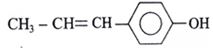
What will be the product of the reaction with $HBr$?
A
$CH_3CHBrCH_2-C_6H_4-OH$
B
$CH_3CH_2CH(Br)-C_6H_4-OH$
C
$CH_3CHBrCH_2-C_6H_4-Br$
D
$CH_3CH_2CHBr-C_6H_4-OH$
Solution
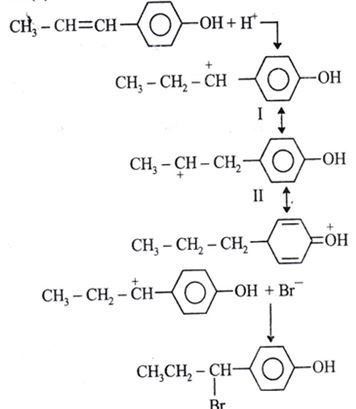
(B) The reaction proceeds via the formation of a carbocation intermediate. When $H^+$ adds to the double bond,it forms a carbocation at the benzylic position,which is stabilized by resonance due to the electron-donating $-OH$ group at the para position. The carbocation $I$ $(CH_3-CH_2-CH^+-C_6H_4-OH)$ is more stable than other possible carbocations. Subsequently,the $Br^-$ ion attacks this stable carbocation to form the final product: $CH_3-CH_2-CH(Br)-C_6H_4-OH$.
0 likes
View Solution154
MediumMCQ
Which of the following substances does not contain a $-COOH$ group?
A
Picric acid
B
Benzoic acid
C
Aspirin
D
All contain a $-COOH$ group.
Solution
(A) $1$. Picric acid is $2,4,6-\text{trinitrophenol}$. Its structure contains a phenolic $-OH$ group and three $-NO_2$ groups,but no $-COOH$ group.
$2$. Benzoic acid is $C_6H_5COOH$,which contains a $-COOH$ group.
$3$. Aspirin is acetylsalicylic acid,which contains a $-COOH$ group.
$4$. Therefore,picric acid is the substance that does not contain a $-COOH$ group.
$2$. Benzoic acid is $C_6H_5COOH$,which contains a $-COOH$ group.
$3$. Aspirin is acetylsalicylic acid,which contains a $-COOH$ group.
$4$. Therefore,picric acid is the substance that does not contain a $-COOH$ group.
0 likes
View Solution155
MediumMCQ
Which of the following compounds will give an ester with acid chloride?
A
Phenol
B
$CH_3-COOH$
C
$CH_3-COCl$
D
None of these
Solution
(A) Phenols react with acid chlorides $(R-COCl)$ in the presence of a base (like pyridine) to form esters. The reaction is known as esterification or acylation of phenols.
The reaction is as follows:
$C_6H_5OH + R-COCl \xrightarrow{\text{base}} C_6H_5O-CO-R + HCl$
Thus,phenol is the compound that reacts with acid chloride to form an ester.
The reaction is as follows:
$C_6H_5OH + R-COCl \xrightarrow{\text{base}} C_6H_5O-CO-R + HCl$
Thus,phenol is the compound that reacts with acid chloride to form an ester.
0 likes
View Solution156
MediumMCQ
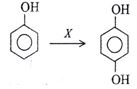
What is $X$ in the given reaction?
A
Air
B
$KMnO_4 / H_2SO_4$
C
$K_2S_2O_8$
D
$K_2SO_4$
Solution
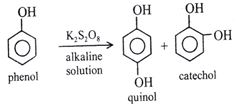
(C) The reaction of phenol with potassium persulphate $(K_2S_2O_8)$ in an alkaline medium is known as the Elbs persulphate oxidation.
This reaction results in the hydroxylation of phenol to form a mixture of ortho- and para-dihydroxybenzenes (catechol and quinol).
Therefore,the reagent $X$ is $K_2S_2O_8$ in an alkaline solution.
This reaction results in the hydroxylation of phenol to form a mixture of ortho- and para-dihydroxybenzenes (catechol and quinol).
Therefore,the reagent $X$ is $K_2S_2O_8$ in an alkaline solution.
0 likes
View Solution157
MediumMCQ
What is the increasing order of boiling points for the following alcohols?
$I.$ $1, 2-$dihydroxybenzene
$II.$ $1, 3-$dihydroxybenzene
$III.$ $1, 4-$dihydroxybenzene
$IV.$ hydroxybenzene
$I.$ $1, 2-$dihydroxybenzene
$II.$ $1, 3-$dihydroxybenzene
$III.$ $1, 4-$dihydroxybenzene
$IV.$ hydroxybenzene
A
$I < II < IV < III$
B
$I < II < III < IV$
C
$IV < I < II < III$
D
$IV < I < III < II$
Solution
(C) The boiling point of a compound depends on the extent of intermolecular hydrogen bonding.
$1.$ Hydroxybenzene $(IV)$ has only one $-OH$ group,so it has the lowest boiling point.
$2.$ Among the dihydroxybenzenes,$1, 2-$dihydroxybenzene $(I)$ exhibits intramolecular hydrogen bonding,which reduces the extent of intermolecular hydrogen bonding,leading to a lower boiling point compared to the $1, 3-$ and $1, 4-$ isomers.
$3.$ $1, 3-$dihydroxybenzene $(II)$ and $1, 4-$dihydroxybenzene $(III)$ exhibit strong intermolecular hydrogen bonding. $1, 4-$dihydroxybenzene has a more symmetrical structure and stronger intermolecular forces,resulting in the highest boiling point.
Thus,the increasing order of boiling points is: $IV < I < II < III$.
$1.$ Hydroxybenzene $(IV)$ has only one $-OH$ group,so it has the lowest boiling point.
$2.$ Among the dihydroxybenzenes,$1, 2-$dihydroxybenzene $(I)$ exhibits intramolecular hydrogen bonding,which reduces the extent of intermolecular hydrogen bonding,leading to a lower boiling point compared to the $1, 3-$ and $1, 4-$ isomers.
$3.$ $1, 3-$dihydroxybenzene $(II)$ and $1, 4-$dihydroxybenzene $(III)$ exhibit strong intermolecular hydrogen bonding. $1, 4-$dihydroxybenzene has a more symmetrical structure and stronger intermolecular forces,resulting in the highest boiling point.
Thus,the increasing order of boiling points is: $IV < I < II < III$.
0 likes
View Solution158
MediumMCQ
Which of the following is the electrophile involved in this reaction?

A
Dichloromethyl cation $(CHCl_2^+)$
B
Dichlorocarbene $(:CCl_2)$
C
Trichloromethyl anion $(CCl_3^-)$
D
Formyl cation $(CHO^+)$
Solution
(B) The reaction shown is the Reimer-Tiemann reaction.
In this reaction,the electrophile involved is dichlorocarbene $(:CCl_2)$.
It is generated from chloroform $(CHCl_3)$ by the action of a base $(OH^-)$:
$OH^- + CHCl_3 \rightleftharpoons H_2O + :CCl_3^-$
$:CCl_3^- \to Cl^- + :CCl_2$
In this reaction,the electrophile involved is dichlorocarbene $(:CCl_2)$.
It is generated from chloroform $(CHCl_3)$ by the action of a base $(OH^-)$:
$OH^- + CHCl_3 \rightleftharpoons H_2O + :CCl_3^-$
$:CCl_3^- \to Cl^- + :CCl_2$
0 likes
View Solution159
MediumMCQ
What is the major product formed when phenol reacts with sodium hydroxide and carbon dioxide?
A
Benzoic acid
B
Salicylaldehyde
C
Salicylic acid
D
Phthalic acid
Solution
(C) The reaction of phenol with $NaOH$ followed by $CO_2$ is known as the Kolbe-Schmitt reaction.
In this reaction,phenol is first converted to sodium phenoxide,which then undergoes electrophilic substitution with $CO_2$ at high pressure and temperature to form sodium salicylate.
Upon acidification,this yields salicylic acid as the major product.
In this reaction,phenol is first converted to sodium phenoxide,which then undergoes electrophilic substitution with $CO_2$ at high pressure and temperature to form sodium salicylate.
Upon acidification,this yields salicylic acid as the major product.
0 likes
View Solution160
MediumMCQ
Phenol $\xrightarrow{Zn \, \text{dust}} X$ $\xrightarrow[Anhyd. \, AlCl_3]{CH_3Cl} Y$ $\xrightarrow{\text{Alkaline } KMnO_4} Z$. In the above reaction,what is $Z$?
A
Toluene
B
Benzene
C
Benzoic acid
D
Benzaldehyde
Solution
(C) $1$. Phenol reacts with $Zn$ dust to form Benzene $(X)$.
$2$. Benzene undergoes Friedel-Crafts alkylation with $CH_3Cl$ in the presence of anhydrous $AlCl_3$ to form Toluene $(Y)$.
$3$. Toluene is oxidized by alkaline $KMnO_4$ to form Benzoic acid $(Z)$.
$2$. Benzene undergoes Friedel-Crafts alkylation with $CH_3Cl$ in the presence of anhydrous $AlCl_3$ to form Toluene $(Y)$.
$3$. Toluene is oxidized by alkaline $KMnO_4$ to form Benzoic acid $(Z)$.
0 likes
View Solution161
MediumMCQ
Benzoic acid on heating with $X$ gives benzene and phenol on heating with $Y$ gives benzene. What are $X$ and $Y$ respectively?
A
Sodium and Copper
B
Zinc dust and Sodium hydroxide
C
Zinc dust and Sodalime
D
Sodalime and Zinc dust
Solution
(D) Benzoic acid $(C_6H_5COOH)$ reacts with sodalime $(NaOH + CaO)$ to undergo decarboxylation,yielding benzene $(C_6H_6)$ and sodium carbonate $(Na_2CO_3)$. Thus,$X$ is sodalime.
Phenol $(C_6H_5OH)$ reacts with zinc dust $(Zn)$ to undergo reduction,yielding benzene $(C_6H_6)$ and zinc oxide $(ZnO)$. Thus,$Y$ is zinc dust.
Therefore,$X$ is sodalime and $Y$ is zinc dust. The correct option is $D$.
Phenol $(C_6H_5OH)$ reacts with zinc dust $(Zn)$ to undergo reduction,yielding benzene $(C_6H_6)$ and zinc oxide $(ZnO)$. Thus,$Y$ is zinc dust.
Therefore,$X$ is sodalime and $Y$ is zinc dust. The correct option is $D$.
0 likes
View Solution162
MediumMCQ
Which of the following substances gives a violet color with neutral ferric chloride $(FeCl_3)$?
A
Acetic acid
B
Salicylic acid
C
Formic acid
D
Benzoic acid
Solution
(B) Salicylic acid contains a phenolic $-OH$ group attached to the benzene ring.
Compounds containing a phenolic group react with neutral $FeCl_3$ to form a violet-colored complex.
This is a characteristic test for phenols.
Compounds containing a phenolic group react with neutral $FeCl_3$ to form a violet-colored complex.
This is a characteristic test for phenols.
0 likes
View Solution163
MediumMCQ
Which of the following is the weakest acid?
A
Phenol
B
$CH_3COOH$
C
$HCOOH$
D
Benzoic acid
Solution
(A) The acidity of the given compounds follows the order: $HCOOH > C_6H_5COOH > CH_3COOH > C_6H_5OH$.
Carboxylic acids are generally stronger acids than phenols because the carboxylate ion is more effectively stabilized by resonance than the phenoxide ion.
Among the given options,phenol $(C_6H_5OH)$ is the weakest acid.
Carboxylic acids are generally stronger acids than phenols because the carboxylate ion is more effectively stabilized by resonance than the phenoxide ion.
Among the given options,phenol $(C_6H_5OH)$ is the weakest acid.
0 likes
View Solution164
MediumMCQ
Which of the following reagents can be used to distinguish between phenol and ethanoic acid?
A
Ammoniacal silver nitrate solution
B
Fehling's solution
C
Sodium carbonate solution
D
Phenolphthalein
Solution
(C) Ethanoic acid $(CH_3COOH)$ is a stronger acid than phenol $(C_6H_5OH)$.
Ethanoic acid reacts with sodium carbonate $(Na_2CO_3)$ to evolve $CO_2$ gas,which is observed as effervescence.
Phenol is a weaker acid and does not react with sodium carbonate to evolve $CO_2$ gas.
Therefore,sodium carbonate solution is used to distinguish between them.
Ethanoic acid reacts with sodium carbonate $(Na_2CO_3)$ to evolve $CO_2$ gas,which is observed as effervescence.
Phenol is a weaker acid and does not react with sodium carbonate to evolve $CO_2$ gas.
Therefore,sodium carbonate solution is used to distinguish between them.
0 likes
View Solution165
MediumMCQ
Identify the incorrect statement from the following.
A
Salicylic acid is a monobasic acid.
B
Methyl salicylate is an ester.
C
Salicylic acid gives a violet color with neutral $FeCl_3$ solution and brisk effervescence with sodium bicarbonate.
D
Methyl salicylate is not found in natural oils.
Solution
(D) Salicylic acid $(C_7H_6O_3)$ contains one carboxylic group $(-COOH)$ and one phenolic hydroxyl group $(-OH)$. It acts as a monobasic acid due to the $-COOH$ group. It reacts with neutral $FeCl_3$ to give a violet color (due to the phenolic group) and with $NaHCO_3$ to release $CO_2$ gas (effervescence). Methyl salicylate is an ester known as 'oil of wintergreen' and is found in several natural oils. Therefore,the statement that it is not found in natural oils is incorrect.
0 likes
View Solution166
MediumMCQ
Phenol is more acidic than:
A
$o-$Methoxy phenol
B
$p-$Nitrophenol
C
$C_2H_2$
D
Both $(a)$ and $(c)$
Solution
(D) The methoxy group $(-OCH_3)$ exerts a $+I$ effect and $+M$ effect. The $+I$ effect increases the electron density on the oxygen atom of the $-OH$ group,which destabilizes the phenoxide ion and decreases the acidity of phenol.
$o-$Methoxy phenol is less acidic than phenol due to the electron-donating nature of the methoxy group.
Acetylene $(C_2H_2)$ is a terminal alkyne with a $pK_a$ of approximately $25$,whereas phenol has a $pK_a$ of approximately $10$. Thus,phenol is significantly more acidic than acetylene.
$p-$Nitrophenol is more acidic than phenol due to the strong $-I$ and $-M$ effects of the nitro group,which stabilize the phenoxide ion.
$o-$Methoxy phenol is less acidic than phenol due to the electron-donating nature of the methoxy group.
Acetylene $(C_2H_2)$ is a terminal alkyne with a $pK_a$ of approximately $25$,whereas phenol has a $pK_a$ of approximately $10$. Thus,phenol is significantly more acidic than acetylene.
$p-$Nitrophenol is more acidic than phenol due to the strong $-I$ and $-M$ effects of the nitro group,which stabilize the phenoxide ion.
0 likes
View Solution167
DifficultMCQ
The compound $X$ in the reaction is

A
Sodium benzoate
B
Sodium salicylate
C
Sodium phenoxide
D
Sodium phenyl carbonate
Solution
(B) The given reaction is the Kolbe-Schmitt reaction.
In this reaction,sodium phenoxide reacts with carbon dioxide $(CO_2)$ at a temperature of $390 \ K$ and high pressure to form sodium phenyl carbonate as an intermediate,which then undergoes rearrangement to form sodium salicylate $(X)$.
Finally,acidification with $HCl$ yields salicylic acid.
Thus,the compound $X$ is sodium salicylate.
In this reaction,sodium phenoxide reacts with carbon dioxide $(CO_2)$ at a temperature of $390 \ K$ and high pressure to form sodium phenyl carbonate as an intermediate,which then undergoes rearrangement to form sodium salicylate $(X)$.
Finally,acidification with $HCl$ yields salicylic acid.
Thus,the compound $X$ is sodium salicylate.
0 likes
View Solution168
DifficultMCQ
Identify the reaction shown below:
$C_6H_5OH + CH_2O \xrightarrow{\text{acid or base}} \text{o-hydroxybenzyl alcohol} + \text{p-hydroxybenzyl alcohol}$
$C_6H_5OH + CH_2O \xrightarrow{\text{acid or base}} \text{o-hydroxybenzyl alcohol} + \text{p-hydroxybenzyl alcohol}$
A
Lederer-Manasse reaction
B
Claisen condensation
C
Benzoin condensation
D
Etard reaction
Solution
(A) The reaction of phenol with formaldehyde $(CH_2O)$ in the presence of an acid or base catalyst leads to the formation of ortho- and para-hydroxybenzyl alcohols.
This specific electrophilic aromatic substitution reaction is known as the Lederer-Manasse reaction.
Therefore,the correct option is $(A)$.
This specific electrophilic aromatic substitution reaction is known as the Lederer-Manasse reaction.
Therefore,the correct option is $(A)$.
0 likes
View Solution169
DifficultMCQ
When phenol is reacted with $CHCl_3$ and $NaOH$ followed by acidification,salicylaldehyde is obtained. Which of the following species are involved in the above mentioned reaction as intermediates?
A
$:CCl_2$
B
Phenoxide ion
C
Dichloromethyl cation
D
All of these
Solution
(D) The reaction described is the Reimer-Tiemann reaction.
$1$. $NaOH$ reacts with $CHCl_3$ to generate the electrophilic intermediate dichlorocarbene,$:CCl_2$.
$2$. Phenol reacts with $NaOH$ to form the phenoxide ion,which is more reactive towards electrophilic substitution.
$3$. The phenoxide ion undergoes electrophilic attack by $:CCl_2$ to form a dichloromethyl substituted intermediate.
$4$. Since $:CCl_2$ and the phenoxide ion are both involved as intermediates in the reaction mechanism,and the dichloromethyl substituted species is also an intermediate,all the listed species are involved.
Therefore,the correct option is $D$.
$1$. $NaOH$ reacts with $CHCl_3$ to generate the electrophilic intermediate dichlorocarbene,$:CCl_2$.
$2$. Phenol reacts with $NaOH$ to form the phenoxide ion,which is more reactive towards electrophilic substitution.
$3$. The phenoxide ion undergoes electrophilic attack by $:CCl_2$ to form a dichloromethyl substituted intermediate.
$4$. Since $:CCl_2$ and the phenoxide ion are both involved as intermediates in the reaction mechanism,and the dichloromethyl substituted species is also an intermediate,all the listed species are involved.
Therefore,the correct option is $D$.
0 likes
View Solution170
MediumMCQ
In the following compounds,the order of acidity is:
$(I)$ Phenol
$(II)$ $p$-Cresol
$(III)$ $m$-Nitrophenol
$(IV)$ $p$-Nitrophenol
$(I)$ Phenol
$(II)$ $p$-Cresol
$(III)$ $m$-Nitrophenol
$(IV)$ $p$-Nitrophenol
A
$III > IV > I > II$
B
$I > IV > III > II$
C
$II > I > III > IV$
D
$IV > III > I > II$
Solution
(D) The acidity of phenols depends on the nature of the substituents attached to the benzene ring.
$1$. Electron-withdrawing groups $(EWG)$ like $-NO_2$ increase acidity by stabilizing the phenoxide ion through inductive and resonance effects.
$2$. Electron-releasing groups $(ERG)$ like $-CH_3$ decrease acidity by destabilizing the phenoxide ion.
$3$. In $p$-nitrophenol $(IV)$,the $-NO_2$ group at the para position exerts both $-I$ and $-M$ effects,making it the most acidic.
$4$. In $m$-nitrophenol $(III)$,the $-NO_2$ group exerts only the $-I$ effect,making it less acidic than $p$-nitrophenol but more acidic than phenol.
$5$. Phenol $(I)$ is the reference compound.
$6$. In $p$-cresol $(II)$,the $-CH_3$ group exerts $+I$ and hyperconjugation effects,which decrease the acidity,making it the least acidic.
Therefore,the correct order of acidity is $IV > III > I > II$.
$1$. Electron-withdrawing groups $(EWG)$ like $-NO_2$ increase acidity by stabilizing the phenoxide ion through inductive and resonance effects.
$2$. Electron-releasing groups $(ERG)$ like $-CH_3$ decrease acidity by destabilizing the phenoxide ion.
$3$. In $p$-nitrophenol $(IV)$,the $-NO_2$ group at the para position exerts both $-I$ and $-M$ effects,making it the most acidic.
$4$. In $m$-nitrophenol $(III)$,the $-NO_2$ group exerts only the $-I$ effect,making it less acidic than $p$-nitrophenol but more acidic than phenol.
$5$. Phenol $(I)$ is the reference compound.
$6$. In $p$-cresol $(II)$,the $-CH_3$ group exerts $+I$ and hyperconjugation effects,which decrease the acidity,making it the least acidic.
Therefore,the correct order of acidity is $IV > III > I > II$.
0 likes
View Solution171
MediumMCQ
Which of the following is the weakest acid?
A
Phenol $(C_6H_5OH)$
B
$CH_3COOH$
C
$HCOOH$
D
$ClCH_2COOH$
Solution
(A) The acidity of these compounds depends on the stability of their conjugate bases.
$1$. $ClCH_2COOH$ is the strongest acid due to the strong electron-withdrawing effect of the chlorine atom,which stabilizes the carboxylate anion.
$2$. $HCOOH$ is stronger than $CH_3COOH$ because the methyl group in $CH_3COOH$ is electron-donating,which destabilizes the carboxylate anion.
$3$. Phenol $(C_6H_5OH)$ is a much weaker acid than carboxylic acids because the negative charge on the phenoxide ion is less effectively delocalized compared to the resonance-stabilized carboxylate ion.
Therefore,phenol is the weakest acid among the given options.
$1$. $ClCH_2COOH$ is the strongest acid due to the strong electron-withdrawing effect of the chlorine atom,which stabilizes the carboxylate anion.
$2$. $HCOOH$ is stronger than $CH_3COOH$ because the methyl group in $CH_3COOH$ is electron-donating,which destabilizes the carboxylate anion.
$3$. Phenol $(C_6H_5OH)$ is a much weaker acid than carboxylic acids because the negative charge on the phenoxide ion is less effectively delocalized compared to the resonance-stabilized carboxylate ion.
Therefore,phenol is the weakest acid among the given options.
0 likes
View Solution172
MediumMCQ
Which one of the following is most reactive towards electrophilic attack?
A
Phenol
B
Chlorobenzene
C
Nitrobenzene
D
Benzyl alcohol
Solution
(A) The reactivity of an aromatic ring towards electrophilic substitution depends on the nature of the substituent attached to it.
Groups that donate electrons to the ring (activating groups) increase the electron density on the ring,making it more reactive towards electrophiles. Examples include $-OH$,$-NH_2$,etc.
Groups that withdraw electrons from the ring (deactivating groups) decrease the electron density on the ring,making it less reactive. Examples include $-NO_2$,$-Cl$ (which is deactivating due to its strong $-I$ effect despite its $+M$ effect).
In the given options:
$(A)$ Phenol ($-OH$ group) is strongly activating due to the $+M$ effect.
$(B)$ Chlorobenzene ($-Cl$ group) is deactivating due to the strong $-I$ effect.
$(C)$ Nitrobenzene ($-NO_2$ group) is strongly deactivating due to both $-I$ and $-M$ effects.
$(D)$ Benzyl alcohol ($-CH_2OH$ group) has a weak activating effect due to hyperconjugation,but it is less activating than the $-OH$ group directly attached to the ring.
Therefore,phenol is the most reactive towards electrophilic attack.
Groups that donate electrons to the ring (activating groups) increase the electron density on the ring,making it more reactive towards electrophiles. Examples include $-OH$,$-NH_2$,etc.
Groups that withdraw electrons from the ring (deactivating groups) decrease the electron density on the ring,making it less reactive. Examples include $-NO_2$,$-Cl$ (which is deactivating due to its strong $-I$ effect despite its $+M$ effect).
In the given options:
$(A)$ Phenol ($-OH$ group) is strongly activating due to the $+M$ effect.
$(B)$ Chlorobenzene ($-Cl$ group) is deactivating due to the strong $-I$ effect.
$(C)$ Nitrobenzene ($-NO_2$ group) is strongly deactivating due to both $-I$ and $-M$ effects.
$(D)$ Benzyl alcohol ($-CH_2OH$ group) has a weak activating effect due to hyperconjugation,but it is less activating than the $-OH$ group directly attached to the ring.
Therefore,phenol is the most reactive towards electrophilic attack.
0 likes
View Solution173
MediumMCQ
Which one is the most acidic compound?
A
Phenol
B
$p$-Nitrophenol
C
$2,4,6$-Trinitrophenol (Picric acid)
D
$p$-Cresol
Solution
(C) The acidity of phenols depends on the stability of the phenoxide ion formed after the loss of a proton. Electron-withdrawing groups ($-I$ and $-M$ effects) increase acidity by stabilizing the phenoxide ion,while electron-donating groups (like $-CH_3$) decrease acidity.
$1$. $2,4,6$-Trinitrophenol has three $-NO_2$ groups,which exert strong $-I$ and $-M$ effects,making it the most acidic.
$2$. $p$-Nitrophenol has one $-NO_2$ group,which is acidic but less than picric acid.
$3$. Phenol has no substituent.
$4$. $p$-Cresol has a $-CH_3$ group,which is electron-donating ($+I$ and hyperconjugation),making it the least acidic.
Therefore,the order of acidity is: $2,4,6$-Trinitrophenol > $p$-Nitrophenol > Phenol > $p$-Cresol.
$1$. $2,4,6$-Trinitrophenol has three $-NO_2$ groups,which exert strong $-I$ and $-M$ effects,making it the most acidic.
$2$. $p$-Nitrophenol has one $-NO_2$ group,which is acidic but less than picric acid.
$3$. Phenol has no substituent.
$4$. $p$-Cresol has a $-CH_3$ group,which is electron-donating ($+I$ and hyperconjugation),making it the least acidic.
Therefore,the order of acidity is: $2,4,6$-Trinitrophenol > $p$-Nitrophenol > Phenol > $p$-Cresol.
0 likes
View Solution174
DifficultMCQ
Reaction of phenol with chloroform in the presence of dilute sodium hydroxide finally introduces which one of the following functional groups?
A
$-COOH$
B
$-CHCl_2$
C
$-CHO$
D
$-CH_2Cl$
Solution
(C) The reaction of phenol with chloroform $(CHCl_3)$ in the presence of aqueous sodium hydroxide $(NaOH)$ is known as the Reimer-Tiemann reaction.
This reaction introduces an aldehyde group $(-CHO)$ at the $ortho$ position of the phenol ring.
The overall transformation is: $C_6H_5OH + CHCl_3 + 3NaOH \rightarrow C_6H_4(OH)(CHO) + 3NaCl + 2H_2O$.
This reaction introduces an aldehyde group $(-CHO)$ at the $ortho$ position of the phenol ring.
The overall transformation is: $C_6H_5OH + CHCl_3 + 3NaOH \rightarrow C_6H_4(OH)(CHO) + 3NaCl + 2H_2O$.
0 likes
View Solution175
MediumMCQ
Which of the following will not be soluble in sodium hydrogen carbonate?
A
$2,4,6-$ Trinitrophenol
B
Benzoic acid
C
$o-$ Nitrophenol
D
Benzenesulphonic acid
Solution
(C) The solubility of an organic acid in $NaHCO_3$ depends on its acidity. An acid will react with $NaHCO_3$ to form a salt and evolve $CO_2$ gas if it is stronger than carbonic acid $(H_2CO_3)$.
The general reaction is: $\text{Acid} + NaHCO_3 \longrightarrow \text{Salt} + H_2O + CO_2$.
$1$. $2,4,6-$Trinitrophenol (picric acid),benzoic acid,and benzenesulphonic acid are stronger acids than $H_2CO_3$ and thus dissolve in $NaHCO_3$ solution.
$2$. $o-$Nitrophenol is a weaker acid than $H_2CO_3$ due to intramolecular hydrogen bonding,which stabilizes the molecule and hinders the release of the proton. Therefore,it does not react with $NaHCO_3$ and is not soluble in it.
The general reaction is: $\text{Acid} + NaHCO_3 \longrightarrow \text{Salt} + H_2O + CO_2$.
$1$. $2,4,6-$Trinitrophenol (picric acid),benzoic acid,and benzenesulphonic acid are stronger acids than $H_2CO_3$ and thus dissolve in $NaHCO_3$ solution.
$2$. $o-$Nitrophenol is a weaker acid than $H_2CO_3$ due to intramolecular hydrogen bonding,which stabilizes the molecule and hinders the release of the proton. Therefore,it does not react with $NaHCO_3$ and is not soluble in it.
0 likes
View Solution176
DifficultMCQ
Given are cyclohexanol $(I)$,acetic acid $(II)$,$2,4,6-$trinitrophenol $(III)$ and phenol $(IV)$. The order of decreasing acidic character is:
A
$III > II > IV > I$
B
$II > III > I > IV$
C
$II > III > IV > I$
D
$III > IV > II > I$
Solution
(A) The acidic strength depends on the stability of the conjugate base formed after the loss of a proton $(H^+)$.
$2,4,6-$trinitrophenol $(III)$ is the most acidic because the phenoxide ion is highly stabilized by the strong $-I$ and $-M$ effects of three $-NO_2$ groups.
Acetic acid $(II)$ is more acidic than phenol $(IV)$ because the carboxylate ion is stabilized by resonance between two electronegative oxygen atoms,whereas the phenoxide ion is stabilized by resonance within the aromatic ring.
Phenol $(IV)$ is more acidic than cyclohexanol $(I)$ because the phenoxide ion is resonance-stabilized,while the cyclohexoxide ion has no such stabilization.
Cyclohexanol $(I)$ is the least acidic as the alkyl group is electron-donating ($+I$ effect),which destabilizes the alkoxide ion.
Therefore,the order of decreasing acidic strength is $III > II > IV > I$.
$2,4,6-$trinitrophenol $(III)$ is the most acidic because the phenoxide ion is highly stabilized by the strong $-I$ and $-M$ effects of three $-NO_2$ groups.
Acetic acid $(II)$ is more acidic than phenol $(IV)$ because the carboxylate ion is stabilized by resonance between two electronegative oxygen atoms,whereas the phenoxide ion is stabilized by resonance within the aromatic ring.
Phenol $(IV)$ is more acidic than cyclohexanol $(I)$ because the phenoxide ion is resonance-stabilized,while the cyclohexoxide ion has no such stabilization.
Cyclohexanol $(I)$ is the least acidic as the alkyl group is electron-donating ($+I$ effect),which destabilizes the alkoxide ion.
Therefore,the order of decreasing acidic strength is $III > II > IV > I$.
0 likes
View Solution177
DifficultMCQ
Which of the following compounds has the most acidic nature?
A
Benzyl alcohol $(C_6H_5CH_2OH)$
B
Phenol
C
Cyclohexanol $(C_6H_{11}OH)$
D
Dicyclohexylmethanol $((C_6H_{11})_2CHOH)$
Solution
(B) The acidity of a compound depends on the stability of its conjugate base.
$1$. Phenol $(C_6H_5OH)$ forms a phenoxide ion $(C_6H_5O^-)$ upon losing a proton. This phenoxide ion is highly resonance-stabilized by the benzene ring,making phenol the most acidic among the given options.
$2$. Benzyl alcohol $(C_6H_5CH_2OH)$ forms a benzyloxide ion $(C_6H_5CH_2O^-)$,where the negative charge is localized on the oxygen atom and is not resonance-stabilized by the benzene ring.
$3$. Cyclohexanol and dicyclohexylmethanol are aliphatic alcohols. The alkyl groups attached to the carbon bearing the $-OH$ group are electron-releasing ($+I$ effect),which destabilizes the alkoxide ion and decreases acidity.
Therefore,phenol is the most acidic compound.
$1$. Phenol $(C_6H_5OH)$ forms a phenoxide ion $(C_6H_5O^-)$ upon losing a proton. This phenoxide ion is highly resonance-stabilized by the benzene ring,making phenol the most acidic among the given options.
$2$. Benzyl alcohol $(C_6H_5CH_2OH)$ forms a benzyloxide ion $(C_6H_5CH_2O^-)$,where the negative charge is localized on the oxygen atom and is not resonance-stabilized by the benzene ring.
$3$. Cyclohexanol and dicyclohexylmethanol are aliphatic alcohols. The alkyl groups attached to the carbon bearing the $-OH$ group are electron-releasing ($+I$ effect),which destabilizes the alkoxide ion and decreases acidity.
Therefore,phenol is the most acidic compound.
0 likes
View Solution178
MediumMCQ
Among the following four compounds:
$(i)$ Phenol
$(ii)$ Methyl phenol
$(iii)$ Meta-nitrophenol
$(iv)$ Para-nitrophenol
The acidity order is:
$(i)$ Phenol
$(ii)$ Methyl phenol
$(iii)$ Meta-nitrophenol
$(iv)$ Para-nitrophenol
The acidity order is:
A
$(iv) > (iii) > (i) > (ii)$
B
$(iii) > (iv) > (i) > (ii)$
C
$(i) > (iv) > (iii) > (ii)$
D
$(ii) > (i) > (iii) > (iv)$
Solution
(A) The acidity of phenols is determined by the stability of the phenoxide ion formed after the loss of a proton.
Electron-withdrawing groups $(EWG)$,such as $-NO_2$,stabilize the phenoxide ion through $-I$ and $-M$ effects,thereby increasing the acidity.
Electron-releasing groups $(ERG)$,such as $-CH_3$,destabilize the phenoxide ion through $+I$ and $+H$ effects,thereby decreasing the acidity.
Comparing the compounds:
$1$. $(iv)$ Para-nitrophenol: $-NO_2$ at para position exerts both $-I$ and $-M$ effects,providing maximum stabilization.
$2$. $(iii)$ Meta-nitrophenol: $-NO_2$ at meta position exerts only $-I$ effect,providing less stabilization than para.
$3$. $(i)$ Phenol: Reference compound.
$4$. $(ii)$ Methyl phenol: $-CH_3$ group exerts $+I$ and $+H$ effects,destabilizing the phenoxide ion.
Thus,the correct order of acidity is $(iv) > (iii) > (i) > (ii)$.
Electron-withdrawing groups $(EWG)$,such as $-NO_2$,stabilize the phenoxide ion through $-I$ and $-M$ effects,thereby increasing the acidity.
Electron-releasing groups $(ERG)$,such as $-CH_3$,destabilize the phenoxide ion through $+I$ and $+H$ effects,thereby decreasing the acidity.
Comparing the compounds:
$1$. $(iv)$ Para-nitrophenol: $-NO_2$ at para position exerts both $-I$ and $-M$ effects,providing maximum stabilization.
$2$. $(iii)$ Meta-nitrophenol: $-NO_2$ at meta position exerts only $-I$ effect,providing less stabilization than para.
$3$. $(i)$ Phenol: Reference compound.
$4$. $(ii)$ Methyl phenol: $-CH_3$ group exerts $+I$ and $+H$ effects,destabilizing the phenoxide ion.
Thus,the correct order of acidity is $(iv) > (iii) > (i) > (ii)$.
0 likes
View Solution179
DifficultMCQ
Consider the following reaction:
$Phenol$ $\xrightarrow{Zn\,dust} X$ $\xrightarrow[{Anhyd.\,AlCl_3}]{CH_3Cl} Y$ $\xrightarrow{Alkaline\,KMnO_4} Z$
The product $Z$ is:
$Phenol$ $\xrightarrow{Zn\,dust} X$ $\xrightarrow[{Anhyd.\,AlCl_3}]{CH_3Cl} Y$ $\xrightarrow{Alkaline\,KMnO_4} Z$
The product $Z$ is:
A
benzaldehyde
B
benzoic acid
C
benzene
D
toluene
Solution
(B) Step $1$: Phenol reacts with $Zn$ dust to form benzene $(X)$.
$C_6H_5OH + Zn \rightarrow C_6H_6 + ZnO$
Step $2$: Benzene undergoes Friedel-Crafts alkylation with $CH_3Cl$ in the presence of anhydrous $AlCl_3$ to form toluene $(Y)$.
$C_6H_6 + CH_3Cl \xrightarrow{Anhyd.\,AlCl_3} C_6H_5CH_3 + HCl$
Step $3$: Toluene $(Y)$ is oxidized by alkaline $KMnO_4$ to form benzoic acid $(Z)$.
$C_6H_5CH_3 \xrightarrow{Alkaline\,KMnO_4} C_6H_5COOH$
Therefore,the product $Z$ is benzoic acid.
$C_6H_5OH + Zn \rightarrow C_6H_6 + ZnO$
Step $2$: Benzene undergoes Friedel-Crafts alkylation with $CH_3Cl$ in the presence of anhydrous $AlCl_3$ to form toluene $(Y)$.
$C_6H_6 + CH_3Cl \xrightarrow{Anhyd.\,AlCl_3} C_6H_5CH_3 + HCl$
Step $3$: Toluene $(Y)$ is oxidized by alkaline $KMnO_4$ to form benzoic acid $(Z)$.
$C_6H_5CH_3 \xrightarrow{Alkaline\,KMnO_4} C_6H_5COOH$
Therefore,the product $Z$ is benzoic acid.
0 likes
View Solution180
MediumMCQ
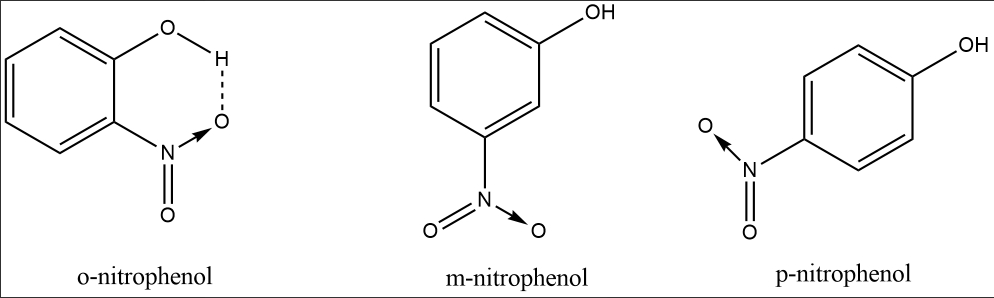
$o-$Nitrophenol is less soluble in water than $p-$ and $m-$Nitrophenols because:
A
$o-$Nitrophenol is more volatile in steam than those of $m-$ and $p-$ isomers.
B
$o-$Nitrophenol shows intramolecular $H-$bonding.
C
$o-$Nitrophenol shows intermolecular $H-$bonding.
D
Melting point of $o-$Nitrophenol is lower than those of $m-$ and $p-$isomers.
Solution
(B) Due to intramolecular $H-$bonding,the $-OH$ group is not available to form a hydrogen bond with water molecules.
Hence,$o-$nitrophenol is sparingly soluble in water,while $m-$ and $p-$nitrophenols are more soluble due to their ability to form intermolecular $H-$bonding with water.
Hence,$o-$nitrophenol is sparingly soluble in water,while $m-$ and $p-$nitrophenols are more soluble due to their ability to form intermolecular $H-$bonding with water.
0 likes
View Solution181
DifficultMCQ
The structure of the compound that gives a tribromo derivative on treatment with bromine water is
A
B
C
D
Solution
(C) When phenols are treated with bromine water,the $-OH$ group strongly activates the benzene ring,leading to electrophilic substitution at all available ortho and para positions.
For $m$-cresol ($3$-methylphenol),the positions ortho and para to the $-OH$ group are available for substitution.
Specifically,the positions ortho to the $-OH$ group (at $C2$ and $C6$) and the position para to the $-OH$ group (at $C4$) are all activated,leading to the formation of $2,4,6-$tribromo$-3-$methylphenol.
Therefore,$m$-cresol gives a tribromo derivative.
For $m$-cresol ($3$-methylphenol),the positions ortho and para to the $-OH$ group are available for substitution.
Specifically,the positions ortho to the $-OH$ group (at $C2$ and $C6$) and the position para to the $-OH$ group (at $C4$) are all activated,leading to the formation of $2,4,6-$tribromo$-3-$methylphenol.
Therefore,$m$-cresol gives a tribromo derivative.
0 likes
View Solution182
MediumMCQ
The electrophile involved in the below reaction is:

A
trichloromethyl anion $(:\,CCl_3^-)$
B
formyl cation $(HCO^{+})$
C
dichloromethyl cation $(CHCl_2^+)$
D
dichlorocarbene $(:\,CCl_2)$
Solution
(D) The given reaction is the $Reimer-Tiemann$ reaction.
In this reaction,phenol reacts with chloroform $(CHCl_3)$ in the presence of aqueous sodium hydroxide $(NaOH)$ to form salicylaldehyde.
The mechanism involves the formation of dichlorocarbene $(:\,CCl_2)$ as the reactive intermediate,which acts as an electrophile.
Therefore,the correct option is $D$.
In this reaction,phenol reacts with chloroform $(CHCl_3)$ in the presence of aqueous sodium hydroxide $(NaOH)$ to form salicylaldehyde.
The mechanism involves the formation of dichlorocarbene $(:\,CCl_2)$ as the reactive intermediate,which acts as an electrophile.
Therefore,the correct option is $D$.
0 likes
View Solution183
MediumMCQ
Phenol,when it first reacts with concentrated sulphuric acid and then with concentrated nitric acid,gives:
A
$o-$nitrophenol
B
$2, 4, 6-$trinitrophenol
C
$p-$nitrophenol
D
nitrobenzene
Solution
(B) When phenol reacts with concentrated $H_2SO_4$,it undergoes sulphonation to form phenol-$2, 4-$disulphonic acid.
Subsequently,when this product reacts with concentrated $HNO_3$,the sulphonic acid groups are replaced by nitro groups to yield $2, 4, 6-$trinitrophenol,which is commonly known as picric acid.
Therefore,option $B$ is correct.
Subsequently,when this product reacts with concentrated $HNO_3$,the sulphonic acid groups are replaced by nitro groups to yield $2, 4, 6-$trinitrophenol,which is commonly known as picric acid.
Therefore,option $B$ is correct.
0 likes
View Solution184
MediumMCQ
The major product obtained on interaction of phenol with sodium hydroxide and carbon dioxide is
A
salicylaldehyde
B
salicylic acid
C
phthalic acid
D
benzoic acid
Solution
(B) The reaction of phenol with $NaOH$ followed by $CO_2$ at $6 \ atm$ and $140 \ ^\circ C$,and subsequent acidification,is known as the Kolbe-Schmitt reaction.
In this reaction,phenol is first converted to sodium phenoxide.
Sodium phenoxide then reacts with $CO_2$ to form sodium salicylate,which upon acidification yields salicylic acid as the major product.
In this reaction,phenol is first converted to sodium phenoxide.
Sodium phenoxide then reacts with $CO_2$ to form sodium salicylate,which upon acidification yields salicylic acid as the major product.
0 likes
View Solution185
MediumMCQ
Phenol is heated with a solution of a mixture of $KBr$ and $KBrO_3$. The major product obtained in the above reaction is:
A
$2-$ Bromophenol
B
$3-$ Bromophenol
C
$4-$ Bromophenol
D
$2, 4, 6-$ Tribromophenol
Solution
(D) When phenol is treated with a mixture of $KBr$ and $KBrO_3$ in an acidic medium,$Br_2$ is generated in situ.
$5KBr + KBrO_3 + 6H^+ \rightarrow 3Br_2 + 6K^+ + 3H_2O$
Due to the highly activating nature of the $-OH$ group,phenol undergoes electrophilic aromatic substitution with bromine water to form a white precipitate of $2, 4, 6-$ tribromophenol.
$5KBr + KBrO_3 + 6H^+ \rightarrow 3Br_2 + 6K^+ + 3H_2O$
Due to the highly activating nature of the $-OH$ group,phenol undergoes electrophilic aromatic substitution with bromine water to form a white precipitate of $2, 4, 6-$ tribromophenol.
0 likes
View Solution186
MediumMCQ
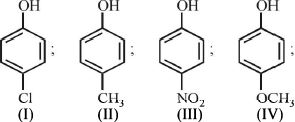
Arrange the following compounds in order of decreasing acidity:
A
$II > IV > I > III$
B
$I > II > III > IV$
C
$III > I > II > IV$
D
$IV > III > I > II$
Solution
(C) The acidity of substituted phenols depends on the nature of the substituent group attached to the benzene ring.
Electron-withdrawing groups $(EWG)$ stabilize the phenoxide ion through $-I$ and $-M$ effects,thereby increasing acidity.
Electron-releasing groups $(ERG)$ destabilize the phenoxide ion through $+I$ and $+M$ effects,thereby decreasing acidity.
Comparing the substituents:
$III$ $(NO_2)$: Strong $-M$ and $-I$ effect (Strongest acid).
$I$ $(Cl)$: $-I$ effect (Weakly acidic).
$II$ $(CH_3)$: $+I$ effect and hyperconjugation (Electron releasing).
$IV$ $(OCH_3)$: Strong $+M$ effect (Strongest electron releasing group,weakest acid).
Thus,the order of decreasing acidity is $III > I > II > IV$.
Electron-withdrawing groups $(EWG)$ stabilize the phenoxide ion through $-I$ and $-M$ effects,thereby increasing acidity.
Electron-releasing groups $(ERG)$ destabilize the phenoxide ion through $+I$ and $+M$ effects,thereby decreasing acidity.
Comparing the substituents:
$III$ $(NO_2)$: Strong $-M$ and $-I$ effect (Strongest acid).
$I$ $(Cl)$: $-I$ effect (Weakly acidic).
$II$ $(CH_3)$: $+I$ effect and hyperconjugation (Electron releasing).
$IV$ $(OCH_3)$: Strong $+M$ effect (Strongest electron releasing group,weakest acid).
Thus,the order of decreasing acidity is $III > I > II > IV$.
0 likes
View Solution187
DifficultMCQ
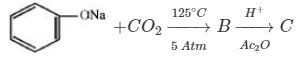
Sodium phenoxide when heated with $CO_2$ under pressure at $125\,^{\circ}C$ yields a product which on acetylation produces $C$. The major product $C$ would be
A
$2-$Acetoxybenzoic acid
B
$4-$Hydroxyacetophenone
C
Methyl salicylate
D
$3-$Acetoxybenzoic acid
Solution
(A) The reaction of sodium phenoxide with $CO_2$ at $125\,^{\circ}C$ and $5 \ atm$ pressure is the Kolbe-Schmidt reaction,which yields salicylic acid ($2$-hydroxybenzoic acid) as the intermediate $B$.
In the second step,salicylic acid undergoes acetylation with acetic anhydride $(Ac_2O)$ to form acetylsalicylic acid,commonly known as Aspirin,which is the major product $C$.
The structure of $C$ is $2$-acetoxybenzoic acid.
In the second step,salicylic acid undergoes acetylation with acetic anhydride $(Ac_2O)$ to form acetylsalicylic acid,commonly known as Aspirin,which is the major product $C$.
The structure of $C$ is $2$-acetoxybenzoic acid.
0 likes
View Solution188
MediumMCQ
Which of the following reagents may be used to distinguish between phenol and benzoic acid?
A
Aqueous $NaOH$
B
Tollen's reagent
C
Molisch reagent
D
Neutral $FeCl_3$
Solution
(D) Phenol reacts with neutral $FeCl_3$ to form a violet-colored complex.
Benzoic acid reacts with neutral $FeCl_3$ to form a buff-colored (pale dull yellow) precipitate of ferric benzoate.
Therefore,neutral $FeCl_3$ can be used to distinguish between them.
Benzoic acid reacts with neutral $FeCl_3$ to form a buff-colored (pale dull yellow) precipitate of ferric benzoate.
Therefore,neutral $FeCl_3$ can be used to distinguish between them.
0 likes
View Solution189
EasyMCQ
By passing vapours of phenol over heated $zinc$ dust will produce :
A
Benzoic acid
B
Quinone
C
Benzene
D
Malic acid
Solution
(C) When phenol is distilled with $Zn$ dust,it undergoes reduction to form benzene as the major product.
The chemical reaction is as follows:
$C_6H_5OH + Zn \rightarrow C_6H_6 + ZnO$
The chemical reaction is as follows:
$C_6H_5OH + Zn \rightarrow C_6H_6 + ZnO$
0 likes
View Solution190
MediumMCQ
Which of the following compounds has the least $pK_a$ value?
A
$p$-nitrophenol
B
$o$-nitrophenol
C
Phenol
D
$p$-methoxyphenol
Solution
(A) The $pK_a$ value is inversely proportional to the acidity of the compound. $A$ stronger acid has a lower $pK_a$ value.
Among the given compounds,the nitro group $(-NO_2)$ is a strong electron-withdrawing group ($-I$ and $-M$ effects),which increases the acidity of phenol by stabilizing the phenoxide ion.
$p$-nitrophenol is more acidic than $o$-nitrophenol because $o$-nitrophenol exhibits intramolecular hydrogen bonding,which stabilizes the undissociated molecule and reduces its acidity compared to $p$-nitrophenol.
Therefore,$p$-nitrophenol is the most acidic and has the least $pK_a$ value.
Among the given compounds,the nitro group $(-NO_2)$ is a strong electron-withdrawing group ($-I$ and $-M$ effects),which increases the acidity of phenol by stabilizing the phenoxide ion.
$p$-nitrophenol is more acidic than $o$-nitrophenol because $o$-nitrophenol exhibits intramolecular hydrogen bonding,which stabilizes the undissociated molecule and reduces its acidity compared to $p$-nitrophenol.
Therefore,$p$-nitrophenol is the most acidic and has the least $pK_a$ value.
0 likes
View Solution191
DifficultMCQ
When benzene sulfonic acid and $p-$nitrophenol are treated with $NaHCO_3$,the gases released respectively are
A
$SO_2, NO_2$
B
$SO_2, NO$
C
$SO_2, CO_2$
D
$CO_2, CO_2$
Solution
(D) Acids that are stronger than carbonic acid $(H_2CO_3)$ react with sodium bicarbonate $(NaHCO_3)$ to evolve carbon dioxide $(CO_2)$ gas.
Benzene sulfonic acid $(C_6H_5SO_3H)$ is a strong acid $(pK_a \approx -2.8)$,which is much stronger than $H_2CO_3$ $(pK_a \approx 6.35)$,so it releases $CO_2$.
$p-$Nitrophenol $(O_2N-C_6H_4-OH)$ has a $pK_a \approx 7.15$,which is slightly weaker than $H_2CO_3$. However,in many standard chemistry contexts,it is considered acidic enough to react with $NaHCO_3$ to release $CO_2$ gas due to the electron-withdrawing effect of the nitro group.
Therefore,both compounds release $CO_2$ gas.
Benzene sulfonic acid $(C_6H_5SO_3H)$ is a strong acid $(pK_a \approx -2.8)$,which is much stronger than $H_2CO_3$ $(pK_a \approx 6.35)$,so it releases $CO_2$.
$p-$Nitrophenol $(O_2N-C_6H_4-OH)$ has a $pK_a \approx 7.15$,which is slightly weaker than $H_2CO_3$. However,in many standard chemistry contexts,it is considered acidic enough to react with $NaHCO_3$ to release $CO_2$ gas due to the electron-withdrawing effect of the nitro group.
Therefore,both compounds release $CO_2$ gas.
0 likes
View Solution192
MediumMCQ
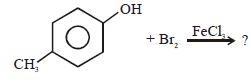
Major product of reaction :
A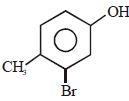
B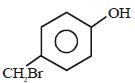
C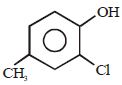
D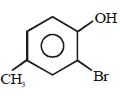
Solution
(D) The reaction of $p$-cresol ($4$-methylphenol) with $Br_2$ in the presence of $FeCl_3$ (a Lewis acid catalyst) is an electrophilic aromatic substitution reaction.
Since the $-OH$ group is a strong activating group and ortho/para directing,and the para position is already occupied by a $-CH_3$ group,the electrophile $(Br^+)$ will attack the ortho position relative to the $-OH$ group.
Therefore,the major product is $2$-bromo-$4$-methylphenol.
Since the $-OH$ group is a strong activating group and ortho/para directing,and the para position is already occupied by a $-CH_3$ group,the electrophile $(Br^+)$ will attack the ortho position relative to the $-OH$ group.
Therefore,the major product is $2$-bromo-$4$-methylphenol.
0 likes
View Solution193
MediumMCQ
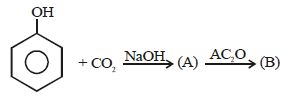
The product $(B)$ will be:
A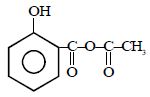
B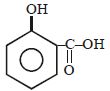
C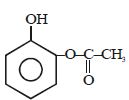
D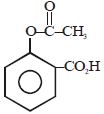
Solution
(D) The reaction sequence is as follows:
$1$. Phenol reacts with $CO_2$ in the presence of $NaOH$ (Kolbe-Schmitt reaction) to form sodium salicylate,which upon acidification gives salicylic acid $(A)$,which is $2$-hydroxybenzoic acid.
$2$. Salicylic acid $(A)$ reacts with acetic anhydride $(Ac_2O)$ in the presence of an acid catalyst to undergo acetylation of the phenolic $-OH$ group,forming $2$-acetoxybenzoic acid $(B)$,commonly known as aspirin.
$3$. The structure of $(B)$ is a benzene ring with a $-COOH$ group at position $1$ and a $-OCOCH_3$ group at position $2$.
$1$. Phenol reacts with $CO_2$ in the presence of $NaOH$ (Kolbe-Schmitt reaction) to form sodium salicylate,which upon acidification gives salicylic acid $(A)$,which is $2$-hydroxybenzoic acid.
$2$. Salicylic acid $(A)$ reacts with acetic anhydride $(Ac_2O)$ in the presence of an acid catalyst to undergo acetylation of the phenolic $-OH$ group,forming $2$-acetoxybenzoic acid $(B)$,commonly known as aspirin.
$3$. The structure of $(B)$ is a benzene ring with a $-COOH$ group at position $1$ and a $-OCOCH_3$ group at position $2$.
0 likes
View Solution194
MediumMCQ
In the Reimer-Tiemann formylation reaction,by how much does the molecular weight of phenol increase?
A
$28$
B
$29$
C
$30$
D
$31$
Solution
(A) In the Reimer-Tiemann reaction,phenol $(C_6H_5OH)$ reacts with chloroform $(CHCl_3)$ in the presence of aqueous $NaOH$ to form salicylaldehyde $(C_6H_4(OH)CHO)$.
The chemical equation is: $C_6H_5OH + CHCl_3 + 3NaOH \rightarrow C_6H_4(OH)CHO + 3NaCl + 2H_2O$.
The molecular weight of phenol $(C_6H_5OH)$ is $6 \times 12 + 6 \times 1 + 16 = 94 \ g/mol$.
The molecular weight of salicylaldehyde $(C_6H_4(OH)CHO)$ is $7 \times 12 + 6 \times 1 + 2 \times 16 = 84 + 6 + 32 = 122 \ g/mol$.
The increase in molecular weight is $122 - 94 = 28$.
This corresponds to the replacement of one $H$ atom (mass $1$) with one $CHO$ group (mass $29$),resulting in a net increase of $29 - 1 = 28$.
The chemical equation is: $C_6H_5OH + CHCl_3 + 3NaOH \rightarrow C_6H_4(OH)CHO + 3NaCl + 2H_2O$.
The molecular weight of phenol $(C_6H_5OH)$ is $6 \times 12 + 6 \times 1 + 16 = 94 \ g/mol$.
The molecular weight of salicylaldehyde $(C_6H_4(OH)CHO)$ is $7 \times 12 + 6 \times 1 + 2 \times 16 = 84 + 6 + 32 = 122 \ g/mol$.
The increase in molecular weight is $122 - 94 = 28$.
This corresponds to the replacement of one $H$ atom (mass $1$) with one $CHO$ group (mass $29$),resulting in a net increase of $29 - 1 = 28$.
0 likes
View Solution195
DifficultMCQ
Which of the following compounds decolourises $Br_2 / H_2O$ and also gives a positive test with neutral $FeCl_3$?
A
B
C
D
Solution
(D) Phenol $(C_6H_5OH)$ contains an electron-rich aromatic ring which undergoes electrophilic substitution with bromine water $(Br_2 / H_2O)$ to form $2,4,6$-tribromophenol,causing the reddish-brown colour of bromine to disappear.
Additionally,phenol reacts with neutral $FeCl_3$ to form a violet-coloured iron-phenoxide complex,which is a characteristic test for phenolic groups.
Additionally,phenol reacts with neutral $FeCl_3$ to form a violet-coloured iron-phenoxide complex,which is a characteristic test for phenolic groups.
0 likes
View Solution196
MediumMCQ
$4$-Hydroxybenzenesulphonic acid is treated with bromine water. The product formed is -
A
$2, 4, 6$-Tribromophenol
B
$3, 5$-Dibromo-$4$-hydroxybenzenesulphonic acid
C
$3$-Bromo-$4$-hydroxybenzenesulphonic acid
D
$2, 6$-Dibromophenol
Solution
(B) The reaction of $4$-hydroxybenzenesulphonic acid with bromine water involves electrophilic aromatic substitution. The $-OH$ group is a strong activating group and is ortho/para directing. The $-SO_3H$ group is at the para position. Bromination occurs at the ortho positions relative to the $-OH$ group (positions $3$ and $5$). Since the $-SO_3H$ group is a good leaving group in the presence of water,it can be displaced by bromine,but under standard conditions with bromine water,the primary product is $3, 5$-dibromo-$4$-hydroxybenzenesulphonic acid. If excess bromine is used,the $-SO_3H$ group is replaced to form $2, 4, 6$-tribromophenol. Given the options,$3, 5$-dibromo-$4$-hydroxybenzenesulphonic acid is the specific product of the substitution.
0 likes
View Solution197
AdvancedMCQ
Benzoylation of phenol with benzoyl chloride in the presence of dilute $NaOH$ gives phenyl benzoate. This reaction is an example of
A
Friedel-$Crafts$ reaction
B
Reimer-$Tiemann$ reaction
C
Claisen-$Schmidt$ reaction
D
Schotten-$Baumann$ reaction
Solution
(D) The process of benzoylation of compounds containing active hydrogen such as phenol,aniline,or alcohol with benzoyl chloride in the presence of aqueous $NaOH$ is known as the Schotten-$Baumann$ reaction.
0 likes
View Solution198
MediumMCQ
Product $(A)$ and $(B)$ respectively are :-
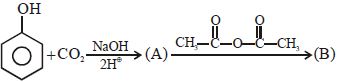
A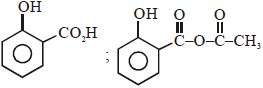
B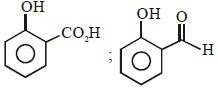
C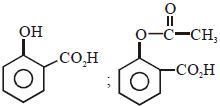
D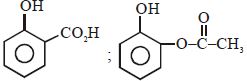
Solution
(C) The reaction of phenol with $CO_2$ in the presence of $NaOH$ followed by acidification is the Kolbe-Schmidt reaction,which produces salicylic acid as product $(A)$.
Salicylic acid then undergoes acetylation with acetic anhydride to form aspirin (acetylsalicylic acid) as product $(B)$.
In this reaction,the phenolic $-OH$ group is acetylated to form an ester linkage,resulting in $2$-acetoxybenzoic acid.
Salicylic acid then undergoes acetylation with acetic anhydride to form aspirin (acetylsalicylic acid) as product $(B)$.
In this reaction,the phenolic $-OH$ group is acetylated to form an ester linkage,resulting in $2$-acetoxybenzoic acid.
0 likes
View Solution199
DifficultMCQ
Identify $(C)$ in the reaction$(s)$:
$p\text{-toluidine}$ $\xrightarrow[{0\,^{\circ}C}]{{NaNO_2/HCl}}\,(A)\,$ $\xrightarrow{{{H_2}O, \Delta }}\,(B)\,$ $\xrightarrow[{(ii)\,dil.\,HCl}]{{(i)\,CHCl_3, KOH, \Delta }}\,(C)$
$p\text{-toluidine}$ $\xrightarrow[{0\,^{\circ}C}]{{NaNO_2/HCl}}\,(A)\,$ $\xrightarrow{{{H_2}O, \Delta }}\,(B)\,$ $\xrightarrow[{(ii)\,dil.\,HCl}]{{(i)\,CHCl_3, KOH, \Delta }}\,(C)$
A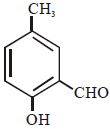
B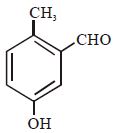
C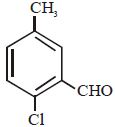
D
None of these
Solution
(A) The reaction sequence is as follows:
$1.$ $p\text{-toluidine}$ $(4\text{-methylaniline})$ reacts with $NaNO_2/HCl$ at $0\,^{\circ}C$ to form the diazonium salt $(A)$,which is $p\text{-toluenediazonium chloride}$.
$2.$ Hydrolysis of $(A)$ with $H_2O$ at high temperature yields $p\text{-cresol}$ $(4\text{-methylphenol})$ as $(B)$.
$3.$ The Reimer-Tiemann reaction of $p\text{-cresol}$ with $CHCl_3$ and $KOH$ followed by acidification introduces a formyl group $(-CHO)$ at the ortho position relative to the $-OH$ group,resulting in $2\text{-hydroxy-5-methylbenzaldehyde}$ as $(C)$.
$1.$ $p\text{-toluidine}$ $(4\text{-methylaniline})$ reacts with $NaNO_2/HCl$ at $0\,^{\circ}C$ to form the diazonium salt $(A)$,which is $p\text{-toluenediazonium chloride}$.
$2.$ Hydrolysis of $(A)$ with $H_2O$ at high temperature yields $p\text{-cresol}$ $(4\text{-methylphenol})$ as $(B)$.
$3.$ The Reimer-Tiemann reaction of $p\text{-cresol}$ with $CHCl_3$ and $KOH$ followed by acidification introduces a formyl group $(-CHO)$ at the ortho position relative to the $-OH$ group,resulting in $2\text{-hydroxy-5-methylbenzaldehyde}$ as $(C)$.
0 likes
View Solution200
MediumMCQ
$C_6H_5OH \xrightarrow[Br_2]{OH^{\ominus}} ; $ Intermediate of the given reaction is/are
A
$2-$Bromophenoxide ion
B
$2,4-$Dibromophenoxide ion
C
$4-$Bromophenoxide ion
D
All of these
Solution
(D) The reaction of phenol with $Br_2$ in the presence of $OH^{\ominus}$ is an electrophilic aromatic substitution reaction.
First,phenol reacts with $OH^{\ominus}$ to form the phenoxide ion,which is highly activated towards electrophilic substitution.
The phenoxide ion then reacts with $Br_2$ to form ortho-bromophenoxide ($2$-bromophenoxide) and para-bromophenoxide ($4$-bromophenoxide) intermediates.
Further reaction with $Br_2$ leads to the formation of $2,4,6-$tribromophenol.
Since all the given species ($2$-bromophenoxide,$4$-bromophenoxide,and $2,4-$dibromophenoxide) are formed as intermediates during the stepwise bromination process,the correct answer is 'All of these'.
First,phenol reacts with $OH^{\ominus}$ to form the phenoxide ion,which is highly activated towards electrophilic substitution.
The phenoxide ion then reacts with $Br_2$ to form ortho-bromophenoxide ($2$-bromophenoxide) and para-bromophenoxide ($4$-bromophenoxide) intermediates.
Further reaction with $Br_2$ leads to the formation of $2,4,6-$tribromophenol.
Since all the given species ($2$-bromophenoxide,$4$-bromophenoxide,and $2,4-$dibromophenoxide) are formed as intermediates during the stepwise bromination process,the correct answer is 'All of these'.
0 likes
View SolutionAlcohols, Phenols and Ethers — Properties of Phenols · Frequently Asked Questions
1Are these Alcohols, Phenols and Ethers questions useful for JEE and NEET?
Yes. All questions in this section are mapped to JEE Main and NEET exam patterns. Previous year questions from JEE Main, NEET, GUJCET and state-level exams are included with full solutions.
2Can I switch to Hindi or Gujarati for these questions?
Yes. Use the language tabs in the hero section or the sidebar to view the same questions and solutions in English, Hindi or Gujarati.
3How do I generate a question paper from this subtopic?
Use the Vedclass Exam Paper Generator — select the chapter and subtopic, set difficulty, and generate Sets A, B, C, D automatically. First 3 chapters of every subject are free.
Vedclass Products
For Students
Vedclass Test Series
Mock tests in real JEE/NEET style with performance analysis. 5-day free trial.
Start Free TrialFor Teachers
Exam Paper Generator
Generate Set A/B/C/D papers from this chapter in 2 minutes. 3 chapters free.
Try FreeFor Institutes
Online Exam Module
Live online exams with unlimited students, 360° analytics & white-label branding.
See DemoFor Teachers & Institutes
Generate a Alcohols, Phenols and Ethers Exam Paper in 2 Minutes
Select subtopic & difficulty — Sets A, B, C, D auto-generated with No Repeat logic.
First 3 chapters of every subject are free — no payment required.