
A English
Properties of Phenols Questions in English
Class 12 Chemistry · Alcohols, Phenols and Ethers · Properties of Phenols
751+
Questions
English
Language
100%
With Solutions
Showing 49 of 751 questions in English
51
MediumMCQ
Which statement is true?
A
$C_6H_5OH$ is more acidic than $C_2H_5OH$
B
$C_6H_5OH$ is less acidic than $C_2H_5OH$
C
$C_6H_5OH$ reacts with $NaHCO_3$
D
$C_6H_5OH$ gives oxime with $NH_2OH$ and $HCl$
Solution
(A) The acidity of $C_6H_5OH$ (phenol) is greater than that of $C_2H_5OH$ (ethanol) because the phenoxide ion formed after the loss of $H^+$ is stabilized by resonance with the benzene ring,whereas the ethoxide ion $(C_2H_5O^-)$ is destabilized by the electron-donating inductive effect $(+I)$ of the ethyl group.
Phenol does not react with $NaHCO_3$ because it is a weaker acid than carbonic acid $(H_2CO_3)$.
Phenol does not react with $NH_2OH$ to form an oxime; this reaction is characteristic of carbonyl compounds (aldehydes and ketones).
Phenol does not react with $NaHCO_3$ because it is a weaker acid than carbonic acid $(H_2CO_3)$.
Phenol does not react with $NH_2OH$ to form an oxime; this reaction is characteristic of carbonyl compounds (aldehydes and ketones).
0 likes
View Solution52
MediumMCQ
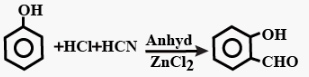
The following reaction is known as:
A
Perkin reaction
B
Gattermann reaction
C
Kolbe reaction
D
Gattermann-Koch reaction
Solution
(B) The given reaction is known as the Gattermann reaction.
In this reaction,an aromatic compound such as phenol is treated with a mixture of $HCN$ and dry $HCl$ gas in the presence of anhydrous $ZnCl_2$ to introduce a formyl group $(-CHO)$ into the aromatic nucleus.
In this reaction,an aromatic compound such as phenol is treated with a mixture of $HCN$ and dry $HCl$ gas in the presence of anhydrous $ZnCl_2$ to introduce a formyl group $(-CHO)$ into the aromatic nucleus.
0 likes
View Solution53
DifficultMCQ
The compound obtained by heating salicylic acid with phenol in the presence of phosphorus oxychloride $(POCl_3)$ is
A
Salol
B
Aspirin
C
Oil of wintergreen
D
$o-$chlorobenzoyl chloride
Solution
(A) When salicylic acid $(C_6H_4(OH)COOH)$ is heated with phenol $(C_6H_5OH)$ in the presence of phosphorus oxychloride $(POCl_3)$,an esterification reaction occurs.
This reaction results in the formation of phenyl salicylate,which is commonly known as Salol.
The chemical equation is:
$C_6H_4(OH)COOH + C_6H_5OH \xrightarrow{POCl_3} C_6H_4(OH)COOC_6H_5 + H_2O$
Therefore,the correct option is $A$.
This reaction results in the formation of phenyl salicylate,which is commonly known as Salol.
The chemical equation is:
$C_6H_4(OH)COOH + C_6H_5OH \xrightarrow{POCl_3} C_6H_4(OH)COOC_6H_5 + H_2O$
Therefore,the correct option is $A$.
0 likes
View Solution54
DifficultMCQ
When phenol is allowed to react with $Br_2$ in $(i)$ $CS_2$ solution and $(ii)$ in aqueous solution,the resulting compounds are
A
$(i)$ $2, 4, 6-$ tribromophenol and $(ii)$ $o-$ and $p-$ bromophenol
B
$(i)$ $m-$ bromophenol and $(ii)$ $2, 3, 4-$ tribromophenol
C
$(i)$ $o-$ and $p-$ bromophenol and $(ii)$ $2, 4, 6-$ tribromophenol
D
$(i)$ $o-$ and $m-$ bromophenol and $(ii)$ $2, 3, 4-$ tribromophenol
Solution
(C) In aqueous solution,phenol ionizes to form the phenoxide ion,which strongly activates the benzene ring towards electrophilic substitution,leading to the formation of $2, 4, 6-$ tribromophenol.
In the presence of a non-polar solvent like $CS_2$,phenol does not ionize significantly. The benzene ring is only weakly activated by the $-OH$ group,resulting in the formation of monosubstituted products,specifically $o-$ bromophenol and $p-$ bromophenol.
In the presence of a non-polar solvent like $CS_2$,phenol does not ionize significantly. The benzene ring is only weakly activated by the $-OH$ group,resulting in the formation of monosubstituted products,specifically $o-$ bromophenol and $p-$ bromophenol.
0 likes
View Solution55
DifficultMCQ
What amount of bromine will be required to convert $2 \ g$ of phenol into $2, 4, 6-$tribromophenol (in $g$)?
A
$4$
B
$6$
C
$10.22$
D
$20.44$
Solution
(C) The chemical equation for the reaction is:
$C_6H_5OH + 3Br_2 \rightarrow C_6H_2Br_3OH + 3HBr$
From the stoichiometry of the reaction,$1 \ mole$ of phenol $(94 \ g/mol)$ reacts with $3 \ moles$ of $Br_2$ $(3 \times 160 = 480 \ g/mol)$.
Therefore,$94 \ g$ of phenol requires $480 \ g$ of $Br_2$.
For $2 \ g$ of phenol,the amount of $Br_2$ required is:
$\text{Amount of } Br_2 = \frac{480 \ g}{94 \ g} \times 2 \ g \approx 10.2127 \ g \approx 10.22 \ g$.
$C_6H_5OH + 3Br_2 \rightarrow C_6H_2Br_3OH + 3HBr$
From the stoichiometry of the reaction,$1 \ mole$ of phenol $(94 \ g/mol)$ reacts with $3 \ moles$ of $Br_2$ $(3 \times 160 = 480 \ g/mol)$.
Therefore,$94 \ g$ of phenol requires $480 \ g$ of $Br_2$.
For $2 \ g$ of phenol,the amount of $Br_2$ required is:
$\text{Amount of } Br_2 = \frac{480 \ g}{94 \ g} \times 2 \ g \approx 10.2127 \ g \approx 10.22 \ g$.
0 likes
View Solution56
DifficultMCQ
Among the following,the compound that undergoes nitration readily is
A
Benzoic acid
B
Phenol
C
Toluene
D
Nitrobenzene
Solution
(B) The presence of an electron-donating group $(-OH)$ in Phenol significantly increases the electron density of the benzene ring through resonance,making it highly reactive toward electrophilic aromatic substitution like nitration compared to Toluene,Benzoic acid,or Nitrobenzene.
0 likes
View Solution57
MediumMCQ
$Phenol$ $\xrightarrow[Distillation]{Zn} A$ $\xrightarrow[Conc. H_2SO_4]{Conc. HNO_3} B$ $\xrightarrow[NaOH]{Zn} C$
In the above reaction,$A$,$B$,and $C$ are the following compounds:
In the above reaction,$A$,$B$,and $C$ are the following compounds:
A
$C_6H_6, C_6H_5NO_2$ and aniline
B
$C_6H_6$,dinitrobenzene and metanitroaniline
C
Toluene,metanitrobenzene and metatoluidine
D
$C_6H_6, C_6H_5NO_2$ and hydrazobenzene
Solution
(D) $1$. Phenol reacts with $Zn$ dust upon distillation to form Benzene $(A = C_6H_6)$.
$2$. Benzene undergoes nitration with a mixture of $Conc. H_2SO_4$ and $Conc. HNO_3$ to form Nitrobenzene $(B = C_6H_5NO_2)$.
$3$. Nitrobenzene undergoes reduction in the presence of $Zn$ and $NaOH$ (alkaline medium) to form Hydrazobenzene $(C = C_6H_5-NH-NH-C_6H_5)$.
Thus,the correct sequence is $C_6H_6, C_6H_5NO_2$ and hydrazobenzene.
$2$. Benzene undergoes nitration with a mixture of $Conc. H_2SO_4$ and $Conc. HNO_3$ to form Nitrobenzene $(B = C_6H_5NO_2)$.
$3$. Nitrobenzene undergoes reduction in the presence of $Zn$ and $NaOH$ (alkaline medium) to form Hydrazobenzene $(C = C_6H_5-NH-NH-C_6H_5)$.
Thus,the correct sequence is $C_6H_6, C_6H_5NO_2$ and hydrazobenzene.
0 likes
View Solution58
MediumMCQ
Phenol reacts with $CCl_4$ in the presence of aqueous alkali and forms a product which on hydrolysis gives:
A
Salicylaldehyde
B
Salicylic acid
C
Benzaldehyde
D
Benzoic acid
Solution
(B) The reaction of phenol with $CCl_4$ in the presence of an aqueous alkali (like $KOH$) is known as the Reimer-Tiemann reaction (specifically the variant using $CCl_4$).
This reaction proceeds as follows:
$C_6H_5OH + CCl_4 + 4KOH \rightarrow C_6H_4(OH)(COOK) + 4KCl + 2H_2O$
The intermediate product formed is the potassium salt of salicylic acid.
Upon subsequent acidic hydrolysis,this salt is converted into salicylic acid $(2-hydroxybenzoic \ acid)$.
This reaction proceeds as follows:
$C_6H_5OH + CCl_4 + 4KOH \rightarrow C_6H_4(OH)(COOK) + 4KCl + 2H_2O$
The intermediate product formed is the potassium salt of salicylic acid.
Upon subsequent acidic hydrolysis,this salt is converted into salicylic acid $(2-hydroxybenzoic \ acid)$.
0 likes
View Solution59
MediumMCQ
The order of melting point of ortho-,meta-,and para-nitrophenol is
A
$o > m > p$
B
$p > m > o$
C
$m > p > o$
D
$p > o > m$
Solution
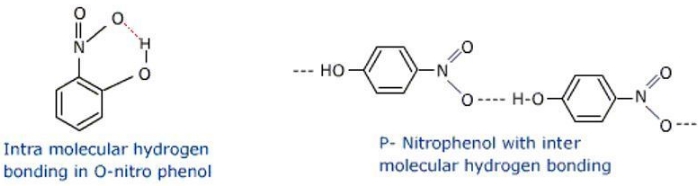
(B) For $o$-nitrophenol,hydrogen bonding is intramolecular,i.e.,confined to the same molecule.
For $m$-nitrophenol and $p$-nitrophenol,hydrogen bonding is intermolecular,occurring between different molecules.
Therefore,$p$-nitrophenol has the highest melting point due to strong intermolecular hydrogen bonding and symmetrical packing,followed by $m$-nitrophenol,while $o$-nitrophenol has the lowest melting point.
The correct order of melting point is $p > m > o$.
For $m$-nitrophenol and $p$-nitrophenol,hydrogen bonding is intermolecular,occurring between different molecules.
Therefore,$p$-nitrophenol has the highest melting point due to strong intermolecular hydrogen bonding and symmetrical packing,followed by $m$-nitrophenol,while $o$-nitrophenol has the lowest melting point.
The correct order of melting point is $p > m > o$.
0 likes
View Solution60
MediumMCQ
Phenol $\xrightarrow[{{H^ + }}]{{CHCl_3/NaOH}}$ Salicylaldehyde. The above reaction is known as:
A
Riemer-Tiemann reaction
B
Bucherer reaction
C
Gattermann synthesis
D
Perkin reaction
Solution
(A) The Reimer-Tiemann reaction is a chemical reaction used for the ortho-formylation of phenols.
In this reaction,phenol is treated with chloroform $(CHCl_3)$ in the presence of an aqueous base like sodium hydroxide $(NaOH)$,followed by acidic workup $(H^+)$ to yield salicylaldehyde as the major product.
In this reaction,phenol is treated with chloroform $(CHCl_3)$ in the presence of an aqueous base like sodium hydroxide $(NaOH)$,followed by acidic workup $(H^+)$ to yield salicylaldehyde as the major product.
0 likes
View Solution61
MediumMCQ
The rate of electrophilic substitution reaction in phenol is:
A
Slower than the rate of benzene
B
Faster than the rate of benzene
C
Equal to the rate of benzene
D
None of these
Solution
(B) The rate of electrophilic substitution reaction in phenol is faster than in benzene.
This is because the $-OH$ group is an electron-donating group due to its $+M$ (mesomeric) effect.
The lone pair of electrons on the oxygen atom is delocalized into the benzene ring,which increases the electron density at the $o-$ (ortho) and $p-$ (para) positions.
This makes the ring more susceptible to attack by an electrophile.
This is because the $-OH$ group is an electron-donating group due to its $+M$ (mesomeric) effect.
The lone pair of electrons on the oxygen atom is delocalized into the benzene ring,which increases the electron density at the $o-$ (ortho) and $p-$ (para) positions.
This makes the ring more susceptible to attack by an electrophile.
0 likes
View Solution62
MediumMCQ
Phenol reacts with dilute $HNO_3$ at low temperature to form:
A
$o$-Nitrophenol and $p$-Nitrophenol
B
$o$-Nitrophenol
C
$p$-Nitrophenol
D
$2,4,6$-Trinitrophenol
Solution
(A) When phenol reacts with dilute $HNO_3$ at a low temperature (around $298 \ K$),it undergoes electrophilic aromatic substitution to form a mixture of $o$-nitrophenol and $p$-nitrophenol.
The reaction is as follows:
$C_6H_5OH + HNO_3 \text{ (dilute)} \xrightarrow{298 \ K} o\text{-Nitrophenol} + p\text{-Nitrophenol}$
Therefore,the correct option is $A$.
The reaction is as follows:
$C_6H_5OH + HNO_3 \text{ (dilute)} \xrightarrow{298 \ K} o\text{-Nitrophenol} + p\text{-Nitrophenol}$
Therefore,the correct option is $A$.
0 likes
View Solution63
MediumMCQ
One mole of phenol reacts with bromine to form $2,4,6-$tribromophenol. $X \ mol$ of bromine is used. The value of $X$ is:
A
$1.5$
B
$3$
C
$4.5$
D
$6$
Solution
(B) The reaction of phenol with bromine water leads to the electrophilic substitution of bromine atoms at the $2, 4,$ and $6$ positions of the phenol ring.
The balanced chemical equation for this reaction is:
$C_6H_5OH + 3Br_2 \rightarrow C_6H_2Br_3OH + 3HBr$
From the stoichiometry of the reaction,$1 \ mol$ of phenol reacts with $3 \ mol$ of bromine $(Br_2)$ to produce $1 \ mol$ of $2,4,6-$tribromophenol.
Therefore,the value of $X$ is $3$.
The balanced chemical equation for this reaction is:
$C_6H_5OH + 3Br_2 \rightarrow C_6H_2Br_3OH + 3HBr$
From the stoichiometry of the reaction,$1 \ mol$ of phenol reacts with $3 \ mol$ of bromine $(Br_2)$ to produce $1 \ mol$ of $2,4,6-$tribromophenol.
Therefore,the value of $X$ is $3$.
0 likes
View Solution64
DifficultMCQ
In the presence of $NaOH$,phenol reacts with $CHCl_3$ to form $o$-hydroxybenzaldehyde. This reaction is called:
A
Reimer-Tiemann reaction
B
Sandmeyer's reaction
C
Hoffmann's degradation reaction
D
Gattermann's aldehyde synthesis
Solution
(A) When phenol is treated with chloroform $(CHCl_3)$ in the presence of aqueous sodium hydroxide $(NaOH)$ at $340 \ K$,it forms $2$-hydroxybenzaldehyde,also known as salicylaldehyde.
This specific chemical transformation is known as the Reimer-Tiemann reaction.
This specific chemical transformation is known as the Reimer-Tiemann reaction.
0 likes
View Solution65
EasyMCQ
Picric acid is (at $25\,^{\circ}C$)
A
$A$ white solid
B
$A$ colourless liquid
C
$A$ gas
D
$A$ bright yellow solid
Solution
(D) Picric acid,chemically known as $2,4,6$-trinitrophenol,is a derivative of phenol.
At room temperature $(25\,^{\circ}C)$,it exists as a bright yellow crystalline solid.
The intense yellow colour is due to the presence of three electron-withdrawing nitro groups $(-NO_2)$ attached to the benzene ring,which affect the electronic transitions of the molecule.
At room temperature $(25\,^{\circ}C)$,it exists as a bright yellow crystalline solid.
The intense yellow colour is due to the presence of three electron-withdrawing nitro groups $(-NO_2)$ attached to the benzene ring,which affect the electronic transitions of the molecule.
0 likes
View Solution66
EasyMCQ
Phenol on distillation with zinc dust gives
A
$C_6H_6$
B
$C_6H_{12}$
C
$C_6H_5OC_6H_5$
D
$C_6H_5-C_6H_5$
Solution
(A) When phenol $(C_6H_5OH)$ is distilled with zinc dust,it undergoes reduction to form benzene $(C_6H_6)$ and zinc oxide $(ZnO)$.
The chemical reaction is as follows:
$C_6H_5OH + Zn \rightarrow C_6H_6 + ZnO$
Thus,the correct option is $A$.
The chemical reaction is as follows:
$C_6H_5OH + Zn \rightarrow C_6H_6 + ZnO$
Thus,the correct option is $A$.
0 likes
View Solution67
MediumMCQ
The action of diazomethane on phenol liberates which of the following gases?
A
$O_2$
B
$H_2$
C
$N_2$
D
$CO_2$
Solution
(C) The reaction of phenol $(C_6H_5OH)$ with diazomethane $(CH_2N_2)$ in the presence of a catalyst like $HBF_4$ results in the methylation of the phenolic hydroxyl group to form anisole $(C_6H_5OCH_3)$.
During this reaction,the nitrogen atom from the diazomethane is released as nitrogen gas $(N_2)$.
The chemical equation is: $C_6H_5OH + CH_2N_2 \xrightarrow{HBF_4} C_6H_5OCH_3 + N_2 \uparrow$.
During this reaction,the nitrogen atom from the diazomethane is released as nitrogen gas $(N_2)$.
The chemical equation is: $C_6H_5OH + CH_2N_2 \xrightarrow{HBF_4} C_6H_5OCH_3 + N_2 \uparrow$.
0 likes
View Solution68
MediumMCQ
The ring deuteration of phenol:
A
Lowers the acidity
B
Increases the acidity
C
Imparts no effect
D
Causes amphoteric nature
Solution
(C) The acidity of phenol is primarily determined by the stability of the phenoxide ion formed after the loss of a proton from the $-OH$ group. Ring deuteration involves the replacement of hydrogen atoms on the aromatic ring with deuterium atoms. Since deuterium is an isotope of hydrogen,it has similar electronic properties but a slightly stronger $C-D$ bond compared to $C-H$. This substitution on the aromatic ring does not significantly alter the electronic environment of the $-OH$ group or the stability of the phenoxide ion. Therefore,ring deuteration has no significant effect on the acidity of phenol.
0 likes
View Solution69
MediumMCQ
Which of the following is most acidic?
A
Phenol
B
Benzyl alcohol
C
$m$-chlorophenol
D
Cyclohexanol
Solution
(C) The acidity of phenols is determined by the stability of the phenoxide ion formed after the loss of a proton.
Electron-withdrawing groups $(EWG)$ like $-Cl$ increase the acidity of phenols by stabilizing the phenoxide ion through the inductive effect.
Benzyl alcohol and cyclohexanol are not acidic in nature as they do not form stable phenoxide-like ions.
Between phenol and $m$-chlorophenol,the presence of the $-Cl$ group in $m$-chlorophenol exerts an electron-withdrawing inductive effect ($-I$ effect),which stabilizes the conjugate base more than in unsubstituted phenol.
Therefore,$m$-chlorophenol is the most acidic among the given options.
Electron-withdrawing groups $(EWG)$ like $-Cl$ increase the acidity of phenols by stabilizing the phenoxide ion through the inductive effect.
Benzyl alcohol and cyclohexanol are not acidic in nature as they do not form stable phenoxide-like ions.
Between phenol and $m$-chlorophenol,the presence of the $-Cl$ group in $m$-chlorophenol exerts an electron-withdrawing inductive effect ($-I$ effect),which stabilizes the conjugate base more than in unsubstituted phenol.
Therefore,$m$-chlorophenol is the most acidic among the given options.
0 likes
View Solution70
MediumMCQ
In Friedel-Crafts acylation,besides $AlCl_3$,the other reactants are
A
Phenol + $CH_3Cl$
B
Phenol + $CH_3COCl$
C
Phenol + $HN_3$
D
Benzene + $CH_3Cl$
Solution
(B) In Friedel-Crafts acylation,an aromatic compound (such as phenol) reacts with an acyl halide (such as $CH_3COCl$) in the presence of a Lewis acid catalyst like anhydrous $AlCl_3$ to form an acyl derivative.
The reaction is:
$\text{Phenol} + CH_3COCl \xrightarrow{AlCl_3} o-\text{acetylphenol} + p-\text{acetylphenol}$
Therefore,the correct reactants are phenol and acetyl chloride $(CH_3COCl)$.
The reaction is:
$\text{Phenol} + CH_3COCl \xrightarrow{AlCl_3} o-\text{acetylphenol} + p-\text{acetylphenol}$
Therefore,the correct reactants are phenol and acetyl chloride $(CH_3COCl)$.
0 likes
View Solution71
DifficultMCQ
Which of the following reagents will produce salicylaldehyde on reaction with phenol?
A
$CHCl_3/NaOH$
B
$CCl_4/NaOH$
C
$CH_2Cl_2/NaOH$
D
$CH_3Cl/NaOH$
Solution
(A) The reaction of phenol with $CHCl_3$ in the presence of aqueous $NaOH$ is known as the Reimer-Tiemann reaction.
This reaction introduces a formyl group $(-CHO)$ at the ortho position of the phenol ring to produce salicylaldehyde.
The overall reaction is:
Phenol + $CHCl_3 + aq. NaOH \rightarrow$ Intermediate $\rightarrow$ Salicylaldehyde (after acidification with $H^+$).
This reaction introduces a formyl group $(-CHO)$ at the ortho position of the phenol ring to produce salicylaldehyde.
The overall reaction is:
Phenol + $CHCl_3 + aq. NaOH \rightarrow$ Intermediate $\rightarrow$ Salicylaldehyde (after acidification with $H^+$).
0 likes
View Solution72
MediumMCQ
Predict the product of the following reaction:
$HO-C_6H_5 + C_6H_5N_2^+Cl^- \xrightarrow{\text{base}} ?$
$HO-C_6H_5 + C_6H_5N_2^+Cl^- \xrightarrow{\text{base}} ?$
A
$C_6H_5-N=N-C_6H_4-OH$
B
$C_6H_5-O-C_6H_5$
C
$C_6H_5-C_6H_5$
D
$C_6H_5-C_6H_4-OH$
Solution
(A) The given reaction is an electrophilic aromatic substitution reaction known as a coupling reaction.
In this reaction,benzenediazonium chloride $(C_6H_5N_2^+Cl^-)$ reacts with phenol $(C_6H_5OH)$ in the presence of a base.
The diazonium cation acts as an electrophile and attacks the para-position of the phenol ring to form $p$-hydroxyazobenzene,which is an orange dye.
The reaction is: $C_6H_5N_2^+Cl^- + H-C_6H_4-OH \xrightarrow{\text{base}} C_6H_5-N=N-C_6H_4-OH + HCl$.
In this reaction,benzenediazonium chloride $(C_6H_5N_2^+Cl^-)$ reacts with phenol $(C_6H_5OH)$ in the presence of a base.
The diazonium cation acts as an electrophile and attacks the para-position of the phenol ring to form $p$-hydroxyazobenzene,which is an orange dye.
The reaction is: $C_6H_5N_2^+Cl^- + H-C_6H_4-OH \xrightarrow{\text{base}} C_6H_5-N=N-C_6H_4-OH + HCl$.
0 likes
View Solution73
MediumMCQ
In which of the following reactions does carbon$-$carbon bond formation take place?
A
Cannizzaro reaction
B
Reimer-Tiemann reaction
C
$HVZ$ reaction
D
Schmidt reaction
Solution
(B) The Reimer-Tiemann reaction involves the introduction of a formyl group $(-CHO)$ into the benzene ring of phenol using chloroform $(CHCl_3)$ and aqueous $NaOH$.
This process involves the formation of a new carbon$-$carbon bond between the aromatic ring and the formyl carbon.
The reaction is represented as:
Phenol + $CHCl_3$ $\xrightarrow{NaOH, 340 K}$ Salicylaldehyde (via intermediate) $\xrightarrow{dil. HCl, -NaCl}$ Salicylaldehyde.
Therefore,the correct option is $(B)$.
This process involves the formation of a new carbon$-$carbon bond between the aromatic ring and the formyl carbon.
The reaction is represented as:
Phenol + $CHCl_3$ $\xrightarrow{NaOH, 340 K}$ Salicylaldehyde (via intermediate) $\xrightarrow{dil. HCl, -NaCl}$ Salicylaldehyde.
Therefore,the correct option is $(B)$.
0 likes
View Solution74
MediumMCQ
The reaction of phenol with chloroform and sodium hydroxide to give $o$-hydroxybenzaldehyde involves the formation of which intermediate?
A
Dichlorocarbene
B
Trichlorocarbene
C
Chlorine atoms
D
Chlorine molecules
Solution
(A) The reaction described is the $Reimer-Tiemann$ reaction.
In this reaction,phenol reacts with chloroform $(CHCl_3)$ in the presence of an aqueous base $(NaOH)$ to form $o$-hydroxybenzaldehyde (salicylaldehyde).
The electrophile involved in this reaction is dichlorocarbene $(:CCl_2)$,which is generated from chloroform by the action of the base.
The mechanism is as follows:
$OH^{-} + CHCl_3 \rightleftharpoons H_2O + :CCl_3^{-} \to Cl^{-} + :CCl_2$ (dichlorocarbene).
In this reaction,phenol reacts with chloroform $(CHCl_3)$ in the presence of an aqueous base $(NaOH)$ to form $o$-hydroxybenzaldehyde (salicylaldehyde).
The electrophile involved in this reaction is dichlorocarbene $(:CCl_2)$,which is generated from chloroform by the action of the base.
The mechanism is as follows:
$OH^{-} + CHCl_3 \rightleftharpoons H_2O + :CCl_3^{-} \to Cl^{-} + :CCl_2$ (dichlorocarbene).
0 likes
View Solution75
MediumMCQ
Phenol $\xrightarrow{NaNO_2/H_2SO_4} B$ $\xrightarrow{H_2O} C$ $\xrightarrow{NaOH} D$. The name of the above reaction is:
A
Liebermann's nitroso reaction
B
Phthalein fusion test
C
Reimer-Tiemann reaction
D
Schotten-Baumann reaction
Solution
(A) The reaction sequence given is the characteristic test for phenols known as $Liebermann's \ nitroso \ reaction$.
In this reaction,phenol reacts with $NaNO_2$ and $H_2SO_4$ to form $p-nitrosophenol$ $(B)$,which further reacts with another molecule of phenol in the presence of $H_2SO_4$ to form an indophenol dye $(C)$.
Upon adding $NaOH$,the solution turns deep blue or green due to the formation of the sodium salt of the indophenol $(D)$.
In this reaction,phenol reacts with $NaNO_2$ and $H_2SO_4$ to form $p-nitrosophenol$ $(B)$,which further reacts with another molecule of phenol in the presence of $H_2SO_4$ to form an indophenol dye $(C)$.
Upon adding $NaOH$,the solution turns deep blue or green due to the formation of the sodium salt of the indophenol $(D)$.
0 likes
View Solution76
MediumMCQ
The most suitable method for the separation of a $1:1$ mixture of $o-$ and $p-$ nitrophenols is:
A
Steam distillation
B
Sublimation
C
Crystallization
D
Chromatography
Solution
(A) $o-$ and $p-$ nitrophenols are separated by steam distillation.
$o-$ nitrophenol exhibits intramolecular hydrogen bonding,making it steam volatile.
$p-$ nitrophenol exhibits intermolecular hydrogen bonding,leading to higher molecular association and lower volatility,thus it is not steam volatile.
$o-$ nitrophenol exhibits intramolecular hydrogen bonding,making it steam volatile.
$p-$ nitrophenol exhibits intermolecular hydrogen bonding,leading to higher molecular association and lower volatility,thus it is not steam volatile.
0 likes
View Solution77
DifficultMCQ
The Reimer-Tiemann reaction involves a
A
Carbonium ion intermediate
B
Carbene intermediate
C
Carbanion intermediate
D
Free radical intermediate
Solution
(B) The Reimer-Tiemann reaction involves the reaction of phenol with chloroform $(CHCl_3)$ in the presence of an aqueous base ($NaOH$ or $KOH$).
In the first step,the base abstracts a proton from chloroform to form a trichloromethyl carbanion $(:CCl_3^-)$,which subsequently loses a chloride ion to generate dichlorocarbene $(:CCl_2)$ as an electrophilic intermediate.
This dichlorocarbene then attacks the phenoxide ion to form the product.
Therefore,the correct answer is $(B)$.
In the first step,the base abstracts a proton from chloroform to form a trichloromethyl carbanion $(:CCl_3^-)$,which subsequently loses a chloride ion to generate dichlorocarbene $(:CCl_2)$ as an electrophilic intermediate.
This dichlorocarbene then attacks the phenoxide ion to form the product.
Therefore,the correct answer is $(B)$.
0 likes
View Solution78
DifficultMCQ
In the given reaction,the compound $C$ is:
$C_6H_5OH$ $\xrightarrow{NaOH} (A)$ $\xrightarrow{CO_2, 140 \ ^oC, (4-7 \ atm)} (B)$ $\xrightarrow{HCl} (C)$
$C_6H_5OH$ $\xrightarrow{NaOH} (A)$ $\xrightarrow{CO_2, 140 \ ^oC, (4-7 \ atm)} (B)$ $\xrightarrow{HCl} (C)$
A
Benzoic acid
B
Salicylaldehyde
C
Chlorobenzene
D
Salicylic acid
Solution
(D) The reaction sequence is known as Kolbe's reaction.
$1$. Phenol $(C_6H_5OH)$ reacts with $NaOH$ to form sodium phenoxide $(A)$: $C_6H_5OH + NaOH \rightarrow C_6H_5ONa + H_2O$.
$2$. Sodium phenoxide reacts with $CO_2$ at $140 \ ^oC$ and $4-7 \ atm$ pressure to form sodium salicylate $(B)$: $C_6H_5ONa + CO_2 \rightarrow C_6H_4(OH)COONa$.
$3$. Acidification of sodium salicylate with $HCl$ yields salicylic acid $(C)$: $C_6H_4(OH)COONa + HCl \rightarrow C_6H_4(OH)COOH + NaCl$.
Thus,the final product $C$ is salicylic acid.
$1$. Phenol $(C_6H_5OH)$ reacts with $NaOH$ to form sodium phenoxide $(A)$: $C_6H_5OH + NaOH \rightarrow C_6H_5ONa + H_2O$.
$2$. Sodium phenoxide reacts with $CO_2$ at $140 \ ^oC$ and $4-7 \ atm$ pressure to form sodium salicylate $(B)$: $C_6H_5ONa + CO_2 \rightarrow C_6H_4(OH)COONa$.
$3$. Acidification of sodium salicylate with $HCl$ yields salicylic acid $(C)$: $C_6H_4(OH)COONa + HCl \rightarrow C_6H_4(OH)COOH + NaCl$.
Thus,the final product $C$ is salicylic acid.
0 likes
View Solution79
MediumMCQ
Salicylic acid is prepared from phenol by:
A
Kolbe-Schmidt reaction
B
Reimer-Tiemann reaction
C
Kolbe-electrolysis reaction
D
None of these
Solution
(B) The preparation of salicylic acid from phenol using $CO_2$ and $NaOH$ is known as the Kolbe-Schmidt reaction.
In this reaction,phenol is first converted to sodium phenoxide,which then undergoes electrophilic substitution with $CO_2$ to form sodium salicylate,followed by acidification to yield salicylic acid.
The reaction shown in the image uses $CCl_4$ and $NaOH$,which is the mechanism for the Reimer-Tiemann reaction (specifically the form that produces salicylic acid).
Therefore,the correct answer is $(B)$.
In this reaction,phenol is first converted to sodium phenoxide,which then undergoes electrophilic substitution with $CO_2$ to form sodium salicylate,followed by acidification to yield salicylic acid.
The reaction shown in the image uses $CCl_4$ and $NaOH$,which is the mechanism for the Reimer-Tiemann reaction (specifically the form that produces salicylic acid).
Therefore,the correct answer is $(B)$.
0 likes
View Solution80
MediumMCQ
What will be the product,when salicylic acid,obtained by the Reimer-Tiemann process,is reduced with $Zn$ dust?
A
Salicylaldehyde
B
Benzaldehyde
C
Phenol
D
Benzoic acid
Solution
(D) The Reimer-Tiemann reaction of phenol with $CHCl_3$ and $NaOH$ yields salicylaldehyde. However,the question refers to salicylic acid (which is obtained by the Kolbe-Schmitt reaction). When salicylic acid ($o$-hydroxybenzoic acid) is heated with $Zn$ dust,the phenolic $-OH$ group is removed,resulting in the reduction of the compound to benzoic acid.
0 likes
View Solution81
MediumMCQ
Benzoic acid gives benzene on being heated with $X$ and phenol gives benzene on being heated with $Y$. Therefore $X$ and $Y$ are respectively
A
Sodalime and copper
B
$Zn$ dust and $NaOH$
C
$Zn$ dust and sodalime
D
Sodalime and zinc dust
Solution
(D) Benzoic acid $(C_6H_5COOH)$ undergoes decarboxylation when heated with sodalime $(NaOH + CaO)$ to form benzene $(C_6H_6)$. Thus,$X$ is sodalime.
Phenol $(C_6H_5OH)$ undergoes reduction when heated with zinc dust $(Zn)$ to form benzene $(C_6H_6)$ and zinc oxide $(ZnO)$. Thus,$Y$ is zinc dust.
Therefore,$X$ is sodalime and $Y$ is zinc dust. The correct option is $(D)$.
Phenol $(C_6H_5OH)$ undergoes reduction when heated with zinc dust $(Zn)$ to form benzene $(C_6H_6)$ and zinc oxide $(ZnO)$. Thus,$Y$ is zinc dust.
Therefore,$X$ is sodalime and $Y$ is zinc dust. The correct option is $(D)$.
0 likes
View Solution82
MediumMCQ
Which of the following is most acidic?
A
Picric acid
B
$p-$nitrophenol
C
$m-$nitrophenol
D
$o,p-$dinitrophenol
Solution
(A) The acidity of phenols increases with the presence of electron-withdrawing groups $(-NO_2)$ on the benzene ring due to the $-I$ and $-M$ effects.
Picric acid ($2,4,6-$trinitrophenol) contains three $-NO_2$ groups at the $ortho$ and $para$ positions,which exert a strong electron-withdrawing effect,significantly stabilizing the phenoxide ion.
Comparing the options:
$1$. Picric acid ($3$ $-NO_2$ groups)
$2$. $o,p-$dinitrophenol ($2$ $-NO_2$ groups)
$3$. $p-$nitrophenol ($1$ $-NO_2$ group)
$4$. $m-$nitrophenol ($1$ $-NO_2$ group)
Therefore,Picric acid is the most acidic.
Picric acid ($2,4,6-$trinitrophenol) contains three $-NO_2$ groups at the $ortho$ and $para$ positions,which exert a strong electron-withdrawing effect,significantly stabilizing the phenoxide ion.
Comparing the options:
$1$. Picric acid ($3$ $-NO_2$ groups)
$2$. $o,p-$dinitrophenol ($2$ $-NO_2$ groups)
$3$. $p-$nitrophenol ($1$ $-NO_2$ group)
$4$. $m-$nitrophenol ($1$ $-NO_2$ group)
Therefore,Picric acid is the most acidic.
0 likes
View Solution83
MediumMCQ
Azo dye is prepared by the coupling of phenol and:
A
Diazonium chloride
B
$o-$nitro aniline
C
Benzoic acid
D
Chlorobenzene
Solution
(A) The coupling reaction occurs between a diazonium salt and an activated aromatic ring such as phenol or aniline.
In this process,benzene diazonium chloride reacts with phenol in a weakly alkaline medium to form an azo dye.
Therefore,the correct option is $(A)$.
In this process,benzene diazonium chloride reacts with phenol in a weakly alkaline medium to form an azo dye.
Therefore,the correct option is $(A)$.
0 likes
View Solution84
MediumMCQ
Aspirin is obtained by the reaction of $CH_3COCl$ with
A
Phenol
B
Benzoic acid
C
Salicylic acid
D
Benzaldehyde
Solution
(C) Aspirin is chemically known as $2$-acetoxybenzoic acid.
It is prepared by the acetylation of salicylic acid ($2$-hydroxybenzoic acid) using acetyl chloride $(CH_3COCl)$ or acetic anhydride.
The reaction is:
$C_6H_4(OH)COOH + CH_3COCl \rightarrow C_6H_4(OCOCH_3)COOH + HCl$
Thus,salicylic acid reacts with $CH_3COCl$ to form aspirin.
It is prepared by the acetylation of salicylic acid ($2$-hydroxybenzoic acid) using acetyl chloride $(CH_3COCl)$ or acetic anhydride.
The reaction is:
$C_6H_4(OH)COOH + CH_3COCl \rightarrow C_6H_4(OCOCH_3)COOH + HCl$
Thus,salicylic acid reacts with $CH_3COCl$ to form aspirin.
0 likes
View Solution85
DifficultMCQ
In the reaction $C_6H_5 - X \xleftarrow[HNO_2]{Cu} C_6H_5N_2Cl \xrightarrow[\Delta]{Water} \phi - Y$,what are $X$ and $Y$ respectively?
A
$o-, p-$ and $m-$ directing
B
$o-, p-$ and $o-, p-$ directing
C
$m$ and $m$ directing
D
$m$ and $o, p$ directing
Solution
(B) The given reaction sequence is:
$C_6H_5 - NH_2 \xleftarrow[HNO_2]{Cu} C_6H_5N_2Cl \xrightarrow[\Delta]{Water} C_6H_5OH$.
Here,$X$ is the $-NH_2$ group (aniline),which is an $o-, p-$ directing group.
$Y$ is the $-OH$ group (phenol),which is also an $o-, p-$ directing group.
Therefore,both $X$ and $Y$ are $o-, p-$ directing groups.
$C_6H_5 - NH_2 \xleftarrow[HNO_2]{Cu} C_6H_5N_2Cl \xrightarrow[\Delta]{Water} C_6H_5OH$.
Here,$X$ is the $-NH_2$ group (aniline),which is an $o-, p-$ directing group.
$Y$ is the $-OH$ group (phenol),which is also an $o-, p-$ directing group.
Therefore,both $X$ and $Y$ are $o-, p-$ directing groups.
0 likes
View Solution86
DifficultMCQ
Which product is obtained when chlorobenzene is reacted with $6-8\%$ aqueous $NaOH$ at $633\,K$ temperature and $300\,bar$ pressure in the presence of an acid catalyst?
A
Benzene
B
Phenol
C
$2, 4, 6-$ Trinitrophenol
D
Aniline
Solution
(B) The reaction of chlorobenzene with aqueous $NaOH$ at high temperature $(633\,K)$ and high pressure $(300\,bar)$ is known as the Dow process.
In this process,chlorobenzene is converted into sodium phenoxide,which upon acidification with an acid catalyst (like $HCl$) yields phenol.
The chemical equation is: $C_6H_5Cl + 2NaOH \xrightarrow{633\,K, 300\,bar} C_6H_5ONa + NaCl + H_2O$,followed by $C_6H_5ONa + H^+ \rightarrow C_6H_5OH + Na^+$.
In this process,chlorobenzene is converted into sodium phenoxide,which upon acidification with an acid catalyst (like $HCl$) yields phenol.
The chemical equation is: $C_6H_5Cl + 2NaOH \xrightarrow{633\,K, 300\,bar} C_6H_5ONa + NaCl + H_2O$,followed by $C_6H_5ONa + H^+ \rightarrow C_6H_5OH + Na^+$.
0 likes
View Solution87
MediumMCQ
What does phenol give with $NaOH$ and $CHCl_3$ at $340 \ K$?
A
$o$-Chlorophenol
B
Salicylaldehyde
C
Benzaldehyde
D
Chlorobenzene
Solution
(B) The reaction of phenol with $CHCl_3$ (chloroform) and aqueous $NaOH$ at $340 \ K$ is known as the Reimer-Tiemann reaction.
In this reaction,an aldehyde group $(-CHO)$ is introduced at the ortho position of the phenol ring.
The major product formed is $o$-hydroxybenzaldehyde,which is commonly known as Salicylaldehyde.
In this reaction,an aldehyde group $(-CHO)$ is introduced at the ortho position of the phenol ring.
The major product formed is $o$-hydroxybenzaldehyde,which is commonly known as Salicylaldehyde.
0 likes
View Solution88
DifficultMCQ
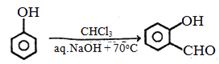
What is the name of the following reaction?
A
Fittig reaction
B
Williamson synthesis
C
Wurtz-Fittig reaction
D
Reimer-Tiemann reaction
Solution
(D) The given reaction involves the treatment of phenol with chloroform $(CHCl_3)$ in the presence of aqueous sodium hydroxide $(aq. NaOH)$ at $70^{\circ}C$,which results in the formation of salicylaldehyde (o-hydroxybenzaldehyde). This specific chemical transformation is known as the Reimer-Tiemann reaction.
0 likes
View Solution89
MediumMCQ
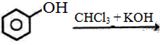
Which statement is incorrect for the product of the reaction shown above?
A
The reaction is known as the Reimer-Tiemann reaction.
B
The intermediate in the reaction is dichlorocarbene.
C
The final product is $o$-hydroxybenzaldehyde.
D
Benzyl chloride is the final product.
Solution
(D) The reaction of phenol with $CHCl_3$ and $KOH$ is the Reimer-Tiemann reaction.
In this reaction,phenol is converted into $o$-hydroxybenzaldehyde (salicylaldehyde).
The reaction mechanism involves the formation of a dichlorocarbene $(:CCl_2)$ intermediate.
Therefore,statements $A$,$B$,and $C$ are correct.
Statement $D$ is incorrect because benzyl chloride is not formed in this reaction.
In this reaction,phenol is converted into $o$-hydroxybenzaldehyde (salicylaldehyde).
The reaction mechanism involves the formation of a dichlorocarbene $(:CCl_2)$ intermediate.
Therefore,statements $A$,$B$,and $C$ are correct.
Statement $D$ is incorrect because benzyl chloride is not formed in this reaction.
0 likes
View Solution90
EasyMCQ
Heating benzoic acid with $X$ or phenol with $Y$ gives benzene. $X$ and $Y$ are respectively:
A
Sodalime and zinc dust
B
Zinc dust and sodalime
C
Zinc dust and sodium hydroxide
D
Sodalime and copper
Solution
(A) $1$. Decarboxylation of benzoic acid $(C_6H_5COOH)$ with sodalime $(NaOH + CaO)$ yields benzene $(C_6H_6)$. Thus,$X$ is sodalime.
$2$. Reduction of phenol $(C_6H_5OH)$ with zinc dust $(Zn)$ yields benzene $(C_6H_6)$. Thus,$Y$ is zinc dust.
$3$. Therefore,$X$ and $Y$ are sodalime and zinc dust respectively.
$2$. Reduction of phenol $(C_6H_5OH)$ with zinc dust $(Zn)$ yields benzene $(C_6H_6)$. Thus,$Y$ is zinc dust.
$3$. Therefore,$X$ and $Y$ are sodalime and zinc dust respectively.
0 likes
View Solution91
DifficultMCQ
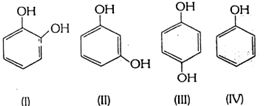
The order of boiling points for the given compounds is:
A
$(I) < (II) < (III) < (IV)$
B
$(IV) < (I) < (II) < (III)$
C
$(I) < (II) < (IV) < (III)$
D
$(II) < (I) < (III) < (IV)$
Solution
(B) The compounds are: $(I)$ Catechol (ortho-dihydroxybenzene),$(II)$ Resorcinol (meta-dihydroxybenzene),$(III)$ Hydroquinone (para-dihydroxybenzene),and $(IV)$ Phenol.
Boiling point depends on intermolecular hydrogen bonding.
$(IV)$ Phenol has only one $-OH$ group,so it has the lowest boiling point.
Among the dihydroxybenzenes,$(I)$ Catechol exhibits intramolecular hydrogen bonding,which reduces the extent of intermolecular hydrogen bonding,leading to a lower boiling point compared to $(II)$ and $(III)$.
$(III)$ Hydroquinone has a symmetrical structure and strong intermolecular hydrogen bonding,resulting in the highest boiling point.
$(II)$ Resorcinol has an intermediate boiling point.
Thus,the order is: $(IV) < (I) < (II) < (III)$.
Boiling point depends on intermolecular hydrogen bonding.
$(IV)$ Phenol has only one $-OH$ group,so it has the lowest boiling point.
Among the dihydroxybenzenes,$(I)$ Catechol exhibits intramolecular hydrogen bonding,which reduces the extent of intermolecular hydrogen bonding,leading to a lower boiling point compared to $(II)$ and $(III)$.
$(III)$ Hydroquinone has a symmetrical structure and strong intermolecular hydrogen bonding,resulting in the highest boiling point.
$(II)$ Resorcinol has an intermediate boiling point.
Thus,the order is: $(IV) < (I) < (II) < (III)$.
0 likes
View Solution92
DifficultMCQ
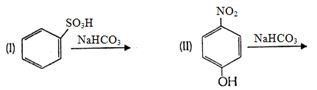
The gases evolved in reactions $(I)$ and $(II)$ are.......
A
$CO_2, CO_2$
B
$SO_2, NO_2$
C
$SO_2, CO_2$
D
$SO_2, NO$
Solution
(A) Reaction $(I)$: Benzenesulfonic acid $(C_6H_5SO_3H)$ is a strong acid. When it reacts with sodium bicarbonate $(NaHCO_3)$,it undergoes an acid-base reaction to form sodium benzenesulfonate,water,and carbon dioxide $(CO_2)$ gas.
Reaction $(II)$: $p$-Nitrophenol is a weaker acid than carbonic acid $(H_2CO_3)$. Therefore,it does not react with sodium bicarbonate $(NaHCO_3)$ to evolve $CO_2$ gas.
However,looking at the provided options,the question implies a reaction occurs in both. If we consider the acidity,benzenesulfonic acid is stronger than $H_2CO_3$,so it releases $CO_2$. $p$-Nitrophenol is also acidic enough to react with $NaHCO_3$ to release $CO_2$ gas because its $pK_a$ is approximately $7.15$,which is comparable to or stronger than carbonic acid ($pK_a \approx 6.35$ for the first dissociation). Thus,both reactions evolve $CO_2$ gas.
Reaction $(II)$: $p$-Nitrophenol is a weaker acid than carbonic acid $(H_2CO_3)$. Therefore,it does not react with sodium bicarbonate $(NaHCO_3)$ to evolve $CO_2$ gas.
However,looking at the provided options,the question implies a reaction occurs in both. If we consider the acidity,benzenesulfonic acid is stronger than $H_2CO_3$,so it releases $CO_2$. $p$-Nitrophenol is also acidic enough to react with $NaHCO_3$ to release $CO_2$ gas because its $pK_a$ is approximately $7.15$,which is comparable to or stronger than carbonic acid ($pK_a \approx 6.35$ for the first dissociation). Thus,both reactions evolve $CO_2$ gas.
0 likes
View Solution93
DifficultMCQ
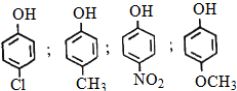
Arrange the following compounds in decreasing order of their acidity.
A
$II > IV > I > III$
B
$I > II > III > IV$
C
$III > I > II > IV$
D
$IV > III > I > II$
Solution
(C) The acidity of phenols depends on the stability of the phenoxide ion formed after the loss of a proton. Electron-withdrawing groups $(EWG)$ increase acidity by stabilizing the phenoxide ion,while electron-donating groups $(EDG)$ decrease acidity by destabilizing it.
Let the compounds be:
$I$: $p$-chlorophenol ($-Cl$ has $-I$ effect,which increases acidity)
$II$: $p$-cresol ($-CH_3$ has $+I$ and $+H$ effects,which decrease acidity)
$III$: $p$-nitrophenol ($-NO_2$ has strong $-I$ and $-M$ effects,which significantly increase acidity)
$IV$: $p$-methoxyphenol ($-OCH_3$ has $-I$ effect but strong $+M$ effect,which decreases acidity more than $-CH_3$)
Comparing the effects:
$-NO_2$ (strong $EWG$) > $-Cl$ (weak $EWG$) > $-CH_3$ (weak $EDG$) > $-OCH_3$ (strong $EDG$).
Therefore,the order of acidity is $III > I > II > IV$.
Let the compounds be:
$I$: $p$-chlorophenol ($-Cl$ has $-I$ effect,which increases acidity)
$II$: $p$-cresol ($-CH_3$ has $+I$ and $+H$ effects,which decrease acidity)
$III$: $p$-nitrophenol ($-NO_2$ has strong $-I$ and $-M$ effects,which significantly increase acidity)
$IV$: $p$-methoxyphenol ($-OCH_3$ has $-I$ effect but strong $+M$ effect,which decreases acidity more than $-CH_3$)
Comparing the effects:
$-NO_2$ (strong $EWG$) > $-Cl$ (weak $EWG$) > $-CH_3$ (weak $EDG$) > $-OCH_3$ (strong $EDG$).
Therefore,the order of acidity is $III > I > II > IV$.
0 likes
View Solution94
EasyMCQ
Which of the following is the least acidic?
A
$p$-Nitrophenol
B
$p$-Chlorophenol
C
Phenol
D
$o$-Cresol
Solution
(D) The acidity of phenols is determined by the stability of the phenoxide ion formed after the loss of a proton.
Electron-withdrawing groups $(EWG)$ like $-NO_2$ and $-Cl$ stabilize the phenoxide ion through $-I$ and $-M$ effects,thereby increasing acidity.
Electron-donating groups $(EDG)$ like $-CH_3$ (present in $o$-cresol) destabilize the phenoxide ion through $+I$ and hyperconjugation effects,thereby decreasing acidity.
Comparing the options:
$1$. $p$-Nitrophenol: Strongest acid due to the powerful $-M$ effect of $-NO_2$.
$2$. $p$-Chlorophenol: Acidic due to the $-I$ effect of $-Cl$.
$3$. Phenol: Baseline acidity.
$4$. $o$-Cresol: Least acidic due to the electron-donating $+I$ effect of the methyl group.
Therefore,$o$-cresol is the least acidic.
Electron-withdrawing groups $(EWG)$ like $-NO_2$ and $-Cl$ stabilize the phenoxide ion through $-I$ and $-M$ effects,thereby increasing acidity.
Electron-donating groups $(EDG)$ like $-CH_3$ (present in $o$-cresol) destabilize the phenoxide ion through $+I$ and hyperconjugation effects,thereby decreasing acidity.
Comparing the options:
$1$. $p$-Nitrophenol: Strongest acid due to the powerful $-M$ effect of $-NO_2$.
$2$. $p$-Chlorophenol: Acidic due to the $-I$ effect of $-Cl$.
$3$. Phenol: Baseline acidity.
$4$. $o$-Cresol: Least acidic due to the electron-donating $+I$ effect of the methyl group.
Therefore,$o$-cresol is the least acidic.
0 likes
View Solution95
MediumMCQ
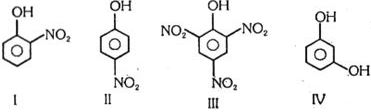
What is the correct order of increasing dissociation constant $(K_a)$ for the following compounds?
A
$II < IV < I < III$
B
$IV < II < I < III$
C
$IV < I < II < III$
D
$II < I < IV < III$
Solution
(C) The acidity of phenols increases with the presence of electron-withdrawing groups $(EWG)$ like $-NO_2$ due to their $-I$ and $-M$ effects,which stabilize the phenoxide ion. Conversely,electron-donating groups $(EDG)$ like $-OH$ decrease acidity.
$I$: $o$-Nitrophenol ($-NO_2$ at ortho position,$-I$ and $-M$ effect).
$II$: $p$-Nitrophenol ($-NO_2$ at para position,$-I$ and $-M$ effect).
$III$: $2,4,6$-Trinitrophenol (Picric acid,three $-NO_2$ groups,strongest acid).
$IV$: Resorcinol ($m$-hydroxy phenol,$-OH$ group at meta position acts as an $EDG$ via $+M$ effect,making it the least acidic).
Comparing $I$ and $II$: $p$-Nitrophenol $(II)$ is generally more acidic than $o$-Nitrophenol $(I)$ because $o$-Nitrophenol forms intramolecular hydrogen bonding,which stabilizes the molecule and makes the proton less available compared to $p$-Nitrophenol.
Thus,the order of acidity (and $K_a$) is: $IV < I < II < III$.
$I$: $o$-Nitrophenol ($-NO_2$ at ortho position,$-I$ and $-M$ effect).
$II$: $p$-Nitrophenol ($-NO_2$ at para position,$-I$ and $-M$ effect).
$III$: $2,4,6$-Trinitrophenol (Picric acid,three $-NO_2$ groups,strongest acid).
$IV$: Resorcinol ($m$-hydroxy phenol,$-OH$ group at meta position acts as an $EDG$ via $+M$ effect,making it the least acidic).
Comparing $I$ and $II$: $p$-Nitrophenol $(II)$ is generally more acidic than $o$-Nitrophenol $(I)$ because $o$-Nitrophenol forms intramolecular hydrogen bonding,which stabilizes the molecule and makes the proton less available compared to $p$-Nitrophenol.
Thus,the order of acidity (and $K_a$) is: $IV < I < II < III$.
0 likes
View Solution96
MediumMCQ
What is the order of acidic strength for the following compounds?
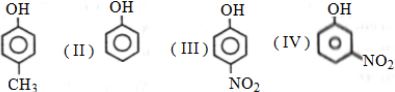
A
$I < II < IV < III$
B
$IV < III < II < I$
C
$I < II < III < IV$
D
$II < I < III < IV$
Solution
(A) The acidic strength of phenols depends on the stability of the phenoxide ion formed after the loss of a proton. Electron-withdrawing groups $(EWG)$ increase acidity by stabilizing the negative charge,while electron-donating groups $(EDG)$ decrease acidity by destabilizing it.
$I$: $p$-cresol ($-CH_3$ is an $EDG$,which decreases acidity).
$II$: Phenol (reference compound).
$III$: $p$-nitrophenol ($-NO_2$ is a strong $EWG$ at the para position,providing both $-I$ and $-M$ effects,making it the most acidic).
$IV$: $m$-nitrophenol ($-NO_2$ is an $EWG$ at the meta position,providing only $-I$ effect,making it less acidic than $p$-nitrophenol but more acidic than phenol).
Comparing the effects:
$p$-cresol $(I)$ < Phenol $(II)$ < $m$-nitrophenol $(IV)$ < $p$-nitrophenol $(III)$.
Thus,the correct order is $I < II < IV < III$.
$I$: $p$-cresol ($-CH_3$ is an $EDG$,which decreases acidity).
$II$: Phenol (reference compound).
$III$: $p$-nitrophenol ($-NO_2$ is a strong $EWG$ at the para position,providing both $-I$ and $-M$ effects,making it the most acidic).
$IV$: $m$-nitrophenol ($-NO_2$ is an $EWG$ at the meta position,providing only $-I$ effect,making it less acidic than $p$-nitrophenol but more acidic than phenol).
Comparing the effects:
$p$-cresol $(I)$ < Phenol $(II)$ < $m$-nitrophenol $(IV)$ < $p$-nitrophenol $(III)$.
Thus,the correct order is $I < II < IV < III$.
0 likes
View Solution97
MediumMCQ
Which of the following compounds is the most acidic?
A
$Cl-CH_2-CH_2-OH$
B
o-Nitrophenol
C
Phenol
D
o-Cresol
Solution
(B) The acidity of a compound depends on the stability of its conjugate base.
$1$. $Cl-CH_2-CH_2-OH$ is an aliphatic alcohol,which is much less acidic than phenols.
$2$. Among the phenols,the acidity is determined by the electron-withdrawing or electron-donating nature of the substituents.
$3$. The $-NO_2$ group is a strong electron-withdrawing group ($-I$ and $-M$ effect),which stabilizes the phenoxide ion significantly.
$4$. The $-CH_3$ group is an electron-donating group ($+I$ and hyperconjugation),which destabilizes the phenoxide ion,making it less acidic than phenol.
$5$. Therefore,$o$-Nitrophenol is the most acidic among the given options.
$1$. $Cl-CH_2-CH_2-OH$ is an aliphatic alcohol,which is much less acidic than phenols.
$2$. Among the phenols,the acidity is determined by the electron-withdrawing or electron-donating nature of the substituents.
$3$. The $-NO_2$ group is a strong electron-withdrawing group ($-I$ and $-M$ effect),which stabilizes the phenoxide ion significantly.
$4$. The $-CH_3$ group is an electron-donating group ($+I$ and hyperconjugation),which destabilizes the phenoxide ion,making it less acidic than phenol.
$5$. Therefore,$o$-Nitrophenol is the most acidic among the given options.
0 likes
View Solution98
MediumMCQ
What is the correct order of acidity for the following compounds?
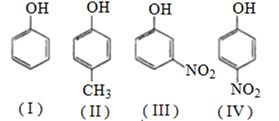
A
$III > IV > I > II$
B
$I > IV > III > II$
C
$II > I > III > IV$
D
$IV > III > I > II$
Solution
(D) The acidity of phenols is determined by the stability of the phenoxide ion formed after the loss of a proton. Electron-withdrawing groups $(EWG)$ increase acidity by stabilizing the negative charge,while electron-donating groups $(EDG)$ decrease acidity by destabilizing it.
$(I)$ Phenol: Reference compound.
$(II)$ $p$-Methylphenol: The $-CH_3$ group is an $EDG$ (via $+I$ and hyperconjugation),which destabilizes the phenoxide ion,making it the least acidic.
$(III)$ $m$-Nitrophenol: The $-NO_2$ group is a strong $EWG$ (via $-I$ effect),which stabilizes the phenoxide ion.
$(IV)$ $p$-Nitrophenol: The $-NO_2$ group is a strong $EWG$ (via both $-I$ and $-M$ effects),which provides maximum stabilization to the phenoxide ion.
Comparing the effects: The $-M$ effect of $-NO_2$ at the para position is more effective than the $-I$ effect at the meta position. Thus,the order of acidity is $IV > III > I > II$.
$(I)$ Phenol: Reference compound.
$(II)$ $p$-Methylphenol: The $-CH_3$ group is an $EDG$ (via $+I$ and hyperconjugation),which destabilizes the phenoxide ion,making it the least acidic.
$(III)$ $m$-Nitrophenol: The $-NO_2$ group is a strong $EWG$ (via $-I$ effect),which stabilizes the phenoxide ion.
$(IV)$ $p$-Nitrophenol: The $-NO_2$ group is a strong $EWG$ (via both $-I$ and $-M$ effects),which provides maximum stabilization to the phenoxide ion.
Comparing the effects: The $-M$ effect of $-NO_2$ at the para position is more effective than the $-I$ effect at the meta position. Thus,the order of acidity is $IV > III > I > II$.
0 likes
View Solution99
MediumMCQ
Which of the following groups increases the acidity of phenol?
A
$-NO_2$
B
$-CN$
C
$-CHO$
D
All of the above
Solution
(D) The acidity of phenol is directly proportional to the electron-withdrawing effect ($-I$ and $-M$ effect) of the substituent attached to the benzene ring.
All the given groups,$-NO_2$,$-CN$,and $-CHO$,are electron-withdrawing groups $(EWG)$ that stabilize the phenoxide ion by dispersing the negative charge through $-I$ and $-M$ effects.
Therefore,all of these groups increase the acidity of phenol.
All the given groups,$-NO_2$,$-CN$,and $-CHO$,are electron-withdrawing groups $(EWG)$ that stabilize the phenoxide ion by dispersing the negative charge through $-I$ and $-M$ effects.
Therefore,all of these groups increase the acidity of phenol.
0 likes
View SolutionAlcohols, Phenols and Ethers — Properties of Phenols · Frequently Asked Questions
1Are these Alcohols, Phenols and Ethers questions useful for JEE and NEET?
Yes. All questions in this section are mapped to JEE Main and NEET exam patterns. Previous year questions from JEE Main, NEET, GUJCET and state-level exams are included with full solutions.
2Can I switch to Hindi or Gujarati for these questions?
Yes. Use the language tabs in the hero section or the sidebar to view the same questions and solutions in English, Hindi or Gujarati.
3How do I generate a question paper from this subtopic?
Use the Vedclass Exam Paper Generator — select the chapter and subtopic, set difficulty, and generate Sets A, B, C, D automatically. First 3 chapters of every subject are free.
Vedclass Products
For Students
Vedclass Test Series
Mock tests in real JEE/NEET style with performance analysis. 5-day free trial.
Start Free TrialFor Teachers
Exam Paper Generator
Generate Set A/B/C/D papers from this chapter in 2 minutes. 3 chapters free.
Try FreeFor Institutes
Online Exam Module
Live online exams with unlimited students, 360° analytics & white-label branding.
See DemoFor Teachers & Institutes
Generate a Alcohols, Phenols and Ethers Exam Paper in 2 Minutes
Select subtopic & difficulty — Sets A, B, C, D auto-generated with No Repeat logic.
First 3 chapters of every subject are free — no payment required.