
A English
Properties of Ethers Questions in English
Class 12 Chemistry · Alcohols, Phenols and Ethers · Properties of Ethers
343+
Questions
English
Language
100%
With Solutions
Showing 50 of 343 questions in English
201
Medium
Give the reactions of ether compounds involving the cleavage of the $C-O$ bond with examples.
Solution
(N/A) Reactivity of ethers with $HX$:
$(i)$ Ethers are the least reactive among all functional groups.
$(ii)$ Ether compounds react with excess hydrogen halides $(HX)$ under vigorous conditions to produce alcohols and alkyl halides.
$R-O-R + HX \xrightarrow{\Delta} RX + ROH$
$(iii)$ The order of reactivity of hydrogen halides $(HX)$ with ethers is $HI > HBr > HCl$.
$(iv)$ Ethers react with concentrated $HI$ or $HBr$ at high temperatures to cleave the $C-O$ bond,forming alcohol and alkyl halide.
$(b)$ Ease of $C-O$ bond cleavage in ethers:
$(i)$ In dialkyl ethers with identical alkyl groups,cleavage of the $C-O$ bond by $HX$ yields identical products.
$(ii)$ In alkyl aryl ethers $(R-O-Ar)$,the alkyl-oxygen $(R-O)$ bond is cleaved,yielding $RX$ and $ArOH$.
The $Ar-O$ bond is stronger and more stable than the $R-O$ bond due to partial double bond character. The weaker $R-O$ bond breaks,and the nucleophile $X^-$ attacks the alkyl group to form $RX$,while $H^+$ adds to the phenoxide ion to form $ArOH$ (phenol).
$(i)$ Ethers are the least reactive among all functional groups.
$(ii)$ Ether compounds react with excess hydrogen halides $(HX)$ under vigorous conditions to produce alcohols and alkyl halides.
$R-O-R + HX \xrightarrow{\Delta} RX + ROH$
$(iii)$ The order of reactivity of hydrogen halides $(HX)$ with ethers is $HI > HBr > HCl$.
$(iv)$ Ethers react with concentrated $HI$ or $HBr$ at high temperatures to cleave the $C-O$ bond,forming alcohol and alkyl halide.
$(b)$ Ease of $C-O$ bond cleavage in ethers:
$(i)$ In dialkyl ethers with identical alkyl groups,cleavage of the $C-O$ bond by $HX$ yields identical products.
$(ii)$ In alkyl aryl ethers $(R-O-Ar)$,the alkyl-oxygen $(R-O)$ bond is cleaved,yielding $RX$ and $ArOH$.
The $Ar-O$ bond is stronger and more stable than the $R-O$ bond due to partial double bond character. The weaker $R-O$ bond breaks,and the nucleophile $X^-$ attacks the alkyl group to form $RX$,while $H^+$ adds to the phenoxide ion to form $ArOH$ (phenol).
0 likes
View Solution202
Medium
Describe the nucleophilic reactions of ethers with $HX$ and provide examples.
Solution
(N/A) Reactivity of ethers with $HX$:
$(i)$ Ethers are the least reactive among all functional groups.
$(ii)$ Ethers react with excess hydrogen halides $(HX)$ under vigorous conditions to produce alcohols and alkyl halides.
$R-O-R + HX \xrightarrow{\Delta} RX + ROH$
$(iii)$ The order of reactivity of hydrogen halides $(HX)$ with ethers is $HI > HBr > HCl$.
$(iv)$ Ethers react with concentrated $HI$ or $HBr$ at high temperatures to cleave the $C-O$ bond,forming an alcohol and an alkyl halide.
$(b)$ Ease of $C-O$ bond cleavage and product formation:
$(i)$ In symmetrical dialkyl ethers,cleavage of the $C-O$ bond by $HX$ yields identical products.
$(ii)$ In alkyl aryl ethers $(R-O-Ar)$,the alkyl-oxygen $(R-O)$ bond is cleaved,resulting in the formation of $RX$ and $ArOH$ (phenol).
The $Ar-O$ bond is more stable and stronger than the $R-O$ bond due to partial double bond character. The weaker $R-O$ bond breaks,and the nucleophile $X^-$ attacks the alkyl group to form $RX$,while $H^+$ adds to the phenoxide oxygen to form $ArOH$.
$(i)$ Ethers are the least reactive among all functional groups.
$(ii)$ Ethers react with excess hydrogen halides $(HX)$ under vigorous conditions to produce alcohols and alkyl halides.
$R-O-R + HX \xrightarrow{\Delta} RX + ROH$
$(iii)$ The order of reactivity of hydrogen halides $(HX)$ with ethers is $HI > HBr > HCl$.
$(iv)$ Ethers react with concentrated $HI$ or $HBr$ at high temperatures to cleave the $C-O$ bond,forming an alcohol and an alkyl halide.
$(b)$ Ease of $C-O$ bond cleavage and product formation:
$(i)$ In symmetrical dialkyl ethers,cleavage of the $C-O$ bond by $HX$ yields identical products.
$(ii)$ In alkyl aryl ethers $(R-O-Ar)$,the alkyl-oxygen $(R-O)$ bond is cleaved,resulting in the formation of $RX$ and $ArOH$ (phenol).
The $Ar-O$ bond is more stable and stronger than the $R-O$ bond due to partial double bond character. The weaker $R-O$ bond breaks,and the nucleophile $X^-$ attacks the alkyl group to form $RX$,while $H^+$ adds to the phenoxide oxygen to form $ArOH$.
0 likes
View Solution203
Medium
Explain the reaction of methoxyethane with concentrated $HI$ and describe its mechanism.
Solution
(N/A) Reaction of methoxyethane with concentrated $HI$: When methoxyethane is heated with concentrated $HI$,the $C-O$ bond breaks to form methyl iodide and ethanol. At higher temperatures,ethanol is further converted into ethyl iodide.
$(b)$ Mechanism: This reaction proceeds via an $S_{N}2$ mechanism in the following steps:
Step-$1$: Protonation of the ether occurs due to the presence of acidic $HI$,forming a protonated ether.
Step-$2$: The nucleophilic attack by $I^{-}$ results in the formation of methyl iodide $(CH_{3}I)$ and ethanol $(C_{2}H_{5}OH)$.
$(i)$ The nucleophile $I^{-}$ attacks the smaller alkyl group $(CH_{3})$ of the protonated ether from the opposite side,forming a transition state $(T)$ where the $C-I$ bond is partially formed and the $C-O$ bond is partially broken.
$(ii)$ In the transition state,the bond breaks. Since the rate depends on two species,it is a second-order or bimolecular reaction.
$(iii)$ Since the nucleophile $I^{-}$ displaces the $OCH_{2}CH_{3}$ (ethoxy) group from the ether,the reaction follows a nucleophilic substitution mechanism.
$(b)$ Mechanism: This reaction proceeds via an $S_{N}2$ mechanism in the following steps:
Step-$1$: Protonation of the ether occurs due to the presence of acidic $HI$,forming a protonated ether.
Step-$2$: The nucleophilic attack by $I^{-}$ results in the formation of methyl iodide $(CH_{3}I)$ and ethanol $(C_{2}H_{5}OH)$.
$(i)$ The nucleophile $I^{-}$ attacks the smaller alkyl group $(CH_{3})$ of the protonated ether from the opposite side,forming a transition state $(T)$ where the $C-I$ bond is partially formed and the $C-O$ bond is partially broken.
$(ii)$ In the transition state,the bond breaks. Since the rate depends on two species,it is a second-order or bimolecular reaction.
$(iii)$ Since the nucleophile $I^{-}$ displaces the $OCH_{2}CH_{3}$ (ethoxy) group from the ether,the reaction follows a nucleophilic substitution mechanism.
0 likes
View Solution204
Medium
Give the reaction of tert-butyl methyl ether with $HI$ and explain its mechanism.
Solution
(N/A) The reaction of tert-butyl methyl ether with $HI$ proceeds via an $S_{N}1$ mechanism because the tert-butyl group can form a stable carbocation intermediate.
Step $1$: Protonation of the ether oxygen atom by $H^+$ from $HI$ to form a protonated ether.
$(CH_3)_3C-O-CH_3 + H^+ \rightleftharpoons (CH_3)_3C-O^+(H)-CH_3$
Step $2$: The $C-O$ bond between the tert-butyl group and oxygen breaks to form a stable tert-butyl carbocation $(CH_3)_3C^+$ and methanol $(CH_3OH)$. This is the slow,rate-determining step.
$(CH_3)_3C-O^+(H)-CH_3 \xrightarrow{\text{slow}} (CH_3)_3C^+ + CH_3OH$
Step $3$: The nucleophilic iodide ion $(I^-)$ attacks the tert-butyl carbocation to form tert-butyl iodide.
$(CH_3)_3C^+ + I^- \xrightarrow{\text{fast}} (CH_3)_3C-I$
Overall reaction: $(CH_3)_3C-O-CH_3 + HI \rightarrow (CH_3)_3C-I + CH_3OH$.
Step $1$: Protonation of the ether oxygen atom by $H^+$ from $HI$ to form a protonated ether.
$(CH_3)_3C-O-CH_3 + H^+ \rightleftharpoons (CH_3)_3C-O^+(H)-CH_3$
Step $2$: The $C-O$ bond between the tert-butyl group and oxygen breaks to form a stable tert-butyl carbocation $(CH_3)_3C^+$ and methanol $(CH_3OH)$. This is the slow,rate-determining step.
$(CH_3)_3C-O^+(H)-CH_3 \xrightarrow{\text{slow}} (CH_3)_3C^+ + CH_3OH$
Step $3$: The nucleophilic iodide ion $(I^-)$ attacks the tert-butyl carbocation to form tert-butyl iodide.
$(CH_3)_3C^+ + I^- \xrightarrow{\text{fast}} (CH_3)_3C-I$
Overall reaction: $(CH_3)_3C-O-CH_3 + HI \rightarrow (CH_3)_3C-I + CH_3OH$.
0 likes
View Solution205
Medium
Explain the reaction of anisole with $HI$.
Solution
(N/A) The reaction is as follows:
$C_6H_5OCH_3 + HI \rightarrow C_6H_5OH + CH_3I$
Explanation:
Anisole is an ether containing $C_6H_5-O$ and $O-CH_3$ bonds.
The $C_6H_5-O$ bond is stronger because the oxygen is attached to an $sp^2$ hybridized carbon of the benzene ring,and resonance gives the $C-O$ bond partial double bond character.
Therefore,the $O-CH_3$ bond is weaker and breaks during the reaction.
Mechanism:
$(i)$ Protonation: The oxygen atom of anisole gets protonated by $H^+$ to form a protonated ether.
$C_6H_5-O(CH_3)-H^+$
(ii) Nucleophilic attack: The iodide ion $(I^-)$ attacks the less sterically hindered methyl group $(CH_3)$,breaking the $O-CH_3$ bond to form phenol $(C_6H_5OH)$ and methyl iodide $(CH_3I)$.
The phenol formed does not react further with $HI$ to form $C_6H_5I$ because the $sp^2$ hybridized carbon of the benzene ring does not undergo nucleophilic substitution with $I^-$.
$C_6H_5OCH_3 + HI \rightarrow C_6H_5OH + CH_3I$
Explanation:
Anisole is an ether containing $C_6H_5-O$ and $O-CH_3$ bonds.
The $C_6H_5-O$ bond is stronger because the oxygen is attached to an $sp^2$ hybridized carbon of the benzene ring,and resonance gives the $C-O$ bond partial double bond character.
Therefore,the $O-CH_3$ bond is weaker and breaks during the reaction.
Mechanism:
$(i)$ Protonation: The oxygen atom of anisole gets protonated by $H^+$ to form a protonated ether.
$C_6H_5-O(CH_3)-H^+$
(ii) Nucleophilic attack: The iodide ion $(I^-)$ attacks the less sterically hindered methyl group $(CH_3)$,breaking the $O-CH_3$ bond to form phenol $(C_6H_5OH)$ and methyl iodide $(CH_3I)$.
The phenol formed does not react further with $HI$ to form $C_6H_5I$ because the $sp^2$ hybridized carbon of the benzene ring does not undergo nucleophilic substitution with $I^-$.
0 likes
View Solution206
Medium
Explain: In alkoxybenzene,the alkoxy group is ortho-para directing,but why does electrophilic substitution occur mainly at the para-position and to a lesser extent at the ortho-position?
Solution
(N/A) $(i)$ The alkoxy group decreases the electron density at the ortho-position due to its electron-withdrawing inductive effect $(-I)$.
$(ii)$ The steric hindrance of the alkoxy group makes it difficult for the electrophile to reach the ortho-position. Due to these two reasons,the electrophilic reagent attaches more to the para-position.
$(iii)$ In reactions like bromination,nitration,and Friedel-Crafts reactions,the para-product is the major product,and the ortho-substituted product is the minor product.
$(ii)$ The steric hindrance of the alkoxy group makes it difficult for the electrophile to reach the ortho-position. Due to these two reasons,the electrophilic reagent attaches more to the para-position.
$(iii)$ In reactions like bromination,nitration,and Friedel-Crafts reactions,the para-product is the major product,and the ortho-substituted product is the minor product.
0 likes
View Solution207
Medium
Write the reaction for the nitration of anisole.
Solution
(N/A) Nitration of anisole is an electrophilic aromatic substitution reaction. Anisole reacts with a mixture of concentrated sulfuric acid $(H_2SO_4)$ and concentrated nitric acid $(HNO_3)$ to yield a mixture of ortho-nitroanisole and para-nitroanisole.
The reaction is as follows:
$C_6H_5OCH_3 + HNO_3 \xrightarrow{H_2SO_4} C_6H_4(NO_2)OCH_3$ (ortho and para isomers).
The $-OCH_3$ group is ortho and para directing,and it activates the benzene ring towards electrophilic substitution.
The reaction is as follows:
$C_6H_5OCH_3 + HNO_3 \xrightarrow{H_2SO_4} C_6H_4(NO_2)OCH_3$ (ortho and para isomers).
The $-OCH_3$ group is ortho and para directing,and it activates the benzene ring towards electrophilic substitution.
0 likes
View Solution208
Medium
Give the reaction of $CH_3-C(CH_3)_2-OCH_3$ with the following:
$(i)$ Anhydrous $HI$ in ether
$(ii)$ Concentrated $HI$
$(i)$ Anhydrous $HI$ in ether
$(ii)$ Concentrated $HI$
Solution
(N/A) The reaction of tert-butyl methyl ether with $HI$ proceeds via the protonation of the ether oxygen atom.
$(i)$ With anhydrous $HI$ (or $HI$ in ether),the reaction follows an $S_N2$ mechanism. The nucleophile $I^-$ attacks the less sterically hindered methyl group,resulting in the formation of tert-butyl alcohol and methyl iodide $(CH_3I)$.
$(ii)$ With concentrated $HI$,the reaction follows an $S_N1$ mechanism. The protonated ether undergoes cleavage to form a stable tert-butyl carbocation,which then reacts with $I^-$ to form $2-$iodo$-2-$methylpropane,while the methyl group forms methanol $(CH_3OH)$.
$(i)$ With anhydrous $HI$ (or $HI$ in ether),the reaction follows an $S_N2$ mechanism. The nucleophile $I^-$ attacks the less sterically hindered methyl group,resulting in the formation of tert-butyl alcohol and methyl iodide $(CH_3I)$.
$(ii)$ With concentrated $HI$,the reaction follows an $S_N1$ mechanism. The protonated ether undergoes cleavage to form a stable tert-butyl carbocation,which then reacts with $I^-$ to form $2-$iodo$-2-$methylpropane,while the methyl group forms methanol $(CH_3OH)$.
0 likes
View Solution209
Medium
Write the reaction steps for the following conversions:
$1.$ Propene to Propanal
$2.$ Ethanol to tert-Butyl ethyl ether
$1.$ Propene to Propanal
$2.$ Ethanol to tert-Butyl ethyl ether
Solution
(N/A) $1.$ Propene to Propanal:
$CH_3CH=CH_2$ $\xrightarrow[(ii) H_2O_2, OH^-]{(i) (BH_3)_2} CH_3CH_2CH_2OH$ $\xrightarrow{PCC \text{ or } Cu, 573 K} CH_3CH_2CHO$
$2.$ Ethanol to tert-Butyl ethyl ether:
$CH_3CH_2OH$ $\xrightarrow{PBr_3} CH_3CH_2Br$ $\xrightarrow{(CH_3)_3C-ONa^+} CH_3CH_2-O-C(CH_3)_3$
$CH_3CH=CH_2$ $\xrightarrow[(ii) H_2O_2, OH^-]{(i) (BH_3)_2} CH_3CH_2CH_2OH$ $\xrightarrow{PCC \text{ or } Cu, 573 K} CH_3CH_2CHO$
$2.$ Ethanol to tert-Butyl ethyl ether:
$CH_3CH_2OH$ $\xrightarrow{PBr_3} CH_3CH_2Br$ $\xrightarrow{(CH_3)_3C-ONa^+} CH_3CH_2-O-C(CH_3)_3$
0 likes
View Solution210
MediumMCQ
Identify the missing product in the following reaction: $C_6H_5ONa + CH_3CH_2Br \rightarrow (?)$
A
Phenetole $(C_6H_5OCH_2CH_3)$
B
Anisole $(C_6H_5OCH_3)$
C
Ethylbenzene $(C_6H_5CH_2CH_3)$
D
Phenol $(C_6H_5OH)$
Solution
(A) The given reaction is a Williamson ether synthesis.
In this reaction,sodium phenoxide $(C_6H_5ONa)$ acts as a nucleophile and attacks the electrophilic carbon of ethyl bromide $(CH_3CH_2Br)$.
The nucleophilic oxygen atom of the phenoxide ion attacks the $CH_2$ group of ethyl bromide,displacing the bromide ion $(Br^-)$.
The reaction is: $C_6H_5ONa + CH_3CH_2Br \rightarrow C_6H_5OCH_2CH_3 + NaBr$.
The product formed is phenetole $(C_6H_5OCH_2CH_3)$.
In this reaction,sodium phenoxide $(C_6H_5ONa)$ acts as a nucleophile and attacks the electrophilic carbon of ethyl bromide $(CH_3CH_2Br)$.
The nucleophilic oxygen atom of the phenoxide ion attacks the $CH_2$ group of ethyl bromide,displacing the bromide ion $(Br^-)$.
The reaction is: $C_6H_5ONa + CH_3CH_2Br \rightarrow C_6H_5OCH_2CH_3 + NaBr$.
The product formed is phenetole $(C_6H_5OCH_2CH_3)$.
0 likes
View Solution211
MediumMCQ
Complete the following reaction:
$CH_3CH_2-O-C(CH_3)_2-CH_2CH_3 + \text{conc. } HI \to (?)$
$CH_3CH_2-O-C(CH_3)_2-CH_2CH_3 + \text{conc. } HI \to (?)$
A
$CH_3CH_2OH + CH_3-CI(CH_3)-CH_2CH_3$
B
$CH_3CH_2I + CH_3-COH(CH_3)-CH_2CH_3$
C
$CH_3CH_2OH + CH_3-C(CH_3)=CHCH_3$
D
$CH_3CH_2I + CH_3-C(CH_3)=CHCH_3$
Solution
(A) The reaction of an ether with concentrated $HI$ proceeds via an $S_N1$ mechanism when one of the alkyl groups is tertiary.
In the given ether,$CH_3CH_2-O-C(CH_3)_2-CH_2CH_3$,the group attached to the oxygen is a tertiary alkyl group ($2$-methyl$-2-$butyl group).
The protonation of the ether oxygen by $HI$ forms an oxonium ion.
Then,the $C-O$ bond breaks to form a stable tertiary carbocation $(CH_3)_2C^+-CH_2CH_3$ and ethanol $(CH_3CH_2OH)$.
The iodide ion $(I^-)$ then attacks the tertiary carbocation to form $2-$iodo$-2-$methylbutane.
Thus,the products are ethanol $(CH_3CH_2OH)$ and $2-$iodo$-2-$methylbutane $(CH_3-CI(CH_3)-CH_2CH_3)$.
In the given ether,$CH_3CH_2-O-C(CH_3)_2-CH_2CH_3$,the group attached to the oxygen is a tertiary alkyl group ($2$-methyl$-2-$butyl group).
The protonation of the ether oxygen by $HI$ forms an oxonium ion.
Then,the $C-O$ bond breaks to form a stable tertiary carbocation $(CH_3)_2C^+-CH_2CH_3$ and ethanol $(CH_3CH_2OH)$.
The iodide ion $(I^-)$ then attacks the tertiary carbocation to form $2-$iodo$-2-$methylbutane.
Thus,the products are ethanol $(CH_3CH_2OH)$ and $2-$iodo$-2-$methylbutane $(CH_3-CI(CH_3)-CH_2CH_3)$.
0 likes
View Solution212
DifficultMCQ
Identify the missing reagent in the following reaction: $C_6H_5OCH_3 + (?) \rightarrow \text{p-methoxyacetophenone (major)} + \text{o-methoxyacetophenone (minor)}$
A
$CH_3Cl / AlCl_3$
B
$CH_3COCl / AlCl_3$
C
$CH_3COOH / H^+$
D
$CH_3COOCH_3 / AlCl_3$
Solution
(B) The given reaction is a Friedel-Crafts acylation of anisole $(C_6H_5OCH_3)$.
Anisole reacts with acetyl chloride $(CH_3COCl)$ in the presence of anhydrous aluminum chloride $(AlCl_3)$ as a Lewis acid catalyst.
This reaction introduces an acetyl group $(-COCH_3)$ at the ortho and para positions of the benzene ring.
Since the methoxy group $(-OCH_3)$ is ortho/para directing,the para-isomer is formed as the major product due to less steric hindrance compared to the ortho-isomer.
Therefore,the missing reagent is $CH_3COCl / AlCl_3$.
Anisole reacts with acetyl chloride $(CH_3COCl)$ in the presence of anhydrous aluminum chloride $(AlCl_3)$ as a Lewis acid catalyst.
This reaction introduces an acetyl group $(-COCH_3)$ at the ortho and para positions of the benzene ring.
Since the methoxy group $(-OCH_3)$ is ortho/para directing,the para-isomer is formed as the major product due to less steric hindrance compared to the ortho-isomer.
Therefore,the missing reagent is $CH_3COCl / AlCl_3$.
0 likes
View Solution213
Medium
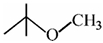
Why is the $C-O-H$ bond angle in alcohol slightly less than the tetrahedral angle,whereas the $C-O-C$ bond angle in ether is slightly greater?
Solution
The oxygen atom in both alcohol and ether is $sp^3$ hybridized.
In alcohols,the lone pair-lone pair repulsions are greater than the bond pair-bond pair repulsions,which pushes the bonding pairs closer together,resulting in a bond angle of $108.9^{\circ}$,which is slightly less than the regular tetrahedral angle of $109^{\circ} 28^{\prime}$.
In ethers,there is significant steric repulsion between the two bulky alkyl or aryl groups,which pushes the $C-O$ bonds apart,resulting in a bond angle of $111.7^{\circ}$,which is greater than $109^{\circ} 28^{\prime}$.
In alcohols,the lone pair-lone pair repulsions are greater than the bond pair-bond pair repulsions,which pushes the bonding pairs closer together,resulting in a bond angle of $108.9^{\circ}$,which is slightly less than the regular tetrahedral angle of $109^{\circ} 28^{\prime}$.
In ethers,there is significant steric repulsion between the two bulky alkyl or aryl groups,which pushes the $C-O$ bonds apart,resulting in a bond angle of $111.7^{\circ}$,which is greater than $109^{\circ} 28^{\prime}$.
0 likes
View Solution214
Medium
Write the mechanism of the reaction of $HI$ with methoxybenzene.
Solution
(N/A) The reaction of methoxybenzene (anisole) with $HI$ proceeds via an $S_N2$ mechanism. The steps are as follows:
Step $1$: Protonation of the ether oxygen atom.
The lone pair on the oxygen atom of methoxybenzene attacks the proton $(H^+)$ from $HI$ to form a protonated ether (oxonium ion).
$C_6H_5-O-CH_3 + H^+ \rightleftharpoons C_6H_5-O^+(H)-CH_3$
Step $2$: Nucleophilic attack by the iodide ion $(I^-)$.
The iodide ion $(I^-)$ acts as a nucleophile and attacks the less sterically hindered methyl carbon atom of the protonated ether. This leads to the cleavage of the $C-O$ bond,resulting in the formation of phenol and methyl iodide $(CH_3I)$.
$C_6H_5-O^+(H)-CH_3 + I^- \xrightarrow{S_N2} C_6H_5-OH + CH_3I$
Step $1$: Protonation of the ether oxygen atom.
The lone pair on the oxygen atom of methoxybenzene attacks the proton $(H^+)$ from $HI$ to form a protonated ether (oxonium ion).
$C_6H_5-O-CH_3 + H^+ \rightleftharpoons C_6H_5-O^+(H)-CH_3$
Step $2$: Nucleophilic attack by the iodide ion $(I^-)$.
The iodide ion $(I^-)$ acts as a nucleophile and attacks the less sterically hindered methyl carbon atom of the protonated ether. This leads to the cleavage of the $C-O$ bond,resulting in the formation of phenol and methyl iodide $(CH_3I)$.
$C_6H_5-O^+(H)-CH_3 + I^- \xrightarrow{S_N2} C_6H_5-OH + CH_3I$
0 likes
View Solution215
Medium
Complete the following reaction sequence.
$CH_3-CO-CH_3$ $\xrightarrow[(ii) H_2O]{(i) CH_3MgBr} [A]$ $\xrightarrow{Na, \text{Ether}} [B]$ $\xrightarrow{CH_3-Br} [C]$
$CH_3-CO-CH_3$ $\xrightarrow[(ii) H_2O]{(i) CH_3MgBr} [A]$ $\xrightarrow{Na, \text{Ether}} [B]$ $\xrightarrow{CH_3-Br} [C]$
Solution
(N/A) Step $1$: Reaction of propanone with $CH_3MgBr$ followed by hydrolysis gives $2$-methylpropan-$2$-ol $([A])$.
$CH_3-CO-CH_3 + CH_3MgBr$ $\rightarrow (CH_3)_3C-OMgBr$ $\xrightarrow{H_2O} (CH_3)_3C-OH$ $([A])$.
Step $2$: Reaction of $[A]$ with $Na$ metal in ether gives sodium $tert$-butoxide $([B])$.
$(CH_3)_3C-OH + Na \rightarrow (CH_3)_3C-ONa$ $([B])$ $+ \frac{1}{2} H_2$.
Step $3$: Reaction of $[B]$ with $CH_3-Br$ via Williamson synthesis gives $2$-methoxy-$2$-methylpropane $([C])$.
$(CH_3)_3C-ONa + CH_3-Br \rightarrow (CH_3)_3C-O-CH_3$ $([C])$ $+ NaBr$.
$CH_3-CO-CH_3 + CH_3MgBr$ $\rightarrow (CH_3)_3C-OMgBr$ $\xrightarrow{H_2O} (CH_3)_3C-OH$ $([A])$.
Step $2$: Reaction of $[A]$ with $Na$ metal in ether gives sodium $tert$-butoxide $([B])$.
$(CH_3)_3C-OH + Na \rightarrow (CH_3)_3C-ONa$ $([B])$ $+ \frac{1}{2} H_2$.
Step $3$: Reaction of $[B]$ with $CH_3-Br$ via Williamson synthesis gives $2$-methoxy-$2$-methylpropane $([C])$.
$(CH_3)_3C-ONa + CH_3-Br \rightarrow (CH_3)_3C-O-CH_3$ $([C])$ $+ NaBr$.
0 likes
View Solution216
Medium
Ethers are prepared from alcohols by Williamson synthesis. Heating ethanol with sulfuric acid at $413 \ K$ gives ethoxyethane. Match the ether compounds in Column-$I$ with the products formed upon heating with $HI$ in Column-$II$.
| Column-$I$ (Ether) | Column-$II$ (Product) |
|---|---|
| $(A)$ $CH_3CH_2-CH(CH_3)-CH_2-OCH_2CH_3$ | $(i)$ $CH_3OH + CH_3-C(CH_3)_2-I$ |
| $(B)$ $CH_3CH_2CH_2-O-C(CH_3)_2CH_2CH_3$ | (ii) $C_6H_5OH + C_6H_5CH_2I$ |
| $(C)$ $C_6H_5CH_2-O-C_6H_5$ | (iii) $CH_3CH_2CH_2OH + CH_3CH_2-C(CH_3)_2-I$ |
| $(D)$ $CH_3-C(CH_3)_2-O-CH_3$ | (iv) $CH_3CH_2-CH(CH_3)-CH_2OH + CH_3CH_2I$ |
Solution
(A-IV, B-III, C-II, D-I) The reaction of ethers with $HI$ follows $S_N1$ or $S_N2$ mechanisms depending on the nature of the alkyl groups.
$(A)$ $CH_3CH_2-CH(CH_3)-CH_2-OCH_2CH_3$ is a primary ether. Cleavage occurs at the less hindered side,giving $CH_3CH_2-CH(CH_3)-CH_2OH$ and $CH_3CH_2I$ $(A \rightarrow iv)$.
$(B)$ $CH_3CH_2CH_2-O-C(CH_3)_2CH_2CH_3$ contains a tertiary alkyl group. Cleavage occurs via $S_N1$ to form the stable tertiary carbocation,giving $CH_3CH_2CH_2OH$ and $CH_3CH_2-C(CH_3)_2I$ $(B \rightarrow iii)$.
$(C)$ $C_6H_5CH_2-O-C_6H_5$ has a benzyl group and a phenyl group. The $C-O$ bond between the benzyl carbon and oxygen breaks,giving $C_6H_5CH_2I$ and $C_6H_5OH$ $(C \rightarrow ii)$.
$(D)$ $CH_3-C(CH_3)_2-O-CH_3$ contains a tertiary alkyl group. Cleavage occurs via $S_N1$ to form the stable tertiary carbocation,giving $CH_3OH$ and $CH_3-C(CH_3)_2I$ $(D \rightarrow i)$.
$(A)$ $CH_3CH_2-CH(CH_3)-CH_2-OCH_2CH_3$ is a primary ether. Cleavage occurs at the less hindered side,giving $CH_3CH_2-CH(CH_3)-CH_2OH$ and $CH_3CH_2I$ $(A \rightarrow iv)$.
$(B)$ $CH_3CH_2CH_2-O-C(CH_3)_2CH_2CH_3$ contains a tertiary alkyl group. Cleavage occurs via $S_N1$ to form the stable tertiary carbocation,giving $CH_3CH_2CH_2OH$ and $CH_3CH_2-C(CH_3)_2I$ $(B \rightarrow iii)$.
$(C)$ $C_6H_5CH_2-O-C_6H_5$ has a benzyl group and a phenyl group. The $C-O$ bond between the benzyl carbon and oxygen breaks,giving $C_6H_5CH_2I$ and $C_6H_5OH$ $(C \rightarrow ii)$.
$(D)$ $CH_3-C(CH_3)_2-O-CH_3$ contains a tertiary alkyl group. Cleavage occurs via $S_N1$ to form the stable tertiary carbocation,giving $CH_3OH$ and $CH_3-C(CH_3)_2I$ $(D \rightarrow i)$.
0 likes
View Solution217
Difficult
Match the products of the reaction with anisole in Column-$I$ with the reagents in Column-$II$. Find the correct reagent for the product in Column-$I$ from Column-$II$.
| Column-$I$ (Product) | Column-$II$ (Reagent) |
| $A$. Mainly $p$-bromoanisole | $i$. Anhydrous $AlCl_3$,$CH_3COCl$ |
| $B$. $4$-nitroanisole | $ii$. $CH_3Cl$,anhydrous $AlCl_3$ in $CS_2$ |
| $C$. $4$-methoxytoluene | $iii$. $Br_2$ in ethanoic acid |
| $D$. $4$-methoxyacetophenone | $iv$. Mixture of conc. $H_2SO_4$ and $HNO_3$ |
Solution
(A-III, B-IV, C-II, D-I) The reactions of anisole are as follows:
$(A)$ Bromination of anisole with $Br_2$ in ethanoic acid gives $p$-bromoanisole as the major product. Thus,$(A \rightarrow iii)$.
$(B)$ Nitration of anisole with a mixture of conc. $H_2SO_4$ and $HNO_3$ gives $4$-nitroanisole. Thus,$(B \rightarrow iv)$.
$(C)$ Friedel-Crafts alkylation of anisole with $CH_3Cl$ in the presence of anhydrous $AlCl_3$ gives $4$-methoxytoluene. Thus,$(C \rightarrow ii)$.
$(D)$ Friedel-Crafts acylation of anisole with $CH_3COCl$ in the presence of anhydrous $AlCl_3$ gives $4$-methoxyacetophenone. Thus,$(D \rightarrow i)$.
Therefore,the correct matching is $(A-iii, B-iv, C-ii, D-i)$.
$(A)$ Bromination of anisole with $Br_2$ in ethanoic acid gives $p$-bromoanisole as the major product. Thus,$(A \rightarrow iii)$.
$(B)$ Nitration of anisole with a mixture of conc. $H_2SO_4$ and $HNO_3$ gives $4$-nitroanisole. Thus,$(B \rightarrow iv)$.
$(C)$ Friedel-Crafts alkylation of anisole with $CH_3Cl$ in the presence of anhydrous $AlCl_3$ gives $4$-methoxytoluene. Thus,$(C \rightarrow ii)$.
$(D)$ Friedel-Crafts acylation of anisole with $CH_3COCl$ in the presence of anhydrous $AlCl_3$ gives $4$-methoxyacetophenone. Thus,$(D \rightarrow i)$.
Therefore,the correct matching is $(A-iii, B-iv, C-ii, D-i)$.
0 likes
View Solution218
Difficult
Match the reactants in Column-$I$ with the major products of their reaction in Column-$II$. Find the correct match for $(I)$ from $(II)$.
| Column-$I$ (Reactants) | Column-$II$ (Products) |
|---|---|
| $(A) \ CH_3CH_2CH_2-O-CH_3 + HI \rightarrow$ | $(i) \ (CH_3)_3C-I + CH_3CH_2OH$ |
| $(B) \ C_6H_5OCH_2CH_3 + HBr \rightarrow$ | $(ii) \ CH_3CH_2CH_2OH + CH_3I$ |
| $(C) \ (CH_3)_3C-OCH_2CH_3 + HI \rightarrow$ | $(iii) \ CH_3CH_2I + C_6H_5OH$ |
| $(D) \ C_6H_5OCH_2CH_3 + \text{conc. } H_2SO_4 + \text{conc. } HNO_3 \rightarrow$ | $(iv) \ p-NO_2-C_6H_4-OCH_2CH_3$ |
Solution
(A-II, B-III, C-I, D-IV) $(A) \ CH_3CH_2CH_2-O-CH_3 + HI \rightarrow CH_3CH_2CH_2OH + CH_3I$ (Cleavage occurs at the less hindered side,$S_N2$ mechanism). Thus,$(A \rightarrow ii)$.
$(B) \ C_6H_5OCH_2CH_3 + HBr \rightarrow C_6H_5OH + CH_3CH_2Br$ (Phenol and ethyl bromide are formed). Wait,looking at the options,$(iii)$ is $CH_3CH_2I + C_6H_5OH$. If $HI$ was used,it would be $(iii)$. Given the options,$(B \rightarrow iii)$ is the intended match.
$(C) \ (CH_3)_3C-OCH_2CH_3 + HI \rightarrow (CH_3)_3C-I + CH_3CH_2OH$ (Cleavage occurs at the more hindered side due to stable carbocation formation,$S_N1$ mechanism). Thus,$(C \rightarrow i)$.
$(D) \ C_6H_5OCH_2CH_3$ undergoes electrophilic aromatic substitution (nitration) to give $p$-nitro-phenetole. Thus,$(D \rightarrow iv)$.
Final match: $(A$ $\rightarrow ii, B$ $\rightarrow iii, C$ $\rightarrow i, D$ $\rightarrow iv)$.
$(B) \ C_6H_5OCH_2CH_3 + HBr \rightarrow C_6H_5OH + CH_3CH_2Br$ (Phenol and ethyl bromide are formed). Wait,looking at the options,$(iii)$ is $CH_3CH_2I + C_6H_5OH$. If $HI$ was used,it would be $(iii)$. Given the options,$(B \rightarrow iii)$ is the intended match.
$(C) \ (CH_3)_3C-OCH_2CH_3 + HI \rightarrow (CH_3)_3C-I + CH_3CH_2OH$ (Cleavage occurs at the more hindered side due to stable carbocation formation,$S_N1$ mechanism). Thus,$(C \rightarrow i)$.
$(D) \ C_6H_5OCH_2CH_3$ undergoes electrophilic aromatic substitution (nitration) to give $p$-nitro-phenetole. Thus,$(D \rightarrow iv)$.
Final match: $(A$ $\rightarrow ii, B$ $\rightarrow iii, C$ $\rightarrow i, D$ $\rightarrow iv)$.
0 likes
View Solution219
Medium
Match the starting materials given in Column-$I$ with the products formed by these (Column-$II$) in the reaction with $HI$.
| Column-$I$ | Column-$II$ |
|---|---|
| $(A)$ $CH_3-O-CH_3$ | $(1)$ $C_6H_5OH + CH_3I$ |
| $(B)$ $(CH_3)_2CH-O-CH_3$ | $(2)$ $(CH_3)_3C-I + CH_3OH$ |
| $(C)$ $(CH_3)_3C-O-CH_3$ | $(3)$ $C_6H_5I + CH_3OH$ |
| $(D)$ $C_6H_5-O-CH_3$ | $(4)$ $CH_3OH + CH_3I$ |
| $(5)$ $(CH_3)_2CHOH + CH_3I$ | |
| $(6)$ $(CH_3)_2CH-I + CH_3OH$ | |
| $(7)$ $(CH_3)_3COH + CH_3I$ |
Solution
(A-4, B-5, C-2, D-1) The reaction of ethers with $HI$ follows $S_N2$ or $S_N1$ mechanisms depending on the nature of the alkyl groups.
$(A)$ $CH_3-O-CH_3 + HI \rightarrow CH_3OH + CH_3I$ (Matches with $4$).
$(B)$ $(CH_3)_2CH-O-CH_3 + HI \rightarrow (CH_3)_2CH-I + CH_3OH$ (The $S_N2$ mechanism occurs at the less hindered methyl group,but here the secondary carbon is more reactive towards $S_N1$ or $S_N2$ depending on conditions; typically,$CH_3I$ and $(CH_3)_2CHOH$ are formed,matching with $5$).
$(C)$ $(CH_3)_3C-O-CH_3 + HI \rightarrow (CH_3)_3C-I + CH_3OH$ (The $S_N1$ mechanism occurs at the tertiary carbon,matching with $2$).
$(D)$ $C_6H_5-O-CH_3 + HI \rightarrow C_6H_5OH + CH_3I$ (Cleavage occurs at the $O-CH_3$ bond because the $C-O$ bond to the phenyl ring has partial double bond character,matching with $1$).
Thus,the correct matching is: $A-4, B-5, C-2, D-1$.
$(A)$ $CH_3-O-CH_3 + HI \rightarrow CH_3OH + CH_3I$ (Matches with $4$).
$(B)$ $(CH_3)_2CH-O-CH_3 + HI \rightarrow (CH_3)_2CH-I + CH_3OH$ (The $S_N2$ mechanism occurs at the less hindered methyl group,but here the secondary carbon is more reactive towards $S_N1$ or $S_N2$ depending on conditions; typically,$CH_3I$ and $(CH_3)_2CHOH$ are formed,matching with $5$).
$(C)$ $(CH_3)_3C-O-CH_3 + HI \rightarrow (CH_3)_3C-I + CH_3OH$ (The $S_N1$ mechanism occurs at the tertiary carbon,matching with $2$).
$(D)$ $C_6H_5-O-CH_3 + HI \rightarrow C_6H_5OH + CH_3I$ (Cleavage occurs at the $O-CH_3$ bond because the $C-O$ bond to the phenyl ring has partial double bond character,matching with $1$).
Thus,the correct matching is: $A-4, B-5, C-2, D-1$.
0 likes
View Solution220
DifficultMCQ
An organic compound $'A'$ $(C_9H_{10}O)$ when treated with conc. $HI$ undergoes cleavage to yield compounds $'B'$ and $'C'$. $'B'$ gives a yellow precipitate with $AgNO_3$ whereas $'C'$ tautomerizes to $'D'$. $'D'$ gives a positive iodoform test. $'A'$ could be :
A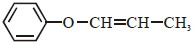
B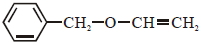
C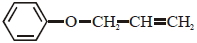
D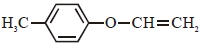
Solution
(B) The reaction of the ether $'A'$ $(C_9H_{10}O)$ with conc. $HI$ leads to cleavage.
Compound $'A'$ is benzyl vinyl ether $(C_6H_5CH_2-O-CH=CH_2)$.
Upon treatment with $HI$,the ether bond cleaves to form benzyl iodide ($C_6H_5CH_2I$,compound $'B'$) and vinyl alcohol ($CH_2=CHOH$,compound $'C'$).
Compound $'B'$ $(C_6H_5CH_2I)$ reacts with $AgNO_3$ to give a yellow precipitate of $AgI$.
Compound $'C'$ $(CH_2=CHOH)$ is unstable and tautomerizes to acetaldehyde ($CH_3CHO$,compound $'D'$).
Acetaldehyde $(CH_3CHO)$ gives a positive iodoform test because it contains the $CH_3CO-$ group.
Therefore,the structure of $'A'$ is benzyl vinyl ether.
Compound $'A'$ is benzyl vinyl ether $(C_6H_5CH_2-O-CH=CH_2)$.
Upon treatment with $HI$,the ether bond cleaves to form benzyl iodide ($C_6H_5CH_2I$,compound $'B'$) and vinyl alcohol ($CH_2=CHOH$,compound $'C'$).
Compound $'B'$ $(C_6H_5CH_2I)$ reacts with $AgNO_3$ to give a yellow precipitate of $AgI$.
Compound $'C'$ $(CH_2=CHOH)$ is unstable and tautomerizes to acetaldehyde ($CH_3CHO$,compound $'D'$).
Acetaldehyde $(CH_3CHO)$ gives a positive iodoform test because it contains the $CH_3CO-$ group.
Therefore,the structure of $'A'$ is benzyl vinyl ether.
0 likes
View Solution221
MediumMCQ
Anisole on cleavage with $HI$ gives:
A
$Phenol$ and $Methyl \ iodide$
B
$Iodobenzene$ and $Methyl \ alcohol$
C
$Phenol$ and $Methane$
D
$Benzene$ and $Methyl \ alcohol$
Solution
(A) Anisole $(C_6H_5OCH_3)$ on heating with $HI$ undergoes cleavage of the $C-O$ bond between the methyl group and the oxygen atom to form $Phenol$ $(C_6H_5OH)$ and $Methyl \ iodide$ $(CH_3I)$.
This reaction proceeds via an $S_N2$ mechanism where the iodide ion attacks the less sterically hindered methyl carbon.
This reaction proceeds via an $S_N2$ mechanism where the iodide ion attacks the less sterically hindered methyl carbon.
0 likes
View Solution222
DifficultMCQ
What is $X$ in the following reaction?
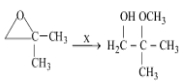
A
$CH_3OH, H_2SO_4$
B
$CH_3OH, CH_3O^{-}Na^{+}$
C
$H_2O / H_2SO_4$ followed by $CH_3OH$
D
$CH_3MgBr / \text{ether}$ followed by $H_3O^{+}$
Solution
(A) The reaction involves the acid-catalyzed ring opening of an epoxide.
In the presence of an acid catalyst like $H_2SO_4$,the epoxide oxygen is protonated,making the epoxide ring more susceptible to nucleophilic attack.
Since the reaction occurs under acidic conditions,the nucleophile $(CH_3OH)$ attacks the more substituted carbon atom of the epoxide due to the development of significant carbocation character at that position in the transition state.
Therefore,the reagent $X$ is $CH_3OH$ in the presence of an acid catalyst $(H_2SO_4)$.
In the presence of an acid catalyst like $H_2SO_4$,the epoxide oxygen is protonated,making the epoxide ring more susceptible to nucleophilic attack.
Since the reaction occurs under acidic conditions,the nucleophile $(CH_3OH)$ attacks the more substituted carbon atom of the epoxide due to the development of significant carbocation character at that position in the transition state.
Therefore,the reagent $X$ is $CH_3OH$ in the presence of an acid catalyst $(H_2SO_4)$.
0 likes
View Solution223
MediumMCQ
Main products formed during a reaction of $1-$methoxy naphthalene with hydroiodic acid are:
A
$CH_3OH$ and $1-$naphthol
B
$CH_3I$ and $1-$naphthol
C
$CH_3OH$ and $1-$iodonaphthalene
D
$CH_3I$ and $1-$iodonaphthalene
Solution
(B) The reaction of an alkyl aryl ether with $HI$ involves the protonation of the ether oxygen atom followed by the nucleophilic attack of the iodide ion $(I^-)$ on the less sterically hindered alkyl group.
In $1-$methoxy naphthalene,the oxygen is attached to a methyl group and a naphthyl group.
The $I^-$ ion attacks the methyl group $(CH_3)$ via an $S_N2$ mechanism because the naphthyl group is bulky and the $C-O$ bond involving the aromatic ring has partial double bond character,making it resistant to nucleophilic substitution.
Thus,the products formed are $CH_3I$ (methyl iodide) and $1-$naphthol.
In $1-$methoxy naphthalene,the oxygen is attached to a methyl group and a naphthyl group.
The $I^-$ ion attacks the methyl group $(CH_3)$ via an $S_N2$ mechanism because the naphthyl group is bulky and the $C-O$ bond involving the aromatic ring has partial double bond character,making it resistant to nucleophilic substitution.
Thus,the products formed are $CH_3I$ (methyl iodide) and $1-$naphthol.
0 likes
View Solution224
MediumMCQ
Given below are two statements: one is labelled as Assertion $(A)$ and the other is labelled as Reason $(R).$
Assertion $(A):$ Synthesis of ethyl phenyl ether may be achieved by Williamson synthesis.
Reason $(R):$ Reaction of bromobenzene with sodium ethoxide yields ethyl phenyl ether.
In the light of the above statements,choose the most appropriate answer from the options given below:
Assertion $(A):$ Synthesis of ethyl phenyl ether may be achieved by Williamson synthesis.
Reason $(R):$ Reaction of bromobenzene with sodium ethoxide yields ethyl phenyl ether.
In the light of the above statements,choose the most appropriate answer from the options given below:
A
Both $(A)$ and $(R)$ are correct and $(R)$ is the correct explanation of $(A)$
B
$(A)$ is correct but $(R)$ is not correct
C
$(A)$ is not correct but $(R)$ is correct
D
Both $(A)$ and $(R)$ are correct but $(R)$ is $NOT$ the correct explanation of $(A)$
Solution
(B) Williamson synthesis involves the reaction of an alkyl halide with a sodium alkoxide or sodium phenoxide to form an ether.
Assertion $(A)$ is correct because ethyl phenyl ether can be synthesized by the reaction of sodium phenoxide with ethyl bromide.
Reason $(R)$ is incorrect because bromobenzene does not undergo nucleophilic substitution with sodium ethoxide under normal conditions due to the partial double bond character of the $C-Br$ bond in aryl halides,which makes the carbon atom less susceptible to nucleophilic attack.
Assertion $(A)$ is correct because ethyl phenyl ether can be synthesized by the reaction of sodium phenoxide with ethyl bromide.
Reason $(R)$ is incorrect because bromobenzene does not undergo nucleophilic substitution with sodium ethoxide under normal conditions due to the partial double bond character of the $C-Br$ bond in aryl halides,which makes the carbon atom less susceptible to nucleophilic attack.
0 likes
View Solution225
DifficultMCQ
Major product '$B$' of the following reaction sequence is.
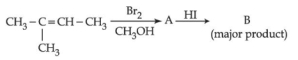
A
$CH_3-C(OH)(CH_3)-CH(Br)-CH_3$
B
$CH_3-C(I)(CH_3)-CH(Br)-CH_3$
C
$CH_3-C(Br)(CH_3)-CH(OH)-CH_3$
D
$CH_3-C(Br)(CH_3)-CH(I)-CH_3$
Solution
(B) The reaction of $2$-methylbut-$2$-ene with $Br_2$ in the presence of $CH_3OH$ (a polar protic solvent) proceeds via the formation of a bromonium ion intermediate.
$CH_3OH$ acts as a nucleophile and attacks the more substituted carbon atom of the bromonium ion to form an ether,$A$ ($3$-bromo-$2$-methoxy-$2$-methylbutane).
Reaction: $CH_3-C(CH_3)=CH-CH_3 + Br_2 + CH_3OH \rightarrow CH_3-C(OCH_3)(CH_3)-CH(Br)-CH_3$ $(A)$.
When $A$ reacts with $HI$,the methoxy group $(-OCH_3)$ is protonated by $H^+$ to form an oxonium ion,which is a good leaving group.
$I^-$ then attacks the tertiary carbon atom,displacing $CH_3OH$ to form the final product $B$ ($3$-bromo-$2$-iodo-$2$-methylbutane).
Therefore,the major product $B$ is $CH_3-C(I)(CH_3)-CH(Br)-CH_3$.
$CH_3OH$ acts as a nucleophile and attacks the more substituted carbon atom of the bromonium ion to form an ether,$A$ ($3$-bromo-$2$-methoxy-$2$-methylbutane).
Reaction: $CH_3-C(CH_3)=CH-CH_3 + Br_2 + CH_3OH \rightarrow CH_3-C(OCH_3)(CH_3)-CH(Br)-CH_3$ $(A)$.
When $A$ reacts with $HI$,the methoxy group $(-OCH_3)$ is protonated by $H^+$ to form an oxonium ion,which is a good leaving group.
$I^-$ then attacks the tertiary carbon atom,displacing $CH_3OH$ to form the final product $B$ ($3$-bromo-$2$-iodo-$2$-methylbutane).
Therefore,the major product $B$ is $CH_3-C(I)(CH_3)-CH(Br)-CH_3$.
0 likes
View Solution226
DifficultMCQ
The following compound can readily be prepared by Williamson ether synthesis by reaction between:

A
Bicyclo[$2.2$.$2$]octan$-1-$ol and benzyl chloride
B
Bicyclo[$2.2$.$2$]octan$-1-$ol and benzyl iodide
C
$1-$Chlorobicyclo[$2.2$.$2$]octane and benzyl alcohol
D
$1-$Iodobicyclo[$2.2$.$2$]octane and benzyl alcohol
Solution
(B) Williamson ether synthesis involves the $S_{N}2$ reaction between an alkoxide ion and a primary alkyl halide. The reaction is favored when the leaving group is good. In this case,the alkoxide is derived from bicyclo[$2.2$.$2$]octan$-1-$ol,and the alkyl halide is benzyl halide. Between benzyl chloride and benzyl iodide,benzyl iodide is preferred because $I^{-}$ is a better leaving group than $Cl^{-}$,making the $S_{N}2$ reaction faster.
0 likes
View Solution227
EasyMCQ
The major product formed in the following reaction is: $CH_{3}Br + CH_{3}CH_{2}ONa \longrightarrow$
A
$CH_{3}CH_{2}CH_{2}OH$
B
$CH_{3}OCH_{3}$
C
$CH_{3}CH_{2}OCH_{3}$
D
$CH_{3}CH_{2}OCH_{2}Br$
Solution
(C) The reaction is: $CH_{3}Br + CH_{3}CH_{2}ONa \rightarrow CH_{3}CH_{2}OCH_{3} + NaBr$.
This reaction is known as the Williamson ether synthesis.
In this reaction,a primary alkyl halide $(CH_{3}Br)$ reacts with a sodium alkoxide $(CH_{3}CH_{2}ONa)$ via an $S_{N}2$ mechanism to form an ether $(CH_{3}CH_{2}OCH_{3})$,which is ethyl methyl ether.
Since $CH_{3}Br$ is a primary halide,the $S_{N}2$ pathway is highly favorable.
This reaction is known as the Williamson ether synthesis.
In this reaction,a primary alkyl halide $(CH_{3}Br)$ reacts with a sodium alkoxide $(CH_{3}CH_{2}ONa)$ via an $S_{N}2$ mechanism to form an ether $(CH_{3}CH_{2}OCH_{3})$,which is ethyl methyl ether.
Since $CH_{3}Br$ is a primary halide,the $S_{N}2$ pathway is highly favorable.
0 likes
View Solution228
MediumMCQ
The major products formed in the reaction of $t$-butyl methyl ether with $HI$ are
A
$CH_3I$ and $(CH_3)_3COH$
B
$(CH_3)_2C=CH_2$ and $CH_3OH$
C
$(CH_3)_3CI$ and $CH_3OH$
D
$(CH_3)_2CHCH_2I$ and $CH_3OH$
Solution
(C) The reaction of $t$-butyl methyl ether with $HI$ proceeds via an $S_N1$ mechanism.
$1$. The oxygen atom of the ether is protonated by $HI$ to form an oxonium ion.
$2$. The $C-O$ bond between the $t$-butyl group and the oxygen atom breaks to form a stable $t$-butyl carbocation $(CH_3)_3C^+$ and methanol $(CH_3OH)$.
$3$. The iodide ion $(I^-)$ then attacks the $t$-butyl carbocation to form $t$-butyl iodide $(CH_3)_3CI$.
Thus,the major products are $t$-butyl iodide and methanol.
$1$. The oxygen atom of the ether is protonated by $HI$ to form an oxonium ion.
$2$. The $C-O$ bond between the $t$-butyl group and the oxygen atom breaks to form a stable $t$-butyl carbocation $(CH_3)_3C^+$ and methanol $(CH_3OH)$.
$3$. The iodide ion $(I^-)$ then attacks the $t$-butyl carbocation to form $t$-butyl iodide $(CH_3)_3CI$.
Thus,the major products are $t$-butyl iodide and methanol.
0 likes
View Solution229
MediumMCQ
The reaction that gives the following molecule as the major product is:
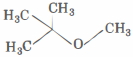
A
$(CH_3)_3C-Br + CH_3ONa$
B
$(CH_3)_3C-ONa + CH_3Br$
C
$(CH_3)_3C-OH + CH_3ONa$
D
$(CH_3)_2C=CH_2 + CH_3ONa$
Solution
(B) The reaction is known as the Williamson synthesis,which is an important laboratory method for the preparation of symmetrical and unsymmetrical ethers.
For the synthesis of tert-butyl methyl ether,$(CH_3)_3C-OCH_3$,we must use a primary alkyl halide and a tertiary alkoxide to avoid the elimination reaction that would occur if a tertiary alkyl halide were used.
Therefore,the reaction between sodium tert-butoxide,$(CH_3)_3C-ONa$,and methyl bromide,$CH_3Br$,is the correct path to obtain the desired ether as the major product.
Option $B$ represents this correct reaction: $(CH_3)_3C-ONa + CH_3Br \rightarrow (CH_3)_3C-OCH_3 + NaBr$.
For the synthesis of tert-butyl methyl ether,$(CH_3)_3C-OCH_3$,we must use a primary alkyl halide and a tertiary alkoxide to avoid the elimination reaction that would occur if a tertiary alkyl halide were used.
Therefore,the reaction between sodium tert-butoxide,$(CH_3)_3C-ONa$,and methyl bromide,$CH_3Br$,is the correct path to obtain the desired ether as the major product.
Option $B$ represents this correct reaction: $(CH_3)_3C-ONa + CH_3Br \rightarrow (CH_3)_3C-OCH_3 + NaBr$.
0 likes
View Solution230
DifficultMCQ
Two isomeric compounds $I$ and $II$ are heated with $HBr$. The products obtained are
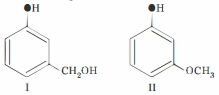
A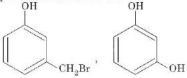
B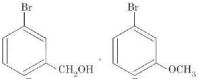
C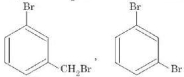
D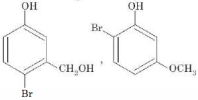
Solution
(A) In reaction $(I)$,the $OH$ group of the $CH_2OH$ side chain is protonated by $HBr$ to form a good leaving group $(H_2O^+)$. This leaves as water to form a resonance-stabilized benzylic carbocation,which is then attacked by $Br^-$ to yield $3-(bromomethyl)phenol$.
In reaction $(II)$,the ether oxygen is protonated by $HBr$. The $C-O$ bond cleavage occurs such that the methyl group is released as $CH_3Br$ because the $C-O$ bond involving the phenyl ring has partial double bond character due to resonance,making it stronger and harder to break. Thus,the reaction yields benzene-$1,3-diol$ (resorcinol) and $CH_3Br$.
In reaction $(II)$,the ether oxygen is protonated by $HBr$. The $C-O$ bond cleavage occurs such that the methyl group is released as $CH_3Br$ because the $C-O$ bond involving the phenyl ring has partial double bond character due to resonance,making it stronger and harder to break. Thus,the reaction yields benzene-$1,3-diol$ (resorcinol) and $CH_3Br$.
0 likes
View Solution231
MediumMCQ
The solvent of choice for carrying out a Grignard reaction is
A
diethyl ether
B
chloroform
C
ethyl acetate
D
ethanol
Solution
(A) .
Anhydrous diethyl ether is the preferred solvent for carrying out Grignard reactions.
This is because it is a highly volatile solvent,which helps in preventing oxygen from reaching the reaction solution.
Additionally,ether molecules coordinate with the magnesium atom of the Grignard reagent,which helps in stabilizing it through the formation of a complex,as shown in the structure:
$2(Et_2O) \rightarrow R-Mg-Br$.
Anhydrous diethyl ether is the preferred solvent for carrying out Grignard reactions.
This is because it is a highly volatile solvent,which helps in preventing oxygen from reaching the reaction solution.
Additionally,ether molecules coordinate with the magnesium atom of the Grignard reagent,which helps in stabilizing it through the formation of a complex,as shown in the structure:
$2(Et_2O) \rightarrow R-Mg-Br$.
0 likes
View Solution232
MediumMCQ
The maximum number of isomeric ethers with the molecular formula $C_4H_{10}O$ is
A
$2$
B
$3$
C
$4$
D
$5$
Solution
(B)
The isomeric ethers with the molecular formula $C_4H_{10}O$ are:
$1. CH_3-O-CH_2-CH_2-CH_3$ ($1$-methoxypropane)
$2. CH_3-CH_2-O-CH_2-CH_3$ (ethoxyethane)
$3. CH_3-O-CH(CH_3)_2$ ($2$-methoxypropane)
Thus,there are $3$ isomeric ethers with the molecular formula $C_4H_{10}O$.
The isomeric ethers with the molecular formula $C_4H_{10}O$ are:
$1. CH_3-O-CH_2-CH_2-CH_3$ ($1$-methoxypropane)
$2. CH_3-CH_2-O-CH_2-CH_3$ (ethoxyethane)
$3. CH_3-O-CH(CH_3)_2$ ($2$-methoxypropane)
Thus,there are $3$ isomeric ethers with the molecular formula $C_4H_{10}O$.
0 likes
View Solution233
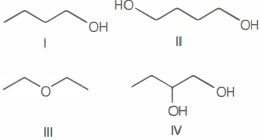
MediumMCQ
Among the compounds $I-IV$,the compound having the lowest boiling point is:
A
$I$
B
$II$
C
$III$
D
$IV$
Solution
(C) The boiling point of a compound depends upon the extent of intermolecular $H$-bonding present in it.
Compounds $I$ (butanol),$II$ (butane$-1,4-$diol),and $IV$ (butane$-1,2-$diol) are alcohols,which can form strong intermolecular $H$-bonds,leading to higher boiling points.
Compound $III$ (diethyl ether) is an ether and cannot form intermolecular $H$-bonds among its own molecules.
Therefore,compound $III$ has the lowest boiling point.
Compounds $I$ (butanol),$II$ (butane$-1,4-$diol),and $IV$ (butane$-1,2-$diol) are alcohols,which can form strong intermolecular $H$-bonds,leading to higher boiling points.
Compound $III$ (diethyl ether) is an ether and cannot form intermolecular $H$-bonds among its own molecules.
Therefore,compound $III$ has the lowest boiling point.
0 likes
View Solution234
MediumMCQ
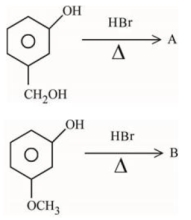
$'A'$ and $'B'$ formed in the following set of reactions are :
A
$A = \text{3-hydroxybenzyl bromide}, B = \text{resorcinol}$
B
$A = \text{3-hydroxybenzyl bromide}, B = \text{3-bromophenol}$
C
$A = \text{3-hydroxybenzyl bromide}, B = \text{3-bromoanisole}$
D
$A = \text{3-hydroxybenzyl bromide}, B = \text{3-hydroxybenzyl bromide}$
Solution
(A) In the first reaction,$3-\text{hydroxybenzyl alcohol}$ reacts with $HBr$. The benzylic $-OH$ group is more reactive towards substitution than the phenolic $-OH$ group. Thus,the benzylic $-OH$ is replaced by $-Br$ to form $3-\text{hydroxybenzyl bromide}$ $(A)$.
In the second reaction,$3-\text{methoxyphenol}$ reacts with $HBr$ under heating. $HBr$ cleaves the ether linkage $(-OCH_3)$ to form a phenol and methyl bromide. The phenolic $-OH$ group remains intact. Thus,the product $B$ is resorcinol $(1,3-\text{dihydroxybenzene})$.
In the second reaction,$3-\text{methoxyphenol}$ reacts with $HBr$ under heating. $HBr$ cleaves the ether linkage $(-OCH_3)$ to form a phenol and methyl bromide. The phenolic $-OH$ group remains intact. Thus,the product $B$ is resorcinol $(1,3-\text{dihydroxybenzene})$.
0 likes
View Solution235
EasyMCQ
The suitable reaction condition for the preparation of Methyl phenyl ether is:
A
$Ph^{-}Br, MeO^{-} Na^{+}$
B
$PhO^{-} Na^{+}, MeOH$
C
$PhO^{-} Na^{+}, MeBr$
D
Benzene,$MeBr$
Solution
(C) The preparation of ethers via the Williamson ether synthesis involves the reaction of an alkoxide or phenoxide ion with a primary alkyl halide.
For the synthesis of Methyl phenyl ether $(Ph-O-Me)$,the phenoxide ion $(PhO^{-} Na^{+})$ acts as a nucleophile and attacks the methyl halide $(MeBr)$ via an $S_N2$ mechanism.
The reaction is: $PhO^{-} Na^{+} + Me-Br \xrightarrow{S_N2} Ph-O-Me + NaBr$.
Thus,the correct condition is $PhO^{-} Na^{+}$ and $MeBr$.
For the synthesis of Methyl phenyl ether $(Ph-O-Me)$,the phenoxide ion $(PhO^{-} Na^{+})$ acts as a nucleophile and attacks the methyl halide $(MeBr)$ via an $S_N2$ mechanism.
The reaction is: $PhO^{-} Na^{+} + Me-Br \xrightarrow{S_N2} Ph-O-Me + NaBr$.
Thus,the correct condition is $PhO^{-} Na^{+}$ and $MeBr$.
0 likes
View Solution236
DifficultMCQ
Consider the following reaction. Identify products $A$ and $B$ :-

A
$A = C_6H_5CH_3$ and $B = C_6H_5I$
B
$A = C_6H_5CH_3$ and $B = C_6H_5OH$
C
$A = C_6H_5CH_2OH$ and $B = C_6H_5I$
D
$A = C_6H_5CH_2I$ and $B = C_6H_5OH$
Solution
(D) The reaction of benzyl phenyl ether with $HI$ involves the protonation of the ether oxygen atom.
Following protonation,the $C-O$ bond between the benzyl carbon and the oxygen atom breaks to form a stable benzyl carbocation $(C_6H_5CH_2^+)$ and phenol $(C_6H_5OH)$.
The benzyl carbocation is stabilized by resonance with the phenyl ring.
Finally,the iodide ion $(I^-)$ attacks the benzyl carbocation to form benzyl iodide $(C_6H_5CH_2I)$.
Thus,the products are $A = C_6H_5CH_2I$ and $B = C_6H_5OH$.
Following protonation,the $C-O$ bond between the benzyl carbon and the oxygen atom breaks to form a stable benzyl carbocation $(C_6H_5CH_2^+)$ and phenol $(C_6H_5OH)$.
The benzyl carbocation is stabilized by resonance with the phenyl ring.
Finally,the iodide ion $(I^-)$ attacks the benzyl carbocation to form benzyl iodide $(C_6H_5CH_2I)$.
Thus,the products are $A = C_6H_5CH_2I$ and $B = C_6H_5OH$.
0 likes
View Solution237
DifficultMCQ
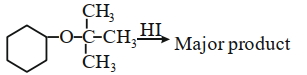
The major product formed in the following reaction is a mixture of:
A
Cyclohexyl iodide and $(CH_3)_3Cl$
B
Cyclohexyl iodide and $(CH_3)_3COH$
C
Cyclohexanol and $(CH_3)_3COH$
D
Cyclohexanol and $2-$iodo$-2-$methylpropane
Solution
(D) The reaction of an ether with $HI$ proceeds via the protonation of the ether oxygen atom,followed by the cleavage of the $C-O$ bond.
In the given ether,cyclohexyl tert-butyl ether,the cleavage occurs such that the more stable carbocation is formed.
The tert-butyl group forms a stable tertiary carbocation $(CH_3)_3C^+$,which is then attacked by the iodide ion $(I^-)$ to form tert-butyl iodide,$(CH_3)_3CI$.
The cyclohexyl group remains as the alcohol,cyclohexanol $(C_6H_{11}OH)$.
Thus,the major products are cyclohexanol and $2-$iodo$-2-$methylpropane (tert-butyl iodide).
In the given ether,cyclohexyl tert-butyl ether,the cleavage occurs such that the more stable carbocation is formed.
The tert-butyl group forms a stable tertiary carbocation $(CH_3)_3C^+$,which is then attacked by the iodide ion $(I^-)$ to form tert-butyl iodide,$(CH_3)_3CI$.
The cyclohexyl group remains as the alcohol,cyclohexanol $(C_6H_{11}OH)$.
Thus,the major products are cyclohexanol and $2-$iodo$-2-$methylpropane (tert-butyl iodide).
0 likes
View Solution238
DifficultMCQ
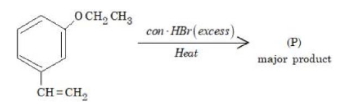
The major product $(P)$ in the following reaction is:
A
$3-$($2$-bromoethyl)phenol
B
$1-$bromo$-3-$($2$-bromoethyl)benzene
C
$1-$bromo$-3-$($1$-bromoethyl)benzene
D
$3-$($1$-bromoethyl)phenol
Solution
(D) The reaction involves two steps with excess $HBr$:
$1$. Electrophilic addition of $HBr$ to the vinyl group $(-CH=CH_2)$ follows Markovnikov's rule,forming a stable benzylic carbocation intermediate,which then reacts with $Br^-$ to give a $1$-bromoethyl group.
$2$. Cleavage of the ether linkage $(-OCH_2CH_3)$ occurs via protonation of the oxygen followed by nucleophilic attack of $Br^-$ on the less hindered ethyl group,resulting in the formation of phenol and ethyl bromide.
Thus,the major product is $3-(1\text{-bromoethyl})phenol$.
$1$. Electrophilic addition of $HBr$ to the vinyl group $(-CH=CH_2)$ follows Markovnikov's rule,forming a stable benzylic carbocation intermediate,which then reacts with $Br^-$ to give a $1$-bromoethyl group.
$2$. Cleavage of the ether linkage $(-OCH_2CH_3)$ occurs via protonation of the oxygen followed by nucleophilic attack of $Br^-$ on the less hindered ethyl group,resulting in the formation of phenol and ethyl bromide.
Thus,the major product is $3-(1\text{-bromoethyl})phenol$.
0 likes
View Solution239
AdvancedMCQ
In the reaction shown below,the products are:
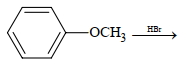
A
$4-$bromoanisole and $H_2$
B
Bromobenzene and $CH_3Br$
C
Bromobenzene and $CH_3OH$
D
Phenol and $CH_3Br$
Solution
(D) The reaction of anisole $(C_6H_5OCH_3)$ with $HBr$ involves the protonation of the ether oxygen atom by the acid.
This is followed by the nucleophilic attack of the bromide ion $(Br^-)$ on the less sterically hindered alkyl group.
Since the phenyl group is attached to the oxygen,the $C-O$ bond between the phenyl ring and oxygen has partial double bond character due to resonance,making it stronger and harder to break.
Therefore,the $Br^-$ ion attacks the methyl group $(CH_3)$,resulting in the formation of phenol $(C_6H_5OH)$ and methyl bromide $(CH_3Br)$.
This is followed by the nucleophilic attack of the bromide ion $(Br^-)$ on the less sterically hindered alkyl group.
Since the phenyl group is attached to the oxygen,the $C-O$ bond between the phenyl ring and oxygen has partial double bond character due to resonance,making it stronger and harder to break.
Therefore,the $Br^-$ ion attacks the methyl group $(CH_3)$,resulting in the formation of phenol $(C_6H_5OH)$ and methyl bromide $(CH_3Br)$.
0 likes
View Solution240
DifficultMCQ
The major product of the following reaction is
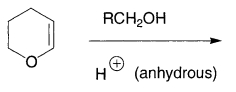
A
a hemiacetal
B
an acetal
C
an ether
D
an ester
Solution
(B) The reaction involves the acid-catalyzed addition of an alcohol $(RCH_2OH)$ to the double bond of $3,4-dihydro-2H-pyran$.
This reaction proceeds through the formation of a resonance-stabilized oxocarbenium ion intermediate.
The alcohol acts as a nucleophile and attacks the electrophilic carbon of the oxocarbenium ion.
After the loss of a proton $(H^+)$,the final product formed is a tetrahydropyranyl ether.
Since the product contains an alkoxy group attached to a carbon atom that is also bonded to another oxygen atom (part of the ring),it is classified as an acetal (specifically,a cyclic acetal).
This reaction proceeds through the formation of a resonance-stabilized oxocarbenium ion intermediate.
The alcohol acts as a nucleophile and attacks the electrophilic carbon of the oxocarbenium ion.
After the loss of a proton $(H^+)$,the final product formed is a tetrahydropyranyl ether.
Since the product contains an alkoxy group attached to a carbon atom that is also bonded to another oxygen atom (part of the ring),it is classified as an acetal (specifically,a cyclic acetal).
0 likes
View Solution241
DifficultMCQ
The acidic hydrolysis of ether $(X)$ shown below is fastest when :
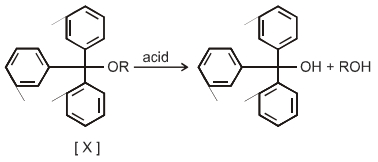
A
one phenyl group is replaced by a methyl group.
B
one phenyl group is replaced by a para-methoxyphenyl group.
C
two phenyl groups are replaced by two para-methoxyphenyl groups.
D
no structural change is made to $X$.
Solution
(C) The reaction proceeds by an $S_N1$ mechanism,which involves the formation of a carbocation intermediate.
The rate of the reaction depends on the stability of the carbocation formed.
Greater the electron-releasing effect of the attached groups,the greater is the stability of the intermediate carbocation,and consequently,the faster is the rate of the reaction.
The $p-MeO-C_6H_4-$ group is a strong electron-donating group due to the $+M$ effect of the $-OMe$ group.
If two phenyl groups are replaced by two $p-methoxyphenyl$ groups,the strong $+M$ effect of the two $-OMe$ groups stabilizes the carbocation significantly better than the unsubstituted phenyl groups,thereby making the reaction the fastest.
The rate of the reaction depends on the stability of the carbocation formed.
Greater the electron-releasing effect of the attached groups,the greater is the stability of the intermediate carbocation,and consequently,the faster is the rate of the reaction.
The $p-MeO-C_6H_4-$ group is a strong electron-donating group due to the $+M$ effect of the $-OMe$ group.
If two phenyl groups are replaced by two $p-methoxyphenyl$ groups,the strong $+M$ effect of the two $-OMe$ groups stabilizes the carbocation significantly better than the unsubstituted phenyl groups,thereby making the reaction the fastest.
0 likes
View Solution242
MediumMCQ
Which one of the following,with $HBr$ will give a phenol?
A
Benzylidene dimethyl ether
B
Anisole (Methoxybenzene)
C
Benzyl methyl ether
D
Benzyl tert-butyl ether
Solution
(B) The reaction of ethers with $HBr$ involves the protonation of the oxygen atom followed by nucleophilic attack by the bromide ion $(Br^-)$.
In the case of anisole $(C_6H_5OCH_3)$,the oxygen is attached to a phenyl group and a methyl group.
Protonation gives $[C_6H_5-O^+(H)-CH_3]$.
The $Br^-$ ion attacks the less sterically hindered methyl group via an $S_N2$ mechanism,resulting in the cleavage of the $O-CH_3$ bond.
This produces phenol $(C_6H_5OH)$ and methyl bromide $(CH_3Br)$.
Other ethers like benzyl methyl ether or benzyl tert-butyl ether would cleave to form benzyl bromide because the benzyl carbocation or transition state is stabilized by resonance,leading to the formation of methanol or tert-butyl alcohol instead of phenol.
In the case of anisole $(C_6H_5OCH_3)$,the oxygen is attached to a phenyl group and a methyl group.
Protonation gives $[C_6H_5-O^+(H)-CH_3]$.
The $Br^-$ ion attacks the less sterically hindered methyl group via an $S_N2$ mechanism,resulting in the cleavage of the $O-CH_3$ bond.
This produces phenol $(C_6H_5OH)$ and methyl bromide $(CH_3Br)$.
Other ethers like benzyl methyl ether or benzyl tert-butyl ether would cleave to form benzyl bromide because the benzyl carbocation or transition state is stabilized by resonance,leading to the formation of methanol or tert-butyl alcohol instead of phenol.
0 likes
View Solution243
MediumMCQ
Given below are two statements $:$
Statement $I :$ Dimethyl ether is completely soluble in water. However,diethyl ether is soluble in water to a very small extent.
Statement $II :$ Sodium metal can be used to dry diethyl ether and not ethyl alcohol. In the light of given statements,choose the correct answer from the options given below
Statement $I :$ Dimethyl ether is completely soluble in water. However,diethyl ether is soluble in water to a very small extent.
Statement $II :$ Sodium metal can be used to dry diethyl ether and not ethyl alcohol. In the light of given statements,choose the correct answer from the options given below
A
Statement $I$ is false but Statement $II$ is true
B
Both Statement $I$ and Statement $II$ are false
C
Statement $I$ is true but Statement $II$ is false
D
Both Statement $I$ and Statement $II$ are true
Solution
(A) Statement $I$ is false because dimethyl ether is a gas at room temperature and is soluble in water,but diethyl ether is also soluble to a limited extent ($7.5 \ g$ per $100 \ mL$ of water) due to hydrogen bonding. The statement implies a contrast that is not strictly accurate in the context of solubility trends.
Statement $II$ is true because sodium metal reacts with ethyl alcohol $(C_2H_5OH)$ to produce sodium ethoxide and hydrogen gas $(H_2)$,making it unsuitable for drying. Sodium does not react with diethyl ether $(C_2H_5OC_2H_5)$,so it can be used to remove traces of moisture from it.
Statement $II$ is true because sodium metal reacts with ethyl alcohol $(C_2H_5OH)$ to produce sodium ethoxide and hydrogen gas $(H_2)$,making it unsuitable for drying. Sodium does not react with diethyl ether $(C_2H_5OC_2H_5)$,so it can be used to remove traces of moisture from it.
0 likes
View Solution244
MediumMCQ
Which one of the following reactions will not lead to the desired ether formation in major proportion? (iso-$Bu$ $\Rightarrow$ isobutyl,sec-$Bu$ $\Rightarrow$ sec-butyl,$nPr$ $\Rightarrow$ $n$-propyl,${}^{t}Bu$ $\Rightarrow$ tert-butyl,$Et$ $\Rightarrow$ ethyl)
A
${}^{t}BuO^{\ominus} Na^{\oplus} + EtBr \rightarrow {}^{t}BuOEt$
B
Cyclohexyl-$O^{\ominus} Na^{\oplus} + CH_3Br \rightarrow$ Cyclohexyl-$O-CH_3$
C
$PhO^{\ominus} Na^{\oplus} + n-PrBr \rightarrow n-Pr-O-Ph$
D
$iso-BuO^{\ominus} Na^{\oplus} + sec-BuBr \rightarrow$ Elimination product
Solution
(D) The Williamson ether synthesis involves the reaction of an alkoxide ion with an alkyl halide. For the reaction to proceed via $S_N2$ mechanism to form an ether,the alkyl halide should ideally be primary. If the alkyl halide is secondary or tertiary,the strong base (alkoxide) will prefer to undergo an $E2$ elimination reaction rather than $S_N2$ substitution.
In option $A$,${}^{t}BuO^{\ominus}$ is a bulky base and $EtBr$ is a primary halide,so $S_N2$ is possible,but often elimination competes. However,in option $D$,$iso-BuO^{\ominus}$ is a base reacting with $sec-BuBr$ (a secondary alkyl halide). Due to steric hindrance and the nature of the secondary halide,the $E2$ elimination reaction is highly favored over $S_N2$ substitution,leading to alkene formation as the major product instead of the desired ether.
In option $A$,${}^{t}BuO^{\ominus}$ is a bulky base and $EtBr$ is a primary halide,so $S_N2$ is possible,but often elimination competes. However,in option $D$,$iso-BuO^{\ominus}$ is a base reacting with $sec-BuBr$ (a secondary alkyl halide). Due to steric hindrance and the nature of the secondary halide,the $E2$ elimination reaction is highly favored over $S_N2$ substitution,leading to alkene formation as the major product instead of the desired ether.
0 likes
View Solution245
MediumMCQ
Find the major product in the given reaction:
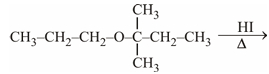
A
$CH_3-CH_2-CH_2-I$ and $CH_3-CH_2-C(CH_3)_2-OH$
B
$CH_3-CH_2-CH_2-OH$ and $CH_3-CH_2-C(CH_3)_2-I$
C
$CH_3-CH(OH)-CH_3$ and $CH_3-C(CH_3)_2-I$
D
$CH_3-CH_2-CH_2-I$ and $CH_3-C(CH_3)_2-OH$
Solution
(B) The reaction of an ether with $HI$ proceeds via an $SN^1$ mechanism when one of the alkyl groups is tertiary.
$1$. The oxygen atom of the ether is protonated by $H^+$ from $HI$ to form an oxonium ion.
$2$. The bond between the oxygen and the tertiary carbon breaks to form a stable tertiary carbocation $(CH_3-CH_2-C^+(CH_3)_2)$ and a propanol molecule $(CH_3-CH_2-CH_2-OH)$.
$3$. The iodide ion $(I^-)$ then attacks the tertiary carbocation to form the tertiary alkyl iodide $(CH_3-CH_2-C(CH_3)_2-I)$.
Thus,the products are $CH_3-CH_2-CH_2-OH$ and $CH_3-CH_2-C(CH_3)_2-I$.
$1$. The oxygen atom of the ether is protonated by $H^+$ from $HI$ to form an oxonium ion.
$2$. The bond between the oxygen and the tertiary carbon breaks to form a stable tertiary carbocation $(CH_3-CH_2-C^+(CH_3)_2)$ and a propanol molecule $(CH_3-CH_2-CH_2-OH)$.
$3$. The iodide ion $(I^-)$ then attacks the tertiary carbocation to form the tertiary alkyl iodide $(CH_3-CH_2-C(CH_3)_2-I)$.
Thus,the products are $CH_3-CH_2-CH_2-OH$ and $CH_3-CH_2-C(CH_3)_2-I$.
0 likes
View Solution246
MediumMCQ
The compound shown in the image is prepared in high yield by the reaction:
A
$(CH_3)_3C-Br + CH_3OK \rightarrow$
B
$(CH_3)_3C-OH \xrightarrow[170^{\circ}C]{H_2SO_4}$
C
$(CH_3)_3C-OK + CH_3-Br \rightarrow (CH_3)_3C-O-CH_3$
D
$(CH_3)_2C=CH_2 \xrightarrow{\text{Conc. } H_2SO_4} (CH_3)_3C-O-CH_3$
Solution
(C) The compound shown is methyl tert-butyl ether,$(CH_3)_3C-O-CH_3$.
Williamson ether synthesis is the best method for preparing unsymmetrical ethers.
It involves the reaction of an alkoxide ion with a primary alkyl halide.
To obtain a high yield,the alkyl halide should be primary (to avoid elimination) and the alkoxide should be bulky if necessary.
Reaction: $(CH_3)_3C-OK + CH_3-Br \rightarrow (CH_3)_3C-O-CH_3 + KBr$.
Here,$(CH_3)_3C-OK$ is the nucleophile (tert-butoxide) and $CH_3-Br$ is the primary alkyl halide (methyl bromide),which undergoes $S_N2$ reaction to form the ether.
Williamson ether synthesis is the best method for preparing unsymmetrical ethers.
It involves the reaction of an alkoxide ion with a primary alkyl halide.
To obtain a high yield,the alkyl halide should be primary (to avoid elimination) and the alkoxide should be bulky if necessary.
Reaction: $(CH_3)_3C-OK + CH_3-Br \rightarrow (CH_3)_3C-O-CH_3 + KBr$.
Here,$(CH_3)_3C-OK$ is the nucleophile (tert-butoxide) and $CH_3-Br$ is the primary alkyl halide (methyl bromide),which undergoes $S_N2$ reaction to form the ether.
0 likes
View Solution247
MediumMCQ
For the reaction shown below,identify products $A$ and $B$ $:$

A
$MeOH$ and $PhCH_2I$
B
$MeI$ and $PhCH_2OH$
C
$MeOH$ and $PhI$
D
$MeI$ and $PhOH$
Solution
(B) The reaction of an ether with concentrated $HI$ involves the protonation of the ether oxygen followed by nucleophilic attack by the iodide ion $(I^-)$.
In the given ether,$CH_3-O-CH_2Ph$ (benzyl methyl ether),the protonation occurs at the oxygen atom.
The iodide ion $(I^-)$ attacks the less sterically hindered carbon atom,which is the methyl group $(CH_3)$,via an $S_N2$ mechanism.
This leads to the formation of $CH_3I$ (methyl iodide) and $PhCH_2OH$ (benzyl alcohol).
Therefore,the products $A$ and $B$ are $MeI$ and $PhCH_2OH$.
In the given ether,$CH_3-O-CH_2Ph$ (benzyl methyl ether),the protonation occurs at the oxygen atom.
The iodide ion $(I^-)$ attacks the less sterically hindered carbon atom,which is the methyl group $(CH_3)$,via an $S_N2$ mechanism.
This leads to the formation of $CH_3I$ (methyl iodide) and $PhCH_2OH$ (benzyl alcohol).
Therefore,the products $A$ and $B$ are $MeI$ and $PhCH_2OH$.
0 likes
View Solution248
MediumMCQ
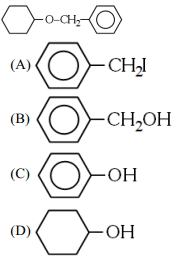
The ether shown below when treated with $HI$ produces:
A
$A, B$
B
$A, D$
C
$A, B, C, D$
D
$B, C$
Solution
(B) The reaction of an ether with $HI$ involves the protonation of the ether oxygen followed by nucleophilic attack by the iodide ion $(I^-)$.
In this specific case,the ether is cyclohexyl benzyl ether. The cleavage occurs such that the more stable carbocation is formed,or the reaction proceeds via an $S_N1$ mechanism if a stable carbocation can be formed.
The benzyl group $(C_6H_5CH_2-)$ can form a stable resonance-stabilized carbocation,so the $C-O$ bond between the benzyl carbon and the oxygen breaks.
The products formed are cyclohexanol ($C_6H_{11}OH$,which corresponds to option $D$) and benzyl iodide ($C_6H_5CH_2I$,which corresponds to option $A$).
Therefore,the products are $A$ and $D$.
In this specific case,the ether is cyclohexyl benzyl ether. The cleavage occurs such that the more stable carbocation is formed,or the reaction proceeds via an $S_N1$ mechanism if a stable carbocation can be formed.
The benzyl group $(C_6H_5CH_2-)$ can form a stable resonance-stabilized carbocation,so the $C-O$ bond between the benzyl carbon and the oxygen breaks.
The products formed are cyclohexanol ($C_6H_{11}OH$,which corresponds to option $D$) and benzyl iodide ($C_6H_5CH_2I$,which corresponds to option $A$).
Therefore,the products are $A$ and $D$.
0 likes
View Solution249
MediumMCQ
For the reaction: $CH_3-CH(CH_3)-O-CH_3 + HI \rightarrow X + Y$,identify $X$ and $Y$.
A
$CH_3-OH \& (CH_3)_2CH-I$
B
$CH_3-I \& (CH_3)_2CH-OH$
C
$CH_3-I \& (CH_3)_2CH-I$
D
$CH_3-OH \& (CH_3)_2CH-OH$
Solution
(A) The reaction of an unsymmetrical ether with $HI$ follows an $S_N1$ mechanism when one of the alkyl groups is tertiary or secondary,as it can form a stable carbocation.
In the given ether,$CH_3-CH(CH_3)-O-CH_3$,the isopropyl group $(CH_3)_2CH-$ is secondary.
Upon protonation of the oxygen atom by $HI$,the bond between the oxygen and the secondary carbon breaks to form a stable secondary carbocation,$(CH_3)_2CH^+$.
The iodide ion $(I^-)$ then attacks this carbocation to form isopropyl iodide,$(CH_3)_2CH-I$.
The remaining part,$CH_3-O-H$,forms methanol,$CH_3-OH$.
Thus,the products are $CH_3-OH$ and $(CH_3)_2CH-I$.
In the given ether,$CH_3-CH(CH_3)-O-CH_3$,the isopropyl group $(CH_3)_2CH-$ is secondary.
Upon protonation of the oxygen atom by $HI$,the bond between the oxygen and the secondary carbon breaks to form a stable secondary carbocation,$(CH_3)_2CH^+$.
The iodide ion $(I^-)$ then attacks this carbocation to form isopropyl iodide,$(CH_3)_2CH-I$.
The remaining part,$CH_3-O-H$,forms methanol,$CH_3-OH$.
Thus,the products are $CH_3-OH$ and $(CH_3)_2CH-I$.
0 likes
View Solution250
MediumMCQ
Which of the following will not give ether as a product?
A
$CH_3-CH_2-O^{\ominus}Na^{\oplus} + CH_3-CH_2-Cl \rightarrow$
B
Sodium phenoxide + Benzyl iodide $\rightarrow$
C
$CH_3-CH_2-O^{\ominus}Na^{\oplus} + (CH_3)_3C-Br \rightarrow$
D
Both $B$ and $C$
Solution
(C) The Williamson ether synthesis involves the reaction of an alkoxide ion with a primary alkyl halide to form an ether via an $S_N2$ mechanism.
$1$. In option $A$,a primary alkoxide reacts with a primary alkyl halide,which successfully yields an ether.
$2$. In option $B$,sodium phenoxide reacts with benzyl iodide. This is a standard Williamson synthesis where the phenoxide acts as a nucleophile and the benzyl halide is highly reactive towards $S_N2$ due to resonance stabilization of the transition state,thus forming a benzyl phenyl ether.
$3$. In option $C$,the ethoxide ion $(CH_3-CH_2-O^{\ominus})$ acts as a strong base when it encounters a tertiary alkyl halide $((CH_3)_3C-Br)$. Due to steric hindrance,the $S_N2$ pathway is blocked,and instead,an $E2$ elimination reaction occurs,resulting in the formation of an alkene (isobutylene) rather than an ether.
Therefore,option $C$ does not yield an ether.
$1$. In option $A$,a primary alkoxide reacts with a primary alkyl halide,which successfully yields an ether.
$2$. In option $B$,sodium phenoxide reacts with benzyl iodide. This is a standard Williamson synthesis where the phenoxide acts as a nucleophile and the benzyl halide is highly reactive towards $S_N2$ due to resonance stabilization of the transition state,thus forming a benzyl phenyl ether.
$3$. In option $C$,the ethoxide ion $(CH_3-CH_2-O^{\ominus})$ acts as a strong base when it encounters a tertiary alkyl halide $((CH_3)_3C-Br)$. Due to steric hindrance,the $S_N2$ pathway is blocked,and instead,an $E2$ elimination reaction occurs,resulting in the formation of an alkene (isobutylene) rather than an ether.
Therefore,option $C$ does not yield an ether.
0 likes
View SolutionAlcohols, Phenols and Ethers — Properties of Ethers · Frequently Asked Questions
1Are these Alcohols, Phenols and Ethers questions useful for JEE and NEET?
Yes. All questions in this section are mapped to JEE Main and NEET exam patterns. Previous year questions from JEE Main, NEET, GUJCET and state-level exams are included with full solutions.
2Can I switch to Hindi or Gujarati for these questions?
Yes. Use the language tabs in the hero section or the sidebar to view the same questions and solutions in English, Hindi or Gujarati.
3How do I generate a question paper from this subtopic?
Use the Vedclass Exam Paper Generator — select the chapter and subtopic, set difficulty, and generate Sets A, B, C, D automatically. First 3 chapters of every subject are free.
Vedclass Products
For Students
Vedclass Test Series
Mock tests in real JEE/NEET style with performance analysis. 5-day free trial.
Start Free TrialFor Teachers
Exam Paper Generator
Generate Set A/B/C/D papers from this chapter in 2 minutes. 3 chapters free.
Try FreeFor Institutes
Online Exam Module
Live online exams with unlimited students, 360° analytics & white-label branding.
See DemoFor Teachers & Institutes
Generate a Alcohols, Phenols and Ethers Exam Paper in 2 Minutes
Select subtopic & difficulty — Sets A, B, C, D auto-generated with No Repeat logic.
First 3 chapters of every subject are free — no payment required.