
A English
Properties of Ethers Questions in English
Class 12 Chemistry · Alcohols, Phenols and Ethers · Properties of Ethers
343+
Questions
English
Language
100%
With Solutions
Showing 47 of 343 questions in English
251
EasyMCQ
Identify the product '$A$' in the following reaction:
$C_6H_5OCH_3 \xrightarrow[398 \ K]{HI} A + CH_3I$
$C_6H_5OCH_3 \xrightarrow[398 \ K]{HI} A + CH_3I$
A
Aniline
B
Iodobenzene
C
Phenol
D
Benzene
Solution
(C) The reaction of anisole $(C_6H_5OCH_3)$ with $HI$ at $398 \ K$ is a cleavage reaction of ethers.
Since the phenyl group $(C_6H_5-)$ is attached to the oxygen atom,the $C-O$ bond between the phenyl ring and oxygen has partial double bond character due to resonance.
Therefore,the $HI$ attacks the $O-CH_3$ bond,resulting in the formation of phenol $(C_6H_5OH)$ and iodomethane $(CH_3I)$.
Thus,the product '$A$' is phenol $(C_6H_5OH)$,which is also known as benzenol.
Since the phenyl group $(C_6H_5-)$ is attached to the oxygen atom,the $C-O$ bond between the phenyl ring and oxygen has partial double bond character due to resonance.
Therefore,the $HI$ attacks the $O-CH_3$ bond,resulting in the formation of phenol $(C_6H_5OH)$ and iodomethane $(CH_3I)$.
Thus,the product '$A$' is phenol $(C_6H_5OH)$,which is also known as benzenol.
0 likes
View Solution252
MediumMCQ
Which of the following compounds is obtained when anisole is heated with dilute sulfuric acid?
A
Phenol and ethanol
B
Phenol and methanol
C
Pyrogallol and methanol
D
Phloroglucinol and ethanol
Solution
(B) When anisole $(C_6H_5OCH_3)$ is heated with dilute sulfuric acid $(H_2SO_4)$ under pressure,it undergoes acid-catalyzed hydrolysis.
The reaction is as follows:
$C_6H_5OCH_3 + H_2O \xrightarrow{H^+, \Delta} C_6H_5OH + CH_3OH$
Thus,the products obtained are phenol $(C_6H_5OH)$ and methanol $(CH_3OH)$.
The reaction is as follows:
$C_6H_5OCH_3 + H_2O \xrightarrow{H^+, \Delta} C_6H_5OH + CH_3OH$
Thus,the products obtained are phenol $(C_6H_5OH)$ and methanol $(CH_3OH)$.
0 likes
View Solution253
EasyMCQ
Identify the major product obtained when anisole reacts with bromine in acetic acid.
A
$o-$bromoanisole
B
$m-$bromoanisole
C
$p-$bromoanisole
D
$2, 4, 6-$tribromoanisole
Solution
(C) Anisole $(C_6H_5OCH_3)$ contains a methoxy group $(-OCH_3)$,which is an activating group and ortho/para directing due to the resonance effect.
When anisole reacts with bromine $(Br_2)$ in acetic acid $(CH_3COOH)$,the reaction is an electrophilic aromatic substitution.
Due to the strong activating nature of the methoxy group,the para-isomer is formed as the major product because of the steric hindrance at the ortho position.
Therefore,the major product is $p-$bromoanisole.
When anisole reacts with bromine $(Br_2)$ in acetic acid $(CH_3COOH)$,the reaction is an electrophilic aromatic substitution.
Due to the strong activating nature of the methoxy group,the para-isomer is formed as the major product because of the steric hindrance at the ortho position.
Therefore,the major product is $p-$bromoanisole.
0 likes
View Solution254
DifficultMCQ
Identify the major product when anisole is treated with $Br_2$ in the presence of acetic acid.
A
$m$-Bromo anisole
B
$p$-Bromo anisole
C
$o$-Bromo anisole
D
$2,4,6$-Tribromo anisole
Solution
(B) Anisole $(C_6H_5OCH_3)$ undergoes electrophilic aromatic substitution when treated with $Br_2$ in the presence of acetic acid $(CH_3COOH)$.
The methoxy group $(-OCH_3)$ is an activating group and is ortho/para-directing.
Due to steric hindrance at the ortho position,the para-isomer is formed as the major product.
Thus,the reaction is: $C_6H_5OCH_3 + Br_2 \xrightarrow{CH_3COOH} p\text{-bromoanisole} + HBr$.
The methoxy group $(-OCH_3)$ is an activating group and is ortho/para-directing.
Due to steric hindrance at the ortho position,the para-isomer is formed as the major product.
Thus,the reaction is: $C_6H_5OCH_3 + Br_2 \xrightarrow{CH_3COOH} p\text{-bromoanisole} + HBr$.
0 likes
View Solution255
MediumMCQ
Identify the product obtained when methyl bromide $(CH_3Br)$ reacts with sodium tert-butoxide $((CH_3)_3CONa)$.
A
Isobutylene and methanol
B
$1-$Methoxybutane
C
$2-$Methoxybutane
D
$2-$Methoxy$-2-$methylpropane
Solution
(D) The reaction between methyl bromide $(CH_3Br)$ and sodium tert-butoxide $((CH_3)_3CONa)$ is a Williamson ether synthesis.
Since methyl bromide is a primary alkyl halide,it undergoes an $S_N2$ reaction with the nucleophilic tert-butoxide ion.
The nucleophilic oxygen of the tert-butoxide attacks the electrophilic carbon of the methyl bromide,displacing the bromide ion.
The product formed is tert-butyl methyl ether,which is also known as $2-$methoxy$-2-$methylpropane.
Since methyl bromide is a primary alkyl halide,it undergoes an $S_N2$ reaction with the nucleophilic tert-butoxide ion.
The nucleophilic oxygen of the tert-butoxide attacks the electrophilic carbon of the methyl bromide,displacing the bromide ion.
The product formed is tert-butyl methyl ether,which is also known as $2-$methoxy$-2-$methylpropane.
0 likes
View Solution256
MediumMCQ
Which of the following compounds does not undergo Williamson's synthesis?
A
$C_2H_5Br$
B
$CH_3-CH(CH_3)-CH_2-Cl$
C
$C_6H_5Cl$
D
$CH_3-CH_2-CH_2-Cl$
Solution
(C) Williamson's synthesis involves an $S_N2$ reaction between an alkyl halide and an alkoxide ion.
$Aryl$ halides (like $C_6H_5Cl$) do not undergo $S_N2$ reactions easily due to the partial double bond character of the $C-Cl$ bond and the instability of the phenyl cation.
Therefore,$C_6H_5Cl$ does not undergo Williamson's synthesis.
$Aryl$ halides (like $C_6H_5Cl$) do not undergo $S_N2$ reactions easily due to the partial double bond character of the $C-Cl$ bond and the instability of the phenyl cation.
Therefore,$C_6H_5Cl$ does not undergo Williamson's synthesis.
0 likes
View Solution257
MediumMCQ
Identify the product obtained when ethoxybenzene reacts with hot and concentrated $HI$.
A
$Ethyl$ $iodide$ and $Phenol$
B
$Ethyl$ $alcohol$ and $Phenol$
C
$Ethyl$ $alcohol$ and $Iodobenzene$
D
$Ethyl$ $iodide$ and $Iodobenzene$
Solution
(A) The reaction of an alkyl aryl ether like ethoxybenzene $(C_6H_5OC_2H_5)$ with hot and concentrated $HI$ involves the cleavage of the $C-O$ bond between the alkyl group and the oxygen atom.
This occurs because the $C-O$ bond between the phenyl ring and oxygen has partial double bond character due to resonance,making it stronger and harder to break.
Therefore,the $HI$ attacks the alkyl group,resulting in the formation of phenol $(C_6H_5OH)$ and ethyl iodide $(C_2H_5I)$.
This occurs because the $C-O$ bond between the phenyl ring and oxygen has partial double bond character due to resonance,making it stronger and harder to break.
Therefore,the $HI$ attacks the alkyl group,resulting in the formation of phenol $(C_6H_5OH)$ and ethyl iodide $(C_2H_5I)$.
0 likes
View Solution258
MediumMCQ
Which of the following compounds does $NOT$ undergo Williamson's synthesis?
A
$C_2H_5-Cl$
B
$CH_3-CH(CH_3)-CH_2-Cl$
C
$C_6H_5-Cl$
D
$CH_3-CH_2-CH_2-Cl$
Solution
(C) Williamson's synthesis involves the reaction of an alkyl halide with a sodium alkoxide to form an ether.
This reaction proceeds via an $S_N2$ mechanism.
Aryl halides,such as $C_6H_5-Cl$,do not undergo $S_N2$ reactions easily because the $C-Cl$ bond has partial double bond character due to resonance and the carbon atom is $sp^2$ hybridized,making it less susceptible to nucleophilic attack.
Therefore,$C_6H_5-Cl$ does not undergo Williamson's synthesis.
This reaction proceeds via an $S_N2$ mechanism.
Aryl halides,such as $C_6H_5-Cl$,do not undergo $S_N2$ reactions easily because the $C-Cl$ bond has partial double bond character due to resonance and the carbon atom is $sp^2$ hybridized,making it less susceptible to nucleophilic attack.
Therefore,$C_6H_5-Cl$ does not undergo Williamson's synthesis.
0 likes
View Solution259
MediumMCQ
What is the temperature at which ethers can be prepared from alcohols by the action of concentrated $H_2SO_4$ (in $K$)?
A
$413$
B
$213$
C
$113$
D
$443$
Solution
(A) The preparation of ethers from alcohols by the action of concentrated $H_2SO_4$ is a dehydration reaction.
When $2 \ moles$ of alcohol are heated with concentrated $H_2SO_4$ at $413 \ K$ $(140^{\circ}C)$,an ether is formed.
The reaction is as follows:
$2R-OH \xrightarrow{Conc. H_2SO_4, 413 \ K} R-O-R + H_2O$
Therefore,the correct temperature is $413 \ K$.
When $2 \ moles$ of alcohol are heated with concentrated $H_2SO_4$ at $413 \ K$ $(140^{\circ}C)$,an ether is formed.
The reaction is as follows:
$2R-OH \xrightarrow{Conc. H_2SO_4, 413 \ K} R-O-R + H_2O$
Therefore,the correct temperature is $413 \ K$.
0 likes
View Solution260
DifficultMCQ
Which of the following ethers is formed from the reaction of an alcohol with diazomethane?
A
$1-$ethoxypropane
B
ethoxyethane
C
$1-$methoxypropane
D
$2-$ethoxypropane
Solution
(C) The reaction of an alcohol $(R-OH)$ with diazomethane $(CH_2N_2)$ in the presence of a catalyst like $HBF_4$ results in the formation of a methyl ether $(R-OCH_3)$ and the release of nitrogen gas $(N_2)$.
For the reaction of propan$-1-$ol $(CH_3CH_2CH_2OH)$ with diazomethane $(CH_2N_2)$:
$CH_3CH_2CH_2OH + CH_2N_2 \xrightarrow{HBF_4} CH_3CH_2CH_2OCH_3 + N_2$
The product formed is $1-$methoxypropane.
For the reaction of propan$-1-$ol $(CH_3CH_2CH_2OH)$ with diazomethane $(CH_2N_2)$:
$CH_3CH_2CH_2OH + CH_2N_2 \xrightarrow{HBF_4} CH_3CH_2CH_2OCH_3 + N_2$
The product formed is $1-$methoxypropane.
0 likes
View Solution261
EasyMCQ
Which of the following compounds is formed when ether is dissolved in cold concentrated sulphuric acid?
A
Alkanol
B
Alkanoic acid
C
Alkyl hydrogen sulphate
D
Oxonium salt
Solution
(D) Ethers are basic in nature due to the presence of lone pairs of electrons on the oxygen atom. $R-O-R + H_2SO_4 (\text{conc.}) \rightarrow [R-O^+(H)-R]HSO_4^-$. This product is known as an oxonium salt.
0 likes
View Solution262
MediumMCQ
Identify the product obtained when ethers are dissolved in cold concentrated sulphuric acid.
A
Alkanols
B
Alkanoic acids
C
Alkyl hydrogen sulphate
D
Oxonium salts
Solution
(D) When ethers are dissolved in cold concentrated sulphuric acid,the lone pair of electrons on the oxygen atom of the ether accepts a proton from the acid to form an oxonium salt.
The reaction is as follows:
$R-O-R' + H_2SO_4 \rightarrow [R-O(H)-R']^+ [HSO_4]^-$ (Oxonium salt)
The reaction is as follows:
$R-O-R' + H_2SO_4 \rightarrow [R-O(H)-R']^+ [HSO_4]^-$ (Oxonium salt)
0 likes
View Solution263
MediumMCQ
Ethers,when dissolved in cold concentrated sulfuric acid,form:
A
Alkanols
B
Alkanoic acids
C
Alkyl hydrogen sulphate
D
Oxonium salts
Solution
(D) Ethers contain an oxygen atom with two lone pairs of electrons,which makes them act as weak Lewis bases.
When ethers are dissolved in cold concentrated sulfuric acid $(H_2SO_4)$,the oxygen atom of the ether gets protonated by the acid to form an oxonium salt.
The reaction is as follows:
$R-O-R' + H_2SO_4 \rightarrow [R-O(H)-R']^+ HSO_4^-$
Here,the product formed is an oxonium salt.
When ethers are dissolved in cold concentrated sulfuric acid $(H_2SO_4)$,the oxygen atom of the ether gets protonated by the acid to form an oxonium salt.
The reaction is as follows:
$R-O-R' + H_2SO_4 \rightarrow [R-O(H)-R']^+ HSO_4^-$
Here,the product formed is an oxonium salt.
0 likes
View Solution264
MediumMCQ
Which among the following is obtained as the major product $x$ in the reaction stated below?
$\text{Anisole} \xrightarrow{\text{conc. } HNO_3, \text{conc. } H_2SO_4} x$
$\text{Anisole} \xrightarrow{\text{conc. } HNO_3, \text{conc. } H_2SO_4} x$
A
$2, 4, 6-$Trinitro anisole
B
$4-$Nitro anisole
C
$2-$Nitro anisole
D
$3-$Nitro anisole
Solution
(B) The reaction of anisole with a mixture of concentrated $HNO_3$ and concentrated $H_2SO_4$ is an electrophilic aromatic substitution reaction known as nitration.
In anisole $(C_6H_5OCH_3)$,the methoxy group $(-OCH_3)$ is an ortho/para-directing group due to its $+M$ effect.
Due to steric hindrance at the ortho position,the para-substituted product is formed as the major product.
Therefore,the major product $x$ is $4-$nitro anisole.
In anisole $(C_6H_5OCH_3)$,the methoxy group $(-OCH_3)$ is an ortho/para-directing group due to its $+M$ effect.
Due to steric hindrance at the ortho position,the para-substituted product is formed as the major product.
Therefore,the major product $x$ is $4-$nitro anisole.
0 likes
View Solution265
MediumMCQ
Ethoxybenzene on reaction with hot and concentrated $HI$ forms:
A
ethyl iodide and phenol
B
ethyl iodide and iodobenzene
C
ethyl alcohol and iodobenzene
D
ethyl alcohol and phenol
Solution
(A) The reaction of ethoxybenzene $(C_6H_5-O-CH_2CH_3)$ with hot and concentrated $HI$ involves the cleavage of the $C-O$ bond between the oxygen atom and the ethyl group.
This occurs because the $C-O$ bond between the oxygen and the phenyl ring has partial double bond character due to resonance,making it stronger and harder to break.
Therefore,the $I^-$ ion attacks the less sterically hindered ethyl group via an $S_N2$ mechanism.
The products formed are phenol $(C_6H_5OH)$ and ethyl iodide $(CH_3CH_2I)$.
This occurs because the $C-O$ bond between the oxygen and the phenyl ring has partial double bond character due to resonance,making it stronger and harder to break.
Therefore,the $I^-$ ion attacks the less sterically hindered ethyl group via an $S_N2$ mechanism.
The products formed are phenol $(C_6H_5OH)$ and ethyl iodide $(CH_3CH_2I)$.
0 likes
View Solution266
EasyMCQ
Methoxyethane on reaction with hot concentrated $HI$ gives
A
iodomethane and ethanol
B
iodomethane and iodoethane
C
methanol and ethanol
D
methanol and iodoethane
Solution
(B) When an ether reacts with excess hot concentrated $HI$,the $C-O$ bonds are cleaved to form alkyl halides.
For methoxyethane $(CH_3OCH_2CH_3)$,the reaction with excess $HI$ proceeds as follows:
$CH_3OCH_2CH_3 + 2HI \xrightarrow{\Delta} CH_3I + CH_3CH_2I + H_2O$
The products formed are iodomethane $(CH_3I)$ and iodoethane $(CH_3CH_2I)$.
For methoxyethane $(CH_3OCH_2CH_3)$,the reaction with excess $HI$ proceeds as follows:
$CH_3OCH_2CH_3 + 2HI \xrightarrow{\Delta} CH_3I + CH_3CH_2I + H_2O$
The products formed are iodomethane $(CH_3I)$ and iodoethane $(CH_3CH_2I)$.
0 likes
View Solution267
MediumMCQ
Identify product '$C$' in the following reaction:
$C_2H_5OH$ $\xrightarrow[\text{Pyridine}]{SOCl_2} A$ $\xrightarrow{C_2H_5ONa} B$ $\xrightarrow[\Delta, \text{Pressure}]{\text{dil. } H_2SO_4} C$
$C_2H_5OH$ $\xrightarrow[\text{Pyridine}]{SOCl_2} A$ $\xrightarrow{C_2H_5ONa} B$ $\xrightarrow[\Delta, \text{Pressure}]{\text{dil. } H_2SO_4} C$
A
Ethyl ethanoate
B
Ethanol
C
Ethanoic acid
D
But$-2-$ene
Solution
(B) $C_2H_5OH \xrightarrow[\text{Pyridine}]{SOCl_2} C_2H_5Cl$ $(A)$
$C_2H_5Cl + C_2H_5ONa \rightarrow C_2H_5-O-C_2H_5$ ($B$,Diethyl ether)
$C_2H_5-O-C_2H_5 + H_2O \xrightarrow[\Delta, \text{Pressure}]{\text{dil. } H_2SO_4} 2C_2H_5OH$ ($C$,Ethanol)
Thus,the product '$C$' is Ethanol.
$C_2H_5Cl + C_2H_5ONa \rightarrow C_2H_5-O-C_2H_5$ ($B$,Diethyl ether)
$C_2H_5-O-C_2H_5 + H_2O \xrightarrow[\Delta, \text{Pressure}]{\text{dil. } H_2SO_4} 2C_2H_5OH$ ($C$,Ethanol)
Thus,the product '$C$' is Ethanol.
0 likes
View Solution268
MediumMCQ
Which of the following compounds does $NOT$ react with sodium metal?
A
$CH_{3}CH_{2}OH$
B
$C_{6}H_{5}OH$
C
$CH_{3}OCH_{3}$
D
$CH_{3}COOH$
Solution
(C) Sodium metal reacts with compounds containing an acidic hydrogen atom (like $-OH$ or $-COOH$ groups) to release hydrogen gas $(H_{2})$.
$CH_{3}CH_{2}OH$ (ethanol),$C_{6}H_{5}OH$ (phenol),and $CH_{3}COOH$ (acetic acid) all contain an acidic proton.
$CH_{3}OCH_{3}$ (dimethyl ether) does not contain any acidic hydrogen atom,therefore it does not react with sodium metal.
$CH_{3}CH_{2}OH$ (ethanol),$C_{6}H_{5}OH$ (phenol),and $CH_{3}COOH$ (acetic acid) all contain an acidic proton.
$CH_{3}OCH_{3}$ (dimethyl ether) does not contain any acidic hydrogen atom,therefore it does not react with sodium metal.
0 likes
View Solution269
EasyMCQ
When methoxybenzene reacts with $HI$ at room temperature,the products formed are:
A
Iodomethane and Iodobenzene
B
Iodomethane and Phenol
C
Methanol and Iodobenzene
D
Iodomethane and Benzene
Solution
(B) The reaction of methoxybenzene $(C_6H_5OCH_3)$ with $HI$ involves the cleavage of the $C-O$ bond.
In aryl alkyl ethers,the $O-CH_3$ bond is weaker than the $O-C_6H_5$ bond because the $O-C_6H_5$ bond has partial double bond character due to resonance.
Therefore,the $HI$ attacks the methyl group,resulting in the formation of phenol $(C_6H_5OH)$ and iodomethane $(CH_3I)$.
The reaction is: $C_6H_5OCH_3 + HI \rightarrow C_6H_5OH + CH_3I$.
In aryl alkyl ethers,the $O-CH_3$ bond is weaker than the $O-C_6H_5$ bond because the $O-C_6H_5$ bond has partial double bond character due to resonance.
Therefore,the $HI$ attacks the methyl group,resulting in the formation of phenol $(C_6H_5OH)$ and iodomethane $(CH_3I)$.
The reaction is: $C_6H_5OCH_3 + HI \rightarrow C_6H_5OH + CH_3I$.
0 likes
View Solution270
MediumMCQ
Which products are obtained when methoxy ethane is heated with $HI$?
A
$CH_{3}I$ and $C_{2}H_{5}I$
B
$CH_{3}I$ and $C_{2}H_{5}OH$
C
$CH_{3}OH$ and $C_{2}H_{5}OH$
D
$C_{2}H_{5}I$ and $CH_{3}OH$
Solution
(B) The reaction of an ether with $HI$ involves the protonation of the ether oxygen followed by nucleophilic attack by the iodide ion $(I^-)$.
For an unsymmetrical ether like methoxy ethane $(CH_{3}-O-C_{2}H_{5})$,the reaction proceeds via an $S_{N}2$ mechanism.
The iodide ion attacks the less sterically hindered alkyl group.
Here,the methyl group $(CH_{3}-)$ is less hindered than the ethyl group $(C_{2}H_{5}-)$.
Therefore,the reaction is: $CH_{3}-O-C_{2}H_{5} + HI \rightarrow CH_{3}I + C_{2}H_{5}OH$.
The products obtained are iodomethane $(CH_{3}I)$ and ethanol $(C_{2}H_{5}OH)$.
For an unsymmetrical ether like methoxy ethane $(CH_{3}-O-C_{2}H_{5})$,the reaction proceeds via an $S_{N}2$ mechanism.
The iodide ion attacks the less sterically hindered alkyl group.
Here,the methyl group $(CH_{3}-)$ is less hindered than the ethyl group $(C_{2}H_{5}-)$.
Therefore,the reaction is: $CH_{3}-O-C_{2}H_{5} + HI \rightarrow CH_{3}I + C_{2}H_{5}OH$.
The products obtained are iodomethane $(CH_{3}I)$ and ethanol $(C_{2}H_{5}OH)$.
0 likes
View Solution271
MediumMCQ
Action of hydrogen iodide on anisole gives,
A
phenol and iodomethane
B
iodobenzene and methanol
C
phenol and methanol
D
iodobenzene and iodomethane
Solution
(A) The reaction of anisole $(C_6H_5OCH_3)$ with hydrogen iodide $(HI)$ involves the cleavage of the $C-O$ bond.
Since the $C_6H_5-O$ bond has partial double bond character due to resonance,the $O-CH_3$ bond is cleaved.
This results in the formation of phenol $(C_6H_5OH)$ and iodomethane $(CH_3I)$.
The reaction is: $C_6H_5OCH_3 + HI \xrightarrow{\Delta} C_6H_5OH + CH_3I$.
Since the $C_6H_5-O$ bond has partial double bond character due to resonance,the $O-CH_3$ bond is cleaved.
This results in the formation of phenol $(C_6H_5OH)$ and iodomethane $(CH_3I)$.
The reaction is: $C_6H_5OCH_3 + HI \xrightarrow{\Delta} C_6H_5OH + CH_3I$.
0 likes
View Solution272
MediumMCQ
$Tert$-butyl methyl ether on treatment with hydrogen iodide in cold gives
A
$Tert$-butyl iodide and methyl iodide
B
$Tert$-butyl alcohol and methyl alcohol
C
$Tert$-butyl alcohol and methyl iodide
D
$Tert$-butyl iodide and methyl alcohol
Solution
(D) The reaction of $Tert$-butyl methyl ether with $HI$ in cold conditions follows an $S_N1$ mechanism.
Since the $Tert$-butyl group can form a stable $Tert$-butyl carbocation,the $C-O$ bond between the $Tert$-butyl group and the oxygen atom breaks.
The reaction proceeds as follows:
$(CH_3)_3C-O-CH_3 + HI \xrightarrow{\text{cold}} (CH_3)_3C-I + CH_3OH$
Thus,the products formed are $Tert$-butyl iodide and methanol (methyl alcohol).
Since the $Tert$-butyl group can form a stable $Tert$-butyl carbocation,the $C-O$ bond between the $Tert$-butyl group and the oxygen atom breaks.
The reaction proceeds as follows:
$(CH_3)_3C-O-CH_3 + HI \xrightarrow{\text{cold}} (CH_3)_3C-I + CH_3OH$
Thus,the products formed are $Tert$-butyl iodide and methanol (methyl alcohol).
0 likes
View Solution273
MediumMCQ
Isopropyl methyl ether when treated with cold hydrogen iodide $(HI)$ gives -
A
Isopropyl iodide and methyl iodide
B
Isopropyl alcohol and methyl iodide
C
Isopropyl alcohol and methyl alcohol
D
Isopropyl iodide and methyl alcohol
Solution
(B) The reaction of an unsymmetrical ether with cold $HI$ follows an $S_N2$ mechanism.
In the case of isopropyl methyl ether,the nucleophile $(I^-)$ attacks the less sterically hindered alkyl group,which is the methyl group.
Therefore,the reaction is:
$(CH_3)_2CH-O-CH_3 HI \text{ (cold)} \rightarrow (CH_3)_2CHOH CH_3I$
Thus,the products formed are isopropyl alcohol and methyl iodide.
In the case of isopropyl methyl ether,the nucleophile $(I^-)$ attacks the less sterically hindered alkyl group,which is the methyl group.
Therefore,the reaction is:
$(CH_3)_2CH-O-CH_3 HI \text{ (cold)} \rightarrow (CH_3)_2CHOH CH_3I$
Thus,the products formed are isopropyl alcohol and methyl iodide.
0 likes
View Solution274
MediumMCQ
What is the $IUPAC$ name of $3-$chloropropyl ethyl ether?
A
$3-$Chloro$-1-$propoxyethane
B
$3-$Chloro$-1-$ethoxypropane
C
$1-$Chloro$-3-$propoxyethane
D
$1-$Chloro$-3-$ethoxypropane
Solution
(B) The structure of $3-$chloropropyl ethyl ether is $CH_3-CH_2-O-CH_2-CH_2-CH_2-Cl$.
In $IUPAC$ nomenclature,the ether group is named as an alkoxy substituent.
The longest carbon chain containing the ether oxygen is a propane chain.
The ethoxy group $(-OCH_2CH_3)$ is attached to the $1^{st}$ carbon,and the chlorine atom is attached to the $3^{rd}$ carbon.
Therefore,the $IUPAC$ name is $1-$ethoxy$-3-$chloropropane,which is equivalent to $3-$chloro$-1-$ethoxypropane.
In $IUPAC$ nomenclature,the ether group is named as an alkoxy substituent.
The longest carbon chain containing the ether oxygen is a propane chain.
The ethoxy group $(-OCH_2CH_3)$ is attached to the $1^{st}$ carbon,and the chlorine atom is attached to the $3^{rd}$ carbon.
Therefore,the $IUPAC$ name is $1-$ethoxy$-3-$chloropropane,which is equivalent to $3-$chloro$-1-$ethoxypropane.
0 likes
View Solution275
MediumMCQ
Williamson's synthesis involves
A
$S_{N}1$ mechanism
B
nucleophilic addition
C
$S_{N}2$ mechanism
D
$S_{E}$ mechanism
Solution
(C) Williamson's synthesis is a reaction where an alkoxide ion acts as a nucleophile and attacks an alkyl halide to form an ether.
The general reaction is: $R-ONa + R'-X \longrightarrow R-O-R' + NaX$.
This reaction proceeds via an $S_{N}2$ mechanism,where the nucleophile attacks the alkyl halide from the backside,leading to the displacement of the halide ion in a single step.
The general reaction is: $R-ONa + R'-X \longrightarrow R-O-R' + NaX$.
This reaction proceeds via an $S_{N}2$ mechanism,where the nucleophile attacks the alkyl halide from the backside,leading to the displacement of the halide ion in a single step.
0 likes
View Solution276
MediumMCQ
Which of the following ethers is gaseous at room temperature?
A
$1-$Methoxypropane
B
$1-$Ethoxypropane
C
Methoxyethane
D
Ethoxyethane
Solution
(C) Lower ethers are highly volatile and inflammable substances.
Dimethyl ether $(CH_3OCH_3)$ and methoxyethane $(CH_3OCH_2CH_3)$ are gases at room temperature,whereas higher ethers are colourless liquids with a pleasant odour.
Dimethyl ether $(CH_3OCH_3)$ and methoxyethane $(CH_3OCH_2CH_3)$ are gases at room temperature,whereas higher ethers are colourless liquids with a pleasant odour.
0 likes
View Solution277
EasyMCQ
Which among the following compounds is obtained as a major product $X$ in the reaction given below?
Anisole $\xrightarrow[AlCl_3 \text{ (anhydrous)}]{acetyl chloride} X$
Anisole $\xrightarrow[AlCl_3 \text{ (anhydrous)}]{acetyl chloride} X$
A
$2-$Methoxy acetophenone
B
$4-$Methoxy acetophenone
C
$4-$Methoxy toluene
D
$2-$Methoxy toluene
Solution
(B) The reaction of anisole with acetyl chloride in the presence of anhydrous $AlCl_3$ is a Friedel-Crafts acylation reaction.
Anisole contains a $-OCH_3$ group,which is an ortho/para-directing group.
Due to steric hindrance at the ortho position,the para-substituted product is formed as the major product.
Therefore,the major product $X$ is $4-$Methoxy acetophenone.
Anisole contains a $-OCH_3$ group,which is an ortho/para-directing group.
Due to steric hindrance at the ortho position,the para-substituted product is formed as the major product.
Therefore,the major product $X$ is $4-$Methoxy acetophenone.
0 likes
View Solution278
EasyMCQ
Give the major product formed by heating $CH_3-CH_2-CH_2-O-C(CH_3)_2-CH_2-CH_3$ with $HI$.
A
$CH_3-CH_2-CH_2-OI + CH_3-CH_2-C(CH_3)_2-H$
B
$CH_3-CH_2-CH_2-I + CH_3-CH_2-C(CH_3)_2-OH$
C
$CH_3-CH_3 + I-CH_2-O-C(CH_3)_2-CH_2-CH_3$
D
$CH_3-CH_2-CH_2-OH + CH_3-CH_2-C(CH_3)_2-I$
Solution
(D) The reaction of an ether with $HI$ proceeds via an $S_N1$ or $S_N2$ mechanism depending on the nature of the alkyl groups attached to the oxygen atom.
In the given ether,$CH_3-CH_2-CH_2-O-C(CH_3)_2-CH_2-CH_3$,one alkyl group is a primary alkyl group ($n$-propyl) and the other is a tertiary alkyl group ($3$-methylpentan$-3-$yl group).
When an ether has a tertiary alkyl group,the reaction follows the $S_N1$ mechanism because the tertiary carbocation is highly stable.
The oxygen atom is protonated by $HI$ to form an oxonium ion,which then undergoes cleavage to form the most stable carbocation.
The tertiary carbocation,$CH_3-CH_2-C^+(CH_3)_2$,is formed,which then reacts with the iodide ion $(I^-)$ to form the tertiary alkyl iodide,$CH_3-CH_2-C(I)(CH_3)_2$.
The remaining part forms the primary alcohol,$CH_3-CH_2-CH_2-OH$.
Therefore,the major products are $CH_3-CH_2-CH_2-OH$ and $CH_3-CH_2-C(I)(CH_3)_2$.
In the given ether,$CH_3-CH_2-CH_2-O-C(CH_3)_2-CH_2-CH_3$,one alkyl group is a primary alkyl group ($n$-propyl) and the other is a tertiary alkyl group ($3$-methylpentan$-3-$yl group).
When an ether has a tertiary alkyl group,the reaction follows the $S_N1$ mechanism because the tertiary carbocation is highly stable.
The oxygen atom is protonated by $HI$ to form an oxonium ion,which then undergoes cleavage to form the most stable carbocation.
The tertiary carbocation,$CH_3-CH_2-C^+(CH_3)_2$,is formed,which then reacts with the iodide ion $(I^-)$ to form the tertiary alkyl iodide,$CH_3-CH_2-C(I)(CH_3)_2$.
The remaining part forms the primary alcohol,$CH_3-CH_2-CH_2-OH$.
Therefore,the major products are $CH_3-CH_2-CH_2-OH$ and $CH_3-CH_2-C(I)(CH_3)_2$.
0 likes
View Solution279
EasyMCQ
Which reagent is used for the electrophilic aromatic bromination of methyl phenyl ether (anisole)?
A
$Br_2 / \text{Red } P$
B
$Br_2 / CH_3COOH$
C
$Br_2 / FeBr_3$
D
$HBr / \Delta$
Solution
(B) Methyl phenyl ether (anisole) is an electron-rich aromatic compound due to the $+M$ effect of the $-OCH_3$ group.
Electrophilic aromatic substitution occurs readily in anisole.
For bromination,$Br_2$ in ethanoic acid $(CH_3COOH)$ is used as the reagent.
The polar solvent $CH_3COOH$ polarizes the $Br-Br$ bond,allowing the reaction to proceed without the need for a strong Lewis acid catalyst like $FeBr_3$,which would otherwise lead to poly-substitution or other side reactions.
Electrophilic aromatic substitution occurs readily in anisole.
For bromination,$Br_2$ in ethanoic acid $(CH_3COOH)$ is used as the reagent.
The polar solvent $CH_3COOH$ polarizes the $Br-Br$ bond,allowing the reaction to proceed without the need for a strong Lewis acid catalyst like $FeBr_3$,which would otherwise lead to poly-substitution or other side reactions.
0 likes
View Solution280
EasyMCQ
Which of the following statements is incorrect for ether?
A
Generally,ether can be oxidized and reduced.
B
Ether does not form intermolecular $H$-bond with water,so it is insoluble in water.
C
The reaction between $R-OH$ with concentrated $H_2SO_4$ under suitable conditions forms ether.
D
The boiling point of ether is lower than that of an alcohol containing the same number of carbon atoms because it has no intermolecular $H$-bond.
Solution
(A) The correct answer is $A$. Ethers are generally resistant to oxidation and reduction under normal conditions. They do not react with oxidizing agents like $KMnO_4$ or reducing agents like $LiAlH_4$ easily. Option $B$ is correct as ethers lack the ability to form intermolecular $H$-bonds with water,making them less soluble. Option $C$ is correct as it describes the dehydration of alcohols to form ethers. Option $D$ is correct as ethers cannot form intermolecular $H$-bonds with themselves,leading to lower boiling points compared to isomeric alcohols.
0 likes
View Solution281
EasyMCQ
$C_6H_5OC_2H_5 + HI \rightarrow X + Y$. Here $X$ and $Y$ are . . . . . . .
A
$C_6H_5OH$ and $C_2H_5I$
B
$C_6H_5I$ and $C_2H_5OH$
C
$C_6H_5I$ and $C_2H_5I$
D
$C_6H_5OH$ and $C_2H_5OH$
Solution
(A) The reaction of an alkyl aryl ether with $HI$ involves the cleavage of the $C_{alkyl}-O$ bond because the $C_{aryl}-O$ bond has partial double bond character due to resonance and is stronger.
Therefore,the reaction proceeds as follows:
$C_6H_5-O-C_2H_5 + HI \rightarrow C_6H_5OH + C_2H_5I$
Here,$X$ is $C_6H_5OH$ (phenol) and $Y$ is $C_2H_5I$ (ethyl iodide).
Thus,the correct option is $A$.
Therefore,the reaction proceeds as follows:
$C_6H_5-O-C_2H_5 + HI \rightarrow C_6H_5OH + C_2H_5I$
Here,$X$ is $C_6H_5OH$ (phenol) and $Y$ is $C_2H_5I$ (ethyl iodide).
Thus,the correct option is $A$.
0 likes
View Solution282
EasyMCQ
Predict the products '$X$' and '$Y$' of the following reaction respectively.
$(CH_3)_3C-O-C_2H_5 \xrightarrow{HI} X + Y$
$(CH_3)_3C-O-C_2H_5 \xrightarrow{HI} X + Y$
A
$(CH_3)_3C-OH + C_2H_5I$
B
$(CH_3)_3C-I + C_2H_5OH$
C
$C_4H_{10} + C_2H_6$
D
$(CH_3)_3C-I + CH_3OH$
Solution
(B) The reaction of an ether with $HI$ proceeds via an $S_N1$ mechanism when one of the alkyl groups is tertiary.
In the given ether,$(CH_3)_3C-O-C_2H_5$,the tert-butyl group $(CH_3)_3C-$ is capable of forming a stable tertiary carbocation.
Therefore,the $C-O$ bond between the tert-butyl group and the oxygen atom breaks,leading to the formation of tert-butyl iodide $(CH_3)_3C-I$ and ethanol $C_2H_5OH$.
Thus,$X = (CH_3)_3C-I$ and $Y = C_2H_5OH$.
In the given ether,$(CH_3)_3C-O-C_2H_5$,the tert-butyl group $(CH_3)_3C-$ is capable of forming a stable tertiary carbocation.
Therefore,the $C-O$ bond between the tert-butyl group and the oxygen atom breaks,leading to the formation of tert-butyl iodide $(CH_3)_3C-I$ and ethanol $C_2H_5OH$.
Thus,$X = (CH_3)_3C-I$ and $Y = C_2H_5OH$.
0 likes
View Solution283
EasyMCQ
Ethyl alcohol is heated with concentrated sulphuric acid at $413 \ K$. The major product is:
A
$C_2H_5-O-C_2H_5$
B
$CH_3-O-C_3H_7$
C
$CH_2=CH_2$
D
$CH_3COOC_2H_5$
Solution
(A) When ethyl alcohol $(C_2H_5OH)$ is heated with concentrated sulphuric acid $(H_2SO_4)$ at $413 \ K$,the reaction undergoes intermolecular dehydration to form diethyl ether $(C_2H_5-O-C_2H_5)$.
The reaction is as follows:
$2C_2H_5OH \xrightarrow{Conc. H_2SO_4, 413 \ K} C_2H_5-O-C_2H_5 + H_2O$
At a higher temperature of $443 \ K$,the reaction would instead produce ethene $(CH_2=CH_2)$ via intramolecular dehydration.
The reaction is as follows:
$2C_2H_5OH \xrightarrow{Conc. H_2SO_4, 413 \ K} C_2H_5-O-C_2H_5 + H_2O$
At a higher temperature of $443 \ K$,the reaction would instead produce ethene $(CH_2=CH_2)$ via intramolecular dehydration.
0 likes
View Solution284
MediumMCQ
What are $A$ and $B$ respectively in the following reaction?
$(CH_3)_3C-OCH_3 + HI \rightarrow A + B$
$(CH_3)_3C-OCH_3 + HI \rightarrow A + B$
A
$A = CH_3OH, B = (CH_3)_3C-OH$
B
$A = CH_3-I, B = (CH_3)_3C-OH$
C
$A = CH_3OH, B = (CH_3)_3C-I$
D
$A = CH_3-I, B = (CH_3)_3C-I$
Solution
(C) The reaction of an ether with $HI$ proceeds via an $S_N1$ mechanism when one of the alkyl groups is tertiary,as it can form a stable carbocation.
$1$. The oxygen atom of the ether is protonated by $HI$ to form an oxonium ion: $(CH_3)_3C-O^+(H)-CH_3$.
$2$. The $C-O$ bond between the tertiary carbon and oxygen breaks to form a stable tertiary carbocation $(CH_3)_3C^+$ and methanol $CH_3OH$.
$3$. The iodide ion $I^-$ then attacks the tertiary carbocation to form tert-butyl iodide $(CH_3)_3C-I$.
Thus,$A$ is $CH_3OH$ and $B$ is $(CH_3)_3C-I$.
$1$. The oxygen atom of the ether is protonated by $HI$ to form an oxonium ion: $(CH_3)_3C-O^+(H)-CH_3$.
$2$. The $C-O$ bond between the tertiary carbon and oxygen breaks to form a stable tertiary carbocation $(CH_3)_3C^+$ and methanol $CH_3OH$.
$3$. The iodide ion $I^-$ then attacks the tertiary carbocation to form tert-butyl iodide $(CH_3)_3C-I$.
Thus,$A$ is $CH_3OH$ and $B$ is $(CH_3)_3C-I$.
0 likes
View Solution285
DifficultMCQ
Among the following,the products formed by the reaction of anisole with $HI$ are
A
sodium phenate + methanol
B
benzene + methanol
C
phenol + methane
D
phenol + iodomethane
Solution
(D) The reaction of anisole $(C_6H_5OCH_3)$ with $HI$ involves the cleavage of the $C-O$ bond between the methyl group and the oxygen atom.
This occurs because the $C_6H_5-O$ bond has partial double bond character due to resonance,making it stronger and harder to break.
The reaction is:
$C_6H_5OCH_3 + HI \rightarrow C_6H_5OH + CH_3I$
Thus,the products formed are phenol and iodomethane.
This occurs because the $C_6H_5-O$ bond has partial double bond character due to resonance,making it stronger and harder to break.
The reaction is:
$C_6H_5OCH_3 + HI \rightarrow C_6H_5OH + CH_3I$
Thus,the products formed are phenol and iodomethane.
0 likes
View Solution286
EasyMCQ
One mole of an organic compound $A$ with the formula $C_{3}H_{8}O$ reacts completely with two moles of $HI$ to form $X$ and $Y$. When $Y$ is boiled with aqueous alkali,it forms $Z$. $Z$ answers the iodoform test. The compound $A$ is
A
propan$-2-$ol
B
propan$-1-$ol
C
ethoxyethane
D
methoxyethane
Solution
(D) The molecular formula $C_{3}H_{8}O$ corresponds to the general formula $C_{n}H_{2n+2}O$,which suggests that the compound $A$ is either an alcohol or an ether.
Since the compound reacts with $HI$ to form two different products ($X$ and $Y$),it must be an unsymmetrical ether. The reaction is: $CH_{3}OC_{2}H_{5} + HI \longrightarrow CH_{3}I + C_{2}H_{5}OH$.
Here,$X$ is $CH_{3}I$ and $Y$ is $C_{2}H_{5}OH$ (ethanol).
When ethanol $(Y)$ is treated with aqueous alkali (like $NaOH$) and $I_{2}$,it undergoes the iodoform test because it can be oxidized to acetaldehyde,which contains the $CH_{3}CO-$ group.
The reaction for the iodoform test is: $C_{2}H_{5}OH + 4I_{2} + 6NaOH \longrightarrow CHI_{3} + HCOONa + 5NaI + 5H_{2}O$.
Thus,the compound $A$ is methoxyethane $(CH_{3}OC_{2}H_{5})$.
Since the compound reacts with $HI$ to form two different products ($X$ and $Y$),it must be an unsymmetrical ether. The reaction is: $CH_{3}OC_{2}H_{5} + HI \longrightarrow CH_{3}I + C_{2}H_{5}OH$.
Here,$X$ is $CH_{3}I$ and $Y$ is $C_{2}H_{5}OH$ (ethanol).
When ethanol $(Y)$ is treated with aqueous alkali (like $NaOH$) and $I_{2}$,it undergoes the iodoform test because it can be oxidized to acetaldehyde,which contains the $CH_{3}CO-$ group.
The reaction for the iodoform test is: $C_{2}H_{5}OH + 4I_{2} + 6NaOH \longrightarrow CHI_{3} + HCOONa + 5NaI + 5H_{2}O$.
Thus,the compound $A$ is methoxyethane $(CH_{3}OC_{2}H_{5})$.
0 likes
View Solution287
EasyMCQ
The products formed during the following reaction are:
$(CH_{3})_{3}C-O-CH_{3} + HI \rightarrow ?$
$(CH_{3})_{3}C-O-CH_{3} + HI \rightarrow ?$
A
$CH_{3}OH + (CH_{3})_{3}C-I$
B
$CH_{3}I + (CH_{3})_{3}C-OH$
C
$CH_{3}OI + (CH_{3})_{3}C-H$
D
$CH_{4} + (CH_{3})_{3}C-OI$
Solution
(A) The reaction involved is:
$(CH_{3})_{3}C-O-CH_{3} + HI \rightarrow (CH_{3})_{3}C-I + CH_{3}OH$
This is because the reaction occurs by the $S_{N}1$ mechanism. The formation of products is governed by the stability of the carbocation formed from the cleavage of the $C-O$ bond in the protonated ether (oxonium ion).
Since the tert-butyl carbocation $[(CH_{3})_{3}C^{+}]$ is more stable than the methyl carbocation $[CH_{3}^{+}]$,the cleavage of the $C-O$ bond gives the more stable carbocation $[(CH_{3})_{3}C^{+}]$ and methanol as products.
Then,the iodide ion $(I^{-})$ attacks the tert-butyl carbocation to form tert-butyl iodide.
$(CH_{3})_{3}C-O-CH_{3} + HI \rightarrow (CH_{3})_{3}C-I + CH_{3}OH$
This is because the reaction occurs by the $S_{N}1$ mechanism. The formation of products is governed by the stability of the carbocation formed from the cleavage of the $C-O$ bond in the protonated ether (oxonium ion).
Since the tert-butyl carbocation $[(CH_{3})_{3}C^{+}]$ is more stable than the methyl carbocation $[CH_{3}^{+}]$,the cleavage of the $C-O$ bond gives the more stable carbocation $[(CH_{3})_{3}C^{+}]$ and methanol as products.
Then,the iodide ion $(I^{-})$ attacks the tert-butyl carbocation to form tert-butyl iodide.
0 likes
View Solution288
MediumMCQ
Which of the following has the lowest boiling point?
A
$CH_3-CH_2-OH$
B
$CH_3-CH_2-NH_2$
C
$CH_3-O-CH_3$
D
$HCOOH$
Solution
(C) The boiling point of a compound depends on the strength of intermolecular forces.
$CH_3-CH_2-OH$ (alcohol),$CH_3-CH_2-NH_2$ (amine),and $HCOOH$ (carboxylic acid) all exhibit intermolecular hydrogen bonding,which significantly increases their boiling points.
$CH_3-O-CH_3$ (dimethyl ether) is a polar molecule but lacks hydrogen bonding,relying only on dipole-dipole interactions.
Therefore,$CH_3-O-CH_3$ has the lowest boiling point among the given options.
$CH_3-CH_2-OH$ (alcohol),$CH_3-CH_2-NH_2$ (amine),and $HCOOH$ (carboxylic acid) all exhibit intermolecular hydrogen bonding,which significantly increases their boiling points.
$CH_3-O-CH_3$ (dimethyl ether) is a polar molecule but lacks hydrogen bonding,relying only on dipole-dipole interactions.
Therefore,$CH_3-O-CH_3$ has the lowest boiling point among the given options.
0 likes
View Solution289
MediumMCQ
When $CH_2 = CH - O - CH_2 - CH_3$ reacts with $1 \ mol$ of $HI$,one of the products formed is
A
ethanol
B
ethanal
C
ethane
D
iodoethane
Solution
(D) The reaction of ethyl vinyl ether $(CH_2 = CH - O - CH_2 - CH_3)$ with $HI$ proceeds via the protonation of the oxygen atom.
$CH_2 = CH - O - CH_2 - CH_3 + H^+ \rightarrow CH_2 = CH - O^+(H) - CH_2 - CH_3$
Then,the iodide ion $(I^-)$ attacks the ethyl group $(CH_2CH_3)$ because the vinyl group $(CH_2=CH-)$ is not susceptible to $S_N2$ attack due to the partial double bond character of the $C-O$ bond.
$I^- + CH_2 = CH - O^+(H) - CH_2 - CH_3 \rightarrow CH_2 = CH - OH + CH_3CH_2I$
The product $CH_2 = CH - OH$ (vinyl alcohol) is unstable and tautomerizes to form ethanal $(CH_3CHO)$.
The other product formed is iodoethane $(CH_3CH_2I)$.
Therefore,among the given options,iodoethane is one of the products.
$CH_2 = CH - O - CH_2 - CH_3 + H^+ \rightarrow CH_2 = CH - O^+(H) - CH_2 - CH_3$
Then,the iodide ion $(I^-)$ attacks the ethyl group $(CH_2CH_3)$ because the vinyl group $(CH_2=CH-)$ is not susceptible to $S_N2$ attack due to the partial double bond character of the $C-O$ bond.
$I^- + CH_2 = CH - O^+(H) - CH_2 - CH_3 \rightarrow CH_2 = CH - OH + CH_3CH_2I$
The product $CH_2 = CH - OH$ (vinyl alcohol) is unstable and tautomerizes to form ethanal $(CH_3CHO)$.
The other product formed is iodoethane $(CH_3CH_2I)$.
Therefore,among the given options,iodoethane is one of the products.
0 likes
View Solution290
MediumMCQ
Anisole can be prepared by the action of methyl iodide on sodium phenate. The reaction is called:
A
Wurtz's reaction
B
Williamson's reaction
C
Fittig's reaction
D
Etard's reaction
Solution
(B) The reaction of an alkyl halide with a sodium alkoxide (or sodium phenoxide) to form an ether is known as Williamson's synthesis.
In this reaction,$CH_3I$ (methyl iodide) reacts with $C_6H_5ONa$ (sodium phenate) to produce $C_6H_5OCH_3$ (anisole) and $NaI$.
Since this follows the general mechanism of $R-X + R'-ONa \rightarrow R-O-R' + NaX$,it is classified as Williamson's synthesis.
In this reaction,$CH_3I$ (methyl iodide) reacts with $C_6H_5ONa$ (sodium phenate) to produce $C_6H_5OCH_3$ (anisole) and $NaI$.
Since this follows the general mechanism of $R-X + R'-ONa \rightarrow R-O-R' + NaX$,it is classified as Williamson's synthesis.
0 likes
View Solution291
MediumMCQ
The reaction of $tert$-butyl methyl ether with one equivalent of $HI$ gives:
A
$tert$-butyl iodide and methyl iodide
B
iso-butene and methyl iodide
C
iso-butene and methanol
D
$tert$-butyl iodide and methanol
Solution
(D) When $tert$-butyl methyl ether reacts with $HI$,it undergoes protonation of the ether oxygen followed by cleavage.
Since the $tert$-butyl group can form a stable tertiary carbocation,the reaction proceeds via an $S_N1$ mechanism.
The iodide ion $(I^-)$ attacks the $tert$-butyl carbocation to form $tert$-butyl iodide,while the methanol $(CH_3OH)$ is formed from the methyl group.
The reaction is: $(CH_3)_3C-O-CH_3 + HI \rightarrow (CH_3)_3C-I + CH_3OH$.
Since the $tert$-butyl group can form a stable tertiary carbocation,the reaction proceeds via an $S_N1$ mechanism.
The iodide ion $(I^-)$ attacks the $tert$-butyl carbocation to form $tert$-butyl iodide,while the methanol $(CH_3OH)$ is formed from the methyl group.
The reaction is: $(CH_3)_3C-O-CH_3 + HI \rightarrow (CH_3)_3C-I + CH_3OH$.
0 likes
View Solution292
MediumMCQ
Identify $A$ and $B$ in the following reaction: $C_6H_5CH_2-O-C_6H_5 + HI \rightarrow A + B$
A
$A = C_6H_5I, B = C_6H_5OCH_3$
B
$A = C_6H_5CH_2I, B = C_6H_5OH$
C
$A = C_6H_5CH_2OH, B = C_6H_5I$
D
$A = C_6H_6, B = C_6H_5CH_2OI$
Solution
(B) The reaction of an alkyl aryl ether with $HI$ involves the cleavage of the $C-O$ bond. In the case of benzyl phenyl ether $(C_6H_5CH_2-O-C_6H_5)$,the $C-O$ bond between the benzyl carbon and oxygen is cleaved because the benzyl carbocation is stabilized by resonance. The oxygen atom remains attached to the phenyl ring,forming phenol $(C_6H_5OH)$,while the benzyl group forms benzyl iodide $(C_6H_5CH_2I)$. Therefore,$A = C_6H_5CH_2I$ and $B = C_6H_5OH$.
0 likes
View Solution293
MediumMCQ
What are $X$ and $Y$ in the following reaction?
$(CH_3)_3COCH_3 + HI \rightarrow X + Y$
$(CH_3)_3COCH_3 + HI \rightarrow X + Y$
A
$(H_3C)_3I \quad CH_3OH$
B
$(H_3C)_3COH \quad CH_3I$
C
$(H_3C)_3C-CH=CH_2 \quad CH_3I$
D
$(H_3C)_2C=CH_2 \quad CH_3OH$
Solution
(B) The reaction of an ether with $HI$ involves the protonation of the ether oxygen followed by a nucleophilic attack by the iodide ion.
In the case of tert-butyl methyl ether,the protonation occurs at the oxygen atom.
Since the tert-butyl group can form a stable carbocation,the reaction proceeds via an $S_N1$ mechanism (or $S_N2$ depending on conditions,but the products are consistent).
The iodide ion attacks the less sterically hindered methyl group,leading to the formation of tert-butyl alcohol and methyl iodide.
Thus,$X = (CH_3)_3COH$ and $Y = CH_3I$.
In the case of tert-butyl methyl ether,the protonation occurs at the oxygen atom.
Since the tert-butyl group can form a stable carbocation,the reaction proceeds via an $S_N1$ mechanism (or $S_N2$ depending on conditions,but the products are consistent).
The iodide ion attacks the less sterically hindered methyl group,leading to the formation of tert-butyl alcohol and methyl iodide.
Thus,$X = (CH_3)_3COH$ and $Y = CH_3I$.
0 likes
View Solution294
EasyMCQ
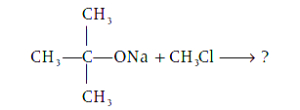
Identify the product of the following reaction:
A
$C_2H_5-C(CH_3)_2-O-CH_3$
B
$C_2H_5-C(CH_3)_2-O-C_2H_5$
C
$C_2H_5-C(CH_3)_2-O-Cl$
D
$CH_3-O-C_2H_5$
Solution
(A) The reaction is a Williamson ether synthesis between sodium $2-$methylbutan$-2-$olate and chloromethane $(CH_3Cl)$. The nucleophilic alkoxide ion attacks the methyl carbon of chloromethane in an $S_N2$ mechanism,displacing the chloride ion to form $NaCl$ and the ether product,$2-$methoxy$-2-$methylbutane. The structure of $2-$methoxy$-2-$methylbutane is $C_2H_5-C(CH_3)_2-O-CH_3$.
0 likes
View Solution295
MediumMCQ
The correct statement regarding $X$ and $Y$ formed in the following reaction is
$(CH_3)_3COC_2H_5 \xrightarrow[\Delta]{HI} \text{halide } (X) + \text{alcohol } (Y)$
$(CH_3)_3COC_2H_5 \xrightarrow[\Delta]{HI} \text{halide } (X) + \text{alcohol } (Y)$
A
$X$ undergoes substitution by $S_{N}2$ mechanism
B
$X$ undergoes substitution with water in two steps
C
$Y$ gets converted to corresponding chloride with conc. $HCl$ at room temperature
D
Reaction of $Y$ with $Cu / 573 \ K$ gives ketone
Solution
(B) The reaction of an ether with $HI$ follows the mechanism where the more stable carbocation is formed. For $(CH_3)_3COC_2H_5$,the cleavage occurs to form $(CH_3)_3C^+$ and $C_2H_5OH$.
Thus,$X = (CH_3)_3CI$ (tert-butyl iodide) and $Y = C_2H_5OH$ (ethanol).
$X$ is a tertiary alkyl halide,which undergoes substitution via the $S_{N}1$ mechanism,not $S_{N}2$.
$Y$ is a primary alcohol. Primary alcohols do not react with conc. $HCl$ at room temperature; they require $ZnCl_2$ (Lucas reagent) and heating.
Reaction of $Y$ $(C_2H_5OH)$ with $Cu / 573 \ K$ is a dehydrogenation reaction that gives an aldehyde $(CH_3CHO)$,not a ketone.
$X$ is a tertiary halide,which undergoes substitution with water via the $S_{N}1$ mechanism,which involves two steps (formation of carbocation followed by nucleophilic attack).
Thus,$X = (CH_3)_3CI$ (tert-butyl iodide) and $Y = C_2H_5OH$ (ethanol).
$X$ is a tertiary alkyl halide,which undergoes substitution via the $S_{N}1$ mechanism,not $S_{N}2$.
$Y$ is a primary alcohol. Primary alcohols do not react with conc. $HCl$ at room temperature; they require $ZnCl_2$ (Lucas reagent) and heating.
Reaction of $Y$ $(C_2H_5OH)$ with $Cu / 573 \ K$ is a dehydrogenation reaction that gives an aldehyde $(CH_3CHO)$,not a ketone.
$X$ is a tertiary halide,which undergoes substitution with water via the $S_{N}1$ mechanism,which involves two steps (formation of carbocation followed by nucleophilic attack).
0 likes
View Solution296
MediumMCQ
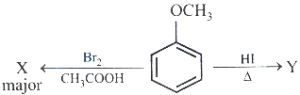
What are '$X$' and '$Y$' respectively in the following reactions?
A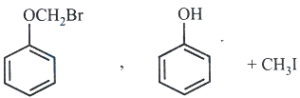
B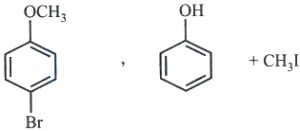
C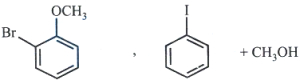
D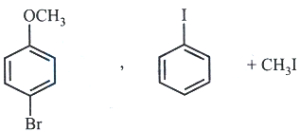
Solution
(C) $1$. Reaction with $Br_2$ in $CH_3COOH$: Anisole $(C_6H_5OCH_3)$ undergoes electrophilic aromatic substitution. The $-OCH_3$ group is ortho/para directing. Due to steric hindrance,the para-isomer is the major product $(X)$,which is $p$-bromoanisole.
$2$. Reaction with $HI$ and $\Delta$: Anisole reacts with $HI$ to undergo cleavage of the $C-O$ bond. Since the phenyl group is attached to the oxygen,the $C(phenyl)-O$ bond has partial double bond character and is difficult to break. Thus,the $C(methyl)-O$ bond breaks,resulting in the formation of phenol $(C_6H_5OH)$ and methyl iodide $(CH_3I)$ as $Y$.
$2$. Reaction with $HI$ and $\Delta$: Anisole reacts with $HI$ to undergo cleavage of the $C-O$ bond. Since the phenyl group is attached to the oxygen,the $C(phenyl)-O$ bond has partial double bond character and is difficult to break. Thus,the $C(methyl)-O$ bond breaks,resulting in the formation of phenol $(C_6H_5OH)$ and methyl iodide $(CH_3I)$ as $Y$.
0 likes
View Solution297
MediumMCQ
Identify the product$(s)$ formed in the following reaction.
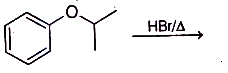
A
Phenol and isopropyl bromide
B
Bromobenzene and isopropyl alcohol
C
$4-$bromoisopropylbenzene
D
$2-$bromoisopropylbenzene
Solution
(A) The reaction of an alkyl aryl ether with $HBr$ involves the cleavage of the $C-O$ bond.
In the case of isopropyl phenyl ether,the oxygen atom is attached to a phenyl group and an isopropyl group.
The $C-O$ bond between the oxygen and the isopropyl group is cleaved because the resulting isopropyl carbocation is more stable (secondary carbocation) compared to the phenyl carbocation,which is not formed due to the partial double bond character of the $C-O$ bond in the aryl group.
Therefore,the reaction proceeds via an $S_N1$ mechanism,yielding phenol and isopropyl bromide as the products.
In the case of isopropyl phenyl ether,the oxygen atom is attached to a phenyl group and an isopropyl group.
The $C-O$ bond between the oxygen and the isopropyl group is cleaved because the resulting isopropyl carbocation is more stable (secondary carbocation) compared to the phenyl carbocation,which is not formed due to the partial double bond character of the $C-O$ bond in the aryl group.
Therefore,the reaction proceeds via an $S_N1$ mechanism,yielding phenol and isopropyl bromide as the products.
0 likes
View SolutionAlcohols, Phenols and Ethers — Properties of Ethers · Frequently Asked Questions
1Are these Alcohols, Phenols and Ethers questions useful for JEE and NEET?
Yes. All questions in this section are mapped to JEE Main and NEET exam patterns. Previous year questions from JEE Main, NEET, GUJCET and state-level exams are included with full solutions.
2Can I switch to Hindi or Gujarati for these questions?
Yes. Use the language tabs in the hero section or the sidebar to view the same questions and solutions in English, Hindi or Gujarati.
3How do I generate a question paper from this subtopic?
Use the Vedclass Exam Paper Generator — select the chapter and subtopic, set difficulty, and generate Sets A, B, C, D automatically. First 3 chapters of every subject are free.
Vedclass Products
For Students
Vedclass Test Series
Mock tests in real JEE/NEET style with performance analysis. 5-day free trial.
Start Free TrialFor Teachers
Exam Paper Generator
Generate Set A/B/C/D papers from this chapter in 2 minutes. 3 chapters free.
Try FreeFor Institutes
Online Exam Module
Live online exams with unlimited students, 360° analytics & white-label branding.
See DemoFor Teachers & Institutes
Generate a Alcohols, Phenols and Ethers Exam Paper in 2 Minutes
Select subtopic & difficulty — Sets A, B, C, D auto-generated with No Repeat logic.
First 3 chapters of every subject are free — no payment required.