
A English
Properties of Ethers Questions in English
Class 12 Chemistry · Alcohols, Phenols and Ethers · Properties of Ethers
343+
Questions
English
Language
100%
With Solutions
Showing 50 of 343 questions in English
151
MediumMCQ
The product of the reaction between $2-$methyltetrahydrofuran and $HI$ is:
A
$4-$iodopentan$-1-$ol
B
$5-$iodopentan$-2-$ol
C
$1,2-$diiodopentane
D
$1,2-$diiodopentan$-5-$ol
0 likes
View Solution152
MediumMCQ
The product in the reaction (figure) $+ HBr$ is

A
$1-$methylcyclohexanol with a bromine atom at the $2-$position
B
$1-$methylcyclohexene
C
$1-$bromo$-1-$methylcyclohexan$-2-$ol
D
$3-$bromo$-1-$methylcyclohexene
Solution
(C) The reaction involves the acid-catalyzed ring opening of an epoxide.
In the presence of $H^+$,the oxygen atom of the epoxide is protonated,making it a better leaving group.
$HBr$ provides the nucleophile $Br^-$.
For an unsymmetrical epoxide,the nucleophile attacks the more substituted carbon atom because it can better stabilize the partial positive charge in the transition state.
In this case,the tertiary carbon (the one with the $CH_3$ group) is more substituted than the secondary carbon.
Therefore,$Br^-$ attacks the tertiary carbon,and the $C-O$ bond breaks to form a hydroxyl group at the secondary carbon.
The final product is $1-bromo-1-methylcyclohexan-2-ol$.
In the presence of $H^+$,the oxygen atom of the epoxide is protonated,making it a better leaving group.
$HBr$ provides the nucleophile $Br^-$.
For an unsymmetrical epoxide,the nucleophile attacks the more substituted carbon atom because it can better stabilize the partial positive charge in the transition state.
In this case,the tertiary carbon (the one with the $CH_3$ group) is more substituted than the secondary carbon.
Therefore,$Br^-$ attacks the tertiary carbon,and the $C-O$ bond breaks to form a hydroxyl group at the secondary carbon.
The final product is $1-bromo-1-methylcyclohexan-2-ol$.
0 likes
View Solution153
MediumMCQ
$CH_3-CH(CH_3)-O-C_6H_5 \xrightarrow{HI/\Delta} (X + Y)$. $X$ and $Y$ are:
A
$CH_3-CH(I)-CH_3 + C_6H_5-I$
B
$CH_3-CH(I)-CH_3 + C_6H_5-OH$
C
$CH_3-CH(OH)-CH_3 + C_6H_5-I$
D
$CH_3-CH(OH)-CH_3 + C_6H_5-OH$
Solution
(B) In alkyl aryl ethers,the bond between the oxygen atom and the aromatic ring has partial double bond character due to resonance,making it stronger than the alkyl-oxygen bond.
Therefore,when reacted with $HI$,the alkyl-oxygen bond breaks,yielding phenol and an alkyl iodide.
Reaction: $C_6H_5-O-CH(CH_3)_2 + HI \xrightarrow{\Delta} C_6H_5-OH + CH_3-CH(I)-CH_3$.
Therefore,when reacted with $HI$,the alkyl-oxygen bond breaks,yielding phenol and an alkyl iodide.
Reaction: $C_6H_5-O-CH(CH_3)_2 + HI \xrightarrow{\Delta} C_6H_5-OH + CH_3-CH(I)-CH_3$.
0 likes
View Solution154
DifficultMCQ
Identify the product $Y$ in the following reaction sequence:
$C_6H_5OH$ $\xrightarrow{Na} X$ $\xrightarrow{CH_3-CH_2-Cl} Y$
$C_6H_5OH$ $\xrightarrow{Na} X$ $\xrightarrow{CH_3-CH_2-Cl} Y$
A
Phenetole $(C_6H_5-O-CH_2-CH_3)$
B
$3$-Ethylphenol
C
$4$-Ethylphenol
D
Ethylbenzene $(C_6H_5-CH_2-CH_3)$
Solution
(A) The reaction sequence is as follows:
$1$. Phenol $(C_6H_5OH)$ reacts with sodium $(Na)$ to form sodium phenoxide $(X = C_6H_5ONa)$ and hydrogen gas.
$C_6H_5OH + Na \rightarrow C_6H_5ONa + \frac{1}{2}H_2$
$2$. Sodium phenoxide $(C_6H_5ONa)$ then reacts with ethyl chloride $(CH_3-CH_2-Cl)$ via a Williamson ether synthesis mechanism to form phenetole (ethoxybenzene) $(Y = C_6H_5-O-CH_2-CH_3)$.
$C_6H_5ONa + CH_3-CH_2-Cl \rightarrow C_6H_5-O-CH_2-CH_3 + NaCl$
$1$. Phenol $(C_6H_5OH)$ reacts with sodium $(Na)$ to form sodium phenoxide $(X = C_6H_5ONa)$ and hydrogen gas.
$C_6H_5OH + Na \rightarrow C_6H_5ONa + \frac{1}{2}H_2$
$2$. Sodium phenoxide $(C_6H_5ONa)$ then reacts with ethyl chloride $(CH_3-CH_2-Cl)$ via a Williamson ether synthesis mechanism to form phenetole (ethoxybenzene) $(Y = C_6H_5-O-CH_2-CH_3)$.
$C_6H_5ONa + CH_3-CH_2-Cl \rightarrow C_6H_5-O-CH_2-CH_3 + NaCl$
0 likes
View Solution155
MediumMCQ
$CH_3-C(CH_3)_2-O-CH_3 \xrightarrow{\text{Cold } HI} \text{Product is}$
A
$CH_3-I + (CH_3)_3C-OH$
B
$CH_3-OH + (CH_3)_3C-OH$
C
$CH_3-OH + (CH_3)_3C-I$
D
$CH_3-I + (CH_3)_3C-I$
Solution
(C) The reaction of tert-butyl methyl ether with cold $HI$ proceeds via the $S_N1$ mechanism.
Since the tert-butyl group can form a stable tertiary carbocation $(CH_3)_3C^+$,the cleavage occurs such that the iodide ion attacks the tertiary carbon.
The reaction is: $CH_3-C(CH_3)_2-O-CH_3 + HI \xrightarrow{\text{Cold}} (CH_3)_3C-I + CH_3-OH$.
Thus,the products are tert-butyl iodide and methanol.
Since the tert-butyl group can form a stable tertiary carbocation $(CH_3)_3C^+$,the cleavage occurs such that the iodide ion attacks the tertiary carbon.
The reaction is: $CH_3-C(CH_3)_2-O-CH_3 + HI \xrightarrow{\text{Cold}} (CH_3)_3C-I + CH_3-OH$.
Thus,the products are tert-butyl iodide and methanol.
0 likes
View Solution156
MediumMCQ
Which of the following is true for Williamson's synthesis?
A
Tertiary halides are not used in the reaction
B
Reaction mainly follows $S_{N}2$ mechanism
C
Reaction is used in preparation of ethers
D
All
Solution
(D) Williamson's synthesis is a laboratory method for the preparation of symmetrical and unsymmetrical ethers.
It involves the reaction of an alkyl halide with a sodium alkoxide.
The reaction proceeds via an $S_{N}2$ mechanism.
Because it follows the $S_{N}2$ mechanism,it is sensitive to steric hindrance.
Therefore,primary alkyl halides are preferred,while tertiary halides are not used because they undergo elimination reactions to form alkenes instead of ethers.
Thus,all the given statements are correct.
It involves the reaction of an alkyl halide with a sodium alkoxide.
The reaction proceeds via an $S_{N}2$ mechanism.
Because it follows the $S_{N}2$ mechanism,it is sensitive to steric hindrance.
Therefore,primary alkyl halides are preferred,while tertiary halides are not used because they undergo elimination reactions to form alkenes instead of ethers.
Thus,all the given statements are correct.
0 likes
View Solution157
DifficultMCQ
Which of the reactants given below is/are suitable for the preparation of Methoxybenzene?
$(x)$ $C_6H_5Br + CH_3ONa$
$(y)$ $C_6H_5ONa + CH_3Br$
$(x)$ $C_6H_5Br + CH_3ONa$
$(y)$ $C_6H_5ONa + CH_3Br$
A
Only $x$
B
Only $y$
C
Both $x$ and $y$
D
Neither $x$ nor $y$
Solution
(B) For the preparation of Methoxybenzene $(C_6H_5OCH_3)$,the Williamson ether synthesis is used.
In reaction $(x)$,$C_6H_5Br + CH_3ONa$,the $C-Br$ bond in bromobenzene has partial double bond character due to resonance,making it resistant to nucleophilic substitution. Thus,it does not undergo the reaction.
In reaction $(y)$,$C_6H_5ONa + CH_3Br$,sodium phenoxide acts as a nucleophile and attacks the methyl bromide $(CH_3Br)$ via an $S_N2$ mechanism to form Methoxybenzene. Therefore,only reaction $(y)$ is suitable.
In reaction $(x)$,$C_6H_5Br + CH_3ONa$,the $C-Br$ bond in bromobenzene has partial double bond character due to resonance,making it resistant to nucleophilic substitution. Thus,it does not undergo the reaction.
In reaction $(y)$,$C_6H_5ONa + CH_3Br$,sodium phenoxide acts as a nucleophile and attacks the methyl bromide $(CH_3Br)$ via an $S_N2$ mechanism to form Methoxybenzene. Therefore,only reaction $(y)$ is suitable.
0 likes
View Solution158
MediumMCQ
What are the major products from the following reaction?
$C_6H_5-O-CH_2-C_6H_5 \xrightarrow{HI, \text{heat}} ?$
$C_6H_5-O-CH_2-C_6H_5 \xrightarrow{HI, \text{heat}} ?$
A
$(I) \ C_6H_5I + C_6H_5CH_2OH$
B
$(II) \ C_6H_5OH + C_6H_5CH_2I$
C
$(III) \ C_6H_5OCH_2OH + C_6H_5I$
D
$(IV) \ C_6H_5OCH_2I + C_6H_5OH$
Solution
(B) The reaction of an ether with $HI$ involves the protonation of the ether oxygen followed by nucleophilic attack by the iodide ion $(I^-)$.
In the given ether,$C_6H_5-O-CH_2-C_6H_5$ (benzyl phenyl ether),the bond between the oxygen and the benzyl carbon $(CH_2-C_6H_5)$ is weaker than the bond between the oxygen and the phenyl carbon $(C_6H_5-O)$ because the benzyl carbocation is resonance-stabilized.
Upon protonation,the $I^-$ ion attacks the more electrophilic benzyl carbon via an $S_N1$ or $S_N2$ mechanism (favored by the stability of the benzyl carbocation intermediate),leading to the formation of phenol $(C_6H_5OH)$ and benzyl iodide $(C_6H_5CH_2I)$.
Thus,the major products are phenol and benzyl iodide,which corresponds to option $(II)$.
In the given ether,$C_6H_5-O-CH_2-C_6H_5$ (benzyl phenyl ether),the bond between the oxygen and the benzyl carbon $(CH_2-C_6H_5)$ is weaker than the bond between the oxygen and the phenyl carbon $(C_6H_5-O)$ because the benzyl carbocation is resonance-stabilized.
Upon protonation,the $I^-$ ion attacks the more electrophilic benzyl carbon via an $S_N1$ or $S_N2$ mechanism (favored by the stability of the benzyl carbocation intermediate),leading to the formation of phenol $(C_6H_5OH)$ and benzyl iodide $(C_6H_5CH_2I)$.
Thus,the major products are phenol and benzyl iodide,which corresponds to option $(II)$.
0 likes
View Solution159
DifficultMCQ
The reaction of chloroethane with $Y$ gives $NaCl$ and $Z$. The reaction of one mole of $Z$ with two moles of $HI$ gives water and iodoethane. What is $Y$?
A
$CH_3CHO$
B
$C_2H_5OC_2H_5$
C
$C_2H_5ONa$
D
$CH_3COOH$
Solution
(C) The reaction of chloroethane $(C_2H_5Cl)$ with $Y$ produces $NaCl$ and $Z$. This indicates a nucleophilic substitution reaction where $Y$ is a sodium alkoxide,specifically sodium ethoxide $(C_2H_5ONa)$.
$C_2H_5Cl + C_2H_5ONa \rightarrow C_2H_5OC_2H_5 + NaCl$
Here,$Z$ is diethyl ether $(C_2H_5OC_2H_5)$.
When one mole of diethyl ether reacts with two moles of $HI$,it undergoes cleavage to form two moles of iodoethane and water:
$C_2H_5OC_2H_5 + 2HI \rightarrow 2C_2H_5I + H_2O$
Thus,$Y$ is $C_2H_5ONa$.
$C_2H_5Cl + C_2H_5ONa \rightarrow C_2H_5OC_2H_5 + NaCl$
Here,$Z$ is diethyl ether $(C_2H_5OC_2H_5)$.
When one mole of diethyl ether reacts with two moles of $HI$,it undergoes cleavage to form two moles of iodoethane and water:
$C_2H_5OC_2H_5 + 2HI \rightarrow 2C_2H_5I + H_2O$
Thus,$Y$ is $C_2H_5ONa$.
0 likes
View Solution160
DifficultMCQ
The reaction of methyl chloride with silver acetate yields $................$.
A
Acetic acid
B
Methyl acetate
C
Acetyl chloride
D
Acetaldehyde
Solution
(B) The reaction between methyl chloride $(CH_3Cl)$ and silver acetate $(CH_3COOAg)$ is a nucleophilic substitution reaction.
The reaction proceeds as follows:
$CH_3Cl + CH_3COOAg \rightarrow CH_3COOCH_3 + AgCl$
The product formed is methyl acetate $(CH_3COOCH_3)$.
The reaction proceeds as follows:
$CH_3Cl + CH_3COOAg \rightarrow CH_3COOCH_3 + AgCl$
The product formed is methyl acetate $(CH_3COOCH_3)$.
0 likes
View Solution161
MediumMCQ
$C_2H_5OH$ $\xrightarrow{Na} P$ $\xrightarrow{CH_3-Cl} Q$; $Q$ is
A
$CH_3-CH_2-CH_3$
B
$CH_3-CH_2-O-CH_3$
C
$CH_3-CH_2-CH_2-OH$
D
$CH_3-CH_2-CH_2-Cl$
Solution
(B) The reaction proceeds as follows:
$1$. Ethanol $(C_2H_5OH)$ reacts with sodium $(Na)$ to form sodium ethoxide $(P)$: $C_2H_5OH + Na \rightarrow C_2H_5ONa + \frac{1}{2}H_2$.
$2$. Sodium ethoxide $(C_2H_5ONa)$ then reacts with methyl chloride $(CH_3-Cl)$ via the Williamson ether synthesis to form ethyl methyl ether $(Q)$: $C_2H_5ONa + CH_3-Cl \rightarrow C_2H_5-O-CH_3 + NaCl$.
Thus,$Q$ is $CH_3-CH_2-O-CH_3$.
$1$. Ethanol $(C_2H_5OH)$ reacts with sodium $(Na)$ to form sodium ethoxide $(P)$: $C_2H_5OH + Na \rightarrow C_2H_5ONa + \frac{1}{2}H_2$.
$2$. Sodium ethoxide $(C_2H_5ONa)$ then reacts with methyl chloride $(CH_3-Cl)$ via the Williamson ether synthesis to form ethyl methyl ether $(Q)$: $C_2H_5ONa + CH_3-Cl \rightarrow C_2H_5-O-CH_3 + NaCl$.
Thus,$Q$ is $CH_3-CH_2-O-CH_3$.
0 likes
View Solution162
DifficultMCQ
Which product is formed when sodium phenoxide is heated with ethyl iodide?
A
Phenetole
B
Ethyl phenyl alcohol
C
Phenol
D
None of the above
Solution
(A) The reaction between sodium phenoxide $(C_6H_5ONa)$ and ethyl iodide $(C_2H_5I)$ is a Williamson ether synthesis.
The nucleophilic phenoxide ion attacks the ethyl iodide,displacing the iodide ion to form an ether.
The reaction is: $C_6H_5ONa + C_2H_5I \rightarrow C_6H_5OC_2H_5 + NaI$.
The product $C_6H_5OC_2H_5$ is known as ethyl phenyl ether or phenetole.
The nucleophilic phenoxide ion attacks the ethyl iodide,displacing the iodide ion to form an ether.
The reaction is: $C_6H_5ONa + C_2H_5I \rightarrow C_6H_5OC_2H_5 + NaI$.
The product $C_6H_5OC_2H_5$ is known as ethyl phenyl ether or phenetole.
0 likes
View Solution163
DifficultMCQ
An organic compound with the molecular formula $C_3H_6O$ does not give a precipitate with $2,4-$dinitrophenylhydrazine $(2,4-DNP)$ and does not react with sodium metal. What is this compound?
A
$CH_3COCH_3$
B
$CH_2=CH-OCH_3$
C
$CH_3CH_2CHO$
D
$CH_2=CHCH_2OH$
Solution
(B) $1$. The molecular formula $C_3H_6O$ corresponds to a degree of unsaturation of $1$ $(3 - 6/2 + 1 = 1)$.
$2$. The compound does not react with $2,4-DNP$,which indicates the absence of a carbonyl group (aldehyde or ketone).
$3$. The compound does not react with sodium metal,which indicates the absence of an active hydrogen atom (like in alcohols or phenols).
$4$. Given these conditions,the compound must be an ether with a double bond (unsaturated ether).
$5$. Among the options,$CH_2=CH-OCH_3$ (methoxyethene) fits the molecular formula $C_3H_6O$,lacks a carbonyl group,and lacks an active hydrogen atom.
$2$. The compound does not react with $2,4-DNP$,which indicates the absence of a carbonyl group (aldehyde or ketone).
$3$. The compound does not react with sodium metal,which indicates the absence of an active hydrogen atom (like in alcohols or phenols).
$4$. Given these conditions,the compound must be an ether with a double bond (unsaturated ether).
$5$. Among the options,$CH_2=CH-OCH_3$ (methoxyethene) fits the molecular formula $C_3H_6O$,lacks a carbonyl group,and lacks an active hydrogen atom.
0 likes
View Solution164
DifficultMCQ
Which product is obtained by the reaction of acetic anhydride with diethyl ether in the presence of anhydrous $AlCl_3$?
A
$CH_3COOCH_3$
B
$CH_3CH_2COOCH_3$
C
$CH_3COOCH_2CH_3$
D
$CH_3CH_2OH$
Solution
(C) The reaction of acetic anhydride $(CH_3CO)_2O$ with diethyl ether $(C_2H_5OC_2H_5)$ in the presence of anhydrous $AlCl_3$ is a cleavage reaction of the ether.
$AlCl_3$ acts as a Lewis acid and coordinates with the oxygen atom of the ether.
This facilitates the cleavage of the $C-O$ bond,leading to the formation of an ester.
The reaction proceeds as follows:
$(CH_3CO)_2O + C_2H_5OC_2H_5 \xrightarrow{AlCl_3} 2CH_3COOC_2H_5$
Thus,the product formed is ethyl acetate,which is $CH_3COOCH_2CH_3$.
$AlCl_3$ acts as a Lewis acid and coordinates with the oxygen atom of the ether.
This facilitates the cleavage of the $C-O$ bond,leading to the formation of an ester.
The reaction proceeds as follows:
$(CH_3CO)_2O + C_2H_5OC_2H_5 \xrightarrow{AlCl_3} 2CH_3COOC_2H_5$
Thus,the product formed is ethyl acetate,which is $CH_3COOCH_2CH_3$.
0 likes
View Solution165
DifficultMCQ
What product is formed when anisole reacts with concentrated $HNO_3$ and concentrated $H_2SO_4$?
A
$o-$ and $p-$ nitroanisole
B
Phenol
C
$m-$ nitroanisole
D
Nitrobenzene
Solution
(A) Anisole $(C_6H_5OCH_3)$ contains a methoxy group $(-OCH_3)$,which is an activating group and ortho/para directing.
When anisole reacts with a nitrating mixture (concentrated $HNO_3$ and concentrated $H_2SO_4$),the electrophile $NO_2^+$ attacks the ortho and para positions of the benzene ring.
This results in the formation of a mixture of $o-$nitroanisole and $p-$nitroanisole.
When anisole reacts with a nitrating mixture (concentrated $HNO_3$ and concentrated $H_2SO_4$),the electrophile $NO_2^+$ attacks the ortho and para positions of the benzene ring.
This results in the formation of a mixture of $o-$nitroanisole and $p-$nitroanisole.
0 likes
View Solution166
DifficultMCQ
An organic compound with the molecular formula $C_4H_{10}O$ does not react with sodium metal and produces only two types of halides upon reaction with excess $HI$. What is the compound?
A
Ethoxyethane
B
$2-$Methylpropan$-2-$ol
C
$1-$Methoxypropane
D
$1-$Butanol
Solution
(C) The molecular formula $C_4H_{10}O$ corresponds to either an alcohol or an ether.
Since the compound does not react with sodium metal,it must be an ether.
Among the given options,$1-$Methoxypropane $(CH_3-O-CH_2-CH_2-CH_3)$ is an ether.
When $1-$Methoxypropane reacts with excess $HI$,it undergoes cleavage:
$CH_3-O-CH_2-CH_2-CH_3 + 2HI \rightarrow CH_3I + CH_3CH_2CH_2I + H_2O$.
This reaction produces two types of alkyl halides: methyl iodide $(CH_3I)$ and $1-$iodopropane $(CH_3CH_2CH_2I)$.
Since the compound does not react with sodium metal,it must be an ether.
Among the given options,$1-$Methoxypropane $(CH_3-O-CH_2-CH_2-CH_3)$ is an ether.
When $1-$Methoxypropane reacts with excess $HI$,it undergoes cleavage:
$CH_3-O-CH_2-CH_2-CH_3 + 2HI \rightarrow CH_3I + CH_3CH_2CH_2I + H_2O$.
This reaction produces two types of alkyl halides: methyl iodide $(CH_3I)$ and $1-$iodopropane $(CH_3CH_2CH_2I)$.
0 likes
View Solution167
DifficultMCQ
Which of the following reactions will not yield an alkyl halide?
A
Diethyl ether (in dark) $+ Cl_2$
B
Diethyl ether $+ HI$
C
Diethyl ether $+ PCl_5$
D
Divinyl ether $\xrightarrow{\text{reduction}} X$ $\xrightarrow{SOCl_2}$
Solution
(A) $1$. Diethyl ether reacts with $Cl_2$ in the dark to form $\alpha$-chloro diethyl ether,which is a substituted ether,not an alkyl halide.
$2$. Diethyl ether reacts with $HI$ to form ethyl iodide $(C_2H_5I)$,which is an alkyl halide.
$3$. Diethyl ether reacts with $PCl_5$ to form ethyl chloride $(C_2H_5Cl)$,which is an alkyl halide.
$4$. Divinyl ether on reduction gives diethyl ether,which upon further reaction with $SOCl_2$ (or other halogenating agents) can yield alkyl halides. Thus,the reaction in option $A$ does not produce an alkyl halide.
$2$. Diethyl ether reacts with $HI$ to form ethyl iodide $(C_2H_5I)$,which is an alkyl halide.
$3$. Diethyl ether reacts with $PCl_5$ to form ethyl chloride $(C_2H_5Cl)$,which is an alkyl halide.
$4$. Divinyl ether on reduction gives diethyl ether,which upon further reaction with $SOCl_2$ (or other halogenating agents) can yield alkyl halides. Thus,the reaction in option $A$ does not produce an alkyl halide.
0 likes
View Solution168
DifficultMCQ
At $525 \ K$,aromatic ethers do not undergo cleavage by $HI$. Which of the following compounds will not undergo cleavage?
A
$C_6H_5OCH_3$
B
$C_6H_5-O-C_6H_5$
C
$C_6H_5-O-C_3H_7$
D
Tetrahydrofuran
Solution
(B) Aromatic ethers like $C_6H_5-O-C_6H_5$ (diphenyl ether) do not undergo cleavage by $HI$ even at high temperatures $(525 \ K)$.
This is because the $C-O$ bond in aromatic ethers has partial double bond character due to resonance,making it very strong and difficult to break.
In contrast,alkyl aryl ethers like $C_6H_5OCH_3$ or $C_6H_5OC_3H_7$ undergo cleavage to form phenol and alkyl iodide.
Tetrahydrofuran is an aliphatic cyclic ether and undergoes cleavage easily.
This is because the $C-O$ bond in aromatic ethers has partial double bond character due to resonance,making it very strong and difficult to break.
In contrast,alkyl aryl ethers like $C_6H_5OCH_3$ or $C_6H_5OC_3H_7$ undergo cleavage to form phenol and alkyl iodide.
Tetrahydrofuran is an aliphatic cyclic ether and undergoes cleavage easily.
0 likes
View Solution169
DifficultMCQ
What is $X$ in the following reaction?
$C_2H_5OC_2H_5 + 4[H] \xrightarrow{Red \ P + HI} 2X + H_2O$
$C_2H_5OC_2H_5 + 4[H] \xrightarrow{Red \ P + HI} 2X + H_2O$
A
Ethane
B
Ethylene
C
Butane
D
Propane
Solution
(A) The reaction of diethyl ether with excess of concentrated $HI$ in the presence of red phosphorus at $423 \ K$ is a reduction reaction.
$C_2H_5OC_2H_5 + 2HI \xrightarrow{Red \ P, 423 \ K} 2C_2H_5I + H_2O$
Further,the ethyl iodide formed is reduced by $HI$ in the presence of red phosphorus:
$2C_2H_5I + 2HI \xrightarrow{Red \ P} 2C_2H_6 + 2I_2$
Combining these steps,the overall reaction is:
$C_2H_5OC_2H_5 + 4[H] \xrightarrow{Red \ P + HI} 2C_2H_6 + H_2O$
Comparing this with the given equation,$2X = 2C_2H_6$,so $X = C_2H_6$ (Ethane).
$C_2H_5OC_2H_5 + 2HI \xrightarrow{Red \ P, 423 \ K} 2C_2H_5I + H_2O$
Further,the ethyl iodide formed is reduced by $HI$ in the presence of red phosphorus:
$2C_2H_5I + 2HI \xrightarrow{Red \ P} 2C_2H_6 + 2I_2$
Combining these steps,the overall reaction is:
$C_2H_5OC_2H_5 + 4[H] \xrightarrow{Red \ P + HI} 2C_2H_6 + H_2O$
Comparing this with the given equation,$2X = 2C_2H_6$,so $X = C_2H_6$ (Ethane).
0 likes
View Solution170
DifficultMCQ
What are the products formed when phenyl ethyl ether is heated with concentrated $HBr$?
A
Phenol and ethyl bromide
B
Bromobenzene and ethanol
C
Phenol and ethane
D
Bromobenzene and ethane
Solution
(A) The reaction of phenyl ethyl ether $(C_6H_5-O-C_2H_5)$ with concentrated $HBr$ involves the cleavage of the $C-O$ bond.
Since the $C_6H_5-O$ bond has partial double bond character due to resonance,it is stronger and cannot be easily cleaved.
Therefore,the $O-C_2H_5$ bond breaks,resulting in the formation of phenol $(C_6H_5OH)$ and ethyl bromide $(C_2H_5Br)$.
Since the $C_6H_5-O$ bond has partial double bond character due to resonance,it is stronger and cannot be easily cleaved.
Therefore,the $O-C_2H_5$ bond breaks,resulting in the formation of phenol $(C_6H_5OH)$ and ethyl bromide $(C_2H_5Br)$.
0 likes
View Solution171
DifficultMCQ
Which of the following mixtures is obtained when $tert$-butyl methyl ether is heated with $HI$?
A
$tert$-butyl alcohol and methyl iodide
B
$tert$-butyl iodide and methanol
C
Isobutylene and methyl iodide
D
Isobutylene and methanol
Solution
(B) The reaction of $tert$-butyl methyl ether with $HI$ follows an $S_N1$ mechanism because the $tert$-butyl group can form a stable $tert$-butyl carbocation.
$1$. The oxygen atom of the ether is protonated by $HI$ to form an oxonium ion: $(CH_3)_3C-O(CH_3) + H^+ \rightarrow (CH_3)_3C-O^+(H)(CH_3)$.
$2$. The $C-O$ bond between the $tert$-butyl group and oxygen breaks to form a stable $tert$-butyl carbocation $(CH_3)_3C^+$ and methanol $(CH_3OH)$.
$3$. The iodide ion $(I^-)$ then attacks the $tert$-butyl carbocation to form $tert$-butyl iodide $(CH_3)_3C-I$.
Thus,the products are $tert$-butyl iodide and methanol.
$1$. The oxygen atom of the ether is protonated by $HI$ to form an oxonium ion: $(CH_3)_3C-O(CH_3) + H^+ \rightarrow (CH_3)_3C-O^+(H)(CH_3)$.
$2$. The $C-O$ bond between the $tert$-butyl group and oxygen breaks to form a stable $tert$-butyl carbocation $(CH_3)_3C^+$ and methanol $(CH_3OH)$.
$3$. The iodide ion $(I^-)$ then attacks the $tert$-butyl carbocation to form $tert$-butyl iodide $(CH_3)_3C-I$.
Thus,the products are $tert$-butyl iodide and methanol.
0 likes
View Solution172
DifficultMCQ
What product is obtained when ethyl hydrogen sulphate is heated with an excess of alcohol at $410 \ K$?
A
Ethene
B
Ethylene
C
Diethyl ether
D
Diethyl sulphate
Solution
(C) When ethyl hydrogen sulphate $(C_2H_5HSO_4)$ is heated with an excess of ethanol $(C_2H_5OH)$ at $410 \ K$,the reaction proceeds via a nucleophilic substitution mechanism to form diethyl ether $(C_2H_5-O-C_2H_5)$.
The reaction is as follows:
$C_2H_5HSO_4 + C_2H_5OH \xrightarrow{410 \ K} C_2H_5-O-C_2H_5 + H_2SO_4$.
If the temperature were higher (around $443 \ K$),the reaction would favor the formation of ethene (dehydration) instead.
The reaction is as follows:
$C_2H_5HSO_4 + C_2H_5OH \xrightarrow{410 \ K} C_2H_5-O-C_2H_5 + H_2SO_4$.
If the temperature were higher (around $443 \ K$),the reaction would favor the formation of ethene (dehydration) instead.
0 likes
View Solution173
MediumMCQ
Which of the following compounds will not yield benzoic acid upon boiling with basic $KMnO_4$ followed by acidification?
A
Toluene
B
Acetophenone
C
Anisole
D
Benzyl alcohol
Solution
(C) $1$. $KMnO_4$ is a strong oxidizing agent. When alkyl benzenes or compounds with a benzylic hydrogen are treated with basic $KMnO_4$ followed by acidification,they are oxidized to benzoic acid.
$2$. Toluene $(C_6H_5CH_3)$ has a benzylic hydrogen and oxidizes to benzoic acid.
$3$. Acetophenone $(C_6H_5COCH_3)$ has a benzylic hydrogen on the methyl group and oxidizes to benzoic acid.
$4$. Benzyl alcohol $(C_6H_5CH_2OH)$ has benzylic hydrogens and oxidizes to benzoic acid.
$5$. Anisole $(C_6H_5OCH_3)$ does not have a benzylic hydrogen (the carbon attached to the ring is part of an ether linkage and lacks the necessary hydrogen for oxidation to the carboxylic acid group). Therefore,it does not yield benzoic acid under these conditions.
$2$. Toluene $(C_6H_5CH_3)$ has a benzylic hydrogen and oxidizes to benzoic acid.
$3$. Acetophenone $(C_6H_5COCH_3)$ has a benzylic hydrogen on the methyl group and oxidizes to benzoic acid.
$4$. Benzyl alcohol $(C_6H_5CH_2OH)$ has benzylic hydrogens and oxidizes to benzoic acid.
$5$. Anisole $(C_6H_5OCH_3)$ does not have a benzylic hydrogen (the carbon attached to the ring is part of an ether linkage and lacks the necessary hydrogen for oxidation to the carboxylic acid group). Therefore,it does not yield benzoic acid under these conditions.
0 likes
View Solution174
MediumMCQ
Which of the following reactions will produce methyl tert-butyl ether?
A
$(C_2H_5)_3C-ONa + CH_3Cl$
B
$CH_3ONa + (CH_3)_3CCl$
C
$(CH_3)_3C-ONa + C_2H_5Cl$
D
$(CH_3)_3C-ONa + CH_3Cl$
Solution
(D) The synthesis of ethers via the Williamson ether synthesis involves the reaction of an alkoxide ion with an alkyl halide.
To synthesize methyl tert-butyl ether,$(CH_3)_3C-O-CH_3$,we must choose reactants that avoid the elimination reaction.
Tertiary alkyl halides undergo $E2$ elimination in the presence of strong bases (alkoxides).
Therefore,we must use a tertiary alkoxide and a primary alkyl halide.
Reaction: $(CH_3)_3C-ONa + CH_3Cl \rightarrow (CH_3)_3C-O-CH_3 + NaCl$.
This corresponds to option $D$.
To synthesize methyl tert-butyl ether,$(CH_3)_3C-O-CH_3$,we must choose reactants that avoid the elimination reaction.
Tertiary alkyl halides undergo $E2$ elimination in the presence of strong bases (alkoxides).
Therefore,we must use a tertiary alkoxide and a primary alkyl halide.
Reaction: $(CH_3)_3C-ONa + CH_3Cl \rightarrow (CH_3)_3C-O-CH_3 + NaCl$.
This corresponds to option $D$.
0 likes
View Solution175
DifficultMCQ
Which one of the following compounds is resistant to nucleophilic attack by hydroxyl $(OH^{-})$ ions?
A
Methyl acetate
B
Acetonitrile
C
Diethyl ether
D
Acetamide
Solution
(C) The correct answer is $(c)$.
Diethyl ether $(CH_3CH_2OCH_2CH_3)$ is resistant to nucleophilic attack by $OH^{-}$ ions because it lacks an electrophilic carbon atom that can be attacked by a nucleophile.
In contrast,carboxylic acid derivatives such as methyl acetate $(CH_3COOCH_3)$ and acetamide $(CH_3CONH_2)$,as well as nitriles like acetonitrile $(CH_3CN)$,contain a carbonyl or cyano carbon atom which is electrophilic and susceptible to nucleophilic attack.
Ethers are generally inert towards bases because the alkoxide ion $(RO^{-})$ is a poor leaving group.
Diethyl ether $(CH_3CH_2OCH_2CH_3)$ is resistant to nucleophilic attack by $OH^{-}$ ions because it lacks an electrophilic carbon atom that can be attacked by a nucleophile.
In contrast,carboxylic acid derivatives such as methyl acetate $(CH_3COOCH_3)$ and acetamide $(CH_3CONH_2)$,as well as nitriles like acetonitrile $(CH_3CN)$,contain a carbonyl or cyano carbon atom which is electrophilic and susceptible to nucleophilic attack.
Ethers are generally inert towards bases because the alkoxide ion $(RO^{-})$ is a poor leaving group.
0 likes
View Solution176
AdvancedMCQ
Assertion : Iodide ion combines with smaller group to avoid steric hindrance.
Reason : With $HI$,anisole gives iodobenzene and methyl alcohol.
Reason : With $HI$,anisole gives iodobenzene and methyl alcohol.
A
If both Assertion and Reason are correct and the Reason is a correct explanation of the Assertion.
B
If both Assertion and Reason are correct but Reason is not a correct explanation of the Assertion.
C
If the Assertion is correct but Reason is incorrect.
D
If both the Assertion and Reason are incorrect.
Solution
(C) The reaction of anisole $(C_6H_5OCH_3)$ with $HI$ involves the protonation of the oxygen atom,followed by the nucleophilic attack of the iodide ion $(I^-)$.
The $I^-$ ion attacks the less sterically hindered methyl group $(CH_3)$ to form methyl iodide $(CH_3I)$ and phenol $(C_6H_5OH)$.
Therefore,the Assertion is correct as the iodide ion attacks the smaller group.
However,the Reason states that it gives iodobenzene and methyl alcohol,which is incorrect; it actually gives phenol and methyl iodide.
Thus,the Assertion is correct but the Reason is incorrect.
The $I^-$ ion attacks the less sterically hindered methyl group $(CH_3)$ to form methyl iodide $(CH_3I)$ and phenol $(C_6H_5OH)$.
Therefore,the Assertion is correct as the iodide ion attacks the smaller group.
However,the Reason states that it gives iodobenzene and methyl alcohol,which is incorrect; it actually gives phenol and methyl iodide.
Thus,the Assertion is correct but the Reason is incorrect.
0 likes
View Solution177
MediumMCQ
$CH_3OC_2H_5$ and $(CH_3)_3COCH_3$ are treated with hydroiodic acid. The fragments obtained after reactions are:
A
$CH_3I + C_2H_5OH$; $(CH_3)_3CI + CH_3OH$
B
$CH_3OH + C_2H_5I$; $(CH_3)_3CI + CH_3OH$
C
$CH_3OH + C_2H_5I$; $(CH_3)_3COH + CH_3I$
D
$CH_3I + C_2H_5OH$; $CH_3I + (CH_3)_3COH$
Solution
(A) The reaction of ethers with $HI$ involves the cleavage of the $C-O$ bond.
For the first ether,$CH_3-O-C_2H_5$,the reaction follows the $S_N2$ mechanism,where the iodide ion attacks the less sterically hindered alkyl group,forming $CH_3I + C_2H_5OH$.
For the second ether,$(CH_3)_3C-O-CH_3$,the reaction follows the $S_N1$ mechanism because the tert-butyl carbocation is highly stable,leading to the formation of $(CH_3)_3CI + CH_3OH$.
For the first ether,$CH_3-O-C_2H_5$,the reaction follows the $S_N2$ mechanism,where the iodide ion attacks the less sterically hindered alkyl group,forming $CH_3I + C_2H_5OH$.
For the second ether,$(CH_3)_3C-O-CH_3$,the reaction follows the $S_N1$ mechanism because the tert-butyl carbocation is highly stable,leading to the formation of $(CH_3)_3CI + CH_3OH$.
0 likes
View Solution178
DifficultMCQ
In which of the following reactions is the product obtained $t-$butyl methyl ether?
A
$CH_3OH + HO-CH_2-CH_3 \xrightarrow{conc. H_2SO_4}$
B
$(CH_3)_3C-Br + CH_3OH \xrightarrow{HO^-Na^+}$
C
$CH_3Br + (CH_3)_3C-ONa \longrightarrow$
D
$CH_3-O^-Na^+ + (CH_3)_3C-Br \longrightarrow$
Solution
(C) The reaction of $CH_3Br$ (methyl bromide) with sodium $t-$butoxide $((CH_3)_3C-ONa)$ is an $S_N2$ reaction which produces $t-$butyl methyl ether.
In reaction $(d)$,the $t-$butyl bromide undergoes elimination due to steric hindrance and the presence of a strong base,forming isobutylene instead of the ether.
In reaction $(d)$,the $t-$butyl bromide undergoes elimination due to steric hindrance and the presence of a strong base,forming isobutylene instead of the ether.
0 likes
View Solution179
AdvancedMCQ
An aromatic ether is not cleaved by $HI$ even at $525 \ K$. The compound is
A
$C_6H_5OCH_3$
B
$C_6H_5OC_6H_5$
C
$C_6H_5OC_3H_7$
D
Tetrahydrofuran
Solution
(B) The cleavage of ethers by $HI$ involves the protonation of the ether oxygen followed by a nucleophilic attack by the iodide ion $(I^-)$.
In diaryl ethers like $C_6H_5OC_6H_5$ (diphenyl ether),the lone pair of electrons on the oxygen atom is involved in resonance with both phenyl rings.
This imparts a partial double bond character to the $C-O$ bonds,making them very strong and difficult to break.
Additionally,the $sp^2$ hybridized carbon atoms of the phenyl rings are less susceptible to nucleophilic attack compared to $sp^3$ hybridized carbons.
Therefore,$C_6H_5OC_6H_5$ is resistant to cleavage by $HI$ even at high temperatures.
In diaryl ethers like $C_6H_5OC_6H_5$ (diphenyl ether),the lone pair of electrons on the oxygen atom is involved in resonance with both phenyl rings.
This imparts a partial double bond character to the $C-O$ bonds,making them very strong and difficult to break.
Additionally,the $sp^2$ hybridized carbon atoms of the phenyl rings are less susceptible to nucleophilic attack compared to $sp^3$ hybridized carbons.
Therefore,$C_6H_5OC_6H_5$ is resistant to cleavage by $HI$ even at high temperatures.
0 likes
View Solution180
MediumMCQ
The ether that undergoes electrophilic substitution reactions is
A
$C_6H_5OCH_3$
B
$CH_3OC_2H_5$
C
$CH_3OCH_3$
D
$C_2H_5OC_2H_5$
Solution
(A) Electrophilic substitution reactions (such as halogenation,nitration,or Friedel-Crafts reactions) occur on the benzene ring.
Only aromatic ethers (alkyl aryl ethers) contain a benzene ring that can be activated by the alkoxy group $(-OR)$ towards electrophilic substitution.
Among the given options,$C_6H_5OCH_3$ (Anisole) is an aromatic ether,while the others are aliphatic ethers.
Therefore,$C_6H_5OCH_3$ undergoes electrophilic substitution reactions.
Only aromatic ethers (alkyl aryl ethers) contain a benzene ring that can be activated by the alkoxy group $(-OR)$ towards electrophilic substitution.
Among the given options,$C_6H_5OCH_3$ (Anisole) is an aromatic ether,while the others are aliphatic ethers.
Therefore,$C_6H_5OCH_3$ undergoes electrophilic substitution reactions.
0 likes
View Solution181
MediumMCQ
Assertion : The major products formed by heating $C_6H_5CH_2OCH_3$ with $HI$ are $C_6H_5CH_2I$ and $CH_3OH$.
Reason : Benzyl cation is more stable than methyl cation.
Reason : Benzyl cation is more stable than methyl cation.
A
If both Assertion and Reason are correct and the Reason is a correct explanation of the Assertion.
B
If both Assertion and Reason are correct but Reason is not a correct explanation of the Assertion.
C
If the Assertion is correct but Reason is incorrect.
D
If both the Assertion and Reason are incorrect.
Solution
(A) The reaction of $C_6H_5CH_2OCH_3$ with $HI$ proceeds via an $S_N1$ mechanism because the benzyl carbocation $(C_6H_5CH_2^+)$ is highly stable due to resonance.
The cleavage of the $C-O$ bond occurs such that the more stable carbocation is formed.
Since the benzyl carbocation is more stable than the methyl carbocation $(CH_3^+)$,the iodide ion attacks the benzyl group to form $C_6H_5CH_2I$,while the methoxide group is protonated to form $CH_3OH$.
Therefore,both the Assertion and the Reason are correct,and the Reason is the correct explanation of the Assertion.
The cleavage of the $C-O$ bond occurs such that the more stable carbocation is formed.
Since the benzyl carbocation is more stable than the methyl carbocation $(CH_3^+)$,the iodide ion attacks the benzyl group to form $C_6H_5CH_2I$,while the methoxide group is protonated to form $CH_3OH$.
Therefore,both the Assertion and the Reason are correct,and the Reason is the correct explanation of the Assertion.
0 likes
View Solution182
MediumMCQ
Assertion: Ethers behave as bases in the presence of mineral acids.
Reason: Due to the presence of lone pairs of electrons on oxygen.
Reason: Due to the presence of lone pairs of electrons on oxygen.
A
If both Assertion and Reason are correct and the Reason is a correct explanation of the Assertion.
B
If both Assertion and Reason are correct but Reason is not a correct explanation of the Assertion.
C
If the Assertion is correct but Reason is incorrect.
D
If both the Assertion and Reason are incorrect.
Solution
(A) Ethers have two lone pairs of electrons on the oxygen atom,which makes them act as Lewis bases.
In the presence of mineral acids (like $HCl$),the oxygen atom donates a lone pair to the $H^+$ ion,forming an oxonium salt.
The reaction is: $R-O-R + HCl \rightarrow [R_2O^+-H]Cl^-$.
Since the basic behavior is directly caused by the lone pairs on the oxygen atom,the Reason correctly explains the Assertion.
In the presence of mineral acids (like $HCl$),the oxygen atom donates a lone pair to the $H^+$ ion,forming an oxonium salt.
The reaction is: $R-O-R + HCl \rightarrow [R_2O^+-H]Cl^-$.
Since the basic behavior is directly caused by the lone pairs on the oxygen atom,the Reason correctly explains the Assertion.
0 likes
View Solution183
MediumMCQ
Assertion: Ethyl phenyl ether on reaction with $HBr$ forms phenol and ethyl bromide.
Reason: Cleavage of $C-O$ bond takes place at the ethyl-oxygen bond due to the more stable phenyl-oxygen bond.
Reason: Cleavage of $C-O$ bond takes place at the ethyl-oxygen bond due to the more stable phenyl-oxygen bond.
A
If both Assertion and Reason are correct and the Reason is a correct explanation of the Assertion.
B
If both Assertion and Reason are correct but Reason is not a correct explanation of the Assertion.
C
If the Assertion is correct but Reason is incorrect.
D
If both the Assertion and Reason are incorrect.
Solution
(A) Alkyl aryl ethers are cleaved at the alkyl-oxygen bond because the phenyl-oxygen bond has partial double bond character due to resonance,making it stronger and more stable.
Therefore,the reaction of ethyl phenyl ether $(C_6H_5-O-C_2H_5)$ with $HBr$ proceeds as follows:
$C_6H_5-O-C_2H_5 + HBr \rightarrow C_6H_5OH + C_2H_5Br$
Both the Assertion and the Reason are correct,and the Reason correctly explains why the cleavage occurs at the alkyl-oxygen bond.
Therefore,the reaction of ethyl phenyl ether $(C_6H_5-O-C_2H_5)$ with $HBr$ proceeds as follows:
$C_6H_5-O-C_2H_5 + HBr \rightarrow C_6H_5OH + C_2H_5Br$
Both the Assertion and the Reason are correct,and the Reason correctly explains why the cleavage occurs at the alkyl-oxygen bond.
0 likes
View Solution184
DifficultMCQ
The major products $C$ and $D$ formed in the following reaction are:
$CH_{3}CH_{2}CH_{2}OC(CH_{3})_{3} \xrightarrow[\Delta]{\text{excess } HI} C + D$
$CH_{3}CH_{2}CH_{2}OC(CH_{3})_{3} \xrightarrow[\Delta]{\text{excess } HI} C + D$
A
$CH_{3}CH_{2}CH_{2}I$ and $(CH_{3})_{3}CI$
B
$CH_{3}CH_{2}CH_{2}OH$ and $(CH_{3})_{3}CI$
C
$CH_{3}CH_{2}CH_{2}I$ and $(CH_{3})_{3}COH$
D
$CH_{3}CH_{2}CH_{2}OH$ and $(CH_{3})_{3}COH$
Solution
(A) The reaction of an ether with excess $HI$ involves the protonation of the ether oxygen followed by nucleophilic attack by $I^-$.
$CH_{3}CH_{2}CH_{2}OC(CH_{3})_{3} + HI \rightarrow CH_{3}CH_{2}CH_{2}OH + (CH_{3})_{3}CI$.
Since $HI$ is in excess,the alcohol formed $(CH_{3}CH_{2}CH_{2}OH)$ further reacts with $HI$ to form an alkyl iodide.
$CH_{3}CH_{2}CH_{2}OH + HI \rightarrow CH_{3}CH_{2}CH_{2}I + H_{2}O$.
The tertiary carbocation formed from the cleavage of the $C-O$ bond in the tert-butyl group is highly stable,leading to the formation of $(CH_{3})_{3}CI$.
Thus,the final products are $CH_{3}CH_{2}CH_{2}I$ and $(CH_{3})_{3}CI$.
$CH_{3}CH_{2}CH_{2}OC(CH_{3})_{3} + HI \rightarrow CH_{3}CH_{2}CH_{2}OH + (CH_{3})_{3}CI$.
Since $HI$ is in excess,the alcohol formed $(CH_{3}CH_{2}CH_{2}OH)$ further reacts with $HI$ to form an alkyl iodide.
$CH_{3}CH_{2}CH_{2}OH + HI \rightarrow CH_{3}CH_{2}CH_{2}I + H_{2}O$.
The tertiary carbocation formed from the cleavage of the $C-O$ bond in the tert-butyl group is highly stable,leading to the formation of $(CH_{3})_{3}CI$.
Thus,the final products are $CH_{3}CH_{2}CH_{2}I$ and $(CH_{3})_{3}CI$.
0 likes
View Solution185
AdvancedMCQ
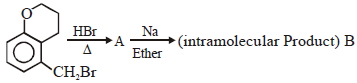
In the following reaction sequence,structures of $A$ and $B$,respectively will be
A
$A$: $2-$($3$-bromopropyl)$-6-$(bromomethyl)phenol; $B$: $1-$naphthol
B
$A$: $2-$($3$-bromopropyl)phenol; $B$: $1-$tetralol
C
$A$: $2-$($3$-bromopropyl)$-6-$(bromomethyl)phenol; $B$: $5,6,7,8-$tetrahydronaphthalen$-1-$ol
D
$A$: $2-$($3$-bromopropyl)phenol; $B$: $1-$naphthol
Solution
(B) The reaction of the given cyclic ether with $HBr$ under heating causes the cleavage of the $C-O$ bond. The $H^+$ protonates the oxygen,and $Br^-$ attacks the less hindered carbon,resulting in the opening of the ring to form $A$ ($2$-($3$-bromopropyl)phenol).
When $A$ is treated with $Na$ in ether,the phenolic $-OH$ group is deprotonated to form a phenoxide ion. This nucleophilic phenoxide ion then undergoes an intramolecular $S_N2$ reaction with the $-CH_2Br$ group (if present) or,in this specific case,the intramolecular cyclization leads to the formation of $1$-tetralol ($5$,$6$,$7$,$8$-tetrahydronaphthalen$-1-$ol) via the reaction of the phenoxide with the alkyl bromide side chain.
When $A$ is treated with $Na$ in ether,the phenolic $-OH$ group is deprotonated to form a phenoxide ion. This nucleophilic phenoxide ion then undergoes an intramolecular $S_N2$ reaction with the $-CH_2Br$ group (if present) or,in this specific case,the intramolecular cyclization leads to the formation of $1$-tetralol ($5$,$6$,$7$,$8$-tetrahydronaphthalen$-1-$ol) via the reaction of the phenoxide with the alkyl bromide side chain.
0 likes
View Solution186
MediumMCQ
The following is not an appropriate reaction for the preparation of $t$-butyl ethyl ether:
$C_2H_5ONa + CH_3-C(CH_3)_2-Cl \to CH_3-C(CH_3)_2-O-C_2H_5$
$(i)$ What would be the major product of this reaction?
$(ii)$ Write a suitable reaction for the preparation of $t$-butyl ethyl ether.
$C_2H_5ONa + CH_3-C(CH_3)_2-Cl \to CH_3-C(CH_3)_2-O-C_2H_5$
$(i)$ What would be the major product of this reaction?
$(ii)$ Write a suitable reaction for the preparation of $t$-butyl ethyl ether.
A
$(i) CH_3-C(CH_3)_2-O-C_2H_5, (ii) C_2H_5ONa + (CH_3)_3C-Cl$
B
$(i) CH_2=C(CH_3)_2, (ii) (CH_3)_3C-ONa + C_2H_5-Br$
C
$(i) CH_3-CH_2-OH, (ii) C_2H_5OH + (CH_3)_3C-OH$
D
$(i) CH_2=C(CH_3)_2, (ii) C_2H_5ONa + (CH_3)_3C-Cl$
Solution
(B) $(i)$ The major product of the given reaction is $2$-methylpropene $(CH_2=C(CH_3)_2)$. Sodium ethoxide $(C_2H_5ONa)$ is a strong base,and $t$-butyl chloride is a tertiary $(3^\circ)$ alkyl halide. In the case of tertiary halides,elimination $(E2)$ predominates over substitution $(S_N2)$.
$(ii)$ For the preparation of $t$-butyl ethyl ether,a primary alkyl halide should be reacted with a tertiary alkoxide (Williamson ether synthesis).
$(CH_3)_3C-ONa + C_2H_5-Br \to (CH_3)_3C-O-C_2H_5 + NaBr$.
$(ii)$ For the preparation of $t$-butyl ethyl ether,a primary alkyl halide should be reacted with a tertiary alkoxide (Williamson ether synthesis).
$(CH_3)_3C-ONa + C_2H_5-Br \to (CH_3)_3C-O-C_2H_5 + NaBr$.
0 likes
View Solution187
Difficult
Give the major products that are formed by heating each of the following ethers with $HI$.
$(i)$ $CH_3-CH_2-CH(CH_3)-CH_2-O-CH_2-CH_3$
$(ii)$ $CH_3-CH_2-CH_2-O-C(CH_3)_2-CH_2-CH_3$
$(iii)$ $C_6H_5-CH_2-O-C_6H_5$
$(i)$ $CH_3-CH_2-CH(CH_3)-CH_2-O-CH_2-CH_3$
$(ii)$ $CH_3-CH_2-CH_2-O-C(CH_3)_2-CH_2-CH_3$
$(iii)$ $C_6H_5-CH_2-O-C_6H_5$
Solution
(N/A) $(i)$ The reaction follows $S_N2$ mechanism because the alkyl groups are primary. The smaller alkyl group forms the alkyl iodide. Products: $CH_3-CH_2-CH(CH_3)-CH_2OH + CH_3CH_2I$.
$(ii)$ The reaction follows $S_N1$ mechanism because the ether contains a tertiary alkyl group. The tertiary carbocation is more stable. Products: $CH_3CH_2CH_2OH + CH_3CH_2-C(CH_3)_2I$.
$(iii)$ The cleavage occurs at the $C-O$ bond where the benzyl carbocation is formed,which is resonance stabilized. Products: $C_6H_5CH_2I + C_6H_5OH$.
$(ii)$ The reaction follows $S_N1$ mechanism because the ether contains a tertiary alkyl group. The tertiary carbocation is more stable. Products: $CH_3CH_2CH_2OH + CH_3CH_2-C(CH_3)_2I$.
$(iii)$ The cleavage occurs at the $C-O$ bond where the benzyl carbocation is formed,which is resonance stabilized. Products: $C_6H_5CH_2I + C_6H_5OH$.
0 likes
View Solution188
Difficult
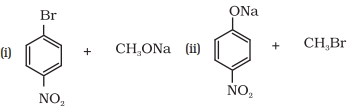
Which of the following is an appropriate set of reactants for the preparation of $1-methoxy-4-nitrobenzene$ and why?
Solution
(B) Set $(ii)$ is an appropriate set of reactants for the preparation of $1-methoxy-4-nitrobenzene$. The reaction is: $p-nitrophenoxide + CH_3Br \rightarrow 1-methoxy-4-nitrobenzene + NaBr$.
In set $(i)$,the reactant is $1-bromo-4-nitrobenzene$. Aryl halides are generally unreactive towards nucleophilic substitution reactions under ordinary conditions because the $C-X$ bond has partial double bond character due to resonance and the $sp^2$ hybridized carbon atom is more electronegative. Furthermore,$CH_3ONa$ is a strong nucleophile and base,but it cannot easily displace the halide from the aryl ring in this manner compared to the Williamson ether synthesis shown in set $(ii)$.
In set $(i)$,the reactant is $1-bromo-4-nitrobenzene$. Aryl halides are generally unreactive towards nucleophilic substitution reactions under ordinary conditions because the $C-X$ bond has partial double bond character due to resonance and the $sp^2$ hybridized carbon atom is more electronegative. Furthermore,$CH_3ONa$ is a strong nucleophile and base,but it cannot easily displace the halide from the aryl ring in this manner compared to the Williamson ether synthesis shown in set $(ii)$.
0 likes
View Solution189
Difficult
Predict the products of the following reactions:
$(i)$ $CH_3-CH_2-CH_2-O-CH_3 + HBr \rightarrow$
$(ii)$ $\text{Ethoxybenzene} + HBr \rightarrow$
$(iii)$ $\text{Ethoxybenzene} \xrightarrow{\text{Conc. } H_2SO_4 / \text{Conc. } HNO_3}$
$(iv)$ $(CH_3)_3C-O-C_2H_5 \xrightarrow{HI}$
$(i)$ $CH_3-CH_2-CH_2-O-CH_3 + HBr \rightarrow$
$(ii)$ $\text{Ethoxybenzene} + HBr \rightarrow$
$(iii)$ $\text{Ethoxybenzene} \xrightarrow{\text{Conc. } H_2SO_4 / \text{Conc. } HNO_3}$
$(iv)$ $(CH_3)_3C-O-C_2H_5 \xrightarrow{HI}$
Solution
(N/A) $(i)$ $CH_3-CH_2-CH_2-O-CH_3 + HBr \rightarrow CH_3-CH_2-CH_2-OH + CH_3-Br$
$(ii)$ $\text{Ethoxybenzene} + HBr \rightarrow \text{Phenol} + C_2H_5Br$
$(iii)$ $\text{Ethoxybenzene}$ $\xrightarrow{\text{Conc. } H_2SO_4 / \text{Conc. } HNO_3} \text{4-Ethoxynitrobenzene (Major)} + \text{2-Ethoxynitrobenzene (Minor)}$
$(iv)$ $(CH_3)_3C-O-C_2H_5 \xrightarrow{HI} (CH_3)_3C-I + C_2H_5OH$
$(ii)$ $\text{Ethoxybenzene} + HBr \rightarrow \text{Phenol} + C_2H_5Br$
$(iii)$ $\text{Ethoxybenzene}$ $\xrightarrow{\text{Conc. } H_2SO_4 / \text{Conc. } HNO_3} \text{4-Ethoxynitrobenzene (Major)} + \text{2-Ethoxynitrobenzene (Minor)}$
$(iv)$ $(CH_3)_3C-O-C_2H_5 \xrightarrow{HI} (CH_3)_3C-I + C_2H_5OH$
0 likes
View Solution190
Medium
Give $IUPAC$ names of the following ethers:
$(i)$ $C_2H_5OCH_2CH(CH_3)_2$
$(ii)$ $CH_3OCH_2CH_2Cl$
$(iii)$ $O_2NC_6H_4OCH_3(p)$
$(iv)$ $CH_3CH_2CH_2OCH_3$
$(v)$ $1$-Ethoxy-$4,4$-dimethylcyclohexane
$(vi)$ Ethoxybenzene
$(i)$ $C_2H_5OCH_2CH(CH_3)_2$
$(ii)$ $CH_3OCH_2CH_2Cl$
$(iii)$ $O_2NC_6H_4OCH_3(p)$
$(iv)$ $CH_3CH_2CH_2OCH_3$
$(v)$ $1$-Ethoxy-$4,4$-dimethylcyclohexane
$(vi)$ Ethoxybenzene
Solution
(A) $(i)$ $1$-Ethoxy-$2$-methylpropane
$(ii)$ $1$-Chloro-$2$-methoxyethane
$(iii)$ $1$-Methoxy-$4$-nitrobenzene (or $4$-Nitroanisole)
$(iv)$ $1$-Methoxypropane
$(v)$ $1$-Ethoxy-$4,4$-dimethylcyclohexane
$(vi)$ Ethoxybenzene
$(ii)$ $1$-Chloro-$2$-methoxyethane
$(iii)$ $1$-Methoxy-$4$-nitrobenzene (or $4$-Nitroanisole)
$(iv)$ $1$-Methoxypropane
$(v)$ $1$-Ethoxy-$4,4$-dimethylcyclohexane
$(vi)$ Ethoxybenzene
0 likes
View Solution191
Medium
Illustrate with examples the limitations of Williamson synthesis for the preparation of certain types of ethers.
Solution
(N/A) The Williamson synthesis involves the $S_{N}2$ attack of an alkoxide ion on a primary alkyl halide.
For example: $(CH_3)_3CONa + CH_3Cl \rightarrow (CH_3)_3COCH_3 + NaCl$
However,if secondary or tertiary alkyl halides are used instead of primary alkyl halides,elimination competes with substitution.
As a result,alkenes are produced instead of ethers because alkoxides act as both nucleophiles and strong bases.
For example: $(CH_3)_3CCl + NaOCH_3 \rightarrow CH_3-C(CH_3)=CH_2 + CH_3OH + NaCl$
For example: $(CH_3)_3CONa + CH_3Cl \rightarrow (CH_3)_3COCH_3 + NaCl$
However,if secondary or tertiary alkyl halides are used instead of primary alkyl halides,elimination competes with substitution.
As a result,alkenes are produced instead of ethers because alkoxides act as both nucleophiles and strong bases.
For example: $(CH_3)_3CCl + NaOCH_3 \rightarrow CH_3-C(CH_3)=CH_2 + CH_3OH + NaCl$
0 likes
View Solution192
Medium
How is $1-$propoxypropane synthesized from propan$-1-$ol? Write the mechanism of this reaction.
Solution
(N/A) $1-$propoxypropane can be synthesized from propan$-1-$ol by acid-catalyzed dehydration. Propan$-1-$ol undergoes dehydration in the presence of protic acids (such as $H_{2}SO_{4}$ or $H_{3}PO_{4}$) at $413 \ K$ to give $1-$propoxypropane.
$2CH_{3}CH_{2}CH_{2}OH \xrightarrow{H^{+}, 413K} CH_{3}CH_{2}CH_{2}-O-CH_{2}CH_{2}CH_{3} + H_{2}O$
The mechanism of this reaction involves the following three steps:
Step $1$: Protonation
$CH_{3}CH_{2}CH_{2}-\ddot{O}H + H^{+} \rightleftharpoons CH_{3}CH_{2}CH_{2}-\overset{+}{O}H_{2}$
Step $2$: Nucleophilic attack
$CH_{3}CH_{2}CH_{2}-\ddot{O}H + CH_{3}CH_{2}CH_{2}-\overset{+}{O}H_{2} \to CH_{3}CH_{2}CH_{2}-\overset{+}{O}(H)-CH_{2}CH_{2}CH_{3} + H_{2}O$
Step $3$: Deprotonation
$CH_{3}CH_{2}CH_{2}-\overset{+}{O}(H)-CH_{2}CH_{2}CH_{3} \to CH_{3}CH_{2}CH_{2}-O-CH_{2}CH_{2}CH_{3} + H^{+}$
$2CH_{3}CH_{2}CH_{2}OH \xrightarrow{H^{+}, 413K} CH_{3}CH_{2}CH_{2}-O-CH_{2}CH_{2}CH_{3} + H_{2}O$
The mechanism of this reaction involves the following three steps:
Step $1$: Protonation
$CH_{3}CH_{2}CH_{2}-\ddot{O}H + H^{+} \rightleftharpoons CH_{3}CH_{2}CH_{2}-\overset{+}{O}H_{2}$
Step $2$: Nucleophilic attack
$CH_{3}CH_{2}CH_{2}-\ddot{O}H + CH_{3}CH_{2}CH_{2}-\overset{+}{O}H_{2} \to CH_{3}CH_{2}CH_{2}-\overset{+}{O}(H)-CH_{2}CH_{2}CH_{3} + H_{2}O$
Step $3$: Deprotonation
$CH_{3}CH_{2}CH_{2}-\overset{+}{O}(H)-CH_{2}CH_{2}CH_{3} \to CH_{3}CH_{2}CH_{2}-O-CH_{2}CH_{2}CH_{3} + H^{+}$
0 likes
View Solution193
Difficult
Write the equations for the reaction of hydrogen iodide with:
$(i)$ $1-propoxypropane$
$(ii)$ $methoxybenzene$
$(iii)$ $benzyl \ ethyl \ ether$
$(i)$ $1-propoxypropane$
$(ii)$ $methoxybenzene$
$(iii)$ $benzyl \ ethyl \ ether$
Solution
(N/A) $(i)$ $CH_3CH_2CH_2-O-CH_2CH_2CH_3 + HI \xrightarrow{373 \ K} CH_3CH_2CH_2-OH + CH_3CH_2CH_2-I$
$(ii)$ $C_6H_5-OCH_3 + HI \rightarrow C_6H_5-OH + CH_3I$
$(iii)$ $C_6H_5CH_2-O-C_2H_5 + HI \rightarrow C_6H_5CH_2-I + C_2H_5OH$
$(ii)$ $C_6H_5-OCH_3 + HI \rightarrow C_6H_5-OH + CH_3I$
$(iii)$ $C_6H_5CH_2-O-C_2H_5 + HI \rightarrow C_6H_5CH_2-I + C_2H_5OH$
0 likes
View Solution194
Medium
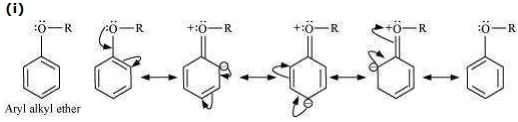
Explain the fact that in aryl alkyl ethers $(i)$ the alkoxy group activates the benzene ring towards electrophilic substitution and $(ii)$ it directs the incoming substituents to ortho and para positions in the benzene ring.
Solution
(N/A) $(i)$ In aryl alkyl ethers,due to the $+R$ effect of the alkoxy group,the electron density in the benzene ring increases as shown in the following resonance structures.
Thus,the benzene ring is activated towards electrophilic substitution by the alkoxy group.
$(ii)$ It can also be observed from the resonance structures that the electron density increases more at the ortho and para positions than at the meta position. As a result,the incoming electrophilic substituents are directed to the ortho and para positions in the benzene ring.
Thus,the benzene ring is activated towards electrophilic substitution by the alkoxy group.
$(ii)$ It can also be observed from the resonance structures that the electron density increases more at the ortho and para positions than at the meta position. As a result,the incoming electrophilic substituents are directed to the ortho and para positions in the benzene ring.
0 likes
View Solution195
Medium
Write the mechanism of the reaction of $HI$ with methoxymethane.
Solution
(N/A) The mechanism of the reaction of $HI$ with methoxymethane involves the following steps:
Step $1$: Protonation of methoxymethane:
$CH_3-O-CH_3 + HI \rightleftharpoons CH_3-O^{+}(H)-CH_3 + I^{-}$
Step $2$: Nucleophilic attack of $I^{-}$ on the protonated ether:
$I^{-} + CH_3-O^{+}(H)-CH_3 \to CH_3-I + CH_3-OH$
Step $3$: When $HI$ is in excess and the reaction is carried out at a high temperature,the methanol formed in the second step reacts with another $HI$ molecule:
$CH_3-OH + HI \rightleftharpoons CH_3-OH_2^{+} + I^{-}$
$I^{-} + CH_3-OH_2^{+} \to CH_3-I + H_2O$
Step $1$: Protonation of methoxymethane:
$CH_3-O-CH_3 + HI \rightleftharpoons CH_3-O^{+}(H)-CH_3 + I^{-}$
Step $2$: Nucleophilic attack of $I^{-}$ on the protonated ether:
$I^{-} + CH_3-O^{+}(H)-CH_3 \to CH_3-I + CH_3-OH$
Step $3$: When $HI$ is in excess and the reaction is carried out at a high temperature,the methanol formed in the second step reacts with another $HI$ molecule:
$CH_3-OH + HI \rightleftharpoons CH_3-OH_2^{+} + I^{-}$
$I^{-} + CH_3-OH_2^{+} \to CH_3-I + H_2O$
0 likes
View Solution196
Difficult
Write equations of the following reactions:
$(i)$ Friedel-Crafts reaction - alkylation of anisole.
$(ii)$ Nitration of anisole.
$(iii)$ Bromination of anisole in ethanoic acid medium.
$(iv)$ Friedel-Craft's acetylation of anisole.
$(i)$ Friedel-Crafts reaction - alkylation of anisole.
$(ii)$ Nitration of anisole.
$(iii)$ Bromination of anisole in ethanoic acid medium.
$(iv)$ Friedel-Craft's acetylation of anisole.
Solution
(N/A) $(i)$ Friedel-Crafts alkylation: $C_6H_5OCH_3 + CH_3Cl \xrightarrow{Anhyd. AlCl_3, CS_2} C_6H_4(OCH_3)(CH_3) \text{ (ortho and para isomers)}$.
$(ii)$ Nitration: $C_6H_5OCH_3 + HNO_3 \xrightarrow{H_2SO_4} C_6H_4(OCH_3)(NO_2) \text{ (ortho and para isomers)}$.
$(iii)$ Bromination: $C_6H_5OCH_3 + Br_2 \xrightarrow{CH_3COOH} C_6H_4(OCH_3)(Br) \text{ (ortho and para isomers)}$.
$(iv)$ Friedel-Crafts acetylation: $C_6H_5OCH_3 + CH_3COCl \xrightarrow{Anhyd. AlCl_3} C_6H_4(OCH_3)(COCH_3) \text{ (ortho and para isomers)}$.
$(ii)$ Nitration: $C_6H_5OCH_3 + HNO_3 \xrightarrow{H_2SO_4} C_6H_4(OCH_3)(NO_2) \text{ (ortho and para isomers)}$.
$(iii)$ Bromination: $C_6H_5OCH_3 + Br_2 \xrightarrow{CH_3COOH} C_6H_4(OCH_3)(Br) \text{ (ortho and para isomers)}$.
$(iv)$ Friedel-Crafts acetylation: $C_6H_5OCH_3 + CH_3COCl \xrightarrow{Anhyd. AlCl_3} C_6H_4(OCH_3)(COCH_3) \text{ (ortho and para isomers)}$.
0 likes
View Solution197
Medium
Give the common and $\rm {IUPAC}$ names for the following ether compounds:
$(i) \ CH_3OCH_3$
$(ii) \ C_2H_5OC_2H_5$
$(iii) \ C_6H_5OC_6H_5$
$(iv) \ CH_3OCH_2CH_2CH_3$
$(v) \ CH_3OCH(CH_3)_2$
$(vi) \ C_6H_5OCH_3$
$(vii) \ C_6H_5OCH_2CH_3$
$(viii) \ C_6H_5O(CH_2)_6CH_3$
$(ix) \ C_6H_5OCH_2CH_2CH(CH_3)_2$
$(x) \ CH_3OCH_2CH_2OCH_3$
$(xi) \ C_2H_5OCH_2CH_2OC_2H_5$
$(xii) \ CH_3OCH_2CH_2CH_2OCH_3$
$(xiii) \ CH_3OCH_2CH_2OC_2H_5$
$(xiv) \ \text{Cyclohexyl methyl ether}$
$(i) \ CH_3OCH_3$
$(ii) \ C_2H_5OC_2H_5$
$(iii) \ C_6H_5OC_6H_5$
$(iv) \ CH_3OCH_2CH_2CH_3$
$(v) \ CH_3OCH(CH_3)_2$
$(vi) \ C_6H_5OCH_3$
$(vii) \ C_6H_5OCH_2CH_3$
$(viii) \ C_6H_5O(CH_2)_6CH_3$
$(ix) \ C_6H_5OCH_2CH_2CH(CH_3)_2$
$(x) \ CH_3OCH_2CH_2OCH_3$
$(xi) \ C_2H_5OCH_2CH_2OC_2H_5$
$(xii) \ CH_3OCH_2CH_2CH_2OCH_3$
$(xiii) \ CH_3OCH_2CH_2OC_2H_5$
$(xiv) \ \text{Cyclohexyl methyl ether}$
Solution
(N/A) The common and $\rm {IUPAC}$ names are as follows:
| Compound | Common Name | $\rm {IUPAC}$ Name |
|---|---|---|
| $(i) \ CH_3OCH_3$ | Dimethyl ether | Methoxymethane |
| $(ii) \ C_2H_5OC_2H_5$ | Diethyl ether | Ethoxyethane |
| $(iii) \ C_6H_5OC_6H_5$ | Diphenyl ether | Phenoxybenzene |
| $(iv) \ CH_3OCH_2CH_2CH_3$ | Methyl n-propyl ether | $1$-Methoxypropane |
| $(v) \ CH_3OCH(CH_3)_2$ | Methyl isopropyl ether | $2$-Methoxypropane |
| $(vi) \ C_6H_5OCH_3$ | Methyl phenyl ether (Anisole) | Methoxybenzene |
| $(vii) \ C_6H_5OCH_2CH_3$ | Ethyl phenyl ether (Phenetole) | Ethoxybenzene |
| $(viii) \ C_6H_5O(CH_2)_6CH_3$ | Heptyl phenyl ether | $1$-Phenoxyheptane |
| $(ix) \ C_6H_5OCH_2CH_2CH(CH_3)_2$ | Isobutyl phenyl ether | $1$-Phenoxy$-3-$methylbutane |
| $(x) \ CH_3OCH_2CH_2OCH_3$ | $1$,$2$-Dimethoxyethane | $1$,$2$-Dimethoxyethane |
| $(xi) \ C_2H_5OCH_2CH_2OC_2H_5$ | $1$,$2$-Diethoxyethane | $1$,$2$-Diethoxyethane |
| $(xii) \ CH_3OCH_2CH_2CH_2OCH_3$ | $1$,$3$-Dimethoxypropane | $1$,$3$-Dimethoxypropane |
| $(xiii) \ CH_3OCH_2CH_2OC_2H_5$ | $1$-Ethoxy$-2-$methoxyethane | $1$-Ethoxy$-2-$methoxyethane |
| $(xiv) \ \text{Cyclohexyl methyl ether}$ | Cyclohexyl methyl ether | Methoxycyclohexane |
0 likes
View Solution198
Difficult
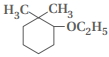
Give the common and $\text{IUPAC}$ names for the following ether compound:
$1,1-\text{dimethyl}-2-\text{ethoxycyclohexane}$ (structure shown in image).
$1,1-\text{dimethyl}-2-\text{ethoxycyclohexane}$ (structure shown in image).
Solution
(N/A) The given structure is a substituted cyclohexane ring.
$1$. Identify the parent chain: The ring is a cyclohexane.
$2$. Identify substituents: There are two methyl groups at position $1$ and an ethoxy group $(-OC_2H_5)$ at position $2$.
$3$. $\text{IUPAC}$ naming: Numbering starts from the carbon with the substituents to give the lowest possible locants. Thus,the name is $2-\text{ethoxy}-1,1-\text{dimethylcyclohexane}$.
$4$. Common name: This is an ether where the alkyl groups are an ethyl group and a $2,2-\text{dimethylcyclohexyl}$ group. Thus,the common name is $\text{ethyl } 2,2-\text{dimethylcyclohexyl ether}$.
$1$. Identify the parent chain: The ring is a cyclohexane.
$2$. Identify substituents: There are two methyl groups at position $1$ and an ethoxy group $(-OC_2H_5)$ at position $2$.
$3$. $\text{IUPAC}$ naming: Numbering starts from the carbon with the substituents to give the lowest possible locants. Thus,the name is $2-\text{ethoxy}-1,1-\text{dimethylcyclohexane}$.
$4$. Common name: This is an ether where the alkyl groups are an ethyl group and a $2,2-\text{dimethylcyclohexyl}$ group. Thus,the common name is $\text{ethyl } 2,2-\text{dimethylcyclohexyl ether}$.
0 likes
View Solution199
Medium
Write a note on Williamson's ether synthesis.
Solution
(N/A) Williamson's ether synthesis is an important laboratory method for the preparation of symmetrical and unsymmetrical ethers.
In this reaction,an alkyl halide is reacted with a sodium alkoxide to form an ether.
The general reaction is: $R-X + R'-O^-Na^+ \rightarrow R-O-R' + NaX$.
This reaction involves an $S_N2$ mechanism.
For the synthesis of unsymmetrical ethers,it is important to choose the reactants such that the alkyl halide is primary $(1^\circ)$ to minimize steric hindrance and favor the $S_N2$ pathway.
If a tertiary alkyl halide is used,elimination (forming an alkene) becomes the major reaction instead of substitution.
Example: The reaction of sodium tert-butoxide with methyl bromide yields tert-butyl methyl ether: $(CH_3)_3C-O^-Na^+ + CH_3-Br \rightarrow (CH_3)_3C-O-CH_3 + NaBr$.
In this reaction,an alkyl halide is reacted with a sodium alkoxide to form an ether.
The general reaction is: $R-X + R'-O^-Na^+ \rightarrow R-O-R' + NaX$.
This reaction involves an $S_N2$ mechanism.
For the synthesis of unsymmetrical ethers,it is important to choose the reactants such that the alkyl halide is primary $(1^\circ)$ to minimize steric hindrance and favor the $S_N2$ pathway.
If a tertiary alkyl halide is used,elimination (forming an alkene) becomes the major reaction instead of substitution.
Example: The reaction of sodium tert-butoxide with methyl bromide yields tert-butyl methyl ether: $(CH_3)_3C-O^-Na^+ + CH_3-Br \rightarrow (CH_3)_3C-O-CH_3 + NaBr$.
0 likes
View Solution200
Medium
Compare the boiling points of ethers with alkanes and alcohols.
Solution
(N/A) The $C-O$ bond in ethers is polar,and due to the angular shape of the ether molecule,it possesses a net dipole moment. Consequently,ethers have slightly higher boiling points than alkanes of comparable molecular mass.
However,ethers have significantly lower boiling points than alcohols of comparable molecular mass. This is because alcohols can form intermolecular hydrogen bonds,whereas ethers cannot.
The order of boiling points for compounds of comparable molecular mass is: $Alkane \approx Ether < Alcohol$.
However,ethers have significantly lower boiling points than alcohols of comparable molecular mass. This is because alcohols can form intermolecular hydrogen bonds,whereas ethers cannot.
The order of boiling points for compounds of comparable molecular mass is: $Alkane \approx Ether < Alcohol$.
0 likes
View SolutionAlcohols, Phenols and Ethers — Properties of Ethers · Frequently Asked Questions
1Are these Alcohols, Phenols and Ethers questions useful for JEE and NEET?
Yes. All questions in this section are mapped to JEE Main and NEET exam patterns. Previous year questions from JEE Main, NEET, GUJCET and state-level exams are included with full solutions.
2Can I switch to Hindi or Gujarati for these questions?
Yes. Use the language tabs in the hero section or the sidebar to view the same questions and solutions in English, Hindi or Gujarati.
3How do I generate a question paper from this subtopic?
Use the Vedclass Exam Paper Generator — select the chapter and subtopic, set difficulty, and generate Sets A, B, C, D automatically. First 3 chapters of every subject are free.
Vedclass Products
For Students
Vedclass Test Series
Mock tests in real JEE/NEET style with performance analysis. 5-day free trial.
Start Free TrialFor Teachers
Exam Paper Generator
Generate Set A/B/C/D papers from this chapter in 2 minutes. 3 chapters free.
Try FreeFor Institutes
Online Exam Module
Live online exams with unlimited students, 360° analytics & white-label branding.
See DemoFor Teachers & Institutes
Generate a Alcohols, Phenols and Ethers Exam Paper in 2 Minutes
Select subtopic & difficulty — Sets A, B, C, D auto-generated with No Repeat logic.
First 3 chapters of every subject are free — no payment required.