
A English
Properties of Ethers Questions in English
Class 12 Chemistry · Alcohols, Phenols and Ethers · Properties of Ethers
343+
Questions
English
Language
100%
With Solutions
Showing 31 of 343 questions in English
301
DifficultMCQ
Identify the products $(X, Y)$ and reaction mechanism $(Z)$ of the following reaction:
$CH_3CH_2-O-C(CH_3)_2CH_2CH_3 \xrightarrow{HI, \Delta} X + Y$
$CH_3CH_2-O-C(CH_3)_2CH_2CH_3 \xrightarrow{HI, \Delta} X + Y$
A
$X = CH_3CH_2OH, Y = (CH_3)_2(CH_3CH_2)C-I, Z = S_N1$
B
$X = CH_3CH_2OH, Y = (CH_3)_2(CH_3CH_2)C-I, Z = S_N2$
C
$X = CH_3CH_2I, Y = (CH_3)_2(CH_3CH_2)C-OH, Z = S_N1$
D
$X = CH_3CH_2I, Y = (CH_3)_2(CH_3CH_2)C-OH, Z = S_N2$
Solution
(A) $(i)$ The reaction of an ether with $HI$ produces an alcohol and an alkyl iodide. In the presence of a $3^{\circ}$ carbon atom in one of the alkyl groups of the ether,the iodide ion $(-I)$ attacks the more substituted carbon atom (the $3^{\circ}$ carbon) via the $S_N1$ mechanism.
$(ii)$ This occurs because the $3^{\circ}$ carbocation formed during the reaction is highly stable compared to $1^{\circ}$ or $2^{\circ}$ carbocations,and the $S_N2$ mechanism is hindered by significant steric hindrance at the $3^{\circ}$ carbon.
$(iii)$ In the given reaction,the ether is $2-ethoxy-2-methylbutane$. The $HI$ cleaves the bond between the oxygen and the $3^{\circ}$ carbon,leading to the formation of ethanol $(CH_3CH_2OH)$ and $2-iodo-2-methylbutane$ $((CH_3)_2(CH_3CH_2)C-I)$ via the $S_N1$ mechanism.
Thus,option $A$ is the correct answer.
$(ii)$ This occurs because the $3^{\circ}$ carbocation formed during the reaction is highly stable compared to $1^{\circ}$ or $2^{\circ}$ carbocations,and the $S_N2$ mechanism is hindered by significant steric hindrance at the $3^{\circ}$ carbon.
$(iii)$ In the given reaction,the ether is $2-ethoxy-2-methylbutane$. The $HI$ cleaves the bond between the oxygen and the $3^{\circ}$ carbon,leading to the formation of ethanol $(CH_3CH_2OH)$ and $2-iodo-2-methylbutane$ $((CH_3)_2(CH_3CH_2)C-I)$ via the $S_N1$ mechanism.
Thus,option $A$ is the correct answer.
0 likes
View Solution302
MediumMCQ
The reaction of anisole with acetyl chloride in the presence of anhydrous $AlCl_3$ gives $X$ and $Y$. $X$ and $Y$ are
A
$o-$Methoxyacetophenone and $p-$methoxyacetophenone
B
$o-$Ethoxyacetophenone and $p-$ethoxyacetophenone
C
$o-$Methoxypropiophenone and $p-$methoxypropiophenone
D
$o-$Ethoxypropiophenone and $p-$ethoxypropiophenone
Solution
(A) Anisole $(C_6H_5OCH_3)$ undergoes Friedel-Crafts acylation when treated with acetyl chloride $(CH_3COCl)$ in the presence of anhydrous $AlCl_3$.
The methoxy group $(-OCH_3)$ is an ortho/para-directing group.
Therefore,the reaction yields a mixture of ortho-substituted and para-substituted products.
The products formed are $o-$methoxyacetophenone and $p-$methoxyacetophenone.
The methoxy group $(-OCH_3)$ is an ortho/para-directing group.
Therefore,the reaction yields a mixture of ortho-substituted and para-substituted products.
The products formed are $o-$methoxyacetophenone and $p-$methoxyacetophenone.
0 likes
View Solution303
EasyMCQ
What are $A$ and $B$ in the following reaction?
$CH_3-CH_2-CH_2-O-C(CH_3)_2-CH_2-CH_3 \xrightarrow{HI} A + B$
$CH_3-CH_2-CH_2-O-C(CH_3)_2-CH_2-CH_3 \xrightarrow{HI} A + B$
A
$A = CH_3CH_2I, B = HO-C(CH_3)_2-CH_2CH_3$
B
$A = CH_3CH_2I, B = H_3C-O-C(CH_3)_2-CH_2CH_3$
C
$A = CH_3CH_2CH_2OH, B = I-C(CH_3)_2-CH_2CH_3$
D
$A = CH_3CH_3, B = IH_2C-O-C(CH_3)_2-CH_2CH_3$
Solution
(C) The reaction of an ether with $HI$ proceeds via an $S_N1$ mechanism when one of the alkyl groups is tertiary,as it can form a stable carbocation.
In the given ether,$CH_3-CH_2-CH_2-O-C(CH_3)_2-CH_2-CH_3$,the oxygen atom is attached to a primary alkyl group ($n$-propyl) and a tertiary alkyl group ($2$-methylbutan$-2-$yl).
When $HI$ is added,the oxygen gets protonated. The bond between the oxygen and the tertiary carbon breaks to form a stable tertiary carbocation,which then reacts with the iodide ion $(I^-)$ to form an alkyl iodide,and the primary group forms an alcohol.
Therefore,the products are $CH_3-CH_2-CH_2-OH$ (propan$-1-$ol) and $I-C(CH_3)_2-CH_2-CH_3$ ($2$-iodo$-2-$methylbutane).
Comparing this with the given options,option $C$ represents the correct products.
In the given ether,$CH_3-CH_2-CH_2-O-C(CH_3)_2-CH_2-CH_3$,the oxygen atom is attached to a primary alkyl group ($n$-propyl) and a tertiary alkyl group ($2$-methylbutan$-2-$yl).
When $HI$ is added,the oxygen gets protonated. The bond between the oxygen and the tertiary carbon breaks to form a stable tertiary carbocation,which then reacts with the iodide ion $(I^-)$ to form an alkyl iodide,and the primary group forms an alcohol.
Therefore,the products are $CH_3-CH_2-CH_2-OH$ (propan$-1-$ol) and $I-C(CH_3)_2-CH_2-CH_3$ ($2$-iodo$-2-$methylbutane).
Comparing this with the given options,option $C$ represents the correct products.
0 likes
View Solution304
MediumMCQ
Identify $Y$ and $Z$ in the following reaction:
$C_6H_5-O-CH_2CH_3 \xrightarrow{HI, \Delta} Y + Z$
$C_6H_5-O-CH_2CH_3 \xrightarrow{HI, \Delta} Y + Z$
A
$C_6H_5OH \ | \ CH_3CH_3$
B
$C_2H_5I \ | \ C_6H_5CHO$
C
$C_6H_5I \ | \ CH_3CH_2OH$
D
$C_6H_5OH \ | \ CH_3CH_2I$
Solution
(D) When an alkyl aryl ether is reacted with a halogen acid $(HI)$,the cleavage of the $C-O$ bond occurs such that the alkyl group forms an alkyl halide and the aryl group forms a phenol.
In the reaction of ethyl phenyl ether $(C_6H_5-O-CH_2CH_3)$ with $HI$,the $C-O$ bond between the oxygen and the ethyl group breaks.
$C_6H_5-O-CH_2CH_3 + HI \xrightarrow{\Delta} C_6H_5OH + CH_3CH_2I$
Thus,$Y$ is $C_6H_5OH$ (phenol) and $Z$ is $CH_3CH_2I$ (ethyl iodide).
In the reaction of ethyl phenyl ether $(C_6H_5-O-CH_2CH_3)$ with $HI$,the $C-O$ bond between the oxygen and the ethyl group breaks.
$C_6H_5-O-CH_2CH_3 + HI \xrightarrow{\Delta} C_6H_5OH + CH_3CH_2I$
Thus,$Y$ is $C_6H_5OH$ (phenol) and $Z$ is $CH_3CH_2I$ (ethyl iodide).
0 likes
View Solution305
DifficultMCQ
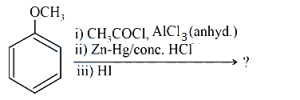
The major product of the following reaction sequence is:
A
$4-$Ethylphenol
B
$3-$Iodo$-4-$ethylanisole
C
$2,6-$Diiodo$-4-$ethylphenol
D
$4-$Ethyl$-1-$iodobenzene
Solution
(A) The $-OCH_3$ group is an electron-donating group and is ortho/para directing. In aromatic electrophilic substitution,the para position is favored due to steric hindrance at the ortho position.
Step-$1$: Friedel-Crafts Acylation of anisole with $CH_3COCl$ and anhydrous $AlCl_3$ yields $4$-methoxyacetophenone as the major product.
Step-$2$: Clemmensen reduction of $4$-methoxyacetophenone using $Zn-Hg$ and concentrated $HCl$ reduces the acetyl group to an ethyl group,forming $4$-ethylanisole.
Step-$3$: Cleavage of the ether linkage in $4$-ethylanisole with $HI$ yields $4$-ethylphenol and methyl iodide $(CH_3I)$.
Thus,the major product is $4$-ethylphenol.
Step-$1$: Friedel-Crafts Acylation of anisole with $CH_3COCl$ and anhydrous $AlCl_3$ yields $4$-methoxyacetophenone as the major product.
Step-$2$: Clemmensen reduction of $4$-methoxyacetophenone using $Zn-Hg$ and concentrated $HCl$ reduces the acetyl group to an ethyl group,forming $4$-ethylanisole.
Step-$3$: Cleavage of the ether linkage in $4$-ethylanisole with $HI$ yields $4$-ethylphenol and methyl iodide $(CH_3I)$.
Thus,the major product is $4$-ethylphenol.
0 likes
View Solution306
DifficultMCQ
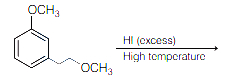
The total number of $S_{N}2$ (nucleophilic substitution bimolecular) reactions involved in the following reaction sequence is
A
$3$
B
$4$
C
$2$
D
$5$
Solution
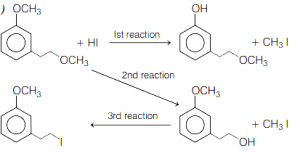
(A) The reaction of $1$-methoxy$-3-$($2$-methoxyethyl)benzene with excess $HI$ at high temperature involves the cleavage of both ether groups.
$1$. The first $S_{N}2$ reaction occurs at the primary alkyl group of the side chain,where the methoxy group is protonated and then attacked by the iodide ion $(I^-)$ to form an alcohol and $CH_3I$.
$2$. The second $S_{N}2$ reaction occurs at the methyl group attached to the phenolic oxygen,where the methoxy group is protonated and then attacked by the iodide ion to form phenol and $CH_3I$.
$3$. The third $S_{N}2$ reaction involves the conversion of the primary alcohol formed in the first step into an alkyl iodide by reaction with $HI$.
Thus,there are a total of $3$ $S_{N}2$ reactions involved in the complete conversion.
$1$. The first $S_{N}2$ reaction occurs at the primary alkyl group of the side chain,where the methoxy group is protonated and then attacked by the iodide ion $(I^-)$ to form an alcohol and $CH_3I$.
$2$. The second $S_{N}2$ reaction occurs at the methyl group attached to the phenolic oxygen,where the methoxy group is protonated and then attacked by the iodide ion to form phenol and $CH_3I$.
$3$. The third $S_{N}2$ reaction involves the conversion of the primary alcohol formed in the first step into an alkyl iodide by reaction with $HI$.
Thus,there are a total of $3$ $S_{N}2$ reactions involved in the complete conversion.
0 likes
View Solution307
MediumMCQ
The bond angle of $C-O-C$ bond in methoxy methane is (in $^{\circ}$)
A
$111.7$
B
$109$
C
$108.9$
D
$180$
Solution
(A) In methoxy methane $(CH_3-O-CH_3)$,the oxygen atom is $sp^3$ hybridized.
Due to the presence of two bulky $-CH_3$ groups,there is significant steric repulsion between them.
This repulsion causes the $C-O-C$ bond angle to increase from the ideal tetrahedral angle of $109^{\circ} 28^{\prime}$ to $111.7^{\circ}$.
Due to the presence of two bulky $-CH_3$ groups,there is significant steric repulsion between them.
This repulsion causes the $C-O-C$ bond angle to increase from the ideal tetrahedral angle of $109^{\circ} 28^{\prime}$ to $111.7^{\circ}$.
0 likes
View Solution308
EasyMCQ
The hybridisation of oxygen in diethyl ether is
A
$sp$
B
$sp^2$
C
$sp^3$
D
$sp^3d$
Solution
(C) In diethyl ether $(CH_3CH_2-O-CH_2CH_3)$,the oxygen atom is bonded to two carbon atoms and has two lone pairs of electrons.
According to the steric number rule,the steric number is calculated as: $\text{Steric Number} = \text{Number of sigma bonds} + \text{Number of lone pairs} = 2 + 2 = 4$.
$A$ steric number of $4$ corresponds to $sp^3$ hybridisation.
According to the steric number rule,the steric number is calculated as: $\text{Steric Number} = \text{Number of sigma bonds} + \text{Number of lone pairs} = 2 + 2 = 4$.
$A$ steric number of $4$ corresponds to $sp^3$ hybridisation.
0 likes
View Solution309
EasyMCQ
The $IUPAC$ name of an unsymmetrical ether with the molecular formula $= C_4H_{10}O$ is:
A
$1-$ethoxypropane
B
methoxyethane
C
ethoxyethane
D
$1-$methoxypropane
Solution
(D) The molecular formula $C_4H_{10}O$ corresponds to ethers with the general formula $R-O-R'$.
For an unsymmetrical ether,the alkyl groups $R$ and $R'$ must be different.
The possible unsymmetrical ethers for $C_4H_{10}O$ are:
$1.$ $1-$methoxypropane $(CH_3-O-CH_2-CH_2-CH_3)$
$2.$ $2-$methoxypropane $(CH_3-O-CH(CH_3)_2)$
Among the given options,$1-$methoxypropane is the correct $IUPAC$ name.
For an unsymmetrical ether,the alkyl groups $R$ and $R'$ must be different.
The possible unsymmetrical ethers for $C_4H_{10}O$ are:
$1.$ $1-$methoxypropane $(CH_3-O-CH_2-CH_2-CH_3)$
$2.$ $2-$methoxypropane $(CH_3-O-CH(CH_3)_2)$
Among the given options,$1-$methoxypropane is the correct $IUPAC$ name.
0 likes
View Solution310
MediumMCQ
One mole of an organic compound $(A)$ with the formula $C_3H_8O$ reacts completely with two moles of $HI$ to form $X$ and $Y$. When $Y$ is boiled with aqueous alkali it forms $Z$. $Z$ answers the iodoform test. The compound $(A)$ is
A
Propan$-1-$ol
B
Propan$-2-$ol
C
Ethoxy ethane
D
Methoxy ethane
Solution
(D) The molecular formula $C_3H_8O$ corresponds to either an alcohol or an ether. Since it reacts with $HI$ to form two products ($X$ and $Y$),it must be an ether. The reaction is: $CH_3-CH_2-O-CH_3 + 2HI \rightarrow CH_3-I (X) + CH_3-CH_2-I (Y) + H_2O$.
When ethyl iodide $(Y)$ is boiled with aqueous alkali $(NaOH)$,it forms ethanol $(CH_3CH_2OH)$.
However,the iodoform test is given by compounds containing the $CH_3CO-$ group or $CH_3CH(OH)-$ group. Ethanol $(CH_3CH_2OH)$ gives a positive iodoform test. Thus,$(A)$ is methoxyethane.
When ethyl iodide $(Y)$ is boiled with aqueous alkali $(NaOH)$,it forms ethanol $(CH_3CH_2OH)$.
However,the iodoform test is given by compounds containing the $CH_3CO-$ group or $CH_3CH(OH)-$ group. Ethanol $(CH_3CH_2OH)$ gives a positive iodoform test. Thus,$(A)$ is methoxyethane.
0 likes
View Solution311
MediumMCQ
Consider the reaction sequence:
Dimethyl ketone $\xrightarrow[(ii) H_2O]{(i) CH_3MgCl} X$ $\xrightarrow[(ii) CH_3Br]{(i) Na} Y$
How many $sp^3$ carbons are present in $Y$?
Dimethyl ketone $\xrightarrow[(ii) H_2O]{(i) CH_3MgCl} X$ $\xrightarrow[(ii) CH_3Br]{(i) Na} Y$
How many $sp^3$ carbons are present in $Y$?
A
$5$
B
$4$
C
$3$
D
$6$
Solution
(A) Step $1$: Dimethyl ketone is acetone,$CH_3COCH_3$. Reaction with $CH_3MgCl$ followed by $H_2O$ (Grignard reaction) yields $tert$-butyl alcohol,$X = (CH_3)_3COH$.
Step $2$: Reaction of $X$ with $Na$ gives the alkoxide $(CH_3)_3CONa$. Subsequent reaction with $CH_3Br$ (Williamson ether synthesis) yields $tert$-butyl methyl ether,$Y = (CH_3)_3COCH_3$.
Step $3$: In $Y$,the structure is $(CH_3)_3C-O-CH_3$. The carbons are: three methyl carbons attached to the central carbon,the central quaternary carbon,and the methyl carbon attached to oxygen. All $5$ carbons are $sp^3$ hybridized.
Step $2$: Reaction of $X$ with $Na$ gives the alkoxide $(CH_3)_3CONa$. Subsequent reaction with $CH_3Br$ (Williamson ether synthesis) yields $tert$-butyl methyl ether,$Y = (CH_3)_3COCH_3$.
Step $3$: In $Y$,the structure is $(CH_3)_3C-O-CH_3$. The carbons are: three methyl carbons attached to the central carbon,the central quaternary carbon,and the methyl carbon attached to oxygen. All $5$ carbons are $sp^3$ hybridized.
0 likes
View Solution312
DifficultMCQ
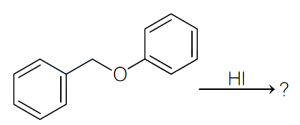
In the following reaction,the major products are
A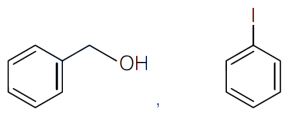
B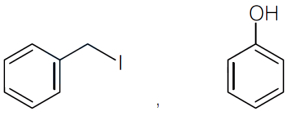
C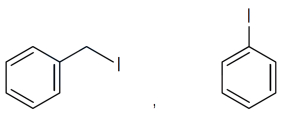
D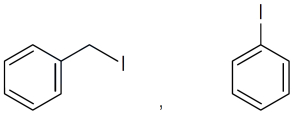
Solution
(C) The reaction of benzyl phenyl ether with $HI$ proceeds via the protonation of the ether oxygen atom.
Following protonation,the bond between the oxygen and the benzylic carbon breaks to form a stable benzylic carbocation $(C_6H_5CH_2^+)$ and phenol $(C_6H_5OH)$.
The benzylic carbocation is resonance-stabilized.
Finally,the iodide ion $(I^-)$ attacks the benzylic carbocation to form benzyl iodide $(C_6H_5CH_2I)$.
Thus,the major products are benzyl iodide and phenol.
This corresponds to option $C$.
Following protonation,the bond between the oxygen and the benzylic carbon breaks to form a stable benzylic carbocation $(C_6H_5CH_2^+)$ and phenol $(C_6H_5OH)$.
The benzylic carbocation is resonance-stabilized.
Finally,the iodide ion $(I^-)$ attacks the benzylic carbocation to form benzyl iodide $(C_6H_5CH_2I)$.
Thus,the major products are benzyl iodide and phenol.
This corresponds to option $C$.
0 likes
View Solution313
MediumMCQ
Identify the products $R$ and $S$ in the reaction sequence given:
$(CH_3)_3 COH$ $\xrightarrow{Na} P$ $\xrightarrow{CH_3 Br} Q$ $\xrightarrow[\Delta]{HI} R + S$
$(CH_3)_3 COH$ $\xrightarrow{Na} P$ $\xrightarrow{CH_3 Br} Q$ $\xrightarrow[\Delta]{HI} R + S$
A
$(CH_3)_3 CI, CH_3 OH$
B
$(CH_3)_3 COH, CH_3 I$
C
$(CH_3)_3 COH, CH_3 OH$
D
$(CH_3)_2 C=CH_2, CH_3 OH$
Solution
(A) Step $1$: Reaction of tert-butyl alcohol with $Na$ gives sodium tert-butoxide $(P)$:
$(CH_3)_3 COH Na \rightarrow (CH_3)_3 CONa \frac{1}{2} H_2$
Step $2$: Reaction of $P$ with methyl bromide $(CH_3 Br)$ via $S_N2$ mechanism gives tert-butyl methyl ether $(Q)$:
$(CH_3)_3 CONa CH_3 Br \rightarrow (CH_3)_3 COCH_3 NaBr$
Step $3$: Cleavage of ether $Q$ with $HI$ at high temperature $(\Delta)$:
Since the ether contains a tertiary alkyl group,the reaction proceeds via an $S_N1$ mechanism.
The protonated ether undergoes cleavage to form a stable tertiary carbocation $(CH_3)_3 C $,which then reacts with $I^-$ to form tert-butyl iodide $(R = (CH_3)_3 CI)$ and methanol $(S = CH_3 OH)$.
$(CH_3)_3 COH Na \rightarrow (CH_3)_3 CONa \frac{1}{2} H_2$
Step $2$: Reaction of $P$ with methyl bromide $(CH_3 Br)$ via $S_N2$ mechanism gives tert-butyl methyl ether $(Q)$:
$(CH_3)_3 CONa CH_3 Br \rightarrow (CH_3)_3 COCH_3 NaBr$
Step $3$: Cleavage of ether $Q$ with $HI$ at high temperature $(\Delta)$:
Since the ether contains a tertiary alkyl group,the reaction proceeds via an $S_N1$ mechanism.
The protonated ether undergoes cleavage to form a stable tertiary carbocation $(CH_3)_3 C $,which then reacts with $I^-$ to form tert-butyl iodide $(R = (CH_3)_3 CI)$ and methanol $(S = CH_3 OH)$.
0 likes
View Solution314
MediumMCQ
Ethyl chloride reacts with sodium ethoxide to form a compound $A$. Which of the following reactions also yields $A$?
A
$C_2H_5Cl, KOH$ (alc.),$\Delta$
B
$2C_2H_5OH$,conc. $H_2SO_4, 140^{\circ}C$
C
$C_2H_5Cl, Mg$ (dry ether)
D
$C_2H_2$,dil. $H_2SO_4, HgSO_4$
Solution
(B) The reaction of ethyl chloride $(C_2H_5Cl)$ with sodium ethoxide $(C_2H_5ONa)$ is a Williamson ether synthesis,which produces diethyl ether $(C_2H_5-O-C_2H_5)$ as compound $A$.
The reaction is: $C_2H_5Cl + C_2H_5ONa \rightarrow C_2H_5-O-C_2H_5 + NaCl$.
Diethyl ether is also obtained by the intermolecular dehydration of ethyl alcohol $(C_2H_5OH)$ in the presence of concentrated $H_2SO_4$ at $140^{\circ}C$ $(413 \ K)$:
$2C_2H_5OH \xrightarrow{conc. H_2SO_4, 140^{\circ}C} C_2H_5-O-C_2H_5 + H_2O$.
The reaction is: $C_2H_5Cl + C_2H_5ONa \rightarrow C_2H_5-O-C_2H_5 + NaCl$.
Diethyl ether is also obtained by the intermolecular dehydration of ethyl alcohol $(C_2H_5OH)$ in the presence of concentrated $H_2SO_4$ at $140^{\circ}C$ $(413 \ K)$:
$2C_2H_5OH \xrightarrow{conc. H_2SO_4, 140^{\circ}C} C_2H_5-O-C_2H_5 + H_2O$.
0 likes
View Solution315
MediumMCQ
In which of the following reactions is the product an ether?
A
$C_6H_6 + CH_3COCl$ / anhydrous $AlCl_3$
B
$C_2H_5Cl + aq. KOH$
C
$C_6H_6 + C_6H_5COCl$ / anhydrous $AlCl_3$
D
$C_2H_5Cl + C_2H_5ONa$
Solution
(D) Alkyl halides react with sodium alkoxide to give ether. This is known as Williamson's ether synthesis.
$C_2H_5Cl + C_2H_5ONa \xrightarrow{\Delta} C_2H_5OC_2H_5 + NaCl$
In option $D$,the reaction between ethyl chloride and sodium ethoxide produces diethyl ether,which is an ether.
$C_2H_5Cl + C_2H_5ONa \xrightarrow{\Delta} C_2H_5OC_2H_5 + NaCl$
In option $D$,the reaction between ethyl chloride and sodium ethoxide produces diethyl ether,which is an ether.
0 likes
View Solution316
MediumMCQ
Chloroethane reacts with $X$ to form diethyl ether. What is $X$?
A
$NaOH$
B
$H_2SO_4$
C
$C_2H_5ONa$
D
$Na_2S_2O_3$
Solution
(C) The reaction of chloroethane $(C_2H_5Cl)$ with sodium ethoxide $(C_2H_5ONa)$ is known as the Williamson ether synthesis.
In this reaction,the ethoxide ion $(C_2H_5O^-)$ acts as a nucleophile and attacks the chloroethane molecule,displacing the chloride ion to form diethyl ether $(C_2H_5OC_2H_5)$.
The chemical equation is:
$C_2H_5Cl + C_2H_5ONa \rightarrow C_2H_5OC_2H_5 + NaCl$
Therefore,$X$ is $C_2H_5ONa$.
In this reaction,the ethoxide ion $(C_2H_5O^-)$ acts as a nucleophile and attacks the chloroethane molecule,displacing the chloride ion to form diethyl ether $(C_2H_5OC_2H_5)$.
The chemical equation is:
$C_2H_5Cl + C_2H_5ONa \rightarrow C_2H_5OC_2H_5 + NaCl$
Therefore,$X$ is $C_2H_5ONa$.
0 likes
View Solution317
MediumMCQ
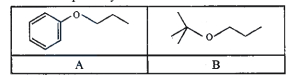
The bromides formed by the cleavage of ethers $A$ and $B$ with $HBr$ respectively are:
A
Phenyl bromide and $tert$-butyl bromide
B
Phenyl bromide and $n$-propyl bromide
C
$n$-propyl bromide and $n$-propyl bromide
D
$n$-propyl bromide and $tert$-butyl bromide
Solution
(D) For ether $A$ (phenyl $n$-propyl ether): The $C-O$ bond between the phenyl group and oxygen cannot be cleaved because the $C-O$ bond has partial double bond character due to resonance. Therefore,cleavage occurs at the alkyl side,yielding phenol and $n$-propyl bromide.
For ether $B$ ($tert$-butyl $n$-propyl ether): The cleavage occurs to form the more stable carbocation. The $tert$-butyl group forms a $3^{\circ}$ carbocation,which is much more stable than the $n$-propyl carbocation. Thus,the $C-O$ bond between the $tert$-butyl group and oxygen is cleaved,yielding $tert$-butyl bromide and $n$-propanol.
Therefore,the bromides formed are $n$-propyl bromide and $tert$-butyl bromide.
For ether $B$ ($tert$-butyl $n$-propyl ether): The cleavage occurs to form the more stable carbocation. The $tert$-butyl group forms a $3^{\circ}$ carbocation,which is much more stable than the $n$-propyl carbocation. Thus,the $C-O$ bond between the $tert$-butyl group and oxygen is cleaved,yielding $tert$-butyl bromide and $n$-propanol.
Therefore,the bromides formed are $n$-propyl bromide and $tert$-butyl bromide.
0 likes
View Solution318
MediumMCQ
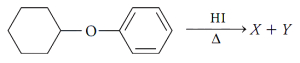
What are $X$ and $Y$ in the following reaction?
A
Cyclohexyl iodide and Phenyl iodide
B
Cyclohexyl iodide and Phenol
C
Cyclohexanol and Phenyl iodide
D
Cyclohexanol and Phenol
Solution
(B) The reaction of an alkyl aryl ether with $HI$ involves the protonation of the ether oxygen atom followed by the nucleophilic attack of the iodide ion $(I^-)$ on the less sterically hindered alkyl group. In this case,the cyclohexyl group is the alkyl group and the phenyl group is the aryl group. The $I^-$ ion attacks the cyclohexyl carbon,leading to the formation of cyclohexyl iodide $(X)$ and phenol $(Y)$.
0 likes
View Solution319
MediumMCQ
Identify the products $Y$ and $Z$ in the following reaction:
$C_6H_5-O-CH_2CH_3 \xrightarrow[\Delta]{HI} Y + Z$
$C_6H_5-O-CH_2CH_3 \xrightarrow[\Delta]{HI} Y + Z$
A
$C_6H_5OH$ and $CH_3CH_3$
B
$C_2H_5I$ and $C_6H_5CHO$
C
$C_6H_5I$ and $CH_3CH_2OH$
D
$C_6H_5OH$ and $CH_3CH_2I$
Solution
(D) The reaction of alkyl aryl ethers with $HI$ involves the cleavage of the $O-alkyl$ bond.
This occurs because the $O-aryl$ bond possesses partial double bond character due to resonance,making it stronger and harder to break.
Therefore,the ether $C_6H_5-O-CH_2CH_3$ reacts with $HI$ to form phenol $(C_6H_5OH)$ and ethyl iodide $(CH_3CH_2I)$.
Thus,the correct option is $D$.
This occurs because the $O-aryl$ bond possesses partial double bond character due to resonance,making it stronger and harder to break.
Therefore,the ether $C_6H_5-O-CH_2CH_3$ reacts with $HI$ to form phenol $(C_6H_5OH)$ and ethyl iodide $(CH_3CH_2I)$.
Thus,the correct option is $D$.
0 likes
View Solution320
DifficultMCQ
Identify the product $(A)$ of the following reaction:
$C_2H_5-O-C_2H_5 + CO \xrightarrow[500 \text{ atm}]{BF_3 / 150^{\circ}C} A$
$C_2H_5-O-C_2H_5 + CO \xrightarrow[500 \text{ atm}]{BF_3 / 150^{\circ}C} A$
A
ethyl alcohol
B
ethyl propionate
C
ethanoic acid
D
ethyl acetate
Solution
(B) The reaction of diethyl ether with carbon monoxide in the presence of a Lewis acid catalyst like $BF_3$ at high pressure and temperature is a carbonylation reaction.
$C_2H_5-O-C_2H_5 + CO \xrightarrow[500 \text{ atm}]{BF_3 / 150^{\circ}C} C_2H_5COOC_2H_5$
The product $(A)$ formed is ethyl propionate.
$C_2H_5-O-C_2H_5 + CO \xrightarrow[500 \text{ atm}]{BF_3 / 150^{\circ}C} C_2H_5COOC_2H_5$
The product $(A)$ formed is ethyl propionate.
0 likes
View Solution321
DifficultMCQ
In the reaction,$C_2H_5OC_2H_5 + CO \xrightarrow[150^{\circ}C, 500 \text{ atm pressure}]{BF_3} X$. What is $X$?
A
Diethyl carbonate
B
Ethyl carbonate
C
Diethyl peroxide
D
Ethyl propionate
Solution
(D) The reaction of diethyl ether $(C_2H_5OC_2H_5)$ with carbon monoxide $(CO)$ in the presence of a Lewis acid catalyst like $BF_3$ at high temperature $(150^{\circ}C)$ and high pressure $(500 \text{ atm})$ is a carbonylation reaction.
This reaction results in the insertion of $CO$ into the $C-O$ bond of the ether to form an ester.
The product formed is ethyl propionate $(C_2H_5COOC_2H_5)$.
This reaction results in the insertion of $CO$ into the $C-O$ bond of the ether to form an ester.
The product formed is ethyl propionate $(C_2H_5COOC_2H_5)$.
0 likes
View Solution322
MediumMCQ
The products formed when diethyl ether is reacted with cold $HI$ are
A
$C_2H_5I + C_2H_5OH$
B
$2C_2H_5I + H_2O$
C
$2C_2H_5OH$
D
$C_2H_5-O-C_2H_5 + H_2O$
Solution
(A) When diethyl ether reacts with cold $HI$,it undergoes cleavage to form ethyl alcohol and ethyl iodide as follows:
$C_2H_5-O-C_2H_5 + HI \rightarrow C_2H_5OH + C_2H_5I$
$C_2H_5-O-C_2H_5 + HI \rightarrow C_2H_5OH + C_2H_5I$
0 likes
View Solution323
DifficultMCQ
Which of the following compounds when heated with $CO$ at $150^{\circ} C$ and $500 \ atm$ pressure in the presence of $BF_3$ forms ethyl propionate?
A
$C_2H_5OH$
B
$CH_3OCH_3$
C
$C_2H_5OC_2H_5$
D
$CH_3OC_2H_5$
Solution
(C) The reaction of ethers with carbon monoxide $(CO)$ in the presence of a Lewis acid catalyst like $BF_3$ at high temperature $(150^{\circ} C)$ and high pressure $(500 \ atm)$ is a carbonylation reaction.
Diethyl ether $(C_2H_5OC_2H_5)$ reacts with $CO$ to form ethyl propionate $(C_2H_5COOC_2H_5)$ according to the following equation:
$C_2H_5OC_2H_5 + CO \xrightarrow{BF_3, 150^{\circ} C, 500 \ atm} C_2H_5COOC_2H_5$.
Diethyl ether $(C_2H_5OC_2H_5)$ reacts with $CO$ to form ethyl propionate $(C_2H_5COOC_2H_5)$ according to the following equation:
$C_2H_5OC_2H_5 + CO \xrightarrow{BF_3, 150^{\circ} C, 500 \ atm} C_2H_5COOC_2H_5$.
0 likes
View Solution324
MediumMCQ
Hybridisation of oxygen in diethyl ether is
A
$sp$
B
$sp^2$
C
$sp^3$
D
$sp^3d$
Solution
(C) The chemical formula of diethyl ether is $C_2H_5-O-C_2H_5$.
In this molecule,the oxygen atom is bonded to two carbon atoms and possesses two lone pairs of electrons.
The steric number of the oxygen atom is calculated as: $\text{Steric Number} = \text{Number of sigma bonds} + \text{Number of lone pairs} = 2 + 2 = 4$.
$A$ steric number of $4$ corresponds to $sp^3$ hybridisation.
In this molecule,the oxygen atom is bonded to two carbon atoms and possesses two lone pairs of electrons.
The steric number of the oxygen atom is calculated as: $\text{Steric Number} = \text{Number of sigma bonds} + \text{Number of lone pairs} = 2 + 2 = 4$.
$A$ steric number of $4$ corresponds to $sp^3$ hybridisation.
0 likes
View Solution325
EasyMCQ
Which of the following compounds has no reaction with sodium metal?
A
Phenol
B
Ethanol
C
Benzoic acid
D
Anisole
Solution
(D) Sodium metal reacts with compounds containing acidic hydrogen atoms (like $-OH$ or $-COOH$ groups) to evolve hydrogen gas.
Phenol $(C_6H_5OH)$,ethanol $(C_2H_5OH)$,and benzoic acid $(C_6H_5COOH)$ all contain acidic hydrogen atoms.
Anisole $(C_6H_5OCH_3)$ is an ether and does not contain any acidic hydrogen atom,therefore it does not react with sodium metal.
Phenol $(C_6H_5OH)$,ethanol $(C_2H_5OH)$,and benzoic acid $(C_6H_5COOH)$ all contain acidic hydrogen atoms.
Anisole $(C_6H_5OCH_3)$ is an ether and does not contain any acidic hydrogen atom,therefore it does not react with sodium metal.
0 likes
View Solution326
MediumMCQ
What is $Y$ in the following reaction?
$C_2H_5I + NaOC_2H_5 \longrightarrow X + NaI$
$X + 2HI \xrightarrow{\Delta} 2Y + H_2O$
$C_2H_5I + NaOC_2H_5 \longrightarrow X + NaI$
$X + 2HI \xrightarrow{\Delta} 2Y + H_2O$
A
$C_2H_6$
B
$C_2H_5I$
C
$C_2H_4$
D
$C_2H_5OC_2H_5$
Solution
(B) Step $1$: The first reaction is the Williamson ether synthesis.
$C_2H_5I + NaOC_2H_5 \longrightarrow C_2H_5OC_2H_5 (X) + NaI$
Here,$X$ is diethyl ether $(C_2H_5OC_2H_5)$.
Step $2$: The second reaction is the cleavage of ether by excess hydroiodic acid $(HI)$.
$C_2H_5OC_2H_5 + 2HI \xrightarrow{\Delta} 2C_2H_5I (Y) + H_2O$
Comparing this with the given reaction $X + 2HI \xrightarrow{\Delta} 2Y + H_2O$,we find that $Y$ is $C_2H_5I$.
$C_2H_5I + NaOC_2H_5 \longrightarrow C_2H_5OC_2H_5 (X) + NaI$
Here,$X$ is diethyl ether $(C_2H_5OC_2H_5)$.
Step $2$: The second reaction is the cleavage of ether by excess hydroiodic acid $(HI)$.
$C_2H_5OC_2H_5 + 2HI \xrightarrow{\Delta} 2C_2H_5I (Y) + H_2O$
Comparing this with the given reaction $X + 2HI \xrightarrow{\Delta} 2Y + H_2O$,we find that $Y$ is $C_2H_5I$.
0 likes
View Solution327
MediumMCQ
Which one of the following methods is used to prepare $Me_{3}COEt$ with a good yield?
A
Mixing $EtONa$ with $Me_{3}CCl$
B
Mixing $Me_{3}CONa$ with $EtCl$
C
Heating a mixture of $(1:1)$ $EtOH$ and $Me_{3}COH$ in the presence of conc. $H_{2}SO_{4}$
D
Treatment of $Me_{3}COH$ with $EtMgI$
Solution
(B) $Me_{3}CONa + EtCl \rightarrow Me_{3}COEt + NaCl$
Williamson synthesis involves the reaction of an alkoxide with a primary alkyl halide to form an ether.
Since $EtCl$ is a primary $(1^{\circ})$ alkyl halide and $Me_{3}CONa$ is a bulky alkoxide,this reaction proceeds via an $S_{N}2$ mechanism to yield the desired ether.
Option $A$ would result in elimination $(E2)$ because $Me_{3}CCl$ is a tertiary alkyl halide.
Therefore,the correct option is $B$.
Williamson synthesis involves the reaction of an alkoxide with a primary alkyl halide to form an ether.
Since $EtCl$ is a primary $(1^{\circ})$ alkyl halide and $Me_{3}CONa$ is a bulky alkoxide,this reaction proceeds via an $S_{N}2$ mechanism to yield the desired ether.
Option $A$ would result in elimination $(E2)$ because $Me_{3}CCl$ is a tertiary alkyl halide.
Therefore,the correct option is $B$.
0 likes
View Solution328
MediumMCQ
Methoxybenzene on treatment with $HI$ produces
A
iodobenzene and methanol
B
phenol and methyl iodide
C
iodobenzene and methyl iodide
D
phenol and methanol
Solution
(B) Methoxybenzene (anisole) on treatment with $HI$ produces phenol and methyl iodide.
This reaction occurs because the $C_{aryl}-O$ bond is stronger than the $C_{alkyl}-O$ bond.
The carbon of the phenyl group is $sp^{2}$-hybridised,which gives the $C_{aryl}-O$ bond a partial double bond character,making it resistant to cleavage.
Consequently,the nucleophilic iodide ion attacks the less sterically hindered methyl group,resulting in the formation of phenol and methyl iodide $(CH_3I)$.
This reaction occurs because the $C_{aryl}-O$ bond is stronger than the $C_{alkyl}-O$ bond.
The carbon of the phenyl group is $sp^{2}$-hybridised,which gives the $C_{aryl}-O$ bond a partial double bond character,making it resistant to cleavage.
Consequently,the nucleophilic iodide ion attacks the less sterically hindered methyl group,resulting in the formation of phenol and methyl iodide $(CH_3I)$.
0 likes
View Solution329
DifficultMCQ
$A$ mixed ether $(P)$,when heated with excess of hot concentrated hydrogen iodide,produces two different alkyl iodides which when treated with aqueous $NaOH$ give compounds $(Q)$ and $(R)$. Both $(Q)$ and $(R)$ give a yellow precipitate with $NaOI$. Identify the mixed ether $(P)$:
A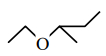
B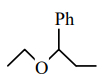
C
D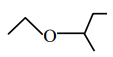
Solution
(D) $1$. The mixed ether $(P)$ reacts with excess hot concentrated $HI$ to form two alkyl iodides.
$2$. These alkyl iodides,upon treatment with aqueous $NaOH$,yield alcohols $(Q)$ and $(R)$.
$3$. Both $(Q)$ and $(R)$ give a yellow precipitate with $NaOI$ (iodoform test),which implies both must contain a $CH_3CH(OH)-$ group or be ethanol $(CH_3CH_2OH)$.
$4$. Ethyl sec-butyl ether $(CH_3CH_2-O-CH(CH_3)CH_2CH_3)$ on cleavage with $HI$ gives ethyl iodide $(CH_3CH_2I)$ and sec-butyl iodide $(CH_3CH(I)CH_2CH_3)$.
$5$. Treatment with $NaOH$ converts these to ethanol $(CH_3CH_2OH)$ and sec-butanol $(CH_3CH(OH)CH_2CH_3)$.
$6$. Both ethanol and sec-butanol give a positive iodoform test with $NaOI$ (forming yellow $CHI_3$ precipitate).
$7$. Thus,the ether $(P)$ is ethyl sec-butyl ether.
$2$. These alkyl iodides,upon treatment with aqueous $NaOH$,yield alcohols $(Q)$ and $(R)$.
$3$. Both $(Q)$ and $(R)$ give a yellow precipitate with $NaOI$ (iodoform test),which implies both must contain a $CH_3CH(OH)-$ group or be ethanol $(CH_3CH_2OH)$.
$4$. Ethyl sec-butyl ether $(CH_3CH_2-O-CH(CH_3)CH_2CH_3)$ on cleavage with $HI$ gives ethyl iodide $(CH_3CH_2I)$ and sec-butyl iodide $(CH_3CH(I)CH_2CH_3)$.
$5$. Treatment with $NaOH$ converts these to ethanol $(CH_3CH_2OH)$ and sec-butanol $(CH_3CH(OH)CH_2CH_3)$.
$6$. Both ethanol and sec-butanol give a positive iodoform test with $NaOI$ (forming yellow $CHI_3$ precipitate).
$7$. Thus,the ether $(P)$ is ethyl sec-butyl ether.
0 likes
View Solution330
MediumMCQ
Consider the following reaction:
Statement $I$: In the above reaction,the product formed will be a mixture of benzyl alcohol and iodobenzene.
Statement $II$: In the above reaction,the $-O-CH_2-$ bond is cleaved to give the product.
In the light of the above statements,choose the correct answer from the options given below:
Statement $I$: In the above reaction,the product formed will be a mixture of benzyl alcohol and iodobenzene.
Statement $II$: In the above reaction,the $-O-CH_2-$ bond is cleaved to give the product.
In the light of the above statements,choose the correct answer from the options given below:

A
Both Statement $I$ and Statement $II$ are true
B
Both Statement $I$ and Statement $II$ are false
C
Statement $I$ is true but Statement $II$ is false
D
Statement $I$ is false but Statement $II$ is true
Solution
(D) The reaction involves the cleavage of an ether,benzyl phenyl ether $(C_6H_5-O-CH_2-C_6H_5)$,with hydrogen iodide $(HI)$.
In the reaction of an alkyl aryl ether with $HI$,the cleavage occurs such that the alkyl group forms an alkyl iodide and the aryl group forms a phenol.
This is because the $O-C_{aryl}$ bond has partial double bond character due to resonance and is stronger,while the $O-C_{alkyl}$ bond is weaker and undergoes nucleophilic substitution.
Here,the $O-CH_2C_6H_5$ bond breaks to form benzyl iodide $(C_6H_5CH_2I)$ and phenol $(C_6H_5OH)$.
Therefore,Statement $I$ is false because the products are benzyl iodide and phenol,not benzyl alcohol and iodobenzene.
Statement $II$ is true because the $O-CH_2$ bond is indeed the one that undergoes cleavage.
In the reaction of an alkyl aryl ether with $HI$,the cleavage occurs such that the alkyl group forms an alkyl iodide and the aryl group forms a phenol.
This is because the $O-C_{aryl}$ bond has partial double bond character due to resonance and is stronger,while the $O-C_{alkyl}$ bond is weaker and undergoes nucleophilic substitution.
Here,the $O-CH_2C_6H_5$ bond breaks to form benzyl iodide $(C_6H_5CH_2I)$ and phenol $(C_6H_5OH)$.
Therefore,Statement $I$ is false because the products are benzyl iodide and phenol,not benzyl alcohol and iodobenzene.
Statement $II$ is true because the $O-CH_2$ bond is indeed the one that undergoes cleavage.
0 likes
View Solution331
MediumMCQ
Consider the following reaction.
$C_6H_5-O-CH_2-C_6H_5 + HI \rightarrow \text{Product}$
Statement $I$ : In the above reaction,the product formed will be a mixture of benzyl alcohol and iodobenzene.
Statement $II$ : In the above reaction,the $-O-CH_2-$ bond is cleaved to give the product.
In the light of the above statements,choose the correct answer from the options given below:
$C_6H_5-O-CH_2-C_6H_5 + HI \rightarrow \text{Product}$
Statement $I$ : In the above reaction,the product formed will be a mixture of benzyl alcohol and iodobenzene.
Statement $II$ : In the above reaction,the $-O-CH_2-$ bond is cleaved to give the product.
In the light of the above statements,choose the correct answer from the options given below:
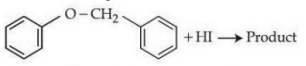
A
Both Statement $I$ and Statement $II$ are true
B
Both Statement $I$ and Statement $II$ are false
C
Statement $I$ is true but Statement $II$ is false
D
Statement $I$ is false but Statement $II$ is true
Solution
(D) The reaction of an ether with $HI$ involves the protonation of the ether oxygen atom,followed by a nucleophilic attack by the iodide ion $(I^-)$.
In the given ether,benzyl phenyl ether $(C_6H_5-O-CH_2-C_6H_5)$,the oxygen atom is attached to a phenyl group and a benzyl group.
The cleavage occurs such that the more stable carbocation is formed. The benzyl carbocation $(C_6H_5CH_2^+)$ is resonance-stabilized and more stable than the phenyl carbocation.
Therefore,the $C-O$ bond on the benzylic side is cleaved,leading to the formation of benzyl iodide $(C_6H_5CH_2I)$ and phenol $(C_6H_5OH)$.
Statement $I$ claims the products are benzyl alcohol and iodobenzene,which is incorrect.
Statement $II$ correctly states that the $-O-CH_2-$ bond is cleaved.
Thus,Statement $I$ is false and Statement $II$ is true.
In the given ether,benzyl phenyl ether $(C_6H_5-O-CH_2-C_6H_5)$,the oxygen atom is attached to a phenyl group and a benzyl group.
The cleavage occurs such that the more stable carbocation is formed. The benzyl carbocation $(C_6H_5CH_2^+)$ is resonance-stabilized and more stable than the phenyl carbocation.
Therefore,the $C-O$ bond on the benzylic side is cleaved,leading to the formation of benzyl iodide $(C_6H_5CH_2I)$ and phenol $(C_6H_5OH)$.
Statement $I$ claims the products are benzyl alcohol and iodobenzene,which is incorrect.
Statement $II$ correctly states that the $-O-CH_2-$ bond is cleaved.
Thus,Statement $I$ is false and Statement $II$ is true.
0 likes
View SolutionAlcohols, Phenols and Ethers — Properties of Ethers · Frequently Asked Questions
1Are these Alcohols, Phenols and Ethers questions useful for JEE and NEET?
Yes. All questions in this section are mapped to JEE Main and NEET exam patterns. Previous year questions from JEE Main, NEET, GUJCET and state-level exams are included with full solutions.
2Can I switch to Hindi or Gujarati for these questions?
Yes. Use the language tabs in the hero section or the sidebar to view the same questions and solutions in English, Hindi or Gujarati.
3How do I generate a question paper from this subtopic?
Use the Vedclass Exam Paper Generator — select the chapter and subtopic, set difficulty, and generate Sets A, B, C, D automatically. First 3 chapters of every subject are free.
Vedclass Products
For Students
Vedclass Test Series
Mock tests in real JEE/NEET style with performance analysis. 5-day free trial.
Start Free TrialFor Teachers
Exam Paper Generator
Generate Set A/B/C/D papers from this chapter in 2 minutes. 3 chapters free.
Try FreeFor Institutes
Online Exam Module
Live online exams with unlimited students, 360° analytics & white-label branding.
See DemoFor Teachers & Institutes
Generate a Alcohols, Phenols and Ethers Exam Paper in 2 Minutes
Select subtopic & difficulty — Sets A, B, C, D auto-generated with No Repeat logic.
First 3 chapters of every subject are free — no payment required.