
A English
Properties of Ethers Questions in English
Class 12 Chemistry · Alcohols, Phenols and Ethers · Properties of Ethers
343+
Questions
English
Language
100%
With Solutions
Showing 50 of 343 questions in English
101
DifficultMCQ
Predict the major product for the following reaction:
$m-CH_3O-C_6H_4-CH_2CH_2-O-CH(CH_3)Ph \xrightarrow{HI (excess), \text{heat}} ?$
$m-CH_3O-C_6H_4-CH_2CH_2-O-CH(CH_3)Ph \xrightarrow{HI (excess), \text{heat}} ?$
A
$m-CH_3O-C_6H_4-CH_2CH_2-OH + Ph-CH(I)CH_3$
B
$m-I-C_6H_4-CH_2CH_2-OH + Ph-CH(OH)CH_3$
C
$m-HO-C_6H_4-CH_2CH_2-I + Ph-CH(OH)CH_3$
D
$m-I-C_6H_4-CH_2CH_2-I + Ph-CH(I)CH_3$
Solution
(C) The reaction involves the cleavage of an ether with excess $HI$ under heating conditions.
$1$. The ether is $m-CH_3O-C_6H_4-CH_2CH_2-O-CH(CH_3)Ph$.
$2$. The $O-CH(CH_3)Ph$ bond is cleaved because the carbocation formed at the benzylic position $(Ph-CH^+-CH_3)$ is highly stable due to resonance with the phenyl ring.
$3$. The $O-CH_3$ bond in the methoxy group $(m-CH_3O-C_6H_4-)$ is also cleaved by excess $HI$ to form a phenol $(m-HO-C_6H_4-)$ and methyl iodide $(CH_3I)$.
$4$. The $O-CH_2CH_2-Ar$ bond is not cleaved because the primary carbocation is unstable.
$5$. Thus,the products are $m-HO-C_6H_4-CH_2CH_2-I$ and $Ph-CH(I)CH_3$ (from the benzylic alcohol intermediate $Ph-CH(OH)CH_3$ reacting further with $HI$).
$6$. However,looking at the options provided,the reaction of the ether with excess $HI$ leads to the cleavage of both ether linkages. The methoxy group becomes a phenol,and the alkyl ether part forms an alkyl iodide. The correct product set is $m-HO-C_6H_4-CH_2CH_2-I$ and $Ph-CH(I)CH_3$ along with $CH_3I$.
$1$. The ether is $m-CH_3O-C_6H_4-CH_2CH_2-O-CH(CH_3)Ph$.
$2$. The $O-CH(CH_3)Ph$ bond is cleaved because the carbocation formed at the benzylic position $(Ph-CH^+-CH_3)$ is highly stable due to resonance with the phenyl ring.
$3$. The $O-CH_3$ bond in the methoxy group $(m-CH_3O-C_6H_4-)$ is also cleaved by excess $HI$ to form a phenol $(m-HO-C_6H_4-)$ and methyl iodide $(CH_3I)$.
$4$. The $O-CH_2CH_2-Ar$ bond is not cleaved because the primary carbocation is unstable.
$5$. Thus,the products are $m-HO-C_6H_4-CH_2CH_2-I$ and $Ph-CH(I)CH_3$ (from the benzylic alcohol intermediate $Ph-CH(OH)CH_3$ reacting further with $HI$).
$6$. However,looking at the options provided,the reaction of the ether with excess $HI$ leads to the cleavage of both ether linkages. The methoxy group becomes a phenol,and the alkyl ether part forms an alkyl iodide. The correct product set is $m-HO-C_6H_4-CH_2CH_2-I$ and $Ph-CH(I)CH_3$ along with $CH_3I$.
0 likes
View Solution102
MediumMCQ
In the reaction $CH_3-CH(CH_3)-CH_2-O-CH_2-CH_3 + HI \xrightarrow{\text{Heated}} \dots$,which of the following compounds will be formed?
A
$CH_3-CH(CH_3)-CH_2-OH + CH_3-CH_2-I$
B
$CH_3-CH(CH_3)-CH_2-I + CH_3-CH_2-OH$
C
$CH_3-CH(CH_3)-CH_3 + CH_3-CH_2-OH$
D
$CH_3-CH(CH_3)-CH_2-OH + CH_3-CH_3$
Solution
(A) The reaction of an ether with $HI$ involves the protonation of the oxygen atom followed by a nucleophilic attack by the $I^{-}$ ion.
Since both the isobutyl and ethyl groups are primary,the reaction follows the $S_N2$ mechanism.
The $I^{-}$ ion attacks the less sterically hindered carbon atom,which is the ethyl group.
Therefore,the products formed are isobutyl alcohol $(CH_3-CH(CH_3)-CH_2-OH)$ and ethyl iodide $(CH_3-CH_2-I)$.
Since both the isobutyl and ethyl groups are primary,the reaction follows the $S_N2$ mechanism.
The $I^{-}$ ion attacks the less sterically hindered carbon atom,which is the ethyl group.
Therefore,the products formed are isobutyl alcohol $(CH_3-CH(CH_3)-CH_2-OH)$ and ethyl iodide $(CH_3-CH_2-I)$.
0 likes
View Solution103
MediumMCQ
In the reaction $CH_3-CH(CH_3)-CH_2-O-CH_2-CH_3 + HI \xrightarrow{\text{Heated}} \dots$,which of the following compounds will be formed?
A
$CH_3-CH(CH_3)-CH_2OH + CH_3-CH_2-I$
B
$CH_3-CH(CH_3)-CH_2-I + CH_3-CH_2OH$
C
$CH_3-CH(CH_3)-CH_3 + CH_3-CH_2OH$
D
$CH_3-CH(CH_3)-CH_2OH + CH_3-CH_3$
Solution
(A) The reaction of an unsymmetrical ether with $HI$ follows the $S_N2$ mechanism when both alkyl groups are primary.
In the $S_N2$ mechanism,the nucleophile (halide ion,$I^-$) attacks the less sterically hindered carbon atom.
In the given ether,$CH_3-CH(CH_3)-CH_2-O-CH_2-CH_3$,the ethyl group $(-CH_2-CH_3)$ is less sterically hindered than the isobutyl group $(-CH_2-CH(CH_3)_2)$.
Therefore,the $I^-$ ion attacks the ethyl group to form ethyl iodide $(CH_3-CH_2-I)$,and the isobutyl group forms isobutyl alcohol $(CH_3-CH(CH_3)-CH_2OH)$.
The reaction is: $CH_3-CH(CH_3)-CH_2-O-CH_2-CH_3 + HI \rightarrow CH_3-CH(CH_3)-CH_2OH + CH_3-CH_2-I$.
In the $S_N2$ mechanism,the nucleophile (halide ion,$I^-$) attacks the less sterically hindered carbon atom.
In the given ether,$CH_3-CH(CH_3)-CH_2-O-CH_2-CH_3$,the ethyl group $(-CH_2-CH_3)$ is less sterically hindered than the isobutyl group $(-CH_2-CH(CH_3)_2)$.
Therefore,the $I^-$ ion attacks the ethyl group to form ethyl iodide $(CH_3-CH_2-I)$,and the isobutyl group forms isobutyl alcohol $(CH_3-CH(CH_3)-CH_2OH)$.
The reaction is: $CH_3-CH(CH_3)-CH_2-O-CH_2-CH_3 + HI \rightarrow CH_3-CH(CH_3)-CH_2OH + CH_3-CH_2-I$.
0 likes
View Solution104
MediumMCQ
The reaction of $2,2-$dimethyltetrahydrofuran with $HBr$ gives:
A
$2-$bromo$-2-$methylpentan$-1-$ol
B
$5-$bromo$-2-$methylpentan$-2-$ol
C
Cyclohexane
D
$3,4-$dimethylfuran
Solution
(B) The reaction of an ether with $HBr$ involves the protonation of the oxygen atom by $H^+$,followed by the cleavage of the $C-O$ bond.
In the case of $2,2-$dimethyltetrahydrofuran,the protonation of the oxygen atom creates a good leaving group.
The $C-O$ bond cleavage occurs at the more substituted carbon atom (the tertiary carbon) to form a stable tertiary carbocation intermediate.
Finally,the nucleophilic bromide ion $(Br^-)$ attacks the tertiary carbocation to form $5-$bromo$-2-$methylpentan$-2-$ol.
In the case of $2,2-$dimethyltetrahydrofuran,the protonation of the oxygen atom creates a good leaving group.
The $C-O$ bond cleavage occurs at the more substituted carbon atom (the tertiary carbon) to form a stable tertiary carbocation intermediate.
Finally,the nucleophilic bromide ion $(Br^-)$ attacks the tertiary carbocation to form $5-$bromo$-2-$methylpentan$-2-$ol.
0 likes
View Solution105
DifficultMCQ
What are the major products from the following reaction?
$C_6H_5-O-CH_2-C_6H_5 + HI \xrightarrow{\text{heat}} ?$
$(I) C_6H_5I + C_6H_5CH_2OH$
$(II) C_6H_5OH + C_6H_5CH_2I$
$(III) C_6H_5OCH_2OH + C_6H_5I$
$(IV) C_6H_5OCH_2I + C_6H_5OH$
$C_6H_5-O-CH_2-C_6H_5 + HI \xrightarrow{\text{heat}} ?$
$(I) C_6H_5I + C_6H_5CH_2OH$
$(II) C_6H_5OH + C_6H_5CH_2I$
$(III) C_6H_5OCH_2OH + C_6H_5I$
$(IV) C_6H_5OCH_2I + C_6H_5OH$
A
$I$
B
$II$
C
$III$
D
$IV$
Solution
(B) The reaction of an alkyl aryl ether with $HI$ involves the protonation of the ether oxygen followed by nucleophilic attack by the iodide ion $(I^-)$.
In the case of benzyl phenyl ether $(C_6H_5-O-CH_2-C_6H_5)$,the protonated ether undergoes cleavage.
The $C-O$ bond between the oxygen and the benzyl group $(C_6H_5CH_2-)$ is cleaved because the benzyl carbocation is resonance-stabilized,making the benzyl carbon more susceptible to $S_N1$ or $S_N2$ attack by the iodide ion.
Thus,the products formed are phenol $(C_6H_5OH)$ and benzyl iodide $(C_6H_5CH_2I)$.
This corresponds to option $II$.
In the case of benzyl phenyl ether $(C_6H_5-O-CH_2-C_6H_5)$,the protonated ether undergoes cleavage.
The $C-O$ bond between the oxygen and the benzyl group $(C_6H_5CH_2-)$ is cleaved because the benzyl carbocation is resonance-stabilized,making the benzyl carbon more susceptible to $S_N1$ or $S_N2$ attack by the iodide ion.
Thus,the products formed are phenol $(C_6H_5OH)$ and benzyl iodide $(C_6H_5CH_2I)$.
This corresponds to option $II$.
0 likes
View Solution106
DifficultMCQ
The product of the reaction $CH_3O-CH_2-CH(OCH_3)-CH_2-OCH_3 \xrightarrow{HI(excess)}$ is:
A
Allyl iodide
B
Glycerol
C
$2-$iodopropane
D
$1-$iodopropane
Solution
(C) When $1,2,3$-trimethoxypropane reacts with excess $HI$,the ether bonds are cleaved first to produce glycerol $(CH_2OH-CHOH-CH_2OH)$ and methyl iodide $(CH_3I)$.
Glycerol then reacts with excess $HI$ through a series of steps:
$CH_2OH-CHOH-CH_2OH$ $\xrightarrow{3HI} [CH_2I-CHI-CH_2I]$ $\xrightarrow{-I_2} CH_2=CH-CH_2I$ $\xrightarrow{HI} [CH_3-CHI-CH_2I]$ $\xrightarrow{-I_2} CH_3-CH=CH_2$ $\xrightarrow{HI} CH_3-CHI-CH_3$.
The final stable product is $2$-iodopropane (isopropyl iodide).
Glycerol then reacts with excess $HI$ through a series of steps:
$CH_2OH-CHOH-CH_2OH$ $\xrightarrow{3HI} [CH_2I-CHI-CH_2I]$ $\xrightarrow{-I_2} CH_2=CH-CH_2I$ $\xrightarrow{HI} [CH_3-CHI-CH_2I]$ $\xrightarrow{-I_2} CH_3-CH=CH_2$ $\xrightarrow{HI} CH_3-CHI-CH_3$.
The final stable product is $2$-iodopropane (isopropyl iodide).
0 likes
View Solution107
MediumMCQ
Predict the major product for the following reaction: $Ph-O-CH_2-CH_2-(C_6H_4)-NO_2 + HI \text{ (excess)} \rightarrow \text{Product}$
A
$PhOH + ICH_2CH_2(C_6H_4)NO_2$
B
$PhI + HOCH_2CH_2(C_6H_4)NO_2$
C
$PhOH + HOCH_2CH_2(C_6H_4)NO_2$
D
$PhI + ICH_2CH_2(C_6H_4)NO_2$
Solution
(A) The reaction of an alkyl aryl ether with excess $HI$ involves the cleavage of the $C-O$ bond.
In the ether $Ph-O-CH_2-CH_2-(C_6H_4)NO_2$,the oxygen is attached to a phenyl group $(Ph)$ and an alkyl group $(-CH_2CH_2(C_6H_4)NO_2)$.
When treated with $HI$,the ether is protonated to form an oxonium ion.
The iodide ion $(I^-)$ acts as a nucleophile and attacks the less sterically hindered alkyl carbon.
The $C-O$ bond between the oxygen and the alkyl group breaks,resulting in the formation of phenol $(PhOH)$ and an alkyl iodide $(ICH_2CH_2(C_6H_4)NO_2)$.
Since $HI$ is in excess,the reaction proceeds to completion,yielding $PhOH$ and $ICH_2CH_2(C_6H_4)NO_2$.
In the ether $Ph-O-CH_2-CH_2-(C_6H_4)NO_2$,the oxygen is attached to a phenyl group $(Ph)$ and an alkyl group $(-CH_2CH_2(C_6H_4)NO_2)$.
When treated with $HI$,the ether is protonated to form an oxonium ion.
The iodide ion $(I^-)$ acts as a nucleophile and attacks the less sterically hindered alkyl carbon.
The $C-O$ bond between the oxygen and the alkyl group breaks,resulting in the formation of phenol $(PhOH)$ and an alkyl iodide $(ICH_2CH_2(C_6H_4)NO_2)$.
Since $HI$ is in excess,the reaction proceeds to completion,yielding $PhOH$ and $ICH_2CH_2(C_6H_4)NO_2$.
0 likes
View Solution108
MediumMCQ
The following are possible syntheses of phenyl propyl ether. Which one would work?
$(i)$ $C_6H_5OH$ $\xrightarrow{KNH_2}$ $\xrightarrow{CH_3CH_2CH_2Br}$
(ii) $CH_3CH_2CH_2OH$ $\xrightarrow{NaOH}$ $\xrightarrow{C_6H_5Br}$
(iii) $CH_3CH_2CH_2OH$ $\xrightarrow{NaH}$ $\xrightarrow{C_6H_5Br}$
$(i)$ $C_6H_5OH$ $\xrightarrow{KNH_2}$ $\xrightarrow{CH_3CH_2CH_2Br}$
(ii) $CH_3CH_2CH_2OH$ $\xrightarrow{NaOH}$ $\xrightarrow{C_6H_5Br}$
(iii) $CH_3CH_2CH_2OH$ $\xrightarrow{NaH}$ $\xrightarrow{C_6H_5Br}$
A
$i$ only
B
$iii$ only
C
$ii$ and $iii$
D
$i$ and $iii$
Solution
(A) The synthesis of ethers via the Williamson ether synthesis involves the reaction of an alkoxide or phenoxide ion with an alkyl halide.
$(i)$ Phenol $(C_6H_5OH)$ reacts with $KNH_2$ to form potassium phenoxide $(C_6H_5OK)$. This phenoxide ion then undergoes an $S_N2$ reaction with propyl bromide $(CH_3CH_2CH_2Br)$ to yield phenyl propyl ether. This is a valid synthesis.
(ii) Propanol $(CH_3CH_2CH_2OH)$ reacts with $NaOH$ to form sodium propoxide. However,the subsequent reaction with bromobenzene $(C_6H_5Br)$ does not occur because aryl halides are unreactive towards nucleophilic substitution under these conditions ($S_N2$ is not possible on an $sp^2$ hybridized carbon).
(iii) Similarly,$NaH$ converts propanol to sodium propoxide,but the reaction with bromobenzene still fails for the same reason as in (ii).
Therefore,only reaction $(i)$ will work.
$(i)$ Phenol $(C_6H_5OH)$ reacts with $KNH_2$ to form potassium phenoxide $(C_6H_5OK)$. This phenoxide ion then undergoes an $S_N2$ reaction with propyl bromide $(CH_3CH_2CH_2Br)$ to yield phenyl propyl ether. This is a valid synthesis.
(ii) Propanol $(CH_3CH_2CH_2OH)$ reacts with $NaOH$ to form sodium propoxide. However,the subsequent reaction with bromobenzene $(C_6H_5Br)$ does not occur because aryl halides are unreactive towards nucleophilic substitution under these conditions ($S_N2$ is not possible on an $sp^2$ hybridized carbon).
(iii) Similarly,$NaH$ converts propanol to sodium propoxide,but the reaction with bromobenzene still fails for the same reason as in (ii).
Therefore,only reaction $(i)$ will work.
0 likes
View Solution109
MediumMCQ
In the given reaction
$C_6H_5 - O - CH_2 - CH_3 \xrightarrow{\text{Excess } HI / \Delta} [X] + [Y]$
$[X]$ and $[Y]$ will respectively be
$C_6H_5 - O - CH_2 - CH_3 \xrightarrow{\text{Excess } HI / \Delta} [X] + [Y]$
$[X]$ and $[Y]$ will respectively be
A
$C_6H_5I$ and $CH_3CH_2I$
B
$C_6H_5OH$ and $CH_3CH_2I$
C
$C_6H_5I$ and $CH_3CH_2OH$
D
$C_6H_5OH$ and $CH_2 = CH_2$
Solution
(B) The reaction of an alkyl aryl ether with excess $HI$ involves the cleavage of the $C_{aryl}-O$ and $C_{alkyl}-O$ bonds.
$1$. The $C_{alkyl}-O$ bond is cleaved to form an alkyl halide $(CH_3CH_2I)$ and a phenol $(C_6H_5OH)$.
$2$. Since $HI$ is in excess,the phenol $(C_6H_5OH)$ does not react further with $HI$ to form iodobenzene because the $C_{aryl}-O$ bond has partial double bond character due to resonance,making it difficult to break.
$3$. Therefore,the products are $C_6H_5OH$ and $CH_3CH_2I$.
$1$. The $C_{alkyl}-O$ bond is cleaved to form an alkyl halide $(CH_3CH_2I)$ and a phenol $(C_6H_5OH)$.
$2$. Since $HI$ is in excess,the phenol $(C_6H_5OH)$ does not react further with $HI$ to form iodobenzene because the $C_{aryl}-O$ bond has partial double bond character due to resonance,making it difficult to break.
$3$. Therefore,the products are $C_6H_5OH$ and $CH_3CH_2I$.
0 likes
View Solution110
DifficultMCQ
Which of the following is not a product of the reaction between phenyl cyclohexyl ether and $PCl_5$?

A
$C_6H_5Cl$
B
$C_6H_5OH$
C
$C_6H_{11}Cl$
D
$POCl_3$
Solution
(B) The reaction of an ether with $PCl_5$ involves the cleavage of the $C-O$ bond.
For an alkyl aryl ether like phenyl cyclohexyl ether $(Ph-O-C_6H_{11})$,the $C-O$ bond between the alkyl group and oxygen is cleaved,while the $C-O$ bond between the aryl group and oxygen is very strong due to partial double bond character and is not easily cleaved.
The reaction proceeds as follows:
$Ph-O-C_6H_{11} + PCl_5 \rightarrow Ph-O-PCl_4 + C_6H_{11}Cl$
Further,$Ph-O-PCl_4$ can decompose to form $PhCl$ and $POCl_3$.
However,phenol $(C_6H_5OH)$ is not a product of this reaction as the aryl-oxygen bond does not break under these conditions to form the alcohol.
Thus,$C_6H_5OH$ is not a product.
For an alkyl aryl ether like phenyl cyclohexyl ether $(Ph-O-C_6H_{11})$,the $C-O$ bond between the alkyl group and oxygen is cleaved,while the $C-O$ bond between the aryl group and oxygen is very strong due to partial double bond character and is not easily cleaved.
The reaction proceeds as follows:
$Ph-O-C_6H_{11} + PCl_5 \rightarrow Ph-O-PCl_4 + C_6H_{11}Cl$
Further,$Ph-O-PCl_4$ can decompose to form $PhCl$ and $POCl_3$.
However,phenol $(C_6H_5OH)$ is not a product of this reaction as the aryl-oxygen bond does not break under these conditions to form the alcohol.
Thus,$C_6H_5OH$ is not a product.
0 likes
View Solution111
DifficultMCQ
$C_2H_5-Br + CH_3ONa \to A \xrightarrow[{(cold)}]{{HI}} B,$ product $B$ is
A
$CH_3Br + C_2H_5I$
B
$CH_3I + C_2H_5I$
C
$CH_3Br + C_2H_5OH$
D
$CH_3I + C_2H_5OH$
Solution
(D) Step $1$: The reaction of $C_2H_5Br$ with $CH_3ONa$ is a Williamson ether synthesis,which produces ethyl methyl ether $(A = C_2H_5-O-CH_3)$.
Step $2$: When $C_2H_5-O-CH_3$ reacts with cold $HI$,the cleavage of the $C-O$ bond occurs.
Step $3$: Since the ethyl group is primary and the methyl group is primary,the reaction follows an $S_N2$ mechanism where the iodide ion attacks the less sterically hindered methyl group.
Step $4$: The products formed are $C_2H_5OH$ and $CH_3I$.
Step $2$: When $C_2H_5-O-CH_3$ reacts with cold $HI$,the cleavage of the $C-O$ bond occurs.
Step $3$: Since the ethyl group is primary and the methyl group is primary,the reaction follows an $S_N2$ mechanism where the iodide ion attacks the less sterically hindered methyl group.
Step $4$: The products formed are $C_2H_5OH$ and $CH_3I$.
0 likes
View Solution112
MediumMCQ
The product of the reaction $CH_3-C(CH_3)_2-O-CH_3 \xrightarrow{cold \ HI}$ is:
A
$CH_3-I + (CH_3)_3C-OH$
B
$CH_3-OH + (CH_3)_3C-OH$
C
$CH_3-OH + (CH_3)_3C-I$
D
$CH_3-I + (CH_3)_3C-I$
Solution
(C) The reaction of an ether with $HI$ follows the $S_N1$ mechanism when one of the alkyl groups is tertiary,as the tertiary carbocation is highly stable.
$1$. Protonation of the ether oxygen occurs: $(CH_3)_3C-O(H^+)-CH_3$.
$2$. The bond between the tertiary carbon and oxygen breaks to form a stable tertiary carbocation $(CH_3)_3C^+$ and methanol $CH_3OH$.
$3$. The iodide ion $I^-$ attacks the tertiary carbocation to form tert-butyl iodide $(CH_3)_3C-I$.
Thus,the products are $CH_3OH$ and $(CH_3)_3C-I$.
$1$. Protonation of the ether oxygen occurs: $(CH_3)_3C-O(H^+)-CH_3$.
$2$. The bond between the tertiary carbon and oxygen breaks to form a stable tertiary carbocation $(CH_3)_3C^+$ and methanol $CH_3OH$.
$3$. The iodide ion $I^-$ attacks the tertiary carbocation to form tert-butyl iodide $(CH_3)_3C-I$.
Thus,the products are $CH_3OH$ and $(CH_3)_3C-I$.
0 likes
View Solution113
MediumMCQ
Product $(B)$ is

A
$CH_2=CH-CH_2-O-CH_3$
B
$CH_3-O-CH_2-CH_2-CH_3$
C
$H_2C=CH-CH_2-O-CH_3$
D
$CH_2=CH-CH_2-CH_2-O-CH_3$
Solution
(A) $1$. The reaction of $CH_2(O)CH-CH_2-Br$ with $Mg$ in dry ether forms a Grignard reagent $(A)$,which is $CH_2(O)CH-CH_2-MgBr$.
$2$. This Grignard reagent undergoes an intramolecular acid-base reaction where the carbanion attacks the epoxide ring,leading to ring opening and the formation of an alkoxide intermediate: $CH_2=CH-CH_2-OMgBr$.
$3$. This alkoxide then acts as a nucleophile and attacks $CH_3-I$ in an $S_N2$ reaction to form the final product $(B)$,which is $CH_2=CH-CH_2-O-CH_3$.
$2$. This Grignard reagent undergoes an intramolecular acid-base reaction where the carbanion attacks the epoxide ring,leading to ring opening and the formation of an alkoxide intermediate: $CH_2=CH-CH_2-OMgBr$.
$3$. This alkoxide then acts as a nucleophile and attacks $CH_3-I$ in an $S_N2$ reaction to form the final product $(B)$,which is $CH_2=CH-CH_2-O-CH_3$.
0 likes
View Solution114
DifficultMCQ
Anisole $\xrightarrow[\text{reflux}]{\text{excess } HI \text{ (conc.)}} \text{ Product}$
A
$C_6H_5I + CH_3I$
B
$C_6H_5I + CH_3OH$
C
$C_6H_5OH + CH_3I$
D
$C_6H_5OH + CH_3CH_2I$
Solution
(C) When anisole $(C_6H_5OCH_3)$ reacts with excess concentrated $HI$ under reflux conditions,the ether linkage is cleaved.
The reaction proceeds via the protonation of the oxygen atom of the ether,followed by a nucleophilic attack by the iodide ion $(I^-)$ on the less sterically hindered carbon atom (the methyl group) via an $S_N2$ mechanism.
This results in the formation of phenol $(C_6H_5OH)$ and methyl iodide $(CH_3I)$.
Since $HI$ is in excess,the reaction stops at phenol and methyl iodide,as the $C-O$ bond between the phenyl ring and oxygen cannot be cleaved by $S_N2$ or $S_N1$ mechanisms due to the partial double bond character of the $C-O$ bond in the aromatic ring.
The reaction proceeds via the protonation of the oxygen atom of the ether,followed by a nucleophilic attack by the iodide ion $(I^-)$ on the less sterically hindered carbon atom (the methyl group) via an $S_N2$ mechanism.
This results in the formation of phenol $(C_6H_5OH)$ and methyl iodide $(CH_3I)$.
Since $HI$ is in excess,the reaction stops at phenol and methyl iodide,as the $C-O$ bond between the phenyl ring and oxygen cannot be cleaved by $S_N2$ or $S_N1$ mechanisms due to the partial double bond character of the $C-O$ bond in the aromatic ring.
0 likes
View Solution115
AdvancedMCQ
What are the products $(A)$ and $(B)$ respectively?
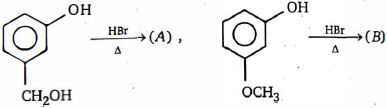
A
$3-$hydroxybenzyl bromide and $3-$bromophenol
B
$3-$hydroxybenzyl bromide and $3-$hydroxyphenol
C
$3-$hydroxybenzyl bromide and $3-$bromophenol
D
$3-$bromobenzyl alcohol and $3-$bromophenol
Solution
(B) For the first reaction,the substrate is $3$-hydroxybenzyl alcohol. The reaction with $HBr$ involves the protonation of the $-OH$ group on the side chain,followed by the loss of water to form a stable benzylic carbocation. This carbocation then reacts with $Br^-$ to form $3$-hydroxybenzyl bromide. This follows an $S_N1$ mechanism.
For the second reaction,the substrate is $3$-methoxyphenol. The reaction with $HBr$ involves the protonation of the oxygen atom of the methoxy group. Since the methyl group is attached to the oxygen,the $Br^-$ ion attacks the methyl group,leading to the cleavage of the $C-O$ bond and the formation of $3$-hydroxyphenol (resorcinol) and $CH_3Br$. This follows an $S_N2$ mechanism because the methoxy group is a poor leaving group and the methyl group is sterically unhindered.
Therefore,the products are $3$-hydroxybenzyl bromide and $3$-hydroxyphenol.
For the second reaction,the substrate is $3$-methoxyphenol. The reaction with $HBr$ involves the protonation of the oxygen atom of the methoxy group. Since the methyl group is attached to the oxygen,the $Br^-$ ion attacks the methyl group,leading to the cleavage of the $C-O$ bond and the formation of $3$-hydroxyphenol (resorcinol) and $CH_3Br$. This follows an $S_N2$ mechanism because the methoxy group is a poor leaving group and the methyl group is sterically unhindered.
Therefore,the products are $3$-hydroxybenzyl bromide and $3$-hydroxyphenol.
0 likes
View Solution116
MediumMCQ
Which of the following reactions will not give ether as a major product?
A
$CH_3-CH_2-Cl + Ag_2O(\text{dry}) \to$
B
$CH_3-C(CH_3)_2-Cl + CH_3-CH_2-O^-Na^+ \to$
C
$CH_3-CH_2-Cl + C_6H_5O^-Na^+ \to$
D
$CH_3-Cl + (CH_3)_3C-O^-Na^+ \to$
Solution
(B) In reaction $(B)$,a tertiary alkyl halide $(CH_3)_3CCl$ reacts with a strong base $CH_3-CH_2-O^-Na^+$.
Due to steric hindrance and the high basicity of the alkoxide,elimination $(E2)$ occurs as the major pathway,yielding isobutylene (an alkene) instead of an ether.
For Williamson ether synthesis to produce an ether as the major product,the alkyl halide must be primary $(1^\circ)$.
Due to steric hindrance and the high basicity of the alkoxide,elimination $(E2)$ occurs as the major pathway,yielding isobutylene (an alkene) instead of an ether.
For Williamson ether synthesis to produce an ether as the major product,the alkyl halide must be primary $(1^\circ)$.
0 likes
View Solution117
MediumMCQ
Methyl vinyl ether,$H_2C=CH-OCH_3$,reacts with $Br_2/CH_3OH$. If methanol is reacting as water would,and if this reaction follows a typical mechanism of electrophilic addition,what would be the expected product?
A
$BrCH_2-CH(OCH_3)_2$
B
$BrCH_2-CH(OCH_3)-OCH_3$
C
$CH_3-CH(Br)-OCH_3$
D
$BrCH_2-CH_2-OCH_3$
Solution
(A) The reaction of methyl vinyl ether $(H_2C=CH-OCH_3)$ with $Br_2$ in the presence of methanol $(CH_3OH)$ follows the mechanism of electrophilic addition.
$1$. First,the electrophile $Br^+$ attacks the double bond to form a cyclic bromonium ion intermediate.
$2$. Due to the strong electron-donating $+M$ effect of the $-OCH_3$ group,the positive charge in the intermediate is highly stabilized at the carbon atom attached to the oxygen.
$3$. Methanol $(CH_3OH)$ acts as a nucleophile and attacks this more substituted,positively charged carbon atom.
$4$. The final product formed is $BrCH_2-CH(OCH_3)_2$.
$1$. First,the electrophile $Br^+$ attacks the double bond to form a cyclic bromonium ion intermediate.
$2$. Due to the strong electron-donating $+M$ effect of the $-OCH_3$ group,the positive charge in the intermediate is highly stabilized at the carbon atom attached to the oxygen.
$3$. Methanol $(CH_3OH)$ acts as a nucleophile and attacks this more substituted,positively charged carbon atom.
$4$. The final product formed is $BrCH_2-CH(OCH_3)_2$.
0 likes
View Solution118
DifficultMCQ
$\underset{(A)}{C_5H_{10}O} \xrightarrow{H_3O^{\oplus}} B + C$; $(B)$ and $(C)$ both give positive iodoform test. Compound $(A)$ is
A
$CH_3-CH=CH-O-CH_2-CH_3$
B
$CH_3-CH(CH_3)-O-CH_2-CH_3$
C
$CH_3-C(=CH_2)-O-CH_2-CH_3$
D
both $(b)$ and $(c)$
Solution
(C) The hydrolysis of ether $(A)$ with formula $C_5H_{10}O$ yields two products $(B)$ and $(C)$ that both give a positive iodoform test.
For an alcohol or carbonyl compound to give a positive iodoform test,it must contain a $CH_3CH(OH)-$ group or a $CH_3C(=O)-$ group.
In option $(b)$,hydrolysis of $CH_3-CH(CH_3)-O-CH_2-CH_3$ gives $CH_3-CH(OH)-CH_3$ (isopropyl alcohol) and $CH_3-CH_2-OH$ (ethanol). Isopropyl alcohol gives a positive iodoform test,but ethanol does not.
In option $(c)$,hydrolysis of $CH_3-C(=CH_2)-O-CH_2-CH_3$ (an enol ether) proceeds via protonation of the double bond to form a carbocation,which is then attacked by water to form a hemiacetal,which subsequently breaks down into acetone $(CH_3COCH_3)$ and ethanol $(CH_3CH_2OH)$. Acetone gives a positive iodoform test,but ethanol does not.
However,re-evaluating the question,if $(A)$ is $CH_3-C(OCH_2CH_3)=CH_2$,it hydrolyzes to acetone and ethanol. If the question implies the products are $B$ and $C$ where both give iodoform,there might be a typo in the options or the question. Given the provided image,option $(c)$ is the intended mechanism for the hydrolysis of an enol ether to a ketone.
For an alcohol or carbonyl compound to give a positive iodoform test,it must contain a $CH_3CH(OH)-$ group or a $CH_3C(=O)-$ group.
In option $(b)$,hydrolysis of $CH_3-CH(CH_3)-O-CH_2-CH_3$ gives $CH_3-CH(OH)-CH_3$ (isopropyl alcohol) and $CH_3-CH_2-OH$ (ethanol). Isopropyl alcohol gives a positive iodoform test,but ethanol does not.
In option $(c)$,hydrolysis of $CH_3-C(=CH_2)-O-CH_2-CH_3$ (an enol ether) proceeds via protonation of the double bond to form a carbocation,which is then attacked by water to form a hemiacetal,which subsequently breaks down into acetone $(CH_3COCH_3)$ and ethanol $(CH_3CH_2OH)$. Acetone gives a positive iodoform test,but ethanol does not.
However,re-evaluating the question,if $(A)$ is $CH_3-C(OCH_2CH_3)=CH_2$,it hydrolyzes to acetone and ethanol. If the question implies the products are $B$ and $C$ where both give iodoform,there might be a typo in the options or the question. Given the provided image,option $(c)$ is the intended mechanism for the hydrolysis of an enol ether to a ketone.
0 likes
View Solution119
MediumMCQ
$A$ solution of $Ph_3CCO_2H$ in concentrated $H_2SO_4$ gives $(X)$ when poured into methanol. $X$ is
A
$Ph_3CCOOCH_3$
B
$Ph_3CHCOOCH_3$
C
$Ph_3COCH_3$
D
$Ph_3CCH_3$
Solution
(C) When $Ph_3CCO_2H$ is dissolved in concentrated $H_2SO_4$,it undergoes protonation followed by the loss of $CO$ to form a stable triphenylmethyl carbocation $(Ph_3C^+)$.
When this solution is poured into methanol $(CH_3OH)$,the methanol acts as a nucleophile and attacks the $Ph_3C^+$ carbocation.
This results in the formation of methyl triphenylmethyl ether,which is $Ph_3COCH_3$ (also written as $Ph_3C-O-CH_3$).
Therefore,the product $(X)$ is $Ph_3COCH_3$.
When this solution is poured into methanol $(CH_3OH)$,the methanol acts as a nucleophile and attacks the $Ph_3C^+$ carbocation.
This results in the formation of methyl triphenylmethyl ether,which is $Ph_3COCH_3$ (also written as $Ph_3C-O-CH_3$).
Therefore,the product $(X)$ is $Ph_3COCH_3$.
0 likes
View Solution120
MediumMCQ
Ethanol when reacts with $PCl_5$ gives $A$,$POCl_3$ and $HCl$. $A$ reacts with dry $Ag_2O$ to form $B$ (major product) and $AgCl$. $A$ and $B$ respectively are
A
$C_2H_5Cl$ and $C_2H_5OC_2H_5$
B
$C_2H_4$ and $C_2H_5OC_2H_5$
C
$C_2H_6$ and $C_2H_5OC_2H_5$
D
$C_2H_5Cl$ and $C_2H_4$
Solution
(A) The reaction of ethanol with $PCl_5$ is: $C_2H_5OH + PCl_5 \rightarrow C_2H_5Cl (A) + POCl_3 + HCl$.
Here,$A$ is ethyl chloride $(C_2H_5Cl)$.
When ethyl chloride $(A)$ reacts with dry silver oxide $(Ag_2O)$,it undergoes a Williamson ether synthesis reaction to form diethyl ether $(B)$ and silver chloride: $2C_2H_5Cl + Ag_2O \rightarrow C_2H_5OC_2H_5 (B) + 2AgCl$.
Thus,$A$ is $C_2H_5Cl$ and $B$ is $C_2H_5OC_2H_5$.
Here,$A$ is ethyl chloride $(C_2H_5Cl)$.
When ethyl chloride $(A)$ reacts with dry silver oxide $(Ag_2O)$,it undergoes a Williamson ether synthesis reaction to form diethyl ether $(B)$ and silver chloride: $2C_2H_5Cl + Ag_2O \rightarrow C_2H_5OC_2H_5 (B) + 2AgCl$.
Thus,$A$ is $C_2H_5Cl$ and $B$ is $C_2H_5OC_2H_5$.
0 likes
View Solution121
MediumMCQ
Choose the best synthesis of phenyl $n$-propyl ether.
A
Phenol + $Na$ metal followed by $CH_3CH_2CH_2Br$ in a polar aprotic solvent.
B
$n$-Propanol + $Na$ metal followed by bromobenzene $(Ph-Br)$.
C
Anisole + $Na$ metal followed by ethyl bromide $(CH_3CH_2Br)$.
D
$p$-Propylphenol + $Na$ metal followed by $HBr$.
Solution
(A) The synthesis of phenyl $n$-propyl ether is best achieved via the Williamson ether synthesis,which involves the reaction of a phenoxide ion with a primary alkyl halide.
$(a)$ Phenol reacts with $Na$ metal to form sodium phenoxide $(PhO^-Na^+)$. This nucleophilic phenoxide ion then undergoes an $S_N2$ reaction with $n$-propyl bromide $(CH_3CH_2CH_2Br)$ in a polar aprotic solvent to yield phenyl $n$-propyl ether. This is the correct method.
$(b)$ This reaction would require an $S_N2$ attack on bromobenzene,which is not possible because the $C-Br$ bond has partial double-bond character due to resonance,making it resistant to nucleophilic substitution.
$(c)$ Anisole does not react with $Na$ metal.
$(d)$ This reaction does not produce the desired ether; it would likely result in no reaction or side reactions.
$(a)$ Phenol reacts with $Na$ metal to form sodium phenoxide $(PhO^-Na^+)$. This nucleophilic phenoxide ion then undergoes an $S_N2$ reaction with $n$-propyl bromide $(CH_3CH_2CH_2Br)$ in a polar aprotic solvent to yield phenyl $n$-propyl ether. This is the correct method.
$(b)$ This reaction would require an $S_N2$ attack on bromobenzene,which is not possible because the $C-Br$ bond has partial double-bond character due to resonance,making it resistant to nucleophilic substitution.
$(c)$ Anisole does not react with $Na$ metal.
$(d)$ This reaction does not produce the desired ether; it would likely result in no reaction or side reactions.
0 likes
View Solution122
MediumMCQ
$1-$Phenoxypropane is treated with excess of conc. $HI$ at $0\,^{\circ}C$ and the mixture of products is treated with thionyl chloride. The products formed are
A
$n-$propanol $+$ Chlorobenzene
B
Phenol $+$ $n-$propyl iodide
C
$n-$propyl chloride $+$ Chlorobenzene
D
$n-$propyl chloride $+$ Phenol
Solution
(D) Step $1$: Reaction of $1-$phenoxypropane $(C_6H_5-O-CH_2CH_2CH_3)$ with excess conc. $HI$ at $0\,^{\circ}C$. The cleavage of the ether bond occurs such that the alkyl group forms an alkyl iodide and the phenolic oxygen remains with the phenyl group. Thus,$C_6H_5-O-CH_2CH_2CH_3 + HI \rightarrow C_6H_5OH + CH_3CH_2CH_2I$ (Phenol and $n-$propyl iodide).
Step $2$: The mixture of products (Phenol and $n-$propyl iodide) is treated with thionyl chloride $(SOCl_2)$. Thionyl chloride reacts with alcohols to form alkyl chlorides,but it does not react with phenols under standard conditions to form chlorobenzene. Therefore,$n-$propyl iodide reacts with $SOCl_2$ to form $n-$propyl chloride $(CH_3CH_2CH_2Cl)$,while phenol remains unchanged.
Final products: $n-$propyl chloride and Phenol.
Step $2$: The mixture of products (Phenol and $n-$propyl iodide) is treated with thionyl chloride $(SOCl_2)$. Thionyl chloride reacts with alcohols to form alkyl chlorides,but it does not react with phenols under standard conditions to form chlorobenzene. Therefore,$n-$propyl iodide reacts with $SOCl_2$ to form $n-$propyl chloride $(CH_3CH_2CH_2Cl)$,while phenol remains unchanged.
Final products: $n-$propyl chloride and Phenol.
0 likes
View Solution123
MediumMCQ
Amongst the following compounds,the compound having the lowest boiling point is
A
Propan$-1-$ol
B
Butan$-1-$ol
C
Ethoxyethane
D
Propane$-1,2-$diol
Solution
(C) The boiling point of a compound depends on the intermolecular forces present.
Propan$-1-$ol $(CH_3CH_2CH_2OH)$,Butan$-1-$ol $(CH_3CH_2CH_2CH_2OH)$,and Propane$-1,2-$diol $(CH_3CH(OH)CH_2OH)$ are alcohols and can form intermolecular hydrogen bonds,which significantly increase their boiling points.
Ethoxyethane $(CH_3CH_2OCH_2CH_3)$ is an ether and cannot form intermolecular hydrogen bonds among its own molecules.
Therefore,ethoxyethane has the weakest intermolecular forces (dipole-dipole interactions) compared to the alcohols,resulting in the lowest boiling point.
Propan$-1-$ol $(CH_3CH_2CH_2OH)$,Butan$-1-$ol $(CH_3CH_2CH_2CH_2OH)$,and Propane$-1,2-$diol $(CH_3CH(OH)CH_2OH)$ are alcohols and can form intermolecular hydrogen bonds,which significantly increase their boiling points.
Ethoxyethane $(CH_3CH_2OCH_2CH_3)$ is an ether and cannot form intermolecular hydrogen bonds among its own molecules.
Therefore,ethoxyethane has the weakest intermolecular forces (dipole-dipole interactions) compared to the alcohols,resulting in the lowest boiling point.
0 likes
View Solution124
MediumMCQ
The given compounds can be differentiated by which of the following reagents?
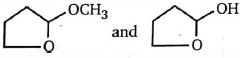
A
$2,4-DNP$ (Brady reagent)
B
Tollen's reagent
C
Lucas reagent
D
$NaHSO_3$
Solution
(B) The first compound is a cyclic acetal,which is stable in basic conditions and does not react with Tollen's reagent.
The second compound is a cyclic hemiacetal. In the presence of the basic medium of Tollen's reagent,the hemiacetal ring opens to form an open-chain hydroxy-aldehyde $(HO-CH_2-CH_2-CH_2-CHO)$.
Since the resulting molecule contains an aldehyde group,it will give a positive Tollen's test (silver mirror test).
Therefore,Tollen's reagent can be used to differentiate between the two compounds.
The second compound is a cyclic hemiacetal. In the presence of the basic medium of Tollen's reagent,the hemiacetal ring opens to form an open-chain hydroxy-aldehyde $(HO-CH_2-CH_2-CH_2-CHO)$.
Since the resulting molecule contains an aldehyde group,it will give a positive Tollen's test (silver mirror test).
Therefore,Tollen's reagent can be used to differentiate between the two compounds.
0 likes
View Solution125
DifficultMCQ
Reactant $(A)$ is:
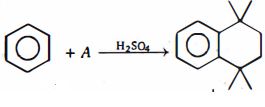
A
Succinic anhydride
B
Tetrahydrofuran
C
$2,2,5,5-$tetramethyltetrahydrofuran
D
Succinic acid
Solution
(C) The reaction is a Friedel-Crafts alkylation involving the ring-opening of a cyclic ether. The reactant $(A)$ is $2,2,5,5$-tetramethyltetrahydrofuran. In the presence of an acid catalyst $(H_2SO_4)$,the cyclic ether undergoes protonation followed by ring opening to form a carbocation,which then undergoes electrophilic aromatic substitution with benzene to form the final product.

0 likes
View Solution126
MediumMCQ
What are the products of the following reaction?

A
$4-Bromophenyl$ $2-bromoethyl$ ether
B
$Bromobenzene + BrCH_2CH_2OH$
C
$Phenol + BrCH_2CH_2Br$
D
$Bromobenzene + BrCH_2CH_2Br$
Solution
(C) The reaction involves the cleavage of an aryl alkyl ether with excess $HBr$ under heating conditions.
In the reactant $C_6H_5-O-CH_2CH_2OH$,the $C-O$ bond between the phenyl ring and the oxygen atom has partial double bond character due to resonance,making it very strong and resistant to cleavage.
Therefore,the $HBr$ attacks the alkyl $C-O$ bond.
The oxygen atom is protonated by $H^+$,and then the bromide ion $(Br^-)$ attacks the alkyl carbon,leading to the formation of phenol $(C_6H_5OH)$ and $1,2-dibromoethane$ $(BrCH_2CH_2Br)$ because the initial product $BrCH_2CH_2OH$ reacts further with excess $HBr$ to form $BrCH_2CH_2Br$.
In the reactant $C_6H_5-O-CH_2CH_2OH$,the $C-O$ bond between the phenyl ring and the oxygen atom has partial double bond character due to resonance,making it very strong and resistant to cleavage.
Therefore,the $HBr$ attacks the alkyl $C-O$ bond.
The oxygen atom is protonated by $H^+$,and then the bromide ion $(Br^-)$ attacks the alkyl carbon,leading to the formation of phenol $(C_6H_5OH)$ and $1,2-dibromoethane$ $(BrCH_2CH_2Br)$ because the initial product $BrCH_2CH_2OH$ reacts further with excess $HBr$ to form $BrCH_2CH_2Br$.
0 likes
View Solution127
MediumMCQ
Product $(A)$ of this reaction is:
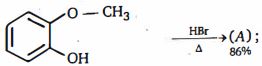
A
$2-$bromophenol
B
$2-$bromoanisole
C
Catechol (benzene$-1,2-$diol)
D
$2-$(bromomethoxy)benzene
Solution
(C) The reaction of guaiacol ($2$-methoxyphenol) with $HBr$ involves the cleavage of the ether bond.
In this reaction,the oxygen atom of the methoxy group gets protonated by $HBr$ to form an oxonium ion.
The $Br^-$ ion then attacks the methyl group $(CH_3)$ because the $C-O$ bond between the benzene ring and the oxygen atom has partial double bond character due to resonance,making it resistant to nucleophilic attack.
Thus,the $C-O$ bond between the methyl group and the oxygen atom breaks,resulting in the formation of catechol (benzene$-1,2-$diol) and methyl bromide $(CH_3Br)$.
In this reaction,the oxygen atom of the methoxy group gets protonated by $HBr$ to form an oxonium ion.
The $Br^-$ ion then attacks the methyl group $(CH_3)$ because the $C-O$ bond between the benzene ring and the oxygen atom has partial double bond character due to resonance,making it resistant to nucleophilic attack.
Thus,the $C-O$ bond between the methyl group and the oxygen atom breaks,resulting in the formation of catechol (benzene$-1,2-$diol) and methyl bromide $(CH_3Br)$.
0 likes
View Solution128
MediumMCQ
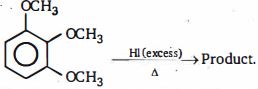
Predict the major product of the following reaction:
A
$1,2,3-$trihydroxybenzene
B
$1,2,3-$triiodobenzene
C
$1-$methyl$-2,3-$dihydroxybenzene
D
$1,2-$dihydroxy$-3-$iodobenzene
Solution
(A) The reactant is $1,2,3$-trimethoxybenzene.
When treated with excess $HI$ and heated,the methoxy groups $(-OCH_3)$ undergo cleavage to form hydroxyl groups $(-OH)$ and methyl iodide $(CH_3I)$.
Since the ether linkage is between an alkyl group and an aromatic ring,the $C-O$ bond cleavage occurs at the alkyl-oxygen bond,resulting in the formation of phenol derivatives and $CH_3I$.
Therefore,all three methoxy groups are converted into hydroxyl groups,yielding $1,2,3$-trihydroxybenzene (pyrogallol) as the major product.
When treated with excess $HI$ and heated,the methoxy groups $(-OCH_3)$ undergo cleavage to form hydroxyl groups $(-OH)$ and methyl iodide $(CH_3I)$.
Since the ether linkage is between an alkyl group and an aromatic ring,the $C-O$ bond cleavage occurs at the alkyl-oxygen bond,resulting in the formation of phenol derivatives and $CH_3I$.
Therefore,all three methoxy groups are converted into hydroxyl groups,yielding $1,2,3$-trihydroxybenzene (pyrogallol) as the major product.
0 likes
View Solution129
MediumMCQ
Which of the following procedures would be best for the preparation of phenyl benzyl ether? $C_6H_5OCH_2C_6H_5$
A
$C_6H_5Cl + C_6H_5CH_2O^{(-)} Na^{(+)}$
B
$C_6H_5O^{(-)} Na^{(+)} + C_6H_5CH_2Cl$
C
$2C_6H_5Cl + Na_2O$
D
$2C_6H_5MgBr + CH_2O$
Solution
(B) The preparation of ethers via the Williamson ether synthesis involves the reaction of an alkoxide or phenoxide ion with an alkyl halide.
For the synthesis of phenyl benzyl ether $(C_6H_5OCH_2C_6H_5)$,we need a nucleophilic substitution reaction.
Option $B$ involves the reaction of sodium phenoxide $(C_6H_5O^{(-)} Na^{(+)})$ with benzyl chloride $(C_6H_5CH_2Cl)$.
Benzyl chloride is a primary alkyl halide and is highly reactive towards $S_N2$ reactions due to the resonance stabilization of the transition state by the phenyl group.
In contrast,option $A$ involves chlorobenzene,which is unreactive towards $S_N2$ reactions because the $C-Cl$ bond has partial double bond character and the phenyl ring is electron-rich,hindering nucleophilic attack.
Therefore,the reaction $C_6H_5O^{(-)} Na^{(+)} + C_6H_5CH_2Cl \rightarrow C_6H_5OCH_2C_6H_5 + NaCl$ is the most efficient method.
For the synthesis of phenyl benzyl ether $(C_6H_5OCH_2C_6H_5)$,we need a nucleophilic substitution reaction.
Option $B$ involves the reaction of sodium phenoxide $(C_6H_5O^{(-)} Na^{(+)})$ with benzyl chloride $(C_6H_5CH_2Cl)$.
Benzyl chloride is a primary alkyl halide and is highly reactive towards $S_N2$ reactions due to the resonance stabilization of the transition state by the phenyl group.
In contrast,option $A$ involves chlorobenzene,which is unreactive towards $S_N2$ reactions because the $C-Cl$ bond has partial double bond character and the phenyl ring is electron-rich,hindering nucleophilic attack.
Therefore,the reaction $C_6H_5O^{(-)} Na^{(+)} + C_6H_5CH_2Cl \rightarrow C_6H_5OCH_2C_6H_5 + NaCl$ is the most efficient method.
0 likes
View Solution130
DifficultMCQ
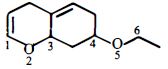
On the treatment of the following compound with a strong acid,the most susceptible site for bond cleavage is
A
$O2-C3$
B
$O5-C6$
C
$C4-O5$
D
$C1-O2$
Solution
(C) The lone pair of electrons on the oxygen atom at position $2$ $(O2)$ is involved in resonance with the adjacent $C=C$ double bond,making it less basic and less susceptible to protonation.
In contrast,the lone pair of electrons on the oxygen atom at position $5$ $(O5)$ is not involved in resonance with any $C=C$ double bond,making it more basic and readily protonated by a strong acid.
Upon protonation of $O5$,the $C4-O5$ bond becomes susceptible to cleavage,as the resulting oxonium ion is a good leaving group. The cleavage occurs at the $C4-O5$ bond,leading to the formation of a carbocation at $C4$.
In contrast,the lone pair of electrons on the oxygen atom at position $5$ $(O5)$ is not involved in resonance with any $C=C$ double bond,making it more basic and readily protonated by a strong acid.
Upon protonation of $O5$,the $C4-O5$ bond becomes susceptible to cleavage,as the resulting oxonium ion is a good leaving group. The cleavage occurs at the $C4-O5$ bond,leading to the formation of a carbocation at $C4$.
0 likes
View Solution131
DifficultMCQ
Allyl phenyl ether can be prepared by heating:
A
$C_6H_5-Br + CH_2=CH-CH_2-ONa$
B
$CH_2=CH-CH_2-Br + C_6H_5-ONa$
C
$C_6H_5-CH=CH-Br + CH_3-ONa$
D
$CH_2=CH-Br + C_6H_5-CH_2-ONa$
Solution
(B) is the correct option.
Allyl phenyl ether is prepared by the $Williamson$ ether synthesis.
In this reaction,sodium phenoxide $(C_6H_5-ONa)$ acts as a nucleophile and attacks the electrophilic carbon of allyl bromide $(CH_2=CH-CH_2-Br)$ via an $S_N2$ mechanism.
Aryl halides like bromobenzene $(C_6H_5-Br)$ do not undergo nucleophilic substitution under ordinary conditions due to the partial double bond character of the $C-X$ bond.
Reaction: $C_6H_5-ONa + Br-CH_2-CH=CH_2 \rightarrow C_6H_5-O-CH_2-CH=CH_2 + NaBr$
Allyl phenyl ether is prepared by the $Williamson$ ether synthesis.
In this reaction,sodium phenoxide $(C_6H_5-ONa)$ acts as a nucleophile and attacks the electrophilic carbon of allyl bromide $(CH_2=CH-CH_2-Br)$ via an $S_N2$ mechanism.
Aryl halides like bromobenzene $(C_6H_5-Br)$ do not undergo nucleophilic substitution under ordinary conditions due to the partial double bond character of the $C-X$ bond.
Reaction: $C_6H_5-ONa + Br-CH_2-CH=CH_2 \rightarrow C_6H_5-O-CH_2-CH=CH_2 + NaBr$
0 likes
View Solution132
DifficultMCQ
Williamson synthesis of ether is an example of
A
Nucleophilic addition
B
Electrophilic addition
C
Electrophilic substitution
D
Nucleophilic substitution
Solution
(D) The Williamson synthesis involves the reaction of an alkoxide ion $(RO^-)$ with an alkyl halide $(R'X)$.
This reaction proceeds via an $S_N2$ mechanism,where the alkoxide ion acts as a nucleophile and attacks the alkyl halide,displacing the halide ion.
Therefore,it is an example of a nucleophilic substitution reaction.
This reaction proceeds via an $S_N2$ mechanism,where the alkoxide ion acts as a nucleophile and attacks the alkyl halide,displacing the halide ion.
Therefore,it is an example of a nucleophilic substitution reaction.
0 likes
View Solution133
DifficultMCQ
An ether $(A)$,$C_5H_{12}O$,when heated with excess of hot concentrated $HI$ produced two alkyl halides which when treated with $NaOH$ yielded compounds $(B)$ and $(C)$. Oxidation of $(B)$ and $(C)$ gave a propanone and an ethanoic acid respectively. The $IUPAC$ name of the ether $(A)$ is
A
$2-$ethoxypropane
B
ethoxypropane
C
methoxybutane
D
$2-$methoxybutane
Solution
(A) The ether $(A)$ has the molecular formula $C_5H_{12}O$.
Reaction with excess $HI$ produces two alkyl halides.
Treatment of these alkyl halides with $NaOH$ yields alcohols $(B)$ and $(C)$.
Oxidation of $(B)$ produces propanone $(CH_3COCH_3)$,which indicates that $(B)$ is propan-$2$-ol $(CH_3CH(OH)CH_3)$.
Oxidation of $(C)$ produces ethanoic acid $(CH_3COOH)$,which indicates that $(C)$ is ethanol $(CH_3CH_2OH)$.
Therefore,the ether $(A)$ is formed by the combination of an isopropyl group and an ethyl group,which is $CH_3CH_2OCH(CH_3)_2$.
The $IUPAC$ name of this ether is $2-$ethoxypropane.
Reaction with excess $HI$ produces two alkyl halides.
Treatment of these alkyl halides with $NaOH$ yields alcohols $(B)$ and $(C)$.
Oxidation of $(B)$ produces propanone $(CH_3COCH_3)$,which indicates that $(B)$ is propan-$2$-ol $(CH_3CH(OH)CH_3)$.
Oxidation of $(C)$ produces ethanoic acid $(CH_3COOH)$,which indicates that $(C)$ is ethanol $(CH_3CH_2OH)$.
Therefore,the ether $(A)$ is formed by the combination of an isopropyl group and an ethyl group,which is $CH_3CH_2OCH(CH_3)_2$.
The $IUPAC$ name of this ether is $2-$ethoxypropane.
0 likes
View Solution134
DifficultMCQ
In Williamson synthesis of mixed ether having a primary and a tertiary alkyl group,if a tertiary halide is used,then:
A
Rate of reaction will be slow due to slow cleavage of carbon-halogen bond.
B
Alkene will be the main product.
C
Simple ether will form instead of mixed ether.
D
Expected mixed ether will be formed.
Solution
(B) In Williamson synthesis,the reaction between an alkoxide ion and an alkyl halide follows the $S_N2$ mechanism.
For ether formation,the alkyl halide should ideally be primary.
If a tertiary $(3^\circ)$ alkyl halide is used,the alkoxide ion (which is a strong base) promotes elimination $(E2)$ over substitution $(S_N2)$ due to steric hindrance.
Consequently,an alkene is formed as the major product instead of an ether.
For ether formation,the alkyl halide should ideally be primary.
If a tertiary $(3^\circ)$ alkyl halide is used,the alkoxide ion (which is a strong base) promotes elimination $(E2)$ over substitution $(S_N2)$ due to steric hindrance.
Consequently,an alkene is formed as the major product instead of an ether.
0 likes
View Solution135
DifficultMCQ
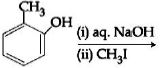
The major product of the following reaction is
A
$2,6-$dimethylphenol
B
$2-$methylanisole
C
$2,4-$dimethylphenol
D
$4-$methylphenol
Solution
(B) The reaction involves the Williamson ether synthesis.
First,$o$-cresol ($2$-methylphenol) reacts with aqueous $NaOH$ to form sodium $o$-cresoxide,which is a nucleophilic phenoxide ion.
Then,this phenoxide ion undergoes a nucleophilic substitution $(S_N2)$ reaction with methyl iodide $(CH_3I)$ to form $2$-methylanisole ($1$-methoxy-$2$-methylbenzene) as the major product.
First,$o$-cresol ($2$-methylphenol) reacts with aqueous $NaOH$ to form sodium $o$-cresoxide,which is a nucleophilic phenoxide ion.
Then,this phenoxide ion undergoes a nucleophilic substitution $(S_N2)$ reaction with methyl iodide $(CH_3I)$ to form $2$-methylanisole ($1$-methoxy-$2$-methylbenzene) as the major product.
0 likes
View Solution136
DifficultMCQ
The major product in the following conversion is

A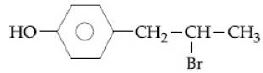
B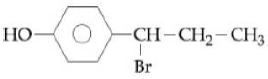
C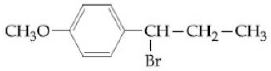
D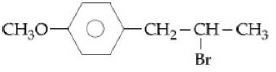
Solution
(B) The reaction involves two steps when $HBr$ is in excess and heat is applied:
$1$. The ether group $(-OCH_3)$ undergoes cleavage by $HBr$ to form a phenol $(-OH)$ and methyl bromide $(CH_3Br)$.
$2$. The alkene group $(-CH=CH-CH_3)$ undergoes electrophilic addition of $HBr$ following Markownikoff's rule.
According to Markownikoff's rule,the electrophile $H^+$ adds to the carbon with more hydrogens,and the nucleophile $Br^-$ adds to the more substituted carbon,resulting in the formation of a stable carbocation intermediate. Thus,the product is $4-(1-bromopropyl)phenol$.
$1$. The ether group $(-OCH_3)$ undergoes cleavage by $HBr$ to form a phenol $(-OH)$ and methyl bromide $(CH_3Br)$.
$2$. The alkene group $(-CH=CH-CH_3)$ undergoes electrophilic addition of $HBr$ following Markownikoff's rule.
According to Markownikoff's rule,the electrophile $H^+$ adds to the carbon with more hydrogens,and the nucleophile $Br^-$ adds to the more substituted carbon,resulting in the formation of a stable carbocation intermediate. Thus,the product is $4-(1-bromopropyl)phenol$.
0 likes
View Solution137
DifficultMCQ
The major product of the following reaction is:
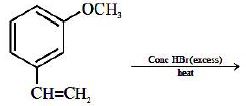
A
$3-$($2$-bromoethyl)phenol
B
$1-$bromo$-3-$($2$-bromoethyl)benzene
C
$1-$bromo$-3-$($1$-bromoethyl)benzene
D
$3-$($1$-bromoethyl)phenol
Solution
(D) The reaction involves two steps with excess $HBr$ and heat:
$1$. Cleavage of the ether linkage: The methoxy group $(-OCH_3)$ is protonated by $HBr$ to form an oxonium ion,which then undergoes $S_N2$ attack by $Br^-$ to yield $CH_3Br$ and a phenol derivative,$3$-vinylphenol.
$2$. Electrophilic addition to the alkene: The vinyl group $(-CH=CH_2)$ undergoes electrophilic addition with $HBr$. According to Markovnikov's rule,the proton adds to the terminal carbon to form a stable benzylic carbocation $(Ar-CH^+-CH_3)$. The bromide ion then attacks this carbocation to form the final product,$3-(1-bromoethyl)phenol$.
$1$. Cleavage of the ether linkage: The methoxy group $(-OCH_3)$ is protonated by $HBr$ to form an oxonium ion,which then undergoes $S_N2$ attack by $Br^-$ to yield $CH_3Br$ and a phenol derivative,$3$-vinylphenol.
$2$. Electrophilic addition to the alkene: The vinyl group $(-CH=CH_2)$ undergoes electrophilic addition with $HBr$. According to Markovnikov's rule,the proton adds to the terminal carbon to form a stable benzylic carbocation $(Ar-CH^+-CH_3)$. The bromide ion then attacks this carbocation to form the final product,$3-(1-bromoethyl)phenol$.
0 likes
View Solution138
MediumMCQ
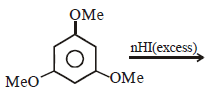
The value of $n$ in the given reaction is:
A
$3$
B
$4$
C
$5$
D
$6$
Solution
(A) The given compound is $1,3,5$-trimethoxybenzene.
When an ether reacts with excess $HI$,the $C-O$ bond is cleaved to form an alcohol and an alkyl iodide.
In the case of $1,3,5$-trimethoxybenzene,there are three methoxy $(-OCH_3)$ groups attached to the benzene ring.
Each methoxy group reacts with one molecule of $HI$ to form a phenolic $-OH$ group and one molecule of methyl iodide $(CH_3I)$.
The reaction is:
$C_6H_3(OCH_3)_3 + 3HI \rightarrow C_6H_3(OH)_3 + 3CH_3I$.
Thus,$3$ moles of $HI$ are required for the complete cleavage of the three methoxy groups.
Therefore,the value of $n$ is $3$.
When an ether reacts with excess $HI$,the $C-O$ bond is cleaved to form an alcohol and an alkyl iodide.
In the case of $1,3,5$-trimethoxybenzene,there are three methoxy $(-OCH_3)$ groups attached to the benzene ring.
Each methoxy group reacts with one molecule of $HI$ to form a phenolic $-OH$ group and one molecule of methyl iodide $(CH_3I)$.
The reaction is:
$C_6H_3(OCH_3)_3 + 3HI \rightarrow C_6H_3(OH)_3 + 3CH_3I$.
Thus,$3$ moles of $HI$ are required for the complete cleavage of the three methoxy groups.
Therefore,the value of $n$ is $3$.
0 likes
View Solution139
MediumMCQ
$Ph-O-CH_2-Ph \xrightarrow{HI} A + B$ will be
A
$Ph-OH + Ph-CH_2-I$
B
$Ph-I + Ph-CH_2-I$
C
$Ph-I + Ph-CH_2-OH$
D
$Ph-OH + Ph-CH_2-OH$
Solution
(A) In the reaction of benzyl phenyl ether $(Ph-O-CH_2-Ph)$ with $HI$,the cleavage occurs at the $O-CH_2$ bond rather than the $O-Ph$ bond.
This is because the $C-O$ bond in $Ph-O$ has partial double bond character due to resonance with the benzene ring,making it stronger.
The $I^-$ nucleophile attacks the benzyl carbon to form benzyl iodide $(Ph-CH_2-I)$,and the oxygen remains with the phenyl ring to form phenol $(Ph-OH)$.
This is because the $C-O$ bond in $Ph-O$ has partial double bond character due to resonance with the benzene ring,making it stronger.
The $I^-$ nucleophile attacks the benzyl carbon to form benzyl iodide $(Ph-CH_2-I)$,and the oxygen remains with the phenyl ring to form phenol $(Ph-OH)$.
0 likes
View Solution140
MediumMCQ
Consider the following reaction: $CH_3-C(CH_3)_2-O-CH_3 \xrightarrow{HI (1 \text{ mole})} \text{Products}$. The main products of the reaction will be:
A
$CH_3-C(I)(CH_3)_2 + CH_3-OH$
B
$CH_3-C(OH)(CH_3)_2 + CH_3-I$
C
$CH_3-C(OH)(CH_3)_2 + CH_3-OH$
D
$CH_3-CH(I)-CH_3 + CH_3-CH_2-I$
Solution
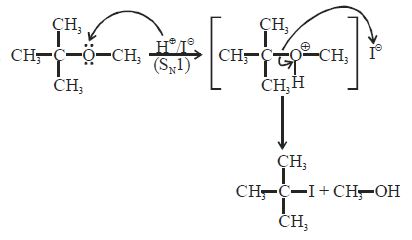
(A) The reaction of tert-butyl methyl ether with $HI$ follows the $S_N1$ mechanism because a highly stable tertiary carbocation $(CH_3-C^{+}(CH_3)_2)$ is formed upon protonation and cleavage of the $C-O$ bond.
The iodide ion $(I^{-})$ then attacks this carbocation to form tert-butyl iodide $(CH_3-C(I)(CH_3)_2)$,while the other fragment remains as methanol $(CH_3-OH)$.
The iodide ion $(I^{-})$ then attacks this carbocation to form tert-butyl iodide $(CH_3-C(I)(CH_3)_2)$,while the other fragment remains as methanol $(CH_3-OH)$.
0 likes
View Solution141
AdvancedMCQ
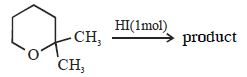
The main product of the following reaction will be:
A
$HO-CH_2-CH_2-CH_2-CH_2-C(I)(CH_3)_2$
B
$I-CH_2-CH_2-CH_2-CH_2-C(OH)(CH_3)_2$
C
$I-CH_2-CH_2-CH_2-CH_2-C(I)(CH_3)_2$
D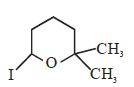
Solution
(A) The reaction involves the cleavage of a cyclic ether (tetrahydro$-2,2-$dimethyl-2H-pyran) with $HI$.
$1$. The oxygen atom of the ether is protonated by $HI$ to form an oxonium ion.
$2$. The $C-O$ bond breaks to form a carbocation. The bond breaks such that the more stable carbocation is formed. In this case,the tertiary carbocation at the carbon bearing two methyl groups is significantly more stable than a primary carbocation.
$3$. The iodide ion $(I^-)$ then attacks the stable tertiary carbocation to form the final product,$HO-CH_2-CH_2-CH_2-CH_2-C(I)(CH_3)_2$.
$1$. The oxygen atom of the ether is protonated by $HI$ to form an oxonium ion.
$2$. The $C-O$ bond breaks to form a carbocation. The bond breaks such that the more stable carbocation is formed. In this case,the tertiary carbocation at the carbon bearing two methyl groups is significantly more stable than a primary carbocation.
$3$. The iodide ion $(I^-)$ then attacks the stable tertiary carbocation to form the final product,$HO-CH_2-CH_2-CH_2-CH_2-C(I)(CH_3)_2$.
0 likes
View Solution142
DifficultMCQ
Ether on heating at high temperature in the presence of air forms an explosive compound. The structure of this compound is:
A
$CH_3-CH_2-O-CH(OH)-CH_3$
B
Tetrahydrofuran structure
C
$CH_3-CH_2-O-CH(OOH)-CH_3$
D
$CH_3-CH_2-O^+(H)-CH_2-CH_3$
Solution
(C) Ethers,when exposed to air and heat or light for a long time,undergo auto-oxidation to form hydroperoxides.
These peroxides are highly explosive and can cause accidents during distillation.
The reaction for diethyl ether is:
$CH_3-CH_2-O-CH_2-CH_3 + O_2 \xrightarrow{\Delta} CH_3-CH_2-O-CH(OOH)-CH_3$.
These peroxides are highly explosive and can cause accidents during distillation.
The reaction for diethyl ether is:
$CH_3-CH_2-O-CH_2-CH_3 + O_2 \xrightarrow{\Delta} CH_3-CH_2-O-CH(OOH)-CH_3$.
0 likes
View Solution143
DifficultMCQ
In which of the following reactions is an ether $NOT$ a main product?
A
$CH_3-CH_2-Cl \xrightarrow{CH_3ONa} CH_3-CH_2-O-CH_3 + NaCl$
B
$CH_3-Cl \xrightarrow{CH_3-CH(CH_3)-ONa} CH_3-O-CH(CH_3)_2 + NaCl$
C
$C_6H_5-CH_2-Cl \xrightarrow{CH_3-CH_2-ONa} C_6H_5-CH_2-O-CH_2-CH_3 + NaCl$
D
$CH_3-C(CH_3)_2-Cl \xrightarrow{CH_3-CH(CH_3)-ONa} CH_2=C(CH_3)_2 + CH_3-CH(CH_3)-OH + NaCl$
Solution
(D) The Williamson ether synthesis involves the reaction of an alkyl halide with an alkoxide.
For the reaction to produce an ether,the alkyl halide should ideally be primary $(1^o)$ to favor $S_N2$ substitution.
In option $D$,the reactant is a tertiary $(3^o)$ alkyl halide $(CH_3-C(CH_3)_2-Cl)$.
Tertiary alkyl halides undergo elimination reactions in the presence of strong bases (like alkoxides) to form alkenes as the major product,rather than ethers.
Therefore,in reaction $D$,an ether is not the main product.
For the reaction to produce an ether,the alkyl halide should ideally be primary $(1^o)$ to favor $S_N2$ substitution.
In option $D$,the reactant is a tertiary $(3^o)$ alkyl halide $(CH_3-C(CH_3)_2-Cl)$.
Tertiary alkyl halides undergo elimination reactions in the presence of strong bases (like alkoxides) to form alkenes as the major product,rather than ethers.
Therefore,in reaction $D$,an ether is not the main product.
0 likes
View Solution144
AdvancedMCQ
Predict the major products of the following reaction:
$m$-methoxyphenethyl$-1-$phenylethyl ether + $HI$ (excess) $\xrightarrow{\text{heat}}$ ?
$m$-methoxyphenethyl$-1-$phenylethyl ether + $HI$ (excess) $\xrightarrow{\text{heat}}$ ?
A
$3$-($2$-iodoethyl)phenol + $1$-phenylethyl iodide
B
$3$-($2$-hydroxyethyl)iodobenzene + $1$-phenylethyl iodide
C
$3$-($2$-hydroxyethyl)phenol + $1$-phenylethyl iodide
D
$3$-($2$-iodoethyl)iodobenzene + $1$-phenylethyl iodide
Solution
(A) The reaction of an ether with excess $HI$ involves the cleavage of the $C-O$ bonds.
$1$. The ether is $3$-methoxyphenethyl-$1$-phenylethyl ether.
$2$. The $C-O$ bond attached to the $1$-phenylethyl group is cleaved via an $S_N1$ mechanism because the resulting carbocation is stabilized by the phenyl ring (benzylic carbocation).
$3$. The $C-O$ bond of the methoxy group attached to the benzene ring is cleaved to form phenol and methyl iodide $(CH_3I)$.
$4$. The $C-O$ bond of the primary alkyl group (phenethyl group) is cleaved to form the corresponding alkyl iodide.
$5$. Given the excess $HI$ and heat,the final products are $3$-($2$-iodoethyl)phenol and $1$-phenylethyl iodide.
$1$. The ether is $3$-methoxyphenethyl-$1$-phenylethyl ether.
$2$. The $C-O$ bond attached to the $1$-phenylethyl group is cleaved via an $S_N1$ mechanism because the resulting carbocation is stabilized by the phenyl ring (benzylic carbocation).
$3$. The $C-O$ bond of the methoxy group attached to the benzene ring is cleaved to form phenol and methyl iodide $(CH_3I)$.
$4$. The $C-O$ bond of the primary alkyl group (phenethyl group) is cleaved to form the corresponding alkyl iodide.
$5$. Given the excess $HI$ and heat,the final products are $3$-($2$-iodoethyl)phenol and $1$-phenylethyl iodide.
0 likes
View Solution145
MediumMCQ
Which of the following is not a product of the reaction shown below?
$Ph-O-C_6H_{11} + PCl_5 \rightarrow \text{Products}$
$Ph-O-C_6H_{11} + PCl_5 \rightarrow \text{Products}$
A
Chlorobenzene
B
Phenol
C
Chlorocyclohexane
D
$POCl_3$
Solution
(B) The reaction of an ether with $PCl_5$ typically involves the cleavage of the $C-O$ bond to form alkyl/aryl halides and $POCl_3$.
For the reaction: $Ph-O-C_6H_{11} + PCl_5 \rightarrow Ph-Cl + C_6H_{11}-Cl + POCl_3$.
Here,$Ph-Cl$ (chlorobenzene),$C_6H_{11}-Cl$ (chlorocyclohexane),and $POCl_3$ are the products.
Phenol $(C_6H_5OH)$ is not a product of this reaction.
For the reaction: $Ph-O-C_6H_{11} + PCl_5 \rightarrow Ph-Cl + C_6H_{11}-Cl + POCl_3$.
Here,$Ph-Cl$ (chlorobenzene),$C_6H_{11}-Cl$ (chlorocyclohexane),and $POCl_3$ are the products.
Phenol $(C_6H_5OH)$ is not a product of this reaction.
0 likes
View Solution146
MediumMCQ
The bond angle and hybridization in ether $(CH_3OCH_3)$ is
A
$106^o51', sp^3$
B
$104^o31', sp^3$
C
$> 109^o28', sp^3$
D
None of these
Solution
(D) In dimethyl ether $(CH_3OCH_3)$,the oxygen atom is $sp^3$ hybridized.
Due to the presence of two lone pairs on the oxygen atom and the steric repulsion between the two bulky methyl groups,the $C-O-C$ bond angle is increased from the tetrahedral angle of $109^o28'$ to approximately $111.7^o$.
Since none of the given options match this value,the correct choice is $D$.
Due to the presence of two lone pairs on the oxygen atom and the steric repulsion between the two bulky methyl groups,the $C-O-C$ bond angle is increased from the tetrahedral angle of $109^o28'$ to approximately $111.7^o$.
Since none of the given options match this value,the correct choice is $D$.
0 likes
View Solution147
DifficultMCQ
Which of the following reactions will not give ether as a major product?
A
$CH_3-CH_2-O^-Na^+ + CH_3-CH_2-Cl \to$
B
$(CH_3)_3C-Cl + CH_3-CH_2-O^-Na^+ \to$
C
$CH_3-CH_2-Cl + C_6H_5O^-Na^+ \to$
D
$CH_3-Cl + (CH_3)_3C-O^-Na^+ \to$
Solution
(B) In reaction $(B)$,$(CH_3)_3C-Cl$ is a tertiary alkyl halide. When it reacts with a strong base like sodium ethoxide $(CH_3-CH_2-O^-Na^+)$,elimination $(E2)$ occurs as the major pathway due to steric hindrance,forming $2$-methylpropene (an alkene) instead of an ether.
In contrast,reaction $(D)$ uses a primary alkyl halide,which allows $S_N2$ substitution with the bulky alkoxide to form an ether.
In contrast,reaction $(D)$ uses a primary alkyl halide,which allows $S_N2$ substitution with the bulky alkoxide to form an ether.
0 likes
View Solution148
MediumMCQ
Predict the major products for the following reaction:
$\text{Cyclohexyl-O-C(CH}_3)_3 \xrightarrow{HI \text{ (excess)}, \Delta} ?$
$\text{Cyclohexyl-O-C(CH}_3)_3 \xrightarrow{HI \text{ (excess)}, \Delta} ?$
A
$\text{Cyclohexanol} + \text{2-iodo-2-methylpropane}$
B
$\text{2-iodo-2-methylpropane} + \text{iodocyclohexane}$
C
$\text{Iodocyclohexane} + \text{2-methylpropan-2-ol}$
D
$\text{2-iodocyclohexanol} + \text{2-iodo-2-methylpropane}$
Solution
(A) The reaction of an ether with excess $HI$ at high temperature involves the cleavage of the $C-O$ bond.
In this case,the ether is $Cyclohexyl-O-C(CH_3)_3$.
$1$. The oxygen atom is protonated by $HI$ to form an oxonium ion: $Cyclohexyl-O^+(H)-C(CH_3)_3$.
$2$. The $C-O$ bond cleavage occurs to form the most stable carbocation. The $tert-butyl$ group forms a stable $tert-butyl$ carbocation $(CH_3)_3C^+$,while the cyclohexyl group is less stable as a carbocation.
$3$. Therefore,the $C-O$ bond between the oxygen and the $tert-butyl$ group breaks,leading to the formation of $tert-butyl$ iodide $(CH_3)_3CI$ and cyclohexanol $(C_6H_{11}OH)$.
$4$. Since $HI$ is in excess,the reaction proceeds to completion,and the final products are $tert-butyl$ iodide and cyclohexanol.
In this case,the ether is $Cyclohexyl-O-C(CH_3)_3$.
$1$. The oxygen atom is protonated by $HI$ to form an oxonium ion: $Cyclohexyl-O^+(H)-C(CH_3)_3$.
$2$. The $C-O$ bond cleavage occurs to form the most stable carbocation. The $tert-butyl$ group forms a stable $tert-butyl$ carbocation $(CH_3)_3C^+$,while the cyclohexyl group is less stable as a carbocation.
$3$. Therefore,the $C-O$ bond between the oxygen and the $tert-butyl$ group breaks,leading to the formation of $tert-butyl$ iodide $(CH_3)_3CI$ and cyclohexanol $(C_6H_{11}OH)$.
$4$. Since $HI$ is in excess,the reaction proceeds to completion,and the final products are $tert-butyl$ iodide and cyclohexanol.
0 likes
View Solution149
AdvancedMCQ
$Ph - \mathop O\limits^{18} - CH_3 \xrightarrow{conc. HI} \text{products}$
A
$Ph - \mathop O\limits^{18} H + CH_3 - I$
B
$Ph - I + CH_3 - \mathop O\limits^{18} H$
C
$Ph - I + CH_3 - I$
D
$Ph - OH + CH_3I$
Solution
(A) The cleavage of ethers with $conc. HI$ follows an $S_N2$ mechanism for primary alkyl groups.
In the case of anisole $(Ph-O-CH_3)$,the $C-O$ bond between the methyl group and oxygen is weaker than the $C-O$ bond between the phenyl group and oxygen due to the partial double bond character of the $Ph-O$ bond.
Therefore,the $HI$ attacks the methyl group,leading to the formation of $CH_3I$ and phenol $(Ph-OH)$.
Since the oxygen atom in the ether is labeled with $^{18}O$,the label will remain with the phenol product $(Ph - \mathop O\limits^{18} H)$.
Thus,the products are $Ph - \mathop O\limits^{18} H$ and $CH_3 - I$.
In the case of anisole $(Ph-O-CH_3)$,the $C-O$ bond between the methyl group and oxygen is weaker than the $C-O$ bond between the phenyl group and oxygen due to the partial double bond character of the $Ph-O$ bond.
Therefore,the $HI$ attacks the methyl group,leading to the formation of $CH_3I$ and phenol $(Ph-OH)$.
Since the oxygen atom in the ether is labeled with $^{18}O$,the label will remain with the phenol product $(Ph - \mathop O\limits^{18} H)$.
Thus,the products are $Ph - \mathop O\limits^{18} H$ and $CH_3 - I$.
0 likes
View Solution150
MediumMCQ
$CH_3-C(CH_3)_2-OCH_3 \xrightarrow{\text{Conc. } HI}$ The type of reaction in the above reaction is:
A
$S_{N}1$
B
$S_{N}2$
C
$ESR$
D
$EAR$
Solution
(A) The reaction of ethers with concentrated $HI$ follows the $S_{N}1$ mechanism when one of the alkyl groups is tertiary,such as the tert-butyl group in this case.
This is because the cleavage of the $C-O$ bond leads to the formation of a highly stable tertiary carbocation.
The reaction proceeds as follows:
$CH_3-C(CH_3)_2-OCH_3 + H^{+} \rightarrow CH_3-C(CH_3)_2-O^{+}(H)-CH_3$
$CH_3-C(CH_3)_2-O^{+}(H)-CH_3 \rightarrow (CH_3)_3C^{+} + CH_3OH$
Finally,the nucleophilic attack occurs: $(CH_3)_3C^{+} + I^{-} \rightarrow (CH_3)_3C-I$.
This is because the cleavage of the $C-O$ bond leads to the formation of a highly stable tertiary carbocation.
The reaction proceeds as follows:
$CH_3-C(CH_3)_2-OCH_3 + H^{+} \rightarrow CH_3-C(CH_3)_2-O^{+}(H)-CH_3$
$CH_3-C(CH_3)_2-O^{+}(H)-CH_3 \rightarrow (CH_3)_3C^{+} + CH_3OH$
Finally,the nucleophilic attack occurs: $(CH_3)_3C^{+} + I^{-} \rightarrow (CH_3)_3C-I$.
0 likes
View SolutionAlcohols, Phenols and Ethers — Properties of Ethers · Frequently Asked Questions
1Are these Alcohols, Phenols and Ethers questions useful for JEE and NEET?
Yes. All questions in this section are mapped to JEE Main and NEET exam patterns. Previous year questions from JEE Main, NEET, GUJCET and state-level exams are included with full solutions.
2Can I switch to Hindi or Gujarati for these questions?
Yes. Use the language tabs in the hero section or the sidebar to view the same questions and solutions in English, Hindi or Gujarati.
3How do I generate a question paper from this subtopic?
Use the Vedclass Exam Paper Generator — select the chapter and subtopic, set difficulty, and generate Sets A, B, C, D automatically. First 3 chapters of every subject are free.
Vedclass Products
For Students
Vedclass Test Series
Mock tests in real JEE/NEET style with performance analysis. 5-day free trial.
Start Free TrialFor Teachers
Exam Paper Generator
Generate Set A/B/C/D papers from this chapter in 2 minutes. 3 chapters free.
Try FreeFor Institutes
Online Exam Module
Live online exams with unlimited students, 360° analytics & white-label branding.
See DemoFor Teachers & Institutes
Generate a Alcohols, Phenols and Ethers Exam Paper in 2 Minutes
Select subtopic & difficulty — Sets A, B, C, D auto-generated with No Repeat logic.
First 3 chapters of every subject are free — no payment required.