
A English
Properties of Ethers Questions in English
Class 12 Chemistry · Alcohols, Phenols and Ethers · Properties of Ethers
343+
Questions
English
Language
100%
With Solutions
Showing 50 of 343 questions in English
51
DifficultMCQ
What is obtained when sodium ethoxide and ethyl iodide are heated together?
A
Ether
B
Ethyl alcohol
C
Acetaldehyde
D
Acetic acid
Solution
(A) The reaction between sodium ethoxide and ethyl iodide is a $Williamson$ synthesis reaction.
The chemical equation is:
$C_2H_5ONa + C_2H_5I \rightarrow C_2H_5OC_2H_5 + NaI$
Here,$C_2H_5OC_2H_5$ is diethyl ether,which belongs to the class of compounds known as ethers.
The chemical equation is:
$C_2H_5ONa + C_2H_5I \rightarrow C_2H_5OC_2H_5 + NaI$
Here,$C_2H_5OC_2H_5$ is diethyl ether,which belongs to the class of compounds known as ethers.
0 likes
View Solution52
MediumMCQ
What is the product obtained when ethanol vapor is passed over $Al_2O_3$ at $240 - 250 \, ^\circ C$?
A
Ethyl ether
B
Acetone
C
Ethane
D
Ethanol
Solution
(A) When ethanol vapor is passed over $Al_2O_3$ at $240 - 250 \, ^\circ C$,it undergoes intermolecular dehydration to form diethyl ether.
The chemical reaction is:
$2C_2H_5OH \xrightarrow{Al_2O_3, 240 - 250 \, ^\circ C} C_2H_5-O-C_2H_5 + H_2O$
Thus,the product is diethyl ether (ethyl ether).
The chemical reaction is:
$2C_2H_5OH \xrightarrow{Al_2O_3, 240 - 250 \, ^\circ C} C_2H_5-O-C_2H_5 + H_2O$
Thus,the product is diethyl ether (ethyl ether).
0 likes
View Solution53
DifficultMCQ
Which product is formed when sodium phenoxide is heated with ethyl iodide?
A
Anisole
B
Ethyl phenyl alcohol
C
Phenol
D
Phenetole
Solution
(D) The reaction between sodium phenoxide $(C_6H_5ONa)$ and ethyl iodide $(C_2H_5I)$ is a Williamson ether synthesis reaction.
In this reaction,the nucleophilic phenoxide ion attacks the ethyl iodide,displacing the iodide ion to form ethyl phenyl ether,which is commonly known as phenetole $(C_6H_5OC_2H_5)$.
The chemical equation is: $C_6H_5ONa + C_2H_5I \rightarrow C_6H_5OC_2H_5 + NaI$.
In this reaction,the nucleophilic phenoxide ion attacks the ethyl iodide,displacing the iodide ion to form ethyl phenyl ether,which is commonly known as phenetole $(C_6H_5OC_2H_5)$.
The chemical equation is: $C_6H_5ONa + C_2H_5I \rightarrow C_6H_5OC_2H_5 + NaI$.
0 likes
View Solution54
MediumMCQ
What is the product formed when acetic anhydride reacts with diethyl ether in the presence of anhydrous $AlCl_3$?
A
$CH_3COOCH_3$
B
$CH_3CH_2COOCH_3$
C
$CH_3COOCH_2CH_3$
D
$CH_3CH_2OH$
Solution
(C) The reaction of diethyl ether with acetic anhydride in the presence of anhydrous $AlCl_3$ is a cleavage reaction of the ether linkage.
The reaction proceeds as follows:
$(C_2H_5)_2O + (CH_3CO)_2O \xrightarrow{AlCl_3 (anhyd.)} 2CH_3COOC_2H_5$
The product formed is ethyl acetate $(CH_3COOCH_2CH_3)$.
The reaction proceeds as follows:
$(C_2H_5)_2O + (CH_3CO)_2O \xrightarrow{AlCl_3 (anhyd.)} 2CH_3COOC_2H_5$
The product formed is ethyl acetate $(CH_3COOCH_2CH_3)$.
0 likes
View Solution55
DifficultMCQ
When diethyl ether is reacted with an excess of chlorine in the presence of sunlight,what is the final product obtained?
A
$CH_3CHCl-O-CH_2CH_3$
B
$CH_3CHCl-O-CHClCH_3$
C
$CCl_3CCl_2-O-CCl_2CCl_3$
D
$CH_3CCl_2-O-CHClCH_3$
Solution
(C) When diethyl ether $(CH_3CH_2-O-CH_2CH_3)$ reacts with an excess of chlorine $(Cl_2)$ in the presence of sunlight $(hv)$,all the hydrogen atoms are replaced by chlorine atoms.
The chemical reaction is:
$CH_3CH_2-O-CH_2CH_3 + 10Cl_2 \xrightarrow{hv} CCl_3CCl_2-O-CCl_2CCl_3 + 10HCl$
Thus,the final product is perchlorodiethyl ether,which is $CCl_3CCl_2-O-CCl_2CCl_3$.
The chemical reaction is:
$CH_3CH_2-O-CH_2CH_3 + 10Cl_2 \xrightarrow{hv} CCl_3CCl_2-O-CCl_2CCl_3 + 10HCl$
Thus,the final product is perchlorodiethyl ether,which is $CCl_3CCl_2-O-CCl_2CCl_3$.
0 likes
View Solution56
DifficultMCQ
An organic compound with the molecular formula $C_4H_{10}O$ does not react with sodium metal. Upon reaction with excess $HI$,it yields only two types of halides. Identify the compound.
A
Ethoxyethane
B
$2-$Methylpropan$-2-$ol
C
$1-$Methoxypropane
D
$1-$Butanol
Solution
(C) The molecular formula $C_4H_{10}O$ corresponds to either an alcohol or an ether.
Since the compound does not react with sodium metal,it must be an ether.
$1-$Methoxypropane $(CH_3-O-CH_2CH_2CH_3)$ reacts with excess $HI$ as follows:
$CH_3-O-CH_2CH_2CH_3 + 2HI \rightarrow CH_3I + CH_3CH_2CH_2I + H_2O$.
This reaction produces two distinct alkyl halides: methyl iodide and propyl iodide.
Since the compound does not react with sodium metal,it must be an ether.
$1-$Methoxypropane $(CH_3-O-CH_2CH_2CH_3)$ reacts with excess $HI$ as follows:
$CH_3-O-CH_2CH_2CH_3 + 2HI \rightarrow CH_3I + CH_3CH_2CH_2I + H_2O$.
This reaction produces two distinct alkyl halides: methyl iodide and propyl iodide.
0 likes
View Solution57
DifficultMCQ
Which of the following aromatic ethers does not undergo cleavage by $HI$ at $525 \ K$?
A
$C_6H_5OCH_3$
B
$C_6H_5-O-C_6H_4(CH_3)$
C
$C_6H_5-O-C_3H_7$
D
Tetrahydrofuran
Solution
(B) The cleavage of ethers with $HI$ involves the formation of an alkyl halide and an alcohol. In the case of alkyl aryl ethers,the bond between the oxygen and the alkyl group is cleaved because the bond between the oxygen and the aryl group has partial double bond character due to resonance,making it stronger and harder to break. However,diaryl ethers,where both groups attached to the oxygen are aryl groups,do not undergo cleavage by $HI$ even at high temperatures like $525 \ K$ because both $C-O$ bonds have partial double bond character. Option $B$ represents a diaryl ether,specifically $4-methylphenyl$ phenyl ether.
0 likes
View Solution58
MediumMCQ
Which of the following substances resists the nucleophilic attack of $OH^{-}$ ions?
A
Urea
B
Acetonitrile
C
Acetamide
D
Diethyl ether
Solution
(D) Ethers are generally inert towards nucleophilic attack because they lack a reactive site or a good leaving group that can be displaced by a nucleophile like $OH^{-}$ under normal conditions.
0 likes
View Solution59
MediumMCQ
In the following reaction,
${C_2H_5}O{C_2H_5} + 4[H] \xrightarrow{HI} 2X + {H_2}O$
What is $X$ in this reaction?
${C_2H_5}O{C_2H_5} + 4[H] \xrightarrow{HI} 2X + {H_2}O$
What is $X$ in this reaction?
A
Ethane
B
Ethylene
C
Butane
D
Propane
Solution
(A) The reaction of diethyl ether with excess $HI$ is a cleavage reaction.
${C_2H_5}O{C_2H_5} + 2HI \rightarrow 2{C_2H_5}I + {H_2}O$
Further reduction of ethyl iodide with $HI$ (acting as a reducing agent) gives ethane:
${C_2H_5}I + HI \rightarrow {C_2H_6} + I_2$
Combining these steps,the overall reaction is:
${C_2H_5}O{C_2H_5} + 4[H] \xrightarrow{HI} 2{C_2H_6} + {H_2}O$
Therefore,$X$ is ${C_2H_6}$ (Ethane).
${C_2H_5}O{C_2H_5} + 2HI \rightarrow 2{C_2H_5}I + {H_2}O$
Further reduction of ethyl iodide with $HI$ (acting as a reducing agent) gives ethane:
${C_2H_5}I + HI \rightarrow {C_2H_6} + I_2$
Combining these steps,the overall reaction is:
${C_2H_5}O{C_2H_5} + 4[H] \xrightarrow{HI} 2{C_2H_6} + {H_2}O$
Therefore,$X$ is ${C_2H_6}$ (Ethane).
0 likes
View Solution60
MediumMCQ
Which of the following methods is used to prepare ethoxyethane by Williamson synthesis?
A
Passing ethanol over alumina
B
Heating ethanol with dry $Ag_2O$
C
Heating sodium ethoxide with ethyl bromide
D
Heating ethyl alcohol with excess $H_2SO_4$ at high temperature
Solution
(C) Williamson synthesis involves the reaction of an alkoxide ion with an alkyl halide.
For the preparation of ethoxyethane $(C_2H_5-O-C_2H_5)$,sodium ethoxide $(C_2H_5ONa)$ reacts with ethyl bromide $(C_2H_5Br)$:
$C_2H_5ONa + C_2H_5Br \xrightarrow{\Delta} C_2H_5-O-C_2H_5 + NaBr$
Thus,heating sodium ethoxide with ethyl bromide is the correct method.
For the preparation of ethoxyethane $(C_2H_5-O-C_2H_5)$,sodium ethoxide $(C_2H_5ONa)$ reacts with ethyl bromide $(C_2H_5Br)$:
$C_2H_5ONa + C_2H_5Br \xrightarrow{\Delta} C_2H_5-O-C_2H_5 + NaBr$
Thus,heating sodium ethoxide with ethyl bromide is the correct method.
0 likes
View Solution61
DifficultMCQ
Which of the following ethers will undergo electrophilic substitution reaction?
A
$CH_3OC_2H_5$
B
$C_6H_5OCH_3$
C
$CH_3OCH_3$
D
$C_2H_5-O-C_2H_5$
Solution
(B) Electrophilic substitution reactions in ethers occur in the aromatic ring.
$C_6H_5OCH_3$ (Anisole) contains an aromatic ring,which activates the ring towards electrophilic substitution due to the electron-donating effect of the $-OCH_3$ group.
Aliphatic ethers like $CH_3OC_2H_5$,$CH_3OCH_3$,and $C_2H_5-O-C_2H_5$ do not contain an aromatic ring and therefore do not undergo typical electrophilic aromatic substitution.
$C_6H_5OCH_3$ (Anisole) contains an aromatic ring,which activates the ring towards electrophilic substitution due to the electron-donating effect of the $-OCH_3$ group.
Aliphatic ethers like $CH_3OC_2H_5$,$CH_3OCH_3$,and $C_2H_5-O-C_2H_5$ do not contain an aromatic ring and therefore do not undergo typical electrophilic aromatic substitution.
0 likes
View Solution62
MediumMCQ
Ethers are practically inert towards which of the following?
A
Oxidizing agents
B
Reducing agents
C
Metals
D
Bases
Solution
(D) Ethers are generally inert towards bases,reducing agents,and many oxidizing agents under normal conditions. Among the given options,they are most notably inert towards bases.
0 likes
View Solution63
MediumMCQ
Heating tert-butyl methyl ether with $HI$ gives which of the following mixtures?
A
tert-Butyl alcohol and methyl iodide
B
tert-Butyl iodide and methanol
C
Isobutylene and methyl iodide
D
Isobutylene and methanol
Solution
(B) The reaction of tert-butyl methyl ether with $HI$ proceeds via an $S_N1$ mechanism because the tert-butyl carbocation is highly stable.
$CH_3-C(CH_3)_2-OCH_3 + HI \to CH_3-C(CH_3)_2-I + CH_3OH$.
The protonation of the ether oxygen is followed by the cleavage of the $C-O$ bond to form the stable tert-butyl carbocation,which then reacts with the iodide ion to form tert-butyl iodide and methanol.
$CH_3-C(CH_3)_2-OCH_3 + HI \to CH_3-C(CH_3)_2-I + CH_3OH$.
The protonation of the ether oxygen is followed by the cleavage of the $C-O$ bond to form the stable tert-butyl carbocation,which then reacts with the iodide ion to form tert-butyl iodide and methanol.
0 likes
View Solution64
MediumMCQ
What product is formed when anisole reacts with conc. $HNO_3$ and conc. $H_2SO_4$?
A
Phenol
B
Nitrobenzene
C
$o-$ and $p-$nitroanisole
D
$m-$nitroanisole
Solution
(C) Anisole undergoes electrophilic aromatic substitution (nitration) when treated with a mixture of conc. $HNO_3$ and conc. $H_2SO_4$.
The methoxy group $(-OCH_3)$ is an ortho- and para-directing group due to its $+R$ effect.
Therefore,the nitration of anisole yields a mixture of $o-$nitroanisole and $p-$nitroanisole as the major products.
The methoxy group $(-OCH_3)$ is an ortho- and para-directing group due to its $+R$ effect.
Therefore,the nitration of anisole yields a mixture of $o-$nitroanisole and $p-$nitroanisole as the major products.
0 likes
View Solution65
DifficultMCQ
Which of the following compounds will not give benzoic acid upon boiling with alkaline $KMnO_4$ followed by acidification?
A
Toluene
B
Acetophenone
C
Anisole
D
Benzyl alcohol
Solution
(C) Alkaline $KMnO_4$ is a strong oxidizing agent that oxidizes alkyl side chains attached to a benzene ring to a carboxylic acid group $(-COOH)$.
$1$. Toluene $(C_6H_5CH_3)$ oxidizes to benzoic acid $(C_6H_5COOH)$.
$2$. Acetophenone $(C_6H_5COCH_3)$ oxidizes to benzoic acid.
$3$. Benzyl alcohol $(C_6H_5CH_2OH)$ oxidizes to benzoic acid.
$4$. Anisole $(C_6H_5OCH_3)$ is an ether. Ethers are generally inert towards oxidation by alkaline $KMnO_4$ under these conditions,as the methoxy group does not possess the required benzylic hydrogen atoms or the reactivity to be oxidized to a carboxyl group.
$1$. Toluene $(C_6H_5CH_3)$ oxidizes to benzoic acid $(C_6H_5COOH)$.
$2$. Acetophenone $(C_6H_5COCH_3)$ oxidizes to benzoic acid.
$3$. Benzyl alcohol $(C_6H_5CH_2OH)$ oxidizes to benzoic acid.
$4$. Anisole $(C_6H_5OCH_3)$ is an ether. Ethers are generally inert towards oxidation by alkaline $KMnO_4$ under these conditions,as the methoxy group does not possess the required benzylic hydrogen atoms or the reactivity to be oxidized to a carboxyl group.
0 likes
View Solution66
MediumMCQ
The $C - O - C$ bond angle in ethers is approximately -
A
$180^o$
B
$109^o28'$
C
$110^o$
D
$105^o$
Solution
(C) In ethers,the oxygen atom is $sp^3$ hybridized. Due to the repulsion between the two bulky alkyl groups attached to the oxygen atom,the $C - O - C$ bond angle is slightly greater than the tetrahedral angle of $109^o28'$,which is approximately $110^o$.
0 likes
View Solution67
DifficultMCQ
When is methyl tert-butyl ether formed?
A
$(C_2H_5)_3COONa + CH_3Cl$
B
$CH_3ONa + (CH_3)_3CCl$
C
$(CH_3)_3CONa + C_2H_5Cl$
D
$(CH_3)_3CONa + CH_3Cl$
Solution
(D) The synthesis of methyl tert-butyl ether follows the Williamson ether synthesis,which involves the reaction of a sodium alkoxide with a primary alkyl halide.
$(CH_3)_3CONa + CH_3Cl \to (CH_3)_3COCH_3 + NaCl$.
If a tertiary alkyl halide is used with a sodium alkoxide,the elimination reaction dominates over substitution,leading to the formation of an alkene instead of an ether.
Therefore,the correct reaction is $(CH_3)_3CONa + CH_3Cl$.
$(CH_3)_3CONa + CH_3Cl \to (CH_3)_3COCH_3 + NaCl$.
If a tertiary alkyl halide is used with a sodium alkoxide,the elimination reaction dominates over substitution,leading to the formation of an alkene instead of an ether.
Therefore,the correct reaction is $(CH_3)_3CONa + CH_3Cl$.
0 likes
View Solution68
MediumMCQ
Which of the following cannot be prepared by Williamson synthesis?
A
Methoxybenzene
B
Benzyl $p-$nitrophenyl ether
C
Methyl tert-butyl ether
D
Di-tert-butyl ether
Solution
(D) Williamson synthesis involves the reaction of an alkoxide ion with an alkyl halide. $S_N2$ mechanism is preferred for this reaction. Tertiary alkyl halides undergo elimination reactions rather than substitution when treated with strong bases like alkoxides. Therefore,di-tert-butyl ether cannot be prepared by this method because it would require the reaction of sodium tert-butoxide with tert-butyl halide,which leads to the formation of isobutylene via an elimination reaction.
0 likes
View Solution69
MediumMCQ
Which of the following compounds will $NOT$ yield benzoic acid upon oxidation with alkaline $KMnO_4$ followed by heating?
A
Benzyl alcohol
B
Acetophenone
C
Anisole
D
Toluene
Solution
(C) Alkaline $KMnO_4$ is a strong oxidizing agent that oxidizes alkyl side chains attached to a benzene ring to a carboxylic acid group $(-COOH)$.
Benzyl alcohol $(C_6H_5CH_2OH)$,Toluene $(C_6H_5CH_3)$,and Acetophenone $(C_6H_5COCH_3)$ all contain a side chain attached to the benzene ring that can be oxidized to benzoic acid.
Anisole $(C_6H_5OCH_3)$ contains a methoxy group $(-OCH_3)$ attached to the benzene ring. The $C-O$ bond in the methoxy group is stable towards oxidation by alkaline $KMnO_4$ under these conditions,so it does not yield benzoic acid.
Benzyl alcohol $(C_6H_5CH_2OH)$,Toluene $(C_6H_5CH_3)$,and Acetophenone $(C_6H_5COCH_3)$ all contain a side chain attached to the benzene ring that can be oxidized to benzoic acid.
Anisole $(C_6H_5OCH_3)$ contains a methoxy group $(-OCH_3)$ attached to the benzene ring. The $C-O$ bond in the methoxy group is stable towards oxidation by alkaline $KMnO_4$ under these conditions,so it does not yield benzoic acid.
0 likes
View Solution70
MediumMCQ
Which of the following compounds resists the reaction with the nucleophilic hydroxide ion?
A
Methyl acetate
B
Acetonitrile
C
Acetamide
D
Dimethyl ether
Solution
(D) Acid derivatives like $CH_3COOCH_3$ (methyl acetate),$CH_3CN$ (acetonitrile),and $CH_3CONH_2$ (acetamide) contain an electrophilic carbonyl carbon atom,which is susceptible to nucleophilic attack by the $OH^-$ ion.
Dimethyl ether $(CH_3OCH_3)$ does not contain an electrophilic center or a leaving group,making it resistant to nucleophilic attack by the hydroxide ion.
Dimethyl ether $(CH_3OCH_3)$ does not contain an electrophilic center or a leaving group,making it resistant to nucleophilic attack by the hydroxide ion.
0 likes
View Solution71
MediumMCQ
$C_2H_5I$ and $Ag_2O$ react to produce:
A
$C_2H_6$
B
$C_2H_5 - C_2H_5$
C
$C_2H_5 - O - C_2H_5$
D
$C_2H_5 - CH_3$
Solution
(C) $C_2H_5I$ and $Ag_2O$ (moist) react to produce diethyl ether as follows:
$2C_2H_5I + Ag_2O \to C_2H_5-O-C_2H_5 + 2AgI$
Thus,the product formed is $C_2H_5-O-C_2H_5$ (diethyl ether).
$2C_2H_5I + Ag_2O \to C_2H_5-O-C_2H_5 + 2AgI$
Thus,the product formed is $C_2H_5-O-C_2H_5$ (diethyl ether).
0 likes
View Solution72
DifficultMCQ
Identify $Z$ in the sequence of reactions :
$CH_3CH_2CH=CH_2$ $\xrightarrow{HBr/H_2O_2} Y$ $\xrightarrow{C_2H_5ONa} Z$
$CH_3CH_2CH=CH_2$ $\xrightarrow{HBr/H_2O_2} Y$ $\xrightarrow{C_2H_5ONa} Z$
A
$CH_3(CH_2)_3 - O - CH_2CH_3$
B
$(CH_3)_2CH - O - CH_2CH_3$
C
$CH_3(CH_2)_4 - O - CH_3$
D
$CH_3CH_2 - CH(CH_3) - O - CH_2CH_3$
Solution
(A) The reaction of $CH_3CH_2CH=CH_2$ with $HBr$ in the presence of $H_2O_2$ (peroxide effect or Kharasch effect) follows anti-Markovnikov addition to give $CH_3CH_2CH_2CH_2Br$ $(Y)$.
Then,$CH_3CH_2CH_2CH_2Br$ reacts with sodium ethoxide $(C_2H_5ONa)$ via the Williamson ether synthesis mechanism to form $CH_3(CH_2)_3 - O - CH_2CH_3$ $(Z)$.
Then,$CH_3CH_2CH_2CH_2Br$ reacts with sodium ethoxide $(C_2H_5ONa)$ via the Williamson ether synthesis mechanism to form $CH_3(CH_2)_3 - O - CH_2CH_3$ $(Z)$.
0 likes
View Solution73
DifficultMCQ
The heating of phenyl methyl ether with $HI$ produces
A
iodobenzene
B
phenol
C
benzene
D
methyl iodide
Solution
(B) When phenyl methyl ether $(Ph-O-CH_3)$ is heated with $HI$,the reaction proceeds via the protonation of the ether oxygen followed by a nucleophilic attack by the iodide ion $(I^-)$ on the less sterically hindered methyl group via an $S_N2$ mechanism.
The reaction is as follows:
$Ph-O-CH_3 + HI \rightarrow Ph-OH + CH_3I$
The products formed are phenol $(Ph-OH)$ and methyl iodide $(CH_3I)$. Among the given options,phenol is the correct product.
The reaction is as follows:
$Ph-O-CH_3 + HI \rightarrow Ph-OH + CH_3I$
The products formed are phenol $(Ph-OH)$ and methyl iodide $(CH_3I)$. Among the given options,phenol is the correct product.
0 likes
View Solution74
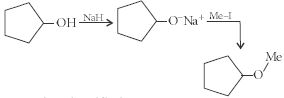
DifficultMCQ
This reaction can be classified as:
A
dehydration reaction
B
Williamson alcohol synthesis reaction
C
Williamson ether synthesis reaction
D
alcohol formation reaction
Solution
(C) The given reaction involves the formation of an ether from an alkoxide ion and an alkyl halide.
First,cyclopentanol reacts with $NaH$ to form sodium cyclopentoxide.
Then,sodium cyclopentoxide reacts with methyl iodide $(Me-I)$ via an $S_N2$ mechanism to form methyl cyclopentyl ether.
This is a classic example of the Williamson ether synthesis reaction,represented by the general equation: $R-X + R'-ONa \longrightarrow R-O-R' + NaX$.
First,cyclopentanol reacts with $NaH$ to form sodium cyclopentoxide.
Then,sodium cyclopentoxide reacts with methyl iodide $(Me-I)$ via an $S_N2$ mechanism to form methyl cyclopentyl ether.
This is a classic example of the Williamson ether synthesis reaction,represented by the general equation: $R-X + R'-ONa \longrightarrow R-O-R' + NaX$.
0 likes
View Solution75
MediumMCQ
This reaction,$CH_3-C(CH_3)_2-ONa + CH_3-CH_2-Cl \xrightarrow{-NaCl} CH_3-C(CH_3)_2-O-CH_2-CH_3$ is called:
A
Etard reaction
B
Gattermann-Koch reaction
C
Williamson synthesis
D
Williamson continuous etherification process
Solution
(C) The reaction of a sodium alkoxide with an alkyl halide to form an ether is known as $Williamson$ synthesis.
This reaction proceeds via an $S_N2$ mechanism where the alkoxide ion acts as a nucleophile and attacks the alkyl halide.
The given reaction is: $CH_3-C(CH_3)_2-ONa + CH_3-CH_2-Cl \rightarrow CH_3-C(CH_3)_2-O-CH_2-CH_3 + NaCl$.
This reaction proceeds via an $S_N2$ mechanism where the alkoxide ion acts as a nucleophile and attacks the alkyl halide.
The given reaction is: $CH_3-C(CH_3)_2-ONa + CH_3-CH_2-Cl \rightarrow CH_3-C(CH_3)_2-O-CH_2-CH_3 + NaCl$.
0 likes
View Solution76
MediumMCQ
Among the following sets of reactants,which one produces anisole?
A
$CH_3CHO; \, RMgX$
B
$C_6H_5OH; \, NaOH; \, CH_3I$
C
$C_6H_5OH; \, \text{neutral } FeCl_3$
D
$C_6H_5CH_3; \, CH_3COCl; \, AlCl_3$
Solution
(B) The reaction of phenol $(C_6H_5OH)$ with sodium hydroxide $(NaOH)$ forms sodium phenoxide $(C_6H_5ONa)$.
Sodium phenoxide then undergoes a nucleophilic substitution reaction $(S_N2)$ with methyl iodide $(CH_3I)$ to produce anisole $(C_6H_5OCH_3)$.
This process is an example of Williamson's ether synthesis.
Sodium phenoxide then undergoes a nucleophilic substitution reaction $(S_N2)$ with methyl iodide $(CH_3I)$ to produce anisole $(C_6H_5OCH_3)$.
This process is an example of Williamson's ether synthesis.
0 likes
View Solution77
MediumMCQ
Among the following ethers,which one will produce methyl alcohol on treatment with hot concentrated $HI$?
A
$CH_3-C(CH_3)_2-O-CH_3$
B
$CH_3-CH(CH_3)-CH_2-O-CH_3$
C
$CH_3-CH_2-CH_2-O-CH_3$
D
$CH_3-CH_2-CH(CH_3)-O-CH_3$
Solution
(A) When an ether contains a tertiary alkyl group,the reaction with hot concentrated $HI$ proceeds via the $S_N1$ mechanism.
In the case of tert-butyl methyl ether $(CH_3-C(CH_3)_2-O-CH_3)$,the $C-O$ bond cleavage occurs such that the stable tertiary carbocation $(CH_3-C^+(CH_3)_2)$ is formed.
This carbocation then reacts with $I^-$ to form tert-butyl iodide,while the methoxy group is protonated to form methyl alcohol $(CH_3OH)$.
In contrast,for primary and secondary alkyl ethers,the reaction follows the $S_N2$ mechanism,where the nucleophile $I^-$ attacks the less sterically hindered carbon (the methyl group),resulting in the formation of methyl iodide $(CH_3I)$ and the corresponding alcohol.
In the case of tert-butyl methyl ether $(CH_3-C(CH_3)_2-O-CH_3)$,the $C-O$ bond cleavage occurs such that the stable tertiary carbocation $(CH_3-C^+(CH_3)_2)$ is formed.
This carbocation then reacts with $I^-$ to form tert-butyl iodide,while the methoxy group is protonated to form methyl alcohol $(CH_3OH)$.
In contrast,for primary and secondary alkyl ethers,the reaction follows the $S_N2$ mechanism,where the nucleophile $I^-$ attacks the less sterically hindered carbon (the methyl group),resulting in the formation of methyl iodide $(CH_3I)$ and the corresponding alcohol.
0 likes
View Solution78
MediumMCQ
In the reaction: $CH_3-CH(CH_3)-CH_2-O-CH_2-CH_3 + HI \xrightarrow{\text{Heated}}$ Which of the following compounds will be formed?
A
$CH_3-CH(CH_3)-CH_3 + CH_3CH_2OH$
B
$CH_3-CH(CH_3)-CH_2OH + CH_3CH_3$
C
$CH_3-CH(CH_3)-CH_2OH + CH_3CH_2I$
D
$CH_3-CH(CH_3)-CH_2I + CH_3CH_2OH$
Solution
(C) The reaction of an ether with $HI$ follows the $S_N2$ mechanism when the alkyl groups are primary or secondary.
The iodide ion $(I^-)$ attacks the less sterically hindered alkyl group.
In isobutyl ethyl ether $(CH_3-CH(CH_3)-CH_2-O-CH_2-CH_3)$,the ethyl group is less sterically hindered than the isobutyl group.
Therefore,the $I^-$ ion attacks the ethyl group,resulting in the formation of isobutyl alcohol $(CH_3-CH(CH_3)-CH_2OH)$ and ethyl iodide $(CH_3CH_2I)$.
The iodide ion $(I^-)$ attacks the less sterically hindered alkyl group.
In isobutyl ethyl ether $(CH_3-CH(CH_3)-CH_2-O-CH_2-CH_3)$,the ethyl group is less sterically hindered than the isobutyl group.
Therefore,the $I^-$ ion attacks the ethyl group,resulting in the formation of isobutyl alcohol $(CH_3-CH(CH_3)-CH_2OH)$ and ethyl iodide $(CH_3CH_2I)$.
0 likes
View Solution79
MediumMCQ
The major organic product in the reaction is: $CH_3-O-CH(CH_3)_2 + HI \to$ products
A
$CH_3I + (CH_3)_2CHOH$
B
$CH_3OH + (CH_3)_2CHI$
C
$ICH_2OCH(CH_3)_2$
D
$CH_3-O-C(I)(CH_3)_2$
Solution
(A) In the reaction of an unsymmetrical ether with $HI$,if the alkyl groups are primary or secondary,the reaction follows the $S_N2$ mechanism.
The iodide ion $(I^{-})$ attacks the smaller (less sterically hindered) alkyl group.
In $CH_3-O-CH(CH_3)_2$,the methyl group $(-CH_3)$ is smaller than the isopropyl group $(-CH(CH_3)_2)$.
Therefore,the $I^{-}$ ion attacks the methyl group,leading to the formation of $CH_3I$ and $(CH_3)_2CHOH$ as the major products.
The iodide ion $(I^{-})$ attacks the smaller (less sterically hindered) alkyl group.
In $CH_3-O-CH(CH_3)_2$,the methyl group $(-CH_3)$ is smaller than the isopropyl group $(-CH(CH_3)_2)$.
Therefore,the $I^{-}$ ion attacks the methyl group,leading to the formation of $CH_3I$ and $(CH_3)_2CHOH$ as the major products.
0 likes
View Solution80
MediumMCQ
$PhMgBr + EtOEt \rightarrow$ Product will be
A
$PhOEt$
B
$PhOH$
C
$PhEt$
D
None
Solution
(D) The reaction between a Grignard reagent $(PhMgBr)$ and an ether $(EtOEt)$ does not proceed under standard conditions. Grignard reagents are nucleophilic and basic,but ethers are generally inert towards them because they lack an acidic proton or a suitable leaving group that can be displaced by the phenyl nucleophile. Therefore,no reaction occurs.
0 likes
View Solution81
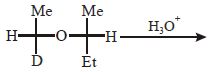
EasyMCQ
Which of the following alcohols is not present in the mixture containing major products of the reaction shown below?
A
B
C
D
Solution
(A) The reaction of an ether with $H_3O^+$ (acid-catalyzed cleavage) typically follows an $S_N2$ mechanism for primary and secondary alkyl groups.
In the given ether,both alkyl groups attached to the oxygen are secondary.
Cleavage occurs at the $C-O$ bond,resulting in the formation of two alcohols.
Since the reaction proceeds via an $S_N2$ mechanism,the configuration at the chiral center where the bond is broken will be inverted.
For the left side $(CH(Me)(D)-O-)$,the $C-O$ bond cleavage leads to $CH(Me)(D)OH$ with inversion.
For the right side $(-O-CH(Me)(Et))$,the $C-O$ bond cleavage leads to $CH(Me)(Et)OH$ with inversion.
Option $A$ represents the alcohol from the left side without inversion.
Option $B$ represents the alcohol from the right side without inversion.
Option $C$ represents the alcohol from the left side with inversion.
Option $D$ represents the alcohol from the right side with inversion.
Since the reaction involves $S_N2$ inversion,the products formed are the inverted alcohols. Therefore,the alcohols with the original configuration (non-inverted) are not present in the major product mixture.
In the given ether,both alkyl groups attached to the oxygen are secondary.
Cleavage occurs at the $C-O$ bond,resulting in the formation of two alcohols.
Since the reaction proceeds via an $S_N2$ mechanism,the configuration at the chiral center where the bond is broken will be inverted.
For the left side $(CH(Me)(D)-O-)$,the $C-O$ bond cleavage leads to $CH(Me)(D)OH$ with inversion.
For the right side $(-O-CH(Me)(Et))$,the $C-O$ bond cleavage leads to $CH(Me)(Et)OH$ with inversion.
Option $A$ represents the alcohol from the left side without inversion.
Option $B$ represents the alcohol from the right side without inversion.
Option $C$ represents the alcohol from the left side with inversion.
Option $D$ represents the alcohol from the right side with inversion.
Since the reaction involves $S_N2$ inversion,the products formed are the inverted alcohols. Therefore,the alcohols with the original configuration (non-inverted) are not present in the major product mixture.
0 likes
View Solution82
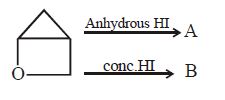
DifficultMCQ
For the given reaction,$A$ and $B$ are respectively:
A
Both are $2-$iodocyclopentanol
B
Both are $2-$iodocyclopentanol
C
Both are $2-$iodocyclopentanol
D
Both are $2-$iodocyclopentanol
Solution
(A) The reaction of cyclic ethers with $HI$ involves the protonation of the oxygen atom followed by the nucleophilic attack of the iodide ion $(I^-)$.
In the case of the given cyclic ether (tetrahydrofuran derivative),the protonation occurs at the oxygen atom.
The iodide ion $(I^-)$ then attacks the less hindered carbon atom to open the ring.
Since both $HI$ (anhydrous) and $conc. HI$ provide the same reactive species ($H^+$ and $I^-$) for this ring-opening reaction,the product formed in both cases is the same,which is $2$-iodocyclopentanol.
In the case of the given cyclic ether (tetrahydrofuran derivative),the protonation occurs at the oxygen atom.
The iodide ion $(I^-)$ then attacks the less hindered carbon atom to open the ring.
Since both $HI$ (anhydrous) and $conc. HI$ provide the same reactive species ($H^+$ and $I^-$) for this ring-opening reaction,the product formed in both cases is the same,which is $2$-iodocyclopentanol.
0 likes
View Solution83
MediumMCQ
$(CH_3)_3C-CH(O)CH_2 + CH_3SNa \xrightarrow{C_2H_5OH} ?$
The product formed is:
The product formed is:
A
$CH_3S-CH_2-CH(OH)-C(CH_3)_3$
B
$(CH_3)_3C-CH(SCH_3)-CH_2OH$
C
$CH_3S-CH_2-CH(OH)-CH(CH_3)_2$
D
$(CH_3)_3C-CH_2-CH(OH)-SCH_3$
Solution
(A) The reaction involves the nucleophilic ring opening of an epoxide ($2$-tert-butyl-oxirane) by the methanethiolate ion $(CH_3S^-)$.
In a protic solvent like $C_2H_5OH$,the $S_N2$ mechanism dominates.
The nucleophile $CH_3S^-$ attacks the less sterically hindered carbon atom of the epoxide ring,which is the $CH_2$ group.
The epoxide ring opens,and the resulting alkoxide ion is protonated by the solvent to yield the final product,$CH_3S-CH_2-CH(OH)-C(CH_3)_3$.
In a protic solvent like $C_2H_5OH$,the $S_N2$ mechanism dominates.
The nucleophile $CH_3S^-$ attacks the less sterically hindered carbon atom of the epoxide ring,which is the $CH_2$ group.
The epoxide ring opens,and the resulting alkoxide ion is protonated by the solvent to yield the final product,$CH_3S-CH_2-CH(OH)-C(CH_3)_3$.
0 likes
View Solution84
MediumMCQ
When ethyl bromide is treated with dry $Ag_2O$,the main product is:
A
Ethyl ether
B
Ethanol
C
Ethoxy ethane
D
All of the above
Solution
(C) When ethyl bromide $(CH_3CH_2Br)$ is treated with dry silver oxide $(Ag_2O)$,it undergoes a Williamson-like ether synthesis reaction to form diethyl ether,also known as ethoxy ethane.
$2CH_3CH_2Br + Ag_2O \rightarrow CH_3CH_2OCH_2CH_3 + 2AgBr$
$2CH_3CH_2Br + Ag_2O \rightarrow CH_3CH_2OCH_2CH_3 + 2AgBr$
0 likes
View Solution85
MediumMCQ
In the following reaction: $Cl-CH_2-CH(O)^{14}CH_2 \xrightarrow{C_2H_5O^-} \text{the final product is:}$
A
$Cl-CH_2-CH(OH)-^{14}CH_2-OC_2H_5$
B
$Cl-CH_2-CH(OC_2H_5)-^{14}CH_2-ONa$
C
$CH_2(O)CH-^{14}CH_2-OC_2H_5$
D
$CH_2(O)CH-^{14}CH_2-OC_2H_5$
Solution
(C) The reaction involves the nucleophilic attack of the ethoxide ion $(C_2H_5O^-)$ on the less sterically hindered terminal carbon $(^{14}CH_2)$ of the epoxide ring in epichlorohydrin.
This opens the epoxide ring to form an alkoxide intermediate: $Cl-CH_2-CH(O^-)-^{14}CH_2-OC_2H_5$.
Subsequently,the alkoxide oxygen performs an intramolecular $S_N2$ attack on the $CH_2$ group attached to the chlorine atom,displacing the chloride ion $(Cl^-)$.
This cyclization reforms an epoxide ring,resulting in the final product: $CH_2(O)CH-^{14}CH_2-OC_2H_5$.
This opens the epoxide ring to form an alkoxide intermediate: $Cl-CH_2-CH(O^-)-^{14}CH_2-OC_2H_5$.
Subsequently,the alkoxide oxygen performs an intramolecular $S_N2$ attack on the $CH_2$ group attached to the chlorine atom,displacing the chloride ion $(Cl^-)$.
This cyclization reforms an epoxide ring,resulting in the final product: $CH_2(O)CH-^{14}CH_2-OC_2H_5$.
0 likes
View Solution86
DifficultMCQ
Consider the reaction of $HI$ with the following compounds:
$I$: Tetrahydropyran
$II$: Isochroman (or similar cyclic ether fused to benzene)
Which forms a di-iodide on reaction with $HI$ (excess)?
$I$: Tetrahydropyran
$II$: Isochroman (or similar cyclic ether fused to benzene)
Which forms a di-iodide on reaction with $HI$ (excess)?
A
$I$ and $II$ both
B
$II$ only
C
$I$ only
D
none
Solution
(C) Compound $I$ (tetrahydropyran) is a cyclic ether. Upon reaction with excess $HI$,the ether ring undergoes cleavage.
In the first step,the protonated ether is attacked by $I^-$ to form $HO-(CH_2)_5-I$.
In the second step,the hydroxyl group is converted to an iodide by $HI$,resulting in the formation of $I-(CH_2)_5-I$ ($1$,$5$-diiodopentane).
Compound $II$ contains a phenolic ether linkage (where the oxygen is attached to an aromatic ring). Cleavage of the $C(aryl)-O$ bond is extremely difficult due to the partial double bond character of the $C-O$ bond and the stability of the aromatic ring,so it does not form a di-iodide under standard conditions.
In the first step,the protonated ether is attacked by $I^-$ to form $HO-(CH_2)_5-I$.
In the second step,the hydroxyl group is converted to an iodide by $HI$,resulting in the formation of $I-(CH_2)_5-I$ ($1$,$5$-diiodopentane).
Compound $II$ contains a phenolic ether linkage (where the oxygen is attached to an aromatic ring). Cleavage of the $C(aryl)-O$ bond is extremely difficult due to the partial double bond character of the $C-O$ bond and the stability of the aromatic ring,so it does not form a di-iodide under standard conditions.
0 likes
View Solution87
MediumMCQ
The reaction of $CH_3-O-C_2H_5$ with $HI$ gives:
A
$CH_3I$
B
$C_2H_5OH$
C
$CH_3I + C_2H_5OH$
D
$C_2H_5I + CH_3OH$
Solution
(C) In the reaction of an unsymmetrical ether with $HI$,the iodide ion $(I^-)$ attacks the smaller alkyl group via $S_N2$ mechanism due to less steric hindrance.
$CH_3-O-C_2H_5 + HI \rightarrow CH_3I + C_2H_5OH$
$CH_3-O-C_2H_5 + HI \rightarrow CH_3I + C_2H_5OH$
0 likes
View Solution88
AdvancedMCQ
Diethyl ether and air give ether hydroperoxide. The mechanism of the reaction is
A
Nucleophilic substitution
B
Free radical addition
C
Free radical substitution
D
None of the above
Solution
(C) The formation of $diethyl$ ether hydroperoxide occurs via the autoxidation of $diethyl$ ether in the presence of atmospheric oxygen.
This process involves the abstraction of a hydrogen atom from the $\alpha$-carbon of the ether by a radical initiator,followed by the addition of oxygen to form a peroxy radical.
This is a $free \ radical \ chain \ mechanism$ that proceeds through a $free \ radical \ substitution$ pathway.
This process involves the abstraction of a hydrogen atom from the $\alpha$-carbon of the ether by a radical initiator,followed by the addition of oxygen to form a peroxy radical.
This is a $free \ radical \ chain \ mechanism$ that proceeds through a $free \ radical \ substitution$ pathway.
0 likes
View Solution89
DifficultMCQ
Ether on carbonylation gives:
A
Alkanoic acid
B
Alkanone
C
Alkyl alkanoate
D
Alkanal
Solution
(C) The carbonylation of ethers involves the reaction with carbon monoxide $(CO)$ in the presence of a catalyst (like $BF_3$ or metal carbonyls) to form esters.
The general reaction is:
$R - O - R + CO \xrightarrow{\text{catalyst}} R - CO - O - R$
Thus,the product formed is an alkyl alkanoate.
The general reaction is:
$R - O - R + CO \xrightarrow{\text{catalyst}} R - CO - O - R$
Thus,the product formed is an alkyl alkanoate.
0 likes
View Solution90
DifficultMCQ
$R-O^+(H)-R' + I^- \to RI + R'OH$. Which of the following is true about this mechanism?
A
$S_N1$ in gas phase
B
$S_N2$ in aqueous phase
C
Both of the above
D
None of these
Solution
(D) The mechanism of ether cleavage by $HI$ depends on the nature of the alkyl groups ($R$ and $R'$).
If the alkyl groups are primary or secondary,the reaction follows the $S_N2$ mechanism.
If one of the alkyl groups is tertiary,it follows the $S_N1$ mechanism.
Since the nature of $R$ and $R'$ is not specified,and the reaction conditions (such as solvent polarity and temperature) significantly influence the pathway,neither statement $A$ nor $B$ is universally true for the given general reaction.
If the alkyl groups are primary or secondary,the reaction follows the $S_N2$ mechanism.
If one of the alkyl groups is tertiary,it follows the $S_N1$ mechanism.
Since the nature of $R$ and $R'$ is not specified,and the reaction conditions (such as solvent polarity and temperature) significantly influence the pathway,neither statement $A$ nor $B$ is universally true for the given general reaction.
0 likes
View Solution91
MediumMCQ
An ether is heated with phosphorus pentasulphide to give:
A
Alkanethiol
B
Dialkyl sulphide
C
Hydrogen sulphide
D
Thioester
Solution
(B) When an ether $(R-O-R)$ is heated with phosphorus pentasulphide $(P_2S_5)$,the oxygen atom of the ether is replaced by a sulphur atom to form a dialkyl sulphide $(R-S-R)$.
The reaction is represented as:
$5 R-O-R + P_2S_5 \rightarrow 5 R-S-R + P_2O_5$
The reaction is represented as:
$5 R-O-R + P_2S_5 \rightarrow 5 R-S-R + P_2O_5$
0 likes
View Solution92
MediumMCQ
Which of the following ethers cannot be synthesized by Williamson's ether synthesis?
A
$Me_3C-O-Me$
B
$CH_3-CH_2-CH_2-O-CH_2-CH=CH_2$
C
$Me_3C-O-Ph$
D
$Ph-O-Et$
0 likes
View Solution93
DifficultMCQ
$Ph-O-CH_2-Ph$ $\xrightarrow{HI/\Delta}$ product
A
$Ph-I + Ph-CH_2-OH$
B
$Ph-OH + Ph-CH_2-OH$
C
$Ph-I + Ph-OH$
D
$Ph-OH + Ph-CH_2-I$
Solution
(D) The reaction of an ether with $HI$ involves the protonation of the ether oxygen atom to form an oxonium ion.
In the case of $Ph-O-CH_2-Ph$,the cleavage occurs such that the more stable carbocation is formed.
The $Ph-CH_2^+$ (benzyl carbocation) is stabilized by resonance,whereas the $Ph^+$ (phenyl carbocation) is highly unstable.
Therefore,the $I^-$ ion attacks the $CH_2$ group of the benzyl moiety,leading to the formation of $Ph-OH$ and $Ph-CH_2-I$.
In the case of $Ph-O-CH_2-Ph$,the cleavage occurs such that the more stable carbocation is formed.
The $Ph-CH_2^+$ (benzyl carbocation) is stabilized by resonance,whereas the $Ph^+$ (phenyl carbocation) is highly unstable.
Therefore,the $I^-$ ion attacks the $CH_2$ group of the benzyl moiety,leading to the formation of $Ph-OH$ and $Ph-CH_2-I$.
0 likes
View Solution94
DifficultMCQ
Which of the following can be prepared effectively by Williamson ether synthesis?
A
$C_6H_5-O-C_6H_5$
B
$C_6H_5-O-CH_3$
C
$(CH_3)_3C-O-C_6H_5$
D
$CH_2=CH-O-C_6H_5$
Solution
(B) Williamson ether synthesis involves the reaction of an alkoxide ion with an alkyl halide via an $S_N2$ mechanism.
For effective synthesis,the alkyl halide must be primary $(1^\circ)$ to avoid competing elimination reactions.
In option $B$,the reaction between sodium phenoxide $(C_6H_5ONa)$ and methyl iodide $(CH_3I)$ is highly effective because $CH_3I$ is a primary alkyl halide and does not undergo elimination.
Option $A$ is not possible because aryl halides do not undergo $S_N2$ reactions.
Option $C$ involves a tertiary alkyl group,which would lead to elimination (forming an alkene) rather than substitution.
Option $D$ involves a vinyl halide,which is unreactive towards $S_N2$ substitution.
For effective synthesis,the alkyl halide must be primary $(1^\circ)$ to avoid competing elimination reactions.
In option $B$,the reaction between sodium phenoxide $(C_6H_5ONa)$ and methyl iodide $(CH_3I)$ is highly effective because $CH_3I$ is a primary alkyl halide and does not undergo elimination.
Option $A$ is not possible because aryl halides do not undergo $S_N2$ reactions.
Option $C$ involves a tertiary alkyl group,which would lead to elimination (forming an alkene) rather than substitution.
Option $D$ involves a vinyl halide,which is unreactive towards $S_N2$ substitution.
0 likes
View Solution95
AdvancedMCQ
The major product in the given reaction will be:
(One mole of each)
$C_6H_5O^-Na^+ + C_6H_5CH_2Cl + C_2H_5OK^+ \xrightarrow{\text{Major Product}}$
(One mole of each)
$C_6H_5O^-Na^+ + C_6H_5CH_2Cl + C_2H_5OK^+ \xrightarrow{\text{Major Product}}$
A
Benzyl phenyl ether $(C_6H_5CH_2OC_6H_5)$
B
Benzyl ethyl ether $(C_6H_5CH_2OC_2H_5)$
C
Cyclohexyl benzyl ether
D
Phenol $(C_6H_5OH)$
Solution
(B) The reaction involves a nucleophilic substitution $(S_N2)$ on benzyl chloride $(C_6H_5CH_2Cl)$.
There are two nucleophiles present: phenoxide ion $(C_6H_5O^-)$ and ethoxide ion $(C_2H_5O^-)$.
Ethoxide ion $(C_2H_5O^-)$ is a stronger nucleophile than the phenoxide ion $(C_6H_5O^-)$ because the negative charge on the phenoxide ion is delocalized over the benzene ring,making it less available for attack.
Therefore,the ethoxide ion will preferentially attack the electrophilic carbon of benzyl chloride to form benzyl ethyl ether $(C_6H_5CH_2OC_2H_5)$ as the major product.
There are two nucleophiles present: phenoxide ion $(C_6H_5O^-)$ and ethoxide ion $(C_2H_5O^-)$.
Ethoxide ion $(C_2H_5O^-)$ is a stronger nucleophile than the phenoxide ion $(C_6H_5O^-)$ because the negative charge on the phenoxide ion is delocalized over the benzene ring,making it less available for attack.
Therefore,the ethoxide ion will preferentially attack the electrophilic carbon of benzyl chloride to form benzyl ethyl ether $(C_6H_5CH_2OC_2H_5)$ as the major product.
0 likes
View Solution96
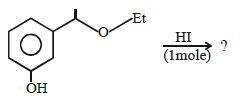
DifficultMCQ
The major product of the above reaction is:
A
$3-$($1$-iodoethyl)phenol + ethanol
B
$3-$($1$-hydroxyethyl)phenol + iodoethane
C
$3-$($1$-iodoethyl)phenol + ethanol
D
$3-$($1$-iodoethyl)phenol + iodoethane
Solution
(A) The reaction involves the cleavage of an ether with $HI$. The ether is $3-(1-ethoxyethyl)phenol$.
When $HI$ reacts with this ether,the oxygen atom of the ether is protonated by $H^+$.
This forms a stable carbocation at the benzylic position (specifically,a secondary benzylic carbocation stabilized by the benzene ring).
Since the carbocation is stable,the reaction proceeds via an $S_N1$ mechanism.
The iodide ion $(I^-)$ attacks the carbocation to form $3-(1-iodoethyl)phenol$,and the ethyl group is released as ethanol $(C_2H_5OH)$.
Thus,the major products are $3-(1-iodoethyl)phenol$ and ethanol.
When $HI$ reacts with this ether,the oxygen atom of the ether is protonated by $H^+$.
This forms a stable carbocation at the benzylic position (specifically,a secondary benzylic carbocation stabilized by the benzene ring).
Since the carbocation is stable,the reaction proceeds via an $S_N1$ mechanism.
The iodide ion $(I^-)$ attacks the carbocation to form $3-(1-iodoethyl)phenol$,and the ethyl group is released as ethanol $(C_2H_5OH)$.
Thus,the major products are $3-(1-iodoethyl)phenol$ and ethanol.
0 likes
View Solution97
MediumMCQ
The compound $CH_3-O-C(CH_3)_3$ is prepared best by the reaction:
A
$(CH_3)_3C-Br + CH_3OK \to$
B
$(CH_3)_3C-OH \xrightarrow[170 \ ^oC]{H_2SO_4}$
C
$(CH_3)_3C-OK + CH_3-Br \to$
D
$(CH_3)_2C=CH_2 \xrightarrow{Conc. \ H_2SO_4, CH_3OH}$
Solution
(C) The compound is methyl tert-butyl ether,$(CH_3)_3C-O-CH_3$.
To prepare ethers,the Williamson ether synthesis is the most effective method.
It involves the reaction of an alkoxide ion with a primary alkyl halide.
If a tertiary alkyl halide is used (as in option $A$),elimination (dehydrohalogenation) occurs instead of substitution,leading to an alkene.
Therefore,the correct approach is to use a tertiary alkoxide $(CH_3)_3C-OK$ and a primary alkyl halide $(CH_3-Br)$ to undergo $S_N2$ reaction.
Reaction: $(CH_3)_3C-OK + CH_3-Br \to (CH_3)_3C-O-CH_3 + KBr$.
To prepare ethers,the Williamson ether synthesis is the most effective method.
It involves the reaction of an alkoxide ion with a primary alkyl halide.
If a tertiary alkyl halide is used (as in option $A$),elimination (dehydrohalogenation) occurs instead of substitution,leading to an alkene.
Therefore,the correct approach is to use a tertiary alkoxide $(CH_3)_3C-OK$ and a primary alkyl halide $(CH_3-Br)$ to undergo $S_N2$ reaction.
Reaction: $(CH_3)_3C-OK + CH_3-Br \to (CH_3)_3C-O-CH_3 + KBr$.
0 likes
View Solution98
MediumMCQ
Ethanol reacts with $H_2SO_4$ at $140^\circ C$ to form
A
Ethene
B
Ethyl hydrogen sulphate
C
Ethoxy ethane
D
None of these
Solution
(C) When ethanol $(CH_3CH_2OH)$ is heated with concentrated $H_2SO_4$ at $140^\circ C$ $(413 \ K)$,it undergoes intermolecular dehydration to form diethyl ether (ethoxy ethane).
The reaction is as follows:
$2CH_3CH_2OH \xrightarrow{conc. H_2SO_4, 140^\circ C} CH_3CH_2-O-CH_2CH_3 + H_2O$
Mechanism:
$1$. Protonation of ethanol: $CH_3CH_2OH + H^+ \rightarrow CH_3CH_2OH_2^+$
$2$. Nucleophilic attack: $CH_3CH_2OH_2^+ + CH_3CH_2OH \rightarrow CH_3CH_2-O^+(H)-CH_2CH_3 + H_2O$
$3$. Deprotonation: $CH_3CH_2-O^+(H)-CH_2CH_3 \rightarrow CH_3CH_2-O-CH_2CH_3 + H^+$
The reaction is as follows:
$2CH_3CH_2OH \xrightarrow{conc. H_2SO_4, 140^\circ C} CH_3CH_2-O-CH_2CH_3 + H_2O$
Mechanism:
$1$. Protonation of ethanol: $CH_3CH_2OH + H^+ \rightarrow CH_3CH_2OH_2^+$
$2$. Nucleophilic attack: $CH_3CH_2OH_2^+ + CH_3CH_2OH \rightarrow CH_3CH_2-O^+(H)-CH_2CH_3 + H_2O$
$3$. Deprotonation: $CH_3CH_2-O^+(H)-CH_2CH_3 \rightarrow CH_3CH_2-O-CH_2CH_3 + H^+$
0 likes
View Solution99
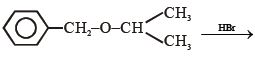
MediumMCQ
The product of the reaction is $?$
A
$Ph-CH_2OH + CH_3-CH(Br)-CH_3$
B
$Ph-CH_2Br + CH_3-CH(OH)-CH_3$
C
$Ph-Br + CH_3-O-CH(CH_3)_2$
D
$Ph-CH_2Br + CH_3CH_2CH_2OH$
Solution
(B) The reaction of an ether with $HBr$ involves the protonation of the ether oxygen atom by $H^+$,followed by the nucleophilic attack of $Br^-$ on the carbon atom.
In the given ether,$Ph-CH_2-O-CH(CH_3)_2$,the benzyl group $(Ph-CH_2-)$ is attached to the oxygen. The carbocation formed at the benzylic position $(Ph-CH_2^+)$ is stabilized by resonance.
Therefore,the $Br^-$ nucleophile attacks the benzylic carbon to form benzyl bromide $(Ph-CH_2Br)$,and the isopropyl group forms isopropyl alcohol $(CH_3-CH(OH)-CH_3)$.
The reaction is: $Ph-CH_2-O-CH(CH_3)_2 + HBr \rightarrow Ph-CH_2Br + CH_3-CH(OH)-CH_3$.
In the given ether,$Ph-CH_2-O-CH(CH_3)_2$,the benzyl group $(Ph-CH_2-)$ is attached to the oxygen. The carbocation formed at the benzylic position $(Ph-CH_2^+)$ is stabilized by resonance.
Therefore,the $Br^-$ nucleophile attacks the benzylic carbon to form benzyl bromide $(Ph-CH_2Br)$,and the isopropyl group forms isopropyl alcohol $(CH_3-CH(OH)-CH_3)$.
The reaction is: $Ph-CH_2-O-CH(CH_3)_2 + HBr \rightarrow Ph-CH_2Br + CH_3-CH(OH)-CH_3$.
0 likes
View Solution100
DifficultMCQ
Which of the following reactions will give ether as the major product?
A
$CH_3ONa + CH_3-C(CH_3)_2-Cl \rightarrow$
B
$CH_3-CH_2-ONa + C_6H_5-Cl \xrightarrow{\text{Room Temp.}} $
C
$CH_3-CH_2-ONa + CH_3-C(Cl)(CH_3)-CH_2-CH_3 \rightarrow$
D
$CH_3ONa + C_6H_5-CH_2-Br \rightarrow$
Solution
(D) The Williamson ether synthesis involves the reaction of an alkoxide ion with a primary alkyl halide via an $S_N2$ mechanism to form an ether.
$(A)$ $CH_3ONa + CH_3-C(CH_3)_2-Cl \rightarrow$ This is a tertiary alkyl halide. The strong base $CH_3O^-$ will cause elimination $(E2)$ to form an alkene (isobutylene) as the major product,not an ether.
$(B)$ $CH_3-CH_2-ONa + C_6H_5-Cl \rightarrow$ Aryl halides do not undergo $S_N2$ reactions under normal conditions due to the partial double bond character of the $C-Cl$ bond and steric hindrance. No reaction occurs.
$(C)$ $CH_3-CH_2-ONa + CH_3-C(Cl)(CH_3)-CH_2-CH_3 \rightarrow$ This is a tertiary alkyl halide. Similar to $(A)$,elimination $(E2)$ will be the major pathway,yielding an alkene.
$(D)$ $CH_3ONa + C_6H_5-CH_2-Br \rightarrow$ This is a primary benzylic halide. Benzylic halides are highly reactive towards $S_N2$ reactions. The $CH_3O^-$ nucleophile will attack the $CH_2$ group,displacing $Br^-$ to form benzyl methyl ether $(C_6H_5-CH_2-OCH_3)$ as the major product.
Therefore,option $(D)$ is the correct reaction.
$(A)$ $CH_3ONa + CH_3-C(CH_3)_2-Cl \rightarrow$ This is a tertiary alkyl halide. The strong base $CH_3O^-$ will cause elimination $(E2)$ to form an alkene (isobutylene) as the major product,not an ether.
$(B)$ $CH_3-CH_2-ONa + C_6H_5-Cl \rightarrow$ Aryl halides do not undergo $S_N2$ reactions under normal conditions due to the partial double bond character of the $C-Cl$ bond and steric hindrance. No reaction occurs.
$(C)$ $CH_3-CH_2-ONa + CH_3-C(Cl)(CH_3)-CH_2-CH_3 \rightarrow$ This is a tertiary alkyl halide. Similar to $(A)$,elimination $(E2)$ will be the major pathway,yielding an alkene.
$(D)$ $CH_3ONa + C_6H_5-CH_2-Br \rightarrow$ This is a primary benzylic halide. Benzylic halides are highly reactive towards $S_N2$ reactions. The $CH_3O^-$ nucleophile will attack the $CH_2$ group,displacing $Br^-$ to form benzyl methyl ether $(C_6H_5-CH_2-OCH_3)$ as the major product.
Therefore,option $(D)$ is the correct reaction.
0 likes
View SolutionAlcohols, Phenols and Ethers — Properties of Ethers · Frequently Asked Questions
1Are these Alcohols, Phenols and Ethers questions useful for JEE and NEET?
Yes. All questions in this section are mapped to JEE Main and NEET exam patterns. Previous year questions from JEE Main, NEET, GUJCET and state-level exams are included with full solutions.
2Can I switch to Hindi or Gujarati for these questions?
Yes. Use the language tabs in the hero section or the sidebar to view the same questions and solutions in English, Hindi or Gujarati.
3How do I generate a question paper from this subtopic?
Use the Vedclass Exam Paper Generator — select the chapter and subtopic, set difficulty, and generate Sets A, B, C, D automatically. First 3 chapters of every subject are free.
Vedclass Products
For Students
Vedclass Test Series
Mock tests in real JEE/NEET style with performance analysis. 5-day free trial.
Start Free TrialFor Teachers
Exam Paper Generator
Generate Set A/B/C/D papers from this chapter in 2 minutes. 3 chapters free.
Try FreeFor Institutes
Online Exam Module
Live online exams with unlimited students, 360° analytics & white-label branding.
See DemoFor Teachers & Institutes
Generate a Alcohols, Phenols and Ethers Exam Paper in 2 Minutes
Select subtopic & difficulty — Sets A, B, C, D auto-generated with No Repeat logic.
First 3 chapters of every subject are free — no payment required.