
A English
Pedigree Analysis and Mendelian disorders Questions in English
Class 12 Biology · Principles of Inheritance and Variation · Pedigree Analysis and Mendelian disorders
420+
Questions
English
Language
100%
With Solutions
Showing 50 of 420 questions in English
251
Medium
Match the columns:
| Column $I$ | Column $II$ |
|---|---|
| $(1)$ Albinism | $(q)$ Recessive gene represented by $cc$ |
| $(2)$ Phenylketonuria | $(s)$ Recessive gene represented by $pp$ |
| $(3)$ Sickle cell anaemia | $(p)$ Recessive gene represented by $Hb^sHb^s$ |
| $(4)$ Alkaptonuria | $(r)$ Recessive gene represented by $aa$ |
Solution
(A) The correct matches are:
$(1)$ Albinism is an autosomal recessive disorder caused by the absence of the enzyme tyrosinase,often represented by the genotype $cc$.
$(2)$ Phenylketonuria $(PKU)$ is an inborn error of metabolism caused by a recessive gene,often represented by $pp$.
$(3)$ Sickle cell anaemia is an autosomal recessive disorder caused by a mutation in the $\beta$-globin chain,represented by the genotype $Hb^sHb^s$.
$(4)$ Alkaptonuria is an autosomal recessive metabolic disorder caused by a deficiency of the enzyme homogentisate $1,2-$dioxygenase,often represented by the genotype $aa$.
Therefore,the correct matching is $(1-q), (2-s), (3-p), (4-r)$.
$(1)$ Albinism is an autosomal recessive disorder caused by the absence of the enzyme tyrosinase,often represented by the genotype $cc$.
$(2)$ Phenylketonuria $(PKU)$ is an inborn error of metabolism caused by a recessive gene,often represented by $pp$.
$(3)$ Sickle cell anaemia is an autosomal recessive disorder caused by a mutation in the $\beta$-globin chain,represented by the genotype $Hb^sHb^s$.
$(4)$ Alkaptonuria is an autosomal recessive metabolic disorder caused by a deficiency of the enzyme homogentisate $1,2-$dioxygenase,often represented by the genotype $aa$.
Therefore,the correct matching is $(1-q), (2-s), (3-p), (4-r)$.
0 likes
View Solution252
EasyMCQ
Match the columns:
| Column $I$ | Column $II$ |
|---|---|
| $(a)$ Sickle cell anaemia | $(x)$ Homogentisic acid |
| $(b)$ Alkaptonuria | $(y)$ Melanin pigments are absent |
| $(c)$ Albinism | $(z)$ More amount of phenylalanine |
| $(d)$ Phenylketonuria | $(w)$ Defective haemoglobin |
A
$(a-w), (b-x), (c-y), (d-z)$
B
$(a-x), (b-w), (c-y), (d-z)$
C
$(a-w), (b-y), (c-x), (d-z)$
D
$(a-z), (b-x), (c-y), (d-w)$
Solution
(A) The correct matches are as follows:
$1$. $(a)$ Sickle cell anaemia is caused by the production of $(w)$ Defective haemoglobin (specifically $HbS$ due to a point mutation).
$2$. $(b)$ Alkaptonuria is a metabolic disorder characterized by the accumulation of $(x)$ Homogentisic acid in the urine.
$3$. $(c)$ Albinism is a genetic condition where $(y)$ Melanin pigments are absent in the skin,hair,and eyes.
$4$. $(d)$ Phenylketonuria is a disorder caused by the inability to metabolize phenylalanine,leading to $(z)$ More amount of phenylalanine in the body.
Therefore,the correct sequence is $(a-w), (b-x), (c-y), (d-z)$.
$1$. $(a)$ Sickle cell anaemia is caused by the production of $(w)$ Defective haemoglobin (specifically $HbS$ due to a point mutation).
$2$. $(b)$ Alkaptonuria is a metabolic disorder characterized by the accumulation of $(x)$ Homogentisic acid in the urine.
$3$. $(c)$ Albinism is a genetic condition where $(y)$ Melanin pigments are absent in the skin,hair,and eyes.
$4$. $(d)$ Phenylketonuria is a disorder caused by the inability to metabolize phenylalanine,leading to $(z)$ More amount of phenylalanine in the body.
Therefore,the correct sequence is $(a-w), (b-x), (c-y), (d-z)$.
0 likes
View Solution253
MediumMCQ
Which of the following characteristics is $NOT$ associated with Phenylketonuria $(PKU)$?
A
Mental retardation
B
Reduction in hair and skin pigmentation
C
Inability to metabolize Phenylalanine
D
Increase in the level of Tyrosine
Solution
(D) Phenylketonuria $(PKU)$ is an inborn error of metabolism inherited as an autosomal recessive trait.
In this disorder,the affected individual lacks the enzyme Phenylalanine hydroxylase,which is required to convert the amino acid Phenylalanine into Tyrosine.
Due to this deficiency,Phenylalanine accumulates and is converted into Phenylpyruvic acid and other derivatives,leading to mental retardation.
Accumulation of these derivatives in the brain results in mental retardation,and they are also excreted through urine because of poor absorption by the kidney.
Since the conversion of Phenylalanine to Tyrosine is blocked,the level of Tyrosine decreases,not increases.
Therefore,the statement 'Increase in the level of Tyrosine' is incorrect and not associated with $PKU$.
In this disorder,the affected individual lacks the enzyme Phenylalanine hydroxylase,which is required to convert the amino acid Phenylalanine into Tyrosine.
Due to this deficiency,Phenylalanine accumulates and is converted into Phenylpyruvic acid and other derivatives,leading to mental retardation.
Accumulation of these derivatives in the brain results in mental retardation,and they are also excreted through urine because of poor absorption by the kidney.
Since the conversion of Phenylalanine to Tyrosine is blocked,the level of Tyrosine decreases,not increases.
Therefore,the statement 'Increase in the level of Tyrosine' is incorrect and not associated with $PKU$.
0 likes
View Solution254
MediumMCQ
Pedigree analysis is $NOT$ useful for which of the following purposes?
A
To study a specific trait.
B
To identify abnormalities in the offspring.
C
To diagnose a disease.
D
None of the above.
Solution
(D) Pedigree analysis is a tool used in human genetics to study the inheritance pattern of specific traits or diseases over several generations.
It is useful for:
$1$. Studying the inheritance of a specific trait or gene.
$2$. Identifying abnormalities or genetic disorders in offspring.
$3$. Diagnosing the mode of inheritance of a disease (e.g.,autosomal dominant,recessive,or sex-linked).
Since pedigree analysis is useful for all the purposes mentioned in options $A$,$B$,and $C$,the correct answer is $D$.
It is useful for:
$1$. Studying the inheritance of a specific trait or gene.
$2$. Identifying abnormalities or genetic disorders in offspring.
$3$. Diagnosing the mode of inheritance of a disease (e.g.,autosomal dominant,recessive,or sex-linked).
Since pedigree analysis is useful for all the purposes mentioned in options $A$,$B$,and $C$,the correct answer is $D$.
0 likes
View Solution255
MediumMCQ
Which of the following cannot be included in Mendelian disorders?
A
Hemophilia
B
Phenylketonuria
C
Sickle cell anemia
D
Down's syndrome
Solution
(D) Mendelian disorders are primarily determined by alteration or mutation in the single gene. Examples include Hemophilia,Cystic fibrosis,Sickle cell anemia,Color blindness,Phenylketonuria,and Thalassemia.
Down's syndrome is a chromosomal disorder caused by the presence of an additional copy of chromosome number $21$ (trisomy of $21$).
Therefore,Down's syndrome is not a Mendelian disorder but a chromosomal disorder.
Down's syndrome is a chromosomal disorder caused by the presence of an additional copy of chromosome number $21$ (trisomy of $21$).
Therefore,Down's syndrome is not a Mendelian disorder but a chromosomal disorder.
0 likes
View Solution256
MediumMCQ
What type of disorder is hemophilia?
A
Sex-linked dominant
B
Sex-linked recessive
C
Autosomal dominant
D
Autosomal recessive
Solution
(B) Hemophilia is a $X$-linked recessive genetic disorder.
In this condition,the gene responsible for the clotting factor is located on the $X$ chromosome.
Since it is recessive,a female must have the mutation on both $X$ chromosomes to express the disease,whereas a male only needs one mutated $X$ chromosome because he has only one $X$ chromosome ($XY$ genotype).
Therefore,it is classified as a sex-linked recessive disorder.
In this condition,the gene responsible for the clotting factor is located on the $X$ chromosome.
Since it is recessive,a female must have the mutation on both $X$ chromosomes to express the disease,whereas a male only needs one mutated $X$ chromosome because he has only one $X$ chromosome ($XY$ genotype).
Therefore,it is classified as a sex-linked recessive disorder.
0 likes
View Solution257
MediumMCQ
Myotonic dystrophy is which type of trait?
A
Sex-linked dominant
B
Sex-linked recessive
C
Autosomal dominant
D
Autosomal recessive
Solution
(C) Myotonic dystrophy is a genetic disorder characterized by the progressive weakness and wasting of muscles.
It is caused by a mutation in the $DMPK$ gene.
According to the principles of human genetics,myotonic dystrophy follows an autosomal dominant pattern of inheritance.
This means that an affected individual only needs to inherit one copy of the mutated gene from either parent to express the disorder.
It is caused by a mutation in the $DMPK$ gene.
According to the principles of human genetics,myotonic dystrophy follows an autosomal dominant pattern of inheritance.
This means that an affected individual only needs to inherit one copy of the mutated gene from either parent to express the disorder.
0 likes
View Solution258
MediumMCQ
Which of the following disorders is more commonly observed in males than in females?
A
Hemophilia
B
Thalassemia
C
Color blindness
D
Both $a$ and $c$
Solution
(D) Hemophilia and color blindness are $X$-linked recessive disorders.
In males,there is only one $X$ chromosome $(XY)$,so if the gene is present on the $X$ chromosome,the disorder is expressed.
In females,there are two $X$ chromosomes $(XX)$,so they usually act as carriers unless they are homozygous for the recessive trait.
Therefore,these disorders are significantly more common in males than in females.
In males,there is only one $X$ chromosome $(XY)$,so if the gene is present on the $X$ chromosome,the disorder is expressed.
In females,there are two $X$ chromosomes $(XX)$,so they usually act as carriers unless they are homozygous for the recessive trait.
Therefore,these disorders are significantly more common in males than in females.
0 likes
View Solution259
MediumMCQ
Which of the following disorders can occur if the protein required for blood clotting is affected?
A
Hemophilia
B
Color blindness
C
Thalassemia
D
Sickle cell anemia
Solution
(A) Hemophilia is a sex-linked recessive disorder that results in the failure of blood to clot. This occurs due to a defect in the proteins (clotting factors) required for the blood coagulation cascade. In affected individuals,a simple cut results in non-stop bleeding. Color blindness is a defect in color perception,while Thalassemia and Sickle cell anemia are disorders related to hemoglobin synthesis.
0 likes
View Solution260
MediumMCQ
If a son is affected by hemophilia,from whom is the probability of inheriting this disease?
A
Hemophilic father
B
Normal father
C
Normal mother
D
Carrier mother
Solution
(D) Hemophilia is an $X$-linked recessive disorder.
Since a son receives his $Y$ chromosome from his father and his $X$ chromosome from his mother,the gene for hemophilia must be present on the $X$ chromosome inherited from the mother.
If the mother is a carrier $(X^HX^h)$,she can pass the $X^h$ chromosome to her son,resulting in a hemophilic son $(X^hY)$.
Therefore,the probability of the son inheriting the disease comes from a carrier mother.
Since a son receives his $Y$ chromosome from his father and his $X$ chromosome from his mother,the gene for hemophilia must be present on the $X$ chromosome inherited from the mother.
If the mother is a carrier $(X^HX^h)$,she can pass the $X^h$ chromosome to her son,resulting in a hemophilic son $(X^hY)$.
Therefore,the probability of the son inheriting the disease comes from a carrier mother.
0 likes
View Solution261
MediumMCQ
Which of the following disorders is an autosomal recessive disorder?
A
Color blindness
B
Hemophilia
C
Sickle cell anemia
D
All of the above
Solution
(C) $1$. Color blindness and Hemophilia are $X$-linked recessive disorders.
$2$. Sickle cell anemia is an autosomal recessive disorder caused by a mutation in the hemoglobin gene on chromosome $11$.
$3$. Therefore,the correct option is $C$.
$2$. Sickle cell anemia is an autosomal recessive disorder caused by a mutation in the hemoglobin gene on chromosome $11$.
$3$. Therefore,the correct option is $C$.
0 likes
View Solution262
MediumMCQ
If the mother has a genotype of $Hb^{A}Hb^{S}$ and the father has a genotype of $Hb^{A}Hb^{S}$,what is the probability of having an affected son (in $\%$)?
A
$100$
B
$50$
C
$75$
D
$12.5$
Solution
(D) Sickle cell anemia is an autosomal recessive disorder.
Both parents are carriers $(Hb^{A}Hb^{S} \times Hb^{A}Hb^{S})$.
The Punnett square for this cross results in:
- $Hb^{A}Hb^{A}$ (Normal): $25 \%$
- $Hb^{A}Hb^{S}$ (Carrier): $50 \%$
- $Hb^{S}Hb^{S}$ (Affected): $25 \%$
The probability of having an affected child $(Hb^{S}Hb^{S})$ is $1/4$ or $25 \%$.
Since the question asks for the probability of having an affected son,we must consider the probability of the child being male $(1/2)$ and the probability of the child being affected $(1/4)$.
Probability = $P(\text{Affected}) \times P(\text{Male}) = 1/4 \times 1/2 = 1/8$ or $12.5 \%$.
Both parents are carriers $(Hb^{A}Hb^{S} \times Hb^{A}Hb^{S})$.
The Punnett square for this cross results in:
- $Hb^{A}Hb^{A}$ (Normal): $25 \%$
- $Hb^{A}Hb^{S}$ (Carrier): $50 \%$
- $Hb^{S}Hb^{S}$ (Affected): $25 \%$
The probability of having an affected child $(Hb^{S}Hb^{S})$ is $1/4$ or $25 \%$.
Since the question asks for the probability of having an affected son,we must consider the probability of the child being male $(1/2)$ and the probability of the child being affected $(1/4)$.
Probability = $P(\text{Affected}) \times P(\text{Male}) = 1/4 \times 1/2 = 1/8$ or $12.5 \%$.
0 likes
View Solution263
MediumMCQ
Which disorder is related to the quantitative amount of hemoglobin?
A
Hemophilia
B
Sickle-cell anemia
C
Color blindness
D
Thalassemia
Solution
(D) Thalassemia is an autosomal recessive blood disorder caused by defects in the synthesis of globin chains of hemoglobin.
It is classified into two types: $\alpha$-thalassemia and $\beta$-thalassemia.
Unlike sickle-cell anemia,which is a qualitative defect (abnormal hemoglobin structure),thalassemia is a quantitative defect where there is a reduced synthesis of one of the globin chains ($ \alpha $ or $ \beta $),leading to the formation of abnormal hemoglobin molecules and anemia.
It is classified into two types: $\alpha$-thalassemia and $\beta$-thalassemia.
Unlike sickle-cell anemia,which is a qualitative defect (abnormal hemoglobin structure),thalassemia is a quantitative defect where there is a reduced synthesis of one of the globin chains ($ \alpha $ or $ \beta $),leading to the formation of abnormal hemoglobin molecules and anemia.
0 likes
View Solution264
MediumMCQ
Which of the following disorders is caused by a qualitative defect in the synthesis of globin molecules, leading to impaired $O_2$ transport?
A
Sickle-cell anaemia
B
Thalassemia
C
Haemophilia
D
Both $A$ and $C$
Solution
$(A)$ Sickle-cell anaemia is a qualitative defect where a single amino acid substitution (glutamic acid to valine) occurs in the globin chain, leading to abnormal haemoglobin structure.
Thalassemia is a quantitative defect where there is a reduced synthesis of one of the globin chains ($\alpha$ or $\beta$ chains).
However, the question specifically asks for a qualitative defect in the synthesis of globin molecules that impairs $O_2$ transport.
Sickle-cell anaemia is the classic example of a qualitative defect in the globin molecule structure.
Therefore, the correct option is $A$.
Thalassemia is a quantitative defect where there is a reduced synthesis of one of the globin chains ($\alpha$ or $\beta$ chains).
However, the question specifically asks for a qualitative defect in the synthesis of globin molecules that impairs $O_2$ transport.
Sickle-cell anaemia is the classic example of a qualitative defect in the globin molecule structure.
Therefore, the correct option is $A$.
0 likes
View Solution265
MediumMCQ
In the formation of the $\beta$-globin chain of hemoglobin,when valine replaces glutamic acid,the shape of the red blood cell becomes sickle-shaped,which leads to ....
A
Thalassemia
B
Sickle cell anemia
C
Hemophilia
D
Both $A$ and $C$
Solution
(B) Sickle cell anemia is an autosome-linked recessive trait that can be transmitted from parents to the offspring when both the partners are carrier for the gene. The disease is controlled by a single pair of allele,$Hb^A$ and $Hb^S$. The defect is caused by the substitution of glutamic acid $(Glu)$ by valine $(Val)$ at the sixth position of the $\beta$-globin chain of the hemoglobin molecule. This substitution occurs due to a single base substitution at the sixth codon of the $\beta$-globin gene from $GAG$ to $GUG$. The mutant hemoglobin molecule undergoes polymerization under low oxygen tension causing the change in the shape of the $RBC$ from biconcave disc to elongated sickle-like structure.
0 likes
View Solution266
MediumMCQ
Phenylketonuria $(PKU)$ is an inborn error of metabolism caused by the expression of recessive genes $(pp)$. In this condition,the amino acid phenylalanine is not converted into which amino acid,and what type of genetic disorder is it?
A
Tyrosine,Autosomal dominant disorder
B
Tryptophan,Autosomal dominant disorder
C
Tyrosine,Autosomal recessive disorder
D
Tryptophan,Autosomal recessive disorder
Solution
(C) Phenylketonuria $(PKU)$ is an inborn error of metabolism.
It is caused by a mutation in the gene that codes for the enzyme phenylalanine hydroxylase.
In affected individuals,the enzyme phenylalanine hydroxylase is deficient or absent.
This enzyme is responsible for converting the amino acid phenylalanine into tyrosine.
Due to the lack of this enzyme,phenylalanine accumulates and is converted into phenylpyruvic acid and other derivatives,which leads to mental retardation.
Since the gene responsible for this condition is located on an autosome and is expressed only in the homozygous recessive state $(pp)$,it is classified as an autosomal recessive disorder.
It is caused by a mutation in the gene that codes for the enzyme phenylalanine hydroxylase.
In affected individuals,the enzyme phenylalanine hydroxylase is deficient or absent.
This enzyme is responsible for converting the amino acid phenylalanine into tyrosine.
Due to the lack of this enzyme,phenylalanine accumulates and is converted into phenylpyruvic acid and other derivatives,which leads to mental retardation.
Since the gene responsible for this condition is located on an autosome and is expressed only in the homozygous recessive state $(pp)$,it is classified as an autosomal recessive disorder.
0 likes
View Solution267
MediumMCQ
Which of the following disorders is characterized by mental retardation?
A
Thalassemia
B
Hemophilia
C
Sickle cell anemia
D
Phenylketonuria
Solution
(D) Phenylketonuria $(PKU)$ is an inborn error of metabolism that is inherited as an autosomal recessive trait.
In this disorder,the affected individual lacks the enzyme phenylalanine hydroxylase,which converts the amino acid phenylalanine into tyrosine.
As a result,phenylalanine accumulates and is converted into phenylpyruvic acid and other derivatives.
Accumulation of these substances in the brain results in mental retardation.
Other symptoms include reduction in hair and skin pigmentation.
In this disorder,the affected individual lacks the enzyme phenylalanine hydroxylase,which converts the amino acid phenylalanine into tyrosine.
As a result,phenylalanine accumulates and is converted into phenylpyruvic acid and other derivatives.
Accumulation of these substances in the brain results in mental retardation.
Other symptoms include reduction in hair and skin pigmentation.
0 likes
View Solution268
MediumMCQ
Which disease is caused by a gene defect located on chromosome $16$,leading to a deficiency that affects the transport of respiratory gases?
A
Hemophilia
B
Sickle cell anemia
C
$\alpha$-Thalassemia
D
$\beta$-Thalassemia
Solution
(C) Thalassemia is an autosomal recessive blood disorder.
In $\alpha$-Thalassemia,the production of the $\alpha$-globin chain is affected,which is controlled by two closely linked genes,$HBA1$ and $HBA2$,located on chromosome $16$.
Defects in these genes lead to reduced or absent production of $\alpha$-globin chains,which impairs the formation of hemoglobin,thereby affecting the transport of respiratory gases like oxygen.
In contrast,$\beta$-Thalassemia is caused by mutations in the $HBB$ gene located on chromosome $11$.
In $\alpha$-Thalassemia,the production of the $\alpha$-globin chain is affected,which is controlled by two closely linked genes,$HBA1$ and $HBA2$,located on chromosome $16$.
Defects in these genes lead to reduced or absent production of $\alpha$-globin chains,which impairs the formation of hemoglobin,thereby affecting the transport of respiratory gases like oxygen.
In contrast,$\beta$-Thalassemia is caused by mutations in the $HBB$ gene located on chromosome $11$.
0 likes
View Solution269
MediumMCQ
Which disorder is caused when the synthesis of the $\beta$-globin chain of hemoglobin is affected due to a single gene $HBB$,leading to a quantitative change in the hemoglobin structure?
A
Hemophilia
B
Sickle cell anemia
C
$\beta$-Thalassemia
D
Both $b$ and $c$
Solution
(C) The disorder described is $\beta$-Thalassemia.
$1$. $\beta$-Thalassemia is a quantitative disorder where the production of the $\beta$-globin chain of hemoglobin is reduced or absent.
$2$. This is caused by mutations in the $HBB$ gene located on chromosome $11$.
$3$. In contrast,Sickle cell anemia is a qualitative disorder caused by a mutation in the $HBB$ gene that results in the production of abnormal hemoglobin $(HbS)$ rather than a reduction in the quantity of the chain.
$4$. Hemophilia is a sex-linked recessive disorder related to blood clotting factors,not hemoglobin synthesis.
$1$. $\beta$-Thalassemia is a quantitative disorder where the production of the $\beta$-globin chain of hemoglobin is reduced or absent.
$2$. This is caused by mutations in the $HBB$ gene located on chromosome $11$.
$3$. In contrast,Sickle cell anemia is a qualitative disorder caused by a mutation in the $HBB$ gene that results in the production of abnormal hemoglobin $(HbS)$ rather than a reduction in the quantity of the chain.
$4$. Hemophilia is a sex-linked recessive disorder related to blood clotting factors,not hemoglobin synthesis.
0 likes
View Solution270
MediumMCQ
Which of the following is not an autosomal dominant disorder?
A
Sickle cell anemia
B
Thalassemia
C
Phenylketonuria
D
All of the above
Solution
(D) The disorders listed,$Sickle$ $cell$ $anemia$,$Thalassemia$,and $Phenylketonuria$,are all examples of autosomal recessive disorders.
Autosomal recessive disorders occur when an individual inherits two copies of the mutated gene (one from each parent).
$Sickle$ $cell$ $anemia$ is caused by a mutation in the $HbS$ gene.
$Thalassemia$ is a group of inherited blood disorders characterized by less hemoglobin and fewer red blood cells in the body.
$Phenylketonuria$ $(PKU)$ is an inborn error of metabolism caused by a deficiency of the enzyme phenylalanine hydroxylase.
Since none of these are autosomal dominant,the correct answer is $D$.
Autosomal recessive disorders occur when an individual inherits two copies of the mutated gene (one from each parent).
$Sickle$ $cell$ $anemia$ is caused by a mutation in the $HbS$ gene.
$Thalassemia$ is a group of inherited blood disorders characterized by less hemoglobin and fewer red blood cells in the body.
$Phenylketonuria$ $(PKU)$ is an inborn error of metabolism caused by a deficiency of the enzyme phenylalanine hydroxylase.
Since none of these are autosomal dominant,the correct answer is $D$.
0 likes
View Solution271
MediumMCQ
The distortion of hemoglobin under low oxygen tension is a characteristic of which of the following?
A
$\alpha -$ Thalassemia
B
$\beta -$ Thalassemia
C
Sickle cell anemia
D
Hemophilia
Solution
(C) Sickle cell anemia is an autosome-linked recessive trait that can be transmitted from parents to the offspring when both the partners are carrier for the gene.
In this disease,the hemoglobin molecule undergoes polymerization under low oxygen tension,causing the change in the shape of the red blood cell from a biconcave disc to an elongated sickle-like structure.
This distortion occurs due to a single base substitution at the sixth codon of the $\beta -$globin gene from $GAG$ to $GUG$,resulting in the substitution of glutamic acid by valine.
In this disease,the hemoglobin molecule undergoes polymerization under low oxygen tension,causing the change in the shape of the red blood cell from a biconcave disc to an elongated sickle-like structure.
This distortion occurs due to a single base substitution at the sixth codon of the $\beta -$globin gene from $GAG$ to $GUG$,resulting in the substitution of glutamic acid by valine.
0 likes
View Solution272
MediumMCQ
If a male offspring is born with a genetic defect,from whom is this defect inherited?
A
Mother
B
Father
C
Both
D
Through a virus
Solution
(A) In humans,a male offspring has $XY$ sex chromosomes. The $Y$ chromosome is inherited from the father,while the $X$ chromosome is inherited from the mother. If the defect is $X$-linked recessive (the most common type of genetic defect in males),the gene is located on the $X$ chromosome. Since the male receives his only $X$ chromosome from his mother,the defect is inherited from the mother.
0 likes
View Solution273
MediumMCQ
$A$ daughter becomes colorblind only when:
A
Father is colorblind,mother is a carrier.
B
Father is normal,mother is colorblind.
C
Father is normal,mother is a carrier.
D
Father is colorblind,mother is normal.
Solution
(A) Colorblindness is an $X$-linked recessive disorder.
For a daughter to be colorblind,she must inherit the recessive allele $(X^c)$ from both parents.
This means her genotype must be $X^cX^c$.
$1$. The father must be colorblind $(X^cY)$,so he contributes an $X^c$ chromosome to his daughter.
$2$. The mother must be either a carrier $(X^cX)$ or colorblind $(X^cX^c)$ to contribute an $X^c$ chromosome.
Among the given options,if the father is colorblind $(X^cY)$ and the mother is a carrier $(X^cX)$,there is a $25\%$ chance of having a colorblind daughter $(X^cX^c)$.
Option $A$ is the most appropriate condition where the father is colorblind and the mother is a carrier,ensuring the daughter receives the recessive allele from both.
For a daughter to be colorblind,she must inherit the recessive allele $(X^c)$ from both parents.
This means her genotype must be $X^cX^c$.
$1$. The father must be colorblind $(X^cY)$,so he contributes an $X^c$ chromosome to his daughter.
$2$. The mother must be either a carrier $(X^cX)$ or colorblind $(X^cX^c)$ to contribute an $X^c$ chromosome.
Among the given options,if the father is colorblind $(X^cY)$ and the mother is a carrier $(X^cX)$,there is a $25\%$ chance of having a colorblind daughter $(X^cX^c)$.
Option $A$ is the most appropriate condition where the father is colorblind and the mother is a carrier,ensuring the daughter receives the recessive allele from both.
0 likes
View Solution274
MediumMCQ
$A$ color-blind man marries a woman whose father was color-blind. What is the probability of color blindness in their children?
A
All sons will be color-blind.
B
All daughters will be color-blind.
C
$50 \%$ of sons will be color-blind.
D
No daughter will be color-blind.
Solution
(C) Color blindness is an $X$-linked recessive genetic disorder.
The genotype of the color-blind man is $X^cY$ (where $X^c$ is the gene for color blindness).
The woman's father was color-blind,so the woman is a carrier: $X^cX$.
When a cross occurs between $X^cY$ and $X^cX$:
Offspring: $X^cX^c$ (color-blind daughter),$X^cX$ (carrier daughter),$X^cY$ (color-blind son),$XY$ (normal son).
Thus,there is a $50 \%$ probability that the sons will be color-blind.
The genotype of the color-blind man is $X^cY$ (where $X^c$ is the gene for color blindness).
The woman's father was color-blind,so the woman is a carrier: $X^cX$.
When a cross occurs between $X^cY$ and $X^cX$:
Offspring: $X^cX^c$ (color-blind daughter),$X^cX$ (carrier daughter),$X^cY$ (color-blind son),$XY$ (normal son).
Thus,there is a $50 \%$ probability that the sons will be color-blind.
0 likes
View Solution275
MediumMCQ
$A$ woman with normal vision marries a man with normal vision and they have a color-blind son. What is the genotype of the mother?
A
$X^c X^c$
B
$X^C X^C$
C
$X^C X^c$
D
$X^C Y$
Solution
(C) Color blindness is an $X$-linked recessive disorder.
Let the normal vision allele be $X^C$ and the color-blindness allele be $X^c$.
The son is color-blind,so his genotype must be $X^c Y$.
$A$ son inherits his $Y$ chromosome from his father and his $X$ chromosome from his mother.
Therefore,the son must have inherited the $X^c$ chromosome from his mother.
Since the mother has normal vision,she must possess at least one dominant $X^C$ allele.
Thus,the mother's genotype must be $X^C X^c$ (a carrier).
Let the normal vision allele be $X^C$ and the color-blindness allele be $X^c$.
The son is color-blind,so his genotype must be $X^c Y$.
$A$ son inherits his $Y$ chromosome from his father and his $X$ chromosome from his mother.
Therefore,the son must have inherited the $X^c$ chromosome from his mother.
Since the mother has normal vision,she must possess at least one dominant $X^C$ allele.
Thus,the mother's genotype must be $X^C X^c$ (a carrier).
0 likes
View Solution276
MediumMCQ
Which of the following disorders is most likely to be recessive?
A
Autosomal disorder
B
Mutation-induced disorder
C
Sex-linked disorder
D
All of the above
Solution
(D) In genetics,many Mendelian disorders are inherited in a recessive manner.
$1$. Autosomal recessive disorders (e.g.,Sickle-cell anaemia) require two copies of the mutated gene to manifest.
$2$. Sex-linked recessive disorders (e.g.,Haemophilia,Colour blindness) are more common in males because they have only one $X$ chromosome.
$3$. Mutation-induced disorders can also be recessive if the mutation results in a loss-of-function allele.
Therefore,all the listed categories frequently exhibit recessive inheritance patterns.
$1$. Autosomal recessive disorders (e.g.,Sickle-cell anaemia) require two copies of the mutated gene to manifest.
$2$. Sex-linked recessive disorders (e.g.,Haemophilia,Colour blindness) are more common in males because they have only one $X$ chromosome.
$3$. Mutation-induced disorders can also be recessive if the mutation results in a loss-of-function allele.
Therefore,all the listed categories frequently exhibit recessive inheritance patterns.
0 likes
View Solution277
MediumMCQ
Hemophilia is more common in males than in females because...
A
Respiratory capacity decreases due to a drop in hemoglobin.
B
Blood does not clot rapidly.
C
Red blood cells become sickle-shaped.
D
It is an $X$-linked recessive disorder.
Solution
(D) Hemophilia is a sex-linked recessive disorder caused by a mutation in genes located on the $X$ chromosome.
In females,there are two $X$ chromosomes $(XX)$. For a female to be affected,she must inherit the recessive gene on both $X$ chromosomes $(X^hX^h)$.
In males,there is only one $X$ chromosome $(XY)$. If a male inherits the recessive gene on his single $X$ chromosome $(X^hY)$,he will express the disorder.
Therefore,males are more frequently affected because they only require one copy of the defective gene to manifest the disease,whereas females require two.
In females,there are two $X$ chromosomes $(XX)$. For a female to be affected,she must inherit the recessive gene on both $X$ chromosomes $(X^hX^h)$.
In males,there is only one $X$ chromosome $(XY)$. If a male inherits the recessive gene on his single $X$ chromosome $(X^hY)$,he will express the disorder.
Therefore,males are more frequently affected because they only require one copy of the defective gene to manifest the disease,whereas females require two.
0 likes
View Solution278
MediumMCQ
Which symbol is used in pedigree analysis to represent a carrier offspring?
A
$n$
B
$I$
C
$\odot$
D
$\%$
Solution
(C) In pedigree analysis, a circle with a dot in the center $(\odot)$ is used to represent a carrier female for an $X$-linked recessive trait. This symbol indicates that the individual is phenotypically normal but carries the recessive allele for the disorder.
0 likes
View Solution279
MediumMCQ
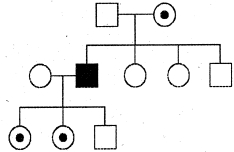
Select the correct trait from the given pedigree chart.
A
Sex-linked recessive disorder
B
Autosomal recessive disorder
C
Autosomal dominant disorder
D
$Y$-linked recessive disorder
Solution
(B) $1$. In the pedigree,the mother is a carrier (indicated by a dot in the circle) and the father is unaffected. They have an affected son.
$2$. The affected son marries an unaffected woman and they have two carrier daughters.
$3$. This pattern is characteristic of an Autosomal Recessive disorder. If it were $X$-linked recessive,the affected father would pass the trait to all his daughters,making them carriers,but he would not pass it to his sons. Here,the father is affected and the daughters are carriers,which is consistent with an autosomal recessive trait where the mother is a carrier and the father is affected (homozygous recessive). However,looking at the first generation,the mother is a carrier and the father is normal,resulting in an affected son,which is a classic indicator of an Autosomal Recessive trait.
$2$. The affected son marries an unaffected woman and they have two carrier daughters.
$3$. This pattern is characteristic of an Autosomal Recessive disorder. If it were $X$-linked recessive,the affected father would pass the trait to all his daughters,making them carriers,but he would not pass it to his sons. Here,the father is affected and the daughters are carriers,which is consistent with an autosomal recessive trait where the mother is a carrier and the father is affected (homozygous recessive). However,looking at the first generation,the mother is a carrier and the father is normal,resulting in an affected son,which is a classic indicator of an Autosomal Recessive trait.
0 likes
View Solution280
MediumMCQ
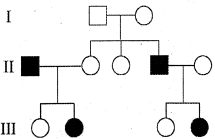
Identify the genotype of the first generation $(I)$ for an autosomal recessive disorder based on the provided pedigree chart.
A
$aa, aa$
B
$Aa, Aa$
C
$AA, AA$
D
$aa, AA$
Solution
(B) In the given pedigree chart,the disorder is autosomal recessive.
Individuals in generation $II$ are affected (shaded),meaning they must have the genotype $aa$.
Since the parents in generation $I$ are unaffected but have affected children in generation $II$,both parents must be carriers of the recessive allele.
Therefore,the genotype of the parents in generation $I$ must be $Aa$ and $Aa$.
Individuals in generation $II$ are affected (shaded),meaning they must have the genotype $aa$.
Since the parents in generation $I$ are unaffected but have affected children in generation $II$,both parents must be carriers of the recessive allele.
Therefore,the genotype of the parents in generation $I$ must be $Aa$ and $Aa$.
0 likes
View Solution281
MediumMCQ
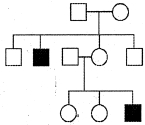
Study the given pedigree chart.
A
Inheritance of a condition like Phenylketonuria as an autosomal recessive trait.
B
Inheritance of a sex-linked inborn error of metabolism like Phenylketonuria.
C
Inheritance of a sex-linked recessive disorder like Haemophilia.
D
The pedigree chart is wrong as this is not possible.
Solution
(A) $1$. In the given pedigree,the parents are unaffected (unshaded),but they have an affected (shaded) offspring. This indicates that the trait is recessive.
$2$. Since the trait appears in both generations and can skip generations,it is likely autosomal recessive.
$3$. Phenylketonuria is a well-known example of an autosomal recessive metabolic disorder.
$4$. Sex-linked recessive disorders like Haemophilia typically show a criss-cross pattern of inheritance,which is not exclusively depicted here,and the autosomal recessive pattern fits the data perfectly.
$2$. Since the trait appears in both generations and can skip generations,it is likely autosomal recessive.
$3$. Phenylketonuria is a well-known example of an autosomal recessive metabolic disorder.
$4$. Sex-linked recessive disorders like Haemophilia typically show a criss-cross pattern of inheritance,which is not exclusively depicted here,and the autosomal recessive pattern fits the data perfectly.
0 likes
View Solution282
MediumMCQ
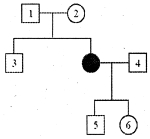
The following pedigree shows the presence of albinism,which is an autosomal recessive trait. If individual $4$ is homozygous dominant,who will be the carriers for the trait?
A
$1, 2, 5$ and $6$
B
$5$ and $6$
C
$1, 2, 3, 4, 5, 6$
D
$1, 2$ and $3$
Solution
(A) Albinism is an autosomal recessive disorder. Let the normal allele be '$A$' and the recessive allele for albinism be '$a$'.
An affected individual must have the genotype '$aa$'.
In the pedigree,the female parent of individuals $5$ and $6$ is affected,so her genotype is '$aa$'.
Individual $4$ is given as homozygous dominant,so his genotype is '$AA$'.
The offspring of '$aa$' and '$AA$' will all have the genotype '$Aa$'.
Therefore,individuals $5$ and $6$ are carriers ('$Aa$').
Since individuals $5$ and $6$ received one '$a$' allele from their affected mother,and their father $(4)$ is '$AA$',they must be carriers.
For the first generation,since the affected female's parents ($1$ and $2$) produced an affected child $(aa)$,both parents $1$ and $2$ must be carriers ('$Aa$').
Individual $3$ is a normal male,but his genotype could be '$AA$' or '$Aa$',so he is not necessarily a carrier.
Thus,the carriers are $1, 2, 5,$ and $6$.
An affected individual must have the genotype '$aa$'.
In the pedigree,the female parent of individuals $5$ and $6$ is affected,so her genotype is '$aa$'.
Individual $4$ is given as homozygous dominant,so his genotype is '$AA$'.
The offspring of '$aa$' and '$AA$' will all have the genotype '$Aa$'.
Therefore,individuals $5$ and $6$ are carriers ('$Aa$').
Since individuals $5$ and $6$ received one '$a$' allele from their affected mother,and their father $(4)$ is '$AA$',they must be carriers.
For the first generation,since the affected female's parents ($1$ and $2$) produced an affected child $(aa)$,both parents $1$ and $2$ must be carriers ('$Aa$').
Individual $3$ is a normal male,but his genotype could be '$AA$' or '$Aa$',so he is not necessarily a carrier.
Thus,the carriers are $1, 2, 5,$ and $6$.
0 likes
View Solution283
MediumMCQ
In humans,polydactyly is caused by the effect of a/an ...
A
Sex-linked recessive gene
B
Autosomal recessive gene
C
Autosomal dominant gene
D
Sex-linked dominant gene
Solution
(C) Polydactyly is a condition in which a person has more than the normal number of fingers or toes.
It is a genetic disorder that follows an autosomal dominant pattern of inheritance.
This means that an individual only needs to inherit one copy of the mutated gene from either parent to express the trait.
Since it is autosomal,it is not linked to the sex chromosomes ($X$ or $Y$).
It is a genetic disorder that follows an autosomal dominant pattern of inheritance.
This means that an individual only needs to inherit one copy of the mutated gene from either parent to express the trait.
Since it is autosomal,it is not linked to the sex chromosomes ($X$ or $Y$).
0 likes
View Solution284
MediumMCQ
Which genotype is responsible for the carrier state of sickle-cell anemia?
A
$Hb^A Hb^A$
B
$Hb^S Hb^S$
C
$Hb^A Hb^a$
D
$Hb^A Hb^S$
Solution
(D) Sickle-cell anemia is an autosome-linked recessive trait.
In this condition,the gene $Hb^A$ represents the normal hemoglobin,while $Hb^S$ represents the mutant hemoglobin.
- $Hb^A Hb^A$: Normal individual.
- $Hb^S Hb^S$: Affected individual (suffers from the disease).
- $Hb^A Hb^S$: Carrier individual (heterozygous,phenotypically normal but carries the trait).
Therefore,the genotype $Hb^A Hb^S$ is responsible for the carrier state.
In this condition,the gene $Hb^A$ represents the normal hemoglobin,while $Hb^S$ represents the mutant hemoglobin.
- $Hb^A Hb^A$: Normal individual.
- $Hb^S Hb^S$: Affected individual (suffers from the disease).
- $Hb^A Hb^S$: Carrier individual (heterozygous,phenotypically normal but carries the trait).
Therefore,the genotype $Hb^A Hb^S$ is responsible for the carrier state.
0 likes
View Solution285
MediumMCQ
Which of the following diseases is known as a 'bleeder's disease',caused by the presence of an $X$-linked recessive gene?
A
Thalassemia
B
Sickle cell anemia
C
Hemophilia
D
Color blindness
Solution
(C) Hemophilia is a sex-linked recessive disorder,which shows its transmission from unaffected carrier female to some of the male progeny.
In this disease,a single protein that is a part of the cascade of proteins involved in the clotting of blood is affected.
Due to this,in an affected individual,a simple cut will result in non-stop bleeding.
The gene for this disease is located on the $X$ chromosome.
Therefore,it is known as an $X$-linked recessive disorder and is commonly referred to as 'bleeder's disease'.
In this disease,a single protein that is a part of the cascade of proteins involved in the clotting of blood is affected.
Due to this,in an affected individual,a simple cut will result in non-stop bleeding.
The gene for this disease is located on the $X$ chromosome.
Therefore,it is known as an $X$-linked recessive disorder and is commonly referred to as 'bleeder's disease'.
0 likes
View Solution286
MediumMCQ
Which blood clotting factors are deficient in Hemophilia-$A$,Hemophilia-$B$,and Hemophilia-$C$,respectively?
A
$VIII, IX, X$
B
$VIII, IX, XII$
C
$VIII, IX, XI$
D
$XI, IX, VIII$
Solution
(C) Hemophilia is a group of genetic disorders that impair the body's ability to make blood clots.
- Hemophilia-$A$ is caused by a deficiency of clotting factor $VIII$ (Anti-hemophilic factor).
- Hemophilia-$B$ (also known as Christmas disease) is caused by a deficiency of clotting factor $IX$ (Christmas factor).
- Hemophilia-$C$ is caused by a deficiency of clotting factor $XI$ (Plasma thromboplastin antecedent).
Therefore,the correct sequence of deficient factors is $VIII, IX, XI$.
- Hemophilia-$A$ is caused by a deficiency of clotting factor $VIII$ (Anti-hemophilic factor).
- Hemophilia-$B$ (also known as Christmas disease) is caused by a deficiency of clotting factor $IX$ (Christmas factor).
- Hemophilia-$C$ is caused by a deficiency of clotting factor $XI$ (Plasma thromboplastin antecedent).
Therefore,the correct sequence of deficient factors is $VIII, IX, XI$.
0 likes
View Solution287
MediumMCQ
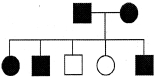
What does the given pedigree chart indicate?
A
Dominant inheritance
B
Recessive inheritance
C
Sex-linked recessive inheritance
D
Cytoplasmic inheritance
Solution
(A) In the given pedigree,both parents are affected (shaded),yet they have unaffected offspring (unshaded).
This indicates that the trait is dominant,as two affected parents can produce an unaffected child only if the trait is dominant and both parents are heterozygous $(Aa \times Aa \rightarrow aa)$.
If the trait were recessive,two affected parents would only produce affected offspring.
Therefore,the pedigree represents dominant inheritance.
This indicates that the trait is dominant,as two affected parents can produce an unaffected child only if the trait is dominant and both parents are heterozygous $(Aa \times Aa \rightarrow aa)$.
If the trait were recessive,two affected parents would only produce affected offspring.
Therefore,the pedigree represents dominant inheritance.
0 likes
View Solution288
EasyMCQ
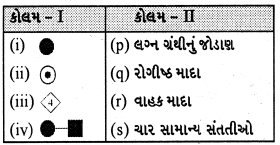
Match the following symbols used in pedigree analysis with their correct meanings.
A
$(i - r), (ii - q), (iii - s), (iv - p)$
B
$(i - p), (ii - q), (iii - s), (iv - r)$
C
$(i - s), (ii - q), (iii - p), (iv - r)$
D
$(i - q), (ii - r), (iii - s), (iv - p)$
Solution
(D) Based on standard pedigree analysis symbols:
$(i)$ $A$ filled circle represents an affected female.
(ii) $A$ circle with a dot represents a carrier female.
(iii) $A$ diamond with a number inside represents unspecified sex with that number of offspring.
(iv) $A$ filled circle connected to a filled square represents mating between an affected female and an affected male.
Matching the columns:
$(i)$ Affected female -> $(q)$
(ii) Carrier female -> $(r)$
(iii) Four normal offspring (unspecified sex) -> $(s)$
(iv) Mating -> $(p)$
Therefore,the correct matching is $(i - q), (ii - r), (iii - s), (iv - p)$.
$(i)$ $A$ filled circle represents an affected female.
(ii) $A$ circle with a dot represents a carrier female.
(iii) $A$ diamond with a number inside represents unspecified sex with that number of offspring.
(iv) $A$ filled circle connected to a filled square represents mating between an affected female and an affected male.
Matching the columns:
$(i)$ Affected female -> $(q)$
(ii) Carrier female -> $(r)$
(iii) Four normal offspring (unspecified sex) -> $(s)$
(iv) Mating -> $(p)$
Therefore,the correct matching is $(i - q), (ii - r), (iii - s), (iv - p)$.
0 likes
View Solution289
MediumMCQ
Match Column-$I$ with Column-$II$ and select the correct option.
| Column-$I$ | Column-$II$ |
|---|---|
| $(P)$ Haemophilia | $(i)$ Recessive gene: $X^{h}X^{h}$ |
| $(Q)$ Colour blindness | $(ii)$ Recessive gene: $pp$ |
| $(R)$ Phenylketonuria | $(iii)$ Recessive gene: $Hb^{s}Hb^{s}$ |
| $(S)$ Sickle-cell anaemia | $(iv)$ Recessive gene: $X^{c}X^{c}$ |
A
$P-i, Q-ii, R-iv, S-iii$
B
$P-iii, Q-iv, R-ii, S-i$
C
$P-iii, Q-iv, R-i, S-ii$
D
$P-i, Q-iv, R-ii, S-iii$
Solution
(D) The correct matches are as follows:
$(P)$ Haemophilia is an $X$-linked recessive disorder,represented by the genotype $X^{h}X^{h}$ in females.
$(Q)$ Colour blindness is an $X$-linked recessive disorder,represented by the genotype $X^{c}X^{c}$ in females.
$(R)$ Phenylketonuria is an autosomal recessive metabolic disorder,represented by the genotype $pp$.
$(S)$ Sickle-cell anaemia is an autosomal recessive disorder,represented by the genotype $Hb^{s}Hb^{s}$.
Therefore,the correct matching is $P-i, Q-iv, R-ii, S-iii$.
$(P)$ Haemophilia is an $X$-linked recessive disorder,represented by the genotype $X^{h}X^{h}$ in females.
$(Q)$ Colour blindness is an $X$-linked recessive disorder,represented by the genotype $X^{c}X^{c}$ in females.
$(R)$ Phenylketonuria is an autosomal recessive metabolic disorder,represented by the genotype $pp$.
$(S)$ Sickle-cell anaemia is an autosomal recessive disorder,represented by the genotype $Hb^{s}Hb^{s}$.
Therefore,the correct matching is $P-i, Q-iv, R-ii, S-iii$.
0 likes
View Solution290
MediumMCQ
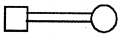
What does the given symbol indicate?
A
Mating
B
Consanguineous mating
C
Marriage
D
Sex unspecified
0 likes
View Solution291
MediumMCQ
What does the given symbol represent in a pedigree chart?

A
$5$ unaffected offspring
B
$5$ affected males
C
$5$ affected offspring
D
All of the above
Solution
(A) In a pedigree analysis,a diamond shape with a number inside represents a group of offspring of the specified number whose sex is unspecified. The number inside the diamond indicates the total count of such offspring. Therefore,a diamond with the number $5$ inside represents $5$ unaffected offspring.
0 likes
View Solution292
MediumMCQ
What is the cause of sickle cell anemia?
A
Substitution of glycine for glutamate in the $\beta$-globin chain.
B
Substitution of valine for glutamate in the $\beta$-globin chain.
C
Substitution of valine for glutamate in the $\alpha$-globin chain.
D
Substitution of glycine for glutamate in the $\alpha$-globin chain.
Solution
(B) Sickle cell anemia is an autosome-linked recessive trait that can be transmitted from parents to the offspring when both the partners are carrier for the gene.
It is caused by a point mutation in the gene coding for the $\beta$-globin chain of hemoglobin.
This mutation results in the substitution of glutamic acid (Glu) by valine (Val) at the sixth position of the $\beta$-globin chain of the hemoglobin molecule.
Due to this amino acid substitution,the mutant hemoglobin molecule undergoes polymerization under low oxygen tension,causing the change in the shape of the $RBC$ from biconcave disc to an elongated sickle-like structure.
It is caused by a point mutation in the gene coding for the $\beta$-globin chain of hemoglobin.
This mutation results in the substitution of glutamic acid (Glu) by valine (Val) at the sixth position of the $\beta$-globin chain of the hemoglobin molecule.
Due to this amino acid substitution,the mutant hemoglobin molecule undergoes polymerization under low oxygen tension,causing the change in the shape of the $RBC$ from biconcave disc to an elongated sickle-like structure.
0 likes
View Solution293
MediumMCQ
What is the full form of $PKU$?
A
Phenylketo unit
B
Phenylketonuria
C
Phenylpotassium urate
D
Phosphorketo urate
Solution
(B) $PKU$ stands for Phenylketonuria.
It is an inborn error of metabolism that is inherited as an autosomal recessive trait.
In this condition,the affected individual lacks an enzyme that converts the amino acid phenylalanine into tyrosine.
As a result,phenylalanine accumulates and is converted into phenylpyruvic acid and other derivatives,which leads to mental retardation.
It is an inborn error of metabolism that is inherited as an autosomal recessive trait.
In this condition,the affected individual lacks an enzyme that converts the amino acid phenylalanine into tyrosine.
As a result,phenylalanine accumulates and is converted into phenylpyruvic acid and other derivatives,which leads to mental retardation.
0 likes
View Solution294
MediumMCQ
$A$ normal woman,whose father was colourblind,marries a normal man. What kinds of children can be expected and in what proportion?
A
All daughters normal,$50 \%$ of sons colourblind
B
All daughters normal,all sons colourblind
C
$50 \%$ daughters colourblind,all sons normal
D
All daughters colourblind,all sons normal
Solution
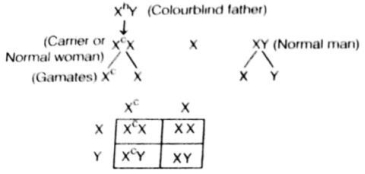
(A) The woman is a carrier for colourblindness because her father was colourblind $(X^{C}X)$. The man is normal $(XY)$.
The cross is as follows:
Parents: $X^{C}X \times XY$
Gametes: $X^{C}, X$ and $X, Y$
Offspring genotypes:
$X^{C}X$ (Carrier daughter,phenotypically normal)
$XX$ (Normal daughter)
$X^{C}Y$ (Colourblind son)
$XY$ (Normal son)
Thus,all daughters are phenotypically normal (though $50 \%$ are carriers),and $50 \%$ of the sons are colourblind.
The cross is as follows:
Parents: $X^{C}X \times XY$
Gametes: $X^{C}, X$ and $X, Y$
Offspring genotypes:
$X^{C}X$ (Carrier daughter,phenotypically normal)
$XX$ (Normal daughter)
$X^{C}Y$ (Colourblind son)
$XY$ (Normal son)
Thus,all daughters are phenotypically normal (though $50 \%$ are carriers),and $50 \%$ of the sons are colourblind.
0 likes
View Solution295
EasyMCQ
Which of the following is a sex-linked character?
A
White color blindness
B
Red-green color blindness
C
Night blindness
D
Sickle cell anaemia
Solution
(B) Red-green color blindness is a well-known $X$-linked recessive disorder.
In this condition,the gene responsible for the trait is located on the $X$ chromosome.
Females have two $X$ chromosomes $(XX)$,so they only express the trait if they are homozygous recessive $(X^cX^c)$.
Males have only one $X$ chromosome $(XY)$,so if they inherit the defective allele $(X^c)$,they will express the condition.
Therefore,red-green color blindness is a classic example of a sex-linked trait.
In this condition,the gene responsible for the trait is located on the $X$ chromosome.
Females have two $X$ chromosomes $(XX)$,so they only express the trait if they are homozygous recessive $(X^cX^c)$.
Males have only one $X$ chromosome $(XY)$,so if they inherit the defective allele $(X^c)$,they will express the condition.
Therefore,red-green color blindness is a classic example of a sex-linked trait.
0 likes
View Solution296
MediumMCQ
Which one of the following disorders and its characteristic is correctly matched?
A
Cystic fibrosis - Production of thick mucus that clogs airways
B
Sickle cell anaemia - Brain deterioration beginning at months of age
C
Achondroplasia - Extra fingers or toes
D
Huntington's disease - Skeletal,eye and cardiovascular defects
Solution
(A) . Cystic fibrosis is a genetic disorder characterized by the production of thick,sticky mucus that clogs the airways and digestive system. This is the correct match.
$B$. Sickle cell anaemia is caused by defective haemoglobin in $RBC$s,leading to abnormal cell shape and impaired oxygen transport,not brain deterioration.
$C$. Achondroplasia is a form of short-limbed dwarfism,not the presence of extra fingers or toes (which is polydactyly).
$D$. Huntington's disease is a progressive neurodegenerative disorder characterized by the breakdown of nerve cells in the brain,not skeletal or cardiovascular defects.
$B$. Sickle cell anaemia is caused by defective haemoglobin in $RBC$s,leading to abnormal cell shape and impaired oxygen transport,not brain deterioration.
$C$. Achondroplasia is a form of short-limbed dwarfism,not the presence of extra fingers or toes (which is polydactyly).
$D$. Huntington's disease is a progressive neurodegenerative disorder characterized by the breakdown of nerve cells in the brain,not skeletal or cardiovascular defects.
0 likes
View Solution297
MediumMCQ
Blackening of urine,when exposed to air,is a metabolic disorder in human beings. This is due to:
A
Phenylalanine
B
Tyrosine
C
Valine replacing glutamine
D
Homogentisic acid
Solution
(D) Alkaptonuria is a rare genetic metabolic disorder. In this condition,the body cannot produce enough of the enzyme homogentisate $1,2-$dioxygenase. As a result,homogentisic acid accumulates in the body and is excreted in large amounts in the urine. When this urine is exposed to air,the homogentisic acid oxidizes,causing the urine to turn black.
0 likes
View Solution298
MediumMCQ
Alkaptonuria is a condition in which
A
Accumulation of homogentisic acid in blood
B
Excretion of homogentisic acid in sweat
C
Excretion of homogentisic acid in urine
D
All of the above
Solution
(C) Alkaptonuria is a rare genetic metabolic disorder caused by a deficiency of the enzyme homogentisate $1,2-$dioxygenase.
This enzyme deficiency leads to the accumulation of homogentisic acid in the body.
Because the body cannot break down this acid,it is excreted through the kidneys into the urine.
When exposed to air,the homogentisic acid in the urine oxidizes,turning the urine dark or black in color.
This enzyme deficiency leads to the accumulation of homogentisic acid in the body.
Because the body cannot break down this acid,it is excreted through the kidneys into the urine.
When exposed to air,the homogentisic acid in the urine oxidizes,turning the urine dark or black in color.
0 likes
View Solution299
MediumMCQ
Sickle cell anaemia is
A
An autosomal linked dominant trait
B
Caused by substitution of glutamic acid by valine in the $\beta$-globin chain of haemoglobin
C
Caused by a change in $3$ base pairs of $DNA$
D
Characterized by elongated sickle like $RBCs$ with a nucleus
Solution
(B) Sickle cell anaemia is an autosomal recessive genetic disorder.
It is caused by a point mutation in the gene coding for the $\beta$-globin chain of haemoglobin.
Specifically,the amino acid glutamic acid at the $6^{th}$ position is replaced by valine due to a single base pair substitution ($GAG$ to $GUG$ in $mRNA$).
This change leads to the formation of abnormal haemoglobin,causing $RBCs$ to become sickle-shaped under low oxygen tension.
It is caused by a point mutation in the gene coding for the $\beta$-globin chain of haemoglobin.
Specifically,the amino acid glutamic acid at the $6^{th}$ position is replaced by valine due to a single base pair substitution ($GAG$ to $GUG$ in $mRNA$).
This change leads to the formation of abnormal haemoglobin,causing $RBCs$ to become sickle-shaped under low oxygen tension.
0 likes
View Solution300
MediumMCQ
Sickle-cell anaemia has not been eliminated from the African population because it
A
Is controlled by recessive genes
B
Is not a fatal disease
C
Provides immunity against malaria
D
Is controlled by dominant genes
Solution
(C) Sickle-cell anaemia is a genetic disorder caused by a mutation in the haemoglobin gene.
In regions where malaria is endemic,such as parts of Africa,individuals who are heterozygous for the sickle-cell trait (carriers) possess a survival advantage.
This is because the presence of some abnormal haemoglobin interferes with the life cycle of the malaria parasite $(Plasmodium)$,thereby providing partial immunity or resistance against malaria.
Consequently,the gene for sickle-cell anaemia is maintained in the population through natural selection.
In regions where malaria is endemic,such as parts of Africa,individuals who are heterozygous for the sickle-cell trait (carriers) possess a survival advantage.
This is because the presence of some abnormal haemoglobin interferes with the life cycle of the malaria parasite $(Plasmodium)$,thereby providing partial immunity or resistance against malaria.
Consequently,the gene for sickle-cell anaemia is maintained in the population through natural selection.
0 likes
View SolutionPrinciples of Inheritance and Variation — Pedigree Analysis and Mendelian disorders · Frequently Asked Questions
1Are these Principles of Inheritance and Variation questions useful for JEE and NEET?
Yes. All questions in this section are mapped to JEE Main and NEET exam patterns. Previous year questions from JEE Main, NEET, GUJCET and state-level exams are included with full solutions.
2Can I switch to Hindi or Gujarati for these questions?
Yes. Use the language tabs in the hero section or the sidebar to view the same questions and solutions in English, Hindi or Gujarati.
3How do I generate a question paper from this subtopic?
Use the Vedclass Exam Paper Generator — select the chapter and subtopic, set difficulty, and generate Sets A, B, C, D automatically. First 3 chapters of every subject are free.
Vedclass Products
For Students
Vedclass Test Series
Mock tests in real JEE/NEET style with performance analysis. 5-day free trial.
Start Free TrialFor Teachers
Exam Paper Generator
Generate Set A/B/C/D papers from this chapter in 2 minutes. 3 chapters free.
Try FreeFor Institutes
Online Exam Module
Live online exams with unlimited students, 360° analytics & white-label branding.
See DemoFor Teachers & Institutes
Generate a Principles of Inheritance and Variation Exam Paper in 2 Minutes
Select subtopic & difficulty — Sets A, B, C, D auto-generated with No Repeat logic.
First 3 chapters of every subject are free — no payment required.