
A English
Interaction of gene and cytoplasmic inheritance Questions in English
Class 12 Biology · Principles of Inheritance and Variation · Interaction of gene and cytoplasmic inheritance
82+
Questions
English
Language
100%
With Solutions
Showing 50 of 82 questions in English
1
MediumMCQ
$A$ farmer crossed a walnut-combed chicken with a single-combed one and obtained all walnut-combed chickens in $F_1$. The genotype of the parents was
A
$Rr\ Pp \times rr\ pp$
B
$RR\ PP \times rr\ pp$
C
$RR\ pp \times rr\ pp$
D
$RR\ Pp \times rr\ pp$
Solution
(B) In chickens,comb shape is determined by two gene pairs,$R$ and $P$. The interaction is as follows: Walnut comb $(R-P-)$,Rose comb $(R-pp)$,Pea comb $(rrP-)$,and Single comb $(rrpp)$.
Since the $F_1$ generation consists entirely of walnut-combed chickens $(R-P-)$,the walnut-combed parent must be homozygous dominant for both traits $(RR\ PP)$ to ensure that all offspring receive at least one dominant allele for both genes ($R$ and $P$).
The single-combed parent is recessive for both traits,having the genotype $rr\ pp$.
Therefore,the cross is $RR\ PP \times rr\ pp$.
Since the $F_1$ generation consists entirely of walnut-combed chickens $(R-P-)$,the walnut-combed parent must be homozygous dominant for both traits $(RR\ PP)$ to ensure that all offspring receive at least one dominant allele for both genes ($R$ and $P$).
The single-combed parent is recessive for both traits,having the genotype $rr\ pp$.
Therefore,the cross is $RR\ PP \times rr\ pp$.
0 likes
View Solution2
EasyMCQ
Who worked on the poky strain of $Neurospora$?
A
Mary and Mitchell
B
Ruth Sager
C
Khorana
D
Crick
Solution
(A) The $Poky$ strain of $Neurospora$ $crassa$ was discovered and studied by Mary $B$. Mitchell and $H$.$K$. Mitchell in $1952$.
This mutant strain exhibits a very slow growth rate due to an imbalance in mitochondrial physiology,which serves as a classic example of extranuclear or cytoplasmic inheritance.
This mutant strain exhibits a very slow growth rate due to an imbalance in mitochondrial physiology,which serves as a classic example of extranuclear or cytoplasmic inheritance.
0 likes
View Solution3
MediumMCQ
In sweet pea plants,the presence of dominant $C$ and $P$ genes is essential for the development of purple colour. The ratio of plants producing flowers of different colours in the progeny of the cross $CcPp \times Ccpp$ will be:
A
$2$ white and $6$ purple coloured flowers
B
$2$ purple and $6$ white coloured flowers
C
$3$ white and $5$ purple coloured flowers
D
$3$ purple and $5$ white coloured flowers
Solution
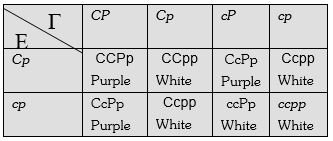
(D) The cross is between $CcPp$ (purple) and $Ccpp$ (white).
To find the offspring,we perform a Punnett square analysis:
Gametes from $CcPp$: $CP, Cp, cP, cp$
Gametes from $Ccpp$: $Cp, cp$
| | $CP$ | $Cp$ | $cP$ | $cp$ |
|---|---|---|---|---|
| $Cp$ | $CCPp$ (Purple) | $CCpp$ (White) | $CcPp$ (Purple) | $Ccpp$ (White) |
| $cp$ | $CcPp$ (Purple) | $Ccpp$ (White) | $ccPp$ (White) | $ccpp$ (White) |
Counting the phenotypes:
Purple flowers $(C-P-)$: $CCPp, CcPp, CcPp$ = $3$ plants.
White flowers (others): $CCpp, Ccpp, Ccpp, ccPp, ccpp$ = $5$ plants.
Therefore,the ratio is $3$ purple : $5$ white.
To find the offspring,we perform a Punnett square analysis:
Gametes from $CcPp$: $CP, Cp, cP, cp$
Gametes from $Ccpp$: $Cp, cp$
| | $CP$ | $Cp$ | $cP$ | $cp$ |
|---|---|---|---|---|
| $Cp$ | $CCPp$ (Purple) | $CCpp$ (White) | $CcPp$ (Purple) | $Ccpp$ (White) |
| $cp$ | $CcPp$ (Purple) | $Ccpp$ (White) | $ccPp$ (White) | $ccpp$ (White) |
Counting the phenotypes:
Purple flowers $(C-P-)$: $CCPp, CcPp, CcPp$ = $3$ plants.
White flowers (others): $CCpp, Ccpp, Ccpp, ccPp, ccpp$ = $5$ plants.
Therefore,the ratio is $3$ purple : $5$ white.
0 likes
View Solution4
MediumMCQ
In sweet peas,genes $C$ and $P$ are necessary for colour in flowers. The flowers are white in the absence of either or both the genes. What will be the percentage of coloured flowers in the offspring of the cross $Cc\ pp \times cc\ Pp$ (in $\%$)?
A
$100$
B
$75$
C
$25$
D
$50$
Solution
(C) For flowers to be coloured,both dominant genes $C$ and $P$ must be present (genotype $C-P-$).
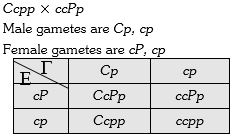
Given cross: $Cc\ pp \times cc\ Pp$.
Gametes produced by $Cc\ pp$: $Cp$ and $cp$.
Gametes produced by $cc\ Pp$: $cP$ and $cp$.
Punnett square analysis:
| | $Cp$ | $cp$ |
|---|---|---|
| $cP$ | $CcPp$ | $ccPp$ |
| $cp$ | $Ccpp$ | $ccpp$ |
Out of the $4$ offspring,only $CcPp$ has both dominant genes $C$ and $P$,resulting in a coloured flower.
The other three genotypes ($ccPp$,$Ccpp$,$ccpp$) lack at least one dominant gene,resulting in white flowers.
Therefore,the percentage of coloured flowers is $(1/4) \times 100 = 25\%$.
Given cross: $Cc\ pp \times cc\ Pp$.
Gametes produced by $Cc\ pp$: $Cp$ and $cp$.
Gametes produced by $cc\ Pp$: $cP$ and $cp$.
Punnett square analysis:
| | $Cp$ | $cp$ |
|---|---|---|
| $cP$ | $CcPp$ | $ccPp$ |
| $cp$ | $Ccpp$ | $ccpp$ |
Out of the $4$ offspring,only $CcPp$ has both dominant genes $C$ and $P$,resulting in a coloured flower.
The other three genotypes ($ccPp$,$Ccpp$,$ccpp$) lack at least one dominant gene,resulting in white flowers.
Therefore,the percentage of coloured flowers is $(1/4) \times 100 = 25\%$.
0 likes
View Solution5
MediumMCQ
In a cross between white-flowered parents,$F_1$ progeny was uniformly purple-flowered. The $F_2$ progeny showed a phenotypic ratio $9:7$ between purple-flowered and white-flowered plants. The above result indicates that the flower colour is controlled by
A
Two genes
B
One gene
C
Three genes
D
Four genes
Solution
(A) The phenotypic ratio of $9:7$ in the $F_2$ generation is a classic modification of the Mendelian dihybrid ratio $(9:3:3:1)$.
This specific ratio occurs due to complementary gene interaction,where two independent genes interact to produce a single phenotype.
In this case,both dominant alleles must be present for the purple colour to be expressed; otherwise,the flowers remain white.
Therefore,the flower colour is controlled by two genes.
This specific ratio occurs due to complementary gene interaction,where two independent genes interact to produce a single phenotype.
In this case,both dominant alleles must be present for the purple colour to be expressed; otherwise,the flowers remain white.
Therefore,the flower colour is controlled by two genes.
0 likes
View Solution6
MediumMCQ
In wheat,when a green plant was self-fertilized,the progeny had $209$ green seedlings and $14$ white seedlings. The above result indicates that:
A
The parents were heterozygous for two duplicate alleles
B
The parents were true breeding
C
The parents were heterozygous for one allele
D
None of the above
Solution
(A) The total number of seedlings is $209 + 14 = 223$.
The ratio of green to white seedlings is approximately $209/14 \approx 14.93 : 1$,which is very close to the $15 : 1$ ratio.
$A$ $15 : 1$ phenotypic ratio is characteristic of duplicate gene interaction (also known as duplicate recessive epistasis),where the presence of at least one dominant allele at either of the two gene loci results in the dominant phenotype (green).
Therefore,the parent plant must have been heterozygous for two duplicate genes (genotype $AaBb$).
The ratio of green to white seedlings is approximately $209/14 \approx 14.93 : 1$,which is very close to the $15 : 1$ ratio.
$A$ $15 : 1$ phenotypic ratio is characteristic of duplicate gene interaction (also known as duplicate recessive epistasis),where the presence of at least one dominant allele at either of the two gene loci results in the dominant phenotype (green).
Therefore,the parent plant must have been heterozygous for two duplicate genes (genotype $AaBb$).
0 likes
View Solution7
MediumMCQ
In poultry,the new comb colour that appears by the collaboration of two dominant genes is:
A
Walnut
B
Single
C
Rose
D
Pea
Solution
(A) In poultry,comb shape is determined by the interaction of two gene pairs,$R$ and $P$. The presence of both dominant alleles ($R$ and $P$) results in a walnut comb phenotype. This is an example of gene interaction where two dominant genes collaborate to produce a new phenotype.
0 likes
View Solution8
MediumMCQ
Lathyrus odoratus is an example of which of the following gene interactions?
A
Supplementary genes
B
Complementary genes
C
Lethal genes
D
Codominant genes
Solution
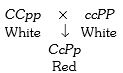
(B) In Lathyrus odoratus (sweet pea),flower color is determined by complementary gene action.
Two dominant genes,$C$ and $P$,are required for the production of the purple/red flower color.
When both genes are present in the dominant form (at least one dominant allele of each),the flower is colored.
If either gene is homozygous recessive (e.g.,$ccPP$ or $CCpp$),the flower remains white.
In the $F_2$ generation,this interaction results in a phenotypic ratio of $9:7$ (colored:white).
Two dominant genes,$C$ and $P$,are required for the production of the purple/red flower color.
When both genes are present in the dominant form (at least one dominant allele of each),the flower is colored.
If either gene is homozygous recessive (e.g.,$ccPP$ or $CCpp$),the flower remains white.
In the $F_2$ generation,this interaction results in a phenotypic ratio of $9:7$ (colored:white).
0 likes
View Solution9
MediumMCQ
The example of epistatic gene is shown by
A
Comb colour of poultry
B
Sweet pea
C
Cucurbita pepo
D
None of the above
Solution
(C) Epistasis is a genetic interaction where one gene masks or interferes with the expression of another gene.
$Cucurbita pepo$ (summer squash) is a classic example of dominant epistasis, where the fruit color is determined by the interaction of two gene loci.
In this case, the dominant allele of one gene (e.g., $W$) masks the expression of another gene (e.g., $Y$), resulting in white fruit regardless of the presence of the $Y$ allele.
Therefore, $Cucurbita pepo$ is the correct example of epistasis.
$Cucurbita pepo$ (summer squash) is a classic example of dominant epistasis, where the fruit color is determined by the interaction of two gene loci.
In this case, the dominant allele of one gene (e.g., $W$) masks the expression of another gene (e.g., $Y$), resulting in white fruit regardless of the presence of the $Y$ allele.
Therefore, $Cucurbita pepo$ is the correct example of epistasis.
0 likes
View Solution10
MediumMCQ
Which of the following is an example of a supplementary gene?
A
Cucurbita pepo
B
Skin colour of mice
C
Comb shape of poultry
D
None of the above
Solution
(B) Supplementary genes are a type of gene interaction where one dominant gene produces a specific phenotype,but the second gene (the supplementary gene) modifies the expression of the first only when present in a dominant state.
In the case of skin colour in mice,the gene for agouti colour $(A)$ is dominant over black $(a)$. However,the expression of the agouti colour requires the presence of a dominant gene $(C)$ for colour production.
When black mice $(CCaa)$ are crossed with white albinos $(ccAA)$,the $F_1$ generation is agouti $(CcAa)$. This is a classic example of supplementary gene interaction.
In the case of skin colour in mice,the gene for agouti colour $(A)$ is dominant over black $(a)$. However,the expression of the agouti colour requires the presence of a dominant gene $(C)$ for colour production.
When black mice $(CCaa)$ are crossed with white albinos $(ccAA)$,the $F_1$ generation is agouti $(CcAa)$. This is a classic example of supplementary gene interaction.
0 likes
View Solution11
MediumMCQ
The colour of the endosperm in maize is an example of:
A
Duplicate genes
B
Inhibitory genes
C
Polymeric genes
D
Quantitative inheritance
Solution
(A) The inheritance of endosperm colour in maize is an example of duplicate genes. In this type of gene interaction,the presence of at least one dominant allele at either of the two loci produces the same phenotype. Consequently,the standard $F_2$ dihybrid ratio of $9:3:3:1$ is modified to a $15:1$ ratio,where $15$ individuals show the dominant trait and $1$ individual shows the recessive trait.
0 likes
View Solution12
MediumMCQ
Which of the following is an example of an inhibitory gene?
A
Rice
B
Pea
C
Sweet pea
D
All of the above
Solution
(A) Inhibitory gene interaction is observed in rice. In a cross between $IIpp$ (green) and $iiPP$ (purple),the $F_1$ generation is green $(IiPp)$. In the $F_2$ generation,the ratio is $13$ green $(I-P-, I-pp, iipp)$ : $3$ purple $(iiP-)$. The gene $I$ acts as an inhibitor of the purple color gene $P$,meaning the purple color is expressed only when the dominant allele $P$ is present in the absence of the inhibitor $I$ (i.e.,$iiP-$).
0 likes
View Solution13
MediumMCQ
Lethal genes are:
A
Dominant homozygous
B
Recessive
C
Dominant heterozygous
D
Codominant
Solution
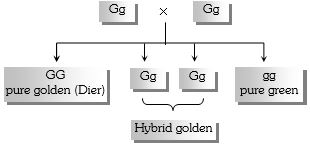
(A) Lethal genes are genes that cause the death of the organism that carries them. In the provided example of snapdragon (Antirrhinum),the gene for golden color is dominant. When two heterozygous golden plants $(Gg)$ are crossed,the offspring are $1 GG$ (pure golden),$2 Gg$ (hybrid golden),and $1 gg$ (pure green). The $GG$ homozygous condition is lethal,causing the death of the seedling. Therefore,lethal genes often manifest their effect in the dominant homozygous state.
0 likes
View Solution14
MediumMCQ
The phenomenon in which an allele of one gene suppresses the activity of an allele of another gene is known as
A
Dominance
B
Inactivation
C
Epistasis
D
Suppression
Solution
(C) Epistasis is a genetic interaction where the effect of one gene is dependent on the presence of one or more 'modifier' genes,i.e.,the genetic background.
In this phenomenon,an allele of one gene masks or suppresses the phenotypic expression of an allele of another gene.
For example,in dominant epistasis,the $F_2$ phenotypic ratio is typically modified to $12:3:1$ instead of the standard Mendelian $9:3:3:1$ ratio.
In this phenomenon,an allele of one gene masks or suppresses the phenotypic expression of an allele of another gene.
For example,in dominant epistasis,the $F_2$ phenotypic ratio is typically modified to $12:3:1$ instead of the standard Mendelian $9:3:3:1$ ratio.
0 likes
View Solution15
MediumMCQ
The $9 : 3 : 3 : 1$ ratio is modified to $9 : 7$ ratio due to
A
Complementary gene
B
Epistatic gene
C
Hypostatic gene
D
Supplementary gene
Solution
(A) The $9 : 7$ ratio is a classic example of complementary gene interaction.
In this interaction,two pairs of non-allelic genes interact to produce a single phenotypic trait.
If either gene is present alone,it cannot express the trait; both dominant alleles must be present together to produce the phenotype.
This results in a modification of the dihybrid $9 : 3 : 3 : 1$ ratio to $9 : 7$ in the $F_2$ generation.
In this interaction,two pairs of non-allelic genes interact to produce a single phenotypic trait.
If either gene is present alone,it cannot express the trait; both dominant alleles must be present together to produce the phenotype.
This results in a modification of the dihybrid $9 : 3 : 3 : 1$ ratio to $9 : 7$ in the $F_2$ generation.
0 likes
View Solution16
MediumMCQ
When an albino female plant of maize is crossed with a normal green male plant,all plants in the progeny are albino because:
A
Plastids are inherited through maternal plants
B
Albinism is dominant over green character
C
The crossing results in structural changes in green plastids
D
Green plastids of male parents become mutated
Solution
(A) The inheritance of plastids in many plants,including maize,is governed by cytoplasmic inheritance (maternal inheritance).
Since plastids are inherited exclusively through the egg cell (maternal parent) and not through the pollen (male parent),the phenotype of the offspring is determined by the plastids present in the female parent.
In this case,the female parent is albino (lacking functional chloroplasts),so all offspring will inherit these defective plastids and appear albino,regardless of the green male parent's contribution.
Since plastids are inherited exclusively through the egg cell (maternal parent) and not through the pollen (male parent),the phenotype of the offspring is determined by the plastids present in the female parent.
In this case,the female parent is albino (lacking functional chloroplasts),so all offspring will inherit these defective plastids and appear albino,regardless of the green male parent's contribution.
0 likes
View Solution17
MediumMCQ
Kappa particles indicate
A
Nuclear inheritance
B
Cytoplasmic inheritance
C
Mutation
D
Nucleo-cytoplasmic inheritance
Solution
(B) Kappa particles are self-replicating cytoplasmic particles found in certain strains of Paramecium.
They contain $DNA$ and are responsible for the production of a toxin called paramecin.
Since these particles are located in the cytoplasm and are transmitted through the cytoplasm during cell division,they serve as a classic example of cytoplasmic inheritance (also known as extranuclear inheritance).
They contain $DNA$ and are responsible for the production of a toxin called paramecin.
Since these particles are located in the cytoplasm and are transmitted through the cytoplasm during cell division,they serve as a classic example of cytoplasmic inheritance (also known as extranuclear inheritance).
0 likes
View Solution18
MediumMCQ
Mirabilis jalapa is a good example of
A
Complete dominance
B
Plastid inheritance
C
Both $(a)$ and $(b)$
D
None of the above
Solution
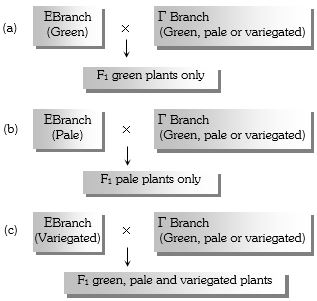
(B) The phenomenon of plastid inheritance (also known as cytoplasmic or extranuclear inheritance) is observed in the four-o'clock plant, $Mirabilis \text{ } jalapa$. In this plant, the color of the leaves is determined by the plastids present in the cytoplasm of the egg cell. Since the egg cell contributes the majority of the cytoplasm to the zygote, the phenotype of the offspring is determined by the maternal parent's plastids. The provided image illustrates this, showing that the phenotype of the $F_1$ generation depends on the type of branch (green, pale, or variegated) from which the egg was derived.
0 likes
View Solution19
MediumMCQ
Cytoplasmic male sterility in maize is a manifestation of the interaction between:
A
Chloroplast and nuclear genes
B
Mitochondrial and nuclear genes
C
Chloroplast and mitochondrial genes
D
Cytoplasmic factors and male sterile genes
Solution
(B) Cytoplasmic male sterility $(CMS)$ in maize is a classic example of nucleo-cytoplasmic interaction.
It arises due to the interaction between specific genes located in the mitochondrial genome (cytoplasmic) and nuclear genes (restorer genes).
The mitochondrial genome carries genes that cause pollen abortion,while nuclear genes can suppress or 'restore' fertility.
Therefore,the correct interaction is between mitochondrial and nuclear genes.
It arises due to the interaction between specific genes located in the mitochondrial genome (cytoplasmic) and nuclear genes (restorer genes).
The mitochondrial genome carries genes that cause pollen abortion,while nuclear genes can suppress or 'restore' fertility.
Therefore,the correct interaction is between mitochondrial and nuclear genes.
0 likes
View Solution20
EasyMCQ
The two organelles responsible for cytoplasmic inheritance among eukaryotes are
A
Lysosomes and mitochondria
B
Mitochondria and golgi complex
C
Chloroplasts and mitochondria
D
Chloroplasts and lysosomes
Solution
(C) Cytoplasmic inheritance,also known as extranuclear inheritance,refers to the transmission of genes present in organelles located in the cytoplasm rather than the nucleus.
In eukaryotes,the two semi-autonomous organelles that contain their own $DNA$ and are responsible for this type of inheritance are the mitochondria and chloroplasts.
These organelles replicate independently of the cell cycle and pass their genetic material to the next generation through the cytoplasm of the gametes,primarily the egg cell.
In eukaryotes,the two semi-autonomous organelles that contain their own $DNA$ and are responsible for this type of inheritance are the mitochondria and chloroplasts.
These organelles replicate independently of the cell cycle and pass their genetic material to the next generation through the cytoplasm of the gametes,primarily the egg cell.
0 likes
View Solution21
MediumMCQ
After crossing two plants,the progenies are found to be male sterile. The phenomenon is found to be maternally inherited and is due to some genes which reside in
A
Nucleus
B
Chloroplast
C
Mitochondria
D
Cytoplasm
Solution
(D) The correct answer is $D$. Male sterility in plants is often a result of cytoplasmic male sterility $(CMS)$. This phenomenon is maternally inherited because the organelles responsible for this trait,such as mitochondria and chloroplasts,are inherited through the egg cytoplasm. Since these genes reside in the cytoplasm (specifically within the organellar $DNA$),they do not follow Mendelian inheritance patterns.
0 likes
View Solution22
MediumMCQ
Extranuclear inheritance is a consequence of the presence of genes in
A
Ribosomes and chloroplasts
B
Lysosomes and ribosomes
C
Mitochondria and chloroplasts
D
Endoplasmic reticulum and mitochondria
Solution
(C) Extranuclear inheritance,also known as cytoplasmic inheritance,refers to the transmission of genes that are located outside the nucleus. In eukaryotic cells,the organelles that contain their own $DNA$ (extranuclear $DNA$) are the mitochondria and chloroplasts. These organelles possess their own genomes,which are inherited independently of the nuclear chromosomes,typically through the cytoplasm of the egg cell.
0 likes
View Solution23
MediumMCQ
Genes for cytoplasmic male sterility in plants are generally located in
A
Mitochondrial genome
B
Cytosol
C
Chloroplast genome
D
Nuclear genome
Solution
(A) Cytoplasmic male sterility $(CMS)$ is a condition in plants where a plant is unable to produce functional pollen.
This trait is inherited maternally because the genes responsible for $CMS$ are located in the mitochondrial genome.
Unlike nuclear genes which follow Mendelian inheritance,mitochondrial genes are passed from the mother to the offspring through the cytoplasm of the egg cell.
Therefore,the correct location for these genes is the mitochondrial genome.
This trait is inherited maternally because the genes responsible for $CMS$ are located in the mitochondrial genome.
Unlike nuclear genes which follow Mendelian inheritance,mitochondrial genes are passed from the mother to the offspring through the cytoplasm of the egg cell.
Therefore,the correct location for these genes is the mitochondrial genome.
0 likes
View Solution24
MediumMCQ
The expression of genes for the production of milk in only females is a
A
$X$-linked character
B
$Y$-linked character
C
Sex-limited genes
D
Sex-influenced genes
Solution
(C) The correct answer is $C$.
Milk production is a trait controlled by sex-limited genes.
Sex-limited genes are autosomal genes whose expression is restricted to only one sex due to the physiological or hormonal environment of that specific sex.
Although these genes are present in both males and females,they are only expressed in females because the hormonal regulation required for milk production is absent in males.
Milk production is a trait controlled by sex-limited genes.
Sex-limited genes are autosomal genes whose expression is restricted to only one sex due to the physiological or hormonal environment of that specific sex.
Although these genes are present in both males and females,they are only expressed in females because the hormonal regulation required for milk production is absent in males.
0 likes
View Solution25
MediumMCQ
Pattern baldness,moustaches and beard in human males are examples of
A
Sex-determining traits
B
Sex-linked traits
C
Sex-limited traits
D
Sex-differentiating traits
Solution
(C) $Sex-limited$ genes express their effects in only one sex,and their action is clearly related to the sex hormones.
For example,the development of beard and moustaches in human males is a $sex-limited$ character because these traits are phenotypically expressed only in males,even though the genes for these traits may be present in both sexes.
For example,the development of beard and moustaches in human males is a $sex-limited$ character because these traits are phenotypically expressed only in males,even though the genes for these traits may be present in both sexes.
0 likes
View Solution26
MediumMCQ
One of the parents of a cross has a mutation in its mitochondria. In that cross,that parent is taken as a male. During segregation of $F_2$ progenies,that mutation is found in
A
All the progenies
B
Fifty percent of the progenies
C
One-third of the progenies
D
None of the progenies
Solution
(D) The correct answer is $D$.
In eukaryotes,mitochondrial inheritance is strictly maternal.
During fertilization,the sperm contributes its nucleus to the egg,but the cytoplasm (containing mitochondria) is almost exclusively derived from the ovum.
Since the parent with the mitochondrial mutation is used as the male,the mutation will not be passed on to the offspring.
Therefore,none of the $F_1$ or $F_2$ progenies will inherit the mutation.
In eukaryotes,mitochondrial inheritance is strictly maternal.
During fertilization,the sperm contributes its nucleus to the egg,but the cytoplasm (containing mitochondria) is almost exclusively derived from the ovum.
Since the parent with the mitochondrial mutation is used as the male,the mutation will not be passed on to the offspring.
Therefore,none of the $F_1$ or $F_2$ progenies will inherit the mutation.
0 likes
View Solution27
MediumMCQ
Epistasis implies
A
One pair of genes can completely mask the expression of another pair of genes
B
One pair of genes independently controls a particular phenotype
C
One pair of genes enhances the phenotype expression of another pair of genes
D
Many genes collectively control a particular phenotype
Solution
(A) Epistasis is the phenomenon of masking or suppressing the expression of a gene by another non-allelic gene.
The gene which suppresses the expression of a non-allelic gene is termed as an epistatic gene,and a gene whose expression is masked by a non-allelic gene is termed as a hypostatic gene.
The gene which suppresses the expression of a non-allelic gene is termed as an epistatic gene,and a gene whose expression is masked by a non-allelic gene is termed as a hypostatic gene.
0 likes
View Solution28
MediumMCQ
Extranuclear inheritance is observed in $.....$.
A
Killer Paramecium
B
Killer Amoeba
C
Euglena
D
Hydra
Solution
(A) Extranuclear inheritance, also known as cytoplasmic inheritance, refers to the transmission of genes present in cytoplasmic organelles like mitochondria or chloroplasts, or in endosymbionts.
In $Paramecium$, the 'killer' trait is determined by cytoplasmic particles called $\kappa$ particles.
These $\kappa$ particles are endosymbiotic bacteria ($Caedibacter$ $taeniospiralis$) that reside in the cytoplasm of the $Paramecium$ and are passed on to the offspring through the cytoplasm during reproduction.
Therefore, the correct answer is $Killer$ $Paramecium$.
In $Paramecium$, the 'killer' trait is determined by cytoplasmic particles called $\kappa$ particles.
These $\kappa$ particles are endosymbiotic bacteria ($Caedibacter$ $taeniospiralis$) that reside in the cytoplasm of the $Paramecium$ and are passed on to the offspring through the cytoplasm during reproduction.
Therefore, the correct answer is $Killer$ $Paramecium$.
0 likes
View Solution29
MediumMCQ
$A$ gene that suppresses the effect of another gene,and which is not located at the same locus on homologous chromosomes,is called:
A
Duplicate gene
B
Complementary gene
C
Epistatic gene
D
Supplementary gene
Solution
(C) The phenomenon where one gene masks or suppresses the expression of another non-allelic gene is known as $Epistasis$. The gene that suppresses the effect is called the $Epistatic$ gene,and the gene whose expression is masked is called the $Hypostatic$ gene. Since these genes are not located at the same locus on homologous chromosomes,this interaction is distinct from dominance (which occurs between alleles at the same locus). Therefore,the correct answer is $Epistatic$ gene.
0 likes
View Solution30
EasyMCQ
The ratio of complementary genes is ....
A
$9:3:4$
B
$12:3:1$
C
$9:3:3:4$
D
$9:7$
Solution
(D) Complementary genes are two independent pairs of genes that interact to produce a specific phenotype,where each gene is required for the expression of the other.
In a dihybrid cross involving complementary genes,the phenotypic ratio observed in the $F_2$ generation is $9:7$.
This occurs because the presence of at least one dominant allele for both genes is necessary to produce the dominant trait; otherwise,the recessive phenotype is expressed.
In a dihybrid cross involving complementary genes,the phenotypic ratio observed in the $F_2$ generation is $9:7$.
This occurs because the presence of at least one dominant allele for both genes is necessary to produce the dominant trait; otherwise,the recessive phenotype is expressed.
0 likes
View Solution31
MediumMCQ
When two non-allelic genes are present together,they produce a new phenotype,but when they are separated,they do not show this effect. This is called:
A
Epistasis
B
Polygenes
C
Non-complementary genes
D
Complementary genes
Solution
(D) Complementary genes are two non-allelic genes that interact to produce a specific phenotype that neither gene can produce on its own. When these genes are present together,they express a new trait (e.g.,flower color in Lathyrus odoratus). However,when they are separated or present individually,they fail to produce the effect,as the biochemical pathway remains incomplete.
0 likes
View Solution32
MediumMCQ
The coiling of the shell in the snail $Limnaea$ is an example of.....
A
Recombination
B
Biparental inheritance
C
Maternal inheritance
D
Temporal transformation
Solution
(C) The coiling of the shell in the snail $Limnaea$ peregra is a classic example of maternal inheritance (also known as cytoplasmic inheritance or maternal effect).
In this phenomenon,the phenotype of the offspring is determined by the genotype of the mother,regardless of the offspring's own genotype.
The direction of the coiling (dextral or sinistral) is controlled by a gene in the mother's cytoplasm,which is deposited in the egg before fertilization.
Therefore,the correct option is $C$.
In this phenomenon,the phenotype of the offspring is determined by the genotype of the mother,regardless of the offspring's own genotype.
The direction of the coiling (dextral or sinistral) is controlled by a gene in the mother's cytoplasm,which is deposited in the egg before fertilization.
Therefore,the correct option is $C$.
0 likes
View Solution33
MediumMCQ
What is the reason for the appearance of walnut-comb in the offspring resulting from a cross between pea-comb and rose-comb in chickens?
A
Duplicate genes
B
Complementary genes
C
Additive genes
D
Collaborative genes
Solution
(D) In chickens,the inheritance of comb shape is a classic example of gene interaction known as collaborative gene action.
When a bird with a rose-comb $(RRpp)$ is crossed with a bird with a pea-comb $(rrPP)$,the $F_1$ generation produces offspring with a walnut-comb $(RrPp)$.
This occurs because the two dominant alleles ($R$ and $P$) interact to produce a new phenotype (walnut-comb) that is different from either parent.
This phenomenon,where two non-allelic genes interact to produce a new trait,is termed as collaborative gene interaction.
When a bird with a rose-comb $(RRpp)$ is crossed with a bird with a pea-comb $(rrPP)$,the $F_1$ generation produces offspring with a walnut-comb $(RrPp)$.
This occurs because the two dominant alleles ($R$ and $P$) interact to produce a new phenotype (walnut-comb) that is different from either parent.
This phenomenon,where two non-allelic genes interact to produce a new trait,is termed as collaborative gene interaction.
0 likes
View Solution34
MediumMCQ
In which type of inheritance is the effect of maternal influence more prominent in the offspring?
A
Autosomal
B
Cytoplasmic
C
$Y$-linked
D
$X$-linked
Solution
(B) Cytoplasmic inheritance,also known as extranuclear inheritance,refers to the transmission of genes located in organelles such as mitochondria or chloroplasts.
Since the zygote receives the majority of its cytoplasm from the egg cell (ovum) and very little or none from the sperm,the traits governed by these cytoplasmic genes are inherited exclusively or predominantly from the mother.
Therefore,the effect of maternal influence is most prominent in cytoplasmic inheritance.
Since the zygote receives the majority of its cytoplasm from the egg cell (ovum) and very little or none from the sperm,the traits governed by these cytoplasmic genes are inherited exclusively or predominantly from the mother.
Therefore,the effect of maternal influence is most prominent in cytoplasmic inheritance.
0 likes
View Solution35
MediumMCQ
When two independently assorting dominant genes interact with each other to produce a specific phenotype,but cannot produce that phenotype when present alone,such genes are called .....
A
Complementary genes
B
Supplementary genes
C
Duplicate genes
D
Inhibitory genes
Solution
(A) Complementary genes are two or more independent genes that interact to produce a specific phenotype,which neither can produce alone.
For example,in Lathyrus odoratus (sweet pea),the production of purple flower color requires the presence of two dominant genes,$C$ and $P$.
If either gene is present in the homozygous recessive state (e.g.,$ccP-$ or $C-pp$),the flower color remains white.
Thus,these genes complement each other to express the trait.
For example,in Lathyrus odoratus (sweet pea),the production of purple flower color requires the presence of two dominant genes,$C$ and $P$.
If either gene is present in the homozygous recessive state (e.g.,$ccP-$ or $C-pp$),the flower color remains white.
Thus,these genes complement each other to express the trait.
0 likes
View Solution36
EasyMCQ
The eukaryotic organelles responsible for cytoplasmic inheritance are .....
A
Lysosomes and Mitochondria
B
Chloroplasts and Lysosomes
C
Mitochondria and Chloroplasts
D
Mitochondria and Golgi bodies
Solution
(C) Cytoplasmic inheritance (also known as extranuclear inheritance) refers to the transmission of genes located in organelles outside the nucleus.
In eukaryotic cells,the organelles that contain their own $DNA$ and are capable of self-replication are mitochondria and chloroplasts.
These organelles carry genetic information that is inherited independently of the nuclear chromosomes,typically following a maternal pattern of inheritance.
In eukaryotic cells,the organelles that contain their own $DNA$ and are capable of self-replication are mitochondria and chloroplasts.
These organelles carry genetic information that is inherited independently of the nuclear chromosomes,typically following a maternal pattern of inheritance.
0 likes
View Solution37
DifficultMCQ
In $Lathyrus$ $odoratus$,dominant genes $C$ and $P$ are required for the production of purple flower color. What will be the ratio of white to purple flowers in a cross between $CcPp$ and $Ccpp$?
A
$5:3$
B
$9:7$
C
$3:5$
D
$1:3$
Solution
(A) In $Lathyrus$ $odoratus$,the purple color is produced only when both dominant genes $C$ and $P$ are present $(C-P-)$.
If either $C$ or $P$ is absent,the flower color is white.
We are crossing $CcPp$ (purple) with $Ccpp$ (white).
Using the Punnett square or branching method:
For $Cc \times Cc$,the offspring are $1CC : 2Cc : 1cc$.
For $Pp \times pp$,the offspring are $1Pp : 1pp$.
Combining these,the genotypes are:
$1CCPp$ (purple),$1CCpp$ (white),$2CcPp$ (purple),$2Ccpp$ (white),$1ccPp$ (white),$1ccpp$ (white).
Total purple $(C-P-)$ = $1 + 2 = 3$.
Total white = $1 + 2 + 1 + 1 = 5$.
Thus,the ratio of white to purple flowers is $5:3$.
If either $C$ or $P$ is absent,the flower color is white.
We are crossing $CcPp$ (purple) with $Ccpp$ (white).
Using the Punnett square or branching method:
For $Cc \times Cc$,the offspring are $1CC : 2Cc : 1cc$.
For $Pp \times pp$,the offspring are $1Pp : 1pp$.
Combining these,the genotypes are:
$1CCPp$ (purple),$1CCpp$ (white),$2CcPp$ (purple),$2Ccpp$ (white),$1ccPp$ (white),$1ccpp$ (white).
Total purple $(C-P-)$ = $1 + 2 = 3$.
Total white = $1 + 2 + 1 + 1 = 5$.
Thus,the ratio of white to purple flowers is $5:3$.
0 likes
View Solution38
MediumMCQ
Epistasis differs from dominance because.......
A
In epistasis,one pair of genes masks the expression of another pair of genes.
B
Epistasis is a type of allelic interaction.
C
Numerous genes collectively control a particular phenotype.
D
One pair of genes independently controls a specific phenotype.
Solution
(A) Dominance refers to the interaction between alleles of the same gene,where one allele masks the expression of the other.
In contrast,epistasis is a non-allelic (inter-genic) interaction where one gene pair masks or interferes with the expression of another gene pair at a different locus.
Therefore,the correct statement is that in epistasis,one pair of genes masks the expression of another pair of genes.
In contrast,epistasis is a non-allelic (inter-genic) interaction where one gene pair masks or interferes with the expression of another gene pair at a different locus.
Therefore,the correct statement is that in epistasis,one pair of genes masks the expression of another pair of genes.
0 likes
View Solution39
MediumMCQ
When certain traits are inherited only from the mother,it is likely a case of .....
A
Mendelian nuclear inheritance
B
Multiple plastid inheritance
C
Cytoplasmic inheritance
D
Incomplete dominance
Solution
(C) Cytoplasmic inheritance (also known as extranuclear inheritance) refers to the transmission of genes located in organelles such as mitochondria or chloroplasts.
Since the zygote receives the majority of its cytoplasm from the egg cell (ovum) and very little or none from the sperm,traits governed by these cytoplasmic genes are inherited exclusively from the mother.
This phenomenon is known as maternal inheritance.
Since the zygote receives the majority of its cytoplasm from the egg cell (ovum) and very little or none from the sperm,traits governed by these cytoplasmic genes are inherited exclusively from the mother.
This phenomenon is known as maternal inheritance.
0 likes
View Solution40
MediumMCQ
When the expression of one gene is inhibited by the factors of another gene,it is called.....
A
Dominance
B
Inactivation
C
Epistasis
D
Suppression
Solution
(C) Epistasis is a phenomenon in genetics where the effect of one gene is dependent on the presence of one or more 'modifier genes',i.e.,the genetic background.
In this process,the expression of one gene is masked or inhibited by the factors of another non-allelic gene.
Therefore,when the expression of one gene is inhibited by the factors of another gene,it is known as Epistasis.
In this process,the expression of one gene is masked or inhibited by the factors of another non-allelic gene.
Therefore,when the expression of one gene is inhibited by the factors of another gene,it is known as Epistasis.
0 likes
View Solution41
MediumMCQ
What do $Kappa$ particles represent?
A
Cytoplasmic inheritance
B
Nuclear inheritance
C
Nucleo-cytoplasmic inheritance
D
Mutation
Solution
(A) $Kappa$ particles are found in the cytoplasm of certain strains of $Paramecium$ (known as killer strains).
These particles contain $DNA$ and are capable of self-replication,but their maintenance and replication are dependent on a dominant nuclear gene $K$.
Since these particles are located in the cytoplasm and are transmitted through the cytoplasm during conjugation,they are a classic example of cytoplasmic inheritance (or extranuclear inheritance).
These particles contain $DNA$ and are capable of self-replication,but their maintenance and replication are dependent on a dominant nuclear gene $K$.
Since these particles are located in the cytoplasm and are transmitted through the cytoplasm during conjugation,they are a classic example of cytoplasmic inheritance (or extranuclear inheritance).
0 likes
View Solution42
MediumMCQ
Cytoplasmic male sterility is inherited through.....
A
Mother
B
Father
C
Both
D
Multiplication of bacteriophages
Solution
(A) Cytoplasmic male sterility $(CMS)$ is a condition in plants where the plant is unable to produce functional pollen.
This trait is governed by genes located in the mitochondrial $DNA$ (mt$DNA$).
Since the cytoplasm of the zygote is primarily derived from the egg cell during fertilization,the mitochondria are inherited maternally.
Therefore,cytoplasmic male sterility is inherited through the mother.
This trait is governed by genes located in the mitochondrial $DNA$ (mt$DNA$).
Since the cytoplasm of the zygote is primarily derived from the egg cell during fertilization,the mitochondria are inherited maternally.
Therefore,cytoplasmic male sterility is inherited through the mother.
0 likes
View Solution43
MediumMCQ
In $Drosophila$,irregularities are observed during the differentiation of organs. For example,long appendages are formed in place of wings. Which gene is responsible for this?
A
Bicoid gene
B
Homeotic gene
C
Complementary gene
D
Plastid
Solution
(B) Homeotic genes are a group of genes that regulate the development of anatomical structures in various organisms,including $Drosophila$.
These genes determine the identity of body segments during embryonic development.
Mutations in homeotic genes (such as the $Antennapedia$ complex) can lead to homeotic transformations,where one body part is replaced by another,such as the development of legs in place of wings or antennae.
Therefore,the correct answer is the homeotic gene.
These genes determine the identity of body segments during embryonic development.
Mutations in homeotic genes (such as the $Antennapedia$ complex) can lead to homeotic transformations,where one body part is replaced by another,such as the development of legs in place of wings or antennae.
Therefore,the correct answer is the homeotic gene.
0 likes
View Solution44
MediumMCQ
Which of the following is not an example of cytoplasmic inheritance?
A
Male sterility in maize
B
Sigma particle inheritance
C
Kappa particle inheritance
D
None of the above
Solution
(D) Cytoplasmic inheritance (also known as extranuclear inheritance) refers to the transmission of genes located in organelles like mitochondria or chloroplasts,or in cytoplasmic particles.
$1$. Male sterility in maize is a classic example of cytoplasmic inheritance,where the trait is governed by mitochondrial genes.
$2$. Sigma particle inheritance in Drosophila is an example of cytoplasmic inheritance involving infectious particles.
$3$. Kappa particle inheritance in Paramecium is also a well-known example of cytoplasmic inheritance.
Since all the given options $(A, B, C)$ are examples of cytoplasmic inheritance,the correct answer is $D$.
$1$. Male sterility in maize is a classic example of cytoplasmic inheritance,where the trait is governed by mitochondrial genes.
$2$. Sigma particle inheritance in Drosophila is an example of cytoplasmic inheritance involving infectious particles.
$3$. Kappa particle inheritance in Paramecium is also a well-known example of cytoplasmic inheritance.
Since all the given options $(A, B, C)$ are examples of cytoplasmic inheritance,the correct answer is $D$.
0 likes
View Solution45
MediumMCQ
In plants,the gene for cytoplasmic male sterility is generally located in which of the following?
A
Chloroplast genome
B
Mitochondrial genome
C
Nuclear genome
D
Cytosol
Solution
(B) Cytoplasmic male sterility $(CMS)$ is a condition in plants where the plant is unable to produce functional pollen.
This trait is inherited maternally because the genes responsible for $CMS$ are typically located in the mitochondrial genome.
Since mitochondria are inherited through the cytoplasm of the egg cell,the trait follows non-Mendelian,cytoplasmic inheritance patterns.
This trait is inherited maternally because the genes responsible for $CMS$ are typically located in the mitochondrial genome.
Since mitochondria are inherited through the cytoplasm of the egg cell,the trait follows non-Mendelian,cytoplasmic inheritance patterns.
0 likes
View Solution46
MediumMCQ
In which type of inheritance is the result affected by reciprocal crosses?
A
Nuclear
B
Cytoplasmic
C
Mixed
D
All of the above
Solution
(B) Reciprocal crosses involve swapping the phenotypes of the parents (e.g., male parent $A$ $\times$ female parent $B$ vs. male parent $B$ $\times$ female parent $A$).
In nuclear inheritance (Mendelian inheritance), the result is generally the same regardless of which parent provides the trait.
However, in cytoplasmic (or extranuclear) inheritance, the trait is inherited through the cytoplasm of the egg cell (maternal inheritance).
Since the egg cell contributes the vast majority of the cytoplasm to the zygote, the phenotype of the offspring is determined by the female parent.
Therefore, reciprocal crosses yield different results in cytoplasmic inheritance.
In nuclear inheritance (Mendelian inheritance), the result is generally the same regardless of which parent provides the trait.
However, in cytoplasmic (or extranuclear) inheritance, the trait is inherited through the cytoplasm of the egg cell (maternal inheritance).
Since the egg cell contributes the vast majority of the cytoplasm to the zygote, the phenotype of the offspring is determined by the female parent.
Therefore, reciprocal crosses yield different results in cytoplasmic inheritance.
0 likes
View Solution47
EasyMCQ
Who discovered epistasis?
A
Johannsen
B
Shull
C
Bateson
D
Mendel
Solution
(C) Epistasis is a phenomenon in genetics where the effect of one gene is dependent on the presence of one or more 'modifier genes'.
It was first described and named by the British geneticist William Bateson in $1909$.
In this interaction,one gene masks or interferes with the expression of another gene at a different locus.
It was first described and named by the British geneticist William Bateson in $1909$.
In this interaction,one gene masks or interferes with the expression of another gene at a different locus.
0 likes
View Solution48
MediumMCQ
The ratio of $9:7$ is obtained as a result of:
A
Supplementary genes
B
Lethal genes
C
Complementary genes
D
Epistatic genes
Solution
(C) The $9:7$ phenotypic ratio is a modification of the typical Mendelian dihybrid ratio $(9:3:3:1)$.
This ratio occurs due to complementary gene interaction.
In this interaction,two independent pairs of genes interact to produce a single trait,and the presence of both dominant alleles is required for the expression of the phenotype.
If either gene is present in a homozygous recessive state,the phenotype is not expressed,resulting in the $9:7$ ratio.
This ratio occurs due to complementary gene interaction.
In this interaction,two independent pairs of genes interact to produce a single trait,and the presence of both dominant alleles is required for the expression of the phenotype.
If either gene is present in a homozygous recessive state,the phenotype is not expressed,resulting in the $9:7$ ratio.
0 likes
View Solution49
MediumMCQ
In a dihybrid cross,the $F_2$ generation ratio of $15:1$ is the result of:
A
Supplementary genes
B
Dominant epistasis
C
Duplicate genes
D
Recessive epistasis
Solution
(C) In a dihybrid cross,the standard Mendelian ratio is $9:3:3:1$.
When two different genes control the same trait and the presence of at least one dominant allele of either gene produces the same phenotype,it is known as duplicate genes.
In this case,the phenotypic ratio becomes $9+3+3:1$,which equals $15:1$.
Therefore,the $15:1$ ratio in the $F_2$ generation is the result of duplicate genes.
When two different genes control the same trait and the presence of at least one dominant allele of either gene produces the same phenotype,it is known as duplicate genes.
In this case,the phenotypic ratio becomes $9+3+3:1$,which equals $15:1$.
Therefore,the $15:1$ ratio in the $F_2$ generation is the result of duplicate genes.
0 likes
View Solution50
MediumMCQ
In plants,cytoplasmic male sterility is generally located in which of the following?
A
Chloroplast genome
B
Mitochondrial genome
C
Nuclear genome
D
Cytosol
Solution
(B) Cytoplasmic male sterility $(CMS)$ is a condition in plants where the plant is unable to produce functional pollen.
This trait is typically inherited maternally because the genetic determinants responsible for $CMS$ are located in the mitochondrial genome $(mtDNA)$.
Unlike nuclear genes,which follow Mendelian inheritance,mitochondrial genes are passed from the mother to the offspring through the cytoplasm of the egg cell.
This trait is typically inherited maternally because the genetic determinants responsible for $CMS$ are located in the mitochondrial genome $(mtDNA)$.
Unlike nuclear genes,which follow Mendelian inheritance,mitochondrial genes are passed from the mother to the offspring through the cytoplasm of the egg cell.
0 likes
View SolutionPrinciples of Inheritance and Variation — Interaction of gene and cytoplasmic inheritance · Frequently Asked Questions
1Are these Principles of Inheritance and Variation questions useful for JEE and NEET?
Yes. All questions in this section are mapped to JEE Main and NEET exam patterns. Previous year questions from JEE Main, NEET, GUJCET and state-level exams are included with full solutions.
2Can I switch to Hindi or Gujarati for these questions?
Yes. Use the language tabs in the hero section or the sidebar to view the same questions and solutions in English, Hindi or Gujarati.
3How do I generate a question paper from this subtopic?
Use the Vedclass Exam Paper Generator — select the chapter and subtopic, set difficulty, and generate Sets A, B, C, D automatically. First 3 chapters of every subject are free.
Vedclass Products
For Students
Vedclass Test Series
Mock tests in real JEE/NEET style with performance analysis. 5-day free trial.
Start Free TrialFor Teachers
Exam Paper Generator
Generate Set A/B/C/D papers from this chapter in 2 minutes. 3 chapters free.
Try FreeFor Institutes
Online Exam Module
Live online exams with unlimited students, 360° analytics & white-label branding.
See DemoFor Teachers & Institutes
Generate a Principles of Inheritance and Variation Exam Paper in 2 Minutes
Select subtopic & difficulty — Sets A, B, C, D auto-generated with No Repeat logic.
First 3 chapters of every subject are free — no payment required.