
A English
Pedigree Analysis and Mendelian disorders Questions in English
Class 12 Biology · Principles of Inheritance and Variation · Pedigree Analysis and Mendelian disorders
420+
Questions
English
Language
100%
With Solutions
Showing 49 of 420 questions in English
151
MediumMCQ
Marriages between close relatives should be avoided because they have a higher incidence of:
A
Recessive alleles brought together
B
Mutations
C
Multiple births
D
Blood group abnormalities
Solution
(A) Marriages between close relatives (inbreeding) increase the probability that offspring will inherit two copies of a harmful recessive allele from a common ancestor.
Since close relatives share a significant portion of their genetic material, the likelihood of both parents being carriers for the same rare recessive genetic disorder is much higher than in the general population.
When both parents are carriers, there is a $25\%$ chance for each child to express the recessive trait (homozygous recessive condition).
Therefore, inbreeding increases the expression of deleterious recessive traits in the population.
Since close relatives share a significant portion of their genetic material, the likelihood of both parents being carriers for the same rare recessive genetic disorder is much higher than in the general population.
When both parents are carriers, there is a $25\%$ chance for each child to express the recessive trait (homozygous recessive condition).
Therefore, inbreeding increases the expression of deleterious recessive traits in the population.
0 likes
View Solution152
DifficultMCQ
$A$ woman with normal vision marries a man with normal vision and gives birth to a color-blind son. Her husband dies,and she remarries a color-blind man. What is the probability of color blindness in her children from the second marriage?
A
$50\%$ sons color-blind + $50\%$ daughters color-blind
B
All sons color-blind and carrier daughters
C
All daughters color-blind and sons normal
D
$50\%$ sons color-blind and all daughters carrier
Solution
(A) $1$. The woman has a color-blind son $(X^cY)$ from her first marriage,which means she must be a carrier $(X^CX^c)$ for color blindness.
$2$. In her second marriage,she marries a color-blind man $(X^cY)$.
$3$. The cross is: $X^CX^c \times X^cY$.
$4$. The possible genotypes of the offspring are: $X^CX^c$ (normal vision daughter,carrier),$X^cX^c$ (color-blind daughter),$X^CY$ (normal vision son),and $X^cY$ (color-blind son).
$5$. Thus,$50\%$ of the sons will be color-blind,and $50\%$ of the daughters will be color-blind (the other $50\%$ of daughters will be carriers).
$2$. In her second marriage,she marries a color-blind man $(X^cY)$.
$3$. The cross is: $X^CX^c \times X^cY$.
$4$. The possible genotypes of the offspring are: $X^CX^c$ (normal vision daughter,carrier),$X^cX^c$ (color-blind daughter),$X^CY$ (normal vision son),and $X^cY$ (color-blind son).
$5$. Thus,$50\%$ of the sons will be color-blind,and $50\%$ of the daughters will be color-blind (the other $50\%$ of daughters will be carriers).
0 likes
View Solution153
MediumMCQ
$A$ colorblind man marries a woman who is the daughter of a colorblind father. What will be the status of their offspring regarding colorblindness?
A
All sons will be colorblind.
B
All daughters will be colorblind.
C
Half of the sons will be colorblind.
D
None of the daughters will be colorblind.
Solution
(C) Colorblindness is an $X$-linked recessive trait. Let $X^c$ represent the allele for colorblindness and $X$ represent the normal allele.
$1$. The man is colorblind, so his genotype is $X^c Y$.
$2$. The woman is the daughter of a colorblind father, meaning she inherited an $X^c$ chromosome from her father. Since she is not stated to be colorblind, she must be a carrier, with genotype $X^c X$.
$3$. The cross is $X^c Y \times X^c X$.
$4$. The possible genotypes of the offspring are:
- $X^c X^c$ (Colorblind daughter)
- $X^c X$ (Carrier daughter)
- $X^c Y$ (Colorblind son)
- $XY$ (Normal son)
$5$. From the results, $50\%$ of the sons are colorblind and $50\%$ of the daughters are colorblind. However, looking at the options provided, the question asks for the outcome. Since $50\%$ of sons are colorblind, option $C$ is the correct description of the inheritance pattern.
$1$. The man is colorblind, so his genotype is $X^c Y$.
$2$. The woman is the daughter of a colorblind father, meaning she inherited an $X^c$ chromosome from her father. Since she is not stated to be colorblind, she must be a carrier, with genotype $X^c X$.
$3$. The cross is $X^c Y \times X^c X$.
$4$. The possible genotypes of the offspring are:
- $X^c X^c$ (Colorblind daughter)
- $X^c X$ (Carrier daughter)
- $X^c Y$ (Colorblind son)
- $XY$ (Normal son)
$5$. From the results, $50\%$ of the sons are colorblind and $50\%$ of the daughters are colorblind. However, looking at the options provided, the question asks for the outcome. Since $50\%$ of sons are colorblind, option $C$ is the correct description of the inheritance pattern.
0 likes
View Solution154
EasyMCQ
If a father shows a normal genotype for hemophilia,what will be the outcome for his children?
A
All female children will be carriers.
B
Male children will have a $50\%$ chance of having the active disease.
C
Female children will have a $50\%$ chance of having the active disease.
D
All female children will be hemophilic.
Solution
(B) Hemophilia is an $X$-linked recessive disorder. Let $X^H$ be the normal allele and $X^h$ be the hemophilic allele.
Since the father is normal,his genotype is $X^H Y$.
If the mother is a carrier $(X^H X^h)$,the cross is $X^H Y \times X^H X^h$.
The offspring genotypes will be $X^H X^H$ (normal female),$X^H X^h$ (carrier female),$X^H Y$ (normal male),and $X^h Y$ (hemophilic male).
If the mother is normal $(X^H X^H)$,all children will be normal.
However,in the context of standard genetics problems where a trait is being analyzed,if we assume the mother is a carrier,the male children have a $50\%$ chance of inheriting the $X^h$ chromosome from the mother and the $Y$ chromosome from the father,resulting in hemophilia $(X^h Y)$.
Since the father is normal,his genotype is $X^H Y$.
If the mother is a carrier $(X^H X^h)$,the cross is $X^H Y \times X^H X^h$.
The offspring genotypes will be $X^H X^H$ (normal female),$X^H X^h$ (carrier female),$X^H Y$ (normal male),and $X^h Y$ (hemophilic male).
If the mother is normal $(X^H X^H)$,all children will be normal.
However,in the context of standard genetics problems where a trait is being analyzed,if we assume the mother is a carrier,the male children have a $50\%$ chance of inheriting the $X^h$ chromosome from the mother and the $Y$ chromosome from the father,resulting in hemophilia $(X^h Y)$.
0 likes
View Solution155
MediumMCQ
If a color-blind woman marries a normal man,their offspring will be:
A
All color-blind
B
All daughters normal and all sons color-blind
C
All normal
D
All daughters color-blind and all sons normal
Solution
(B) Color blindness is an $X$-linked recessive disorder.
Let $X^c$ represent the allele for color blindness and $X$ represent the normal allele.
The genotype of a color-blind woman is $X^cX^c$.
The genotype of a normal man is $XY$.
When these two cross:
$X^cX^c \times XY \rightarrow X^cX$ (carrier daughter),$X^cY$ (color-blind son).
Since the woman passes one $X^c$ to all her children,all sons will receive the $X^c$ chromosome from their mother and the $Y$ chromosome from their father,making them color-blind $(X^cY)$.
All daughters will receive one $X^c$ from their mother and one $X$ from their father,making them carriers (phenotypically normal) $(X^cX)$.
Therefore,all daughters are normal (carriers) and all sons are color-blind.
Let $X^c$ represent the allele for color blindness and $X$ represent the normal allele.
The genotype of a color-blind woman is $X^cX^c$.
The genotype of a normal man is $XY$.
When these two cross:
$X^cX^c \times XY \rightarrow X^cX$ (carrier daughter),$X^cY$ (color-blind son).
Since the woman passes one $X^c$ to all her children,all sons will receive the $X^c$ chromosome from their mother and the $Y$ chromosome from their father,making them color-blind $(X^cY)$.
All daughters will receive one $X^c$ from their mother and one $X$ from their father,making them carriers (phenotypically normal) $(X^cX)$.
Therefore,all daughters are normal (carriers) and all sons are color-blind.
0 likes
View Solution156
MediumMCQ
If a color-blind woman marries a normal man,what will be the phenotype of their children?
A
Color-blind daughter and normal son
B
Color-blind son and carrier daughter
C
Normal son and carrier daughter
D
Normal son and normal daughter
Solution
(B) Color blindness is an $X$-linked recessive disorder. Let $X^c$ represent the allele for color blindness and $X$ represent the normal allele.
The genotype of a color-blind woman is $X^c X^c$.
The genotype of a normal man is $XY$.
When these parents cross:
$X^c X^c \times XY$
Possible offspring genotypes:
$1$. $X^c X$ (Carrier daughter)
$2$. $X^c Y$ (Color-blind son)
Thus,all sons will be color-blind and all daughters will be carriers.
The genotype of a color-blind woman is $X^c X^c$.
The genotype of a normal man is $XY$.
When these parents cross:
$X^c X^c \times XY$
Possible offspring genotypes:
$1$. $X^c X$ (Carrier daughter)
$2$. $X^c Y$ (Color-blind son)
Thus,all sons will be color-blind and all daughters will be carriers.
0 likes
View Solution157
MediumMCQ
$A$ color-blind daughter is born only when:
A
Father is color-blind,mother is normal
B
Mother is color-blind,father is normal
C
Mother is a carrier,father is normal
D
Mother is a carrier,father is color-blind
Solution
(D) Color blindness is an $X$-linked recessive disorder. Let $X^c$ represent the allele for color blindness and $X$ represent the normal allele.
For a daughter to be color-blind,her genotype must be $X^c X^c$.
She receives one $X^c$ chromosome from her mother and one $X^c$ chromosome from her father.
Therefore,the father must be color-blind $(X^c Y)$ and the mother must be either a carrier $(X X^c)$ or color-blind $(X^c X^c)$.
Among the given options,the condition where the mother is a carrier $(X X^c)$ and the father is color-blind $(X^c Y)$ allows for the birth of a color-blind daughter $(X^c X^c)$.
For a daughter to be color-blind,her genotype must be $X^c X^c$.
She receives one $X^c$ chromosome from her mother and one $X^c$ chromosome from her father.
Therefore,the father must be color-blind $(X^c Y)$ and the mother must be either a carrier $(X X^c)$ or color-blind $(X^c X^c)$.
Among the given options,the condition where the mother is a carrier $(X X^c)$ and the father is color-blind $(X^c Y)$ allows for the birth of a color-blind daughter $(X^c X^c)$.
0 likes
View Solution158
EasyMCQ
Polydactyly in humans is caused by a/an:
A
Autosomal dominant gene
B
Autosomal recessive gene
C
Sex-linked dominant gene
D
Sex-linked recessive gene
Solution
(A) Polydactyly is a condition where an individual has extra fingers or toes.
It is a genetic disorder inherited in an autosomal dominant pattern.
This means that only one copy of the mutated gene from either parent is sufficient to cause the condition.
Therefore,the correct option is $A$.
It is a genetic disorder inherited in an autosomal dominant pattern.
This means that only one copy of the mutated gene from either parent is sufficient to cause the condition.
Therefore,the correct option is $A$.
0 likes
View Solution159
MediumMCQ
What is sickle-cell anemia?
A
It is characterized by the presence of elongated sickle-shaped nuclei.
B
It is an autosomal dominant trait.
C
It is caused by the substitution of glutamic acid by valine in the beta-globin chain of hemoglobin.
D
It is caused by a change in a single base pair of $DNA$.
Solution
(C) Sickle-cell anemia is an autosomal-linked recessive trait that can be transmitted from parents to the offspring when both the partners are carriers for the gene.
It is caused by a point mutation in the $DNA$ sequence,specifically the substitution of glutamic acid $(Glu)$ by valine $(Val)$ at the sixth position of the beta-globin chain of the hemoglobin molecule.
This substitution occurs due to the single base pair change in the $DNA$ sequence ($GAG$ to $GTG$).
While option $D$ mentions a change in a single base pair,option $C$ provides the most specific and accurate biological description of the molecular defect associated with the disease.
It is caused by a point mutation in the $DNA$ sequence,specifically the substitution of glutamic acid $(Glu)$ by valine $(Val)$ at the sixth position of the beta-globin chain of the hemoglobin molecule.
This substitution occurs due to the single base pair change in the $DNA$ sequence ($GAG$ to $GTG$).
While option $D$ mentions a change in a single base pair,option $C$ provides the most specific and accurate biological description of the molecular defect associated with the disease.
0 likes
View Solution160
MediumMCQ
Why are some genetic disorders not eliminated from the gene pool despite being harmful?
A
They possess future survival advantages.
B
They remain recessive and are carried by heterozygotes.
C
They are dominant and appear frequently.
D
Genetic drift occurs due to small population size.
Solution
(B) Many genetic disorders are caused by recessive alleles. In a heterozygous state,the individual is a carrier and does not express the disease phenotype,thus the harmful allele is not exposed to natural selection. Because these alleles remain hidden in the gene pool through carriers,they are not eliminated even if they are harmful in the homozygous recessive condition.
0 likes
View Solution161
MediumMCQ
Which of the following diseases in humans belongs to the same category as hemophilia?
A
Hypermetropia
B
Rabies
C
Night blindness
D
Color blindness
Solution
(D) Hemophilia is a sex-linked recessive disorder in humans.
Color blindness is also a sex-linked recessive disorder caused by a mutation in certain genes on the $X$ chromosome.
Both conditions follow the same pattern of inheritance,where the gene is located on the $X$ chromosome and typically affects males more frequently than females.
Therefore,color blindness belongs to the same category as hemophilia.
Color blindness is also a sex-linked recessive disorder caused by a mutation in certain genes on the $X$ chromosome.
Both conditions follow the same pattern of inheritance,where the gene is located on the $X$ chromosome and typically affects males more frequently than females.
Therefore,color blindness belongs to the same category as hemophilia.
0 likes
View Solution162
MediumMCQ
In humans,color blindness is caused by:
A
Vitamin $A$ deficiency
B
Sex-linked inheritance
C
Hyperactivity of the adrenal gland
D
Excessive alcohol consumption
Solution
(B) Color blindness in humans is a sex-linked recessive disorder.
It is caused by a mutation in certain genes present on the $X$ chromosome.
Because males have only one $X$ chromosome $(XY)$,they are more frequently affected than females,who have two $X$ chromosomes $(XX)$ and can be carriers.
Therefore,it is a classic example of sex-linked inheritance.
It is caused by a mutation in certain genes present on the $X$ chromosome.
Because males have only one $X$ chromosome $(XY)$,they are more frequently affected than females,who have two $X$ chromosomes $(XX)$ and can be carriers.
Therefore,it is a classic example of sex-linked inheritance.
0 likes
View Solution163
MediumMCQ
Color blindness is caused by:
A
Deficiency of Vitamin $A$
B
Deficiency of Vitamin $D$
C
Deficiency of Vitamin $E$
D
None of the above
Solution
(D) Color blindness is a sex-linked recessive disorder caused by mutations in genes on the $X$ chromosome. It is a genetic condition and is not caused by the deficiency of any vitamin. Deficiency of Vitamin $A$ typically leads to night blindness (nyctalopia),not color blindness. Therefore,the correct answer is $D$.
0 likes
View Solution164
MediumMCQ
Thalassemia and sickle cell anaemia are caused due to a problem in globin molecule synthesis. Select the correct statement.
A
Both are due to a quantitative defect in globin chain synthesis.
B
Thalassemia is due to less synthesis of globin molecules.
C
Sickle cell anaemia is due to a quantitative problem of globin molecules.
D
Both are due to a qualitative defect in globin chain synthesis.
Solution
(B) $Sickle$ $cell$ $anaemia$ is caused due to a point mutation in which glutamic acid is replaced by valine at the $6th$ position of the $\beta$-globin chain. Thus,it is a qualitative defect in the functioning of globin molecules.
$Thalassemia$ is caused due to either mutation or deletion,which ultimately results in a reduced rate of synthesis of one of the globin chains that make up haemoglobin. Hence,it is a quantitative defect in the functioning of globin molecules.
$Thalassemia$ is caused due to either mutation or deletion,which ultimately results in a reduced rate of synthesis of one of the globin chains that make up haemoglobin. Hence,it is a quantitative defect in the functioning of globin molecules.
0 likes
View Solution165
MediumMCQ
If a colour-blind man marries a woman who is homozygous for normal colour vision,the probability of their son being colour-blind is
A
$0$
B
$0.5$
C
$0.75$
D
$1$
Solution
(A) The genotype of a colour-blind man is $X^c Y$,where $X^c$ represents the $X$-linked recessive allele for colour blindness.
The genotype of a woman homozygous for normal colour vision is $XX$.
When these parents produce offspring,the possible genotypes are:
- Daughters: $X^c X$ (carriers with normal vision)
- Sons: $XY$ (normal vision)
Since the son receives his $Y$ chromosome from the father and his $X$ chromosome from the mother (who is homozygous normal),all sons will have normal vision.
Therefore,the probability of their son being colour-blind is $0$.
The genotype of a woman homozygous for normal colour vision is $XX$.
When these parents produce offspring,the possible genotypes are:
- Daughters: $X^c X$ (carriers with normal vision)
- Sons: $XY$ (normal vision)
Since the son receives his $Y$ chromosome from the father and his $X$ chromosome from the mother (who is homozygous normal),all sons will have normal vision.
Therefore,the probability of their son being colour-blind is $0$.
0 likes
View Solution166
MediumMCQ
Pick out the correct statements.
$(1)$ Haemophilia is a sex-linked recessive disease.
$(2)$ Down's syndrome is due to aneuploidy.
$(3)$ Phenylketonuria is an autosomal recessive gene disorder.
$(4)$ Sickle cell anaemia is an $X$-linked recessive gene disorder.
$(1)$ Haemophilia is a sex-linked recessive disease.
$(2)$ Down's syndrome is due to aneuploidy.
$(3)$ Phenylketonuria is an autosomal recessive gene disorder.
$(4)$ Sickle cell anaemia is an $X$-linked recessive gene disorder.
A
$(1), (3)$ and $(4)$ are correct.
B
$(1), (2)$ and $(3)$ are correct.
C
$(1)$ and $(4)$ are correct.
D
$(2)$ and $(4)$ are correct.
Solution
(B) The correct statements are $(1), (2),$ and $(3)$.
$(1)$ Haemophilia is a sex-linked recessive disease,which shows its transmission from unaffected carrier female to some of the male progeny.
$(2)$ Down's syndrome is a chromosomal disorder caused by the presence of an additional copy of chromosome number $21$ (trisomy of $21$),which is a type of aneuploidy.
$(3)$ Phenylketonuria is an inborn error of metabolism that is inherited as an autosomal recessive trait.
$(4)$ Sickle cell anaemia is an autosomal recessive trait that can be transmitted from parents to the offspring when both the partners are carriers of the gene (or heterozygous). Therefore,statement $(4)$ is incorrect.
$(1)$ Haemophilia is a sex-linked recessive disease,which shows its transmission from unaffected carrier female to some of the male progeny.
$(2)$ Down's syndrome is a chromosomal disorder caused by the presence of an additional copy of chromosome number $21$ (trisomy of $21$),which is a type of aneuploidy.
$(3)$ Phenylketonuria is an inborn error of metabolism that is inherited as an autosomal recessive trait.
$(4)$ Sickle cell anaemia is an autosomal recessive trait that can be transmitted from parents to the offspring when both the partners are carriers of the gene (or heterozygous). Therefore,statement $(4)$ is incorrect.
0 likes
View Solution167
MediumMCQ
Which of the following most appropriately describes haemophilia?
A
Chromosomal disorder
B
Dominant gene disorder
C
Recessive gene disorder
D
$X$-linked recessive gene disorder
Solution
(D) Haemophilia is a sex-linked genetic disorder.
It is caused by a mutation in the genes responsible for the production of blood clotting factors.
Specifically,it is an $X$-linked recessive disorder,meaning the defective gene is located on the $X$ chromosome.
Since it is recessive,males (who have only one $X$ chromosome) are more frequently affected than females,as they only need one copy of the defective gene to express the disease.
It is caused by a mutation in the genes responsible for the production of blood clotting factors.
Specifically,it is an $X$-linked recessive disorder,meaning the defective gene is located on the $X$ chromosome.
Since it is recessive,males (who have only one $X$ chromosome) are more frequently affected than females,as they only need one copy of the defective gene to express the disease.
0 likes
View Solution168
MediumMCQ
$A$ colour blind man marries a woman with normal sight who has no history of colour blindness in her family. What is the probability of their grandson being colour blind?
A
$Nil$
B
$0.25$
C
$0.5$
D
$1$
Solution
(B) colour blind man has the genotype $X^cY$,and a normal woman has the genotype $XX$.
When they marry,the offspring are: $X^cX$ (carrier daughter) and $XY$ (normal son).
All daughters are carriers $(X^cX)$ and all sons are normal $(XY)$.
When a carrier daughter $(X^cX)$ marries a normal man $(XY)$,the possible genotypes for their children are: $XX$ (normal daughter),$X^cX$ (carrier daughter),$XY$ (normal son),and $X^cY$ (colour blind son).
The probability of having a colour blind son (the grandson of the original couple) is $1/4$ or $0.25$.
When they marry,the offspring are: $X^cX$ (carrier daughter) and $XY$ (normal son).
All daughters are carriers $(X^cX)$ and all sons are normal $(XY)$.
When a carrier daughter $(X^cX)$ marries a normal man $(XY)$,the possible genotypes for their children are: $XX$ (normal daughter),$X^cX$ (carrier daughter),$XY$ (normal son),and $X^cY$ (colour blind son).
The probability of having a colour blind son (the grandson of the original couple) is $1/4$ or $0.25$.
0 likes
View Solution169
MediumMCQ
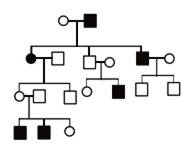
In the following human pedigree,the filled symbols represent the affected individuals. Identify the type of given pedigree.
A
Autosomal recessive
B
$X$-linked dominant
C
Autosomal dominant
D
$X$-linked recessive
Solution
(C) The correct answer is $(C)$ Autosomal dominant.
Analysis of the pedigree:
$1$. The trait appears in every generation (vertical transmission),which is a characteristic of dominant traits.
$2$. Affected individuals have at least one affected parent.
$3$. Both males and females are affected,and affected fathers can pass the trait to their sons,which rules out $X$-linked recessive inheritance.
$4$. Since the trait does not skip generations and appears in both sexes with equal frequency,it is identified as an autosomal dominant trait.
Analysis of the pedigree:
$1$. The trait appears in every generation (vertical transmission),which is a characteristic of dominant traits.
$2$. Affected individuals have at least one affected parent.
$3$. Both males and females are affected,and affected fathers can pass the trait to their sons,which rules out $X$-linked recessive inheritance.
$4$. Since the trait does not skip generations and appears in both sexes with equal frequency,it is identified as an autosomal dominant trait.
0 likes
View Solution170
MediumMCQ
$A$ man whose father was colour blind marries a woman who had a colour blind mother and normal father. What percentage of male children of this couple will be colour blind (in $\%$)?
A
$25$
B
$0$
C
$50$
D
$75$
Solution
(C) Colour blindness is an $X$-linked recessive disorder.
$1$. The man's father was colour blind,but the man himself is normal because he inherits his $Y$ chromosome from his father and his $X$ chromosome from his mother. Thus,the man's genotype is $XY$.
$2$. The woman had a colour blind mother $(X^cX^c)$ and a normal father $(XY)$. She must have inherited an $X^c$ chromosome from her mother and an $X$ chromosome from her father. Thus,the woman's genotype is $X^cX$.
$3$. Cross: $XY \times X^cX$
- Offspring genotypes: $XX, X^cX, XY, X^cY$
- The male children are $XY$ (normal) and $X^cY$ (colour blind).
$4$. Out of the male children,$50\%$ are colour blind.
$1$. The man's father was colour blind,but the man himself is normal because he inherits his $Y$ chromosome from his father and his $X$ chromosome from his mother. Thus,the man's genotype is $XY$.
$2$. The woman had a colour blind mother $(X^cX^c)$ and a normal father $(XY)$. She must have inherited an $X^c$ chromosome from her mother and an $X$ chromosome from her father. Thus,the woman's genotype is $X^cX$.
$3$. Cross: $XY \times X^cX$
- Offspring genotypes: $XX, X^cX, XY, X^cY$
- The male children are $XY$ (normal) and $X^cY$ (colour blind).
$4$. Out of the male children,$50\%$ are colour blind.
0 likes
View Solution171
MediumMCQ
Select the incorrect statement with regard to haemophilia.
A
It is a dominant disease.
B
$A$ single protein involved in the clotting of blood is affected.
C
It is a sex-linked disease.
D
It is a recessive disease.
Solution
(A) : Haemophilia is a sex-linked recessive disease,also known as bleeder's disease.
In this condition,a single protein involved in the cascade of blood clotting is affected (e.g.,antihaemophilic globulin or factor $VIII$ in haemophilia-$A$,or plasma thromboplastin factor $IX$ in haemophilia-$B$).
Because the patient lacks these essential clotting factors,even a minor cut leads to continuous bleeding,which can be fatal.
It is caused by a recessive gene $h$ located on the $X$-chromosome.
$A$ female becomes haemophiliac only if both her $X$-chromosomes carry the recessive gene $(X^hX^h)$.
$A$ female with one recessive allele $(XX^h)$ is a carrier and appears normal because the dominant allele on the other $X$-chromosome ensures normal clotting.
Males are more frequently affected because they have only one $X$-chromosome $(X^hY)$,meaning a single recessive gene is sufficient to express the disease.
In this condition,a single protein involved in the cascade of blood clotting is affected (e.g.,antihaemophilic globulin or factor $VIII$ in haemophilia-$A$,or plasma thromboplastin factor $IX$ in haemophilia-$B$).
Because the patient lacks these essential clotting factors,even a minor cut leads to continuous bleeding,which can be fatal.
It is caused by a recessive gene $h$ located on the $X$-chromosome.
$A$ female becomes haemophiliac only if both her $X$-chromosomes carry the recessive gene $(X^hX^h)$.
$A$ female with one recessive allele $(XX^h)$ is a carrier and appears normal because the dominant allele on the other $X$-chromosome ensures normal clotting.
Males are more frequently affected because they have only one $X$-chromosome $(X^hY)$,meaning a single recessive gene is sufficient to express the disease.
0 likes
View Solution172
MediumMCQ
If both parents are carriers for thalassaemia,which is an autosomal recessive disorder,what are the chances of pregnancy resulting in an affected child?
A
$0.25$
B
$1$
C
No chance
D
$0.5$
Solution
(A) Thalassaemia is an autosomal recessive blood disorder.
Let the normal allele be $T$ and the recessive allele for thalassaemia be $t$.
Both parents are carriers,meaning their genotype is $Tt$.
When crossing $Tt \times Tt$,the possible genotypes of the offspring are $TT$ (normal),$Tt$ (carrier),$Tt$ (carrier),and $tt$ (affected).
The probability of an affected child $(tt)$ is $1/4$ or $0.25$.
Let the normal allele be $T$ and the recessive allele for thalassaemia be $t$.
Both parents are carriers,meaning their genotype is $Tt$.
When crossing $Tt \times Tt$,the possible genotypes of the offspring are $TT$ (normal),$Tt$ (carrier),$Tt$ (carrier),and $tt$ (affected).
The probability of an affected child $(tt)$ is $1/4$ or $0.25$.
0 likes
View Solution173
MediumMCQ
Which one is the incorrect statement with regard to the importance of pedigree analysis?
A
It confirms that $DNA$ is the carrier of genetic information.
B
It helps to understand whether the trait in question is dominant or recessive.
C
It confirms that the trait is linked to one of the autosome.
D
It helps to trace the inheritance of a specific trait.
Solution
(A) : Pedigree analysis is a method of studying the inheritance of specific traits over several generations in a family.
It does not confirm that $DNA$ is the carrier of genetic information,as this is a tool for observing phenotypic patterns of inheritance.
Experiments to prove that $DNA$ is the genetic material require molecular biology techniques,such as the Hershey-Chase experiment.
Therefore,the statement that it confirms $DNA$ as the carrier of genetic information is incorrect.
It does not confirm that $DNA$ is the carrier of genetic information,as this is a tool for observing phenotypic patterns of inheritance.
Experiments to prove that $DNA$ is the genetic material require molecular biology techniques,such as the Hershey-Chase experiment.
Therefore,the statement that it confirms $DNA$ as the carrier of genetic information is incorrect.
0 likes
View Solution174
MediumMCQ
$A$ normal-visioned man whose father was colour-blind,marries a woman whose father was also colour-blind. They have their first child as a daughter. What are the chances that this child would be colour-blind?
A
$1$
B
Zero percent
C
$0.25$
D
$0.5$
Solution
(B) Colour blindness is an $X$-linked recessive trait. Let $X^C$ be the allele for colour blindness and $X$ be the normal allele.
$1$. The man is normal-visioned,so his genotype is $XY$. His father was colour-blind,but this does not affect the man's genotype as he inherits his $Y$ chromosome from his father.
$2$. The woman's father was colour-blind,meaning she must be a carrier of the trait. Her genotype is $XX^C$.
$3$. The cross between the man $(XY)$ and the carrier woman $(XX^C)$ is: $XY \times XX^C$.
$4$. The possible genotypes of the offspring are: $XX$ (normal daughter),$XX^C$ (carrier daughter),$XY$ (normal son),and $X^CY$ (colour-blind son).
$5$. The probability of having a colour-blind daughter is $0$ because a daughter needs to inherit the $X^C$ allele from both parents to be colour-blind,but the father is normal $(XY)$.
$1$. The man is normal-visioned,so his genotype is $XY$. His father was colour-blind,but this does not affect the man's genotype as he inherits his $Y$ chromosome from his father.
$2$. The woman's father was colour-blind,meaning she must be a carrier of the trait. Her genotype is $XX^C$.
$3$. The cross between the man $(XY)$ and the carrier woman $(XX^C)$ is: $XY \times XX^C$.
$4$. The possible genotypes of the offspring are: $XX$ (normal daughter),$XX^C$ (carrier daughter),$XY$ (normal son),and $X^CY$ (colour-blind son).
$5$. The probability of having a colour-blind daughter is $0$ because a daughter needs to inherit the $X^C$ allele from both parents to be colour-blind,but the father is normal $(XY)$.
0 likes
View Solution175
MediumMCQ
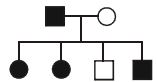
Study the pedigree chart of a certain family given below and select the correct conclusion which can be drawn for the character.
A
The female parent is heterozygous.
B
The parents could not have had a normal daughter for this character.
C
The trait under study could not be colour blindness.
D
The male parent is homozygous dominant.
Solution
(C) The pedigree shows an affected father and an unaffected mother producing both affected and unaffected offspring. This pattern is consistent with an autosomal dominant trait.
Let the dominant allele be $A$ and the recessive allele be $a$.
The affected father must be heterozygous $(Aa)$ because he has an unaffected son $(aa)$.
The unaffected mother must be homozygous recessive $(aa)$.
The cross is $Aa \times aa$.
The offspring genotypes are $Aa$ (affected) and $aa$ (unaffected).
Since the mother is $aa$,she contributes an $a$ allele to all children. The father contributes either $A$ or $a$.
Therefore,the female parent is homozygous recessive $(aa)$,and the male parent is heterozygous $(Aa)$.
Option $(A)$ is incorrect because the female parent is homozygous recessive.
Option $(B)$ is incorrect because they can have a normal daughter $(aa)$.
Option $(C)$ is correct because if the trait were colour blindness ($X$-linked recessive),an affected father would pass the trait to all his daughters,but here he has an unaffected daughter (if we assume the circle represents a daughter,though the pedigree shows two affected daughters and one unaffected son and one affected son). Actually,looking at the pedigree,the father is affected and the mother is unaffected. They have two affected daughters,one unaffected son,and one affected son. This is consistent with an autosomal dominant trait. If it were $X$-linked recessive,an affected father $(X^aY)$ and normal mother $(X^AX^A)$ would produce normal daughters $(X^AX^a)$ and normal sons $(X^AY)$. Thus,it cannot be $X$-linked recessive (colour blindness).
Let the dominant allele be $A$ and the recessive allele be $a$.
The affected father must be heterozygous $(Aa)$ because he has an unaffected son $(aa)$.
The unaffected mother must be homozygous recessive $(aa)$.
The cross is $Aa \times aa$.
The offspring genotypes are $Aa$ (affected) and $aa$ (unaffected).
Since the mother is $aa$,she contributes an $a$ allele to all children. The father contributes either $A$ or $a$.
Therefore,the female parent is homozygous recessive $(aa)$,and the male parent is heterozygous $(Aa)$.
Option $(A)$ is incorrect because the female parent is homozygous recessive.
Option $(B)$ is incorrect because they can have a normal daughter $(aa)$.
Option $(C)$ is correct because if the trait were colour blindness ($X$-linked recessive),an affected father would pass the trait to all his daughters,but here he has an unaffected daughter (if we assume the circle represents a daughter,though the pedigree shows two affected daughters and one unaffected son and one affected son). Actually,looking at the pedigree,the father is affected and the mother is unaffected. They have two affected daughters,one unaffected son,and one affected son. This is consistent with an autosomal dominant trait. If it were $X$-linked recessive,an affected father $(X^aY)$ and normal mother $(X^AX^A)$ would produce normal daughters $(X^AX^a)$ and normal sons $(X^AY)$. Thus,it cannot be $X$-linked recessive (colour blindness).
0 likes
View Solution176
MediumMCQ
Sickle-cell anaemia is
A
caused by substitution of glutamic acid by valine in the beta globin chain of haemoglobin
B
caused by a change in a single base pair of $DNA$
C
characterized by elongated sickle like $RBCs$ without a nucleus
D
an autosomal linked recessive trait.
Solution
(B) $Sickle-cell$ anaemia is an autosomal recessive genetic disorder in which erythrocytes become sickle-shaped.
It is caused by the formation of an abnormal haemoglobin called $Haemoglobin-S$ $(HbS)$.
$Haemoglobin-S$ is formed when the $6^{th}$ amino acid of the $\beta$-globin chain, $i.e.$, glutamic acid, is replaced by valine due to a point mutation.
This occurs due to a single nucleotide change ($GAG \rightarrow GTG$ at the $DNA$ level, corresponding to $A \rightarrow T$ substitution) in the $\beta$-globin gene.
In the normal $\beta$-globin gene, the $DNA$ sequence is $CCTGAGGAG$, while in $sickle-cell$ anaemia, the sequence is $CCTGTGGAG$.
It is caused by the formation of an abnormal haemoglobin called $Haemoglobin-S$ $(HbS)$.
$Haemoglobin-S$ is formed when the $6^{th}$ amino acid of the $\beta$-globin chain, $i.e.$, glutamic acid, is replaced by valine due to a point mutation.
This occurs due to a single nucleotide change ($GAG \rightarrow GTG$ at the $DNA$ level, corresponding to $A \rightarrow T$ substitution) in the $\beta$-globin gene.
In the normal $\beta$-globin gene, the $DNA$ sequence is $CCTGAGGAG$, while in $sickle-cell$ anaemia, the sequence is $CCTGTGGAG$.
0 likes
View Solution177
MediumMCQ
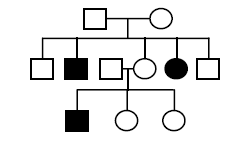
Study the pedigree chart given below. What does it show?
A
Inheritance of a condition like phenylketonuria as an autosomal recessive trait.
B
The pedigree chart is wrong as this is not possible.
C
Inheritance of a recessive sex-linked disease like haemophilia.
D
Inheritance of a sex-linked inborn error of metabolism like phenylketonuria.
Solution
(A) : This chart shows the inheritance of an autosomal recessive trait like phenylketonuria. An autosomal recessive trait may skip a generation. It appears in the case of marriage between two heterozygous individuals $(Aa \times Aa = 3\ Aa + 1\ aa)$,a recessive individual with a hybrid $(Aa \times aa = 2\ Aa + 2\ aa)$,and two recessive individuals $(aa \times aa = \text{all } aa)$. Phenylketonuria is an inborn,autosomal,recessive metabolic disorder in which the homozygous recessive individual lacks the enzyme phenylalanine hydroxylase. The heterozygous individuals are normal but carriers.
0 likes
View Solution178
MediumMCQ
Both sickle cell anaemia and Huntington's chorea are
A
virus-related diseases
B
bacteria-related diseases
C
congenital disorders
D
pollutant-induced disorders
Solution
(C) : $A$ congenital disorder is a medical condition that is present at birth. Congenital disorders can be a result of genetic abnormalities,the intrauterine environment,or unknown factors.
Sickle cell anaemia is a group of genetic disorders caused by sickle haemoglobin $(HbS)$. $HbS$ molecules tend to clump together,making red blood cells sticky,stiff,and more fragile,causing them to form into a curved,sickle shape.
Huntington's chorea is an inherited disorder characterized by degenerative changes in the basal ganglia structures,which ultimately result in a severely shrunken brain and enlarged ventricles,abnormal body movements called chorea,and loss of memory.
Both are genetic in origin and present from birth,hence they are classified as congenital disorders.
Sickle cell anaemia is a group of genetic disorders caused by sickle haemoglobin $(HbS)$. $HbS$ molecules tend to clump together,making red blood cells sticky,stiff,and more fragile,causing them to form into a curved,sickle shape.
Huntington's chorea is an inherited disorder characterized by degenerative changes in the basal ganglia structures,which ultimately result in a severely shrunken brain and enlarged ventricles,abnormal body movements called chorea,and loss of memory.
Both are genetic in origin and present from birth,hence they are classified as congenital disorders.
0 likes
View Solution179
MediumMCQ
If a colour blind woman marries a normal visioned man,their sons will be
A
all colour blind
B
all normal visioned
C
one-half colour blind and one-half normal
D
three-fourths colour blind and one-fourth normal
Solution
(A) Colour blindness is a recessive sex-linked trait caused by a gene on the $X$ chromosome.
Let $X^c$ represent the allele for colour blindness and $X$ represent the normal allele.
$A$ colour blind woman has the genotype $X^c X^c$.
$A$ normal visioned man has the genotype $XY$.
When they reproduce,the cross is $X^c X^c \times XY$.
The possible genotypes for the offspring are $X^c X$ (carrier daughters) and $X^c Y$ (colour blind sons).
Since all sons receive their $X$ chromosome from their mother,and the mother is colour blind $(X^c X^c)$,all sons will inherit the $X^c$ allele.
Therefore,all sons will be colour blind.
Let $X^c$ represent the allele for colour blindness and $X$ represent the normal allele.
$A$ colour blind woman has the genotype $X^c X^c$.
$A$ normal visioned man has the genotype $XY$.
When they reproduce,the cross is $X^c X^c \times XY$.
The possible genotypes for the offspring are $X^c X$ (carrier daughters) and $X^c Y$ (colour blind sons).
Since all sons receive their $X$ chromosome from their mother,and the mother is colour blind $(X^c X^c)$,all sons will inherit the $X^c$ allele.
Therefore,all sons will be colour blind.
0 likes
View Solution180
MediumMCQ
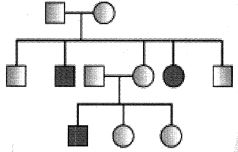
Study the given pedigree chart and select the correct option for the given questions.
$(1)$ Is the trait recessive or dominant?
$(2)$ Is the trait sex-linked or autosomal?
$(1)$ Is the trait recessive or dominant?
$(2)$ Is the trait sex-linked or autosomal?
A
Dominant,Sex-linked
B
Dominant,Autosomal linked
C
Recessive,Autosomal linked
D
Recessive,Sex-linked
Solution
(C) $1$. Analysis of the pedigree chart shows that the trait appears in the offspring of unaffected parents (the parents in the first generation are both unaffected,but they have an affected son and an affected daughter). This indicates that the trait is recessive.
$2$. Since the trait appears in both males and females (an affected son and an affected daughter in the first generation),and it skips generations,it is autosomal recessive. Specifically,the presence of an affected daughter from unaffected parents confirms it is autosomal,as a sex-linked recessive trait would require the father to be affected to pass it to his daughter.
$2$. Since the trait appears in both males and females (an affected son and an affected daughter in the first generation),and it skips generations,it is autosomal recessive. Specifically,the presence of an affected daughter from unaffected parents confirms it is autosomal,as a sex-linked recessive trait would require the father to be affected to pass it to his daughter.
0 likes
View Solution181
MediumMCQ
Which of the following is not a correct statement regarding Phenylketonuria?
A
It is an inborn error of metabolism.
B
It is an autosomal recessive trait.
C
The affected individual lacks an enzyme.
D
It occurs due to the failure of cytokinesis.
Solution
(D) Phenylketonuria $(PKU)$ is an inborn error of metabolism that is inherited as an autosomal recessive trait.
In this disorder,the affected individual lacks the enzyme phenylalanine hydroxylase,which converts the amino acid phenylalanine into tyrosine.
As a result,phenylalanine accumulates and is converted into phenylpyruvic acid and other derivatives,leading to mental retardation.
Option $(D)$ is incorrect because the failure of cytokinesis leads to polyploidy (e.g.,Down syndrome),not $PKU$.
In this disorder,the affected individual lacks the enzyme phenylalanine hydroxylase,which converts the amino acid phenylalanine into tyrosine.
As a result,phenylalanine accumulates and is converted into phenylpyruvic acid and other derivatives,leading to mental retardation.
Option $(D)$ is incorrect because the failure of cytokinesis leads to polyploidy (e.g.,Down syndrome),not $PKU$.
0 likes
View Solution182
MediumMCQ
$A$ - Sickle-cell anaemia is a sex-linked recessive trait.
$R$ - This disease is controlled by more than two pairs of alleles.
$R$ - This disease is controlled by more than two pairs of alleles.
A
$A$ and $R$ both correct
B
$A$ correct and $R$ incorrect
C
$A$ and $R$ both incorrect
D
$A$ incorrect and $R$ correct
Solution
(C) is incorrect because sickle-cell anaemia is an autosomal recessive trait,not sex-linked.
$R$ is incorrect because sickle-cell anaemia is controlled by a single pair of alleles ($Hb^A$ and $Hb^S$),not by more than two pairs (which would be polygenic inheritance).
Therefore,both $A$ and $R$ are incorrect.
$R$ is incorrect because sickle-cell anaemia is controlled by a single pair of alleles ($Hb^A$ and $Hb^S$),not by more than two pairs (which would be polygenic inheritance).
Therefore,both $A$ and $R$ are incorrect.
0 likes
View Solution183
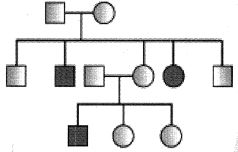
MediumMCQ
Given below is a pedigree chart showing the inheritance of a certain trait in humans. Select the correct option for the given chart.
A
Autosomal dominant trait
B
Autosomal recessive trait
C
Sex-linked recessive
D
Sex-linked dominant
Solution
(B) In the given pedigree chart,both parents are unaffected (unshaded),but they have affected (shaded) offspring. This indicates that the trait is recessive.
If the trait were sex-linked recessive,an affected daughter must have an affected father,which is not the case here (the father is unaffected).
Therefore,the trait must be autosomal recessive,where both parents are heterozygous carriers $(Aa)$.
This allows for the possibility of having affected $(aa)$ children,as seen in the chart.
If the trait were sex-linked recessive,an affected daughter must have an affected father,which is not the case here (the father is unaffected).
Therefore,the trait must be autosomal recessive,where both parents are heterozygous carriers $(Aa)$.
This allows for the possibility of having affected $(aa)$ children,as seen in the chart.
0 likes
View Solution184
MediumMCQ
Haemophilia is an example of:
A
Infectious disease
B
Sex-linked recessive trait
C
Autosomal linked recessive
D
None of the above
Solution
(B) Haemophilia is a genetic disorder caused by a defect in the genes responsible for blood clotting.
It is a $X$-linked recessive trait,meaning the gene responsible for the disease is located on the $X$ chromosome.
Since it is recessive,a female must have the defective gene on both $X$ chromosomes to express the disease,while a male only needs one defective $X$ chromosome to express it because they have only one $X$ chromosome.
Therefore,it is classified as a sex-linked recessive disorder.
It is a $X$-linked recessive trait,meaning the gene responsible for the disease is located on the $X$ chromosome.
Since it is recessive,a female must have the defective gene on both $X$ chromosomes to express the disease,while a male only needs one defective $X$ chromosome to express it because they have only one $X$ chromosome.
Therefore,it is classified as a sex-linked recessive disorder.
0 likes
View Solution185
MediumMCQ
Select the correct statement regarding colour blindness.
A
It is an autosome-linked recessive disorder.
B
It is caused by a mutation in a gene present on the $21^{st}$ pair of chromosomes.
C
It involves the formation of abnormal haemoglobin molecules.
D
It occurs in about $8\%$ of males and only about $0.4\%$ of females.
Solution
(D) Colour blindness is a sex-linked recessive disorder due to a defect in either red or green cone of the eye,resulting in failure to discriminate between red and green colour.
This defect is due to a mutation in certain genes present in the $X$ chromosome.
It occurs in about $8\%$ of males and only about $0.4\%$ of females because the genes that lead to red-green colour blindness are on the $X$ chromosome.
Since males have only one $X$ chromosome and females have two,the incidence is much higher in males.
This defect is due to a mutation in certain genes present in the $X$ chromosome.
It occurs in about $8\%$ of males and only about $0.4\%$ of females because the genes that lead to red-green colour blindness are on the $X$ chromosome.
Since males have only one $X$ chromosome and females have two,the incidence is much higher in males.
0 likes
View Solution186
MediumMCQ
Which is not a Mendelian disorder in man?
A
Sickle cell anaemia
B
Colour blindness
C
Haemophilia
D
Down's syndrome
Solution
(D) Mendelian disorders are primarily determined by alteration or mutation in the single gene. Examples include Haemophilia,Colour blindness,Sickle cell anaemia,Phenylketonuria,Thalassemia,and Cystic fibrosis.
Down's syndrome is a chromosomal disorder caused by the presence of an additional copy of chromosome number $21$ (Trisomy of $21$).
Therefore,Down's syndrome is not a Mendelian disorder.
Down's syndrome is a chromosomal disorder caused by the presence of an additional copy of chromosome number $21$ (Trisomy of $21$).
Therefore,Down's syndrome is not a Mendelian disorder.
0 likes
View Solution187
MediumMCQ
If a colour blind man marries a woman who is homozygous for normal vision,the probability of their son being colour blind is ......... (in $\%$)
A
$100$
B
$0$
C
$0.5$
D
$25$
Solution
(B) Colour blindness is an $X$-linked recessive disorder.
Let $X^c$ represent the allele for colour blindness and $X$ represent the allele for normal vision.
The genotype of the colour blind man is $X^cY$.
The genotype of the homozygous normal vision woman is $XX$.
When they cross: $X^cY \times XX$.
The possible offspring genotypes are $XX^c$ (carrier daughter) and $XY$ (normal son).
Since the son receives the $Y$ chromosome from the father and the $X$ chromosome from the mother (who is homozygous normal),all sons will have normal vision.
Therefore,the probability of their son being colour blind is $0\%$.
Let $X^c$ represent the allele for colour blindness and $X$ represent the allele for normal vision.
The genotype of the colour blind man is $X^cY$.
The genotype of the homozygous normal vision woman is $XX$.
When they cross: $X^cY \times XX$.
The possible offspring genotypes are $XX^c$ (carrier daughter) and $XY$ (normal son).
Since the son receives the $Y$ chromosome from the father and the $X$ chromosome from the mother (who is homozygous normal),all sons will have normal vision.
Therefore,the probability of their son being colour blind is $0\%$.
0 likes
View Solution188
MediumMCQ
Choose the incorrect statement for haemophilia.
A
$A$ single protein that is a part of the cascade of proteins involved in the clotting of blood is affected.
B
It is a sex-linked recessive disease.
C
The family pedigree of Queen Victoria shows a number of haemophilic descendants as she was a carrier of the disease.
D
It is a sex-linked dominant disease.
Solution
(D) Haemophilia is a sex-linked recessive disorder,which means the gene for the disease is located on the $X$ chromosome.
Because it is recessive,a female must have the mutation on both $X$ chromosomes to express the disease,while a male only needs one affected $X$ chromosome.
Queen Victoria was a known carrier of haemophilia,and her pedigree shows the transmission of the disease to several royal families in Europe.
The disease is caused by a defect in a single protein that is part of the cascade of proteins involved in blood clotting.
Therefore,the statement that it is a sex-linked dominant disease is incorrect.
Because it is recessive,a female must have the mutation on both $X$ chromosomes to express the disease,while a male only needs one affected $X$ chromosome.
Queen Victoria was a known carrier of haemophilia,and her pedigree shows the transmission of the disease to several royal families in Europe.
The disease is caused by a defect in a single protein that is part of the cascade of proteins involved in blood clotting.
Therefore,the statement that it is a sex-linked dominant disease is incorrect.
0 likes
View Solution189
MediumMCQ
Which statement is correct regarding the inheritance of an autosome-linked recessive gene?
A
It is more frequent in females than in males.
B
It is more frequent in males than in females.
C
This disease is inherited in children from the mother only.
D
This disease is expressed only in the homozygous condition.
Solution
(D) An autosome-linked recessive trait is controlled by a gene located on one of the autosomes (non-sex chromosomes).
Since autosomes are present in equal numbers in both males and females,the inheritance pattern does not show sex-linkage.
For a recessive trait to be phenotypically expressed,the individual must possess two copies of the recessive allele (homozygous recessive,e.g.,$aa$).
If an individual is heterozygous (e.g.,$Aa$),they are a carrier but do not express the disease.
Therefore,the disease is expressed only in the homozygous condition.
Since autosomes are present in equal numbers in both males and females,the inheritance pattern does not show sex-linkage.
For a recessive trait to be phenotypically expressed,the individual must possess two copies of the recessive allele (homozygous recessive,e.g.,$aa$).
If an individual is heterozygous (e.g.,$Aa$),they are a carrier but do not express the disease.
Therefore,the disease is expressed only in the homozygous condition.
0 likes
View Solution190
MediumMCQ
Identify the genetic disorders based on the following characteristics:
$(i)$ Presence of sickle-shaped $RBC$.
$(ii)$ Blood does not clot,leading to non-stop bleeding.
$(iii)$ The heterozygous female transmits the disease to sons.
$(iv)$ Both heterozygous parents transmit the disease to offspring.
$(i)$ Presence of sickle-shaped $RBC$.
$(ii)$ Blood does not clot,leading to non-stop bleeding.
$(iii)$ The heterozygous female transmits the disease to sons.
$(iv)$ Both heterozygous parents transmit the disease to offspring.
A
$i$ & $ii$ - sickle-cell anaemia,$iii$ & $iv$ - haemophilia
B
$i$ & $iii$ - haemophilia,$iii$ & $iv$ - sickle-cell anaemia
C
$ii$ & $iv$ - haemophilia,$i$ & $iii$ - sickle-cell anaemia
D
$i$ & $iv$ - sickle-cell anaemia,$ii$ & $iii$ - haemophilia
Solution
(D) The characteristics are analyzed as follows:
$(i)$ Sickle-shaped $RBC$ is a hallmark of sickle-cell anaemia (autosomal recessive).
$(ii)$ Non-stop bleeding due to lack of clotting factors is characteristic of haemophilia ($X$-linked recessive).
$(iii)$ Haemophilia is $X$-linked recessive; thus,a heterozygous female (carrier) transmits the disease to her sons.
$(iv)$ Sickle-cell anaemia is autosomal recessive; thus,both heterozygous parents (carriers) can transmit the disease to their offspring.
Therefore,$(i)$ and $(iv)$ correspond to sickle-cell anaemia,while $(ii)$ and $(iii)$ correspond to haemophilia.
$(i)$ Sickle-shaped $RBC$ is a hallmark of sickle-cell anaemia (autosomal recessive).
$(ii)$ Non-stop bleeding due to lack of clotting factors is characteristic of haemophilia ($X$-linked recessive).
$(iii)$ Haemophilia is $X$-linked recessive; thus,a heterozygous female (carrier) transmits the disease to her sons.
$(iv)$ Sickle-cell anaemia is autosomal recessive; thus,both heterozygous parents (carriers) can transmit the disease to their offspring.
Therefore,$(i)$ and $(iv)$ correspond to sickle-cell anaemia,while $(ii)$ and $(iii)$ correspond to haemophilia.
0 likes
View Solution191
MediumMCQ
$A$ husband and wife both have normal vision,although both of their fathers were colorblind. What is the probability that their daughter will be colorblind (in $\%$)?
A
$0$
B
$25$
C
$50$
D
$75$
Solution
(A) Colorblindness is an $X$-linked recessive disorder.
Let $X^C$ be the allele for colorblindness and $X$ be the allele for normal vision.
The husband has normal vision,so his genotype is $XY$.
The wife has normal vision,but since her father was colorblind,she must be a carrier,so her genotype is $XX^C$.
When we cross $XY \times XX^C$,the possible genotypes for their children are:
$1. XX$ (Normal daughter)
$2. XX^C$ (Carrier daughter)
$3. XY$ (Normal son)
$4. X^CY$ (Colorblind son)
Since colorblindness is $X$-linked recessive,a daughter can only be colorblind if she inherits the $X^C$ allele from both parents. In this case,the father is normal $(XY)$,so he cannot pass the $X^C$ allele to his daughter.
Therefore,the probability of their daughter being colorblind is $0\%$.
Let $X^C$ be the allele for colorblindness and $X$ be the allele for normal vision.
The husband has normal vision,so his genotype is $XY$.
The wife has normal vision,but since her father was colorblind,she must be a carrier,so her genotype is $XX^C$.
When we cross $XY \times XX^C$,the possible genotypes for their children are:
$1. XX$ (Normal daughter)
$2. XX^C$ (Carrier daughter)
$3. XY$ (Normal son)
$4. X^CY$ (Colorblind son)
Since colorblindness is $X$-linked recessive,a daughter can only be colorblind if she inherits the $X^C$ allele from both parents. In this case,the father is normal $(XY)$,so he cannot pass the $X^C$ allele to his daughter.
Therefore,the probability of their daughter being colorblind is $0\%$.
0 likes
View Solution192
MediumMCQ
Hemophilia is more common in males because it is a:
A
Recessive trait carried by the $Y$ chromosome.
B
Dominant trait carried by the $Y$ chromosome.
C
Dominant trait carried by the $X$ chromosome.
D
Recessive trait carried by the $X$ chromosome.
Solution
(D) Hemophilia is a sex-linked recessive disorder.
It is caused by a mutation in the genes located on the $X$ chromosome.
Since males have only one $X$ chromosome $(XY)$,a single recessive gene is sufficient to express the disease.
In contrast,females have two $X$ chromosomes $(XX)$,so they require two copies of the recessive gene to express the disease,making them less frequently affected than males.
It is caused by a mutation in the genes located on the $X$ chromosome.
Since males have only one $X$ chromosome $(XY)$,a single recessive gene is sufficient to express the disease.
In contrast,females have two $X$ chromosomes $(XX)$,so they require two copies of the recessive gene to express the disease,making them less frequently affected than males.
0 likes
View Solution193
MediumMCQ
Which of the following is a genetic disorder?
A
Cataract
B
Leprosy
C
Night blindness
D
Phenylketonuria
Solution
(D) Phenylketonuria $(PKU)$ is an inborn error of metabolism that is inherited as an autosomal recessive trait.
It is caused by a mutation in the gene that codes for the enzyme phenylalanine hydroxylase,which leads to the accumulation of phenylalanine in the body.
Cataract,leprosy,and night blindness are generally not classified as genetic disorders in the context of Mendelian inheritance; leprosy is an infectious disease,while cataract and night blindness can be caused by environmental factors,aging,or nutritional deficiencies.
It is caused by a mutation in the gene that codes for the enzyme phenylalanine hydroxylase,which leads to the accumulation of phenylalanine in the body.
Cataract,leprosy,and night blindness are generally not classified as genetic disorders in the context of Mendelian inheritance; leprosy is an infectious disease,while cataract and night blindness can be caused by environmental factors,aging,or nutritional deficiencies.
0 likes
View Solution194
MediumMCQ
$A$ color-blind girl is rarely born. This occurs only when:
A
Her mother is a carrier and her father is color-blind.
B
Her father is color-blind and her maternal grandfather is color-blind.
C
Her mother is color-blind and her father has normal vision.
D
Both parents have normal vision but maternal grandparents were color-blind.
Solution
(A) Color blindness is an $X$-linked recessive trait. For a girl to be color-blind,she must inherit the recessive allele $(X^c)$ from both parents. This means her father must be color-blind $(X^cY)$ and her mother must be either a carrier $(X^CX^c)$ or color-blind $(X^cX^c)$. Since the question implies the rarity of the condition,the most specific scenario is that the father is color-blind and the mother is at least a carrier. However,looking at the provided options,the condition where a girl is color-blind requires the father to be color-blind and the mother to carry the gene. Option $A$ is the most accurate description of the genetic requirement.
0 likes
View Solution195
MediumMCQ
$A$ color-blind mother and a normal father will have:
A
Color-blind sons and normal carrier daughters
B
Color-blind sons and daughters
C
All color-blind
D
All normal
Solution
(A) Color blindness is an $X$-linked recessive disorder.
Let the genotype of the color-blind mother be $X^cX^c$ and the normal father be $XY$.
When these parents cross:
- The mother produces gametes $X^c$ and $X^c$.
- The father produces gametes $X$ and $Y$.
- The offspring genotypes will be:
- $X^cX$ (Carrier daughter)
- $X^cY$ (Color-blind son)
Therefore,all sons will be color-blind and all daughters will be normal carriers.
Let the genotype of the color-blind mother be $X^cX^c$ and the normal father be $XY$.
When these parents cross:
- The mother produces gametes $X^c$ and $X^c$.
- The father produces gametes $X$ and $Y$.
- The offspring genotypes will be:
- $X^cX$ (Carrier daughter)
- $X^cY$ (Color-blind son)
Therefore,all sons will be color-blind and all daughters will be normal carriers.
0 likes
View Solution196
DifficultMCQ
In a normal couple,half of the sons are hemophilic and half of the daughters are carriers. Where is the gene located?
A
On the father's $X$ chromosome
B
On the father's $Y$ chromosome
C
On one of the mother's $X$ chromosomes
D
On both of the mother's $X$ chromosomes
Solution
(C) Hemophilia is an $X$-linked recessive disorder.
If the mother is a carrier $(X^HX^h)$ and the father is normal $(X^HY)$,the cross results in:
$1$. $X^HX^H$ (Normal daughter)
$2$. $X^HX^h$ (Carrier daughter)
$3$. $X^HY$ (Normal son)
$4$. $X^hY$ (Hemophilic son)
In this scenario,$50\%$ of sons are hemophilic and $50\%$ of daughters are carriers. This confirms that the mother carries the recessive gene on one of her $X$ chromosomes.
If the mother is a carrier $(X^HX^h)$ and the father is normal $(X^HY)$,the cross results in:
$1$. $X^HX^H$ (Normal daughter)
$2$. $X^HX^h$ (Carrier daughter)
$3$. $X^HY$ (Normal son)
$4$. $X^hY$ (Hemophilic son)
In this scenario,$50\%$ of sons are hemophilic and $50\%$ of daughters are carriers. This confirms that the mother carries the recessive gene on one of her $X$ chromosomes.
0 likes
View Solution197
MediumMCQ
What is the probability of having a color-blind male child from two normal parents?
A
Not at all.
B
If all four grandparents have normal vision.
C
Only possible if the father's mother is color-blind.
D
Possible if the mother's father is color-blind.
Solution
(D) Color blindness is an $X$-linked recessive disorder.
Let the normal vision allele be $X^C$ and the color-blind allele be $X^c$.
$A$ normal male is $X^CY$ and a normal female is $X^CX^C$ or $X^CX^c$ (carrier).
If the mother is a carrier $(X^CX^c)$ and the father is normal $(X^CY)$,the cross is $X^CX^c \times X^CY$.
The offspring genotypes are $X^CX^C$ (normal female),$X^CX^c$ (carrier female),$X^CY$ (normal male),and $X^cY$ (color-blind male).
Thus,a color-blind male child is possible if the mother is a carrier. $A$ woman is a carrier if her father was color-blind (since she receives one $X$ chromosome from her father).
Let the normal vision allele be $X^C$ and the color-blind allele be $X^c$.
$A$ normal male is $X^CY$ and a normal female is $X^CX^C$ or $X^CX^c$ (carrier).
If the mother is a carrier $(X^CX^c)$ and the father is normal $(X^CY)$,the cross is $X^CX^c \times X^CY$.
The offspring genotypes are $X^CX^C$ (normal female),$X^CX^c$ (carrier female),$X^CY$ (normal male),and $X^cY$ (color-blind male).
Thus,a color-blind male child is possible if the mother is a carrier. $A$ woman is a carrier if her father was color-blind (since she receives one $X$ chromosome from her father).
0 likes
View Solution198
MediumMCQ
$A$ woman whose father was an albino marries an albino man. What will be the ratio of their offspring?
A
$2$ Normal : $1$ Albino
B
All Normal
C
All Albino
D
$1$ Normal : $1$ Albino
Solution
(D) Albinism is an autosomal recessive trait. Let $A$ be the dominant allele for normal skin pigmentation and $a$ be the recessive allele for albinism.
$1$. The woman's father was an albino $(aa)$,so she must have inherited one recessive allele $(a)$ from him. Since she is phenotypically normal,her genotype must be $Aa$.
$2$. The man is an albino,so his genotype must be $aa$.
$3$. The cross between the woman $(Aa)$ and the man $(aa)$ is: $Aa \times aa$.
$4$. The resulting offspring genotypes are $Aa$ (Normal) and $aa$ (Albino) in a $1:1$ ratio.
Therefore,the ratio of their offspring will be $1$ Normal : $1$ Albino.
$1$. The woman's father was an albino $(aa)$,so she must have inherited one recessive allele $(a)$ from him. Since she is phenotypically normal,her genotype must be $Aa$.
$2$. The man is an albino,so his genotype must be $aa$.
$3$. The cross between the woman $(Aa)$ and the man $(aa)$ is: $Aa \times aa$.
$4$. The resulting offspring genotypes are $Aa$ (Normal) and $aa$ (Albino) in a $1:1$ ratio.
Therefore,the ratio of their offspring will be $1$ Normal : $1$ Albino.
0 likes
View Solution199
MediumMCQ
$A$ color-blind woman marries a man with normal vision. In their offspring,.........
A
Both sons and daughters are color-blind.
B
All daughters are color-blind.
C
All sons are normal.
D
All sons are color-blind.
Solution
(D) Color blindness is an $X$-linked recessive disorder. Let the allele for normal vision be $X^C$ and the allele for color blindness be $X^c$.
The genotype of a color-blind woman is $X^cX^c$.
The genotype of a man with normal vision is $X^CY$.
When these two individuals cross:
Parents: $X^cX^c$ (female) $\times$ $X^CY$ (male)
Gametes: $X^c$ and $X^c$ (from mother); $X^C$ and $Y$ (from father)
Offspring genotypes:
$X^CX^c$ (Carrier daughter, normal vision)
$X^CX^c$ (Carrier daughter, normal vision)
$X^cY$ (Color-blind son)
$X^cY$ (Color-blind son)
Therefore, all sons will be color-blind, and all daughters will be carriers with normal vision.
The genotype of a color-blind woman is $X^cX^c$.
The genotype of a man with normal vision is $X^CY$.
When these two individuals cross:
Parents: $X^cX^c$ (female) $\times$ $X^CY$ (male)
Gametes: $X^c$ and $X^c$ (from mother); $X^C$ and $Y$ (from father)
Offspring genotypes:
$X^CX^c$ (Carrier daughter, normal vision)
$X^CX^c$ (Carrier daughter, normal vision)
$X^cY$ (Color-blind son)
$X^cY$ (Color-blind son)
Therefore, all sons will be color-blind, and all daughters will be carriers with normal vision.
0 likes
View SolutionPrinciples of Inheritance and Variation — Pedigree Analysis and Mendelian disorders · Frequently Asked Questions
1Are these Principles of Inheritance and Variation questions useful for JEE and NEET?
Yes. All questions in this section are mapped to JEE Main and NEET exam patterns. Previous year questions from JEE Main, NEET, GUJCET and state-level exams are included with full solutions.
2Can I switch to Hindi or Gujarati for these questions?
Yes. Use the language tabs in the hero section or the sidebar to view the same questions and solutions in English, Hindi or Gujarati.
3How do I generate a question paper from this subtopic?
Use the Vedclass Exam Paper Generator — select the chapter and subtopic, set difficulty, and generate Sets A, B, C, D automatically. First 3 chapters of every subject are free.
Vedclass Products
For Students
Vedclass Test Series
Mock tests in real JEE/NEET style with performance analysis. 5-day free trial.
Start Free TrialFor Teachers
Exam Paper Generator
Generate Set A/B/C/D papers from this chapter in 2 minutes. 3 chapters free.
Try FreeFor Institutes
Online Exam Module
Live online exams with unlimited students, 360° analytics & white-label branding.
See DemoFor Teachers & Institutes
Generate a Principles of Inheritance and Variation Exam Paper in 2 Minutes
Select subtopic & difficulty — Sets A, B, C, D auto-generated with No Repeat logic.
First 3 chapters of every subject are free — no payment required.