
A English
Pedigree Analysis and Mendelian disorders Questions in English
Class 12 Biology · Principles of Inheritance and Variation · Pedigree Analysis and Mendelian disorders
420+
Questions
English
Language
100%
With Solutions
Showing 47 of 420 questions in English
1
MediumMCQ
Which of the following pairs is incorrect?
A
Rickets - Vitamin $D$
B
Goitre - Iodine
C
Beri-beri - Vitamin $B$
D
Colourblindness - Vitamin $A$
Solution
(D) Rickets is caused by a deficiency of Vitamin $D$.
Goitre is caused by a deficiency of Iodine.
Beri-beri is caused by a deficiency of Vitamin $B_1$ (Thiamine).
Colourblindness is a genetic disorder caused by mutations in the genes on the $X$ chromosome,not by a vitamin deficiency. Vitamin $A$ deficiency leads to night blindness,not colourblindness. Therefore,the pair 'Colourblindness - Vitamin $A$' is incorrect.
Goitre is caused by a deficiency of Iodine.
Beri-beri is caused by a deficiency of Vitamin $B_1$ (Thiamine).
Colourblindness is a genetic disorder caused by mutations in the genes on the $X$ chromosome,not by a vitamin deficiency. Vitamin $A$ deficiency leads to night blindness,not colourblindness. Therefore,the pair 'Colourblindness - Vitamin $A$' is incorrect.
0 likes
View Solution2
MediumMCQ
Mental retardation in children suffering from galactosemia can be avoided by
A
Giving them more milk
B
Giving them milk-free diet
C
Giving them milk fortified with vitamins
D
Giving them more proteinous diet
Solution
(B) Galactosemia is a genetic metabolic disorder where the body is unable to metabolize galactose,a sugar found in milk and dairy products.
If left untreated,the accumulation of galactose leads to severe health issues,including mental retardation,liver damage,and cataracts.
Therefore,the primary treatment for infants suffering from galactosemia is to provide them with a milk-free diet,effectively eliminating the source of galactose.
If left untreated,the accumulation of galactose leads to severe health issues,including mental retardation,liver damage,and cataracts.
Therefore,the primary treatment for infants suffering from galactosemia is to provide them with a milk-free diet,effectively eliminating the source of galactose.
0 likes
View Solution3
EasyMCQ
Alkaptonuria is a disease where the urine is:
A
Yellow
B
White
C
Orange
D
Black
Solution
(D) Alkaptonuria is a metabolic disorder caused by the deficiency of the enzyme homogentisate $1,2-$dioxygenase.
This leads to the accumulation of homogentisic acid (alkapton) in the body.
When the urine is exposed to air,the homogentisic acid oxidizes and turns dark or black in color.
Therefore,the correct option is $D$.
This leads to the accumulation of homogentisic acid (alkapton) in the body.
When the urine is exposed to air,the homogentisic acid oxidizes and turns dark or black in color.
Therefore,the correct option is $D$.
0 likes
View Solution4
MediumMCQ
The blackening of urine when exposed to air is a metabolic disorder in human beings. This is due to the presence of:
A
Phenylalanine
B
Tyrosine
C
Valine replacing glutamine
D
Homogentisic acid
Solution
(D) The condition described is Alkaptonuria,which is an inborn error of metabolism.
It is caused by a deficiency of the enzyme homogentisate $1,2-$dioxygenase.
Due to this deficiency,homogentisic acid accumulates in the body and is excreted in the urine.
When the urine is exposed to air,the homogentisic acid oxidizes and polymerizes to form a pigment similar to melanin,which turns the urine black.
It is caused by a deficiency of the enzyme homogentisate $1,2-$dioxygenase.
Due to this deficiency,homogentisic acid accumulates in the body and is excreted in the urine.
When the urine is exposed to air,the homogentisic acid oxidizes and polymerizes to form a pigment similar to melanin,which turns the urine black.
0 likes
View Solution5
MediumMCQ
Which of the following is an example of qualitative inheritance?
A
Skin colour
B
Colour blindness
C
Klinefelter's syndrome
D
Alkaptonuria
Solution
(D) Qualitative inheritance refers to traits that are controlled by a single gene or a few genes and show distinct,discontinuous variations (e.g.,presence or absence of a trait).
$A$. Skin colour is a classic example of quantitative inheritance (polygenic inheritance),where multiple genes contribute to a continuous range of phenotypes.
$B$. Colour blindness is a sex-linked recessive disorder,which is a qualitative trait.
$C$. Klinefelter's syndrome is a chromosomal disorder $(47, XXY)$,not a simple qualitative inheritance pattern.
$D$. Alkaptonuria is an autosomal recessive metabolic disorder caused by a mutation in a single gene. It follows Mendelian inheritance patterns,which is a form of qualitative inheritance. However,in the context of standard biology curriculum comparisons between polygenic and monogenic traits,Alkaptonuria is a clear example of a trait governed by a single gene (qualitative).
$A$. Skin colour is a classic example of quantitative inheritance (polygenic inheritance),where multiple genes contribute to a continuous range of phenotypes.
$B$. Colour blindness is a sex-linked recessive disorder,which is a qualitative trait.
$C$. Klinefelter's syndrome is a chromosomal disorder $(47, XXY)$,not a simple qualitative inheritance pattern.
$D$. Alkaptonuria is an autosomal recessive metabolic disorder caused by a mutation in a single gene. It follows Mendelian inheritance patterns,which is a form of qualitative inheritance. However,in the context of standard biology curriculum comparisons between polygenic and monogenic traits,Alkaptonuria is a clear example of a trait governed by a single gene (qualitative).
0 likes
View Solution6
MediumMCQ
If an albino man marries a normal woman and $50$ offspring are albino and $50$ are normal,the woman is:
A
Heterozygous normal
B
Homozygous normal
C
Heterozygous carrier
D
None of these
Solution
(C) Albinism is an autosomal recessive trait.
Let the allele for normal pigmentation be '$A$' and the allele for albinism be '$a$'.
The albino man must have the genotype '$aa$'.
If the woman is normal,she must have at least one '$A$' allele. Since $50\%$ of the offspring are albino ('$aa$'),they must have received one '$a$' allele from each parent.
Therefore,the woman must possess the '$a$' allele,making her genotype '$Aa$'.
Thus,the woman is a heterozygous carrier.
Let the allele for normal pigmentation be '$A$' and the allele for albinism be '$a$'.
The albino man must have the genotype '$aa$'.
If the woman is normal,she must have at least one '$A$' allele. Since $50\%$ of the offspring are albino ('$aa$'),they must have received one '$a$' allele from each parent.
Therefore,the woman must possess the '$a$' allele,making her genotype '$Aa$'.
Thus,the woman is a heterozygous carrier.
0 likes
View Solution7
MediumMCQ
If both the mother and father are without pigments (albinism),then:
A
All the offspring will be albinos.
B
Half of the offspring will be albinos.
C
$75\%$ of the offspring will be albinos.
D
No offspring will be albinos.
Solution
(A) Albinism is an autosomal recessive disorder. Let the normal allele be represented by '$A$' and the recessive allele for albinism be represented by '$a$'.
An individual with albinism must have the genotype '$aa$'.
If both parents are albinos,their genotypes are '$aa$' and '$aa$'.
When these parents cross $(aa \times aa)$,all possible gametes from both parents will carry the '$a$' allele.
Therefore,all offspring will have the genotype '$aa$',which means all offspring will express the albinism phenotype.
An individual with albinism must have the genotype '$aa$'.
If both parents are albinos,their genotypes are '$aa$' and '$aa$'.
When these parents cross $(aa \times aa)$,all possible gametes from both parents will carry the '$a$' allele.
Therefore,all offspring will have the genotype '$aa$',which means all offspring will express the albinism phenotype.
0 likes
View Solution8
MediumMCQ
Which one in man is a wholly genetic trait?
A
Diphtheria
B
Leucoderma
C
Albinism
D
Tuberculosis
Solution
(C) Albinism is a genetic disorder characterized by the absence of pigment in the skin,hair,and eyes. It is primarily inherited as an autosomal recessive trait. Most commonly,it is caused by mutations in the $TYR$ gene located on the long arm of chromosome $11$,which encodes the enzyme tyrosinase. It can also be caused by mutations in other genes,such as the $P$ gene located on the long arm of chromosome $15$. Diphtheria and Tuberculosis are infectious diseases caused by bacteria,while Leucoderma (Vitiligo) is generally considered an autoimmune condition,not a purely genetic trait.
0 likes
View Solution9
EasyMCQ
In man,albinism is due to the non-synthesis of melanin in the absence of:
A
Lysine
B
Tyrosinase
C
Luciferase
D
Melanase
Solution
(B) Albinism is a genetic disorder caused by the absence of the enzyme $Tyrosinase$.
In humans,the synthesis of melanin pigment from the amino acid $Tyrosine$ requires the enzyme $Tyrosinase$.
When an individual is homozygous recessive for the gene controlling this enzyme,the enzyme is not produced.
As a result,melanin cannot be synthesized,leading to a lack of pigment in the skin,hair,and iris.
In humans,the synthesis of melanin pigment from the amino acid $Tyrosine$ requires the enzyme $Tyrosinase$.
When an individual is homozygous recessive for the gene controlling this enzyme,the enzyme is not produced.
As a result,melanin cannot be synthesized,leading to a lack of pigment in the skin,hair,and iris.
0 likes
View Solution10
MediumMCQ
Which of the following is a genetic disease?
A
Phenylketonuria
B
Blindness
C
Cataract
D
Leprosy
Solution
(A) Phenylketonuria is a genetic disorder caused by a mutation in the gene that codes for the enzyme phenylalanine hydroxylase. It is inherited as an autosomal recessive trait. Blindness,cataract,and leprosy are generally not classified as genetic diseases in the context of Mendelian disorders.
0 likes
View Solution11
MediumMCQ
Which of the following disorders is not hereditary?
A
Haemophilia
B
Cataract
C
Sickle-cell anaemia
D
Colour blindness
Solution
(B) Hereditary disorders are genetic conditions passed from parents to offspring through genes.
$A$. Haemophilia is an $X$-linked recessive disorder.
$B$. Cataract is generally an age-related condition or caused by environmental factors,though it can be congenital,it is not typically classified as a hereditary genetic disorder in the same sense as the others.
$C$. Sickle-cell anaemia is an autosomal recessive genetic disorder.
$D$. Colour blindness is an $X$-linked recessive disorder.
Therefore,Cataract is the correct answer as it is not primarily a hereditary disorder.
$A$. Haemophilia is an $X$-linked recessive disorder.
$B$. Cataract is generally an age-related condition or caused by environmental factors,though it can be congenital,it is not typically classified as a hereditary genetic disorder in the same sense as the others.
$C$. Sickle-cell anaemia is an autosomal recessive genetic disorder.
$D$. Colour blindness is an $X$-linked recessive disorder.
Therefore,Cataract is the correct answer as it is not primarily a hereditary disorder.
0 likes
View Solution12
MediumMCQ
Albinism is a:
A
Hereditary character
B
Non-hereditary character
C
Sex-linked character
D
Acquired character
Solution
(A) Albinism is a genetic disorder characterized by the absence of the pigment melanin in the skin,hair,and eyes.
It is caused by mutations in specific genes that are inherited from parents to offspring.
Since it is passed down through generations via genetic material,it is classified as a hereditary character.
It is caused by mutations in specific genes that are inherited from parents to offspring.
Since it is passed down through generations via genetic material,it is classified as a hereditary character.
0 likes
View Solution13
MediumMCQ
An albino lady marries a normal man having one gene for albinism. They have $3$ daughters and $1$ son. The son will be
A
Normal
B
Either normal or albino
C
Half normal half albino
D
Normal in childhood but turns albino on becoming adult
Solution
(B) Albinism is an autosomal recessive trait. Let $A$ be the dominant allele for normal pigmentation and $a$ be the recessive allele for albinism.
An albino lady has the genotype $aa$.
$A$ normal man carrying one gene for albinism has the genotype $Aa$.
The cross is $aa \times Aa$.
The possible offspring genotypes are $Aa$ (normal carrier) and $aa$ (albino).
Each child,regardless of gender,has a $50\%$ probability of being normal $(Aa)$ and a $50\%$ probability of being albino $(aa)$.
Therefore,the son can be either normal or albino.
An albino lady has the genotype $aa$.
$A$ normal man carrying one gene for albinism has the genotype $Aa$.
The cross is $aa \times Aa$.
The possible offspring genotypes are $Aa$ (normal carrier) and $aa$ (albino).
Each child,regardless of gender,has a $50\%$ probability of being normal $(Aa)$ and a $50\%$ probability of being albino $(aa)$.
Therefore,the son can be either normal or albino.
0 likes
View Solution14
MediumMCQ
An example of a disease caused by a molecular mutation is
A
Erythroblastosis fetalis
B
Haemophilia
C
Anaemia
D
Sickle-cell anaemia
Solution
(D) The correct answer is $D$. Sickle-cell anaemia is a classic example of a molecular disease caused by a point mutation in the gene encoding the $\beta$-globin chain of haemoglobin.
This mutation results in the substitution of glutamic acid with valine at the $6^{th}$ position of the $\beta$-globin chain.
This change in the amino acid sequence alters the molecular structure of the haemoglobin protein,causing the red blood cells to become sickle-shaped under low oxygen tension.
This mutation results in the substitution of glutamic acid with valine at the $6^{th}$ position of the $\beta$-globin chain.
This change in the amino acid sequence alters the molecular structure of the haemoglobin protein,causing the red blood cells to become sickle-shaped under low oxygen tension.
0 likes
View Solution15
EasyMCQ
Albinism is a congenital disorder resulting from the lack of the enzyme:
A
Catalase
B
Fructokinase
C
Tyrosinase
D
Xanthine oxidase
Solution
(C) Albinism is a genetic disorder characterized by the absence of pigment in the skin,hair,and eyes.
It is caused by a mutation in the genes that control the production of melanin.
The enzyme $Tyrosinase$ is essential for the synthesis of melanin from the amino acid tyrosine.
Due to the lack or inactivity of the $Tyrosinase$ enzyme,melanin cannot be produced,leading to the condition known as albinism.
It is caused by a mutation in the genes that control the production of melanin.
The enzyme $Tyrosinase$ is essential for the synthesis of melanin from the amino acid tyrosine.
Due to the lack or inactivity of the $Tyrosinase$ enzyme,melanin cannot be produced,leading to the condition known as albinism.
0 likes
View Solution16
MediumMCQ
In man,the genetic disorder 'Aniridia' (congenital absence of the iris) occurs due to:
A
Recessive mutation
B
Dominant mutation
C
Lethal mutation
D
All the above
Solution
(B) Aniridia is a rare genetic condition characterized by the complete or partial absence of the iris in the eye.
It is primarily caused by a mutation in the $PAX6$ gene.
This condition follows an autosomal dominant pattern of inheritance,meaning that a single copy of the mutated gene is sufficient to cause the disorder.
Therefore,it is classified as a dominant mutation.
It is primarily caused by a mutation in the $PAX6$ gene.
This condition follows an autosomal dominant pattern of inheritance,meaning that a single copy of the mutated gene is sufficient to cause the disorder.
Therefore,it is classified as a dominant mutation.
0 likes
View Solution17
MediumMCQ
Phenylketonuria is a genetic disorder of
A
Trisomic condition
B
Monosomic condition
C
Autosomal dominant gene
D
Autosomal recessive gene
Solution
(D) Phenylketonuria $(PKU)$ is an inborn error of metabolism.
It is caused by an autosomal recessive mutation of a gene located on chromosome $12$.
This mutation leads to the deficiency of the enzyme phenylalanine hydroxylase,which is required to convert the amino acid phenylalanine into tyrosine.
As a result,phenylalanine accumulates and is converted into phenylpyruvic acid and other derivatives,which leads to mental retardation.
It is caused by an autosomal recessive mutation of a gene located on chromosome $12$.
This mutation leads to the deficiency of the enzyme phenylalanine hydroxylase,which is required to convert the amino acid phenylalanine into tyrosine.
As a result,phenylalanine accumulates and is converted into phenylpyruvic acid and other derivatives,which leads to mental retardation.
0 likes
View Solution18
MediumMCQ
Which of the following is not $X$-linked recessive?
A
Haemophilia-$A$
B
Colour blindness
C
$\beta$-Thalassemia
D
$G-6\ PD$ deficiency
Solution
(C) $X$-linked recessive disorders are caused by mutations in genes located on the $X$ chromosome.
Haemophilia-$A$,Colour blindness,and $G-6\ PD$ deficiency are well-known examples of $X$-linked recessive inheritance.
$\beta$-Thalassemia is an autosomal recessive blood disorder caused by mutations in the $HBB$ gene located on chromosome $11$.
Therefore,$\beta$-Thalassemia is not $X$-linked.
Haemophilia-$A$,Colour blindness,and $G-6\ PD$ deficiency are well-known examples of $X$-linked recessive inheritance.
$\beta$-Thalassemia is an autosomal recessive blood disorder caused by mutations in the $HBB$ gene located on chromosome $11$.
Therefore,$\beta$-Thalassemia is not $X$-linked.
0 likes
View Solution19
EasyMCQ
Alkaptonuria is caused due to
A
Dominant autosomal gene
B
Recessive autosomal gene
C
$X$-linked recessive gene
D
$X$-linked dominant gene
Solution
(B) Alkaptonuria is an inborn error of metabolism caused by a recessive autosomal gene mutation.
It leads to the accumulation of homogentisic acid in the body.
Individuals with this condition excrete large amounts of homogentisic acid in their urine.
This urine turns black upon exposure to light due to the oxidation of homogentisic acid.
It leads to the accumulation of homogentisic acid in the body.
Individuals with this condition excrete large amounts of homogentisic acid in their urine.
This urine turns black upon exposure to light due to the oxidation of homogentisic acid.
0 likes
View Solution20
EasyMCQ
Polydactyly in humans is due to:
A
Autosomal dominant gene
B
Autosomal recessive gene
C
Sex-linked dominant gene
D
Sex-linked recessive gene
Solution
(A) Polydactyly is a condition characterized by the presence of extra fingers or toes.
It is a genetic disorder inherited in an autosomal dominant pattern.
This means that an individual only needs to inherit one copy of the mutated gene from either parent to express the trait.
It is a genetic disorder inherited in an autosomal dominant pattern.
This means that an individual only needs to inherit one copy of the mutated gene from either parent to express the trait.
0 likes
View Solution21
MediumMCQ
The amino acid substituted in sickle cell anaemia is
A
Glutamic acid for valine in the alpha chain
B
Glutamic acid for valine in the beta chain
C
Valine for glutamic acid in the alpha chain
D
Valine for glutamic acid in the beta chain
Solution
(D) In sickle cell anaemia,a point mutation occurs in the gene coding for the $\beta$-globin chain of haemoglobin.
Specifically,the sixth amino acid of the normal $\beta$-globin chain,which is glutamic acid,is replaced by valine.
This substitution occurs due to a single base pair change ($GAG$ to $GUG$) in the $DNA$ sequence.
Therefore,the correct substitution is valine for glutamic acid in the $\beta$-chain.
Specifically,the sixth amino acid of the normal $\beta$-globin chain,which is glutamic acid,is replaced by valine.
This substitution occurs due to a single base pair change ($GAG$ to $GUG$) in the $DNA$ sequence.
Therefore,the correct substitution is valine for glutamic acid in the $\beta$-chain.
0 likes
View Solution22
MediumMCQ
Phenylketonuria is a genetic disorder due to a defect in the metabolism of which of the following?
A
Polysaccharides
B
Fatty acids
C
Vitamins
D
Amino acids
Solution
(D) Phenylketonuria $(PKU)$ is an autosomal recessive genetic disorder.
It is caused by a mutation in the gene that codes for the enzyme phenylalanine hydroxylase.
This enzyme is responsible for the metabolism of the amino acid phenylalanine into tyrosine.
Due to the defect in this enzyme,phenylalanine accumulates in the body and is converted into phenylpyruvic acid and other derivatives,which leads to mental retardation and other symptoms.
It is caused by a mutation in the gene that codes for the enzyme phenylalanine hydroxylase.
This enzyme is responsible for the metabolism of the amino acid phenylalanine into tyrosine.
Due to the defect in this enzyme,phenylalanine accumulates in the body and is converted into phenylpyruvic acid and other derivatives,which leads to mental retardation and other symptoms.
0 likes
View Solution23
EasyMCQ
Which one of the following is a dominant trait?
A
Albinism
B
Sickle cell anaemia
C
Phenylketonuria
D
Polydactyly
Solution
(D) The correct answer is $D$.
Polydactyly is a dominant genetic trait in humans,characterized by the presence of extra fingers or toes.
In contrast,Albinism,Sickle cell anaemia,and Phenylketonuria are all examples of autosomal recessive disorders.
Polydactyly is a dominant genetic trait in humans,characterized by the presence of extra fingers or toes.
In contrast,Albinism,Sickle cell anaemia,and Phenylketonuria are all examples of autosomal recessive disorders.
0 likes
View Solution24
MediumMCQ
Albinism is known to be due to an autosomal recessive mutation. The first child of a couple with normal skin pigmentation was an albino. What is the probability that their second child will also be an albino (in $\%$)?
A
$100$
B
$25$
C
$50$
D
$75$
Solution
(B) Albinism is an autosomal recessive trait. Let the normal allele be $A$ and the albino allele be $a$.
Since the parents have normal skin pigmentation but produced an albino child $(aa)$,both parents must be carriers (heterozygous,$Aa$).
The cross is $Aa \times Aa$.
The Punnett square results in the following genotypes: $AA$ (normal),$Aa$ (normal carrier),$Aa$ (normal carrier),and $aa$ (albino).
The probability of having an albino child $(aa)$ in any given pregnancy is $1/4$ or $25\%$.
Therefore,the probability that their second child will be an albino is $25\%$.
Since the parents have normal skin pigmentation but produced an albino child $(aa)$,both parents must be carriers (heterozygous,$Aa$).
The cross is $Aa \times Aa$.
The Punnett square results in the following genotypes: $AA$ (normal),$Aa$ (normal carrier),$Aa$ (normal carrier),and $aa$ (albino).
The probability of having an albino child $(aa)$ in any given pregnancy is $1/4$ or $25\%$.
Therefore,the probability that their second child will be an albino is $25\%$.
0 likes
View Solution25
MediumMCQ
$A$ colour-blind man marries the daughter of a colour-blind person. Then in their progeny:
A
None of their daughters are colour-blind
B
All the sons are colour-blind
C
All the daughters are colour-blind
D
Half of their sons are colour-blind
Solution
(D) Let the colour-blind man be $X^cY$ and the daughter of a colour-blind person be $X^cX$ (carrier).
When they marry,the cross is $X^cY \times X^cX$.
The possible genotypes of the offspring are $X^cX^c$ (colour-blind daughter),$X^cX$ (carrier daughter),$X^cY$ (colour-blind son),and $XY$ (normal son).
Thus,half of their sons will be colour-blind.
When they marry,the cross is $X^cY \times X^cX$.
The possible genotypes of the offspring are $X^cX^c$ (colour-blind daughter),$X^cX$ (carrier daughter),$X^cY$ (colour-blind son),and $XY$ (normal son).
Thus,half of their sons will be colour-blind.
0 likes
View Solution26
MediumMCQ
Given that $X^h$ is the chromosome with the gene for haemophilia and $X$ is the chromosome with the normal gene. Which of the following individuals will act as a carrier for haemophilia?
A
$X^hY$
B
$XY$
C
$X^hX^h$
D
$X^hX$
Solution
(D) Haemophilia is an $X$-linked recessive disorder.
In females,the genotype $X^hX$ represents a carrier state,where the individual possesses one recessive gene for the disease but does not express the phenotype because the normal gene on the other $X$ chromosome masks its effect.
$X^hX^h$ results in an affected female,$XY$ is a normal male,and $X^hY$ is an affected male.
Therefore,the individual with the genotype $X^hX$ acts as a carrier.
In females,the genotype $X^hX$ represents a carrier state,where the individual possesses one recessive gene for the disease but does not express the phenotype because the normal gene on the other $X$ chromosome masks its effect.
$X^hX^h$ results in an affected female,$XY$ is a normal male,and $X^hY$ is an affected male.
Therefore,the individual with the genotype $X^hX$ acts as a carrier.
0 likes
View Solution27
MediumMCQ
Colour blindness is found more in males than in females because
A
The males containing the single affected $X$ chromosome are colour blind
B
Heterozygous females are colour blind
C
Males having affected $Y$ chromosome are colour blind
D
Affected $X$ chromosome has much high affinity to $Y$ chromosome as compared to unaffected $X$ chromosome
Solution
(A) Colour blindness is a recessive sex-linked trait,and the genes responsible for it are located exclusively on the non-homologous segment of the $X$ chromosome.
Males are hemizygous for the $X$ chromosome $(XY)$,meaning they only require a single affected $X$ chromosome to express the trait.
Females,being $XX$,require both $X$ chromosomes to carry the affected gene to express the trait,making them less likely to be affected compared to males.
Males are hemizygous for the $X$ chromosome $(XY)$,meaning they only require a single affected $X$ chromosome to express the trait.
Females,being $XX$,require both $X$ chromosomes to carry the affected gene to express the trait,making them less likely to be affected compared to males.
0 likes
View Solution28
EasyMCQ
Which one is a sex-linked disease?
A
Tylosis
B
Beri-beri
C
Colour blindness
D
Albinism
Solution
(C) Colour blindness is a well-known $X$-linked recessive disorder in humans.
In this condition,the individual is unable to distinguish between red and green colours.
Haemophilia is another common example of an $X$-linked recessive disease.
$Tylosis$ is a skin condition,$Beri-beri$ is caused by Vitamin $B_1$ deficiency,and $Albinism$ is an autosomal recessive disorder.
In this condition,the individual is unable to distinguish between red and green colours.
Haemophilia is another common example of an $X$-linked recessive disease.
$Tylosis$ is a skin condition,$Beri-beri$ is caused by Vitamin $B_1$ deficiency,and $Albinism$ is an autosomal recessive disorder.
0 likes
View Solution29
MediumMCQ
If a mother is a carrier for colour blindness and the father is normal,then in the offspring,this disease may be seen in:
A
All the sons
B
All the daughters
C
$50\%$ of sons and $50\%$ of daughters (carrier)
D
All the sons and not in daughters
Solution
(C) Colour blindness is an $X$-linked recessive disorder. Let $X^C$ be the normal allele and $X^c$ be the colour-blind allele.
Mother is a carrier: $X^C X^c$.
Father is normal: $X^C Y$.
Crossing: $X^C X^c \times X^C Y \rightarrow X^C X^C$ (Normal daughter),$X^C Y$ (Normal son),$X^C X^c$ (Carrier daughter),$X^c Y$ (Colour-blind son).
Thus,$50\%$ of the sons will be colour-blind and $50\%$ of the daughters will be carriers.
Mother is a carrier: $X^C X^c$.
Father is normal: $X^C Y$.
Crossing: $X^C X^c \times X^C Y \rightarrow X^C X^C$ (Normal daughter),$X^C Y$ (Normal son),$X^C X^c$ (Carrier daughter),$X^c Y$ (Colour-blind son).
Thus,$50\%$ of the sons will be colour-blind and $50\%$ of the daughters will be carriers.
0 likes
View Solution30
MediumMCQ
Which one of the following is a sex-linked trait?
A
Myxoedema
B
Diabetes
C
Blindness
D
Haemophilia
Solution
(D) Sex-linked traits are those determined by genes located on the sex chromosomes ($X$ or $Y$).
$Haemophilia$ is a well-known $X$-linked recessive disorder where the blood fails to clot properly due to the deficiency of clotting factors.
$Myxoedema$ is caused by thyroid hormone deficiency.
$Diabetes$ (specifically $Diabetes \text{ } mellitus$) is a metabolic disorder.
$Blindness$ can be caused by various factors, but it is not classified as a standard sex-linked trait in the context of Mendelian genetics.
Therefore, the correct option is $D$.
$Haemophilia$ is a well-known $X$-linked recessive disorder where the blood fails to clot properly due to the deficiency of clotting factors.
$Myxoedema$ is caused by thyroid hormone deficiency.
$Diabetes$ (specifically $Diabetes \text{ } mellitus$) is a metabolic disorder.
$Blindness$ can be caused by various factors, but it is not classified as a standard sex-linked trait in the context of Mendelian genetics.
Therefore, the correct option is $D$.
0 likes
View Solution31
MediumMCQ
$A$ haemophilic female marries a normal male. What will be the theoretical ratio of their offspring regarding haemophilia?
A
All offspring are haemophilic
B
All girls are haemophilic
C
All sons are haemophilic
D
Half daughters and half sons are haemophilic
Solution
(C) Haemophilia is an $X$-linked recessive disorder. Let $X^h$ represent the haemophilic allele and $X$ represent the normal allele.
The genotype of a haemophilic female is $X^h X^h$ and a normal male is $XY$.
When they cross: $X^h X^h \times XY$.
The possible genotypes of the offspring are $X^h X$ (carrier daughter) and $X^h Y$ (haemophilic son).
Therefore,all sons will be haemophilic,and all daughters will be carriers.
The genotype of a haemophilic female is $X^h X^h$ and a normal male is $XY$.
When they cross: $X^h X^h \times XY$.
The possible genotypes of the offspring are $X^h X$ (carrier daughter) and $X^h Y$ (haemophilic son).
Therefore,all sons will be haemophilic,and all daughters will be carriers.
0 likes
View Solution32
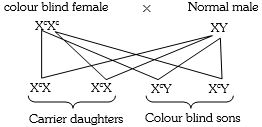
MediumMCQ
If a colour blind lady marries a normal man,their children will be:
A
Normal daughters and normal sons
B
Normal sons and carrier daughters
C
Colour blind sons and carrier daughters
D
Colour blind sons and colour blind daughters
Solution
(C) Colour blindness is an $X$-linked recessive disorder. Let the allele for normal vision be $X$ and the allele for colour blindness be $X^c$.
$A$ colour blind female has the genotype $X^cX^c$.
$A$ normal male has the genotype $XY$.
When they cross $(X^cX^c \times XY)$:
- The female produces gametes $X^c$ and $X^c$.
- The male produces gametes $X$ and $Y$.
The resulting offspring genotypes are:
- $X^cX$ (Carrier daughter)
- $X^cY$ (Colour blind son)
Therefore,all daughters will be carriers and all sons will be colour blind.
$A$ colour blind female has the genotype $X^cX^c$.
$A$ normal male has the genotype $XY$.
When they cross $(X^cX^c \times XY)$:
- The female produces gametes $X^c$ and $X^c$.
- The male produces gametes $X$ and $Y$.
The resulting offspring genotypes are:
- $X^cX$ (Carrier daughter)
- $X^cY$ (Colour blind son)
Therefore,all daughters will be carriers and all sons will be colour blind.
0 likes
View Solution33
MediumMCQ
Which one of the following is a hereditary trait?
A
Night blindness
B
Baldness
C
Colour blindness
D
Beri–beri
Solution
(C) hereditary trait is a characteristic that is passed from parents to offspring through genes.
Colour blindness is a classic example of an $X$-linked recessive hereditary disorder.
Night blindness is typically caused by a deficiency of Vitamin $A$.
Baldness is a polygenic trait influenced by both genetics and environmental factors,but it is not a classic Mendelian hereditary disorder in the same sense as colour blindness.
Beri–beri is caused by a deficiency of Vitamin $B_1$ (thiamine).
Therefore,colour blindness is the correct answer.
Colour blindness is a classic example of an $X$-linked recessive hereditary disorder.
Night blindness is typically caused by a deficiency of Vitamin $A$.
Baldness is a polygenic trait influenced by both genetics and environmental factors,but it is not a classic Mendelian hereditary disorder in the same sense as colour blindness.
Beri–beri is caused by a deficiency of Vitamin $B_1$ (thiamine).
Therefore,colour blindness is the correct answer.
0 likes
View Solution34
MediumMCQ
$A$ person whose father is colourblind marries a lady whose mother is the daughter of a colourblind man. Their children will be:
A
All normal
B
All colour blind
C
All sons colour blind
D
Some sons normal and some colour blind
Solution
(D) $1$. The man's father is colourblind. Since colourblindness is an $X$-linked recessive trait,the man receives his $Y$ chromosome from his father and his $X$ chromosome from his mother. Therefore,the man is genetically normal $(XY)$.
$2$. The lady's mother is the daughter of a colourblind man. This means the lady's mother is a carrier $(X^CX)$. The lady herself is the daughter of this carrier mother. There is a $50\%$ probability that the lady is a carrier $(X^CX)$ and a $50\%$ probability that she is normal $(XX)$. Assuming the standard pedigree problem context,we consider the lady as a carrier $(X^CX)$.
$3$. The cross between a normal man $(XY)$ and a carrier lady $(X^CX)$ results in the following genotypes for their children: $XX$ (normal daughter),$X^CX$ (carrier daughter),$XY$ (normal son),and $X^CY$ (colourblind son).
$4$. Thus,the sons will be some normal and some colourblind.
$2$. The lady's mother is the daughter of a colourblind man. This means the lady's mother is a carrier $(X^CX)$. The lady herself is the daughter of this carrier mother. There is a $50\%$ probability that the lady is a carrier $(X^CX)$ and a $50\%$ probability that she is normal $(XX)$. Assuming the standard pedigree problem context,we consider the lady as a carrier $(X^CX)$.
$3$. The cross between a normal man $(XY)$ and a carrier lady $(X^CX)$ results in the following genotypes for their children: $XX$ (normal daughter),$X^CX$ (carrier daughter),$XY$ (normal son),and $X^CY$ (colourblind son).
$4$. Thus,the sons will be some normal and some colourblind.
0 likes
View Solution35
MediumMCQ
Which of the following diseases belongs to the same category as colourblindness in man?
A
Night blindness
B
Presbyopia
C
Diabetes insipidus
D
Haemophilia
Solution
(D) Colourblindness is a $X$-linked recessive disorder in humans.
Similarly,Haemophilia is also a $X$-linked recessive disorder.
Both conditions are caused by mutations in genes located on the $X$ chromosome,which are inherited in a recessive manner.
Therefore,Haemophilia belongs to the same category as colourblindness.
Similarly,Haemophilia is also a $X$-linked recessive disorder.
Both conditions are caused by mutations in genes located on the $X$ chromosome,which are inherited in a recessive manner.
Therefore,Haemophilia belongs to the same category as colourblindness.
0 likes
View Solution36
EasyMCQ
Which of the following human diseases provides an example of sex-linked inheritance?
A
Haemophilia
B
Night blindness
C
Mongolism
D
Beri-beri
Solution
(A) Haemophilia is a classic example of a sex-linked recessive disorder in humans.
It is caused by a mutation in the genes located on the $X$ chromosome.
Since it is recessive,it manifests more frequently in males (who have only one $X$ chromosome) than in females.
In contrast,night blindness is typically related to vitamin $A$ deficiency,Mongolism (Down syndrome) is a chromosomal disorder caused by trisomy $21$,and Beri-beri is caused by vitamin $B_1$ deficiency.
It is caused by a mutation in the genes located on the $X$ chromosome.
Since it is recessive,it manifests more frequently in males (who have only one $X$ chromosome) than in females.
In contrast,night blindness is typically related to vitamin $A$ deficiency,Mongolism (Down syndrome) is a chromosomal disorder caused by trisomy $21$,and Beri-beri is caused by vitamin $B_1$ deficiency.
0 likes
View Solution37
MediumMCQ
$A$ man known to be a victim of haemophilia marries a normal woman whose father was known to be a bleeder. Then it is expected that:
A
All their children will be bleeders
B
Half of their children will be bleeders
C
One fourth of their children will be bleeders
D
None of their children will be bleeder
Solution
(B) Haemophilia is an $X$-linked recessive disorder.
Let $X^h$ represent the haemophilic allele and $X$ represent the normal allele.
The man is a victim of haemophilia,so his genotype is $X^hY$.
The woman is normal but her father was a bleeder $(X^hY)$,which means she must have inherited the $X^h$ allele from him. Thus,her genotype is $X^hX$.
When they marry,the cross is $X^hY \times X^hX$.
The possible offspring genotypes are:
$1. X^hX^h$ (Haemophilic daughter)
$2. X^hX$ (Carrier daughter)
$3. X^hY$ (Haemophilic son)
$4. XY$ (Normal son)
Out of these four possibilities,two are affected (haemophilic). Therefore,half of their children will be bleeders.
Let $X^h$ represent the haemophilic allele and $X$ represent the normal allele.
The man is a victim of haemophilia,so his genotype is $X^hY$.
The woman is normal but her father was a bleeder $(X^hY)$,which means she must have inherited the $X^h$ allele from him. Thus,her genotype is $X^hX$.
When they marry,the cross is $X^hY \times X^hX$.
The possible offspring genotypes are:
$1. X^hX^h$ (Haemophilic daughter)
$2. X^hX$ (Carrier daughter)
$3. X^hY$ (Haemophilic son)
$4. XY$ (Normal son)
Out of these four possibilities,two are affected (haemophilic). Therefore,half of their children will be bleeders.
0 likes
View Solution38
MediumMCQ
Genes of colour blindness are carried in
A
Eye cells
B
Sex cells
C
Body cells
D
Heterosomes
Solution
(D) Colour blindness is a $X$-linked recessive disorder.
This means the gene responsible for colour blindness is located on the $X$ chromosome.
Since the $X$ chromosome is a sex chromosome (also known as a heterosome),the genes are carried in the sex chromosomes.
Therefore,the correct option is $D$.
This means the gene responsible for colour blindness is located on the $X$ chromosome.
Since the $X$ chromosome is a sex chromosome (also known as a heterosome),the genes are carried in the sex chromosomes.
Therefore,the correct option is $D$.
0 likes
View Solution39
MediumMCQ
All sons of a couple are colourblind because
A
Mother is homozygous colourblind
B
Mother is heterozygous and father normal
C
Mother is heterozygous and father colourblind
D
Mother is normal and father colourblind
Solution
(A) Colour blindness is an $X$-linked recessive disorder.
For a son to be colourblind,he must inherit the $X$ chromosome carrying the recessive allele from his mother.
If the mother is homozygous colourblind $(X^cX^c)$,she will pass the $X^c$ chromosome to all her sons.
Since sons receive their only $X$ chromosome from their mother and the $Y$ chromosome from their father,all sons will be colourblind $(X^cY)$ regardless of the father's genotype.
For a son to be colourblind,he must inherit the $X$ chromosome carrying the recessive allele from his mother.
If the mother is homozygous colourblind $(X^cX^c)$,she will pass the $X^c$ chromosome to all her sons.
Since sons receive their only $X$ chromosome from their mother and the $Y$ chromosome from their father,all sons will be colourblind $(X^cY)$ regardless of the father's genotype.
0 likes
View Solution40
MediumMCQ
Colour blindness in man is
A
Due to deficiency of vitamin $A$
B
Due to absence of visual purple in retina
C
Due to absence of rods in retina
D
$A$ sex-linked abnormality
Solution
(D) Colour blindness is a sex-linked recessive disorder in humans.
It is caused by the mutation of certain genes present on the $X$ chromosome.
Because it is $X$-linked,it affects males more frequently than females,as males have only one $X$ chromosome.
Therefore,the correct option is $D$.
It is caused by the mutation of certain genes present on the $X$ chromosome.
Because it is $X$-linked,it affects males more frequently than females,as males have only one $X$ chromosome.
Therefore,the correct option is $D$.
0 likes
View Solution41
MediumMCQ
Colour blindness is a disease usually affecting men,but the factor for it is transmitted to the children always by the woman. This is because the particular factor is located on
A
$X$ chromosome
B
$Y$ chromosome
C
Both $X$ and $Y$ chromosomes
D
Autosome
Solution
(A) Colour blindness is an $X$-linked recessive disorder.
In this condition,the gene responsible for the trait is located on the $X$ chromosome.
Since males have only one $X$ chromosome $(XY)$,they express the trait if they inherit the affected chromosome from their mother.
Females have two $X$ chromosomes $(XX)$,so they can be carriers without showing the disease if they have one normal and one affected allele.
Because the gene is on the $X$ chromosome,a mother can pass the trait to her sons (who receive her $X$ chromosome) and daughters (who may become carriers),making the woman the transmitter of the factor.
In this condition,the gene responsible for the trait is located on the $X$ chromosome.
Since males have only one $X$ chromosome $(XY)$,they express the trait if they inherit the affected chromosome from their mother.
Females have two $X$ chromosomes $(XX)$,so they can be carriers without showing the disease if they have one normal and one affected allele.
Because the gene is on the $X$ chromosome,a mother can pass the trait to her sons (who receive her $X$ chromosome) and daughters (who may become carriers),making the woman the transmitter of the factor.
0 likes
View Solution42
MediumMCQ
Red-green colour blindness appears due to
A
Excessive drinking of alcohol
B
Inheritance through $X$ chromosome
C
Over-activity of adrenal glands
D
Vitamin $A$ deficiency
Solution
(B) Red-green colour blindness is a sex-linked recessive disorder.
It is caused by a mutation in the genes located on the $X$ chromosome.
Since males have only one $X$ chromosome,they are more frequently affected than females,who have two $X$ chromosomes and can be carriers.
It is caused by a mutation in the genes located on the $X$ chromosome.
Since males have only one $X$ chromosome,they are more frequently affected than females,who have two $X$ chromosomes and can be carriers.
0 likes
View Solution43
MediumMCQ
Which of the following is ineffective against antibiotics?
A
Bacterial infected wound
B
Bacterial infected throat
C
Haemophilia
D
Bacterial infected gonorrhoea
Solution
(C) . Haemophilia is a genetic disorder caused by mutations in genes responsible for blood clotting factors. Since it is an inherited condition and not caused by a pathogen,it cannot be treated or affected by antibiotics.
0 likes
View Solution44
MediumMCQ
Haemophilia $A$ is due to the absence of
A
Antihaemophilic globulin
B
Calcium
C
Plasma thromboplastin
D
$X$ chromosome
Solution
(A) Haemophilia $A$ is a genetic disorder characterized by the deficiency of antihaemophilic globulin,also known as clotting Factor $VIII$.
This factor is essential for the blood coagulation cascade.
When this factor is absent or defective,the blood fails to clot properly,leading to prolonged bleeding.
Approximately $80\%$ of all haemophilia cases are classified as Haemophilia $A$.
This factor is essential for the blood coagulation cascade.
When this factor is absent or defective,the blood fails to clot properly,leading to prolonged bleeding.
Approximately $80\%$ of all haemophilia cases are classified as Haemophilia $A$.
0 likes
View Solution45
MediumMCQ
If a boy's father has haemophilia and his mother has one gene for haemophilia,what is the chance that the boy will inherit the disease (in $\%$)?
A
$25$
B
$50$
C
$75$
D
$100$
Solution
(B) Haemophilia is an $X$-linked recessive disorder.
The father's genotype is $X^hY$ (affected) and the mother's genotype is $X^HX^h$ (carrier,as she has one gene for haemophilia).
When we cross the parents $(X^HX^h \times X^hY)$:
- The possible genotypes for the offspring are $X^HX^h$ (carrier daughter),$X^hX^h$ (affected daughter),$X^HY$ (normal son),and $X^hY$ (affected son).
- Among the sons,$50\%$ will be normal $(X^HY)$ and $50\%$ will be affected $(X^hY)$.
- Therefore,the chance that the boy will inherit the disease is $50\%$.
The father's genotype is $X^hY$ (affected) and the mother's genotype is $X^HX^h$ (carrier,as she has one gene for haemophilia).
When we cross the parents $(X^HX^h \times X^hY)$:
- The possible genotypes for the offspring are $X^HX^h$ (carrier daughter),$X^hX^h$ (affected daughter),$X^HY$ (normal son),and $X^hY$ (affected son).
- Among the sons,$50\%$ will be normal $(X^HY)$ and $50\%$ will be affected $(X^hY)$.
- Therefore,the chance that the boy will inherit the disease is $50\%$.
0 likes
View Solution46
MediumMCQ
Carrier of genes of colour blindness are present in
A
Father
B
Mother
C
Father and mother
D
None
Solution
(B) The gene for colour blindness is $X$-linked recessive.
$A$ male has only one $X$-chromosome $(XY)$,so if he carries the gene,he will be colour blind.
$A$ female has two $X$-chromosomes $(XX)$. If she carries the gene on only one $X$-chromosome,she remains phenotypically normal but acts as a carrier.
Therefore,mothers can be carriers of the colour blindness gene,while fathers cannot be carriers.
$A$ male has only one $X$-chromosome $(XY)$,so if he carries the gene,he will be colour blind.
$A$ female has two $X$-chromosomes $(XX)$. If she carries the gene on only one $X$-chromosome,she remains phenotypically normal but acts as a carrier.
Therefore,mothers can be carriers of the colour blindness gene,while fathers cannot be carriers.
0 likes
View Solution47
MediumMCQ
Sickle cell anaemia is due to
A
Hormones
B
Viruses
C
Genes
D
Bacteria
Solution
(C) Sickle-cell anaemia is a genetic disorder caused by a point mutation in the $HbA$ gene located on chromosome $11$.
This mutation leads to the substitution of glutamic acid with valine at the sixth position of the $\beta$-globin chain of haemoglobin.
Since it is caused by a change in the $DNA$ sequence,it is classified as a genetic disease.
This mutation leads to the substitution of glutamic acid with valine at the sixth position of the $\beta$-globin chain of haemoglobin.
Since it is caused by a change in the $DNA$ sequence,it is classified as a genetic disease.
0 likes
View SolutionPrinciples of Inheritance and Variation — Pedigree Analysis and Mendelian disorders · Frequently Asked Questions
1Are these Principles of Inheritance and Variation questions useful for JEE and NEET?
Yes. All questions in this section are mapped to JEE Main and NEET exam patterns. Previous year questions from JEE Main, NEET, GUJCET and state-level exams are included with full solutions.
2Can I switch to Hindi or Gujarati for these questions?
Yes. Use the language tabs in the hero section or the sidebar to view the same questions and solutions in English, Hindi or Gujarati.
3How do I generate a question paper from this subtopic?
Use the Vedclass Exam Paper Generator — select the chapter and subtopic, set difficulty, and generate Sets A, B, C, D automatically. First 3 chapters of every subject are free.
Vedclass Products
For Students
Vedclass Test Series
Mock tests in real JEE/NEET style with performance analysis. 5-day free trial.
Start Free TrialFor Teachers
Exam Paper Generator
Generate Set A/B/C/D papers from this chapter in 2 minutes. 3 chapters free.
Try FreeFor Institutes
Online Exam Module
Live online exams with unlimited students, 360° analytics & white-label branding.
See DemoFor Teachers & Institutes
Generate a Principles of Inheritance and Variation Exam Paper in 2 Minutes
Select subtopic & difficulty — Sets A, B, C, D auto-generated with No Repeat logic.
First 3 chapters of every subject are free — no payment required.