
A English
Pedigree Analysis and Mendelian disorders Questions in English
Class 12 Biology · Principles of Inheritance and Variation · Pedigree Analysis and Mendelian disorders
420+
Questions
English
Language
100%
With Solutions
Showing 50 of 420 questions in English
301
MediumMCQ
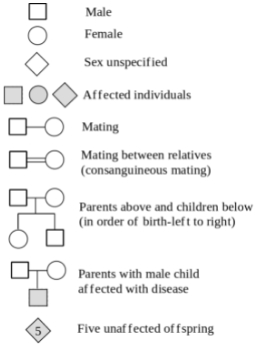
In pedigree analysis,the square,blackened,and horizontal lines represent:
A
Female,healthy individual,parents
B
Female,affected individual,parents
C
Male,affected individual,parents
D
Male,affected individual,progeny
Solution
(C) In pedigree analysis:
- $A$ square represents a male.
- $A$ blackened (shaded) square or circle represents an affected individual.
- $A$ horizontal line between two symbols represents mating (parents).
Pedigree analysis is the study of the inheritance of genetic traits in several generations of a human family,represented as a family tree diagram.
Advantages:
$(i)$ It helps in genetic counselling to avoid disorders.
$(ii)$ It shows the origin of a trait and the flow of a trait in a family.
$(iii)$ It is important to know the possibility of a recessive allele that can cause genetic disorders like colour blindness,haemophilia,etc.
- $A$ square represents a male.
- $A$ blackened (shaded) square or circle represents an affected individual.
- $A$ horizontal line between two symbols represents mating (parents).
Pedigree analysis is the study of the inheritance of genetic traits in several generations of a human family,represented as a family tree diagram.
Advantages:
$(i)$ It helps in genetic counselling to avoid disorders.
$(ii)$ It shows the origin of a trait and the flow of a trait in a family.
$(iii)$ It is important to know the possibility of a recessive allele that can cause genetic disorders like colour blindness,haemophilia,etc.
0 likes
View Solution302
MediumMCQ
Which of the following is not true of haemophilia?
A
Royal disease
B
Bleeder's disease
C
$X$-linked disorder
D
$Y$-linked disorder
Solution
(D) Haemophilia is a genetic disorder caused by a mutation in genes located on the $X$ chromosome.
It is inherited in an $X$-linked recessive pattern.
It is historically known as 'Royal disease' because it affected several royal families in Europe.
It is also known as 'Bleeder's disease' because the blood of affected individuals fails to clot properly due to a deficiency in clotting factors.
Therefore,it is not a $Y$-linked disorder.
It is inherited in an $X$-linked recessive pattern.
It is historically known as 'Royal disease' because it affected several royal families in Europe.
It is also known as 'Bleeder's disease' because the blood of affected individuals fails to clot properly due to a deficiency in clotting factors.
Therefore,it is not a $Y$-linked disorder.
0 likes
View Solution303
MediumMCQ
If a man who is colour blind marries a woman who is pure normal for colour vision,the chances of their sons having colour blindness is
A
$100 \%$
B
$50: 50$
C
$0 \%$
D
$75: 25$
Solution
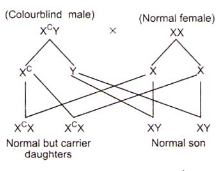
(C) Colour blindness is an $X$-linked recessive disorder. Let the genotype of the colour blind man be $X^CY$ and the normal woman be $XX$.
The cross between them is as follows:
$X^CY \times XX \rightarrow X^CX, X^CX, XY, XY$.
The offspring produced are two carrier daughters $(X^CX)$ and two normal sons $(XY)$.
Since the sons receive their $X$ chromosome from their mother and $Y$ chromosome from their father,and the mother is normal $(XX)$,all sons will be normal.
Therefore,the probability of their sons having colour blindness is $0 \%$.
The cross between them is as follows:
$X^CY \times XX \rightarrow X^CX, X^CX, XY, XY$.
The offspring produced are two carrier daughters $(X^CX)$ and two normal sons $(XY)$.
Since the sons receive their $X$ chromosome from their mother and $Y$ chromosome from their father,and the mother is normal $(XX)$,all sons will be normal.
Therefore,the probability of their sons having colour blindness is $0 \%$.
0 likes
View Solution304
MediumMCQ
Which of the following is an example of a sex-linked disease?
A
$AIDS$
B
Colour blindness
C
Syphilis
D
Gonorrhoea
Solution
(B) Sex-linked diseases are genetic disorders caused by mutations in genes located on sex chromosomes ($X$ or $Y$).
Colour blindness is a classic example of an $X$-linked recessive disorder.
Haemophilia is another well-known example of an $X$-linked recessive disease.
$AIDS$,Syphilis,and Gonorrhoea are infectious diseases caused by pathogens,not genetic mutations.
Colour blindness is a classic example of an $X$-linked recessive disorder.
Haemophilia is another well-known example of an $X$-linked recessive disease.
$AIDS$,Syphilis,and Gonorrhoea are infectious diseases caused by pathogens,not genetic mutations.
0 likes
View Solution305
MediumMCQ
Pedigree analysis is very important in human beings because
A
It helps genetic counselors to avoid disorders
B
It shows the origin of traits
C
It shows the flow of traits in a family
D
All of the above
Solution
(D) The study of inheritance of genetic traits in several generations of a human family in the form of a family tree diagram is called pedigree analysis.
Advantages:
$(i)$ It helps in genetic counseling to avoid disorders.
$(ii)$ It shows the origin of a trait and the flow of a trait in a family.
$(iii)$ It is important to know the possibility of a recessive allele that can cause genetic disorders like color blindness,hemophilia,etc.
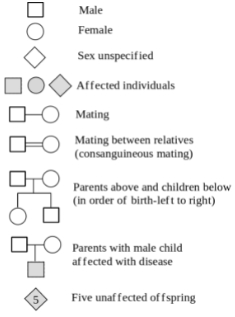
The symbols used in pedigree analysis are as follows:
| Symbol | Meaning |
| :--- | :--- |
| Square | Male |
| Circle | Female |
| Diamond | Sex unspecified |
| Shaded symbols | Affected individuals |
| Horizontal line between square and circle | Mating |
| Double horizontal line | Mating between relatives (consanguineous mating) |
| Vertical line from horizontal line | Parents above and children below (in order of birth-left to right) |
| Square with number $5$ inside | Five unaffected offspring |
Advantages:
$(i)$ It helps in genetic counseling to avoid disorders.
$(ii)$ It shows the origin of a trait and the flow of a trait in a family.
$(iii)$ It is important to know the possibility of a recessive allele that can cause genetic disorders like color blindness,hemophilia,etc.
The symbols used in pedigree analysis are as follows:
| Symbol | Meaning |
| :--- | :--- |
| Square | Male |
| Circle | Female |
| Diamond | Sex unspecified |
| Shaded symbols | Affected individuals |
| Horizontal line between square and circle | Mating |
| Double horizontal line | Mating between relatives (consanguineous mating) |
| Vertical line from horizontal line | Parents above and children below (in order of birth-left to right) |
| Square with number $5$ inside | Five unaffected offspring |
0 likes
View Solution306
MediumMCQ
Sickle-cell anaemia happens due to $A$ mutation in which $B$ of haemoglobin is affected. Fill the correct option for $A$ and $B$.
A
$A-$point; $B-\beta$-chain
B
$A-$chromosomal; $B-\alpha$-chain
C
$A-$allele; $B-\alpha$-chain
D
$A-$non-allele; $B-$chain
Solution
(A) Sickle-cell anaemia is a classic example of a point mutation.
It occurs due to a single base pair substitution in the gene coding for the $\beta$-globin chain of haemoglobin.
Specifically, the codon $GAG$ is replaced by $GUG$, which leads to the substitution of glutamic acid with valine at the sixth position of the $\beta$-globin chain.
Therefore, $A$ is point mutation and $B$ is $\beta$-chain.
It occurs due to a single base pair substitution in the gene coding for the $\beta$-globin chain of haemoglobin.
Specifically, the codon $GAG$ is replaced by $GUG$, which leads to the substitution of glutamic acid with valine at the sixth position of the $\beta$-globin chain.
Therefore, $A$ is point mutation and $B$ is $\beta$-chain.
0 likes
View Solution307
EasyMCQ
Carrier organism refers to an individual,which carries a
A
Dominant gene,that is not expressed
B
Recessive gene,that is not expressed
C
Recessive gene,that is expressed
D
Dominant gene,that is expressed
Solution
(B) carrier organism is an individual who possesses a recessive gene for a specific trait or disease but does not show the phenotype because the dominant allele masks its expression. The individual is heterozygous for the trait.
0 likes
View Solution308
MediumMCQ
The gene for colour blindness is carried by:
A
$I$ and $II$
B
$II$ and $III$
C
$III$ and $I$
D
$I$ and $IV$
Solution
(B) Colour blindness is a sex-linked recessive disorder caused by a defective gene located on the $X$-chromosome.
Since females have two $X$-chromosomes $(XX)$ and males have one $X$-chromosome $(XY)$,the inheritance pattern depends on the parents.
$A$ colour-blind male inherits the defective gene from his mother,while a colour-blind female inherits the defective gene from both her father and her mother.
Therefore,the gene for colour blindness is carried by both the father and the mother.
Since females have two $X$-chromosomes $(XX)$ and males have one $X$-chromosome $(XY)$,the inheritance pattern depends on the parents.
$A$ colour-blind male inherits the defective gene from his mother,while a colour-blind female inherits the defective gene from both her father and her mother.
Therefore,the gene for colour blindness is carried by both the father and the mother.
0 likes
View Solution309
MediumMCQ
Thalassaemia is:
A
Autosomal recessive disease
B
Autosomal dominant disease
C
Sex-linked dominant disease
D
Sex-linked recessive disease
Solution
(A) Thalassaemia is an autosome-linked recessive blood disorder.
$(i)$ It occurs due to either mutation or deletion,resulting in a reduced rate of synthesis of one of the globin chains of haemoglobin.
$(ii)$ Anaemia is the characteristic symptom of this disease.
$(iii)$ Thalassaemia is classified into two types:
$1.$ $\alpha$-thalassaemia: The production of the $\alpha$-globin chain is affected. It is controlled by the closely linked genes $HBA1$ and $HBA2$ on chromosome $16$. It occurs due to the mutation or deletion of one or more of the four genes.
$2.$ $\beta$-thalassaemia: The production of the $\beta$-globin chain is affected. It occurs due to the mutation of one or both $HBB$ genes on chromosome $11$.
$(i)$ It occurs due to either mutation or deletion,resulting in a reduced rate of synthesis of one of the globin chains of haemoglobin.
$(ii)$ Anaemia is the characteristic symptom of this disease.
$(iii)$ Thalassaemia is classified into two types:
$1.$ $\alpha$-thalassaemia: The production of the $\alpha$-globin chain is affected. It is controlled by the closely linked genes $HBA1$ and $HBA2$ on chromosome $16$. It occurs due to the mutation or deletion of one or more of the four genes.
$2.$ $\beta$-thalassaemia: The production of the $\beta$-globin chain is affected. It occurs due to the mutation of one or both $HBB$ genes on chromosome $11$.
0 likes
View Solution310
EasyMCQ
$A$ person is suffering from the disease phenylketonuria, which is an autosomal recessive disease. Which of these is lacking in the person?
A
Homogentisic acid
B
Phenylalanine hydroxylase
C
Caeruloplasmin
D
Cystine
Solution
(B) Phenylketonuria $(PKU)$ is an inborn error of metabolism inherited as an autosomal recessive trait. It is caused by a mutation in the gene that codes for the liver enzyme $Phenylalanine$ hydroxylase. This enzyme is responsible for converting the amino acid $Phenylalanine$ into $Tyrosine$. Due to the deficiency of this enzyme, $Phenylalanine$ accumulates in the body and is converted into phenylpyruvic acid and other derivatives, which leads to mental retardation and other symptoms.
0 likes
View Solution311
MediumMCQ
Disorders inherited according to Mendel's laws of inheritance are called:
A
Mendelian disorder
B
Chromosomal disorder
C
Maternal inheritance
D
Polygenic inheritance
Solution
(A) Genetic disorders are broadly grouped into two categories:
$(i)$ Mendelian Disorders: These genetic disorders are primarily caused by alterations or mutations in a single gene. They are transmitted to offspring following the principles of inheritance as described by Mendel. Mendelian disorders can be dominant or recessive. Examples include haemophilia,colour blindness,sickle-cell anaemia,cystic fibrosis,phenylketonuria,and thalassaemia.
$(ii)$ Chromosomal Disorders: These disorders are caused due to the excess,absence,or abnormal arrangement of one or more chromosomes. Examples include Turner's syndrome,Down's syndrome,etc.
$(i)$ Mendelian Disorders: These genetic disorders are primarily caused by alterations or mutations in a single gene. They are transmitted to offspring following the principles of inheritance as described by Mendel. Mendelian disorders can be dominant or recessive. Examples include haemophilia,colour blindness,sickle-cell anaemia,cystic fibrosis,phenylketonuria,and thalassaemia.
$(ii)$ Chromosomal Disorders: These disorders are caused due to the excess,absence,or abnormal arrangement of one or more chromosomes. Examples include Turner's syndrome,Down's syndrome,etc.
0 likes
View Solution312
EasyMCQ
In Cooley's Anemia,the affected chain of a haemoglobin is
A
$\alpha$-globin chain
B
$\beta$-globin chain
C
Both $(a)$ and $(b)$
D
None of these
Solution
(B) $\beta$-thalassaemia major is also known as Cooley's Anemia.
Thalassaemia is of two major kinds: $\alpha$-thalassaemia and $\beta$-thalassaemia,depending on the defective gene in the $\alpha$ or $\beta$-chain of haemoglobin.
Key characteristics of Thalassaemia:
$(i)$ It is an autosome-linked recessive disease.
$(ii)$ It occurs due to either mutation or deletion,resulting in a reduced rate of synthesis of one of the globin chains of haemoglobin.
$(iii)$ Anaemia is the characteristic symptom of this disease.
$(iv)$ $\alpha$-thalassaemia: Production of $\alpha$-globin chain is affected. It is controlled by the closely linked genes $HBA1$ and $HBA2$ on chromosome $16$.
$(v)$ $\beta$-thalassaemia: Production of $\beta$-globin chain is affected. It occurs due to mutation of one or both $HBB$ genes on chromosome $11$.
Thalassaemia is of two major kinds: $\alpha$-thalassaemia and $\beta$-thalassaemia,depending on the defective gene in the $\alpha$ or $\beta$-chain of haemoglobin.
Key characteristics of Thalassaemia:
$(i)$ It is an autosome-linked recessive disease.
$(ii)$ It occurs due to either mutation or deletion,resulting in a reduced rate of synthesis of one of the globin chains of haemoglobin.
$(iii)$ Anaemia is the characteristic symptom of this disease.
$(iv)$ $\alpha$-thalassaemia: Production of $\alpha$-globin chain is affected. It is controlled by the closely linked genes $HBA1$ and $HBA2$ on chromosome $16$.
$(v)$ $\beta$-thalassaemia: Production of $\beta$-globin chain is affected. It occurs due to mutation of one or both $HBB$ genes on chromosome $11$.
0 likes
View Solution313
MediumMCQ
Mendelian disorders may be of which type?
A
Recessive
B
Dominant
C
Both $(a)$ and $(b)$
D
Cannot be determined
Solution
(C) Mendelian disorders are caused by mutations in a single gene. These disorders follow the principles of Mendelian inheritance and can be classified as either dominant or recessive,depending on whether the trait is expressed in the heterozygous or homozygous condition.
0 likes
View Solution314
MediumMCQ
Colour blindness is caused due to
A
Recessive female chromosome
B
Dominant female chromosome
C
Dominant male chromosome
D
Linkage
Solution
(A) Colour blindness is a sex-linked recessive disorder. It is caused by the presence of a recessive gene located on the $X$ chromosome. Since males have only one $X$ chromosome,they are more frequently affected than females,who require two copies of the recessive gene to express the trait.
0 likes
View Solution315
MediumMCQ
Which of the following diseases results from the genetic inability to synthesize a single enzyme?
A
Colour blindness
B
Down's syndrome
C
Phenylketonuria
D
Crossing over
Solution
(C) Phenylketonuria $(PKU)$ is an inborn error of metabolism that is inherited as an autosomal recessive trait.
It is caused by a mutation in the gene that codes for the enzyme phenylalanine hydroxylase.
Due to the deficiency of this single enzyme,the amino acid phenylalanine cannot be converted into tyrosine,leading to its accumulation and subsequent conversion into phenylpyruvic acid and other derivatives,which causes mental retardation.
It is caused by a mutation in the gene that codes for the enzyme phenylalanine hydroxylase.
Due to the deficiency of this single enzyme,the amino acid phenylalanine cannot be converted into tyrosine,leading to its accumulation and subsequent conversion into phenylpyruvic acid and other derivatives,which causes mental retardation.
0 likes
View Solution316
EasyMCQ
Persons who are colourblind cannot distinguish between which of the following colours?
A
Red and green colour
B
Yellow and white colour
C
Black and white colour
D
Yellow and blue colour
Solution
(A) Colour blindness is a sex-linked recessive disorder due to defect in either red or green cone of eye resulting in failure to discriminate between red and green colour. This defect is due to mutation in certain genes present in the $X$ chromosome.
0 likes
View Solution317
EasyMCQ
Haemophilia is also called
A
Bleeder's disease
B
Blood disease
C
$RBC$ disease
D
All of these
Solution
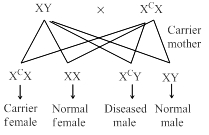
(A) Haemophilia is also known as Bleeder's disease.
It is a sex-linked recessive disorder in which the blood fails to clot properly due to the absence of specific clotting factors.
This condition is typically transmitted from a carrier female to her male progeny.
It is a sex-linked recessive disorder in which the blood fails to clot properly due to the absence of specific clotting factors.
This condition is typically transmitted from a carrier female to her male progeny.
0 likes
View Solution318
MediumMCQ
Colour blindness is
A
Sex-linked recessive disease
B
Sex-linked dominant disease
C
Autosomal dominant disease
D
Autosomal recessive disease
Solution
(A) Colour blindness is a genetic disorder characterized by the inability to distinguish between certain colours,most commonly red and green.
$(i)$ It is a sex-linked recessive disorder.
$(ii)$ It results from a defect in either red or green cone cells of the eye,leading to a failure to discriminate between red and green colours.
$(iii)$ The gene responsible for colour blindness is located on the $X$-chromosome.
$(iv)$ It is observed more frequently in males $(X^{c}Y)$ because they possess only one $X$-chromosome,whereas females $(XX)$ require two copies of the recessive gene to express the trait.
$(i)$ It is a sex-linked recessive disorder.
$(ii)$ It results from a defect in either red or green cone cells of the eye,leading to a failure to discriminate between red and green colours.
$(iii)$ The gene responsible for colour blindness is located on the $X$-chromosome.
$(iv)$ It is observed more frequently in males $(X^{c}Y)$ because they possess only one $X$-chromosome,whereas females $(XX)$ require two copies of the recessive gene to express the trait.
0 likes
View Solution319
MediumMCQ
Among symbols $A, B$ and $C$,what does $C$ indicate?
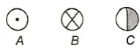
A
Carrier female
B
Affected female
C
Death of female
D
Normal female
Solution
(A) In pedigree analysis,standard symbols are used to represent individuals.
Symbol $A$ represents a carrier female for an $X$-linked recessive trait (often shown as a circle with a central dot).
Symbol $B$ represents an affected female (a shaded circle).
Symbol $C$ represents a carrier female for an autosomal recessive trait (a circle with half-shaded area).
Therefore,symbol $C$ indicates a carrier female.
Symbol $A$ represents a carrier female for an $X$-linked recessive trait (often shown as a circle with a central dot).
Symbol $B$ represents an affected female (a shaded circle).
Symbol $C$ represents a carrier female for an autosomal recessive trait (a circle with half-shaded area).
Therefore,symbol $C$ indicates a carrier female.
0 likes
View Solution320
MediumMCQ
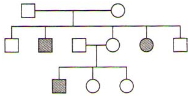
Study the pedigree chart given below.
What does it show?
What does it show?
A
Inheritance of a sex-linked inborn error of metabolism like phenylketonuria
B
Inheritance of a condition like phenylketonuria as an autosomal recessive trait
C
The pedigree chart is wrong as this is not possible
D
Inheritance of a recessive sex-linked disease like haemophilia
Solution
(B) $1$. In the given pedigree,both parents are unaffected (unshaded),but they have affected (shaded) offspring (both male and female).
$2$. This pattern indicates that the trait is recessive because it skips generations and appears in the offspring of unaffected parents.
$3$. Since both male and female offspring are affected,it cannot be $Y$-linked. If it were $X$-linked recessive,an affected daughter would require her father to be affected,which is not the case here.
$4$. Therefore,the trait must be autosomal recessive. Phenylketonuria is a classic example of an autosomal recessive metabolic disorder.
$5$. Thus,the pedigree represents the inheritance of a condition like phenylketonuria as an autosomal recessive trait.
$2$. This pattern indicates that the trait is recessive because it skips generations and appears in the offspring of unaffected parents.
$3$. Since both male and female offspring are affected,it cannot be $Y$-linked. If it were $X$-linked recessive,an affected daughter would require her father to be affected,which is not the case here.
$4$. Therefore,the trait must be autosomal recessive. Phenylketonuria is a classic example of an autosomal recessive metabolic disorder.
$5$. Thus,the pedigree represents the inheritance of a condition like phenylketonuria as an autosomal recessive trait.
0 likes
View Solution321
EasyMCQ
Brachydactyly is due to
A
Dominant gene on the autosome
B
Recessive gene on the autosome
C
Dominant gene on the sex chromosome
D
None of the above
Solution
(A) Brachydactyly is a genetic condition characterized by abnormally short fingers or toes. It is inherited as an autosomal dominant trait. This means that an individual only needs to inherit one copy of the mutated gene from one parent to express the condition.
0 likes
View Solution322
MediumMCQ
Both husband and wife have normal vision,though their fathers were colourblind and mothers did not have any gene for colour blindness. The probability of their daughter becoming colourblind is
A
$50\, \%$
B
$75\, \%$
C
$25\, \%$
D
None of these
Solution
(D) Colour blindness is an $X$-linked recessive disorder.
Let the normal vision allele be $X^C$ and the colourblind allele be $X^c$.
Since the husband has normal vision,his genotype is $X^CY$.
Since his father was colourblind,he inherited his $Y$ chromosome from his father and his $X^C$ chromosome from his mother.
Since the wife has normal vision but her father was colourblind,she must be a carrier of the trait. Her genotype is $X^CX^c$.
When we cross the husband $(X^CY)$ and the wife $(X^CX^c)$:
Possible genotypes for their children are $X^CX^C$ (normal daughter),$X^CX^c$ (carrier daughter),$X^CY$ (normal son),and $X^cY$ (colourblind son).
For a daughter to be colourblind,she must have the genotype $X^cX^c$.
Since the father is $X^CY$,he can only pass the $X^C$ allele to his daughters.
Therefore,the probability of their daughter being colourblind is $0\, \%$.
Let the normal vision allele be $X^C$ and the colourblind allele be $X^c$.
Since the husband has normal vision,his genotype is $X^CY$.
Since his father was colourblind,he inherited his $Y$ chromosome from his father and his $X^C$ chromosome from his mother.
Since the wife has normal vision but her father was colourblind,she must be a carrier of the trait. Her genotype is $X^CX^c$.
When we cross the husband $(X^CY)$ and the wife $(X^CX^c)$:
Possible genotypes for their children are $X^CX^C$ (normal daughter),$X^CX^c$ (carrier daughter),$X^CY$ (normal son),and $X^cY$ (colourblind son).
For a daughter to be colourblind,she must have the genotype $X^cX^c$.
Since the father is $X^CY$,he can only pass the $X^C$ allele to his daughters.
Therefore,the probability of their daughter being colourblind is $0\, \%$.
0 likes
View Solution323
EasyMCQ
Wilson detected the colour blindness disease in
A
$1921$
B
$1911$
C
$1912$
D
$1910$
Solution
(D) Colour blindness is a sex-linked recessive disorder. The genetic basis of colour blindness was first described by Wilson in $1910$.
0 likes
View Solution324
MediumMCQ
Haemophilia,a $X$-linked recessive disease,is caused due to the deficiency of:
A
Blood plasma and vitamin-$K$
B
Blood platelets and haemoglobin
C
Blood clotting factors
D
All of the above
Solution
(C) Haemophilia is a sex-linked recessive disorder,which is caused due to the deficiency of specific blood clotting factors (such as Factor-$VIII$ in Haemophilia-$A$ or Factor-$IX$ in Haemophilia-$B$).
It is transmitted from an unaffected carrier female to some of her male progeny.
It is characterized by the inability of the blood to clot properly,leading to excessive bleeding even from minor injuries.
It is transmitted from an unaffected carrier female to some of her male progeny.
It is characterized by the inability of the blood to clot properly,leading to excessive bleeding even from minor injuries.
0 likes
View Solution325
MediumMCQ
$A$ man with normal vision whose father was colourblind marries a woman whose father was also colourblind. Suppose their first child is a daughter,what are the chances of this child being colourblind (in $\%$)?
A
$100$
B
$25$
C
$50$
D
$0$
Solution
(D) The man has normal vision,so his genotype is $X^CY$. Since his father was colourblind,the man received his $Y$ chromosome from his father and his $X^C$ chromosome from his mother,but he is phenotypically normal,meaning he carries the dominant allele. Wait,if the man has normal vision,his genotype is $X^CY$. The woman's father was colourblind,so she must be a carrier $(X^CX^c)$.
When a normal man $(X^CY)$ marries a carrier woman $(X^CX^c)$,the possible genotypes for their daughters are $X^CX^C$ (normal) and $X^CX^c$ (carrier).
Neither of these genotypes results in colourblindness for the daughter,as colourblindness is a recessive $X$-linked trait requiring the daughter to inherit the recessive allele from both parents. Since the father is normal $(X^CY)$,he cannot pass the recessive allele to his daughter. Therefore,the chance of the daughter being colourblind is $0 \%$.
When a normal man $(X^CY)$ marries a carrier woman $(X^CX^c)$,the possible genotypes for their daughters are $X^CX^C$ (normal) and $X^CX^c$ (carrier).
Neither of these genotypes results in colourblindness for the daughter,as colourblindness is a recessive $X$-linked trait requiring the daughter to inherit the recessive allele from both parents. Since the father is normal $(X^CY)$,he cannot pass the recessive allele to his daughter. Therefore,the chance of the daughter being colourblind is $0 \%$.
0 likes
View Solution326
MediumMCQ
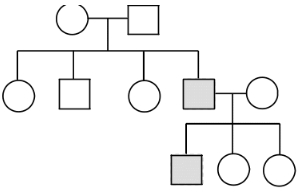
The following pedigree chart shows:
A
Recessive and autosomal
B
Recessive and sex-linked
C
Dominant and sex-linked
D
Dominant and autosomal
Solution
(A) $1$. In the given pedigree,the trait appears in the offspring of unaffected parents (first generation). This indicates that the trait is recessive.
$2$. The trait is observed in both males and females,and it does not show a specific bias towards one sex,which is characteristic of an autosomal trait.
$3$. Therefore,the pedigree chart represents an autosomal recessive trait.
$2$. The trait is observed in both males and females,and it does not show a specific bias towards one sex,which is characteristic of an autosomal trait.
$3$. Therefore,the pedigree chart represents an autosomal recessive trait.
0 likes
View Solution327
MediumMCQ
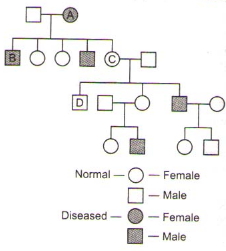
In the provided pedigree,assume that no outsider marrying into the family carries the disease. Determine the genotypes of $C$ and $D$.
A
$X^cY$ and $X^cX^c$
B
$XX^c$ and $XY$
C
$XY$ and $X^cX^c$
D
$X^cX^c$ and $X^cX$
Solution
(B) $1$. The pedigree shows an $X$-linked recessive trait because the affected mother $(A)$ passes the trait to her sons.
$2$. Since $A$ is affected,her genotype is $X^cX^c$. Her husband is normal,so his genotype is $XY$.
$3$. Individual $C$ is a normal female daughter of $A$. She must have inherited one $X^c$ from her mother and one $X$ from her father. Thus,the genotype of $C$ is $XX^c$.
$4$. Individual $D$ is a normal male son of $C$. Since he is normal,he must have inherited the $X$ chromosome from his mother $(C)$ and the $Y$ chromosome from his father. Thus,the genotype of $D$ is $XY$.
$2$. Since $A$ is affected,her genotype is $X^cX^c$. Her husband is normal,so his genotype is $XY$.
$3$. Individual $C$ is a normal female daughter of $A$. She must have inherited one $X^c$ from her mother and one $X$ from her father. Thus,the genotype of $C$ is $XX^c$.
$4$. Individual $D$ is a normal male son of $C$. Since he is normal,he must have inherited the $X$ chromosome from his mother $(C)$ and the $Y$ chromosome from his father. Thus,the genotype of $D$ is $XY$.
0 likes
View Solution328
MediumMCQ
$A$ woman has a haemophilic son and three normal children. Her genotype and that of her husband with respect to this gene would be
A
$XX$ and $X^hY$
B
$X^hX^h$ and $X^hY$
C
$X^hX^h$ and $XY$
D
$X^hX$ and $XY$
Solution
(D) Haemophilia is an $X$-linked recessive disorder.
Since the woman has a haemophilic son $(X^hY)$,the son must have inherited the $X^h$ chromosome from his mother.
Therefore,the mother must be a carrier of the haemophilia gene,meaning her genotype is $X^hX$.
Since the woman also has normal children and the husband is not mentioned as haemophilic,we assume the husband is normal $(XY)$.
Thus,the genotype of the woman is $X^hX$ and the husband is $XY$.
Since the woman has a haemophilic son $(X^hY)$,the son must have inherited the $X^h$ chromosome from his mother.
Therefore,the mother must be a carrier of the haemophilia gene,meaning her genotype is $X^hX$.
Since the woman also has normal children and the husband is not mentioned as haemophilic,we assume the husband is normal $(XY)$.
Thus,the genotype of the woman is $X^hX$ and the husband is $XY$.
0 likes
View Solution329
MediumMCQ
$A$ haemophilic woman marries a normal man,then:
A
All the children will be normal
B
All the sons will be haemophilic
C
All the girls will be haemophilic
D
Half girls will be haemophilic
Solution
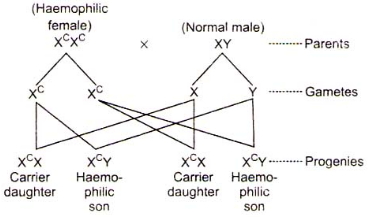
(B) Haemophilia is an $X$-linked recessive disorder. $A$ haemophilic woman has the genotype $X^hX^h$,and a normal man has the genotype $XY$.
When they cross $(X^hX^h \times XY)$,the gametes produced are $X^h$ from the mother and $X$ or $Y$ from the father.
The resulting progeny will have genotypes $X^hX$ (carrier daughter) and $X^hY$ (haemophilic son).
Therefore,all sons will be haemophilic and all daughters will be carriers.
When they cross $(X^hX^h \times XY)$,the gametes produced are $X^h$ from the mother and $X$ or $Y$ from the father.
The resulting progeny will have genotypes $X^hX$ (carrier daughter) and $X^hY$ (haemophilic son).
Therefore,all sons will be haemophilic and all daughters will be carriers.
0 likes
View Solution330
MediumMCQ
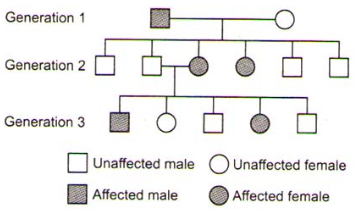
Given below is a pedigree chart showing the inheritance of a certain sex-linked trait in humans. The trait traced in the above pedigree chart is
A
Dominant $X$-linked
B
Recessive $X$-linked
C
Dominant $Y$-linked
D
Recessive $Y$-linked
Solution
(A) The pedigree chart shows that the trait is $X$-linked dominant.
$1$. The trait is present in every generation,which is a characteristic of a dominant trait.
$2$. An affected father passes the trait to all his daughters but none of his sons,which indicates $X$-linkage.
$3$. Since the trait appears in females (who have two $X$ chromosomes) and is passed from an affected father to his daughters,it must be $X$-linked dominant.
$1$. The trait is present in every generation,which is a characteristic of a dominant trait.
$2$. An affected father passes the trait to all his daughters but none of his sons,which indicates $X$-linkage.
$3$. Since the trait appears in females (who have two $X$ chromosomes) and is passed from an affected father to his daughters,it must be $X$-linked dominant.
0 likes
View Solution331
MediumMCQ
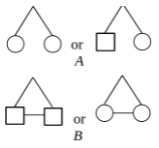
The given diagram $A$ and $B$ indicates:
A
$A$-Zygotic twins; $B$-Dizygotic twins
B
$A$-Dizygotic twins; $B$-Identical twins
C
$A$-Zygotic twins; $B$-Identical twins
D
$A$-Identical twins; $B$-Dizygotic twins
Solution
(B) -Dizygotic (fraternal) twins result from the fertilization of two separate ova by two separate sperm. They are genetically as similar as any other siblings.
$B$-Monozygotic (identical) twins result from the fertilization of a single ovum by a single sperm,forming one zygote. This zygote subsequently divides into two or more embryos. These individuals share an identical genome.
$B$-Monozygotic (identical) twins result from the fertilization of a single ovum by a single sperm,forming one zygote. This zygote subsequently divides into two or more embryos. These individuals share an identical genome.
0 likes
View Solution332
MediumMCQ
Sickle cell anaemia disorder arises due to
A
Duplication of a segment of $DNA$
B
Substitution in a single base of $DNA$
C
Deletion of a segment of $DNA$
D
Duplication in a base pair of $RNA$
Solution
(B) Sickle cell anaemia is an autosome-linked recessive trait that can be transmitted from parents to the offspring when both the partners are carriers for the gene.
This disease is controlled by a single pair of allele,$Hb^A$ and $Hb^S$.
It is caused by a point mutation in the $\beta$-globin chain of the haemoglobin molecule.
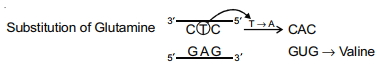
Specifically,there is a substitution of Glutamic acid $(Glu)$ by Valine $(Val)$ at the sixth position of the $\beta$-globin chain.
This substitution occurs due to a single base pair change in the $DNA$ sequence,where the codon $GAG$ is mutated to $GUG$.
This disease is controlled by a single pair of allele,$Hb^A$ and $Hb^S$.
It is caused by a point mutation in the $\beta$-globin chain of the haemoglobin molecule.
Specifically,there is a substitution of Glutamic acid $(Glu)$ by Valine $(Val)$ at the sixth position of the $\beta$-globin chain.
This substitution occurs due to a single base pair change in the $DNA$ sequence,where the codon $GAG$ is mutated to $GUG$.
0 likes
View Solution333
MediumMCQ
In pedigree analysis,the symbol given for sex unspecified is
A
B
C
D
Solution
(A) In pedigree analysis,standard symbols are used to represent individuals in a family tree.
- $A$ square $(A)$ represents a male.
- $A$ circle represents a female.
- $A$ diamond shape represents an individual whose sex is unspecified.
- $A$ filled circle or square represents an affected individual.
- $A$ square connected to a circle represents a mating between a male and a female.
Therefore,the symbol for sex unspecified is a diamond shape.
- $A$ square $(A)$ represents a male.
- $A$ circle represents a female.
- $A$ diamond shape represents an individual whose sex is unspecified.
- $A$ filled circle or square represents an affected individual.
- $A$ square connected to a circle represents a mating between a male and a female.
Therefore,the symbol for sex unspecified is a diamond shape.
0 likes
View Solution334
EasyMCQ
Cystic fibrosis,Myotonic dystrophy,and Thalassemia are:
A
Chromosomal disorders
B
Autosomal recessive disorders
C
Mendelian disorders
D
Autosomal dominant disorders
Solution
(C) Cystic fibrosis,Myotonic dystrophy,and Thalassemia are classified as Mendelian disorders.
These disorders are primarily determined by alteration or mutation in a single gene.
They are transmitted to the offspring through the same principles of inheritance as described by Mendel,hence they are called Mendelian disorders.
These disorders are primarily determined by alteration or mutation in a single gene.
They are transmitted to the offspring through the same principles of inheritance as described by Mendel,hence they are called Mendelian disorders.
0 likes
View Solution335
EasyMCQ
Phenylketonuria is an inborn error of metabolism that is inherited as:
A
Autosomal recessive trait
B
Sex-linked dominant trait
C
$X$-linked recessive trait
D
Autosomal dominant trait
Solution
(A) Phenylketonuria $(PKU)$ is an inborn error of metabolism caused by a mutation in the gene encoding the enzyme phenylalanine hydroxylase.
This gene is located on chromosome $12$.
Since the disorder only manifests when an individual inherits two copies of the mutated gene (one from each parent),it is classified as an autosomal recessive trait.
This gene is located on chromosome $12$.
Since the disorder only manifests when an individual inherits two copies of the mutated gene (one from each parent),it is classified as an autosomal recessive trait.
0 likes
View Solution336
MediumMCQ
Which of the following abnormalities is due to an autosomal dominant mutation?
A
Colour blindness
B
Thalassemia
C
Myotonic dystrophy
D
Haemophilia
Solution
(C) $1$. Colour blindness is an $X$-linked recessive disorder.
$2$. Thalassemia is an autosomal recessive blood disorder.
$3$. Myotonic dystrophy is an autosomal dominant disorder caused by a mutation in the $DMPK$ gene.
$4$. Haemophilia is an $X$-linked recessive disorder.
Therefore,the correct answer is Myotonic dystrophy.
$2$. Thalassemia is an autosomal recessive blood disorder.
$3$. Myotonic dystrophy is an autosomal dominant disorder caused by a mutation in the $DMPK$ gene.
$4$. Haemophilia is an $X$-linked recessive disorder.
Therefore,the correct answer is Myotonic dystrophy.
0 likes
View Solution337
MediumMCQ
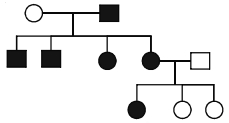
In the given pedigree,indicate whether the shaded symbols indicate a dominant or recessive allele.
A
Recessive
B
Codominant
C
Dominant
D
It can be recessive or dominant both
Solution
(C) In the provided pedigree,we observe that the trait is expressed in every generation (vertical transmission).
Furthermore,an affected individual has at least one affected parent.
This pattern of inheritance,where the trait does not skip generations and affected individuals appear in every generation,is characteristic of a dominant trait.
Therefore,the shaded symbols represent the dominant allele.
Furthermore,an affected individual has at least one affected parent.
This pattern of inheritance,where the trait does not skip generations and affected individuals appear in every generation,is characteristic of a dominant trait.
Therefore,the shaded symbols represent the dominant allele.
0 likes
View Solution338
MediumMCQ
In which of the following disorders is a single protein that is a part of the cascade of proteins involved in blood clotting affected?
A
Thalassemia
B
Sickle-cell anaemia
C
Haemophilia
D
Phenylketonuria
Solution
(C) Haemophilia is a sex-linked recessive disorder in which a single protein that is a part of the cascade of proteins involved in blood clotting is affected.
In Haemophilia $A$,the blood clotting factor $VIII$ is absent or defective.
In Haemophilia $B$,the blood clotting factor $IX$ is absent or defective.
Due to this,a simple cut results in non-stop bleeding.
In Haemophilia $A$,the blood clotting factor $VIII$ is absent or defective.
In Haemophilia $B$,the blood clotting factor $IX$ is absent or defective.
Due to this,a simple cut results in non-stop bleeding.
0 likes
View Solution339
MediumMCQ
Mark the correct statement with respect to sickle-cell anaemia.
A
Homozygous individuals for $Hb^{S}$ are apparently unaffected.
B
Heterozygous individuals exhibit sickle-cell trait.
C
Heterozygous individuals are affected as well as carriers.
D
Homozygous individuals for $Hb^{A}$ show the diseased phenotype.
Solution
(B) Sickle-cell anaemia is an autosome-linked recessive trait.
Individuals with the genotype $Hb^{A}Hb^{A}$ are normal.
Individuals with the genotype $Hb^{A}Hb^{S}$ are carriers and exhibit the sickle-cell trait,meaning they are generally healthy but can pass the gene to their offspring.
Individuals with the genotype $Hb^{S}Hb^{S}$ are affected by the disease.
Therefore,the correct statement is that heterozygous individuals $(Hb^{A}Hb^{S})$ exhibit the sickle-cell trait.
Individuals with the genotype $Hb^{A}Hb^{A}$ are normal.
Individuals with the genotype $Hb^{A}Hb^{S}$ are carriers and exhibit the sickle-cell trait,meaning they are generally healthy but can pass the gene to their offspring.
Individuals with the genotype $Hb^{S}Hb^{S}$ are affected by the disease.
Therefore,the correct statement is that heterozygous individuals $(Hb^{A}Hb^{S})$ exhibit the sickle-cell trait.
0 likes
View Solution340
MediumMCQ
$A$ normal woman,whose father was colour blind,marries a normal man. What is the chance of occurrence of colour blindness in the progeny (in $;\%$)?
A
$25$
B
$50$
C
$100$
D
$0$
Solution
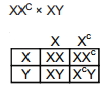
(A) $1$. Colour blindness is an $X$-linked recessive trait.
$2$. The woman is normal but her father was colour blind,so she must be a carrier $(XX^c)$.
$3$. The man is normal $(XY)$.
$4$. The cross is $XX^c \times XY$.
$5$. The Punnett square results are:
- $XX$ (Normal daughter)
- $XX^c$ (Carrier daughter)
- $XY$ (Normal son)
- $X^cY$ (Colour blind son)
$6$. Out of four possible outcomes,one $(X^cY)$ is colour blind.
$7$. Therefore,the probability of colour blindness in the progeny is $1/4$ or $25\;\%$.
$2$. The woman is normal but her father was colour blind,so she must be a carrier $(XX^c)$.
$3$. The man is normal $(XY)$.
$4$. The cross is $XX^c \times XY$.
$5$. The Punnett square results are:
- $XX$ (Normal daughter)
- $XX^c$ (Carrier daughter)
- $XY$ (Normal son)
- $X^cY$ (Colour blind son)
$6$. Out of four possible outcomes,one $(X^cY)$ is colour blind.
$7$. Therefore,the probability of colour blindness in the progeny is $1/4$ or $25\;\%$.
0 likes
View Solution341
MediumMCQ
Mr. Stevan is suffering from haemophilia and cystic fibrosis. His father is heterozygous for cystic fibrosis. The probability of Stevan's sperm having recessive $X$-linked as well as autosomal allele is
A
$\frac{1}{4}$
B
$\frac{1}{16}$
C
$\frac{1}{2}$
D
$\frac{1}{8}$
Solution
(C) Haemophilia is an $X$-linked recessive disorder,and cystic fibrosis is an autosomal recessive disorder.
Mr. Stevan is suffering from both,so his genotype is $X^hY$ for haemophilia and $cc$ for cystic fibrosis.
Since he is a male,his sperm cells will carry either the $X$ chromosome or the $Y$ chromosome.
For the $X$-linked trait,the sperm will carry the recessive allele $X^h$ with a probability of $1$.
For the autosomal trait,since he is $cc$,all his gametes will carry the recessive allele $c$ with a probability of $1$.
Therefore,the probability of a sperm carrying both the recessive $X$-linked allele $(X^h)$ and the recessive autosomal allele $(c)$ is $1 \times 1 = 1$. However,considering the segregation of chromosomes,the sperm carrying the $X^h$ allele is $1/2$ of the total sperm produced.
Thus,the probability is $1/2$.
Mr. Stevan is suffering from both,so his genotype is $X^hY$ for haemophilia and $cc$ for cystic fibrosis.
Since he is a male,his sperm cells will carry either the $X$ chromosome or the $Y$ chromosome.
For the $X$-linked trait,the sperm will carry the recessive allele $X^h$ with a probability of $1$.
For the autosomal trait,since he is $cc$,all his gametes will carry the recessive allele $c$ with a probability of $1$.
Therefore,the probability of a sperm carrying both the recessive $X$-linked allele $(X^h)$ and the recessive autosomal allele $(c)$ is $1 \times 1 = 1$. However,considering the segregation of chromosomes,the sperm carrying the $X^h$ allele is $1/2$ of the total sperm produced.
Thus,the probability is $1/2$.
0 likes
View Solution342
MediumMCQ
Match the following symbols used in Pedigree analysis:
| Column-$I$ | Column-$II$ |
| $a.$ Solid symbol | $(i)$ Carrier of sex-linked trait |
| $b.$ Horizontal line between symbols | $(ii)$ Offspring |
| $c.$ Horizontal line above the symbols | $(iii)$ Affected individual (Trait to be studied) |
| $d.$ Dot in centre | $(iv)$ Mating (Parents) |
A
$a(iv), b(iii), c(ii), d(i)$
B
$a(ii), b(iii), c(iv), d(i)$
C
$a(iii), b(iv), c(ii), d(i)$
D
$a(i), b(ii), c(iv), d(iii)$
Solution
(C) In pedigree analysis, standard symbols are used to represent genetic relationships and traits:
$a.$ Solid symbol represents an affected individual (Trait to be studied) - $(iii)$.
$b.$ $A$ horizontal line between two symbols represents mating between parents - $(iv)$.
$c.$ $A$ horizontal line above symbols represents offspring - $(ii)$.
$d.$ $A$ dot in the centre of a symbol represents a carrier of a sex-linked trait - $(i)$.
Therefore, the correct matching is $a(iii), b(iv), c(ii), d(i)$.
$a.$ Solid symbol represents an affected individual (Trait to be studied) - $(iii)$.
$b.$ $A$ horizontal line between two symbols represents mating between parents - $(iv)$.
$c.$ $A$ horizontal line above symbols represents offspring - $(ii)$.
$d.$ $A$ dot in the centre of a symbol represents a carrier of a sex-linked trait - $(i)$.
Therefore, the correct matching is $a(iii), b(iv), c(ii), d(i)$.
0 likes
View Solution343
MediumMCQ
In phenylketonuria:
A
Breakdown of phenylalanine is rapid
B
Accumulation of phenylalanine in body
C
Chromosomal constitution of patient changes
D
$TSD$ gene situated on chromosome $15$ undergoes mutation
Solution
(B) Phenylketonuria is an inborn error of metabolism inherited as an autosomal recessive trait. It is caused by a deficiency of the enzyme phenylalanine hydroxylase,which converts the amino acid phenylalanine into tyrosine. Due to the absence of this enzyme,phenylalanine accumulates in the body and is converted into phenylpyruvic acid and other derivatives,which leads to mental retardation.
0 likes
View Solution344
MediumMCQ
$A$: The possibility of a female becoming a haemophilic is extremely rare.
$R$: Mother of such a female has to be a carrier and the father should be haemophilic.
$R$: Mother of such a female has to be a carrier and the father should be haemophilic.
A
Assertion and Reason both are correct and Reason is the correct explanation of Assertion.
B
Assertion and Reason both are correct but Reason is not the correct explanation of Assertion.
C
Assertion is correct,but Reason is incorrect.
D
Both Assertion and Reason are incorrect.
Solution
(A) Haemophilia is an $X$-linked recessive disorder.
For a female to be haemophilic (genotype $X^hX^h$),she must inherit one recessive allele $(X^h)$ from her mother and one recessive allele $(X^h)$ from her father.
This means the father must be haemophilic $(X^hY)$ and the mother must be either a carrier $(X^HX^h)$ or haemophilic $(X^hX^h)$.
Since the condition is rare,the probability of both parents carrying the gene is very low,making the occurrence of a haemophilic female extremely rare.
Thus,both the Assertion and the Reason are correct,and the Reason explains why the condition is rare in females.
For a female to be haemophilic (genotype $X^hX^h$),she must inherit one recessive allele $(X^h)$ from her mother and one recessive allele $(X^h)$ from her father.
This means the father must be haemophilic $(X^hY)$ and the mother must be either a carrier $(X^HX^h)$ or haemophilic $(X^hX^h)$.
Since the condition is rare,the probability of both parents carrying the gene is very low,making the occurrence of a haemophilic female extremely rare.
Thus,both the Assertion and the Reason are correct,and the Reason explains why the condition is rare in females.
0 likes
View Solution345
MediumMCQ
$A$: The heterozygotic female for haemophilia may transmit the disease to sons.
$R$: Such traits show criss-cross inheritance.
$R$: Such traits show criss-cross inheritance.
A
Assertion and Reason both are correct and Reason is the correct explanation of Assertion.
B
Assertion and Reason both are correct but Reason is not the correct explanation of Assertion.
C
Assertion is correct,but Reason is incorrect.
D
Both Assertion and Reason are incorrect.
Solution
(A) Haemophilia is an $X$-linked recessive disorder. $A$ heterozygotic female (carrier) has one normal $X$ chromosome and one $X$ chromosome carrying the haemophilia gene $(X^hX)$.
During gametogenesis,she produces two types of eggs: $X$ and $X^h$. If an egg with the $X^h$ chromosome is fertilized by a $Y$-bearing sperm,the resulting son will be haemophilic $(X^hY)$. Thus,the assertion is correct.
Haemophilia exhibits criss-cross inheritance,where the trait is passed from an affected father to his daughter (who becomes a carrier) and then to his grandsons. Since $X$-linked recessive traits are transmitted from mother to son and father to daughter,they follow a criss-cross pattern. Thus,the reason is correct and explains why the disease is transmitted in this specific manner.
During gametogenesis,she produces two types of eggs: $X$ and $X^h$. If an egg with the $X^h$ chromosome is fertilized by a $Y$-bearing sperm,the resulting son will be haemophilic $(X^hY)$. Thus,the assertion is correct.
Haemophilia exhibits criss-cross inheritance,where the trait is passed from an affected father to his daughter (who becomes a carrier) and then to his grandsons. Since $X$-linked recessive traits are transmitted from mother to son and father to daughter,they follow a criss-cross pattern. Thus,the reason is correct and explains why the disease is transmitted in this specific manner.
0 likes
View Solution346
MediumMCQ
In a cross between a male and female, both heterozygous for sickle cell anaemia gene, what percentage of the progeny will be diseased? (In $ \%$ )
A
$50$
B
$75$
C
$25$
D
$100$
Solution
(C) Sickle cell anaemia is an autosomal recessive disorder.
Let the normal allele be $Hb^A$ and the sickle cell allele be $Hb^S$.
Both parents are heterozygous, meaning their genotypes are $Hb^A Hb^S$.
The cross is: $Hb^A Hb^S \times Hb^A Hb^S$.
The Punnett square results are:
$1$ $Hb^A Hb^A$ (Normal)
$2$ $Hb^A Hb^S$ (Carrier/Heterozygous)
$1$ $Hb^S Hb^S$ (Diseased)
Thus, $1$ out of $4$ offspring will be diseased.
Percentage = $(1/4) \times 100 = 25\%$.
Let the normal allele be $Hb^A$ and the sickle cell allele be $Hb^S$.
Both parents are heterozygous, meaning their genotypes are $Hb^A Hb^S$.
The cross is: $Hb^A Hb^S \times Hb^A Hb^S$.
The Punnett square results are:
$1$ $Hb^A Hb^A$ (Normal)
$2$ $Hb^A Hb^S$ (Carrier/Heterozygous)
$1$ $Hb^S Hb^S$ (Diseased)
Thus, $1$ out of $4$ offspring will be diseased.
Percentage = $(1/4) \times 100 = 25\%$.
0 likes
View Solution347
Medium
Why are thalassemia and haemophilia categorised as Mendelian disorders? Write the symptoms of these diseases. Explain their pattern of inheritance in humans.
Solution
(N/A) Thalassemia and haemophilia are categorised as Mendelian disorders because these disorders are caused by an alteration or mutation in a single gene. They are transmitted to offspring following Mendelian principles of inheritance.
Symptoms and patterns of inheritance are as follows:
$(a)$ Thalassemia: It is an autosomal-linked recessive blood disorder characterized by defects in the $\alpha$,$\beta$,or $\delta$ globin chains,resulting in abnormal $Hb$ molecules.
Symptom: Severe anaemia.
Inheritance: It follows an autosomal recessive pattern. Two mutant alleles (one from each parent) must be inherited for an individual to be affected (homozygous). Heterozygous individuals are carriers and may pass the mutant allele to their children.
$(b)$ Haemophilia: It is a sex-linked recessive disorder where the defective gene is located on the $X$-chromosome.
Symptom: Prolonged blood clotting time and excessive bleeding even from minor injuries.
Inheritance: Since the gene is on the $X$-chromosome,it is more common in males as they possess only a single $X$-chromosome (hemizygous). Females have two $X$-chromosomes,so they are rarely affected unless the father is haemophilic and the mother is at least a carrier.
Symptoms and patterns of inheritance are as follows:
$(a)$ Thalassemia: It is an autosomal-linked recessive blood disorder characterized by defects in the $\alpha$,$\beta$,or $\delta$ globin chains,resulting in abnormal $Hb$ molecules.
Symptom: Severe anaemia.
Inheritance: It follows an autosomal recessive pattern. Two mutant alleles (one from each parent) must be inherited for an individual to be affected (homozygous). Heterozygous individuals are carriers and may pass the mutant allele to their children.
$(b)$ Haemophilia: It is a sex-linked recessive disorder where the defective gene is located on the $X$-chromosome.
Symptom: Prolonged blood clotting time and excessive bleeding even from minor injuries.
Inheritance: Since the gene is on the $X$-chromosome,it is more common in males as they possess only a single $X$-chromosome (hemizygous). Females have two $X$-chromosomes,so they are rarely affected unless the father is haemophilic and the mother is at least a carrier.
0 likes
View Solution348
MediumMCQ
Which of the following occurs due to the presence of an autosome-linked dominant trait?
A
Myotonic dystrophy
B
Haemophilia
C
Thalassemia
D
Sickle cell anaemia
Solution
(A) $1$. Myotonic dystrophy is an example of an autosome-linked dominant trait.
$2$. Haemophilia is an $X$-linked recessive disorder.
$3$. Thalassemia is an autosome-linked recessive blood disorder.
$4$. Sickle cell anaemia is an autosome-linked recessive disorder.
Therefore,the correct option is $A$.
$2$. Haemophilia is an $X$-linked recessive disorder.
$3$. Thalassemia is an autosome-linked recessive blood disorder.
$4$. Sickle cell anaemia is an autosome-linked recessive disorder.
Therefore,the correct option is $A$.
0 likes
View Solution349
MediumMCQ
If a colour blind female marries a man whose mother was also colour blind,what are the chances of her progeny having colour blindness (in $\%$)?
A
$50$
B
$75$
C
$100$
D
$25$
Solution
(C) Colour blindness is an $X$-linked recessive disorder.
Let $X^c$ represent the allele for colour blindness and $X$ represent the normal allele.
$A$ colour blind female has the genotype $X^c X^c$.
$A$ man whose mother was colour blind must have inherited the $X^c$ allele from her,so his genotype is $X^c Y$.
When they marry $(X^c X^c \times X^c Y)$:
- Offspring genotypes: $X^c X^c$ (colour blind daughter),$X^c Y$ (colour blind son),$X^c X^c$ (colour blind daughter),$X^c Y$ (colour blind son).
All offspring $(100 \%)$ will be colour blind.
Let $X^c$ represent the allele for colour blindness and $X$ represent the normal allele.
$A$ colour blind female has the genotype $X^c X^c$.
$A$ man whose mother was colour blind must have inherited the $X^c$ allele from her,so his genotype is $X^c Y$.
When they marry $(X^c X^c \times X^c Y)$:
- Offspring genotypes: $X^c X^c$ (colour blind daughter),$X^c Y$ (colour blind son),$X^c X^c$ (colour blind daughter),$X^c Y$ (colour blind son).
All offspring $(100 \%)$ will be colour blind.
0 likes
View Solution350
EasyMCQ
Which disease is caused by the deficiency of factor $VIII$?
A
Color blindness
B
Hemophilia
C
Jaundice
D
Sickle cell anemia
Solution
(B) Factor $VIII$ (Anti-hemophilic factor) is a crucial protein involved in the blood clotting cascade.
Its deficiency leads to Hemophilia $A$,a genetic disorder where the blood fails to clot properly,resulting in prolonged bleeding even from minor injuries.
Color blindness is a vision-related disorder,Jaundice is related to liver function,and Sickle cell anemia is a hemoglobin-related genetic disorder.
Its deficiency leads to Hemophilia $A$,a genetic disorder where the blood fails to clot properly,resulting in prolonged bleeding even from minor injuries.
Color blindness is a vision-related disorder,Jaundice is related to liver function,and Sickle cell anemia is a hemoglobin-related genetic disorder.
0 likes
View SolutionPrinciples of Inheritance and Variation — Pedigree Analysis and Mendelian disorders · Frequently Asked Questions
1Are these Principles of Inheritance and Variation questions useful for JEE and NEET?
Yes. All questions in this section are mapped to JEE Main and NEET exam patterns. Previous year questions from JEE Main, NEET, GUJCET and state-level exams are included with full solutions.
2Can I switch to Hindi or Gujarati for these questions?
Yes. Use the language tabs in the hero section or the sidebar to view the same questions and solutions in English, Hindi or Gujarati.
3How do I generate a question paper from this subtopic?
Use the Vedclass Exam Paper Generator — select the chapter and subtopic, set difficulty, and generate Sets A, B, C, D automatically. First 3 chapters of every subject are free.
Vedclass Products
For Students
Vedclass Test Series
Mock tests in real JEE/NEET style with performance analysis. 5-day free trial.
Start Free TrialFor Teachers
Exam Paper Generator
Generate Set A/B/C/D papers from this chapter in 2 minutes. 3 chapters free.
Try FreeFor Institutes
Online Exam Module
Live online exams with unlimited students, 360° analytics & white-label branding.
See DemoFor Teachers & Institutes
Generate a Principles of Inheritance and Variation Exam Paper in 2 Minutes
Select subtopic & difficulty — Sets A, B, C, D auto-generated with No Repeat logic.
First 3 chapters of every subject are free — no payment required.