
A English
Multiple alleles Questions in English
Class 12 Biology · Principles of Inheritance and Variation · Multiple alleles
100+
Questions
English
Language
100%
With Solutions
Showing 50 of 100 questions in English
1
EasyMCQ
Self-sterility in $Nicotiana$ was reported by:
A
Morgan
B
East
C
Crick
D
Goldberg
Solution
(B) Self-sterility (also known as self-incompatibility) in $Nicotiana$ was first reported by $E.M. East$ in $1925$.
This phenomenon is controlled by a series of multiple alleles at a single locus,often denoted as the $S$-locus.
These alleles prevent self-fertilization,thereby promoting cross-pollination and increasing genetic diversity within the population.
This phenomenon is controlled by a series of multiple alleles at a single locus,often denoted as the $S$-locus.
These alleles prevent self-fertilization,thereby promoting cross-pollination and increasing genetic diversity within the population.
0 likes
View Solution2
MediumMCQ
What are alleles?
A
$A$ pair of genes governing a specific character such as tallness or dwarfness.
B
Multiple forms of genes.
C
Genes governing eye characters.
D
Genes present in allosomes.
Solution
(A) Alleles are slightly different forms of the same gene. They occupy the same locus on homologous chromosomes and control the expression of a specific trait (e.g.,tallness or dwarfness in pea plants). Therefore,they are defined as a pair of genes governing a specific character.
0 likes
View Solution3
MediumMCQ
When a gene exists in more than one form,the different forms are called
A
Heterozygous
B
Complementary genes
C
Genotypes
D
Alleles
Solution
(D) The different forms of a gene that occupy the same locus on homologous chromosomes are known as alleles.
For example,in pea plants,the gene for height has two forms: one for tallness $(T)$ and one for dwarfness $(t)$.
These two forms ($T$ and $t$) are alleles of the same gene.
For example,in pea plants,the gene for height has two forms: one for tallness $(T)$ and one for dwarfness $(t)$.
These two forms ($T$ and $t$) are alleles of the same gene.
0 likes
View Solution4
MediumMCQ
Inheritance of $ABO$ blood group system is an example of
A
Multiple allelism
B
Partial dominance
C
Epistasis
D
Dominance
Solution
(A) The $ABO$ blood group system in humans is controlled by the gene $I$. This gene has three alleles: $I^A$,$I^B$,and $i$.
Since there are more than two alleles present for a single gene locus within a population,this phenomenon is known as multiple allelism.
Different combinations of these three alleles result in four distinct phenotypes: blood types $A, B, AB$,and $O$.
Since there are more than two alleles present for a single gene locus within a population,this phenomenon is known as multiple allelism.
Different combinations of these three alleles result in four distinct phenotypes: blood types $A, B, AB$,and $O$.
0 likes
View Solution5
MediumMCQ
The genotype of blood group $A$ will be
A
$I^A I^A$
B
$I^B I^B$
C
$I^A I^A$ or $I^A I^O$
D
$I^A I^O$
Solution
(C) The human $ABO$ blood group system is controlled by the gene $I$. The gene $I$ has three alleles: $I^A$,$I^B$,and $i$ (or $I^O$).
For blood group $A$,the individual can be homozygous $(I^A I^A)$ or heterozygous ($I^A i$ or $I^A I^O$).
Therefore,the possible genotypes for blood group $A$ are $I^A I^A$ or $I^A I^O$.
For blood group $A$,the individual can be homozygous $(I^A I^A)$ or heterozygous ($I^A i$ or $I^A I^O$).
Therefore,the possible genotypes for blood group $A$ are $I^A I^A$ or $I^A I^O$.
0 likes
View Solution6
MediumMCQ
Blood group $B$ will have which of the following genotypes?
A
$ii$
B
$I^A I^A$
C
$I^B I^B$
D
$I^B I^B$ or $I^B i$
Solution
(D) The human $ABO$ blood group system is controlled by the gene $I$. The gene $I$ has three alleles: $I^A$,$I^B$,and $i$.
- Alleles $I^A$ and $I^B$ are codominant,while $i$ is recessive.
- $A$ person with blood group $B$ can have the genotype $I^B I^B$ (homozygous) or $I^B i$ (heterozygous),as the $I^B$ allele is dominant over the $i$ allele.
- Alleles $I^A$ and $I^B$ are codominant,while $i$ is recessive.
- $A$ person with blood group $B$ can have the genotype $I^B I^B$ (homozygous) or $I^B i$ (heterozygous),as the $I^B$ allele is dominant over the $i$ allele.
0 likes
View Solution7
MediumMCQ
If a child has $O$ type of blood group and the father has $B$ type,the genotype of the father will be:
A
$I^O I^O$
B
$I^A I^B$
C
$I^B I^O$
D
$I^B I^B$
Solution
(C) The blood group $O$ is represented by the genotype $I^O I^O$.
Since the child inherits one allele from each parent,the child must have received one $I^O$ allele from the father and one $I^O$ allele from the mother.
Given that the father has blood group $B$,his possible genotypes are $I^B I^B$ (homozygous) or $I^B I^O$ (heterozygous).
Since the father must contribute an $I^O$ allele to the child to result in an $O$ blood group child,the father must be heterozygous for blood group $B$,which is $I^B I^O$.
Since the child inherits one allele from each parent,the child must have received one $I^O$ allele from the father and one $I^O$ allele from the mother.
Given that the father has blood group $B$,his possible genotypes are $I^B I^B$ (homozygous) or $I^B I^O$ (heterozygous).
Since the father must contribute an $I^O$ allele to the child to result in an $O$ blood group child,the father must be heterozygous for blood group $B$,which is $I^B I^O$.
0 likes
View Solution8
MediumMCQ
Parents of blood groups $O$ and $AB$ cannot have a child of group $AB$ because
A
Gene $O$ is dominant over gene $A$
B
Gene $O$ is dominant over gene $B$
C
Gene $A$ or $B$ is absent in one of the parents
D
Gene $A$ and $B$ are absent in one of the parents
Solution
(D) The genotype of a person with blood group $O$ is $ii$ (recessive).
The genotype of a person with blood group $AB$ is $I^A I^B$ (codominant).
When these parents cross,the possible offspring genotypes are $I^A i$ (blood group $A$) and $I^B i$ (blood group $B$).
Since the $O$ parent lacks both $I^A$ and $I^B$ alleles,they cannot pass these alleles to the offspring.
Therefore,it is impossible for the child to have the $AB$ blood group,as the child must inherit one allele from each parent.
The genotype of a person with blood group $AB$ is $I^A I^B$ (codominant).
When these parents cross,the possible offspring genotypes are $I^A i$ (blood group $A$) and $I^B i$ (blood group $B$).
Since the $O$ parent lacks both $I^A$ and $I^B$ alleles,they cannot pass these alleles to the offspring.
Therefore,it is impossible for the child to have the $AB$ blood group,as the child must inherit one allele from each parent.
0 likes
View Solution9
MediumMCQ
If one parent has blood group $A$ and the other parent has blood group $B$,what blood groups can the offspring have?
A
$AB$
B
$O$
C
$A, B$
D
$A, B, AB, O$
Solution
(D) The inheritance of $ABO$ blood groups in humans is controlled by the gene $I$. The gene $I$ has three alleles: $I^A$,$I^B$,and $i$.
If one parent has blood group $A$ (genotype $I^A I^A$ or $I^A i$) and the other parent has blood group $B$ (genotype $I^B I^B$ or $I^B i$),the offspring can inherit different combinations of these alleles.
If both parents are heterozygous (genotypes $I^A i$ and $I^B i$),the possible genotypes for the offspring are $I^A I^B$ (blood group $AB$),$I^A i$ (blood group $A$),$I^B i$ (blood group $B$),and $ii$ (blood group $O$).
Therefore,the offspring can have any of the four blood groups: $A, B, AB,$ or $O$.
If one parent has blood group $A$ (genotype $I^A I^A$ or $I^A i$) and the other parent has blood group $B$ (genotype $I^B I^B$ or $I^B i$),the offspring can inherit different combinations of these alleles.
If both parents are heterozygous (genotypes $I^A i$ and $I^B i$),the possible genotypes for the offspring are $I^A I^B$ (blood group $AB$),$I^A i$ (blood group $A$),$I^B i$ (blood group $B$),and $ii$ (blood group $O$).
Therefore,the offspring can have any of the four blood groups: $A, B, AB,$ or $O$.
0 likes
View Solution10
MediumMCQ
$A$ man with blood group $B$ marries a woman with blood group $A$ and their first child has blood group $B$. What is the genotype of the child?
A
$I^A I^B$
B
$I^A I^O$
C
$I^B I^O$
D
$I^B I^B$
Solution
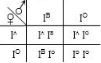
(C) The blood group of the father is $B$ and the mother is $A$. For the child to have blood group $B$,the father must be heterozygous $(I^B I^O)$ and the mother must be heterozygous $(I^A I^O)$.
According to the Punnett square:
- Father's gametes: $I^B, I^O$
- Mother's gametes: $I^A, I^O$
- Possible genotypes of children: $I^A I^B$ $(AB)$,$I^A I^O$ $(A)$,$I^B I^O$ $(B)$,$I^O I^O$ $(O)$.
Since the child has blood group $B$,the genotype must be $I^B I^O$.
According to the Punnett square:
- Father's gametes: $I^B, I^O$
- Mother's gametes: $I^A, I^O$
- Possible genotypes of children: $I^A I^B$ $(AB)$,$I^A I^O$ $(A)$,$I^B I^O$ $(B)$,$I^O I^O$ $(O)$.
Since the child has blood group $B$,the genotype must be $I^B I^O$.
0 likes
View Solution11
MediumMCQ
$A$ pair of contrasting characters is termed as
A
Allelomorphs
B
Homozygous
C
Heterozygous
D
Polymorphs
Solution
(A) The two Mendelian factors that occur on the same locus in the two homologous chromosomes of an individual and control the expression of a trait or character are called alleles or allelomorphs. $A$ pair of these contrasting forms of a gene is referred to as allelomorphs.
0 likes
View Solution12
DifficultMCQ
$A$ man with blood group $AB$ marries a woman with $O$ blood group. In this situation,
A
The blood groups of their children will be the same as that of the mother
B
The blood group of the children differs from both the parents
C
While $50\%$ of children will have father's blood group,the remaining will have mother's blood group
D
None of the above
Solution
(B) The genotype of a man with blood group $AB$ is $I^A I^B$,and the genotype of a woman with blood group $O$ is $ii$.
When these individuals cross,the possible genotypes for the offspring are $I^A i$ (blood group $A$) and $I^B i$ (blood group $B$).
Thus,the children will have either blood group $A$ or blood group $B$.
Since neither $A$ nor $B$ blood group matches the parents ($AB$ and $O$),the blood group of the children differs from both parents.
When these individuals cross,the possible genotypes for the offspring are $I^A i$ (blood group $A$) and $I^B i$ (blood group $B$).
Thus,the children will have either blood group $A$ or blood group $B$.
Since neither $A$ nor $B$ blood group matches the parents ($AB$ and $O$),the blood group of the children differs from both parents.
0 likes
View Solution13
EasyMCQ
Genes located at the same locus of chromosomes are called
A
Polygenes
B
Oncogenes
C
Multiple alleles
D
None of these
Solution
(C) Multiple alleles are defined as a series of three or more alternative forms of a gene that occupy the same locus on a specific chromosome in a population.
Since they occupy the same locus,they represent different states of the same gene and do not undergo crossing over between them.
Since they occupy the same locus,they represent different states of the same gene and do not undergo crossing over between them.
0 likes
View Solution14
MediumMCQ
If the mother's blood group is $AB$ and the father's blood group is $O$,what will be the possible blood group$(s)$ of the child?
A
$A, AB, O$
B
$AB, O$
C
$B, O$
D
$A, B$
Solution
(D) The genotype of the mother with blood group $AB$ is $I^A I^B$.
The genotype of the father with blood group $O$ is $ii$.
When these genotypes are crossed:
$I^A I^B \times ii$
The possible gametes from the mother are $I^A$ and $I^B$.
The possible gametes from the father are $i$ and $i$.
The resulting offspring genotypes will be $I^A i$ (Blood group $A$) and $I^B i$ (Blood group $B$).
Therefore,the possible blood groups of the child are $A$ and $B$.
The genotype of the father with blood group $O$ is $ii$.
When these genotypes are crossed:
$I^A I^B \times ii$
The possible gametes from the mother are $I^A$ and $I^B$.
The possible gametes from the father are $i$ and $i$.
The resulting offspring genotypes will be $I^A i$ (Blood group $A$) and $I^B i$ (Blood group $B$).
Therefore,the possible blood groups of the child are $A$ and $B$.
0 likes
View Solution15
MediumMCQ
What does a gamete contain in a multiple allele system?
A
Two alleles
B
Three alleles
C
One allele
D
Multiple alleles
Solution
(C) In a multiple allele system,although a population may have more than two alleles for a specific gene (e.g.,$ABO$ blood grouping in humans),an individual is diploid and carries only two alleles for that gene in their somatic cells.
However,during the process of gametogenesis,meiosis occurs,which results in the segregation of alleles.
Consequently,each gamete receives only one allele for a given gene.
Therefore,regardless of the number of alleles present in the population,a single gamete will always contain only one allele.
However,during the process of gametogenesis,meiosis occurs,which results in the segregation of alleles.
Consequently,each gamete receives only one allele for a given gene.
Therefore,regardless of the number of alleles present in the population,a single gamete will always contain only one allele.
0 likes
View Solution16
MediumMCQ
In humans,the $ABO$ blood group is controlled by the $I$ gene. It has three alleles: $I^A$,$I^B$,and $i$. Although there are three different alleles,six different genotypes are possible. How many phenotypes are observed in this case?
A
Four
B
Two
C
Three
D
One
Solution
(A) The $ABO$ blood group system in humans is an example of multiple alleles.
There are three alleles: $I^A$,$I^B$,and $i$.
- $I^A$ and $I^B$ are codominant,while $i$ is recessive to both.
The possible genotypes are: $I^A I^A$,$I^A i$,$I^B I^B$,$I^B i$,$I^A I^B$,and $ii$.
The corresponding phenotypes are:
$1$. $I^A I^A$ and $I^A i$ result in blood group $A$.
$2$. $I^B I^B$ and $I^B i$ result in blood group $B$.
$3$. $I^A I^B$ results in blood group $AB$.
$4$. $ii$ results in blood group $O$.
Thus,there are a total of $4$ phenotypes $(A, B, AB, O)$.
There are three alleles: $I^A$,$I^B$,and $i$.
- $I^A$ and $I^B$ are codominant,while $i$ is recessive to both.
The possible genotypes are: $I^A I^A$,$I^A i$,$I^B I^B$,$I^B i$,$I^A I^B$,and $ii$.
The corresponding phenotypes are:
$1$. $I^A I^A$ and $I^A i$ result in blood group $A$.
$2$. $I^B I^B$ and $I^B i$ result in blood group $B$.
$3$. $I^A I^B$ results in blood group $AB$.
$4$. $ii$ results in blood group $O$.
Thus,there are a total of $4$ phenotypes $(A, B, AB, O)$.
0 likes
View Solution17
MediumMCQ
What are the possible blood groups of children born to parents with blood groups $A$ and $AB$?
A
$O, A$
B
$A, B, AB$
C
$O, A, B$
D
$O, A, B, AB$
Solution
(B) The blood group $A$ can have genotypes $I^A I^A$ or $I^A i$. The blood group $AB$ has the genotype $I^A I^B$.
Case $1$: If the parent with blood group $A$ is homozygous $(I^A I^A)$:
Cross: $I^A I^A \times I^A I^B$
Offspring genotypes: $I^A I^A$ (Blood group $A$),$I^A I^B$ (Blood group $AB$).
Case $2$: If the parent with blood group $A$ is heterozygous $(I^A i)$:
Cross: $I^A i \times I^A I^B$
Offspring genotypes: $I^A I^A$ (Blood group $A$),$I^A I^B$ (Blood group $AB$),$I^A i$ (Blood group $A$),$I^B i$ (Blood group $B$).
Combining both cases,the possible blood groups are $A, B,$ and $AB$.
Case $1$: If the parent with blood group $A$ is homozygous $(I^A I^A)$:
Cross: $I^A I^A \times I^A I^B$
Offspring genotypes: $I^A I^A$ (Blood group $A$),$I^A I^B$ (Blood group $AB$).
Case $2$: If the parent with blood group $A$ is heterozygous $(I^A i)$:
Cross: $I^A i \times I^A I^B$
Offspring genotypes: $I^A I^A$ (Blood group $A$),$I^A I^B$ (Blood group $AB$),$I^A i$ (Blood group $A$),$I^B i$ (Blood group $B$).
Combining both cases,the possible blood groups are $A, B,$ and $AB$.
0 likes
View Solution18
EasyMCQ
In a family,the father has blood group '$A$' and the mother has blood group '$B$'. If the probability of their offspring having blood group '$AB$' is $50\%$,this indicates that:
A
The father is heterozygous.
B
The mother is heterozygous.
C
One of the parents is heterozygous.
D
The mother is homozygous.
Solution
(C) The genotype for blood group '$A$' can be $I^AI^A$ or $I^Ai$,and for blood group '$B$' can be $I^BI^B$ or $I^Bi$.
If the father is $I^Ai$ (heterozygous) and the mother is $I^BI^B$ (homozygous),the offspring will have $I^AI^B$ ($AB$ blood group) and $I^Bi$ ($B$ blood group),resulting in a $50\%$ probability of $AB$ blood group.
Similarly,if the father is $I^AI^A$ (homozygous) and the mother is $I^Bi$ (heterozygous),the offspring will have $I^AI^B$ ($AB$ blood group) and $I^Ai$ ($A$ blood group),which also results in a $50\%$ probability of $AB$ blood group.
Therefore,a $50\%$ probability of $AB$ blood group is obtained only when one of the parents is heterozygous and the other is homozygous.
If the father is $I^Ai$ (heterozygous) and the mother is $I^BI^B$ (homozygous),the offspring will have $I^AI^B$ ($AB$ blood group) and $I^Bi$ ($B$ blood group),resulting in a $50\%$ probability of $AB$ blood group.
Similarly,if the father is $I^AI^A$ (homozygous) and the mother is $I^Bi$ (heterozygous),the offspring will have $I^AI^B$ ($AB$ blood group) and $I^Ai$ ($A$ blood group),which also results in a $50\%$ probability of $AB$ blood group.
Therefore,a $50\%$ probability of $AB$ blood group is obtained only when one of the parents is heterozygous and the other is homozygous.
0 likes
View Solution19
MediumMCQ
In humans,how many genotypes and phenotypes are produced by the three different alleles of the $ABO$ blood group system?
A
$4$ and $6$
B
$6$ and $4$
C
$6$ and $6$
D
$4$ and $4$
Solution
(B) The $ABO$ blood group system in humans is controlled by three alleles: $I^A$,$I^B$,and $i$.
These three alleles result in the following genotypes: $I^A I^A$,$I^A i$,$I^B I^B$,$I^B i$,$I^A I^B$,and $ii$. Thus,there are $6$ possible genotypes.
The phenotypes produced are $A$,$B$,$AB$,and $O$. Thus,there are $4$ possible phenotypes.
Therefore,the number of genotypes is $6$ and the number of phenotypes is $4$.
These three alleles result in the following genotypes: $I^A I^A$,$I^A i$,$I^B I^B$,$I^B i$,$I^A I^B$,and $ii$. Thus,there are $6$ possible genotypes.
The phenotypes produced are $A$,$B$,$AB$,and $O$. Thus,there are $4$ possible phenotypes.
Therefore,the number of genotypes is $6$ and the number of phenotypes is $4$.
0 likes
View Solution20
MediumMCQ
Where are multiple alleles found?
A
On different chromosomes
B
At different loci on the same chromosome
C
At the same locus on homologous chromosomes
D
On non-homologous chromosomes
Solution
(C) Multiple alleles refer to the presence of more than two alternative forms of a gene occupying the same locus on a homologous chromosome pair.
Since an individual is diploid,they can only carry two alleles at a time,but in a population,more than two alleles can exist for a specific trait.
An example of this is the $ABO$ blood grouping system in humans,which is controlled by the $I$ gene.
Since an individual is diploid,they can only carry two alleles at a time,but in a population,more than two alleles can exist for a specific trait.
An example of this is the $ABO$ blood grouping system in humans,which is controlled by the $I$ gene.
0 likes
View Solution21
MediumMCQ
How are blood groups in humans controlled?
A
By $4$ alleles where $I^A$ is dominant
B
By $3$ alleles where $I^A$ and $I^B$ are dominant
C
By $2$ alleles where no allele is dominant
D
By $3$ alleles where $I^A$ is recessive
Solution
(B) In humans,$ABO$ blood grouping is controlled by the gene $I$. The gene $I$ has three alleles: $I^A$,$I^B$,and $i$.
$I^A$ and $I^B$ produce slightly different forms of sugar,while allele $i$ does not produce any sugar.
Alleles $I^A$ and $I^B$ are completely dominant over $i$,meaning when $I^A$ and $i$ are present,only $I^A$ expresses. However,when $I^A$ and $I^B$ are present together,they both express themselves due to codominance.
Thus,blood groups are controlled by $3$ alleles where $I^A$ and $I^B$ show codominance and are dominant over $i$.
$I^A$ and $I^B$ produce slightly different forms of sugar,while allele $i$ does not produce any sugar.
Alleles $I^A$ and $I^B$ are completely dominant over $i$,meaning when $I^A$ and $i$ are present,only $I^A$ expresses. However,when $I^A$ and $I^B$ are present together,they both express themselves due to codominance.
Thus,blood groups are controlled by $3$ alleles where $I^A$ and $I^B$ show codominance and are dominant over $i$.
0 likes
View Solution22
MediumMCQ
Genes located on homologous chromosomes for the same trait are called.....
A
Factors
B
Linked genes
C
Multiple alleles
D
Alleles
Solution
(D) Genes that occupy the same locus on homologous chromosomes and control the same trait are known as $Alleles$ (or allelomorphs).
These are slightly different forms of the same gene that arise by mutation and are found at the same place on a chromosome.
Therefore,the correct option is $D$.
These are slightly different forms of the same gene that arise by mutation and are found at the same place on a chromosome.
Therefore,the correct option is $D$.
0 likes
View Solution23
MediumMCQ
If the mother's blood group is $B$ and the father's is $A$,what blood group$(s)$ can their offspring have?
A
$A$
B
$O$
C
$AB$
D
All of the above
Solution
(D) The inheritance of $ABO$ blood groups is controlled by the gene $I$. The gene $I$ has three alleles: $I^A$,$I^B$,and $i$.
If the mother has blood group $B$,her genotype can be $I^B I^B$ or $I^B i$.
If the father has blood group $A$,his genotype can be $I^A I^A$ or $I^A i$.
Considering the heterozygous condition ($I^B i$ and $I^A i$),the cross is $I^A i \times I^B i$.
The possible genotypes of the offspring are $I^A I^B$ $(AB)$,$I^A i$ $(A)$,$I^B i$ $(B)$,and $ii$ $(O)$.
Therefore,all four blood groups $(A, B, AB, O)$ are possible in the offspring.
If the mother has blood group $B$,her genotype can be $I^B I^B$ or $I^B i$.
If the father has blood group $A$,his genotype can be $I^A I^A$ or $I^A i$.
Considering the heterozygous condition ($I^B i$ and $I^A i$),the cross is $I^A i \times I^B i$.
The possible genotypes of the offspring are $I^A I^B$ $(AB)$,$I^A i$ $(A)$,$I^B i$ $(B)$,and $ii$ $(O)$.
Therefore,all four blood groups $(A, B, AB, O)$ are possible in the offspring.
0 likes
View Solution24
MediumMCQ
Which of the following is an excellent example of multiple alleles?
A
$ABO$ blood grouping
B
Starch grain size in peas
C
Seed shape
D
Flower color in peas
Solution
(A) Multiple alleles refer to the presence of more than two alternative forms of a gene occupying the same locus in a population.
In the case of $ABO$ blood grouping in humans,the gene $I$ exists in three allelic forms: $I^A$,$I^B$,and $i$.
Since an individual can only possess two of these alleles at a time,but the population contains three,it serves as a classic example of multiple alleles.
Starch grain size and seed shape in peas are examples of pleiotropy and simple dominance,respectively.
In the case of $ABO$ blood grouping in humans,the gene $I$ exists in three allelic forms: $I^A$,$I^B$,and $i$.
Since an individual can only possess two of these alleles at a time,but the population contains three,it serves as a classic example of multiple alleles.
Starch grain size and seed shape in peas are examples of pleiotropy and simple dominance,respectively.
0 likes
View Solution25
EasyMCQ
$ABO$ blood grouping is an example of:
A
Dominance
B
Multiple alleles
C
Co-dominance
D
Complementary genes
Solution
(B) $ABO$ blood grouping in humans is controlled by the gene $I$. The gene $I$ has three alleles: $I^A$,$I^B$,and $i$.
Since there are more than two alleles present for a single gene in a population,this phenomenon is known as multiple alleles.
While an individual only possesses two of these alleles,the presence of three different alleles in the population makes it a classic example of multiple allelism.
Since there are more than two alleles present for a single gene in a population,this phenomenon is known as multiple alleles.
While an individual only possesses two of these alleles,the presence of three different alleles in the population makes it a classic example of multiple allelism.
0 likes
View Solution26
MediumMCQ
$A$ man with blood group $A$ marries a woman with blood group $AB$. Which type of offspring would indicate that the man is heterozygous for blood group $A$?
A
$AB$
B
$A$
C
$O$
D
$B$
Solution
(D) The blood group $A$ can be represented by genotypes $I^A I^A$ (homozygous) or $I^A i$ (heterozygous). The blood group $AB$ is represented by the genotype $I^A I^B$.
If the man is homozygous $(I^A I^A)$,the cross is $I^A I^A \times I^A I^B$,resulting in offspring with genotypes $I^A I^A$ (Group $A$) and $I^A I^B$ (Group $AB$).
If the man is heterozygous $(I^A i)$,the cross is $I^A i \times I^A I^B$,resulting in offspring with genotypes $I^A I^A$ (Group $A$),$I^A I^B$ (Group $AB$),$I^A i$ (Group $A$),and $I^B i$ (Group $B$).
The presence of an offspring with blood group $B$ $(I^B i)$ confirms that the father must have contributed the $i$ allele,meaning he is heterozygous $(I^A i)$.
If the man is homozygous $(I^A I^A)$,the cross is $I^A I^A \times I^A I^B$,resulting in offspring with genotypes $I^A I^A$ (Group $A$) and $I^A I^B$ (Group $AB$).
If the man is heterozygous $(I^A i)$,the cross is $I^A i \times I^A I^B$,resulting in offspring with genotypes $I^A I^A$ (Group $A$),$I^A I^B$ (Group $AB$),$I^A i$ (Group $A$),and $I^B i$ (Group $B$).
The presence of an offspring with blood group $B$ $(I^B i)$ confirms that the father must have contributed the $i$ allele,meaning he is heterozygous $(I^A i)$.
0 likes
View Solution27
MediumMCQ
If one parent has blood group $A$ and the other has blood group $B$,what blood group$(s)$ can their offspring have?
A
Only $AB$
B
Only $O$
C
Only $B$
D
$A, B, AB, O$
Solution
(D) The inheritance of human blood groups is controlled by the $I$ gene,which has three alleles: $I^A$,$I^B$,and $i$.
If the parents are heterozygous for their respective blood groups (i.e.,$I^A i$ and $I^B i$),the possible genotypes for the offspring are determined by a Punnett square cross:
$I^A i \times I^B i \rightarrow I^A I^B$ (Blood group $AB$),$I^A i$ (Blood group $A$),$I^B i$ (Blood group $B$),and $ii$ (Blood group $O$).
Therefore,the offspring can have any of the four blood groups: $A, B, AB,$ or $O$.
If the parents are heterozygous for their respective blood groups (i.e.,$I^A i$ and $I^B i$),the possible genotypes for the offspring are determined by a Punnett square cross:
$I^A i \times I^B i \rightarrow I^A I^B$ (Blood group $AB$),$I^A i$ (Blood group $A$),$I^B i$ (Blood group $B$),and $ii$ (Blood group $O$).
Therefore,the offspring can have any of the four blood groups: $A, B, AB,$ or $O$.
0 likes
View Solution28
MediumMCQ
If the mother's blood group is '$A$' and the father's blood group is '$AB$',then the possible blood groups of their children will be:
A
$A, B, AB$
B
$A, B, O$
C
$A, AB, O$
D
$A, B, AB, O$
Solution
(A) The genotype of the mother with blood group '$A$' can be $I^A I^A$ or $I^A i$.
The genotype of the father with blood group '$AB$' is $I^A I^B$.
Case $1$: If the mother is $I^A I^A$,the cross is $I^A I^A \times I^A I^B$. The offspring genotypes are $I^A I^A$ (Blood group '$A$') and $I^A I^B$ (Blood group '$AB$').
Case $2$: If the mother is $I^A i$,the cross is $I^A i \times I^A I^B$. The offspring genotypes are $I^A I^A$ (Blood group '$A$'),$I^A I^B$ (Blood group '$AB$'),$I^A i$ (Blood group '$A$'),and $I^B i$ (Blood group '$B$').
Combining both cases,the possible blood groups for the children are '$A$','$B$',and '$AB$'.
The genotype of the father with blood group '$AB$' is $I^A I^B$.
Case $1$: If the mother is $I^A I^A$,the cross is $I^A I^A \times I^A I^B$. The offspring genotypes are $I^A I^A$ (Blood group '$A$') and $I^A I^B$ (Blood group '$AB$').
Case $2$: If the mother is $I^A i$,the cross is $I^A i \times I^A I^B$. The offspring genotypes are $I^A I^A$ (Blood group '$A$'),$I^A I^B$ (Blood group '$AB$'),$I^A i$ (Blood group '$A$'),and $I^B i$ (Blood group '$B$').
Combining both cases,the possible blood groups for the children are '$A$','$B$',and '$AB$'.
0 likes
View Solution29
MediumMCQ
The genotypes of a husband and wife are $I^AI^B$ and $I^Ai$. Among the blood types of their children,how many different genotypes and phenotypes are possible?
A
$3$ genotypes; $4$ phenotypes
B
$4$ genotypes; $3$ phenotypes
C
$4$ genotypes; $4$ phenotypes
D
$3$ genotypes; $3$ phenotypes
Solution
(B) The cross between the parents with genotypes $I^AI^B$ and $I^Ai$ results in the following offspring genotypes:
As shown above,there are $4$ distinct genotypes $(I^AI^A, I^Ai, I^AI^B, I^Bi)$ and $3$ distinct phenotypes $(A, AB, B)$.
| $I^A I^A$ | Genotype $I^A I^A$ (Phenotype $A$) |
| $I^A i$ | Genotype $I^A i$ (Phenotype $A$) |
| $I^A I^B$ | Genotype $I^A I^B$ (Phenotype $AB$) |
| $I^B i$ | Genotype $I^B i$ (Phenotype $B$) |
As shown above,there are $4$ distinct genotypes $(I^AI^A, I^Ai, I^AI^B, I^Bi)$ and $3$ distinct phenotypes $(A, AB, B)$.
0 likes
View Solution30
MediumMCQ
Alleles are
A
different molecular forms of a gene
B
heterozygotes
C
different phenotype
D
true breeding homozygotes
Solution
(A) : Genes are the units of inheritance and contain the information that is required to express a particular trait in an organism.
Alternating forms of a single gene which code for a pair of contrasting traits are known as alleles.
For example,two alleles determine the height of a pea plant (tall and dwarf).
Alternating forms of a single gene which code for a pair of contrasting traits are known as alleles.
For example,two alleles determine the height of a pea plant (tall and dwarf).
0 likes
View Solution31
MediumMCQ
Multiple alleles are present:
A
at the same locus of the chromosome
B
on non-sister chromatids
C
on different chromosomes
D
at different loci on the same chromosome
Solution
(A) Multiple alleles refer to the existence of more than two alternative forms of a gene occupying the same locus on a homologous chromosome. Since an individual can only carry two alleles for a given trait (one on each homologous chromosome),multiple alleles can only be observed at the population level. Therefore,they are always present at the same locus of the chromosome.
0 likes
View Solution32
MediumMCQ
$A$ man with blood group $A$ marries a woman with blood group $B$. What are all the possible blood groups of their offspring?
A
$A, B, AB$ and $O$
B
$O$ only
C
$A$ and $B$ only
D
$A, B$ and $AB$ only
Solution
(A) The man has blood group $A$,so his genotype can be $I^AI^A$ or $I^AI^O$.
The woman has blood group $B$,so her genotype can be $I^BI^B$ or $I^BI^O$.
If we consider the heterozygous condition for both parents $(I^AI^O \times I^BI^O)$,the possible combinations for the offspring are:
$1. I^AI^B$ (Blood group $AB$)
$2. I^AI^O$ (Blood group $A$)
$3. I^BI^O$ (Blood group $B$)
$4. I^OI^O$ (Blood group $O$)
Therefore,all four blood groups ($A, B, AB,$ and $O$) are possible in their offspring.
The woman has blood group $B$,so her genotype can be $I^BI^B$ or $I^BI^O$.
If we consider the heterozygous condition for both parents $(I^AI^O \times I^BI^O)$,the possible combinations for the offspring are:
$1. I^AI^B$ (Blood group $AB$)
$2. I^AI^O$ (Blood group $A$)
$3. I^BI^O$ (Blood group $B$)
$4. I^OI^O$ (Blood group $O$)
Therefore,all four blood groups ($A, B, AB,$ and $O$) are possible in their offspring.
0 likes
View Solution33
MediumMCQ
$ABO$ blood groups in humans are controlled by the gene $I$. It has three alleles: $I^A, I^B$ and $i$. Since there are three different alleles, six different genotypes are possible. How many phenotypes can occur?
A
Three
B
One
C
Four
D
Two
Solution
(C) : The three alleles $I^A, I^B$ and $i$ of gene $I$ in the $ABO$ blood group system can produce six different genotypes and four different phenotypes as shown below:
Thus, there are four distinct phenotypes: $A, B, AB$ and $O$.
| Genotypes | Phenotypes |
| $I^AI^A, I^Ai$ | Blood group $A$ |
| $I^BI^B, I^Bi$ | Blood group $B$ |
| $I^AI^B$ | Blood group $AB$ |
| $ii$ | Blood group $O$ |
Thus, there are four distinct phenotypes: $A, B, AB$ and $O$.
0 likes
View Solution34
MediumMCQ
$ABO$ blood grouping is controlled by gene $I$,which has three alleles and shows co-dominance. There are six genotypes. How many phenotypes in all are possible?
A
Six
B
Three
C
Four
D
Five
Solution
(C) : The three alleles $I^A$,$I^B$,and $i$ of gene $I$ in the $ABO$ blood group system can produce six different genotypes and four different phenotypes as shown below:
Thus,there are a total of four possible phenotypes: $A, B, AB,$ and $O$.
| Genotypes | Phenotypes |
|---|---|
| $I^AI^A, I^Ai$ | Blood group $A$ |
| $I^BI^B, I^Bi$ | Blood group $B$ |
| $I^AI^B$ | Blood group $AB$ |
| $ii$ | Blood group $O$ |
Thus,there are a total of four possible phenotypes: $A, B, AB,$ and $O$.
0 likes
View Solution35
MediumMCQ
The number of phenotypes in $ABO$ blood group is
A
$1$
B
$4$
C
$6$
D
$8$
Solution
(B) The $ABO$ blood group system in humans is controlled by the gene $I$. The gene $I$ has three alleles: $I^A, I^B,$ and $i$.
Since there are three alleles,the possible genotypes are $I^A I^A, I^A i, I^B I^B, I^B i, I^A I^B,$ and $ii$,totaling $6$ genotypes.
However,the phenotypes are determined by the expression of these alleles. $I^A$ and $I^B$ are dominant over $i$,and $I^A$ and $I^B$ show codominance.
The resulting phenotypes are:
$1$. Type $A$ (from $I^A I^A$ or $I^A i$)
$2$. Type $B$ (from $I^B I^B$ or $I^B i$)
$3$. Type $AB$ (from $I^A I^B$)
$4$. Type $O$ (from $ii$)
Thus,there are $4$ distinct phenotypes.
Since there are three alleles,the possible genotypes are $I^A I^A, I^A i, I^B I^B, I^B i, I^A I^B,$ and $ii$,totaling $6$ genotypes.
However,the phenotypes are determined by the expression of these alleles. $I^A$ and $I^B$ are dominant over $i$,and $I^A$ and $I^B$ show codominance.
The resulting phenotypes are:
$1$. Type $A$ (from $I^A I^A$ or $I^A i$)
$2$. Type $B$ (from $I^B I^B$ or $I^B i$)
$3$. Type $AB$ (from $I^A I^B$)
$4$. Type $O$ (from $ii$)
Thus,there are $4$ distinct phenotypes.
0 likes
View Solution36
MediumMCQ
$A$ child with a mother of $B$ blood group and a father of $AB$ blood group will not have which of the following blood groups?
A
$A$
B
$B$
C
$AB$
D
$O$
Solution
(D) The mother has blood group $B$,which can have genotypes $I^B I^B$ or $I^B i$. The father has blood group $AB$,which has the genotype $I^A I^B$.
If the mother is $I^B I^B$,the possible offspring genotypes are $I^A I^B$ $(AB)$ and $I^B I^B$ $(B)$.
If the mother is $I^i I^B$,the possible offspring genotypes are $I^A I^B$ $(AB)$,$I^A i$ $(A)$,$I^B I^B$ $(B)$,and $I^B i$ $(B)$.
In both scenarios,the blood group $O$ $(ii)$ cannot be produced because the father does not carry the $i$ allele.
If the mother is $I^B I^B$,the possible offspring genotypes are $I^A I^B$ $(AB)$ and $I^B I^B$ $(B)$.
If the mother is $I^i I^B$,the possible offspring genotypes are $I^A I^B$ $(AB)$,$I^A i$ $(A)$,$I^B I^B$ $(B)$,and $I^B i$ $(B)$.
In both scenarios,the blood group $O$ $(ii)$ cannot be produced because the father does not carry the $i$ allele.
0 likes
View Solution37
MediumMCQ
$A$ child of $O$ blood group has a $B$ blood group father. The genotype of the father will be:
A
$I^O I^O$
B
$I^A I^B$
C
$I^B I^O$
D
$I^B I^B$
Solution
(C) The blood group of the child is $O$,which means the genotype of the child is $I^O I^O$.
This implies that the child must have inherited one $I^O$ allele from the mother and one $I^O$ allele from the father.
Since the father has blood group $B$,his possible genotypes are $I^B I^B$ (homozygous) or $I^B I^O$ (heterozygous).
Because the child inherited an $I^O$ allele from the father,the father must possess at least one $I^O$ allele.
Therefore,the genotype of the father must be $I^B I^O$.
This implies that the child must have inherited one $I^O$ allele from the mother and one $I^O$ allele from the father.
Since the father has blood group $B$,his possible genotypes are $I^B I^B$ (homozygous) or $I^B I^O$ (heterozygous).
Because the child inherited an $I^O$ allele from the father,the father must possess at least one $I^O$ allele.
Therefore,the genotype of the father must be $I^B I^O$.
0 likes
View Solution38
MediumMCQ
$ABO$ blood group is a good example of:
A
Incomplete dominance
B
Polyploidy
C
Aneuploidy
D
Multiple alleles
Solution
(D) The $ABO$ blood group system in humans is controlled by the gene $I$. This gene has three alleles: $I^A$,$I^B$,and $i$.
Since there are more than two alleles present for a single gene locus within a population,this phenomenon is known as multiple alleles.
In this system,$I^A$ and $I^B$ are dominant over $i$,while $I^A$ and $I^B$ exhibit codominance when present together.
Since there are more than two alleles present for a single gene locus within a population,this phenomenon is known as multiple alleles.
In this system,$I^A$ and $I^B$ are dominant over $i$,while $I^A$ and $I^B$ exhibit codominance when present together.
0 likes
View Solution39
MediumMCQ
$A$ child with a mother of $O$ blood group and a father of $A$ blood group will have which of the following blood groups?
A
$O$ or $B$
B
$A$ or $B$
C
$O$ or $AB$
D
$O$ or $A$
Solution
(D) The blood group of the mother is $O$,which means her genotype is $ii$.
The blood group of the father is $A$. The genotype of the father can be either $I^A I^A$ (homozygous) or $I^A i$ (heterozygous).
Case $1$: If the father is $I^A I^A$,the cross is $ii \times I^A I^A$,resulting in offspring with genotype $I^A i$ (Blood group $A$).
Case $2$: If the father is $I^A i$,the cross is $ii \times I^A i$,resulting in offspring with genotypes $I^A i$ (Blood group $A$) and $ii$ (Blood group $O$).
Therefore,the possible blood groups for the child are $A$ or $O$.
The blood group of the father is $A$. The genotype of the father can be either $I^A I^A$ (homozygous) or $I^A i$ (heterozygous).
Case $1$: If the father is $I^A I^A$,the cross is $ii \times I^A I^A$,resulting in offspring with genotype $I^A i$ (Blood group $A$).
Case $2$: If the father is $I^A i$,the cross is $ii \times I^A i$,resulting in offspring with genotypes $I^A i$ (Blood group $A$) and $ii$ (Blood group $O$).
Therefore,the possible blood groups for the child are $A$ or $O$.
0 likes
View Solution40
MediumMCQ
$ABO$ blood groups are controlled by the gene:
A
$ABO$
B
$O$
C
$I$
D
$i$
Solution
(C) The $ABO$ blood grouping in humans is controlled by the gene $I$.
This gene has three alleles: $I^A$,$I^B$,and $i$.
The alleles $I^A$ and $I^B$ produce slightly different forms of the sugar polymer that protrudes from the plasma membrane of red blood cells,while the allele $i$ does not produce any sugar.
Because humans are diploid organisms,each person possesses any two of the three $I$ gene alleles.
This gene has three alleles: $I^A$,$I^B$,and $i$.
The alleles $I^A$ and $I^B$ produce slightly different forms of the sugar polymer that protrudes from the plasma membrane of red blood cells,while the allele $i$ does not produce any sugar.
Because humans are diploid organisms,each person possesses any two of the three $I$ gene alleles.
0 likes
View Solution41
MediumMCQ
Which of the following is an example of multiple allelism?
A
Phenylketonuria
B
Colour blindness
C
Sickle cell anaemia
D
Blood grouping
Solution
(D) Multiple allelism refers to the existence of more than two alleles for a single gene locus within a population.
In humans,the $ABO$ blood grouping system is a classic example of multiple allelism.
The gene $I$ controls the $ABO$ blood grouping,which has three alleles: $I^A$,$I^B$,and $i$.
Since there are three alleles,there are more than two possible phenotypes and genotypes in the population.
In humans,the $ABO$ blood grouping system is a classic example of multiple allelism.
The gene $I$ controls the $ABO$ blood grouping,which has three alleles: $I^A$,$I^B$,and $i$.
Since there are three alleles,there are more than two possible phenotypes and genotypes in the population.
0 likes
View Solution42
MediumMCQ
Some mutations occur at the same locus of a chromosome. They produce ..........
A
Pseudoalleles
B
Polygenic
C
Oncogenes
D
Multiple genes
Solution
(A) Pseudoalleles are genes that are functionally related and are located very close to each other on the same chromosome. They appear to be alleles of the same gene because they occupy the same locus or closely linked loci and affect the same trait. Mutations occurring at these closely linked sites result in the formation of pseudoalleles.
0 likes
View Solution43
MediumMCQ
$ABO$ blood grouping in humans is controlled by the gene $I$. It has three alleles: $I^A, I^B,$ and $i$. Due to these three different alleles,six different genotypes are possible. How many phenotypes can be formed from these?
A
Three
B
One
C
Four
D
Two
Solution
(C) The $ABO$ blood group system in humans is an example of multiple allelism.
There are three alleles: $I^A, I^B,$ and $i$.
- $I^A$ and $I^B$ are codominant,while $i$ is recessive to both.
- The possible genotypes are: $I^A I^A, I^A i$ (Phenotype: $A$),$I^B I^B, I^B i$ (Phenotype: $B$),$I^A I^B$ (Phenotype: $AB$),and $ii$ (Phenotype: $O$).
- Thus,the possible phenotypes are $A, B, AB,$ and $O$,which totals to $4$ distinct phenotypes.
There are three alleles: $I^A, I^B,$ and $i$.
- $I^A$ and $I^B$ are codominant,while $i$ is recessive to both.
- The possible genotypes are: $I^A I^A, I^A i$ (Phenotype: $A$),$I^B I^B, I^B i$ (Phenotype: $B$),$I^A I^B$ (Phenotype: $AB$),and $ii$ (Phenotype: $O$).
- Thus,the possible phenotypes are $A, B, AB,$ and $O$,which totals to $4$ distinct phenotypes.
0 likes
View Solution44
MediumMCQ
The genotypes of a husband and wife are $I^AI^B$ and $I^Ai$ respectively. How many different genotypes and phenotypes are possible among their children?
A
$3$ genotypes : $3$ phenotypes
B
$3$ genotypes : $4$ phenotypes
C
$4$ genotypes : $3$ phenotypes
D
$4$ genotypes : $4$ phenotypes
Solution
(C) To determine the possible genotypes and phenotypes of the children, we perform a Punnett square cross between the parents with genotypes $I^AI^B$ and $I^Ai$.
Parental gametes:
Parent $1$ $(I^AI^B)$: $I^A, I^B$
Parent $2$ $(I^Ai)$: $I^A, i$
Punnett Square:
- $I^A \times I^A = I^AI^A$ (Blood type $A$)
- $I^A \times i = I^Ai$ (Blood type $A$)
- $I^B \times I^A = I^AI^B$ (Blood type $AB$)
- $I^B \times i = I^Bi$ (Blood type $B$)
Possible Genotypes: $I^AI^A, I^Ai, I^AI^B, I^Bi$ (Total $4$ distinct genotypes).
Possible Phenotypes: Blood type $A$, Blood type $AB$, Blood type $B$ (Total $3$ distinct phenotypes).
Therefore, the correct answer is $4$ genotypes and $3$ phenotypes.
Parental gametes:
Parent $1$ $(I^AI^B)$: $I^A, I^B$
Parent $2$ $(I^Ai)$: $I^A, i$
Punnett Square:
- $I^A \times I^A = I^AI^A$ (Blood type $A$)
- $I^A \times i = I^Ai$ (Blood type $A$)
- $I^B \times I^A = I^AI^B$ (Blood type $AB$)
- $I^B \times i = I^Bi$ (Blood type $B$)
Possible Genotypes: $I^AI^A, I^Ai, I^AI^B, I^Bi$ (Total $4$ distinct genotypes).
Possible Phenotypes: Blood type $A$, Blood type $AB$, Blood type $B$ (Total $3$ distinct phenotypes).
Therefore, the correct answer is $4$ genotypes and $3$ phenotypes.
0 likes
View Solution45
MediumMCQ
In a marriage between a male with blood group $A$ and a female with blood group $B$,the progeny had either blood group $AB$ or $B$. What could be the possible genotype of parents?
A
$I^A i$ (Male) : $I^B I^B$ (Female)
B
$I^A I^A$ (Male) : $I^B I^B$ (Female)
C
$I^A I^A$ (Male) : $I^B i$ (Female)
D
$I^A i$ (Male) : $I^B i$ (Female)
Solution
(A) The blood group $A$ can have genotypes $I^A I^A$ or $I^A i$. The blood group $B$ can have genotypes $I^B I^B$ or $I^B i$.
If the male is $I^A i$ and the female is $I^B I^B$,the possible offspring genotypes are $I^A I^B$ (blood group $AB$) and $I^B i$ (blood group $B$).
This matches the given progeny blood groups ($AB$ or $B$).
Therefore,the correct genotype for the parents is $I^A i$ (Male) and $I^B I^B$ (Female).
If the male is $I^A i$ and the female is $I^B I^B$,the possible offspring genotypes are $I^A I^B$ (blood group $AB$) and $I^B i$ (blood group $B$).
This matches the given progeny blood groups ($AB$ or $B$).
Therefore,the correct genotype for the parents is $I^A i$ (Male) and $I^B I^B$ (Female).
0 likes
View Solution46
Difficult
$A$ child has blood group $O$. If the father has blood group $A$ and mother has blood group $B$,work out the genotypes of the parents and the possible genotypes of the other offspring.
Solution
(N/A) The blood group characteristic in humans is controlled by three alleles,namely,$I^A$,$I^B$,and $i$. The alleles $I^A$ and $I^B$ are codominant,whereas allele $i$ is recessive to both. Individuals with genotypes $I^A I^A$ and $I^A i$ have blood group $A$,while individuals with genotypes $I^B I^B$ and $I^B i$ have blood group $B$. Persons with genotype $I^A I^B$ have blood group $AB$,and those with blood group $O$ have genotype $ii$.
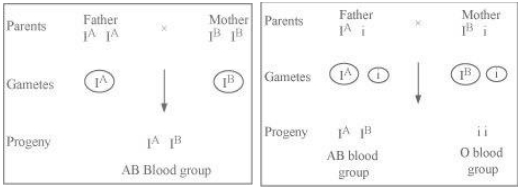
Since the child has blood group $O$ (genotype $ii$),the child must have inherited one $i$ allele from each parent. Therefore,the parents must be heterozygous for their respective blood groups.
Father's genotype: $I^A i$ (Blood group $A$)
Mother's genotype: $I^B i$ (Blood group $B$)
When these parents are crossed:
Parents: $I^A i \times I^B i$
Gametes: $(I^A, i) \times (I^B, i)$
Possible genotypes of offspring:
$1$. $I^A I^B$ (Blood group $AB$)
$2$. $I^A i$ (Blood group $A$)
$3$. $I^B i$ (Blood group $B$)
$4$. $ii$ (Blood group $O$)
Thus,the other possible genotypes of the offspring are $I^A I^B$,$I^A i$,and $I^B i$.
Since the child has blood group $O$ (genotype $ii$),the child must have inherited one $i$ allele from each parent. Therefore,the parents must be heterozygous for their respective blood groups.
Father's genotype: $I^A i$ (Blood group $A$)
Mother's genotype: $I^B i$ (Blood group $B$)
When these parents are crossed:
Parents: $I^A i \times I^B i$
Gametes: $(I^A, i) \times (I^B, i)$
Possible genotypes of offspring:
$1$. $I^A I^B$ (Blood group $AB$)
$2$. $I^A i$ (Blood group $A$)
$3$. $I^B i$ (Blood group $B$)
$4$. $ii$ (Blood group $O$)
Thus,the other possible genotypes of the offspring are $I^A I^B$,$I^A i$,and $I^B i$.
0 likes
View Solution47
Medium
Explain the concept of multiple alleles.
Solution
(A) $ABO$ blood grouping provides a classic example of multiple alleles.
Multiple alleles refer to the existence of more than two alleles for a single gene within a population. While an individual can only possess two alleles at a time,the presence of three or more alleles can only be observed through population studies.
Occasionally,a single gene product may produce more than one effect. For example,starch synthesis in pea seeds is controlled by one gene with two alleles ($B$ and $b$). $BB$ homozygotes synthesize starch effectively,resulting in large starch grains. In contrast,$bb$ homozygotes have lower efficiency,producing smaller starch grains.
Upon maturation,$BB$ seeds appear round,and $bb$ seeds appear wrinkled. Heterozygotes $(Bb)$ produce round seeds,suggesting $B$ is the dominant allele. However,the starch grains in $Bb$ seeds are of intermediate size. If starch grain size is considered the phenotype,the alleles exhibit incomplete dominance.
Therefore,dominance is not an autonomous feature of a gene or its product. It depends on the gene product,the resulting phenotype,and the specific phenotype chosen for examination when a single gene influences multiple traits.
Multiple alleles refer to the existence of more than two alleles for a single gene within a population. While an individual can only possess two alleles at a time,the presence of three or more alleles can only be observed through population studies.
Occasionally,a single gene product may produce more than one effect. For example,starch synthesis in pea seeds is controlled by one gene with two alleles ($B$ and $b$). $BB$ homozygotes synthesize starch effectively,resulting in large starch grains. In contrast,$bb$ homozygotes have lower efficiency,producing smaller starch grains.
Upon maturation,$BB$ seeds appear round,and $bb$ seeds appear wrinkled. Heterozygotes $(Bb)$ produce round seeds,suggesting $B$ is the dominant allele. However,the starch grains in $Bb$ seeds are of intermediate size. If starch grain size is considered the phenotype,the alleles exhibit incomplete dominance.
Therefore,dominance is not an autonomous feature of a gene or its product. It depends on the gene product,the resulting phenotype,and the specific phenotype chosen for examination when a single gene influences multiple traits.
0 likes
View Solution48
MediumMCQ
Even if a character shows multiple allelism,an individual will only have two alleles for that character. Why?
A
Because alleles are located on different chromosomes.
B
Because an individual is diploid and possesses only two homologous chromosomes for any given gene locus.
C
Because multiple alleles are only expressed in haploid organisms.
D
Because the other alleles are destroyed during gametogenesis.
Solution
(B) In a diploid organism,every chromosome exists in a pair,known as homologous chromosomes.
Since a gene locus is located at a specific position on a chromosome,an individual can only carry a maximum of two alleles for a single gene—one on each homologous chromosome.
Multiple allelism is a phenomenon observed only at the population level,where more than two alternative forms of a gene exist within the gene pool of a species.
Since a gene locus is located at a specific position on a chromosome,an individual can only carry a maximum of two alleles for a single gene—one on each homologous chromosome.
Multiple allelism is a phenomenon observed only at the population level,where more than two alternative forms of a gene exist within the gene pool of a species.
0 likes
View Solution49
Medium
Can a child have blood group '$O$' if his parents have blood group '$A$' and '$B$'? Explain.
Solution
(N/A) Yes,a child can have blood group '$O$' if both parents are heterozygous for their respective blood groups.
Blood group inheritance is controlled by three alleles: $I^A$,$I^B$,and $i$.
- $A$ person with blood group '$A$' can have the genotype $I^A I^A$ (homozygous) or $I^A i$ (heterozygous).
- $A$ person with blood group '$B$' can have the genotype $I^B I^B$ (homozygous) or $I^B i$ (heterozygous).
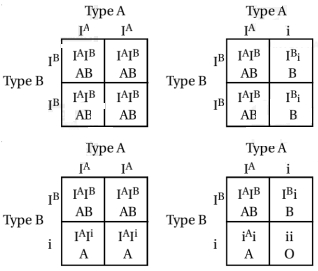
If both parents are heterozygous,i.e.,the father has genotype $I^A i$ and the mother has genotype $I^B i$,the cross is as follows:
Parents: $I^A i \times I^B i$
Gametes: $(I^A, i) \times (I^B, i)$
Offspring genotypes: $I^A I^B$ $(AB)$,$I^A i$ $(A)$,$I^B i$ $(B)$,$ii$ $(O)$.
Thus,there is a $25\%$ probability that the child will have blood group '$O$' (genotype $ii$).
Blood group inheritance is controlled by three alleles: $I^A$,$I^B$,and $i$.
- $A$ person with blood group '$A$' can have the genotype $I^A I^A$ (homozygous) or $I^A i$ (heterozygous).
- $A$ person with blood group '$B$' can have the genotype $I^B I^B$ (homozygous) or $I^B i$ (heterozygous).
If both parents are heterozygous,i.e.,the father has genotype $I^A i$ and the mother has genotype $I^B i$,the cross is as follows:
Parents: $I^A i \times I^B i$
Gametes: $(I^A, i) \times (I^B, i)$
Offspring genotypes: $I^A I^B$ $(AB)$,$I^A i$ $(A)$,$I^B i$ $(B)$,$ii$ $(O)$.
Thus,there is a $25\%$ probability that the child will have blood group '$O$' (genotype $ii$).
0 likes
View Solution50
MediumMCQ
Identify the wrong statement with reference to the gene $I$ that controls $ABO$ blood groups.
A
Allele $i$ does not produce any sugar.
B
The gene $I$ has three alleles.
C
$A$ person will have only two of the three alleles.
D
When $I^{A}$ and $I^{B}$ are present together,they express same type of sugar.
Solution
(D) The statement 'When $I^{A}$ and $I^{B}$ are present together,they express same type of sugar' is incorrect.
In the $ABO$ blood group system,the gene $I$ has three alleles: $I^{A}$,$I^{B}$,and $i$.
Alleles $I^{A}$ and $I^{B}$ produce different types of sugar polymers on the surface of red blood cells,while allele $i$ does not produce any sugar.
When both $I^{A}$ and $I^{B}$ are present together,they both express their own sugars simultaneously due to codominance,resulting in blood type $AB$. They do not express the same type of sugar.
In the $ABO$ blood group system,the gene $I$ has three alleles: $I^{A}$,$I^{B}$,and $i$.
Alleles $I^{A}$ and $I^{B}$ produce different types of sugar polymers on the surface of red blood cells,while allele $i$ does not produce any sugar.
When both $I^{A}$ and $I^{B}$ are present together,they both express their own sugars simultaneously due to codominance,resulting in blood type $AB$. They do not express the same type of sugar.
0 likes
View SolutionPrinciples of Inheritance and Variation — Multiple alleles · Frequently Asked Questions
1Are these Principles of Inheritance and Variation questions useful for JEE and NEET?
Yes. All questions in this section are mapped to JEE Main and NEET exam patterns. Previous year questions from JEE Main, NEET, GUJCET and state-level exams are included with full solutions.
2Can I switch to Hindi or Gujarati for these questions?
Yes. Use the language tabs in the hero section or the sidebar to view the same questions and solutions in English, Hindi or Gujarati.
3How do I generate a question paper from this subtopic?
Use the Vedclass Exam Paper Generator — select the chapter and subtopic, set difficulty, and generate Sets A, B, C, D automatically. First 3 chapters of every subject are free.
Vedclass Products
For Students
Vedclass Test Series
Mock tests in real JEE/NEET style with performance analysis. 5-day free trial.
Start Free TrialFor Teachers
Exam Paper Generator
Generate Set A/B/C/D papers from this chapter in 2 minutes. 3 chapters free.
Try FreeFor Institutes
Online Exam Module
Live online exams with unlimited students, 360° analytics & white-label branding.
See DemoFor Teachers & Institutes
Generate a Principles of Inheritance and Variation Exam Paper in 2 Minutes
Select subtopic & difficulty — Sets A, B, C, D auto-generated with No Repeat logic.
First 3 chapters of every subject are free — no payment required.