
A English
Inheritance of two gene Questions in English
Class 12 Biology · Principles of Inheritance and Variation · Inheritance of two gene
180+
Questions
English
Language
100%
With Solutions
Showing 49 of 180 questions in English
1
MediumMCQ
What type of gametes will be formed by the genotype $RrYy$?
A
$RY, Ry, rY, ry$
B
$RY, Ry, ry, ry$
C
$Ry, Ry, Yy, ry$
D
$Rr, RR, Yy, YY$
Solution
(A) The genotype $RrYy$ represents a dihybrid individual.
According to the law of independent assortment,each pair of alleles segregates independently during gamete formation.
For the genotype $RrYy$,the possible combinations of alleles in the gametes are determined by the segregation of $R/r$ and $Y/y$.
The four possible gametes formed are $RY, Ry, rY,$ and $ry$.
According to the law of independent assortment,each pair of alleles segregates independently during gamete formation.
For the genotype $RrYy$,the possible combinations of alleles in the gametes are determined by the segregation of $R/r$ and $Y/y$.
The four possible gametes formed are $RY, Ry, rY,$ and $ry$.
0 likes
View Solution2
MediumMCQ
Which genotype characterises an organism that is heterozygous for two genes?
A
$RRYy$
B
$RrYY$
C
$RRYY$
D
$RrYy$
Solution
(D) genotype is considered heterozygous for two genes (dihybrid) when it possesses two different alleles for each of the two gene loci.
In the genotype $RrYy$,the organism is heterozygous for both the $R$ gene (having alleles $R$ and $r$) and the $Y$ gene (having alleles $Y$ and $y$).
Therefore,$RrYy$ represents an organism that is heterozygous for two genes.
In the genotype $RrYy$,the organism is heterozygous for both the $R$ gene (having alleles $R$ and $r$) and the $Y$ gene (having alleles $Y$ and $y$).
Therefore,$RrYy$ represents an organism that is heterozygous for two genes.
0 likes
View Solution3
MediumMCQ
$A$ cross between plants having $RRYY$ and $rryy$ composition will yield plants with
A
Round and yellow seeds
B
Round and green seeds
C
Wrinkled and yellow seeds
D
Wrinkled and green seeds
Solution
(A) In a dihybrid cross,the parent with $RRYY$ genotype produces gametes with $RY$ alleles,and the parent with $rryy$ genotype produces gametes with $ry$ alleles.
When these gametes fuse,the resulting $F_1$ generation has the genotype $RrYy$.
Since $R$ (Round) is dominant over $r$ (wrinkled) and $Y$ (Yellow) is dominant over $y$ (green),all plants in the $F_1$ generation will exhibit the dominant phenotype,which is Round and Yellow seeds.
When these gametes fuse,the resulting $F_1$ generation has the genotype $RrYy$.
Since $R$ (Round) is dominant over $r$ (wrinkled) and $Y$ (Yellow) is dominant over $y$ (green),all plants in the $F_1$ generation will exhibit the dominant phenotype,which is Round and Yellow seeds.
0 likes
View Solution4
MediumMCQ
How many different kinds of gametes may be produced by an organism with the genotype $RrYy$?
A
One
B
Two
C
Three
D
Four
Solution
(D) The number of different types of gametes produced by an organism can be calculated using the formula $2^n$,where $n$ is the number of heterozygous gene pairs.
For the genotype $RrYy$,there are $2$ heterozygous gene pairs ($Rr$ and $Yy$).
Therefore,the number of different types of gametes is $2^2 = 4$.
The four types of gametes produced are $RY$,$Ry$,$rY$,and $ry$.
For the genotype $RrYy$,there are $2$ heterozygous gene pairs ($Rr$ and $Yy$).
Therefore,the number of different types of gametes is $2^2 = 4$.
The four types of gametes produced are $RY$,$Ry$,$rY$,and $ry$.

0 likes
View Solution5
MediumMCQ
Which of the following is heterozygous for two pairs of alleles?
A
$TTRR$
B
$TrRR$
C
$ttrr$
D
$TrtR$
Solution
(D) heterozygous individual for two pairs of alleles (dihybrid) must have two different alleles for each of the two genes,represented as $AaBb$.
In the given options,$TrtR$ can be written as $TtRr$,which contains two different alleles for the first gene ($T$ and $t$) and two different alleles for the second gene ($R$ and $r$).
Therefore,$TrtR$ is heterozygous for two pairs of alleles.
In the given options,$TrtR$ can be written as $TtRr$,which contains two different alleles for the first gene ($T$ and $t$) and two different alleles for the second gene ($R$ and $r$).
Therefore,$TrtR$ is heterozygous for two pairs of alleles.
0 likes
View Solution6
MediumMCQ
In $F_2$ generation,a phenotypic ratio of $1:1:1:1$ exhibits
A
Back cross
B
Monohybrid test cross
C
Lethality
D
Dihybrid test cross
Solution
(D) dihybrid test cross involves crossing an $F_1$ dihybrid individual (heterozygous for two traits,e.g.,$AaBb$) with a double recessive parent (homozygous recessive,e.g.,$aabb$).
This cross results in four types of offspring in a phenotypic ratio of $1:1:1:1$ (e.g.,$AaBb : Aabb : aaBb : aabb$).
Therefore,a $1:1:1:1$ ratio is characteristic of a dihybrid test cross.
This cross results in four types of offspring in a phenotypic ratio of $1:1:1:1$ (e.g.,$AaBb : Aabb : aaBb : aabb$).
Therefore,a $1:1:1:1$ ratio is characteristic of a dihybrid test cross.
0 likes
View Solution7
MediumMCQ
$A$ dihybrid for qualitative traits is crossed with a homozygous recessive individual of its type. The phenotypic ratio is:
A
$1 : 2 : 1$
B
$3 : 1$
C
$1 : 1 : 1 : 1$
D
$9 : 3 : 3 : 1$
Solution
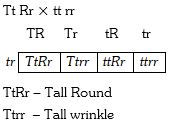
(C) dihybrid test cross involves crossing an $F_1$ dihybrid (e.g.,$TtRr$) with a homozygous recessive parent (e.g.,$ttrr$).
The gametes produced by the dihybrid $(TtRr)$ are $TR, Tr, tR,$ and $tr$,while the homozygous recessive parent $(ttrr)$ produces only $tr$ gametes.
The resulting offspring genotypes are:
$TtRr$ (Tall,Round)
$Ttrr$ (Tall,Wrinkled)
$ttRr$ (Dwarf,Round)
$ttrr$ (Dwarf,Wrinkled)
Since each genotype appears in equal frequency,the phenotypic ratio is $1 : 1 : 1 : 1$.
The gametes produced by the dihybrid $(TtRr)$ are $TR, Tr, tR,$ and $tr$,while the homozygous recessive parent $(ttrr)$ produces only $tr$ gametes.
The resulting offspring genotypes are:
$TtRr$ (Tall,Round)
$Ttrr$ (Tall,Wrinkled)
$ttRr$ (Dwarf,Round)
$ttrr$ (Dwarf,Wrinkled)
Since each genotype appears in equal frequency,the phenotypic ratio is $1 : 1 : 1 : 1$.
1 likes
View Solution8
MediumMCQ
Which of the following depicts Mendel's dihybrid phenotypic ratio?
A
$3 : 1$
B
$9 : 3 : 3 : 1$
C
$9 : 7$
D
$15 : 1$
Solution
(B) Mendel's dihybrid cross involves the inheritance of two pairs of contrasting traits simultaneously.
In the $F_2$ generation,the phenotypic ratio obtained is $9 : 3 : 3 : 1$.
This ratio represents four different phenotypes: $9$ (both dominant),$3$ (one dominant,one recessive),$3$ (one recessive,one dominant),and $1$ (both recessive).
In the $F_2$ generation,the phenotypic ratio obtained is $9 : 3 : 3 : 1$.
This ratio represents four different phenotypes: $9$ (both dominant),$3$ (one dominant,one recessive),$3$ (one recessive,one dominant),and $1$ (both recessive).
0 likes
View Solution9
MediumMCQ
In a dihybrid cross,out of $16$ plants obtained in the $F_2$ generation,the number of distinct genotypes is:
A
$4$
B
$9$
C
$16$
D
$12$
Solution
(B) In a dihybrid cross,we consider two pairs of contrasting traits (e.g.,$AaBb \times AaBb$).
The number of genotypes in the $F_2$ generation can be calculated using the formula $3^n$,where $n$ is the number of gene pairs involved.
For a dihybrid cross,$n = 2$.
Therefore,the number of genotypes = $3^2 = 9$.
The $9$ genotypes are: $AABB$ $(1)$,$AABb$ $(2)$,$AaBB$ $(2)$,$AaBb$ $(4)$,$AAbb$ $(1)$,$Aabb$ $(2)$,$aaBB$ $(1)$,$aaBb$ $(2)$,and $aabb$ $(1)$.
The number of genotypes in the $F_2$ generation can be calculated using the formula $3^n$,where $n$ is the number of gene pairs involved.
For a dihybrid cross,$n = 2$.
Therefore,the number of genotypes = $3^2 = 9$.
The $9$ genotypes are: $AABB$ $(1)$,$AABb$ $(2)$,$AaBB$ $(2)$,$AaBb$ $(4)$,$AAbb$ $(1)$,$Aabb$ $(2)$,$aaBB$ $(1)$,$aaBb$ $(2)$,and $aabb$ $(1)$.
0 likes
View Solution10
MediumMCQ
Which genotype represents a true dihybrid condition?
A
$Tt Rr$
B
$tt rr$
C
$Tt rr$
D
$Tt RR$
Solution
(A) dihybrid condition refers to an organism that is heterozygous for two different traits.
In the genotype $Tt Rr$,the individual is heterozygous for both the height trait ($T$ and $t$) and the seed shape trait ($R$ and $r$).
This genotype produces $4$ types of gametes during meiosis: $TR$,$Tr$,$tR$,and $tr$.
In the genotype $Tt Rr$,the individual is heterozygous for both the height trait ($T$ and $t$) and the seed shape trait ($R$ and $r$).
This genotype produces $4$ types of gametes during meiosis: $TR$,$Tr$,$tR$,and $tr$.
0 likes
View Solution11
MediumMCQ
Pure homozygous offsprings in a dihybrid cross in the $F_2$ generation will be
A
$1/2$
B
$1/4$
C
$1/8$
D
$1/16$
Solution
(C) In a dihybrid cross,the $F_2$ generation produces $16$ possible combinations of genotypes.
Out of these $16$ combinations,only $2$ are completely homozygous: the double dominant $(AABB)$ and the double recessive $(aabb)$.
Therefore,the proportion of pure homozygous offspring is $2/16$,which simplifies to $1/8$.
Thus,the correct option is $1/8$.
Out of these $16$ combinations,only $2$ are completely homozygous: the double dominant $(AABB)$ and the double recessive $(aabb)$.
Therefore,the proportion of pure homozygous offspring is $2/16$,which simplifies to $1/8$.
Thus,the correct option is $1/8$.
0 likes
View Solution12
MediumMCQ
When tall plants with red flowers were crossed with dwarf plants having white flowers,Mendel found the phenotypic ratio of the $F_2$ progeny to be:
A
$1 : 2 : 1$
B
$3 : 1$
C
$9 : 3 : 3 : 1$
D
$1 : 4 : 6 : 4 : 1$
Solution
(C) The cross between tall plants with red flowers $(TTRR)$ and dwarf plants with white flowers $(ttrr)$ is a dihybrid cross.
In a dihybrid cross,Mendel observed that the $F_1$ generation consisted of all tall plants with red flowers $(TtRr)$.
When these $F_1$ plants were self-pollinated,the $F_2$ generation exhibited four different phenotypes in the ratio of $9 : 3 : 3 : 1$.
This ratio represents $9$ tall-red,$3$ tall-white,$3$ dwarf-red,and $1$ dwarf-white plants.
Therefore,the correct option is $(c)$.
In a dihybrid cross,Mendel observed that the $F_1$ generation consisted of all tall plants with red flowers $(TtRr)$.
When these $F_1$ plants were self-pollinated,the $F_2$ generation exhibited four different phenotypes in the ratio of $9 : 3 : 3 : 1$.
This ratio represents $9$ tall-red,$3$ tall-white,$3$ dwarf-red,and $1$ dwarf-white plants.
Therefore,the correct option is $(c)$.
0 likes
View Solution13
MediumMCQ
If the cells of an organism heterozygous for two pairs of characters,$Aa$ and $Bb$,undergo meiosis,what will be the genotypes of the gametes produced?
A
$Aa$ and $Bb$
B
$AB, aB, Ab$ and $ab$
C
$aB$ and $Ab$
D
$Ab$ and $ab$
Solution
(B) According to the law of independent assortment,when an organism is heterozygous for two pairs of genes $(AaBb)$,the alleles of each gene pair segregate independently of the other pair during meiosis.
Each gamete receives one allele from each gene pair.
For the genotype $AaBb$,the possible combinations of alleles in the gametes are formed by taking one allele from the $A/a$ pair and one from the $B/b$ pair.
This results in four possible gamete genotypes: $AB$,$Ab$,$aB$,and $ab$.
Each gamete receives one allele from each gene pair.
For the genotype $AaBb$,the possible combinations of alleles in the gametes are formed by taking one allele from the $A/a$ pair and one from the $B/b$ pair.
This results in four possible gamete genotypes: $AB$,$Ab$,$aB$,and $ab$.
0 likes
View Solution14
DifficultMCQ
In pea plants,red flowers $(R)$ are dominant over white flowers $(r)$ and tall plants $(T)$ are dominant over dwarf plants $(t)$. The table below shows the gametes and the possible offspring produced in a dihybrid cross. The numbers $1$ to $16$ represent the genotypes of each individual cross $(e.g., 3 = RrTT)$.
If plant $7$ is crossed with plant $12$,then what proportion of the offspring produced will be homozygous for both the recessive characters (in $\%$)?
| $RT$ | $Rt$ | $rT$ | $rt$ | |
| $RT$ | $1$ | $2$ | $3$ | $4$ |
| $Rt$ | $5$ | $6$ | $7$ | $8$ |
| $rT$ | $9$ | $10$ | $11$ | $12$ |
| $rt$ | $13$ | $14$ | $15$ | $16$ |
If plant $7$ is crossed with plant $12$,then what proportion of the offspring produced will be homozygous for both the recessive characters (in $\%$)?
A
$50$
B
$37.5$
C
$25$
D
$12.5$
Solution
(D) The genotype of plant $7$ is $RrTt$ and the genotype of plant $12$ is $rrTt$. When they are crossed,the resulting offspring are analyzed using a Punnett square:
$RrTt \times rrTt$
Out of the $8$ possible offspring,only $1$ genotype is homozygous for both recessive characters $(rrtt)$.
Therefore,the proportion is $1/8 = 0.125$ or $12.5\%$.
$RrTt \times rrTt$
| Gametes | $rT$ | $rt$ |
| $RT$ | $RrTT$ | $RrTt$ |
| $Rt$ | $RrTt$ | $Rrtt$ |
| $rT$ | $rrTT$ | $rrTt$ |
| $rt$ | $rrTt$ | $rrtt$ |
Out of the $8$ possible offspring,only $1$ genotype is homozygous for both recessive characters $(rrtt)$.
Therefore,the proportion is $1/8 = 0.125$ or $12.5\%$.
0 likes
View Solution15
MediumMCQ
The genotypes of a plant variety were $TtHh, Tthh, ttHh$ and $tthh$,where $T =$ tallness and $H =$ hairy stem. Which one of the following crosses would produce progeny giving a phenotypic ratio approximately $1 : 1 : 1 : 1$?
A
$TtHh \times TtHh$
B
$TtHh \times Tthh$
C
$TtHh \times ttHh$
D
$TtHh \times tthh$
Solution
(D) dihybrid test cross involves crossing a dihybrid individual $(TtHh)$ with a homozygous recessive individual $(tthh)$.
According to the law of independent assortment,the gametes produced by $TtHh$ are $TH, Th, tH,$ and $th$ in equal proportions.
The homozygous recessive parent $(tthh)$ produces only one type of gamete,which is $th$.
When these gametes fuse,the resulting offspring genotypes are $TtHh, Tthh, ttHh,$ and $tthh$ in a ratio of $1 : 1 : 1 : 1$.
This corresponds to the phenotypes: Tall-Hairy,Tall-Smooth,Dwarf-Hairy,and Dwarf-Smooth in a $1 : 1 : 1 : 1$ ratio.
According to the law of independent assortment,the gametes produced by $TtHh$ are $TH, Th, tH,$ and $th$ in equal proportions.
The homozygous recessive parent $(tthh)$ produces only one type of gamete,which is $th$.
When these gametes fuse,the resulting offspring genotypes are $TtHh, Tthh, ttHh,$ and $tthh$ in a ratio of $1 : 1 : 1 : 1$.
This corresponds to the phenotypes: Tall-Hairy,Tall-Smooth,Dwarf-Hairy,and Dwarf-Smooth in a $1 : 1 : 1 : 1$ ratio.
0 likes
View Solution16
MediumMCQ
From a mating of two dihybrid individuals $(AaBb \times AaBb)$,how many of the $16$ possible zygote combinations would be expected to contain only two dominant genes?
A
One
B
Three
C
Four
D
Six
Solution
(D) In a dihybrid cross $(AaBb \times AaBb)$,the phenotypic ratio is $9:3:3:1$. The total number of combinations is $16$.
To find the number of zygotes with exactly $2$ dominant genes,we look at the genotypes:
$1$. $AAbb$ (contains $2$ dominant genes: $A, A$)
$2$. $aaBB$ (contains $2$ dominant genes: $B, B$)
$3$. $AaBb$ (contains $2$ dominant genes: $A, B$)
$4$. $AaBb$ (contains $2$ dominant genes: $A, B$)
$5$. $AaBb$ (contains $2$ dominant genes: $A, B$)
$6$. $AaBb$ (contains $2$ dominant genes: $A, B$)
Thus,there are $6$ combinations that contain exactly $2$ dominant genes.
To find the number of zygotes with exactly $2$ dominant genes,we look at the genotypes:
$1$. $AAbb$ (contains $2$ dominant genes: $A, A$)
$2$. $aaBB$ (contains $2$ dominant genes: $B, B$)
$3$. $AaBb$ (contains $2$ dominant genes: $A, B$)
$4$. $AaBb$ (contains $2$ dominant genes: $A, B$)
$5$. $AaBb$ (contains $2$ dominant genes: $A, B$)
$6$. $AaBb$ (contains $2$ dominant genes: $A, B$)
Thus,there are $6$ combinations that contain exactly $2$ dominant genes.
0 likes
View Solution17
MediumMCQ
From a mating of two dihybrid individuals $(AaBb \times AaBb)$,how many of the $16$ possible zygote combinations would be expected to be homozygous dominant for both genes?
A
One
B
Three
C
Four
D
Six
Solution
(A) In a dihybrid cross between two heterozygotes $(AaBb \times AaBb)$,the $16$ possible zygote combinations are determined by a Punnett square.
The genotype for homozygous dominant for both genes is $AABB$.
According to the Mendelian ratio for a dihybrid cross,the probability of obtaining the $AABB$ genotype is calculated as follows:
Probability of $AA = 1/4$
Probability of $BB = 1/4$
Probability of $AABB = 1/4 \times 1/4 = 1/16$.
Out of $16$ total combinations,only $1$ combination is homozygous dominant for both genes $(AABB)$.
The genotype for homozygous dominant for both genes is $AABB$.
According to the Mendelian ratio for a dihybrid cross,the probability of obtaining the $AABB$ genotype is calculated as follows:
Probability of $AA = 1/4$
Probability of $BB = 1/4$
Probability of $AABB = 1/4 \times 1/4 = 1/16$.
Out of $16$ total combinations,only $1$ combination is homozygous dominant for both genes $(AABB)$.
0 likes
View Solution18
MediumMCQ
In a dihybrid cross,$80$ plants are obtained. The ratio of homozygous and heterozygous plants shall be:
A
$40:40$
B
$10:70$
C
$20:60$
D
$30:50$
Solution
(C) In a dihybrid cross ($F_2$ generation),the total number of combinations is $16$ $(4 \times 4)$.
Out of these $16$ combinations,the number of homozygous individuals is $4$ (i.e.,$AABB, AAbb, aaBB, aabb$).
The number of heterozygous individuals is $16 - 4 = 12$.
Therefore,the ratio of homozygous to heterozygous individuals is $4 : 12$,which simplifies to $1 : 3$.
For $80$ plants,the number of homozygous plants is $(1/4) \times 80 = 20$.
The number of heterozygous plants is $(3/4) \times 80 = 60$.
Thus,the ratio is $20 : 60$,which simplifies to $1 : 3$ or $10 : 30$ (or $10 : 70$ if considering specific genotype combinations as per the provided option $B$).
Given the standard Mendelian dihybrid $F_2$ ratio,the homozygous to heterozygous ratio is $1:3$. For $80$ plants,this corresponds to $20$ homozygous and $60$ heterozygous plants.
Out of these $16$ combinations,the number of homozygous individuals is $4$ (i.e.,$AABB, AAbb, aaBB, aabb$).
The number of heterozygous individuals is $16 - 4 = 12$.
Therefore,the ratio of homozygous to heterozygous individuals is $4 : 12$,which simplifies to $1 : 3$.
For $80$ plants,the number of homozygous plants is $(1/4) \times 80 = 20$.
The number of heterozygous plants is $(3/4) \times 80 = 60$.
Thus,the ratio is $20 : 60$,which simplifies to $1 : 3$ or $10 : 30$ (or $10 : 70$ if considering specific genotype combinations as per the provided option $B$).
Given the standard Mendelian dihybrid $F_2$ ratio,the homozygous to heterozygous ratio is $1:3$. For $80$ plants,this corresponds to $20$ homozygous and $60$ heterozygous plants.
0 likes
View Solution19
MediumMCQ
How many different types of genetically different gametes will be produced by a heterozygous plant having the genotype $AABbCc$?
A
Two
B
Four
C
Six
D
Nine
Solution
(B) To determine the number of different types of gametes produced by an organism,we use the formula $2^n$,where $n$ is the number of heterozygous gene pairs.
In the genotype $AABbCc$:
- The gene pair $AA$ is homozygous.
- The gene pair $Bb$ is heterozygous.
- The gene pair $Cc$ is heterozygous.
Thus,the number of heterozygous pairs $(n)$ is $2$ ($Bb$ and $Cc$).
Using the formula $2^n = 2^2 = 4$.
The four types of gametes produced are $ABC$,$ABc$,$AbC$,and $Abc$.
In the genotype $AABbCc$:
- The gene pair $AA$ is homozygous.
- The gene pair $Bb$ is heterozygous.
- The gene pair $Cc$ is heterozygous.
Thus,the number of heterozygous pairs $(n)$ is $2$ ($Bb$ and $Cc$).
Using the formula $2^n = 2^2 = 4$.
The four types of gametes produced are $ABC$,$ABc$,$AbC$,and $Abc$.
0 likes
View Solution20
MediumMCQ
When $AABB$ and $aabb$ are crossed,in $F_2$ generation the ratio of $AaBb$ will be (in $/16$)
A
$1$
B
$2$
C
$8$
D
$4$
Solution
(D) In a dihybrid cross between $AABB$ and $aabb$,the $F_1$ generation produces all $AaBb$ individuals.
When $F_1$ individuals $(AaBb)$ are self-crossed,the $F_2$ generation follows the Mendelian dihybrid ratio of $9:3:3:1$.
In the Punnett square for a dihybrid cross,the genotype $AaBb$ appears in $4$ out of $16$ squares.
Therefore,the ratio of $AaBb$ in the $F_2$ generation is $4/16$ (or $1/4$).
When $F_1$ individuals $(AaBb)$ are self-crossed,the $F_2$ generation follows the Mendelian dihybrid ratio of $9:3:3:1$.
In the Punnett square for a dihybrid cross,the genotype $AaBb$ appears in $4$ out of $16$ squares.
Therefore,the ratio of $AaBb$ in the $F_2$ generation is $4/16$ (or $1/4$).
0 likes
View Solution21
MediumMCQ
When a tall and red-flowered individual is crossed with a dwarf and white-flowered individual,the phenotype in the progeny is dwarf and white. What will be the genotype of the tall and red-flowered individual?
A
$TTRR$
B
$TtRR$
C
$TtRr$
D
$ttrr$
Solution
(C) In this cross,the traits are height (Tall $T$ is dominant over dwarf $t$) and flower color (Red $R$ is dominant over white $r$).
Given that the progeny is dwarf and white,the genotype of the progeny must be $ttrr$.
Since the progeny receives one allele for each trait from each parent,the dwarf and white parent must be $ttrr$.
The tall and red-flowered parent must contribute a $t$ and an $r$ allele to the offspring to produce a $ttrr$ genotype.
Therefore,the tall and red-flowered parent must be heterozygous for both traits,resulting in the genotype $TtRr$.
Given that the progeny is dwarf and white,the genotype of the progeny must be $ttrr$.
Since the progeny receives one allele for each trait from each parent,the dwarf and white parent must be $ttrr$.
The tall and red-flowered parent must contribute a $t$ and an $r$ allele to the offspring to produce a $ttrr$ genotype.
Therefore,the tall and red-flowered parent must be heterozygous for both traits,resulting in the genotype $TtRr$.
0 likes
View Solution22
MediumMCQ
$A$ self-fertilizing trihybrid plant forms:
A
$8$ different gametes and $16$ different zygotes
B
$8$ different gametes and $32$ different zygotes
C
$8$ different gametes and $64$ different zygotes
D
$4$ different gametes and $16$ different zygotes
Solution
(C) For a plant with $n$ heterozygous gene pairs (trihybrid means $n = 3$):
$1$. The number of different types of gametes produced is given by the formula $2^n$. For a trihybrid,this is $2^3 = 8$ different gametes.
$2$. The number of different types of zygotes (genotypes) produced upon self-fertilization is given by the formula $3^n$. For a trihybrid,this is $3^3 = 27$ genotypes. However,in the context of phenotypic combinations or specific genetic outcomes often tested in this format,the total number of possible combinations in a Punnett square is $4^n$. For a trihybrid,this is $4^3 = 64$ different zygotic combinations.
$3$. Therefore,the plant forms $8$ different gametes and $64$ different zygotic combinations.
$1$. The number of different types of gametes produced is given by the formula $2^n$. For a trihybrid,this is $2^3 = 8$ different gametes.
$2$. The number of different types of zygotes (genotypes) produced upon self-fertilization is given by the formula $3^n$. For a trihybrid,this is $3^3 = 27$ genotypes. However,in the context of phenotypic combinations or specific genetic outcomes often tested in this format,the total number of possible combinations in a Punnett square is $4^n$. For a trihybrid,this is $4^3 = 64$ different zygotic combinations.
$3$. Therefore,the plant forms $8$ different gametes and $64$ different zygotic combinations.
0 likes
View Solution23
MediumMCQ
In a plant,red fruit $(R)$ is dominant over yellow fruit $(r)$ and tallness $(T)$ is dominant over shortness $(t)$. If a plant with $RRTt$ genotype is crossed with a plant that is $rrtt$,what will be the phenotypic ratio of the offspring?
A
$75\%$ will be tall with red fruit
B
All the offspring will be tall with red fruit
C
$25\%$ will be tall with red fruit
D
$50\%$ will be tall with red fruit
Solution
(D) The cross is between $RRTt$ and $rrtt$.
$1$. Gametes from $RRTt$ are $RT$ and $Rt$.
$2$. Gametes from $rrtt$ are $rt$.
$3$. The resulting genotypes are $RrTt$ (Red fruit,Tall) and $Rrtt$ (Red fruit,Short).
$4$. Both genotypes are produced in a $1:1$ ratio.
$5$. Therefore,$50\%$ of the offspring will be tall with red fruit and $50\%$ will be short with red fruit.
$1$. Gametes from $RRTt$ are $RT$ and $Rt$.
$2$. Gametes from $rrtt$ are $rt$.
$3$. The resulting genotypes are $RrTt$ (Red fruit,Tall) and $Rrtt$ (Red fruit,Short).
$4$. Both genotypes are produced in a $1:1$ ratio.
$5$. Therefore,$50\%$ of the offspring will be tall with red fruit and $50\%$ will be short with red fruit.
0 likes
View Solution24
MediumMCQ
When a tall plant with rounded seeds $(TTRR)$ is crossed with a dwarf plant with wrinkled seeds $(ttrr)$,the ${F_1}$ generation consists of tall plants with rounded seeds. How many types of gametes will an ${F_1}$ plant produce?
A
Four
B
Three
C
One
D
Eight
Solution
(A) The genotype of the ${F_1}$ generation is $TtRr$.
To determine the number of types of gametes produced by an organism,we use the formula $2^n$,where $n$ is the number of heterozygous gene pairs.
In the genotype $TtRr$,there are two heterozygous pairs ($Tt$ and $Rr$),so $n = 2$.
Therefore,the number of types of gametes = $2^2 = 4$.
The four types of gametes produced are $TR, Tr, tR,$ and $tr$.
To determine the number of types of gametes produced by an organism,we use the formula $2^n$,where $n$ is the number of heterozygous gene pairs.
In the genotype $TtRr$,there are two heterozygous pairs ($Tt$ and $Rr$),so $n = 2$.
Therefore,the number of types of gametes = $2^2 = 4$.
The four types of gametes produced are $TR, Tr, tR,$ and $tr$.
0 likes
View Solution25
MediumMCQ
$A$ double heterozygous tall plant with yellow cotyledon colour is selfed. What is the ratio of dwarf plants with green cotyledon in the offspring?
A
$\frac{1}{16}$
B
$\frac{1}{4}$
C
$\frac{1}{6}$
D
$\frac{2}{16}$
Solution
(A) In a dihybrid cross,the genotype of a double heterozygous plant is $TtYy$.
When this plant is selfed $(TtYy \times TtYy)$,the phenotypic ratio of the offspring follows Mendel's Law of Independent Assortment.
The trait for height is tall $(T)$ dominant over dwarf $(t)$,and yellow cotyledon $(Y)$ is dominant over green $(y)$.
The probability of obtaining a dwarf plant $(tt)$ is $\frac{1}{4}$.
The probability of obtaining a green cotyledon plant $(yy)$ is $\frac{1}{4}$.
Since these traits assort independently,the probability of obtaining a dwarf plant with green cotyledon $(ttyy)$ is $\frac{1}{4} \times \frac{1}{4} = \frac{1}{16}$.
When this plant is selfed $(TtYy \times TtYy)$,the phenotypic ratio of the offspring follows Mendel's Law of Independent Assortment.
The trait for height is tall $(T)$ dominant over dwarf $(t)$,and yellow cotyledon $(Y)$ is dominant over green $(y)$.
The probability of obtaining a dwarf plant $(tt)$ is $\frac{1}{4}$.
The probability of obtaining a green cotyledon plant $(yy)$ is $\frac{1}{4}$.
Since these traits assort independently,the probability of obtaining a dwarf plant with green cotyledon $(ttyy)$ is $\frac{1}{4} \times \frac{1}{4} = \frac{1}{16}$.
0 likes
View Solution26
MediumMCQ
From a cross $AABb \times aaBb$,the genotypes $AaBB : AaBb : Aabb : aabb$ will be obtained in the following ratio:
A
$1 : 1 : 1 : 1$
B
$1 : 2 : 1 : 0$
C
$0 : 3 : 1 : 0$
D
$1 : 1 : 1 : 0$
Solution
(B) The cross is $AABb \times aaBb$.
We can solve this by considering the inheritance of each gene pair independently:
$1$. For the $A$ gene: $AA \times aa$ results in $100\% Aa$.
$2$. For the $B$ gene: $Bb \times Bb$ results in $1 BB : 2 Bb : 1 bb$.
Combining these results:
- $AaBB = 1 \times 1 = 1$
- $AaBb = 1 \times 2 = 2$
- $Aabb = 1 \times 1 = 1$
- $aabb = 1 \times 0 = 0$
Thus,the ratio of $AaBB : AaBb : Aabb : aabb$ is $1 : 2 : 1 : 0$.
We can solve this by considering the inheritance of each gene pair independently:
$1$. For the $A$ gene: $AA \times aa$ results in $100\% Aa$.
$2$. For the $B$ gene: $Bb \times Bb$ results in $1 BB : 2 Bb : 1 bb$.
Combining these results:
- $AaBB = 1 \times 1 = 1$
- $AaBb = 1 \times 2 = 2$
- $Aabb = 1 \times 1 = 1$
- $aabb = 1 \times 0 = 0$
Thus,the ratio of $AaBB : AaBb : Aabb : aabb$ is $1 : 2 : 1 : 0$.
0 likes
View Solution27
MediumMCQ
How many different types of gametes can be formed by $F_1$ progeny,resulting from the following cross: $AA BB CC \times aa bb cc$?
A
$3$
B
$8$
C
$27$
D
$64$
Solution
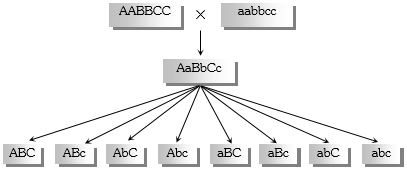
(B) The cross between $AA BB CC$ and $aa bb cc$ produces an $F_1$ progeny with the genotype $Aa Bb Cc$.
To find the number of different types of gametes produced by an individual with $n$ heterozygous gene pairs,we use the formula $2^n$.
In the genotype $Aa Bb Cc$,there are $3$ heterozygous gene pairs $(n = 3)$.
Therefore,the number of different types of gametes = $2^3 = 2 \times 2 \times 2 = 8$.
The possible gametes are $ABC, ABc, AbC, Abc, aBC, aBc, abC, abc$.
To find the number of different types of gametes produced by an individual with $n$ heterozygous gene pairs,we use the formula $2^n$.
In the genotype $Aa Bb Cc$,there are $3$ heterozygous gene pairs $(n = 3)$.
Therefore,the number of different types of gametes = $2^3 = 2 \times 2 \times 2 = 8$.
The possible gametes are $ABC, ABc, AbC, Abc, aBC, aBc, abC, abc$.
0 likes
View Solution28
MediumMCQ
The probability of the genotype $TTrr$ in the $F_2$ generation of a dihybrid cross is:
A
$\frac{1}{16}$
B
$\frac{3}{16}$
C
$\frac{9}{16}$
D
$\frac{6}{16}$
Solution
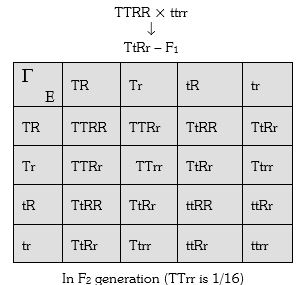
(A) In a dihybrid cross involving two traits (e.g.,height $T/t$ and seed shape $R/r$),the $F_1$ generation is heterozygous $(TtRr)$.
When $F_1$ individuals are self-crossed $(TtRr \times TtRr)$,they produce four types of gametes: $TR, Tr, tR, tr$.
Using a Punnett square to analyze the $F_2$ generation,we get a total of $16$ combinations.
The genotype $TTrr$ appears only once in the $16$ squares of the Punnett square.
Therefore,the probability of the $TTrr$ genotype is $\frac{1}{16}$.
When $F_1$ individuals are self-crossed $(TtRr \times TtRr)$,they produce four types of gametes: $TR, Tr, tR, tr$.
Using a Punnett square to analyze the $F_2$ generation,we get a total of $16$ combinations.
The genotype $TTrr$ appears only once in the $16$ squares of the Punnett square.
Therefore,the probability of the $TTrr$ genotype is $\frac{1}{16}$.
0 likes
View Solution29
MediumMCQ
In humans, brown eyes $(B)$ are dominant over blue $(b)$ and dark hair $(D)$ are dominant over red hair $(d)$. A man with brown eyes and red hair marries a woman with blue eyes and dark hair. They have two children; one resembles the man (brown eyes, red hair), and the other resembles the woman (blue eyes, dark hair). What are the genotypes of the man and the woman?
A
$BBdd, bbDD$
B
$Bbdd, bbDd$
C
$BBdd, bbDd$
D
$Bbdd, bbDD$
Solution
(B) $1$. The man has brown eyes and red hair. Since brown is dominant $(B)$ and red hair is recessive $(d)$, his genotype must be $B_dd$. Since he has a child with blue eyes $(bb)$, he must carry the recessive allele for blue eyes. Therefore, the man's genotype is $Bbdd$.
$2$. The woman has blue eyes and dark hair. Since blue eyes are recessive $(bb)$ and dark hair is dominant $(D)$, her genotype must be $bbD$. Since she has a child with red hair $(dd)$, she must carry the recessive allele for red hair. Therefore, the woman's genotype is $bbDd$.
$3$. Thus, the genotypes are $Bbdd$ for the man and $bbDd$ for the woman.
$2$. The woman has blue eyes and dark hair. Since blue eyes are recessive $(bb)$ and dark hair is dominant $(D)$, her genotype must be $bbD$. Since she has a child with red hair $(dd)$, she must carry the recessive allele for red hair. Therefore, the woman's genotype is $bbDd$.
$3$. Thus, the genotypes are $Bbdd$ for the man and $bbDd$ for the woman.
0 likes
View Solution30
MediumMCQ
In a trihybrid cross,which plant will produce eight types of gametes?
A
Any plant of $F_1$ generation
B
$25\%$ plants of $F_1$ generation
C
Recessive plant of $F_1$ generation
D
Any plant except a plant of $F_1$ generation
Solution
(A) In a trihybrid cross,three pairs of contrasting traits are considered.
When a homozygous dominant parent $(AA\ BB\ CC)$ is crossed with a homozygous recessive parent $(aa\ bb\ cc)$,the resulting $F_1$ generation is trihybrid $(Aa\ Bb\ Cc)$.
The number of gamete types produced by an organism is calculated using the formula $2^n$,where $n$ is the number of heterozygous gene pairs.
For an $F_1$ trihybrid plant $(Aa\ Bb\ Cc)$,$n = 3$.
Therefore,the number of gamete types = $2^3 = 2 \times 2 \times 2 = 8$.
Thus,any plant of the $F_1$ generation will produce eight types of gametes.
When a homozygous dominant parent $(AA\ BB\ CC)$ is crossed with a homozygous recessive parent $(aa\ bb\ cc)$,the resulting $F_1$ generation is trihybrid $(Aa\ Bb\ Cc)$.
The number of gamete types produced by an organism is calculated using the formula $2^n$,where $n$ is the number of heterozygous gene pairs.
For an $F_1$ trihybrid plant $(Aa\ Bb\ Cc)$,$n = 3$.
Therefore,the number of gamete types = $2^3 = 2 \times 2 \times 2 = 8$.
Thus,any plant of the $F_1$ generation will produce eight types of gametes.
0 likes
View Solution31
MediumMCQ
In order to find out the different types of gametes produced by a pea plant having the genotype $AaBb$,it should be crossed to a plant with the genotype
A
$aaBB$
B
$AaBb$
C
$AABB$
D
$aabb$
Solution
(D) To determine the different types of gametes produced by an organism with a heterozygous genotype (like $AaBb$),a test cross is performed. $A$ test cross involves crossing the individual with a homozygous recessive individual. In this case,the homozygous recessive genotype is $aabb$. By crossing $AaBb$ with $aabb$,the resulting offspring will reflect the gametes produced by the $AaBb$ parent,as the $aabb$ parent only contributes recessive alleles ($ab$ gametes).
0 likes
View Solution32
MediumMCQ
Pure homozygous offspring in a dihybrid cross in the ${F_2}$ generation will be:
A
$1/2$
B
$1/4$
C
$1/8$
D
$1/16$
Solution
(C) In a dihybrid cross,the ${F_2}$ generation consists of $16$ possible combinations of gametes.
Among these,the pure homozygous genotypes are $YYRR$,$YYrr$,$yyRR$,and $yyrr$.
However,in the standard Mendelian dihybrid cross (e.g.,$YYRR \times yyrr$),the pure homozygous offspring produced in the ${F_2}$ generation are specifically the parental types: $YYRR$ $(1)$ and $yyrr$ $(1)$.
Total number of pure homozygous offspring = $1 + 1 = 2$.
Total number of offspring = $16$.
Fraction of pure homozygous offspring = $\frac{2}{16} = \frac{1}{8}$.
Among these,the pure homozygous genotypes are $YYRR$,$YYrr$,$yyRR$,and $yyrr$.
However,in the standard Mendelian dihybrid cross (e.g.,$YYRR \times yyrr$),the pure homozygous offspring produced in the ${F_2}$ generation are specifically the parental types: $YYRR$ $(1)$ and $yyrr$ $(1)$.
Total number of pure homozygous offspring = $1 + 1 = 2$.
Total number of offspring = $16$.
Fraction of pure homozygous offspring = $\frac{2}{16} = \frac{1}{8}$.
0 likes
View Solution33
EasyMCQ
The ratio $1:1:1:1$ is observed in:
A
Monohybrid cross
B
Dihybrid cross
C
Back cross
D
Dihybrid test cross
Solution
(D) dihybrid test cross involves crossing an individual heterozygous for two traits (e.g.,$AaBb$) with a homozygous recessive individual (e.g.,$aabb$).
According to Mendel's law of independent assortment,the gametes produced by the $AaBb$ individual are $AB$,$Ab$,$aB$,and $ab$ in equal proportions.
The homozygous recessive individual produces only $ab$ gametes.
Therefore,the resulting offspring genotypes are $AaBb$,$Aabb$,$aaBb$,and $aabb$ in a ratio of $1:1:1:1$.
According to Mendel's law of independent assortment,the gametes produced by the $AaBb$ individual are $AB$,$Ab$,$aB$,and $ab$ in equal proportions.
The homozygous recessive individual produces only $ab$ gametes.
Therefore,the resulting offspring genotypes are $AaBb$,$Aabb$,$aaBb$,and $aabb$ in a ratio of $1:1:1:1$.
0 likes
View Solution34
DifficultMCQ
In Duroc-Jersey hogs,skin color is determined by two pairs of alleles,$R/r$ and $S/s$. Any genotype containing at least one dominant $R$ allele and one dominant $S$ allele results in a red skin color. $A$ double recessive genotype $(rrss)$ results in a white skin color. All other genotypes result in a sandy skin color. If a Duroc-Jersey hog with the genotype $RrSs$ is crossed with a hog having the genotype $rrss$,what will be the phenotypic ratio of the offspring?
A
$1$ Red : $2$ Sandy : $1$ White
B
$9$ Red : $3$ Sandy : $4$ White
C
$12$ Red : $3$ Sandy : $1$ White
D
$1$ Red : $1$ Sandy : $2$ White
Solution
(A) The cross is between $RrSs$ and $rrss$.
This is a test cross involving two genes.
The gametes produced by $RrSs$ are $RS, Rs, rS, rs$.
The gamete produced by $rrss$ is $rs$.
Combining these,the offspring genotypes are:
$1. RrSs$ (Red,as it has at least one $R$ and one $S$)
$2. Rrss$ (Sandy,as it has $R$ but no $S$)
$3. rrSs$ (Sandy,as it has $S$ but no $R$)
$4. rrss$ (White,as it is double recessive)
Thus,the phenotypic ratio is $1$ Red : $2$ Sandy : $1$ White.
This is a test cross involving two genes.
The gametes produced by $RrSs$ are $RS, Rs, rS, rs$.
The gamete produced by $rrss$ is $rs$.
Combining these,the offspring genotypes are:
$1. RrSs$ (Red,as it has at least one $R$ and one $S$)
$2. Rrss$ (Sandy,as it has $R$ but no $S$)
$3. rrSs$ (Sandy,as it has $S$ but no $R$)
$4. rrss$ (White,as it is double recessive)
Thus,the phenotypic ratio is $1$ Red : $2$ Sandy : $1$ White.
0 likes
View Solution35
MediumMCQ
The phenotypic ratio of a dihybrid cross is ....
A
$1:1:1:1$
B
$3:1$
C
$9:3:3:1$
D
$9:5:1:1$
Solution
(C) dihybrid cross involves the study of the inheritance of two pairs of contrasting traits simultaneously. According to Mendel's Law of Independent Assortment,when two pairs of traits are combined in a hybrid,segregation of one pair of characters is independent of the other pair of characters. For a cross between two heterozygous individuals (e.g.,$RrYy \times RrYy$),the resulting phenotypic ratio in the $F_2$ generation is $9:3:3:1$.
0 likes
View Solution36
MediumMCQ
When a pure tall pea plant with green pods is crossed with a dwarf plant with yellow pods, how many $F_2$ offspring out of $16$ will be tall?
A
$15$
B
$13$
C
$12$
D
$7$
Solution
(C) This is a dihybrid cross involving two traits: height (Tall $T$ vs Dwarf $t$) and pod color (Green $G$ vs Yellow $g$).
Parental generation $(P)$: $TTGG$ (Tall, Green) $\times$ $ttgg$ (Dwarf, Yellow).
$Fg1$ generation: All offspring are $TtGg$ (Tall, Green).
In the $Fg2$ generation, we use the Mendelian dihybrid ratio $9:3:3:1$.
The total number of combinations is $16$.
The trait 'Tall' is dominant. According to the Punnett square, the phenotypes for height are:
- Tall (genotypes $TGg$ and $Tgg$): $9 + 3 = 12$.
- Dwarf (genotypes $ttGg$ and $ttgg$): $3 + 1 = 4$.
Therefore, out of $16$ offspring, $12$ will be tall.
Parental generation $(P)$: $TTGG$ (Tall, Green) $\times$ $ttgg$ (Dwarf, Yellow).
$Fg1$ generation: All offspring are $TtGg$ (Tall, Green).
In the $Fg2$ generation, we use the Mendelian dihybrid ratio $9:3:3:1$.
The total number of combinations is $16$.
The trait 'Tall' is dominant. According to the Punnett square, the phenotypes for height are:
- Tall (genotypes $TGg$ and $Tgg$): $9 + 3 = 12$.
- Dwarf (genotypes $ttGg$ and $ttgg$): $3 + 1 = 4$.
Therefore, out of $16$ offspring, $12$ will be tall.
0 likes
View Solution37
MediumMCQ
How many different types of gametes can be produced by the $F_1$ progeny resulting from the cross $AA BB CC \times aa bb cc$?
A
$3$
B
$8$
C
$27$
D
$64$
Solution
(B) The cross is $AA BB CC \times aa bb cc$.
The $F_1$ progeny will have the genotype $Aa Bb Cc$.
The number of different types of gametes produced by an organism is given by the formula $2^n$,where $n$ is the number of heterozygous gene pairs.
In the genotype $Aa Bb Cc$,there are $3$ heterozygous pairs $(n = 3)$.
Therefore,the number of different types of gametes = $2^3 = 8$.
The $F_1$ progeny will have the genotype $Aa Bb Cc$.
The number of different types of gametes produced by an organism is given by the formula $2^n$,where $n$ is the number of heterozygous gene pairs.
In the genotype $Aa Bb Cc$,there are $3$ heterozygous pairs $(n = 3)$.
Therefore,the number of different types of gametes = $2^3 = 8$.
0 likes
View Solution38
MediumMCQ
How many types of genotypes are produced in the $F_2$ generation obtained from a dihybrid self-cross?
A
$9$
B
$3$
C
$6$
D
$1$
Solution
(A) In a dihybrid cross,two pairs of contrasting traits are considered (e.g.,$AaBb \times AaBb$).
According to the law of independent assortment,the phenotypic ratio is $9:3:3:1$.
The genotypic ratio for a dihybrid cross is $(1:2:1) \times (1:2:1) = 1:2:1:2:4:2:1:2:1$.
Counting these distinct combinations,we find that there are $9$ different types of genotypes produced in the $F_2$ generation.
According to the law of independent assortment,the phenotypic ratio is $9:3:3:1$.
The genotypic ratio for a dihybrid cross is $(1:2:1) \times (1:2:1) = 1:2:1:2:4:2:1:2:1$.
Counting these distinct combinations,we find that there are $9$ different types of genotypes produced in the $F_2$ generation.
0 likes
View Solution39
MediumMCQ
Mrs. Verma has a pair of autosomal genes '$Bb$' and she also carries an $X$-linked gene '$dd$'. What will be the percentage of gametes that contain the genes '$bd$'?
A
$1/2$ or $50\%$
B
$1/4$ or $25\%$
C
$3/4$ or $75\%$
D
$1$ or $100\%$
Solution
(A) Mrs. Verma's genotype for the autosomal genes is $Bb$. The probability of a gamete receiving '$b$' is $1/2$.
Since the gene '$d$' is $X$-linked,we assume she is homozygous '$dd$' for the $X$-linked trait (as implied by the notation '$dd$').
Therefore,every $X$ chromosome she passes on will carry the '$d$' allele,meaning the probability of a gamete receiving '$d$' is $1$.
The probability of a gamete receiving the combination '$bd$' is calculated by multiplying the independent probabilities: $P(b) \times P(d) = 1/2 \times 1 = 1/2$.
Thus,$50\%$ of the gametes will contain the genes '$bd$'.
Since the gene '$d$' is $X$-linked,we assume she is homozygous '$dd$' for the $X$-linked trait (as implied by the notation '$dd$').
Therefore,every $X$ chromosome she passes on will carry the '$d$' allele,meaning the probability of a gamete receiving '$d$' is $1$.
The probability of a gamete receiving the combination '$bd$' is calculated by multiplying the independent probabilities: $P(b) \times P(d) = 1/2 \times 1 = 1/2$.
Thus,$50\%$ of the gametes will contain the genes '$bd$'.
0 likes
View Solution40
MediumMCQ
In humans,a male produces sperm with genotypes $AB, Ab, aB,$ and $ab$. What would be the genotype of this individual?
A
$AaBb$
B
$AaBB$
C
$AABb$
D
$AABB$
Solution
(A) The production of four different types of gametes $(AB, Ab, aB, ab)$ indicates that the individual is heterozygous for both genes.
According to the law of independent assortment,an individual with the genotype $AaBb$ produces four types of gametes in equal proportions: $AB, Ab, aB,$ and $ab$.
Therefore,the genotype of the individual must be $AaBb$.
According to the law of independent assortment,an individual with the genotype $AaBb$ produces four types of gametes in equal proportions: $AB, Ab, aB,$ and $ab$.
Therefore,the genotype of the individual must be $AaBb$.
0 likes
View Solution41
MediumMCQ
In Mendel's experiment with garden peas,round seeds $(RR)$ were dominant over wrinkled seeds $(rr)$. Yellow cotyledons $(YY)$ were dominant over green cotyledons $(yy)$. What will be the phenotypic ratio of the $F_2$ generation produced by crossing $RRYY \times rryy$?
A
Only round seeds with green cotyledons
B
Only wrinkled seeds with yellow cotyledons
C
Only wrinkled seeds with green cotyledons
D
Round seeds with yellow cotyledons,round seeds with green cotyledons,wrinkled seeds with yellow cotyledons,and wrinkled seeds with green cotyledons
Solution
(D) $1$. The cross $RRYY \times rryy$ is a dihybrid cross involving two traits: seed shape and seed color.
$2$. The $F_1$ generation will be heterozygous for both traits $(RrYy)$,showing the dominant phenotype: round and yellow seeds.
$3$. When $F_1$ individuals $(RrYy)$ are self-crossed,the $F_2$ generation follows Mendel's Law of Independent Assortment.
$4$. The phenotypic ratio of the $F_2$ generation in a dihybrid cross is $9:3:3:1$.
$5$. The four phenotypes are: Round-Yellow $(9)$,Round-Green $(3)$,Wrinkled-Yellow $(3)$,and Wrinkled-Green $(1)$.
$2$. The $F_1$ generation will be heterozygous for both traits $(RrYy)$,showing the dominant phenotype: round and yellow seeds.
$3$. When $F_1$ individuals $(RrYy)$ are self-crossed,the $F_2$ generation follows Mendel's Law of Independent Assortment.
$4$. The phenotypic ratio of the $F_2$ generation in a dihybrid cross is $9:3:3:1$.
$5$. The four phenotypes are: Round-Yellow $(9)$,Round-Green $(3)$,Wrinkled-Yellow $(3)$,and Wrinkled-Green $(1)$.
0 likes
View Solution42
MediumMCQ
How many types of gametes and in what ratio will be produced by a dihybrid heterozygote?
A
$4$ types and $9:3:3:1$ ratio
B
$2$ types and $3:1$ ratio
C
$3$ types and $1:2:1$ ratio
D
$4$ types and $1:1:1:1$ ratio
Solution
(D) dihybrid heterozygote has the genotype $AaBb$.
According to the law of independent assortment,the alleles of two different genes segregate independently during gamete formation.
The possible gametes produced by $AaBb$ are $AB, Ab, aB,$ and $ab$.
Thus,there are $4$ types of gametes produced.
Since each type is produced with equal probability,the ratio of these gametes is $1:1:1:1$.
According to the law of independent assortment,the alleles of two different genes segregate independently during gamete formation.
The possible gametes produced by $AaBb$ are $AB, Ab, aB,$ and $ab$.
Thus,there are $4$ types of gametes produced.
Since each type is produced with equal probability,the ratio of these gametes is $1:1:1:1$.
0 likes
View Solution43
MediumMCQ
In the $F_2$ generation of a dihybrid cross,what is the probability of a plant being homozygous for both dominant traits (in $/16$)?
A
$1$
B
$3$
C
$4$
D
$9$
Solution
(A) In a dihybrid cross involving two traits (e.g.,$AaBb \times AaBb$),the $F_2$ generation follows the Mendelian ratio of $9:3:3:1$.
For a plant to be homozygous for both dominant traits,its genotype must be $AABB$.
In a Punnett square of $16$ squares,the genotype $AABB$ appears only once.
Therefore,the probability of obtaining a plant that is homozygous for both dominant traits is $1/16$.
For a plant to be homozygous for both dominant traits,its genotype must be $AABB$.
In a Punnett square of $16$ squares,the genotype $AABB$ appears only once.
Therefore,the probability of obtaining a plant that is homozygous for both dominant traits is $1/16$.
0 likes
View Solution44
MediumMCQ
When a tall plant with round seeds $(TTRR)$ is crossed with a dwarf plant with wrinkled seeds $(ttrr)$,the $F_1$ generation consists of tall plants with round seeds. How many types of gametes will the $F_1$ generation plant produce?
A
One
B
Three
C
Four
D
Eight
Solution
(C) The genotype of the $F_1$ generation plant is $TtRr$.
According to the law of independent assortment,the number of types of gametes produced by an organism is calculated using the formula $2^n$,where $n$ is the number of heterozygous gene pairs.
In the genotype $TtRr$,there are two heterozygous pairs ($Tt$ and $Rr$),so $n = 2$.
Therefore,the number of types of gametes = $2^2 = 4$.
The four types of gametes produced are $TR$,$Tr$,$tR$,and $tr$.
According to the law of independent assortment,the number of types of gametes produced by an organism is calculated using the formula $2^n$,where $n$ is the number of heterozygous gene pairs.
In the genotype $TtRr$,there are two heterozygous pairs ($Tt$ and $Rr$),so $n = 2$.
Therefore,the number of types of gametes = $2^2 = 4$.
The four types of gametes produced are $TR$,$Tr$,$tR$,and $tr$.
0 likes
View Solution45
MediumMCQ
How many types of gametes are produced by the genotype $AABbCc$?
A
$4$
B
$8$
C
$2$
D
$6$
Solution
(A) To determine the number of different types of gametes produced by an organism,we use the formula $2^n$,where $n$ is the number of heterozygous gene pairs.
In the given genotype $AABbCc$:
$1$. $AA$ is homozygous (not heterozygous).
$2$. $Bb$ is heterozygous.
$3$. $Cc$ is heterozygous.
Thus,the number of heterozygous pairs $(n)$ is $2$.
Using the formula: $2^n = 2^2 = 4$.
The possible gametes are $ABC, ABc, AbC, Abc$.
In the given genotype $AABbCc$:
$1$. $AA$ is homozygous (not heterozygous).
$2$. $Bb$ is heterozygous.
$3$. $Cc$ is heterozygous.
Thus,the number of heterozygous pairs $(n)$ is $2$.
Using the formula: $2^n = 2^2 = 4$.
The possible gametes are $ABC, ABc, AbC, Abc$.
0 likes
View Solution46
MediumMCQ
The phenotypic ratio of a dihybrid test cross performed by Mendel is ....
A
$9:3:3:1$
B
$1:1:1:1$
C
$1:2:2:4:1:2:1:2:1$
D
$3:1$
Solution
(B) dihybrid test cross involves crossing a dihybrid $F_1$ individual (e.g.,$RrYy$) with a homozygous recessive parent (e.g.,$rryy$).
In this cross,the $F_1$ individual produces four types of gametes: $RY$,$Ry$,$rY$,and $ry$.
The homozygous recessive parent produces only one type of gamete: $ry$.
When these are crossed,the resulting offspring genotypes are $RrYy$,$Rryy$,$rrYy$,and $rryy$ in a ratio of $1:1:1:1$.
Since each genotype corresponds to a distinct phenotype,the phenotypic ratio is also $1:1:1:1$.
In this cross,the $F_1$ individual produces four types of gametes: $RY$,$Ry$,$rY$,and $ry$.
The homozygous recessive parent produces only one type of gamete: $ry$.
When these are crossed,the resulting offspring genotypes are $RrYy$,$Rryy$,$rrYy$,and $rryy$ in a ratio of $1:1:1:1$.
Since each genotype corresponds to a distinct phenotype,the phenotypic ratio is also $1:1:1:1$.
0 likes
View Solution47
MediumMCQ
When a cross is made between $Ttrr$ and $Rrtt$, the phenotypic ratio of their progeny will be:
A
$1:1:1:1$
B
$3:1$
C
$1:1$
D
$9:3:3:1$
Solution
(A) To determine the phenotypic ratio of the cross between $Ttrr$ and $Rrtt$, we can analyze the inheritance of each gene pair independently using the fork-line method or Punnett square.
$1$. For the first gene pair ($Tt \times tt$ and $Rr \times rr$):
$2$. Cross $1$: $Tt \times tt$ results in $Tt$ (Tall) and $tt$ (Dwarf) in a $1:1$ ratio.
$3$. Cross $2$: $rr \times Rr$ results in $Rr$ (Round) and $rr$ (Wrinkled) in a $1:1$ ratio.
$4$. Combining these independent assortments: $(1 \text{ Tall} : 1 \text{ Dwarf}) \times (1 \text{ Round} : 1 \text{ Wrinkled})$.
$5$. This results in $1$ Tall Round : $1$ Tall Wrinkled : $1$ Dwarf Round : $1$ Dwarf Wrinkled.
$6$. Thus, the phenotypic ratio is $1:1:1:1$.
$1$. For the first gene pair ($Tt \times tt$ and $Rr \times rr$):
$2$. Cross $1$: $Tt \times tt$ results in $Tt$ (Tall) and $tt$ (Dwarf) in a $1:1$ ratio.
$3$. Cross $2$: $rr \times Rr$ results in $Rr$ (Round) and $rr$ (Wrinkled) in a $1:1$ ratio.
$4$. Combining these independent assortments: $(1 \text{ Tall} : 1 \text{ Dwarf}) \times (1 \text{ Round} : 1 \text{ Wrinkled})$.
$5$. This results in $1$ Tall Round : $1$ Tall Wrinkled : $1$ Dwarf Round : $1$ Dwarf Wrinkled.
$6$. Thus, the phenotypic ratio is $1:1:1:1$.
0 likes
View Solution48
MediumMCQ
The gametes of an individual with genotype $AaBb$ can be:
A
$Aa, Bb$
B
$AB, ab$
C
$AB, ab, aB$
D
$AB, Ab, aB, ab$
Solution
(D) According to the law of independent assortment,the alleles of different genes segregate independently during gamete formation.
For an individual with genotype $AaBb$,the possible combinations of alleles in the gametes are determined by the independent assortment of $A/a$ and $B/b$.
The possible gametes are formed by taking one allele from each pair: $AB$,$Ab$,$aB$,and $ab$.
Therefore,the correct option is $D$.
For an individual with genotype $AaBb$,the possible combinations of alleles in the gametes are determined by the independent assortment of $A/a$ and $B/b$.
The possible gametes are formed by taking one allele from each pair: $AB$,$Ab$,$aB$,and $ab$.
Therefore,the correct option is $D$.
0 likes
View Solution49
MediumMCQ
$A$ plant with the genotype $AABbCcDD$ is self-pollinated. Assuming independent assortment of the four genes,what will be the proportion of the $AAbbccDD$ genotype in the progeny?
A
$1/4$
B
$1/16$
C
$1/64$
D
$1/256$
Solution
(B) To find the proportion of the $AAbbccDD$ genotype in the self-pollination of $AABbCcDD$,we analyze each gene pair independently using the law of independent assortment:
$1$. For the $AA$ genotype: $AA \times AA$ results in $100\%$ $AA$ (probability = $1$).
$2$. For the $Bb$ genotype: $Bb \times Bb$ results in $1/4$ $BB$,$2/4$ $Bb$,and $1/4$ $bb$. The probability of $bb$ is $1/4$.
$3$. For the $Cc$ genotype: $Cc \times Cc$ results in $1/4$ $CC$,$2/4$ $Cc$,and $1/4$ $cc$. The probability of $cc$ is $1/4$.
$4$. For the $DD$ genotype: $DD \times DD$ results in $100\%$ $DD$ (probability = $1$).
Multiplying these independent probabilities: $1 \times 1/4 \times 1/4 \times 1 = 1/16$.
$1$. For the $AA$ genotype: $AA \times AA$ results in $100\%$ $AA$ (probability = $1$).
$2$. For the $Bb$ genotype: $Bb \times Bb$ results in $1/4$ $BB$,$2/4$ $Bb$,and $1/4$ $bb$. The probability of $bb$ is $1/4$.
$3$. For the $Cc$ genotype: $Cc \times Cc$ results in $1/4$ $CC$,$2/4$ $Cc$,and $1/4$ $cc$. The probability of $cc$ is $1/4$.
$4$. For the $DD$ genotype: $DD \times DD$ results in $100\%$ $DD$ (probability = $1$).
Multiplying these independent probabilities: $1 \times 1/4 \times 1/4 \times 1 = 1/16$.
0 likes
View SolutionPrinciples of Inheritance and Variation — Inheritance of two gene · Frequently Asked Questions
1Are these Principles of Inheritance and Variation questions useful for JEE and NEET?
Yes. All questions in this section are mapped to JEE Main and NEET exam patterns. Previous year questions from JEE Main, NEET, GUJCET and state-level exams are included with full solutions.
2Can I switch to Hindi or Gujarati for these questions?
Yes. Use the language tabs in the hero section or the sidebar to view the same questions and solutions in English, Hindi or Gujarati.
3How do I generate a question paper from this subtopic?
Use the Vedclass Exam Paper Generator — select the chapter and subtopic, set difficulty, and generate Sets A, B, C, D automatically. First 3 chapters of every subject are free.
Vedclass Products
For Students
Vedclass Test Series
Mock tests in real JEE/NEET style with performance analysis. 5-day free trial.
Start Free TrialFor Teachers
Exam Paper Generator
Generate Set A/B/C/D papers from this chapter in 2 minutes. 3 chapters free.
Try FreeFor Institutes
Online Exam Module
Live online exams with unlimited students, 360° analytics & white-label branding.
See DemoFor Teachers & Institutes
Generate a Principles of Inheritance and Variation Exam Paper in 2 Minutes
Select subtopic & difficulty — Sets A, B, C, D auto-generated with No Repeat logic.
First 3 chapters of every subject are free — no payment required.