
A English
Mendelism Questions in English
Class 12 Biology · Principles of Inheritance and Variation · Mendelism
354+
Questions
English
Language
100%
With Solutions
Showing 50 of 354 questions in English
1
MediumMCQ
Mendelism is related to:
A
Heredity in living beings
B
Meiosis during sexual reproduction
C
Mutation in living organisms
D
None of the above
Solution
(A) Mendelism refers to the principles of inheritance formulated by Gregor Johann Mendel.
He was the first to conduct systematic experiments on pea plants and formulate clear-cut laws of heredity,which explain how traits are passed from parents to offspring.
Therefore,Mendelism is primarily related to the study of heredity in living beings.
He was the first to conduct systematic experiments on pea plants and formulate clear-cut laws of heredity,which explain how traits are passed from parents to offspring.
Therefore,Mendelism is primarily related to the study of heredity in living beings.
0 likes
View Solution2
MediumMCQ
The branch of botany dealing with heredity and variation is called
A
Geobotany
B
Sericulture
C
Genetics
D
Evolution
Solution
(C) . Genetics is the branch of biology that deals with the study of heredity and the variations in organisms.
0 likes
View Solution3
EasyMCQ
The term 'genetics' was coined by:
A
Mendel
B
Morgan
C
Bateson
D
Boveri
Solution
(C) The term 'genetics' was first proposed and used by William Bateson in $1905$ to describe the study of heredity and variation.
0 likes
View Solution4
MediumMCQ
The first "geneticist" was
A
Engler
B
Mendel
C
Schwann
D
Miller
Solution
(B) Gregor Johann Mendel ($1822-1884$, Austria) is known as the father of genetics. He is considered the first geneticist because he was the first to demonstrate the mechanism of transmission of characters from one generation to the next through his experiments on pea plants.
0 likes
View Solution5
MediumMCQ
Gregor Mendel was born in which century?
A
$17^{th}$ century
B
$18^{th}$ century
C
$19^{th}$ century
D
$8^{th}$ century
Solution
(C) Gregor Mendel was born on July $20, 1822$, and passed away on January $6, 1884$.
Since the year $1822$ falls within the $19^{th}$ century (which spans from $1801$ to $1900$), the correct answer is $19^{th}$ century.
Since the year $1822$ falls within the $19^{th}$ century (which spans from $1801$ to $1900$), the correct answer is $19^{th}$ century.
0 likes
View Solution6
EasyMCQ
Gregor Mendel was a native of which country?
A
France
B
Sweden
C
India
D
Austria
Solution
(D) Gregor Mendel was a native of Austria. He served as an abbot (head) of the Augustinian monastery of St. Thomas at Brunn,which was located in the Austrian Empire (now Brno,Czech Republic) in $1847$.
0 likes
View Solution7
EasyMCQ
Gregor Mendel conducted his experiments on pea plants at which of the following locations?
A
Vienna University
B
University of Austria
C
Monastery of Brünn
D
School of Brünn
Solution
(C) Gregor Mendel was an Augustinian friar who performed his pioneering experiments on garden pea plants $(Pisum \text{ } sativum)$ in the garden of the St. Thomas's Abbey (a monastery) in Brünn, which was then part of the Austrian Empire (now Brno, Czech Republic). Therefore, the correct location is the Monastery of Brünn.
0 likes
View Solution8
EasyMCQ
Mendel proposed which of the following terms for hereditary units?
A
Factor (determiner)
B
Genome
C
Genetic particle
D
None of the above
Solution
(A) Mendel proposed the term $Factor$ (or $determiner$) for the units of inheritance.
These factors are now known as $genes$ (a term coined by $Johannsen$ in $1905$).
Therefore,the correct option is $A$.
These factors are now known as $genes$ (a term coined by $Johannsen$ in $1905$).
Therefore,the correct option is $A$.
0 likes
View Solution9
EasyMCQ
The resemblance of individuals to their progenitors is called
A
Heredity
B
Genetics
C
Evolution
D
None of these
Solution
(A) The correct answer is $A$.
$Heredity$ is the process by which genetic characters are transmitted from parents to their offspring,resulting in the resemblance of individuals to their progenitors.
$Heredity$ is the process by which genetic characters are transmitted from parents to their offspring,resulting in the resemblance of individuals to their progenitors.
0 likes
View Solution10
MediumMCQ
In genetics,the use of a checkerboard was introduced by
A
Mendel
B
Correns
C
Punnett
D
Darwin
Solution
(C) The correct answer is $C$.
The checkerboard,commonly known as the $Punnett$ square,was developed by the British geneticist $R.C. Punnett$ in $1927$.
It is a graphical representation used to predict the probability of all possible genotypes and phenotypes of offspring resulting from a genetic cross between two organisms.
The checkerboard,commonly known as the $Punnett$ square,was developed by the British geneticist $R.C. Punnett$ in $1927$.
It is a graphical representation used to predict the probability of all possible genotypes and phenotypes of offspring resulting from a genetic cross between two organisms.
0 likes
View Solution11
MediumMCQ
In $1900$ $A.D.$,three biologists independently discovered Mendel's principles. They are:
A
De Vries,Correns and Tschermak
B
Sutton,Morgan and Bridges
C
Avery,McLeod and McCarthy
D
Bateson,Punnet and Bridges
Solution
(A) Gregor Mendel's work remained unrecognized for many years until it was rediscovered in $1900$ $A.D.$
Three scientists,Hugo de Vries (Netherlands),Carl Correns (Germany),and Erich von Tschermak (Austria),independently conducted experiments and reached conclusions similar to Mendel's,thereby validating his principles of inheritance.
Three scientists,Hugo de Vries (Netherlands),Carl Correns (Germany),and Erich von Tschermak (Austria),independently conducted experiments and reached conclusions similar to Mendel's,thereby validating his principles of inheritance.
0 likes
View Solution12
EasyMCQ
Which of the following is a dominant character in tomato plants?
A
Red fruit
B
Rounded fruit
C
Violet stem
D
All of the above
Solution
(D) In tomato plants $(Solanum \ lycopersicum)$,several traits follow Mendelian inheritance patterns.
$1$. Fruit color: Red fruit color is dominant over yellow fruit color.
$2$. Fruit shape: Rounded fruit shape is dominant over pear-shaped fruit.
$3$. Stem color: Violet (purple) stem color is dominant over green stem color.
Since all three traits listed are dominant characters in tomato plants,the correct answer is $D$.
$1$. Fruit color: Red fruit color is dominant over yellow fruit color.
$2$. Fruit shape: Rounded fruit shape is dominant over pear-shaped fruit.
$3$. Stem color: Violet (purple) stem color is dominant over green stem color.
Since all three traits listed are dominant characters in tomato plants,the correct answer is $D$.
0 likes
View Solution13
MediumMCQ
$A$ pure line organism is one that produces individuals of:
A
Dominant characters
B
Recessive characters
C
Its own characters
D
Intermediate type
Solution
(C) pure line refers to a population of individuals that are homozygous for a particular trait.
Because they are homozygous,they consistently produce offspring that exhibit the same phenotype and genotype as the parents,generation after generation.
Therefore,a pure line organism produces individuals of its own characters.
Because they are homozygous,they consistently produce offspring that exhibit the same phenotype and genotype as the parents,generation after generation.
Therefore,a pure line organism produces individuals of its own characters.
0 likes
View Solution14
MediumMCQ
If an offspring shows any one of the characters of either of its parents,the:
A
Character is said to be hereditary
B
Offspring is hereditary
C
The character is related with cytoplasm
D
None of the above
Solution
(A) The transmission of characters from parents to offspring is known as heredity or inheritance. When an offspring exhibits a character present in either of its parents,it indicates that the trait has been passed down through genetic material (genes) located on chromosomes. Therefore,such a character is defined as a hereditary character.
0 likes
View Solution15
MediumMCQ
Mendel is famous for his work on
A
Pisum
B
Drosophila
C
Neurospora
D
Oenothera
Solution
(A) Gregor Johann Mendel is known as the 'Father of Genetics'.
He conducted his hybridization experiments on the garden pea plant,scientifically known as $Pisum$ $sativum$.
He chose this plant because it has a short life cycle,produces many seeds,and exhibits several contrasting traits,which made it ideal for studying inheritance patterns over multiple generations.
He conducted his hybridization experiments on the garden pea plant,scientifically known as $Pisum$ $sativum$.
He chose this plant because it has a short life cycle,produces many seeds,and exhibits several contrasting traits,which made it ideal for studying inheritance patterns over multiple generations.
0 likes
View Solution16
MediumMCQ
Which of the following did Mendel select for his experiments?
A
Garden pea
B
Pigeon pea
C
Sweet pea
D
Moong
Solution
(A) Gregor Johann Mendel conducted his hybridization experiments on the garden pea plant,scientifically known as $Pisum$ $sativum$. He chose this plant because it has several contrasting traits,a short life cycle,and is easy to cultivate,which allowed him to observe inheritance patterns over several generations.
0 likes
View Solution17
MediumMCQ
The main reason for the success of Mendel was
A
Study of all the characters at the same time
B
Study of one character at one time
C
Study of all the plants at the same time
D
Counting of plants
Solution
(B) Gregor Johann Mendel's success in his experiments on pea plants was primarily due to his systematic approach.
He focused on studying one or two contrasting traits (characters) at a time,which allowed him to analyze the inheritance patterns clearly without confusion.
By keeping accurate records and using statistical analysis for the large number of offspring,he was able to derive the laws of inheritance.
Therefore,the study of one character at one time was a key factor in his success.
He focused on studying one or two contrasting traits (characters) at a time,which allowed him to analyze the inheritance patterns clearly without confusion.
By keeping accurate records and using statistical analysis for the large number of offspring,he was able to derive the laws of inheritance.
Therefore,the study of one character at one time was a key factor in his success.
0 likes
View Solution18
MediumMCQ
Mendel chose pea plants because
A
They were cheap
B
They had seven pairs of contrasting characters
C
They were easily available
D
Of great economic importance
Solution
(B) Mendel chose pea plants $(Pisum \text{ } sativum)$ because they possessed several distinct, easily observable, and contrasting traits.
Specifically, he identified $7$ pairs of contrasting characters:
$(1)$ Stem height (tall/dwarf)
$(2)$ Flower position (axial/terminal)
$(3)$ Pod shape (inflated/constricted)
$(4)$ Pod colour (green/yellow)
$(5)$ Seed shape (round/wrinkled)
$(6)$ Seed colour (yellow/green)
$(7)$ Seed coat colour (coloured/white).
Specifically, he identified $7$ pairs of contrasting characters:
$(1)$ Stem height (tall/dwarf)
$(2)$ Flower position (axial/terminal)
$(3)$ Pod shape (inflated/constricted)
$(4)$ Pod colour (green/yellow)
$(5)$ Seed shape (round/wrinkled)
$(6)$ Seed colour (yellow/green)
$(7)$ Seed coat colour (coloured/white).
0 likes
View Solution19
MediumMCQ
How many pairs of contrasting characters in pea plants were chosen by Mendel?
A
$2$
B
$3$
C
$4$
D
$7$
Solution
(D) Mendel chose $7$ pairs of contrasting characters in pea plants $(Pisum \text{ } sativum)$ for his experiments.
These characters are:
$1$. Stem height (Tall/Dwarf)
$2$. Flower colour (Violet/White)
$3$. Flower position (Axial/Terminal)
$4$. Pod shape (Inflated/Constricted)
$5$. Pod colour (Green/Yellow)
$6$. Seed shape (Round/Wrinkled)
$7$. Seed colour (Yellow/Green)
Therefore, the correct option is $D$.
These characters are:
$1$. Stem height (Tall/Dwarf)
$2$. Flower colour (Violet/White)
$3$. Flower position (Axial/Terminal)
$4$. Pod shape (Inflated/Constricted)
$5$. Pod colour (Green/Yellow)
$6$. Seed shape (Round/Wrinkled)
$7$. Seed colour (Yellow/Green)
Therefore, the correct option is $D$.
0 likes
View Solution20
EasyMCQ
The genes controlling seven traits in pea studied by Mendel were later found to be located on following number of chromosomes:
A
Seven
B
Four
C
Five
D
Six
Solution
(B) Mendel studied seven pairs of contrasting traits in pea plants.
Later research revealed that the genes responsible for these seven traits are located on only four different pairs of chromosomes in the pea plant $(Pisum \text{ } sativum)$.
These chromosomes are chromosome numbers $1, 4, 5,$ and $7$.
Later research revealed that the genes responsible for these seven traits are located on only four different pairs of chromosomes in the pea plant $(Pisum \text{ } sativum)$.
These chromosomes are chromosome numbers $1, 4, 5,$ and $7$.
0 likes
View Solution21
EasyMCQ
The term "genotype" was coined by
A
$H.J. Muller$
B
$T. Boveri$
C
$W.S. Sutton$
D
$W.L. Johanssen$
Solution
(D) The term "genotype" was coined by the Danish botanist $W.L. Johanssen$ in $1909$.
It refers to the genetic constitution or the entire genetic makeup of an individual organism, which determines its hereditary characteristics.
It refers to the genetic constitution or the entire genetic makeup of an individual organism, which determines its hereditary characteristics.
0 likes
View Solution22
MediumMCQ
An organism's genetic constitution is called its
A
Genotype
B
Phenotype
C
Holotype
D
None of these
Solution
(A) The genetic constitution or the genetic makeup of an organism is known as its $Genotype$.
$Phenotype$ refers to the observable physical or biochemical characteristics of an organism,as determined by both genetic makeup and environmental influences.
$Holotype$ is a term used in taxonomy to refer to a single physical specimen of an organism that was used when the species was formally described.
$Phenotype$ refers to the observable physical or biochemical characteristics of an organism,as determined by both genetic makeup and environmental influences.
$Holotype$ is a term used in taxonomy to refer to a single physical specimen of an organism that was used when the species was formally described.
0 likes
View Solution23
EasyMCQ
Who proposed the term 'Allelomorph'?
A
De Vries
B
Morgan
C
Tschermak
D
Bateson
Solution
(D) The term 'Allelomorph' was proposed by William Bateson in $1902$.
It is used to describe alternative forms of a gene that occupy the same locus on a homologous chromosome.
The term 'Allele' is an abbreviated form of 'Allelomorph'.
It is used to describe alternative forms of a gene that occupy the same locus on a homologous chromosome.
The term 'Allele' is an abbreviated form of 'Allelomorph'.
0 likes
View Solution24
MediumMCQ
The term 'allelomorphic' implies
A
Any two characters
B
$A$ pair of contrasting characters
C
Sex linked characters
D
$A$ pair of non-contrasting characters
Solution
(B) The term 'allelomorphic' (or allele) refers to alternative forms of a gene that occupy the same locus on homologous chromosomes. These forms control the same trait but result in different expressions,which are known as a pair of contrasting characters. For example,in pea plants,the gene for height has two alleles: one for tallness and one for dwarfness.
0 likes
View Solution25
MediumMCQ
An allele is said to be dominant if
A
It is expressed only in heterozygous combination
B
It is expressed only in homozygous combination
C
It is expressed in both homozygous and heterozygous condition
D
It is expressed only in second generation
Solution
(C) dominant allele is defined as an allele that expresses its phenotype even in the presence of a recessive allele.
Therefore,it is expressed in both the homozygous condition (e.g.,$TT$) and the heterozygous condition (e.g.,$Tt$).
Conventionally,dominant alleles are represented by capital letters,such as $T$ for tallness in pea plants or $R$ for round seeds.
Therefore,it is expressed in both the homozygous condition (e.g.,$TT$) and the heterozygous condition (e.g.,$Tt$).
Conventionally,dominant alleles are represented by capital letters,such as $T$ for tallness in pea plants or $R$ for round seeds.
0 likes
View Solution26
MediumMCQ
When a true breeding pea plant that has yellow seeds is pollinated by a plant that has green seeds,all the $F_1$ plants have yellow seeds. This means that the allele for yellow is
A
Heterozygous
B
Dominant
C
Recessive
D
Lethal
Solution
(B) The correct answer is $(b)$.
According to Mendel's Law of Dominance,when two homozygous individuals with contrasting traits are crossed,the trait that appears in the $F_1$ generation is called the dominant trait.
Since all $F_1$ plants have yellow seeds,the allele for yellow color expresses itself in the presence of the green allele,confirming that the yellow seed allele is dominant.
According to Mendel's Law of Dominance,when two homozygous individuals with contrasting traits are crossed,the trait that appears in the $F_1$ generation is called the dominant trait.
Since all $F_1$ plants have yellow seeds,the allele for yellow color expresses itself in the presence of the green allele,confirming that the yellow seed allele is dominant.
0 likes
View Solution27
MediumMCQ
An organism with two identical alleles for a given trait is:
A
Homozygous
B
Segregating
C
Dominant
D
$A$ hermaphrodite
Solution
(A) An organism is said to be homozygous for a specific trait if it possesses two identical alleles for that trait (e.g.,$TT$ or $tt$).
Homozygous individuals are pure for the character and breed true,meaning they produce offspring with the same character upon self-fertilization.
Homozygous individuals are pure for the character and breed true,meaning they produce offspring with the same character upon self-fertilization.
0 likes
View Solution28
EasyMCQ
The dwarfness in plants of $F_2$ generation is
A
Recessive
B
Dominant
C
Both the above
D
None of the above
Solution
(A) In $F_2$ generation,the dwarf trait is expressed only when the genotype is homozygous recessive $(tt)$.
According to Mendel's law of dominance,the factor that is unable to express its effect in the presence of its contrasting dominant factor in a heterozygote is called a recessive factor.
Since dwarfness is masked by tallness in the $F_1$ generation and only reappears in the $F_2$ generation in homozygous condition,it is considered a recessive trait.
According to Mendel's law of dominance,the factor that is unable to express its effect in the presence of its contrasting dominant factor in a heterozygote is called a recessive factor.
Since dwarfness is masked by tallness in the $F_1$ generation and only reappears in the $F_2$ generation in homozygous condition,it is considered a recessive trait.
0 likes
View Solution29
MediumMCQ
To determine the genotype of an offspring,which cross should be performed?
A
With the parent having dominant characters
B
With the parent having recessive characters
C
With any of the plants
D
With a plant showing incomplete dominance
Solution
(B) test cross is performed to determine the genotype of an organism showing a dominant phenotype. In this cross,the individual is crossed with a parent that is homozygous recessive for the trait. If the offspring show a $1:1$ ratio of dominant to recessive phenotypes,the individual is heterozygous. If all offspring show the dominant phenotype,the individual is homozygous dominant.
1 likes
View Solution30
MediumMCQ
In a cross between a red flower and a white flower,the offspring have red flowers in the majority,while white flowers are much less frequent. In this cross,the red colour character is:
A
Dominant
B
Assorted
C
Recessive
D
Hybrid
Solution
(A) In a genetic cross,the trait that appears in the majority of the offspring in the $F_1$ generation is considered the dominant trait. Since the red flower colour appears more frequently than the white flower colour,the red colour is the dominant character,while the white colour is the recessive character.
0 likes
View Solution31
MediumMCQ
The pod character, specifically the green colour in pea plants, is:
A
Dominant
B
Incompletely dominant
C
Recessive character
D
Abnormal character
Solution
(A) In $Pisum \text{ } sativum$ (pea plant), Mendel identified seven pairs of contrasting traits.
For the pod colour trait, green pod colour is the dominant character, while yellow pod colour is the recessive character.
Therefore, the green colour of the pod is a dominant trait.
For the pod colour trait, green pod colour is the dominant character, while yellow pod colour is the recessive character.
Therefore, the green colour of the pod is a dominant trait.
0 likes
View Solution32
MediumMCQ
Which of the following is a dominant character according to Mendel?
A
Dwarf plant and yellow fruit
B
Terminal fruit and wrinkled seed
C
White testa and yellow pericarp
D
Green coloured pod and rounded seed
Solution
(D) According to Mendel's experiments on pea plants $(Pisum \text{ } sativum)$, the dominant traits include tall stem, axial flower position, green pod colour, inflated pod shape, yellow seed colour, round seed shape, and grey seed coat.
In option $(D)$, green coloured pod and rounded seed are both dominant characters.
In option $(A)$, dwarf plant is recessive.
In option $(B)$, terminal fruit (flower) and wrinkled seed are both recessive.
In option $(C)$, white testa (seed coat) is recessive.
In option $(D)$, green coloured pod and rounded seed are both dominant characters.
In option $(A)$, dwarf plant is recessive.
In option $(B)$, terminal fruit (flower) and wrinkled seed are both recessive.
In option $(C)$, white testa (seed coat) is recessive.
0 likes
View Solution33
MediumMCQ
Which is a dominant character of a pod of pea?
A
Constricted shape
B
Inflated shape
C
Conical shape
D
Fusiform shape
Solution
(B) In $Mendelian$ genetics,$Gregor$ $Mendel$ identified seven pairs of contrasting traits in pea plants. For the pod shape,the $Inflated$ shape is the dominant trait,while the $Constricted$ shape is the recessive trait. Therefore,option $(b)$ is the correct answer.
0 likes
View Solution34
MediumMCQ
Which of the following pea plants will always produce white flowers?
A
In which the stem is elongated
B
In which the stem is short
C
In which the seed coat is white
D
In which the pod is constricted
Solution
(C) In $Mendelian$ genetics,the flower color in pea plants is determined by specific alleles. The white flower color is a recessive trait. According to the law of segregation,a plant will always produce white flowers if it is homozygous recessive for the flower color gene (genotype $ww$). The presence of a white seed coat is often correlated with white flowers because both traits are linked to the same genetic background in many pea varieties (specifically,the $A$ gene locus). Therefore,a plant with a white seed coat is homozygous recessive for the flower color trait and will always produce white flowers.
0 likes
View Solution35
MediumMCQ
In Mendel's experiments,the nature of seed coat,flower colour,position of flower,pod colour,stem height,etc.,are referred to as:
A
Alleles
B
Genotypes
C
Phenotypes
D
All of the above
Solution
(C) In genetics,the observable physical or biochemical characteristics of an organism,as determined by both genetic makeup and environmental influences,are called phenotypes.
Gregor Mendel studied seven pairs of contrasting traits in pea plants,such as stem height (tall/dwarf),flower colour (violet/white),and seed coat colour (grey/white).
Since these traits represent the physical appearance or observable characteristics of the plant,they are classified as phenotypes.
Gregor Mendel studied seven pairs of contrasting traits in pea plants,such as stem height (tall/dwarf),flower colour (violet/white),and seed coat colour (grey/white).
Since these traits represent the physical appearance or observable characteristics of the plant,they are classified as phenotypes.
0 likes
View Solution36
MediumMCQ
Mendel chose the pea plant to study genetics because of many qualities. One of them which he did not consider was
A
Plant height
B
Plant colour
C
Pod shape
D
Pod colour
Solution
(B) Mendel selected $7$ pairs of contrasting characters in the garden pea $(Pisum \text{ } sativum)$.
These characters were: stem height, flower colour, flower position, pod shape, pod colour, seed shape, and seed colour.
Among the given options, plant colour (specifically flower colour was considered, but plant colour as a whole was not a specific trait) was not one of the $7$ pairs of contrasting characters he studied.
Therefore, the correct option is $B$.
These characters were: stem height, flower colour, flower position, pod shape, pod colour, seed shape, and seed colour.
Among the given options, plant colour (specifically flower colour was considered, but plant colour as a whole was not a specific trait) was not one of the $7$ pairs of contrasting characters he studied.
Therefore, the correct option is $B$.
0 likes
View Solution37
MediumMCQ
In Mendelism,linkage was not observed due to
A
Mutation
B
Independent assortment
C
Synapsis
D
Crossing over
Solution
(B) Mendel's Law of Independent Assortment states that the alleles of two (or more) different genes get sorted into gametes independently of one another.
Linkage refers to the physical association of genes on the same chromosome,which causes them to be inherited together,thereby violating the Law of Independent Assortment.
Since Mendel chose traits that were either on different chromosomes or far apart on the same chromosome,he observed independent assortment and did not encounter the phenomenon of linkage.
Linkage refers to the physical association of genes on the same chromosome,which causes them to be inherited together,thereby violating the Law of Independent Assortment.
Since Mendel chose traits that were either on different chromosomes or far apart on the same chromosome,he observed independent assortment and did not encounter the phenomenon of linkage.
0 likes
View Solution38
MediumMCQ
Mendel's law of heredity can be explained with the help of
A
Mitosis
B
Meiosis
C
Both mitosis and meiosis
D
None of the above
Solution
(B) Mendel's laws of inheritance,specifically the Law of Segregation and the Law of Independent Assortment,are based on the behavior of chromosomes during cell division.
Meiosis is the specialized type of cell division that reduces the chromosome number by half,leading to the formation of gametes.
During meiosis,homologous chromosomes segregate into different gametes,which provides the physical basis for Mendel's Law of Segregation.
Furthermore,the independent alignment of different pairs of homologous chromosomes during metaphase $I$ explains the Law of Independent Assortment.
Therefore,meiosis is the process that explains the transmission of genetic material from parents to offspring according to Mendelian principles.
Meiosis is the specialized type of cell division that reduces the chromosome number by half,leading to the formation of gametes.
During meiosis,homologous chromosomes segregate into different gametes,which provides the physical basis for Mendel's Law of Segregation.
Furthermore,the independent alignment of different pairs of homologous chromosomes during metaphase $I$ explains the Law of Independent Assortment.
Therefore,meiosis is the process that explains the transmission of genetic material from parents to offspring according to Mendelian principles.
0 likes
View Solution39
EasyMCQ
Change of male and female parents during crosses is known as
A
Back cross
B
Test cross
C
Reciprocal cross
D
Monohybrid cross
Solution
(C) reciprocal cross is a breeding experiment designed to test the role of parental sex on a given inheritance pattern. In this process,two crosses are performed: in the first cross,a male of strain $A$ is crossed with a female of strain $B$,and in the second cross,a female of strain $A$ is crossed with a male of strain $B$. This reversal of parental sexes helps determine if a trait is sex-linked or autosomal.
0 likes
View Solution40
MediumMCQ
The cross used to ascertain whether the plant is homozygous or heterozygous is:
A
Linkage cross
B
Reciprocal cross
C
Test cross
D
Monohybrid cross
Solution
(C) Test cross: $A$ test cross is performed to determine the genotype of an individual showing a dominant phenotype.
In this cross,the individual is crossed with a homozygous recessive parent.
If the offspring show a $1:1$ phenotypic ratio,the individual is heterozygous.
If all offspring show the dominant trait,the individual is homozygous dominant.
In this cross,the individual is crossed with a homozygous recessive parent.
If the offspring show a $1:1$ phenotypic ratio,the individual is heterozygous.
If all offspring show the dominant trait,the individual is homozygous dominant.
0 likes
View Solution41
MediumMCQ
$A$ cross between a homozygous recessive and a heterozygous plant is called:
A
Monohybrid cross
B
Dihybrid cross
C
Test cross
D
Back cross
Solution
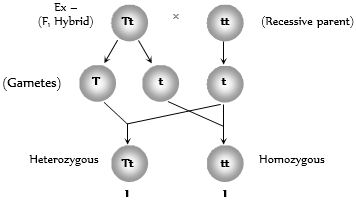
(C) cross between an organism with an unknown genotype (or a heterozygous individual) and a homozygous recessive parent is known as a test cross.
In this cross,the $F_1$ hybrid (heterozygous,$Tt$) is crossed with a homozygous recessive parent $(tt)$.
The purpose of a test cross is to determine the genotype of an organism showing a dominant phenotype.
The resulting offspring ratio in a monohybrid test cross is $1:1$ (heterozygous $Tt$ : homozygous recessive $tt$).
In this cross,the $F_1$ hybrid (heterozygous,$Tt$) is crossed with a homozygous recessive parent $(tt)$.
The purpose of a test cross is to determine the genotype of an organism showing a dominant phenotype.
The resulting offspring ratio in a monohybrid test cross is $1:1$ (heterozygous $Tt$ : homozygous recessive $tt$).
0 likes
View Solution42
MediumMCQ
$A$ cross between an $F_1$ plant and a recessive parent is called:
A
Back cross
B
Test cross
C
Out cross
D
Mutation
Solution
(B) cross between an $F_1$ hybrid and its recessive parent is specifically known as a $Test \ cross$.
This type of cross is used to determine the genotype of an organism showing a dominant phenotype.
If the offspring show a $1:1$ phenotypic ratio,the parent was heterozygous.
If all offspring show the dominant trait,the parent was homozygous dominant.
This type of cross is used to determine the genotype of an organism showing a dominant phenotype.
If the offspring show a $1:1$ phenotypic ratio,the parent was heterozygous.
If all offspring show the dominant trait,the parent was homozygous dominant.
0 likes
View Solution43
EasyMCQ
When a cross is made between an offspring and one of its parents,it is known as:
A
Monohybrid cross
B
Dihybrid cross
C
Back cross
D
Reciprocal cross
Solution
(C) cross between an $F_1$ hybrid and one of its parents is called a back cross. This technique is frequently used in plant breeding to improve the traits of a specific parent by repeatedly crossing the offspring with that parent.
0 likes
View Solution44
MediumMCQ
Which of the following statements is correct?
A
Each back cross is a test cross.
B
Each test cross is a back cross.
C
Both tests have the same meaning.
D
Reappearance of similar characters in a test cross is called a back cross.
Solution
(B) back cross is a cross between an $F_1$ hybrid and either of its parents. $A$ test cross is a specific type of back cross where an $F_1$ hybrid is crossed with the recessive parent only. Therefore,every test cross is a back cross,but not every back cross is a test cross.
0 likes
View Solution45
MediumMCQ
In a monohybrid cross, when $F_1$ is crossed with a homozygous dominant parent, what type of offspring will be obtained?
A
Dominant : recessive $3 : 1$
B
Only recessive
C
Dominant : recessive $1 : 1$
D
No recessive
Solution
(D) When an $F_1$ hybrid (heterozygous, $Tt$) is crossed with a homozygous dominant parent $(TT)$, this is known as a backcross.
The cross is represented as: $Tt \times TT$.
As shown in the table, all offspring are phenotypically dominant ($TT$ and $Tt$). Therefore, no recessive offspring are produced.
The cross is represented as: $Tt \times TT$.
| Gametes | $T$ | $T$ |
| $T$ | $TT$ | $TT$ |
| $t$ | $Tt$ | $Tt$ |
As shown in the table, all offspring are phenotypically dominant ($TT$ and $Tt$). Therefore, no recessive offspring are produced.
0 likes
View Solution46
MediumMCQ
Mendel crossed a pure white-flowered recessive pea plant with a dominant pure red-flowered plant. The first generation of hybrids from the cross should show
A
$50\%$ white-flowered and $50\%$ red-flowered plants
B
All red-flowered plants
C
$75\%$ red-flowered and $25\%$ white-flowered plants
D
All white-flowered plants
Solution
(B) According to Mendel's law of dominance,when a pure dominant trait is crossed with a pure recessive trait,the $F_1$ generation expresses only the dominant trait.
Here,the red flower color $(R)$ is dominant over the white flower color $(r)$.
When a pure red-flowered plant $(RR)$ is crossed with a pure white-flowered plant $(rr)$,all offspring in the $F_1$ generation will have the genotype $Rr$.
Since $R$ is dominant,all $F_1$ plants will be red-flowered.
$\mathop {RR}\limits_{\text{(Pure Red)}} \times \mathop {rr}\limits_{\text{(Pure White)}} \xrightarrow{} Rr \text{ (All Red-flowered plants)}$
Here,the red flower color $(R)$ is dominant over the white flower color $(r)$.
When a pure red-flowered plant $(RR)$ is crossed with a pure white-flowered plant $(rr)$,all offspring in the $F_1$ generation will have the genotype $Rr$.
Since $R$ is dominant,all $F_1$ plants will be red-flowered.
$\mathop {RR}\limits_{\text{(Pure Red)}} \times \mathop {rr}\limits_{\text{(Pure White)}} \xrightarrow{} Rr \text{ (All Red-flowered plants)}$
0 likes
View Solution47
MediumMCQ
From a single ear of corn,a farmer planted $200$ kernels which produced $140$ tall and $40$ dwarf plants. The genotypes of these offspring are most likely:
A
$TT, Tt$ and $tt$
B
$TT$ and $tt$ only
C
$TT$ and $Tt$ only
D
$Tt$ and $tt$ only
Solution
(A) The total number of plants produced is $140 + 40 = 180$.
Since both tall and dwarf plants are produced from the same parent,the parent must be heterozygous $(Tt)$.
When a heterozygous plant $(Tt)$ is self-pollinated,the offspring genotypes follow the Mendelian ratio of $1:2:1$ for $TT:Tt:tt$.
$TT$ represents homozygous tall plants,$Tt$ represents heterozygous tall plants,and $tt$ represents homozygous dwarf plants.
Therefore,the offspring will consist of all three genotypes: $TT, Tt$,and $tt$.
Since both tall and dwarf plants are produced from the same parent,the parent must be heterozygous $(Tt)$.
When a heterozygous plant $(Tt)$ is self-pollinated,the offspring genotypes follow the Mendelian ratio of $1:2:1$ for $TT:Tt:tt$.
$TT$ represents homozygous tall plants,$Tt$ represents heterozygous tall plants,and $tt$ represents homozygous dwarf plants.
Therefore,the offspring will consist of all three genotypes: $TT, Tt$,and $tt$.
0 likes
View Solution48
DifficultMCQ
$A$ black hybrid mouse is crossed with a pure brown mouse to produce a total of $24$ young ones. Which of the following result is most likely to be correct?
A
$13$ black males and $11$ black females
B
$11$ brown males and $13$ brown females
C
$8$ black males,$10$ black females,$3$ brown males,$3$ brown females
D
$5$ black males,$6$ brown males,$7$ black females,$6$ brown females
Solution
(D) This is a test cross where a hybrid individual $(Bb)$ is crossed with a homozygous recessive individual $(bb)$.
According to Mendelian genetics,the cross $Bb \times bb$ results in a $1:1$ phenotypic ratio of black $(Bb)$ and brown $(bb)$ offspring.
Since there are $24$ offspring in total,we expect approximately $12$ black and $12$ brown mice.
Furthermore,the inheritance of coat color is independent of sex,meaning the distribution of males and females should be approximately equal within each phenotypic group.
Option $(d)$ shows $12$ black mice $(5$ males $+ 7$ females$)$ and $12$ brown mice $(6$ males $+ 6$ females$)$,which perfectly matches the expected $1:1$ ratio for both phenotype and sex.
According to Mendelian genetics,the cross $Bb \times bb$ results in a $1:1$ phenotypic ratio of black $(Bb)$ and brown $(bb)$ offspring.
Since there are $24$ offspring in total,we expect approximately $12$ black and $12$ brown mice.
Furthermore,the inheritance of coat color is independent of sex,meaning the distribution of males and females should be approximately equal within each phenotypic group.
Option $(d)$ shows $12$ black mice $(5$ males $+ 7$ females$)$ and $12$ brown mice $(6$ males $+ 6$ females$)$,which perfectly matches the expected $1:1$ ratio for both phenotype and sex.
0 likes
View Solution49
MediumMCQ
Some pure black mice were mistakenly mixed with hybrid black mice. The quickest way to discover whether one individual black mouse is pure is:
A
To cross it with a pure black mouse and all the offsprings must be black.
B
To cross it with a brown mouse and all the offsprings must be black.
C
To cross it with a known hybrid black mouse and all the offsprings must be black or brown mice in equal numbers.
D
To cross it with a pure brown mouse and all the offsprings must be black or brown in equal numbers.
Solution
(D) In mice,black coat color $(B)$ is dominant over brown coat color $(b)$. $A$ pure black mouse has the genotype $BB$,while a hybrid black mouse has the genotype $Bb$. To determine if a black mouse is pure $(BB)$ or hybrid $(Bb)$,we perform a test cross with a recessive individual (brown mouse,$bb$).
$1$. If the black mouse is pure $(BB)$,the cross $BB \times bb$ will result in all offspring being black $(Bb)$.
$2$. If the black mouse is hybrid $(Bb)$,the cross $Bb \times bb$ will result in a $1:1$ ratio of black $(Bb)$ and brown $(bb)$ offspring.
Therefore,crossing it with a brown mouse is the standard method to identify the genotype.
$1$. If the black mouse is pure $(BB)$,the cross $BB \times bb$ will result in all offspring being black $(Bb)$.
$2$. If the black mouse is hybrid $(Bb)$,the cross $Bb \times bb$ will result in a $1:1$ ratio of black $(Bb)$ and brown $(bb)$ offspring.
Therefore,crossing it with a brown mouse is the standard method to identify the genotype.
0 likes
View Solution50
MediumMCQ
Blue-flowered and white-flowered plants on crossing gave progeny of blue and white-flowered in the ratio of $60 : 40$. What ratio of blue and white is expected if the blue-flowered plants are self-pollinated?
A
$76:24$
B
$40:60$
C
$50:48$
D
$84:16$
Solution
(A) The cross between blue-flowered and white-flowered plants resulting in a $60:40$ ratio (approximately $1:1$) indicates a test cross between a heterozygous dominant $(Ww)$ and a homozygous recessive $(ww)$ parent.
Thus,the blue-flowered progeny are all heterozygous $(Ww)$.
When these blue-flowered $(Ww)$ plants are self-pollinated,the cross is $Ww \times Ww$.
According to Mendelian inheritance,the phenotypic ratio of the offspring will be $3$ blue-flowered $(WW, Ww, Ww)$ to $1$ white-flowered $(ww)$.
This $3:1$ ratio corresponds to $75\%$ blue and $25\%$ white,which is approximately $76:24$.
Thus,the blue-flowered progeny are all heterozygous $(Ww)$.
When these blue-flowered $(Ww)$ plants are self-pollinated,the cross is $Ww \times Ww$.
According to Mendelian inheritance,the phenotypic ratio of the offspring will be $3$ blue-flowered $(WW, Ww, Ww)$ to $1$ white-flowered $(ww)$.
This $3:1$ ratio corresponds to $75\%$ blue and $25\%$ white,which is approximately $76:24$.
0 likes
View SolutionPrinciples of Inheritance and Variation — Mendelism · Frequently Asked Questions
1Are these Principles of Inheritance and Variation questions useful for JEE and NEET?
Yes. All questions in this section are mapped to JEE Main and NEET exam patterns. Previous year questions from JEE Main, NEET, GUJCET and state-level exams are included with full solutions.
2Can I switch to Hindi or Gujarati for these questions?
Yes. Use the language tabs in the hero section or the sidebar to view the same questions and solutions in English, Hindi or Gujarati.
3How do I generate a question paper from this subtopic?
Use the Vedclass Exam Paper Generator — select the chapter and subtopic, set difficulty, and generate Sets A, B, C, D automatically. First 3 chapters of every subject are free.
Vedclass Products
For Students
Vedclass Test Series
Mock tests in real JEE/NEET style with performance analysis. 5-day free trial.
Start Free TrialFor Teachers
Exam Paper Generator
Generate Set A/B/C/D papers from this chapter in 2 minutes. 3 chapters free.
Try FreeFor Institutes
Online Exam Module
Live online exams with unlimited students, 360° analytics & white-label branding.
See DemoFor Teachers & Institutes
Generate a Principles of Inheritance and Variation Exam Paper in 2 Minutes
Select subtopic & difficulty — Sets A, B, C, D auto-generated with No Repeat logic.
First 3 chapters of every subject are free — no payment required.