
A English
Pedigree Analysis and Mendelian disorders Questions in English
Class 12 Biology · Principles of Inheritance and Variation · Pedigree Analysis and Mendelian disorders
420+
Questions
English
Language
100%
With Solutions
Showing 50 of 420 questions in English
351
MediumMCQ
Phenylketonuria is caused by the deficiency of which enzyme?
A
Tyrosinase
B
Phenylalanine hydroxylase
C
Hexokinase
D
Aldolase
Solution
(B) Phenylketonuria $(PKU)$ is an inborn error of metabolism inherited as an autosomal recessive trait.
It is caused by the deficiency of the enzyme $Phenylalanine$ hydroxylase.
This enzyme is responsible for converting the amino acid $Phenylalanine$ into $Tyrosine$.
Due to the lack of this enzyme, $Phenylalanine$ accumulates and is converted into phenylpyruvic acid and other derivatives, which leads to mental retardation and other symptoms.
It is caused by the deficiency of the enzyme $Phenylalanine$ hydroxylase.
This enzyme is responsible for converting the amino acid $Phenylalanine$ into $Tyrosine$.
Due to the lack of this enzyme, $Phenylalanine$ accumulates and is converted into phenylpyruvic acid and other derivatives, which leads to mental retardation and other symptoms.
0 likes
View Solution352
MediumMCQ
Choose the correct option for the symptoms of $Phenylketonuria$ $(PKU)$.
A
Mental retardation
B
Reduction in hair
C
Reduction in skin pigmentation
D
All of the above
Solution
(D) $Phenylketonuria$ is an inborn error of metabolism that is inherited as an autosomal recessive trait.
In this disorder,the affected individual lacks an enzyme that converts the amino acid $Phenylalanine$ into $Tyrosine$.
As a result,$Phenylalanine$ accumulates and is converted into $Phenylpyruvic$ acid and other derivatives.
Accumulation of these in the brain results in mental retardation.
These are also excreted through urine because of poor absorption by the kidney.
Symptoms include mental retardation,reduction in hair,and reduction in skin pigmentation.
In this disorder,the affected individual lacks an enzyme that converts the amino acid $Phenylalanine$ into $Tyrosine$.
As a result,$Phenylalanine$ accumulates and is converted into $Phenylpyruvic$ acid and other derivatives.
Accumulation of these in the brain results in mental retardation.
These are also excreted through urine because of poor absorption by the kidney.
Symptoms include mental retardation,reduction in hair,and reduction in skin pigmentation.
0 likes
View Solution353
MediumMCQ
What does the given symbol represent?
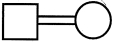
A
Mating
B
Mating between relatives
C
Sex unspecified
D
Affected offspring
Solution
(A) In pedigree analysis,the symbol shown represents mating between a male (represented by a square) and a female (represented by a circle). $A$ single horizontal line connecting a square and a circle indicates a standard mating or marriage. Therefore,the correct option is $A$.
0 likes
View Solution354
MediumMCQ
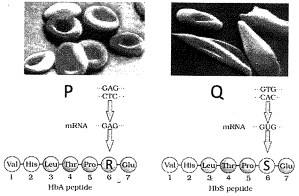
Identify the given figure and select the correct option for $P, Q, R$ and $S$.
$\quad P \quad Q \quad R \quad S$
$\quad P \quad Q \quad R \quad S$
A
Sickle cell gene $\quad$ Normal gene $\quad Val \quad Glu$
B
Sickle cell gene $\quad$ Normal gene $\quad Glu \quad Val$
C
Normal gene $\quad$ Sickle cell gene $\quad Val \quad Glu$
D
Normal gene $\quad$ Sickle cell gene $\quad Glu \quad Val$
Solution
(D) The figure illustrates the molecular basis of sickle-cell anemia.
In the normal hemoglobin $(HbA)$ peptide,the $6^{th}$ position is occupied by Glutamic acid $(Glu)$,which is coded by the codon $GAG$.
In the sickle-cell hemoglobin $(HbS)$ peptide,a point mutation occurs where $GAG$ is replaced by $GTG$,leading to the substitution of Glutamic acid $(Glu)$ with Valine $(Val)$ at the $6^{th}$ position.
Thus,$P$ represents the Normal gene,$Q$ represents the Sickle cell gene,$R$ represents $Glu$,and $S$ represents $Val$.
In the normal hemoglobin $(HbA)$ peptide,the $6^{th}$ position is occupied by Glutamic acid $(Glu)$,which is coded by the codon $GAG$.
In the sickle-cell hemoglobin $(HbS)$ peptide,a point mutation occurs where $GAG$ is replaced by $GTG$,leading to the substitution of Glutamic acid $(Glu)$ with Valine $(Val)$ at the $6^{th}$ position.
Thus,$P$ represents the Normal gene,$Q$ represents the Sickle cell gene,$R$ represents $Glu$,and $S$ represents $Val$.
0 likes
View Solution355
MediumMCQ
Quantitative defect of hemoglobin $- P$
Qualitative defect of hemoglobin $- Q$
Select the correct option for $P$ and $Q$.
$\quad \quad P\quad \quad \quad Q$
Qualitative defect of hemoglobin $- Q$
Select the correct option for $P$ and $Q$.
$\quad \quad P\quad \quad \quad Q$
A
Thalassemia $\quad$ $\quad$ Hemophilia
B
Sickle cell anemia $\quad$ $\quad$ Thalassemia
C
Thalassemia $\quad$ $\quad$ Sickle cell anemia
D
Hemophilia $\quad$ $\quad$ Thalassemia
Solution
(C) $1$. Thalassemia is a quantitative defect of hemoglobin,which results from the reduced synthesis of one of the globin chains (alpha or beta) of the hemoglobin molecule.
$2$. Sickle cell anemia is a qualitative defect of hemoglobin,caused by a point mutation in the gene coding for the beta-globin chain,leading to the substitution of glutamic acid by valine at the sixth position.
$3$. Therefore,$P$ (quantitative defect) is Thalassemia and $Q$ (qualitative defect) is Sickle cell anemia.
$2$. Sickle cell anemia is a qualitative defect of hemoglobin,caused by a point mutation in the gene coding for the beta-globin chain,leading to the substitution of glutamic acid by valine at the sixth position.
$3$. Therefore,$P$ (quantitative defect) is Thalassemia and $Q$ (qualitative defect) is Sickle cell anemia.
0 likes
View Solution356
MediumMCQ
Autosomal dominant disorder $- P$
Autosomal recessive disorder $- Q$
$X$-linked recessive disorder $- R$
$I -$ Haemophilia,$II -$ Sickle cell anaemia,$III -$ Phenylketonuria,
$IV -$ Thalassaemia,$V -$ Colour blindness,$VI -$ Myotonic dystrophy
Select the correct option for $P, Q$ and $R$.
$\quad\quad P \quad\quad Q \quad\quad R$
Autosomal recessive disorder $- Q$
$X$-linked recessive disorder $- R$
$I -$ Haemophilia,$II -$ Sickle cell anaemia,$III -$ Phenylketonuria,
$IV -$ Thalassaemia,$V -$ Colour blindness,$VI -$ Myotonic dystrophy
Select the correct option for $P, Q$ and $R$.
$\quad\quad P \quad\quad Q \quad\quad R$
A
$II, III, IV\quad\quad VI \quad\quad I, V$
B
$VI \quad\quad II, III, IV\quad\quad I, V$
C
$II, III, IV \quad\quad I, V \quad\quad VI$
D
$I, V \quad\quad VI \quad\quad II, III, IV$
Solution
(B) The classification of the given disorders is as follows:
$P$ (Autosomal dominant disorder): Myotonic dystrophy $(VI)$.
$Q$ (Autosomal recessive disorder): Sickle cell anaemia $(II)$,Phenylketonuria $(III)$,and Thalassaemia $(IV)$.
$R$ ($X$-linked recessive disorder): Haemophilia $(I)$ and Colour blindness $(V)$.
Therefore,the correct matching is $P = VI$,$Q = II, III, IV$,and $R = I, V$. This corresponds to option $B$.
$P$ (Autosomal dominant disorder): Myotonic dystrophy $(VI)$.
$Q$ (Autosomal recessive disorder): Sickle cell anaemia $(II)$,Phenylketonuria $(III)$,and Thalassaemia $(IV)$.
$R$ ($X$-linked recessive disorder): Haemophilia $(I)$ and Colour blindness $(V)$.
Therefore,the correct matching is $P = VI$,$Q = II, III, IV$,and $R = I, V$. This corresponds to option $B$.
0 likes
View Solution357
MediumMCQ
Choose the correct option for the offspring of a colorblind woman and a normal man.
A
$100\, \%$ sons colorblind and $0\, \%$ daughters colorblind
B
$50\, \%$ sons colorblind and $50\, \%$ daughters colorblind
C
$100\, \%$ sons colorblind and $100\, \%$ daughters colorblind
D
$50\, \%$ sons colorblind and $0\, \%$ daughters colorblind
Solution
(A) Colorblindness is an $X$-linked recessive disorder.
Let $X^c$ be the allele for colorblindness and $X$ be the normal allele.
The genotype of a colorblind woman is $X^c X^c$.
The genotype of a normal man is $XY$.
Cross: $X^c X^c \times XY$.
Offspring genotypes: $X^c X$ (carrier daughter) and $X^c Y$ (colorblind son).
Therefore,all sons $(100\, \%)$ will be colorblind,and all daughters $(100\, \%)$ will be carriers (normal phenotype,$0\, \%$ colorblind).
Thus,the correct option is $A$.
Let $X^c$ be the allele for colorblindness and $X$ be the normal allele.
The genotype of a colorblind woman is $X^c X^c$.
The genotype of a normal man is $XY$.
Cross: $X^c X^c \times XY$.
Offspring genotypes: $X^c X$ (carrier daughter) and $X^c Y$ (colorblind son).
Therefore,all sons $(100\, \%)$ will be colorblind,and all daughters $(100\, \%)$ will be carriers (normal phenotype,$0\, \%$ colorblind).
Thus,the correct option is $A$.
0 likes
View Solution358
MediumMCQ
Color blindness is more common in males because it is a:
A
$Y$-linked recessive trait.
B
$Y$-linked dominant trait.
C
$X$-linked recessive trait.
D
$X$-linked dominant trait.
Solution
(C) Color blindness is a sex-linked recessive disorder caused by a mutation in genes located on the $X$ chromosome.
In males $(XY)$,there is only one $X$ chromosome. If this $X$ chromosome carries the recessive gene for color blindness,the male will express the trait because there is no corresponding allele on the $Y$ chromosome to mask it.
In females $(XX)$,both $X$ chromosomes must carry the recessive gene for the trait to be expressed. If only one $X$ chromosome carries the gene,the female is a carrier and does not show the trait.
Therefore,the condition is much more common in males than in females.
In males $(XY)$,there is only one $X$ chromosome. If this $X$ chromosome carries the recessive gene for color blindness,the male will express the trait because there is no corresponding allele on the $Y$ chromosome to mask it.
In females $(XX)$,both $X$ chromosomes must carry the recessive gene for the trait to be expressed. If only one $X$ chromosome carries the gene,the female is a carrier and does not show the trait.
Therefore,the condition is much more common in males than in females.
0 likes
View Solution359
MediumMCQ
This type of disease is transmitted from a carrier mother to some of her sons.
A
$X$-linked recessive disease
B
$X$-linked dominant disease
C
Autosomal recessive disease
D
Autosomal dominant disease
Solution
(A) In $X$-linked recessive inheritance,the mother acts as a carrier (heterozygous,$X^CX^c$) because she has one normal allele and one mutant allele.
When she passes the $X$ chromosome carrying the mutant allele to her sons,they will express the disease because they only have one $X$ chromosome $(XY)$.
Therefore,$X$-linked recessive traits are characteristically transmitted from carrier mothers to approximately $50\%$ of their sons.
When she passes the $X$ chromosome carrying the mutant allele to her sons,they will express the disease because they only have one $X$ chromosome $(XY)$.
Therefore,$X$-linked recessive traits are characteristically transmitted from carrier mothers to approximately $50\%$ of their sons.
0 likes
View Solution360
MediumMCQ
How many types of genotypes are observed in sickle cell anemia?
A
$1$
B
$2$
C
$3$
D
$4$
Solution
(C) Sickle cell anemia is an autosome-linked recessive trait that can be transmitted from parents to the offspring when both the partners are carriers for the gene $(Hb^A Hb^S)$.
In this condition,the gene is controlled by a pair of alleles,$Hb^A$ and $Hb^S$.
The possible genotypes are:
$1$. $Hb^A Hb^A$ (Normal individual)
$2$. $Hb^A Hb^S$ (Carrier/Sickle cell trait)
$3$. $Hb^S Hb^S$ (Affected individual)
Therefore,there are $3$ possible genotypes.
In this condition,the gene is controlled by a pair of alleles,$Hb^A$ and $Hb^S$.
The possible genotypes are:
$1$. $Hb^A Hb^A$ (Normal individual)
$2$. $Hb^A Hb^S$ (Carrier/Sickle cell trait)
$3$. $Hb^S Hb^S$ (Affected individual)
Therefore,there are $3$ possible genotypes.
0 likes
View Solution361
MediumMCQ
Which of the following genotypes causes sickle cell anemia?
A
$Hb^S Hb^S$
B
$Hb^A Hb^A$
C
$Hb^A Hb^S$
D
Both $A$ and $C$
Solution
(A) Sickle cell anemia is an autosome-linked recessive trait that can be transmitted from parents to the offspring when both the partners are carriers for the gene $(Hb^A Hb^S)$.
In this disease,the defect is caused by the substitution of Glutamic acid $(Glu)$ by Valine $(Val)$ at the sixth position of the beta-globin chain of the hemoglobin molecule.
The genotype $Hb^S Hb^S$ represents the affected individual (homozygous recessive),who suffers from the disease.
The genotype $Hb^A Hb^A$ represents a normal individual.
The genotype $Hb^A Hb^S$ represents a carrier individual who is phenotypically normal but carries the trait.
Therefore,the genotype that causes the disease is $Hb^S Hb^S$.
In this disease,the defect is caused by the substitution of Glutamic acid $(Glu)$ by Valine $(Val)$ at the sixth position of the beta-globin chain of the hemoglobin molecule.
The genotype $Hb^S Hb^S$ represents the affected individual (homozygous recessive),who suffers from the disease.
The genotype $Hb^A Hb^A$ represents a normal individual.
The genotype $Hb^A Hb^S$ represents a carrier individual who is phenotypically normal but carries the trait.
Therefore,the genotype that causes the disease is $Hb^S Hb^S$.
0 likes
View Solution362
MediumMCQ
Which of the following genotypes results in hemophilia in females and males respectively?
$\quad\quad$ Female $\quad\quad$ Male
$\quad\quad$ Female $\quad\quad$ Male
A
$X^H X^H, X^H X^h \quad\quad X^H Y$
B
$X^h X^h \quad\quad X^h Y$
C
$X^H X^H \quad\quad X^H Y$
D
$X^h X^h \quad\quad X^H Y$
Solution
(B) Hemophilia is an $X$-linked recessive disorder.
For a female to be affected by hemophilia,she must be homozygous recessive for the trait,meaning her genotype must be $X^h X^h$.
For a male to be affected by hemophilia,he must carry the recessive allele on his single $X$ chromosome,meaning his genotype must be $X^h Y$.
Therefore,the correct genotypes for affected females and males are $X^h X^h$ and $X^h Y$ respectively.
For a female to be affected by hemophilia,she must be homozygous recessive for the trait,meaning her genotype must be $X^h X^h$.
For a male to be affected by hemophilia,he must carry the recessive allele on his single $X$ chromosome,meaning his genotype must be $X^h Y$.
Therefore,the correct genotypes for affected females and males are $X^h X^h$ and $X^h Y$ respectively.
0 likes
View Solution363
MediumMCQ
In an individual with phenylketonuria,there is an enzyme deficiency. This enzyme converts phenylalanine into ........ .
A
Glutamic acid
B
Valine
C
Tyrosine
D
Tryptophan
Solution
(C) Phenylketonuria $(PKU)$ is an inborn error of metabolism inherited as an autosomal recessive trait.
In this disorder,the affected individual lacks the enzyme phenylalanine hydroxylase.
This enzyme is responsible for converting the amino acid phenylalanine into tyrosine.
Due to the deficiency of this enzyme,phenylalanine accumulates and is converted into phenylpyruvic acid and other derivatives,which leads to mental retardation.
In this disorder,the affected individual lacks the enzyme phenylalanine hydroxylase.
This enzyme is responsible for converting the amino acid phenylalanine into tyrosine.
Due to the deficiency of this enzyme,phenylalanine accumulates and is converted into phenylpyruvic acid and other derivatives,which leads to mental retardation.
0 likes
View Solution364
MediumMCQ
What is the phenotype of the offspring of a color-blind woman and a normal-vision man?
A
All color-blind
B
All normal-vision
C
Sons are color-blind and daughters are normal-vision
D
Both sons and daughters are color-blind
Solution
(C) Color blindness is an $X$-linked recessive trait. Let $X^c$ represent the allele for color blindness and $X$ represent the normal allele.
The genotype of a color-blind woman is $X^cX^c$.
The genotype of a normal-vision man is $XY$.
When these parents produce offspring:
- The mother contributes an $X^c$ chromosome to all her children.
- The father contributes an $X$ chromosome to his daughters and a $Y$ chromosome to his sons.
Cross: $X^cX^c \times XY$
- Daughters: $X^cX$ (Carrier,normal vision)
- Sons: $X^cY$ (Color-blind)
Therefore,all sons will be color-blind and all daughters will be carriers with normal vision.
The genotype of a color-blind woman is $X^cX^c$.
The genotype of a normal-vision man is $XY$.
When these parents produce offspring:
- The mother contributes an $X^c$ chromosome to all her children.
- The father contributes an $X$ chromosome to his daughters and a $Y$ chromosome to his sons.
Cross: $X^cX^c \times XY$
- Daughters: $X^cX$ (Carrier,normal vision)
- Sons: $X^cY$ (Color-blind)
Therefore,all sons will be color-blind and all daughters will be carriers with normal vision.
0 likes
View Solution365
MediumMCQ
$A$ couple,neither of whom has sickle cell anemia,has a first child who is affected by sickle cell anemia. What is the probability that their second child will have sickle cell anemia (in $, \%$)?
A
$0$
B
$25$
C
$50$
D
$75$
Solution
(B) Sickle cell anemia is an autosomal recessive disorder.
Since the parents do not have the disease but have an affected child,both parents must be carriers (heterozygous) for the trait.
Let the normal allele be $A$ and the sickle cell allele be $a$.
The genotype of both parents is $Aa$.
When crossing $Aa \times Aa$,the possible genotypes of the offspring are $AA$ (normal),$Aa$ (carrier),$Aa$ (carrier),and $aa$ (affected).
The probability of having an affected child $(aa)$ in each pregnancy is $1/4$ or $25\, \%$.
Since the parents do not have the disease but have an affected child,both parents must be carriers (heterozygous) for the trait.
Let the normal allele be $A$ and the sickle cell allele be $a$.
The genotype of both parents is $Aa$.
When crossing $Aa \times Aa$,the possible genotypes of the offspring are $AA$ (normal),$Aa$ (carrier),$Aa$ (carrier),and $aa$ (affected).
The probability of having an affected child $(aa)$ in each pregnancy is $1/4$ or $25\, \%$.
0 likes
View Solution366
MediumMCQ
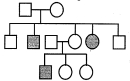
Identify the given pedigree analysis.
A
$X$-linked recessive disorder
B
Autosomal dominant disorder
C
Autosomal recessive disorder
D
$X$-linked dominant disorder
Solution
(C) $1$. Observe the pedigree: Unaffected parents produce affected offspring (both male and female).
$2$. Since unaffected parents have affected children,the trait must be recessive.
$3$. If it were $X$-linked recessive,an affected daughter would require an affected father,which is not the case here.
$4$. Therefore,the trait is autosomal recessive,as it skips generations and appears in both sexes equally.
$2$. Since unaffected parents have affected children,the trait must be recessive.
$3$. If it were $X$-linked recessive,an affected daughter would require an affected father,which is not the case here.
$4$. Therefore,the trait is autosomal recessive,as it skips generations and appears in both sexes equally.
0 likes
View Solution367
MediumMCQ
Which disease is caused by a point mutation?
A
Sickle cell anemia
B
Down's syndrome
C
Turner's syndrome
D
Klinefelter's syndrome
Solution
(A) point mutation is a change in a single base pair of $DNA$.
Sickle cell anemia is a classic example of a point mutation where a single nucleotide substitution ($GAG$ to $GUG$) occurs in the $\beta$-globin gene,leading to the substitution of glutamic acid with valine at the sixth position of the $\beta$-globin chain.
Down's syndrome,Turner's syndrome,and Klinefelter's syndrome are chromosomal disorders caused by aneuploidy (gain or loss of chromosomes),not by point mutations.
Sickle cell anemia is a classic example of a point mutation where a single nucleotide substitution ($GAG$ to $GUG$) occurs in the $\beta$-globin gene,leading to the substitution of glutamic acid with valine at the sixth position of the $\beta$-globin chain.
Down's syndrome,Turner's syndrome,and Klinefelter's syndrome are chromosomal disorders caused by aneuploidy (gain or loss of chromosomes),not by point mutations.
0 likes
View Solution368
MediumMCQ
Given below are two statements:
Statement $I$: Sickle cell anaemia and Haemophilia are autosomal dominant traits.
Statement $II$: Sickle cell anaemia and Haemophilia are disorders of the blood.
In the light of the above statements,choose the correct answer from the options given below:
Statement $I$: Sickle cell anaemia and Haemophilia are autosomal dominant traits.
Statement $II$: Sickle cell anaemia and Haemophilia are disorders of the blood.
In the light of the above statements,choose the correct answer from the options given below:
A
Both Statement $I$ and Statement $II$ are correct.
B
Both Statement $I$ and Statement $II$ are incorrect.
C
Statement $I$ is correct but Statement $II$ is incorrect.
D
Statement $I$ is incorrect but Statement $II$ is correct.
Solution
(D) Statement $I$ is incorrect because both Sickle cell anaemia and Haemophilia are recessive disorders. Specifically,Sickle cell anaemia is an autosomal recessive trait,while Haemophilia is an $X$-linked recessive trait.
Statement $II$ is correct because both conditions affect the blood. Sickle cell anaemia involves the formation of abnormal haemoglobin leading to distorted red blood cells,and Haemophilia is a clotting factor deficiency disorder.
Therefore,Statement $I$ is incorrect and Statement $II$ is correct.
Statement $II$ is correct because both conditions affect the blood. Sickle cell anaemia involves the formation of abnormal haemoglobin leading to distorted red blood cells,and Haemophilia is a clotting factor deficiency disorder.
Therefore,Statement $I$ is incorrect and Statement $II$ is correct.
0 likes
View Solution369
MediumMCQ
Select the incorrect match regarding the symbols used in Pedigree analysis:
A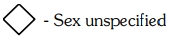
$A$ diamond shape represents sex unspecified.
B
$A$ filled square or circle represents an affected individual.
C
$A$ square and a circle connected by a single horizontal line represent consanguineous mating.
D
$A$ mating pair with a filled square below represents parents with a male child affected by a disease.
Solution
(C) In pedigree analysis,standard symbols are used to represent family relationships and traits.
$1$. $A$ diamond shape represents an individual of unspecified sex.
$2$. $A$ filled (shaded) symbol (square or circle) represents an affected individual.
$3$. $A$ mating (marriage) is represented by a horizontal line connecting a square (male) and a circle (female).
$4$. Consanguineous mating (mating between close relatives) is represented by two horizontal lines connecting the square and the circle.
$5$. The symbol shown in option $C$ represents a normal mating,not consanguineous mating. Therefore,option $C$ is the incorrect match.
$1$. $A$ diamond shape represents an individual of unspecified sex.
$2$. $A$ filled (shaded) symbol (square or circle) represents an affected individual.
$3$. $A$ mating (marriage) is represented by a horizontal line connecting a square (male) and a circle (female).
$4$. Consanguineous mating (mating between close relatives) is represented by two horizontal lines connecting the square and the circle.
$5$. The symbol shown in option $C$ represents a normal mating,not consanguineous mating. Therefore,option $C$ is the incorrect match.
0 likes
View Solution370
MediumMCQ
$A$ normal girl, whose mother is haemophilic, marries a male with no ancestral history of haemophilia. What will be the possible phenotypes of the offsprings?
$(a)$ Haemophilic son and haemophilic daughter.
$(b)$ Haemophilic son and carrier daughter.
$(c)$ Normal daughter and normal son.
$(d)$ Normal son and normal daughter.
Choose the most appropriate answer from the options given below:
$(a)$ Haemophilic son and haemophilic daughter.
$(b)$ Haemophilic son and carrier daughter.
$(c)$ Normal daughter and normal son.
$(d)$ Normal son and normal daughter.
Choose the most appropriate answer from the options given below:
A
$(a)$ and $(b)$ only
B
$(b)$ and $(c)$ only
C
$(c)$ and $(d)$ only
D
$(a)$ and $(d)$ only
Solution
(B) Haemophilia is an $X$-linked recessive disorder.
Let $X^H$ be the normal allele and $X^h$ be the haemophilic allele.
The mother of the girl is haemophilic, so her genotype is $X^h X^h$. She must pass one $X^h$ chromosome to her daughter. Since the girl is normal, her genotype must be $X^H X^h$ (carrier).
The male has no ancestral history of haemophilia, so his genotype is $X^H Y$.
Cross: $X^H X^h$ (carrier female) $\times$ $X^H Y$ (normal male).
Offspring genotypes: $X^H X^H$ (normal daughter), $X^H X^h$ (carrier daughter), $X^H Y$ (normal son), $X^h Y$ (haemophilic son).
Possible phenotypes: Normal daughter, carrier daughter, normal son, and haemophilic son.
Thus, the possible phenotypes include normal daughter, normal son, carrier daughter, and haemophilic son. Options $(b)$ and $(c)$ correctly describe these possibilities.
Let $X^H$ be the normal allele and $X^h$ be the haemophilic allele.
The mother of the girl is haemophilic, so her genotype is $X^h X^h$. She must pass one $X^h$ chromosome to her daughter. Since the girl is normal, her genotype must be $X^H X^h$ (carrier).
The male has no ancestral history of haemophilia, so his genotype is $X^H Y$.
Cross: $X^H X^h$ (carrier female) $\times$ $X^H Y$ (normal male).
Offspring genotypes: $X^H X^H$ (normal daughter), $X^H X^h$ (carrier daughter), $X^H Y$ (normal son), $X^h Y$ (haemophilic son).
Possible phenotypes: Normal daughter, carrier daughter, normal son, and haemophilic son.
Thus, the possible phenotypes include normal daughter, normal son, carrier daughter, and haemophilic son. Options $(b)$ and $(c)$ correctly describe these possibilities.
0 likes
View Solution371
MediumMCQ
Which one of the following symbols represents mating between relatives in human pedigree analysis?
A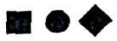
B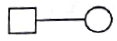
C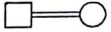
D
Solution
(C) In human pedigree analysis,standard symbols are used to represent different family relationships and traits.
- $A$ single horizontal line between a square (male) and a circle (female) represents mating.
- $A$ double horizontal line between a square and a circle represents mating between relatives,also known as consanguineous mating.
- Therefore,the symbol shown in option $C$ represents mating between relatives.
- $A$ single horizontal line between a square (male) and a circle (female) represents mating.
- $A$ double horizontal line between a square and a circle represents mating between relatives,also known as consanguineous mating.
- Therefore,the symbol shown in option $C$ represents mating between relatives.

0 likes
View Solution372
DifficultMCQ
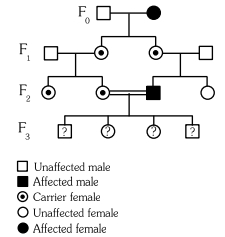
With the help of the given pedigree,find out the probability for the birth of a child having no disease and being a carrier (has the disease mutation in one allele of the gene) in the $F_3$ generation.
A
$1/4$
B
$1/2$
C
$1/8$
D
Zero
Solution
(B) $1$. The pedigree shows an autosomal recessive trait because an affected female $(F_0)$ produces carrier daughters,and an affected male $(F_2)$ is produced from the mating of a carrier female and an unaffected male (implying the father was also a carrier or the trait is recessive).
$2$. Let the normal allele be $A$ and the disease allele be $a$. The affected individuals are $aa$.
$3$. In the $F_2$ generation,the parents are a carrier female $(Aa)$ and an affected male $(aa)$.
$4$. The cross is $Aa \times aa$. The possible genotypes of the offspring are $Aa$ (carrier) and $aa$ (affected) in a $1:1$ ratio.
$5$. The probability of a child being a carrier $(Aa)$ is $1/2$.
$6$. The probability of a child being affected $(aa)$ is $1/2$.
$7$. The question asks for the probability of a child having no disease and being a carrier. Since a carrier $(Aa)$ is phenotypically normal (has no disease),the probability is $1/2$.
$2$. Let the normal allele be $A$ and the disease allele be $a$. The affected individuals are $aa$.
$3$. In the $F_2$ generation,the parents are a carrier female $(Aa)$ and an affected male $(aa)$.
$4$. The cross is $Aa \times aa$. The possible genotypes of the offspring are $Aa$ (carrier) and $aa$ (affected) in a $1:1$ ratio.
$5$. The probability of a child being a carrier $(Aa)$ is $1/2$.
$6$. The probability of a child being affected $(aa)$ is $1/2$.
$7$. The question asks for the probability of a child having no disease and being a carrier. Since a carrier $(Aa)$ is phenotypically normal (has no disease),the probability is $1/2$.
0 likes
View Solution373
MediumMCQ
Given below are two statements:
Statement $I$: The son of a carrier woman has a $100$ percent chance of being colour blind.
Statement $II$: $A$ daughter of a carrier mother and a normal father will be $100$ percent colour blind.
In the light of the above statements,choose the correct answer from the options given below:
Statement $I$: The son of a carrier woman has a $100$ percent chance of being colour blind.
Statement $II$: $A$ daughter of a carrier mother and a normal father will be $100$ percent colour blind.
In the light of the above statements,choose the correct answer from the options given below:
A
Statement $I$ is incorrect but Statement $II$ is correct
B
Both Statement $I$ and Statement $II$ are incorrect
C
Statement $I$ is correct but Statement $II$ is incorrect
D
Both Statement $I$ and Statement $II$ are correct
Solution
(B) Colour blindness is an $X$-linked recessive disorder.
Let $X^C$ be the allele for colour blindness and $X$ be the normal allele.
$A$ carrier woman has the genotype $XX^C$.
Statement $I$: The son of a carrier woman $(XX^C)$ and a normal father $(XY)$ can have genotypes $XY$ (normal son) or $X^CY$ (colour blind son). Thus,the probability of the son being colour blind is $50$ percent,not $100$ percent. Therefore,Statement $I$ is incorrect.
Statement $II$: $A$ daughter of a carrier mother $(XX^C)$ and a normal father $(XY)$ can have genotypes $XX$ (normal daughter) or $XX^C$ (carrier daughter). None of the daughters will be colour blind $(X^CX^C)$. Therefore,Statement $II$ is incorrect.
Since both statements are incorrect,the correct option is $B$.
Let $X^C$ be the allele for colour blindness and $X$ be the normal allele.
$A$ carrier woman has the genotype $XX^C$.
Statement $I$: The son of a carrier woman $(XX^C)$ and a normal father $(XY)$ can have genotypes $XY$ (normal son) or $X^CY$ (colour blind son). Thus,the probability of the son being colour blind is $50$ percent,not $100$ percent. Therefore,Statement $I$ is incorrect.
Statement $II$: $A$ daughter of a carrier mother $(XX^C)$ and a normal father $(XY)$ can have genotypes $XX$ (normal daughter) or $XX^C$ (carrier daughter). None of the daughters will be colour blind $(X^CX^C)$. Therefore,Statement $II$ is incorrect.
Since both statements are incorrect,the correct option is $B$.
0 likes
View Solution374
EasyMCQ
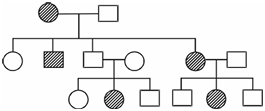
The given pedigree chart shows which type of inheritance?
A
$X-$linked recessive
B
Autosomal dominant
C
Autosomal recessive
D
$X-$linked dominant
Solution
(B) $1$. Analyze the pedigree: The trait appears in every generation (vertical transmission).
$2$. Affected individuals have at least one affected parent.
$3$. An affected mother (shaded circle) has both affected and unaffected children,and an affected father (shaded square) can have affected children.
$4$. Since the trait does not skip generations and is present in both males and females,it is likely autosomal.
$5$. Because it appears in every generation and affected individuals have an affected parent,it follows an autosomal dominant pattern of inheritance.
$2$. Affected individuals have at least one affected parent.
$3$. An affected mother (shaded circle) has both affected and unaffected children,and an affected father (shaded square) can have affected children.
$4$. Since the trait does not skip generations and is present in both males and females,it is likely autosomal.
$5$. Because it appears in every generation and affected individuals have an affected parent,it follows an autosomal dominant pattern of inheritance.
0 likes
View Solution375
MediumMCQ
$A$ normal-visioned man whose father was colourblind marries a normal woman whose father was also colourblind. They have one son. What is the probability of the son being colourblind (in $\%$)?
A
$0$
B
$50$
C
$100$
D
$75$
Solution
(B) Colour blindness is an $X$-linked recessive trait.
$1$. The man is normal-visioned,so his genotype is $X^CY$ (where $X^C$ is the normal allele and $X^c$ is the colourblind allele). Since his father was colourblind,he inherited his $Y$ chromosome from his father and his $X^C$ chromosome from his mother.
$2$. The woman is normal-visioned but her father was colourblind. This means she must be a carrier,with the genotype $X^CX^c$.
$3$. The cross is $X^CY \times X^CX^c$.
$4$. The possible genotypes of the offspring are: $X^CX^C$ (normal daughter),$X^CX^c$ (carrier daughter),$X^CY$ (normal son),and $X^cY$ (colourblind son).
$5$. Among the sons,the genotypes are $X^CY$ and $X^cY$. Thus,the probability of the son being colourblind is $1/2$ or $50 \%$.
$1$. The man is normal-visioned,so his genotype is $X^CY$ (where $X^C$ is the normal allele and $X^c$ is the colourblind allele). Since his father was colourblind,he inherited his $Y$ chromosome from his father and his $X^C$ chromosome from his mother.
$2$. The woman is normal-visioned but her father was colourblind. This means she must be a carrier,with the genotype $X^CX^c$.
$3$. The cross is $X^CY \times X^CX^c$.
$4$. The possible genotypes of the offspring are: $X^CX^C$ (normal daughter),$X^CX^c$ (carrier daughter),$X^CY$ (normal son),and $X^cY$ (colourblind son).
$5$. Among the sons,the genotypes are $X^CY$ and $X^cY$. Thus,the probability of the son being colourblind is $1/2$ or $50 \%$.
0 likes
View Solution376
MediumMCQ
Of a normal couple,half the sons are haemophilic while half the daughters are carriers. The gene is located on $:-$
A
$X-$chromosome of father
B
$Y-$chromosome of father
C
One $X-$chromosome of mother
D
Both the $X-$chromosomes of mother
Solution
(C) Haemophilia is an $X-$linked recessive disorder.
Let the normal allele be $X^H$ and the haemophilic allele be $X^h$.
If the mother is a carrier $(X^H X^h)$ and the father is normal $(X^H Y)$,the cross is as follows:
$X^H X^h \times X^H Y$
Offspring genotypes: $X^H X^H$ (normal daughter),$X^H X^h$ (carrier daughter),$X^H Y$ (normal son),$X^h Y$ (haemophilic son).
In this scenario,$50\%$ of the sons are haemophilic and $50\%$ of the daughters are carriers.
Therefore,the gene is located on one $X-$chromosome of the mother.
Let the normal allele be $X^H$ and the haemophilic allele be $X^h$.
If the mother is a carrier $(X^H X^h)$ and the father is normal $(X^H Y)$,the cross is as follows:
$X^H X^h \times X^H Y$
Offspring genotypes: $X^H X^H$ (normal daughter),$X^H X^h$ (carrier daughter),$X^H Y$ (normal son),$X^h Y$ (haemophilic son).
In this scenario,$50\%$ of the sons are haemophilic and $50\%$ of the daughters are carriers.
Therefore,the gene is located on one $X-$chromosome of the mother.
0 likes
View Solution377
MediumMCQ
$A$ woman has a haemophilic son and three normal children. What is the genotype of the woman and her husband?
A
$XX$ and $X^hY$
B
$X^hX^h$ and $X^hY$
C
$X^hX^h$ and $XY$
D
$X^hX$ and $XY$
Solution
(D) Haemophilia is an $X$-linked recessive disorder.
Since the woman has a haemophilic son $(X^hY)$,the son must have inherited the $X^h$ chromosome from his mother.
Therefore,the mother must be a carrier of the haemophilia gene,meaning her genotype is $X^hX$.
Since the woman has three normal children,and the father is normal $(XY)$,the father's genotype is $XY$.
If the father were haemophilic $(X^hY)$,he would pass the $X^h$ gene to all his daughters,making them carriers or affected,but the question implies the father is normal.
Since the woman has a haemophilic son $(X^hY)$,the son must have inherited the $X^h$ chromosome from his mother.
Therefore,the mother must be a carrier of the haemophilia gene,meaning her genotype is $X^hX$.
Since the woman has three normal children,and the father is normal $(XY)$,the father's genotype is $XY$.
If the father were haemophilic $(X^hY)$,he would pass the $X^h$ gene to all his daughters,making them carriers or affected,but the question implies the father is normal.
0 likes
View Solution378
MediumMCQ
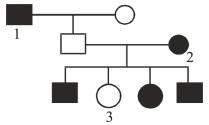
Given below is a pedigree showing the inheritance of Myotonic Dystrophy,an autosomal dominant disorder. The genotypes of person $1, 2$ and $3$ in this family tree are:
A
$1- MM, 2- Mm, 3- mm$
B
$1-MM, 2-MM, 3-mm$
C
$1-Mm, 2-MM, 3-Mm$
D
$1-Mm, 2-Mm, 3-mm$
Solution
(D) Myotonic Dystrophy is an autosomal dominant disorder. In a pedigree,a shaded symbol represents an affected individual,and an unshaded symbol represents an unaffected individual.
For an autosomal dominant trait,the unaffected individuals must be homozygous recessive $(mm)$.
Person $3$ is unaffected,so her genotype must be $mm$.
Person $1$ is an affected male. Since he has an unaffected child,he must be heterozygous $(Mm)$.
Person $2$ is an affected female. She has an unaffected child $(3)$,which means she must carry the recessive allele,so her genotype is $Mm$.
Therefore,the genotypes are: $1-Mm, 2-Mm, 3-mm$.
For an autosomal dominant trait,the unaffected individuals must be homozygous recessive $(mm)$.
Person $3$ is unaffected,so her genotype must be $mm$.
Person $1$ is an affected male. Since he has an unaffected child,he must be heterozygous $(Mm)$.
Person $2$ is an affected female. She has an unaffected child $(3)$,which means she must carry the recessive allele,so her genotype is $Mm$.
Therefore,the genotypes are: $1-Mm, 2-Mm, 3-mm$.
0 likes
View Solution379
MediumMCQ
Assertion $(A) :$ Phenylketonuria is an inborn error of metabolism and inherited as the autosomal dominant trait.
Reason $(R) :$ The disease is caused by mutation in the gene that codes for the enzyme phenylalanine hydroxylase.
Reason $(R) :$ The disease is caused by mutation in the gene that codes for the enzyme phenylalanine hydroxylase.
A
Both $(A)$ and $(R)$ are correct and $(R)$ is the correct explanation of $(A)$
B
Both $(A)$ and $(R)$ are correct but $(R)$ is not the correct explanation of $(A)$
C
$(A)$ is correct but $(R)$ is not correct
D
$(A)$ is not correct but $(R)$ is correct
Solution
(D) Phenylketonuria $(PKU)$ is an inborn error of metabolism caused by an autosomal recessive mutation,not an autosomal dominant one. Therefore,the Assertion $(A)$ is incorrect.
The disease is caused by a mutation in the gene that codes for the enzyme phenylalanine hydroxylase,which is responsible for converting the amino acid phenylalanine into tyrosine. Thus,the Reason $(R)$ is correct.
Since $(A)$ is incorrect and $(R)$ is correct,the correct option is $(D)$.
The disease is caused by a mutation in the gene that codes for the enzyme phenylalanine hydroxylase,which is responsible for converting the amino acid phenylalanine into tyrosine. Thus,the Reason $(R)$ is correct.
Since $(A)$ is incorrect and $(R)$ is correct,the correct option is $(D)$.
0 likes
View Solution380
EasyMCQ
Which of the following diseases is autosomal recessive?
A
Myotonic dystrophy
B
Haemophilia
C
Thalassemia
D
Colour blindness
Solution
(C) $1$. Myotonic dystrophy is an autosomal dominant disorder.
$2$. Haemophilia is an $X$-linked recessive disorder.
$3$. Thalassemia is an autosomal recessive blood disorder caused by defects in the synthesis of globin chains of haemoglobin.
$4$. Colour blindness is an $X$-linked recessive disorder.
Therefore,the correct answer is Thalassemia.
$2$. Haemophilia is an $X$-linked recessive disorder.
$3$. Thalassemia is an autosomal recessive blood disorder caused by defects in the synthesis of globin chains of haemoglobin.
$4$. Colour blindness is an $X$-linked recessive disorder.
Therefore,the correct answer is Thalassemia.
0 likes
View Solution381
MediumMCQ
If a colourblind woman marries a normal man whose father was colourblind,what are the chances of their son being colourblind (in $\%$)?
A
$0$
B
$100$
C
$50$
D
$25$
Solution
(B) Colour blindness is an $X$-linked recessive disorder.
Let $X^c$ represent the allele for colour blindness and $X$ represent the normal allele.
$A$ colourblind woman has the genotype $X^c X^c$.
$A$ normal man has the genotype $XY$. Since his father was colourblind,it does not affect his genotype because the $Y$ chromosome is inherited from the father and the $X$ chromosome from the mother. Thus,the man remains $XY$.
Crossing $X^c X^c$ (woman) with $XY$ (man):
Offspring genotypes: $X^c X$ (carrier daughter),$X^c Y$ (colourblind son).
All sons will receive the $X^c$ chromosome from the mother and the $Y$ chromosome from the father.
Therefore,$100 \%$ of their sons will be colourblind.
Let $X^c$ represent the allele for colour blindness and $X$ represent the normal allele.
$A$ colourblind woman has the genotype $X^c X^c$.
$A$ normal man has the genotype $XY$. Since his father was colourblind,it does not affect his genotype because the $Y$ chromosome is inherited from the father and the $X$ chromosome from the mother. Thus,the man remains $XY$.
Crossing $X^c X^c$ (woman) with $XY$ (man):
Offspring genotypes: $X^c X$ (carrier daughter),$X^c Y$ (colourblind son).
All sons will receive the $X^c$ chromosome from the mother and the $Y$ chromosome from the father.
Therefore,$100 \%$ of their sons will be colourblind.
0 likes
View Solution382
EasyMCQ
Given below are the two statements.
Statement $I$: Widow's peak is determined by an autosomal dominant gene.
Statement $II$: Heterozygous individuals have a straight hairline.
In the light of the above statements,choose the correct answer from the options given below:
Statement $I$: Widow's peak is determined by an autosomal dominant gene.
Statement $II$: Heterozygous individuals have a straight hairline.
In the light of the above statements,choose the correct answer from the options given below:
A
Both statement $I$ and statement $II$ are correct.
B
Both statement $I$ and statement $II$ are incorrect.
C
Statement $I$ is correct but statement $II$ is incorrect.
D
Statement $I$ is incorrect but statement $II$ is correct.
Solution
(C) Widow's peak is a trait determined by an autosomal dominant gene.
Individuals with the dominant allele $(W)$ express the widow's peak phenotype.
Therefore,both homozygous dominant $(WW)$ and heterozygous $(Ww)$ individuals exhibit the widow's peak.
Individuals with a straight hairline are homozygous recessive $(ww)$.
Thus,Statement $I$ is correct and Statement $II$ is incorrect.
Individuals with the dominant allele $(W)$ express the widow's peak phenotype.
Therefore,both homozygous dominant $(WW)$ and heterozygous $(Ww)$ individuals exhibit the widow's peak.
Individuals with a straight hairline are homozygous recessive $(ww)$.
Thus,Statement $I$ is correct and Statement $II$ is incorrect.
0 likes
View Solution383
EasyMCQ
$A$ woman has normal vision but some of her sons and daughters are colorblind. What will be the genotype of the woman and her husband?
A
B
C
D
Solution
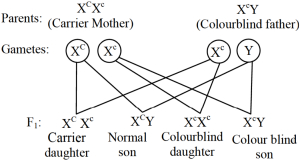
(B) i. Color blindness is an $X$-linked recessive disorder.
ii. $A$ son receives his $X$ chromosome from his mother and his $Y$ chromosome from his father.
iii. Since the woman has normal vision but has colorblind children,she must be a carrier $(X^C X^c)$.
iv. For a daughter to be colorblind $(X^c X^c)$,she must inherit one recessive allele from each parent. Since the mother is a carrier $(X^C X^c)$,the father must be colorblind $(X^c Y)$ to pass the recessive allele to his daughter.
v. Therefore,the genotype of the woman is $X^C X^c$ and the genotype of her husband is $X^c Y$.
ii. $A$ son receives his $X$ chromosome from his mother and his $Y$ chromosome from his father.
iii. Since the woman has normal vision but has colorblind children,she must be a carrier $(X^C X^c)$.
iv. For a daughter to be colorblind $(X^c X^c)$,she must inherit one recessive allele from each parent. Since the mother is a carrier $(X^C X^c)$,the father must be colorblind $(X^c Y)$ to pass the recessive allele to his daughter.
v. Therefore,the genotype of the woman is $X^C X^c$ and the genotype of her husband is $X^c Y$.
0 likes
View Solution384
EasyMCQ
Which one of the following traits shows criss-cross inheritance?
A
Hypertrichosis
B
Cystic fibrosis
C
Red-green colorblindness
D
Total colorblindness
Solution
(C) $i$. $\text{Criss-cross inheritance}$: The inheritance of characters from the father to his grandson through his daughter.
$ii$. $\text{Hypertrichosis}$ is a $Y$-linked trait (holandric trait).
$iii$. $\text{Cystic fibrosis}$ is an autosomal recessive trait.
$iv$. $\text{Red-green colorblindness}$ is an $X$-linked recessive trait,which follows the pattern of criss-cross inheritance.
$v$. $\text{Total colorblindness}$ is an example of autosomal recessive inheritance.
$ii$. $\text{Hypertrichosis}$ is a $Y$-linked trait (holandric trait).
$iii$. $\text{Cystic fibrosis}$ is an autosomal recessive trait.
$iv$. $\text{Red-green colorblindness}$ is an $X$-linked recessive trait,which follows the pattern of criss-cross inheritance.
$v$. $\text{Total colorblindness}$ is an example of autosomal recessive inheritance.
0 likes
View Solution385
EasyMCQ
What will be the genotypes of the parents of a colorblind daughter and a colorblind son?
A
Father $-X^C Y$ and mother $-X^C X^C$
B
Father $-X^C Y$ and mother $-X^C X^c$
C
Father $-X^c Y$ and mother $-X^C X^C$
D
Father $-X^c Y$ and mother $-X^c X^c$
Solution
(D) Colorblindness is an $X$-linked recessive disorder.
For a daughter to be colorblind,she must inherit the recessive allele $(X^c)$ from both parents.
For a son to be colorblind,he must inherit the recessive allele $(X^c)$ from his mother.
If the daughter is colorblind $(X^c X^c)$,the father must be colorblind $(X^c Y)$ because he passes his only $X$ chromosome to his daughter.
If the mother is colorblind $(X^c X^c)$,she will pass the recessive allele to all her children,ensuring that both the son and daughter are colorblind.
Therefore,the correct genotypes are Father $-X^c Y$ and mother $-X^c X^c$.
For a daughter to be colorblind,she must inherit the recessive allele $(X^c)$ from both parents.
For a son to be colorblind,he must inherit the recessive allele $(X^c)$ from his mother.
If the daughter is colorblind $(X^c X^c)$,the father must be colorblind $(X^c Y)$ because he passes his only $X$ chromosome to his daughter.
If the mother is colorblind $(X^c X^c)$,she will pass the recessive allele to all her children,ensuring that both the son and daughter are colorblind.
Therefore,the correct genotypes are Father $-X^c Y$ and mother $-X^c X^c$.
0 likes
View Solution386
EasyMCQ
When a hemophilic male $(X^h Y)$ marries a carrier female $(X^H X^h)$ for hemophilia,what are the chances of all daughters born being normal (in $\%$)?
A
$75$
B
$0$
C
$100$
D
$50$
Solution
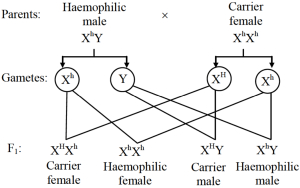
(B) The cross between a hemophilic male $(X^h Y)$ and a carrier female $(X^H X^h)$ is as follows:
Parents: $(X^h Y) \times (X^H X^h)$
Gametes: $(X^h, Y)$ and $(X^H, X^h)$
$F_1$ generation:
$1$. $(X^H X^h)$ - Carrier female
$2$. $(X^h X^h)$ - Hemophilic female
$3$. $(X^H Y)$ - Normal male
$4$. $(X^h Y)$ - Hemophilic male
In this cross,the daughters produced are $(X^H X^h)$ (carrier) and $(X^h X^h)$ (hemophilic). Neither of these genotypes represents a normal female $(X^H X^H)$. Therefore,the probability of having a normal daughter is $0\%$.
Parents: $(X^h Y) \times (X^H X^h)$
Gametes: $(X^h, Y)$ and $(X^H, X^h)$
$F_1$ generation:
$1$. $(X^H X^h)$ - Carrier female
$2$. $(X^h X^h)$ - Hemophilic female
$3$. $(X^H Y)$ - Normal male
$4$. $(X^h Y)$ - Hemophilic male
In this cross,the daughters produced are $(X^H X^h)$ (carrier) and $(X^h X^h)$ (hemophilic). Neither of these genotypes represents a normal female $(X^H X^H)$. Therefore,the probability of having a normal daughter is $0\%$.
0 likes
View Solution387
EasyMCQ
$A$ woman will be colourblind only if . . . . . . .
A
Her mother is carrier and father is colourblind
B
Her mother is carrier and father has normal vision
C
Her father is colourblind and mother has normal vision and not a carrier
D
Her mother is colourblind and father has normal vision.
Solution
(A) Colour blindness is an $X$-linked recessive disorder. For a female to be colourblind,she must possess the recessive allele on both of her $X$ chromosomes. This means she must inherit one mutated $X$ chromosome from her mother and one mutated $X$ chromosome from her father. Therefore,her father must be colourblind $(X^cY)$ and her mother must be either a carrier $(X^cX)$ or colourblind $(X^cX^c)$.
0 likes
View Solution388
EasyMCQ
The $ . . . . . . $ is regarded as an inborn metabolic disorder.
A
Sickle cell anemia
B
Thalassemia
C
Widow's peak
D
Phenylketonuria
Solution
(D) Phenylketonuria $(PKU)$ is an inborn error of metabolism.
It is an autosomal recessive genetic disorder caused by a mutation in the gene for the enzyme phenylalanine hydroxylase $(PAH)$.
This enzyme is responsible for converting the amino acid phenylalanine into tyrosine.
Due to the deficiency of this enzyme,phenylalanine accumulates in the body and is converted into phenylpyruvic acid and other derivatives,which can lead to mental retardation and other neurological issues.
It is an autosomal recessive genetic disorder caused by a mutation in the gene for the enzyme phenylalanine hydroxylase $(PAH)$.
This enzyme is responsible for converting the amino acid phenylalanine into tyrosine.
Due to the deficiency of this enzyme,phenylalanine accumulates in the body and is converted into phenylpyruvic acid and other derivatives,which can lead to mental retardation and other neurological issues.
0 likes
View Solution389
EasyMCQ
If a colour blind man marries a normal visioned woman,what is the percentage of offsprings showing colour blindness phenotypically (in $\%$)?
A
$50$
B
$0$
C
$25$
D
$100$
Solution
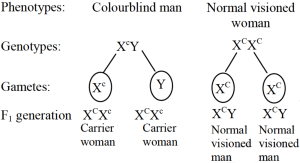
(B) Colour blindness is an $X$-linked recessive disorder.
The genotype of a colour blind man is $X^cY$ and that of a normal visioned woman is $X^CX^C$.
When they cross,the offspring genotypes are:
$X^cY \times X^CX^C \rightarrow X^CX^c$ (Carrier daughter),$X^CX^c$ (Carrier daughter),$X^CY$ (Normal son),$X^CY$ (Normal son).
All daughters are carriers (phenotypically normal) and all sons have normal vision.
Therefore,$0\%$ of the offspring will show colour blindness phenotypically.
The genotype of a colour blind man is $X^cY$ and that of a normal visioned woman is $X^CX^C$.
When they cross,the offspring genotypes are:
$X^cY \times X^CX^C \rightarrow X^CX^c$ (Carrier daughter),$X^CX^c$ (Carrier daughter),$X^CY$ (Normal son),$X^CY$ (Normal son).
All daughters are carriers (phenotypically normal) and all sons have normal vision.
Therefore,$0\%$ of the offspring will show colour blindness phenotypically.
0 likes
View Solution390
EasyMCQ
Find the $ODD$ one out,with respect to $X$-linkage.
A
Haemophilia
B
Myopia
C
Nephritis
D
Night blindness
Solution
(C) Nephritis is an example of incomplete sex-linked inheritance.
Haemophilia,Myopia,and Night blindness are examples of complete sex-linked inheritance.
Therefore,Nephritis is the odd one out.
Haemophilia,Myopia,and Night blindness are examples of complete sex-linked inheritance.
Therefore,Nephritis is the odd one out.
0 likes
View Solution391
EasyMCQ
$A$ couple,both carriers for the gene of sickle cell anaemia,are planning to get married. What are the chances of them having an anaemic child (in $\%$)?
A
$100$
B
$75$
C
$50$
D
$25$
Solution
(D) Sickle cell anaemia is an autosomal recessive disorder. Let the normal allele be $Hb^A$ and the sickle cell allele be $Hb^S$.
Both parents are carriers,meaning their genotype is $Hb^A Hb^S$.
When a cross is performed between two carriers $(Hb^A Hb^S \times Hb^A Hb^S)$,the resulting offspring genotypes are:
$25\% Hb^A Hb^A$ (Normal),
$50\% Hb^A Hb^S$ (Carrier),
$25\% Hb^S Hb^S$ (Affected/Anaemic).
Therefore,the probability of having an anaemic child is $25\%$.
Both parents are carriers,meaning their genotype is $Hb^A Hb^S$.
When a cross is performed between two carriers $(Hb^A Hb^S \times Hb^A Hb^S)$,the resulting offspring genotypes are:
$25\% Hb^A Hb^A$ (Normal),
$50\% Hb^A Hb^S$ (Carrier),
$25\% Hb^S Hb^S$ (Affected/Anaemic).
Therefore,the probability of having an anaemic child is $25\%$.
0 likes
View Solution392
EasyMCQ
On which chromosome of each parent is the gene controlling $\beta$-thalassemia located?
A
${11}^{\text{th}}$
B
${21}^{\text{st}}$
C
${16}^{\text{th}}$
D
${14}^{\text{th}}$
Solution
(A) $\beta$-thalassemia is a blood-related autosomal recessive genetic disorder.
It is caused by mutations in the $HBB$ gene.
The $HBB$ gene is located on chromosome ${11}$ in humans.
In contrast, $\alpha$-thalassemia is controlled by genes located on chromosome ${16}$.
Therefore, the correct option is $A$.
It is caused by mutations in the $HBB$ gene.
The $HBB$ gene is located on chromosome ${11}$ in humans.
In contrast, $\alpha$-thalassemia is controlled by genes located on chromosome ${16}$.
Therefore, the correct option is $A$.
0 likes
View Solution393
EasyMCQ
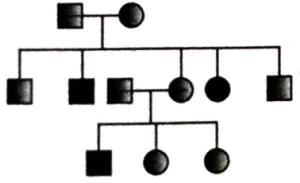
Which autosome-linked disease is related to the following pedigree analysis?
A
Myotonic dystrophy
B
Sickle-cell anaemia
C
Haemophilia
D
Colour blindness
Solution
(A) The provided pedigree shows an autosomal dominant trait because the disease appears in every generation, and affected individuals have affected parents.
$1$. $\text{Haemophilia}$ and $\text{Colour blindness}$ are $X$-linked recessive disorders.
$2$. $\text{Sickle-cell anaemia}$ is an autosomal recessive disorder.
$3$. $\text{Myotonic dystrophy}$ is an autosomal dominant disorder.
Therefore, the correct option is $A$.
$1$. $\text{Haemophilia}$ and $\text{Colour blindness}$ are $X$-linked recessive disorders.
$2$. $\text{Sickle-cell anaemia}$ is an autosomal recessive disorder.
$3$. $\text{Myotonic dystrophy}$ is an autosomal dominant disorder.
Therefore, the correct option is $A$.
0 likes
View Solution394
EasyMCQ
Absence of teeth,bifid tongue and mental retardness are observed in . . . . . . .
A
Down's syndrome
B
Albinism
C
Klinefelter's syndrome
D
Oral-facial-digital syndrome
Solution
(D) The condition characterized by the absence of teeth (hypodontia),a bifid (split) tongue,and intellectual disability is known as $Oral-facial-digital$ syndrome. This is a group of genetic disorders that primarily affect the development of the oral cavity,face,and digits. Down's syndrome is characterized by trisomy $21$,Albinism is a lack of melanin,and Klinefelter's syndrome involves an extra $X$ chromosome $(XXY)$. Therefore,the correct option is $D$.
0 likes
View Solution395
EasyMCQ
What will be the percentage of affected sons,whose father is colour-blind and mother is normal (in $\%$)?
A
$0$
B
$50$
C
$25$
D
$100$
Solution
(A) Colour blindness is an $X$-linked recessive disorder.
Let $X^C$ be the allele for colour blindness and $X$ be the normal allele.
The father is colour-blind,so his genotype is $X^C Y$.
The mother is normal,so her genotype is $X X$.
When these parents cross: $X^C Y \times X X$.
The possible offspring genotypes are:
$1$. $X X^C$ (Carrier daughter)
$2$. $X X^C$ (Carrier daughter)
$3$. $X Y$ (Normal son)
$4$. $X Y$ (Normal son)
Since all sons receive their $X$ chromosome from their mother and $Y$ chromosome from their father,and the mother is normal $(X X)$,all sons will be normal.
Therefore,the percentage of affected sons is $0 \%$.
Let $X^C$ be the allele for colour blindness and $X$ be the normal allele.
The father is colour-blind,so his genotype is $X^C Y$.
The mother is normal,so her genotype is $X X$.
When these parents cross: $X^C Y \times X X$.
The possible offspring genotypes are:
$1$. $X X^C$ (Carrier daughter)
$2$. $X X^C$ (Carrier daughter)
$3$. $X Y$ (Normal son)
$4$. $X Y$ (Normal son)
Since all sons receive their $X$ chromosome from their mother and $Y$ chromosome from their father,and the mother is normal $(X X)$,all sons will be normal.
Therefore,the percentage of affected sons is $0 \%$.
0 likes
View Solution396
EasyMCQ
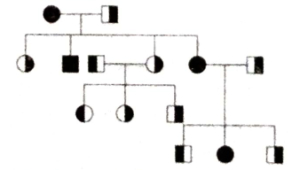
Choose the correct option for the pedigree analysis given below:
A
Autosomal dominant pedigree
B
Autosomal recessive pedigree
C
$X$-linked dominant pedigree
D
$X$-linked recessive pedigree
Solution
(A) The given pedigree shows that the trait is present in every generation,which indicates that it is a dominant trait.
Since both males and females are affected and the trait is transmitted from affected parents to both sons and daughters,it is an autosomal dominant trait.
In autosomal dominant inheritance,an affected individual must have at least one affected parent.
Therefore,the correct option is $A$.
Since both males and females are affected and the trait is transmitted from affected parents to both sons and daughters,it is an autosomal dominant trait.
In autosomal dominant inheritance,an affected individual must have at least one affected parent.
Therefore,the correct option is $A$.
0 likes
View Solution397
EasyMCQ
In the $\beta$-globin chain of haemoglobin of an individual,if the sixth amino acid,Glutamic acid (Glu),is replaced by Valine (Val),then the individual will be suffering from:
A
Albinism
B
Haemophilia
C
Sickle-cell anaemia
D
Phenylketonuria
Solution
(C) Sickle-cell anaemia is an autosome-linked recessive trait that can be transmitted from parents to the offspring when both the partners are carrier for the gene. The disease is controlled by a single pair of allele,$Hb^A$ and $Hb^S$. The defect is caused by the substitution of Glutamic acid (Glu) by Valine (Val) at the sixth position of the $\beta$-globin chain of the haemoglobin molecule. This substitution occurs due to the single base substitution at the sixth codon of the $\beta$-globin gene from $GAG$ to $GUG$.
0 likes
View Solution398
EasyMCQ
Which of the following is a Mendelian disorder?
A
Cystic fibrosis
B
Malaria
C
Pneumonia
D
Filariasis
Solution
(A) Mendelian disorder is primarily determined by alteration or mutation in a single gene.
$A$. Cystic fibrosis is an autosomal recessive genetic disorder caused by mutations in the $CFTR$ gene,making it a classic example of a Mendelian disorder.
$B$. Malaria is an infectious disease caused by protozoan parasites of the genus $Plasmodium$.
$C$. Pneumonia is an inflammatory condition of the lung,typically caused by infection.
$D$. Filariasis is a parasitic disease caused by infection with roundworms of the Filarioidea type.
Therefore,the correct option is $A$.
$A$. Cystic fibrosis is an autosomal recessive genetic disorder caused by mutations in the $CFTR$ gene,making it a classic example of a Mendelian disorder.
$B$. Malaria is an infectious disease caused by protozoan parasites of the genus $Plasmodium$.
$C$. Pneumonia is an inflammatory condition of the lung,typically caused by infection.
$D$. Filariasis is a parasitic disease caused by infection with roundworms of the Filarioidea type.
Therefore,the correct option is $A$.
0 likes
View Solution399
EasyMCQ
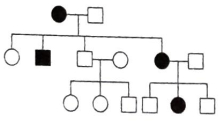
In the given pedigree chart,which Mendelian disorder is represented?
A
Autosomal dominant trait
B
Sex-linked dominant trait
C
Autosomal recessive trait
D
Sex-linked recessive trait
Solution
(A) The correct answer is $A$ (Autosomal dominant trait).
$1$. Analysis of the pedigree shows that the trait appears in every generation (it does not skip generations),which is a characteristic feature of a dominant trait.
$2$. Affected individuals have at least one affected parent.
$3$. The trait is observed in both males and females,and affected mothers pass the trait to both sons and daughters,which rules out sex-linked recessive inheritance.
$4$. Since an affected mother passes the trait to her offspring regardless of their sex,and it does not show the specific pattern of criss-cross inheritance,it is identified as an autosomal dominant trait.
$1$. Analysis of the pedigree shows that the trait appears in every generation (it does not skip generations),which is a characteristic feature of a dominant trait.
$2$. Affected individuals have at least one affected parent.
$3$. The trait is observed in both males and females,and affected mothers pass the trait to both sons and daughters,which rules out sex-linked recessive inheritance.
$4$. Since an affected mother passes the trait to her offspring regardless of their sex,and it does not show the specific pattern of criss-cross inheritance,it is identified as an autosomal dominant trait.
0 likes
View Solution400
EasyMCQ
Which of the following is not a Mendelian disorder?
A
Ascariasis
B
Cystic fibrosis
C
Phenylketonuria
D
Sickle-cell anemia
Solution
(A) Mendelian disorders are primarily determined by alteration or mutation in a single gene.
$A$. Ascariasis is an infectious disease caused by the parasitic roundworm $Ascaris$ $lumbricoides$,not a genetic disorder.
$B$. Cystic fibrosis is an autosomal recessive Mendelian disorder.
$C$. Phenylketonuria is an inborn error of metabolism and an autosomal recessive Mendelian disorder.
$D$. Sickle-cell anemia is an autosomal linked recessive trait that can be transmitted from parents to the offspring when both the partners are carrier for the gene.
Therefore,the correct answer is $A$.
$A$. Ascariasis is an infectious disease caused by the parasitic roundworm $Ascaris$ $lumbricoides$,not a genetic disorder.
$B$. Cystic fibrosis is an autosomal recessive Mendelian disorder.
$C$. Phenylketonuria is an inborn error of metabolism and an autosomal recessive Mendelian disorder.
$D$. Sickle-cell anemia is an autosomal linked recessive trait that can be transmitted from parents to the offspring when both the partners are carrier for the gene.
Therefore,the correct answer is $A$.
0 likes
View SolutionPrinciples of Inheritance and Variation — Pedigree Analysis and Mendelian disorders · Frequently Asked Questions
1Are these Principles of Inheritance and Variation questions useful for JEE and NEET?
Yes. All questions in this section are mapped to JEE Main and NEET exam patterns. Previous year questions from JEE Main, NEET, GUJCET and state-level exams are included with full solutions.
2Can I switch to Hindi or Gujarati for these questions?
Yes. Use the language tabs in the hero section or the sidebar to view the same questions and solutions in English, Hindi or Gujarati.
3How do I generate a question paper from this subtopic?
Use the Vedclass Exam Paper Generator — select the chapter and subtopic, set difficulty, and generate Sets A, B, C, D automatically. First 3 chapters of every subject are free.
Vedclass Products
For Students
Vedclass Test Series
Mock tests in real JEE/NEET style with performance analysis. 5-day free trial.
Start Free TrialFor Teachers
Exam Paper Generator
Generate Set A/B/C/D papers from this chapter in 2 minutes. 3 chapters free.
Try FreeFor Institutes
Online Exam Module
Live online exams with unlimited students, 360° analytics & white-label branding.
See DemoFor Teachers & Institutes
Generate a Principles of Inheritance and Variation Exam Paper in 2 Minutes
Select subtopic & difficulty — Sets A, B, C, D auto-generated with No Repeat logic.
First 3 chapters of every subject are free — no payment required.