
A English
Chromosomal theory of inheritance Questions in English
Class 12 Biology · Principles of Inheritance and Variation · Chromosomal theory of inheritance
31+
Questions
English
Language
100%
With Solutions
Showing 31 of 31 questions in English
1
MediumMCQ
Who postulated the 'Chromosome Theory of Inheritance'?
A
De Vries
B
Mendel
C
Sutton and Boveri
D
Morgan
Solution
(C) The 'Chromosome Theory of Inheritance' was independently proposed by Walter Sutton and Theodor Boveri in $1902$.
This theory states that chromosomes are the vehicles of hereditary information and that their behavior during meiosis explains the laws of inheritance proposed by Mendel.
Therefore,the correct option is $C$.
This theory states that chromosomes are the vehicles of hereditary information and that their behavior during meiosis explains the laws of inheritance proposed by Mendel.
Therefore,the correct option is $C$.
0 likes
View Solution2
EasyMCQ
Name the scientist who was awarded the Nobel Prize for his genetic studies on the linear arrangement of genes on the chromosomes in the fruitfly,$Drosophila \ melanogaster$.
A
$C$.$F$. Wolff
B
$T$.$A$. Knight
C
$J$. Swammerdam
D
$T$. $H$. Morgan
Solution
(D) Thomas Hunt Morgan was an American evolutionary biologist,geneticist,and embryologist.
He won the Nobel Prize in Physiology or Medicine in $1933$ for his discoveries concerning the role played by the chromosome in heredity.
His pioneering work on the fruit fly,$Drosophila \ melanogaster$,provided experimental evidence for the chromosomal theory of inheritance and established the linear arrangement of genes on chromosomes.
He won the Nobel Prize in Physiology or Medicine in $1933$ for his discoveries concerning the role played by the chromosome in heredity.
His pioneering work on the fruit fly,$Drosophila \ melanogaster$,provided experimental evidence for the chromosomal theory of inheritance and established the linear arrangement of genes on chromosomes.
0 likes
View Solution3
MediumMCQ
Who proposed the Chromosomal Theory of Inheritance?
A
de Vries
B
Mendel
C
Morgan
D
Sutton and Boveri
Solution
(D) The Chromosomal Theory of Inheritance was proposed by $Sutton$ and $Boveri$ in $1902$.
They observed that the behavior of chromosomes is parallel to the behavior of genes.
They argued that the pairing and separation of a pair of chromosomes would lead to the segregation of a pair of factors (genes) they carried.
$Sutton$ and $Boveri$ united the knowledge of chromosomal segregation with Mendelian principles and called it the Chromosomal Theory of Inheritance.
They observed that the behavior of chromosomes is parallel to the behavior of genes.
They argued that the pairing and separation of a pair of chromosomes would lead to the segregation of a pair of factors (genes) they carried.
$Sutton$ and $Boveri$ united the knowledge of chromosomal segregation with Mendelian principles and called it the Chromosomal Theory of Inheritance.
0 likes
View Solution4
MediumMCQ
Who proposed the Chromosomal Theory of Inheritance?
A
De Vries
B
$T$. $H$. Morgan
C
Boveri and Sutton
D
Bateson
Solution
(C) The Chromosomal Theory of Inheritance was proposed by Walter Sutton and Theodor Boveri in $1902$.
They observed that the behavior of chromosomes during meiosis is parallel to the behavior of genes (Mendelian factors).
They argued that the pairing and separation of a pair of chromosomes would lead to the segregation of a pair of factors they carried.
Sutton and Boveri united the knowledge of chromosomal segregation with Mendelian principles and called it the Chromosomal Theory of Inheritance.
They observed that the behavior of chromosomes during meiosis is parallel to the behavior of genes (Mendelian factors).
They argued that the pairing and separation of a pair of chromosomes would lead to the segregation of a pair of factors they carried.
Sutton and Boveri united the knowledge of chromosomal segregation with Mendelian principles and called it the Chromosomal Theory of Inheritance.
0 likes
View Solution5
MediumMCQ
Walter Sutton is famous for his contribution to the....
A
Genetic engineering
B
Totipotency
C
Population genetics
D
Chromosomal theory of inheritance
Solution
(D) Walter Sutton and Theodor Boveri are credited with proposing the $Chromosomal \ theory \ of \ inheritance$ in $1902$.
They observed that the behavior of chromosomes during meiosis is parallel to the behavior of genes (Mendelian factors).
This theory states that chromosomes are the vehicles of heredity and that genes are located on chromosomes.
They observed that the behavior of chromosomes during meiosis is parallel to the behavior of genes (Mendelian factors).
This theory states that chromosomes are the vehicles of heredity and that genes are located on chromosomes.
0 likes
View Solution6
MediumMCQ
Which is the only feature of chromosomes other than genes that follows the law of segregation?
A
They are available in pairs
B
They segregate at the time of gamete formation
C
They appear clearly in metaphase
D
They are available in nucleus
Solution
(B) According to the Chromosomal Theory of Inheritance proposed by Sutton and Boveri,chromosomes and genes share several common features.
$1$. Both occur in pairs in diploid organisms.
$2$. Both segregate during gamete formation such that only one of each pair is transmitted to a gamete.
$3$. Independent pairs segregate independently of each other.
Option $B$ describes the process of segregation,which is a fundamental property shared by both genes and chromosomes during meiosis,allowing for the independent assortment of alleles.
$1$. Both occur in pairs in diploid organisms.
$2$. Both segregate during gamete formation such that only one of each pair is transmitted to a gamete.
$3$. Independent pairs segregate independently of each other.
Option $B$ describes the process of segregation,which is a fundamental property shared by both genes and chromosomes during meiosis,allowing for the independent assortment of alleles.
0 likes
View Solution7
MediumMCQ
.............. noted that the behavior of chromosomes was parallel to the behavior of genes and used chromosome movement to explain Mendel's laws.
A
Tschermak and Correns
B
de-Vries and Sutton
C
Boveri and Sutton
D
Correns and Boveri
Solution
(C) Walter Sutton and Theodor Boveri noted that the behavior of chromosomes was parallel to the behavior of genes and used chromosome movement to explain Mendel's laws. This is known as the Chromosomal Theory of Inheritance. They observed that chromosomes occur in pairs and segregate during meiosis,similar to how alleles of a gene pair segregate during gamete formation.
0 likes
View Solution8
EasyMCQ
Who had proposed the chromosomal theory of inheritance?
A
Gregor Mendel
B
Sutton and Boveri
C
Thomas Hunt Morgan
D
Alfred Sturtevant
Solution
(B) Sutton and Boveri proposed the chromosomal theory of inheritance in $1902$.
They observed that the behavior of chromosomes is parallel to the behavior of genes and used this to explain the inheritance of traits.
They observed that the behavior of chromosomes is parallel to the behavior of genes and used this to explain the inheritance of traits.
0 likes
View Solution9
MediumMCQ
Based on which processes were Mendel's results clearly explained by other scientists?
A
Mitosis and cell cycle
B
Meiosis and chromosomal movement
C
$DNA$ replication and transcription
D
Translation and protein synthesis
Solution
(B) In $1900$,three scientists,de Vries,Correns,and von Tschermak,independently rediscovered Mendel's results on the inheritance of characters.
At this time,due to advancements in microscopy,scientists were able to carefully observe cell division,specifically meiosis.
$A$ structure in the nucleus was discovered that replicates and divides before cell division,which was termed 'chromosomes'.
By $1902$,the movement of chromosomes during meiosis was well understood.
Walter Sutton and Theodor Boveri showed that the behavior of chromosomes is parallel to that of genes. They explained Mendel's laws using the chromosomal movement during meiosis.
At this time,due to advancements in microscopy,scientists were able to carefully observe cell division,specifically meiosis.
$A$ structure in the nucleus was discovered that replicates and divides before cell division,which was termed 'chromosomes'.
By $1902$,the movement of chromosomes during meiosis was well understood.
Walter Sutton and Theodor Boveri showed that the behavior of chromosomes is parallel to that of genes. They explained Mendel's laws using the chromosomal movement during meiosis.
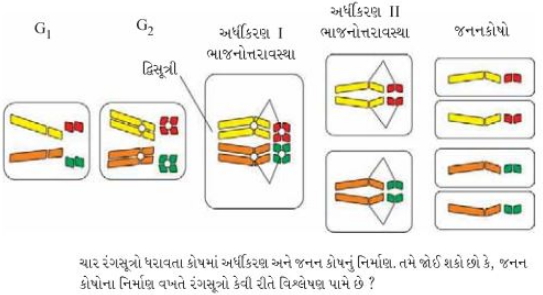
| Feature | Genes | Chromosomes |
|---|---|---|
| Occurrence | Occur in pairs | Occur in pairs |
| Segregation | Segregate at the time of gamete formation such that only one of each pair is transmitted to a gamete | Segregate at the time of gamete formation and only one of each pair is transmitted to a gamete |
| Independence | Independent pairs segregate independently of each other | One pair segregates independently of another pair |
0 likes
View Solution10
Medium
What information did Thomas Morgan provide regarding the chromosomal theory of inheritance?
Solution
(N/A) Thomas Hunt Morgan and his colleagues provided the experimental verification of the chromosomal theory of inheritance.
They laid the foundation for understanding the variations observed in sexually reproducing organisms.
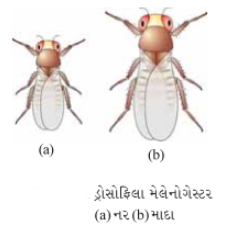
Morgan worked with the fruit fly,$Drosophila$ $melanogaster$. He chose this organism because:
$1$. They could be grown on simple synthetic media in the laboratory.
$2$. They complete their life cycle in about two weeks.
$3$. $A$ single mating could produce a large number of progeny flies.
$4$. There was a clear differentiation of the sexes; the male and female flies are easily distinguishable.
$5$. It has many types of hereditary variations that can be seen with low-power microscopes.
They laid the foundation for understanding the variations observed in sexually reproducing organisms.
Morgan worked with the fruit fly,$Drosophila$ $melanogaster$. He chose this organism because:
$1$. They could be grown on simple synthetic media in the laboratory.
$2$. They complete their life cycle in about two weeks.
$3$. $A$ single mating could produce a large number of progeny flies.
$4$. There was a clear differentiation of the sexes; the male and female flies are easily distinguishable.
$5$. It has many types of hereditary variations that can be seen with low-power microscopes.
0 likes
View Solution11
EasyMCQ
State the contribution of the following scientists: Walter Sutton and Boveri $(1902)$.
A
Proposed the Law of Segregation.
B
Proposed the Chromosomal Theory of Inheritance.
C
Discovered the structure of $DNA$.
D
Proposed the concept of linkage.
Solution
(B) Walter Sutton and Theodor Boveri proposed the Chromosomal Theory of Inheritance in $1902$.
They observed that the behavior of chromosomes is parallel to the behavior of genes.
They stated that chromosomes occur in pairs and segregate during meiosis,just like Mendelian factors (genes).
They observed that the behavior of chromosomes is parallel to the behavior of genes.
They stated that chromosomes occur in pairs and segregate during meiosis,just like Mendelian factors (genes).
0 likes
View Solution12
MediumMCQ
How was it concluded that genes are located on chromosomes?
A
Through the study of linkage and recombination in Drosophila.
B
By observing the independent assortment of alleles.
C
Through the discovery of $DNA$ structure.
D
By studying the process of mitosis.
Solution
(A) Thomas Hunt Morgan provided the experimental evidence that genes are located on chromosomes.
Morgan studied the inheritance patterns of eye colour in the fruit fly, $Drosophila \, melanogaster$.
He discovered that the gene for eye colour is located on the $X$ chromosome, which is a sex-linked trait.
When he crossed a white-eyed male with a red-eyed female, the $F_1$ generation showed only red eyes, confirming that the trait followed the chromosomal inheritance pattern.
This work linked the physical location of genes to specific chromosomes, thereby validating the Chromosomal Theory of Inheritance.
Morgan studied the inheritance patterns of eye colour in the fruit fly, $Drosophila \, melanogaster$.
He discovered that the gene for eye colour is located on the $X$ chromosome, which is a sex-linked trait.
When he crossed a white-eyed male with a red-eyed female, the $F_1$ generation showed only red eyes, confirming that the trait followed the chromosomal inheritance pattern.
This work linked the physical location of genes to specific chromosomes, thereby validating the Chromosomal Theory of Inheritance.
0 likes
View Solution13
Medium
How do genes and chromosomes share similarity from the point of view of genetical studies?
Solution
(N/A) Similarities between Chromosomes and Genes are as follows:
$(i)$ Both occur in pairs in diploid organisms.
$(ii)$ Both segregate during the time of gamete formation (meiosis) such that only one of each pair is transmitted to a gamete.
$(iii)$ Both pairs segregate independently of each other during gamete formation.
$(i)$ Both occur in pairs in diploid organisms.
$(ii)$ Both segregate during the time of gamete formation (meiosis) such that only one of each pair is transmitted to a gamete.
$(iii)$ Both pairs segregate independently of each other during gamete formation.
0 likes
View Solution14
EasyMCQ
Experimental verification of the chromosomal theory of inheritance was done by
A
Morgan
B
Mendel
C
Sutton
D
Boveri
Solution
(A) Thomas Hunt Morgan provided the experimental verification of the chromosomal theory of inheritance. While Sutton and Boveri proposed the theory, it was Morgan who worked with $Drosophila$ $\text{melanogaster}$ (fruit flies) to demonstrate the linkage and recombination of genes on chromosomes, thereby providing the necessary experimental evidence.
0 likes
View Solution15
EasyMCQ
Who provided the experimental verification of the chromosomal theory of inheritance?
A
Mendel
B
Sutton
C
Boveri
D
Morgan
Solution
(D) The chromosomal theory of inheritance was proposed by Sutton and Boveri in $1902$.
However, the experimental verification of this theory was provided by Thomas Hunt Morgan.
Morgan worked with the fruit fly, $Drosophila melanogaster$, and observed that genes are located on chromosomes, which provided the physical basis for the inheritance of traits.
However, the experimental verification of this theory was provided by Thomas Hunt Morgan.
Morgan worked with the fruit fly, $Drosophila melanogaster$, and observed that genes are located on chromosomes, which provided the physical basis for the inheritance of traits.
0 likes
View Solution16
Medium
Describe the chromosomal theory of inheritance.
Solution
(N/A) Mendel published his work on the inheritance of characters in $1865$,but for several reasons,it remained unrecognized until $1900$.
Firstly,communication was not easy in those days,and his work could not be widely publicized. Secondly,his concept of genes (factors) as stable and discrete units that controlled the expression of traits and of the pair of alleles which did not 'blend' with each other was not accepted by his contemporaries as an explanation for the apparently continuous variation seen in nature.
Thirdly,Mendel's approach of using mathematics to explain biological phenomena was totally new and unacceptable to many biologists of his time.
Finally,though Mendel's work suggested that factors (genes) were discrete units,he could not provide any physical proof for the existence of factors or explain what they were made of.
In $1900$,three scientists (de Vries,Correns,and Von Tschermak) independently rediscovered Mendel's results on the inheritance of characters.
By this time,due to advancements in microscopy,scientists were able to carefully observe cell division.
This led to the discovery of structures in the nucleus that appeared to double and divide just before each cell division. These were called chromosomes (colored bodies,as they were visualized by staining).
By $1902$,the chromosome movement during meiosis had been worked out. Walter Sutton and Theodore Boveri noted that the behavior of chromosomes was parallel to the behavior of genes and used chromosome movement to explain Mendel's laws.
They united the knowledge of chromosomal segregation with Mendelian principles and called it the chromosomal theory of inheritance.
According to this theory:
$(i)$ All hereditary characters must be with sperm and egg cells as they provide a bridge from one generation to the other.
$(ii)$ The hereditary factors must be carried by the nuclear material.
$(iii)$ Chromosomes are also found in pairs like Mendelian alleles.
$(iv)$ The two alleles of a gene pair are located on homologous sites on homologous chromosomes.
$(v)$ Sperm and eggs have haploid sets of chromosomes which fuse to re-establish the diploid state.
$(vi)$ Genes are carried on the chromosomes.
$(vii)$ Homologous chromosomes synapse during meiosis and separate to pass into different cells.
Firstly,communication was not easy in those days,and his work could not be widely publicized. Secondly,his concept of genes (factors) as stable and discrete units that controlled the expression of traits and of the pair of alleles which did not 'blend' with each other was not accepted by his contemporaries as an explanation for the apparently continuous variation seen in nature.
Thirdly,Mendel's approach of using mathematics to explain biological phenomena was totally new and unacceptable to many biologists of his time.
Finally,though Mendel's work suggested that factors (genes) were discrete units,he could not provide any physical proof for the existence of factors or explain what they were made of.
In $1900$,three scientists (de Vries,Correns,and Von Tschermak) independently rediscovered Mendel's results on the inheritance of characters.
By this time,due to advancements in microscopy,scientists were able to carefully observe cell division.
This led to the discovery of structures in the nucleus that appeared to double and divide just before each cell division. These were called chromosomes (colored bodies,as they were visualized by staining).
By $1902$,the chromosome movement during meiosis had been worked out. Walter Sutton and Theodore Boveri noted that the behavior of chromosomes was parallel to the behavior of genes and used chromosome movement to explain Mendel's laws.
They united the knowledge of chromosomal segregation with Mendelian principles and called it the chromosomal theory of inheritance.
According to this theory:
$(i)$ All hereditary characters must be with sperm and egg cells as they provide a bridge from one generation to the other.
$(ii)$ The hereditary factors must be carried by the nuclear material.
$(iii)$ Chromosomes are also found in pairs like Mendelian alleles.
$(iv)$ The two alleles of a gene pair are located on homologous sites on homologous chromosomes.
$(v)$ Sperm and eggs have haploid sets of chromosomes which fuse to re-establish the diploid state.
$(vi)$ Genes are carried on the chromosomes.
$(vii)$ Homologous chromosomes synapse during meiosis and separate to pass into different cells.
0 likes
View Solution17
Medium
State a comparison between the behaviour of chromosomes and genes.
Solution
(N/A) The comparison between the behaviour of chromosomes and genes is based on the Chromosomal Theory of Inheritance,which states that genes are located on chromosomes and follow similar patterns of segregation and independent assortment during meiosis.
| $A$. Chromosomes | $B$. Genes |
|---|---|
| $(1)$ Occur in pairs. | $(1)$ Occur in pairs. |
| $(2)$ Segregate at the time of gamete formation such that only one of each pair is transmitted to a gamete. | $(2)$ Segregate at gamete formation and only one of each pair is transmitted to a gamete. |
| $(3)$ Independent pairs segregate independently of each other. | $(3)$ One pair segregates independently of another pair. |
0 likes
View Solution18
MediumMCQ
Who proposed the Chromosomal Theory of Inheritance,which states that chromosomes are the vehicles of heredity?
A
$T.H.$ Morgan
B
Tschermak,Correns,de Vries
C
Sutton and Boveri
D
Mendel
Solution
(C) The Chromosomal Theory of Inheritance was independently proposed by Walter Sutton and Theodor Boveri in $1902$.
They observed that the behavior of chromosomes during meiosis (segregation and independent assortment) is parallel to the behavior of genes (Mendelian factors).
This theory states that chromosomes are the carriers of hereditary information and that they segregate and assort independently during gamete formation,which explains the physical basis of Mendel's laws of inheritance.
They observed that the behavior of chromosomes during meiosis (segregation and independent assortment) is parallel to the behavior of genes (Mendelian factors).
This theory states that chromosomes are the carriers of hereditary information and that they segregate and assort independently during gamete formation,which explains the physical basis of Mendel's laws of inheritance.
0 likes
View Solution19
MediumMCQ
Sutton and Boveri explained inheritance based on which of the following?
A
Gene
B
Allele
C
Chromosome
D
$DNA$
Solution
(C) Sutton and Boveri observed that the behavior of chromosomes is parallel to the behavior of genes during meiosis.
They proposed the Chromosomal Theory of Inheritance,which states that chromosomes are the vehicles of heredity and that the pairing and separation of a pair of chromosomes would lead to the segregation of the pair of factors (genes) they carried.
Therefore,they explained inheritance based on the movement and behavior of chromosomes.
They proposed the Chromosomal Theory of Inheritance,which states that chromosomes are the vehicles of heredity and that the pairing and separation of a pair of chromosomes would lead to the segregation of the pair of factors (genes) they carried.
Therefore,they explained inheritance based on the movement and behavior of chromosomes.
0 likes
View Solution20
EasyMCQ
Chromosomal theory of inheritance was proposed by
A
Watson and Crick
B
Sutton and Boveri
C
Bateson and Punnet
D
$T$.$H$. Morgan
Solution
(B) The Chromosomal theory of inheritance was proposed by Walter Sutton and Theodor Boveri in $1902$. They observed that the behavior of chromosomes during meiosis is parallel to the behavior of genes (Mendelian factors) and proposed that chromosomes are the vehicles of heredity.
0 likes
View Solution21
EasyMCQ
Experimental verification of the chromosomal theory of inheritance was given by
A
Gregor Johann Mendel
B
Hugo de Vries
C
Langdon Down
D
Thomas Hunt Morgan
Solution
(D) The chromosomal theory of inheritance was proposed by Walter Sutton and Theodor Boveri. However, the experimental verification of this theory was provided by Thomas Hunt Morgan and his colleagues through their work on the fruit fly, $Drosophila$ $melanogaster$. This research also led to the discovery of the basis for variations that sexual reproduction produces.
0 likes
View Solution22
EasyMCQ
The chromosomal theory of inheritance was proposed by:
A
$Gregor$ $Mendel$
B
$Hugo$ $de$ $Vries$
C
$Bridges$
D
$Sutton$ and $Boveri$
Solution
(D) The chromosomal theory of inheritance was proposed by $Sutton$ and $Boveri$ in $1902$.
This theory states that chromosomes are the vehicles of hereditary information.
It suggests that chromosomes possess $Mendelian$ factors (genes) and they segregate and assort independently during the process of meiosis,which explains the transmission of traits from one generation to the next.
This theory states that chromosomes are the vehicles of hereditary information.
It suggests that chromosomes possess $Mendelian$ factors (genes) and they segregate and assort independently during the process of meiosis,which explains the transmission of traits from one generation to the next.
0 likes
View Solution23
EasyMCQ
Experimental evidence of the chromosomal theory of inheritance was given by
A
$HT$ Morgan
B
$TH$ Morgan
C
$H$ de Vries
D
$DH$ Vries
Solution
(B) Thomas Hunt Morgan ($TH$ Morgan) provided the experimental evidence to support the Chromosomal Theory of Inheritance.
He conducted experiments on the fruit fly,$Drosophila$ $melanogaster$.
Through his work on sex-linked inheritance,he concluded that the gene for eye color is located on the $X$ chromosome.
He conducted experiments on the fruit fly,$Drosophila$ $melanogaster$.
Through his work on sex-linked inheritance,he concluded that the gene for eye color is located on the $X$ chromosome.
0 likes
View Solution24
MediumMCQ
The important things to remember are that chromosomes as well as genes occur in ...$A$.... The two alleles of a gene pair are located on homologous sites on ...$B$... chromosomes. Choose the correct choice for $A$ and $B$.
A
$A$-single,$B$-analogous
B
$A$-pair,$B$-analogous
C
$A$-pair,$B$-homologous
D
$A$-single,$B$-heterozygous
Solution
(C) According to the chromosomal theory of inheritance,both chromosomes and genes occur in pairs. The two alleles of a gene pair are located on homologous sites on homologous chromosomes. Therefore,$A$ is 'pair' and $B$ is 'homologous'. The correct option is $C$.
0 likes
View Solution25
MediumMCQ
Which of the following statements regarding the chromosomal theory of inheritance is incorrect?
A
Pairing and separation of a pair of chromosomes would lead to the segregation of a factor they carried.
B
Behaviour of chromosomes is parallel to the behaviour of genes.
C
The two alleles of a gene pair are located on homologous sites on homologous chromosomes.
D
Chromosomes as well as genes occur in pairs.
Solution
(C) The chromosomal theory of inheritance,proposed by Sutton and Boveri,states that chromosomes are the vehicles of heredity.
Key points include:
$1$. Chromosomes and genes both occur in pairs in diploid organisms.
$2$. The behaviour of chromosomes during meiosis (pairing and separation) is parallel to the behaviour of genes (segregation).
$3$. The segregation of a pair of chromosomes leads to the segregation of the factors (genes) they carry.
Option $C$ is incorrect because alleles of a gene pair are located on homologous chromosomes,but they are not necessarily located on 'homologous sites' (loci) in a way that implies they must be identical or occupy the same specific position relative to other genes in all contexts; however,the standard biological definition states they occupy the same locus on homologous chromosomes. Upon closer inspection of the provided options,all statements $A, B,$ and $D$ are fundamental tenets of the theory. Statement $C$ is often considered the most technically nuanced or potentially misleading depending on the phrasing of 'homologous sites',but in many contexts,this question is designed to test the understanding that genes are carried on chromosomes. Given the standard options,if one must be incorrect,it is often a distractor regarding the specific terminology of 'homologous sites' versus 'same locus'.
Key points include:
$1$. Chromosomes and genes both occur in pairs in diploid organisms.
$2$. The behaviour of chromosomes during meiosis (pairing and separation) is parallel to the behaviour of genes (segregation).
$3$. The segregation of a pair of chromosomes leads to the segregation of the factors (genes) they carry.
Option $C$ is incorrect because alleles of a gene pair are located on homologous chromosomes,but they are not necessarily located on 'homologous sites' (loci) in a way that implies they must be identical or occupy the same specific position relative to other genes in all contexts; however,the standard biological definition states they occupy the same locus on homologous chromosomes. Upon closer inspection of the provided options,all statements $A, B,$ and $D$ are fundamental tenets of the theory. Statement $C$ is often considered the most technically nuanced or potentially misleading depending on the phrasing of 'homologous sites',but in many contexts,this question is designed to test the understanding that genes are carried on chromosomes. Given the standard options,if one must be incorrect,it is often a distractor regarding the specific terminology of 'homologous sites' versus 'same locus'.
0 likes
View Solution26
EasyMCQ
Experimental verification of the chromosomal theory of inheritance was given by
A
Sutton and Boveri
B
Correns
C
$T.H. \text{ Morgan}$
D
Tschermak
Solution
(C) The chromosomal theory of inheritance was proposed by Sutton and Boveri in $1902$. However,the experimental verification of this theory was provided by $T.H. \text{ Morgan}$ through his work on the fruit fly,$Drosophila \text{ melanogaster}$. He discovered the basis for the variation that sexual reproduction produced by studying linkage and recombination.
0 likes
View Solution27
EasyMCQ
Which scientists observed that the behavior of chromosomes is parallel to that of genes?
A
Walter Sutton and Theodor Boveri
B
Gregor Mendel
C
de Vries,Correns,and Tschermak
D
Reginald $C$. Punnett
Solution
(A) Walter Sutton and Theodor Boveri observed that the behavior of chromosomes is parallel to the behavior of genes and used chromosome movement to explain Mendel's laws. This is known as the Chromosomal Theory of Inheritance.
0 likes
View Solution28
EasyMCQ
The chromosomal theory of inheritance was proposed by:
A
Thomas Morgan
B
Sutton and Boveri
C
Gregor Mendel
D
Robert Brown
Solution
(B) The chromosomal theory of inheritance was proposed by $Sutton$ and $Boveri$ in $1902$.
This theory states that chromosomes are the vehicles of heredity and that the segregation of a pair of Mendelian factors (genes) during meiosis is parallel to the segregation of a pair of homologous chromosomes.
$Thomas$ $Morgan$ is known for his experimental verification of this theory using $Drosophila$ $melanogaster$ (fruit fly).
$Gregor$ $Mendel$ is the father of genetics who proposed the laws of inheritance.
$Robert$ $Brown$ is known for the discovery of the cell nucleus.
This theory states that chromosomes are the vehicles of heredity and that the segregation of a pair of Mendelian factors (genes) during meiosis is parallel to the segregation of a pair of homologous chromosomes.
$Thomas$ $Morgan$ is known for his experimental verification of this theory using $Drosophila$ $melanogaster$ (fruit fly).
$Gregor$ $Mendel$ is the father of genetics who proposed the laws of inheritance.
$Robert$ $Brown$ is known for the discovery of the cell nucleus.
0 likes
View Solution29
MediumMCQ
Which statement is not correct for the chromosomal theory of inheritance?
A
Behaviour of chromosomes is parallel to the behaviour of genes.
B
Chromosomes as well as genes occur in pairs.
C
Pairing and separation of a pair of chromosomes would lead to the segregation of a pair of factors they carried.
D
Segregation of chromosomes occurs at anaphase-$II$.
Solution
(D) The chromosomal theory of inheritance was proposed by Sutton and Boveri in $1902$.
Key points of this theory include:
$1$. Chromosomes and genes both occur in pairs in diploid organisms.
$2$. The two alleles of a gene pair are located on homologous sites on homologous chromosomes.
$3$. Homologous chromosomes separate during meiosis,specifically during anaphase-$I$,which leads to the segregation of the factors (genes) they carry.
Option $D$ is incorrect because the segregation of homologous chromosomes occurs during anaphase-$I$ of meiosis,not anaphase-$II$. Anaphase-$II$ involves the separation of sister chromatids.
Key points of this theory include:
$1$. Chromosomes and genes both occur in pairs in diploid organisms.
$2$. The two alleles of a gene pair are located on homologous sites on homologous chromosomes.
$3$. Homologous chromosomes separate during meiosis,specifically during anaphase-$I$,which leads to the segregation of the factors (genes) they carry.
Option $D$ is incorrect because the segregation of homologous chromosomes occurs during anaphase-$I$ of meiosis,not anaphase-$II$. Anaphase-$II$ involves the separation of sister chromatids.
0 likes
View Solution30
MediumMCQ
Experimental verification of the chromosomal theory of inheritance was given by $:-$
A
Thomas Hunt Morgan
B
Sutton and Boveri
C
Alfred Sturtevant
D
Gregor Mendel
Solution
(A) The chromosomal theory of inheritance was proposed by Sutton and Boveri in $1902$. However, the experimental verification of this theory was provided by Thomas Hunt Morgan. Morgan worked with the fruit fly, $Drosophila$ $melanogaster$, and his experiments on linkage and recombination provided the necessary evidence to support the chromosomal basis of heredity.
0 likes
View Solution31
EasyMCQ
The statement 'The behaviour of chromosomes was parallel to the behaviour of genes' was proposed by . . . . . . .
A
Walter Sutton and Theodor Boveri
B
Alfred Hershey and Martha Chase
C
Watson and Crick
D
MacLeod and McCarty
Solution
(A) The Chromosomal Theory of Inheritance was proposed by $Walter \ Sutton$ and $Theodor \ Boveri$ in $1902$. They observed that the behaviour of chromosomes is parallel to the behaviour of genes,as both occur in pairs in diploid organisms and segregate during gamete formation. Thus,the correct option is $A$.
0 likes
View SolutionPrinciples of Inheritance and Variation — Chromosomal theory of inheritance · Frequently Asked Questions
1Are these Principles of Inheritance and Variation questions useful for JEE and NEET?
Yes. All questions in this section are mapped to JEE Main and NEET exam patterns. Previous year questions from JEE Main, NEET, GUJCET and state-level exams are included with full solutions.
2Can I switch to Hindi or Gujarati for these questions?
Yes. Use the language tabs in the hero section or the sidebar to view the same questions and solutions in English, Hindi or Gujarati.
3How do I generate a question paper from this subtopic?
Use the Vedclass Exam Paper Generator — select the chapter and subtopic, set difficulty, and generate Sets A, B, C, D automatically. First 3 chapters of every subject are free.
Vedclass Products
For Students
Vedclass Test Series
Mock tests in real JEE/NEET style with performance analysis. 5-day free trial.
Start Free TrialFor Teachers
Exam Paper Generator
Generate Set A/B/C/D papers from this chapter in 2 minutes. 3 chapters free.
Try FreeFor Institutes
Online Exam Module
Live online exams with unlimited students, 360° analytics & white-label branding.
See DemoFor Teachers & Institutes
Generate a Principles of Inheritance and Variation Exam Paper in 2 Minutes
Select subtopic & difficulty — Sets A, B, C, D auto-generated with No Repeat logic.
First 3 chapters of every subject are free — no payment required.