
A English
Pedigree Analysis and Mendelian disorders Questions in English
Class 12 Biology · Principles of Inheritance and Variation · Pedigree Analysis and Mendelian disorders
420+
Questions
English
Language
100%
With Solutions
Showing 50 of 420 questions in English
201
MediumMCQ
Albinism is caused by an autosomal recessive disorder. $A$ couple has their first child who is an albino (having abnormal skin pigmentation). What is the probability that their second child will also be an albino (in $\%$)?
A
$100$
B
$25$
C
$50$
D
$75$
Solution
(B) Albinism is an autosomal recessive disorder. Let the normal allele be '$A$' and the albino allele be '$a$'.
Since the first child is an albino $(aa)$,both parents must be carriers of the recessive allele $(Aa)$.
When two carrier parents $(Aa \times Aa)$ have a child,the possible genotypes are $AA, Aa, Aa, aa$.
The probability of an offspring being an albino $(aa)$ is $1/4$ or $25\%$.
Each child's birth is an independent event,so the probability for the second child remains $25\%$.
Since the first child is an albino $(aa)$,both parents must be carriers of the recessive allele $(Aa)$.
When two carrier parents $(Aa \times Aa)$ have a child,the possible genotypes are $AA, Aa, Aa, aa$.
The probability of an offspring being an albino $(aa)$ is $1/4$ or $25\%$.
Each child's birth is an independent event,so the probability for the second child remains $25\%$.
0 likes
View Solution202
MediumMCQ
$A$ woman is a carrier for hemophilia (having one gene on each $X$ chromosome) and also carries one gene for color blindness on one $X$ chromosome. She marries a normal man. What will be the phenotype of their offspring?
A
All sons and daughters are hemophilic and color-blind.
B
Color-blind and hemophilic daughters.
C
$50\%$ hemophilic,color-blind sons and $50\%$ hemophilic sons.
D
$50\%$ hemophilic daughters and $50\%$ color-blind daughters.
Solution
(C) Let $X^H$ be the gene for normal blood clotting and $X^h$ be the gene for hemophilia. Let $X^C$ be the gene for normal vision and $X^c$ be the gene for color blindness. The woman is a carrier for hemophilia $(X^H X^h)$ and also carries the color blindness gene on one $X$ chromosome. Assuming the genes are linked,her genotype is $X^{Hc} X^h$ (where $c$ is the color blindness allele). The normal man has the genotype $X^{HC} Y$.
When they cross:
$1$. $X^{Hc} X^h \times X^{HC} Y$
$2$. Offspring genotypes: $X^{Hc} X^{HC}$ (Carrier daughter),$X^{Hc} Y$ (Hemophilic and color-blind son),$X^h X^{HC}$ (Carrier daughter),$X^h Y$ (Hemophilic son).
Thus,the sons will be $50\%$ hemophilic and color-blind,and $50\%$ hemophilic.
When they cross:
$1$. $X^{Hc} X^h \times X^{HC} Y$
$2$. Offspring genotypes: $X^{Hc} X^{HC}$ (Carrier daughter),$X^{Hc} Y$ (Hemophilic and color-blind son),$X^h X^{HC}$ (Carrier daughter),$X^h Y$ (Hemophilic son).
Thus,the sons will be $50\%$ hemophilic and color-blind,and $50\%$ hemophilic.
0 likes
View Solution203
MediumMCQ
$A$ hemophilic man marries a normal woman. What will be the nature of their offspring?
A
All sons hemophilic
B
All normal
C
All daughters hemophilic
D
All hemophilic
Solution
(B) Hemophilia is an $X$-linked recessive disorder.
Let $X^H$ represent the normal allele and $X^h$ represent the hemophilic allele.
The genotype of the hemophilic man is $X^hY$ and the genotype of the normal woman is $X^HX^H$.
When they cross: $X^hY \times X^HX^H$.
The offspring genotypes will be $X^HX^h$ (carrier daughter) and $X^HY$ (normal son).
Since all daughters are carriers (phenotypically normal) and all sons are normal,all offspring are phenotypically normal.
Let $X^H$ represent the normal allele and $X^h$ represent the hemophilic allele.
The genotype of the hemophilic man is $X^hY$ and the genotype of the normal woman is $X^HX^H$.
When they cross: $X^hY \times X^HX^H$.
The offspring genotypes will be $X^HX^h$ (carrier daughter) and $X^HY$ (normal son).
Since all daughters are carriers (phenotypically normal) and all sons are normal,all offspring are phenotypically normal.
0 likes
View Solution204
MediumMCQ
$A$ normal woman,whose father was colorblind,marries a normal man. What will be the status of their sons?
A
$75\%$ colorblind
B
$50\%$ colorblind
C
All normal
D
All colorblind
Solution
(B) Colorblindness is an $X$-linked recessive disorder.
Let $X^C$ represent the allele for normal vision and $X^c$ represent the allele for colorblindness.
The woman's father was colorblind $(X^cY)$,so she must be a carrier $(X^CX^c)$.
The man is normal $(X^CY)$.
The cross is: $X^CX^c \times X^CY$.
The possible offspring are: $X^CX^C$ (normal daughter),$X^CX^Y$ (normal son),$X^CX^c$ (carrier daughter),and $X^cY$ (colorblind son).
Among the sons,$50\%$ are normal $(X^CY)$ and $50\%$ are colorblind $(X^cY)$.
Let $X^C$ represent the allele for normal vision and $X^c$ represent the allele for colorblindness.
The woman's father was colorblind $(X^cY)$,so she must be a carrier $(X^CX^c)$.
The man is normal $(X^CY)$.
The cross is: $X^CX^c \times X^CY$.
The possible offspring are: $X^CX^C$ (normal daughter),$X^CX^Y$ (normal son),$X^CX^c$ (carrier daughter),and $X^cY$ (colorblind son).
Among the sons,$50\%$ are normal $(X^CY)$ and $50\%$ are colorblind $(X^cY)$.
0 likes
View Solution205
DifficultMCQ
$A$ man and a woman do not show any apparent genetic disease. They have $7$ children ($2$ daughters and $5$ sons). Three sons suffer from the given disease,but none of the daughters are affected. Which pattern of inheritance can you suggest for this disease?
A
Autosomal dominant
B
Sex-linked dominant
C
Sex-limited recessive
D
Sex-linked recessive
Solution
(D) $1$. The parents are unaffected,but they have affected offspring,which indicates that the trait is recessive.
$2$. The disease appears only in sons ($5$ sons,$3$ affected) and not in daughters ($2$ daughters,$0$ affected).
$3$. This pattern of inheritance,where the trait skips a generation and affects primarily males,is characteristic of $X$-linked recessive inheritance.
$4$. In $X$-linked recessive inheritance,the mother is a carrier $(X^CX)$ and the father is unaffected $(XY)$. The sons inherit the $Y$ chromosome from the father and the $X$ chromosome from the mother. If the mother passes the affected $X$ chromosome to her son,he will express the disease.
$2$. The disease appears only in sons ($5$ sons,$3$ affected) and not in daughters ($2$ daughters,$0$ affected).
$3$. This pattern of inheritance,where the trait skips a generation and affects primarily males,is characteristic of $X$-linked recessive inheritance.
$4$. In $X$-linked recessive inheritance,the mother is a carrier $(X^CX)$ and the father is unaffected $(XY)$. The sons inherit the $Y$ chromosome from the father and the $X$ chromosome from the mother. If the mother passes the affected $X$ chromosome to her son,he will express the disease.
0 likes
View Solution206
MediumMCQ
$A$ woman with normal vision,but whose father was color-blind,marries a color-blind man. Suppose their fourth child is a boy. This boy will be ....... .
A
be color-blind.
B
have normal vision.
C
be either color-blind or have normal vision.
D
be partially color-blind.
Solution
(C) Color blindness is an $X$-linked recessive trait. Let $X^C$ be the allele for color blindness and $X$ be the allele for normal vision.
$1$. The woman's father was color-blind $(X^CY)$,so she must have inherited the $X^C$ allele from him. Since she has normal vision,her genotype is $XX^C$.
$2$. The man is color-blind,so his genotype is $X^CY$.
$3$. The cross is $XX^C \times X^CY$.
$4$. The possible genotypes for their children are: $XX^C$ (normal vision daughter),$X^CX^C$ (color-blind daughter),$XY$ (normal vision son),and $X^CY$ (color-blind son).
$5$. For any son,there is a $50\%$ chance of being color-blind and a $50\%$ chance of having normal vision. Therefore,the fourth boy can be either color-blind or have normal vision.
$1$. The woman's father was color-blind $(X^CY)$,so she must have inherited the $X^C$ allele from him. Since she has normal vision,her genotype is $XX^C$.
$2$. The man is color-blind,so his genotype is $X^CY$.
$3$. The cross is $XX^C \times X^CY$.
$4$. The possible genotypes for their children are: $XX^C$ (normal vision daughter),$X^CX^C$ (color-blind daughter),$XY$ (normal vision son),and $X^CY$ (color-blind son).
$5$. For any son,there is a $50\%$ chance of being color-blind and a $50\%$ chance of having normal vision. Therefore,the fourth boy can be either color-blind or have normal vision.
0 likes
View Solution207
MediumMCQ
Hemophilia is more commonly observed in human males than in human females because ....
A
Female children die more frequently during infancy.
B
This disease is caused by an $X$-linked dominant mutant gene.
C
This disease is caused by an $X$-linked recessive mutant gene.
D
This disease is caused by a $Y$-linked dominant mutant gene.
Solution
(C) Hemophilia is a sex-linked recessive disorder.
It is caused by a mutation in the genes located on the $X$ chromosome.
Since males have only one $X$ chromosome $(XY)$,a single recessive gene is sufficient to express the disease.
In contrast,females have two $X$ chromosomes $(XX)$,so they require two copies of the recessive gene to express the disease,making them less likely to be affected compared to males.
It is caused by a mutation in the genes located on the $X$ chromosome.
Since males have only one $X$ chromosome $(XY)$,a single recessive gene is sufficient to express the disease.
In contrast,females have two $X$ chromosomes $(XX)$,so they require two copies of the recessive gene to express the disease,making them less likely to be affected compared to males.
0 likes
View Solution208
MediumMCQ
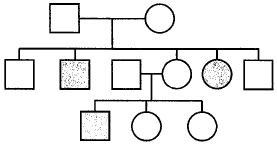
The given chart shows a pedigree analysis. What does it represent?
A
Sex-linked inheritance such as inborn errors of metabolism like Phenylketonuria.
B
Genetic condition like Phenylketonuria,which is an autosomal recessive trait.
C
The pedigree chart is wrong,as this is not possible.
D
Recessive sex-linked disease like Haemophilia.
Solution
(B) $1$. In the given pedigree,the parents are unaffected (unshaded),but they have affected (shaded) offspring of both sexes (a male and a female).
$2$. This pattern of inheritance,where unaffected parents produce affected offspring,is characteristic of an autosomal recessive trait.
$3$. Phenylketonuria is a well-known example of an autosomal recessive disorder.
$4$. Sex-linked recessive traits (like Haemophilia) typically show a different pattern,often affecting males more frequently and skipping generations in a specific way related to the $X$-chromosome.
$5$. Therefore,the pedigree represents an autosomal recessive trait like Phenylketonuria.
$2$. This pattern of inheritance,where unaffected parents produce affected offspring,is characteristic of an autosomal recessive trait.
$3$. Phenylketonuria is a well-known example of an autosomal recessive disorder.
$4$. Sex-linked recessive traits (like Haemophilia) typically show a different pattern,often affecting males more frequently and skipping generations in a specific way related to the $X$-chromosome.
$5$. Therefore,the pedigree represents an autosomal recessive trait like Phenylketonuria.
0 likes
View Solution209
DifficultMCQ
$A$ normal-visioned man,whose father was color-blind,marries a woman whose father was also color-blind. What is the probability that their first child,a daughter,will be color-blind (in $\%$)?
A
$100$
B
$0$
C
$25$
D
$50$
Solution
(B) Color blindness is an $X$-linked recessive disorder.
Let $X^C$ be the allele for color blindness and $X$ be the normal allele.
The man is normal-visioned,so his genotype is $XY$. Since his father was color-blind $(X^CY)$,he inherited his $Y$ chromosome from his father and his $X$ chromosome from his mother. Thus,his genotype is $XY$.
The woman's father was color-blind $(X^CY)$,so she must have inherited the $X^C$ allele from him. Since she is not mentioned as color-blind,she is a carrier with the genotype $X^CX$.
Cross: $XY$ (man) $\times$ $X^CX$ (woman).
Possible offspring genotypes: $XX, X^CX, XY, X^CY$.
The female offspring genotypes are $XX$ (normal) and $X^CX$ (carrier).
Neither of the female offspring genotypes is color-blind $(X^CX^C)$.
Therefore,the probability of their daughter being color-blind is $0\%$.
Let $X^C$ be the allele for color blindness and $X$ be the normal allele.
The man is normal-visioned,so his genotype is $XY$. Since his father was color-blind $(X^CY)$,he inherited his $Y$ chromosome from his father and his $X$ chromosome from his mother. Thus,his genotype is $XY$.
The woman's father was color-blind $(X^CY)$,so she must have inherited the $X^C$ allele from him. Since she is not mentioned as color-blind,she is a carrier with the genotype $X^CX$.
Cross: $XY$ (man) $\times$ $X^CX$ (woman).
Possible offspring genotypes: $XX, X^CX, XY, X^CY$.
The female offspring genotypes are $XX$ (normal) and $X^CX$ (carrier).
Neither of the female offspring genotypes is color-blind $(X^CX^C)$.
Therefore,the probability of their daughter being color-blind is $0\%$.
0 likes
View Solution210
MediumMCQ
Which of the following statements is incorrect regarding $Hemophilia$?
A
It is a sex-linked disease.
B
It is a recessive disease.
C
It is a dominant disease.
D
It involves a single protein that affects the blood clotting cascade.
Solution
(C) $Hemophilia$ is a sex-linked recessive disorder.
It is caused by a mutation in the genes that code for proteins involved in the blood clotting cascade.
Since it is a recessive trait,it is expressed only when the individual is homozygous for the recessive allele in females or hemizygous in males.
Therefore,the statement that it is a dominant disease is incorrect.
It is caused by a mutation in the genes that code for proteins involved in the blood clotting cascade.
Since it is a recessive trait,it is expressed only when the individual is homozygous for the recessive allele in females or hemizygous in males.
Therefore,the statement that it is a dominant disease is incorrect.
0 likes
View Solution211
MediumMCQ
If both parents are carriers of thalassemia,which is an autosomal recessive disorder,what is the probability of having an affected child?
A
No probability
B
$50\%$
C
$25\%$
D
$100\%$
Solution
(C) Thalassemia is an autosomal recessive disorder. Let the normal allele be represented by '$A$' and the recessive disease-causing allele by '$a$'.
Since both parents are carriers,their genotypes are '$Aa$'.
When we perform a cross between two carriers $(Aa \times Aa)$:
The possible offspring genotypes are:
$AA$ (Normal - $25\%$)
$Aa$ (Carrier - $50\%$)
$aa$ (Affected - $25\%$)
Therefore,the probability of having an affected child $(aa)$ is $25\%$.
Since both parents are carriers,their genotypes are '$Aa$'.
When we perform a cross between two carriers $(Aa \times Aa)$:
The possible offspring genotypes are:
$AA$ (Normal - $25\%$)
$Aa$ (Carrier - $50\%$)
$aa$ (Affected - $25\%$)
Therefore,the probability of having an affected child $(aa)$ is $25\%$.
0 likes
View Solution212
MediumMCQ
$A$ man whose father was colorblind marries a woman who has a colorblind mother and a normal father. What is the percentage probability of their male children being colorblind (in $\%$)?
A
$50$
B
$0$
C
$25$
D
$75$
Solution
(A) Colorblindness is an $X$-linked recessive trait.
$1$. The man's father was colorblind,so the man must have received his $Y$ chromosome from his father and his $X$ chromosome from his mother. Since he is a male,his genotype is $X^CY$ (where $X^C$ is the colorblind allele). However,the man himself is normal,so his genotype is $XY$.
$2$. The woman has a colorblind mother $(X^CX^C)$ and a normal father $(XY)$. She must have inherited one $X^C$ from her mother and one $X$ from her father. Thus,her genotype is $X^CX$.
$3$. The cross is $XY$ (man) $\times$ $X^CX$ (woman).
$4$. The possible genotypes of the offspring are: $XX^C$ (carrier daughter),$XX$ (normal daughter),$X^CY$ (colorblind son),and $XY$ (normal son).
$5$. Among the male children,the genotypes are $X^CY$ and $XY$. The probability of a male child being colorblind is $1/2$ or $50\%$.
$1$. The man's father was colorblind,so the man must have received his $Y$ chromosome from his father and his $X$ chromosome from his mother. Since he is a male,his genotype is $X^CY$ (where $X^C$ is the colorblind allele). However,the man himself is normal,so his genotype is $XY$.
$2$. The woman has a colorblind mother $(X^CX^C)$ and a normal father $(XY)$. She must have inherited one $X^C$ from her mother and one $X$ from her father. Thus,her genotype is $X^CX$.
$3$. The cross is $XY$ (man) $\times$ $X^CX$ (woman).
$4$. The possible genotypes of the offspring are: $XX^C$ (carrier daughter),$XX$ (normal daughter),$X^CY$ (colorblind son),and $XY$ (normal son).
$5$. Among the male children,the genotypes are $X^CY$ and $XY$. The probability of a male child being colorblind is $1/2$ or $50\%$.
0 likes
View Solution213
MediumMCQ
$A$ color-blind man marries a woman with normal vision,whose family has no history of color blindness. What is the probability that their daughter's children (grandsons and granddaughters) will be color-blind?
A
$0.5$
B
$1$
C
$0.25$
D
$0$
Solution
(C) Color blindness is an $X$-linked recessive trait. Let $X^c$ represent the color-blind allele and $X$ represent the normal allele.
$1$. The man is color-blind $(X^c Y)$. The woman is normal and has no family history,so she is homozygous normal $(XX)$.
$2$. Their offspring: The daughter receives $X^c$ from her father and $X$ from her mother,making her a carrier $(X X^c)$. The son receives $Y$ from his father and $X$ from his mother,making him normal $(XY)$.
$3$. The daughter (carrier $X X^c$) marries a normal man $(XY)$.
$4$. Their children's genotypes: $XX$ (normal daughter),$X X^c$ (carrier daughter),$XY$ (normal son),$X^c Y$ (color-blind son).
$5$. The probability of a grandson being color-blind is $0.5$ (since $X^c Y$ is one of two possibilities for a son),and the probability of a granddaughter being color-blind is $0$ (since she must inherit $X^c$ from her father,who is normal).
$6$. The question asks for the probability of the daughter's children being color-blind. Since the daughter has a $1/4$ chance of having a color-blind son and $0$ chance of a color-blind daughter,the overall probability for any child is $0.25$.
$1$. The man is color-blind $(X^c Y)$. The woman is normal and has no family history,so she is homozygous normal $(XX)$.
$2$. Their offspring: The daughter receives $X^c$ from her father and $X$ from her mother,making her a carrier $(X X^c)$. The son receives $Y$ from his father and $X$ from his mother,making him normal $(XY)$.
$3$. The daughter (carrier $X X^c$) marries a normal man $(XY)$.
$4$. Their children's genotypes: $XX$ (normal daughter),$X X^c$ (carrier daughter),$XY$ (normal son),$X^c Y$ (color-blind son).
$5$. The probability of a grandson being color-blind is $0.5$ (since $X^c Y$ is one of two possibilities for a son),and the probability of a granddaughter being color-blind is $0$ (since she must inherit $X^c$ from her father,who is normal).
$6$. The question asks for the probability of the daughter's children being color-blind. Since the daughter has a $1/4$ chance of having a color-blind son and $0$ chance of a color-blind daughter,the overall probability for any child is $0.25$.
0 likes
View Solution214
MediumMCQ
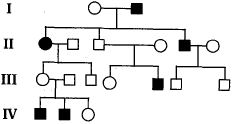
In the given pedigree chart,the filled symbols represent affected individuals. Identify the type of inheritance:
A
$X$-linked dominant
B
Autosomal dominant
C
$X$-linked recessive
D
Autosomal recessive
Solution
(B) $1$. Analyze the pedigree: The trait appears in every generation (vertical transmission),which is characteristic of dominant traits.
$2$. Check for Autosomal Dominant inheritance: In autosomal dominant traits,an affected individual must have at least one affected parent. Here,the affected individuals in generation $II$ and $III$ have affected parents.
$3$. Check for $X$-linked dominant: If it were $X$-linked dominant,an affected father would pass the trait to all his daughters. In generation $I$,the affected father has an unaffected daughter in generation $II$,which rules out $X$-linked dominant.
$4$. Conclusion: The pattern is consistent with Autosomal Dominant inheritance,as it does not skip generations and affected individuals have affected parents.
$2$. Check for Autosomal Dominant inheritance: In autosomal dominant traits,an affected individual must have at least one affected parent. Here,the affected individuals in generation $II$ and $III$ have affected parents.
$3$. Check for $X$-linked dominant: If it were $X$-linked dominant,an affected father would pass the trait to all his daughters. In generation $I$,the affected father has an unaffected daughter in generation $II$,which rules out $X$-linked dominant.
$4$. Conclusion: The pattern is consistent with Autosomal Dominant inheritance,as it does not skip generations and affected individuals have affected parents.
0 likes
View Solution215
MediumMCQ
If a colorblind man marries a woman with normal vision,what is the probability of their son being colorblind?
A
$0.75$
B
$1$
C
$0$
D
$0.5$
Solution
(C) Color blindness is an $X$-linked recessive trait.
Let $X^C$ be the allele for color blindness and $X$ be the normal allele.
The genotype of the colorblind man is $X^C Y$.
The genotype of the woman with normal vision is $X X$.
When they cross: $X^C Y \times X X \rightarrow X^C X, X^C X, XY, XY$.
The offspring are: two carrier daughters $(X^C X)$ and two normal sons $(XY)$.
Since the sons receive the $Y$ chromosome from the father and the $X$ chromosome from the mother,and the mother is normal $(XX)$,all sons will have normal vision.
Therefore,the probability of their son being colorblind is $0$.
Let $X^C$ be the allele for color blindness and $X$ be the normal allele.
The genotype of the colorblind man is $X^C Y$.
The genotype of the woman with normal vision is $X X$.
When they cross: $X^C Y \times X X \rightarrow X^C X, X^C X, XY, XY$.
The offspring are: two carrier daughters $(X^C X)$ and two normal sons $(XY)$.
Since the sons receive the $Y$ chromosome from the father and the $X$ chromosome from the mother,and the mother is normal $(XX)$,all sons will have normal vision.
Therefore,the probability of their son being colorblind is $0$.
0 likes
View Solution216
MediumMCQ
Identify the incorrect statement.
A
Phenylketonuria is an autosomal recessive gene disorder.
B
Down syndrome is caused by aneuploidy.
C
Sickle cell anemia is an $X$-linked recessive gene disorder.
D
Hemophilia is a sex-linked recessive disease.
Solution
(C) The correct answer is $C$.
$1$. Phenylketonuria is an autosomal recessive disorder caused by a mutation in the gene for the enzyme phenylalanine hydroxylase.
$2$. Down syndrome is a chromosomal disorder caused by the presence of an extra copy of chromosome $21$ (trisomy $21$),which is a type of aneuploidy.
$3$. Sickle cell anemia is an autosomal recessive disorder,not an $X$-linked disorder. It is caused by a mutation in the hemoglobin beta gene on chromosome $11$.
$4$. Hemophilia is a well-known $X$-linked recessive disorder where blood fails to clot properly.
$1$. Phenylketonuria is an autosomal recessive disorder caused by a mutation in the gene for the enzyme phenylalanine hydroxylase.
$2$. Down syndrome is a chromosomal disorder caused by the presence of an extra copy of chromosome $21$ (trisomy $21$),which is a type of aneuploidy.
$3$. Sickle cell anemia is an autosomal recessive disorder,not an $X$-linked disorder. It is caused by a mutation in the hemoglobin beta gene on chromosome $11$.
$4$. Hemophilia is a well-known $X$-linked recessive disorder where blood fails to clot properly.
0 likes
View Solution217
MediumMCQ
Which of the following most accurately describes hemophilia?
A
$X$-linked recessive gene disorder
B
Chromosomal disorder
C
Dominant gene disorder
D
Recessive gene disorder
Solution
(A) Hemophilia is a sex-linked genetic disorder where the gene responsible for the clotting factor is located on the $X$ chromosome.
Since it is a recessive trait,it is expressed more frequently in males $(XY)$ because they have only one $X$ chromosome,whereas females $(XX)$ require two copies of the recessive allele to express the disease.
Therefore,it is specifically classified as an $X$-linked recessive gene disorder.
Since it is a recessive trait,it is expressed more frequently in males $(XY)$ because they have only one $X$ chromosome,whereas females $(XX)$ require two copies of the recessive allele to express the disease.
Therefore,it is specifically classified as an $X$-linked recessive gene disorder.
0 likes
View Solution218
MediumMCQ
Thalassemia and sickle-cell anemia are caused by problems in the synthesis of globin molecules. Select the correct statement.
A
Both are caused by a defect in the qualitative synthesis of the globin chain.
B
Both are caused by a defect in the quantitative synthesis of the globin chain.
C
Thalassemia is caused by the reduced synthesis of globin molecules.
D
Sickle-cell anemia is caused by a quantitative problem of the globin molecule.
Solution
(C) Thalassemia is a quantitative disorder where there is a defect in the synthesis of globin chains,leading to the production of fewer globin molecules.
Sickle-cell anemia is a qualitative disorder caused by a point mutation in the gene coding for the $\beta$-globin chain,resulting in the synthesis of abnormal hemoglobin $(HbS)$.
Sickle-cell anemia is a qualitative disorder caused by a point mutation in the gene coding for the $\beta$-globin chain,resulting in the synthesis of abnormal hemoglobin $(HbS)$.
0 likes
View Solution219
MediumMCQ
Which of the following conditions,although harmful,provides resistance against infectious diseases spread by mosquitoes?
A
Pernicious anemia
B
Leukemia
C
Thalassemia
D
Sickle cell anemia
Solution
(D) Sickle cell anemia is a genetic disorder caused by a mutation in the hemoglobin gene.
Individuals who are heterozygous for the sickle cell trait $(Hb^A Hb^S)$ possess red blood cells that are less hospitable to the malaria parasite,$Plasmodium$.
This provides a selective advantage in regions where malaria is endemic,as these individuals are less likely to develop severe or fatal cases of malaria compared to individuals with normal hemoglobin $(Hb^A Hb^A)$.
Individuals who are heterozygous for the sickle cell trait $(Hb^A Hb^S)$ possess red blood cells that are less hospitable to the malaria parasite,$Plasmodium$.
This provides a selective advantage in regions where malaria is endemic,as these individuals are less likely to develop severe or fatal cases of malaria compared to individuals with normal hemoglobin $(Hb^A Hb^A)$.
0 likes
View Solution220
MediumMCQ
Sickle cell anemia and Huntington's chorea are both ..........
A
Bacteria-related diseases
B
Congenital disorders
C
Pollution-induced disorders
D
Virus-related diseases
Solution
(B) Sickle cell anemia is an autosomal recessive genetic disorder caused by a mutation in the hemoglobin gene.
Huntington's chorea is an autosomal dominant genetic disorder caused by a mutation in the huntingtin gene.
Since both of these conditions are inherited from parents to offspring through genes,they are classified as congenital disorders (genetic disorders present at birth).
Therefore,the correct option is $B$.
Huntington's chorea is an autosomal dominant genetic disorder caused by a mutation in the huntingtin gene.
Since both of these conditions are inherited from parents to offspring through genes,they are classified as congenital disorders (genetic disorders present at birth).
Therefore,the correct option is $B$.
0 likes
View Solution221
MediumMCQ
Sickle cell anemia cannot be eliminated from the African population because ........... .
A
It is regulated by recessive genes.
B
It is not a lethal disease.
C
It provides resistance against malaria.
D
It is regulated by dominant genes.
Solution
(C) Sickle cell anemia is a genetic disorder caused by a mutation in the hemoglobin gene.
Individuals who are heterozygous for the sickle cell trait $(Hb^A Hb^S)$ possess a survival advantage in regions where malaria is endemic.
The presence of sickle-shaped red blood cells inhibits the growth and reproduction of the malaria parasite $(Plasmodium)$.
Therefore,natural selection maintains the sickle cell gene in the population because it confers resistance to malaria,preventing its complete elimination despite the disease being harmful in the homozygous recessive $(Hb^S Hb^S)$ state.
Individuals who are heterozygous for the sickle cell trait $(Hb^A Hb^S)$ possess a survival advantage in regions where malaria is endemic.
The presence of sickle-shaped red blood cells inhibits the growth and reproduction of the malaria parasite $(Plasmodium)$.
Therefore,natural selection maintains the sickle cell gene in the population because it confers resistance to malaria,preventing its complete elimination despite the disease being harmful in the homozygous recessive $(Hb^S Hb^S)$ state.
0 likes
View Solution222
MediumMCQ
Assertion: Persons suffering from haemophilia fail to produce blood clotting factor $VIII$.
Reason: Prothrombin producing platelets in such persons are found in very low concentration.
Reason: Prothrombin producing platelets in such persons are found in very low concentration.
A
If both Assertion and Reason are correct and the Reason is a correct explanation of the Assertion.
B
If both Assertion and Reason are correct but Reason is not a correct explanation of the Assertion.
C
If the Assertion is correct but Reason is incorrect.
D
If both the Assertion and Reason are incorrect.
Solution
(C) Haemophilia is a sex-linked recessive disorder caused by the deficiency of blood clotting factor $VIII$ (Haemophilia $A$) or factor $IX$ (Haemophilia $B$).
In patients with haemophilia,the blood clotting mechanism is impaired because the cascade of reactions required for fibrin formation is interrupted due to the absence of these specific clotting factors.
The Assertion is correct because haemophilia is indeed characterized by the failure to produce functional clotting factor $VIII$.
The Reason is incorrect because the primary defect in haemophilia is not a low concentration of platelets or a deficiency in prothrombin production; rather,it is a genetic deficiency of specific clotting factors. Platelet counts in haemophiliacs are typically normal.
In patients with haemophilia,the blood clotting mechanism is impaired because the cascade of reactions required for fibrin formation is interrupted due to the absence of these specific clotting factors.
The Assertion is correct because haemophilia is indeed characterized by the failure to produce functional clotting factor $VIII$.
The Reason is incorrect because the primary defect in haemophilia is not a low concentration of platelets or a deficiency in prothrombin production; rather,it is a genetic deficiency of specific clotting factors. Platelet counts in haemophiliacs are typically normal.
0 likes
View Solution223
MediumMCQ
$A$ normal woman whose father was colour blind,is married to a normal man. The sons would be
A
$75\%$ colour blind
B
$50\%$ colour blind
C
all normal
D
all colour blind
Solution
(B) Colour blindness is an $X$-linked recessive trait.
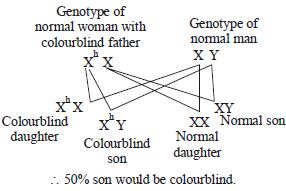
$1$. The woman is normal but her father was colour blind,so she must be a carrier for the trait. Her genotype is $X^hX$.
$2$. The man is normal,so his genotype is $XY$.
$3$. The cross between the carrier woman $(X^hX)$ and the normal man $(XY)$ results in the following offspring:
- $X^hX$ (Carrier daughter)
- $XX$ (Normal daughter)
- $X^hY$ (Colour blind son)
- $XY$ (Normal son)
$4$. Among the sons,one is colour blind $(X^hY)$ and one is normal $(XY)$. Therefore,$50\%$ of the sons would be colour blind.
$1$. The woman is normal but her father was colour blind,so she must be a carrier for the trait. Her genotype is $X^hX$.
$2$. The man is normal,so his genotype is $XY$.
$3$. The cross between the carrier woman $(X^hX)$ and the normal man $(XY)$ results in the following offspring:
- $X^hX$ (Carrier daughter)
- $XX$ (Normal daughter)
- $X^hY$ (Colour blind son)
- $XY$ (Normal son)
$4$. Among the sons,one is colour blind $(X^hY)$ and one is normal $(XY)$. Therefore,$50\%$ of the sons would be colour blind.
0 likes
View Solution224
MediumMCQ
If both parents are carriers for thalassemia,which is an autosomal recessive disorder,what are the chances of pregnancy resulting in an affected child?
A
$50\%$
B
$25\%$
C
$100\%$
D
no chance
Solution
(B) Thalassemia is an autosomal recessive disorder. Let '$A$' represent the dominant normal allele and '$a$' represent the recessive mutant allele.
Carrier parents have the genotype '$Aa$'.
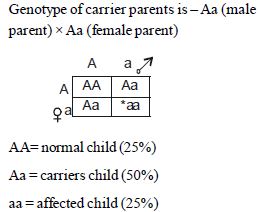
When two carrier parents $(Aa \times Aa)$ reproduce,the possible genotypes of the offspring are determined by a Punnett square:
- $AA$ (Normal child): $25\%$
- $Aa$ (Carrier child): $50\%$
- $aa$ (Affected child): $25\%$
Therefore,the probability of having an affected child $(aa)$ is $25\%$.
Carrier parents have the genotype '$Aa$'.
When two carrier parents $(Aa \times Aa)$ reproduce,the possible genotypes of the offspring are determined by a Punnett square:
- $AA$ (Normal child): $25\%$
- $Aa$ (Carrier child): $50\%$
- $aa$ (Affected child): $25\%$
Therefore,the probability of having an affected child $(aa)$ is $25\%$.
0 likes
View Solution225
MediumMCQ
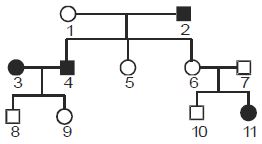
In Huntington's disease,the unaffected persons are homozygous for normal allele $h$. The following pedigree is erroneous because:
A
it shows both male and female affected by Huntington's disease
B
either person $6$ or $7$ should have the disease,if individual $11$ shows the disease.
C
at least one of the $2$ children $(8, 9)$ should have the disease
D
all of these
Solution
(B) Huntington's disease is an autosomal dominant disorder. In an autosomal dominant pedigree,an affected individual must have at least one affected parent.
In the given pedigree,individual $11$ is affected (represented by a filled circle). Since the disease is autosomal dominant,at least one of her parents ($6$ or $7$) must also be affected (represented by a filled symbol).
However,in the pedigree,both individuals $6$ and $7$ are unaffected (represented by empty symbols). Therefore,this pedigree is erroneous because it violates the rule of autosomal dominant inheritance.
In the given pedigree,individual $11$ is affected (represented by a filled circle). Since the disease is autosomal dominant,at least one of her parents ($6$ or $7$) must also be affected (represented by a filled symbol).
However,in the pedigree,both individuals $6$ and $7$ are unaffected (represented by empty symbols). Therefore,this pedigree is erroneous because it violates the rule of autosomal dominant inheritance.
0 likes
View Solution226
MediumMCQ
Assertion: Phenylketonuria is a recessive hereditary disease caused by the body's failure to oxidize the amino acid phenylalanine to tyrosine due to a defective enzyme.
Reason: It results in the presence of phenylalanine acid in urine.
Reason: It results in the presence of phenylalanine acid in urine.
A
If both Assertion and Reason are correct and the Reason is a correct explanation of the Assertion.
B
If both Assertion and Reason are correct but Reason is not a correct explanation of the Assertion.
C
If the Assertion is correct but Reason is incorrect.
D
If both the Assertion and Reason are incorrect.
Solution
(A) Phenylketonuria $(PKU)$ is an autosomal recessive genetic disorder.
It is caused by the deficiency of the enzyme phenylalanine hydroxylase,which is responsible for converting the amino acid phenylalanine into tyrosine.
Due to the lack of this enzyme,phenylalanine accumulates in the body and is converted into phenylpyruvic acid and other derivatives.
These derivatives are excreted in the urine,hence the name Phenylketonuria. Therefore,both the Assertion and the Reason are correct,and the Reason explains why the condition is named as such and why the substance appears in the urine.
It is caused by the deficiency of the enzyme phenylalanine hydroxylase,which is responsible for converting the amino acid phenylalanine into tyrosine.
Due to the lack of this enzyme,phenylalanine accumulates in the body and is converted into phenylpyruvic acid and other derivatives.
These derivatives are excreted in the urine,hence the name Phenylketonuria. Therefore,both the Assertion and the Reason are correct,and the Reason explains why the condition is named as such and why the substance appears in the urine.
0 likes
View Solution227
MediumMCQ
Assertion: Haemophilia is a recessive sex-linked disease.
Reason: Haemophilia occurs due to mutation of a structural gene on chromosome $15$.
Reason: Haemophilia occurs due to mutation of a structural gene on chromosome $15$.
A
If both Assertion and Reason are correct and the Reason is a correct explanation of the Assertion.
B
If both Assertion and Reason are correct but Reason is not a correct explanation of the Assertion.
C
If the Assertion is correct but Reason is incorrect.
D
If both the Assertion and Reason are incorrect.
Solution
(C) Haemophilia,also known as bleeder's disease,is a classic example of recessive sex-linked inheritance in humans.
It is masked in the heterozygous condition.
The person suffering from this disease lacks clotting factors $VIII$ and $IX$,which are essential for blood coagulation.
$A$ small cut may lead to continuous bleeding.
Men are primarily affected by this disease,while women typically act as carriers.
The mutation of a structural gene on chromosome number $15$ is associated with Marfan syndrome,not haemophilia.
Marfan syndrome results in the formation of abnormal connective tissues and extreme looseness of joints.
Therefore,the Assertion is correct,but the Reason is incorrect.
It is masked in the heterozygous condition.
The person suffering from this disease lacks clotting factors $VIII$ and $IX$,which are essential for blood coagulation.
$A$ small cut may lead to continuous bleeding.
Men are primarily affected by this disease,while women typically act as carriers.
The mutation of a structural gene on chromosome number $15$ is associated with Marfan syndrome,not haemophilia.
Marfan syndrome results in the formation of abnormal connective tissues and extreme looseness of joints.
Therefore,the Assertion is correct,but the Reason is incorrect.
0 likes
View Solution228
MediumMCQ
Assertion : Persons suffering from haemophilia fail to produce blood clotting factor $VIII$.
Reason : Prothrombin producing platelets in such persons are found in very low concentration.
Reason : Prothrombin producing platelets in such persons are found in very low concentration.
A
If both Assertion and Reason are correct and the Reason is a correct explanation of the Assertion.
B
If both Assertion and Reason are correct but Reason is not a correct explanation of the Assertion.
C
If the Assertion is correct but Reason is incorrect.
D
If both the Assertion and Reason are incorrect.
Solution
(C) Haemophilia is a group of hereditary genetic disorders that impair the body's ability to control blood clotting or coagulation.
In its most common form,Haemophilia $A$,the blood clotting factor $VIII$ is absent or deficient.
In Haemophilia $B$,factor $IX$ is deficient.
Factor $VIII$ acts as a cofactor for factor $IXa$,which in the presence of $Ca^{+2}$ and phospholipids,forms a complex that converts factor $X$ to its activated form,$Xa$.
Defects in the gene encoding factor $VIII$ result in Haemophilia $A$,which is a recessive $X$-linked coagulation disorder.
The Reason statement is incorrect because the concentration of platelets in haemophilia patients is typically normal; the disorder is caused by a deficiency in specific clotting factors,not a deficiency in platelet count or prothrombin production.
In its most common form,Haemophilia $A$,the blood clotting factor $VIII$ is absent or deficient.
In Haemophilia $B$,factor $IX$ is deficient.
Factor $VIII$ acts as a cofactor for factor $IXa$,which in the presence of $Ca^{+2}$ and phospholipids,forms a complex that converts factor $X$ to its activated form,$Xa$.
Defects in the gene encoding factor $VIII$ result in Haemophilia $A$,which is a recessive $X$-linked coagulation disorder.
The Reason statement is incorrect because the concentration of platelets in haemophilia patients is typically normal; the disorder is caused by a deficiency in specific clotting factors,not a deficiency in platelet count or prothrombin production.
0 likes
View Solution229
Easy
What is pedigree analysis? Suggest how such an analysis can be useful.
Solution
(N/A) Pedigree analysis is a record of the occurrence of a trait in several generations of a family. It is based on the fact that certain characteristic features are heritable in a family,for example,eye colour,skin colour,hair form and colour,and other facial characteristics. Along with these features,there are other genetic disorders such as Mendelian disorders that are inherited in a family,generation after generation. Hence,by using pedigree analysis for the study of specific traits or disorders,generation after generation,it is possible to trace the pattern of inheritance. In this analysis,the inheritance of a trait is represented as a tree,called a family tree. Genetic counselors use pedigree charts for the analysis of various traits and diseases in a family and predict their inheritance patterns. It is useful in preventing hemophilia,sickle cell anemia,and other genetic disorders in future generations.
0 likes
View Solution230
Medium
Mention any two autosomal genetic disorders with their symptoms.
Solution
(N/A) Two autosomal genetic disorders are as follows:
$1$. Sickle cell anaemia: It is an autosomal-linked recessive disorder caused by a point mutation in the beta-globin chain of the haemoglobin molecule. The disease is controlled by $Hb^A$ and $Hb^S$ alleles. Homozygous individuals $(Hb^S Hb^S)$ show symptoms,while heterozygous individuals $(Hb^A Hb^S)$ are carriers.
Symptoms: Rapid heart rate,breathlessness,delayed growth,jaundice,weakness,fever,excessive thirst,chest pain,and decreased fertility.
$2$. Down's syndrome: It is an autosomal disorder caused by the trisomy of chromosome $21$.
Symptoms: Short stature,round head,open mouth,protruding tongue,short neck,slanting eyes,broad short hands,and retarded mental and physical growth.
$1$. Sickle cell anaemia: It is an autosomal-linked recessive disorder caused by a point mutation in the beta-globin chain of the haemoglobin molecule. The disease is controlled by $Hb^A$ and $Hb^S$ alleles. Homozygous individuals $(Hb^S Hb^S)$ show symptoms,while heterozygous individuals $(Hb^A Hb^S)$ are carriers.
Symptoms: Rapid heart rate,breathlessness,delayed growth,jaundice,weakness,fever,excessive thirst,chest pain,and decreased fertility.
$2$. Down's syndrome: It is an autosomal disorder caused by the trisomy of chromosome $21$.
Symptoms: Short stature,round head,open mouth,protruding tongue,short neck,slanting eyes,broad short hands,and retarded mental and physical growth.
0 likes
View Solution231
Medium
Describe pedigree analysis and draw its symbols.
Solution
(N/A) Pedigree analysis is the study of the inheritance of a particular trait,abnormality,or disease in a family over several generations. It is represented as a family tree.
In human genetics,pedigree analysis is a powerful tool because controlled crosses,which are possible in organisms like pea plants,cannot be performed in humans due to reasons such as: $(i)$ The progeny produced is very small (usually one) and takes a long time to mature. $(ii)$ Controlled crosses are not ethically or practically possible.
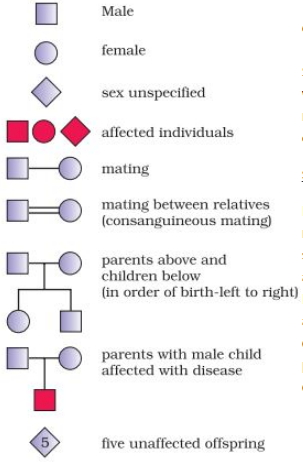
The standard symbols used in pedigree analysis are as follows:
| Symbol | Meaning |
| :--- | :--- |
| Square | Male |
| Circle | Female |
| Diamond | Sex unspecified |
| Shaded symbols | Affected individuals |
| Square-Circle connected by horizontal line | Mating |
| Square-Circle connected by double horizontal line | Mating between relatives (consanguineous mating) |
| Parents connected by horizontal line with offspring below | Parents with children (in order of birth from left to right) |
| Parents with a shaded square below | Parents with an affected male child |
| Diamond with number $5$ inside | Five unaffected offspring |
In human genetics,pedigree analysis is a powerful tool because controlled crosses,which are possible in organisms like pea plants,cannot be performed in humans due to reasons such as: $(i)$ The progeny produced is very small (usually one) and takes a long time to mature. $(ii)$ Controlled crosses are not ethically or practically possible.
The standard symbols used in pedigree analysis are as follows:
| Symbol | Meaning |
| :--- | :--- |
| Square | Male |
| Circle | Female |
| Diamond | Sex unspecified |
| Shaded symbols | Affected individuals |
| Square-Circle connected by horizontal line | Mating |
| Square-Circle connected by double horizontal line | Mating between relatives (consanguineous mating) |
| Parents connected by horizontal line with offspring below | Parents with children (in order of birth from left to right) |
| Parents with a shaded square below | Parents with an affected male child |
| Diamond with number $5$ inside | Five unaffected offspring |
0 likes
View Solution232
Medium
Describe the sex-linked recessive gene disorder of color blindness through pedigree analysis.
Solution
(N/A) Color blindness is a sex-linked recessive disorder caused by a mutation in certain genes present on the $X$ chromosome.
This defect results in the failure to discriminate between red and green colors due to the defect in either red or green cone cells of the eye.
It occurs in about $8\%$ of males and only about $0.4\%$ of females because the genes for red-green color blindness are located on the $X$ chromosome.
Males have only one $X$ chromosome and a $Y$ chromosome,whereas females have two $X$ chromosomes.
The son of a woman who carries the gene has a $50\%$ chance of being color blind.
The mother is not herself color blind because the gene is recessive and its effect is suppressed by her other normal dominant gene.
$A$ daughter will be color blind only when her mother is a carrier and her father is color blind.
This defect results in the failure to discriminate between red and green colors due to the defect in either red or green cone cells of the eye.
It occurs in about $8\%$ of males and only about $0.4\%$ of females because the genes for red-green color blindness are located on the $X$ chromosome.
Males have only one $X$ chromosome and a $Y$ chromosome,whereas females have two $X$ chromosomes.
The son of a woman who carries the gene has a $50\%$ chance of being color blind.
The mother is not herself color blind because the gene is recessive and its effect is suppressed by her other normal dominant gene.
$A$ daughter will be color blind only when her mother is a carrier and her father is color blind.
0 likes
View Solution233
Easy
Write a short note on Haemophilia.
Solution
(N/A) Haemophilia is a sex-linked recessive disorder that is transmitted from an unaffected carrier female to some of the male progeny.
$1$. Genetic Basis: The gene for haemophilia is located on the $X$ chromosome. Since it is recessive,females $(XX)$ require two copies of the defective gene to express the disease,whereas males $(XY)$ only require one copy.
$2$. Physiological Effect: The disorder results in a defect in the blood clotting mechanism. $A$ single protein that is part of the cascade of proteins involved in the clotting of blood is affected.
$3$. Clinical Manifestation: Due to the defect,a simple cut results in non-stop bleeding in an affected individual.
$4$. Inheritance Pattern: The possibility of a female becoming a haemophilic is extremely rare because the mother of such a female has to be at least a carrier and the father should be haemophilic (unviable in the later stage of life).
$1$. Genetic Basis: The gene for haemophilia is located on the $X$ chromosome. Since it is recessive,females $(XX)$ require two copies of the defective gene to express the disease,whereas males $(XY)$ only require one copy.
$2$. Physiological Effect: The disorder results in a defect in the blood clotting mechanism. $A$ single protein that is part of the cascade of proteins involved in the clotting of blood is affected.
$3$. Clinical Manifestation: Due to the defect,a simple cut results in non-stop bleeding in an affected individual.
$4$. Inheritance Pattern: The possibility of a female becoming a haemophilic is extremely rare because the mother of such a female has to be at least a carrier and the father should be haemophilic (unviable in the later stage of life).
0 likes
View Solution234
Medium
Provide detailed information about Sickle-cell anemia and Phenylketonuria $(PKU)$.
Solution
(N/A) Sickle-cell anemia: This is an autosome-linked recessive trait that can be transmitted from parents to offspring when both partners are carriers for the gene (or heterozygous).
The disease is controlled by a pair of alleles,$Hb^A$ and $Hb^S$. Out of the three possible genotypes,only individuals homozygous for $Hb^S$ $(Hb^SHb^S)$ show the disease symptoms.
Heterozygous $(Hb^AHb^S)$ individuals appear unaffected but are carriers of the disease. There is a $50\%$ probability of transmission of the mutant gene to the progeny.
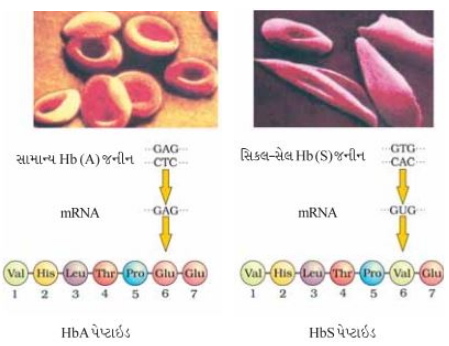
The defect is caused by the substitution of Glutamic acid $(Glu)$ by Valine $(Val)$ at the sixth position of the $\beta$-globin chain of the hemoglobin molecule.
This substitution of amino acid in the globin protein results due to the single base pair substitution at the sixth codon of the $\beta$-globin gene from $GAG$ to $GUG$.
Under low oxygen tension,the mutant hemoglobin molecule undergoes polymerization,causing the shape of the red blood cell to change from biconcave disc to an elongated sickle-like structure.
Phenylketonuria $(PKU)$: This is an inborn error of metabolism that is also inherited as an autosomal recessive trait.
The affected individual lacks an enzyme that converts the amino acid Phenylalanine into Tyrosine. As a result,Phenylalanine accumulates and is converted into Phenylpyruvic acid and other derivatives.
Accumulation of these in the brain results in mental retardation. These are also excreted through urine because of poor absorption by the kidney.
The disease is controlled by a pair of alleles,$Hb^A$ and $Hb^S$. Out of the three possible genotypes,only individuals homozygous for $Hb^S$ $(Hb^SHb^S)$ show the disease symptoms.
Heterozygous $(Hb^AHb^S)$ individuals appear unaffected but are carriers of the disease. There is a $50\%$ probability of transmission of the mutant gene to the progeny.
The defect is caused by the substitution of Glutamic acid $(Glu)$ by Valine $(Val)$ at the sixth position of the $\beta$-globin chain of the hemoglobin molecule.
This substitution of amino acid in the globin protein results due to the single base pair substitution at the sixth codon of the $\beta$-globin gene from $GAG$ to $GUG$.
Under low oxygen tension,the mutant hemoglobin molecule undergoes polymerization,causing the shape of the red blood cell to change from biconcave disc to an elongated sickle-like structure.
Phenylketonuria $(PKU)$: This is an inborn error of metabolism that is also inherited as an autosomal recessive trait.
The affected individual lacks an enzyme that converts the amino acid Phenylalanine into Tyrosine. As a result,Phenylalanine accumulates and is converted into Phenylpyruvic acid and other derivatives.
Accumulation of these in the brain results in mental retardation. These are also excreted through urine because of poor absorption by the kidney.
0 likes
View Solution235
Medium
Explain thalassemia.
Solution
(N/A) Thalassemia is an autosomal recessive blood disorder characterized by abnormal hemoglobin production.
$1$. It is caused by mutations in the genes that code for the globin chains of hemoglobin.
$2$. The disorder is classified into two main types: $\alpha$-thalassemia and $\beta$-thalassemia.
$3$. In $\alpha$-thalassemia,the production of the $\alpha$-globin chain is affected,which is controlled by two closely linked genes,$HBA1$ and $HBA2$,on chromosome $16$.
$4$. In $\beta$-thalassemia,the production of the $\beta$-globin chain is affected,which is controlled by a single gene,$HBB$,on chromosome $11$.
$5$. The condition leads to the formation of abnormal hemoglobin molecules,resulting in the destruction of red blood cells (anemia).
$1$. It is caused by mutations in the genes that code for the globin chains of hemoglobin.
$2$. The disorder is classified into two main types: $\alpha$-thalassemia and $\beta$-thalassemia.
$3$. In $\alpha$-thalassemia,the production of the $\alpha$-globin chain is affected,which is controlled by two closely linked genes,$HBA1$ and $HBA2$,on chromosome $16$.
$4$. In $\beta$-thalassemia,the production of the $\beta$-globin chain is affected,which is controlled by a single gene,$HBB$,on chromosome $11$.
$5$. The condition leads to the formation of abnormal hemoglobin molecules,resulting in the destruction of red blood cells (anemia).
0 likes
View Solution236
EasyMCQ
Color blindness is generally observed in males. Why?
A
The gene for color blindness is located on the $Y$ chromosome.
B
The gene for color blindness is recessive and located on the $X$ chromosome.
C
The gene for color blindness is dominant and located on the $X$ chromosome.
D
Males have two $X$ chromosomes.
Solution
(B) Color blindness is a sex-linked recessive disorder caused by a mutation in genes located on the $X$ chromosome.
Since males have only one $X$ chromosome $(XY)$,a single recessive allele is sufficient to express the trait.
Females have two $X$ chromosomes $(XX)$,so they only express the trait if they are homozygous recessive $(X^cX^c)$.
If a female has one recessive allele,she acts as a carrier $(X^cX)$ and does not show the symptoms.
Since males have only one $X$ chromosome $(XY)$,a single recessive allele is sufficient to express the trait.
Females have two $X$ chromosomes $(XX)$,so they only express the trait if they are homozygous recessive $(X^cX^c)$.
If a female has one recessive allele,she acts as a carrier $(X^cX)$ and does not show the symptoms.
0 likes
View Solution237
EasyMCQ
Testing for $\beta$-thalassemia should be done before marriage.
A
True
B
False
C
Cannot be determined
D
Not applicable
Solution
(A) Thalassemia is a blood-related genetic disorder characterized by the production of insufficient hemoglobin.
In $\beta$-thalassemia,the production of the $\beta$-globin chain of hemoglobin is affected.
It is caused by mutations or deletions in the $HBB$ gene located on chromosome $11$.
Since it is an autosomal recessive disorder,if both parents are carriers,there is a $25\%$ chance of the offspring being affected.
Therefore,genetic counseling and testing before marriage are recommended to prevent the transmission of the disease to the next generation.
In $\beta$-thalassemia,the production of the $\beta$-globin chain of hemoglobin is affected.
It is caused by mutations or deletions in the $HBB$ gene located on chromosome $11$.
Since it is an autosomal recessive disorder,if both parents are carriers,there is a $25\%$ chance of the offspring being affected.
Therefore,genetic counseling and testing before marriage are recommended to prevent the transmission of the disease to the next generation.
0 likes
View Solution238
MediumMCQ
Pedigree analysis plays an important role in genetic disorders.
A
True
B
False
C
Cannot be determined
D
Irrelevant
Solution
(A) Pedigree analysis is a powerful tool used to study human genetics and understand the inheritance patterns of genetic disorders.
After the rediscovery of Mendel's work,the study of the inheritance patterns of traits in humans began.
Pedigree analysis is the record-keeping of a specific trait across several generations in a human family.
In this analysis,data regarding the history of a specific trait is collected,and then the expression of that trait is represented through a chart or family tree.
After the rediscovery of Mendel's work,the study of the inheritance patterns of traits in humans began.
Pedigree analysis is the record-keeping of a specific trait across several generations in a human family.
In this analysis,data regarding the history of a specific trait is collected,and then the expression of that trait is represented through a chart or family tree.
0 likes
View Solution239
Medium
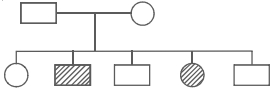
The pedigree chart given below shows a particular trait which is absent in parents but present in the next generation irrespective of sexes. Draw your conclusion on the basis of the pedigree.
Solution
(N/A) The trait is an autosomal recessive trait.
Since the trait is absent in the parents but appears in the offspring,the parents must be heterozygous (carriers) for the trait.
Because the trait appears in both male and female offspring,it is not sex-linked.
Therefore,the inheritance pattern is autosomal recessive,where the genotype of both parents is $Aa$ and the affected offspring have the genotype $aa$.
Since the trait is absent in the parents but appears in the offspring,the parents must be heterozygous (carriers) for the trait.
Because the trait appears in both male and female offspring,it is not sex-linked.
Therefore,the inheritance pattern is autosomal recessive,where the genotype of both parents is $Aa$ and the affected offspring have the genotype $aa$.
0 likes
View Solution240
Medium
The harmful allele of sickle cell anemia has not been eliminated from the human population. Such afflicted people derive some other benefit. Discuss.
Solution
(B) The harmful alleles are typically eliminated from a population over time,yet sickle cell anemia persists in the human population. This is because while the homozygous condition $(Hb^S Hb^S)$ is harmful,the heterozygous condition $(Hb^A Hb^S)$ provides a survival advantage against malaria.
The malaria-causing parasite,$Plasmodium$,spends part of its life cycle in red blood cells and triggers an abnormal drop in oxygen levels within the cell.
In carriers $(Hb^A Hb^S)$,this drop in oxygen is sufficient to trigger the sickling of red blood cells. These sickled cells are then rapidly removed from circulation by the spleen,which significantly limits the progression of the malarial infection.
These individuals possess a high resistance to malaria and have a greater chance of surviving outbreaks.
This resistance to infection is the primary reason the $Hb^S$ allele persists in the population. It is found at the highest frequency in regions where malaria is or was a serious health problem.
In contrast,normal individuals $(Hb^A Hb^A)$ are fully susceptible to $Plasmodium$ infection.
The malaria-causing parasite,$Plasmodium$,spends part of its life cycle in red blood cells and triggers an abnormal drop in oxygen levels within the cell.
In carriers $(Hb^A Hb^S)$,this drop in oxygen is sufficient to trigger the sickling of red blood cells. These sickled cells are then rapidly removed from circulation by the spleen,which significantly limits the progression of the malarial infection.
These individuals possess a high resistance to malaria and have a greater chance of surviving outbreaks.
This resistance to infection is the primary reason the $Hb^S$ allele persists in the population. It is found at the highest frequency in regions where malaria is or was a serious health problem.
In contrast,normal individuals $(Hb^A Hb^A)$ are fully susceptible to $Plasmodium$ infection.
0 likes
View Solution241
MediumMCQ
Why is the frequency of red-green colour blindness many times higher in males than in females?
A
Males have two $X$ chromosomes.
B
Colour blindness is a $Y$-linked trait.
C
Males have only one $X$ chromosome,so a single recessive allele expresses the trait.
D
Females are more resistant to genetic mutations.
Solution
(C) Red-green colour blindness is an $X$-linked recessive disorder.
Females have two $X$ chromosomes $(XX)$,so for a female to be colourblind,both $X$ chromosomes must carry the recessive allele $(X^cX^c)$.
In contrast,males have only one $X$ chromosome $(XY)$. If an $X$ chromosome carries the recessive allele $(X^cY)$,the male will express the trait because there is no second $X$ chromosome to mask the effect of the recessive allele.
Therefore,the probability of males being affected is significantly higher than that of females.
Females have two $X$ chromosomes $(XX)$,so for a female to be colourblind,both $X$ chromosomes must carry the recessive allele $(X^cX^c)$.
In contrast,males have only one $X$ chromosome $(XY)$. If an $X$ chromosome carries the recessive allele $(X^cY)$,the male will express the trait because there is no second $X$ chromosome to mask the effect of the recessive allele.
Therefore,the probability of males being affected is significantly higher than that of females.
0 likes
View Solution242
Medium
If a father and son are both defective in red-green colour vision,is it likely that the son inherited the trait from his father? Comment.
Solution
(N/A) The gene for red-green colour blindness is $X$-linked recessive.
In humans,a son inherits his $Y$-chromosome from his father and his $X$-chromosome from his mother.
Since the trait is $X$-linked,it cannot be passed directly from father to son.
Therefore,the son did not inherit the trait from his father.
In this case,the mother must be a carrier (heterozygous) for the colour blindness gene,and she passed the affected $X$-chromosome to her son.
In humans,a son inherits his $Y$-chromosome from his father and his $X$-chromosome from his mother.
Since the trait is $X$-linked,it cannot be passed directly from father to son.
Therefore,the son did not inherit the trait from his father.
In this case,the mother must be a carrier (heterozygous) for the colour blindness gene,and she passed the affected $X$-chromosome to her son.
0 likes
View Solution243
Medium
$A$ normal-visioned woman, whose father is colour-blind, marries a normal-visioned man. What would be the probability of her sons and daughters being colour-blind? Explain with the help of a pedigree chart.
Solution
(D) The woman is a carrier for colour blindness because her father was colour-blind (genotype $X^c Y$). She inherited the $X^c$ chromosome from her father, so her genotype is $X^C X^c$. The man is normal-visioned, so his genotype is $X^C Y$.
Cross: $X^C X^c$ (woman) $\times$ $X^C Y$ (man)
Offspring genotypes:
$1$. $X^C X^C$ (Normal-visioned daughter)
$2$. $X^C X^c$ (Carrier daughter, normal vision)
$3$. $X^C Y$ (Normal-visioned son)
$4$. $X^c Y$ (Colour-blind son)
Probability:
- Daughters: $0 \%$ chance of being colour-blind ($50 \%$ are carriers).
- Sons: $50 \%$ chance of being colour-blind.
Cross: $X^C X^c$ (woman) $\times$ $X^C Y$ (man)
Offspring genotypes:
$1$. $X^C X^C$ (Normal-visioned daughter)
$2$. $X^C X^c$ (Carrier daughter, normal vision)
$3$. $X^C Y$ (Normal-visioned son)
$4$. $X^c Y$ (Colour-blind son)
Probability:
- Daughters: $0 \%$ chance of being colour-blind ($50 \%$ are carriers).
- Sons: $50 \%$ chance of being colour-blind.
0 likes
View Solution244
MediumMCQ
Select the correct match.
A
Thalassemia $- X$-linked
B
Haemophilia $- Y$-linked
C
Phenylketonuria $-$ Autosomal dominant trait
D
Sickle cell anaemia $-$ Autosomal recessive trait
Solution
(D) $1$. Thalassemia is an autosomal recessive blood disorder.
$2$. Haemophilia is an $X$-linked recessive disorder.
$3$. Phenylketonuria is an autosomal recessive metabolic disorder.
$4$. Sickle cell anaemia is an autosomal recessive trait caused by a mutation in the gene located on chromosome $11$.
$2$. Haemophilia is an $X$-linked recessive disorder.
$3$. Phenylketonuria is an autosomal recessive metabolic disorder.
$4$. Sickle cell anaemia is an autosomal recessive trait caused by a mutation in the gene located on chromosome $11$.
0 likes
View Solution245
MediumMCQ
Select the correct pair:
A
Hemophilia $-$ $Y$-linked
B
Phenylketonuria $-$ Autosomal dominant trait
C
Sickle cell anemia $-$ Autosomal recessive trait,chromosome $-11$
D
Thalassemia $-$ $X$-linked
Solution
(C) $1$. Hemophilia is an $X$-linked recessive disorder.
$2$. Phenylketonuria is an autosomal recessive disorder.
$3$. Sickle cell anemia is an autosomal recessive disorder caused by a mutation in the gene on chromosome $-11$.
$4$. Thalassemia is an autosomal recessive blood disorder.
Therefore,the correct pair is $C$.
$2$. Phenylketonuria is an autosomal recessive disorder.
$3$. Sickle cell anemia is an autosomal recessive disorder caused by a mutation in the gene on chromosome $-11$.
$4$. Thalassemia is an autosomal recessive blood disorder.
Therefore,the correct pair is $C$.
0 likes
View Solution246
Medium
Describe Mendelian disorders.
Solution
(N/A) Mendelian disorders are primarily determined by alterations or mutations in a single gene.
These disorders are transmitted to the offspring following the principles of inheritance.
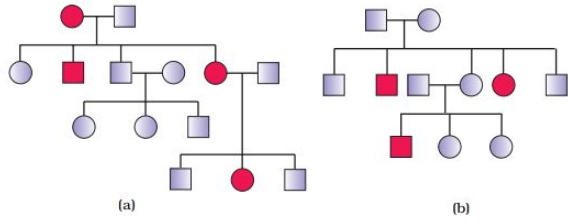
The pattern of inheritance of Mendelian disorders can be traced in a family through pedigree analysis.
Some common and prevalent Mendelian disorders include Haemophilia,Cystic fibrosis,Sickle cell anaemia,Colour blindness,Phenylketonuria,and Thalassemia.
Such Mendelian disorders may be dominant or recessive.
Through pedigree analysis,one can easily determine whether the trait in question is dominant or recessive.
Similarly,the trait may also be linked to the sex chromosome,as in the case of haemophilia.
It is evident that this $X$-linked recessive trait shows transmission from a carrier female to male progeny.
$A$ representative pedigree is shown in the figure for dominant and recessive traits.
Colour blindness is a sex-linked recessive disorder caused by a defect in either the red or green cones of the eye,resulting in a failure to discriminate between red and green colours.
These disorders are transmitted to the offspring following the principles of inheritance.
The pattern of inheritance of Mendelian disorders can be traced in a family through pedigree analysis.
Some common and prevalent Mendelian disorders include Haemophilia,Cystic fibrosis,Sickle cell anaemia,Colour blindness,Phenylketonuria,and Thalassemia.
Such Mendelian disorders may be dominant or recessive.
Through pedigree analysis,one can easily determine whether the trait in question is dominant or recessive.
Similarly,the trait may also be linked to the sex chromosome,as in the case of haemophilia.
It is evident that this $X$-linked recessive trait shows transmission from a carrier female to male progeny.
$A$ representative pedigree is shown in the figure for dominant and recessive traits.
Colour blindness is a sex-linked recessive disorder caused by a defect in either the red or green cones of the eye,resulting in a failure to discriminate between red and green colours.
0 likes
View Solution247
Medium
Give differences: Haemophilia and Sickle-cell Anaemia.
Solution
(N/A)
| Haemophilia | Sickle-cell Anaemia |
|---|---|
| $(1)$ It occurs due to a defective recessive allele present on the $X$-chromosome. | $(1)$ It occurs due to point mutation,i.e.,a single base pair change leads to a change in amino acid. |
| $(2)$ The defective allele produces a non-functional protein involved in the blood clotting cascade. | $(2)$ In this,glutamic acid $(Glu)$ is replaced by valine $(Val)$ at the sixth position of the beta-globin chain of the haemoglobin molecule. |
| $(3)$ It is a sex-linked recessive disorder. | $(3)$ It is an autosomal-linked recessive disorder. |
| $(4)$ More males are affected than females. | $(4)$ Both males and females are affected equally. |
0 likes
View Solution248
Easy
Give differences: Mendelian disorders and Chromosomal disorders.
Solution
(N/A)
| Mendelian disorders | Chromosomal disorders |
|---|---|
| $(1)$ These are caused by an alteration or mutation in a single gene. | $(1)$ These are caused by the absence,excess,or abnormal arrangement of one or more chromosomes. |
| $(2)$ They are transmitted to subsequent generations following Mendelian principles of inheritance. | $(2)$ They are generally not transmitted as the affected individuals are often sterile. |
| $(3)$ They can be recessive or dominant in nature. | $(3)$ These are typically associated with large-scale genomic changes and are often dominant in their phenotypic expression. |
| $(4)$ Examples: Colour blindness,Phenylketonuria,Haemophilia. | $(4)$ Examples: Down's syndrome,Turner's syndrome,Klinefelter's syndrome. |
0 likes
View Solution249
Easy
Give scientific reasons: The product of phenylalanine catabolism excreted in the urine in phenylketonuria.
Solution
(N/A) Phenylketonuria $(PKU)$ is an inborn error of metabolism caused by the deficiency of the enzyme $Phenylalanine$ hydroxylase.
This enzyme is essential for converting the amino acid $Phenylalanine$ into $Tyrosine$ in the liver.
Due to the lack of this enzyme, $Phenylalanine$ accumulates in the body and is diverted into an alternative metabolic pathway.
It gets converted into $Phenylpyruvic$ acid and other related derivatives.
These metabolites accumulate in the brain, leading to mental retardation, and are also excreted in the urine due to poor reabsorption by the kidneys.
This enzyme is essential for converting the amino acid $Phenylalanine$ into $Tyrosine$ in the liver.
Due to the lack of this enzyme, $Phenylalanine$ accumulates in the body and is diverted into an alternative metabolic pathway.
It gets converted into $Phenylpyruvic$ acid and other related derivatives.
These metabolites accumulate in the brain, leading to mental retardation, and are also excreted in the urine due to poor reabsorption by the kidneys.
0 likes
View Solution250
Medium
Give scientific reasons: The human male never passes on the gene for haemophilia to his son.
Solution
(N/A) The gene for haemophilia is present on the $X$-chromosome. $A$ male has only one $X$-chromosome,which he receives from his mother,and a $Y$-chromosome,which he receives from his father. During reproduction,the human male passes his $X$-chromosome to his daughters and his $Y$-chromosome to his sons. Since the haemophilia gene is located on the $X$-chromosome,a father cannot pass this gene to his son because the son inherits the $Y$-chromosome from the father,not the $X$-chromosome.
0 likes
View SolutionPrinciples of Inheritance and Variation — Pedigree Analysis and Mendelian disorders · Frequently Asked Questions
1Are these Principles of Inheritance and Variation questions useful for JEE and NEET?
Yes. All questions in this section are mapped to JEE Main and NEET exam patterns. Previous year questions from JEE Main, NEET, GUJCET and state-level exams are included with full solutions.
2Can I switch to Hindi or Gujarati for these questions?
Yes. Use the language tabs in the hero section or the sidebar to view the same questions and solutions in English, Hindi or Gujarati.
3How do I generate a question paper from this subtopic?
Use the Vedclass Exam Paper Generator — select the chapter and subtopic, set difficulty, and generate Sets A, B, C, D automatically. First 3 chapters of every subject are free.
Vedclass Products
For Students
Vedclass Test Series
Mock tests in real JEE/NEET style with performance analysis. 5-day free trial.
Start Free TrialFor Teachers
Exam Paper Generator
Generate Set A/B/C/D papers from this chapter in 2 minutes. 3 chapters free.
Try FreeFor Institutes
Online Exam Module
Live online exams with unlimited students, 360° analytics & white-label branding.
See DemoFor Teachers & Institutes
Generate a Principles of Inheritance and Variation Exam Paper in 2 Minutes
Select subtopic & difficulty — Sets A, B, C, D auto-generated with No Repeat logic.
First 3 chapters of every subject are free — no payment required.