
A English
Wave Equation and Characteristics of Waves Questions in English
Class 11 Physics · Waves and Sound · Wave Equation and Characteristics of Waves
317+
Questions
English
Language
100%
With Solutions
Showing 50 of 317 questions in English
101
MediumMCQ
$A$ wave with a frequency of $100 \, Hz$ has a velocity of $10 \, m/s$. What is the phase difference between two particles separated by a distance of $2.5 \, cm$?
A
$\pi / 8$
B
$\pi / 4$
C
$3\pi / 8$
D
$\pi / 2$
Solution
(D) The wavelength $\lambda$ is given by $\lambda = v / f = 10 / 100 = 0.1 \, m = 10 \, cm$.
The phase difference $\Delta \phi$ is related to the path difference $\Delta x$ by the formula $\Delta \phi = (2\pi / \lambda) \times \Delta x$.
Substituting the values: $\Delta \phi = (2\pi / 10) \times 2.5 = (2\pi / 10) \times (10 / 4) = \pi / 2 \, \text{radians}$.
The phase difference $\Delta \phi$ is related to the path difference $\Delta x$ by the formula $\Delta \phi = (2\pi / \lambda) \times \Delta x$.
Substituting the values: $\Delta \phi = (2\pi / 10) \times 2.5 = (2\pi / 10) \times (10 / 4) = \pi / 2 \, \text{radians}$.
0 likes
View Solution102
EasyMCQ
For a wave represented by the equation $y = 3 \cos \left( \frac{x}{4} - 10t - \frac{\pi}{2} \right)$,what is the maximum velocity of the particle of the medium?
A
$30$
B
$3\pi / 2$
C
$10$
D
$40$
Solution
(A) The standard wave equation is given by $y = A \cos(kx - \omega t + \phi)$.
Comparing the given equation $y = 3 \cos \left( \frac{x}{4} - 10t - \frac{\pi}{2} \right)$ with the standard form,we get:
Amplitude $A = 3$ units.
Angular frequency $\omega = 10 \text{ rad/s}$.
The maximum velocity of a particle in the medium is given by the formula $v_{\text{max}} = A \omega$.
Substituting the values,$v_{\text{max}} = 3 \times 10 = 30$ units/s.
Comparing the given equation $y = 3 \cos \left( \frac{x}{4} - 10t - \frac{\pi}{2} \right)$ with the standard form,we get:
Amplitude $A = 3$ units.
Angular frequency $\omega = 10 \text{ rad/s}$.
The maximum velocity of a particle in the medium is given by the formula $v_{\text{max}} = A \omega$.
Substituting the values,$v_{\text{max}} = 3 \times 10 = 30$ units/s.
0 likes
View Solution103
DifficultMCQ
For a wave equation $Y = Y_0 \sin 2\pi \left( ft - \frac{x}{\lambda} \right) \text{ cm}$,the condition for the maximum particle velocity to be four times the wave velocity is:
A
$\lambda = \frac{\pi Y_0}{4}$
B
$\lambda = \frac{\pi Y_0}{2}$
C
$\lambda = \pi Y_0$
D
$\lambda = 2\pi Y_0$
Solution
(B) The given wave equation is $Y = Y_0 \sin(2\pi ft - \frac{2\pi x}{\lambda})$.
Comparing this with the standard form $Y = A \sin(\omega t - kx)$,we get amplitude $A = Y_0$,angular frequency $\omega = 2\pi f$,and wave number $k = \frac{2\pi}{\lambda}$.
The maximum particle velocity $v_{p,max} = A\omega = Y_0(2\pi f)$.
The wave velocity $v_w = \frac{\omega}{k} = \frac{2\pi f}{2\pi / \lambda} = f\lambda$.
According to the problem,$v_{p,max} = 4v_w$.
Substituting the values: $Y_0(2\pi f) = 4(f\lambda)$.
Canceling $f$ from both sides: $2\pi Y_0 = 4\lambda$.
Therefore,$\lambda = \frac{2\pi Y_0}{4} = \frac{\pi Y_0}{2}$.
Comparing this with the standard form $Y = A \sin(\omega t - kx)$,we get amplitude $A = Y_0$,angular frequency $\omega = 2\pi f$,and wave number $k = \frac{2\pi}{\lambda}$.
The maximum particle velocity $v_{p,max} = A\omega = Y_0(2\pi f)$.
The wave velocity $v_w = \frac{\omega}{k} = \frac{2\pi f}{2\pi / \lambda} = f\lambda$.
According to the problem,$v_{p,max} = 4v_w$.
Substituting the values: $Y_0(2\pi f) = 4(f\lambda)$.
Canceling $f$ from both sides: $2\pi Y_0 = 4\lambda$.
Therefore,$\lambda = \frac{2\pi Y_0}{4} = \frac{\pi Y_0}{2}$.
0 likes
View Solution104
EasyMCQ
If the equation of a progressive wave is given by $y = 3 \cos \pi (100 t - x) \text{ cm}$,then what is the wavelength of the wave in $\text{cm}$?
A
$100$
B
$2$
C
$5$
D
None of these
Solution
(B) The standard equation for a progressive wave is given by $y = A \cos (\omega t - kx)$.
Given equation: $y = 3 \cos (100 \pi t - \pi x)$.
Comparing the given equation with the standard form,we get the wave number $k = \pi \text{ rad/cm}$.
The relationship between wavelength $\lambda$ and wave number $k$ is $\lambda = \frac{2\pi}{k}$.
Substituting the value of $k$: $\lambda = \frac{2\pi}{\pi} = 2 \text{ cm}$.
Therefore,the wavelength of the wave is $2 \text{ cm}$.
Given equation: $y = 3 \cos (100 \pi t - \pi x)$.
Comparing the given equation with the standard form,we get the wave number $k = \pi \text{ rad/cm}$.
The relationship between wavelength $\lambda$ and wave number $k$ is $\lambda = \frac{2\pi}{k}$.
Substituting the value of $k$: $\lambda = \frac{2\pi}{\pi} = 2 \text{ cm}$.
Therefore,the wavelength of the wave is $2 \text{ cm}$.
0 likes
View Solution105
EasyMCQ
What is the phase change of a wave when it reflects from a rigid support?
A
$\pi /4$
B
$\pi /2$
C
$\pi$
D
$2\pi$
Solution
(C) When a wave traveling in a medium hits a rigid boundary (a fixed end),it undergoes reflection.
According to the boundary conditions for a fixed end,the displacement at the boundary must be zero at all times.
This requirement results in the reflected wave being inverted relative to the incident wave.
An inversion of the wave corresponds to a phase change of $\pi$ radians (or $180^{\circ}$).
According to the boundary conditions for a fixed end,the displacement at the boundary must be zero at all times.
This requirement results in the reflected wave being inverted relative to the incident wave.
An inversion of the wave corresponds to a phase change of $\pi$ radians (or $180^{\circ}$).
0 likes
View Solution106
MediumMCQ
What is the ratio of the amplitudes of the waves $y_1 = 10 \sin(3\pi t + \frac{\pi}{3})$ and $y_2 = 5[\sin 3\pi t + \sqrt{3} \cos 3\pi t]$?
A
$1 : 2$
B
$2 : 1$
C
$1 : 1$
D
None of these
Solution
(C) Given $y_1 = 10 \sin(3\pi t + \frac{\pi}{3})$. The amplitude $A_1 = 10$.
For $y_2 = 5[\sin 3\pi t + \sqrt{3} \cos 3\pi t]$,we multiply and divide by $2$ inside the bracket:
$y_2 = 5 \times 2 [\frac{1}{2} \sin 3\pi t + \frac{\sqrt{3}}{2} \cos 3\pi t]$
Using the identity $\sin(A+B) = \sin A \cos B + \cos A \sin B$,where $\cos(\frac{\pi}{3}) = \frac{1}{2}$ and $\sin(\frac{\pi}{3}) = \frac{\sqrt{3}}{2}$:
$y_2 = 10 [\sin 3\pi t \cos(\frac{\pi}{3}) + \cos 3\pi t \sin(\frac{\pi}{3})]$
$y_2 = 10 \sin(3\pi t + \frac{\pi}{3})$.
The amplitude $A_2 = 10$.
Therefore,the ratio of amplitudes is $\frac{A_1}{A_2} = \frac{10}{10} = 1:1$.
For $y_2 = 5[\sin 3\pi t + \sqrt{3} \cos 3\pi t]$,we multiply and divide by $2$ inside the bracket:
$y_2 = 5 \times 2 [\frac{1}{2} \sin 3\pi t + \frac{\sqrt{3}}{2} \cos 3\pi t]$
Using the identity $\sin(A+B) = \sin A \cos B + \cos A \sin B$,where $\cos(\frac{\pi}{3}) = \frac{1}{2}$ and $\sin(\frac{\pi}{3}) = \frac{\sqrt{3}}{2}$:
$y_2 = 10 [\sin 3\pi t \cos(\frac{\pi}{3}) + \cos 3\pi t \sin(\frac{\pi}{3})]$
$y_2 = 10 \sin(3\pi t + \frac{\pi}{3})$.
The amplitude $A_2 = 10$.
Therefore,the ratio of amplitudes is $\frac{A_1}{A_2} = \frac{10}{10} = 1:1$.
0 likes
View Solution107
EasyMCQ
For a wave equation given by $y = 2 \sin \pi (0.5x - 200t) \, cm$,what is the wave velocity in $cm/sec$?
A
$100$
B
$200$
C
$300$
D
$400$
Solution
(D) The standard wave equation is given by $y = A \sin (kx - \omega t)$.
Given equation: $y = 2 \sin (0.5 \pi x - 200 \pi t)$.
Comparing the given equation with the standard form,we get the angular wave number $k = 0.5 \pi$ and the angular frequency $\omega = 200 \pi$.
The wave velocity $v$ is given by the formula $v = \frac{\omega}{k}$.
Substituting the values: $v = \frac{200 \pi}{0.5 \pi} = \frac{200}{0.5} = 400 \, cm/sec$.
Given equation: $y = 2 \sin (0.5 \pi x - 200 \pi t)$.
Comparing the given equation with the standard form,we get the angular wave number $k = 0.5 \pi$ and the angular frequency $\omega = 200 \pi$.
The wave velocity $v$ is given by the formula $v = \frac{\omega}{k}$.
Substituting the values: $v = \frac{200 \pi}{0.5 \pi} = \frac{200}{0.5} = 400 \, cm/sec$.
0 likes
View Solution108
MediumMCQ
$A$ transverse wave propagating along the $x-$ axis is represented by $y(x,t) = 8.0 \sin \left( 0.5\pi x - 4\pi t - \frac{\pi}{4} \right)$,where $x$ is in metres and $t$ is in seconds. The speed of the wave is ..... $m/s$.
A
$8$
B
$4\pi$
C
$0.5\pi$
D
$\frac{\pi}{4}$
Solution
(A) The given wave equation is $y(x, t) = 8.0 \sin \left( 0.5 \pi x - 4 \pi t - \frac{\pi}{4} \right)$.
Comparing this with the standard wave equation $y(x, t) = A \sin (kx - \omega t + \phi)$:
Here,the wave number $k = 0.5 \pi$ and the angular frequency $\omega = 4 \pi$.
The speed of the wave $v$ is given by the ratio of angular frequency to wave number:
$v = \frac{\omega}{k}$
Substituting the values:
$v = \frac{4 \pi}{0.5 \pi} = \frac{4}{0.5} = 8 \ m/s$.
Therefore,the speed of the wave is $8 \ m/s$.
Comparing this with the standard wave equation $y(x, t) = A \sin (kx - \omega t + \phi)$:
Here,the wave number $k = 0.5 \pi$ and the angular frequency $\omega = 4 \pi$.
The speed of the wave $v$ is given by the ratio of angular frequency to wave number:
$v = \frac{\omega}{k}$
Substituting the values:
$v = \frac{4 \pi}{0.5 \pi} = \frac{4}{0.5} = 8 \ m/s$.
Therefore,the speed of the wave is $8 \ m/s$.
0 likes
View Solution109
MediumMCQ
The wave described by $y = 0.25 \sin(10\pi x - 2\pi t)$,where $x$ and $y$ are in meters and $t$ is in seconds,is a wave travelling along the
A
$+ve$ $x$ direction with frequency $1 \text{ Hz}$ and wavelength $\lambda = 0.2 \text{ m}$.
B
$-ve$ $x$ direction with amplitude $0.25 \text{ m}$ and wavelength $\lambda = 0.2 \text{ m}$.
C
$-ve$ $x$ direction with frequency $1 \text{ Hz}$.
D
$+ve$ $x$ direction with frequency $\pi \text{ Hz}$ and wavelength $\lambda = 0.2 \text{ m}$.
Solution
(A) The given wave equation is $y = 0.25 \sin(10\pi x - 2\pi t)$.
Comparing this with the standard wave equation $y = A \sin(kx - \omega t)$:
$1$. The amplitude $A = 0.25 \text{ m}$.
$2$. The wave number $k = 10\pi$. Since $k = \frac{2\pi}{\lambda}$,we have $\frac{2\pi}{\lambda} = 10\pi$,which gives $\lambda = 0.2 \text{ m}$.
$3$. The angular frequency $\omega = 2\pi$. Since $\omega = 2\pi f$,we have $2\pi f = 2\pi$,which gives $f = 1 \text{ Hz}$.
$4$. Since the sign between the $kx$ and $\omega t$ terms is negative,the wave is travelling in the positive $x$-direction.
Therefore,the wave travels in the $+ve$ $x$-direction with frequency $1 \text{ Hz}$ and wavelength $\lambda = 0.2 \text{ m}$.
Comparing this with the standard wave equation $y = A \sin(kx - \omega t)$:
$1$. The amplitude $A = 0.25 \text{ m}$.
$2$. The wave number $k = 10\pi$. Since $k = \frac{2\pi}{\lambda}$,we have $\frac{2\pi}{\lambda} = 10\pi$,which gives $\lambda = 0.2 \text{ m}$.
$3$. The angular frequency $\omega = 2\pi$. Since $\omega = 2\pi f$,we have $2\pi f = 2\pi$,which gives $f = 1 \text{ Hz}$.
$4$. Since the sign between the $kx$ and $\omega t$ terms is negative,the wave is travelling in the positive $x$-direction.
Therefore,the wave travels in the $+ve$ $x$-direction with frequency $1 \text{ Hz}$ and wavelength $\lambda = 0.2 \text{ m}$.
0 likes
View Solution110
MediumMCQ
Two points are located at a distance of $10\; m$ and $15 \;m$ from the source of oscillation. The period of oscillation is $0.05 \;s$ and the velocity of the wave is $300 \;m/s$. What is the phase difference between the oscillations of the two points?
A
$\pi$
B
$\frac{\pi}{6}$
C
$\frac{\pi}{3}$
D
$\frac{2\pi}{3}$
Solution
(D) Given:
Distance of first point,$x_1 = 10\;m$
Distance of second point,$x_2 = 15\;m$
Period of oscillation,$T = 0.05\;s$
Velocity of wave,$v = 300\;m/s$
Path difference between the two points is:
$\Delta x = x_2 - x_1 = 15 - 10 = 5\;m$
First,calculate the wavelength $\lambda$ using the formula $v = f \lambda$,where $f = \frac{1}{T}$:
$f = \frac{1}{0.05} = 20\;Hz$
$\lambda = \frac{v}{f} = \frac{300}{20} = 15\;m$
The phase difference $\Delta \phi$ is related to the path difference $\Delta x$ by the formula:
$\Delta \phi = \frac{2\pi}{\lambda} \times \Delta x$
Substituting the values:
$\Delta \phi = \frac{2\pi}{15} \times 5 = \frac{2\pi}{3}$
Distance of first point,$x_1 = 10\;m$
Distance of second point,$x_2 = 15\;m$
Period of oscillation,$T = 0.05\;s$
Velocity of wave,$v = 300\;m/s$
Path difference between the two points is:
$\Delta x = x_2 - x_1 = 15 - 10 = 5\;m$
First,calculate the wavelength $\lambda$ using the formula $v = f \lambda$,where $f = \frac{1}{T}$:
$f = \frac{1}{0.05} = 20\;Hz$
$\lambda = \frac{v}{f} = \frac{300}{20} = 15\;m$
The phase difference $\Delta \phi$ is related to the path difference $\Delta x$ by the formula:
$\Delta \phi = \frac{2\pi}{\lambda} \times \Delta x$
Substituting the values:
$\Delta \phi = \frac{2\pi}{15} \times 5 = \frac{2\pi}{3}$
0 likes
View Solution111
MediumMCQ
$A$ wave in a string has an amplitude of $2\, cm$. The wave travels in the $+ve$ direction of $x-$axis with a speed of $128\, m/s$ and it is noted that $5$ complete waves fit in $4\, m$ length of the string. The equation describing the wave is
A
$y = 0.02\, m\, \sin(7.85x - 1005t)$
B
$y = 0.02\, m\, \sin(7.85x + 1005t)$
C
$y = 0.02\, m\, \sin(15.7x - 2010t)$
D
$y = 0.02\, m\, \sin(15.7x + 2010t)$
Solution
(A) Given: Amplitude $A = 2\, cm = 0.02\, m$,speed $v = 128\, m/s$.
Since $5$ complete waves fit in $4\, m$,the wavelength $\lambda = \frac{4\, m}{5} = 0.8\, m$.
The frequency $f = \frac{v}{\lambda} = \frac{128}{0.8} = 160\, Hz$.
The angular frequency $\omega = 2\pi f = 2 \times 3.14159 \times 160 \approx 1005\, rad/s$.
The wave number $k = \frac{2\pi}{\lambda} = \frac{2 \times 3.14159}{0.8} \approx 7.85\, rad/m$.
Since the wave travels in the $+ve$ $x$-direction,the equation is $y = A \sin(kx - \omega t)$.
Substituting the values: $y = 0.02 \sin(7.85x - 1005t)$.
Since $5$ complete waves fit in $4\, m$,the wavelength $\lambda = \frac{4\, m}{5} = 0.8\, m$.
The frequency $f = \frac{v}{\lambda} = \frac{128}{0.8} = 160\, Hz$.
The angular frequency $\omega = 2\pi f = 2 \times 3.14159 \times 160 \approx 1005\, rad/s$.
The wave number $k = \frac{2\pi}{\lambda} = \frac{2 \times 3.14159}{0.8} \approx 7.85\, rad/m$.
Since the wave travels in the $+ve$ $x$-direction,the equation is $y = A \sin(kx - \omega t)$.
Substituting the values: $y = 0.02 \sin(7.85x - 1005t)$.
0 likes
View Solution112
MediumMCQ
$A$ transverse wave is represented by $y = A \sin(\omega t - kx)$. For what value of the wavelength is the wave velocity equal to the maximum particle velocity?
A
$\frac{\pi A}{2}$
B
$\pi A$
C
$2\pi A$
D
$A$
Solution
(C) The given wave equation is $y = A \sin(\omega t - kx)$.
Wave velocity,$v = \frac{\omega}{k}$ --- $(i)$
Particle velocity,$v_p = \frac{dy}{dt} = A\omega \cos(\omega t - kx)$.
Maximum particle velocity,$(v_p)_{\max} = A\omega$ --- $(ii)$
According to the problem,wave velocity is equal to the maximum particle velocity:
$v = (v_p)_{\max}$
$\frac{\omega}{k} = A\omega$
$\frac{1}{k} = A$
Since the wave number $k = \frac{2\pi}{\lambda}$,we substitute this into the equation:
$\frac{\lambda}{2\pi} = A$
$\lambda = 2\pi A$.
Wave velocity,$v = \frac{\omega}{k}$ --- $(i)$
Particle velocity,$v_p = \frac{dy}{dt} = A\omega \cos(\omega t - kx)$.
Maximum particle velocity,$(v_p)_{\max} = A\omega$ --- $(ii)$
According to the problem,wave velocity is equal to the maximum particle velocity:
$v = (v_p)_{\max}$
$\frac{\omega}{k} = A\omega$
$\frac{1}{k} = A$
Since the wave number $k = \frac{2\pi}{\lambda}$,we substitute this into the equation:
$\frac{\lambda}{2\pi} = A$
$\lambda = 2\pi A$.
0 likes
View Solution113
MediumMCQ
The equation of a simple harmonic wave is given by $y = 3 \sin \frac{\pi}{2}(50t - x)$,where $x$ and $y$ are in metres and $t$ is in seconds. The ratio of maximum particle velocity to the wave velocity is
A
$2\pi$
B
$\frac{3\pi}{2}$
C
$3\pi$
D
$\frac{2\pi}{3}$
Solution
(B) The given wave equation is $y = 3 \sin \frac{\pi}{2}(50t - x)$.
Expanding this,we get $y = 3 \sin (25\pi t - \frac{\pi}{2}x)$ $...(i)$.
The standard wave equation is $y = A \sin (\omega t - kx)$ $...(ii)$.
Comparing $(i)$ and $(ii)$,we get angular frequency $\omega = 25\pi \text{ rad/s}$ and wave number $k = \frac{\pi}{2} \text{ m}^{-1}$.
Wave velocity $v = \frac{\omega}{k} = \frac{25\pi}{\pi/2} = 50 \text{ m/s}$.
Particle velocity $v_p = \frac{dy}{dt} = \frac{d}{dt} [3 \sin (25\pi t - \frac{\pi}{2}x)] = 3 \times 25\pi \cos (25\pi t - \frac{\pi}{2}x) = 75\pi \cos (25\pi t - \frac{\pi}{2}x)$.
Maximum particle velocity $(v_p)_{\max} = 75\pi \text{ m/s}$.
The ratio of maximum particle velocity to wave velocity is $\frac{(v_p)_{\max}}{v} = \frac{75\pi}{50} = \frac{3\pi}{2}$.
Expanding this,we get $y = 3 \sin (25\pi t - \frac{\pi}{2}x)$ $...(i)$.
The standard wave equation is $y = A \sin (\omega t - kx)$ $...(ii)$.
Comparing $(i)$ and $(ii)$,we get angular frequency $\omega = 25\pi \text{ rad/s}$ and wave number $k = \frac{\pi}{2} \text{ m}^{-1}$.
Wave velocity $v = \frac{\omega}{k} = \frac{25\pi}{\pi/2} = 50 \text{ m/s}$.
Particle velocity $v_p = \frac{dy}{dt} = \frac{d}{dt} [3 \sin (25\pi t - \frac{\pi}{2}x)] = 3 \times 25\pi \cos (25\pi t - \frac{\pi}{2}x) = 75\pi \cos (25\pi t - \frac{\pi}{2}x)$.
Maximum particle velocity $(v_p)_{\max} = 75\pi \text{ m/s}$.
The ratio of maximum particle velocity to wave velocity is $\frac{(v_p)_{\max}}{v} = \frac{75\pi}{50} = \frac{3\pi}{2}$.
0 likes
View Solution114
MediumMCQ
$A$ wave travelling in the $+ve$ $x$-direction having displacement along $y$-direction as $1\, m$,wavelength $2\pi\, m$,and frequency of $\frac{1}{\pi}\ Hz$ is represented by
A
$y = \sin(x - 2t)$
B
$y = \sin(2\pi x - 2\pi t)$
C
$y = \sin(10\pi x - 20\pi t)$
D
$y = \sin(2\pi x + 2\pi t)$
Solution
(A) The standard equation of a wave travelling along the $+ve$ $x$-direction is given by:
$y = A \sin(kx - \omega t)$
where:
$A$ is the amplitude of the wave.
$k$ is the angular wave number.
$\omega$ is the angular frequency of the wave.
Given: $A = 1\, m$,$\lambda = 2\pi\, m$,and $f = \frac{1}{\pi}\ Hz$.
Calculating the wave number $k$:
$k = \frac{2\pi}{\lambda} = \frac{2\pi}{2\pi} = 1\, m^{-1}$.
Calculating the angular frequency $\omega$:
$\omega = 2\pi f = 2\pi \times \frac{1}{\pi} = 2\, rad/s$.
Substituting these values into the standard equation:
$y = 1 \sin(1x - 2t) = \sin(x - 2t)$.
$y = A \sin(kx - \omega t)$
where:
$A$ is the amplitude of the wave.
$k$ is the angular wave number.
$\omega$ is the angular frequency of the wave.
Given: $A = 1\, m$,$\lambda = 2\pi\, m$,and $f = \frac{1}{\pi}\ Hz$.
Calculating the wave number $k$:
$k = \frac{2\pi}{\lambda} = \frac{2\pi}{2\pi} = 1\, m^{-1}$.
Calculating the angular frequency $\omega$:
$\omega = 2\pi f = 2\pi \times \frac{1}{\pi} = 2\, rad/s$.
Substituting these values into the standard equation:
$y = 1 \sin(1x - 2t) = \sin(x - 2t)$.
0 likes
View Solution115
MediumMCQ
When a wave travels in a medium,the particle displacement is given by $y(x, t) = 0.03 \sin \pi (2t - 0.01x)$,where $y$ and $x$ are in meters and $t$ is in seconds. The phase difference,at a given instant of time,between two particles $25 \ m$ apart in the medium is:
A
$\frac{\pi}{8}$
B
$\frac{\pi}{4}$
C
$\frac{\pi}{2}$
D
$\pi$
Solution
(B) The given wave equation is $y(x, t) = 0.03 \sin \pi (2t - 0.01x)$.
Expanding this,we get $y(x, t) = 0.03 \sin (2\pi t - 0.01\pi x)$.
Comparing this with the standard wave equation $y(x, t) = A \sin (\omega t - kx)$,we identify the wave number $k = 0.01\pi \ rad/m$.
The phase difference $\Delta \phi$ between two particles separated by a distance $\Delta x$ is given by the formula $\Delta \phi = k \cdot \Delta x$.
Given $\Delta x = 25 \ m$,we have $\Delta \phi = (0.01\pi) \times 25$.
$\Delta \phi = 0.25\pi = \frac{\pi}{4} \ rad$.
Expanding this,we get $y(x, t) = 0.03 \sin (2\pi t - 0.01\pi x)$.
Comparing this with the standard wave equation $y(x, t) = A \sin (\omega t - kx)$,we identify the wave number $k = 0.01\pi \ rad/m$.
The phase difference $\Delta \phi$ between two particles separated by a distance $\Delta x$ is given by the formula $\Delta \phi = k \cdot \Delta x$.
Given $\Delta x = 25 \ m$,we have $\Delta \phi = (0.01\pi) \times 25$.
$\Delta \phi = 0.25\pi = \frac{\pi}{4} \ rad$.
0 likes
View Solution116
EasyMCQ
$A$ sine wave has an amplitude $A$ and wavelength $\lambda$. Let $V$ be the wave velocity and $v$ be the maximum velocity of a particle in the medium. Then:
A
$V = v$ if $\lambda = \frac{3A}{2\pi}$
B
$V = v$ if $A = 2\pi\lambda$
C
$V = v$ if $A = \frac{\lambda}{2\pi}$
D
$V$ can not be equal to $v$
Solution
(C) The wave velocity $V$ is given by $V = f\lambda$,where $f$ is the frequency.
The maximum particle velocity $v$ for a sine wave is given by $v = A\omega$,where $\omega = 2\pi f$ is the angular frequency.
Equating the two velocities: $V = v$
$f\lambda = A(2\pi f)$
Dividing both sides by $f$ (assuming $f \neq 0$):
$\lambda = 2\pi A$
Rearranging for $A$:
$A = \frac{\lambda}{2\pi}$
Thus,the correct condition is $A = \frac{\lambda}{2\pi}$.
The maximum particle velocity $v$ for a sine wave is given by $v = A\omega$,where $\omega = 2\pi f$ is the angular frequency.
Equating the two velocities: $V = v$
$f\lambda = A(2\pi f)$
Dividing both sides by $f$ (assuming $f \neq 0$):
$\lambda = 2\pi A$
Rearranging for $A$:
$A = \frac{\lambda}{2\pi}$
Thus,the correct condition is $A = \frac{\lambda}{2\pi}$.
0 likes
View Solution117
EasyMCQ
The equation for a spherical progressive wave is (where $r$ is the distance from the source):
A
$y = a \sin(\omega t - kx)$
B
$y = \frac{a}{\sqrt{r}} \sin(\omega t - kx)$
C
$y = \frac{a}{2} \sin(\omega t - kx)$
D
$y = \frac{a}{r} \sin(\omega t - kx)$
Solution
(D) For a spherical wave,the intensity $I$ is inversely proportional to the square of the distance $r$ from the source,i.e.,$I \propto \frac{1}{r^2}$.
Since the intensity $I$ is proportional to the square of the amplitude $a$ $(I \propto a^2)$,we have $a^2 \propto \frac{1}{r^2}$,which implies $a \propto \frac{1}{r}$.
Therefore,the amplitude of a spherical wave decreases as $\frac{1}{r}$.
Substituting this into the standard wave equation,the equation for a spherical progressive wave is $y = \frac{a}{r} \sin(\omega t - kr)$.
Since the intensity $I$ is proportional to the square of the amplitude $a$ $(I \propto a^2)$,we have $a^2 \propto \frac{1}{r^2}$,which implies $a \propto \frac{1}{r}$.
Therefore,the amplitude of a spherical wave decreases as $\frac{1}{r}$.
Substituting this into the standard wave equation,the equation for a spherical progressive wave is $y = \frac{a}{r} \sin(\omega t - kr)$.
0 likes
View Solution118
AdvancedMCQ
$A$ wave is propagating along the $x$-axis. The displacement of particles of the medium in the $z$-direction at $t = 0$ is given by: $z = \exp[-(x + 2)^2]$,where $x$ is in meters. At $t = 1 \ s$,the same wave disturbance is given by: $z = \exp[-(2 - x)^2]$. Then,the wave propagation velocity is:
A
$4 \ m/s$ in $+x$ direction
B
$4 \ m/s$ in $-x$ direction
C
$2 \ m/s$ in $+x$ direction
D
$2 \ m/s$ in $-x$ direction
Solution
(A) The general equation of a wave moving with velocity $v$ is given by $z(x, t) = f(x - vt)$.
At $t = 0$,the wave is $z = \exp[-(x + 2)^2]$. This represents a pulse centered at $x = -2$.
At $t = 1 \ s$,the wave is $z = \exp[-(2 - x)^2] = \exp[-(x - 2)^2]$. This represents the same pulse now centered at $x = 2$.
The pulse has moved from $x = -2$ to $x = 2$ in $1 \ s$.
The displacement $\Delta x = 2 - (-2) = 4 \ m$.
The time interval $\Delta t = 1 \ s$.
The velocity $v = \frac{\Delta x}{\Delta t} = \frac{4 \ m}{1 \ s} = 4 \ m/s$.
Since the pulse moved in the positive $x$-direction,the velocity is $4 \ m/s$ in the $+x$ direction.
At $t = 0$,the wave is $z = \exp[-(x + 2)^2]$. This represents a pulse centered at $x = -2$.
At $t = 1 \ s$,the wave is $z = \exp[-(2 - x)^2] = \exp[-(x - 2)^2]$. This represents the same pulse now centered at $x = 2$.
The pulse has moved from $x = -2$ to $x = 2$ in $1 \ s$.
The displacement $\Delta x = 2 - (-2) = 4 \ m$.
The time interval $\Delta t = 1 \ s$.
The velocity $v = \frac{\Delta x}{\Delta t} = \frac{4 \ m}{1 \ s} = 4 \ m/s$.
Since the pulse moved in the positive $x$-direction,the velocity is $4 \ m/s$ in the $+x$ direction.
0 likes
View Solution119
MediumMCQ
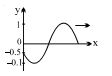
The equation of a wave travelling along the positive $x$-axis,as shown in the figure at $t = 0$,is given by:
A
$\sin(kx - \omega t + \frac{\pi}{6})$
B
$\sin(kx - \omega t - \frac{\pi}{6})$
C
$\sin(\omega t - kx + \frac{\pi}{6})$
D
$\sin(\omega t - kx - \frac{\pi}{6})$
Solution
(D) The general equation for a wave travelling in the positive $x$-direction is $y = A \sin(kx - \omega t + \phi)$.
Given the amplitude $A = 1$,the equation becomes $y = \sin(kx - \omega t + \phi)$.
At $t = 0$,the equation is $y = \sin(kx + \phi)$.
From the graph at $t = 0$,when $x = 0$,$y = -0.5$.
Substituting these values: $-0.5 = \sin(0 + \phi) \Rightarrow \sin(\phi) = -0.5$.
This gives $\phi = -\frac{\pi}{6}$ or $\phi = -\frac{5\pi}{6}$.
Since the wave is moving in the positive $x$-direction,the particle at $x = 0$ is moving upwards (as the wave crest is approaching $x = 0$ from the negative side),so the velocity $v = \frac{dy}{dt} = -\omega \cos(kx - \omega t + \phi)$ must be positive at $t = 0, x = 0$.
For $v > 0$,we need $\cos(\phi) < 0$. Since $\cos(-\frac{\pi}{6}) = \frac{\sqrt{3}}{2} > 0$ and $\cos(-\frac{5\pi}{6}) = -\frac{\sqrt{3}}{2} < 0$,we choose $\phi = -\frac{5\pi}{6}$.
Thus,$y = \sin(kx - \omega t - \frac{5\pi}{6}) = \sin(\omega t - kx + \frac{5\pi}{6})$.
However,checking the options provided,the standard form for a wave moving in the positive $x$-direction is $y = \sin(\omega t - kx + \phi)$.
At $t = 0, x = 0, y = -0.5$,we have $\sin(\phi) = -0.5$,so $\phi = -\frac{\pi}{6}$.
Substituting this,$y = \sin(\omega t - kx - \frac{\pi}{6})$,which matches option $D$.
Given the amplitude $A = 1$,the equation becomes $y = \sin(kx - \omega t + \phi)$.
At $t = 0$,the equation is $y = \sin(kx + \phi)$.
From the graph at $t = 0$,when $x = 0$,$y = -0.5$.
Substituting these values: $-0.5 = \sin(0 + \phi) \Rightarrow \sin(\phi) = -0.5$.
This gives $\phi = -\frac{\pi}{6}$ or $\phi = -\frac{5\pi}{6}$.
Since the wave is moving in the positive $x$-direction,the particle at $x = 0$ is moving upwards (as the wave crest is approaching $x = 0$ from the negative side),so the velocity $v = \frac{dy}{dt} = -\omega \cos(kx - \omega t + \phi)$ must be positive at $t = 0, x = 0$.
For $v > 0$,we need $\cos(\phi) < 0$. Since $\cos(-\frac{\pi}{6}) = \frac{\sqrt{3}}{2} > 0$ and $\cos(-\frac{5\pi}{6}) = -\frac{\sqrt{3}}{2} < 0$,we choose $\phi = -\frac{5\pi}{6}$.
Thus,$y = \sin(kx - \omega t - \frac{5\pi}{6}) = \sin(\omega t - kx + \frac{5\pi}{6})$.
However,checking the options provided,the standard form for a wave moving in the positive $x$-direction is $y = \sin(\omega t - kx + \phi)$.
At $t = 0, x = 0, y = -0.5$,we have $\sin(\phi) = -0.5$,so $\phi = -\frac{\pi}{6}$.
Substituting this,$y = \sin(\omega t - kx - \frac{\pi}{6})$,which matches option $D$.
0 likes
View Solution120
MediumMCQ
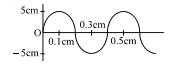
The figure shows the shape of a part of a long string in which transverse waves are produced by attaching one end of the string to a tuning fork of frequency $250 \ Hz$. What is the velocity of the waves in $ms^{-1}$?
A
$1.0$
B
$1.5$
C
$2.0$
D
$2.5$
Solution
(A) The velocity of a wave is given by the formula $v = \lambda f$.
From the given graph,the distance between two consecutive crests or two consecutive troughs represents the wavelength $\lambda$.
The graph shows that one full wave cycle (from $0.1 \ cm$ to $0.5 \ cm$) corresponds to a distance of $0.4 \ cm$.
Thus,the wavelength $\lambda = 0.4 \ cm = 0.4 \times 10^{-2} \ m = 4 \times 10^{-3} \ m$.
The frequency $f$ is given as $250 \ Hz$.
Substituting these values into the formula:
$v = (4 \times 10^{-3} \ m) \times (250 \ Hz)$
$v = 1000 \times 10^{-3} \ m/s$
$v = 1.0 \ m/s$.
From the given graph,the distance between two consecutive crests or two consecutive troughs represents the wavelength $\lambda$.
The graph shows that one full wave cycle (from $0.1 \ cm$ to $0.5 \ cm$) corresponds to a distance of $0.4 \ cm$.
Thus,the wavelength $\lambda = 0.4 \ cm = 0.4 \times 10^{-2} \ m = 4 \times 10^{-3} \ m$.
The frequency $f$ is given as $250 \ Hz$.
Substituting these values into the formula:
$v = (4 \times 10^{-3} \ m) \times (250 \ Hz)$
$v = 1000 \times 10^{-3} \ m/s$
$v = 1.0 \ m/s$.
0 likes
View Solution121
MediumMCQ
$A$ wave travels uniformly in all directions from a point source in an isotropic medium. The displacement of the medium at any point at a distance $r$ from the source may be represented by ($A$ is a constant representing strength of source)
A
$[A/\sqrt{r}] \sin(kr - \omega t)$
B
$[A/r] \sin(kr - \omega t)$
C
$[Ar] \sin(kr - \omega t)$
D
$[A/r^2] \sin(kr - \omega t)$
Solution
(B) For a spherical wave traveling uniformly in all directions from a point source,the energy is distributed over the surface area of a sphere,which is $4\pi r^2$.
Since the intensity $I$ is proportional to the square of the amplitude $a$ $(I \propto a^2)$ and intensity also follows the inverse square law $(I \propto 1/r^2)$,we have $a^2 \propto 1/r^2$,which implies $a \propto 1/r$.
Therefore,the amplitude of the wave at a distance $r$ is given by $A/r$.
Thus,the displacement of the medium at distance $r$ is represented by $y = \frac{A}{r} \sin(kr - \omega t)$.
Since the intensity $I$ is proportional to the square of the amplitude $a$ $(I \propto a^2)$ and intensity also follows the inverse square law $(I \propto 1/r^2)$,we have $a^2 \propto 1/r^2$,which implies $a \propto 1/r$.
Therefore,the amplitude of the wave at a distance $r$ is given by $A/r$.
Thus,the displacement of the medium at distance $r$ is represented by $y = \frac{A}{r} \sin(kr - \omega t)$.
0 likes
View Solution122
MediumMCQ
$A$ transverse wave is described by the equation $y = A \sin [2\pi (f t - x/\lambda ) ]$. The maximum particle velocity is equal to four times the wave velocity if:
A
$\lambda = \pi A/4$
B
$\lambda = \pi A/2$
C
$\lambda = \pi A$
D
$\lambda = 2\pi A$
Solution
(B) In a plane progressive transverse wave,particles of the medium oscillate simple harmonically about their mean positions. Hence,the concepts of $SHM$ are applicable to the particles.
The maximum particle velocity is given by $v_{p,max} = A \omega$,which occurs at the mean position.
From the given wave equation:
$y = A \sin (2 \pi f t - 2 \pi x / \lambda)$
Comparing this with the standard wave equation $y = A \sin (\omega t - kx)$,we get:
Angular frequency $\omega = 2 \pi f$
Wave number $k = 2 \pi / \lambda$
The wave velocity $v$ is given by:
$v = \omega / k = (2 \pi f) / (2 \pi / \lambda) = \lambda f$
According to the given condition,the maximum particle velocity is four times the wave velocity:
$A \omega = 4 v$
$A (2 \pi f) = 4 (\lambda f)$
$2 \pi A f = 4 \lambda f$
$\lambda = (2 \pi A) / 4$
$\lambda = \pi A / 2$
The maximum particle velocity is given by $v_{p,max} = A \omega$,which occurs at the mean position.
From the given wave equation:
$y = A \sin (2 \pi f t - 2 \pi x / \lambda)$
Comparing this with the standard wave equation $y = A \sin (\omega t - kx)$,we get:
Angular frequency $\omega = 2 \pi f$
Wave number $k = 2 \pi / \lambda$
The wave velocity $v$ is given by:
$v = \omega / k = (2 \pi f) / (2 \pi / \lambda) = \lambda f$
According to the given condition,the maximum particle velocity is four times the wave velocity:
$A \omega = 4 v$
$A (2 \pi f) = 4 (\lambda f)$
$2 \pi A f = 4 \lambda f$
$\lambda = (2 \pi A) / 4$
$\lambda = \pi A / 2$
0 likes
View Solution123
MediumMCQ
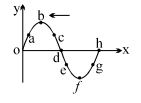
The figure represents the instantaneous picture of a transverse harmonic wave traveling along the negative $x$-axis. Choose the correct alternative$(s)$ related to the movement of the nine points shown in the figure. The points moving upward is/are
A
$a$
B
$g$
C
$f$
D
both $(A)$ and $(B)$
Solution
(D) The wave is traveling in the negative $x$-direction.
To determine the direction of motion of a particle at a given point,we can imagine the wave shifting slightly to the left (negative $x$-direction).
Points that are on the 'front' of the wave crest or trough relative to the direction of propagation will move in a specific direction.
For a wave moving in the negative $x$-direction:
- Points on the rising part of the wave (slope is negative) move upward.
- Points on the falling part of the wave (slope is positive) move downward.
Looking at the figure:
- Point $a$ is on the rising slope of the crest,so it is moving upward.
- Point $g$ is on the rising slope of the trough,so it is moving upward.
- Point $f$ is at the bottom of the trough,so it is at its extreme position and momentarily at rest.
Therefore,both points $a$ and $g$ are moving upward.
The correct option is $(D)$.
To determine the direction of motion of a particle at a given point,we can imagine the wave shifting slightly to the left (negative $x$-direction).
Points that are on the 'front' of the wave crest or trough relative to the direction of propagation will move in a specific direction.
For a wave moving in the negative $x$-direction:
- Points on the rising part of the wave (slope is negative) move upward.
- Points on the falling part of the wave (slope is positive) move downward.
Looking at the figure:
- Point $a$ is on the rising slope of the crest,so it is moving upward.
- Point $g$ is on the rising slope of the trough,so it is moving upward.
- Point $f$ is at the bottom of the trough,so it is at its extreme position and momentarily at rest.
Therefore,both points $a$ and $g$ are moving upward.
The correct option is $(D)$.
0 likes
View Solution124
MediumMCQ
The figure represents the instantaneous snapshot of a transverse harmonic wave traveling along the negative $x$-axis. Choose the correct alternative(s) related to the movement of the points shown in the figure. The point(s) moving downwards is/are:
A
$a$
B
$b$
C
$c$
D
$d$
Solution
(C, D) For a wave traveling in the negative $x$-direction, the velocity of a particle at any point $x$ is given by $v_p = -v \cdot (\text{slope})$, where $v$ is the wave speed and the slope is $\frac{\partial y}{\partial x}$.
Since the wave is moving in the negative $x$-direction, $v$ is negative. Thus, $v_p = |v| \cdot (\text{slope})$.
Therefore, a particle moves downwards $(v_p < 0)$ where the slope of the wave is negative.
Looking at the graph:
- At point $a$, the slope is positive, so it moves upwards.
- At point $b$, the slope is zero (it is a crest).
- At point $c$, the slope is negative, so it moves downwards.
- At point $d$, the slope is negative, so it moves downwards.
- At point $e$, the slope is positive, so it moves upwards.
- At point $f$, the slope is zero (it is a trough).
- At point $g$, the slope is positive, so it moves upwards.
- At point $h$, the slope is positive, so it moves upwards.
Thus, points $c$ and $d$ are moving downwards.
Since the wave is moving in the negative $x$-direction, $v$ is negative. Thus, $v_p = |v| \cdot (\text{slope})$.
Therefore, a particle moves downwards $(v_p < 0)$ where the slope of the wave is negative.
Looking at the graph:
- At point $a$, the slope is positive, so it moves upwards.
- At point $b$, the slope is zero (it is a crest).
- At point $c$, the slope is negative, so it moves downwards.
- At point $d$, the slope is negative, so it moves downwards.
- At point $e$, the slope is positive, so it moves upwards.
- At point $f$, the slope is zero (it is a trough).
- At point $g$, the slope is positive, so it moves upwards.
- At point $h$, the slope is positive, so it moves upwards.
Thus, points $c$ and $d$ are moving downwards.
0 likes
View Solution125
MediumMCQ
The figure represents the instantaneous picture of a transverse harmonic wave traveling along the negative $x$-axis. Choose the correct alternative$(s)$ related to the movement of the nine points shown in the figure. The stationary point$(s)$ is/are:
A
$o$
B
$b$
C
$f$
D
both $(b)$ and $(f)$
Solution
(D) In a transverse wave,the particles at the crests and troughs have zero instantaneous velocity because they are at their extreme positions of displacement.
For a wave traveling along the negative $x$-axis,the points $b$ and $f$ represent the crest and trough respectively.
At these extreme positions,the vertical velocity of the particles is momentarily zero.
Therefore,the points $b$ and $f$ are the stationary points at this instant.
Thus,the correct option is $(D)$.
For a wave traveling along the negative $x$-axis,the points $b$ and $f$ represent the crest and trough respectively.
At these extreme positions,the vertical velocity of the particles is momentarily zero.
Therefore,the points $b$ and $f$ are the stationary points at this instant.
Thus,the correct option is $(D)$.
0 likes
View Solution126
MediumMCQ
The figure represents the instantaneous picture of a transverse harmonic wave traveling along the negative $x$-axis. Choose the correct alternative(s) related to the movement of the points shown in the figure. The points moving with maximum velocity is/are:
A
$b$
B
$h$
C
$d$
D
both $(b)$ and $(d)$
Solution
(C) In a transverse harmonic wave, the velocity of a particle is given by $v_p = -v \cdot (\text{slope})$, where $v$ is the wave speed and the slope is $\frac{\partial y}{\partial x}$.
For a wave traveling in the negative $x$-direction, the particle velocity is $v_p = v \cdot (\text{slope})$.
The particle velocity is maximum at the mean position (where the displacement $y = 0$) because the slope is maximum there.
Looking at the figure, the points $o$, $d$, and $h$ are at the mean position $(y = 0)$.
Among the given options, point $d$ is at the mean position.
Points $b$ and $f$ are at the extreme positions where the velocity is zero.
Therefore, the point moving with maximum velocity is $d$.
For a wave traveling in the negative $x$-direction, the particle velocity is $v_p = v \cdot (\text{slope})$.
The particle velocity is maximum at the mean position (where the displacement $y = 0$) because the slope is maximum there.
Looking at the figure, the points $o$, $d$, and $h$ are at the mean position $(y = 0)$.
Among the given options, point $d$ is at the mean position.
Points $b$ and $f$ are at the extreme positions where the velocity is zero.
Therefore, the point moving with maximum velocity is $d$.
0 likes
View Solution127
DifficultMCQ
$A$ plane wave $y = A \sin \omega \left( t - \frac{x}{v} \right)$ undergoes normal incidence on a plane boundary separating medium $M_1$ and $M_2$ and splits into a reflected and transmitted wave having speeds $v_1$ and $v_2$. Then:
A
For all values of $v_1$ and $v_2$,the phase of the transmitted wave is the same as that of the incident wave.
B
The phase of the reflected wave depends upon $v_1$ and $v_2$.
C
The phase of the transmitted wave depends upon $v_1$ and $v_2$.
D
Both $(A)$ and $(B)$.
Solution
(D) When a wave travels from medium $1$ (speed $v_1$) to medium $2$ (speed $v_2$),the transmitted wave always maintains the same phase as the incident wave because the amplitude coefficient $\frac{2v_2}{v_1+v_2}$ is always positive.
The reflected wave amplitude is given by $A_r = \left( \frac{v_2 - v_1}{v_1 + v_2} \right) A_i$.
If $v_2 > v_1$,the term $\frac{v_2 - v_1}{v_1 + v_2}$ is positive,meaning the reflected wave is in phase with the incident wave.
If $v_2 < v_1$,the term $\frac{v_2 - v_1}{v_1 + v_2}$ is negative,which introduces a phase change of $\pi$ radians (a phase reversal).
Therefore,the phase of the reflected wave depends on the relative values of $v_1$ and $v_2$.
The reflected wave amplitude is given by $A_r = \left( \frac{v_2 - v_1}{v_1 + v_2} \right) A_i$.
If $v_2 > v_1$,the term $\frac{v_2 - v_1}{v_1 + v_2}$ is positive,meaning the reflected wave is in phase with the incident wave.
If $v_2 < v_1$,the term $\frac{v_2 - v_1}{v_1 + v_2}$ is negative,which introduces a phase change of $\pi$ radians (a phase reversal).
Therefore,the phase of the reflected wave depends on the relative values of $v_1$ and $v_2$.
0 likes
View Solution128
MediumMCQ
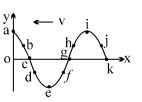
The figure represents the instantaneous snapshot of a transverse harmonic wave traveling along the negative $x$-axis. Identify the correct point(s) moving in the negative $y$-direction (downward).
A
$b$
B
$c$
C
$f$
D
$i$
Solution
(C) For a wave traveling in the negative $x$-direction, the velocity of a particle at any point is given by $v_p = -v \cdot (\text{slope})$, where $v$ is the wave speed and the slope is $\frac{\partial y}{\partial x}$.
Since the wave is moving in the negative $x$-direction, the particle velocity $v_p$ is positive (upward) where the slope is negative, and $v_p$ is negative (downward) where the slope is positive.
Looking at the graph:
- At point $b$, the slope is negative, so the particle moves upward.
- At point $c$, the slope is negative, so the particle moves upward.
- At point $f$, the slope is positive, so the particle moves downward.
- At point $i$, the slope is zero (at the crest), so the particle is momentarily at rest.
Therefore, the point moving in the negative $y$-direction is $f$.
Since the wave is moving in the negative $x$-direction, the particle velocity $v_p$ is positive (upward) where the slope is negative, and $v_p$ is negative (downward) where the slope is positive.
Looking at the graph:
- At point $b$, the slope is negative, so the particle moves upward.
- At point $c$, the slope is negative, so the particle moves upward.
- At point $f$, the slope is positive, so the particle moves downward.
- At point $i$, the slope is zero (at the crest), so the particle is momentarily at rest.
Therefore, the point moving in the negative $y$-direction is $f$.
0 likes
View Solution129
DifficultMCQ
The figure represents the instantaneous picture of a transverse harmonic wave travelling along the negative $x$-axis. Identify the correct statement(s) related to the movement of the points shown in the figure. The points moving opposite to the direction of propagation (i.e., moving in the negative $y$-direction) are:
A
$a, b$
B
$d, e, f$
C
$h, i, j$
D
$b, c, d$
Solution
(B) For a wave travelling in the negative $x$-direction, the velocity of a particle at any point is given by $v_p = -v \cdot (\text{slope})$.
Here, $v$ is the wave speed (positive value) and the slope is $\frac{dy}{dx}$ at that point.
For the particle to move in the negative $y$-direction, $v_p$ must be negative.
This implies that $-v \cdot (\text{slope}) < 0$, which means the slope must be positive.
Looking at the graph, the slope is positive in the regions where the curve is increasing (going upwards from left to right).
These regions correspond to the points $d, e, f$.
Thus, the points $d, e, f$ are moving in the negative $y$-direction.
Here, $v$ is the wave speed (positive value) and the slope is $\frac{dy}{dx}$ at that point.
For the particle to move in the negative $y$-direction, $v_p$ must be negative.
This implies that $-v \cdot (\text{slope}) < 0$, which means the slope must be positive.
Looking at the graph, the slope is positive in the regions where the curve is increasing (going upwards from left to right).
These regions correspond to the points $d, e, f$.
Thus, the points $d, e, f$ are moving in the negative $y$-direction.
0 likes
View Solution130
MediumMCQ
The figure represents the instantaneous picture of a longitudinal harmonic wave travelling along the negative $x$-axis. Identify the correct statement$(s)$ related to the movement of the points shown in the figure. The stationary points are
A
$a$
B
$c$
C
$g$
D
$k$
Solution
(A, C, D) In a wave,the stationary points are those where the displacement is at its maximum or minimum (i.e.,the crests and troughs).
At these points,the particle velocity is zero at that specific instant.
Looking at the figure,the points $a$,$e$,$i$,and $k$ are at the extreme positions (crests or troughs).
Therefore,the stationary points are $a$,$e$,$i$,and $k$.
At these points,the particle velocity is zero at that specific instant.
Looking at the figure,the points $a$,$e$,$i$,and $k$ are at the extreme positions (crests or troughs).
Therefore,the stationary points are $a$,$e$,$i$,and $k$.
0 likes
View Solution131
DifficultMCQ
The figure represents the instantaneous picture of a longitudinal harmonic wave travelling along the negative $x$-axis. Identify the correct statement$(s)$ related to the movement of the points shown in the figure. The points with maximum displacement are:
A
$a$
B
$e$
C
$i$
D
All of the above
Solution
(D) In a wave displacement-position graph,the points with maximum displacement from the equilibrium position $(y = 0)$ are the crests and troughs of the wave.
Looking at the provided figure,the points $a$,$e$,and $i$ represent the peaks (crests) and valleys (troughs) of the wave.
Point $a$ is at a maximum positive displacement.
Point $e$ is at a maximum negative displacement.
Point $i$ is at a maximum positive displacement.
Therefore,all these points ($a$,$e$,and $i$) correspond to the positions of maximum displacement.
Thus,the correct option is $D$.
Looking at the provided figure,the points $a$,$e$,and $i$ represent the peaks (crests) and valleys (troughs) of the wave.
Point $a$ is at a maximum positive displacement.
Point $e$ is at a maximum negative displacement.
Point $i$ is at a maximum positive displacement.
Therefore,all these points ($a$,$e$,and $i$) correspond to the positions of maximum displacement.
Thus,the correct option is $D$.
0 likes
View Solution132
MediumMCQ
$A$ wave travelling along the $x$-axis is described by the equation $y(x, t) = 0.005 \cos(\alpha x - \beta t)$. If the wavelength and the time period of the wave are $0.08 \ m$ and $2.0 \ s$,respectively,then $\alpha$ and $\beta$ in appropriate units are:
A
$\alpha = 12.5\pi, \beta = \frac{\pi}{2}$
B
$\alpha = 25\pi, \beta = \pi$
C
$\alpha = \frac{0.08}{\pi}, \beta = \frac{2}{\pi}$
D
$\alpha = \frac{0.04}{\pi}, \beta = \frac{1}{\pi}$
Solution
(B) The given wave equation is $y(x, t) = 0.005 \cos(\alpha x - \beta t)$.
Comparing this with the standard wave equation $y(x, t) = a \cos(kx - \omega t)$,we identify the wave number $k = \alpha$ and the angular frequency $\omega = \beta$.
The wave number is defined as $k = \frac{2\pi}{\lambda}$. Given $\lambda = 0.08 \ m$,we have $\alpha = \frac{2\pi}{0.08} = 25\pi \ rad/m$.
The angular frequency is defined as $\omega = \frac{2\pi}{T}$. Given $T = 2.0 \ s$,we have $\beta = \frac{2\pi}{2.0} = \pi \ rad/s$.
Thus,$\alpha = 25\pi$ and $\beta = \pi$.
Comparing this with the standard wave equation $y(x, t) = a \cos(kx - \omega t)$,we identify the wave number $k = \alpha$ and the angular frequency $\omega = \beta$.
The wave number is defined as $k = \frac{2\pi}{\lambda}$. Given $\lambda = 0.08 \ m$,we have $\alpha = \frac{2\pi}{0.08} = 25\pi \ rad/m$.
The angular frequency is defined as $\omega = \frac{2\pi}{T}$. Given $T = 2.0 \ s$,we have $\beta = \frac{2\pi}{2.0} = \pi \ rad/s$.
Thus,$\alpha = 25\pi$ and $\beta = \pi$.
0 likes
View Solution133
DifficultMCQ
The transverse displacement $y(x, t)$ of a wave on a string is given by $y(x, t) = e^{-(ax^2 + bt^2 + 2\sqrt{ab}xt)}$. This represents a:
A
wave moving in $+x$ direction with speed $\sqrt{\frac{a}{b}}$
B
wave moving in $-x$ direction with speed $\sqrt{\frac{b}{a}}$
C
standing wave of frequency $\sqrt{b}$
D
standing wave of frequency $\frac{1}{\sqrt{b}}$
Solution
(B) The given wave equation is $y(x, t) = e^{-(ax^2 + bt^2 + 2\sqrt{ab}xt)}$.
We can rewrite the exponent as a perfect square:
$ax^2 + bt^2 + 2\sqrt{ab}xt = (\sqrt{a}x + \sqrt{b}t)^2 = a(x + \sqrt{\frac{b}{a}}t)^2$.
Thus,$y(x, t) = e^{-a(x + \sqrt{\frac{b}{a}}t)^2}$.
This is a function of the form $y = f(x + vt)$,which represents a wave traveling in the negative $x$-direction.
Comparing $x + \sqrt{\frac{b}{a}}t$ with $x + vt$,we get the wave speed $v = \sqrt{\frac{b}{a}}$.
Therefore,it represents a wave moving in the $-x$ direction with speed $\sqrt{\frac{b}{a}}$.
We can rewrite the exponent as a perfect square:
$ax^2 + bt^2 + 2\sqrt{ab}xt = (\sqrt{a}x + \sqrt{b}t)^2 = a(x + \sqrt{\frac{b}{a}}t)^2$.
Thus,$y(x, t) = e^{-a(x + \sqrt{\frac{b}{a}}t)^2}$.
This is a function of the form $y = f(x + vt)$,which represents a wave traveling in the negative $x$-direction.
Comparing $x + \sqrt{\frac{b}{a}}t$ with $x + vt$,we get the wave speed $v = \sqrt{\frac{b}{a}}$.
Therefore,it represents a wave moving in the $-x$ direction with speed $\sqrt{\frac{b}{a}}$.
0 likes
View Solution134
MediumMCQ
Consider the snapshot of a wave traveling in the positive $x$-direction.
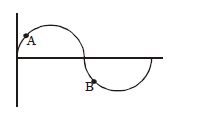
A
The particle $A$ is moving in the $-ve$ $y$-direction and particle $B$ is moving in the $+ve$ $y$-direction.
B
The particle $B$ is moving in the $-ve$ $y$-direction and particle $A$ is moving in the $+ve$ $y$-direction.
C
Both are moving in the $+ve$ $y$-direction.
D
Both are moving in the $-ve$ $y$-direction.
Solution
(A) The velocity of a particle in a wave is given by the relation: $v_p = -(\text{slope}) \times v_{\text{wave}}$.
Since the wave is traveling in the positive $x$-direction,$v_{\text{wave}}$ is positive.
At point $A$,the slope of the wave displacement curve is positive. Therefore,$v_p = -(\text{positive}) \times (\text{positive}) = \text{negative}$. Thus,particle $A$ is moving in the $-ve$ $y$-direction.
At point $B$,the slope of the wave displacement curve is negative. Therefore,$v_p = -(\text{negative}) \times (\text{positive}) = \text{positive}$. Thus,particle $B$ is moving in the $+ve$ $y$-direction.
Hence,particle $A$ moves in the $-ve$ $y$-direction and particle $B$ moves in the $+ve$ $y$-direction.
Since the wave is traveling in the positive $x$-direction,$v_{\text{wave}}$ is positive.
At point $A$,the slope of the wave displacement curve is positive. Therefore,$v_p = -(\text{positive}) \times (\text{positive}) = \text{negative}$. Thus,particle $A$ is moving in the $-ve$ $y$-direction.
At point $B$,the slope of the wave displacement curve is negative. Therefore,$v_p = -(\text{negative}) \times (\text{positive}) = \text{positive}$. Thus,particle $B$ is moving in the $+ve$ $y$-direction.
Hence,particle $A$ moves in the $-ve$ $y$-direction and particle $B$ moves in the $+ve$ $y$-direction.
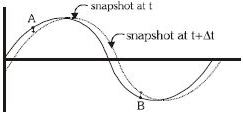
0 likes
View Solution135
MediumMCQ
The equation of a wave is given by (all quantities expressed in $M.K.S.$ units) $Y = 5 \sin(10\pi t - 0.1\pi x)$ along the $x$-axis. The phase difference between two points separated by a distance of $10 \ m$ along the $x$-axis is:
A
$\frac{\pi}{2}$
B
$\pi$
C
$2\pi$
D
$\frac{\pi}{4}$
Solution
(B) The standard wave equation is given by $Y = A \sin(\omega t - kx)$.
Comparing this with the given equation $Y = 5 \sin(10\pi t - 0.1\pi x)$,we get the wave number $k = 0.1\pi \ rad/m$.
The phase difference $\Delta\phi$ between two points separated by a distance $\Delta x$ is given by the formula $\Delta\phi = k \cdot \Delta x$.
Given $\Delta x = 10 \ m$ and $k = 0.1\pi \ rad/m$,we have:
$\Delta\phi = (0.1\pi) \times 10 = \pi \ rad$.
Therefore,the phase difference is $\pi$.
Comparing this with the given equation $Y = 5 \sin(10\pi t - 0.1\pi x)$,we get the wave number $k = 0.1\pi \ rad/m$.
The phase difference $\Delta\phi$ between two points separated by a distance $\Delta x$ is given by the formula $\Delta\phi = k \cdot \Delta x$.
Given $\Delta x = 10 \ m$ and $k = 0.1\pi \ rad/m$,we have:
$\Delta\phi = (0.1\pi) \times 10 = \pi \ rad$.
Therefore,the phase difference is $\pi$.
0 likes
View Solution136
DifficultMCQ
$A$ triangular pulse moving at $2 \ cm/s$ on a rope approaches an end at which it is free to slide on a vertical pole. What is the particle speed at the free end at $\frac{3}{4} \ s$ from the instant shown? (in $cm/s$)
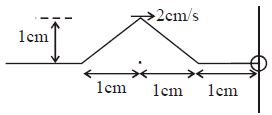
A
$2$
B
$1$
C
$3$
D
$4$
Solution
(A) The wave pulse moves at a speed $v_w = 2 \ cm/s$.
At $t = 0$,the trailing edge of the pulse is at a distance of $2 \ cm$ from the free end.
In $t = \frac{3}{4} \ s$,the pulse travels a distance $d = v_w \times t = 2 \times \frac{3}{4} = 1.5 \ cm$.
Since the trailing edge was $2 \ cm$ away,after $0.75 \ s$,the trailing edge is at $2 - 1.5 = 0.5 \ cm$ from the free end.
This means the free end is currently located on the trailing slope of the triangular pulse.
The slope of the trailing edge is $m = \frac{\text{height}}{\text{base}} = \frac{1 \ cm}{1 \ cm} = 1$.
For a wave pulse,the particle velocity $v_p$ is given by $v_p = -v_w \times \text{slope}$.
Since the trailing edge has a negative slope (relative to the direction of motion),the particle velocity at the free end is $v_p = -2 \times (-1) = 2 \ cm/s$.
At $t = 0$,the trailing edge of the pulse is at a distance of $2 \ cm$ from the free end.
In $t = \frac{3}{4} \ s$,the pulse travels a distance $d = v_w \times t = 2 \times \frac{3}{4} = 1.5 \ cm$.
Since the trailing edge was $2 \ cm$ away,after $0.75 \ s$,the trailing edge is at $2 - 1.5 = 0.5 \ cm$ from the free end.
This means the free end is currently located on the trailing slope of the triangular pulse.
The slope of the trailing edge is $m = \frac{\text{height}}{\text{base}} = \frac{1 \ cm}{1 \ cm} = 1$.
For a wave pulse,the particle velocity $v_p$ is given by $v_p = -v_w \times \text{slope}$.
Since the trailing edge has a negative slope (relative to the direction of motion),the particle velocity at the free end is $v_p = -2 \times (-1) = 2 \ cm/s$.
0 likes
View Solution137
MediumMCQ
$A$ wave travelling along the $x$-axis is described by the equation $y(x, t) = 0.005 \cos(\alpha x - \beta t)$. If the wavelength and the time period of the wave are $0.08 \ m$ and $2.0 \ s$ respectively,then $\alpha$ and $\beta$ in appropriate units are:
A
$\alpha = 25.00\pi, \beta = \pi$
B
$\alpha = \frac{0.08}{\pi}, \beta = \frac{2.0}{\pi}$
C
$\alpha = \frac{0.04}{\pi}, \beta = \frac{1.0}{\pi}$
D
$\alpha = 12.50\pi, \beta = \frac{\pi}{2.0}$
Solution
(A) The general equation of a travelling wave is given by $y(x, t) = A \cos(kx - \omega t)$.
Comparing this with the given equation $y(x, t) = 0.005 \cos(\alpha x - \beta t)$,we identify $\alpha = k$ and $\beta = \omega$.
The wave number $k$ is related to the wavelength $\lambda$ by the formula $k = \frac{2\pi}{\lambda}$.
Given $\lambda = 0.08 \ m$,we have $\alpha = k = \frac{2\pi}{0.08} = 25\pi \ m^{-1}$.
The angular frequency $\omega$ is related to the time period $T$ by the formula $\omega = \frac{2\pi}{T}$.
Given $T = 2.0 \ s$,we have $\beta = \omega = \frac{2\pi}{2.0} = \pi \ rad/s$.
Thus,$\alpha = 25\pi$ and $\beta = \pi$.
Comparing this with the given equation $y(x, t) = 0.005 \cos(\alpha x - \beta t)$,we identify $\alpha = k$ and $\beta = \omega$.
The wave number $k$ is related to the wavelength $\lambda$ by the formula $k = \frac{2\pi}{\lambda}$.
Given $\lambda = 0.08 \ m$,we have $\alpha = k = \frac{2\pi}{0.08} = 25\pi \ m^{-1}$.
The angular frequency $\omega$ is related to the time period $T$ by the formula $\omega = \frac{2\pi}{T}$.
Given $T = 2.0 \ s$,we have $\beta = \omega = \frac{2\pi}{2.0} = \pi \ rad/s$.
Thus,$\alpha = 25\pi$ and $\beta = \pi$.
0 likes
View Solution138
MediumMCQ
The displacement $y$ of a wave travelling in the $x$-direction is given by $y = 10^{-4} \sin(600t - 2x + \frac{\pi}{3}) \, \text{m}$,where $x$ is expressed in metres and $t$ in seconds. The speed of the wave in $\text{m/s}$ is:
A
$300$
B
$600$
C
$1200$
D
$200$
Solution
(A) The general equation of a travelling wave is given by $y = A \sin(\omega t - kx + \phi)$.
Comparing this with the given equation $y = 10^{-4} \sin(600t - 2x + \frac{\pi}{3})$:
We identify the angular frequency $\omega = 600 \, \text{rad/s}$ and the wave number $k = 2 \, \text{rad/m}$.
The speed of the wave $v$ is given by the formula $v = \frac{\omega}{k}$.
Substituting the values,$v = \frac{600}{2} = 300 \, \text{m/s}$.
Comparing this with the given equation $y = 10^{-4} \sin(600t - 2x + \frac{\pi}{3})$:
We identify the angular frequency $\omega = 600 \, \text{rad/s}$ and the wave number $k = 2 \, \text{rad/m}$.
The speed of the wave $v$ is given by the formula $v = \frac{\omega}{k}$.
Substituting the values,$v = \frac{600}{2} = 300 \, \text{m/s}$.
0 likes
View Solution139
MediumMCQ
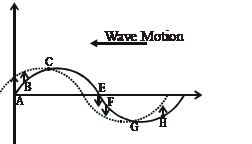
$A$ transverse wave is travelling along a stretched string from right to left. The figure shown represents the shape of the string at a given instant. At this instant,
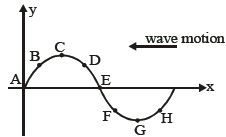
A
the particles at $A, B$ and $H$ have downward velocity
B
the particles at $D, E$ and $F$ have downward velocity
C
the particles at $C, E$ and $G$ have zero velocity
D
the particles at $A$ and $F$ have maximum velocity
Solution
(B) To determine the direction of velocity of particles in a transverse wave,we can visualize the wave moving slightly in the direction of propagation.
Since the wave is moving from right to left,the wave profile shifts to the left.
$1$. At point $D, E, F$: As the wave moves to the left,the profile at these points will shift downwards,meaning these particles have a downward velocity.
$2$. At point $C, G$: These are extreme positions (crests and troughs),so their instantaneous velocity is zero.
$3$. At point $A, B, H$: As the wave moves to the left,the profile at these points will shift upwards,meaning these particles have an upward velocity.
Therefore,the particles at $D, E$ and $F$ have downward velocity. The correct option is $B$.
Since the wave is moving from right to left,the wave profile shifts to the left.
$1$. At point $D, E, F$: As the wave moves to the left,the profile at these points will shift downwards,meaning these particles have a downward velocity.
$2$. At point $C, G$: These are extreme positions (crests and troughs),so their instantaneous velocity is zero.
$3$. At point $A, B, H$: As the wave moves to the left,the profile at these points will shift upwards,meaning these particles have an upward velocity.
Therefore,the particles at $D, E$ and $F$ have downward velocity. The correct option is $B$.
0 likes
View Solution140
DifficultMCQ
$A$ transverse harmonic wave on a string is described by $y = 3 \sin (36t + 0.018x + \frac{\pi}{4})$,where $x$ and $y$ are in $cm$ and $t$ is in $s$. The least distance between two successive crests in the wave is .... $m$. (in $.5$)
A
$2$
B
$3$
C
$1$
D
$4$
Solution
(B) The standard equation of a transverse harmonic wave is given by $y = A \sin (\omega t + kx + \phi)$.
Comparing this with the given equation $y = 3 \sin (36t + 0.018x + \frac{\pi}{4})$,we identify the wave number $k = 0.018 \, cm^{-1}$.
The distance between two successive crests is equal to the wavelength $\lambda$.
The relationship between wavelength and wave number is $\lambda = \frac{2\pi}{k}$.
Substituting the value of $k$: $\lambda = \frac{2 \times 3.1416}{0.018} \approx 349.06 \, cm$.
To convert this into meters,we divide by $100$: $\lambda = \frac{349.06}{100} \approx 3.49 \, m$.
Rounding to the nearest provided option,the distance is $3.5 \, m$.
Comparing this with the given equation $y = 3 \sin (36t + 0.018x + \frac{\pi}{4})$,we identify the wave number $k = 0.018 \, cm^{-1}$.
The distance between two successive crests is equal to the wavelength $\lambda$.
The relationship between wavelength and wave number is $\lambda = \frac{2\pi}{k}$.
Substituting the value of $k$: $\lambda = \frac{2 \times 3.1416}{0.018} \approx 349.06 \, cm$.
To convert this into meters,we divide by $100$: $\lambda = \frac{349.06}{100} \approx 3.49 \, m$.
Rounding to the nearest provided option,the distance is $3.5 \, m$.
0 likes
View Solution141
MediumMCQ
If a given wave has a propagation constant of $\frac{5 \pi}{7} \, rad/m$,then the phase difference between two particles having a distance difference of $\frac{49}{22} \, m$ is ..... $rad.$ (Take $\pi = \frac{22}{7}$)
A
$5$
B
$10$
C
$2.5$
D
$5/7$
Solution
(A) The phase difference $\Delta \phi$ is related to the path difference $\Delta x$ and the propagation constant $k$ by the formula: $\Delta \phi = k \cdot \Delta x$.
Given:
Propagation constant $k = \frac{5 \pi}{7} \, rad/m$.
Path difference $\Delta x = \frac{49}{22} \, m$.
Using $\pi = \frac{22}{7}$,we substitute the values:
$\Delta \phi = \left( \frac{5}{7} \times \frac{22}{7} \right) \times \frac{49}{22}$.
$\Delta \phi = \left( \frac{5 \times 22}{49} \right) \times \frac{49}{22}$.
$\Delta \phi = 5 \, rad$.
Given:
Propagation constant $k = \frac{5 \pi}{7} \, rad/m$.
Path difference $\Delta x = \frac{49}{22} \, m$.
Using $\pi = \frac{22}{7}$,we substitute the values:
$\Delta \phi = \left( \frac{5}{7} \times \frac{22}{7} \right) \times \frac{49}{22}$.
$\Delta \phi = \left( \frac{5 \times 22}{49} \right) \times \frac{49}{22}$.
$\Delta \phi = 5 \, rad$.
0 likes
View Solution142
EasyMCQ
$A$ sine wave of wavelength $\lambda$ is travelling in a medium. The minimum distance between two particles,which always have the same speed,is
A
$\frac{\lambda}{4}$
B
$\frac{\lambda}{3}$
C
$\frac{\lambda}{2}$
D
$\lambda$
Solution
(C) In a sine wave,the displacement of a particle is given by $y = A \sin(\omega t - kx)$.
The velocity of a particle is $v_p = \frac{dy}{dt} = A\omega \cos(\omega t - kx)$.
For two particles at positions $x_1$ and $x_2$ to have the same speed,their velocities must satisfy $|v_{p1}| = |v_{p2}|$.
This occurs when the phase difference is an integer multiple of $\pi$. Specifically,particles separated by a distance $\Delta x = \frac{\lambda}{2}$ have velocities that are equal in magnitude but opposite in direction $(v_1 = -v_2)$,meaning their speeds are identical.
Thus,the minimum distance between two particles having the same speed is $\frac{\lambda}{2}$.
The velocity of a particle is $v_p = \frac{dy}{dt} = A\omega \cos(\omega t - kx)$.
For two particles at positions $x_1$ and $x_2$ to have the same speed,their velocities must satisfy $|v_{p1}| = |v_{p2}|$.
This occurs when the phase difference is an integer multiple of $\pi$. Specifically,particles separated by a distance $\Delta x = \frac{\lambda}{2}$ have velocities that are equal in magnitude but opposite in direction $(v_1 = -v_2)$,meaning their speeds are identical.
Thus,the minimum distance between two particles having the same speed is $\frac{\lambda}{2}$.
0 likes
View Solution143
DifficultMCQ
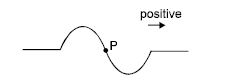
$A$ pulse on a string is shown in the figure. $P$ is a particle of the string. State which of the following is incorrect.
A
If $P$ is a stationary point, then the pulse consists of two waves travelling in opposite directions.
B
If $P$ is moving upwards, then the pulse is travelling in the positive direction.
C
If $P$ is moving downwards, then the pulse is travelling in the negative direction.
D
None of these.
Solution
(B) The velocity of a particle $v_p$ in a wave is given by $v_p = -v \cdot (\text{slope})$, where $v$ is the wave speed.
If the pulse travels in the positive direction $(v > 0)$, then $v_p = -v \cdot (\text{slope})$.
$1$. At point $P$ (on the trailing edge of the crest), the slope is positive. Thus, $v_p = -v \cdot (\text{positive}) = \text{negative}$. So, $P$ moves downwards if the pulse moves in the positive direction.
$2$. Conversely, if the pulse moves in the negative direction $(v < 0)$, then $v_p = -(-v) \cdot (\text{slope}) = v \cdot (\text{slope})$. Since the slope at $P$ is positive, $v_p$ is positive (upwards).
$3$. Option $A$: If $P$ is stationary, it implies the superposition of two waves moving in opposite directions (standing wave condition), which is correct.
$4$. Option $B$: If $P$ moves upwards, the pulse must be moving in the negative direction (based on the slope analysis). Thus, option $B$ is incorrect.
$5$. Option $C$: If $P$ moves downwards, the pulse must be moving in the positive direction. Thus, option $C$ is incorrect.
Since both $B$ and $C$ are incorrect statements based on the standard wave equation, and the question asks for the incorrect statement, there is an ambiguity. However, typically in such problems, if $P$ is on the trailing edge, it moves downwards for a positive-moving pulse. Thus, $B$ is clearly incorrect.
If the pulse travels in the positive direction $(v > 0)$, then $v_p = -v \cdot (\text{slope})$.
$1$. At point $P$ (on the trailing edge of the crest), the slope is positive. Thus, $v_p = -v \cdot (\text{positive}) = \text{negative}$. So, $P$ moves downwards if the pulse moves in the positive direction.
$2$. Conversely, if the pulse moves in the negative direction $(v < 0)$, then $v_p = -(-v) \cdot (\text{slope}) = v \cdot (\text{slope})$. Since the slope at $P$ is positive, $v_p$ is positive (upwards).
$3$. Option $A$: If $P$ is stationary, it implies the superposition of two waves moving in opposite directions (standing wave condition), which is correct.
$4$. Option $B$: If $P$ moves upwards, the pulse must be moving in the negative direction (based on the slope analysis). Thus, option $B$ is incorrect.
$5$. Option $C$: If $P$ moves downwards, the pulse must be moving in the positive direction. Thus, option $C$ is incorrect.
Since both $B$ and $C$ are incorrect statements based on the standard wave equation, and the question asks for the incorrect statement, there is an ambiguity. However, typically in such problems, if $P$ is on the trailing edge, it moves downwards for a positive-moving pulse. Thus, $B$ is clearly incorrect.
0 likes
View Solution144
DifficultMCQ
The transverse displacement $y(x, t)$ of a wave on a string is given by $y(x, t) = e^{-(ax^2 + bt^2 + 2\sqrt{ab}xt)}$. This represents:
A
a standing wave of frequency $\sqrt{b}$
B
a standing wave of frequency $\frac{1}{\sqrt{b}}$
C
a wave moving in the $+x$ direction with speed $\sqrt{\frac{a}{b}}$
D
a wave moving in the $-x$ direction with speed $\sqrt{\frac{b}{a}}$
Solution
(D) The given equation is $y(x, t) = e^{-(ax^2 + bt^2 + 2\sqrt{ab}xt)}$.
We can rewrite the exponent as a perfect square: $ax^2 + bt^2 + 2\sqrt{ab}xt = (\sqrt{a}x + \sqrt{b}t)^2$.
Therefore,the wave function is $y(x, t) = e^{-(\sqrt{a}x + \sqrt{b}t)^2}$.
$A$ general traveling wave function is represented as $f(kx + \omega t)$,where the wave moves in the $-x$ direction if the sign between $kx$ and $\omega t$ is positive.
Comparing $y(x, t) = e^{-(\sqrt{a}x + \sqrt{b}t)^2}$ with $f(kx + \omega t)$,we identify $k = \sqrt{a}$ and $\omega = \sqrt{b}$.
The wave speed $v$ is given by $v = \frac{\omega}{k} = \frac{\sqrt{b}}{\sqrt{a}} = \sqrt{\frac{b}{a}}$.
Since the expression is of the form $f(kx + \omega t)$,the wave is moving in the $-x$ direction.
We can rewrite the exponent as a perfect square: $ax^2 + bt^2 + 2\sqrt{ab}xt = (\sqrt{a}x + \sqrt{b}t)^2$.
Therefore,the wave function is $y(x, t) = e^{-(\sqrt{a}x + \sqrt{b}t)^2}$.
$A$ general traveling wave function is represented as $f(kx + \omega t)$,where the wave moves in the $-x$ direction if the sign between $kx$ and $\omega t$ is positive.
Comparing $y(x, t) = e^{-(\sqrt{a}x + \sqrt{b}t)^2}$ with $f(kx + \omega t)$,we identify $k = \sqrt{a}$ and $\omega = \sqrt{b}$.
The wave speed $v$ is given by $v = \frac{\omega}{k} = \frac{\sqrt{b}}{\sqrt{a}} = \sqrt{\frac{b}{a}}$.
Since the expression is of the form $f(kx + \omega t)$,the wave is moving in the $-x$ direction.
0 likes
View Solution145
MediumMCQ
In a plane progressive harmonic wave,the particle speed is always less than the wave speed if:
A
amplitude of the wave is less than $\frac{\lambda}{2\pi}$
B
amplitude of the wave is greater than $\frac{\lambda}{2\pi}$
C
amplitude of the wave is less than $\lambda$
D
amplitude of the wave is greater than $\frac{\lambda}{\pi}$
Solution
(A) Let the wave equation be $y = A \sin(\omega t - kx)$.
The particle velocity is given by $v_p = \frac{\partial y}{\partial t} = A\omega \cos(\omega t - kx)$.
The maximum particle speed is $v_{p, \text{max}} = A\omega$.
The wave speed is $v = \frac{\omega}{k} = \frac{\omega}{2\pi / \lambda} = \frac{\omega \lambda}{2\pi}$.
For the particle speed to be always less than the wave speed,the maximum particle speed must be less than the wave speed:
$v_{p, \text{max}} < v$
$A\omega < \frac{\omega \lambda}{2\pi}$
Dividing both sides by $\omega$,we get:
$A < \frac{\lambda}{2\pi}$.
The particle velocity is given by $v_p = \frac{\partial y}{\partial t} = A\omega \cos(\omega t - kx)$.
The maximum particle speed is $v_{p, \text{max}} = A\omega$.
The wave speed is $v = \frac{\omega}{k} = \frac{\omega}{2\pi / \lambda} = \frac{\omega \lambda}{2\pi}$.
For the particle speed to be always less than the wave speed,the maximum particle speed must be less than the wave speed:
$v_{p, \text{max}} < v$
$A\omega < \frac{\omega \lambda}{2\pi}$
Dividing both sides by $\omega$,we get:
$A < \frac{\lambda}{2\pi}$.
0 likes
View Solution146
MediumMCQ
$A$ transverse wave propagates in a medium with a velocity of $1450 \, m/s$. The distance between the nearest points at which the oscillations of the particles are in the opposite phase (phase difference of $\pi$) is $0.1 \, m$. What is the frequency of the wave in $Hz$?
A
$290$
B
$7250$
C
$14500$
D
$145$
Solution
(B) Given velocity of the wave,$v = 1450 \, m/s$.
The distance between two points in opposite phase is equal to half the wavelength,$\frac{\lambda}{2}$.
Given,$\frac{\lambda}{2} = 0.1 \, m$,therefore,$\lambda = 0.2 \, m$.
The relationship between wave velocity,frequency $(f)$,and wavelength $(\lambda)$ is given by $v = f \lambda$.
Rearranging for frequency: $f = \frac{v}{\lambda}$.
Substituting the values: $f = \frac{1450}{0.2} = 7250 \, Hz$.
The distance between two points in opposite phase is equal to half the wavelength,$\frac{\lambda}{2}$.
Given,$\frac{\lambda}{2} = 0.1 \, m$,therefore,$\lambda = 0.2 \, m$.
The relationship between wave velocity,frequency $(f)$,and wavelength $(\lambda)$ is given by $v = f \lambda$.
Rearranging for frequency: $f = \frac{v}{\lambda}$.
Substituting the values: $f = \frac{1450}{0.2} = 7250 \, Hz$.
0 likes
View Solution147
EasyMCQ
The equation of a progressive wave is $y = a \sin \left( \frac{\pi}{2}x - 200\pi t \right)$. The frequency of the wave will be .... $Hz$.
A
$0.1$
B
$25$
C
$100$
D
$200$
Solution
(C) The standard equation of a progressive wave is given by $y = a \sin(kx - \omega t)$.
Comparing the given equation $y = a \sin \left( \frac{\pi}{2}x - 200\pi t \right)$ with the standard equation,we get the angular frequency $\omega = 200\pi \ rad/s$.
The relationship between angular frequency $\omega$ and frequency $\nu$ is $\omega = 2\pi \nu$.
Substituting the value of $\omega$:
$2\pi \nu = 200\pi$
$\nu = \frac{200\pi}{2\pi} = 100 \ Hz$.
Therefore,the frequency of the wave is $100 \ Hz$.
Comparing the given equation $y = a \sin \left( \frac{\pi}{2}x - 200\pi t \right)$ with the standard equation,we get the angular frequency $\omega = 200\pi \ rad/s$.
The relationship between angular frequency $\omega$ and frequency $\nu$ is $\omega = 2\pi \nu$.
Substituting the value of $\omega$:
$2\pi \nu = 200\pi$
$\nu = \frac{200\pi}{2\pi} = 100 \ Hz$.
Therefore,the frequency of the wave is $100 \ Hz$.
0 likes
View Solution148
EasyMCQ
When a wave travelling in a medium is reflected from the boundary of a denser medium,which of the following will not change?
A
Amplitude
B
Intensity
C
Phase
D
Wavelength
Solution
(D) When a wave is reflected from the boundary of a denser medium,the wave undergoes a phase change of $\pi$ radians $(180^\circ)$.
Because the medium remains the same,the speed of the wave $(v = f \lambda)$ does not change.
Since the frequency $(f)$ is determined by the source,it remains constant.
Consequently,the wavelength $(\lambda = v/f)$ also remains unchanged.
However,some energy is transmitted into the denser medium,which causes the amplitude and intensity of the reflected wave to decrease.
Therefore,the wavelength is the quantity that does not change.
Because the medium remains the same,the speed of the wave $(v = f \lambda)$ does not change.
Since the frequency $(f)$ is determined by the source,it remains constant.
Consequently,the wavelength $(\lambda = v/f)$ also remains unchanged.
However,some energy is transmitted into the denser medium,which causes the amplitude and intensity of the reflected wave to decrease.
Therefore,the wavelength is the quantity that does not change.
0 likes
View Solution149
MediumMCQ
The two waves represented by $y_1 = a \sin(\omega t)$ and $y_2 = b \cos(\omega t)$ have a phase difference of
A
$0$
B
$\frac{\pi}{2}$
C
$\pi$
D
$\frac{\pi}{4}$
Solution
(B) Given the wave equations:
$y_1 = a \sin(\omega t)$
$y_2 = b \cos(\omega t)$
Using the trigonometric identity $\cos(\theta) = \sin(\theta + \frac{\pi}{2})$,we can rewrite $y_2$ as:
$y_2 = b \sin(\omega t + \frac{\pi}{2})$
The phase of the first wave is $\phi_1 = \omega t$.
The phase of the second wave is $\phi_2 = \omega t + \frac{\pi}{2}$.
The phase difference $\Delta\phi$ is given by $\phi_2 - \phi_1 = (\omega t + \frac{\pi}{2}) - \omega t = \frac{\pi}{2}$.
$y_1 = a \sin(\omega t)$
$y_2 = b \cos(\omega t)$
Using the trigonometric identity $\cos(\theta) = \sin(\theta + \frac{\pi}{2})$,we can rewrite $y_2$ as:
$y_2 = b \sin(\omega t + \frac{\pi}{2})$
The phase of the first wave is $\phi_1 = \omega t$.
The phase of the second wave is $\phi_2 = \omega t + \frac{\pi}{2}$.
The phase difference $\Delta\phi$ is given by $\phi_2 - \phi_1 = (\omega t + \frac{\pi}{2}) - \omega t = \frac{\pi}{2}$.
0 likes
View Solution150
DifficultMCQ
When a wave travels in a medium,the particle displacement is given by $y = a \sin(2 \pi (bt - cx))$,where $a, b$ and $c$ are constants. The maximum particle velocity will be twice the wave velocity if
A
$c = \frac{1}{\pi a}$
B
$c = \pi a$
C
$b = ac$
D
$b = \frac{1}{ac}$
Solution
(A) The given wave equation is $y = a \sin(2 \pi bt - 2 \pi cx)$.
Comparing this with the standard wave equation $y = A \sin(\omega t - kx)$,we get:
Angular frequency $\omega = 2 \pi b$
Wave number $k = 2 \pi c$
Amplitude $A = a$
The wave velocity $v_w$ is given by $v_w = \frac{\omega}{k} = \frac{2 \pi b}{2 \pi c} = \frac{b}{c}$.
The maximum particle velocity $v_p$ is given by $v_p = \omega A = (2 \pi b) a = 2 \pi ab$.
According to the problem,the maximum particle velocity is twice the wave velocity:
$v_p = 2 v_w$
$2 \pi ab = 2 \left( \frac{b}{c} \right)$
$\pi a = \frac{1}{c}$
$c = \frac{1}{\pi a}$
Comparing this with the standard wave equation $y = A \sin(\omega t - kx)$,we get:
Angular frequency $\omega = 2 \pi b$
Wave number $k = 2 \pi c$
Amplitude $A = a$
The wave velocity $v_w$ is given by $v_w = \frac{\omega}{k} = \frac{2 \pi b}{2 \pi c} = \frac{b}{c}$.
The maximum particle velocity $v_p$ is given by $v_p = \omega A = (2 \pi b) a = 2 \pi ab$.
According to the problem,the maximum particle velocity is twice the wave velocity:
$v_p = 2 v_w$
$2 \pi ab = 2 \left( \frac{b}{c} \right)$
$\pi a = \frac{1}{c}$
$c = \frac{1}{\pi a}$
0 likes
View SolutionWaves and Sound — Wave Equation and Characteristics of Waves · Frequently Asked Questions
1Are these Waves and Sound questions useful for JEE and NEET?
Yes. All questions in this section are mapped to JEE Main and NEET exam patterns. Previous year questions from JEE Main, NEET, GUJCET and state-level exams are included with full solutions.
2Can I switch to Hindi or Gujarati for these questions?
Yes. Use the language tabs in the hero section or the sidebar to view the same questions and solutions in English, Hindi or Gujarati.
3How do I generate a question paper from this subtopic?
Use the Vedclass Exam Paper Generator — select the chapter and subtopic, set difficulty, and generate Sets A, B, C, D automatically. First 3 chapters of every subject are free.
Vedclass Products
For Students
Vedclass Test Series
Mock tests in real JEE/NEET style with performance analysis. 5-day free trial.
Start Free TrialFor Teachers
Exam Paper Generator
Generate Set A/B/C/D papers from this chapter in 2 minutes. 3 chapters free.
Try FreeFor Institutes
Online Exam Module
Live online exams with unlimited students, 360° analytics & white-label branding.
See DemoFor Teachers & Institutes
Generate a Waves and Sound Exam Paper in 2 Minutes
Select subtopic & difficulty — Sets A, B, C, D auto-generated with No Repeat logic.
First 3 chapters of every subject are free — no payment required.