
A English
Wave Equation and Characteristics of Waves Questions in English
Class 11 Physics · Waves and Sound · Wave Equation and Characteristics of Waves
317+
Questions
English
Language
100%
With Solutions
Showing 50 of 317 questions in English
151
MediumMCQ
Two points on a travelling wave having frequency $500\, Hz$ and velocity $300\, m/s$ are $60^{\circ}$ out of phase,then the minimum distance between the two points is ..... $m$.
A
$0.2$
B
$0.1$
C
$0.5$
D
$0.4$
Solution
(B) The wavelength $\lambda$ of the wave is given by the formula $\lambda = \frac{v}{f}$.
Given $v = 300\, m/s$ and $f = 500\, Hz$,we have $\lambda = \frac{300}{500} = 0.6\, m$.
$A$ phase difference of $360^{\circ}$ corresponds to a path difference of one full wavelength $\lambda$.
Therefore,a phase difference of $\Delta\phi = 60^{\circ}$ corresponds to a path difference $\Delta x$ given by $\Delta x = \frac{\Delta\phi}{360^{\circ}} \times \lambda$.
Substituting the values,$\Delta x = \frac{60^{\circ}}{360^{\circ}} \times 0.6\, m = \frac{1}{6} \times 0.6\, m = 0.1\, m$.
Given $v = 300\, m/s$ and $f = 500\, Hz$,we have $\lambda = \frac{300}{500} = 0.6\, m$.
$A$ phase difference of $360^{\circ}$ corresponds to a path difference of one full wavelength $\lambda$.
Therefore,a phase difference of $\Delta\phi = 60^{\circ}$ corresponds to a path difference $\Delta x$ given by $\Delta x = \frac{\Delta\phi}{360^{\circ}} \times \lambda$.
Substituting the values,$\Delta x = \frac{60^{\circ}}{360^{\circ}} \times 0.6\, m = \frac{1}{6} \times 0.6\, m = 0.1\, m$.
0 likes
View Solution152
MediumMCQ
$A$ person is producing a wave in a string by moving his hand first up and then down. If the frequency is $\frac{1}{8} \, Hz$,then find out the time taken by a particle which is at a distance of $9 \, m$ from the source to move to the lower extreme for the first time in seconds. (Given $\lambda = 24 \, m$)
A
$3$
B
$5$
C
$9$
D
$8$
Solution
(C) Given frequency $f = \frac{1}{8} \, Hz$.
Therefore,time period $T = \frac{1}{f} = 8 \, s$.
Given wavelength $\lambda = 24 \, m$.
The wave speed $v = f \lambda = \frac{1}{8} \times 24 = 3 \, m/s$.
The time taken by the wave to reach the particle at distance $x = 9 \, m$ is $t_1 = \frac{x}{v} = \frac{9}{3} = 3 \, s$.
The particle starts its motion from the mean position (moving up first). To reach the lower extreme for the first time,the particle must complete $\frac{3}{4}$ of its oscillation cycle.
The time taken by the particle to reach the lower extreme from the moment the wave reaches it is $t_2 = \frac{3T}{4} = \frac{3}{4} \times 8 = 6 \, s$.
Total time taken = $t_1 + t_2 = 3 \, s + 6 \, s = 9 \, s$.
Therefore,time period $T = \frac{1}{f} = 8 \, s$.
Given wavelength $\lambda = 24 \, m$.
The wave speed $v = f \lambda = \frac{1}{8} \times 24 = 3 \, m/s$.
The time taken by the wave to reach the particle at distance $x = 9 \, m$ is $t_1 = \frac{x}{v} = \frac{9}{3} = 3 \, s$.
The particle starts its motion from the mean position (moving up first). To reach the lower extreme for the first time,the particle must complete $\frac{3}{4}$ of its oscillation cycle.
The time taken by the particle to reach the lower extreme from the moment the wave reaches it is $t_2 = \frac{3T}{4} = \frac{3}{4} \times 8 = 6 \, s$.
Total time taken = $t_1 + t_2 = 3 \, s + 6 \, s = 9 \, s$.
0 likes
View Solution153
MediumMCQ
$A$ wave equation is given by $y = 10^{-4} \sin(60t + 2x)$,where $x$ and $y$ are in $meters$ and $t$ is in $seconds$. Which of the following statements is correct?
A
Frequency of the wave is $50\pi \ Hz$
B
The wave travels with a velocity $30 \ m/s$ in the negative direction of the $x$-axis
C
Wavelength of the wave is $\pi \ m$
D
All of the above
Solution
(C) The standard wave equation is $y = A \sin(\omega t + kx)$.
Comparing the given equation $y = 10^{-4} \sin(60t + 2x)$ with the standard form:
Angular frequency $\omega = 60 \ rad/s$ and wave number $k = 2 \ m^{-1}$.
Since $\omega = 2\pi f$,we have $60 = 2\pi f$,which gives $f = \frac{30}{\pi} \ Hz$.
Wave velocity $v = \frac{\omega}{k} = \frac{60}{2} = 30 \ m/s$. Since the sign between $\omega t$ and $kx$ is positive,the wave travels in the negative $x$-direction.
Wavelength $\lambda = \frac{2\pi}{k} = \frac{2\pi}{2} = \pi \ m$.
Comparing these results with the options,option $C$ is correct.
Comparing the given equation $y = 10^{-4} \sin(60t + 2x)$ with the standard form:
Angular frequency $\omega = 60 \ rad/s$ and wave number $k = 2 \ m^{-1}$.
Since $\omega = 2\pi f$,we have $60 = 2\pi f$,which gives $f = \frac{30}{\pi} \ Hz$.
Wave velocity $v = \frac{\omega}{k} = \frac{60}{2} = 30 \ m/s$. Since the sign between $\omega t$ and $kx$ is positive,the wave travels in the negative $x$-direction.
Wavelength $\lambda = \frac{2\pi}{k} = \frac{2\pi}{2} = \pi \ m$.
Comparing these results with the options,option $C$ is correct.
0 likes
View Solution154
MediumMCQ
The equation of a wave traveling along the $x$-axis is given by $y(x, t) = 0.005 \cos(\alpha x - \beta t)$. If the wavelength and time period of the wave are $0.08 \ m$ and $2.0 \ s$ respectively,find the values of $\alpha$ and $\beta$ in appropriate units.
A
$\alpha = 25.00\pi; \beta = \pi$
B
$\alpha = \frac{0.08}{\pi}; \beta = \frac{2.0}{\pi}$
C
$\alpha = \frac{0.04}{\pi}; \beta = \frac{1.0}{\pi}$
D
$\alpha = 12.50\pi; \beta = \frac{\pi}{2.0}$
Solution
(A) The standard equation of a traveling wave is $y(x, t) = A \cos(kx - \omega t)$.
Here,$k = \alpha$ (wave number) and $\omega = \beta$ (angular frequency).
The wave number is given by $k = \frac{2\pi}{\lambda}$.
Given $\lambda = 0.08 \ m$,therefore $\alpha = \frac{2\pi}{0.08} = 25\pi \ rad/m$.
The angular frequency is given by $\omega = \frac{2\pi}{T}$.
Given $T = 2.0 \ s$,therefore $\beta = \frac{2\pi}{2.0} = \pi \ rad/s$.
Thus,the correct option is $A$.
Here,$k = \alpha$ (wave number) and $\omega = \beta$ (angular frequency).
The wave number is given by $k = \frac{2\pi}{\lambda}$.
Given $\lambda = 0.08 \ m$,therefore $\alpha = \frac{2\pi}{0.08} = 25\pi \ rad/m$.
The angular frequency is given by $\omega = \frac{2\pi}{T}$.
Given $T = 2.0 \ s$,therefore $\beta = \frac{2\pi}{2.0} = \pi \ rad/s$.
Thus,the correct option is $A$.
0 likes
View Solution155
DifficultMCQ
$A$ transverse wave in a medium is described by the equation $y = A \sin^2 (\omega t - kx)$. The magnitude of the maximum velocity of particles in the medium will be equal to that of the wave velocity,if the value of $A$ is ($\lambda$ = wavelength of wave).
A
$\lambda / 2\pi$
B
$\lambda / 4\pi$
C
$\lambda / \pi$
D
$2\lambda / \pi$
Solution
(A) The given wave equation is $y = A \sin^2 (\omega t - kx)$.
Using the trigonometric identity $\sin^2 \theta = \frac{1 - \cos(2\theta)}{2}$,we can rewrite the equation as:
$y = \frac{A}{2} [1 - \cos(2\omega t - 2kx)]$.
The particle velocity $v_p$ is given by the derivative of $y$ with respect to time $t$:
$v_p = \frac{\partial y}{\partial t} = \frac{A}{2} [2\omega \sin(2\omega t - 2kx)] = A\omega \sin(2\omega t - 2kx)$.
The maximum particle velocity is $(v_p)_{\max} = A\omega$.
The wave velocity $v$ is given by the ratio of the coefficient of $t$ to the coefficient of $x$ in the argument of the function:
$v = \frac{2\omega}{2k} = \frac{\omega}{k}$.
Since $k = \frac{2\pi}{\lambda}$,we have $v = \frac{\omega}{2\pi / \lambda} = \frac{\omega \lambda}{2\pi}$.
According to the problem,$(v_p)_{\max} = v$:
$A\omega = \frac{\omega \lambda}{2\pi}$.
Solving for $A$,we get $A = \frac{\lambda}{2\pi}$.
Using the trigonometric identity $\sin^2 \theta = \frac{1 - \cos(2\theta)}{2}$,we can rewrite the equation as:
$y = \frac{A}{2} [1 - \cos(2\omega t - 2kx)]$.
The particle velocity $v_p$ is given by the derivative of $y$ with respect to time $t$:
$v_p = \frac{\partial y}{\partial t} = \frac{A}{2} [2\omega \sin(2\omega t - 2kx)] = A\omega \sin(2\omega t - 2kx)$.
The maximum particle velocity is $(v_p)_{\max} = A\omega$.
The wave velocity $v$ is given by the ratio of the coefficient of $t$ to the coefficient of $x$ in the argument of the function:
$v = \frac{2\omega}{2k} = \frac{\omega}{k}$.
Since $k = \frac{2\pi}{\lambda}$,we have $v = \frac{\omega}{2\pi / \lambda} = \frac{\omega \lambda}{2\pi}$.
According to the problem,$(v_p)_{\max} = v$:
$A\omega = \frac{\omega \lambda}{2\pi}$.
Solving for $A$,we get $A = \frac{\lambda}{2\pi}$.
0 likes
View Solution156
MediumMCQ
For waves propagating in a medium,identify the property that is independent of the others.
A
Velocity
B
Wavelength
C
Frequency
D
All these depend on each other
Solution
(C) The frequency of a wave is determined solely by the source of the wave. When a wave travels from one medium to another,its frequency remains constant,while its velocity and wavelength change based on the properties of the medium. Therefore,frequency is independent of the medium's properties and the other wave parameters.
0 likes
View Solution157
MediumMCQ
$A$ transverse wave is represented by $y = \frac{10}{\pi} \sin \left( \frac{2\pi}{T}t - \frac{2\pi}{\lambda}x \right)$. For what value of the wavelength is the wave velocity twice the maximum particle velocity (in $cm$)?
A
$40$
B
$20$
C
$10$
D
$60$
Solution
(A) The given wave equation is $y = a \sin \left( \frac{2\pi}{T}t - \frac{2\pi}{\lambda}x \right)$,where amplitude $a = \frac{10}{\pi} \ cm$.
The wave velocity $v$ is given by $v = \frac{\omega}{k} = \frac{2\pi/T}{2\pi/\lambda} = \frac{\lambda}{T} = f\lambda$.
The maximum particle velocity $v_{p,max}$ is given by $v_{p,max} = a\omega = a \left( \frac{2\pi}{T} \right)$.
According to the problem,the wave velocity is twice the maximum particle velocity:
$v = 2 v_{p,max}$
Substituting the expressions:
$\frac{\lambda}{T} = 2 \left( a \cdot \frac{2\pi}{T} \right)$
Canceling $T$ from both sides:
$\lambda = 4\pi a$
Substituting the value of $a = \frac{10}{\pi} \ cm$:
$\lambda = 4\pi \left( \frac{10}{\pi} \right) = 40 \ cm$.
The wave velocity $v$ is given by $v = \frac{\omega}{k} = \frac{2\pi/T}{2\pi/\lambda} = \frac{\lambda}{T} = f\lambda$.
The maximum particle velocity $v_{p,max}$ is given by $v_{p,max} = a\omega = a \left( \frac{2\pi}{T} \right)$.
According to the problem,the wave velocity is twice the maximum particle velocity:
$v = 2 v_{p,max}$
Substituting the expressions:
$\frac{\lambda}{T} = 2 \left( a \cdot \frac{2\pi}{T} \right)$
Canceling $T$ from both sides:
$\lambda = 4\pi a$
Substituting the value of $a = \frac{10}{\pi} \ cm$:
$\lambda = 4\pi \left( \frac{10}{\pi} \right) = 40 \ cm$.
0 likes
View Solution158
MediumMCQ
When two sound waves travel in the same direction in a medium,the displacements of a particle located at $x$ at time $t$ are given by:
$y_1 = 0.05 \cos(0.50 \pi x - 100 \pi t)$
$y_2 = 0.05 \cos(0.46 \pi x - 92 \pi t)$
Then the velocity of the waves is..... $m/s$.
$y_1 = 0.05 \cos(0.50 \pi x - 100 \pi t)$
$y_2 = 0.05 \cos(0.46 \pi x - 92 \pi t)$
Then the velocity of the waves is..... $m/s$.
A
$92$
B
$200$
C
$100$
D
$332$
Solution
(B) The standard equation for a traveling wave is given by $y(x, t) = A \cos(kx - \omega t)$,where $k = \frac{\omega}{v}$.
For the first wave $y_1 = 0.05 \cos(0.50 \pi x - 100 \pi t)$:
Comparing with the standard equation,we have angular frequency $\omega_1 = 100 \pi \text{ rad/s}$ and wave number $k_1 = 0.50 \pi \text{ rad/m}$.
The velocity $v_1$ is given by $v_1 = \frac{\omega_1}{k_1} = \frac{100 \pi}{0.50 \pi} = 200 \text{ m/s}$.
For the second wave $y_2 = 0.05 \cos(0.46 \pi x - 92 \pi t)$:
Comparing with the standard equation,we have angular frequency $\omega_2 = 92 \pi \text{ rad/s}$ and wave number $k_2 = 0.46 \pi \text{ rad/m}$.
The velocity $v_2$ is given by $v_2 = \frac{\omega_2}{k_2} = \frac{92 \pi}{0.46 \pi} = 200 \text{ m/s}$.
Since both waves have the same velocity,the velocity of the waves is $200 \text{ m/s}$.
For the first wave $y_1 = 0.05 \cos(0.50 \pi x - 100 \pi t)$:
Comparing with the standard equation,we have angular frequency $\omega_1 = 100 \pi \text{ rad/s}$ and wave number $k_1 = 0.50 \pi \text{ rad/m}$.
The velocity $v_1$ is given by $v_1 = \frac{\omega_1}{k_1} = \frac{100 \pi}{0.50 \pi} = 200 \text{ m/s}$.
For the second wave $y_2 = 0.05 \cos(0.46 \pi x - 92 \pi t)$:
Comparing with the standard equation,we have angular frequency $\omega_2 = 92 \pi \text{ rad/s}$ and wave number $k_2 = 0.46 \pi \text{ rad/m}$.
The velocity $v_2$ is given by $v_2 = \frac{\omega_2}{k_2} = \frac{92 \pi}{0.46 \pi} = 200 \text{ m/s}$.
Since both waves have the same velocity,the velocity of the waves is $200 \text{ m/s}$.
0 likes
View Solution159
DifficultMCQ
In a transverse wave,the distance between a crest and the neighbouring trough at the same instant is $4.0 \, cm$,and the distance between a crest and trough at the same place is $1.0 \, cm$. The next crest appears at the same place after a time interval of $0.4 \, s$. The maximum speed of the vibrating particles in the medium is
A
$\frac{3\pi}{2} \, cm/s$
B
$\frac{5\pi}{2} \, cm/s$
C
$\frac{\pi}{2} \, cm/s$
D
$2\pi \, cm/s$
Solution
(B) The distance between a crest and the neighbouring trough at the same instant is half the wavelength $(\lambda/2)$.
Given $\lambda/2 = 4.0 \, cm$,so $\lambda = 8.0 \, cm$.
The distance between a crest and a trough at the same place is twice the amplitude $(2a)$.
Given $2a = 1.0 \, cm$,so $a = 0.5 \, cm$.
The time interval between two consecutive crests at the same place is the time period $(T)$.
Given $T = 0.4 \, s$.
The angular frequency is $\omega = \frac{2\pi}{T} = \frac{2\pi}{0.4} = 5\pi \, rad/s$.
The maximum speed of the vibrating particles is given by $v_{max} = a\omega$.
Substituting the values: $v_{max} = 0.5 \times 5\pi = 2.5\pi = \frac{5\pi}{2} \, cm/s$.
Given $\lambda/2 = 4.0 \, cm$,so $\lambda = 8.0 \, cm$.
The distance between a crest and a trough at the same place is twice the amplitude $(2a)$.
Given $2a = 1.0 \, cm$,so $a = 0.5 \, cm$.
The time interval between two consecutive crests at the same place is the time period $(T)$.
Given $T = 0.4 \, s$.
The angular frequency is $\omega = \frac{2\pi}{T} = \frac{2\pi}{0.4} = 5\pi \, rad/s$.
The maximum speed of the vibrating particles is given by $v_{max} = a\omega$.
Substituting the values: $v_{max} = 0.5 \times 5\pi = 2.5\pi = \frac{5\pi}{2} \, cm/s$.
0 likes
View Solution160
DifficultMCQ
The disturbance $y(x, t)$ of a wave propagating in the positive $x$-direction is given by $y = \frac{1}{1 + x^2}$ at time $t = 0$ and by $y = \frac{1}{1 + (x - 1)^2}$ at $t = 2 \ s$,where $x$ and $y$ are in meters. The shape of the wave disturbance does not change during the propagation. The velocity of the wave in $m/s$ is:
A
$2$
B
$4$
C
$0.5$
D
$1$
Solution
(C) The general equation of a wave propagating in the positive $x$-direction is given by $y(x, t) = f(x - vt)$,where $v$ is the wave velocity.
At $t = 0$,the equation is $y = f(x) = \frac{1}{1 + x^2}$.
At any time $t$,the equation becomes $y = f(x - vt) = \frac{1}{1 + (x - vt)^2}$.
Given that at $t = 2 \ s$,the equation is $y = \frac{1}{1 + (x - 1)^2}$.
Comparing the two expressions for $t = 2 \ s$:
$vt = 1$
Since $t = 2 \ s$,we have $v(2) = 1$.
Therefore,$v = \frac{1}{2} = 0.5 \ m/s$.
At $t = 0$,the equation is $y = f(x) = \frac{1}{1 + x^2}$.
At any time $t$,the equation becomes $y = f(x - vt) = \frac{1}{1 + (x - vt)^2}$.
Given that at $t = 2 \ s$,the equation is $y = \frac{1}{1 + (x - 1)^2}$.
Comparing the two expressions for $t = 2 \ s$:
$vt = 1$
Since $t = 2 \ s$,we have $v(2) = 1$.
Therefore,$v = \frac{1}{2} = 0.5 \ m/s$.
0 likes
View Solution161
MediumMCQ
$A$ travelling harmonic wave is represented by the equation $y(x, t) = 10^{-3} \sin(50t + 2x)$,where $x$ and $y$ are in meters and $t$ is in seconds. Which of the following is a correct statement about the wave?
A
The wave is propagating along the positive $x$-axis with speed $25 \ m/s$.
B
The wave is propagating along the positive $x$-axis with speed $100 \ m/s$.
C
The wave is propagating along the negative $x$-axis with speed $25 \ m/s$.
D
The wave is propagating along the negative $x$-axis with speed $100 \ m/s$.
Solution
(C) The general equation for a travelling harmonic wave is $y(x, t) = A \sin(\omega t + kx + \phi)$.
Comparing this with the given equation $y(x, t) = 10^{-3} \sin(50t + 2x)$:
Here,$\omega = 50 \ rad/s$ and $k = 2 \ rad/m$.
Since the sign between the $t$ and $x$ terms is positive $(+)$,the wave is propagating along the negative $x$-axis.
The wave speed $v$ is given by the ratio of angular frequency to the wave number: $v = \frac{\omega}{k}$.
Substituting the values: $v = \frac{50}{2} = 25 \ m/s$.
Therefore,the wave is propagating along the negative $x$-axis with a speed of $25 \ m/s$.
Comparing this with the given equation $y(x, t) = 10^{-3} \sin(50t + 2x)$:
Here,$\omega = 50 \ rad/s$ and $k = 2 \ rad/m$.
Since the sign between the $t$ and $x$ terms is positive $(+)$,the wave is propagating along the negative $x$-axis.
The wave speed $v$ is given by the ratio of angular frequency to the wave number: $v = \frac{\omega}{k}$.
Substituting the values: $v = \frac{50}{2} = 25 \ m/s$.
Therefore,the wave is propagating along the negative $x$-axis with a speed of $25 \ m/s$.
0 likes
View Solution162
MediumMCQ
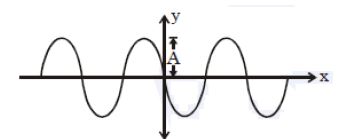
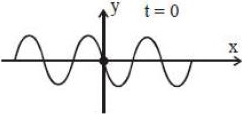
$A$ progressive wave travelling along the positive $x-$ direction is represented by $y(x, t) = A \sin(kx - \omega t + \phi)$. Its snapshot at $t = 0$ is given in the figure. For this wave,the phase $\phi$ is
A
$\pi$
B
$\frac{\pi}{2}$
C
$-\frac{\pi}{2}$
D
$0$
Solution
(A) The given wave equation is $y(x, t) = A \sin(kx - \omega t + \phi)$.
At $t = 0$,the equation becomes $y(x, 0) = A \sin(kx + \phi)$.
From the given graph at $t = 0$,we observe that at $x = 0$,the displacement $y(0, 0) = 0$.
Substituting these values into the equation: $0 = A \sin(k(0) + \phi) \Rightarrow \sin(\phi) = 0$.
This implies $\phi = 0$ or $\phi = \pi$.
To determine the correct value,we check the slope of the wave at $x = 0$. The slope is given by $\frac{\partial y}{\partial x} = Ak \cos(kx + \phi)$.
At $x = 0$,the slope is $Ak \cos(\phi)$.
From the graph,at $x = 0$,the wave is moving downwards as $x$ increases,meaning the slope is negative.
If $\phi = 0$,the slope is $Ak \cos(0) = Ak$,which is positive.
If $\phi = \pi$,the slope is $Ak \cos(\pi) = -Ak$,which is negative.
Therefore,the phase $\phi$ must be $\pi$.
At $t = 0$,the equation becomes $y(x, 0) = A \sin(kx + \phi)$.
From the given graph at $t = 0$,we observe that at $x = 0$,the displacement $y(0, 0) = 0$.
Substituting these values into the equation: $0 = A \sin(k(0) + \phi) \Rightarrow \sin(\phi) = 0$.
This implies $\phi = 0$ or $\phi = \pi$.
To determine the correct value,we check the slope of the wave at $x = 0$. The slope is given by $\frac{\partial y}{\partial x} = Ak \cos(kx + \phi)$.
At $x = 0$,the slope is $Ak \cos(\phi)$.
From the graph,at $x = 0$,the wave is moving downwards as $x$ increases,meaning the slope is negative.
If $\phi = 0$,the slope is $Ak \cos(0) = Ak$,which is positive.
If $\phi = \pi$,the slope is $Ak \cos(\pi) = -Ak$,which is negative.
Therefore,the phase $\phi$ must be $\pi$.
0 likes
View Solution163
MediumMCQ
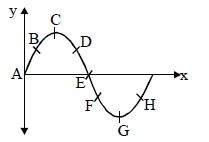
$A$ transverse wave is travelling along a string from left to right. The adjoining figure represents the shape of the string at a given instant. At this instant,among the following,choose the wrong statement.
A
Points $D, E$ and $F$ have upwards positive velocity.
B
Points $A, B$ and $H$ have downwards negative velocity.
C
Points $C$ and $G$ have zero velocity.
D
Points $A$ and $E$ have minimum velocity.
Solution
(D) The particle velocity is given by $v_p = \frac{dy}{dt} = -v \left( \frac{dy}{dx} \right)$,where $v$ is the wave velocity and $\frac{dy}{dx}$ is the slope of the wave at that point.
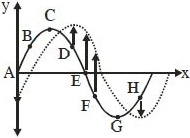
$(1)$ For upward velocity,$v_p$ must be positive. This requires the slope $\frac{dy}{dx}$ to be negative. Looking at the graph,the slope is negative at points $D, E,$ and $F$. Thus,these points move upwards.
$(2)$ For downward velocity,$v_p$ must be negative. This requires the slope $\frac{dy}{dx}$ to be positive. Looking at the graph,the slope is positive at points $A, B,$ and $H$. Thus,these points move downwards.
$(3)$ For zero velocity,the slope $\frac{dy}{dx}$ must be zero. This occurs at the crest and trough,which are points $C$ and $G$.
$(4)$ The magnitude of the particle velocity is maximum where the slope $| \frac{dy}{dx} |$ is maximum. This occurs at points $A, E,$ and the point between $G$ and $H$. Points $A$ and $E$ have maximum velocity,not minimum. Therefore,statement $(D)$ is wrong.
$(1)$ For upward velocity,$v_p$ must be positive. This requires the slope $\frac{dy}{dx}$ to be negative. Looking at the graph,the slope is negative at points $D, E,$ and $F$. Thus,these points move upwards.
$(2)$ For downward velocity,$v_p$ must be negative. This requires the slope $\frac{dy}{dx}$ to be positive. Looking at the graph,the slope is positive at points $A, B,$ and $H$. Thus,these points move downwards.
$(3)$ For zero velocity,the slope $\frac{dy}{dx}$ must be zero. This occurs at the crest and trough,which are points $C$ and $G$.
$(4)$ The magnitude of the particle velocity is maximum where the slope $| \frac{dy}{dx} |$ is maximum. This occurs at points $A, E,$ and the point between $G$ and $H$. Points $A$ and $E$ have maximum velocity,not minimum. Therefore,statement $(D)$ is wrong.
0 likes
View Solution164
MediumMCQ
$A$ wave equation is $y = 10^{-4} \sin(60t + 2x)$,where $x$ and $y$ are in $m$ and $t$ is in $s$. Which of the following statements is correct?
A
Frequency of the wave is $50/\pi \text{ Hz}$.
B
The wave travels with a velocity $30 \text{ m/s}$ in the negative direction of the $x$-axis.
C
Wavelength of the wave is $\pi \text{ m}$.
D
All of the above
Solution
(C) The standard wave equation is given by $y = A \sin(\omega t + kx)$.
Comparing the given equation $y = 10^{-4} \sin(60t + 2x)$ with the standard equation,we get:
Angular frequency $\omega = 60 \text{ rad/s}$ and wave number $k = 2 \text{ m}^{-1}$.
Since the sign between $\omega t$ and $kx$ is positive,the wave travels in the negative $x$-direction.
Frequency $f = \omega / (2\pi) = 60 / (2\pi) = 30/\pi \text{ Hz}$.
Wave velocity $v = \omega / k = 60 / 2 = 30 \text{ m/s}$.
Wavelength $\lambda = 2\pi / k = 2\pi / 2 = \pi \text{ m}$.
Comparing these results with the options,option $C$ is correct.
Comparing the given equation $y = 10^{-4} \sin(60t + 2x)$ with the standard equation,we get:
Angular frequency $\omega = 60 \text{ rad/s}$ and wave number $k = 2 \text{ m}^{-1}$.
Since the sign between $\omega t$ and $kx$ is positive,the wave travels in the negative $x$-direction.
Frequency $f = \omega / (2\pi) = 60 / (2\pi) = 30/\pi \text{ Hz}$.
Wave velocity $v = \omega / k = 60 / 2 = 30 \text{ m/s}$.
Wavelength $\lambda = 2\pi / k = 2\pi / 2 = \pi \text{ m}$.
Comparing these results with the options,option $C$ is correct.
0 likes
View Solution165
DifficultMCQ
$A$ wave travelling in the $-z$ direction having displacement along the $x$ direction as $1 \ m$,wavelength $\pi \ m$,and frequency $\frac{1}{\pi} \ Hz$ is represented by:
A
$x = \sin(2t + 2z)$
B
$z = \sin(2t + 2x)$
C
$x = \sin(2\pi t - 2z)$
D
$z = \sin(2t - 2x)$
Solution
(A) The general equation for a wave travelling in the $-z$ direction is given by $x = A \sin(\omega t + kz)$.
Given:
Amplitude $A = 1 \ m$.
Wavelength $\lambda = \pi \ m$.
Frequency $f = \frac{1}{\pi} \ Hz$.
Angular frequency $\omega = 2\pi f = 2\pi \times \frac{1}{\pi} = 2 \ rad/s$.
Wave number $k = \frac{2\pi}{\lambda} = \frac{2\pi}{\pi} = 2 \ m^{-1}$.
Substituting these values into the general equation,we get:
$x = 1 \sin(2t + 2z)$.
Thus,the correct option is $A$.
Given:
Amplitude $A = 1 \ m$.
Wavelength $\lambda = \pi \ m$.
Frequency $f = \frac{1}{\pi} \ Hz$.
Angular frequency $\omega = 2\pi f = 2\pi \times \frac{1}{\pi} = 2 \ rad/s$.
Wave number $k = \frac{2\pi}{\lambda} = \frac{2\pi}{\pi} = 2 \ m^{-1}$.
Substituting these values into the general equation,we get:
$x = 1 \sin(2t + 2z)$.
Thus,the correct option is $A$.
0 likes
View Solution166
MediumMCQ
The phase difference corresponding to a path difference of $x$ is
A
$\frac{2\pi x}{\lambda}$
B
$\frac{2\pi \lambda}{x}$
C
$\frac{\pi x}{\lambda}$
D
$\frac{\pi \lambda}{x}$
Solution
(A) The relationship between phase difference $(\Delta \phi)$ and path difference $(\Delta x)$ for a wave is given by the formula:
$\frac{\Delta \phi}{2\pi} = \frac{\Delta x}{\lambda}$
Given that the path difference is $\Delta x = x$,we substitute this into the equation:
$\frac{\Delta \phi}{2\pi} = \frac{x}{\lambda}$
Solving for the phase difference $\Delta \phi$:
$\Delta \phi = \frac{2\pi x}{\lambda}$
$\frac{\Delta \phi}{2\pi} = \frac{\Delta x}{\lambda}$
Given that the path difference is $\Delta x = x$,we substitute this into the equation:
$\frac{\Delta \phi}{2\pi} = \frac{x}{\lambda}$
Solving for the phase difference $\Delta \phi$:
$\Delta \phi = \frac{2\pi x}{\lambda}$
0 likes
View Solution167
MediumMCQ
The wave described by $y = 0.25 \sin(10\pi x - 2\pi t)$,where $x$ and $y$ are in $meters$ and $t$ in $seconds$,is a wave travelling along:
A
$+ve$ $x$-direction with frequency $1 \, Hz$ and wavelength $\lambda = 0.2 \, m$.
B
$-ve$ $x$-direction with amplitude $0.25 \, m$ and wavelength $\lambda = 0.2 \, m$.
C
$-ve$ $x$-direction with frequency $1 \, Hz$.
D
$+ve$ $x$-direction with frequency $\pi \, Hz$ and wavelength $\lambda = 0.2 \, m$.
Solution
(A) The given wave equation is $y = 0.25 \sin(10\pi x - 2\pi t)$.
Comparing this with the standard wave equation $y = A \sin(kx - \omega t)$:
$1$. The amplitude $A = 0.25 \, m$.
$2$. The wave number $k = 10\pi$. Since $k = \frac{2\pi}{\lambda}$,we have $\lambda = \frac{2\pi}{10\pi} = 0.2 \, m$.
$3$. The angular frequency $\omega = 2\pi$. Since $\omega = 2\pi f$,we have $f = \frac{2\pi}{2\pi} = 1 \, Hz$.
$4$. Since the sign between $kx$ and $\omega t$ is negative,the wave travels in the positive $x$-direction.
Therefore,the wave travels in the $+ve$ $x$-direction with frequency $1 \, Hz$ and wavelength $\lambda = 0.2 \, m$.
Comparing this with the standard wave equation $y = A \sin(kx - \omega t)$:
$1$. The amplitude $A = 0.25 \, m$.
$2$. The wave number $k = 10\pi$. Since $k = \frac{2\pi}{\lambda}$,we have $\lambda = \frac{2\pi}{10\pi} = 0.2 \, m$.
$3$. The angular frequency $\omega = 2\pi$. Since $\omega = 2\pi f$,we have $f = \frac{2\pi}{2\pi} = 1 \, Hz$.
$4$. Since the sign between $kx$ and $\omega t$ is negative,the wave travels in the positive $x$-direction.
Therefore,the wave travels in the $+ve$ $x$-direction with frequency $1 \, Hz$ and wavelength $\lambda = 0.2 \, m$.
0 likes
View Solution168
MediumMCQ
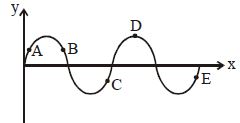
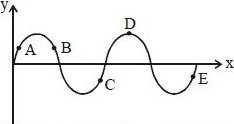
The figure shows a sinusoidal wave at a given instant. Which points are in the same phase?
A
$A, B$
B
$B, C$
C
$B, D$
D
$C, E$
Solution
(D) Two points are in the same phase if they have the same displacement from the mean position and are moving in the same direction.
In the given sinusoidal wave,points $C$ and $E$ are both below the $x$-axis,have the same vertical displacement,and are both moving in the upward direction (towards the equilibrium position). Therefore,points $C$ and $E$ are in the same phase.
In the given sinusoidal wave,points $C$ and $E$ are both below the $x$-axis,have the same vertical displacement,and are both moving in the upward direction (towards the equilibrium position). Therefore,points $C$ and $E$ are in the same phase.
0 likes
View Solution169
MediumMCQ
Two waves are represented by the equations: $y_1 = a \sin(\omega t + kx + 0.57) \ m$ and $y_2 = a \cos(\omega t + kx) \ m$,where $x$ is in $meters$ and $t$ is in $seconds$. The phase difference between them is ..... $radian$.
A
$1.0$
B
$1.25$
C
$1.57$
D
$0.57$
Solution
(A) The first wave is given by $y_1 = a \sin(\omega t + kx + 0.57)$.
Therefore,the phase of the first wave is $\phi_1 = (\omega t + kx + 0.57)$.
The second wave is given by $y_2 = a \cos(\omega t + kx)$.
Using the trigonometric identity $\cos(\theta) = \sin(\theta + \pi/2)$,we can write $y_2 = a \sin(\omega t + kx + \pi/2)$.
Therefore,the phase of the second wave is $\phi_2 = (\omega t + kx + \pi/2)$.
The phase difference $\Delta \phi$ is given by $\phi_2 - \phi_1$.
$\Delta \phi = (\omega t + kx + \pi/2) - (\omega t + kx + 0.57)$.
$\Delta \phi = \pi/2 - 0.57$.
Since $\pi \approx 3.14$,$\pi/2 \approx 1.57$.
$\Delta \phi = 1.57 - 0.57 = 1.0 \ radian$.
Therefore,the phase of the first wave is $\phi_1 = (\omega t + kx + 0.57)$.
The second wave is given by $y_2 = a \cos(\omega t + kx)$.
Using the trigonometric identity $\cos(\theta) = \sin(\theta + \pi/2)$,we can write $y_2 = a \sin(\omega t + kx + \pi/2)$.
Therefore,the phase of the second wave is $\phi_2 = (\omega t + kx + \pi/2)$.
The phase difference $\Delta \phi$ is given by $\phi_2 - \phi_1$.
$\Delta \phi = (\omega t + kx + \pi/2) - (\omega t + kx + 0.57)$.
$\Delta \phi = \pi/2 - 0.57$.
Since $\pi \approx 3.14$,$\pi/2 \approx 1.57$.
$\Delta \phi = 1.57 - 0.57 = 1.0 \ radian$.
0 likes
View Solution170
MediumMCQ
$A$ body sends waves $100 \, mm$ long through medium $A$ and $0.25 \, m$ long in medium $B$. If the velocity of waves in medium $A$ is $80 \, cm s^{-1}$,the velocity of waves in medium $B$ is .... $m s^{-1}$.
A
$1$
B
$2$
C
$3$
D
$4$
Solution
(B) Given: Wavelength in medium $A$,$\lambda_{A} = 100 \, mm = 0.10 \, m$.
Wavelength in medium $B$,$\lambda_{B} = 0.25 \, m$.
Velocity in medium $A$,$v_{A} = 80 \, cm s^{-1} = 0.80 \, m s^{-1}$.
Since the frequency $f$ of the wave remains constant when it travels from one medium to another,we have $f = \frac{v_{A}}{\lambda_{A}} = \frac{v_{B}}{\lambda_{B}}$.
Rearranging for $v_{B}$,we get $v_{B} = v_{A} \times \frac{\lambda_{B}}{\lambda_{A}}$.
Substituting the values: $v_{B} = 0.80 \times \frac{0.25}{0.10}$.
$v_{B} = 0.80 \times 2.5 = 2.0 \, m s^{-1}$.
Wavelength in medium $B$,$\lambda_{B} = 0.25 \, m$.
Velocity in medium $A$,$v_{A} = 80 \, cm s^{-1} = 0.80 \, m s^{-1}$.
Since the frequency $f$ of the wave remains constant when it travels from one medium to another,we have $f = \frac{v_{A}}{\lambda_{A}} = \frac{v_{B}}{\lambda_{B}}$.
Rearranging for $v_{B}$,we get $v_{B} = v_{A} \times \frac{\lambda_{B}}{\lambda_{A}}$.
Substituting the values: $v_{B} = 0.80 \times \frac{0.25}{0.10}$.
$v_{B} = 0.80 \times 2.5 = 2.0 \, m s^{-1}$.
0 likes
View Solution171
MediumMCQ
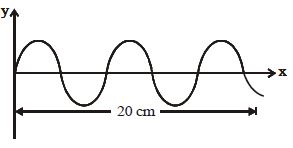
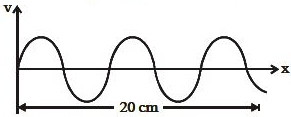
The figure given shows a sinusoidal wave on a string. If the frequency of the wave is $150 \, Hz$,what is the wavelength and velocity of the given wave?
A
$0.04 \, m, 10 \, ms^{-1}$
B
$0.06 \, m, 12 \, ms^{-1}$
C
$0.08 \, m, 10 \, ms^{-1}$
D
$0.08 \, m, 12 \, ms^{-1}$
Solution
(D) Given: Frequency of the wave,$f = 150 \, Hz$.
From the figure,the distance of $20 \, cm$ covers $2.5$ wavelengths (or $\frac{5}{2}$ cycles).
So,$\frac{5}{2} \lambda = 20 \, cm$.
$\lambda = \frac{20 \times 2}{5} \, cm = 8 \, cm = 0.08 \, m$.
Velocity of the wave is given by $v = f \lambda$.
$v = 150 \, Hz \times 0.08 \, m = 12 \, ms^{-1}$.
Thus,the wavelength is $0.08 \, m$ and the velocity is $12 \, ms^{-1}$.
From the figure,the distance of $20 \, cm$ covers $2.5$ wavelengths (or $\frac{5}{2}$ cycles).
So,$\frac{5}{2} \lambda = 20 \, cm$.
$\lambda = \frac{20 \times 2}{5} \, cm = 8 \, cm = 0.08 \, m$.
Velocity of the wave is given by $v = f \lambda$.
$v = 150 \, Hz \times 0.08 \, m = 12 \, ms^{-1}$.
Thus,the wavelength is $0.08 \, m$ and the velocity is $12 \, ms^{-1}$.
0 likes
View Solution172
MediumMCQ
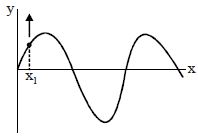
The diagram shows a snapshot of a wave at time $t = 0$. The particle at $x = x_1$ is moving upward at that instant. The direction of propagation of the wave is:
A
$+y$
B
$-y$
C
$+x$
D
$-x$
Solution
(C) To determine the direction of wave propagation,we look at the motion of the particle at $x = x_1$.
At $x = x_1$,the particle is on the rising slope of the wave and is moving upward.
For a wave traveling in the $+x$ direction,the particles on the rising slope (where the slope is positive) move upward.
Conversely,for a wave traveling in the $-x$ direction,the particles on the rising slope move downward.
Since the particle at $x = x_1$ is moving upward,the wave must be propagating in the $+x$ direction.
At $x = x_1$,the particle is on the rising slope of the wave and is moving upward.
For a wave traveling in the $+x$ direction,the particles on the rising slope (where the slope is positive) move upward.
Conversely,for a wave traveling in the $-x$ direction,the particles on the rising slope move downward.
Since the particle at $x = x_1$ is moving upward,the wave must be propagating in the $+x$ direction.
0 likes
View Solution173
DifficultMCQ
The amplitude of a wave disturbance propagating in the positive $X-$ direction is given by $y = 1/(1 + x^2)$ at time $t = 0$ and by $y = 1/[1 + (x - 1)^2]$ at $t = 2$ seconds,where $x$ and $y$ are in meters. The shape of the wave disturbance does not change during the propagation. The velocity of the wave is ..... $ms^{-1}$.
A
$1$
B
$0.5$
C
$1.5$
D
$2$
Solution
(B) The general equation for a wave propagating in the positive $X-$ direction without changing its shape is given by $y = f(x - vt)$.
At $t = 0$,the equation is $y = f(x) = 1/(1 + x^2)$.
At $t = 2$ seconds,the equation is $y = f(x - 2v) = 1/[1 + (x - 2v)^2]$.
Comparing this with the given equation at $t = 2$ seconds,which is $y = 1/[1 + (x - 1)^2]$,we get:
$x - 2v = x - 1$
$2v = 1$
$v = 0.5 \, ms^{-1}$.
At $t = 0$,the equation is $y = f(x) = 1/(1 + x^2)$.
At $t = 2$ seconds,the equation is $y = f(x - 2v) = 1/[1 + (x - 2v)^2]$.
Comparing this with the given equation at $t = 2$ seconds,which is $y = 1/[1 + (x - 1)^2]$,we get:
$x - 2v = x - 1$
$2v = 1$
$v = 0.5 \, ms^{-1}$.
0 likes
View Solution174
MediumMCQ
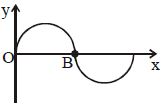
The figure shows the wave $y = A \sin(\omega t - kx)$. What is the magnitude of the slope of the curve at $B$?
A
$\frac{\omega}{A}$
B
$\frac{k}{A}$
C
$kA$
D
$\omega A$
Solution
(C) The given wave equation is $y = A \sin(\omega t - kx)$.
To find the slope of the curve at any point $x$ at a given time $t$,we calculate the partial derivative of $y$ with respect to $x$:
$\frac{\partial y}{\partial x} = A \cos(\omega t - kx) \cdot (-k) = -kA \cos(\omega t - kx)$.
The magnitude of the slope is $|\frac{\partial y}{\partial x}| = |kA \cos(\omega t - kx)|$.
At point $B$,the displacement $y = 0$,which implies $\sin(\omega t - kx) = 0$. This occurs when $(\omega t - kx) = n\pi$ (where $n$ is an integer).
At these points,$\cos(\omega t - kx) = \pm 1$.
Therefore,the magnitude of the slope at $B$ is $|-kA(\pm 1)| = kA$.
To find the slope of the curve at any point $x$ at a given time $t$,we calculate the partial derivative of $y$ with respect to $x$:
$\frac{\partial y}{\partial x} = A \cos(\omega t - kx) \cdot (-k) = -kA \cos(\omega t - kx)$.
The magnitude of the slope is $|\frac{\partial y}{\partial x}| = |kA \cos(\omega t - kx)|$.
At point $B$,the displacement $y = 0$,which implies $\sin(\omega t - kx) = 0$. This occurs when $(\omega t - kx) = n\pi$ (where $n$ is an integer).
At these points,$\cos(\omega t - kx) = \pm 1$.
Therefore,the magnitude of the slope at $B$ is $|-kA(\pm 1)| = kA$.
0 likes
View Solution175
MediumMCQ
The equation of a transverse wave in a stretched string is $y = 5 \sin 2\pi \left[ \frac{t}{0.04} - \frac{x}{50} \right]$,where distances are in $cm$ and time is in seconds. The wavelength of the wave is .... $cm$.
A
$15$
B
$10$
C
$25$
D
$50$
Solution
(D) The standard equation of a transverse wave is given by $y = A \sin 2\pi \left( \frac{t}{T} - \frac{x}{\lambda} \right)$.
Comparing the given equation $y = 5 \sin 2\pi \left[ \frac{t}{0.04} - \frac{x}{50} \right]$ with the standard equation,we identify the term $\frac{x}{\lambda} = \frac{x}{50}$.
Therefore,the wavelength $\lambda = 50 \, cm$.
Comparing the given equation $y = 5 \sin 2\pi \left[ \frac{t}{0.04} - \frac{x}{50} \right]$ with the standard equation,we identify the term $\frac{x}{\lambda} = \frac{x}{50}$.
Therefore,the wavelength $\lambda = 50 \, cm$.
0 likes
View Solution176
MediumMCQ
The amplitude of a wave represented by the displacement equation $y = \frac{1}{\sqrt{a}} \sin \omega t \pm \frac{1}{\sqrt{b}} \cos \omega t$ will be
A
$\frac{\sqrt{a + b}}{\sqrt{ab}}$
B
$\frac{\sqrt{a} + \sqrt{b}}{ab}$
C
$\frac{\sqrt{a} - \sqrt{b}}{ab}$
D
$\frac{\sqrt{a - b}}{\sqrt{ab}}$
Solution
(A) The given equation is of the form $y = A_1 \sin \omega t + A_2 \cos \omega t$,where $A_1 = \frac{1}{\sqrt{a}}$ and $A_2 = \frac{1}{\sqrt{b}}$.
For an equation of the form $y = A_1 \sin \omega t + A_2 \cos \omega t$,the resultant amplitude $A$ is given by $A = \sqrt{A_1^2 + A_2^2}$.
Substituting the values of $A_1$ and $A_2$:
$A = \sqrt{\left(\frac{1}{\sqrt{a}}\right)^2 + \left(\frac{1}{\sqrt{b}}\right)^2}$
$A = \sqrt{\frac{1}{a} + \frac{1}{b}}$
$A = \sqrt{\frac{b + a}{ab}}$
$A = \frac{\sqrt{a + b}}{\sqrt{ab}}$
For an equation of the form $y = A_1 \sin \omega t + A_2 \cos \omega t$,the resultant amplitude $A$ is given by $A = \sqrt{A_1^2 + A_2^2}$.
Substituting the values of $A_1$ and $A_2$:
$A = \sqrt{\left(\frac{1}{\sqrt{a}}\right)^2 + \left(\frac{1}{\sqrt{b}}\right)^2}$
$A = \sqrt{\frac{1}{a} + \frac{1}{b}}$
$A = \sqrt{\frac{b + a}{ab}}$
$A = \frac{\sqrt{a + b}}{\sqrt{ab}}$
0 likes
View Solution177
MediumMCQ
$A$ boat at anchor is rocked by waves whose crests are $100 \ m$ apart and velocity is $25 \ m/s$. The boat bounces up once in every: ... $s$
A
$2500$
B
$75$
C
$4$
D
$0.25$
Solution
(C) The wavelength $\lambda$ is the distance between two consecutive crests,so $\lambda = 100 \ m$.
Given the wave velocity $v = 25 \ m/s$.
The frequency $f$ of the wave is given by the formula $v = f \lambda$,which implies $f = \frac{v}{\lambda}$.
Substituting the values,$f = \frac{25}{100} = 0.25 \ Hz$.
The time period $T$ is the time taken for one complete bounce,which is the reciprocal of the frequency: $T = \frac{1}{f}$.
Therefore,$T = \frac{1}{0.25} = 4 \ s$.
Given the wave velocity $v = 25 \ m/s$.
The frequency $f$ of the wave is given by the formula $v = f \lambda$,which implies $f = \frac{v}{\lambda}$.
Substituting the values,$f = \frac{25}{100} = 0.25 \ Hz$.
The time period $T$ is the time taken for one complete bounce,which is the reciprocal of the frequency: $T = \frac{1}{f}$.
Therefore,$T = \frac{1}{0.25} = 4 \ s$.
0 likes
View Solution178
EasyMCQ
For a wave propagating in a medium, identify the property that is independent of the others.
A
velocity
B
wavelength
C
frequency
D
all these depend on each other
Solution
(C) When a wave travels from one medium to another, its velocity $(v)$ and wavelength $(\lambda)$ change depending on the properties of the medium (such as refractive index or density).
However, the frequency $(f)$ of the wave is determined solely by the source of the wave and remains constant regardless of the medium through which it propagates.
Therefore, frequency is independent of the medium's properties, while velocity and wavelength are dependent on them.
However, the frequency $(f)$ of the wave is determined solely by the source of the wave and remains constant regardless of the medium through which it propagates.
Therefore, frequency is independent of the medium's properties, while velocity and wavelength are dependent on them.
0 likes
View Solution179
MediumMCQ
$A$ wave on a string is travelling and the displacement of particles on it is given by $x = A \sin (2t - 0.1x)$. Then the wavelength of the wave is
A
$10\pi$
B
$20\pi$
C
$40\pi$
D
$20$
Solution
(B) The standard equation of a travelling wave is given by $y = A \sin (\omega t - kx)$.
Comparing the given equation $x = A \sin (2t - 0.1x)$ with the standard form,we identify the wave number $k$ as $k = 0.1$.
The wave number $k$ is related to the wavelength $\lambda$ by the formula $k = \frac{2\pi}{\lambda}$.
Substituting the value of $k$:
$0.1 = \frac{2\pi}{\lambda}$
$\lambda = \frac{2\pi}{0.1} = 20\pi$.
Therefore,the wavelength of the wave is $20\pi$.
Comparing the given equation $x = A \sin (2t - 0.1x)$ with the standard form,we identify the wave number $k$ as $k = 0.1$.
The wave number $k$ is related to the wavelength $\lambda$ by the formula $k = \frac{2\pi}{\lambda}$.
Substituting the value of $k$:
$0.1 = \frac{2\pi}{\lambda}$
$\lambda = \frac{2\pi}{0.1} = 20\pi$.
Therefore,the wavelength of the wave is $20\pi$.
0 likes
View Solution180
MediumMCQ
$Assertion :$ Speed of wave $= \frac{\text{wavelength}}{\text{time period}}$
$Reason :$ Wavelength is the distance between two nearest particles in phase.
$Reason :$ Wavelength is the distance between two nearest particles in phase.
A
If both Assertion and Reason are correct and the Reason is a correct explanation of the Assertion.
B
If both Assertion and Reason are correct but Reason is not a correct explanation of the Assertion.
C
If the Assertion is correct but Reason is incorrect.
D
If both the Assertion and Reason are incorrect.
Solution
(A) The wavelength $(\lambda)$ is defined as the distance between two nearest particles in the same phase.
The time period $(T)$ is the time taken by the wave to travel a distance equal to one wavelength.
By definition,the speed of a wave $(v)$ is the distance traveled per unit time.
Therefore,$v = \frac{\lambda}{T}$,which is $\text{Speed of wave} = \frac{\text{wavelength}}{\text{time period}}$.
Since the reason correctly defines wavelength and provides the basis for the relationship in the assertion,the reason is the correct explanation of the assertion.
The time period $(T)$ is the time taken by the wave to travel a distance equal to one wavelength.
By definition,the speed of a wave $(v)$ is the distance traveled per unit time.
Therefore,$v = \frac{\lambda}{T}$,which is $\text{Speed of wave} = \frac{\text{wavelength}}{\text{time period}}$.
Since the reason correctly defines wavelength and provides the basis for the relationship in the assertion,the reason is the correct explanation of the assertion.
0 likes
View Solution181
Medium
$A$ wave travelling along a string is described by,
$y(x, t) = 0.005 \sin (80.0 x - 3.0 t)$
In which the numerical constants are in $SI$ units ($0.005 \, m, 80.0 \, rad \, m^{-1},$ and $3.0 \, rad \, s^{-1}$). Calculate
$(a)$ the amplitude,
$(b)$ the wavelength,and
$(c)$ the period and frequency of the wave.
Also,calculate the displacement $y$ of the wave at a distance $x = 30.0 \, cm$ and time $t = 20 \, s$.
$y(x, t) = 0.005 \sin (80.0 x - 3.0 t)$
In which the numerical constants are in $SI$ units ($0.005 \, m, 80.0 \, rad \, m^{-1},$ and $3.0 \, rad \, s^{-1}$). Calculate
$(a)$ the amplitude,
$(b)$ the wavelength,and
$(c)$ the period and frequency of the wave.
Also,calculate the displacement $y$ of the wave at a distance $x = 30.0 \, cm$ and time $t = 20 \, s$.
Solution
(N/A) The standard wave equation is $y(x, t) = a \sin (kx - \omega t)$.
$(a)$ Comparing the given equation with the standard form,the amplitude $a = 0.005 \, m = 5 \, mm$.
$(b)$ The angular wave number $k = 80.0 \, m^{-1}$. The wavelength $\lambda$ is given by $\lambda = 2\pi / k = 2\pi / 80.0 \approx 0.0785 \, m = 7.85 \, cm$.
$(c)$ The angular frequency $\omega = 3.0 \, rad \, s^{-1}$. The period $T = 2\pi / \omega = 2\pi / 3.0 \approx 2.09 \, s$. The frequency $\nu = 1 / T = 3.0 / 2\pi \approx 0.48 \, Hz$.
For displacement at $x = 30.0 \, cm = 0.3 \, m$ and $t = 20 \, s$:
$y = 0.005 \sin (80.0 \times 0.3 - 3.0 \times 20) = 0.005 \sin (24 - 60) = 0.005 \sin (-36 \, rad)$.
Since $\sin(-36 \, rad) \approx \sin(-36 + 12\pi) \approx \sin(1.699 \, rad) \approx 0.992$,
$y \approx 0.005 \times 0.992 \approx 0.00496 \, m \approx 5 \, mm$.
$(a)$ Comparing the given equation with the standard form,the amplitude $a = 0.005 \, m = 5 \, mm$.
$(b)$ The angular wave number $k = 80.0 \, m^{-1}$. The wavelength $\lambda$ is given by $\lambda = 2\pi / k = 2\pi / 80.0 \approx 0.0785 \, m = 7.85 \, cm$.
$(c)$ The angular frequency $\omega = 3.0 \, rad \, s^{-1}$. The period $T = 2\pi / \omega = 2\pi / 3.0 \approx 2.09 \, s$. The frequency $\nu = 1 / T = 3.0 / 2\pi \approx 0.48 \, Hz$.
For displacement at $x = 30.0 \, cm = 0.3 \, m$ and $t = 20 \, s$:
$y = 0.005 \sin (80.0 \times 0.3 - 3.0 \times 20) = 0.005 \sin (24 - 60) = 0.005 \sin (-36 \, rad)$.
Since $\sin(-36 \, rad) \approx \sin(-36 + 12\pi) \approx \sin(1.699 \, rad) \approx 0.992$,
$y \approx 0.005 \times 0.992 \approx 0.00496 \, m \approx 5 \, mm$.
0 likes
View Solution182
Medium
You have learnt that a travelling wave in one dimension is represented by a function $y=f(x, t)$ where $x$ and $t$ must appear in the combination $x-vt$ or $x+vt$,i.e.,$y=f(x \pm vt)$. Is the converse true? Examine if the following functions for $y$ can possibly represent a travelling wave:
$(a)$ $(x-vt)^2$
$(b)$ $\log[(x+vt)/x_0]$
$(c)$ $1/(x+vt)$
$(a)$ $(x-vt)^2$
$(b)$ $\log[(x+vt)/x_0]$
$(c)$ $1/(x+vt)$
Solution
(NONE) The converse is not true. $A$ function $y=f(x \pm vt)$ represents a travelling wave only if it remains finite for all values of $x$ and $t$.
$(a)$ For $y = (x-vt)^2$: As $x \to \infty$ or $t \to \infty$,$y \to \infty$. Since the function does not remain finite for all $x$ and $t$,it does not represent a physically possible travelling wave.
$(b)$ For $y = \log[(x+vt)/x_0]$: As $x+vt \to 0$,$y \to -\infty$. Since the function does not remain finite for all $x$ and $t$,it does not represent a physically possible travelling wave.
$(c)$ For $y = 1/(x+vt)$: As $x+vt \to 0$,$y \to \infty$. Since the function does not remain finite for all $x$ and $t$,it does not represent a physically possible travelling wave.
$(a)$ For $y = (x-vt)^2$: As $x \to \infty$ or $t \to \infty$,$y \to \infty$. Since the function does not remain finite for all $x$ and $t$,it does not represent a physically possible travelling wave.
$(b)$ For $y = \log[(x+vt)/x_0]$: As $x+vt \to 0$,$y \to -\infty$. Since the function does not remain finite for all $x$ and $t$,it does not represent a physically possible travelling wave.
$(c)$ For $y = 1/(x+vt)$: As $x+vt \to 0$,$y \to \infty$. Since the function does not remain finite for all $x$ and $t$,it does not represent a physically possible travelling wave.
0 likes
View Solution183
Medium
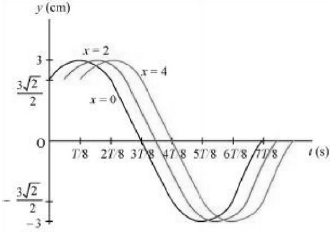
For the wave $y(x, t) = 3.0 \sin (36 t + 0.018 x + \pi / 4)$,plot the displacement $(y)$ versus time $(t)$ graphs for $x = 0, 2$ and $4 \; cm$. What are the shapes of these graphs? In which aspects does the oscillatory motion in a travelling wave differ from one point to another: amplitude,frequency,or phase?
Solution
(N/A) The given transverse harmonic wave equation is $y(x, t) = 3.0 \sin (36 t + 0.018 x + \pi / 4)$.
For $x = 0, 2,$ and $4 \; cm$,the equations are:
$y(0, t) = 3.0 \sin (36 t + \pi / 4)$
$y(2, t) = 3.0 \sin (36 t + 0.036 + \pi / 4)$
$y(4, t) = 3.0 \sin (36 t + 0.072 + \pi / 4)$
The angular frequency is $\omega = 36 \; rad/s$,so the time period is $T = 2\pi / \omega = \pi / 18 \; s$.
The shapes of these graphs are sinusoidal. In a travelling wave,the amplitude and frequency remain constant for all points,but the phase changes from one point to another due to the $kx$ term in the wave equation.
For $x = 0, 2,$ and $4 \; cm$,the equations are:
$y(0, t) = 3.0 \sin (36 t + \pi / 4)$
$y(2, t) = 3.0 \sin (36 t + 0.036 + \pi / 4)$
$y(4, t) = 3.0 \sin (36 t + 0.072 + \pi / 4)$
The angular frequency is $\omega = 36 \; rad/s$,so the time period is $T = 2\pi / \omega = \pi / 18 \; s$.
The shapes of these graphs are sinusoidal. In a travelling wave,the amplitude and frequency remain constant for all points,but the phase changes from one point to another due to the $kx$ term in the wave equation.
0 likes
View Solution184
Medium
For the travelling harmonic wave $y(x, t) = 2.0 \cos 2 \pi(10 t - 0.0080 x + 0.35)$,where $x$ and $y$ are in $cm$ and $t$ is in $s$. Calculate the phase difference between oscillatory motion of two points separated by a distance of:
$(a)$ $4 \, m$
$(b)$ $0.5 \, m$
$(c)$ $\lambda / 2$
$(d)$ $3 \lambda / 4$
$(a)$ $4 \, m$
$(b)$ $0.5 \, m$
$(c)$ $\lambda / 2$
$(d)$ $3 \lambda / 4$
Solution
(N/A) The equation for a travelling harmonic wave is given by $y(x, t) = 2.0 \cos 2 \pi(10 t - 0.0080 x + 0.35)$.
Comparing this with the standard wave equation $y = a \cos(2 \pi \nu t - kx + \phi_0)$,we get:
Propagation constant $k = 0.0160 \pi \, rad/cm$.
The phase difference $\Delta \phi$ between two points separated by distance $\Delta x$ is given by $\Delta \phi = k \Delta x$.
$(a)$ For $\Delta x = 4 \, m = 400 \, cm$:
$\Delta \phi = (0.0160 \pi \, rad/cm) \times (400 \, cm) = 6.4 \pi \, rad$.
$(b)$ For $\Delta x = 0.5 \, m = 50 \, cm$:
$\Delta \phi = (0.0160 \pi \, rad/cm) \times (50 \, cm) = 0.8 \pi \, rad$.
$(c)$ For $\Delta x = \lambda / 2$:
Since $k = 2 \pi / \lambda$,$\Delta \phi = (2 \pi / \lambda) \times (\lambda / 2) = \pi \, rad$.
$(d)$ For $\Delta x = 3 \lambda / 4$:
$\Delta \phi = (2 \pi / \lambda) \times (3 \lambda / 4) = 1.5 \pi \, rad$.
Comparing this with the standard wave equation $y = a \cos(2 \pi \nu t - kx + \phi_0)$,we get:
Propagation constant $k = 0.0160 \pi \, rad/cm$.
The phase difference $\Delta \phi$ between two points separated by distance $\Delta x$ is given by $\Delta \phi = k \Delta x$.
$(a)$ For $\Delta x = 4 \, m = 400 \, cm$:
$\Delta \phi = (0.0160 \pi \, rad/cm) \times (400 \, cm) = 6.4 \pi \, rad$.
$(b)$ For $\Delta x = 0.5 \, m = 50 \, cm$:
$\Delta \phi = (0.0160 \pi \, rad/cm) \times (50 \, cm) = 0.8 \pi \, rad$.
$(c)$ For $\Delta x = \lambda / 2$:
Since $k = 2 \pi / \lambda$,$\Delta \phi = (2 \pi / \lambda) \times (\lambda / 2) = \pi \, rad$.
$(d)$ For $\Delta x = 3 \lambda / 4$:
$\Delta \phi = (2 \pi / \lambda) \times (3 \lambda / 4) = 1.5 \pi \, rad$.
0 likes
View Solution185
Medium
$A$ travelling harmonic wave on a string is described by $y(x, t) = 7.5 \sin (0.0050 x + 12 t + \pi / 4)$.
$(a)$ What are the displacement and velocity of oscillation of a point at $x = 1 \; cm$ and $t = 1 \; s$? Is this velocity equal to the velocity of wave propagation?
$(b)$ Locate the points of the string which have the same transverse displacements and velocity as the $x = 1 \; cm$ point at $t = 2 \; s, 5 \; s$ and $11 \; s$.
$(a)$ What are the displacement and velocity of oscillation of a point at $x = 1 \; cm$ and $t = 1 \; s$? Is this velocity equal to the velocity of wave propagation?
$(b)$ Locate the points of the string which have the same transverse displacements and velocity as the $x = 1 \; cm$ point at $t = 2 \; s, 5 \; s$ and $11 \; s$.
Solution
(A) The given harmonic wave is $y(x, t) = 7.5 \sin (0.0050 x + 12 t + \pi / 4)$.
$(a)$ For $x = 1 \; cm$ and $t = 1 \; s$:
$y(1, 1) = 7.5 \sin (0.0050 + 12 + \pi / 4) = 7.5 \sin (12.0050 + 0.785) = 7.5 \sin (12.79 \; rad)$.
Converting to degrees: $12.79 \times (180 / \pi) \approx 732.81^{\circ}$.
$y = 7.5 \sin (732.81^{\circ}) = 7.5 \sin (8 \times 90^{\circ} + 12.81^{\circ}) = 7.5 \sin (12.81^{\circ}) \approx 7.5 \times 0.2217 \approx 1.663 \; cm$.
The velocity of oscillation is $v = \frac{\partial y}{\partial t} = 7.5 \times 12 \cos (0.0050 x + 12 t + \pi / 4) = 90 \cos (0.0050 x + 12 t + \pi / 4)$.
At $x = 1 \; cm, t = 1 \; s$: $v = 90 \cos (12.79 \; rad) = 90 \cos (12.81^{\circ}) \approx 90 \times 0.975 = 87.75 \; cm/s$.
The wave propagation velocity $v_p = \omega / k = 12 / 0.0050 = 2400 \; cm/s$.
Since $87.75 \; cm/s \neq 2400 \; cm/s$,the oscillation velocity is not equal to the wave propagation velocity.
$(b)$ The wavelength $\lambda = 2 \pi / k = 2 \pi / 0.0050 = 1256 \; cm = 12.56 \; m$.
Points with the same displacement and velocity are separated by integer multiples of the wavelength $\lambda$. Thus,the points are $x = (1 \; cm \pm n \lambda)$,where $n = 1, 2, 3, \dots$.
$(a)$ For $x = 1 \; cm$ and $t = 1 \; s$:
$y(1, 1) = 7.5 \sin (0.0050 + 12 + \pi / 4) = 7.5 \sin (12.0050 + 0.785) = 7.5 \sin (12.79 \; rad)$.
Converting to degrees: $12.79 \times (180 / \pi) \approx 732.81^{\circ}$.
$y = 7.5 \sin (732.81^{\circ}) = 7.5 \sin (8 \times 90^{\circ} + 12.81^{\circ}) = 7.5 \sin (12.81^{\circ}) \approx 7.5 \times 0.2217 \approx 1.663 \; cm$.
The velocity of oscillation is $v = \frac{\partial y}{\partial t} = 7.5 \times 12 \cos (0.0050 x + 12 t + \pi / 4) = 90 \cos (0.0050 x + 12 t + \pi / 4)$.
At $x = 1 \; cm, t = 1 \; s$: $v = 90 \cos (12.79 \; rad) = 90 \cos (12.81^{\circ}) \approx 90 \times 0.975 = 87.75 \; cm/s$.
The wave propagation velocity $v_p = \omega / k = 12 / 0.0050 = 2400 \; cm/s$.
Since $87.75 \; cm/s \neq 2400 \; cm/s$,the oscillation velocity is not equal to the wave propagation velocity.
$(b)$ The wavelength $\lambda = 2 \pi / k = 2 \pi / 0.0050 = 1256 \; cm = 12.56 \; m$.
Points with the same displacement and velocity are separated by integer multiples of the wavelength $\lambda$. Thus,the points are $x = (1 \; cm \pm n \lambda)$,where $n = 1, 2, 3, \dots$.
0 likes
View Solution186
Medium
One end of a long string of linear mass density $8.0 \times 10^{-3} \; kg \; m^{-1}$ is connected to an electrically driven tuning fork of frequency $256 \; Hz$. The other end passes over a pulley and is tied to a pan containing a mass of $90 \; kg$. The pulley end absorbs all the incoming energy so that reflected waves at this end have negligible amplitude. At $t=0$,the left end (fork end) of the string $x=0$ has zero transverse displacement $(y=0)$ and is moving along the positive $y$-direction. The amplitude of the wave is $5.0 \; cm$. Write down the transverse displacement $y$ as a function of $x$ and $t$ that describes the wave on the string.
Solution
(N/A) The equation of a travelling wave propagating along the positive $x$-direction is given by $y(x, t) = a \sin(\omega t - kx + \phi)$.
Given $y(0, 0) = 0$,we have $a \sin(\phi) = 0$,so $\phi = 0$.
Linear mass density $\mu = 8.0 \times 10^{-3} \; kg \; m^{-1}$.
Frequency $v = 256 \; Hz$.
Amplitude $a = 5.0 \; cm = 0.05 \; m$.
Tension $T = mg = 90 \times 9.8 = 882 \; N$.
Wave velocity $v = \sqrt{T/\mu} = \sqrt{882 / (8.0 \times 10^{-3})} = \sqrt{110250} \approx 332 \; m/s$.
Angular frequency $\omega = 2\pi v = 2 \times 3.14159 \times 256 \approx 1608 \; rad/s$.
Propagation constant $k = \omega / v = 1608 / 332 \approx 4.84 \; m^{-1}$.
Substituting these values,the displacement equation is $y(x, t) = 0.05 \sin(1608t - 4.84x) \; m$.
Given $y(0, 0) = 0$,we have $a \sin(\phi) = 0$,so $\phi = 0$.
Linear mass density $\mu = 8.0 \times 10^{-3} \; kg \; m^{-1}$.
Frequency $v = 256 \; Hz$.
Amplitude $a = 5.0 \; cm = 0.05 \; m$.
Tension $T = mg = 90 \times 9.8 = 882 \; N$.
Wave velocity $v = \sqrt{T/\mu} = \sqrt{882 / (8.0 \times 10^{-3})} = \sqrt{110250} \approx 332 \; m/s$.
Angular frequency $\omega = 2\pi v = 2 \times 3.14159 \times 256 \approx 1608 \; rad/s$.
Propagation constant $k = \omega / v = 1608 / 332 \approx 4.84 \; m^{-1}$.
Substituting these values,the displacement equation is $y(x, t) = 0.05 \sin(1608t - 4.84x) \; m$.
0 likes
View Solution187
Medium
Explain the amplitude and phase of a wave.
Solution
(N/A) The magnitude of the maximum displacement of a particle participating in the propagation of a wave is called the amplitude of the wave. It is represented by the symbol $a$ or $A$.
According to the wave equation:
$y = a \sin(kx - \omega t + \phi)$
Since the value of $\sin(kx - \omega t + \phi)$ has extreme values $\pm 1$,we can write:
$y_{\max} = a(\pm 1) = \pm a$
Therefore,the amplitude of the wave is $|y_{\max}| = a$.
The amplitude of a wave is always positive. Its $SI$ unit is $m$ and its dimensional formula is $[M^0 L^1 T^0]$.
Initial phase $(\phi)$: If we know the initial position of a particle at the origin of the wave and the direction of its motion at time $t = 0$,we can find the value of the initial phase $\phi$ using:
$y(x, t) = a \sin(\omega t - kx + \phi)$
Putting $x = 0$ and $t = 0$,we get $y(0, 0) = a \sin \phi$.
By knowing $\sin \phi$,we can determine the initial phase $\phi$.
In the wave equation $y = y(x, t) = a \sin(\omega t - kx + \phi)$,the argument of the sine function $(\omega t - kx + \phi)$ is called the total phase of the wave at time $t$ at a distance $x$ from its source. It represents the total phase of oscillation of a particle at distance $x$ from the origin of the wave at time $t$.
According to the wave equation:
$y = a \sin(kx - \omega t + \phi)$
Since the value of $\sin(kx - \omega t + \phi)$ has extreme values $\pm 1$,we can write:
$y_{\max} = a(\pm 1) = \pm a$
Therefore,the amplitude of the wave is $|y_{\max}| = a$.
The amplitude of a wave is always positive. Its $SI$ unit is $m$ and its dimensional formula is $[M^0 L^1 T^0]$.
Initial phase $(\phi)$: If we know the initial position of a particle at the origin of the wave and the direction of its motion at time $t = 0$,we can find the value of the initial phase $\phi$ using:
$y(x, t) = a \sin(\omega t - kx + \phi)$
Putting $x = 0$ and $t = 0$,we get $y(0, 0) = a \sin \phi$.
By knowing $\sin \phi$,we can determine the initial phase $\phi$.
In the wave equation $y = y(x, t) = a \sin(\omega t - kx + \phi)$,the argument of the sine function $(\omega t - kx + \phi)$ is called the total phase of the wave at time $t$ at a distance $x$ from its source. It represents the total phase of oscillation of a particle at distance $x$ from the origin of the wave at time $t$.
0 likes
View Solution188
Medium
Give the definition,equation,and unit for wavelength and wave number for a wave.
Solution
(N/A) Wavelength: The linear distance between any two consecutive points or particles having a phase difference of $2 \pi \text{ rad}$ is called the wavelength $(\lambda)$ of the wave. Its $SI$ unit is metre $(m)$.
Wave Number: The number of waves per unit distance is called the wave number $(\bar{\nu})$. It is defined as the reciprocal of the wavelength.
Equation for Wavelength: For a wave represented by $y(x, t) = a \sin(kx - \omega t)$,the displacement repeats after a distance $\lambda = \frac{2 \pi}{k}$.
Equation for Wave Number: $\bar{\nu} = \frac{1}{\lambda} = \frac{k}{2 \pi}$.
Units:
- Wavelength $(\lambda)$: $SI$ unit is metre $(m)$.
- Wave Number $(\bar{\nu})$: $SI$ unit is metre$^{-1}$ $(m^{-1})$.
Wave Number: The number of waves per unit distance is called the wave number $(\bar{\nu})$. It is defined as the reciprocal of the wavelength.
Equation for Wavelength: For a wave represented by $y(x, t) = a \sin(kx - \omega t)$,the displacement repeats after a distance $\lambda = \frac{2 \pi}{k}$.
Equation for Wave Number: $\bar{\nu} = \frac{1}{\lambda} = \frac{k}{2 \pi}$.
Units:
- Wavelength $(\lambda)$: $SI$ unit is metre $(m)$.
- Wave Number $(\bar{\nu})$: $SI$ unit is metre$^{-1}$ $(m^{-1})$.
0 likes
View Solution189
Medium
Give the definition,$SI$ unit,and dimensional formula of the time period,angular frequency,and frequency of a wave.
Solution
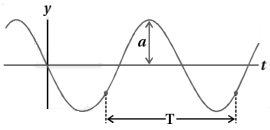
(N/A) Time period: The time taken by any string element to complete one full oscillation is called the Time period $(T)$.
In the equation of displacement of a wave,$y(x, t) = a \sin (kx - \omega t + \phi)$. If $\phi = 0$,then observing the motion of an element at $x = 0$,we get $y(0, t) = a \sin(-\omega t) = -a \sin(\omega t)$. This represents simple harmonic motion $(SHM)$ with amplitude $a$ and time period $T$. Since the sine function repeats at $2\pi$ intervals,$\omega T = 2\pi$,which gives $\omega = \frac{2\pi}{T}$.
Angular frequency: The angular frequency of oscillations of particles of the medium in a wave is called the angular frequency of the wave. Its symbol is $\omega$,its $SI$ unit is $\text{rad } s^{-1}$,and its dimensional formula is $[M^0 L^0 T^{-1}]$.
Frequency: The number of oscillations performed by a particle of the medium in one second is known as the frequency of oscillation. Its symbol is $\nu$ or $f$. Since $f = \frac{1}{T}$,the $SI$ unit of frequency is $s^{-1}$ or $\text{Hz}$ (Hertz),and its dimensional formula is $[M^0 L^0 T^{-1}]$.
In the equation of displacement of a wave,$y(x, t) = a \sin (kx - \omega t + \phi)$. If $\phi = 0$,then observing the motion of an element at $x = 0$,we get $y(0, t) = a \sin(-\omega t) = -a \sin(\omega t)$. This represents simple harmonic motion $(SHM)$ with amplitude $a$ and time period $T$. Since the sine function repeats at $2\pi$ intervals,$\omega T = 2\pi$,which gives $\omega = \frac{2\pi}{T}$.
Angular frequency: The angular frequency of oscillations of particles of the medium in a wave is called the angular frequency of the wave. Its symbol is $\omega$,its $SI$ unit is $\text{rad } s^{-1}$,and its dimensional formula is $[M^0 L^0 T^{-1}]$.
Frequency: The number of oscillations performed by a particle of the medium in one second is known as the frequency of oscillation. Its symbol is $\nu$ or $f$. Since $f = \frac{1}{T}$,the $SI$ unit of frequency is $s^{-1}$ or $\text{Hz}$ (Hertz),and its dimensional formula is $[M^0 L^0 T^{-1}]$.
0 likes
View Solution190
Medium
Write the equation of displacement of an element of a medium in a harmonic wave.
Solution
(N/A) The displacement function for a harmonic wave is given by the equation: $s(x, t) = a \sin(kx - \omega t + \phi)$.
Here,$s(x, t)$ represents the displacement of an element of the medium at position $x$ and time $t$.
$a$ is the amplitude of the wave.
$k$ is the angular wave number,defined as $k = \frac{2\pi}{\lambda}$.
$\omega$ is the angular frequency,defined as $\omega = 2\pi f$.
$\phi$ is the initial phase constant.
Here,$s(x, t)$ represents the displacement of an element of the medium at position $x$ and time $t$.
$a$ is the amplitude of the wave.
$k$ is the angular wave number,defined as $k = \frac{2\pi}{\lambda}$.
$\omega$ is the angular frequency,defined as $\omega = 2\pi f$.
$\phi$ is the initial phase constant.
0 likes
View Solution191
Easy
Write the definition of wave speed and derive $v = \frac{\omega}{k}$.
Solution
(N/A) Wave speed: The distance covered by a wave in unit time is called wave speed.
Its unit is $m/s$ and its dimensional formula is $[M^0 L^1 T^{-1}]$.
Let $\lambda$ be the wavelength (distance covered by the wave in one time period $T$).
By definition,wave speed $v = \frac{\text{distance}}{\text{time}} = \frac{\lambda}{T}$.
Since frequency $f = \frac{1}{T}$,we have $v = f \lambda$.
Multiplying and dividing by $2\pi$,we get $v = \frac{2\pi f \lambda}{2\pi}$.
Using the relations $\omega = 2\pi f$ (angular frequency) and $k = \frac{2\pi}{\lambda}$ (wave number),we substitute these into the equation:
$v = \frac{\omega}{k}$.
Its unit is $m/s$ and its dimensional formula is $[M^0 L^1 T^{-1}]$.
Let $\lambda$ be the wavelength (distance covered by the wave in one time period $T$).
By definition,wave speed $v = \frac{\text{distance}}{\text{time}} = \frac{\lambda}{T}$.
Since frequency $f = \frac{1}{T}$,we have $v = f \lambda$.
Multiplying and dividing by $2\pi$,we get $v = \frac{2\pi f \lambda}{2\pi}$.
Using the relations $\omega = 2\pi f$ (angular frequency) and $k = \frac{2\pi}{\lambda}$ (wave number),we substitute these into the equation:
$v = \frac{\omega}{k}$.
0 likes
View Solution192
Medium
What is a wave equation?
Solution
(N/A) wave equation is a second-order linear partial differential equation that describes the propagation of various types of waves,such as sound waves,light waves,and water waves.
For a one-dimensional wave traveling along the $x$-axis with a wave speed $v$,the wave equation is given by:
$\frac{\partial^2 y}{\partial x^2} = \frac{1}{v^2} \frac{\partial^2 y}{\partial t^2}$
where $y(x, t)$ represents the displacement of the wave at position $x$ and time $t$.
For a one-dimensional wave traveling along the $x$-axis with a wave speed $v$,the wave equation is given by:
$\frac{\partial^2 y}{\partial x^2} = \frac{1}{v^2} \frac{\partial^2 y}{\partial t^2}$
where $y(x, t)$ represents the displacement of the wave at position $x$ and time $t$.
0 likes
View Solution193
Medium
Write the definition,unit,and dimensional formula of amplitude.
Solution
(N/A) Definition: The amplitude of a wave is defined as the maximum displacement of the particles of the medium from their mean or equilibrium position during the propagation of the wave.
Unit: The $SI$ unit of amplitude is the meter $(m)$.
Dimensional Formula: Since amplitude represents a length,its dimensional formula is $[M^0 L^1 T^0]$.
Unit: The $SI$ unit of amplitude is the meter $(m)$.
Dimensional Formula: Since amplitude represents a length,its dimensional formula is $[M^0 L^1 T^0]$.
0 likes
View Solution194
Easy
Define wavelength and state its $SI$ unit.
Solution
(N/A) Wavelength is defined as the distance between two consecutive crests or two consecutive troughs in a transverse wave,or the distance between two consecutive compressions or two consecutive rarefactions in a longitudinal wave.
It represents the distance covered by the wave in one complete oscillation.
The $SI$ unit of wavelength is the meter $(m)$.
It represents the distance covered by the wave in one complete oscillation.
The $SI$ unit of wavelength is the meter $(m)$.
0 likes
View Solution195
Easy
Define the angular wave number and provide its mathematical equation.
Solution
(N/A) The angular wave number,also known as the propagation constant,is defined as the phase change per unit distance of a wave.
It represents the number of radians of phase change per unit length.
Mathematically,the angular wave number $k$ is given by:
$k = \frac{2\pi}{\lambda}$
where $\lambda$ is the wavelength of the wave.
The $SI$ unit of angular wave number is $\text{rad/m}$ or $\text{m}^{-1}$.
It represents the number of radians of phase change per unit length.
Mathematically,the angular wave number $k$ is given by:
$k = \frac{2\pi}{\lambda}$
where $\lambda$ is the wavelength of the wave.
The $SI$ unit of angular wave number is $\text{rad/m}$ or $\text{m}^{-1}$.
0 likes
View Solution196
Medium
Write the definition of the time period of a wave.
Solution
(N/A) The time period of a wave is defined as the time taken by a particle of the medium to complete one full oscillation or vibration as the wave passes through it.
Alternatively,it is the time taken by the wave to travel a distance equal to one wavelength $(\lambda)$.
It is denoted by the symbol $T$ and its $SI$ unit is the second $(s)$.
Alternatively,it is the time taken by the wave to travel a distance equal to one wavelength $(\lambda)$.
It is denoted by the symbol $T$ and its $SI$ unit is the second $(s)$.
0 likes
View Solution197
Medium
Write the definition of the angular frequency of a wave and its $SI$ unit.
Solution
(N/A) The angular frequency $(\omega)$ of a wave is defined as the rate of change of the phase of the wave with respect to time.
It represents the number of radians the wave oscillates per unit of time.
Mathematically, it is given by $\omega = 2\pi f$, where $f$ is the frequency of the wave.
The $SI$ unit of angular frequency is radians per second $(rad/s)$.
It represents the number of radians the wave oscillates per unit of time.
Mathematically, it is given by $\omega = 2\pi f$, where $f$ is the frequency of the wave.
The $SI$ unit of angular frequency is radians per second $(rad/s)$.
0 likes
View Solution198
Easy
Define wave speed.
Solution
(N/A) The wave speed is defined as the distance traveled by a wave per unit time. It is the speed at which the wave disturbance propagates through a medium. Mathematically, it is given by the product of the wave frequency $(f)$ and the wavelength $(\lambda)$: $v = f \lambda$. In terms of angular frequency $(\omega)$ and wave number $(k)$, it is expressed as $v = \frac{\omega}{k}$.
0 likes
View Solution199
Easy
Obtain the relation between wave velocity,angular frequency,and angular wave number.
Solution
(N/A) The general equation of a traveling wave is given by $y(x, t) = A \sin(kx - \omega t + \phi)$.
Here,$k$ is the angular wave number and $\omega$ is the angular frequency.
The phase of the wave is given by $\Phi = kx - \omega t$.
For a constant phase (the position of a specific point on the wave),we have $kx - \omega t = \text{constant}$.
Differentiating both sides with respect to time $t$,we get $k \frac{dx}{dt} - \omega = 0$.
Since the wave velocity $v$ is defined as $v = \frac{dx}{dt}$,we substitute this into the equation:
$kv - \omega = 0$.
Therefore,the relation is $v = \frac{\omega}{k}$.
Here,$k$ is the angular wave number and $\omega$ is the angular frequency.
The phase of the wave is given by $\Phi = kx - \omega t$.
For a constant phase (the position of a specific point on the wave),we have $kx - \omega t = \text{constant}$.
Differentiating both sides with respect to time $t$,we get $k \frac{dx}{dt} - \omega = 0$.
Since the wave velocity $v$ is defined as $v = \frac{dx}{dt}$,we substitute this into the equation:
$kv - \omega = 0$.
Therefore,the relation is $v = \frac{\omega}{k}$.
0 likes
View Solution200
Easy
Write the definition of wave speed and its $SI$ unit.
Solution
(N/A) Wave speed is defined as the distance traveled by a wave per unit time. It represents the speed at which the wave profile or the disturbance moves through the medium.
Mathematically, it is given by the product of the frequency $(f)$ and the wavelength $(\lambda)$: $v = f \lambda$.
The $SI$ unit of wave speed is meters per second $(m/s)$.
Mathematically, it is given by the product of the frequency $(f)$ and the wavelength $(\lambda)$: $v = f \lambda$.
The $SI$ unit of wave speed is meters per second $(m/s)$.
0 likes
View SolutionWaves and Sound — Wave Equation and Characteristics of Waves · Frequently Asked Questions
1Are these Waves and Sound questions useful for JEE and NEET?
Yes. All questions in this section are mapped to JEE Main and NEET exam patterns. Previous year questions from JEE Main, NEET, GUJCET and state-level exams are included with full solutions.
2Can I switch to Hindi or Gujarati for these questions?
Yes. Use the language tabs in the hero section or the sidebar to view the same questions and solutions in English, Hindi or Gujarati.
3How do I generate a question paper from this subtopic?
Use the Vedclass Exam Paper Generator — select the chapter and subtopic, set difficulty, and generate Sets A, B, C, D automatically. First 3 chapters of every subject are free.
Vedclass Products
For Students
Vedclass Test Series
Mock tests in real JEE/NEET style with performance analysis. 5-day free trial.
Start Free TrialFor Teachers
Exam Paper Generator
Generate Set A/B/C/D papers from this chapter in 2 minutes. 3 chapters free.
Try FreeFor Institutes
Online Exam Module
Live online exams with unlimited students, 360° analytics & white-label branding.
See DemoFor Teachers & Institutes
Generate a Waves and Sound Exam Paper in 2 Minutes
Select subtopic & difficulty — Sets A, B, C, D auto-generated with No Repeat logic.
First 3 chapters of every subject are free — no payment required.