
A English
Doppler’s Effect Questions in English
Class 11 Physics · Waves and Sound · Doppler’s Effect
322+
Questions
English
Language
100%
With Solutions
Showing 50 of 322 questions in English
51
EasyMCQ
$A$ source emits a sound of frequency $400 \ Hz$,but the listener hears it to be $390 \ Hz$. Then:
A
The listener is moving towards the source
B
The source is moving towards the listener
C
The listener is moving away from the source
D
The listener has a defective ear
Solution
(C) The apparent frequency $f'$ is given by the Doppler effect formula: $f' = f \left( \frac{v \pm v_L}{v \mp v_S} \right)$.
Given that the apparent frequency $(390 \ Hz)$ is less than the actual frequency $(400 \ Hz)$,the relative distance between the source and the listener must be increasing.
This occurs if the listener moves away from the source or the source moves away from the listener.
Among the given options,the listener moving away from the source is the correct scenario.
Given that the apparent frequency $(390 \ Hz)$ is less than the actual frequency $(400 \ Hz)$,the relative distance between the source and the listener must be increasing.
This occurs if the listener moves away from the source or the source moves away from the listener.
Among the given options,the listener moving away from the source is the correct scenario.
0 likes
View Solution52
EasyMCQ
The Doppler effect is applicable for
A
Moving bodies
B
One is moving and the other is stationary
C
Relative motion
D
None of these
Solution
(C) The Doppler effect is the change in frequency of a wave in relation to an observer who is moving relative to the wave source.
It is applicable whenever there is relative motion between the source of the wave and the observer.
This phenomenon applies to all types of waves,including sound and light.
Therefore,the fundamental requirement for the Doppler effect is the existence of relative motion between the source and the observer.
It is applicable whenever there is relative motion between the source of the wave and the observer.
This phenomenon applies to all types of waves,including sound and light.
Therefore,the fundamental requirement for the Doppler effect is the existence of relative motion between the source and the observer.
0 likes
View Solution53
MediumMCQ
$A$ source and an observer are moving towards each other with a speed equal to $\frac{v}{2}$,where $v$ is the speed of sound. The source is emitting sound of frequency $n$. The frequency heard by the observer will be
A
Zero
B
$n$
C
$\frac{n}{3}$
D
$3n$
Solution
(D) According to the Doppler effect,the apparent frequency $n'$ heard by an observer is given by the formula: $n' = n \left( \frac{v + v_o}{v - v_s} \right)$.
Here,$v$ is the speed of sound,$v_o$ is the velocity of the observer,and $v_s$ is the velocity of the source.
Since the source and observer are moving towards each other,$v_o = \frac{v}{2}$ and $v_s = \frac{v}{2}$.
Substituting these values into the formula:
$n' = n \left( \frac{v + v/2}{v - v/2} \right)$
$n' = n \left( \frac{3v/2}{v/2} \right)$
$n' = n \times 3 = 3n$.
Therefore,the frequency heard by the observer is $3n$.
Here,$v$ is the speed of sound,$v_o$ is the velocity of the observer,and $v_s$ is the velocity of the source.
Since the source and observer are moving towards each other,$v_o = \frac{v}{2}$ and $v_s = \frac{v}{2}$.
Substituting these values into the formula:
$n' = n \left( \frac{v + v/2}{v - v/2} \right)$
$n' = n \left( \frac{3v/2}{v/2} \right)$
$n' = n \times 3 = 3n$.
Therefore,the frequency heard by the observer is $3n$.
0 likes
View Solution54
MediumMCQ
When an engine passes near a stationary observer,its apparent frequencies occur in the ratio $5/3$. If the velocity of sound is $340 \ m/s$,then the velocity of the engine is .... $m/s$.
A
$540$
B
$270$
C
$85$
D
$52.5$
Solution
(C) When the engine approaches the observer,the apparent frequency is $n' = n \left( \frac{v}{v - v_s} \right)$.
When the engine moves away from the observer,the apparent frequency is $n'' = n \left( \frac{v}{v + v_s} \right)$.
Given the ratio of apparent frequencies is $n'/n'' = 5/3$.
Therefore,$\frac{n'}{n''} = \frac{v + v_s}{v - v_s} = \frac{5}{3}$.
Substituting $v = 340 \ m/s$:
$\frac{340 + v_s}{340 - v_s} = \frac{5}{3}$.
$3(340 + v_s) = 5(340 - v_s)$.
$1020 + 3v_s = 1700 - 5v_s$.
$8v_s = 680$.
$v_s = 85 \ m/s$.
When the engine moves away from the observer,the apparent frequency is $n'' = n \left( \frac{v}{v + v_s} \right)$.
Given the ratio of apparent frequencies is $n'/n'' = 5/3$.
Therefore,$\frac{n'}{n''} = \frac{v + v_s}{v - v_s} = \frac{5}{3}$.
Substituting $v = 340 \ m/s$:
$\frac{340 + v_s}{340 - v_s} = \frac{5}{3}$.
$3(340 + v_s) = 5(340 - v_s)$.
$1020 + 3v_s = 1700 - 5v_s$.
$8v_s = 680$.
$v_s = 85 \ m/s$.
0 likes
View Solution55
MediumMCQ
$A$ police car horn emits a sound at a frequency $240 \text{ Hz}$ when the car is at rest. If the speed of sound is $330 \text{ m/s}$,the frequency heard by an observer who is approaching the car at a speed of $11 \text{ m/s}$ is ... $\text{ Hz}$.
A
$248$
B
$244$
C
$240$
D
$230$
Solution
(A) The frequency heard by an observer when moving towards a stationary source is given by the Doppler effect formula:
$n' = n \left( \frac{v + v_0}{v} \right)$
Where:
$n = 240 \text{ Hz}$ (source frequency)
$v = 330 \text{ m/s}$ (speed of sound)
$v_0 = 11 \text{ m/s}$ (speed of observer)
Substituting the values:
$n' = 240 \left( \frac{330 + 11}{330} \right)$
$n' = 240 \left( \frac{341}{330} \right)$
$n' = 240 \times 1.0333 = 248 \text{ Hz}$.
$n' = n \left( \frac{v + v_0}{v} \right)$
Where:
$n = 240 \text{ Hz}$ (source frequency)
$v = 330 \text{ m/s}$ (speed of sound)
$v_0 = 11 \text{ m/s}$ (speed of observer)
Substituting the values:
$n' = 240 \left( \frac{330 + 11}{330} \right)$
$n' = 240 \left( \frac{341}{330} \right)$
$n' = 240 \times 1.0333 = 248 \text{ Hz}$.
0 likes
View Solution56
MediumMCQ
$A$ person carrying a whistle emitting a note of $272 \text{ Hz}$ is running towards a reflecting surface with a speed of $18 \text{ km/h}$. The speed of sound in air is $345 \text{ m/s}$. The number of beats heard by him is:
A
$4$
B
$6$
C
$8$
D
$3$
Solution
(C) The speed of the person is $v_p = 18 \text{ km/h} = 18 \times \frac{5}{18} = 5 \text{ m/s}$.
Since the person is moving towards a reflecting surface,the reflected sound acts as a source moving towards the observer.
The frequency of the sound heard directly from the whistle is $f = 272 \text{ Hz}$.
The frequency of the reflected sound heard by the person is given by the Doppler effect formula for a moving observer and a moving source (the image of the whistle):
$f' = f \left( \frac{v + v_p}{v - v_p} \right)$
Substituting the values: $f' = 272 \left( \frac{345 + 5}{345 - 5} \right) = 272 \left( \frac{350}{340} \right) = 272 \times \frac{35}{34} = 8 \times 35 = 280 \text{ Hz}$.
The number of beats heard is the difference between the reflected frequency and the original frequency:
$\text{Beats} = f' - f = 280 \text{ Hz} - 272 \text{ Hz} = 8 \text{ Hz}$.
Since the person is moving towards a reflecting surface,the reflected sound acts as a source moving towards the observer.
The frequency of the sound heard directly from the whistle is $f = 272 \text{ Hz}$.
The frequency of the reflected sound heard by the person is given by the Doppler effect formula for a moving observer and a moving source (the image of the whistle):
$f' = f \left( \frac{v + v_p}{v - v_p} \right)$
Substituting the values: $f' = 272 \left( \frac{345 + 5}{345 - 5} \right) = 272 \left( \frac{350}{340} \right) = 272 \times \frac{35}{34} = 8 \times 35 = 280 \text{ Hz}$.
The number of beats heard is the difference between the reflected frequency and the original frequency:
$\text{Beats} = f' - f = 280 \text{ Hz} - 272 \text{ Hz} = 8 \text{ Hz}$.
0 likes
View Solution57
MediumMCQ
$A$ bus is moving with a velocity of $5 \ m/s$ towards a huge wall. The driver sounds a horn of frequency $165 \ Hz$. If the speed of sound in air is $355 \ m/s$,the number of beats heard per second by a passenger on the bus will be:
A
$6$
B
$5$
C
$3$
D
$4$
Solution
(B) The passenger on the bus hears two sounds: the direct sound from the horn and the reflected sound from the wall.
Since the bus is moving towards the wall with velocity $v_B = 5 \ m/s$,the wall acts as a source of reflected sound.
The frequency of the direct sound heard by the passenger is $n = 165 \ Hz$.
The frequency of the reflected sound $(n')$ heard by the passenger is given by the Doppler effect formula for a moving observer and a stationary source (the wall acts as a stationary source reflecting the sound):
$n' = n \left( \frac{v + v_B}{v - v_B} \right)$
Substituting the given values ($v = 355 \ m/s$,$v_B = 5 \ m/s$,$n = 165 \ Hz$):
$n' = 165 \left( \frac{355 + 5}{355 - 5} \right) = 165 \left( \frac{360}{350} \right) = 165 \times \frac{36}{35} = 169.71 \approx 170 \ Hz$.
The number of beats heard per second is the difference between the frequencies:
$\text{Beats} = n' - n = 170 \ Hz - 165 \ Hz = 5 \ Hz$.
Since the bus is moving towards the wall with velocity $v_B = 5 \ m/s$,the wall acts as a source of reflected sound.
The frequency of the direct sound heard by the passenger is $n = 165 \ Hz$.
The frequency of the reflected sound $(n')$ heard by the passenger is given by the Doppler effect formula for a moving observer and a stationary source (the wall acts as a stationary source reflecting the sound):
$n' = n \left( \frac{v + v_B}{v - v_B} \right)$
Substituting the given values ($v = 355 \ m/s$,$v_B = 5 \ m/s$,$n = 165 \ Hz$):
$n' = 165 \left( \frac{355 + 5}{355 - 5} \right) = 165 \left( \frac{360}{350} \right) = 165 \times \frac{36}{35} = 169.71 \approx 170 \ Hz$.
The number of beats heard per second is the difference between the frequencies:
$\text{Beats} = n' - n = 170 \ Hz - 165 \ Hz = 5 \ Hz$.
0 likes
View Solution58
DifficultMCQ
$A$ source of sound of frequency $256 \ Hz$ is moving rapidly towards a wall with a velocity of $5 \ m/s$. The speed of sound is $330 \ m/s$. If the observer is between the wall and the source,then the number of beats per second heard will be .... $Hz$.
A
$7.8$
B
$7.7$
C
$3.9$
D
$0$
Solution
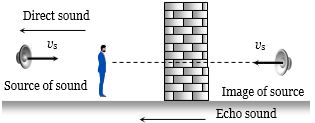
(A) The observer hears two sounds: one directly from the source and the other from the reflected sound (echo) from the wall.
For the direct sound,the source is moving away from the observer. The apparent frequency $n_1$ is given by:
$n_1 = n \left( \frac{v}{v + v_S} \right) = 256 \left( \frac{330}{330 + 5} \right) = 256 \left( \frac{330}{335} \right) \approx 252.18 \ Hz$.
For the reflected sound,the wall acts as a stationary source reflecting the sound. The source is moving towards the wall,so the wall receives sound at a higher frequency,which it then reflects back to the observer. The apparent frequency $n_2$ is given by:
$n_2 = n \left( \frac{v}{v - v_S} \right) = 256 \left( \frac{330}{330 - 5} \right) = 256 \left( \frac{330}{325} \right) \approx 260.00 \ Hz$.
The number of beats per second is the difference between these two frequencies:
$f_{beat} = n_2 - n_1 = n \left( \frac{v}{v - v_S} - \frac{v}{v + v_S} \right) = n \left( \frac{v(v + v_S) - v(v - v_S)}{v^2 - v_S^2} \right) = \frac{2nvv_S}{v^2 - v_S^2}$.
Substituting the values:
$f_{beat} = \frac{2 \times 256 \times 330 \times 5}{330^2 - 5^2} = \frac{844800}{108900 - 25} = \frac{844800}{108875} \approx 7.76 \ Hz \approx 7.8 \ Hz$.
For the direct sound,the source is moving away from the observer. The apparent frequency $n_1$ is given by:
$n_1 = n \left( \frac{v}{v + v_S} \right) = 256 \left( \frac{330}{330 + 5} \right) = 256 \left( \frac{330}{335} \right) \approx 252.18 \ Hz$.
For the reflected sound,the wall acts as a stationary source reflecting the sound. The source is moving towards the wall,so the wall receives sound at a higher frequency,which it then reflects back to the observer. The apparent frequency $n_2$ is given by:
$n_2 = n \left( \frac{v}{v - v_S} \right) = 256 \left( \frac{330}{330 - 5} \right) = 256 \left( \frac{330}{325} \right) \approx 260.00 \ Hz$.
The number of beats per second is the difference between these two frequencies:
$f_{beat} = n_2 - n_1 = n \left( \frac{v}{v - v_S} - \frac{v}{v + v_S} \right) = n \left( \frac{v(v + v_S) - v(v - v_S)}{v^2 - v_S^2} \right) = \frac{2nvv_S}{v^2 - v_S^2}$.
Substituting the values:
$f_{beat} = \frac{2 \times 256 \times 330 \times 5}{330^2 - 5^2} = \frac{844800}{108900 - 25} = \frac{844800}{108875} \approx 7.76 \ Hz \approx 7.8 \ Hz$.
0 likes
View Solution59
MediumMCQ
The apparent frequency of a note,when a listener moves towards a stationary source with a velocity of $40 \ m/s$,is $200 \ Hz$. When the listener moves away from the same source with the same speed,the apparent frequency of the same note is $160 \ Hz$. The velocity of sound in air is (in $m/s$):
A
$360$
B
$330$
C
$320$
D
$340$
Solution
(A) Let $v$ be the velocity of sound and $v_0 = 40 \ m/s$ be the velocity of the listener.
When the listener moves towards a stationary source,the apparent frequency $n'$ is given by:
$n' = \left( \frac{v + v_0}{v} \right) n = 200 \dots (i)$
When the listener moves away from the same source,the apparent frequency $n''$ is given by:
$n'' = \left( \frac{v - v_0}{v} \right) n = 160 \dots (ii)$
Dividing equation $(i)$ by equation $(ii)$:
$\frac{v + v_0}{v - v_0} = \frac{200}{160} = \frac{5}{4}$
$4(v + 40) = 5(v - 40)$
$4v + 160 = 5v - 200$
$v = 360 \ m/s$
The velocity of sound in air is $360 \ m/s$.
When the listener moves towards a stationary source,the apparent frequency $n'$ is given by:
$n' = \left( \frac{v + v_0}{v} \right) n = 200 \dots (i)$
When the listener moves away from the same source,the apparent frequency $n''$ is given by:
$n'' = \left( \frac{v - v_0}{v} \right) n = 160 \dots (ii)$
Dividing equation $(i)$ by equation $(ii)$:
$\frac{v + v_0}{v - v_0} = \frac{200}{160} = \frac{5}{4}$
$4(v + 40) = 5(v - 40)$
$4v + 160 = 5v - 200$
$v = 360 \ m/s$
The velocity of sound in air is $360 \ m/s$.
0 likes
View Solution60
MediumMCQ
An observer moves towards a stationary source of sound,with a velocity one-fifth of the velocity of sound. What is the percentage increase in the apparent frequency (in $\%$)?
A
$5$
B
$20$
C
$0$
D
$0.5$
Solution
(B) When an observer moves towards a stationary source,the apparent frequency $n'$ is given by the Doppler effect formula:
$n' = \left( \frac{v + v_O}{v} \right) n$
Given that the velocity of the observer $v_O = \frac{v}{5}$,where $v$ is the velocity of sound.
Substituting the value of $v_O$ into the formula:
$n' = \left( \frac{v + v/5}{v} \right) n = \left( \frac{6v/5}{v} \right) n = 1.2n$
The increase in frequency is $\Delta n = n' - n = 1.2n - n = 0.2n$.
The percentage increase in frequency is given by:
$\text{Percentage increase} = \left( \frac{\Delta n}{n} \right) \times 100 = \left( \frac{0.2n}{n} \right) \times 100 = 20\%$.
$n' = \left( \frac{v + v_O}{v} \right) n$
Given that the velocity of the observer $v_O = \frac{v}{5}$,where $v$ is the velocity of sound.
Substituting the value of $v_O$ into the formula:
$n' = \left( \frac{v + v/5}{v} \right) n = \left( \frac{6v/5}{v} \right) n = 1.2n$
The increase in frequency is $\Delta n = n' - n = 1.2n - n = 0.2n$.
The percentage increase in frequency is given by:
$\text{Percentage increase} = \left( \frac{\Delta n}{n} \right) \times 100 = \left( \frac{0.2n}{n} \right) \times 100 = 20\%$.
0 likes
View Solution61
DifficultMCQ
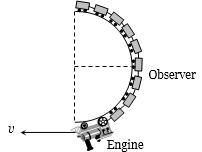
$A$ train is moving along a semicircular track. The engine is at one end of the semicircular part of the track,while the last carriage is at the other end. The driver blows a whistle of frequency $200 \ Hz$. The velocity of sound is $340 \ m/s$. If the speed of the train is $30 \ m/s$,what is the apparent frequency observed by a passenger in the middle of the train (in $Hz$)?
A
$209$
B
$288$
C
$200$
D
$181$
Solution
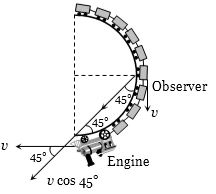
(C) The situation is shown in the figure. Both the source (engine) and the observer (passenger in the middle of the train) have the same speed $v = 30 \ m/s$.
The engine is at the start of the semicircle,and the observer is at the midpoint of the semicircle. The line joining the engine and the observer makes an angle of $45^\circ$ with the velocity vector of both the engine and the observer.
The component of the velocity of the observer towards the source is $v \cos 45^\circ$.
The component of the velocity of the source towards the observer is $v \cos 45^\circ$.
Since both the source and the observer are moving with the same velocity component along the line joining them,there is no relative motion between them along the line of sight.
Therefore,the apparent frequency heard by the observer is the same as the source frequency,which is $200 \ Hz$.
The engine is at the start of the semicircle,and the observer is at the midpoint of the semicircle. The line joining the engine and the observer makes an angle of $45^\circ$ with the velocity vector of both the engine and the observer.
The component of the velocity of the observer towards the source is $v \cos 45^\circ$.
The component of the velocity of the source towards the observer is $v \cos 45^\circ$.
Since both the source and the observer are moving with the same velocity component along the line joining them,there is no relative motion between them along the line of sight.
Therefore,the apparent frequency heard by the observer is the same as the source frequency,which is $200 \ Hz$.
0 likes
View Solution62
DifficultMCQ
The difference between the apparent frequency of a source of sound as perceived by an observer during its approach and recession is $2\%$ of the natural frequency of the source. If the velocity of sound in air is $300 \, m/s$,the velocity of the source is ... $m/s$ (Given that velocity of source < velocity of sound).
A
$6$
B
$3$
C
$1.5$
D
$12$
Solution
(B) When the source approaches the observer,the apparent frequency is $n' = \frac{v}{v - v_s} n = n \left( 1 - \frac{v_s}{v} \right)^{-1} \approx n \left( 1 + \frac{v_s}{v} \right)$.
When the source recedes from the observer,the apparent frequency is $n'' = \frac{v}{v + v_s} n = n \left( 1 + \frac{v_s}{v} \right)^{-1} \approx n \left( 1 - \frac{v_s}{v} \right)$.
Given that the difference $n' - n'' = \frac{2}{100} n$.
Substituting the expressions: $n \left( 1 + \frac{v_s}{v} \right) - n \left( 1 - \frac{v_s}{v} \right) = \frac{2}{100} n$.
$n \left( \frac{2 v_s}{v} \right) = \frac{2}{100} n$.
$\frac{2 v_s}{v} = \frac{2}{100} \Rightarrow v_s = \frac{v}{100}$.
Given $v = 300 \, m/s$,so $v_s = \frac{300}{100} = 3 \, m/s$.
When the source recedes from the observer,the apparent frequency is $n'' = \frac{v}{v + v_s} n = n \left( 1 + \frac{v_s}{v} \right)^{-1} \approx n \left( 1 - \frac{v_s}{v} \right)$.
Given that the difference $n' - n'' = \frac{2}{100} n$.
Substituting the expressions: $n \left( 1 + \frac{v_s}{v} \right) - n \left( 1 - \frac{v_s}{v} \right) = \frac{2}{100} n$.
$n \left( \frac{2 v_s}{v} \right) = \frac{2}{100} n$.
$\frac{2 v_s}{v} = \frac{2}{100} \Rightarrow v_s = \frac{v}{100}$.
Given $v = 300 \, m/s$,so $v_s = \frac{300}{100} = 3 \, m/s$.
0 likes
View Solution63
DifficultMCQ
$A$ sound wave of frequency $\nu$ travels horizontally to the right. It is reflected from a large vertical plane surface moving to the left with a speed $v$. The speed of sound in the medium is $c$. Then:
A
The frequency of the reflected wave is $\frac{\nu (c + v)}{c - v}$
B
The wavelength of the reflected wave is $\frac{c(c - v)}{\nu (c + v)}$
C
The number of waves striking the surface per second is $\frac{\nu (c + v)}{c}$
D
All of the above.
Solution
(D) $1$. The number of waves striking the surface per second (frequency of waves reaching the moving target) is given by $n' = \frac{c + v}{\lambda} = \frac{\nu (c + v)}{c}$. Thus,option $(c)$ is correct.
$2$. The moving target acts as a source for the reflected waves. The apparent frequency $n''$ of the reflected wave is given by the Doppler effect formula for a moving source: $n'' = n' \left( \frac{c}{c - v} \right) = \nu \left( \frac{c + v}{c} \right) \left( \frac{c}{c - v} \right) = \nu \left( \frac{c + v}{c - v} \right)$. Thus,option $(a)$ is correct.
$3$. The wavelength $\lambda'$ of the reflected wave is $\lambda' = \frac{c}{n''} = \frac{c}{\nu \left( \frac{c + v}{c - v} \right)} = \frac{c(c - v)}{\nu (c + v)}$. Thus,option $(b)$ is correct.
$4$. Since $(a)$,$(b)$,and $(c)$ are all correct,the correct choice is $(d)$.
$2$. The moving target acts as a source for the reflected waves. The apparent frequency $n''$ of the reflected wave is given by the Doppler effect formula for a moving source: $n'' = n' \left( \frac{c}{c - v} \right) = \nu \left( \frac{c + v}{c} \right) \left( \frac{c}{c - v} \right) = \nu \left( \frac{c + v}{c - v} \right)$. Thus,option $(a)$ is correct.
$3$. The wavelength $\lambda'$ of the reflected wave is $\lambda' = \frac{c}{n''} = \frac{c}{\nu \left( \frac{c + v}{c - v} \right)} = \frac{c(c - v)}{\nu (c + v)}$. Thus,option $(b)$ is correct.
$4$. Since $(a)$,$(b)$,and $(c)$ are all correct,the correct choice is $(d)$.
0 likes
View Solution64
DifficultMCQ
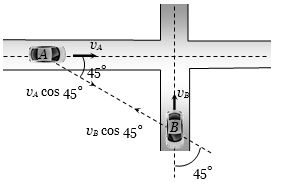
Two cars are moving on two perpendicular roads towards a crossing with uniform speeds of $72\; km/hr$ and $36\; km/hr$. If the first car blows a horn of frequency $280\; Hz$,then the frequency of the horn heard by the driver of the second car when the line joining the cars makes a $45^o$ angle with the roads will be .... $Hz$.
A
$321$
B
$298$
C
$289$
D
$280$
Solution
(B) Given:
Speed of car $A$ $(v_A)$ = $72\; km/hr = 72 \times \frac{5}{18} = 20\; m/s$.
Speed of car $B$ $(v_B)$ = $36\; km/hr = 36 \times \frac{5}{18} = 10\; m/s$.
Frequency of source $(n)$ = $280\; Hz$.
Speed of sound $(v)$ = $340\; m/s$ (assumed).
The component of velocity of source $(A)$ along the line joining the cars is $v_A \cos 45^o$ (moving towards the observer).
The component of velocity of observer $(B)$ along the line joining the cars is $v_B \cos 45^o$ (moving towards the source).
Using the Doppler effect formula:
$n' = n \left( \frac{v + v_B \cos 45^o}{v - v_A \cos 45^o} \right)$
$n' = 280 \left( \frac{340 + 10 \cos 45^o}{340 - 20 \cos 45^o} \right)$
$n' = 280 \left( \frac{340 + 10/\sqrt{2}}{340 - 20/\sqrt{2}} \right)$
$n' = 280 \left( \frac{340 + 7.07}{340 - 14.14} \right) = 280 \left( \frac{347.07}{325.86} \right) \approx 298.2\; Hz$.
Thus,the observed frequency is approximately $298\; Hz$.
Speed of car $A$ $(v_A)$ = $72\; km/hr = 72 \times \frac{5}{18} = 20\; m/s$.
Speed of car $B$ $(v_B)$ = $36\; km/hr = 36 \times \frac{5}{18} = 10\; m/s$.
Frequency of source $(n)$ = $280\; Hz$.
Speed of sound $(v)$ = $340\; m/s$ (assumed).
The component of velocity of source $(A)$ along the line joining the cars is $v_A \cos 45^o$ (moving towards the observer).
The component of velocity of observer $(B)$ along the line joining the cars is $v_B \cos 45^o$ (moving towards the source).
Using the Doppler effect formula:
$n' = n \left( \frac{v + v_B \cos 45^o}{v - v_A \cos 45^o} \right)$
$n' = 280 \left( \frac{340 + 10 \cos 45^o}{340 - 20 \cos 45^o} \right)$
$n' = 280 \left( \frac{340 + 10/\sqrt{2}}{340 - 20/\sqrt{2}} \right)$
$n' = 280 \left( \frac{340 + 7.07}{340 - 14.14} \right) = 280 \left( \frac{347.07}{325.86} \right) \approx 298.2\; Hz$.
Thus,the observed frequency is approximately $298\; Hz$.
0 likes
View Solution65
MediumMCQ
Two whistles $A$ and $B$ produce notes of frequencies $660 \ Hz$ and $596 \ Hz$ respectively. There is a listener at the mid-point of the line joining them. Now,the whistle $B$ and the listener start moving with a speed of $30 \ m/s$ away from the whistle $A$. If the speed of sound is $330 \ m/s$,how many beats will be heard by the listener?
A
$2$
B
$4$
C
$6$
D
$8$
Solution
(B) Let the speed of sound be $v = 330 \ m/s$. The speed of the listener $v_L = 30 \ m/s$ and the speed of whistle $B$ is $v_B = 30 \ m/s$.
$1$. For whistle $B$: Since the listener and whistle $B$ are moving in the same direction with the same speed,their relative velocity is zero. Therefore,the frequency heard by the listener from $B$ remains $f_B' = 596 \ Hz$.
$2$. For whistle $A$: The listener is moving away from the stationary whistle $A$ with speed $v_L = 30 \ m/s$. The observed frequency $f_A'$ is given by the Doppler effect formula: $f_A' = f_A \left( \frac{v - v_L}{v} \right)$.
Substituting the values: $f_A' = 660 \left( \frac{330 - 30}{330} \right) = 660 \left( \frac{300}{330} \right) = 660 \times \frac{10}{11} = 600 \ Hz$.
$3$. The number of beats heard is the difference between the two observed frequencies: $\text{Beats} = |f_A' - f_B'| = |600 - 596| = 4 \ Hz$.
$1$. For whistle $B$: Since the listener and whistle $B$ are moving in the same direction with the same speed,their relative velocity is zero. Therefore,the frequency heard by the listener from $B$ remains $f_B' = 596 \ Hz$.
$2$. For whistle $A$: The listener is moving away from the stationary whistle $A$ with speed $v_L = 30 \ m/s$. The observed frequency $f_A'$ is given by the Doppler effect formula: $f_A' = f_A \left( \frac{v - v_L}{v} \right)$.
Substituting the values: $f_A' = 660 \left( \frac{330 - 30}{330} \right) = 660 \left( \frac{300}{330} \right) = 660 \times \frac{10}{11} = 600 \ Hz$.
$3$. The number of beats heard is the difference between the two observed frequencies: $\text{Beats} = |f_A' - f_B'| = |600 - 596| = 4 \ Hz$.
0 likes
View Solution66
MediumMCQ
$A$ source producing sound of frequency $170 \, Hz$ is approaching a stationary observer with a velocity $17 \, ms^{-1}$. The apparent change in the wavelength of sound heard by the observer is (speed of sound in air $= 340 \, ms^{-1}$) ..... $m$
A
$0.1$
B
$0.2$
C
$0.4$
D
$0.5$
Solution
(A) The original wavelength of the sound emitted by the source is given by $\lambda = \frac{v}{f} = \frac{340}{170} = 2 \, m$.
When the source approaches a stationary observer with velocity $v_s = 17 \, ms^{-1}$,the apparent wavelength $\lambda'$ is given by the formula $\lambda' = \frac{v - v_s}{f} = \frac{340 - 17}{170} = \frac{323}{170} = 1.9 \, m$.
The apparent change in the wavelength is $\Delta \lambda = \lambda - \lambda' = 2 - 1.9 = 0.1 \, m$.
When the source approaches a stationary observer with velocity $v_s = 17 \, ms^{-1}$,the apparent wavelength $\lambda'$ is given by the formula $\lambda' = \frac{v - v_s}{f} = \frac{340 - 17}{170} = \frac{323}{170} = 1.9 \, m$.
The apparent change in the wavelength is $\Delta \lambda = \lambda - \lambda' = 2 - 1.9 = 0.1 \, m$.
0 likes
View Solution67
DifficultMCQ
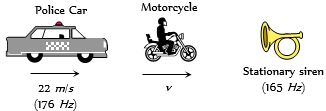
$A$ police car moving at $22 \ m/s$ chases a motorcyclist. The policeman sounds his horn at $176 \ Hz$,while both of them move towards a stationary siren of frequency $165 \ Hz$. Calculate the speed of the motorcycle,if it is given that he does not observe any beats. (in $m/s$)
A
$33$
B
$22$
C
$0$
D
$11$
Solution
(B) Let $v$ be the speed of the motorcyclist and $v_s = 330 \ m/s$ be the speed of sound.
$1$. The frequency $n_1$ of the police car horn heard by the motorcyclist (who is moving away from the source) is given by the Doppler effect formula:
$n_1 = n_0 \left( \frac{v_s - v}{v_s - v_{police}} \right) = 176 \left( \frac{330 - v}{330 - 22} \right) = 176 \left( \frac{330 - v}{308} \right)$
$2$. The frequency $n_2$ of the stationary siren heard by the motorcyclist (who is moving towards the source) is:
$n_2 = n_s \left( \frac{v_s + v}{v_s} \right) = 165 \left( \frac{330 + v}{330} \right)$
$3$. Since the motorcyclist observes no beats,the frequencies must be equal $(n_1 = n_2)$:
$176 \left( \frac{330 - v}{308} \right) = 165 \left( \frac{330 + v}{330} \right)$
$4$. Simplifying the equation:
$\frac{176}{308} (330 - v) = \frac{165}{330} (330 + v)$
$\frac{4}{7} (330 - v) = \frac{1}{2} (330 + v)$
$8(330 - v) = 7(330 + v)$
$2640 - 8v = 2310 + 7v$
$15v = 330$
$v = 22 \ m/s$.
$1$. The frequency $n_1$ of the police car horn heard by the motorcyclist (who is moving away from the source) is given by the Doppler effect formula:
$n_1 = n_0 \left( \frac{v_s - v}{v_s - v_{police}} \right) = 176 \left( \frac{330 - v}{330 - 22} \right) = 176 \left( \frac{330 - v}{308} \right)$
$2$. The frequency $n_2$ of the stationary siren heard by the motorcyclist (who is moving towards the source) is:
$n_2 = n_s \left( \frac{v_s + v}{v_s} \right) = 165 \left( \frac{330 + v}{330} \right)$
$3$. Since the motorcyclist observes no beats,the frequencies must be equal $(n_1 = n_2)$:
$176 \left( \frac{330 - v}{308} \right) = 165 \left( \frac{330 + v}{330} \right)$
$4$. Simplifying the equation:
$\frac{176}{308} (330 - v) = \frac{165}{330} (330 + v)$
$\frac{4}{7} (330 - v) = \frac{1}{2} (330 + v)$
$8(330 - v) = 7(330 + v)$
$2640 - 8v = 2310 + 7v$
$15v = 330$
$v = 22 \ m/s$.
0 likes
View Solution68
DifficultMCQ
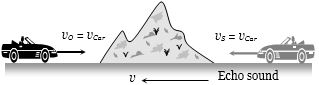
$A$ car is moving towards a high cliff. The car driver sounds a horn of frequency $f$. The reflected sound heard by the driver has a frequency $2f$. If $v$ is the velocity of sound,then the velocity of the car,in the same velocity units,will be:
A
$v/\sqrt{2}$
B
$v/2$
C
$v/3$
D
$v/4$
Solution
(C) The frequency of the reflected sound heard by the driver is given by the Doppler effect formula for a moving source and a moving observer:
$f' = f \left( \frac{v + v_{car}}{v - v_{car}} \right)$
Given that the reflected frequency $f' = 2f$,we substitute this into the equation:
$2f = f \left( \frac{v + v_{car}}{v - v_{car}} \right)$
$2 = \frac{v + v_{car}}{v - v_{car}}$
$2(v - v_{car}) = v + v_{car}$
$2v - 2v_{car} = v + v_{car}$
$v = 3v_{car}$
$v_{car} = v/3$
Therefore,the velocity of the car is $v/3$.
$f' = f \left( \frac{v + v_{car}}{v - v_{car}} \right)$
Given that the reflected frequency $f' = 2f$,we substitute this into the equation:
$2f = f \left( \frac{v + v_{car}}{v - v_{car}} \right)$
$2 = \frac{v + v_{car}}{v - v_{car}}$
$2(v - v_{car}) = v + v_{car}$
$2v - 2v_{car} = v + v_{car}$
$v = 3v_{car}$
$v_{car} = v/3$
Therefore,the velocity of the car is $v/3$.
0 likes
View Solution69
DifficultMCQ
$A$ man is standing on a railway platform listening to the whistle of an engine that passes the man at a constant speed without stopping. If the engine passes the man at time $t_0$,how does the frequency $f$ of the whistle as heard by the man change with time?
A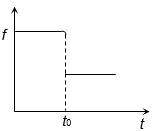
B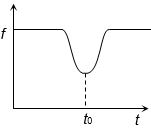
C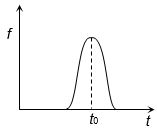
D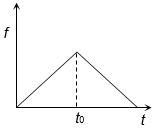
Solution
(A) According to the Doppler effect,when a source of sound moves with a constant velocity $v_s$ relative to a stationary observer,the observed frequency $f$ is given by:
$1$. When the engine is approaching the observer: $f' = f_0 \left( \frac{v}{v - v_s} \right)$,where $v$ is the speed of sound and $f_0$ is the source frequency. This frequency is constant and higher than $f_0$.
$2$. When the engine is moving away from the observer: $f'' = f_0 \left( \frac{v}{v + v_s} \right)$. This frequency is also constant and lower than $f_0$.
Since the engine passes the observer at time $t_0$,the frequency heard by the observer will be a constant higher value for $t < t_0$ and will abruptly drop to a constant lower value for $t > t_0$. This behavior is represented by the graph in option $A$.
$1$. When the engine is approaching the observer: $f' = f_0 \left( \frac{v}{v - v_s} \right)$,where $v$ is the speed of sound and $f_0$ is the source frequency. This frequency is constant and higher than $f_0$.
$2$. When the engine is moving away from the observer: $f'' = f_0 \left( \frac{v}{v + v_s} \right)$. This frequency is also constant and lower than $f_0$.
Since the engine passes the observer at time $t_0$,the frequency heard by the observer will be a constant higher value for $t < t_0$ and will abruptly drop to a constant lower value for $t > t_0$. This behavior is represented by the graph in option $A$.
0 likes
View Solution70
MediumMCQ
An observer starts moving with uniform acceleration $a$ toward a stationary sound source emitting a whistle of frequency $n$. As the observer approaches the source,the apparent frequency $n'$ heard by the observer varies with time $t$ as:
A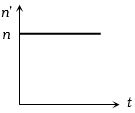
B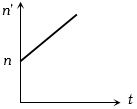
C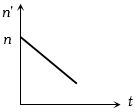
D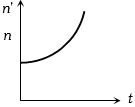
Solution
(B) For an observer approaching a stationary source,the apparent frequency $n'$ is given by the Doppler effect formula:
$n' = n \left( \frac{v + v_0}{v} \right)$
where $v$ is the speed of sound and $v_0$ is the velocity of the observer.
Since the observer starts from rest and moves with uniform acceleration $a$,their velocity at time $t$ is $v_0 = at$.
Substituting this into the frequency formula:
$n' = n \left( \frac{v + at}{v} \right) = n \left( 1 + \frac{at}{v} \right) = \left( \frac{na}{v} \right) t + n$
This is an equation of the form $y = mx + c$,which represents a straight line.
Here,the intercept on the $n'$ axis is $n$ (at $t = 0$),and the slope of the line is $\frac{na}{v}$,which is positive.
Therefore,the graph is a straight line with a positive slope starting from $n$.
$n' = n \left( \frac{v + v_0}{v} \right)$
where $v$ is the speed of sound and $v_0$ is the velocity of the observer.
Since the observer starts from rest and moves with uniform acceleration $a$,their velocity at time $t$ is $v_0 = at$.
Substituting this into the frequency formula:
$n' = n \left( \frac{v + at}{v} \right) = n \left( 1 + \frac{at}{v} \right) = \left( \frac{na}{v} \right) t + n$
This is an equation of the form $y = mx + c$,which represents a straight line.
Here,the intercept on the $n'$ axis is $n$ (at $t = 0$),and the slope of the line is $\frac{na}{v}$,which is positive.
Therefore,the graph is a straight line with a positive slope starting from $n$.
0 likes
View Solution71
MediumMCQ
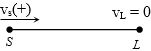
$A$ source with a frequency of $90 \, \text{vibrations/sec}$ moves towards a stationary observer with a velocity of $1/10 \, V$, where $V$ is the speed of sound. What frequency will the observer hear in $\text{vibrations/sec}$?
A
$80$
B
$90$
C
$100$
D
$120$
Solution
(C) According to the Doppler effect, when a source moves towards a stationary observer, the observed frequency $n'$ is given by:
$n' = \left( \frac{V}{V - v_s} \right) n$
Given:
Frequency of source $n = 90 \, \text{vibrations/sec}$
Velocity of source $v_s = \frac{1}{10} V$
Substituting the values:
$n' = \left( \frac{V}{V - \frac{V}{10}} \right) \times 90$
$n' = \left( \frac{V}{\frac{9V}{10}} \right) \times 90$
$n' = \frac{10}{9} \times 90$
$n' = 100 \, \text{vibrations/sec}$
$n' = \left( \frac{V}{V - v_s} \right) n$
Given:
Frequency of source $n = 90 \, \text{vibrations/sec}$
Velocity of source $v_s = \frac{1}{10} V$
Substituting the values:
$n' = \left( \frac{V}{V - \frac{V}{10}} \right) \times 90$
$n' = \left( \frac{V}{\frac{9V}{10}} \right) \times 90$
$n' = \frac{10}{9} \times 90$
$n' = 100 \, \text{vibrations/sec}$
0 likes
View Solution72
EasyMCQ
$A$ source with a frequency of $500 \,Hz$ moves towards a stationary observer with a velocity of $30 \,m/s$. What frequency (in $Hz$) will the observer hear? (The speed of sound in air is $330 \,m/s$.)
A
$550$
B
$458.3$
C
$530$
D
$545.5$
Solution
(A) According to the Doppler effect,when a source moves towards a stationary observer,the observed frequency $n'$ is given by the formula:
$n' = \left( \frac{v}{v - v_s} \right) n$
Where:
$v = 330 \,m/s$ (speed of sound)
$v_s = 30 \,m/s$ (speed of the source)
$n = 500 \,Hz$ (original frequency)
Substituting the values into the formula:
$n' = \left( \frac{330}{330 - 30} \right) \times 500$
$n' = \left( \frac{330}{300} \right) \times 500$
$n' = 1.1 \times 500$
$n' = 550 \,Hz$
Therefore,the observer will hear a frequency of $550 \,Hz$.
$n' = \left( \frac{v}{v - v_s} \right) n$
Where:
$v = 330 \,m/s$ (speed of sound)
$v_s = 30 \,m/s$ (speed of the source)
$n = 500 \,Hz$ (original frequency)
Substituting the values into the formula:
$n' = \left( \frac{330}{330 - 30} \right) \times 500$
$n' = \left( \frac{330}{300} \right) \times 500$
$n' = 1.1 \times 500$
$n' = 550 \,Hz$
Therefore,the observer will hear a frequency of $550 \,Hz$.
0 likes
View Solution73
MediumMCQ
$A$ car moving towards a wall at a velocity of $72 \,km/hr$ sounds a horn of frequency $124 \,vib/sec$. What frequency will the driver hear? (Speed of sound in air = $330 \,ms^{-1}$)
A
$109$
B
$132$
C
$140$
D
$248$
Solution
(C) Given: Velocity of car $v_s = 72 \,km/hr = 72 \times \frac{5}{18} = 20 \,ms^{-1}$.
Frequency of source $n = 124 \,vib/sec$.
Speed of sound $v = 330 \,ms^{-1}$.
The sound reflects from the wall. The wall acts as a stationary source for the reflected sound,and the car acts as a moving observer.
The frequency heard by the driver is given by the Doppler effect formula for a moving observer and stationary source:
$n' = n \left( \frac{v + v_o}{v - v_s} \right)$
Since the car is moving towards the wall,the wall receives sound at a higher frequency $n_w = n \left( \frac{v}{v - v_s} \right)$.
Then,the driver (moving towards the wall) receives the reflected sound at frequency $n' = n_w \left( \frac{v + v_o}{v} \right)$.
Substituting $v_o = v_s = 20 \,ms^{-1}$:
$n' = n \left( \frac{v + v_s}{v - v_s} \right) = 124 \left( \frac{330 + 20}{330 - 20} \right) = 124 \left( \frac{350}{310} \right) = 124 \times 1.129 \approx 140 \,vib/sec$.
Frequency of source $n = 124 \,vib/sec$.
Speed of sound $v = 330 \,ms^{-1}$.
The sound reflects from the wall. The wall acts as a stationary source for the reflected sound,and the car acts as a moving observer.
The frequency heard by the driver is given by the Doppler effect formula for a moving observer and stationary source:
$n' = n \left( \frac{v + v_o}{v - v_s} \right)$
Since the car is moving towards the wall,the wall receives sound at a higher frequency $n_w = n \left( \frac{v}{v - v_s} \right)$.
Then,the driver (moving towards the wall) receives the reflected sound at frequency $n' = n_w \left( \frac{v + v_o}{v} \right)$.
Substituting $v_o = v_s = 20 \,ms^{-1}$:
$n' = n \left( \frac{v + v_s}{v - v_s} \right) = 124 \left( \frac{330 + 20}{330 - 20} \right) = 124 \left( \frac{350}{310} \right) = 124 \times 1.129 \approx 140 \,vib/sec$.
0 likes
View Solution74
EasyMCQ
$A$ car moving towards a wall at a velocity of $30 \, m/s$ sounds a horn of frequency $600 \, Hz$. What frequency $(Hz)$ will the driver hear? (Speed of sound in air = $330 \, m/s$)
A
$720$
B
$555.5$
C
$550$
D
$500$
Solution
(A) The sound reflects off the wall and returns to the driver. The wall acts as a stationary source of sound.
First,the frequency received by the wall is $f_w = f \left( \frac{v}{v - v_s} \right)$,where $v = 330 \, m/s$,$v_s = 30 \, m/s$,and $f = 600 \, Hz$.
$f_w = 600 \left( \frac{330}{330 - 30} \right) = 600 \left( \frac{330}{300} \right) = 600 \times 1.1 = 660 \, Hz$.
Now,the driver acts as an observer moving towards this reflected sound source (the wall) with velocity $v_o = 30 \, m/s$.
The frequency heard by the driver is $f' = f_w \left( \frac{v + v_o}{v} \right)$.
$f' = 660 \left( \frac{330 + 30}{330} \right) = 660 \left( \frac{360}{330} \right) = 2 \times 360 = 720 \, Hz$.
First,the frequency received by the wall is $f_w = f \left( \frac{v}{v - v_s} \right)$,where $v = 330 \, m/s$,$v_s = 30 \, m/s$,and $f = 600 \, Hz$.
$f_w = 600 \left( \frac{330}{330 - 30} \right) = 600 \left( \frac{330}{300} \right) = 600 \times 1.1 = 660 \, Hz$.
Now,the driver acts as an observer moving towards this reflected sound source (the wall) with velocity $v_o = 30 \, m/s$.
The frequency heard by the driver is $f' = f_w \left( \frac{v + v_o}{v} \right)$.
$f' = 660 \left( \frac{330 + 30}{330} \right) = 660 \left( \frac{360}{330} \right) = 2 \times 360 = 720 \, Hz$.
0 likes
View Solution75
DifficultMCQ
$A$ source with frequency $f$ and an observer are moving towards each other with a velocity of $V/10$. The frequency heard by the observer will be ............ $f$. (The velocity of sound in air is $V \, m/s$.)
A
$1.11$
B
$1.22$
C
$1.00$
D
$1.27$
Solution
(B) The Doppler effect formula for the apparent frequency $f'$ is given by:
$f' = f \left( \frac{v + v_o}{v - v_s} \right)$
Here,the velocity of sound is $v = V$.
The observer is moving towards the source,so $v_o = V/10$.
The source is moving towards the observer,so $v_s = V/10$.
Substituting these values into the formula:
$f' = f \left( \frac{V + V/10}{V - V/10} \right)$
$f' = f \left( \frac{11V/10}{9V/10} \right)$
$f' = f \left( \frac{11}{9} \right)$
$f' \approx 1.22 f$
Therefore,the frequency heard by the observer is $1.22 f$.
$f' = f \left( \frac{v + v_o}{v - v_s} \right)$
Here,the velocity of sound is $v = V$.
The observer is moving towards the source,so $v_o = V/10$.
The source is moving towards the observer,so $v_s = V/10$.
Substituting these values into the formula:
$f' = f \left( \frac{V + V/10}{V - V/10} \right)$
$f' = f \left( \frac{11V/10}{9V/10} \right)$
$f' = f \left( \frac{11}{9} \right)$
$f' \approx 1.22 f$
Therefore,the frequency heard by the observer is $1.22 f$.
0 likes
View Solution76
DifficultMCQ
$A$ man is standing between two trains moving away from and towards him,both with a speed of $4 \, m/s$. If both trains produce a sound of frequency $240 \, Hz$,calculate the number of beats heard by the man. (Speed of sound in air = $320 \, m/s$)
A
$6$
B
$3$
C
$0$
D
$12$
Solution
(A) Let the speed of sound be $v = 320 \, m/s$,the speed of the source be $v_s = 4 \, m/s$,and the source frequency be $n = 240 \, Hz$.
For the train moving towards the man,the apparent frequency is $n_1 = \frac{v}{v - v_s} \cdot n = \frac{320}{320 - 4} \cdot 240 = \frac{320}{316} \cdot 240 \approx 243.038 \, Hz$.
For the train moving away from the man,the apparent frequency is $n_2 = \frac{v}{v + v_s} \cdot n = \frac{320}{320 + 4} \cdot 240 = \frac{320}{324} \cdot 240 \approx 237.037 \, Hz$.
The number of beats heard per second is the difference between the apparent frequencies: $n_{beat} = n_1 - n_2$.
$n_{beat} = 320 \cdot 240 \cdot \left( \frac{1}{316} - \frac{1}{324} \right) = 76800 \cdot \left( \frac{324 - 316}{316 \cdot 324} \right) = 76800 \cdot \frac{8}{102384} \approx 6 \, Hz$.
For the train moving towards the man,the apparent frequency is $n_1 = \frac{v}{v - v_s} \cdot n = \frac{320}{320 - 4} \cdot 240 = \frac{320}{316} \cdot 240 \approx 243.038 \, Hz$.
For the train moving away from the man,the apparent frequency is $n_2 = \frac{v}{v + v_s} \cdot n = \frac{320}{320 + 4} \cdot 240 = \frac{320}{324} \cdot 240 \approx 237.037 \, Hz$.
The number of beats heard per second is the difference between the apparent frequencies: $n_{beat} = n_1 - n_2$.
$n_{beat} = 320 \cdot 240 \cdot \left( \frac{1}{316} - \frac{1}{324} \right) = 76800 \cdot \left( \frac{324 - 316}{316 \cdot 324} \right) = 76800 \cdot \frac{8}{102384} \approx 6 \, Hz$.
0 likes
View Solution77
EasyMCQ
With what speed should a sound source move towards an observer so that the observer hears half the original frequency $(v)$?
A
$0.5v$
B
$2v$
C
$0.25v$
D
$v$
Solution
(D) According to the Doppler effect,the apparent frequency $n'$ heard by a stationary observer when the source moves with velocity $v_s$ towards the observer is given by:
$n' = n \left( \frac{v}{v - v_s} \right)$
Given that the observed frequency is half the original frequency,$n' = \frac{n}{2}$.
Substituting this into the formula:
$\frac{n}{2} = n \left( \frac{v}{v - v_s} \right)$
$\frac{1}{2} = \frac{v}{v - v_s}$
$v - v_s = 2v$
$v_s = -v$
The negative sign indicates that the source must move away from the observer at a speed of $v$ to hear half the frequency.
$n' = n \left( \frac{v}{v - v_s} \right)$
Given that the observed frequency is half the original frequency,$n' = \frac{n}{2}$.
Substituting this into the formula:
$\frac{n}{2} = n \left( \frac{v}{v - v_s} \right)$
$\frac{1}{2} = \frac{v}{v - v_s}$
$v - v_s = 2v$
$v_s = -v$
The negative sign indicates that the source must move away from the observer at a speed of $v$ to hear half the frequency.
0 likes
View Solution78
MediumMCQ
The driver of a car travelling with speed $30 \, m/s$ towards a hill sounds a horn of frequency $600 \, Hz$. If the velocity of sound in air is $330 \, m/s$,the frequency of reflected sound as heard by the driver is .... $Hz$.
A
$480$
B
$720$
C
$510$
D
$570$
Solution
(B) The car acts as the source and the hill acts as the observer.
First,we calculate the frequency $f_1$ heard by the hill:
$f_1 = f_0 \times \frac{v}{v - v_s} = 600 \times \frac{330}{330 - 30} = 600 \times \frac{330}{300} = 660 \, Hz$.
Now,the hill reflects this sound,acting as the source,and the driver acts as the observer moving towards the source.
The frequency $f_2$ heard by the driver is:
$f_2 = f_1 \times \frac{v + v_o}{v} = 660 \times \frac{330 + 30}{330} = 660 \times \frac{360}{330} = 2 \times 360 = 720 \, Hz$.
First,we calculate the frequency $f_1$ heard by the hill:
$f_1 = f_0 \times \frac{v}{v - v_s} = 600 \times \frac{330}{330 - 30} = 600 \times \frac{330}{300} = 660 \, Hz$.
Now,the hill reflects this sound,acting as the source,and the driver acts as the observer moving towards the source.
The frequency $f_2$ heard by the driver is:
$f_2 = f_1 \times \frac{v + v_o}{v} = 660 \times \frac{330 + 30}{330} = 660 \times \frac{360}{330} = 2 \times 360 = 720 \, Hz$.
0 likes
View Solution79
MediumMCQ
$A$ train moving at a speed of $220\, m s^{-1}$ towards a stationary object,emits a sound of frequency $1000\, Hz$. Some of the sound reaching the object gets reflected back to the train as an echo. The frequency of the echo as detected by the driver of the train is ...... $Hz$. (Speed of sound in air is $330\, m s^{-1}$)
A
$3500$
B
$4000$
C
$5000$
D
$3000$
Solution
(C) The speed of the train (source and observer) is $v_T = 220\, m s^{-1}$.
The speed of sound in air is $v = 330\, m s^{-1}$.
The source (train) emits a frequency $f_0 = 1000\, Hz$.
First,the sound reaches the stationary object. The frequency received by the object is $f_1 = f_0 \left( \frac{v}{v - v_T} \right)$.
Then,the object reflects this sound back to the moving train. The train acts as an observer moving towards the reflected sound source. The frequency detected by the driver is $f' = f_1 \left( \frac{v + v_T}{v} \right)$.
Substituting $f_1$ into the equation for $f'$,we get $f' = f_0 \left( \frac{v}{v - v_T} \right) \left( \frac{v + v_T}{v} \right) = f_0 \left( \frac{v + v_T}{v - v_T} \right)$.
Calculating the value: $f' = 1000 \left( \frac{330 + 220}{330 - 220} \right) = 1000 \left( \frac{550}{110} \right) = 1000 \times 5 = 5000\, Hz$.
The speed of sound in air is $v = 330\, m s^{-1}$.
The source (train) emits a frequency $f_0 = 1000\, Hz$.
First,the sound reaches the stationary object. The frequency received by the object is $f_1 = f_0 \left( \frac{v}{v - v_T} \right)$.
Then,the object reflects this sound back to the moving train. The train acts as an observer moving towards the reflected sound source. The frequency detected by the driver is $f' = f_1 \left( \frac{v + v_T}{v} \right)$.
Substituting $f_1$ into the equation for $f'$,we get $f' = f_0 \left( \frac{v}{v - v_T} \right) \left( \frac{v + v_T}{v} \right) = f_0 \left( \frac{v + v_T}{v - v_T} \right)$.
Calculating the value: $f' = 1000 \left( \frac{330 + 220}{330 - 220} \right) = 1000 \left( \frac{550}{110} \right) = 1000 \times 5 = 5000\, Hz$.
0 likes
View Solution80
MediumMCQ
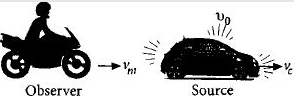
$A$ speeding motorcyclist sees a traffic jam ahead. He slows down to $36\, km\, h^{-1}$. He finds that the traffic has eased and a car moving ahead of him at $18\, km\, h^{-1}$ is honking at a frequency of $1392\, Hz$. If the speed of sound is $343\, m s^{-1}$,the frequency of the honk as heard by him will be .... $Hz$.
A
$1332$
B
$1372$
C
$1412$
D
$1454$
Solution
(C) The speed of the motorcyclist (observer) is $v_o = 36\, km\, h^{-1} = 36 \times \frac{5}{18} = 10\, m s^{-1}$.
Since the motorcyclist is moving towards the source (car),the observer's velocity is taken as positive.
The speed of the car (source) is $v_s = 18\, km\, h^{-1} = 18 \times \frac{5}{18} = 5\, m s^{-1}$.
Since the source is moving away from the observer,the source's velocity is taken as positive.
The speed of sound is $v = 343\, m s^{-1}$.
The frequency of the source is $f_0 = 1392\, Hz$.
Using the Doppler effect formula for frequency heard by the observer,$f' = f_0 \left( \frac{v + v_o}{v + v_s} \right)$,
$f' = 1392 \left( \frac{343 + 10}{343 + 5} \right)$,
$f' = 1392 \left( \frac{353}{348} \right)$,
$f' = 4 \times 353 = 1412\, Hz$.
Since the motorcyclist is moving towards the source (car),the observer's velocity is taken as positive.
The speed of the car (source) is $v_s = 18\, km\, h^{-1} = 18 \times \frac{5}{18} = 5\, m s^{-1}$.
Since the source is moving away from the observer,the source's velocity is taken as positive.
The speed of sound is $v = 343\, m s^{-1}$.
The frequency of the source is $f_0 = 1392\, Hz$.
Using the Doppler effect formula for frequency heard by the observer,$f' = f_0 \left( \frac{v + v_o}{v + v_s} \right)$,
$f' = 1392 \left( \frac{343 + 10}{343 + 5} \right)$,
$f' = 1392 \left( \frac{353}{348} \right)$,
$f' = 4 \times 353 = 1412\, Hz$.
0 likes
View Solution81
DifficultMCQ
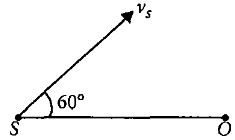
$A$ source of sound $S$ emitting waves of frequency $100 \, Hz$ and an observer $O$ are located at some distance from each other. The source is moving with a speed of $19.4 \, m s^{-1}$ at an angle of $60^{\circ}$ with the source-observer line as shown in the figure. The observer is at rest. The apparent frequency observed by the observer is .... $Hz$ (velocity of sound in air $330 \, m s^{-1}$).
A
$97$
B
$100$
C
$103$
D
$106$
Solution
(A) Given:
Frequency of source,$f_{0} = 100 \, Hz$
Velocity of source,$v_{s} = 19.4 \, m s^{-1}$
Velocity of sound in air,$v = 330 \, m s^{-1}$
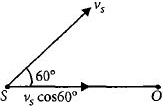
The component of the source velocity along the line joining the source and the observer is $v_{s} \cos 60^{\circ}$. Since the source is moving away from the observer,the apparent frequency $f'$ is given by the Doppler effect formula:
$f' = f_{0} \left( \frac{v}{v + v_{s} \cos 60^{\circ}} \right)$
Substituting the values:
$f' = 100 \left( \frac{330}{330 + 19.4 \times \cos 60^{\circ}} \right)$
$f' = 100 \left( \frac{330}{330 + 19.4 \times 0.5} \right)$
$f' = 100 \left( \frac{330}{330 + 9.7} \right)$
$f' = 100 \left( \frac{330}{339.7} \right) \approx 97.14 \, Hz$
Rounding to the nearest integer,the apparent frequency is $97 \, Hz$.
Frequency of source,$f_{0} = 100 \, Hz$
Velocity of source,$v_{s} = 19.4 \, m s^{-1}$
Velocity of sound in air,$v = 330 \, m s^{-1}$
The component of the source velocity along the line joining the source and the observer is $v_{s} \cos 60^{\circ}$. Since the source is moving away from the observer,the apparent frequency $f'$ is given by the Doppler effect formula:
$f' = f_{0} \left( \frac{v}{v + v_{s} \cos 60^{\circ}} \right)$
Substituting the values:
$f' = 100 \left( \frac{330}{330 + 19.4 \times \cos 60^{\circ}} \right)$
$f' = 100 \left( \frac{330}{330 + 19.4 \times 0.5} \right)$
$f' = 100 \left( \frac{330}{330 + 9.7} \right)$
$f' = 100 \left( \frac{330}{339.7} \right) \approx 97.14 \, Hz$
Rounding to the nearest integer,the apparent frequency is $97 \, Hz$.
0 likes
View Solution82
MediumMCQ
$A$ siren emitting a sound of frequency $800 \, Hz$ moves away from an observer towards a cliff at a speed of $15 \, m s^{-1}$. The frequency of sound that the observer hears in the echo reflected from the cliff is .... $Hz$ (Take velocity of sound in air $= 330 \, m s^{-1}$)
A
$800$
B
$838$
C
$885$
D
$765$
Solution
(B) The frequency of the sound emitted by the siren is $f_0 = 800 \, Hz$.
The speed of the source (siren) is $v_s = 15 \, m s^{-1}$.
The speed of sound in air is $v = 330 \, m s^{-1}$.
Since the siren is moving towards the cliff,the cliff acts as an observer receiving the sound. The frequency $f'$ received by the cliff is given by the Doppler effect formula for a moving source and stationary observer:
$f' = f_0 \left( \frac{v}{v - v_s} \right) = 800 \left( \frac{330}{330 - 15} \right) = 800 \left( \frac{330}{315} \right) \approx 838.09 \, Hz$.
The cliff reflects this sound back to the original observer. Since the cliff is stationary,it acts as a stationary source emitting sound at frequency $f'$. The original observer is stationary relative to the cliff,so they hear the reflected sound at the same frequency $f'$.
Therefore,the frequency heard by the observer is approximately $838 \, Hz$.
The speed of the source (siren) is $v_s = 15 \, m s^{-1}$.
The speed of sound in air is $v = 330 \, m s^{-1}$.
Since the siren is moving towards the cliff,the cliff acts as an observer receiving the sound. The frequency $f'$ received by the cliff is given by the Doppler effect formula for a moving source and stationary observer:
$f' = f_0 \left( \frac{v}{v - v_s} \right) = 800 \left( \frac{330}{330 - 15} \right) = 800 \left( \frac{330}{315} \right) \approx 838.09 \, Hz$.
The cliff reflects this sound back to the original observer. Since the cliff is stationary,it acts as a stationary source emitting sound at frequency $f'$. The original observer is stationary relative to the cliff,so they hear the reflected sound at the same frequency $f'$.
Therefore,the frequency heard by the observer is approximately $838 \, Hz$.
0 likes
View Solution83
MediumMCQ
Two cars moving in opposite directions approach each other with speeds of $22 \, m s^{-1}$ and $16.5 \, m s^{-1}$ respectively. The driver of the first car blows a horn having a frequency of $400 \, Hz$. The frequency heard by the driver of the second car is ..... $Hz$ (velocity of sound is $340 \, m s^{-1}$)
A
$411$
B
$448$
C
$350$
D
$361$
Solution
(B) The apparent frequency $v^{\prime}$ heard by the observer is given by the Doppler effect formula for sound:
$v^{\prime} = v \left( \frac{v + v_{o}}{v - v_{s}} \right)$
Here,the velocity of sound $v = 340 \, m s^{-1}$.
The source is the first car,so $v_{s} = 22 \, m s^{-1}$.
The observer is the second car,so $v_{o} = 16.5 \, m s^{-1}$.
The source frequency $v = 400 \, Hz$.
Substituting the values into the formula:
$v^{\prime} = 400 \left( \frac{340 + 16.5}{340 - 22} \right)$
$v^{\prime} = 400 \left( \frac{356.5}{318} \right)$
$v^{\prime} = 400 \times 1.121069...$
$v^{\prime} \approx 448.42 \, Hz$
Rounding to the nearest integer,the frequency heard is $448 \, Hz$.
$v^{\prime} = v \left( \frac{v + v_{o}}{v - v_{s}} \right)$
Here,the velocity of sound $v = 340 \, m s^{-1}$.
The source is the first car,so $v_{s} = 22 \, m s^{-1}$.
The observer is the second car,so $v_{o} = 16.5 \, m s^{-1}$.
The source frequency $v = 400 \, Hz$.
Substituting the values into the formula:
$v^{\prime} = 400 \left( \frac{340 + 16.5}{340 - 22} \right)$
$v^{\prime} = 400 \left( \frac{356.5}{318} \right)$
$v^{\prime} = 400 \times 1.121069...$
$v^{\prime} \approx 448.42 \, Hz$
Rounding to the nearest integer,the frequency heard is $448 \, Hz$.
0 likes
View Solution84
EasyMCQ
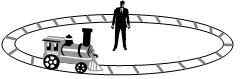
An engine is moving on a circular track with a constant speed. It is blowing a whistle of frequency $500 \ Hz$. The frequency received by an observer standing stationary at the centre of the track is
A
$500 \ Hz$
B
More than $500 \ Hz$
C
Less than $500 \ Hz$
D
More or less than $500 \ Hz$ depending on the actual speed of the engine
Solution
(A) The Doppler effect depends on the relative velocity between the source and the observer along the line joining them.
In this scenario,the engine (source) is moving along a circular path,and the observer is at the center of the circle.
The velocity vector of the engine is always tangential to the circular path,while the line joining the engine and the observer is along the radius.
Since the tangent to a circle is always perpendicular to the radius at the point of contact,the velocity of the source along the line joining the source and the observer is always zero.
Because there is no component of velocity along the line of sight (radial direction),there is no relative motion between the source and the observer along the line joining them.
Therefore,the apparent frequency heard by the observer remains equal to the original frequency of the whistle,which is $500 \ Hz$.
In this scenario,the engine (source) is moving along a circular path,and the observer is at the center of the circle.
The velocity vector of the engine is always tangential to the circular path,while the line joining the engine and the observer is along the radius.
Since the tangent to a circle is always perpendicular to the radius at the point of contact,the velocity of the source along the line joining the source and the observer is always zero.
Because there is no component of velocity along the line of sight (radial direction),there is no relative motion between the source and the observer along the line joining them.
Therefore,the apparent frequency heard by the observer remains equal to the original frequency of the whistle,which is $500 \ Hz$.
0 likes
View Solution85
MediumMCQ
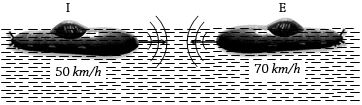
An Indian submarine $(I)$ and an enemy submarine $(E)$ move towards each other in motionless water. The Indian submarine moves at $50 \ km/h$,and the enemy submarine at $70 \ km/h$. The Indian submarine sends out a sonar signal (sound wave in water) at $1000 \ Hz$. The sonar wave reflects off the enemy submarine and returns to the Indian submarine. If the speed of sound in water is $5500 \ km/h$,what is the frequency of the reflected signal detected by the Indian submarine in $kHz$ (in $kHz$)?
A
$1.02$
B
$2$
C
$2.5$
D
$4.7$
Solution
(A) $1$. First,the enemy submarine acts as a receiver moving towards the source (Indian submarine). The frequency $f'$ received by the enemy submarine is: $f' = f \left( \frac{v + v_E}{v} \right) = 1000 \left( \frac{5500 + 70}{5500} \right) \approx 1012.73 \ Hz$.
$2$. The enemy submarine then acts as a source reflecting this frequency back to the Indian submarine. The Indian submarine is moving towards this source. The frequency $f''$ detected by the Indian submarine is: $f'' = f' \left( \frac{v + v_I}{v} \right) = 1012.73 \left( \frac{5500 + 50}{5500} \right) \approx 1012.73 \times 1.00909 \approx 1021.94 \ Hz$.
$3$. Converting to $kHz$,we get $f'' \approx 1.02 \ kHz$.
$2$. The enemy submarine then acts as a source reflecting this frequency back to the Indian submarine. The Indian submarine is moving towards this source. The frequency $f''$ detected by the Indian submarine is: $f'' = f' \left( \frac{v + v_I}{v} \right) = 1012.73 \left( \frac{5500 + 50}{5500} \right) \approx 1012.73 \times 1.00909 \approx 1021.94 \ Hz$.
$3$. Converting to $kHz$,we get $f'' \approx 1.02 \ kHz$.
0 likes
View Solution86
MediumMCQ
Two trains,one coming towards and another going away from an observer,both at $4 \; m/s$,produce a whistle simultaneously of frequency $300 \; Hz$. Find the number of beats produced. (Assume the speed of sound $v = 332 \; m/s$)
A
$5$
B
$6$
C
$7$
D
$12$
Solution
(C) The apparent frequency $n_1$ of the train coming towards the observer is given by $n_1 = n \left( \frac{v}{v - u} \right)$.
The apparent frequency $n_2$ of the train going away from the observer is given by $n_2 = n \left( \frac{v}{v + u} \right)$.
The number of beats produced is the difference between the two apparent frequencies: $\Delta n = n_1 - n_2$.
$\Delta n = n \left( \frac{v}{v - u} - \frac{v}{v + u} \right) = n \left( \frac{v(v + u) - v(v - u)}{v^2 - u^2} \right) = n \left( \frac{2uv}{v^2 - u^2} \right)$.
Substituting the given values: $n = 300 \; Hz$,$v = 332 \; m/s$,$u = 4 \; m/s$.
$\Delta n = 300 \times \left( \frac{2 \times 4 \times 332}{332^2 - 4^2} \right) = 300 \times \left( \frac{2656}{110224 - 16} \right) = 300 \times \left( \frac{2656}{110208} \right) \approx 300 \times 0.0241 = 7.23$.
Rounding to the nearest integer,the number of beats is $7$.
The apparent frequency $n_2$ of the train going away from the observer is given by $n_2 = n \left( \frac{v}{v + u} \right)$.
The number of beats produced is the difference between the two apparent frequencies: $\Delta n = n_1 - n_2$.
$\Delta n = n \left( \frac{v}{v - u} - \frac{v}{v + u} \right) = n \left( \frac{v(v + u) - v(v - u)}{v^2 - u^2} \right) = n \left( \frac{2uv}{v^2 - u^2} \right)$.
Substituting the given values: $n = 300 \; Hz$,$v = 332 \; m/s$,$u = 4 \; m/s$.
$\Delta n = 300 \times \left( \frac{2 \times 4 \times 332}{332^2 - 4^2} \right) = 300 \times \left( \frac{2656}{110224 - 16} \right) = 300 \times \left( \frac{2656}{110208} \right) \approx 300 \times 0.0241 = 7.23$.
Rounding to the nearest integer,the number of beats is $7$.
0 likes
View Solution87
DifficultMCQ
The frequency changes by $10\%$ as a sound source approaches a stationary observer with constant speed $v_s$. What would be the percentage change in frequency as the source recedes from the observer with the same speed? (Given that $v_s < v$,where $v$ is the speed of sound in air)
A
$14.3$
B
$20$
C
$10.0$
D
$8.5$
Solution
(D) When the source approaches the stationary observer,the apparent frequency $\nu'$ is given by $\nu' = \nu \left( \frac{v}{v - v_s} \right)$.
Given that the frequency increases by $10\%$,we have $\frac{\nu'}{\nu} = 1.1 = \frac{11}{10}$.
So,$\frac{v}{v - v_s} = \frac{11}{10} \implies 10v = 11v - 11v_s \implies 11v_s = v \implies v_s = \frac{v}{11}$.
When the source recedes from the observer,the apparent frequency $\nu''$ is given by $\nu'' = \nu \left( \frac{v}{v + v_s} \right)$.
Substituting $v_s = \frac{v}{11}$,we get $\frac{\nu''}{\nu} = \frac{v}{v + v/11} = \frac{v}{12v/11} = \frac{11}{12} \approx 0.9167$.
The change in frequency is $\nu - \nu'' = \nu - 0.9167\nu = 0.0833\nu$.
The percentage change is $0.0833 \times 100 \% \approx 8.33 \%$,which is approximately $8.5 \%$.
Given that the frequency increases by $10\%$,we have $\frac{\nu'}{\nu} = 1.1 = \frac{11}{10}$.
So,$\frac{v}{v - v_s} = \frac{11}{10} \implies 10v = 11v - 11v_s \implies 11v_s = v \implies v_s = \frac{v}{11}$.
When the source recedes from the observer,the apparent frequency $\nu''$ is given by $\nu'' = \nu \left( \frac{v}{v + v_s} \right)$.
Substituting $v_s = \frac{v}{11}$,we get $\frac{\nu''}{\nu} = \frac{v}{v + v/11} = \frac{v}{12v/11} = \frac{11}{12} \approx 0.9167$.
The change in frequency is $\nu - \nu'' = \nu - 0.9167\nu = 0.0833\nu$.
The percentage change is $0.0833 \times 100 \% \approx 8.33 \%$,which is approximately $8.5 \%$.
0 likes
View Solution88
MediumMCQ
Consider two sound sources $S_1$ and $S_2$ having the same frequency $100\,Hz$ and the observer $O$ located between them as shown in the figure. All three are moving with the same velocity in the same direction. The beat frequency heard by the observer is .... $Hz$.

A
$50$
B
$5$
C
$0$
D
$2.5$
Solution
(C) According to the Doppler effect,the apparent frequency $f'$ heard by an observer is given by $f' = f \left( \frac{v \pm v_o}{v \mp v_s} \right)$,where $f$ is the source frequency,$v$ is the speed of sound,$v_o$ is the velocity of the observer,and $v_s$ is the velocity of the source.
In this problem,the source $S_1$,the observer $O$,and the source $S_2$ are all moving with the same velocity $v_s = v_o = 30\,m/s$ in the same direction.
For source $S_1$: The observer is moving away from $S_1$ and $S_1$ is moving towards the observer. The apparent frequency $f_1$ is $f_1 = f \left( \frac{v - v_o}{v - v_s} \right)$. Since $v_o = v_s$,$f_1 = f \left( \frac{v - v_s}{v - v_s} \right) = f = 100\,Hz$.
For source $S_2$: The observer is moving towards $S_2$ and $S_2$ is moving away from the observer. The apparent frequency $f_2$ is $f_2 = f \left( \frac{v + v_o}{v + v_s} \right)$. Since $v_o = v_s$,$f_2 = f \left( \frac{v + v_s}{v + v_s} \right) = f = 100\,Hz$.
The beat frequency is the difference between the two apparent frequencies: $f_{beat} = |f_1 - f_2| = |100 - 100| = 0\,Hz$.
In this problem,the source $S_1$,the observer $O$,and the source $S_2$ are all moving with the same velocity $v_s = v_o = 30\,m/s$ in the same direction.
For source $S_1$: The observer is moving away from $S_1$ and $S_1$ is moving towards the observer. The apparent frequency $f_1$ is $f_1 = f \left( \frac{v - v_o}{v - v_s} \right)$. Since $v_o = v_s$,$f_1 = f \left( \frac{v - v_s}{v - v_s} \right) = f = 100\,Hz$.
For source $S_2$: The observer is moving towards $S_2$ and $S_2$ is moving away from the observer. The apparent frequency $f_2$ is $f_2 = f \left( \frac{v + v_o}{v + v_s} \right)$. Since $v_o = v_s$,$f_2 = f \left( \frac{v + v_s}{v + v_s} \right) = f = 100\,Hz$.
The beat frequency is the difference between the two apparent frequencies: $f_{beat} = |f_1 - f_2| = |100 - 100| = 0\,Hz$.
0 likes
View Solution89
DifficultMCQ
An engine whistling at a constant frequency $n_0$ and moving with a constant velocity goes past a stationary observer. As the engine crosses him,the frequency of the sound heard by him changes by a factor $f$. The actual difference in the frequencies of the sound heard by him before and after the engine crosses him is
A
$\frac{1}{2}n_0 (1 - f^2)$
B
$\frac{1}{2} n_0 \left( \frac{1 - f^2}{f} \right)$
C
$n_0 \left( \frac{1 - f}{1 + f} \right)$
D
$\frac{1}{2} n_0 \left( \frac{1 - f}{1 + f} \right)$
Solution
(B) Let $n_1$ be the frequency observed by the observer before the source crosses the observer,and $n_2$ be the frequency after the source crosses the observer. We are given that $n_2 = f n_1$ ... $(1)$.
The natural frequency of the source is $n_0$. Using the Doppler effect formula for a moving source and stationary observer:
$n_1 = \frac{V}{V - V_s} n_0$
$n_2 = \frac{V}{V + V_s} n_0$
Substituting these into equation $(1)$:
$\frac{V}{V + V_s} n_0 = f \left( \frac{V}{V - V_s} n_0 \right)$
$\frac{1}{V + V_s} = \frac{f}{V - V_s} \implies V - V_s = fV + fV_s$
$V(1 - f) = V_s(1 + f) \implies \frac{V_s}{V} = \frac{1 - f}{1 + f}$ ... $(2)$.
The difference in frequencies is $n_1 - n_2 = n_0 \left( \frac{V}{V - V_s} - \frac{V}{V + V_s} \right) = n_0 \left( \frac{1}{1 - V_s/V} - \frac{1}{1 + V_s/V} \right)$.
Substituting $V_s/V = \frac{1 - f}{1 + f}$:
$n_1 - n_2 = n_0 \left( \frac{1}{1 - \frac{1-f}{1+f}} - \frac{1}{1 + \frac{1-f}{1+f}} \right) = n_0 \left( \frac{1+f}{2f} - \frac{1+f}{2} \right) = n_0 \left( \frac{1+f - f(1+f)}{2f} \right) = n_0 \left( \frac{1+f - f - f^2}{2f} \right) = \frac{1}{2} n_0 \left( \frac{1 - f^2}{f} \right)$.
The natural frequency of the source is $n_0$. Using the Doppler effect formula for a moving source and stationary observer:
$n_1 = \frac{V}{V - V_s} n_0$
$n_2 = \frac{V}{V + V_s} n_0$
Substituting these into equation $(1)$:
$\frac{V}{V + V_s} n_0 = f \left( \frac{V}{V - V_s} n_0 \right)$
$\frac{1}{V + V_s} = \frac{f}{V - V_s} \implies V - V_s = fV + fV_s$
$V(1 - f) = V_s(1 + f) \implies \frac{V_s}{V} = \frac{1 - f}{1 + f}$ ... $(2)$.
The difference in frequencies is $n_1 - n_2 = n_0 \left( \frac{V}{V - V_s} - \frac{V}{V + V_s} \right) = n_0 \left( \frac{1}{1 - V_s/V} - \frac{1}{1 + V_s/V} \right)$.
Substituting $V_s/V = \frac{1 - f}{1 + f}$:
$n_1 - n_2 = n_0 \left( \frac{1}{1 - \frac{1-f}{1+f}} - \frac{1}{1 + \frac{1-f}{1+f}} \right) = n_0 \left( \frac{1+f}{2f} - \frac{1+f}{2} \right) = n_0 \left( \frac{1+f - f(1+f)}{2f} \right) = n_0 \left( \frac{1+f - f - f^2}{2f} \right) = \frac{1}{2} n_0 \left( \frac{1 - f^2}{f} \right)$.
0 likes
View Solution90
MediumMCQ
$A$ source and an observer both start moving simultaneously from the origin,one along the $x-$axis and the other along the $y-$axis,with the speed of the source being twice the speed of the observer. The graph between the apparent frequency $f$ observed by the observer and time $t$ would approximately be:
A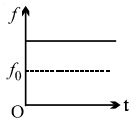
B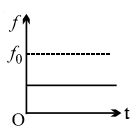
C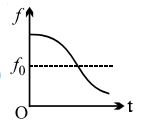
D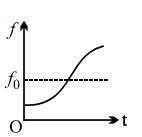
Solution
(B) Let the speed of the observer be $v_o = v$ and the speed of the source be $v_s = 2v$.
At time $t$,the position of the observer is $(0, vt)$ and the position of the source is $(2vt, 0)$.
The velocity vector of the observer is $\vec{v}_o = v \hat{j}$ and the velocity vector of the source is $\vec{v}_s = 2v \hat{i}$.
The unit vector from the source to the observer is $\hat{r} = \frac{-2vt \hat{i} + vt \hat{j}}{\sqrt{(2vt)^2 + (vt)^2}} = \frac{-2 \hat{i} + \hat{j}}{\sqrt{5}}$.
The component of the source velocity along the line of sight is $v_{s,r} = \vec{v}_s \cdot \hat{r} = (2v \hat{i}) \cdot \left( \frac{-2 \hat{i} + \hat{j}}{\sqrt{5}} \right) = -\frac{4v}{\sqrt{5}}$.
The component of the observer velocity along the line of sight is $v_{o,r} = \vec{v}_o \cdot \hat{r} = (v \hat{j}) \cdot \left( \frac{-2 \hat{i} + \hat{j}}{\sqrt{5}} \right) = \frac{v}{\sqrt{5}}$.
The apparent frequency is given by $f = f_0 \left( \frac{c - v_{o,r}}{c - v_{s,r}} \right)$,where $c$ is the speed of sound.
Substituting the values,$f = f_0 \left( \frac{c - v/\sqrt{5}}{c + 4v/\sqrt{5}} \right)$.
Since $v_{s,r}$ and $v_{o,r}$ are constant,the apparent frequency $f$ is constant over time.
Therefore,the graph of $f$ versus $t$ is a horizontal straight line. Comparing this with the given options,Graph $B$ represents a constant frequency $f < f_0$.
At time $t$,the position of the observer is $(0, vt)$ and the position of the source is $(2vt, 0)$.
The velocity vector of the observer is $\vec{v}_o = v \hat{j}$ and the velocity vector of the source is $\vec{v}_s = 2v \hat{i}$.
The unit vector from the source to the observer is $\hat{r} = \frac{-2vt \hat{i} + vt \hat{j}}{\sqrt{(2vt)^2 + (vt)^2}} = \frac{-2 \hat{i} + \hat{j}}{\sqrt{5}}$.
The component of the source velocity along the line of sight is $v_{s,r} = \vec{v}_s \cdot \hat{r} = (2v \hat{i}) \cdot \left( \frac{-2 \hat{i} + \hat{j}}{\sqrt{5}} \right) = -\frac{4v}{\sqrt{5}}$.
The component of the observer velocity along the line of sight is $v_{o,r} = \vec{v}_o \cdot \hat{r} = (v \hat{j}) \cdot \left( \frac{-2 \hat{i} + \hat{j}}{\sqrt{5}} \right) = \frac{v}{\sqrt{5}}$.
The apparent frequency is given by $f = f_0 \left( \frac{c - v_{o,r}}{c - v_{s,r}} \right)$,where $c$ is the speed of sound.
Substituting the values,$f = f_0 \left( \frac{c - v/\sqrt{5}}{c + 4v/\sqrt{5}} \right)$.
Since $v_{s,r}$ and $v_{o,r}$ are constant,the apparent frequency $f$ is constant over time.
Therefore,the graph of $f$ versus $t$ is a horizontal straight line. Comparing this with the given options,Graph $B$ represents a constant frequency $f < f_0$.
0 likes
View Solution91
MediumMCQ
$A$ stationary sound source $S$ of frequency $334 \, Hz$ and a stationary observer $O$ are placed near a reflecting surface moving away from the source with velocity $u = 2 \, m/s$ as shown in the figure. If the velocity of the sound waves in air is $V = 330 \, m/s$,the apparent frequency of the echo heard by the observer is ... $Hz$.

A
$332$
B
$326$
C
$334$
D
$330$
Solution
(D) The problem involves two steps of the Doppler effect.
Step $1$: The reflecting surface acts as an observer moving away from the source $S$. The frequency $f'$ received by the surface is given by $f' = f \left( \frac{V - u}{V} \right)$,where $f = 334 \, Hz$,$V = 330 \, m/s$,and $u = 2 \, m/s$.
$f' = 334 \left( \frac{330 - 2}{330} \right) = 334 \left( \frac{328}{330} \right) \approx 331.97 \, Hz$.
Step $2$: The reflecting surface now acts as a moving source reflecting the sound back to the stationary observer $O$. The frequency $f''$ heard by the observer is $f'' = f' \left( \frac{V}{V + u} \right)$.
$f'' = 334 \left( \frac{328}{330} \right) \times \left( \frac{330}{330 + 2} \right) = 334 \left( \frac{328}{332} \right) = 334 \times 0.98795 \approx 330 \, Hz$.
Step $1$: The reflecting surface acts as an observer moving away from the source $S$. The frequency $f'$ received by the surface is given by $f' = f \left( \frac{V - u}{V} \right)$,where $f = 334 \, Hz$,$V = 330 \, m/s$,and $u = 2 \, m/s$.
$f' = 334 \left( \frac{330 - 2}{330} \right) = 334 \left( \frac{328}{330} \right) \approx 331.97 \, Hz$.
Step $2$: The reflecting surface now acts as a moving source reflecting the sound back to the stationary observer $O$. The frequency $f''$ heard by the observer is $f'' = f' \left( \frac{V}{V + u} \right)$.
$f'' = 334 \left( \frac{328}{330} \right) \times \left( \frac{330}{330 + 2} \right) = 334 \left( \frac{328}{332} \right) = 334 \times 0.98795 \approx 330 \, Hz$.
0 likes
View Solution92
MediumMCQ
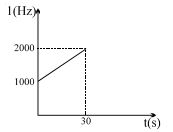
$A$ detector is released from rest over a source of sound of frequency $f_0 = 10^3 \, Hz$. The frequency observed by the detector at time $t$ is plotted in the graph. Given $g = 10 \, m/s^2$,find the speed of sound in air in $m/s$.
A
$330$
B
$350$
C
$300$
D
$310$
Solution
(C) The frequency observed by a moving detector approaching a stationary source is given by the Doppler effect formula: $f = f_0 \left( \frac{v + v_0}{v} \right)$,where $v$ is the speed of sound and $v_0$ is the speed of the detector.
Since the detector is released from rest and falls under gravity,its speed at time $t$ is $v_0 = gt = 10t$.
Substituting this into the formula: $f = 10^3 \left( \frac{v + 10t}{v} \right) = 10^3 + \left( \frac{10^4}{v} \right)t$.
This equation represents a straight line with a slope $m = \frac{10^4}{v}$.
From the graph,the frequency changes from $1000 \, Hz$ to $2000 \, Hz$ in $30 \, s$.
Therefore,the slope is $m = \frac{2000 - 1000}{30} = \frac{1000}{30} = \frac{100}{3}$.
Equating the slopes: $\frac{10^4}{v} = \frac{100}{3}$.
Solving for $v$: $v = \frac{10^4 \times 3}{100} = 100 \times 3 = 300 \, m/s$.
Since the detector is released from rest and falls under gravity,its speed at time $t$ is $v_0 = gt = 10t$.
Substituting this into the formula: $f = 10^3 \left( \frac{v + 10t}{v} \right) = 10^3 + \left( \frac{10^4}{v} \right)t$.
This equation represents a straight line with a slope $m = \frac{10^4}{v}$.
From the graph,the frequency changes from $1000 \, Hz$ to $2000 \, Hz$ in $30 \, s$.
Therefore,the slope is $m = \frac{2000 - 1000}{30} = \frac{1000}{30} = \frac{100}{3}$.
Equating the slopes: $\frac{10^4}{v} = \frac{100}{3}$.
Solving for $v$: $v = \frac{10^4 \times 3}{100} = 100 \times 3 = 300 \, m/s$.
0 likes
View Solution93
MediumMCQ
An observer starts moving with uniform acceleration $a$ towards a stationary sound source of frequency $f$. As the observer approaches the source,the apparent frequency $f'$ heard by the observer varies with time $t$ as:
A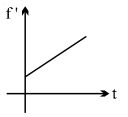
B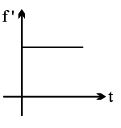
C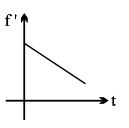
D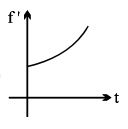
Solution
(A) For an observer approaching a stationary source,the apparent frequency $f'$ is given by the Doppler effect formula:
$f' = f \left( \frac{v + v_0}{v} \right)$
where $v$ is the speed of sound and $v_0$ is the velocity of the observer.
Since the observer starts from rest and moves with uniform acceleration $a$,their velocity at time $t$ is $v_0 = at$.
Substituting this into the frequency formula:
$f' = f \left( \frac{v + at}{v} \right) = f \left( 1 + \frac{a}{v} t \right) = \left( \frac{fa}{v} \right) t + f$
This equation is of the form $y = mx + c$,which represents a straight line.
Here,the intercept on the $f'$ axis is $f$ (at $t = 0$) and the slope is $\frac{fa}{v}$,which is positive.
Therefore,the graph is a straight line with a positive intercept and a positive slope.
$f' = f \left( \frac{v + v_0}{v} \right)$
where $v$ is the speed of sound and $v_0$ is the velocity of the observer.
Since the observer starts from rest and moves with uniform acceleration $a$,their velocity at time $t$ is $v_0 = at$.
Substituting this into the frequency formula:
$f' = f \left( \frac{v + at}{v} \right) = f \left( 1 + \frac{a}{v} t \right) = \left( \frac{fa}{v} \right) t + f$
This equation is of the form $y = mx + c$,which represents a straight line.
Here,the intercept on the $f'$ axis is $f$ (at $t = 0$) and the slope is $\frac{fa}{v}$,which is positive.
Therefore,the graph is a straight line with a positive intercept and a positive slope.
0 likes
View Solution94
MediumMCQ
$A$ sounding body of negligible dimension emitting a frequency of $150\, Hz$ is dropped from a height. During its fall under gravity,it passes near a balloon moving up with a constant velocity of $2\, m/s$ one second after it started to fall. The difference in the frequency observed by the man in the balloon just before and just after crossing the body will be: (Given: velocity of sound $= 300\, m/s$; $g = 10\, m/s^2$) (in $, Hz$)
A
$12$
B
$6$
C
$8$
D
$4$
Solution
(A) After $t = 1\, s$ of free fall,the velocity of the source is $v_s = g \times t = 10 \times 1 = 10\, m/s$ (downward).
The observer in the balloon is moving upward with $v_o = 2\, m/s$.
Let $v = 300\, m/s$ be the speed of sound.
Before crossing,the source is moving towards the observer and the observer is moving towards the source. The observed frequency $n_1$ is:
$n_1 = f_0 \left( \frac{v + v_o}{v - v_s} \right) = 150 \left( \frac{300 + 2}{300 - 10} \right) = 150 \left( \frac{302}{290} \right) \approx 156.21\, Hz$.
After crossing,the source is moving away from the observer and the observer is moving away from the source. The observed frequency $n_2$ is:
$n_2 = f_0 \left( \frac{v - v_o}{v + v_s} \right) = 150 \left( \frac{300 - 2}{300 + 10} \right) = 150 \left( \frac{298}{310} \right) \approx 144.19\, Hz$.
The difference in frequency is $\Delta n = n_1 - n_2 = 156.21 - 144.19 = 12.02\, Hz \approx 12\, Hz$.
The observer in the balloon is moving upward with $v_o = 2\, m/s$.
Let $v = 300\, m/s$ be the speed of sound.
Before crossing,the source is moving towards the observer and the observer is moving towards the source. The observed frequency $n_1$ is:
$n_1 = f_0 \left( \frac{v + v_o}{v - v_s} \right) = 150 \left( \frac{300 + 2}{300 - 10} \right) = 150 \left( \frac{302}{290} \right) \approx 156.21\, Hz$.
After crossing,the source is moving away from the observer and the observer is moving away from the source. The observed frequency $n_2$ is:
$n_2 = f_0 \left( \frac{v - v_o}{v + v_s} \right) = 150 \left( \frac{300 - 2}{300 + 10} \right) = 150 \left( \frac{298}{310} \right) \approx 144.19\, Hz$.
The difference in frequency is $\Delta n = n_1 - n_2 = 156.21 - 144.19 = 12.02\, Hz \approx 12\, Hz$.
0 likes
View Solution95
DifficultMCQ
Two whistles $A$ and $B$ each have a frequency of $500\,Hz$. $A$ is stationary and $B$ is moving towards the right (away from $A$) at a speed of $50\,m/s$. An observer is between the two whistles moving towards the right with a speed of $25\,m/s$. The velocity of sound in air is $350\,m/s$. Assume there is no wind. Then which of the following statements are true:
A
The apparent frequency of whistle $B$ as heard by $A$ is $444\,Hz$ approximately.
B
The apparent frequency of whistle $B$ as heard by the observer is $469\,Hz$ approximately.
C
The difference in the apparent frequencies of $A$ and $B$ as heard by the observer is $4.5\,Hz$.
D
Both $(B)$ and $(C)$.
Solution
(D) The Doppler effect formula is given by $n' = n \left( \frac{v \pm v_o}{v \mp v_s} \right)$.
For whistle $A$ (source stationary,$v_s = 0$) and observer moving away at $25\,m/s$ $(v_o = 25\,m/s)$:
$n'_A = 500 \left( \frac{350 - 25}{350} \right) = 500 \times \frac{325}{350} \approx 464.28\,Hz$.
For whistle $B$ (source moving away at $50\,m/s$,$v_s = 50\,m/s$) and observer moving towards it at $25\,m/s$ $(v_o = 25\,m/s)$:
$n'_B = 500 \left( \frac{350 + 25}{350 + 50} \right) = 500 \times \frac{375}{400} = 468.75\,Hz$.
Difference in frequencies heard by the observer: $\Delta n = |n'_B - n'_A| = |468.75 - 464.28| = 4.47\,Hz \approx 4.5\,Hz$.
Thus,statements $(B)$ and $(C)$ are correct.
For whistle $A$ (source stationary,$v_s = 0$) and observer moving away at $25\,m/s$ $(v_o = 25\,m/s)$:
$n'_A = 500 \left( \frac{350 - 25}{350} \right) = 500 \times \frac{325}{350} \approx 464.28\,Hz$.
For whistle $B$ (source moving away at $50\,m/s$,$v_s = 50\,m/s$) and observer moving towards it at $25\,m/s$ $(v_o = 25\,m/s)$:
$n'_B = 500 \left( \frac{350 + 25}{350 + 50} \right) = 500 \times \frac{375}{400} = 468.75\,Hz$.
Difference in frequencies heard by the observer: $\Delta n = |n'_B - n'_A| = |468.75 - 464.28| = 4.47\,Hz \approx 4.5\,Hz$.
Thus,statements $(B)$ and $(C)$ are correct.
0 likes
View Solution96
DifficultMCQ
Two stationary sources each emit waves of wavelength $\lambda$. An observer moves from one source to the other with velocity $u$. The number of beats heard by the observer is:
A
$\frac{u}{2\lambda}$
B
$\frac{u}{\lambda}$
C
$\frac{2u}{\lambda}$
D
$\sqrt{u\lambda}$
Solution
(C) Let $v$ be the speed of sound and $n$ be the frequency of the sources. Since $\lambda = v/n$,we have $n = v/\lambda$.
For the $1^{st}$ source,the observer is moving away with velocity $u$. The apparent frequency is $n_1 = n \left( \frac{v - u}{v} \right) = n \left( 1 - \frac{u}{v} \right)$.
For the $2^{nd}$ source,the observer is moving towards it with velocity $u$. The apparent frequency is $n_2 = n \left( \frac{v + u}{v} \right) = n \left( 1 + \frac{u}{v} \right)$.
The beat frequency is the difference between the two apparent frequencies:
$|n_2 - n_1| = n \left( 1 + \frac{u}{v} \right) - n \left( 1 - \frac{u}{v} \right) = n \left( \frac{2u}{v} \right)$.
Substituting $n = v/\lambda$,we get:
Beat frequency $= \left( \frac{v}{\lambda} \right) \left( \frac{2u}{v} \right) = \frac{2u}{\lambda}$.
For the $1^{st}$ source,the observer is moving away with velocity $u$. The apparent frequency is $n_1 = n \left( \frac{v - u}{v} \right) = n \left( 1 - \frac{u}{v} \right)$.
For the $2^{nd}$ source,the observer is moving towards it with velocity $u$. The apparent frequency is $n_2 = n \left( \frac{v + u}{v} \right) = n \left( 1 + \frac{u}{v} \right)$.
The beat frequency is the difference between the two apparent frequencies:
$|n_2 - n_1| = n \left( 1 + \frac{u}{v} \right) - n \left( 1 - \frac{u}{v} \right) = n \left( \frac{2u}{v} \right)$.
Substituting $n = v/\lambda$,we get:
Beat frequency $= \left( \frac{v}{\lambda} \right) \left( \frac{2u}{v} \right) = \frac{2u}{\lambda}$.
0 likes
View Solution97
AdvancedMCQ
$A$ car moves towards a hill with speed $v_c$. It blows a horn of frequency $f$ which is heard by an observer following the car with speed $v_o$. The speed of sound in air is $v$.
A
The wavelength of sound reaching the hill is $\frac{v}{f}$.
B
The wavelength of sound reaching the hill is $\frac{v - v_c}{f}$.
C
The beat frequency observed by the observer is $\frac{2v_c(v + v_o)f}{v^2 - v_c^2}$.
D
Both $(B)$ and $(C)$.
Solution
(B) The car acts as a source moving towards a stationary hill with speed $v_c$. The wavelength of the sound waves emitted by the car and reaching the hill is given by $\lambda = \frac{v - v_c}{f}$.
The sound reflects off the hill and acts as a source moving away from the observer. The frequency of the reflected sound heard by the observer is $f' = f \left( \frac{v + v_o}{v - v_c} \right)$.
The frequency of the direct sound heard by the observer is $f'' = f \left( \frac{v + v_o}{v - v_c} \right)$.
Wait,the beat frequency is the difference between the frequency of the reflected sound and the direct sound. The reflected sound frequency $f_{ref} = f \left( \frac{v + v_o}{v - v_c} \right)$ and the direct sound frequency $f_{dir} = f \left( \frac{v - v_o}{v - v_c} \right)$.
The beat frequency $f_b = |f_{ref} - f_{dir}| = f \left( \frac{v + v_o}{v - v_c} - \frac{v - v_o}{v - v_c} \right) = f \left( \frac{2v_o}{v - v_c} \right)$.
Re-evaluating the provided options,option $(B)$ is correct as the wavelength is $\frac{v - v_c}{f}$. Therefore,$(B)$ is the correct choice.
The sound reflects off the hill and acts as a source moving away from the observer. The frequency of the reflected sound heard by the observer is $f' = f \left( \frac{v + v_o}{v - v_c} \right)$.
The frequency of the direct sound heard by the observer is $f'' = f \left( \frac{v + v_o}{v - v_c} \right)$.
Wait,the beat frequency is the difference between the frequency of the reflected sound and the direct sound. The reflected sound frequency $f_{ref} = f \left( \frac{v + v_o}{v - v_c} \right)$ and the direct sound frequency $f_{dir} = f \left( \frac{v - v_o}{v - v_c} \right)$.
The beat frequency $f_b = |f_{ref} - f_{dir}| = f \left( \frac{v + v_o}{v - v_c} - \frac{v - v_o}{v - v_c} \right) = f \left( \frac{2v_o}{v - v_c} \right)$.
Re-evaluating the provided options,option $(B)$ is correct as the wavelength is $\frac{v - v_c}{f}$. Therefore,$(B)$ is the correct choice.
0 likes
View Solution98
MediumMCQ
$A$ whistle producing sound waves of frequencies $9500 \ Hz$ and above is approaching a stationary person with speed $v \ ms^{-1}$. The velocity of sound in air is $300 \ ms^{-1}$. If the person can hear frequencies up to a maximum of $10,000 \ Hz$,the maximum value of $v$ up to which he can hear the whistle is ... $ms^{-1}$.
A
$30$
B
$15\sqrt{2}$
C
$\frac{15}{\sqrt{2}}$
D
$15$
Solution
(D) The apparent frequency $f'$ heard by a stationary observer when the source approaches with velocity $v_s$ is given by the Doppler effect formula: $f' = f \left( \frac{v}{v - v_s} \right)$.
Given: source frequency $f = 9500 \ Hz$,speed of sound $v = 300 \ ms^{-1}$,and maximum audible frequency $f' = 10000 \ Hz$.
Substituting the values: $10000 = 9500 \left( \frac{300}{300 - v} \right)$.
Simplifying the equation: $\frac{10000}{9500} = \frac{300}{300 - v} \Rightarrow \frac{20}{19} = \frac{300}{300 - v}$.
Cross-multiplying: $20(300 - v) = 19 \times 300 \Rightarrow 6000 - 20v = 5700$.
$20v = 300 \Rightarrow v = 15 \ ms^{-1}$.
Thus,the maximum value of $v$ is $15 \ ms^{-1}$.
Given: source frequency $f = 9500 \ Hz$,speed of sound $v = 300 \ ms^{-1}$,and maximum audible frequency $f' = 10000 \ Hz$.
Substituting the values: $10000 = 9500 \left( \frac{300}{300 - v} \right)$.
Simplifying the equation: $\frac{10000}{9500} = \frac{300}{300 - v} \Rightarrow \frac{20}{19} = \frac{300}{300 - v}$.
Cross-multiplying: $20(300 - v) = 19 \times 300 \Rightarrow 6000 - 20v = 5700$.
$20v = 300 \Rightarrow v = 15 \ ms^{-1}$.
Thus,the maximum value of $v$ is $15 \ ms^{-1}$.
0 likes
View Solution99
DifficultMCQ
$A$ motorcycle starts from rest and accelerates along a straight path at $2 \; m/s^2$. At the starting point of the motorcycle,there is a stationary electric siren. How far has the motorcycle gone when the driver hears the frequency of the siren at $94 \%$ of its original value (in $; m$)? (Speed of sound $= 330 \; m/s$)
A
$49$
B
$98$
C
$147$
D
$196$
Solution
(B) The observer (motorcycle) is in motion and the source (siren) is at rest. The Doppler effect formula is given by $n' = n \left( \frac{v - v_O}{v} \right)$,where $v$ is the speed of sound and $v_O$ is the speed of the observer.
Given $n' = 0.94n$,we have $0.94n = n \left( \frac{330 - v_O}{330} \right)$.
Simplifying this,$0.94 \times 330 = 330 - v_O$.
$v_O = 330 - 310.2 = 19.8 \; m/s$.
The motorcycle starts from rest $(u = 0)$ and accelerates at $a = 2 \; m/s^2$. Using the equation of motion $v_O^2 = u^2 + 2as$:
$(19.8)^2 = 0^2 + 2 \times 2 \times s$.
$392.04 = 4s$.
$s = 98.01 \; m \approx 98 \; m$.
Given $n' = 0.94n$,we have $0.94n = n \left( \frac{330 - v_O}{330} \right)$.
Simplifying this,$0.94 \times 330 = 330 - v_O$.
$v_O = 330 - 310.2 = 19.8 \; m/s$.
The motorcycle starts from rest $(u = 0)$ and accelerates at $a = 2 \; m/s^2$. Using the equation of motion $v_O^2 = u^2 + 2as$:
$(19.8)^2 = 0^2 + 2 \times 2 \times s$.
$392.04 = 4s$.
$s = 98.01 \; m \approx 98 \; m$.
0 likes
View Solution100
MediumMCQ
$A$ train is moving on a straight track with speed $20 \ ms^{-1}$. It is blowing its whistle at a frequency of $1000 \ Hz$. The percentage change in the frequency heard by a person standing near the track as the train passes him is (speed of sound $= 320 \ ms^{-1}$) close to .... $\%$
A
$12$
B
$18$
C
$24$
D
$6$
Solution
(A) The frequency heard by the observer when the train is approaching is given by $f_1 = f \left( \frac{v}{v - v_s} \right)$, where $v = 320 \ ms^{-1}$ and $v_s = 20 \ ms^{-1}$.
$f_1 = 1000 \times \left( \frac{320}{320 - 20} \right) = 1000 \times \frac{320}{300} \ Hz$.
When the train is moving away, the frequency heard is $f_2 = f \left( \frac{v}{v + v_s} \right)$.
$f_2 = 1000 \times \left( \frac{320}{320 + 20} \right) = 1000 \times \frac{320}{340} \ Hz$.
The change in frequency is $\Delta f = f_1 - f_2$.
The percentage change relative to the approaching frequency is $\frac{f_1 - f_2}{f_1} \times 100 = \left( 1 - \frac{f_2}{f_1} \right) \times 100$.
Substituting the values: $\left( 1 - \frac{320/340}{320/300} \right) \times 100 = \left( 1 - \frac{300}{340} \right) \times 100 = \left( \frac{40}{340} \right) \times 100 \approx 11.76 \% \approx 12 \%$.
$f_1 = 1000 \times \left( \frac{320}{320 - 20} \right) = 1000 \times \frac{320}{300} \ Hz$.
When the train is moving away, the frequency heard is $f_2 = f \left( \frac{v}{v + v_s} \right)$.
$f_2 = 1000 \times \left( \frac{320}{320 + 20} \right) = 1000 \times \frac{320}{340} \ Hz$.
The change in frequency is $\Delta f = f_1 - f_2$.
The percentage change relative to the approaching frequency is $\frac{f_1 - f_2}{f_1} \times 100 = \left( 1 - \frac{f_2}{f_1} \right) \times 100$.
Substituting the values: $\left( 1 - \frac{320/340}{320/300} \right) \times 100 = \left( 1 - \frac{300}{340} \right) \times 100 = \left( \frac{40}{340} \right) \times 100 \approx 11.76 \% \approx 12 \%$.
0 likes
View SolutionWaves and Sound — Doppler’s Effect · Frequently Asked Questions
1Are these Waves and Sound questions useful for JEE and NEET?
Yes. All questions in this section are mapped to JEE Main and NEET exam patterns. Previous year questions from JEE Main, NEET, GUJCET and state-level exams are included with full solutions.
2Can I switch to Hindi or Gujarati for these questions?
Yes. Use the language tabs in the hero section or the sidebar to view the same questions and solutions in English, Hindi or Gujarati.
3How do I generate a question paper from this subtopic?
Use the Vedclass Exam Paper Generator — select the chapter and subtopic, set difficulty, and generate Sets A, B, C, D automatically. First 3 chapters of every subject are free.
Vedclass Products
For Students
Vedclass Test Series
Mock tests in real JEE/NEET style with performance analysis. 5-day free trial.
Start Free TrialFor Teachers
Exam Paper Generator
Generate Set A/B/C/D papers from this chapter in 2 minutes. 3 chapters free.
Try FreeFor Institutes
Online Exam Module
Live online exams with unlimited students, 360° analytics & white-label branding.
See DemoFor Teachers & Institutes
Generate a Waves and Sound Exam Paper in 2 Minutes
Select subtopic & difficulty — Sets A, B, C, D auto-generated with No Repeat logic.
First 3 chapters of every subject are free — no payment required.