
A English
Doppler’s Effect Questions in English
Class 11 Physics · Waves and Sound · Doppler’s Effect
322+
Questions
English
Language
100%
With Solutions
Showing 50 of 322 questions in English
151
MediumMCQ
$A$ train is moving towards a stationary observer. Which of the following curves best represents the frequency $f$ received by the observer as a function of time $t$?
A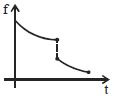
B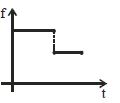
C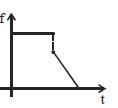
D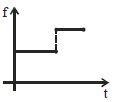
Solution
(B) According to the Doppler effect,when a source of sound (train) moves towards a stationary observer,the observed frequency $f$ is given by $f = f_0 \left( \frac{v}{v - v_s} \right)$,where $v$ is the speed of sound and $v_s$ is the speed of the source. This frequency is higher than the source frequency $f_0$ and remains constant as long as the source approaches with constant velocity.
When the train passes the observer and starts moving away,the observed frequency becomes $f = f_0 \left( \frac{v}{v + v_s} \right)$,which is lower than the source frequency $f_0$ and remains constant as long as the source moves away with constant velocity.
Therefore,the frequency $f$ will be higher than $f_0$ initially and will suddenly drop to a value lower than $f_0$ at the moment the train passes the observer. This behavior is correctly represented by graph $B$.
When the train passes the observer and starts moving away,the observed frequency becomes $f = f_0 \left( \frac{v}{v + v_s} \right)$,which is lower than the source frequency $f_0$ and remains constant as long as the source moves away with constant velocity.
Therefore,the frequency $f$ will be higher than $f_0$ initially and will suddenly drop to a value lower than $f_0$ at the moment the train passes the observer. This behavior is correctly represented by graph $B$.
0 likes
View Solution152
MediumMCQ
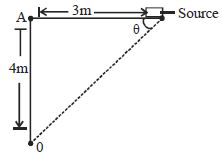
$A$ source of sound is travelling at $\frac{100}{3} \, m/s$ along a road,towards a point $A$. When the source is $3 \, m$ away from $A$,a person is standing at a point $O$ on a road perpendicular to the path of the source. The distance of $O$ from $A$ at that time is $4 \, m$. If the original frequency is $640 \, Hz$,then the apparent frequency heard by the person is ...... $Hz$ (speed of sound is $340 \, m/s$).
A
$620$
B
$680$
C
$720$
D
$840$
Solution
(B) The source is moving towards point $A$ with velocity $v_s = \frac{100}{3} \, m/s$. The observer is at point $O$. The distance $AO = 4 \, m$ and the distance of the source from $A$ is $3 \, m$. The distance of the source from the observer $O$ is $r = \sqrt{3^2 + 4^2} = 5 \, m$.
The component of the source's velocity along the line joining the source and the observer is the effective velocity $v_{s, \text{eff}} = v_s \cos \theta$,where $\theta$ is the angle between the velocity vector and the line $OS$.
From the geometry,$\cos \theta = \frac{3}{5}$.
Therefore,$v_{s, \text{eff}} = \frac{100}{3} \times \frac{3}{5} = 20 \, m/s$.
Using the Doppler effect formula for a moving source and stationary observer: $n' = n \left( \frac{v}{v - v_{s, \text{eff}}} \right)$.
Substituting the values: $n' = 640 \times \left( \frac{340}{340 - 20} \right) = 640 \times \left( \frac{340}{320} \right) = 640 \times 1.0625 = 680 \, Hz$.
The component of the source's velocity along the line joining the source and the observer is the effective velocity $v_{s, \text{eff}} = v_s \cos \theta$,where $\theta$ is the angle between the velocity vector and the line $OS$.
From the geometry,$\cos \theta = \frac{3}{5}$.
Therefore,$v_{s, \text{eff}} = \frac{100}{3} \times \frac{3}{5} = 20 \, m/s$.
Using the Doppler effect formula for a moving source and stationary observer: $n' = n \left( \frac{v}{v - v_{s, \text{eff}}} \right)$.
Substituting the values: $n' = 640 \times \left( \frac{340}{340 - 20} \right) = 640 \times \left( \frac{340}{320} \right) = 640 \times 1.0625 = 680 \, Hz$.
0 likes
View Solution153
DifficultMCQ
An engine is moving towards a wall with a velocity $50\, ms^{-1}$ and emits a note of $1.2\, kHz$. The speed of sound in air is $350\, ms^{-1}$. The frequency of the note after reflection from the wall as heard by the driver of the engine is ..... $kHz$.
A
$2.4$
B
$0.24$
C
$1.6$
D
$1.2$
Solution
(C) The engine acts as both the source and the observer. The sound travels to the wall and reflects back.
Since the engine is moving towards the wall with velocity $v_s = 50\, ms^{-1}$,the frequency $f'$ received by the wall is given by the Doppler effect formula for a moving source and stationary observer:
$f' = f_0 \left( \frac{v}{v - v_s} \right) = 1.2 \left( \frac{350}{350 - 50} \right) = 1.2 \left( \frac{350}{300} \right) = 1.4\, kHz$.
Now,the wall acts as a stationary source reflecting this frequency $f'$,and the engine acts as an observer moving towards the wall with velocity $v_o = 50\, ms^{-1}$.
The frequency $f''$ heard by the driver is:
$f'' = f' \left( \frac{v + v_o}{v} \right) = 1.4 \left( \frac{350 + 50}{350} \right) = 1.4 \left( \frac{400}{350} \right) = 1.4 \times \frac{8}{7} = 1.6\, kHz$.
Alternatively,using the combined formula for reflection from a wall:
$f'' = f_0 \left( \frac{v + v_s}{v - v_s} \right) = 1.2 \left( \frac{350 + 50}{350 - 50} \right) = 1.2 \left( \frac{400}{300} \right) = 1.6\, kHz$.
Since the engine is moving towards the wall with velocity $v_s = 50\, ms^{-1}$,the frequency $f'$ received by the wall is given by the Doppler effect formula for a moving source and stationary observer:
$f' = f_0 \left( \frac{v}{v - v_s} \right) = 1.2 \left( \frac{350}{350 - 50} \right) = 1.2 \left( \frac{350}{300} \right) = 1.4\, kHz$.
Now,the wall acts as a stationary source reflecting this frequency $f'$,and the engine acts as an observer moving towards the wall with velocity $v_o = 50\, ms^{-1}$.
The frequency $f''$ heard by the driver is:
$f'' = f' \left( \frac{v + v_o}{v} \right) = 1.4 \left( \frac{350 + 50}{350} \right) = 1.4 \left( \frac{400}{350} \right) = 1.4 \times \frac{8}{7} = 1.6\, kHz$.
Alternatively,using the combined formula for reflection from a wall:
$f'' = f_0 \left( \frac{v + v_s}{v - v_s} \right) = 1.2 \left( \frac{350 + 50}{350 - 50} \right) = 1.2 \left( \frac{400}{300} \right) = 1.6\, kHz$.
0 likes
View Solution154
DifficultMCQ
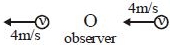
$A$ man is watching two trains,one leaving and the other coming with an equal speed of $4\,m/s$. If they sound their whistles each of frequency $240\,Hz$,the number of beats per second heard by the man will be equal to: (velocity of sound in air $= 320\,m/s$)
A
$12$
B
$0$
C
$3$
D
$6$
Solution
(D) The apparent frequency $n'$ heard by the observer from the train approaching with speed $v_s$ is given by:
$n' = n \left[ \frac{v}{v - v_s} \right]$
The apparent frequency $n''$ heard by the observer from the train moving away with speed $v_s$ is given by:
$n'' = n \left[ \frac{v}{v + v_s} \right]$
The number of beats per second is the difference between these two frequencies:
$\Delta n = n' - n''$
$\Delta n = nv \left[ \frac{1}{v - v_s} - \frac{1}{v + v_s} \right] = nv \left[ \frac{(v + v_s) - (v - v_s)}{v^2 - v_s^2} \right] = nv \left[ \frac{2v_s}{v^2 - v_s^2} \right]$
Since $v_s^2$ is very small compared to $v^2$ ($4^2 = 16$ vs $320^2 = 102400$),we can approximate $v^2 - v_s^2 \approx v^2$:
$\Delta n \approx nv \left[ \frac{2v_s}{v^2} \right] = \frac{2nv_s}{v}$
Substituting the given values ($n = 240\,Hz$,$v_s = 4\,m/s$,$v = 320\,m/s$):
$\Delta n = \frac{2 \times 240 \times 4}{320} = \frac{1920}{320} = 6\,Hz$
Thus,the number of beats per second heard by the man is $6$.
$n' = n \left[ \frac{v}{v - v_s} \right]$
The apparent frequency $n''$ heard by the observer from the train moving away with speed $v_s$ is given by:
$n'' = n \left[ \frac{v}{v + v_s} \right]$
The number of beats per second is the difference between these two frequencies:
$\Delta n = n' - n''$
$\Delta n = nv \left[ \frac{1}{v - v_s} - \frac{1}{v + v_s} \right] = nv \left[ \frac{(v + v_s) - (v - v_s)}{v^2 - v_s^2} \right] = nv \left[ \frac{2v_s}{v^2 - v_s^2} \right]$
Since $v_s^2$ is very small compared to $v^2$ ($4^2 = 16$ vs $320^2 = 102400$),we can approximate $v^2 - v_s^2 \approx v^2$:
$\Delta n \approx nv \left[ \frac{2v_s}{v^2} \right] = \frac{2nv_s}{v}$
Substituting the given values ($n = 240\,Hz$,$v_s = 4\,m/s$,$v = 320\,m/s$):
$\Delta n = \frac{2 \times 240 \times 4}{320} = \frac{1920}{320} = 6\,Hz$
Thus,the number of beats per second heard by the man is $6$.
0 likes
View Solution155
DifficultMCQ
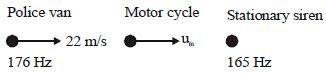
$A$ police van,moving at $22 \, m/s$,chases a motorcyclist. The policeman sounds a horn at $176 \, Hz$,while both of them move towards a stationary siren of frequency $165 \, Hz$ as shown in the figure. If the motorcyclist does not observe any beats,his speed must be .... $m/s$ (take the speed of sound $= 330 \, m/s$).
A
$33$
B
$22$
C
$0$
D
$11$
Solution
(B) The apparent frequency $f'$ of the horn of the police van as heard by the motorcyclist is given by the Doppler effect formula:
$f' = \left( \frac{v - u_m}{v - v_s} \right) f_s$
Given $v = 330 \, m/s$,$v_s = 22 \, m/s$,and $f_s = 176 \, Hz$:
$f' = \left( \frac{330 - u_m}{330 - 22} \right) \times 176 = \left( \frac{330 - u_m}{308} \right) \times 176 \quad \dots (i)$
The apparent frequency $f''$ of the stationary siren as heard by the motorcyclist is:
$f'' = \left( \frac{v + u_m}{v} \right) f_{sireen}$
Given $f_{sireen} = 165 \, Hz$:
$f'' = \left( \frac{330 + u_m}{330} \right) \times 165 \quad \dots (ii)$
Since the motorcyclist does not observe any beats,the frequencies must be equal $(f' = f'')$:
$\left( \frac{330 - u_m}{308} \right) \times 176 = \left( \frac{330 + u_m}{330} \right) \times 165$
$\frac{330 - u_m}{308} \times 176 = \frac{330 + u_m}{2}$
$(330 - u_m) \times 0.5714 \times 176 = (330 + u_m) \times 0.5$
Simplifying the ratio: $\frac{176}{308} = \frac{4}{7}$ and $\frac{165}{330} = \frac{1}{2}$.
$\frac{4(330 - u_m)}{7} = \frac{330 + u_m}{2}$
$8(330 - u_m) = 7(330 + u_m)$
$2640 - 8u_m = 2310 + 7u_m$
$15u_m = 330$
$u_m = 22 \, m/s$.
$f' = \left( \frac{v - u_m}{v - v_s} \right) f_s$
Given $v = 330 \, m/s$,$v_s = 22 \, m/s$,and $f_s = 176 \, Hz$:
$f' = \left( \frac{330 - u_m}{330 - 22} \right) \times 176 = \left( \frac{330 - u_m}{308} \right) \times 176 \quad \dots (i)$
The apparent frequency $f''$ of the stationary siren as heard by the motorcyclist is:
$f'' = \left( \frac{v + u_m}{v} \right) f_{sireen}$
Given $f_{sireen} = 165 \, Hz$:
$f'' = \left( \frac{330 + u_m}{330} \right) \times 165 \quad \dots (ii)$
Since the motorcyclist does not observe any beats,the frequencies must be equal $(f' = f'')$:
$\left( \frac{330 - u_m}{308} \right) \times 176 = \left( \frac{330 + u_m}{330} \right) \times 165$
$\frac{330 - u_m}{308} \times 176 = \frac{330 + u_m}{2}$
$(330 - u_m) \times 0.5714 \times 176 = (330 + u_m) \times 0.5$
Simplifying the ratio: $\frac{176}{308} = \frac{4}{7}$ and $\frac{165}{330} = \frac{1}{2}$.
$\frac{4(330 - u_m)}{7} = \frac{330 + u_m}{2}$
$8(330 - u_m) = 7(330 + u_m)$
$2640 - 8u_m = 2310 + 7u_m$
$15u_m = 330$
$u_m = 22 \, m/s$.
0 likes
View Solution156
EasyMCQ
Which of the following statements is false?
A
The wavelength of sound does not depend on the reference frame of the observer.
B
Motion of the source of sound affects the wavelength.
C
When the source of sound and the observer are both at rest and the medium is moving,the wavelength and velocity of sound change in equal proportion.
D
When only the medium moves from the source to the observer,the frequency heard by the observer will be greater than the original frequency.
Solution
(D) $1$. The wavelength of sound is defined as $\lambda = v/f$. Since the source determines the frequency $f$ and the medium determines the speed $v$,the wavelength is independent of the observer's motion. Thus,statement $A$ is true.
$2$. When the source moves,the distance between successive wave crests changes,which directly affects the wavelength. Thus,statement $B$ is true.
$3$. If the medium moves with velocity $u$,the speed of sound relative to the ground becomes $v' = v \pm u$. The wavelength also changes to $\lambda' = (v \pm u)/f$. Since $f$ is constant,the ratio $\lambda'/v' = 1/f$ remains constant,meaning they change in equal proportion. Thus,statement $C$ is true.
$4$. When the medium moves from source to observer,the effective speed of sound increases to $v' = v + u$. The frequency heard by the observer is $f' = v'/\lambda$. Since $\lambda = v/f$,we get $f' = (v+u)/(v/f) = f(1 + u/v)$. This is greater than $f$. However,in the Doppler effect,if the source and observer are at rest relative to the ground,the frequency heard is $f' = (v+u)/((\lambda)) = (v+u)/(v/f) = f(1+u/v)$. Wait,the frequency heard by a stationary observer from a stationary source when the medium moves is actually the same as the original frequency because the number of waves passing per second remains constant. Therefore,statement $D$ is false.
$2$. When the source moves,the distance between successive wave crests changes,which directly affects the wavelength. Thus,statement $B$ is true.
$3$. If the medium moves with velocity $u$,the speed of sound relative to the ground becomes $v' = v \pm u$. The wavelength also changes to $\lambda' = (v \pm u)/f$. Since $f$ is constant,the ratio $\lambda'/v' = 1/f$ remains constant,meaning they change in equal proportion. Thus,statement $C$ is true.
$4$. When the medium moves from source to observer,the effective speed of sound increases to $v' = v + u$. The frequency heard by the observer is $f' = v'/\lambda$. Since $\lambda = v/f$,we get $f' = (v+u)/(v/f) = f(1 + u/v)$. This is greater than $f$. However,in the Doppler effect,if the source and observer are at rest relative to the ground,the frequency heard is $f' = (v+u)/((\lambda)) = (v+u)/(v/f) = f(1+u/v)$. Wait,the frequency heard by a stationary observer from a stationary source when the medium moves is actually the same as the original frequency because the number of waves passing per second remains constant. Therefore,statement $D$ is false.
0 likes
View Solution157
DifficultMCQ
$A$ car $A$ is chasing another car $B$ with a speed of $20 \, m/s$,sounding a horn of frequency $180 \, Hz$. Both cars are moving towards a stationary siren of frequency $170 \, Hz$. What is the speed of car $B$ so that it does not hear any beats (in $, m/s$)? (Speed of sound $= 340 \, m/s$)
A
$34$
B
$22$
C
$20$
D
$0$
Solution
(C) Let the speed of car $B$ be $v_B$. Both cars $A$ and $B$ are moving towards the stationary siren.
$1$. Frequency heard by car $B$ from the stationary siren $(n_1)$:
Since the source is stationary and the observer (car $B$) is moving towards it,the frequency is given by:
$n_1 = n_s \left( \frac{v + v_B}{v} \right) = 170 \left( \frac{340 + v_B}{340} \right) = \frac{1}{2} (340 + v_B)$
$2$. Frequency heard by car $B$ from car $A$ $(n_2)$:
Car $A$ is the source moving towards the observer (car $B$),and car $B$ is the observer moving away from the source (car $A$).
$n_2 = n_A \left( \frac{v - v_B}{v - v_A} \right) = 180 \left( \frac{340 - v_B}{340 - 20} \right) = 180 \left( \frac{340 - v_B}{320} \right) = \frac{18}{32} (340 - v_B) = \frac{9}{16} (340 - v_B)$
$3$. Condition for no beats:
For no beats,the frequencies must be equal: $n_1 = n_2$
$\frac{1}{2} (340 + v_B) = \frac{9}{16} (340 - v_B)$
$8 (340 + v_B) = 9 (340 - v_B)$
$2720 + 8v_B = 3060 - 9v_B$
$17v_B = 340$
$v_B = 20 \, m/s$
$1$. Frequency heard by car $B$ from the stationary siren $(n_1)$:
Since the source is stationary and the observer (car $B$) is moving towards it,the frequency is given by:
$n_1 = n_s \left( \frac{v + v_B}{v} \right) = 170 \left( \frac{340 + v_B}{340} \right) = \frac{1}{2} (340 + v_B)$
$2$. Frequency heard by car $B$ from car $A$ $(n_2)$:
Car $A$ is the source moving towards the observer (car $B$),and car $B$ is the observer moving away from the source (car $A$).
$n_2 = n_A \left( \frac{v - v_B}{v - v_A} \right) = 180 \left( \frac{340 - v_B}{340 - 20} \right) = 180 \left( \frac{340 - v_B}{320} \right) = \frac{18}{32} (340 - v_B) = \frac{9}{16} (340 - v_B)$
$3$. Condition for no beats:
For no beats,the frequencies must be equal: $n_1 = n_2$
$\frac{1}{2} (340 + v_B) = \frac{9}{16} (340 - v_B)$
$8 (340 + v_B) = 9 (340 - v_B)$
$2720 + 8v_B = 3060 - 9v_B$
$17v_B = 340$
$v_B = 20 \, m/s$

0 likes
View Solution158
EasyMCQ
$Assertion :$ The Doppler formula for sound waves is symmetric with respect to the speed of the source and the speed of the observer.
$Reason :$ The motion of a source with respect to a stationary observer is not equivalent to the motion of an observer with respect to a stationary source.
$Reason :$ The motion of a source with respect to a stationary observer is not equivalent to the motion of an observer with respect to a stationary source.
A
If both Assertion and Reason are correct and the Reason is a correct explanation of the Assertion.
B
If both Assertion and Reason are correct but Reason is not a correct explanation of the Assertion.
C
If the Assertion is correct but Reason is incorrect.
D
If both the Assertion and Reason are incorrect.
Solution
(D) The Doppler effect for sound waves depends on the medium. The formula is given by $f' = f \left( \frac{v \pm v_o}{v \mp v_s} \right)$,where $v$ is the speed of sound in the medium,$v_o$ is the speed of the observer,and $v_s$ is the speed of the source.
Because the medium provides a preferred frame of reference,the effect is not symmetric with respect to the source and the observer. Therefore,the Assertion is incorrect.
The motion of a source relative to a stationary observer is physically different from the motion of an observer relative to a stationary source because the medium is stationary in one case and moving relative to the observer in the other. Thus,the Reason is correct.
Because the medium provides a preferred frame of reference,the effect is not symmetric with respect to the source and the observer. Therefore,the Assertion is incorrect.
The motion of a source relative to a stationary observer is physically different from the motion of an observer relative to a stationary source because the medium is stationary in one case and moving relative to the observer in the other. Thus,the Reason is correct.
0 likes
View Solution159
DifficultMCQ
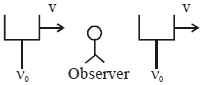
$A$ stationary observer receives sound from two identical tuning forks, one of which approaches and the other one recedes with the same speed $v$ (much less than the speed of sound). The observer hears $2 \; \text{beats/sec}$. The oscillation frequency of each tuning fork is $\nu_{0} = 1400 \; \text{Hz}$ and the velocity of sound in air is $c = 350 \; \text{m/s}$. The speed of each tuning fork is close to:
A
$\frac{1}{8} \; \text{m/s}$
B
$\frac{1}{2} \; \text{m/s}$
C
$1 \; \text{m/s}$
D
$\frac{1}{4} \; \text{m/s}$
Solution
(D) Let $c$ be the speed of sound and $v$ be the speed of the tuning forks.
The frequency heard from the approaching tuning fork is $\nu_{1} = \left(\frac{c}{c-v}\right) \nu_{0}$.
The frequency heard from the receding tuning fork is $\nu_{2} = \left(\frac{c}{c+v}\right) \nu_{0}$.
The beat frequency is given by $\Delta \nu = \nu_{1} - \nu_{2} = 2 \; \text{Hz}$.
Substituting the expressions:
$\Delta \nu = c \nu_{0} \left(\frac{1}{c-v} - \frac{1}{c+v}\right) = c \nu_{0} \left(\frac{c+v - (c-v)}{c^{2}-v^{2}}\right) = \frac{2 c \nu_{0} v}{c^{2}-v^{2}}$.
Since $v \ll c$, we can approximate $c^{2} - v^{2} \approx c^{2}$.
Thus, $\Delta \nu \approx \frac{2 c \nu_{0} v}{c^{2}} = \frac{2 \nu_{0} v}{c} = 2$.
Substituting the given values: $\frac{2 \times 1400 \times v}{350} = 2$.
$8v = 2 \Rightarrow v = \frac{2}{8} = \frac{1}{4} \; \text{m/s}$.
The frequency heard from the approaching tuning fork is $\nu_{1} = \left(\frac{c}{c-v}\right) \nu_{0}$.
The frequency heard from the receding tuning fork is $\nu_{2} = \left(\frac{c}{c+v}\right) \nu_{0}$.
The beat frequency is given by $\Delta \nu = \nu_{1} - \nu_{2} = 2 \; \text{Hz}$.
Substituting the expressions:
$\Delta \nu = c \nu_{0} \left(\frac{1}{c-v} - \frac{1}{c+v}\right) = c \nu_{0} \left(\frac{c+v - (c-v)}{c^{2}-v^{2}}\right) = \frac{2 c \nu_{0} v}{c^{2}-v^{2}}$.
Since $v \ll c$, we can approximate $c^{2} - v^{2} \approx c^{2}$.
Thus, $\Delta \nu \approx \frac{2 c \nu_{0} v}{c^{2}} = \frac{2 \nu_{0} v}{c} = 2$.
Substituting the given values: $\frac{2 \times 1400 \times v}{350} = 2$.
$8v = 2 \Rightarrow v = \frac{2}{8} = \frac{1}{4} \; \text{m/s}$.
0 likes
View Solution160
Medium
$A$ rocket is moving at a speed of $200\; m s^{-1}$ towards a stationary target. While moving, it emits a wave of frequency $1000\; Hz$. Some of the sound reaching the target gets reflected back to the rocket as an echo. Calculate:
$(1)$ the frequency of the sound as detected by the target and
$(2)$ the frequency of the echo as detected by the rocket.
$(1)$ the frequency of the sound as detected by the target and
$(2)$ the frequency of the echo as detected by the rocket.
Solution
(N/A) $(1)$ The observer (target) is at rest $(v_o = 0)$ and the source (rocket) is moving towards the target with speed $v_s = 200\; m s^{-1}$. The speed of sound is $v = 330\; m s^{-1}$.
Using the Doppler effect formula for a moving source and stationary observer:
$f' = f \left( \frac{v}{v - v_s} \right)$
$f' = 1000\; Hz \times \left( \frac{330}{330 - 200} \right) = 1000 \times \left( \frac{330}{130} \right) \simeq 2538.46\; Hz$.
$(2)$ Now, the target acts as the source of the reflected sound (echo) and is stationary $(v_s = 0)$. The rocket acts as the observer moving towards the source with speed $v_o = 200\; m s^{-1}$. The frequency of the source is the frequency received by the target, $f' = 2538.46\; Hz$.
Using the Doppler effect formula for a stationary source and moving observer:
$f'' = f' \left( \frac{v + v_o}{v} \right)$
$f'' = 2538.46\; Hz \times \left( \frac{330 + 200}{330} \right) = 2538.46 \times \left( \frac{530}{330} \right) \simeq 4076.16\; Hz$.
Using the Doppler effect formula for a moving source and stationary observer:
$f' = f \left( \frac{v}{v - v_s} \right)$
$f' = 1000\; Hz \times \left( \frac{330}{330 - 200} \right) = 1000 \times \left( \frac{330}{130} \right) \simeq 2538.46\; Hz$.
$(2)$ Now, the target acts as the source of the reflected sound (echo) and is stationary $(v_s = 0)$. The rocket acts as the observer moving towards the source with speed $v_o = 200\; m s^{-1}$. The frequency of the source is the frequency received by the target, $f' = 2538.46\; Hz$.
Using the Doppler effect formula for a stationary source and moving observer:
$f'' = f' \left( \frac{v + v_o}{v} \right)$
$f'' = 2538.46\; Hz \times \left( \frac{330 + 200}{330} \right) = 2538.46 \times \left( \frac{530}{330} \right) \simeq 4076.16\; Hz$.
0 likes
View Solution161
Medium
$A$ train,standing at the outer signal of a railway station,blows a whistle of frequency $400\; Hz$ in still air.
$(i)$ What is the frequency of the whistle for a platform observer when the train $(a)$ approaches the platform with a speed of $10\; m s^{-1}$,$(b)$ recedes from the platform with a speed of $10\; m s^{-1}$?
$(ii)$ What is the speed of sound in each case? The speed of sound in still air can be taken as $340\; m s^{-1}$.
$(i)$ What is the frequency of the whistle for a platform observer when the train $(a)$ approaches the platform with a speed of $10\; m s^{-1}$,$(b)$ recedes from the platform with a speed of $10\; m s^{-1}$?
$(ii)$ What is the speed of sound in each case? The speed of sound in still air can be taken as $340\; m s^{-1}$.
Solution
(A) Frequency of the whistle,$\nu = 400\; Hz$.
Speed of the source (train),$v_s = 10\; m s^{-1}$.
Speed of sound,$v = 340\; m s^{-1}$.
The apparent frequency $(\nu')$ of the whistle as the train approaches the platform is given by the Doppler effect formula:
$\nu' = \left( \frac{v}{v - v_s} \right) \nu = \left( \frac{340}{340 - 10} \right) \times 400 = \frac{340}{330} \times 400 \approx 412.12\; Hz$.
The apparent frequency $(\nu'')$ of the whistle as the train recedes from the platform is given by:
$\nu'' = \left( \frac{v}{v + v_s} \right) \nu = \left( \frac{340}{340 + 10} \right) \times 400 = \frac{340}{350} \times 400 \approx 388.57\; Hz$.
$(ii)$ The apparent change in the frequency of sound is caused by the relative motion between the source and the observer. This motion does not affect the speed of sound in the medium. Therefore,the speed of sound in air in both cases remains $340\; m s^{-1}$.
Speed of the source (train),$v_s = 10\; m s^{-1}$.
Speed of sound,$v = 340\; m s^{-1}$.
The apparent frequency $(\nu')$ of the whistle as the train approaches the platform is given by the Doppler effect formula:
$\nu' = \left( \frac{v}{v - v_s} \right) \nu = \left( \frac{340}{340 - 10} \right) \times 400 = \frac{340}{330} \times 400 \approx 412.12\; Hz$.
The apparent frequency $(\nu'')$ of the whistle as the train recedes from the platform is given by:
$\nu'' = \left( \frac{v}{v + v_s} \right) \nu = \left( \frac{340}{340 + 10} \right) \times 400 = \frac{340}{350} \times 400 \approx 388.57\; Hz$.
$(ii)$ The apparent change in the frequency of sound is caused by the relative motion between the source and the observer. This motion does not affect the speed of sound in the medium. Therefore,the speed of sound in air in both cases remains $340\; m s^{-1}$.
0 likes
View Solution162
Medium
$A$ train,standing in a station-yard,blows a whistle of frequency $400\; Hz$ in still air. The wind starts blowing in the direction from the yard to the station with a speed of $10\; m s^{-1}$. What are the frequency,wavelength,and speed of sound for an observer standing on the station's platform? Is the situation exactly identical to the case when the air is still and the observer runs towards the yard at a speed of $10\; m s^{-1}$? The speed of sound in still air can be taken as $340\; m s^{-1}$.
Solution
(D) For the stationary observer: Frequency $= 400\; Hz$,Wavelength $= 0.85\; m$,Speed of sound $= 350\; m s^{-1}$.
For the running observer: Frequency $\approx 411.76\; Hz$,Wavelength $= 0.85\; m$,Speed of sound $= 340\; m s^{-1}$.
$1$. For the stationary observer:
Since the source and observer are stationary relative to each other,the frequency remains $400\; Hz$. The wind blows towards the observer,so the effective speed of sound is $v_e = v + w = 340 + 10 = 350\; m s^{-1}$. The wavelength is $\lambda = v_e / f = 350 / 400 = 0.875\; m$.
$2$. For the running observer:
Here,the air is still,so the speed of sound is $340\; m s^{-1}$. The wavelength remains $\lambda = v / f = 340 / 400 = 0.85\; m$. The observer moves towards the source at $10\; m s^{-1}$,so the frequency heard is $f' = f(v + v_o) / v = 400(340 + 10) / 340 = 411.76\; Hz$.
Conclusion: The two situations are not identical because the wavelength and the effective speed of sound differ in both cases.
For the running observer: Frequency $\approx 411.76\; Hz$,Wavelength $= 0.85\; m$,Speed of sound $= 340\; m s^{-1}$.
$1$. For the stationary observer:
Since the source and observer are stationary relative to each other,the frequency remains $400\; Hz$. The wind blows towards the observer,so the effective speed of sound is $v_e = v + w = 340 + 10 = 350\; m s^{-1}$. The wavelength is $\lambda = v_e / f = 350 / 400 = 0.875\; m$.
$2$. For the running observer:
Here,the air is still,so the speed of sound is $340\; m s^{-1}$. The wavelength remains $\lambda = v / f = 340 / 400 = 0.85\; m$. The observer moves towards the source at $10\; m s^{-1}$,so the frequency heard is $f' = f(v + v_o) / v = 400(340 + 10) / 340 = 411.76\; Hz$.
Conclusion: The two situations are not identical because the wavelength and the effective speed of sound differ in both cases.
0 likes
View Solution163
MediumMCQ
$A$ $SONAR$ system fixed in a submarine operates at a frequency of $40.0 \; kHz$. An enemy submarine moves towards the $SONAR$ with a speed of $360 \; km/h$. What is the frequency (in $kHz$) of sound reflected by the submarine (in $; kHz$)? Take the speed of sound in water to be $1450 \; m/s$.
A
$32$
B
$56$
C
$28$
D
$46$
Solution
(D) The operating frequency of the $SONAR$ is $f = 40.0 \; kHz = 40000 \; Hz$.
Speed of the enemy submarine (observer),$v_o = 360 \; km/h = 360 \times (5/18) \; m/s = 100 \; m/s$.
Speed of sound in water,$v = 1450 \; m/s$.
First,the enemy submarine acts as an observer moving towards the stationary $SONAR$ source. The frequency $f'$ received by the submarine is:
$f' = f \left( \frac{v + v_o}{v} \right) = 40 \left( \frac{1450 + 100}{1450} \right) = 40 \left( \frac{1550}{1450} \right) \approx 42.76 \; kHz$.
Next,the submarine acts as a source reflecting this frequency back to the $SONAR$. Since the submarine is moving towards the $SONAR$,the frequency $f''$ received by the $SONAR$ is:
$f'' = f' \left( \frac{v}{v - v_o} \right) = 42.76 \left( \frac{1450}{1450 - 100} \right) = 42.76 \left( \frac{1450}{1350} \right) \approx 45.93 \; kHz$.
Rounding to the nearest integer,the frequency is approximately $46 \; kHz$.
Speed of the enemy submarine (observer),$v_o = 360 \; km/h = 360 \times (5/18) \; m/s = 100 \; m/s$.
Speed of sound in water,$v = 1450 \; m/s$.
First,the enemy submarine acts as an observer moving towards the stationary $SONAR$ source. The frequency $f'$ received by the submarine is:
$f' = f \left( \frac{v + v_o}{v} \right) = 40 \left( \frac{1450 + 100}{1450} \right) = 40 \left( \frac{1550}{1450} \right) \approx 42.76 \; kHz$.
Next,the submarine acts as a source reflecting this frequency back to the $SONAR$. Since the submarine is moving towards the $SONAR$,the frequency $f''$ received by the $SONAR$ is:
$f'' = f' \left( \frac{v}{v - v_o} \right) = 42.76 \left( \frac{1450}{1450 - 100} \right) = 42.76 \left( \frac{1450}{1350} \right) \approx 45.93 \; kHz$.
Rounding to the nearest integer,the frequency is approximately $46 \; kHz$.
0 likes
View Solution164
MediumMCQ
$A$ bat is flitting about in a cave,navigating via ultrasonic beeps. Assume that the sound emission frequency of the bat is $40\; kHz$. During one fast swoop directly toward a flat wall surface,the bat is moving at $0.03$ times the speed of sound in air. What frequency (in $kHz$) does the bat hear reflected off the wall?
A
$38.5$
B
$42.5$
C
$49.2$
D
$56.8$
Solution
(B) Let $v$ be the speed of sound in air and $f = 40\; kHz$ be the frequency emitted by the bat.
The bat moves toward the wall with speed $v_b = 0.03v$.
First,the wall acts as a stationary observer receiving the sound. The frequency $f'$ heard by the wall is:
$f' = f \left( \frac{v}{v - v_b} \right) = 40 \left( \frac{v}{v - 0.03v} \right) = \frac{40}{0.97}\; kHz$.
Next,the wall reflects this sound,acting as a stationary source,and the bat acts as an observer moving toward the source with speed $v_b = 0.03v$. The frequency $f''$ heard by the bat is:
$f'' = f' \left( \frac{v + v_b}{v} \right) = \left( \frac{40}{0.97} \right) \left( \frac{v + 0.03v}{v} \right) = \frac{40 \times 1.03}{0.97} \approx 42.47\; kHz$.
Rounding to one decimal place,we get $42.5\; kHz$.
The bat moves toward the wall with speed $v_b = 0.03v$.
First,the wall acts as a stationary observer receiving the sound. The frequency $f'$ heard by the wall is:
$f' = f \left( \frac{v}{v - v_b} \right) = 40 \left( \frac{v}{v - 0.03v} \right) = \frac{40}{0.97}\; kHz$.
Next,the wall reflects this sound,acting as a stationary source,and the bat acts as an observer moving toward the source with speed $v_b = 0.03v$. The frequency $f''$ heard by the bat is:
$f'' = f' \left( \frac{v + v_b}{v} \right) = \left( \frac{40}{0.97} \right) \left( \frac{v + 0.03v}{v} \right) = \frac{40 \times 1.03}{0.97} \approx 42.47\; kHz$.
Rounding to one decimal place,we get $42.5\; kHz$.
0 likes
View Solution165
Medium
What is the Doppler effect? Write its example and explain how its analysis can be performed.
Solution
(N/A) The Doppler effect is the phenomenon where the observed frequency of a wave changes due to the relative motion between the source of the wave and the observer.
Example: The pitch (or frequency) of the whistle of a fast-moving train appears to decrease as it recedes away from an observer. Conversely,when an observer approaches a stationary source of sound at high speed,the pitch of the sound heard appears to be higher than the actual frequency of the source.
Analysis: The Doppler effect is a wave phenomenon applicable to both sound and electromagnetic waves. We analyze the frequency changes under three primary conditions:
$(1)$ The observer is stationary,but the source is moving.
$(2)$ The observer is moving,but the source is stationary.
$(3)$ Both the observer and the source are moving relative to the medium.
Example: The pitch (or frequency) of the whistle of a fast-moving train appears to decrease as it recedes away from an observer. Conversely,when an observer approaches a stationary source of sound at high speed,the pitch of the sound heard appears to be higher than the actual frequency of the source.
Analysis: The Doppler effect is a wave phenomenon applicable to both sound and electromagnetic waves. We analyze the frequency changes under three primary conditions:
$(1)$ The observer is stationary,but the source is moving.
$(2)$ The observer is moving,but the source is stationary.
$(3)$ Both the observer and the source are moving relative to the medium.
0 likes
View Solution166
MediumMCQ
Which pre-assumptions are used for the Doppler effect?
A
The medium is stationary.
B
The velocity of the source and observer is less than the velocity of sound.
C
The motion of the source and observer is along the line joining them.
D
All of the above.
Solution
(D) The Doppler effect describes the change in frequency of a wave in relation to an observer who is moving relative to the wave source. The standard pre-assumptions (conditions) for the derivation of the Doppler effect formula are:
$(1)$ The medium through which the sound travels is stationary.
$(2)$ The velocities of the source and the observer are significantly less than the velocity of sound in the medium $(v_s, v_o < v)$.
$(3)$ The motion of the source and the observer is along the straight line joining them.
$(4)$ The observer is capable of hearing the sound.
$(1)$ The medium through which the sound travels is stationary.
$(2)$ The velocities of the source and the observer are significantly less than the velocity of sound in the medium $(v_s, v_o < v)$.
$(3)$ The motion of the source and the observer is along the straight line joining them.
$(4)$ The observer is capable of hearing the sound.
0 likes
View Solution167
Medium
Obtain the equation for the frequency observed by a stationary observer when the source is moving.
Solution
(N/A) For this,we use the following sign convention: the direction from the observer to the source is taken as the positive direction of velocity.
Consider a source $S$ moving with velocity $v_{s}$ and an observer who is stationary in a frame where the medium is also at rest.
Let the speed of a wave of angular frequency $\omega$ and period $T_{0}$,both measured by an observer at rest with respect to the medium,be $v$.
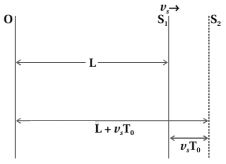
As shown in the figure,at time $t=0$,the source is at point $S_{1}$,located at a distance $L$ from the observer,and emits a crest. This reaches the observer at time $t_{1} = \frac{L}{v} \quad \dots (1)$
At time $t=T_{0}$,the source has moved a distance $v_{s}T_{0}$ and is at point $S_{2}$,located at a distance $L + v_{s}T_{0}$ from the observer. At $S_{2}$,the source emits a second crest. This reaches the observer at time $t_{2} = T_{0} + \frac{L + v_{s}T_{0}}{v}$.
At time $n T_{0}$,the source emits its $(n+1)^{th}$ crest,which reaches the observer at time $t_{n+1} = n T_{0} + \frac{L + n v_{s}T_{0}}{v} \quad \dots (2)$.
The time interval between the arrival of the $(n+1)^{th}$ crest and the first crest at the observer is $\Delta t = t_{n+1} - t_{1} = n T_{0} + \frac{L + n v_{s}T_{0}}{v} - \frac{L}{v} = n T_{0} + \frac{n v_{s}T_{0}}{v} = n T_{0} \left( 1 + \frac{v_{s}}{v} \right)$.
The observed period $T$ is the time interval between consecutive crests,so $T = \frac{\Delta t}{n} = T_{0} \left( 1 + \frac{v_{s}}{v} \right) = T_{0} \left( \frac{v + v_{s}}{v} \right)$.
Since frequency $\nu = \frac{1}{T}$ and $\nu_{0} = \frac{1}{T_{0}}$,the observed frequency is $\nu = \nu_{0} \left( \frac{v}{v + v_{s}} \right)$.
Consider a source $S$ moving with velocity $v_{s}$ and an observer who is stationary in a frame where the medium is also at rest.
Let the speed of a wave of angular frequency $\omega$ and period $T_{0}$,both measured by an observer at rest with respect to the medium,be $v$.
As shown in the figure,at time $t=0$,the source is at point $S_{1}$,located at a distance $L$ from the observer,and emits a crest. This reaches the observer at time $t_{1} = \frac{L}{v} \quad \dots (1)$
At time $t=T_{0}$,the source has moved a distance $v_{s}T_{0}$ and is at point $S_{2}$,located at a distance $L + v_{s}T_{0}$ from the observer. At $S_{2}$,the source emits a second crest. This reaches the observer at time $t_{2} = T_{0} + \frac{L + v_{s}T_{0}}{v}$.
At time $n T_{0}$,the source emits its $(n+1)^{th}$ crest,which reaches the observer at time $t_{n+1} = n T_{0} + \frac{L + n v_{s}T_{0}}{v} \quad \dots (2)$.
The time interval between the arrival of the $(n+1)^{th}$ crest and the first crest at the observer is $\Delta t = t_{n+1} - t_{1} = n T_{0} + \frac{L + n v_{s}T_{0}}{v} - \frac{L}{v} = n T_{0} + \frac{n v_{s}T_{0}}{v} = n T_{0} \left( 1 + \frac{v_{s}}{v} \right)$.
The observed period $T$ is the time interval between consecutive crests,so $T = \frac{\Delta t}{n} = T_{0} \left( 1 + \frac{v_{s}}{v} \right) = T_{0} \left( \frac{v + v_{s}}{v} \right)$.
Since frequency $\nu = \frac{1}{T}$ and $\nu_{0} = \frac{1}{T_{0}}$,the observed frequency is $\nu = \nu_{0} \left( \frac{v}{v + v_{s}} \right)$.
0 likes
View Solution168
Medium
Obtain the equation of frequency observed by a moving observer and a stationary source.
Solution
(N/A) When the observer moves with velocity $v_{0}$ towards a stationary source,we analyze the situation in the reference frame of the moving observer. In this frame,the source and the medium approach the observer at speed $v_{0}$,and the speed at which the wave crests approach the observer is $v + v_{0}$.
The time interval between the arrival of the first and the $(n+1)^{\text{th}}$ crests is given by:
$t_{n+1} - t_{n} = n T_{0} - \frac{n v_{0} T_{0}}{v + v_{0}}$
The observer measures the period of the wave as:
$T = \frac{t_{n+1} - t_{1}}{n} = T_{0} \left( 1 - \frac{v_{0}}{v + v_{0}} \right) = T_{0} \left( \frac{v}{v + v_{0}} \right)$
Since frequency $\nu = \frac{1}{T}$ and original frequency $\nu_{0} = \frac{1}{T_{0}}$,the observed frequency is:
$\nu = \nu_{0} \left( \frac{v + v_{0}}{v} \right) = \nu_{0} \left( 1 + \frac{v_{0}}{v} \right)$
When the observer moves away from the stationary source,we replace $v_{0}$ with $-v_{0}$ in the equation:
$\nu = \nu_{0} \left( 1 - \frac{v_{0}}{v} \right)$
The time interval between the arrival of the first and the $(n+1)^{\text{th}}$ crests is given by:
$t_{n+1} - t_{n} = n T_{0} - \frac{n v_{0} T_{0}}{v + v_{0}}$
The observer measures the period of the wave as:
$T = \frac{t_{n+1} - t_{1}}{n} = T_{0} \left( 1 - \frac{v_{0}}{v + v_{0}} \right) = T_{0} \left( \frac{v}{v + v_{0}} \right)$
Since frequency $\nu = \frac{1}{T}$ and original frequency $\nu_{0} = \frac{1}{T_{0}}$,the observed frequency is:
$\nu = \nu_{0} \left( \frac{v + v_{0}}{v} \right) = \nu_{0} \left( 1 + \frac{v_{0}}{v} \right)$
When the observer moves away from the stationary source,we replace $v_{0}$ with $-v_{0}$ in the equation:
$\nu = \nu_{0} \left( 1 - \frac{v_{0}}{v} \right)$
0 likes
View Solution169
Medium
Obtain the equation of frequency observed by an observer for a moving source and a moving observer at different velocities.
Solution
(N/A) Let us take the direction from the observer to the source as the positive direction.
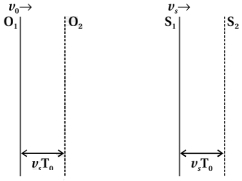
Let the source and the observer be moving with velocities $v_{s}$ and $v_{0}$ respectively as shown in the figure.
Suppose at time $t=0$,the observer is at $O_{1}$ and the source is at $S_{1}$,with $O_{1}$ being to the left of $S_{1}$.
The source emits a wave of velocity $v$,frequency $\nu$,and period $T_{0}$,all measured by an observer at rest with respect to the medium.
Let $L$ be the distance between $O_{1}$ and $S_{1}$ at $t=0$,when the source emits the first crest. Since the observer is moving,the velocity of the wave relative to the observer is $v+v_{0}$. Therefore,the first crest reaches the observer at time $t_{1}=\frac{L}{v+v_{0}}$.
At time $t=T_{0}$,both the observer and the source have moved to their new positions $O_{2}$ and $S_{2}$ respectively. The new distance between the observer and the source $O_{2}S_{2}$ would be $L+(v_{s}-v_{0})T_{0}$.
At $S_{2}$,the source emits a second crest. This reaches the observer at time $t_{2}=T_{0}+\frac{L+(v_{s}-v_{0})T_{0}}{v+v_{0}}$.
At time $nT_{0}$,the source emits its $(n+1)^{th}$ crest,and this reaches the observer at time $t_{n+1}=nT_{0}+\frac{L+n(v_{s}-v_{0})T_{0}}{v+v_{0}}$.
The time interval between the arrival of the first and $(n+1)^{th}$ crest is $\Delta t = t_{n+1} - t_{1} = nT_{0} + \frac{n(v_{s}-v_{0})T_{0}}{v+v_{0}} = nT_{0} \left(1 + \frac{v_{s}-v_{0}}{v+v_{0}}\right) = nT_{0} \left(\frac{v+v_{0}+v_{s}-v_{0}}{v+v_{0}}\right) = nT_{0} \left(\frac{v+v_{s}}{v+v_{0}}\right)$.
The observed period is $T' = \frac{\Delta t}{n} = T_{0} \left(\frac{v+v_{s}}{v+v_{0}}\right)$.
Thus,the observed frequency is $\nu' = \frac{1}{T'} = \nu \left(\frac{v+v_{0}}{v+v_{s}}\right)$.
Let the source and the observer be moving with velocities $v_{s}$ and $v_{0}$ respectively as shown in the figure.
Suppose at time $t=0$,the observer is at $O_{1}$ and the source is at $S_{1}$,with $O_{1}$ being to the left of $S_{1}$.
The source emits a wave of velocity $v$,frequency $\nu$,and period $T_{0}$,all measured by an observer at rest with respect to the medium.
Let $L$ be the distance between $O_{1}$ and $S_{1}$ at $t=0$,when the source emits the first crest. Since the observer is moving,the velocity of the wave relative to the observer is $v+v_{0}$. Therefore,the first crest reaches the observer at time $t_{1}=\frac{L}{v+v_{0}}$.
At time $t=T_{0}$,both the observer and the source have moved to their new positions $O_{2}$ and $S_{2}$ respectively. The new distance between the observer and the source $O_{2}S_{2}$ would be $L+(v_{s}-v_{0})T_{0}$.
At $S_{2}$,the source emits a second crest. This reaches the observer at time $t_{2}=T_{0}+\frac{L+(v_{s}-v_{0})T_{0}}{v+v_{0}}$.
At time $nT_{0}$,the source emits its $(n+1)^{th}$ crest,and this reaches the observer at time $t_{n+1}=nT_{0}+\frac{L+n(v_{s}-v_{0})T_{0}}{v+v_{0}}$.
The time interval between the arrival of the first and $(n+1)^{th}$ crest is $\Delta t = t_{n+1} - t_{1} = nT_{0} + \frac{n(v_{s}-v_{0})T_{0}}{v+v_{0}} = nT_{0} \left(1 + \frac{v_{s}-v_{0}}{v+v_{0}}\right) = nT_{0} \left(\frac{v+v_{0}+v_{s}-v_{0}}{v+v_{0}}\right) = nT_{0} \left(\frac{v+v_{s}}{v+v_{0}}\right)$.
The observed period is $T' = \frac{\Delta t}{n} = T_{0} \left(\frac{v+v_{s}}{v+v_{0}}\right)$.
Thus,the observed frequency is $\nu' = \frac{1}{T'} = \nu \left(\frac{v+v_{0}}{v+v_{s}}\right)$.
0 likes
View Solution170
Medium
When the source of sound moves away from a stationary listener,we obtain $f_{L} < f_{S}$. Why?
Solution
(N/A) The general formula for the Doppler effect is given by $\frac{f_{L}}{v + v_{L}} = \frac{f_{S}}{v + v_{S}}$,where $v$ is the speed of sound,$v_{L}$ is the velocity of the listener,and $v_{S}$ is the velocity of the source.
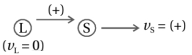
Given that the listener is stationary,$v_{L} = 0$.
When the source moves away from the listener,the velocity of the source $v_{S}$ is taken as positive in the direction of sound propagation (from listener to source),so the denominator becomes $(v + v_{S})$.
Substituting these values,we get $\frac{f_{L}}{v + 0} = \frac{f_{S}}{v + v_{S}}$.
Therefore,$f_{L} = \left( \frac{v}{v + v_{S}} \right) f_{S}$.
Since $v + v_{S} > v$,the fraction $\frac{v}{v + v_{S}} < 1$. Consequently,$f_{L} < f_{S}$.
Given that the listener is stationary,$v_{L} = 0$.
When the source moves away from the listener,the velocity of the source $v_{S}$ is taken as positive in the direction of sound propagation (from listener to source),so the denominator becomes $(v + v_{S})$.
Substituting these values,we get $\frac{f_{L}}{v + 0} = \frac{f_{S}}{v + v_{S}}$.
Therefore,$f_{L} = \left( \frac{v}{v + v_{S}} \right) f_{S}$.
Since $v + v_{S} > v$,the fraction $\frac{v}{v + v_{S}} < 1$. Consequently,$f_{L} < f_{S}$.
0 likes
View Solution171
Easy
Match Column-$A$ with Column-$B$.
| Column-$A$ | Column-$B$ |
| $(a)$ When source of sound and listener move towards wall. | $(i)$ Listener would hear a sound with same frequency as that of source. |
| $(b)$ When source of sound and listener move away from each other. | $(ii)$ Listener would hear a sound with frequency smaller than that of source. |
| $(iii)$ Frequency of echo would be greater than that of source. |
Solution
(A) For $(a)$,when both the source and the listener move towards a wall,the sound reflects off the wall. The wall acts as a secondary source. Since both are moving towards the reflecting surface,the frequency of the reflected sound (echo) heard by the listener increases due to the Doppler effect. Thus,$(a-iii)$.
For $(b)$,when the source and the listener move away from each other,the relative velocity between them increases,causing the observed frequency to decrease according to the Doppler effect formula $f' = f \left( \frac{v - v_L}{v + v_S} \right)$. Thus,$(b-ii)$.
For $(b)$,when the source and the listener move away from each other,the relative velocity between them increases,causing the observed frequency to decrease according to the Doppler effect formula $f' = f \left( \frac{v - v_L}{v + v_S} \right)$. Thus,$(b-ii)$.
0 likes
View Solution172
EasyMCQ
$A$ train standing at the outer signal of a railway station blows a whistle of frequency $400 \ Hz$ in still air. The train begins to move with a speed of $10 \ ms^{-1}$ towards the platform. What is the frequency of the sound for an observer standing on the platform (in $Hz$)? (Sound velocity in air $= 330 \ ms^{-1}$).
A
$400$
B
$412.5$
C
$387.5$
D
$425$
Solution
(B) According to the Doppler effect,the apparent frequency $f_{L}$ heard by an observer is given by the formula:
$f_{L} = f_{S} \left( \frac{v + v_{L}}{v + v_{S}} \right)$
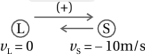
Here,$f_{S} = 400 \ Hz$ is the source frequency,$v = 330 \ ms^{-1}$ is the speed of sound in air,$v_{L} = 0 \ ms^{-1}$ is the velocity of the observer (standing on the platform),and $v_{S} = -10 \ ms^{-1}$ is the velocity of the source (moving towards the observer).
Substituting the values:
$f_{L} = 400 \times \left( \frac{330 + 0}{330 - 10} \right)$
$f_{L} = 400 \times \left( \frac{330}{320} \right)$
$f_{L} = 400 \times 1.03125 = 412.5 \ Hz$
Thus,the frequency of the sound heard by the observer is $412.5 \ Hz$.
$f_{L} = f_{S} \left( \frac{v + v_{L}}{v + v_{S}} \right)$
Here,$f_{S} = 400 \ Hz$ is the source frequency,$v = 330 \ ms^{-1}$ is the speed of sound in air,$v_{L} = 0 \ ms^{-1}$ is the velocity of the observer (standing on the platform),and $v_{S} = -10 \ ms^{-1}$ is the velocity of the source (moving towards the observer).
Substituting the values:
$f_{L} = 400 \times \left( \frac{330 + 0}{330 - 10} \right)$
$f_{L} = 400 \times \left( \frac{330}{320} \right)$
$f_{L} = 400 \times 1.03125 = 412.5 \ Hz$
Thus,the frequency of the sound heard by the observer is $412.5 \ Hz$.
0 likes
View Solution173
DifficultMCQ
The driver of a bus approaching a big wall notices that the frequency of his bus's horn changes from $420\, Hz$ to $490\, Hz$,when he hears it after it gets reflected from the wall. Find the speed of the bus (in $kmh^{-1}$) if the speed of sound is $330\, ms^{-1}$.
A
$91$
B
$71$
C
$81$
D
$61$
Solution
(A) Let $v_B$ be the speed of the bus and $v = 330\, ms^{-1}$ be the speed of sound.
First,the sound from the horn reaches the wall. The wall acts as a stationary observer receiving sound from a moving source (the bus). The frequency $f'$ received by the wall is:
$f' = f_0 \left( \frac{v}{v - v_B} \right) = 420 \left( \frac{330}{330 - v_B} \right)$
Next,the wall reflects this sound,acting as a stationary source of frequency $f'$. The driver (moving source) acts as an observer moving towards this source. The frequency $f''$ heard by the driver is:
$f'' = f' \left( \frac{v + v_B}{v} \right) = 420 \left( \frac{330}{330 - v_B} \right) \left( \frac{330 + v_B}{330} \right)$
Given $f'' = 490\, Hz$,we have:
$490 = 420 \left( \frac{330 + v_B}{330 - v_B} \right)$
Dividing both sides by $70$:
$7 = 6 \left( \frac{330 + v_B}{330 - v_B} \right)$
$7(330 - v_B) = 6(330 + v_B)$
$2310 - 7v_B = 1980 + 6v_B$
$13v_B = 330$
$v_B = \frac{330}{13} \approx 25.38\, ms^{-1}$
Converting to $kmh^{-1}$:
$v_B = \frac{330}{13} \times \frac{18}{5} = \frac{66 \times 18}{13} = \frac{1188}{13} \approx 91.38\, kmh^{-1}$
Rounding to the nearest integer,the speed is $91\, kmh^{-1}$.
First,the sound from the horn reaches the wall. The wall acts as a stationary observer receiving sound from a moving source (the bus). The frequency $f'$ received by the wall is:
$f' = f_0 \left( \frac{v}{v - v_B} \right) = 420 \left( \frac{330}{330 - v_B} \right)$
Next,the wall reflects this sound,acting as a stationary source of frequency $f'$. The driver (moving source) acts as an observer moving towards this source. The frequency $f''$ heard by the driver is:
$f'' = f' \left( \frac{v + v_B}{v} \right) = 420 \left( \frac{330}{330 - v_B} \right) \left( \frac{330 + v_B}{330} \right)$
Given $f'' = 490\, Hz$,we have:
$490 = 420 \left( \frac{330 + v_B}{330 - v_B} \right)$
Dividing both sides by $70$:
$7 = 6 \left( \frac{330 + v_B}{330 - v_B} \right)$
$7(330 - v_B) = 6(330 + v_B)$
$2310 - 7v_B = 1980 + 6v_B$
$13v_B = 330$
$v_B = \frac{330}{13} \approx 25.38\, ms^{-1}$
Converting to $kmh^{-1}$:
$v_B = \frac{330}{13} \times \frac{18}{5} = \frac{66 \times 18}{13} = \frac{1188}{13} \approx 91.38\, kmh^{-1}$
Rounding to the nearest integer,the speed is $91\, kmh^{-1}$.
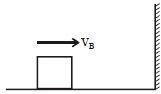
0 likes
View Solution174
DifficultMCQ
$A$ driver in a car,approaching a vertical wall,notices that the frequency of his car horn has changed from $440 \, Hz$ to $480 \, Hz$ when it gets reflected from the wall. If the speed of sound in air is $345 \, m/s,$ then the speed of the car is $....... \, km/hr$.
A
$36$
B
$24$
C
$18$
D
$54$
Solution
(D) Let $f_0 = 440 \, Hz$ be the original frequency and $f_2 = 480 \, Hz$ be the reflected frequency heard by the driver.
First,the wall acts as a stationary observer receiving the sound from the moving car. The frequency $f_1$ received by the wall is given by the Doppler effect formula for a moving source and stationary observer:
$f_1 = f_0 \left( \frac{v}{v - v_c} \right)$
where $v = 345 \, m/s$ is the speed of sound and $v_c$ is the speed of the car.
Next,the wall acts as a stationary source reflecting the sound back to the moving driver (who is now the observer). The frequency $f_2$ heard by the driver is:
$f_2 = f_1 \left( \frac{v + v_c}{v} \right)$
Substituting $f_1$ into the equation for $f_2$:
$f_2 = f_0 \left( \frac{v}{v - v_c} \right) \left( \frac{v + v_c}{v} \right) = f_0 \left( \frac{v + v_c}{v - v_c} \right)$
Given $f_2 / f_0 = 480 / 440 = 48 / 44 = 12 / 11$:
$12 / 11 = (345 + v_c) / (345 - v_c)$
$12(345 - v_c) = 11(345 + v_c)$
$4140 - 12v_c = 3795 + 11v_c$
$23v_c = 345$
$v_c = 345 / 23 = 15 \, m/s$
Converting to $km/hr$:
$v_c = 15 \times (18 / 5) = 54 \, km/hr$.
First,the wall acts as a stationary observer receiving the sound from the moving car. The frequency $f_1$ received by the wall is given by the Doppler effect formula for a moving source and stationary observer:
$f_1 = f_0 \left( \frac{v}{v - v_c} \right)$
where $v = 345 \, m/s$ is the speed of sound and $v_c$ is the speed of the car.
Next,the wall acts as a stationary source reflecting the sound back to the moving driver (who is now the observer). The frequency $f_2$ heard by the driver is:
$f_2 = f_1 \left( \frac{v + v_c}{v} \right)$
Substituting $f_1$ into the equation for $f_2$:
$f_2 = f_0 \left( \frac{v}{v - v_c} \right) \left( \frac{v + v_c}{v} \right) = f_0 \left( \frac{v + v_c}{v - v_c} \right)$
Given $f_2 / f_0 = 480 / 440 = 48 / 44 = 12 / 11$:
$12 / 11 = (345 + v_c) / (345 - v_c)$
$12(345 - v_c) = 11(345 + v_c)$
$4140 - 12v_c = 3795 + 11v_c$
$23v_c = 345$
$v_c = 345 / 23 = 15 \, m/s$
Converting to $km/hr$:
$v_c = 15 \times (18 / 5) = 54 \, km/hr$.
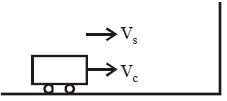
0 likes
View Solution175
DifficultMCQ
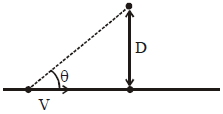
$A$ sound source $S$ is moving along a straight track with speed $v,$ and is emitting sound of frequency $v_{0}.$ An observer is standing at a finite distance,at the point $O,$ from the track. The time variation of frequency heard by the observer is best represented by (where $t_{0}$ represents the instant when the distance between the source and observer is minimum).
A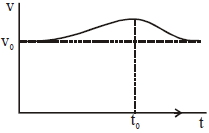
B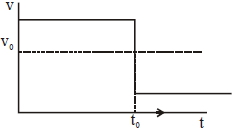
C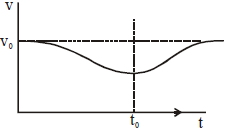
D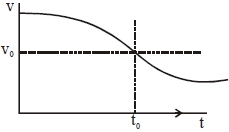
Solution
(D) The frequency $f$ heard by the observer is given by the Doppler effect formula: $f = f_{0} \left( \frac{v_{s}}{v_{s} - v \cos \theta} \right)$,where $v_{s}$ is the speed of sound,$v$ is the speed of the source,and $\theta$ is the angle between the velocity vector of the source and the line joining the source to the observer.
Before the source reaches the point of closest approach $(t < t_{0})$,the source is approaching the observer,so $\theta$ is acute,$\cos \theta > 0$,and the observed frequency $f > f_{0}$. As the source approaches the point of closest approach,$\theta$ increases towards $90^{\circ}$,so $\cos \theta$ decreases,and $f$ decreases towards $f_{0}$.
At the point of closest approach $(t = t_{0})$,$\theta = 90^{\circ}$,$\cos \theta = 0$,and $f = f_{0}$.
After the source passes the point of closest approach $(t > t_{0})$,the source is moving away from the observer,so $\theta$ is obtuse,$\cos \theta < 0$,and the observed frequency $f < f_{0}$. As the source moves further away,$\theta$ increases,$\cos \theta$ becomes more negative,and $f$ decreases further below $f_{0}$.
Thus,the frequency $f$ starts above $f_{0}$,decreases to $f_{0}$ at $t = t_{0}$,and continues to decrease below $f_{0}$ for $t > t_{0}$. This behavior is best represented by Graph $D$.
Before the source reaches the point of closest approach $(t < t_{0})$,the source is approaching the observer,so $\theta$ is acute,$\cos \theta > 0$,and the observed frequency $f > f_{0}$. As the source approaches the point of closest approach,$\theta$ increases towards $90^{\circ}$,so $\cos \theta$ decreases,and $f$ decreases towards $f_{0}$.
At the point of closest approach $(t = t_{0})$,$\theta = 90^{\circ}$,$\cos \theta = 0$,and $f = f_{0}$.
After the source passes the point of closest approach $(t > t_{0})$,the source is moving away from the observer,so $\theta$ is obtuse,$\cos \theta < 0$,and the observed frequency $f < f_{0}$. As the source moves further away,$\theta$ increases,$\cos \theta$ becomes more negative,and $f$ decreases further below $f_{0}$.
Thus,the frequency $f$ starts above $f_{0}$,decreases to $f_{0}$ at $t = t_{0}$,and continues to decrease below $f_{0}$ for $t > t_{0}$. This behavior is best represented by Graph $D$.
0 likes
View Solution176
DifficultMCQ
Two sources of sound $S_1$ and $S_2$ are moving towards and away from a stationary observer with the same speed $V$ respectively. The observer detects $3$ beats per second. Find the speed of the source (approximately) in $m/s$. Given: $f_1 = f_2 = 500 \, Hz$,speed of sound in air $= 330 \, m/s$.
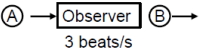
A
$1$
B
$2$
C
$3$
D
$4$
Solution
(A) The apparent frequency $f'$ heard by a stationary observer from a moving source is given by $f' = f \left( \frac{v}{v \mp v_s} \right)$,where $v$ is the speed of sound and $v_s$ is the speed of the source.
For source $S_1$ moving towards the observer,the apparent frequency is $f_1' = f \left( \frac{v}{v - V} \right)$.
For source $S_2$ moving away from the observer,the apparent frequency is $f_2' = f \left( \frac{v}{v + V} \right)$.
The beat frequency is the difference between these two frequencies:
$|f_1' - f_2'| = 3$
$f \left( \frac{v}{v - V} - \frac{v}{v + V} \right) = 3$
Substituting the given values $f = 500 \, Hz$ and $v = 330 \, m/s$:
$500 \left( \frac{330(v + V) - 330(v - V)}{v^2 - V^2} \right) = 3$
$500 \left( \frac{660V}{330^2 - V^2} \right) = 3$
Since $V^2 \ll 330^2$,we can approximate $330^2 - V^2 \approx 330^2$:
$500 \left( \frac{660V}{330^2} \right) = 3$
$500 \left( \frac{2V}{330} \right) = 3$
$V = \frac{3 \times 330}{1000} = \frac{990}{1000} = 0.99 \, m/s \approx 1 \, m/s$.
For source $S_1$ moving towards the observer,the apparent frequency is $f_1' = f \left( \frac{v}{v - V} \right)$.
For source $S_2$ moving away from the observer,the apparent frequency is $f_2' = f \left( \frac{v}{v + V} \right)$.
The beat frequency is the difference between these two frequencies:
$|f_1' - f_2'| = 3$
$f \left( \frac{v}{v - V} - \frac{v}{v + V} \right) = 3$
Substituting the given values $f = 500 \, Hz$ and $v = 330 \, m/s$:
$500 \left( \frac{330(v + V) - 330(v - V)}{v^2 - V^2} \right) = 3$
$500 \left( \frac{660V}{330^2 - V^2} \right) = 3$
Since $V^2 \ll 330^2$,we can approximate $330^2 - V^2 \approx 330^2$:
$500 \left( \frac{660V}{330^2} \right) = 3$
$500 \left( \frac{2V}{330} \right) = 3$
$V = \frac{3 \times 330}{1000} = \frac{990}{1000} = 0.99 \, m/s \approx 1 \, m/s$.
0 likes
View Solution177
DifficultMCQ
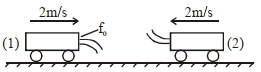
Two cars are approaching each other at an equal speed of $7.2\, km/hr$. When they see each other,both blow horns having a frequency of $676\, Hz$. The beat frequency heard by each driver will be $.....\, Hz$. [Velocity of sound in air is $340\, m/s$.]
A
$8$
B
$16$
C
$32$
D
$24$
Solution
(A) Given: Speed of each car $v_s = v_o = 7.2\, km/hr = 7.2 \times \frac{5}{18} = 2\, m/s$. Frequency of horn $f_0 = 676\, Hz$. Velocity of sound $v = 340\, m/s$.
Each driver hears two sounds: one directly from the other car and one reflected from the other car.
$1$. Frequency of sound heard directly from the other car $(f_d)$:
$f_d = f_0 \left( \frac{v + v_o}{v - v_s} \right) = 676 \left( \frac{340 + 2}{340 - 2} \right) = 676 \left( \frac{342}{338} \right) = 684\, Hz$.
$2$. Frequency of sound reflected from the other car $(f_r)$:
The sound from the other car travels to the driver's car,reflects,and returns. Effectively,the other car acts as a source moving towards the driver,and the driver acts as a source reflecting the sound back. The frequency heard after reflection is:
$f_r = f_0 \left( \frac{v + v_s}{v - v_s} \right) \left( \frac{v + v_o}{v - v_o} \right) = 676 \left( \frac{342}{338} \right) \left( \frac{342}{338} \right) = 676 \left( \frac{342}{338} \right)^2 \approx 692\, Hz$.
Beat frequency = $f_r - f_d = 692 - 684 = 8\, Hz$.
Each driver hears two sounds: one directly from the other car and one reflected from the other car.
$1$. Frequency of sound heard directly from the other car $(f_d)$:
$f_d = f_0 \left( \frac{v + v_o}{v - v_s} \right) = 676 \left( \frac{340 + 2}{340 - 2} \right) = 676 \left( \frac{342}{338} \right) = 684\, Hz$.
$2$. Frequency of sound reflected from the other car $(f_r)$:
The sound from the other car travels to the driver's car,reflects,and returns. Effectively,the other car acts as a source moving towards the driver,and the driver acts as a source reflecting the sound back. The frequency heard after reflection is:
$f_r = f_0 \left( \frac{v + v_s}{v - v_s} \right) \left( \frac{v + v_o}{v - v_o} \right) = 676 \left( \frac{342}{338} \right) \left( \frac{342}{338} \right) = 676 \left( \frac{342}{338} \right)^2 \approx 692\, Hz$.
Beat frequency = $f_r - f_d = 692 - 684 = 8\, Hz$.
0 likes
View Solution178
DifficultMCQ
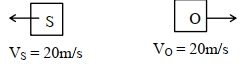
$A$ source and a detector move away from each other in the absence of wind with a speed of $20 \, m/s$ with respect to the ground. If the detector detects a frequency of $1800 \, Hz$ of the sound coming from the source,then the original frequency of the source,considering the speed of sound in air to be $340 \, m/s$,will be (in $Hz$):
A
$1050$
B
$750$
C
$2025$
D
$2250$
Solution
(C) Given:
Speed of source $V_S = 20 \, m/s$
Speed of observer/detector $V_O = 20 \, m/s$
Speed of sound $V = 340 \, m/s$
Observed frequency $f' = 1800 \, Hz$
According to the Doppler effect,when the source and observer move away from each other,the observed frequency is given by:
$f' = f \left( \frac{V - V_O}{V + V_S} \right)$
Substituting the values:
$1800 = f \left( \frac{340 - 20}{340 + 20} \right)$
$1800 = f \left( \frac{320}{360} \right)$
$1800 = f \left( \frac{8}{9} \right)$
$f = \frac{1800 \times 9}{8}$
$f = 225 \times 9 = 2025 \, Hz$
Therefore,the original frequency of the source is $2025 \, Hz$.
Speed of source $V_S = 20 \, m/s$
Speed of observer/detector $V_O = 20 \, m/s$
Speed of sound $V = 340 \, m/s$
Observed frequency $f' = 1800 \, Hz$
According to the Doppler effect,when the source and observer move away from each other,the observed frequency is given by:
$f' = f \left( \frac{V - V_O}{V + V_S} \right)$
Substituting the values:
$1800 = f \left( \frac{340 - 20}{340 + 20} \right)$
$1800 = f \left( \frac{320}{360} \right)$
$1800 = f \left( \frac{8}{9} \right)$
$f = \frac{1800 \times 9}{8}$
$f = 225 \times 9 = 2025 \, Hz$
Therefore,the original frequency of the source is $2025 \, Hz$.
0 likes
View Solution179
MediumMCQ
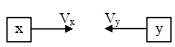
Two cars $X$ and $Y$ are approaching each other with velocities $36 \; km/h$ and $72 \; km/h$ respectively. The frequency of a whistle sound emitted by a passenger in car $X$,heard by the passenger in car $Y$,is $1320 \; Hz$. If the velocity of sound in air is $340 \; m/s$,the actual frequency of the whistle sound produced is ........ $Hz$.
A
$1210$
B
$1250$
C
$605$
D
$2420$
Solution
(A) Given:
Velocity of source (car $X$),$V_s = 36 \; km/h = 36 \times \frac{5}{18} = 10 \; m/s$.
Velocity of observer (car $Y$),$V_o = 72 \; km/h = 72 \times \frac{5}{18} = 20 \; m/s$.
Velocity of sound,$V = 340 \; m/s$.
Apparent frequency,$f' = 1320 \; Hz$.
Using the Doppler effect formula for source and observer approaching each other:
$f' = f_0 \left( \frac{V + V_o}{V - V_s} \right)$
Substituting the values:
$1320 = f_0 \left( \frac{340 + 20}{340 - 10} \right)$
$1320 = f_0 \left( \frac{360}{330} \right)$
$1320 = f_0 \left( \frac{36}{33} \right)$
$f_0 = 1320 \times \frac{33}{36}$
$f_0 = 1210 \; Hz$.
Therefore,the actual frequency of the whistle is $1210 \; Hz$.
Velocity of source (car $X$),$V_s = 36 \; km/h = 36 \times \frac{5}{18} = 10 \; m/s$.
Velocity of observer (car $Y$),$V_o = 72 \; km/h = 72 \times \frac{5}{18} = 20 \; m/s$.
Velocity of sound,$V = 340 \; m/s$.
Apparent frequency,$f' = 1320 \; Hz$.
Using the Doppler effect formula for source and observer approaching each other:
$f' = f_0 \left( \frac{V + V_o}{V - V_s} \right)$
Substituting the values:
$1320 = f_0 \left( \frac{340 + 20}{340 - 10} \right)$
$1320 = f_0 \left( \frac{360}{330} \right)$
$1320 = f_0 \left( \frac{36}{33} \right)$
$f_0 = 1320 \times \frac{33}{36}$
$f_0 = 1210 \; Hz$.
Therefore,the actual frequency of the whistle is $1210 \; Hz$.
0 likes
View Solution180
DifficultMCQ
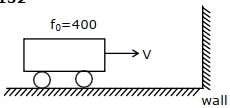
The frequency of a car horn changes from $400\, Hz$ to $500\, Hz$ as the car approaches a vertical wall. If the speed of sound is $330\, m/s$,then the speed of the car is $.....\, km/h$.
A
$330$
B
$132$
C
$185$
D
$852$
Solution
(B) Let $f_0 = 400\, Hz$ be the source frequency,$f_2 = 500\, Hz$ be the reflected frequency heard by the driver,$C = 330\, m/s$ be the speed of sound,and $V$ be the speed of the car.
First,the wall acts as an observer receiving the sound from the moving car:
$f_1 = f_0 \left( \frac{C}{C - V} \right)$
Next,the wall acts as a stationary source reflecting the sound back to the driver (observer) who is moving towards the wall:
$f_2 = f_1 \left( \frac{C + V}{C} \right)$
Substituting $f_1$ into the equation for $f_2$:
$f_2 = f_0 \left( \frac{C}{C - V} \right) \left( \frac{C + V}{C} \right) = f_0 \left( \frac{C + V}{C - V} \right)$
Given $f_2 = 500\, Hz$ and $f_0 = 400\, Hz$:
$500 = 400 \left( \frac{330 + V}{330 - V} \right)$
$\frac{5}{4} = \frac{330 + V}{330 - V}$
$5(330 - V) = 4(330 + V)$
$1650 - 5V = 1320 + 4V$
$9V = 330$
$V = \frac{330}{9} = \frac{110}{3}\, m/s$
Converting the speed to $km/h$:
$V = \frac{110}{3} \times \frac{18}{5} = 22 \times 6 = 132\, km/h$.
First,the wall acts as an observer receiving the sound from the moving car:
$f_1 = f_0 \left( \frac{C}{C - V} \right)$
Next,the wall acts as a stationary source reflecting the sound back to the driver (observer) who is moving towards the wall:
$f_2 = f_1 \left( \frac{C + V}{C} \right)$
Substituting $f_1$ into the equation for $f_2$:
$f_2 = f_0 \left( \frac{C}{C - V} \right) \left( \frac{C + V}{C} \right) = f_0 \left( \frac{C + V}{C - V} \right)$
Given $f_2 = 500\, Hz$ and $f_0 = 400\, Hz$:
$500 = 400 \left( \frac{330 + V}{330 - V} \right)$
$\frac{5}{4} = \frac{330 + V}{330 - V}$
$5(330 - V) = 4(330 + V)$
$1650 - 5V = 1320 + 4V$
$9V = 330$
$V = \frac{330}{9} = \frac{110}{3}\, m/s$
Converting the speed to $km/h$:
$V = \frac{110}{3} \times \frac{18}{5} = 22 \times 6 = 132\, km/h$.
0 likes
View Solution181
MediumMCQ
An observer moves towards a stationary source of sound with a velocity equal to one-fifth of the velocity of sound. The percentage change in the frequency will be $\dots \;$%.
A
$20$
B
$10$
C
$5$
D
$0$
Solution
(A) The observed frequency $f_{0}$ when an observer moves towards a stationary source is given by the Doppler effect formula: $f_{0} = \left(\frac{v + v_{0}}{v}\right) f_{s}$,where $v$ is the velocity of sound and $v_{0}$ is the velocity of the observer.
Given that $v_{0} = \frac{v}{5}$,we substitute this into the formula:
$f_{0} = \left(\frac{v + \frac{v}{5}}{v}\right) f_{s} = \left(\frac{\frac{6v}{5}}{v}\right) f_{s} = \frac{6}{5} f_{s} = 1.2 f_{s}$.
The percentage change in frequency is calculated as:
$\% \text{ change} = \frac{f_{0} - f_{s}}{f_{s}} \times 100$.
Substituting $f_{0} = 1.2 f_{s}$:
$\% \text{ change} = \frac{1.2 f_{s} - f_{s}}{f_{s}} \times 100 = 0.2 \times 100 = 20 \%$.
Given that $v_{0} = \frac{v}{5}$,we substitute this into the formula:
$f_{0} = \left(\frac{v + \frac{v}{5}}{v}\right) f_{s} = \left(\frac{\frac{6v}{5}}{v}\right) f_{s} = \frac{6}{5} f_{s} = 1.2 f_{s}$.
The percentage change in frequency is calculated as:
$\% \text{ change} = \frac{f_{0} - f_{s}}{f_{s}} \times 100$.
Substituting $f_{0} = 1.2 f_{s}$:
$\% \text{ change} = \frac{1.2 f_{s} - f_{s}}{f_{s}} \times 100 = 0.2 \times 100 = 20 \%$.
0 likes
View Solution182
DifficultMCQ
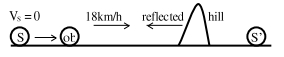
An observer is riding on a bicycle and moving towards a hill at $18\,km\,h^{-1}$. He hears a sound from a source at some distance behind him directly as well as after its reflection from the hill. If the original frequency of the sound as emitted by the source is $640\,Hz$ and the velocity of sound in air is $320\,m/s$,the beat frequency between the two sounds heard by the observer will be $...Hz$.
A
$19$
B
$200$
C
$20$
D
$2$
Solution
(C) The velocity of the observer is $V_{o} = 18\,km/h = 18 \times \frac{5}{18} = 5\,m/s$. The source is stationary,so $V_{s} = 0$.
For the direct sound,the observer is moving away from the source. The apparent frequency is given by:
$f_{\text{direct}} = f_{0} \left( \frac{v - V_{o}}{v} \right) = 640 \left( \frac{320 - 5}{320} \right) = 640 \left( \frac{315}{320} \right) = 2 \times 315 = 630\,Hz$.
For the reflected sound,the hill acts as a stationary source of frequency $f_{0} = 640\,Hz$. The observer is moving towards the hill (towards the reflected source). The apparent frequency is given by:
$f_{\text{reflected}} = f_{0} \left( \frac{v + V_{o}}{v} \right) = 640 \left( \frac{320 + 5}{320} \right) = 640 \left( \frac{325}{320} \right) = 2 \times 325 = 650\,Hz$.
The beat frequency is the difference between the two frequencies:
$f_{\text{beat}} = f_{\text{reflected}} - f_{\text{direct}} = 650\,Hz - 630\,Hz = 20\,Hz$.
For the direct sound,the observer is moving away from the source. The apparent frequency is given by:
$f_{\text{direct}} = f_{0} \left( \frac{v - V_{o}}{v} \right) = 640 \left( \frac{320 - 5}{320} \right) = 640 \left( \frac{315}{320} \right) = 2 \times 315 = 630\,Hz$.
For the reflected sound,the hill acts as a stationary source of frequency $f_{0} = 640\,Hz$. The observer is moving towards the hill (towards the reflected source). The apparent frequency is given by:
$f_{\text{reflected}} = f_{0} \left( \frac{v + V_{o}}{v} \right) = 640 \left( \frac{320 + 5}{320} \right) = 640 \left( \frac{325}{320} \right) = 2 \times 325 = 650\,Hz$.
The beat frequency is the difference between the two frequencies:
$f_{\text{beat}} = f_{\text{reflected}} - f_{\text{direct}} = 650\,Hz - 630\,Hz = 20\,Hz$.
0 likes
View Solution183
DifficultMCQ
When a car is approaching the observer,the frequency of the horn is $100 \, Hz$. After passing the observer,it is $50 \, Hz$. If the observer moves with the car,the frequency will be $\frac{x}{3} \, Hz$ where $x = .....$
A
$202$
B
$2000$
C
$20$
D
$200$
Solution
(D) Let $f_0$ be the actual frequency of the horn,$C$ be the speed of sound,and $V_s$ be the speed of the car.
When the car approaches the observer: $f_1 = f_0 \left( \frac{C}{C - V_s} \right) = 100 \, Hz$.
When the car moves away from the observer: $f_2 = f_0 \left( \frac{C}{C + V_s} \right) = 50 \, Hz$.
Dividing the two equations: $\frac{f_1}{f_2} = \frac{100}{50} = 2 = \frac{C + V_s}{C - V_s}$.
Solving for $V_s$: $2(C - V_s) = C + V_s \implies 2C - 2V_s = C + V_s \implies C = 3V_s \implies V_s = \frac{C}{3}$.
Substituting $V_s$ into the first equation: $100 = f_0 \left( \frac{C}{C - C/3} \right) = f_0 \left( \frac{C}{2C/3} \right) = f_0 \left( \frac{3}{2} \right)$.
Thus,$f_0 = 100 \times \frac{2}{3} = \frac{200}{3} \, Hz$.
If the observer moves with the car,the relative velocity between the source and the observer is zero,so the observed frequency is equal to the actual frequency $f_0$.
Therefore,$f = f_0 = \frac{200}{3} \, Hz$.
Comparing this with $\frac{x}{3} \, Hz$,we get $x = 200$.
When the car approaches the observer: $f_1 = f_0 \left( \frac{C}{C - V_s} \right) = 100 \, Hz$.
When the car moves away from the observer: $f_2 = f_0 \left( \frac{C}{C + V_s} \right) = 50 \, Hz$.
Dividing the two equations: $\frac{f_1}{f_2} = \frac{100}{50} = 2 = \frac{C + V_s}{C - V_s}$.
Solving for $V_s$: $2(C - V_s) = C + V_s \implies 2C - 2V_s = C + V_s \implies C = 3V_s \implies V_s = \frac{C}{3}$.
Substituting $V_s$ into the first equation: $100 = f_0 \left( \frac{C}{C - C/3} \right) = f_0 \left( \frac{C}{2C/3} \right) = f_0 \left( \frac{3}{2} \right)$.
Thus,$f_0 = 100 \times \frac{2}{3} = \frac{200}{3} \, Hz$.
If the observer moves with the car,the relative velocity between the source and the observer is zero,so the observed frequency is equal to the actual frequency $f_0$.
Therefore,$f = f_0 = \frac{200}{3} \, Hz$.
Comparing this with $\frac{x}{3} \, Hz$,we get $x = 200$.
0 likes
View Solution184
DifficultMCQ
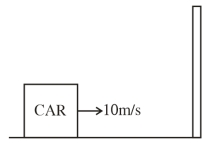
The frequency of the echo will be $.......Hz$ if a car blowing a whistle of frequency $320\,Hz$ is moving with a velocity of $36\,km/h$ towards a hill from which an echo is heard by the car driver. The velocity of sound in air is $330\,m/s$.
A
$320$
B
$340$
C
$360$
D
$380$
Solution
(B) The hill acts as a secondary source of sound.
Given:
Frequency of whistle,$f = 320\,Hz$
Velocity of car,$v_s = v_o = 36\,km/h = 36 \times \frac{5}{18} = 10\,m/s$
Velocity of sound,$v = 330\,m/s$
Step $1$: Calculate the frequency received by the hill $(f_1)$.
Since the source (car) is moving towards the stationary observer (hill),the frequency received by the hill is:
$f_1 = f \left( \frac{v}{v - v_s} \right) = 320 \left( \frac{330}{330 - 10} \right) = 320 \left( \frac{330}{320} \right) = 330\,Hz$
Step $2$: Calculate the frequency of the echo heard by the driver $(f_2)$.
The hill reflects this frequency $f_1$. Now,the hill acts as a stationary source and the car acts as a moving observer moving towards the source.
$f_2 = f_1 \left( \frac{v + v_o}{v} \right) = 330 \left( \frac{330 + 10}{330} \right) = 340\,Hz$
Given:
Frequency of whistle,$f = 320\,Hz$
Velocity of car,$v_s = v_o = 36\,km/h = 36 \times \frac{5}{18} = 10\,m/s$
Velocity of sound,$v = 330\,m/s$
Step $1$: Calculate the frequency received by the hill $(f_1)$.
Since the source (car) is moving towards the stationary observer (hill),the frequency received by the hill is:
$f_1 = f \left( \frac{v}{v - v_s} \right) = 320 \left( \frac{330}{330 - 10} \right) = 320 \left( \frac{330}{320} \right) = 330\,Hz$
Step $2$: Calculate the frequency of the echo heard by the driver $(f_2)$.
The hill reflects this frequency $f_1$. Now,the hill acts as a stationary source and the car acts as a moving observer moving towards the source.
$f_2 = f_1 \left( \frac{v + v_o}{v} \right) = 330 \left( \frac{330 + 10}{330} \right) = 340\,Hz$
0 likes
View Solution185
DifficultMCQ
$A$ whistle emitting a loud sound of frequency $540 \,Hz$ is whirled in a horizontal circle of radius $2 \,m$ at a constant angular speed of $15 \,rad/s$. The speed of sound is $330 \,m/s$. The ratio of the highest to the lowest frequency heard by a listener standing at rest at a large distance from the centre of the circle is
A
$1.0$
B
$1.1$
C
$1.2$
D
$1.4$
Solution
(C) The source of sound is moving in a circle,so its linear speed $v_s$ is given by $v_s = r\omega$.
Given $r = 2 \,m$ and $\omega = 15 \,rad/s$,we have $v_s = 2 \times 15 = 30 \,m/s$.
The speed of sound is $v = 330 \,m/s$.
According to the Doppler effect,when the source moves towards the stationary observer,the observed frequency is $f_{\max} = \left(\frac{v}{v - v_s}\right) f$.
When the source moves away from the stationary observer,the observed frequency is $f_{\min} = \left(\frac{v}{v + v_s}\right) f$.
The ratio of the highest to the lowest frequency is:
$\frac{f_{\max}}{f_{\min}} = \frac{\left(\frac{v}{v - v_s}\right) f}{\left(\frac{v}{v + v_s}\right) f} = \frac{v + v_s}{v - v_s}$.
Substituting the values:
$\frac{f_{\max}}{f_{\min}} = \frac{330 + 30}{330 - 30} = \frac{360}{300} = 1.2$.
Given $r = 2 \,m$ and $\omega = 15 \,rad/s$,we have $v_s = 2 \times 15 = 30 \,m/s$.
The speed of sound is $v = 330 \,m/s$.
According to the Doppler effect,when the source moves towards the stationary observer,the observed frequency is $f_{\max} = \left(\frac{v}{v - v_s}\right) f$.
When the source moves away from the stationary observer,the observed frequency is $f_{\min} = \left(\frac{v}{v + v_s}\right) f$.
The ratio of the highest to the lowest frequency is:
$\frac{f_{\max}}{f_{\min}} = \frac{\left(\frac{v}{v - v_s}\right) f}{\left(\frac{v}{v + v_s}\right) f} = \frac{v + v_s}{v - v_s}$.
Substituting the values:
$\frac{f_{\max}}{f_{\min}} = \frac{330 + 30}{330 - 30} = \frac{360}{300} = 1.2$.
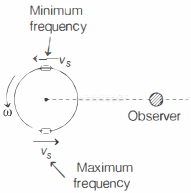
0 likes
View Solution186
AdvancedMCQ
An engine moving away from a vertical cliff blows a horn at a frequency $f$. Its speed is $0.5 \%$ of the speed of sound in air. The frequency of the reflected sound received at the engine is ............ $f$.
A
$0.990$
B
$0.995$
C
$1.005$
D
$1.010$
Solution
(A) Let $v$ be the speed of sound in air. The speed of the engine is $v_s = 0.005v$.
First,the sound travels from the moving engine to the stationary cliff. The frequency $f_1$ received by the cliff is given by the Doppler effect formula for a moving source and stationary observer:
$f_1 = f \left( \frac{v}{v + v_s} \right) = f \left( \frac{v}{v + 0.005v} \right) = f \left( \frac{1}{1.005} \right)$
Next,the cliff acts as a stationary source reflecting the sound of frequency $f_1$ back to the moving engine (observer). The frequency $f_2$ received by the engine is given by the Doppler effect formula for a stationary source and moving observer:
$f_2 = f_1 \left( \frac{v - v_o}{v} \right)$
Since the engine is moving away from the cliff,the observer speed $v_o = v_s = 0.005v$ is taken as negative relative to the direction of the reflected sound:
$f_2 = f_1 \left( \frac{v - 0.005v}{v} \right) = f_1 \left( \frac{0.995v}{v} \right) = 0.995 f_1$
Substituting $f_1$ into the equation for $f_2$:
$f_2 = 0.995 \times f \left( \frac{1}{1.005} \right) \approx 0.995 \times 0.995 f \approx 0.990 f$
Thus,the correct option is $A$.
First,the sound travels from the moving engine to the stationary cliff. The frequency $f_1$ received by the cliff is given by the Doppler effect formula for a moving source and stationary observer:
$f_1 = f \left( \frac{v}{v + v_s} \right) = f \left( \frac{v}{v + 0.005v} \right) = f \left( \frac{1}{1.005} \right)$
Next,the cliff acts as a stationary source reflecting the sound of frequency $f_1$ back to the moving engine (observer). The frequency $f_2$ received by the engine is given by the Doppler effect formula for a stationary source and moving observer:
$f_2 = f_1 \left( \frac{v - v_o}{v} \right)$
Since the engine is moving away from the cliff,the observer speed $v_o = v_s = 0.005v$ is taken as negative relative to the direction of the reflected sound:
$f_2 = f_1 \left( \frac{v - 0.005v}{v} \right) = f_1 \left( \frac{0.995v}{v} \right) = 0.995 f_1$
Substituting $f_1$ into the equation for $f_2$:
$f_2 = 0.995 \times f \left( \frac{1}{1.005} \right) \approx 0.995 \times 0.995 f \approx 0.990 f$
Thus,the correct option is $A$.
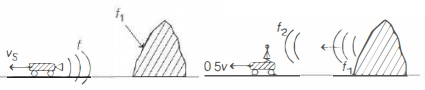
0 likes
View Solution187
DifficultMCQ
$A$ speaker emits a sound wave of frequency $f_0$. When it moves towards a stationary observer with speed $u$,the observer measures a frequency $f_1$. If the speaker is stationary and the observer moves towards it with speed $u$,the measured frequency is $f_2$. Then,
A
$f_1=f_2 < f_0$
B
$f_1 > f_2$
C
$f_1 < f_2$
D
$f_1=f_2 > f_0$
Solution
(B) When the observer is stationary and the source is moving towards the observer,the observed frequency is given by the Doppler effect formula:
$f_1 = f_0 \left( \frac{v}{v - u} \right)$
where $v$ is the speed of sound and $u$ is the speed of the source.
When the source is stationary and the observer is moving towards the source,the measured frequency is:
$f_2 = f_0 \left( \frac{v + u}{v} \right)$
To compare $f_1$ and $f_2$,we look at the ratio:
$f_1 = f_0 \left( 1 - \frac{u}{v} \right)^{-1} \approx f_0 \left( 1 + \frac{u}{v} + \frac{u^2}{v^2} + \dots \right)$
$f_2 = f_0 \left( 1 + \frac{u}{v} \right)$
Comparing the two,$f_1 = f_0 \left( \frac{v}{v-u} \right)$ and $f_2 = f_0 \left( \frac{v+u}{v} \right) = f_0 \left( 1 + \frac{u}{v} \right)$.
Since $\frac{v}{v-u} > 1 + \frac{u}{v}$ (because $\frac{v^2}{v(v-u)} > \frac{v^2-u^2}{v(v-u)}$),it follows that $f_1 > f_2$.
$f_1 = f_0 \left( \frac{v}{v - u} \right)$
where $v$ is the speed of sound and $u$ is the speed of the source.
When the source is stationary and the observer is moving towards the source,the measured frequency is:
$f_2 = f_0 \left( \frac{v + u}{v} \right)$
To compare $f_1$ and $f_2$,we look at the ratio:
$f_1 = f_0 \left( 1 - \frac{u}{v} \right)^{-1} \approx f_0 \left( 1 + \frac{u}{v} + \frac{u^2}{v^2} + \dots \right)$
$f_2 = f_0 \left( 1 + \frac{u}{v} \right)$
Comparing the two,$f_1 = f_0 \left( \frac{v}{v-u} \right)$ and $f_2 = f_0 \left( \frac{v+u}{v} \right) = f_0 \left( 1 + \frac{u}{v} \right)$.
Since $\frac{v}{v-u} > 1 + \frac{u}{v}$ (because $\frac{v^2}{v(v-u)} > \frac{v^2-u^2}{v(v-u)}$),it follows that $f_1 > f_2$.
0 likes
View Solution188
DifficultMCQ
$A$ bus driving along at $39.6 \,km/h$ is approaching a person who is standing at the bus stop,while honking repeatedly at an interval of $30 \,s$. If the speed of sound is $330 \,ms^{-1}$,at what interval will the person hear the horn?
A
$31 \,s$
B
$29 \,s$
C
$30 \,s$
D
The interval will depend on the distance of the bus from the passenger
Solution
(B) The source (bus) is moving towards a stationary observer (person at the bus stop).
Given:
Velocity of source,$v_s = 39.6 \,km/h = 39.6 \times \frac{5}{18} = 11 \,ms^{-1}$.
Velocity of sound,$v = 330 \,ms^{-1}$.
Time interval of source,$T = 30 \,s$.
When the source moves towards a stationary observer,the apparent time interval $T^{\prime}$ between two consecutive pulses is given by the formula:
$T^{\prime} = T \left( \frac{v - v_s}{v} \right)$
Substituting the values:
$T^{\prime} = 30 \left( \frac{330 - 11}{330} \right)$
$T^{\prime} = 30 \left( \frac{319}{330} \right)$
$T^{\prime} = \frac{319}{11} = 29 \,s$.
Therefore,the person will hear the horn at an interval of $29 \,s$.
Given:
Velocity of source,$v_s = 39.6 \,km/h = 39.6 \times \frac{5}{18} = 11 \,ms^{-1}$.
Velocity of sound,$v = 330 \,ms^{-1}$.
Time interval of source,$T = 30 \,s$.
When the source moves towards a stationary observer,the apparent time interval $T^{\prime}$ between two consecutive pulses is given by the formula:
$T^{\prime} = T \left( \frac{v - v_s}{v} \right)$
Substituting the values:
$T^{\prime} = 30 \left( \frac{330 - 11}{330} \right)$
$T^{\prime} = 30 \left( \frac{319}{330} \right)$
$T^{\prime} = \frac{319}{11} = 29 \,s$.
Therefore,the person will hear the horn at an interval of $29 \,s$.
0 likes
View Solution189
MediumMCQ
$A$ policeman on duty detects a drop of $10 \%$ in the pitch of the horn of a moving car as it crosses him. If the velocity of sound is $330 \, m/s$,calculate the speed of the car in $m/s$.
A
$36.7$
B
$20.4$
C
$18.6$
D
$16.4$
Solution
(A) The apparent frequency $\nu'$ is $10 \%$ less than the original frequency $\nu$,so $\nu' = 0.9 \nu$.
Using the Doppler effect formula for a source moving away from a stationary observer: $\nu' = \nu \left( \frac{v}{v + v_s} \right)$,where $v = 330 \, m/s$ is the speed of sound and $v_s$ is the speed of the car.
Substituting the values: $0.9 \nu = \nu \left( \frac{330}{330 + v_s} \right)$.
$0.9 = \frac{330}{330 + v_s} \Rightarrow 0.9(330 + v_s) = 330$.
$297 + 0.9 v_s = 330$.
$0.9 v_s = 330 - 297 = 33$.
$v_s = \frac{33}{0.9} = \frac{330}{9} \approx 36.7 \, m/s$.
Using the Doppler effect formula for a source moving away from a stationary observer: $\nu' = \nu \left( \frac{v}{v + v_s} \right)$,where $v = 330 \, m/s$ is the speed of sound and $v_s$ is the speed of the car.
Substituting the values: $0.9 \nu = \nu \left( \frac{330}{330 + v_s} \right)$.
$0.9 = \frac{330}{330 + v_s} \Rightarrow 0.9(330 + v_s) = 330$.
$297 + 0.9 v_s = 330$.
$0.9 v_s = 330 - 297 = 33$.
$v_s = \frac{33}{0.9} = \frac{330}{9} \approx 36.7 \, m/s$.
0 likes
View Solution190
MediumMCQ
$A$ locomotive approaching a crossing at a speed of $20 \, m/s$ sounds a whistle of frequency $640 \, Hz$ when it is $1 \, km$ from the crossing. There is no wind and the speed of sound in air is $330 \, m/s$. What frequency is heard by an observer located $\sqrt{3} \, km$ away from the crossing on a straight road at a right angle to the locomotive's path (in $, Hz$)?
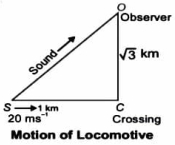
A
$600$
B
$630$
C
$660$
D
$720$
Solution
(C) The observer is at point $O$ and the locomotive is at point $S$. The crossing is at point $C$. The distance $SC = 1 \, km$ and $OC = \sqrt{3} \, km$.
In the right-angled triangle $SCO$,the angle $\theta$ at $S$ is given by $\tan \theta = \frac{OC}{SC} = \frac{\sqrt{3}}{1} = \sqrt{3}$.
Therefore,$\theta = 60^{\circ}$.
According to the Doppler effect for a moving source and a stationary observer,the apparent frequency $f'$ is given by:
$f' = f \left( \frac{c}{c - v \cos \theta} \right)$
where $c = 330 \, m/s$ is the speed of sound,$v = 20 \, m/s$ is the speed of the source,and $f = 640 \, Hz$ is the source frequency.
Substituting the values:
$f' = 640 \left( \frac{330}{330 - 20 \cos 60^{\circ}} \right)$
Since $\cos 60^{\circ} = 0.5$:
$f' = 640 \left( \frac{330}{330 - 20 \times 0.5} \right) = 640 \left( \frac{330}{330 - 10} \right) = 640 \left( \frac{330}{320} \right)$
$f' = 640 \times \frac{33}{32} = 20 \times 33 = 660 \, Hz$.
In the right-angled triangle $SCO$,the angle $\theta$ at $S$ is given by $\tan \theta = \frac{OC}{SC} = \frac{\sqrt{3}}{1} = \sqrt{3}$.
Therefore,$\theta = 60^{\circ}$.
According to the Doppler effect for a moving source and a stationary observer,the apparent frequency $f'$ is given by:
$f' = f \left( \frac{c}{c - v \cos \theta} \right)$
where $c = 330 \, m/s$ is the speed of sound,$v = 20 \, m/s$ is the speed of the source,and $f = 640 \, Hz$ is the source frequency.
Substituting the values:
$f' = 640 \left( \frac{330}{330 - 20 \cos 60^{\circ}} \right)$
Since $\cos 60^{\circ} = 0.5$:
$f' = 640 \left( \frac{330}{330 - 20 \times 0.5} \right) = 640 \left( \frac{330}{330 - 10} \right) = 640 \left( \frac{330}{320} \right)$
$f' = 640 \times \frac{33}{32} = 20 \times 33 = 660 \, Hz$.
0 likes
View Solution191
DifficultMCQ
Two sources $A$ and $B$ are sounding notes of frequency $660 \, Hz$. $A$ listener moves from $A$ to $B$ with a constant velocity $u$. If the speed of sound is $330 \, m/s$,what must be the value of $u$ so that he hears $8$ beats per second?
A
$2.8$
B
$2$
C
$3.0$
D
$3.5$
Solution
(B) Let $v = 330 \, m/s$ be the speed of sound and $n = 660 \, Hz$ be the frequency of the sources.
When the listener moves from $A$ to $B$ with velocity $u$,they move away from source $A$ and towards source $B$.
The apparent frequency heard from source $A$ is $n_1 = n \left( \frac{v - u}{v} \right)$.
The apparent frequency heard from source $B$ is $n_2 = n \left( \frac{v + u}{v} \right)$.
The number of beats per second is the difference between these frequencies: $n_2 - n_1 = 8$.
Substituting the expressions: $n \left( \frac{v + u}{v} \right) - n \left( \frac{v - u}{v} \right) = 8$.
$\frac{n}{v} (v + u - v + u) = 8$.
$\frac{n}{v} (2u) = 8$.
Substituting the values: $\frac{660}{330} (2u) = 8$.
$2(2u) = 8$.
$4u = 8$.
$u = 2 \, m/s$.
When the listener moves from $A$ to $B$ with velocity $u$,they move away from source $A$ and towards source $B$.
The apparent frequency heard from source $A$ is $n_1 = n \left( \frac{v - u}{v} \right)$.
The apparent frequency heard from source $B$ is $n_2 = n \left( \frac{v + u}{v} \right)$.
The number of beats per second is the difference between these frequencies: $n_2 - n_1 = 8$.
Substituting the expressions: $n \left( \frac{v + u}{v} \right) - n \left( \frac{v - u}{v} \right) = 8$.
$\frac{n}{v} (v + u - v + u) = 8$.
$\frac{n}{v} (2u) = 8$.
Substituting the values: $\frac{660}{330} (2u) = 8$.
$2(2u) = 8$.
$4u = 8$.
$u = 2 \, m/s$.
0 likes
View Solution192
MediumMCQ
$A$ man standing on a platform observes that the frequency of the sound of a whistle emitted by a train drops by $140 \, Hz$. If the velocity of sound in air is $330 \, m/s$ and the speed of the train is $70 \, m/s$,the frequency of the whistle is .......... $Hz$.
A
$571$
B
$800$
C
$400$
D
$260$
Solution
(B) Let the original frequency of the whistle be $f_0$.
When the train approaches the observer,the observed frequency is $f_1 = f_0 \left( \frac{v}{v - v_s} \right)$.
When the train moves away from the observer,the observed frequency is $f_2 = f_0 \left( \frac{v}{v + v_s} \right)$.
However,the problem states the frequency drops by $140 \, Hz$ as the train passes. This implies the change is from the frequency when approaching to the frequency when receding: $f_1 - f_2 = 140 \, Hz$.
Given $v = 330 \, m/s$ and $v_s = 70 \, m/s$:
$f_0 \left( \frac{330}{330 - 70} - \frac{330}{330 + 70} \right) = 140$
$f_0 \left( \frac{330}{260} - \frac{330}{400} \right) = 140$
$f_0 \left( 1.269 - 0.825 \right) = 140$
$f_0 (0.444) = 140 \implies f_0 \approx 315 \, Hz$.
Wait,re-evaluating the standard interpretation: If the train is moving away,the drop is $f_0 - f_2 = 140$.
$f_0 \left( 1 - \frac{330}{330 + 70} \right) = 140$
$f_0 \left( 1 - \frac{330}{400} \right) = 140$
$f_0 \left( \frac{70}{400} \right) = 140$
$f_0 = 140 \times \frac{400}{70} = 800 \, Hz$.
When the train approaches the observer,the observed frequency is $f_1 = f_0 \left( \frac{v}{v - v_s} \right)$.
When the train moves away from the observer,the observed frequency is $f_2 = f_0 \left( \frac{v}{v + v_s} \right)$.
However,the problem states the frequency drops by $140 \, Hz$ as the train passes. This implies the change is from the frequency when approaching to the frequency when receding: $f_1 - f_2 = 140 \, Hz$.
Given $v = 330 \, m/s$ and $v_s = 70 \, m/s$:
$f_0 \left( \frac{330}{330 - 70} - \frac{330}{330 + 70} \right) = 140$
$f_0 \left( \frac{330}{260} - \frac{330}{400} \right) = 140$
$f_0 \left( 1.269 - 0.825 \right) = 140$
$f_0 (0.444) = 140 \implies f_0 \approx 315 \, Hz$.
Wait,re-evaluating the standard interpretation: If the train is moving away,the drop is $f_0 - f_2 = 140$.
$f_0 \left( 1 - \frac{330}{330 + 70} \right) = 140$
$f_0 \left( 1 - \frac{330}{400} \right) = 140$
$f_0 \left( \frac{70}{400} \right) = 140$
$f_0 = 140 \times \frac{400}{70} = 800 \, Hz$.
0 likes
View Solution193
EasyMCQ
$A$ train moves towards a stationary observer with a speed of $34 \, m/s$. The train sounds a whistle and its frequency registered by the observer is $f_1$. If the speed of the train is reduced to $17 \, m/s$,the frequency registered is $f_2$. If the speed of sound is $340 \, m/s$,then the ratio $\frac{f_1}{f_2}$ is ..........
A
$\frac{18}{19}$
B
$\frac{1}{2}$
C
$2$
D
$\frac{19}{18}$
Solution
(D) According to the Doppler effect,when a source moves towards a stationary observer,the observed frequency $f$ is given by $f = f_0 \left( \frac{v}{v - v_s} \right)$,where $f_0$ is the source frequency,$v$ is the speed of sound,and $v_s$ is the speed of the source.
For the first case,$v_s = 34 \, m/s$:
$f_1 = f_0 \left( \frac{340}{340 - 34} \right) = f_0 \left( \frac{340}{306} \right) = f_0 \left( \frac{10}{9} \right)$.
For the second case,$v_s = 17 \, m/s$:
$f_2 = f_0 \left( \frac{340}{340 - 17} \right) = f_0 \left( \frac{340}{323} \right) = f_0 \left( \frac{20}{19} \right)$.
Now,calculating the ratio $\frac{f_1}{f_2}$:
$\frac{f_1}{f_2} = \frac{f_0 \left( \frac{10}{9} \right)}{f_0 \left( \frac{20}{19} \right)} = \frac{10}{9} \times \frac{19}{20} = \frac{19}{18}$.
For the first case,$v_s = 34 \, m/s$:
$f_1 = f_0 \left( \frac{340}{340 - 34} \right) = f_0 \left( \frac{340}{306} \right) = f_0 \left( \frac{10}{9} \right)$.
For the second case,$v_s = 17 \, m/s$:
$f_2 = f_0 \left( \frac{340}{340 - 17} \right) = f_0 \left( \frac{340}{323} \right) = f_0 \left( \frac{20}{19} \right)$.
Now,calculating the ratio $\frac{f_1}{f_2}$:
$\frac{f_1}{f_2} = \frac{f_0 \left( \frac{10}{9} \right)}{f_0 \left( \frac{20}{19} \right)} = \frac{10}{9} \times \frac{19}{20} = \frac{19}{18}$.
0 likes
View Solution194
EasyMCQ
An observer is approaching with a speed $v$ towards a stationary source emitting sound waves of wavelength $\lambda_0$. The wavelength shift detected by the observer is (Take $c$ as the speed of sound).
A
$\frac{\lambda_0 v}{c}$
B
$\frac{\lambda_0 c}{v}$
C
$\frac{\lambda_0 v^2}{c^2}$
D
Zero
Solution
(D) In the Doppler effect,when an observer moves towards a stationary source,the frequency of the sound detected by the observer increases because the observer encounters more wave crests per unit time.
However,the wavelength of the sound waves in the medium is determined solely by the source and the properties of the medium (speed of sound $c$ and frequency $f_0$).
Since the source is stationary and the medium is stationary,the wavelength $\lambda_0$ remains unchanged for the observer.
Therefore,the wavelength shift detected by the observer is zero.
However,the wavelength of the sound waves in the medium is determined solely by the source and the properties of the medium (speed of sound $c$ and frequency $f_0$).
Since the source is stationary and the medium is stationary,the wavelength $\lambda_0$ remains unchanged for the observer.
Therefore,the wavelength shift detected by the observer is zero.
0 likes
View Solution195
DifficultMCQ
$A$ vibrating tuning fork is moving slowly and uniformly in a horizontal circular path of radius $8 \, m$. The shortest distance of an observer in the same plane from the tuning fork is $9 \, m$. The distance between the tuning fork and the observer at the instant when the apparent frequency becomes maximum is ......... $m$.
A
$9$
B
$25$
C
$15$
D
$\sqrt{353}$
Solution
(C) The apparent frequency is maximum when the component of the velocity of the source along the line joining the source and the observer is maximum towards the observer.
Let $O$ be the position of the observer and $C$ be the center of the circular path. The distance from the observer to the center is $OC = 9 + 8 = 17 \, m$.
Let $P$ be the position of the tuning fork on the circle. The velocity vector $V_s$ of the tuning fork is tangential to the circle at $P$. The component of $V_s$ along $OP$ is maximum when the angle between $OP$ and the velocity vector $V_s$ is zero,or more simply,when the line $OP$ is tangent to the circle at $P$.
In this configuration,$\triangle OPC$ is a right-angled triangle with the right angle at $P$ (since the radius $CP$ is perpendicular to the tangent $OP$).
Using the Pythagorean theorem in $\triangle OPC$:
$OP^2 + CP^2 = OC^2$
$OP^2 + 8^2 = 17^2$
$OP^2 = 289 - 64 = 225$
$OP = \sqrt{225} = 15 \, m$.
Let $O$ be the position of the observer and $C$ be the center of the circular path. The distance from the observer to the center is $OC = 9 + 8 = 17 \, m$.
Let $P$ be the position of the tuning fork on the circle. The velocity vector $V_s$ of the tuning fork is tangential to the circle at $P$. The component of $V_s$ along $OP$ is maximum when the angle between $OP$ and the velocity vector $V_s$ is zero,or more simply,when the line $OP$ is tangent to the circle at $P$.
In this configuration,$\triangle OPC$ is a right-angled triangle with the right angle at $P$ (since the radius $CP$ is perpendicular to the tangent $OP$).
Using the Pythagorean theorem in $\triangle OPC$:
$OP^2 + CP^2 = OC^2$
$OP^2 + 8^2 = 17^2$
$OP^2 = 289 - 64 = 225$
$OP = \sqrt{225} = 15 \, m$.
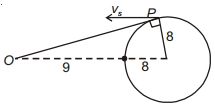
0 likes
View Solution196
DifficultMCQ
The frequency changes by $10 \%$ as a sound source approaches a stationary observer with constant speed $V_s$. What would be the percentage change in the frequency as the source recedes from the observer with the same speed $\left(V_s < V\right)$ (in $.5$)?
A
$10$
B
$8$
C
$4$
D
$1$
Solution
(B) When the source approaches the stationary observer,the observed frequency $f'$ is given by $f' = \frac{v}{v - V_s} f_0$.
Given that the frequency increases by $10 \%$,we have $f' = 1.1 f_0$.
Thus,$\frac{v}{v - V_s} = 1.1 = \frac{11}{10}$.
$10v = 11v - 11V_s \implies v = 11V_s$.
When the source recedes from the observer,the observed frequency $f''$ is given by $f'' = \frac{v}{v + V_s} f_0$.
Substituting $v = 11V_s$,we get $f'' = \frac{11V_s}{11V_s + V_s} f_0 = \frac{11}{12} f_0$.
$f'' \approx 0.9166 f_0 = 91.66 \% f_0$.
The percentage change in frequency is $100 \% - 91.66 \% = 8.34 \% \approx 8.5 \%$.
Given that the frequency increases by $10 \%$,we have $f' = 1.1 f_0$.
Thus,$\frac{v}{v - V_s} = 1.1 = \frac{11}{10}$.
$10v = 11v - 11V_s \implies v = 11V_s$.
When the source recedes from the observer,the observed frequency $f''$ is given by $f'' = \frac{v}{v + V_s} f_0$.
Substituting $v = 11V_s$,we get $f'' = \frac{11V_s}{11V_s + V_s} f_0 = \frac{11}{12} f_0$.
$f'' \approx 0.9166 f_0 = 91.66 \% f_0$.
The percentage change in frequency is $100 \% - 91.66 \% = 8.34 \% \approx 8.5 \%$.
0 likes
View Solution197
MediumMCQ
$A$ train blowing its whistle moves with constant speed on a straight track towards an observer and then crosses him. If the ratio of the difference between the actual and apparent frequencies is $3:2$ in the two cases (approaching and receding),then the speed of the train is (where $v$ is the speed of sound).
A
$\frac{2v}{3}$
B
$\frac{v}{5}$
C
$\frac{v}{3}$
D
$\frac{3v}{2}$
Solution
(B) Let $f_0$ be the actual frequency,$v$ be the speed of sound,and $v_s$ be the speed of the train.
When the train approaches the observer,the apparent frequency $f_A$ is given by: $f_A = \frac{v}{v - v_s} f_0$.
The difference in frequency is $\Delta f_A = f_A - f_0 = \left( \frac{v}{v - v_s} - 1 \right) f_0 = \frac{v_s}{v - v_s} f_0$.
When the train recedes from the observer,the apparent frequency $f_R$ is given by: $f_R = \frac{v}{v + v_s} f_0$.
The difference in frequency is $\Delta f_R = f_0 - f_R = \left( 1 - \frac{v}{v + v_s} \right) f_0 = \frac{v_s}{v + v_s} f_0$.
Given the ratio $\frac{\Delta f_A}{\Delta f_R} = \frac{3}{2}$,we have:
$\frac{\frac{v_s}{v - v_s} f_0}{\frac{v_s}{v + v_s} f_0} = \frac{v + v_s}{v - v_s} = \frac{3}{2}$.
Cross-multiplying gives: $2(v + v_s) = 3(v - v_s)$.
$2v + 2v_s = 3v - 3v_s$.
$5v_s = v$.
$v_s = \frac{v}{5}$.
When the train approaches the observer,the apparent frequency $f_A$ is given by: $f_A = \frac{v}{v - v_s} f_0$.
The difference in frequency is $\Delta f_A = f_A - f_0 = \left( \frac{v}{v - v_s} - 1 \right) f_0 = \frac{v_s}{v - v_s} f_0$.
When the train recedes from the observer,the apparent frequency $f_R$ is given by: $f_R = \frac{v}{v + v_s} f_0$.
The difference in frequency is $\Delta f_R = f_0 - f_R = \left( 1 - \frac{v}{v + v_s} \right) f_0 = \frac{v_s}{v + v_s} f_0$.
Given the ratio $\frac{\Delta f_A}{\Delta f_R} = \frac{3}{2}$,we have:
$\frac{\frac{v_s}{v - v_s} f_0}{\frac{v_s}{v + v_s} f_0} = \frac{v + v_s}{v - v_s} = \frac{3}{2}$.
Cross-multiplying gives: $2(v + v_s) = 3(v - v_s)$.
$2v + 2v_s = 3v - 3v_s$.
$5v_s = v$.
$v_s = \frac{v}{5}$.
0 likes
View Solution198
DifficultMCQ
$A$ whistle $S$ of frequency $f$ revolves in a circle of radius $R$ at a constant speed $v$. What is the ratio of maximum and minimum frequency detected by a detector $D$ at rest at a distance $2R$ from the center of the circle as shown in the figure?
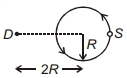
A
$\left(\frac{c+v}{c-v}\right)$
B
$\sqrt{2}\left(\frac{c+v}{c-v}\right)$
C
$\sqrt{2}$
D
$\frac{(c+v)}{c \sqrt{2}}$
Solution
(A) Let $c$ be the speed of sound. The detector $D$ is at a distance $2R$ from the center of the circle. The source $S$ moves in a circle of radius $R$ with speed $v$. The component of the source's velocity along the line joining the source and the detector determines the Doppler shift.
The maximum frequency is detected when the source is moving directly towards the detector. At this point,the velocity component along the line $SD$ is $v$. The observed frequency is $f_{max} = f \left( \frac{c}{c-v} \right)$.
The minimum frequency is detected when the source is moving directly away from the detector. At this point,the velocity component along the line $SD$ is $v$. The observed frequency is $f_{min} = f \left( \frac{c}{c+v} \right)$.
Therefore,the ratio of maximum to minimum frequency is:
$\frac{f_{max}}{f_{min}} = \frac{f \left( \frac{c}{c-v} \right)}{f \left( \frac{c}{c+v} \right)} = \frac{c+v}{c-v}$.
The maximum frequency is detected when the source is moving directly towards the detector. At this point,the velocity component along the line $SD$ is $v$. The observed frequency is $f_{max} = f \left( \frac{c}{c-v} \right)$.
The minimum frequency is detected when the source is moving directly away from the detector. At this point,the velocity component along the line $SD$ is $v$. The observed frequency is $f_{min} = f \left( \frac{c}{c+v} \right)$.
Therefore,the ratio of maximum to minimum frequency is:
$\frac{f_{max}}{f_{min}} = \frac{f \left( \frac{c}{c-v} \right)}{f \left( \frac{c}{c+v} \right)} = \frac{c+v}{c-v}$.
0 likes
View Solution199
MediumMCQ
$A$ sound source,emitting sound of constant frequency,moves with a constant speed and crosses a stationary observer. The frequency $(n)$ of sound heard by the observer is plotted against time $(t)$. Which of the following graphs represents the correct variation?
A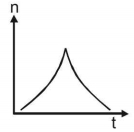
B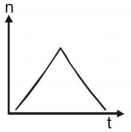
C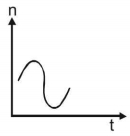
D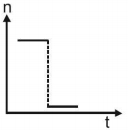
Solution
(D) According to the Doppler effect,when a source of sound moves with a constant velocity $v_s$ towards a stationary observer,the observed frequency $n'$ is given by $n' = n_0 \left( \frac{v}{v - v_s} \right)$,where $n_0$ is the source frequency and $v$ is the speed of sound. This frequency is constant and higher than $n_0$.
As the source crosses the observer and moves away,the observed frequency becomes $n'' = n_0 \left( \frac{v}{v + v_s} \right)$,which is also constant but lower than $n_0$.
Since the source moves with a constant speed,the frequency remains constant at a higher value before the observer and drops abruptly to a lower constant value after passing the observer. This behavior is represented by the graph in option $D$.
As the source crosses the observer and moves away,the observed frequency becomes $n'' = n_0 \left( \frac{v}{v + v_s} \right)$,which is also constant but lower than $n_0$.
Since the source moves with a constant speed,the frequency remains constant at a higher value before the observer and drops abruptly to a lower constant value after passing the observer. This behavior is represented by the graph in option $D$.
0 likes
View Solution200
MediumMCQ
When a source of sound crosses a stationary observer,the change in apparent frequency of sound observed by the observer,when $V_s << V$,will be -
A
$\Delta n = \frac{2 n V_s}{V}$
B
$\Delta n = \frac{2 n V}{V_s}$
C
$\Delta n = 2 n V_s V$
D
$\Delta n = \frac{2 n V_0}{V}$
Solution
(A) Let $n$ be the actual frequency of the source,$V$ be the speed of sound,and $V_s$ be the speed of the source.
When the source moves towards the stationary observer,the apparent frequency is $n_1 = n \left( \frac{V}{V - V_s} \right)$.
When the source moves away from the stationary observer,the apparent frequency is $n_2 = n \left( \frac{V}{V + V_s} \right)$.
The change in apparent frequency is $\Delta n = n_1 - n_2$.
$\Delta n = n \left( \frac{V}{V - V_s} - \frac{V}{V + V_s} \right) = n V \left( \frac{V + V_s - (V - V_s)}{V^2 - V_s^2} \right) = n V \left( \frac{2 V_s}{V^2 - V_s^2} \right)$.
Since $V_s << V$,we can approximate $V^2 - V_s^2 \approx V^2$.
Therefore,$\Delta n \approx n V \left( \frac{2 V_s}{V^2} \right) = \frac{2 n V_s}{V}$.
When the source moves towards the stationary observer,the apparent frequency is $n_1 = n \left( \frac{V}{V - V_s} \right)$.
When the source moves away from the stationary observer,the apparent frequency is $n_2 = n \left( \frac{V}{V + V_s} \right)$.
The change in apparent frequency is $\Delta n = n_1 - n_2$.
$\Delta n = n \left( \frac{V}{V - V_s} - \frac{V}{V + V_s} \right) = n V \left( \frac{V + V_s - (V - V_s)}{V^2 - V_s^2} \right) = n V \left( \frac{2 V_s}{V^2 - V_s^2} \right)$.
Since $V_s << V$,we can approximate $V^2 - V_s^2 \approx V^2$.
Therefore,$\Delta n \approx n V \left( \frac{2 V_s}{V^2} \right) = \frac{2 n V_s}{V}$.
0 likes
View SolutionWaves and Sound — Doppler’s Effect · Frequently Asked Questions
1Are these Waves and Sound questions useful for JEE and NEET?
Yes. All questions in this section are mapped to JEE Main and NEET exam patterns. Previous year questions from JEE Main, NEET, GUJCET and state-level exams are included with full solutions.
2Can I switch to Hindi or Gujarati for these questions?
Yes. Use the language tabs in the hero section or the sidebar to view the same questions and solutions in English, Hindi or Gujarati.
3How do I generate a question paper from this subtopic?
Use the Vedclass Exam Paper Generator — select the chapter and subtopic, set difficulty, and generate Sets A, B, C, D automatically. First 3 chapters of every subject are free.
Vedclass Products
For Students
Vedclass Test Series
Mock tests in real JEE/NEET style with performance analysis. 5-day free trial.
Start Free TrialFor Teachers
Exam Paper Generator
Generate Set A/B/C/D papers from this chapter in 2 minutes. 3 chapters free.
Try FreeFor Institutes
Online Exam Module
Live online exams with unlimited students, 360° analytics & white-label branding.
See DemoFor Teachers & Institutes
Generate a Waves and Sound Exam Paper in 2 Minutes
Select subtopic & difficulty — Sets A, B, C, D auto-generated with No Repeat logic.
First 3 chapters of every subject are free — no payment required.