
A English
Mix Examples-Thermodynamics Questions in English
Class 11 Physics · Thermodynamics · Mix Examples-Thermodynamics
331+
Questions
English
Language
100%
With Solutions
Showing 50 of 331 questions in English
151
Difficult
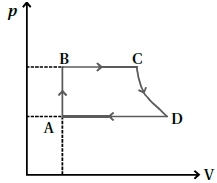
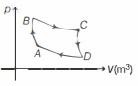
$A$ cycle followed by an engine (made of one mole of an ideal gas in a cylinder with a piston) is shown in the figure. Find the heat exchanged by the engine with the surroundings for each section of the cycle. Given ${C_v} = \frac{3}{2}R$.
$(a)$ $A$ to $B$: constant volume
$(b)$ $B$ to $C$: constant pressure
$(c)$ $C$ to $D$: adiabatic
$(d)$ $D$ to $A$: constant pressure
$(a)$ $A$ to $B$: constant volume
$(b)$ $B$ to $C$: constant pressure
$(c)$ $C$ to $D$: adiabatic
$(d)$ $D$ to $A$: constant pressure
Solution
(N/A) For process $A$ to $B$,the volume is constant,hence the work done $dW = 0$. From the first law of thermodynamics,$dQ = dU + dW = dU + 0 = dU = nC_V dT = nC_V(T_B - T_A) = (1)(\frac{3}{2}R)(T_B - T_A) = \frac{3}{2}(RT_B - RT_A)$. Using the ideal gas equation $PV = RT$,we get $dQ = \frac{3}{2}(P_B V_B - P_A V_A)$.
$(b)$ For process $B$ to $C$,the pressure is constant. The work done is $dW = P_B(V_C - V_B)$. From the first law of thermodynamics,$dQ = dU + dW = nC_V(T_C - T_B) + P_B(V_C - V_B) = \frac{3}{2}(P_C V_C - P_B V_B) + P_B(V_C - V_B)$. Since $P_B = P_C$,this simplifies to $dQ = \frac{3}{2}P_B(V_C - V_B) + P_B(V_C - V_B) = \frac{5}{2}P_B(V_C - V_B)$.
$(c)$ For process $C$ to $D$,it is an adiabatic process,so the heat exchanged $dQ = 0$.
$(d)$ For process $D$ to $A$,the pressure is constant at $P_A$. The gas is compressed from volume $V_D$ to $V_A$. Similar to process $(b)$,the heat exchanged is $dQ = \frac{5}{2}P_A(V_A - V_D)$.
$(b)$ For process $B$ to $C$,the pressure is constant. The work done is $dW = P_B(V_C - V_B)$. From the first law of thermodynamics,$dQ = dU + dW = nC_V(T_C - T_B) + P_B(V_C - V_B) = \frac{3}{2}(P_C V_C - P_B V_B) + P_B(V_C - V_B)$. Since $P_B = P_C$,this simplifies to $dQ = \frac{3}{2}P_B(V_C - V_B) + P_B(V_C - V_B) = \frac{5}{2}P_B(V_C - V_B)$.
$(c)$ For process $C$ to $D$,it is an adiabatic process,so the heat exchanged $dQ = 0$.
$(d)$ For process $D$ to $A$,the pressure is constant at $P_A$. The gas is compressed from volume $V_D$ to $V_A$. Similar to process $(b)$,the heat exchanged is $dQ = \frac{5}{2}P_A(V_A - V_D)$.
0 likes
View Solution152
Difficult
Consider that an ideal gas ($n$ moles) is expanding in a process given by $P = f(V)$,which passes through a point $(V_0, P_0)$. Show that the gas is absorbing heat at $(P_0, V_0)$ if the slope of the curve $P = f(V)$ is larger than the slope of the adiabatic curve passing through $(P_0, V_0)$.
Solution
(N/A) For an ideal gas,the heat absorbed is given by $dQ = dU + dW = nC_V dT + P dV$.
Since $PV = nRT$,we have $T = \frac{PV}{nR} = \frac{f(V)V}{nR}$.
Differentiating with respect to $V$,we get $dT = \frac{1}{nR} [f(V) + V f'(V)] dV$.
Substituting this into the heat equation: $dQ = n C_V \left( \frac{f(V) + V f'(V)}{nR} \right) dV + f(V) dV$.
Using $C_V = \frac{R}{\gamma - 1}$,we get $dQ = \left( \frac{f(V) + V f'(V)}{\gamma - 1} + f(V) \right) dV$.
For the gas to absorb heat,$dQ > 0$ for $dV > 0$.
This requires $\frac{f(V) + V f'(V)}{\gamma - 1} + f(V) > 0$.
Simplifying,$f(V) + V f'(V) + (\gamma - 1)f(V) > 0$,which leads to $\gamma f(V) + V f'(V) > 0$.
Rearranging,$f'(V) > -\gamma \frac{f(V)}{V}$.
The slope of the adiabatic curve is given by $\frac{dP}{dV} = -\gamma \frac{P}{V}$.
Thus,the condition for heat absorption is that the slope of the process curve $f'(V)$ must be greater than the slope of the adiabatic curve $-\gamma \frac{P_0}{V_0}$.
Since $PV = nRT$,we have $T = \frac{PV}{nR} = \frac{f(V)V}{nR}$.
Differentiating with respect to $V$,we get $dT = \frac{1}{nR} [f(V) + V f'(V)] dV$.
Substituting this into the heat equation: $dQ = n C_V \left( \frac{f(V) + V f'(V)}{nR} \right) dV + f(V) dV$.
Using $C_V = \frac{R}{\gamma - 1}$,we get $dQ = \left( \frac{f(V) + V f'(V)}{\gamma - 1} + f(V) \right) dV$.
For the gas to absorb heat,$dQ > 0$ for $dV > 0$.
This requires $\frac{f(V) + V f'(V)}{\gamma - 1} + f(V) > 0$.
Simplifying,$f(V) + V f'(V) + (\gamma - 1)f(V) > 0$,which leads to $\gamma f(V) + V f'(V) > 0$.
Rearranging,$f'(V) > -\gamma \frac{f(V)}{V}$.
The slope of the adiabatic curve is given by $\frac{dP}{dV} = -\gamma \frac{P}{V}$.
Thus,the condition for heat absorption is that the slope of the process curve $f'(V)$ must be greater than the slope of the adiabatic curve $-\gamma \frac{P_0}{V_0}$.
0 likes
View Solution153
MediumMCQ
$A$ heat engine is involved with an exchange of heat of $1915\, J,$ $-40\, J,$ $+125\, J,$ and $-Q\, J$ during one cycle,achieving an efficiency of $50.0 \%$. The value of $Q$ is ....... $J$.
A
$640$
B
$400$
C
$980$
D
$40$
Solution
(C) The efficiency $\eta$ of a heat engine is defined as the ratio of the net work done to the total heat supplied.
$\eta = \frac{W}{Q_{\text{in}}} = \frac{Q_{\text{net}}}{Q_{\text{in}}}$
Here,the net heat exchanged in one cycle is $Q_{\text{net}} = 1915 - 40 + 125 - Q = 2000 - Q$.
The heat supplied $(Q_{\text{in}})$ is the sum of all positive heat exchanges: $Q_{\text{in}} = 1915 + 125 = 2040\, J$.
Given $\eta = 50.0\% = 0.5$,we have:
$0.5 = \frac{2000 - Q}{2040}$
$1020 = 2000 - Q$
$Q = 2000 - 1020 = 980\, J$.
$\eta = \frac{W}{Q_{\text{in}}} = \frac{Q_{\text{net}}}{Q_{\text{in}}}$
Here,the net heat exchanged in one cycle is $Q_{\text{net}} = 1915 - 40 + 125 - Q = 2000 - Q$.
The heat supplied $(Q_{\text{in}})$ is the sum of all positive heat exchanges: $Q_{\text{in}} = 1915 + 125 = 2040\, J$.
Given $\eta = 50.0\% = 0.5$,we have:
$0.5 = \frac{2000 - Q}{2040}$
$1020 = 2000 - Q$
$Q = 2000 - 1020 = 980\, J$.
0 likes
View Solution154
MediumMCQ
Match the thermodynamic processes taking place in a system with the correct conditions. In the table: $\Delta Q$ is the heat supplied,$\Delta W$ is the work done and $\Delta U$ is change in internal energy of the system.
| Process | Condition |
| $(I)$ Adiabatic | $(A) \Delta W = 0$ |
| $(II)$ Isothermal | $(B) \Delta Q = 0$ |
| $(III)$ Isochoric | $(C) \Delta U \neq 0, \Delta W \neq 0, \Delta Q \neq 0$ |
| $(IV)$ Isobaric | $(D) \Delta U = 0$ |
A
$I-B, II-D, III-A, IV-C$
B
$I-B, II-A, III-D, IV-C$
C
$I-A, II-A, III-B, IV-C$
D
$I-A, II-B, III-D, IV-D$
Solution
(A) $(I)$ Adiabatic process: $\Delta Q = 0$. No exchange of heat takes place with the surroundings.
$(II)$ Isothermal process: Temperature remains constant $(\Delta T = 0)$. Since internal energy $\Delta U = \frac{f}{2}nR\Delta T$,it follows that $\Delta U = 0$.
$(III)$ Isochoric process: Volume remains constant $(\Delta V = 0)$. Work done $W = \int P \cdot dV = 0$.
$(IV)$ Isobaric process: Pressure remains constant. Here,$W = P\Delta V \neq 0$,$\Delta U = \frac{f}{2}nR\Delta T \neq 0$,and $\Delta Q = nC_p\Delta T \neq 0$.
$(II)$ Isothermal process: Temperature remains constant $(\Delta T = 0)$. Since internal energy $\Delta U = \frac{f}{2}nR\Delta T$,it follows that $\Delta U = 0$.
$(III)$ Isochoric process: Volume remains constant $(\Delta V = 0)$. Work done $W = \int P \cdot dV = 0$.
$(IV)$ Isobaric process: Pressure remains constant. Here,$W = P\Delta V \neq 0$,$\Delta U = \frac{f}{2}nR\Delta T \neq 0$,and $\Delta Q = nC_p\Delta T \neq 0$.
0 likes
View Solution155
MediumMCQ
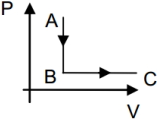
If one mole of an ideal gas goes through the process $A \rightarrow B$ and $B \rightarrow C$ as shown in the $P-V$ diagram. Given that $T_A = 400 \, K$ and $T_C = 400 \, K$. If $\frac{P_B}{P_A} = \frac{1}{5}$,then find the total heat supplied to the gas (in $J$). (in $.2$)
A
$2059$
B
$3659$
C
$2225$
D
$2659$
Solution
(D) For the process $A \rightarrow B$ (isochoric): $V_A = V_B$. Using $PV = nRT$,we have $\frac{P_A}{T_A} = \frac{P_B}{T_B}$. Given $\frac{P_B}{P_A} = \frac{1}{5}$,so $T_B = \frac{T_A}{5} = \frac{400}{5} = 80 \, K$.
Heat supplied in $A \rightarrow B$: $Q_1 = n C_V (T_B - T_A) = 1 \times \frac{3}{2} R (80 - 400) = \frac{3}{2} \times 8.31 \times (-320) = -3988.8 \, J$.
For the process $B \rightarrow C$ (isobaric): $P_B = P_C$. Using $PV = nRT$,we have $\frac{V_B}{T_B} = \frac{V_C}{T_C}$. Since $T_C = 400 \, K$ and $T_B = 80 \, K$,$V_C = V_B \frac{400}{80} = 5 V_B$.
Heat supplied in $B \rightarrow C$: $Q_2 = n C_P (T_C - T_B) = 1 \times \frac{5}{2} R (400 - 80) = \frac{5}{2} \times 8.31 \times 320 = 6648 \, J$.
Total heat supplied: $Q = Q_1 + Q_2 = -3988.8 + 6648 = 2659.2 \, J$.
Heat supplied in $A \rightarrow B$: $Q_1 = n C_V (T_B - T_A) = 1 \times \frac{3}{2} R (80 - 400) = \frac{3}{2} \times 8.31 \times (-320) = -3988.8 \, J$.
For the process $B \rightarrow C$ (isobaric): $P_B = P_C$. Using $PV = nRT$,we have $\frac{V_B}{T_B} = \frac{V_C}{T_C}$. Since $T_C = 400 \, K$ and $T_B = 80 \, K$,$V_C = V_B \frac{400}{80} = 5 V_B$.
Heat supplied in $B \rightarrow C$: $Q_2 = n C_P (T_C - T_B) = 1 \times \frac{5}{2} R (400 - 80) = \frac{5}{2} \times 8.31 \times 320 = 6648 \, J$.
Total heat supplied: $Q = Q_1 + Q_2 = -3988.8 + 6648 = 2659.2 \, J$.
0 likes
View Solution156
DifficultMCQ
Two cylinders of equal size are filled with an equal amount of ideal diatomic gas at room temperature. Both cylinders are fitted with pistons. In cylinder $A$,the piston is free to move (isobaric process),while in cylinder $B$,the piston is fixed (isochoric process). When the same amount of heat is supplied to both cylinders,the temperature of the gas in cylinder $A$ rises by $30\, K$. What will be the rise in temperature of the gas in cylinder $B$ (in $;K$)?
A
$42$
B
$30$
C
$20$
D
$56$
Solution
(A) For cylinder $A$ (isobaric process),the heat supplied is $Q_A = n C_p \Delta T_A$.
For cylinder $B$ (isochoric process),the heat supplied is $Q_B = n C_v \Delta T_B$.
Given that $Q_A = Q_B$ and the amount of gas $n$ is the same,we have $n C_p \Delta T_A = n C_v \Delta T_B$.
Thus,$\Delta T_B = \frac{C_p}{C_v} \Delta T_A$.
For a diatomic gas,the adiabatic index $\gamma = \frac{C_p}{C_v} = \frac{7}{5} = 1.4$.
Substituting the values,$\Delta T_B = 1.4 \times 30\, K = 42\, K$.
For cylinder $B$ (isochoric process),the heat supplied is $Q_B = n C_v \Delta T_B$.
Given that $Q_A = Q_B$ and the amount of gas $n$ is the same,we have $n C_p \Delta T_A = n C_v \Delta T_B$.
Thus,$\Delta T_B = \frac{C_p}{C_v} \Delta T_A$.
For a diatomic gas,the adiabatic index $\gamma = \frac{C_p}{C_v} = \frac{7}{5} = 1.4$.
Substituting the values,$\Delta T_B = 1.4 \times 30\, K = 42\, K$.
0 likes
View Solution157
MediumMCQ
In thermodynamics,heat and work are
A
Path functions
B
Intensive thermodynamic state variables
C
Extensive thermodynamic state variables
D
Point functions
Solution
(A) In thermodynamics,heat and work are classified as path functions.
According to the first law of thermodynamics,$\Delta Q = \Delta U + \Delta W$.
Here,$\Delta U$ (internal energy) is a state function,meaning it depends only on the initial and final states of the system.
However,the work done $(\Delta W)$ depends on the specific process or path taken to change the state of the system.
Since $\Delta U$ is a state function and $\Delta W$ is a path function,the heat exchanged $(\Delta Q)$ must also depend on the path taken.
Therefore,both heat and work are path functions.
According to the first law of thermodynamics,$\Delta Q = \Delta U + \Delta W$.
Here,$\Delta U$ (internal energy) is a state function,meaning it depends only on the initial and final states of the system.
However,the work done $(\Delta W)$ depends on the specific process or path taken to change the state of the system.
Since $\Delta U$ is a state function and $\Delta W$ is a path function,the heat exchanged $(\Delta Q)$ must also depend on the path taken.
Therefore,both heat and work are path functions.
0 likes
View Solution158
DifficultMCQ
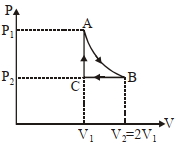
$n$ moles of a perfect gas undergo a cyclic process $ABCA$ (see figure) consisting of the following processes:
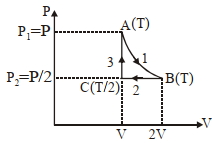
$A \rightarrow B :$ Isothermal expansion at temperature $T$ so that the volume is doubled from $V_{1}$ to $V_{2}=2V_{1}$ and pressure changes from $P_{1}$ to $P_{2}$.
$B \rightarrow C :$ Isobaric compression at pressure $P_{2}$ to initial volume $V_{1}$.
$C \rightarrow A :$ Isochoric change leading to a change of pressure from $P_{2}$ to $P_{1}$.
Total work done in the complete cycle $ABCA$ is
$A \rightarrow B :$ Isothermal expansion at temperature $T$ so that the volume is doubled from $V_{1}$ to $V_{2}=2V_{1}$ and pressure changes from $P_{1}$ to $P_{2}$.
$B \rightarrow C :$ Isobaric compression at pressure $P_{2}$ to initial volume $V_{1}$.
$C \rightarrow A :$ Isochoric change leading to a change of pressure from $P_{2}$ to $P_{1}$.
Total work done in the complete cycle $ABCA$ is
A
$0$
B
$nRT \left(\ln 2+\frac{1}{2}\right)$
C
$nRT \ln 2$
D
$nRT \left(\ln 2-\frac{1}{2}\right)$
Solution
(D) The total work done in a cyclic process is the sum of work done in each individual process.
$1$. For process $A \rightarrow B$ (Isothermal expansion):
$W_{AB} = nRT \ln \left(\frac{V_{2}}{V_{1}}\right) = nRT \ln \left(\frac{2V_{1}}{V_{1}}\right) = nRT \ln 2$.
$2$. For process $B \rightarrow C$ (Isobaric compression):
Since the process is isothermal from $A$ to $B$,$P_{1}V_{1} = P_{2}V_{2}$. Given $V_{2} = 2V_{1}$,we have $P_{1}V_{1} = P_{2}(2V_{1})$,which means $P_{2} = \frac{P_{1}}{2}$.
$W_{BC} = P_{2}(V_{1} - V_{2}) = P_{2}(V_{1} - 2V_{1}) = -P_{2}V_{1}$.
Using the ideal gas law at point $B$,$P_{2}V_{2} = nRT$,so $P_{2}(2V_{1}) = nRT$,which gives $P_{2}V_{1} = \frac{nRT}{2}$.
Thus,$W_{BC} = -\frac{nRT}{2}$.
$3$. For process $C \rightarrow A$ (Isochoric change):
Since the volume is constant $(V_{1})$,the work done $W_{CA} = 0$.
Total work done $W_{net} = W_{AB} + W_{BC} + W_{CA} = nRT \ln 2 - \frac{nRT}{2} + 0 = nRT \left(\ln 2 - \frac{1}{2}\right)$.
$1$. For process $A \rightarrow B$ (Isothermal expansion):
$W_{AB} = nRT \ln \left(\frac{V_{2}}{V_{1}}\right) = nRT \ln \left(\frac{2V_{1}}{V_{1}}\right) = nRT \ln 2$.
$2$. For process $B \rightarrow C$ (Isobaric compression):
Since the process is isothermal from $A$ to $B$,$P_{1}V_{1} = P_{2}V_{2}$. Given $V_{2} = 2V_{1}$,we have $P_{1}V_{1} = P_{2}(2V_{1})$,which means $P_{2} = \frac{P_{1}}{2}$.
$W_{BC} = P_{2}(V_{1} - V_{2}) = P_{2}(V_{1} - 2V_{1}) = -P_{2}V_{1}$.
Using the ideal gas law at point $B$,$P_{2}V_{2} = nRT$,so $P_{2}(2V_{1}) = nRT$,which gives $P_{2}V_{1} = \frac{nRT}{2}$.
Thus,$W_{BC} = -\frac{nRT}{2}$.
$3$. For process $C \rightarrow A$ (Isochoric change):
Since the volume is constant $(V_{1})$,the work done $W_{CA} = 0$.
Total work done $W_{net} = W_{AB} + W_{BC} + W_{CA} = nRT \ln 2 - \frac{nRT}{2} + 0 = nRT \left(\ln 2 - \frac{1}{2}\right)$.
0 likes
View Solution159
MediumMCQ
Match List-$I$ with List-$II$:
Choose the correct answer from the options given below:
| List-$I$ | List-$II$ |
|---|---|
| $(a)$ Isothermal | $(i)$ Pressure constant |
| $(b)$ Isochoric | $(ii)$ Temperature constant |
| $(c)$ Adiabatic | $(iii)$ Volume constant |
| $(d)$ Isobaric | $(iv)$ Heat content is constant |
Choose the correct answer from the options given below:
A
$(a) \rightarrow (i), (b) \rightarrow (iii), (c) \rightarrow (ii), (d) \rightarrow (iv)$
B
$(a) \rightarrow (ii), (b) \rightarrow (iii), (c) \rightarrow (iv), (d) \rightarrow (i)$
C
$(a) \rightarrow (ii), (b) \rightarrow (iv), (c) \rightarrow (iii), (d) \rightarrow (i)$
D
$(a) \rightarrow (iii), (b) \rightarrow (ii), (c) \rightarrow (i), (d) \rightarrow (iv)$
Solution
(B) Isothermal process: In this process, the temperature of the system remains constant $(\Delta T = 0)$. Thus, $(a) \rightarrow (ii)$.
$(b)$ Isochoric process: In this process, the volume of the system remains constant $(\Delta V = 0)$. Thus, $(b) \rightarrow (iii)$.
$(c)$ Adiabatic process: In this process, there is no exchange of heat between the system and the surroundings $(\Delta Q = 0)$. Thus, the heat content remains constant. So, $(c) \rightarrow (iv)$.
$(d)$ Isobaric process: In this process, the pressure of the system remains constant $(\Delta P = 0)$. Thus, $(d) \rightarrow (i)$.
Therefore, the correct matching is $(a) \rightarrow (ii), (b) \rightarrow (iii), (c) \rightarrow (iv), (d) \rightarrow (i)$.
$(b)$ Isochoric process: In this process, the volume of the system remains constant $(\Delta V = 0)$. Thus, $(b) \rightarrow (iii)$.
$(c)$ Adiabatic process: In this process, there is no exchange of heat between the system and the surroundings $(\Delta Q = 0)$. Thus, the heat content remains constant. So, $(c) \rightarrow (iv)$.
$(d)$ Isobaric process: In this process, the pressure of the system remains constant $(\Delta P = 0)$. Thus, $(d) \rightarrow (i)$.
Therefore, the correct matching is $(a) \rightarrow (ii), (b) \rightarrow (iii), (c) \rightarrow (iv), (d) \rightarrow (i)$.
0 likes
View Solution160
DifficultMCQ
In a certain thermodynamical process,the pressure of a gas depends on its volume as $P = kV^{3}$. The work done when the temperature changes from $100^{\circ}C$ to $300^{\circ}C$ will be .......... $nR$,where $n$ denotes the number of moles of a gas.
A
$25$
B
$40$
C
$50$
D
$60$
Solution
(C) Given the process equation: $P = kV^{3}$.
Using the ideal gas law: $PV = nRT$,we can write $P = \frac{nRT}{V}$.
Equating the two expressions for $P$: $\frac{nRT}{V} = kV^{3}$,which implies $kV^{4} = nRT$.
Differentiating both sides with respect to temperature: $4kV^{3} dV = nR dT$.
Since $P = kV^{3}$,we can substitute this into the equation: $4P dV = nR dT$,which gives $P dV = \frac{nR dT}{4}$.
The work done $W$ is given by the integral: $W = \int P dV = \int_{T_i}^{T_f} \frac{nR}{4} dT$.
$W = \frac{nR}{4} (T_f - T_i) = \frac{nR}{4} (300 - 100) = \frac{nR}{4} (200) = 50nR$.
Thus,the work done is $50nR$.
Using the ideal gas law: $PV = nRT$,we can write $P = \frac{nRT}{V}$.
Equating the two expressions for $P$: $\frac{nRT}{V} = kV^{3}$,which implies $kV^{4} = nRT$.
Differentiating both sides with respect to temperature: $4kV^{3} dV = nR dT$.
Since $P = kV^{3}$,we can substitute this into the equation: $4P dV = nR dT$,which gives $P dV = \frac{nR dT}{4}$.
The work done $W$ is given by the integral: $W = \int P dV = \int_{T_i}^{T_f} \frac{nR}{4} dT$.
$W = \frac{nR}{4} (T_f - T_i) = \frac{nR}{4} (300 - 100) = \frac{nR}{4} (200) = 50nR$.
Thus,the work done is $50nR$.
0 likes
View Solution161
DifficultMCQ
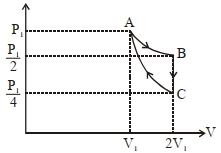
If one mole of an ideal gas at $(P_{1}, V_{1})$ is allowed to expand reversibly and isothermally ($A$ to $B$),its pressure is reduced to one-half of the original pressure (see figure). This is followed by a constant volume cooling till its pressure is reduced to one-fourth of the initial value $(B \rightarrow C)$. Then it is restored to its initial state by a reversible adiabatic compression ($C$ to $A$). The net work done by the gas is equal to ...... .
A
$RT \left(\ln 2 - \frac{1}{2(\gamma-1)}\right)$
B
$-\frac{RT}{2(\gamma-1)}$
C
$0$
D
$RT \ln 2$
Solution
(A) For the isothermal process $A-B$:
$W_{AB} = nRT \ln \left(\frac{V_B}{V_A}\right) = RT \ln \left(\frac{2V_1}{V_1}\right) = RT \ln 2$.
For the isochoric process $B-C$:
Since the volume is constant,$W_{BC} = 0$.
For the adiabatic process $C-A$:
The work done in an adiabatic process is $W = \frac{P_i V_i - P_f V_f}{\gamma - 1}$.
Here,$P_C = \frac{P_1}{4}$,$V_C = 2V_1$,$P_A = P_1$,$V_A = V_1$.
$W_{CA} = \frac{P_C V_C - P_A V_A}{\gamma - 1} = \frac{(\frac{P_1}{4})(2V_1) - P_1 V_1}{\gamma - 1} = \frac{\frac{P_1 V_1}{2} - P_1 V_1}{\gamma - 1} = \frac{-\frac{P_1 V_1}{2}}{\gamma - 1} = -\frac{RT}{2(\gamma - 1)}$.
The net work done is $W_{net} = W_{AB} + W_{BC} + W_{CA} = RT \ln 2 + 0 - \frac{RT}{2(\gamma - 1)} = RT \left(\ln 2 - \frac{1}{2(\gamma - 1)}\right)$.
$W_{AB} = nRT \ln \left(\frac{V_B}{V_A}\right) = RT \ln \left(\frac{2V_1}{V_1}\right) = RT \ln 2$.
For the isochoric process $B-C$:
Since the volume is constant,$W_{BC} = 0$.
For the adiabatic process $C-A$:
The work done in an adiabatic process is $W = \frac{P_i V_i - P_f V_f}{\gamma - 1}$.
Here,$P_C = \frac{P_1}{4}$,$V_C = 2V_1$,$P_A = P_1$,$V_A = V_1$.
$W_{CA} = \frac{P_C V_C - P_A V_A}{\gamma - 1} = \frac{(\frac{P_1}{4})(2V_1) - P_1 V_1}{\gamma - 1} = \frac{\frac{P_1 V_1}{2} - P_1 V_1}{\gamma - 1} = \frac{-\frac{P_1 V_1}{2}}{\gamma - 1} = -\frac{RT}{2(\gamma - 1)}$.
The net work done is $W_{net} = W_{AB} + W_{BC} + W_{CA} = RT \ln 2 + 0 - \frac{RT}{2(\gamma - 1)} = RT \left(\ln 2 - \frac{1}{2(\gamma - 1)}\right)$.
0 likes
View Solution162
DifficultMCQ
The volume $V$ of a given mass of monoatomic gas changes with temperature $T$ according to the relation $V = KT^{2/3}$. The work done when temperature changes by $90\,K$ will be $xR$. The value of $x$ is $[R = \text{universal gas constant}]$
A
$50$
B
$60$
C
$48$
D
$72$
Solution
(B) The work done by a gas is given by $W = \int P\,dV$.
From the ideal gas law,$P = \frac{nRT}{V}$.
Substituting this into the work formula: $W = \int \frac{nRT}{V}\,dV$.
Given the relation $V = KT^{2/3}$,we differentiate with respect to $T$: $dV = K \cdot \frac{2}{3} T^{-1/3}\,dT$.
Substituting $V$ and $dV$ into the integral: $W = \int_{T_1}^{T_2} \frac{nRT}{KT^{2/3}} \cdot \left( \frac{2}{3} K T^{-1/3} \right) dT$.
Simplifying the expression: $W = \int_{T_1}^{T_2} \frac{2}{3} nR \cdot \frac{T \cdot T^{-1/3}}{T^{2/3}} \,dT = \int_{T_1}^{T_2} \frac{2}{3} nR \,dT$.
Integrating,we get $W = \frac{2}{3} nR (T_2 - T_1)$.
Given $\Delta T = T_2 - T_1 = 90\,K$ and assuming $n = 1$ mole: $W = \frac{2}{3} \cdot 1 \cdot R \cdot 90 = 60R$.
Thus,$x = 60$.
From the ideal gas law,$P = \frac{nRT}{V}$.
Substituting this into the work formula: $W = \int \frac{nRT}{V}\,dV$.
Given the relation $V = KT^{2/3}$,we differentiate with respect to $T$: $dV = K \cdot \frac{2}{3} T^{-1/3}\,dT$.
Substituting $V$ and $dV$ into the integral: $W = \int_{T_1}^{T_2} \frac{nRT}{KT^{2/3}} \cdot \left( \frac{2}{3} K T^{-1/3} \right) dT$.
Simplifying the expression: $W = \int_{T_1}^{T_2} \frac{2}{3} nR \cdot \frac{T \cdot T^{-1/3}}{T^{2/3}} \,dT = \int_{T_1}^{T_2} \frac{2}{3} nR \,dT$.
Integrating,we get $W = \frac{2}{3} nR (T_2 - T_1)$.
Given $\Delta T = T_2 - T_1 = 90\,K$ and assuming $n = 1$ mole: $W = \frac{2}{3} \cdot 1 \cdot R \cdot 90 = 60R$.
Thus,$x = 60$.
0 likes
View Solution163
DifficultMCQ
$1$ mole of rigid diatomic gas performs a work of $Q/5$ when heat $Q$ is supplied to it. The molar heat capacity of the gas during this transformation is $\frac{xR}{8}.$ The value of $x$ is $\ldots \ldots \ldots .$ $[R =$ universal gas constant $]$
A
$30$
B
$25$
C
$36$
D
$45$
Solution
(B) From the first law of thermodynamics,$Q = \Delta U + W.$
Given that $W = Q/5,$ we have $Q = \Delta U + Q/5.$
Therefore,$\Delta U = Q - Q/5 = 4Q/5.$
For a rigid diatomic gas,the internal energy change is $\Delta U = n C_v \Delta T,$ where $C_v = \frac{5}{2}R.$
Also,$Q = n C \Delta T,$ where $C$ is the molar heat capacity.
Substituting these into the equation $\Delta U = \frac{4}{5}Q,$ we get $n C_v \Delta T = \frac{4}{5} (n C \Delta T).$
$C_v = \frac{4}{5} C \implies C = \frac{5}{4} C_v.$
Substituting $C_v = \frac{5}{2}R,$ we get $C = \frac{5}{4} \times \frac{5}{2} R = \frac{25}{8} R.$
Comparing this with $\frac{xR}{8},$ we find $x = 25.$
Given that $W = Q/5,$ we have $Q = \Delta U + Q/5.$
Therefore,$\Delta U = Q - Q/5 = 4Q/5.$
For a rigid diatomic gas,the internal energy change is $\Delta U = n C_v \Delta T,$ where $C_v = \frac{5}{2}R.$
Also,$Q = n C \Delta T,$ where $C$ is the molar heat capacity.
Substituting these into the equation $\Delta U = \frac{4}{5}Q,$ we get $n C_v \Delta T = \frac{4}{5} (n C \Delta T).$
$C_v = \frac{4}{5} C \implies C = \frac{5}{4} C_v.$
Substituting $C_v = \frac{5}{2}R,$ we get $C = \frac{5}{4} \times \frac{5}{2} R = \frac{25}{8} R.$
Comparing this with $\frac{xR}{8},$ we find $x = 25.$
0 likes
View Solution164
MediumMCQ
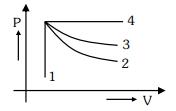
An ideal gas undergoes four different processes from the same initial state as shown in the figure below. Those processes are adiabatic,isothermal,isobaric and isochoric. The curve which represents the adiabatic process among $1, 2, 3$ and $4$ is
A
$2$
B
$3$
C
$4$
D
$1$
Solution
(A) In a $P-V$ diagram,the slope of an adiabatic process is given by $\frac{dP}{dV} = -\gamma \frac{P}{V}$,while the slope of an isothermal process is given by $\frac{dP}{dV} = -\frac{P}{V}$.
Since the adiabatic index $\gamma > 1$ for all gases,the magnitude of the slope of the adiabatic curve is greater than that of the isothermal curve.
Therefore,the adiabatic curve is steeper than the isothermal curve.
Looking at the graph:
$1$ represents an isochoric process (constant volume).
$4$ represents an isobaric process (constant pressure).
Between $2$ and $3$,curve $2$ is steeper than curve $3$.
Thus,curve $2$ represents the adiabatic process and curve $3$ represents the isothermal process.
Since the adiabatic index $\gamma > 1$ for all gases,the magnitude of the slope of the adiabatic curve is greater than that of the isothermal curve.
Therefore,the adiabatic curve is steeper than the isothermal curve.
Looking at the graph:
$1$ represents an isochoric process (constant volume).
$4$ represents an isobaric process (constant pressure).
Between $2$ and $3$,curve $2$ is steeper than curve $3$.
Thus,curve $2$ represents the adiabatic process and curve $3$ represents the isothermal process.
0 likes
View Solution165
MediumMCQ
$A$ monoatomic gas performs a work of $\frac{Q}{4}$,where $Q$ is the heat supplied to it. The molar heat capacity of the gas during this transformation will be $xR$,where $R$ is the gas constant. Find the value of $x$.
A
$9$
B
$25$
C
$2$
D
$8$
Solution
(C) According to the first law of thermodynamics,$\Delta Q = \Delta U + W$.
Given,$W = \frac{Q}{4}$.
Therefore,$\Delta U = \Delta Q - W = Q - \frac{Q}{4} = \frac{3Q}{4}$.
For a monoatomic gas,the change in internal energy is $\Delta U = n C_v \Delta T = n (\frac{3}{2}R) \Delta T$.
So,$n (\frac{3}{2}R) \Delta T = \frac{3Q}{4} \Rightarrow n \Delta T = \frac{Q}{2R}$.
The molar heat capacity $C$ is defined as $C = \frac{Q}{n \Delta T}$.
Substituting $n \Delta T$,we get $C = \frac{Q}{Q / (2R)} = 2R$.
Thus,the value of $x$ is $2$.
Given,$W = \frac{Q}{4}$.
Therefore,$\Delta U = \Delta Q - W = Q - \frac{Q}{4} = \frac{3Q}{4}$.
For a monoatomic gas,the change in internal energy is $\Delta U = n C_v \Delta T = n (\frac{3}{2}R) \Delta T$.
So,$n (\frac{3}{2}R) \Delta T = \frac{3Q}{4} \Rightarrow n \Delta T = \frac{Q}{2R}$.
The molar heat capacity $C$ is defined as $C = \frac{Q}{n \Delta T}$.
Substituting $n \Delta T$,we get $C = \frac{Q}{Q / (2R)} = 2R$.
Thus,the value of $x$ is $2$.
0 likes
View Solution166
MediumMCQ
$A$ thermally insulated vessel contains an ideal gas of molecular mass $M$ and ratio of specific heats $1.4$. The vessel is moving with speed $v$ and is suddenly brought to rest. Assuming no heat is lost to the surroundings,the temperature of the gas increases by ... ($R =$ universal gas constant)
A
$\frac{ Mv^{2}}{7R}$
B
$\frac{ Mv^{2}}{5R}$
C
$2 \frac{ Mv^{2}}{7R}$
D
$7 \frac{ Mv^{2}}{5R}$
Solution
(B) The ratio of specific heats is given by $\gamma = \frac{C_P}{C_V} = 1 + \frac{2}{f} = 1.4$,where $f$ is the degrees of freedom.
$1 + \frac{2}{f} = 1.4 \Rightarrow \frac{2}{f} = 0.4 \Rightarrow f = 5$.
By the law of conservation of energy,the kinetic energy of the gas is converted into internal energy.
$\Delta U = K.E._{initial}$
$\frac{f}{2} nR \Delta T = \frac{1}{2} (nm) v^2$,where $n$ is the number of moles and $m$ is the mass of one molecule.
Since $M = m \times N_A$ and $R = k_B \times N_A$,we have $m = \frac{M}{N_A}$.
$\frac{5}{2} nR \Delta T = \frac{1}{2} n M v^2$
$\Delta T = \frac{M v^2}{5R}$.
$1 + \frac{2}{f} = 1.4 \Rightarrow \frac{2}{f} = 0.4 \Rightarrow f = 5$.
By the law of conservation of energy,the kinetic energy of the gas is converted into internal energy.
$\Delta U = K.E._{initial}$
$\frac{f}{2} nR \Delta T = \frac{1}{2} (nm) v^2$,where $n$ is the number of moles and $m$ is the mass of one molecule.
Since $M = m \times N_A$ and $R = k_B \times N_A$,we have $m = \frac{M}{N_A}$.
$\frac{5}{2} nR \Delta T = \frac{1}{2} n M v^2$
$\Delta T = \frac{M v^2}{5R}$.
0 likes
View Solution167
MediumMCQ
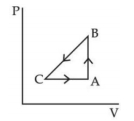
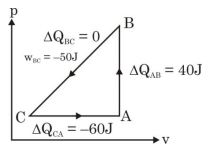
$A$ sample of an ideal gas is taken through the cyclic process $ABCA$ as shown in the figure. It absorbs $40 \ J$ of heat during the part $AB$,no heat during $BC$,and rejects $60 \ J$ of heat during $CA$. $A$ work of $50 \ J$ is done on the gas during the part $BC$. The internal energy of the gas at $A$ is $1560 \ J$. The work done by the gas during the part $CA$ is.............$J$.
A
$20$
B
$30$
C
$-30$
D
$-60$
Solution
(B) For a cyclic process,the change in internal energy $\Delta U = 0$. Therefore,the total heat absorbed $\Delta Q$ equals the total work done $\Delta W$ by the gas.
$\Delta Q_{\text{cycle}} = \Delta Q_{AB} + \Delta Q_{BC} + \Delta Q_{CA} = 40 + 0 - 60 = -20 \ J$.
Since $\Delta Q_{\text{cycle}} = \Delta W_{\text{cycle}}$,we have $\Delta W_{\text{cycle}} = -20 \ J$.
The total work done is $\Delta W_{\text{cycle}} = W_{AB} + W_{BC} + W_{CA}$.
From the figure,the process $AB$ is isochoric (vertical line),so $W_{AB} = 0$.
Given $W_{BC} = -50 \ J$ (work done on the gas).
Thus,$-20 = 0 + (-50) + W_{CA}$.
$W_{CA} = -20 + 50 = 30 \ J$.
$\Delta Q_{\text{cycle}} = \Delta Q_{AB} + \Delta Q_{BC} + \Delta Q_{CA} = 40 + 0 - 60 = -20 \ J$.
Since $\Delta Q_{\text{cycle}} = \Delta W_{\text{cycle}}$,we have $\Delta W_{\text{cycle}} = -20 \ J$.
The total work done is $\Delta W_{\text{cycle}} = W_{AB} + W_{BC} + W_{CA}$.
From the figure,the process $AB$ is isochoric (vertical line),so $W_{AB} = 0$.
Given $W_{BC} = -50 \ J$ (work done on the gas).
Thus,$-20 = 0 + (-50) + W_{CA}$.
$W_{CA} = -20 + 50 = 30 \ J$.
0 likes
View Solution168
MediumMCQ
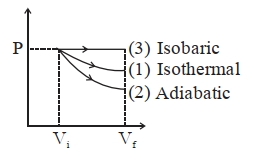
Starting with the same initial conditions,an ideal gas expands from volume $V_{i}$ to $V_{f}$ in three different ways. The work done by the gas is $W_{1}$ if the process is purely isothermal,$W_{2}$ if the process is purely adiabatic,and $W_{3}$ if the process is purely isobaric. Then,choose the correct option.
A
$W_{1} < W_{2} < W_{3}$
B
$W_{2} < W_{3} < W_{1}$
C
$W_{3} < W_{1} < W_{2}$
D
$W_{2} < W_{1} < W_{3}$
Solution
(D) The work done by a gas during an expansion process is given by the area under the $P-V$ curve.
From the given $P-V$ diagram,for the same change in volume from $V_{i}$ to $V_{f}$,the area under the isobaric process curve $(3)$ is the largest,followed by the isothermal process curve $(1)$,and the adiabatic process curve $(2)$ has the smallest area under it.
Therefore,the work done follows the order: $W_{2} < W_{1} < W_{3}$.
From the given $P-V$ diagram,for the same change in volume from $V_{i}$ to $V_{f}$,the area under the isobaric process curve $(3)$ is the largest,followed by the isothermal process curve $(1)$,and the adiabatic process curve $(2)$ has the smallest area under it.
Therefore,the work done follows the order: $W_{2} < W_{1} < W_{3}$.
0 likes
View Solution169
MediumMCQ
$A$ certain amount of gas of volume $V$ at $27^{\circ}C$ temperature and pressure $2 \times 10^{7} \; N m^{-2}$ expands isothermally until its volume gets doubled. Later it expands adiabatically until its volume gets redoubled. The final pressure of the gas will be (Use $\gamma = 1.5$)
A
$3.536 \times 10^{5} \; Pa$
B
$3.536 \times 10^{6} \; Pa$
C
$1.25 \times 10^{6} \; Pa$
D
$1.25 \times 10^{5} \; Pa$
Solution
(B) Initial state: $P_{1} = 2 \times 10^{7} \; Pa$,$V_{1} = V$,$T_{1} = 300 \; K$.
Step $1$: Isothermal expansion.
For an isothermal process,$P_{1}V_{1} = P_{2}V_{2}$.
Given $V_{2} = 2V_{1} = 2V$.
So,$P_{2} = P_{1} \times (V_{1} / V_{2}) = (2 \times 10^{7}) \times (V / 2V) = 1 \times 10^{7} \; Pa$.
Step $2$: Adiabatic expansion.
For an adiabatic process,$P_{2}V_{2}^{\gamma} = P_{3}V_{3}^{\gamma}$.
Given $V_{3} = 2V_{2} = 4V$ and $\gamma = 1.5$.
So,$P_{3} = P_{2} \times (V_{2} / V_{3})^{\gamma} = (1 \times 10^{7}) \times (V_{2} / 2V_{2})^{1.5} = (1 \times 10^{7}) \times (1/2)^{1.5}$.
$P_{3} = (1 \times 10^{7}) / 2^{1.5} = (1 \times 10^{7}) / 2.8284 = 3.536 \times 10^{6} \; Pa$.
Step $1$: Isothermal expansion.
For an isothermal process,$P_{1}V_{1} = P_{2}V_{2}$.
Given $V_{2} = 2V_{1} = 2V$.
So,$P_{2} = P_{1} \times (V_{1} / V_{2}) = (2 \times 10^{7}) \times (V / 2V) = 1 \times 10^{7} \; Pa$.
Step $2$: Adiabatic expansion.
For an adiabatic process,$P_{2}V_{2}^{\gamma} = P_{3}V_{3}^{\gamma}$.
Given $V_{3} = 2V_{2} = 4V$ and $\gamma = 1.5$.
So,$P_{3} = P_{2} \times (V_{2} / V_{3})^{\gamma} = (1 \times 10^{7}) \times (V_{2} / 2V_{2})^{1.5} = (1 \times 10^{7}) \times (1/2)^{1.5}$.
$P_{3} = (1 \times 10^{7}) / 2^{1.5} = (1 \times 10^{7}) / 2.8284 = 3.536 \times 10^{6} \; Pa$.
0 likes
View Solution170
DifficultMCQ
Read the following statements:
$A.$ When the small temperature difference between a liquid and its surroundings is doubled,the rate of loss of heat of the liquid becomes twice.
$B.$ Two bodies $P$ and $Q$ having equal surface areas are maintained at temperatures $10^{\circ}C$ and $20^{\circ}C$. The thermal radiation emitted in a given time by $P$ and $Q$ are in the ratio $1:1.15$.
$C.$ $A$ Carnot engine working between $100 K$ and $400 K$ has an efficiency of $75\%$.
$D.$ When the small temperature difference between a liquid and its surroundings is quadrupled,the rate of loss of heat of the liquid becomes twice.
Choose the correct answer from the options given below:
$A.$ When the small temperature difference between a liquid and its surroundings is doubled,the rate of loss of heat of the liquid becomes twice.
$B.$ Two bodies $P$ and $Q$ having equal surface areas are maintained at temperatures $10^{\circ}C$ and $20^{\circ}C$. The thermal radiation emitted in a given time by $P$ and $Q$ are in the ratio $1:1.15$.
$C.$ $A$ Carnot engine working between $100 K$ and $400 K$ has an efficiency of $75\%$.
$D.$ When the small temperature difference between a liquid and its surroundings is quadrupled,the rate of loss of heat of the liquid becomes twice.
Choose the correct answer from the options given below:
A
$A, B, C$ only
B
$A, B$ only
C
$A, C$ only
D
$B, C, D$ only
Solution
(A) $A.$ According to Newton's law of cooling,the rate of loss of heat $\frac{dQ}{dt} \propto \Delta T$. If $\Delta T$ is doubled,the rate of loss of heat becomes twice. Thus,$A$ is correct.
$B.$ The power radiated by a body is $P = \sigma e A T^4$. The ratio of radiation emitted is $\frac{H_P}{H_Q} = \left(\frac{T_P}{T_Q}\right)^4$. Converting temperatures to Kelvin: $T_P = 10 + 273 = 283 K$ and $T_Q = 20 + 273 = 293 K$. Thus,$\frac{H_P}{H_Q} = \left(\frac{283}{293}\right)^4 \approx (0.9658)^4 \approx 0.87$. However,using the approximation $\frac{293}{283} \approx 1.035$,then $(1.035)^4 \approx 1.15$. Thus,$1:1.15$ is correct. $B$ is correct.
$C.$ Efficiency $\eta = 1 - \frac{T_L}{T_H} = 1 - \frac{100}{400} = 1 - 0.25 = 0.75$ or $75\%$. Thus,$C$ is correct.
$D.$ Since $\frac{dQ}{dt} \propto \Delta T$,if $\Delta T$ is quadrupled,the rate of loss of heat becomes four times,not twice. Thus,$D$ is incorrect.
Therefore,statements $A, B,$ and $C$ are correct.
$B.$ The power radiated by a body is $P = \sigma e A T^4$. The ratio of radiation emitted is $\frac{H_P}{H_Q} = \left(\frac{T_P}{T_Q}\right)^4$. Converting temperatures to Kelvin: $T_P = 10 + 273 = 283 K$ and $T_Q = 20 + 273 = 293 K$. Thus,$\frac{H_P}{H_Q} = \left(\frac{283}{293}\right)^4 \approx (0.9658)^4 \approx 0.87$. However,using the approximation $\frac{293}{283} \approx 1.035$,then $(1.035)^4 \approx 1.15$. Thus,$1:1.15$ is correct. $B$ is correct.
$C.$ Efficiency $\eta = 1 - \frac{T_L}{T_H} = 1 - \frac{100}{400} = 1 - 0.25 = 0.75$ or $75\%$. Thus,$C$ is correct.
$D.$ Since $\frac{dQ}{dt} \propto \Delta T$,if $\Delta T$ is quadrupled,the rate of loss of heat becomes four times,not twice. Thus,$D$ is incorrect.
Therefore,statements $A, B,$ and $C$ are correct.
0 likes
View Solution171
AdvancedMCQ
An engine runs between a reservoir at temperature $200 \,K$ and a hot body which is initially at temperature of $600 \,K$. If the hot body cools down to a temperature of $400 \,K$ in the process,then the maximum amount of work that the engine can do (while working in a cycle) is (the heat capacity of the hot body is $1 \,J/K$).
A
$200(1-\ln 2) \,J$
B
$200(1-\ln(3/2)) \,J$
C
$200(1+\ln(3/2)) \,J$
D
$200 \,J$
Solution
(B) For a heat engine operating between a variable temperature source $T$ and a fixed temperature sink $T_0 = 200 \,K$,the maximum work is obtained when the engine operates as a Carnot engine at every instant.
The efficiency of a Carnot engine is given by $\eta = 1 - \frac{T_0}{T}$.
The infinitesimal work done $dW$ for an infinitesimal heat $dQ_{in} = -C dT$ extracted from the hot body is $dW = \eta dQ_{in} = (1 - \frac{T_0}{T})(-C dT)$.
Integrating from the initial temperature $T_i = 600 \,K$ to the final temperature $T_f = 400 \,K$:
$W = \int_{600}^{400} -(1 - \frac{200}{T}) C dT = C \int_{400}^{600} (1 - \frac{200}{T}) dT$.
Given $C = 1 \,J/K$:
$W = [T - 200 \ln T]_{400}^{600} = (600 - 400) - 200(\ln 600 - \ln 400)$.
$W = 200 - 200 \ln(600/400) = 200 - 200 \ln(3/2) = 200(1 - \ln(3/2)) \,J$.
The efficiency of a Carnot engine is given by $\eta = 1 - \frac{T_0}{T}$.
The infinitesimal work done $dW$ for an infinitesimal heat $dQ_{in} = -C dT$ extracted from the hot body is $dW = \eta dQ_{in} = (1 - \frac{T_0}{T})(-C dT)$.
Integrating from the initial temperature $T_i = 600 \,K$ to the final temperature $T_f = 400 \,K$:
$W = \int_{600}^{400} -(1 - \frac{200}{T}) C dT = C \int_{400}^{600} (1 - \frac{200}{T}) dT$.
Given $C = 1 \,J/K$:
$W = [T - 200 \ln T]_{400}^{600} = (600 - 400) - 200(\ln 600 - \ln 400)$.
$W = 200 - 200 \ln(600/400) = 200 - 200 \ln(3/2) = 200(1 - \ln(3/2)) \,J$.
0 likes
View Solution172
AdvancedMCQ
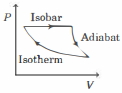
The efficiency of the cycle shown in the figure (consisting of one isobar,one adiabat,and one isotherm) is $50 \%$. The ratio $x$ between the highest and lowest temperatures attained in this cycle obeys (the working substance is an ideal gas):
A
$x = e^{x-1}$
B
$x^2 = e^{x-1}$
C
$x = e^{x^2-1}$
D
$x^2 = e^{x^2-1}$
Solution
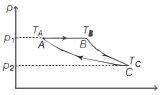
(B) Let the cycle be $A \rightarrow B \rightarrow C \rightarrow A$.
$A \rightarrow B$ is isobaric,$B \rightarrow C$ is adiabatic,and $C \rightarrow A$ is isothermal.
Let $T_A = T_{min}$ and $T_B = T_{max}$. The ratio is $x = T_B / T_A$.
For isobaric process $A \rightarrow B$: $Q_{AB} = n C_p (T_B - T_A) = n \left( \frac{\gamma R}{\gamma - 1} \right) (T_B - T_A)$.
For isothermal process $C \rightarrow A$: $Q_{CA} = n R T_A \ln(V_A / V_C)$.
Since $B \rightarrow C$ is adiabatic,$T_B V_B^{\gamma-1} = T_C V_C^{\gamma-1}$. Since $T_C = T_A$,$T_B V_B^{\gamma-1} = T_A V_C^{\gamma-1}$.
Thus,$(V_C / V_B)^{\gamma-1} = T_B / T_A = x$,so $V_C / V_B = x^{1/(\gamma-1)}$.
Also,for isobaric process $A \rightarrow B$,$V_B / V_A = T_B / T_A = x$.
So,$V_C / V_A = (V_C / V_B) \cdot (V_B / V_A) = x^{1/(\gamma-1)} \cdot x = x^{\gamma/(\gamma-1)}$.
Efficiency $\eta = 1 - |Q_{CA}| / Q_{AB} = 1 - [n R T_A \ln(V_C / V_A)] / [n R \frac{\gamma}{\gamma-1} (T_B - T_A)]$.
Substituting values: $\eta = 1 - [T_A \cdot \frac{\gamma}{\gamma-1} \ln x] / [\frac{\gamma}{\gamma-1} T_A (x - 1)] = 1 - \frac{\ln x}{x - 1}$.
Given $\eta = 0.5$,so $0.5 = 1 - \frac{\ln x}{x - 1} \Rightarrow \frac{\ln x}{x - 1} = 0.5 \Rightarrow \ln x = 0.5(x - 1) \Rightarrow \ln x = \ln(e^{0.5(x-1)})$.
Thus $x = e^{0.5(x-1)} \Rightarrow x^2 = e^{x-1}$.
$A \rightarrow B$ is isobaric,$B \rightarrow C$ is adiabatic,and $C \rightarrow A$ is isothermal.
Let $T_A = T_{min}$ and $T_B = T_{max}$. The ratio is $x = T_B / T_A$.
For isobaric process $A \rightarrow B$: $Q_{AB} = n C_p (T_B - T_A) = n \left( \frac{\gamma R}{\gamma - 1} \right) (T_B - T_A)$.
For isothermal process $C \rightarrow A$: $Q_{CA} = n R T_A \ln(V_A / V_C)$.
Since $B \rightarrow C$ is adiabatic,$T_B V_B^{\gamma-1} = T_C V_C^{\gamma-1}$. Since $T_C = T_A$,$T_B V_B^{\gamma-1} = T_A V_C^{\gamma-1}$.
Thus,$(V_C / V_B)^{\gamma-1} = T_B / T_A = x$,so $V_C / V_B = x^{1/(\gamma-1)}$.
Also,for isobaric process $A \rightarrow B$,$V_B / V_A = T_B / T_A = x$.
So,$V_C / V_A = (V_C / V_B) \cdot (V_B / V_A) = x^{1/(\gamma-1)} \cdot x = x^{\gamma/(\gamma-1)}$.
Efficiency $\eta = 1 - |Q_{CA}| / Q_{AB} = 1 - [n R T_A \ln(V_C / V_A)] / [n R \frac{\gamma}{\gamma-1} (T_B - T_A)]$.
Substituting values: $\eta = 1 - [T_A \cdot \frac{\gamma}{\gamma-1} \ln x] / [\frac{\gamma}{\gamma-1} T_A (x - 1)] = 1 - \frac{\ln x}{x - 1}$.
Given $\eta = 0.5$,so $0.5 = 1 - \frac{\ln x}{x - 1} \Rightarrow \frac{\ln x}{x - 1} = 0.5 \Rightarrow \ln x = 0.5(x - 1) \Rightarrow \ln x = \ln(e^{0.5(x-1)})$.
Thus $x = e^{0.5(x-1)} \Rightarrow x^2 = e^{x-1}$.
0 likes
View Solution173
DifficultMCQ
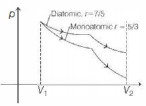
One mole of a monoatomic gas and one mole of a diatomic gas are initially in the same state. Both gases are expanded isothermally and then adiabatically,such that they acquire the same final state. Choose the correct statement.
A
Work done by diatomic gas is more than that by monoatomic gas
B
Work done by monoatomic gas is more than that by diatomic gas
C
Work done by both the gases are equal
D
Change in internal energies of both the gases are equal
Solution
(A) The expansion curves are shown in the figure. The slope of an adiabatic curve is given by $\frac{dp}{dV} = -\gamma \left(\frac{p}{V}\right)$.
Since $\gamma_{\text{diatomic}} = \frac{7}{5} = 1.4$ and $\gamma_{\text{monoatomic}} = \frac{5}{3} \approx 1.67$,we have $\gamma_{\text{diatomic}} < \gamma_{\text{monoatomic}}$.
This implies that the adiabatic expansion curve for the monoatomic gas is steeper than that for the diatomic gas. Since both gases start from the same initial state and reach the same final state,the area under the $p-V$ graph represents the work done. Because the diatomic gas curve lies above the monoatomic gas curve during the expansion process,the area under the diatomic gas curve is greater than the area under the monoatomic gas curve.
Therefore,the work done by the diatomic gas is more than that by the monoatomic gas.
Since $\gamma_{\text{diatomic}} = \frac{7}{5} = 1.4$ and $\gamma_{\text{monoatomic}} = \frac{5}{3} \approx 1.67$,we have $\gamma_{\text{diatomic}} < \gamma_{\text{monoatomic}}$.
This implies that the adiabatic expansion curve for the monoatomic gas is steeper than that for the diatomic gas. Since both gases start from the same initial state and reach the same final state,the area under the $p-V$ graph represents the work done. Because the diatomic gas curve lies above the monoatomic gas curve during the expansion process,the area under the diatomic gas curve is greater than the area under the monoatomic gas curve.
Therefore,the work done by the diatomic gas is more than that by the monoatomic gas.
0 likes
View Solution174
DifficultMCQ
One mole of an ideal monoatomic gas undergoes the following four reversible processes:
Step $1$: It is first compressed adiabatically from volume $8.0 \, m^{3}$ to $1.0 \, m^{3}$.
Step $2$: Then expanded isothermally at temperature $T_{1}$ to volume $10.0 \, m^{3}$.
Step $3$: Then expanded adiabatically to volume $80.0 \, m^{3}$.
Step $4$: Then compressed isothermally at temperature $T_{2}$ to volume $8.0 \, m^{3}$.
Then,$T_{1} / T_{2}$ is:
Step $1$: It is first compressed adiabatically from volume $8.0 \, m^{3}$ to $1.0 \, m^{3}$.
Step $2$: Then expanded isothermally at temperature $T_{1}$ to volume $10.0 \, m^{3}$.
Step $3$: Then expanded adiabatically to volume $80.0 \, m^{3}$.
Step $4$: Then compressed isothermally at temperature $T_{2}$ to volume $8.0 \, m^{3}$.
Then,$T_{1} / T_{2}$ is:
A
$2$
B
$4$
C
$6$
D
$8$
Solution
(B) For an ideal monoatomic gas,the adiabatic index is $\gamma = 5/3$.
Let the states be $A, B, C, D$ corresponding to the volumes $V_A = 8.0 \, m^3, V_B = 1.0 \, m^3, V_C = 10.0 \, m^3, V_D = 80.0 \, m^3$.
Step $1$ $(A \to B)$: Adiabatic compression.
$T_A V_A^{\gamma-1} = T_B V_B^{\gamma-1} \implies T_2 (8)^{5/3-1} = T_1 (1)^{5/3-1} \implies T_2 (8)^{2/3} = T_1 (1)^{2/3} \implies T_2 (4) = T_1 \implies T_1/T_2 = 4$.
Step $3$ $(C \to D)$: Adiabatic expansion.
$T_C V_C^{\gamma-1} = T_D V_D^{\gamma-1} \implies T_1 (10)^{5/3-1} = T_2 (80)^{5/3-1} \implies T_1 (10)^{2/3} = T_2 (80)^{2/3} \implies T_1/T_2 = (80/10)^{2/3} = 8^{2/3} = 4$.
Both steps confirm that $T_1/T_2 = 4$.
Let the states be $A, B, C, D$ corresponding to the volumes $V_A = 8.0 \, m^3, V_B = 1.0 \, m^3, V_C = 10.0 \, m^3, V_D = 80.0 \, m^3$.
Step $1$ $(A \to B)$: Adiabatic compression.
$T_A V_A^{\gamma-1} = T_B V_B^{\gamma-1} \implies T_2 (8)^{5/3-1} = T_1 (1)^{5/3-1} \implies T_2 (8)^{2/3} = T_1 (1)^{2/3} \implies T_2 (4) = T_1 \implies T_1/T_2 = 4$.
Step $3$ $(C \to D)$: Adiabatic expansion.
$T_C V_C^{\gamma-1} = T_D V_D^{\gamma-1} \implies T_1 (10)^{5/3-1} = T_2 (80)^{5/3-1} \implies T_1 (10)^{2/3} = T_2 (80)^{2/3} \implies T_1/T_2 = (80/10)^{2/3} = 8^{2/3} = 4$.
Both steps confirm that $T_1/T_2 = 4$.
0 likes
View Solution175
AdvancedMCQ
$A$ gas obeying the equation of state $pV = RT$ undergoes a hypothetical reversible process described by the equation $pV^{5/3} \exp \left(-\frac{pV}{E_0}\right) = C_1$,where $C_1$ and $E_0$ are dimensioned constants. Then,for this process,the thermal compressibility at high temperature
A
approaches a constant value
B
is proportional to $T$
C
is proportional to $T^{1/2}$
D
is proportional to $T^2$
Solution
(A) The process equation is $pV^{5/3} \cdot e^{-pV/E_0} = C_1$.
Taking the natural logarithm on both sides: $\ln(p) + \frac{5}{3} \ln(V) = \ln(C_1) + \frac{pV}{E_0}$.
Differentiating with respect to $V$: $\frac{1}{p} \frac{dp}{dV} + \frac{5}{3V} = \frac{1}{E_0} \left( p + V \frac{dp}{dV} \right)$.
Rearranging terms to find $\frac{dp}{dV}$: $\frac{dp}{dV} \left( \frac{1}{p} - \frac{V}{E_0} \right) = \frac{p}{E_0} - \frac{5}{3V}$.
Using $pV = RT$,we have $p = \frac{RT}{V}$. Substituting this,the isothermal compressibility $k = -\frac{1}{V} \frac{dV}{dp}$ is derived.
As $T \to \infty$,the terms involving $\frac{1}{RT}$ approach zero.
Thus,$k = -\frac{1}{V} \frac{dV}{dp} = \frac{1/p - V/E_0}{p/E_0 - 5/3V} \cdot \frac{1}{V} \approx \text{constant}$ as $T \to \infty$.
Taking the natural logarithm on both sides: $\ln(p) + \frac{5}{3} \ln(V) = \ln(C_1) + \frac{pV}{E_0}$.
Differentiating with respect to $V$: $\frac{1}{p} \frac{dp}{dV} + \frac{5}{3V} = \frac{1}{E_0} \left( p + V \frac{dp}{dV} \right)$.
Rearranging terms to find $\frac{dp}{dV}$: $\frac{dp}{dV} \left( \frac{1}{p} - \frac{V}{E_0} \right) = \frac{p}{E_0} - \frac{5}{3V}$.
Using $pV = RT$,we have $p = \frac{RT}{V}$. Substituting this,the isothermal compressibility $k = -\frac{1}{V} \frac{dV}{dp}$ is derived.
As $T \to \infty$,the terms involving $\frac{1}{RT}$ approach zero.
Thus,$k = -\frac{1}{V} \frac{dV}{dp} = \frac{1/p - V/E_0}{p/E_0 - 5/3V} \cdot \frac{1}{V} \approx \text{constant}$ as $T \to \infty$.
0 likes
View Solution176
MediumMCQ
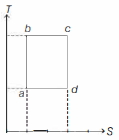
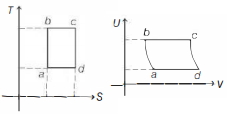
An ideal gas is taken reversibly around the cycle $a-b-c-d-a$ as shown on the temperature $T$ - entropy $S$ diagram. The most appropriate representation of the above cycle on an internal energy $U$ - volume $V$ diagram is
A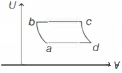
B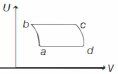
C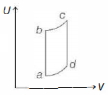
D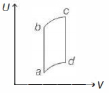
Solution
(A) In the given $T-S$ cycle:
$b-c$ and $a-d$ are isothermal processes. Since internal energy $U$ of an ideal gas depends only on temperature $(U = nC_vT)$, $U$ remains constant during these processes. Thus, on a $U-V$ diagram, these appear as horizontal lines.
$a-b$ and $c-d$ are isentropic (adiabatic) processes $(S = \text{constant})$. For an adiabatic process, $TV^{\gamma-1} = \text{constant}$. Since $U \propto T$, we have $UV^{\gamma-1} = \text{constant}$, which implies $U \propto V^{1-\gamma}$. This represents a curve on the $U-V$ diagram.
Comparing the processes: In $b-c$, $T$ is high, so $U$ is high. In $a-d$, $T$ is low, so $U$ is low. Thus, the cycle on the $U-V$ diagram consists of two horizontal lines at different $U$ levels, connected by two curves. This matches the representation in option $A$.
$b-c$ and $a-d$ are isothermal processes. Since internal energy $U$ of an ideal gas depends only on temperature $(U = nC_vT)$, $U$ remains constant during these processes. Thus, on a $U-V$ diagram, these appear as horizontal lines.
$a-b$ and $c-d$ are isentropic (adiabatic) processes $(S = \text{constant})$. For an adiabatic process, $TV^{\gamma-1} = \text{constant}$. Since $U \propto T$, we have $UV^{\gamma-1} = \text{constant}$, which implies $U \propto V^{1-\gamma}$. This represents a curve on the $U-V$ diagram.
Comparing the processes: In $b-c$, $T$ is high, so $U$ is high. In $a-d$, $T$ is low, so $U$ is low. Thus, the cycle on the $U-V$ diagram consists of two horizontal lines at different $U$ levels, connected by two curves. This matches the representation in option $A$.
0 likes
View Solution177
AdvancedMCQ
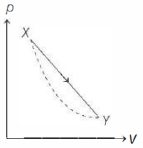
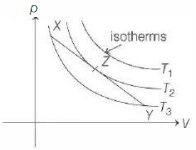
In the $p-V$ diagram below,the dashed curved line is an adiabat. For a process that is described by a straight line joining two points $X$ and $Y$ on the adiabat (solid line in the diagram),heat is (Hint: consider the variation in temperature from $X$ to $Y$ along the straight line)
A
absorbed throughout from $X$ to $Y$
B
released throughout from $X$ to $Y$
C
absorbed from $X$ up to an intermediate point $Z$ (not shown in the figure) and then released from $Z$ to $Y$
D
released from $X$ up to an intermediate point $Z$ (not shown in the figure) and then absorbed from $Z$ to $Y$
Solution
(C) The first law of thermodynamics states that $dQ = dU + dW$. For an ideal gas,$dU = nC_v dT$. Along the straight line path $XY$,the system moves through different isotherms.
At the start point $X$ and end point $Y$,the temperature is the same as they lie on the same adiabat (if we consider the adiabat as a boundary). However,as the straight line path $XY$ lies above the adiabat,the temperature of the gas first increases as it moves away from the adiabat towards higher temperature isotherms,reaching a maximum at some intermediate point $Z$,and then decreases as it approaches point $Y$.
Since $dQ = nC_v dT + p dV$,and $dV > 0$ throughout the process,the heat exchange depends on the sign of $dT$. From $X$ to $Z$,the temperature increases $(dT > 0)$,so heat is absorbed. From $Z$ to $Y$,the temperature decreases $(dT < 0)$,and the work done by the gas eventually outweighs the internal energy change,leading to heat release. Thus,heat is absorbed from $X$ to $Z$ and released from $Z$ to $Y$.
At the start point $X$ and end point $Y$,the temperature is the same as they lie on the same adiabat (if we consider the adiabat as a boundary). However,as the straight line path $XY$ lies above the adiabat,the temperature of the gas first increases as it moves away from the adiabat towards higher temperature isotherms,reaching a maximum at some intermediate point $Z$,and then decreases as it approaches point $Y$.
Since $dQ = nC_v dT + p dV$,and $dV > 0$ throughout the process,the heat exchange depends on the sign of $dT$. From $X$ to $Z$,the temperature increases $(dT > 0)$,so heat is absorbed. From $Z$ to $Y$,the temperature decreases $(dT < 0)$,and the work done by the gas eventually outweighs the internal energy change,leading to heat release. Thus,heat is absorbed from $X$ to $Z$ and released from $Z$ to $Y$.
0 likes
View Solution178
MediumMCQ
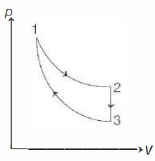
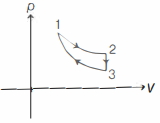
The three processes in a thermodynamic cycle shown in the figure are: Process $1 \rightarrow 2$ is isothermal; Process $2 \rightarrow 3$ is isochoric (volume remains constant); Process $3 \rightarrow 1$ is adiabatic. The total work done by the ideal gas in this cycle is $10 \, J$. The internal energy decreases by $20 \, J$ in the isochoric process. The work done by the gas in the adiabatic process is $-20 \, J$. The heat added to the system in the isothermal process is .............. $J$.
A
$0$
B
$10$
C
$20$
D
$30$
Solution
(D) The total work done in a complete thermodynamic cycle is the sum of the work done in each individual process:
$W_{\text{total}} = W_{12} + W_{23} + W_{31}$
Given that the total work $W_{\text{total}} = 10 \, J$.
In an isochoric process $(2 \rightarrow 3)$,the volume remains constant,so the work done $W_{23} = 0 \, J$.
The work done in the adiabatic process $(3 \rightarrow 1)$ is given as $W_{31} = -20 \, J$.
Substituting these values into the total work equation:
$10 \, J = W_{12} + 0 \, J + (-20 \, J)$
$10 \, J = W_{12} - 20 \, J$
$W_{12} = 30 \, J$
For an isothermal process,the change in internal energy $\Delta U = 0$. According to the first law of thermodynamics,$\Delta Q = \Delta U + W$. Therefore,for the isothermal process $(1 \rightarrow 2)$:
$\Delta Q_{12} = 0 + W_{12} = 30 \, J$.
Thus,the heat added to the system in the isothermal process is $30 \, J$.
$W_{\text{total}} = W_{12} + W_{23} + W_{31}$
Given that the total work $W_{\text{total}} = 10 \, J$.
In an isochoric process $(2 \rightarrow 3)$,the volume remains constant,so the work done $W_{23} = 0 \, J$.
The work done in the adiabatic process $(3 \rightarrow 1)$ is given as $W_{31} = -20 \, J$.
Substituting these values into the total work equation:
$10 \, J = W_{12} + 0 \, J + (-20 \, J)$
$10 \, J = W_{12} - 20 \, J$
$W_{12} = 30 \, J$
For an isothermal process,the change in internal energy $\Delta U = 0$. According to the first law of thermodynamics,$\Delta Q = \Delta U + W$. Therefore,for the isothermal process $(1 \rightarrow 2)$:
$\Delta Q_{12} = 0 + W_{12} = 30 \, J$.
Thus,the heat added to the system in the isothermal process is $30 \, J$.
0 likes
View Solution179
MediumMCQ
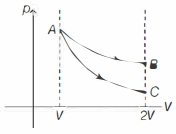
An ideal monoatomic gas expands to twice its volume. If the process is isothermal,the magnitude of work done by the gas is $W_i$. If the process is adiabatic,the magnitude of work done by the gas is $W_a$. Which of the following is true?
A
$W_i=W_a > 0$
B
$W_i > W_{a} > 0$
C
$W_i > W_{a}=0$
D
$W_{a} > W_i=0$
Solution
(B) The work done by a gas during an expansion process is equal to the area under the $p-V$ curve.
For an ideal gas expanding from volume $V$ to $2V$,the isothermal process is represented by the curve $AB$ and the adiabatic process is represented by the curve $AC$ on the $p-V$ diagram.
Since the adiabatic curve is steeper than the isothermal curve,the area under the isothermal curve $AB$ is greater than the area under the adiabatic curve $AC$ for the same change in volume.
Therefore,the work done in the isothermal process $(W_i)$ is greater than the work done in the adiabatic process $(W_a)$.
Since the gas is expanding,the work done is positive in both cases.
Thus,$W_i > W_a > 0$.
For an ideal gas expanding from volume $V$ to $2V$,the isothermal process is represented by the curve $AB$ and the adiabatic process is represented by the curve $AC$ on the $p-V$ diagram.
Since the adiabatic curve is steeper than the isothermal curve,the area under the isothermal curve $AB$ is greater than the area under the adiabatic curve $AC$ for the same change in volume.
Therefore,the work done in the isothermal process $(W_i)$ is greater than the work done in the adiabatic process $(W_a)$.
Since the gas is expanding,the work done is positive in both cases.
Thus,$W_i > W_a > 0$.
0 likes
View Solution180
AdvancedMCQ
One mole of an ideal gas at initial temperature $T$ undergoes a quasi-static process during which the volume $V$ is doubled. During the process,the internal energy $U$ obeys the equation $U = a V^3$,where $a$ is a constant. The work done during this process is
A
$\frac{3 R T}{2}$
B
$\frac{5 R T}{2}$
C
$\frac{5 R T}{3}$
D
$\frac{7 R T}{3}$
Solution
(D) Given,internal energy $U = a V^3$.
For an ideal gas,$U = \frac{f}{2} n R T$. Since $n = 1$ and assuming a monatomic gas $(f = 3)$,we have $U = \frac{3}{2} R T$.
Equating the two expressions: $\frac{3}{2} R T = a V^3$.
Using the ideal gas law $P V = R T$,we substitute $R T = P V$:
$\frac{3}{2} P V = a V^3 \Rightarrow P = \frac{2 a}{3} V^2$.
The work done $W$ is given by $\int_{V_i}^{V_f} P dV$.
Here,$V_i = V$ and $V_f = 2V$.
$W = \int_{V}^{2V} \frac{2 a}{3} V^2 dV = \frac{2 a}{3} \left[ \frac{V^3}{3} \right]_{V}^{2V} = \frac{2 a}{9} (8V^3 - V^3) = \frac{2 a}{9} (7V^3) = \frac{14 a V^3}{9}$.
Since $a V^3 = \frac{3}{2} R T$ at the initial state,we substitute $a V^3 = \frac{3}{2} R T$:
$W = \frac{14}{9} \times \left( \frac{3}{2} R T \right) = \frac{7}{3} R T$.
For an ideal gas,$U = \frac{f}{2} n R T$. Since $n = 1$ and assuming a monatomic gas $(f = 3)$,we have $U = \frac{3}{2} R T$.
Equating the two expressions: $\frac{3}{2} R T = a V^3$.
Using the ideal gas law $P V = R T$,we substitute $R T = P V$:
$\frac{3}{2} P V = a V^3 \Rightarrow P = \frac{2 a}{3} V^2$.
The work done $W$ is given by $\int_{V_i}^{V_f} P dV$.
Here,$V_i = V$ and $V_f = 2V$.
$W = \int_{V}^{2V} \frac{2 a}{3} V^2 dV = \frac{2 a}{3} \left[ \frac{V^3}{3} \right]_{V}^{2V} = \frac{2 a}{9} (8V^3 - V^3) = \frac{2 a}{9} (7V^3) = \frac{14 a V^3}{9}$.
Since $a V^3 = \frac{3}{2} R T$ at the initial state,we substitute $a V^3 = \frac{3}{2} R T$:
$W = \frac{14}{9} \times \left( \frac{3}{2} R T \right) = \frac{7}{3} R T$.
0 likes
View Solution181
MediumMCQ
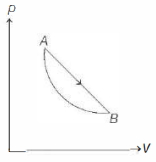
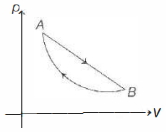
An ideal gas is made to undergo a cycle depicted by the $p-V$ diagram given below. The curved line from $A$ to $B$ is an adiabat. Then,
A
the efficiency of this cycle is given by unity as no heat is released during the cycle
B
heat is absorbed in the upper part of the straight line path and released in the lower part
C
if $T_1$ and $T_2$ are the maximum and minimum temperatures reached during the cycle,then the efficiency is given by $1-\frac{T_2}{T_1}$
D
the cycle can only be carried out in the reverse of the direction shown in the above figure
Solution
(B) The cycle consists of a straight line path from $A$ to $B$ and an adiabatic path from $B$ to $A$.
Along the straight line path from $A$ to $B$,the gas undergoes expansion,and the temperature changes. Since the path is a straight line,the heat exchange varies. Specifically,heat is absorbed by the gas during the expansion phase along the straight line.
Along the curved path from $B$ to $A$,the process is adiabatic,meaning no heat is exchanged $(dQ = 0)$.
However,in a complete cycle,for work to be done by the gas,heat must be absorbed from a source and some must be rejected to a sink. In this specific cycle,heat is absorbed during the straight-line expansion and rejected during the adiabatic compression (if we consider the cycle direction). Therefore,option $B$ correctly describes the heat exchange characteristics.
Along the straight line path from $A$ to $B$,the gas undergoes expansion,and the temperature changes. Since the path is a straight line,the heat exchange varies. Specifically,heat is absorbed by the gas during the expansion phase along the straight line.
Along the curved path from $B$ to $A$,the process is adiabatic,meaning no heat is exchanged $(dQ = 0)$.
However,in a complete cycle,for work to be done by the gas,heat must be absorbed from a source and some must be rejected to a sink. In this specific cycle,heat is absorbed during the straight-line expansion and rejected during the adiabatic compression (if we consider the cycle direction). Therefore,option $B$ correctly describes the heat exchange characteristics.
0 likes
View Solution182
DifficultMCQ
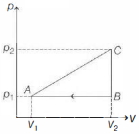
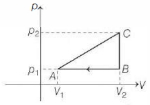
An ideal gas with constant heat capacity $C_V = \frac{3}{2} n R$ is made to carry out a cycle that is depicted by a triangle in the figure given below. The following statement is true about the cycle.
A
The efficiency is given by $1 - \frac{p_1 V_1}{p_2 V_2}$
B
The efficiency is given by $1 - \frac{1}{2} \frac{p_1 V_1}{p_2 V_2}$
C
Net heat absorbed in the cycle is $(p_2 - p_1)(V_2 - V_1)$
D
Heat absorbed in part $AC$ is given by $2(p_2 V_2 - p_1 V_1) + \frac{1}{2}(p_1 V_2 - p_2 V_1)$
Solution
(D) For the cyclic process $A \rightarrow B \rightarrow C \rightarrow A$,the change in internal energy $\Delta U = 0$. By the first law of thermodynamics,$\Delta Q = \Delta W$,where $\Delta W$ is the area enclosed by the triangle $ABC$ in the $p-V$ diagram.
Area $= \frac{1}{2} \times \text{base} \times \text{height} = \frac{1}{2} (V_2 - V_1)(p_2 - p_1)$.
For process $AB$ (isobaric,$p = p_1$):
$\Delta Q_{AB} = n C_p \Delta T = n (\frac{5}{2} R) \Delta T = \frac{5}{2} p_1 (V_1 - V_2)$.
For process $BC$ (isochoric,$V = V_2$):
$\Delta Q_{BC} = n C_V \Delta T = n (\frac{3}{2} R) \Delta T = \frac{3}{2} V_2 (p_2 - p_1)$.
Using $\Delta Q_{total} = \Delta Q_{AB} + \Delta Q_{BC} + \Delta Q_{AC} = \Delta W$,we find:
$\Delta Q_{AC} = \Delta W - \Delta Q_{AB} - \Delta Q_{BC}$.
Substituting the values:
$\Delta Q_{AC} = \frac{1}{2}(V_2 - V_1)(p_2 - p_1) - [\frac{5}{2} p_1 (V_1 - V_2) + \frac{3}{2} V_2 (p_2 - p_1)]$.
Simplifying this expression yields:
$\Delta Q_{AC} = 2(p_2 V_2 - p_1 V_1) + \frac{1}{2}(p_1 V_2 - p_2 V_1)$.
Area $= \frac{1}{2} \times \text{base} \times \text{height} = \frac{1}{2} (V_2 - V_1)(p_2 - p_1)$.
For process $AB$ (isobaric,$p = p_1$):
$\Delta Q_{AB} = n C_p \Delta T = n (\frac{5}{2} R) \Delta T = \frac{5}{2} p_1 (V_1 - V_2)$.
For process $BC$ (isochoric,$V = V_2$):
$\Delta Q_{BC} = n C_V \Delta T = n (\frac{3}{2} R) \Delta T = \frac{3}{2} V_2 (p_2 - p_1)$.
Using $\Delta Q_{total} = \Delta Q_{AB} + \Delta Q_{BC} + \Delta Q_{AC} = \Delta W$,we find:
$\Delta Q_{AC} = \Delta W - \Delta Q_{AB} - \Delta Q_{BC}$.
Substituting the values:
$\Delta Q_{AC} = \frac{1}{2}(V_2 - V_1)(p_2 - p_1) - [\frac{5}{2} p_1 (V_1 - V_2) + \frac{3}{2} V_2 (p_2 - p_1)]$.
Simplifying this expression yields:
$\Delta Q_{AC} = 2(p_2 V_2 - p_1 V_1) + \frac{1}{2}(p_1 V_2 - p_2 V_1)$.
0 likes
View Solution183
AdvancedMCQ
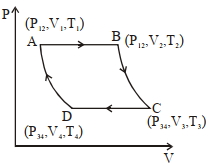
An ideal gas,initially in state $(P_{12}, V_1, T_1)$ is expanded isobarically to $(P_{12}, V_2, T_2)$,then adiabatically to $(P_{34}, V_3, T_3)$. It is then contracted isobarically to $(P_{34}, V_4, T_4)$ and finally adiabatically back to the initial state. The efficiency of this cycle is
A
$1-\frac{T_4}{T_1}$
B
$1-\frac{T_4}{T_2}$
C
$1-\frac{T_3}{T_1}$
D
$1-\frac{P_{34}}{P_{12}}$
Solution
(A) For the adiabatic processes $BC$ and $DA$:
$P_{12} V_2^\gamma = P_{34} V_3^\gamma \quad \dots(i)$
$P_{34} V_4^\gamma = P_{12} V_1^\gamma \quad \dots(ii)$
Multiplying $(i)$ and $(ii)$:
$P_{12} P_{34} (V_2 V_4)^\gamma = P_{12} P_{34} (V_1 V_3)^\gamma$
$V_2 V_4 = V_1 V_3 \Rightarrow \frac{V_2}{V_3} = \frac{V_1}{V_4}$
Using the ideal gas law $PV = nRT$ for isobaric processes:
$T_1 = \frac{P_{12} V_1}{nR}, T_2 = \frac{P_{12} V_2}{nR}, T_3 = \frac{P_{34} V_3}{nR}, T_4 = \frac{P_{34} V_4}{nR}$
Efficiency $\eta = 1 - \frac{Q_{rejected}}{Q_{supplied}} = 1 - \frac{n C_p (T_3 - T_4)}{n C_p (T_2 - T_1)} = 1 - \frac{T_3 - T_4}{T_2 - T_1}$
Substituting $T$ values:
$\eta = 1 - \frac{\frac{P_{34}}{nR}(V_3 - V_4)}{\frac{P_{12}}{nR}(V_2 - V_1)} = 1 - \frac{P_{34}}{P_{12}} \left( \frac{V_3 - V_4}{V_2 - V_1} \right)$
Since $\frac{V_2}{V_3} = \frac{V_1}{V_4} = k$,then $V_2 = k V_3$ and $V_1 = k V_4$.
$\eta = 1 - \frac{P_{34}}{P_{12}} \left( \frac{V_3 - V_4}{k(V_3 - V_4)} \right) = 1 - \frac{P_{34}}{P_{12} k} = 1 - \frac{P_{34}}{P_{12}} \cdot \frac{V_3}{V_2} = 1 - \frac{T_3}{T_2} = 1 - \frac{T_4}{T_1}$
$P_{12} V_2^\gamma = P_{34} V_3^\gamma \quad \dots(i)$
$P_{34} V_4^\gamma = P_{12} V_1^\gamma \quad \dots(ii)$
Multiplying $(i)$ and $(ii)$:
$P_{12} P_{34} (V_2 V_4)^\gamma = P_{12} P_{34} (V_1 V_3)^\gamma$
$V_2 V_4 = V_1 V_3 \Rightarrow \frac{V_2}{V_3} = \frac{V_1}{V_4}$
Using the ideal gas law $PV = nRT$ for isobaric processes:
$T_1 = \frac{P_{12} V_1}{nR}, T_2 = \frac{P_{12} V_2}{nR}, T_3 = \frac{P_{34} V_3}{nR}, T_4 = \frac{P_{34} V_4}{nR}$
Efficiency $\eta = 1 - \frac{Q_{rejected}}{Q_{supplied}} = 1 - \frac{n C_p (T_3 - T_4)}{n C_p (T_2 - T_1)} = 1 - \frac{T_3 - T_4}{T_2 - T_1}$
Substituting $T$ values:
$\eta = 1 - \frac{\frac{P_{34}}{nR}(V_3 - V_4)}{\frac{P_{12}}{nR}(V_2 - V_1)} = 1 - \frac{P_{34}}{P_{12}} \left( \frac{V_3 - V_4}{V_2 - V_1} \right)$
Since $\frac{V_2}{V_3} = \frac{V_1}{V_4} = k$,then $V_2 = k V_3$ and $V_1 = k V_4$.
$\eta = 1 - \frac{P_{34}}{P_{12}} \left( \frac{V_3 - V_4}{k(V_3 - V_4)} \right) = 1 - \frac{P_{34}}{P_{12} k} = 1 - \frac{P_{34}}{P_{12}} \cdot \frac{V_3}{V_2} = 1 - \frac{T_3}{T_2} = 1 - \frac{T_4}{T_1}$
0 likes
View Solution184
AdvancedMCQ
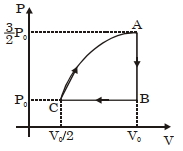
One mole of a monoatomic ideal gas $\left(c_{V} = \frac{3}{2} R\right)$ undergoes a cycle where it first goes isochorically from the state $\left(\frac{3}{2} P_{0}, V_{0}\right)$ to $\left(P_{0}, V_{0}\right)$,and then is isobarically contracted to the volume $\frac{1}{2} V_{0}$. It is then taken back to the initial state by a path which is a quarter ellipse on the $P-V$ diagram. The efficiency of this cycle is
A
$\frac{1}{\pi}$
B
$\frac{\pi}{16+\pi}$
C
$\frac{\pi}{32+\pi}$
D
$\frac{2\pi}{32+\pi}$
Solution
(C) The efficiency of the cycle is given by $\eta = \frac{W_{\text{net}}}{Q_{\text{supplied}}}$.
The net work done $W_{\text{net}}$ is the area enclosed by the cycle on the $P-V$ diagram. The area of a quarter ellipse with semi-axes $a = \frac{V_{0}}{2}$ and $b = \frac{P_{0}}{2}$ is $W_{\text{net}} = \frac{1}{4} \pi a b = \frac{1}{4} \pi \left(\frac{V_{0}}{2}\right) \left(\frac{P_{0}}{2}\right) = \frac{\pi P_{0} V_{0}}{16}$.
Heat is supplied to the gas only during the process $CA$. For process $CA$,the change in internal energy is $\Delta U_{CA} = n C_{V} \Delta T = \frac{3}{2} R (T_{A} - T_{C})$. Using $PV = nRT$,we have $T_{A} = \frac{(3/2 P_{0}) V_{0}}{R} = \frac{3 P_{0} V_{0}}{2R}$ and $T_{C} = \frac{P_{0} (V_{0}/2)}{R} = \frac{P_{0} V_{0}}{2R}$.
Thus,$\Delta U_{CA} = \frac{3}{2} R \left(\frac{3 P_{0} V_{0}}{2R} - \frac{P_{0} V_{0}}{2R}\right) = \frac{3}{2} P_{0} V_{0}$.
The work done during the path $CA$ is the area under the curve $CA$,which is the area of the rectangle plus the area of the quarter ellipse: $W_{CA} = P_{0} \left(\frac{V_{0}}{2}\right) + \frac{\pi P_{0} V_{0}}{16} = \frac{P_{0} V_{0}}{2} + \frac{\pi P_{0} V_{0}}{16}$.
Total heat supplied $Q_{\text{supplied}} = W_{CA} + \Delta U_{CA} = \left(\frac{P_{0} V_{0}}{2} + \frac{\pi P_{0} V_{0}}{16}\right) + \frac{3}{2} P_{0} V_{0} = 2 P_{0} V_{0} + \frac{\pi P_{0} V_{0}}{16} = P_{0} V_{0} \left(2 + \frac{\pi}{16}\right) = P_{0} V_{0} \left(\frac{32 + \pi}{16}\right)$.
Efficiency $\eta = \frac{\pi P_{0} V_{0} / 16}{P_{0} V_{0} (32 + \pi) / 16} = \frac{\pi}{32 + \pi}$.
The net work done $W_{\text{net}}$ is the area enclosed by the cycle on the $P-V$ diagram. The area of a quarter ellipse with semi-axes $a = \frac{V_{0}}{2}$ and $b = \frac{P_{0}}{2}$ is $W_{\text{net}} = \frac{1}{4} \pi a b = \frac{1}{4} \pi \left(\frac{V_{0}}{2}\right) \left(\frac{P_{0}}{2}\right) = \frac{\pi P_{0} V_{0}}{16}$.
Heat is supplied to the gas only during the process $CA$. For process $CA$,the change in internal energy is $\Delta U_{CA} = n C_{V} \Delta T = \frac{3}{2} R (T_{A} - T_{C})$. Using $PV = nRT$,we have $T_{A} = \frac{(3/2 P_{0}) V_{0}}{R} = \frac{3 P_{0} V_{0}}{2R}$ and $T_{C} = \frac{P_{0} (V_{0}/2)}{R} = \frac{P_{0} V_{0}}{2R}$.
Thus,$\Delta U_{CA} = \frac{3}{2} R \left(\frac{3 P_{0} V_{0}}{2R} - \frac{P_{0} V_{0}}{2R}\right) = \frac{3}{2} P_{0} V_{0}$.
The work done during the path $CA$ is the area under the curve $CA$,which is the area of the rectangle plus the area of the quarter ellipse: $W_{CA} = P_{0} \left(\frac{V_{0}}{2}\right) + \frac{\pi P_{0} V_{0}}{16} = \frac{P_{0} V_{0}}{2} + \frac{\pi P_{0} V_{0}}{16}$.
Total heat supplied $Q_{\text{supplied}} = W_{CA} + \Delta U_{CA} = \left(\frac{P_{0} V_{0}}{2} + \frac{\pi P_{0} V_{0}}{16}\right) + \frac{3}{2} P_{0} V_{0} = 2 P_{0} V_{0} + \frac{\pi P_{0} V_{0}}{16} = P_{0} V_{0} \left(2 + \frac{\pi}{16}\right) = P_{0} V_{0} \left(\frac{32 + \pi}{16}\right)$.
Efficiency $\eta = \frac{\pi P_{0} V_{0} / 16}{P_{0} V_{0} (32 + \pi) / 16} = \frac{\pi}{32 + \pi}$.
0 likes
View Solution185
EasyMCQ
Select the correct statement for work, heat, and change in internal energy.
A
Heat supplied and work done depend on initial and final states.
B
Change in internal energy depends on the initial and final states only.
C
Heat and work depend on the path between the two points.
D
All of these.
Solution
(D) The correct answer is $D$.
$1$. Internal energy $(U)$ is a state function, meaning its change $(\Delta U)$ depends only on the initial and final states of the system, not on the path taken.
$2$. Heat $(Q)$ and work $(W)$ are path functions. Their values depend on the specific process or path followed to transition between two states.
$3$. Since statements $B$ and $C$ are correct, and statement $A$ is often interpreted in the context of path dependence (as the values of $Q$ and $W$ are determined by the path between states), all statements are considered correct in the context of thermodynamics.
$1$. Internal energy $(U)$ is a state function, meaning its change $(\Delta U)$ depends only on the initial and final states of the system, not on the path taken.
$2$. Heat $(Q)$ and work $(W)$ are path functions. Their values depend on the specific process or path followed to transition between two states.
$3$. Since statements $B$ and $C$ are correct, and statement $A$ is often interpreted in the context of path dependence (as the values of $Q$ and $W$ are determined by the path between states), all statements are considered correct in the context of thermodynamics.
0 likes
View Solution186
EasyMCQ
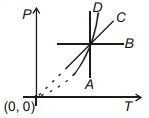
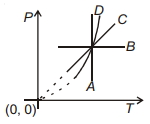
The following figure shows the $P-T$ graph for four processes $A, B, C,$ and $D$. Select the correct alternative.
A
$A$ - Isochoric process
B
$B$ - Isobaric process
C
$C$ - Isothermal process
D
$D$ - Adiabatic process
Solution
(D) In a $P-T$ graph:
$1.$ Process $A$ is a vertical line, meaning temperature $T$ is constant. This represents an isothermal process.
$2.$ Process $B$ is a horizontal line, meaning pressure $P$ is constant. This represents an isobaric process.
$3.$ Process $C$ is a straight line passing through the origin $(0, 0)$, meaning $P \propto T$. From the ideal gas law $PV = nRT$, if $P/T = nR/V$ is constant, then volume $V$ must be constant. This represents an isochoric process.
$4.$ Process $D$ is a curve where the slope $dP/dT$ increases with temperature. For an adiabatic process, $P^{1-\gamma} T^{\gamma} = \text{constant}$, which leads to a non-linear relationship in the $P-T$ plane. Thus, $D$ represents an adiabatic process.
Comparing these with the options, the correct alternative is $D$ - Adiabatic process.
$1.$ Process $A$ is a vertical line, meaning temperature $T$ is constant. This represents an isothermal process.
$2.$ Process $B$ is a horizontal line, meaning pressure $P$ is constant. This represents an isobaric process.
$3.$ Process $C$ is a straight line passing through the origin $(0, 0)$, meaning $P \propto T$. From the ideal gas law $PV = nRT$, if $P/T = nR/V$ is constant, then volume $V$ must be constant. This represents an isochoric process.
$4.$ Process $D$ is a curve where the slope $dP/dT$ increases with temperature. For an adiabatic process, $P^{1-\gamma} T^{\gamma} = \text{constant}$, which leads to a non-linear relationship in the $P-T$ plane. Thus, $D$ represents an adiabatic process.
Comparing these with the options, the correct alternative is $D$ - Adiabatic process.
0 likes
View Solution187
MediumMCQ
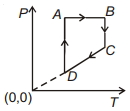
For the $P-V$ diagram of a thermodynamic cycle as shown in the figure,processes $BC$ and $DA$ are isothermal. Which of the corresponding graphs is correct?
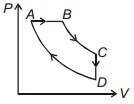
A
B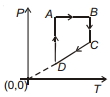
C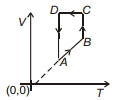
D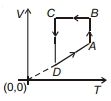
Solution
(B) In the given $P-V$ diagram:
$1$. Process $A \longrightarrow B$: The pressure $P$ is constant while the volume $V$ increases. This is an isobaric expansion.
$2$. Process $B \longrightarrow C$: This is an isothermal process ($T$ is constant). For an ideal gas,$PV = nRT$,so $P \propto 1/V$. The curve is a rectangular hyperbola.
$3$. Process $C \longrightarrow D$: The volume $V$ is constant while the pressure $P$ decreases. This is an isochoric cooling process.
$4$. Process $D \longrightarrow A$: This is an isothermal process ($T$ is constant). Similar to $B \longrightarrow C$,$P \propto 1/V$.
Now,let's analyze the $P-T$ graph:
- For an isobaric process $(A \longrightarrow B)$,$V \propto T$. Since $V$ increases,$T$ must increase at constant $P$.
- For an isothermal process $(B \longrightarrow C)$,$T$ is constant,so the graph is a vertical line segment.
- For an isochoric process $(C \longrightarrow D)$,$P \propto T$. This is a straight line passing through the origin $(0,0)$.
- For an isothermal process $(D \longrightarrow A)$,$T$ is constant,so the graph is a vertical line segment.
Comparing these with the given options,the correct $P-T$ graph is represented by option $B$.
$1$. Process $A \longrightarrow B$: The pressure $P$ is constant while the volume $V$ increases. This is an isobaric expansion.
$2$. Process $B \longrightarrow C$: This is an isothermal process ($T$ is constant). For an ideal gas,$PV = nRT$,so $P \propto 1/V$. The curve is a rectangular hyperbola.
$3$. Process $C \longrightarrow D$: The volume $V$ is constant while the pressure $P$ decreases. This is an isochoric cooling process.
$4$. Process $D \longrightarrow A$: This is an isothermal process ($T$ is constant). Similar to $B \longrightarrow C$,$P \propto 1/V$.
Now,let's analyze the $P-T$ graph:
- For an isobaric process $(A \longrightarrow B)$,$V \propto T$. Since $V$ increases,$T$ must increase at constant $P$.
- For an isothermal process $(B \longrightarrow C)$,$T$ is constant,so the graph is a vertical line segment.
- For an isochoric process $(C \longrightarrow D)$,$P \propto T$. This is a straight line passing through the origin $(0,0)$.
- For an isothermal process $(D \longrightarrow A)$,$T$ is constant,so the graph is a vertical line segment.
Comparing these with the given options,the correct $P-T$ graph is represented by option $B$.
0 likes
View Solution188
MediumMCQ
$A$ container is filled with $20$ moles of an ideal diatomic gas at absolute temperature $T$. When heat is supplied to the gas,the temperature remains constant,but $8$ moles dissociate into atoms. The heat energy given to the gas is ......... (in $R T$)
A
$4$
B
$6$
C
$3$
D
$5$
Solution
(A) The process is isothermal,so the change in internal energy $\Delta U$ is equal to the heat supplied $Q$ because the work done by the gas is not requested,but rather the energy required to change the state of the gas.
Initial internal energy of $20$ moles of diatomic gas: $U_{\text{initial}} = n_1 \times C_{v1} \times T = 20 \times \frac{5}{2} R T = 50 R T$.
After dissociation,$8$ moles of diatomic gas become $16$ moles of monatomic gas,and $12$ moles of diatomic gas remain.
Final internal energy: $U_{\text{final}} = (12 \times \frac{5}{2} R T) + (16 \times \frac{3}{2} R T) = 30 R T + 24 R T = 54 R T$.
Heat energy supplied $Q = U_{\text{final}} - U_{\text{initial}} = 54 R T - 50 R T = 4 R T$.
Initial internal energy of $20$ moles of diatomic gas: $U_{\text{initial}} = n_1 \times C_{v1} \times T = 20 \times \frac{5}{2} R T = 50 R T$.
After dissociation,$8$ moles of diatomic gas become $16$ moles of monatomic gas,and $12$ moles of diatomic gas remain.
Final internal energy: $U_{\text{final}} = (12 \times \frac{5}{2} R T) + (16 \times \frac{3}{2} R T) = 30 R T + 24 R T = 54 R T$.
Heat energy supplied $Q = U_{\text{final}} - U_{\text{initial}} = 54 R T - 50 R T = 4 R T$.
0 likes
View Solution189
MediumMCQ
$A$ cyclic process on an ideal monatomic gas is shown in the figure. The correct statement is:

A
Work done by the gas in process $AB$ is more than that in the process $BC$.
B
Net heat energy has been supplied to the system.
C
Temperature of the gas is maximum at state $B$.
D
In process $CA$,heat energy is absorbed by the system.
Solution
(B) For a cyclic process,the change in internal energy $\Delta U = 0$.
According to the first law of thermodynamics,$Q = \Delta U + W$. Since $\Delta U = 0$,we have $Q = W$.
The work done in a cyclic process is equal to the area enclosed by the $PV$ diagram.
Since the cycle is traced in a clockwise direction,the net work done $W$ by the gas is positive $(W > 0)$.
Therefore,the net heat energy $Q$ supplied to the system must be positive $(Q > 0)$,meaning heat is supplied to the system.
Thus,option $(b)$ is correct.
According to the first law of thermodynamics,$Q = \Delta U + W$. Since $\Delta U = 0$,we have $Q = W$.
The work done in a cyclic process is equal to the area enclosed by the $PV$ diagram.
Since the cycle is traced in a clockwise direction,the net work done $W$ by the gas is positive $(W > 0)$.
Therefore,the net heat energy $Q$ supplied to the system must be positive $(Q > 0)$,meaning heat is supplied to the system.
Thus,option $(b)$ is correct.
0 likes
View Solution190
EasyMCQ
$A$ gas may expand either adiabatically or isothermally. $A$ number of $P-V$ curves are drawn for the two processes over different ranges of pressure and volume. It will be found that:
A
An adiabatic curve and an isothermal curve may intersect.
B
Two adiabatic curves do not intersect.
C
Two isothermal curves do not intersect.
D
All of these.
0 likes
View Solution191
MediumMCQ
Neon gas of a given mass expands isothermally to double its volume. What should be the further fractional decrease in pressure,so that the gas when adiabatically compressed from that state,reaches the original state?
A
$1-2^{-2 / 3}$
B
$1-3^{1 / 3}$
C
$2^{1 / 3}$
D
$3^{2 / 3}$
Solution
(A) For an isothermal process,$P_1 V_1 = P_2 V_2$. Given $V_2 = 2V_1$,we have $P_1 V_1 = P_2 (2V_1)$,which gives $P_2 = P_1 / 2$.
Let the pressure be further decreased by a factor such that the new pressure is $P'$. We want to reach the original state $(P_1, V_1)$ from $(P', 2V_1)$ via an adiabatic process.
For an adiabatic process,$P' (2V_1)^\gamma = P_1 (V_1)^\gamma$,where $\gamma = 5/3$ for a monoatomic gas like neon.
$P' (2)^\gamma = P_1 \implies P' = P_1 (2)^{-\gamma} = P_1 (2)^{-5/3}$.
The pressure at the end of the isothermal expansion was $P_2 = P_1 / 2 = P_1 (2)^{-1}$.
The fractional decrease in pressure required is $\frac{P_2 - P'}{P_2} = \frac{P_1 (2)^{-1} - P_1 (2)^{-5/3}}{P_1 (2)^{-1}} = 1 - \frac{(2)^{-5/3}}{(2)^{-1}} = 1 - 2^{-5/3 + 1} = 1 - 2^{-2/3}$.
Let the pressure be further decreased by a factor such that the new pressure is $P'$. We want to reach the original state $(P_1, V_1)$ from $(P', 2V_1)$ via an adiabatic process.
For an adiabatic process,$P' (2V_1)^\gamma = P_1 (V_1)^\gamma$,where $\gamma = 5/3$ for a monoatomic gas like neon.
$P' (2)^\gamma = P_1 \implies P' = P_1 (2)^{-\gamma} = P_1 (2)^{-5/3}$.
The pressure at the end of the isothermal expansion was $P_2 = P_1 / 2 = P_1 (2)^{-1}$.
The fractional decrease in pressure required is $\frac{P_2 - P'}{P_2} = \frac{P_1 (2)^{-1} - P_1 (2)^{-5/3}}{P_1 (2)^{-1}} = 1 - \frac{(2)^{-5/3}}{(2)^{-1}} = 1 - 2^{-5/3 + 1} = 1 - 2^{-2/3}$.
0 likes
View Solution192
MediumMCQ
An ideal gas with adiabatic exponent $(\gamma = 1.5)$ undergoes a process in which the work done by the gas is equal to the increase in the internal energy of the gas. The molar heat capacity of the gas for this process is:
A
$C = 4R$
B
$C = 0$
C
$C = 2R$
D
$C = R$
Solution
(A) According to the first law of thermodynamics: $\Delta Q = \Delta U + \Delta W$.
Given that the work done by the gas is equal to the increase in internal energy,we have $\Delta W = \Delta U$.
Substituting this into the first law equation: $\Delta Q = \Delta U + \Delta U = 2\Delta U$.
We know that $\Delta Q = nC\Delta T$ and $\Delta U = nC_v\Delta T$,where $C$ is the molar heat capacity for the process and $C_v$ is the molar heat capacity at constant volume.
Thus,$nC\Delta T = 2nC_v\Delta T$,which simplifies to $C = 2C_v$.
For an ideal gas,$C_v = \frac{R}{\gamma - 1}$.
Given $\gamma = 1.5$,we have $C_v = \frac{R}{1.5 - 1} = \frac{R}{0.5} = 2R$.
Therefore,$C = 2 \times (2R) = 4R$.
Given that the work done by the gas is equal to the increase in internal energy,we have $\Delta W = \Delta U$.
Substituting this into the first law equation: $\Delta Q = \Delta U + \Delta U = 2\Delta U$.
We know that $\Delta Q = nC\Delta T$ and $\Delta U = nC_v\Delta T$,where $C$ is the molar heat capacity for the process and $C_v$ is the molar heat capacity at constant volume.
Thus,$nC\Delta T = 2nC_v\Delta T$,which simplifies to $C = 2C_v$.
For an ideal gas,$C_v = \frac{R}{\gamma - 1}$.
Given $\gamma = 1.5$,we have $C_v = \frac{R}{1.5 - 1} = \frac{R}{0.5} = 2R$.
Therefore,$C = 2 \times (2R) = 4R$.
0 likes
View Solution193
MediumMCQ
$1\,g$ of a liquid is converted to vapour at $3 \times 10^5\,Pa$ pressure. If $10\%$ of the heat supplied is used for increasing the volume by $1600\,cm^3$ during this phase change,then the increase in internal energy in the process will be $............\,J$.
A
$4320$
B
$432000$
C
$4800$
D
$4.32$
Solution
(A) The work done during the phase change is given by $W = P \Delta V$.
Given $P = 3 \times 10^5\,Pa$ and $\Delta V = 1600\,cm^3 = 1600 \times 10^{-6}\,m^3 = 1.6 \times 10^{-3}\,m^3$.
So,$W = (3 \times 10^5) \times (1.6 \times 10^{-3}) = 480\,J$.
It is given that $10\%$ of the total heat supplied $(Q)$ is used for this work.
Therefore,$0.10 \times Q = 480\,J$,which implies $Q = 4800\,J$.
According to the first law of thermodynamics,$\Delta Q = \Delta U + W$,where $\Delta U$ is the change in internal energy.
Thus,$\Delta U = \Delta Q - W = 4800\,J - 480\,J = 4320\,J$.
Alternatively,since $10\%$ of heat is used for work,$90\%$ of the heat is used to increase the internal energy.
$\Delta U = 0.90 \times 4800\,J = 4320\,J$.
Given $P = 3 \times 10^5\,Pa$ and $\Delta V = 1600\,cm^3 = 1600 \times 10^{-6}\,m^3 = 1.6 \times 10^{-3}\,m^3$.
So,$W = (3 \times 10^5) \times (1.6 \times 10^{-3}) = 480\,J$.
It is given that $10\%$ of the total heat supplied $(Q)$ is used for this work.
Therefore,$0.10 \times Q = 480\,J$,which implies $Q = 4800\,J$.
According to the first law of thermodynamics,$\Delta Q = \Delta U + W$,where $\Delta U$ is the change in internal energy.
Thus,$\Delta U = \Delta Q - W = 4800\,J - 480\,J = 4320\,J$.
Alternatively,since $10\%$ of heat is used for work,$90\%$ of the heat is used to increase the internal energy.
$\Delta U = 0.90 \times 4800\,J = 4320\,J$.
0 likes
View Solution194
MediumMCQ
Match List-$I$ with List-$II$ :
Choose the correct answer from the options given below :
| List-$I$ | List-$II$ |
| $A$. Isothermal Process | $I$. Work done by the gas decreases internal energy |
| $B$. Adiabatic Process | $II$. No change in internal energy |
| $C$. Isochoric Process | $III$. The heat absorbed goes partly to increase internal energy and partly to do work |
| $D$. Isobaric Process | $IV$. No work is done on or by the gas |
Choose the correct answer from the options given below :
A
$A-II, B-I, C-III, D-IV$
B
$A-II, B-I, C-IV, D-III$
C
$A-I, B-II, C-IV, D-III$
D
$A-I, B-II, C-III, D-IV$
Solution
(B) The change in internal energy is given by $\Delta U = nC_{v} \Delta T$.
For an isothermal process, the temperature $T$ is constant, so $\Delta T = 0$, which implies $\Delta U = 0$. Thus, $A \longrightarrow II$.
For an adiabatic process, the heat exchange $\Delta Q = 0$. According to the first law of thermodynamics, $\Delta Q = \Delta U + \Delta W$, so $\Delta U = -\Delta W$. If work is done by the gas, $\Delta W > 0$, then $\Delta U < 0$, meaning internal energy decreases. Thus, $B \longrightarrow I$.
For an isochoric process, the volume $V$ is constant, so $\Delta V = 0$. Since work done $\Delta W = P \Delta V$, no work is done on or by the gas. Thus, $C \longrightarrow IV$.
For an isobaric process, the pressure $P$ is constant. The heat absorbed $\Delta Q$ is used to both increase the internal energy $\Delta U$ and perform work $\Delta W = P \Delta V$. Thus, $D \longrightarrow III$.
Therefore, the correct matching is $A-II, B-I, C-IV, D-III$.
For an isothermal process, the temperature $T$ is constant, so $\Delta T = 0$, which implies $\Delta U = 0$. Thus, $A \longrightarrow II$.
For an adiabatic process, the heat exchange $\Delta Q = 0$. According to the first law of thermodynamics, $\Delta Q = \Delta U + \Delta W$, so $\Delta U = -\Delta W$. If work is done by the gas, $\Delta W > 0$, then $\Delta U < 0$, meaning internal energy decreases. Thus, $B \longrightarrow I$.
For an isochoric process, the volume $V$ is constant, so $\Delta V = 0$. Since work done $\Delta W = P \Delta V$, no work is done on or by the gas. Thus, $C \longrightarrow IV$.
For an isobaric process, the pressure $P$ is constant. The heat absorbed $\Delta Q$ is used to both increase the internal energy $\Delta U$ and perform work $\Delta W = P \Delta V$. Thus, $D \longrightarrow III$.
Therefore, the correct matching is $A-II, B-I, C-IV, D-III$.
0 likes
View Solution195
MediumMCQ
Heat energy of $735\,J$ is given to a diatomic gas allowing the gas to expand at constant pressure. Each gas molecule rotates around an internal axis but does not oscillate. The increase in the internal energy of the gas will be $..........\,J$
A
$525$
B
$441$
C
$572$
D
$735$
Solution
(A) For a diatomic gas where molecules rotate but do not oscillate,the degrees of freedom $f = 5$ ($3$ translational + $2$ rotational).
The molar heat capacity at constant pressure is $C_p = \frac{f+2}{2}R = \frac{5+2}{2}R = \frac{7}{2}R$.
The molar heat capacity at constant volume is $C_v = \frac{f}{2}R = \frac{5}{2}R$.
The heat supplied at constant pressure is $Q = nC_p\Delta T = 735\,J$.
So,$n\left(\frac{7}{2}R\right)\Delta T = 735$,which gives $nR\Delta T = 735 \times \frac{2}{7} = 210\,J$.
The increase in internal energy is given by $\Delta U = nC_v\Delta T = n\left(\frac{5}{2}R\right)\Delta T$.
Substituting the value of $nR\Delta T$,we get $\Delta U = \frac{5}{2} \times 210 = 5 \times 105 = 525\,J$.
The molar heat capacity at constant pressure is $C_p = \frac{f+2}{2}R = \frac{5+2}{2}R = \frac{7}{2}R$.
The molar heat capacity at constant volume is $C_v = \frac{f}{2}R = \frac{5}{2}R$.
The heat supplied at constant pressure is $Q = nC_p\Delta T = 735\,J$.
So,$n\left(\frac{7}{2}R\right)\Delta T = 735$,which gives $nR\Delta T = 735 \times \frac{2}{7} = 210\,J$.
The increase in internal energy is given by $\Delta U = nC_v\Delta T = n\left(\frac{5}{2}R\right)\Delta T$.
Substituting the value of $nR\Delta T$,we get $\Delta U = \frac{5}{2} \times 210 = 5 \times 105 = 525\,J$.
0 likes
View Solution196
MediumMCQ
Given below are two statements:
Statement $I:$ If heat is added to a system,its temperature must increase.
Statement $II:$ If positive work is done by a system in a thermodynamic process,its volume must increase.
In the light of the above statements,choose the correct answer from the options given below.
Statement $I:$ If heat is added to a system,its temperature must increase.
Statement $II:$ If positive work is done by a system in a thermodynamic process,its volume must increase.
In the light of the above statements,choose the correct answer from the options given below.
A
Statement $I$ is true but Statement $II$ is false
B
Both Statement $I$ and Statement $II$ are true
C
Both Statement $I$ and Statement $II$ are false
D
Statement $I$ is false but Statement $II$ is true
Solution
(D) Statement $I:$ $\Delta Q > 0$. According to the $1^{\text{st}}$ law of thermodynamics,$\Delta Q = \Delta U + W$. If heat is added to a system,it is possible for the system to perform work $W$ such that $W > \Delta Q$,which would result in $\Delta U < 0$ (a decrease in internal energy and temperature). Thus,Statement $I$ is false.
Statement $II:$ Work done by a system is given by $W = \int P \, dV$. If $W > 0$,then $\int P \, dV > 0$. Since pressure $P$ is always positive for a gas,the change in volume $dV$ must be positive,meaning the volume of the system must increase. Thus,Statement $II$ is true.
Statement $II:$ Work done by a system is given by $W = \int P \, dV$. If $W > 0$,then $\int P \, dV > 0$. Since pressure $P$ is always positive for a gas,the change in volume $dV$ must be positive,meaning the volume of the system must increase. Thus,Statement $II$ is true.
0 likes
View Solution197
MediumMCQ
Consider two containers $A$ and $B$ containing monoatomic gases at the same Pressure $(P)$,Volume $(V)$ and Temperature $(T)$. The gas in $A$ is compressed isothermally to $\frac{1}{8}$ of its original volume while the gas $B$ is compressed adiabatically to $\frac{1}{8}$ of its original volume. The ratio of final pressure of gas in $B$ to that of gas in $A$ is ...........
A
$8$
B
$8^{\frac{3}{2}}$
C
$\frac{1}{8}$
D
$4$
Solution
(D) For the isothermal process in container $A$,the temperature $T$ remains constant.
Using Boyle's Law: $P_1 V_1 = P_2 V_2$.
Given $P_1 = P$,$V_1 = V$,and $V_2 = V/8$.
$P \cdot V = P_A \cdot (V/8) \implies P_A = 8P$.
For the adiabatic process in container $B$,the relation is $P_1 V_1^\gamma = P_2 V_2^\gamma$,where $\gamma = 5/3$ for a monoatomic gas.
$P \cdot V^{5/3} = P_B \cdot (V/8)^{5/3}$.
$P_B = P \cdot (V / (V/8))^{5/3} = P \cdot (8)^{5/3}$.
Since $8 = 2^3$,$8^{5/3} = (2^3)^{5/3} = 2^5 = 32$.
So,$P_B = 32P$.
The ratio of the final pressure of gas in $B$ to that of gas in $A$ is $\frac{P_B}{P_A} = \frac{32P}{8P} = 4$.
Using Boyle's Law: $P_1 V_1 = P_2 V_2$.
Given $P_1 = P$,$V_1 = V$,and $V_2 = V/8$.
$P \cdot V = P_A \cdot (V/8) \implies P_A = 8P$.
For the adiabatic process in container $B$,the relation is $P_1 V_1^\gamma = P_2 V_2^\gamma$,where $\gamma = 5/3$ for a monoatomic gas.
$P \cdot V^{5/3} = P_B \cdot (V/8)^{5/3}$.
$P_B = P \cdot (V / (V/8))^{5/3} = P \cdot (8)^{5/3}$.
Since $8 = 2^3$,$8^{5/3} = (2^3)^{5/3} = 2^5 = 32$.
So,$P_B = 32P$.
The ratio of the final pressure of gas in $B$ to that of gas in $A$ is $\frac{P_B}{P_A} = \frac{32P}{8P} = 4$.
0 likes
View Solution198
DifficultMCQ
Choose the correct statement for processes $A$ and $B$ shown in the figure.
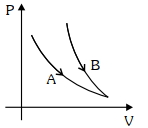
A
$PV^\gamma = k$ for process $B$ and $PV = k$ for process $A$.
B
$PV = k$ for process $B$ and $A$.
C
$\frac{P^{\gamma-1}}{T^\gamma} = k$ for process $B$ and $T = k$ for process $A$.
D
$\frac{T^\gamma}{P^{\gamma-1}} = k$ for process $A$ and $PV = k$ for process $B$.
Solution
(A) In a $P-V$ diagram,the slope of an adiabatic process is $\gamma$ times the slope of an isothermal process. Therefore,the steeper curve represents an adiabatic process.
$1$. Curve $B$ is steeper than curve $A$,so process $B$ is adiabatic. The equation for an adiabatic process is $PV^\gamma = k$.
$2$. Curve $A$ is less steep,so process $A$ is isothermal. The equation for an isothermal process is $PV = k$.
Comparing this with the given options,option $A$ correctly identifies process $B$ as adiabatic $(PV^\gamma = k)$ and process $A$ as isothermal $(PV = k)$.
$1$. Curve $B$ is steeper than curve $A$,so process $B$ is adiabatic. The equation for an adiabatic process is $PV^\gamma = k$.
$2$. Curve $A$ is less steep,so process $A$ is isothermal. The equation for an isothermal process is $PV = k$.
Comparing this with the given options,option $A$ correctly identifies process $B$ as adiabatic $(PV^\gamma = k)$ and process $A$ as isothermal $(PV = k)$.
0 likes
View Solution199
DifficultMCQ
The specific heat at constant pressure of a real gas obeying $PV^2=RT$ equation is:
A
$C_{V}+R$
B
$\frac{R}{3}+C_{V}$
C
$R$
D
$C_V+\frac{R}{2}$
Solution
(D) From the first law of thermodynamics,$dQ = du + dW$.
For a process,$C dT = C_V dT + P dV$,where $C$ is the molar heat capacity.
Dividing by $dT$,we get $C = C_V + P \frac{dV}{dT}$.
Given the equation of state $PV^2 = RT$.
Differentiating with respect to $T$ at constant pressure $P$:
$P(2V) \frac{dV}{dT} = R$.
Therefore,$P \frac{dV}{dT} = \frac{R}{2}$.
Substituting this into the expression for $C$:
$C = C_V + \frac{R}{2}$.
For a process,$C dT = C_V dT + P dV$,where $C$ is the molar heat capacity.
Dividing by $dT$,we get $C = C_V + P \frac{dV}{dT}$.
Given the equation of state $PV^2 = RT$.
Differentiating with respect to $T$ at constant pressure $P$:
$P(2V) \frac{dV}{dT} = R$.
Therefore,$P \frac{dV}{dT} = \frac{R}{2}$.
Substituting this into the expression for $C$:
$C = C_V + \frac{R}{2}$.
0 likes
View Solution200
DifficultMCQ
$A$ real gas within a closed chamber at $27^{\circ} C$ undergoes the cyclic process as shown in the figure. The gas obeys the $PV^3 = RT$ equation for the path $A$ to $B$. The net work done in the complete cycle is (assuming $R = 8 \, J/mol \cdot K$): (in $ \, J$)
A
$225$
B
$205$
C
$20$
D
$-20$
Solution
(B) For path $A$ to $B$, the process follows $PV^3 = RT$. Given $T = 300 \, K$ (constant temperature process is not implied, but $T$ is constant at $300 \, K$ for the state $A$ and $B$ as per the equation $PV^3 = RT$ at $T=300 \, K$).
$W_{AB} = \int_{V_A}^{V_B} P \, dV = \int_{2}^{4} \frac{RT}{V^3} \, dV = RT \int_{2}^{4} V^{-3} \, dV$
$W_{AB} = 8 \times 300 \times \left[ \frac{V^{-2}}{-2} \right]_{2}^{4} = 2400 \times \left( -\frac{1}{2} \right) \left( \frac{1}{16} - \frac{1}{4} \right) = -1200 \times \left( \frac{1-4}{16} \right) = -1200 \times \left( -\frac{3}{16} \right) = 75 \times 3 = 225 \, J$.
For path $B$ to $C$, it is an isobaric process at $P = 10 \, Pa$ from $V = 4 \, m^3$ to $V = 2 \, m^3$.
$W_{BC} = P(V_C - V_B) = 10(2 - 4) = -20 \, J$.
For path $C$ to $A$, it is an isochoric process at $V = 2 \, m^3$, so $W_{CA} = 0 \, J$.
Total work $W_{net} = W_{AB} + W_{BC} + W_{CA} = 225 - 20 + 0 = 205 \, J$.
$W_{AB} = \int_{V_A}^{V_B} P \, dV = \int_{2}^{4} \frac{RT}{V^3} \, dV = RT \int_{2}^{4} V^{-3} \, dV$
$W_{AB} = 8 \times 300 \times \left[ \frac{V^{-2}}{-2} \right]_{2}^{4} = 2400 \times \left( -\frac{1}{2} \right) \left( \frac{1}{16} - \frac{1}{4} \right) = -1200 \times \left( \frac{1-4}{16} \right) = -1200 \times \left( -\frac{3}{16} \right) = 75 \times 3 = 225 \, J$.
For path $B$ to $C$, it is an isobaric process at $P = 10 \, Pa$ from $V = 4 \, m^3$ to $V = 2 \, m^3$.
$W_{BC} = P(V_C - V_B) = 10(2 - 4) = -20 \, J$.
For path $C$ to $A$, it is an isochoric process at $V = 2 \, m^3$, so $W_{CA} = 0 \, J$.
Total work $W_{net} = W_{AB} + W_{BC} + W_{CA} = 225 - 20 + 0 = 205 \, J$.
0 likes
View SolutionThermodynamics — Mix Examples-Thermodynamics · Frequently Asked Questions
1Are these Thermodynamics questions useful for JEE and NEET?
Yes. All questions in this section are mapped to JEE Main and NEET exam patterns. Previous year questions from JEE Main, NEET, GUJCET and state-level exams are included with full solutions.
2Can I switch to Hindi or Gujarati for these questions?
Yes. Use the language tabs in the hero section or the sidebar to view the same questions and solutions in English, Hindi or Gujarati.
3How do I generate a question paper from this subtopic?
Use the Vedclass Exam Paper Generator — select the chapter and subtopic, set difficulty, and generate Sets A, B, C, D automatically. First 3 chapters of every subject are free.
Vedclass Products
For Students
Vedclass Test Series
Mock tests in real JEE/NEET style with performance analysis. 5-day free trial.
Start Free TrialFor Teachers
Exam Paper Generator
Generate Set A/B/C/D papers from this chapter in 2 minutes. 3 chapters free.
Try FreeFor Institutes
Online Exam Module
Live online exams with unlimited students, 360° analytics & white-label branding.
See DemoFor Teachers & Institutes
Generate a Thermodynamics Exam Paper in 2 Minutes
Select subtopic & difficulty — Sets A, B, C, D auto-generated with No Repeat logic.
First 3 chapters of every subject are free — no payment required.