
A English
First Law of Thermodynamics Questions in English
Class 11 Physics · Thermodynamics · First Law of Thermodynamics
132+
Questions
English
Language
100%
With Solutions
Showing 49 of 132 questions in English
1
EasyMCQ
In supplying $400$ calories of heat to a system,the work done will be
A
$400$ joules
B
$1672$ joules
C
$1672$ watts
D
$1672$ ergs
Solution
(B) The mechanical equivalent of heat is given by $J = 4.18 \text{ J/cal}$.
Given the heat supplied $Q = 400 \text{ calories}$.
The work done $W$ is calculated using the relation $W = J \times Q$.
Substituting the values,we get $W = 4.18 \times 400 = 1672 \text{ Joules}$.
Given the heat supplied $Q = 400 \text{ calories}$.
The work done $W$ is calculated using the relation $W = J \times Q$.
Substituting the values,we get $W = 4.18 \times 400 = 1672 \text{ Joules}$.
0 likes
View Solution2
EasyMCQ
The first law of thermodynamics is given by:
A
$dQ = dU + PdV$
B
$dQ = dU \times PdV$
C
$dQ = (dU + dV)P$
D
$dQ = PdU + dV$
Solution
(A) The first law of thermodynamics is a statement of the conservation of energy applied to thermodynamic systems. It states that the heat supplied to a system $(dQ)$ is equal to the change in internal energy $(dU)$ plus the work done by the system $(dW)$.
Mathematically,it is expressed as: $dQ = dU + dW$.
Since the work done by a gas during an expansion or compression is given by $dW = PdV$,we substitute this into the equation.
Therefore,the first law of thermodynamics is given by: $dQ = dU + PdV$.
Mathematically,it is expressed as: $dQ = dU + dW$.
Since the work done by a gas during an expansion or compression is given by $dW = PdV$,we substitute this into the equation.
Therefore,the first law of thermodynamics is given by: $dQ = dU + PdV$.
0 likes
View Solution3
EasyMCQ
In changing the state of a thermodynamic system from state $A$ to state $B$, the heat supplied to the system is $Q$ and the work done by the system is $W$. The change in its internal energy is
A
$Q + W$
B
$Q - W$
C
$Q$
D
$\frac{Q - W}{2}$
Solution
(B) According to the First Law of Thermodynamics, the heat supplied to a system ($\Delta Q$) is equal to the sum of the change in internal energy ($\Delta U$) and the work done by the system ($\Delta W$).
Mathematically, this is expressed as: $\Delta Q = \Delta U + \Delta W$.
Given that the heat supplied is $Q$ and the work done by the system is $W$, we substitute these values into the equation: $Q = \Delta U + W$.
Rearranging the equation to solve for the change in internal energy ($\Delta U$): $\Delta U = Q - W$.
Mathematically, this is expressed as: $\Delta Q = \Delta U + \Delta W$.
Given that the heat supplied is $Q$ and the work done by the system is $W$, we substitute these values into the equation: $Q = \Delta U + W$.
Rearranging the equation to solve for the change in internal energy ($\Delta U$): $\Delta U = Q - W$.
0 likes
View Solution4
EasyMCQ
Heat given to a system is $35 \ J$ and work done by the system is $15 \ J$. The change in the internal energy of the system will be ..... $J$.
A
$-50$
B
$20$
C
$30$
D
$50$
Solution
(B) According to the First Law of Thermodynamics,the change in internal energy $(\Delta U)$ is given by the equation: $\Delta U = \Delta Q - W$.
Here,the heat given to the system $(\Delta Q)$ is $+35 \ J$ and the work done by the system $(W)$ is $+15 \ J$.
Substituting these values into the equation:
$\Delta U = 35 \ J - 15 \ J = 20 \ J$.
Therefore,the change in the internal energy of the system is $20 \ J$.
Here,the heat given to the system $(\Delta Q)$ is $+35 \ J$ and the work done by the system $(W)$ is $+15 \ J$.
Substituting these values into the equation:
$\Delta U = 35 \ J - 15 \ J = 20 \ J$.
Therefore,the change in the internal energy of the system is $20 \ J$.
2 likes
View Solution5
EasyMCQ
The first law of thermodynamics is concerned with the conservation of
A
Momentum
B
Energy
C
Mass
D
Temperature
Solution
(B) According to the first law of thermodynamics,
$Q = \Delta U + W$
where $Q$ is the heat supplied to the system,$\Delta U$ is the change in internal energy,and $W$ is the work done by the system.
This law is a statement of the law of conservation of energy,which states that energy can neither be created nor destroyed,only transformed from one form to another.
$Q = \Delta U + W$
where $Q$ is the heat supplied to the system,$\Delta U$ is the change in internal energy,and $W$ is the work done by the system.
This law is a statement of the law of conservation of energy,which states that energy can neither be created nor destroyed,only transformed from one form to another.
0 likes
View Solution6
EasyMCQ
If the amount of heat given to a system is $35 \ J$ and the amount of work done by the system is $-15 \ J$,then the change in the internal energy of the system is .... $J$.
A
$-50$
B
$20$
C
$30$
D
$50$
Solution
(D) According to the first law of thermodynamics,the change in internal energy $\Delta U$ is given by the equation: $\Delta Q = \Delta U + \Delta W$.
Here,the heat given to the system is $\Delta Q = 35 \ J$.
The work done by the system is $\Delta W = -15 \ J$.
Substituting these values into the equation: $35 = \Delta U + (-15)$.
Solving for $\Delta U$: $\Delta U = 35 + 15 = 50 \ J$.
Therefore,the change in internal energy is $50 \ J$.
Here,the heat given to the system is $\Delta Q = 35 \ J$.
The work done by the system is $\Delta W = -15 \ J$.
Substituting these values into the equation: $35 = \Delta U + (-15)$.
Solving for $\Delta U$: $\Delta U = 35 + 15 = 50 \ J$.
Therefore,the change in internal energy is $50 \ J$.
0 likes
View Solution7
MediumMCQ
$A$ system is given $300$ calories of heat and it does $600$ joules of work. How much does the internal energy of the system change in this process? $(1 \text{ calorie} = 4.18 \text{ joules})$
A
$654$
B
$156.5$
C
$-300$
D
$-528.2$
Solution
(A) According to the first law of thermodynamics,the change in internal energy $\Delta U$ is given by the equation: $\Delta U = \Delta Q - \Delta W$.
Here,the heat supplied $\Delta Q = 300 \text{ calories}$.
Converting heat into joules: $\Delta Q = 300 \times 4.18 \text{ J} = 1254 \text{ J}$.
The work done by the system $\Delta W = 600 \text{ J}$.
Substituting these values into the equation: $\Delta U = 1254 \text{ J} - 600 \text{ J} = 654 \text{ J}$.
Therefore,the internal energy of the system increases by $654 \text{ J}$.
Here,the heat supplied $\Delta Q = 300 \text{ calories}$.
Converting heat into joules: $\Delta Q = 300 \times 4.18 \text{ J} = 1254 \text{ J}$.
The work done by the system $\Delta W = 600 \text{ J}$.
Substituting these values into the equation: $\Delta U = 1254 \text{ J} - 600 \text{ J} = 654 \text{ J}$.
Therefore,the internal energy of the system increases by $654 \text{ J}$.
0 likes
View Solution8
MediumMCQ
The internal energy change in a system that has absorbed $2 \; kcal$ of heat and done $500 \; J$ of work is ...... $J$.
A
$7900$
B
$8200$
C
$5600$
D
$6400$
Solution
(A) According to the first law of thermodynamics,$\Delta Q = \Delta U + \Delta W$,where $\Delta Q$ is the heat absorbed,$\Delta U$ is the change in internal energy,and $\Delta W$ is the work done by the system.
Given:
Heat absorbed,$\Delta Q = 2 \; kcal = 2 \times 10^3 \times 4.2 \; J = 8400 \; J$.
Work done,$\Delta W = 500 \; J$.
Substituting these values into the equation:
$\Delta U = \Delta Q - \Delta W$
$\Delta U = 8400 \; J - 500 \; J = 7900 \; J$.
Therefore,the internal energy change is $7900 \; J$.
Given:
Heat absorbed,$\Delta Q = 2 \; kcal = 2 \times 10^3 \times 4.2 \; J = 8400 \; J$.
Work done,$\Delta W = 500 \; J$.
Substituting these values into the equation:
$\Delta U = \Delta Q - \Delta W$
$\Delta U = 8400 \; J - 500 \; J = 7900 \; J$.
Therefore,the internal energy change is $7900 \; J$.
0 likes
View Solution9
EasyMCQ
$A$ system performs work $\Delta W$ when an amount of heat $\Delta Q$ is added to the system. The corresponding change in the internal energy is $\Delta U$. Which of the following is a unique function of the initial and final states (irrespective of the mode of change)?
A
$\Delta Q$
B
$\Delta W$
C
$\Delta U$ and $\Delta Q$
D
$\Delta U$
Solution
(D) According to the first law of thermodynamics,$\Delta Q = \Delta U + \Delta W$.
In this equation,$\Delta Q$ (heat) and $\Delta W$ (work) are path-dependent quantities,meaning their values depend on the process or path taken to reach the final state from the initial state.
However,$\Delta U$ (change in internal energy) is a state function.
$A$ state function is a property whose value depends only on the current state of the system (initial and final states) and is independent of the path taken to reach that state.
Therefore,$\Delta U$ is the unique function of the initial and final states.
In this equation,$\Delta Q$ (heat) and $\Delta W$ (work) are path-dependent quantities,meaning their values depend on the process or path taken to reach the final state from the initial state.
However,$\Delta U$ (change in internal energy) is a state function.
$A$ state function is a property whose value depends only on the current state of the system (initial and final states) and is independent of the path taken to reach that state.
Therefore,$\Delta U$ is the unique function of the initial and final states.
1 likes
View Solution10
EasyMCQ
$110\; J$ of heat is added to a gaseous system,whose internal energy change is $40\; J$,then the amount of external work done is ........ $J$.
A
$150$
B
$70$
C
$110$
D
$40$
Solution
(B) According to the First Law of Thermodynamics,the heat supplied to a system is equal to the sum of the change in internal energy and the work done by the system.
$\Delta Q = \Delta U + \Delta W$
Given:
Heat added,$\Delta Q = 110\; J$
Change in internal energy,$\Delta U = 40\; J$
Rearranging the formula to find the work done:
$\Delta W = \Delta Q - \Delta U$
$\Delta W = 110\; J - 40\; J = 70\; J$
Therefore,the amount of external work done is $70\; J$.
$\Delta Q = \Delta U + \Delta W$
Given:
Heat added,$\Delta Q = 110\; J$
Change in internal energy,$\Delta U = 40\; J$
Rearranging the formula to find the work done:
$\Delta W = \Delta Q - \Delta U$
$\Delta W = 110\; J - 40\; J = 70\; J$
Therefore,the amount of external work done is $70\; J$.
0 likes
View Solution11
EasyMCQ
Which of the following is not a thermodynamic state function?
A
Enthalpy
B
Work done
C
Gibbs energy
D
Internal energy
Solution
(B) thermodynamic state function is a property whose value depends only on the current state of the system and not on the path taken to reach that state.
Enthalpy $(H)$,Gibbs energy $(G)$,and Internal energy $(U)$ are all state functions because they depend only on the state variables of the system.
Work done $(W)$ is a path function,meaning its value depends on the specific process or path taken to change the state of the system.
Therefore,work done is not a thermodynamic state function.
Enthalpy $(H)$,Gibbs energy $(G)$,and Internal energy $(U)$ are all state functions because they depend only on the state variables of the system.
Work done $(W)$ is a path function,meaning its value depends on the specific process or path taken to change the state of the system.
Therefore,work done is not a thermodynamic state function.
0 likes
View Solution12
EasyMCQ
When the amount of work done is $333 \ cal$ and the change in internal energy is $167 \ cal$,then the heat supplied is ....... $cal$.
A
$166$
B
$333$
C
$500$
D
$400$
Solution
(C) According to the First Law of Thermodynamics,the heat supplied to a system $(\Delta Q)$ is equal to the sum of the change in internal energy $(\Delta U)$ and the work done by the system $(\Delta W)$.
Formula: $\Delta Q = \Delta U + \Delta W$
Given:
$\Delta W = 333 \ cal$
$\Delta U = 167 \ cal$
Calculation:
$\Delta Q = 167 \ cal + 333 \ cal = 500 \ cal$
Therefore,the heat supplied is $500 \ cal$.
Formula: $\Delta Q = \Delta U + \Delta W$
Given:
$\Delta W = 333 \ cal$
$\Delta U = 167 \ cal$
Calculation:
$\Delta Q = 167 \ cal + 333 \ cal = 500 \ cal$
Therefore,the heat supplied is $500 \ cal$.
0 likes
View Solution13
EasyMCQ
The first law of thermodynamics states that:
A
System can do work
B
System has temperature
C
System has pressure
D
Heat is a form of energy
Solution
(D) The first law of thermodynamics is essentially the law of conservation of energy applied to thermodynamic systems. It states that energy can neither be created nor destroyed,only transformed from one form to another. Since heat is a form of energy,the first law implies that the change in internal energy of a system is equal to the heat added to the system minus the work done by the system $(ΔU = Q - W)$. Therefore,heat is recognized as a form of energy in transit.
0 likes
View Solution14
EasyMCQ
$A$ thermodynamic system is changed from state $(P_1, V_1)$ to $(P_2, V_2)$ by two different processes. The quantity which will remain the same is
A
$\Delta Q$
B
$\Delta W$
C
$\Delta Q + \Delta W$
D
$\Delta Q - \Delta W$
Solution
(D) According to the First Law of Thermodynamics,the change in internal energy $\Delta U$ is given by $\Delta U = \Delta Q - \Delta W$.
Internal energy is a state function,meaning its value depends only on the initial and final states of the system and is independent of the path taken.
Since the initial state $(P_1, V_1)$ and the final state $(P_2, V_2)$ are the same for both processes,the change in internal energy $\Delta U$ will remain the same.
Therefore,the quantity $\Delta Q - \Delta W$ remains constant.
Internal energy is a state function,meaning its value depends only on the initial and final states of the system and is independent of the path taken.
Since the initial state $(P_1, V_1)$ and the final state $(P_2, V_2)$ are the same for both processes,the change in internal energy $\Delta U$ will remain the same.
Therefore,the quantity $\Delta Q - \Delta W$ remains constant.
0 likes
View Solution15
EasyMCQ
In a thermodynamic process,$200 \ J$ of heat is given to a gas and $100 \ J$ of work is also done on it. The change in internal energy of the gas is ........ $J$.
A
$100$
B
$300$
C
$419$
D
$24$
Solution
(B) According to the first law of thermodynamics,the change in internal energy $\Delta U$ is given by the equation: $\Delta Q = \Delta U + \Delta W$.
Here,heat is given to the system,so $\Delta Q = +200 \ J$.
Work is done on the system,so $\Delta W = -100 \ J$.
Substituting these values into the equation: $200 = \Delta U + (-100)$.
Therefore,$\Delta U = 200 + 100 = 300 \ J$.
Here,heat is given to the system,so $\Delta Q = +200 \ J$.
Work is done on the system,so $\Delta W = -100 \ J$.
Substituting these values into the equation: $200 = \Delta U + (-100)$.
Therefore,$\Delta U = 200 + 100 = 300 \ J$.
0 likes
View Solution16
EasyMCQ
If $150 \ J$ of heat is added to a system and the work done by the system is $110 \ J$,then the change in internal energy will be .......... $J$.
A
$260$
B
$150$
C
$110$
D
$40$
Solution
(D) According to the First Law of Thermodynamics,the change in internal energy $(\Delta U)$ is given by the equation: $\Delta Q = \Delta U + \Delta W$.
Here,the heat added to the system is $\Delta Q = 150 \ J$.
The work done by the system is $\Delta W = 110 \ J$.
Rearranging the formula to solve for $\Delta U$: $\Delta U = \Delta Q - \Delta W$.
Substituting the values: $\Delta U = 150 \ J - 110 \ J = 40 \ J$.
Therefore,the change in internal energy is $40 \ J$.
Here,the heat added to the system is $\Delta Q = 150 \ J$.
The work done by the system is $\Delta W = 110 \ J$.
Rearranging the formula to solve for $\Delta U$: $\Delta U = \Delta Q - \Delta W$.
Substituting the values: $\Delta U = 150 \ J - 110 \ J = 40 \ J$.
Therefore,the change in internal energy is $40 \ J$.
0 likes
View Solution17
MediumMCQ
If $\Delta Q$ and $\Delta W$ represent the heat supplied to the system and the work done on the system respectively,then the first law of thermodynamics can be written as,where $\Delta U$ is the change in internal energy.
A
$\Delta Q = \Delta U + \Delta W$
B
$\Delta Q = \Delta U - \Delta W$
C
$\Delta Q = \Delta W - \Delta U$
D
$\Delta Q = - \Delta W - \Delta U$
Solution
(B) The first law of thermodynamics is generally expressed as $\Delta Q = \Delta U + W_{by}$,where $W_{by}$ is the work done $BY$ the system.
In this problem,$\Delta W$ is defined as the work done $ON$ the system.
By sign convention,work done on the system is negative of work done by the system,so $W_{by} = -\Delta W$.
Substituting this into the first law equation: $\Delta Q = \Delta U + (-\Delta W)$.
Therefore,the correct expression is $\Delta Q = \Delta U - \Delta W$.
In this problem,$\Delta W$ is defined as the work done $ON$ the system.
By sign convention,work done on the system is negative of work done by the system,so $W_{by} = -\Delta W$.
Substituting this into the first law equation: $\Delta Q = \Delta U + (-\Delta W)$.
Therefore,the correct expression is $\Delta Q = \Delta U - \Delta W$.
0 likes
View Solution18
EasyMCQ
$A$ system is provided with $200 \, cal$ of heat and the work done by the system on the surroundings is $40 \, J$. Then its internal energy
A
Increases by $600 \, J$
B
Decreases by $800 \, J$
C
Increases by $800 \, J$
D
Decreases by $50 \, J$
Solution
(C) According to the First Law of Thermodynamics,$\Delta Q = \Delta U + \Delta W$.
Given,heat supplied to the system $\Delta Q = 200 \, cal$.
Converting calories to Joules,$\Delta Q = 200 \times 4.2 \, J = 840 \, J$.
Work done by the system $\Delta W = 40 \, J$.
Substituting these values into the equation,$\Delta U = \Delta Q - \Delta W$.
$\Delta U = 840 \, J - 40 \, J = 800 \, J$.
Since $\Delta U$ is positive,the internal energy increases by $800 \, J$.
Given,heat supplied to the system $\Delta Q = 200 \, cal$.
Converting calories to Joules,$\Delta Q = 200 \times 4.2 \, J = 840 \, J$.
Work done by the system $\Delta W = 40 \, J$.
Substituting these values into the equation,$\Delta U = \Delta Q - \Delta W$.
$\Delta U = 840 \, J - 40 \, J = 800 \, J$.
Since $\Delta U$ is positive,the internal energy increases by $800 \, J$.
0 likes
View Solution19
EasyMCQ
In a thermodynamic process,the pressure of a fixed mass of a gas is changed in such a manner that the gas molecules release $20 \ J$ of heat and $10 \ J$ of work is done on the gas. If the initial internal energy of the gas was $40 \ J$,then the final internal energy will be ........ $J$.
A
$30$
B
$20$
C
$60$
D
$40$
Solution
(A) According to the first law of thermodynamics,$\Delta Q = \Delta U + \Delta W$.
Given:
Heat released by the gas,$\Delta Q = -20 \ J$ (heat lost by the system is negative).
Work done on the gas,$\Delta W = -10 \ J$ (work done on the system is negative in the convention $\Delta Q = \Delta U + \Delta W$).
Initial internal energy,$U_i = 40 \ J$.
Substituting the values into the equation:
$-20 = (U_f - 40) + (-10)$
$-20 = U_f - 40 - 10$
$-20 = U_f - 50$
$U_f = 50 - 20 = 30 \ J$.
Wait,re-evaluating the sign convention: If $\Delta Q = \Delta U + W$ where $W$ is work done $BY$ the gas,then $W = -10 \ J$. Thus,$-20 = \Delta U - 10$,so $\Delta U = -10 \ J$. Since $\Delta U = U_f - U_i$,we have $U_f - 40 = -10$,which gives $U_f = 30 \ J$.
Given:
Heat released by the gas,$\Delta Q = -20 \ J$ (heat lost by the system is negative).
Work done on the gas,$\Delta W = -10 \ J$ (work done on the system is negative in the convention $\Delta Q = \Delta U + \Delta W$).
Initial internal energy,$U_i = 40 \ J$.
Substituting the values into the equation:
$-20 = (U_f - 40) + (-10)$
$-20 = U_f - 40 - 10$
$-20 = U_f - 50$
$U_f = 50 - 20 = 30 \ J$.
Wait,re-evaluating the sign convention: If $\Delta Q = \Delta U + W$ where $W$ is work done $BY$ the gas,then $W = -10 \ J$. Thus,$-20 = \Delta U - 10$,so $\Delta U = -10 \ J$. Since $\Delta U = U_f - U_i$,we have $U_f - 40 = -10$,which gives $U_f = 30 \ J$.
0 likes
View Solution20
EasyMCQ
The first law of thermodynamics is a special case of:
A
Newton's law
B
Law of conservation of energy
C
Charles's law
D
Law of heat exchange
Solution
(B) The first law of thermodynamics states that the heat $Q$ supplied to a system is equal to the change in internal energy $\Delta U$ plus the work done $W$ by the system,expressed as $Q = \Delta U + W$.
This equation is a direct application of the law of conservation of energy,which states that energy cannot be created or destroyed,only transformed from one form to another.
Therefore,the first law of thermodynamics is a special case of the law of conservation of energy.
This equation is a direct application of the law of conservation of energy,which states that energy cannot be created or destroyed,only transformed from one form to another.
Therefore,the first law of thermodynamics is a special case of the law of conservation of energy.
0 likes
View Solution21
MediumMCQ
When heat energy of $1500 \; J$ is supplied to a gas at a constant pressure of $2.1 \times 10^5 \; N/m^2$,its volume increases by $2.5 \times 10^{-3} \; m^3$. The increase in the internal energy of the gas in Joules is ...... $J$.
A
$450$
B
$525$
C
$975$
D
$2025$
Solution
(C) According to the First Law of Thermodynamics $(FLOT)$,the heat supplied $(\Delta Q)$ is equal to the change in internal energy $(\Delta U)$ plus the work done by the gas $(W = P \Delta V)$.
$\Delta Q = \Delta U + P \Delta V$
Given:
$\Delta Q = 1500 \; J$
$P = 2.1 \times 10^5 \; N/m^2$
$\Delta V = 2.5 \times 10^{-3} \; m^3$
Rearranging the formula to find $\Delta U$:
$\Delta U = \Delta Q - P \Delta V$
$\Delta U = 1500 - (2.1 \times 10^5) \times (2.5 \times 10^{-3})$
$\Delta U = 1500 - (2.1 \times 2.5 \times 10^2)$
$\Delta U = 1500 - (5.25 \times 100)$
$\Delta U = 1500 - 525$
$\Delta U = 975 \; J$
Therefore,the increase in internal energy is $975 \; J$.
$\Delta Q = \Delta U + P \Delta V$
Given:
$\Delta Q = 1500 \; J$
$P = 2.1 \times 10^5 \; N/m^2$
$\Delta V = 2.5 \times 10^{-3} \; m^3$
Rearranging the formula to find $\Delta U$:
$\Delta U = \Delta Q - P \Delta V$
$\Delta U = 1500 - (2.1 \times 10^5) \times (2.5 \times 10^{-3})$
$\Delta U = 1500 - (2.1 \times 2.5 \times 10^2)$
$\Delta U = 1500 - (5.25 \times 100)$
$\Delta U = 1500 - 525$
$\Delta U = 975 \; J$
Therefore,the increase in internal energy is $975 \; J$.
0 likes
View Solution22
EasyMCQ
If heat given to a system is $6 \, kcal$ and work done is $6 \, kJ$,then the change in internal energy is ....... $kJ$.
A
$19.1$
B
$12.5$
C
$25$
D
$0$
Solution
(A) According to the first law of thermodynamics,$\Delta Q = \Delta U + \Delta W$,where $\Delta Q$ is the heat supplied,$\Delta U$ is the change in internal energy,and $\Delta W$ is the work done.
Given: $\Delta Q = 6 \, kcal = 6 \times 4.184 \, kJ = 25.104 \, kJ$ (using $1 \, kcal = 4.184 \, kJ$).
Work done $\Delta W = 6 \, kJ$.
Therefore,$\Delta U = \Delta Q - \Delta W = 25.104 \, kJ - 6 \, kJ = 19.104 \, kJ$.
Rounding to one decimal place,we get $\Delta U \approx 19.1 \, kJ$.
Given: $\Delta Q = 6 \, kcal = 6 \times 4.184 \, kJ = 25.104 \, kJ$ (using $1 \, kcal = 4.184 \, kJ$).
Work done $\Delta W = 6 \, kJ$.
Therefore,$\Delta U = \Delta Q - \Delta W = 25.104 \, kJ - 6 \, kJ = 19.104 \, kJ$.
Rounding to one decimal place,we get $\Delta U \approx 19.1 \, kJ$.
0 likes
View Solution23
MediumMCQ
In a thermodynamic process,the pressure of a fixed mass of a gas is changed in such a manner that the gas releases $20 \ J$ of heat and $8 \ J$ of work is done on the gas. If the initial internal energy of the gas was $30 \ J$,the final internal energy will be ...... $J$.
A
$18$
B
$9$
C
$4.5$
D
$36$
Solution
(A) According to the first law of thermodynamics,$\Delta Q = \Delta U + \Delta W$.
Given that the gas releases heat,$\Delta Q = -20 \ J$.
Since work is done on the gas,$\Delta W = -8 \ J$.
The initial internal energy $U_i = 30 \ J$.
Substituting these values into the equation: $-20 = \Delta U + (-8)$.
$\Delta U = -20 + 8 = -12 \ J$.
Since $\Delta U = U_f - U_i$,we have $U_f - 30 = -12$.
Therefore,$U_f = 30 - 12 = 18 \ J$.
Given that the gas releases heat,$\Delta Q = -20 \ J$.
Since work is done on the gas,$\Delta W = -8 \ J$.
The initial internal energy $U_i = 30 \ J$.
Substituting these values into the equation: $-20 = \Delta U + (-8)$.
$\Delta U = -20 + 8 = -12 \ J$.
Since $\Delta U = U_f - U_i$,we have $U_f - 30 = -12$.
Therefore,$U_f = 30 - 12 = 18 \ J$.
0 likes
View Solution24
EasyMCQ
$A$ monoatomic gas of $n$ moles is heated from temperature $T_1$ to $T_2$ under two different conditions: $(i)$ at constant volume and $(ii)$ at constant pressure. The change in internal energy of the gas is
A
More for $(i)$
B
More for $(ii)$
C
Same in both cases
D
Independent of number of moles
Solution
(C) The change in internal energy of an ideal gas is given by the formula $\Delta U = n C_V \Delta T$.
Since the gas is monoatomic,the molar heat capacity at constant volume $C_V$ is constant,given by $C_V = \frac{3}{2}R$.
Internal energy is a state function,meaning it depends only on the initial and final states of the system (temperature $T_1$ and $T_2$) and not on the path or process taken to reach the final state.
Therefore,for a given change in temperature $\Delta T = T_2 - T_1$,the change in internal energy $\Delta U$ remains the same regardless of whether the process occurs at constant volume or constant pressure.
Since the gas is monoatomic,the molar heat capacity at constant volume $C_V$ is constant,given by $C_V = \frac{3}{2}R$.
Internal energy is a state function,meaning it depends only on the initial and final states of the system (temperature $T_1$ and $T_2$) and not on the path or process taken to reach the final state.
Therefore,for a given change in temperature $\Delta T = T_2 - T_1$,the change in internal energy $\Delta U$ remains the same regardless of whether the process occurs at constant volume or constant pressure.
0 likes
View Solution25
MediumMCQ
$A$ perfect gas goes from state $A$ to another state $B$ by absorbing $8 \times 10^5 \ J$ of heat and doing $6.5 \times 10^5 \ J$ of external work. It is now transferred between the same two states in another process in which it absorbs $10^5 \ J$ of heat. Then in the second process:
A
Work done on the gas is $0.5 \times 10^5 \ J$
B
Work done by gas is $0.5 \times 10^5 \ J$
C
Work done on gas is $10^5 \ J$
D
Work done by gas is $10^5 \ J$
Solution
(A) According to the first law of thermodynamics,$\Delta Q = \Delta U + \Delta W$.
In the first process:
$\Delta Q_1 = 8 \times 10^5 \ J$ and $\Delta W_1 = 6.5 \times 10^5 \ J$.
Therefore,$\Delta U = \Delta Q_1 - \Delta W_1 = (8 - 6.5) \times 10^5 \ J = 1.5 \times 10^5 \ J$.
Since the initial and final states are the same for both processes,the change in internal energy $\Delta U$ remains constant.
In the second process:
$\Delta Q_2 = 10^5 \ J$ and $\Delta U = 1.5 \times 10^5 \ J$.
Using $\Delta Q_2 = \Delta U + \Delta W_2$:
$10^5 = 1.5 \times 10^5 + \Delta W_2$.
$\Delta W_2 = 10^5 - 1.5 \times 10^5 = -0.5 \times 10^5 \ J$.
$A$ negative value for work done by the gas indicates that work is done on the gas. Thus,the work done on the gas is $0.5 \times 10^5 \ J$.
In the first process:
$\Delta Q_1 = 8 \times 10^5 \ J$ and $\Delta W_1 = 6.5 \times 10^5 \ J$.
Therefore,$\Delta U = \Delta Q_1 - \Delta W_1 = (8 - 6.5) \times 10^5 \ J = 1.5 \times 10^5 \ J$.
Since the initial and final states are the same for both processes,the change in internal energy $\Delta U$ remains constant.
In the second process:
$\Delta Q_2 = 10^5 \ J$ and $\Delta U = 1.5 \times 10^5 \ J$.
Using $\Delta Q_2 = \Delta U + \Delta W_2$:
$10^5 = 1.5 \times 10^5 + \Delta W_2$.
$\Delta W_2 = 10^5 - 1.5 \times 10^5 = -0.5 \times 10^5 \ J$.
$A$ negative value for work done by the gas indicates that work is done on the gas. Thus,the work done on the gas is $0.5 \times 10^5 \ J$.
1 likes
View Solution26
EasyMCQ
If a system undergoes contraction of volume,then the work done by the system will be:
A
Zero
B
Negligible
C
Negative
D
Positive
Solution
(C) The work done by a system is given by the formula $\Delta W = P \Delta V$,where $P$ is the pressure and $\Delta V$ is the change in volume.
Since the system undergoes contraction,the final volume is less than the initial volume,which means $\Delta V = V_{final} - V_{initial} < 0$.
Therefore,the work done by the system $\Delta W = P \Delta V$ will be negative.
Since the system undergoes contraction,the final volume is less than the initial volume,which means $\Delta V = V_{final} - V_{initial} < 0$.
Therefore,the work done by the system $\Delta W = P \Delta V$ will be negative.
0 likes
View Solution27
EasyMCQ
Which of the following statements is incorrect regarding the first law of thermodynamics?
A
It introduces the concept of internal energy.
B
It introduces the concept of entropy.
C
It is not applicable to any cyclic process.
D
None of the above.
Solution
(B) The first law of thermodynamics is based on the law of conservation of energy and introduces the concept of internal energy $(U)$. It states that $\Delta Q = \Delta U + \Delta W$. It is applicable to all processes,including cyclic processes. However,the concept of entropy is introduced by the second law of thermodynamics,not the first. Therefore,statement $(b)$ is incorrect.
0 likes
View Solution28
EasyMCQ
The latent heat of vaporisation of water is $2240 \, J/g$. If the work done in the process of expansion of $1 \, g$ of water is $168 \, J$,then the increase in internal energy is ....... $J$.
A
$2408$
B
$2240$
C
$2072$
D
$1904$
Solution
(C) According to the first law of thermodynamics,the heat supplied $(\Delta Q)$ is equal to the sum of the change in internal energy $(\Delta U)$ and the work done $(\Delta W)$:
$\Delta Q = \Delta U + \Delta W$
Given:
Latent heat of vaporisation $(\Delta Q)$ = $2240 \, J$
Work done $(\Delta W)$ = $168 \, J$
Rearranging the formula to find the change in internal energy:
$\Delta U = \Delta Q - \Delta W$
$\Delta U = 2240 \, J - 168 \, J$
$\Delta U = 2072 \, J$
Therefore,the increase in internal energy is $2072 \, J$.
$\Delta Q = \Delta U + \Delta W$
Given:
Latent heat of vaporisation $(\Delta Q)$ = $2240 \, J$
Work done $(\Delta W)$ = $168 \, J$
Rearranging the formula to find the change in internal energy:
$\Delta U = \Delta Q - \Delta W$
$\Delta U = 2240 \, J - 168 \, J$
$\Delta U = 2072 \, J$
Therefore,the increase in internal energy is $2072 \, J$.
0 likes
View Solution29
MediumMCQ
$540$ calories of heat convert $1$ cubic centimeter of water at $100^{\circ}C$ into $1671$ cubic centimeter of steam at $100^{\circ}C$ at a pressure of one atmosphere. Then the work done against the atmospheric pressure is nearly ...... $cal$.
A
$540$
B
$40$
C
$0$
D
$500$
Solution
(B) Given: Heat supplied $Q = 540 \; cal$.
Initial volume of water $V_1 = 1 \; cm^3$.
Final volume of steam $V_2 = 1671 \; cm^3$.
Change in volume $\Delta V = V_2 - V_1 = 1671 - 1 = 1670 \; cm^3$.
Atmospheric pressure $P = 1.013 \times 10^5 \; Pa = 1.013 \times 10^6 \; dyne/cm^2$.
Work done against atmospheric pressure $W = P \Delta V$.
$W = (1.013 \times 10^6 \; dyne/cm^2) \times (1670 \; cm^3) = 1.69171 \times 10^9 \; ergs$.
Since $1 \; cal = 4.184 \times 10^7 \; ergs$,we convert the work into calories:
$W = \frac{1.69171 \times 10^9}{4.184 \times 10^7} \approx 40.4 \; cal$.
Thus,the work done is nearly $40 \; cal$.
Initial volume of water $V_1 = 1 \; cm^3$.
Final volume of steam $V_2 = 1671 \; cm^3$.
Change in volume $\Delta V = V_2 - V_1 = 1671 - 1 = 1670 \; cm^3$.
Atmospheric pressure $P = 1.013 \times 10^5 \; Pa = 1.013 \times 10^6 \; dyne/cm^2$.
Work done against atmospheric pressure $W = P \Delta V$.
$W = (1.013 \times 10^6 \; dyne/cm^2) \times (1670 \; cm^3) = 1.69171 \times 10^9 \; ergs$.
Since $1 \; cal = 4.184 \times 10^7 \; ergs$,we convert the work into calories:
$W = \frac{1.69171 \times 10^9}{4.184 \times 10^7} \approx 40.4 \; cal$.
Thus,the work done is nearly $40 \; cal$.
0 likes
View Solution30
MediumMCQ
$A$ unit mass of a liquid with volume $V_1$ is completely changed into a gas of volume $V_2$ at a constant external pressure $P$ and temperature $T$. If the latent heat of evaporation for the given mass is $L$,then the increase in the internal energy of the system is:
A
Zero
B
$P(V_2 - V_1)$
C
$L - P(V_2 - V_1)$
D
$L$
Solution
(C) According to the first law of thermodynamics,$\Delta Q = \Delta U + W$.
Here,$\Delta Q$ is the heat supplied,which is equal to the latent heat $L$ for a unit mass.
$W$ is the work done by the system during expansion at constant pressure $P$,given by $W = P(V_2 - V_1)$.
Substituting these into the first law equation:
$L = \Delta U + P(V_2 - V_1)$.
Rearranging for the change in internal energy $\Delta U$:
$\Delta U = L - P(V_2 - V_1)$.
Here,$\Delta Q$ is the heat supplied,which is equal to the latent heat $L$ for a unit mass.
$W$ is the work done by the system during expansion at constant pressure $P$,given by $W = P(V_2 - V_1)$.
Substituting these into the first law equation:
$L = \Delta U + P(V_2 - V_1)$.
Rearranging for the change in internal energy $\Delta U$:
$\Delta U = L - P(V_2 - V_1)$.
0 likes
View Solution31
MediumMCQ
$1 \text{ cm}^3$ of water at its boiling point absorbs $540 \text{ calories}$ of heat to become steam with a volume of $1671 \text{ cm}^3$. If the atmospheric pressure = $1.013 \times 10^5 \text{ N/m}^2$ and the mechanical equivalent of heat = $4.19 \text{ J/calorie}$, the energy spent in this process in overcoming intermolecular forces is ..... $\text{cal}$. (in $\text{cal}$)
A
$540$
B
$40$
C
$500$
D
$0$
Solution
(C) According to the first law of thermodynamics, $\Delta Q = \Delta U + \Delta W$.
Here, $\Delta Q$ is the total heat absorbed, $\Delta U$ is the change in internal energy (energy spent in overcoming intermolecular forces), and $\Delta W$ is the work done against atmospheric pressure.
Given: $\Delta Q = 540 \text{ cal}$, $P = 1.013 \times 10^5 \text{ N/m}^2$, $V_1 = 1 \text{ cm}^3 = 10^{-6} \text{ m}^3$, $V_2 = 1671 \text{ cm}^3 = 1671 \times 10^{-6} \text{ m}^3$, and $J = 4.19 \text{ J/cal}$.
Work done $\Delta W = P(V_2 - V_1) = 1.013 \times 10^5 \times (1671 - 1) \times 10^{-6} \text{ J} = 1.013 \times 10^5 \times 1670 \times 10^{-6} \text{ J} \approx 169.17 \text{ J}$.
Converting work to calories: $\Delta W_{\text{cal}} = \frac{169.17}{4.19} \approx 40.37 \text{ cal}$.
Internal energy change $\Delta U = \Delta Q - \Delta W_{\text{cal}} = 540 - 40.37 \approx 500 \text{ cal}$.
Here, $\Delta Q$ is the total heat absorbed, $\Delta U$ is the change in internal energy (energy spent in overcoming intermolecular forces), and $\Delta W$ is the work done against atmospheric pressure.
Given: $\Delta Q = 540 \text{ cal}$, $P = 1.013 \times 10^5 \text{ N/m}^2$, $V_1 = 1 \text{ cm}^3 = 10^{-6} \text{ m}^3$, $V_2 = 1671 \text{ cm}^3 = 1671 \times 10^{-6} \text{ m}^3$, and $J = 4.19 \text{ J/cal}$.
Work done $\Delta W = P(V_2 - V_1) = 1.013 \times 10^5 \times (1671 - 1) \times 10^{-6} \text{ J} = 1.013 \times 10^5 \times 1670 \times 10^{-6} \text{ J} \approx 169.17 \text{ J}$.
Converting work to calories: $\Delta W_{\text{cal}} = \frac{169.17}{4.19} \approx 40.37 \text{ cal}$.
Internal energy change $\Delta U = \Delta Q - \Delta W_{\text{cal}} = 540 - 40.37 \approx 500 \text{ cal}$.
0 likes
View Solution32
MediumMCQ
$A$ thermally insulated rigid container contains an ideal gas heated by a filament of resistance $100 \,\Omega$ through a current of $1 \,A$ for $5 \,min$. The change in internal energy is...... $kJ$.
A
$0$
B
$10$
C
$20$
D
$30$
Solution
(D) The container is rigid,which means the volume of the ideal gas remains constant,so the work done $W = P\Delta V = 0$.
According to the First Law of Thermodynamics,$\Delta Q = \Delta U + W$.
Since $W = 0$,the change in internal energy is equal to the heat supplied: $\Delta U = \Delta Q$.
The heat supplied by the filament is given by Joule's heating formula: $\Delta Q = I^2Rt$.
Given: $I = 1 \,A$,$R = 100 \,\Omega$,and $t = 5 \,min = 5 \times 60 \,s = 300 \,s$.
Substituting the values: $\Delta U = (1)^2 \times 100 \times 300 = 30,000 \,J$.
Converting to $kJ$: $\Delta U = 30 \,kJ$.
According to the First Law of Thermodynamics,$\Delta Q = \Delta U + W$.
Since $W = 0$,the change in internal energy is equal to the heat supplied: $\Delta U = \Delta Q$.
The heat supplied by the filament is given by Joule's heating formula: $\Delta Q = I^2Rt$.
Given: $I = 1 \,A$,$R = 100 \,\Omega$,and $t = 5 \,min = 5 \times 60 \,s = 300 \,s$.
Substituting the values: $\Delta U = (1)^2 \times 100 \times 300 = 30,000 \,J$.
Converting to $kJ$: $\Delta U = 30 \,kJ$.
0 likes
View Solution33
MediumMCQ
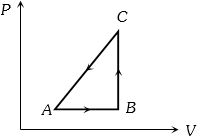
The $P-V$ diagram of a system undergoing a thermodynamic transformation is shown in the figure. The work done on the system in going from $A \to B \to C$ is $50 \, J$ and $20 \, cal$ of heat is given to the system. The change in internal energy between $A$ and $C$ is ...... $J$.
A
$34$
B
$70$
C
$84$
D
$134$
Solution
(D) Given,heat supplied to the system,$\Delta Q = 20 \, cal = 20 \times 4.2 \, J = 84 \, J$.
Work done on the system,$\Delta W = -50 \, J$ (Since work is done on the system,it is negative).
According to the first law of thermodynamics,$\Delta Q = \Delta U + \Delta W$,where $\Delta U$ is the change in internal energy.
Therefore,$\Delta U = \Delta Q - \Delta W$.
Substituting the values,$\Delta U = 84 \, J - (-50 \, J) = 84 \, J + 50 \, J = 134 \, J$.
Thus,the change in internal energy between $A$ and $C$ is $134 \, J$.
Work done on the system,$\Delta W = -50 \, J$ (Since work is done on the system,it is negative).
According to the first law of thermodynamics,$\Delta Q = \Delta U + \Delta W$,where $\Delta U$ is the change in internal energy.
Therefore,$\Delta U = \Delta Q - \Delta W$.
Substituting the values,$\Delta U = 84 \, J - (-50 \, J) = 84 \, J + 50 \, J = 134 \, J$.
Thus,the change in internal energy between $A$ and $C$ is $134 \, J$.
0 likes
View Solution34
MediumMCQ
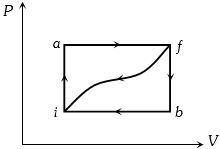
When a system is taken from state $i$ to a state $f$ along path $iaf$,$Q = 50 \, J$ and $W = 20 \, J$. Along path $ibf$,$Q = 35 \, J$. If $W = -13 \, J$ for the curved return path $fi$,$Q$ for this path is ...... $J$.
A
$33$
B
$23$
C
$-7$
D
$-43$
Solution
(D) The change in internal energy $\Delta U$ is a state function,meaning it depends only on the initial and final states,not on the path taken.
For the path $iaf$,the first law of thermodynamics is given by $\Delta Q = \Delta U + \Delta W$.
Given $\Delta Q_{iaf} = 50 \, J$ and $\Delta W_{iaf} = 20 \, J$,we have:
$\Delta U_{if} = \Delta Q_{iaf} - \Delta W_{iaf} = 50 \, J - 20 \, J = 30 \, J$.
For the return path $fi$,the initial state is $f$ and the final state is $i$. Therefore,the change in internal energy is $\Delta U_{fi} = -\Delta U_{if} = -30 \, J$.
Using the first law of thermodynamics for the path $fi$:
$\Delta Q_{fi} = \Delta U_{fi} + \Delta W_{fi}$.
Given $\Delta W_{fi} = -13 \, J$ and $\Delta U_{fi} = -30 \, J$,we get:
$\Delta Q_{fi} = -30 \, J + (-13 \, J) = -43 \, J$.
For the path $iaf$,the first law of thermodynamics is given by $\Delta Q = \Delta U + \Delta W$.
Given $\Delta Q_{iaf} = 50 \, J$ and $\Delta W_{iaf} = 20 \, J$,we have:
$\Delta U_{if} = \Delta Q_{iaf} - \Delta W_{iaf} = 50 \, J - 20 \, J = 30 \, J$.
For the return path $fi$,the initial state is $f$ and the final state is $i$. Therefore,the change in internal energy is $\Delta U_{fi} = -\Delta U_{if} = -30 \, J$.
Using the first law of thermodynamics for the path $fi$:
$\Delta Q_{fi} = \Delta U_{fi} + \Delta W_{fi}$.
Given $\Delta W_{fi} = -13 \, J$ and $\Delta U_{fi} = -30 \, J$,we get:
$\Delta Q_{fi} = -30 \, J + (-13 \, J) = -43 \, J$.
0 likes
View Solution35
MediumMCQ
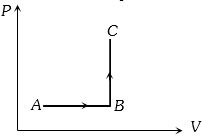
The $P-V$ diagram of a system undergoing a thermodynamic transformation is shown in the figure. The work done by the system in going from $A \to B \to C$ is $30 \ J$ and $40 \ J$ of heat is given to the system. The change in internal energy between $A$ and $C$ is ....... $J$.
A
$10$
B
$70$
C
$84$
D
$134$
Solution
(A) According to the first law of thermodynamics,the heat supplied to a system $(\Delta Q)$ is equal to the sum of the change in internal energy $(\Delta U)$ and the work done by the system $(\Delta W)$:
$\Delta Q = \Delta U + \Delta W$
Given:
Heat supplied,$\Delta Q = 40 \ J$
Work done,$\Delta W = 30 \ J$
Substituting these values into the equation:
$40 \ J = \Delta U + 30 \ J$
$\Delta U = 40 \ J - 30 \ J = 10 \ J$
Therefore,the change in internal energy between $A$ and $C$ is $10 \ J$.
$\Delta Q = \Delta U + \Delta W$
Given:
Heat supplied,$\Delta Q = 40 \ J$
Work done,$\Delta W = 30 \ J$
Substituting these values into the equation:
$40 \ J = \Delta U + 30 \ J$
$\Delta U = 40 \ J - 30 \ J = 10 \ J$
Therefore,the change in internal energy between $A$ and $C$ is $10 \ J$.
0 likes
View Solution36
DifficultMCQ
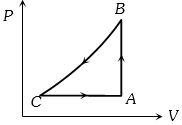
$A$ sample of an ideal gas is taken through a cycle as shown in the figure. It absorbs $50 \ J$ of energy during the process $AB$,no heat during $BC$,and rejects $70 \ J$ during $CA$. $40 \ J$ of work is done on the gas during $BC$. If the internal energy of the gas at $A$ is $1500 \ J$,the internal energy at $C$ would be ........ $J$.
A
$1590$
B
$1620$
C
$1540$
D
$1570$
Solution
(A) From the given $P-V$ diagram,process $AB$ is an isochoric process (volume is constant).
For process $AB$:
$\Delta W_{AB} = 0$
Using the first law of thermodynamics,$\Delta Q_{AB} = \Delta U_{AB} + \Delta W_{AB}$.
Given $\Delta Q_{AB} = 50 \ J$,so $\Delta U_{AB} = 50 \ J$.
Since $U_A = 1500 \ J$,then $U_B = U_A + \Delta U_{AB} = 1500 + 50 = 1550 \ J$.
For process $BC$:
Given $\Delta Q_{BC} = 0$ (adiabatic process).
Work done on the gas is $\Delta W_{BC} = -40 \ J$ (since work is done on the gas,it is negative).
Using the first law,$\Delta Q_{BC} = \Delta U_{BC} + \Delta W_{BC}$.
$0 = \Delta U_{BC} - 40 \ J \implies \Delta U_{BC} = 40 \ J$.
Therefore,$U_C = U_B + \Delta U_{BC} = 1550 + 40 = 1590 \ J$.
For process $AB$:
$\Delta W_{AB} = 0$
Using the first law of thermodynamics,$\Delta Q_{AB} = \Delta U_{AB} + \Delta W_{AB}$.
Given $\Delta Q_{AB} = 50 \ J$,so $\Delta U_{AB} = 50 \ J$.
Since $U_A = 1500 \ J$,then $U_B = U_A + \Delta U_{AB} = 1500 + 50 = 1550 \ J$.
For process $BC$:
Given $\Delta Q_{BC} = 0$ (adiabatic process).
Work done on the gas is $\Delta W_{BC} = -40 \ J$ (since work is done on the gas,it is negative).
Using the first law,$\Delta Q_{BC} = \Delta U_{BC} + \Delta W_{BC}$.
$0 = \Delta U_{BC} - 40 \ J \implies \Delta U_{BC} = 40 \ J$.
Therefore,$U_C = U_B + \Delta U_{BC} = 1550 + 40 = 1590 \ J$.
0 likes
View Solution37
EasyMCQ
The first law of thermodynamics is a special case of which law?
A
Newton's law
B
Law of conservation of energy
C
Charles's law
D
Law of thermal expansion
Solution
(B) The first law of thermodynamics states that $\Delta Q = \Delta U + \Delta W$. This equation represents the principle of conservation of energy,where the heat supplied to a system $(\Delta Q)$ is used to increase its internal energy $(\Delta U)$ and to perform work against external pressure $(\Delta W)$. Thus,it is a direct application of the law of conservation of energy.
0 likes
View Solution38
MediumMCQ
$A$ gas is compressed at a constant pressure of $50 \ N/m^{2}$ from a volume of $10 \ m^{3}$ to $4 \ m^{3}$. Then,the gas is heated by supplying $100 \ J$ of energy. The increase in its internal energy will be ..... $J$.
A
$400$
B
$200$
C
$100$
D
$300$
Solution
(A) According to the first law of thermodynamics,$\Delta Q = \Delta U + \Delta W$.
Here,the work done on the gas during compression is $\Delta W = P \Delta V$.
Since the volume changes from $10 \ m^{3}$ to $4 \ m^{3}$,$\Delta V = (4 - 10) \ m^{3} = -6 \ m^{3}$.
Thus,$\Delta W = 50 \times (-6) = -300 \ J$.
The heat supplied is $\Delta Q = 100 \ J$.
Using the first law: $\Delta U = \Delta Q - \Delta W$.
$\Delta U = 100 - (-300) = 100 + 300 = 400 \ J$.
Here,the work done on the gas during compression is $\Delta W = P \Delta V$.
Since the volume changes from $10 \ m^{3}$ to $4 \ m^{3}$,$\Delta V = (4 - 10) \ m^{3} = -6 \ m^{3}$.
Thus,$\Delta W = 50 \times (-6) = -300 \ J$.
The heat supplied is $\Delta Q = 100 \ J$.
Using the first law: $\Delta U = \Delta Q - \Delta W$.
$\Delta U = 100 - (-300) = 100 + 300 = 400 \ J$.
0 likes
View Solution39
MediumMCQ
During a thermodynamic process,the pressure of a fixed mass of gas is changed in such a way that the gas releases $20 \ J$ of heat and $10 \ J$ of work is done on the gas. If the initial internal energy of the gas is $40 \ J$,then the final internal energy is ...... $J$.
A
$30$
B
$20$
C
$60$
D
$40$
Solution
(A) According to the first law of thermodynamics,$\Delta Q = \Delta U + \Delta W$.
Here,the gas releases heat,so $\Delta Q = -20 \ J$.
Work is done on the gas,so $\Delta W = -10 \ J$.
The initial internal energy $U_1 = 40 \ J$.
Substituting these values into the equation: $-20 = (U_2 - 40) + (-10)$.
$-20 = U_2 - 40 - 10$.
$-20 = U_2 - 50$.
$U_2 = 50 - 20 = 30 \ J$.
Here,the gas releases heat,so $\Delta Q = -20 \ J$.
Work is done on the gas,so $\Delta W = -10 \ J$.
The initial internal energy $U_1 = 40 \ J$.
Substituting these values into the equation: $-20 = (U_2 - 40) + (-10)$.
$-20 = U_2 - 40 - 10$.
$-20 = U_2 - 50$.
$U_2 = 50 - 20 = 30 \ J$.
0 likes
View Solution40
MediumMCQ
An ideal gas is contained in a thermally insulated rigid container. It is heated by a filament of $100 \, \Omega$ resistance by passing a current of $1 \, A$ for $5 \, \text{min}$. The change in internal energy is .... $kJ$?
A
$0$
B
$10$
C
$20$
D
$30$
Solution
(D) Since the container is rigid,the volume of the ideal gas remains constant,so the work done $W = P \Delta V = 0$.
According to the first law of thermodynamics,$\Delta Q = \Delta U + W$. Since $W = 0$,we have $\Delta Q = \Delta U$.
The heat supplied by the filament is given by Joule's law of heating: $\Delta Q = i^2 R t$.
Given: $i = 1 \, A$,$R = 100 \, \Omega$,and $t = 5 \, \text{min} = 5 \times 60 \, \text{s} = 300 \, \text{s}$.
Substituting the values: $\Delta U = (1)^2 \times 100 \times 300 = 30,000 \, \text{J} = 30 \, \text{kJ}$.
According to the first law of thermodynamics,$\Delta Q = \Delta U + W$. Since $W = 0$,we have $\Delta Q = \Delta U$.
The heat supplied by the filament is given by Joule's law of heating: $\Delta Q = i^2 R t$.
Given: $i = 1 \, A$,$R = 100 \, \Omega$,and $t = 5 \, \text{min} = 5 \times 60 \, \text{s} = 300 \, \text{s}$.
Substituting the values: $\Delta U = (1)^2 \times 100 \times 300 = 30,000 \, \text{J} = 30 \, \text{kJ}$.
0 likes
View Solution41
DifficultMCQ
When $1500 \ J$ of heat is supplied to a gas at a constant pressure of $2.5 \times 10^{5} \ N/m^{2}$,the volume increases by $2.5 \times 10^{-3} \ m^{3}$. The increase in the internal energy of the gas is ..... $J$?
A
$450$
B
$525$
C
$875$
D
$2025$
Solution
(C) According to the first law of thermodynamics,$\Delta Q = \Delta U + W$.
Here,the work done by the gas at constant pressure is $W = P \Delta V$.
Given: $\Delta Q = 1500 \ J$,$P = 2.5 \times 10^{5} \ N/m^{2}$,and $\Delta V = 2.5 \times 10^{-3} \ m^{3}$.
Calculating the work done: $W = (2.5 \times 10^{5}) \times (2.5 \times 10^{-3}) = 6.25 \times 10^{2} = 625 \ J$.
Now,substituting the values into the first law equation: $\Delta U = \Delta Q - W$.
$\Delta U = 1500 \ J - 625 \ J = 875 \ J$.
Therefore,the increase in internal energy is $875 \ J$.
Here,the work done by the gas at constant pressure is $W = P \Delta V$.
Given: $\Delta Q = 1500 \ J$,$P = 2.5 \times 10^{5} \ N/m^{2}$,and $\Delta V = 2.5 \times 10^{-3} \ m^{3}$.
Calculating the work done: $W = (2.5 \times 10^{5}) \times (2.5 \times 10^{-3}) = 6.25 \times 10^{2} = 625 \ J$.
Now,substituting the values into the first law equation: $\Delta U = \Delta Q - W$.
$\Delta U = 1500 \ J - 625 \ J = 875 \ J$.
Therefore,the increase in internal energy is $875 \ J$.
0 likes
View Solution42
MediumMCQ
If the heat given to a system is $35 \ J$ and the work done on the system is $15 \ J$,then the change in the internal energy of the system is ... $J$?
A
$-50$
B
$20$
C
$30$
D
$50$
Solution
(D) According to the first law of thermodynamics,$\Delta Q = \Delta U + \Delta W$,which implies $\Delta U = \Delta Q - \Delta W$.
In this problem,the heat supplied to the system is $\Delta Q = +35 \ J$.
Since work is done on the system,the work done by the system is negative,so $\Delta W = -15 \ J$.
Substituting these values into the equation: $\Delta U = 35 \ J - (-15 \ J) = 35 \ J + 15 \ J = 50 \ J$.
Therefore,the change in internal energy is $50 \ J$.
In this problem,the heat supplied to the system is $\Delta Q = +35 \ J$.
Since work is done on the system,the work done by the system is negative,so $\Delta W = -15 \ J$.
Substituting these values into the equation: $\Delta U = 35 \ J - (-15 \ J) = 35 \ J + 15 \ J = 50 \ J$.
Therefore,the change in internal energy is $50 \ J$.
0 likes
View Solution43
MediumMCQ
When $2 \ kg$ of water is boiled at atmospheric pressure,it converts into steam. The volume increases from $2 \times 10^{-3} \ m^3$ to $3.34 \ m^3$. The work done by the system is ....... $kJ$.
A
$-340$
B
$-170$
C
$170$
D
$340$
Solution
(D) The work done by the system is given by the formula $W = P \Delta V$.
Here,the atmospheric pressure $P = 1.013 \times 10^5 \ Pa$.
The change in volume is $\Delta V = V_2 - V_1 = 3.34 \ m^3 - 0.002 \ m^3 = 3.338 \ m^3$.
Substituting the values: $W = (1.013 \times 10^5 \ Pa) \times (3.338 \ m^3)$.
$W \approx 3.38 \times 10^5 \ J = 338 \ kJ$.
Rounding to the nearest provided option,the work done is approximately $340 \ kJ$.
Here,the atmospheric pressure $P = 1.013 \times 10^5 \ Pa$.
The change in volume is $\Delta V = V_2 - V_1 = 3.34 \ m^3 - 0.002 \ m^3 = 3.338 \ m^3$.
Substituting the values: $W = (1.013 \times 10^5 \ Pa) \times (3.338 \ m^3)$.
$W \approx 3.38 \times 10^5 \ J = 338 \ kJ$.
Rounding to the nearest provided option,the work done is approximately $340 \ kJ$.
0 likes
View Solution44
DifficultMCQ
$A$ thermodynamic system absorbs $2 \, kcal$ of heat and performs $500 \, J$ of work. The change in its internal energy is ......... $J$.
A
$8900$
B
$6400$
C
$5400$
D
$7900$
Solution
(D) According to the first law of thermodynamics,$\Delta Q = \Delta U + \Delta W$.
Here,the heat absorbed $\Delta Q = 2 \, kcal = 2 \times 10^3 \, cal$.
Since $1 \, cal = 4.2 \, J$,we have $\Delta Q = 2000 \times 4.2 = 8400 \, J$.
The work done by the system is $\Delta W = 500 \, J$.
Using the formula $\Delta U = \Delta Q - \Delta W$,we get:
$\Delta U = 8400 \, J - 500 \, J = 7900 \, J$.
Therefore,the change in internal energy is $7900 \, J$.
Here,the heat absorbed $\Delta Q = 2 \, kcal = 2 \times 10^3 \, cal$.
Since $1 \, cal = 4.2 \, J$,we have $\Delta Q = 2000 \times 4.2 = 8400 \, J$.
The work done by the system is $\Delta W = 500 \, J$.
Using the formula $\Delta U = \Delta Q - \Delta W$,we get:
$\Delta U = 8400 \, J - 500 \, J = 7900 \, J$.
Therefore,the change in internal energy is $7900 \, J$.
0 likes
View Solution45
DifficultMCQ
$A$ gas is supplied with $1500 \; J$ of heat energy at constant pressure. If the constant pressure of the gas is $2.1 \times 10^{5} \; N/m^{2}$ and the increase in volume is $2.5 \times 10^{-3} \; m^{3}$,then the increase in the internal energy of the gas is ...... $J$.
A
$450$
B
$525$
C
$975$
D
$2025$
Solution
(C) According to the first law of thermodynamics:
$\Delta Q = \Delta U + \Delta W$
Since the process occurs at constant pressure,the work done is $\Delta W = P \Delta V$.
Therefore,$\Delta Q = \Delta U + P \Delta V$.
Given:
$\Delta Q = 1500 \; J$
$P = 2.1 \times 10^{5} \; N/m^{2}$
$\Delta V = 2.5 \times 10^{-3} \; m^{3}$
Calculating the work done:
$\Delta W = P \Delta V = (2.1 \times 10^{5}) \times (2.5 \times 10^{-3}) = 525 \; J$.
Now,calculating the change in internal energy:
$\Delta U = \Delta Q - \Delta W = 1500 - 525 = 975 \; J$.
$\Delta Q = \Delta U + \Delta W$
Since the process occurs at constant pressure,the work done is $\Delta W = P \Delta V$.
Therefore,$\Delta Q = \Delta U + P \Delta V$.
Given:
$\Delta Q = 1500 \; J$
$P = 2.1 \times 10^{5} \; N/m^{2}$
$\Delta V = 2.5 \times 10^{-3} \; m^{3}$
Calculating the work done:
$\Delta W = P \Delta V = (2.1 \times 10^{5}) \times (2.5 \times 10^{-3}) = 525 \; J$.
Now,calculating the change in internal energy:
$\Delta U = \Delta Q - \Delta W = 1500 - 525 = 975 \; J$.
0 likes
View Solution46
DifficultMCQ
$A$ container contains $1 \text{ mole}$ of a gas with molar mass $M$ and adiabatic index $\gamma = C_P/C_V$. The container is moving with a velocity $v$. When it suddenly stops,the kinetic energy of the container is converted into the internal energy of the gas. The rise in the temperature of the gas is:
A
$\frac{Mv^2}{2R(\gamma + 1)}$
B
$\frac{Mv^2(\gamma - 1)}{2R}$
C
$\frac{Mv^2}{2R(\gamma - 1)}$
D
$\frac{Mv^2}{2R}$
Solution
(B) The kinetic energy of the container is $K = \frac{1}{2} M v^2$ (since it contains $1 \text{ mole}$,mass $m = M$).
When the container stops,this kinetic energy is converted into the internal energy of the gas,$\Delta U = \mu C_V \Delta T$.
Since $\mu = 1 \text{ mole}$,we have $\Delta U = C_V \Delta T$.
We know that $C_V = \frac{R}{\gamma - 1}$.
Equating the kinetic energy to the change in internal energy:
$\frac{1}{2} M v^2 = C_V \Delta T$
$\frac{1}{2} M v^2 = \frac{R}{\gamma - 1} \Delta T$
Solving for $\Delta T$:
$\Delta T = \frac{M v^2 (\gamma - 1)}{2R}$.
When the container stops,this kinetic energy is converted into the internal energy of the gas,$\Delta U = \mu C_V \Delta T$.
Since $\mu = 1 \text{ mole}$,we have $\Delta U = C_V \Delta T$.
We know that $C_V = \frac{R}{\gamma - 1}$.
Equating the kinetic energy to the change in internal energy:
$\frac{1}{2} M v^2 = C_V \Delta T$
$\frac{1}{2} M v^2 = \frac{R}{\gamma - 1} \Delta T$
Solving for $\Delta T$:
$\Delta T = \frac{M v^2 (\gamma - 1)}{2R}$.
0 likes
View Solution47
DifficultMCQ
The increase in internal energy of $2$ moles of gas when its temperature is raised from $340 \ K$ to $342 \ K$ is ........ $cal$. Given $C_v = 4.96 \ cal/mole \ K$.
A
$27.80$
B
$19.84$
C
$13.90$
D
$9.92$
Solution
(B) The change in internal energy $\Delta U$ for an ideal gas is given by the formula: $\Delta U = \mu C_v \Delta T$.
Given:
Number of moles $\mu = 2 \ mol$.
Specific heat at constant volume $C_v = 4.96 \ cal/mole \ K$.
Change in temperature $\Delta T = 342 \ K - 340 \ K = 2 \ K$.
Substituting these values into the formula:
$\Delta U = 2 \times 4.96 \times 2$.
$\Delta U = 19.84 \ cal$.
Given:
Number of moles $\mu = 2 \ mol$.
Specific heat at constant volume $C_v = 4.96 \ cal/mole \ K$.
Change in temperature $\Delta T = 342 \ K - 340 \ K = 2 \ K$.
Substituting these values into the formula:
$\Delta U = 2 \times 4.96 \times 2$.
$\Delta U = 19.84 \ cal$.
0 likes
View Solution48
MediumMCQ
When $150 \ J$ of heat is supplied to a system,the work done by the system is $110 \ J$. The change in the internal energy of the system is ....... $J$.
A
$260$
B
$150$
C
$110$
D
$40$
Solution
(D) According to the first law of thermodynamics,the heat supplied to a system $(\Delta Q)$ is equal to the sum of the change in internal energy $(\Delta U)$ and the work done by the system $(\Delta W)$:
$\Delta Q = \Delta U + \Delta W$
Given:
Heat supplied,$\Delta Q = 150 \ J$
Work done by the system,$\Delta W = 110 \ J$
Substituting these values into the equation:
$150 = \Delta U + 110$
$\Delta U = 150 - 110$
$\Delta U = 40 \ J$
Therefore,the change in internal energy is $40 \ J$.
$\Delta Q = \Delta U + \Delta W$
Given:
Heat supplied,$\Delta Q = 150 \ J$
Work done by the system,$\Delta W = 110 \ J$
Substituting these values into the equation:
$150 = \Delta U + 110$
$\Delta U = 150 - 110$
$\Delta U = 40 \ J$
Therefore,the change in internal energy is $40 \ J$.
0 likes
View Solution49
MediumMCQ
When $110 \ J$ of heat is supplied to a system and the change in internal energy is $40 \ J$,the work done is .......... $J$.
A
$150$
B
$70$
C
$110$
D
$40$
Solution
(B) According to the first law of thermodynamics,the heat supplied to a system is equal to the sum of the change in internal energy and the work done by the system.
$\Delta Q = \Delta U + \Delta W$
Given:
$\Delta Q = 110 \ J$
$\Delta U = 40 \ J$
Substituting the values into the equation:
$110 = 40 + \Delta W$
$\Delta W = 110 - 40$
$\Delta W = 70 \ J$
Therefore,the work done is $70 \ J$.
$\Delta Q = \Delta U + \Delta W$
Given:
$\Delta Q = 110 \ J$
$\Delta U = 40 \ J$
Substituting the values into the equation:
$110 = 40 + \Delta W$
$\Delta W = 110 - 40$
$\Delta W = 70 \ J$
Therefore,the work done is $70 \ J$.
0 likes
View SolutionThermodynamics — First Law of Thermodynamics · Frequently Asked Questions
1Are these Thermodynamics questions useful for JEE and NEET?
Yes. All questions in this section are mapped to JEE Main and NEET exam patterns. Previous year questions from JEE Main, NEET, GUJCET and state-level exams are included with full solutions.
2Can I switch to Hindi or Gujarati for these questions?
Yes. Use the language tabs in the hero section or the sidebar to view the same questions and solutions in English, Hindi or Gujarati.
3How do I generate a question paper from this subtopic?
Use the Vedclass Exam Paper Generator — select the chapter and subtopic, set difficulty, and generate Sets A, B, C, D automatically. First 3 chapters of every subject are free.
Vedclass Products
For Students
Vedclass Test Series
Mock tests in real JEE/NEET style with performance analysis. 5-day free trial.
Start Free TrialFor Teachers
Exam Paper Generator
Generate Set A/B/C/D papers from this chapter in 2 minutes. 3 chapters free.
Try FreeFor Institutes
Online Exam Module
Live online exams with unlimited students, 360° analytics & white-label branding.
See DemoFor Teachers & Institutes
Generate a Thermodynamics Exam Paper in 2 Minutes
Select subtopic & difficulty — Sets A, B, C, D auto-generated with No Repeat logic.
First 3 chapters of every subject are free — no payment required.