
A English
Mix Examples-Thermodynamics Questions in English
Class 11 Physics · Thermodynamics · Mix Examples-Thermodynamics
331+
Questions
English
Language
100%
With Solutions
Showing 47 of 331 questions in English
251
EasyMCQ
$A$ quantity of heat $Q$ is supplied to a monoatomic ideal gas which expands at constant pressure. What is the fraction of heat converted into work? Given $\gamma = \frac{C_p}{C_v} = \frac{5}{3}$.
A
$3:5$
B
$5:3$
C
$2:5$
D
$3:2$
Solution
(C) For an ideal gas at constant pressure,the heat supplied is $\Delta Q = n C_p \Delta T$.
The work done is $W = P \Delta V = n R \Delta T$.
The change in internal energy is $\Delta U = n C_v \Delta T$.
According to the first law of thermodynamics,$\Delta Q = \Delta U + W$.
The fraction of heat converted into work is $\frac{W}{\Delta Q} = \frac{\Delta Q - \Delta U}{\Delta Q} = 1 - \frac{\Delta U}{\Delta Q}$.
Since $\Delta U = n C_v \Delta T$ and $\Delta Q = n C_p \Delta T$,we have $\frac{\Delta U}{\Delta Q} = \frac{C_v}{C_p} = \frac{1}{\gamma}$.
Thus,the fraction is $1 - \frac{1}{\gamma} = 1 - \frac{1}{5/3} = 1 - \frac{3}{5} = \frac{2}{5}$.
The work done is $W = P \Delta V = n R \Delta T$.
The change in internal energy is $\Delta U = n C_v \Delta T$.
According to the first law of thermodynamics,$\Delta Q = \Delta U + W$.
The fraction of heat converted into work is $\frac{W}{\Delta Q} = \frac{\Delta Q - \Delta U}{\Delta Q} = 1 - \frac{\Delta U}{\Delta Q}$.
Since $\Delta U = n C_v \Delta T$ and $\Delta Q = n C_p \Delta T$,we have $\frac{\Delta U}{\Delta Q} = \frac{C_v}{C_p} = \frac{1}{\gamma}$.
Thus,the fraction is $1 - \frac{1}{\gamma} = 1 - \frac{1}{5/3} = 1 - \frac{3}{5} = \frac{2}{5}$.
0 likes
View Solution252
EasyMCQ
Out of the following statements,which one is '$NOT$' correct in the case of a thermodynamic process?
A
In an isothermal process,$\Delta T = 0$
B
In an isobaric process,$\Delta P = 0$
C
In an isochoric process,$W = 0$
D
In an isothermal process,$Q = 0$
Solution
(D) In an isothermal process,the temperature remains constant,so $\Delta T = 0$. However,heat exchange $Q$ is not necessarily zero; it is equal to the work done $(Q = W)$.
In an adiabatic process,the heat exchange $Q$ is zero.
Therefore,the statement 'In an isothermal process,$Q = 0$' is incorrect.
In an adiabatic process,the heat exchange $Q$ is zero.
Therefore,the statement 'In an isothermal process,$Q = 0$' is incorrect.
0 likes
View Solution253
EasyMCQ
$A$ monoatomic gas at pressure $P$ having volume $V$ expands isothermally to a volume $2V$ and then adiabatically to a volume $16V$. The final pressure of the gas is $\left(\gamma = \frac{5}{3}\right)$.
A
$\frac{P}{64}$
B
$\frac{P}{128}$
C
$\frac{P}{8}$
D
$\frac{P}{32}$
Solution
(A) For the isothermal process,the relation is $P_1 V_1 = P_2 V_2$. Given $P_1 = P$,$V_1 = V$,and $V_2 = 2V$.
Substituting these values: $P \times V = P_2 \times 2V$,which gives $P_2 = \frac{P}{2}$.
For the adiabatic process,the relation is $P_2 V_2^\gamma = P_3 V_3^\gamma$. Given $V_2 = 2V$,$V_3 = 16V$,and $\gamma = \frac{5}{3}$.
Substituting these values: $P_3 = P_2 \left(\frac{V_2}{V_3}\right)^\gamma = \frac{P}{2} \left(\frac{2V}{16V}\right)^{5/3}$.
$P_3 = \frac{P}{2} \left(\frac{1}{8}\right)^{5/3} = \frac{P}{2} \times \left(\left(\frac{1}{2}\right)^3\right)^{5/3} = \frac{P}{2} \times \left(\frac{1}{2}\right)^5 = \frac{P}{2} \times \frac{1}{32} = \frac{P}{64}$.
Substituting these values: $P \times V = P_2 \times 2V$,which gives $P_2 = \frac{P}{2}$.
For the adiabatic process,the relation is $P_2 V_2^\gamma = P_3 V_3^\gamma$. Given $V_2 = 2V$,$V_3 = 16V$,and $\gamma = \frac{5}{3}$.
Substituting these values: $P_3 = P_2 \left(\frac{V_2}{V_3}\right)^\gamma = \frac{P}{2} \left(\frac{2V}{16V}\right)^{5/3}$.
$P_3 = \frac{P}{2} \left(\frac{1}{8}\right)^{5/3} = \frac{P}{2} \times \left(\left(\frac{1}{2}\right)^3\right)^{5/3} = \frac{P}{2} \times \left(\frac{1}{2}\right)^5 = \frac{P}{2} \times \frac{1}{32} = \frac{P}{64}$.
0 likes
View Solution254
EasyMCQ
For a monoatomic gas, the work done at constant pressure is $W$. The heat supplied at constant volume for the same rise in temperature of the gas is
A
$2 \,W$
B
$W$
C
$\frac{W}{2}$
D
$\frac{3 \,W}{2}$
Solution
(D) At constant pressure, the work done is given by $W = P \Delta V$.
For an ideal gas, $PV = nRT$, so $P \Delta V = nR \Delta T$.
Thus, $W = nR \Delta T$.
Heat supplied at constant volume is given by $Q = \Delta U = nC_v \Delta T$.
For a monoatomic gas, the molar heat capacity at constant volume is $C_v = \frac{3}{2}R$.
Substituting this into the heat equation, we get $Q = n \left( \frac{3}{2}R \right) \Delta T = \frac{3}{2} (nR \Delta T)$.
Since $W = nR \Delta T$, we substitute $W$ into the equation for $Q$:
$Q = \frac{3}{2} W$.
For an ideal gas, $PV = nRT$, so $P \Delta V = nR \Delta T$.
Thus, $W = nR \Delta T$.
Heat supplied at constant volume is given by $Q = \Delta U = nC_v \Delta T$.
For a monoatomic gas, the molar heat capacity at constant volume is $C_v = \frac{3}{2}R$.
Substituting this into the heat equation, we get $Q = n \left( \frac{3}{2}R \right) \Delta T = \frac{3}{2} (nR \Delta T)$.
Since $W = nR \Delta T$, we substitute $W$ into the equation for $Q$:
$Q = \frac{3}{2} W$.
0 likes
View Solution255
MediumMCQ
An ideal gas with pressure $P$,volume $V$ and temperature $T$ is expanded isothermally to a volume $2V$ and a final pressure $P_i$. The same gas is expanded adiabatically to a volume $2V$,the final pressure is $P_a$. In terms of the ratio of the two specific heats for the gas $\gamma$,the ratio $\frac{P_i}{P_a}$ is
A
$2^{\gamma+1}$
B
$2^{\gamma-1}$
C
$2^{1-\gamma}$
D
$2^{\gamma}$
Solution
(B) For isothermal expansion,the process follows Boyle's Law: $P_1 V_1 = P_2 V_2$.
Given $P_1 = P$,$V_1 = V$,and $V_2 = 2V$.
Therefore,$P_i = P \times (V / 2V) = P / 2$.
For adiabatic expansion,the process follows the relation $P_1 V_1^{\gamma} = P_2 V_2^{\gamma}$.
Given $P_1 = P$,$V_1 = V$,and $V_2 = 2V$.
Therefore,$P_a = P \times (V / 2V)^{\gamma} = P / 2^{\gamma}$.
Now,calculating the ratio $\frac{P_i}{P_a}$:
$\frac{P_i}{P_a} = \frac{P/2}{P/2^{\gamma}} = \frac{2^{\gamma}}{2} = 2^{\gamma-1}$.
Given $P_1 = P$,$V_1 = V$,and $V_2 = 2V$.
Therefore,$P_i = P \times (V / 2V) = P / 2$.
For adiabatic expansion,the process follows the relation $P_1 V_1^{\gamma} = P_2 V_2^{\gamma}$.
Given $P_1 = P$,$V_1 = V$,and $V_2 = 2V$.
Therefore,$P_a = P \times (V / 2V)^{\gamma} = P / 2^{\gamma}$.
Now,calculating the ratio $\frac{P_i}{P_a}$:
$\frac{P_i}{P_a} = \frac{P/2}{P/2^{\gamma}} = \frac{2^{\gamma}}{2} = 2^{\gamma-1}$.
0 likes
View Solution256
DifficultMCQ
The initial pressure and volume of a gas are $P$ and $V$ respectively. First,the gas is expanded to a volume of $9V$ by an isothermal process,and then it is compressed to a volume of $V$ by an adiabatic process. What is its final pressure (in $P$)? (Ratio of specific heat at constant pressure to constant volume $\gamma = \frac{3}{2}$)
A
$6$
B
$27$
C
$3$
D
$9$
Solution
(C) Given: $\gamma = \frac{C_p}{C_v} = \frac{3}{2}$.
Case $I$: Isothermal process $(T = \text{constant})$
For an isothermal process,$P_1 V_1 = P_2 V_2$.
Given $P_1 = P$,$V_1 = V$,and $V_2 = 9V$.
$P \times V = P_2 \times 9V$
$P_2 = \frac{P}{9}$.
Case $II$: Adiabatic process $(PV^\gamma = \text{constant})$
For an adiabatic process,$P_2 V_2^\gamma = P_3 V_3^\gamma$.
Given $P_2 = \frac{P}{9}$,$V_2 = 9V$,and $V_3 = V$.
$\frac{P}{9} \times (9V)^{3/2} = P_3 \times (V)^{3/2}$
$P_3 = \frac{P}{9} \times \left(\frac{9V}{V}\right)^{3/2}$
$P_3 = \frac{P}{9} \times (9)^{3/2}$
$P_3 = \frac{P}{9} \times (3^2)^{3/2} = \frac{P}{9} \times 3^3 = \frac{P}{9} \times 27 = 3P$.
Therefore,the final pressure is $3P$.
Case $I$: Isothermal process $(T = \text{constant})$
For an isothermal process,$P_1 V_1 = P_2 V_2$.
Given $P_1 = P$,$V_1 = V$,and $V_2 = 9V$.
$P \times V = P_2 \times 9V$
$P_2 = \frac{P}{9}$.
Case $II$: Adiabatic process $(PV^\gamma = \text{constant})$
For an adiabatic process,$P_2 V_2^\gamma = P_3 V_3^\gamma$.
Given $P_2 = \frac{P}{9}$,$V_2 = 9V$,and $V_3 = V$.
$\frac{P}{9} \times (9V)^{3/2} = P_3 \times (V)^{3/2}$
$P_3 = \frac{P}{9} \times \left(\frac{9V}{V}\right)^{3/2}$
$P_3 = \frac{P}{9} \times (9)^{3/2}$
$P_3 = \frac{P}{9} \times (3^2)^{3/2} = \frac{P}{9} \times 3^3 = \frac{P}{9} \times 27 = 3P$.
Therefore,the final pressure is $3P$.
0 likes
View Solution257
EasyMCQ
Heat is applied to a rigid diatomic gas at constant pressure. The ratio $\Delta Q : \Delta U : \Delta W$ is
A
$5: 7: 2$
B
$7: 5: 2$
C
$2: 5: 7$
D
$5: 2: 7$
Solution
(B) For a process at constant pressure,the heat supplied is given by $\Delta Q = n C_p \Delta T$.
The change in internal energy is given by $\Delta U = n C_v \Delta T$.
The work done is given by $\Delta W = P \Delta V = n R \Delta T$.
Thus,the ratio $\Delta Q : \Delta U : \Delta W = C_p : C_v : R$.
For a rigid diatomic gas,the degrees of freedom $f = 5$.
Therefore,$C_v = \frac{f}{2} R = \frac{5}{2} R$ and $C_p = C_v + R = \frac{7}{2} R$.
Substituting these values,we get $\Delta Q : \Delta U : \Delta W = \frac{7}{2} R : \frac{5}{2} R : R$.
Multiplying by $\frac{2}{R}$,we obtain the ratio $7 : 5 : 2$.
The change in internal energy is given by $\Delta U = n C_v \Delta T$.
The work done is given by $\Delta W = P \Delta V = n R \Delta T$.
Thus,the ratio $\Delta Q : \Delta U : \Delta W = C_p : C_v : R$.
For a rigid diatomic gas,the degrees of freedom $f = 5$.
Therefore,$C_v = \frac{f}{2} R = \frac{5}{2} R$ and $C_p = C_v + R = \frac{7}{2} R$.
Substituting these values,we get $\Delta Q : \Delta U : \Delta W = \frac{7}{2} R : \frac{5}{2} R : R$.
Multiplying by $\frac{2}{R}$,we obtain the ratio $7 : 5 : 2$.
0 likes
View Solution258
MediumMCQ
$A$ monoatomic gas of pressure $P$ having volume $V$ expands isothermally to a volume $2V$ and then adiabatically to a volume $16V$. The final pressure of the gas is (ratio of specific heats $\gamma = \frac{5}{3}$)
A
$\frac{P}{16}$
B
$P$
C
$\frac{P}{32}$
D
$\frac{P}{64}$
Solution
(D) Given: $\gamma = \frac{5}{3}$.
Step $1$: Isothermal expansion from volume $V$ to $2V$.
For an isothermal process,$P_1 V_1 = P_2 V_2$.
$P \times V = P_2 \times 2V$.
Therefore,$P_2 = \frac{P}{2}$.
Step $2$: Adiabatic expansion from volume $2V$ to $16V$.
For an adiabatic process,$P_2 V_2^{\gamma} = P_3 V_3^{\gamma}$.
$P_3 = P_2 \left( \frac{V_2}{V_3} \right)^{\gamma}$.
$P_3 = \frac{P}{2} \left( \frac{2V}{16V} \right)^{5/3} = \frac{P}{2} \left( \frac{1}{8} \right)^{5/3}$.
$P_3 = \frac{P}{2} \left( (2^{-3})^{5/3} \right) = \frac{P}{2} \times 2^{-5} = \frac{P}{2 \times 32} = \frac{P}{64}$.
Step $1$: Isothermal expansion from volume $V$ to $2V$.
For an isothermal process,$P_1 V_1 = P_2 V_2$.
$P \times V = P_2 \times 2V$.
Therefore,$P_2 = \frac{P}{2}$.
Step $2$: Adiabatic expansion from volume $2V$ to $16V$.
For an adiabatic process,$P_2 V_2^{\gamma} = P_3 V_3^{\gamma}$.
$P_3 = P_2 \left( \frac{V_2}{V_3} \right)^{\gamma}$.
$P_3 = \frac{P}{2} \left( \frac{2V}{16V} \right)^{5/3} = \frac{P}{2} \left( \frac{1}{8} \right)^{5/3}$.
$P_3 = \frac{P}{2} \left( (2^{-3})^{5/3} \right) = \frac{P}{2} \times 2^{-5} = \frac{P}{2 \times 32} = \frac{P}{64}$.
0 likes
View Solution259
DifficultMCQ
$A$ gas of mass '$m$' and molecular weight '$M$' is flowing in an insulated tube with a velocity '$2V$'. If the flow of the gas is suddenly stopped and all the kinetic energy is utilized to compress the gas,the increase in the temperature of the gas is ($\gamma$ is the ratio of specific heats,$R$ is the universal gas constant).
A
$\frac{2MV^2(\gamma-1)}{R}$
B
$\frac{mV^2(\gamma-1)}{2MR}$
C
$\frac{mV^2\gamma}{2R}$
D
$\frac{MV^2\gamma}{2R}$
Solution
(A) Since the gas flow is suddenly stopped in an insulated tube,the process is adiabatic.
The kinetic energy of the gas is given by $K.E. = \frac{1}{2}m(2V)^2 = 2mV^2$.
In an adiabatic process,the work done to compress the gas is equal to the change in internal energy,which is given by $\Delta U = \frac{nR\Delta T}{\gamma-1}$.
Since the number of moles $n = \frac{m}{M}$,we have $\Delta U = \frac{mR\Delta T}{M(\gamma-1)}$.
Equating the kinetic energy to the change in internal energy:
$2mV^2 = \frac{mR\Delta T}{M(\gamma-1)}$.
Solving for $\Delta T$:
$\Delta T = \frac{2MV^2(\gamma-1)}{R}$.
The kinetic energy of the gas is given by $K.E. = \frac{1}{2}m(2V)^2 = 2mV^2$.
In an adiabatic process,the work done to compress the gas is equal to the change in internal energy,which is given by $\Delta U = \frac{nR\Delta T}{\gamma-1}$.
Since the number of moles $n = \frac{m}{M}$,we have $\Delta U = \frac{mR\Delta T}{M(\gamma-1)}$.
Equating the kinetic energy to the change in internal energy:
$2mV^2 = \frac{mR\Delta T}{M(\gamma-1)}$.
Solving for $\Delta T$:
$\Delta T = \frac{2MV^2(\gamma-1)}{R}$.
0 likes
View Solution260
MediumMCQ
When $80 \ J$ of heat is supplied to a gas at constant pressure,if the work done by the gas is $20 \ J$,then the ratio of the specific heat capacities of the gas is
A
$4/3$
B
$5/3$
C
$7/5$
D
$9/7$
Solution
(A) Given: Heat supplied at constant pressure,$Q_p = 80 \ J$. Work done by the gas,$W = 20 \ J$.
According to the First Law of Thermodynamics,$Q_p = \Delta U + W$,where $\Delta U$ is the change in internal energy.
$\Delta U = Q_p - W = 80 \ J - 20 \ J = 60 \ J$.
We know that $Q_p = n C_p \Delta T$ and $\Delta U = n C_v \Delta T$.
Therefore,the ratio $\frac{Q_p}{\Delta U} = \frac{n C_p \Delta T}{n C_v \Delta T} = \frac{C_p}{C_v} = \gamma$.
Substituting the values,$\gamma = \frac{80}{60} = \frac{4}{3}$.
Thus,the ratio of the specific heat capacities is $4/3$.
According to the First Law of Thermodynamics,$Q_p = \Delta U + W$,where $\Delta U$ is the change in internal energy.
$\Delta U = Q_p - W = 80 \ J - 20 \ J = 60 \ J$.
We know that $Q_p = n C_p \Delta T$ and $\Delta U = n C_v \Delta T$.
Therefore,the ratio $\frac{Q_p}{\Delta U} = \frac{n C_p \Delta T}{n C_v \Delta T} = \frac{C_p}{C_v} = \gamma$.
Substituting the values,$\gamma = \frac{80}{60} = \frac{4}{3}$.
Thus,the ratio of the specific heat capacities is $4/3$.
0 likes
View Solution261
MediumMCQ
The change in internal energy of a given mass of a gas,when its volume changes from $V$ to $3V$ at constant pressure $P$,is (where $\gamma$ is the ratio of the specific heat capacities of the gas).
A
$\frac{PV}{\gamma-1}$
B
$\frac{2 PV}{\gamma-1}$
C
$\frac{3 PV}{\gamma-1}$
D
$\frac{PV}{2 \gamma-1}$
Solution
(B) The change in internal energy $\Delta U$ of an ideal gas is given by the formula $\Delta U = n C_v \Delta T$.
We know that $C_v = \frac{R}{\gamma-1}$.
Substituting this,we get $\Delta U = n \left( \frac{R}{\gamma-1} \right) \Delta T = \frac{n R \Delta T}{\gamma-1}$.
From the ideal gas equation at constant pressure,$PV = nRT$,so $n R \Delta T = P \Delta V$.
Here,the change in volume is $\Delta V = 3V - V = 2V$.
Therefore,$n R \Delta T = P(2V) = 2PV$.
Substituting this into the internal energy equation: $\Delta U = \frac{2PV}{\gamma-1}$.
We know that $C_v = \frac{R}{\gamma-1}$.
Substituting this,we get $\Delta U = n \left( \frac{R}{\gamma-1} \right) \Delta T = \frac{n R \Delta T}{\gamma-1}$.
From the ideal gas equation at constant pressure,$PV = nRT$,so $n R \Delta T = P \Delta V$.
Here,the change in volume is $\Delta V = 3V - V = 2V$.
Therefore,$n R \Delta T = P(2V) = 2PV$.
Substituting this into the internal energy equation: $\Delta U = \frac{2PV}{\gamma-1}$.
0 likes
View Solution262
EasyMCQ
When $100 \ J$ of heat is supplied to a gas,the increase in the internal energy of the gas is $60 \ J$. Then the gas is/can
A
be triatomic or diatomic gas
B
Triatomic gas
C
Monoatomic gas
D
Diatomic gas
Solution
(C) Given: Heat supplied $Q = 100 \ J$,Change in internal energy $\Delta U = 60 \ J$.
According to the First Law of Thermodynamics,$Q = \Delta U + W$,so the work done $W = Q - \Delta U = 100 - 60 = 40 \ J$.
We know that $\Delta U = n C_v \Delta T$ and $Q = n C_p \Delta T$.
Therefore,$\frac{Q}{\Delta U} = \frac{C_p}{C_v} = \gamma$.
Substituting the values,$\gamma = \frac{100}{60} = \frac{5}{3} \approx 1.67$.
Since the adiabatic index $\gamma = 1.67$ corresponds to a monoatomic gas,the gas is monoatomic.
According to the First Law of Thermodynamics,$Q = \Delta U + W$,so the work done $W = Q - \Delta U = 100 - 60 = 40 \ J$.
We know that $\Delta U = n C_v \Delta T$ and $Q = n C_p \Delta T$.
Therefore,$\frac{Q}{\Delta U} = \frac{C_p}{C_v} = \gamma$.
Substituting the values,$\gamma = \frac{100}{60} = \frac{5}{3} \approx 1.67$.
Since the adiabatic index $\gamma = 1.67$ corresponds to a monoatomic gas,the gas is monoatomic.
0 likes
View Solution263
EasyMCQ
$A$ monoatomic gas of $n$-moles is heated from temperature $T_1$ to $T_2$ under two different conditions: $(i)$ at constant volume and (ii) at constant pressure. The change in internal energy of the gas is
A
More when heated at constant volume
B
More when heated at constant pressure
C
Same in both the cases
D
Zero in both the cases
Solution
(C) The internal energy $U$ of an ideal gas depends only on its temperature $T$.
For a monoatomic gas,the degrees of freedom $f = 3$.
The change in internal energy is given by the formula $\Delta U = \frac{n f R \Delta T}{2}$.
$(i)$ At constant volume: $\Delta U_1 = \frac{n(3)R(T_2 - T_1)}{2} = \frac{3}{2} nR(T_2 - T_1)$.
(ii) At constant pressure: $\Delta U_2 = \frac{n(3)R(T_2 - T_1)}{2} = \frac{3}{2} nR(T_2 - T_1)$.
Since the change in temperature $\Delta T = T_2 - T_1$ is the same in both cases,the change in internal energy is the same in both cases.
For a monoatomic gas,the degrees of freedom $f = 3$.
The change in internal energy is given by the formula $\Delta U = \frac{n f R \Delta T}{2}$.
$(i)$ At constant volume: $\Delta U_1 = \frac{n(3)R(T_2 - T_1)}{2} = \frac{3}{2} nR(T_2 - T_1)$.
(ii) At constant pressure: $\Delta U_2 = \frac{n(3)R(T_2 - T_1)}{2} = \frac{3}{2} nR(T_2 - T_1)$.
Since the change in temperature $\Delta T = T_2 - T_1$ is the same in both cases,the change in internal energy is the same in both cases.
0 likes
View Solution264
MediumMCQ
When a monatomic gas expands at constant pressure,the percentages of heat supplied that is used to do external work and to increase its internal energy are respectively:
A
$40$,$60$
B
$25$,$75$
C
$60$,$40$
D
$75$,$25$
Solution
(A) For a monatomic gas,the degrees of freedom $f = 3$.
$C_p = \frac{5}{2}R$ and $C_v = \frac{3}{2}R$.
Total heat supplied at constant pressure is $Q = n C_p \Delta T = \frac{5}{2} nR \Delta T$.
Heat used to increase internal energy is $\Delta U = n C_v \Delta T = \frac{3}{2} nR \Delta T$.
Percentage of heat used to increase internal energy $= \frac{\Delta U}{Q} \times 100 = \frac{\frac{3}{2} nR \Delta T}{\frac{5}{2} nR \Delta T} \times 100 = 60\%$.
Heat used to do external work is $W = P \Delta V = nR \Delta T$.
Percentage of heat used to do external work $= \frac{W}{Q} \times 100 = \frac{nR \Delta T}{\frac{5}{2} nR \Delta T} \times 100 = 40\%$.
Thus,the percentages are $40\%$ and $60\%$ respectively.
$C_p = \frac{5}{2}R$ and $C_v = \frac{3}{2}R$.
Total heat supplied at constant pressure is $Q = n C_p \Delta T = \frac{5}{2} nR \Delta T$.
Heat used to increase internal energy is $\Delta U = n C_v \Delta T = \frac{3}{2} nR \Delta T$.
Percentage of heat used to increase internal energy $= \frac{\Delta U}{Q} \times 100 = \frac{\frac{3}{2} nR \Delta T}{\frac{5}{2} nR \Delta T} \times 100 = 60\%$.
Heat used to do external work is $W = P \Delta V = nR \Delta T$.
Percentage of heat used to do external work $= \frac{W}{Q} \times 100 = \frac{nR \Delta T}{\frac{5}{2} nR \Delta T} \times 100 = 40\%$.
Thus,the percentages are $40\%$ and $60\%$ respectively.
0 likes
View Solution265
MediumMCQ
Match the following:
Codes:
$A \quad B \quad C \quad D$
| Column $I$ | Column $II$ |
| $A$. Ratio of $\frac{\Delta Q}{\Delta U}$ in an isobaric process | $1$. $\frac{T_1}{T_1-T_2}$ |
| $B$. Ratio of $\frac{\Delta Q}{\Delta W}$ in an isobaric process | $2$. $\frac{T_2}{T_1-T_2}$ |
| $C$. Coefficient of performance of a refrigerator | $3$. $\frac{\gamma}{\gamma-1}$ |
| $D$. Coefficient of performance of a heat pump | $4$. $\gamma$ |
Codes:
$A \quad B \quad C \quad D$
A
$4 \quad 3 \quad 2 \quad 1$
B
$2 \quad 1 \quad 4 \quad 3$
C
$3 \quad 1 \quad 2 \quad 4$
D
$4 \quad 2 \quad 3 \quad 1$
Solution
(A) For an isobaric process,the heat supplied is $\Delta Q = C_p \Delta T$ and the change in internal energy is $\Delta U = C_V \Delta T$.
Thus,$\frac{\Delta Q}{\Delta U} = \frac{C_p \Delta T}{C_V \Delta T} = \frac{C_p}{C_V} = \gamma$. So,$A \rightarrow 4$.
For an isobaric process,$\Delta Q = \Delta U + \Delta W$,so $\Delta W = \Delta Q - \Delta U = (C_p - C_V) \Delta T$.
Thus,$\frac{\Delta Q}{\Delta W} = \frac{C_p \Delta T}{(C_p - C_V) \Delta T} = \frac{C_p}{C_p - C_V} = \frac{C_p/C_V}{(C_p/C_V) - 1} = \frac{\gamma}{\gamma - 1}$. So,$B \rightarrow 3$.
For a refrigerator,the coefficient of performance $\beta = \frac{Q_2}{W} = \frac{Q_2}{Q_1 - Q_2} = \frac{T_2}{T_1 - T_2}$. So,$C \rightarrow 2$.
For a heat pump,the coefficient of performance $\alpha = \frac{Q_1}{W} = \frac{Q_1}{Q_1 - Q_2} = \frac{T_1}{T_1 - T_2}$. So,$D \rightarrow 1$.
Therefore,the correct match is $A \rightarrow 4, B \rightarrow 3, C \rightarrow 2, D \rightarrow 1$.
Thus,$\frac{\Delta Q}{\Delta U} = \frac{C_p \Delta T}{C_V \Delta T} = \frac{C_p}{C_V} = \gamma$. So,$A \rightarrow 4$.
For an isobaric process,$\Delta Q = \Delta U + \Delta W$,so $\Delta W = \Delta Q - \Delta U = (C_p - C_V) \Delta T$.
Thus,$\frac{\Delta Q}{\Delta W} = \frac{C_p \Delta T}{(C_p - C_V) \Delta T} = \frac{C_p}{C_p - C_V} = \frac{C_p/C_V}{(C_p/C_V) - 1} = \frac{\gamma}{\gamma - 1}$. So,$B \rightarrow 3$.
For a refrigerator,the coefficient of performance $\beta = \frac{Q_2}{W} = \frac{Q_2}{Q_1 - Q_2} = \frac{T_2}{T_1 - T_2}$. So,$C \rightarrow 2$.
For a heat pump,the coefficient of performance $\alpha = \frac{Q_1}{W} = \frac{Q_1}{Q_1 - Q_2} = \frac{T_1}{T_1 - T_2}$. So,$D \rightarrow 1$.
Therefore,the correct match is $A \rightarrow 4, B \rightarrow 3, C \rightarrow 2, D \rightarrow 1$.
0 likes
View Solution266
MediumMCQ
$A$ gas is compressed from a volume of $2 \,m^3$ to a volume of $1 \,m^3$ at a constant pressure of $100 \,N m^{-2}$. Then it is heated at constant volume by supplying $150 \,J$ of energy. As a result,the internal energy of the gas
A
increase by $250 \,J$
B
decrease by $250 \,J$
C
decrease by $50 \,J$
D
increase by $50 \,J$
Solution
$(A)$ The gas is compressed from $V_1 = 2 \,m^3$ to $V_2 = 1 \,m^3$ at a constant pressure $P = 100 \,N m^{-2}$.
Work done on the gas is $W = -P \Delta V = -100 \times (1 - 2) = 100 \,J$.
Note: Work done $BY$ the gas is $P \Delta V = -100 \,J$,so work done $ON$ the gas is $+100 \,J$.
Heat supplied to the system is $Q = 150 \,J$.
According to the first law of thermodynamics,$\Delta U = Q + W_{on}$.
$\Delta U = 150 \,J + 100 \,J = 250 \,J$.
Therefore,the internal energy increases by $250 \,J$.
Work done on the gas is $W = -P \Delta V = -100 \times (1 - 2) = 100 \,J$.
Note: Work done $BY$ the gas is $P \Delta V = -100 \,J$,so work done $ON$ the gas is $+100 \,J$.
Heat supplied to the system is $Q = 150 \,J$.
According to the first law of thermodynamics,$\Delta U = Q + W_{on}$.
$\Delta U = 150 \,J + 100 \,J = 250 \,J$.
Therefore,the internal energy increases by $250 \,J$.
0 likes
View Solution267
EasyMCQ
$A$ gas expands with temperature according to the relation,$V=k T^{2/3}$,where $k$ is a constant. Work done when the temperature changes by $60 \ K$ is ($R=$ universal gas constant.) (in $R$)
A
$10$
B
$20$
C
$50$
D
$40$
Solution
(D) Given the relation $V = k T^{2/3}$.
From the ideal gas law,$PV = RT$ (for $1 \ mole$),so $P = \frac{RT}{V}$.
The work done is given by $W = \int P \ dV = \int \frac{RT}{V} \ dV$.
From $V = k T^{2/3}$,we differentiate with respect to $T$:
$dV = k \cdot \frac{2}{3} T^{-1/3} \ dT$.
Substituting $V$ and $dV$ into the work integral:
$W = \int \frac{RT}{k T^{2/3}} \cdot (k \cdot \frac{2}{3} T^{-1/3} \ dT) = \int R \cdot \frac{2}{3} \cdot \frac{T \cdot T^{-1/3}}{T^{2/3}} \ dT = \int \frac{2}{3} R \ dT$.
Given the change in temperature $\Delta T = 60 \ K$,the work done is:
$W = \frac{2}{3} R \int_{T_1}^{T_2} dT = \frac{2}{3} R \Delta T = \frac{2}{3} R (60) = 40 R$.
From the ideal gas law,$PV = RT$ (for $1 \ mole$),so $P = \frac{RT}{V}$.
The work done is given by $W = \int P \ dV = \int \frac{RT}{V} \ dV$.
From $V = k T^{2/3}$,we differentiate with respect to $T$:
$dV = k \cdot \frac{2}{3} T^{-1/3} \ dT$.
Substituting $V$ and $dV$ into the work integral:
$W = \int \frac{RT}{k T^{2/3}} \cdot (k \cdot \frac{2}{3} T^{-1/3} \ dT) = \int R \cdot \frac{2}{3} \cdot \frac{T \cdot T^{-1/3}}{T^{2/3}} \ dT = \int \frac{2}{3} R \ dT$.
Given the change in temperature $\Delta T = 60 \ K$,the work done is:
$W = \frac{2}{3} R \int_{T_1}^{T_2} dT = \frac{2}{3} R \Delta T = \frac{2}{3} R (60) = 40 R$.
0 likes
View Solution268
EasyMCQ
One mole of a gas expands such that its volume $V$ changes with absolute temperature $T$ in accordance with the relation $V = K T^2$,where $K$ is a constant. If the temperature of the gas changes by $60 \text{ K}$,then the work done by the gas is ($R$ is the universal gas constant).
A
$K R \ln 60$
B
$R \ln 60$
C
$40 K R$
D
$120 R$
Solution
(D) Given the relation $V = K T^2$.
Using the ideal gas equation $PV = RT$ for one mole of gas,we have $P = \frac{RT}{V}$.
Substituting $V = K T^2$ into the expression for $P$,we get $P = \frac{RT}{K T^2} = \frac{R}{KT}$.
The work done $W$ is given by $W = \int P dV$.
Since $V = K T^2$,differentiating with respect to $T$ gives $dV = 2KT dT$.
Substituting $P$ and $dV$ into the work integral:
$W = \int_{T_1}^{T_2} \left( \frac{R}{KT} \right) (2KT dT) = \int_{T_1}^{T_2} 2R dT$.
Given the change in temperature $\Delta T = T_2 - T_1 = 60 \text{ K}$.
Therefore,$W = 2R (T_2 - T_1) = 2R(60) = 120R$.
Using the ideal gas equation $PV = RT$ for one mole of gas,we have $P = \frac{RT}{V}$.
Substituting $V = K T^2$ into the expression for $P$,we get $P = \frac{RT}{K T^2} = \frac{R}{KT}$.
The work done $W$ is given by $W = \int P dV$.
Since $V = K T^2$,differentiating with respect to $T$ gives $dV = 2KT dT$.
Substituting $P$ and $dV$ into the work integral:
$W = \int_{T_1}^{T_2} \left( \frac{R}{KT} \right) (2KT dT) = \int_{T_1}^{T_2} 2R dT$.
Given the change in temperature $\Delta T = T_2 - T_1 = 60 \text{ K}$.
Therefore,$W = 2R (T_2 - T_1) = 2R(60) = 120R$.
0 likes
View Solution269
MediumMCQ
If a heat engine and a refrigerator are working between the same two temperatures $T_1$ and $T_2$ $(T_1 > T_2)$,then the ratio of the efficiency of the heat engine to the coefficient of performance of the refrigerator is:
A
$\frac{T_1 - T_2}{T_1 T_2}$
B
$\frac{T_1 + T_2}{T_1 T_2}$
C
$\frac{(T_1 - T_2)^2}{T_1 T_2}$
D
$\frac{(T_1 + T_2)^2}{T_1 T_2}$
Solution
(C) The efficiency of a Carnot heat engine is given by $\eta = 1 - \frac{T_2}{T_1} = \frac{T_1 - T_2}{T_1}$.
The coefficient of performance of a Carnot refrigerator is given by $\beta = \frac{T_2}{T_1 - T_2}$.
We need to find the ratio of the efficiency of the heat engine to the coefficient of performance of the refrigerator:
Ratio $= \frac{\eta}{\beta} = \frac{\frac{T_1 - T_2}{T_1}}{\frac{T_2}{T_1 - T_2}}$.
Simplifying the expression:
Ratio $= \frac{T_1 - T_2}{T_1} \times \frac{T_1 - T_2}{T_2} = \frac{(T_1 - T_2)^2}{T_1 T_2}$.
Thus,the correct option is $C$.
The coefficient of performance of a Carnot refrigerator is given by $\beta = \frac{T_2}{T_1 - T_2}$.
We need to find the ratio of the efficiency of the heat engine to the coefficient of performance of the refrigerator:
Ratio $= \frac{\eta}{\beta} = \frac{\frac{T_1 - T_2}{T_1}}{\frac{T_2}{T_1 - T_2}}$.
Simplifying the expression:
Ratio $= \frac{T_1 - T_2}{T_1} \times \frac{T_1 - T_2}{T_2} = \frac{(T_1 - T_2)^2}{T_1 T_2}$.
Thus,the correct option is $C$.
0 likes
View Solution270
EasyMCQ
The relation between the efficiency $\eta$ of a heat engine and the coefficient of performance $\alpha$ of a refrigerator is:
A
$\eta=\frac{1}{1-\alpha}$
B
$\eta=\frac{1}{1+\alpha}$
C
$\eta = 1 + \alpha$
D
$\eta = 1 - \alpha$
Solution
(B) For a heat engine,efficiency is defined as $\eta = \frac{W}{Q_H} = 1 - \frac{Q_L}{Q_H}$.
For a refrigerator,the coefficient of performance is defined as $\alpha = \frac{Q_L}{W} = \frac{Q_L}{Q_H - Q_L}$.
Taking the reciprocal,$\frac{1}{\alpha} = \frac{Q_H - Q_L}{Q_L} = \frac{Q_H}{Q_L} - 1$.
Thus,$\frac{Q_H}{Q_L} = 1 + \frac{1}{\alpha} = \frac{\alpha + 1}{\alpha}$.
Therefore,$\frac{Q_L}{Q_H} = \frac{\alpha}{1 + \alpha}$.
Substituting this into the efficiency formula: $\eta = 1 - \frac{Q_L}{Q_H} = 1 - \frac{\alpha}{1 + \alpha} = \frac{1 + \alpha - \alpha}{1 + \alpha} = \frac{1}{1 + \alpha}$.
For a refrigerator,the coefficient of performance is defined as $\alpha = \frac{Q_L}{W} = \frac{Q_L}{Q_H - Q_L}$.
Taking the reciprocal,$\frac{1}{\alpha} = \frac{Q_H - Q_L}{Q_L} = \frac{Q_H}{Q_L} - 1$.
Thus,$\frac{Q_H}{Q_L} = 1 + \frac{1}{\alpha} = \frac{\alpha + 1}{\alpha}$.
Therefore,$\frac{Q_L}{Q_H} = \frac{\alpha}{1 + \alpha}$.
Substituting this into the efficiency formula: $\eta = 1 - \frac{Q_L}{Q_H} = 1 - \frac{\alpha}{1 + \alpha} = \frac{1 + \alpha - \alpha}{1 + \alpha} = \frac{1}{1 + \alpha}$.
0 likes
View Solution271
MediumMCQ
For the given $P-V$ diagram of a thermodynamic system,match the curves with their respective thermodynamic processes. ($P$ = Pressure and $V$ = Volume)
| Curve | Process |
| $I$ | $a)$ Adiabatic |
| $II$ | $b)$ Isobaric |
| $III$ | $c)$ Isochoric |
| $IV$ | $d)$ Isothermal |
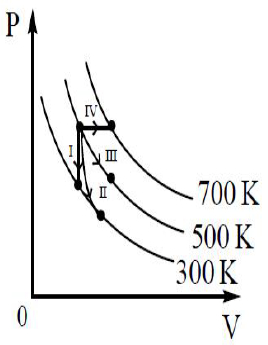
A
$I-c, II-a, III-d, IV-b$
B
$I-c, II-d, III-b, IV-a$
C
$I-d, II-b, III-a, IV-c$
D
$I-a, II-c, III-d, IV-b$
Solution
(A) In the given $P-V$ diagram:
$1$. Process $I$ is a vertical line,meaning volume $V$ is constant. This is an isochoric process. Thus,$I-c$.
$2$. Process $IV$ is a horizontal line,meaning pressure $P$ is constant. This is an isobaric process. Thus,$IV-b$.
$3$. Processes $II$ and $III$ are curves representing changes in both $P$ and $V$. Since $II$ connects the $300 \ K$ and $500 \ K$ isotherms and $III$ connects the $500 \ K$ and $700 \ K$ isotherms,they represent adiabatic processes (as they cross isotherms). Specifically,$II$ is adiabatic and $III$ is isothermal (or vice versa depending on the specific slope analysis). However,looking at the options,$I-c$ and $IV-b$ are fixed. Comparing with options,$I-c, II-a, III-d, IV-b$ fits the standard interpretation where $II$ is adiabatic and $III$ is isothermal. Therefore,the correct match is $I-c, II-a, III-d, IV-b$.
$1$. Process $I$ is a vertical line,meaning volume $V$ is constant. This is an isochoric process. Thus,$I-c$.
$2$. Process $IV$ is a horizontal line,meaning pressure $P$ is constant. This is an isobaric process. Thus,$IV-b$.
$3$. Processes $II$ and $III$ are curves representing changes in both $P$ and $V$. Since $II$ connects the $300 \ K$ and $500 \ K$ isotherms and $III$ connects the $500 \ K$ and $700 \ K$ isotherms,they represent adiabatic processes (as they cross isotherms). Specifically,$II$ is adiabatic and $III$ is isothermal (or vice versa depending on the specific slope analysis). However,looking at the options,$I-c$ and $IV-b$ are fixed. Comparing with options,$I-c, II-a, III-d, IV-b$ fits the standard interpretation where $II$ is adiabatic and $III$ is isothermal. Therefore,the correct match is $I-c, II-a, III-d, IV-b$.
0 likes
View Solution272
DifficultMCQ
$A$ monatomic gas of volume $V$ and pressure $P$ expands isothermally to a volume $27 V$ and then is compressed adiabatically to a volume $V$. The final pressure of the gas is: (in $P$)
A
$3$
B
$2$
C
$9$
D
$4$
Solution
(C) Initial state: $P_1 = P$,$V_1 = V$.
Step $1$: Isothermal expansion to $V_2 = 27 V$.
For an isothermal process,$P_1 V_1 = P_2 V_2$.
$P_2 = \frac{P_1 V_1}{V_2} = \frac{P \times V}{27 V} = \frac{P}{27}$.
Step $2$: Adiabatic compression to $V_3 = V$.
For a monatomic gas,the adiabatic index $\gamma = \frac{5}{3}$.
For an adiabatic process,$P_2 V_2^\gamma = P_3 V_3^\gamma$.
$P_3 = P_2 \left( \frac{V_2}{V_3} \right)^\gamma = \frac{P}{27} \left( \frac{27 V}{V} \right)^{5/3}$.
$P_3 = \frac{P}{27} \times (27)^{5/3} = \frac{P}{27} \times (3^3)^{5/3} = \frac{P}{27} \times 3^5$.
$P_3 = \frac{P}{27} \times 243 = 9 P$.
The final pressure of the gas is $9 P$.
Step $1$: Isothermal expansion to $V_2 = 27 V$.
For an isothermal process,$P_1 V_1 = P_2 V_2$.
$P_2 = \frac{P_1 V_1}{V_2} = \frac{P \times V}{27 V} = \frac{P}{27}$.
Step $2$: Adiabatic compression to $V_3 = V$.
For a monatomic gas,the adiabatic index $\gamma = \frac{5}{3}$.
For an adiabatic process,$P_2 V_2^\gamma = P_3 V_3^\gamma$.
$P_3 = P_2 \left( \frac{V_2}{V_3} \right)^\gamma = \frac{P}{27} \left( \frac{27 V}{V} \right)^{5/3}$.
$P_3 = \frac{P}{27} \times (27)^{5/3} = \frac{P}{27} \times (3^3)^{5/3} = \frac{P}{27} \times 3^5$.
$P_3 = \frac{P}{27} \times 243 = 9 P$.
The final pressure of the gas is $9 P$.
0 likes
View Solution273
EasyMCQ
$A$ gas is expanded from an initial state to a final state along a path on a $P-V$ diagram. The path consists of $(i)$ an isothermal expansion of work $50 J$,$(ii)$ an adiabatic expansion,and $(iii)$ an isothermal expansion of work $20 J$. If the internal energy of the gas is changed by $-30 J$,then the work done by the gas during the adiabatic expansion is: (in $J$)
A
$40$
B
$100$
C
$30$
D
$20$
Solution
(C) The change in internal energy $\Delta U$ is a state function,meaning it depends only on the initial and final states.
For an isothermal process,the temperature remains constant,so the change in internal energy $\Delta U_{\text{iso}} = 0$.
Given the total change in internal energy $\Delta U_{\text{total}} = -30 J$,and since the path consists of two isothermal processes and one adiabatic process,we have $\Delta U_{\text{total}} = \Delta U_{\text{iso1}} + \Delta U_{\text{adiabatic}} + \Delta U_{\text{iso2}}$.
Substituting the values: $-30 J = 0 + \Delta U_{\text{adiabatic}} + 0$,which gives $\Delta U_{\text{adiabatic}} = -30 J$.
For an adiabatic process,the first law of thermodynamics states $\Delta Q = \Delta U + W$. Since $\Delta Q = 0$,we have $W_{\text{adiabatic}} = -\Delta U_{\text{adiabatic}}$.
Therefore,$W_{\text{adiabatic}} = -(-30 J) = 30 J$.
For an isothermal process,the temperature remains constant,so the change in internal energy $\Delta U_{\text{iso}} = 0$.
Given the total change in internal energy $\Delta U_{\text{total}} = -30 J$,and since the path consists of two isothermal processes and one adiabatic process,we have $\Delta U_{\text{total}} = \Delta U_{\text{iso1}} + \Delta U_{\text{adiabatic}} + \Delta U_{\text{iso2}}$.
Substituting the values: $-30 J = 0 + \Delta U_{\text{adiabatic}} + 0$,which gives $\Delta U_{\text{adiabatic}} = -30 J$.
For an adiabatic process,the first law of thermodynamics states $\Delta Q = \Delta U + W$. Since $\Delta Q = 0$,we have $W_{\text{adiabatic}} = -\Delta U_{\text{adiabatic}}$.
Therefore,$W_{\text{adiabatic}} = -(-30 J) = 30 J$.
0 likes
View Solution274
MediumMCQ
The slopes of the isothermal and adiabatic $p-V$ graphs of a gas are $S_I$ and $S_A$ respectively. If the heat capacity ratio of the gas is $\frac{3}{2}$,then $\frac{S_I}{S_A}=$
A
$\frac{3}{2}$
B
$\frac{2}{3}$
C
$\frac{1}{2}$
D
$\frac{1}{3}$
Solution
(B) The slope of the isothermal process $(S_I)$ is given by $\frac{dp}{dV} = -\frac{p}{V}$.
The slope of the adiabatic process $(S_A)$ is given by $\frac{dp}{dV} = -\gamma \frac{p}{V}$.
Therefore,the relationship between the slopes is $S_A = \gamma \times S_I$.
This implies $\frac{S_I}{S_A} = \frac{1}{\gamma}$.
Given the heat capacity ratio $\gamma = \frac{3}{2}$,we substitute this value into the expression:
$\frac{S_I}{S_A} = \frac{1}{3/2} = \frac{2}{3}$.
The slope of the adiabatic process $(S_A)$ is given by $\frac{dp}{dV} = -\gamma \frac{p}{V}$.
Therefore,the relationship between the slopes is $S_A = \gamma \times S_I$.
This implies $\frac{S_I}{S_A} = \frac{1}{\gamma}$.
Given the heat capacity ratio $\gamma = \frac{3}{2}$,we substitute this value into the expression:
$\frac{S_I}{S_A} = \frac{1}{3/2} = \frac{2}{3}$.
0 likes
View Solution275
MediumMCQ
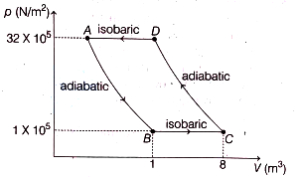
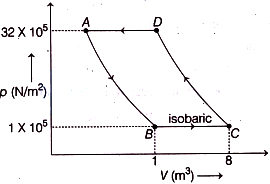
One mole of an ideal monoatomic gas undergoes the process $A \rightarrow B \rightarrow C \rightarrow D \rightarrow A$ as shown in the graph. The work done during the process is
A
$-52.5 \times 10^5 \text{ J}$
B
$-11.5 \times 10^5 \text{ J}$
C
$-64 \times 10^5 \text{ J}$
D
$-36 \times 10^5 \text{ J}$
Solution
(A) For an ideal monoatomic gas,the ratio of specific heats is $\gamma = \frac{5}{3}$.
For the adiabatic process $A \rightarrow B$:
$p_A V_A^\gamma = p_B V_B^\gamma$
Substituting the values from the graph ($p_A = 32 \times 10^5 \text{ Pa}$,$p_B = 1 \times 10^5 \text{ Pa}$,$V_B = 1 \text{ m}^3$):
$32 \times 10^5 \times V_A^{5/3} = 1 \times 10^5 \times (1)^{5/3}$
$V_A^{5/3} = \frac{1}{32} = (2^{-5}) \Rightarrow V_A = (2^{-5})^{3/5} = 2^{-3} = \frac{1}{8} \text{ m}^3$.
For the adiabatic process $C \rightarrow D$:
$p_C V_C^\gamma = p_D V_D^\gamma$
Substituting the values from the graph ($p_C = 1 \times 10^5 \text{ Pa}$,$V_C = 8 \text{ m}^3$,$p_D = 32 \times 10^5 \text{ Pa}$):
$1 \times 10^5 \times (8)^{5/3} = 32 \times 10^5 \times V_D^{5/3}$
$(2^3)^{5/3} = 32 \times V_D^{5/3} \Rightarrow 2^5 = 32 \times V_D^{5/3} \Rightarrow 32 = 32 \times V_D^{5/3} \Rightarrow V_D = 1 \text{ m}^3$.
The total work done in the cycle $A \rightarrow B \rightarrow C \rightarrow D \rightarrow A$ is:
$W = W_{AB} + W_{BC} + W_{CD} + W_{DA}$
$W_{AB} = \frac{p_A V_A - p_B V_B}{\gamma - 1} = \frac{(32 \times 10^5 \times 1/8) - (1 \times 10^5 \times 1)}{5/3 - 1} = \frac{(4 - 1) \times 10^5}{2/3} = 4.5 \times 10^5 \text{ J}$.
$W_{BC} = p_B(V_C - V_B) = 1 \times 10^5 \times (8 - 1) = 7 \times 10^5 \text{ J}$.
$W_{CD} = \frac{p_C V_C - p_D V_D}{\gamma - 1} = \frac{(1 \times 10^5 \times 8) - (32 \times 10^5 \times 1)}{5/3 - 1} = \frac{(8 - 32) \times 10^5}{2/3} = -36 \times 10^5 \text{ J}$.
$W_{DA} = p_D(V_A - V_D) = 32 \times 10^5 \times (1/8 - 1) = 32 \times 10^5 \times (-7/8) = -28 \times 10^5 \text{ J}$.
Total work $W = (4.5 + 7 - 36 - 28) \times 10^5 \text{ J} = -52.5 \times 10^5 \text{ J}$.
For the adiabatic process $A \rightarrow B$:
$p_A V_A^\gamma = p_B V_B^\gamma$
Substituting the values from the graph ($p_A = 32 \times 10^5 \text{ Pa}$,$p_B = 1 \times 10^5 \text{ Pa}$,$V_B = 1 \text{ m}^3$):
$32 \times 10^5 \times V_A^{5/3} = 1 \times 10^5 \times (1)^{5/3}$
$V_A^{5/3} = \frac{1}{32} = (2^{-5}) \Rightarrow V_A = (2^{-5})^{3/5} = 2^{-3} = \frac{1}{8} \text{ m}^3$.
For the adiabatic process $C \rightarrow D$:
$p_C V_C^\gamma = p_D V_D^\gamma$
Substituting the values from the graph ($p_C = 1 \times 10^5 \text{ Pa}$,$V_C = 8 \text{ m}^3$,$p_D = 32 \times 10^5 \text{ Pa}$):
$1 \times 10^5 \times (8)^{5/3} = 32 \times 10^5 \times V_D^{5/3}$
$(2^3)^{5/3} = 32 \times V_D^{5/3} \Rightarrow 2^5 = 32 \times V_D^{5/3} \Rightarrow 32 = 32 \times V_D^{5/3} \Rightarrow V_D = 1 \text{ m}^3$.
The total work done in the cycle $A \rightarrow B \rightarrow C \rightarrow D \rightarrow A$ is:
$W = W_{AB} + W_{BC} + W_{CD} + W_{DA}$
$W_{AB} = \frac{p_A V_A - p_B V_B}{\gamma - 1} = \frac{(32 \times 10^5 \times 1/8) - (1 \times 10^5 \times 1)}{5/3 - 1} = \frac{(4 - 1) \times 10^5}{2/3} = 4.5 \times 10^5 \text{ J}$.
$W_{BC} = p_B(V_C - V_B) = 1 \times 10^5 \times (8 - 1) = 7 \times 10^5 \text{ J}$.
$W_{CD} = \frac{p_C V_C - p_D V_D}{\gamma - 1} = \frac{(1 \times 10^5 \times 8) - (32 \times 10^5 \times 1)}{5/3 - 1} = \frac{(8 - 32) \times 10^5}{2/3} = -36 \times 10^5 \text{ J}$.
$W_{DA} = p_D(V_A - V_D) = 32 \times 10^5 \times (1/8 - 1) = 32 \times 10^5 \times (-7/8) = -28 \times 10^5 \text{ J}$.
Total work $W = (4.5 + 7 - 36 - 28) \times 10^5 \text{ J} = -52.5 \times 10^5 \text{ J}$.
0 likes
View Solution276
MediumMCQ
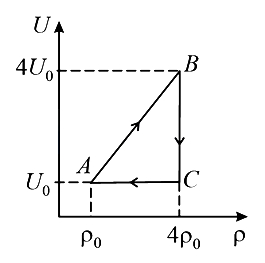
For a monoatomic ideal gas following the cyclic process $ABCA$ shown in the $U$ vs $\rho$ plot,identify the incorrect option:
A
Molar heat capacity of the process $AB$ is $\frac{R}{2}$
B
Heat is rejected by the system in path $BC$
C
Molar heat capacity for the process $BC$ is $\frac{2 R}{3}$
D
Work done by the system in the process $CA$ is $\frac{2 U_0}{3} \ln 4$
Solution
(C) The internal energy of a monoatomic ideal gas is $U = \frac{3}{2} n R T$,so $U \propto T$.
Density $\rho = \frac{m}{V}$,so $\rho \propto \frac{1}{V}$.
For process $AB$,the line passes through origin in $U$-$\rho$ plot,so $U = k \rho$. Substituting $U \propto T$ and $\rho \propto 1/V$,we get $T \propto 1/V$,or $TV = \text{constant}$.
Using $PV = nRT$,we have $(PV/nR)V = \text{constant}$,so $PV^2 = \text{constant}$. This is a polytropic process with index $m = 2$.
The molar heat capacity is $C = C_V + \frac{R}{1-m} = \frac{3R}{2} + \frac{R}{1-2} = \frac{3R}{2} - R = \frac{R}{2}$. Thus,option $A$ is correct.
In process $BC$,$\rho$ is constant,so it is an isochoric process. Since $U$ decreases,temperature decreases,so heat is rejected. Thus,option $B$ is correct.
For an isochoric process,the molar heat capacity is $C_V = \frac{3}{2} R$. Option $C$ states it is $\frac{2R}{3}$,which is incorrect.
In process $CA$,$U$ is constant,so $T$ is constant (isothermal). $W_{CA} = nRT \ln(V_A/V_C) = nRT \ln(\rho_C/\rho_A) = (\frac{2}{3} U_0) \ln(4\rho_0/\rho_0) = \frac{2}{3} U_0 \ln 4$. Option $D$ is correct.
Density $\rho = \frac{m}{V}$,so $\rho \propto \frac{1}{V}$.
For process $AB$,the line passes through origin in $U$-$\rho$ plot,so $U = k \rho$. Substituting $U \propto T$ and $\rho \propto 1/V$,we get $T \propto 1/V$,or $TV = \text{constant}$.
Using $PV = nRT$,we have $(PV/nR)V = \text{constant}$,so $PV^2 = \text{constant}$. This is a polytropic process with index $m = 2$.
The molar heat capacity is $C = C_V + \frac{R}{1-m} = \frac{3R}{2} + \frac{R}{1-2} = \frac{3R}{2} - R = \frac{R}{2}$. Thus,option $A$ is correct.
In process $BC$,$\rho$ is constant,so it is an isochoric process. Since $U$ decreases,temperature decreases,so heat is rejected. Thus,option $B$ is correct.
For an isochoric process,the molar heat capacity is $C_V = \frac{3}{2} R$. Option $C$ states it is $\frac{2R}{3}$,which is incorrect.
In process $CA$,$U$ is constant,so $T$ is constant (isothermal). $W_{CA} = nRT \ln(V_A/V_C) = nRT \ln(\rho_C/\rho_A) = (\frac{2}{3} U_0) \ln(4\rho_0/\rho_0) = \frac{2}{3} U_0 \ln 4$. Option $D$ is correct.
0 likes
View Solution277
MediumMCQ
Two containers $A$ and $B$ contain equal volumes of an identical gas at the same pressure and temperature. The gas in container $A$ is compressed to half its original volume isothermally,while the gas in container $B$ is compressed to half its original volume adiabatically. The ratio of the final pressure of gas in container $B$ to that of gas in container $A$ is
A
$(2)^{\gamma-1}$
B
$\left(\frac{1}{2}\right)^{\gamma-1}$
C
$\left(\frac{1}{1-\gamma}\right)^2$
D
$\left(\frac{1}{\gamma-1}\right)^2$
Solution
(A) Initial state: $V_A = V_B = V$,$p_A = p_B = p$.
For container $A$ (isothermal process): $p_A V_A = p_A^{\prime} V_A^{\prime}$.
Given $V_A^{\prime} = V/2$,so $p V = p_A^{\prime} (V/2) \Rightarrow p_A^{\prime} = 2p$.
For container $B$ (adiabatic process): $p_B V_B^{\gamma} = p_B^{\prime} (V_B^{\prime})^{\gamma}$.
Given $V_B^{\prime} = V/2$,so $p V^{\gamma} = p_B^{\prime} (V/2)^{\gamma} \Rightarrow p_B^{\prime} = p \cdot 2^{\gamma}$.
The ratio of final pressures is $\frac{p_B^{\prime}}{p_A^{\prime}} = \frac{p \cdot 2^{\gamma}}{2p} = 2^{\gamma-1}$.
For container $A$ (isothermal process): $p_A V_A = p_A^{\prime} V_A^{\prime}$.
Given $V_A^{\prime} = V/2$,so $p V = p_A^{\prime} (V/2) \Rightarrow p_A^{\prime} = 2p$.
For container $B$ (adiabatic process): $p_B V_B^{\gamma} = p_B^{\prime} (V_B^{\prime})^{\gamma}$.
Given $V_B^{\prime} = V/2$,so $p V^{\gamma} = p_B^{\prime} (V/2)^{\gamma} \Rightarrow p_B^{\prime} = p \cdot 2^{\gamma}$.
The ratio of final pressures is $\frac{p_B^{\prime}}{p_A^{\prime}} = \frac{p \cdot 2^{\gamma}}{2p} = 2^{\gamma-1}$.
0 likes
View Solution278
EasyMCQ
The ratio of the slopes of isothermal and adiabatic curves is
A
$1$
B
$\gamma$
C
$\frac{1}{\gamma}$
D
$\frac{3}{2}$
Solution
(C) For an isothermal process,the equation is $pV = K$.
Differentiating both sides with respect to $V$,we get $p + V \frac{dp}{dV} = 0$,which implies $\left(\frac{dp}{dV}\right)_{\text{iso}} = -\frac{p}{V}$.
For an adiabatic process,the equation is $pV^{\gamma} = K'$.
Differentiating both sides with respect to $V$,we get $\frac{dp}{dV} V^{\gamma} + p \gamma V^{\gamma-1} = 0$.
Rearranging this gives $\left(\frac{dp}{dV}\right)_{\text{adia}} = -\gamma \frac{p}{V}$.
Taking the ratio of the slope of the isothermal curve to the slope of the adiabatic curve:
$\frac{(\frac{dp}{dV})_{\text{iso}}}{(\frac{dp}{dV})_{\text{adia}}} = \frac{-p/V}{-\gamma p/V} = \frac{1}{\gamma}$.
Differentiating both sides with respect to $V$,we get $p + V \frac{dp}{dV} = 0$,which implies $\left(\frac{dp}{dV}\right)_{\text{iso}} = -\frac{p}{V}$.
For an adiabatic process,the equation is $pV^{\gamma} = K'$.
Differentiating both sides with respect to $V$,we get $\frac{dp}{dV} V^{\gamma} + p \gamma V^{\gamma-1} = 0$.
Rearranging this gives $\left(\frac{dp}{dV}\right)_{\text{adia}} = -\gamma \frac{p}{V}$.
Taking the ratio of the slope of the isothermal curve to the slope of the adiabatic curve:
$\frac{(\frac{dp}{dV})_{\text{iso}}}{(\frac{dp}{dV})_{\text{adia}}} = \frac{-p/V}{-\gamma p/V} = \frac{1}{\gamma}$.
0 likes
View Solution279
DifficultMCQ
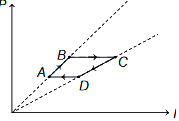
Three moles of an ideal monatomic gas perform a cycle $ABCDA$ as shown in the figure. The temperatures of the gas at the states $A, B, C$ and $D$ are $400 \, K, 800 \, K, 2400 \, K$ and $1200 \, K$, respectively. The work done by the gas during this cycle is ($R$ is the universal gas constant). (in $R$)
A
$1200$
B
$3600$
C
$2400$
D
$2000$
Solution
(C) The given graph is a $P-T$ diagram. The work done by an ideal gas in a cycle is given by the area enclosed by the cycle in a $P-V$ diagram. However, for a $P-T$ diagram, we can use the relation $PV = nRT$.
For an ideal gas, the work done in a process is $W = \int P dV$.
From the ideal gas equation, $V = \frac{nRT}{P}$, so $dV = \frac{nR}{P} dT - \frac{nRT}{P^2} dP$.
In the given $P-T$ diagram, the processes $AB$ and $CD$ are isochoric (since they lie on lines passing through the origin, $P \propto T \implies V = \text{constant}$), and processes $BC$ and $DA$ are isobaric (since $P$ is constant).
Work done in isochoric processes ($AB$ and $CD$) is $0$.
Work done in isobaric processes is $W = P \Delta V = nR \Delta T$.
For process $BC$ (isobaric at $P_B$): $W_{BC} = nR(T_C - T_B) = 3R(2400 - 800) = 3R(1600) = 4800R$.
For process $DA$ (isobaric at $P_A$): $W_{DA} = nR(T_A - T_D) = 3R(400 - 1200) = 3R(-800) = -2400R$.
Total work done $W_{net} = W_{AB} + W_{BC} + W_{CD} + W_{DA} = 0 + 4800R + 0 - 2400R = 2400R$.
For an ideal gas, the work done in a process is $W = \int P dV$.
From the ideal gas equation, $V = \frac{nRT}{P}$, so $dV = \frac{nR}{P} dT - \frac{nRT}{P^2} dP$.
In the given $P-T$ diagram, the processes $AB$ and $CD$ are isochoric (since they lie on lines passing through the origin, $P \propto T \implies V = \text{constant}$), and processes $BC$ and $DA$ are isobaric (since $P$ is constant).
Work done in isochoric processes ($AB$ and $CD$) is $0$.
Work done in isobaric processes is $W = P \Delta V = nR \Delta T$.
For process $BC$ (isobaric at $P_B$): $W_{BC} = nR(T_C - T_B) = 3R(2400 - 800) = 3R(1600) = 4800R$.
For process $DA$ (isobaric at $P_A$): $W_{DA} = nR(T_A - T_D) = 3R(400 - 1200) = 3R(-800) = -2400R$.
Total work done $W_{net} = W_{AB} + W_{BC} + W_{CD} + W_{DA} = 0 + 4800R + 0 - 2400R = 2400R$.
0 likes
View Solution280
EasyMCQ
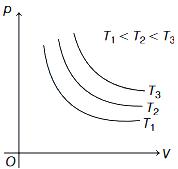
Which of the following statements is correct regarding the $p-V$ graph?
$1$. The slope of the $p-V$ graph in an isothermal process is $-\frac{p}{V}$.
$2$. The slope of the $p-V$ graph in an adiabatic process is $-\frac{p}{V}$.
$3$. The slope of the $p-V$ graph in an isochoric process is $-\frac{\gamma p}{V}$.
$4$. The slope of the $p-V$ graph in an isobaric process is zero.
$1$. The slope of the $p-V$ graph in an isothermal process is $-\frac{p}{V}$.
$2$. The slope of the $p-V$ graph in an adiabatic process is $-\frac{p}{V}$.
$3$. The slope of the $p-V$ graph in an isochoric process is $-\frac{\gamma p}{V}$.
$4$. The slope of the $p-V$ graph in an isobaric process is zero.
A
$1, 3, 4$ are correct
B
$2, 3$ are correct
C
$1, 4$ are correct
D
$2, 3, 4$ are correct
Solution
(C) The correct statements are $1$ and $4$.
$1$. For an isothermal process, $pV = \text{constant}$. Differentiating with respect to $V$, we get $p + V \frac{dp}{dV} = 0$, which gives the slope $\frac{dp}{dV} = -\frac{p}{V}$. This is correct.
$2$. For an adiabatic process, $pV^{\gamma} = \text{constant}$. Differentiating with respect to $V$, we get $\frac{dp}{dV} V^{\gamma} + p \gamma V^{\gamma-1} = 0$, which gives the slope $\frac{dp}{dV} = -\gamma \frac{p}{V}$. Thus, statement $2$ is incorrect.
$3$. In an isochoric process, volume $V$ is constant, so $dV = 0$. The graph is a vertical line, and the slope $\frac{dp}{dV}$ is undefined (or $\infty$). Thus, statement $3$ is incorrect.
$4$. In an isobaric process, pressure $p$ is constant, so $dp = 0$. The graph is a horizontal line parallel to the volume axis, and the slope $\frac{dp}{dV} = 0$. This is correct.
$1$. For an isothermal process, $pV = \text{constant}$. Differentiating with respect to $V$, we get $p + V \frac{dp}{dV} = 0$, which gives the slope $\frac{dp}{dV} = -\frac{p}{V}$. This is correct.
$2$. For an adiabatic process, $pV^{\gamma} = \text{constant}$. Differentiating with respect to $V$, we get $\frac{dp}{dV} V^{\gamma} + p \gamma V^{\gamma-1} = 0$, which gives the slope $\frac{dp}{dV} = -\gamma \frac{p}{V}$. Thus, statement $2$ is incorrect.
$3$. In an isochoric process, volume $V$ is constant, so $dV = 0$. The graph is a vertical line, and the slope $\frac{dp}{dV}$ is undefined (or $\infty$). Thus, statement $3$ is incorrect.
$4$. In an isobaric process, pressure $p$ is constant, so $dp = 0$. The graph is a horizontal line parallel to the volume axis, and the slope $\frac{dp}{dV} = 0$. This is correct.
0 likes
View Solution281
EasyMCQ
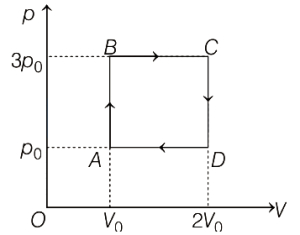
An ideal monoatomic gas is carried along the cycle $ABCDA$ as shown in the figure. The total heat absorbed during this process is (in $p_0 V_0$)
A
$10.5$
B
$7.5$
C
$2.5$
D
$1.5$
Solution
(A) Heat is absorbed by the system when $\Delta Q > 0$. In a cyclic process,heat is absorbed during the segments where the internal energy increases and work is done by the gas. Looking at the cycle $ABCDA$:
$1$. Path $A \rightarrow B$ (isochoric): $W = 0$,$\Delta U = n C_V \Delta T = \frac{3}{2} V_0 (3p_0 - p_0) = 3 p_0 V_0$. Since $\Delta U > 0$,heat is absorbed: $\Delta Q_{AB} = 3 p_0 V_0$.
$2$. Path $B \rightarrow C$ (isobaric): $W = p \Delta V = 3p_0 (2V_0 - V_0) = 3 p_0 V_0$. $\Delta U = n C_V \Delta T = \frac{3}{2} (p_C V_C - p_B V_B) = \frac{3}{2} (6 p_0 V_0 - 3 p_0 V_0) = 4.5 p_0 V_0$. Heat is absorbed: $\Delta Q_{BC} = \Delta U + W = 4.5 p_0 V_0 + 3 p_0 V_0 = 7.5 p_0 V_0$.
$3$. Path $C \rightarrow D$ and $D \rightarrow A$: The gas releases heat as internal energy decreases and work is done on the gas.
Total heat absorbed = $\Delta Q_{AB} + \Delta Q_{BC} = 3 p_0 V_0 + 7.5 p_0 V_0 = 10.5 p_0 V_0$.
$1$. Path $A \rightarrow B$ (isochoric): $W = 0$,$\Delta U = n C_V \Delta T = \frac{3}{2} V_0 (3p_0 - p_0) = 3 p_0 V_0$. Since $\Delta U > 0$,heat is absorbed: $\Delta Q_{AB} = 3 p_0 V_0$.
$2$. Path $B \rightarrow C$ (isobaric): $W = p \Delta V = 3p_0 (2V_0 - V_0) = 3 p_0 V_0$. $\Delta U = n C_V \Delta T = \frac{3}{2} (p_C V_C - p_B V_B) = \frac{3}{2} (6 p_0 V_0 - 3 p_0 V_0) = 4.5 p_0 V_0$. Heat is absorbed: $\Delta Q_{BC} = \Delta U + W = 4.5 p_0 V_0 + 3 p_0 V_0 = 7.5 p_0 V_0$.
$3$. Path $C \rightarrow D$ and $D \rightarrow A$: The gas releases heat as internal energy decreases and work is done on the gas.
Total heat absorbed = $\Delta Q_{AB} + \Delta Q_{BC} = 3 p_0 V_0 + 7.5 p_0 V_0 = 10.5 p_0 V_0$.
0 likes
View Solution282
EasyMCQ
$A$ gas is governed by an equation $V = \frac{aT^3}{P}$,where $P, V$,and $T$ are pressure,volume,and temperature of the gas respectively,and $a$ is a constant. If the temperature of the gas is doubled at constant pressure,then the work done by the gas is: (in $aT^3$)
A
$6$
B
$8$
C
$9$
D
$7$
Solution
(D) The given equation is $V = \frac{aT^3}{P}$.
For a constant pressure $P$,the initial volume is $V_1 = \frac{aT^3}{P}$.
When the temperature is doubled $(T_2 = 2T)$,the new volume becomes $V_2 = \frac{a(2T)^3}{P} = \frac{8aT^3}{P}$.
The work done by the gas at constant pressure is given by $W = P \Delta V = P(V_2 - V_1)$.
Substituting the values,we get $W = P \left( \frac{8aT^3}{P} - \frac{aT^3}{P} \right) = P \left( \frac{7aT^3}{P} \right) = 7aT^3$.
For a constant pressure $P$,the initial volume is $V_1 = \frac{aT^3}{P}$.
When the temperature is doubled $(T_2 = 2T)$,the new volume becomes $V_2 = \frac{a(2T)^3}{P} = \frac{8aT^3}{P}$.
The work done by the gas at constant pressure is given by $W = P \Delta V = P(V_2 - V_1)$.
Substituting the values,we get $W = P \left( \frac{8aT^3}{P} - \frac{aT^3}{P} \right) = P \left( \frac{7aT^3}{P} \right) = 7aT^3$.
0 likes
View Solution283
EasyMCQ
Match the following:
The correct answer is:
| List-$I$ | List-$II$ |
| $i)$ Isothermal process | $a)$ $0$ |
| $ii)$ Isobaric process | $b)$ $\frac{1}{\gamma-1}[P_2 V_2 - P_1 V_1]$ |
| $iii)$ Isochoric process | $c)$ $\mu RT \ln(\frac{V_2}{V_1})$ |
| $iv)$ Adiabatic process | $d)$ $P(V_2 - V_1)$ |
The correct answer is:
A
$i-c, ii-d, iii-a, iv-b$
B
$i-a, ii-d, iii-b, iv-c$
C
$i-c, ii-b, iii-d, iv-a$
D
$i-b, ii-c, iii-a, iv-d$
Solution
(A) The work done $W$ in different thermodynamic processes is given by:
$1$. Isothermal process: $W = \int_{V_1}^{V_2} P dV = \mu RT \ln(\frac{V_2}{V_1})$. Thus,$i-c$.
$2$. Isobaric process: Pressure $P$ is constant,so $W = P \int_{V_1}^{V_2} dV = P(V_2 - V_1)$. Thus,$ii-d$.
$3$. Isochoric process: Volume $V$ is constant,so $dV = 0$,which implies $W = 0$. Thus,$iii-a$.
$4$. Adiabatic process: $W = \frac{P_1 V_1 - P_2 V_2}{\gamma - 1} = \frac{1}{\gamma - 1}[P_2 V_2 - P_1 V_1]$ (with a sign convention adjustment). Thus,$iv-b$.
Therefore,the correct matching is $i-c, ii-d, iii-a, iv-b$.
$1$. Isothermal process: $W = \int_{V_1}^{V_2} P dV = \mu RT \ln(\frac{V_2}{V_1})$. Thus,$i-c$.
$2$. Isobaric process: Pressure $P$ is constant,so $W = P \int_{V_1}^{V_2} dV = P(V_2 - V_1)$. Thus,$ii-d$.
$3$. Isochoric process: Volume $V$ is constant,so $dV = 0$,which implies $W = 0$. Thus,$iii-a$.
$4$. Adiabatic process: $W = \frac{P_1 V_1 - P_2 V_2}{\gamma - 1} = \frac{1}{\gamma - 1}[P_2 V_2 - P_1 V_1]$ (with a sign convention adjustment). Thus,$iv-b$.
Therefore,the correct matching is $i-c, ii-d, iii-a, iv-b$.
0 likes
View Solution284
EasyMCQ
Two moles of helium gas $\left(\gamma = \frac{5}{3}\right)$ at $27^{\circ} C$ is expanded at constant pressure until its volume is doubled. Then it undergoes an adiabatic change until the temperature returns to its initial value. The work done during the adiabatic process is (universal gas constant $R = 8.3 \ J \ mol^{-1} \ K^{-1}$) (in $J$)
A
$7470$
B
$7070$
C
$4770$
D
$4077$
Solution
(A) Initial state: $n = 2 \ mol$,$T_1 = 27^{\circ} C = 300 \ K$,$P_1 = P$,$V_1 = V$.
Step $1$ (Isobaric expansion): Volume doubles,so $V_2 = 2V$. Since $P$ is constant,$\frac{V_1}{T_1} = \frac{V_2}{T_2} \implies T_2 = T_1 \left(\frac{V_2}{V_1}\right) = 300 \times 2 = 600 \ K$.
Step $2$ (Adiabatic process): The gas expands/compresses until $T_3 = T_1 = 300 \ K$.
Work done in an adiabatic process is $W = \frac{nR(T_2 - T_3)}{\gamma - 1}$.
Given $\gamma = \frac{5}{3}$,so $\gamma - 1 = \frac{2}{3}$.
$W = \frac{2 \times 8.3 \times (600 - 300)}{2/3} = \frac{2 \times 8.3 \times 300 \times 3}{2} = 8.3 \times 900 = 7470 \ J$.
Step $1$ (Isobaric expansion): Volume doubles,so $V_2 = 2V$. Since $P$ is constant,$\frac{V_1}{T_1} = \frac{V_2}{T_2} \implies T_2 = T_1 \left(\frac{V_2}{V_1}\right) = 300 \times 2 = 600 \ K$.
Step $2$ (Adiabatic process): The gas expands/compresses until $T_3 = T_1 = 300 \ K$.
Work done in an adiabatic process is $W = \frac{nR(T_2 - T_3)}{\gamma - 1}$.
Given $\gamma = \frac{5}{3}$,so $\gamma - 1 = \frac{2}{3}$.
$W = \frac{2 \times 8.3 \times (600 - 300)}{2/3} = \frac{2 \times 8.3 \times 300 \times 3}{2} = 8.3 \times 900 = 7470 \ J$.
0 likes
View Solution285
EasyMCQ
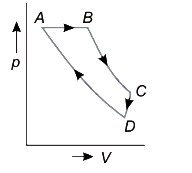
An ideal gas is subjected to a cyclic process $ABCD$ as depicted in the $p-V$ diagram given below. Which of the following curves represents the equivalent cyclic process?
A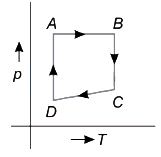
B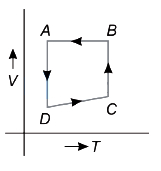
C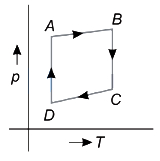
D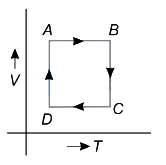
Solution
(D) The given $p-V$ diagram shows a clockwise cyclic process $A \rightarrow B \rightarrow C \rightarrow D \rightarrow A$.
$1$. $A \rightarrow B$: Isobaric expansion (pressure $p$ is constant,volume $V$ increases,so temperature $T$ increases).
$2$. $B \rightarrow C$: Isothermal compression ($p \propto 1/V$,so $T$ is constant,volume $V$ decreases).
$3$. $C \rightarrow D$: Isochoric compression (volume $V$ is constant,pressure $p$ decreases,so temperature $T$ decreases).
$4$. $D \rightarrow A$: Isothermal expansion ($p \propto 1/V$,so $T$ is constant,volume $V$ increases).
Comparing these processes with the given options,the $p-T$ diagram in option $D$ correctly represents this cycle: $A \rightarrow B$ (isobaric,$T$ increases),$B \rightarrow C$ (isothermal,$p$ decreases),$C \rightarrow D$ (isochoric,$T$ decreases),$D \rightarrow A$ (isothermal,$p$ increases). Thus,the correct representation is option $D$.
$1$. $A \rightarrow B$: Isobaric expansion (pressure $p$ is constant,volume $V$ increases,so temperature $T$ increases).
$2$. $B \rightarrow C$: Isothermal compression ($p \propto 1/V$,so $T$ is constant,volume $V$ decreases).
$3$. $C \rightarrow D$: Isochoric compression (volume $V$ is constant,pressure $p$ decreases,so temperature $T$ decreases).
$4$. $D \rightarrow A$: Isothermal expansion ($p \propto 1/V$,so $T$ is constant,volume $V$ increases).
Comparing these processes with the given options,the $p-T$ diagram in option $D$ correctly represents this cycle: $A \rightarrow B$ (isobaric,$T$ increases),$B \rightarrow C$ (isothermal,$p$ decreases),$C \rightarrow D$ (isochoric,$T$ decreases),$D \rightarrow A$ (isothermal,$p$ increases). Thus,the correct representation is option $D$.
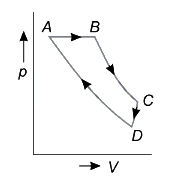
0 likes
View Solution286
EasyMCQ
Match the following lists.
The correct answer is:
| List-$I$ | List-$II$ |
|---|---|
| $A$. Zeroth law of thermodynamics | $I$. Direction of flow of heat |
| $B$. First law of thermodynamics | $II$. Work done is zero |
| $C$. Free expansion of a gas | $III$. Thermal equilibrium |
| $D$. Second law of thermodynamics | $IV$. Law of conservation of energy |
The correct answer is:
A
$II, IV, III, I$
B
$III, IV, II, I$
C
$III, I, II, IV$
D
$I, III, IV, II$
Solution
$(B)$. Zeroth law of thermodynamics defines thermal equilibrium between systems in contact $(A-III)$.
$B$. First law of thermodynamics is based on the law of conservation of energy $(B-IV)$.
$C$. In the free expansion of a gas, no work is done by the gas against an external pressure, so work done is zero $(C-II)$.
$D$. Second law of thermodynamics provides the criteria for the direction of heat flow $(D-I)$.
Therefore, the correct matching is $A-III, B-IV, C-II, D-I$.
$B$. First law of thermodynamics is based on the law of conservation of energy $(B-IV)$.
$C$. In the free expansion of a gas, no work is done by the gas against an external pressure, so work done is zero $(C-II)$.
$D$. Second law of thermodynamics provides the criteria for the direction of heat flow $(D-I)$.
Therefore, the correct matching is $A-III, B-IV, C-II, D-I$.
0 likes
View Solution287
MediumMCQ
Match the "Technology" given in List-$1$ with the "Principle of Physics" given in List-$2$.
| $A$. Steam engine | $I$. Magnetic confinement of plasma |
| $B$. Electron microscope | $II$. Laws of thermodynamics |
| $C$. Non-reflecting coatings | $III$. Wave nature of electrons |
| $D$. Tokamak | $IV$. Interference of light |
A
$A-I, B-II, C-III, D-IV$
B
$A-II, B-III, C-IV, D-I$
C
$A-II, B-IV, C-III, D-I$
D
$A-II, B-I, C-III, D-IV$
Solution
(B) The correct matches are as follows:
$A$. Steam engine operates on the $\text{Laws}$ $\text{of}$ $\text{thermodynamics}$ $(II)$.
$B$. Electron microscope utilizes the $\text{Wave}$ $\text{nature}$ $\text{of}$ $\text{electrons}$ $(III)$.
$C$. Non-reflecting coatings are based on the $\text{Interference}$ $\text{of}$ $\text{light}$ $(IV)$.
$D$. Tokamak uses $\text{Magnetic}$ $\text{confinement}$ $\text{of}$ $\text{plasma}$ $(I)$.
Therefore, the correct sequence is $A-II, B-III, C-IV, D-I$.
$A$. Steam engine operates on the $\text{Laws}$ $\text{of}$ $\text{thermodynamics}$ $(II)$.
$B$. Electron microscope utilizes the $\text{Wave}$ $\text{nature}$ $\text{of}$ $\text{electrons}$ $(III)$.
$C$. Non-reflecting coatings are based on the $\text{Interference}$ $\text{of}$ $\text{light}$ $(IV)$.
$D$. Tokamak uses $\text{Magnetic}$ $\text{confinement}$ $\text{of}$ $\text{plasma}$ $(I)$.
Therefore, the correct sequence is $A-II, B-III, C-IV, D-I$.
0 likes
View Solution288
EasyMCQ
An insulating cylinder contains $4 \text{ moles}$ of an ideal diatomic gas. When a heat $Q$ is supplied to it,$2 \text{ moles}$ of the gas molecules dissociate. If the temperature of the gas remains constant,then the value of $Q$ is ($R$ - universal gas constant).
A
$2RT$
B
$RT$
C
$3RT$
D
$4RT$
Solution
(B) The heat supplied $Q$ is equal to the change in internal energy $\Delta U$ since the process is at constant temperature and the cylinder is insulating (no work done by expansion against external pressure,assuming rigid walls):
$Q = U_f - U_i$.
Initially,the cylinder contains $4 \text{ moles}$ of diatomic gas $(f = 5)$.
$U_i = n \left( \frac{f}{2} RT \right) = 4 \left( \frac{5}{2} RT \right) = 10 RT$.
After dissociation,$2 \text{ moles}$ of diatomic gas break into $4 \text{ moles}$ of monoatomic gas $(f = 3)$. The remaining $2 \text{ moles}$ stay diatomic.
Final state: $4 \text{ moles}$ monoatomic $(f = 3)$ and $2 \text{ moles}$ diatomic $(f = 5)$.
$U_f = n_{mono} \left( \frac{3}{2} RT \right) + n_{dia} \left( \frac{5}{2} RT \right) = 4 \left( \frac{3}{2} RT \right) + 2 \left( \frac{5}{2} RT \right) = 6 RT + 5 RT = 11 RT$.
Thus,$Q = U_f - U_i = 11 RT - 10 RT = RT$.
$Q = U_f - U_i$.
Initially,the cylinder contains $4 \text{ moles}$ of diatomic gas $(f = 5)$.
$U_i = n \left( \frac{f}{2} RT \right) = 4 \left( \frac{5}{2} RT \right) = 10 RT$.
After dissociation,$2 \text{ moles}$ of diatomic gas break into $4 \text{ moles}$ of monoatomic gas $(f = 3)$. The remaining $2 \text{ moles}$ stay diatomic.
Final state: $4 \text{ moles}$ monoatomic $(f = 3)$ and $2 \text{ moles}$ diatomic $(f = 5)$.
$U_f = n_{mono} \left( \frac{3}{2} RT \right) + n_{dia} \left( \frac{5}{2} RT \right) = 4 \left( \frac{3}{2} RT \right) + 2 \left( \frac{5}{2} RT \right) = 6 RT + 5 RT = 11 RT$.
Thus,$Q = U_f - U_i = 11 RT - 10 RT = RT$.
0 likes
View Solution289
MediumMCQ
The ratio of the work done,change in internal energy,and heat absorbed when a diatomic gas expands at constant pressure is
A
$2: 3: 5$
B
$7: 5: 2$
C
$5: 3: 2$
D
$2: 5: 7$
Solution
(D) For a diatomic gas,the degrees of freedom $f = 5$.
At constant pressure,the heat absorbed is given by $dQ = n C_p dT$.
The work done is $dW = P dV = n R dT$.
The change in internal energy is $dU = n C_v dT$.
We know that $C_v = \frac{f}{2} R = \frac{5}{2} R$ and $C_p = C_v + R = \frac{7}{2} R$.
Thus,the ratio $dW : dU : dQ$ is $nR dT : \frac{5}{2} nR dT : \frac{7}{2} nR dT$.
Dividing by $nR dT$,we get $1 : \frac{5}{2} : \frac{7}{2}$.
Multiplying by $2$,we get $2 : 5 : 7$.
At constant pressure,the heat absorbed is given by $dQ = n C_p dT$.
The work done is $dW = P dV = n R dT$.
The change in internal energy is $dU = n C_v dT$.
We know that $C_v = \frac{f}{2} R = \frac{5}{2} R$ and $C_p = C_v + R = \frac{7}{2} R$.
Thus,the ratio $dW : dU : dQ$ is $nR dT : \frac{5}{2} nR dT : \frac{7}{2} nR dT$.
Dividing by $nR dT$,we get $1 : \frac{5}{2} : \frac{7}{2}$.
Multiplying by $2$,we get $2 : 5 : 7$.
0 likes
View Solution290
DifficultMCQ
When $Q_1$ amount of heat is supplied to a monatomic gas,the work done by the gas is $W$. When $Q_2$ amount of heat is supplied to a diatomic gas,the work done by the gas is $2W$. Then $Q_1: Q_2=$
A
$2: 3$
B
$3: 5$
C
$5: 7$
D
$5: 14$
Solution
(D) At constant pressure,$W = P \Delta V = nR \Delta T$,which implies $W \propto \Delta T$.
Given $W_1 = W$ and $W_2 = 2W$,we have $\frac{(\Delta T)_2}{(\Delta T)_1} = \frac{W_2}{W_1} = 2$,so $(\Delta T)_2 = 2(\Delta T)_1$.
For a monatomic gas,the degrees of freedom $f_1 = 3$. The heat supplied is $Q_1 = \Delta U_1 + W_1 = \frac{f_1}{2} nR(\Delta T)_1 + nR(\Delta T)_1 = (\frac{3}{2} + 1) nR(\Delta T)_1 = \frac{5}{2} nR(\Delta T)_1$.
For a diatomic gas,the degrees of freedom $f_2 = 5$. The heat supplied is $Q_2 = \Delta U_2 + W_2 = \frac{f_2}{2} nR(\Delta T)_2 + 2W = \frac{5}{2} nR(2(\Delta T)_1) + 2nR(\Delta T)_1 = (5 + 2) nR(\Delta T)_1 = 7nR(\Delta T)_1$.
Therefore,the ratio is $\frac{Q_1}{Q_2} = \frac{\frac{5}{2} nR(\Delta T)_1}{7nR(\Delta T)_1} = \frac{5}{14}$.
Thus,$Q_1 : Q_2 = 5 : 14$.
Given $W_1 = W$ and $W_2 = 2W$,we have $\frac{(\Delta T)_2}{(\Delta T)_1} = \frac{W_2}{W_1} = 2$,so $(\Delta T)_2 = 2(\Delta T)_1$.
For a monatomic gas,the degrees of freedom $f_1 = 3$. The heat supplied is $Q_1 = \Delta U_1 + W_1 = \frac{f_1}{2} nR(\Delta T)_1 + nR(\Delta T)_1 = (\frac{3}{2} + 1) nR(\Delta T)_1 = \frac{5}{2} nR(\Delta T)_1$.
For a diatomic gas,the degrees of freedom $f_2 = 5$. The heat supplied is $Q_2 = \Delta U_2 + W_2 = \frac{f_2}{2} nR(\Delta T)_2 + 2W = \frac{5}{2} nR(2(\Delta T)_1) + 2nR(\Delta T)_1 = (5 + 2) nR(\Delta T)_1 = 7nR(\Delta T)_1$.
Therefore,the ratio is $\frac{Q_1}{Q_2} = \frac{\frac{5}{2} nR(\Delta T)_1}{7nR(\Delta T)_1} = \frac{5}{14}$.
Thus,$Q_1 : Q_2 = 5 : 14$.
0 likes
View Solution291
MediumMCQ
Two moles of a triatomic gas $\left(\gamma = \frac{4}{3}\right)$ at temperature $327^{\circ} C$ expands adiabatically such that its volume becomes $8$ times its initial volume. Later,the temperature of the gas is doubled in an isochoric process. The total work done in the two processes is ($R$ - universal gas constant). (in $R$)
A
$900$
B
$1800$
C
$1200$
D
$300$
Solution
(B) Given: $n = 2 \text{ moles}$,$\gamma = 4/3$,$T_1 = 327^{\circ} C = 600 \text{ K}$.
Step $1$: Adiabatic expansion.
$T_1 V_1^{\gamma-1} = T_2 V_2^{\gamma-1}$.
Given $V_2 = 8 V_1$,so $T_2 = T_1 (V_1/V_2)^{\gamma-1} = 600 \times (1/8)^{(4/3 - 1)} = 600 \times (1/8)^{1/3} = 600 \times (1/2) = 300 \text{ K}$.
Work done in adiabatic process: $W_1 = \frac{nR(T_1 - T_2)}{\gamma - 1} = \frac{2R(600 - 300)}{4/3 - 1} = \frac{2R(300)}{1/3} = 1800 R$.
Step $2$: Isochoric process.
In an isochoric process,volume is constant,so work done $W_2 = 0$.
Total work done $W = W_1 + W_2 = 1800 R + 0 = 1800 R$.
Step $1$: Adiabatic expansion.
$T_1 V_1^{\gamma-1} = T_2 V_2^{\gamma-1}$.
Given $V_2 = 8 V_1$,so $T_2 = T_1 (V_1/V_2)^{\gamma-1} = 600 \times (1/8)^{(4/3 - 1)} = 600 \times (1/8)^{1/3} = 600 \times (1/2) = 300 \text{ K}$.
Work done in adiabatic process: $W_1 = \frac{nR(T_1 - T_2)}{\gamma - 1} = \frac{2R(600 - 300)}{4/3 - 1} = \frac{2R(300)}{1/3} = 1800 R$.
Step $2$: Isochoric process.
In an isochoric process,volume is constant,so work done $W_2 = 0$.
Total work done $W = W_1 + W_2 = 1800 R + 0 = 1800 R$.
0 likes
View Solution292
EasyMCQ
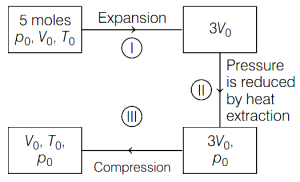
Five moles of an ideal gas has pressure $p_0$,volume $V_0$,and temperature $T_0$. The gas is expanded to volume $3V_0$ along a path such that the pressure $p$ changes as a function of volume $V$ as $p = p_0(V/V_0)$. The pressure is then reduced to $p_0$ while maintaining constant volume. Finally,the gas undergoes an isobaric compression until the volume and temperature return to $V_0$ and $T_0$,respectively. The total work done by the gas during the entire process is:
A
$p_0 V_0 / 3$
B
$3 p_0 V_0$
C
$5 p_0 V_0 / 3$
D
$2 p_0 V_0$
Solution
(D) The process consists of three steps:
Step $I$: Expansion from $V_0$ to $3V_0$ where $p = p_0(V/V_0)$.
Work done $W_I = \int_{V_0}^{3V_0} p dV = \int_{V_0}^{3V_0} \frac{p_0}{V_0} V dV = \frac{p_0}{V_0} \left[ \frac{V^2}{2} \right]_{V_0}^{3V_0} = \frac{p_0}{2V_0} (9V_0^2 - V_0^2) = 4p_0 V_0$.
Step $II$: Isochoric process (volume is constant at $3V_0$),so work done $W_{II} = 0$.
Step $III$: Isobaric compression from $3V_0$ to $V_0$ at constant pressure $p_0$.
Work done $W_{III} = \int_{3V_0}^{V_0} p_0 dV = p_0 (V_0 - 3V_0) = -2p_0 V_0$.
Total work done $W_{\text{total}} = W_I + W_{II} + W_{III} = 4p_0 V_0 + 0 - 2p_0 V_0 = 2p_0 V_0$.
Step $I$: Expansion from $V_0$ to $3V_0$ where $p = p_0(V/V_0)$.
Work done $W_I = \int_{V_0}^{3V_0} p dV = \int_{V_0}^{3V_0} \frac{p_0}{V_0} V dV = \frac{p_0}{V_0} \left[ \frac{V^2}{2} \right]_{V_0}^{3V_0} = \frac{p_0}{2V_0} (9V_0^2 - V_0^2) = 4p_0 V_0$.
Step $II$: Isochoric process (volume is constant at $3V_0$),so work done $W_{II} = 0$.
Step $III$: Isobaric compression from $3V_0$ to $V_0$ at constant pressure $p_0$.
Work done $W_{III} = \int_{3V_0}^{V_0} p_0 dV = p_0 (V_0 - 3V_0) = -2p_0 V_0$.
Total work done $W_{\text{total}} = W_I + W_{II} + W_{III} = 4p_0 V_0 + 0 - 2p_0 V_0 = 2p_0 V_0$.
0 likes
View Solution293
EasyMCQ
An office room contains about $2000$ moles of air. The change in the internal energy of this much air when it is cooled from $34^{\circ} C$ to $24^{\circ} C$ at a constant pressure of $1.0 \text{ atm}$ is (Use $\gamma_{\text{air}} = 1.4$ and universal gas constant $R = 8.314 \text{ J/mol-K}$)
A
$-1.9 \times 10^5 \text{ J}$
B
$+1.9 \times 10^5 \text{ J}$
C
$-4.2 \times 10^5 \text{ J}$
D
$+0.7 \times 10^5 \text{ J}$
Solution
(C) The change in internal energy $(\Delta U)$ of an ideal gas is given by the formula $\Delta U = n C_v \Delta T$.
Given:
Number of moles $(n) = 2000 = 2 \times 10^3 \text{ mol}$.
Initial temperature $(T_i) = 34^{\circ} C$,Final temperature $(T_f) = 24^{\circ} C$.
Temperature change $(\Delta T) = 24 - 34 = -10 \text{ K}$.
For air,$\gamma = 1.4$. The molar heat capacity at constant volume is $C_v = \frac{R}{\gamma - 1} = \frac{R}{1.4 - 1} = \frac{R}{0.4}$.
Substituting the values:
$\Delta U = n \left( \frac{R}{0.4} \right) \Delta T$
$\Delta U = (2 \times 10^3) \times \left( \frac{8.314}{0.4} \right) \times (-10)$
$\Delta U = - \frac{2 \times 8.314 \times 10^4}{0.4}$
$\Delta U = - \frac{16.628 \times 10^4}{0.4} = -41.57 \times 10^4 \text{ J} \approx -4.2 \times 10^5 \text{ J}$.
Given:
Number of moles $(n) = 2000 = 2 \times 10^3 \text{ mol}$.
Initial temperature $(T_i) = 34^{\circ} C$,Final temperature $(T_f) = 24^{\circ} C$.
Temperature change $(\Delta T) = 24 - 34 = -10 \text{ K}$.
For air,$\gamma = 1.4$. The molar heat capacity at constant volume is $C_v = \frac{R}{\gamma - 1} = \frac{R}{1.4 - 1} = \frac{R}{0.4}$.
Substituting the values:
$\Delta U = n \left( \frac{R}{0.4} \right) \Delta T$
$\Delta U = (2 \times 10^3) \times \left( \frac{8.314}{0.4} \right) \times (-10)$
$\Delta U = - \frac{2 \times 8.314 \times 10^4}{0.4}$
$\Delta U = - \frac{16.628 \times 10^4}{0.4} = -41.57 \times 10^4 \text{ J} \approx -4.2 \times 10^5 \text{ J}$.
0 likes
View Solution294
DifficultMCQ
An ideal gas is subjected to a cyclic process involving four thermodynamic states. The amounts of heat $(Q)$ and work $(W)$ involved in each of these states are:
$Q_1 = 6000 \ J, Q_2 = -5500 \ J, Q_3 = -3000 \ J, Q_4 = 3500 \ J$
$W_1 = 2500 \ J, W_2 = -1000 \ J, W_3 = -1200 \ J, W_4 = x \ J$
The ratio of the net work done by the gas to the total heat absorbed by the gas is $\eta$. The values of $x$ and $\eta$ respectively are:
$Q_1 = 6000 \ J, Q_2 = -5500 \ J, Q_3 = -3000 \ J, Q_4 = 3500 \ J$
$W_1 = 2500 \ J, W_2 = -1000 \ J, W_3 = -1200 \ J, W_4 = x \ J$
The ratio of the net work done by the gas to the total heat absorbed by the gas is $\eta$. The values of $x$ and $\eta$ respectively are:
A
$500; 7.5 \%$
B
$700; 10.5 \%$
C
$1000; 21 \%$
D
$1500; 15 \%$
Solution
(B) For a cyclic process, the change in internal energy over the complete cycle is zero, i.e., $\sum \Delta U = 0$.
Using the first law of thermodynamics, $\Delta U = Q - W$.
Thus, $\sum (Q_i - W_i) = 0$.
$(Q_1 - W_1) + (Q_2 - W_2) + (Q_3 - W_3) + (Q_4 - W_4) = 0$
$(6000 - 2500) + (-5500 + 1000) + (-3000 + 1200) + (3500 - x) = 0$
$3500 - 4500 - 1800 + 3500 - x = 0$
$700 - x = 0 \implies x = 700 \ J$.
Net work done $W_{net} = W_1 + W_2 + W_3 + W_4 = 2500 - 1000 - 1200 + 700 = 1000 \ J$.
Total heat absorbed $Q_{in} = Q_1 + Q_4 = 6000 + 3500 = 9500 \ J$.
Efficiency $\eta = \frac{W_{net}}{Q_{in}} \times 100 = \frac{1000}{9500} \times 100 = 10.5 \%$.
Using the first law of thermodynamics, $\Delta U = Q - W$.
Thus, $\sum (Q_i - W_i) = 0$.
$(Q_1 - W_1) + (Q_2 - W_2) + (Q_3 - W_3) + (Q_4 - W_4) = 0$
$(6000 - 2500) + (-5500 + 1000) + (-3000 + 1200) + (3500 - x) = 0$
$3500 - 4500 - 1800 + 3500 - x = 0$
$700 - x = 0 \implies x = 700 \ J$.
Net work done $W_{net} = W_1 + W_2 + W_3 + W_4 = 2500 - 1000 - 1200 + 700 = 1000 \ J$.
Total heat absorbed $Q_{in} = Q_1 + Q_4 = 6000 + 3500 = 9500 \ J$.
Efficiency $\eta = \frac{W_{net}}{Q_{in}} \times 100 = \frac{1000}{9500} \times 100 = 10.5 \%$.
0 likes
View Solution295
DifficultMCQ
Two cylinders $A$ and $B$ fitted with pistons contain equal number of moles of an ideal monoatomic gas at $400 \,K$. The piston of $A$ is free to move while that of $B$ is held fixed. The same amount of heat energy is given to the gas in each cylinder. If the rise in temperature of the gas in $A$ is $42 \,K$, what is the rise in temperature of the gas in $B$ (in $\,K$)? (Given $\gamma = 5/3$)
A
$25.2$
B
$35$
C
$42$
D
$70$
Solution
(D) For a monoatomic gas, the molar heat capacity at constant volume is $C_v = \frac{3}{2}R$ and at constant pressure is $C_p = \frac{5}{2}R$.
In cylinder $B$, the piston is fixed, so the process is isochoric (constant volume). The heat supplied is $\Delta Q = n C_v \Delta T_B = n (\frac{3}{2}R) \Delta T_B$.
In cylinder $A$, the piston is free to move, so the process is isobaric (constant pressure). The heat supplied is $\Delta Q = n C_p \Delta T_A = n (\frac{5}{2}R) \Delta T_A$.
Since the heat supplied is the same in both cases, we have $n (\frac{3}{2}R) \Delta T_B = n (\frac{5}{2}R) \Delta T_A$.
Given $\Delta T_A = 42 \,K$, we substitute the values: $\frac{3}{2} \Delta T_B = \frac{5}{2} \times 42$.
$3 \Delta T_B = 5 \times 42 = 210$.
$\Delta T_B = \frac{210}{3} = 70 \,K$.
In cylinder $B$, the piston is fixed, so the process is isochoric (constant volume). The heat supplied is $\Delta Q = n C_v \Delta T_B = n (\frac{3}{2}R) \Delta T_B$.
In cylinder $A$, the piston is free to move, so the process is isobaric (constant pressure). The heat supplied is $\Delta Q = n C_p \Delta T_A = n (\frac{5}{2}R) \Delta T_A$.
Since the heat supplied is the same in both cases, we have $n (\frac{3}{2}R) \Delta T_B = n (\frac{5}{2}R) \Delta T_A$.
Given $\Delta T_A = 42 \,K$, we substitute the values: $\frac{3}{2} \Delta T_B = \frac{5}{2} \times 42$.
$3 \Delta T_B = 5 \times 42 = 210$.
$\Delta T_B = \frac{210}{3} = 70 \,K$.
0 likes
View Solution296
MediumMCQ
Three moles of an ideal gas undergo a cyclic process $ABCA$ as shown in the figure. The pressure,volume,and absolute temperature at points $A, B,$ and $C$ are respectively $(P_1, V_1, T_1)$,$(P_2, 3V_1, T_1)$,and $(P_2, V_1, T_2)$. Then the total work done in the cycle $ABCA$ is (where $R$ is the universal gas constant).
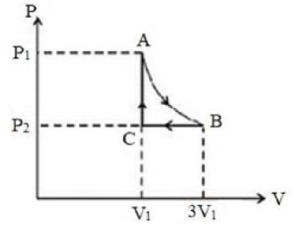
A
$RT_1[3 \ln(3) - 2]$
B
$RT_1[3 \ln(3) + 2]$
C
$3RT_1 \ln(3)$
D
$RT_1[3 \ln(2)]$
Solution
(A) The total work done in the cycle $ABCA$ is $W_{ABCA} = W_{AB} + W_{BC} + W_{CA}$.
$1$. Process $AB$ is an isothermal process since $T_A = T_B = T_1$. The work done is $W_{AB} = nRT_1 \ln(V_B/V_A) = 3RT_1 \ln(3V_1/V_1) = 3RT_1 \ln(3)$.
$2$. Process $BC$ is an isobaric process since $P_B = P_C = P_2$. The work done is $W_{BC} = P_2(V_C - V_B) = P_2(V_1 - 3V_1) = -2P_2V_1$. From the ideal gas law at point $B$,$P_2(3V_1) = nRT_1 = 3RT_1$,so $P_2V_1 = RT_1$. Thus,$W_{BC} = -2RT_1$.
$3$. Process $CA$ is an isochoric process since $V_C = V_A = V_1$. The work done is $W_{CA} = 0$.
$4$. Total work $W_{ABCA} = 3RT_1 \ln(3) - 2RT_1 + 0 = RT_1[3 \ln(3) - 2]$.
$1$. Process $AB$ is an isothermal process since $T_A = T_B = T_1$. The work done is $W_{AB} = nRT_1 \ln(V_B/V_A) = 3RT_1 \ln(3V_1/V_1) = 3RT_1 \ln(3)$.
$2$. Process $BC$ is an isobaric process since $P_B = P_C = P_2$. The work done is $W_{BC} = P_2(V_C - V_B) = P_2(V_1 - 3V_1) = -2P_2V_1$. From the ideal gas law at point $B$,$P_2(3V_1) = nRT_1 = 3RT_1$,so $P_2V_1 = RT_1$. Thus,$W_{BC} = -2RT_1$.
$3$. Process $CA$ is an isochoric process since $V_C = V_A = V_1$. The work done is $W_{CA} = 0$.
$4$. Total work $W_{ABCA} = 3RT_1 \ln(3) - 2RT_1 + 0 = RT_1[3 \ln(3) - 2]$.
0 likes
View Solution297
MediumMCQ
If $dQ$,$dU$,and $dW$ are heat energy absorbed,change in internal energy,and external work done respectively by a diatomic gas at constant pressure,then the ratio $dW: dU: dQ$ is:
A
$5: 3: 2$
B
$7: 5: 2$
C
$4: 3: 1$
D
$2: 5: 7$
Solution
(D) For a diatomic gas at constant pressure:
$1$. The work done is $dW = P dV = nR dT$.
$2$. The change in internal energy is $dU = n C_v dT$. For a diatomic gas,the molar heat capacity at constant volume is $C_v = \frac{5}{2} R$,so $dU = n \left( \frac{5}{2} R \right) dT$.
$3$. The heat absorbed is $dQ = n C_p dT$. For a diatomic gas,the molar heat capacity at constant pressure is $C_p = \frac{7}{2} R$,so $dQ = n \left( \frac{7}{2} R \right) dT$.
$4$. The ratio $dW : dU : dQ$ is:
$dW : dU : dQ = nR dT : n \left( \frac{5}{2} R \right) dT : n \left( \frac{7}{2} R \right) dT$
Dividing by $nR dT$,we get:
$1 : \frac{5}{2} : \frac{7}{2}$
Multiplying by $2$ to simplify:
$2 : 5 : 7$.
$1$. The work done is $dW = P dV = nR dT$.
$2$. The change in internal energy is $dU = n C_v dT$. For a diatomic gas,the molar heat capacity at constant volume is $C_v = \frac{5}{2} R$,so $dU = n \left( \frac{5}{2} R \right) dT$.
$3$. The heat absorbed is $dQ = n C_p dT$. For a diatomic gas,the molar heat capacity at constant pressure is $C_p = \frac{7}{2} R$,so $dQ = n \left( \frac{7}{2} R \right) dT$.
$4$. The ratio $dW : dU : dQ$ is:
$dW : dU : dQ = nR dT : n \left( \frac{5}{2} R \right) dT : n \left( \frac{7}{2} R \right) dT$
Dividing by $nR dT$,we get:
$1 : \frac{5}{2} : \frac{7}{2}$
Multiplying by $2$ to simplify:
$2 : 5 : 7$.
0 likes
View SolutionThermodynamics — Mix Examples-Thermodynamics · Frequently Asked Questions
1Are these Thermodynamics questions useful for JEE and NEET?
Yes. All questions in this section are mapped to JEE Main and NEET exam patterns. Previous year questions from JEE Main, NEET, GUJCET and state-level exams are included with full solutions.
2Can I switch to Hindi or Gujarati for these questions?
Yes. Use the language tabs in the hero section or the sidebar to view the same questions and solutions in English, Hindi or Gujarati.
3How do I generate a question paper from this subtopic?
Use the Vedclass Exam Paper Generator — select the chapter and subtopic, set difficulty, and generate Sets A, B, C, D automatically. First 3 chapters of every subject are free.
Vedclass Products
For Students
Vedclass Test Series
Mock tests in real JEE/NEET style with performance analysis. 5-day free trial.
Start Free TrialFor Teachers
Exam Paper Generator
Generate Set A/B/C/D papers from this chapter in 2 minutes. 3 chapters free.
Try FreeFor Institutes
Online Exam Module
Live online exams with unlimited students, 360° analytics & white-label branding.
See DemoFor Teachers & Institutes
Generate a Thermodynamics Exam Paper in 2 Minutes
Select subtopic & difficulty — Sets A, B, C, D auto-generated with No Repeat logic.
First 3 chapters of every subject are free — no payment required.