
A English
Mix Examples-Thermodynamics Questions in English
Class 11 Physics · Thermodynamics · Mix Examples-Thermodynamics
331+
Questions
English
Language
100%
With Solutions
Showing 50 of 331 questions in English
101
MediumMCQ
Which of the following processes will release the maximum amount of heat to the surroundings when the volume is reduced to half of its initial value?
A
Isobaric
B
Isothermal
C
Isochoric
D
Adiabatic
Solution
(A) For an adiabatic process,the heat exchange $Q = 0$.
For an isothermal process,the heat rejected is given by $Q_{\text{rejected}} = -W = -nRT_0 \ln(V_f/V_i) = nRT_0 \ln(V_i/V_f)$. Since $V_f = V_0/2$,we have $Q_{\text{rejected}} = nRT_0 \ln(2) \approx 0.693 nRT_0$.
For an isobaric process,the heat rejected is $Q_{\text{rejected}} = -n C_p \Delta T$. Since $V \propto T$,if $V$ becomes $V_0/2$,then $T$ becomes $T_0/2$,so $\Delta T = -T_0/2$. Thus,$Q_{\text{rejected}} = -n (\frac{f}{2} + 1) R (-T_0/2) = (\frac{f}{4} + 0.5) nRT_0$.
For a monoatomic gas $(f=3)$,$Q_{\text{rejected}} = (0.75 + 0.5) nRT_0 = 1.25 nRT_0$.
Comparing the values,$1.25 nRT_0 > 0.693 nRT_0$,therefore,the isobaric process releases the maximum amount of heat.
For an isothermal process,the heat rejected is given by $Q_{\text{rejected}} = -W = -nRT_0 \ln(V_f/V_i) = nRT_0 \ln(V_i/V_f)$. Since $V_f = V_0/2$,we have $Q_{\text{rejected}} = nRT_0 \ln(2) \approx 0.693 nRT_0$.
For an isobaric process,the heat rejected is $Q_{\text{rejected}} = -n C_p \Delta T$. Since $V \propto T$,if $V$ becomes $V_0/2$,then $T$ becomes $T_0/2$,so $\Delta T = -T_0/2$. Thus,$Q_{\text{rejected}} = -n (\frac{f}{2} + 1) R (-T_0/2) = (\frac{f}{4} + 0.5) nRT_0$.
For a monoatomic gas $(f=3)$,$Q_{\text{rejected}} = (0.75 + 0.5) nRT_0 = 1.25 nRT_0$.
Comparing the values,$1.25 nRT_0 > 0.693 nRT_0$,therefore,the isobaric process releases the maximum amount of heat.
0 likes
View Solution102
MediumMCQ
An ideal monoatomic gas is taken through a process $dQ = 2dU$. The molar heat capacity for the process is:
A
$2.5\,R$
B
$3\,R$
C
$R$
D
$2\,R$
Solution
(B) The molar heat capacity $C$ is defined by the relation $dQ = \mu C dT$,where $\mu$ is the number of moles and $dT$ is the change in temperature.
The internal energy change for an ideal gas is given by $dU = \mu C_v dT$.
Given the process equation: $dQ = 2dU$.
Substituting the expressions for $dQ$ and $dU$:
$\mu C dT = 2(\mu C_v dT)$
Dividing both sides by $\mu dT$:
$C = 2C_v$
For a monoatomic gas,the molar heat capacity at constant volume is $C_v = \frac{3}{2}R$.
Therefore,$C = 2 \times (\frac{3}{2}R) = 3R$.
The molar heat capacity for the process is $3R$.
The internal energy change for an ideal gas is given by $dU = \mu C_v dT$.
Given the process equation: $dQ = 2dU$.
Substituting the expressions for $dQ$ and $dU$:
$\mu C dT = 2(\mu C_v dT)$
Dividing both sides by $\mu dT$:
$C = 2C_v$
For a monoatomic gas,the molar heat capacity at constant volume is $C_v = \frac{3}{2}R$.
Therefore,$C = 2 \times (\frac{3}{2}R) = 3R$.
The molar heat capacity for the process is $3R$.
0 likes
View Solution103
DifficultMCQ
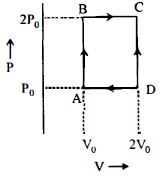
An engine operates by taking $n$ moles of an ideal gas through the cycle $ABCDA$ shown in the figure. The thermal efficiency of the engine is: (Take $C_v = 1.5 R$,where $R$ is the gas constant)
A
$0.24$
B
$0.15$
C
$0.32$
D
$0.08$
Solution
(B) The work done $(W)$ in the cycle $ABCDA$ is the area enclosed by the rectangle:
$W = (2P_0 - P_0) \times (2V_0 - V_0) = P_0 V_0$
Heat is absorbed during processes $AB$ and $BC$:
For process $AB$ (isochoric): $Q_{AB} = n C_v \Delta T = n (1.5 R) (T_B - T_A) = 1.5 (P_B V_B - P_A V_A) = 1.5 (2P_0 V_0 - P_0 V_0) = 1.5 P_0 V_0$
For process $BC$ (isobaric): $Q_{BC} = n C_p \Delta T = n (2.5 R) (T_C - T_B) = 2.5 (P_C V_C - P_B V_B) = 2.5 (4P_0 V_0 - 2P_0 V_0) = 5 P_0 V_0$
Total heat absorbed $(Q_{in})$ = $Q_{AB} + Q_{BC} = 1.5 P_0 V_0 + 5 P_0 V_0 = 6.5 P_0 V_0 = \frac{13}{2} P_0 V_0$
Thermal efficiency $(\eta)$ = $\frac{W}{Q_{in}} = \frac{P_0 V_0}{6.5 P_0 V_0} = \frac{1}{6.5} = \frac{2}{13} \approx 0.154$
$W = (2P_0 - P_0) \times (2V_0 - V_0) = P_0 V_0$
Heat is absorbed during processes $AB$ and $BC$:
For process $AB$ (isochoric): $Q_{AB} = n C_v \Delta T = n (1.5 R) (T_B - T_A) = 1.5 (P_B V_B - P_A V_A) = 1.5 (2P_0 V_0 - P_0 V_0) = 1.5 P_0 V_0$
For process $BC$ (isobaric): $Q_{BC} = n C_p \Delta T = n (2.5 R) (T_C - T_B) = 2.5 (P_C V_C - P_B V_B) = 2.5 (4P_0 V_0 - 2P_0 V_0) = 5 P_0 V_0$
Total heat absorbed $(Q_{in})$ = $Q_{AB} + Q_{BC} = 1.5 P_0 V_0 + 5 P_0 V_0 = 6.5 P_0 V_0 = \frac{13}{2} P_0 V_0$
Thermal efficiency $(\eta)$ = $\frac{W}{Q_{in}} = \frac{P_0 V_0}{6.5 P_0 V_0} = \frac{1}{6.5} = \frac{2}{13} \approx 0.154$
0 likes
View Solution104
MediumMCQ
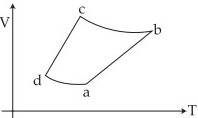
An ideal gas goes through a reversible cycle $a \to b \to c \to d$ and has the $V - T$ diagram shown below. Processes $d \to a$ and $b \to c$ are adiabatic. The corresponding $P - V$ diagram for the process is (all figures are schematic and not drawn to scale):
A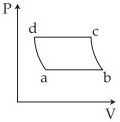
B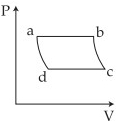
C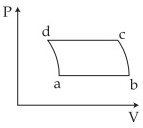
D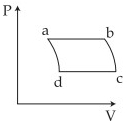
Solution
(A) In the given $V - T$ diagram:
$1$. Process $a \to b$: The line passes through the origin,so $V \propto T$. From the ideal gas law $PV = nRT$,this implies $P$ is constant. Thus,$a \to b$ is an isobaric process where temperature increases,meaning volume also increases.
$2$. Process $b \to c$: This is given as an adiabatic process. Since $V$ decreases and $T$ increases (from the graph),the pressure $P$ must increase significantly.
$3$. Process $c \to d$: The line passes through the origin,so $V \propto T$,which implies $P$ is constant. Thus,$c \to d$ is an isobaric process where temperature decreases,meaning volume also decreases.
$4$. Process $d \to a$: This is given as an adiabatic process. Since $V$ increases and $T$ decreases (from the graph),the pressure $P$ must decrease.
Comparing these characteristics with the given options,the $P - V$ diagram that correctly represents these processes is Option $A$.
$1$. Process $a \to b$: The line passes through the origin,so $V \propto T$. From the ideal gas law $PV = nRT$,this implies $P$ is constant. Thus,$a \to b$ is an isobaric process where temperature increases,meaning volume also increases.
$2$. Process $b \to c$: This is given as an adiabatic process. Since $V$ decreases and $T$ increases (from the graph),the pressure $P$ must increase significantly.
$3$. Process $c \to d$: The line passes through the origin,so $V \propto T$,which implies $P$ is constant. Thus,$c \to d$ is an isobaric process where temperature decreases,meaning volume also decreases.
$4$. Process $d \to a$: This is given as an adiabatic process. Since $V$ increases and $T$ decreases (from the graph),the pressure $P$ must decrease.
Comparing these characteristics with the given options,the $P - V$ diagram that correctly represents these processes is Option $A$.
0 likes
View Solution105
MediumMCQ
$A$ gas is compressed from a volume of $2\,m^3$ to a volume of $1\,m^3$ at a constant pressure of $100\,N/m^2$. Then it is heated at constant volume by supplying $150\,J$ of energy. As a result,the internal energy of the gas
A
increases by $250\,J$
B
decreases by $250\,J$
C
increases by $50\,J$
D
decreases by $50\,J$
Solution
(A) According to the first law of thermodynamics,$\Delta Q = \Delta U + \Delta W$.
Step $1$: Calculate the work done during the compression process.
Work done $\Delta W = P \Delta V = 100 \times (1 - 2) = -100\,J$.
Step $2$: Calculate the change in internal energy during the heating process.
Given $\Delta Q = 150\,J$ and since it is a constant volume process,$\Delta W = 0$.
Therefore,$\Delta Q = \Delta U = 150\,J$.
Step $3$: Total change in internal energy.
The total change in internal energy is the sum of the changes in both processes. However,the question asks for the net result of the entire sequence.
Using $\Delta Q_{total} = \Delta U_{total} + \Delta W_{total}$,where $\Delta Q_{total} = 150\,J$ and $\Delta W_{total} = -100\,J$.
$150 = \Delta U + (-100)$.
$\Delta U = 150 + 100 = 250\,J$.
Thus,the internal energy of the gas increases by $250\,J$.
Step $1$: Calculate the work done during the compression process.
Work done $\Delta W = P \Delta V = 100 \times (1 - 2) = -100\,J$.
Step $2$: Calculate the change in internal energy during the heating process.
Given $\Delta Q = 150\,J$ and since it is a constant volume process,$\Delta W = 0$.
Therefore,$\Delta Q = \Delta U = 150\,J$.
Step $3$: Total change in internal energy.
The total change in internal energy is the sum of the changes in both processes. However,the question asks for the net result of the entire sequence.
Using $\Delta Q_{total} = \Delta U_{total} + \Delta W_{total}$,where $\Delta Q_{total} = 150\,J$ and $\Delta W_{total} = -100\,J$.
$150 = \Delta U + (-100)$.
$\Delta U = 150 + 100 = 250\,J$.
Thus,the internal energy of the gas increases by $250\,J$.
0 likes
View Solution106
MediumMCQ
$A$ certain amount of gas is taken through a cyclic process $(A-B-C-D-A)$ that has two isobars, one isochore, and one isothermal process. The cycle can be represented on a $P-V$ indicator diagram as:
A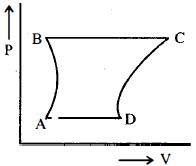
B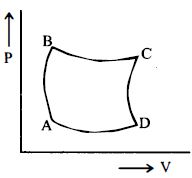
C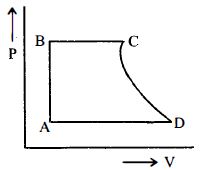
D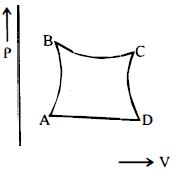
Solution
(A) In a $P-V$ diagram:
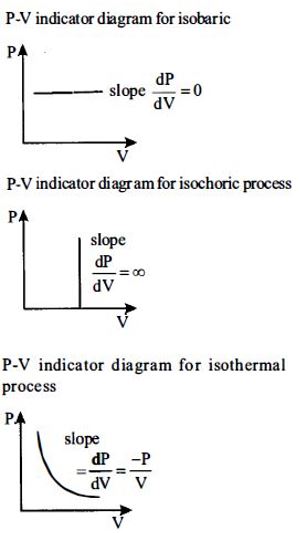
$1$. An isobaric process is represented by a horizontal line where pressure $P$ is constant, so the slope $\frac{dP}{dV} = 0$.
$2$. An isochoric process is represented by a vertical line where volume $V$ is constant, so the slope $\frac{dP}{dV} = \infty$.
$3$. An isothermal process is represented by a curve where $PV = \text{constant}$, so the slope $\frac{dP}{dV} = -\frac{P}{V}$.
Looking at the given options, option $A$ shows two horizontal lines (isobars), one vertical line (isochore), and one curved line (isothermal). Thus, it correctly represents the cycle $(A-B-C-D-A)$.
$1$. An isobaric process is represented by a horizontal line where pressure $P$ is constant, so the slope $\frac{dP}{dV} = 0$.
$2$. An isochoric process is represented by a vertical line where volume $V$ is constant, so the slope $\frac{dP}{dV} = \infty$.
$3$. An isothermal process is represented by a curve where $PV = \text{constant}$, so the slope $\frac{dP}{dV} = -\frac{P}{V}$.
Looking at the given options, option $A$ shows two horizontal lines (isobars), one vertical line (isochore), and one curved line (isothermal). Thus, it correctly represents the cycle $(A-B-C-D-A)$.
0 likes
View Solution107
MediumMCQ
An ideal monoatomic gas with pressure $P$, volume $V$ and temperature $T$ is expanded isothermally to a volume $2V$ and a final pressure $P_i$. If the same gas is expanded adiabatically to a volume $2V$, the final pressure is $P_a$. The ratio $\frac{P_a}{P_i}$ is
A
$2^{-1/3}$
B
$2^{1/3}$
C
$2^{2/3}$
D
$2^{-2/3}$
Solution
(D) For an isothermal process, the temperature remains constant, so $PV = \text{constant}$.
Initial state: $(P, V)$. Final state: $(P_i, 2V)$.
$PV = P_i(2V) \implies P_i = \frac{P}{2} \implies P = 2P_i \quad ...(i)$
For an adiabatic process, $PV^{\gamma} = \text{constant}$.
Initial state: $(P, V)$. Final state: $(P_a, 2V)$.
$PV^{\gamma} = P_a(2V)^{\gamma} \implies P_a = P \left(\frac{V}{2V}\right)^{\gamma} = P(2)^{-\gamma}$
For a monoatomic gas, the adiabatic index $\gamma = \frac{5}{3}$.
Substituting $P = 2P_i$ and $\gamma = \frac{5}{3}$ into the adiabatic equation:
$P_a = (2P_i)(2)^{-5/3} = P_i \cdot 2^1 \cdot 2^{-5/3} = P_i \cdot 2^{1 - 5/3} = P_i \cdot 2^{-2/3}$
Therefore, the ratio $\frac{P_a}{P_i} = 2^{-2/3}$.
Initial state: $(P, V)$. Final state: $(P_i, 2V)$.
$PV = P_i(2V) \implies P_i = \frac{P}{2} \implies P = 2P_i \quad ...(i)$
For an adiabatic process, $PV^{\gamma} = \text{constant}$.
Initial state: $(P, V)$. Final state: $(P_a, 2V)$.
$PV^{\gamma} = P_a(2V)^{\gamma} \implies P_a = P \left(\frac{V}{2V}\right)^{\gamma} = P(2)^{-\gamma}$
For a monoatomic gas, the adiabatic index $\gamma = \frac{5}{3}$.
Substituting $P = 2P_i$ and $\gamma = \frac{5}{3}$ into the adiabatic equation:
$P_a = (2P_i)(2)^{-5/3} = P_i \cdot 2^1 \cdot 2^{-5/3} = P_i \cdot 2^{1 - 5/3} = P_i \cdot 2^{-2/3}$
Therefore, the ratio $\frac{P_a}{P_i} = 2^{-2/3}$.
0 likes
View Solution108
MediumMCQ
The graph for $y = 1 - e^{-x}$ is represented by (for $x > 0$):
A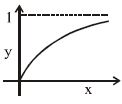
B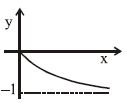
C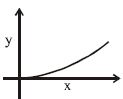
D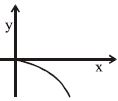
Solution
(A) Given the function $y = 1 - e^{-x}$.
For $x = 0$,$y = 1 - e^{0} = 1 - 1 = 0$. Thus,the graph starts from the origin $(0, 0)$.
As $x \to \infty$,$e^{-x} \to 0$,so $y \to 1 - 0 = 1$. This means the graph approaches the horizontal asymptote $y = 1$ as $x$ increases.
The derivative $\frac{dy}{dx} = e^{-x}$ is always positive for all $x$,meaning the function is strictly increasing.
Comparing these properties with the given options,the graph that starts at $(0, 0)$ and asymptotically approaches $y = 1$ is represented by Graph $A$.
For $x = 0$,$y = 1 - e^{0} = 1 - 1 = 0$. Thus,the graph starts from the origin $(0, 0)$.
As $x \to \infty$,$e^{-x} \to 0$,so $y \to 1 - 0 = 1$. This means the graph approaches the horizontal asymptote $y = 1$ as $x$ increases.
The derivative $\frac{dy}{dx} = e^{-x}$ is always positive for all $x$,meaning the function is strictly increasing.
Comparing these properties with the given options,the graph that starts at $(0, 0)$ and asymptotically approaches $y = 1$ is represented by Graph $A$.
0 likes
View Solution109
DifficultMCQ
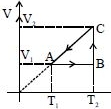
$A$ cyclic process for $1 \, \text{mole}$ of an ideal gas is shown in the $V-T$ diagram. Find the work done in processes $AB$, $BC$, and $CA$ respectively.
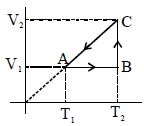
A
$0; R T_2 \ln \left( \frac{V_2}{V_1} \right); R(T_1 - T_2)$
B
$R(T_1 - T_2); R; R T_1 \ln \left( \frac{V_1}{V_2} \right)$
C
$0; R T_2 \ln \left( \frac{V_2}{V_1} \right); R(T_2 - T_1)$
D
$0; R T_2 \ln \left( \frac{V_1}{V_2} \right); R(T_2 - T_1)$
Solution
(A) For process $AB$: The volume $V$ is constant $(V = V_1)$. Therefore, the work done $W_{AB} = \int P dV = 0$.
For process $BC$: The temperature $T$ is constant $(T = T_2)$. The work done for an isothermal process is $W_{BC} = nRT_2 \ln \left( \frac{V_f}{V_i} \right)$. Here, $n = 1$, $V_i = V_1$, and $V_f = V_2$. So, $W_{BC} = R T_2 \ln \left( \frac{V_2}{V_1} \right)$.
For process $CA$: This is a process where the graph is a straight line passing through the origin in the $V-T$ diagram, which implies $V \propto T$, meaning pressure $P$ is constant (isobaric process). The work done is $W_{CA} = nR \Delta T = R(T_1 - T_2)$.
For process $BC$: The temperature $T$ is constant $(T = T_2)$. The work done for an isothermal process is $W_{BC} = nRT_2 \ln \left( \frac{V_f}{V_i} \right)$. Here, $n = 1$, $V_i = V_1$, and $V_f = V_2$. So, $W_{BC} = R T_2 \ln \left( \frac{V_2}{V_1} \right)$.
For process $CA$: This is a process where the graph is a straight line passing through the origin in the $V-T$ diagram, which implies $V \propto T$, meaning pressure $P$ is constant (isobaric process). The work done is $W_{CA} = nR \Delta T = R(T_1 - T_2)$.
0 likes
View Solution110
MediumMCQ
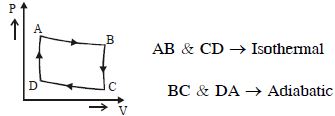
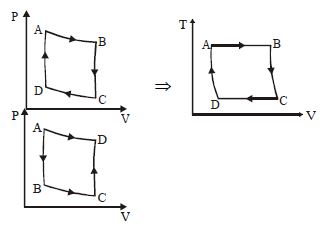
The $P-V$ diagram of a certain process (Carnot cycle) is as shown. The process is also represented as:
A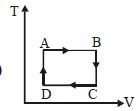
B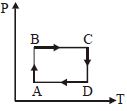
C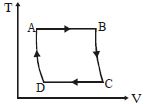
D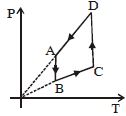
Solution
(D) कार्नोट चक्र में चार चरण होते हैं:
$1$. $AB$: समतापीय प्रसार ($T$ स्थिर, $P$ घटता है, $V$ बढ़ता है)।
$2$. $BC$: रुद्धोष्म प्रसार ($Q=0$, $T$ घटता है, $V$ बढ़ता है)।
$3$. $CD$: समतापीय संपीड़न ($T$ स्थिर, $P$ बढ़ता है, $V$ घटता है)।
$4$. $DA$: रुद्धोष्म संपीड़न ($Q=0$, $T$ बढ़ता है, $V$ घटता है)।
$T-V$ आरेख में, समतापीय प्रक्रियाएं ($AB$ और $CD$) क्षैतिज रेखाओं के रूप में दिखाई देती हैं क्योंकि $T$ स्थिर रहता है। रुद्धोष्म प्रक्रियाएं ($BC$ और $DA$) वक्र रेखाओं के रूप में दिखाई देती हैं क्योंकि $T$ और $V$ के बीच का संबंध $TV^{\gamma-1} = \text{constant}$ है। अतः, सही विकल्प $D$ है।
$1$. $AB$: समतापीय प्रसार ($T$ स्थिर, $P$ घटता है, $V$ बढ़ता है)।
$2$. $BC$: रुद्धोष्म प्रसार ($Q=0$, $T$ घटता है, $V$ बढ़ता है)।
$3$. $CD$: समतापीय संपीड़न ($T$ स्थिर, $P$ बढ़ता है, $V$ घटता है)।
$4$. $DA$: रुद्धोष्म संपीड़न ($Q=0$, $T$ बढ़ता है, $V$ घटता है)।
$T-V$ आरेख में, समतापीय प्रक्रियाएं ($AB$ और $CD$) क्षैतिज रेखाओं के रूप में दिखाई देती हैं क्योंकि $T$ स्थिर रहता है। रुद्धोष्म प्रक्रियाएं ($BC$ और $DA$) वक्र रेखाओं के रूप में दिखाई देती हैं क्योंकि $T$ और $V$ के बीच का संबंध $TV^{\gamma-1} = \text{constant}$ है। अतः, सही विकल्प $D$ है।
0 likes
View Solution111
MediumMCQ
$540$ calories of heat converts $1$ cubic centimeter of water at $100\,^oC$ into $1671$ cubic centimeter of steam at $100\,^oC$ at a pressure of one atmosphere. Then the work done against the atmospheric pressure is nearly .......... $cal$.
A
$540$
B
$40$
C
$0$
D
$500$
Solution
(B) The work done by the system during an isobaric expansion is given by the formula $W = P(V_2 - V_1)$.
Given:
Pressure $P = 1 \text{ atm} \approx 1.013 \times 10^5 \text{ Pa}$. For simplicity in calculation,we use $P = 10^5 \text{ Pa}$.
Initial volume $V_1 = 1 \text{ cm}^3 = 1 \times 10^{-6} \text{ m}^3$.
Final volume $V_2 = 1671 \text{ cm}^3 = 1671 \times 10^{-6} \text{ m}^3$.
Change in volume $\Delta V = V_2 - V_1 = (1671 - 1) \times 10^{-6} \text{ m}^3 = 1670 \times 10^{-6} \text{ m}^3$.
Work done in Joules: $W = 10^5 \times 1670 \times 10^{-6} \text{ J} = 167 \text{ J}$.
To convert work from Joules to calories,divide by the mechanical equivalent of heat $(J \approx 4.2 \text{ J/cal})$:
$W = \frac{167}{4.2} \approx 39.76 \text{ cal}$.
Rounding to the nearest integer,the work done is approximately $40 \text{ cal}$.
Given:
Pressure $P = 1 \text{ atm} \approx 1.013 \times 10^5 \text{ Pa}$. For simplicity in calculation,we use $P = 10^5 \text{ Pa}$.
Initial volume $V_1 = 1 \text{ cm}^3 = 1 \times 10^{-6} \text{ m}^3$.
Final volume $V_2 = 1671 \text{ cm}^3 = 1671 \times 10^{-6} \text{ m}^3$.
Change in volume $\Delta V = V_2 - V_1 = (1671 - 1) \times 10^{-6} \text{ m}^3 = 1670 \times 10^{-6} \text{ m}^3$.
Work done in Joules: $W = 10^5 \times 1670 \times 10^{-6} \text{ J} = 167 \text{ J}$.
To convert work from Joules to calories,divide by the mechanical equivalent of heat $(J \approx 4.2 \text{ J/cal})$:
$W = \frac{167}{4.2} \approx 39.76 \text{ cal}$.
Rounding to the nearest integer,the work done is approximately $40 \text{ cal}$.
0 likes
View Solution112
DifficultMCQ
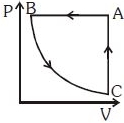
$A$ cyclic process $ABCA$ is shown in the $PT$ diagram. When represented on a $PV$ diagram,it would be:

A
B
C
D
Solution
(D) In the $PT$ diagram:
$A \rightarrow B$: $P$ is constant and $T$ decreases. Since $PV = nRT$,$V$ must decrease. This is an isobaric compression.
$B \rightarrow C$: The line passes through the origin,so $P \propto T$,which means $V$ is constant. Since $P$ decreases,$T$ also decreases. This is an isochoric cooling.
$C \rightarrow A$: The line is not passing through the origin. From the ideal gas law $PV = nRT$,we have $P = (nR/V)T$. The slope of the $PT$ graph is $nR/V$. Since $P$ and $T$ both increase from $C$ to $A$,and the slope is positive,this represents a process where $V$ changes. Specifically,for an isothermal process,$P \propto 1/V$. The correct representation in the $PV$ diagram is shown in image $818-$s925.
$A \rightarrow B$: $P$ is constant and $T$ decreases. Since $PV = nRT$,$V$ must decrease. This is an isobaric compression.
$B \rightarrow C$: The line passes through the origin,so $P \propto T$,which means $V$ is constant. Since $P$ decreases,$T$ also decreases. This is an isochoric cooling.
$C \rightarrow A$: The line is not passing through the origin. From the ideal gas law $PV = nRT$,we have $P = (nR/V)T$. The slope of the $PT$ graph is $nR/V$. Since $P$ and $T$ both increase from $C$ to $A$,and the slope is positive,this represents a process where $V$ changes. Specifically,for an isothermal process,$P \propto 1/V$. The correct representation in the $PV$ diagram is shown in image $818-$s925.
0 likes
View Solution113
DifficultMCQ
$A$ monoatomic gas at a pressure $P$,having a volume $V$ expands isothermally to a volume $4V$ and then adiabatically to volume $16V$. The final pressure of the gas is (Take $\gamma = \frac{5}{3}$)
A
$32P$
B
$\frac{P}{32}$
C
$\frac{P}{64}$
D
$64P$
Solution
(B) For an isothermal process,the temperature remains constant,so $P_1 V_1 = P_2 V_2$.
Given $P_1 = P$,$V_1 = V$,and $V_2 = 4V$,we have $P \times V = P_2 \times (4V)$.
Thus,$P_2 = \frac{P}{4}$.
For an adiabatic process,the relation is $P_2 V_2^{\gamma} = P_f V_f^{\gamma}$.
Given $\gamma = \frac{5}{3}$,$V_2 = 4V$,and $V_f = 16V$,we have $\frac{P}{4} \times (4V)^{5/3} = P_f \times (16V)^{5/3}$.
$P_f = \frac{P}{4} \times \left(\frac{4V}{16V}\right)^{5/3} = \frac{P}{4} \times \left(\frac{1}{4}\right)^{5/3} = \frac{P}{4} \times \frac{1}{4^{5/3}} = \frac{P}{4^{1 + 5/3}} = \frac{P}{4^{8/3}}$.
Note: If $\gamma = 1.5$ (or $3/2$) as per the original prompt,$P_f = \frac{P}{4} \times (1/4)^{3/2} = \frac{P}{4} \times \frac{1}{8} = \frac{P}{32}$.
Given $P_1 = P$,$V_1 = V$,and $V_2 = 4V$,we have $P \times V = P_2 \times (4V)$.
Thus,$P_2 = \frac{P}{4}$.
For an adiabatic process,the relation is $P_2 V_2^{\gamma} = P_f V_f^{\gamma}$.
Given $\gamma = \frac{5}{3}$,$V_2 = 4V$,and $V_f = 16V$,we have $\frac{P}{4} \times (4V)^{5/3} = P_f \times (16V)^{5/3}$.
$P_f = \frac{P}{4} \times \left(\frac{4V}{16V}\right)^{5/3} = \frac{P}{4} \times \left(\frac{1}{4}\right)^{5/3} = \frac{P}{4} \times \frac{1}{4^{5/3}} = \frac{P}{4^{1 + 5/3}} = \frac{P}{4^{8/3}}$.
Note: If $\gamma = 1.5$ (or $3/2$) as per the original prompt,$P_f = \frac{P}{4} \times (1/4)^{3/2} = \frac{P}{4} \times \frac{1}{8} = \frac{P}{32}$.
0 likes
View Solution114
DifficultMCQ
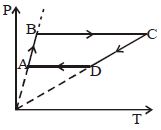
Six moles of an ideal gas perform a cycle shown in the figure. If the temperatures are $T_A = 600\, K,$ $T_B = 800\, K,$ $T_C = 2200\, K,$ and $T_D = 1200\, K,$ then the work done per cycle is approximately ...... $kJ$.
A
$20$
B
$30$
C
$40$
D
$60$
Solution
(C) The work done in a cycle is given by $W = \oint P dV$. For an ideal gas,$PV = nRT$,so $dV = \frac{nR}{P} dT$ for isobaric processes.
Process $AB$ and $CD$ are isochoric (constant volume) as they lie on lines passing through the origin in a $P-T$ diagram,so $W_{AB} = 0$ and $W_{CD} = 0$.
Process $BC$ is isobaric at pressure $P_2$. Work $W_{BC} = P_2(V_C - V_B) = nR(T_C - T_B) = 6 \times R \times (2200 - 800) = 6R \times 1400 = 8400R$.
Process $DA$ is isobaric at pressure $P_1$. Work $W_{DA} = P_1(V_A - V_D) = nR(T_A - T_D) = 6 \times R \times (600 - 1200) = 6R \times (-600) = -3600R$.
Total work $W = W_{AB} + W_{BC} + W_{CD} + W_{DA} = 0 + 8400R + 0 - 3600R = 4800R$.
Using $R \approx 8.314\, J/(mol\cdot K)$ or $R \approx 25/3\, J/(mol\cdot K)$:
$W = 4800 \times (25/3) = 1600 \times 25 = 40000\, J = 40\, kJ$.
Process $AB$ and $CD$ are isochoric (constant volume) as they lie on lines passing through the origin in a $P-T$ diagram,so $W_{AB} = 0$ and $W_{CD} = 0$.
Process $BC$ is isobaric at pressure $P_2$. Work $W_{BC} = P_2(V_C - V_B) = nR(T_C - T_B) = 6 \times R \times (2200 - 800) = 6R \times 1400 = 8400R$.
Process $DA$ is isobaric at pressure $P_1$. Work $W_{DA} = P_1(V_A - V_D) = nR(T_A - T_D) = 6 \times R \times (600 - 1200) = 6R \times (-600) = -3600R$.
Total work $W = W_{AB} + W_{BC} + W_{CD} + W_{DA} = 0 + 8400R + 0 - 3600R = 4800R$.
Using $R \approx 8.314\, J/(mol\cdot K)$ or $R \approx 25/3\, J/(mol\cdot K)$:
$W = 4800 \times (25/3) = 1600 \times 25 = 40000\, J = 40\, kJ$.
0 likes
View Solution115
DifficultMCQ
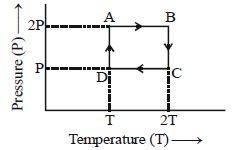
One mole of an ideal gas having initial volume $V$,pressure $2P$ and temperature $T$ undergoes a cyclic process $ABCDA$ as shown below. The net work done in the complete cycle is:
A
zero
B
$\frac{1}{2} RT \ln 2$
C
$RT \ln 2$
D
$\frac{3}{2} RT \ln 2$
Solution
(C) For an ideal gas,the work done in a process is given by $\Delta W = \int P \, dV$. Using the ideal gas equation $PV = nRT$,we have $V = \frac{nRT}{P}$. Thus,$dV = \frac{nR}{P} dT$ (at constant pressure) or $dV = -\frac{nRT}{P^2} dP$ (at constant temperature).
$1$. Path $AB$ (Constant pressure $P = 2P_0$): $\Delta W_{AB} = P \Delta V = nR \Delta T = 1 \cdot R \cdot (2T - T) = RT$.
$2$. Path $BC$ (Constant temperature $T = 2T_0$): $\Delta W_{BC} = nRT \ln \left( \frac{V_f}{V_i} \right) = nRT \ln \left( \frac{P_i}{P_f} \right) = 1 \cdot R \cdot (2T) \ln \left( \frac{2P}{P} \right) = 2RT \ln 2$.
$3$. Path $CD$ (Constant pressure $P = P_0$): $\Delta W_{CD} = P \Delta V = nR \Delta T = 1 \cdot R \cdot (T - 2T) = -RT$.
$4$. Path $DA$ (Constant temperature $T = T_0$): $\Delta W_{DA} = nRT \ln \left( \frac{V_f}{V_i} \right) = nRT \ln \left( \frac{P_i}{P_f} \right) = 1 \cdot R \cdot (T) \ln \left( \frac{P}{2P} \right) = RT \ln \left( \frac{1}{2} \right) = -RT \ln 2$.
Net work done $\Delta W = \Delta W_{AB} + \Delta W_{BC} + \Delta W_{CD} + \Delta W_{DA} = RT + 2RT \ln 2 - RT - RT \ln 2 = RT \ln 2$.
$1$. Path $AB$ (Constant pressure $P = 2P_0$): $\Delta W_{AB} = P \Delta V = nR \Delta T = 1 \cdot R \cdot (2T - T) = RT$.
$2$. Path $BC$ (Constant temperature $T = 2T_0$): $\Delta W_{BC} = nRT \ln \left( \frac{V_f}{V_i} \right) = nRT \ln \left( \frac{P_i}{P_f} \right) = 1 \cdot R \cdot (2T) \ln \left( \frac{2P}{P} \right) = 2RT \ln 2$.
$3$. Path $CD$ (Constant pressure $P = P_0$): $\Delta W_{CD} = P \Delta V = nR \Delta T = 1 \cdot R \cdot (T - 2T) = -RT$.
$4$. Path $DA$ (Constant temperature $T = T_0$): $\Delta W_{DA} = nRT \ln \left( \frac{V_f}{V_i} \right) = nRT \ln \left( \frac{P_i}{P_f} \right) = 1 \cdot R \cdot (T) \ln \left( \frac{P}{2P} \right) = RT \ln \left( \frac{1}{2} \right) = -RT \ln 2$.
Net work done $\Delta W = \Delta W_{AB} + \Delta W_{BC} + \Delta W_{CD} + \Delta W_{DA} = RT + 2RT \ln 2 - RT - RT \ln 2 = RT \ln 2$.
0 likes
View Solution116
MediumMCQ
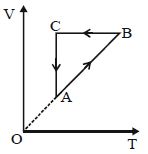
$A$ thermodynamic cycle of an ideal gas is shown in the figure. Choose the correct option which represents the same cycle.
A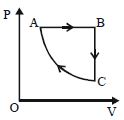
B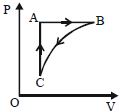
C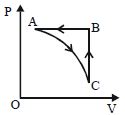
D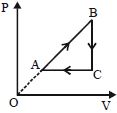
Solution
(A) In the given $V-T$ diagram:
$1$. Process $A \rightarrow B$: This is a straight line passing through the origin,so $V \propto T$. According to the ideal gas law $PV = nRT$,this implies $P$ is constant. Thus,$A \rightarrow B$ is an isobaric process.
$2$. Process $B \rightarrow C$: This is a horizontal line,meaning $V$ is constant. Thus,$B \rightarrow C$ is an isochoric process.
$3$. Process $C \rightarrow A$: This is a vertical line,meaning $T$ is constant. Thus,$C \rightarrow A$ is an isothermal process.
Now,let's analyze the $P-V$ diagrams:
- In option $A$,$A \rightarrow B$ is an isobaric process (horizontal line),$B \rightarrow C$ is an isochoric process (vertical line),and $C \rightarrow A$ is an isothermal process (hyperbolic curve). This matches the given cycle.
$1$. Process $A \rightarrow B$: This is a straight line passing through the origin,so $V \propto T$. According to the ideal gas law $PV = nRT$,this implies $P$ is constant. Thus,$A \rightarrow B$ is an isobaric process.
$2$. Process $B \rightarrow C$: This is a horizontal line,meaning $V$ is constant. Thus,$B \rightarrow C$ is an isochoric process.
$3$. Process $C \rightarrow A$: This is a vertical line,meaning $T$ is constant. Thus,$C \rightarrow A$ is an isothermal process.
Now,let's analyze the $P-V$ diagrams:
- In option $A$,$A \rightarrow B$ is an isobaric process (horizontal line),$B \rightarrow C$ is an isochoric process (vertical line),and $C \rightarrow A$ is an isothermal process (hyperbolic curve). This matches the given cycle.
0 likes
View Solution117
MediumMCQ
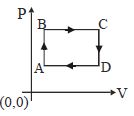
The figure shows the $P-V$ diagram of a thermodynamic cycle. Which corresponding curve is correct?
A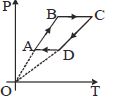
B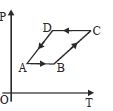
C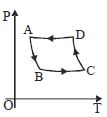
D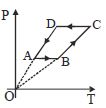
Solution
(A) From the given $P-V$ diagram,we analyze each process:
$1$. Process $A-B$: $V$ is constant (isochoric). From the ideal gas equation $PV = nRT$,since $V$ is constant,$P \propto T$. This represents a straight line passing through the origin in a $P-T$ diagram.
$2$. Process $B-C$: $P$ is constant (isobaric). From $PV = nRT$,since $P$ is constant,$V \propto T$. In a $P-T$ diagram,this is a line with a positive slope passing through the origin.
$3$. Process $C-D$: $V$ is constant (isochoric). Similar to $A-B$,this is a straight line passing through the origin.
$4$. Process $D-A$: $P$ is constant (isobaric). Similar to $B-C$,this is a line passing through the origin.
Comparing these characteristics with the given options,the graph in option $(A)$ correctly represents these processes in the $P-T$ plane.
$1$. Process $A-B$: $V$ is constant (isochoric). From the ideal gas equation $PV = nRT$,since $V$ is constant,$P \propto T$. This represents a straight line passing through the origin in a $P-T$ diagram.
$2$. Process $B-C$: $P$ is constant (isobaric). From $PV = nRT$,since $P$ is constant,$V \propto T$. In a $P-T$ diagram,this is a line with a positive slope passing through the origin.
$3$. Process $C-D$: $V$ is constant (isochoric). Similar to $A-B$,this is a straight line passing through the origin.
$4$. Process $D-A$: $P$ is constant (isobaric). Similar to $B-C$,this is a line passing through the origin.
Comparing these characteristics with the given options,the graph in option $(A)$ correctly represents these processes in the $P-T$ plane.
0 likes
View Solution118
DifficultMCQ
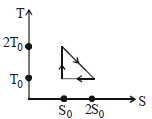
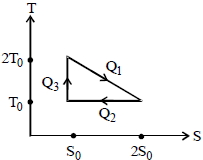
The temperature-entropy $(T-S)$ diagram of a reversible engine cycle is given in the figure. Its efficiency is
A
$1/4$
B
$1/2$
C
$2/3$
D
$1/3$
Solution
(D) In a $T-S$ diagram,the heat exchanged $Q$ is given by the area under the process curve,i.e.,$Q = \int T dS$.
For the given cycle:
$1$. Heat absorbed $(Q_1)$ during the expansion process (top diagonal line) is the area under the line from $S_0$ to $2S_0$:
$Q_1 = \text{Area of rectangle} + \text{Area of triangle} = (T_0 \times S_0) + \frac{1}{2} \times (T_0 \times S_0) = \frac{3}{2} T_0 S_0$.
$2$. Heat rejected $(Q_2)$ during the constant temperature process (bottom horizontal line) is the area under the line from $2S_0$ to $S_0$:
$Q_2 = T_0 \times (2S_0 - S_0) = T_0 S_0$.
$3$. The process $Q_3$ is an adiabatic process (vertical line),so $Q_3 = 0$.
$4$. The efficiency $\eta$ of the cycle is given by:
$\eta = \frac{W}{Q_1} = \frac{Q_1 - Q_2}{Q_1} = 1 - \frac{Q_2}{Q_1}$.
Substituting the values:
$\eta = 1 - \frac{T_0 S_0}{\frac{3}{2} T_0 S_0} = 1 - \frac{2}{3} = \frac{1}{3}$.
For the given cycle:
$1$. Heat absorbed $(Q_1)$ during the expansion process (top diagonal line) is the area under the line from $S_0$ to $2S_0$:
$Q_1 = \text{Area of rectangle} + \text{Area of triangle} = (T_0 \times S_0) + \frac{1}{2} \times (T_0 \times S_0) = \frac{3}{2} T_0 S_0$.
$2$. Heat rejected $(Q_2)$ during the constant temperature process (bottom horizontal line) is the area under the line from $2S_0$ to $S_0$:
$Q_2 = T_0 \times (2S_0 - S_0) = T_0 S_0$.
$3$. The process $Q_3$ is an adiabatic process (vertical line),so $Q_3 = 0$.
$4$. The efficiency $\eta$ of the cycle is given by:
$\eta = \frac{W}{Q_1} = \frac{Q_1 - Q_2}{Q_1} = 1 - \frac{Q_2}{Q_1}$.
Substituting the values:
$\eta = 1 - \frac{T_0 S_0}{\frac{3}{2} T_0 S_0} = 1 - \frac{2}{3} = \frac{1}{3}$.
0 likes
View Solution119
DifficultMCQ
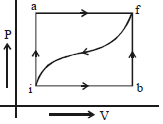
When a system is taken from a state $i$ to $f$ along the path $iaf$ (as shown in the figure),$Q = 50 \, cal$ and $W = 20 \, cal$. Along path $ibf$,$Q = 36 \, cal$.
$(i)$ What is $W$ along path $ibf$?
$(ii)$ If $W = -13 \, cal$ for path $fi$,what is $Q$ for the path $fi$?
$(iii)$ Take $E_{int,i} = 10 \, cal$,then what is $E_{int,f}$?
$(i)$ What is $W$ along path $ibf$?
$(ii)$ If $W = -13 \, cal$ for path $fi$,what is $Q$ for the path $fi$?
$(iii)$ Take $E_{int,i} = 10 \, cal$,then what is $E_{int,f}$?
A
$30, 20, 40 \, cal$
B
$6, -43, 40 \, cal$
C
$10, -20, 30 \, cal$
D
$15, 35, 25 \, cal$
Solution
(B) For path $iaf$:
$Q = 50 \, cal$,$W = 20 \, cal$.
According to the first law of thermodynamics,$\Delta U = Q - W$.
$\Delta U = 50 - 20 = 30 \, cal$.
Since internal energy is a state function,$\Delta U$ is the same for any path from $i$ to $f$.
$(i)$ For path $ibf$:
$Q = 36 \, cal$,$\Delta U = 30 \, cal$.
$W = Q - \Delta U = 36 - 30 = 6 \, cal$.
$(ii)$ For path $fi$ (reverse path):
$W = -13 \, cal$,$\Delta U_{fi} = -\Delta U_{if} = -30 \, cal$.
$Q = \Delta U + W = -30 + (-13) = -43 \, cal$.
$(iii)$ Given $E_{int,i} = 10 \, cal$:
$E_{int,f} = E_{int,i} + \Delta U = 10 + 30 = 40 \, cal$.
$Q = 50 \, cal$,$W = 20 \, cal$.
According to the first law of thermodynamics,$\Delta U = Q - W$.
$\Delta U = 50 - 20 = 30 \, cal$.
Since internal energy is a state function,$\Delta U$ is the same for any path from $i$ to $f$.
$(i)$ For path $ibf$:
$Q = 36 \, cal$,$\Delta U = 30 \, cal$.
$W = Q - \Delta U = 36 - 30 = 6 \, cal$.
$(ii)$ For path $fi$ (reverse path):
$W = -13 \, cal$,$\Delta U_{fi} = -\Delta U_{if} = -30 \, cal$.
$Q = \Delta U + W = -30 + (-13) = -43 \, cal$.
$(iii)$ Given $E_{int,i} = 10 \, cal$:
$E_{int,f} = E_{int,i} + \Delta U = 10 + 30 = 40 \, cal$.
0 likes
View Solution120
EasyMCQ
Two moles of a monoatomic ideal gas is confined in a container and is heated such that its temperature increases by $10\,^{\circ}C$. The approximate change in its internal energy is ..... $J$. $(R = 8.31\, J/mol\cdot K)$
A
$+ 250$
B
$+ 350$
C
$- 250$
D
$+ 450$
Solution
(A) The change in internal energy $\Delta U$ for an ideal gas is given by the formula $\Delta U = n C_v \Delta T$.
For a monoatomic ideal gas,the molar heat capacity at constant volume is $C_v = \frac{3}{2} R$.
Given: $n = 2\, mol$,$\Delta T = 10\, K$ (since a change of $10\,^{\circ}C$ is equivalent to a change of $10\, K$),and $R = 8.31\, J/mol\cdot K$.
Substituting these values into the formula:
$\Delta U = 2 \times \left( \frac{3}{2} \times 8.31 \right) \times 10$
$\Delta U = 3 \times 8.31 \times 10$
$\Delta U = 24.93 \times 10 = 249.3\, J$.
Rounding to the nearest integer,the approximate change in internal energy is $250\, J$.
For a monoatomic ideal gas,the molar heat capacity at constant volume is $C_v = \frac{3}{2} R$.
Given: $n = 2\, mol$,$\Delta T = 10\, K$ (since a change of $10\,^{\circ}C$ is equivalent to a change of $10\, K$),and $R = 8.31\, J/mol\cdot K$.
Substituting these values into the formula:
$\Delta U = 2 \times \left( \frac{3}{2} \times 8.31 \right) \times 10$
$\Delta U = 3 \times 8.31 \times 10$
$\Delta U = 24.93 \times 10 = 249.3\, J$.
Rounding to the nearest integer,the approximate change in internal energy is $250\, J$.
0 likes
View Solution121
DifficultMCQ
Starting at temperature $300 \; K,$ one mole of an ideal diatomic gas $(\gamma=1.4)$ is first compressed adiabatically from volume $V_{1}$ to $V_{2}=\frac{V_{1}}{16}.$ It is then allowed to expand isobarically to volume $2V_{2}.$ If all the processes are quasi-static,then the final temperature of the gas (in $K$) is (to the nearest integer):
A
$1818$
B
$2020$
C
$1576$
D
$1734$
Solution
(A) Step $1$: Adiabatic compression from $V_{1}$ to $V_{2} = V_{1}/16$.
For an adiabatic process,$T_{1}V_{1}^{\gamma-1} = T_{2}V_{2}^{\gamma-1}$.
Given $T_{1} = 300 \; K$,$\gamma = 1.4 = 7/5$,so $\gamma-1 = 0.4 = 2/5$.
$300 \times V_{1}^{2/5} = T_{2} \times (V_{1}/16)^{2/5}$.
$T_{2} = 300 \times (16)^{2/5} = 300 \times (2^{4})^{2/5} = 300 \times 2^{8/5}$.
$T_{2} = 300 \times 3.0314 = 909.42 \; K$.
Step $2$: Isobaric expansion from $V_{2}$ to $2V_{2}$.
For an isobaric process,$V/T = \text{constant}$,so $V_{2}/T_{2} = (2V_{2})/T_{f}$.
$T_{f} = 2 \times T_{2} = 2 \times 909.42 = 1818.84 \; K$.
Rounding to the nearest integer,the final temperature is $1819 \; K$. Given the options,$1818$ is the closest match.
For an adiabatic process,$T_{1}V_{1}^{\gamma-1} = T_{2}V_{2}^{\gamma-1}$.
Given $T_{1} = 300 \; K$,$\gamma = 1.4 = 7/5$,so $\gamma-1 = 0.4 = 2/5$.
$300 \times V_{1}^{2/5} = T_{2} \times (V_{1}/16)^{2/5}$.
$T_{2} = 300 \times (16)^{2/5} = 300 \times (2^{4})^{2/5} = 300 \times 2^{8/5}$.
$T_{2} = 300 \times 3.0314 = 909.42 \; K$.
Step $2$: Isobaric expansion from $V_{2}$ to $2V_{2}$.
For an isobaric process,$V/T = \text{constant}$,so $V_{2}/T_{2} = (2V_{2})/T_{f}$.
$T_{f} = 2 \times T_{2} = 2 \times 909.42 = 1818.84 \; K$.
Rounding to the nearest integer,the final temperature is $1819 \; K$. Given the options,$1818$ is the closest match.
0 likes
View Solution122
MediumMCQ
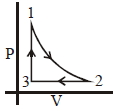
Which of the following is an equivalent cyclic process corresponding to the thermodynamic cycle given in the figure? Where, $1 \rightarrow 2$ is adiabatic.
A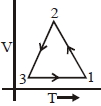
B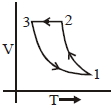
C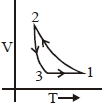
D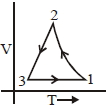
Solution
(D) In the given $P-V$ diagram:
$1$. Process $1 \rightarrow 2$ is an adiabatic expansion (pressure decreases, volume increases).
$2$. Process $2 \rightarrow 3$ is an isobaric compression (pressure is constant, volume decreases).
$3$. Process $3 \rightarrow 1$ is an isochoric heating (volume is constant, pressure increases).
Now, let's analyze the $V-T$ diagrams:
- For process $1 \rightarrow 2$ (adiabatic): $TV^{\gamma-1} = \text{constant}$. Since volume increases, temperature must decrease.
- For process $2 \rightarrow 3$ (isobaric): $V \propto T$. Since volume decreases, temperature must decrease.
- For process $3 \rightarrow 1$ (isochoric): $P \propto T$. Since pressure increases, temperature must increase.
Comparing these with the given options, the $V-T$ diagram that shows these trends is represented in option $D$.
$1$. Process $1 \rightarrow 2$ is an adiabatic expansion (pressure decreases, volume increases).
$2$. Process $2 \rightarrow 3$ is an isobaric compression (pressure is constant, volume decreases).
$3$. Process $3 \rightarrow 1$ is an isochoric heating (volume is constant, pressure increases).
Now, let's analyze the $V-T$ diagrams:
- For process $1 \rightarrow 2$ (adiabatic): $TV^{\gamma-1} = \text{constant}$. Since volume increases, temperature must decrease.
- For process $2 \rightarrow 3$ (isobaric): $V \propto T$. Since volume decreases, temperature must decrease.
- For process $3 \rightarrow 1$ (isochoric): $P \propto T$. Since pressure increases, temperature must increase.
Comparing these with the given options, the $V-T$ diagram that shows these trends is represented in option $D$.
0 likes
View Solution123
Medium
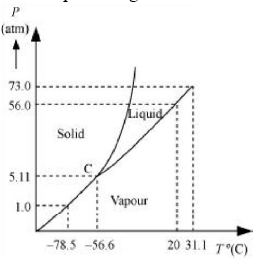
Answer the following questions based on the $P-T$ phase diagram of $CO_{2}$:
$(a)$ $CO_{2}$ at $1 \; atm$ pressure and temperature $-60^{\circ} C$ is compressed isothermally. Does it go through a liquid phase?
$(b)$ What happens when $CO_{2}$ at $4 \; atm$ pressure is cooled from room temperature at constant pressure?
$(c)$ Describe qualitatively the changes in a given mass of solid $CO_{2}$ at $10 \; atm$ pressure and temperature $-65^{\circ} C$ as it is heated up to room temperature at constant pressure.
$(d)$ $CO_{2}$ is heated to a temperature $70^{\circ} C$ and compressed isothermally. What changes in its properties do you expect to observe?
$(a)$ $CO_{2}$ at $1 \; atm$ pressure and temperature $-60^{\circ} C$ is compressed isothermally. Does it go through a liquid phase?
$(b)$ What happens when $CO_{2}$ at $4 \; atm$ pressure is cooled from room temperature at constant pressure?
$(c)$ Describe qualitatively the changes in a given mass of solid $CO_{2}$ at $10 \; atm$ pressure and temperature $-65^{\circ} C$ as it is heated up to room temperature at constant pressure.
$(d)$ $CO_{2}$ is heated to a temperature $70^{\circ} C$ and compressed isothermally. What changes in its properties do you expect to observe?
Solution
(N/A) No. At $1 \; atm$ pressure and $-60^{\circ} C$,$CO_{2}$ is in the vapour phase. As it is compressed isothermally,it moves from the vapour region directly into the solid region,bypassing the liquid phase.
$(b)$ At $4 \; atm$ pressure,which is below the triple point pressure of $5.11 \; atm$,cooling $CO_{2}$ from room temperature causes it to transition directly from the vapour phase to the solid phase (deposition).
$(c)$ At $10 \; atm$ pressure,which is above the triple point pressure,heating solid $CO_{2}$ from $-65^{\circ} C$ causes it to first melt into the liquid phase at the fusion curve and then vaporise into the gas phase at the vaporisation curve as it reaches room temperature.
$(d)$ Since $70^{\circ} C$ is above the critical temperature of $CO_{2}$ $(31.1^{\circ} C)$,it cannot be liquefied by compression alone. It will remain in the vapour phase,but its density will increase,and it will deviate from ideal gas behaviour as pressure increases.
$(b)$ At $4 \; atm$ pressure,which is below the triple point pressure of $5.11 \; atm$,cooling $CO_{2}$ from room temperature causes it to transition directly from the vapour phase to the solid phase (deposition).
$(c)$ At $10 \; atm$ pressure,which is above the triple point pressure,heating solid $CO_{2}$ from $-65^{\circ} C$ causes it to first melt into the liquid phase at the fusion curve and then vaporise into the gas phase at the vaporisation curve as it reaches room temperature.
$(d)$ Since $70^{\circ} C$ is above the critical temperature of $CO_{2}$ $(31.1^{\circ} C)$,it cannot be liquefied by compression alone. It will remain in the vapour phase,but its density will increase,and it will deviate from ideal gas behaviour as pressure increases.
0 likes
View Solution124
MediumMCQ
In changing the state of a gas adiabatically from an equilibrium state $A$ to another equilibrium state $B$,an amount of work equal to $22.3 \; J$ is done on the system. If the gas is taken from state $A$ to $B$ via a process in which the net heat absorbed by the system is $9.35 \; cal$,how much is the net work done (in $J$) by the system in the latter case? (Take $1 \; cal = 4.19 \; J$)
A
$16.88$
B
$39.18$
C
$8.65$
D
$22.35$
Solution
(A) For an adiabatic process,the heat exchange $\Delta Q = 0$. The work done on the system is $W_{adiabatic} = 22.3 \; J$. By the sign convention,work done on the system is negative,so $\Delta W = -22.3 \; J$.
From the first law of thermodynamics,$\Delta Q = \Delta U + \Delta W$,we get $0 = \Delta U - 22.3 \; J$,which implies $\Delta U = 22.3 \; J$.
Since internal energy is a state function,$\Delta U$ remains the same for any process between states $A$ and $B$.
In the second process,the heat absorbed is $\Delta Q' = 9.35 \; cal = 9.35 \times 4.19 \; J = 39.1765 \; J$.
Using the first law again: $\Delta Q' = \Delta U + \Delta W'$,where $\Delta W'$ is the work done by the system.
$\Delta W' = \Delta Q' - \Delta U = 39.1765 \; J - 22.3 \; J = 16.8765 \; J$.
Rounding to two decimal places,the work done by the system is $16.88 \; J$.
From the first law of thermodynamics,$\Delta Q = \Delta U + \Delta W$,we get $0 = \Delta U - 22.3 \; J$,which implies $\Delta U = 22.3 \; J$.
Since internal energy is a state function,$\Delta U$ remains the same for any process between states $A$ and $B$.
In the second process,the heat absorbed is $\Delta Q' = 9.35 \; cal = 9.35 \times 4.19 \; J = 39.1765 \; J$.
Using the first law again: $\Delta Q' = \Delta U + \Delta W'$,where $\Delta W'$ is the work done by the system.
$\Delta W' = \Delta Q' - \Delta U = 39.1765 \; J - 22.3 \; J = 16.8765 \; J$.
Rounding to two decimal places,the work done by the system is $16.88 \; J$.
0 likes
View Solution125
Easy
Write one process where work is converted into heat and heat is converted into work.
Solution
(N/A) $1$. Work to Heat: In winter,when we rub our palms together,the mechanical work done in rubbing is converted into thermal energy (heat),which makes our palms feel warmer.
$2$. Heat to Work: In a steam engine,the thermal energy (heat) released from steam is used to perform mechanical work by pushing pistons,which in turn rotate the wheels of the train.
$2$. Heat to Work: In a steam engine,the thermal energy (heat) released from steam is used to perform mechanical work by pushing pistons,which in turn rotate the wheels of the train.
0 likes
View Solution126
Medium
What are the differences between mechanics and thermodynamics?
Solution
(N/A) Mechanics deals with the motion of particles or bodies under the action of forces and torques. It focuses on the mechanical state of a system,such as its position,velocity,and kinetic energy.
Thermodynamics,on the other hand,is concerned with the internal macroscopic state of a system,defined by state variables like pressure,volume,and temperature. It does not focus on the motion of the system as a whole.
For example,when a bullet is fired from a gun,its mechanical state (kinetic energy) changes. However,when the bullet hits a piece of wood and stops,its kinetic energy is converted into internal energy (heat),which changes the temperature of both the bullet and the wood.
In summary,temperature is related to the energy of the internal,disordered motion of particles,whereas mechanics is concerned with the ordered motion of the system as a whole.
Thermodynamics,on the other hand,is concerned with the internal macroscopic state of a system,defined by state variables like pressure,volume,and temperature. It does not focus on the motion of the system as a whole.
For example,when a bullet is fired from a gun,its mechanical state (kinetic energy) changes. However,when the bullet hits a piece of wood and stops,its kinetic energy is converted into internal energy (heat),which changes the temperature of both the bullet and the wood.
In summary,temperature is related to the energy of the internal,disordered motion of particles,whereas mechanics is concerned with the ordered motion of the system as a whole.
0 likes
View Solution127
MediumMCQ
Match the devices in Column-$I$ with their efficiency/coefficient of performance in Column-$II$:
| Column-$I$ | Column-$II$ |
|---|---|
| $(a)$ Heat engine | $(i)$ $\text{COP} = \frac{Q_2}{Q_1 - Q_2}$ |
| $(b)$ Heat pump | $(ii)$ $\eta = \frac{Q_1 - Q_2}{Q_1}$ |
| $(iii)$ $\eta = \frac{T_1 - T_2}{T_1}$ |
A
$(a-ii, iii), (b-i)$
B
$(a-ii), (b-i, iii)$
C
$(a-i), (b-ii, iii)$
D
$(a-i, ii), (b-iii)$
Solution
(A) For a heat engine,the efficiency $\eta$ is defined as the ratio of work done to the heat absorbed from the source: $\eta = \frac{W}{Q_1} = \frac{Q_1 - Q_2}{Q_1}$.
For a Carnot engine,this is also expressed in terms of temperatures as $\eta = \frac{T_1 - T_2}{T_1}$. Thus,$(a)$ matches with $(ii)$ and $(iii)$.
For a heat pump,the coefficient of performance $(COP)$ is defined as the ratio of heat extracted from the cold reservoir to the work done: $\text{COP} = \frac{Q_2}{W} = \frac{Q_2}{Q_1 - Q_2}$. Thus,$(b)$ matches with $(i)$.
Therefore,the correct matching is $(a-ii, iii)$ and $(b-i)$.
For a Carnot engine,this is also expressed in terms of temperatures as $\eta = \frac{T_1 - T_2}{T_1}$. Thus,$(a)$ matches with $(ii)$ and $(iii)$.
For a heat pump,the coefficient of performance $(COP)$ is defined as the ratio of heat extracted from the cold reservoir to the work done: $\text{COP} = \frac{Q_2}{W} = \frac{Q_2}{Q_1 - Q_2}$. Thus,$(b)$ matches with $(i)$.
Therefore,the correct matching is $(a-ii, iii)$ and $(b-i)$.
0 likes
View Solution128
MediumMCQ
$A$ given amount of gas has an initial state $(P_i, V_i, T_i)$. It expands until its volume becomes $V_f$. Consider the following two cases:
$(a)$ The expansion occurs at constant temperature (isothermal).
$(b)$ The expansion occurs at constant pressure (isobaric).
Draw the $P-V$ diagram for each case. In which of the two cases is the work done by the gas greater?
$(a)$ The expansion occurs at constant temperature (isothermal).
$(b)$ The expansion occurs at constant pressure (isobaric).
Draw the $P-V$ diagram for each case. In which of the two cases is the work done by the gas greater?
A
Case $(a)$
B
Case $(b)$
C
Work done is equal in both cases
D
Cannot be determined
Solution
(B) The work done by a gas during expansion is given by the area under the $P-V$ curve.
$(1)$ For isothermal expansion $(a)$,the pressure $P$ decreases as volume $V$ increases according to $P = nRT/V$. The curve is a rectangular hyperbola.
$(2)$ For isobaric expansion $(b)$,the pressure $P$ remains constant at $P_i$. The curve is a horizontal line.
$(3)$ Since the gas expands from $V_i$ to $V_f$ starting from the same initial pressure $P_i$,the isobaric process maintains the pressure at $P_i$ throughout the expansion,whereas the isothermal process involves a decrease in pressure.
$(4)$ Graphically,the area under the horizontal line $(P = P_i)$ from $V_i$ to $V_f$ is a rectangle with area $P_i(V_f - V_i)$. The area under the isothermal curve is smaller because the pressure drops below $P_i$ during the process.
$(5)$ Therefore,the work done is greater in the isobaric expansion $(b)$.
$(1)$ For isothermal expansion $(a)$,the pressure $P$ decreases as volume $V$ increases according to $P = nRT/V$. The curve is a rectangular hyperbola.
$(2)$ For isobaric expansion $(b)$,the pressure $P$ remains constant at $P_i$. The curve is a horizontal line.
$(3)$ Since the gas expands from $V_i$ to $V_f$ starting from the same initial pressure $P_i$,the isobaric process maintains the pressure at $P_i$ throughout the expansion,whereas the isothermal process involves a decrease in pressure.
$(4)$ Graphically,the area under the horizontal line $(P = P_i)$ from $V_i$ to $V_f$ is a rectangle with area $P_i(V_f - V_i)$. The area under the isothermal curve is smaller because the pressure drops below $P_i$ during the process.
$(5)$ Therefore,the work done is greater in the isobaric expansion $(b)$.
0 likes
View Solution129
Difficult
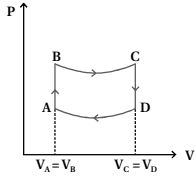
The cycle shown in the figure represents an engine (the engine consists of one mole of gas in a cylinder with a piston). $A$ to $B$ is isochoric,$B$ to $C$ is isothermal,$C$ to $D$ is isochoric,and $D$ to $A$ is isothermal. Also,$V_C = V_D = 2V_A = 2V_B$.
$(a)$ In which part of the cycle is heat supplied to the engine from the outside?
$(b)$ In which part of the cycle can the engine give energy to its surroundings?
$(c)$ How much work is done by the engine during one cycle? Give your answer in terms of $P_A, P_B$ and $V_A$.
$(d)$ What is the efficiency of the engine? (For the gas,$\gamma = 5/3$,and for one mole,$C_V = 3/2 R$)
$(a)$ In which part of the cycle is heat supplied to the engine from the outside?
$(b)$ In which part of the cycle can the engine give energy to its surroundings?
$(c)$ How much work is done by the engine during one cycle? Give your answer in terms of $P_A, P_B$ and $V_A$.
$(d)$ What is the efficiency of the engine? (For the gas,$\gamma = 5/3$,and for one mole,$C_V = 3/2 R$)
Solution
(N/A) Heat is supplied during the processes where the internal energy and work done increase. In the isothermal expansion $B \to C$,heat is absorbed $(Q_{BC} = nRT_B \ln(V_C/V_B) > 0)$. In the isochoric heating $A \to B$,heat is absorbed $(Q_{AB} = nC_V(T_B - T_A) > 0)$. Thus,heat is supplied in $A \to B$ and $B \to C$.
$(b)$ The engine gives energy to the surroundings during the cooling processes: isochoric cooling $C \to D$ and isothermal compression $D \to A$.
$(c)$ Work done $W = W_{AB} + W_{BC} + W_{CD} + W_{DA}$. Since $AB$ and $CD$ are isochoric,$W_{AB} = W_{CD} = 0$. $W_{BC} = nRT_B \ln(V_C/V_B) = P_B V_B \ln(2)$. $W_{DA} = nRT_A \ln(V_A/V_D) = P_A V_A \ln(1/2) = -P_A V_A \ln(2)$. Total work $W = (P_B - P_A) V_A \ln(2)$.
$(d)$ Efficiency $\eta = W / Q_{in}$. $Q_{in} = Q_{AB} + Q_{BC} = C_V(T_B - T_A) + P_B V_B \ln(2) = \frac{3}{2}(P_B - P_A)V_A + P_B V_A \ln(2)$. $\eta = \frac{(P_B - P_A) V_A \ln(2)}{\frac{3}{2}(P_B - P_A)V_A + P_B V_A \ln(2)} = \frac{(P_B - P_A) \ln(2)}{\frac{3}{2}(P_B - P_A) + P_B \ln(2)}$.
$(b)$ The engine gives energy to the surroundings during the cooling processes: isochoric cooling $C \to D$ and isothermal compression $D \to A$.
$(c)$ Work done $W = W_{AB} + W_{BC} + W_{CD} + W_{DA}$. Since $AB$ and $CD$ are isochoric,$W_{AB} = W_{CD} = 0$. $W_{BC} = nRT_B \ln(V_C/V_B) = P_B V_B \ln(2)$. $W_{DA} = nRT_A \ln(V_A/V_D) = P_A V_A \ln(1/2) = -P_A V_A \ln(2)$. Total work $W = (P_B - P_A) V_A \ln(2)$.
$(d)$ Efficiency $\eta = W / Q_{in}$. $Q_{in} = Q_{AB} + Q_{BC} = C_V(T_B - T_A) + P_B V_B \ln(2) = \frac{3}{2}(P_B - P_A)V_A + P_B V_A \ln(2)$. $\eta = \frac{(P_B - P_A) V_A \ln(2)}{\frac{3}{2}(P_B - P_A)V_A + P_B V_A \ln(2)} = \frac{(P_B - P_A) \ln(2)}{\frac{3}{2}(P_B - P_A) + P_B \ln(2)}$.
0 likes
View Solution130
Difficult
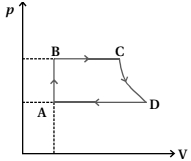
An engine (consisting of one mole of an ideal gas in a cylinder with a piston) follows the cycle shown in the figure. Find the heat exchanged by the engine with the surroundings in each part of the cycle. Given $C_V = \frac{3}{2}R$.
$(a)$ $A$ to $B$: Constant volume
$(b)$ $B$ to $C$: Constant pressure
$(c)$ $C$ to $D$: Adiabatic expansion
$(d)$ $D$ to $A$: Constant pressure
$(a)$ $A$ to $B$: Constant volume
$(b)$ $B$ to $C$: Constant pressure
$(c)$ $C$ to $D$: Adiabatic expansion
$(d)$ $D$ to $A$: Constant pressure
Solution
(N/A) For a process,the heat exchanged is given by $Q = nC\Delta T$.
$(a)$ $A$ to $B$ (Isochoric): $W = 0$,so $Q_{AB} = \Delta U = nC_V(T_B - T_A) = \frac{3}{2}nR(T_B - T_A)$. Since $P_B > P_A$ and $V$ is constant,$T_B > T_A$,so heat is absorbed.
$(b)$ $B$ to $C$ (Isobaric): $Q_{BC} = nC_P(T_C - T_B) = n(\frac{5}{2}R)(T_C - T_B)$. Since $V_C > V_B$,$T_C > T_B$,so heat is absorbed.
$(c)$ $C$ to $D$ (Adiabatic): By definition,$Q_{CD} = 0$.
$(d)$ $D$ to $A$ (Isobaric): $Q_{DA} = nC_P(T_A - T_D) = n(\frac{5}{2}R)(T_A - T_D)$. Since $V_A < V_D$,$T_A < T_D$,so heat is released.
$(a)$ $A$ to $B$ (Isochoric): $W = 0$,so $Q_{AB} = \Delta U = nC_V(T_B - T_A) = \frac{3}{2}nR(T_B - T_A)$. Since $P_B > P_A$ and $V$ is constant,$T_B > T_A$,so heat is absorbed.
$(b)$ $B$ to $C$ (Isobaric): $Q_{BC} = nC_P(T_C - T_B) = n(\frac{5}{2}R)(T_C - T_B)$. Since $V_C > V_B$,$T_C > T_B$,so heat is absorbed.
$(c)$ $C$ to $D$ (Adiabatic): By definition,$Q_{CD} = 0$.
$(d)$ $D$ to $A$ (Isobaric): $Q_{DA} = nC_P(T_A - T_D) = n(\frac{5}{2}R)(T_A - T_D)$. Since $V_A < V_D$,$T_A < T_D$,so heat is released.
0 likes
View Solution131
Advanced
Suppose an ideal gas ($n$ moles) undergoes an expansion process $P = f(V)$ which passes through the point $(V_0, P_0)$. If the slope of the curve $P = f(V)$ is greater than the slope of the adiabatic curve passing through $(V_0, P_0)$,show that the gas absorbs heat at $(V_0, P_0)$.
Solution
(N/A) The heat capacity $C$ for a process is given by $C = C_V + \frac{R}{1 - x}$,where $x$ is the polytropic index or related to the slope of the process curve.
For an adiabatic process,the slope is given by $(\frac{dP}{dV})_{ad} = -\gamma \frac{P_0}{V_0}$.
For the given process $P = f(V)$,let the slope be $(\frac{dP}{dV})_{proc}$.
We are given that $(\frac{dP}{dV})_{proc} > (\frac{dP}{dV})_{ad}$,which means $(\frac{dP}{dV})_{proc} > -\gamma \frac{P_0}{V_0}$.
The molar heat capacity for a general process is $C = C_V + \frac{P}{n(\frac{dT}{dV})}$.
Using the ideal gas law $PV = nRT$,we have $P + V(\frac{dP}{dV}) = nR(\frac{dT}{dV})$.
Substituting this into the heat capacity formula,we get $C = C_V + \frac{R}{1 - \frac{V}{P}(\frac{dP}{dV})}$.
Since the slope of the process is greater than the adiabatic slope,the denominator $(1 - \frac{V}{P}(\frac{dP}{dV}))$ becomes smaller than the denominator for the adiabatic process (which is $1 - (-\gamma) = 1 + \gamma$).
Specifically,if the slope is greater than the adiabatic slope,the process index $n_{poly}$ is less than $\gamma$.
Since $C = C_V \frac{\gamma - n_{poly}}{1 - n_{poly}}$,and given $n_{poly} < \gamma$,the heat capacity $C$ becomes positive.
Therefore,the gas absorbs heat during the expansion.
For an adiabatic process,the slope is given by $(\frac{dP}{dV})_{ad} = -\gamma \frac{P_0}{V_0}$.
For the given process $P = f(V)$,let the slope be $(\frac{dP}{dV})_{proc}$.
We are given that $(\frac{dP}{dV})_{proc} > (\frac{dP}{dV})_{ad}$,which means $(\frac{dP}{dV})_{proc} > -\gamma \frac{P_0}{V_0}$.
The molar heat capacity for a general process is $C = C_V + \frac{P}{n(\frac{dT}{dV})}$.
Using the ideal gas law $PV = nRT$,we have $P + V(\frac{dP}{dV}) = nR(\frac{dT}{dV})$.
Substituting this into the heat capacity formula,we get $C = C_V + \frac{R}{1 - \frac{V}{P}(\frac{dP}{dV})}$.
Since the slope of the process is greater than the adiabatic slope,the denominator $(1 - \frac{V}{P}(\frac{dP}{dV}))$ becomes smaller than the denominator for the adiabatic process (which is $1 - (-\gamma) = 1 + \gamma$).
Specifically,if the slope is greater than the adiabatic slope,the process index $n_{poly}$ is less than $\gamma$.
Since $C = C_V \frac{\gamma - n_{poly}}{1 - n_{poly}}$,and given $n_{poly} < \gamma$,the heat capacity $C$ becomes positive.
Therefore,the gas absorbs heat during the expansion.
0 likes
View Solution132
EasyMCQ
Is the splitting of water an exothermic or an endothermic process?
A
Exothermic
B
Endothermic
C
Both
D
Neither
Solution
(B) The splitting of water,also known as water electrolysis,is the process of breaking down water molecules $(H_2O)$ into hydrogen gas $(H_2)$ and oxygen gas $(O_2)$.
This reaction requires an input of energy (usually in the form of electricity) to break the strong covalent bonds between hydrogen and oxygen atoms.
Since energy is absorbed from the surroundings to drive the reaction,it is classified as an endothermic process.
This reaction requires an input of energy (usually in the form of electricity) to break the strong covalent bonds between hydrogen and oxygen atoms.
Since energy is absorbed from the surroundings to drive the reaction,it is classified as an endothermic process.
0 likes
View Solution133
Medium
What are thermodynamic processes?
Solution
(N/A) Thermodynamic processes are defined as follows:
$(1)$ Isothermal process: The process during which the temperature of the system remains constant.
$(2)$ Isobaric process: The process during which the pressure of the system remains constant.
$(3)$ Isochoric process: The process during which the volume of the system remains constant.
$(4)$ Adiabatic process: $A$ process in which a system undergoes physical changes such that no heat is exchanged between the system and its surroundings $(\Delta Q = 0)$.
$(5)$ Cyclic process: $A$ process in which a system undergoes a series of changes that return the system back to its initial state.
Some special thermodynamic processes are summarized in the table below:
$(1)$ Isothermal process: The process during which the temperature of the system remains constant.
$(2)$ Isobaric process: The process during which the pressure of the system remains constant.
$(3)$ Isochoric process: The process during which the volume of the system remains constant.
$(4)$ Adiabatic process: $A$ process in which a system undergoes physical changes such that no heat is exchanged between the system and its surroundings $(\Delta Q = 0)$.
$(5)$ Cyclic process: $A$ process in which a system undergoes a series of changes that return the system back to its initial state.
Some special thermodynamic processes are summarized in the table below:
| Type of process | Feature |
| Isothermal | Temperature constant |
| Isobaric | Pressure constant |
| Isochoric | Volume constant |
| Adiabatic | No heat flow $(\Delta Q = 0)$ |
0 likes
View Solution134
Easy
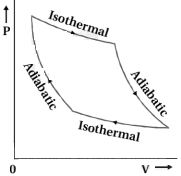
Draw $P-V$ curves for isothermal and adiabatic processes of an ideal gas.
Solution
(N/A) The $P-V$ diagram represents a Carnot cycle,which consists of two isothermal processes and two adiabatic processes.
$1$. Isothermal expansion: The gas expands at a constant temperature.
$2$. Adiabatic expansion: The gas expands without any heat exchange with the surroundings.
$3$. Isothermal compression: The gas is compressed at a constant temperature.
$4$. Adiabatic compression: The gas is compressed without any heat exchange with the surroundings.
The adiabatic curves are steeper than the isothermal curves because the adiabatic bulk modulus is $\gamma$ times the isothermal bulk modulus,where $\gamma > 1$.
$1$. Isothermal expansion: The gas expands at a constant temperature.
$2$. Adiabatic expansion: The gas expands without any heat exchange with the surroundings.
$3$. Isothermal compression: The gas is compressed at a constant temperature.
$4$. Adiabatic compression: The gas is compressed without any heat exchange with the surroundings.
The adiabatic curves are steeper than the isothermal curves because the adiabatic bulk modulus is $\gamma$ times the isothermal bulk modulus,where $\gamma > 1$.
0 likes
View Solution135
Easy
What is an isothermal process, adiabatic process, and isobaric process? Write the first law of thermodynamics for an ideal gas.
Solution
(N/A) $1$. Isothermal Process: $A$ process in which the temperature of the system remains constant $(T = \text{constant})$. For an ideal gas, the internal energy remains constant $(dU = 0)$.
$2$. Adiabatic Process: $A$ process in which there is no exchange of heat between the system and its surroundings $(dQ = 0)$.
$3$. Isobaric Process: $A$ process in which the pressure of the system remains constant $(P = \text{constant})$.
$4$. First Law of Thermodynamics: For an ideal gas, the first law is given by $dQ = dU + dW$, where $dQ$ is the heat supplied to the system, $dU$ is the change in internal energy, and $dW$ is the work done by the system.
$2$. Adiabatic Process: $A$ process in which there is no exchange of heat between the system and its surroundings $(dQ = 0)$.
$3$. Isobaric Process: $A$ process in which the pressure of the system remains constant $(P = \text{constant})$.
$4$. First Law of Thermodynamics: For an ideal gas, the first law is given by $dQ = dU + dW$, where $dQ$ is the heat supplied to the system, $dU$ is the change in internal energy, and $dW$ is the work done by the system.
0 likes
View Solution136
Medium
What is an isochoric process and a cyclic process? Write the first law of thermodynamics for an ideal gas.
Solution
(N/A) $1$. Isochoric Process: A thermodynamic process in which the volume of the system remains constant $(dV = 0)$ is called an isochoric process. In this process, no work is done by or on the system $(W = 0)$.
$2$. Cyclic Process: A process is called cyclic if the system returns to its initial state after a series of changes. In a cyclic process, the change in internal energy is zero $(\Delta U = 0)$.
$3$. First Law of Thermodynamics: For an ideal gas, the first law of thermodynamics is given by $\Delta Q = \Delta U + \Delta W$, where $\Delta Q$ is the heat supplied to the system, $\Delta U$ is the change in internal energy, and $\Delta W$ is the work done by the system.
$2$. Cyclic Process: A process is called cyclic if the system returns to its initial state after a series of changes. In a cyclic process, the change in internal energy is zero $(\Delta U = 0)$.
$3$. First Law of Thermodynamics: For an ideal gas, the first law of thermodynamics is given by $\Delta Q = \Delta U + \Delta W$, where $\Delta Q$ is the heat supplied to the system, $\Delta U$ is the change in internal energy, and $\Delta W$ is the work done by the system.
0 likes
View Solution137
Medium
Write the equation for the work done during the compression of an ideal gas.
Solution
(N/A) The work done $W$ by or on a gas during a process is given by the integral $W = \int_{V_i}^{V_f} P \, dV$.
For an ideal gas undergoing an isothermal compression,the equation is $W = nRT \ln\left(\frac{V_f}{V_i}\right)$. Since it is compression,$V_f < V_i$,making $W$ negative (work done on the gas).
For an adiabatic compression,the equation is $W = \frac{nR(T_f - T_i)}{\gamma - 1} = \frac{P_f V_f - P_i V_i}{\gamma - 1}$,where $\gamma$ is the adiabatic index.
For an ideal gas undergoing an isothermal compression,the equation is $W = nRT \ln\left(\frac{V_f}{V_i}\right)$. Since it is compression,$V_f < V_i$,making $W$ negative (work done on the gas).
For an adiabatic compression,the equation is $W = \frac{nR(T_f - T_i)}{\gamma - 1} = \frac{P_f V_f - P_i V_i}{\gamma - 1}$,where $\gamma$ is the adiabatic index.
0 likes
View Solution138
MediumMCQ
What is the working substance in an external combustion engine and an internal combustion engine?
A
Steam in both
B
Steam in external combustion engine and air-fuel mixture in internal combustion engine
C
Air-fuel mixture in both
D
Water in both
Solution
(B) In an external combustion engine,the fuel is burned outside the engine cylinder. The heat generated is used to convert water into high-pressure steam,which then acts as the working substance to perform mechanical work. Examples include steam engines and steam turbines.
In an internal combustion engine,the fuel is burned inside the engine cylinder itself. The combustion of the fuel creates high-pressure gases (a mixture of air and fuel),which expand to push the piston,acting as the working substance. Examples include petrol and diesel engines.
In an internal combustion engine,the fuel is burned inside the engine cylinder itself. The combustion of the fuel creates high-pressure gases (a mixture of air and fuel),which expand to push the piston,acting as the working substance. Examples include petrol and diesel engines.
0 likes
View Solution139
Easy
Obtain the relation between the coefficient of performance and the efficiency of a heat engine.
Solution
(N/A) The coefficient of performance $(COP)$, denoted by $\alpha$, for a refrigerator is defined as the ratio of heat extracted from the cold reservoir $(Q_2)$ to the work done $(W)$ on the system.
$\alpha = \frac{Q_2}{W} = \frac{Q_2}{Q_1 - Q_2}$
Dividing the numerator and denominator by $Q_1$:
$\alpha = \frac{Q_2 / Q_1}{1 - Q_2 / Q_1} \dots (1)$
For a Carnot engine, the efficiency $\eta$ is defined as:
$\eta = 1 - \frac{Q_2}{Q_1}$
Rearranging this gives:
$\frac{Q_2}{Q_1} = 1 - \eta \dots (2)$
Substituting equation $(2)$ into equation $(1)$:
$\alpha = \frac{1 - \eta}{\eta}$
Thus, the relation is $\alpha = \frac{1}{\eta} - 1$.
$\alpha = \frac{Q_2}{W} = \frac{Q_2}{Q_1 - Q_2}$
Dividing the numerator and denominator by $Q_1$:
$\alpha = \frac{Q_2 / Q_1}{1 - Q_2 / Q_1} \dots (1)$
For a Carnot engine, the efficiency $\eta$ is defined as:
$\eta = 1 - \frac{Q_2}{Q_1}$
Rearranging this gives:
$\frac{Q_2}{Q_1} = 1 - \eta \dots (2)$
Substituting equation $(2)$ into equation $(1)$:
$\alpha = \frac{1 - \eta}{\eta}$
Thus, the relation is $\alpha = \frac{1}{\eta} - 1$.
0 likes
View Solution140
Easy
What is the specific heat of a gas in an isothermal process and an adiabatic process?
Solution
(A) For an isothermal process,the temperature change $\Delta T = 0$. Since the specific heat is defined as $C = \frac{\Delta Q}{m \Delta T}$,as $\Delta T \to 0$,the specific heat $C$ becomes infinite.
For an adiabatic process,there is no heat exchange with the surroundings,so $\Delta Q = 0$. Substituting this into the formula $C = \frac{\Delta Q}{m \Delta T}$,we get $C = 0$.
For an adiabatic process,there is no heat exchange with the surroundings,so $\Delta Q = 0$. Substituting this into the formula $C = \frac{\Delta Q}{m \Delta T}$,we get $C = 0$.
0 likes
View Solution141
Difficult
What are the limitations of the first law of thermodynamics?
Solution
(N/A) $(i)$ It does not specify the direction in which heat flows. It only states that energy is conserved.
$(ii)$ It fails to explain why heat cannot be converted into work automatically and completely in a cyclic process without any external effect.
$(ii)$ It fails to explain why heat cannot be converted into work automatically and completely in a cyclic process without any external effect.
0 likes
View Solution142
Medium
Check if the following statements are true or false:
$1.$ For an adiabatic process,$T V^{\gamma - 1} = \text{constant}$.
$2.$ The charging process of a battery is a reversible process.
$3.$ Water falling from a height is a reversible process.
$4.$ Internal energy,volume,and mass are intensive variables,while pressure,temperature,and density are extensive variables.
$1.$ For an adiabatic process,$T V^{\gamma - 1} = \text{constant}$.
$2.$ The charging process of a battery is a reversible process.
$3.$ Water falling from a height is a reversible process.
$4.$ Internal energy,volume,and mass are intensive variables,while pressure,temperature,and density are extensive variables.
Solution
(A) $1.$ True. For an adiabatic process,the relation between temperature $T$ and volume $V$ is given by $T V^{\gamma - 1} = \text{constant}$.
$2.$ True. The charging of a battery is considered a reversible process if it is done infinitely slowly without any energy dissipation.
$3.$ False. Water falling from a height is an irreversible process because the kinetic energy gained is dissipated as heat due to friction and impact,which cannot be recovered.
$4.$ False. Internal energy,volume,and mass are extensive variables (they depend on the amount of matter),whereas pressure,temperature,and density are intensive variables (they are independent of the amount of matter).
$2.$ True. The charging of a battery is considered a reversible process if it is done infinitely slowly without any energy dissipation.
$3.$ False. Water falling from a height is an irreversible process because the kinetic energy gained is dissipated as heat due to friction and impact,which cannot be recovered.
$4.$ False. Internal energy,volume,and mass are extensive variables (they depend on the amount of matter),whereas pressure,temperature,and density are intensive variables (they are independent of the amount of matter).
0 likes
View Solution143
Medium
Check whether the following statements are true or false:
$1.$ The change in internal energy $\Delta U = 0$ in a cyclic process.
$2.$ In an adiabatic process,temperature remains constant.
$3.$ The internal energy of a system during an isothermal process decreases.
$1.$ The change in internal energy $\Delta U = 0$ in a cyclic process.
$2.$ In an adiabatic process,temperature remains constant.
$3.$ The internal energy of a system during an isothermal process decreases.
Solution
(A) $1.$ True. In a cyclic process,the system returns to its initial state,so the change in state functions like internal energy is zero $(\Delta U = 0)$.
$2.$ False. In an adiabatic process,there is no exchange of heat $(Q = 0)$,but the temperature of the system changes as work is done.
$3.$ False. In an isothermal process,the temperature remains constant. Since internal energy of an ideal gas depends only on temperature,$\Delta U = 0$ for an isothermal process.
$2.$ False. In an adiabatic process,there is no exchange of heat $(Q = 0)$,but the temperature of the system changes as work is done.
$3.$ False. In an isothermal process,the temperature remains constant. Since internal energy of an ideal gas depends only on temperature,$\Delta U = 0$ for an isothermal process.
0 likes
View Solution144
Medium
Fill in the blanks:
$1.$ The change of internal energy in a cyclic process is ......
$2.$ The internal energy of a gas is increased by ......
$3.$ An ideal gas at temperature $T_1$ is compressed to $1/32$ of its original volume,then its temperature $T_2$ will be ...... $(\gamma = 1.4)$.
$4.$ The triple point of water is at ...... pressure and ...... temperature.
$1.$ The change of internal energy in a cyclic process is ......
$2.$ The internal energy of a gas is increased by ......
$3.$ An ideal gas at temperature $T_1$ is compressed to $1/32$ of its original volume,then its temperature $T_2$ will be ...... $(\gamma = 1.4)$.
$4.$ The triple point of water is at ...... pressure and ...... temperature.
Solution
(N/A) $1.$ In a cyclic process,the system returns to its initial state. Since internal energy is a state function,the change in internal energy is $0$.
$2.$ The internal energy of a gas increases when work is done on the gas in an adiabatic process (where $Q = 0$,$\Delta U = -W$).
$3.$ For an adiabatic process,$T_1 V_1^{\gamma-1} = T_2 V_2^{\gamma-1}$. Given $V_2 = V_1 / 32$ and $\gamma = 1.4$,we have $T_2 = T_1 (V_1 / V_2)^{\gamma-1} = T_1 (32)^{1.4-1} = T_1 (32)^{0.4} = T_1 (2^5)^{2/5} = T_1 \times 2^2 = 4 T_1$.
$4.$ The triple point of water occurs at a pressure of $4.58 \text{ mm Hg}$ and a temperature of $273.16 \text{ K}$.
$2.$ The internal energy of a gas increases when work is done on the gas in an adiabatic process (where $Q = 0$,$\Delta U = -W$).
$3.$ For an adiabatic process,$T_1 V_1^{\gamma-1} = T_2 V_2^{\gamma-1}$. Given $V_2 = V_1 / 32$ and $\gamma = 1.4$,we have $T_2 = T_1 (V_1 / V_2)^{\gamma-1} = T_1 (32)^{1.4-1} = T_1 (32)^{0.4} = T_1 (2^5)^{2/5} = T_1 \times 2^2 = 4 T_1$.
$4.$ The triple point of water occurs at a pressure of $4.58 \text{ mm Hg}$ and a temperature of $273.16 \text{ K}$.
0 likes
View Solution145
Medium
Fill in the blanks:
$1.$ The heat required to raise the temperature of a body by $1\,K$ is called ...... .
$2.$ $A$ temperature difference of $10\,^{\circ}C$ is equivalent to a temperature difference of ...... on the Fahrenheit temperature scale.
$3.$ For an isothermal process of an ideal gas,$\frac{dP}{P} = .........$
$1.$ The heat required to raise the temperature of a body by $1\,K$ is called ...... .
$2.$ $A$ temperature difference of $10\,^{\circ}C$ is equivalent to a temperature difference of ...... on the Fahrenheit temperature scale.
$3.$ For an isothermal process of an ideal gas,$\frac{dP}{P} = .........$
Solution
(N/A) $1.$ The heat required to raise the temperature of a body by $1\,K$ is defined as its thermal capacity.
$2.$ The relation between temperature differences is $\Delta T_F = \frac{9}{5} \Delta T_C$. Given $\Delta T_C = 10\,^{\circ}C$,then $\Delta T_F = \frac{9}{5} \times 10 = 18\,^{\circ}F$.
$3.$ For an isothermal process,$PV = \text{constant}$. Differentiating both sides,we get $P dV + V dP = 0$. Rearranging gives $V dP = -P dV$,which simplifies to $\frac{dP}{P} = -\frac{dV}{V}$.
$2.$ The relation between temperature differences is $\Delta T_F = \frac{9}{5} \Delta T_C$. Given $\Delta T_C = 10\,^{\circ}C$,then $\Delta T_F = \frac{9}{5} \times 10 = 18\,^{\circ}F$.
$3.$ For an isothermal process,$PV = \text{constant}$. Differentiating both sides,we get $P dV + V dP = 0$. Rearranging gives $V dP = -P dV$,which simplifies to $\frac{dP}{P} = -\frac{dV}{V}$.
0 likes
View Solution146
Easy
In Column $-I$ processes and in Column $-II$ formulas of work are given. Match them appropriately:
| Column $-I$ | Column $-II$ |
|---|---|
| $(a)$ Isothermal process | $(i)$ $W = \frac{\mu R(T_1 - T_2)}{\gamma - 1}$ |
| $(b)$ Adiabatic process | $(ii)$ $W = P\Delta V$ |
| $(iii)$ $W = 2.303\mu RT \log_{10} \left( \frac{V_2}{V_1} \right)$ |
Solution
(A) For an isothermal process,the temperature $T$ remains constant. The work done is given by $W = \int_{V_1}^{V_2} P dV = \int_{V_1}^{V_2} \frac{\mu RT}{V} dV = \mu RT \ln \left( \frac{V_2}{V_1} \right) = 2.303 \mu RT \log_{10} \left( \frac{V_2}{V_1} \right)$. Thus,$(a)$ matches with $(iii)$.
For an adiabatic process,the work done is given by $W = \frac{\mu R(T_1 - T_2)}{\gamma - 1}$. Thus,$(b)$ matches with $(i)$.
Therefore,the correct matching is $(a-iii, b-i)$.
For an adiabatic process,the work done is given by $W = \frac{\mu R(T_1 - T_2)}{\gamma - 1}$. Thus,$(b)$ matches with $(i)$.
Therefore,the correct matching is $(a-iii, b-i)$.
0 likes
View Solution147
Easy
In Column-$I$ processes and in Column-$II$ the first law of thermodynamics are given. Match them appropriately:
| Column-$I$ | Column-$II$ |
|---|---|
| $(a)$ Adiabatic | $(i)$ $\Delta Q = \Delta U$ |
| $(b)$ Isothermal | $(ii)$ $\Delta Q = \Delta W$ |
| $(iii)$ $\Delta U = -\Delta W$ |
Solution
(A) The first law of thermodynamics is given by $\Delta Q = \Delta U + \Delta W$.
$(a)$ For an adiabatic process,there is no heat exchange with the surroundings,so $\Delta Q = 0$. Substituting this into the first law: $0 = \Delta U + \Delta W$,which implies $\Delta U = -\Delta W$. Thus,$(a)$ matches $(iii)$.
$(b)$ For an isothermal process,the temperature remains constant,which implies the change in internal energy $\Delta U = 0$. Substituting this into the first law: $\Delta Q = 0 + \Delta W$,which implies $\Delta Q = \Delta W$. Thus,$(b)$ matches $(ii)$.
Therefore,the correct matching is $(a-iii), (b-ii)$.
$(a)$ For an adiabatic process,there is no heat exchange with the surroundings,so $\Delta Q = 0$. Substituting this into the first law: $0 = \Delta U + \Delta W$,which implies $\Delta U = -\Delta W$. Thus,$(a)$ matches $(iii)$.
$(b)$ For an isothermal process,the temperature remains constant,which implies the change in internal energy $\Delta U = 0$. Substituting this into the first law: $\Delta Q = 0 + \Delta W$,which implies $\Delta Q = \Delta W$. Thus,$(b)$ matches $(ii)$.
Therefore,the correct matching is $(a-iii), (b-ii)$.
0 likes
View Solution148
Medium
In Column-$I$ devices and in Column-$II$ efficiency are given. Match them appropriately:
| Column-$I$ | Column-$II$ |
|---|---|
| $(a)$ Heat engine | $(i)$ $\eta = \frac{Q_2}{Q_1 - Q_2}$ |
| $(b)$ Heat pump | $(ii)$ $\eta = \frac{Q_1 - Q_2}{Q_1}$ |
| $(iii)$ $\eta = \frac{T_1 - T_2}{T_1}$ |
Solution
(A) For a heat engine,the efficiency $\eta$ is defined as the ratio of work done to heat input,given by $\eta = \frac{W}{Q_1} = \frac{Q_1 - Q_2}{Q_1}$. For a Carnot engine,this simplifies to $\eta = \frac{T_1 - T_2}{T_1}$. Thus,$(a)$ matches with $(ii)$ and $(iii)$.
For a heat pump,the coefficient of performance is defined as $\beta = \frac{Q_2}{W} = \frac{Q_2}{Q_1 - Q_2}$. Thus,$(b)$ matches with $(i)$.
For a heat pump,the coefficient of performance is defined as $\beta = \frac{Q_2}{W} = \frac{Q_2}{Q_1 - Q_2}$. Thus,$(b)$ matches with $(i)$.
0 likes
View Solution149
Medium
The initial state of a certain gas is $(P_i, V_i, T_i)$. It undergoes expansion until its volume becomes $V_f$. Consider the following two cases:
$(a)$ The expansion takes place at constant temperature.
$(b)$ The expansion takes place at constant pressure.
Plot the $P-V$ diagram for each case. In which of the two cases is the work done by the gas more?
$(a)$ The expansion takes place at constant temperature.
$(b)$ The expansion takes place at constant pressure.
Plot the $P-V$ diagram for each case. In which of the two cases is the work done by the gas more?
Solution
(B) The situation is shown in the provided $P-V$ graph,where the variation is shown for each process.
Process $1$ represents the isobaric expansion (constant pressure),and process $2$ represents the isothermal expansion (constant temperature).
Since the work done by a gas during expansion is equal to the area under the $P-V$ curve,we compare the areas under the two curves.
From the graph,the area under the curve for process $1$ (isobaric) is clearly larger than the area under the curve for process $2$ (isothermal).
Therefore,the work done by the gas is more in the isobaric process (case $b$).
Process $1$ represents the isobaric expansion (constant pressure),and process $2$ represents the isothermal expansion (constant temperature).
Since the work done by a gas during expansion is equal to the area under the $P-V$ curve,we compare the areas under the two curves.
From the graph,the area under the curve for process $1$ (isobaric) is clearly larger than the area under the curve for process $2$ (isothermal).
Therefore,the work done by the gas is more in the isobaric process (case $b$).
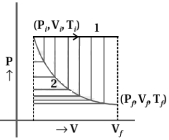
0 likes
View Solution150
Difficult
$A$ cycle followed by an engine (made of one mole of perfect gas in a cylinder with a piston) is shown in the figure.
$A$ to $B$: volume constant
$B$ to $C$: adiabatic
$C$ to $D$: volume constant
$D$ to $A$: adiabatic
$V_C = V_D = 2V_A = 2V_B$
$(a)$ In which part of the cycle is heat supplied to the engine from outside?
$(b)$ In which part of the cycle is heat given to the surrounding by the engine?
$(c)$ What is the work done by the engine in one cycle? Write your answer in terms of $P_A, P_B, V_A$.
$(d)$ What is the efficiency of the engine?
$(\gamma = 5/3, C_v = 3/2 R$ for one mole of the gas$)$
$A$ to $B$: volume constant
$B$ to $C$: adiabatic
$C$ to $D$: volume constant
$D$ to $A$: adiabatic
$V_C = V_D = 2V_A = 2V_B$
$(a)$ In which part of the cycle is heat supplied to the engine from outside?
$(b)$ In which part of the cycle is heat given to the surrounding by the engine?
$(c)$ What is the work done by the engine in one cycle? Write your answer in terms of $P_A, P_B, V_A$.
$(d)$ What is the efficiency of the engine?
$(\gamma = 5/3, C_v = 3/2 R$ for one mole of the gas$)$
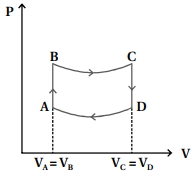
Solution
(N/A) In process $AB$, volume is constant $(dV = 0)$, so work done $dW = 0$. From the first law of thermodynamics, $dQ = dU + dW = dU$. Since pressure increases at constant volume, temperature increases, so $dU > 0$. Thus, heat is supplied in process $AB$.
$(b)$ In process $CD$, volume is constant and pressure decreases, so temperature decreases. Thus, heat is released to the surroundings in process $CD$.
$(c)$ Work done $W = W_{AB} + W_{BC} + W_{CD} + W_{DA}$. Since $W_{AB} = 0$ and $W_{CD} = 0$, $W = W_{BC} + W_{DA}$.
For adiabatic processes, $W = \frac{P_i V_i - P_f V_f}{\gamma - 1}$.
$W_{BC} = \frac{P_B V_B - P_C V_C}{\gamma - 1}$ and $W_{DA} = \frac{P_D V_D - P_A V_A}{\gamma - 1}$.
Given $V_C = V_D = 2V_A = 2V_B$, and adiabatic relations $P_B V_B^\gamma = P_C V_C^\gamma$ and $P_A V_A^\gamma = P_D V_D^\gamma$:
$P_C = P_B(1/2)^{5/3}$ and $P_D = P_A(2)^{5/3}$.
$W = \frac{1}{\gamma - 1} [P_B V_B - P_B(1/2)^{5/3}(2V_B) + P_A(2)^{5/3}(2V_A) - P_A V_A]$
$W = \frac{V_A}{2/3} [P_B(1 - 2^{-2/3}) + P_A(2^{8/3} - 1)] = \frac{3V_A}{2} [P_B(1 - 2^{-2/3}) + P_A(2^{8/3} - 1)]$.
$(d)$ Efficiency $\eta = 1 - \frac{|Q_{out}|}{Q_{in}} = 1 - \frac{C_v(T_C - T_D)}{C_v(T_B - T_A)} = 1 - \frac{P_C V_C - P_D V_D}{P_B V_B - P_A V_A} = 1 - \frac{2(P_C - P_D)}{P_B - P_A} = 1 - \frac{2(P_B 2^{-5/3} - P_A 2^{5/3})}{P_B - P_A}$.
$(b)$ In process $CD$, volume is constant and pressure decreases, so temperature decreases. Thus, heat is released to the surroundings in process $CD$.
$(c)$ Work done $W = W_{AB} + W_{BC} + W_{CD} + W_{DA}$. Since $W_{AB} = 0$ and $W_{CD} = 0$, $W = W_{BC} + W_{DA}$.
For adiabatic processes, $W = \frac{P_i V_i - P_f V_f}{\gamma - 1}$.
$W_{BC} = \frac{P_B V_B - P_C V_C}{\gamma - 1}$ and $W_{DA} = \frac{P_D V_D - P_A V_A}{\gamma - 1}$.
Given $V_C = V_D = 2V_A = 2V_B$, and adiabatic relations $P_B V_B^\gamma = P_C V_C^\gamma$ and $P_A V_A^\gamma = P_D V_D^\gamma$:
$P_C = P_B(1/2)^{5/3}$ and $P_D = P_A(2)^{5/3}$.
$W = \frac{1}{\gamma - 1} [P_B V_B - P_B(1/2)^{5/3}(2V_B) + P_A(2)^{5/3}(2V_A) - P_A V_A]$
$W = \frac{V_A}{2/3} [P_B(1 - 2^{-2/3}) + P_A(2^{8/3} - 1)] = \frac{3V_A}{2} [P_B(1 - 2^{-2/3}) + P_A(2^{8/3} - 1)]$.
$(d)$ Efficiency $\eta = 1 - \frac{|Q_{out}|}{Q_{in}} = 1 - \frac{C_v(T_C - T_D)}{C_v(T_B - T_A)} = 1 - \frac{P_C V_C - P_D V_D}{P_B V_B - P_A V_A} = 1 - \frac{2(P_C - P_D)}{P_B - P_A} = 1 - \frac{2(P_B 2^{-5/3} - P_A 2^{5/3})}{P_B - P_A}$.
0 likes
View SolutionThermodynamics — Mix Examples-Thermodynamics · Frequently Asked Questions
1Are these Thermodynamics questions useful for JEE and NEET?
Yes. All questions in this section are mapped to JEE Main and NEET exam patterns. Previous year questions from JEE Main, NEET, GUJCET and state-level exams are included with full solutions.
2Can I switch to Hindi or Gujarati for these questions?
Yes. Use the language tabs in the hero section or the sidebar to view the same questions and solutions in English, Hindi or Gujarati.
3How do I generate a question paper from this subtopic?
Use the Vedclass Exam Paper Generator — select the chapter and subtopic, set difficulty, and generate Sets A, B, C, D automatically. First 3 chapters of every subject are free.
Vedclass Products
For Students
Vedclass Test Series
Mock tests in real JEE/NEET style with performance analysis. 5-day free trial.
Start Free TrialFor Teachers
Exam Paper Generator
Generate Set A/B/C/D papers from this chapter in 2 minutes. 3 chapters free.
Try FreeFor Institutes
Online Exam Module
Live online exams with unlimited students, 360° analytics & white-label branding.
See DemoFor Teachers & Institutes
Generate a Thermodynamics Exam Paper in 2 Minutes
Select subtopic & difficulty — Sets A, B, C, D auto-generated with No Repeat logic.
First 3 chapters of every subject are free — no payment required.