
A English
Polytropic Process Questions in English
Class 11 Physics · Thermodynamics · Polytropic Process
65+
Questions
English
Language
100%
With Solutions
Showing 50 of 65 questions in English
1
MediumMCQ
An ideal gas expands in such a manner that its pressure and volume are related by the equation $PV^2 = \text{constant}$. During this process, the gas is
A
Heated
B
Cooled
C
Neither heated nor cooled
D
First heated and then cooled
Solution
(B) For an ideal gas, the equation of state is $PV = nRT$. Given the process equation $PV^2 = K$ (where $K$ is a constant).
Substituting $P = \frac{nRT}{V}$ into the process equation, we get $(\frac{nRT}{V})V^2 = K$, which simplifies to $TV = \frac{K}{nR} = \text{constant}$.
Since $T \propto \frac{1}{V}$, as the gas expands, the volume $V$ increases.
Because $V$ increases, the temperature $T$ must decrease.
Therefore, the gas is cooled during the expansion.
Substituting $P = \frac{nRT}{V}$ into the process equation, we get $(\frac{nRT}{V})V^2 = K$, which simplifies to $TV = \frac{K}{nR} = \text{constant}$.
Since $T \propto \frac{1}{V}$, as the gas expands, the volume $V$ increases.
Because $V$ increases, the temperature $T$ must decrease.
Therefore, the gas is cooled during the expansion.
0 likes
View Solution2
MediumMCQ
The $P-V$ diagram of a diatomic gas is a straight line passing through the origin. The molar heat capacity of the gas in this process will be:
A
$4 R$
B
$2.5 R$
C
$3 R$
D
$\frac{4R}{3}$
Solution
(C) The $P-V$ diagram is a straight line passing through the origin,which implies $P \propto V$,or $P = kV$ (where $k$ is a constant).
This can be written as $PV^{-1} = \text{constant}$,which is of the form $PV^x = \text{constant}$ with $x = -1$.
The molar heat capacity $C$ for a polytropic process $PV^x = \text{constant}$ is given by $C = \frac{R}{\gamma - 1} + \frac{R}{1 - x}$.
For a diatomic gas,the adiabatic index $\gamma = 1.4 = \frac{7}{5}$.
Substituting the values: $C = \frac{R}{1.4 - 1} + \frac{R}{1 - (-1)} = \frac{R}{0.4} + \frac{R}{2} = 2.5R + 0.5R = 3R$.
This can be written as $PV^{-1} = \text{constant}$,which is of the form $PV^x = \text{constant}$ with $x = -1$.
The molar heat capacity $C$ for a polytropic process $PV^x = \text{constant}$ is given by $C = \frac{R}{\gamma - 1} + \frac{R}{1 - x}$.
For a diatomic gas,the adiabatic index $\gamma = 1.4 = \frac{7}{5}$.
Substituting the values: $C = \frac{R}{1.4 - 1} + \frac{R}{1 - (-1)} = \frac{R}{0.4} + \frac{R}{2} = 2.5R + 0.5R = 3R$.
0 likes
View Solution3
DifficultMCQ
During an experiment,an ideal gas is found to obey an additional law $VP^2 = \text{constant}$. The gas is initially at temperature $T$ and volume $V$. When the gas expands to a volume $2V$,its temperature will be:
A
$\sqrt{3} T$
B
$2T$
C
$\sqrt{2} \cdot 3T$
D
$\sqrt{2} T$
Solution
(D) From the ideal gas equation,$PV = \mu RT$,so $P = \frac{\mu RT}{V}$.
Given the process law $VP^2 = K$ (where $K$ is a constant).
Substituting $P$ in the law: $V \left( \frac{\mu RT}{V} \right)^2 = K$.
$V \cdot \frac{\mu^2 R^2 T^2}{V^2} = K$.
$\frac{T^2}{V} = \frac{K}{\mu^2 R^2} = \text{constant}$.
This implies $T^2 \propto V$,or $T \propto \sqrt{V}$.
Therefore,$\frac{T_2}{T_1} = \sqrt{\frac{V_2}{V_1}}$.
Given $V_1 = V$,$V_2 = 2V$,and $T_1 = T$.
$\frac{T_2}{T} = \sqrt{\frac{2V}{V}} = \sqrt{2}$.
$T_2 = \sqrt{2} T$.
Given the process law $VP^2 = K$ (where $K$ is a constant).
Substituting $P$ in the law: $V \left( \frac{\mu RT}{V} \right)^2 = K$.
$V \cdot \frac{\mu^2 R^2 T^2}{V^2} = K$.
$\frac{T^2}{V} = \frac{K}{\mu^2 R^2} = \text{constant}$.
This implies $T^2 \propto V$,or $T \propto \sqrt{V}$.
Therefore,$\frac{T_2}{T_1} = \sqrt{\frac{V_2}{V_1}}$.
Given $V_1 = V$,$V_2 = 2V$,and $T_1 = T$.
$\frac{T_2}{T} = \sqrt{\frac{2V}{V}} = \sqrt{2}$.
$T_2 = \sqrt{2} T$.
0 likes
View Solution4
MediumMCQ
One mole of an ideal monatomic gas undergoes a process described by the equation $PV^3 = \text{constant}$. The heat capacity of the gas during this process is
A
$2R$
B
$R$
C
$\frac{3}{2}R$
D
$\frac{5}{2}R$
Solution
(B) The given process is described by the equation $PV^3 = \text{constant}$.
This is a polytropic process of the form $PV^n = \text{constant}$, where $n = 3$.
For an ideal gas, the molar heat capacity $C$ for a polytropic process is given by the formula $C = C_v + \frac{R}{1 - n}$.
For a monatomic gas, the molar heat capacity at constant volume is $C_v = \frac{3}{2}R$.
Substituting the values $C_v = \frac{3}{2}R$ and $n = 3$ into the formula:
$C = \frac{3}{2}R + \frac{R}{1 - 3}$
$C = \frac{3}{2}R + \frac{R}{-2}$
$C = \frac{3}{2}R - \frac{1}{2}R = R$.
Therefore, the heat capacity of the gas during this process is $R$.
This is a polytropic process of the form $PV^n = \text{constant}$, where $n = 3$.
For an ideal gas, the molar heat capacity $C$ for a polytropic process is given by the formula $C = C_v + \frac{R}{1 - n}$.
For a monatomic gas, the molar heat capacity at constant volume is $C_v = \frac{3}{2}R$.
Substituting the values $C_v = \frac{3}{2}R$ and $n = 3$ into the formula:
$C = \frac{3}{2}R + \frac{R}{1 - 3}$
$C = \frac{3}{2}R + \frac{R}{-2}$
$C = \frac{3}{2}R - \frac{1}{2}R = R$.
Therefore, the heat capacity of the gas during this process is $R$.
0 likes
View Solution5
MediumMCQ
The volume of $1 \; mole$ of an ideal gas with the adiabatic exponent $\gamma$ is changed according to the relation $V = \frac{b}{T}$,where $b$ is a constant. The amount of heat absorbed by the gas in the process if the temperature is increased by $\Delta T$ will be:
A
$\frac{R}{\gamma - 1} \Delta T$
B
$\left( \frac{2 - \gamma}{\gamma - 1} \right) R \Delta T$
C
$\frac{R \Delta T}{\gamma - 1}$
D
$\left( \frac{1 - \gamma}{\gamma + 1} \right) R \Delta T$
Solution
(B) Given the relation $V = \frac{b}{T}$,we can write $VT = b$ (constant).
Using the ideal gas law $PV = nRT$,for $n = 1$ mole,we have $T = \frac{PV}{R}$.
Substituting this into the relation: $V \left( \frac{PV}{R} \right) = b$,which simplifies to $PV^2 = bR = \text{constant}$.
This is a polytropic process of the form $PV^x = \text{constant}$,where $x = 2$.
The molar heat capacity $C$ for a polytropic process is given by $C = \frac{R}{\gamma - 1} + \frac{R}{1 - x}$.
Substituting $x = 2$: $C = \frac{R}{\gamma - 1} + \frac{R}{1 - 2} = \frac{R}{\gamma - 1} - R = R \left( \frac{1 - (\gamma - 1)}{\gamma - 1} \right) = R \left( \frac{2 - \gamma}{\gamma - 1} \right)$.
The heat absorbed $Q$ is given by $Q = nC \Delta T$.
For $n = 1$,$Q = \left( \frac{2 - \gamma}{\gamma - 1} \right) R \Delta T$.
Using the ideal gas law $PV = nRT$,for $n = 1$ mole,we have $T = \frac{PV}{R}$.
Substituting this into the relation: $V \left( \frac{PV}{R} \right) = b$,which simplifies to $PV^2 = bR = \text{constant}$.
This is a polytropic process of the form $PV^x = \text{constant}$,where $x = 2$.
The molar heat capacity $C$ for a polytropic process is given by $C = \frac{R}{\gamma - 1} + \frac{R}{1 - x}$.
Substituting $x = 2$: $C = \frac{R}{\gamma - 1} + \frac{R}{1 - 2} = \frac{R}{\gamma - 1} - R = R \left( \frac{1 - (\gamma - 1)}{\gamma - 1} \right) = R \left( \frac{2 - \gamma}{\gamma - 1} \right)$.
The heat absorbed $Q$ is given by $Q = nC \Delta T$.
For $n = 1$,$Q = \left( \frac{2 - \gamma}{\gamma - 1} \right) R \Delta T$.
0 likes
View Solution6
MediumMCQ
Suppose an ideal gas follows the process $VP^3 = \text{constant}$. The initial temperature and volume of the gas are $T$ and $V$ respectively. If the gas expands to $27V$, then its final temperature will be:
A
$T$
B
$9T$
C
$27T$
D
$T/9$
Solution
(B) Given the process equation: $VP^3 = k$ (where $k$ is a constant).
From the ideal gas law, $PV = \mu RT$, we can write $P = \frac{\mu RT}{V}$.
Substituting $P$ into the process equation: $V \left( \frac{\mu RT}{V} \right)^3 = k$.
This simplifies to $V \cdot \frac{(\mu R)^3 T^3}{V^3} = k$, which gives $\frac{T^3}{V^2} = \text{constant}$.
Therefore, $\frac{T_1^3}{V_1^2} = \frac{T_2^3}{V_2^2}$.
Given $T_1 = T$, $V_1 = V$, and $V_2 = 27V$, we substitute these values:
$\frac{T^3}{V^2} = \frac{T_2^3}{(27V)^2}$.
$\frac{T^3}{V^2} = \frac{T_2^3}{729V^2}$.
$T_2^3 = 729T^3$.
Taking the cube root of both sides, $T_2 = \sqrt[3]{729} T = 9T$.
From the ideal gas law, $PV = \mu RT$, we can write $P = \frac{\mu RT}{V}$.
Substituting $P$ into the process equation: $V \left( \frac{\mu RT}{V} \right)^3 = k$.
This simplifies to $V \cdot \frac{(\mu R)^3 T^3}{V^3} = k$, which gives $\frac{T^3}{V^2} = \text{constant}$.
Therefore, $\frac{T_1^3}{V_1^2} = \frac{T_2^3}{V_2^2}$.
Given $T_1 = T$, $V_1 = V$, and $V_2 = 27V$, we substitute these values:
$\frac{T^3}{V^2} = \frac{T_2^3}{(27V)^2}$.
$\frac{T^3}{V^2} = \frac{T_2^3}{729V^2}$.
$T_2^3 = 729T^3$.
Taking the cube root of both sides, $T_2 = \sqrt[3]{729} T = 9T$.
0 likes
View Solution7
MediumMCQ
$A$ gas expands with temperature according to the relation $V = k T^{2/3}$. What is the work done when the temperature changes by $30^{\circ}C$ (in $R$)?
A
$10$
B
$20$
C
$30$
D
$40$
Solution
(B) The work done by a gas is given by $W = \int P dV$.
Using the ideal gas law $PV = RT$ (for $1$ mole),we have $P = \frac{RT}{V}$.
Thus,$W = \int \frac{RT}{V} dV$.
Given the relation $V = k T^{2/3}$,we differentiate with respect to $T$:
$dV = k \cdot \frac{2}{3} T^{-1/3} dT$.
Substituting $k = \frac{V}{T^{2/3}}$ into the expression for $dV$:
$dV = \left( \frac{V}{T^{2/3}} \right) \cdot \frac{2}{3} T^{-1/3} dT = \frac{2}{3} \frac{V}{T} dT$.
Therefore,$\frac{dV}{V} = \frac{2}{3} \frac{dT}{T}$.
Substituting this into the work integral:
$W = \int_{T_1}^{T_2} R T \left( \frac{2}{3} \frac{dT}{T} \right) = \int_{T_1}^{T_2} \frac{2}{3} R dT$.
$W = \frac{2}{3} R (T_2 - T_1)$.
Given the change in temperature $\Delta T = T_2 - T_1 = 30^{\circ}C = 30 \ K$:
$W = \frac{2}{3} R (30) = 20 R$.
Using the ideal gas law $PV = RT$ (for $1$ mole),we have $P = \frac{RT}{V}$.
Thus,$W = \int \frac{RT}{V} dV$.
Given the relation $V = k T^{2/3}$,we differentiate with respect to $T$:
$dV = k \cdot \frac{2}{3} T^{-1/3} dT$.
Substituting $k = \frac{V}{T^{2/3}}$ into the expression for $dV$:
$dV = \left( \frac{V}{T^{2/3}} \right) \cdot \frac{2}{3} T^{-1/3} dT = \frac{2}{3} \frac{V}{T} dT$.
Therefore,$\frac{dV}{V} = \frac{2}{3} \frac{dT}{T}$.
Substituting this into the work integral:
$W = \int_{T_1}^{T_2} R T \left( \frac{2}{3} \frac{dT}{T} \right) = \int_{T_1}^{T_2} \frac{2}{3} R dT$.
$W = \frac{2}{3} R (T_2 - T_1)$.
Given the change in temperature $\Delta T = T_2 - T_1 = 30^{\circ}C = 30 \ K$:
$W = \frac{2}{3} R (30) = 20 R$.
0 likes
View Solution8
MediumMCQ
An ideal gas mixture filled inside a balloon expands according to the relation $PV^{2/3} = \text{constant}$. The temperature inside the balloon is
A
increasing
B
decreasing
C
constant
D
can't be said
Solution
(A) Given the relation for the process is $PV^{2/3} = \text{constant}$.
Using the ideal gas law $PV = nRT$, we can write $P = \frac{nRT}{V}$.
Substituting this into the given relation: $\left(\frac{nRT}{V}\right) V^{2/3} = \text{constant}$.
This simplifies to $T V^{-1/3} = \text{constant}$, or $T = \text{constant} \times V^{1/3}$.
Since the gas is expanding, the volume $V$ is increasing.
As $V$ increases, $V^{1/3}$ increases, which implies that the temperature $T$ must also increase.
Using the ideal gas law $PV = nRT$, we can write $P = \frac{nRT}{V}$.
Substituting this into the given relation: $\left(\frac{nRT}{V}\right) V^{2/3} = \text{constant}$.
This simplifies to $T V^{-1/3} = \text{constant}$, or $T = \text{constant} \times V^{1/3}$.
Since the gas is expanding, the volume $V$ is increasing.
As $V$ increases, $V^{1/3}$ increases, which implies that the temperature $T$ must also increase.
0 likes
View Solution9
DifficultMCQ
During an experiment, an ideal gas obeys an additional equation of state $P^2V = \text{constant}$. The initial temperature and volume of the gas are $T$ and $V$ respectively. When it expands to volume $2V$, its temperature will be:
A
$T$
B
$\sqrt{2} T$
C
$2T$
D
$2\sqrt{2} T$
Solution
(B) Given the equation of state: $P^2V = K$ (where $K$ is a constant).
From the ideal gas law, $PV = nRT$, we have $P = \frac{nRT}{V}$.
Substituting $P$ into the given equation: $(\frac{nRT}{V})^2 V = K$.
This simplifies to: $\frac{n^2 R^2 T^2}{V^2} \cdot V = K$, which gives $\frac{n^2 R^2 T^2}{V} = K$.
Therefore, $T^2 \propto V$, or $T \propto \sqrt{V}$.
Let the initial state be $(T_1, V_1) = (T, V)$ and the final state be $(T_2, V_2) = (T', 2V)$.
Using the proportionality $\frac{T_1}{T_2} = \sqrt{\frac{V_1}{V_2}}$, we get $\frac{T}{T'} = \sqrt{\frac{V}{2V}} = \frac{1}{\sqrt{2}}$.
Thus, $T' = \sqrt{2} T$.
From the ideal gas law, $PV = nRT$, we have $P = \frac{nRT}{V}$.
Substituting $P$ into the given equation: $(\frac{nRT}{V})^2 V = K$.
This simplifies to: $\frac{n^2 R^2 T^2}{V^2} \cdot V = K$, which gives $\frac{n^2 R^2 T^2}{V} = K$.
Therefore, $T^2 \propto V$, or $T \propto \sqrt{V}$.
Let the initial state be $(T_1, V_1) = (T, V)$ and the final state be $(T_2, V_2) = (T', 2V)$.
Using the proportionality $\frac{T_1}{T_2} = \sqrt{\frac{V_1}{V_2}}$, we get $\frac{T}{T'} = \sqrt{\frac{V}{2V}} = \frac{1}{\sqrt{2}}$.
Thus, $T' = \sqrt{2} T$.
0 likes
View Solution10
DifficultMCQ
$A$ perfect gas is found to obey the relation $PV^{3/2} =$ constant,during an adiabatic process. If such a gas,initially at a temperature $T$,is compressed adiabatically to half its initial volume,then its final temperature will be
A
$2T$
B
$4T$
C
$\sqrt{2}T$
D
$2\sqrt{2}T$
Solution
(C) For an adiabatic process,the given relation is $PV^{3/2} = \text{constant}$.
Using the ideal gas equation $PV = RT$,we can write $P = \frac{RT}{V}$.
Substituting this into the given relation: $\left(\frac{RT}{V}\right) V^{3/2} = \text{constant}$.
This simplifies to $TV^{1/2} = \text{constant}$.
Let the initial state be $(T_1, V_1)$ and the final state be $(T_2, V_2)$.
Given $T_1 = T$ and $V_2 = \frac{V_1}{2}$.
Using the relation $T_1 V_1^{1/2} = T_2 V_2^{1/2}$,we get:
$T \cdot V_1^{1/2} = T_2 \cdot \left(\frac{V_1}{2}\right)^{1/2}$.
$T = T_2 \cdot \frac{1}{\sqrt{2}}$.
Therefore,$T_2 = \sqrt{2}T$.
Using the ideal gas equation $PV = RT$,we can write $P = \frac{RT}{V}$.
Substituting this into the given relation: $\left(\frac{RT}{V}\right) V^{3/2} = \text{constant}$.
This simplifies to $TV^{1/2} = \text{constant}$.
Let the initial state be $(T_1, V_1)$ and the final state be $(T_2, V_2)$.
Given $T_1 = T$ and $V_2 = \frac{V_1}{2}$.
Using the relation $T_1 V_1^{1/2} = T_2 V_2^{1/2}$,we get:
$T \cdot V_1^{1/2} = T_2 \cdot \left(\frac{V_1}{2}\right)^{1/2}$.
$T = T_2 \cdot \frac{1}{\sqrt{2}}$.
Therefore,$T_2 = \sqrt{2}T$.
0 likes
View Solution11
MediumMCQ
One mole of an ideal monoatomic gas at temperature $T_0$ expands slowly according to the law $P/V = \text{constant}$. If the final temperature is $2 T_0$, heat supplied to the gas is:
A
$2 R T_0$
B
$\frac{3}{2} R T_0$
C
$R T_0$
D
$\frac{1}{2} R T_0$
Solution
(A) For a polytropic process $P V^x = \text{constant}$, the molar heat capacity $C$ is given by $C = C_V + \frac{R}{1-x}$.
Given the process law is $P/V = \text{constant}$, we can write it as $P V^{-1} = \text{constant}$.
Thus, the polytropic index $x = -1$.
For an ideal monoatomic gas, the molar heat capacity at constant volume is $C_V = \frac{3}{2} R$.
Substituting these values, $C = \frac{3}{2} R + \frac{R}{1-(-1)} = \frac{3}{2} R + \frac{R}{2} = 2 R$.
The heat supplied is given by $\Delta Q = n C \Delta T$.
Given $n = 1$ mole and $\Delta T = 2 T_0 - T_0 = T_0$.
Therefore, $\Delta Q = 1 \times (2 R) \times T_0 = 2 R T_0$.
Given the process law is $P/V = \text{constant}$, we can write it as $P V^{-1} = \text{constant}$.
Thus, the polytropic index $x = -1$.
For an ideal monoatomic gas, the molar heat capacity at constant volume is $C_V = \frac{3}{2} R$.
Substituting these values, $C = \frac{3}{2} R + \frac{R}{1-(-1)} = \frac{3}{2} R + \frac{R}{2} = 2 R$.
The heat supplied is given by $\Delta Q = n C \Delta T$.
Given $n = 1$ mole and $\Delta T = 2 T_0 - T_0 = T_0$.
Therefore, $\Delta Q = 1 \times (2 R) \times T_0 = 2 R T_0$.
0 likes
View Solution12
MediumMCQ
$A$ diatomic gas follows the equation $PV^m =$ constant during a process. What should be the value of $m$ such that its molar heat capacity during the process is equal to $R$?
A
$2/3$
B
$1$
C
$1.5$
D
$5/3$
Solution
(D) For a process $PV^m = \text{constant}$,the molar heat capacity $C$ is given by the formula: $C = C_V + \frac{R}{1-m}$.
For a diatomic gas,the molar heat capacity at constant volume is $C_V = \frac{5}{2}R$.
Given that the molar heat capacity $C = R$,we substitute the values into the formula:
$R = \frac{5}{2}R + \frac{R}{1-m}$.
Subtracting $\frac{5}{2}R$ from both sides:
$R - \frac{5}{2}R = \frac{R}{1-m}$.
$-\frac{3}{2}R = \frac{R}{1-m}$.
Dividing by $R$ (assuming $R \neq 0$):
$-\frac{3}{2} = \frac{1}{1-m}$.
Taking the reciprocal of both sides:
$-\frac{2}{3} = 1 - m$.
Rearranging for $m$:
$m = 1 + \frac{2}{3} = \frac{5}{3}$.
Therefore,the value of $m$ is $5/3$.
For a diatomic gas,the molar heat capacity at constant volume is $C_V = \frac{5}{2}R$.
Given that the molar heat capacity $C = R$,we substitute the values into the formula:
$R = \frac{5}{2}R + \frac{R}{1-m}$.
Subtracting $\frac{5}{2}R$ from both sides:
$R - \frac{5}{2}R = \frac{R}{1-m}$.
$-\frac{3}{2}R = \frac{R}{1-m}$.
Dividing by $R$ (assuming $R \neq 0$):
$-\frac{3}{2} = \frac{1}{1-m}$.
Taking the reciprocal of both sides:
$-\frac{2}{3} = 1 - m$.
Rearranging for $m$:
$m = 1 + \frac{2}{3} = \frac{5}{3}$.
Therefore,the value of $m$ is $5/3$.
0 likes
View Solution13
AdvancedMCQ
One mole of an ideal gas at temperature $T_1$ expands according to the law $\frac{P}{V^2} = a$ (constant). The work done by the gas until the temperature of the gas becomes $T_2$ is:
A
$\frac{1}{2}R(T_2 - T_1)$
B
$\frac{1}{3}R(T_2 - T_1)$
C
$\frac{1}{4}R(T_2 - T_1)$
D
$\frac{1}{5}R(T_2 - T_1)$
Solution
(B) The given process is $\frac{P}{V^2} = a$,which is a polytropic process of the form $PV^n = K$,where $n = -2$.
The work done in a polytropic process for $n \neq 1$ is given by the formula:
$W = \frac{nR\Delta T}{1-n}$
Here,$n = -2$,$n_{mole} = 1$,and $\Delta T = T_2 - T_1$.
Substituting these values into the formula:
$W = \frac{1 \cdot R(T_2 - T_1)}{1 - (-2)}$
$W = \frac{R(T_2 - T_1)}{1 + 2}$
$W = \frac{1}{3}R(T_2 - T_1)$
The work done in a polytropic process for $n \neq 1$ is given by the formula:
$W = \frac{nR\Delta T}{1-n}$
Here,$n = -2$,$n_{mole} = 1$,and $\Delta T = T_2 - T_1$.
Substituting these values into the formula:
$W = \frac{1 \cdot R(T_2 - T_1)}{1 - (-2)}$
$W = \frac{R(T_2 - T_1)}{1 + 2}$
$W = \frac{1}{3}R(T_2 - T_1)$
0 likes
View Solution14
DifficultMCQ
$2$ moles of a diatomic gas undergoes the process: $PT^2/V = \text{constant}$. The molar heat capacity of the gas during the process is:
A
$5R/2$
B
$9R/2$
C
$3R$
D
$4R$
Solution
(D) The given process is $\frac{PT^2}{V} = \text{constant}$.
For a diatomic gas, the molar heat capacity at constant volume is $C_V = \frac{5}{2}R$.
Using the ideal gas equation $PV = nRT$, we have $T = \frac{PV}{nR}$, which implies $T \propto PV$.
Substituting $T$ into the given process equation:
$\frac{P(PV)^2}{V} = \text{constant} \implies \frac{P^3V^2}{V} = \text{constant} \implies P^3V = \text{constant}$.
Taking the cube root, we get $PV^{1/3} = \text{constant}$.
This is a polytropic process of the form $PV^x = \text{constant}$, where $x = 1/3$.
The molar heat capacity $C$ for a polytropic process is given by $C = C_V + \frac{R}{1-x}$.
Substituting the values: $C = \frac{5}{2}R + \frac{R}{1 - 1/3} = \frac{5}{2}R + \frac{R}{2/3} = \frac{5}{2}R + \frac{3}{2}R = \frac{8}{2}R = 4R$.
For a diatomic gas, the molar heat capacity at constant volume is $C_V = \frac{5}{2}R$.
Using the ideal gas equation $PV = nRT$, we have $T = \frac{PV}{nR}$, which implies $T \propto PV$.
Substituting $T$ into the given process equation:
$\frac{P(PV)^2}{V} = \text{constant} \implies \frac{P^3V^2}{V} = \text{constant} \implies P^3V = \text{constant}$.
Taking the cube root, we get $PV^{1/3} = \text{constant}$.
This is a polytropic process of the form $PV^x = \text{constant}$, where $x = 1/3$.
The molar heat capacity $C$ for a polytropic process is given by $C = C_V + \frac{R}{1-x}$.
Substituting the values: $C = \frac{5}{2}R + \frac{R}{1 - 1/3} = \frac{5}{2}R + \frac{R}{2/3} = \frac{5}{2}R + \frac{3}{2}R = \frac{8}{2}R = 4R$.
0 likes
View Solution15
DifficultMCQ
An ideal gas expands in such a way that $PV^2 = \text{constant}$ throughout the process.
A
The graph of the process on a $T-V$ diagram is a parabola.
B
The graph of the process on a $T-V$ diagram is a straight line.
C
Such an expansion is possible only with heating.
D
Such an expansion is possible only with cooling.
Solution
(D) From the ideal gas equation, $PV = nRT$, we have $P = \frac{nRT}{V}$.
Substituting this into the given process equation $PV^2 = K$ (where $K$ is a constant):
$(\frac{nRT}{V})V^2 = K$
$nRTV = K$
$TV = \frac{K}{nR} = \text{constant}$.
Since $T \propto \frac{1}{V}$, as the gas expands, the volume $V$ increases.
Because $V$ increases, the temperature $T$ must decrease to keep the product $TV$ constant.
Therefore, the gas undergoes cooling during this expansion.
Thus, the correct option is $D$.
Substituting this into the given process equation $PV^2 = K$ (where $K$ is a constant):
$(\frac{nRT}{V})V^2 = K$
$nRTV = K$
$TV = \frac{K}{nR} = \text{constant}$.
Since $T \propto \frac{1}{V}$, as the gas expands, the volume $V$ increases.
Because $V$ increases, the temperature $T$ must decrease to keep the product $TV$ constant.
Therefore, the gas undergoes cooling during this expansion.
Thus, the correct option is $D$.
0 likes
View Solution16
AdvancedMCQ
During an experiment, an ideal gas is found to obey a condition $VP^2 = \text{constant}$. The gas is initially at a temperature $T$, pressure $P$, and volume $V$. The gas expands to volume $4V$. Which of the following statements is correct?
A
The pressure of the gas changes to $P/2$.
B
The graph of the above process on the $P-T$ diagram is a hyperbola.
C
The graph of the above process on the $P-T$ diagram is a parabola.
D
Both $(A)$ and $(B)$.
Solution
(D) Given the condition $VP^2 = \text{constant}$.
From the ideal gas equation, $PV = nRT$, so $V = nRT/P$.
Substituting $V$ into the given condition: $(nRT/P) \cdot P^2 = \text{constant} \implies TP = \text{constant}$.
Thus, $P \propto 1/T$, which represents a rectangular hyperbola on a $P-T$ diagram.
Since $VP^2 = \text{constant}$, we have $P^2 \propto 1/V$, which means $P \propto 1/\sqrt{V}$.
If the volume $V$ becomes $4V$, then the new pressure $P'$ is $P' \propto 1/\sqrt{4V} = (1/2) \cdot (1/\sqrt{V}) = P/2$.
Therefore, both statements $(A)$ and $(B)$ are correct.
From the ideal gas equation, $PV = nRT$, so $V = nRT/P$.
Substituting $V$ into the given condition: $(nRT/P) \cdot P^2 = \text{constant} \implies TP = \text{constant}$.
Thus, $P \propto 1/T$, which represents a rectangular hyperbola on a $P-T$ diagram.
Since $VP^2 = \text{constant}$, we have $P^2 \propto 1/V$, which means $P \propto 1/\sqrt{V}$.
If the volume $V$ becomes $4V$, then the new pressure $P'$ is $P' \propto 1/\sqrt{4V} = (1/2) \cdot (1/\sqrt{V}) = P/2$.
Therefore, both statements $(A)$ and $(B)$ are correct.
0 likes
View Solution17
DifficultMCQ
$2$ moles of a monoatomic gas are expanded to double its initial volume, through a process $P/V = \text{constant}$. If its initial temperature is $300\, K$, then which of the following is not true?
A
$\Delta T = 900\, K$
B
$\Delta Q = 3200\, R$
C
$\Delta Q = 3600\, R$
D
$W = 900\, R$
Solution
(B) Given: $n = 2$, $V_f = 2V_i$, $T_i = 300\, K$, process $P/V = k$ (polytropic index $x = -1$).
Using $PV = nRT$ and $P = kV$, we get $kV^2 = nRT$, so $T \propto V^2$.
$T_f = T_i (V_f/V_i)^2 = 300 \times (2)^2 = 1200\, K$.
Change in temperature $\Delta T = T_f - T_i = 1200 - 300 = 900\, K$. (Option $A$ is true).
Work done $W = \int P dV = \int_V^{2V} kV dV = k [V^2/2]_V^{2V} = k/2 (4V^2 - V^2) = 3/2 kV^2 = 3/2 PV = 3/2 nRT$.
At initial state, $W_i = 3/2 nRT_i = 3/2 \times 2 \times R \times 300 = 900\, R$. (Option $D$ is true).
Change in internal energy $\Delta U = n C_v \Delta T = 2 \times (3/2 R) \times 900 = 2700\, R$.
Heat supplied $\Delta Q = \Delta U + W = 2700\, R + 900\, R = 3600\, R$. (Option $C$ is true).
Since $\Delta Q = 3600\, R$, option $B$ is false.
Using $PV = nRT$ and $P = kV$, we get $kV^2 = nRT$, so $T \propto V^2$.
$T_f = T_i (V_f/V_i)^2 = 300 \times (2)^2 = 1200\, K$.
Change in temperature $\Delta T = T_f - T_i = 1200 - 300 = 900\, K$. (Option $A$ is true).
Work done $W = \int P dV = \int_V^{2V} kV dV = k [V^2/2]_V^{2V} = k/2 (4V^2 - V^2) = 3/2 kV^2 = 3/2 PV = 3/2 nRT$.
At initial state, $W_i = 3/2 nRT_i = 3/2 \times 2 \times R \times 300 = 900\, R$. (Option $D$ is true).
Change in internal energy $\Delta U = n C_v \Delta T = 2 \times (3/2 R) \times 900 = 2700\, R$.
Heat supplied $\Delta Q = \Delta U + W = 2700\, R + 900\, R = 3600\, R$. (Option $C$ is true).
Since $\Delta Q = 3600\, R$, option $B$ is false.
0 likes
View Solution18
DifficultMCQ
An ideal gas undergoes a quasi-static,reversible process in which its molar heat capacity $C$ remains constant. If during this process the relation of pressure $P$ and volume $V$ is given by $PV^n = \text{constant}$,then $n$ is given by (Here $C_p$ and $C_v$ are molar specific heat at constant pressure and constant volume,respectively):
A
$n = \frac{C_p - C}{C - C_v}$
B
$n = \frac{C - C_v}{C - C_p}$
C
$n = \frac{C_p}{C_v}$
D
$n = \frac{C - C_p}{C - C_v}$
Solution
(D) For a polytropic process,the molar heat capacity $C$ is given by the relation: $C = C_v + \frac{R}{1 - n}$.
Rearranging the terms to solve for $n$:
$C - C_v = \frac{R}{1 - n}$
$1 - n = \frac{R}{C - C_v}$
$n = 1 - \frac{R}{C - C_v}$
Using Mayer's relation $R = C_p - C_v$:
$n = \frac{C - C_v - (C_p - C_v)}{C - C_v}$
$n = \frac{C - C_v - C_p + C_v}{C - C_v}$
$n = \frac{C - C_p}{C - C_v}$.
Rearranging the terms to solve for $n$:
$C - C_v = \frac{R}{1 - n}$
$1 - n = \frac{R}{C - C_v}$
$n = 1 - \frac{R}{C - C_v}$
Using Mayer's relation $R = C_p - C_v$:
$n = \frac{C - C_v - (C_p - C_v)}{C - C_v}$
$n = \frac{C - C_v - C_p + C_v}{C - C_v}$
$n = \frac{C - C_p}{C - C_v}$.
0 likes
View Solution19
DifficultMCQ
In an $H_2$ gas process, $PV^2 = \text{constant}$. The ratio of work done by the gas to the change in its internal energy is:
A
$2/3$
B
$0.4$
C
$-0.4$
D
$1.5$
Solution
(C) For a polytropic process $PV^x = \text{constant}$, the work done is given by $W = \frac{nR \Delta T}{1-x}$.
Here, $x = 2$, so $W = \frac{nR \Delta T}{1-2} = -nR \Delta T$.
For a diatomic gas like $H_2$, the change in internal energy is $\Delta U = n C_v \Delta T = n \left( \frac{5}{2}R \right) \Delta T = 2.5 nR \Delta T$.
The ratio of work done to the change in internal energy is $\frac{W}{\Delta U} = \frac{-nR \Delta T}{2.5 nR \Delta T} = -\frac{1}{2.5} = -0.4$.
Here, $x = 2$, so $W = \frac{nR \Delta T}{1-2} = -nR \Delta T$.
For a diatomic gas like $H_2$, the change in internal energy is $\Delta U = n C_v \Delta T = n \left( \frac{5}{2}R \right) \Delta T = 2.5 nR \Delta T$.
The ratio of work done to the change in internal energy is $\frac{W}{\Delta U} = \frac{-nR \Delta T}{2.5 nR \Delta T} = -\frac{1}{2.5} = -0.4$.
0 likes
View Solution20
DifficultMCQ
Find the amount of work done to increase the temperature of one mole of an ideal gas by $30^o\ C$ if it is expanding under the condition $V \propto T^{2/3}$. $[R = 1.99 \ cal/mol-K]$
A
$176$
B
$167$
C
$671$
D
$761$
Solution
(B) Given the condition $V \propto T^{2/3}$,we can write $V = k T^{2/3}$.
From the ideal gas law $PV = nRT$,we have $P = \frac{nRT}{V}$.
Substituting $V$,we get $P = \frac{nRT}{k T^{2/3}} = \frac{nR}{k} T^{1/3}$.
Since $T \propto V^{3/2}$,we have $P \propto (V^{3/2})^{1/3} = V^{1/2}$.
This is a polytropic process $PV^x = \text{constant}$ where $P V^{-1/2} = \text{constant}$,so $x = -1/2$.
The work done in a polytropic process is given by $W = \frac{nR \Delta T}{1-x}$.
Here $n = 1 \ mol$,$\Delta T = 30 \ K$,$R = 1.99 \ cal/mol-K$,and $x = -1/2$.
$W = \frac{1 \times 1.99 \times 30}{1 - (-1/2)} = \frac{59.7}{1.5} = 39.8 \ cal$.
Converting to Joules $(1 \ cal \approx 4.184 \ J)$: $W = 39.8 \times 4.184 \approx 166.5 \ J$.
Rounding to the nearest integer,we get $167 \ J$.
From the ideal gas law $PV = nRT$,we have $P = \frac{nRT}{V}$.
Substituting $V$,we get $P = \frac{nRT}{k T^{2/3}} = \frac{nR}{k} T^{1/3}$.
Since $T \propto V^{3/2}$,we have $P \propto (V^{3/2})^{1/3} = V^{1/2}$.
This is a polytropic process $PV^x = \text{constant}$ where $P V^{-1/2} = \text{constant}$,so $x = -1/2$.
The work done in a polytropic process is given by $W = \frac{nR \Delta T}{1-x}$.
Here $n = 1 \ mol$,$\Delta T = 30 \ K$,$R = 1.99 \ cal/mol-K$,and $x = -1/2$.
$W = \frac{1 \times 1.99 \times 30}{1 - (-1/2)} = \frac{59.7}{1.5} = 39.8 \ cal$.
Converting to Joules $(1 \ cal \approx 4.184 \ J)$: $W = 39.8 \times 4.184 \approx 166.5 \ J$.
Rounding to the nearest integer,we get $167 \ J$.
0 likes
View Solution21
AdvancedMCQ
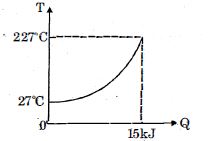
$Q$ amount of heat is given to $0.5 \text{ mole}$ of an ideal mono-atomic gas by a process $TV^n = \text{constant}$. The following graph shows the variation of temperature with $Q$. Find the value of $n$.
A
$\frac{-2}{35}$
B
$\frac{-2}{33}$
C
$\frac{-1}{33}$
D
$\frac{2}{33}$
Solution
(B) For a polytropic process $TV^n = \text{constant}$, the molar heat capacity is given by $C = C_V + \frac{R}{1-n} = \frac{3R}{2} + \frac{R}{1-n}$.
Given $\Delta Q = n_{m} C \Delta T$, where $n_{m} = 0.5 \text{ mole}$ and $\Delta T = 227^{\circ}\text{C} - 27^{\circ}\text{C} = 200 \text{ K}$.
Total heat $\Delta Q = 15 \times 10^3 \text{ J}$.
$15000 = 0.5 \times \left( \frac{3R}{2} + \frac{R}{1-n} \right) \times 200$.
$15000 = 100 \times \left( \frac{3R}{2} + \frac{R}{1-n} \right) \implies 150 = \frac{3R}{2} + \frac{R}{1-n}$.
Taking $R = \frac{25}{3} \text{ J/mol K}$, we get $150 = \frac{3}{2} \times \frac{25}{3} + \frac{25/3}{1-n} = 12.5 + \frac{25}{3(1-n)}$.
$137.5 = \frac{25}{3(1-n)} \implies 5.5 = \frac{1}{3(1-n)}$.
$16.5(1-n) = 1 \implies 1 - n = \frac{1}{16.5} = \frac{2}{33}$.
$n = 1 - \frac{2}{33} = \frac{31}{33}$.
Wait, re-evaluating the process equation $TV^n = \text{constant}$. The standard polytropic form is $PV^x = \text{constant}$, which implies $TV^{x-1} = \text{constant}$. Thus $n = x-1$. Using $C = \frac{R}{\gamma-1} + \frac{R}{1-x} = \frac{3R}{2} + \frac{R}{1-x}$.
From $150 = 12.5 + \frac{25}{3(1-x)}$, we get $1-x = \frac{25}{3 \times 137.5} = \frac{25}{412.5} = \frac{2}{33}$.
$x = 1 - \frac{2}{33} = \frac{31}{33}$. Since $n = x-1$, $n = \frac{31}{33} - 1 = \frac{-2}{33}$.
Given $\Delta Q = n_{m} C \Delta T$, where $n_{m} = 0.5 \text{ mole}$ and $\Delta T = 227^{\circ}\text{C} - 27^{\circ}\text{C} = 200 \text{ K}$.
Total heat $\Delta Q = 15 \times 10^3 \text{ J}$.
$15000 = 0.5 \times \left( \frac{3R}{2} + \frac{R}{1-n} \right) \times 200$.
$15000 = 100 \times \left( \frac{3R}{2} + \frac{R}{1-n} \right) \implies 150 = \frac{3R}{2} + \frac{R}{1-n}$.
Taking $R = \frac{25}{3} \text{ J/mol K}$, we get $150 = \frac{3}{2} \times \frac{25}{3} + \frac{25/3}{1-n} = 12.5 + \frac{25}{3(1-n)}$.
$137.5 = \frac{25}{3(1-n)} \implies 5.5 = \frac{1}{3(1-n)}$.
$16.5(1-n) = 1 \implies 1 - n = \frac{1}{16.5} = \frac{2}{33}$.
$n = 1 - \frac{2}{33} = \frac{31}{33}$.
Wait, re-evaluating the process equation $TV^n = \text{constant}$. The standard polytropic form is $PV^x = \text{constant}$, which implies $TV^{x-1} = \text{constant}$. Thus $n = x-1$. Using $C = \frac{R}{\gamma-1} + \frac{R}{1-x} = \frac{3R}{2} + \frac{R}{1-x}$.
From $150 = 12.5 + \frac{25}{3(1-x)}$, we get $1-x = \frac{25}{3 \times 137.5} = \frac{25}{412.5} = \frac{2}{33}$.
$x = 1 - \frac{2}{33} = \frac{31}{33}$. Since $n = x-1$, $n = \frac{31}{33} - 1 = \frac{-2}{33}$.
0 likes
View Solution22
MediumMCQ
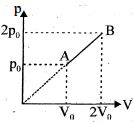
An enclosed one mole of a monoatomic gas is taken through a process $A$ to $B$ as shown in the figure. The molar heat capacity of the gas for this process is
A
$R$
B
$2R$
C
$3R$
D
$4R$
Solution
(B) The molar heat capacity for a polytropic process $PV^n = \text{constant}$ is given by $C = C_v + \frac{R}{1-n}$.
For a monoatomic gas, $C_v = \frac{3}{2}R$.
From the given $P-V$ graph, the process is a straight line passing through the origin, so $P \propto V$, which means $P = kV$ or $PV^{-1} = \text{constant}$.
Comparing this with $PV^n = \text{constant}$, we get $n = -1$.
Substituting the values into the formula:
$C = \frac{3}{2}R + \frac{R}{1 - (-1)}$
$C = \frac{3}{2}R + \frac{R}{2}$
$C = \frac{3R + R}{2} = \frac{4R}{2} = 2R$.
Thus, the molar heat capacity is $2R$.
For a monoatomic gas, $C_v = \frac{3}{2}R$.
From the given $P-V$ graph, the process is a straight line passing through the origin, so $P \propto V$, which means $P = kV$ or $PV^{-1} = \text{constant}$.
Comparing this with $PV^n = \text{constant}$, we get $n = -1$.
Substituting the values into the formula:
$C = \frac{3}{2}R + \frac{R}{1 - (-1)}$
$C = \frac{3}{2}R + \frac{R}{2}$
$C = \frac{3R + R}{2} = \frac{4R}{2} = 2R$.
Thus, the molar heat capacity is $2R$.
0 likes
View Solution23
DifficultMCQ
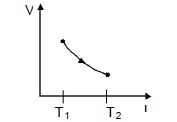
The figure shows a process $AB$ undergone by $2$ moles of an ideal diatomic gas. The process $AB$ follows the relation $VT = \text{constant}$. Given $T_1 = 300 \text{ K}$ and $T_2 = 500 \text{ K}$ ($R$ is the gas constant).
A
The molar heat capacity of the gas in the process $A \rightarrow B$ is $\frac{5R}{2} \text{ J/mol-K}$.
B
The molar heat capacity of the gas in the process $A \rightarrow B$ is $R \text{ J/mol-K}$.
C
The work done by the gas is $-400R \text{ J}$.
D
The work done by the gas is $-200R \text{ J}$.
Solution
(C) Given the process $VT = \text{constant}$.
Using the ideal gas law $PV = nRT$,we have $T = \frac{PV}{nR}$.
Substituting this into the process equation: $V \left( \frac{PV}{nR} \right) = \text{constant} \implies PV^2 = \text{constant}$.
This is a polytropic process $PV^x = \text{constant}$ with $x = 2$.
For a diatomic gas,the molar heat capacity at constant volume is $C_V = \frac{5R}{2}$.
The molar heat capacity for a polytropic process is $C = C_V + \frac{R}{1-x}$.
$C = \frac{5R}{2} + \frac{R}{1-2} = \frac{5R}{2} - R = \frac{3R}{2} \text{ J/mol-K}$.
The work done in a polytropic process is $W = \frac{nR(T_2 - T_1)}{1-x}$.
Given $n = 2$,$T_1 = 300 \text{ K}$,$T_2 = 500 \text{ K}$,and $x = 2$:
$W = \frac{2R(500 - 300)}{1-2} = \frac{2R(200)}{-1} = -400R \text{ J}$.
Thus,option $C$ is correct.
Using the ideal gas law $PV = nRT$,we have $T = \frac{PV}{nR}$.
Substituting this into the process equation: $V \left( \frac{PV}{nR} \right) = \text{constant} \implies PV^2 = \text{constant}$.
This is a polytropic process $PV^x = \text{constant}$ with $x = 2$.
For a diatomic gas,the molar heat capacity at constant volume is $C_V = \frac{5R}{2}$.
The molar heat capacity for a polytropic process is $C = C_V + \frac{R}{1-x}$.
$C = \frac{5R}{2} + \frac{R}{1-2} = \frac{5R}{2} - R = \frac{3R}{2} \text{ J/mol-K}$.
The work done in a polytropic process is $W = \frac{nR(T_2 - T_1)}{1-x}$.
Given $n = 2$,$T_1 = 300 \text{ K}$,$T_2 = 500 \text{ K}$,and $x = 2$:
$W = \frac{2R(500 - 300)}{1-2} = \frac{2R(200)}{-1} = -400R \text{ J}$.
Thus,option $C$ is correct.
0 likes
View Solution24
DifficultMCQ
$A$ monoatomic gas is taken through a process $TP^{-1/3} = \text{constant}$. If heat is given to the gas, what happens to its temperature?
A
Its temperature remains constant
B
Its temperature will increase
C
Its temperature will decrease
D
Cannot be predicted
Solution
(C) Given the process equation: $TP^{-1/3} = \text{constant}$.
Using the ideal gas law $PV = nRT$, we have $T \propto PV$, so $PV \cdot P^{-1/3} = \text{constant}$, which simplifies to $P^{2/3}V = \text{constant}$.
Raising both sides to the power of $3/2$, we get $PV^{3/2} = \text{constant}$.
This is a polytropic process $PV^x = \text{constant}$ where $x = 3/2$.
For a monoatomic gas, the adiabatic index $\gamma = 5/3$.
The molar heat capacity $C$ for a polytropic process is given by $C = \frac{R}{\gamma - 1} + \frac{R}{1 - x}$.
Substituting the values: $C = \frac{R}{5/3 - 1} + \frac{R}{1 - 3/2} = \frac{R}{2/3} + \frac{R}{-1/2} = \frac{3R}{2} - 2R = -\frac{R}{2}$.
Since the molar heat capacity $C$ is negative, from the relation $\Delta Q = nC\Delta T$, if heat is given to the gas $(\Delta Q > 0)$, then $\Delta T$ must be negative $(\Delta T < 0)$.
Therefore, the temperature of the gas will decrease.
Using the ideal gas law $PV = nRT$, we have $T \propto PV$, so $PV \cdot P^{-1/3} = \text{constant}$, which simplifies to $P^{2/3}V = \text{constant}$.
Raising both sides to the power of $3/2$, we get $PV^{3/2} = \text{constant}$.
This is a polytropic process $PV^x = \text{constant}$ where $x = 3/2$.
For a monoatomic gas, the adiabatic index $\gamma = 5/3$.
The molar heat capacity $C$ for a polytropic process is given by $C = \frac{R}{\gamma - 1} + \frac{R}{1 - x}$.
Substituting the values: $C = \frac{R}{5/3 - 1} + \frac{R}{1 - 3/2} = \frac{R}{2/3} + \frac{R}{-1/2} = \frac{3R}{2} - 2R = -\frac{R}{2}$.
Since the molar heat capacity $C$ is negative, from the relation $\Delta Q = nC\Delta T$, if heat is given to the gas $(\Delta Q > 0)$, then $\Delta T$ must be negative $(\Delta T < 0)$.
Therefore, the temperature of the gas will decrease.
0 likes
View Solution25
MediumMCQ
$P_i, V_i$ and $P_f, V_f$ are initial and final pressures and volumes of a gas in a thermodynamic process respectively. If $PV^n = \text{constant}$, then the amount of work done is
A
minimum for $n = \gamma$
B
minimum for $n = 1$
C
minimum for $n = 0$
D
minimum for $n = \infty$
Solution
(D) The work done in a polytropic process $PV^n = \text{constant}$ is given by the formula:
$W = \frac{P_i V_i - P_f V_f}{n - 1}$
For a fixed initial and final state, the work done depends on the value of $n$.
If we consider the magnitude of work done for a given change in volume, the work done is zero when $n = \infty$ (isochoric process, $\Delta V = 0$).
Thus, the work done is minimum (zero) for $n = \infty$.
$W = \frac{P_i V_i - P_f V_f}{n - 1}$
For a fixed initial and final state, the work done depends on the value of $n$.
If we consider the magnitude of work done for a given change in volume, the work done is zero when $n = \infty$ (isochoric process, $\Delta V = 0$).
Thus, the work done is minimum (zero) for $n = \infty$.
0 likes
View Solution26
DifficultMCQ
$1 \, \text{mole}$ of gas expands with temperature according to the relation $V = KT^{2/3}$. When the temperature changes by $30 \, ^\circ\text{C}$, the work done will be: (in $, R$)
A
$10$
B
$20$
C
$30$
D
$40$
Solution
(B) Given the relation $V = KT^{2/3}$.
Using the ideal gas law $PV = nRT$, we have $T = \frac{PV}{nR}$.
Substituting $T$ into the given relation: $V = K \left( \frac{PV}{nR} \right)^{2/3}$.
Raising both sides to the power of $3/2$: $V^{3/2} = K^{3/2} \frac{PV}{nR}$.
Rearranging the terms: $V^{3/2} / V = \frac{K^{3/2}}{nR} P \Rightarrow V^{1/2} = \frac{K^{3/2}}{nR} P$.
This can be written as $P V^{-1/2} = \text{constant}$.
Comparing this with the polytropic process equation $PV^x = \text{constant}$, we get $x = -1/2$.
The work done in a polytropic process is given by $W = \frac{nR \Delta T}{1-x}$.
Substituting the values $n = 1$, $\Delta T = 30$, and $x = -1/2$:
$W = \frac{1 \times R \times 30}{1 - (-1/2)} = \frac{30R}{3/2} = 20R$.
Using the ideal gas law $PV = nRT$, we have $T = \frac{PV}{nR}$.
Substituting $T$ into the given relation: $V = K \left( \frac{PV}{nR} \right)^{2/3}$.
Raising both sides to the power of $3/2$: $V^{3/2} = K^{3/2} \frac{PV}{nR}$.
Rearranging the terms: $V^{3/2} / V = \frac{K^{3/2}}{nR} P \Rightarrow V^{1/2} = \frac{K^{3/2}}{nR} P$.
This can be written as $P V^{-1/2} = \text{constant}$.
Comparing this with the polytropic process equation $PV^x = \text{constant}$, we get $x = -1/2$.
The work done in a polytropic process is given by $W = \frac{nR \Delta T}{1-x}$.
Substituting the values $n = 1$, $\Delta T = 30$, and $x = -1/2$:
$W = \frac{1 \times R \times 30}{1 - (-1/2)} = \frac{30R}{3/2} = 20R$.
0 likes
View Solution27
MediumMCQ
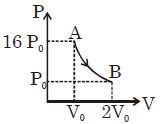
The figure shows a polytropic process for an ideal gas. The work done by the gas in process $AB$ is
A
$\frac{15}{2} P_0 V_0$
B
$\frac{14}{3} P_0 V_0$
C
$8 P_0 V_0$
D
Insufficient information
Solution
(B) For a polytropic process, the equation is $P V^x = \text{constant}$.
At point $A$, $P_1 = 16 P_0$ and $V_1 = V_0$.
At point $B$, $P_2 = P_0$ and $V_2 = 2 V_0$.
Substituting these values into the polytropic equation: $P_1 V_1^x = P_2 V_2^x$.
$16 P_0 (V_0)^x = P_0 (2 V_0)^x$.
$16 = 2^x \implies 2^4 = 2^x \implies x = 4$.
The work done in a polytropic process is given by $W = \frac{P_1 V_1 - P_2 V_2}{x - 1}$.
$W = \frac{(16 P_0)(V_0) - (P_0)(2 V_0)}{4 - 1}$.
$W = \frac{16 P_0 V_0 - 2 P_0 V_0}{3} = \frac{14}{3} P_0 V_0$.
At point $A$, $P_1 = 16 P_0$ and $V_1 = V_0$.
At point $B$, $P_2 = P_0$ and $V_2 = 2 V_0$.
Substituting these values into the polytropic equation: $P_1 V_1^x = P_2 V_2^x$.
$16 P_0 (V_0)^x = P_0 (2 V_0)^x$.
$16 = 2^x \implies 2^4 = 2^x \implies x = 4$.
The work done in a polytropic process is given by $W = \frac{P_1 V_1 - P_2 V_2}{x - 1}$.
$W = \frac{(16 P_0)(V_0) - (P_0)(2 V_0)}{4 - 1}$.
$W = \frac{16 P_0 V_0 - 2 P_0 V_0}{3} = \frac{14}{3} P_0 V_0$.
0 likes
View Solution28
DifficultMCQ
An ideal gas expands in such a way that $PV^2 =$ constant throughout the process.
A
In the process, $T-V$ diagram is a parabola.
B
In the process, $T-V$ diagram is a straight line.
C
Such an expansion is possible only with heating.
D
Such an expansion is possible only with cooling.
Solution
(D) Given the process equation: $PV^2 = \text{constant}$.
Using the ideal gas law $PV = nRT$, we can write $P = \frac{nRT}{V}$.
Substituting this into the process equation: $\left(\frac{nRT}{V}\right) V^2 = \text{constant}$.
This simplifies to $nRT \cdot V = \text{constant}$.
Since $n$ and $R$ are constants, we get $TV = \text{constant}$, or $T \propto \frac{1}{V}$.
The graph of $T$ versus $V$ is a rectangular hyperbola, not a parabola or a straight line.
For an expansion, $V$ increases. Since $T \propto \frac{1}{V}$, as $V$ increases, $T$ must decrease.
Therefore, such an expansion is possible only with cooling.
Using the ideal gas law $PV = nRT$, we can write $P = \frac{nRT}{V}$.
Substituting this into the process equation: $\left(\frac{nRT}{V}\right) V^2 = \text{constant}$.
This simplifies to $nRT \cdot V = \text{constant}$.
Since $n$ and $R$ are constants, we get $TV = \text{constant}$, or $T \propto \frac{1}{V}$.
The graph of $T$ versus $V$ is a rectangular hyperbola, not a parabola or a straight line.
For an expansion, $V$ increases. Since $T \propto \frac{1}{V}$, as $V$ increases, $T$ must decrease.
Therefore, such an expansion is possible only with cooling.
0 likes
View Solution29
DifficultMCQ
In a process,temperature and volume of one mole of an ideal monoatomic gas are varied according to the relation $VT = K$,where $K$ is a constant. In this process,the temperature of the gas is increased by $\Delta T$. The amount of heat absorbed by the gas is ($R$ is the gas constant).
A
$\frac{1}{2} R \Delta T$
B
$\frac{1}{2} K R \Delta T$
C
$\frac{3}{2} R \Delta T$
D
$\frac{2 K}{3} \Delta T$
Solution
(A) Given the process relation: $VT = K$.
Using the ideal gas law $PV = nRT$,we have $T = \frac{PV}{nR}$.
Substituting $T$ into the process equation: $V \left( \frac{PV}{nR} \right) = K$.
This simplifies to $PV^2 = nRK$,which is a polytropic process of the form $PV^x = \text{constant}$,where $x = 2$.
For a monoatomic gas,the molar heat capacity at constant volume is $C_v = \frac{3}{2} R$.
The molar heat capacity $C$ for a polytropic process is given by $C = C_v + \frac{R}{1-x}$.
Substituting the values: $C = \frac{3}{2} R + \frac{R}{1-2} = \frac{3}{2} R - R = \frac{1}{2} R$.
The heat absorbed by $n$ moles of gas is $\Delta Q = n C \Delta T$.
Given $n = 1$,we get $\Delta Q = 1 \times \left( \frac{1}{2} R \right) \times \Delta T = \frac{1}{2} R \Delta T$.
Using the ideal gas law $PV = nRT$,we have $T = \frac{PV}{nR}$.
Substituting $T$ into the process equation: $V \left( \frac{PV}{nR} \right) = K$.
This simplifies to $PV^2 = nRK$,which is a polytropic process of the form $PV^x = \text{constant}$,where $x = 2$.
For a monoatomic gas,the molar heat capacity at constant volume is $C_v = \frac{3}{2} R$.
The molar heat capacity $C$ for a polytropic process is given by $C = C_v + \frac{R}{1-x}$.
Substituting the values: $C = \frac{3}{2} R + \frac{R}{1-2} = \frac{3}{2} R - R = \frac{1}{2} R$.
The heat absorbed by $n$ moles of gas is $\Delta Q = n C \Delta T$.
Given $n = 1$,we get $\Delta Q = 1 \times \left( \frac{1}{2} R \right) \times \Delta T = \frac{1}{2} R \Delta T$.
0 likes
View Solution30
DifficultMCQ
$1 \, \text{mole}$ of an ideal gas at temperature $T_1$ expands according to the law $P/V = \text{constant}$. Find the work done when the final temperature becomes $T_2$.
A
$R(T_2 - T_1)$
B
$\frac{R}{2}(T_2 - T_1)$
C
$\frac{R}{4}(T_2 - T_1)$
D
$PV(T_2 - T_1)$
Solution
(B) The work done by an ideal gas is given by $W = \int_{V_1}^{V_2} P \, dV$.
Given the process law $P/V = K$ (where $K$ is a constant), we have $P = KV$.
Substituting this into the work integral: $W = \int_{V_1}^{V_2} KV \, dV = \frac{1}{2} K(V_2^2 - V_1^2)$.
From the ideal gas equation $PV = RT$, and substituting $P = KV$, we get $(KV)V = RT$, which implies $KV^2 = RT$.
Therefore, $K V_2^2 = RT_2$ and $K V_1^2 = RT_1$.
Substituting these into the work expression: $W = \frac{1}{2} (KV_2^2 - KV_1^2) = \frac{1}{2} (RT_2 - RT_1) = \frac{R}{2}(T_2 - T_1)$.
Given the process law $P/V = K$ (where $K$ is a constant), we have $P = KV$.
Substituting this into the work integral: $W = \int_{V_1}^{V_2} KV \, dV = \frac{1}{2} K(V_2^2 - V_1^2)$.
From the ideal gas equation $PV = RT$, and substituting $P = KV$, we get $(KV)V = RT$, which implies $KV^2 = RT$.
Therefore, $K V_2^2 = RT_2$ and $K V_1^2 = RT_1$.
Substituting these into the work expression: $W = \frac{1}{2} (KV_2^2 - KV_1^2) = \frac{1}{2} (RT_2 - RT_1) = \frac{R}{2}(T_2 - T_1)$.
0 likes
View Solution31
MediumMCQ
$1 \, \text{mole}$ of an ideal monoatomic gas at temperature $T_0$ expands slowly according to the law $P = KV$,where $K$ is a constant. If the final temperature of the gas is $2T_0$,find the heat supplied to the gas.
A
$RT_0$
B
$2RT_0$
C
$3RT_0$
D
$4RT_0$
Solution
(B) For a monoatomic gas,the molar heat capacity $C$ for a process $P = KV$ is calculated as follows:
Given $P = KV$,we know $PV = nRT$. Substituting $P = KV$,we get $KV^2 = nRT$,so $V^2 \propto T$.
For a polytropic process $PV^x = \text{constant}$,we have $T V^{x-1} = \text{constant}$.
Since $V^2 \propto T$,we have $T V^{-2} = \text{constant}$,which implies $x - 1 = -2$,so $x = -1$.
The molar heat capacity $C$ is given by $C = C_v + \frac{R}{1-x} = \frac{3}{2}R + \frac{R}{1-(-1)} = \frac{3}{2}R + \frac{R}{2} = 2R$.
The heat supplied is $Q = nC\Delta T = 1 \times (2R) \times (2T_0 - T_0) = 2RT_0$.
Given $P = KV$,we know $PV = nRT$. Substituting $P = KV$,we get $KV^2 = nRT$,so $V^2 \propto T$.
For a polytropic process $PV^x = \text{constant}$,we have $T V^{x-1} = \text{constant}$.
Since $V^2 \propto T$,we have $T V^{-2} = \text{constant}$,which implies $x - 1 = -2$,so $x = -1$.
The molar heat capacity $C$ is given by $C = C_v + \frac{R}{1-x} = \frac{3}{2}R + \frac{R}{1-(-1)} = \frac{3}{2}R + \frac{R}{2} = 2R$.
The heat supplied is $Q = nC\Delta T = 1 \times (2R) \times (2T_0 - T_0) = 2RT_0$.
0 likes
View Solution32
DifficultMCQ
$1 \, \text{mole}$ of a gas expands with temperature as $V = KT^{2/3}$. What is the work done when temperature changes by $30^oC$ (in $R$)?
A
$10$
B
$20$
C
$30$
D
$40$
Solution
(B) The work done by a gas is given by $W = \int P \, dV$.
Using the ideal gas law $PV = RT$ (for $1 \, \text{mole}$),we have $P = \frac{RT}{V}$.
Given the relation $V = KT^{2/3} \dots (i)$.
Differentiating with respect to $T$,we get $dV = K \cdot \frac{2}{3} T^{-1/3} \, dT \dots (ii)$.
Dividing equation $(ii)$ by $(i)$,we get $\frac{dV}{V} = \frac{2}{3} \frac{dT}{T}$.
Substituting $P = \frac{RT}{V}$ into the work integral: $W = \int \frac{RT}{V} dV$.
Substituting $\frac{dV}{V} = \frac{2}{3} \frac{dT}{T}$,we get $W = \int R T \left( \frac{2}{3} \frac{dT}{T} \right) = \int \frac{2}{3} R \, dT$.
Integrating over the temperature change $\Delta T = 30^oC$,we get $W = \frac{2}{3} R \Delta T$.
$W = \frac{2}{3} \times 30R = 20R$.
Using the ideal gas law $PV = RT$ (for $1 \, \text{mole}$),we have $P = \frac{RT}{V}$.
Given the relation $V = KT^{2/3} \dots (i)$.
Differentiating with respect to $T$,we get $dV = K \cdot \frac{2}{3} T^{-1/3} \, dT \dots (ii)$.
Dividing equation $(ii)$ by $(i)$,we get $\frac{dV}{V} = \frac{2}{3} \frac{dT}{T}$.
Substituting $P = \frac{RT}{V}$ into the work integral: $W = \int \frac{RT}{V} dV$.
Substituting $\frac{dV}{V} = \frac{2}{3} \frac{dT}{T}$,we get $W = \int R T \left( \frac{2}{3} \frac{dT}{T} \right) = \int \frac{2}{3} R \, dT$.
Integrating over the temperature change $\Delta T = 30^oC$,we get $W = \frac{2}{3} R \Delta T$.
$W = \frac{2}{3} \times 30R = 20R$.
0 likes
View Solution33
EasyMCQ
The graph of pressure $(P)$ and volume $(V)$ according to $PV^n = C$,where $n = 1.4$. Identify the correct graph.
A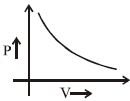
B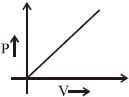
C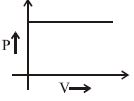
D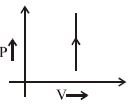
Solution
(A) The given equation is $PV^n = C$,where $n = 1.4$.
This represents a polytropic process.
Since $P = \frac{C}{V^{1.4}}$,as volume $V$ increases,pressure $P$ decreases non-linearly.
This relationship $P \propto V^{-1.4}$ represents a curve that is steeper than an isothermal process $(n=1)$ and is characteristic of an adiabatic process $(n=\gamma=1.4)$.
Graph $A$ represents this inverse non-linear relationship (a hyperbola-like curve),which is the correct representation for $PV^{1.4} = C$.
This represents a polytropic process.
Since $P = \frac{C}{V^{1.4}}$,as volume $V$ increases,pressure $P$ decreases non-linearly.
This relationship $P \propto V^{-1.4}$ represents a curve that is steeper than an isothermal process $(n=1)$ and is characteristic of an adiabatic process $(n=\gamma=1.4)$.
Graph $A$ represents this inverse non-linear relationship (a hyperbola-like curve),which is the correct representation for $PV^{1.4} = C$.
0 likes
View Solution34
MediumMCQ
$A$ gas obeys $P^2V = \text{constant}$. The initial temperature and volume are $T_0$ and $V_0$. If the gas expands to a volume of $2V_0$,the final temperature is:
A
$\sqrt{2} T_0$
B
$2 T_0$
C
$T_0/2$
D
$T_0/\sqrt{2}$
Solution
(A) Given the process equation: $P^2V = \text{constant}$.
From the ideal gas law,$PV = nRT$,we have $P = \frac{nRT}{V}$.
Substituting this into the given equation:
$(\frac{nRT}{V})^2 V = \text{constant}$
$\frac{T^2}{V^2} \cdot V = \text{constant}$
$\frac{T^2}{V} = \text{constant}$.
This implies that $\frac{T_1^2}{V_1} = \frac{T_2^2}{V_2}$.
Given $T_1 = T_0$,$V_1 = V_0$,and $V_2 = 2V_0$:
$\frac{T_0^2}{V_0} = \frac{T_2^2}{2V_0}$
$T_2^2 = 2T_0^2$
$T_2 = \sqrt{2} T_0$.
From the ideal gas law,$PV = nRT$,we have $P = \frac{nRT}{V}$.
Substituting this into the given equation:
$(\frac{nRT}{V})^2 V = \text{constant}$
$\frac{T^2}{V^2} \cdot V = \text{constant}$
$\frac{T^2}{V} = \text{constant}$.
This implies that $\frac{T_1^2}{V_1} = \frac{T_2^2}{V_2}$.
Given $T_1 = T_0$,$V_1 = V_0$,and $V_2 = 2V_0$:
$\frac{T_0^2}{V_0} = \frac{T_2^2}{2V_0}$
$T_2^2 = 2T_0^2$
$T_2 = \sqrt{2} T_0$.
0 likes
View Solution35
MediumMCQ
An ideal gas is subjected to a thermodynamic process $PV^{2.5} = 0.40$,where $P$ is in $Pa$ and $V$ is in $m^3$. What is the slope of the $P-V$ curve with volume plotted against the $x-$axis at $V = 1 \, m^3$?
A
$-1$
B
$-3.5$
C
$-2.5$
D
None of these
Solution
(A) The given equation for the thermodynamic process is $PV^{2.5} = 0.40$.
To find the slope of the $P-V$ curve,we need to calculate the derivative $\frac{dP}{dV}$.
First,express $P$ as a function of $V$:
$P = 0.40 V^{-2.5}$
Differentiating both sides with respect to $V$:
$\frac{dP}{dV} = 0.40 \times (-2.5) \times V^{-2.5-1}$
$\frac{dP}{dV} = -1.0 \times V^{-3.5}$
Now,evaluate the slope at $V = 1 \, m^3$:
$\left(\frac{dP}{dV}\right)_{V=1} = -1.0 \times (1)^{-3.5}$
$\left(\frac{dP}{dV}\right)_{V=1} = -1 \, Pa/m^3$
Thus,the slope of the $P-V$ curve at $V = 1 \, m^3$ is $-1$.
To find the slope of the $P-V$ curve,we need to calculate the derivative $\frac{dP}{dV}$.
First,express $P$ as a function of $V$:
$P = 0.40 V^{-2.5}$
Differentiating both sides with respect to $V$:
$\frac{dP}{dV} = 0.40 \times (-2.5) \times V^{-2.5-1}$
$\frac{dP}{dV} = -1.0 \times V^{-3.5}$
Now,evaluate the slope at $V = 1 \, m^3$:
$\left(\frac{dP}{dV}\right)_{V=1} = -1.0 \times (1)^{-3.5}$
$\left(\frac{dP}{dV}\right)_{V=1} = -1 \, Pa/m^3$
Thus,the slope of the $P-V$ curve at $V = 1 \, m^3$ is $-1$.
0 likes
View Solution36
DifficultMCQ
One mole of an ideal monoatomic gas at temperature $T_0$ expands slowly according to the law $P = kV$ ($k$ is a constant). If the final temperature is $2T_0$,the heat supplied to the gas is:
A
$2RT_0$
B
$3/2 RT_0$
C
$RT_0$
D
$RT_0/2$
Solution
(A) For an ideal gas,the equation of state is $PV = nRT$. Given $P = kV$ and $n = 1$,we have $kV^2 = RT$,which implies $V^2 \propto T$.
Since $P = kV$,the process is a polytropic process $PV^{-1} = k$. Thus,the polytropic index $x = -1$.
The change in internal energy is given by $\Delta U = nC_v \Delta T = 1 \cdot \frac{3R}{2} \cdot (2T_0 - T_0) = \frac{3RT_0}{2}$.
The work done in a polytropic process is $W = \frac{nR \Delta T}{1-x} = \frac{1 \cdot R \cdot (2T_0 - T_0)}{1 - (-1)} = \frac{RT_0}{2}$.
According to the first law of thermodynamics,the heat supplied is $Q = \Delta U + W = \frac{3RT_0}{2} + \frac{RT_0}{2} = 2RT_0$.
Since $P = kV$,the process is a polytropic process $PV^{-1} = k$. Thus,the polytropic index $x = -1$.
The change in internal energy is given by $\Delta U = nC_v \Delta T = 1 \cdot \frac{3R}{2} \cdot (2T_0 - T_0) = \frac{3RT_0}{2}$.
The work done in a polytropic process is $W = \frac{nR \Delta T}{1-x} = \frac{1 \cdot R \cdot (2T_0 - T_0)}{1 - (-1)} = \frac{RT_0}{2}$.
According to the first law of thermodynamics,the heat supplied is $Q = \Delta U + W = \frac{3RT_0}{2} + \frac{RT_0}{2} = 2RT_0$.
0 likes
View Solution37
DifficultMCQ
$A$ gas obeys the relation $P^2V = \text{constant}$. The initial temperature and volume are $T_0$ and $V_0$. If the gas expands to a volume $2V_0$, what will be its final temperature?
A
$\sqrt{2} T_0$
B
$2T_0$
C
$T_0/2$
D
$T_0/\sqrt{2}$
Solution
(A) Given the relation for the gas is $P^2V = \text{constant}$.
Using the ideal gas law, $PV = nRT$, we can express pressure as $P = \frac{nRT}{V}$.
Substituting this into the given relation: $\left(\frac{nRT}{V}\right)^2 V = \text{constant}$.
This simplifies to $\frac{n^2R^2T^2}{V^2} \cdot V = \text{constant}$, which implies $\frac{T^2}{V} = \text{constant}$.
For two states, we have $\frac{T_1^2}{V_1} = \frac{T_2^2}{V_2}$.
Given $T_1 = T_0$, $V_1 = V_0$, and $V_2 = 2V_0$, we substitute these values:
$\frac{T_0^2}{V_0} = \frac{T_2^2}{2V_0}$.
Canceling $V_0$ from both sides, we get $T_2^2 = 2T_0^2$.
Taking the square root, the final temperature is $T_2 = \sqrt{2} T_0$.
Using the ideal gas law, $PV = nRT$, we can express pressure as $P = \frac{nRT}{V}$.
Substituting this into the given relation: $\left(\frac{nRT}{V}\right)^2 V = \text{constant}$.
This simplifies to $\frac{n^2R^2T^2}{V^2} \cdot V = \text{constant}$, which implies $\frac{T^2}{V} = \text{constant}$.
For two states, we have $\frac{T_1^2}{V_1} = \frac{T_2^2}{V_2}$.
Given $T_1 = T_0$, $V_1 = V_0$, and $V_2 = 2V_0$, we substitute these values:
$\frac{T_0^2}{V_0} = \frac{T_2^2}{2V_0}$.
Canceling $V_0$ from both sides, we get $T_2^2 = 2T_0^2$.
Taking the square root, the final temperature is $T_2 = \sqrt{2} T_0$.
0 likes
View Solution38
DifficultMCQ
$A$ gas is found to obey the law $P^2V =$ constant. The initial temperature and volume are $T_0$ and $V_0$. If the gas expands to a volume $3V_0$,its final temperature becomes
A
$T_0 / 3$
B
$T_0 / \sqrt{3}$
C
$3T_0$
D
$\sqrt{3} T_0$
Solution
(D) Given the law for the gas is $P^2V = C$ (constant).
From the ideal gas equation,we have $PV = nRT$,which implies $P = \frac{nRT}{V}$.
Substituting $P$ into the given law: $(\frac{nRT}{V})^2 V = C$.
This simplifies to $\frac{n^2 R^2 T^2}{V^2} \cdot V = C$,or $\frac{T^2}{V} = \text{constant}$.
Therefore,$T^2 \propto V$.
For the initial state,we have $T_0^2 \propto V_0$.
For the final state,let the temperature be $T_f$ and volume be $3V_0$,so $T_f^2 \propto 3V_0$.
Dividing the two relations: $\frac{T_f^2}{T_0^2} = \frac{3V_0}{V_0} = 3$.
Taking the square root on both sides,we get $T_f = \sqrt{3} T_0$.
From the ideal gas equation,we have $PV = nRT$,which implies $P = \frac{nRT}{V}$.
Substituting $P$ into the given law: $(\frac{nRT}{V})^2 V = C$.
This simplifies to $\frac{n^2 R^2 T^2}{V^2} \cdot V = C$,or $\frac{T^2}{V} = \text{constant}$.
Therefore,$T^2 \propto V$.
For the initial state,we have $T_0^2 \propto V_0$.
For the final state,let the temperature be $T_f$ and volume be $3V_0$,so $T_f^2 \propto 3V_0$.
Dividing the two relations: $\frac{T_f^2}{T_0^2} = \frac{3V_0}{V_0} = 3$.
Taking the square root on both sides,we get $T_f = \sqrt{3} T_0$.
0 likes
View Solution39
MediumMCQ
For a certain process, the pressure of a diatomic gas varies according to the relation $P = aV^2$, where $a$ is a constant. What is the molar heat capacity of the gas for this process?
A
$\frac{17R}{6}$
B
$\frac{6R}{17}$
C
$\frac{13R}{6}$
D
$\frac{16R}{7}$
Solution
(A) The given process is $P = aV^2$, which can be written as $PV^{-2} = a$.
Comparing this with the polytropic process equation $PV^x = \text{constant}$, we get $x = -2$.
The molar heat capacity $C$ for a polytropic process is given by $C = C_V + \frac{R}{1-x}$.
For a diatomic gas, the molar heat capacity at constant volume is $C_V = \frac{5R}{2}$.
Substituting the values, we get $C = \frac{5R}{2} + \frac{R}{1 - (-2)}$.
$C = \frac{5R}{2} + \frac{R}{3} = \frac{15R + 2R}{6} = \frac{17R}{6}$.
Comparing this with the polytropic process equation $PV^x = \text{constant}$, we get $x = -2$.
The molar heat capacity $C$ for a polytropic process is given by $C = C_V + \frac{R}{1-x}$.
For a diatomic gas, the molar heat capacity at constant volume is $C_V = \frac{5R}{2}$.
Substituting the values, we get $C = \frac{5R}{2} + \frac{R}{1 - (-2)}$.
$C = \frac{5R}{2} + \frac{R}{3} = \frac{15R + 2R}{6} = \frac{17R}{6}$.
0 likes
View Solution40
Difficult
Consider one mole of an ideal gas in a cylindrical container following the path shown in the $P-V$ diagram. The process follows $PV^{1/2} = \text{constant}$.
$(a)$ Find the work done in taking the gas from state $1$ to state $2$.
$(b)$ If $V_2 = 2V_1$, what is the ratio of temperatures $\frac{T_1}{T_2}$?
$(c)$ The internal energy of one mole of gas at temperature $T$ is $\frac{3}{2}RT$. Find the heat supplied to the gas in taking it from state $1$ to state $2$.
$(a)$ Find the work done in taking the gas from state $1$ to state $2$.
$(b)$ If $V_2 = 2V_1$, what is the ratio of temperatures $\frac{T_1}{T_2}$?
$(c)$ The internal energy of one mole of gas at temperature $T$ is $\frac{3}{2}RT$. Find the heat supplied to the gas in taking it from state $1$ to state $2$.
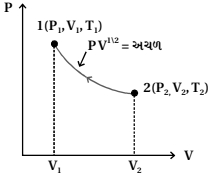
Solution
(N/A) The work done in a polytropic process $PV^n = K$ is given by $W = \frac{P_1V_1 - P_2V_2}{n-1}$.
Here, $n = 1/2$. So, $W = \frac{P_1V_1 - P_2V_2}{1/2 - 1} = \frac{P_1V_1 - P_2V_2}{-1/2} = 2(P_2V_2 - P_1V_1)$.
Since $P_1V_1^{1/2} = P_2V_2^{1/2}$, we have $P_2 = P_1(V_1/V_2)^{1/2}$.
Thus, $W = 2[P_1(V_1/V_2)^{1/2}V_2 - P_1V_1] = 2P_1V_1[(V_2/V_1)^{1/2} - 1]$.
$(b)$ Using the ideal gas law $PV = RT$ (for $1$ mole), $P = RT/V$.
Substituting into $PV^{1/2} = K$, we get $(RT/V)V^{1/2} = K$, so $TV^{-1/2} = \text{constant}$.
Therefore, $T_1V_1^{-1/2} = T_2V_2^{-1/2} \implies \frac{T_1}{T_2} = (\frac{V_1}{V_2})^{1/2}$.
Given $V_2 = 2V_1$, $\frac{T_1}{T_2} = (\frac{V_1}{2V_1})^{1/2} = \frac{1}{\sqrt{2}}$.
$(c)$ From the first law of thermodynamics, $Q = \Delta U + W$.
$\Delta U = \frac{3}{2}R(T_2 - T_1)$.
Since $T_2 = \sqrt{2}T_1$, $\Delta U = \frac{3}{2}R(\sqrt{2}T_1 - T_1) = \frac{3}{2}RT_1(\sqrt{2} - 1)$.
$W = 2(P_2V_2 - P_1V_1) = 2R(T_2 - T_1) = 2RT_1(\sqrt{2} - 1)$.
$Q = \frac{3}{2}RT_1(\sqrt{2} - 1) + 2RT_1(\sqrt{2} - 1) = \frac{7}{2}RT_1(\sqrt{2} - 1)$.
Here, $n = 1/2$. So, $W = \frac{P_1V_1 - P_2V_2}{1/2 - 1} = \frac{P_1V_1 - P_2V_2}{-1/2} = 2(P_2V_2 - P_1V_1)$.
Since $P_1V_1^{1/2} = P_2V_2^{1/2}$, we have $P_2 = P_1(V_1/V_2)^{1/2}$.
Thus, $W = 2[P_1(V_1/V_2)^{1/2}V_2 - P_1V_1] = 2P_1V_1[(V_2/V_1)^{1/2} - 1]$.
$(b)$ Using the ideal gas law $PV = RT$ (for $1$ mole), $P = RT/V$.
Substituting into $PV^{1/2} = K$, we get $(RT/V)V^{1/2} = K$, so $TV^{-1/2} = \text{constant}$.
Therefore, $T_1V_1^{-1/2} = T_2V_2^{-1/2} \implies \frac{T_1}{T_2} = (\frac{V_1}{V_2})^{1/2}$.
Given $V_2 = 2V_1$, $\frac{T_1}{T_2} = (\frac{V_1}{2V_1})^{1/2} = \frac{1}{\sqrt{2}}$.
$(c)$ From the first law of thermodynamics, $Q = \Delta U + W$.
$\Delta U = \frac{3}{2}R(T_2 - T_1)$.
Since $T_2 = \sqrt{2}T_1$, $\Delta U = \frac{3}{2}R(\sqrt{2}T_1 - T_1) = \frac{3}{2}RT_1(\sqrt{2} - 1)$.
$W = 2(P_2V_2 - P_1V_1) = 2R(T_2 - T_1) = 2RT_1(\sqrt{2} - 1)$.
$Q = \frac{3}{2}RT_1(\sqrt{2} - 1) + 2RT_1(\sqrt{2} - 1) = \frac{7}{2}RT_1(\sqrt{2} - 1)$.
0 likes
View Solution41
Difficult
Consider a $P - V$ diagram in which the path followed by one mole of perfect gas in a cylindrical container is shown in the figure.
$(a)$ Find the work done when the gas is taken from state $1$ to state $2$.
$(b)$ What is the ratio of temperature $\frac{T_1}{T_2}$ if $V_2 = 2V_1$?
$(c)$ Given the internal energy for one mole of gas at temperature $T$ is $\frac{3}{2}RT$,find the heat supplied to the gas when it is taken from state $1$ to $2$,with $V_2 = 2V_1$.
$(a)$ Find the work done when the gas is taken from state $1$ to state $2$.
$(b)$ What is the ratio of temperature $\frac{T_1}{T_2}$ if $V_2 = 2V_1$?
$(c)$ Given the internal energy for one mole of gas at temperature $T$ is $\frac{3}{2}RT$,find the heat supplied to the gas when it is taken from state $1$ to $2$,with $V_2 = 2V_1$.
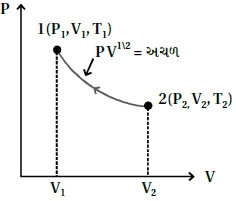
Solution
(N/A) From the graph,the process follows $PV^{\frac{1}{2}} = K$ (constant).
$(a)$ The work done $W$ for the process from state $1$ to $2$ is given by:
$W = \int_{V_1}^{V_2} P \, dV = \int_{V_1}^{V_2} \frac{K}{\sqrt{V}} \, dV = K \left[ \frac{V^{\frac{1}{2}}}{\frac{1}{2}} \right]_{V_1}^{V_2} = 2K(\sqrt{V_2} - \sqrt{V_1})$.
Since $K = P_1 V_1^{\frac{1}{2}}$,we have $W = 2P_1 V_1^{\frac{1}{2}}(\sqrt{V_2} - \sqrt{V_1}) = 2P_1 V_1 (\sqrt{\frac{V_2}{V_1}} - 1)$.
Given $V_2 = 2V_1$,$W = 2P_1 V_1 (\sqrt{2} - 1)$.
$(b)$ From the ideal gas equation $PV = nRT$,and $P = \frac{K}{\sqrt{V}}$,we get $T = \frac{PV}{nR} = \frac{K\sqrt{V}}{nR}$.
Thus,$\frac{T_1}{T_2} = \sqrt{\frac{V_1}{V_2}} = \sqrt{\frac{V_1}{2V_1}} = \frac{1}{\sqrt{2}}$.
$(c)$ Heat supplied $Q = \Delta U + W$.
$\Delta U = nC_v \Delta T = 1 \cdot \frac{3}{2}R(T_2 - T_1) = \frac{3}{2}(P_2 V_2 - P_1 V_1)$.
Since $P_2 V_2^{\frac{1}{2}} = P_1 V_1^{\frac{1}{2}}$,$P_2 = P_1 \sqrt{\frac{V_1}{V_2}} = \frac{P_1}{\sqrt{2}}$.
$P_2 V_2 = \frac{P_1}{\sqrt{2}} (2V_1) = P_1 V_1 \sqrt{2}$.
$\Delta U = \frac{3}{2} P_1 V_1 (\sqrt{2} - 1)$.
$Q = \frac{3}{2} P_1 V_1 (\sqrt{2} - 1) + 2 P_1 V_1 (\sqrt{2} - 1) = \frac{7}{2} P_1 V_1 (\sqrt{2} - 1)$.
$(a)$ The work done $W$ for the process from state $1$ to $2$ is given by:
$W = \int_{V_1}^{V_2} P \, dV = \int_{V_1}^{V_2} \frac{K}{\sqrt{V}} \, dV = K \left[ \frac{V^{\frac{1}{2}}}{\frac{1}{2}} \right]_{V_1}^{V_2} = 2K(\sqrt{V_2} - \sqrt{V_1})$.
Since $K = P_1 V_1^{\frac{1}{2}}$,we have $W = 2P_1 V_1^{\frac{1}{2}}(\sqrt{V_2} - \sqrt{V_1}) = 2P_1 V_1 (\sqrt{\frac{V_2}{V_1}} - 1)$.
Given $V_2 = 2V_1$,$W = 2P_1 V_1 (\sqrt{2} - 1)$.
$(b)$ From the ideal gas equation $PV = nRT$,and $P = \frac{K}{\sqrt{V}}$,we get $T = \frac{PV}{nR} = \frac{K\sqrt{V}}{nR}$.
Thus,$\frac{T_1}{T_2} = \sqrt{\frac{V_1}{V_2}} = \sqrt{\frac{V_1}{2V_1}} = \frac{1}{\sqrt{2}}$.
$(c)$ Heat supplied $Q = \Delta U + W$.
$\Delta U = nC_v \Delta T = 1 \cdot \frac{3}{2}R(T_2 - T_1) = \frac{3}{2}(P_2 V_2 - P_1 V_1)$.
Since $P_2 V_2^{\frac{1}{2}} = P_1 V_1^{\frac{1}{2}}$,$P_2 = P_1 \sqrt{\frac{V_1}{V_2}} = \frac{P_1}{\sqrt{2}}$.
$P_2 V_2 = \frac{P_1}{\sqrt{2}} (2V_1) = P_1 V_1 \sqrt{2}$.
$\Delta U = \frac{3}{2} P_1 V_1 (\sqrt{2} - 1)$.
$Q = \frac{3}{2} P_1 V_1 (\sqrt{2} - 1) + 2 P_1 V_1 (\sqrt{2} - 1) = \frac{7}{2} P_1 V_1 (\sqrt{2} - 1)$.
0 likes
View Solution42
DifficultMCQ
$A$ thermodynamic process for one mole of an ideal gas is shown below on a $P-V$ diagram. If $V_{2} = 2V_{1}$, then the ratio of temperature $T_{2} / T_{1}$ is ...... .
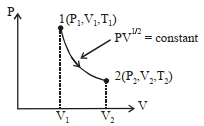
A
$\frac{1}{2}$
B
$2$
C
$\sqrt{2}$
D
$\frac{1}{\sqrt{2}}$
Solution
(D) For a polytropic process, the equation is $PV^{x} = \text{constant}$.
Given the process equation is $PV^{1/2} = \text{constant}$.
Using the ideal gas equation $PV = nRT$, we can write $P = \frac{nRT}{V}$.
Substituting this into the process equation:
$\left(\frac{nRT}{V}\right) V^{1/2} = \text{constant}$
$T V^{-1} V^{1/2} = \text{constant}$
$T V^{-1/2} = \text{constant}$
Thus, $T_{1} V_{1}^{-1/2} = T_{2} V_{2}^{-1/2}$.
Rearranging for the ratio of temperatures:
$\frac{T_{2}}{T_{1}} = \left(\frac{V_{2}}{V_{1}}\right)^{-1/2} = \left(\frac{V_{1}}{V_{2}}\right)^{1/2}$.
Given $V_{2} = 2V_{1}$, we have $\frac{V_{1}}{V_{2}} = \frac{1}{2}$.
Therefore, $\frac{T_{2}}{T_{1}} = \left(\frac{1}{2}\right)^{1/2} = \frac{1}{\sqrt{2}}$.
Hence, the correct option is $D$.
Given the process equation is $PV^{1/2} = \text{constant}$.
Using the ideal gas equation $PV = nRT$, we can write $P = \frac{nRT}{V}$.
Substituting this into the process equation:
$\left(\frac{nRT}{V}\right) V^{1/2} = \text{constant}$
$T V^{-1} V^{1/2} = \text{constant}$
$T V^{-1/2} = \text{constant}$
Thus, $T_{1} V_{1}^{-1/2} = T_{2} V_{2}^{-1/2}$.
Rearranging for the ratio of temperatures:
$\frac{T_{2}}{T_{1}} = \left(\frac{V_{2}}{V_{1}}\right)^{-1/2} = \left(\frac{V_{1}}{V_{2}}\right)^{1/2}$.
Given $V_{2} = 2V_{1}$, we have $\frac{V_{1}}{V_{2}} = \frac{1}{2}$.
Therefore, $\frac{T_{2}}{T_{1}} = \left(\frac{1}{2}\right)^{1/2} = \frac{1}{\sqrt{2}}$.
Hence, the correct option is $D$.
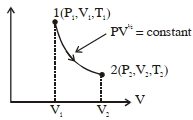
0 likes
View Solution43
AdvancedMCQ
$0.02 \, mol$ of an ideal diatomic gas with initial temperature $20^{\circ} C$ is compressed from $1500 \, cm^3$ to $500 \, cm^3$. The thermodynamic process is such that $p V^2 = \beta$,where $\beta$ is a constant. Then,the value of $\beta$ is close to (the gas constant,$R = 8.31 \, J / K / mol$).
A
$7.5 \times 10^{-2} \, Pa \cdot m^6$
B
$1.5 \times 10^2 \, Pa \cdot m^6$
C
$3 \times 10^{-2} \, Pa \cdot m^6$
D
$2.0 \times 10^1 \, Pa \cdot m^6$
Solution
(A) The process equation is given by $p V^2 = \beta$.
Since the gas is ideal,it obeys the ideal gas equation $p V = n R T$.
From the ideal gas equation,we can write $p = \frac{n R T}{V}$.
Substituting this into the process equation: $\left(\frac{n R T}{V}\right) V^2 = \beta$,which simplifies to $n R T V = \beta$.
Given values:
$n = 0.02 \, mol$
$R = 8.31 \, J \cdot K^{-1} \cdot mol^{-1}$
$T = 20^{\circ} C = 293 \, K$
$V = 1500 \, cm^3 = 1500 \times 10^{-6} \, m^3 = 1.5 \times 10^{-3} \, m^3$.
Now,calculate $\beta$:
$\beta = n R T V = (0.02) \times (8.31) \times (293) \times (1.5 \times 10^{-3})$.
$\beta = 0.02 \times 8.31 \times 293 \times 0.0015 \approx 0.0729 \, Pa \cdot m^6$.
Rounding to the nearest given option,$\beta \approx 7.5 \times 10^{-2} \, Pa \cdot m^6$.
Since the gas is ideal,it obeys the ideal gas equation $p V = n R T$.
From the ideal gas equation,we can write $p = \frac{n R T}{V}$.
Substituting this into the process equation: $\left(\frac{n R T}{V}\right) V^2 = \beta$,which simplifies to $n R T V = \beta$.
Given values:
$n = 0.02 \, mol$
$R = 8.31 \, J \cdot K^{-1} \cdot mol^{-1}$
$T = 20^{\circ} C = 293 \, K$
$V = 1500 \, cm^3 = 1500 \times 10^{-6} \, m^3 = 1.5 \times 10^{-3} \, m^3$.
Now,calculate $\beta$:
$\beta = n R T V = (0.02) \times (8.31) \times (293) \times (1.5 \times 10^{-3})$.
$\beta = 0.02 \times 8.31 \times 293 \times 0.0015 \approx 0.0729 \, Pa \cdot m^6$.
Rounding to the nearest given option,$\beta \approx 7.5 \times 10^{-2} \, Pa \cdot m^6$.
0 likes
View Solution44
MediumMCQ
An ideal gas follows a process described by $p V^2 = C$ from $(p_1, V_1, T_1)$ to $(p_2, V_2, T_2)$,where $C$ is a constant. Then,
A
if $p_1 > p_2$ then $T_2 > T_1$
B
if $V_2 > V_1$ then $T_2 < T_1$
C
if $V_2 > V_1$ then $T_2 > T_1$
D
if $p_1 > p_2$ then $V_1 > V_2$
Solution
(B) Given the process equation: $p V^2 = C$.
For an ideal gas,we know that $p V = n R T$,which implies $p = \frac{n R T}{V}$.
Substituting this into the process equation:
$\left(\frac{n R T}{V}\right) V^2 = C$
$n R T V = C$
Since $n, R,$ and $C$ are constants,we have $T V = \text{constant}$,or $T \propto \frac{1}{V}$.
If $V_2 > V_1$,then according to the relation $T \propto \frac{1}{V}$,the temperature $T_2$ must be less than $T_1$ $(T_2 < T_1)$.
Therefore,option $(b)$ is correct.
For an ideal gas,we know that $p V = n R T$,which implies $p = \frac{n R T}{V}$.
Substituting this into the process equation:
$\left(\frac{n R T}{V}\right) V^2 = C$
$n R T V = C$
Since $n, R,$ and $C$ are constants,we have $T V = \text{constant}$,or $T \propto \frac{1}{V}$.
If $V_2 > V_1$,then according to the relation $T \propto \frac{1}{V}$,the temperature $T_2$ must be less than $T_1$ $(T_2 < T_1)$.
Therefore,option $(b)$ is correct.
0 likes
View Solution45
AdvancedMCQ
One mole of a monoatomic ideal gas is expanded by a process described by $p V^3 = C$,where $C$ is a constant. The heat capacity of the gas during the process is given by ($R$ is the gas constant).
A
$2 R$
B
$\frac{5}{2} R$
C
$\frac{3}{2} R$
D
$R$
Solution
(D) For a polytropic process $p V^x = C$,the molar heat capacity $C_{process}$ is given by the formula $C_{process} = C_V + \frac{R}{1 - x}$.
Here,the given process is $p V^3 = C$,so $x = 3$.
For a monoatomic ideal gas,the molar heat capacity at constant volume is $C_V = \frac{3}{2} R$.
Substituting these values into the formula:
$C_{process} = \frac{3}{2} R + \frac{R}{1 - 3}$
$C_{process} = \frac{3}{2} R + \frac{R}{-2}$
$C_{process} = \frac{3}{2} R - \frac{1}{2} R = R$.
Thus,the heat capacity of the gas during the process is $R$.
Here,the given process is $p V^3 = C$,so $x = 3$.
For a monoatomic ideal gas,the molar heat capacity at constant volume is $C_V = \frac{3}{2} R$.
Substituting these values into the formula:
$C_{process} = \frac{3}{2} R + \frac{R}{1 - 3}$
$C_{process} = \frac{3}{2} R + \frac{R}{-2}$
$C_{process} = \frac{3}{2} R - \frac{1}{2} R = R$.
Thus,the heat capacity of the gas during the process is $R$.
0 likes
View Solution46
DifficultMCQ
An ideal gas with heat capacity at constant volume $C_V$ undergoes a quasistatic process described by $p V^{\alpha} = \text{constant}$ in a $p-V$ diagram,where $\alpha$ is a constant. The heat capacity of the gas during this process is given by
A
$C_V$
B
$C_V + nR$
C
$C_V + \frac{nR}{1-\alpha}$
D
$C_V + \frac{nR}{1-\alpha^2}$
Solution
(C) The process equation is $p V^{\alpha} = K$ (constant).
From the ideal gas law,$pV = nRT$,so $p = \frac{nRT}{V}$.
Substituting this into the process equation: $\left(\frac{nRT}{V}\right) V^{\alpha} = K \Rightarrow T V^{\alpha-1} = \text{constant}$.
Differentiating with respect to $T$,we relate the change in temperature $\Delta T$ to the change in volume $\Delta V$.
The work done in a polytropic process $p V^{\alpha} = K$ is given by $\Delta W = \int p dV = \frac{p_f V_f - p_i V_i}{1-\alpha} = \frac{nR \Delta T}{1-\alpha}$.
According to the first law of thermodynamics,$\Delta Q = \Delta U + \Delta W$.
We know $\Delta Q = C \Delta T$ and $\Delta U = C_V \Delta T$.
Substituting these into the first law equation: $C \Delta T = C_V \Delta T + \frac{nR \Delta T}{1-\alpha}$.
Dividing by $\Delta T$,we get the molar heat capacity $C = C_V + \frac{nR}{1-\alpha}$.
From the ideal gas law,$pV = nRT$,so $p = \frac{nRT}{V}$.
Substituting this into the process equation: $\left(\frac{nRT}{V}\right) V^{\alpha} = K \Rightarrow T V^{\alpha-1} = \text{constant}$.
Differentiating with respect to $T$,we relate the change in temperature $\Delta T$ to the change in volume $\Delta V$.
The work done in a polytropic process $p V^{\alpha} = K$ is given by $\Delta W = \int p dV = \frac{p_f V_f - p_i V_i}{1-\alpha} = \frac{nR \Delta T}{1-\alpha}$.
According to the first law of thermodynamics,$\Delta Q = \Delta U + \Delta W$.
We know $\Delta Q = C \Delta T$ and $\Delta U = C_V \Delta T$.
Substituting these into the first law equation: $C \Delta T = C_V \Delta T + \frac{nR \Delta T}{1-\alpha}$.
Dividing by $\Delta T$,we get the molar heat capacity $C = C_V + \frac{nR}{1-\alpha}$.
0 likes
View Solution47
MediumMCQ
The specific heat of a gas in a polytropic process is given by
A
$\frac{R}{\gamma-1}+\frac{R}{N-1}$
B
$\frac{R}{1-\gamma}+\frac{R}{1-N}$
C
$\frac{R}{\gamma-1}-\frac{R}{N-1}$
D
$\frac{R}{1-\gamma}-\frac{R}{1-N}$
Solution
(C) In a polytropic process,the molar specific heat $C$ is given by the relation $C = C_V + \frac{R}{1-N}$,where $C_V$ is the molar specific heat at constant volume and $N$ is the polytropic index.
We know that for an ideal gas,$C_V = \frac{R}{\gamma-1}$.
Substituting this into the expression,we get $C = \frac{R}{\gamma-1} + \frac{R}{1-N}$.
This can be rewritten as $C = \frac{R}{\gamma-1} - \frac{R}{N-1}$.
Therefore,the correct option is $C$.
We know that for an ideal gas,$C_V = \frac{R}{\gamma-1}$.
Substituting this into the expression,we get $C = \frac{R}{\gamma-1} + \frac{R}{1-N}$.
This can be rewritten as $C = \frac{R}{\gamma-1} - \frac{R}{N-1}$.
Therefore,the correct option is $C$.
0 likes
View Solution48
MediumMCQ
In a thermodynamic process, $2 \, \text{moles}$ of a monatomic ideal gas obey $P \propto V^{-2}$. If the temperature of the gas increases from $300 \, K$ to $400 \, K$, find the work done by the gas in terms of $R$ (where $R$ is the universal gas constant).
A
$200$
B
$-200$
C
$-100$
D
$-400$
Solution
(B) The given process is a polytropic process defined by $P \propto V^{-2}$, which can be written as $P V^2 = \text{constant}$.
Comparing this with the general polytropic equation $P V^n = \text{constant}$, we get the polytropic index $n = 2$.
The work done by an ideal gas in a polytropic process is given by the formula $W = \frac{\mu R (T_1 - T_2)}{n - 1}$, or equivalently $W = \frac{\mu R \Delta T}{1 - n}$.
Given: number of moles $\mu = 2$, initial temperature $T_1 = 300 \, K$, final temperature $T_2 = 400 \, K$, and $n = 2$.
Substituting these values into the formula:
$W = \frac{2 \times R \times (400 - 300)}{1 - 2}$
$W = \frac{2 \times R \times 100}{-1}$
$W = -200 \, R$.
Thus, the work done by the gas is $-200 \, R$.
Comparing this with the general polytropic equation $P V^n = \text{constant}$, we get the polytropic index $n = 2$.
The work done by an ideal gas in a polytropic process is given by the formula $W = \frac{\mu R (T_1 - T_2)}{n - 1}$, or equivalently $W = \frac{\mu R \Delta T}{1 - n}$.
Given: number of moles $\mu = 2$, initial temperature $T_1 = 300 \, K$, final temperature $T_2 = 400 \, K$, and $n = 2$.
Substituting these values into the formula:
$W = \frac{2 \times R \times (400 - 300)}{1 - 2}$
$W = \frac{2 \times R \times 100}{-1}$
$W = -200 \, R$.
Thus, the work done by the gas is $-200 \, R$.
0 likes
View Solution49
MediumMCQ
The variation of pressure $P$ with volume $V$ for an ideal diatomic gas is parabolic as shown in the figure. The molar specific heat of the gas during this process is
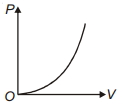
A
$\frac{9 R}{5}$
B
$\frac{17 R}{6}$
C
$\frac{3 R}{4}$
D
$\frac{8 R}{5}$
Solution
(B) For a polytropic process,the relation between pressure $P$ and volume $V$ is given by $PV^n = \text{constant}$.
Given that the process is parabolic,$P \propto V^2$,which implies $P = aV^2$. However,looking at the standard form $PV^n = K$,we rewrite this as $P V^{-2} = K$,so $n = -2$.
For an ideal diatomic gas,the adiabatic index $\gamma = 1.4 = \frac{7}{5}$.
The molar specific heat $C$ for a polytropic process is given by $C = \frac{R}{\gamma - 1} + \frac{R}{1 - n}$.
Substituting the values: $C = \frac{R}{\frac{7}{5} - 1} + \frac{R}{1 - (-2)} = \frac{R}{\frac{2}{5}} + \frac{R}{3} = \frac{5R}{2} + \frac{R}{3}$.
Calculating the sum: $C = \frac{15R + 2R}{6} = \frac{17R}{6}$.
Given that the process is parabolic,$P \propto V^2$,which implies $P = aV^2$. However,looking at the standard form $PV^n = K$,we rewrite this as $P V^{-2} = K$,so $n = -2$.
For an ideal diatomic gas,the adiabatic index $\gamma = 1.4 = \frac{7}{5}$.
The molar specific heat $C$ for a polytropic process is given by $C = \frac{R}{\gamma - 1} + \frac{R}{1 - n}$.
Substituting the values: $C = \frac{R}{\frac{7}{5} - 1} + \frac{R}{1 - (-2)} = \frac{R}{\frac{2}{5}} + \frac{R}{3} = \frac{5R}{2} + \frac{R}{3}$.
Calculating the sum: $C = \frac{15R + 2R}{6} = \frac{17R}{6}$.
0 likes
View Solution50
MediumMCQ
$A$ diatomic gas undergoes a process represented by $PV^{1.3} = \text{constant}$. Choose the incorrect statement.
A
The gas expands by absorbing heat from the surroundings.
B
The gas cools down during expansion.
C
The work done by surroundings during expansion of the gas is negative.
D
None of these.
Solution
(D) For a polytropic process $PV^n = K$, the molar heat capacity is given by $C = C_v + \frac{R}{1-n}$.
For a diatomic gas, $C_v = \frac{5}{2}R$. Given $n = 1.3$, $C = \frac{5}{2}R + \frac{R}{1-1.3} = 2.5R - 3.33R = -0.83R$.
Since $C < 0$, the gas absorbs heat when it expands (as $dQ = nCdT$ and $dT > 0$ for expansion in this process, but here $C$ is negative, implying heat is released or absorbed depending on the sign of $dT$).
Actually, for $1 < n < \gamma$ (where $\gamma = 1.4$ for diatomic gas), the gas absorbs heat during expansion and its temperature decreases.
Statement $A$: The gas absorbs heat during expansion. This is correct.
Statement $B$: The gas cools down during expansion. This is correct as $T \propto V^{1-n} = V^{-0.3}$.
Statement $C$: Work done by the gas is positive during expansion, so work done by the surroundings is negative. This is correct.
Since all statements $A$, $B$, and $C$ are correct, the incorrect statement is none of these.
For a diatomic gas, $C_v = \frac{5}{2}R$. Given $n = 1.3$, $C = \frac{5}{2}R + \frac{R}{1-1.3} = 2.5R - 3.33R = -0.83R$.
Since $C < 0$, the gas absorbs heat when it expands (as $dQ = nCdT$ and $dT > 0$ for expansion in this process, but here $C$ is negative, implying heat is released or absorbed depending on the sign of $dT$).
Actually, for $1 < n < \gamma$ (where $\gamma = 1.4$ for diatomic gas), the gas absorbs heat during expansion and its temperature decreases.
Statement $A$: The gas absorbs heat during expansion. This is correct.
Statement $B$: The gas cools down during expansion. This is correct as $T \propto V^{1-n} = V^{-0.3}$.
Statement $C$: Work done by the gas is positive during expansion, so work done by the surroundings is negative. This is correct.
Since all statements $A$, $B$, and $C$ are correct, the incorrect statement is none of these.
0 likes
View SolutionThermodynamics — Polytropic Process · Frequently Asked Questions
1Are these Thermodynamics questions useful for JEE and NEET?
Yes. All questions in this section are mapped to JEE Main and NEET exam patterns. Previous year questions from JEE Main, NEET, GUJCET and state-level exams are included with full solutions.
2Can I switch to Hindi or Gujarati for these questions?
Yes. Use the language tabs in the hero section or the sidebar to view the same questions and solutions in English, Hindi or Gujarati.
3How do I generate a question paper from this subtopic?
Use the Vedclass Exam Paper Generator — select the chapter and subtopic, set difficulty, and generate Sets A, B, C, D automatically. First 3 chapters of every subject are free.
Vedclass Products
For Students
Vedclass Test Series
Mock tests in real JEE/NEET style with performance analysis. 5-day free trial.
Start Free TrialFor Teachers
Exam Paper Generator
Generate Set A/B/C/D papers from this chapter in 2 minutes. 3 chapters free.
Try FreeFor Institutes
Online Exam Module
Live online exams with unlimited students, 360° analytics & white-label branding.
See DemoFor Teachers & Institutes
Generate a Thermodynamics Exam Paper in 2 Minutes
Select subtopic & difficulty — Sets A, B, C, D auto-generated with No Repeat logic.
First 3 chapters of every subject are free — no payment required.