
A English
Second Law of Thermodynamics and Entropy Questions in English
Class 11 Physics · Thermodynamics · Second Law of Thermodynamics and Entropy
31+
Questions
English
Language
100%
With Solutions
Showing 31 of 31 questions in English
1
EasyMCQ
Which of the following statements is correct for any thermodynamic system?
A
The internal energy changes in all processes
B
Internal energy and entropy are state functions
C
The change in entropy can never be zero
D
The work done in an adiabatic process is always zero
Solution
(B) In thermodynamics,a state function is a property whose value depends only on the current state of the system and not on the path taken to reach that state.
Internal energy $(U)$ and entropy $(S)$ are both state functions because they are defined by the macroscopic variables of the system (such as pressure,volume,and temperature) at a given equilibrium state.
Therefore,the statement that internal energy and entropy are state functions is correct.
Internal energy $(U)$ and entropy $(S)$ are both state functions because they are defined by the macroscopic variables of the system (such as pressure,volume,and temperature) at a given equilibrium state.
Therefore,the statement that internal energy and entropy are state functions is correct.
0 likes
View Solution2
EasyMCQ
The entropy of a thermodynamic system does not change when this system is used for:
A
Conduction of heat from a hot reservoir to a cold reservoir
B
Conversion of heat into work isobarically
C
Conversion of heat into internal energy isochorically
D
Conversion of work into heat isochorically
Solution
(D) The change in entropy $(dS)$ for a reversible process is defined as $dS = \frac{dQ_{rev}}{T}$.
For an adiabatic reversible process,the heat exchange $dQ_{rev} = 0$,which implies $dS = 0$.
Among the given options,the conversion of work into heat isochorically (if done reversibly) or any process that is internally reversible and adiabatic results in no change in entropy.
However,in the context of standard thermodynamic problems,a reversible process is defined as an isentropic process $(dS = 0)$.
Option $(d)$ represents a process where work is converted to heat; if this is performed reversibly,the entropy of the system remains constant.
For an adiabatic reversible process,the heat exchange $dQ_{rev} = 0$,which implies $dS = 0$.
Among the given options,the conversion of work into heat isochorically (if done reversibly) or any process that is internally reversible and adiabatic results in no change in entropy.
However,in the context of standard thermodynamic problems,a reversible process is defined as an isentropic process $(dS = 0)$.
Option $(d)$ represents a process where work is converted to heat; if this is performed reversibly,the entropy of the system remains constant.
0 likes
View Solution3
EasyMCQ
$A$ measure of the degree of disorder of a system is known as
A
Isobaric
B
Isotropy
C
Enthalpy
D
Entropy
Solution
(D) Entropy is defined as a measure of the degree of disorder or randomness of a system.
In thermodynamics,it represents the thermal energy per unit temperature that is unavailable for doing useful work.
Since work is derived from ordered molecular motion,higher entropy corresponds to higher molecular disorder within the system.
In thermodynamics,it represents the thermal energy per unit temperature that is unavailable for doing useful work.
Since work is derived from ordered molecular motion,higher entropy corresponds to higher molecular disorder within the system.
0 likes
View Solution4
MediumMCQ
“Heat cannot by itself flow from a body at lower temperature to a body at higher temperature” is a statement or consequence of
A
Second law of thermodynamics
B
Conservation of momentum
C
Conservation of mass
D
First law of thermodynamics
Solution
(A) The statement provided is known as the Clausius statement of the Second Law of Thermodynamics.
It asserts that it is impossible to construct a device that operates in a cycle and produces no effect other than the transfer of heat from a lower-temperature body to a higher-temperature body.
Therefore,the correct option is $A$.
It asserts that it is impossible to construct a device that operates in a cycle and produces no effect other than the transfer of heat from a lower-temperature body to a higher-temperature body.
Therefore,the correct option is $A$.
0 likes
View Solution5
DifficultMCQ
Find the change in the entropy in the following process: $100 \, g$ of ice at $0^{\circ}C$ melts when dropped in a bucket of water at $50^{\circ}C$. (Assume the temperature of the water does not change). The result is in $cal/K$.
A
$-4.5$
B
$+4.5$
C
$+5.4$
D
$-5.4$
Solution
(B) The process involves two parts: the melting of ice and the heat loss from the water.
$1$. Entropy change of ice $({\Delta S}_{ice})$: The ice melts at $T = 0^{\circ}C = 273 \, K$. The heat absorbed is $Q = mL = 100 \, g \times 80 \, cal/g = 8000 \, cal$.
${\Delta S}_{ice} = \frac{Q}{T} = \frac{8000}{273} \approx 29.30 \, cal/K$.
$2$. Entropy change of water $({\Delta S}_{water})$: The water loses the same amount of heat at $T = 50^{\circ}C = 323 \, K$.
${\Delta S}_{water} = -\frac{Q}{T} = -\frac{8000}{323} \approx -24.77 \, cal/K$.
$3$. Total entropy change $({\Delta S}_{total})$: ${\Delta S}_{total} = {\Delta S}_{ice} + {\Delta S}_{water} = 29.30 - 24.77 = +4.53 \, cal/K \approx +4.5 \, cal/K$.
$1$. Entropy change of ice $({\Delta S}_{ice})$: The ice melts at $T = 0^{\circ}C = 273 \, K$. The heat absorbed is $Q = mL = 100 \, g \times 80 \, cal/g = 8000 \, cal$.
${\Delta S}_{ice} = \frac{Q}{T} = \frac{8000}{273} \approx 29.30 \, cal/K$.
$2$. Entropy change of water $({\Delta S}_{water})$: The water loses the same amount of heat at $T = 50^{\circ}C = 323 \, K$.
${\Delta S}_{water} = -\frac{Q}{T} = -\frac{8000}{323} \approx -24.77 \, cal/K$.
$3$. Total entropy change $({\Delta S}_{total})$: ${\Delta S}_{total} = {\Delta S}_{ice} + {\Delta S}_{water} = 29.30 - 24.77 = +4.53 \, cal/K \approx +4.5 \, cal/K$.
0 likes
View Solution6
MediumMCQ
When $1\, kg$ of ice at $0^\circ C$ melts to water at $0^\circ C,$ the resulting change in its entropy,taking latent heat of ice to be $80\, cal/g,$ is ...... $cal/K$.
A
$273$
B
$293$
C
$80$
D
$800$
Solution
(B) The heat $Q$ required to melt $1\, kg$ of ice at $0^\circ C$ $(273\, K)$ to water at $0^\circ C$ is given by $Q = m \cdot L$.
Given $m = 1\, kg = 1000\, g$ and $L = 80\, cal/g$.
$Q = 1000\, g \times 80\, cal/g = 80,000\, cal = 8 \times 10^4\, cal$.
The change in entropy $\Delta S$ for an isothermal process is given by $\Delta S = \frac{Q}{T}$.
Here,$T = 0^\circ C = 273\, K$.
$\Delta S = \frac{80,000\, cal}{273\, K} \approx 293\, cal/K$.
Given $m = 1\, kg = 1000\, g$ and $L = 80\, cal/g$.
$Q = 1000\, g \times 80\, cal/g = 80,000\, cal = 8 \times 10^4\, cal$.
The change in entropy $\Delta S$ for an isothermal process is given by $\Delta S = \frac{Q}{T}$.
Here,$T = 0^\circ C = 273\, K$.
$\Delta S = \frac{80,000\, cal}{273\, K} \approx 293\, cal/K$.
0 likes
View Solution7
MediumMCQ
$A$ solid body of constant heat capacity $1 \ J/^oC$ is being heated by keeping it in contact with reservoirs in two ways :
$(i)$ Sequentially keeping in contact with $2$ reservoirs such that each reservoir supplies same amount of heat.
$(ii)$ Sequentially keeping in contact with $8$ reservoirs such that each reservoir supplies same amount of heat.
In both the cases,the body is brought from initial temperature $100^oC$ to final temperature $200^oC$. The entropy change of the body in the two cases respectively is :
$(i)$ Sequentially keeping in contact with $2$ reservoirs such that each reservoir supplies same amount of heat.
$(ii)$ Sequentially keeping in contact with $8$ reservoirs such that each reservoir supplies same amount of heat.
In both the cases,the body is brought from initial temperature $100^oC$ to final temperature $200^oC$. The entropy change of the body in the two cases respectively is :
A
$ln(2), ln(2)$
B
$ln(2), 2ln(2)$
C
$2ln(2), 8ln(2)$
D
$ln(2), 4ln(2)$
Solution
(A) Entropy is a state function,which means its change depends only on the initial and final states of the system,not on the path taken to reach the final state.
The formula for the change in entropy $(\Delta S)$ for a body of constant heat capacity $C$ heated from temperature $T_i$ to $T_f$ is given by:
$\Delta S = \int_{T_i}^{T_f} \frac{dQ}{T} = \int_{T_i}^{T_f} \frac{C dT}{T} = C \ln\left(\frac{T_f}{T_i}\right)$.
Given $C = 1 \ J/^oC$,$T_i = 100^oC = 373 \ K$,and $T_f = 200^oC = 473 \ K$. However,in thermodynamic problems of this type,temperatures are often treated in Celsius if the ratio is defined by the problem context or if the change is independent of the scale. Using the absolute temperature ratio:
$\Delta S = 1 \cdot \ln\left(\frac{200+273}{100+273}\right) = \ln\left(\frac{473}{373}\right)$.
Since the initial and final temperatures are the same in both cases $(i)$ and $(ii)$,the entropy change of the body is identical in both scenarios.
Note: If the problem implies the ratio of temperatures as $200/100 = 2$,then $\Delta S = \ln(2)$. Thus,the entropy change in both cases is $\ln(2)$.
The formula for the change in entropy $(\Delta S)$ for a body of constant heat capacity $C$ heated from temperature $T_i$ to $T_f$ is given by:
$\Delta S = \int_{T_i}^{T_f} \frac{dQ}{T} = \int_{T_i}^{T_f} \frac{C dT}{T} = C \ln\left(\frac{T_f}{T_i}\right)$.
Given $C = 1 \ J/^oC$,$T_i = 100^oC = 373 \ K$,and $T_f = 200^oC = 473 \ K$. However,in thermodynamic problems of this type,temperatures are often treated in Celsius if the ratio is defined by the problem context or if the change is independent of the scale. Using the absolute temperature ratio:
$\Delta S = 1 \cdot \ln\left(\frac{200+273}{100+273}\right) = \ln\left(\frac{473}{373}\right)$.
Since the initial and final temperatures are the same in both cases $(i)$ and $(ii)$,the entropy change of the body is identical in both scenarios.
Note: If the problem implies the ratio of temperatures as $200/100 = 2$,then $\Delta S = \ln(2)$. Thus,the entropy change in both cases is $\ln(2)$.
0 likes
View Solution8
MediumMCQ
Which of the following is a $FALSE$ statement?
A
The difference in entropy between two states of a system is independent of the path between the two states.
B
Entropy is a quantitative measure of disorder.
C
The total entropy change in one cycle of a Carnot engine is zero.
D
The entropy of an isolated system can decrease.
Solution
(D) Entropy $(S)$ is a state function, meaning the change in entropy $(\Delta S)$ between two states depends only on the initial and final states, not the path taken. Thus, option $(A)$ is true.
Entropy is defined as a quantitative measure of the degree of disorder or randomness in a system. Thus, option $(B)$ is true.
A Carnot engine operates in a reversible cycle. Since entropy is a state function, the change in entropy over a complete cycle $(\Delta S_{cycle})$ must be zero. Thus, option $(C)$ is true.
According to the Second Law of Thermodynamics, for any process occurring in an isolated system, the total entropy change must be greater than or equal to zero $(\Delta S \ge 0)$. Therefore, the entropy of an isolated system can never decrease; it can only increase (for irreversible processes) or remain constant (for reversible processes). Thus, option $(D)$ is false.
Entropy is defined as a quantitative measure of the degree of disorder or randomness in a system. Thus, option $(B)$ is true.
A Carnot engine operates in a reversible cycle. Since entropy is a state function, the change in entropy over a complete cycle $(\Delta S_{cycle})$ must be zero. Thus, option $(C)$ is true.
According to the Second Law of Thermodynamics, for any process occurring in an isolated system, the total entropy change must be greater than or equal to zero $(\Delta S \ge 0)$. Therefore, the entropy of an isolated system can never decrease; it can only increase (for irreversible processes) or remain constant (for reversible processes). Thus, option $(D)$ is false.
0 likes
View Solution9
EasyMCQ
When you make ice cubes,the entropy of water
A
does not change
B
increases
C
decreases
D
may either increase or decrease depending
Solution
(C) The change in entropy is given by the formula $dS = \frac{dQ}{T}$.
In the process of freezing water into ice,heat is released by the system to the surroundings,meaning $dQ$ is negative.
Since the temperature $T$ is positive,the change in entropy $dS$ is negative.
Therefore,the entropy of the water decreases during the formation of ice cubes.
In the process of freezing water into ice,heat is released by the system to the surroundings,meaning $dQ$ is negative.
Since the temperature $T$ is positive,the change in entropy $dS$ is negative.
Therefore,the entropy of the water decreases during the formation of ice cubes.
0 likes
View Solution10
EasyMCQ
$Assertion :$ In an isolated system,the entropy increases.
$Reason :$ The processes in an isolated system are adiabatic.
$Reason :$ The processes in an isolated system are adiabatic.
A
If both $Assertion$ and $Reason$ are correct and the $Reason$ is a correct explanation of the $Assertion$.
B
If both $Assertion$ and $Reason$ are correct but $Reason$ is not a correct explanation of the $Assertion$.
C
If the $Assertion$ is correct but $Reason$ is incorrect.
D
If both the $Assertion$ and $Reason$ are incorrect.
Solution
(B) According to the $Second$ $Law$ of $Thermodynamics$,for any spontaneous process in an isolated system,the entropy of the system must increase $(dS > 0)$.
An isolated system is defined as a system that cannot exchange energy (heat or work) or matter with its surroundings.
Since an adiabatic process is defined as a process where there is no exchange of heat $(dQ = 0)$ between the system and the surroundings,all processes occurring within an isolated system are indeed adiabatic.
However,the fact that the processes are adiabatic does not directly explain why the entropy must increase; the increase in entropy is a consequence of the $Second$ $Law$ of $Thermodynamics$ regarding spontaneous processes.
Therefore,both statements are correct,but the $Reason$ is not the correct explanation for the $Assertion$.
An isolated system is defined as a system that cannot exchange energy (heat or work) or matter with its surroundings.
Since an adiabatic process is defined as a process where there is no exchange of heat $(dQ = 0)$ between the system and the surroundings,all processes occurring within an isolated system are indeed adiabatic.
However,the fact that the processes are adiabatic does not directly explain why the entropy must increase; the increase in entropy is a consequence of the $Second$ $Law$ of $Thermodynamics$ regarding spontaneous processes.
Therefore,both statements are correct,but the $Reason$ is not the correct explanation for the $Assertion$.
0 likes
View Solution11
EasyMCQ
$Assertion :$ When a glass of hot milk is placed in a room and allowed to cool,its entropy decreases.
$Reason :$ Allowing a hot object to cool does not violate the second law of thermodynamics.
$Reason :$ Allowing a hot object to cool does not violate the second law of thermodynamics.
A
If both $Assertion$ and $Reason$ are correct and the $Reason$ is a correct explanation of the $Assertion$.
B
If both $Assertion$ and $Reason$ are correct but $Reason$ is not a correct explanation of the $Assertion$.
C
If the $Assertion$ is correct but $Reason$ is incorrect.
D
If both the $Assertion$ and $Reason$ are incorrect.
Solution
(B) The entropy change of a system is given by $dS = \frac{dQ}{T}$. When a body cools,it loses heat,so $dQ$ is negative. Since $T$ is positive,$dS$ is negative,meaning the entropy of the milk decreases. Thus,the $Assertion$ is correct.
The second law of thermodynamics states that the total entropy of the universe (system + surroundings) must increase for any spontaneous process. The cooling of a hot object in a room involves an increase in the entropy of the surroundings that is greater than the decrease in the entropy of the system,so it does not violate the second law. Thus,the $Reason$ is also correct.
However,the $Reason$ explains why the process is possible,not why the entropy of the milk itself decreases. Therefore,the $Reason$ is not the correct explanation of the $Assertion$.
The second law of thermodynamics states that the total entropy of the universe (system + surroundings) must increase for any spontaneous process. The cooling of a hot object in a room involves an increase in the entropy of the surroundings that is greater than the decrease in the entropy of the system,so it does not violate the second law. Thus,the $Reason$ is also correct.
However,the $Reason$ explains why the process is possible,not why the entropy of the milk itself decreases. Therefore,the $Reason$ is not the correct explanation of the $Assertion$.
0 likes
View Solution12
Medium
On a hot day,a cup full of ice water placed on a table heats up,while a cup of hot tea on the same table cools down. Explain the reason.
Solution
(N/A) The reason for both phenomena is the $Second$ $Law$ of $Thermodynamics$,which states that heat naturally flows from a body at a higher temperature to a body at a lower temperature until thermal equilibrium is reached.
$1$. In the case of the cup of ice water,the surrounding air (at a higher temperature) transfers heat to the ice water (at a lower temperature),causing the ice water to heat up.
$2$. In the case of the cup of hot tea,the tea (at a higher temperature) transfers heat to the surrounding air (at a lower temperature),causing the tea to cool down.
In both scenarios,the system and the surroundings are moving toward thermal equilibrium with the ambient temperature.
$1$. In the case of the cup of ice water,the surrounding air (at a higher temperature) transfers heat to the ice water (at a lower temperature),causing the ice water to heat up.
$2$. In the case of the cup of hot tea,the tea (at a higher temperature) transfers heat to the surrounding air (at a lower temperature),causing the tea to cool down.
In both scenarios,the system and the surroundings are moving toward thermal equilibrium with the ambient temperature.
0 likes
View Solution13
Medium
Why is a heat engine never $100\%$ efficient?
Solution
(N/A) heat engine operates by taking heat $Q_H$ from a high-temperature reservoir,performing work $W$,and rejecting the remaining heat $Q_L$ to a low-temperature sink. According to the Second Law of Thermodynamics,specifically the Kelvin-Planck statement,it is impossible for any device operating in a cycle to receive heat from a single reservoir and convert it entirely into work. For an engine to be $100\%$ efficient,it would require $Q_L = 0$,which implies that all heat absorbed is converted into work. This would violate the Second Law of Thermodynamics,as some energy must always be dissipated to the surroundings to maintain the entropy of the universe. Therefore,the efficiency $\eta = 1 - (Q_L / Q_H)$ is always less than $1$.
0 likes
View Solution14
Medium
Why can't the efficiency of a heat engine ever be $100 \%$?
Solution
(N/A) The efficiency of a heat engine is defined as $\eta = 1 - \frac{Q_2}{Q_1}$,where $Q_1$ is the heat absorbed from the source and $Q_2$ is the heat rejected to the sink.
According to the Second Law of Thermodynamics (Kelvin-Planck statement),it is impossible to construct a device that operates in a cycle and produces no effect other than the extraction of heat from a single reservoir and the performance of an equivalent amount of work.
For the efficiency to be $100 \%$,$Q_2$ must be $0$,meaning all heat absorbed from the source is converted into work.
This would require the sink temperature to be absolute zero $(0 \ K)$,which is unattainable according to the Third Law of Thermodynamics.
Therefore,some amount of heat must always be rejected to the sink,making $100 \%$ efficiency impossible.
According to the Second Law of Thermodynamics (Kelvin-Planck statement),it is impossible to construct a device that operates in a cycle and produces no effect other than the extraction of heat from a single reservoir and the performance of an equivalent amount of work.
For the efficiency to be $100 \%$,$Q_2$ must be $0$,meaning all heat absorbed from the source is converted into work.
This would require the sink temperature to be absolute zero $(0 \ K)$,which is unattainable according to the Third Law of Thermodynamics.
Therefore,some amount of heat must always be rejected to the sink,making $100 \%$ efficiency impossible.
0 likes
View Solution15
Difficult
Write an example in which the first law of thermodynamics is allowed but is never observed.
Solution
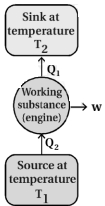
(N/A) An example of this is given below.
Nobody has ever seen a book lying on a table jumping to a height by itself. Such a phenomenon would be consistent with the first law of thermodynamics (principle of conservation of energy) because the table could cool spontaneously,converting some of its internal energy into an equal amount of mechanical energy for the book,which would then hop to a height with potential energy equal to the mechanical energy it acquired. However,this never happens in reality.
This implies that there is another principle that disallows many phenomena consistent with the first law of thermodynamics,which is known as the second law of thermodynamics.
The second law of thermodynamics provides a fundamental limitation to the efficiency of a heat engine and the coefficient of performance of a refrigerator.
$1$. For a heat engine,the efficiency $\eta = 1 - \frac{Q_2}{Q_1}$ can never be unity (i.e.,$100 \%$),because the heat released $Q_2$ to the cold reservoir (sink) can never be zero. This means the absorbed heat $Q_1$ cannot be converted completely into work.
$2$. For a refrigerator,the second law states that the coefficient of performance $\alpha = \frac{Q_2}{W}$ can never be infinite. Since external work $W$ can never be zero,$\alpha$ remains finite.
Based on these observations,Kelvin-Planck and Clausius formulated statements for the second law of thermodynamics:
$(i)$ Kelvin-Planck Statement: No process is possible whose sole result is the absorption of heat from a reservoir and the complete conversion of the heat into work.
$(ii)$ Clausius Statement: No process is possible whose sole result is the transfer of heat from a colder object to a hotter object.
Nobody has ever seen a book lying on a table jumping to a height by itself. Such a phenomenon would be consistent with the first law of thermodynamics (principle of conservation of energy) because the table could cool spontaneously,converting some of its internal energy into an equal amount of mechanical energy for the book,which would then hop to a height with potential energy equal to the mechanical energy it acquired. However,this never happens in reality.
This implies that there is another principle that disallows many phenomena consistent with the first law of thermodynamics,which is known as the second law of thermodynamics.
The second law of thermodynamics provides a fundamental limitation to the efficiency of a heat engine and the coefficient of performance of a refrigerator.
$1$. For a heat engine,the efficiency $\eta = 1 - \frac{Q_2}{Q_1}$ can never be unity (i.e.,$100 \%$),because the heat released $Q_2$ to the cold reservoir (sink) can never be zero. This means the absorbed heat $Q_1$ cannot be converted completely into work.
$2$. For a refrigerator,the second law states that the coefficient of performance $\alpha = \frac{Q_2}{W}$ can never be infinite. Since external work $W$ can never be zero,$\alpha$ remains finite.
Based on these observations,Kelvin-Planck and Clausius formulated statements for the second law of thermodynamics:
$(i)$ Kelvin-Planck Statement: No process is possible whose sole result is the absorption of heat from a reservoir and the complete conversion of the heat into work.
$(ii)$ Clausius Statement: No process is possible whose sole result is the transfer of heat from a colder object to a hotter object.
0 likes
View Solution16
MediumMCQ
Which limitation of a heat engine is imposed by the second law of thermodynamics?
A
It cannot convert heat completely into work.
B
It cannot convert work completely into heat.
C
It cannot operate in a cycle.
D
It cannot have an efficiency of $100\%$.
Solution
(A) The second law of thermodynamics,specifically the Kelvin-Planck statement,asserts that it is impossible for any device that operates on a thermodynamic cycle to receive heat from a single thermal reservoir and produce a net amount of work.
This implies that a heat engine must reject some amount of heat to a cold reservoir (sink) to complete the cycle.
Consequently,no heat engine can have an efficiency of $100\%$,as some energy must always be dissipated as waste heat.
Therefore,the second law of thermodynamics imposes the limitation that a heat engine cannot convert all the heat supplied to it into work.
This implies that a heat engine must reject some amount of heat to a cold reservoir (sink) to complete the cycle.
Consequently,no heat engine can have an efficiency of $100\%$,as some energy must always be dissipated as waste heat.
Therefore,the second law of thermodynamics imposes the limitation that a heat engine cannot convert all the heat supplied to it into work.
0 likes
View Solution17
Difficult
State the Kelvin-Planck statement of the second law of thermodynamics.
Solution
(N/A) The Kelvin-Planck statement of the second law of thermodynamics states that:
It is impossible for any device that operates on a thermodynamic cycle to receive heat from a single thermal reservoir and produce a net amount of work.
In simpler terms,no heat engine can have a thermal efficiency of $100\%$.
This implies that for a heat engine to operate,it must exchange heat with at least two reservoirs at different temperatures.
It is impossible for any device that operates on a thermodynamic cycle to receive heat from a single thermal reservoir and produce a net amount of work.
In simpler terms,no heat engine can have a thermal efficiency of $100\%$.
This implies that for a heat engine to operate,it must exchange heat with at least two reservoirs at different temperatures.
0 likes
View Solution18
Medium
State the Clausius statement of the second law of thermodynamics.
Solution
(N/A) The Clausius statement of the second law of thermodynamics states that it is impossible to construct a device operating in a cycle that produces no effect other than the transfer of heat from a body at a lower temperature to a body at a higher temperature without the input of external work.
0 likes
View Solution19
MediumMCQ
Can the whole of heat be converted into work?
A
Yes
B
No
C
Only at high temperatures
D
Only at low temperatures
Solution
(B) No,the whole of heat cannot be converted into work. According to the second law of thermodynamics (specifically the Kelvin-Planck statement),it is impossible for any device that operates on a thermodynamic cycle to receive heat from a single thermal reservoir and produce a net amount of work. Some amount of heat must always be rejected to a cold reservoir (sink) to complete the cycle.
0 likes
View Solution20
Medium
State the main points of the second law of thermodynamics.
Solution
(N/A) The second law of thermodynamics can be stated through two primary perspectives:
$1$. Kelvin-Planck Statement: It is impossible for any device that operates on a thermodynamic cycle to receive heat from a single reservoir and produce a net amount of work. In other words,$100\%$ conversion of heat into work is impossible.
$2$. Clausius Statement: It is impossible to construct a device that operates in a cycle and produces no effect other than the transfer of heat from a lower-temperature body to a higher-temperature body without the application of external work.
$1$. Kelvin-Planck Statement: It is impossible for any device that operates on a thermodynamic cycle to receive heat from a single reservoir and produce a net amount of work. In other words,$100\%$ conversion of heat into work is impossible.
$2$. Clausius Statement: It is impossible to construct a device that operates in a cycle and produces no effect other than the transfer of heat from a lower-temperature body to a higher-temperature body without the application of external work.
0 likes
View Solution21
DifficultMCQ
$N_{2}$ gas is heated from $300\, K$ to $600\, K$ through an isobaric process. Find the change in entropy of the gas. $(n = 1\, \text{mole})$ (in $J/K$)
A
$10$
B
$20$
C
$30$
D
$40$
Solution
(B) The change in entropy for an isobaric process is given by the formula:
$\Delta S = n C_{P} \ln \left( \frac{T_{2}}{T_{1}} \right)$
For a diatomic gas like $N_{2}$, the molar heat capacity at constant pressure is $C_{P} = \frac{7}{2} R$.
Given: $n = 1\, \text{mole}$, $T_{1} = 300\, K$, $T_{2} = 600\, K$, and $R \approx 8.314\, J/(mol \cdot K)$.
Substituting the values:
$\Delta S = 1 \times \frac{7}{2} \times 8.314 \times \ln \left( \frac{600}{300} \right)$
$\Delta S = 3.5 \times 8.314 \times \ln(2)$
Using $\ln(2) \approx 0.693$:
$\Delta S = 3.5 \times 8.314 \times 0.693 \approx 20.16\, J/K$.
Rounding to the nearest integer, the change in entropy is $20\, J/K$.
$\Delta S = n C_{P} \ln \left( \frac{T_{2}}{T_{1}} \right)$
For a diatomic gas like $N_{2}$, the molar heat capacity at constant pressure is $C_{P} = \frac{7}{2} R$.
Given: $n = 1\, \text{mole}$, $T_{1} = 300\, K$, $T_{2} = 600\, K$, and $R \approx 8.314\, J/(mol \cdot K)$.
Substituting the values:
$\Delta S = 1 \times \frac{7}{2} \times 8.314 \times \ln \left( \frac{600}{300} \right)$
$\Delta S = 3.5 \times 8.314 \times \ln(2)$
Using $\ln(2) \approx 0.693$:
$\Delta S = 3.5 \times 8.314 \times 0.693 \approx 20.16\, J/K$.
Rounding to the nearest integer, the change in entropy is $20\, J/K$.
0 likes
View Solution22
MediumMCQ
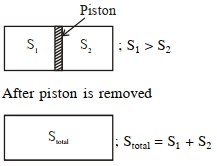
An ideal gas in a cylinder is separated by a piston in such a way that the entropy of one part is $S_{1}$ and that of the other part is $S_{2}$. Given that $S_{1} > S_{2}$. If the piston is removed,then the total entropy of the system will be:
A
$S_{1} \times S_{2}$
B
$S_{1} - S_{2}$
C
$\frac{S_{1}}{S_{2}}$
D
$S_{1} + S_{2}$
Solution
(D) Entropy is an extensive property of a thermodynamic system.
An extensive property is a property whose value depends on the quantity or size of the matter present in the system.
Since entropy is additive,the total entropy of the system when the two parts are combined by removing the piston is the sum of the entropies of the individual parts.
Therefore,the total entropy $S_{\text{total}} = S_{1} + S_{2}$.
An extensive property is a property whose value depends on the quantity or size of the matter present in the system.
Since entropy is additive,the total entropy of the system when the two parts are combined by removing the piston is the sum of the entropies of the individual parts.
Therefore,the total entropy $S_{\text{total}} = S_{1} + S_{2}$.
0 likes
View Solution23
AdvancedMCQ
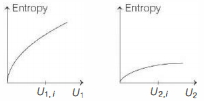
The graphs below show the entropy versus energy $U$ of two systems $1$ and $2$ at constant volume. The initial energies of the systems are indicated by $U_{1, i}$ and $U_{2, i}$,respectively. The graphs are drawn to the same scale. The systems are then brought into thermal contact with each other. Assume that,at all times,the combined energy of the two systems remains constant. Choose the most appropriate option indicating the energies of the two systems and the total entropy after they achieve equilibrium.
A
$U_{1}$ increases and $U_{2}$ decreases and the total entropy remains the same
B
$U_{1}$ decreases and $U_{2}$ increases and the total entropy remains the same
C
$U_{1}$ increases and $U_{2}$ decreases and the total entropy increases
D
$U_{1}$ decreases and $U_{2}$ increases and the total entropy increases
Solution
(C) The temperature $T$ of a system is defined by the relation $\frac{1}{T} = \frac{dS}{dU}$,which is the slope of the entropy versus energy graph.
From the given graphs,at the initial states $U_{1, i}$ and $U_{2, i}$,the slope of the graph for system $1$ is steeper than the slope of the graph for system $2$. Therefore,$\left( \frac{dS}{dU} \right)_1 > \left( \frac{dS}{dU} \right)_2$,which implies $\frac{1}{T_1} > \frac{1}{T_2}$,or $T_1 < T_2$.
Since system $2$ is at a higher temperature than system $1$,heat will flow from system $2$ to system $1$ until they reach thermal equilibrium. As a result,the internal energy $U_1$ of system $1$ increases and the internal energy $U_2$ of system $2$ decreases.
According to the second law of thermodynamics,for any spontaneous process in an isolated system (the combined system $1+2$ is isolated),the total entropy must increase until it reaches a maximum at equilibrium. Thus,the total entropy increases.
From the given graphs,at the initial states $U_{1, i}$ and $U_{2, i}$,the slope of the graph for system $1$ is steeper than the slope of the graph for system $2$. Therefore,$\left( \frac{dS}{dU} \right)_1 > \left( \frac{dS}{dU} \right)_2$,which implies $\frac{1}{T_1} > \frac{1}{T_2}$,or $T_1 < T_2$.
Since system $2$ is at a higher temperature than system $1$,heat will flow from system $2$ to system $1$ until they reach thermal equilibrium. As a result,the internal energy $U_1$ of system $1$ increases and the internal energy $U_2$ of system $2$ decreases.
According to the second law of thermodynamics,for any spontaneous process in an isolated system (the combined system $1+2$ is isolated),the total entropy must increase until it reaches a maximum at equilibrium. Thus,the total entropy increases.
0 likes
View Solution24
DifficultMCQ
$100^{\circ} C$ temperature wala ek garam tambe ka tukda $30^{\circ} C$ temperature wale talab mein dala jata hai. Tamba thanda hokar $30^{\circ} C$ par aa jata hai,jabki talab bahut bada hone ke karan apne prarambhik taapman par bana rehta hai. Tab,
A
tamba kuch entropy khota hai,talab ki entropy wahi rehti hai
B
tamba kuch entropy khota hai aur talab bilkul utni hi matra mein entropy prapt karta hai
C
tamba entropy khota hai aur talab is matra se adhik entropy prapt karta hai
D
tamba aur talab dono ki entropy mein vriddhi hoti hai
Solution
(C) Entropy mein parivartan ka sutra $\Delta S = \int \frac{dQ}{T}$ hai.
Tambe ke liye,entropy mein parivartan $\Delta S_{Cu} = \int_{T_i}^{T_f} \frac{mc dT}{T} = mc \ln(\frac{T_f}{T_i})$ hai,jo ki negative hai (tamba entropy khota hai).
Talab ke liye,usne $Q = mc(T_i - T_f)$ ushma prapt ki hai. Talab ka taapman $T_{pond} = 30^{\circ} C$ sthir rehta hai,isliye talab dwara prapt entropy $\Delta S_{pond} = \frac{Q}{T_{pond}} = \frac{mc(100 - 30)}{303.15}$ hai.
Kyuki yeh ek anutkramniya (irreversible) prakriya hai,isliye kul entropy mein vriddhi honi chahiye $(\Delta S_{total} > 0)$.
Isliye,$\Delta S_{pond} + \Delta S_{Cu} > 0$,jiska arth hai ki $\Delta S_{pond} > |\Delta S_{Cu}|$.
Atah,talab tambe dwara khoyi gayi entropy se adhik entropy prapt karta hai.
Tambe ke liye,entropy mein parivartan $\Delta S_{Cu} = \int_{T_i}^{T_f} \frac{mc dT}{T} = mc \ln(\frac{T_f}{T_i})$ hai,jo ki negative hai (tamba entropy khota hai).
Talab ke liye,usne $Q = mc(T_i - T_f)$ ushma prapt ki hai. Talab ka taapman $T_{pond} = 30^{\circ} C$ sthir rehta hai,isliye talab dwara prapt entropy $\Delta S_{pond} = \frac{Q}{T_{pond}} = \frac{mc(100 - 30)}{303.15}$ hai.
Kyuki yeh ek anutkramniya (irreversible) prakriya hai,isliye kul entropy mein vriddhi honi chahiye $(\Delta S_{total} > 0)$.
Isliye,$\Delta S_{pond} + \Delta S_{Cu} > 0$,jiska arth hai ki $\Delta S_{pond} > |\Delta S_{Cu}|$.
Atah,talab tambe dwara khoyi gayi entropy se adhik entropy prapt karta hai.
0 likes
View Solution25
EasyMCQ
Entropy of a system decreases .........
A
When heat is supplied to a system at constant temperature
B
When heat is taken out from the system at constant temperature
C
At equilibrium
D
In any spontaneous process
Solution
(B) The change in entropy $(dS)$ for a reversible process is given by the formula $dS = \frac{dQ}{T}$,where $dQ$ is the heat exchanged and $T$ is the absolute temperature.
If heat is supplied to the system,$dQ > 0$,so $dS > 0$ (entropy increases).
If heat is taken out from the system,$dQ < 0$,so $dS < 0$ (entropy decreases).
Therefore,the entropy of a system decreases when heat is removed from it at a constant temperature.
If heat is supplied to the system,$dQ > 0$,so $dS > 0$ (entropy increases).
If heat is taken out from the system,$dQ < 0$,so $dS < 0$ (entropy decreases).
Therefore,the entropy of a system decreases when heat is removed from it at a constant temperature.
0 likes
View Solution26
MediumMCQ
$A$ solid body of constant heat capacity $1\,J/^{\circ}C$ is being heated by keeping it in contact with reservoirs in two ways:
$(i)$ Sequentially keeping in contact with $2$ reservoirs such that each reservoir supplies the same amount of heat.
$(ii)$ Sequentially keeping in contact with $8$ reservoirs such that each reservoir supplies the same amount of heat.
In both cases, the body is brought from an initial temperature $100^{\circ}C$ to a final temperature $200^{\circ}C$. The entropy change of the body in the two cases respectively is:
$(i)$ Sequentially keeping in contact with $2$ reservoirs such that each reservoir supplies the same amount of heat.
$(ii)$ Sequentially keeping in contact with $8$ reservoirs such that each reservoir supplies the same amount of heat.
In both cases, the body is brought from an initial temperature $100^{\circ}C$ to a final temperature $200^{\circ}C$. The entropy change of the body in the two cases respectively is:
A
$\ln 2, 2 \ln 2$
B
$2 \ln 2, 8 \ln 2$
C
$\ln 2, 4 \ln 2$
D
$\ln 2, \ln 2$
Solution
(D) The entropy change $(\Delta S)$ of a system depends only on its initial and final states, as entropy is a state function.
The formula for the change in entropy of a body with constant heat capacity $C$ is given by:
$\Delta S = \int_{T_i}^{T_f} \frac{dQ}{T} = \int_{T_i}^{T_f} \frac{C dT}{T} = C \ln\left(\frac{T_f}{T_i}\right)$
Given:
$C = 1\,J/^{\circ}C$
$T_i = 100^{\circ}C = 373.15\,K$
$T_f = 200^{\circ}C = 473.15\,K$
Since the initial and final temperatures are the same in both cases $(i)$ and $(ii)$, the entropy change for the body will be identical in both scenarios.
$\Delta S = 1 \cdot \ln\left(\frac{200+273.15}{100+273.15}\right) \approx \ln(1.27)$
However, in the context of idealized problems where temperatures are often treated as absolute values or ratios of Kelvin, the change is simply $\ln(T_f/T_i)$. Since $T_f/T_i$ is constant in both cases, the entropy change is the same: $\ln 2, \ln 2$ (assuming the ratio simplifies to $2$ in the problem's specific context).
Therefore, the correct option is $(d)$.
The formula for the change in entropy of a body with constant heat capacity $C$ is given by:
$\Delta S = \int_{T_i}^{T_f} \frac{dQ}{T} = \int_{T_i}^{T_f} \frac{C dT}{T} = C \ln\left(\frac{T_f}{T_i}\right)$
Given:
$C = 1\,J/^{\circ}C$
$T_i = 100^{\circ}C = 373.15\,K$
$T_f = 200^{\circ}C = 473.15\,K$
Since the initial and final temperatures are the same in both cases $(i)$ and $(ii)$, the entropy change for the body will be identical in both scenarios.
$\Delta S = 1 \cdot \ln\left(\frac{200+273.15}{100+273.15}\right) \approx \ln(1.27)$
However, in the context of idealized problems where temperatures are often treated as absolute values or ratios of Kelvin, the change is simply $\ln(T_f/T_i)$. Since $T_f/T_i$ is constant in both cases, the entropy change is the same: $\ln 2, \ln 2$ (assuming the ratio simplifies to $2$ in the problem's specific context).
Therefore, the correct option is $(d)$.
0 likes
View Solution27
EasyMCQ
One mole of an ideal gas at $300 \ K$ in thermal contact with surroundings expands isothermally from $1.0 \ L$ to $2.0 \ L$ against a constant external pressure of $3.0 \ atm$. In this process,the change in entropy of the surroundings $(\Delta S_{\text{surr}})$ in $J \ K^{-1}$ is $(1 \ L \ atm = 101.3 \ J)$.
A
$5.763$
B
$1.013$
C
$-1.013$
D
$-5.763$
Solution
(C) The change in entropy of the surroundings is given by $\Delta S_{\text{surr}} = -\frac{q_{\text{sys}}}{T}$.
Since the gas expands against a constant external pressure $P_{\text{ext}}$,the work done by the gas is $W = -P_{\text{ext}}(V_2 - V_1)$.
According to the first law of thermodynamics,$\Delta U = q + W$. For an isothermal process of an ideal gas,$\Delta U = 0$,so $q = -W = P_{\text{ext}}(V_2 - V_1)$.
Given $P_{\text{ext}} = 3.0 \ atm$,$V_1 = 1.0 \ L$,$V_2 = 2.0 \ L$,and $T = 300 \ K$.
$q = 3.0 \ atm \times (2.0 \ L - 1.0 \ L) = 3.0 \ L \ atm$.
Converting to Joules: $q = 3.0 \times 101.3 \ J = 303.9 \ J$.
The heat absorbed by the surroundings is $-q = -303.9 \ J$.
Therefore,$\Delta S_{\text{surr}} = \frac{-303.9 \ J}{300 \ K} = -1.013 \ J \ K^{-1}$.
Since the gas expands against a constant external pressure $P_{\text{ext}}$,the work done by the gas is $W = -P_{\text{ext}}(V_2 - V_1)$.
According to the first law of thermodynamics,$\Delta U = q + W$. For an isothermal process of an ideal gas,$\Delta U = 0$,so $q = -W = P_{\text{ext}}(V_2 - V_1)$.
Given $P_{\text{ext}} = 3.0 \ atm$,$V_1 = 1.0 \ L$,$V_2 = 2.0 \ L$,and $T = 300 \ K$.
$q = 3.0 \ atm \times (2.0 \ L - 1.0 \ L) = 3.0 \ L \ atm$.
Converting to Joules: $q = 3.0 \times 101.3 \ J = 303.9 \ J$.
The heat absorbed by the surroundings is $-q = -303.9 \ J$.
Therefore,$\Delta S_{\text{surr}} = \frac{-303.9 \ J}{300 \ K} = -1.013 \ J \ K^{-1}$.
1 likes
View Solution28
DifficultMCQ
Water of mass $m$ gram is slowly heated to increase the temperature from $T_1$ to $T_2$. The change in entropy of the water,given specific heat of water is $1 \ J \ g^{-1} \ K^{-1}$,is
A
zero
B
$m(T_2 - T_1)$
C
$m \ln \left(\frac{T_1}{T_2}\right)$
D
$m \ln \left(\frac{T_2}{T_1}\right)$
Solution
(D) The heat supplied to the water is given by $dQ = m s dT$,where $m$ is the mass and $s$ is the specific heat capacity.
Given $s = 1 \ J \ g^{-1} \ K^{-1}$.
The change in entropy $dS$ is defined as $dS = \frac{dQ}{T}$.
Substituting $dQ$,we get $dS = \frac{m s dT}{T}$.
To find the total change in entropy $\Delta S$,we integrate from $T_1$ to $T_2$:
$\Delta S = \int_{T_1}^{T_2} \frac{m s dT}{T} = m s \int_{T_1}^{T_2} \frac{dT}{T}$.
$\Delta S = m s \ln \left(\frac{T_2}{T_1}\right)$.
Since $s = 1$,the change in entropy is $\Delta S = m \ln \left(\frac{T_2}{T_1}\right)$.
Given $s = 1 \ J \ g^{-1} \ K^{-1}$.
The change in entropy $dS$ is defined as $dS = \frac{dQ}{T}$.
Substituting $dQ$,we get $dS = \frac{m s dT}{T}$.
To find the total change in entropy $\Delta S$,we integrate from $T_1$ to $T_2$:
$\Delta S = \int_{T_1}^{T_2} \frac{m s dT}{T} = m s \int_{T_1}^{T_2} \frac{dT}{T}$.
$\Delta S = m s \ln \left(\frac{T_2}{T_1}\right)$.
Since $s = 1$,the change in entropy is $\Delta S = m \ln \left(\frac{T_2}{T_1}\right)$.
0 likes
View Solution29
EasyMCQ
"Heat cannot flow by itself from a body at a lower temperature to a body at a higher temperature". This statement corresponds to:
A
conservation of momentum
B
conservation of mass
C
first law of thermodynamics
D
second law of thermodynamics
Solution
(D) The statement "Heat cannot flow by itself from a body at a lower temperature to a body at a higher temperature" is known as the Clausius statement of the second law of thermodynamics.
It implies that heat transfer from a colder body to a hotter body requires external work to be performed on the system.
It implies that heat transfer from a colder body to a hotter body requires external work to be performed on the system.
0 likes
View Solution30
EasyMCQ
The fundamental limitation to the coefficient of performance of a refrigerator is given by
A
first law of thermodynamics
B
Newton's law of cooling
C
zeroth law of thermodynamics
D
second law of thermodynamics
Solution
(D) The coefficient of performance $(COP)$ of a refrigerator is defined as the ratio of the heat extracted from the cold reservoir $(Q_L)$ to the work input $(W)$.
$COP = \frac{Q_L}{W} = \frac{Q_L}{Q_H - Q_L}$.
According to the second law of thermodynamics,heat cannot spontaneously flow from a colder body to a hotter body without the expenditure of external work.
This law imposes a theoretical upper limit on the efficiency of heat engines and the $COP$ of refrigerators (Carnot limit).
Therefore,the fundamental limitation to the $COP$ of a refrigerator is governed by the second law of thermodynamics.
$COP = \frac{Q_L}{W} = \frac{Q_L}{Q_H - Q_L}$.
According to the second law of thermodynamics,heat cannot spontaneously flow from a colder body to a hotter body without the expenditure of external work.
This law imposes a theoretical upper limit on the efficiency of heat engines and the $COP$ of refrigerators (Carnot limit).
Therefore,the fundamental limitation to the $COP$ of a refrigerator is governed by the second law of thermodynamics.
0 likes
View Solution31
EasyMCQ
During phase change,entropy
A
remains constant
B
always increases
C
always decreases
D
may increase or decrease
Solution
(D) The entropy of a system during a phase change (phase transition) is determined by the heat exchange involved.
Entropy change is given by $\Delta S = \frac{Q}{T}$,where $Q$ is the heat exchanged and $T$ is the absolute temperature.
During melting or vaporization,heat is absorbed by the system $(Q > 0)$,so entropy increases.
During freezing or condensation,heat is released by the system $(Q < 0)$,so entropy decreases.
Therefore,during a phase change,the entropy of the system may increase or decrease depending on the direction of the transition.
Entropy change is given by $\Delta S = \frac{Q}{T}$,where $Q$ is the heat exchanged and $T$ is the absolute temperature.
During melting or vaporization,heat is absorbed by the system $(Q > 0)$,so entropy increases.
During freezing or condensation,heat is released by the system $(Q < 0)$,so entropy decreases.
Therefore,during a phase change,the entropy of the system may increase or decrease depending on the direction of the transition.
0 likes
View SolutionThermodynamics — Second Law of Thermodynamics and Entropy · Frequently Asked Questions
1Are these Thermodynamics questions useful for JEE and NEET?
Yes. All questions in this section are mapped to JEE Main and NEET exam patterns. Previous year questions from JEE Main, NEET, GUJCET and state-level exams are included with full solutions.
2Can I switch to Hindi or Gujarati for these questions?
Yes. Use the language tabs in the hero section or the sidebar to view the same questions and solutions in English, Hindi or Gujarati.
3How do I generate a question paper from this subtopic?
Use the Vedclass Exam Paper Generator — select the chapter and subtopic, set difficulty, and generate Sets A, B, C, D automatically. First 3 chapters of every subject are free.
Vedclass Products
For Students
Vedclass Test Series
Mock tests in real JEE/NEET style with performance analysis. 5-day free trial.
Start Free TrialFor Teachers
Exam Paper Generator
Generate Set A/B/C/D papers from this chapter in 2 minutes. 3 chapters free.
Try FreeFor Institutes
Online Exam Module
Live online exams with unlimited students, 360° analytics & white-label branding.
See DemoFor Teachers & Institutes
Generate a Thermodynamics Exam Paper in 2 Minutes
Select subtopic & difficulty — Sets A, B, C, D auto-generated with No Repeat logic.
First 3 chapters of every subject are free — no payment required.