
A English
Heat Engine and Carnot Cycle Questions in English
Class 11 Physics · Thermodynamics · Heat Engine and Carnot Cycle
247+
Questions
English
Language
100%
With Solutions
Showing 47 of 247 questions in English
1
MediumMCQ
$A$ Carnot engine working between $300\,K$ and $600\,K$ has a work output of $800\,J$ per cycle. What is the amount of heat energy supplied to the engine from the source per cycle in $J/cycle$?
A
$1800$
B
$1000$
C
$2000$
D
$1600$
Solution
(D) The efficiency $\eta$ of a Carnot engine is given by the formula: $\eta = \frac{T_1 - T_2}{T_1} = \frac{W}{Q}$,where $T_1$ is the source temperature,$T_2$ is the sink temperature,$W$ is the work output,and $Q$ is the heat supplied.
Given: $T_1 = 600\,K$,$T_2 = 300\,K$,and $W = 800\,J$.
Rearranging the formula to solve for $Q$: $Q = \left( \frac{T_1}{T_1 - T_2} \right) W$.
Substituting the values: $Q = \left( \frac{600}{600 - 300} \right) \times 800$.
$Q = \left( \frac{600}{300} \right) \times 800 = 2 \times 800 = 1600\,J$.
Thus,the heat energy supplied per cycle is $1600\,J$.
Given: $T_1 = 600\,K$,$T_2 = 300\,K$,and $W = 800\,J$.
Rearranging the formula to solve for $Q$: $Q = \left( \frac{T_1}{T_1 - T_2} \right) W$.
Substituting the values: $Q = \left( \frac{600}{600 - 300} \right) \times 800$.
$Q = \left( \frac{600}{300} \right) \times 800 = 2 \times 800 = 1600\,J$.
Thus,the heat energy supplied per cycle is $1600\,J$.
0 likes
View Solution2
DifficultMCQ
An ideal gas heat engine operates in a Carnot cycle between $227^{\circ}C$ and $127^{\circ}C$. It absorbs $6 \times 10^4 \, J$ of heat at the high temperature. The amount of heat converted into work is:
A
$4.8 \times 10^4 \, J$
B
$3.5 \times 10^4 \, J$
C
$1.6 \times 10^4 \, J$
D
$1.2 \times 10^4 \, J$
Solution
(D) The efficiency $\eta$ of a Carnot engine is given by $\eta = 1 - \frac{T_2}{T_1}$,where $T_1$ and $T_2$ are the absolute temperatures in Kelvin.
Given $T_1 = 227^{\circ}C = 227 + 273 = 500 \, K$ and $T_2 = 127^{\circ}C = 127 + 273 = 400 \, K$.
$\eta = 1 - \frac{400}{500} = 1 - 0.8 = 0.2$ or $\frac{1}{5}$.
Since efficiency $\eta = \frac{W}{Q_1}$,where $W$ is the work done and $Q_1$ is the heat absorbed at high temperature:
$W = \eta \times Q_1 = \frac{1}{5} \times (6 \times 10^4 \, J) = 1.2 \times 10^4 \, J$.
Given $T_1 = 227^{\circ}C = 227 + 273 = 500 \, K$ and $T_2 = 127^{\circ}C = 127 + 273 = 400 \, K$.
$\eta = 1 - \frac{400}{500} = 1 - 0.8 = 0.2$ or $\frac{1}{5}$.
Since efficiency $\eta = \frac{W}{Q_1}$,where $W$ is the work done and $Q_1$ is the heat absorbed at high temperature:
$W = \eta \times Q_1 = \frac{1}{5} \times (6 \times 10^4 \, J) = 1.2 \times 10^4 \, J$.
0 likes
View Solution3
MediumMCQ
An ideal heat engine exhausting heat at $77^{\circ}C$ is to have a $30\%$ efficiency. It must take heat at ...... $^{\circ}C$.
A
$127$
B
$227$
C
$327$
D
$673$
Solution
(B) The efficiency $\eta$ of a Carnot engine is given by $\eta = 1 - \frac{T_2}{T_1}$,where $T_1$ is the source temperature and $T_2$ is the sink temperature in Kelvin.
Given: $\eta = 30\% = 0.3$,$T_2 = 77^{\circ}C = 77 + 273 = 350\,K$.
Substituting the values: $0.3 = 1 - \frac{350}{T_1}$.
Rearranging the equation: $\frac{350}{T_1} = 1 - 0.3 = 0.7$.
Solving for $T_1$: $T_1 = \frac{350}{0.7} = 500\,K$.
Converting back to Celsius: $T_1 = 500 - 273 = 227^{\circ}C$.
Given: $\eta = 30\% = 0.3$,$T_2 = 77^{\circ}C = 77 + 273 = 350\,K$.
Substituting the values: $0.3 = 1 - \frac{350}{T_1}$.
Rearranging the equation: $\frac{350}{T_1} = 1 - 0.3 = 0.7$.
Solving for $T_1$: $T_1 = \frac{350}{0.7} = 500\,K$.
Converting back to Celsius: $T_1 = 500 - 273 = 227^{\circ}C$.
0 likes
View Solution4
MediumMCQ
The efficiency of a Carnot engine is $100\%$ if
A
$T_2 = 273\, K$
B
$T_2 = 0\, K$
C
$T_1 = 273\, K$
D
$T_1 = 0\, K$
Solution
(B) The efficiency $\eta$ of a Carnot engine is given by the formula $\eta = 1 - \frac{T_2}{T_1}$,where $T_1$ is the temperature of the source and $T_2$ is the temperature of the sink.
For the efficiency to be $100\%$,we set $\eta = 1$.
Substituting this into the formula: $1 = 1 - \frac{T_2}{T_1}$.
This simplifies to $\frac{T_2}{T_1} = 0$,which implies $T_2 = 0\, K$ (absolute zero).
Therefore,the efficiency of a Carnot engine is $100\%$ only if the sink temperature is at absolute zero.
For the efficiency to be $100\%$,we set $\eta = 1$.
Substituting this into the formula: $1 = 1 - \frac{T_2}{T_1}$.
This simplifies to $\frac{T_2}{T_1} = 0$,which implies $T_2 = 0\, K$ (absolute zero).
Therefore,the efficiency of a Carnot engine is $100\%$ only if the sink temperature is at absolute zero.
0 likes
View Solution5
MediumMCQ
$A$ Carnot engine uses an ideal monoatomic gas first and then an ideal diatomic gas. If the source and sink temperatures are $411^{\circ}C$ and $69^{\circ}C$ respectively,and the engine extracts $1000 \, J$ of heat in each cycle,then the area enclosed by the $PV$ diagram is ........ $J$.
A
$100$
B
$300$
C
$500$
D
$700$
Solution
(C) The efficiency of a Carnot engine is given by the formula: $\eta = 1 - \frac{T_2}{T_1}$.
Here,the source temperature $T_1 = 411 + 273 = 684 \, K$ and the sink temperature $T_2 = 69 + 273 = 342 \, K$.
Substituting these values into the efficiency formula: $\eta = 1 - \frac{342}{684} = 1 - 0.5 = 0.5$.
The work done per cycle is equal to the area enclosed by the $PV$ diagram,which is given by $W = \eta \times Q$.
Given that the heat extracted $Q = 1000 \, J$,we have $W = 0.5 \times 1000 = 500 \, J$.
Here,the source temperature $T_1 = 411 + 273 = 684 \, K$ and the sink temperature $T_2 = 69 + 273 = 342 \, K$.
Substituting these values into the efficiency formula: $\eta = 1 - \frac{342}{684} = 1 - 0.5 = 0.5$.
The work done per cycle is equal to the area enclosed by the $PV$ diagram,which is given by $W = \eta \times Q$.
Given that the heat extracted $Q = 1000 \, J$,we have $W = 0.5 \times 1000 = 500 \, J$.
0 likes
View Solution6
MediumMCQ
$A$ Carnot engine absorbs an amount $Q$ of heat from a reservoir at an absolute temperature $T$ and rejects heat to a sink at a temperature of $T/3$. The amount of heat rejected is
A
$Q / 4$
B
$Q / 3$
C
$Q / 2$
D
$2Q / 3$
Solution
(B) For a Carnot engine,the efficiency $\eta$ is given by the ratio of temperatures of the sink $(T_2)$ and the source $(T_1)$:
$\eta = 1 - \frac{T_2}{T_1}$
Given,$T_1 = T$ and $T_2 = T/3$.
Therefore,$\eta = 1 - \frac{T/3}{T} = 1 - \frac{1}{3} = \frac{2}{3}$.
Also,the efficiency is defined as $\eta = 1 - \frac{Q_2}{Q_1}$,where $Q_1$ is the heat absorbed and $Q_2$ is the heat rejected.
Equating the two expressions for efficiency:
$\frac{2}{3} = 1 - \frac{Q_2}{Q}$
$\frac{Q_2}{Q} = 1 - \frac{2}{3} = \frac{1}{3}$
$Q_2 = \frac{Q}{3}$.
Thus,the amount of heat rejected is $Q/3$.
$\eta = 1 - \frac{T_2}{T_1}$
Given,$T_1 = T$ and $T_2 = T/3$.
Therefore,$\eta = 1 - \frac{T/3}{T} = 1 - \frac{1}{3} = \frac{2}{3}$.
Also,the efficiency is defined as $\eta = 1 - \frac{Q_2}{Q_1}$,where $Q_1$ is the heat absorbed and $Q_2$ is the heat rejected.
Equating the two expressions for efficiency:
$\frac{2}{3} = 1 - \frac{Q_2}{Q}$
$\frac{Q_2}{Q} = 1 - \frac{2}{3} = \frac{1}{3}$
$Q_2 = \frac{Q}{3}$.
Thus,the amount of heat rejected is $Q/3$.
0 likes
View Solution7
MediumMCQ
The temperature of the sink of a Carnot engine is $27^\circ C$. The efficiency of the engine is $25\%$. Then the temperature of the source is ...... $^\circ C$.
A
$227$
B
$327$
C
$127$
D
$27$
Solution
(C) The efficiency $\eta$ of a Carnot engine is given by the formula: $\eta = 1 - \frac{T_2}{T_1}$,where $T_1$ is the temperature of the source and $T_2$ is the temperature of the sink in Kelvin.
Given: Sink temperature $T_2 = 27^\circ C = 27 + 273 = 300 \ K$.
Efficiency $\eta = 25\% = 0.25$.
Substituting the values into the formula: $0.25 = 1 - \frac{300}{T_1}$.
Rearranging the terms: $\frac{300}{T_1} = 1 - 0.25 = 0.75$.
$T_1 = \frac{300}{0.75} = 400 \ K$.
Converting back to Celsius: $T_1 = 400 - 273 = 127^\circ C$.
Given: Sink temperature $T_2 = 27^\circ C = 27 + 273 = 300 \ K$.
Efficiency $\eta = 25\% = 0.25$.
Substituting the values into the formula: $0.25 = 1 - \frac{300}{T_1}$.
Rearranging the terms: $\frac{300}{T_1} = 1 - 0.25 = 0.75$.
$T_1 = \frac{300}{0.75} = 400 \ K$.
Converting back to Celsius: $T_1 = 400 - 273 = 127^\circ C$.
0 likes
View Solution8
MediumMCQ
The temperature of the source of a Carnot engine operating with an efficiency of $70\%$ is $1000 \ K$. The temperature of its sink is ...... $K$.
A
$300$
B
$400$
C
$500$
D
$700$
Solution
(A) The efficiency $\eta$ of a Carnot engine is given by the formula: $\eta = 1 - \frac{T_2}{T_1}$,where $T_1$ is the temperature of the source and $T_2$ is the temperature of the sink.
Given: $\eta = 70\% = 0.7$ and $T_1 = 1000 \ K$.
Substituting the values into the formula: $0.7 = 1 - \frac{T_2}{1000}$.
Rearranging the terms: $\frac{T_2}{1000} = 1 - 0.7 = 0.3$.
Therefore,$T_2 = 0.3 \times 1000 = 300 \ K$.
Given: $\eta = 70\% = 0.7$ and $T_1 = 1000 \ K$.
Substituting the values into the formula: $0.7 = 1 - \frac{T_2}{1000}$.
Rearranging the terms: $\frac{T_2}{1000} = 1 - 0.7 = 0.3$.
Therefore,$T_2 = 0.3 \times 1000 = 300 \ K$.
0 likes
View Solution9
MediumMCQ
In a Carnot engine,when ${T_2} = {0^o}C$ and ${T_1} = {200^o}C$,its efficiency is ${\eta _1}$. When ${T_1} = {0^o}C$ and ${T_2} = -{200^o}C$,its efficiency is ${\eta _2}$. What is the ratio ${\eta _1}/{\eta _2}$?
A
$0.577$
B
$0.733$
C
$0.638$
D
Cannot be calculated
Solution
(A) The efficiency of a Carnot engine is given by $\eta = 1 - \frac{T_2}{T_1}$,where $T_1$ and $T_2$ are the absolute temperatures in Kelvin.
First,convert the temperatures to Kelvin: $T(K) = T(^oC) + 273.15$. For calculation,we use $273$.
For the first case: $T_1 = 200 + 273 = 473 \ K$ and $T_2 = 0 + 273 = 273 \ K$.
$\eta_1 = 1 - \frac{273}{473} = \frac{473 - 273}{473} = \frac{200}{473}$.
For the second case: $T_1 = 0 + 273 = 273 \ K$ and $T_2 = -200 + 273 = 73 \ K$.
$\eta_2 = 1 - \frac{73}{273} = \frac{273 - 73}{273} = \frac{200}{273}$.
Now,calculate the ratio: $\frac{\eta_1}{\eta_2} = \frac{200/473}{200/273} = \frac{273}{473} \approx 0.577$.
First,convert the temperatures to Kelvin: $T(K) = T(^oC) + 273.15$. For calculation,we use $273$.
For the first case: $T_1 = 200 + 273 = 473 \ K$ and $T_2 = 0 + 273 = 273 \ K$.
$\eta_1 = 1 - \frac{273}{473} = \frac{473 - 273}{473} = \frac{200}{473}$.
For the second case: $T_1 = 0 + 273 = 273 \ K$ and $T_2 = -200 + 273 = 73 \ K$.
$\eta_2 = 1 - \frac{73}{273} = \frac{273 - 73}{273} = \frac{200}{273}$.
Now,calculate the ratio: $\frac{\eta_1}{\eta_2} = \frac{200/473}{200/273} = \frac{273}{473} \approx 0.577$.
0 likes
View Solution10
EasyMCQ
The efficiency of a Carnot engine operating between reservoirs maintained at temperatures $27^{\circ}C$ and $-123^{\circ}C$ is ...... $\%$
A
$50$
B
$24$
C
$0.75$
D
$0.4$
Solution
(A) The efficiency $\eta$ of a Carnot engine is given by the formula: $\eta = 1 - \frac{T_{sink}}{T_{source}}$.
First, convert the temperatures from Celsius to Kelvin:
$T_{source} = 27^{\circ}C = 27 + 273 = 300 \ K$.
$T_{sink} = -123^{\circ}C = -123 + 273 = 150 \ K$.
Now, substitute these values into the efficiency formula:
$\eta = 1 - \frac{150}{300} = 1 - 0.5 = 0.5$.
To express this as a percentage, multiply by $100$:
$\eta = 0.5 \times 100 = 50\%$.
First, convert the temperatures from Celsius to Kelvin:
$T_{source} = 27^{\circ}C = 27 + 273 = 300 \ K$.
$T_{sink} = -123^{\circ}C = -123 + 273 = 150 \ K$.
Now, substitute these values into the efficiency formula:
$\eta = 1 - \frac{150}{300} = 1 - 0.5 = 0.5$.
To express this as a percentage, multiply by $100$:
$\eta = 0.5 \times 100 = 50\%$.
0 likes
View Solution11
EasyMCQ
$A$ Carnot engine operates between $227^{\circ}C$ and $27^{\circ}C$. The efficiency of the engine will be:
A
$0.33$
B
$0.4$
C
$0.75$
D
$0.6$
Solution
(B) The efficiency $\eta$ of a Carnot engine is given by the formula: $\eta = 1 - \frac{T_2}{T_1}$,where $T_1$ is the temperature of the source and $T_2$ is the temperature of the sink in Kelvin.
First,convert the temperatures from Celsius to Kelvin:
$T_1 = 227 + 273 = 500 \ K$
$T_2 = 27 + 273 = 300 \ K$
Now,substitute these values into the efficiency formula:
$\eta = 1 - \frac{300}{500}$
$\eta = 1 - 0.6 = 0.4$
Therefore,the efficiency of the engine is $0.4$.
First,convert the temperatures from Celsius to Kelvin:
$T_1 = 227 + 273 = 500 \ K$
$T_2 = 27 + 273 = 300 \ K$
Now,substitute these values into the efficiency formula:
$\eta = 1 - \frac{300}{500}$
$\eta = 1 - 0.6 = 0.4$
Therefore,the efficiency of the engine is $0.4$.
0 likes
View Solution12
MediumMCQ
$A$ Carnot engine has the same efficiency between $800 \ K$ to $500 \ K$ and $x \ K$ to $600 \ K$. The value of $x$ is ...... $K$. (in $K$)
A
$1000$
B
$960$
C
$846$
D
$754$
Solution
(B) The efficiency of a Carnot engine is given by the formula $\eta = 1 - \frac{T_L}{T_H}$,where $T_L$ is the temperature of the sink and $T_H$ is the temperature of the source.
In the first case,the temperatures are $T_H = 800 \ K$ and $T_L = 500 \ K$. Thus,$\eta_1 = 1 - \frac{500}{800} = 1 - \frac{5}{8} = \frac{3}{8}$.
In the second case,the temperatures are $T_H = x \ K$ and $T_L = 600 \ K$. Thus,$\eta_2 = 1 - \frac{600}{x}$.
Since the efficiencies are equal,$\eta_1 = \eta_2$,we have $\frac{3}{8} = 1 - \frac{600}{x}$.
Rearranging the terms,$\frac{600}{x} = 1 - \frac{3}{8} = \frac{5}{8}$.
Solving for $x$,we get $x = \frac{600 \times 8}{5} = 120 \times 8 = 960 \ K$.
In the first case,the temperatures are $T_H = 800 \ K$ and $T_L = 500 \ K$. Thus,$\eta_1 = 1 - \frac{500}{800} = 1 - \frac{5}{8} = \frac{3}{8}$.
In the second case,the temperatures are $T_H = x \ K$ and $T_L = 600 \ K$. Thus,$\eta_2 = 1 - \frac{600}{x}$.
Since the efficiencies are equal,$\eta_1 = \eta_2$,we have $\frac{3}{8} = 1 - \frac{600}{x}$.
Rearranging the terms,$\frac{600}{x} = 1 - \frac{3}{8} = \frac{5}{8}$.
Solving for $x$,we get $x = \frac{600 \times 8}{5} = 120 \times 8 = 960 \ K$.
0 likes
View Solution13
MediumMCQ
$A$ scientist claims that the efficiency of their heat engine,which operates between a source temperature of $127^{\circ}C$ and a sink temperature of $27^{\circ}C$,is $26\%$. Then:
A
It is impossible
B
It is possible but less probable
C
It is quite probable
D
Data are incomplete
Solution
(A) The maximum theoretical efficiency of a heat engine is given by the Carnot efficiency formula: $\eta_{\max} = 1 - \frac{T_2}{T_1}$.
First,convert the temperatures from Celsius to Kelvin: $T_1 = 127 + 273 = 400 \text{ K}$ and $T_2 = 27 + 273 = 300 \text{ K}$.
Substituting these values into the formula: $\eta_{\max} = 1 - \frac{300}{400} = 1 - 0.75 = 0.25$ or $25\%$.
Since the second law of thermodynamics states that no heat engine can have an efficiency greater than the Carnot efficiency operating between the same two temperatures,an efficiency of $26\%$ is impossible.
First,convert the temperatures from Celsius to Kelvin: $T_1 = 127 + 273 = 400 \text{ K}$ and $T_2 = 27 + 273 = 300 \text{ K}$.
Substituting these values into the formula: $\eta_{\max} = 1 - \frac{300}{400} = 1 - 0.75 = 0.25$ or $25\%$.
Since the second law of thermodynamics states that no heat engine can have an efficiency greater than the Carnot efficiency operating between the same two temperatures,an efficiency of $26\%$ is impossible.
0 likes
View Solution14
MediumMCQ
$A$ Carnot engine is made to work between $200^{\circ}C$ and $0^{\circ}C$ first and then between $0^{\circ}C$ and $-200^{\circ}C$. The ratio of efficiencies of the engine in the two cases is
A
$1.73 : 1$
B
$1 : 1.73$
C
$1 : 1$
D
$1 : 2$
Solution
(B) The efficiency of a Carnot engine is given by $\eta = 1 - \frac{T_L}{T_H}$,where $T_L$ is the sink temperature and $T_H$ is the source temperature in Kelvin.
For the first case: $T_H = 200 + 273 = 473 \ K$ and $T_L = 0 + 273 = 273 \ K$.
$\eta_1 = 1 - \frac{273}{473} = \frac{473 - 273}{473} = \frac{200}{473}$.
For the second case: $T_H = 0 + 273 = 273 \ K$ and $T_L = -200 + 273 = 73 \ K$.
$\eta_2 = 1 - \frac{73}{273} = \frac{273 - 73}{273} = \frac{200}{273}$.
The ratio of efficiencies is $\frac{\eta_1}{\eta_2} = \frac{200/473}{200/273} = \frac{273}{473} \approx \frac{1}{1.73}$.
Thus,the ratio is $1 : 1.73$.
For the first case: $T_H = 200 + 273 = 473 \ K$ and $T_L = 0 + 273 = 273 \ K$.
$\eta_1 = 1 - \frac{273}{473} = \frac{473 - 273}{473} = \frac{200}{473}$.
For the second case: $T_H = 0 + 273 = 273 \ K$ and $T_L = -200 + 273 = 73 \ K$.
$\eta_2 = 1 - \frac{73}{273} = \frac{273 - 73}{273} = \frac{200}{273}$.
The ratio of efficiencies is $\frac{\eta_1}{\eta_2} = \frac{200/473}{200/273} = \frac{273}{473} \approx \frac{1}{1.73}$.
Thus,the ratio is $1 : 1.73$.
0 likes
View Solution15
MediumMCQ
The efficiency of a Carnot engine is $50\%$ and the temperature of the sink is $500 \ K$. If the temperature of the source is kept constant and its efficiency is raised to $60\%$,then the required temperature of the sink will be: (in $K$)
A
$100$
B
$400$
C
$600$
D
$500$
Solution
(B) The efficiency $\eta$ of a Carnot engine is given by $\eta = 1 - \frac{T_2}{T_1}$,where $T_1$ is the source temperature and $T_2$ is the sink temperature.
Initially,$\eta_1 = 0.5$ and $T_2 = 500 \ K$.
$0.5 = 1 - \frac{500}{T_1} \implies \frac{500}{T_1} = 0.5 \implies T_1 = 1000 \ K$.
Now,the efficiency is increased to $\eta_2 = 0.6$ while keeping $T_1$ constant at $1000 \ K$.
$0.6 = 1 - \frac{T_2'}{1000} \implies \frac{T_2'}{1000} = 1 - 0.6 = 0.4$.
$T_2' = 0.4 \times 1000 = 400 \ K$.
Therefore,the required temperature of the sink is $400 \ K$.
Initially,$\eta_1 = 0.5$ and $T_2 = 500 \ K$.
$0.5 = 1 - \frac{500}{T_1} \implies \frac{500}{T_1} = 0.5 \implies T_1 = 1000 \ K$.
Now,the efficiency is increased to $\eta_2 = 0.6$ while keeping $T_1$ constant at $1000 \ K$.
$0.6 = 1 - \frac{T_2'}{1000} \implies \frac{T_2'}{1000} = 1 - 0.6 = 0.4$.
$T_2' = 0.4 \times 1000 = 400 \ K$.
Therefore,the required temperature of the sink is $400 \ K$.
0 likes
View Solution16
MediumMCQ
Even a Carnot engine cannot give $100\%$ efficiency because we cannot
A
Prevent radiation
B
Find ideal sources
C
Reach absolute zero temperature
D
Eliminate friction
Solution
(C) The efficiency of a Carnot engine is given by $\eta = 1 - \frac{T_2}{T_1}$,where $T_1$ is the temperature of the source and $T_2$ is the temperature of the sink.
To obtain $100\%$ efficiency,we require $\eta = 1$,which implies $\frac{T_2}{T_1} = 0$.
This condition can only be met if $T_2 = 0 \text{ K}$ (absolute zero temperature).
According to the $3\text{rd}$ law of thermodynamics,it is impossible to reach absolute zero temperature in a finite number of steps.
Furthermore,if $T_2$ were $0 \text{ K}$,all heat taken from the source would be converted into work,which violates the $2\text{nd}$ law of thermodynamics (Kelvin-Planck statement).
Therefore,we cannot reach absolute zero temperature.
To obtain $100\%$ efficiency,we require $\eta = 1$,which implies $\frac{T_2}{T_1} = 0$.
This condition can only be met if $T_2 = 0 \text{ K}$ (absolute zero temperature).
According to the $3\text{rd}$ law of thermodynamics,it is impossible to reach absolute zero temperature in a finite number of steps.
Furthermore,if $T_2$ were $0 \text{ K}$,all heat taken from the source would be converted into work,which violates the $2\text{nd}$ law of thermodynamics (Kelvin-Planck statement).
Therefore,we cannot reach absolute zero temperature.
0 likes
View Solution17
MediumMCQ
$A$ Carnot engine takes $3 \times 10^6 \, \text{cal}$ of heat from a reservoir at $627^{\circ}C$ and gives it to a sink at $27^{\circ}C$. The work done by the engine is:
A
$4.2 \times 10^6 \, \text{J}$
B
$8.4 \times 10^6 \, \text{J}$
C
$16.8 \times 10^6 \, \text{J}$
D
Zero
Solution
(B) The efficiency of a Carnot engine is given by $\eta = 1 - \frac{T_2}{T_1}$,where $T_1$ is the temperature of the source and $T_2$ is the temperature of the sink in Kelvin.
Given: $T_1 = 627^{\circ}C = 627 + 273 = 900 \, \text{K}$,$T_2 = 27^{\circ}C = 27 + 273 = 300 \, \text{K}$,and $Q_1 = 3 \times 10^6 \, \text{cal}$.
Converting heat to Joules: $Q_1 = 3 \times 10^6 \times 4.2 \, \text{J} = 12.6 \times 10^6 \, \text{J}$.
The efficiency is $\eta = 1 - \frac{300}{900} = 1 - \frac{1}{3} = \frac{2}{3}$.
Since $\eta = \frac{W}{Q_1}$,the work done is $W = \eta \times Q_1 = \frac{2}{3} \times 12.6 \times 10^6 \, \text{J} = 2 \times 4.2 \times 10^6 \, \text{J} = 8.4 \times 10^6 \, \text{J}$.
Given: $T_1 = 627^{\circ}C = 627 + 273 = 900 \, \text{K}$,$T_2 = 27^{\circ}C = 27 + 273 = 300 \, \text{K}$,and $Q_1 = 3 \times 10^6 \, \text{cal}$.
Converting heat to Joules: $Q_1 = 3 \times 10^6 \times 4.2 \, \text{J} = 12.6 \times 10^6 \, \text{J}$.
The efficiency is $\eta = 1 - \frac{300}{900} = 1 - \frac{1}{3} = \frac{2}{3}$.
Since $\eta = \frac{W}{Q_1}$,the work done is $W = \eta \times Q_1 = \frac{2}{3} \times 12.6 \times 10^6 \, \text{J} = 2 \times 4.2 \times 10^6 \, \text{J} = 8.4 \times 10^6 \, \text{J}$.
0 likes
View Solution18
MediumMCQ
For which combination of working temperatures is the efficiency of a Carnot engine the highest?
A
$80 K, 60 K$
B
$100 K, 80 K$
C
$60 K, 40 K$
D
$40 K, 20 K$
Solution
(D) The efficiency of a Carnot engine is given by the formula $\eta = 1 - \frac{T_2}{T_1}$,where $T_1$ is the temperature of the source and $T_2$ is the temperature of the sink.
To maximize the efficiency $\eta$,the ratio $\frac{T_2}{T_1}$ must be minimized.
Let us calculate the ratio for each option:
$(a)$ $\frac{60}{80} = 0.75$
$(b)$ $\frac{80}{100} = 0.80$
$(c)$ $\frac{40}{60} \approx 0.667$
$(d)$ $\frac{20}{40} = 0.50$
Comparing these values,the ratio is minimum for option $(d)$. Therefore,the efficiency is highest for the combination $40 K$ and $20 K$.
To maximize the efficiency $\eta$,the ratio $\frac{T_2}{T_1}$ must be minimized.
Let us calculate the ratio for each option:
$(a)$ $\frac{60}{80} = 0.75$
$(b)$ $\frac{80}{100} = 0.80$
$(c)$ $\frac{40}{60} \approx 0.667$
$(d)$ $\frac{20}{40} = 0.50$
Comparing these values,the ratio is minimum for option $(d)$. Therefore,the efficiency is highest for the combination $40 K$ and $20 K$.
0 likes
View Solution19
EasyMCQ
The efficiency of a Carnot engine when the source temperature is $T_1$ and the sink temperature is $T_2$ is given by:
A
$\frac{T_1 - T_2}{T_1}$
B
$\frac{T_2 - T_1}{T_2}$
C
$\frac{T_1 - T_2}{T_2}$
D
$\frac{T_1}{T_2}$
Solution
(A) The efficiency $(\eta)$ of a Carnot engine is defined as the ratio of the work done by the engine to the heat absorbed from the source.
For a reversible Carnot cycle,the efficiency depends only on the temperatures of the source and the sink.
The formula for the efficiency of a Carnot engine is given by:
$\eta = 1 - \frac{T_2}{T_1} = \frac{T_1 - T_2}{T_1}$
Where:
$T_1$ is the absolute temperature of the source (in Kelvin).
$T_2$ is the absolute temperature of the sink (in Kelvin).
Therefore,the correct option is $A$.
For a reversible Carnot cycle,the efficiency depends only on the temperatures of the source and the sink.
The formula for the efficiency of a Carnot engine is given by:
$\eta = 1 - \frac{T_2}{T_1} = \frac{T_1 - T_2}{T_1}$
Where:
$T_1$ is the absolute temperature of the source (in Kelvin).
$T_2$ is the absolute temperature of the sink (in Kelvin).
Therefore,the correct option is $A$.
0 likes
View Solution20
MediumMCQ
An ideal heat engine working between temperatures $T_1$ and $T_2$ has an efficiency $\eta$. What will be the new efficiency if both the source and sink temperatures are doubled?
A
$\frac{\eta}{2}$
B
$\eta$
C
$2\eta$
D
$3\eta$
Solution
(B) The efficiency of an ideal heat engine (Carnot engine) is given by the formula: $\eta = 1 - \frac{T_2}{T_1} = \frac{T_1 - T_2}{T_1}$.
In the first case,the efficiency is $\eta = \frac{T_1 - T_2}{T_1}$.
In the second case,the new source temperature is $T_1' = 2T_1$ and the new sink temperature is $T_2' = 2T_2$.
The new efficiency $\eta'$ is given by: $\eta' = \frac{T_1' - T_2'}{T_1'} = \frac{2T_1 - 2T_2}{2T_1}$.
Simplifying the expression: $\eta' = \frac{2(T_1 - T_2)}{2T_1} = \frac{T_1 - T_2}{T_1} = \eta$.
Therefore,the efficiency remains unchanged.
In the first case,the efficiency is $\eta = \frac{T_1 - T_2}{T_1}$.
In the second case,the new source temperature is $T_1' = 2T_1$ and the new sink temperature is $T_2' = 2T_2$.
The new efficiency $\eta'$ is given by: $\eta' = \frac{T_1' - T_2'}{T_1'} = \frac{2T_1 - 2T_2}{2T_1}$.
Simplifying the expression: $\eta' = \frac{2(T_1 - T_2)}{2T_1} = \frac{T_1 - T_2}{T_1} = \eta$.
Therefore,the efficiency remains unchanged.
0 likes
View Solution21
MediumMCQ
An ideal gas heat engine operates in a Carnot cycle between $227^{\circ}C$ and $127^{\circ}C$. It absorbs $6 \times 10^4 \text{ cal}$ of heat at the higher temperature. The amount of heat converted to work is ......... $\times 10^4 \text{ cal}$.
A
$2.4$
B
$6$
C
$1.2$
D
$4.8$
Solution
(C) The efficiency $\eta$ of a Carnot engine is given by $\eta = \frac{T_1 - T_2}{T_1} = \frac{W}{Q_1}$.
Here,$T_1 = 227^{\circ}C = 227 + 273 = 500 \text{ K}$ and $T_2 = 127^{\circ}C = 127 + 273 = 400 \text{ K}$.
The heat absorbed at the higher temperature is $Q_1 = 6 \times 10^4 \text{ cal}$.
Using the formula $W = Q_1 \left( \frac{T_1 - T_2}{T_1} \right)$:
$W = 6 \times 10^4 \times \left( \frac{500 - 400}{500} \right)$
$W = 6 \times 10^4 \times \left( \frac{100}{500} \right)$
$W = 6 \times 10^4 \times 0.2 = 1.2 \times 10^4 \text{ cal}$.
Thus,the amount of heat converted to work is $1.2 \times 10^4 \text{ cal}$.
Here,$T_1 = 227^{\circ}C = 227 + 273 = 500 \text{ K}$ and $T_2 = 127^{\circ}C = 127 + 273 = 400 \text{ K}$.
The heat absorbed at the higher temperature is $Q_1 = 6 \times 10^4 \text{ cal}$.
Using the formula $W = Q_1 \left( \frac{T_1 - T_2}{T_1} \right)$:
$W = 6 \times 10^4 \times \left( \frac{500 - 400}{500} \right)$
$W = 6 \times 10^4 \times \left( \frac{100}{500} \right)$
$W = 6 \times 10^4 \times 0.2 = 1.2 \times 10^4 \text{ cal}$.
Thus,the amount of heat converted to work is $1.2 \times 10^4 \text{ cal}$.
0 likes
View Solution22
DifficultMCQ
Two Carnot engines $A$ and $B$ are operated in succession. The first one,$A$,receives heat from a source at $T_1 = 800 \ K$ and rejects heat to a sink at $T_2 \ K$. The second engine,$B$,receives the heat rejected by the first engine and rejects heat to another sink at $T_3 = 300 \ K$. If the work outputs of the two engines are equal,then the value of $T_2$ is .... $K$.
A
$100$
B
$300$
C
$550$
D
$700$
Solution
(C) For Carnot engine $A$,the efficiency is $\eta_A = \frac{T_1 - T_2}{T_1} = \frac{W_A}{Q_1}$.
For Carnot engine $B$,the efficiency is $\eta_B = \frac{T_2 - T_3}{T_2} = \frac{W_B}{Q_2}$.
Since the heat rejected by engine $A$ is the heat received by engine $B$,we have $Q_2 = Q_1(1 - \eta_A) = Q_1 \left( \frac{T_2}{T_1} \right)$.
Given that the work outputs are equal,$W_A = W_B$,which implies $Q_1 \eta_A = Q_2 \eta_B$.
Substituting the expressions: $Q_1 \left( \frac{T_1 - T_2}{T_1} \right) = Q_1 \left( \frac{T_2}{T_1} \right) \left( \frac{T_2 - T_3}{T_2} \right)$.
Simplifying this,we get $T_1 - T_2 = T_2 - T_3$.
Therefore,$2T_2 = T_1 + T_3$,which gives $T_2 = \frac{T_1 + T_3}{2}$.
Substituting the given values: $T_2 = \frac{800 + 300}{2} = \frac{1100}{2} = 550 \ K$.
For Carnot engine $B$,the efficiency is $\eta_B = \frac{T_2 - T_3}{T_2} = \frac{W_B}{Q_2}$.
Since the heat rejected by engine $A$ is the heat received by engine $B$,we have $Q_2 = Q_1(1 - \eta_A) = Q_1 \left( \frac{T_2}{T_1} \right)$.
Given that the work outputs are equal,$W_A = W_B$,which implies $Q_1 \eta_A = Q_2 \eta_B$.
Substituting the expressions: $Q_1 \left( \frac{T_1 - T_2}{T_1} \right) = Q_1 \left( \frac{T_2}{T_1} \right) \left( \frac{T_2 - T_3}{T_2} \right)$.
Simplifying this,we get $T_1 - T_2 = T_2 - T_3$.
Therefore,$2T_2 = T_1 + T_3$,which gives $T_2 = \frac{T_1 + T_3}{2}$.
Substituting the given values: $T_2 = \frac{800 + 300}{2} = \frac{1100}{2} = 550 \ K$.
0 likes
View Solution23
DifficultMCQ
$A$ reversible engine converts one-sixth of the heat input into work. When the temperature of the sink is reduced by $62^\circ C$,the efficiency of the engine is doubled. The temperatures of the source and sink are:
A
$80^\circ C, 37^\circ C$
B
$95^\circ C, 28^\circ C$
C
$90^\circ C, 37^\circ C$
D
$99^\circ C, 37^\circ C$
Solution
(D) The efficiency of a reversible engine is given by $\eta = 1 - \frac{T_2}{T_1}$,where $T_1$ is the source temperature and $T_2$ is the sink temperature in Kelvin.
Initially,$\eta = \frac{1}{6}$,so $1 - \frac{T_2}{T_1} = \frac{1}{6} \implies \frac{T_2}{T_1} = \frac{5}{6} \implies T_2 = \frac{5}{6}T_1$ ...$(i)$
When the sink temperature is reduced by $62^\circ C$ (which is equivalent to $62 \ K$),the new efficiency $\eta' = 2\eta = 2 \times \frac{1}{6} = \frac{1}{3}$.
The new sink temperature is $T_2' = T_2 - 62$.
Thus,$\eta' = 1 - \frac{T_2 - 62}{T_1} = \frac{1}{3}$.
Substituting $T_2 = \frac{5}{6}T_1$ into the equation: $1 - \frac{\frac{5}{6}T_1 - 62}{T_1} = \frac{1}{3}$.
$1 - (\frac{5}{6} - \frac{62}{T_1}) = \frac{1}{3} \implies 1 - \frac{5}{6} + \frac{62}{T_1} = \frac{1}{3}$.
$\frac{1}{6} + \frac{62}{T_1} = \frac{1}{3} \implies \frac{62}{T_1} = \frac{1}{3} - \frac{1}{6} = \frac{1}{6}$.
$T_1 = 62 \times 6 = 372 \ K = (372 - 273)^\circ C = 99^\circ C$.
Now,$T_2 = \frac{5}{6} \times 372 = 310 \ K = (310 - 273)^\circ C = 37^\circ C$.
Initially,$\eta = \frac{1}{6}$,so $1 - \frac{T_2}{T_1} = \frac{1}{6} \implies \frac{T_2}{T_1} = \frac{5}{6} \implies T_2 = \frac{5}{6}T_1$ ...$(i)$
When the sink temperature is reduced by $62^\circ C$ (which is equivalent to $62 \ K$),the new efficiency $\eta' = 2\eta = 2 \times \frac{1}{6} = \frac{1}{3}$.
The new sink temperature is $T_2' = T_2 - 62$.
Thus,$\eta' = 1 - \frac{T_2 - 62}{T_1} = \frac{1}{3}$.
Substituting $T_2 = \frac{5}{6}T_1$ into the equation: $1 - \frac{\frac{5}{6}T_1 - 62}{T_1} = \frac{1}{3}$.
$1 - (\frac{5}{6} - \frac{62}{T_1}) = \frac{1}{3} \implies 1 - \frac{5}{6} + \frac{62}{T_1} = \frac{1}{3}$.
$\frac{1}{6} + \frac{62}{T_1} = \frac{1}{3} \implies \frac{62}{T_1} = \frac{1}{3} - \frac{1}{6} = \frac{1}{6}$.
$T_1 = 62 \times 6 = 372 \ K = (372 - 273)^\circ C = 99^\circ C$.
Now,$T_2 = \frac{5}{6} \times 372 = 310 \ K = (310 - 273)^\circ C = 37^\circ C$.
0 likes
View Solution24
MediumMCQ
$A$ Carnot engine whose low temperature reservoir is at $7\,^{\circ}C$ has an efficiency of $50\%$. It is desired to increase the efficiency to $70\%$. By how many degrees should the temperature of the high temperature reservoir be increased? (in $K$)
A
$840$
B
$280$
C
$560$
D
$380$
Solution
(D) The efficiency of a Carnot engine is given by $\eta = 1 - \frac{T_2}{T_1}$,where $T_2$ is the temperature of the cold reservoir and $T_1$ is the temperature of the hot reservoir.
Given $T_2 = 7 + 273 = 280 \, K$ and initial efficiency $\eta_1 = 0.5$.
$0.5 = 1 - \frac{280}{T_1} \implies \frac{280}{T_1} = 0.5 \implies T_1 = 560 \, K$.
For the new efficiency $\eta_2 = 0.7$ with the same cold reservoir temperature $T_2 = 280 \, K$:
$0.7 = 1 - \frac{280}{T_1'} \implies \frac{280}{T_1'} = 0.3 \implies T_1' = \frac{280}{0.3} = 933.33 \, K$.
The increase in temperature of the high temperature reservoir is $\Delta T = T_1' - T_1 = 933.33 - 560 = 373.33 \, K$.
Rounding to the nearest provided option,the increase is approximately $380 \, K$.
Given $T_2 = 7 + 273 = 280 \, K$ and initial efficiency $\eta_1 = 0.5$.
$0.5 = 1 - \frac{280}{T_1} \implies \frac{280}{T_1} = 0.5 \implies T_1 = 560 \, K$.
For the new efficiency $\eta_2 = 0.7$ with the same cold reservoir temperature $T_2 = 280 \, K$:
$0.7 = 1 - \frac{280}{T_1'} \implies \frac{280}{T_1'} = 0.3 \implies T_1' = \frac{280}{0.3} = 933.33 \, K$.
The increase in temperature of the high temperature reservoir is $\Delta T = T_1' - T_1 = 933.33 - 560 = 373.33 \, K$.
Rounding to the nearest provided option,the increase is approximately $380 \, K$.
0 likes
View Solution25
DifficultMCQ
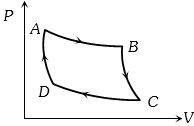
The Carnot cycle (reversible) of a gas represented by a Pressure-Volume $(P-V)$ curve is shown in the diagram. Consider the following statements:
$I.$ Area $ABCD =$ Work done by the gas
$II.$ Area $ABCD =$ Net heat absorbed
$III.$ Change in the internal energy in the cycle $= 0$
Which of these are correct?
$I.$ Area $ABCD =$ Work done by the gas
$II.$ Area $ABCD =$ Net heat absorbed
$III.$ Change in the internal energy in the cycle $= 0$
Which of these are correct?
A
$I$ only
B
$II$ only
C
$II$ and $III$
D
$I, II$ and $III$
Solution
(D) $1$. The area enclosed by a closed loop in a $P-V$ diagram represents the net work done by the gas during one complete cycle. Since the cycle is clockwise,the work done is positive (work done by the gas). Thus,statement $I$ is correct.
$2$. According to the first law of thermodynamics,$\Delta Q = \Delta W + \Delta U$. For a complete cycle,the change in internal energy $\Delta U$ is zero because internal energy is a state function and the system returns to its initial state. Thus,statement $III$ is correct.
$3$. Since $\Delta U = 0$,the first law becomes $\Delta Q = \Delta W$. This means the net heat absorbed by the gas is equal to the net work done by the gas,which is equal to the area enclosed by the cycle $ABCD$. Thus,statement $II$ is correct.
Therefore,statements $I, II,$ and $III$ are all correct.
$2$. According to the first law of thermodynamics,$\Delta Q = \Delta W + \Delta U$. For a complete cycle,the change in internal energy $\Delta U$ is zero because internal energy is a state function and the system returns to its initial state. Thus,statement $III$ is correct.
$3$. Since $\Delta U = 0$,the first law becomes $\Delta Q = \Delta W$. This means the net heat absorbed by the gas is equal to the net work done by the gas,which is equal to the area enclosed by the cycle $ABCD$. Thus,statement $II$ is correct.
Therefore,statements $I, II,$ and $III$ are all correct.
0 likes
View Solution26
DifficultMCQ
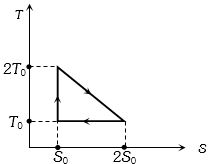
The temperature-entropy $(T-S)$ diagram of a reversible engine cycle is given in the figure. Its efficiency is
A
$0.33$
B
$0.67$
C
$0.5$
D
$0.25$
Solution
(A) The area under the $T-S$ curve represents the heat exchanged in a process.
For the given cycle, the heat absorbed $(Q_{in})$ is the area under the top slanted line from $S_0$ to $2S_0$.
The area is a rectangle plus a triangle: $Q_{in} = (T_0 \times S_0) + \frac{1}{2} \times (2T_0 - T_0) \times (2S_0 - S_0) = T_0 S_0 + \frac{1}{2} T_0 S_0 = 1.5 T_0 S_0$.
The heat rejected $(Q_{out})$ is the area under the bottom horizontal line from $2S_0$ to $S_0$ at temperature $T_0$: $Q_{out} = T_0 \times (2S_0 - S_0) = T_0 S_0$.
The efficiency $\eta$ is given by $\eta = 1 - \frac{Q_{out}}{Q_{in}}$.
Substituting the values: $\eta = 1 - \frac{T_0 S_0}{1.5 T_0 S_0} = 1 - \frac{1}{1.5} = 1 - \frac{2}{3} = \frac{1}{3} \approx 0.33$.
For the given cycle, the heat absorbed $(Q_{in})$ is the area under the top slanted line from $S_0$ to $2S_0$.
The area is a rectangle plus a triangle: $Q_{in} = (T_0 \times S_0) + \frac{1}{2} \times (2T_0 - T_0) \times (2S_0 - S_0) = T_0 S_0 + \frac{1}{2} T_0 S_0 = 1.5 T_0 S_0$.
The heat rejected $(Q_{out})$ is the area under the bottom horizontal line from $2S_0$ to $S_0$ at temperature $T_0$: $Q_{out} = T_0 \times (2S_0 - S_0) = T_0 S_0$.
The efficiency $\eta$ is given by $\eta = 1 - \frac{Q_{out}}{Q_{in}}$.
Substituting the values: $\eta = 1 - \frac{T_0 S_0}{1.5 T_0 S_0} = 1 - \frac{1}{1.5} = 1 - \frac{2}{3} = \frac{1}{3} \approx 0.33$.
0 likes
View Solution27
MediumMCQ
$A$ Carnot engine absorbs $3 \times 10^{6} \text{ cal}$ of heat from a reservoir at $627^{\circ}C$ and rejects it at $27^{\circ}C$. The work done by the engine is:
A
$4.2 \times 10^{6} \text{ J}$
B
$8.4 \times 10^{6} \text{ J}$
C
$16.8 \times 10^{6} \text{ J}$
D
Zero
Solution
(B) The temperatures are $T_{1} = 627 + 273 = 900 \text{ K}$ and $T_{2} = 27 + 273 = 300 \text{ K}$.
Efficiency $\eta = 1 - \frac{T_{2}}{T_{1}} = 1 - \frac{300}{900} = 1 - \frac{1}{3} = \frac{2}{3}$.
Heat absorbed $Q_{1} = 3 \times 10^{6} \text{ cal} = 3 \times 10^{6} \times 4.2 \text{ J} = 12.6 \times 10^{6} \text{ J}$.
Work done $W = \eta \times Q_{1} = \frac{2}{3} \times 12.6 \times 10^{6} \text{ J} = 8.4 \times 10^{6} \text{ J}$.
Efficiency $\eta = 1 - \frac{T_{2}}{T_{1}} = 1 - \frac{300}{900} = 1 - \frac{1}{3} = \frac{2}{3}$.
Heat absorbed $Q_{1} = 3 \times 10^{6} \text{ cal} = 3 \times 10^{6} \times 4.2 \text{ J} = 12.6 \times 10^{6} \text{ J}$.
Work done $W = \eta \times Q_{1} = \frac{2}{3} \times 12.6 \times 10^{6} \text{ J} = 8.4 \times 10^{6} \text{ J}$.
0 likes
View Solution28
MediumMCQ
For which of the following options will the efficiency of a Carnot engine be the highest?
A
$80 \ K, 60 \ K$
B
$100 \ K, 80 \ K$
C
$60 \ K, 40 \ K$
D
$40 \ K, 20 \ K$
Solution
(D) The efficiency of a Carnot engine is given by $\eta = 1 - \frac{T_2}{T_1}$,where $T_1$ is the source temperature and $T_2$ is the sink temperature.
To maximize $\eta$,the ratio $\frac{T_2}{T_1}$ must be minimized.
Calculating the ratio for each option:
$A: \frac{60}{80} = 0.75$
$B: \frac{80}{100} = 0.80$
$C: \frac{40}{60} \approx 0.67$
$D: \frac{20}{40} = 0.50$
Since the ratio is minimum for option $D$,the efficiency is highest for $T_1 = 40 \ K$ and $T_2 = 20 \ K$.
To maximize $\eta$,the ratio $\frac{T_2}{T_1}$ must be minimized.
Calculating the ratio for each option:
$A: \frac{60}{80} = 0.75$
$B: \frac{80}{100} = 0.80$
$C: \frac{40}{60} \approx 0.67$
$D: \frac{20}{40} = 0.50$
Since the ratio is minimum for option $D$,the efficiency is highest for $T_1 = 40 \ K$ and $T_2 = 20 \ K$.
0 likes
View Solution29
DifficultMCQ
An ideal heat engine based on the Carnot cycle operates between temperatures of $227 \, ^\circ C$ and $127 \, ^\circ C$. If it absorbs $6 \times 10^{4} \, cal$ of heat from the high-temperature reservoir,the net work done by the engine is:
A
$2.4 \times 10^{4} \, cal$
B
$6 \times 10^{4} \, cal$
C
$1.2 \times 10^{4} \, cal$
D
$4.8 \times 10^{4} \, cal$
Solution
(C) The efficiency of a Carnot engine is given by $\eta = 1 - \frac{T_2}{T_1}$,where $T_1$ is the source temperature and $T_2$ is the sink temperature in Kelvin.
Given: $T_1 = 227 + 273 = 500 \, K$ and $T_2 = 127 + 273 = 400 \, K$.
Heat absorbed from the source $Q_1 = 6 \times 10^{4} \, cal$.
The efficiency is also defined as $\eta = \frac{W}{Q_1}$,where $W$ is the net work done.
Therefore,$W = Q_1 \left( 1 - \frac{T_2}{T_1} \right)$.
Substituting the values: $W = 6 \times 10^{4} \left( 1 - \frac{400}{500} \right)$.
$W = 6 \times 10^{4} \left( 1 - 0.8 \right) = 6 \times 10^{4} \times 0.2$.
$W = 1.2 \times 10^{4} \, cal$.
Given: $T_1 = 227 + 273 = 500 \, K$ and $T_2 = 127 + 273 = 400 \, K$.
Heat absorbed from the source $Q_1 = 6 \times 10^{4} \, cal$.
The efficiency is also defined as $\eta = \frac{W}{Q_1}$,where $W$ is the net work done.
Therefore,$W = Q_1 \left( 1 - \frac{T_2}{T_1} \right)$.
Substituting the values: $W = 6 \times 10^{4} \left( 1 - \frac{400}{500} \right)$.
$W = 6 \times 10^{4} \left( 1 - 0.8 \right) = 6 \times 10^{4} \times 0.2$.
$W = 1.2 \times 10^{4} \, cal$.
0 likes
View Solution30
EasyMCQ
The efficiency of a Carnot engine operating between temperatures $27^{\circ}C$ and $-123^{\circ}C$ is .... $\%$?
A
$50$
B
$24$
C
$75$
D
$0.4$
Solution
(A) The efficiency $\eta$ of a Carnot engine is given by the formula: $\eta = 1 - \frac{T_2}{T_1}$, where $T_1$ is the source temperature and $T_2$ is the sink temperature in Kelvin.
Convert temperatures from Celsius to Kelvin: $T_1 = 27 + 273 = 300 \, K$ and $T_2 = -123 + 273 = 150 \, K$.
Substitute the values into the formula: $\eta = 1 - \frac{150}{300}$.
Simplify the expression: $\eta = 1 - 0.5 = 0.5$.
Convert to percentage: $\eta = 0.5 \times 100 = 50\%$.
Convert temperatures from Celsius to Kelvin: $T_1 = 27 + 273 = 300 \, K$ and $T_2 = -123 + 273 = 150 \, K$.
Substitute the values into the formula: $\eta = 1 - \frac{150}{300}$.
Simplify the expression: $\eta = 1 - 0.5 = 0.5$.
Convert to percentage: $\eta = 0.5 \times 100 = 50\%$.
0 likes
View Solution31
DifficultMCQ
$A$ heat engine receives $200 \, cal$ of heat and rejects $150 \, cal$ of heat. If the temperature of the source is $400 \, K$,what is the temperature of the sink in $K$ (in $, K$)?
A
$300$
B
$200$
C
$100$
D
$50$
Solution
(A) Given: Heat supplied by the source $Q_1 = 200 \, cal$,Heat rejected to the sink $Q_2 = 150 \, cal$,Temperature of the source $T_1 = 400 \, K$.
For a reversible heat engine,the ratio of heat exchanged is equal to the ratio of temperatures: $\frac{Q_1}{Q_2} = \frac{T_1}{T_2}$.
Rearranging the formula to solve for the sink temperature $T_2$: $T_2 = \frac{Q_2}{Q_1} \times T_1$.
Substituting the given values: $T_2 = \frac{150}{200} \times 400$.
$T_2 = 0.75 \times 400 = 300 \, K$.
Therefore,the temperature of the sink is $300 \, K$.
For a reversible heat engine,the ratio of heat exchanged is equal to the ratio of temperatures: $\frac{Q_1}{Q_2} = \frac{T_1}{T_2}$.
Rearranging the formula to solve for the sink temperature $T_2$: $T_2 = \frac{Q_2}{Q_1} \times T_1$.
Substituting the given values: $T_2 = \frac{150}{200} \times 400$.
$T_2 = 0.75 \times 400 = 300 \, K$.
Therefore,the temperature of the sink is $300 \, K$.
0 likes
View Solution32
MediumMCQ
The sink temperature of a Carnot engine is $27^{\circ}C$ and its efficiency is $25\%$. What is the temperature of the source in $^{\circ}C$?
A
$227$
B
$327$
C
$127$
D
$27$
Solution
(C) The efficiency of a Carnot engine is given by the formula: $\eta = 1 - \frac{T_2}{T_1}$,where $T_1$ is the source temperature and $T_2$ is the sink temperature in Kelvin.
Given: $\eta = 25\% = 0.25$ and $T_2 = 27^{\circ}C = 27 + 273 = 300 \ K$.
Substituting the values: $0.25 = 1 - \frac{300}{T_1}$.
Rearranging the terms: $\frac{300}{T_1} = 1 - 0.25 = 0.75$.
$T_1 = \frac{300}{0.75} = 400 \ K$.
Converting back to Celsius: $T_1 = 400 - 273 = 127^{\circ}C$.
Given: $\eta = 25\% = 0.25$ and $T_2 = 27^{\circ}C = 27 + 273 = 300 \ K$.
Substituting the values: $0.25 = 1 - \frac{300}{T_1}$.
Rearranging the terms: $\frac{300}{T_1} = 1 - 0.25 = 0.75$.
$T_1 = \frac{300}{0.75} = 400 \ K$.
Converting back to Celsius: $T_1 = 400 - 273 = 127^{\circ}C$.
0 likes
View Solution33
MediumMCQ
$A$ scientist claims that their heat engine has an efficiency of $26\%$ when operating between a source temperature of $127^{\circ}C$ and a sink temperature of $27^{\circ}C$. This implies that:
A
This is impossible.
B
This is possible but highly unlikely.
C
This is possible.
D
The information provided is insufficient.
Solution
(A) The maximum theoretical efficiency of a heat engine is given by the Carnot efficiency formula: $\eta_{max} = 1 - \frac{T_L}{T_H}$.
Here,the source temperature $T_H = 127^{\circ}C = 127 + 273 = 400 \text{ K}$.
The sink temperature $T_L = 27^{\circ}C = 27 + 273 = 300 \text{ K}$.
Substituting these values: $\eta_{max} = 1 - \frac{300}{400} = 1 - 0.75 = 0.25$ or $25\%$.
Since the scientist claims an efficiency of $26\%$,which is greater than the maximum possible Carnot efficiency of $25\%$,this claim violates the second law of thermodynamics.
Therefore,this is impossible.
Here,the source temperature $T_H = 127^{\circ}C = 127 + 273 = 400 \text{ K}$.
The sink temperature $T_L = 27^{\circ}C = 27 + 273 = 300 \text{ K}$.
Substituting these values: $\eta_{max} = 1 - \frac{300}{400} = 1 - 0.75 = 0.25$ or $25\%$.
Since the scientist claims an efficiency of $26\%$,which is greater than the maximum possible Carnot efficiency of $25\%$,this claim violates the second law of thermodynamics.
Therefore,this is impossible.
0 likes
View Solution34
MediumMCQ
In a Carnot engine,the temperature of the sink is $27 \, ^\circ C$ and the temperature of the source is $927 \, ^\circ C$. If the work done by the engine to reject heat from the source to the sink is $12.6 \times 10^{6} \, J$,what is the heat absorbed from the source?
A
$16.8 \times 10^{6} \, J$
B
$4 \times 10^{6} \, J$
C
$7.6 \times 10^{6} \, J$
D
$4.2 \times 10^{6} \, J$
Solution
(A) The temperatures are given as $T_2 = 27 \, ^\circ C = 300 \, K$ and $T_1 = 927 \, ^\circ C = 1200 \, K$.
Efficiency of a Carnot engine is given by $\eta = 1 - \frac{T_2}{T_1} = 1 - \frac{300}{1200} = 1 - 0.25 = 0.75 = \frac{3}{4}$.
Also,efficiency $\eta = \frac{W}{Q_1}$,where $W$ is the work done and $Q_1$ is the heat absorbed from the source.
Given $W = 12.6 \times 10^{6} \, J$.
Substituting the values: $\frac{3}{4} = \frac{12.6 \times 10^{6}}{Q_1}$.
Therefore,$Q_1 = \frac{4 \times 12.6 \times 10^{6}}{3} = 4 \times 4.2 \times 10^{6} = 16.8 \times 10^{6} \, J$.
Efficiency of a Carnot engine is given by $\eta = 1 - \frac{T_2}{T_1} = 1 - \frac{300}{1200} = 1 - 0.25 = 0.75 = \frac{3}{4}$.
Also,efficiency $\eta = \frac{W}{Q_1}$,where $W$ is the work done and $Q_1$ is the heat absorbed from the source.
Given $W = 12.6 \times 10^{6} \, J$.
Substituting the values: $\frac{3}{4} = \frac{12.6 \times 10^{6}}{Q_1}$.
Therefore,$Q_1 = \frac{4 \times 12.6 \times 10^{6}}{3} = 4 \times 4.2 \times 10^{6} = 16.8 \times 10^{6} \, J$.
0 likes
View Solution35
MediumMCQ
The source temperature of a heat engine is $727^{\circ}C$ and the sink temperature is $227^{\circ}C$. What is the maximum possible efficiency of this engine?
A
$1/2$
B
$1/4$
C
$3/4$
D
$1$
Solution
(A) The efficiency $\eta$ of a Carnot engine is given by the formula: $\eta = 1 - \frac{T_2}{T_1}$,where $T_1$ is the source temperature and $T_2$ is the sink temperature in Kelvin.
First,convert the temperatures from Celsius to Kelvin:
$T_1 = 727 + 273 = 1000 \ K$
$T_2 = 227 + 273 = 500 \ K$
Now,substitute these values into the efficiency formula:
$\eta = 1 - \frac{500}{1000} = 1 - 0.5 = 0.5$
Therefore,the maximum possible efficiency is $1/2$.
First,convert the temperatures from Celsius to Kelvin:
$T_1 = 727 + 273 = 1000 \ K$
$T_2 = 227 + 273 = 500 \ K$
Now,substitute these values into the efficiency formula:
$\eta = 1 - \frac{500}{1000} = 1 - 0.5 = 0.5$
Therefore,the maximum possible efficiency is $1/2$.
0 likes
View Solution36
DifficultMCQ
$A$ Carnot engine having an efficiency of $40\%$ takes heat from a source maintained at a temperature of $500 \ K$. If the efficiency is to be increased to $60\%$ while keeping the sink temperature constant,what should be the new source temperature in $K$?
A
The efficiency of a Carnot engine cannot exceed $50\%$.
B
$1200$
C
$750$
D
$600$
Solution
(C) The efficiency of a Carnot engine is given by $\eta = (1 - \frac{T_L}{T_H}) \times 100$,where $T_L$ is the sink temperature and $T_H$ is the source temperature.
For the first case: $40 = (1 - \frac{T_L}{500}) \times 100$.
$0.4 = 1 - \frac{T_L}{500} \implies \frac{T_L}{500} = 0.6 \implies T_L = 300 \ K$.
For the second case,the sink temperature $T_L$ remains constant at $300 \ K$ and efficiency $\eta$ becomes $60\%$:
$60 = (1 - \frac{300}{T_H'}) \times 100$.
$0.6 = 1 - \frac{300}{T_H'} \implies \frac{300}{T_H'} = 0.4$.
$T_H' = \frac{300}{0.4} = 750 \ K$.
For the first case: $40 = (1 - \frac{T_L}{500}) \times 100$.
$0.4 = 1 - \frac{T_L}{500} \implies \frac{T_L}{500} = 0.6 \implies T_L = 300 \ K$.
For the second case,the sink temperature $T_L$ remains constant at $300 \ K$ and efficiency $\eta$ becomes $60\%$:
$60 = (1 - \frac{300}{T_H'}) \times 100$.
$0.6 = 1 - \frac{300}{T_H'} \implies \frac{300}{T_H'} = 0.4$.
$T_H' = \frac{300}{0.4} = 750 \ K$.
0 likes
View Solution37
MediumMCQ
$A$ diatomic ideal gas is used as the working substance in a Carnot engine. During the adiabatic expansion process,if the volume of the gas increases from $V$ to $32V$,what is the efficiency of the engine?
A
$0.25$
B
$0.5$
C
$0.75$
D
$0.99$
Solution
(C) For a diatomic gas,the adiabatic index $\gamma = 1.4 = 7/5$.
In a Carnot cycle,the adiabatic expansion occurs between temperatures $T_1$ (source) and $T_2$ (sink).
The relation for adiabatic process is $T V^{\gamma - 1} = \text{constant}$.
Thus,$T_1 V_B^{\gamma - 1} = T_2 V_C^{\gamma - 1}$,where $V_B = V$ and $V_C = 32V$.
$\frac{T_2}{T_1} = \left( \frac{V_B}{V_C} \right)^{\gamma - 1} = \left( \frac{V}{32V} \right)^{1.4 - 1} = \left( \frac{1}{32} \right)^{0.4} = \left( \frac{1}{32} \right)^{2/5}$.
Since $32 = 2^5$,we have $\frac{T_2}{T_1} = (2^{-5})^{2/5} = 2^{-2} = 1/4 = 0.25$.
The efficiency $\eta$ of a Carnot engine is given by $\eta = 1 - \frac{T_2}{T_1}$.
$\eta = 1 - 0.25 = 0.75$.
In a Carnot cycle,the adiabatic expansion occurs between temperatures $T_1$ (source) and $T_2$ (sink).
The relation for adiabatic process is $T V^{\gamma - 1} = \text{constant}$.
Thus,$T_1 V_B^{\gamma - 1} = T_2 V_C^{\gamma - 1}$,where $V_B = V$ and $V_C = 32V$.
$\frac{T_2}{T_1} = \left( \frac{V_B}{V_C} \right)^{\gamma - 1} = \left( \frac{V}{32V} \right)^{1.4 - 1} = \left( \frac{1}{32} \right)^{0.4} = \left( \frac{1}{32} \right)^{2/5}$.
Since $32 = 2^5$,we have $\frac{T_2}{T_1} = (2^{-5})^{2/5} = 2^{-2} = 1/4 = 0.25$.
The efficiency $\eta$ of a Carnot engine is given by $\eta = 1 - \frac{T_2}{T_1}$.
$\eta = 1 - 0.25 = 0.75$.
0 likes
View Solution38
DifficultMCQ
$A$ Carnot engine operating between temperatures $7^{\circ}C$ and a higher temperature has an efficiency of $50\%$. To increase its efficiency to $70\%$,by how much must the temperature of the source be increased in $K$?
A
$840$
B
$280$
C
$560$
D
$380$
Solution
(D) The efficiency of a Carnot engine is given by $\eta = 1 - \frac{T_2}{T_1}$,where $T_2$ is the sink temperature and $T_1$ is the source temperature.
Given $T_2 = 7^{\circ}C = 280 \ K$ and $\eta_1 = 0.5$.
$0.5 = 1 - \frac{280}{T_1} \Rightarrow \frac{280}{T_1} = 0.5 \Rightarrow T_1 = 560 \ K$.
Now,for $\eta_2 = 0.7$ with the same sink temperature $T_2 = 280 \ K$:
$0.7 = 1 - \frac{280}{T_1'} \Rightarrow \frac{280}{T_1'} = 0.3 \Rightarrow T_1' = \frac{280}{0.3} = 933.33 \ K$.
The increase in source temperature is $\Delta T = T_1' - T_1 = 933.33 - 560 = 373.33 \ K$.
Rounding to the nearest given option,the increase is approximately $380 \ K$.
Given $T_2 = 7^{\circ}C = 280 \ K$ and $\eta_1 = 0.5$.
$0.5 = 1 - \frac{280}{T_1} \Rightarrow \frac{280}{T_1} = 0.5 \Rightarrow T_1 = 560 \ K$.
Now,for $\eta_2 = 0.7$ with the same sink temperature $T_2 = 280 \ K$:
$0.7 = 1 - \frac{280}{T_1'} \Rightarrow \frac{280}{T_1'} = 0.3 \Rightarrow T_1' = \frac{280}{0.3} = 933.33 \ K$.
The increase in source temperature is $\Delta T = T_1' - T_1 = 933.33 - 560 = 373.33 \ K$.
Rounding to the nearest given option,the increase is approximately $380 \ K$.
0 likes
View Solution39
DifficultMCQ
$A$ reversible engine converts $1/6$ of its input heat into work. When the temperature of the sink is reduced by $62^{\circ}C$,the efficiency of the engine is doubled. Find the temperatures of the source and the sink.
A
$80^{\circ}C, 37^{\circ}C$
B
$95^{\circ}C, 25^{\circ}C$
C
$90^{\circ}C, 37^{\circ}C$
D
$99^{\circ}C, 37^{\circ}C$
Solution
(D) The efficiency of a Carnot engine is given by $\eta = 1 - \frac{T_2}{T_1} = \frac{W}{Q}$.
Initially,$\eta = 1/6$,so $1 - \frac{T_2}{T_1} = \frac{1}{6} \implies \frac{T_2}{T_1} = \frac{5}{6} \implies T_1 = \frac{6}{5}T_2$.
When the sink temperature is reduced by $62^{\circ}C$,the new sink temperature is $T_2' = T_2 - 62$.
The new efficiency is $\eta' = 2\eta = 2(1/6) = 1/3$.
Thus,$1 - \frac{T_2 - 62}{T_1} = \frac{1}{3} \implies \frac{T_2 - 62}{T_1} = \frac{2}{3}$.
Substituting $T_1 = \frac{6}{5}T_2$ into the equation: $\frac{T_2 - 62}{(6/5)T_2} = \frac{2}{3}$.
$\frac{5(T_2 - 62)}{6T_2} = \frac{2}{3} \implies 15(T_2 - 62) = 12T_2 \implies 15T_2 - 930 = 12T_2$.
$3T_2 = 930 \implies T_2 = 310 \text{ K}$.
Converting to Celsius: $T_2 = 310 - 273 = 37^{\circ}C$.
Now,$T_1 = \frac{6}{5} \times 310 = 6 \times 62 = 372 \text{ K}$.
Converting to Celsius: $T_1 = 372 - 273 = 99^{\circ}C$.
Initially,$\eta = 1/6$,so $1 - \frac{T_2}{T_1} = \frac{1}{6} \implies \frac{T_2}{T_1} = \frac{5}{6} \implies T_1 = \frac{6}{5}T_2$.
When the sink temperature is reduced by $62^{\circ}C$,the new sink temperature is $T_2' = T_2 - 62$.
The new efficiency is $\eta' = 2\eta = 2(1/6) = 1/3$.
Thus,$1 - \frac{T_2 - 62}{T_1} = \frac{1}{3} \implies \frac{T_2 - 62}{T_1} = \frac{2}{3}$.
Substituting $T_1 = \frac{6}{5}T_2$ into the equation: $\frac{T_2 - 62}{(6/5)T_2} = \frac{2}{3}$.
$\frac{5(T_2 - 62)}{6T_2} = \frac{2}{3} \implies 15(T_2 - 62) = 12T_2 \implies 15T_2 - 930 = 12T_2$.
$3T_2 = 930 \implies T_2 = 310 \text{ K}$.
Converting to Celsius: $T_2 = 310 - 273 = 37^{\circ}C$.
Now,$T_1 = \frac{6}{5} \times 310 = 6 \times 62 = 372 \text{ K}$.
Converting to Celsius: $T_1 = 372 - 273 = 99^{\circ}C$.
0 likes
View Solution40
DifficultMCQ
For a Carnot engine,the efficiency is given by $W/Q_1 = 1/6$. If the temperature of the sink is reduced by $62^{\circ}C$,the efficiency doubles. The initial temperatures of the sink and the source are,respectively:
A
$33^{\circ}C$ and $67^{\circ}C$
B
$37^{\circ}C$ and $99^{\circ}C$
C
$67^{\circ}C$ and $33^{\circ}C$
D
$97 K$ and $37 K$
Solution
(B) The efficiency of a Carnot engine is given by $\eta = 1 - \frac{T_2}{T_1} = \frac{W}{Q_1}$.
Initially,$\eta = 1 - \frac{T_2}{T_1} = \frac{1}{6} \quad \dots(i)$
When the sink temperature $T_2$ is reduced by $62^{\circ}C$ (which is equivalent to $62 K$ in absolute scale),the new sink temperature is $T_2' = T_2 - 62$.
The new efficiency is $\eta' = 1 - \frac{T_2 - 62}{T_1} = 2\eta$.
Substituting $\eta = 1/6$,we get $\eta' = 2 \times (1/6) = 1/3$.
So,$1 - \frac{T_2 - 62}{T_1} = \frac{1}{3} \implies \frac{T_2 - 62}{T_1} = \frac{2}{3} \quad \dots(ii)$.
From $(i)$,$\frac{T_2}{T_1} = 1 - \frac{1}{6} = \frac{5}{6} \implies T_2 = \frac{5}{6}T_1$.
Substitute $T_2$ into $(ii)$: $\frac{\frac{5}{6}T_1 - 62}{T_1} = \frac{2}{3} \implies \frac{5}{6} - \frac{62}{T_1} = \frac{2}{3}$.
$\frac{62}{T_1} = \frac{5}{6} - \frac{4}{6} = \frac{1}{6} \implies T_1 = 62 \times 6 = 372 K$.
Converting to Celsius: $T_1 = 372 - 273 = 99^{\circ}C$.
Now,$T_2 = \frac{5}{6} \times 372 = 310 K$.
Converting to Celsius: $T_2 = 310 - 273 = 37^{\circ}C$.
Thus,the sink temperature is $37^{\circ}C$ and the source temperature is $99^{\circ}C$.
Initially,$\eta = 1 - \frac{T_2}{T_1} = \frac{1}{6} \quad \dots(i)$
When the sink temperature $T_2$ is reduced by $62^{\circ}C$ (which is equivalent to $62 K$ in absolute scale),the new sink temperature is $T_2' = T_2 - 62$.
The new efficiency is $\eta' = 1 - \frac{T_2 - 62}{T_1} = 2\eta$.
Substituting $\eta = 1/6$,we get $\eta' = 2 \times (1/6) = 1/3$.
So,$1 - \frac{T_2 - 62}{T_1} = \frac{1}{3} \implies \frac{T_2 - 62}{T_1} = \frac{2}{3} \quad \dots(ii)$.
From $(i)$,$\frac{T_2}{T_1} = 1 - \frac{1}{6} = \frac{5}{6} \implies T_2 = \frac{5}{6}T_1$.
Substitute $T_2$ into $(ii)$: $\frac{\frac{5}{6}T_1 - 62}{T_1} = \frac{2}{3} \implies \frac{5}{6} - \frac{62}{T_1} = \frac{2}{3}$.
$\frac{62}{T_1} = \frac{5}{6} - \frac{4}{6} = \frac{1}{6} \implies T_1 = 62 \times 6 = 372 K$.
Converting to Celsius: $T_1 = 372 - 273 = 99^{\circ}C$.
Now,$T_2 = \frac{5}{6} \times 372 = 310 K$.
Converting to Celsius: $T_2 = 310 - 273 = 37^{\circ}C$.
Thus,the sink temperature is $37^{\circ}C$ and the source temperature is $99^{\circ}C$.
0 likes
View Solution41
DifficultMCQ
$A$ Carnot engine has an efficiency of $40\%$. The temperature of its sink is $300 \ K$. To increase the efficiency by $50\%$ of its original efficiency while keeping the sink temperature constant,by how many $K$ must the source temperature be increased?
A
$380$
B
$275$
C
$325$
D
$250$
Solution
(D) The efficiency of a Carnot engine is given by $\eta = 1 - \frac{T_2}{T_1}$,where $T_1$ is the source temperature and $T_2$ is the sink temperature.
Given $\eta = 0.40$ and $T_2 = 300 \ K$,we have $0.40 = 1 - \frac{300}{T_1}$.
$\frac{300}{T_1} = 0.60 \implies T_1 = \frac{300}{0.60} = 500 \ K$.
Now,the efficiency is increased by $50\%$ of its original value. The new efficiency $\eta' = \eta + 0.50 \times \eta = 0.40 + 0.20 = 0.60$.
Keeping $T_2 = 300 \ K$ constant,the new source temperature $T_1'$ is given by $\eta' = 1 - \frac{T_2}{T_1'}$.
$0.60 = 1 - \frac{300}{T_1'} \implies \frac{300}{T_1'} = 0.40$.
$T_1' = \frac{300}{0.40} = 750 \ K$.
The increase in source temperature is $\Delta T = T_1' - T_1 = 750 \ K - 500 \ K = 250 \ K$.
Given $\eta = 0.40$ and $T_2 = 300 \ K$,we have $0.40 = 1 - \frac{300}{T_1}$.
$\frac{300}{T_1} = 0.60 \implies T_1 = \frac{300}{0.60} = 500 \ K$.
Now,the efficiency is increased by $50\%$ of its original value. The new efficiency $\eta' = \eta + 0.50 \times \eta = 0.40 + 0.20 = 0.60$.
Keeping $T_2 = 300 \ K$ constant,the new source temperature $T_1'$ is given by $\eta' = 1 - \frac{T_2}{T_1'}$.
$0.60 = 1 - \frac{300}{T_1'} \implies \frac{300}{T_1'} = 0.40$.
$T_1' = \frac{300}{0.40} = 750 \ K$.
The increase in source temperature is $\Delta T = T_1' - T_1 = 750 \ K - 500 \ K = 250 \ K$.
0 likes
View Solution42
DifficultMCQ
The efficiency of a Carnot engine is $50 \%$ when the temperature of the sink is $500 \ K$. If the efficiency of the Carnot engine is to be increased to $60 \%$,what should be the temperature of the sink,keeping the temperature of the source constant (in $K$)?
A
$200$
B
$400$
C
$600$
D
$800$
Solution
(B) The efficiency of a Carnot engine is given by $\eta = 1 - \frac{T_2}{T_1}$,where $T_1$ is the source temperature and $T_2$ is the sink temperature.
Given $\eta = 0.5$ and $T_2 = 500 \ K$,we have $0.5 = 1 - \frac{500}{T_1}$,which gives $\frac{500}{T_1} = 0.5$,so $T_1 = 1000 \ K$.
Now,keeping the source temperature $T_1 = 1000 \ K$ constant,we want to achieve an efficiency $\eta' = 0.6$ by changing the sink temperature to $T_2'$.
Using the formula $\eta' = 1 - \frac{T_2'}{T_1}$,we get $0.6 = 1 - \frac{T_2'}{1000}$.
Rearranging the terms,$\frac{T_2'}{1000} = 1 - 0.6 = 0.4$.
Therefore,$T_2' = 0.4 \times 1000 = 400 \ K$.
Given $\eta = 0.5$ and $T_2 = 500 \ K$,we have $0.5 = 1 - \frac{500}{T_1}$,which gives $\frac{500}{T_1} = 0.5$,so $T_1 = 1000 \ K$.
Now,keeping the source temperature $T_1 = 1000 \ K$ constant,we want to achieve an efficiency $\eta' = 0.6$ by changing the sink temperature to $T_2'$.
Using the formula $\eta' = 1 - \frac{T_2'}{T_1}$,we get $0.6 = 1 - \frac{T_2'}{1000}$.
Rearranging the terms,$\frac{T_2'}{1000} = 1 - 0.6 = 0.4$.
Therefore,$T_2' = 0.4 \times 1000 = 400 \ K$.
0 likes
View Solution43
DifficultMCQ
$A$ Carnot engine with $40\%$ efficiency takes heat at $500 \ K$. If its efficiency is to be $50\%$,then for the same exhaust temperature,the intake temperature must be ..... $K$.
A
$800$
B
$900$
C
$600$
D
$700$
Solution
(C) The efficiency of a Carnot engine is given by $\eta = 1 - \frac{T_2}{T_1}$,where $T_1$ is the intake temperature and $T_2$ is the exhaust temperature.
For the first case: $\eta_1 = 0.4$,$T_1 = 500 \ K$.
$0.4 = 1 - \frac{T_2}{500} \implies \frac{T_2}{500} = 0.6 \implies T_2 = 300 \ K$.
Since the exhaust temperature $T_2$ remains the same for the second case:
For the second case: $\eta_2 = 0.5$,$T_2 = 300 \ K$.
$0.5 = 1 - \frac{300}{T_1'} \implies \frac{300}{T_1'} = 0.5 \implies T_1' = \frac{300}{0.5} = 600 \ K$.
Thus,the new intake temperature is $600 \ K$.
For the first case: $\eta_1 = 0.4$,$T_1 = 500 \ K$.
$0.4 = 1 - \frac{T_2}{500} \implies \frac{T_2}{500} = 0.6 \implies T_2 = 300 \ K$.
Since the exhaust temperature $T_2$ remains the same for the second case:
For the second case: $\eta_2 = 0.5$,$T_2 = 300 \ K$.
$0.5 = 1 - \frac{300}{T_1'} \implies \frac{300}{T_1'} = 0.5 \implies T_1' = \frac{300}{0.5} = 600 \ K$.
Thus,the new intake temperature is $600 \ K$.
0 likes
View Solution44
MediumMCQ
$A$ Carnot engine operates between $300 \ K$ and $600 \ K$. If the work done per cycle is $800 \ J$,then the heat supplied per cycle is ....... $J/cycle$.
A
$1800$
B
$1000$
C
$2000$
D
$1600$
Solution
(D) The efficiency $\eta$ of a Carnot engine is given by $\eta = 1 - \frac{T_L}{T_H}$,where $T_L = 300 \ K$ and $T_H = 600 \ K$.
$\eta = 1 - \frac{300}{600} = 1 - 0.5 = 0.5$.
Efficiency is also defined as the ratio of work done $W$ to the heat supplied $Q_H$,i.e.,$\eta = \frac{W}{Q_H}$.
Given $W = 800 \ J$,we have $0.5 = \frac{800}{Q_H}$.
Therefore,$Q_H = \frac{800}{0.5} = 1600 \ J/cycle$.
$\eta = 1 - \frac{300}{600} = 1 - 0.5 = 0.5$.
Efficiency is also defined as the ratio of work done $W$ to the heat supplied $Q_H$,i.e.,$\eta = \frac{W}{Q_H}$.
Given $W = 800 \ J$,we have $0.5 = \frac{800}{Q_H}$.
Therefore,$Q_H = \frac{800}{0.5} = 1600 \ J/cycle$.
0 likes
View Solution45
EasyMCQ
$A$ Carnot engine operates between $627^{\circ}C$ and $227^{\circ}C$. The efficiency of the Carnot engine is ....... $\%$
A
$22.2$
B
$33.3$
C
$44.4$
D
$66.6$
Solution
(C) The efficiency $(\eta)$ of a Carnot engine is given by the formula: $\eta = 1 - \frac{T_2}{T_1}$, where $T_1$ is the temperature of the source and $T_2$ is the temperature of the sink in Kelvin.
Given: $T_1 = 627^{\circ}C = 627 + 273 = 900 \ K$ and $T_2 = 227^{\circ}C = 227 + 273 = 500 \ K$.
Substituting the values: $\eta = 1 - \frac{500}{900} = 1 - \frac{5}{9} = \frac{4}{9}$.
To express as a percentage: $\eta = \frac{4}{9} \times 100 \% \approx 44.44 \%$.
Therefore, the correct option is $C$.
Given: $T_1 = 627^{\circ}C = 627 + 273 = 900 \ K$ and $T_2 = 227^{\circ}C = 227 + 273 = 500 \ K$.
Substituting the values: $\eta = 1 - \frac{500}{900} = 1 - \frac{5}{9} = \frac{4}{9}$.
To express as a percentage: $\eta = \frac{4}{9} \times 100 \% \approx 44.44 \%$.
Therefore, the correct option is $C$.
1 likes
View Solution46
DifficultMCQ
$A$ Carnot engine whose sink is at $300\, K$ has an efficiency of $40\%.$ By how much should the temperature of the source be increased so as to increase its efficiency by $50\%$ of its original efficiency? (in $K$)
A
$380$
B
$275$
C
$325$
D
$250$
Solution
(D) The efficiency of a Carnot engine is given by $\eta = 1 - \frac{T_2}{T_1}$,where $T_2$ is the sink temperature and $T_1$ is the source temperature.
Given $\eta = 40\% = 0.4$ and $T_2 = 300\, K$.
$0.4 = 1 - \frac{300}{T_1} \implies \frac{300}{T_1} = 0.6 \implies T_1 = \frac{300}{0.6} = 500\, K$.
The efficiency is to be increased by $50\%$ of its original efficiency.
New efficiency $\eta' = \eta + 0.5 \times \eta = 0.4 + 0.5(0.4) = 0.4 + 0.2 = 0.6 = 60\%$.
Let the new source temperature be $T_1'$.
$0.6 = 1 - \frac{300}{T_1'} \implies \frac{300}{T_1'} = 0.4 \implies T_1' = \frac{300}{0.4} = 750\, K$.
The increase in source temperature is $\Delta T = T_1' - T_1 = 750 - 500 = 250\, K$.
Given $\eta = 40\% = 0.4$ and $T_2 = 300\, K$.
$0.4 = 1 - \frac{300}{T_1} \implies \frac{300}{T_1} = 0.6 \implies T_1 = \frac{300}{0.6} = 500\, K$.
The efficiency is to be increased by $50\%$ of its original efficiency.
New efficiency $\eta' = \eta + 0.5 \times \eta = 0.4 + 0.5(0.4) = 0.4 + 0.2 = 0.6 = 60\%$.
Let the new source temperature be $T_1'$.
$0.6 = 1 - \frac{300}{T_1'} \implies \frac{300}{T_1'} = 0.4 \implies T_1' = \frac{300}{0.4} = 750\, K$.
The increase in source temperature is $\Delta T = T_1' - T_1 = 750 - 500 = 250\, K$.
0 likes
View Solution47
DifficultMCQ
An engine has an efficiency of $1/6$. When the temperature of the sink is reduced by $62^{\circ}C$,its efficiency is doubled. The temperature of the source is ....... $^{\circ}C$.
A
$80$
B
$95$
C
$90$
D
$99$
Solution
(D) The efficiency of a Carnot engine is given by $\eta = 1 - \frac{T_2}{T_1}$,where $T_1$ is the source temperature and $T_2$ is the sink temperature in Kelvin.
Given $\eta_1 = 1/6$,so $1/6 = 1 - \frac{T_2}{T_1}$,which implies $\frac{T_2}{T_1} = 5/6$ or $T_2 = \frac{5}{6}T_1$ $...(i)$.
When the sink temperature is reduced by $62^{\circ}C$ (which is equivalent to a change of $62 \ K$),the new efficiency $\eta_2 = 2 \times \eta_1 = 2 \times (1/6) = 1/3$.
The new sink temperature is $T_2' = T_2 - 62$.
Using the efficiency formula: $1/3 = 1 - \frac{T_2 - 62}{T_1}$.
Rearranging gives $\frac{T_2 - 62}{T_1} = 1 - 1/3 = 2/3$.
Substituting $T_2 = \frac{5}{6}T_1$ from equation $(i)$:
$\frac{\frac{5}{6}T_1 - 62}{T_1} = 2/3$.
$\frac{5}{6} - \frac{62}{T_1} = 2/3$.
$\frac{62}{T_1} = \frac{5}{6} - \frac{4}{6} = 1/6$.
$T_1 = 62 \times 6 = 372 \ K$.
To convert to Celsius: $T(^{\circ}C) = 372 - 273 = 99^{\circ}C$.
Given $\eta_1 = 1/6$,so $1/6 = 1 - \frac{T_2}{T_1}$,which implies $\frac{T_2}{T_1} = 5/6$ or $T_2 = \frac{5}{6}T_1$ $...(i)$.
When the sink temperature is reduced by $62^{\circ}C$ (which is equivalent to a change of $62 \ K$),the new efficiency $\eta_2 = 2 \times \eta_1 = 2 \times (1/6) = 1/3$.
The new sink temperature is $T_2' = T_2 - 62$.
Using the efficiency formula: $1/3 = 1 - \frac{T_2 - 62}{T_1}$.
Rearranging gives $\frac{T_2 - 62}{T_1} = 1 - 1/3 = 2/3$.
Substituting $T_2 = \frac{5}{6}T_1$ from equation $(i)$:
$\frac{\frac{5}{6}T_1 - 62}{T_1} = 2/3$.
$\frac{5}{6} - \frac{62}{T_1} = 2/3$.
$\frac{62}{T_1} = \frac{5}{6} - \frac{4}{6} = 1/6$.
$T_1 = 62 \times 6 = 372 \ K$.
To convert to Celsius: $T(^{\circ}C) = 372 - 273 = 99^{\circ}C$.
0 likes
View SolutionThermodynamics — Heat Engine and Carnot Cycle · Frequently Asked Questions
1Are these Thermodynamics questions useful for JEE and NEET?
Yes. All questions in this section are mapped to JEE Main and NEET exam patterns. Previous year questions from JEE Main, NEET, GUJCET and state-level exams are included with full solutions.
2Can I switch to Hindi or Gujarati for these questions?
Yes. Use the language tabs in the hero section or the sidebar to view the same questions and solutions in English, Hindi or Gujarati.
3How do I generate a question paper from this subtopic?
Use the Vedclass Exam Paper Generator — select the chapter and subtopic, set difficulty, and generate Sets A, B, C, D automatically. First 3 chapters of every subject are free.
Vedclass Products
For Students
Vedclass Test Series
Mock tests in real JEE/NEET style with performance analysis. 5-day free trial.
Start Free TrialFor Teachers
Exam Paper Generator
Generate Set A/B/C/D papers from this chapter in 2 minutes. 3 chapters free.
Try FreeFor Institutes
Online Exam Module
Live online exams with unlimited students, 360° analytics & white-label branding.
See DemoFor Teachers & Institutes
Generate a Thermodynamics Exam Paper in 2 Minutes
Select subtopic & difficulty — Sets A, B, C, D auto-generated with No Repeat logic.
First 3 chapters of every subject are free — no payment required.