
A English
Reversible and Irreversible process , Free Expansion Questions in English
Class 11 Physics · Thermodynamics · Reversible and Irreversible process , Free Expansion
36+
Questions
English
Language
100%
With Solutions
Showing 36 of 36 questions in English
1
EasyMCQ
If a Van der Waals gas expands freely,then the final temperature is:
A
Less than the initial temperature
B
Equal to the initial temperature
C
More than the initial temperature
D
Less or more than the initial temperature depending on the nature of the gas
Solution
(A) In a free expansion process,the work done by the gas is $W = 0$ and the heat exchanged is $Q = 0$. According to the first law of thermodynamics,$\Delta U = Q - W = 0$. For a Van der Waals gas,the internal energy $U$ depends on both temperature $T$ and volume $V$. As the gas expands,the intermolecular forces of attraction perform negative work internally,which leads to a decrease in the kinetic energy of the molecules. Consequently,the final temperature of a Van der Waals gas after free expansion is less than the initial temperature.
0 likes
View Solution2
EasyMCQ
$A$ container of volume $1 \ m^3$ is divided into two equal compartments by a partition. One of these compartments contains an ideal gas at $300 \ K$. The other compartment is vacuum. The whole system is thermally isolated from its surroundings. The partition is removed and the gas expands to occupy the whole volume of the container. Its temperature now would be ..... $K$.
A
$300$
B
$239$
C
$200$
D
$100$
Solution
(A) This is a case of free expansion of an ideal gas into a vacuum.
In free expansion,the gas does no work because it expands against zero external pressure,so $\Delta W = 0$.
Since the system is thermally isolated from its surroundings,there is no heat exchange,so $\Delta Q = 0$.
According to the first law of thermodynamics,$\Delta U = \Delta Q - \Delta W$.
Substituting the values,$\Delta U = 0 - 0 = 0$.
For an ideal gas,the internal energy $U$ is a function of temperature only $(U \propto T)$.
Since $\Delta U = 0$,the change in temperature $\Delta T$ must also be $0$.
Therefore,the final temperature remains the same as the initial temperature,which is $300 \ K$.
In free expansion,the gas does no work because it expands against zero external pressure,so $\Delta W = 0$.
Since the system is thermally isolated from its surroundings,there is no heat exchange,so $\Delta Q = 0$.
According to the first law of thermodynamics,$\Delta U = \Delta Q - \Delta W$.
Substituting the values,$\Delta U = 0 - 0 = 0$.
For an ideal gas,the internal energy $U$ is a function of temperature only $(U \propto T)$.
Since $\Delta U = 0$,the change in temperature $\Delta T$ must also be $0$.
Therefore,the final temperature remains the same as the initial temperature,which is $300 \ K$.
0 likes
View Solution3
EasyMCQ
$A$ perfect gas contained in a cylinder is kept in vacuum. If the cylinder suddenly bursts,then the temperature of the gas
A
Remains constant
B
Becomes zero
C
Increases
D
Decreases
Solution
(A) During free expansion of a perfect gas,no work is done $(W = 0)$ because the external pressure is zero.
Also,no heat is exchanged with the surroundings $(Q = 0)$.
According to the first law of thermodynamics,$\Delta U = Q - W$.
Since $Q = 0$ and $W = 0$,the change in internal energy $\Delta U = 0$.
For a perfect gas,internal energy depends only on temperature $(U \propto T)$.
Since internal energy remains constant,the temperature of the gas remains constant.
Also,no heat is exchanged with the surroundings $(Q = 0)$.
According to the first law of thermodynamics,$\Delta U = Q - W$.
Since $Q = 0$ and $W = 0$,the change in internal energy $\Delta U = 0$.
For a perfect gas,internal energy depends only on temperature $(U \propto T)$.
Since internal energy remains constant,the temperature of the gas remains constant.
0 likes
View Solution4
EasyMCQ
For the free expansion of a gas,which of the following is true?
A
$Q = 0, W = 0$ and $\Delta E_{\text{int}} = 0$
B
$Q = 0, W > 0$ and $\Delta E_{\text{int}} = -W$
C
$W = 0, Q > 0$ and $\Delta E_{\text{int}} = Q$
D
$W > 0, Q < 0$ and $\Delta E_{\text{int}} = 0$
Solution
(A) Free expansion is an adiabatic process where a gas expands into a vacuum.
Since the gas expands into a vacuum,there is no external pressure to work against,so the work done by the gas is $W = 0$.
Because the process is adiabatic,there is no heat exchange with the surroundings,so $Q = 0$.
According to the first law of thermodynamics,$\Delta E_{\text{int}} = Q - W$.
Substituting the values,$\Delta E_{\text{int}} = 0 - 0 = 0$.
Therefore,the correct option is $A$.
Since the gas expands into a vacuum,there is no external pressure to work against,so the work done by the gas is $W = 0$.
Because the process is adiabatic,there is no heat exchange with the surroundings,so $Q = 0$.
According to the first law of thermodynamics,$\Delta E_{\text{int}} = Q - W$.
Substituting the values,$\Delta E_{\text{int}} = 0 - 0 = 0$.
Therefore,the correct option is $A$.
0 likes
View Solution5
EasyMCQ
$A$ thermally insulated container is divided into two parts by a screen. In one part,an ideal gas is filled at pressure $P$ and temperature $T$. The second part is a vacuum. If a small hole is now created in the screen,the temperature of the gas will:
A
Decrease
B
Increase
C
Remain same
D
None of the above
Solution
(C) This is a case of free expansion of an ideal gas into a vacuum.
For an ideal gas,the internal energy $U$ depends only on temperature $T$.
In free expansion,the gas does no work against an external pressure because the external pressure is zero $(W = 0)$.
Since the container is thermally insulated,there is no heat exchange with the surroundings $(Q = 0)$.
According to the first law of thermodynamics,$\Delta U = Q - W$.
Substituting the values,$\Delta U = 0 - 0 = 0$.
Since the internal energy remains constant $(\Delta U = 0)$,the temperature of the ideal gas remains the same.
For an ideal gas,the internal energy $U$ depends only on temperature $T$.
In free expansion,the gas does no work against an external pressure because the external pressure is zero $(W = 0)$.
Since the container is thermally insulated,there is no heat exchange with the surroundings $(Q = 0)$.
According to the first law of thermodynamics,$\Delta U = Q - W$.
Substituting the values,$\Delta U = 0 - 0 = 0$.
Since the internal energy remains constant $(\Delta U = 0)$,the temperature of the ideal gas remains the same.
0 likes
View Solution6
EasyMCQ
If a cylinder containing a gas at high pressure explodes,the gas undergoes
A
Reversible adiabatic change and fall of temperature
B
Reversible adiabatic change and rise of temperature
C
Irreversible adiabatic change and fall of temperature
D
Irreversible adiabatic change and rise of temperature
Solution
(C) When a gas cylinder explodes suddenly,the process is extremely rapid,meaning there is no time for heat exchange with the surroundings,which characterizes an adiabatic process.
Since the process occurs spontaneously and rapidly against external atmospheric pressure,it is irreversible.
According to the first law of thermodynamics,$dQ = dU + dW$. For an adiabatic process,$dQ = 0$,so $dU = -dW$.
As the gas expands rapidly,it performs work on the surroundings $(dW > 0)$,which leads to a decrease in internal energy $(dU < 0)$.
Since the internal energy of an ideal gas is directly proportional to its temperature,a decrease in internal energy results in a fall in temperature.
Since the process occurs spontaneously and rapidly against external atmospheric pressure,it is irreversible.
According to the first law of thermodynamics,$dQ = dU + dW$. For an adiabatic process,$dQ = 0$,so $dU = -dW$.
As the gas expands rapidly,it performs work on the surroundings $(dW > 0)$,which leads to a decrease in internal energy $(dU < 0)$.
Since the internal energy of an ideal gas is directly proportional to its temperature,a decrease in internal energy results in a fall in temperature.
0 likes
View Solution7
EasyMCQ
Which of the following is an irreversible process?
A
Adiabatic process
B
Joule-Thomson expansion
C
Ideal isothermal process
D
None of the above
Solution
(B) The process in which a gas or liquid at a higher pressure $P_1$ flows into a region of lower pressure $P_2$ through a porous plug or a narrow opening,without any significant change in kinetic energy,is known as the Joule-Thomson expansion.
This expansion occurs spontaneously and involves a pressure drop without performing external work,which leads to an increase in the entropy of the system and its surroundings.
Therefore,the Joule-Thomson expansion is inherently an irreversible process.
This expansion occurs spontaneously and involves a pressure drop without performing external work,which leads to an increase in the entropy of the system and its surroundings.
Therefore,the Joule-Thomson expansion is inherently an irreversible process.
0 likes
View Solution8
MediumMCQ
For a reversible process,the necessary condition is:
A
In the whole cycle of the system,the loss of any type of heat energy should be zero.
B
The process should be very fast.
C
The process should be slow so that the working substance remains in thermal and mechanical equilibrium with the surroundings.
D
The loss of energy should be zero and it should be quasistatic.
Solution
(D) reversible process is defined as a process that can be reversed without leaving any trace on the surroundings.
For a process to be reversible,it must satisfy two main conditions:
$1$. The process must be quasistatic (infinitely slow),ensuring the system remains in thermal and mechanical equilibrium with its surroundings at every stage.
$2$. There should be no dissipative effects such as friction,viscosity,or electrical resistance,meaning the loss of energy must be zero.
Therefore,option $(d)$ is the most comprehensive answer as it covers both the absence of energy loss and the requirement for the process to be quasistatic.
Mathematically,for a reversible cycle,$\oint \frac{dQ}{T} = 0$.
For a process to be reversible,it must satisfy two main conditions:
$1$. The process must be quasistatic (infinitely slow),ensuring the system remains in thermal and mechanical equilibrium with its surroundings at every stage.
$2$. There should be no dissipative effects such as friction,viscosity,or electrical resistance,meaning the loss of energy must be zero.
Therefore,option $(d)$ is the most comprehensive answer as it covers both the absence of energy loss and the requirement for the process to be quasistatic.
Mathematically,for a reversible cycle,$\oint \frac{dQ}{T} = 0$.
0 likes
View Solution9
MediumMCQ
Which of the following processes is reversible?
A
Transfer of heat by radiation
B
Electrical heating of a nichrome wire
C
Transfer of heat by conduction
D
Isothermal compression
Solution
(D) process is reversible if it occurs infinitely slowly such that the system remains in thermodynamic equilibrium with its surroundings at every stage.
$(a)$ Heat transfer by radiation involves a temperature gradient and is irreversible.
$(b)$ Electrical heating (Joule heating) is irreversible due to the dissipation of energy as heat.
$(c)$ Heat transfer by conduction requires a temperature difference and is irreversible.
$(d)$ An isothermal compression of an ideal gas,if performed infinitely slowly,allows the system to remain in equilibrium,making it a reversible process.
$(a)$ Heat transfer by radiation involves a temperature gradient and is irreversible.
$(b)$ Electrical heating (Joule heating) is irreversible due to the dissipation of energy as heat.
$(c)$ Heat transfer by conduction requires a temperature difference and is irreversible.
$(d)$ An isothermal compression of an ideal gas,if performed infinitely slowly,allows the system to remain in equilibrium,making it a reversible process.
0 likes
View Solution10
MediumMCQ
Which of the following is not reversible?
A
Joule effect
B
Peltier effect
C
Seebeck effect
D
Thomson effect
Solution
(A) The Joule effect,which describes the production of heat when an electric current flows through a conductor $(H = I^2Rt)$,is an irreversible process because the heat produced is always positive regardless of the direction of the current.
In contrast,the Peltier effect,Seebeck effect,and Thomson effect are all reversible thermoelectric phenomena where the direction of heat exchange changes with the direction of the electric current.
In contrast,the Peltier effect,Seebeck effect,and Thomson effect are all reversible thermoelectric phenomena where the direction of heat exchange changes with the direction of the electric current.
0 likes
View Solution11
EasyMCQ
When a gas in a vacuum chamber expands suddenly,which of the following is true?
A
The heat supplied is zero.
B
The temperature remains constant.
C
The volume does not change.
D
Both $A$ and $B$ are correct.
Solution
(D) This process is known as free expansion.
In free expansion,the gas expands into a vacuum,so the external pressure $P_{ext} = 0$.
Therefore,the work done $W = \int P_{ext} dV = 0$.
According to the first law of thermodynamics,$\Delta Q = \Delta U + W$.
Since the process is adiabatic,$\Delta Q = 0$.
Substituting these values,we get $0 = \Delta U + 0$,which implies $\Delta U = 0$.
For an ideal gas,internal energy $U$ is a function of temperature only $(U \propto T)$.
Since $\Delta U = 0$,the change in temperature $\Delta T = 0$,meaning the temperature remains constant.
Thus,both the heat supplied is zero and the temperature remains constant.
In free expansion,the gas expands into a vacuum,so the external pressure $P_{ext} = 0$.
Therefore,the work done $W = \int P_{ext} dV = 0$.
According to the first law of thermodynamics,$\Delta Q = \Delta U + W$.
Since the process is adiabatic,$\Delta Q = 0$.
Substituting these values,we get $0 = \Delta U + 0$,which implies $\Delta U = 0$.
For an ideal gas,internal energy $U$ is a function of temperature only $(U \propto T)$.
Since $\Delta U = 0$,the change in temperature $\Delta T = 0$,meaning the temperature remains constant.
Thus,both the heat supplied is zero and the temperature remains constant.
0 likes
View Solution12
MediumMCQ
$A$ container with insulating walls is divided into two equal parts by a partition fitted with a valve. One part is filled with an ideal gas at a pressure $P$ and temperature $T$,whereas the other part is completely evacuated. If the valve is suddenly opened,the pressure and temperature of the gas will be
A
$P/2, T$
B
$P/2, T/2$
C
$P, T$
D
$P, T/2$
Solution
(A) This process is known as free expansion of an ideal gas into a vacuum.
Since the walls are insulating,the heat exchange with the surroundings is zero $(Q = 0)$.
Since the gas expands into a vacuum,the work done by the gas is zero $(W = 0)$.
According to the first law of thermodynamics,$\Delta U = Q - W = 0 - 0 = 0$.
For an ideal gas,internal energy $U$ depends only on temperature. Since $\Delta U = 0$,the temperature remains constant,so $T_2 = T$.
Using the ideal gas law for the initial and final states: $P_1 V_1 = P_2 V_2$.
Initially,the gas occupies volume $V_1 = V$ at pressure $P_1 = P$.
After opening the valve,the gas occupies the total volume $V_2 = 2V$.
Substituting these values: $P \cdot V = P_2 \cdot (2V)$.
Therefore,$P_2 = P/2$.
Since the walls are insulating,the heat exchange with the surroundings is zero $(Q = 0)$.
Since the gas expands into a vacuum,the work done by the gas is zero $(W = 0)$.
According to the first law of thermodynamics,$\Delta U = Q - W = 0 - 0 = 0$.
For an ideal gas,internal energy $U$ depends only on temperature. Since $\Delta U = 0$,the temperature remains constant,so $T_2 = T$.
Using the ideal gas law for the initial and final states: $P_1 V_1 = P_2 V_2$.
Initially,the gas occupies volume $V_1 = V$ at pressure $P_1 = P$.
After opening the valve,the gas occupies the total volume $V_2 = 2V$.
Substituting these values: $P \cdot V = P_2 \cdot (2V)$.
Therefore,$P_2 = P/2$.
0 likes
View Solution13
MediumMCQ
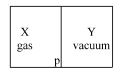
$A$ closed container is fully insulated from the outside. One half of it is filled with an ideal gas $X$ separated by a plate $P$ from the other half $Y$,which contains a vacuum as shown in the figure. When $P$ is removed,$X$ expands into $Y$. Which of the following statements is correct?
A
No work is done by $X$.
B
$X$ decreases in temperature.
C
$X$ increases in internal energy.
D
$X$ doubles in pressure.
Solution
(A) The process described is free expansion of an ideal gas into a vacuum.
Work done by a gas is given by the formula:
$W = \int P_{ext} dV$
Since the gas expands into a vacuum,the external pressure $P_{ext} = 0$.
Therefore,the work done is:
$W = \int 0 \cdot dV = 0$
Since the container is fully insulated,there is no heat exchange with the surroundings,so $Q = 0$.
According to the first law of thermodynamics,$\Delta U = Q - W = 0 - 0 = 0$.
For an ideal gas,internal energy $U$ depends only on temperature $(U \propto T)$. Since $\Delta U = 0$,the temperature remains constant $(\Delta T = 0)$.
Thus,no work is done by the gas,and its internal energy and temperature remain unchanged.
Work done by a gas is given by the formula:
$W = \int P_{ext} dV$
Since the gas expands into a vacuum,the external pressure $P_{ext} = 0$.
Therefore,the work done is:
$W = \int 0 \cdot dV = 0$
Since the container is fully insulated,there is no heat exchange with the surroundings,so $Q = 0$.
According to the first law of thermodynamics,$\Delta U = Q - W = 0 - 0 = 0$.
For an ideal gas,internal energy $U$ depends only on temperature $(U \propto T)$. Since $\Delta U = 0$,the temperature remains constant $(\Delta T = 0)$.
Thus,no work is done by the gas,and its internal energy and temperature remain unchanged.
0 likes
View Solution14
MediumMCQ
For the free expansion of a gas,which of the following is true?
A
$Q = 0, W = 0$ and $\Delta U = 0$
B
$Q = 0, W > 0$ and $\Delta U = -W$
C
$W = 0, Q > 0$ and $\Delta U = Q$
D
$W = 0, Q < 0$ and $\Delta U = 0$
Solution
(A) Free expansion is an adiabatic process where a gas expands into a vacuum.
Since the gas expands against zero external pressure $(P_{ext} = 0)$,the work done is $W = P_{ext} \Delta V = 0$.
Because the process is adiabatic and occurs in an isolated system,no heat is exchanged with the surroundings,so $Q = 0$.
According to the first law of thermodynamics,$\Delta U = Q - W$.
Substituting the values,$\Delta U = 0 - 0 = 0$.
Therefore,for free expansion,$Q = 0, W = 0$ and $\Delta U = 0$.
Since the gas expands against zero external pressure $(P_{ext} = 0)$,the work done is $W = P_{ext} \Delta V = 0$.
Because the process is adiabatic and occurs in an isolated system,no heat is exchanged with the surroundings,so $Q = 0$.
According to the first law of thermodynamics,$\Delta U = Q - W$.
Substituting the values,$\Delta U = 0 - 0 = 0$.
Therefore,for free expansion,$Q = 0, W = 0$ and $\Delta U = 0$.
0 likes
View Solution15
EasyMCQ
$Assertion :$ Thermodynamic processes in nature are irreversible.
$Reason :$ Dissipative effects cannot be eliminated.
$Reason :$ Dissipative effects cannot be eliminated.
A
If both $Assertion$ and $Reason$ are correct and the $Reason$ is a correct explanation of the $Assertion$.
B
If both $Assertion$ and $Reason$ are correct but $Reason$ is not a correct explanation of the $Assertion$.
C
If the $Assertion$ is correct but $Reason$ is incorrect.
D
If both the $Assertion$ and $Reason$ are incorrect.
Solution
(A) Most phenomena in nature are irreversible. $A$ process becomes irreversible if some energy is dissipated,typically converted into heat energy due to friction,viscosity,or other resistive forces. This is known as a dissipative effect. Since these dissipative effects cannot be completely eliminated in any real-world process,all natural thermodynamic processes are irreversible.
0 likes
View Solution16
EasyMCQ
$Assertion :$ Reversible systems are difficult to find in the real world.
$Reason :$ Most processes are dissipative in nature.
$Reason :$ Most processes are dissipative in nature.
A
If both $Assertion$ and $Reason$ are correct and the $Reason$ is a correct explanation of the $Assertion$.
B
If both $Assertion$ and $Reason$ are correct but $Reason$ is not a correct explanation of the $Assertion$.
C
If the $Assertion$ is correct but $Reason$ is incorrect.
D
If both the $Assertion$ and $Reason$ are incorrect.
Solution
(A) In any real-world process,some energy is inevitably converted into heat due to friction,viscosity,or other resistive forces,which is dissipative in nature.
Because of this energy loss,the system cannot be returned to its original state without leaving a change in the surroundings.
Therefore,all natural processes are irreversible,making perfectly reversible systems impossible to find in reality.
Thus,the $Assertion$ is correct,and the $Reason$ is the correct explanation for it.
Because of this energy loss,the system cannot be returned to its original state without leaving a change in the surroundings.
Therefore,all natural processes are irreversible,making perfectly reversible systems impossible to find in reality.
Thus,the $Assertion$ is correct,and the $Reason$ is the correct explanation for it.
0 likes
View Solution17
EasyMCQ
$Assertion :$ In free expansion of an ideal gas,the entropy increases.
$Reason :$ Entropy increases in all natural processes.
$Reason :$ Entropy increases in all natural processes.
A
If both Assertion and Reason are correct and the Reason is a correct explanation of the Assertion.
B
If both Assertion and Reason are correct but Reason is not a correct explanation of the Assertion.
C
If the Assertion is correct but Reason is incorrect.
D
If both the Assertion and Reason are incorrect.
Solution
(A) Free expansion of an ideal gas is an adiabatic process $(Q = 0)$ where no work is done $(W = 0)$. Since $\Delta U = Q - W$,the internal energy remains constant,meaning the temperature of the ideal gas does not change. However,the gas occupies a larger volume,which increases the number of available microstates. The change in entropy for an ideal gas is given by $\Delta S = nR \ln(V_f/V_i)$. Since $V_f > V_i$,$\Delta S > 0$,so entropy increases. Furthermore,all natural (irreversible) processes are accompanied by an increase in the total entropy of the universe. Thus,both the Assertion and the Reason are correct,and the Reason correctly explains the Assertion.
0 likes
View Solution18
Medium
Two cylinders $A$ and $B$ of equal capacity are connected to each other via a stopcock. $A$ contains a gas at standard temperature and pressure. $B$ is completely evacuated. The entire system is thermally insulated. The stopcock is suddenly opened. Answer the following :
$(a)$ What is the final pressure of the gas in $A$ and $B$?
$(b)$ What is the change in internal energy of the gas?
$(c)$ What is the change in the temperature of the gas?
$(d)$ Do the intermediate states of the system (before settling to the final equilibrium state) lie on its $P-V-T$ surface?
$(a)$ What is the final pressure of the gas in $A$ and $B$?
$(b)$ What is the change in internal energy of the gas?
$(c)$ What is the change in the temperature of the gas?
$(d)$ Do the intermediate states of the system (before settling to the final equilibrium state) lie on its $P-V-T$ surface?
Solution
(A) $0.5 \text{ atm}$: The volume available to the gas is doubled as soon as the stopcock between cylinders $A$ and $B$ is opened. Since volume is inversely proportional to pressure at constant temperature,the pressure will decrease to one-half of the original value. Since the initial pressure of the gas is $1 \text{ atm}$,the final pressure in each cylinder will be $0.5 \text{ atm}$.
$(b)$ Zero: The internal energy of an ideal gas depends only on its temperature. Since this is a case of free expansion in a thermally insulated system,no work is done $(W = 0)$ and no heat is exchanged $(Q = 0)$. According to the first law of thermodynamics,$\Delta U = Q - W = 0$. Thus,the internal energy does not change.
$(c)$ Zero: Since the internal energy of an ideal gas is a function of temperature only and $\Delta U = 0$,the temperature of the gas remains constant.
$(d)$ No: The given process is a case of free expansion. It is rapid and uncontrolled. The intermediate states are non-equilibrium states and do not satisfy the ideal gas equation $PV = nRT$; therefore,they do not lie on the $P-V-T$ surface.
$(b)$ Zero: The internal energy of an ideal gas depends only on its temperature. Since this is a case of free expansion in a thermally insulated system,no work is done $(W = 0)$ and no heat is exchanged $(Q = 0)$. According to the first law of thermodynamics,$\Delta U = Q - W = 0$. Thus,the internal energy does not change.
$(c)$ Zero: Since the internal energy of an ideal gas is a function of temperature only and $\Delta U = 0$,the temperature of the gas remains constant.
$(d)$ No: The given process is a case of free expansion. It is rapid and uncontrolled. The intermediate states are non-equilibrium states and do not satisfy the ideal gas equation $PV = nRT$; therefore,they do not lie on the $P-V-T$ surface.
0 likes
View Solution19
Difficult
Explain the quasi-static process.
Solution
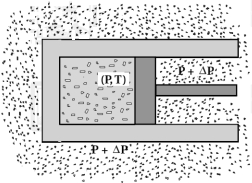
(N/A) Suppose the external pressure is suddenly reduced (by lifting the weight on the movable piston in the container). The piston will accelerate outward. During this process,the gas passes through states that are not equilibrium states. These non-equilibrium states do not have well-defined pressure and temperature. If a finite temperature difference exists between the gas and its surroundings,there will be a rapid exchange of heat during which the gas will pass through non-equilibrium states,and after some time,the gas will settle into an equilibrium state.
An ideal process in which at every stage the system is in an equilibrium state is known as a quasi-static process. Such a process is infinitely slow.
$A$ quasi-static process is obviously a hypothetical construct. In practice,processes that are sufficiently slow and do not involve accelerated motion of the piston or large temperature gradients are approximations to an ideal quasi-static process.
The system changes its variables $(P, T, V)$ so slowly that it remains in thermal and mechanical equilibrium with its surroundings throughout.
In a quasi-static process,at every stage,the difference in the pressure of the system and the external pressure is infinitesimally small.
To take a gas from the state $(P, T)$ to another state $(P', T')$ via a quasi-static process,we change the external pressure by a very small amount,allow the system to equalize its pressure with that of the surroundings,and continue the process infinitely slowly until the system achieves the pressure $P'$.
Similarly,to change the temperature,we introduce an infinitesimal temperature difference between the system and the surrounding reservoirs. By choosing reservoirs of progressively different temperatures from $T$ to $T'$,the system achieves the temperature $T'$.
In a quasi-static process,the temperature of the surrounding reservoir and the external pressure differ only infinitesimally from the temperature and pressure of the system.
An ideal process in which at every stage the system is in an equilibrium state is known as a quasi-static process. Such a process is infinitely slow.
$A$ quasi-static process is obviously a hypothetical construct. In practice,processes that are sufficiently slow and do not involve accelerated motion of the piston or large temperature gradients are approximations to an ideal quasi-static process.
The system changes its variables $(P, T, V)$ so slowly that it remains in thermal and mechanical equilibrium with its surroundings throughout.
In a quasi-static process,at every stage,the difference in the pressure of the system and the external pressure is infinitesimally small.
To take a gas from the state $(P, T)$ to another state $(P', T')$ via a quasi-static process,we change the external pressure by a very small amount,allow the system to equalize its pressure with that of the surroundings,and continue the process infinitely slowly until the system achieves the pressure $P'$.
Similarly,to change the temperature,we introduce an infinitesimal temperature difference between the system and the surrounding reservoirs. By choosing reservoirs of progressively different temperatures from $T$ to $T'$,the system achieves the temperature $T'$.
In a quasi-static process,the temperature of the surrounding reservoir and the external pressure differ only infinitesimally from the temperature and pressure of the system.
0 likes
View Solution20
Medium
Write a short note on reversible and irreversible processes.
Solution
(N/A) process is said to be reversible if it can be retraced in the opposite direction such that both the system and the surroundings return to their original states without leaving any net change in the universe. Reversible processes are ideal and cannot be fully realized in practice.
An irreversible process is one that cannot be reversed to restore the system and surroundings to their initial states. Most natural processes are irreversible. Examples include:
$(1)$ Heat transfer from a hot body to a cold body.
$(2)$ Diffusion of gases.
$(3)$ Combustion of fuel.
$(4)$ Rusting of iron.
$(5)$ Friction and viscosity effects.
Irreversibility arises primarily due to:
$(i)$ The system passing through non-equilibrium states during the process.
$(ii)$ The presence of dissipative effects like friction and viscosity,which cannot be completely eliminated.
An irreversible process is one that cannot be reversed to restore the system and surroundings to their initial states. Most natural processes are irreversible. Examples include:
$(1)$ Heat transfer from a hot body to a cold body.
$(2)$ Diffusion of gases.
$(3)$ Combustion of fuel.
$(4)$ Rusting of iron.
$(5)$ Friction and viscosity effects.
Irreversibility arises primarily due to:
$(i)$ The system passing through non-equilibrium states during the process.
$(ii)$ The presence of dissipative effects like friction and viscosity,which cannot be completely eliminated.
0 likes
View Solution21
Difficult
What is an irreversible process and what is a reversible process?
Solution
(N/A) reversible process is a process that can be reversed by means of infinitesimal changes in a property of the system without leaving any trace of change on the surroundings. It is an ideal process that occurs in equilibrium at every stage.
An irreversible process is a process that cannot be reversed to its initial state without leaving a permanent change in the surroundings. Most natural processes,such as friction,diffusion,and heat transfer across a finite temperature difference,are irreversible.
An irreversible process is a process that cannot be reversed to its initial state without leaving a permanent change in the surroundings. Most natural processes,such as friction,diffusion,and heat transfer across a finite temperature difference,are irreversible.
0 likes
View Solution22
MediumMCQ
What is a quasi-static process?
A
$A$ process that occurs infinitely fast.
B
$A$ process that occurs infinitely slowly.
C
$A$ process that occurs at constant pressure.
D
$A$ process that occurs at constant volume.
Solution
(B) quasi-static process is an idealized thermodynamic process that occurs infinitely slowly such that the system remains in thermal and mechanical equilibrium with its surroundings at every instant.
In this process,the state variables (like pressure,volume,and temperature) are well-defined at every point along the path.
Since the change is infinitesimal,the system is always infinitesimally close to an equilibrium state.
In this process,the state variables (like pressure,volume,and temperature) are well-defined at every point along the path.
Since the change is infinitesimal,the system is always infinitesimally close to an equilibrium state.
0 likes
View Solution23
EasyMCQ
Which process is acceptable in nature: a reversible or an irreversible process?
A
Reversible process
B
Irreversible process
C
Both are equally acceptable
D
None of the above
Solution
(B) In nature,all spontaneous processes are irreversible. $A$ reversible process is an idealization that cannot be perfectly achieved in the real world because it requires the system to be in equilibrium at every stage,which implies an infinitely slow process. Therefore,only irreversible processes are acceptable and occur naturally.
0 likes
View Solution24
MediumMCQ
Which thermodynamic process is quasi-static and does not dissipate energy?
A
Irreversible process
B
Reversible process
C
Adiabatic process
D
Isobaric process
Solution
(B) process is called quasi-static if it occurs infinitely slowly such that the system remains in thermodynamic equilibrium with its surroundings at every stage.
Energy dissipation (due to friction,viscosity,or turbulence) occurs in irreversible processes.
$A$ process that is both quasi-static and frictionless is defined as a reversible process.
In a reversible process,there is no loss of energy due to dissipative forces,and the system can be returned to its initial state without leaving any change in the surroundings.
Therefore,the correct answer is a reversible process.
Energy dissipation (due to friction,viscosity,or turbulence) occurs in irreversible processes.
$A$ process that is both quasi-static and frictionless is defined as a reversible process.
In a reversible process,there is no loss of energy due to dissipative forces,and the system can be returned to its initial state without leaving any change in the surroundings.
Therefore,the correct answer is a reversible process.
0 likes
View Solution25
DifficultMCQ
Name the process which is associated with dissipated energy process and reduce the efficiency.
A
Reversible process
B
Irreversible process
C
Isothermal process
D
Adiabatic process
Solution
(B) In thermodynamics,an $Irreversible$ $process$ is one that cannot be reversed to restore the system and its surroundings to their initial states without leaving any change in the universe.
Such processes are always associated with dissipative effects like friction,viscosity,or electrical resistance,which convert mechanical or useful energy into internal energy (heat).
Because some energy is dissipated as heat that cannot be converted back into work,the efficiency of any real-world engine operating through such processes is always less than that of an ideal Carnot engine.
Such processes are always associated with dissipative effects like friction,viscosity,or electrical resistance,which convert mechanical or useful energy into internal energy (heat).
Because some energy is dissipated as heat that cannot be converted back into work,the efficiency of any real-world engine operating through such processes is always less than that of an ideal Carnot engine.
0 likes
View Solution26
Medium
Is the rusting of iron a reversible process? Why?
Solution
(B) No, the rusting of iron is not a reversible process.
Rusting is a chemical change where iron reacts with oxygen and moisture to form hydrated iron $(III)$ oxide $(Fe_2O_3 \cdot nH_2O)$.
Since the chemical composition of the substance changes permanently and cannot be easily reversed to obtain the original iron, it is classified as an irreversible process.
Rusting is a chemical change where iron reacts with oxygen and moisture to form hydrated iron $(III)$ oxide $(Fe_2O_3 \cdot nH_2O)$.
Since the chemical composition of the substance changes permanently and cannot be easily reversed to obtain the original iron, it is classified as an irreversible process.
0 likes
View Solution27
MediumMCQ
$A$ balloon filled with helium ($32^{\circ} C$ and $1.7 \; atm$) bursts. Immediately afterwards,the expansion of helium can be considered as:
A
Irreversible isothermal
B
Irreversible adiabatic
C
Reversible adiabatic
D
Reversible isothermal
Solution
(B) The bursting of a balloon is a sudden and spontaneous process,which makes it irreversible.
Since the process occurs very rapidly,there is no sufficient time for heat exchange with the surroundings $(dQ = 0)$.
Therefore,the expansion of helium during the bursting of the balloon is an irreversible adiabatic process.
Since the process occurs very rapidly,there is no sufficient time for heat exchange with the surroundings $(dQ = 0)$.
Therefore,the expansion of helium during the bursting of the balloon is an irreversible adiabatic process.
0 likes
View Solution28
EasyMCQ
Two cylinders $A$ and $B$ of equal capacity are connected to each other via a stop cock. Cylinder $A$ contains an ideal gas at standard temperature and pressure. Cylinder $B$ is completely evacuated. The entire system is thermally insulated. The stop cock is suddenly opened. The process is:
A
isobaric
B
isothermal
C
adiabatic
D
isochoric
Solution
(C) The process described is known as free expansion,where a gas expands into a vacuum.
Since the system is thermally insulated,there is no heat exchange with the surroundings,meaning $Q = 0$.
Because the gas expands into a vacuum,it does no work against any external pressure,meaning $W = 0$.
According to the first law of thermodynamics,$\Delta U = Q - W$. Since $Q = 0$ and $W = 0$,the change in internal energy $\Delta U = 0$.
For an ideal gas,internal energy depends only on temperature. Therefore,if $\Delta U = 0$,the temperature remains constant.
However,the defining characteristic of a process where $Q = 0$ is that it is an adiabatic process.
Since the system is thermally insulated,there is no heat exchange with the surroundings,meaning $Q = 0$.
Because the gas expands into a vacuum,it does no work against any external pressure,meaning $W = 0$.
According to the first law of thermodynamics,$\Delta U = Q - W$. Since $Q = 0$ and $W = 0$,the change in internal energy $\Delta U = 0$.
For an ideal gas,internal energy depends only on temperature. Therefore,if $\Delta U = 0$,the temperature remains constant.
However,the defining characteristic of a process where $Q = 0$ is that it is an adiabatic process.
0 likes
View Solution29
DifficultMCQ
$A$ container with rigid walls is covered with perfectly insulating material. The container is divided into two parts by a partition. One part contains a gas while the other is fully evacuated (vacuum). The partition is suddenly removed. The gas rushes to fill the entire volume and comes to equilibrium after a little time. If the gas is not ideal,then
A
the initial internal energy of the gas equals its final internal energy
B
the initial temperature of the gas equals its final temperature
C
the initial pressure of the gas equals its final pressure
D
the initial entropy of the gas equals its final entropy
Solution
(A) The expansion occurs in a vacuum,so the work done by the expanding gas is $\Delta W = 0$.
The container is perfectly insulated,so the heat exchanged with the surroundings is $\Delta Q = 0$.
According to the first law of thermodynamics,$\Delta Q = \Delta U + \Delta W$.
Substituting the values,we get $0 = \Delta U + 0$,which implies $\Delta U = 0$.
Therefore,$U_i = U_f$,meaning the initial and final internal energies of the gas are equal.
Since the gas is not ideal,the expansion results in an increase in the intermolecular potential energy. Because the total internal energy remains constant,this increase in potential energy leads to a decrease in the kinetic energy of the molecules,which consequently causes the temperature of the gas to decrease.
The container is perfectly insulated,so the heat exchanged with the surroundings is $\Delta Q = 0$.
According to the first law of thermodynamics,$\Delta Q = \Delta U + \Delta W$.
Substituting the values,we get $0 = \Delta U + 0$,which implies $\Delta U = 0$.
Therefore,$U_i = U_f$,meaning the initial and final internal energies of the gas are equal.
Since the gas is not ideal,the expansion results in an increase in the intermolecular potential energy. Because the total internal energy remains constant,this increase in potential energy leads to a decrease in the kinetic energy of the molecules,which consequently causes the temperature of the gas to decrease.
0 likes
View Solution30
EasyMCQ
$A$ process can be reversible if
A
It is quasi-static
B
Non-dissipative
C
Both $(a)$ and $(b)$
D
Neither $(a)$ nor $(b)$
Solution
(C) The correct answer is $(c)$.
$A$ process is considered reversible if it can be reversed without leaving any trace on the surroundings. For a process to be reversible,it must satisfy two main conditions:
$1$. It must be quasi-static: The process must occur infinitely slowly so that the system remains in thermodynamic equilibrium at every stage.
$2$. It must be non-dissipative: There should be no dissipative forces such as friction,viscosity,or electrical resistance,which would cause an irreversible loss of energy as heat.
$A$ process is considered reversible if it can be reversed without leaving any trace on the surroundings. For a process to be reversible,it must satisfy two main conditions:
$1$. It must be quasi-static: The process must occur infinitely slowly so that the system remains in thermodynamic equilibrium at every stage.
$2$. It must be non-dissipative: There should be no dissipative forces such as friction,viscosity,or electrical resistance,which would cause an irreversible loss of energy as heat.
0 likes
View Solution31
MediumMCQ
Given below are two statements. One is labelled as Assertion $(A)$ and the other is labelled as Reason $(R)$.
Assertion $(A) :$ In an insulated container,a gas is adiabatically shrunk to half of its initial volume. The temperature of the gas decreases.
Reason $(R) :$ Free expansion of an ideal gas is an irreversible and an adiabatic process.
In the light of the above statement,choose the correct answer from the options given below :
Assertion $(A) :$ In an insulated container,a gas is adiabatically shrunk to half of its initial volume. The temperature of the gas decreases.
Reason $(R) :$ Free expansion of an ideal gas is an irreversible and an adiabatic process.
In the light of the above statement,choose the correct answer from the options given below :
A
Both $(A)$ and $(R)$ are true and $(R)$ is the correct explanation of $(A)$
B
$(A)$ is true but $(R)$ is false
C
$(A)$ is false but $(R)$ is true
D
Both $(A)$ and $(R)$ are true but $(R)$ is $\text{NOT}$ the correct explanation of $(A)$
Solution
(C) For an adiabatic process,the relation between temperature and volume is given by $T_1 V_1^{\gamma-1} = T_2 V_2^{\gamma-1}$.
When a gas is shrunk to half its initial volume,$V_2 = V_1 / 2$.
Substituting this,$T_2 = T_1 (V_1 / V_2)^{\gamma-1} = T_1 (2)^{\gamma-1}$.
Since $\gamma > 1$ for all gases,$T_2 > T_1$,meaning the temperature increases,not decreases. Thus,Assertion $(A)$ is false.
Free expansion of an ideal gas occurs against zero external pressure $(P_{ext} = 0)$,so no work is done $(W = 0)$. Since the container is insulated,$Q = 0$. By the first law of thermodynamics,$\Delta U = Q - W = 0$,implying the temperature remains constant. This is an irreversible adiabatic process. Thus,Reason $(R)$ is true.
When a gas is shrunk to half its initial volume,$V_2 = V_1 / 2$.
Substituting this,$T_2 = T_1 (V_1 / V_2)^{\gamma-1} = T_1 (2)^{\gamma-1}$.
Since $\gamma > 1$ for all gases,$T_2 > T_1$,meaning the temperature increases,not decreases. Thus,Assertion $(A)$ is false.
Free expansion of an ideal gas occurs against zero external pressure $(P_{ext} = 0)$,so no work is done $(W = 0)$. Since the container is insulated,$Q = 0$. By the first law of thermodynamics,$\Delta U = Q - W = 0$,implying the temperature remains constant. This is an irreversible adiabatic process. Thus,Reason $(R)$ is true.
0 likes
View Solution32
EasyMCQ
In case of free expansion, which one of the following statements is $\underline{\text{WRONG}}$?
A
It is an instantaneous change.
B
The system is not in thermodynamic equilibrium.
C
Free expansion can be plotted on a $p-V$ diagram.
D
It is an uncontrolled change.
Solution
(C) Free expansion is an adiabatic process where work done $W = 0$ and internal energy change $\Delta U = 0$.
Because the process is rapid and uncontrolled, the system does not pass through a series of equilibrium states.
Since a $p-V$ diagram requires the system to be in thermodynamic equilibrium at every point to define pressure and volume, free expansion cannot be plotted as a continuous path on a $p-V$ diagram.
Therefore, the statement that free expansion can be plotted on a $p-V$ diagram is incorrect.
Because the process is rapid and uncontrolled, the system does not pass through a series of equilibrium states.
Since a $p-V$ diagram requires the system to be in thermodynamic equilibrium at every point to define pressure and volume, free expansion cannot be plotted as a continuous path on a $p-V$ diagram.
Therefore, the statement that free expansion can be plotted on a $p-V$ diagram is incorrect.
0 likes
View Solution33
EasyMCQ
In a thermodynamic process of uncontrolled change satisfying the equation $Q=W=0$,where $Q$ is heat supplied and $W$ is work done,the process is:
A
Free expansion
B
Cyclic
C
Isochoric
D
Isothermal
Solution
(A) i. Free expansions are adiabatic processes where there is no exchange of heat between the system and its environment,so $Q=0$.
ii. In a free expansion,the gas expands into a vacuum,meaning there is no external pressure to push against,so no work is done by the system,$W=0$.
iii. According to the first law of thermodynamics,$\Delta U = Q - W$. Since $Q=0$ and $W=0$,the change in internal energy $\Delta U = 0$.
iv. An example is the sudden rupture of a balloon or a tire,where gas rushes out into the surroundings without performing work on a piston or boundary.
v. $A$ free expansion is an uncontrolled,irreversible,and instantaneous change where the system is not in thermodynamic equilibrium during the process,and it cannot be represented as a continuous path on a $p-V$ diagram.
ii. In a free expansion,the gas expands into a vacuum,meaning there is no external pressure to push against,so no work is done by the system,$W=0$.
iii. According to the first law of thermodynamics,$\Delta U = Q - W$. Since $Q=0$ and $W=0$,the change in internal energy $\Delta U = 0$.
iv. An example is the sudden rupture of a balloon or a tire,where gas rushes out into the surroundings without performing work on a piston or boundary.
v. $A$ free expansion is an uncontrolled,irreversible,and instantaneous change where the system is not in thermodynamic equilibrium during the process,and it cannot be represented as a continuous path on a $p-V$ diagram.
0 likes
View Solution34
EasyMCQ
Which of the following is $NOT$ a reversible process?
A
Melting of ice
B
Conduction of heat
C
Isothermal expansion of gas
D
Adiabatic expansion of gas
Solution
(B) reversible process is one that can be reversed without leaving any trace on the surroundings.
Melting of ice,isothermal expansion,and adiabatic expansion (if performed quasi-statically) can be considered reversible processes.
Conduction of heat is an irreversible process because it occurs due to a finite temperature difference between two bodies.
Heat always flows spontaneously from a higher temperature to a lower temperature,and this process cannot be reversed without external work,thus increasing the entropy of the universe.
Melting of ice,isothermal expansion,and adiabatic expansion (if performed quasi-statically) can be considered reversible processes.
Conduction of heat is an irreversible process because it occurs due to a finite temperature difference between two bodies.
Heat always flows spontaneously from a higher temperature to a lower temperature,and this process cannot be reversed without external work,thus increasing the entropy of the universe.
0 likes
View Solution35
EasyMCQ
There is no change in internal energy of an ideal gas when it undergoes
A
isothermal expansion
B
adiabatic expansion
C
free expansion
D
isobaric expansion
Solution
(C) In free expansion,an ideal gas is allowed to expand into a vacuum.
Since the expansion occurs against zero external pressure $(P_{ext} = 0)$,the work done by the gas is $W = P_{ext} \Delta V = 0$.
Additionally,free expansion is typically considered adiabatic $(Q = 0)$.
According to the first law of thermodynamics,$\Delta U = Q - W$.
Substituting the values,$\Delta U = 0 - 0 = 0$.
Therefore,there is no change in the internal energy of an ideal gas during free expansion.
Since the expansion occurs against zero external pressure $(P_{ext} = 0)$,the work done by the gas is $W = P_{ext} \Delta V = 0$.
Additionally,free expansion is typically considered adiabatic $(Q = 0)$.
According to the first law of thermodynamics,$\Delta U = Q - W$.
Substituting the values,$\Delta U = 0 - 0 = 0$.
Therefore,there is no change in the internal energy of an ideal gas during free expansion.
0 likes
View Solution36
EasyMCQ
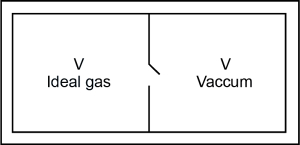
Consider the given diagram. An ideal gas is contained in a chamber (left) of volume $V$ and is at an absolute temperature $T$. It is allowed to rush freely into the right chamber of volume $V$ which is initially vacuum. The whole system is thermally isolated. What will be the final temperature once the equilibrium has been attained?
A
$T$
B
$\frac{T}{2}$
C
$2T$
D
$\frac{T}{4}$
Solution
(A) This process is known as free expansion of an ideal gas.
Since the system is thermally isolated,there is no heat exchange with the surroundings,so $Q = 0$.
Since the gas expands into a vacuum,there is no external pressure against which the gas does work,so the work done $W = 0$.
According to the first law of thermodynamics,$\Delta U = Q - W$.
Since $Q = 0$ and $W = 0$,the change in internal energy $\Delta U = 0$.
For an ideal gas,the internal energy depends only on its temperature $(U \propto T)$.
Since $\Delta U = 0$,the temperature of the ideal gas remains constant.
Therefore,the final temperature attained at equilibrium will be $T$.
Since the system is thermally isolated,there is no heat exchange with the surroundings,so $Q = 0$.
Since the gas expands into a vacuum,there is no external pressure against which the gas does work,so the work done $W = 0$.
According to the first law of thermodynamics,$\Delta U = Q - W$.
Since $Q = 0$ and $W = 0$,the change in internal energy $\Delta U = 0$.
For an ideal gas,the internal energy depends only on its temperature $(U \propto T)$.
Since $\Delta U = 0$,the temperature of the ideal gas remains constant.
Therefore,the final temperature attained at equilibrium will be $T$.
0 likes
View SolutionThermodynamics — Reversible and Irreversible process , Free Expansion · Frequently Asked Questions
1Are these Thermodynamics questions useful for JEE and NEET?
Yes. All questions in this section are mapped to JEE Main and NEET exam patterns. Previous year questions from JEE Main, NEET, GUJCET and state-level exams are included with full solutions.
2Can I switch to Hindi or Gujarati for these questions?
Yes. Use the language tabs in the hero section or the sidebar to view the same questions and solutions in English, Hindi or Gujarati.
3How do I generate a question paper from this subtopic?
Use the Vedclass Exam Paper Generator — select the chapter and subtopic, set difficulty, and generate Sets A, B, C, D automatically. First 3 chapters of every subject are free.
Vedclass Products
For Students
Vedclass Test Series
Mock tests in real JEE/NEET style with performance analysis. 5-day free trial.
Start Free TrialFor Teachers
Exam Paper Generator
Generate Set A/B/C/D papers from this chapter in 2 minutes. 3 chapters free.
Try FreeFor Institutes
Online Exam Module
Live online exams with unlimited students, 360° analytics & white-label branding.
See DemoFor Teachers & Institutes
Generate a Thermodynamics Exam Paper in 2 Minutes
Select subtopic & difficulty — Sets A, B, C, D auto-generated with No Repeat logic.
First 3 chapters of every subject are free — no payment required.