
A English
Mix Example - System of Particles and Rotational Motion Questions in English
Class 11 Physics · System of Particles and Rotational Motion · Mix Example - System of Particles and Rotational Motion
262+
Questions
English
Language
100%
With Solutions
Showing 50 of 262 questions in English
51
DifficultMCQ
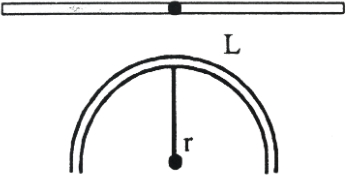
$A$ thin uniform rod of mass $M$ and length $L$ has its moment of inertia $I_1$ about its perpendicular bisector. The rod is bent in the form of a semicircular arc. Now its moment of inertia through the centre of the semicircular arc and perpendicular to its plane is $I_2$. The ratio of $I_1 : I_2$ will be
A
$< 1$
B
$> 1$
C
$= 1$
D
can't be said
Solution
(A) The moment of inertia of a thin uniform rod of mass $M$ and length $L$ about its perpendicular bisector is given by:
$I_1 = \frac{ML^2}{12} \quad ...(1)$
When the rod is bent into a semicircular arc,its length $L$ becomes the circumference of a semicircle of radius $r$,so $L = \pi r$,which gives $r = \frac{L}{\pi}$.
The moment of inertia of a semicircular arc of mass $M$ and radius $r$ about an axis passing through its centre and perpendicular to its plane is:
$I_2 = Mr^2$
Substituting $r = \frac{L}{\pi}$:
$I_2 = M \left(\frac{L}{\pi}\right)^2 = \frac{ML^2}{\pi^2} \quad ...(2)$
Now,calculating the ratio $I_1 : I_2$:
$\frac{I_1}{I_2} = \frac{ML^2/12}{ML^2/\pi^2} = \frac{\pi^2}{12}$
Since $\pi^2 \approx 9.87$,we have $\frac{\pi^2}{12} \approx \frac{9.87}{12} < 1$.
Therefore,the ratio $I_1 : I_2 < 1$.
$I_1 = \frac{ML^2}{12} \quad ...(1)$
When the rod is bent into a semicircular arc,its length $L$ becomes the circumference of a semicircle of radius $r$,so $L = \pi r$,which gives $r = \frac{L}{\pi}$.
The moment of inertia of a semicircular arc of mass $M$ and radius $r$ about an axis passing through its centre and perpendicular to its plane is:
$I_2 = Mr^2$
Substituting $r = \frac{L}{\pi}$:
$I_2 = M \left(\frac{L}{\pi}\right)^2 = \frac{ML^2}{\pi^2} \quad ...(2)$
Now,calculating the ratio $I_1 : I_2$:
$\frac{I_1}{I_2} = \frac{ML^2/12}{ML^2/\pi^2} = \frac{\pi^2}{12}$
Since $\pi^2 \approx 9.87$,we have $\frac{\pi^2}{12} \approx \frac{9.87}{12} < 1$.
Therefore,the ratio $I_1 : I_2 < 1$.
0 likes
View Solution52
DifficultMCQ
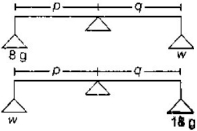
$A$ body weighs $6$ g when placed in one pan and $24$ g when placed on the other pan of a false balance. If the beam is horizontal when both the pans are empty,the true weight of the body is ....... g.
A
$13$
B
$12$
C
$15.5$
D
$15$
Solution
(B) Let the true weight of the body be $w$ and the lengths of the two arms of the balance be $p$ and $q$.
Case $1$: When the body is placed in the left pan,it is balanced by a weight of $6$ g in the right pan.
By the principle of moments,$w \times p = 6 \times q$
$\Rightarrow \frac{p}{q} = \frac{6}{w} \quad ...(i)$
Case $2$: When the body is placed in the right pan,it is balanced by a weight of $24$ g in the left pan.
By the principle of moments,$24 \times p = w \times q$
$\Rightarrow \frac{p}{q} = \frac{w}{24} \quad ...(ii)$
Equating $(i)$ and $(ii)$:
$\frac{6}{w} = \frac{w}{24}$
$w^2 = 6 \times 24 = 144$
$w = \sqrt{144} = 12$ g.
Thus,the true weight of the body is $12$ g.
Case $1$: When the body is placed in the left pan,it is balanced by a weight of $6$ g in the right pan.
By the principle of moments,$w \times p = 6 \times q$
$\Rightarrow \frac{p}{q} = \frac{6}{w} \quad ...(i)$
Case $2$: When the body is placed in the right pan,it is balanced by a weight of $24$ g in the left pan.
By the principle of moments,$24 \times p = w \times q$
$\Rightarrow \frac{p}{q} = \frac{w}{24} \quad ...(ii)$
Equating $(i)$ and $(ii)$:
$\frac{6}{w} = \frac{w}{24}$
$w^2 = 6 \times 24 = 144$
$w = \sqrt{144} = 12$ g.
Thus,the true weight of the body is $12$ g.
0 likes
View Solution53
DifficultMCQ
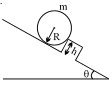
Find the minimum height $h$ of the obstacle so that the sphere of radius $R$ can stay in equilibrium on an inclined plane of angle $\theta$.
A
$\frac{R}{1 + \cos \theta}$
B
$\frac{R}{1 + \sin \theta}$
C
$R(1 - \sin \theta)$
D
$R(1 - \cos \theta)$
Solution
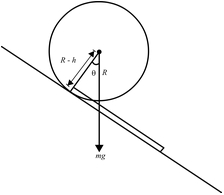
(D) For the sphere to be in equilibrium,the line of action of its weight $(mg)$ must pass through or behind the edge of the obstacle to prevent it from toppling over.
Consider the triangle formed by the center of the sphere,the point of contact with the inclined plane,and the edge of the obstacle.
The vertical distance from the center of the sphere to the horizontal level of the edge is $R \cos \theta$.
The height of the center of the sphere from the inclined plane is $R$.
Therefore,the vertical height of the edge relative to the inclined plane is $h = R - R \cos \theta$.
Thus,$h = R(1 - \cos \theta)$.
Consider the triangle formed by the center of the sphere,the point of contact with the inclined plane,and the edge of the obstacle.
The vertical distance from the center of the sphere to the horizontal level of the edge is $R \cos \theta$.
The height of the center of the sphere from the inclined plane is $R$.
Therefore,the vertical height of the edge relative to the inclined plane is $h = R - R \cos \theta$.
Thus,$h = R(1 - \cos \theta)$.
0 likes
View Solution54
AdvancedMCQ
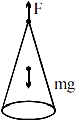
$A$ uniform rod of mass $m$ and length $l$ hinged at its end is released from rest when it is in the horizontal position. The normal reaction at the hinge when the rod becomes vertical is:
A
$\frac{mg}{2}$
B
$\frac{3mg}{2}$
C
$\frac{5mg}{2}$
D
$2mg$
Solution
(C) By the principle of conservation of energy,the loss in potential energy $(P.E.)$ equals the gain in rotational kinetic energy $(K.E.)$ as the rod falls from horizontal to vertical position.
Loss in $P.E. = mg \frac{l}{2}$.
Gain in $K.E. = \frac{1}{2} I \omega^2$,where $I = \frac{ml^2}{3}$ is the moment of inertia about the hinge.
Equating them: $mg \frac{l}{2} = \frac{1}{2} (\frac{ml^2}{3}) \omega^2$.
Simplifying gives: $mg l = \frac{ml^2}{3} \omega^2$,which leads to $\omega^2 = \frac{3g}{l}$.
At the vertical position,the net force acting towards the hinge provides the centripetal force for the center of mass of the rod:
$F - mg = m a_c = m (\frac{l}{2}) \omega^2$.
Substituting $\omega^2$: $F = mg + m (\frac{l}{2}) (\frac{3g}{l}) = mg + \frac{3mg}{2} = \frac{5mg}{2}$.
Loss in $P.E. = mg \frac{l}{2}$.
Gain in $K.E. = \frac{1}{2} I \omega^2$,where $I = \frac{ml^2}{3}$ is the moment of inertia about the hinge.
Equating them: $mg \frac{l}{2} = \frac{1}{2} (\frac{ml^2}{3}) \omega^2$.
Simplifying gives: $mg l = \frac{ml^2}{3} \omega^2$,which leads to $\omega^2 = \frac{3g}{l}$.
At the vertical position,the net force acting towards the hinge provides the centripetal force for the center of mass of the rod:
$F - mg = m a_c = m (\frac{l}{2}) \omega^2$.
Substituting $\omega^2$: $F = mg + m (\frac{l}{2}) (\frac{3g}{l}) = mg + \frac{3mg}{2} = \frac{5mg}{2}$.
0 likes
View Solution55
DifficultMCQ
$A$ rod is hinged at its centre and rotated by applying a constant torque starting from rest. The power developed by the external torque as a function of time is:
A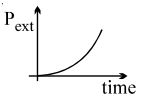
B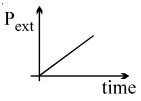
C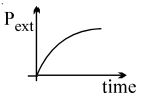
D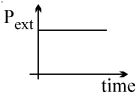
Solution
(B) The power $P$ developed by a torque $\tau$ is given by $P = \tau \omega$,where $\omega$ is the angular velocity.
Since the rod starts from rest,the initial angular velocity $\omega_0 = 0$.
Given a constant torque $\tau$,the angular acceleration $\alpha$ is constant,where $\alpha = \frac{\tau}{I}$ ($I$ is the moment of inertia).
The angular velocity at time $t$ is given by $\omega = \omega_0 + \alpha t = 0 + \left(\frac{\tau}{I}\right) t = \frac{\tau}{I} t$.
Substituting this into the power equation: $P = \tau \left(\frac{\tau}{I} t\right) = \frac{\tau^2}{I} t$.
Since $\tau$ and $I$ are constants,$P \propto t$.
This represents a straight line passing through the origin,which corresponds to the graph in option $B$.
Since the rod starts from rest,the initial angular velocity $\omega_0 = 0$.
Given a constant torque $\tau$,the angular acceleration $\alpha$ is constant,where $\alpha = \frac{\tau}{I}$ ($I$ is the moment of inertia).
The angular velocity at time $t$ is given by $\omega = \omega_0 + \alpha t = 0 + \left(\frac{\tau}{I}\right) t = \frac{\tau}{I} t$.
Substituting this into the power equation: $P = \tau \left(\frac{\tau}{I} t\right) = \frac{\tau^2}{I} t$.
Since $\tau$ and $I$ are constants,$P \propto t$.
This represents a straight line passing through the origin,which corresponds to the graph in option $B$.
0 likes
View Solution56
MediumMCQ
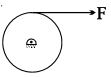
$A$ pulley is hinged at the centre and a massless thread is wrapped around it. The thread is pulled with a constant force $F$ starting from rest. As the time increases,
A
its angular velocity increases,but force on hinge remains constant
B
its angular velocity remains same,but force on hinge increases
C
its angular velocity increases and force on hinge increases
D
its angular velocity remains same and force on hinge is constant
Solution
(A) $1$. The constant force $F$ applied at the rim of the pulley creates a constant torque $\tau = F \cdot R$ about the hinge,where $R$ is the radius of the pulley.
$2$. According to the rotational analogue of Newton's second law,$\tau = I \alpha$,where $I$ is the moment of inertia and $\alpha$ is the angular acceleration. Since $\tau$ is constant,$\alpha$ is also constant.
$3$. Starting from rest,the angular velocity $\omega$ at time $t$ is given by $\omega = \alpha t$. As $t$ increases,$\omega$ increases linearly.
$4$. To maintain equilibrium in the translational direction,the hinge must exert a reaction force $F_h$ to balance the applied force $F$. Since the pulley is not moving translationally,the net force on the pulley must be zero. Therefore,the hinge force $F_h$ must be equal and opposite to the applied force $F$ at all times. Thus,the force on the hinge remains constant.
$2$. According to the rotational analogue of Newton's second law,$\tau = I \alpha$,where $I$ is the moment of inertia and $\alpha$ is the angular acceleration. Since $\tau$ is constant,$\alpha$ is also constant.
$3$. Starting from rest,the angular velocity $\omega$ at time $t$ is given by $\omega = \alpha t$. As $t$ increases,$\omega$ increases linearly.
$4$. To maintain equilibrium in the translational direction,the hinge must exert a reaction force $F_h$ to balance the applied force $F$. Since the pulley is not moving translationally,the net force on the pulley must be zero. Therefore,the hinge force $F_h$ must be equal and opposite to the applied force $F$ at all times. Thus,the force on the hinge remains constant.
0 likes
View Solution57
AdvancedMCQ
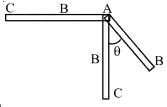
$A$ rod hinged at one end is released from the horizontal position as shown in the figure. When it becomes vertical,its lower half separates without exerting any reaction at the breaking point. Then the maximum angle '$\theta$' made by the hinged upper half with the vertical is ......... $^o$.
A
$30$
B
$45$
C
$60$
D
$90$
Solution
(C) Let the length of the rod be $l$ and its mass be $m$. When the rod is released from the horizontal position,by the conservation of mechanical energy,the potential energy lost equals the rotational kinetic energy gained when it reaches the vertical position:
$mg(l/2) = (1/2)I\omega^2$
Since $I = ml^2/3$ for a rod hinged at one end,we have:
$mgl/2 = (1/2)(ml^2/3)\omega^2$
$\omega^2 = 3g/l$
When the rod reaches the vertical position,the lower half (mass $m/2$) separates. The upper half (mass $m/2$) remains hinged at the top and continues to rotate with the same angular velocity $\omega = \sqrt{3g/l}$.
Now,applying the work-energy theorem to the upper half as it swings up to an angle $\theta$ with the vertical:
The change in kinetic energy is $\Delta K = K_f - K_i = 0 - (1/2)I_{upper}\omega^2$,where $I_{upper} = (m/2)(l/2)^2/3 = ml^2/24$.
The work done by gravity is $W_g = -(m/2)g(h_{cm,f} - h_{cm,i}) = -(m/2)g((l/4) - (l/4)\cos\theta) = -(mgl/8)(1 - \cos\theta)$.
Equating $W_g = \Delta K$:
$-(mgl/8)(1 - \cos\theta) = -(1/2)(ml^2/24)(3g/l)$
$(mgl/8)(1 - \cos\theta) = (mgl/16)$
$1 - \cos\theta = 1/2$
$\cos\theta = 1/2$
$\theta = 60^o$.
$mg(l/2) = (1/2)I\omega^2$
Since $I = ml^2/3$ for a rod hinged at one end,we have:
$mgl/2 = (1/2)(ml^2/3)\omega^2$
$\omega^2 = 3g/l$
When the rod reaches the vertical position,the lower half (mass $m/2$) separates. The upper half (mass $m/2$) remains hinged at the top and continues to rotate with the same angular velocity $\omega = \sqrt{3g/l}$.
Now,applying the work-energy theorem to the upper half as it swings up to an angle $\theta$ with the vertical:
The change in kinetic energy is $\Delta K = K_f - K_i = 0 - (1/2)I_{upper}\omega^2$,where $I_{upper} = (m/2)(l/2)^2/3 = ml^2/24$.
The work done by gravity is $W_g = -(m/2)g(h_{cm,f} - h_{cm,i}) = -(m/2)g((l/4) - (l/4)\cos\theta) = -(mgl/8)(1 - \cos\theta)$.
Equating $W_g = \Delta K$:
$-(mgl/8)(1 - \cos\theta) = -(1/2)(ml^2/24)(3g/l)$
$(mgl/8)(1 - \cos\theta) = (mgl/16)$
$1 - \cos\theta = 1/2$
$\cos\theta = 1/2$
$\theta = 60^o$.
0 likes
View Solution58
DifficultMCQ
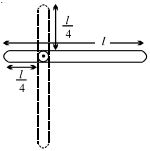
For the pivoted slender rod of length $l$ as shown in the figure,the angular velocity as the bar reaches the vertical position after being released from the horizontal position is:
A
$\sqrt {\frac{g}{l}} $
B
$\sqrt {\frac{24g}{19l}} $
C
$\sqrt {\frac{24g}{7l}} $
D
$\sqrt {\frac{4g}{l}} $
Solution
(C) The rod is pivoted at a distance $l/4$ from one end. The distance of the pivot from the center of mass $(CM)$ is $d = |l/2 - l/4| = l/4$.
By the parallel axis theorem,the moment of inertia $I$ of the rod about the pivot is:
$I = I_{CM} + md^2 = \frac{ml^2}{12} + m\left(\frac{l}{4}\right)^2 = \frac{ml^2}{12} + \frac{ml^2}{16} = \frac{4ml^2 + 3ml^2}{48} = \frac{7ml^2}{48}$.
When the rod is released from the horizontal position and reaches the vertical position,the center of mass drops by a vertical distance $h = l/4$.
By the law of conservation of energy,the loss in potential energy equals the gain in rotational kinetic energy:
$mgh = \frac{1}{2} I \omega^2$
$mg\left(\frac{l}{4}\right) = \frac{1}{2} \left(\frac{7ml^2}{48}\right) \omega^2$
$\frac{mgl}{4} = \frac{7ml^2}{96} \omega^2$
$\omega^2 = \frac{mgl}{4} \cdot \frac{96}{7ml^2} = \frac{24g}{7l}$
$\omega = \sqrt{\frac{24g}{7l}}$.
By the parallel axis theorem,the moment of inertia $I$ of the rod about the pivot is:
$I = I_{CM} + md^2 = \frac{ml^2}{12} + m\left(\frac{l}{4}\right)^2 = \frac{ml^2}{12} + \frac{ml^2}{16} = \frac{4ml^2 + 3ml^2}{48} = \frac{7ml^2}{48}$.
When the rod is released from the horizontal position and reaches the vertical position,the center of mass drops by a vertical distance $h = l/4$.
By the law of conservation of energy,the loss in potential energy equals the gain in rotational kinetic energy:
$mgh = \frac{1}{2} I \omega^2$
$mg\left(\frac{l}{4}\right) = \frac{1}{2} \left(\frac{7ml^2}{48}\right) \omega^2$
$\frac{mgl}{4} = \frac{7ml^2}{96} \omega^2$
$\omega^2 = \frac{mgl}{4} \cdot \frac{96}{7ml^2} = \frac{24g}{7l}$
$\omega = \sqrt{\frac{24g}{7l}}$.
0 likes
View Solution59
DifficultMCQ
$A$ block of mass $m$ is attached to a pulley disc of equal mass $m$ and radius $r$ by means of a slack string as shown. The pulley is hinged about its centre on a horizontal table and the block is projected with an initial velocity of $5\, m/s$. Its velocity when the string becomes taut will be
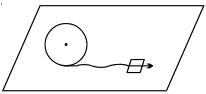
A
$3\, m/s$
B
$2.5\, m/s$
C
$5/3\, m/s$
D
$10/3\, m/s$
Solution
(D) When the string becomes taut,an impulsive tension $T$ acts on both the block and the disc for a very short time interval $\Delta t$.
For the block,the impulse-momentum theorem gives: $-T \Delta t = m v - m v_0$,where $v_0 = 5\, m/s$ is the initial velocity and $v$ is the final velocity.
For the disc,the angular impulse-angular momentum theorem about the hinge gives: $(T \cdot r) \Delta t = I \omega$,where $I = \frac{1}{2} m r^2$ is the moment of inertia of the disc.
Since the string is taut,the tangential velocity of the disc at the rim must equal the velocity of the block,so $v = \omega r$,or $\omega = v/r$.
Substituting $\omega$ into the disc equation: $T \Delta t = \frac{I \omega}{r} = \frac{(\frac{1}{2} m r^2) (v/r)}{r} = \frac{1}{2} m v$.
Substituting $T \Delta t$ into the block equation: $-(\frac{1}{2} m v) = m v - m v_0$.
Rearranging the terms: $m v_0 = m v + \frac{1}{2} m v = \frac{3}{2} m v$.
Solving for $v$: $v = \frac{2}{3} v_0 = \frac{2}{3} \times 5 = \frac{10}{3}\, m/s$.
For the block,the impulse-momentum theorem gives: $-T \Delta t = m v - m v_0$,where $v_0 = 5\, m/s$ is the initial velocity and $v$ is the final velocity.
For the disc,the angular impulse-angular momentum theorem about the hinge gives: $(T \cdot r) \Delta t = I \omega$,where $I = \frac{1}{2} m r^2$ is the moment of inertia of the disc.
Since the string is taut,the tangential velocity of the disc at the rim must equal the velocity of the block,so $v = \omega r$,or $\omega = v/r$.
Substituting $\omega$ into the disc equation: $T \Delta t = \frac{I \omega}{r} = \frac{(\frac{1}{2} m r^2) (v/r)}{r} = \frac{1}{2} m v$.
Substituting $T \Delta t$ into the block equation: $-(\frac{1}{2} m v) = m v - m v_0$.
Rearranging the terms: $m v_0 = m v + \frac{1}{2} m v = \frac{3}{2} m v$.
Solving for $v$: $v = \frac{2}{3} v_0 = \frac{2}{3} \times 5 = \frac{10}{3}\, m/s$.
0 likes
View Solution60
MediumMCQ
$A$ man is sitting in a smooth groove on a horizontal circular table at the edge by holding a rope joined to the centre. The moment of inertia of the table is $I$. The mass of the man is $M$. The man now pulls the rope so that he comes to the centre. The angular velocity of the table:
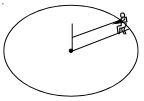
A
must increase
B
may increase
C
must decrease
D
may decrease
Solution
(A) The system consists of the table and the man. Since the table is on a smooth surface and there are no external torques acting on the system about the axis of rotation, the angular momentum $L$ of the system is conserved.
Initially, the man is at the edge of the table at a distance $R$ from the center. The initial moment of inertia of the system is $I_{initial} = I + MR^2$.
When the man moves to the center, his distance from the axis of rotation becomes zero. The final moment of inertia of the system is $I_{final} = I + M(0)^2 = I$.
Since $I_{final} < I_{initial}$, and the angular momentum $L = I\omega$ is conserved, we have $I_{initial}\omega_{initial} = I_{final}\omega_{final}$.
Therefore, $\omega_{final} = \frac{I_{initial}}{I_{final}} \omega_{initial}$.
Since $I_{initial} > I_{final}$, it follows that $\omega_{final} > \omega_{initial}$.
Thus, the angular velocity of the table must increase.
Initially, the man is at the edge of the table at a distance $R$ from the center. The initial moment of inertia of the system is $I_{initial} = I + MR^2$.
When the man moves to the center, his distance from the axis of rotation becomes zero. The final moment of inertia of the system is $I_{final} = I + M(0)^2 = I$.
Since $I_{final} < I_{initial}$, and the angular momentum $L = I\omega$ is conserved, we have $I_{initial}\omega_{initial} = I_{final}\omega_{final}$.
Therefore, $\omega_{final} = \frac{I_{initial}}{I_{final}} \omega_{initial}$.
Since $I_{initial} > I_{final}$, it follows that $\omega_{final} > \omega_{initial}$.
Thus, the angular velocity of the table must increase.
0 likes
View Solution61
DifficultMCQ
$A$ uniform rod is fixed to a rotating turntable so that its lower end is on the axis of the turntable and it makes an angle of $20^o$ to the vertical. (The rod is thus rotating with uniform angular velocity about a vertical axis passing through one end.) If the turntable is rotating clockwise as seen from above,what is the direction of the rod's angular momentum vector (calculated about its lower end)?
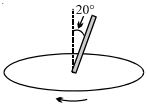
A
vertically downwards
B
down at $20^o$ to the horizontal
C
up at $20^o$ to the horizontal
D
vertically upwards
Solution
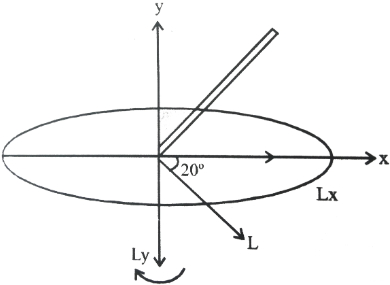
(B) The angular momentum vector $\vec{L}$ of a rotating body is given by $\vec{L} = I\vec{\omega}$.
For a rod rotating about an axis passing through one end at an angle $\theta = 20^o$ with the vertical,the angular momentum vector $\vec{L}$ does not lie along the axis of rotation.
Instead,it is perpendicular to the rod. Since the rod makes an angle of $20^o$ with the vertical,the angle it makes with the horizontal is $90^o - 20^o = 70^o$.
The angular momentum vector $\vec{L}$ is perpendicular to the rod,so it makes an angle of $20^o$ with the horizontal plane.
As the rod rotates,the angular momentum vector $\vec{L}$ points downwards at an angle of $20^o$ to the horizontal,as shown in the diagram.
For a rod rotating about an axis passing through one end at an angle $\theta = 20^o$ with the vertical,the angular momentum vector $\vec{L}$ does not lie along the axis of rotation.
Instead,it is perpendicular to the rod. Since the rod makes an angle of $20^o$ with the vertical,the angle it makes with the horizontal is $90^o - 20^o = 70^o$.
The angular momentum vector $\vec{L}$ is perpendicular to the rod,so it makes an angle of $20^o$ with the horizontal plane.
As the rod rotates,the angular momentum vector $\vec{L}$ points downwards at an angle of $20^o$ to the horizontal,as shown in the diagram.
0 likes
View Solution62
MediumMCQ
$A$ uniform rod is fixed to a rotating turntable so that its lower end is on the axis of the turntable and it makes an angle of $20^o$ to the vertical. (The rod is thus rotating with uniform angular velocity about a vertical axis passing through one end.) If the turntable is rotating clockwise as seen from above,is there a torque acting on it,and if so,in what direction?
A
Yes,vertically
B
Yes,horizontally
C
Yes,at $20^o$ to the horizontal
D
No
Solution
(B) The angular momentum vector $\vec{L}$ of the rotating rod is not aligned with the axis of rotation. As the rod rotates,the direction of the angular momentum vector changes continuously,tracing out a cone.
Since the angular momentum vector $\vec{L}$ is changing with time,there must be an external torque $\vec{\tau} = \frac{d\vec{L}}{dt}$ acting on the rod.
The change in angular momentum occurs in the horizontal plane as the rod sweeps around the vertical axis.
Therefore,the torque required to maintain this motion must be horizontal.
Since the angular momentum vector $\vec{L}$ is changing with time,there must be an external torque $\vec{\tau} = \frac{d\vec{L}}{dt}$ acting on the rod.
The change in angular momentum occurs in the horizontal plane as the rod sweeps around the vertical axis.
Therefore,the torque required to maintain this motion must be horizontal.
0 likes
View Solution63
MediumMCQ
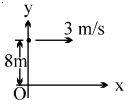
$A$ particle starts from the point $(0\,m, 8\,m)$ and moves with a uniform velocity of $3\, \hat{i} \,m/s$. After $5\,s$,the angular velocity of the particle about the origin will be:
A
$\frac{8}{289}\,rad/s$
B
$\frac{3}{8}\,rad/s$
C
$\frac{24}{289}\,rad/s$
D
$\frac{8}{17}\,rad/s$
Solution
(C) The particle starts at $(0, 8)$ and moves with velocity $\vec{v} = 3\hat{i}\,m/s$.
After time $t = 5\,s$,the position of the particle is:
$x = x_0 + v_x t = 0 + 3 \times 5 = 15\,m$
$y = y_0 + v_y t = 8 + 0 \times 5 = 8\,m$
The position vector is $\vec{r} = 15\hat{i} + 8\hat{j}$.
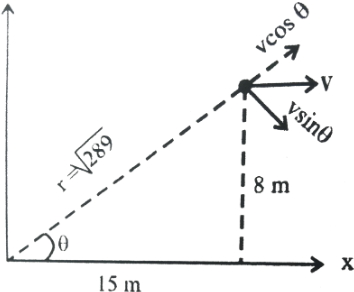
The distance from the origin is $r = \sqrt{15^2 + 8^2} = \sqrt{225 + 64} = \sqrt{289} = 17\,m$.
The angular velocity $\omega$ is given by $\omega = \frac{v_{\perp}}{r}$,where $v_{\perp}$ is the component of velocity perpendicular to the position vector.
From the geometry,$\sin \theta = \frac{y}{r} = \frac{8}{17}$.
The component of velocity perpendicular to $\vec{r}$ is $v_{\perp} = v \sin \theta = 3 \times \frac{8}{17} = \frac{24}{17}\,m/s$.
Thus,$\omega = \frac{v_{\perp}}{r} = \frac{24/17}{17} = \frac{24}{289}\,rad/s$.
After time $t = 5\,s$,the position of the particle is:
$x = x_0 + v_x t = 0 + 3 \times 5 = 15\,m$
$y = y_0 + v_y t = 8 + 0 \times 5 = 8\,m$
The position vector is $\vec{r} = 15\hat{i} + 8\hat{j}$.
The distance from the origin is $r = \sqrt{15^2 + 8^2} = \sqrt{225 + 64} = \sqrt{289} = 17\,m$.
The angular velocity $\omega$ is given by $\omega = \frac{v_{\perp}}{r}$,where $v_{\perp}$ is the component of velocity perpendicular to the position vector.
From the geometry,$\sin \theta = \frac{y}{r} = \frac{8}{17}$.
The component of velocity perpendicular to $\vec{r}$ is $v_{\perp} = v \sin \theta = 3 \times \frac{8}{17} = \frac{24}{17}\,m/s$.
Thus,$\omega = \frac{v_{\perp}}{r} = \frac{24/17}{17} = \frac{24}{289}\,rad/s$.
0 likes
View Solution64
AdvancedMCQ
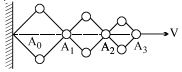
$A$ hinged construction consists of three rhombs with the side ratio $5:3:2$. Vertex $A_3$ moves in the horizontal direction at a velocity $v$. The velocity of $A_2$ is ....... $V$.
A
$2.5$
B
$1.5$
C
$\frac{2}{3}$
D
$0.8$
Solution
(D) $1)$ We know that the diagonal of a rhombus is proportional to its side length.
$\Rightarrow$ The corresponding ratio of the diagonals is $5:3:2$.
Let the lengths of the diagonals be $5y, 3y,$ and $2y$ respectively,as shown in the figure.
$2)$ Now,the velocity of $A_3$ relative to $A_0$ is given by the rate of change of the total length $A_0 A_3$:
$V_{A_3} - V_{A_0} = \frac{d(A_0 A_3)}{dt}$
Since $A_0$ is fixed,$V_{A_0} = 0$. The total length $A_0 A_3 = 5y + 3y + 2y = 10y$.
$V - 0 = \frac{d(10y)}{dt}$
$V = 10 \frac{dy}{dt} \dots (1)$
$3)$ Similarly,the velocity of $A_3$ relative to $A_2$ is the rate of change of the length $A_2 A_3$:
$V_{A_3} - V_{A_2} = \frac{d(A_2 A_3)}{dt}$
$V - V_{A_2} = \frac{d(2y)}{dt}$
$V - V_{A_2} = 2 \frac{dy}{dt} \dots (2)$
$4)$ From equation $(1)$,we have $\frac{dy}{dt} = \frac{V}{10}$.
Substituting this into equation $(2)$:
$V - V_{A_2} = 2 \left( \frac{V}{10} \right)$
$V - V_{A_2} = 0.2V$
$V_{A_2} = V - 0.2V = 0.8V$.
Thus,the velocity of $A_2$ is $0.8V$.
$\Rightarrow$ The corresponding ratio of the diagonals is $5:3:2$.
Let the lengths of the diagonals be $5y, 3y,$ and $2y$ respectively,as shown in the figure.
$2)$ Now,the velocity of $A_3$ relative to $A_0$ is given by the rate of change of the total length $A_0 A_3$:
$V_{A_3} - V_{A_0} = \frac{d(A_0 A_3)}{dt}$
Since $A_0$ is fixed,$V_{A_0} = 0$. The total length $A_0 A_3 = 5y + 3y + 2y = 10y$.
$V - 0 = \frac{d(10y)}{dt}$
$V = 10 \frac{dy}{dt} \dots (1)$
$3)$ Similarly,the velocity of $A_3$ relative to $A_2$ is the rate of change of the length $A_2 A_3$:
$V_{A_3} - V_{A_2} = \frac{d(A_2 A_3)}{dt}$
$V - V_{A_2} = \frac{d(2y)}{dt}$
$V - V_{A_2} = 2 \frac{dy}{dt} \dots (2)$
$4)$ From equation $(1)$,we have $\frac{dy}{dt} = \frac{V}{10}$.
Substituting this into equation $(2)$:
$V - V_{A_2} = 2 \left( \frac{V}{10} \right)$
$V - V_{A_2} = 0.2V$
$V_{A_2} = V - 0.2V = 0.8V$.
Thus,the velocity of $A_2$ is $0.8V$.
0 likes
View Solution65
DifficultMCQ
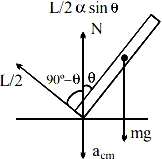
$A$ thin rod of length $L$ is placed vertically on a frictionless horizontal floor and released with a negligible push to allow it to fall. At any moment,the rod makes an angle $\theta$ with the vertical. If the center of mass has acceleration $= A$,and the rod has an angular acceleration $= \alpha$ at that moment,then:
A
$A = (L\alpha) \sin \theta$
B
$A/2 = (L\alpha) \sin \theta$
C
$2A = (L\alpha) \sin \theta$
D
$A = L\alpha$
Solution
(C) The center of mass of the rod is at a distance $r = L/2$ from the bottom end (pivot point on the floor).
When the rod rotates with an angular acceleration $\alpha$,the tangential acceleration of the center of mass is $a_t = r \alpha = (L/2) \alpha$.
This tangential acceleration is perpendicular to the rod. The component of this acceleration in the vertical direction (which is the direction of the center of mass acceleration $A$ as the rod falls) is given by $A = a_t \sin \theta$.
Substituting the value of $a_t$,we get $A = (L/2) \alpha \sin \theta$.
Multiplying both sides by $2$,we obtain $2A = (L\alpha) \sin \theta$.
When the rod rotates with an angular acceleration $\alpha$,the tangential acceleration of the center of mass is $a_t = r \alpha = (L/2) \alpha$.
This tangential acceleration is perpendicular to the rod. The component of this acceleration in the vertical direction (which is the direction of the center of mass acceleration $A$ as the rod falls) is given by $A = a_t \sin \theta$.
Substituting the value of $a_t$,we get $A = (L/2) \alpha \sin \theta$.
Multiplying both sides by $2$,we obtain $2A = (L\alpha) \sin \theta$.
0 likes
View Solution66
DifficultMCQ
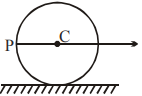
$A$ disc of radius $R$ is rolling purely on a flat horizontal surface with a constant angular velocity $\omega$. The angle between the velocity and acceleration vectors of point $P$ (which is at the same horizontal level as the center $C$) is
A
zero
B
$45^o$
C
$135^o$
D
$tan^{-1}(1/2)$
Solution
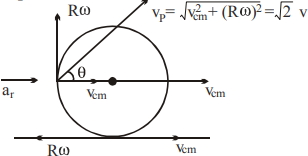
(B) For a disc rolling purely with constant angular velocity $\omega$,the velocity of the center of mass is $v_{cm} = R\omega$.
For point $P$ at the same horizontal level as the center $C$,the velocity vector $\vec{v}_P$ is the vector sum of the translational velocity $\vec{v}_{cm}$ and the tangential velocity $\vec{v}_{rot} = \vec{\omega} \times \vec{r}$.
Since $\vec{v}_{cm}$ is horizontal and $\vec{v}_{rot}$ is vertical at point $P$,the magnitude is $v_P = \sqrt{v_{cm}^2 + (R\omega)^2} = \sqrt{2} v_{cm}$. The velocity vector makes an angle of $45^o$ with the horizontal.
The acceleration of point $P$ is purely centripetal,directed towards the center $C$,which is horizontal.
Thus,the angle between the velocity vector (at $45^o$ to the horizontal) and the acceleration vector (horizontal) is $45^o$.
For point $P$ at the same horizontal level as the center $C$,the velocity vector $\vec{v}_P$ is the vector sum of the translational velocity $\vec{v}_{cm}$ and the tangential velocity $\vec{v}_{rot} = \vec{\omega} \times \vec{r}$.
Since $\vec{v}_{cm}$ is horizontal and $\vec{v}_{rot}$ is vertical at point $P$,the magnitude is $v_P = \sqrt{v_{cm}^2 + (R\omega)^2} = \sqrt{2} v_{cm}$. The velocity vector makes an angle of $45^o$ with the horizontal.
The acceleration of point $P$ is purely centripetal,directed towards the center $C$,which is horizontal.
Thus,the angle between the velocity vector (at $45^o$ to the horizontal) and the acceleration vector (horizontal) is $45^o$.
0 likes
View Solution67
DifficultMCQ
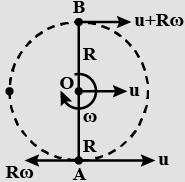
$A$ ring of radius $R$ rolls without sliding with a constant velocity $u$. The radius of curvature of the path followed by any particle of the ring at the highest point of its path will be
A
$R$
B
$2R$
C
$4R$
D
None
Solution
(C) For a ring rolling without slipping,the velocity of the center of mass is $u$ and the angular velocity is $\omega = u/R$.
The velocity of the highest point $B$ is $v_B = u + R\omega = u + u = 2u$.
The acceleration of the highest point $B$ is purely centripetal,directed towards the center of the ring,given by $a_c = R\omega^2 = R(u/R)^2 = u^2/R$.
The radius of curvature $R'$ of the path at any point is given by the formula $R' = v^2 / a_n$,where $v$ is the velocity of the particle and $a_n$ is the normal (centripetal) acceleration.
Substituting the values for the highest point $B$:
$R' = \frac{(2u)^2}{u^2/R} = \frac{4u^2}{u^2/R} = 4R$.
The velocity of the highest point $B$ is $v_B = u + R\omega = u + u = 2u$.
The acceleration of the highest point $B$ is purely centripetal,directed towards the center of the ring,given by $a_c = R\omega^2 = R(u/R)^2 = u^2/R$.
The radius of curvature $R'$ of the path at any point is given by the formula $R' = v^2 / a_n$,where $v$ is the velocity of the particle and $a_n$ is the normal (centripetal) acceleration.
Substituting the values for the highest point $B$:
$R' = \frac{(2u)^2}{u^2/R} = \frac{4u^2}{u^2/R} = 4R$.
0 likes
View Solution68
DifficultMCQ
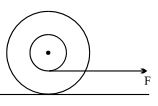
Inner and outer radii of a spool are $r$ and $R$ respectively. $A$ thread is wound over its inner surface and placed over a rough horizontal surface. The thread is pulled by a force $F$ as shown in the figure. Then,in the case of pure rolling:
A
Thread unwinds,spool rotates anticlockwise and friction acts leftwards.
B
Thread winds,spool rotates clockwise and friction acts leftwards.
C
Thread winds,spool moves to the right and friction acts rightwards.
D
Thread winds,spool moves to the right and friction does not come into existence.
Solution
(C) For pure rolling,the velocity of the point of contact with the ground must be zero.
When a force $F$ is applied to the thread wound on the inner radius $r$ as shown,it creates a torque about the center of mass that tends to rotate the spool clockwise.
As the spool rotates clockwise,the point of contact with the ground has a tendency to slip to the left. To oppose this,the static friction $f$ acts towards the right.
However,let's analyze the torque about the point of contact $P$. The torque due to force $F$ is $\tau_P = F(R-r)$ in the clockwise direction. Since this torque is non-zero,the spool will have an angular acceleration $\alpha$ in the clockwise direction.
For pure rolling,the spool must move to the right with acceleration $a_{cm} = \alpha R$.
Considering the forces: $F + f = m a_{cm}$ (where $f$ is friction acting to the right).
Considering torque about the center of mass: $F r + f R = I \alpha$.
Since the spool moves to the right and rotates clockwise,the thread winds further. Thus,the spool moves to the right and friction acts to the right.
When a force $F$ is applied to the thread wound on the inner radius $r$ as shown,it creates a torque about the center of mass that tends to rotate the spool clockwise.
As the spool rotates clockwise,the point of contact with the ground has a tendency to slip to the left. To oppose this,the static friction $f$ acts towards the right.
However,let's analyze the torque about the point of contact $P$. The torque due to force $F$ is $\tau_P = F(R-r)$ in the clockwise direction. Since this torque is non-zero,the spool will have an angular acceleration $\alpha$ in the clockwise direction.
For pure rolling,the spool must move to the right with acceleration $a_{cm} = \alpha R$.
Considering the forces: $F + f = m a_{cm}$ (where $f$ is friction acting to the right).
Considering torque about the center of mass: $F r + f R = I \alpha$.
Since the spool moves to the right and rotates clockwise,the thread winds further. Thus,the spool moves to the right and friction acts to the right.
0 likes
View Solution69
DifficultMCQ
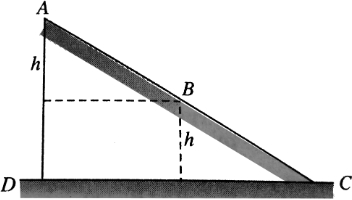
The portion $AB$ of the wedge shown in the figure is rough and $BC$ is smooth. $A$ solid cylinder rolls without slipping from $A$ to $B$. The ratio of translational kinetic energy to rotational kinetic energy,when the cylinder reaches point $C$,is:
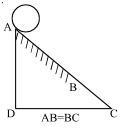
A
$3/4$
B
$5$
C
$7/5$
D
$8/3$
Solution
(B) For a solid cylinder rolling without slipping,the total energy is conserved. Let the vertical height difference between $A$ and $B$ be $H$.
At point $B$,the cylinder has reached the bottom of the rough incline. The translational kinetic energy $K_T$ and rotational kinetic energy $K_R$ are related by $K_T = 2K_R$ for a solid cylinder $(I = \frac{1}{2}mR^2)$.
From energy conservation,$mgH = K_T + K_R = 2K_R + K_R = 3K_R$. Thus,$K_R = \frac{1}{3}mgH$ and $K_T = \frac{2}{3}mgH$.
From $B$ to $C$,the surface is smooth,so there is no friction to exert a torque. Thus,the angular velocity $\omega$ and rotational kinetic energy $K_R$ remain constant.
The potential energy lost from $B$ to $C$ is converted entirely into translational kinetic energy. If the vertical height difference between $B$ and $C$ is also $H$,the additional translational kinetic energy gained is $mgH$.
Total translational kinetic energy at $C$ is $K_{T,C} = K_{T,B} + mgH = \frac{2}{3}mgH + mgH = \frac{5}{3}mgH$.
The rotational kinetic energy at $C$ is $K_{R,C} = K_{R,B} = \frac{1}{3}mgH$.
The ratio is $\frac{K_{T,C}}{K_{R,C}} = \frac{\frac{5}{3}mgH}{\frac{1}{3}mgH} = 5$.
At point $B$,the cylinder has reached the bottom of the rough incline. The translational kinetic energy $K_T$ and rotational kinetic energy $K_R$ are related by $K_T = 2K_R$ for a solid cylinder $(I = \frac{1}{2}mR^2)$.
From energy conservation,$mgH = K_T + K_R = 2K_R + K_R = 3K_R$. Thus,$K_R = \frac{1}{3}mgH$ and $K_T = \frac{2}{3}mgH$.
From $B$ to $C$,the surface is smooth,so there is no friction to exert a torque. Thus,the angular velocity $\omega$ and rotational kinetic energy $K_R$ remain constant.
The potential energy lost from $B$ to $C$ is converted entirely into translational kinetic energy. If the vertical height difference between $B$ and $C$ is also $H$,the additional translational kinetic energy gained is $mgH$.
Total translational kinetic energy at $C$ is $K_{T,C} = K_{T,B} + mgH = \frac{2}{3}mgH + mgH = \frac{5}{3}mgH$.
The rotational kinetic energy at $C$ is $K_{R,C} = K_{R,B} = \frac{1}{3}mgH$.
The ratio is $\frac{K_{T,C}}{K_{R,C}} = \frac{\frac{5}{3}mgH}{\frac{1}{3}mgH} = 5$.
0 likes
View Solution70
AdvancedMCQ
$A$ plank of mass $M$ is placed over a smooth inclined plane and a sphere of mass $m$ is also placed over the plank. Friction is sufficient between the sphere and the plank. If the plank and the sphere are released from rest,the frictional force on the sphere is:
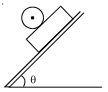
A
up the plane
B
down the plane
C
horizontal
D
zero
Solution
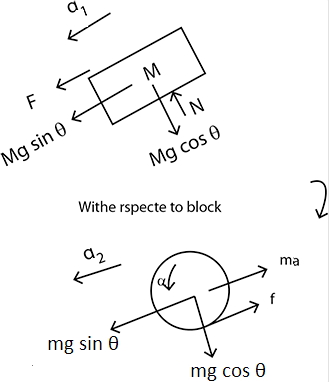
(D) Let the friction force acting on the sphere be $f$ directed up the plane.
For the plank of mass $M$,the equation of motion along the plane is:
$M a_1 = M g \sin \theta + f$ --- $(1)$
where $a_1$ is the acceleration of the plank down the plane.
For the sphere of mass $m$,let $a_2$ be its acceleration relative to the plank down the plane. The torque equation about the center of the sphere is:
$f \cdot r = I \alpha = (\frac{1}{2} m r^2) \alpha$
Since the sphere rolls without slipping on the plank,$a_2 = \alpha r$,so $f = \frac{1}{2} m a_2$,which gives $a_2 = \frac{2f}{m}$.
The equation of motion for the sphere relative to the plank is:
$m a_2 = m g \sin \theta - f - m a_1$ --- $(2)$
Substituting $a_1 = g \sin \theta + \frac{f}{M}$ from $(1)$ into $(2)$:
$m (\frac{2f}{m}) = m g \sin \theta - f - m (g \sin \theta + \frac{f}{M})$
$2f = m g \sin \theta - f - m g \sin \theta - \frac{m f}{M}$
$3f = - \frac{m f}{M}$
$f (3 + \frac{m}{M}) = 0$
Since $(3 + \frac{m}{M}) \neq 0$,we must have $f = 0$.
For the plank of mass $M$,the equation of motion along the plane is:
$M a_1 = M g \sin \theta + f$ --- $(1)$
where $a_1$ is the acceleration of the plank down the plane.
For the sphere of mass $m$,let $a_2$ be its acceleration relative to the plank down the plane. The torque equation about the center of the sphere is:
$f \cdot r = I \alpha = (\frac{1}{2} m r^2) \alpha$
Since the sphere rolls without slipping on the plank,$a_2 = \alpha r$,so $f = \frac{1}{2} m a_2$,which gives $a_2 = \frac{2f}{m}$.
The equation of motion for the sphere relative to the plank is:
$m a_2 = m g \sin \theta - f - m a_1$ --- $(2)$
Substituting $a_1 = g \sin \theta + \frac{f}{M}$ from $(1)$ into $(2)$:
$m (\frac{2f}{m}) = m g \sin \theta - f - m (g \sin \theta + \frac{f}{M})$
$2f = m g \sin \theta - f - m g \sin \theta - \frac{m f}{M}$
$3f = - \frac{m f}{M}$
$f (3 + \frac{m}{M}) = 0$
Since $(3 + \frac{m}{M}) \neq 0$,we must have $f = 0$.
0 likes
View Solution71
DifficultMCQ
$A$ plank with a uniform sphere placed on it rests on a smooth horizontal plane. The plank is pulled to the right by a constant force $F$. If the sphere does not slip over the plank,which of the following statements is incorrect?
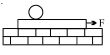
A
Acceleration of the centre of the sphere is less than that of the plank.
B
Work done by friction acting on the sphere is equal to its total kinetic energy.
C
Total kinetic energy of the system is equal to work done by the force $F$.
D
None of the above.
Solution
(D) Let $M$ be the mass of the plank and $m$ be the mass of the sphere. Let $a_p$ be the acceleration of the plank and $a_s$ be the acceleration of the sphere. Since the sphere does not slip,the acceleration of the point of contact on the sphere relative to the plank must be zero. The friction $f$ acts on the sphere in the forward direction and on the plank in the backward direction. For the sphere,$f = m a_s$ and $\tau = f R = I \alpha = (\frac{2}{5} m R^2) \alpha$. Since there is no slipping,$a_s = \alpha R$,so $f = \frac{2}{5} m a_s$. This implies $a_s = \frac{f}{m}$. The acceleration of the plank is $a_p = \frac{F - f}{M}$. Since $a_s < a_p$ is generally true for such systems,statement $A$ is correct. The work done by friction on the sphere is $W_f = \Delta K_{sphere} = K_{trans} + K_{rot} = \frac{1}{2} m v_s^2 + \frac{1}{2} I \omega^2$. Since $v_s = \omega R$,$W_f = \frac{1}{2} m v_s^2 + \frac{1}{2} (\frac{2}{5} m R^2) (\frac{v_s}{R})^2 = \frac{1}{2} m v_s^2 + \frac{1}{5} m v_s^2 = \frac{7}{10} m v_s^2$,which is the total kinetic energy of the sphere. Thus,statement $B$ is correct. According to the work-energy theorem,the total work done by all forces on the system (plank + sphere) equals the change in total kinetic energy. The only external force doing work is $F$. Friction is an internal force,so its net work on the system is zero. Thus,$W_F = \Delta K_{total}$. Statement $C$ is also correct. Since all statements $A, B,$ and $C$ are correct,the incorrect statement is none of these.
0 likes
View Solution72
AdvancedMCQ
$A$ ring of mass $m$ and radius $R$ has three particles attached to the ring as shown in the figure. The centre of the ring has a speed $v_0$. The kinetic energy of the system is: (Slipping is absent) (in $, mv_0^2$)
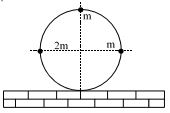
A
$6$
B
$12$
C
$4$
D
$8$
Solution
(A) The system is rolling without slipping on a horizontal surface. The point of contact with the ground is the instantaneous axis of rotation $(IAR)$.
For pure rolling,the velocity of the centre of the ring is $v_0 = R\omega$,where $\omega$ is the angular velocity.
The kinetic energy of the system is given by $KE = \frac{1}{2} I_{IAR} \omega^2$.
First,we calculate the moment of inertia $I_{IAR}$ about the point of contact.
The ring has mass $m$ and radius $R$. The particles have masses $m$,$2m$,and $m$ at positions $(0, R)$,$(-R, 0)$,and $(R, 0)$ relative to the centre,respectively.
The point of contact is at $(0, -R)$.
The squared distances of the particles from the point of contact are:
For particle of mass $m$ at $(0, R)$: $r_1^2 = 0^2 + (R - (-R))^2 = (2R)^2 = 4R^2$.
For particle of mass $2m$ at $(-R, 0)$: $r_2^2 = (-R - 0)^2 + (0 - (-R))^2 = R^2 + R^2 = 2R^2$.
For particle of mass $m$ at $(R, 0)$: $r_3^2 = (R - 0)^2 + (0 - (-R))^2 = R^2 + R^2 = 2R^2$.
For the ring of mass $m$,$I_{ring, IAR} = I_{cm} + mR^2 = mR^2 + mR^2 = 2mR^2$.
Total $I_{IAR} = m(4R^2) + 2m(2R^2) + m(2R^2) + 2mR^2 = 4mR^2 + 4mR^2 + 2mR^2 + 2mR^2 = 12mR^2$.
Substituting $I_{IAR}$ and $\omega = v_0/R$ into the kinetic energy formula:
$KE = \frac{1}{2} (12mR^2) (v_0/R)^2 = 6mR^2 (v_0^2/R^2) = 6mv_0^2$.
For pure rolling,the velocity of the centre of the ring is $v_0 = R\omega$,where $\omega$ is the angular velocity.
The kinetic energy of the system is given by $KE = \frac{1}{2} I_{IAR} \omega^2$.
First,we calculate the moment of inertia $I_{IAR}$ about the point of contact.
The ring has mass $m$ and radius $R$. The particles have masses $m$,$2m$,and $m$ at positions $(0, R)$,$(-R, 0)$,and $(R, 0)$ relative to the centre,respectively.
The point of contact is at $(0, -R)$.
The squared distances of the particles from the point of contact are:
For particle of mass $m$ at $(0, R)$: $r_1^2 = 0^2 + (R - (-R))^2 = (2R)^2 = 4R^2$.
For particle of mass $2m$ at $(-R, 0)$: $r_2^2 = (-R - 0)^2 + (0 - (-R))^2 = R^2 + R^2 = 2R^2$.
For particle of mass $m$ at $(R, 0)$: $r_3^2 = (R - 0)^2 + (0 - (-R))^2 = R^2 + R^2 = 2R^2$.
For the ring of mass $m$,$I_{ring, IAR} = I_{cm} + mR^2 = mR^2 + mR^2 = 2mR^2$.
Total $I_{IAR} = m(4R^2) + 2m(2R^2) + m(2R^2) + 2mR^2 = 4mR^2 + 4mR^2 + 2mR^2 + 2mR^2 = 12mR^2$.
Substituting $I_{IAR}$ and $\omega = v_0/R$ into the kinetic energy formula:
$KE = \frac{1}{2} (12mR^2) (v_0/R)^2 = 6mR^2 (v_0^2/R^2) = 6mv_0^2$.
0 likes
View Solution73
DifficultMCQ
$A$ uniform sphere of radius $R$ is placed on a rough horizontal surface and given a linear velocity $v_0$ and angular velocity $\omega_0$ as shown. The sphere comes to rest after moving some distance to the right. It follows that:
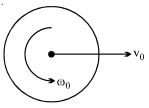
A
$v_0 = \omega_0R$
B
$2v_0 = 5\omega_0R$
C
$5v_0 = 2\omega_0R$
D
$2v_0 = \omega_0R$
Solution
(C) For the sphere to come to rest,the net impulse due to friction must stop both the linear and angular motion.
Let the mass of the sphere be $m$ and its moment of inertia about the center be $I = \frac{2}{5}mR^2$.
The friction force $f$ acts in the backward direction to oppose the linear motion,and the torque $\tau = fR$ acts to oppose the angular motion.
Let $t$ be the time taken for the sphere to come to rest.
From the impulse-momentum theorem for linear motion: $f t = m v_0$.
From the angular impulse-momentum theorem: $\tau t = I \omega_0$,which gives $(fR) t = (\frac{2}{5}mR^2) \omega_0$.
Substituting $ft = m v_0$ into the angular equation: $(m v_0) R = \frac{2}{5} m R^2 \omega_0$.
Simplifying this,we get $v_0 = \frac{2}{5} \omega_0 R$,or $5v_0 = 2\omega_0 R$.
Let the mass of the sphere be $m$ and its moment of inertia about the center be $I = \frac{2}{5}mR^2$.
The friction force $f$ acts in the backward direction to oppose the linear motion,and the torque $\tau = fR$ acts to oppose the angular motion.
Let $t$ be the time taken for the sphere to come to rest.
From the impulse-momentum theorem for linear motion: $f t = m v_0$.
From the angular impulse-momentum theorem: $\tau t = I \omega_0$,which gives $(fR) t = (\frac{2}{5}mR^2) \omega_0$.
Substituting $ft = m v_0$ into the angular equation: $(m v_0) R = \frac{2}{5} m R^2 \omega_0$.
Simplifying this,we get $v_0 = \frac{2}{5} \omega_0 R$,or $5v_0 = 2\omega_0 R$.
0 likes
View Solution74
AdvancedMCQ
$A$ sphere of mass $M$ and radius $R$ is attached by a light rod of length $l$ to a point $P$. The sphere rolls without slipping on a circular track as shown. It is released from the horizontal position. The angular momentum of the system about $P$ when the rod becomes vertical is:
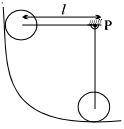
A
$M\sqrt {\frac{{10}}{7}\,g{\text{l}}} \,\,[{\text{l}} + R]$
B
$M\sqrt {\frac{{10}}{7}\,g{\text{l}}} \,\,\left[ {{\text{l}} - \,\frac{2}{5}R} \right]$
C
$M\sqrt {\frac{{10}}{7}\,g{\text{l}}} \,\,\left[ {{\text{l}} + \,\frac{7}{5}R} \right]$
D
$M\sqrt {\frac{{10}}{7}\,g{\text{l}}} \,\,\left[ {{\text{l}} + \,\frac{2}{5}R} \right]$
Solution
(D) Let at the bottom position,$v$ be the linear speed of the center of mass and $\omega$ be the angular speed of rotation about its center.
From the conservation of mechanical energy,the potential energy lost equals the kinetic energy gained:
$Mgl = \frac{1}{2} M v^2 + \frac{1}{2} I_{cm} \omega^2$
Since the sphere rolls without slipping,$v = R\omega$ and $I_{cm} = \frac{2}{5}MR^2$.
Substituting these values:
$Mgl = \frac{1}{2} M v^2 + \frac{1}{2} (\frac{2}{5} M R^2) (\frac{v}{R})^2$
$Mgl = \frac{1}{2} M v^2 + \frac{1}{5} M v^2 = \frac{7}{10} M v^2$
$v = \sqrt{\frac{10gl}{7}}$
The angular momentum $L$ about point $P$ is the sum of the angular momentum about the center of mass and the angular momentum of the center of mass about $P$:
$L = I_{cm} \omega + Mvl$
$L = (\frac{2}{5} M R^2) (\frac{v}{R}) + Mvl = \frac{2}{5} MRv + Mvl$
$L = Mv (l + \frac{2}{5}R)$
Substituting $v = \sqrt{\frac{10gl}{7}}$:
$L = M \sqrt{\frac{10gl}{7}} [l + \frac{2}{5}R]$
From the conservation of mechanical energy,the potential energy lost equals the kinetic energy gained:
$Mgl = \frac{1}{2} M v^2 + \frac{1}{2} I_{cm} \omega^2$
Since the sphere rolls without slipping,$v = R\omega$ and $I_{cm} = \frac{2}{5}MR^2$.
Substituting these values:
$Mgl = \frac{1}{2} M v^2 + \frac{1}{2} (\frac{2}{5} M R^2) (\frac{v}{R})^2$
$Mgl = \frac{1}{2} M v^2 + \frac{1}{5} M v^2 = \frac{7}{10} M v^2$
$v = \sqrt{\frac{10gl}{7}}$
The angular momentum $L$ about point $P$ is the sum of the angular momentum about the center of mass and the angular momentum of the center of mass about $P$:
$L = I_{cm} \omega + Mvl$
$L = (\frac{2}{5} M R^2) (\frac{v}{R}) + Mvl = \frac{2}{5} MRv + Mvl$
$L = Mv (l + \frac{2}{5}R)$
Substituting $v = \sqrt{\frac{10gl}{7}}$:
$L = M \sqrt{\frac{10gl}{7}} [l + \frac{2}{5}R]$
0 likes
View Solution75
AdvancedMCQ
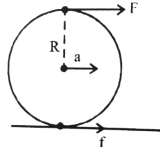
$A$ body kept on a smooth horizontal surface is pulled by a constant horizontal force applied at the top point of the body. If the body rolls purely on the surface,its shape can be:
A
thin pipe
B
uniform cylinder
C
uniform sphere
D
thin spherical shell
Solution
(A) For translational motion of the center of mass $(C.M.)$:
$F + f = ma$ (where $f$ is the friction force)
For rotational motion about the $C.M.$:
$R(F - f) = I\alpha$
For pure rolling,the condition is $a = R\alpha$,which implies $\alpha = a/R$.
Substituting $\alpha$ in the rotational equation:
$R(F - f) = I(a/R) \implies F - f = \frac{I}{R^2} a$
From the translational equation,$a = \frac{F + f}{m}$. Substituting this:
$F - f = \frac{I}{R^2} \left( \frac{F + f}{m} \right)$
$mR^2(F - f) = I(F + f)$
$F(mR^2 - I) = f(mR^2 + I)$
$f = F \frac{mR^2 - I}{mR^2 + I}$
For pure rolling to occur on a smooth surface without needing external friction,we require $f = 0$.
This implies $mR^2 - I = 0$,or $I = mR^2$.
Among the given options,a thin pipe (or ring) has a moment of inertia $I = mR^2$ about its central axis.
$F + f = ma$ (where $f$ is the friction force)
For rotational motion about the $C.M.$:
$R(F - f) = I\alpha$
For pure rolling,the condition is $a = R\alpha$,which implies $\alpha = a/R$.
Substituting $\alpha$ in the rotational equation:
$R(F - f) = I(a/R) \implies F - f = \frac{I}{R^2} a$
From the translational equation,$a = \frac{F + f}{m}$. Substituting this:
$F - f = \frac{I}{R^2} \left( \frac{F + f}{m} \right)$
$mR^2(F - f) = I(F + f)$
$F(mR^2 - I) = f(mR^2 + I)$
$f = F \frac{mR^2 - I}{mR^2 + I}$
For pure rolling to occur on a smooth surface without needing external friction,we require $f = 0$.
This implies $mR^2 - I = 0$,or $I = mR^2$.
Among the given options,a thin pipe (or ring) has a moment of inertia $I = mR^2$ about its central axis.
0 likes
View Solution76
DifficultMCQ
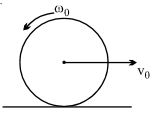
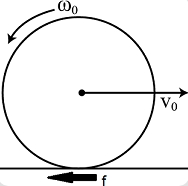
$A$ uniform circular disc placed on a rough horizontal surface has initially a velocity $v_0$ and an angular velocity $\omega_0$ as shown in the figure. The disc comes to rest after moving some distance in the direction of motion. Then $\frac{v_0}{r\omega_0}$ is
A
$\frac{1}{2}$
B
$1$
C
$\frac{3}{2}$
D
$2$
Solution
(A) When the disc is placed on the rough surface,slipping occurs. To oppose the relative motion at the point of contact,kinetic friction $f$ acts in the direction opposite to the velocity $v_0$.
For linear motion,the force of friction $f$ provides retardation $a = \frac{f}{m}$.
For rotational motion,the torque due to friction about the center of mass is $\tau = f \cdot r$. Since the torque acts to oppose the initial angular velocity $\omega_0$,it provides angular retardation $\alpha = \frac{\tau}{I} = \frac{f \cdot r}{\frac{1}{2} m r^2} = \frac{2f}{mr}$.
If the disc comes to rest after time $t$,both linear velocity and angular velocity become zero simultaneously:
$v_0 - at = 0 \implies t = \frac{v_0}{a} = \frac{v_0 m}{f}$
$\omega_0 - \alpha t = 0 \implies t = \frac{\omega_0}{\alpha} = \frac{\omega_0 mr}{2f}$
Equating the two expressions for time $t$:
$\frac{v_0 m}{f} = \frac{\omega_0 mr}{2f}$
$\frac{v_0}{\omega_0 r} = \frac{1}{2}$
For linear motion,the force of friction $f$ provides retardation $a = \frac{f}{m}$.
For rotational motion,the torque due to friction about the center of mass is $\tau = f \cdot r$. Since the torque acts to oppose the initial angular velocity $\omega_0$,it provides angular retardation $\alpha = \frac{\tau}{I} = \frac{f \cdot r}{\frac{1}{2} m r^2} = \frac{2f}{mr}$.
If the disc comes to rest after time $t$,both linear velocity and angular velocity become zero simultaneously:
$v_0 - at = 0 \implies t = \frac{v_0}{a} = \frac{v_0 m}{f}$
$\omega_0 - \alpha t = 0 \implies t = \frac{\omega_0}{\alpha} = \frac{\omega_0 mr}{2f}$
Equating the two expressions for time $t$:
$\frac{v_0 m}{f} = \frac{\omega_0 mr}{2f}$
$\frac{v_0}{\omega_0 r} = \frac{1}{2}$
0 likes
View Solution77
AdvancedMCQ
On a solid sphere lying on a horizontal surface,a force $F$ is applied at a height of $R/2$ from the centre of mass. The initial acceleration of a point at the top of the sphere is (there is no slipping at any point).
A
$\frac{15F}{7M}$
B
$\frac{15F}{14M}$
C
$\frac{30F}{7M}$
D
$\frac{F}{M}$
Solution
(A) Let $M$ be the mass and $R$ be the radius of the solid sphere. The moment of inertia about the center of mass is $I = \frac{2}{5}MR^2$.
Applying Newton's second law for linear motion: $F + f = Ma$,where $f$ is the friction force.
Applying torque equation about the center of mass: $F(R/2) - fR = I\alpha = (\frac{2}{5}MR^2)\alpha$.
Since there is no slipping at the point of contact,the acceleration of the center of mass $a = R\alpha$,so $\alpha = a/R$.
Substituting $\alpha$: $F/2 - f = \frac{2}{5}Ma \implies f = F/2 - \frac{2}{5}Ma$.
Substituting $f$ into the linear equation: $F + F/2 - \frac{2}{5}Ma = Ma \implies \frac{3F}{2} = \frac{7}{5}Ma \implies a = \frac{15F}{14M}$.
The angular acceleration is $\alpha = a/R = \frac{15F}{14MR}$.
The acceleration of the top point is $a_{top} = a + R\alpha = a + a = 2a$.
Therefore,$a_{top} = 2 \times \frac{15F}{14M} = \frac{15F}{7M}$.
Applying Newton's second law for linear motion: $F + f = Ma$,where $f$ is the friction force.
Applying torque equation about the center of mass: $F(R/2) - fR = I\alpha = (\frac{2}{5}MR^2)\alpha$.
Since there is no slipping at the point of contact,the acceleration of the center of mass $a = R\alpha$,so $\alpha = a/R$.
Substituting $\alpha$: $F/2 - f = \frac{2}{5}Ma \implies f = F/2 - \frac{2}{5}Ma$.
Substituting $f$ into the linear equation: $F + F/2 - \frac{2}{5}Ma = Ma \implies \frac{3F}{2} = \frac{7}{5}Ma \implies a = \frac{15F}{14M}$.
The angular acceleration is $\alpha = a/R = \frac{15F}{14MR}$.
The acceleration of the top point is $a_{top} = a + R\alpha = a + a = 2a$.
Therefore,$a_{top} = 2 \times \frac{15F}{14M} = \frac{15F}{7M}$.
0 likes
View Solution78
MediumMCQ
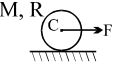
In the following problem,indicate the correct direction of the friction force acting on a cylinder of mass $M$ and radius $R$,which is pulled on a rough surface by a constant horizontal force $F$ applied at its center. The friction force can be represented by which of the following diagrams?
A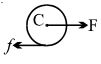
B
C
D
Cannot be interpreted.
Solution
(B) For pure rolling,the point of contact $P$ must be at rest relative to the surface.
Let $a_{cm}$ be the acceleration of the center of mass and $\alpha$ be the angular acceleration.
The condition for pure rolling is $a_{cm} = R\alpha$.
Applying Newton's second law for linear motion: $F - f = M a_{cm} \Rightarrow a_{cm} = \frac{F - f}{M}$.
Applying Newton's second law for rotational motion about the center of mass: $\tau = I\alpha \Rightarrow fR = I\alpha \Rightarrow \alpha = \frac{fR}{I}$.
Substituting these into the rolling condition: $\frac{F - f}{M} = R \left( \frac{fR}{I} \right) = \frac{fR^2}{I}$.
$F - f = \frac{M R^2}{I} f \Rightarrow F = f \left( 1 + \frac{M R^2}{I} \right)$.
Since $F$ is positive,$f$ must be positive,meaning it acts in the same direction as $F$ (forward direction).
Let $a_{cm}$ be the acceleration of the center of mass and $\alpha$ be the angular acceleration.
The condition for pure rolling is $a_{cm} = R\alpha$.
Applying Newton's second law for linear motion: $F - f = M a_{cm} \Rightarrow a_{cm} = \frac{F - f}{M}$.
Applying Newton's second law for rotational motion about the center of mass: $\tau = I\alpha \Rightarrow fR = I\alpha \Rightarrow \alpha = \frac{fR}{I}$.
Substituting these into the rolling condition: $\frac{F - f}{M} = R \left( \frac{fR}{I} \right) = \frac{fR^2}{I}$.
$F - f = \frac{M R^2}{I} f \Rightarrow F = f \left( 1 + \frac{M R^2}{I} \right)$.
Since $F$ is positive,$f$ must be positive,meaning it acts in the same direction as $F$ (forward direction).
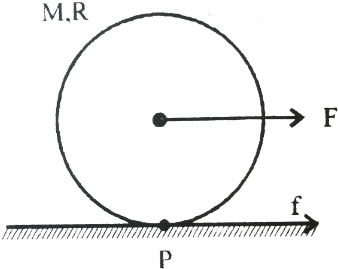
0 likes
View Solution79
AdvancedMCQ
In the following problems,indicate the correct direction of the friction force acting on the cylinder,which is pulled on a rough surface by a constant force $F$. $A$ cylinder is pulled horizontally by a force $F$ acting at a point above the centre of mass of the cylinder,as shown in the figure. The friction force can be given by which of the following diagrams?

A
B
C
D
Cannot be interpreted.
Solution
(D) Due to translational motion only,the friction force $f^{\prime}$ should act backwards to oppose the sliding tendency.
Due to rotational motion only,the torque produced by the force $F$ (applied above the centre of mass $C$) causes a tendency to rotate,which creates a friction force $f^{\prime \prime}$ acting forwards at the point of contact.
Thus,the direction of the net friction force depends on the relative magnitudes of $f^{\prime}$ and $f^{\prime \prime}$.
Since the exact height of the point of application of force $F$ above the centre of mass $C$ is not specified,the relative magnitudes of these opposing friction components cannot be determined.
Therefore,the direction of the net friction force cannot be interpreted.
Due to rotational motion only,the torque produced by the force $F$ (applied above the centre of mass $C$) causes a tendency to rotate,which creates a friction force $f^{\prime \prime}$ acting forwards at the point of contact.
Thus,the direction of the net friction force depends on the relative magnitudes of $f^{\prime}$ and $f^{\prime \prime}$.
Since the exact height of the point of application of force $F$ above the centre of mass $C$ is not specified,the relative magnitudes of these opposing friction components cannot be determined.
Therefore,the direction of the net friction force cannot be interpreted.
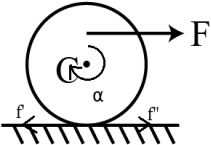
0 likes
View Solution80
DifficultMCQ
$A$ spool is pulled vertically by a constant force $F (< Mg)$ as shown in the figure. Which of the following diagrams correctly represents the direction of the friction force acting on the spool?

A
B
C
D
Cannot be interpreted.
Solution
(B) When a force $F$ is applied vertically upwards on the inner radius $r$ of the spool (with outer radius $R$),it creates a torque about the center of mass of the spool.
Since the force is applied to the right of the center,it produces a clockwise torque about the center of mass.
This torque tends to rotate the spool in the clockwise direction.
Due to this clockwise rotation,the point of contact of the spool with the ground tends to move towards the left.
Therefore,the static friction force $f$ acts in the opposite direction,which is towards the right,to oppose this tendency of motion.
Since the force is applied to the right of the center,it produces a clockwise torque about the center of mass.
This torque tends to rotate the spool in the clockwise direction.
Due to this clockwise rotation,the point of contact of the spool with the ground tends to move towards the left.
Therefore,the static friction force $f$ acts in the opposite direction,which is towards the right,to oppose this tendency of motion.
0 likes
View Solution81
AdvancedMCQ
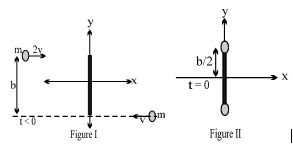
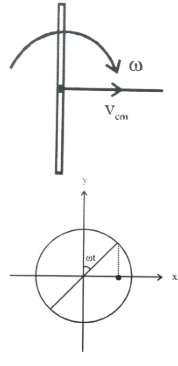
One ice skater of mass $m$ moves with speed $2v$ to the right,while another of the same mass $m$ moves with speed $v$ toward the left,as shown in figure $I$. Their paths are separated by a distance $b$. At $t = 0$,when they are both at $x = 0$,they grasp a pole of length $b$ and negligible mass. For $t > 0$,consider the system as a rigid body of two masses $m$ separated by distance $b$,as shown in figure $II$. Which of the following is the correct formula for the motion after $t = 0$ of the skater initially at $y = b/2$?
A
$x = 2vt, y = b/2$
B
$x = vt + 0.5b \sin(3vt/b), y = 0.5b \cos(3vt/b)$
C
$x = 0.5vt + 0.5b \sin(3vt/b), y = 0.5b \cos(3vt/b)$
D
$x = 0.5vt + 0.5b \sin(6vt/b), y = 0.5b \cos(6vt/b)$
Solution
(C) From the conservation of linear momentum,the velocity of the center of mass $(v_{cm})$ is given by:
$m(2v) - m(v) = (2m)v_{cm} \Rightarrow v_{cm} = v/2$ towards the right.
From the conservation of angular momentum about the center of mass:
$L_i = L_f$
$m(2v)(b/2) + m(v)(b/2) = I\omega$
where $I = m(b/2)^2 + m(b/2)^2 = mb^2/2$.
$(3/2)mvb = (mb^2/2)\omega \Rightarrow \omega = 3v/b$.
The motion of the skater initially at $y = b/2$ is a combination of translation of the center of mass and rotation about it:
$x(t) = v_{cm}t + (b/2)\sin(\omega t) = 0.5vt + 0.5b\sin(3vt/b)$
$y(t) = (b/2)\cos(\omega t) = 0.5b\cos(3vt/b)$
Thus,the correct option is $C$.
$m(2v) - m(v) = (2m)v_{cm} \Rightarrow v_{cm} = v/2$ towards the right.
From the conservation of angular momentum about the center of mass:
$L_i = L_f$
$m(2v)(b/2) + m(v)(b/2) = I\omega$
where $I = m(b/2)^2 + m(b/2)^2 = mb^2/2$.
$(3/2)mvb = (mb^2/2)\omega \Rightarrow \omega = 3v/b$.
The motion of the skater initially at $y = b/2$ is a combination of translation of the center of mass and rotation about it:
$x(t) = v_{cm}t + (b/2)\sin(\omega t) = 0.5vt + 0.5b\sin(3vt/b)$
$y(t) = (b/2)\cos(\omega t) = 0.5b\cos(3vt/b)$
Thus,the correct option is $C$.
0 likes
View Solution82
DifficultMCQ
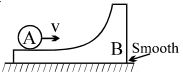
In the figure shown,a ring $A$ is initially rolling without sliding with a velocity $v$ on the horizontal surface of the body $B$ (of the same mass as $A$). All surfaces are smooth. $B$ has no initial velocity. What will be the maximum height reached by $A$ on $B$?
A
$\frac{3v^2}{4g}$
B
$\frac{v^2}{4g}$
C
$\frac{v^2}{2g}$
D
$\frac{v^2}{3g}$
Solution
(B) Let the mass of the ring $A$ be $m$ and the mass of the body $B$ be $m$. Initially,the ring is rolling without sliding,so its angular velocity is $\omega = v/R$. The total initial kinetic energy is $K_i = \frac{1}{2}mv^2 + \frac{1}{2}I\omega^2 = \frac{1}{2}mv^2 + \frac{1}{2}(mR^2)(v/R)^2 = mv^2$.
At the maximum height $h$,the ring and the body $B$ move together with a common horizontal velocity $v'$. By conservation of linear momentum in the horizontal direction: $mv = (m + m)v'$,which gives $v' = v/2$.
Since all surfaces are smooth,there is no friction,so the angular velocity $\omega$ of the ring remains constant throughout the motion.
Applying the conservation of mechanical energy:
$K_i = K_f + U_f$
$mv^2 = \frac{1}{2}(m+m)(v')^2 + \frac{1}{2}I\omega^2 + mgh$
$mv^2 = \frac{1}{2}(2m)(v/2)^2 + \frac{1}{2}(mR^2)(v/R)^2 + mgh$
$mv^2 = \frac{1}{4}mv^2 + \frac{1}{2}mv^2 + mgh$
$mv^2 = \frac{3}{4}mv^2 + mgh$
$mgh = mv^2 - \frac{3}{4}mv^2 = \frac{1}{4}mv^2$
$h = \frac{v^2}{4g}$
At the maximum height $h$,the ring and the body $B$ move together with a common horizontal velocity $v'$. By conservation of linear momentum in the horizontal direction: $mv = (m + m)v'$,which gives $v' = v/2$.
Since all surfaces are smooth,there is no friction,so the angular velocity $\omega$ of the ring remains constant throughout the motion.
Applying the conservation of mechanical energy:
$K_i = K_f + U_f$
$mv^2 = \frac{1}{2}(m+m)(v')^2 + \frac{1}{2}I\omega^2 + mgh$
$mv^2 = \frac{1}{2}(2m)(v/2)^2 + \frac{1}{2}(mR^2)(v/R)^2 + mgh$
$mv^2 = \frac{1}{4}mv^2 + \frac{1}{2}mv^2 + mgh$
$mv^2 = \frac{3}{4}mv^2 + mgh$
$mgh = mv^2 - \frac{3}{4}mv^2 = \frac{1}{4}mv^2$
$h = \frac{v^2}{4g}$
0 likes
View Solution83
DifficultMCQ
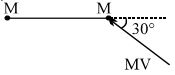
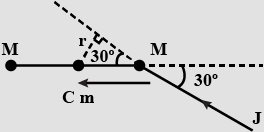
Two equal masses each of mass $M$ are joined by a massless rod of length $L$. Now an impulse $J = MV$ is given to one of the masses,making an angle of $30^{\circ}$ with the length of the rod. The angular velocity of the rod just after imparting the impulse is:
A
$\frac{v}{L}$
B
$\frac{2v}{L}$
C
$\frac{v}{2L}$
D
None of these
Solution
(C) The center of mass $(CM)$ of the system is at the midpoint of the rod. The distance of each mass from the $CM$ is $r = L/2$.
The impulse $J = MV$ is applied at one end. The component of the impulse perpendicular to the rod is $J_{\perp} = J \sin 30^{\circ} = MV \sin 30^{\circ} = MV(1/2) = MV/2$.
The angular impulse about the $CM$ is $\tau_{impulse} = J_{\perp} \times r = (MV/2) \times (L/2) = MVL/4$.
The angular impulse is equal to the change in angular momentum: $\tau_{impulse} = I \omega$,where $I$ is the moment of inertia about the $CM$.
The moment of inertia of the two masses about the $CM$ is $I = M(L/2)^2 + M(L/2)^2 = 2M(L^2/4) = ML^2/2$.
Equating the angular impulse to the change in angular momentum:
$ML^2/2 \times \omega = MVL/4$
Solving for $\omega$:
$\omega = \frac{MVL/4}{ML^2/2} = \frac{MVL}{4} \times \frac{2}{ML^2} = \frac{V}{2L}$.
Thus,the angular velocity is $\frac{V}{2L}$.
The impulse $J = MV$ is applied at one end. The component of the impulse perpendicular to the rod is $J_{\perp} = J \sin 30^{\circ} = MV \sin 30^{\circ} = MV(1/2) = MV/2$.
The angular impulse about the $CM$ is $\tau_{impulse} = J_{\perp} \times r = (MV/2) \times (L/2) = MVL/4$.
The angular impulse is equal to the change in angular momentum: $\tau_{impulse} = I \omega$,where $I$ is the moment of inertia about the $CM$.
The moment of inertia of the two masses about the $CM$ is $I = M(L/2)^2 + M(L/2)^2 = 2M(L^2/4) = ML^2/2$.
Equating the angular impulse to the change in angular momentum:
$ML^2/2 \times \omega = MVL/4$
Solving for $\omega$:
$\omega = \frac{MVL/4}{ML^2/2} = \frac{MVL}{4} \times \frac{2}{ML^2} = \frac{V}{2L}$.
Thus,the angular velocity is $\frac{V}{2L}$.
0 likes
View Solution84
DifficultMCQ
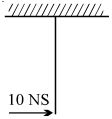
$A$ thin uniform straight rod of mass $2 \, kg$ and length $1 \, m$ is free to rotate about its upper end when at rest. It receives an impulsive blow of $10 \, Ns$ at its lowest point,normal to its length as shown in the figure. The kinetic energy of the rod just after impact is ........ $J$.
A
$75$
B
$100$
C
$200$
D
none
Solution
(A) Given: Mass $m = 2 \, kg$,Length $L = 1 \, m$,Impulse $J = 10 \, Ns$.
The moment of inertia of the rod about its upper end is $I = \frac{1}{3} m L^2$.
Substituting the values: $I = \frac{1}{3} \times 2 \times (1)^2 = \frac{2}{3} \, kg \cdot m^2$.
Angular impulse is equal to the change in angular momentum:
$J \times L = I \omega - 0$
$10 \times 1 = \frac{2}{3} \omega$
$\omega = \frac{10 \times 3}{2} = 15 \, rad/s$.
The kinetic energy of the rod just after impact is given by:
$KE = \frac{1}{2} I \omega^2$
$KE = \frac{1}{2} \times \left(\frac{2}{3}\right) \times (15)^2$
$KE = \frac{1}{3} \times 225 = 75 \, J$.
The moment of inertia of the rod about its upper end is $I = \frac{1}{3} m L^2$.
Substituting the values: $I = \frac{1}{3} \times 2 \times (1)^2 = \frac{2}{3} \, kg \cdot m^2$.
Angular impulse is equal to the change in angular momentum:
$J \times L = I \omega - 0$
$10 \times 1 = \frac{2}{3} \omega$
$\omega = \frac{10 \times 3}{2} = 15 \, rad/s$.
The kinetic energy of the rod just after impact is given by:
$KE = \frac{1}{2} I \omega^2$
$KE = \frac{1}{2} \times \left(\frac{2}{3}\right) \times (15)^2$
$KE = \frac{1}{3} \times 225 = 75 \, J$.
0 likes
View Solution85
DifficultMCQ
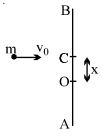
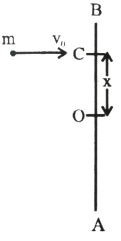
$A$ uniform rod $AB$ of length $L$ and mass $M$ is lying on a smooth table. $A$ small particle of mass $m$ strikes the rod with a velocity $v_0$ at point $C$ at a distance $x$ from the centre $O$. The particle comes to rest after the collision. The value of $x$ such that point $A$ of the rod remains stationary just after the collision is:
A
$L/3$
B
$L/6$
C
$L/4$
D
$L/12$
Solution
(B) The rod will have both translational and rotational motion about its centre of mass $(C.M.)$.
From the conservation of linear momentum:
$m v_0 = M V_{CM} \implies V_{CM} = \frac{m v_0}{M} \dots(1)$
From the conservation of angular momentum about the $C.M.$:
$m v_0 x = I \omega = \left( \frac{M L^2}{12} \right) \omega \implies \omega = \frac{12 m v_0 x}{M L^2} \dots(2)$
For point $A$ to be at rest,the velocity of the $C.M.$ must be equal to the velocity of point $A$ due to rotation:
$V_{CM} = \omega \left( \frac{L}{2} \right) \dots(3)$
Substituting $(1)$ and $(2)$ into $(3)$:
$\frac{m v_0}{M} = \left( \frac{12 m v_0 x}{M L^2} \right) \left( \frac{L}{2} \right)$
$\frac{m v_0}{M} = \frac{6 m v_0 x}{M L}$
$1 = \frac{6 x}{L} \implies x = \frac{L}{6}$
From the conservation of linear momentum:
$m v_0 = M V_{CM} \implies V_{CM} = \frac{m v_0}{M} \dots(1)$
From the conservation of angular momentum about the $C.M.$:
$m v_0 x = I \omega = \left( \frac{M L^2}{12} \right) \omega \implies \omega = \frac{12 m v_0 x}{M L^2} \dots(2)$
For point $A$ to be at rest,the velocity of the $C.M.$ must be equal to the velocity of point $A$ due to rotation:
$V_{CM} = \omega \left( \frac{L}{2} \right) \dots(3)$
Substituting $(1)$ and $(2)$ into $(3)$:
$\frac{m v_0}{M} = \left( \frac{12 m v_0 x}{M L^2} \right) \left( \frac{L}{2} \right)$
$\frac{m v_0}{M} = \frac{6 m v_0 x}{M L}$
$1 = \frac{6 x}{L} \implies x = \frac{L}{6}$
0 likes
View Solution86
AdvancedMCQ
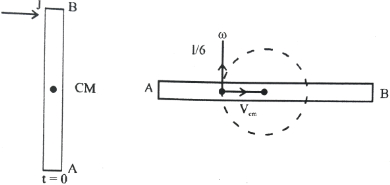
$A$ uniform rod $AB$ of mass $m$ and length $l$ is at rest on a smooth horizontal surface. An impulse $J$ is applied to the end $B$,perpendicular to the rod in the horizontal direction. Find the speed of particle $P$ at a distance $\frac{l}{6}$ from the centre towards $A$ of the rod after time $t = \frac{\pi m l}{12 J}$.
A
$2 \frac{J}{m}$
B
$\frac{J}{\sqrt{2} m}$
C
$\frac{J}{m}$
D
$\sqrt{2} \frac{J}{m}$
Solution
(D) From the equation of linear momentum,$m v_{cm} = J$,so $v_{cm} = \frac{J}{m}$.
From the equation of angular momentum about the center of mass $(CM)$,$J \cdot \frac{l}{2} = I \omega = \frac{m l^2}{12} \cdot \omega$,which gives $\omega = \frac{6 J}{m l}$.
At time $t = \frac{\pi m l}{12 J}$,the angle rotated by the rod is $\theta = \omega t = \left( \frac{6 J}{m l} \right) \left( \frac{\pi m l}{12 J} \right) = \frac{\pi}{2}$.
The tangential velocity of particle $P$ due to rotation about the $CM$ is $v_t = r \omega = \frac{l}{6} \cdot \frac{6 J}{m l} = \frac{J}{m}$.
Since the rod has rotated by $\frac{\pi}{2}$,the velocity vector due to rotation is now perpendicular to the initial velocity vector $v_{cm}$.
The resultant velocity of particle $P$ is $v_p = \sqrt{v_{cm}^2 + v_t^2} = \sqrt{\left( \frac{J}{m} \right)^2 + \left( \frac{J}{m} \right)^2} = \sqrt{2} \frac{J}{m}$.
From the equation of angular momentum about the center of mass $(CM)$,$J \cdot \frac{l}{2} = I \omega = \frac{m l^2}{12} \cdot \omega$,which gives $\omega = \frac{6 J}{m l}$.
At time $t = \frac{\pi m l}{12 J}$,the angle rotated by the rod is $\theta = \omega t = \left( \frac{6 J}{m l} \right) \left( \frac{\pi m l}{12 J} \right) = \frac{\pi}{2}$.
The tangential velocity of particle $P$ due to rotation about the $CM$ is $v_t = r \omega = \frac{l}{6} \cdot \frac{6 J}{m l} = \frac{J}{m}$.
Since the rod has rotated by $\frac{\pi}{2}$,the velocity vector due to rotation is now perpendicular to the initial velocity vector $v_{cm}$.
The resultant velocity of particle $P$ is $v_p = \sqrt{v_{cm}^2 + v_t^2} = \sqrt{\left( \frac{J}{m} \right)^2 + \left( \frac{J}{m} \right)^2} = \sqrt{2} \frac{J}{m}$.
0 likes
View Solution87
DifficultMCQ
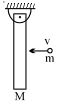
$A$ uniform rod of mass $M$ is hinged at its upper end. $A$ particle of mass $m$ moving horizontally strikes the rod at its mid-point elastically. If the particle comes to rest after the collision,find the value of $M/m$.
A
$3/4$
B
$4/3$
C
$2/3$
D
none
Solution
(A) Given: Mass of the particle $= m$,Mass of the rod $= M$,Length of the rod $= L$.
Applying the principle of conservation of angular momentum about the hinge:
$m v (L/2) = I \omega$
Since the moment of inertia of the rod about the hinge is $I = M L^2 / 3$:
$m v (L/2) = (M L^2 / 3) \omega$
$\omega = (3 m v) / (2 M L)$
Since the collision is elastic and the particle comes to rest,the initial kinetic energy of the particle is converted into the rotational kinetic energy of the rod:
$(1/2) m v^2 = (1/2) I \omega^2$
$(1/2) m v^2 = (1/2) (M L^2 / 3) [(3 m v) / (2 M L)]^2$
$m v^2 = (M L^2 / 3) [9 m^2 v^2 / (4 M^2 L^2)]$
$m v^2 = (3 m^2 v^2) / (4 M)$
$1 = (3 m) / (4 M)$
$M / m = 3 / 4$
Applying the principle of conservation of angular momentum about the hinge:
$m v (L/2) = I \omega$
Since the moment of inertia of the rod about the hinge is $I = M L^2 / 3$:
$m v (L/2) = (M L^2 / 3) \omega$
$\omega = (3 m v) / (2 M L)$
Since the collision is elastic and the particle comes to rest,the initial kinetic energy of the particle is converted into the rotational kinetic energy of the rod:
$(1/2) m v^2 = (1/2) I \omega^2$
$(1/2) m v^2 = (1/2) (M L^2 / 3) [(3 m v) / (2 M L)]^2$
$m v^2 = (M L^2 / 3) [9 m^2 v^2 / (4 M^2 L^2)]$
$m v^2 = (3 m^2 v^2) / (4 M)$
$1 = (3 m) / (4 M)$
$M / m = 3 / 4$
0 likes
View Solution88
DifficultMCQ
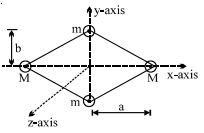
Four point masses are fastened to the corners of a frame of negligible mass lying in the $xy$ plane as shown in the figure. Let $\omega$ be the angular speed of rotation. Then:
A
Rotational kinetic energy associated with a given angular speed depends on the axis of rotation.
B
Rotational kinetic energy about the $y$-axis is independent of $m$ and its value is $Ma^2\omega^2$.
C
Rotational kinetic energy about the $z$-axis depends on $m$ and its value is $(Ma^2 + mb^2)\omega^2$.
D
All of the above.
Solution
(D) The rotational kinetic energy is given by $K = \frac{1}{2}I\omega^2$,where $I$ is the moment of inertia about the axis of rotation.
$1$. For rotation about the $y$-axis: The masses $m$ are on the $y$-axis,so their distance from the axis is $0$. The masses $M$ are at distance $a$ from the $y$-axis. Thus,$I_y = M(a)^2 + M(a)^2 = 2Ma^2$. The kinetic energy is $K_y = \frac{1}{2}(2Ma^2)\omega^2 = Ma^2\omega^2$. This is independent of $m$.
$2$. For rotation about the $z$-axis: The masses $M$ are at distance $a$ from the $z$-axis,and masses $m$ are at distance $b$ from the $z$-axis. Thus,$I_z = M(a)^2 + M(a)^2 + m(b)^2 + m(b)^2 = 2Ma^2 + 2mb^2$. The kinetic energy is $K_z = \frac{1}{2}(2Ma^2 + 2mb^2)\omega^2 = (Ma^2 + mb^2)\omega^2$. This depends on $m$.
$3$. Since the moment of inertia $I$ depends on the axis of rotation,the rotational kinetic energy $K = \frac{1}{2}I\omega^2$ also depends on the axis of rotation.
Therefore,all statements are correct.
$1$. For rotation about the $y$-axis: The masses $m$ are on the $y$-axis,so their distance from the axis is $0$. The masses $M$ are at distance $a$ from the $y$-axis. Thus,$I_y = M(a)^2 + M(a)^2 = 2Ma^2$. The kinetic energy is $K_y = \frac{1}{2}(2Ma^2)\omega^2 = Ma^2\omega^2$. This is independent of $m$.
$2$. For rotation about the $z$-axis: The masses $M$ are at distance $a$ from the $z$-axis,and masses $m$ are at distance $b$ from the $z$-axis. Thus,$I_z = M(a)^2 + M(a)^2 + m(b)^2 + m(b)^2 = 2Ma^2 + 2mb^2$. The kinetic energy is $K_z = \frac{1}{2}(2Ma^2 + 2mb^2)\omega^2 = (Ma^2 + mb^2)\omega^2$. This depends on $m$.
$3$. Since the moment of inertia $I$ depends on the axis of rotation,the rotational kinetic energy $K = \frac{1}{2}I\omega^2$ also depends on the axis of rotation.
Therefore,all statements are correct.
0 likes
View Solution89
DifficultMCQ
$A$ particle falls freely near the surface of the earth. Consider a fixed point $O$ (not vertically below the particle) on the ground.
A
Angular momentum of the particle about $O$ is increasing.
B
The angular velocity of the particle about $O$ is increasing.
C
The moment of inertia of the particle about $O$ is decreasing.
D
All of the above
Solution
(D) The angular momentum $L$ of the particle about point $O$ is given by $L = mvd$,where $m$ is the mass,$v$ is the velocity,and $d$ is the perpendicular distance from $O$ to the line of motion. Since the particle is falling freely,its speed $v$ increases with time,while $d$ remains constant. Therefore,the angular momentum $L$ increases.
The moment of inertia $I$ of the particle about $O$ is $I = mr^2$,where $r$ is the distance from $O$ to the particle. As the particle falls,the distance $r$ decreases,so the moment of inertia $I$ decreases.
The angular velocity $\omega$ of the particle about $O$ is given by $\omega = \frac{v_{\perp}}{r} = \frac{v \sin \theta}{r}$. As the particle falls,$v$ increases,$\sin \theta$ increases (since $\theta$ increases),and $r$ decreases. Consequently,the angular velocity $\omega$ increases.
Since all statements are correct,the correct option is $D$.
The moment of inertia $I$ of the particle about $O$ is $I = mr^2$,where $r$ is the distance from $O$ to the particle. As the particle falls,the distance $r$ decreases,so the moment of inertia $I$ decreases.
The angular velocity $\omega$ of the particle about $O$ is given by $\omega = \frac{v_{\perp}}{r} = \frac{v \sin \theta}{r}$. As the particle falls,$v$ increases,$\sin \theta$ increases (since $\theta$ increases),and $r$ decreases. Consequently,the angular velocity $\omega$ increases.
Since all statements are correct,the correct option is $D$.
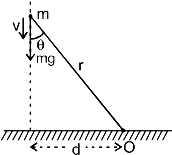
0 likes
View Solution90
MediumMCQ
$A$ man spinning in free space changes the shape of his body,e.g.,by spreading his arms or curling up. By doing this,he can change his
A
moment of inertia
B
rotational kinetic energy
C
angular velocity
D
All of the above
Solution
(D) In free space,there is no external torque acting on the man,so his angular momentum $(L)$ remains conserved.
By changing the shape of his body (spreading arms or curling up),the man changes his moment of inertia $(I)$.
Since $L = I \omega$,if $I$ changes,the angular velocity $(\omega)$ must also change to keep $L$ constant.
Furthermore,the rotational kinetic energy is given by $K.E. = \frac{L^2}{2I}$. Since $L$ is constant,a change in $I$ results in a change in rotational kinetic energy.
Therefore,by changing his body shape,the man can change his moment of inertia,angular velocity,and rotational kinetic energy.
Thus,the correct option is $D$.
By changing the shape of his body (spreading arms or curling up),the man changes his moment of inertia $(I)$.
Since $L = I \omega$,if $I$ changes,the angular velocity $(\omega)$ must also change to keep $L$ constant.
Furthermore,the rotational kinetic energy is given by $K.E. = \frac{L^2}{2I}$. Since $L$ is constant,a change in $I$ results in a change in rotational kinetic energy.
Therefore,by changing his body shape,the man can change his moment of inertia,angular velocity,and rotational kinetic energy.
Thus,the correct option is $D$.
0 likes
View Solution91
DifficultMCQ
$A$ ring rolls without slipping on the ground. Its centre $C$ moves with a constant speed $u$. $P$ is any point on the ring. The speed of $P$ with respect to the ground is:
A
$0 \leq v \leq 2u$
B
$v = \sqrt{2}u$,if $CP$ is horizontal
C
$v = u$,if $CP$ makes an angle of $30^\circ$ with the horizontal and $P$ is below the horizontal level of $C$.
D
All of the above
Solution
(D) For a ring rolling without slipping,the velocity of the point of contact $A$ with the ground is zero,so $v_A = u - R\omega = 0$,which implies $u = R\omega$.
The velocity of the top point $B$ is $v_B = u + R\omega = 2u$.
Thus,the range of speeds for any point $P$ on the ring is $0 \leq v \leq 2u$.
Let $P$ be a point such that the radius $CP$ makes an angle $\theta$ with the horizontal. The velocity vector of $P$ is the vector sum of the translational velocity $\vec{u}$ and the rotational velocity $\vec{v}_{rot} = \vec{\omega} \times \vec{r}$.
The magnitude of velocity is $v_P = \sqrt{u^2 + (R\omega)^2 + 2u(R\omega)\cos(\theta + 90^\circ)}$.
Since $u = R\omega$,$v_P = \sqrt{u^2 + u^2 + 2u^2(-\sin\theta)} = u\sqrt{2(1 - \sin\theta)}$.
For option $B$: If $CP$ is horizontal,$\theta = 0^\circ$,then $v_P = u\sqrt{2(1 - 0)} = u\sqrt{2}$. This is correct.
For option $C$: If $\theta = 30^\circ$ and $P$ is below the horizontal,then $v_P = u\sqrt{2(1 - \sin 30^\circ)} = u\sqrt{2(1 - 0.5)} = u\sqrt{2(0.5)} = u$. This is also correct.
Therefore,all statements are correct.
The velocity of the top point $B$ is $v_B = u + R\omega = 2u$.
Thus,the range of speeds for any point $P$ on the ring is $0 \leq v \leq 2u$.
Let $P$ be a point such that the radius $CP$ makes an angle $\theta$ with the horizontal. The velocity vector of $P$ is the vector sum of the translational velocity $\vec{u}$ and the rotational velocity $\vec{v}_{rot} = \vec{\omega} \times \vec{r}$.
The magnitude of velocity is $v_P = \sqrt{u^2 + (R\omega)^2 + 2u(R\omega)\cos(\theta + 90^\circ)}$.
Since $u = R\omega$,$v_P = \sqrt{u^2 + u^2 + 2u^2(-\sin\theta)} = u\sqrt{2(1 - \sin\theta)}$.
For option $B$: If $CP$ is horizontal,$\theta = 0^\circ$,then $v_P = u\sqrt{2(1 - 0)} = u\sqrt{2}$. This is correct.
For option $C$: If $\theta = 30^\circ$ and $P$ is below the horizontal,then $v_P = u\sqrt{2(1 - \sin 30^\circ)} = u\sqrt{2(1 - 0.5)} = u\sqrt{2(0.5)} = u$. This is also correct.
Therefore,all statements are correct.
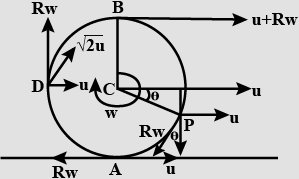
0 likes
View Solution92
DifficultMCQ
$A$ yo-yo is resting on a rough horizontal table. Forces $F_1, F_2$ and $F_3$ are applied separately as shown. The correct statement is
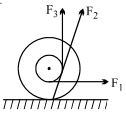
A
when $F_3$ is applied the centre of mass will move to the right.
B
when $F_2$ is applied the centre of mass will move to the left.
C
when $F_1$ is applied the centre of mass will move to the right.
D
when $F_2$ is applied the centre of mass will move to the right.
Solution
(C) The motion of the centre of mass of a body is determined by the net external force acting on it,according to Newton's second law,$F_{ext} = Ma_{cm}$.
For the yo-yo to move to the right,the horizontal component of the applied force must be directed towards the right.
$1$. Force $F_1$ is applied horizontally to the right. Therefore,when $F_1$ is applied,the net force on the yo-yo is to the right,causing the centre of mass to move to the right.
$2$. Force $F_3$ is applied vertically upwards. It has no horizontal component,so it will not cause the centre of mass to move horizontally.
$3$. Force $F_2$ is applied at an angle such that its horizontal component is directed towards the right. Therefore,when $F_2$ is applied,the centre of mass will also move to the right.
Comparing the options,option $C$ is a correct statement.
For the yo-yo to move to the right,the horizontal component of the applied force must be directed towards the right.
$1$. Force $F_1$ is applied horizontally to the right. Therefore,when $F_1$ is applied,the net force on the yo-yo is to the right,causing the centre of mass to move to the right.
$2$. Force $F_3$ is applied vertically upwards. It has no horizontal component,so it will not cause the centre of mass to move horizontally.
$3$. Force $F_2$ is applied at an angle such that its horizontal component is directed towards the right. Therefore,when $F_2$ is applied,the centre of mass will also move to the right.
Comparing the options,option $C$ is a correct statement.
0 likes
View Solution93
AdvancedMCQ
$A$ disc of circumference $s$ is at rest at a point $A$ on a horizontal surface when a constant horizontal force begins to act on its centre. Between $A$ and $B$ there is sufficient friction to prevent slipping,and the surface is smooth to the right of $B$. $AB = s$. The disc moves from $A$ to $B$ in time $T$. To the right of $B$,
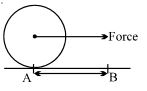
A
the disc will cover a distance greater than $s$ in further time $T$.
B
linear acceleration of the disc will increase.
C
the disc will make one rotation in time $T/2$.
D
All of the above.
Solution
(D) Let $F$ be the applied force,$m$ be the mass,and $R$ be the radius of the disc. Circumference $s = 2\pi R$.
Between $A$ and $B$,the disc rolls without slipping. The equations of motion are:
$F - f = ma_1$ and $fR = I\alpha = (\frac{1}{2}mR^2)\alpha$. Since $a_1 = R\alpha$,we get $f = \frac{1}{2}ma_1$. Substituting this,$F - \frac{1}{2}ma_1 = ma_1 \implies F = \frac{3}{2}ma_1 \implies a_1 = \frac{2F}{3m}$.
The distance $AB = s = 2\pi R = \frac{1}{2}a_1 T^2$. Thus,$T^2 = \frac{4\pi R}{a_1} = \frac{4\pi R}{2F/3m} = \frac{6\pi mR}{F}$.
At point $B$,the linear velocity $v_B = a_1 T$ and angular velocity $\omega_B = \alpha T = \frac{a_1}{R}T$.
To the right of $B$,the surface is smooth,so friction $f = 0$. The new linear acceleration $a_2 = F/m$. Since $F = \frac{3}{2}ma_1$,$a_2 = \frac{3}{2}a_1 > a_1$. Thus,linear acceleration increases.
In time $T$ after $B$,the distance covered is $d = v_B T + \frac{1}{2}a_2 T^2 = (a_1 T)T + \frac{1}{2}(\frac{3}{2}a_1)T^2 = a_1 T^2 + \frac{3}{4}a_1 T^2 = \frac{7}{4}a_1 T^2$. Since $s = \frac{1}{2}a_1 T^2$,$d = \frac{7}{2}s > s$.
Since there is no friction to the right of $B$,the angular velocity remains constant at $\omega_B = \frac{a_1 T}{R}$. The time taken for one rotation is $t = \frac{2\pi}{\omega_B} = \frac{2\pi R}{a_1 T} = \frac{s}{a_1 T} = \frac{\frac{1}{2}a_1 T^2}{a_1 T} = \frac{T}{2}$.
All statements are correct.
Between $A$ and $B$,the disc rolls without slipping. The equations of motion are:
$F - f = ma_1$ and $fR = I\alpha = (\frac{1}{2}mR^2)\alpha$. Since $a_1 = R\alpha$,we get $f = \frac{1}{2}ma_1$. Substituting this,$F - \frac{1}{2}ma_1 = ma_1 \implies F = \frac{3}{2}ma_1 \implies a_1 = \frac{2F}{3m}$.
The distance $AB = s = 2\pi R = \frac{1}{2}a_1 T^2$. Thus,$T^2 = \frac{4\pi R}{a_1} = \frac{4\pi R}{2F/3m} = \frac{6\pi mR}{F}$.
At point $B$,the linear velocity $v_B = a_1 T$ and angular velocity $\omega_B = \alpha T = \frac{a_1}{R}T$.
To the right of $B$,the surface is smooth,so friction $f = 0$. The new linear acceleration $a_2 = F/m$. Since $F = \frac{3}{2}ma_1$,$a_2 = \frac{3}{2}a_1 > a_1$. Thus,linear acceleration increases.
In time $T$ after $B$,the distance covered is $d = v_B T + \frac{1}{2}a_2 T^2 = (a_1 T)T + \frac{1}{2}(\frac{3}{2}a_1)T^2 = a_1 T^2 + \frac{3}{4}a_1 T^2 = \frac{7}{4}a_1 T^2$. Since $s = \frac{1}{2}a_1 T^2$,$d = \frac{7}{2}s > s$.
Since there is no friction to the right of $B$,the angular velocity remains constant at $\omega_B = \frac{a_1 T}{R}$. The time taken for one rotation is $t = \frac{2\pi}{\omega_B} = \frac{2\pi R}{a_1 T} = \frac{s}{a_1 T} = \frac{\frac{1}{2}a_1 T^2}{a_1 T} = \frac{T}{2}$.
All statements are correct.
0 likes
View Solution94
DifficultMCQ
$A$ hollow sphere of radius $R$ and mass $m$ is fully filled with water of mass $m$. It is rolled down a horizontal plane such that its centre of mass moves with a velocity $v$. If it purely rolls,which of the following statements is correct?
A
Kinetic energy of the sphere is $\frac{5}{6} mv^2$
B
Kinetic energy of the sphere is $\frac{4}{5} mv^2$
C
Angular momentum of the sphere about a fixed point on ground is $\frac{8}{3} mvR$
D
Angular momentum of the sphere about a fixed point on ground is $\frac{14}{5} mvR$
Solution
(C) The total mass of the system is $M = m + m = 2m$.
Since the sphere is hollow and filled with water,the moment of inertia of the shell is $I_{shell} = \frac{2}{3} m R^2$.
Assuming the water behaves as a rigid body rotating with the shell,the total moment of inertia is $I = I_{shell} + I_{water} = \frac{2}{3} m R^2 + 0$ (assuming water is non-viscous and does not rotate,but in standard physics problems of this type,we treat the system as a rigid body with $I = \frac{2}{3} m R^2$).
For pure rolling,$\omega = \frac{v}{R}$.
The angular momentum about a point on the ground is $L = I_{cm} \omega + M v R$.
Substituting the values: $L = (\frac{2}{3} m R^2) \times (\frac{v}{R}) + (2m) v R$.
$L = \frac{2}{3} m v R + 2 m v R = \frac{8}{3} m v R$.
Since the sphere is hollow and filled with water,the moment of inertia of the shell is $I_{shell} = \frac{2}{3} m R^2$.
Assuming the water behaves as a rigid body rotating with the shell,the total moment of inertia is $I = I_{shell} + I_{water} = \frac{2}{3} m R^2 + 0$ (assuming water is non-viscous and does not rotate,but in standard physics problems of this type,we treat the system as a rigid body with $I = \frac{2}{3} m R^2$).
For pure rolling,$\omega = \frac{v}{R}$.
The angular momentum about a point on the ground is $L = I_{cm} \omega + M v R$.
Substituting the values: $L = (\frac{2}{3} m R^2) \times (\frac{v}{R}) + (2m) v R$.
$L = \frac{2}{3} m v R + 2 m v R = \frac{8}{3} m v R$.
0 likes
View Solution95
DifficultMCQ
In the figure shown,the plank is being pulled to the right with a constant speed $v$. If the cylinder does not slip,then:
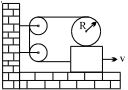
A
the speed of the centre of mass of the cylinder is $2v$.
B
the speed of the centre of mass of the cylinder is zero.
C
the angular velocity of the cylinder is $v/R$.
D
the speed of the centre of mass of the cylinder is $v/2$.
Solution
(D) Let $v_{cm}$ be the velocity of the centre of mass of the cylinder and $\omega$ be its angular velocity.
At the contact point between the cylinder and the plank (bottom point),the velocity of the cylinder must match the velocity of the plank because there is no slipping. Thus,$v_{cm} - R\omega = v$ (assuming $v_{cm}$ is to the right and $\omega$ is clockwise).
At the contact point between the cylinder and the top string (top point),the velocity of the cylinder must match the velocity of the string. Since the string is fixed to the wall,its velocity is $0$. Thus,$v_{cm} + R\omega = 0$.
Adding these two equations: $(v_{cm} - R\omega) + (v_{cm} + R\omega) = v + 0$,which gives $2v_{cm} = v$,so $v_{cm} = v/2$.
Subtracting the equations: $(v_{cm} - R\omega) - (v_{cm} + R\omega) = v - 0$,which gives $-2R\omega = v$,so $\omega = -v/(2R)$ (the negative sign indicates counter-clockwise rotation).
Therefore,the speed of the centre of mass of the cylinder is $v/2$.
At the contact point between the cylinder and the plank (bottom point),the velocity of the cylinder must match the velocity of the plank because there is no slipping. Thus,$v_{cm} - R\omega = v$ (assuming $v_{cm}$ is to the right and $\omega$ is clockwise).
At the contact point between the cylinder and the top string (top point),the velocity of the cylinder must match the velocity of the string. Since the string is fixed to the wall,its velocity is $0$. Thus,$v_{cm} + R\omega = 0$.
Adding these two equations: $(v_{cm} - R\omega) + (v_{cm} + R\omega) = v + 0$,which gives $2v_{cm} = v$,so $v_{cm} = v/2$.
Subtracting the equations: $(v_{cm} - R\omega) - (v_{cm} + R\omega) = v - 0$,which gives $-2R\omega = v$,so $\omega = -v/(2R)$ (the negative sign indicates counter-clockwise rotation).
Therefore,the speed of the centre of mass of the cylinder is $v/2$.
0 likes
View Solution96
DifficultMCQ
$A$ uniform disc is rolling on a horizontal surface. At a certain instant,$B$ is the point of contact and $A$ is the topmost point of the disc,where $R$ is the radius of the disc.

A
The magnitude of the angular momentum of the disc about $B$ is thrice that about $A$.
B
The angular momentum of the disc about $A$ is anticlockwise.
C
The angular momentum of the disc about $B$ is clockwise.
D
All of the above.
Solution
(D) For a disc of mass $m$ and radius $R$ rolling with angular velocity $\omega$ and linear velocity $v = R\omega$:
The angular momentum about the center of mass $O$ is $L_O = I_O \omega = (\frac{1}{2}mR^2)\omega$.
The angular momentum about any point $P$ is given by $\vec{L}_P = \vec{L}_{cm} + \vec{r}_{cm/P} \times m\vec{v}_{cm}$.
For point $B$ (point of contact): $\vec{L}_B = I_O \omega + mR^2 \omega = \frac{1}{2}mR^2 \omega + mR^2 \omega = \frac{3}{2}mR^2 \omega$.
For point $A$ (topmost point): $\vec{L}_A = I_O \omega - mR^2 \omega = \frac{1}{2}mR^2 \omega - mR^2 \omega = -\frac{1}{2}mR^2 \omega$.
The magnitude $|L_B| = \frac{3}{2}mR^2 \omega$ and $|L_A| = \frac{1}{2}mR^2 \omega$. Thus,$|L_B| = 3|L_A|$.
Since $L_A$ is negative,it is anticlockwise,and $L_B$ is positive,it is clockwise. Therefore,all statements are correct.
The angular momentum about the center of mass $O$ is $L_O = I_O \omega = (\frac{1}{2}mR^2)\omega$.
The angular momentum about any point $P$ is given by $\vec{L}_P = \vec{L}_{cm} + \vec{r}_{cm/P} \times m\vec{v}_{cm}$.
For point $B$ (point of contact): $\vec{L}_B = I_O \omega + mR^2 \omega = \frac{1}{2}mR^2 \omega + mR^2 \omega = \frac{3}{2}mR^2 \omega$.
For point $A$ (topmost point): $\vec{L}_A = I_O \omega - mR^2 \omega = \frac{1}{2}mR^2 \omega - mR^2 \omega = -\frac{1}{2}mR^2 \omega$.
The magnitude $|L_B| = \frac{3}{2}mR^2 \omega$ and $|L_A| = \frac{1}{2}mR^2 \omega$. Thus,$|L_B| = 3|L_A|$.
Since $L_A$ is negative,it is anticlockwise,and $L_B$ is positive,it is clockwise. Therefore,all statements are correct.
0 likes
View Solution97
MediumMCQ
Which of the following statements are correct?
A
Friction acting on a cylinder without sliding on an inclined surface is always upward along the incline,irrespective of any external force acting on it.
B
Friction acting on a cylinder without sliding on an inclined surface may be upward or downward depending on the external force acting on it.
C
Friction acting on a cylinder rolling without sliding may be zero depending on the external force acting on it.
D
Both $(B)$ and $(C)$.
Solution
(D) When a cylinder rolls without sliding on an inclined plane,the friction force $f$ depends on the net torque and the net force acting on the body.
For a cylinder of mass $M$ and radius $R$ on an incline of angle $\theta$,the equation of motion is $Mg \sin \theta - f = Ma$ and the torque equation about the center of mass is $fR = I\alpha = (\frac{1}{2}MR^2)(\frac{a}{R})$.
Solving these,we get $f = \frac{1}{3}Mg \sin \theta$,which is directed upward.
However,if an external force (like an applied force $F$) is present,the direction of friction can change to oppose the tendency of sliding or to provide the necessary torque for rolling.
If the external force is applied such that the required torque for rolling is already provided,the friction force can be zero.
Thus,friction can be upward,downward,or zero depending on the external force and the conditions of motion.
Therefore,statements $(B)$ and $(C)$ are correct.
For a cylinder of mass $M$ and radius $R$ on an incline of angle $\theta$,the equation of motion is $Mg \sin \theta - f = Ma$ and the torque equation about the center of mass is $fR = I\alpha = (\frac{1}{2}MR^2)(\frac{a}{R})$.
Solving these,we get $f = \frac{1}{3}Mg \sin \theta$,which is directed upward.
However,if an external force (like an applied force $F$) is present,the direction of friction can change to oppose the tendency of sliding or to provide the necessary torque for rolling.
If the external force is applied such that the required torque for rolling is already provided,the friction force can be zero.
Thus,friction can be upward,downward,or zero depending on the external force and the conditions of motion.
Therefore,statements $(B)$ and $(C)$ are correct.
0 likes
View Solution98
AdvancedMCQ
$A$ ring of mass $M$ and radius $R$ sliding with a velocity $v_0$ suddenly enters a rough surface where the coefficient of friction is $\mu$,as shown in the figure. Choose the correct statement$(s)$.
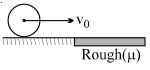
A
As the ring enters the rough surface,the limiting friction force acts on it.
B
The direction of friction is opposite to the direction of motion.
C
The friction force accelerates the ring in the clockwise sense about its centre of mass.
D
All of the above.
Solution
(D) When the ring enters the rough surface,it is purely sliding forward with velocity $v_0$ and has no initial angular velocity $(\omega = 0)$.
$1$. Since the ring is sliding,the kinetic friction force $f = \mu N = \mu Mg$ acts on it,which is the limiting friction.
$2$. The friction force acts at the point of contact in a direction opposite to the velocity of the point of contact,which is opposite to the direction of motion of the ring.
$3$. The friction force $f$ creates a torque $\tau = f \times R$ about the centre of mass. Since the friction acts at the bottom point towards the left,the torque is in the clockwise direction,which causes an angular acceleration $\alpha$ in the clockwise sense.
Therefore,all the given statements are correct.
$1$. Since the ring is sliding,the kinetic friction force $f = \mu N = \mu Mg$ acts on it,which is the limiting friction.
$2$. The friction force acts at the point of contact in a direction opposite to the velocity of the point of contact,which is opposite to the direction of motion of the ring.
$3$. The friction force $f$ creates a torque $\tau = f \times R$ about the centre of mass. Since the friction acts at the bottom point towards the left,the torque is in the clockwise direction,which causes an angular acceleration $\alpha$ in the clockwise sense.
Therefore,all the given statements are correct.
0 likes
View Solution99
MediumMCQ
$A$ ring of mass $M$ and radius $R$ sliding with a velocity $v_0$ suddenly enters a rough surface where the coefficient of friction is $\mu$,as shown in the figure. Choose the correct statement$(s)$.
A
The momentum of the ring is conserved.
B
The angular momentum of the ring is conserved about its centre of mass.
C
The angular momentum of the ring is conserved about any point on the horizontal surface.
D
The mechanical energy of the ring is conserved.
Solution
(C) $1$. When the ring enters the rough surface,a kinetic frictional force $f = \mu Mg$ acts on the ring in the direction opposite to its velocity $v_0$.
$2$. Since an external force (friction) acts on the ring,the linear momentum is not conserved.
$3$. The frictional force exerts a torque about the centre of mass $(CM)$ of the ring,causing it to rotate. Therefore,the angular momentum about the $CM$ is not conserved.
$4$. The frictional force acts at the point of contact with the surface. If we choose any point on the horizontal surface as the reference point,the line of action of the frictional force passes through this point. Thus,the torque due to friction about any point on the horizontal surface is zero. Consequently,the angular momentum of the ring is conserved about any point on the horizontal surface.
$5$. Since friction is a non-conservative force,it does work on the system,so the mechanical energy is not conserved.
$2$. Since an external force (friction) acts on the ring,the linear momentum is not conserved.
$3$. The frictional force exerts a torque about the centre of mass $(CM)$ of the ring,causing it to rotate. Therefore,the angular momentum about the $CM$ is not conserved.
$4$. The frictional force acts at the point of contact with the surface. If we choose any point on the horizontal surface as the reference point,the line of action of the frictional force passes through this point. Thus,the torque due to friction about any point on the horizontal surface is zero. Consequently,the angular momentum of the ring is conserved about any point on the horizontal surface.
$5$. Since friction is a non-conservative force,it does work on the system,so the mechanical energy is not conserved.
0 likes
View Solution100
AdvancedMCQ
$A$ ring of mass $M$ and radius $R$ sliding with a velocity $v_0$ suddenly enters a rough surface where the coefficient of friction is $\mu$,as shown in the figure. Choose the correct statement$(s)$.
A
The rolling velocity is $\frac{v_0}{2}$.
B
The ring starts rolling motion when the point of contact becomes stationary.
C
The time after which the ring starts rolling is $\frac{v_0}{2\mu g}$.
D
All of the above.
Solution
(D) When the ring enters the rough surface,kinetic friction acts in the direction opposite to the velocity $v_0$. The force of friction is $f = \mu Mg$.
This force causes a retardation in linear motion: $a = -\frac{f}{M} = -\mu g$.
Also,this friction force provides a torque about the center of mass: $\tau = fR = \mu MgR$.
The angular acceleration is $\alpha = \frac{\tau}{I} = \frac{\mu MgR}{MR^2} = \frac{\mu g}{R}$.
Let $t$ be the time when pure rolling starts. At this time,the velocity of the center of mass is $v = v_0 - at = v_0 - \mu gt$ and the angular velocity is $\omega = \alpha t = \frac{\mu gt}{R}$.
For pure rolling,$v = \omega R$,so $v_0 - \mu gt = (\frac{\mu gt}{R})R = \mu gt$.
This gives $2\mu gt = v_0$,or $t = \frac{v_0}{2\mu g}$.
The velocity at this time is $v = v_0 - \mu g(\frac{v_0}{2\mu g}) = v_0 - \frac{v_0}{2} = \frac{v_0}{2}$.
Pure rolling starts when the point of contact becomes stationary relative to the surface. Thus,all statements are correct.
This force causes a retardation in linear motion: $a = -\frac{f}{M} = -\mu g$.
Also,this friction force provides a torque about the center of mass: $\tau = fR = \mu MgR$.
The angular acceleration is $\alpha = \frac{\tau}{I} = \frac{\mu MgR}{MR^2} = \frac{\mu g}{R}$.
Let $t$ be the time when pure rolling starts. At this time,the velocity of the center of mass is $v = v_0 - at = v_0 - \mu gt$ and the angular velocity is $\omega = \alpha t = \frac{\mu gt}{R}$.
For pure rolling,$v = \omega R$,so $v_0 - \mu gt = (\frac{\mu gt}{R})R = \mu gt$.
This gives $2\mu gt = v_0$,or $t = \frac{v_0}{2\mu g}$.
The velocity at this time is $v = v_0 - \mu g(\frac{v_0}{2\mu g}) = v_0 - \frac{v_0}{2} = \frac{v_0}{2}$.
Pure rolling starts when the point of contact becomes stationary relative to the surface. Thus,all statements are correct.
0 likes
View SolutionSystem of Particles and Rotational Motion — Mix Example - System of Particles and Rotational Motion · Frequently Asked Questions
1Are these System of Particles and Rotational Motion questions useful for JEE and NEET?
Yes. All questions in this section are mapped to JEE Main and NEET exam patterns. Previous year questions from JEE Main, NEET, GUJCET and state-level exams are included with full solutions.
2Can I switch to Hindi or Gujarati for these questions?
Yes. Use the language tabs in the hero section or the sidebar to view the same questions and solutions in English, Hindi or Gujarati.
3How do I generate a question paper from this subtopic?
Use the Vedclass Exam Paper Generator — select the chapter and subtopic, set difficulty, and generate Sets A, B, C, D automatically. First 3 chapters of every subject are free.
Vedclass Products
For Students
Vedclass Test Series
Mock tests in real JEE/NEET style with performance analysis. 5-day free trial.
Start Free TrialFor Teachers
Exam Paper Generator
Generate Set A/B/C/D papers from this chapter in 2 minutes. 3 chapters free.
Try FreeFor Institutes
Online Exam Module
Live online exams with unlimited students, 360° analytics & white-label branding.
See DemoFor Teachers & Institutes
Generate a System of Particles and Rotational Motion Exam Paper in 2 Minutes
Select subtopic & difficulty — Sets A, B, C, D auto-generated with No Repeat logic.
First 3 chapters of every subject are free — no payment required.