
A English
Rotation Motion Basic, Motion of Connected Mass Questions in English
Class 11 Physics · System of Particles and Rotational Motion · Rotation Motion Basic, Motion of Connected Mass
138+
Questions
English
Language
100%
With Solutions
Showing 50 of 138 questions in English
1
MediumMCQ
The linear velocity of a rotating body is given by $\overrightarrow v = \overrightarrow \omega \times \overrightarrow r,$ where $\overrightarrow \omega$ is the angular velocity and $\overrightarrow r$ is the radius vector. If the angular velocity of a body is $\overrightarrow \omega = \hat i - 2\hat j + 2\hat k$ and the radius vector is $\overrightarrow r = 4\hat j - 3\hat k,$ then find the magnitude of linear velocity $|\overrightarrow v |$.
A
$\sqrt {29} \text{ units}$
B
$\sqrt {31} \text{ units}$
C
$\sqrt {37} \text{ units}$
D
$\sqrt {41} \text{ units}$
Solution
(A) The linear velocity is given by the cross product: $\overrightarrow v = \overrightarrow \omega \times \overrightarrow r$.
Using the determinant method for the cross product:
$\overrightarrow v = \begin{vmatrix} \hat i & \hat j & \hat k \\ 1 & -2 & 2 \\ 0 & 4 & -3 \end{vmatrix}$
$= \hat i((-2)(-3) - (2)(4)) - \hat j((1)(-3) - (2)(0)) + \hat k((1)(4) - (-2)(0))$
$= \hat i(6 - 8) - \hat j(-3 - 0) + \hat k(4 - 0)$
$= -2\hat i + 3\hat j + 4\hat k$
The magnitude of the linear velocity is $|\overrightarrow v | = \sqrt{(-2)^2 + (3)^2 + (4)^2}$
$= \sqrt{4 + 9 + 16} = \sqrt{29} \text{ units}$.
Using the determinant method for the cross product:
$\overrightarrow v = \begin{vmatrix} \hat i & \hat j & \hat k \\ 1 & -2 & 2 \\ 0 & 4 & -3 \end{vmatrix}$
$= \hat i((-2)(-3) - (2)(4)) - \hat j((1)(-3) - (2)(0)) + \hat k((1)(4) - (-2)(0))$
$= \hat i(6 - 8) - \hat j(-3 - 0) + \hat k(4 - 0)$
$= -2\hat i + 3\hat j + 4\hat k$
The magnitude of the linear velocity is $|\overrightarrow v | = \sqrt{(-2)^2 + (3)^2 + (4)^2}$
$= \sqrt{4 + 9 + 16} = \sqrt{29} \text{ units}$.
0 likes
View Solution2
EasyMCQ
In the rotational motion of a rigid body,all particles move with:
A
Same linear and angular velocity
B
Same linear and different angular velocity
C
Different linear velocities and same angular velocities
D
Different linear velocities and different angular velocities
Solution
(C) In the rotational motion of a rigid body about a fixed axis,every particle of the body performs circular motion.
For any particle at a distance $r$ from the axis of rotation,the linear velocity $v$ is given by $v = r\omega$,where $\omega$ is the angular velocity.
Since the body is rigid,all particles rotate by the same angle in the same time interval,meaning they all share the same angular velocity $\omega$.
However,because the distance $r$ from the axis of rotation varies for different particles,the linear velocity $v = r\omega$ will be different for each particle.
Therefore,all particles move with different linear velocities but the same angular velocity.
For any particle at a distance $r$ from the axis of rotation,the linear velocity $v$ is given by $v = r\omega$,where $\omega$ is the angular velocity.
Since the body is rigid,all particles rotate by the same angle in the same time interval,meaning they all share the same angular velocity $\omega$.
However,because the distance $r$ from the axis of rotation varies for different particles,the linear velocity $v = r\omega$ will be different for each particle.
Therefore,all particles move with different linear velocities but the same angular velocity.
0 likes
View Solution3
MediumMCQ
$A$ body is in pure rotation. The linear speed $v$ of a particle,the distance $r$ of the particle from the axis,and the angular velocity $\omega$ of the body are related as $\omega = \frac{v}{r}$. Thus,
A
$\omega \propto \frac{1}{r}$
B
$\omega \propto r$
C
$\omega = 0$
D
$\omega$ is independent of $r$
Solution
(D) In pure rotation,all particles of a rigid body rotate with the same angular velocity $\omega$ about the axis of rotation.
The relation is given by $v = \omega r$,which implies $\omega = \frac{v}{r}$.
For a rigid body undergoing pure rotation,the angular velocity $\omega$ is a property of the entire body and is constant for all particles at any given instant,regardless of their distance $r$ from the axis.
As the distance $r$ increases,the linear speed $v$ increases proportionally such that the ratio $\frac{v}{r}$ remains constant.
Therefore,$\omega$ is independent of $r$.
Thus,option $(d)$ is correct.
The relation is given by $v = \omega r$,which implies $\omega = \frac{v}{r}$.
For a rigid body undergoing pure rotation,the angular velocity $\omega$ is a property of the entire body and is constant for all particles at any given instant,regardless of their distance $r$ from the axis.
As the distance $r$ increases,the linear speed $v$ increases proportionally such that the ratio $\frac{v}{r}$ remains constant.
Therefore,$\omega$ is independent of $r$.
Thus,option $(d)$ is correct.
0 likes
View Solution4
EasyMCQ
$A$ sphere is rotating about a diameter.
A
The particles on the surface of the sphere do not have any linear acceleration.
B
The particles on the diameter mentioned above do not have any linear acceleration.
C
Different particles on the surface have different angular speeds.
D
All the particles on the surface have same linear speed.
Solution
(B) When a sphere rotates about a diameter,all particles of the sphere perform circular motion about the axis of rotation.
For any particle at a distance $r$ from the axis of rotation,the angular velocity $\omega$ is the same for all particles.
The linear velocity is given by $v = r\omega$. Since $r$ varies for different particles,the linear speed $v$ is different for different particles.
The linear acceleration of a particle in circular motion is given by $a = \sqrt{a_c^2 + a_t^2}$,where $a_c = \omega^2 r$ is centripetal acceleration and $a_t = \alpha r$ is tangential acceleration. For uniform rotation,$\alpha = 0$,so $a = \omega^2 r$.
Particles on the axis of rotation (the diameter) have $r = 0$,which means their linear velocity $v = 0$ and their linear acceleration $a = 0$.
Therefore,the particles on the diameter do not have any linear acceleration.
For any particle at a distance $r$ from the axis of rotation,the angular velocity $\omega$ is the same for all particles.
The linear velocity is given by $v = r\omega$. Since $r$ varies for different particles,the linear speed $v$ is different for different particles.
The linear acceleration of a particle in circular motion is given by $a = \sqrt{a_c^2 + a_t^2}$,where $a_c = \omega^2 r$ is centripetal acceleration and $a_t = \alpha r$ is tangential acceleration. For uniform rotation,$\alpha = 0$,so $a = \omega^2 r$.
Particles on the axis of rotation (the diameter) have $r = 0$,which means their linear velocity $v = 0$ and their linear acceleration $a = 0$.
Therefore,the particles on the diameter do not have any linear acceleration.
0 likes
View Solution5
MediumMCQ
Let $\vec{A}$ be a unit vector along the axis of rotation of a purely rotating body and $\vec{B}$ be a unit vector along the velocity of a particle $P$ of the body away from the axis. The value of $\vec{A} \cdot \vec{B}$ is
A
$1$
B
$-1$
C
$0$
D
None of these
Solution
(C) For a body in pure rotation,the axis of rotation is the line about which all particles of the body move in circular paths.
The velocity vector $\vec{v}$ of any particle $P$ in a rotating body is always tangent to its circular path.
Since the circular path lies in a plane perpendicular to the axis of rotation,the velocity vector $\vec{v}$ (and thus the unit vector $\vec{B}$) is always perpendicular to the axis of rotation (and thus the unit vector $\vec{A}$).
Therefore,the angle $\theta$ between $\vec{A}$ and $\vec{B}$ is $90^{\circ}$.
The dot product is given by $\vec{A} \cdot \vec{B} = |\vec{A}| |\vec{B}| \cos \theta$.
Since $|\vec{A}| = 1$,$|\vec{B}| = 1$,and $\cos 90^{\circ} = 0$,we get $\vec{A} \cdot \vec{B} = 1 \times 1 \times 0 = 0$.
The velocity vector $\vec{v}$ of any particle $P$ in a rotating body is always tangent to its circular path.
Since the circular path lies in a plane perpendicular to the axis of rotation,the velocity vector $\vec{v}$ (and thus the unit vector $\vec{B}$) is always perpendicular to the axis of rotation (and thus the unit vector $\vec{A}$).
Therefore,the angle $\theta$ between $\vec{A}$ and $\vec{B}$ is $90^{\circ}$.
The dot product is given by $\vec{A} \cdot \vec{B} = |\vec{A}| |\vec{B}| \cos \theta$.
Since $|\vec{A}| = 1$,$|\vec{B}| = 1$,and $\cos 90^{\circ} = 0$,we get $\vec{A} \cdot \vec{B} = 1 \times 1 \times 0 = 0$.
0 likes
View Solution6
MediumMCQ
$A$ mass $m$ is supported by a massless string wound around a uniform cylinder of mass $M$ and radius $R$. On releasing the mass from rest,it will fall with an acceleration of:
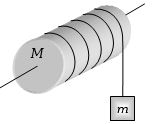
A
$g$
B
$\frac{g}{2}$
C
$\frac{g}{3}$
D
$\frac{2g}{3}$
Solution
(D) Let $T$ be the tension in the string and $a$ be the downward acceleration of the mass $m$. The equation of motion for the falling mass $m$ is: $mg - T = ma$ $(1)$
For the rotating cylinder of mass $M$ and radius $R$,the torque $\tau$ is given by $\tau = T \cdot R$. The moment of inertia of the cylinder is $I = \frac{1}{2}MR^2$. Using $\tau = I\alpha$,where $\alpha = \frac{a}{R}$ is the angular acceleration,we get: $T \cdot R = (\frac{1}{2}MR^2) \cdot (\frac{a}{R}) \implies T = \frac{1}{2}Ma$ $(2)$
Substituting the value of $T$ from $(2)$ into $(1)$: $mg - \frac{1}{2}Ma = ma$
$mg = ma + \frac{1}{2}Ma = a(m + \frac{M}{2})$
$a = \frac{mg}{m + M/2} = \frac{2mg}{2m + M}$.
If we assume the masses are equal $(M = m)$,then $a = \frac{2mg}{3m} = \frac{2g}{3}$.
For the rotating cylinder of mass $M$ and radius $R$,the torque $\tau$ is given by $\tau = T \cdot R$. The moment of inertia of the cylinder is $I = \frac{1}{2}MR^2$. Using $\tau = I\alpha$,where $\alpha = \frac{a}{R}$ is the angular acceleration,we get: $T \cdot R = (\frac{1}{2}MR^2) \cdot (\frac{a}{R}) \implies T = \frac{1}{2}Ma$ $(2)$
Substituting the value of $T$ from $(2)$ into $(1)$: $mg - \frac{1}{2}Ma = ma$
$mg = ma + \frac{1}{2}Ma = a(m + \frac{M}{2})$
$a = \frac{mg}{m + M/2} = \frac{2mg}{2m + M}$.
If we assume the masses are equal $(M = m)$,then $a = \frac{2mg}{3m} = \frac{2g}{3}$.
0 likes
View Solution7
MediumMCQ
$A$ uniform disc of radius $R$ and mass $M$ can rotate on a smooth axis passing through its centre and perpendicular to its plane. $A$ force $F$ is applied on its rim as shown in the figure. What is the tangential acceleration of the rim?
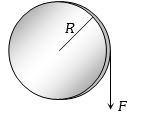
A
$\frac{2F}{M}$
B
$\frac{F}{M}$
C
$\frac{F}{2M}$
D
$\frac{F}{4M}$
Solution
(A) The torque $\tau$ applied by the force $F$ at the rim is given by $\tau = F R$.
The moment of inertia $I$ of a uniform disc about an axis passing through its centre and perpendicular to its plane is $I = \frac{1}{2} M R^2$.
Using the relation $\tau = I \alpha$,where $\alpha$ is the angular acceleration:
$F R = (\frac{1}{2} M R^2) \alpha$
$\alpha = \frac{F R}{\frac{1}{2} M R^2} = \frac{2F}{M R}$.
The tangential acceleration $a_t$ at the rim is given by $a_t = \alpha R$.
Substituting the value of $\alpha$:
$a_t = (\frac{2F}{M R}) R = \frac{2F}{M}$.
Thus,the tangential acceleration is $\frac{2F}{M}$.
The moment of inertia $I$ of a uniform disc about an axis passing through its centre and perpendicular to its plane is $I = \frac{1}{2} M R^2$.
Using the relation $\tau = I \alpha$,where $\alpha$ is the angular acceleration:
$F R = (\frac{1}{2} M R^2) \alpha$
$\alpha = \frac{F R}{\frac{1}{2} M R^2} = \frac{2F}{M R}$.
The tangential acceleration $a_t$ at the rim is given by $a_t = \alpha R$.
Substituting the value of $\alpha$:
$a_t = (\frac{2F}{M R}) R = \frac{2F}{M}$.
Thus,the tangential acceleration is $\frac{2F}{M}$.
0 likes
View Solution8
MediumMCQ
$A$ cylinder of mass $M$ and radius $r$ is mounted on a frictionless axle over a well. $A$ rope of negligible mass is wrapped around the cylinder and a bucket of mass $m$ is suspended from the rope. The linear acceleration of the bucket will be
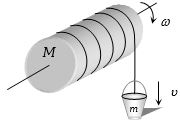
A
$\frac{Mg}{M + 2m}$
B
$\frac{2Mg}{m + 2M}$
C
$\frac{Mg}{2M + m}$
D
$\frac{2mg}{M + 2m}$
Solution
(D) Let $a$ be the linear acceleration of the bucket and $T$ be the tension in the rope.
For the bucket of mass $m$,the equation of motion is: $mg - T = ma$ --- $(1)$
For the cylinder of mass $M$ and radius $r$,the torque $\tau$ is given by $\tau = I\alpha$,where $I = \frac{1}{2}Mr^2$ is the moment of inertia of the cylinder and $\alpha = \frac{a}{r}$ is the angular acceleration.
The torque is also given by $\tau = Tr$.
Equating the two expressions for torque: $Tr = (\frac{1}{2}Mr^2)(\frac{a}{r}) = \frac{1}{2}Mra$.
Thus,$T = \frac{1}{2}Ma$ --- $(2)$
Substituting the value of $T$ from equation $(2)$ into equation $(1)$:
$mg - \frac{1}{2}Ma = ma$
$mg = ma + \frac{1}{2}Ma = a(m + \frac{M}{2}) = a(\frac{2m + M}{2})$
$a = \frac{2mg}{M + 2m}$
For the bucket of mass $m$,the equation of motion is: $mg - T = ma$ --- $(1)$
For the cylinder of mass $M$ and radius $r$,the torque $\tau$ is given by $\tau = I\alpha$,where $I = \frac{1}{2}Mr^2$ is the moment of inertia of the cylinder and $\alpha = \frac{a}{r}$ is the angular acceleration.
The torque is also given by $\tau = Tr$.
Equating the two expressions for torque: $Tr = (\frac{1}{2}Mr^2)(\frac{a}{r}) = \frac{1}{2}Mra$.
Thus,$T = \frac{1}{2}Ma$ --- $(2)$
Substituting the value of $T$ from equation $(2)$ into equation $(1)$:
$mg - \frac{1}{2}Ma = ma$
$mg = ma + \frac{1}{2}Ma = a(m + \frac{M}{2}) = a(\frac{2m + M}{2})$
$a = \frac{2mg}{M + 2m}$
0 likes
View Solution9
DifficultMCQ
$A$ uniform solid cylinder of mass $M$ and radius $R$ rotates about a frictionless horizontal axle. Two similar masses $m$ are suspended with the help of two ropes wrapped around the cylinder. If the system is released from rest,then the acceleration of each mass will be
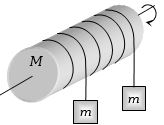
A
$\frac{4mg}{M + 2m}$
B
$\frac{4mg}{M + 4m}$
C
$\frac{2mg}{M + m}$
D
$\frac{2mg}{M + 2m}$
Solution
(B) Let $T$ be the tension in each rope and $a$ be the downward acceleration of each mass $m$.
For each mass $m$,the equation of motion is: $mg - T = ma$ ... $(1)$
For the cylinder,the total torque $\tau$ due to the two ropes is $\tau = 2TR$.
The moment of inertia of the solid cylinder about its axis is $I = \frac{1}{2}MR^2$.
Using $\tau = I\alpha$,where $\alpha$ is the angular acceleration: $2TR = (\frac{1}{2}MR^2)\alpha$.
Since $a = \alpha R$,we have $\alpha = \frac{a}{R}$.
Substituting $\alpha$ into the torque equation: $2TR = \frac{1}{2}MR^2(\frac{a}{R}) = \frac{1}{2}MRa$.
Thus,$2T = \frac{1}{2}Ma$,or $T = \frac{1}{4}Ma$ ... $(2)$
Substitute $T$ from $(2)$ into $(1)$: $mg - \frac{1}{4}Ma = ma$.
$mg = ma + \frac{1}{4}Ma = a(m + \frac{M}{4}) = a(\frac{4m + M}{4})$.
Therefore,$a = \frac{4mg}{M + 4m}$.
For each mass $m$,the equation of motion is: $mg - T = ma$ ... $(1)$
For the cylinder,the total torque $\tau$ due to the two ropes is $\tau = 2TR$.
The moment of inertia of the solid cylinder about its axis is $I = \frac{1}{2}MR^2$.
Using $\tau = I\alpha$,where $\alpha$ is the angular acceleration: $2TR = (\frac{1}{2}MR^2)\alpha$.
Since $a = \alpha R$,we have $\alpha = \frac{a}{R}$.
Substituting $\alpha$ into the torque equation: $2TR = \frac{1}{2}MR^2(\frac{a}{R}) = \frac{1}{2}MRa$.
Thus,$2T = \frac{1}{2}Ma$,or $T = \frac{1}{4}Ma$ ... $(2)$
Substitute $T$ from $(2)$ into $(1)$: $mg - \frac{1}{4}Ma = ma$.
$mg = ma + \frac{1}{4}Ma = a(m + \frac{M}{4}) = a(\frac{4m + M}{4})$.
Therefore,$a = \frac{4mg}{M + 4m}$.
0 likes
View Solution10
DifficultMCQ
$A$ uniform solid cylinder of mass $M$ and radius $R$ rotates about a frictionless horizontal axle. Two similar masses $m$ are suspended with the help of two ropes wrapped around the cylinder. If the masses fall down through a distance $h$,the angular velocity of the cylinder will be
A
$\frac{1}{R}\sqrt {8mgh/(M + 4m)} $
B
$\frac{1}{R}\sqrt {8mgh/(M + m)} $
C
$\frac{1}{R}\sqrt {mgh/(M + m)} $
D
$\frac{1}{R}\sqrt {8mgh/(M + 2m)} $
Solution
(A) By the law of conservation of energy,the loss in potential energy of the two masses equals the gain in kinetic energy of the system.
Loss in potential energy = $2 \times (mgh) = 2mgh$.
Gain in kinetic energy = Kinetic energy of the rotating cylinder + Kinetic energy of the two falling masses.
$K.E. = \frac{1}{2} I \omega^2 + 2 \times (\frac{1}{2} m v^2)$.
For a solid cylinder,$I = \frac{1}{2} M R^2$. Also,$v = R \omega$.
$K.E. = \frac{1}{2} (\frac{1}{2} M R^2) \omega^2 + m (R \omega)^2 = \frac{1}{4} M R^2 \omega^2 + m R^2 \omega^2 = R^2 \omega^2 (\frac{M}{4} + m) = R^2 \omega^2 (\frac{M + 4m}{4})$.
Equating energy: $2mgh = R^2 \omega^2 (\frac{M + 4m}{4})$.
$8mgh = R^2 \omega^2 (M + 4m)$.
$\omega^2 = \frac{8mgh}{R^2 (M + 4m)}$.
$\omega = \frac{1}{R} \sqrt{\frac{8mgh}{M + 4m}}$.
Loss in potential energy = $2 \times (mgh) = 2mgh$.
Gain in kinetic energy = Kinetic energy of the rotating cylinder + Kinetic energy of the two falling masses.
$K.E. = \frac{1}{2} I \omega^2 + 2 \times (\frac{1}{2} m v^2)$.
For a solid cylinder,$I = \frac{1}{2} M R^2$. Also,$v = R \omega$.
$K.E. = \frac{1}{2} (\frac{1}{2} M R^2) \omega^2 + m (R \omega)^2 = \frac{1}{4} M R^2 \omega^2 + m R^2 \omega^2 = R^2 \omega^2 (\frac{M}{4} + m) = R^2 \omega^2 (\frac{M + 4m}{4})$.
Equating energy: $2mgh = R^2 \omega^2 (\frac{M + 4m}{4})$.
$8mgh = R^2 \omega^2 (M + 4m)$.
$\omega^2 = \frac{8mgh}{R^2 (M + 4m)}$.
$\omega = \frac{1}{R} \sqrt{\frac{8mgh}{M + 4m}}$.
0 likes
View Solution11
MediumMCQ
$A$ cord is wound round the circumference of a wheel of radius $r$. The axis of the wheel is horizontal and the moment of inertia about it is $I$. $A$ weight $mg$ is attached to the end of the cord and falls from rest. After falling through a distance $h$,the angular velocity of the wheel will be
A
$\sqrt{\frac{2gh}{I + mr^2}}$
B
$\sqrt{\frac{2mgh}{I + mr^2}}$
C
$\sqrt{\frac{2mgh}{I + 2mr^2}}$
D
$\sqrt{2gh}$
Solution
(B) According to the law of conservation of energy,the potential energy lost by the falling weight is converted into the kinetic energy of the system (rotational kinetic energy of the wheel and translational kinetic energy of the weight).
$mgh = \frac{1}{2}I\omega^2 + \frac{1}{2}mv^2$
Since the cord is wound around the wheel,the linear velocity $v$ of the weight is related to the angular velocity $\omega$ of the wheel by $v = r\omega$.
Substituting $v = r\omega$ into the energy equation:
$mgh = \frac{1}{2}I\omega^2 + \frac{1}{2}m(r\omega)^2$
$mgh = \frac{1}{2}(I + mr^2)\omega^2$
Solving for $\omega$:
$\omega^2 = \frac{2mgh}{I + mr^2}$
$\omega = \sqrt{\frac{2mgh}{I + mr^2}}$
$mgh = \frac{1}{2}I\omega^2 + \frac{1}{2}mv^2$
Since the cord is wound around the wheel,the linear velocity $v$ of the weight is related to the angular velocity $\omega$ of the wheel by $v = r\omega$.
Substituting $v = r\omega$ into the energy equation:
$mgh = \frac{1}{2}I\omega^2 + \frac{1}{2}m(r\omega)^2$
$mgh = \frac{1}{2}(I + mr^2)\omega^2$
Solving for $\omega$:
$\omega^2 = \frac{2mgh}{I + mr^2}$
$\omega = \sqrt{\frac{2mgh}{I + mr^2}}$
0 likes
View Solution12
MediumMCQ
$A$ block of mass $2\,kg$ hangs from the rim of a wheel of radius $0.5\,m$. On releasing from rest,the block falls through $5\,m$ height in $2\,s$. The moment of inertia of the wheel will be ...... $kg \cdot m^2$.
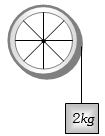
A
$1$
B
$3.2$
C
$2.5$
D
$1.5$
Solution
(D) Given: Mass of block $m = 2\,kg$,radius of wheel $R = 0.5\,m$,distance $S = 5\,m$,time $t = 2\,s$,initial velocity $u = 0$,acceleration due to gravity $g = 10\,m/s^2$.
Using the equation of motion $S = ut + \frac{1}{2}at^2$:
$5 = 0 + \frac{1}{2} \cdot a \cdot (2)^2$
$5 = 2a \implies a = 2.5\,m/s^2$.
The acceleration of a block hanging from a wheel is given by $a = \frac{g}{1 + \frac{I}{mR^2}}$.
Substituting the values:
$2.5 = \frac{10}{1 + \frac{I}{2 \cdot (0.5)^2}}$
$1 + \frac{I}{2 \cdot 0.25} = \frac{10}{2.5}$
$1 + \frac{I}{0.5} = 4$
$\frac{I}{0.5} = 3$
$I = 3 \cdot 0.5 = 1.5\,kg \cdot m^2$.
Using the equation of motion $S = ut + \frac{1}{2}at^2$:
$5 = 0 + \frac{1}{2} \cdot a \cdot (2)^2$
$5 = 2a \implies a = 2.5\,m/s^2$.
The acceleration of a block hanging from a wheel is given by $a = \frac{g}{1 + \frac{I}{mR^2}}$.
Substituting the values:
$2.5 = \frac{10}{1 + \frac{I}{2 \cdot (0.5)^2}}$
$1 + \frac{I}{2 \cdot 0.25} = \frac{10}{2.5}$
$1 + \frac{I}{0.5} = 4$
$\frac{I}{0.5} = 3$
$I = 3 \cdot 0.5 = 1.5\,kg \cdot m^2$.
0 likes
View Solution13
MediumMCQ
$A$ thin rod is hinged at point $O$ and is in an unstable equilibrium position. It falls under the influence of gravity due to a slight disturbance. It makes angles of $60^{\circ}$,$90^{\circ}$,and $180^{\circ}$ with the vertical in positions $(2)$,$(3)$,and $(4)$ respectively. If $\omega_2$,$\omega_3$,and $\omega_4$ are the angular velocities in these positions,then:
A
$\omega_4 = 2 \omega_3$
B
$\omega_4 = 2 \omega_2$
C
$\omega_4 = 1.5 \omega_2$
D
$\omega_4 = \sqrt{2} \omega_2$
Solution
(B) The rod is hinged at $O$. Let $L$ be the length of the rod. The center of mass is at $L/2$. The potential energy $U$ at an angle $\theta$ with the vertical is $U = mg(L/2) \cos \theta$.
By conservation of energy,the loss in potential energy equals the gain in rotational kinetic energy: $mg(L/2)(1 - \cos \theta) = \frac{1}{2} I \omega^2$,where $I = \frac{mL^2}{3}$.
Substituting $I$: $mg(L/2)(1 - \cos \theta) = \frac{1}{2} (\frac{mL^2}{3}) \omega^2 \implies \omega^2 = \frac{3g}{L}(1 - \cos \theta)$.
For position $(2)$,$\theta = 60^{\circ}$,$\cos 60^{\circ} = 0.5$,so $\omega_2^2 = \frac{3g}{L}(1 - 0.5) = \frac{1.5g}{L}$.
For position $(4)$,$\theta = 180^{\circ}$,$\cos 180^{\circ} = -1$,so $\omega_4^2 = \frac{3g}{L}(1 - (-1)) = \frac{6g}{L}$.
Comparing $\omega_4^2$ and $\omega_2^2$: $\frac{\omega_4^2}{\omega_2^2} = \frac{6g/L}{1.5g/L} = 4$.
Therefore,$\omega_4 = 2 \omega_2$.
By conservation of energy,the loss in potential energy equals the gain in rotational kinetic energy: $mg(L/2)(1 - \cos \theta) = \frac{1}{2} I \omega^2$,where $I = \frac{mL^2}{3}$.
Substituting $I$: $mg(L/2)(1 - \cos \theta) = \frac{1}{2} (\frac{mL^2}{3}) \omega^2 \implies \omega^2 = \frac{3g}{L}(1 - \cos \theta)$.
For position $(2)$,$\theta = 60^{\circ}$,$\cos 60^{\circ} = 0.5$,so $\omega_2^2 = \frac{3g}{L}(1 - 0.5) = \frac{1.5g}{L}$.
For position $(4)$,$\theta = 180^{\circ}$,$\cos 180^{\circ} = -1$,so $\omega_4^2 = \frac{3g}{L}(1 - (-1)) = \frac{6g}{L}$.
Comparing $\omega_4^2$ and $\omega_2^2$: $\frac{\omega_4^2}{\omega_2^2} = \frac{6g/L}{1.5g/L} = 4$.
Therefore,$\omega_4 = 2 \omega_2$.
0 likes
View Solution14
EasyMCQ
Regarding the rotation of the Earth about its axis:
A
The linear velocity of an object at the equator is greater than at other locations.
B
The angular velocity of an object at the equator is greater than at the poles.
C
The linear velocity of an object is the same at all locations,but the angular velocity varies.
D
The angular velocity and linear velocity are constant at all locations.
Solution
(A) The relationship between linear velocity $(v)$ and angular velocity $(\omega)$ is given by $v = r\omega$,where $r$ is the perpendicular distance of the particle from the axis of rotation.
Since the Earth rotates as a rigid body,the angular velocity $(\omega)$ is the same for all points on the Earth.
However,the distance $(r)$ from the axis of rotation is maximum at the equator $(r = R_e)$ and decreases as we move towards the poles ($r = R_e \cos \phi$,where $\phi$ is the latitude).
Therefore,the linear velocity $(v)$ is maximum at the equator and zero at the poles.
Since the Earth rotates as a rigid body,the angular velocity $(\omega)$ is the same for all points on the Earth.
However,the distance $(r)$ from the axis of rotation is maximum at the equator $(r = R_e)$ and decreases as we move towards the poles ($r = R_e \cos \phi$,where $\phi$ is the latitude).
Therefore,the linear velocity $(v)$ is maximum at the equator and zero at the poles.
0 likes
View Solution15
DifficultMCQ
In the figure shown,a mass $m$ is attached to a light string which is wrapped around a solid cylinder of mass $M$ and radius $R$. The system starts from rest at $t = 0$. If friction is negligible,what will be the angular velocity at time $t$?
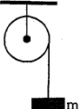
A
$\frac{mgRt}{M + m}$
B
$\frac{2Mgt}{M + 2m}$
C
$\frac{2Mgt}{R(M - 2m)}$
D
$\frac{2mgt}{R(M + 2m)}$
Solution
(D) For the mass $m$,the equation of motion is: $mg - T = ma$ $(1)$
For the cylinder of mass $M$ and radius $R$,the torque equation is: $\tau = I\alpha$,where $I = \frac{1}{2}MR^2$ and $\alpha = \frac{a}{R}$.
So,$TR = (\frac{1}{2}MR^2)(\frac{a}{R}) \implies T = \frac{1}{2}Ma$ $(2)$
Substituting $(2)$ into $(1)$: $mg - \frac{1}{2}Ma = ma \implies mg = a(m + \frac{M}{2}) = a(\frac{2m + M}{2})$.
Thus,the linear acceleration is $a = \frac{2mg}{M + 2m}$.
The angular acceleration is $\alpha = \frac{a}{R} = \frac{2mg}{R(M + 2m)}$.
Since the system starts from rest,the angular velocity at time $t$ is $\omega = \alpha t = \frac{2mgt}{R(M + 2m)}$.
For the cylinder of mass $M$ and radius $R$,the torque equation is: $\tau = I\alpha$,where $I = \frac{1}{2}MR^2$ and $\alpha = \frac{a}{R}$.
So,$TR = (\frac{1}{2}MR^2)(\frac{a}{R}) \implies T = \frac{1}{2}Ma$ $(2)$
Substituting $(2)$ into $(1)$: $mg - \frac{1}{2}Ma = ma \implies mg = a(m + \frac{M}{2}) = a(\frac{2m + M}{2})$.
Thus,the linear acceleration is $a = \frac{2mg}{M + 2m}$.
The angular acceleration is $\alpha = \frac{a}{R} = \frac{2mg}{R(M + 2m)}$.
Since the system starts from rest,the angular velocity at time $t$ is $\omega = \alpha t = \frac{2mgt}{R(M + 2m)}$.
0 likes
View Solution16
MediumMCQ
$A$ ring has inner radius $R_1$ and outer radius $R_2$. It rolls without slipping with a constant angular velocity $\omega$. What is the ratio of the forces $F_1/F_2$ experienced by two particles located on the inner and outer surfaces of the ring?
A
$\frac{R_2}{R_1}$
B
$\left(\frac{R_1}{R_2}\right)^2$
C
$1$
D
$\frac{R_1}{R_2}$
Solution
(D) When a body rolls without slipping with a constant angular velocity $\omega$,the center of mass moves with a constant linear velocity $v = R_{cm}\omega$.
For any particle at a distance $r$ from the center of the ring,the centripetal force experienced by the particle is given by $F = m\omega^2r$.
Since the ring is rolling with a constant angular velocity $\omega$,the centripetal force acting on a particle of mass $m$ at distance $r$ from the center is $F = m\omega^2r$.
For the particle on the inner surface,the radius is $R_1$,so $F_1 = m\omega^2R_1$.
For the particle on the outer surface,the radius is $R_2$,so $F_2 = m\omega^2R_2$.
The ratio of the forces is $\frac{F_1}{F_2} = \frac{m\omega^2R_1}{m\omega^2R_2} = \frac{R_1}{R_2}$.
Therefore,the correct option is $D$.
For any particle at a distance $r$ from the center of the ring,the centripetal force experienced by the particle is given by $F = m\omega^2r$.
Since the ring is rolling with a constant angular velocity $\omega$,the centripetal force acting on a particle of mass $m$ at distance $r$ from the center is $F = m\omega^2r$.
For the particle on the inner surface,the radius is $R_1$,so $F_1 = m\omega^2R_1$.
For the particle on the outer surface,the radius is $R_2$,so $F_2 = m\omega^2R_2$.
The ratio of the forces is $\frac{F_1}{F_2} = \frac{m\omega^2R_1}{m\omega^2R_2} = \frac{R_1}{R_2}$.
Therefore,the correct option is $D$.
0 likes
View Solution17
EasyMCQ
All particles of a body move in circular paths when its axis of rotation.........
A
passes through any point in the body
B
lies outside the body
C
is anywhere
D
passes through the center of mass
Solution
(C) For a rigid body rotating about a fixed axis,every particle of the body moves in a circular path.
The center of each circular path lies on the axis of rotation,and the plane of each circular path is perpendicular to the axis of rotation.
This condition holds true regardless of whether the axis passes through the body or lies outside of it,as long as the axis is fixed in the frame of reference.
However,in the context of standard physics problems regarding the definition of rotation,if the axis is fixed,all particles describe circular motion around that axis.
The center of each circular path lies on the axis of rotation,and the plane of each circular path is perpendicular to the axis of rotation.
This condition holds true regardless of whether the axis passes through the body or lies outside of it,as long as the axis is fixed in the frame of reference.
However,in the context of standard physics problems regarding the definition of rotation,if the axis is fixed,all particles describe circular motion around that axis.
0 likes
View Solution18
EasyMCQ
If $\vec{\omega} = (3\hat{i} + 4\hat{j} + 5\hat{k}) \text{ rad/s}$ and $\vec{r} = (\hat{i} - 2\hat{j} + 3\hat{k}) \text{ m}$,then the linear velocity vector of the particle is:
A
$(22, -4, 2)$
B
$(-22, 4, 2)$
C
$(22, -4, -10)$
D
$(22, 4, 2)$
Solution
(C) The linear velocity $\vec{v}$ is given by the cross product of angular velocity $\vec{\omega}$ and position vector $\vec{r}$:
$\vec{v} = \vec{\omega} \times \vec{r}$
$\vec{v} = \begin{vmatrix} \hat{i} & \hat{j} & \hat{k} \\ 3 & 4 & 5 \\ 1 & -2 & 3 \end{vmatrix}$
Expanding the determinant:
$\vec{v} = \hat{i}((4)(3) - (5)(-2)) - \hat{j}((3)(3) - (5)(1)) + \hat{k}((3)(-2) - (4)(1))$
$\vec{v} = \hat{i}(12 + 10) - \hat{j}(9 - 5) + \hat{k}(-6 - 4)$
$\vec{v} = 22\hat{i} - 4\hat{j} - 10\hat{k}$
Thus,the linear velocity vector is $(22, -4, -10) \text{ m/s}$.
$\vec{v} = \vec{\omega} \times \vec{r}$
$\vec{v} = \begin{vmatrix} \hat{i} & \hat{j} & \hat{k} \\ 3 & 4 & 5 \\ 1 & -2 & 3 \end{vmatrix}$
Expanding the determinant:
$\vec{v} = \hat{i}((4)(3) - (5)(-2)) - \hat{j}((3)(3) - (5)(1)) + \hat{k}((3)(-2) - (4)(1))$
$\vec{v} = \hat{i}(12 + 10) - \hat{j}(9 - 5) + \hat{k}(-6 - 4)$
$\vec{v} = 22\hat{i} - 4\hat{j} - 10\hat{k}$
Thus,the linear velocity vector is $(22, -4, -10) \text{ m/s}$.
0 likes
View Solution19
MediumMCQ
For every particle of a rigid body in rotational motion,which of the following is true?
A
Both linear velocity and angular velocity are the same.
B
Linear velocity is the same,but angular velocity is different.
C
Linear velocity is different,but angular velocity is the same.
D
Both linear velocity and angular velocity are different.
Solution
(C) Since the body is a rigid body,all its particles have the same angular velocity $\omega$ during rotational motion.
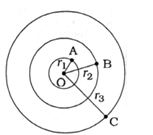
As shown in the figure,three particles $A$,$B$,and $C$ are at distances $r_1$,$r_2$,and $r_3$ from the axis of rotation (origin $O$) respectively,and they rotate with the same angular velocity $\omega$.
The linear velocity $v$ of a particle is given by $v = r\omega$.
For particle $A$,linear velocity $v_1 = r_1\omega$.
For particle $B$,linear velocity $v_2 = r_2\omega$.
For particle $C$,linear velocity $v_3 = r_3\omega$.
Since $r_1$,$r_2$,and $r_3$ are different,the linear velocities $v_1$,$v_2$,and $v_3$ are also different.
Therefore,particles of a rigid body at different distances from the axis of rotation move with the same angular velocity but different linear velocities.
As shown in the figure,three particles $A$,$B$,and $C$ are at distances $r_1$,$r_2$,and $r_3$ from the axis of rotation (origin $O$) respectively,and they rotate with the same angular velocity $\omega$.
The linear velocity $v$ of a particle is given by $v = r\omega$.
For particle $A$,linear velocity $v_1 = r_1\omega$.
For particle $B$,linear velocity $v_2 = r_2\omega$.
For particle $C$,linear velocity $v_3 = r_3\omega$.
Since $r_1$,$r_2$,and $r_3$ are different,the linear velocities $v_1$,$v_2$,and $v_3$ are also different.
Therefore,particles of a rigid body at different distances from the axis of rotation move with the same angular velocity but different linear velocities.
0 likes
View Solution20
MediumMCQ
$A$ wheel of radius $1.5 \ m$ rotates with a constant angular acceleration of $10 \ rad/s^2$. Its initial angular speed is $(\frac{60}{\pi}) \ rpm$. What will be its angular speed and angular displacement at $t = 2.0 \ s$?
A
$22 \ rad/s, 24 \ rad$
B
$20 \ rad/s, 20 \ rad$
C
$24 \ rad/s, 22 \ rad$
D
$18 \ rad/s, 26 \ rad$
Solution
(A) Given: Radius $r = 1.5 \ m$,angular acceleration $\alpha = 10 \ rad/s^2$,initial angular speed $\omega_0 = (\frac{60}{\pi}) \ rpm$,time $t = 2.0 \ s$.
First,convert $\omega_0$ to $rad/s$:
$\omega_0 = \frac{60}{\pi} \times \frac{2\pi}{60} = 2 \ rad/s$.
Using the first equation of rotational motion,$\omega = \omega_0 + \alpha t$:
$\omega = 2 + (10 \times 2) = 2 + 20 = 22 \ rad/s$.
Using the second equation of rotational motion for angular displacement,$\theta = \omega_0 t + \frac{1}{2} \alpha t^2$:
$\theta = (2 \times 2) + \frac{1}{2} \times 10 \times (2)^2 = 4 + (5 \times 4) = 4 + 20 = 24 \ rad$.
First,convert $\omega_0$ to $rad/s$:
$\omega_0 = \frac{60}{\pi} \times \frac{2\pi}{60} = 2 \ rad/s$.
Using the first equation of rotational motion,$\omega = \omega_0 + \alpha t$:
$\omega = 2 + (10 \times 2) = 2 + 20 = 22 \ rad/s$.
Using the second equation of rotational motion for angular displacement,$\theta = \omega_0 t + \frac{1}{2} \alpha t^2$:
$\theta = (2 \times 2) + \frac{1}{2} \times 10 \times (2)^2 = 4 + (5 \times 4) = 4 + 20 = 24 \ rad$.
0 likes
View Solution21
MediumMCQ
As shown in the figure,a small wheel is coaxially connected to a larger wheel of double its radius. The system rotates about a common axis. Strings $A$ and $B$ are attached to the wheels such that they do not slip. If $x$ and $y$ are the distances covered by $A$ and $B$ in the same time interval,then:

A
$x = 2y$
B
$x = y$
C
$y = 2x$
D
None of these
Solution
(C) Since both wheels are connected coaxially,they rotate with the same angular velocity $\omega$.
Let $R$ be the radius of the small wheel and $2R$ be the radius of the large wheel.
The distance covered by a string attached to a wheel is given by $s = r\theta$,where $r$ is the radius and $\theta$ is the angle of rotation.
For the same time interval,both wheels rotate by the same angle $\theta$.
For string $A$ on the small wheel: $x = R\theta$.
For string $B$ on the large wheel: $y = (2R)\theta$.
Dividing the two equations: $y/x = (2R\theta) / (R\theta) = 2$.
Therefore,$y = 2x$.
Let $R$ be the radius of the small wheel and $2R$ be the radius of the large wheel.
The distance covered by a string attached to a wheel is given by $s = r\theta$,where $r$ is the radius and $\theta$ is the angle of rotation.
For the same time interval,both wheels rotate by the same angle $\theta$.
For string $A$ on the small wheel: $x = R\theta$.
For string $B$ on the large wheel: $y = (2R)\theta$.
Dividing the two equations: $y/x = (2R\theta) / (R\theta) = 2$.
Therefore,$y = 2x$.
0 likes
View Solution22
DifficultMCQ
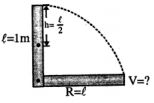
$A$ rod of length $1 \ m$ is held vertically. What will be the speed of the other end when it touches the ground without slipping?
A
$\sqrt{19.6} \ m/s$
B
$\sqrt{29.4} \ m/s$
C
$4.9 \ m/s$
D
$9.8 \ m/s$
Solution
(B) Let the mass of the rod be $M$ and its length be $\ell = 1 \ m$. The rod is hinged at the bottom end. When it falls,the potential energy lost by the center of mass is converted into rotational kinetic energy.
The loss in potential energy is $\Delta U = Mg \Delta h = Mg \left( \frac{\ell}{2} \right)$.
The rotational kinetic energy is $K = \frac{1}{2} I \omega^2$,where $I = \frac{M \ell^2}{3}$ is the moment of inertia about the hinge.
Equating the two: $\frac{1}{2} \left( \frac{M \ell^2}{3} \right) \omega^2 = Mg \frac{\ell}{2}$.
Simplifying,we get $\frac{1}{6} M \ell^2 \omega^2 = \frac{1}{2} Mg \ell$,which leads to $\omega^2 = \frac{3g}{\ell}$.
The linear speed $V$ of the free end is $V = \omega \ell$. Therefore,$V^2 = \omega^2 \ell^2 = \left( \frac{3g}{\ell} \right) \ell^2 = 3g \ell$.
Substituting $g = 9.8 \ m/s^2$ and $\ell = 1 \ m$:
$V = \sqrt{3 \times 9.8 \times 1} = \sqrt{29.4} \ m/s$.
The loss in potential energy is $\Delta U = Mg \Delta h = Mg \left( \frac{\ell}{2} \right)$.
The rotational kinetic energy is $K = \frac{1}{2} I \omega^2$,where $I = \frac{M \ell^2}{3}$ is the moment of inertia about the hinge.
Equating the two: $\frac{1}{2} \left( \frac{M \ell^2}{3} \right) \omega^2 = Mg \frac{\ell}{2}$.
Simplifying,we get $\frac{1}{6} M \ell^2 \omega^2 = \frac{1}{2} Mg \ell$,which leads to $\omega^2 = \frac{3g}{\ell}$.
The linear speed $V$ of the free end is $V = \omega \ell$. Therefore,$V^2 = \omega^2 \ell^2 = \left( \frac{3g}{\ell} \right) \ell^2 = 3g \ell$.
Substituting $g = 9.8 \ m/s^2$ and $\ell = 1 \ m$:
$V = \sqrt{3 \times 9.8 \times 1} = \sqrt{29.4} \ m/s$.
0 likes
View Solution23
DifficultMCQ
$A$ truck is moving at a speed of $54 \ km/h$. The radius of its wheels is $50 \ cm$. If the wheels come to rest after $20$ rotations upon applying brakes,what is the linear distance covered by the truck during this time? What is the angular acceleration of the wheels?
A
$62.8 \ m, -3.58 \ rad \ s^{-2}$
B
$62.8 \ m, 3.58 \ rad \ s^{-2}$
C
$6.28 \ m, -3.58 \ rad \ s^{-2}$
D
$6.28 \ m, 3.58 \ rad \ s^{-2}$
Solution
(A) Given: Initial velocity $v_1 = 54 \ km/h = 54 \times \frac{5}{18} \ m/s = 15 \ m/s$.
Radius $r = 50 \ cm = 0.5 \ m$.
Number of rotations $n = 20$.
Total angular displacement $\theta = 20 \times 2\pi \ rad = 40\pi \ rad$.
Initial angular velocity $\omega_1 = \frac{v_1}{r} = \frac{15}{0.5} = 30 \ rad \ s^{-1}$.
Final angular velocity $\omega_2 = 0$.
Using the equation $\omega_2^2 = \omega_1^2 + 2\alpha\theta$:
$0 = (30)^2 + 2 \times \alpha \times 40\pi$
$\alpha = -\frac{900}{80\pi} \approx -3.58 \ rad \ s^{-2}$.
Linear distance $d = n \times (2\pi r) = 20 \times 2 \times 3.14 \times 0.5 = 62.8 \ m$.
Radius $r = 50 \ cm = 0.5 \ m$.
Number of rotations $n = 20$.
Total angular displacement $\theta = 20 \times 2\pi \ rad = 40\pi \ rad$.
Initial angular velocity $\omega_1 = \frac{v_1}{r} = \frac{15}{0.5} = 30 \ rad \ s^{-1}$.
Final angular velocity $\omega_2 = 0$.
Using the equation $\omega_2^2 = \omega_1^2 + 2\alpha\theta$:
$0 = (30)^2 + 2 \times \alpha \times 40\pi$
$\alpha = -\frac{900}{80\pi} \approx -3.58 \ rad \ s^{-2}$.
Linear distance $d = n \times (2\pi r) = 20 \times 2 \times 3.14 \times 0.5 = 62.8 \ m$.
0 likes
View Solution24
DifficultMCQ
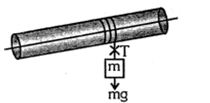
$A$ string is wrapped around a cylinder of radius $r$ and moment of inertia $I$. $A$ mass $m$ is attached to one end of the string. The cylinder can rotate freely about its horizontal axis. If the mass $m$ is released from rest at a height $h$,what will be its velocity?
A
$(2gh)^{1/2}$
B
${\left( {\frac{{2mgh{r^2}}}{I}} \right)^{1/2}}$
C
${\left( {\frac{{2mgh{r^2}}}{{I + m{r^2}}}} \right)^{1/2}}$
D
${\left( {\frac{{mgh{r^2}}}{{I + 2m{r^2}}}} \right)^{1/2}}$
Solution
(C) For the falling mass $m$,the equation of motion is: $mg - T = ma$ $(1)$
For the rotating cylinder,the torque equation is: $\tau = I\alpha = I(a/r) = T \cdot r$,which gives $T = \frac{Ia}{r^2}$ $(2)$
Substituting $(2)$ into $(1)$: $mg - \frac{Ia}{r^2} = ma$
$mg = a(m + \frac{I}{r^2}) = a(\frac{mr^2 + I}{r^2})$
Thus,the acceleration $a = \frac{mgr^2}{I + mr^2}$
Using the kinematic equation $v^2 = u^2 + 2ah$ with $u = 0$:
$v^2 = 2 \cdot (\frac{mgr^2}{I + mr^2}) \cdot h$
$v = \sqrt{\frac{2mghr^2}{I + mr^2}}$
For the rotating cylinder,the torque equation is: $\tau = I\alpha = I(a/r) = T \cdot r$,which gives $T = \frac{Ia}{r^2}$ $(2)$
Substituting $(2)$ into $(1)$: $mg - \frac{Ia}{r^2} = ma$
$mg = a(m + \frac{I}{r^2}) = a(\frac{mr^2 + I}{r^2})$
Thus,the acceleration $a = \frac{mgr^2}{I + mr^2}$
Using the kinematic equation $v^2 = u^2 + 2ah$ with $u = 0$:
$v^2 = 2 \cdot (\frac{mgr^2}{I + mr^2}) \cdot h$
$v = \sqrt{\frac{2mghr^2}{I + mr^2}}$
0 likes
View Solution25
DifficultMCQ
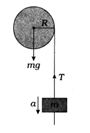
$A$ mass $m$ is suspended from a string wrapped around a frictionless pulley. The pulley has a mass $M$ and radius $R$. If the pulley is a uniform circular disk and the string does not slip on the pulley,what is the acceleration of the mass?
A
$\frac{3}{2}g$
B
$g$
C
$\frac{2}{3}g$
D
$\frac{g}{3}$
Solution
(C) Let $T$ be the tension in the string and $a$ be the acceleration of the mass $m$.
For the falling mass $m$,the equation of motion is: $mg - T = ma$ => $T = m(g - a)$ --- $(1)$
For the rotating pulley,the torque $\tau = I\alpha = TR$.
Given that the pulley is a uniform disk,its moment of inertia $I = \frac{1}{2}MR^2$.
Since the string does not slip,the angular acceleration $\alpha = \frac{a}{R}$.
Substituting these into the torque equation: $(\frac{1}{2}MR^2)(\frac{a}{R}) = TR$ => $\frac{1}{2}Ma = T$ --- $(2)$
Equating $(1)$ and $(2)$: $m(g - a) = \frac{1}{2}Ma$.
If we assume the mass of the pulley $M$ is equal to the mass $m$ (as implied by the context of such standard problems),then $m(g - a) = \frac{1}{2}ma$.
Dividing by $m$: $g - a = \frac{a}{2}$ => $g = \frac{3a}{2}$.
Therefore,the acceleration $a = \frac{2}{3}g$.
For the falling mass $m$,the equation of motion is: $mg - T = ma$ => $T = m(g - a)$ --- $(1)$
For the rotating pulley,the torque $\tau = I\alpha = TR$.
Given that the pulley is a uniform disk,its moment of inertia $I = \frac{1}{2}MR^2$.
Since the string does not slip,the angular acceleration $\alpha = \frac{a}{R}$.
Substituting these into the torque equation: $(\frac{1}{2}MR^2)(\frac{a}{R}) = TR$ => $\frac{1}{2}Ma = T$ --- $(2)$
Equating $(1)$ and $(2)$: $m(g - a) = \frac{1}{2}Ma$.
If we assume the mass of the pulley $M$ is equal to the mass $m$ (as implied by the context of such standard problems),then $m(g - a) = \frac{1}{2}ma$.
Dividing by $m$: $g - a = \frac{a}{2}$ => $g = \frac{3a}{2}$.
Therefore,the acceleration $a = \frac{2}{3}g$.
0 likes
View Solution26
DifficultMCQ
$A$ table rotates about a vertical axis passing through its center with an angular velocity of $20\ rad/s$. $A$ flywheel is mounted on it,which rotates about a horizontal axis with an angular velocity of $40\ rad/s$. The resultant angular velocity of the flywheel is:
A
$10\sqrt{5}\ rad/s$
B
$40\ rad/s$
C
$20\sqrt{5}\ rad/s$
D
$20\ rad/s$
Solution
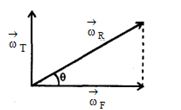
(C) Since the axis of the table is vertical,its angular velocity $\vec{\omega}_T$ is in the vertical direction.
The axis of the flywheel is horizontal,so its angular velocity $\vec{\omega}_F$ is in the horizontal direction.
The resultant angular velocity $\vec{\omega}_R$ is the vector sum of these two perpendicular angular velocities:
$\vec{\omega}_R = \vec{\omega}_F + \vec{\omega}_T$
Since $\vec{\omega}_F$ and $\vec{\omega}_T$ are perpendicular,the magnitude of the resultant angular velocity is:
$|\vec{\omega}_R| = \sqrt{\omega_F^2 + \omega_T^2}$
$|\vec{\omega}_R| = \sqrt{40^2 + 20^2} = \sqrt{1600 + 400} = \sqrt{2000}$
$|\vec{\omega}_R| = 20\sqrt{5}\ rad/s$
The resultant vector $\vec{\omega}_R$ lies in a plane making an angle $\theta$ with the horizontal,where $\theta = \tan^{-1}(\frac{\omega_T}{\omega_F}) = \tan^{-1}(\frac{20}{40}) = \tan^{-1}(0.5)$.
The axis of the flywheel is horizontal,so its angular velocity $\vec{\omega}_F$ is in the horizontal direction.
The resultant angular velocity $\vec{\omega}_R$ is the vector sum of these two perpendicular angular velocities:
$\vec{\omega}_R = \vec{\omega}_F + \vec{\omega}_T$
Since $\vec{\omega}_F$ and $\vec{\omega}_T$ are perpendicular,the magnitude of the resultant angular velocity is:
$|\vec{\omega}_R| = \sqrt{\omega_F^2 + \omega_T^2}$
$|\vec{\omega}_R| = \sqrt{40^2 + 20^2} = \sqrt{1600 + 400} = \sqrt{2000}$
$|\vec{\omega}_R| = 20\sqrt{5}\ rad/s$
The resultant vector $\vec{\omega}_R$ lies in a plane making an angle $\theta$ with the horizontal,where $\theta = \tan^{-1}(\frac{\omega_T}{\omega_F}) = \tan^{-1}(\frac{20}{40}) = \tan^{-1}(0.5)$.
0 likes
View Solution27
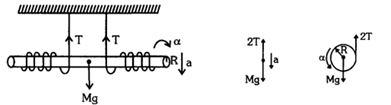
DifficultMCQ
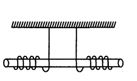
$A$ solid cylinder of mass $M$ and radius $R$ is placed in a horizontal position. Two strings are wrapped around the cylinder. Find the tension in the strings and the acceleration of the cylinder as the strings unwind.
A
$Mg, 4g$
B
$\frac{Mg}{2}, \frac{4}{3}g$
C
$\frac{Mg}{6}, \frac{2}{3}g$
D
$\frac{Mg}{3}, \frac{1}{3}g$
Solution
(C) For linear motion: $Mg - 2T = Ma$
For rotational motion: $2TR = I\alpha$
Here,$I = \frac{MR^2}{2}$ and $\alpha = \frac{a}{R}$.
Substituting these into the torque equation: $2TR = (\frac{MR^2}{2})(\frac{a}{R}) \implies 2TR = \frac{MRa}{2} \implies T = \frac{Ma}{4}$.
Substituting $T$ into the linear motion equation: $Mg - 2(\frac{Ma}{4}) = Ma \implies Mg - \frac{Ma}{2} = Ma \implies Mg = \frac{3Ma}{2} \implies a = \frac{2}{3}g$.
Now,find the tension $T$: $T = \frac{M}{4}(\frac{2}{3}g) = \frac{Mg}{6}$.
For rotational motion: $2TR = I\alpha$
Here,$I = \frac{MR^2}{2}$ and $\alpha = \frac{a}{R}$.
Substituting these into the torque equation: $2TR = (\frac{MR^2}{2})(\frac{a}{R}) \implies 2TR = \frac{MRa}{2} \implies T = \frac{Ma}{4}$.
Substituting $T$ into the linear motion equation: $Mg - 2(\frac{Ma}{4}) = Ma \implies Mg - \frac{Ma}{2} = Ma \implies Mg = \frac{3Ma}{2} \implies a = \frac{2}{3}g$.
Now,find the tension $T$: $T = \frac{M}{4}(\frac{2}{3}g) = \frac{Mg}{6}$.
0 likes
View Solution28
EasyMCQ
For a particle,the angular velocity is $\vec{\omega} = \hat{i} - 2\hat{j} + 3\hat{k}$ and the position vector is $\vec{r} = \hat{i} + \hat{j} + \hat{k}$. What is the linear velocity $\vec{v}$?
A
$-5\hat{i} + 2\hat{j} + 3\hat{k}$
B
$-5\hat{i} + 2\hat{j} - 3\hat{k}$
C
$-5\hat{i} - 2\hat{j} + 3\hat{k}$
D
$-5\hat{i} - 2\hat{j} - 3\hat{k}$
Solution
(A) The linear velocity $\vec{v}$ is given by the cross product of angular velocity $\vec{\omega}$ and position vector $\vec{r}$:
$\vec{v} = \vec{\omega} \times \vec{r}$
$\vec{v} = \begin{vmatrix} \hat{i} & \hat{j} & \hat{k} \\ 1 & -2 & 3 \\ 1 & 1 & 1 \end{vmatrix}$
Expanding the determinant:
$\vec{v} = \hat{i}((-2)(1) - (3)(1)) - \hat{j}((1)(1) - (3)(1)) + \hat{k}((1)(1) - (-2)(1))$
$\vec{v} = \hat{i}(-2 - 3) - \hat{j}(1 - 3) + \hat{k}(1 + 2)$
$\vec{v} = -5\hat{i} - \hat{j}(-2) + 3\hat{k}$
$\vec{v} = -5\hat{i} + 2\hat{j} + 3\hat{k}$
$\vec{v} = \vec{\omega} \times \vec{r}$
$\vec{v} = \begin{vmatrix} \hat{i} & \hat{j} & \hat{k} \\ 1 & -2 & 3 \\ 1 & 1 & 1 \end{vmatrix}$
Expanding the determinant:
$\vec{v} = \hat{i}((-2)(1) - (3)(1)) - \hat{j}((1)(1) - (3)(1)) + \hat{k}((1)(1) - (-2)(1))$
$\vec{v} = \hat{i}(-2 - 3) - \hat{j}(1 - 3) + \hat{k}(1 + 2)$
$\vec{v} = -5\hat{i} - \hat{j}(-2) + 3\hat{k}$
$\vec{v} = -5\hat{i} + 2\hat{j} + 3\hat{k}$
0 likes
View Solution29
DifficultMCQ
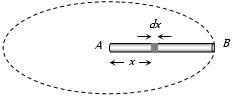
$A$ rod of mass $m$ and length $l$ is rotated about one of its ends with an angular velocity $\omega$. What is the tension in the rod at a distance $x$ from the axis of rotation?
A
$\frac{1}{2}m{\omega ^2}x$
B
$\frac{1}{2}m{\omega ^2}\frac{{{x^2}}}{l}$
C
$\frac{1}{2}m{\omega ^2}l\left( {1 - \frac{x}{l}} \right)$
D
$\frac{1}{2}\frac{{m{\omega ^2}}}{l}[{l^2} - {x^2}]$
Solution
(D) Consider a small element of length $dx$ at a distance $r$ from the axis of rotation. The mass of this element is $dm = (m/l) dr$.
The centripetal force required for this element to rotate is $dT = dm \omega^2 r = (m/l) \omega^2 r dr$.
To find the tension $T$ at a distance $x$ from the axis,we integrate from $x$ to $l$:
$T = \int_x^l dT = \int_x^l \frac{m}{l} \omega^2 r dr$
$T = \frac{m \omega^2}{l} \left[ \frac{r^2}{2} \right]_x^l$
$T = \frac{m \omega^2}{2l} (l^2 - x^2)$
The centripetal force required for this element to rotate is $dT = dm \omega^2 r = (m/l) \omega^2 r dr$.
To find the tension $T$ at a distance $x$ from the axis,we integrate from $x$ to $l$:
$T = \int_x^l dT = \int_x^l \frac{m}{l} \omega^2 r dr$
$T = \frac{m \omega^2}{l} \left[ \frac{r^2}{2} \right]_x^l$
$T = \frac{m \omega^2}{2l} (l^2 - x^2)$
0 likes
View Solution30
DifficultMCQ
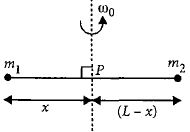
Point masses $m_1$ and $m_2$ are placed at the opposite ends of a rigid rod of length $L$ and negligible mass. The rod is to be set rotating about an axis perpendicular to it. The position of point $P$ on this rod through which the axis should pass so that the work required to set the rod rotating with angular velocity $\omega_0$ is minimum,is given by
A
$x = \frac{m_2 L}{m_1 + m_2}$
B
$x = \frac{m_1 L}{m_1 + m_2}$
C
$x = \frac{m_1 L}{m_2}$
D
$x = \frac{m_2 L}{m_1}$
Solution
(A) The moment of inertia $I$ of the system about an axis passing through point $P$ at a distance $x$ from $m_1$ is given by:
$I = m_1 x^2 + m_2 (L - x)^2$
According to the work-energy theorem,the work done $W$ to set the rod rotating with angular velocity $\omega_0$ is equal to the rotational kinetic energy:
$W = \frac{1}{2} I \omega_0^2 = \frac{1}{2} [m_1 x^2 + m_2 (L - x)^2] \omega_0^2$
For the work $W$ to be minimum,we set the derivative with respect to $x$ to zero:
$\frac{dW}{dx} = \frac{1}{2} \omega_0^2 [2 m_1 x + 2 m_2 (L - x)(-1)] = 0$
$m_1 x - m_2 (L - x) = 0$
$m_1 x - m_2 L + m_2 x = 0$
$(m_1 + m_2) x = m_2 L$
$x = \frac{m_2 L}{m_1 + m_2}$
$I = m_1 x^2 + m_2 (L - x)^2$
According to the work-energy theorem,the work done $W$ to set the rod rotating with angular velocity $\omega_0$ is equal to the rotational kinetic energy:
$W = \frac{1}{2} I \omega_0^2 = \frac{1}{2} [m_1 x^2 + m_2 (L - x)^2] \omega_0^2$
For the work $W$ to be minimum,we set the derivative with respect to $x$ to zero:
$\frac{dW}{dx} = \frac{1}{2} \omega_0^2 [2 m_1 x + 2 m_2 (L - x)(-1)] = 0$
$m_1 x - m_2 (L - x) = 0$
$m_1 x - m_2 L + m_2 x = 0$
$(m_1 + m_2) x = m_2 L$
$x = \frac{m_2 L}{m_1 + m_2}$
0 likes
View Solution31
MediumMCQ
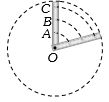
In the rotational motion of a rigid body,all particles of the body have
A
same linear speed and same angular speed
B
same linear speed but different angular speeds
C
different linear speeds but same angular speed
D
different linear speeds and different angular speeds
Solution
(C) In a rigid body,all particles rotate about the same axis with the same angular velocity $\omega$.
Since the linear velocity $v$ is related to angular velocity $\omega$ by the relation $v = r\omega$,where $r$ is the distance of the particle from the axis of rotation.
For a rigid body,$\omega$ is constant for all particles.
Therefore,$v \propto r$.
This implies that particles at different distances from the axis of rotation will have different linear speeds,but they all share the same angular speed.
Since the linear velocity $v$ is related to angular velocity $\omega$ by the relation $v = r\omega$,where $r$ is the distance of the particle from the axis of rotation.
For a rigid body,$\omega$ is constant for all particles.
Therefore,$v \propto r$.
This implies that particles at different distances from the axis of rotation will have different linear speeds,but they all share the same angular speed.
0 likes
View Solution32
MediumMCQ
$A$ wheel is rotating at $1200 \ rpm$ and is slowed down at a rate of $4 \ rad/s^2$. The number of revolutions it completes before coming to rest is:
A
$143$
B
$272$
C
$314$
D
$722$
Solution
(C) Initial angular velocity $\omega_0 = 1200 \ rpm = \frac{1200 \times 2\pi}{60} \ rad/s = 40\pi \ rad/s$.
Final angular velocity $\omega = 0 \ rad/s$.
Angular deceleration $\alpha = 4 \ rad/s^2$.
Using the kinematic equation $\omega^2 = \omega_0^2 - 2\alpha\theta$:
$0 = (40\pi)^2 - 2(4)\theta$
$8\theta = 1600\pi^2$
$\theta = 200\pi^2 \ rad$.
The number of revolutions $n$ is given by $\theta = 2\pi n$:
$n = \frac{\theta}{2\pi} = \frac{200\pi^2}{2\pi} = 100\pi$.
Using $\pi \approx 3.14$,$n = 100 \times 3.14 = 314$ revolutions.
Final angular velocity $\omega = 0 \ rad/s$.
Angular deceleration $\alpha = 4 \ rad/s^2$.
Using the kinematic equation $\omega^2 = \omega_0^2 - 2\alpha\theta$:
$0 = (40\pi)^2 - 2(4)\theta$
$8\theta = 1600\pi^2$
$\theta = 200\pi^2 \ rad$.
The number of revolutions $n$ is given by $\theta = 2\pi n$:
$n = \frac{\theta}{2\pi} = \frac{200\pi^2}{2\pi} = 100\pi$.
Using $\pi \approx 3.14$,$n = 100 \times 3.14 = 314$ revolutions.
0 likes
View Solution33
EasyMCQ
The direction of the angular velocity vector is along which of the following?
A
Tangent to the circular path
B
Radially inward
C
Radially outward
D
Axis of rotation
Solution
(D) The angular velocity vector $\vec{\omega}$ is defined as an axial vector. By the right-hand rule,its direction is always along the axis of rotation of the body. Therefore,the correct option is $D$.
0 likes
View Solution34
EasyMCQ
$A$ thin ring of radius $R$ is rotated about its center. Then its radius:
A
will increase
B
will decrease
C
change depends on the nature of the material
D
none of the above
Solution
(A) When a thin ring is rotated about its center,every particle of the ring experiences a centrifugal force directed radially outward.
This radial force creates a tensile stress within the material of the ring.
Due to this tensile stress,the circumference of the ring increases,which consequently leads to an increase in the radius $R$ of the ring.
This radial force creates a tensile stress within the material of the ring.
Due to this tensile stress,the circumference of the ring increases,which consequently leads to an increase in the radius $R$ of the ring.
0 likes
View Solution35
MediumMCQ
$A$ spool of mass $M$ and radius $R$ is unwinding under gravity as a string is pulled. What is the acceleration of the spool?
A
$g$
B
$g/2$
C
$2g/3$
D
$4g/3$
Solution
(C) For a spool (solid cylinder) of mass $M$ and radius $R$ unwinding under gravity,the acceleration $a$ of the center of mass is given by the formula: $a = \frac{g}{1 + \frac{K^2}{R^2}}$.
For a solid cylinder,the radius of gyration $K$ satisfies $K^2 = \frac{R^2}{2}$,so $\frac{K^2}{R^2} = \frac{1}{2}$.
Substituting this into the formula: $a = \frac{g}{1 + \frac{1}{2}} = \frac{g}{\frac{3}{2}} = \frac{2}{3}g$.
For a solid cylinder,the radius of gyration $K$ satisfies $K^2 = \frac{R^2}{2}$,so $\frac{K^2}{R^2} = \frac{1}{2}$.
Substituting this into the formula: $a = \frac{g}{1 + \frac{1}{2}} = \frac{g}{\frac{3}{2}} = \frac{2}{3}g$.
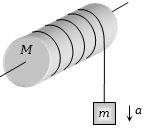
0 likes
View Solution36
DifficultMCQ
$A$ uniform rod is rotating in a gravity-free region with a certain constant angular velocity $\omega$. The variation of tensile stress $\sigma$ with distance $x$ from the axis of rotation is best represented by which of the following graphs?
A
B
C
D
Solution
(A) Consider a uniform rod of length $L$,mass $M$,and cross-sectional area $A$ rotating about one end with constant angular velocity $\omega$.
Consider an element of length $dx$ at a distance $x$ from the axis of rotation.
The mass of this element is $dm = (M/L) dx$.
The centripetal force required for this element is $dF = (dm) \omega^2 x = (M/L) \omega^2 x dx$.
The tensile force $F(x)$ at distance $x$ is the force required to rotate the portion of the rod from $x$ to $L$.
$F(x) = \int_x^L (M/L) \omega^2 r dr = (M/L) \omega^2 [r^2/2]_x^L = (M \omega^2 / 2L) (L^2 - x^2)$.
The tensile stress $\sigma(x)$ is given by $F(x)/A$.
$\sigma(x) = (M \omega^2 / 2AL) (L^2 - x^2)$.
This equation represents a downward-opening parabola where $\sigma$ is maximum at $x = 0$ and $\sigma = 0$ at $x = L$.
This matches the curve shown in graph $A$.
Consider an element of length $dx$ at a distance $x$ from the axis of rotation.
The mass of this element is $dm = (M/L) dx$.
The centripetal force required for this element is $dF = (dm) \omega^2 x = (M/L) \omega^2 x dx$.
The tensile force $F(x)$ at distance $x$ is the force required to rotate the portion of the rod from $x$ to $L$.
$F(x) = \int_x^L (M/L) \omega^2 r dr = (M/L) \omega^2 [r^2/2]_x^L = (M \omega^2 / 2L) (L^2 - x^2)$.
The tensile stress $\sigma(x)$ is given by $F(x)/A$.
$\sigma(x) = (M \omega^2 / 2AL) (L^2 - x^2)$.
This equation represents a downward-opening parabola where $\sigma$ is maximum at $x = 0$ and $\sigma = 0$ at $x = L$.
This matches the curve shown in graph $A$.
0 likes
View Solution37
AdvancedMCQ
$A$ ball of mass $m$ is released from inside a smooth wedge of mass $m$ as shown in the figure. What is the speed of the wedge when the ball reaches point $B$?
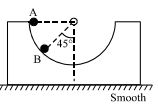
A
$(\frac{gR}{3\sqrt{2}})^{1/2}$
B
$\sqrt{2gR}$
C
$(\frac{5gR}{2\sqrt{3}})^{1/2}$
D
$\sqrt{\frac{3}{2}gR}$
Solution
(A) Let the velocity of the wedge be $v$ and the velocity of the ball relative to the wedge be $v_r$.
$1$. Conservation of linear momentum in the horizontal direction:
Since there are no external horizontal forces,the net horizontal momentum is conserved. Initially,the system is at rest,so the final horizontal momentum must be zero.
$m v_{ball,x} + m v = 0$
$v_{ball,x} = -v$
The velocity of the ball relative to the ground is $\vec{v}_b = \vec{v}_r + \vec{v}_w$.
At point $B$,the ball moves at an angle of $45^{\circ}$ to the horizontal relative to the wedge.
$v_{ball,x} = v_r \cos 45^{\circ} - v = -v \implies v_r \cos 45^{\circ} = 0$ (This implies the horizontal component of the ball's velocity relative to the wedge must cancel the wedge's velocity).
Actually,using the constraint: $v_{ball,x} = v_r \cos 45^{\circ} - v = -v \implies v_r = 0$ is incorrect. Let's use energy.
$2$. Conservation of Mechanical Energy:
The loss in potential energy of the ball equals the gain in kinetic energy of the ball and the wedge.
$m g R \sin 45^{\circ} = \frac{1}{2} m v^2 + \frac{1}{2} m v_b^2$
Using momentum conservation $m v_r \cos 45^{\circ} - m v = 0 \implies v_r \cos 45^{\circ} = v$.
Solving the system leads to $v = (\frac{gR}{3\sqrt{2}})^{1/2}$.
$1$. Conservation of linear momentum in the horizontal direction:
Since there are no external horizontal forces,the net horizontal momentum is conserved. Initially,the system is at rest,so the final horizontal momentum must be zero.
$m v_{ball,x} + m v = 0$
$v_{ball,x} = -v$
The velocity of the ball relative to the ground is $\vec{v}_b = \vec{v}_r + \vec{v}_w$.
At point $B$,the ball moves at an angle of $45^{\circ}$ to the horizontal relative to the wedge.
$v_{ball,x} = v_r \cos 45^{\circ} - v = -v \implies v_r \cos 45^{\circ} = 0$ (This implies the horizontal component of the ball's velocity relative to the wedge must cancel the wedge's velocity).
Actually,using the constraint: $v_{ball,x} = v_r \cos 45^{\circ} - v = -v \implies v_r = 0$ is incorrect. Let's use energy.
$2$. Conservation of Mechanical Energy:
The loss in potential energy of the ball equals the gain in kinetic energy of the ball and the wedge.
$m g R \sin 45^{\circ} = \frac{1}{2} m v^2 + \frac{1}{2} m v_b^2$
Using momentum conservation $m v_r \cos 45^{\circ} - m v = 0 \implies v_r \cos 45^{\circ} = v$.
Solving the system leads to $v = (\frac{gR}{3\sqrt{2}})^{1/2}$.
0 likes
View Solution38
DifficultMCQ
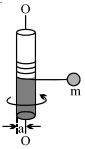
$A$ small particle of mass $m$ is given an initial high velocity in the horizontal plane and winds its cord around the fixed vertical shaft of radius $a$. All motion occurs essentially in the horizontal plane. If the angular velocity of the cord is $\omega_0$ when the distance from the particle to the tangency point is $r_0$,then the angular velocity of the cord $\omega$ after it has turned through an angle $\theta$ is
A
$\omega = \omega_0$
B
$\omega = \frac{a\omega_0}{r_0}$
C
$\omega = \frac{\omega_0}{1 - \frac{a\theta}{r_0}}$
D
$\omega = \omega_0\theta$
Solution
(C) As the cord winds around the shaft,the length of the cord that is free to move decreases. The distance from the particle to the tangency point at any angle $\theta$ is given by $r = r_0 - a\theta$.
Since the tension in the cord acts perpendicular to the velocity of the particle,the torque about the center of the shaft is zero. Thus,the angular momentum of the particle about the center of the shaft is conserved.
However,a simpler approach is to note that the velocity $v$ of the particle remains constant because the tension force is always perpendicular to the velocity vector.
Initially,$v = r_0\omega_0$.
At an angle $\theta$,the distance is $r = r_0 - a\theta$,and the angular velocity is $\omega$.
Since $v$ is constant,$v = r\omega = (r_0 - a\theta)\omega$.
Equating the two expressions for $v$: $r_0\omega_0 = (r_0 - a\theta)\omega$.
Solving for $\omega$: $\omega = \frac{r_0\omega_0}{r_0 - a\theta} = \frac{\omega_0}{1 - \frac{a\theta}{r_0}}$.
Since the tension in the cord acts perpendicular to the velocity of the particle,the torque about the center of the shaft is zero. Thus,the angular momentum of the particle about the center of the shaft is conserved.
However,a simpler approach is to note that the velocity $v$ of the particle remains constant because the tension force is always perpendicular to the velocity vector.
Initially,$v = r_0\omega_0$.
At an angle $\theta$,the distance is $r = r_0 - a\theta$,and the angular velocity is $\omega$.
Since $v$ is constant,$v = r\omega = (r_0 - a\theta)\omega$.
Equating the two expressions for $v$: $r_0\omega_0 = (r_0 - a\theta)\omega$.
Solving for $\omega$: $\omega = \frac{r_0\omega_0}{r_0 - a\theta} = \frac{\omega_0}{1 - \frac{a\theta}{r_0}}$.
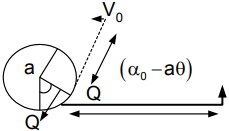
0 likes
View Solution39
DifficultMCQ
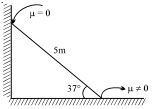
$A$ $5\, m$ long pole of $3\, kg$ mass is placed against a smooth vertical wall as shown in the figure. Under equilibrium condition,if the pole makes an angle of $37^{\circ}$ with the horizontal,the frictional force between the pole and the horizontal surface is
A
$20\, N$
B
$30\, N$
C
$20\, \mu N$
D
$30\, \mu N$
Solution
(A) Let the length of the pole be $L = 5\, m$ and its mass be $m = 3\, kg$. The pole makes an angle $\theta = 37^{\circ}$ with the horizontal.
The pole is in translational and rotational equilibrium.
Let $N_1$ be the normal force from the horizontal surface,$f$ be the frictional force at the base,$N_2$ be the normal force from the smooth vertical wall,and $mg$ be the weight of the pole acting at its center of mass (midpoint).
For translational equilibrium:
Horizontal forces: $f = N_2$
Vertical forces: $N_1 = mg = 3 \times 10 = 30\, N$
For rotational equilibrium,we take the torque about the base point (let it be $A$):
$\tau_{net} = 0$
$mg \times (\frac{L}{2} \cos 37^{\circ}) - N_2 \times (L \sin 37^{\circ}) = 0$
$mg \times \frac{5}{2} \times \frac{4}{5} = N_2 \times 5 \times \frac{3}{5}$
$30 \times 2 = N_2 \times 3$
$60 = 3 N_2 \Rightarrow N_2 = 20\, N$
Since $f = N_2$,the frictional force is $f = 20\, N$.
The pole is in translational and rotational equilibrium.
Let $N_1$ be the normal force from the horizontal surface,$f$ be the frictional force at the base,$N_2$ be the normal force from the smooth vertical wall,and $mg$ be the weight of the pole acting at its center of mass (midpoint).
For translational equilibrium:
Horizontal forces: $f = N_2$
Vertical forces: $N_1 = mg = 3 \times 10 = 30\, N$
For rotational equilibrium,we take the torque about the base point (let it be $A$):
$\tau_{net} = 0$
$mg \times (\frac{L}{2} \cos 37^{\circ}) - N_2 \times (L \sin 37^{\circ}) = 0$
$mg \times \frac{5}{2} \times \frac{4}{5} = N_2 \times 5 \times \frac{3}{5}$
$30 \times 2 = N_2 \times 3$
$60 = 3 N_2 \Rightarrow N_2 = 20\, N$
Since $f = N_2$,the frictional force is $f = 20\, N$.
0 likes
View Solution40
DifficultMCQ
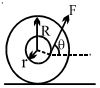
The spool shown in the figure is placed on a rough horizontal surface and has an inner radius $r$ and an outer radius $R$. The angle $\theta$ between the applied force and the horizontal can be varied. The critical angle $\theta$ for which the spool does not roll and remains stationary is given by:
A
$\theta = \cos^{-1} \left( \frac{r}{R} \right)$
B
$\theta = \cos^{-1} \left( \frac{2r}{R} \right)$
C
$\theta = \cos^{-1} \sqrt{\frac{r}{R}}$
D
$\theta = \sin^{-1} \left( \frac{r}{R} \right)$
Solution
(A) For the spool to remain stationary,it must be in both translational and rotational equilibrium.
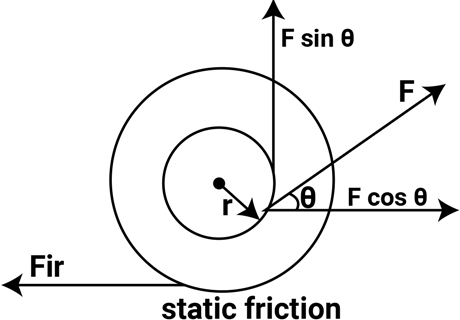
$1$. Translational Equilibrium: The net force on the spool must be zero. Considering the horizontal forces,the applied force component $F \cos \theta$ must be balanced by the static frictional force $f_s$ acting at the point of contact with the ground.
$f_s = F \cos \theta$
$2$. Rotational Equilibrium: The net torque about the point of contact with the ground must be zero. The force $F$ is applied at a distance $r$ from the center. The torque due to force $F$ about the point of contact is $F \times r$. For the spool to not rotate,this must be balanced by the torque of the force components. However,a simpler way is to take the torque about the center of the spool. The torque due to friction $f_s$ at the contact point (distance $R$ from the center) must balance the torque due to the force $F$ (distance $r$ from the center).
$f_s \times R = F \times r$
Substituting $f_s = F \cos \theta$ into the torque equation:
$(F \cos \theta) \times R = F \times r$
Dividing both sides by $F \times R$:
$\cos \theta = \frac{r}{R}$
Therefore,the critical angle is:
$\theta = \cos^{-1} \left( \frac{r}{R} \right)$
$1$. Translational Equilibrium: The net force on the spool must be zero. Considering the horizontal forces,the applied force component $F \cos \theta$ must be balanced by the static frictional force $f_s$ acting at the point of contact with the ground.
$f_s = F \cos \theta$
$2$. Rotational Equilibrium: The net torque about the point of contact with the ground must be zero. The force $F$ is applied at a distance $r$ from the center. The torque due to force $F$ about the point of contact is $F \times r$. For the spool to not rotate,this must be balanced by the torque of the force components. However,a simpler way is to take the torque about the center of the spool. The torque due to friction $f_s$ at the contact point (distance $R$ from the center) must balance the torque due to the force $F$ (distance $r$ from the center).
$f_s \times R = F \times r$
Substituting $f_s = F \cos \theta$ into the torque equation:
$(F \cos \theta) \times R = F \times r$
Dividing both sides by $F \times R$:
$\cos \theta = \frac{r}{R}$
Therefore,the critical angle is:
$\theta = \cos^{-1} \left( \frac{r}{R} \right)$
0 likes
View Solution41
DifficultMCQ
$A$ uniform cylinder of mass $m$ can rotate freely about its own axis,which is horizontal. $A$ particle of mass $m_0$ hangs from the end of a light string wound around the cylinder,which does not slip over it. When the system is allowed to move,the acceleration of the descending mass will be
A
$\frac{2m_0g}{m + 2m_0}$
B
$\frac{m_0g}{m + m_0}$
C
$\frac{2m_0g}{m + m_0}$
D
$\frac{m_0g}{2m + m_0}$
Solution
(A) Let $a$ be the acceleration of the mass $m_0$ and $T$ be the tension in the string. The equation of motion for the mass $m_0$ is:
$m_0g - T = m_0a$ ... $(1)$
For the rotation of the cylinder,the torque $\tau$ is given by $\tau = I\alpha$,where $I = \frac{1}{2}mr^2$ is the moment of inertia of the cylinder and $\alpha = \frac{a}{r}$ is the angular acceleration.
$Tr = I\alpha = \left(\frac{1}{2}mr^2\right) \left(\frac{a}{r}\right)$
$T = \frac{1}{2}ma$ ... $(2)$
Substituting the value of $T$ from equation $(2)$ into equation $(1)$:
$m_0g - \frac{1}{2}ma = m_0a$
$m_0g = m_0a + \frac{1}{2}ma = a\left(m_0 + \frac{m}{2}\right)$
$a = \frac{m_0g}{m_0 + \frac{m}{2}} = \frac{2m_0g}{2m_0 + m}$
$m_0g - T = m_0a$ ... $(1)$
For the rotation of the cylinder,the torque $\tau$ is given by $\tau = I\alpha$,where $I = \frac{1}{2}mr^2$ is the moment of inertia of the cylinder and $\alpha = \frac{a}{r}$ is the angular acceleration.
$Tr = I\alpha = \left(\frac{1}{2}mr^2\right) \left(\frac{a}{r}\right)$
$T = \frac{1}{2}ma$ ... $(2)$
Substituting the value of $T$ from equation $(2)$ into equation $(1)$:
$m_0g - \frac{1}{2}ma = m_0a$
$m_0g = m_0a + \frac{1}{2}ma = a\left(m_0 + \frac{m}{2}\right)$
$a = \frac{m_0g}{m_0 + \frac{m}{2}} = \frac{2m_0g}{2m_0 + m}$

0 likes
View Solution42
DifficultMCQ
$A$ straight rod of length $L$ is released on a frictionless horizontal floor in a vertical position. As it falls and slips,the distance of a point on the rod from the lower end,which follows a quarter circular locus,is
A
$L/2$
B
$L/4$
C
$L/8$
D
None
Solution
(B) Let the rod be of length $L$. The lower end of the rod is at the origin $(0,0)$ initially. The center of mass of the rod is at $(0, L/2)$.
As the rod falls,the center of mass moves vertically downwards to the point $(0,0)$ on the floor.
Let a point $P$ be at a distance $x$ from the lower end of the rod.
Initially,the coordinates of point $P$ are $(0, x)$.
When the rod falls and lies flat on the floor,the lower end is at a distance $L$ from the origin,and the center of mass is at the origin $(0,0)$.
In the final horizontal position,the point $P$ is at a distance $(L-x)$ from the origin (the center of mass position).
For the point $P$ to trace a circular path of radius $r$,its distance from the center of mass (which acts as the center of rotation for the rod's motion) must remain constant.
Initially,the distance of $P$ from the center of mass is $r = |L/2 - x|$.
Finally,when the rod is horizontal,the distance of $P$ from the center of mass is $r = |L - x - L/2| = |L/2 - x|$.
For the path to be a quarter circle,the vertical displacement must equal the horizontal displacement. The point $P$ starts at height $x$ and ends at horizontal distance $L-x$ from the initial base.
Setting $x = L/2 - x$ (distance from center of mass),we get $2x = L/2$,which implies $x = L/4$.
As the rod falls,the center of mass moves vertically downwards to the point $(0,0)$ on the floor.
Let a point $P$ be at a distance $x$ from the lower end of the rod.
Initially,the coordinates of point $P$ are $(0, x)$.
When the rod falls and lies flat on the floor,the lower end is at a distance $L$ from the origin,and the center of mass is at the origin $(0,0)$.
In the final horizontal position,the point $P$ is at a distance $(L-x)$ from the origin (the center of mass position).
For the point $P$ to trace a circular path of radius $r$,its distance from the center of mass (which acts as the center of rotation for the rod's motion) must remain constant.
Initially,the distance of $P$ from the center of mass is $r = |L/2 - x|$.
Finally,when the rod is horizontal,the distance of $P$ from the center of mass is $r = |L - x - L/2| = |L/2 - x|$.
For the path to be a quarter circle,the vertical displacement must equal the horizontal displacement. The point $P$ starts at height $x$ and ends at horizontal distance $L-x$ from the initial base.
Setting $x = L/2 - x$ (distance from center of mass),we get $2x = L/2$,which implies $x = L/4$.
0 likes
View Solution43
AdvancedMCQ
$A$ ladder of length $L$ is slipping with its ends against a vertical wall and a horizontal floor. At a certain moment,the speed of the end in contact with the horizontal floor is $v$ and the ladder makes an angle $\alpha = 30^o$ with the horizontal. If $dv/dt = 0$,then the angular acceleration of the ladder when $\alpha = 45^o$ is:
A
$2v^2/L^2$
B
$v^2/2L^2$
C
$\sqrt{2} v^2 / L^2$
D
None
Solution
(A) Let the coordinates of the ends of the ladder be $(x, 0)$ and $(0, y)$. Then $x^2 + y^2 = L^2$.
Differentiating with respect to time $t$: $2x(dx/dt) + 2y(dy/dt) = 0$.
Given $dx/dt = -v$ (speed of end on floor),so $x(-v) + y(dy/dt) = 0 \Rightarrow dy/dt = xv/y = v \cot \alpha$.
The angular velocity $\omega$ of the ladder is given by $\omega = |d\alpha/dt|$. Since $x = L \cos \alpha$,$dx/dt = -L \sin \alpha (d\alpha/dt) = -v$.
Thus,$\omega = v / (L \sin \alpha)$.
The angular acceleration $\alpha_{ang} = d\omega/dt = (d\omega/d\alpha) \cdot (d\alpha/dt)$.
$d\omega/d\alpha = -(v / L \sin^2 \alpha) \cos \alpha$.
Since $d\alpha/dt = -\omega = -v / (L \sin \alpha)$,we have $\alpha_{ang} = [-(v \cos \alpha) / (L \sin^2 \alpha)] \cdot [-v / (L \sin \alpha)] = (v^2 \cos \alpha) / (L^2 \sin^3 \alpha)$.
At $\alpha = 45^o$: $\alpha_{ang} = (v^2 \cos 45^o) / (L^2 \sin^3 45^o) = (v^2 \cdot (1/\sqrt{2})) / (L^2 \cdot (1/\sqrt{2})^3) = (v^2 / \sqrt{2}) / (L^2 / 2\sqrt{2}) = 2v^2 / L^2$.
Differentiating with respect to time $t$: $2x(dx/dt) + 2y(dy/dt) = 0$.
Given $dx/dt = -v$ (speed of end on floor),so $x(-v) + y(dy/dt) = 0 \Rightarrow dy/dt = xv/y = v \cot \alpha$.
The angular velocity $\omega$ of the ladder is given by $\omega = |d\alpha/dt|$. Since $x = L \cos \alpha$,$dx/dt = -L \sin \alpha (d\alpha/dt) = -v$.
Thus,$\omega = v / (L \sin \alpha)$.
The angular acceleration $\alpha_{ang} = d\omega/dt = (d\omega/d\alpha) \cdot (d\alpha/dt)$.
$d\omega/d\alpha = -(v / L \sin^2 \alpha) \cos \alpha$.
Since $d\alpha/dt = -\omega = -v / (L \sin \alpha)$,we have $\alpha_{ang} = [-(v \cos \alpha) / (L \sin^2 \alpha)] \cdot [-v / (L \sin \alpha)] = (v^2 \cos \alpha) / (L^2 \sin^3 \alpha)$.
At $\alpha = 45^o$: $\alpha_{ang} = (v^2 \cos 45^o) / (L^2 \sin^3 45^o) = (v^2 \cdot (1/\sqrt{2})) / (L^2 \cdot (1/\sqrt{2})^3) = (v^2 / \sqrt{2}) / (L^2 / 2\sqrt{2}) = 2v^2 / L^2$.
0 likes
View Solution44
DifficultMCQ
Two particles of equal mass $m$ at $A$ and $B$ are connected by a rigid light rod $AB$ of length $L$ lying on a smooth horizontal table. An impulse $J$ is applied at $A$ in the plane of the table and perpendicular to $AB$. Then the velocity of the particle at $A$ is:
A
$\frac{J}{2m}$
B
$\frac{3J}{4m}$
C
$\frac{J}{m}$
D
$\frac{2J}{m}$
Solution
(C) Let the length of the rod be $L$. The impulse $J$ applied at $A$ creates a linear impulse and an angular impulse about the center of mass $C$ of the system.
Since the masses are equal,the center of mass $C$ is at the midpoint of $AB$.
The linear velocity of the center of mass $v_{cm}$ is given by $J = M_{total} v_{cm} = (2m) v_{cm}$,so $v_{cm} = \frac{J}{2m}$.
The angular impulse about $C$ is $J \times \frac{L}{2} = I_{cm} \omega$,where $I_{cm} = m(\frac{L}{2})^2 + m(\frac{L}{2})^2 = \frac{mL^2}{2}$.
Thus,$\frac{JL}{2} = \frac{mL^2}{2} \omega$,which gives $\omega = \frac{J}{mL}$.
The velocity of particle $A$ is $v_A = v_{cm} + \omega r_A = \frac{J}{2m} + (\frac{J}{mL})(\frac{L}{2}) = \frac{J}{2m} + \frac{J}{2m} = \frac{J}{m}$.
Since the masses are equal,the center of mass $C$ is at the midpoint of $AB$.
The linear velocity of the center of mass $v_{cm}$ is given by $J = M_{total} v_{cm} = (2m) v_{cm}$,so $v_{cm} = \frac{J}{2m}$.
The angular impulse about $C$ is $J \times \frac{L}{2} = I_{cm} \omega$,where $I_{cm} = m(\frac{L}{2})^2 + m(\frac{L}{2})^2 = \frac{mL^2}{2}$.
Thus,$\frac{JL}{2} = \frac{mL^2}{2} \omega$,which gives $\omega = \frac{J}{mL}$.
The velocity of particle $A$ is $v_A = v_{cm} + \omega r_A = \frac{J}{2m} + (\frac{J}{mL})(\frac{L}{2}) = \frac{J}{2m} + \frac{J}{2m} = \frac{J}{m}$.
0 likes
View Solution45
MediumMCQ
$A$ plank with a uniform sphere placed on it rests on a smooth horizontal plane. The plank is pulled to the right by a constant force $F$. If the sphere does not slip over the plank,which of the following is true?
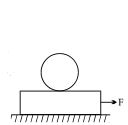
A
The acceleration of the centre of the sphere is less than that of the plank.
B
The acceleration of the centre of the sphere is greater than that of the plank because friction acts rightward on the sphere.
C
The acceleration of the centre of the sphere may be towards the left.
D
The acceleration of the centre of the sphere relative to the plank may be greater than that of the plank relative to the floor.
Solution
(A) Let $M$ be the mass of the plank and $m$ be the mass of the sphere. Let $a_p$ be the acceleration of the plank and $a_s$ be the acceleration of the centre of the sphere.
When the plank is pulled to the right with force $F$,friction $f$ acts on the sphere in the forward direction (to the right) to provide the necessary torque for rolling.
For the sphere: $f = m a_s$ and $\tau = f R = I \alpha = (\frac{2}{5} m R^2) \alpha$. Since there is no slipping,$a_s = R \alpha$,so $f R = \frac{2}{5} m R^2 (\frac{a_s}{R}) = \frac{2}{5} m a_s R$,which implies $f = \frac{2}{5} m a_s$.
However,the friction force $f$ acting on the sphere is $m a_s$. This is only possible if the sphere is accelerating. The plank experiences a backward friction force $f$. The equation for the plank is $F - f = M a_p$.
Since $f = m a_s$,we have $a_s = \frac{f}{m}$. Since $f = \frac{2}{5} m a_s$ is the condition for pure rolling,the friction force $f$ must be $\frac{2}{7} F \frac{m}{M+m}$ (approx). Comparing $a_s$ and $a_p$,we find $a_s < a_p$ because the sphere is being accelerated only by the friction force,while the plank is being accelerated by the external force $F$ minus the friction force.
When the plank is pulled to the right with force $F$,friction $f$ acts on the sphere in the forward direction (to the right) to provide the necessary torque for rolling.
For the sphere: $f = m a_s$ and $\tau = f R = I \alpha = (\frac{2}{5} m R^2) \alpha$. Since there is no slipping,$a_s = R \alpha$,so $f R = \frac{2}{5} m R^2 (\frac{a_s}{R}) = \frac{2}{5} m a_s R$,which implies $f = \frac{2}{5} m a_s$.
However,the friction force $f$ acting on the sphere is $m a_s$. This is only possible if the sphere is accelerating. The plank experiences a backward friction force $f$. The equation for the plank is $F - f = M a_p$.
Since $f = m a_s$,we have $a_s = \frac{f}{m}$. Since $f = \frac{2}{5} m a_s$ is the condition for pure rolling,the friction force $f$ must be $\frac{2}{7} F \frac{m}{M+m}$ (approx). Comparing $a_s$ and $a_p$,we find $a_s < a_p$ because the sphere is being accelerated only by the friction force,while the plank is being accelerated by the external force $F$ minus the friction force.
0 likes
View Solution46
DifficultMCQ
$A$ mass $m$ hangs with the help of a string wrapped around a pulley on a frictionless bearing. The pulley has mass $m$ and radius $R$. Assuming the pulley to be a perfect uniform circular disc,the acceleration of the mass $m$,if the string does not slip on the pulley,is
A
$\frac{3}{2}g$
B
$g$
C
$\frac{2}{3}g$
D
$\frac{g}{3}$
Solution
(C) For the translational motion of the hanging mass $m$:
$mg - T = ma$ --- $(1)$
For the rotational motion of the pulley of mass $m$ and radius $R$:
$T \cdot R = I \alpha$
Since the string does not slip,the linear acceleration $a$ of the mass is related to the angular acceleration $\alpha$ of the pulley by $a = \alpha R$,so $\alpha = \frac{a}{R}$.
The moment of inertia $I$ of a uniform circular disc is $\frac{1}{2}mR^2$.
Substituting these into the torque equation:
$T \cdot R = (\frac{1}{2}mR^2) \cdot (\frac{a}{R})$
$T = \frac{1}{2}ma$ --- $(2)$
Substituting $(2)$ into $(1)$:
$mg - \frac{1}{2}ma = ma$
$mg = ma + \frac{1}{2}ma = \frac{3}{2}ma$
$a = \frac{2}{3}g$
$mg - T = ma$ --- $(1)$
For the rotational motion of the pulley of mass $m$ and radius $R$:
$T \cdot R = I \alpha$
Since the string does not slip,the linear acceleration $a$ of the mass is related to the angular acceleration $\alpha$ of the pulley by $a = \alpha R$,so $\alpha = \frac{a}{R}$.
The moment of inertia $I$ of a uniform circular disc is $\frac{1}{2}mR^2$.
Substituting these into the torque equation:
$T \cdot R = (\frac{1}{2}mR^2) \cdot (\frac{a}{R})$
$T = \frac{1}{2}ma$ --- $(2)$
Substituting $(2)$ into $(1)$:
$mg - \frac{1}{2}ma = ma$
$mg = ma + \frac{1}{2}ma = \frac{3}{2}ma$
$a = \frac{2}{3}g$
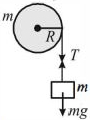
0 likes
View Solution47
MediumMCQ
$A$ mass $m$ is supported by a massless string wound around a uniform hollow cylinder of mass $m$ and radius $R$. If the string does not slip on the cylinder,with what acceleration will the mass fall on release?
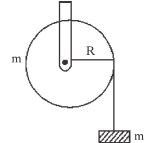
A
$\frac{g}{2}$
B
$g$
C
$\frac{5g}{6}$
D
$\frac{2g}{3}$
Solution
(A) Let $a$ be the linear acceleration of the mass $m$ and $\alpha$ be the angular acceleration of the cylinder. Since the string does not slip,$a = R\alpha$,which implies $\alpha = \frac{a}{R}$.
For the falling mass $m$,the equation of motion is: $mg - T = ma$ . . . $(i)$
For the rotation of the hollow cylinder,the torque $\tau = I\alpha$ is provided by the tension $T$:
$T \times R = I\alpha$
Since the moment of inertia $I$ of a hollow cylinder about its axis is $mR^2$,we have:
$T \times R = (mR^2) \times \left( \frac{a}{R} \right)$
$T = ma$ . . . (ii)
Substituting equation (ii) into equation $(i)$:
$mg - ma = ma$
$mg = 2ma$
$a = \frac{g}{2}$
For the falling mass $m$,the equation of motion is: $mg - T = ma$ . . . $(i)$
For the rotation of the hollow cylinder,the torque $\tau = I\alpha$ is provided by the tension $T$:
$T \times R = I\alpha$
Since the moment of inertia $I$ of a hollow cylinder about its axis is $mR^2$,we have:
$T \times R = (mR^2) \times \left( \frac{a}{R} \right)$
$T = ma$ . . . (ii)
Substituting equation (ii) into equation $(i)$:
$mg - ma = ma$
$mg = 2ma$
$a = \frac{g}{2}$
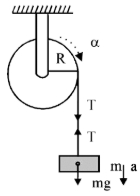
0 likes
View Solution48
MediumMCQ
$A$ ring of mass $m$ can freely slide along the massless curved rod as shown. At the lower most point,the curved path becomes vertical. If the whole system is released from rest,what is the velocity of the ring $(v)$ at the lowermost point just before touching the block $M$ (all surfaces are smooth)?
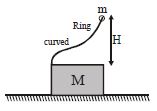
A
$v = \sqrt {2gH} $
B
$v < \sqrt {2gH} $
C
$v > \sqrt {2gH} $
D
Data insufficient
Solution
(B) Let the mass of the ring be $m$ and the mass of the block be $M$. The system is released from rest,so the initial total momentum is zero.
Since all surfaces are smooth and there are no external horizontal forces,the horizontal momentum of the system is conserved.
As the ring slides down the curved rod,it exerts a horizontal force on the rod,causing the block $M$ to move in the opposite direction.
Let $v_m$ be the horizontal velocity of the ring and $V_M$ be the velocity of the block $M$ at the lowermost point.
By conservation of horizontal momentum: $m v_m - M V_M = 0$,which implies $v_m = (M/m) V_M$.
By conservation of mechanical energy: $mgH = \frac{1}{2} m v_m^2 + \frac{1}{2} M V_M^2$.
Substituting $V_M = (m/M) v_m$ into the energy equation: $mgH = \frac{1}{2} m v_m^2 + \frac{1}{2} M (m/M)^2 v_m^2 = \frac{1}{2} m v_m^2 (1 + m/M)$.
Solving for $v_m$: $v_m = \sqrt{\frac{2gH}{1 + m/M}}$.
Since $(1 + m/M) > 1$,it follows that $v_m < \sqrt{2gH}$.
Since all surfaces are smooth and there are no external horizontal forces,the horizontal momentum of the system is conserved.
As the ring slides down the curved rod,it exerts a horizontal force on the rod,causing the block $M$ to move in the opposite direction.
Let $v_m$ be the horizontal velocity of the ring and $V_M$ be the velocity of the block $M$ at the lowermost point.
By conservation of horizontal momentum: $m v_m - M V_M = 0$,which implies $v_m = (M/m) V_M$.
By conservation of mechanical energy: $mgH = \frac{1}{2} m v_m^2 + \frac{1}{2} M V_M^2$.
Substituting $V_M = (m/M) v_m$ into the energy equation: $mgH = \frac{1}{2} m v_m^2 + \frac{1}{2} M (m/M)^2 v_m^2 = \frac{1}{2} m v_m^2 (1 + m/M)$.
Solving for $v_m$: $v_m = \sqrt{\frac{2gH}{1 + m/M}}$.
Since $(1 + m/M) > 1$,it follows that $v_m < \sqrt{2gH}$.
0 likes
View Solution49
DifficultMCQ
The plank in the figure moves a distance $100 \ mm$ to the right while the centre of mass of the sphere of radius $150 \ mm$ moves a distance $75 \ mm$ to the left. The angular displacement of the sphere (in radian) is (there is no slipping anywhere):-
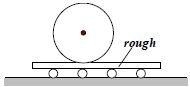
A
$\frac{1}{6}$
B
$\frac{7}{6}$
C
$1$
D
$\frac{1}{2}$
Solution
(A) The condition for no slipping at the point of contact between the sphere and the plank is that their velocities must be equal.
Let $v_p$ be the velocity of the plank to the right and $v_c$ be the velocity of the center of mass of the sphere to the left.
The velocity of the bottom point of the sphere is $v_c - R\omega$ (to the left).
For no slipping,the velocity of the bottom point of the sphere must equal the velocity of the plank.
Taking right as positive direction:
$v_p = v_c - R\omega$ (in magnitude,considering directions: $v_p = -(-v_c) - R\omega$ is not correct,let's use relative velocity).
Relative to the plank,the point of contact on the sphere must have zero velocity.
Velocity of point of contact = $v_c$ (left) + $R\omega$ (left) = $v_p$ (right).
In terms of displacement:
$s_c + R\Delta\theta = s_p$
$75 + 150 \Delta\theta = 100$
$150 \Delta\theta = 100 - 75 = 25$
$\Delta\theta = \frac{25}{150} = \frac{1}{6} \text{ rad}$.
Let $v_p$ be the velocity of the plank to the right and $v_c$ be the velocity of the center of mass of the sphere to the left.
The velocity of the bottom point of the sphere is $v_c - R\omega$ (to the left).
For no slipping,the velocity of the bottom point of the sphere must equal the velocity of the plank.
Taking right as positive direction:
$v_p = v_c - R\omega$ (in magnitude,considering directions: $v_p = -(-v_c) - R\omega$ is not correct,let's use relative velocity).
Relative to the plank,the point of contact on the sphere must have zero velocity.
Velocity of point of contact = $v_c$ (left) + $R\omega$ (left) = $v_p$ (right).
In terms of displacement:
$s_c + R\Delta\theta = s_p$
$75 + 150 \Delta\theta = 100$
$150 \Delta\theta = 100 - 75 = 25$
$\Delta\theta = \frac{25}{150} = \frac{1}{6} \text{ rad}$.
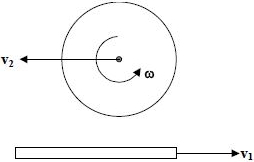
0 likes
View Solution50
DifficultMCQ
$A$ binary star system consists of two stars,one of which has double the mass of the other. The stars rotate about their common centre of mass:
A
both the stars have same angular momentum about centre of mass
B
star having the smaller mass has larger angular momentum about the centre of mass
C
the lighter star has smaller linear speed
D
the heavier star has higher kinetic energy
Solution
(B) Let the masses be $m_1 = 2m$ and $m_2 = m$. Let their distances from the centre of mass be $r_1 = d$ and $r_2 = 2d$ respectively,such that $m_1 r_1 = m_2 r_2$ $(2m \cdot d = m \cdot 2d)$.
Both stars rotate with the same angular velocity $\omega$ about the centre of mass.
Angular momentum $L = I\omega = mr^2\omega$.
For the heavier star $(2m)$: $L_1 = (2m)d^2\omega = 2md^2\omega$.
For the lighter star $(m)$: $L_2 = m(2d)^2\omega = 4md^2\omega$.
Thus,$L_2 > L_1$,meaning the lighter star has larger angular momentum.
Linear speed $v = r\omega$. For the heavier star,$v_1 = d\omega$. For the lighter star,$v_2 = 2d\omega$. Thus,$v_2 > v_1$,so the lighter star has higher linear speed.
Kinetic energy $K = \frac{1}{2}mv^2$. $K_1 = \frac{1}{2}(2m)(d\omega)^2 = md^2\omega^2$. $K_2 = \frac{1}{2}(m)(2d\omega)^2 = 2md^2\omega^2$. Thus,$K_2 > K_1$,so the lighter star has higher kinetic energy.
Therefore,option $B$ is correct.
Both stars rotate with the same angular velocity $\omega$ about the centre of mass.
Angular momentum $L = I\omega = mr^2\omega$.
For the heavier star $(2m)$: $L_1 = (2m)d^2\omega = 2md^2\omega$.
For the lighter star $(m)$: $L_2 = m(2d)^2\omega = 4md^2\omega$.
Thus,$L_2 > L_1$,meaning the lighter star has larger angular momentum.
Linear speed $v = r\omega$. For the heavier star,$v_1 = d\omega$. For the lighter star,$v_2 = 2d\omega$. Thus,$v_2 > v_1$,so the lighter star has higher linear speed.
Kinetic energy $K = \frac{1}{2}mv^2$. $K_1 = \frac{1}{2}(2m)(d\omega)^2 = md^2\omega^2$. $K_2 = \frac{1}{2}(m)(2d\omega)^2 = 2md^2\omega^2$. Thus,$K_2 > K_1$,so the lighter star has higher kinetic energy.
Therefore,option $B$ is correct.
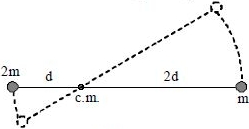
0 likes
View SolutionSystem of Particles and Rotational Motion — Rotation Motion Basic, Motion of Connected Mass · Frequently Asked Questions
1Are these System of Particles and Rotational Motion questions useful for JEE and NEET?
Yes. All questions in this section are mapped to JEE Main and NEET exam patterns. Previous year questions from JEE Main, NEET, GUJCET and state-level exams are included with full solutions.
2Can I switch to Hindi or Gujarati for these questions?
Yes. Use the language tabs in the hero section or the sidebar to view the same questions and solutions in English, Hindi or Gujarati.
3How do I generate a question paper from this subtopic?
Use the Vedclass Exam Paper Generator — select the chapter and subtopic, set difficulty, and generate Sets A, B, C, D automatically. First 3 chapters of every subject are free.
Vedclass Products
For Students
Vedclass Test Series
Mock tests in real JEE/NEET style with performance analysis. 5-day free trial.
Start Free TrialFor Teachers
Exam Paper Generator
Generate Set A/B/C/D papers from this chapter in 2 minutes. 3 chapters free.
Try FreeFor Institutes
Online Exam Module
Live online exams with unlimited students, 360° analytics & white-label branding.
See DemoFor Teachers & Institutes
Generate a System of Particles and Rotational Motion Exam Paper in 2 Minutes
Select subtopic & difficulty — Sets A, B, C, D auto-generated with No Repeat logic.
First 3 chapters of every subject are free — no payment required.