
A English
Mix Example - System of Particles and Rotational Motion Questions in English
Class 11 Physics · System of Particles and Rotational Motion · Mix Example - System of Particles and Rotational Motion
262+
Questions
English
Language
100%
With Solutions
Showing 49 of 262 questions in English
1
MediumMCQ
The total kinetic energy of a body of mass $10 \ kg$ and radius $0.5 \ m$ moving with a velocity of $2 \ m/s$ without slipping is $32.8 \ J$. The radius of gyration of the body is .......... $m$.
A
$0.25$
B
$0.2$
C
$0.5$
D
$0.4$
Solution
(D) Given: Mass $(m) = 10 \ kg$,Radius $(r) = 0.5 \ m$,Velocity $(v) = 2 \ m/s$,Total Kinetic Energy $(E) = 32.8 \ J$.
The total kinetic energy of a body rolling without slipping is the sum of its translational and rotational kinetic energies:
$E = E_{\text{translational}} + E_{\text{rotational}}$
$E = \frac{1}{2}mv^2 + \frac{1}{2}I\omega^2$
Since $I = mk^2$ and $\omega = \frac{v}{r}$,where $k$ is the radius of gyration:
$E = \frac{1}{2}mv^2 + \frac{1}{2}(mk^2)\left(\frac{v}{r}\right)^2$
$32.8 = \frac{1}{2} \times 10 \times (2)^2 + \frac{1}{2} \times 10 \times k^2 \times \left(\frac{2}{0.5}\right)^2$
$32.8 = 20 + 5 \times k^2 \times (4)^2$
$32.8 = 20 + 80k^2$
$12.8 = 80k^2$
$k^2 = \frac{12.8}{80} = 0.16$
$k = \sqrt{0.16} = 0.4 \ m$.
The total kinetic energy of a body rolling without slipping is the sum of its translational and rotational kinetic energies:
$E = E_{\text{translational}} + E_{\text{rotational}}$
$E = \frac{1}{2}mv^2 + \frac{1}{2}I\omega^2$
Since $I = mk^2$ and $\omega = \frac{v}{r}$,where $k$ is the radius of gyration:
$E = \frac{1}{2}mv^2 + \frac{1}{2}(mk^2)\left(\frac{v}{r}\right)^2$
$32.8 = \frac{1}{2} \times 10 \times (2)^2 + \frac{1}{2} \times 10 \times k^2 \times \left(\frac{2}{0.5}\right)^2$
$32.8 = 20 + 5 \times k^2 \times (4)^2$
$32.8 = 20 + 80k^2$
$12.8 = 80k^2$
$k^2 = \frac{12.8}{80} = 0.16$
$k = \sqrt{0.16} = 0.4 \ m$.
0 likes
View Solution2
MediumMCQ
$A$ thin hollow cylinder open at both ends is moving with the same speed $v$ in two different cases:
$(i)$ It slides without rotating.
$(ii)$ It rolls without slipping.
Find the ratio of the kinetic energies in the two cases.
$(i)$ It slides without rotating.
$(ii)$ It rolls without slipping.
Find the ratio of the kinetic energies in the two cases.
A
$1:1$
B
$4:1$
C
$1:2$
D
$2:1$
Solution
(C) Case $(i)$: When the hollow cylinder slides without rotating,it possesses only translational kinetic energy.
$K_{trans} = \frac{1}{2}mv^2$
Case $(ii)$: When the hollow cylinder rolls without slipping,it possesses both translational and rotational kinetic energy.
$K_{total} = K_{trans} + K_{rot} = \frac{1}{2}mv^2 + \frac{1}{2}I\omega^2$
For a thin hollow cylinder,the moment of inertia $I = mR^2$ and for rolling without slipping,$\omega = \frac{v}{R}$.
$K_{total} = \frac{1}{2}mv^2 + \frac{1}{2}(mR^2)(\frac{v}{R})^2 = \frac{1}{2}mv^2 + \frac{1}{2}mv^2 = mv^2$
Ratio of kinetic energies:
$\frac{K_{trans}}{K_{total}} = \frac{\frac{1}{2}mv^2}{mv^2} = \frac{1}{2}$
Thus,the ratio is $1:2$.
$K_{trans} = \frac{1}{2}mv^2$
Case $(ii)$: When the hollow cylinder rolls without slipping,it possesses both translational and rotational kinetic energy.
$K_{total} = K_{trans} + K_{rot} = \frac{1}{2}mv^2 + \frac{1}{2}I\omega^2$
For a thin hollow cylinder,the moment of inertia $I = mR^2$ and for rolling without slipping,$\omega = \frac{v}{R}$.
$K_{total} = \frac{1}{2}mv^2 + \frac{1}{2}(mR^2)(\frac{v}{R})^2 = \frac{1}{2}mv^2 + \frac{1}{2}mv^2 = mv^2$
Ratio of kinetic energies:
$\frac{K_{trans}}{K_{total}} = \frac{\frac{1}{2}mv^2}{mv^2} = \frac{1}{2}$
Thus,the ratio is $1:2$.
0 likes
View Solution3
MediumMCQ
$A$ body with a moment of inertia of $3 \ kg \cdot m^2$ rotating with an angular speed of $2 \ rad/s$ has the same kinetic energy as a mass of $12 \ kg$ moving with a speed of ......... $m/s$.
A
$1$
B
$2$
C
$4$
D
$8$
Solution
(A) The rotational kinetic energy $(K_{rot})$ of a body is given by $K_{rot} = \frac{1}{2} I \omega^2$,where $I$ is the moment of inertia and $\omega$ is the angular speed.
Given $I = 3 \ kg \cdot m^2$ and $\omega = 2 \ rad/s$,we have $K_{rot} = \frac{1}{2} \times 3 \times (2)^2 = \frac{1}{2} \times 3 \times 4 = 6 \ J$.
The translational kinetic energy $(K_{trans})$ of a mass $m$ moving with speed $v$ is given by $K_{trans} = \frac{1}{2} m v^2$.
Given $m = 12 \ kg$ and $K_{trans} = K_{rot} = 6 \ J$,we set up the equation: $6 = \frac{1}{2} \times 12 \times v^2$.
$6 = 6 \times v^2 \Rightarrow v^2 = 1 \Rightarrow v = 1 \ m/s$.
Given $I = 3 \ kg \cdot m^2$ and $\omega = 2 \ rad/s$,we have $K_{rot} = \frac{1}{2} \times 3 \times (2)^2 = \frac{1}{2} \times 3 \times 4 = 6 \ J$.
The translational kinetic energy $(K_{trans})$ of a mass $m$ moving with speed $v$ is given by $K_{trans} = \frac{1}{2} m v^2$.
Given $m = 12 \ kg$ and $K_{trans} = K_{rot} = 6 \ J$,we set up the equation: $6 = \frac{1}{2} \times 12 \times v^2$.
$6 = 6 \times v^2 \Rightarrow v^2 = 1 \Rightarrow v = 1 \ m/s$.
0 likes
View Solution4
MediumMCQ
Which of the following statements are correct?
$(a)$ Centre of mass of a body always coincides with the centre of gravity of the body.
$(b)$ Centre of mass of a body is the point at which the total gravitational torque on the body is zero.
$(c)$ $A$ couple on a body produces both translational and rotational motion in a body.
$(d)$ Mechanical advantage greater than $1$ means that small effort can be used to lift a large load.
$(a)$ Centre of mass of a body always coincides with the centre of gravity of the body.
$(b)$ Centre of mass of a body is the point at which the total gravitational torque on the body is zero.
$(c)$ $A$ couple on a body produces both translational and rotational motion in a body.
$(d)$ Mechanical advantage greater than $1$ means that small effort can be used to lift a large load.
A
$(a)$ and $(b)$
B
$(b)$ and $(c)$
C
$(c)$ and $(d)$
D
$(b)$ and $(d)$
Solution
(D) Statement $(a)$ is incorrect because the centre of mass coincides with the centre of gravity only if the gravitational field is uniform.
Statement $(b)$ is correct because the centre of mass is defined as the point where the net gravitational torque acting on the body is zero.
Statement $(c)$ is incorrect because a couple produces only rotational motion,not translational motion,as the net force of a couple is zero.
Statement $(d)$ is correct because $\text{Mechanical Advantage} = \frac{\text{Load}}{\text{Effort}}$. If $\text{Mechanical Advantage} > 1$,then $\text{Load} > \text{Effort}$,meaning a small effort can lift a large load.
Therefore,statements $(b)$ and $(d)$ are correct.
Statement $(b)$ is correct because the centre of mass is defined as the point where the net gravitational torque acting on the body is zero.
Statement $(c)$ is incorrect because a couple produces only rotational motion,not translational motion,as the net force of a couple is zero.
Statement $(d)$ is correct because $\text{Mechanical Advantage} = \frac{\text{Load}}{\text{Effort}}$. If $\text{Mechanical Advantage} > 1$,then $\text{Load} > \text{Effort}$,meaning a small effort can lift a large load.
Therefore,statements $(b)$ and $(d)$ are correct.
1 likes
View Solution5
MediumMCQ
$A$ body with a moment of inertia of $3\ kg\cdot m^2$ rotating with an angular velocity of $2\ rad/s$ has the same kinetic energy as a mass of $12\ kg$ moving with a velocity of .......... $m/s$.
A
$8$
B
$0.5$
C
$2$
D
$1$
Solution
(D) The rotational kinetic energy $(K_r)$ of a body is given by $K_r = \frac{1}{2}I\omega^2$.
Given $I = 3\ kg\cdot m^2$ and $\omega = 2\ rad/s$,we have $K_r = \frac{1}{2} \times 3 \times (2)^2 = \frac{1}{2} \times 3 \times 4 = 6\ J$.
The translational kinetic energy $(K_t)$ of a mass $m$ moving with velocity $v$ is given by $K_t = \frac{1}{2}mv^2$.
According to the problem,$K_r = K_t$.
Therefore,$6 = \frac{1}{2} \times 12 \times v^2$.
$6 = 6 \times v^2$.
$v^2 = 1$.
$v = 1\ m/s$.
Given $I = 3\ kg\cdot m^2$ and $\omega = 2\ rad/s$,we have $K_r = \frac{1}{2} \times 3 \times (2)^2 = \frac{1}{2} \times 3 \times 4 = 6\ J$.
The translational kinetic energy $(K_t)$ of a mass $m$ moving with velocity $v$ is given by $K_t = \frac{1}{2}mv^2$.
According to the problem,$K_r = K_t$.
Therefore,$6 = \frac{1}{2} \times 12 \times v^2$.
$6 = 6 \times v^2$.
$v^2 = 1$.
$v = 1\ m/s$.
0 likes
View Solution6
DifficultMCQ
$A$ disc and a ring of the same mass are rolling. If their kinetic energies are equal,then the ratio of their velocities will be:
A
$\sqrt{4} : \sqrt{3}$
B
$\sqrt{3} : \sqrt{4}$
C
$\sqrt{3} : \sqrt{2}$
D
$\sqrt{2} : \sqrt{3}$
Solution
(A) The total kinetic energy of a rolling body is given by $K = \frac{1}{2}mv^2(1 + \frac{k^2}{R^2})$.
For a disc,the radius of gyration $k$ satisfies $\frac{k^2}{R^2} = \frac{1}{2}$. Thus,$K_{disc} = \frac{1}{2}mv_d^2(1 + \frac{1}{2}) = \frac{3}{4}mv_d^2$.
For a ring,the radius of gyration $k$ satisfies $\frac{k^2}{R^2} = 1$. Thus,$K_{ring} = \frac{1}{2}mv_r^2(1 + 1) = mv_r^2$.
Given that $K_{disc} = K_{ring}$,we have $\frac{3}{4}mv_d^2 = mv_r^2$.
Rearranging the terms,we get $\frac{v_d^2}{v_r^2} = \frac{4}{3}$.
Therefore,the ratio of their velocities is $\frac{v_d}{v_r} = \sqrt{\frac{4}{3}} = \frac{\sqrt{4}}{\sqrt{3}}$.
For a disc,the radius of gyration $k$ satisfies $\frac{k^2}{R^2} = \frac{1}{2}$. Thus,$K_{disc} = \frac{1}{2}mv_d^2(1 + \frac{1}{2}) = \frac{3}{4}mv_d^2$.
For a ring,the radius of gyration $k$ satisfies $\frac{k^2}{R^2} = 1$. Thus,$K_{ring} = \frac{1}{2}mv_r^2(1 + 1) = mv_r^2$.
Given that $K_{disc} = K_{ring}$,we have $\frac{3}{4}mv_d^2 = mv_r^2$.
Rearranging the terms,we get $\frac{v_d^2}{v_r^2} = \frac{4}{3}$.
Therefore,the ratio of their velocities is $\frac{v_d}{v_r} = \sqrt{\frac{4}{3}} = \frac{\sqrt{4}}{\sqrt{3}}$.
0 likes
View Solution7
MediumMCQ
$A$ ring,a solid sphere,and a thin disc of different masses rotate with the same kinetic energy. Equal torques are applied to stop them. Which will make the least number of rotations before coming to rest?
A
Disc
B
Ring
C
Solid sphere
D
All will make the same number of rotations
Solution
(D) The work-energy theorem states that the work done by an external torque is equal to the change in rotational kinetic energy.
$W = \tau \cdot \theta = \Delta K$
Since the bodies are brought to rest,the work done by the torque $\tau$ must equal the initial rotational kinetic energy $K$.
$\tau \cdot \theta = K$
$\theta = \frac{K}{\tau}$
Here,$\theta$ is the angular displacement in radians,which is related to the number of rotations $n$ by $\theta = 2\pi n$.
Since both the initial kinetic energy $K$ and the applied torque $\tau$ are the same for all three objects,the angular displacement $\theta$ will be the same for all of them.
Therefore,the number of rotations $n = \frac{\theta}{2\pi} = \frac{K}{2\pi\tau}$ will be the same for the ring,the solid sphere,and the disc.
$W = \tau \cdot \theta = \Delta K$
Since the bodies are brought to rest,the work done by the torque $\tau$ must equal the initial rotational kinetic energy $K$.
$\tau \cdot \theta = K$
$\theta = \frac{K}{\tau}$
Here,$\theta$ is the angular displacement in radians,which is related to the number of rotations $n$ by $\theta = 2\pi n$.
Since both the initial kinetic energy $K$ and the applied torque $\tau$ are the same for all three objects,the angular displacement $\theta$ will be the same for all of them.
Therefore,the number of rotations $n = \frac{\theta}{2\pi} = \frac{K}{2\pi\tau}$ will be the same for the ring,the solid sphere,and the disc.
0 likes
View Solution8
EasyMCQ
$A$ ring and a solid sphere of the same mass and radius rotate with the same angular velocity about their respective diameters. Which of the following is true?
A
The ring is easier to stop.
B
The solid sphere is easier to stop.
C
Both are equally difficult to stop.
D
It is impossible to stop a rotating object.
Solution
(B) The difficulty in stopping a rotating object is determined by its rotational kinetic energy,$K = \frac{1}{2} I \omega^2$. Since both objects have the same angular velocity $\omega$,the one with the smaller moment of inertia $I$ will have less rotational kinetic energy and will be easier to stop.
For a ring of mass $M$ and radius $R$ rotating about its diameter,the moment of inertia is $I_{\text{ring}} = \frac{1}{2} MR^2$.
For a solid sphere of mass $M$ and radius $R$ rotating about its diameter,the moment of inertia is $I_{\text{sphere}} = \frac{2}{5} MR^2$.
Comparing the two,$I_{\text{sphere}} = 0.4 MR^2$ and $I_{\text{ring}} = 0.5 MR^2$.
Since $I_{\text{sphere}} < I_{\text{ring}}$,the solid sphere has less rotational kinetic energy and is easier to stop.
For a ring of mass $M$ and radius $R$ rotating about its diameter,the moment of inertia is $I_{\text{ring}} = \frac{1}{2} MR^2$.
For a solid sphere of mass $M$ and radius $R$ rotating about its diameter,the moment of inertia is $I_{\text{sphere}} = \frac{2}{5} MR^2$.
Comparing the two,$I_{\text{sphere}} = 0.4 MR^2$ and $I_{\text{ring}} = 0.5 MR^2$.
Since $I_{\text{sphere}} < I_{\text{ring}}$,the solid sphere has less rotational kinetic energy and is easier to stop.
0 likes
View Solution9
DifficultMCQ
$A$ solid sphere of radius $R$ has a moment of inertia $I$ about its geometric axis. It is melted and recast into a disc of radius $r$ and thickness $t$. If the moment of inertia of this disc about an axis tangent to its edge and perpendicular to its plane is also $I$,find the value of $r$.
A
$\frac{2}{\sqrt{15}} R$
B
$\frac{2}{\sqrt{5}} R$
C
$\frac{3}{\sqrt{15}} R$
D
$\frac{\sqrt{3}}{\sqrt{15}} R$
Solution
(A) $1$. Moment of inertia of a solid sphere about its diameter is $I = \frac{2}{5}MR^2$.
$2$. Volume of the sphere is $V = \frac{4}{3}\pi R^3$. The volume remains constant when recast into a disc,so $V = \pi r^2 t$. Thus,$t = \frac{4R^3}{3r^2}$.
$3$. The moment of inertia of a disc about its central axis perpendicular to its plane is $I_{cm} = \frac{1}{2}Mr^2$.
$4$. Using the parallel axis theorem,the moment of inertia about an axis tangent to the edge and perpendicular to the plane is $I_{tangent} = I_{cm} + Mr^2 = \frac{1}{2}Mr^2 + Mr^2 = \frac{3}{2}Mr^2$.
$5$. Given $I_{tangent} = I$,we have $\frac{3}{2}Mr^2 = \frac{2}{5}MR^2$.
$6$. Simplifying,$r^2 = \frac{4}{15}R^2$,which gives $r = \frac{2}{\sqrt{15}}R$.
$2$. Volume of the sphere is $V = \frac{4}{3}\pi R^3$. The volume remains constant when recast into a disc,so $V = \pi r^2 t$. Thus,$t = \frac{4R^3}{3r^2}$.
$3$. The moment of inertia of a disc about its central axis perpendicular to its plane is $I_{cm} = \frac{1}{2}Mr^2$.
$4$. Using the parallel axis theorem,the moment of inertia about an axis tangent to the edge and perpendicular to the plane is $I_{tangent} = I_{cm} + Mr^2 = \frac{1}{2}Mr^2 + Mr^2 = \frac{3}{2}Mr^2$.
$5$. Given $I_{tangent} = I$,we have $\frac{3}{2}Mr^2 = \frac{2}{5}MR^2$.
$6$. Simplifying,$r^2 = \frac{4}{15}R^2$,which gives $r = \frac{2}{\sqrt{15}}R$.
0 likes
View Solution10
MediumMCQ
The angular momentum of a rigid body of mass $m$ about an axis is $n$ times the linear momentum $(P)$ of the body. The total kinetic energy of the rigid body is:
A
$\frac{P^2(1+n^2)}{2m}$
B
$\frac{n^2P^2}{2m}$
C
$n^2P^2 \times 2m$
D
$\frac{P^2}{2}\left(\frac{n^2}{I}+\frac{1}{m}\right)$
Solution
(D) Given that the angular momentum $L$ is $n$ times the linear momentum $P$,we have $L = nP$.
The total kinetic energy $(KE)$ of a rigid body is the sum of its rotational kinetic energy $(KE_R)$ and translational kinetic energy $(KE_T)$.
$KE = KE_R + KE_T$
Using the formulas $KE_R = \frac{L^2}{2I}$ and $KE_T = \frac{P^2}{2m}$,where $I$ is the moment of inertia:
$KE = \frac{L^2}{2I} + \frac{P^2}{2m}$
Substituting $L = nP$ into the equation:
$KE = \frac{(nP)^2}{2I} + \frac{P^2}{2m}$
$KE = \frac{n^2P^2}{2I} + \frac{P^2}{2m}$
Factoring out $\frac{P^2}{2}$:
$KE = \frac{P^2}{2}\left(\frac{n^2}{I} + \frac{1}{m}\right)$
The total kinetic energy $(KE)$ of a rigid body is the sum of its rotational kinetic energy $(KE_R)$ and translational kinetic energy $(KE_T)$.
$KE = KE_R + KE_T$
Using the formulas $KE_R = \frac{L^2}{2I}$ and $KE_T = \frac{P^2}{2m}$,where $I$ is the moment of inertia:
$KE = \frac{L^2}{2I} + \frac{P^2}{2m}$
Substituting $L = nP$ into the equation:
$KE = \frac{(nP)^2}{2I} + \frac{P^2}{2m}$
$KE = \frac{n^2P^2}{2I} + \frac{P^2}{2m}$
Factoring out $\frac{P^2}{2}$:
$KE = \frac{P^2}{2}\left(\frac{n^2}{I} + \frac{1}{m}\right)$
0 likes
View Solution11
MediumMCQ
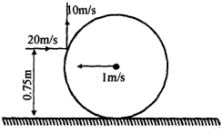
$A$ thin ring of mass $2 \ kg$ has a radius of $0.5 \ m$. It is rolling without slipping on a horizontal plane with a velocity of $1 \ m/s$. $A$ small ball of mass $0.1 \ kg$ moving in the opposite direction with a velocity of $20 \ m/s$ hits the ring at a height of $0.75 \ m$ and moves vertically upward with a velocity of $10 \ m/s$ after the collision. Immediately after the collision:
A
The ring will perform pure rotation about its stationary center of mass.
B
The ring will come to a complete stop.
C
The friction between the ring and the ground acts to the left.
D
No frictional force acts between the ring and the ground.
Solution
(A) Let the ring have mass $M = 2 \ kg$,radius $R = 0.5 \ m$,and velocity $v = 1 \ m/s$. The ball has mass $m = 0.1 \ kg$,initial velocity $u_x = -20 \ m/s$,and final velocity $v_x = 0, v_y = 10 \ m/s$. The collision point is at height $h = 0.75 \ m = 1.5R$.
Using impulse-momentum theorem for the ball in the $x$-direction: $J_x = m(v_x - u_x) = 0.1(0 - (-20)) = 2 \ Ns$. The impulse on the ring is $J_x' = -2 \ Ns$.
For the ring,the change in linear momentum is $M(v_f - v_i) = J_x'$,so $2(v_f - 1) = -2$,giving $v_f = 0$.
The impulse on the ring at height $1.5R$ creates an angular impulse about the center of mass: $\tau_{imp} = J_x' \times (1.5R - R) = -2 \times 0.25 = -0.5 \ Nms$.
Initial angular momentum $L_i = I\omega = (MR^2)(v/R) = MvR = 2 \times 1 \times 0.5 = 1 \ kgm^2/s$.
Final angular momentum $L_f = L_i + \tau_{imp} = 1 - 0.5 = 0.5 \ kgm^2/s$.
Since $L_f = I\omega_f = (MR^2)\omega_f = (2 \times 0.5^2)\omega_f = 0.5\omega_f$,we get $0.5 = 0.5\omega_f$,so $\omega_f = 1 \ rad/s$.
Since $v_f = 0$ and $\omega_f \neq 0$,the ring is in pure rotation about its center of mass.
Using impulse-momentum theorem for the ball in the $x$-direction: $J_x = m(v_x - u_x) = 0.1(0 - (-20)) = 2 \ Ns$. The impulse on the ring is $J_x' = -2 \ Ns$.
For the ring,the change in linear momentum is $M(v_f - v_i) = J_x'$,so $2(v_f - 1) = -2$,giving $v_f = 0$.
The impulse on the ring at height $1.5R$ creates an angular impulse about the center of mass: $\tau_{imp} = J_x' \times (1.5R - R) = -2 \times 0.25 = -0.5 \ Nms$.
Initial angular momentum $L_i = I\omega = (MR^2)(v/R) = MvR = 2 \times 1 \times 0.5 = 1 \ kgm^2/s$.
Final angular momentum $L_f = L_i + \tau_{imp} = 1 - 0.5 = 0.5 \ kgm^2/s$.
Since $L_f = I\omega_f = (MR^2)\omega_f = (2 \times 0.5^2)\omega_f = 0.5\omega_f$,we get $0.5 = 0.5\omega_f$,so $\omega_f = 1 \ rad/s$.
Since $v_f = 0$ and $\omega_f \neq 0$,the ring is in pure rotation about its center of mass.
0 likes
View Solution12
DifficultMCQ
Statement-$1$: $A$ body is rotating about an axis with angular velocity $\omega$ and moment of inertia $I$. Its angular momentum $L$ remains constant,but its rotational kinetic energy $K$ decreases,provided no external torque is applied.
Statement-$2$: $L = I\omega$ and $K = \frac{L^2}{2I} = \frac{1}{2} I\omega^2$.
Statement-$2$: $L = I\omega$ and $K = \frac{L^2}{2I} = \frac{1}{2} I\omega^2$.
A
Statement-$1$ is false,Statement-$2$ is true.
B
Statement-$1$ is true,Statement-$2$ is true,and Statement-$2$ is not the correct explanation of Statement-$1$.
C
Statement-$1$ is true,Statement-$2$ is false.
D
Statement-$1$ is true,Statement-$2$ is true,and Statement-$2$ is the correct explanation of Statement-$1$.
Solution
(A) According to the principle of conservation of angular momentum,if no external torque is applied $(\tau_{ext} = 0)$,the angular momentum $L = I\omega$ remains constant.
The rotational kinetic energy is given by $K = \frac{1}{2} I\omega^2$. Substituting $\omega = \frac{L}{I}$,we get $K = \frac{L^2}{2I}$.
If the moment of inertia $I$ increases while $L$ remains constant,the kinetic energy $K$ must decrease because $K \propto \frac{1}{I}$.
Statement-$1$ claims $K$ decreases,which is possible if $I$ changes. However,the statement implies $K$ decreases without specifying a change in $I$,which is physically inconsistent with the conservation of $L$ and constant $I$. If $I$ is constant and $L$ is constant,$\omega$ must be constant,and thus $K$ must be constant. Therefore,Statement-$1$ is false.
Statement-$2$ provides the correct definitions for $L$ and $K$,so it is true.
The rotational kinetic energy is given by $K = \frac{1}{2} I\omega^2$. Substituting $\omega = \frac{L}{I}$,we get $K = \frac{L^2}{2I}$.
If the moment of inertia $I$ increases while $L$ remains constant,the kinetic energy $K$ must decrease because $K \propto \frac{1}{I}$.
Statement-$1$ claims $K$ decreases,which is possible if $I$ changes. However,the statement implies $K$ decreases without specifying a change in $I$,which is physically inconsistent with the conservation of $L$ and constant $I$. If $I$ is constant and $L$ is constant,$\omega$ must be constant,and thus $K$ must be constant. Therefore,Statement-$1$ is false.
Statement-$2$ provides the correct definitions for $L$ and $K$,so it is true.
0 likes
View Solution13
EasyMCQ
The moment of inertia of a sphere of mass $M$ and radius $R$ is $I$. Which graph represents the variation of $I$ with respect to $R$,keeping $M$ constant?
A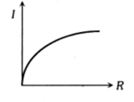
B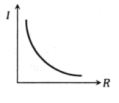
C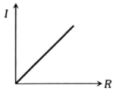
D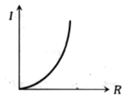
Solution
(D) The moment of inertia of a solid sphere about its diameter is given by the formula:
$I = \frac{2}{5} M R^2$
Since the mass $M$ is kept constant,we have:
$I \propto R^2$
This relationship represents a parabola opening along the $I$-axis.
Comparing this with the given options,the graph that shows $I$ increasing quadratically with $R$ is represented by Graph $D$.
$I = \frac{2}{5} M R^2$
Since the mass $M$ is kept constant,we have:
$I \propto R^2$
This relationship represents a parabola opening along the $I$-axis.
Comparing this with the given options,the graph that shows $I$ increasing quadratically with $R$ is represented by Graph $D$.
0 likes
View Solution14
DifficultMCQ
$A$ particle is moving in a uniform circular motion with angular momentum $L$. If the frequency of motion is doubled and its kinetic energy is halved,the new angular momentum will be ...
A
$2L$
B
$4L$
C
$\frac{L}{2}$
D
$\frac{L}{4}$
Solution
(D) The angular momentum $L$ of a particle in circular motion is given by $L = I\omega$,where $I$ is the moment of inertia and $\omega$ is the angular velocity.
Kinetic energy $E$ is given by $E = \frac{1}{2}I\omega^2$.
From these,we can write $L = \frac{2E}{\omega}$.
Given: Frequency $f$ is doubled,so angular velocity $\omega' = 2\omega$. Kinetic energy is halved,so $E' = \frac{E}{2}$.
The new angular momentum $L'$ is:
$L' = \frac{2E'}{\omega'} = \frac{2(E/2)}{2\omega} = \frac{E}{2\omega} = \frac{1}{4} \left( \frac{2E}{\omega} \right) = \frac{L}{4}$.
Kinetic energy $E$ is given by $E = \frac{1}{2}I\omega^2$.
From these,we can write $L = \frac{2E}{\omega}$.
Given: Frequency $f$ is doubled,so angular velocity $\omega' = 2\omega$. Kinetic energy is halved,so $E' = \frac{E}{2}$.
The new angular momentum $L'$ is:
$L' = \frac{2E'}{\omega'} = \frac{2(E/2)}{2\omega} = \frac{E}{2\omega} = \frac{1}{4} \left( \frac{2E}{\omega} \right) = \frac{L}{4}$.
0 likes
View Solution15
MediumMCQ
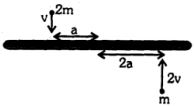
$A$ uniform rod of mass $8m$ and length $6a$ is placed on a horizontal table. Two point masses $m$ and $2m$ are moving with speeds $2v$ and $v$ respectively,as shown in the figure. They strike the rod and stick to it after the collision. Calculate the speed of the centre of mass of the system after the collision.
A
$0$
B
$v/11$
C
$v/5$
D
$v/2$
Solution
(A) Let the velocity of the centre of mass of the system after the collision be $V_{CM}$.
Since there are no external horizontal forces acting on the system,the linear momentum of the system is conserved.
Let the direction of the velocity of mass $2m$ be positive ($+y$ direction) and the direction of the velocity of mass $m$ be negative ($-y$ direction).
The initial linear momentum of the system is:
$P_i = (2m)(v) + (m)(-2v) = 2mv - 2mv = 0$
After the collision,the two masses stick to the rod,so the total mass of the system is $M_{total} = 8m + 2m + m = 11m$.
By the law of conservation of linear momentum:
$P_i = P_f$
$0 = (11m) V_{CM}$
Therefore,$V_{CM} = 0$.
Since there are no external horizontal forces acting on the system,the linear momentum of the system is conserved.
Let the direction of the velocity of mass $2m$ be positive ($+y$ direction) and the direction of the velocity of mass $m$ be negative ($-y$ direction).
The initial linear momentum of the system is:
$P_i = (2m)(v) + (m)(-2v) = 2mv - 2mv = 0$
After the collision,the two masses stick to the rod,so the total mass of the system is $M_{total} = 8m + 2m + m = 11m$.
By the law of conservation of linear momentum:
$P_i = P_f$
$0 = (11m) V_{CM}$
Therefore,$V_{CM} = 0$.
0 likes
View Solution16
DifficultMCQ
$A$ ring starting from rest rotates under a constant angular acceleration of $8 \ rad \ s^{-2}$ due to an applied torque. How many revolutions will the ring complete in $5 \ s$? How many revolutions will it complete in the $6^{th}$ second? If the torque becomes zero after $6 \ s$,how many revolutions will the ring complete in the $7^{th}$ second?
A
$\frac{100}{4\pi }, \frac{44}{2\pi }, \frac{48}{2\pi }$
B
$\frac{120}{2\pi }, \frac{98}{2\pi }, \frac{64}{2\pi }$
C
$\frac{100}{2\pi }, \frac{48}{2\pi }, \frac{56}{2\pi }$
D
$\frac{120}{2\pi }, \frac{98}{2\pi }, \frac{44}{2\pi }$
Solution
(C) Given: Initial angular velocity $\omega_0 = 0$,Angular acceleration $\alpha = 8 \ rad \ s^{-2}$.
$1$. For $t = 5 \ s$: The angular displacement is $\theta_5 = \omega_0 t + \frac{1}{2} \alpha t^2 = 0(5) + \frac{1}{2}(8)(5)^2 = 100 \ rad$.
The number of revolutions in $5 \ s$ is $n_5 = \frac{\theta_5}{2\pi} = \frac{100}{2\pi}$.
$2$. For $t = 6 \ s$: The angular displacement is $\theta_6 = \omega_0 t + \frac{1}{2} \alpha t^2 = 0(6) + \frac{1}{2}(8)(6)^2 = 144 \ rad$.
The number of revolutions in the $6^{th}$ second is $\Delta n = \frac{\theta_6 - \theta_5}{2\pi} = \frac{144 - 100}{2\pi} = \frac{44}{2\pi}$.
$3$. After $6 \ s$,torque is zero,so $\alpha = 0$. The angular velocity at $t = 6 \ s$ is $\omega_6 = \omega_0 + \alpha t = 0 + (8)(6) = 48 \ rad \ s^{-1}$.
In the $7^{th}$ second (i.e.,from $t=6$ to $t=7$),the angular displacement is $\theta_7 = \omega_6 \times \Delta t = 48 \times 1 = 48 \ rad$.
The number of revolutions in the $7^{th}$ second is $\frac{48}{2\pi}$.
$1$. For $t = 5 \ s$: The angular displacement is $\theta_5 = \omega_0 t + \frac{1}{2} \alpha t^2 = 0(5) + \frac{1}{2}(8)(5)^2 = 100 \ rad$.
The number of revolutions in $5 \ s$ is $n_5 = \frac{\theta_5}{2\pi} = \frac{100}{2\pi}$.
$2$. For $t = 6 \ s$: The angular displacement is $\theta_6 = \omega_0 t + \frac{1}{2} \alpha t^2 = 0(6) + \frac{1}{2}(8)(6)^2 = 144 \ rad$.
The number of revolutions in the $6^{th}$ second is $\Delta n = \frac{\theta_6 - \theta_5}{2\pi} = \frac{144 - 100}{2\pi} = \frac{44}{2\pi}$.
$3$. After $6 \ s$,torque is zero,so $\alpha = 0$. The angular velocity at $t = 6 \ s$ is $\omega_6 = \omega_0 + \alpha t = 0 + (8)(6) = 48 \ rad \ s^{-1}$.
In the $7^{th}$ second (i.e.,from $t=6$ to $t=7$),the angular displacement is $\theta_7 = \omega_6 \times \Delta t = 48 \times 1 = 48 \ rad$.
The number of revolutions in the $7^{th}$ second is $\frac{48}{2\pi}$.
0 likes
View Solution17
DifficultMCQ
One of two identical cylinders,cylinder $A$,rotates at an angular speed of $50 \text{ revolutions per second}$. This rotating cylinder is brought into contact with a second stationary cylinder,$B$. Due to kinetic friction between the two cylinders,the stationary cylinder starts rotating with an angular acceleration,while cylinder $A$ undergoes angular deceleration. If the magnitude of the angular acceleration for both cylinders is $1 \text{ revolution per second}^2$,after how many seconds $(t)$ will the angular speeds of both cylinders become equal?
A
$15$
B
$20$
C
$25$
D
$30$
Solution
(C) Initial angular speed of cylinder $A$ is $\omega_{0A} = 50 \text{ rev/s}$.
Initial angular speed of cylinder $B$ is $\omega_{0B} = 0 \text{ rev/s}$.
Let the magnitude of angular acceleration be $\alpha = 1 \text{ rev/s}^2$.
For cylinder $A$,the angular speed at time $t$ is $\omega_A = \omega_{0A} - \alpha t = 50 - 1t$.
For cylinder $B$,the angular speed at time $t$ is $\omega_B = \omega_{0B} + \alpha t = 0 + 1t = t$.
When the angular speeds become equal,$\omega_A = \omega_B$.
Therefore,$50 - t = t$.
$2t = 50$.
$t = 25 \text{ seconds}$.
Initial angular speed of cylinder $B$ is $\omega_{0B} = 0 \text{ rev/s}$.
Let the magnitude of angular acceleration be $\alpha = 1 \text{ rev/s}^2$.
For cylinder $A$,the angular speed at time $t$ is $\omega_A = \omega_{0A} - \alpha t = 50 - 1t$.
For cylinder $B$,the angular speed at time $t$ is $\omega_B = \omega_{0B} + \alpha t = 0 + 1t = t$.
When the angular speeds become equal,$\omega_A = \omega_B$.
Therefore,$50 - t = t$.
$2t = 50$.
$t = 25 \text{ seconds}$.
0 likes
View Solution18
MediumMCQ
$A$ motor of an engine rotates at an angular speed of $100 \ rpm$ about its axis. When the switch is turned off,it comes to rest in $15 \ s$. How many rotations does it complete before coming to rest?
A
$12.5$
B
$25\pi$
C
$2\pi/9$
D
$50$
Solution
(A) Initial angular velocity $\omega_0 = 100 \ rpm = 100 \times \frac{2\pi}{60} \ rad/s = \frac{10\pi}{3} \ rad/s$.
Final angular velocity $\omega = 0 \ rad/s$ at time $t = 15 \ s$.
Using the equation of rotational motion $\omega = \omega_0 + \alpha t$:
$0 = \frac{10\pi}{3} + \alpha(15) \implies \alpha = -\frac{10\pi}{45} = -\frac{2\pi}{9} \ rad/s^2$.
Now,the total angular displacement $\theta$ is given by $\theta = \omega_0 t + \frac{1}{2} \alpha t^2$:
$\theta = (\frac{10\pi}{3})(15) + \frac{1}{2}(-\frac{2\pi}{9})(15)^2 = 50\pi - 25\pi = 25\pi \ rad$.
The number of rotations $N = \frac{\theta}{2\pi} = \frac{25\pi}{2\pi} = 12.5$ rotations.
Final angular velocity $\omega = 0 \ rad/s$ at time $t = 15 \ s$.
Using the equation of rotational motion $\omega = \omega_0 + \alpha t$:
$0 = \frac{10\pi}{3} + \alpha(15) \implies \alpha = -\frac{10\pi}{45} = -\frac{2\pi}{9} \ rad/s^2$.
Now,the total angular displacement $\theta$ is given by $\theta = \omega_0 t + \frac{1}{2} \alpha t^2$:
$\theta = (\frac{10\pi}{3})(15) + \frac{1}{2}(-\frac{2\pi}{9})(15)^2 = 50\pi - 25\pi = 25\pi \ rad$.
The number of rotations $N = \frac{\theta}{2\pi} = \frac{25\pi}{2\pi} = 12.5$ rotations.
0 likes
View Solution19
DifficultMCQ
$A$ particle is moving in a uniform circular motion with angular momentum $L$. If its angular frequency is doubled and its kinetic energy is halved,then the new angular momentum of the particle will be .......
A
$L/4$
B
$2L$
C
$4L$
D
$L/2$
Solution
(A) The angular momentum is given by $L = I\omega$.
The rotational kinetic energy is given by $E_K = \frac{1}{2} I \omega^2$.
From these two equations,we can write $I = \frac{L}{\omega}$. Substituting this into the kinetic energy equation:
$E_K = \frac{1}{2} (\frac{L}{\omega}) \omega^2 = \frac{1}{2} L \omega$.
Therefore,$L = \frac{2 E_K}{\omega}$.
Let the initial state be $(L_1, E_{K1}, \omega_1)$ and the final state be $(L_2, E_{K2}, \omega_2)$.
Given: $\omega_2 = 2\omega_1$ and $E_{K2} = \frac{E_{K1}}{2}$.
Taking the ratio:
$\frac{L_2}{L_1} = \frac{2 E_{K2} / \omega_2}{2 E_{K1} / \omega_1} = \frac{E_{K2}}{E_{K1}} \times \frac{\omega_1}{\omega_2}$.
Substituting the given values:
$\frac{L_2}{L_1} = (\frac{1}{2}) \times (\frac{1}{2}) = \frac{1}{4}$.
Thus,$L_2 = \frac{L_1}{4} = \frac{L}{4}$.
The rotational kinetic energy is given by $E_K = \frac{1}{2} I \omega^2$.
From these two equations,we can write $I = \frac{L}{\omega}$. Substituting this into the kinetic energy equation:
$E_K = \frac{1}{2} (\frac{L}{\omega}) \omega^2 = \frac{1}{2} L \omega$.
Therefore,$L = \frac{2 E_K}{\omega}$.
Let the initial state be $(L_1, E_{K1}, \omega_1)$ and the final state be $(L_2, E_{K2}, \omega_2)$.
Given: $\omega_2 = 2\omega_1$ and $E_{K2} = \frac{E_{K1}}{2}$.
Taking the ratio:
$\frac{L_2}{L_1} = \frac{2 E_{K2} / \omega_2}{2 E_{K1} / \omega_1} = \frac{E_{K2}}{E_{K1}} \times \frac{\omega_1}{\omega_2}$.
Substituting the given values:
$\frac{L_2}{L_1} = (\frac{1}{2}) \times (\frac{1}{2}) = \frac{1}{4}$.
Thus,$L_2 = \frac{L_1}{4} = \frac{L}{4}$.
0 likes
View Solution20
DifficultMCQ
Two bodies have moments of inertia $I_1 = I$ and $I_2 = 2I$ about their axes of rotation. If their rotational kinetic energies are equal,what is the ratio of their angular momenta?
A
$1:2$
B
$\sqrt{2}:1$
C
$1:\sqrt{2}$
D
$2:1$
Solution
(C) The rotational kinetic energy $K$ is given by $K = \frac{L^2}{2I}$,where $L$ is the angular momentum and $I$ is the moment of inertia.
Given that the rotational kinetic energies are equal,$K_1 = K_2$.
Therefore,$\frac{L_1^2}{2I_1} = \frac{L_2^2}{2I_2}$.
Rearranging for the ratio of angular momenta,we get $\frac{L_1^2}{L_2^2} = \frac{I_1}{I_2}$.
Substituting the given values $I_1 = I$ and $I_2 = 2I$,we have $\frac{L_1^2}{L_2^2} = \frac{I}{2I} = \frac{1}{2}$.
Taking the square root on both sides,the ratio of angular momenta is $\frac{L_1}{L_2} = \frac{1}{\sqrt{2}}$.
Given that the rotational kinetic energies are equal,$K_1 = K_2$.
Therefore,$\frac{L_1^2}{2I_1} = \frac{L_2^2}{2I_2}$.
Rearranging for the ratio of angular momenta,we get $\frac{L_1^2}{L_2^2} = \frac{I_1}{I_2}$.
Substituting the given values $I_1 = I$ and $I_2 = 2I$,we have $\frac{L_1^2}{L_2^2} = \frac{I}{2I} = \frac{1}{2}$.
Taking the square root on both sides,the ratio of angular momenta is $\frac{L_1}{L_2} = \frac{1}{\sqrt{2}}$.
0 likes
View Solution21
MediumMCQ
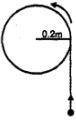
$A$ solid cylinder of mass $2 \ kg$ and radius $0.2 \ m$ is rotating with an angular velocity of $3 \ rad/s$. $A$ particle of mass $0.5 \ kg$ moving with a velocity of $5 \ m/s$ strikes its periphery and sticks to it. The loss in kinetic energy due to the collision is ....... $J$.
A
$6.43$
B
$3.18$
C
$4.25$
D
$3.25$
Solution
(D) Initial kinetic energy $(K.E.)_i = \frac{1}{2} I \omega^2 + \frac{1}{2} m v^2$
$I = \frac{1}{2} M R^2 = \frac{1}{2} \times 2 \times (0.2)^2 = 0.04 \ kg \cdot m^2$
$(K.E.)_i = \frac{1}{2} \times 0.04 \times (3)^2 + \frac{1}{2} \times 0.5 \times (5)^2 = 0.18 + 6.25 = 6.43 \ J$
By conservation of angular momentum about the center of the cylinder: $L_i = L_f$
$I \omega + m v R = (I + m R^2) \omega_f$
$0.04 \times 3 + 0.5 \times 5 \times 0.2 = (0.04 + 0.5 \times (0.2)^2) \omega_f$
$0.12 + 0.5 = (0.04 + 0.02) \omega_f$
$0.62 = 0.06 \omega_f \Rightarrow \omega_f = \frac{0.62}{0.06} = 10.33 \ rad/s$
Final kinetic energy $(K.E.)_f = \frac{1}{2} (I + m R^2) \omega_f^2 = \frac{1}{2} (0.06) \times (10.33)^2 = 0.03 \times 106.7 = 3.20 \ J$
Loss in energy $\Delta E = (K.E.)_i - (K.E.)_f = 6.43 - 3.20 = 3.23 \ J \approx 3.25 \ J$ (closest option).
$I = \frac{1}{2} M R^2 = \frac{1}{2} \times 2 \times (0.2)^2 = 0.04 \ kg \cdot m^2$
$(K.E.)_i = \frac{1}{2} \times 0.04 \times (3)^2 + \frac{1}{2} \times 0.5 \times (5)^2 = 0.18 + 6.25 = 6.43 \ J$
By conservation of angular momentum about the center of the cylinder: $L_i = L_f$
$I \omega + m v R = (I + m R^2) \omega_f$
$0.04 \times 3 + 0.5 \times 5 \times 0.2 = (0.04 + 0.5 \times (0.2)^2) \omega_f$
$0.12 + 0.5 = (0.04 + 0.02) \omega_f$
$0.62 = 0.06 \omega_f \Rightarrow \omega_f = \frac{0.62}{0.06} = 10.33 \ rad/s$
Final kinetic energy $(K.E.)_f = \frac{1}{2} (I + m R^2) \omega_f^2 = \frac{1}{2} (0.06) \times (10.33)^2 = 0.03 \times 106.7 = 3.20 \ J$
Loss in energy $\Delta E = (K.E.)_i - (K.E.)_f = 6.43 - 3.20 = 3.23 \ J \approx 3.25 \ J$ (closest option).
0 likes
View Solution22
DifficultMCQ
$A$ thin hollow cylinder slides with velocity $v$ without rotating. It then rolls without slipping with the same velocity $v$. Find the ratio of the kinetic energies in the two cases.
A
$2 : 1$
B
$1 : 2$
C
$3 : 2$
D
$2 : 3$
Solution
(B) For a thin hollow cylinder,the moment of inertia $I = MR^2$,so the radius of gyration $K$ satisfies $K^2/R^2 = 1$.
Case $1$: Sliding without rotation.
The kinetic energy is purely translational: $E_1 = \frac{1}{2} Mv^2$.
Case $2$: Rolling without slipping.
The total kinetic energy is the sum of translational and rotational kinetic energy: $E_2 = \frac{1}{2} Mv^2 + \frac{1}{2} I\omega^2$.
Since $v = R\omega$ and $I = MR^2$,we have $E_2 = \frac{1}{2} Mv^2 + \frac{1}{2} (MR^2)(v/R)^2 = \frac{1}{2} Mv^2 + \frac{1}{2} Mv^2 = Mv^2$.
Ratio of kinetic energies: $E_1 / E_2 = (\frac{1}{2} Mv^2) / (Mv^2) = 1/2$.
Thus,the ratio is $1 : 2$.
Case $1$: Sliding without rotation.
The kinetic energy is purely translational: $E_1 = \frac{1}{2} Mv^2$.
Case $2$: Rolling without slipping.
The total kinetic energy is the sum of translational and rotational kinetic energy: $E_2 = \frac{1}{2} Mv^2 + \frac{1}{2} I\omega^2$.
Since $v = R\omega$ and $I = MR^2$,we have $E_2 = \frac{1}{2} Mv^2 + \frac{1}{2} (MR^2)(v/R)^2 = \frac{1}{2} Mv^2 + \frac{1}{2} Mv^2 = Mv^2$.
Ratio of kinetic energies: $E_1 / E_2 = (\frac{1}{2} Mv^2) / (Mv^2) = 1/2$.
Thus,the ratio is $1 : 2$.
0 likes
View Solution23
DifficultMCQ
$A$ sphere rotates with an angular velocity $\omega_0$ at a temperature of $0^{\circ}C$. What will be its new angular velocity when the temperature is increased to $100^{\circ}C$? (Given: $\alpha = 2.0 \times 10^{-5} \, ^{\circ}C^{-1}$)
A
$1.1 \omega_0$
B
$1.01 \omega_0$
C
$0.996 \omega_0$
D
$0.824 \omega_0$
Solution
(C) The radius of the sphere at temperature $T$ is given by $R_T = R_0(1 + \alpha \Delta T)$.
For $\Delta T = 100^{\circ}C$,$R_{100} = R_0(1 + 100\alpha)$.
The moment of inertia of a solid sphere is $I = \frac{2}{5}MR^2$.
Since no external torque acts on the sphere,angular momentum is conserved: $I_0 \omega_0 = I_{100} \omega_{100}$.
Substituting the values: $\frac{2}{5}MR_0^2 \omega_0 = \frac{2}{5}MR_{100}^2 \omega_{100}$.
$R_0^2 \omega_0 = [R_0(1 + 100\alpha)]^2 \omega_{100}$.
$R_0^2 \omega_0 = R_0^2(1 + 200\alpha) \omega_{100}$ (using binomial approximation $(1+x)^n \approx 1+nx$ for small $x$).
$\omega_{100} = \frac{\omega_0}{1 + 200\alpha} = \frac{\omega_0}{1 + 200(2.0 \times 10^{-5})} = \frac{\omega_0}{1 + 0.004} = \frac{\omega_0}{1.004}$.
$\omega_{100} \approx 0.996 \omega_0$.
For $\Delta T = 100^{\circ}C$,$R_{100} = R_0(1 + 100\alpha)$.
The moment of inertia of a solid sphere is $I = \frac{2}{5}MR^2$.
Since no external torque acts on the sphere,angular momentum is conserved: $I_0 \omega_0 = I_{100} \omega_{100}$.
Substituting the values: $\frac{2}{5}MR_0^2 \omega_0 = \frac{2}{5}MR_{100}^2 \omega_{100}$.
$R_0^2 \omega_0 = [R_0(1 + 100\alpha)]^2 \omega_{100}$.
$R_0^2 \omega_0 = R_0^2(1 + 200\alpha) \omega_{100}$ (using binomial approximation $(1+x)^n \approx 1+nx$ for small $x$).
$\omega_{100} = \frac{\omega_0}{1 + 200\alpha} = \frac{\omega_0}{1 + 200(2.0 \times 10^{-5})} = \frac{\omega_0}{1 + 0.004} = \frac{\omega_0}{1.004}$.
$\omega_{100} \approx 0.996 \omega_0$.
0 likes
View Solution24
EasyMCQ
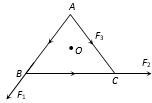
$ABC$ is an equilateral triangle with $O$ as its centre. $\vec F_1, \vec F_2$ and $\vec F_3$ represent three forces acting along the sides $AB, BC$ and $AC$ respectively. If the total torque about $O$ is zero,then the magnitude of $\vec F_3$ is
A
$({F_1} + {F_2})/2$
B
$2({F_1} + {F_2})$
C
$({F_1} + {F_2})$
D
$({F_1} - {F_2})$
Solution
(C) Let $x$ be the perpendicular distance from the center $O$ of the equilateral triangle to each of its sides.
Since the triangle is equilateral,the distance from the center to each side is the same.
The torque $\tau$ produced by a force $F$ about point $O$ is given by $\tau = F \times x$.
Looking at the directions of the forces $\vec F_1, \vec F_2$,and $\vec F_3$ along the sides of the triangle,we can see that $\vec F_1$ and $\vec F_2$ produce torques in the same rotational sense (e.g.,clockwise) about $O$,while $\vec F_3$ produces a torque in the opposite sense (e.g.,counter-clockwise).
For the total torque about $O$ to be zero,the sum of the torques must be zero:
$\tau_1 + \tau_2 - \tau_3 = 0$
$F_1 x + F_2 x - F_3 x = 0$
Dividing by $x$ (since $x \neq 0$):
$F_1 + F_2 - F_3 = 0$
Therefore,$F_3 = F_1 + F_2$.
Since the triangle is equilateral,the distance from the center to each side is the same.
The torque $\tau$ produced by a force $F$ about point $O$ is given by $\tau = F \times x$.
Looking at the directions of the forces $\vec F_1, \vec F_2$,and $\vec F_3$ along the sides of the triangle,we can see that $\vec F_1$ and $\vec F_2$ produce torques in the same rotational sense (e.g.,clockwise) about $O$,while $\vec F_3$ produces a torque in the opposite sense (e.g.,counter-clockwise).
For the total torque about $O$ to be zero,the sum of the torques must be zero:
$\tau_1 + \tau_2 - \tau_3 = 0$
$F_1 x + F_2 x - F_3 x = 0$
Dividing by $x$ (since $x \neq 0$):
$F_1 + F_2 - F_3 = 0$
Therefore,$F_3 = F_1 + F_2$.
0 likes
View Solution25
MediumMCQ
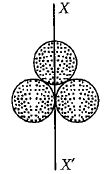
Three identical spherical shells,each of mass $m$ and radius $r$,are placed as shown in the figure. Consider an axis $XX'$ which touches two shells and passes through the diameter of the third shell. The moment of inertia of the system consisting of these three spherical shells about the $XX'$ axis is:
A
$\frac{11}{5} mr^2$
B
$3 mr^2$
C
$\frac{16}{5} mr^2$
D
$4 mr^2$
Solution
(D) The moment of inertia of a thin spherical shell of mass $m$ and radius $r$ about its diameter is $I_{diam} = \frac{2}{3} mr^2$.
For the third shell,the axis $XX'$ passes through its diameter. Therefore,its moment of inertia is $I_3 = \frac{2}{3} mr^2$.
For the other two shells,the axis $XX'$ is tangent to them. According to the parallel axis theorem,the moment of inertia about a tangent is $I_{tangent} = I_{cm} + md^2$,where $d = r$. Thus,$I_1 = I_2 = \frac{2}{3} mr^2 + mr^2 = \frac{5}{3} mr^2$.
The total moment of inertia of the system about the $XX'$ axis is $I = I_1 + I_2 + I_3 = \frac{5}{3} mr^2 + \frac{5}{3} mr^2 + \frac{2}{3} mr^2 = \frac{12}{3} mr^2 = 4 mr^2$.
For the third shell,the axis $XX'$ passes through its diameter. Therefore,its moment of inertia is $I_3 = \frac{2}{3} mr^2$.
For the other two shells,the axis $XX'$ is tangent to them. According to the parallel axis theorem,the moment of inertia about a tangent is $I_{tangent} = I_{cm} + md^2$,where $d = r$. Thus,$I_1 = I_2 = \frac{2}{3} mr^2 + mr^2 = \frac{5}{3} mr^2$.
The total moment of inertia of the system about the $XX'$ axis is $I = I_1 + I_2 + I_3 = \frac{5}{3} mr^2 + \frac{5}{3} mr^2 + \frac{2}{3} mr^2 = \frac{12}{3} mr^2 = 4 mr^2$.
1 likes
View Solution26
MediumMCQ
If the Earth suddenly stops rotating about its own axis,the increase in its temperature will be
A
$\frac{R^2 \omega^2}{5Js}$
B
$\frac{R^2 \omega^2}{Js}$
C
$\frac{Rm \omega^2}{5Js}$
D
None of these
Solution
(A) The rotational kinetic energy of the Earth is converted into heat energy when it stops rotating.
Rotational Kinetic Energy $K = \frac{1}{2} I \omega^2$.
For a solid sphere,the moment of inertia $I = \frac{2}{5} M R^2$.
Thus,$K = \frac{1}{2} (\frac{2}{5} M R^2) \omega^2 = \frac{1}{5} M R^2 \omega^2$.
This energy is converted into heat $Q = M S \Delta \theta$,where $M$ is the mass,$S$ is the specific heat,and $\Delta \theta$ is the change in temperature.
Using the mechanical equivalent of heat $W = JQ$,we have $\frac{1}{5} M R^2 \omega^2 = J (M S \Delta \theta)$.
Solving for $\Delta \theta$,we get $\Delta \theta = \frac{R^2 \omega^2}{5Js}$.
Rotational Kinetic Energy $K = \frac{1}{2} I \omega^2$.
For a solid sphere,the moment of inertia $I = \frac{2}{5} M R^2$.
Thus,$K = \frac{1}{2} (\frac{2}{5} M R^2) \omega^2 = \frac{1}{5} M R^2 \omega^2$.
This energy is converted into heat $Q = M S \Delta \theta$,where $M$ is the mass,$S$ is the specific heat,and $\Delta \theta$ is the change in temperature.
Using the mechanical equivalent of heat $W = JQ$,we have $\frac{1}{5} M R^2 \omega^2 = J (M S \Delta \theta)$.
Solving for $\Delta \theta$,we get $\Delta \theta = \frac{R^2 \omega^2}{5Js}$.
0 likes
View Solution27
EasyMCQ
$A$ flywheel is an important part of a steam engine because it
A
accelerates the speed of the engine
B
gives strength to the engine
C
provides safety to the engine
D
helps the engine in keeping the speed uniform
Solution
(D) flywheel is a heavy rotating mechanical device used to store rotational energy. In a steam engine,the energy production is often cyclic or intermittent. The flywheel,due to its large moment of inertia,resists changes in rotational speed. When the engine produces excess energy,the flywheel absorbs it by increasing its angular velocity. When the engine produces less energy,the flywheel releases stored energy to maintain a constant angular velocity. Thus,it helps in keeping the speed of the engine uniform by smoothing out fluctuations in torque. Therefore,the correct option is $D$.
0 likes
View Solution28
DifficultMCQ
$A$ horizontal platform is rotating with a uniform angular velocity about a vertical axis passing through its center. At some instant, a viscous liquid of mass $m$ is dropped at its center, which is free to spread and eventually falls off the edge. During this time interval, the angular velocity
A
will continuously decrease
B
will decrease initially and then increase
C
will remain unchanged
D
will continuously increase
Solution
(B) According to the principle of conservation of angular momentum, $L = I\omega = \text{constant}$.
When the viscous liquid of mass $m$ is dropped on the platform, it spreads outwards. This increases the moment of inertia $(I)$ of the system. Since $L$ is constant, the angular velocity $(\omega)$ must decrease.
As the liquid reaches the edge and falls off the platform, the moment of inertia $(I)$ of the system decreases back towards its original value. Consequently, the angular velocity $(\omega)$ increases again.
When the viscous liquid of mass $m$ is dropped on the platform, it spreads outwards. This increases the moment of inertia $(I)$ of the system. Since $L$ is constant, the angular velocity $(\omega)$ must decrease.
As the liquid reaches the edge and falls off the platform, the moment of inertia $(I)$ of the system decreases back towards its original value. Consequently, the angular velocity $(\omega)$ increases again.
0 likes
View Solution29
EasyMCQ
$A$ homogeneous disc of mass $2 \ kg$ and radius $15 \ cm$ is rotating about its axis (which is fixed) with an angular velocity $4 \ rad/s$. The linear momentum of the disc is
A
$1.2 \ kg \cdot m/s$
B
$1.0 \ kg \cdot m/s$
C
$0.6 \ kg \cdot m/s$
D
None of the above
Solution
(D) The linear momentum $P$ of a system is given by the product of the total mass $M$ and the velocity of the center of mass $v_{cm}$,i.e.,$P = M \cdot v_{cm}$.
Since the disc is rotating about a fixed axis passing through its center of mass,the center of mass of the disc remains stationary.
Therefore,the velocity of the center of mass $v_{cm} = 0$.
Consequently,the linear momentum $P = 2 \ kg \times 0 \ m/s = 0 \ kg \cdot m/s$.
Since $0 \ kg \cdot m/s$ is not listed in options $A$,$B$,or $C$,the correct option is $D$.
Since the disc is rotating about a fixed axis passing through its center of mass,the center of mass of the disc remains stationary.
Therefore,the velocity of the center of mass $v_{cm} = 0$.
Consequently,the linear momentum $P = 2 \ kg \times 0 \ m/s = 0 \ kg \cdot m/s$.
Since $0 \ kg \cdot m/s$ is not listed in options $A$,$B$,or $C$,the correct option is $D$.
0 likes
View Solution30
MediumMCQ
An object has a moment of inertia of $3 \ kg \cdot m^2$. It is rotating with an angular velocity of $2 \ rad/s$. If a mass of $12 \ kg$ is moving with a velocity of $v \ m/s$,at what value of $v$ will their kinetic energies be equal?
A
$8$
B
$0.5$
C
$2$
D
$1$
Solution
(D) The rotational kinetic energy of the object is given by $K_{rot} = \frac{1}{2} I \omega^2$.
Given $I = 3 \ kg \cdot m^2$ and $\omega = 2 \ rad/s$,we have $K_{rot} = \frac{1}{2} \times 3 \times (2)^2 = \frac{1}{2} \times 3 \times 4 = 6 \ J$.
The translational kinetic energy of the mass is given by $K_{trans} = \frac{1}{2} m v^2$.
Given $m = 12 \ kg$,we set $K_{trans} = K_{rot}$:
$\frac{1}{2} \times 12 \times v^2 = 6$
$6 \times v^2 = 6$
$v^2 = 1$
$v = 1 \ m/s$.
Given $I = 3 \ kg \cdot m^2$ and $\omega = 2 \ rad/s$,we have $K_{rot} = \frac{1}{2} \times 3 \times (2)^2 = \frac{1}{2} \times 3 \times 4 = 6 \ J$.
The translational kinetic energy of the mass is given by $K_{trans} = \frac{1}{2} m v^2$.
Given $m = 12 \ kg$,we set $K_{trans} = K_{rot}$:
$\frac{1}{2} \times 12 \times v^2 = 6$
$6 \times v^2 = 6$
$v^2 = 1$
$v = 1 \ m/s$.
0 likes
View Solution31
DifficultMCQ
$A$ thin string is wrapped around the circumference of a wheel of radius $r$. The wheel has a horizontal axle and a moment of inertia $I$ about it. $A$ weight $mg$ is attached to the end of the string,which falls from rest. After falling through a distance $h$,the angular velocity of the wheel will be:
A
$\sqrt{\frac{2gh}{I + mr}}$
B
$\left[\frac{2mgh}{I + mr^2}\right]^{1/2}$
C
$\left[\frac{2mgh}{I + 2mr^2}\right]^{1/2}$
D
$\sqrt{2gh}$
Solution
(B) According to the law of conservation of energy,the potential energy lost by the falling mass is converted into the kinetic energy of the mass and the rotational kinetic energy of the wheel.
Initial energy = Final energy
$mgh = \frac{1}{2}mv^2 + \frac{1}{2}I\omega^2$
Since the string does not slip,the linear velocity of the mass $v$ is related to the angular velocity of the wheel $\omega$ by $v = r\omega$.
Substituting $v = r\omega$ into the energy equation:
$mgh = \frac{1}{2}m(r\omega)^2 + \frac{1}{2}I\omega^2$
$mgh = \frac{1}{2}(mr^2 + I)\omega^2$
Solving for $\omega$:
$\omega^2 = \frac{2mgh}{I + mr^2}$
$\omega = \sqrt{\frac{2mgh}{I + mr^2}}$
Initial energy = Final energy
$mgh = \frac{1}{2}mv^2 + \frac{1}{2}I\omega^2$
Since the string does not slip,the linear velocity of the mass $v$ is related to the angular velocity of the wheel $\omega$ by $v = r\omega$.
Substituting $v = r\omega$ into the energy equation:
$mgh = \frac{1}{2}m(r\omega)^2 + \frac{1}{2}I\omega^2$
$mgh = \frac{1}{2}(mr^2 + I)\omega^2$
Solving for $\omega$:
$\omega^2 = \frac{2mgh}{I + mr^2}$
$\omega = \sqrt{\frac{2mgh}{I + mr^2}}$
0 likes
View Solution32
EasyMCQ
$A$ solid sphere and a disc of the same radius are released from the same height on an inclined plane and they reach the bottom of the plane at different times. This is due to their:
A
Different radii of gyration
B
Different shapes
C
Different moments of inertia
D
Both $(a)$ and $(c)$
Solution
(D) The time taken for an object to roll down an inclined plane is given by $t = \sqrt{\frac{2h}{g \sin^2 \theta} (1 + \frac{I}{MR^2})}$.
Since the moment of inertia $I$ depends on the distribution of mass,and the radius of gyration $k$ is defined by $I = Mk^2$,the time taken depends on both the moment of inertia and the radius of gyration.
$A$ solid sphere has $I = \frac{2}{5}MR^2$ and a disc has $I = \frac{1}{2}MR^2$.
Because their moments of inertia and radii of gyration are different,they reach the bottom at different times.
Therefore,both $(a)$ and $(c)$ are correct.
Since the moment of inertia $I$ depends on the distribution of mass,and the radius of gyration $k$ is defined by $I = Mk^2$,the time taken depends on both the moment of inertia and the radius of gyration.
$A$ solid sphere has $I = \frac{2}{5}MR^2$ and a disc has $I = \frac{1}{2}MR^2$.
Because their moments of inertia and radii of gyration are different,they reach the bottom at different times.
Therefore,both $(a)$ and $(c)$ are correct.
0 likes
View Solution33
DifficultMCQ
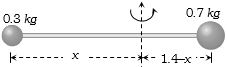
Two masses of $0.3 \, kg$ and $0.7 \, kg$ are attached to the ends of a rod of length $1.4 \, m$ and negligible mass. The rod is rotated about an axis perpendicular to its length with a constant angular speed. The point on the rod through which the axis should pass so that the work required to rotate the rod is minimum is:
A
$0.4 \, m$ from the $0.3 \, kg$ mass
B
$0.98 \, m$ from the $0.3 \, kg$ mass
C
$0.70 \, m$ from the $0.7 \, kg$ mass
D
$0.98 \, m$ from the $0.7 \, kg$ mass
Solution
(B) The work done to rotate a body with constant angular velocity $\omega$ is given by $W = \frac{1}{2} I \omega^2$. For the work to be minimum,the moment of inertia $I$ of the system must be minimum.
Let the axis of rotation be at a distance $x$ from the $0.3 \, kg$ mass. Then the distance from the $0.7 \, kg$ mass is $(1.4 - x)$.
The moment of inertia $I$ is given by: $I = m_1 x^2 + m_2 (L - x)^2 = 0.3 x^2 + 0.7 (1.4 - x)^2$.
To find the minimum $I$,we differentiate with respect to $x$ and set it to zero:
$\frac{dI}{dx} = 0.3(2x) + 0.7(2)(1.4 - x)(-1) = 0$
$0.6x - 1.4(1.4 - x) = 0$
$0.6x - 1.96 + 1.4x = 0$
$2.0x = 1.96$
$x = 0.98 \, m$.
Thus,the axis should pass at a distance of $0.98 \, m$ from the $0.3 \, kg$ mass.
Let the axis of rotation be at a distance $x$ from the $0.3 \, kg$ mass. Then the distance from the $0.7 \, kg$ mass is $(1.4 - x)$.
The moment of inertia $I$ is given by: $I = m_1 x^2 + m_2 (L - x)^2 = 0.3 x^2 + 0.7 (1.4 - x)^2$.
To find the minimum $I$,we differentiate with respect to $x$ and set it to zero:
$\frac{dI}{dx} = 0.3(2x) + 0.7(2)(1.4 - x)(-1) = 0$
$0.6x - 1.4(1.4 - x) = 0$
$0.6x - 1.96 + 1.4x = 0$
$2.0x = 1.96$
$x = 0.98 \, m$.
Thus,the axis should pass at a distance of $0.98 \, m$ from the $0.3 \, kg$ mass.
0 likes
View Solution34
MediumMCQ
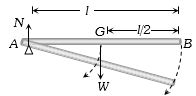
$A$ heavy rod of weight $W$ is held in a horizontal position by two men at its ends. If one man suddenly lets go,what force will the other man feel?
A
$W$
B
$W/2$
C
$3W/4$
D
$W/4$
Solution
(D) Let the length of the rod be $l$ and its mass be $m$,so $W = mg$. Initially,the rod is in equilibrium. When one man at end $B$ lets go,the rod starts rotating about the other end $A$ due to the torque produced by its weight acting at the center of mass $G$ (at distance $l/2$ from $A$).
The torque $\tau$ about point $A$ is given by $\tau = W \cdot \frac{l}{2}$.
The moment of inertia $I$ of the rod about point $A$ is $I = \frac{ml^2}{3}$.
Using $\tau = I\alpha$,we have $W \cdot \frac{l}{2} = \left(\frac{ml^2}{3}\right)\alpha$.
Substituting $W = mg$,we get $mg \cdot \frac{l}{2} = \frac{ml^2}{3} \alpha$,which simplifies to $\alpha = \frac{3g}{2l}$.
The linear acceleration $a$ of the center of mass $G$ is $a = \frac{l}{2} \alpha = \frac{l}{2} \cdot \frac{3g}{2l} = \frac{3g}{4}$.
Now,applying Newton's second law for the vertical motion of the center of mass: $W - N = ma$,where $N$ is the normal force exerted by the man at $A$.
$mg - N = m \left(\frac{3g}{4}\right)$.
$N = mg - \frac{3mg}{4} = \frac{mg}{4} = \frac{W}{4}$.
Thus,the other man feels a force of $W/4$.
The torque $\tau$ about point $A$ is given by $\tau = W \cdot \frac{l}{2}$.
The moment of inertia $I$ of the rod about point $A$ is $I = \frac{ml^2}{3}$.
Using $\tau = I\alpha$,we have $W \cdot \frac{l}{2} = \left(\frac{ml^2}{3}\right)\alpha$.
Substituting $W = mg$,we get $mg \cdot \frac{l}{2} = \frac{ml^2}{3} \alpha$,which simplifies to $\alpha = \frac{3g}{2l}$.
The linear acceleration $a$ of the center of mass $G$ is $a = \frac{l}{2} \alpha = \frac{l}{2} \cdot \frac{3g}{2l} = \frac{3g}{4}$.
Now,applying Newton's second law for the vertical motion of the center of mass: $W - N = ma$,where $N$ is the normal force exerted by the man at $A$.
$mg - N = m \left(\frac{3g}{4}\right)$.
$N = mg - \frac{3mg}{4} = \frac{mg}{4} = \frac{W}{4}$.
Thus,the other man feels a force of $W/4$.
0 likes
View Solution35
DifficultMCQ
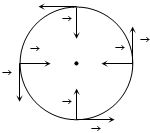
The torque acting on a body about a point is equal to $\overrightarrow{A} \times \overrightarrow{L}$,where $\overrightarrow{A}$ is a constant vector and $\overrightarrow{L}$ is the angular momentum about that point. This implies that:
A
The directions of $\frac{d\overrightarrow{L}}{dt}$ and $\overrightarrow{L}$ are perpendicular at every instant.
B
The component of $\overrightarrow{L}$ in the direction of $\overrightarrow{A}$ does not change with time.
C
The magnitude of $\overrightarrow{L}$ does not change with time.
D
All of the above.
Solution
(D) Given the torque $\overrightarrow{\tau} = \overrightarrow{A} \times \overrightarrow{L}$. Since $\overrightarrow{\tau} = \frac{d\overrightarrow{L}}{dt}$,we have $\frac{d\overrightarrow{L}}{dt} = \overrightarrow{A} \times \overrightarrow{L}$.
$1$. By the definition of the cross product,$\frac{d\overrightarrow{L}}{dt}$ is perpendicular to both $\overrightarrow{A}$ and $\overrightarrow{L}$. Thus,$\frac{d\overrightarrow{L}}{dt} \perp \overrightarrow{L}$,making option $(a)$ correct.
$2$. To check the magnitude of $\overrightarrow{L}$,consider $L^2 = \overrightarrow{L} \cdot \overrightarrow{L}$. Differentiating with respect to time $t$: $\frac{d}{dt}(L^2) = 2\overrightarrow{L} \cdot \frac{d\overrightarrow{L}}{dt}$. Since $\frac{d\overrightarrow{L}}{dt} \perp \overrightarrow{L}$,the dot product $\overrightarrow{L} \cdot \frac{d\overrightarrow{L}}{dt} = 0$. Therefore,$\frac{d}{dt}(L^2) = 0$,which means the magnitude $L$ is constant. Thus,option $(c)$ is correct.
$3$. Since $\frac{d\overrightarrow{L}}{dt} = \overrightarrow{A} \times \overrightarrow{L}$,the rate of change of $\overrightarrow{L}$ is always perpendicular to $\overrightarrow{A}$. The component of $\overrightarrow{L}$ along $\overrightarrow{A}$ is given by $L_A = \overrightarrow{L} \cdot \hat{A}$. Differentiating with respect to time: $\frac{dL_A}{dt} = \frac{d\overrightarrow{L}}{dt} \cdot \hat{A} = (\overrightarrow{A} \times \overrightarrow{L}) \cdot \hat{A}$. Since the cross product $(\overrightarrow{A} \times \overrightarrow{L})$ is perpendicular to $\overrightarrow{A}$,the dot product with $\hat{A}$ is zero. Thus,$\frac{dL_A}{dt} = 0$,meaning the component of $\overrightarrow{L}$ along $\overrightarrow{A}$ is constant. Thus,option $(b)$ is correct.
Since all statements are correct,the answer is $(d)$.
$1$. By the definition of the cross product,$\frac{d\overrightarrow{L}}{dt}$ is perpendicular to both $\overrightarrow{A}$ and $\overrightarrow{L}$. Thus,$\frac{d\overrightarrow{L}}{dt} \perp \overrightarrow{L}$,making option $(a)$ correct.
$2$. To check the magnitude of $\overrightarrow{L}$,consider $L^2 = \overrightarrow{L} \cdot \overrightarrow{L}$. Differentiating with respect to time $t$: $\frac{d}{dt}(L^2) = 2\overrightarrow{L} \cdot \frac{d\overrightarrow{L}}{dt}$. Since $\frac{d\overrightarrow{L}}{dt} \perp \overrightarrow{L}$,the dot product $\overrightarrow{L} \cdot \frac{d\overrightarrow{L}}{dt} = 0$. Therefore,$\frac{d}{dt}(L^2) = 0$,which means the magnitude $L$ is constant. Thus,option $(c)$ is correct.
$3$. Since $\frac{d\overrightarrow{L}}{dt} = \overrightarrow{A} \times \overrightarrow{L}$,the rate of change of $\overrightarrow{L}$ is always perpendicular to $\overrightarrow{A}$. The component of $\overrightarrow{L}$ along $\overrightarrow{A}$ is given by $L_A = \overrightarrow{L} \cdot \hat{A}$. Differentiating with respect to time: $\frac{dL_A}{dt} = \frac{d\overrightarrow{L}}{dt} \cdot \hat{A} = (\overrightarrow{A} \times \overrightarrow{L}) \cdot \hat{A}$. Since the cross product $(\overrightarrow{A} \times \overrightarrow{L})$ is perpendicular to $\overrightarrow{A}$,the dot product with $\hat{A}$ is zero. Thus,$\frac{dL_A}{dt} = 0$,meaning the component of $\overrightarrow{L}$ along $\overrightarrow{A}$ is constant. Thus,option $(b)$ is correct.
Since all statements are correct,the answer is $(d)$.
0 likes
View Solution36
DifficultMCQ
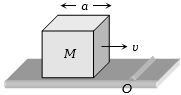
$A$ cube of side $a$ is moving with velocity $v$ on a smooth horizontal surface. It hits a linear raised obstacle $O$ on the horizontal surface (as shown in the figure). The angular speed of the block after hitting $O$ will be
A
$3v/4a$
B
$3v/2a$
C
$\frac{\sqrt{3}v}{\sqrt{2}a}$
D
Zero
Solution
(A) Before hitting the obstacle $O$,the angular momentum of the cube about $O$ is $L = Mv(a/2)$.
After hitting $O$,the cube rotates about the edge passing through $O$. The angular momentum is $L = I\omega$,where $I$ is the moment of inertia of the cube about the edge passing through $O$.
Using the parallel axis theorem,$I = I_{cm} + Md^2$,where $I_{cm} = \frac{Ma^2}{6}$ and $d = \sqrt{(a/2)^2 + (a/2)^2} = \frac{a}{\sqrt{2}}$.
So,$I = \frac{Ma^2}{6} + M(\frac{a^2}{2}) = \frac{Ma^2 + 3Ma^2}{6} = \frac{4Ma^2}{6} = \frac{2Ma^2}{3}$.
By the conservation of angular momentum about $O$:
$Mv(a/2) = I\omega$
$Mv(a/2) = (\frac{2Ma^2}{3})\omega$
$\omega = \frac{Mv(a/2) \cdot 3}{2Ma^2} = \frac{3v}{4a}$.
After hitting $O$,the cube rotates about the edge passing through $O$. The angular momentum is $L = I\omega$,where $I$ is the moment of inertia of the cube about the edge passing through $O$.
Using the parallel axis theorem,$I = I_{cm} + Md^2$,where $I_{cm} = \frac{Ma^2}{6}$ and $d = \sqrt{(a/2)^2 + (a/2)^2} = \frac{a}{\sqrt{2}}$.
So,$I = \frac{Ma^2}{6} + M(\frac{a^2}{2}) = \frac{Ma^2 + 3Ma^2}{6} = \frac{4Ma^2}{6} = \frac{2Ma^2}{3}$.
By the conservation of angular momentum about $O$:
$Mv(a/2) = I\omega$
$Mv(a/2) = (\frac{2Ma^2}{3})\omega$
$\omega = \frac{Mv(a/2) \cdot 3}{2Ma^2} = \frac{3v}{4a}$.
0 likes
View Solution37
MediumMCQ
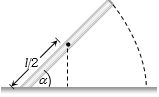
$A$ uniform rod of length $2L$ has one end on a horizontal floor. It is inclined at an angle $\alpha$ to the horizontal floor. It falls without slipping,rotating about the point of contact. Its angular velocity when it hits the horizontal floor will be:
A
$\omega = \sqrt{\frac{3g\sin\alpha}{2L}}$
B
$\omega = \sqrt{\frac{2L}{3g\sin\alpha}}$
C
$\omega = \sqrt{\frac{6g\sin\alpha}{L}}$
D
$\omega = \sqrt{\frac{L}{g\sin\alpha}}$
Solution
(A) Let the length of the rod be $l = 2L$. The center of mass of the rod is at a distance $l/2 = L$ from the point of contact.
Initially,the height of the center of mass above the floor is $h = (l/2) \sin\alpha = L \sin\alpha$.
By the law of conservation of energy,the loss in potential energy equals the gain in rotational kinetic energy:
$mgh = \frac{1}{2} I \omega^2$
Here,$I$ is the moment of inertia of the rod about the point of contact on the floor,given by $I = \frac{ml^2}{3} = \frac{m(2L)^2}{3} = \frac{4mL^2}{3}$.
Substituting the values:
$mg(L \sin\alpha) = \frac{1}{2} \left( \frac{4mL^2}{3} \right) \omega^2$
$mgL \sin\alpha = \frac{2mL^2}{3} \omega^2$
$g \sin\alpha = \frac{2L}{3} \omega^2$
$\omega^2 = \frac{3g \sin\alpha}{2L}$
$\omega = \sqrt{\frac{3g \sin\alpha}{2L}}$
Initially,the height of the center of mass above the floor is $h = (l/2) \sin\alpha = L \sin\alpha$.
By the law of conservation of energy,the loss in potential energy equals the gain in rotational kinetic energy:
$mgh = \frac{1}{2} I \omega^2$
Here,$I$ is the moment of inertia of the rod about the point of contact on the floor,given by $I = \frac{ml^2}{3} = \frac{m(2L)^2}{3} = \frac{4mL^2}{3}$.
Substituting the values:
$mg(L \sin\alpha) = \frac{1}{2} \left( \frac{4mL^2}{3} \right) \omega^2$
$mgL \sin\alpha = \frac{2mL^2}{3} \omega^2$
$g \sin\alpha = \frac{2L}{3} \omega^2$
$\omega^2 = \frac{3g \sin\alpha}{2L}$
$\omega = \sqrt{\frac{3g \sin\alpha}{2L}}$
0 likes
View Solution38
DifficultMCQ
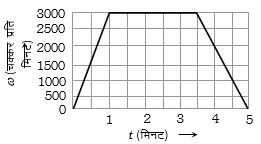
During a test of a jet engine,its compressor rotates according to the graph shown. The total number of revolutions completed by the compressor during the test is:
A
$9000$
B
$16570$
C
$12750$
D
$11250$
Solution
(D) The total number of revolutions is equal to the area under the $\omega-t$ graph.
The graph is a trapezium with parallel sides of length $t_1 = 3.5 \text{ min}$ (from $t=0$ to $t=3.5$) and $t_2 = (3.5 - 1) = 2.5 \text{ min}$ (the flat top part).
However,looking at the graph,the base is from $t=0$ to $t=5$ minutes,and the top flat part is from $t=1$ to $t=3.5$ minutes.
The area of the trapezium is given by $\text{Area} = \frac{1}{2} \times (\text{sum of parallel sides}) \times \text{height}$.
Here,the parallel sides are the base (length $5 \text{ min}$) and the top (length $3.5 - 1 = 2.5 \text{ min}$).
The height is the angular velocity $\omega = 3000 \text{ revolutions/min}$.
Number of revolutions $= \frac{1}{2} \times (5 + 2.5) \times 3000 = \frac{1}{2} \times 7.5 \times 3000 = 7.5 \times 1500 = 11250$ revolutions.
The graph is a trapezium with parallel sides of length $t_1 = 3.5 \text{ min}$ (from $t=0$ to $t=3.5$) and $t_2 = (3.5 - 1) = 2.5 \text{ min}$ (the flat top part).
However,looking at the graph,the base is from $t=0$ to $t=5$ minutes,and the top flat part is from $t=1$ to $t=3.5$ minutes.
The area of the trapezium is given by $\text{Area} = \frac{1}{2} \times (\text{sum of parallel sides}) \times \text{height}$.
Here,the parallel sides are the base (length $5 \text{ min}$) and the top (length $3.5 - 1 = 2.5 \text{ min}$).
The height is the angular velocity $\omega = 3000 \text{ revolutions/min}$.
Number of revolutions $= \frac{1}{2} \times (5 + 2.5) \times 3000 = \frac{1}{2} \times 7.5 \times 3000 = 7.5 \times 1500 = 11250$ revolutions.
0 likes
View Solution39
DifficultMCQ
$A$ circular platform is situated in a horizontal plane and can rotate about a vertical axis passing through its center. $A$ tortoise is sitting at one edge of the platform,and the platform is rotating with a constant angular velocity $\omega_0$. If the tortoise starts moving with a uniform speed along a chord of the circular platform,how will the angular velocity of the platform change with time $t$?
A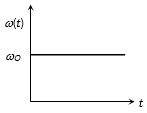
The angular velocity remains constant.
B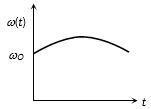
The angular velocity first increases and then decreases.
C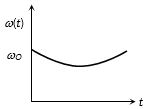
The angular velocity first decreases and then increases.
D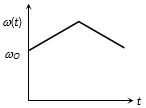
The angular velocity increases linearly and then decreases linearly.
Solution
(B) Since there is no external torque acting on the system,the angular momentum $L = I\omega$ remains constant.
As the tortoise moves along a chord,its distance $r$ from the center of rotation changes.
The moment of inertia $I$ of the system is given by $I = I_{\text{platform}} + mr^2$,where $m$ is the mass of the tortoise and $r$ is its distance from the center.
Initially,the tortoise is at the edge $(r = R)$,so the moment of inertia is maximum. As it moves towards the center of the chord (the point closest to the center of the platform),the distance $r$ decreases,causing the moment of inertia $I$ to decrease.
Since $L = I\omega$ is constant,if $I$ decreases,the angular velocity $\omega$ must increase.
After passing the point on the chord closest to the center,the distance $r$ starts increasing again,causing the moment of inertia $I$ to increase,which in turn causes the angular velocity $\omega$ to decrease.
Therefore,the angular velocity first increases and then decreases.
As the tortoise moves along a chord,its distance $r$ from the center of rotation changes.
The moment of inertia $I$ of the system is given by $I = I_{\text{platform}} + mr^2$,where $m$ is the mass of the tortoise and $r$ is its distance from the center.
Initially,the tortoise is at the edge $(r = R)$,so the moment of inertia is maximum. As it moves towards the center of the chord (the point closest to the center of the platform),the distance $r$ decreases,causing the moment of inertia $I$ to decrease.
Since $L = I\omega$ is constant,if $I$ decreases,the angular velocity $\omega$ must increase.
After passing the point on the chord closest to the center,the distance $r$ starts increasing again,causing the moment of inertia $I$ to increase,which in turn causes the angular velocity $\omega$ to decrease.
Therefore,the angular velocity first increases and then decreases.
0 likes
View Solution40
MediumMCQ
The moment of inertia of a sphere of mass $M$ and radius $R$ is $I$. If the mass is kept constant,what will be the nature of the graph between $I$ and $R$?
A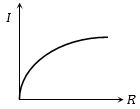
B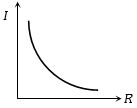
C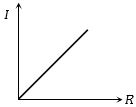
D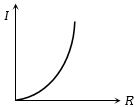
Solution
(D) The moment of inertia of a solid sphere about its diameter is given by the formula: $I = \frac{2}{5}MR^2$.
Since the mass $M$ is kept constant,we can write this relationship as $I \propto R^2$.
This is the equation of a parabola of the form $y = kx^2$,where $y = I$ and $x = R$.
Therefore,the graph between $I$ and $R$ will be a parabola opening upwards,starting from the origin $(0,0)$.
Comparing this with the given options,the graph shown in option $D$ represents this parabolic relationship.
Since the mass $M$ is kept constant,we can write this relationship as $I \propto R^2$.
This is the equation of a parabola of the form $y = kx^2$,where $y = I$ and $x = R$.
Therefore,the graph between $I$ and $R$ will be a parabola opening upwards,starting from the origin $(0,0)$.
Comparing this with the given options,the graph shown in option $D$ represents this parabolic relationship.
0 likes
View Solution41
MediumMCQ
According to the parallel axis theorem,$I = I_{cm} + Mx^2$. What will be the graph between $I$ and $x$?
A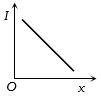
B
C
D
Solution
(C) The given equation is $I = I_{cm} + Mx^2$. This is of the form $y = c + ax^2$,which represents a parabola symmetric about the $I$-axis. Since $I = I_{cm}$ when $x = 0$,the vertex of the parabola is at $(0, I_{cm})$. Therefore,the graph is a parabola that is symmetric about the $I$-axis and does not pass through the origin. This corresponds to the graph shown in option $C$.
0 likes
View Solution42
EasyMCQ
The graph between angular momentum $L$ and angular velocity $\omega$ is:
A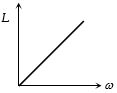
B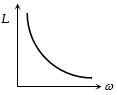
C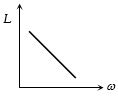
D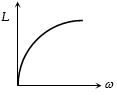
Solution
(A) The relationship between angular momentum $L$ and angular velocity $\omega$ is given by the formula $L = I\omega$,where $I$ is the moment of inertia.
Assuming the moment of inertia $I$ remains constant,the equation $L = I\omega$ represents a linear relationship of the form $y = mx$,where $I$ acts as the slope.
Therefore,the graph of $L$ versus $\omega$ is a straight line passing through the origin with a constant slope equal to $I$.
This corresponds to the graph shown in option $A$.
Assuming the moment of inertia $I$ remains constant,the equation $L = I\omega$ represents a linear relationship of the form $y = mx$,where $I$ acts as the slope.
Therefore,the graph of $L$ versus $\omega$ is a straight line passing through the origin with a constant slope equal to $I$.
This corresponds to the graph shown in option $A$.
0 likes
View Solution43
MediumMCQ
The graph between $\log_e L$ and $\log_e P$ will be (where $L$ is angular momentum and $P$ is linear momentum):
A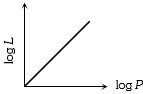
B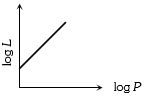
C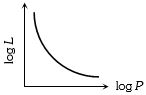
D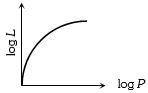
Solution
(B) The relationship between angular momentum $L$ and linear momentum $P$ for a particle at a distance $r$ from the axis of rotation is given by $L = rP$.
Taking the natural logarithm on both sides,we get:
$\log_e L = \log_e (rP)$
Using the logarithmic property $\log(ab) = \log a + \log b$,we have:
$\log_e L = \log_e P + \log_e r$
This equation is in the form of a straight line $y = mx + c$,where $y = \log_e L$,$x = \log_e P$,slope $m = 1$,and intercept $c = \log_e r$.
Since the intercept $c = \log_e r$ is generally non-zero,the graph is a straight line with a slope of $1$ that does not pass through the origin. This corresponds to the graph shown in option $B$.
Taking the natural logarithm on both sides,we get:
$\log_e L = \log_e (rP)$
Using the logarithmic property $\log(ab) = \log a + \log b$,we have:
$\log_e L = \log_e P + \log_e r$
This equation is in the form of a straight line $y = mx + c$,where $y = \log_e L$,$x = \log_e P$,slope $m = 1$,and intercept $c = \log_e r$.
Since the intercept $c = \log_e r$ is generally non-zero,the graph is a straight line with a slope of $1$ that does not pass through the origin. This corresponds to the graph shown in option $B$.
0 likes
View Solution44
DifficultMCQ
Four spheres,each of mass $M$ and diameter $2a$,are placed at the corners of a square of side $b$. The moment of inertia of this system about an axis along one of the sides of the square is:
A
$ \frac{4}{5}M{a^2} + 2M{b^2} $
B
$ \frac{8}{5}M{a^2} + 2M{b^2} $
C
$ \frac{8}{5}M{a^2} $
D
$ \frac{4}{5}M{a^2} + 4M{b^2} $
Solution
(B) The moment of inertia of a solid sphere of mass $M$ and radius $a$ about its diameter is $I_{cm} = \frac{2}{5}Ma^2$.
Let the axis of rotation be the side $AB$ passing through spheres $1$ and $2$.
For spheres $1$ and $2$,the axis passes through their centers,so their moment of inertia about the axis is $I_1 = I_2 = \frac{2}{5}Ma^2$.
For spheres $3$ and $4$,the axis is at a perpendicular distance $b$ from their centers. Using the parallel axis theorem,$I = I_{cm} + Md^2$,we get $I_3 = I_4 = \frac{2}{5}Ma^2 + Mb^2$.
The total moment of inertia of the system about axis $AB$ is $I_{total} = I_1 + I_2 + I_3 + I_4$.
$I_{total} = \frac{2}{5}Ma^2 + \frac{2}{5}Ma^2 + (\frac{2}{5}Ma^2 + Mb^2) + (\frac{2}{5}Ma^2 + Mb^2)$.
$I_{total} = 4 \times (\frac{2}{5}Ma^2) + 2Mb^2 = \frac{8}{5}Ma^2 + 2Mb^2$.
Let the axis of rotation be the side $AB$ passing through spheres $1$ and $2$.
For spheres $1$ and $2$,the axis passes through their centers,so their moment of inertia about the axis is $I_1 = I_2 = \frac{2}{5}Ma^2$.
For spheres $3$ and $4$,the axis is at a perpendicular distance $b$ from their centers. Using the parallel axis theorem,$I = I_{cm} + Md^2$,we get $I_3 = I_4 = \frac{2}{5}Ma^2 + Mb^2$.
The total moment of inertia of the system about axis $AB$ is $I_{total} = I_1 + I_2 + I_3 + I_4$.
$I_{total} = \frac{2}{5}Ma^2 + \frac{2}{5}Ma^2 + (\frac{2}{5}Ma^2 + Mb^2) + (\frac{2}{5}Ma^2 + Mb^2)$.
$I_{total} = 4 \times (\frac{2}{5}Ma^2) + 2Mb^2 = \frac{8}{5}Ma^2 + 2Mb^2$.
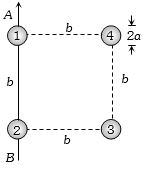
0 likes
View Solution45
MediumMCQ
$A$ rod of mass $m$ and length $l$ is hinged at one end to a horizontal floor and stands vertically. If it is allowed to fall,the velocity with which its upper end strikes the floor is:
A
$\sqrt{2gl}$
B
$\sqrt{3gl}$
C
$\sqrt{5gl}$
D
$\sqrt{mgl}$
Solution
(B) Initially,when the rod is standing vertically,its potential energy is $U_i = mg\frac{l}{2}$.
When it strikes the floor,its potential energy is converted into rotational kinetic energy.
By the law of conservation of energy: $U_i = K_f$.
$mg\left(\frac{l}{2}\right) = \frac{1}{2}I\omega^2$,where $I = \frac{ml^2}{3}$ is the moment of inertia of the rod about the hinge $A$.
Substituting $I$ and $\omega = \frac{v_B}{l}$:
$mg\left(\frac{l}{2}\right) = \frac{1}{2}\left(\frac{ml^2}{3}\right)\left(\frac{v_B}{l}\right)^2$.
$mg\frac{l}{2} = \frac{1}{6}mv_B^2$.
$v_B^2 = 3gl$.
$v_B = \sqrt{3gl}$.
When it strikes the floor,its potential energy is converted into rotational kinetic energy.
By the law of conservation of energy: $U_i = K_f$.
$mg\left(\frac{l}{2}\right) = \frac{1}{2}I\omega^2$,where $I = \frac{ml^2}{3}$ is the moment of inertia of the rod about the hinge $A$.
Substituting $I$ and $\omega = \frac{v_B}{l}$:
$mg\left(\frac{l}{2}\right) = \frac{1}{2}\left(\frac{ml^2}{3}\right)\left(\frac{v_B}{l}\right)^2$.
$mg\frac{l}{2} = \frac{1}{6}mv_B^2$.
$v_B^2 = 3gl$.
$v_B = \sqrt{3gl}$.
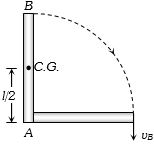
0 likes
View Solution46
AdvancedMCQ
The graphs below show angular velocity $\omega$ as a function of time $t$. In which one is the magnitude of the angular acceleration $\alpha$ constantly decreasing?
A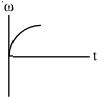
B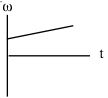
C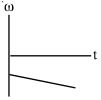
D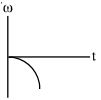
Solution
(A) The angular acceleration $\alpha$ is defined as the rate of change of angular velocity with respect to time,given by $\alpha = \frac{d\omega}{dt}$.
Graphically,$\alpha$ represents the slope of the $\omega-t$ graph.
The magnitude of the angular acceleration is $|\alpha| = |\frac{d\omega}{dt}|$,which corresponds to the steepness (absolute value of the slope) of the tangent to the curve at any point.
In graph $A$,the curve starts with a steep slope and becomes flatter as $t$ increases. This means the slope $\frac{d\omega}{dt}$ is positive and its magnitude is decreasing over time.
In graph $B$,the slope is constant,so $\alpha$ is constant.
In graph $C$,the slope is constant (negative),so the magnitude of $\alpha$ is constant.
In graph $D$,the curve becomes steeper as $t$ increases,meaning the magnitude of the slope is increasing.
Therefore,the magnitude of the angular acceleration is constantly decreasing in graph $A$.
Graphically,$\alpha$ represents the slope of the $\omega-t$ graph.
The magnitude of the angular acceleration is $|\alpha| = |\frac{d\omega}{dt}|$,which corresponds to the steepness (absolute value of the slope) of the tangent to the curve at any point.
In graph $A$,the curve starts with a steep slope and becomes flatter as $t$ increases. This means the slope $\frac{d\omega}{dt}$ is positive and its magnitude is decreasing over time.
In graph $B$,the slope is constant,so $\alpha$ is constant.
In graph $C$,the slope is constant (negative),so the magnitude of $\alpha$ is constant.
In graph $D$,the curve becomes steeper as $t$ increases,meaning the magnitude of the slope is increasing.
Therefore,the magnitude of the angular acceleration is constantly decreasing in graph $A$.
0 likes
View Solution47
AdvancedMCQ
$A$ hemisphere of mass $3m$ and radius $R$ is free to slide with its base on a smooth horizontal table. $A$ particle of mass $m$ is placed on the top of the hemisphere. If the particle is displaced with a negligible velocity,find the angular velocity of the particle relative to the centre of the hemisphere at an angular displacement $\theta$,when the velocity of the hemisphere is $v$.
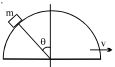
A
$\frac{4v}{R \cos \theta}$
B
$\frac{3v}{R \cos \theta}$
C
$\frac{5v}{R \cos \theta}$
D
$\frac{2v}{R \cos \theta}$
Solution
(A) Let the mass of the hemisphere be $M = 3m$. Since there are no external horizontal forces acting on the system,the horizontal position of the centre of mass remains constant.
Let $x$ be the displacement of the hemisphere to the right. The horizontal displacement of the particle relative to the table is $(R \sin \theta - x)$ to the left.
Equating the horizontal displacement of the centre of mass to zero:
$m(R \sin \theta - x) - M x = 0$
$m R \sin \theta = (M + m) x$
Substituting $M = 3m$:
$m R \sin \theta = (3m + m) x = 4m x$
$x = \frac{R \sin \theta}{4}$
Differentiating with respect to time $t$:
$\frac{dx}{dt} = \frac{R \cos \theta}{4} \frac{d\theta}{dt}$
Given that the velocity of the hemisphere is $v = \frac{dx}{dt}$ and the angular velocity of the particle relative to the centre is $\omega = \frac{d\theta}{dt}$:
$v = \frac{R \cos \theta}{4} \omega$
$\omega = \frac{4v}{R \cos \theta}$
Let $x$ be the displacement of the hemisphere to the right. The horizontal displacement of the particle relative to the table is $(R \sin \theta - x)$ to the left.
Equating the horizontal displacement of the centre of mass to zero:
$m(R \sin \theta - x) - M x = 0$
$m R \sin \theta = (M + m) x$
Substituting $M = 3m$:
$m R \sin \theta = (3m + m) x = 4m x$
$x = \frac{R \sin \theta}{4}$
Differentiating with respect to time $t$:
$\frac{dx}{dt} = \frac{R \cos \theta}{4} \frac{d\theta}{dt}$
Given that the velocity of the hemisphere is $v = \frac{dx}{dt}$ and the angular velocity of the particle relative to the centre is $\omega = \frac{d\theta}{dt}$:
$v = \frac{R \cos \theta}{4} \omega$
$\omega = \frac{4v}{R \cos \theta}$
0 likes
View Solution48
MediumMCQ
$A$ particle of mass $m$ moving horizontally with velocity $v_0$ strikes a smooth wedge of mass $M$,as shown in the figure. After the collision,the ball starts moving up the inclined face of the wedge and rises to a height $h$. When the particle has risen to a height $h$ on the wedge,choose the correct alternative$(s)$.
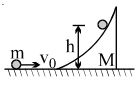
A
The particle is stationary with respect to the ground.
B
Both are stationary with respect to the centre of mass.
C
The kinetic energy with respect to the centre of mass is converted into potential energy.
D
Both $(B)$ and $(C)$.
Solution
(D) $1$. Since the surface is smooth and there are no external horizontal forces acting on the system (particle + wedge),the linear momentum of the system is conserved in the horizontal direction.
$2$. At the maximum height $h$ relative to the wedge,the particle and the wedge move with the same horizontal velocity $V$. By conservation of momentum: $mv_0 = (m + M)V$,so $V = \frac{mv_0}{m+M}$.
$3$. In the centre of mass $(COM)$ frame,the total momentum is zero. At the maximum height $h$,the relative velocity between the particle and the wedge is zero (they move together horizontally). Since the total momentum in the $COM$ frame is zero,both must be stationary with respect to the $COM$ frame.
$4$. In the $COM$ frame,the total energy is the sum of the kinetic energy of the system relative to the $COM$ and the potential energy. At the maximum height $h$,the relative kinetic energy is zero,meaning all the initial kinetic energy relative to the $COM$ has been converted into potential energy $mgh_{eff}$.
$5$. Thus,both statements $(B)$ and $(C)$ are correct.
$2$. At the maximum height $h$ relative to the wedge,the particle and the wedge move with the same horizontal velocity $V$. By conservation of momentum: $mv_0 = (m + M)V$,so $V = \frac{mv_0}{m+M}$.
$3$. In the centre of mass $(COM)$ frame,the total momentum is zero. At the maximum height $h$,the relative velocity between the particle and the wedge is zero (they move together horizontally). Since the total momentum in the $COM$ frame is zero,both must be stationary with respect to the $COM$ frame.
$4$. In the $COM$ frame,the total energy is the sum of the kinetic energy of the system relative to the $COM$ and the potential energy. At the maximum height $h$,the relative kinetic energy is zero,meaning all the initial kinetic energy relative to the $COM$ has been converted into potential energy $mgh_{eff}$.
$5$. Thus,both statements $(B)$ and $(C)$ are correct.
0 likes
View Solution49
AdvancedMCQ
The moment of inertia of a rectangular plate about an axis passing through $P$ and perpendicular to the plate is $I$. Then,the moment of inertia of the triangular portion $PQR$ about an axis perpendicular to the plane of the plate and passing through $P$ is:
A
about $P = I/2$
B
about $R = I/2$
C
about $P > I/2$
D
about $R > I/2$
Solution
(C) Let the mass density be $\rho \text{ kg/m}^2$.
Let the sides be $PQ = RS = a$ and $QR = PS = b$. Assume $a > b$.
The mass of the rectangle is $M = \rho ab$.
The moment of inertia of the rectangle about its center is $I_{cm} = M(a^2 + b^2)/12$.
The distance of point $P$ from the center is $\sqrt{(a/2)^2 + (b/2)^2} = \sqrt{a^2 + b^2}/2$.
Using the parallel axis theorem,the moment of inertia of the rectangle about $P$ is $I = I_{cm} + M(a^2 + b^2)/4 = M(a^2 + b^2)/3$.
The mass of the triangle $PQR$ is $M' = M/2 = \rho ab/2$.
The moment of inertia of the triangle $PQR$ about an axis through its centroid $G$ perpendicular to the plate is $I_G = M'(a^2 + b^2)/18$.
The distance of point $P$ from the centroid $G$ is $d^2 = (2a/3)^2 + (b/3)^2 = (4a^2 + b^2)/9$.
Using the parallel axis theorem,the moment of inertia of the triangle $PQR$ about $P$ is $I_P = I_G + M'd^2 = (M/2)(a^2 + b^2)/18 + (M/2)(4a^2 + b^2)/9 = (M/2)(a^2 + b^2 + 8a^2 + 2b^2)/18 = (M/2)(9a^2 + 3b^2)/18 = (M/2)(3a^2 + b^2)/6$.
Comparing $I_P$ with $I/2 = (M/2)(a^2 + b^2)/3 = (M/2)(2a^2 + 2b^2)/6$,since $a > b$,$3a^2 + b^2 > 2a^2 + 2b^2$,therefore $I_P > I/2$.
Let the sides be $PQ = RS = a$ and $QR = PS = b$. Assume $a > b$.
The mass of the rectangle is $M = \rho ab$.
The moment of inertia of the rectangle about its center is $I_{cm} = M(a^2 + b^2)/12$.
The distance of point $P$ from the center is $\sqrt{(a/2)^2 + (b/2)^2} = \sqrt{a^2 + b^2}/2$.
Using the parallel axis theorem,the moment of inertia of the rectangle about $P$ is $I = I_{cm} + M(a^2 + b^2)/4 = M(a^2 + b^2)/3$.
The mass of the triangle $PQR$ is $M' = M/2 = \rho ab/2$.
The moment of inertia of the triangle $PQR$ about an axis through its centroid $G$ perpendicular to the plate is $I_G = M'(a^2 + b^2)/18$.
The distance of point $P$ from the centroid $G$ is $d^2 = (2a/3)^2 + (b/3)^2 = (4a^2 + b^2)/9$.
Using the parallel axis theorem,the moment of inertia of the triangle $PQR$ about $P$ is $I_P = I_G + M'd^2 = (M/2)(a^2 + b^2)/18 + (M/2)(4a^2 + b^2)/9 = (M/2)(a^2 + b^2 + 8a^2 + 2b^2)/18 = (M/2)(9a^2 + 3b^2)/18 = (M/2)(3a^2 + b^2)/6$.
Comparing $I_P$ with $I/2 = (M/2)(a^2 + b^2)/3 = (M/2)(2a^2 + 2b^2)/6$,since $a > b$,$3a^2 + b^2 > 2a^2 + 2b^2$,therefore $I_P > I/2$.
0 likes
View SolutionSystem of Particles and Rotational Motion — Mix Example - System of Particles and Rotational Motion · Frequently Asked Questions
1Are these System of Particles and Rotational Motion questions useful for JEE and NEET?
Yes. All questions in this section are mapped to JEE Main and NEET exam patterns. Previous year questions from JEE Main, NEET, GUJCET and state-level exams are included with full solutions.
2Can I switch to Hindi or Gujarati for these questions?
Yes. Use the language tabs in the hero section or the sidebar to view the same questions and solutions in English, Hindi or Gujarati.
3How do I generate a question paper from this subtopic?
Use the Vedclass Exam Paper Generator — select the chapter and subtopic, set difficulty, and generate Sets A, B, C, D automatically. First 3 chapters of every subject are free.
Vedclass Products
For Students
Vedclass Test Series
Mock tests in real JEE/NEET style with performance analysis. 5-day free trial.
Start Free TrialFor Teachers
Exam Paper Generator
Generate Set A/B/C/D papers from this chapter in 2 minutes. 3 chapters free.
Try FreeFor Institutes
Online Exam Module
Live online exams with unlimited students, 360° analytics & white-label branding.
See DemoFor Teachers & Institutes
Generate a System of Particles and Rotational Motion Exam Paper in 2 Minutes
Select subtopic & difficulty — Sets A, B, C, D auto-generated with No Repeat logic.
First 3 chapters of every subject are free — no payment required.