
A English
System of particles momentum and Energy Questions in English
Class 11 Physics · System of Particles and Rotational Motion · System of particles momentum and Energy
9+
Questions
English
Language
100%
With Solutions
Showing 9 of 9 questions in English
1
MediumMCQ
Consider the following two statements:
$1.$ Linear momentum of a system of particles is zero.
$2.$ Kinetic energy of a system of particles is zero.
Then:
$1.$ Linear momentum of a system of particles is zero.
$2.$ Kinetic energy of a system of particles is zero.
Then:
A
$1$ implies $2$ and $2$ implies $1$
B
$1$ does not imply $2$ and $2$ does not imply $1$
C
$1$ implies $2$ but $2$ does not imply $1$
D
$1$ does not imply $2$ but $2$ implies $1$
Solution
(D) Statement $1$: Linear momentum $\vec{P} = \sum m_i \vec{v}_i = 0$. This does not imply that the velocity of each particle is zero. For example,in a system of two particles moving in opposite directions with equal momentum,the total momentum is zero,but the kinetic energy $K = \sum \frac{1}{2} m_i v_i^2$ is non-zero.
Statement $2$: Kinetic energy $K = \sum \frac{1}{2} m_i v_i^2 = 0$. Since mass $m_i > 0$ and $v_i^2 \ge 0$,the only way for the sum to be zero is if each $v_i = 0$. If all velocities are zero,then the total linear momentum $\vec{P} = \sum m_i (0) = 0$.
Therefore,$1$ does not imply $2$,but $2$ implies $1$.
Statement $2$: Kinetic energy $K = \sum \frac{1}{2} m_i v_i^2 = 0$. Since mass $m_i > 0$ and $v_i^2 \ge 0$,the only way for the sum to be zero is if each $v_i = 0$. If all velocities are zero,then the total linear momentum $\vec{P} = \sum m_i (0) = 0$.
Therefore,$1$ does not imply $2$,but $2$ implies $1$.
0 likes
View Solution2
MediumMCQ
Consider the following two statements for a system of particles:
$A$: The linear momentum of the system is zero.
$B$: The kinetic energy of the system is zero.
$A$: The linear momentum of the system is zero.
$B$: The kinetic energy of the system is zero.
A
$A$ does not imply $B$ and $B$ does not imply $A$
B
$A$ implies $B$ but $B$ does not imply $A$
C
$A$ does not imply $B$ but $B$ implies $A$
D
$A$ implies $B$ and $B$ implies $A$
Solution
(C) The kinetic energy of a system of particles is given by $K = \sum \frac{1}{2} m_i v_i^2$. If $K = 0$,then each individual particle must have a velocity $v_i = 0$,which implies the system is at rest. If the system is at rest,the total linear momentum $P = \sum m_i v_i = 0$. Thus,$B$ implies $A$.
However,if the linear momentum $P = 0$,the particles could be moving in opposite directions such that their vector sum is zero (e.g.,two particles of equal mass moving with velocities $v$ and $-v$). In this case,the kinetic energy $K = \frac{1}{2}mv^2 + \frac{1}{2}m(-v)^2 = mv^2 \neq 0$. Thus,$A$ does not imply $B$.
However,if the linear momentum $P = 0$,the particles could be moving in opposite directions such that their vector sum is zero (e.g.,two particles of equal mass moving with velocities $v$ and $-v$). In this case,the kinetic energy $K = \frac{1}{2}mv^2 + \frac{1}{2}m(-v)^2 = mv^2 \neq 0$. Thus,$A$ does not imply $B$.
0 likes
View Solution3
MediumMCQ
$A$ system of $N$ particles is free from any external forces. Which of the following must be true for the sum of the magnitudes of the momenta of the individual particles in the system?
A
It must be zero
B
It could be non-zero,but it must be constant
C
It could be non-zero,and it might not be constant
D
It could be zero,even if the magnitude of the total momentum is not zero
Solution
(C) The total momentum of a system is the vector sum of the momenta of individual particles: $\vec{P}_{total} = \sum \vec{p}_i = 0$ (since no external force acts on the system).
However,the sum of the magnitudes of the momenta is given by $S = \sum |\vec{p}_i|$.
Even if the vector sum is zero,the individual momenta $\vec{p}_i$ can change over time due to internal forces acting between the particles.
Since the individual momenta change,their magnitudes $|\vec{p}_i|$ change,and consequently,their sum $S$ is generally non-zero and not necessarily constant.
However,the sum of the magnitudes of the momenta is given by $S = \sum |\vec{p}_i|$.
Even if the vector sum is zero,the individual momenta $\vec{p}_i$ can change over time due to internal forces acting between the particles.
Since the individual momenta change,their magnitudes $|\vec{p}_i|$ change,and consequently,their sum $S$ is generally non-zero and not necessarily constant.
0 likes
View Solution4
DifficultMCQ
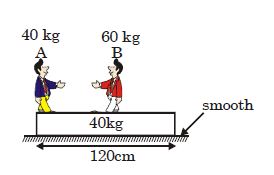
Two men $A$ and $B$ are standing on a plank of length $120 \ cm$ and mass $40 \ kg$. $B$ (mass $60 \ kg$) is at the middle of the plank and $A$ (mass $40 \ kg$) is at the left end of the plank. The system is initially at rest on a smooth horizontal surface. $A$ and $B$ start moving such that the position of $B$ remains fixed with respect to the ground until $A$ meets $B$. The point where $A$ meets $B$ is located at:
A
The middle of the plank
B
$30 \ cm$ from the left end of the plank
C
The right end of the plank
D
None of these
Solution
(A) Let the mass of the plank be $M = 40 \ kg$,mass of $A$ be $m_A = 40 \ kg$,and mass of $B$ be $m_B = 60 \ kg$.
The length of the plank is $L = 120 \ cm$.
Initially,$A$ is at $x = 0$ and $B$ is at $x = 60 \ cm$ (middle).
Since the surface is smooth and there are no external horizontal forces,the center of mass of the system remains fixed.
Let the displacement of the plank be $S_P$ and the displacement of $A$ relative to the ground be $S_A$.
Since $B$ is fixed with respect to the ground,its displacement $S_B = 0$.
The center of mass equation is: $m_A S_A + m_B S_B + M S_P = 0$.
Substituting the values: $40 S_A + 60(0) + 40 S_P = 0$,which simplifies to $S_A = -S_P$.
$A$ moves towards $B$,so $A$ covers the distance of $60 \ cm$ relative to the plank. Let $x$ be the distance $A$ moves relative to the ground. Then $x = 60 + S_P$ (since the plank moves left by $|S_P|$).
Also,$S_A = x = 60 + S_P$.
Substituting $S_A = -S_P$: $-S_P = 60 + S_P \implies 2S_P = -60 \implies S_P = -30 \ cm$.
Thus,$S_A = 30 \ cm$.
$A$ meets $B$ at a position $30 \ cm$ from the original left end of the plank,which is the middle of the plank.
The length of the plank is $L = 120 \ cm$.
Initially,$A$ is at $x = 0$ and $B$ is at $x = 60 \ cm$ (middle).
Since the surface is smooth and there are no external horizontal forces,the center of mass of the system remains fixed.
Let the displacement of the plank be $S_P$ and the displacement of $A$ relative to the ground be $S_A$.
Since $B$ is fixed with respect to the ground,its displacement $S_B = 0$.
The center of mass equation is: $m_A S_A + m_B S_B + M S_P = 0$.
Substituting the values: $40 S_A + 60(0) + 40 S_P = 0$,which simplifies to $S_A = -S_P$.
$A$ moves towards $B$,so $A$ covers the distance of $60 \ cm$ relative to the plank. Let $x$ be the distance $A$ moves relative to the ground. Then $x = 60 + S_P$ (since the plank moves left by $|S_P|$).
Also,$S_A = x = 60 + S_P$.
Substituting $S_A = -S_P$: $-S_P = 60 + S_P \implies 2S_P = -60 \implies S_P = -30 \ cm$.
Thus,$S_A = 30 \ cm$.
$A$ meets $B$ at a position $30 \ cm$ from the original left end of the plank,which is the middle of the plank.
0 likes
View Solution5
Difficult
Separation of motion of a system of particles into motion of the centre of mass and motion about the centre of mass:
$(a)$ Show $p = \sum p_{i}^{\prime} + M V$,where $p$ is the total momentum of the system,$p_{i}^{\prime} = m_{i} v_{i}^{\prime}$,and $v_{i}^{\prime}$ is the velocity of the $i^{th}$ particle relative to the centre of mass. Also,prove using the definition of the centre of mass that $\sum p_{i}^{\prime} = 0$.
$(b)$ Show $K = K^{\prime} + \frac{1}{2} M V^{2}$,where $K$ is the total kinetic energy of the system,$K^{\prime}$ is the total kinetic energy of the system relative to the centre of mass,and $\frac{1}{2} M V^{2}$ is the kinetic energy of the translation of the system as a whole.
$(c)$ Show $L = L^{\prime} + R \times M V$,where $L^{\prime} = \sum r_{i}^{\prime} \times p_{i}^{\prime}$ is the angular momentum of the system about the centre of mass. Note $r_{i}^{\prime} = r_{i} - R$.
$(d)$ Show $\frac{d L^{\prime}}{d t} = \sum r_{i}^{\prime} \times \frac{d p_{i}^{\prime}}{d t}$. Further,show that $\frac{d L^{\prime}}{d t} = \tau_{ext}^{\prime}$,where $\tau_{ext}^{\prime}$ is the sum of all external torques acting on the system about the centre of mass.
$(a)$ Show $p = \sum p_{i}^{\prime} + M V$,where $p$ is the total momentum of the system,$p_{i}^{\prime} = m_{i} v_{i}^{\prime}$,and $v_{i}^{\prime}$ is the velocity of the $i^{th}$ particle relative to the centre of mass. Also,prove using the definition of the centre of mass that $\sum p_{i}^{\prime} = 0$.
$(b)$ Show $K = K^{\prime} + \frac{1}{2} M V^{2}$,where $K$ is the total kinetic energy of the system,$K^{\prime}$ is the total kinetic energy of the system relative to the centre of mass,and $\frac{1}{2} M V^{2}$ is the kinetic energy of the translation of the system as a whole.
$(c)$ Show $L = L^{\prime} + R \times M V$,where $L^{\prime} = \sum r_{i}^{\prime} \times p_{i}^{\prime}$ is the angular momentum of the system about the centre of mass. Note $r_{i}^{\prime} = r_{i} - R$.
$(d)$ Show $\frac{d L^{\prime}}{d t} = \sum r_{i}^{\prime} \times \frac{d p_{i}^{\prime}}{d t}$. Further,show that $\frac{d L^{\prime}}{d t} = \tau_{ext}^{\prime}$,where $\tau_{ext}^{\prime}$ is the sum of all external torques acting on the system about the centre of mass.
Solution
(A) Let $m_{i}$ be the mass and $v_{i}$ be the velocity of the $i^{th}$ particle. The velocity relative to the centre of mass is $v_{i}^{\prime} = v_{i} - V$,so $v_{i} = v_{i}^{\prime} + V$. The total momentum $p = \sum m_{i} v_{i} = \sum m_{i}(v_{i}^{\prime} + V) = \sum m_{i} v_{i}^{\prime} + V \sum m_{i} = \sum p_{i}^{\prime} + MV$. Since $\sum m_{i} r_{i}^{\prime} = 0$,differentiating gives $\sum m_{i} v_{i}^{\prime} = \sum p_{i}^{\prime} = 0$.
$(b)$ $K = \sum \frac{1}{2} m_{i} v_{i}^{2} = \sum \frac{1}{2} m_{i} (v_{i}^{\prime} + V) \cdot (v_{i}^{\prime} + V) = \sum \frac{1}{2} m_{i} v_{i}^{\prime 2} + \sum m_{i} v_{i}^{\prime} \cdot V + \sum \frac{1}{2} m_{i} V^{2} = K^{\prime} + V \cdot (\sum p_{i}^{\prime}) + \frac{1}{2} M V^{2}$. Since $\sum p_{i}^{\prime} = 0$,$K = K^{\prime} + \frac{1}{2} M V^{2}$.
$(c)$ $L = \sum r_{i} \times p_{i} = \sum (R + r_{i}^{\prime}) \times m_{i} (V + v_{i}^{\prime}) = \sum (R \times m_{i} V + R \times m_{i} v_{i}^{\prime} + r_{i}^{\prime} \times m_{i} V + r_{i}^{\prime} \times m_{i} v_{i}^{\prime}) = R \times MV + R \times (\sum p_{i}^{\prime}) + (\sum m_{i} r_{i}^{\prime}) \times V + L^{\prime}$. Since $\sum p_{i}^{\prime} = 0$ and $\sum m_{i} r_{i}^{\prime} = 0$,$L = L^{\prime} + R \times MV$.
$(d)$ $\frac{d L^{\prime}}{d t} = \frac{d}{d t} \sum (r_{i}^{\prime} \times p_{i}^{\prime}) = \sum (v_{i}^{\prime} \times p_{i}^{\prime}) + \sum (r_{i}^{\prime} \times \frac{d p_{i}^{\prime}}{d t})$. Since $v_{i}^{\prime} \times (m_{i} v_{i}^{\prime}) = 0$,$\frac{d L^{\prime}}{d t} = \sum r_{i}^{\prime} \times F_{i}^{\prime} = \tau_{ext}^{\prime}$.
$(b)$ $K = \sum \frac{1}{2} m_{i} v_{i}^{2} = \sum \frac{1}{2} m_{i} (v_{i}^{\prime} + V) \cdot (v_{i}^{\prime} + V) = \sum \frac{1}{2} m_{i} v_{i}^{\prime 2} + \sum m_{i} v_{i}^{\prime} \cdot V + \sum \frac{1}{2} m_{i} V^{2} = K^{\prime} + V \cdot (\sum p_{i}^{\prime}) + \frac{1}{2} M V^{2}$. Since $\sum p_{i}^{\prime} = 0$,$K = K^{\prime} + \frac{1}{2} M V^{2}$.
$(c)$ $L = \sum r_{i} \times p_{i} = \sum (R + r_{i}^{\prime}) \times m_{i} (V + v_{i}^{\prime}) = \sum (R \times m_{i} V + R \times m_{i} v_{i}^{\prime} + r_{i}^{\prime} \times m_{i} V + r_{i}^{\prime} \times m_{i} v_{i}^{\prime}) = R \times MV + R \times (\sum p_{i}^{\prime}) + (\sum m_{i} r_{i}^{\prime}) \times V + L^{\prime}$. Since $\sum p_{i}^{\prime} = 0$ and $\sum m_{i} r_{i}^{\prime} = 0$,$L = L^{\prime} + R \times MV$.
$(d)$ $\frac{d L^{\prime}}{d t} = \frac{d}{d t} \sum (r_{i}^{\prime} \times p_{i}^{\prime}) = \sum (v_{i}^{\prime} \times p_{i}^{\prime}) + \sum (r_{i}^{\prime} \times \frac{d p_{i}^{\prime}}{d t})$. Since $v_{i}^{\prime} \times (m_{i} v_{i}^{\prime}) = 0$,$\frac{d L^{\prime}}{d t} = \sum r_{i}^{\prime} \times F_{i}^{\prime} = \tau_{ext}^{\prime}$.
0 likes
View Solution6
MediumMCQ
What is the total momentum of a system of particles?
A
The product of the total mass and the velocity of the centre of mass.
B
The sum of the individual momenta of all particles.
C
Both $A$ and $B$ are correct.
D
Zero,if no external force acts on the system.
Solution
(C) The total momentum $P$ of a system of $n$ particles is defined as the vector sum of the individual momenta of all particles in the system: $P = \sum_{i=1}^{n} p_i = \sum_{i=1}^{n} m_i v_i$.
By the definition of the centre of mass,the total momentum of a system is also equal to the product of the total mass $M$ of the system and the velocity of the centre of mass $V_{cm}$:
$P = M V_{cm}$,where $M = \sum m_i$ and $V_{cm} = \frac{\sum m_i v_i}{M}$.
Therefore,both the sum of individual momenta and the product of total mass and velocity of the centre of mass represent the total momentum of the system.
By the definition of the centre of mass,the total momentum of a system is also equal to the product of the total mass $M$ of the system and the velocity of the centre of mass $V_{cm}$:
$P = M V_{cm}$,where $M = \sum m_i$ and $V_{cm} = \frac{\sum m_i v_i}{M}$.
Therefore,both the sum of individual momenta and the product of total mass and velocity of the centre of mass represent the total momentum of the system.
0 likes
View Solution7
DifficultMCQ
$A$ uniform rod of mass $M$ and length $L$ is placed on a smooth horizontal surface. $A$ particle of mass $m$ moving with velocity $v$ strikes the rod at one end perpendicularly and comes to rest. The velocity of the centre of mass of the rod after the collision is:
A
$v/2$
B
$mv/M$
C
$mv/(M+m)$
D
$mv/M$
Solution
(B) According to the principle of conservation of linear momentum,the total momentum of the system before the collision must equal the total momentum after the collision.
Before the collision,the particle of mass $m$ has velocity $v$,and the rod of mass $M$ is at rest. Thus,the initial momentum is $P_i = mv$.
After the collision,the particle comes to rest,and the rod moves with a velocity $V_{cm}$ of its centre of mass. Thus,the final momentum is $P_f = MV_{cm}$.
Equating the two: $mv = MV_{cm}$.
Solving for $V_{cm}$: $V_{cm} = mv/M$.
Before the collision,the particle of mass $m$ has velocity $v$,and the rod of mass $M$ is at rest. Thus,the initial momentum is $P_i = mv$.
After the collision,the particle comes to rest,and the rod moves with a velocity $V_{cm}$ of its centre of mass. Thus,the final momentum is $P_f = MV_{cm}$.
Equating the two: $mv = MV_{cm}$.
Solving for $V_{cm}$: $V_{cm} = mv/M$.
0 likes
View Solution8
DifficultMCQ
$A$ uniform rod of length $L$ and mass $M$ is placed on a smooth horizontal surface. $A$ particle of mass $m$ moving with velocity $v$ strikes the rod at one end perpendicularly and comes to rest. The velocity of the centre of mass of the rod after the collision is:
A
$v$
B
$\frac{mv}{M}$
C
$\frac{mv}{M+m}$
D
$\frac{Mv}{m}$
Solution
(B) According to the law of conservation of linear momentum for the system (rod + particle):
Initial momentum = Final momentum
$mv + 0 = 0 + Mv_{cm}$
Here,the particle comes to rest after the collision,so its final velocity is $0$.
The rod acquires a velocity $v_{cm}$ for its centre of mass.
Therefore,$mv = Mv_{cm}$
$v_{cm} = \frac{mv}{M}$
Initial momentum = Final momentum
$mv + 0 = 0 + Mv_{cm}$
Here,the particle comes to rest after the collision,so its final velocity is $0$.
The rod acquires a velocity $v_{cm}$ for its centre of mass.
Therefore,$mv = Mv_{cm}$
$v_{cm} = \frac{mv}{M}$
0 likes
View Solution9
DifficultMCQ
Given below are two statements:
Statement $I$: For a mechanical system of many particles,the total kinetic energy is the sum of the kinetic energies of all the particles.
Statement $II$: The total kinetic energy can be expressed as the sum of the kinetic energy of the center of mass with respect to the origin and the kinetic energy of all the particles with respect to the center of mass as the reference frame.
In the light of the above statements,choose the correct answer from the options given below:
Statement $I$: For a mechanical system of many particles,the total kinetic energy is the sum of the kinetic energies of all the particles.
Statement $II$: The total kinetic energy can be expressed as the sum of the kinetic energy of the center of mass with respect to the origin and the kinetic energy of all the particles with respect to the center of mass as the reference frame.
In the light of the above statements,choose the correct answer from the options given below:
A
Both Statement $I$ and Statement $II$ are true
B
Statement $I$ is true but Statement $II$ is false
C
Statement $I$ is false but Statement $II$ is true
D
Both Statement $I$ and Statement $II$ are false
Solution
(A) Statement $I$ is true by definition: the total kinetic energy of a system of particles is the scalar sum of the kinetic energies of individual particles,$K = \sum \frac{1}{2} m_i v_i^2$.
Statement $II$ is also true based on the theorem of kinetic energy for a system of particles. If $\vec{v}_i$ is the velocity of the $i$-th particle relative to the origin,$\vec{V}_{cm}$ is the velocity of the center of mass,and $\vec{v}_i'$ is the velocity of the $i$-th particle relative to the center of mass,then $\vec{v}_i = \vec{V}_{cm} + \vec{v}_i'$.
The total kinetic energy is $K = \sum \frac{1}{2} m_i v_i^2 = \sum \frac{1}{2} m_i (\vec{V}_{cm} + \vec{v}_i')^2 = \frac{1}{2} M V_{cm}^2 + \sum \frac{1}{2} m_i (v_i')^2$,where $M = \sum m_i$.
Thus,the total kinetic energy is the sum of the kinetic energy of the center of mass and the kinetic energy relative to the center of mass.
Statement $II$ is also true based on the theorem of kinetic energy for a system of particles. If $\vec{v}_i$ is the velocity of the $i$-th particle relative to the origin,$\vec{V}_{cm}$ is the velocity of the center of mass,and $\vec{v}_i'$ is the velocity of the $i$-th particle relative to the center of mass,then $\vec{v}_i = \vec{V}_{cm} + \vec{v}_i'$.
The total kinetic energy is $K = \sum \frac{1}{2} m_i v_i^2 = \sum \frac{1}{2} m_i (\vec{V}_{cm} + \vec{v}_i')^2 = \frac{1}{2} M V_{cm}^2 + \sum \frac{1}{2} m_i (v_i')^2$,where $M = \sum m_i$.
Thus,the total kinetic energy is the sum of the kinetic energy of the center of mass and the kinetic energy relative to the center of mass.
0 likes
View SolutionSystem of Particles and Rotational Motion — System of particles momentum and Energy · Frequently Asked Questions
1Are these System of Particles and Rotational Motion questions useful for JEE and NEET?
Yes. All questions in this section are mapped to JEE Main and NEET exam patterns. Previous year questions from JEE Main, NEET, GUJCET and state-level exams are included with full solutions.
2Can I switch to Hindi or Gujarati for these questions?
Yes. Use the language tabs in the hero section or the sidebar to view the same questions and solutions in English, Hindi or Gujarati.
3How do I generate a question paper from this subtopic?
Use the Vedclass Exam Paper Generator — select the chapter and subtopic, set difficulty, and generate Sets A, B, C, D automatically. First 3 chapters of every subject are free.
Vedclass Products
For Students
Vedclass Test Series
Mock tests in real JEE/NEET style with performance analysis. 5-day free trial.
Start Free TrialFor Teachers
Exam Paper Generator
Generate Set A/B/C/D papers from this chapter in 2 minutes. 3 chapters free.
Try FreeFor Institutes
Online Exam Module
Live online exams with unlimited students, 360° analytics & white-label branding.
See DemoFor Teachers & Institutes
Generate a System of Particles and Rotational Motion Exam Paper in 2 Minutes
Select subtopic & difficulty — Sets A, B, C, D auto-generated with No Repeat logic.
First 3 chapters of every subject are free — no payment required.