
A English
Effect of Internal and External Force on Centre of Mass Questions in English
Class 11 Physics · System of Particles and Rotational Motion · Effect of Internal and External Force on Centre of Mass
23+
Questions
English
Language
100%
With Solutions
Showing 22 of 23 questions in English
1
DifficultMCQ
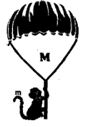
$A$ monkey of mass $m$ is at rest on a light rope attached to a balloon of mass $M$ in mid-air. If the monkey climbs up the rope and reaches the top of the rope,what is the distance covered by the balloon? (The total length of the rope is $L$)
A
$\frac{mL}{(m + M)^2}$
B
$\frac{mL}{m + M}$
C
$\frac{(m + M)L}{m}$
D
$\frac{ML}{m + M}$
Solution
(B) Initially,the system is at rest,so the velocity of the center of mass $\vec{v}_{CM} = 0$.
Since there are no external forces acting on the system,the center of mass remains stationary.
Let $d_1$ be the distance the monkey moves relative to the ground and $d_2$ be the distance the balloon moves relative to the ground.
From the conservation of the center of mass: $m d_1 = M d_2$.
Since the monkey climbs a distance $L$ relative to the balloon,the total distance covered by the monkey relative to the ground is $d_1 = L - d_2$.
Substituting this into the conservation equation: $m(L - d_2) = M d_2$.
$mL - m d_2 = M d_2$.
$mL = (m + M) d_2$.
Therefore,the distance covered by the balloon is $d_2 = \frac{mL}{m + M}$.
Since there are no external forces acting on the system,the center of mass remains stationary.
Let $d_1$ be the distance the monkey moves relative to the ground and $d_2$ be the distance the balloon moves relative to the ground.
From the conservation of the center of mass: $m d_1 = M d_2$.
Since the monkey climbs a distance $L$ relative to the balloon,the total distance covered by the monkey relative to the ground is $d_1 = L - d_2$.
Substituting this into the conservation equation: $m(L - d_2) = M d_2$.
$mL - m d_2 = M d_2$.
$mL = (m + M) d_2$.
Therefore,the distance covered by the balloon is $d_2 = \frac{mL}{m + M}$.
0 likes
View Solution2
EasyMCQ
Two spheres of masses $2M$ and $M$ are initially at rest at a distance $R$ apart. Due to mutual force of attraction,they approach each other. When they are at separation $R/2$,the acceleration of the centre of mass of the system would be .......
A
$0\,m/s^2$
B
$g\,m/s^2$
C
$3g\,m/s^2$
D
$12g\,m/s^2$
Solution
(A) The acceleration of the centre of mass of a system is given by the formula: $a_{cm} = \frac{F_{ext}}{M_{total}}$.
In this problem,the two spheres are moving towards each other due to their mutual gravitational force of attraction.
This gravitational force is an internal force of the system consisting of the two spheres.
Since there are no external forces acting on the system $(F_{ext} = 0)$,the acceleration of the centre of mass must be zero.
Therefore,$a_{cm} = 0\,m/s^2$.
In this problem,the two spheres are moving towards each other due to their mutual gravitational force of attraction.
This gravitational force is an internal force of the system consisting of the two spheres.
Since there are no external forces acting on the system $(F_{ext} = 0)$,the acceleration of the centre of mass must be zero.
Therefore,$a_{cm} = 0\,m/s^2$.
0 likes
View Solution3
MediumMCQ
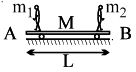
Two persons of mass $m_1$ and $m_2$ are standing at the two ends $A$ and $B$ respectively,of a trolley of mass $M$ as shown. When both the persons jump simultaneously with the same speed,then:
A
the centre of mass of the system remains stationary
B
the trolley remains stationary
C
the trolley moves toward the end where the person with heavier mass is standing
D
None of these
Solution
(D) The system consists of the trolley and the two persons. Since there is no external horizontal force acting on the system,the net external horizontal force is zero $(F_{ext, x} = 0)$.
According to the law of conservation of linear momentum,the velocity of the centre of mass of the system remains constant. Since the system was initially at rest,the velocity of the centre of mass remains zero.
Let the horizontal velocity of the person of mass $m_1$ be $v$ towards the left and the person of mass $m_2$ be $v$ towards the right. Let the velocity of the trolley be $V$ towards the right.
Applying the conservation of linear momentum in the horizontal direction:
$m_1(-v) + m_2(v) + MV = 0$
$MV = m_1v - m_2v$
$V = \frac{(m_1 - m_2)v}{M}$
If $m_1 > m_2$,then $V > 0$,meaning the trolley moves towards the right (towards end $B$).
If $m_2 > m_1$,then $V < 0$,meaning the trolley moves towards the left (towards end $A$).
Thus,the trolley moves towards the end where the person with the lighter mass was standing,which is equivalent to saying it moves away from the heavier mass. Therefore,none of the given options are correct.
According to the law of conservation of linear momentum,the velocity of the centre of mass of the system remains constant. Since the system was initially at rest,the velocity of the centre of mass remains zero.
Let the horizontal velocity of the person of mass $m_1$ be $v$ towards the left and the person of mass $m_2$ be $v$ towards the right. Let the velocity of the trolley be $V$ towards the right.
Applying the conservation of linear momentum in the horizontal direction:
$m_1(-v) + m_2(v) + MV = 0$
$MV = m_1v - m_2v$
$V = \frac{(m_1 - m_2)v}{M}$
If $m_1 > m_2$,then $V > 0$,meaning the trolley moves towards the right (towards end $B$).
If $m_2 > m_1$,then $V < 0$,meaning the trolley moves towards the left (towards end $A$).
Thus,the trolley moves towards the end where the person with the lighter mass was standing,which is equivalent to saying it moves away from the heavier mass. Therefore,none of the given options are correct.
0 likes
View Solution4
EasyMCQ
In a system of particles,internal forces can change (for the system)
A
The linear momentum but not the kinetic energy
B
The kinetic energy but not the linear momentum
C
Linear momentum as well as kinetic energy
D
Neither the linear momentum nor the kinetic energy
Solution
(B) According to Newton's third law,internal forces always exist in action-reaction pairs.
Since these forces are equal in magnitude and opposite in direction,their vector sum is always zero.
Therefore,the net external force on the system is zero,which implies that the total linear momentum of the system remains conserved.
However,internal forces can perform work on the individual particles of the system,which can lead to a change in the total kinetic energy of the system.
Since these forces are equal in magnitude and opposite in direction,their vector sum is always zero.
Therefore,the net external force on the system is zero,which implies that the total linear momentum of the system remains conserved.
However,internal forces can perform work on the individual particles of the system,which can lead to a change in the total kinetic energy of the system.
0 likes
View Solution5
MediumMCQ
If a force $10 \hat{i} + 15 \hat{j} + 25 \hat{k}$ acts on a system and gives an acceleration $2 \hat{i} + 3 \hat{j} - 5 \hat{k}$ to the centre of mass of the system,the mass of the system is
A
$5 \, \text{units}$
B
$\sqrt{38} \, \text{units}$
C
$5\sqrt{38} \, \text{units}$
D
given data is not correct
Solution
(D) According to Newton's second law for a system of particles,the external force acting on the system is related to the acceleration of the centre of mass by the equation: $\vec{F}_{ext} = M \vec{a}_{CM}$.
This implies that the acceleration vector $\vec{a}_{CM}$ must be in the same direction as the external force vector $\vec{F}_{ext}$.
Given $\vec{F}_{ext} = 10 \hat{i} + 15 \hat{j} + 25 \hat{k} = 5(2 \hat{i} + 3 \hat{j} + 5 \hat{k})$.
Given $\vec{a}_{CM} = 2 \hat{i} + 3 \hat{j} - 5 \hat{k}$.
Comparing the components,we see that the $z$-component of the force is positive $(+25 \hat{k})$,while the $z$-component of the acceleration is negative $(-5 \hat{k})$.
Since the vectors are not parallel,the given data is physically inconsistent. Therefore,the correct option is $D$.
This implies that the acceleration vector $\vec{a}_{CM}$ must be in the same direction as the external force vector $\vec{F}_{ext}$.
Given $\vec{F}_{ext} = 10 \hat{i} + 15 \hat{j} + 25 \hat{k} = 5(2 \hat{i} + 3 \hat{j} + 5 \hat{k})$.
Given $\vec{a}_{CM} = 2 \hat{i} + 3 \hat{j} - 5 \hat{k}$.
Comparing the components,we see that the $z$-component of the force is positive $(+25 \hat{k})$,while the $z$-component of the acceleration is negative $(-5 \hat{k})$.
Since the vectors are not parallel,the given data is physically inconsistent. Therefore,the correct option is $D$.
0 likes
View Solution6
MediumMCQ
$A$ rope ladder with a length $l$ carrying a man with a mass $m$ at its end is attached to the basket of a balloon with a mass $M$. The entire system is in equilibrium in the air. As the man climbs up to the end of the ladder into the balloon,the balloon descends by a height $h$. Then the potential energy of the man:
A
Increases by $mg(l - h)$
B
Increases by $mgl$
C
Increases by $mgh$
D
Increases by $mg(2l - h)$
Solution
(A) Let the initial position of the balloon be $y_B = 0$ and the man be at $y_m = -l$. The center of mass of the system remains at the same vertical position because there are no external forces acting on the system.
Initial center of mass $Y_{cm} = \frac{M(0) + m(-l)}{M + m} = \frac{-ml}{M + m}$.
After the man climbs up,the balloon descends by $h$. The new position of the balloon is $y'_B = -h$ and the man is at $y'_m = -h$.
New center of mass $Y'_{cm} = \frac{M(-h) + m(-h)}{M + m} = -h$.
Equating $Y_{cm} = Y'_{cm}$,we get $\frac{-ml}{M + m} = -h$,which implies $ml = h(M + m) = Mh + mh$,so $Mh = m(l - h)$.
The change in potential energy of the man is $\Delta PE_m = mg(y'_m - y_m) = mg(-h - (-l)) = mg(l - h)$.
Initial center of mass $Y_{cm} = \frac{M(0) + m(-l)}{M + m} = \frac{-ml}{M + m}$.
After the man climbs up,the balloon descends by $h$. The new position of the balloon is $y'_B = -h$ and the man is at $y'_m = -h$.
New center of mass $Y'_{cm} = \frac{M(-h) + m(-h)}{M + m} = -h$.
Equating $Y_{cm} = Y'_{cm}$,we get $\frac{-ml}{M + m} = -h$,which implies $ml = h(M + m) = Mh + mh$,so $Mh = m(l - h)$.
The change in potential energy of the man is $\Delta PE_m = mg(y'_m - y_m) = mg(-h - (-l)) = mg(l - h)$.
0 likes
View Solution7
MediumMCQ
Two spheres of masses $2M$ and $M$ are initially at rest at a distance $R$ apart. Due to mutual force of attraction,they approach each other. When they are at a separation $R/2$,the acceleration of the centre of mass of the system would be ....... $m/s^2$.
A
$0$
B
$1$
C
$3$
D
$12$
Solution
(A) The acceleration of the center of mass of a system is given by the formula $a_{cm} = \frac{F_{ext}}{M_{total}}$.
In this system,the two spheres are moving towards each other due to their mutual gravitational force of attraction.
Since the gravitational force is an internal force for the system consisting of both spheres,the net external force acting on the system is zero $(F_{ext} = 0)$.
Therefore,the acceleration of the center of mass of the system is $a_{cm} = 0/M_{total} = 0 \ m/s^2$.
In this system,the two spheres are moving towards each other due to their mutual gravitational force of attraction.
Since the gravitational force is an internal force for the system consisting of both spheres,the net external force acting on the system is zero $(F_{ext} = 0)$.
Therefore,the acceleration of the center of mass of the system is $a_{cm} = 0/M_{total} = 0 \ m/s^2$.
0 likes
View Solution8
EasyMCQ
Internal forces acting in a system of particles can change:
A
The kinetic energy but not linear momentum of the system
B
Neither linear momentum nor kinetic energy of the system
C
Both kinetic energy and linear momentum of the system
D
The linear momentum but not the kinetic energy of system
Solution
(A) According to Newton's third law,internal forces always exist in equal and opposite pairs.
Since the sum of internal forces in a system is always zero,the net force on the system due to internal forces is zero.
According to the impulse-momentum theorem,$\vec{F}_{ext} = \frac{d\vec{p}}{dt}$. Since $\vec{F}_{int} = 0$,the total linear momentum $\vec{p}$ of the system remains constant.
However,internal forces can perform work on the particles of the system,which changes the internal energy or the kinetic energy of the individual particles.
Therefore,internal forces can change the kinetic energy of the system without changing its total linear momentum.
Since the sum of internal forces in a system is always zero,the net force on the system due to internal forces is zero.
According to the impulse-momentum theorem,$\vec{F}_{ext} = \frac{d\vec{p}}{dt}$. Since $\vec{F}_{int} = 0$,the total linear momentum $\vec{p}$ of the system remains constant.
However,internal forces can perform work on the particles of the system,which changes the internal energy or the kinetic energy of the individual particles.
Therefore,internal forces can change the kinetic energy of the system without changing its total linear momentum.
0 likes
View Solution9
EasyMCQ
$Assertion$ : If no external force acts on a system of particles,then the centre of mass will not move in any direction.
$Reason$ : If net external force is zero,then the linear momentum of the system changes.
$Reason$ : If net external force is zero,then the linear momentum of the system changes.
A
If both $Assertion$ and $Reason$ are correct and the $Reason$ is a correct explanation of the $Assertion$.
B
If both $Assertion$ and $Reason$ are correct but $Reason$ is not a correct explanation of the $Assertion$.
C
If the $Assertion$ is correct but $Reason$ is incorrect.
D
If both the $Assertion$ and $Reason$ are incorrect.
Solution
(C) The acceleration of the centre of mass is given by $F_{\text{ext}} = M a_{CM}$.
If the net external force $F_{\text{ext}} = 0$,then $a_{CM} = 0$. This implies that the velocity of the centre of mass $v_{CM}$ remains constant. If the system is initially at rest,it will remain at rest. If it is moving,it will continue to move with a constant velocity. Thus,the statement that the centre of mass will not move in any direction is only true if the initial velocity is zero. However,generally,the centre of mass continues its state of motion.
The $Reason$ states that if the net external force is zero,the linear momentum changes. This is incorrect because,according to Newton's second law,$\frac{dP}{dt} = F_{\text{ext}}$. If $F_{\text{ext}} = 0$,then $\frac{dP}{dt} = 0$,which means the linear momentum $P$ is conserved (constant),not changing.
Therefore,the $Assertion$ is partially correct (in the context of a stationary system) but the $Reason$ is clearly incorrect.
If the net external force $F_{\text{ext}} = 0$,then $a_{CM} = 0$. This implies that the velocity of the centre of mass $v_{CM}$ remains constant. If the system is initially at rest,it will remain at rest. If it is moving,it will continue to move with a constant velocity. Thus,the statement that the centre of mass will not move in any direction is only true if the initial velocity is zero. However,generally,the centre of mass continues its state of motion.
The $Reason$ states that if the net external force is zero,the linear momentum changes. This is incorrect because,according to Newton's second law,$\frac{dP}{dt} = F_{\text{ext}}$. If $F_{\text{ext}} = 0$,then $\frac{dP}{dt} = 0$,which means the linear momentum $P$ is conserved (constant),not changing.
Therefore,the $Assertion$ is partially correct (in the context of a stationary system) but the $Reason$ is clearly incorrect.
0 likes
View Solution10
Medium
Write the expression for the centre of mass of a system of $n$ particles and derive the formula for the force acting on its centre of mass.
Solution
The position vector of the centre of mass of a system of $n$ particles is given by:
$\vec{R}_{cm} = \frac{m_{1} \vec{r}_{1} + m_{2} \vec{r}_{2} + \dots + m_{n} \vec{r}_{n}}{m_{1} + m_{2} + \dots + m_{n}} = \frac{1}{M} \sum_{i=1}^{n} m_{i} \vec{r}_{i}$
where $M = \sum m_{i}$ is the total mass of the system.
To find the force,we differentiate the position vector with respect to time to get velocity:
$\vec{V}_{cm} = \frac{d\vec{R}_{cm}}{dt} = \frac{1}{M} \sum_{i=1}^{n} m_{i} \vec{v}_{i}$
$M \vec{V}_{cm} = \sum_{i=1}^{n} m_{i} \vec{v}_{i} \quad (1)$
Differentiating equation $(1)$ with respect to time $t$ gives the acceleration:
$M \frac{d\vec{V}_{cm}}{dt} = \sum_{i=1}^{n} m_{i} \frac{d\vec{v}_{i}}{dt}$
$M \vec{A}_{cm} = \sum_{i=1}^{n} m_{i} \vec{a}_{i}$
Since the force on the $i$-th particle is $\vec{F}_{i} = m_{i} \vec{a}_{i}$,the total external force $\vec{F}_{ext}$ acting on the system is the sum of all individual forces:
$\vec{F}_{ext} = \sum_{i=1}^{n} \vec{F}_{i} = \sum_{i=1}^{n} m_{i} \vec{a}_{i}$
Therefore,$M \vec{A}_{cm} = \vec{F}_{ext}$.
This shows that the total external force on the system is equal to the product of the total mass of the system and the acceleration of its centre of mass.
$\vec{R}_{cm} = \frac{m_{1} \vec{r}_{1} + m_{2} \vec{r}_{2} + \dots + m_{n} \vec{r}_{n}}{m_{1} + m_{2} + \dots + m_{n}} = \frac{1}{M} \sum_{i=1}^{n} m_{i} \vec{r}_{i}$
where $M = \sum m_{i}$ is the total mass of the system.
To find the force,we differentiate the position vector with respect to time to get velocity:
$\vec{V}_{cm} = \frac{d\vec{R}_{cm}}{dt} = \frac{1}{M} \sum_{i=1}^{n} m_{i} \vec{v}_{i}$
$M \vec{V}_{cm} = \sum_{i=1}^{n} m_{i} \vec{v}_{i} \quad (1)$
Differentiating equation $(1)$ with respect to time $t$ gives the acceleration:
$M \frac{d\vec{V}_{cm}}{dt} = \sum_{i=1}^{n} m_{i} \frac{d\vec{v}_{i}}{dt}$
$M \vec{A}_{cm} = \sum_{i=1}^{n} m_{i} \vec{a}_{i}$
Since the force on the $i$-th particle is $\vec{F}_{i} = m_{i} \vec{a}_{i}$,the total external force $\vec{F}_{ext}$ acting on the system is the sum of all individual forces:
$\vec{F}_{ext} = \sum_{i=1}^{n} \vec{F}_{i} = \sum_{i=1}^{n} m_{i} \vec{a}_{i}$
Therefore,$M \vec{A}_{cm} = \vec{F}_{ext}$.
This shows that the total external force on the system is equal to the product of the total mass of the system and the acceleration of its centre of mass.
0 likes
View Solution11
EasyMCQ
Which types of forces act on a system of particles?
A
Only internal forces
B
Only external forces
C
Both internal and external forces
D
Neither internal nor external forces
Solution
(C) system of particles can be subjected to two types of forces:
$1$. Internal forces: These are the forces exerted by one particle of the system on another particle within the same system. According to Newton's third law,these forces occur in action-reaction pairs and their vector sum is always zero.
$2$. External forces: These are the forces exerted on the particles of the system by agents outside the system. These forces are responsible for the change in the motion of the center of mass of the system.
$1$. Internal forces: These are the forces exerted by one particle of the system on another particle within the same system. According to Newton's third law,these forces occur in action-reaction pairs and their vector sum is always zero.
$2$. External forces: These are the forces exerted on the particles of the system by agents outside the system. These forces are responsible for the change in the motion of the center of mass of the system.
0 likes
View Solution12
MediumMCQ
Why are the internal forces acting on the centre of mass of a system neglected?
A
Because internal forces always occur in action-reaction pairs.
B
Because internal forces do not change the total momentum of the system.
C
Because the vector sum of all internal forces is zero.
D
All of the above.
Solution
(D) According to Newton's third law of motion,internal forces always exist in action-reaction pairs,meaning for every force exerted by one part of the system on another,there is an equal and opposite force exerted back.
Mathematically,if $\vec{F}_{ij}$ is the force exerted by particle $j$ on particle $i$,then $\vec{F}_{ij} = -\vec{F}_{ji}$.
The total internal force $\vec{F}_{int}$ is the vector sum of all such pairs: $\vec{F}_{int} = \sum \vec{F}_{ij} = 0$.
Since the acceleration of the centre of mass is given by $\vec{a}_{cm} = \frac{\vec{F}_{ext} + \vec{F}_{int}}{M}$,and $\vec{F}_{int} = 0$,the internal forces have no effect on the motion of the centre of mass. Therefore,they are neglected.
Mathematically,if $\vec{F}_{ij}$ is the force exerted by particle $j$ on particle $i$,then $\vec{F}_{ij} = -\vec{F}_{ji}$.
The total internal force $\vec{F}_{int}$ is the vector sum of all such pairs: $\vec{F}_{int} = \sum \vec{F}_{ij} = 0$.
Since the acceleration of the centre of mass is given by $\vec{a}_{cm} = \frac{\vec{F}_{ext} + \vec{F}_{int}}{M}$,and $\vec{F}_{int} = 0$,the internal forces have no effect on the motion of the centre of mass. Therefore,they are neglected.
0 likes
View Solution13
EasyMCQ
The multiplication of the total mass of a system and the acceleration of its centre of mass denotes what?
A
Total external force acting on the system
B
Total internal force acting on the system
C
Total momentum of the system
D
Total kinetic energy of the system
Solution
(A) According to Newton's second law for a system of particles,the total external force $F_{ext}$ acting on the system is equal to the product of the total mass $M$ of the system and the acceleration $a_{cm}$ of its centre of mass.
Mathematically,this is expressed as $F_{ext} = M \cdot a_{cm}$.
Therefore,the multiplication of the total mass and the acceleration of the centre of mass denotes the total external force acting on the system.
Mathematically,this is expressed as $F_{ext} = M \cdot a_{cm}$.
Therefore,the multiplication of the total mass and the acceleration of the centre of mass denotes the total external force acting on the system.
0 likes
View Solution14
EasyMCQ
Under which force the centre of mass is moving?
A
Internal forces
B
External forces
C
Both internal and external forces
D
None of the above
Solution
(B) The motion of the centre of mass of a system of particles is governed by the net external force acting on the system.
According to Newton's second law for a system of particles,$F_{ext} = M A_{cm}$,where $F_{ext}$ is the sum of all external forces,$M$ is the total mass of the system,and $A_{cm}$ is the acceleration of the centre of mass.
Internal forces cancel each other out due to Newton's third law and do not contribute to the acceleration of the centre of mass.
Therefore,the centre of mass moves only under the influence of external forces.
According to Newton's second law for a system of particles,$F_{ext} = M A_{cm}$,where $F_{ext}$ is the sum of all external forces,$M$ is the total mass of the system,and $A_{cm}$ is the acceleration of the centre of mass.
Internal forces cancel each other out due to Newton's third law and do not contribute to the acceleration of the centre of mass.
Therefore,the centre of mass moves only under the influence of external forces.
0 likes
View Solution15
EasyMCQ
When a bomb explodes during projectile motion,which forces do not contribute to the motion of the centre of mass?
A
Internal forces
B
External forces
C
Gravitational force
D
Air resistance
Solution
(A) The motion of the centre of mass of a system is governed by the equation $F_{ext} = M a_{cm}$,where $F_{ext}$ is the net external force acting on the system and $M$ is the total mass of the system.
Internal forces are forces that particles within the system exert on each other. According to Newton's third law,these forces occur in equal and opposite pairs,so their vector sum is always zero.
Therefore,internal forces do not affect the acceleration or the motion of the centre of mass of the system.
In the case of an exploding bomb,the explosion is caused by internal chemical forces. These forces do not change the trajectory of the centre of mass,which continues to follow the original parabolic path determined by gravity.
Internal forces are forces that particles within the system exert on each other. According to Newton's third law,these forces occur in equal and opposite pairs,so their vector sum is always zero.
Therefore,internal forces do not affect the acceleration or the motion of the centre of mass of the system.
In the case of an exploding bomb,the explosion is caused by internal chemical forces. These forces do not change the trajectory of the centre of mass,which continues to follow the original parabolic path determined by gravity.
0 likes
View Solution16
Easy
State Newton's second law for a system of particles.
Solution
(N/A) For a system of particles,Newton's second law states that the total external force acting on the system is equal to the rate of change of the total linear momentum of the system.
Mathematically,it is expressed as: $\vec{F}_{ext} = \frac{d\vec{P}}{dt}$,where $\vec{F}_{ext}$ is the sum of all external forces acting on the system and $\vec{P}$ is the total linear momentum of the system.
Since the total linear momentum $\vec{P}$ is equal to $M\vec{v}_{cm}$ (where $M$ is the total mass and $\vec{v}_{cm}$ is the velocity of the center of mass),the law can also be written as: $\vec{F}_{ext} = M\vec{a}_{cm}$,where $\vec{a}_{cm}$ is the acceleration of the center of mass of the system.
Mathematically,it is expressed as: $\vec{F}_{ext} = \frac{d\vec{P}}{dt}$,where $\vec{F}_{ext}$ is the sum of all external forces acting on the system and $\vec{P}$ is the total linear momentum of the system.
Since the total linear momentum $\vec{P}$ is equal to $M\vec{v}_{cm}$ (where $M$ is the total mass and $\vec{v}_{cm}$ is the velocity of the center of mass),the law can also be written as: $\vec{F}_{ext} = M\vec{a}_{cm}$,where $\vec{a}_{cm}$ is the acceleration of the center of mass of the system.
0 likes
View Solution17
MediumMCQ
If the total external forces on the system of particles is zero,then find the velocity and acceleration of its centre of mass.
A
Velocity is constant,acceleration is zero.
B
Velocity is zero,acceleration is constant.
C
Both velocity and acceleration are zero.
D
Both velocity and acceleration are constant.
Solution
(A) The acceleration of the centre of mass of a system is given by the formula: $a_{cm} = \frac{F_{ext}}{M}$,where $F_{ext}$ is the total external force acting on the system and $M$ is the total mass of the system.
Given that the total external force $F_{ext} = 0$,we have $a_{cm} = \frac{0}{M} = 0$.
Since the acceleration $a_{cm} = \frac{dv_{cm}}{dt} = 0$,it implies that the velocity of the centre of mass $v_{cm}$ must be constant over time.
Therefore,if the total external force is zero,the acceleration of the centre of mass is zero,and its velocity remains constant.
Given that the total external force $F_{ext} = 0$,we have $a_{cm} = \frac{0}{M} = 0$.
Since the acceleration $a_{cm} = \frac{dv_{cm}}{dt} = 0$,it implies that the velocity of the centre of mass $v_{cm}$ must be constant over time.
Therefore,if the total external force is zero,the acceleration of the centre of mass is zero,and its velocity remains constant.
0 likes
View Solution18
MediumMCQ
Why do internal forces acting within a system not affect its motion?
A
They cancel each other out.
B
They are always zero.
C
They act only on the surface.
D
They do not exist in a system.
Solution
(A) According to Newton's third law of motion,internal forces between particles in a system always occur in pairs of equal magnitude and opposite direction.
Since the vector sum of these internal forces is zero,they do not contribute to the net external force acting on the system.
Consequently,the acceleration of the center of mass of the system is determined solely by the net external force,as given by $F_{ext} = M a_{cm}$.
Since the vector sum of these internal forces is zero,they do not contribute to the net external force acting on the system.
Consequently,the acceleration of the center of mass of the system is determined solely by the net external force,as given by $F_{ext} = M a_{cm}$.
0 likes
View Solution19
MediumMCQ
Internal forces acting within a system of particles can alter
A
The linear momentum as well as the kinetic energy of the system
B
The linear momentum of the system,but not the kinetic energy of the system
C
The kinetic energy of the system,but not the linear momentum of the system
D
Neither linear momentum nor kinetic energy of the system
Solution
(C) According to Newton's second law,the rate of change of linear momentum of a system is equal to the net external force acting on it: $\vec{F}_{ext} = \frac{d\vec{p}}{dt}$.
Since internal forces always occur in action-reaction pairs,their vector sum is zero. Therefore,internal forces cannot change the total linear momentum of a system.
However,internal forces can perform work on the particles of the system,which can change the internal configuration or the relative velocities of the particles,thereby altering the total kinetic energy of the system.
Thus,internal forces can change the kinetic energy of the system,but not the linear momentum.
Since internal forces always occur in action-reaction pairs,their vector sum is zero. Therefore,internal forces cannot change the total linear momentum of a system.
However,internal forces can perform work on the particles of the system,which can change the internal configuration or the relative velocities of the particles,thereby altering the total kinetic energy of the system.
Thus,internal forces can change the kinetic energy of the system,but not the linear momentum.
0 likes
View Solution20
MediumMCQ
Assertion $(A):$ If there is no external torque on a body about its centre of mass,then the velocity of the centre of mass remains constant.
Reason $(R):$ The linear momentum of an isolated system remains constant.
Reason $(R):$ The linear momentum of an isolated system remains constant.
A
If both Assertion and Reason are true and Reason is the correct explanation of Assertion.
B
If both Assertion and Reason are true but Reason is not the correct explanation of Assertion.
C
If Assertion is true but Reason is false.
D
If both Assertion and Reason are false.
Solution
(C) The Assertion $(A)$ is false. The absence of external torque about the centre of mass implies that the angular momentum of the body remains constant,not the velocity of the centre of mass. The velocity of the centre of mass remains constant only if the net external force acting on the body is zero.
The Reason $(R)$ is true. According to the law of conservation of linear momentum,the linear momentum of an isolated system (where the net external force is zero) remains constant.
Since the Assertion is false and the Reason is true,the correct option is $(C)$.
The Reason $(R)$ is true. According to the law of conservation of linear momentum,the linear momentum of an isolated system (where the net external force is zero) remains constant.
Since the Assertion is false and the Reason is true,the correct option is $(C)$.
0 likes
View Solution21
EasyMCQ
Internal forces can change
A
the linear momentum but not the kinetic energy of the system
B
the kinetic energy but not the linear momentum of the system
C
linear momentum as well as kinetic energy of the system
D
neither the linear momentum nor the kinetic energy of the system
Solution
(B) According to Newton's second law,the rate of change of linear momentum of a system is equal to the net external force acting on it $(F_{ext} = dp/dt)$. Therefore,internal forces cannot change the total linear momentum of a system.
However,internal forces can do work on the particles of a system,which can change the internal configuration or the relative velocities of the particles,thereby changing the total kinetic energy of the system.
However,internal forces can do work on the particles of a system,which can change the internal configuration or the relative velocities of the particles,thereby changing the total kinetic energy of the system.
0 likes
View Solution22
MediumMCQ
Choose the correct statement$(s)$:
$(A)$ The position of the centre of mass of a system is dependent on the choice of coordinate system.
$(B)$ Newton's second law of motion is applicable to the centre of mass of the system.
$(C)$ Internal forces cannot change the state of the centre of mass.
$(D)$ Internal forces can change the state of the centre of mass.
$(A)$ The position of the centre of mass of a system is dependent on the choice of coordinate system.
$(B)$ Newton's second law of motion is applicable to the centre of mass of the system.
$(C)$ Internal forces cannot change the state of the centre of mass.
$(D)$ Internal forces can change the state of the centre of mass.
A
Both $(A)$ and $(B)$ are correct
B
Both $(B)$ and $(C)$ are wrong
C
Both $(A)$ and $(C)$ are wrong
D
Both $(A)$ and $(D)$ are wrong
Solution
(D) Statement $(A)$ is incorrect because the position of the centre of mass is a physical property of the system and is independent of the choice of the coordinate system.
Statement $(B)$ is correct because the motion of the centre of mass is governed by the net external force acting on the system,i.e.,$\vec{F}_{ext} = M\vec{a}_{cm}$.
Statement $(C)$ is correct because internal forces always occur in action-reaction pairs,so their vector sum is zero,meaning they cannot change the velocity or acceleration of the centre of mass.
Statement $(D)$ is incorrect because internal forces cannot change the state of the centre of mass.
Therefore,statements $(A)$ and $(D)$ are wrong.
Statement $(B)$ is correct because the motion of the centre of mass is governed by the net external force acting on the system,i.e.,$\vec{F}_{ext} = M\vec{a}_{cm}$.
Statement $(C)$ is correct because internal forces always occur in action-reaction pairs,so their vector sum is zero,meaning they cannot change the velocity or acceleration of the centre of mass.
Statement $(D)$ is incorrect because internal forces cannot change the state of the centre of mass.
Therefore,statements $(A)$ and $(D)$ are wrong.
0 likes
View SolutionSystem of Particles and Rotational Motion — Effect of Internal and External Force on Centre of Mass · Frequently Asked Questions
1Are these System of Particles and Rotational Motion questions useful for JEE and NEET?
Yes. All questions in this section are mapped to JEE Main and NEET exam patterns. Previous year questions from JEE Main, NEET, GUJCET and state-level exams are included with full solutions.
2Can I switch to Hindi or Gujarati for these questions?
Yes. Use the language tabs in the hero section or the sidebar to view the same questions and solutions in English, Hindi or Gujarati.
3How do I generate a question paper from this subtopic?
Use the Vedclass Exam Paper Generator — select the chapter and subtopic, set difficulty, and generate Sets A, B, C, D automatically. First 3 chapters of every subject are free.
Vedclass Products
For Students
Vedclass Test Series
Mock tests in real JEE/NEET style with performance analysis. 5-day free trial.
Start Free TrialFor Teachers
Exam Paper Generator
Generate Set A/B/C/D papers from this chapter in 2 minutes. 3 chapters free.
Try FreeFor Institutes
Online Exam Module
Live online exams with unlimited students, 360° analytics & white-label branding.
See DemoFor Teachers & Institutes
Generate a System of Particles and Rotational Motion Exam Paper in 2 Minutes
Select subtopic & difficulty — Sets A, B, C, D auto-generated with No Repeat logic.
First 3 chapters of every subject are free — no payment required.