
A English
Centre of mass (Point Mass) Questions in English
Class 11 Physics · System of Particles and Rotational Motion · Centre of mass (Point Mass)
237+
Questions
English
Language
100%
With Solutions
Showing 50 of 237 questions in English
1
EasyMCQ
Where will the centre of mass be located when combining two masses $m$ and $M$ $(M > m)$?
A
Towards $m$
B
Towards $M$
C
Between $m$ and $M$
D
Anywhere
Solution
(B) The position of the centre of mass $(R_{cm})$ for a two-particle system is given by the formula $R_{cm} = \frac{m_1r_1 + m_2r_2}{m_1 + m_2}$.
For two masses $m$ and $M$ separated by a distance $d$,the centre of mass lies on the line joining them.
Specifically,the distance of the centre of mass from the mass $M$ is $r_M = \frac{m \cdot d}{M + m}$ and from the mass $m$ is $r_m = \frac{M \cdot d}{M + m}$.
Since $M > m$,it follows that $r_M < r_m$.
Therefore,the centre of mass is always located closer to the heavier mass,which is $M$.
For two masses $m$ and $M$ separated by a distance $d$,the centre of mass lies on the line joining them.
Specifically,the distance of the centre of mass from the mass $M$ is $r_M = \frac{m \cdot d}{M + m}$ and from the mass $m$ is $r_m = \frac{M \cdot d}{M + m}$.
Since $M > m$,it follows that $r_M < r_m$.
Therefore,the centre of mass is always located closer to the heavier mass,which is $M$.
0 likes
View Solution2
MediumMCQ
Two objects of masses $200 \ gm$ and $500 \ gm$ possess velocities $10 \hat{i} \ m/s$ and $3 \hat{i} + 5 \hat{j} \ m/s$ respectively. The velocity of their centre of mass in $m/s$ is
A
$5 \hat{i} - \frac{25}{7} \hat{j}$
B
$\frac{5}{7} \hat{i} - 25 \hat{j}$
C
$5 \hat{i} + \frac{25}{7} \hat{j}$
D
$25 \hat{i} - \frac{5}{7} \hat{j}$
Solution
(C) Given masses are $m_1 = 200 \ gm = 0.2 \ kg$ and $m_2 = 500 \ gm = 0.5 \ kg$.
Velocities are $\vec{v}_1 = 10 \hat{i} \ m/s$ and $\vec{v}_2 = (3 \hat{i} + 5 \hat{j}) \ m/s$.
The velocity of the centre of mass $\vec{v}_{cm}$ is given by the formula:
$\vec{v}_{cm} = \frac{m_1 \vec{v}_1 + m_2 \vec{v}_2}{m_1 + m_2}$
Substituting the values:
$\vec{v}_{cm} = \frac{0.2(10 \hat{i}) + 0.5(3 \hat{i} + 5 \hat{j})}{0.2 + 0.5}$
$\vec{v}_{cm} = \frac{2 \hat{i} + 1.5 \hat{i} + 2.5 \hat{j}}{0.7}$
$\vec{v}_{cm} = \frac{3.5 \hat{i} + 2.5 \hat{j}}{0.7}$
$\vec{v}_{cm} = \frac{3.5}{0.7} \hat{i} + \frac{2.5}{0.7} \hat{j}$
$\vec{v}_{cm} = 5 \hat{i} + \frac{25}{7} \hat{j} \ m/s$.
Velocities are $\vec{v}_1 = 10 \hat{i} \ m/s$ and $\vec{v}_2 = (3 \hat{i} + 5 \hat{j}) \ m/s$.
The velocity of the centre of mass $\vec{v}_{cm}$ is given by the formula:
$\vec{v}_{cm} = \frac{m_1 \vec{v}_1 + m_2 \vec{v}_2}{m_1 + m_2}$
Substituting the values:
$\vec{v}_{cm} = \frac{0.2(10 \hat{i}) + 0.5(3 \hat{i} + 5 \hat{j})}{0.2 + 0.5}$
$\vec{v}_{cm} = \frac{2 \hat{i} + 1.5 \hat{i} + 2.5 \hat{j}}{0.7}$
$\vec{v}_{cm} = \frac{3.5 \hat{i} + 2.5 \hat{j}}{0.7}$
$\vec{v}_{cm} = \frac{3.5}{0.7} \hat{i} + \frac{2.5}{0.7} \hat{j}$
$\vec{v}_{cm} = 5 \hat{i} + \frac{25}{7} \hat{j} \ m/s$.
0 likes
View Solution3
DifficultMCQ
Four particles of masses $m, 2m, 3m$ and $4m$ are arranged at the corners of a parallelogram with each side equal to $a$ and one of the angles between two adjacent sides is $60^o$. The parallelogram lies in the $x-y$ plane with mass $m$ at the origin and $4m$ on the $x$-axis. The centre of mass of the arrangement will be located at
A
$\left( \frac{\sqrt{3}}{2}a, 0.95a \right)$
B
$\left( 0.95a, \frac{\sqrt{3}}{4}a \right)$
C
$\left( \frac{3a}{4}, \frac{a}{2} \right)$
D
$\left( \frac{a}{2}, \frac{3a}{4} \right)$
Solution
(B) Let the masses be placed at the vertices of the parallelogram. Let mass $m$ be at $(0, 0)$. Since the side length is $a$ and one angle is $60^o$,the mass $4m$ is at $(a, 0)$. The mass $2m$ is at $(a \cos 60^o, a \sin 60^o) = (a/2, \sqrt{3}a/2)$. The mass $3m$ is at $(a + a/2, \sqrt{3}a/2) = (3a/2, \sqrt{3}a/2)$.
The $x$-coordinate of the centre of mass is $x_{cm} = \frac{m(0) + 4m(a) + 2m(a/2) + 3m(3a/2)}{m + 2m + 3m + 4m} = \frac{0 + 4ma + ma + 4.5ma}{10m} = \frac{9.5ma}{10m} = 0.95a$.
The $y$-coordinate of the centre of mass is $y_{cm} = \frac{m(0) + 4m(0) + 2m(\sqrt{3}a/2) + 3m(\sqrt{3}a/2)}{10m} = \frac{5\sqrt{3}ma/2}{10m} = \frac{\sqrt{3}a}{4}$.
Thus,the centre of mass is at $(0.95a, \frac{\sqrt{3}}{4}a)$.
The $x$-coordinate of the centre of mass is $x_{cm} = \frac{m(0) + 4m(a) + 2m(a/2) + 3m(3a/2)}{m + 2m + 3m + 4m} = \frac{0 + 4ma + ma + 4.5ma}{10m} = \frac{9.5ma}{10m} = 0.95a$.
The $y$-coordinate of the centre of mass is $y_{cm} = \frac{m(0) + 4m(0) + 2m(\sqrt{3}a/2) + 3m(\sqrt{3}a/2)}{10m} = \frac{5\sqrt{3}ma/2}{10m} = \frac{\sqrt{3}a}{4}$.
Thus,the centre of mass is at $(0.95a, \frac{\sqrt{3}}{4}a)$.
0 likes
View Solution4
MediumMCQ
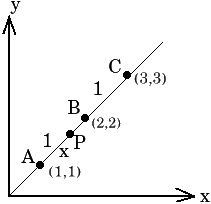
$A$ system consists of $3$ particles each of mass $m$ located at $(1, 1), (2, 2),$ and $(3, 3)$. The coordinates of the centre of mass are
A
$(6, 6)$
B
$(3, 3)$
C
$(2, 2)$
D
$(1, 1)$
Solution
(C) The coordinates of the centre of mass $(X_{cm}, Y_{cm})$ for a system of particles are given by:
$X_{cm} = \frac{m_1 x_1 + m_2 x_2 + m_3 x_3}{m_1 + m_2 + m_3}$
$Y_{cm} = \frac{m_1 y_1 + m_2 y_2 + m_3 y_3}{m_1 + m_2 + m_3}$
Given $m_1 = m_2 = m_3 = m$ and positions $(x_1, y_1) = (1, 1), (x_2, y_2) = (2, 2), (x_3, y_3) = (3, 3)$.
$X_{cm} = \frac{m(1) + m(2) + m(3)}{m + m + m} = \frac{6m}{3m} = 2$
$Y_{cm} = \frac{m(1) + m(2) + m(3)}{m + m + m} = \frac{6m}{3m} = 2$
Thus,the centre of mass is at $(2, 2)$.
$X_{cm} = \frac{m_1 x_1 + m_2 x_2 + m_3 x_3}{m_1 + m_2 + m_3}$
$Y_{cm} = \frac{m_1 y_1 + m_2 y_2 + m_3 y_3}{m_1 + m_2 + m_3}$
Given $m_1 = m_2 = m_3 = m$ and positions $(x_1, y_1) = (1, 1), (x_2, y_2) = (2, 2), (x_3, y_3) = (3, 3)$.
$X_{cm} = \frac{m(1) + m(2) + m(3)}{m + m + m} = \frac{6m}{3m} = 2$
$Y_{cm} = \frac{m(1) + m(2) + m(3)}{m + m + m} = \frac{6m}{3m} = 2$
Thus,the centre of mass is at $(2, 2)$.
0 likes
View Solution5
MediumMCQ
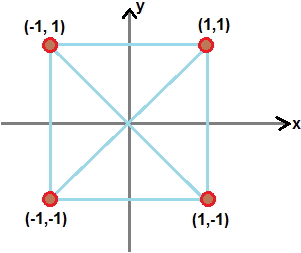
Four identical spheres each of mass $m$ are placed at the corners of a square of side $2 \, m$. Taking the point of intersection of the diagonals as the origin,the coordinates of the centre of mass are
A
$(0, 0)$
B
$(1, 1)$
C
$(-1, 1)$
D
$(1, -1)$
Solution
(A) The coordinates of the four spheres are $(1, 1)$,$(-1, 1)$,$(-1, -1)$,and $(1, -1)$.
Since all spheres have the same mass $m$,the coordinates of the centre of mass $(X_{cm}, Y_{cm})$ are given by:
$X_{cm} = \frac{m(1) + m(-1) + m(-1) + m(1)}{m + m + m + m} = \frac{0}{4m} = 0$
$Y_{cm} = \frac{m(1) + m(1) + m(-1) + m(-1)}{m + m + m + m} = \frac{0}{4m} = 0$
Thus,the centre of mass is at $(0, 0)$.
Since all spheres have the same mass $m$,the coordinates of the centre of mass $(X_{cm}, Y_{cm})$ are given by:
$X_{cm} = \frac{m(1) + m(-1) + m(-1) + m(1)}{m + m + m + m} = \frac{0}{4m} = 0$
$Y_{cm} = \frac{m(1) + m(1) + m(-1) + m(-1)}{m + m + m + m} = \frac{0}{4m} = 0$
Thus,the centre of mass is at $(0, 0)$.
0 likes
View Solution6
MediumMCQ
Two point masses $m$ and $M$ are separated by a distance $L$. The distance of the centre of mass of the system from $m$ is
A
$L(m/M)$
B
$L(M/m)$
C
$L\left( \frac{M}{m + M} \right)$
D
$L\left( \frac{m}{m + M} \right)$
Solution
(C) Let the position of mass $m$ be at the origin $(x_1 = 0)$ and the position of mass $M$ be at $(x_2 = L)$ along the $x$-axis.
The formula for the center of mass $X_{cm}$ of a two-particle system is given by:
$X_{cm} = \frac{m_1x_1 + m_2x_2}{m_1 + m_2}$
Substituting the values:
$X_{cm} = \frac{m(0) + M(L)}{m + M}$
$X_{cm} = \frac{ML}{m + M} = L\left( \frac{M}{m + M} \right)$
Thus,the distance of the center of mass from $m$ is $L\left( \frac{M}{m + M} \right)$.
The formula for the center of mass $X_{cm}$ of a two-particle system is given by:
$X_{cm} = \frac{m_1x_1 + m_2x_2}{m_1 + m_2}$
Substituting the values:
$X_{cm} = \frac{m(0) + M(L)}{m + M}$
$X_{cm} = \frac{ML}{m + M} = L\left( \frac{M}{m + M} \right)$
Thus,the distance of the center of mass from $m$ is $L\left( \frac{M}{m + M} \right)$.
0 likes
View Solution7
DifficultMCQ
Three identical spheres,each of mass $1 \ kg$,are placed touching each other with their centres on a straight line. Their centres are marked $K, L$,and $M$ respectively. The distance of the centre of mass of the system from $K$ is
A
$\frac{KL + KM + LM}{3}$
B
$\frac{KL + KM}{3}$
C
$\frac{KL + LM}{3}$
D
$\frac{KM + LM}{3}$
Solution
(B) Let the radius of each sphere be $r$. Since the spheres are identical and touching,the distance between the centres of adjacent spheres is $2r$.
Let the positions of the centres be $x_K = 0$,$x_L = 2r$,and $x_M = 4r$.
The mass of each sphere is $m = 1 \ kg$.
The centre of mass $X_{cm}$ is given by $X_{cm} = \frac{m x_K + m x_L + m x_M}{m + m + m} = \frac{0 + 2r + 4r}{3} = \frac{6r}{3} = 2r$.
Since $KL = 2r$ and $KM = 4r$,we have $X_{cm} = KL = \frac{KM}{2}$.
Alternatively,$X_{cm} = \frac{KL + KM}{3} = \frac{2r + 4r}{3} = 2r$.
Thus,the distance of the centre of mass from $K$ is $\frac{KL + KM}{3}$.
Let the positions of the centres be $x_K = 0$,$x_L = 2r$,and $x_M = 4r$.
The mass of each sphere is $m = 1 \ kg$.
The centre of mass $X_{cm}$ is given by $X_{cm} = \frac{m x_K + m x_L + m x_M}{m + m + m} = \frac{0 + 2r + 4r}{3} = \frac{6r}{3} = 2r$.
Since $KL = 2r$ and $KM = 4r$,we have $X_{cm} = KL = \frac{KM}{2}$.
Alternatively,$X_{cm} = \frac{KL + KM}{3} = \frac{2r + 4r}{3} = 2r$.
Thus,the distance of the centre of mass from $K$ is $\frac{KL + KM}{3}$.
0 likes
View Solution8
MediumMCQ
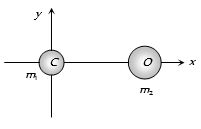
The distance between the carbon atom and the oxygen atom in a carbon monoxide molecule is $1.1 \ \mathring{A}$. Given,mass of carbon atom is $12 \ a.m.u.$ and mass of oxygen atom is $16 \ a.m.u.$,calculate the position of the center of mass of the carbon monoxide molecule.
A
$6.3 \ \mathring{A}$ from the carbon atom
B
$1 \ \mathring{A}$ from the oxygen atom
C
$0.63 \ \mathring{A}$ from the carbon atom
D
$0.12 \ \mathring{A}$ from the oxygen atom
Solution
(C) Let the carbon atom be at the origin $(0, 0)$ and the oxygen atom be placed at $(1.1, 0)$ on the $x$-axis.
Given: $m_1 = 12 \ a.m.u.$ (carbon),$m_2 = 16 \ a.m.u.$ (oxygen).
Position vectors are $\vec{r}_1 = 0\hat{i}$ and $\vec{r}_2 = 1.1\hat{i}$.
The center of mass $R_{cm}$ is given by:
$R_{cm} = \frac{m_1 r_1 + m_2 r_2}{m_1 + m_2}$
$R_{cm} = \frac{12(0) + 16(1.1)}{12 + 16}$
$R_{cm} = \frac{17.6}{28} \ \mathring{A}$
$R_{cm} \approx 0.63 \ \mathring{A}$ from the carbon atom.
Given: $m_1 = 12 \ a.m.u.$ (carbon),$m_2 = 16 \ a.m.u.$ (oxygen).
Position vectors are $\vec{r}_1 = 0\hat{i}$ and $\vec{r}_2 = 1.1\hat{i}$.
The center of mass $R_{cm}$ is given by:
$R_{cm} = \frac{m_1 r_1 + m_2 r_2}{m_1 + m_2}$
$R_{cm} = \frac{12(0) + 16(1.1)}{12 + 16}$
$R_{cm} = \frac{17.6}{28} \ \mathring{A}$
$R_{cm} \approx 0.63 \ \mathring{A}$ from the carbon atom.
0 likes
View Solution9
DifficultMCQ
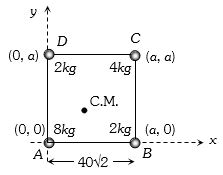
Masses $8\,kg, 2\,kg, 4\,kg, 2\,kg$ are placed at the corners $A, B, C, D$ respectively of a square $ABCD$ of diagonal $80\,cm$. The distance of the centre of mass from $A$ will be ........ $cm$.
A
$20$
B
$30$
C
$40$
D
$60$
Solution
(B) Let corner $A$ of the square $ABCD$ be at the origin $(0,0)$. The mass $8\,kg$ is placed at $A$. The diagonal of the square is $d = a\sqrt{2} = 80\,cm$,where $a$ is the side length.
$a = \frac{80}{\sqrt{2}} = 40\sqrt{2}\,cm$.
The masses are: $m_A = 8\,kg$,$m_B = 2\,kg$,$m_C = 4\,kg$,$m_D = 2\,kg$.
The coordinates of the corners are: $A(0,0)$,$B(a,0)$,$C(a,a)$,$D(0,a)$.
The coordinates of the centre of mass $(X_{CM}, Y_{CM})$ are given by:
$X_{CM} = \frac{m_A x_A + m_B x_B + m_C x_C + m_D x_D}{m_A + m_B + m_C + m_D} = \frac{8(0) + 2(a) + 4(a) + 2(0)}{8 + 2 + 4 + 2} = \frac{6a}{16} = \frac{3a}{8}$.
$Y_{CM} = \frac{m_A y_A + m_B y_B + m_C y_C + m_D y_D}{m_A + m_B + m_C + m_D} = \frac{8(0) + 2(0) + 4(a) + 2(a)}{8 + 2 + 4 + 2} = \frac{6a}{16} = \frac{3a}{8}$.
Substituting $a = 40\sqrt{2}\,cm$:
$X_{CM} = \frac{3(40\sqrt{2})}{8} = 15\sqrt{2}\,cm$.
$Y_{CM} = \frac{3(40\sqrt{2})}{8} = 15\sqrt{2}\,cm$.
The distance of the centre of mass from $A(0,0)$ is $d = \sqrt{X_{CM}^2 + Y_{CM}^2} = \sqrt{(15\sqrt{2})^2 + (15\sqrt{2})^2} = \sqrt{450 + 450} = \sqrt{900} = 30\,cm$.
$a = \frac{80}{\sqrt{2}} = 40\sqrt{2}\,cm$.
The masses are: $m_A = 8\,kg$,$m_B = 2\,kg$,$m_C = 4\,kg$,$m_D = 2\,kg$.
The coordinates of the corners are: $A(0,0)$,$B(a,0)$,$C(a,a)$,$D(0,a)$.
The coordinates of the centre of mass $(X_{CM}, Y_{CM})$ are given by:
$X_{CM} = \frac{m_A x_A + m_B x_B + m_C x_C + m_D x_D}{m_A + m_B + m_C + m_D} = \frac{8(0) + 2(a) + 4(a) + 2(0)}{8 + 2 + 4 + 2} = \frac{6a}{16} = \frac{3a}{8}$.
$Y_{CM} = \frac{m_A y_A + m_B y_B + m_C y_C + m_D y_D}{m_A + m_B + m_C + m_D} = \frac{8(0) + 2(0) + 4(a) + 2(a)}{8 + 2 + 4 + 2} = \frac{6a}{16} = \frac{3a}{8}$.
Substituting $a = 40\sqrt{2}\,cm$:
$X_{CM} = \frac{3(40\sqrt{2})}{8} = 15\sqrt{2}\,cm$.
$Y_{CM} = \frac{3(40\sqrt{2})}{8} = 15\sqrt{2}\,cm$.
The distance of the centre of mass from $A(0,0)$ is $d = \sqrt{X_{CM}^2 + Y_{CM}^2} = \sqrt{(15\sqrt{2})^2 + (15\sqrt{2})^2} = \sqrt{450 + 450} = \sqrt{900} = 30\,cm$.
2 likes
View Solution10
MediumMCQ
The coordinates of the positions of particles of mass $7 \, g$,$4 \, g$,and $10 \, g$ are $(1, 5, -3) \, cm$,$(2, 5, 7) \, cm$,and $(3, 3, -1) \, cm$ respectively. The position of the centre of mass of the system would be:
A
$\left( -\frac{15}{7}, \frac{85}{17}, \frac{1}{7} \right) \, cm$
B
$\left( \frac{15}{7}, -\frac{85}{17}, \frac{1}{7} \right) \, cm$
C
$\left( \frac{15}{7}, \frac{85}{21}, -\frac{1}{7} \right) \, cm$
D
$\left( \frac{15}{7}, \frac{85}{21}, \frac{7}{3} \right) \, cm$
Solution
(C) Given masses are $m_1 = 7 \, g$,$m_2 = 4 \, g$,and $m_3 = 10 \, g$.
Their position vectors are $\vec{r}_1 = (1\hat{i} + 5\hat{j} - 3\hat{k}) \, cm$,$\vec{r}_2 = (2\hat{i} + 5\hat{j} + 7\hat{k}) \, cm$,and $\vec{r}_3 = (3\hat{i} + 3\hat{j} - 1\hat{k}) \, cm$.
The position of the centre of mass $\vec{R}_{cm}$ is given by $\vec{R}_{cm} = \frac{m_1\vec{r}_1 + m_2\vec{r}_2 + m_3\vec{r}_3}{m_1 + m_2 + m_3}$.
Substituting the values:
$\vec{R}_{cm} = \frac{7(1\hat{i} + 5\hat{j} - 3\hat{k}) + 4(2\hat{i} + 5\hat{j} + 7\hat{k}) + 10(3\hat{i} + 3\hat{j} - 1\hat{k})}{7 + 4 + 10}$
$\vec{R}_{cm} = \frac{(7\hat{i} + 35\hat{j} - 21\hat{k}) + (8\hat{i} + 20\hat{j} + 28\hat{k}) + (30\hat{i} + 30\hat{j} - 10\hat{k})}{21}$
$\vec{R}_{cm} = \frac{(7+8+30)\hat{i} + (35+20+30)\hat{j} + (-21+28-10)\hat{k}}{21}$
$\vec{R}_{cm} = \frac{45\hat{i} + 85\hat{j} - 3\hat{k}}{21} = \frac{45}{21}\hat{i} + \frac{85}{21}\hat{j} - \frac{3}{21}\hat{k}$
$\vec{R}_{cm} = \frac{15}{7}\hat{i} + \frac{85}{21}\hat{j} - \frac{1}{7}\hat{k}$.
Thus,the coordinates are $\left( \frac{15}{7}, \frac{85}{21}, -\frac{1}{7} \right) \, cm$.
Their position vectors are $\vec{r}_1 = (1\hat{i} + 5\hat{j} - 3\hat{k}) \, cm$,$\vec{r}_2 = (2\hat{i} + 5\hat{j} + 7\hat{k}) \, cm$,and $\vec{r}_3 = (3\hat{i} + 3\hat{j} - 1\hat{k}) \, cm$.
The position of the centre of mass $\vec{R}_{cm}$ is given by $\vec{R}_{cm} = \frac{m_1\vec{r}_1 + m_2\vec{r}_2 + m_3\vec{r}_3}{m_1 + m_2 + m_3}$.
Substituting the values:
$\vec{R}_{cm} = \frac{7(1\hat{i} + 5\hat{j} - 3\hat{k}) + 4(2\hat{i} + 5\hat{j} + 7\hat{k}) + 10(3\hat{i} + 3\hat{j} - 1\hat{k})}{7 + 4 + 10}$
$\vec{R}_{cm} = \frac{(7\hat{i} + 35\hat{j} - 21\hat{k}) + (8\hat{i} + 20\hat{j} + 28\hat{k}) + (30\hat{i} + 30\hat{j} - 10\hat{k})}{21}$
$\vec{R}_{cm} = \frac{(7+8+30)\hat{i} + (35+20+30)\hat{j} + (-21+28-10)\hat{k}}{21}$
$\vec{R}_{cm} = \frac{45\hat{i} + 85\hat{j} - 3\hat{k}}{21} = \frac{45}{21}\hat{i} + \frac{85}{21}\hat{j} - \frac{3}{21}\hat{k}$
$\vec{R}_{cm} = \frac{15}{7}\hat{i} + \frac{85}{21}\hat{j} - \frac{1}{7}\hat{k}$.
Thus,the coordinates are $\left( \frac{15}{7}, \frac{85}{21}, -\frac{1}{7} \right) \, cm$.
0 likes
View Solution11
DifficultMCQ
Weights of $1\,g, 2\,g, \dots, 100\,g$ are suspended from the $1\,cm, 2\,cm, \dots, 100\,cm$ marks respectively of a light metre scale. Where should it be supported for the system to be in equilibrium?
A
$66.67$
B
$60$
C
$67$
D
$72$
Solution
(C) The system is in equilibrium when supported at its center of mass $(COM)$.
The masses are $m_i = i$ (in grams) and their positions are $x_i = i$ (in cm) for $i = 1, 2, \dots, 100$.
The center of mass is given by:
$COM = \frac{\sum_{i=1}^{100} m_i x_i}{\sum_{i=1}^{100} m_i} = \frac{\sum_{i=1}^{100} i^2}{\sum_{i=1}^{100} i}$
Using the summation formulas:
$\sum_{i=1}^{n} i = \frac{n(n+1)}{2}$ and $\sum_{i=1}^{n} i^2 = \frac{n(n+1)(2n+1)}{6}$
For $n = 100$:
$COM = \frac{\frac{100(101)(201)}{6}}{\frac{100(101)}{2}} = \frac{201}{3} = 67\,cm$.
Thus,the system should be supported at the $67\,cm$ mark.
The masses are $m_i = i$ (in grams) and their positions are $x_i = i$ (in cm) for $i = 1, 2, \dots, 100$.
The center of mass is given by:
$COM = \frac{\sum_{i=1}^{100} m_i x_i}{\sum_{i=1}^{100} m_i} = \frac{\sum_{i=1}^{100} i^2}{\sum_{i=1}^{100} i}$
Using the summation formulas:
$\sum_{i=1}^{n} i = \frac{n(n+1)}{2}$ and $\sum_{i=1}^{n} i^2 = \frac{n(n+1)(2n+1)}{6}$
For $n = 100$:
$COM = \frac{\frac{100(101)(201)}{6}}{\frac{100(101)}{2}} = \frac{201}{3} = 67\,cm$.
Thus,the system should be supported at the $67\,cm$ mark.
0 likes
View Solution12
MediumMCQ
The moment of inertia of an $HCl$ molecule about an axis passing through its centre of mass and perpendicular to the line joining the $H^+$ and $Cl^-$ ions is,if the interatomic distance is $1 \ \mathring A$:
A
$0.61 \times 10^{-47} \ kg \ m^2$
B
$1.61 \times 10^{-47} \ kg \ m^2$
C
$0.061 \times 10^{-47} \ kg \ m^2$
D
$0$
Solution
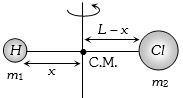
(B) The masses of the atoms are $m_1 = 1 \ amu$ (for $H$) and $m_2 = 35.5 \ amu$ (for $Cl$). The interatomic distance is $L = 1 \ \mathring A = 10^{-10} \ m$.
Let $x$ be the distance of $H$ from the center of mass ($C$.$M$.). Then the distance of $Cl$ from the $C$.$M$. is $(L - x)$.
Using the definition of the center of mass: $m_1 x = m_2 (L - x) \Rightarrow 1 \cdot x = 35.5 \cdot (1 - x)$.
$x = 35.5 - 35.5x \Rightarrow 36.5x = 35.5 \Rightarrow x = \frac{35.5}{36.5} \ \mathring A \approx 0.9726 \ \mathring A$.
The distance of $Cl$ from the $C$.$M$. is $(L - x) = 1 - 0.9726 = 0.0274 \ \mathring A$.
The moment of inertia $I$ is given by $I = m_1 x^2 + m_2 (L - x)^2$.
Using $1 \ amu = 1.67 \times 10^{-27} \ kg$:
$I = (1 \times 1.67 \times 10^{-27}) \times (0.9726 \times 10^{-10})^2 + (35.5 \times 1.67 \times 10^{-27}) \times (0.0274 \times 10^{-10})^2$.
$I = 1.67 \times 10^{-27} \times 10^{-20} \times [0.9726^2 + 35.5 \times 0.0274^2]$.
$I = 1.67 \times 10^{-47} \times [0.946 + 35.5 \times 0.00075] \approx 1.67 \times 10^{-47} \times [0.946 + 0.0266] \approx 1.67 \times 10^{-47} \times 0.9726 \approx 1.62 \times 10^{-47} \ kg \ m^2$.
This is approximately $1.61 \times 10^{-47} \ kg \ m^2$.
Let $x$ be the distance of $H$ from the center of mass ($C$.$M$.). Then the distance of $Cl$ from the $C$.$M$. is $(L - x)$.
Using the definition of the center of mass: $m_1 x = m_2 (L - x) \Rightarrow 1 \cdot x = 35.5 \cdot (1 - x)$.
$x = 35.5 - 35.5x \Rightarrow 36.5x = 35.5 \Rightarrow x = \frac{35.5}{36.5} \ \mathring A \approx 0.9726 \ \mathring A$.
The distance of $Cl$ from the $C$.$M$. is $(L - x) = 1 - 0.9726 = 0.0274 \ \mathring A$.
The moment of inertia $I$ is given by $I = m_1 x^2 + m_2 (L - x)^2$.
Using $1 \ amu = 1.67 \times 10^{-27} \ kg$:
$I = (1 \times 1.67 \times 10^{-27}) \times (0.9726 \times 10^{-10})^2 + (35.5 \times 1.67 \times 10^{-27}) \times (0.0274 \times 10^{-10})^2$.
$I = 1.67 \times 10^{-27} \times 10^{-20} \times [0.9726^2 + 35.5 \times 0.0274^2]$.
$I = 1.67 \times 10^{-47} \times [0.946 + 35.5 \times 0.00075] \approx 1.67 \times 10^{-47} \times [0.946 + 0.0266] \approx 1.67 \times 10^{-47} \times 0.9726 \approx 1.62 \times 10^{-47} \ kg \ m^2$.
This is approximately $1.61 \times 10^{-47} \ kg \ m^2$.
0 likes
View Solution13
MediumMCQ
Two objects $A$ and $B$ of masses $M$ and $m$ respectively,where $M > m$,are separated by a distance. They move towards each other under the influence of equal forces. At what point will they collide?
A
Near $B$
B
Near $A$
C
At an equal distance from $A$ and $B$
D
Cannot be determined
Solution
(B) Since the net external force on the system is zero (or the forces are internal to the system),the center of mass of the system remains at rest if it was initially at rest.
They will collide at their center of mass.
The position of the center of mass is given by $x_{cm} = \frac{M x_A + m x_B}{M + m}$.
Since $M > m$,the center of mass is closer to the heavier mass $A$.
Therefore,they will collide near $A$.
They will collide at their center of mass.
The position of the center of mass is given by $x_{cm} = \frac{M x_A + m x_B}{M + m}$.
Since $M > m$,the center of mass is closer to the heavier mass $A$.
Therefore,they will collide near $A$.
0 likes
View Solution14
DifficultMCQ
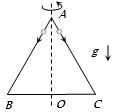
$A$ uniform square plate is shown in the figure. Four identical squares are removed from its corners. If squares $1$ and $3$ are removed,where will the center of mass $(C.M.)$ be located?
A
At point $O$
B
On $OY'$
C
On $OX'$
D
On $OX$
Solution
(C) Let the square plate be placed in the $XY$-plane with its center at the origin $O(0,0)$.
Let the four corners be located at $(a, a), (-a, a), (-a, -a),$ and $(a, -a)$.
Let the squares $1, 2, 3,$ and $4$ be at these corners respectively.
When squares $1$ and $3$ (diagonally opposite) are removed,the remaining system is symmetric about the line passing through the centers of squares $2$ and $4$.
This line corresponds to the diagonal $Y = -X$ (or $OX'$ axis depending on the coordinate orientation).
Due to the symmetry of the remaining mass distribution about this diagonal,the center of mass must lie on this line of symmetry.
Therefore,the center of mass will be located on the axis $OX'$.
Let the four corners be located at $(a, a), (-a, a), (-a, -a),$ and $(a, -a)$.
Let the squares $1, 2, 3,$ and $4$ be at these corners respectively.
When squares $1$ and $3$ (diagonally opposite) are removed,the remaining system is symmetric about the line passing through the centers of squares $2$ and $4$.
This line corresponds to the diagonal $Y = -X$ (or $OX'$ axis depending on the coordinate orientation).
Due to the symmetry of the remaining mass distribution about this diagonal,the center of mass must lie on this line of symmetry.
Therefore,the center of mass will be located on the axis $OX'$.
0 likes
View Solution15
DifficultMCQ
Two particles of masses $200 \ g$ and $500 \ g$ are moving with velocities $10 \ \hat{i} \ m/s$ and $3 \ \hat{i} + 5 \ \hat{j} \ m/s$ respectively. The velocity of the center of mass of the system is:
A
$5 \ \hat{i} - \frac{25}{7} \ \hat{j}$
B
$\frac{5}{7} \ \hat{i} - 25 \ \hat{j}$
C
$5 \ \hat{i} + \frac{25}{7} \ \hat{j}$
D
$25 \ \hat{i} + \frac{5}{7} \ \hat{j}$
Solution
(C) The velocity of the center of mass $\vec{V}_{cm}$ is given by the formula:
$\vec{V}_{cm} = \frac{m_1 \vec{v}_1 + m_2 \vec{v}_2}{m_1 + m_2}$
Given: $m_1 = 200 \ g$,$m_2 = 500 \ g$,$\vec{v}_1 = 10 \ \hat{i} \ m/s$,$\vec{v}_2 = 3 \ \hat{i} + 5 \ \hat{j} \ m/s$.
Substituting the values:
$\vec{V}_{cm} = \frac{200(10 \ \hat{i}) + 500(3 \ \hat{i} + 5 \ \hat{j})}{200 + 500}$
$\vec{V}_{cm} = \frac{2000 \ \hat{i} + 1500 \ \hat{i} + 2500 \ \hat{j}}{700}$
$\vec{V}_{cm} = \frac{3500 \ \hat{i} + 2500 \ \hat{j}}{700}$
$\vec{V}_{cm} = 5 \ \hat{i} + \frac{25}{7} \ \hat{j} \ m/s$.
$\vec{V}_{cm} = \frac{m_1 \vec{v}_1 + m_2 \vec{v}_2}{m_1 + m_2}$
Given: $m_1 = 200 \ g$,$m_2 = 500 \ g$,$\vec{v}_1 = 10 \ \hat{i} \ m/s$,$\vec{v}_2 = 3 \ \hat{i} + 5 \ \hat{j} \ m/s$.
Substituting the values:
$\vec{V}_{cm} = \frac{200(10 \ \hat{i}) + 500(3 \ \hat{i} + 5 \ \hat{j})}{200 + 500}$
$\vec{V}_{cm} = \frac{2000 \ \hat{i} + 1500 \ \hat{i} + 2500 \ \hat{j}}{700}$
$\vec{V}_{cm} = \frac{3500 \ \hat{i} + 2500 \ \hat{j}}{700}$
$\vec{V}_{cm} = 5 \ \hat{i} + \frac{25}{7} \ \hat{j} \ m/s$.
0 likes
View Solution16
MediumMCQ
The center of mass of a system of particles with masses $1 \, g, 2 \, g$,and $3 \, g$ is at the origin. When a particle of mass $4 \, g$ with position vector $\alpha(\hat{i} + 2\hat{j} + 3\hat{k})$ is added,the center of mass of the system becomes $(1, 2, 3)$. If $\alpha$ is a constant,its value must be:
A
$10/3$
B
$5/2$
C
$1/2$
D
$2/5$
Solution
(B) Let the masses be $m_1 = 1 \, g, m_2 = 2 \, g, m_3 = 3 \, g$ and $m_4 = 4 \, g$.
Since the center of mass of the first three particles is at the origin $(0, 0, 0)$,their combined position vector is $\vec{R}_{123} = \frac{m_1\vec{r}_1 + m_2\vec{r}_2 + m_3\vec{r}_3}{m_1 + m_2 + m_3} = (0, 0, 0)$,which implies $m_1\vec{r}_1 + m_2\vec{r}_2 + m_3\vec{r}_3 = 0$.
The position vector of the fourth particle is $\vec{r}_4 = \alpha(\hat{i} + 2\hat{j} + 3\hat{k})$.
The center of mass of the new system is $\vec{R}_{cm} = (1, 2, 3)$.
The formula for the center of mass is $\vec{R}_{cm} = \frac{(m_1\vec{r}_1 + m_2\vec{r}_2 + m_3\vec{r}_3) + m_4\vec{r}_4}{m_1 + m_2 + m_3 + m_4}$.
Substituting the known values: $(1, 2, 3) = \frac{0 + 4\alpha(\hat{i} + 2\hat{j} + 3\hat{k})}{1 + 2 + 3 + 4} = \frac{4\alpha(\hat{i} + 2\hat{j} + 3\hat{k})}{10}$.
Comparing the $x$-components: $1 = \frac{4\alpha}{10} \implies 10 = 4\alpha \implies \alpha = \frac{10}{4} = 2.5 = 5/2$.
Similarly,for $y$-components: $2 = \frac{8\alpha}{10} \implies 20 = 8\alpha \implies \alpha = 2.5 = 5/2$.
Thus,the value of $\alpha$ is $5/2$.
Since the center of mass of the first three particles is at the origin $(0, 0, 0)$,their combined position vector is $\vec{R}_{123} = \frac{m_1\vec{r}_1 + m_2\vec{r}_2 + m_3\vec{r}_3}{m_1 + m_2 + m_3} = (0, 0, 0)$,which implies $m_1\vec{r}_1 + m_2\vec{r}_2 + m_3\vec{r}_3 = 0$.
The position vector of the fourth particle is $\vec{r}_4 = \alpha(\hat{i} + 2\hat{j} + 3\hat{k})$.
The center of mass of the new system is $\vec{R}_{cm} = (1, 2, 3)$.
The formula for the center of mass is $\vec{R}_{cm} = \frac{(m_1\vec{r}_1 + m_2\vec{r}_2 + m_3\vec{r}_3) + m_4\vec{r}_4}{m_1 + m_2 + m_3 + m_4}$.
Substituting the known values: $(1, 2, 3) = \frac{0 + 4\alpha(\hat{i} + 2\hat{j} + 3\hat{k})}{1 + 2 + 3 + 4} = \frac{4\alpha(\hat{i} + 2\hat{j} + 3\hat{k})}{10}$.
Comparing the $x$-components: $1 = \frac{4\alpha}{10} \implies 10 = 4\alpha \implies \alpha = \frac{10}{4} = 2.5 = 5/2$.
Similarly,for $y$-components: $2 = \frac{8\alpha}{10} \implies 20 = 8\alpha \implies \alpha = 2.5 = 5/2$.
Thus,the value of $\alpha$ is $5/2$.
0 likes
View Solution17
DifficultMCQ
Particles of masses $8 \, kg, 2 \, kg, 4 \, kg$,and $2 \, kg$ are placed at the vertices $A, B, C$,and $D$ of a square respectively. The distance of the center of mass of the system from vertex $A$ is $....... \, cm$. The length of the diagonal of the square is $80 \, cm$.
A
$20$
B
$30$
C
$40$
D
$60$
Solution
(B) Let vertex $A$ be at the origin $(0, 0)$. The side length of the square $s$ is related to the diagonal $d = 80 \, cm$ by $s = d / \sqrt{2} = 80 / \sqrt{2} = 40\sqrt{2} \, cm$.
The coordinates of the vertices are: $A(0, 0)$,$B(40\sqrt{2}, 0)$,$C(40\sqrt{2}, 40\sqrt{2})$,and $D(0, 40\sqrt{2})$.
The masses are $m_A = 8 \, kg, m_B = 2 \, kg, m_C = 4 \, kg, m_D = 2 \, kg$. Total mass $M = 8 + 2 + 4 + 2 = 16 \, kg$.
The $x$-coordinate of the center of mass is $X_{cm} = \frac{m_A x_A + m_B x_B + m_C x_C + m_D x_D}{M} = \frac{8(0) + 2(40\sqrt{2}) + 4(40\sqrt{2}) + 2(0)}{16} = \frac{240\sqrt{2}}{16} = 15\sqrt{2} \, cm$.
The $y$-coordinate of the center of mass is $Y_{cm} = \frac{m_A y_A + m_B y_B + m_C y_C + m_D y_D}{M} = \frac{8(0) + 2(0) + 4(40\sqrt{2}) + 2(40\sqrt{2})}{16} = \frac{240\sqrt{2}}{16} = 15\sqrt{2} \, cm$.
The distance from $A(0, 0)$ is $R = \sqrt{X_{cm}^2 + Y_{cm}^2} = \sqrt{(15\sqrt{2})^2 + (15\sqrt{2})^2} = \sqrt{450 + 450} = \sqrt{900} = 30 \, cm$.
The coordinates of the vertices are: $A(0, 0)$,$B(40\sqrt{2}, 0)$,$C(40\sqrt{2}, 40\sqrt{2})$,and $D(0, 40\sqrt{2})$.
The masses are $m_A = 8 \, kg, m_B = 2 \, kg, m_C = 4 \, kg, m_D = 2 \, kg$. Total mass $M = 8 + 2 + 4 + 2 = 16 \, kg$.
The $x$-coordinate of the center of mass is $X_{cm} = \frac{m_A x_A + m_B x_B + m_C x_C + m_D x_D}{M} = \frac{8(0) + 2(40\sqrt{2}) + 4(40\sqrt{2}) + 2(0)}{16} = \frac{240\sqrt{2}}{16} = 15\sqrt{2} \, cm$.
The $y$-coordinate of the center of mass is $Y_{cm} = \frac{m_A y_A + m_B y_B + m_C y_C + m_D y_D}{M} = \frac{8(0) + 2(0) + 4(40\sqrt{2}) + 2(40\sqrt{2})}{16} = \frac{240\sqrt{2}}{16} = 15\sqrt{2} \, cm$.
The distance from $A(0, 0)$ is $R = \sqrt{X_{cm}^2 + Y_{cm}^2} = \sqrt{(15\sqrt{2})^2 + (15\sqrt{2})^2} = \sqrt{450 + 450} = \sqrt{900} = 30 \, cm$.
0 likes
View Solution18
DifficultMCQ
The position vectors of two particles of masses $1 \ kg$ and $3 \ kg$ are $\hat{i} + 2\hat{j} + \hat{k}$ and $-3\hat{i} - 2\hat{j} + \hat{k}$ respectively. The position vector of the center of mass of this system is:
A
$-2\hat{i} - \hat{j} + \hat{k}$
B
$2\hat{i} - \hat{j} - 2\hat{k}$
C
$-\hat{i} + \hat{j} + \hat{k}$
D
$-2\hat{i} + 2\hat{k}$
Solution
(A) The formula for the position vector of the center of mass is $\vec{r}_{cm} = \frac{m_1\vec{r}_1 + m_2\vec{r}_2}{m_1 + m_2}$.
Given $m_1 = 1 \ kg$,$\vec{r}_1 = \hat{i} + 2\hat{j} + \hat{k}$ and $m_2 = 3 \ kg$,$\vec{r}_2 = -3\hat{i} - 2\hat{j} + \hat{k}$.
Substituting these values:
$\vec{r}_{cm} = \frac{1(\hat{i} + 2\hat{j} + \hat{k}) + 3(-3\hat{i} - 2\hat{j} + \hat{k})}{1 + 3}$
$\vec{r}_{cm} = \frac{\hat{i} + 2\hat{j} + \hat{k} - 9\hat{i} - 6\hat{j} + 3\hat{k}}{4}$
$\vec{r}_{cm} = \frac{-8\hat{i} - 4\hat{j} + 4\hat{k}}{4}$
$\vec{r}_{cm} = -2\hat{i} - \hat{j} + \hat{k}$.
Given $m_1 = 1 \ kg$,$\vec{r}_1 = \hat{i} + 2\hat{j} + \hat{k}$ and $m_2 = 3 \ kg$,$\vec{r}_2 = -3\hat{i} - 2\hat{j} + \hat{k}$.
Substituting these values:
$\vec{r}_{cm} = \frac{1(\hat{i} + 2\hat{j} + \hat{k}) + 3(-3\hat{i} - 2\hat{j} + \hat{k})}{1 + 3}$
$\vec{r}_{cm} = \frac{\hat{i} + 2\hat{j} + \hat{k} - 9\hat{i} - 6\hat{j} + 3\hat{k}}{4}$
$\vec{r}_{cm} = \frac{-8\hat{i} - 4\hat{j} + 4\hat{k}}{4}$
$\vec{r}_{cm} = -2\hat{i} - \hat{j} + \hat{k}$.
0 likes
View Solution19
MediumMCQ
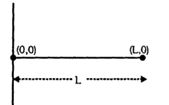
Find the position of the center of mass of a system of two particles of masses $m_1$ and $m_2$ separated by a distance $L$.
A
$\frac{m_2 L}{m_1}$
B
$\frac{m_2 L}{m_1 + m_2}$
C
$\frac{m_2 L}{m_1 - m_2}$
D
$\frac{m_1 L}{m_1 - m_2}$
Solution
(B) Let the two particles be placed on the $x$-axis. Let mass $m_1$ be at the origin $(0, 0)$ and mass $m_2$ be at $(L, 0)$.
The formula for the center of mass $x_{CM}$ is given by:
$x_{CM} = \frac{m_1 x_1 + m_2 x_2}{m_1 + m_2}$
Substituting the values $x_1 = 0$ and $x_2 = L$:
$x_{CM} = \frac{m_1(0) + m_2(L)}{m_1 + m_2}$
$x_{CM} = \frac{m_2 L}{m_1 + m_2}$
Since the particles are on the $x$-axis,$y_{CM} = 0$ and $z_{CM} = 0$.
The formula for the center of mass $x_{CM}$ is given by:
$x_{CM} = \frac{m_1 x_1 + m_2 x_2}{m_1 + m_2}$
Substituting the values $x_1 = 0$ and $x_2 = L$:
$x_{CM} = \frac{m_1(0) + m_2(L)}{m_1 + m_2}$
$x_{CM} = \frac{m_2 L}{m_1 + m_2}$
Since the particles are on the $x$-axis,$y_{CM} = 0$ and $z_{CM} = 0$.
0 likes
View Solution20
MediumMCQ
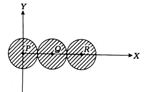
Three identical spheres,each of mass $1 \ kg$,are arranged as shown in the figure. If their centers of mass are at $P$,$Q$,and $R$ respectively,what is the distance of the center of mass of this system from point $P$?
A
$\frac{PQ + PR + QR}{3}$
B
$\frac{PQ + PR}{3}$
C
$\frac{PQ + QR}{3}$
D
$\frac{PR + QR}{3}$
Solution
(B) Let the position of point $P$ be at the origin $(0, 0)$.
Since the spheres are identical and arranged along the $X$-axis,the positions of the centers of mass are $P = 0$,$Q = PQ$,and $R = PR$.
The mass of each sphere is $m = 1 \ kg$.
The center of mass $x_{cm}$ of the system is given by:
$x_{cm} = \frac{m_1x_1 + m_2x_2 + m_3x_3}{m_1 + m_2 + m_3}$
$x_{cm} = \frac{(1 \times 0) + (1 \times PQ) + (1 \times PR)}{1 + 1 + 1}$
$x_{cm} = \frac{PQ + PR}{3}$
Since the spheres are identical and arranged along the $X$-axis,the positions of the centers of mass are $P = 0$,$Q = PQ$,and $R = PR$.
The mass of each sphere is $m = 1 \ kg$.
The center of mass $x_{cm}$ of the system is given by:
$x_{cm} = \frac{m_1x_1 + m_2x_2 + m_3x_3}{m_1 + m_2 + m_3}$
$x_{cm} = \frac{(1 \times 0) + (1 \times PQ) + (1 \times PR)}{1 + 1 + 1}$
$x_{cm} = \frac{PQ + PR}{3}$
0 likes
View Solution21
MediumMCQ
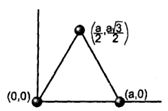
Three equal masses are placed at $(0,0)$,$(a,0)$,and $\left( \frac{a}{2}, \frac{a\sqrt{3}}{2} \right)$. Find the coordinates of the center of mass.
A
$\frac{a}{2}, \frac{a\sqrt{3}}{6}$
B
$\frac{a}{2}, \frac{a}{6}$
C
$\frac{a\sqrt{3}}{2}, \frac{a\sqrt{3}}{6}$
D
$\frac{a\sqrt{3}}{6}, \frac{a\sqrt{3}}{6}$
Solution
(A) Let the three equal masses be $m_1 = m_2 = m_3 = m$.
The coordinates are $(x_1, y_1) = (0,0)$,$(x_2, y_2) = (a,0)$,and $(x_3, y_3) = \left( \frac{a}{2}, \frac{a\sqrt{3}}{2} \right)$.
The $x$-coordinate of the center of mass is given by:
$x_{CM} = \frac{m_1x_1 + m_2x_2 + m_3x_3}{m_1 + m_2 + m_3} = \frac{m(0) + m(a) + m(\frac{a}{2})}{m + m + m} = \frac{m(a + \frac{a}{2})}{3m} = \frac{\frac{3a}{2}}{3} = \frac{a}{2}$.
The $y$-coordinate of the center of mass is given by:
$y_{CM} = \frac{m_1y_1 + m_2y_2 + m_3y_3}{m_1 + m_2 + m_3} = \frac{m(0) + m(0) + m(\frac{a\sqrt{3}}{2})}{m + m + m} = \frac{m(\frac{a\sqrt{3}}{2})}{3m} = \frac{a\sqrt{3}}{6}$.
Thus,the coordinates of the center of mass are $\left( \frac{a}{2}, \frac{a\sqrt{3}}{6} \right)$.
The coordinates are $(x_1, y_1) = (0,0)$,$(x_2, y_2) = (a,0)$,and $(x_3, y_3) = \left( \frac{a}{2}, \frac{a\sqrt{3}}{2} \right)$.
The $x$-coordinate of the center of mass is given by:
$x_{CM} = \frac{m_1x_1 + m_2x_2 + m_3x_3}{m_1 + m_2 + m_3} = \frac{m(0) + m(a) + m(\frac{a}{2})}{m + m + m} = \frac{m(a + \frac{a}{2})}{3m} = \frac{\frac{3a}{2}}{3} = \frac{a}{2}$.
The $y$-coordinate of the center of mass is given by:
$y_{CM} = \frac{m_1y_1 + m_2y_2 + m_3y_3}{m_1 + m_2 + m_3} = \frac{m(0) + m(0) + m(\frac{a\sqrt{3}}{2})}{m + m + m} = \frac{m(\frac{a\sqrt{3}}{2})}{3m} = \frac{a\sqrt{3}}{6}$.
Thus,the coordinates of the center of mass are $\left( \frac{a}{2}, \frac{a\sqrt{3}}{6} \right)$.
0 likes
View Solution22
MediumMCQ
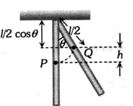
$A$ metre stick of mass $400 \ g$ is pivoted at one end and displaced through an angle $60^o$. The increase in its potential energy is ..... $J$.
A
$2$
B
$3$
C
$0$
D
$1$
Solution
(D) The centre of mass of the metre stick is at its midpoint,which is at a distance of $L/2 = 0.5 \ m$ from the pivot.
When the stick is displaced by an angle $\theta = 60^o$,the vertical height $h$ by which the centre of mass rises is given by:
$h = \frac{L}{2} - \frac{L}{2} \cos \theta$
Given $L = 1 \ m$ and $\theta = 60^o$:
$h = 0.5 - 0.5 \cos 60^o = 0.5 - 0.5 \times 0.5 = 0.5 - 0.25 = 0.25 \ m$
The increase in potential energy $\Delta U$ is given by:
$\Delta U = mgh$
Given mass $m = 400 \ g = 0.4 \ kg$ and taking $g = 10 \ m/s^2$:
$\Delta U = 0.4 \times 10 \times 0.25 = 4 \times 0.25 = 1 \ J$.
When the stick is displaced by an angle $\theta = 60^o$,the vertical height $h$ by which the centre of mass rises is given by:
$h = \frac{L}{2} - \frac{L}{2} \cos \theta$
Given $L = 1 \ m$ and $\theta = 60^o$:
$h = 0.5 - 0.5 \cos 60^o = 0.5 - 0.5 \times 0.5 = 0.5 - 0.25 = 0.25 \ m$
The increase in potential energy $\Delta U$ is given by:
$\Delta U = mgh$
Given mass $m = 400 \ g = 0.4 \ kg$ and taking $g = 10 \ m/s^2$:
$\Delta U = 0.4 \times 10 \times 0.25 = 4 \times 0.25 = 1 \ J$.
0 likes
View Solution23
DifficultMCQ
$A$ particle of mass $m$ is moving in the $xy$-plane at a certain height from the ground along the $x$-axis. It suddenly explodes into two fragments of masses $m/4$ and $3m/4$. At that instant,the smaller fragment is at $y = 15 \ cm$. At this instant,the larger fragment will be at $y = $ ........ $cm$.
A
$ -5$
B
$ + 20$
C
$ + 5$
D
$-20$
Solution
(A) Before the explosion,the particle is moving along the $x$-axis,so its initial velocity component in the $y$-direction is zero $(v_{y,i} = 0)$.
Since there are no external forces acting in the $y$-direction,the position of the center of mass $(y_{cm})$ remains constant at $0$ (assuming the initial $y$-coordinate was $0$).
Using the formula for the center of mass: $y_{cm} = \frac{m_1 y_1 + m_2 y_2}{m_1 + m_2}$.
Given $m_1 = m/4$,$y_1 = 15 \ cm$,$m_2 = 3m/4$,and $y_{cm} = 0$.
$0 = \frac{(m/4)(15) + (3m/4)(y_2)}{m/4 + 3m/4}$.
$0 = \frac{m}{4} (15 + 3y_2) / m$.
$15 + 3y_2 = 0$.
$3y_2 = -15$.
$y_2 = -5 \ cm$.
Since there are no external forces acting in the $y$-direction,the position of the center of mass $(y_{cm})$ remains constant at $0$ (assuming the initial $y$-coordinate was $0$).
Using the formula for the center of mass: $y_{cm} = \frac{m_1 y_1 + m_2 y_2}{m_1 + m_2}$.
Given $m_1 = m/4$,$y_1 = 15 \ cm$,$m_2 = 3m/4$,and $y_{cm} = 0$.
$0 = \frac{(m/4)(15) + (3m/4)(y_2)}{m/4 + 3m/4}$.
$0 = \frac{m}{4} (15 + 3y_2) / m$.
$15 + 3y_2 = 0$.
$3y_2 = -15$.
$y_2 = -5 \ cm$.
0 likes
View Solution24
EasyMCQ
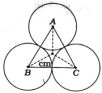
Three identical spheres of radius $r$ are placed on a horizontal surface such that they touch each other. These spheres are arranged such that their centers form an equilateral triangle. The center of mass of this system will be at ........
A
The midpoint of the line connecting two spheres
B
The center of any one sphere
C
On the horizontal surface
D
At the centroid of the triangle formed by their centers
Solution
(D) Since the three spheres are identical and their centers form an equilateral triangle,the system possesses rotational symmetry about the axis passing through the centroid of the triangle.
The center of mass of a system of identical particles is located at the geometric center (centroid) of the configuration.
Therefore,the center of mass of the system of three spheres is located at the centroid of the equilateral triangle formed by their centers.
The center of mass of a system of identical particles is located at the geometric center (centroid) of the configuration.
Therefore,the center of mass of the system of three spheres is located at the centroid of the equilateral triangle formed by their centers.
0 likes
View Solution25
MediumMCQ
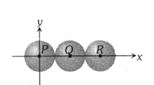
Three identical spheres of mass $1 \ kg$ each are arranged as shown in the figure. The centers of the spheres,which are touching each other,lie on a straight line. If their centers are denoted by $P, Q,$ and $R$,what is the distance of the center of mass of the system from $P$?
A
$(PQ + PR) / 3$
B
$(PQ + PR) / 2$
C
$(PQ + QR) / 3$
D
$(PR + QR) / 3$
Solution
(A) Let the position of the center $P$ be at the origin $(0, 0)$.
Since the spheres are identical and touching,the distance between the centers of adjacent spheres is equal to the diameter of a sphere,say $d$.
Thus,the coordinates of the centers are:
$P = (0, 0)$
$Q = (d, 0)$
$R = (2d, 0)$
Note that $PQ = d$ and $PR = 2d$.
The $x$-coordinate of the center of mass $(x_{cm})$ is given by:
$x_{cm} = \frac{m_P x_P + m_Q x_Q + m_R x_R}{m_P + m_Q + m_R}$
Since $m_P = m_Q = m_R = 1 \ kg$:
$x_{cm} = \frac{1(0) + 1(d) + 1(2d)}{1 + 1 + 1} = \frac{3d}{3} = d$
Since $PQ = d$,the distance of the center of mass from $P$ is $PQ$.
However,looking at the options provided,the expression for the center of mass in terms of distances is:
$x_{cm} = \frac{0 + PQ + PR}{3} = \frac{PQ + PR}{3}$.
Since the spheres are identical and touching,the distance between the centers of adjacent spheres is equal to the diameter of a sphere,say $d$.
Thus,the coordinates of the centers are:
$P = (0, 0)$
$Q = (d, 0)$
$R = (2d, 0)$
Note that $PQ = d$ and $PR = 2d$.
The $x$-coordinate of the center of mass $(x_{cm})$ is given by:
$x_{cm} = \frac{m_P x_P + m_Q x_Q + m_R x_R}{m_P + m_Q + m_R}$
Since $m_P = m_Q = m_R = 1 \ kg$:
$x_{cm} = \frac{1(0) + 1(d) + 1(2d)}{1 + 1 + 1} = \frac{3d}{3} = d$
Since $PQ = d$,the distance of the center of mass from $P$ is $PQ$.
However,looking at the options provided,the expression for the center of mass in terms of distances is:
$x_{cm} = \frac{0 + PQ + PR}{3} = \frac{PQ + PR}{3}$.
0 likes
View Solution26
MediumMCQ
Two point masses of $1.5 \ g$ and $2.5 \ g$ are placed at a distance of $16 \ cm$ from each other. If the center of mass is at a distance $x$ from the $1.5 \ g$ mass,then $x = \dots \ cm$.
A
$10$
B
$6$
C
$13$
D
$3$
Solution
(A) The center of mass $x$ from the first mass $m_1$ is given by the formula: $x = \frac{m_2 d}{m_1 + m_2}$.
Here,$m_1 = 1.5 \ g$,$m_2 = 2.5 \ g$,and $d = 16 \ cm$.
Substituting the values:
$x = \frac{2.5 \times 16}{1.5 + 2.5}$
$x = \frac{40}{4}$
$x = 10 \ cm$.
Here,$m_1 = 1.5 \ g$,$m_2 = 2.5 \ g$,and $d = 16 \ cm$.
Substituting the values:
$x = \frac{2.5 \times 16}{1.5 + 2.5}$
$x = \frac{40}{4}$
$x = 10 \ cm$.
0 likes
View Solution27
DifficultMCQ
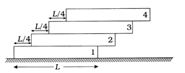
Find the $x$ coordinate of the centre of mass of the books shown in the figure. Every book has mass $m$.
A
$1.25\ L$
B
$\frac{L}{4}$
C
$0.875\ L$
D
$L$
Solution
(C) Let the left edge of the bottom book (book $1$) be at $x = 0$. The length of each book is $L$.
For book $1$,the center of mass is at $x_1 = L/2$.
For book $2$,the left edge is at $x = L/4$,so the center of mass is at $x_2 = L/4 + L/2 = 3L/4$.
For book $3$,the left edge is at $x = L/4 + L/4 = L/2$,so the center of mass is at $x_3 = L/2 + L/2 = L$.
For book $4$,the left edge is at $x = L/4 + L/4 + L/4 = 3L/4$,so the center of mass is at $x_4 = 3L/4 + L/2 = 5L/4$.
Since all books have equal mass $m$,the $x$-coordinate of the center of mass of the system is:
$x_{cm} = \frac{m(x_1 + x_2 + x_3 + x_4)}{4m} = \frac{L/2 + 3L/4 + L + 5L/4}{4}$
$x_{cm} = \frac{(2L + 3L + 4L + 5L)/4}{4} = \frac{14L/4}{4} = \frac{14L}{16} = \frac{7L}{8} = 0.875\ L$.
For book $1$,the center of mass is at $x_1 = L/2$.
For book $2$,the left edge is at $x = L/4$,so the center of mass is at $x_2 = L/4 + L/2 = 3L/4$.
For book $3$,the left edge is at $x = L/4 + L/4 = L/2$,so the center of mass is at $x_3 = L/2 + L/2 = L$.
For book $4$,the left edge is at $x = L/4 + L/4 + L/4 = 3L/4$,so the center of mass is at $x_4 = 3L/4 + L/2 = 5L/4$.
Since all books have equal mass $m$,the $x$-coordinate of the center of mass of the system is:
$x_{cm} = \frac{m(x_1 + x_2 + x_3 + x_4)}{4m} = \frac{L/2 + 3L/4 + L + 5L/4}{4}$
$x_{cm} = \frac{(2L + 3L + 4L + 5L)/4}{4} = \frac{14L/4}{4} = \frac{14L}{16} = \frac{7L}{8} = 0.875\ L$.
0 likes
View Solution28
MediumMCQ
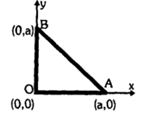
Three rods of equal mass are arranged as shown in the figure. Find the coordinates of the center of mass of the system.
A
$\frac{2a}{3}, \frac{a}{2}$
B
$\frac{2a}{3}, \frac{a}{3}$
C
$\frac{a}{3}, \frac{a}{3}$
D
$\frac{a}{2}, \frac{a}{3}$
Solution
(C) Let the three rods be $OA$,$OB$,and $AB$,each of mass $m$ and length $a$.
$1$. The center of mass $(CM)$ of rod $OA$ (along the x-axis from $(0,0)$ to $(a,0)$) is at $(a/2, 0)$.
$2$. The center of mass $(CM)$ of rod $OB$ (along the y-axis from $(0,0)$ to $(0,a)$) is at $(0, a/2)$.
$3$. The center of mass $(CM)$ of rod $AB$ (connecting $(a,0)$ and $(0,a)$) is at the midpoint of the line segment,which is $(a/2, a/2)$.
Now,calculate the coordinates of the center of mass of the system:
$X_{cm} = \frac{m(a/2) + m(0) + m(a/2)}{m + m + m} = \frac{ma}{3m} = \frac{a}{3}$
$Y_{cm} = \frac{m(0) + m(a/2) + m(a/2)}{m + m + m} = \frac{ma}{3m} = \frac{a}{3}$
Thus,the coordinates of the center of mass are $(a/3, a/3)$.
$1$. The center of mass $(CM)$ of rod $OA$ (along the x-axis from $(0,0)$ to $(a,0)$) is at $(a/2, 0)$.
$2$. The center of mass $(CM)$ of rod $OB$ (along the y-axis from $(0,0)$ to $(0,a)$) is at $(0, a/2)$.
$3$. The center of mass $(CM)$ of rod $AB$ (connecting $(a,0)$ and $(0,a)$) is at the midpoint of the line segment,which is $(a/2, a/2)$.
Now,calculate the coordinates of the center of mass of the system:
$X_{cm} = \frac{m(a/2) + m(0) + m(a/2)}{m + m + m} = \frac{ma}{3m} = \frac{a}{3}$
$Y_{cm} = \frac{m(0) + m(a/2) + m(a/2)}{m + m + m} = \frac{ma}{3m} = \frac{a}{3}$
Thus,the coordinates of the center of mass are $(a/3, a/3)$.
0 likes
View Solution29
DifficultMCQ
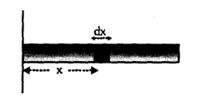
The linear mass density of a rod of length $L$ varies as $\lambda = A + Bx$. Find the center of mass.
A
$\frac{L(3A + 3BL)}{2(2A + BL)}$
B
$\frac{L(3A + 2BL)}{3(2A + 3BL)}$
C
$\frac{L(3A + 2BL)}{3(2A + BL)}$
D
$\frac{L(A + BL)}{3(A + BL)}$
Solution
(C) Let the rod be placed along the $x$-axis with one end at the origin. Since the rod lies on the $x$-axis,the $y$ and $z$ coordinates of the center of mass are zero,i.e.,$y_{CM} = 0$ and $z_{CM} = 0$.
Consider a small element of length $dx$ at a distance $x$ from the origin. The mass of this small element is $dm = \lambda dx = (A + Bx)dx$.
The $x$-coordinate of the center of mass is given by:
$x_{CM} = \frac{\int_{0}^{L} x dm}{\int_{0}^{L} dm} = \frac{\int_{0}^{L} x(A + Bx) dx}{\int_{0}^{L} (A + Bx) dx}$
Evaluating the integrals:
Numerator: $\int_{0}^{L} (Ax + Bx^2) dx = [\frac{Ax^2}{2} + \frac{Bx^3}{3}]_{0}^{L} = \frac{AL^2}{2} + \frac{BL^3}{3} = \frac{3AL^2 + 2BL^3}{6} = \frac{L^2(3A + 2BL)}{6}$
Denominator: $\int_{0}^{L} (A + Bx) dx = [Ax + \frac{Bx^2}{2}]_{0}^{L} = AL + \frac{BL^2}{2} = \frac{2AL + BL^2}{2} = \frac{L(2A + BL)}{2}$
Therefore,$x_{CM} = \frac{L^2(3A + 2BL)}{6} \times \frac{2}{L(2A + BL)} = \frac{L(3A + 2BL)}{3(2A + BL)}$.
Consider a small element of length $dx$ at a distance $x$ from the origin. The mass of this small element is $dm = \lambda dx = (A + Bx)dx$.
The $x$-coordinate of the center of mass is given by:
$x_{CM} = \frac{\int_{0}^{L} x dm}{\int_{0}^{L} dm} = \frac{\int_{0}^{L} x(A + Bx) dx}{\int_{0}^{L} (A + Bx) dx}$
Evaluating the integrals:
Numerator: $\int_{0}^{L} (Ax + Bx^2) dx = [\frac{Ax^2}{2} + \frac{Bx^3}{3}]_{0}^{L} = \frac{AL^2}{2} + \frac{BL^3}{3} = \frac{3AL^2 + 2BL^3}{6} = \frac{L^2(3A + 2BL)}{6}$
Denominator: $\int_{0}^{L} (A + Bx) dx = [Ax + \frac{Bx^2}{2}]_{0}^{L} = AL + \frac{BL^2}{2} = \frac{2AL + BL^2}{2} = \frac{L(2A + BL)}{2}$
Therefore,$x_{CM} = \frac{L^2(3A + 2BL)}{6} \times \frac{2}{L(2A + BL)} = \frac{L(3A + 2BL)}{3(2A + BL)}$.
0 likes
View Solution30
DifficultMCQ
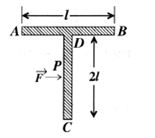
$A$ $T$-shaped object is placed on a smooth surface as shown in the figure. $A$ force $\vec{F}$ is applied at point $P$ in a direction parallel to $AB$ such that the object undergoes pure translational motion without rotation. Find the position of point $P$ relative to point $C$.
A
$\frac{4}{3}l$
B
$l$
C
$\frac{3}{4}l$
D
$\frac{3}{2}l$
Solution
(A) For an object to undergo pure translational motion without rotation,the external force must be applied at its center of mass $(CM)$.
Let the mass of the horizontal rod $AB$ of length $l$ be $m$. Then the mass of the vertical rod $CD$ of length $2l$ will be $2m$.
The center of mass of rod $AB$ is at point $D$ (midpoint of $AB$),and the center of mass of rod $CD$ is at its midpoint,which is at a distance $l$ from $D$ and $l$ from $C$.
Let point $C$ be the origin $(0,0)$.
Coordinates of the center of mass of rod $CD$ $(m_1 = 2m)$: $(0, l)$.
Coordinates of the center of mass of rod $AB$ $(m_2 = m)$: $(0, 2l)$.
The $y$-coordinate of the center of mass of the system is given by:
$Y_{cm} = \frac{m_1 y_1 + m_2 y_2}{m_1 + m_2}$
$Y_{cm} = \frac{(2m)(l) + (m)(2l)}{2m + m}$
$Y_{cm} = \frac{2ml + 2ml}{3m} = \frac{4ml}{3m} = \frac{4}{3}l$
Thus,the force must be applied at a distance of $\frac{4}{3}l$ from point $C$.
Let the mass of the horizontal rod $AB$ of length $l$ be $m$. Then the mass of the vertical rod $CD$ of length $2l$ will be $2m$.
The center of mass of rod $AB$ is at point $D$ (midpoint of $AB$),and the center of mass of rod $CD$ is at its midpoint,which is at a distance $l$ from $D$ and $l$ from $C$.
Let point $C$ be the origin $(0,0)$.
Coordinates of the center of mass of rod $CD$ $(m_1 = 2m)$: $(0, l)$.
Coordinates of the center of mass of rod $AB$ $(m_2 = m)$: $(0, 2l)$.
The $y$-coordinate of the center of mass of the system is given by:
$Y_{cm} = \frac{m_1 y_1 + m_2 y_2}{m_1 + m_2}$
$Y_{cm} = \frac{(2m)(l) + (m)(2l)}{2m + m}$
$Y_{cm} = \frac{2ml + 2ml}{3m} = \frac{4ml}{3m} = \frac{4}{3}l$
Thus,the force must be applied at a distance of $\frac{4}{3}l$ from point $C$.
0 likes
View Solution31
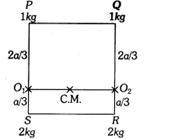
EasyMCQ
Four masses $1 \ kg, 1 \ kg, 2 \ kg$ and $2 \ kg$ are placed at the four corners $P, Q, R$ and $S$ of a square of side $a$ respectively. The center of mass of the system will be farthest from which of the following?
A
$P$
B
$R$ and $S$
C
$R$
D
$P$ and $Q$
Solution
(D) Let the square be in the $XY$-plane with $P(0, a), Q(a, a), R(a, 0)$ and $S(0, 0)$.
The masses are $m_P = 1 \ kg, m_Q = 1 \ kg, m_R = 2 \ kg, m_S = 2 \ kg$.
The center of mass of $P$ and $S$ is at $O_1$ on the side $PS$ at a distance $y_1 = \frac{m_P \cdot a + m_S \cdot 0}{m_P + m_S} = \frac{1 \cdot a + 2 \cdot 0}{1 + 2} = \frac{a}{3}$ from $S$.
The center of mass of $Q$ and $R$ is at $O_2$ on the side $QR$ at a distance $y_2 = \frac{m_Q \cdot a + m_R \cdot 0}{m_Q + m_R} = \frac{1 \cdot a + 2 \cdot 0}{1 + 2} = \frac{a}{3}$ from $R$.
The total mass of the system is $M = 1 + 1 + 2 + 2 = 6 \ kg$.
The center of mass of the whole system lies on the line joining $O_1$ and $O_2$ at a distance $x_{cm} = \frac{(m_P+m_S) \cdot 0 + (m_Q+m_R) \cdot a}{M} = \frac{3 \cdot 0 + 3 \cdot a}{6} = \frac{a}{2}$ from the $Y$-axis.
Thus,the center of mass is at $(\frac{a}{2}, \frac{a}{3})$.
Comparing distances from corners: The center of mass is closest to $R$ and $S$ (distance $\sqrt{(a/2)^2 + (a/3)^2}$) and farthest from $P$ and $Q$ (distance $\sqrt{(a/2)^2 + (2a/3)^2}$).
The masses are $m_P = 1 \ kg, m_Q = 1 \ kg, m_R = 2 \ kg, m_S = 2 \ kg$.
The center of mass of $P$ and $S$ is at $O_1$ on the side $PS$ at a distance $y_1 = \frac{m_P \cdot a + m_S \cdot 0}{m_P + m_S} = \frac{1 \cdot a + 2 \cdot 0}{1 + 2} = \frac{a}{3}$ from $S$.
The center of mass of $Q$ and $R$ is at $O_2$ on the side $QR$ at a distance $y_2 = \frac{m_Q \cdot a + m_R \cdot 0}{m_Q + m_R} = \frac{1 \cdot a + 2 \cdot 0}{1 + 2} = \frac{a}{3}$ from $R$.
The total mass of the system is $M = 1 + 1 + 2 + 2 = 6 \ kg$.
The center of mass of the whole system lies on the line joining $O_1$ and $O_2$ at a distance $x_{cm} = \frac{(m_P+m_S) \cdot 0 + (m_Q+m_R) \cdot a}{M} = \frac{3 \cdot 0 + 3 \cdot a}{6} = \frac{a}{2}$ from the $Y$-axis.
Thus,the center of mass is at $(\frac{a}{2}, \frac{a}{3})$.
Comparing distances from corners: The center of mass is closest to $R$ and $S$ (distance $\sqrt{(a/2)^2 + (a/3)^2}$) and farthest from $P$ and $Q$ (distance $\sqrt{(a/2)^2 + (2a/3)^2}$).
0 likes
View Solution32
DifficultMCQ
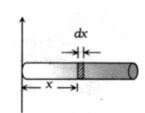
The linear mass density of a $3 \ m$ long rod varies as $\lambda = 2 + x$. The position of the center of mass of the rod is at:
A
$\frac{7}{3} \ m$
B
$\frac{12}{7} \ m$
C
$\frac{10}{7} \ m$
D
$\frac{9}{7} \ m$
Solution
(B) The linear mass density is given by $\lambda = \frac{dm}{dx}$,so $dm = \lambda \, dx$.
The position of the center of mass $x_{cm}$ is given by:
$x_{cm} = \frac{\int x \, dm}{\int dm}$
Substituting $\lambda = 2 + x$ and the limits from $0$ to $3$:
$x_{cm} = \frac{\int_{0}^{3} x(2 + x) \, dx}{\int_{0}^{3} (2 + x) \, dx}$
$x_{cm} = \frac{\int_{0}^{3} (2x + x^2) \, dx}{\int_{0}^{3} (2 + x) \, dx}$
Evaluating the integrals:
Numerator: $[x^2 + \frac{x^3}{3}]_{0}^{3} = (3^2 + \frac{3^3}{3}) = 9 + 9 = 18$
Denominator: $[2x + \frac{x^2}{2}]_{0}^{3} = (2(3) + \frac{3^2}{2}) = 6 + 4.5 = 10.5 = \frac{21}{2}$
$x_{cm} = \frac{18}{21/2} = \frac{36}{21} = \frac{12}{7} \ m$
The position of the center of mass $x_{cm}$ is given by:
$x_{cm} = \frac{\int x \, dm}{\int dm}$
Substituting $\lambda = 2 + x$ and the limits from $0$ to $3$:
$x_{cm} = \frac{\int_{0}^{3} x(2 + x) \, dx}{\int_{0}^{3} (2 + x) \, dx}$
$x_{cm} = \frac{\int_{0}^{3} (2x + x^2) \, dx}{\int_{0}^{3} (2 + x) \, dx}$
Evaluating the integrals:
Numerator: $[x^2 + \frac{x^3}{3}]_{0}^{3} = (3^2 + \frac{3^3}{3}) = 9 + 9 = 18$
Denominator: $[2x + \frac{x^2}{2}]_{0}^{3} = (2(3) + \frac{3^2}{2}) = 6 + 4.5 = 10.5 = \frac{21}{2}$
$x_{cm} = \frac{18}{21/2} = \frac{36}{21} = \frac{12}{7} \ m$
0 likes
View Solution33
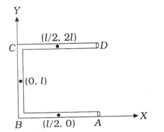
DifficultMCQ
$A$ uniform wire is bent into a $U$ shape with side lengths $l, 2l,$ and $l$. The coordinates of the center of mass of each segment are shown in the figure. The coordinates of the center of mass of the system are:
A
$\left( \frac{l}{4}, \frac{l}{4} \right)$
B
$(l, l)$
C
$\left( l, \frac{l}{4} \right)$
D
$\left( \frac{l}{4}, l \right)$
Solution
(D) Let the mass of a wire of length $l$ be $m$.
For segment $AB$ (length $l$): Mass $m_1 = m$,Center of mass $\vec{r}_1 = \left( \frac{l}{2}, 0 \right)$.
For segment $BC$ (length $2l$): Mass $m_2 = 2m$,Center of mass $\vec{r}_2 = (0, l)$.
For segment $CD$ (length $l$): Mass $m_3 = m$,Center of mass $\vec{r}_3 = \left( \frac{l}{2}, 2l \right)$.
The coordinates of the center of mass $(X_{cm}, Y_{cm})$ are given by:
$X_{cm} = \frac{m_1 x_1 + m_2 x_2 + m_3 x_3}{m_1 + m_2 + m_3} = \frac{m(\frac{l}{2}) + 2m(0) + m(\frac{l}{2})}{m + 2m + m} = \frac{m(l)}{4m} = \frac{l}{4}$.
$Y_{cm} = \frac{m_1 y_1 + m_2 y_2 + m_3 y_3}{m_1 + m_2 + m_3} = \frac{m(0) + 2m(l) + m(2l)}{m + 2m + m} = \frac{4ml}{4m} = l$.
Thus,the center of mass is $\left( \frac{l}{4}, l \right)$.
For segment $AB$ (length $l$): Mass $m_1 = m$,Center of mass $\vec{r}_1 = \left( \frac{l}{2}, 0 \right)$.
For segment $BC$ (length $2l$): Mass $m_2 = 2m$,Center of mass $\vec{r}_2 = (0, l)$.
For segment $CD$ (length $l$): Mass $m_3 = m$,Center of mass $\vec{r}_3 = \left( \frac{l}{2}, 2l \right)$.
The coordinates of the center of mass $(X_{cm}, Y_{cm})$ are given by:
$X_{cm} = \frac{m_1 x_1 + m_2 x_2 + m_3 x_3}{m_1 + m_2 + m_3} = \frac{m(\frac{l}{2}) + 2m(0) + m(\frac{l}{2})}{m + 2m + m} = \frac{m(l)}{4m} = \frac{l}{4}$.
$Y_{cm} = \frac{m_1 y_1 + m_2 y_2 + m_3 y_3}{m_1 + m_2 + m_3} = \frac{m(0) + 2m(l) + m(2l)}{m + 2m + m} = \frac{4ml}{4m} = l$.
Thus,the center of mass is $\left( \frac{l}{4}, l \right)$.
0 likes
View Solution34
DifficultMCQ
$A$ thin rod of length $L$ is placed along the $X$-axis such that one of its ends is at $x = 0$ and the other is at $x = L$. Its linear mass density (mass/length) varies with $x$ as $k(x/L)^n$,where $n$ is any positive number or zero. If the graph of the center of mass $x_{cm}$ versus $n$ is plotted for the rod,which of the following graphs is correct?
A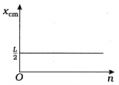
B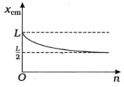
C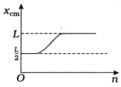
D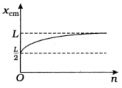
Solution
(D) The center of mass $x_{cm}$ is given by the formula:
$x_{cm} = \frac{\int x dm}{\int dm} = \frac{\int_{0}^{L} x \cdot k(x/L)^n dx}{\int_{0}^{L} k(x/L)^n dx} = \frac{\int_{0}^{L} x^{n+1} dx}{\int_{0}^{L} x^n dx}$
Evaluating the integrals:
$x_{cm} = \frac{L^{n+2} / (n+2)}{L^{n+1} / (n+1)} = L \left( \frac{n+1}{n+2} \right)$
Analyzing the behavior:
$1$. When $n = 0$,$x_{cm} = L(1/2) = L/2$.
$2$. As $n \to \infty$,$x_{cm} = L \left( \frac{1 + 1/n}{1 + 2/n} \right) \to L$.
$3$. The derivative $\frac{dx_{cm}}{dn} = L \left( \frac{(n+2) - (n+1)}{(n+2)^2} \right) = \frac{L}{(n+2)^2} > 0$,which means $x_{cm}$ is an increasing function of $n$.
Thus,the graph starts at $L/2$ for $n=0$ and asymptotically approaches $L$ as $n$ increases. This corresponds to the graph shown in option $D$.
$x_{cm} = \frac{\int x dm}{\int dm} = \frac{\int_{0}^{L} x \cdot k(x/L)^n dx}{\int_{0}^{L} k(x/L)^n dx} = \frac{\int_{0}^{L} x^{n+1} dx}{\int_{0}^{L} x^n dx}$
Evaluating the integrals:
$x_{cm} = \frac{L^{n+2} / (n+2)}{L^{n+1} / (n+1)} = L \left( \frac{n+1}{n+2} \right)$
Analyzing the behavior:
$1$. When $n = 0$,$x_{cm} = L(1/2) = L/2$.
$2$. As $n \to \infty$,$x_{cm} = L \left( \frac{1 + 1/n}{1 + 2/n} \right) \to L$.
$3$. The derivative $\frac{dx_{cm}}{dn} = L \left( \frac{(n+2) - (n+1)}{(n+2)^2} \right) = \frac{L}{(n+2)^2} > 0$,which means $x_{cm}$ is an increasing function of $n$.
Thus,the graph starts at $L/2$ for $n=0$ and asymptotically approaches $L$ as $n$ increases. This corresponds to the graph shown in option $D$.
0 likes
View Solution35
MediumMCQ
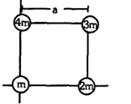
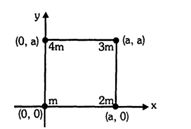
Four particles of masses $m, 2m, 3m, 4m$ are placed at the corners of a square of side $a$ as shown in the figure. Find the coordinates of the center of mass.
A
$\left( \frac{a}{2}, a \right)$
B
$\left( \frac{a}{3}, \frac{3}{10}a^2 \right)$
C
$\left( \frac{2a}{4}, \frac{7}{5}a \right)$
D
$\left( \frac{a}{2}, \frac{7}{10}a \right)$
Solution
(D) Let the positions of the particles be:
$m$ at $(0, 0)$
$2m$ at $(a, 0)$
$3m$ at $(a, a)$
$4m$ at $(0, a)$
The $x$-coordinate of the center of mass is given by:
$X_{CM} = \frac{m(0) + 2m(a) + 3m(a) + 4m(0)}{m + 2m + 3m + 4m} = \frac{5ma}{10m} = \frac{a}{2}$
The $y$-coordinate of the center of mass is given by:
$Y_{CM} = \frac{m(0) + 2m(0) + 3m(a) + 4m(a)}{m + 2m + 3m + 4m} = \frac{7ma}{10m} = \frac{7}{10}a$
Thus,the coordinates of the center of mass are $\left( \frac{a}{2}, \frac{7}{10}a \right)$.
$m$ at $(0, 0)$
$2m$ at $(a, 0)$
$3m$ at $(a, a)$
$4m$ at $(0, a)$
The $x$-coordinate of the center of mass is given by:
$X_{CM} = \frac{m(0) + 2m(a) + 3m(a) + 4m(0)}{m + 2m + 3m + 4m} = \frac{5ma}{10m} = \frac{a}{2}$
The $y$-coordinate of the center of mass is given by:
$Y_{CM} = \frac{m(0) + 2m(0) + 3m(a) + 4m(a)}{m + 2m + 3m + 4m} = \frac{7ma}{10m} = \frac{7}{10}a$
Thus,the coordinates of the center of mass are $\left( \frac{a}{2}, \frac{7}{10}a \right)$.
0 likes
View Solution36
MediumMCQ
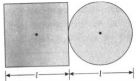
$A$ square plate and a circular disc of uniform density are arranged as shown in the figure. The center of mass of this combined system will be .........
A
Inside the square plate
B
Inside the circular disc
C
At the point of contact of both objects
D
Outside the system
Solution
(A) Let the mass per unit area of the given objects be $\sigma$.
The mass of the square plate is $m_1 = \sigma l^2$.
The mass of the circular disc is $m_2 = \sigma \pi \left( \frac{l}{2} \right)^2 = \sigma l^2 \left( \frac{\pi}{4} \right)$.
Since $m_1 > m_2$ (as $\pi/4 \approx 0.785 < 1$),the center of mass of the system will be closer to the heavier object,which is the square plate. Therefore,the center of mass lies inside the square plate.
The mass of the square plate is $m_1 = \sigma l^2$.
The mass of the circular disc is $m_2 = \sigma \pi \left( \frac{l}{2} \right)^2 = \sigma l^2 \left( \frac{\pi}{4} \right)$.
Since $m_1 > m_2$ (as $\pi/4 \approx 0.785 < 1$),the center of mass of the system will be closer to the heavier object,which is the square plate. Therefore,the center of mass lies inside the square plate.
0 likes
View Solution37
MediumMCQ
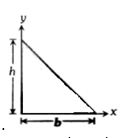
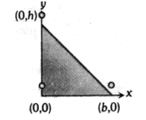
The coordinates of the center of mass of the triangular lamina shown in the figure are ....... .
A
$\left( \frac{h}{2}, \frac{b}{2} \right)$
B
$\left( \frac{b}{2}, \frac{h}{2} \right)$
C
$\left( \frac{b}{3}, \frac{h}{3} \right)$
D
$\left( \frac{h}{3}, \frac{b}{3} \right)$
Solution
(C) For a uniform triangular lamina,the center of mass is located at the centroid of the triangle.
If the vertices of the right-angled triangle are at $(0, 0)$,$(b, 0)$,and $(0, h)$,the coordinates of the center of mass $(x_{cm}, y_{cm})$ are given by the average of the coordinates of the vertices:
$x_{cm} = \frac{x_1 + x_2 + x_3}{3} = \frac{0 + b + 0}{3} = \frac{b}{3}$
$y_{cm} = \frac{y_1 + y_2 + y_3}{3} = \frac{0 + 0 + h}{3} = \frac{h}{3}$
Therefore,the coordinates of the center of mass are $\left( \frac{b}{3}, \frac{h}{3} \right)$.
If the vertices of the right-angled triangle are at $(0, 0)$,$(b, 0)$,and $(0, h)$,the coordinates of the center of mass $(x_{cm}, y_{cm})$ are given by the average of the coordinates of the vertices:
$x_{cm} = \frac{x_1 + x_2 + x_3}{3} = \frac{0 + b + 0}{3} = \frac{b}{3}$
$y_{cm} = \frac{y_1 + y_2 + y_3}{3} = \frac{0 + 0 + h}{3} = \frac{h}{3}$
Therefore,the coordinates of the center of mass are $\left( \frac{b}{3}, \frac{h}{3} \right)$.
0 likes
View Solution38
DifficultMCQ
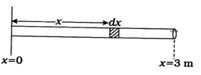
The mass per unit length of a rod of length $3 \ m$ varies in proportion to the distance $x$ from one of its ends. The center of mass of this rod from that end is at a distance of ........ $m$.
A
$1.5$
B
$2$
C
$2.5$
D
$3$
Solution
(B) Let the mass per unit length be $\lambda = kx$,where $k$ is a constant.
Consider a small element of length $dx$ at a distance $x$ from the end $x=0$.
The mass of this element is $dm = \lambda dx = kx dx$.
The center of mass $x_{cm}$ is given by the formula:
$x_{cm} = \frac{\int x dm}{\int dm}$
Substituting the values:
$x_{cm} = \frac{\int_0^3 x (kx dx)}{\int_0^3 kx dx} = \frac{\int_0^3 x^2 dx}{\int_0^3 x dx}$
Evaluating the integrals:
$x_{cm} = \frac{[x^3/3]_0^3}{[x^2/2]_0^3} = \frac{27/3}{9/2} = \frac{9}{4.5} = 2 \ m$.
Consider a small element of length $dx$ at a distance $x$ from the end $x=0$.
The mass of this element is $dm = \lambda dx = kx dx$.
The center of mass $x_{cm}$ is given by the formula:
$x_{cm} = \frac{\int x dm}{\int dm}$
Substituting the values:
$x_{cm} = \frac{\int_0^3 x (kx dx)}{\int_0^3 kx dx} = \frac{\int_0^3 x^2 dx}{\int_0^3 x dx}$
Evaluating the integrals:
$x_{cm} = \frac{[x^3/3]_0^3}{[x^2/2]_0^3} = \frac{27/3}{9/2} = \frac{9}{4.5} = 2 \ m$.
0 likes
View Solution39
MediumMCQ
$A$ rigid body consists of a $3 \ kg$ mass and a $2 \ kg$ mass connected by a massless rod. The $3 \ kg$ mass is at $\vec{r}_1 = (2 \hat{i} + 5 \hat{j}) \ m$ and the $2 \ kg$ mass is at $\vec{r}_2 = (4 \hat{i} + 2 \hat{j}) \ m$. Find the length of the rod and the coordinates of the center of mass.
A
$\sqrt{17} \ m, \left( 4 \hat{i} + \frac{19}{5} \hat{j} \right) \ m$
B
$\sqrt{13} \ m, \left( \frac{14}{5} \hat{i} + \frac{19}{5} \hat{j} \right) \ m$
C
$\sqrt{11} \ m, \left( \frac{12}{5} \hat{i} + \frac{15}{4} \hat{j} \right) \ m$
D
$\sqrt{15} \ m, \left( \frac{14}{3} \hat{i} + \frac{13}{2} \hat{j} \right) \ m$
Solution
(B) The length of the rod is the distance between the two masses:
$L = |\vec{r}_2 - \vec{r}_1| = \sqrt{(4 - 2)^2 + (2 - 5)^2} = \sqrt{2^2 + (-3)^2} = \sqrt{4 + 9} = \sqrt{13} \ m$.
The center of mass $\vec{r}_{CM}$ is given by:
$\vec{r}_{CM} = \frac{m_1 \vec{r}_1 + m_2 \vec{r}_2}{m_1 + m_2} = \frac{3(2 \hat{i} + 5 \hat{j}) + 2(4 \hat{i} + 2 \hat{j})}{3 + 2}$
$\vec{r}_{CM} = \frac{(6 \hat{i} + 15 \hat{j}) + (8 \hat{i} + 4 \hat{j})}{5} = \frac{14 \hat{i} + 19 \hat{j}}{5} = \left( \frac{14}{5} \hat{i} + \frac{19}{5} \hat{j} \right) \ m$.
$L = |\vec{r}_2 - \vec{r}_1| = \sqrt{(4 - 2)^2 + (2 - 5)^2} = \sqrt{2^2 + (-3)^2} = \sqrt{4 + 9} = \sqrt{13} \ m$.
The center of mass $\vec{r}_{CM}$ is given by:
$\vec{r}_{CM} = \frac{m_1 \vec{r}_1 + m_2 \vec{r}_2}{m_1 + m_2} = \frac{3(2 \hat{i} + 5 \hat{j}) + 2(4 \hat{i} + 2 \hat{j})}{3 + 2}$
$\vec{r}_{CM} = \frac{(6 \hat{i} + 15 \hat{j}) + (8 \hat{i} + 4 \hat{j})}{5} = \frac{14 \hat{i} + 19 \hat{j}}{5} = \left( \frac{14}{5} \hat{i} + \frac{19}{5} \hat{j} \right) \ m$.
0 likes
View Solution40
DifficultMCQ
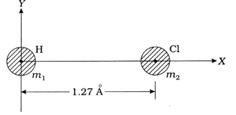
In an $HCl$ molecule,the distance between the nuclei of the two atoms is $1.27 \ \mathring A$. The $Cl$ atom is approximately $35.5$ times heavier than the $H$ atom. The center of mass of this molecule will be at a distance of approximately ....... $\mathring A$ from the center of the $H$ atom.
A
$1$
B
$2.5$
C
$1.24$
D
$1.5$
Solution
(C) Let the mass of the $H$ atom be $m_1 = 1 \ \text{unit}$ and the mass of the $Cl$ atom be $m_2 = 35.5 \ \text{units}$.
Place the $H$ atom at the origin $(0, 0)$. Then the position of the $H$ atom is $r_1 = 0$ and the position of the $Cl$ atom is $r_2 = 1.27 \ \mathring A$.
The center of mass $R_{cm}$ is given by the formula:
$R_{cm} = \frac{m_1 r_1 + m_2 r_2}{m_1 + m_2}$
Substituting the values:
$R_{cm} = \frac{(1)(0) + (35.5)(1.27)}{1 + 35.5}$
$R_{cm} = \frac{35.5 \times 1.27}{36.5}$
$R_{cm} \approx 1.24 \ \mathring A$
Thus,the center of mass is at a distance of $1.24 \ \mathring A$ from the $H$ atom.
Place the $H$ atom at the origin $(0, 0)$. Then the position of the $H$ atom is $r_1 = 0$ and the position of the $Cl$ atom is $r_2 = 1.27 \ \mathring A$.
The center of mass $R_{cm}$ is given by the formula:
$R_{cm} = \frac{m_1 r_1 + m_2 r_2}{m_1 + m_2}$
Substituting the values:
$R_{cm} = \frac{(1)(0) + (35.5)(1.27)}{1 + 35.5}$
$R_{cm} = \frac{35.5 \times 1.27}{36.5}$
$R_{cm} \approx 1.24 \ \mathring A$
Thus,the center of mass is at a distance of $1.24 \ \mathring A$ from the $H$ atom.
0 likes
View Solution41
MediumMCQ
Look at the figure drawn with ink of uniform linear density. $A$ mass $m$ of ink is used to draw each of the two inner circles and each of the two line segments. $A$ mass $6m$ of ink is used to draw the outer circle. The coordinates of the centers of the different parts are: outer circle $(0, 0)$,left inner circle $(-a, a)$,right inner circle $(a, a)$,and the horizontal line segment $(0, -a)$. Find the $y$-coordinate of the center of mass of the ink in the figure.

A
$\frac{a}{10}$
B
$\frac{a}{8}$
C
$\frac{a}{12}$
D
$\frac{a}{3}$
Solution
(A) The total mass of the system is $M = 6m + m + m + m + m = 10m$.
The $y$-coordinates of the centers of mass of the individual parts are:
Outer circle: $y_1 = 0$,mass $m_1 = 6m$
Left inner circle: $y_2 = a$,mass $m_2 = m$
Right inner circle: $y_3 = a$,mass $m_3 = m$
Horizontal line segment: $y_4 = -a$,mass $m_4 = m$
The $y$-coordinate of the center of mass is given by:
$Y_{cm} = \frac{m_1 y_1 + m_2 y_2 + m_3 y_3 + m_4 y_4}{M}$
$Y_{cm} = \frac{(6m)(0) + (m)(a) + (m)(a) + (m)(-a)}{10m}$
$Y_{cm} = \frac{0 + ma + ma - ma}{10m} = \frac{ma}{10m} = \frac{a}{10}$
The $y$-coordinates of the centers of mass of the individual parts are:
Outer circle: $y_1 = 0$,mass $m_1 = 6m$
Left inner circle: $y_2 = a$,mass $m_2 = m$
Right inner circle: $y_3 = a$,mass $m_3 = m$
Horizontal line segment: $y_4 = -a$,mass $m_4 = m$
The $y$-coordinate of the center of mass is given by:
$Y_{cm} = \frac{m_1 y_1 + m_2 y_2 + m_3 y_3 + m_4 y_4}{M}$
$Y_{cm} = \frac{(6m)(0) + (m)(a) + (m)(a) + (m)(-a)}{10m}$
$Y_{cm} = \frac{0 + ma + ma - ma}{10m} = \frac{ma}{10m} = \frac{a}{10}$
0 likes
View Solution42
MediumMCQ
The center of mass of three particles of masses $10 \ kg, 20 \ kg$,and $30 \ kg$ is at $(0, 0, 0)$. Where should a fourth particle of mass $40 \ kg$ be placed so that the center of mass of the system shifts to $(3, 3, 3)$?
A
$(0, 0, 0) \ m$
B
$(7.5, 7.5, 7.5) \ m$
C
$(1, 2, 3) \ m$
D
$(4, 4, 4) \ m$
Solution
(B) Let the total mass of the first three particles be $M = 10 + 20 + 30 = 60 \ kg$. The center of mass of these particles is at $\vec{r}_{cm} = (0, 0, 0)$.
Let the mass of the fourth particle be $m = 40 \ kg$ and its position be $\vec{r} = (x, y, z)$.
The new center of mass of the system is given as $\vec{r}'_{cm} = (3, 3, 3)$.
The formula for the center of mass of the combined system is $\vec{r}'_{cm} = \frac{M\vec{r}_{cm} + m\vec{r}}{M + m}$.
Substituting the values: $(3, 3, 3) = \frac{60(0, 0, 0) + 40(x, y, z)}{60 + 40}$.
$(3, 3, 3) = \frac{40(x, y, z)}{100} = 0.4(x, y, z)$.
Comparing the coordinates: $3 = 0.4x \Rightarrow x = \frac{3}{0.4} = 7.5 \ m$.
Similarly,$y = 7.5 \ m$ and $z = 7.5 \ m$.
Thus,the position of the fourth particle is $(7.5, 7.5, 7.5) \ m$.
Let the mass of the fourth particle be $m = 40 \ kg$ and its position be $\vec{r} = (x, y, z)$.
The new center of mass of the system is given as $\vec{r}'_{cm} = (3, 3, 3)$.
The formula for the center of mass of the combined system is $\vec{r}'_{cm} = \frac{M\vec{r}_{cm} + m\vec{r}}{M + m}$.
Substituting the values: $(3, 3, 3) = \frac{60(0, 0, 0) + 40(x, y, z)}{60 + 40}$.
$(3, 3, 3) = \frac{40(x, y, z)}{100} = 0.4(x, y, z)$.
Comparing the coordinates: $3 = 0.4x \Rightarrow x = \frac{3}{0.4} = 7.5 \ m$.
Similarly,$y = 7.5 \ m$ and $z = 7.5 \ m$.
Thus,the position of the fourth particle is $(7.5, 7.5, 7.5) \ m$.
0 likes
View Solution43
DifficultMCQ
Two bodies of mass $1 \ kg$ and $3 \ kg$ have position vectors $\hat{i} + 2\hat{j} + \hat{k}$ and $-3\hat{i} - 2\hat{j} + \hat{k}$,respectively. The centre of mass of this system has a position vector:
A
$-2\hat{i} - \hat{j} + \hat{k}$
B
$2\hat{i} - \hat{j} - 2\hat{k}$
C
$-\hat{i} + \hat{j} + \hat{k}$
D
$-2\hat{i} + 2\hat{k}$
Solution
(A) Given:
$m_1 = 1 \ kg$,$\vec{r}_1 = \hat{i} + 2\hat{j} + \hat{k}$
$m_2 = 3 \ kg$,$\vec{r}_2 = -3\hat{i} - 2\hat{j} + \hat{k}$
The position vector of the centre of mass is given by:
$\vec{r}_{CM} = \frac{m_1\vec{r}_1 + m_2\vec{r}_2}{m_1 + m_2}$
Substituting the values:
$\vec{r}_{CM} = \frac{1(\hat{i} + 2\hat{j} + \hat{k}) + 3(-3\hat{i} - 2\hat{j} + \hat{k})}{1 + 3}$
$\vec{r}_{CM} = \frac{\hat{i} + 2\hat{j} + \hat{k} - 9\hat{i} - 6\hat{j} + 3\hat{k}}{4}$
$\vec{r}_{CM} = \frac{-8\hat{i} - 4\hat{j} + 4\hat{k}}{4}$
$\vec{r}_{CM} = -2\hat{i} - \hat{j} + \hat{k}$
$m_1 = 1 \ kg$,$\vec{r}_1 = \hat{i} + 2\hat{j} + \hat{k}$
$m_2 = 3 \ kg$,$\vec{r}_2 = -3\hat{i} - 2\hat{j} + \hat{k}$
The position vector of the centre of mass is given by:
$\vec{r}_{CM} = \frac{m_1\vec{r}_1 + m_2\vec{r}_2}{m_1 + m_2}$
Substituting the values:
$\vec{r}_{CM} = \frac{1(\hat{i} + 2\hat{j} + \hat{k}) + 3(-3\hat{i} - 2\hat{j} + \hat{k})}{1 + 3}$
$\vec{r}_{CM} = \frac{\hat{i} + 2\hat{j} + \hat{k} - 9\hat{i} - 6\hat{j} + 3\hat{k}}{4}$
$\vec{r}_{CM} = \frac{-8\hat{i} - 4\hat{j} + 4\hat{k}}{4}$
$\vec{r}_{CM} = -2\hat{i} - \hat{j} + \hat{k}$
0 likes
View Solution44
MediumMCQ
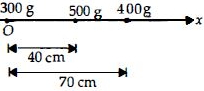
Three masses are placed on the $x-$axis: $300 \, g$ at the origin,$500 \, g$ at $x = 40 \, cm$ and $400 \, g$ at $x = 70 \, cm$. The distance of the centre of mass from the origin is ....... $cm$.
A
$40$
B
$50$
C
$30$
D
$45$
Solution
(A) The distance of the center of mass $(X_{CM})$ of a system of particles from the origin is given by the formula:
$X_{CM} = \frac{m_1x_1 + m_2x_2 + m_3x_3}{m_1 + m_2 + m_3}$
Given:
$m_1 = 300 \, g, x_1 = 0 \, cm$
$m_2 = 500 \, g, x_2 = 40 \, cm$
$m_3 = 400 \, g, x_3 = 70 \, cm$
Substituting the values:
$X_{CM} = \frac{300 \times 0 + 500 \times 40 + 400 \times 70}{300 + 500 + 400}$
$X_{CM} = \frac{0 + 20000 + 28000}{1200}$
$X_{CM} = \frac{48000}{1200}$
$X_{CM} = 40 \, cm$
$X_{CM} = \frac{m_1x_1 + m_2x_2 + m_3x_3}{m_1 + m_2 + m_3}$
Given:
$m_1 = 300 \, g, x_1 = 0 \, cm$
$m_2 = 500 \, g, x_2 = 40 \, cm$
$m_3 = 400 \, g, x_3 = 70 \, cm$
Substituting the values:
$X_{CM} = \frac{300 \times 0 + 500 \times 40 + 400 \times 70}{300 + 500 + 400}$
$X_{CM} = \frac{0 + 20000 + 28000}{1200}$
$X_{CM} = \frac{48000}{1200}$
$X_{CM} = 40 \, cm$
0 likes
View Solution45
MediumMCQ
When two masses $m$ and $M$ $(M > m)$ are connected,where will the center of mass be located?
A
Towards $m$
B
Towards $M$
C
Between $m$ and $M$
D
Anywhere
Solution
(B) The center of mass of a system of two particles is located on the line joining them. The position of the center of mass $R_{cm}$ is given by $R_{cm} = \frac{m_1r_1 + m_2r_2}{m_1 + m_2}$.
For two masses $m$ and $M$ separated by a distance $d$,if we place $M$ at the origin $(0,0)$ and $m$ at $(d,0)$,the center of mass is at $x = \frac{M(0) + m(d)}{M + m} = \frac{md}{M + m}$.
Since $M > m$,the center of mass is closer to the heavier mass $M$. Therefore,the center of mass is located towards $M$.
For two masses $m$ and $M$ separated by a distance $d$,if we place $M$ at the origin $(0,0)$ and $m$ at $(d,0)$,the center of mass is at $x = \frac{M(0) + m(d)}{M + m} = \frac{md}{M + m}$.
Since $M > m$,the center of mass is closer to the heavier mass $M$. Therefore,the center of mass is located towards $M$.
0 likes
View Solution46
DifficultMCQ
The distance between the two atoms in an $HCl$ molecule is approximately $1.27 \mathring{A}$ $(1 \mathring{A} = 10^{-10} \text{ m})$. The chlorine atom is $35.5$ times heavier than the hydrogen atom. The position of the center of mass from the hydrogen atom is approximately ..... $\mathring{A}$.
A
$1$
B
$2.5$
C
$1.24$
D
$1.5$
Solution
(C) Let the mass of the hydrogen atom be $m_1 = 1$ and the mass of the chlorine atom be $m_2 = 35.5$.
Place the hydrogen atom at the origin $(0, 0)$,so its position is $\vec{r}_1 = 0$.
The chlorine atom is at a distance of $1.27 \mathring{A}$ from the hydrogen atom along the $x$-axis,so its position is $\vec{r}_2 = 1.27 \hat{i} \mathring{A}$.
The position of the center of mass $\vec{R}_{cm}$ is given by the formula:
$\vec{R}_{cm} = \frac{m_1 \vec{r}_1 + m_2 \vec{r}_2}{m_1 + m_2}$
Substituting the values:
$\vec{R}_{cm} = \frac{1 \times 0 + 35.5 \times 1.27 \hat{i}}{1 + 35.5}$
$\vec{R}_{cm} = \frac{35.5 \times 1.27}{36.5} \hat{i}$
$\vec{R}_{cm} \approx 0.9726 \times 1.27 \hat{i} \approx 1.235 \hat{i} \mathring{A}$
Rounding to two decimal places,the position is approximately $1.24 \mathring{A}$ from the hydrogen atom.
Place the hydrogen atom at the origin $(0, 0)$,so its position is $\vec{r}_1 = 0$.
The chlorine atom is at a distance of $1.27 \mathring{A}$ from the hydrogen atom along the $x$-axis,so its position is $\vec{r}_2 = 1.27 \hat{i} \mathring{A}$.
The position of the center of mass $\vec{R}_{cm}$ is given by the formula:
$\vec{R}_{cm} = \frac{m_1 \vec{r}_1 + m_2 \vec{r}_2}{m_1 + m_2}$
Substituting the values:
$\vec{R}_{cm} = \frac{1 \times 0 + 35.5 \times 1.27 \hat{i}}{1 + 35.5}$
$\vec{R}_{cm} = \frac{35.5 \times 1.27}{36.5} \hat{i}$
$\vec{R}_{cm} \approx 0.9726 \times 1.27 \hat{i} \approx 1.235 \hat{i} \mathring{A}$
Rounding to two decimal places,the position is approximately $1.24 \mathring{A}$ from the hydrogen atom.
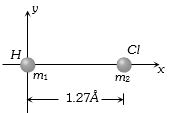
0 likes
View Solution47
DifficultMCQ
The distance between the carbon and oxygen atoms in a carbon monoxide molecule is $1.1 \, \mathring A$. Given that the mass of the carbon atom is $12 \, a.m.u.$ and the mass of the oxygen atom is $16 \, a.m.u.$,find the position of the center of mass of the carbon monoxide molecule.
A
At a distance of $6.3 \, \mathring A$ from the carbon atom
B
At a distance of $1 \, \mathring A$ from the oxygen atom
C
At a distance of $0.63 \, \mathring A$ from the carbon atom
D
At a distance of $0.12 \, \mathring A$ from the oxygen atom
Solution
(C) Let the carbon atom be at the origin $(0, 0)$. The position of the carbon atom is $x_1 = 0$ with mass $m_1 = 12 \, a.m.u.$
The position of the oxygen atom is $x_2 = 1.1 \, \mathring A$ with mass $m_2 = 16 \, a.m.u.$
The center of mass $X_{cm}$ is given by:
$X_{cm} = \frac{m_1 x_1 + m_2 x_2}{m_1 + m_2}$
$X_{cm} = \frac{12 \times 0 + 16 \times 1.1}{12 + 16}$
$X_{cm} = \frac{17.6}{28} \, \mathring A$
$X_{cm} \approx 0.6285 \, \mathring A \approx 0.63 \, \mathring A$
Thus,the center of mass is at a distance of $0.63 \, \mathring A$ from the carbon atom.
The position of the oxygen atom is $x_2 = 1.1 \, \mathring A$ with mass $m_2 = 16 \, a.m.u.$
The center of mass $X_{cm}$ is given by:
$X_{cm} = \frac{m_1 x_1 + m_2 x_2}{m_1 + m_2}$
$X_{cm} = \frac{12 \times 0 + 16 \times 1.1}{12 + 16}$
$X_{cm} = \frac{17.6}{28} \, \mathring A$
$X_{cm} \approx 0.6285 \, \mathring A \approx 0.63 \, \mathring A$
Thus,the center of mass is at a distance of $0.63 \, \mathring A$ from the carbon atom.
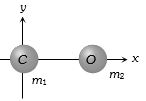
0 likes
View Solution48
MediumMCQ
Three particles of masses $20 \, g$,$30 \, g$,and $50 \, g$ have velocities $10 \, \hat{i}$,$10 \, \hat{j}$,and $10 \, \hat{k}$ respectively. The velocity of the center of mass of these three particles is:
A
$2 \, \hat{i} + 3 \, \hat{j} + 5 \, \hat{k}$
B
$10 \, (\hat{i} + \hat{j} + \hat{k})$
C
$20 \, \hat{i} + 30 \, \hat{j} + 5 \, \hat{k}$
D
$2 \, \hat{i} + 30 \, \hat{j} + 50 \, \hat{k}$
Solution
(A) The velocity of the center of mass $\vec{v}_{cm}$ is given by the formula: $\vec{v}_{cm} = \frac{m_1 \vec{v}_1 + m_2 \vec{v}_2 + m_3 \vec{v}_3}{m_1 + m_2 + m_3}$
Given: $m_1 = 20 \, g$,$m_2 = 30 \, g$,$m_3 = 50 \, g$ and $\vec{v}_1 = 10 \, \hat{i} \, cm/s$,$\vec{v}_2 = 10 \, \hat{j} \, cm/s$,$\vec{v}_3 = 10 \, \hat{k} \, cm/s$.
Total mass $M = 20 + 30 + 50 = 100 \, g$.
Substituting the values: $\vec{v}_{cm} = \frac{20(10 \, \hat{i}) + 30(10 \, \hat{j}) + 50(10 \, \hat{k})}{100}$
$\vec{v}_{cm} = \frac{200 \, \hat{i} + 300 \, \hat{j} + 500 \, \hat{k}}{100}$
$\vec{v}_{cm} = 2 \, \hat{i} + 3 \, \hat{j} + 5 \, \hat{k}$
Given: $m_1 = 20 \, g$,$m_2 = 30 \, g$,$m_3 = 50 \, g$ and $\vec{v}_1 = 10 \, \hat{i} \, cm/s$,$\vec{v}_2 = 10 \, \hat{j} \, cm/s$,$\vec{v}_3 = 10 \, \hat{k} \, cm/s$.
Total mass $M = 20 + 30 + 50 = 100 \, g$.
Substituting the values: $\vec{v}_{cm} = \frac{20(10 \, \hat{i}) + 30(10 \, \hat{j}) + 50(10 \, \hat{k})}{100}$
$\vec{v}_{cm} = \frac{200 \, \hat{i} + 300 \, \hat{j} + 500 \, \hat{k}}{100}$
$\vec{v}_{cm} = 2 \, \hat{i} + 3 \, \hat{j} + 5 \, \hat{k}$
0 likes
View Solution49
DifficultMCQ
Each side of a rhombus has length $a$. Four particles of masses $m, 2m, 3m$ and $4m$ are placed at the vertices of the rhombus. The angle between two adjacent sides of the rhombus is $60^o$. The rhombus lies in the $x-y$ plane,with mass $m$ at the origin and mass $4m$ on the $x$-axis. Find the coordinates of the center of mass of this system.
A
$\left( \frac{\sqrt{3}}{2}a, 0.95a \right)$
B
$\left( 0.95a, \frac{\sqrt{3}}{4}a \right)$
C
$\left( \frac{3a}{4}, \frac{a}{2} \right)$
D
$\left( \frac{a}{2}, \frac{3a}{4} \right)$
Solution
(B) Let the masses at the vertices be $m_1 = m, m_2 = 2m, m_3 = 3m, m_4 = 4m$.
Based on the geometry of the rhombus in the $x-y$ plane:
$r_1 = (0, 0)$
$r_2 = (a \cos 60^o, a \sin 60^o) = (a/2, a\sqrt{3}/2)$
$r_3 = (a + a \cos 60^o, a \sin 60^o) = (3a/2, a\sqrt{3}/2)$
$r_4 = (a, 0)$
The center of mass $(X_{cm}, Y_{cm})$ is given by:
$X_{cm} = \frac{m_1x_1 + m_2x_2 + m_3x_3 + m_4x_4}{m_1 + m_2 + m_3 + m_4} = \frac{m(0) + 2m(a/2) + 3m(3a/2) + 4m(a)}{10m} = \frac{0 + am + 4.5am + 4am}{10m} = \frac{9.5am}{10m} = 0.95a$
$Y_{cm} = \frac{m_1y_1 + m_2y_2 + m_3y_3 + m_4y_4}{m_1 + m_2 + m_3 + m_4} = \frac{m(0) + 2m(a\sqrt{3}/2) + 3m(a\sqrt{3}/2) + 4m(0)}{10m} = \frac{am\sqrt{3} + 1.5am\sqrt{3}}{10m} = \frac{2.5a\sqrt{3}}{10} = \frac{\sqrt{3}}{4}a$
Thus,the center of mass is $(0.95a, \frac{\sqrt{3}}{4}a)$.
Based on the geometry of the rhombus in the $x-y$ plane:
$r_1 = (0, 0)$
$r_2 = (a \cos 60^o, a \sin 60^o) = (a/2, a\sqrt{3}/2)$
$r_3 = (a + a \cos 60^o, a \sin 60^o) = (3a/2, a\sqrt{3}/2)$
$r_4 = (a, 0)$
The center of mass $(X_{cm}, Y_{cm})$ is given by:
$X_{cm} = \frac{m_1x_1 + m_2x_2 + m_3x_3 + m_4x_4}{m_1 + m_2 + m_3 + m_4} = \frac{m(0) + 2m(a/2) + 3m(3a/2) + 4m(a)}{10m} = \frac{0 + am + 4.5am + 4am}{10m} = \frac{9.5am}{10m} = 0.95a$
$Y_{cm} = \frac{m_1y_1 + m_2y_2 + m_3y_3 + m_4y_4}{m_1 + m_2 + m_3 + m_4} = \frac{m(0) + 2m(a\sqrt{3}/2) + 3m(a\sqrt{3}/2) + 4m(0)}{10m} = \frac{am\sqrt{3} + 1.5am\sqrt{3}}{10m} = \frac{2.5a\sqrt{3}}{10} = \frac{\sqrt{3}}{4}a$
Thus,the center of mass is $(0.95a, \frac{\sqrt{3}}{4}a)$.
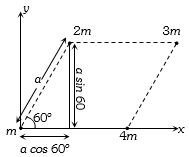
0 likes
View Solution50
DifficultMCQ
Masses of $8 \ kg, 2 \ kg, 4 \ kg,$ and $2 \ kg$ are placed at the corners $A, B, C,$ and $D$ respectively of a square $ABCD$ with a diagonal of $80 \ cm$. The distance of the center of mass from $A$ is ....... $cm$.
A
$20$
B
$30$
C
$40$
D
$60$
Solution
(B) Let the side length of the square be $a$. The diagonal is $d = a\sqrt{2} = 80 \ cm$,so $a = 40\sqrt{2} \ cm$.
Place $A$ at $(0, 0)$,$B$ at $(a, 0)$,$C$ at $(a, a)$,and $D$ at $(0, a)$.
The masses are $m_A = 8 \ kg, m_B = 2 \ kg, m_C = 4 \ kg, m_D = 2 \ kg$.
The coordinates of the center of mass $(X, Y)$ are:
$X = \frac{m_A x_A + m_B x_B + m_C x_C + m_D x_D}{m_A + m_B + m_C + m_D} = \frac{8(0) + 2(a) + 4(a) + 2(0)}{8 + 2 + 4 + 2} = \frac{6a}{16} = \frac{3a}{8}$.
$Y = \frac{m_A y_A + m_B y_B + m_C y_C + m_D y_D}{m_A + m_B + m_C + m_D} = \frac{8(0) + 2(0) + 4(a) + 2(a)}{16} = \frac{6a}{16} = \frac{3a}{8}$.
Substituting $a = 40\sqrt{2} \ cm$:
$X = \frac{3(40\sqrt{2})}{8} = 15\sqrt{2} \ cm$ and $Y = 15\sqrt{2} \ cm$.
The distance from $A(0, 0)$ is $r = \sqrt{X^2 + Y^2} = \sqrt{(15\sqrt{2})^2 + (15\sqrt{2})^2} = \sqrt{450 + 450} = \sqrt{900} = 30 \ cm$.
Place $A$ at $(0, 0)$,$B$ at $(a, 0)$,$C$ at $(a, a)$,and $D$ at $(0, a)$.
The masses are $m_A = 8 \ kg, m_B = 2 \ kg, m_C = 4 \ kg, m_D = 2 \ kg$.
The coordinates of the center of mass $(X, Y)$ are:
$X = \frac{m_A x_A + m_B x_B + m_C x_C + m_D x_D}{m_A + m_B + m_C + m_D} = \frac{8(0) + 2(a) + 4(a) + 2(0)}{8 + 2 + 4 + 2} = \frac{6a}{16} = \frac{3a}{8}$.
$Y = \frac{m_A y_A + m_B y_B + m_C y_C + m_D y_D}{m_A + m_B + m_C + m_D} = \frac{8(0) + 2(0) + 4(a) + 2(a)}{16} = \frac{6a}{16} = \frac{3a}{8}$.
Substituting $a = 40\sqrt{2} \ cm$:
$X = \frac{3(40\sqrt{2})}{8} = 15\sqrt{2} \ cm$ and $Y = 15\sqrt{2} \ cm$.
The distance from $A(0, 0)$ is $r = \sqrt{X^2 + Y^2} = \sqrt{(15\sqrt{2})^2 + (15\sqrt{2})^2} = \sqrt{450 + 450} = \sqrt{900} = 30 \ cm$.
0 likes
View SolutionSystem of Particles and Rotational Motion — Centre of mass (Point Mass) · Frequently Asked Questions
1Are these System of Particles and Rotational Motion questions useful for JEE and NEET?
Yes. All questions in this section are mapped to JEE Main and NEET exam patterns. Previous year questions from JEE Main, NEET, GUJCET and state-level exams are included with full solutions.
2Can I switch to Hindi or Gujarati for these questions?
Yes. Use the language tabs in the hero section or the sidebar to view the same questions and solutions in English, Hindi or Gujarati.
3How do I generate a question paper from this subtopic?
Use the Vedclass Exam Paper Generator — select the chapter and subtopic, set difficulty, and generate Sets A, B, C, D automatically. First 3 chapters of every subject are free.
Vedclass Products
For Students
Vedclass Test Series
Mock tests in real JEE/NEET style with performance analysis. 5-day free trial.
Start Free TrialFor Teachers
Exam Paper Generator
Generate Set A/B/C/D papers from this chapter in 2 minutes. 3 chapters free.
Try FreeFor Institutes
Online Exam Module
Live online exams with unlimited students, 360° analytics & white-label branding.
See DemoFor Teachers & Institutes
Generate a System of Particles and Rotational Motion Exam Paper in 2 Minutes
Select subtopic & difficulty — Sets A, B, C, D auto-generated with No Repeat logic.
First 3 chapters of every subject are free — no payment required.