
A English
Moment of Inertia and Radius of gyration Questions in English
Class 11 Physics · System of Particles and Rotational Motion · Moment of Inertia and Radius of gyration
371+
Questions
English
Language
100%
With Solutions
Showing 49 of 371 questions in English
1
MediumMCQ
What is the unit of moment of inertia in the $MKS$ system?
A
$kg \times cm^2$
B
$kg / cm^2$
C
$kg \times m^2$
D
$Joule \times m$
Solution
(C) The moment of inertia $I$ is defined by the formula $I = M \times R^2$,where $M$ is the mass and $R$ is the distance from the axis of rotation.
In the $MKS$ (Meter-Kilogram-Second) system,the unit of mass $M$ is $kg$ and the unit of distance $R$ is $m$.
Therefore,the unit of moment of inertia $I$ is $kg \times m^2$.
In the $MKS$ (Meter-Kilogram-Second) system,the unit of mass $M$ is $kg$ and the unit of distance $R$ is $m$.
Therefore,the unit of moment of inertia $I$ is $kg \times m^2$.
0 likes
View Solution2
MediumMCQ
Two discs of the same material and thickness have radii $0.2\, m$ and $0.6\, m.$ Their moments of inertia about their axes will be in the ratio
A
$1 : 81$
B
$1 : 27$
C
$1 : 9$
D
$1 : 3$
Solution
(A) The moment of inertia of a disc about its central axis is given by $I = \frac{1}{2} M R^2$.
Since the discs are of the same material and thickness $(t)$,their mass $M$ can be expressed as $M = \text{density} (\rho) \times \text{volume} = \rho \times (\pi R^2 t)$.
Substituting this into the formula for $I$: $I = \frac{1}{2} (\rho \pi R^2 t) R^2 = \frac{1}{2} \rho \pi t R^4$.
Since $\rho$,$\pi$,and $t$ are constant for both discs,we have $I \propto R^4$.
Therefore,the ratio of the moments of inertia is $\frac{I_1}{I_2} = \left( \frac{R_1}{R_2} \right)^4$.
Given $R_1 = 0.2\, m$ and $R_2 = 0.6\, m$,the ratio is $\frac{I_1}{I_2} = \left( \frac{0.2}{0.6} \right)^4 = \left( \frac{1}{3} \right)^4 = \frac{1}{81}$.
Thus,the ratio is $1 : 81$.
Since the discs are of the same material and thickness $(t)$,their mass $M$ can be expressed as $M = \text{density} (\rho) \times \text{volume} = \rho \times (\pi R^2 t)$.
Substituting this into the formula for $I$: $I = \frac{1}{2} (\rho \pi R^2 t) R^2 = \frac{1}{2} \rho \pi t R^4$.
Since $\rho$,$\pi$,and $t$ are constant for both discs,we have $I \propto R^4$.
Therefore,the ratio of the moments of inertia is $\frac{I_1}{I_2} = \left( \frac{R_1}{R_2} \right)^4$.
Given $R_1 = 0.2\, m$ and $R_2 = 0.6\, m$,the ratio is $\frac{I_1}{I_2} = \left( \frac{0.2}{0.6} \right)^4 = \left( \frac{1}{3} \right)^4 = \frac{1}{81}$.
Thus,the ratio is $1 : 81$.
0 likes
View Solution3
MediumMCQ
$A$ circular disc is to be made by using iron and aluminium,so that it acquires maximum moment of inertia about its geometrical axis. This is possible with:
A
Iron and aluminium layers in alternate order
B
Aluminium at the interior and iron surrounding it
C
Iron at the interior and aluminium surrounding it
D
$A$ sheet of iron used at both external surfaces and an aluminium sheet as internal layers
Solution
(B) The moment of inertia $I$ of a body about an axis is given by $I = \int r^2 dm$,where $dm$ is the mass element at a distance $r$ from the axis.
To maximize the moment of inertia for a fixed total mass and radius,we need to place as much mass as possible at the largest possible distance $r$ from the axis.
Since iron has a higher density than aluminium,placing iron at the outer periphery (surrounding the interior) increases the mass distribution at larger radii.
Therefore,placing aluminium at the interior and iron at the exterior (surrounding it) results in a higher moment of inertia compared to other configurations.
Thus,option $B$ is correct.
To maximize the moment of inertia for a fixed total mass and radius,we need to place as much mass as possible at the largest possible distance $r$ from the axis.
Since iron has a higher density than aluminium,placing iron at the outer periphery (surrounding the interior) increases the mass distribution at larger radii.
Therefore,placing aluminium at the interior and iron at the exterior (surrounding it) results in a higher moment of inertia compared to other configurations.
Thus,option $B$ is correct.
1 likes
View Solution4
MediumMCQ
The moment of inertia of a semicircular ring of mass $M$ and radius $R$ about its centre is:
A
$MR^2$
B
$\frac{MR^2}{2}$
C
$\frac{MR^2}{4}$
D
None of these
Solution
(A) Consider a small element of the semicircular ring of angular width $d\theta$ at an angle $\theta$ from the horizontal.
The mass of this small element is $dm = \frac{M}{\pi R} \cdot R d\theta = \frac{M}{\pi} d\theta$.
The moment of inertia of this small element about the centre is $dI = dm \cdot R^2$.
To find the total moment of inertia $I$,we integrate $dI$ from $\theta = 0$ to $\theta = \pi$:
$I = \int_{0}^{\pi} \frac{M}{\pi} d\theta \cdot R^2 = \frac{MR^2}{\pi} \int_{0}^{\pi} d\theta$.
$I = \frac{MR^2}{\pi} [\theta]_{0}^{\pi} = \frac{MR^2}{\pi} (\pi - 0) = MR^2$.
Thus,the moment of inertia is $MR^2$.
The mass of this small element is $dm = \frac{M}{\pi R} \cdot R d\theta = \frac{M}{\pi} d\theta$.
The moment of inertia of this small element about the centre is $dI = dm \cdot R^2$.
To find the total moment of inertia $I$,we integrate $dI$ from $\theta = 0$ to $\theta = \pi$:
$I = \int_{0}^{\pi} \frac{M}{\pi} d\theta \cdot R^2 = \frac{MR^2}{\pi} \int_{0}^{\pi} d\theta$.
$I = \frac{MR^2}{\pi} [\theta]_{0}^{\pi} = \frac{MR^2}{\pi} (\pi - 0) = MR^2$.
Thus,the moment of inertia is $MR^2$.
0 likes
View Solution5
MediumMCQ
Four particles each of mass $m$ are placed at the corners of a square of side length $l.$ The radius of gyration of the system about an axis perpendicular to the square and passing through its centre is
A
$\frac{l}{\sqrt{2}}$
B
$\frac{l}{2}$
C
$l$
D
$\sqrt{2}l$
Solution
(A) The moment of inertia $I$ of the system about an axis perpendicular to the square and passing through its centre is given by $I = \sum m r^2$.
The distance $r$ of each particle from the centre of the square is half the diagonal length,$r = \frac{\sqrt{2}l}{2} = \frac{l}{\sqrt{2}}$.
Since there are four particles of mass $m$,$I = 4 \times m \times (\frac{l}{\sqrt{2}})^2 = 4 \times m \times \frac{l^2}{2} = 2ml^2$.
The total mass of the system is $M = 4m$.
The radius of gyration $k$ is defined as $k = \sqrt{\frac{I}{M}}$.
Substituting the values,$k = \sqrt{\frac{2ml^2}{4m}} = \sqrt{\frac{l^2}{2}} = \frac{l}{\sqrt{2}}$.
The distance $r$ of each particle from the centre of the square is half the diagonal length,$r = \frac{\sqrt{2}l}{2} = \frac{l}{\sqrt{2}}$.
Since there are four particles of mass $m$,$I = 4 \times m \times (\frac{l}{\sqrt{2}})^2 = 4 \times m \times \frac{l^2}{2} = 2ml^2$.
The total mass of the system is $M = 4m$.
The radius of gyration $k$ is defined as $k = \sqrt{\frac{I}{M}}$.
Substituting the values,$k = \sqrt{\frac{2ml^2}{4m}} = \sqrt{\frac{l^2}{2}} = \frac{l}{\sqrt{2}}$.
0 likes
View Solution6
MediumMCQ
Three point masses $m_1, m_2, m_3$ are located at the vertices of an equilateral triangle of side length $a$. The moment of inertia of the system about an axis along the altitude of the triangle passing through $m_1$ is:
A
$(m_2 + m_3) \frac{a^2}{4}$
B
$(m_1 + m_2 + m_3) a^2$
C
$(m_1 + m_2) \frac{a^2}{2}$
D
$(m_2 + m_3) a^2$
Solution
(A) The moment of inertia $(I)$ of a system of particles about an axis is given by $I = \sum m_i r_i^2$,where $r_i$ is the perpendicular distance of the $i$-th particle from the axis of rotation.
$1$. The axis passes through $m_1$ and the altitude of the equilateral triangle. The perpendicular distance of $m_1$ from this axis is $r_1 = 0$.
$2$. In an equilateral triangle of side $a$,the altitude bisects the opposite side. Thus,the perpendicular distance of both $m_2$ and $m_3$ from the altitude passing through $m_1$ is $r_2 = r_3 = \frac{a}{2}$.
$3$. The total moment of inertia $I$ is:
$I = m_1(0)^2 + m_2(\frac{a}{2})^2 + m_3(\frac{a}{2})^2$
$I = 0 + m_2 \frac{a^2}{4} + m_3 \frac{a^2}{4}$
$I = (m_2 + m_3) \frac{a^2}{4}$
$1$. The axis passes through $m_1$ and the altitude of the equilateral triangle. The perpendicular distance of $m_1$ from this axis is $r_1 = 0$.
$2$. In an equilateral triangle of side $a$,the altitude bisects the opposite side. Thus,the perpendicular distance of both $m_2$ and $m_3$ from the altitude passing through $m_1$ is $r_2 = r_3 = \frac{a}{2}$.
$3$. The total moment of inertia $I$ is:
$I = m_1(0)^2 + m_2(\frac{a}{2})^2 + m_3(\frac{a}{2})^2$
$I = 0 + m_2 \frac{a^2}{4} + m_3 \frac{a^2}{4}$
$I = (m_2 + m_3) \frac{a^2}{4}$
0 likes
View Solution7
MediumMCQ
In a rectangle $ABCD$ where $BC = 2AB$,the moment of inertia will be minimum about which axis?
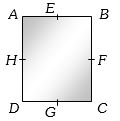
A
$BC$
B
$BD$
C
$HF$
D
$EG$
Solution
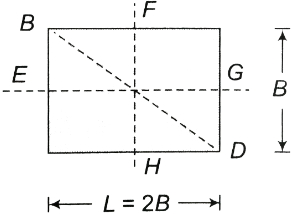
(D) Let the side $AB = B$ and $BC = L = 2B$. The mass of the rectangle is $M$.
For an axis passing through the center of mass and parallel to the sides:
$I_{EG} = \frac{MB^2}{12}$
$I_{HF} = \frac{ML^2}{12} = \frac{M(2B)^2}{12} = \frac{4MB^2}{12} = \frac{MB^2}{3}$
For the diagonal $BD$,the moment of inertia is given by $I_{BD} = \frac{M B^2 L^2}{6(B^2 + L^2)}$.
Substituting $L = 2B$:
$I_{BD} = \frac{M B^2 (2B)^2}{6(B^2 + (2B)^2)} = \frac{4MB^4}{6(5B^2)} = \frac{4MB^2}{30} = \frac{2MB^2}{15} \approx 0.133 MB^2$.
Comparing the values:
$I_{EG} = 0.0833 MB^2$
$I_{HF} = 0.333 MB^2$
$I_{BD} = 0.133 MB^2$
Thus,the moment of inertia is minimum about the axis $EG$.
For an axis passing through the center of mass and parallel to the sides:
$I_{EG} = \frac{MB^2}{12}$
$I_{HF} = \frac{ML^2}{12} = \frac{M(2B)^2}{12} = \frac{4MB^2}{12} = \frac{MB^2}{3}$
For the diagonal $BD$,the moment of inertia is given by $I_{BD} = \frac{M B^2 L^2}{6(B^2 + L^2)}$.
Substituting $L = 2B$:
$I_{BD} = \frac{M B^2 (2B)^2}{6(B^2 + (2B)^2)} = \frac{4MB^4}{6(5B^2)} = \frac{4MB^2}{30} = \frac{2MB^2}{15} \approx 0.133 MB^2$.
Comparing the values:
$I_{EG} = 0.0833 MB^2$
$I_{HF} = 0.333 MB^2$
$I_{BD} = 0.133 MB^2$
Thus,the moment of inertia is minimum about the axis $EG$.
0 likes
View Solution8
MediumMCQ
The moment of inertia of a sphere of mass $M$ and radius $R$ is $I.$ If $M$ is kept constant and a graph is plotted between $I$ and $R,$ then its form would be:
A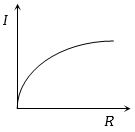
B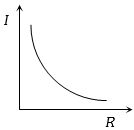
C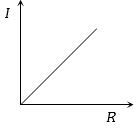
D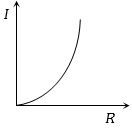
Solution
(D) The moment of inertia $I$ of a solid sphere of mass $M$ and radius $R$ about its diameter is given by the formula:
$I = \frac{2}{5} M R^{2}$
Since the mass $M$ is kept constant,the expression becomes $I = k R^{2},$ where $k = \frac{2}{5} M$ is a constant.
This equation is of the form $y = a x^{2},$ which represents a parabola opening upwards.
Therefore,the graph plotted between $I$ and $R$ will be a parabola that is symmetric about the $I$-axis.
$I = \frac{2}{5} M R^{2}$
Since the mass $M$ is kept constant,the expression becomes $I = k R^{2},$ where $k = \frac{2}{5} M$ is a constant.
This equation is of the form $y = a x^{2},$ which represents a parabola opening upwards.
Therefore,the graph plotted between $I$ and $R$ will be a parabola that is symmetric about the $I$-axis.
0 likes
View Solution9
MediumMCQ
On account of the melting of ice at the North Pole,the moment of inertia of the spinning Earth:
A
Increases
B
Decreases
C
Remains unchanged
D
Depends on the time
Solution
(A) The moment of inertia $I$ of a rotating body is given by $I = \sum m_i r_i^2$,where $r_i$ is the distance of mass $m_i$ from the axis of rotation.
When ice at the North Pole melts,the water flows away from the axis of rotation and spreads across the surface of the Earth towards the equator.
Since the mass is redistributed to regions further away from the axis of rotation (increasing the average distance $r$),the moment of inertia of the Earth increases.
When ice at the North Pole melts,the water flows away from the axis of rotation and spreads across the surface of the Earth towards the equator.
Since the mass is redistributed to regions further away from the axis of rotation (increasing the average distance $r$),the moment of inertia of the Earth increases.
0 likes
View Solution10
MediumMCQ
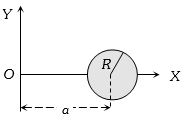
The adjoining figure shows a disc of mass $M$ and radius $R$ lying in the $X-Y$ plane with its centre on the $X$-axis at a distance $a$ from the origin. Then the moment of inertia of the disc about the $X$-axis is
A
$M\left(\frac{R^2}{2}\right)$
B
$M\left(\frac{R^2}{4}\right)$
C
$M\left(\frac{R^2}{4} + a^2\right)$
D
$M\left(\frac{R^2}{2} + a^2\right)$
Solution
(B) The moment of inertia of a disc of mass $M$ and radius $R$ about an axis passing through its centre and lying in its own plane (diameter) is given by $I_{diameter} = \frac{1}{4}MR^2$.
In this problem,the disc lies in the $X-Y$ plane,and its centre is located at $(a, 0)$.
The $X$-axis passes through the centre of the disc and lies in the plane of the disc.
Therefore,the $X$-axis is a diameter of the disc.
Since the moment of inertia of a disc about its diameter is $\frac{1}{4}MR^2$,the moment of inertia about the $X$-axis is simply $\frac{1}{4}MR^2$ or $M\left(\frac{R^2}{4}\right)$.
In this problem,the disc lies in the $X-Y$ plane,and its centre is located at $(a, 0)$.
The $X$-axis passes through the centre of the disc and lies in the plane of the disc.
Therefore,the $X$-axis is a diameter of the disc.
Since the moment of inertia of a disc about its diameter is $\frac{1}{4}MR^2$,the moment of inertia about the $X$-axis is simply $\frac{1}{4}MR^2$ or $M\left(\frac{R^2}{4}\right)$.
0 likes
View Solution11
DifficultMCQ
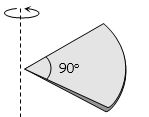
$A$ one-quarter sector is cut from a uniform circular disc of radius $R$. This sector has mass $M$. It is made to rotate about a line perpendicular to its plane and passing through the centre of the original disc. Its moment of inertia about the axis of rotation is
A
$\frac{1}{2}MR^2$
B
$\frac{1}{4}MR^2$
C
$\frac{1}{8}MR^2$
D
$\sqrt{2}MR^2$
Solution
(A) Let the mass of the complete circular disc be $M_{total}$. Since the sector is one-quarter of the disc,its mass $M = \frac{M_{total}}{4}$,which implies $M_{total} = 4M$.
The moment of inertia $(I)$ of a complete uniform circular disc of mass $M_{total}$ and radius $R$ about an axis passing through its centre and perpendicular to its plane is given by $I_{total} = \frac{1}{2}M_{total}R^2$.
Substituting $M_{total} = 4M$ into the formula,we get:
$I_{total} = \frac{1}{2}(4M)R^2 = 2MR^2$.
By the principle of symmetry,the moment of inertia of the quarter sector $(I_{sector})$ about the same axis is one-fourth of the moment of inertia of the complete disc:
$I_{sector} = \frac{I_{total}}{4} = \frac{2MR^2}{4} = \frac{1}{2}MR^2$.
The moment of inertia $(I)$ of a complete uniform circular disc of mass $M_{total}$ and radius $R$ about an axis passing through its centre and perpendicular to its plane is given by $I_{total} = \frac{1}{2}M_{total}R^2$.
Substituting $M_{total} = 4M$ into the formula,we get:
$I_{total} = \frac{1}{2}(4M)R^2 = 2MR^2$.
By the principle of symmetry,the moment of inertia of the quarter sector $(I_{sector})$ about the same axis is one-fourth of the moment of inertia of the complete disc:
$I_{sector} = \frac{I_{total}}{4} = \frac{2MR^2}{4} = \frac{1}{2}MR^2$.
0 likes
View Solution12
MediumMCQ
Two discs of same thickness but of different radii are made of two different materials such that their masses are same. The densities of the materials are in the ratio $1 : 3$. The moments of inertia of these discs about the respective axes passing through their centres and perpendicular to their planes will be in the ratio:
A
$1:3$
B
$3:1$
C
$1:9$
D
$9:1$
Solution
(B) The moment of inertia of a disc about its central axis is given by $I = \frac{1}{2}MR^2$.
Since mass $M = \text{density} (\rho) \times \text{volume} (V) = \rho \times (\pi R^2 t)$,where $t$ is the thickness.
Given that $M$ and $t$ are the same for both discs,we have $M = \rho \pi R^2 t$,which implies $R^2 = \frac{M}{\pi \rho t}$.
Substituting this into the expression for $I$:
$I = \frac{1}{2} M \left( \frac{M}{\pi \rho t} \right) = \frac{M^2}{2 \pi t \rho}$.
Since $M$ and $t$ are constant,$I \propto \frac{1}{\rho}$.
Therefore,the ratio of the moments of inertia is $\frac{I_1}{I_2} = \frac{\rho_2}{\rho_1}$.
Given $\frac{\rho_1}{\rho_2} = \frac{1}{3}$,we have $\frac{\rho_2}{\rho_1} = \frac{3}{1}$.
Thus,the ratio of the moments of inertia is $3:1$.
Since mass $M = \text{density} (\rho) \times \text{volume} (V) = \rho \times (\pi R^2 t)$,where $t$ is the thickness.
Given that $M$ and $t$ are the same for both discs,we have $M = \rho \pi R^2 t$,which implies $R^2 = \frac{M}{\pi \rho t}$.
Substituting this into the expression for $I$:
$I = \frac{1}{2} M \left( \frac{M}{\pi \rho t} \right) = \frac{M^2}{2 \pi t \rho}$.
Since $M$ and $t$ are constant,$I \propto \frac{1}{\rho}$.
Therefore,the ratio of the moments of inertia is $\frac{I_1}{I_2} = \frac{\rho_2}{\rho_1}$.
Given $\frac{\rho_1}{\rho_2} = \frac{1}{3}$,we have $\frac{\rho_2}{\rho_1} = \frac{3}{1}$.
Thus,the ratio of the moments of inertia is $3:1$.
0 likes
View Solution13
EasyMCQ
If a solid sphere and a solid cylinder of the same radius and density rotate about their own axes,which one will have a greater moment of inertia? (Assume $L = R$)
A
Solid cylinder
B
Solid sphere
C
Both
D
Equal for both
Solution
(A) The moment of inertia of a solid cylinder of mass $M$ and radius $R$ about its own axis is given by: $I_{C} = \frac{1}{2} M R^{2} = 0.5 M R^{2}$.
The moment of inertia of a solid sphere of mass $M$ and radius $R$ about its own axis is given by: $I_{S} = \frac{2}{5} M R^{2} = 0.4 M R^{2}$.
Since the radius $R$ is the same and the density is the same,if we assume the same volume (which implies the same mass $M$ for a given density),we compare the coefficients.
Comparing the two,$0.5 M R^{2} > 0.4 M R^{2}$,therefore $I_{C} > I_{S}$.
Hence,the moment of inertia of the solid cylinder is greater than that of the solid sphere.
The moment of inertia of a solid sphere of mass $M$ and radius $R$ about its own axis is given by: $I_{S} = \frac{2}{5} M R^{2} = 0.4 M R^{2}$.
Since the radius $R$ is the same and the density is the same,if we assume the same volume (which implies the same mass $M$ for a given density),we compare the coefficients.
Comparing the two,$0.5 M R^{2} > 0.4 M R^{2}$,therefore $I_{C} > I_{S}$.
Hence,the moment of inertia of the solid cylinder is greater than that of the solid sphere.
0 likes
View Solution14
MediumMCQ
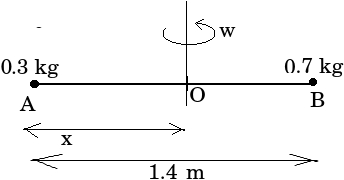
Two point masses of $0.3 \ kg$ and $0.7 \ kg$ are fixed at the ends of a rod of length $1.4 \ m$ and of negligible mass. The rod is set rotating about an axis perpendicular to its length with a uniform angular speed. The point on the rod through which the axis should pass in order that the work required for rotation of the rod is minimum is located at a distance of
A
$0.4 \ m$ from mass of $0.3 \ kg$
B
$0.98 \ m$ from mass of $0.3 \ kg$
C
$0.70 \ m$ from mass of $0.7 \ kg$
D
$0.98 \ m$ from mass of $0.7 \ kg$
Solution
(B) According to the work-energy theorem,the work done is given by $W = \frac{1}{2} I \omega^2$.
Since the angular speed $\omega$ is constant,the work done is minimum when the moment of inertia $I$ is minimum.
Let the axis of rotation pass through a point at a distance $x$ from the $0.3 \ kg$ mass. Then the distance from the $0.7 \ kg$ mass is $(1.4 - x)$.
The moment of inertia $I$ is given by $I = 0.3x^2 + 0.7(1.4 - x)^2$.
To find the minimum value of $I$,we differentiate with respect to $x$ and set it to zero:
$\frac{dI}{dx} = 0.3(2x) + 0.7(2)(1.4 - x)(-1) = 0$
$0.6x - 1.4(1.4 - x) = 0$
$0.6x - 1.96 + 1.4x = 0$
$2.0x = 1.96$
$x = 0.98 \ m$.
Thus,the axis should pass at a distance of $0.98 \ m$ from the $0.3 \ kg$ mass.
Since the angular speed $\omega$ is constant,the work done is minimum when the moment of inertia $I$ is minimum.
Let the axis of rotation pass through a point at a distance $x$ from the $0.3 \ kg$ mass. Then the distance from the $0.7 \ kg$ mass is $(1.4 - x)$.
The moment of inertia $I$ is given by $I = 0.3x^2 + 0.7(1.4 - x)^2$.
To find the minimum value of $I$,we differentiate with respect to $x$ and set it to zero:
$\frac{dI}{dx} = 0.3(2x) + 0.7(2)(1.4 - x)(-1) = 0$
$0.6x - 1.4(1.4 - x) = 0$
$0.6x - 1.96 + 1.4x = 0$
$2.0x = 1.96$
$x = 0.98 \ m$.
Thus,the axis should pass at a distance of $0.98 \ m$ from the $0.3 \ kg$ mass.
0 likes
View Solution15
MediumMCQ
$A$ circular disc $A$ of radius $r$ is made from an iron plate of thickness $t$ and another circular disc $B$ of radius $4r$ is made from an iron plate of thickness $t/4$. The relation between the moments of inertia $I_A$ and $I_B$ is:
A
$I_A > I_B$
B
$I_A = I_B$
C
$I_A < I_B$
D
Depends on the actual values of $t$ and $r$
Solution
(C) The moment of inertia of a circular disc about its central axis is given by $I = \frac{1}{2} M R^2$.
Mass $M$ is given by $M = \text{Density} \times \text{Volume} = \rho \times (\pi R^2 t)$,where $\rho$ is the density of iron.
For disc $A$:
Radius $R_A = r$,thickness $t_A = t$.
$M_A = \rho \pi r^2 t$.
$I_A = \frac{1}{2} M_A R_A^2 = \frac{1}{2} (\rho \pi r^2 t) r^2 = \frac{1}{2} \rho \pi t r^4$.
For disc $B$:
Radius $R_B = 4r$,thickness $t_B = t/4$.
$M_B = \rho \pi (4r)^2 (t/4) = \rho \pi (16r^2) (t/4) = 4 \rho \pi r^2 t$.
$I_B = \frac{1}{2} M_B R_B^2 = \frac{1}{2} (4 \rho \pi r^2 t) (4r)^2 = \frac{1}{2} (4 \rho \pi r^2 t) (16r^2) = 32 \rho \pi t r^4$.
Comparing the two:
$I_A = 0.5 \rho \pi t r^4$
$I_B = 32 \rho \pi t r^4$
Clearly,$I_A < I_B$.
Mass $M$ is given by $M = \text{Density} \times \text{Volume} = \rho \times (\pi R^2 t)$,where $\rho$ is the density of iron.
For disc $A$:
Radius $R_A = r$,thickness $t_A = t$.
$M_A = \rho \pi r^2 t$.
$I_A = \frac{1}{2} M_A R_A^2 = \frac{1}{2} (\rho \pi r^2 t) r^2 = \frac{1}{2} \rho \pi t r^4$.
For disc $B$:
Radius $R_B = 4r$,thickness $t_B = t/4$.
$M_B = \rho \pi (4r)^2 (t/4) = \rho \pi (16r^2) (t/4) = 4 \rho \pi r^2 t$.
$I_B = \frac{1}{2} M_B R_B^2 = \frac{1}{2} (4 \rho \pi r^2 t) (4r)^2 = \frac{1}{2} (4 \rho \pi r^2 t) (16r^2) = 32 \rho \pi t r^4$.
Comparing the two:
$I_A = 0.5 \rho \pi t r^4$
$I_B = 32 \rho \pi t r^4$
Clearly,$I_A < I_B$.
0 likes
View Solution16
MediumMCQ
$A$ thin wire of length $l$ and mass $M$ is bent in the form of a semi-circle. What is its moment of inertia about an axis passing through the ends of the wire?
A
$\frac{Ml^2}{2}$
B
$\frac{Ml^2}{\pi^2}$
C
$\frac{2Ml^2}{\pi^2}$
D
$\frac{Ml^2}{2\pi^2}$
Solution
(D) The axis passing through the ends of the wire is the diameter of the semi-circle.
Let the radius of the semi-circle be $r$. The length of the wire is $l = \pi r$,so $r = \frac{l}{\pi}$.
Every point on the semi-circle is at a distance $r$ from the center of the circle.
The moment of inertia of the wire about an axis passing through the center and perpendicular to the plane of the semi-circle is $I_z = \int r^2 dm = M r^2$.
Let $I_x$ and $I_y$ be the moments of inertia about two perpendicular axes in the plane of the semi-circle,where one axis is the diameter passing through the ends of the wire $(I_x = I_d)$.
By the perpendicular axes theorem,$I_z = I_x + I_y$. Since the wire is symmetric about the diameter,$I_x = I_y = I_d$.
Therefore,$M r^2 = 2 I_d$,which gives $I_d = \frac{M r^2}{2}$.
Substituting $r = \frac{l}{\pi}$,we get $I_d = \frac{M}{2} (\frac{l}{\pi})^2 = \frac{Ml^2}{2\pi^2}$.
Let the radius of the semi-circle be $r$. The length of the wire is $l = \pi r$,so $r = \frac{l}{\pi}$.
Every point on the semi-circle is at a distance $r$ from the center of the circle.
The moment of inertia of the wire about an axis passing through the center and perpendicular to the plane of the semi-circle is $I_z = \int r^2 dm = M r^2$.
Let $I_x$ and $I_y$ be the moments of inertia about two perpendicular axes in the plane of the semi-circle,where one axis is the diameter passing through the ends of the wire $(I_x = I_d)$.
By the perpendicular axes theorem,$I_z = I_x + I_y$. Since the wire is symmetric about the diameter,$I_x = I_y = I_d$.
Therefore,$M r^2 = 2 I_d$,which gives $I_d = \frac{M r^2}{2}$.
Substituting $r = \frac{l}{\pi}$,we get $I_d = \frac{M}{2} (\frac{l}{\pi})^2 = \frac{Ml^2}{2\pi^2}$.
0 likes
View Solution17
DifficultMCQ
If $I_1$ is the moment of inertia of a thin rod of mass $M$ and length $l$ about an axis perpendicular to its length and passing through its centre of mass,and $I_2$ is the moment of inertia of the ring formed by bending the rod about an axis passing through its centre and perpendicular to its plane,then:
A
$I_1:I_2=1:1$
B
$I_1:I_2=\pi^2:3$
C
$I_1:I_2=\pi:4$
D
$I_1:I_2=3:\pi^2$
Solution
(B) The moment of inertia of a thin rod of mass $M$ and length $l$ about an axis passing through its centre and perpendicular to its length is given by $I_1 = \frac{Ml^2}{12}$.
When the rod is bent into a ring of radius $R$,the circumference of the ring is equal to the length of the rod,so $2\pi R = l$,which gives $R = \frac{l}{2\pi}$.
The moment of inertia of the ring about an axis passing through its centre and perpendicular to its plane is $I_2 = MR^2$.
Substituting the value of $R$,we get $I_2 = M \left(\frac{l}{2\pi}\right)^2 = \frac{Ml^2}{4\pi^2}$.
Now,calculating the ratio $I_1 : I_2$:
$\frac{I_1}{I_2} = \frac{Ml^2/12}{Ml^2/4\pi^2} = \frac{4\pi^2}{12} = \frac{\pi^2}{3}$.
Thus,$I_1 : I_2 = \pi^2 : 3$.
When the rod is bent into a ring of radius $R$,the circumference of the ring is equal to the length of the rod,so $2\pi R = l$,which gives $R = \frac{l}{2\pi}$.
The moment of inertia of the ring about an axis passing through its centre and perpendicular to its plane is $I_2 = MR^2$.
Substituting the value of $R$,we get $I_2 = M \left(\frac{l}{2\pi}\right)^2 = \frac{Ml^2}{4\pi^2}$.
Now,calculating the ratio $I_1 : I_2$:
$\frac{I_1}{I_2} = \frac{Ml^2/12}{Ml^2/4\pi^2} = \frac{4\pi^2}{12} = \frac{\pi^2}{3}$.
Thus,$I_1 : I_2 = \pi^2 : 3$.
0 likes
View Solution18
MediumMCQ
Four solids are shown in cross-section. The sections have equal heights and equal maximum widths. They have the same mass. The one which has the largest rotational inertia about a perpendicular axis through the centre of mass is:
A
B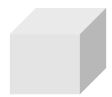
C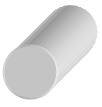
D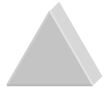
Solution
(A) Rotational inertia $I$ is given by $I = \int r^2 dm$. For a given mass $M$,the rotational inertia is larger if more mass is distributed further from the axis of rotation.
Comparing the four shapes with the same mass,height,and maximum width:
$1$. The ring-like structure has its mass concentrated at the maximum possible distance from the central axis.
$2$. The square prism,solid cylinder,and triangular prism have their mass distributed closer to the central axis compared to the ring.
Since the ring has the largest portion of its mass at the largest radius from the axis,it will have the largest moment of inertia.
Therefore,the correct option is $A$.
Comparing the four shapes with the same mass,height,and maximum width:
$1$. The ring-like structure has its mass concentrated at the maximum possible distance from the central axis.
$2$. The square prism,solid cylinder,and triangular prism have their mass distributed closer to the central axis compared to the ring.
Since the ring has the largest portion of its mass at the largest radius from the axis,it will have the largest moment of inertia.
Therefore,the correct option is $A$.
0 likes
View Solution19
MediumMCQ
The moment of inertia $I$ of a solid sphere having fixed volume depends upon its volume $V$ as
A
$I \propto V$
B
$I \propto V^{2/3}$
C
$I \propto V^{5/3}$
D
$I \propto V^{3/2}$
Solution
(C) The volume of a solid sphere is given by $V = \frac{4}{3} \pi R^3$,where $R$ is the radius.
From this,we have $R^3 \propto V$,which implies $R \propto V^{1/3}$.
The mass $M$ of the sphere is given by $M = \text{density} \times \text{Volume} = \rho V$.
The moment of inertia $I$ of a solid sphere about its diameter is $I = \frac{2}{5} M R^2$.
Substituting $M = \rho V$ and $R \propto V^{1/3}$ into the formula:
$I = \frac{2}{5} (\rho V) (V^{1/3})^2$
$I = \frac{2}{5} \rho V \cdot V^{2/3}$
$I \propto V^{1 + 2/3}$
$I \propto V^{5/3}$.
From this,we have $R^3 \propto V$,which implies $R \propto V^{1/3}$.
The mass $M$ of the sphere is given by $M = \text{density} \times \text{Volume} = \rho V$.
The moment of inertia $I$ of a solid sphere about its diameter is $I = \frac{2}{5} M R^2$.
Substituting $M = \rho V$ and $R \propto V^{1/3}$ into the formula:
$I = \frac{2}{5} (\rho V) (V^{1/3})^2$
$I = \frac{2}{5} \rho V \cdot V^{2/3}$
$I \propto V^{1 + 2/3}$
$I \propto V^{5/3}$.
0 likes
View Solution20
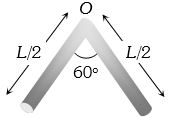
MediumMCQ
$A$ thin rod of length $L$ and mass $M$ is bent at the middle point $O$ at an angle of $60^{\circ}$ as shown in the figure. The moment of inertia of the rod about an axis passing through $O$ and perpendicular to the plane of the rod will be:
A
$\frac{ML^2}{6}$
B
$\frac{ML^2}{12}$
C
$\frac{ML^2}{24}$
D
$\frac{ML^2}{3}$
Solution
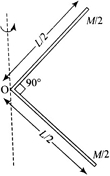
(B) The rod is bent at the middle point $O$. Thus,the rod is divided into two equal segments,each of length $l = \frac{L}{2}$ and mass $m = \frac{M}{2}$.
The moment of inertia of a uniform rod of mass $m$ and length $l$ about an axis passing through one of its ends and perpendicular to its length is given by $I = \frac{1}{3}ml^2$.
For each segment of the bent rod,the moment of inertia about the axis passing through $O$ and perpendicular to the plane of the rod is:
$I_{segment} = \frac{1}{3} \left( \frac{M}{2} \right) \left( \frac{L}{2} \right)^2 = \frac{1}{3} \left( \frac{M}{2} \right) \left( \frac{L^2}{4} \right) = \frac{ML^2}{24}$.
Since the axis passes through the common point $O$ for both segments,the total moment of inertia of the bent rod is the sum of the moments of inertia of the two segments:
$I_{total} = I_{segment} + I_{segment} = \frac{ML^2}{24} + \frac{ML^2}{24} = \frac{2ML^2}{24} = \frac{ML^2}{12}$.
The moment of inertia of a uniform rod of mass $m$ and length $l$ about an axis passing through one of its ends and perpendicular to its length is given by $I = \frac{1}{3}ml^2$.
For each segment of the bent rod,the moment of inertia about the axis passing through $O$ and perpendicular to the plane of the rod is:
$I_{segment} = \frac{1}{3} \left( \frac{M}{2} \right) \left( \frac{L}{2} \right)^2 = \frac{1}{3} \left( \frac{M}{2} \right) \left( \frac{L^2}{4} \right) = \frac{ML^2}{24}$.
Since the axis passes through the common point $O$ for both segments,the total moment of inertia of the bent rod is the sum of the moments of inertia of the two segments:
$I_{total} = I_{segment} + I_{segment} = \frac{ML^2}{24} + \frac{ML^2}{24} = \frac{2ML^2}{24} = \frac{ML^2}{12}$.
0 likes
View Solution21
MediumMCQ
Five particles of mass $2 \ kg$ each are attached to the rim of a circular disc of radius $0.1 \ m$ and negligible mass. The moment of inertia of the system about the axis passing through the centre of the disc and perpendicular to its plane is ........ $kg \ m^2$.
A
$1$
B
$0.1$
C
$2$
D
$0.2$
Solution
(B) The moment of inertia of a system of particles is given by $I = \sum m_i r_i^2$.
Since the disc has negligible mass,we only consider the five particles attached to the rim.
Each particle has a mass $m = 2 \ kg$ and is at a distance $r = 0.1 \ m$ from the axis of rotation.
Therefore,the total moment of inertia is $I = 5 \times (m \times r^2)$.
Substituting the values: $I = 5 \times 2 \times (0.1)^2$.
$I = 10 \times 0.01 = 0.1 \ kg \ m^2$.
Since the disc has negligible mass,we only consider the five particles attached to the rim.
Each particle has a mass $m = 2 \ kg$ and is at a distance $r = 0.1 \ m$ from the axis of rotation.
Therefore,the total moment of inertia is $I = 5 \times (m \times r^2)$.
Substituting the values: $I = 5 \times 2 \times (0.1)^2$.
$I = 10 \times 0.01 = 0.1 \ kg \ m^2$.
0 likes
View Solution22
MediumMCQ
$A$ circular disc $X$ of radius $R$ is made from an iron plate of thickness $t$,and another disc $Y$ of radius $4R$ is made from an iron plate of thickness $\frac{t}{4}$. Then the relation between the moment of inertia $I_x$ and $I_y$ is
A
$I_y = 64I_x$
B
$I_y = 32I_x$
C
$I_y = 16I_x$
D
$I_y = I_x$
Solution
(A) The moment of inertia of a circular disc about its central axis is given by $I = \frac{1}{2}MR^2$.
Since mass $M = \text{Volume} \times \text{density} = (\pi R^2 t) \rho$,where $t$ is the thickness and $\rho$ is the density.
Substituting $M$ into the formula,we get $I = \frac{1}{2}(\pi R^2 t \rho) R^2 = \frac{1}{2} \pi \rho t R^4$.
Assuming the density $\rho$ is the same for both discs,the ratio of the moments of inertia is $\frac{I_y}{I_x} = \frac{t_y}{t_x} \left( \frac{R_y}{R_x} \right)^4$.
Given $R_y = 4R$ and $R_x = R$,so $\frac{R_y}{R_x} = 4$.
Given $t_y = \frac{t}{4}$ and $t_x = t$,so $\frac{t_y}{t_x} = \frac{1}{4}$.
Substituting these values: $\frac{I_y}{I_x} = \frac{1}{4} \times (4)^4 = \frac{256}{4} = 64$.
Therefore,$I_y = 64I_x$.
Since mass $M = \text{Volume} \times \text{density} = (\pi R^2 t) \rho$,where $t$ is the thickness and $\rho$ is the density.
Substituting $M$ into the formula,we get $I = \frac{1}{2}(\pi R^2 t \rho) R^2 = \frac{1}{2} \pi \rho t R^4$.
Assuming the density $\rho$ is the same for both discs,the ratio of the moments of inertia is $\frac{I_y}{I_x} = \frac{t_y}{t_x} \left( \frac{R_y}{R_x} \right)^4$.
Given $R_y = 4R$ and $R_x = R$,so $\frac{R_y}{R_x} = 4$.
Given $t_y = \frac{t}{4}$ and $t_x = t$,so $\frac{t_y}{t_x} = \frac{1}{4}$.
Substituting these values: $\frac{I_y}{I_x} = \frac{1}{4} \times (4)^4 = \frac{256}{4} = 64$.
Therefore,$I_y = 64I_x$.
0 likes
View Solution23
MediumMCQ
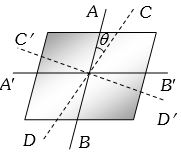
Let $l$ be the moment of inertia of a uniform square plate about an axis $AB$ that passes through its centre and is parallel to two of its sides. $CD$ is a line in the plane of the plate that passes through the centre of the plate and makes an angle $\theta$ with $AB$. The moment of inertia of the plate about the axis $CD$ is then equal to:
A
$l$
B
$l \sin^2 \theta$
C
$l \cos^2 \theta$
D
$l \cos^2 \frac{\theta}{2}$
Solution
(A) For a uniform square plate,the moment of inertia about any axis passing through its centre and lying in its plane is the same.
Let $I_{AB}$ be the moment of inertia about axis $AB$. Given $I_{AB} = l$.
Since the square plate is symmetric about any axis passing through its centre and lying in its plane,the moment of inertia about any such axis is constant.
Specifically,for a square plate of side $a$ and mass $M$,the moment of inertia about an axis passing through the centre and parallel to a side is $I = \frac{Ma^2}{12}$.
Since this value is independent of the orientation of the axis within the plane of the square,the moment of inertia about any axis $CD$ passing through the centre in the plane of the plate is also $l$.
Let $I_{AB}$ be the moment of inertia about axis $AB$. Given $I_{AB} = l$.
Since the square plate is symmetric about any axis passing through its centre and lying in its plane,the moment of inertia about any such axis is constant.
Specifically,for a square plate of side $a$ and mass $M$,the moment of inertia about an axis passing through the centre and parallel to a side is $I = \frac{Ma^2}{12}$.
Since this value is independent of the orientation of the axis within the plane of the square,the moment of inertia about any axis $CD$ passing through the centre in the plane of the plate is also $l$.
0 likes
View Solution24
DifficultMCQ
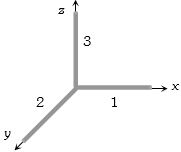
Three rods each of length $L$ and mass $M$ are placed along $X$,$Y$,and $Z$-axes in such a way that one end of each rod is at the origin. The moment of inertia of this system about the $Z$-axis is
A
$\frac{2ML^2}{3}$
B
$\frac{4ML^2}{3}$
C
$\frac{5ML^2}{3}$
D
$\frac{ML^2}{3}$
Solution
(A) The moment of inertia of the system about the $Z$-axis is the sum of the moments of inertia of the individual rods about the $Z$-axis.
$1$. For the rod along the $X$-axis (rod $1$): The $Z$-axis is perpendicular to the rod at its end. Therefore,its moment of inertia is $I_1 = \frac{ML^2}{3}$.
$2$. For the rod along the $Y$-axis (rod $2$): The $Z$-axis is perpendicular to the rod at its end. Therefore,its moment of inertia is $I_2 = \frac{ML^2}{3}$.
$3$. For the rod along the $Z$-axis (rod $3$): The rod lies along the $Z$-axis itself. Therefore,the distance of every mass element from the $Z$-axis is zero,so $I_3 = 0$.
$4$. The total moment of inertia of the system is $I_{\text{system}} = I_1 + I_2 + I_3 = \frac{ML^2}{3} + \frac{ML^2}{3} + 0 = \frac{2ML^2}{3}$.
$1$. For the rod along the $X$-axis (rod $1$): The $Z$-axis is perpendicular to the rod at its end. Therefore,its moment of inertia is $I_1 = \frac{ML^2}{3}$.
$2$. For the rod along the $Y$-axis (rod $2$): The $Z$-axis is perpendicular to the rod at its end. Therefore,its moment of inertia is $I_2 = \frac{ML^2}{3}$.
$3$. For the rod along the $Z$-axis (rod $3$): The rod lies along the $Z$-axis itself. Therefore,the distance of every mass element from the $Z$-axis is zero,so $I_3 = 0$.
$4$. The total moment of inertia of the system is $I_{\text{system}} = I_1 + I_2 + I_3 = \frac{ML^2}{3} + \frac{ML^2}{3} + 0 = \frac{2ML^2}{3}$.
0 likes
View Solution25
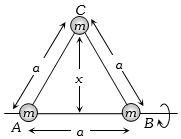
DifficultMCQ
Three point masses,each of mass $m$,are placed at the corners of an equilateral triangle of side $a$. The moment of inertia of this system about an axis passing along one side of the triangle is:
A
$m a^2$
B
$3m a^2$
C
$\frac{3}{4}m a^2$
D
$\frac{2}{3}m a^2$
Solution
(C) Let the vertices of the equilateral triangle be $A, B,$ and $C$. The masses are placed at $A, B,$ and $C$. The axis of rotation passes through side $AB$.
$1$. The perpendicular distance of mass at $A$ from the axis $AB$ is $r_A = 0$.
$2$. The perpendicular distance of mass at $B$ from the axis $AB$ is $r_B = 0$.
$3$. The perpendicular distance of mass at $C$ from the axis $AB$ is the altitude $x$ of the equilateral triangle.
Using the Pythagorean theorem in the triangle formed by the altitude:
$x^2 + (a/2)^2 = a^2$
$x^2 = a^2 - a^2/4 = 3a^2/4$
$x = \frac{\sqrt{3}}{2}a$
The moment of inertia $I$ of the system about the axis $AB$ is given by:
$I = \sum m_i r_i^2 = m(r_A^2) + m(r_B^2) + m(r_C^2)$
$I = m(0)^2 + m(0)^2 + m(x)^2$
$I = m \left( \frac{\sqrt{3}}{2}a \right)^2 = m \left( \frac{3}{4}a^2 \right) = \frac{3}{4}m a^2$
$1$. The perpendicular distance of mass at $A$ from the axis $AB$ is $r_A = 0$.
$2$. The perpendicular distance of mass at $B$ from the axis $AB$ is $r_B = 0$.
$3$. The perpendicular distance of mass at $C$ from the axis $AB$ is the altitude $x$ of the equilateral triangle.
Using the Pythagorean theorem in the triangle formed by the altitude:
$x^2 + (a/2)^2 = a^2$
$x^2 = a^2 - a^2/4 = 3a^2/4$
$x = \frac{\sqrt{3}}{2}a$
The moment of inertia $I$ of the system about the axis $AB$ is given by:
$I = \sum m_i r_i^2 = m(r_A^2) + m(r_B^2) + m(r_C^2)$
$I = m(0)^2 + m(0)^2 + m(x)^2$
$I = m \left( \frac{\sqrt{3}}{2}a \right)^2 = m \left( \frac{3}{4}a^2 \right) = \frac{3}{4}m a^2$
0 likes
View Solution26
DifficultMCQ
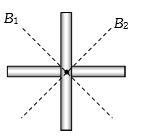
Two identical rods each of mass $M$ and length $l$ are joined in a crossed position as shown in the figure. The moment of inertia of this system about a bisector ($B_1$ or $B_2$) is:
A
$\frac{Ml^2}{6}$
B
$\frac{Ml^2}{12}$
C
$\frac{Ml^2}{3}$
D
$\frac{Ml^2}{4}$
Solution
(B) Let the two rods lie in the $xy$-plane,with one rod along the $x$-axis and the other along the $y$-axis. The moment of inertia of each rod about an axis passing through its center and perpendicular to its length is $\frac{Ml^2}{12}$.
For the system,the moment of inertia about the $z$-axis (perpendicular to the plane of the rods and passing through the intersection point) is the sum of the moments of inertia of the two rods about this axis:
$I_z = I_x + I_y = \frac{Ml^2}{12} + \frac{Ml^2}{12} = \frac{Ml^2}{6}$.
By the perpendicular axes theorem,$I_z = I_{B_1} + I_{B_2}$,where $B_1$ and $B_2$ are the bisector axes. Due to the symmetry of the system,$I_{B_1} = I_{B_2}$.
Therefore,$2I_{B_1} = \frac{Ml^2}{6}$,which gives $I_{B_1} = I_{B_2} = \frac{Ml^2}{12}$.
For the system,the moment of inertia about the $z$-axis (perpendicular to the plane of the rods and passing through the intersection point) is the sum of the moments of inertia of the two rods about this axis:
$I_z = I_x + I_y = \frac{Ml^2}{12} + \frac{Ml^2}{12} = \frac{Ml^2}{6}$.
By the perpendicular axes theorem,$I_z = I_{B_1} + I_{B_2}$,where $B_1$ and $B_2$ are the bisector axes. Due to the symmetry of the system,$I_{B_1} = I_{B_2}$.
Therefore,$2I_{B_1} = \frac{Ml^2}{6}$,which gives $I_{B_1} = I_{B_2} = \frac{Ml^2}{12}$.
0 likes
View Solution27
MediumMCQ
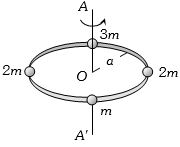
Four masses are attached to a light circular frame of radius $a$ as shown in the figure. The radius of gyration of this system about an axis passing through the center $O$ of the circular frame and perpendicular to its plane is:
A
$a/\sqrt{2}$
B
$a/2$
C
$a$
D
$2a$
Solution
(C) The circular frame is massless,so we only consider the moment of inertia of the four point masses located at a distance $a$ from the center $O$.
The moment of inertia $I$ of the system about an axis passing through the center $O$ and perpendicular to the plane is given by the sum of $mr^2$ for each mass:
$I = (3m)a^2 + (2m)a^2 + (m)a^2 + (2m)a^2 = 8ma^2$
The total mass of the system is $M = 3m + 2m + m + 2m = 8m$.
By the definition of the radius of gyration $k$,we have $I = Mk^2$.
Substituting the values:
$8ma^2 = (8m)k^2$
$k^2 = a^2$
$k = a$
The moment of inertia $I$ of the system about an axis passing through the center $O$ and perpendicular to the plane is given by the sum of $mr^2$ for each mass:
$I = (3m)a^2 + (2m)a^2 + (m)a^2 + (2m)a^2 = 8ma^2$
The total mass of the system is $M = 3m + 2m + m + 2m = 8m$.
By the definition of the radius of gyration $k$,we have $I = Mk^2$.
Substituting the values:
$8ma^2 = (8m)k^2$
$k^2 = a^2$
$k = a$
0 likes
View Solution28
MediumMCQ
The moment of inertia of a solid sphere of density $\rho$ and radius $R$ about its diameter is
A
$\frac{105}{176} R^5 \rho$
B
$\frac{105}{176} R^2 \rho$
C
$\frac{176}{105} R^5 \rho$
D
$\frac{176}{105} R^2 \rho$
Solution
(C) The moment of inertia $I$ of a solid sphere of mass $M$ and radius $R$ about its diameter is given by $I = \frac{2}{5} M R^2$.
Since the sphere has density $\rho$,its mass $M$ is given by $M = \text{Volume} \times \text{density} = \left( \frac{4}{3} \pi R^3 \right) \rho$.
Substituting the value of $M$ into the formula for $I$:
$I = \frac{2}{5} \left( \frac{4}{3} \pi R^3 \rho \right) R^2$
$I = \frac{8}{15} \pi R^5 \rho$.
Using $\pi \approx \frac{22}{7}$:
$I = \frac{8}{15} \times \frac{22}{7} \times R^5 \rho = \frac{176}{105} R^5 \rho$.
Since the sphere has density $\rho$,its mass $M$ is given by $M = \text{Volume} \times \text{density} = \left( \frac{4}{3} \pi R^3 \right) \rho$.
Substituting the value of $M$ into the formula for $I$:
$I = \frac{2}{5} \left( \frac{4}{3} \pi R^3 \rho \right) R^2$
$I = \frac{8}{15} \pi R^5 \rho$.
Using $\pi \approx \frac{22}{7}$:
$I = \frac{8}{15} \times \frac{22}{7} \times R^5 \rho = \frac{176}{105} R^5 \rho$.
0 likes
View Solution29
MediumMCQ
Two circular discs $A$ and $B$ are of equal masses and thickness but made of metals with densities ${d_A}$ and ${d_B}$ $({d_A} > {d_B})$. If their moments of inertia about an axis passing through their centres and normal to the circular faces are ${I_A}$ and ${I_B}$ respectively,then:
A
${I_A} = {I_B}$
B
${I_A} > {I_B}$
C
${I_A} < {I_B}$
D
${I_A} \ge {I_B}$
Solution
(C) The moment of inertia of a circular disc about an axis passing through its centre and normal to its circular face is given by $I = \frac{1}{2}MR^2$.
Since the mass $M$ of the disc is given by $M = V\rho = \pi R^2 t \rho$,where $t$ is the thickness and $\rho$ is the density,we can write $R^2 = \frac{M}{\pi t \rho}$.
Substituting this into the expression for $I$,we get $I = \frac{1}{2} M \left( \frac{M}{\pi t \rho} \right) = \frac{M^2}{2 \pi t \rho}$.
Given that the mass $M$ and thickness $t$ are constant for both discs,we have $I \propto \frac{1}{\rho}$.
Therefore,$\frac{I_A}{I_B} = \frac{d_B}{d_A}$.
Since it is given that $d_A > d_B$,it follows that $I_A < I_B$.
Since the mass $M$ of the disc is given by $M = V\rho = \pi R^2 t \rho$,where $t$ is the thickness and $\rho$ is the density,we can write $R^2 = \frac{M}{\pi t \rho}$.
Substituting this into the expression for $I$,we get $I = \frac{1}{2} M \left( \frac{M}{\pi t \rho} \right) = \frac{M^2}{2 \pi t \rho}$.
Given that the mass $M$ and thickness $t$ are constant for both discs,we have $I \propto \frac{1}{\rho}$.
Therefore,$\frac{I_A}{I_B} = \frac{d_B}{d_A}$.
Since it is given that $d_A > d_B$,it follows that $I_A < I_B$.
0 likes
View Solution30
MediumMCQ
From a circular disc of radius $R$ and mass $9M$,a small disc of mass $M$ and radius $R/3$ is removed concentrically. The moment of inertia of the remaining disc about an axis perpendicular to the plane of the disc and passing through its centre is
A
$M R^2$
B
$\frac{40}{9} M R^2$
C
$4 M R^2$
D
$\frac{4}{9} M R^2$
Solution
(B) The moment of inertia of a circular disc of mass $M$ and radius $R$ about an axis passing through its centre and perpendicular to its plane is $I = \frac{1}{2} M R^2$.
For the original disc: $M_1 = 9M$,$R_1 = R$. Thus,$I_1 = \frac{1}{2} (9M) R^2 = \frac{9}{2} M R^2$.
For the removed disc: $M_2 = M$,$R_2 = R/3$. Thus,$I_2 = \frac{1}{2} (M) (R/3)^2 = \frac{1}{2} M (R^2/9) = \frac{1}{18} M R^2$.
The moment of inertia of the remaining disc is $I = I_1 - I_2$.
$I = \frac{9}{2} M R^2 - \frac{1}{18} M R^2$.
$I = \frac{81 M R^2 - M R^2}{18} = \frac{80 M R^2}{18} = \frac{40}{9} M R^2$.
For the original disc: $M_1 = 9M$,$R_1 = R$. Thus,$I_1 = \frac{1}{2} (9M) R^2 = \frac{9}{2} M R^2$.
For the removed disc: $M_2 = M$,$R_2 = R/3$. Thus,$I_2 = \frac{1}{2} (M) (R/3)^2 = \frac{1}{2} M (R^2/9) = \frac{1}{18} M R^2$.
The moment of inertia of the remaining disc is $I = I_1 - I_2$.
$I = \frac{9}{2} M R^2 - \frac{1}{18} M R^2$.
$I = \frac{81 M R^2 - M R^2}{18} = \frac{80 M R^2}{18} = \frac{40}{9} M R^2$.
0 likes
View Solution31
MediumMCQ
If $I_1$,$I_2$,and $I_3$ are the moments of inertia of a solid sphere,a hollow cylinder,and a ring,respectively,all having the same mass and radius,which of the following statements is correct?
A
$I_1 > I_2 > I_3$
B
$I_3 > I_2 > I_1$
C
$I_2 > I_1 > I_3$
D
$I_2 > I_3 > I_1$
Solution
(B) The moment of inertia for a solid sphere about its diameter is $I_1 = \frac{2}{5} MR^2$.
The moment of inertia for a hollow cylinder about its axis is $I_2 = MR^2$.
The moment of inertia for a ring about its central axis is $I_3 = MR^2$.
Wait,let us re-evaluate the standard moments of inertia for these objects:
$1$. Solid sphere: $I_1 = \frac{2}{5} MR^2 = 0.4 MR^2$.
$2$. Hollow cylinder: $I_2 = MR^2 = 1.0 MR^2$.
$3$. Ring: $I_3 = MR^2 = 1.0 MR^2$.
Comparing these values,we see that $I_2 = I_3 > I_1$. However,if the hollow cylinder is considered to be a thin-walled cylinder (hoop),its moment of inertia is $MR^2$. If the question implies a solid cylinder,it would be $\frac{1}{2}MR^2$. Given the standard options provided in similar physics problems,the correct relationship is $I_3 > I_2 > I_1$ or $I_2 = I_3 > I_1$. Based on the options provided,$I_3 > I_2 > I_1$ is the intended answer.
The moment of inertia for a hollow cylinder about its axis is $I_2 = MR^2$.
The moment of inertia for a ring about its central axis is $I_3 = MR^2$.
Wait,let us re-evaluate the standard moments of inertia for these objects:
$1$. Solid sphere: $I_1 = \frac{2}{5} MR^2 = 0.4 MR^2$.
$2$. Hollow cylinder: $I_2 = MR^2 = 1.0 MR^2$.
$3$. Ring: $I_3 = MR^2 = 1.0 MR^2$.
Comparing these values,we see that $I_2 = I_3 > I_1$. However,if the hollow cylinder is considered to be a thin-walled cylinder (hoop),its moment of inertia is $MR^2$. If the question implies a solid cylinder,it would be $\frac{1}{2}MR^2$. Given the standard options provided in similar physics problems,the correct relationship is $I_3 > I_2 > I_1$ or $I_2 = I_3 > I_1$. Based on the options provided,$I_3 > I_2 > I_1$ is the intended answer.
0 likes
View Solution32
EasyMCQ
$A$ flywheel rotates about its axis with a constant angular velocity. If a particle suddenly sticks to its rim,what will happen to its moment of inertia?
A
Increase
B
Decrease
C
Remain the same
D
Cannot be determined
Solution
(A) The moment of inertia $I$ of a body is given by $I = \sum m_i r_i^2$.
When a particle of mass $m$ sticks to the rim of the flywheel at a distance $R$ from the axis of rotation,the new moment of inertia $I'$ becomes $I' = I + mR^2$.
Since $mR^2 > 0$,it follows that $I' > I$.
Therefore,the moment of inertia of the system increases.
When a particle of mass $m$ sticks to the rim of the flywheel at a distance $R$ from the axis of rotation,the new moment of inertia $I'$ becomes $I' = I + mR^2$.
Since $mR^2 > 0$,it follows that $I' > I$.
Therefore,the moment of inertia of the system increases.
0 likes
View Solution33
DifficultMCQ
$A$ disc $X$ of radius $R$ and thickness $t$ is made of an iron plate. Another disc $Y$ of radius $4R$ and thickness $t/4$ is also made of the same iron plate. What is the relationship between their moments of inertia $I_x$ and $I_y$?
A
$I_y = 32I_x$
B
$I_y = 16I_x$
C
$I_y = I_x$
D
$I_y = 64I_x$
Solution
(D) The moment of inertia of a disc about its central axis is given by $I = \frac{1}{2}MR^2$.
Since both discs are made of the same material,their mass $M$ is given by $M = \text{density} \times \text{volume} = \rho \times (\pi R^2 t)$.
For disc $X$: $M_x = \rho \pi R^2 t$,so $I_x = \frac{1}{2} (\rho \pi R^2 t) R^2 = \frac{1}{2} \rho \pi R^4 t$.
For disc $Y$: $M_y = \rho \pi (4R)^2 (t/4) = \rho \pi (16R^2) (t/4) = 4 \rho \pi R^2 t$.
The moment of inertia $I_y = \frac{1}{2} M_y (4R)^2 = \frac{1}{2} (4 \rho \pi R^2 t) (16R^2) = 32 \rho \pi R^4 t$.
Comparing $I_x$ and $I_y$: $I_y = 64 \times (\frac{1}{2} \rho \pi R^4 t) = 64 I_x$.
Since both discs are made of the same material,their mass $M$ is given by $M = \text{density} \times \text{volume} = \rho \times (\pi R^2 t)$.
For disc $X$: $M_x = \rho \pi R^2 t$,so $I_x = \frac{1}{2} (\rho \pi R^2 t) R^2 = \frac{1}{2} \rho \pi R^4 t$.
For disc $Y$: $M_y = \rho \pi (4R)^2 (t/4) = \rho \pi (16R^2) (t/4) = 4 \rho \pi R^2 t$.
The moment of inertia $I_y = \frac{1}{2} M_y (4R)^2 = \frac{1}{2} (4 \rho \pi R^2 t) (16R^2) = 32 \rho \pi R^4 t$.
Comparing $I_x$ and $I_y$: $I_y = 64 \times (\frac{1}{2} \rho \pi R^4 t) = 64 I_x$.
0 likes
View Solution34
MediumMCQ
When ice at the poles of the Earth melts,its moment of inertia will ........ .
A
increase
B
decrease
C
remain unchanged
D
none of these
Solution
(A) The moment of inertia $I$ of a body is given by $I = \sum mr^2$,where $r$ is the perpendicular distance of mass $m$ from the axis of rotation.
When ice at the poles melts,the water flows from the poles towards the equatorial regions of the Earth.
This causes the mass to be distributed further away from the axis of rotation (i.e.,$r$ increases).
Since the mass is now distributed at a larger average distance from the axis of rotation,the moment of inertia of the Earth increases.
When ice at the poles melts,the water flows from the poles towards the equatorial regions of the Earth.
This causes the mass to be distributed further away from the axis of rotation (i.e.,$r$ increases).
Since the mass is now distributed at a larger average distance from the axis of rotation,the moment of inertia of the Earth increases.
0 likes
View Solution35
EasyMCQ
For a cube of side $a$ and mass $M$,the moment of inertia is minimum about which axis?
A
Any axis passing through the cube
B
Any axis tangent to the surface
C
An axis passing through the center of mass and perpendicular to any face
D
An axis passing through the diagonal of the cube
Solution
(C) The moment of inertia $(I)$ of a cube of side $a$ and mass $M$ about an axis passing through its center of mass and perpendicular to any face is given by $I = \frac{1}{6}Ma^2$.
For an axis passing through the center of mass and parallel to an edge,the moment of inertia is $I = \frac{1}{6}Ma^2 + \frac{1}{6}Ma^2 = \frac{1}{3}Ma^2$.
For an axis passing through the diagonal of the cube,the moment of inertia is $I = \frac{1}{3}Ma^2$.
Comparing these values,the axis passing through the center of mass and perpendicular to any face provides the minimum moment of inertia,which is $\frac{1}{6}Ma^2$.
For an axis passing through the center of mass and parallel to an edge,the moment of inertia is $I = \frac{1}{6}Ma^2 + \frac{1}{6}Ma^2 = \frac{1}{3}Ma^2$.
For an axis passing through the diagonal of the cube,the moment of inertia is $I = \frac{1}{3}Ma^2$.
Comparing these values,the axis passing through the center of mass and perpendicular to any face provides the minimum moment of inertia,which is $\frac{1}{6}Ma^2$.
0 likes
View Solution36
EasyMCQ
The moment of inertia of a uniform semicircular disc of mass $M$ and radius $r$ about an axis perpendicular to the plane of the disc passing through its center is:
A
$\frac{1}{4} M r^2$
B
$\frac{2}{5} M r^2$
C
$M r^2$
D
$\frac{1}{2} M r^2$
Solution
(C) For a complete circular disc of mass $M'$ and radius $r$,the moment of inertia about an axis perpendicular to its plane passing through the center is $I = \frac{1}{2} M' r^2$.
$A$ semicircular disc is exactly half of a complete circular disc.
If the mass of the semicircular disc is $M$,then the mass of the corresponding full circular disc would be $2M$.
Substituting $M' = 2M$ into the formula for the full disc:
$I = \frac{1}{2} (2M) r^2 = M r^2$.
Therefore,the moment of inertia of the semicircular disc about the axis perpendicular to its plane passing through the center is $M r^2$.
$A$ semicircular disc is exactly half of a complete circular disc.
If the mass of the semicircular disc is $M$,then the mass of the corresponding full circular disc would be $2M$.
Substituting $M' = 2M$ into the formula for the full disc:
$I = \frac{1}{2} (2M) r^2 = M r^2$.
Therefore,the moment of inertia of the semicircular disc about the axis perpendicular to its plane passing through the center is $M r^2$.
0 likes
View Solution37
DifficultMCQ
Four point masses each of mass $m$ are placed at the corners of a square $ABCD$ of side length $\ell$. What is the moment of inertia about an axis passing through $A$ and parallel to $BD$?
A
$2\,m\ell^2$
B
$\sqrt{3}\,m\ell^2$
C
$3\,m\ell^2$
D
$m\ell^2$
Solution
(C) Let the coordinates of the corners be $A(0,0)$,$B(\ell, 0)$,$C(\ell, \ell)$,and $D(0, \ell)$.
The diagonal $BD$ connects $(\ell, 0)$ and $(0, \ell)$. The slope of $BD$ is $m_{BD} = \frac{\ell - 0}{0 - \ell} = -1$.
The axis passes through $A(0,0)$ and is parallel to $BD$,so its equation is $y = -x$,or $x + y = 0$.
The perpendicular distance $r$ of a point $(x, y)$ from the line $Ax + By + C = 0$ is $r = \frac{|Ax + By + C|}{\sqrt{A^2 + B^2}}$.
For our axis $x + y = 0$,the distance $r = \frac{|x + y|}{\sqrt{1^2 + 1^2}} = \frac{|x + y|}{\sqrt{2}}$.
Calculating distances for each mass:
$r_A = \frac{|0 + 0|}{\sqrt{2}} = 0$
$r_B = \frac{|\ell + 0|}{\sqrt{2}} = \frac{\ell}{\sqrt{2}}$
$r_D = \frac{|0 + \ell|}{\sqrt{2}} = \frac{\ell}{\sqrt{2}}$
$r_C = \frac{|\ell + \ell|}{\sqrt{2}} = \frac{2\ell}{\sqrt{2}} = \sqrt{2}\ell$
The moment of inertia $I = \sum m_i r_i^2 = m(r_A^2 + r_B^2 + r_C^2 + r_D^2)$.
$I = m(0^2 + (\frac{\ell}{\sqrt{2}})^2 + (\sqrt{2}\ell)^2 + (\frac{\ell}{\sqrt{2}})^2) = m(0 + \frac{\ell^2}{2} + 2\ell^2 + \frac{\ell^2}{2}) = m(3\ell^2) = 3\,m\ell^2$.
The diagonal $BD$ connects $(\ell, 0)$ and $(0, \ell)$. The slope of $BD$ is $m_{BD} = \frac{\ell - 0}{0 - \ell} = -1$.
The axis passes through $A(0,0)$ and is parallel to $BD$,so its equation is $y = -x$,or $x + y = 0$.
The perpendicular distance $r$ of a point $(x, y)$ from the line $Ax + By + C = 0$ is $r = \frac{|Ax + By + C|}{\sqrt{A^2 + B^2}}$.
For our axis $x + y = 0$,the distance $r = \frac{|x + y|}{\sqrt{1^2 + 1^2}} = \frac{|x + y|}{\sqrt{2}}$.
Calculating distances for each mass:
$r_A = \frac{|0 + 0|}{\sqrt{2}} = 0$
$r_B = \frac{|\ell + 0|}{\sqrt{2}} = \frac{\ell}{\sqrt{2}}$
$r_D = \frac{|0 + \ell|}{\sqrt{2}} = \frac{\ell}{\sqrt{2}}$
$r_C = \frac{|\ell + \ell|}{\sqrt{2}} = \frac{2\ell}{\sqrt{2}} = \sqrt{2}\ell$
The moment of inertia $I = \sum m_i r_i^2 = m(r_A^2 + r_B^2 + r_C^2 + r_D^2)$.
$I = m(0^2 + (\frac{\ell}{\sqrt{2}})^2 + (\sqrt{2}\ell)^2 + (\frac{\ell}{\sqrt{2}})^2) = m(0 + \frac{\ell^2}{2} + 2\ell^2 + \frac{\ell^2}{2}) = m(3\ell^2) = 3\,m\ell^2$.
0 likes
View Solution38
DifficultMCQ
The ratios of the masses and radii of two circular rings are $1:2$ and $2:1$ respectively. What is the ratio of their moments of inertia?
A
$1:4$
B
$2:1$
C
$4:1$
D
$\sqrt{2}:1$
Solution
(B) The moment of inertia $(I)$ of a circular ring about its central axis is given by $I = mR^2$,where $m$ is the mass and $R$ is the radius.
Given the ratios of masses $m_1:m_2 = 1:2$ and radii $R_1:R_2 = 2:1$.
The ratio of the moments of inertia is $\frac{I_1}{I_2} = \frac{m_1 R_1^2}{m_2 R_2^2}$.
Substituting the given values: $\frac{I_1}{I_2} = \left(\frac{1}{2}\right) \times \left(\frac{2}{1}\right)^2$.
$\frac{I_1}{I_2} = \frac{1}{2} \times 4 = 2$.
Therefore,the ratio of the moments of inertia is $2:1$.
Given the ratios of masses $m_1:m_2 = 1:2$ and radii $R_1:R_2 = 2:1$.
The ratio of the moments of inertia is $\frac{I_1}{I_2} = \frac{m_1 R_1^2}{m_2 R_2^2}$.
Substituting the given values: $\frac{I_1}{I_2} = \left(\frac{1}{2}\right) \times \left(\frac{2}{1}\right)^2$.
$\frac{I_1}{I_2} = \frac{1}{2} \times 4 = 2$.
Therefore,the ratio of the moments of inertia is $2:1$.
0 likes
View Solution39
DifficultMCQ
Two discs have the same thickness. Their radii are $R_1$ and $R_2$ and their densities are $d_1$ and $d_2$. The moment of inertia of the second disc is greater than the first if:
A
$R_1 > R_2$
B
$d_1 > d_2$
C
$R_2 > R_1$ and $d_2 > d_1$
D
$R_1 > R_2$ and $d_1 > d_2$
Solution
(C) The moment of inertia $I$ of a disc about its central axis is given by $I = \frac{1}{2} M R^2$.
Since the disc has thickness $t$,the mass $M$ is given by $M = \text{Volume} \times \text{Density} = (\pi R^2 t) \times d$.
Substituting $M$ into the formula for $I$,we get $I = \frac{1}{2} (\pi R^2 t d) R^2 = \frac{1}{2} \pi t d R^4$.
Given that the thickness $t$ is the same for both discs,the moment of inertia $I$ is proportional to $d R^4$.
For the second disc to have a greater moment of inertia than the first $(I_2 > I_1)$,we must have $d_2 R_2^4 > d_1 R_1^4$.
This condition is satisfied if $R_2 > R_1$ and $d_2 > d_1$.
Since the disc has thickness $t$,the mass $M$ is given by $M = \text{Volume} \times \text{Density} = (\pi R^2 t) \times d$.
Substituting $M$ into the formula for $I$,we get $I = \frac{1}{2} (\pi R^2 t d) R^2 = \frac{1}{2} \pi t d R^4$.
Given that the thickness $t$ is the same for both discs,the moment of inertia $I$ is proportional to $d R^4$.
For the second disc to have a greater moment of inertia than the first $(I_2 > I_1)$,we must have $d_2 R_2^4 > d_1 R_1^4$.
This condition is satisfied if $R_2 > R_1$ and $d_2 > d_1$.
0 likes
View Solution40
EasyMCQ
One solid sphere $A$ and another hollow sphere $B$ have the same mass and the same outer radii. Their moments of inertia about their diameters are $I_{A}$ and $I_{B}$ respectively. Which of the following relations is correct?
A
$I_{A} < I_{B}$
B
$I_{A} = I_{B}$
C
$I_{A} > I_{B}$
D
$\frac{I_{A}}{I_{B}}=\frac{d_{A}}{d_{B}}$
Solution
(A) The moment of inertia of a solid sphere of mass $M$ and radius $R$ about its diameter is given by $I_A = \frac{2}{5} M R^2$.
The moment of inertia of a hollow sphere of mass $M$ and radius $R$ about its diameter is given by $I_B = \frac{2}{3} M R^2$.
Comparing the two expressions,since $M$ and $R$ are the same for both spheres,we compare the coefficients $\frac{2}{5}$ and $\frac{2}{3}$.
Since $\frac{2}{5} = 0.4$ and $\frac{2}{3} \approx 0.67$,it is clear that $\frac{2}{5} < \frac{2}{3}$.
Therefore,$I_A < I_B$.
The moment of inertia of a hollow sphere of mass $M$ and radius $R$ about its diameter is given by $I_B = \frac{2}{3} M R^2$.
Comparing the two expressions,since $M$ and $R$ are the same for both spheres,we compare the coefficients $\frac{2}{5}$ and $\frac{2}{3}$.
Since $\frac{2}{5} = 0.4$ and $\frac{2}{3} \approx 0.67$,it is clear that $\frac{2}{5} < \frac{2}{3}$.
Therefore,$I_A < I_B$.
1 likes
View Solution41
EasyMCQ
If a wheel rotating with a constant angular speed experiences a break during its motion,what happens to its radius of gyration?
A
Increases
B
Decreases
C
Remains unchanged
D
Cannot be determined
Solution
(B) The radius of gyration $k$ is defined by the relation $I = Mk^2$,where $I$ is the moment of inertia and $M$ is the total mass of the body.
When a piece of the wheel breaks off,the total mass $M$ of the wheel decreases.
Since the mass is removed from the periphery or the body of the wheel,the distribution of mass relative to the axis of rotation changes such that the moment of inertia $I$ decreases significantly.
Because the reduction in mass $M$ is proportional to the reduction in the distribution of mass,the value of $k^2 = I/M$ decreases.
Therefore,the radius of gyration $k$ decreases.
When a piece of the wheel breaks off,the total mass $M$ of the wheel decreases.
Since the mass is removed from the periphery or the body of the wheel,the distribution of mass relative to the axis of rotation changes such that the moment of inertia $I$ decreases significantly.
Because the reduction in mass $M$ is proportional to the reduction in the distribution of mass,the value of $k^2 = I/M$ decreases.
Therefore,the radius of gyration $k$ decreases.
0 likes
View Solution42
EasyMCQ
$A$ flywheel is constructed such that its entire mass is concentrated at its rim,because......
A
It increases the moment of inertia of the flywheel.
B
It decreases the moment of inertia of the flywheel.
C
It increases the speed of the flywheel.
D
It increases the power of the flywheel.
Solution
(A) The moment of inertia $(I)$ of a body is given by the formula $I = \sum mr^2$.
By concentrating the mass at the rim,the distance $(r)$ of the mass from the axis of rotation is maximized.
Since $I \propto r^2$,increasing the distance of the mass from the axis significantly increases the moment of inertia of the flywheel.
$A$ higher moment of inertia allows the flywheel to store more rotational kinetic energy and resist changes in rotational speed.
By concentrating the mass at the rim,the distance $(r)$ of the mass from the axis of rotation is maximized.
Since $I \propto r^2$,increasing the distance of the mass from the axis significantly increases the moment of inertia of the flywheel.
$A$ higher moment of inertia allows the flywheel to store more rotational kinetic energy and resist changes in rotational speed.
0 likes
View Solution43
DifficultMCQ
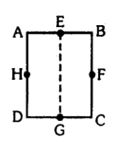
We have a rectangular plate of uniform thickness. $E, F, G, H$ are the midpoints of $AB, BC, CD,$ and $AD$ respectively. About which axis will the moment of inertia be minimum?
A
$AD$
B
$EG$
C
$BD$
D
$HF$
Solution
(D) The moment of inertia $I$ of a body about an axis is given by $I = \int r^2 dm$,where $r$ is the perpendicular distance of the mass element $dm$ from the axis.
For a given mass distribution,the moment of inertia is minimum about an axis passing through the center of mass that is closest to the bulk of the mass.
In a rectangular plate,the moment of inertia is minimum about the axis passing through the center of mass that is parallel to the longer side,as this axis keeps the mass elements at the smallest average distance $r$.
Let the length of the plate be $L$ and width be $W$,where $L > W$.
The axis $HF$ passes through the center of mass and is parallel to the longer side $AB$ (or $CD$).
The axis $EG$ passes through the center of mass and is parallel to the shorter side $AD$ (or $BC$).
Since $HF$ is parallel to the longer side,the mass is distributed closer to this axis compared to $EG$.
Therefore,the moment of inertia is minimum about the axis $HF$.
For a given mass distribution,the moment of inertia is minimum about an axis passing through the center of mass that is closest to the bulk of the mass.
In a rectangular plate,the moment of inertia is minimum about the axis passing through the center of mass that is parallel to the longer side,as this axis keeps the mass elements at the smallest average distance $r$.
Let the length of the plate be $L$ and width be $W$,where $L > W$.
The axis $HF$ passes through the center of mass and is parallel to the longer side $AB$ (or $CD$).
The axis $EG$ passes through the center of mass and is parallel to the shorter side $AD$ (or $BC$).
Since $HF$ is parallel to the longer side,the mass is distributed closer to this axis compared to $EG$.
Therefore,the moment of inertia is minimum about the axis $HF$.
0 likes
View Solution44
DifficultMCQ
The moment of inertia of a body is $160 \ kg \ m^2$ and its mass is $10 \ kg$. What will be the radius of gyration in $m$?
A
$10$
B
$4$
C
$5$
D
$6$
Solution
(B) The formula for the moment of inertia is $I = M K^2$,where $I$ is the moment of inertia,$M$ is the mass,and $K$ is the radius of gyration.
Given: $I = 160 \ kg \ m^2$ and $M = 10 \ kg$.
Substituting the values into the formula:
$160 = 10 \times K^2$
$K^2 = \frac{160}{10} = 16$
Taking the square root on both sides:
$K = \sqrt{16} = 4 \ m$.
Therefore,the radius of gyration is $4 \ m$.
Given: $I = 160 \ kg \ m^2$ and $M = 10 \ kg$.
Substituting the values into the formula:
$160 = 10 \times K^2$
$K^2 = \frac{160}{10} = 16$
Taking the square root on both sides:
$K = \sqrt{16} = 4 \ m$.
Therefore,the radius of gyration is $4 \ m$.
0 likes
View Solution45
MediumMCQ
Of the two eggs which have identical sizes,shapes and weights,one is raw and the other is half-boiled. The ratio between the moment of inertia of the raw egg to the half-boiled egg about their central axis is:
A
Equal to $1$
B
Less than $1$
C
Greater than $1$
D
Comparison is not possible
Solution
(C) The moment of inertia $I$ of a body depends on the distribution of mass relative to the axis of rotation,given by $I = \int r^2 dm$.
In a half-boiled egg,the yolk and white are partially solidified and concentrated closer to the central axis of rotation.
In a raw egg,the liquid content is distributed throughout the shell,meaning more mass is located further away from the central axis compared to the half-boiled egg.
Since the raw egg has more mass distributed at larger distances $r$ from the axis,its moment of inertia is greater than that of the half-boiled egg.
Therefore,the ratio of the moment of inertia of the raw egg to the half-boiled egg is greater than $1$.
In a half-boiled egg,the yolk and white are partially solidified and concentrated closer to the central axis of rotation.
In a raw egg,the liquid content is distributed throughout the shell,meaning more mass is located further away from the central axis compared to the half-boiled egg.
Since the raw egg has more mass distributed at larger distances $r$ from the axis,its moment of inertia is greater than that of the half-boiled egg.
Therefore,the ratio of the moment of inertia of the raw egg to the half-boiled egg is greater than $1$.
0 likes
View Solution46
EasyMCQ
The wheels of moving vehicles are made hollow in the middle and thick at the rim because...
A
It provides a strong grip to the tire.
B
Its shape is strong.
C
It increases the speed.
D
The mass remains the same but the moment of inertia increases.
Solution
(D) The moment of inertia of a body is given by $I = \sum mr^2$.
By concentrating the mass at the rim (far from the axis of rotation),the value of $r$ increases.
Since $I \propto r^2$,increasing the distance of the mass from the axis significantly increases the moment of inertia.
$A$ higher moment of inertia helps the wheel maintain its rotational motion and provides stability against fluctuations in torque.
By concentrating the mass at the rim (far from the axis of rotation),the value of $r$ increases.
Since $I \propto r^2$,increasing the distance of the mass from the axis significantly increases the moment of inertia.
$A$ higher moment of inertia helps the wheel maintain its rotational motion and provides stability against fluctuations in torque.
0 likes
View Solution47
MediumMCQ
$A$ circular disc is made using iron and aluminum. To maximize the moment of inertia about its geometric axis,which configuration is preferred?
A
Aluminum on the inside and iron on the outside
B
Iron on the inside and aluminum on the outside
C
By keeping alternate layers of iron and aluminum
D
Iron strips on both outer surfaces and aluminum strips on the inside
Solution
(A) The moment of inertia $I$ of a circular disc about its geometric axis is given by $I = \int r^2 dm$.
To maximize the moment of inertia for a fixed total mass,we need to place the maximum possible mass at the largest possible distance $r$ from the axis of rotation.
Since iron is denser than aluminum,placing iron at the outer rim (the largest radius) increases the mass distribution at a greater distance from the axis.
Therefore,placing iron on the outside and aluminum on the inside maximizes the moment of inertia.
To maximize the moment of inertia for a fixed total mass,we need to place the maximum possible mass at the largest possible distance $r$ from the axis of rotation.
Since iron is denser than aluminum,placing iron at the outer rim (the largest radius) increases the mass distribution at a greater distance from the axis.
Therefore,placing iron on the outside and aluminum on the inside maximizes the moment of inertia.
0 likes
View Solution48
EasyMCQ
$A$ wire of mass $M$ is bent into a circular shape of radius $R$. What is the moment of inertia about its diameter?
A
$\frac{MR^2}{2}$
B
$MR^2$
C
$2MR^2$
D
$\frac{MR^2}{4}$
Solution
(A) wire bent into a circular shape acts as a thin ring of mass $M$ and radius $R$.
For a ring,the moment of inertia about an axis passing through its center and perpendicular to its plane is $I_{cm} = MR^2$.
According to the perpendicular axis theorem,$I_z = I_x + I_y$.
Since the ring is symmetric,the moment of inertia about any diameter is the same,so $I_x = I_y = I_d$.
Therefore,$MR^2 = I_d + I_d = 2I_d$.
Solving for $I_d$,we get $I_d = \frac{MR^2}{2}$.
For a ring,the moment of inertia about an axis passing through its center and perpendicular to its plane is $I_{cm} = MR^2$.
According to the perpendicular axis theorem,$I_z = I_x + I_y$.
Since the ring is symmetric,the moment of inertia about any diameter is the same,so $I_x = I_y = I_d$.
Therefore,$MR^2 = I_d + I_d = 2I_d$.
Solving for $I_d$,we get $I_d = \frac{MR^2}{2}$.
0 likes
View Solution49
DifficultMCQ
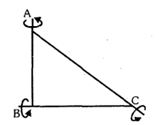
In the given figure,about which axis will the moment of inertia of the triangular frame be maximum? [Given: $AB < BC < AC$]
A
$AB$
B
$BC$
C
$AC$
D
For all axes
Solution
(A) The moment of inertia $I$ of a body about an axis is given by $I = \sum m_i r_i^2$,where $r_i$ is the perpendicular distance of the mass element $m_i$ from the axis of rotation.
For a given mass distribution,the moment of inertia is larger if the mass is distributed farther from the axis of rotation.
In the given triangular frame,the axis $AC$ is the longest side (hypotenuse). When rotating about $AC$,the mass of the frame is,on average,closer to the axis compared to the other two sides.
Conversely,the axis $AB$ is the shortest side. When rotating about $AB$,the mass of the frame (specifically the side $BC$) is distributed at a larger average distance from the axis $AB$.
Since $AB < BC < AC$,the mass is distributed farthest from the axis $AB$ compared to the other axes.
Therefore,the moment of inertia is maximum about the axis $AB$.
For a given mass distribution,the moment of inertia is larger if the mass is distributed farther from the axis of rotation.
In the given triangular frame,the axis $AC$ is the longest side (hypotenuse). When rotating about $AC$,the mass of the frame is,on average,closer to the axis compared to the other two sides.
Conversely,the axis $AB$ is the shortest side. When rotating about $AB$,the mass of the frame (specifically the side $BC$) is distributed at a larger average distance from the axis $AB$.
Since $AB < BC < AC$,the mass is distributed farthest from the axis $AB$ compared to the other axes.
Therefore,the moment of inertia is maximum about the axis $AB$.
0 likes
View SolutionSystem of Particles and Rotational Motion — Moment of Inertia and Radius of gyration · Frequently Asked Questions
1Are these System of Particles and Rotational Motion questions useful for JEE and NEET?
Yes. All questions in this section are mapped to JEE Main and NEET exam patterns. Previous year questions from JEE Main, NEET, GUJCET and state-level exams are included with full solutions.
2Can I switch to Hindi or Gujarati for these questions?
Yes. Use the language tabs in the hero section or the sidebar to view the same questions and solutions in English, Hindi or Gujarati.
3How do I generate a question paper from this subtopic?
Use the Vedclass Exam Paper Generator — select the chapter and subtopic, set difficulty, and generate Sets A, B, C, D automatically. First 3 chapters of every subject are free.
Vedclass Products
For Students
Vedclass Test Series
Mock tests in real JEE/NEET style with performance analysis. 5-day free trial.
Start Free TrialFor Teachers
Exam Paper Generator
Generate Set A/B/C/D papers from this chapter in 2 minutes. 3 chapters free.
Try FreeFor Institutes
Online Exam Module
Live online exams with unlimited students, 360° analytics & white-label branding.
See DemoFor Teachers & Institutes
Generate a System of Particles and Rotational Motion Exam Paper in 2 Minutes
Select subtopic & difficulty — Sets A, B, C, D auto-generated with No Repeat logic.
First 3 chapters of every subject are free — no payment required.