
Class 11PhysicsSystem of Particles and Rotational MotionMix Example - System of Particles and Rotational Motion
Difficult$A$ rod is hinged at its centre and rotated by applying a constant torque starting from rest. The power developed by the external torque as a function of time is:
- A
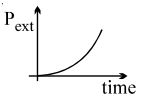
- B
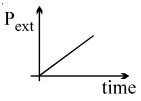
- C
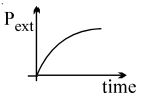
- D
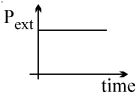
Explore More
Similar Questions
$A$ solid sphere $(A)$ of mass $5m$ and a spherical shell $(B)$ of mass $m$,both having the same radius $R$,are placed on a rough surface. When a force $F$ of the same magnitude is applied tangentially at the highest points of $A$ and $B$,they start rolling without slipping with accelerations $a_A$ and $a_B$,respectively. The ratio of $a_A$ to $a_B$ is . . . . . . .
DifficultJEE MAIN 2026
View SolutionThe general motion of a rigid body can be considered to be a combination of $(i)$ a motion of the centre of mass about an axis,and $(ii)$ its motion about an instantaneous axis passing through the centre of mass. These axes need not be stationary. Consider,for example,a thin uniform disc welded (rigidly fixed) horizontally at its rim to a massless stick,as shown in the figure. When the disc-stick system is rotated about the origin on a horizontal frictionless plane with angular speed $\omega$,the motion at any instant can be taken as a combination of $(i)$ a rotation of the centre of mass of the disc about the $z$-axis,and $(ii)$ a rotation of the disc about an instantaneous vertical axis passing through its centre of mass (as is seen from the changed orientation of points $P$ and $Q$). Both the motions have the same angular speed $\omega$ in this case. Now consider two similar systems as shown in the figure: Case $(a)$ the disc with its face vertical and parallel to the $x-z$ plane; Case $(b)$ the disc with its face making an angle of $45^{\circ}$ with the $x-y$ plane,its horizontal diameter parallel to the $x$-axis. In both the cases,the disc is welded at point $P$,and systems are rotated with constant angular speed $\omega$ about the $z$-axis.
$1.$ Which of the following statements regarding the angular speed about the instantaneous axis (passing through the centre of mass) is correct?
$(A)$ It is $\sqrt{2} \omega$ for both the cases.
$(B)$ It is $\omega$ for case $(a)$; and $\frac{\omega}{\sqrt{2}}$ for case $(b)$.
$(C)$ It is $\omega$ for case $(a)$; and $\sqrt{2} \omega$ for case $(b)$.
$(D)$ It is $\omega$ for both the cases.
$2.$ Which of the following statements about the instantaneous axis (passing through the centre of mass) is correct?
$(A)$ It is vertical for both the cases $(a)$ and $(b)$.
$(B)$ It is vertical for case $(a)$; and is at $45^{\circ}$ to the $x-z$ plane and lies in the plane of the disc for case $(b)$.
$(C)$ It is horizontal for case $(a)$; and is at $45^{\circ}$ to the $x-z$ plane and is normal to the plane of the disc for case $(b)$.
$(D)$ It is vertical for case $(a)$; and is at $45^{\circ}$ to the $x-z$ plane and is normal to the plane of the disc for case $(b)$.
Give the answer for question $1$ and $2$.
$1.$ Which of the following statements regarding the angular speed about the instantaneous axis (passing through the centre of mass) is correct?
$(A)$ It is $\sqrt{2} \omega$ for both the cases.
$(B)$ It is $\omega$ for case $(a)$; and $\frac{\omega}{\sqrt{2}}$ for case $(b)$.
$(C)$ It is $\omega$ for case $(a)$; and $\sqrt{2} \omega$ for case $(b)$.
$(D)$ It is $\omega$ for both the cases.
$2.$ Which of the following statements about the instantaneous axis (passing through the centre of mass) is correct?
$(A)$ It is vertical for both the cases $(a)$ and $(b)$.
$(B)$ It is vertical for case $(a)$; and is at $45^{\circ}$ to the $x-z$ plane and lies in the plane of the disc for case $(b)$.
$(C)$ It is horizontal for case $(a)$; and is at $45^{\circ}$ to the $x-z$ plane and is normal to the plane of the disc for case $(b)$.
$(D)$ It is vertical for case $(a)$; and is at $45^{\circ}$ to the $x-z$ plane and is normal to the plane of the disc for case $(b)$.
Give the answer for question $1$ and $2$.
$A$ uniform thin wooden plank $AB$ of length $L$ and mass $M$ is kept on a table with its $B$ end slightly outside the edge of the table. When an impulse $J$ is given to the end $B$,the plank moves up with the centre of mass rising a distance $h$ from the surface of the table. Then,
Two masses of $0.3 \, kg$ and $0.7 \, kg$ are attached to the ends of a rod of length $1.4 \, m$ and negligible mass. The rod is rotated about an axis perpendicular to its length with a constant angular speed. The point on the rod through which the axis should pass so that the work required to rotate the rod is minimum is:
Difficult
View SolutionMatch Column-$I$ with Column-$II$.
Column-$I$ Column-$II$ $(1)$ $SI$ unit of torque $(a)$ $m$ $(2)$ $SI$ unit of radius of gyration $(b)$ $N\,m$ $(c)$ $Js^{-2}$
| Column-$I$ | Column-$II$ |
|---|---|
| $(1)$ $SI$ unit of torque | $(a)$ $m$ |
| $(2)$ $SI$ unit of radius of gyration | $(b)$ $N\,m$ |
| $(c)$ $Js^{-2}$ |
Easy
View SolutionVedclass Products
For Students
Vedclass Test Series
Mock tests in real JEE/NEET style with performance analysis. 5-day free trial.
Start Free TrialFor Teachers
Exam Paper Generator
Generate Set A/B/C/D exam papers from 7.5L+ questions in 2 minutes. 3 chapters free.
Try FreeFor Institutes
Online Exam Module
Live online exams with unlimited students, 360° analytics & white-label branding.
See Demo