
A English
Energy conservation, Kinetic Energy, Work and Power of Rotational Motion Questions in English
Class 11 Physics · System of Particles and Rotational Motion · Energy conservation, Kinetic Energy, Work and Power of Rotational Motion
49+
Questions
English
Language
100%
With Solutions
Showing 49 of 49 questions in English
1
MediumMCQ
The moment of inertia of a body about a given axis is $2.4 \ kg \cdot m^2$. To produce a rotational kinetic energy of $750 \ J$,an angular acceleration of $5 \ rad/s^2$ must be applied about that axis for how many seconds?
A
$6$
B
$5$
C
$4$
D
$3$
Solution
(B) The rotational kinetic energy $(K_r)$ is given by the formula $K_r = \frac{1}{2} I \omega^2$.
Given $I = 2.4 \ kg \cdot m^2$ and $K_r = 750 \ J$,we have:
$750 = \frac{1}{2} \times 2.4 \times \omega^2$
$750 = 1.2 \times \omega^2$
$\omega^2 = \frac{750}{1.2} = 625$
$\omega = \sqrt{625} = 25 \ rad/s$.
Assuming the body starts from rest,the initial angular velocity $\omega_0 = 0$.
Using the kinematic equation $\omega = \omega_0 + \alpha t$:
$25 = 0 + 5 \times t$
$t = \frac{25}{5} = 5 \ s$.
Given $I = 2.4 \ kg \cdot m^2$ and $K_r = 750 \ J$,we have:
$750 = \frac{1}{2} \times 2.4 \times \omega^2$
$750 = 1.2 \times \omega^2$
$\omega^2 = \frac{750}{1.2} = 625$
$\omega = \sqrt{625} = 25 \ rad/s$.
Assuming the body starts from rest,the initial angular velocity $\omega_0 = 0$.
Using the kinematic equation $\omega = \omega_0 + \alpha t$:
$25 = 0 + 5 \times t$
$t = \frac{25}{5} = 5 \ s$.
0 likes
View Solution2
MediumMCQ
$A$ circular disc has a mass of $1\ kg$ and radius $40\ cm$. It is rotating about an axis passing through its centre and perpendicular to its plane with a speed of $10\ rev/s$. The work done in joules in stopping it would be ...... $J$
A
$4$
B
$47.5$
C
$79$
D
$158$
Solution
(D) The work done to stop the rotating disc is equal to the change in its rotational kinetic energy.
Given: Mass $M = 1\ kg$,Radius $R = 40\ cm = 0.4\ m$,Frequency $f = 10\ rev/s$.
The moment of inertia of the disc about its central axis is $I = \frac{1}{2}MR^2 = \frac{1}{2} \times 1 \times (0.4)^2 = 0.08\ kg\cdot m^2$.
The angular velocity is $\omega = 2\pi f = 2 \times \pi \times 10 = 20\pi\ rad/s$.
The initial rotational kinetic energy is $K_i = \frac{1}{2}I\omega^2 = \frac{1}{2} \times 0.08 \times (20\pi)^2$.
$K_i = 0.04 \times 400\pi^2 = 16\pi^2$.
Using $\pi^2 \approx 9.87$,$K_i = 16 \times 9.87 = 157.92\ J \approx 158\ J$.
Since the final kinetic energy is $0$,the work done to stop the disc is $W = K_f - K_i = 0 - 158 = -158\ J$.
The magnitude of the work done is $158\ J$.
Given: Mass $M = 1\ kg$,Radius $R = 40\ cm = 0.4\ m$,Frequency $f = 10\ rev/s$.
The moment of inertia of the disc about its central axis is $I = \frac{1}{2}MR^2 = \frac{1}{2} \times 1 \times (0.4)^2 = 0.08\ kg\cdot m^2$.
The angular velocity is $\omega = 2\pi f = 2 \times \pi \times 10 = 20\pi\ rad/s$.
The initial rotational kinetic energy is $K_i = \frac{1}{2}I\omega^2 = \frac{1}{2} \times 0.08 \times (20\pi)^2$.
$K_i = 0.04 \times 400\pi^2 = 16\pi^2$.
Using $\pi^2 \approx 9.87$,$K_i = 16 \times 9.87 = 157.92\ J \approx 158\ J$.
Since the final kinetic energy is $0$,the work done to stop the disc is $W = K_f - K_i = 0 - 158 = -158\ J$.
The magnitude of the work done is $158\ J$.
2 likes
View Solution3
MediumMCQ
$A$ tangential force $F$ is applied on a disc of radius $R$,due to which it deflects through an angle $\theta$ from its initial position. The work done by this force would be
A
$FR$
B
$F\theta$
C
$\frac{FR}{\theta}$
D
$FR\theta$
Solution
(D) The work done by a force $F$ acting on a body is given by the product of the force and the displacement in the direction of the force.
For a tangential force $F$ applied to the edge of a disc of radius $R$,the displacement $s$ along the arc for an angular deflection $\theta$ (in radians) is given by $s = R\theta$.
Since the force $F$ is always tangential to the disc,it remains parallel to the displacement at every point along the arc.
Therefore,the work done $W$ is calculated as:
$W = F \times s$
$W = F \times (R\theta)$
$W = FR\theta$
Thus,the correct option is $D$.
For a tangential force $F$ applied to the edge of a disc of radius $R$,the displacement $s$ along the arc for an angular deflection $\theta$ (in radians) is given by $s = R\theta$.
Since the force $F$ is always tangential to the disc,it remains parallel to the displacement at every point along the arc.
Therefore,the work done $W$ is calculated as:
$W = F \times s$
$W = F \times (R\theta)$
$W = FR\theta$
Thus,the correct option is $D$.
0 likes
View Solution4
MediumMCQ
$A$ wheel of moment of inertia $10 \ kg \cdot m^2$ is rotating at $10$ rotations per minute. The work done in increasing its speed to $5$ times its initial value will be .......... $J$.
A
$100$
B
$131.4$
C
$13.4$
D
$0.1341$
Solution
(B) Given: Moment of inertia $I = 10 \ kg \cdot m^2$,initial angular speed $N_1 = 10 \ rpm$.
The initial angular velocity is $\omega_1 = \frac{2 \pi N_1}{60} = \frac{2 \pi \times 10}{60} = \frac{\pi}{3} \ rad/s$.
The final angular velocity is $\omega_2 = 5 \omega_1 = 5 \times \frac{\pi}{3} = \frac{5 \pi}{3} \ rad/s$.
According to the work-energy theorem,the work done is equal to the change in rotational kinetic energy:
$W = \Delta K = \frac{1}{2} I (\omega_2^2 - \omega_1^2)$.
Substituting the values: $W = \frac{1}{2} \times 10 \times \left[ (\frac{5 \pi}{3})^2 - (\frac{\pi}{3})^2 \right]$.
$W = 5 \times \left( \frac{25 \pi^2}{9} - \frac{\pi^2}{9} \right) = 5 \times \frac{24 \pi^2}{9} = 5 \times \frac{8 \pi^2}{3} = \frac{40 \pi^2}{3}$.
Using $\pi^2 \approx 9.8696$,$W = \frac{40 \times 9.8696}{3} \approx 131.59 \ J$. Given the options,the closest value is $131.4 \ J$.
The initial angular velocity is $\omega_1 = \frac{2 \pi N_1}{60} = \frac{2 \pi \times 10}{60} = \frac{\pi}{3} \ rad/s$.
The final angular velocity is $\omega_2 = 5 \omega_1 = 5 \times \frac{\pi}{3} = \frac{5 \pi}{3} \ rad/s$.
According to the work-energy theorem,the work done is equal to the change in rotational kinetic energy:
$W = \Delta K = \frac{1}{2} I (\omega_2^2 - \omega_1^2)$.
Substituting the values: $W = \frac{1}{2} \times 10 \times \left[ (\frac{5 \pi}{3})^2 - (\frac{\pi}{3})^2 \right]$.
$W = 5 \times \left( \frac{25 \pi^2}{9} - \frac{\pi^2}{9} \right) = 5 \times \frac{24 \pi^2}{9} = 5 \times \frac{8 \pi^2}{3} = \frac{40 \pi^2}{3}$.
Using $\pi^2 \approx 9.8696$,$W = \frac{40 \times 9.8696}{3} \approx 131.59 \ J$. Given the options,the closest value is $131.4 \ J$.
0 likes
View Solution5
MediumMCQ
$A$ flywheel has a moment of inertia of $4 \ kg \cdot m^2$ and a kinetic energy of $200 \ J$. Calculate the number of revolutions it makes before coming to rest if a constant opposing couple of $5 \ N \cdot m$ is applied to the flywheel.
A
$12.8$
B
$24$
C
$6.4$
D
$16$
Solution
(C) The rotational kinetic energy is given by $K.E. = \frac{1}{2} I \omega_i^2 = 200 \ J$.
Given $I = 4 \ kg \cdot m^2$,we have $\frac{1}{2} \times 4 \times \omega_i^2 = 200$,which simplifies to $2 \omega_i^2 = 200$,so $\omega_i^2 = 100$,and $\omega_i = 10 \ rad/s$.
The work done by the opposing torque $T$ to bring the flywheel to rest is equal to the initial kinetic energy: $W = T \theta = K.E.$
Here,$T = 5 \ N \cdot m$ and $K.E. = 200 \ J$.
So,$5 \times \theta = 200$,which gives $\theta = 40 \ radians$.
The number of revolutions $n$ is given by $n = \frac{\theta}{2 \pi} = \frac{40}{2 \pi} = \frac{20}{\pi}$.
Using $\pi \approx 3.14159$,$n \approx 6.366 \approx 6.4$ revolutions.
Given $I = 4 \ kg \cdot m^2$,we have $\frac{1}{2} \times 4 \times \omega_i^2 = 200$,which simplifies to $2 \omega_i^2 = 200$,so $\omega_i^2 = 100$,and $\omega_i = 10 \ rad/s$.
The work done by the opposing torque $T$ to bring the flywheel to rest is equal to the initial kinetic energy: $W = T \theta = K.E.$
Here,$T = 5 \ N \cdot m$ and $K.E. = 200 \ J$.
So,$5 \times \theta = 200$,which gives $\theta = 40 \ radians$.
The number of revolutions $n$ is given by $n = \frac{\theta}{2 \pi} = \frac{40}{2 \pi} = \frac{20}{\pi}$.
Using $\pi \approx 3.14159$,$n \approx 6.366 \approx 6.4$ revolutions.
0 likes
View Solution6
DifficultMCQ
$A$ flywheel of moment of inertia $I$ is rotating at $n$ revolutions per second. The work needed to double the frequency would be
A
$2{\pi ^2}I{n^2}$
B
$4{\pi ^2}I{n^2}$
C
$6{\pi ^2}I{n^2}$
D
$8{\pi ^2}I{n^2}$
Solution
(C) Let the initial frequency be $n$.
The initial angular velocity is $\omega_i = 2\pi n$.
The initial rotational kinetic energy is $K_i = \frac{1}{2} I \omega_i^2 = \frac{1}{2} I (2\pi n)^2 = 2 I \pi^2 n^2$.
When the frequency is doubled,the new frequency is $n' = 2n$.
The new angular velocity is $\omega_f = 2\pi (2n) = 4\pi n$.
The final rotational kinetic energy is $K_f = \frac{1}{2} I \omega_f^2 = \frac{1}{2} I (4\pi n)^2 = 8 I \pi^2 n^2$.
According to the work-energy theorem,the work done $W$ is equal to the change in kinetic energy:
$W = K_f - K_i = 8 I \pi^2 n^2 - 2 I \pi^2 n^2 = 6 I \pi^2 n^2$.
The initial angular velocity is $\omega_i = 2\pi n$.
The initial rotational kinetic energy is $K_i = \frac{1}{2} I \omega_i^2 = \frac{1}{2} I (2\pi n)^2 = 2 I \pi^2 n^2$.
When the frequency is doubled,the new frequency is $n' = 2n$.
The new angular velocity is $\omega_f = 2\pi (2n) = 4\pi n$.
The final rotational kinetic energy is $K_f = \frac{1}{2} I \omega_f^2 = \frac{1}{2} I (4\pi n)^2 = 8 I \pi^2 n^2$.
According to the work-energy theorem,the work done $W$ is equal to the change in kinetic energy:
$W = K_f - K_i = 8 I \pi^2 n^2 - 2 I \pi^2 n^2 = 6 I \pi^2 n^2$.
0 likes
View Solution7
MediumMCQ
$A$ wheel is rotating with an angular speed of $20\ rad/s$. It is stopped to rest by applying a constant torque in $4\ s$. If the moment of inertia of the wheel about its axis is $0.20\ kg\cdot m^2$,then the work done by the torque in two seconds will be .......... $J$.
A
$10$
B
$20$
C
$30$
D
$40$
Solution
(C) Initial angular speed $\omega_1 = 20\ rad/s$.
Final angular speed $\omega_f = 0\ rad/s$ at $t = 4\ s$.
Angular retardation $\alpha = \frac{\omega_1 - \omega_f}{t} = \frac{20 - 0}{4} = 5\ rad/s^2$.
Angular speed after $t' = 2\ s$ is $\omega_2 = \omega_1 - \alpha t' = 20 - (5 \times 2) = 10\ rad/s$.
Work done by the torque is equal to the change in rotational kinetic energy:
$W = \Delta K = \frac{1}{2} I (\omega_1^2 - \omega_2^2)$.
$W = \frac{1}{2} \times 0.20 \times (20^2 - 10^2)$.
$W = 0.1 \times (400 - 100) = 0.1 \times 300 = 30\ J$.
Final angular speed $\omega_f = 0\ rad/s$ at $t = 4\ s$.
Angular retardation $\alpha = \frac{\omega_1 - \omega_f}{t} = \frac{20 - 0}{4} = 5\ rad/s^2$.
Angular speed after $t' = 2\ s$ is $\omega_2 = \omega_1 - \alpha t' = 20 - (5 \times 2) = 10\ rad/s$.
Work done by the torque is equal to the change in rotational kinetic energy:
$W = \Delta K = \frac{1}{2} I (\omega_1^2 - \omega_2^2)$.
$W = \frac{1}{2} \times 0.20 \times (20^2 - 10^2)$.
$W = 0.1 \times (400 - 100) = 0.1 \times 300 = 30\ J$.
0 likes
View Solution8
EasyMCQ
The angular velocity of a body is $\vec{\omega} = 2\hat{i} + 3\hat{j} + 4\hat{k}$ and a torque $\vec{\tau} = \hat{i} + 2\hat{j} + 3\hat{k}$ acts on it. The rotational power will be .......... $W$.
A
$20$
B
$15$
C
$\sqrt{17}$
D
$\sqrt{14}$
Solution
(A) The rotational power $(P)$ is given by the dot product of torque $(\vec{\tau})$ and angular velocity $(\vec{\omega})$.
$P = \vec{\tau} \cdot \vec{\omega}$
Given $\vec{\tau} = \hat{i} + 2\hat{j} + 3\hat{k}$ and $\vec{\omega} = 2\hat{i} + 3\hat{j} + 4\hat{k}$.
$P = (1\hat{i} + 2\hat{j} + 3\hat{k}) \cdot (2\hat{i} + 3\hat{j} + 4\hat{k})$
$P = (1 \times 2) + (2 \times 3) + (3 \times 4)$
$P = 2 + 6 + 12$
$P = 20 \ W$
$P = \vec{\tau} \cdot \vec{\omega}$
Given $\vec{\tau} = \hat{i} + 2\hat{j} + 3\hat{k}$ and $\vec{\omega} = 2\hat{i} + 3\hat{j} + 4\hat{k}$.
$P = (1\hat{i} + 2\hat{j} + 3\hat{k}) \cdot (2\hat{i} + 3\hat{j} + 4\hat{k})$
$P = (1 \times 2) + (2 \times 3) + (3 \times 4)$
$P = 2 + 6 + 12$
$P = 20 \ W$
0 likes
View Solution9
MediumMCQ
$A$ tangential force $F$ is applied on the rim of a ring of radius $R$. If the ring rotates by an angle $\theta$,what is the work done by the force?
A
$\frac{FR}{\theta}$
B
$FR\theta$
C
$FR - \frac{1}{\theta}$
D
$FR - \theta$
Solution
(B) The work done by a torque $\tau$ during an angular displacement $\theta$ is given by the formula $W = \tau \theta$.
Here,the force $F$ is applied tangentially to the rim of the ring of radius $R$.
The torque $\tau$ produced by this force is $\tau = F \times R$.
Substituting the value of torque into the work formula,we get $W = (F \times R) \times \theta$.
Therefore,the work done by the force is $W = FR\theta$.
Here,the force $F$ is applied tangentially to the rim of the ring of radius $R$.
The torque $\tau$ produced by this force is $\tau = F \times R$.
Substituting the value of torque into the work formula,we get $W = (F \times R) \times \theta$.
Therefore,the work done by the force is $W = FR\theta$.
0 likes
View Solution10
MediumMCQ
$A$ thin rod of length $l$ and mass $m$ oscillates in a vertical plane about a horizontal axis passing through one of its ends. If the maximum angular velocity of the rod is $\omega$,what is the maximum height reached by its center of mass?
A
$\frac{1}{3} \frac{l^2 \omega^2}{g}$
B
$\frac{1}{6} \frac{l \omega}{g}$
C
$\frac{1}{2} \frac{l^2 \omega^2}{g}$
D
$\frac{1}{6} \frac{l^2 \omega^2}{g}$
Solution
(D) The moment of inertia of a rod of length $l$ and mass $m$ about an axis passing through one of its ends is $I = \frac{1}{3} ml^2$.
The rotational kinetic energy of the rod at its lowest position is $K = \frac{1}{2} I \omega^2 = \frac{1}{2} (\frac{1}{3} ml^2) \omega^2 = \frac{1}{6} ml^2 \omega^2$.
As the rod swings,this kinetic energy is converted into gravitational potential energy of the center of mass.
The center of mass of the rod is at a distance $l/2$ from the axis of rotation.
Let $h$ be the maximum height reached by the center of mass.
By the law of conservation of energy,the change in potential energy equals the initial rotational kinetic energy:
$mgh = \frac{1}{6} ml^2 \omega^2$.
Solving for $h$,we get $h = \frac{l^2 \omega^2}{6g}$.
The rotational kinetic energy of the rod at its lowest position is $K = \frac{1}{2} I \omega^2 = \frac{1}{2} (\frac{1}{3} ml^2) \omega^2 = \frac{1}{6} ml^2 \omega^2$.
As the rod swings,this kinetic energy is converted into gravitational potential energy of the center of mass.
The center of mass of the rod is at a distance $l/2$ from the axis of rotation.
Let $h$ be the maximum height reached by the center of mass.
By the law of conservation of energy,the change in potential energy equals the initial rotational kinetic energy:
$mgh = \frac{1}{6} ml^2 \omega^2$.
Solving for $h$,we get $h = \frac{l^2 \omega^2}{6g}$.

0 likes
View Solution11
MediumMCQ
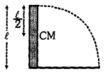
$A$ thin meter rod is placed with one end on the ground. It is allowed to fall such that the contact point remains fixed. Find the velocity of the upper end when it hits the ground.
A
$\sqrt{g\ell}$
B
$\sqrt{2g\ell}$
C
$\sqrt{3g\ell}$
D
$\sqrt{5g\ell}$
Solution
(C) Let the length of the rod be $\ell$ and its mass be $m$. The rod rotates about the fixed end on the ground.
Initially,the center of mass $(CM)$ of the rod is at a height $h = \frac{\ell}{2}$ from the ground.
When the rod hits the ground,the potential energy lost by the rod is converted into rotational kinetic energy.
Loss in potential energy = $mg \Delta h = mg \frac{\ell}{2}$.
Rotational kinetic energy = $\frac{1}{2} I \omega^2$,where $I$ is the moment of inertia about the end,$I = \frac{m\ell^2}{3}$.
Equating the two: $mg \frac{\ell}{2} = \frac{1}{2} \left( \frac{m\ell^2}{3} \right) \omega^2$.
Simplifying,$g\ell = \frac{\ell^2}{3} \omega^2$,so $\omega^2 = \frac{3g}{\ell}$,which gives $\omega = \sqrt{\frac{3g}{\ell}}$.
The velocity $v$ of the upper end is $v = \omega \ell$.
Substituting $\omega$,we get $v = \sqrt{\frac{3g}{\ell}} \times \ell = \sqrt{3g\ell}$.
Initially,the center of mass $(CM)$ of the rod is at a height $h = \frac{\ell}{2}$ from the ground.
When the rod hits the ground,the potential energy lost by the rod is converted into rotational kinetic energy.
Loss in potential energy = $mg \Delta h = mg \frac{\ell}{2}$.
Rotational kinetic energy = $\frac{1}{2} I \omega^2$,where $I$ is the moment of inertia about the end,$I = \frac{m\ell^2}{3}$.
Equating the two: $mg \frac{\ell}{2} = \frac{1}{2} \left( \frac{m\ell^2}{3} \right) \omega^2$.
Simplifying,$g\ell = \frac{\ell^2}{3} \omega^2$,so $\omega^2 = \frac{3g}{\ell}$,which gives $\omega = \sqrt{\frac{3g}{\ell}}$.
The velocity $v$ of the upper end is $v = \omega \ell$.
Substituting $\omega$,we get $v = \sqrt{\frac{3g}{\ell}} \times \ell = \sqrt{3g\ell}$.
0 likes
View Solution12
DifficultMCQ
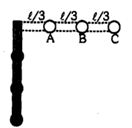
$A$ light rod carries three equal masses $A$,$B$,and $C$ as shown in the figure. If the rod is released from the horizontal position,what will be the velocity of mass $B$ when the rod reaches the vertical position?
A
$\sqrt {\frac{{6g\ell }}{7}} $
B
$\sqrt {\frac{{8g\ell }}{7}} $
C
$\sqrt {\frac{{5g\ell }}{3}} $
D
$\sqrt {\frac{{3g\ell }}{9}} $
Solution
(B) By the principle of conservation of energy,the loss in potential energy equals the gain in rotational kinetic energy.
Let $m$ be the mass of each particle $A$,$B$,and $C$. The distances of $A$,$B$,and $C$ from the pivot are $\frac{\ell}{3}$,$\frac{2\ell}{3}$,and $\ell$ respectively.
Loss in potential energy = $mg(\frac{\ell}{3}) + mg(\frac{2\ell}{3}) + mg(\ell) = mg\ell(1/3 + 2/3 + 1) = 2mg\ell$.
Gain in rotational kinetic energy = $\frac{1}{2} I \omega^2$,where $I = m(\frac{\ell}{3})^2 + m(\frac{2\ell}{3})^2 + m(\ell)^2 = m\ell^2(\frac{1}{9} + \frac{4}{9} + 1) = m\ell^2(\frac{14}{9})$.
Equating the two: $2mg\ell = \frac{1}{2} (m\ell^2 \frac{14}{9}) \omega^2$.
$2g = \frac{7}{9} \ell \omega^2 \Rightarrow \omega^2 = \frac{18g}{7\ell} \Rightarrow \omega = \sqrt{\frac{18g}{7\ell}}$.
The velocity of mass $B$ is $v_B = \omega r_B = \omega (\frac{2\ell}{3})$.
$v_B = \frac{2\ell}{3} \sqrt{\frac{18g}{7\ell}} = \sqrt{\frac{4\ell^2}{9} \cdot \frac{18g}{7\ell}} = \sqrt{\frac{8g\ell}{7}}$.
Let $m$ be the mass of each particle $A$,$B$,and $C$. The distances of $A$,$B$,and $C$ from the pivot are $\frac{\ell}{3}$,$\frac{2\ell}{3}$,and $\ell$ respectively.
Loss in potential energy = $mg(\frac{\ell}{3}) + mg(\frac{2\ell}{3}) + mg(\ell) = mg\ell(1/3 + 2/3 + 1) = 2mg\ell$.
Gain in rotational kinetic energy = $\frac{1}{2} I \omega^2$,where $I = m(\frac{\ell}{3})^2 + m(\frac{2\ell}{3})^2 + m(\ell)^2 = m\ell^2(\frac{1}{9} + \frac{4}{9} + 1) = m\ell^2(\frac{14}{9})$.
Equating the two: $2mg\ell = \frac{1}{2} (m\ell^2 \frac{14}{9}) \omega^2$.
$2g = \frac{7}{9} \ell \omega^2 \Rightarrow \omega^2 = \frac{18g}{7\ell} \Rightarrow \omega = \sqrt{\frac{18g}{7\ell}}$.
The velocity of mass $B$ is $v_B = \omega r_B = \omega (\frac{2\ell}{3})$.
$v_B = \frac{2\ell}{3} \sqrt{\frac{18g}{7\ell}} = \sqrt{\frac{4\ell^2}{9} \cdot \frac{18g}{7\ell}} = \sqrt{\frac{8g\ell}{7}}$.
0 likes
View Solution13
DifficultMCQ
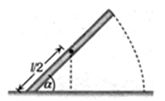
$A$ uniform rod of length $2L$ is placed with one end in contact with a horizontal surface. The other end is released from an angle $\alpha$ with the horizontal,such that the end in contact does not slip. What will be its angular velocity when it becomes horizontal?
A
$\omega = \sqrt{\frac{3g \sin \alpha}{2L}}$
B
$\omega = \sqrt{\frac{2L}{3g \sin \alpha}}$
C
$\omega = \sqrt{\frac{6g \sin \alpha}{L}}$
D
$\omega = \sqrt{\frac{L}{g \sin \alpha}}$
Solution
(A) Let the mass of the rod be $m$ and its length be $l = 2L$.
The rod rotates about the end in contact with the ground. The moment of inertia of the rod about this end is $I = \frac{m l^2}{3} = \frac{m(2L)^2}{3} = \frac{4mL^2}{3}$.
Using the principle of conservation of mechanical energy,the loss in gravitational potential energy equals the gain in rotational kinetic energy.
The initial height of the center of mass is $h = \frac{l}{2} \sin \alpha = L \sin \alpha$.
Loss in potential energy = $mgh = mg(L \sin \alpha)$.
Gain in rotational kinetic energy = $\frac{1}{2} I \omega^2 = \frac{1}{2} \left( \frac{4mL^2}{3} \right) \omega^2 = \frac{2mL^2}{3} \omega^2$.
Equating the two: $mgL \sin \alpha = \frac{2mL^2}{3} \omega^2$.
Solving for $\omega$: $\omega^2 = \frac{3g \sin \alpha}{2L} \Rightarrow \omega = \sqrt{\frac{3g \sin \alpha}{2L}}$.
The rod rotates about the end in contact with the ground. The moment of inertia of the rod about this end is $I = \frac{m l^2}{3} = \frac{m(2L)^2}{3} = \frac{4mL^2}{3}$.
Using the principle of conservation of mechanical energy,the loss in gravitational potential energy equals the gain in rotational kinetic energy.
The initial height of the center of mass is $h = \frac{l}{2} \sin \alpha = L \sin \alpha$.
Loss in potential energy = $mgh = mg(L \sin \alpha)$.
Gain in rotational kinetic energy = $\frac{1}{2} I \omega^2 = \frac{1}{2} \left( \frac{4mL^2}{3} \right) \omega^2 = \frac{2mL^2}{3} \omega^2$.
Equating the two: $mgL \sin \alpha = \frac{2mL^2}{3} \omega^2$.
Solving for $\omega$: $\omega^2 = \frac{3g \sin \alpha}{2L} \Rightarrow \omega = \sqrt{\frac{3g \sin \alpha}{2L}}$.
0 likes
View Solution14
MediumMCQ
Three objects,$A$ (a solid sphere),$B$ (a thin circular disk),and $C$ (a circular ring),each have the same mass $M$ and radius $R$. They all spin with the same angular speed $\omega$ about their own symmetry axes. The amounts of work $(W)$ required to bring them to rest would satisfy the relation:
A
$W_C > W_B > W_A$
B
$W_A > W_B > W_C$
C
$W_A > W_C > W_B$
D
$W_B > W_A > W_C$
Solution
(A) The work done required to bring an object to rest is equal to its rotational kinetic energy: $W = \Delta KE = \frac{1}{2} I \omega^2$.
Since all objects have the same angular speed $\omega$,the work done is directly proportional to the moment of inertia: $W \propto I$.
The moments of inertia for the given objects about their symmetry axes are:
$1$. Solid sphere $(A)$: $I_A = \frac{2}{5} MR^2 = 0.4 MR^2$
$2$. Thin circular disk $(B)$: $I_B = \frac{1}{2} MR^2 = 0.5 MR^2$
$3$. Circular ring $(C)$: $I_C = MR^2 = 1.0 MR^2$
Comparing these values,we get $I_C > I_B > I_A$.
Therefore,the work required satisfies the relation $W_C > W_B > W_A$.
Since all objects have the same angular speed $\omega$,the work done is directly proportional to the moment of inertia: $W \propto I$.
The moments of inertia for the given objects about their symmetry axes are:
$1$. Solid sphere $(A)$: $I_A = \frac{2}{5} MR^2 = 0.4 MR^2$
$2$. Thin circular disk $(B)$: $I_B = \frac{1}{2} MR^2 = 0.5 MR^2$
$3$. Circular ring $(C)$: $I_C = MR^2 = 1.0 MR^2$
Comparing these values,we get $I_C > I_B > I_A$.
Therefore,the work required satisfies the relation $W_C > W_B > W_A$.
0 likes
View Solution15
EasyMCQ
$A$ sphere of mass $m$ and moment of inertia $I$ about its center of mass is rolling without slipping down an inclined plane from rest. Which of the following represents its total kinetic energy?
A
$ \frac{1}{2}I{\omega ^2} $
B
$ \frac{1}{2}m{v^2} $
C
$ I\omega + mv $
D
$ \frac{1}{2}I{\omega ^2} + \frac{1}{2}m{v^2} $
Solution
(D) When a body rolls without slipping,it possesses both translational kinetic energy and rotational kinetic energy.
Translational kinetic energy is given by $K_t = \frac{1}{2}mv^2$,where $m$ is the mass and $v$ is the velocity of the center of mass.
Rotational kinetic energy is given by $K_r = \frac{1}{2}I\omega^2$,where $I$ is the moment of inertia about the center of mass and $\omega$ is the angular velocity.
The total kinetic energy $K$ is the sum of these two energies:
$K = K_t + K_r = \frac{1}{2}mv^2 + \frac{1}{2}I\omega^2$.
Therefore,the correct option is $D$.
Translational kinetic energy is given by $K_t = \frac{1}{2}mv^2$,where $m$ is the mass and $v$ is the velocity of the center of mass.
Rotational kinetic energy is given by $K_r = \frac{1}{2}I\omega^2$,where $I$ is the moment of inertia about the center of mass and $\omega$ is the angular velocity.
The total kinetic energy $K$ is the sum of these two energies:
$K = K_t + K_r = \frac{1}{2}mv^2 + \frac{1}{2}I\omega^2$.
Therefore,the correct option is $D$.
0 likes
View Solution16
DifficultMCQ
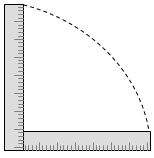
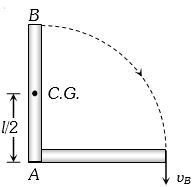
$A$ rod of length $1 \ m$ is held vertically and allowed to fall such that its lower end remains fixed on the ground. The velocity of the other end of the rod when it hits the ground is ......... $m/s$ $(g = 9.8 \ m/s^2)$.
A
$3.2$
B
$5.4$
C
$7.6$
D
$9.2$
Solution
(B) In this process,the potential energy of the rod is converted into rotational kinetic energy.
Initial potential energy of the rod $U = mg \left( \frac{l}{2} \right)$,because the center of gravity of the rod is at its midpoint.
Rotational kinetic energy $K = \frac{1}{2} I \omega^2$.
Here,$I$ is the moment of inertia of the rod about the fixed end $A$,which is $I = \frac{ml^2}{3}$.
Let $\omega$ be the angular velocity of the rod when it hits the ground.
The velocity of the end $B$ when it hits the ground is $v_B = \omega l$,so $\omega = \frac{v_B}{l}$.
According to the law of conservation of energy:
$mg \left( \frac{l}{2} \right) = \frac{1}{2} I \omega^2$
$mg \left( \frac{l}{2} \right) = \frac{1}{2} \left( \frac{ml^2}{3} \right) \left( \frac{v_B}{l} \right)^2$
$mg \frac{l}{2} = \frac{1}{6} m v_B^2$
$v_B^2 = 3gl$
$v_B = \sqrt{3gl} = \sqrt{3 \times 9.8 \times 1} = \sqrt{29.4} \approx 5.42 \ m/s$.
Thus,the velocity is approximately $5.4 \ m/s$.
Initial potential energy of the rod $U = mg \left( \frac{l}{2} \right)$,because the center of gravity of the rod is at its midpoint.
Rotational kinetic energy $K = \frac{1}{2} I \omega^2$.
Here,$I$ is the moment of inertia of the rod about the fixed end $A$,which is $I = \frac{ml^2}{3}$.
Let $\omega$ be the angular velocity of the rod when it hits the ground.
The velocity of the end $B$ when it hits the ground is $v_B = \omega l$,so $\omega = \frac{v_B}{l}$.
According to the law of conservation of energy:
$mg \left( \frac{l}{2} \right) = \frac{1}{2} I \omega^2$
$mg \left( \frac{l}{2} \right) = \frac{1}{2} \left( \frac{ml^2}{3} \right) \left( \frac{v_B}{l} \right)^2$
$mg \frac{l}{2} = \frac{1}{6} m v_B^2$
$v_B^2 = 3gl$
$v_B = \sqrt{3gl} = \sqrt{3 \times 9.8 \times 1} = \sqrt{29.4} \approx 5.42 \ m/s$.
Thus,the velocity is approximately $5.4 \ m/s$.
0 likes
View Solution17
MediumMCQ
$A$ disc with a moment of inertia of $\frac{9.8}{\pi^2} \ kg \ m^2$ is rotating at $600 \ rpm$. If the rotational frequency changes from $600 \ rpm$ to $300 \ rpm$,the work done is .......... $J$.
A
$1470$
B
$1452$
C
$1567$
D
$1632$
Solution
(A) The work done is equal to the change in rotational kinetic energy.
$W = \Delta K = K_f - K_i = \frac{1}{2} I (\omega_f^2 - \omega_i^2)$.
Given $I = \frac{9.8}{\pi^2} \ kg \ m^2$,$n_i = 600 \ rpm = 10 \ rev/s$,and $n_f = 300 \ rpm = 5 \ rev/s$.
Since $\omega = 2\pi n$,we have $\omega_i = 20\pi \ rad/s$ and $\omega_f = 10\pi \ rad/s$.
$W = \frac{1}{2} \times \frac{9.8}{\pi^2} \times ((10\pi)^2 - (20\pi)^2)$.
$W = \frac{1}{2} \times \frac{9.8}{\pi^2} \times (100\pi^2 - 400\pi^2) = \frac{1}{2} \times 9.8 \times (-300) = 4.9 \times (-300) = -1470 \ J$.
The magnitude of work done is $1470 \ J$ (as the system loses energy).
$W = \Delta K = K_f - K_i = \frac{1}{2} I (\omega_f^2 - \omega_i^2)$.
Given $I = \frac{9.8}{\pi^2} \ kg \ m^2$,$n_i = 600 \ rpm = 10 \ rev/s$,and $n_f = 300 \ rpm = 5 \ rev/s$.
Since $\omega = 2\pi n$,we have $\omega_i = 20\pi \ rad/s$ and $\omega_f = 10\pi \ rad/s$.
$W = \frac{1}{2} \times \frac{9.8}{\pi^2} \times ((10\pi)^2 - (20\pi)^2)$.
$W = \frac{1}{2} \times \frac{9.8}{\pi^2} \times (100\pi^2 - 400\pi^2) = \frac{1}{2} \times 9.8 \times (-300) = 4.9 \times (-300) = -1470 \ J$.
The magnitude of work done is $1470 \ J$ (as the system loses energy).
0 likes
View Solution18
MediumMCQ
$A$ man, sitting firmly on a rotating stool, has his arms stretched. If he folds his arms, the work done by the man is:
A
zero
B
positive
C
negative
D
may be positive or negative
Solution
(B) The rotational kinetic energy is given by $KE = \frac{L^2}{2I}$, where $L$ is the angular momentum and $I$ is the moment of inertia.
When the man folds his arms, the distribution of mass changes such that the moment of inertia $I$ decreases.
Since there are no external torques acting on the system, the angular momentum $L$ remains constant.
As $I$ decreases, the rotational kinetic energy $KE$ increases.
According to the work-energy theorem, the work done by the man is equal to the change in kinetic energy $(\Delta KE = KE_f - KE_i)$.
Since the final kinetic energy is greater than the initial kinetic energy, the work done is positive.
When the man folds his arms, the distribution of mass changes such that the moment of inertia $I$ decreases.
Since there are no external torques acting on the system, the angular momentum $L$ remains constant.
As $I$ decreases, the rotational kinetic energy $KE$ increases.
According to the work-energy theorem, the work done by the man is equal to the change in kinetic energy $(\Delta KE = KE_f - KE_i)$.
Since the final kinetic energy is greater than the initial kinetic energy, the work done is positive.
0 likes
View Solution19
DifficultMCQ
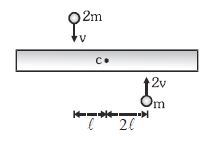
$A$ uniform bar of length $6l$ and mass $8m$ lies on a smooth horizontal table. Two point masses $m$ and $2m$ moving in the same horizontal plane with speeds $2v$ and $v$ respectively,strike the bar (as shown in the figure) and stick to the bar after the collision. The total energy after the collision (about the center of mass,$c$) will be:
A
$\frac{2mv^2}{5}$
B
$\frac{mv^2}{5}$
C
$\frac{3mv^2}{5}$
D
$mv^2$
Solution
(C) Let the center of the bar be the origin $c$. The moment of inertia of the bar about $c$ is $I_{bar} = \frac{(8m)(6l)^2}{12} = 24ml^2$.
After the collision,the masses $m$ and $2m$ stick to the bar at distances $2l$ and $l$ from the center respectively.
The total moment of inertia of the system about $c$ is $I = I_{bar} + m(2l)^2 + (2m)(l)^2 = 24ml^2 + 4ml^2 + 2ml^2 = 30ml^2$.
The angular momentum of the system about $c$ before the collision is $L = (2m)(v)(l) + (m)(2v)(2l) = 2mvl + 4mvl = 6mvl$.
Since there are no external torques,angular momentum is conserved: $L = I\omega$.
$6mvl = (30ml^2)\omega \Rightarrow \omega = \frac{6mvl}{30ml^2} = \frac{v}{5l}$.
The total energy about the center of mass is the rotational kinetic energy: $E = \frac{1}{2}I\omega^2$.
$E = \frac{1}{2}(30ml^2)\left(\frac{v}{5l}\right)^2 = 15ml^2 \times \frac{v^2}{25l^2} = \frac{15}{25}mv^2 = \frac{3mv^2}{5}$.
After the collision,the masses $m$ and $2m$ stick to the bar at distances $2l$ and $l$ from the center respectively.
The total moment of inertia of the system about $c$ is $I = I_{bar} + m(2l)^2 + (2m)(l)^2 = 24ml^2 + 4ml^2 + 2ml^2 = 30ml^2$.
The angular momentum of the system about $c$ before the collision is $L = (2m)(v)(l) + (m)(2v)(2l) = 2mvl + 4mvl = 6mvl$.
Since there are no external torques,angular momentum is conserved: $L = I\omega$.
$6mvl = (30ml^2)\omega \Rightarrow \omega = \frac{6mvl}{30ml^2} = \frac{v}{5l}$.
The total energy about the center of mass is the rotational kinetic energy: $E = \frac{1}{2}I\omega^2$.
$E = \frac{1}{2}(30ml^2)\left(\frac{v}{5l}\right)^2 = 15ml^2 \times \frac{v^2}{25l^2} = \frac{15}{25}mv^2 = \frac{3mv^2}{5}$.
0 likes
View Solution20
DifficultMCQ
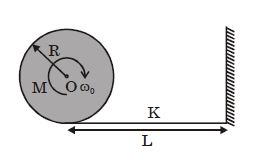
$A$ uniform solid cylinder of mass $M$ and radius $R$ can freely rotate around its axis $O$. There is an elastic string of relaxed length $L$ and stiffness $K$ attached to the cylinder and a static wall. Initially,the string is relaxed. As the cylinder starts rotating,the string will wind around the cylinder. The surface of the cylinder is very rough,so the string does not slip on the cylinder's surface. The minimum initial angular speed of the cylinder,${\omega _0}$,so that it can rotate through an angle $2\pi$ is (Assume Hooke's law to be valid.)
A
$\sqrt {\frac{{8{\pi ^2}K}}{M}} $
B
$\sqrt {\frac{K}{M}} $
C
$\sqrt {\frac{{{\pi ^2}K}}{M}} $
D
None of these
Solution
(A) The initial rotational kinetic energy of the cylinder is $K_i = \frac{1}{2} I \omega_0^2 = \frac{1}{2} (\frac{1}{2} M R^2) \omega_0^2 = \frac{1}{4} M R^2 \omega_0^2$.
When the cylinder rotates by an angle $\theta = 2\pi$,the length of the string wound around the cylinder is $x = R \theta = R(2\pi) = 2\pi R$.
The elastic potential energy stored in the string when it is stretched by length $x$ is $U = \frac{1}{2} K x^2 = \frac{1}{2} K (2\pi R)^2 = \frac{1}{2} K (4\pi^2 R^2) = 2\pi^2 K R^2$.
By the law of conservation of energy,the initial kinetic energy must equal the potential energy stored in the string at the point where the cylinder momentarily stops (at $\theta = 2\pi$):
$\frac{1}{4} M R^2 \omega_0^2 = 2\pi^2 K R^2$.
Solving for $\omega_0$:
$\omega_0^2 = \frac{2 \pi^2 K R^2 \times 4}{M R^2} = \frac{8 \pi^2 K}{M}$.
Therefore,$\omega_0 = \sqrt{\frac{8 \pi^2 K}{M}}$.
When the cylinder rotates by an angle $\theta = 2\pi$,the length of the string wound around the cylinder is $x = R \theta = R(2\pi) = 2\pi R$.
The elastic potential energy stored in the string when it is stretched by length $x$ is $U = \frac{1}{2} K x^2 = \frac{1}{2} K (2\pi R)^2 = \frac{1}{2} K (4\pi^2 R^2) = 2\pi^2 K R^2$.
By the law of conservation of energy,the initial kinetic energy must equal the potential energy stored in the string at the point where the cylinder momentarily stops (at $\theta = 2\pi$):
$\frac{1}{4} M R^2 \omega_0^2 = 2\pi^2 K R^2$.
Solving for $\omega_0$:
$\omega_0^2 = \frac{2 \pi^2 K R^2 \times 4}{M R^2} = \frac{8 \pi^2 K}{M}$.
Therefore,$\omega_0 = \sqrt{\frac{8 \pi^2 K}{M}}$.
0 likes
View Solution21
DifficultMCQ
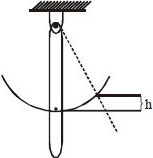
$A$ thin rod of mass $m$ and length $l$ is oscillating about a horizontal axis through its one end. Its maximum angular speed is $\omega$. Its centre of mass will rise up to a maximum height of:
A
$\frac{1}{6} \frac{l \omega}{g}$
B
$\frac{1}{2} \frac{l^2 \omega^2}{g}$
C
$\frac{1}{6} \frac{l^2 \omega^2}{g}$
D
$\frac{1}{3} \frac{l^2 \omega^2}{g}$
Solution
(C) The rod oscillates about one end. The moment of inertia of the rod about an axis passing through one end is $I = \frac{ml^2}{3}$.
By the principle of conservation of mechanical energy,the rotational kinetic energy at the lowest point is equal to the gravitational potential energy gained by the centre of mass at the maximum height $h$:
$\frac{1}{2} I \omega^2 = mgh$
Substituting the value of $I$:
$\frac{1}{2} \left( \frac{ml^2}{3} \right) \omega^2 = mgh$
$\frac{1}{6} ml^2 \omega^2 = mgh$
Solving for $h$:
$h = \frac{l^2 \omega^2}{6g}$
By the principle of conservation of mechanical energy,the rotational kinetic energy at the lowest point is equal to the gravitational potential energy gained by the centre of mass at the maximum height $h$:
$\frac{1}{2} I \omega^2 = mgh$
Substituting the value of $I$:
$\frac{1}{2} \left( \frac{ml^2}{3} \right) \omega^2 = mgh$
$\frac{1}{6} ml^2 \omega^2 = mgh$
Solving for $h$:
$h = \frac{l^2 \omega^2}{6g}$
0 likes
View Solution22
DifficultMCQ
The $M.I.$ of a body about the given axis is $1.2 \, kg \cdot m^2$ and initially the body is at rest. In order to produce a rotational kinetic energy of $1500 \, J$,an angular acceleration of $25 \, rad/s^2$ must be applied about that axis for a duration of ........ $s$.
A
$4$
B
$2$
C
$8$
D
$10$
Solution
(B) Given: Moment of Inertia $I = 1.2 \, kg \cdot m^2$,Initial angular velocity $\omega_0 = 0$,Rotational Kinetic Energy $K_r = 1500 \, J$,Angular acceleration $\alpha = 25 \, rad/s^2$.
Step $1$: Calculate the final angular velocity $\omega$ using the formula for rotational kinetic energy:
$K_r = \frac{1}{2} I \omega^2$
$1500 = \frac{1}{2} \times 1.2 \times \omega^2$
$1500 = 0.6 \times \omega^2$
$\omega^2 = \frac{1500}{0.6} = 2500$
$\omega = \sqrt{2500} = 50 \, rad/s$.
Step $2$: Calculate the time $t$ required using the kinematic equation $\omega = \omega_0 + \alpha t$:
$50 = 0 + 25 \times t$
$t = \frac{50}{25} = 2 \, s$.
Step $1$: Calculate the final angular velocity $\omega$ using the formula for rotational kinetic energy:
$K_r = \frac{1}{2} I \omega^2$
$1500 = \frac{1}{2} \times 1.2 \times \omega^2$
$1500 = 0.6 \times \omega^2$
$\omega^2 = \frac{1500}{0.6} = 2500$
$\omega = \sqrt{2500} = 50 \, rad/s$.
Step $2$: Calculate the time $t$ required using the kinematic equation $\omega = \omega_0 + \alpha t$:
$50 = 0 + 25 \times t$
$t = \frac{50}{25} = 2 \, s$.
0 likes
View Solution23
DifficultMCQ
$A$ thin rod $MN$,free to rotate in the vertical plane about the fixed end $N$,is held horizontal. When the end $M$ is released,the speed of this end,when the rod makes an angle $\alpha$ with the horizontal,will be proportional to (see figure):

A
$\sqrt{\cos \alpha}$
B
$\cos \alpha$
C
$\sin \alpha$
D
$\sqrt{\sin \alpha}$
Solution
(D) Let $l$ be the length of the rod and $m$ be its mass.
When the rod is horizontal,its potential energy is taken as zero.
When the rod makes an angle $\alpha$ with the horizontal,the center of mass of the rod (at distance $l/2$ from $N$) descends by a vertical distance $h = (l/2) \sin \alpha$.
By the law of conservation of energy,the loss in potential energy equals the gain in rotational kinetic energy:
$mg(l/2) \sin \alpha = \frac{1}{2} I \omega^2$
Here,$I$ is the moment of inertia of the rod about the fixed end $N$,which is $I = \frac{ml^2}{3}$.
Substituting $I$ into the energy equation:
$mg(l/2) \sin \alpha = \frac{1}{2} (\frac{ml^2}{3}) \omega^2$
$mg(l/2) \sin \alpha = \frac{ml^2}{6} \omega^2$
$\omega^2 = \frac{3g \sin \alpha}{l}$
$\omega = \sqrt{\frac{3g \sin \alpha}{l}}$
The linear speed $v$ of the end $M$ is given by $v = \omega l$:
$v = l \sqrt{\frac{3g \sin \alpha}{l}} = \sqrt{3gl \sin \alpha}$
Thus,the speed $v$ is proportional to $\sqrt{\sin \alpha}$.
When the rod is horizontal,its potential energy is taken as zero.
When the rod makes an angle $\alpha$ with the horizontal,the center of mass of the rod (at distance $l/2$ from $N$) descends by a vertical distance $h = (l/2) \sin \alpha$.
By the law of conservation of energy,the loss in potential energy equals the gain in rotational kinetic energy:
$mg(l/2) \sin \alpha = \frac{1}{2} I \omega^2$
Here,$I$ is the moment of inertia of the rod about the fixed end $N$,which is $I = \frac{ml^2}{3}$.
Substituting $I$ into the energy equation:
$mg(l/2) \sin \alpha = \frac{1}{2} (\frac{ml^2}{3}) \omega^2$
$mg(l/2) \sin \alpha = \frac{ml^2}{6} \omega^2$
$\omega^2 = \frac{3g \sin \alpha}{l}$
$\omega = \sqrt{\frac{3g \sin \alpha}{l}}$
The linear speed $v$ of the end $M$ is given by $v = \omega l$:
$v = l \sqrt{\frac{3g \sin \alpha}{l}} = \sqrt{3gl \sin \alpha}$
Thus,the speed $v$ is proportional to $\sqrt{\sin \alpha}$.
0 likes
View Solution24
MediumMCQ
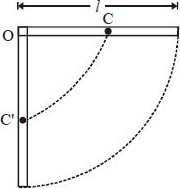
$A$ rod of length $l$ is hinged at one end. It is brought to a horizontal position and released. The angular velocity of the rod when it is in the vertical position is
A
$\sqrt{\frac{g}{l}}$
B
$\sqrt{\frac{2g}{l}}$
C
$\sqrt{\frac{3g}{l}}$
D
$\sqrt{\frac{g}{2l}}$
Solution
(C) The mass of the rod is concentrated at its center of mass. When the rod is in the horizontal position,its center of mass is at a height $h = \frac{l}{2}$ from the lowest point. When it reaches the vertical position,the center of mass is at the lowest point.
Applying the principle of conservation of mechanical energy:
Loss in potential energy $(PE)$ = Gain in rotational kinetic energy $(KE_{rot})$
$mg \left(\frac{l}{2}\right) = \frac{1}{2} I \omega^2$
Here,$I$ is the moment of inertia of the rod about the hinge at one end,given by $I = \frac{ml^2}{3}$.
Substituting the value of $I$:
$mg \left(\frac{l}{2}\right) = \frac{1}{2} \left(\frac{ml^2}{3}\right) \omega^2$
$mg \frac{l}{2} = \frac{ml^2}{6} \omega^2$
$g = \frac{l}{3} \omega^2$
$\omega^2 = \frac{3g}{l}$
$\omega = \sqrt{\frac{3g}{l}}$
Applying the principle of conservation of mechanical energy:
Loss in potential energy $(PE)$ = Gain in rotational kinetic energy $(KE_{rot})$
$mg \left(\frac{l}{2}\right) = \frac{1}{2} I \omega^2$
Here,$I$ is the moment of inertia of the rod about the hinge at one end,given by $I = \frac{ml^2}{3}$.
Substituting the value of $I$:
$mg \left(\frac{l}{2}\right) = \frac{1}{2} \left(\frac{ml^2}{3}\right) \omega^2$
$mg \frac{l}{2} = \frac{ml^2}{6} \omega^2$
$g = \frac{l}{3} \omega^2$
$\omega^2 = \frac{3g}{l}$
$\omega = \sqrt{\frac{3g}{l}}$
0 likes
View Solution25
DifficultMCQ
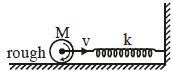
$A$ solid sphere of mass $M$ rolls without slipping with velocity $v$ and presses a spring of spring constant $k$ as shown in the figure. The maximum compression in the spring will be:
A
$v\sqrt {\frac{{2M}}{{3k}}} $
B
$v\sqrt {\frac{{2M}}{{5k}}} $
C
$v\sqrt {\frac{{5k}}{{7M}}} $
D
$v\sqrt {\frac{{7M}}{{5k}}} $
Solution
(D) The total kinetic energy $(KE)$ of a solid sphere rolling without slipping is the sum of its translational and rotational kinetic energies.
$KE_{total} = KE_{trans} + KE_{rot} = \frac{1}{2} Mv^2 + \frac{1}{2} I\omega^2$
For a solid sphere,the moment of inertia $I = \frac{2}{5} MR^2$ and for rolling without slipping,$\omega = \frac{v}{R}$.
Substituting these values:
$KE_{total} = \frac{1}{2} Mv^2 + \frac{1}{2} (\frac{2}{5} MR^2) (\frac{v}{R})^2 = \frac{1}{2} Mv^2 + \frac{1}{5} Mv^2 = \frac{7}{10} Mv^2$
When the sphere compresses the spring by a maximum distance $x_m$,the entire kinetic energy is converted into the potential energy of the spring $(U = \frac{1}{2} kx_m^2)$.
Equating the two:
$\frac{1}{2} kx_m^2 = \frac{7}{10} Mv^2$
$x_m^2 = \frac{14}{10} \frac{Mv^2}{k} = \frac{7Mv^2}{5k}$
$x_m = v \sqrt{\frac{7M}{5k}}$
$KE_{total} = KE_{trans} + KE_{rot} = \frac{1}{2} Mv^2 + \frac{1}{2} I\omega^2$
For a solid sphere,the moment of inertia $I = \frac{2}{5} MR^2$ and for rolling without slipping,$\omega = \frac{v}{R}$.
Substituting these values:
$KE_{total} = \frac{1}{2} Mv^2 + \frac{1}{2} (\frac{2}{5} MR^2) (\frac{v}{R})^2 = \frac{1}{2} Mv^2 + \frac{1}{5} Mv^2 = \frac{7}{10} Mv^2$
When the sphere compresses the spring by a maximum distance $x_m$,the entire kinetic energy is converted into the potential energy of the spring $(U = \frac{1}{2} kx_m^2)$.
Equating the two:
$\frac{1}{2} kx_m^2 = \frac{7}{10} Mv^2$
$x_m^2 = \frac{14}{10} \frac{Mv^2}{k} = \frac{7Mv^2}{5k}$
$x_m = v \sqrt{\frac{7M}{5k}}$
0 likes
View Solution26
DifficultMCQ
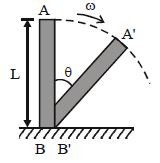
$A$ uniform rod of length $L$ is free to rotate in a vertical plane about a fixed horizontal axis through $B$. The rod begins rotating from rest from its unstable equilibrium position. When it has turned through an angle $\theta$,its angular velocity $\omega$ is given as
A
$\sqrt{\frac{6g}{L}} \sin \theta$
B
$\sqrt{\frac{6g}{L}} \sin \frac{\theta}{2}$
C
$\sqrt{\frac{6g}{L}} \cos \frac{\theta}{2}$
D
$\sqrt{\frac{6g}{L}} \cos \theta$
Solution
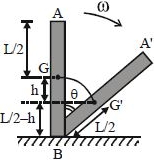
(B) When the rod rotates through an angle $\theta$,the vertical fall $h$ of the centre of gravity is given by geometry.
From the figure,the distance of the centre of gravity from the pivot $B$ is $L/2$. The vertical component of this distance after rotation is $(L/2) \cos \theta$.
The vertical fall $h$ of the centre of gravity is $h = L/2 - (L/2) \cos \theta = \frac{L}{2}(1 - \cos \theta)$.
According to the law of conservation of energy,the decrease in potential energy equals the increase in rotational kinetic energy.
Decrease in potential energy $= Mgh = Mg \frac{L}{2}(1 - \cos \theta)$.
Rotational kinetic energy $= \frac{1}{2} I \omega^2$,where $I = \frac{ML^2}{3}$ is the moment of inertia about the end $B$.
Equating the two: $Mg \frac{L}{2}(1 - \cos \theta) = \frac{1}{2} \left( \frac{ML^2}{3} \right) \omega^2$.
$Mg \frac{L}{2}(1 - \cos \theta) = \frac{ML^2}{6} \omega^2$.
Using the trigonometric identity $1 - \cos \theta = 2 \sin^2(\theta/2)$:
$Mg \frac{L}{2} \cdot 2 \sin^2(\theta/2) = \frac{ML^2}{6} \omega^2$.
$MgL \sin^2(\theta/2) = \frac{ML^2}{6} \omega^2$.
$\omega^2 = \frac{6g}{L} \sin^2(\theta/2)$.
$\omega = \sqrt{\frac{6g}{L}} \sin \left( \frac{\theta}{2} \right)$.
From the figure,the distance of the centre of gravity from the pivot $B$ is $L/2$. The vertical component of this distance after rotation is $(L/2) \cos \theta$.
The vertical fall $h$ of the centre of gravity is $h = L/2 - (L/2) \cos \theta = \frac{L}{2}(1 - \cos \theta)$.
According to the law of conservation of energy,the decrease in potential energy equals the increase in rotational kinetic energy.
Decrease in potential energy $= Mgh = Mg \frac{L}{2}(1 - \cos \theta)$.
Rotational kinetic energy $= \frac{1}{2} I \omega^2$,where $I = \frac{ML^2}{3}$ is the moment of inertia about the end $B$.
Equating the two: $Mg \frac{L}{2}(1 - \cos \theta) = \frac{1}{2} \left( \frac{ML^2}{3} \right) \omega^2$.
$Mg \frac{L}{2}(1 - \cos \theta) = \frac{ML^2}{6} \omega^2$.
Using the trigonometric identity $1 - \cos \theta = 2 \sin^2(\theta/2)$:
$Mg \frac{L}{2} \cdot 2 \sin^2(\theta/2) = \frac{ML^2}{6} \omega^2$.
$MgL \sin^2(\theta/2) = \frac{ML^2}{6} \omega^2$.
$\omega^2 = \frac{6g}{L} \sin^2(\theta/2)$.
$\omega = \sqrt{\frac{6g}{L}} \sin \left( \frac{\theta}{2} \right)$.
0 likes
View Solution27
MediumMCQ
$A$ constant power is supplied to a rotating disc. The angular velocity $(\omega)$ of the disc varies with the number of rotations $(n)$ made by the disc as:
A
$\omega \propto n^{1/3}$
B
$\omega \propto n^{3/2}$
C
$\omega \propto n^{2/3}$
D
$\omega \propto n^2$
Solution
(A) Power $P$ is given by $P = \tau \cdot \omega$.
Since $\tau = I \alpha$ and $\alpha = \omega \frac{d\omega}{d\theta}$,we have $P = I \omega \frac{d\omega}{d\theta} \cdot \omega = I \omega^2 \frac{d\omega}{d\theta}$.
Rearranging the terms,we get $\omega^2 d\omega = \frac{P}{I} d\theta$.
Integrating both sides,$\int \omega^2 d\omega = \int \frac{P}{I} d\theta$,which gives $\frac{\omega^3}{3} = \frac{P}{I} \theta$.
Thus,$\omega^3 \propto \theta$,or $\omega \propto \theta^{1/3}$.
Since the number of rotations $n = \frac{\theta}{2\pi}$,we have $\theta \propto n$.
Therefore,$\omega \propto n^{1/3}$.
Since $\tau = I \alpha$ and $\alpha = \omega \frac{d\omega}{d\theta}$,we have $P = I \omega \frac{d\omega}{d\theta} \cdot \omega = I \omega^2 \frac{d\omega}{d\theta}$.
Rearranging the terms,we get $\omega^2 d\omega = \frac{P}{I} d\theta$.
Integrating both sides,$\int \omega^2 d\omega = \int \frac{P}{I} d\theta$,which gives $\frac{\omega^3}{3} = \frac{P}{I} \theta$.
Thus,$\omega^3 \propto \theta$,or $\omega \propto \theta^{1/3}$.
Since the number of rotations $n = \frac{\theta}{2\pi}$,we have $\theta \propto n$.
Therefore,$\omega \propto n^{1/3}$.
0 likes
View Solution28
DifficultMCQ
$A$ thin rod of length $L$ and mass $M$ is held vertically with one end on the floor and is allowed to fall. Find the velocity of the other end when it hits the floor,assuming that the end on the floor does not slip.
A
$\sqrt{\frac{3g}{L}}$
B
$\sqrt{3gL}$
C
$\sqrt{\frac{L}{3g}}$
D
$\sqrt{\frac{g}{3L}}$
Solution
(B) By the principle of conservation of energy,the potential energy of the rod at the initial vertical position is converted into rotational kinetic energy at the moment it hits the floor.
Initial potential energy $U_i = Mg \frac{L}{2}$.
Final rotational kinetic energy $K_f = \frac{1}{2} I \omega^2$,where $I$ is the moment of inertia of the rod about the end on the floor,$I = \frac{ML^2}{3}$.
Equating $U_i = K_f$:
$Mg \frac{L}{2} = \frac{1}{2} (\frac{ML^2}{3}) \omega^2$.
Simplifying,$gL = \frac{L^2}{3} \omega^2$,which gives $\omega^2 = \frac{3g}{L}$,so $\omega = \sqrt{\frac{3g}{L}}$.
The linear velocity $v$ of the other end is given by $v = L \omega$.
Substituting $\omega$,$v = L \sqrt{\frac{3g}{L}} = \sqrt{3gL}$.
Initial potential energy $U_i = Mg \frac{L}{2}$.
Final rotational kinetic energy $K_f = \frac{1}{2} I \omega^2$,where $I$ is the moment of inertia of the rod about the end on the floor,$I = \frac{ML^2}{3}$.
Equating $U_i = K_f$:
$Mg \frac{L}{2} = \frac{1}{2} (\frac{ML^2}{3}) \omega^2$.
Simplifying,$gL = \frac{L^2}{3} \omega^2$,which gives $\omega^2 = \frac{3g}{L}$,so $\omega = \sqrt{\frac{3g}{L}}$.
The linear velocity $v$ of the other end is given by $v = L \omega$.
Substituting $\omega$,$v = L \sqrt{\frac{3g}{L}} = \sqrt{3gL}$.
0 likes
View Solution29
EasyMCQ
To maintain a rotor at a uniform angular speed of $200 \; rad \; s^{-1}$,an engine needs to transmit a torque of $180 \; N \; m$. What is the power required by the engine (in $; kW$)? (Note: uniform angular velocity in the absence of friction implies zero torque. In practice,applied torque is needed to counter frictional torque). Assume that the engine is $100 \%$ efficient.
A
$36$
B
$18$
C
$72$
D
$9$
Solution
(A) The angular speed of the rotor is $\omega = 200 \; rad \; s^{-1}$.
The torque required to maintain this speed is $\tau = 180 \; N \; m$.
The power $P$ delivered by an engine providing a torque $\tau$ at an angular velocity $\omega$ is given by the formula:
$P = \tau \times \omega$
Substituting the given values:
$P = 180 \; N \; m \times 200 \; rad \; s^{-1}$
$P = 36000 \; W$
Converting to kilowatts:
$P = 36 \; kW$
Therefore,the power required by the engine is $36 \; kW$.
The torque required to maintain this speed is $\tau = 180 \; N \; m$.
The power $P$ delivered by an engine providing a torque $\tau$ at an angular velocity $\omega$ is given by the formula:
$P = \tau \times \omega$
Substituting the given values:
$P = 180 \; N \; m \times 200 \; rad \; s^{-1}$
$P = 36000 \; W$
Converting to kilowatts:
$P = 36 \; kW$
Therefore,the power required by the engine is $36 \; kW$.
0 likes
View Solution30
Medium
Write the formula for power and angular momentum in rotational motion.
Solution
(N/A) In rotational motion, the power $(P)$ delivered by a torque $(\tau)$ to a rotating body with angular velocity $(\omega)$ is given by the formula:
$P = \tau \cdot \omega$
Where:
$P$ is the power in Watts $(W)$,
$\tau$ is the torque in Newton-meters $(N \cdot m)$,
$\omega$ is the angular velocity in radians per second $(rad/s)$.
The angular momentum $(L)$ of a rigid body rotating about a fixed axis with moment of inertia $(I)$ and angular velocity $(\omega)$ is given by the formula:
$L = I \cdot \omega$
Where:
$L$ is the angular momentum in kilogram-meters squared per second $(kg \cdot m^2/s)$,
$I$ is the moment of inertia in kilogram-meters squared $(kg \cdot m^2)$,
$\omega$ is the angular velocity in radians per second $(rad/s)$.
$P = \tau \cdot \omega$
Where:
$P$ is the power in Watts $(W)$,
$\tau$ is the torque in Newton-meters $(N \cdot m)$,
$\omega$ is the angular velocity in radians per second $(rad/s)$.
The angular momentum $(L)$ of a rigid body rotating about a fixed axis with moment of inertia $(I)$ and angular velocity $(\omega)$ is given by the formula:
$L = I \cdot \omega$
Where:
$L$ is the angular momentum in kilogram-meters squared per second $(kg \cdot m^2/s)$,
$I$ is the moment of inertia in kilogram-meters squared $(kg \cdot m^2)$,
$\omega$ is the angular velocity in radians per second $(rad/s)$.
0 likes
View Solution31
Difficult
Explain the work done by torque.
Solution
(N/A) Consider a rigid body rotating about a fixed axis,which is taken as the $Z$-axis. This axis is perpendicular to the plane $X^{\prime} Y^{\prime}$.
Let a force $\overrightarrow{F}_{1}$ act on a particle of the body at point $P_{1}$. The particle rotates on a circle of radius $r_{1}$ with center $C$ on the axis,such that $CP_{1} = r_{1}$.
In a small time interval $\Delta t$,the particle moves from position $P_{1}$ to $P_{1}^{\prime}$. The displacement of the particle is $\Delta S_{1} = r_{1} \Delta \theta$,which is in the tangential direction at $P_{1}$.
Here,$\Delta \theta = \angle P_{1} C P_{1}^{\prime}$ is the angular displacement of the particle.
The work done by the force $\overrightarrow{F}_{1}$ on the particle is given by:
$dW_{1} = \overrightarrow{F}_{1} \cdot d\overrightarrow{S}_{1} = F_{1} dS_{1} \cos \phi_{1}$
Since $dS_{1} = r_{1} d\theta$ and $\phi_{1} = 90^{\circ} - \alpha_{1}$ (where $\alpha_{1}$ is the angle between $\overrightarrow{F}_{1}$ and the radius vector $\overrightarrow{r}_{1}$),we have:
$dW_{1} = F_{1} (r_{1} d\theta) \cos(90^{\circ} - \alpha_{1}) = F_{1} r_{1} \sin \alpha_{1} d\theta$
Since the torque $\tau_{1} = r_{1} F_{1} \sin \alpha_{1}$,the work done is:
$dW_{1} = \tau_{1} d\theta$
The total work done on the rigid body is the sum of the work done on all particles:
$dW = \sum dW_{1} = \sum \tau_{1} d\theta = \tau d\theta$
where $\tau$ is the net torque acting on the body about the axis of rotation.
Let a force $\overrightarrow{F}_{1}$ act on a particle of the body at point $P_{1}$. The particle rotates on a circle of radius $r_{1}$ with center $C$ on the axis,such that $CP_{1} = r_{1}$.
In a small time interval $\Delta t$,the particle moves from position $P_{1}$ to $P_{1}^{\prime}$. The displacement of the particle is $\Delta S_{1} = r_{1} \Delta \theta$,which is in the tangential direction at $P_{1}$.
Here,$\Delta \theta = \angle P_{1} C P_{1}^{\prime}$ is the angular displacement of the particle.
The work done by the force $\overrightarrow{F}_{1}$ on the particle is given by:
$dW_{1} = \overrightarrow{F}_{1} \cdot d\overrightarrow{S}_{1} = F_{1} dS_{1} \cos \phi_{1}$
Since $dS_{1} = r_{1} d\theta$ and $\phi_{1} = 90^{\circ} - \alpha_{1}$ (where $\alpha_{1}$ is the angle between $\overrightarrow{F}_{1}$ and the radius vector $\overrightarrow{r}_{1}$),we have:
$dW_{1} = F_{1} (r_{1} d\theta) \cos(90^{\circ} - \alpha_{1}) = F_{1} r_{1} \sin \alpha_{1} d\theta$
Since the torque $\tau_{1} = r_{1} F_{1} \sin \alpha_{1}$,the work done is:
$dW_{1} = \tau_{1} d\theta$
The total work done on the rigid body is the sum of the work done on all particles:
$dW = \sum dW_{1} = \sum \tau_{1} d\theta = \tau d\theta$
where $\tau$ is the net torque acting on the body about the axis of rotation.
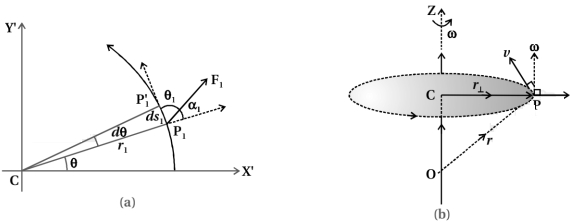
0 likes
View Solution32
Difficult
Explain the work done by torque.
Solution
(N/A) Consider a rigid body rotating about a fixed axis,which is taken as the $Z$-axis. This axis is perpendicular to the plane $X^{\prime} Y^{\prime}$.
Let a force $\overrightarrow{F}_{1}$ act on a particle of the body at point $P_{1}$. The particle rotates on a circle of radius $r_{1}$ with center $C$ on the axis,such that $CP_{1} = r_{1}$.
In a small time interval $\Delta t$,the point moves from $P_{1}$ to $P_{1}^{\prime}$. The displacement of the particle is $\Delta S_{1} = r_{1} \Delta \theta$,and it is in the tangential direction at $P_{1}$.
Here,$\Delta \theta = \angle P_{1} C P_{1}^{\prime}$ is the angular displacement of the particle. The work done by the force $\overrightarrow{F}_{1}$ on the particle is given by:
$dW_{1} = \overrightarrow{F}_{1} \cdot d\overrightarrow{S}_{1}$
$dW_{1} = F_{1} \Delta S_{1} \cos \phi_{1}$
Since $\Delta S_{1} = r_{1} \Delta \theta$ and $\phi_{1} = 90^{\circ} - \alpha_{1}$,where $\alpha_{1}$ is the angle between the force $\overrightarrow{F}_{1}$ and the radius vector $\overrightarrow{r}_{1}$,we have:
$dW_{1} = F_{1} (r_{1} \Delta \theta) \cos(90^{\circ} - \alpha_{1})$
$dW_{1} = F_{1} r_{1} \sin \alpha_{1} \Delta \theta$
Since the torque $\tau_{1} = r_{1} F_{1} \sin \alpha_{1}$,the work done is:
$dW_{1} = \tau_{1} \Delta \theta$
For the entire body,the total work done is the sum of the work done on all particles:
$dW = \sum dW_{i} = \sum \tau_{i} \Delta \theta = \tau \Delta \theta$
where $\tau$ is the total torque acting on the body.
Let a force $\overrightarrow{F}_{1}$ act on a particle of the body at point $P_{1}$. The particle rotates on a circle of radius $r_{1}$ with center $C$ on the axis,such that $CP_{1} = r_{1}$.
In a small time interval $\Delta t$,the point moves from $P_{1}$ to $P_{1}^{\prime}$. The displacement of the particle is $\Delta S_{1} = r_{1} \Delta \theta$,and it is in the tangential direction at $P_{1}$.
Here,$\Delta \theta = \angle P_{1} C P_{1}^{\prime}$ is the angular displacement of the particle. The work done by the force $\overrightarrow{F}_{1}$ on the particle is given by:
$dW_{1} = \overrightarrow{F}_{1} \cdot d\overrightarrow{S}_{1}$
$dW_{1} = F_{1} \Delta S_{1} \cos \phi_{1}$
Since $\Delta S_{1} = r_{1} \Delta \theta$ and $\phi_{1} = 90^{\circ} - \alpha_{1}$,where $\alpha_{1}$ is the angle between the force $\overrightarrow{F}_{1}$ and the radius vector $\overrightarrow{r}_{1}$,we have:
$dW_{1} = F_{1} (r_{1} \Delta \theta) \cos(90^{\circ} - \alpha_{1})$
$dW_{1} = F_{1} r_{1} \sin \alpha_{1} \Delta \theta$
Since the torque $\tau_{1} = r_{1} F_{1} \sin \alpha_{1}$,the work done is:
$dW_{1} = \tau_{1} \Delta \theta$
For the entire body,the total work done is the sum of the work done on all particles:
$dW = \sum dW_{i} = \sum \tau_{i} \Delta \theta = \tau \Delta \theta$
where $\tau$ is the total torque acting on the body.
0 likes
View Solution33
Medium
Write the formula of work done by torque in a rotational rigid body about a fixed axis.
Solution
(N/A) For a rigid body rotating about a fixed axis,the work done $W$ by a torque $\tau$ through an angular displacement $d\theta$ is given by the integral of the torque over the angular displacement.
The infinitesimal work done is $dW = \tau \cdot d\theta$.
For a finite angular displacement from $\theta_1$ to $\theta_2$,the total work done is:
$W = \int_{\theta_1}^{\theta_2} \tau \, d\theta$.
If the torque $\tau$ is constant,the formula simplifies to:
$W = \tau (\theta_2 - \theta_1) = \tau \Delta \theta$.
The infinitesimal work done is $dW = \tau \cdot d\theta$.
For a finite angular displacement from $\theta_1$ to $\theta_2$,the total work done is:
$W = \int_{\theta_1}^{\theta_2} \tau \, d\theta$.
If the torque $\tau$ is constant,the formula simplifies to:
$W = \tau (\theta_2 - \theta_1) = \tau \Delta \theta$.
0 likes
View Solution34
Easy
Write the formula for power in the motion of a rigid body.
Solution
(N/A) For a rigid body rotating about a fixed axis,the power $P$ delivered by a torque $\tau$ is given by the product of the torque and the angular velocity $\omega$ of the body.
Mathematically,the formula is expressed as:
$P = \tau \omega$
Where:
$P$ is the instantaneous power,
$\tau$ is the torque applied to the body,
$\omega$ is the angular velocity of the body.
Mathematically,the formula is expressed as:
$P = \tau \omega$
Where:
$P$ is the instantaneous power,
$\tau$ is the torque applied to the body,
$\omega$ is the angular velocity of the body.
0 likes
View Solution35
EasyMCQ
Match the linear motion formulas in Column-$I$ with their corresponding rotational motion formulas in Column-$II$.
| Column-$I$ | Column-$II$ |
| $(1)$ $W = F \Delta x$ | $(a)$ $P = \tau \omega$ |
| $(2)$ $P = Fv$ | $(b)$ $W = \tau \Delta \theta$ |
| $(c)$ $L = I \omega$ |
A
$(1-c), (2-a)$
B
$(1-b), (2-c)$
C
$(1-b), (2-a)$
D
$(1-a), (2-b)$
Solution
(C) In linear motion,work done is given by $W = F \Delta x$. The rotational analogue of force $F$ is torque $\tau$,and the analogue of displacement $\Delta x$ is angular displacement $\Delta \theta$. Thus,the rotational work is $W = \tau \Delta \theta$. This corresponds to $(1-b)$.
In linear motion,power is given by $P = Fv$. The rotational analogue of force $F$ is torque $\tau$,and the analogue of velocity $v$ is angular velocity $\omega$. Thus,the rotational power is $P = \tau \omega$. This corresponds to $(2-a)$.
Therefore,the correct matching is $(1-b), (2-a)$.
In linear motion,power is given by $P = Fv$. The rotational analogue of force $F$ is torque $\tau$,and the analogue of velocity $v$ is angular velocity $\omega$. Thus,the rotational power is $P = \tau \omega$. This corresponds to $(2-a)$.
Therefore,the correct matching is $(1-b), (2-a)$.
0 likes
View Solution36
DifficultMCQ
$A$ uniform rod of mass $M$ and length $L$ is pivoted at one end and is free to rotate in a vertical plane. The rod is released from rest in a horizontal position. What is the angular velocity of the rod when it reaches the vertical position?
A
$\sqrt{\frac{3g}{L}}$
B
$\sqrt{\frac{2g}{L}}$
C
$\sqrt{\frac{6g}{L}}$
D
$\sqrt{\frac{g}{L}}$
Solution
(A) By the law of conservation of mechanical energy,the loss in potential energy of the rod is equal to the gain in its rotational kinetic energy.
The center of mass of the rod is at a distance $L/2$ from the pivot.
When the rod moves from the horizontal position to the vertical position,the center of mass falls by a vertical distance $h = L/2$.
Loss in potential energy = $Mgh = Mg(L/2) = MgL/2$.
The moment of inertia of a rod about an axis passing through one end is $I = ML^2/3$.
Gain in rotational kinetic energy = $\frac{1}{2} I \omega^2 = \frac{1}{2} (ML^2/3) \omega^2 = \frac{ML^2 \omega^2}{6}$.
Equating the two: $MgL/2 = \frac{ML^2 \omega^2}{6}$.
Solving for $\omega$: $\omega^2 = \frac{6gL}{2L^2} = \frac{3g}{L}$.
Therefore,$\omega = \sqrt{\frac{3g}{L}}$.
The center of mass of the rod is at a distance $L/2$ from the pivot.
When the rod moves from the horizontal position to the vertical position,the center of mass falls by a vertical distance $h = L/2$.
Loss in potential energy = $Mgh = Mg(L/2) = MgL/2$.
The moment of inertia of a rod about an axis passing through one end is $I = ML^2/3$.
Gain in rotational kinetic energy = $\frac{1}{2} I \omega^2 = \frac{1}{2} (ML^2/3) \omega^2 = \frac{ML^2 \omega^2}{6}$.
Equating the two: $MgL/2 = \frac{ML^2 \omega^2}{6}$.
Solving for $\omega$: $\omega^2 = \frac{6gL}{2L^2} = \frac{3g}{L}$.
Therefore,$\omega = \sqrt{\frac{3g}{L}}$.
0 likes
View Solution37
DifficultMCQ
$A$ disc of mass $1\,kg$ and radius $R$ is free to rotate about a horizontal axis passing through its centre and perpendicular to the plane of the disc. $A$ body of the same mass as that of the disc is fixed at the highest point of the disc. Now the system is released. When the body comes to the lowest position,its angular speed will be $4 \sqrt{\frac{x}{3 R}} \text{ rad s}^{-1}$ where $x=$ (Given $g = 10 \text{ m s}^{-2}$)
A
$50$
B
$8$
C
$5$
D
$88$
Solution
(C) Let $m$ be the mass of the disc and the particle. The moment of inertia of the disc about the axis is $I_{\text{disc}} = \frac{1}{2} mR^2$. The moment of inertia of the particle at distance $R$ is $I_{\text{particle}} = mR^2$. The total moment of inertia is $I = I_{\text{disc}} + I_{\text{particle}} = \frac{1}{2} mR^2 + mR^2 = \frac{3}{2} mR^2$.
Using the law of conservation of mechanical energy,the loss in potential energy of the particle equals the gain in rotational kinetic energy of the system.
The particle moves from the highest point to the lowest point,a vertical distance of $2R$.
Loss in potential energy $= mg(2R) = 2mgR$.
Gain in rotational kinetic energy $= \frac{1}{2} I \omega^2 = \frac{1}{2} \left( \frac{3}{2} mR^2 \right) \omega^2 = \frac{3}{4} mR^2 \omega^2$.
Equating the two: $2mgR = \frac{3}{4} mR^2 \omega^2$.
Solving for $\omega^2$: $\omega^2 = \frac{8g}{3R}$.
Given $\omega = 4 \sqrt{\frac{x}{3R}}$,so $\omega^2 = 16 \left( \frac{x}{3R} \right) = \frac{16x}{3R}$.
Equating the expressions for $\omega^2$: $\frac{16x}{3R} = \frac{8g}{3R} \implies 16x = 8g$.
Substituting $g = 10 \text{ m s}^{-2}$: $16x = 8(10) = 80$.
$x = \frac{80}{16} = 5$.
Using the law of conservation of mechanical energy,the loss in potential energy of the particle equals the gain in rotational kinetic energy of the system.
The particle moves from the highest point to the lowest point,a vertical distance of $2R$.
Loss in potential energy $= mg(2R) = 2mgR$.
Gain in rotational kinetic energy $= \frac{1}{2} I \omega^2 = \frac{1}{2} \left( \frac{3}{2} mR^2 \right) \omega^2 = \frac{3}{4} mR^2 \omega^2$.
Equating the two: $2mgR = \frac{3}{4} mR^2 \omega^2$.
Solving for $\omega^2$: $\omega^2 = \frac{8g}{3R}$.
Given $\omega = 4 \sqrt{\frac{x}{3R}}$,so $\omega^2 = 16 \left( \frac{x}{3R} \right) = \frac{16x}{3R}$.
Equating the expressions for $\omega^2$: $\frac{16x}{3R} = \frac{8g}{3R} \implies 16x = 8g$.
Substituting $g = 10 \text{ m s}^{-2}$: $16x = 8(10) = 80$.
$x = \frac{80}{16} = 5$.
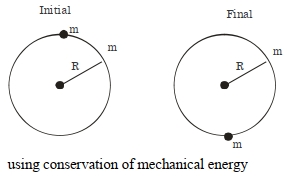
0 likes
View Solution38
MediumMCQ
$A$ disc is rotating with angular velocity $\vec{\omega}$. $A$ force $\vec{F}$ acts at a point whose position vector with respect to the axis of rotation is $\vec{r}$. The power associated with the torque due to the force is given by ..........
A
$(\vec{r} \times \vec{F}) \cdot \vec{\omega}$
B
$(\vec{r} \times \vec{F}) \times \vec{\omega}$
C
$\vec{r} \times(\vec{F} \cdot \vec{\omega})$
D
$\vec{r} \cdot(\vec{F} \times \vec{\omega})$
Solution
(A) The power $P$ delivered by a force $\vec{F}$ acting on a particle moving with velocity $\vec{v}$ is given by $P = \vec{F} \cdot \vec{v}$.
For a rotating body,the velocity of a point with position vector $\vec{r}$ relative to the axis of rotation is $\vec{v} = \vec{\omega} \times \vec{r}$.
Substituting this into the power formula: $P = \vec{F} \cdot (\vec{\omega} \times \vec{r})$.
Using the property of the scalar triple product,$\vec{A} \cdot (\vec{B} \times \vec{C}) = (\vec{A} \times \vec{B}) \cdot \vec{C}$,we can rewrite the expression:
$P = (\vec{F} \times \vec{\omega}) \cdot \vec{r} = \vec{r} \cdot (\vec{F} \times \vec{\omega})$.
Alternatively,using the cyclic property of the scalar triple product $[\vec{a} \vec{b} \vec{c}] = [\vec{b} \vec{c} \vec{a}] = [\vec{c} \vec{a} \vec{b}]$,we have:
$P = \vec{F} \cdot (\vec{\omega} \times \vec{r}) = [\vec{F} \vec{\omega} \vec{r}] = [\vec{\omega} \vec{r} \vec{F}] = \vec{\omega} \cdot (\vec{r} \times \vec{F})$.
Since the torque $\vec{\tau} = \vec{r} \times \vec{F}$,the power is $P = \vec{\tau} \cdot \vec{\omega} = (\vec{r} \times \vec{F}) \cdot \vec{\omega}$.
For a rotating body,the velocity of a point with position vector $\vec{r}$ relative to the axis of rotation is $\vec{v} = \vec{\omega} \times \vec{r}$.
Substituting this into the power formula: $P = \vec{F} \cdot (\vec{\omega} \times \vec{r})$.
Using the property of the scalar triple product,$\vec{A} \cdot (\vec{B} \times \vec{C}) = (\vec{A} \times \vec{B}) \cdot \vec{C}$,we can rewrite the expression:
$P = (\vec{F} \times \vec{\omega}) \cdot \vec{r} = \vec{r} \cdot (\vec{F} \times \vec{\omega})$.
Alternatively,using the cyclic property of the scalar triple product $[\vec{a} \vec{b} \vec{c}] = [\vec{b} \vec{c} \vec{a}] = [\vec{c} \vec{a} \vec{b}]$,we have:
$P = \vec{F} \cdot (\vec{\omega} \times \vec{r}) = [\vec{F} \vec{\omega} \vec{r}] = [\vec{\omega} \vec{r} \vec{F}] = \vec{\omega} \cdot (\vec{r} \times \vec{F})$.
Since the torque $\vec{\tau} = \vec{r} \times \vec{F}$,the power is $P = \vec{\tau} \cdot \vec{\omega} = (\vec{r} \times \vec{F}) \cdot \vec{\omega}$.
0 likes
View Solution39
MediumMCQ
$A$ circular disc of radius $R$ meter and mass $M$ kg is rotating around the axis perpendicular to the disc. An external torque is applied to the disc such that $\theta(t) = 5t^2 - 8t$,where $\theta(t)$ is the angular position of the rotating disc as a function of time $t$. How much power is delivered by the applied torque,when $t = 2$ s (in $MR^2$)?
A
$60$
B
$72$
C
$108$
D
$8$
Solution
(A) The angular position is given by $\theta(t) = 5t^2 - 8t$.
Angular velocity $\omega$ is the derivative of angular position with respect to time: $\omega = \frac{d\theta}{dt} = 10t - 8$.
Angular acceleration $\alpha$ is the derivative of angular velocity with respect to time: $\alpha = \frac{d\omega}{dt} = 10 \text{ rad/s}^2$.
The moment of inertia of a circular disc about an axis perpendicular to its plane and passing through its center is $I = \frac{1}{2}MR^2$.
The torque applied is $\tau = I\alpha = (\frac{1}{2}MR^2)(10) = 5MR^2$.
Power $P$ delivered by the torque is $P = \tau \omega$.
At $t = 2$ s,$\omega = 10(2) - 8 = 12 \text{ rad/s}$.
Therefore,$P = (5MR^2)(12) = 60 MR^2$ $W$.
Angular velocity $\omega$ is the derivative of angular position with respect to time: $\omega = \frac{d\theta}{dt} = 10t - 8$.
Angular acceleration $\alpha$ is the derivative of angular velocity with respect to time: $\alpha = \frac{d\omega}{dt} = 10 \text{ rad/s}^2$.
The moment of inertia of a circular disc about an axis perpendicular to its plane and passing through its center is $I = \frac{1}{2}MR^2$.
The torque applied is $\tau = I\alpha = (\frac{1}{2}MR^2)(10) = 5MR^2$.
Power $P$ delivered by the torque is $P = \tau \omega$.
At $t = 2$ s,$\omega = 10(2) - 8 = 12 \text{ rad/s}$.
Therefore,$P = (5MR^2)(12) = 60 MR^2$ $W$.
0 likes
View Solution40
DifficultMCQ
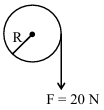
$A$ cord of negligible mass is wound around the rim of a wheel supported by spokes with negligible mass. The mass of the wheel is $10 \ kg$ and the radius is $10 \ cm$. It can rotate freely without any friction. Initially,the wheel is at rest. If a steady pull of $20 \ N$ is applied on the cord,the angular velocity (in $rad/s$) of the wheel,after the cord is unwound by $1 \ m$,would be:
A
$20$
B
$30$
C
$10$
D
$0$
Solution
(A) Given: Mass of the wheel $M = 10 \ kg$,Radius $R = 10 \ cm = 0.1 \ m$,Force $F = 20 \ N$,Displacement $d = 1 \ m$.
Since the wheel is supported by spokes of negligible mass,its moment of inertia is $I = MR^2 = 10 \times (0.1)^2 = 0.1 \ kg \ m^2$.
The work done by the force $F$ is $W = F \times d = 20 \times 1 = 20 \ J$.
According to the work-energy theorem,the work done is equal to the change in rotational kinetic energy: $W = \Delta KE = \frac{1}{2} I \omega^2$.
Substituting the values: $20 = \frac{1}{2} \times 0.1 \times \omega^2$.
$20 = 0.05 \times \omega^2$.
$\omega^2 = \frac{20}{0.05} = 400$.
$\omega = \sqrt{400} = 20 \ rad/s$.
Since the wheel is supported by spokes of negligible mass,its moment of inertia is $I = MR^2 = 10 \times (0.1)^2 = 0.1 \ kg \ m^2$.
The work done by the force $F$ is $W = F \times d = 20 \times 1 = 20 \ J$.
According to the work-energy theorem,the work done is equal to the change in rotational kinetic energy: $W = \Delta KE = \frac{1}{2} I \omega^2$.
Substituting the values: $20 = \frac{1}{2} \times 0.1 \times \omega^2$.
$20 = 0.05 \times \omega^2$.
$\omega^2 = \frac{20}{0.05} = 400$.
$\omega = \sqrt{400} = 20 \ rad/s$.
0 likes
View Solution41
DifficultMCQ
The $M.I.$ of a body about a given axis is $1.2 \ kg \cdot m^2$ and initially the body is at rest. In order to produce a rotational kinetic energy of $1500 \ J$,an angular acceleration of $25 \ rad/s^2$ must be applied about that axis for a time duration of $....... \ s$.
A
$4$
B
$2$
C
$8$
D
$10$
Solution
(B) Given: Moment of Inertia $I = 1.2 \ kg \cdot m^2$,Rotational Kinetic Energy $K_r = 1500 \ J$,Angular acceleration $\alpha = 25 \ rad/s^2$,Initial angular velocity $\omega_0 = 0$.
The formula for rotational kinetic energy is $K_r = \frac{1}{2} I \omega^2$.
Substituting the values: $1500 = \frac{1}{2} \times 1.2 \times \omega^2$.
$1500 = 0.6 \times \omega^2 \Rightarrow \omega^2 = \frac{1500}{0.6} = 2500$.
Therefore,the final angular velocity $\omega = \sqrt{2500} = 50 \ rad/s$.
Using the kinematic equation for rotation: $\omega = \omega_0 + \alpha t$.
$50 = 0 + 25 \times t$.
$t = \frac{50}{25} = 2 \ s$.
The formula for rotational kinetic energy is $K_r = \frac{1}{2} I \omega^2$.
Substituting the values: $1500 = \frac{1}{2} \times 1.2 \times \omega^2$.
$1500 = 0.6 \times \omega^2 \Rightarrow \omega^2 = \frac{1500}{0.6} = 2500$.
Therefore,the final angular velocity $\omega = \sqrt{2500} = 50 \ rad/s$.
Using the kinematic equation for rotation: $\omega = \omega_0 + \alpha t$.
$50 = 0 + 25 \times t$.
$t = \frac{50}{25} = 2 \ s$.
0 likes
View Solution42
EasyMCQ
$A$ thin uniform rod $AB$ of mass $m$ and length $l$ is hinged at one end $A$ to the ground level. Initially,the rod stands vertically and is allowed to fall freely to the ground in the vertical plane. The angular velocity of the rod when its end $B$ strikes the ground is ($g$ = acceleration due to gravity).
A
$\sqrt{\frac{g}{l}}$
B
$\sqrt{\frac{mg}{l}}$
C
$\sqrt{\frac{3g}{l}}$
D
$\sqrt{\frac{mg}{3l}}$
Solution
(C) According to the law of conservation of energy,the loss in potential energy $(P.E.)$ is equal to the gain in rotational kinetic energy $(K.E.)$.
When the rod falls from a vertical position to the ground,its center of mass falls through a height of $h = \frac{l}{2}$.
Loss in $P.E. = mgh = mg \left( \frac{l}{2} \right) = \frac{mgl}{2}$.
The moment of inertia of the rod about the hinged end $A$ is $I = \frac{ml^2}{3}$.
Gain in rotational $K.E. = \frac{1}{2} I \omega^2 = \frac{1}{2} \left( \frac{ml^2}{3} \right) \omega^2 = \frac{ml^2 \omega^2}{6}$.
Equating the loss in $P.E.$ to the gain in rotational $K.E.$:
$\frac{mgl}{2} = \frac{ml^2 \omega^2}{6}$.
Solving for $\omega^2$:
$\omega^2 = \frac{mgl}{2} \times \frac{6}{ml^2} = \frac{3g}{l}$.
Therefore,the angular velocity is $\omega = \sqrt{\frac{3g}{l}}$.
When the rod falls from a vertical position to the ground,its center of mass falls through a height of $h = \frac{l}{2}$.
Loss in $P.E. = mgh = mg \left( \frac{l}{2} \right) = \frac{mgl}{2}$.
The moment of inertia of the rod about the hinged end $A$ is $I = \frac{ml^2}{3}$.
Gain in rotational $K.E. = \frac{1}{2} I \omega^2 = \frac{1}{2} \left( \frac{ml^2}{3} \right) \omega^2 = \frac{ml^2 \omega^2}{6}$.
Equating the loss in $P.E.$ to the gain in rotational $K.E.$:
$\frac{mgl}{2} = \frac{ml^2 \omega^2}{6}$.
Solving for $\omega^2$:
$\omega^2 = \frac{mgl}{2} \times \frac{6}{ml^2} = \frac{3g}{l}$.
Therefore,the angular velocity is $\omega = \sqrt{\frac{3g}{l}}$.
0 likes
View Solution43
DifficultMCQ
$A$ thin,uniform metal rod of mass $M$ and length $L$ is swinging about a horizontal axis passing through its end. Its maximum angular velocity is $\omega$. Its centre of mass rises to a maximum height of $(g = \text{acceleration due to gravity})$
A
$\frac{L^{2} \omega^{2}}{6 g}$
B
$\frac{L^{2} \omega^{2}}{g}$
C
$\frac{L^{2} \omega^{2}}{2 g}$
D
$\frac{L^{2} \omega^{2}}{3 g}$
Solution
(A) The rod swings about a horizontal axis passing through its end. By the principle of conservation of energy,the maximum rotational kinetic energy at the lowest point is equal to the maximum gravitational potential energy gained by the centre of mass at the highest point.
$1$. The rotational kinetic energy is given by $K = \frac{1}{2} I \omega^{2}$.
$2$. The moment of inertia of a rod of mass $M$ and length $L$ about an axis passing through its end is $I = \frac{ML^{2}}{3}$.
$3$. The potential energy gained by the centre of mass is $U = Mgh$,where $h$ is the maximum height reached by the centre of mass.
$4$. Equating kinetic energy and potential energy: $Mgh = \frac{1}{2} I \omega^{2}$.
$5$. Substituting the value of $I$: $Mgh = \frac{1}{2} \left( \frac{ML^{2}}{3} \right) \omega^{2}$.
$6$. Simplifying the equation: $Mgh = \frac{ML^{2} \omega^{2}}{6}$.
$7$. Solving for $h$: $h = \frac{L^{2} \omega^{2}}{6g}$.
$1$. The rotational kinetic energy is given by $K = \frac{1}{2} I \omega^{2}$.
$2$. The moment of inertia of a rod of mass $M$ and length $L$ about an axis passing through its end is $I = \frac{ML^{2}}{3}$.
$3$. The potential energy gained by the centre of mass is $U = Mgh$,where $h$ is the maximum height reached by the centre of mass.
$4$. Equating kinetic energy and potential energy: $Mgh = \frac{1}{2} I \omega^{2}$.
$5$. Substituting the value of $I$: $Mgh = \frac{1}{2} \left( \frac{ML^{2}}{3} \right) \omega^{2}$.
$6$. Simplifying the equation: $Mgh = \frac{ML^{2} \omega^{2}}{6}$.
$7$. Solving for $h$: $h = \frac{L^{2} \omega^{2}}{6g}$.
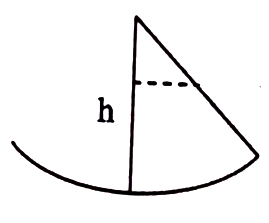
0 likes
View Solution44
DifficultMCQ
When $12000 \ J$ of work is done on a flywheel,its frequency of rotation increases from $10 \ Hz$ to $20 \ Hz$. The moment of inertia of the flywheel about its axis of rotation is (take $\pi^2=10$):
A
$1 \ kg \cdot m^2$
B
$2 \ kg \cdot m^2$
C
$1.688 \ kg \cdot m^2$
D
$1.5 \ kg \cdot m^2$
Solution
(B) Given: Work done $W = 12000 \ J$,Initial frequency $f_1 = 10 \ Hz$,Final frequency $f_2 = 20 \ Hz$.
Angular velocity is given by $\omega = 2\pi f$.
Initial angular velocity $\omega_1 = 2\pi(10) = 20\pi \ rad/s$.
Final angular velocity $\omega_2 = 2\pi(20) = 40\pi \ rad/s$.
According to the work-energy theorem,the work done equals the change in rotational kinetic energy:
$W = \Delta K = \frac{1}{2} I \omega_2^2 - \frac{1}{2} I \omega_1^2 = \frac{1}{2} I (\omega_2^2 - \omega_1^2)$.
Substituting the values:
$12000 = \frac{1}{2} I [(40\pi)^2 - (20\pi)^2]$.
$12000 = \frac{1}{2} I [1600\pi^2 - 400\pi^2]$.
$12000 = \frac{1}{2} I [1200\pi^2]$.
Using $\pi^2 = 10$:
$12000 = \frac{1}{2} I [1200 \times 10]$.
$12000 = I [6000]$.
$I = \frac{12000}{6000} = 2 \ kg \cdot m^2$.
Angular velocity is given by $\omega = 2\pi f$.
Initial angular velocity $\omega_1 = 2\pi(10) = 20\pi \ rad/s$.
Final angular velocity $\omega_2 = 2\pi(20) = 40\pi \ rad/s$.
According to the work-energy theorem,the work done equals the change in rotational kinetic energy:
$W = \Delta K = \frac{1}{2} I \omega_2^2 - \frac{1}{2} I \omega_1^2 = \frac{1}{2} I (\omega_2^2 - \omega_1^2)$.
Substituting the values:
$12000 = \frac{1}{2} I [(40\pi)^2 - (20\pi)^2]$.
$12000 = \frac{1}{2} I [1600\pi^2 - 400\pi^2]$.
$12000 = \frac{1}{2} I [1200\pi^2]$.
Using $\pi^2 = 10$:
$12000 = \frac{1}{2} I [1200 \times 10]$.
$12000 = I [6000]$.
$I = \frac{12000}{6000} = 2 \ kg \cdot m^2$.
0 likes
View Solution45
MediumMCQ
$A$ thin uniform rod of length $L$ and mass $M$ is swinging freely about a horizontal axis passing through its end. Its maximum angular speed is $\omega$. Its centre of mass rises to a maximum height of (where $g$ is the acceleration due to gravity):
A
$\frac{L^2 \omega^2}{2g}$
B
$\frac{L \omega}{6g}$
C
$\frac{L \omega}{2g}$
D
$\frac{L^2 \omega^2}{6g}$
Solution
(D) The rod rotates about an axis passing through its end. The moment of inertia of the rod about this axis is $I = \frac{1}{3}ML^2$.
The rotational kinetic energy of the rod at its lowest point (maximum angular speed) is $K = \frac{1}{2}I\omega^2 = \frac{1}{2}(\frac{1}{3}ML^2)\omega^2 = \frac{1}{6}ML^2\omega^2$.
At the maximum height $h$,the centre of mass of the rod rises by $h$. The potential energy gained by the rod is $U = Mgh$.
By the law of conservation of energy,the rotational kinetic energy at the bottom equals the potential energy at the maximum height:
$\frac{1}{6}ML^2\omega^2 = Mgh$.
Solving for $h$:
$h = \frac{L^2\omega^2}{6g}$.
The rotational kinetic energy of the rod at its lowest point (maximum angular speed) is $K = \frac{1}{2}I\omega^2 = \frac{1}{2}(\frac{1}{3}ML^2)\omega^2 = \frac{1}{6}ML^2\omega^2$.
At the maximum height $h$,the centre of mass of the rod rises by $h$. The potential energy gained by the rod is $U = Mgh$.
By the law of conservation of energy,the rotational kinetic energy at the bottom equals the potential energy at the maximum height:
$\frac{1}{6}ML^2\omega^2 = Mgh$.
Solving for $h$:
$h = \frac{L^2\omega^2}{6g}$.
0 likes
View Solution46
MediumMCQ
$A$ thin uniform metal rod of mass $M$ and length $L$ is swinging about a horizontal axis passing through its end. Its maximum angular velocity is $\omega$. Its centre of mass rises to a maximum height of (where $g$ is the acceleration due to gravity):
A
$\frac{L^2 \omega^2}{3g}$
B
$\frac{L^2 \omega^2}{2g}$
C
$\frac{L^2 \omega^2}{6g}$
D
$\frac{L^2 \omega^2}{4g}$
Solution
(C) By the principle of conservation of energy,the rotational kinetic energy at the lowest point is equal to the gravitational potential energy at the maximum height.
$\frac{1}{2} I \omega^2 = Mgh$
$\therefore h = \frac{I \omega^2}{2Mg} \dots (i)$
The moment of inertia $(I)$ of a uniform rod about an axis passing through its end is given by the parallel axis theorem:
$I = I_{cm} + Md^2 = \frac{ML^2}{12} + M\left(\frac{L}{2}\right)^2 = \frac{ML^2}{12} + \frac{ML^2}{4} = \frac{ML^2}{3} \dots (ii)$
Substituting equation $(ii)$ into equation $(i)$:
$h = \frac{(\frac{ML^2}{3}) \omega^2}{2Mg} = \frac{ML^2 \omega^2}{6Mg} = \frac{L^2 \omega^2}{6g}$
$\frac{1}{2} I \omega^2 = Mgh$
$\therefore h = \frac{I \omega^2}{2Mg} \dots (i)$
The moment of inertia $(I)$ of a uniform rod about an axis passing through its end is given by the parallel axis theorem:
$I = I_{cm} + Md^2 = \frac{ML^2}{12} + M\left(\frac{L}{2}\right)^2 = \frac{ML^2}{12} + \frac{ML^2}{4} = \frac{ML^2}{3} \dots (ii)$
Substituting equation $(ii)$ into equation $(i)$:
$h = \frac{(\frac{ML^2}{3}) \omega^2}{2Mg} = \frac{ML^2 \omega^2}{6Mg} = \frac{L^2 \omega^2}{6g}$
0 likes
View Solution47
MediumMCQ
The Moon revolves around the Earth in an orbit of radius $R$ with a time period of revolution $T$. It also rotates about its own axis with a time period $T$. If the mass of the Moon is $M$ and its radius is $r$,the total kinetic energy of the Moon is:
A
$\frac{2 M \pi^2 R^2}{T^2} + \frac{4 M r^2 \pi^2}{5 T^2}$
B
$\frac{M \pi^2 R^2}{2 T^2}$
C
$\frac{4 M r^2 \pi^2}{5 T^2}$
D
$\frac{M \pi^2 R^2}{2 T^2} + \frac{4 M r^2 \pi^2}{5 T^2}$
Solution
(A) The total kinetic energy of the Moon is the sum of its translational kinetic energy (due to orbital motion) and its rotational kinetic energy (due to rotation about its own axis).
$KE_{total} = KE_{translational} + KE_{rotational}$
$KE_{total} = \frac{1}{2} M v^2 + \frac{1}{2} I \omega^2$
Given that the orbital speed $v = R \omega$ and the angular velocity $\omega = \frac{2 \pi}{T}$.
The moment of inertia of the Moon (assuming it is a solid sphere) is $I = \frac{2}{5} M r^2$.
Substituting these values:
$KE_{total} = \frac{1}{2} M (R \omega)^2 + \frac{1}{2} (\frac{2}{5} M r^2) \omega^2$
$KE_{total} = \frac{1}{2} M R^2 \omega^2 + \frac{1}{5} M r^2 \omega^2$
Substituting $\omega^2 = (\frac{2 \pi}{T})^2 = \frac{4 \pi^2}{T^2}$:
$KE_{total} = \frac{1}{2} M R^2 (\frac{4 \pi^2}{T^2}) + \frac{1}{5} M r^2 (\frac{4 \pi^2}{T^2})$
$KE_{total} = \frac{2 M \pi^2 R^2}{T^2} + \frac{4 M r^2 \pi^2}{5 T^2}$
$KE_{total} = KE_{translational} + KE_{rotational}$
$KE_{total} = \frac{1}{2} M v^2 + \frac{1}{2} I \omega^2$
Given that the orbital speed $v = R \omega$ and the angular velocity $\omega = \frac{2 \pi}{T}$.
The moment of inertia of the Moon (assuming it is a solid sphere) is $I = \frac{2}{5} M r^2$.
Substituting these values:
$KE_{total} = \frac{1}{2} M (R \omega)^2 + \frac{1}{2} (\frac{2}{5} M r^2) \omega^2$
$KE_{total} = \frac{1}{2} M R^2 \omega^2 + \frac{1}{5} M r^2 \omega^2$
Substituting $\omega^2 = (\frac{2 \pi}{T})^2 = \frac{4 \pi^2}{T^2}$:
$KE_{total} = \frac{1}{2} M R^2 (\frac{4 \pi^2}{T^2}) + \frac{1}{5} M r^2 (\frac{4 \pi^2}{T^2})$
$KE_{total} = \frac{2 M \pi^2 R^2}{T^2} + \frac{4 M r^2 \pi^2}{5 T^2}$
0 likes
View Solution48
MediumMCQ
$A$ thin uniform circular disc of mass $\frac{10}{\pi^2} \,kg$ and radius $2 \,m$ is rotating about an axis passing through its centre and perpendicular to its plane. The work done to increase the angular speed of the disc from $90 \,rev/min$ to $120 \,rev/min$ is (in $\,J$)
A
$35$
B
$70$
C
$140$
D
$210$
Solution
(B) The moment of inertia $I$ of a circular disc about an axis passing through its centre and perpendicular to its plane is given by $I = \frac{1}{2}MR^2$.
Given $M = \frac{10}{\pi^2} \,kg$ and $R = 2 \,m$,we have $I = \frac{1}{2} \times \frac{10}{\pi^2} \times (2)^2 = \frac{20}{\pi^2} \,kg \cdot m^2$.
The initial angular speed $\omega_1 = 90 \,rev/min = 90 \times \frac{2\pi}{60} \,rad/s = 3\pi \,rad/s$.
The final angular speed $\omega_2 = 120 \,rev/min = 120 \times \frac{2\pi}{60} \,rad/s = 4\pi \,rad/s$.
According to the work-energy theorem,the work done $W$ is equal to the change in rotational kinetic energy: $W = \Delta K = \frac{1}{2}I(\omega_2^2 - \omega_1^2)$.
Substituting the values: $W = \frac{1}{2} \times \frac{20}{\pi^2} \times ((4\pi)^2 - (3\pi)^2) = \frac{10}{\pi^2} \times (16\pi^2 - 9\pi^2) = \frac{10}{\pi^2} \times 7\pi^2 = 70 \,J$.
Given $M = \frac{10}{\pi^2} \,kg$ and $R = 2 \,m$,we have $I = \frac{1}{2} \times \frac{10}{\pi^2} \times (2)^2 = \frac{20}{\pi^2} \,kg \cdot m^2$.
The initial angular speed $\omega_1 = 90 \,rev/min = 90 \times \frac{2\pi}{60} \,rad/s = 3\pi \,rad/s$.
The final angular speed $\omega_2 = 120 \,rev/min = 120 \times \frac{2\pi}{60} \,rad/s = 4\pi \,rad/s$.
According to the work-energy theorem,the work done $W$ is equal to the change in rotational kinetic energy: $W = \Delta K = \frac{1}{2}I(\omega_2^2 - \omega_1^2)$.
Substituting the values: $W = \frac{1}{2} \times \frac{20}{\pi^2} \times ((4\pi)^2 - (3\pi)^2) = \frac{10}{\pi^2} \times (16\pi^2 - 9\pi^2) = \frac{10}{\pi^2} \times 7\pi^2 = 70 \,J$.
0 likes
View Solution49
DifficultMCQ
$A$ thin uniform rod of mass $1 \ kg$ and length $1 \ m$ is hinged at one end to the ground. It originally stands vertically and is allowed to fall to the ground. If the rod hits the ground with angular speed $\omega$,then the correct statement is (Assume $g = 10 \ m \ s^{-2}$):
A
$\omega = \sqrt{30} \ rad \ s^{-1}$
B
$\omega = \sqrt{20} \ rad \ s^{-1}$
C
$\omega = 5 \ rad \ s^{-1}$
D
$\omega = 6 \ rad \ s^{-1}$
Solution
(A) By the principle of conservation of energy,the potential energy lost by the rod is equal to the rotational kinetic energy gained by it.
Initial potential energy of the rod (taking the center of mass at height $L/2$) is $U_i = mg(L/2)$.
Final rotational kinetic energy when the rod hits the ground is $K_f = \frac{1}{2} I \omega^2$.
Here,$I$ is the moment of inertia of the rod about the hinged end,given by $I = \frac{mL^2}{3}$.
Equating the two: $mg \frac{L}{2} = \frac{1}{2} (\frac{mL^2}{3}) \omega^2$.
Simplifying the equation: $g = \frac{L}{3} \omega^2$,which gives $\omega = \sqrt{\frac{3g}{L}}$.
Substituting the given values $g = 10 \ m \ s^{-2}$ and $L = 1 \ m$:
$\omega = \sqrt{\frac{3 \times 10}{1}} = \sqrt{30} \ rad \ s^{-1}$.
Initial potential energy of the rod (taking the center of mass at height $L/2$) is $U_i = mg(L/2)$.
Final rotational kinetic energy when the rod hits the ground is $K_f = \frac{1}{2} I \omega^2$.
Here,$I$ is the moment of inertia of the rod about the hinged end,given by $I = \frac{mL^2}{3}$.
Equating the two: $mg \frac{L}{2} = \frac{1}{2} (\frac{mL^2}{3}) \omega^2$.
Simplifying the equation: $g = \frac{L}{3} \omega^2$,which gives $\omega = \sqrt{\frac{3g}{L}}$.
Substituting the given values $g = 10 \ m \ s^{-2}$ and $L = 1 \ m$:
$\omega = \sqrt{\frac{3 \times 10}{1}} = \sqrt{30} \ rad \ s^{-1}$.
0 likes
View SolutionSystem of Particles and Rotational Motion — Energy conservation, Kinetic Energy, Work and Power of Rotational Motion · Frequently Asked Questions
1Are these System of Particles and Rotational Motion questions useful for JEE and NEET?
Yes. All questions in this section are mapped to JEE Main and NEET exam patterns. Previous year questions from JEE Main, NEET, GUJCET and state-level exams are included with full solutions.
2Can I switch to Hindi or Gujarati for these questions?
Yes. Use the language tabs in the hero section or the sidebar to view the same questions and solutions in English, Hindi or Gujarati.
3How do I generate a question paper from this subtopic?
Use the Vedclass Exam Paper Generator — select the chapter and subtopic, set difficulty, and generate Sets A, B, C, D automatically. First 3 chapters of every subject are free.
Vedclass Products
For Students
Vedclass Test Series
Mock tests in real JEE/NEET style with performance analysis. 5-day free trial.
Start Free TrialFor Teachers
Exam Paper Generator
Generate Set A/B/C/D papers from this chapter in 2 minutes. 3 chapters free.
Try FreeFor Institutes
Online Exam Module
Live online exams with unlimited students, 360° analytics & white-label branding.
See DemoFor Teachers & Institutes
Generate a System of Particles and Rotational Motion Exam Paper in 2 Minutes
Select subtopic & difficulty — Sets A, B, C, D auto-generated with No Repeat logic.
First 3 chapters of every subject are free — no payment required.