
Class 11PhysicsSystem of Particles and Rotational MotionMix Example - System of Particles and Rotational Motion
MediumIn the following problem,indicate the correct direction of the friction force acting on a cylinder of mass $M$ and radius $R$,which is pulled on a rough surface by a constant horizontal force $F$ applied at its center. The friction force can be represented by which of the following diagrams?
- A
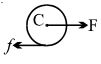
- B

- C

- DCannot be interpreted.
Explore More
Similar Questions
$A$ disc of circumference $s$ is at rest at a point $A$ on a horizontal surface when a constant horizontal force begins to act on its centre. Between $A$ and $B$ there is sufficient friction to prevent slipping,and the surface is smooth to the right of $B$. $AB = s$. The disc moves from $A$ to $B$ in time $T$. To the right of $B$,
The figure shows a system consisting of $(i)$ a ring of outer radius $3R$ rolling clockwise without slipping on a horizontal surface with angular speed $\omega$ and $(ii)$ an inner disc of radius $2R$ rotating anti-clockwise with angular speed $\omega/2$. The ring and disc are separated by frictionless ball bearings. The system is in the $x-z$ plane. The point $P$ on the inner disc is at distance $R$ from the origin,where $OP$ makes an angle of $30^{\circ}$ with the horizontal. Then with respect to the horizontal surface,
$(A)$ the point $O$ has linear velocity $3R\omega\hat{i}$.
$(B)$ the point $P$ has a linear velocity $\frac{11}{4}R\omega\hat{i} + \frac{\sqrt{3}}{4}R\omega\hat{k}$.
$(C)$ the point $P$ has linear velocity $\frac{13}{4}R\omega\hat{i} - \frac{\sqrt{3}}{4}R\omega\hat{k}$.
$(D)$ The point $P$ has a linear velocity $(3 - \frac{\sqrt{3}}{4})R\omega\hat{i} + \frac{1}{4}R\omega\hat{k}$.
$(A)$ the point $O$ has linear velocity $3R\omega\hat{i}$.
$(B)$ the point $P$ has a linear velocity $\frac{11}{4}R\omega\hat{i} + \frac{\sqrt{3}}{4}R\omega\hat{k}$.
$(C)$ the point $P$ has linear velocity $\frac{13}{4}R\omega\hat{i} - \frac{\sqrt{3}}{4}R\omega\hat{k}$.
$(D)$ The point $P$ has a linear velocity $(3 - \frac{\sqrt{3}}{4})R\omega\hat{i} + \frac{1}{4}R\omega\hat{k}$.
$A$ ring of mass $M$ and radius $R$ sliding with a velocity $v_0$ suddenly enters a rough surface where the coefficient of friction is $\mu$,as shown in the figure. Choose the correct alternative$(s)$.
The total kinetic energy of a body of mass $10 \ kg$ and radius $0.5 \ m$ moving with a velocity of $2 \ m/s$ without slipping is $32.8 \ J$. The radius of gyration of the body is .......... $m$.
Medium
View Solution$A$ uniform thin rod of length $2L$ and mass $m$ lies on a horizontal table. $A$ horizontal impulse $J$ is given to the rod at one end. There is no friction. The total kinetic energy of the rod just after the impulse will be
DifficultKVPY 2014
View SolutionVedclass Products
For Students
Vedclass Test Series
Mock tests in real JEE/NEET style with performance analysis. 5-day free trial.
Start Free TrialFor Teachers
Exam Paper Generator
Generate Set A/B/C/D exam papers from 7.5L+ questions in 2 minutes. 3 chapters free.
Try FreeFor Institutes
Online Exam Module
Live online exams with unlimited students, 360° analytics & white-label branding.
See Demo