
A English
Second Law of Motion Questions in English
Class 11 Physics · Newton's Laws of Motion and Friction · Second Law of Motion
102+
Questions
English
Language
100%
With Solutions
Showing 49 of 102 questions in English
1
DifficultMCQ
$A$ force vector applied on a mass is represented as $\vec F = 6\hat i - 8\hat j + 10\hat k$ and accelerates the body with $1\;m/s^2$. What will be the mass of the body in $kg$?
A
$10\sqrt{2}$
B
$20$
C
$2\sqrt{10}$
D
$10$
Solution
(A) The magnitude of the force vector $\vec F = 6\hat i - 8\hat j + 10\hat k$ is given by $|\vec F| = \sqrt{6^2 + (-8)^2 + 10^2}$.
$|\vec F| = \sqrt{36 + 64 + 100} = \sqrt{200} = 10\sqrt{2}\;N$.
According to Newton's second law,$F = ma$,so the mass $m = \frac{|\vec F|}{a}$.
Given the acceleration $a = 1\;m/s^2$,the mass $m = \frac{10\sqrt{2}}{1} = 10\sqrt{2}\;kg$.
$|\vec F| = \sqrt{36 + 64 + 100} = \sqrt{200} = 10\sqrt{2}\;N$.
According to Newton's second law,$F = ma$,so the mass $m = \frac{|\vec F|}{a}$.
Given the acceleration $a = 1\;m/s^2$,the mass $m = \frac{10\sqrt{2}}{1} = 10\sqrt{2}\;kg$.
0 likes
View Solution2
EasyMCQ
The engine of a car produces an acceleration of $4\,m/s^2$ in the car. If this car pulls another car of the same mass,what will be the acceleration produced in $m/s^2$?
A
$8$
B
$2$
C
$4$
D
$0.5$
Solution
(B) According to Newton's second law of motion,the force $F$ produced by the engine is given by $F = m \times a$,where $m$ is the mass and $a$ is the acceleration.
Since the force $F$ remains constant,we have $a \propto \frac{1}{m}$.
Initially,the mass is $m$ and the acceleration is $a_1 = 4\,m/s^2$.
When the car pulls another car of the same mass,the total mass becomes $M = m + m = 2m$.
Let the new acceleration be $a_2$. Since $F = m \times a_1 = 2m \times a_2$,we get $a_2 = \frac{a_1}{2}$.
Substituting the value,$a_2 = \frac{4}{2} = 2\,m/s^2$.
Since the force $F$ remains constant,we have $a \propto \frac{1}{m}$.
Initially,the mass is $m$ and the acceleration is $a_1 = 4\,m/s^2$.
When the car pulls another car of the same mass,the total mass becomes $M = m + m = 2m$.
Let the new acceleration be $a_2$. Since $F = m \times a_1 = 2m \times a_2$,we get $a_2 = \frac{a_1}{2}$.
Substituting the value,$a_2 = \frac{4}{2} = 2\,m/s^2$.
0 likes
View Solution3
MediumMCQ
$A$ constant force acts on a body of mass $0.9 \,kg$ at rest for $10 \,s$. If the body moves a distance of $250 \,m$,the magnitude of the force is.........$N$
A
$3$
B
$3.5$
C
$4.0$
D
$4.5$
Solution
(D) Given: Initial velocity $u = 0$,Mass $m = 0.9 \,kg$,Time $t = 10 \,s$,Distance $S = 250 \,m$.
Using the second equation of motion: $S = ut + \frac{1}{2}at^2$.
Substituting the values: $250 = (0)(10) + \frac{1}{2} \times a \times (10)^2$.
$250 = 50a \Rightarrow a = \frac{250}{50} = 5 \,m/s^2$.
Now,using Newton's second law of motion: $F = ma$.
$F = 0.9 \,kg \times 5 \,m/s^2 = 4.5 \,N$.
Using the second equation of motion: $S = ut + \frac{1}{2}at^2$.
Substituting the values: $250 = (0)(10) + \frac{1}{2} \times a \times (10)^2$.
$250 = 50a \Rightarrow a = \frac{250}{50} = 5 \,m/s^2$.
Now,using Newton's second law of motion: $F = ma$.
$F = 0.9 \,kg \times 5 \,m/s^2 = 4.5 \,N$.
0 likes
View Solution4
EasyMCQ
$A$ body of $5 \, kg$ is moving with a velocity of $20 \, m/s$. If a force of $100 \, N$ is applied on it for $10 \, s$ in the same direction as its velocity,what will be the final velocity of the body in $m/s$?
A
$200$
B
$220$
C
$240$
D
$260$
Solution
(B) Given:
Mass of the body,$m = 5 \, kg$
Initial velocity,$u = 20 \, m/s$
Force applied,$F = 100 \, N$
Time duration,$t = 10 \, s$
According to Newton's second law of motion,the acceleration $a$ is given by $a = \frac{F}{m} = \frac{100}{5} = 20 \, m/s^2$.
Using the first equation of motion,$v = u + at$,we get:
$v = 20 + (20 \times 10)$
$v = 20 + 200 = 220 \, m/s$.
Therefore,the final velocity of the body is $220 \, m/s$.
Mass of the body,$m = 5 \, kg$
Initial velocity,$u = 20 \, m/s$
Force applied,$F = 100 \, N$
Time duration,$t = 10 \, s$
According to Newton's second law of motion,the acceleration $a$ is given by $a = \frac{F}{m} = \frac{100}{5} = 20 \, m/s^2$.
Using the first equation of motion,$v = u + at$,we get:
$v = 20 + (20 \times 10)$
$v = 20 + 200 = 220 \, m/s$.
Therefore,the final velocity of the body is $220 \, m/s$.
0 likes
View Solution5
MediumMCQ
If a bullet of mass $5 \,g$ moving with velocity $100 \,m/s$ penetrates a wooden block up to $6 \,cm$,then the average force imposed by the bullet on the block is ........... $N$.
A
$8300$
B
$417$
C
$830$
D
$0$
Solution
(B) Given: Mass of the bullet $m = 5 \,g = 5 \times 10^{-3} \,kg$,initial velocity $u = 100 \,m/s$,final velocity $v = 0 \,m/s$,and distance $s = 6 \,cm = 0.06 \,m$.
Using the third equation of motion,$v^2 = u^2 + 2as$:
$0^2 = (100)^2 + 2 \times a \times 0.06$
$0 = 10000 + 0.12a$
$a = -\frac{10000}{0.12} = -\frac{1000000}{12} \,m/s^2$.
The negative sign indicates retardation.
Now,using Newton's second law,$F = ma$:
$F = (5 \times 10^{-3} \,kg) \times \left(\frac{1000000}{12} \,m/s^2\right)$
$F = \frac{5000}{12} \approx 416.67 \,N \approx 417 \,N$.
Using the third equation of motion,$v^2 = u^2 + 2as$:
$0^2 = (100)^2 + 2 \times a \times 0.06$
$0 = 10000 + 0.12a$
$a = -\frac{10000}{0.12} = -\frac{1000000}{12} \,m/s^2$.
The negative sign indicates retardation.
Now,using Newton's second law,$F = ma$:
$F = (5 \times 10^{-3} \,kg) \times \left(\frac{1000000}{12} \,m/s^2\right)$
$F = \frac{5000}{12} \approx 416.67 \,N \approx 417 \,N$.
0 likes
View Solution6
EasyMCQ
Newton's second law gives the measure of
A
Acceleration
B
Force
C
Momentum
D
Angular momentum
Solution
(B) Newton's second law of motion states that the rate of change of momentum of an object is directly proportional to the applied unbalanced force in the direction of the force.
Mathematically,this is expressed as $\overrightarrow{F} = m\overrightarrow{a}$,where $\overrightarrow{F}$ is the force,$m$ is the mass,and $\overrightarrow{a}$ is the acceleration.
Therefore,the second law provides a quantitative measure of force.
Mathematically,this is expressed as $\overrightarrow{F} = m\overrightarrow{a}$,where $\overrightarrow{F}$ is the force,$m$ is the mass,and $\overrightarrow{a}$ is the acceleration.
Therefore,the second law provides a quantitative measure of force.
0 likes
View Solution7
EasyMCQ
If the mass and the acceleration of an object are both doubled,how does the force acting on the object change with respect to its previous value?
A
Decreases to half
B
Remains unchanged
C
Increases two times
D
Increases four times
Solution
(D) According to Newton's Second Law of Motion,the force $F$ acting on an object is given by the product of its mass $m$ and acceleration $a$,expressed as $F = m \times a$.
Let the initial force be $F_1 = m_1 \times a_1$.
If the mass is doubled $(m_2 = 2m_1)$ and the acceleration is also doubled $(a_2 = 2a_1)$,the new force $F_2$ becomes:
$F_2 = m_2 \times a_2 = (2m_1) \times (2a_1) = 4 \times (m_1 \times a_1) = 4F_1$.
Therefore,the force increases four times compared to its previous value.
Let the initial force be $F_1 = m_1 \times a_1$.
If the mass is doubled $(m_2 = 2m_1)$ and the acceleration is also doubled $(a_2 = 2a_1)$,the new force $F_2$ becomes:
$F_2 = m_2 \times a_2 = (2m_1) \times (2a_1) = 4 \times (m_1 \times a_1) = 4F_1$.
Therefore,the force increases four times compared to its previous value.
0 likes
View Solution8
EasyMCQ
$A$ force of $5 \, N$ acts on a body of weight $9.8 \, N$. What is the acceleration produced in $m/s^2$?
A
$49$
B
$5$
C
$1.46$
D
$0.51$
Solution
(B) Given: Force $(F)$ = $5 \, N$,Weight $(W)$ = $9.8 \, N$.
We know that Weight $(W)$ = $m \times g$,where $g = 9.8 \, m/s^2$.
Therefore,mass $(m)$ = $W / g = 9.8 / 9.8 = 1 \, kg$.
According to Newton's second law of motion,$F = m \times a$.
Acceleration $(a)$ = $F / m = 5 \, N / 1 \, kg = 5 \, m/s^2$.
We know that Weight $(W)$ = $m \times g$,where $g = 9.8 \, m/s^2$.
Therefore,mass $(m)$ = $W / g = 9.8 / 9.8 = 1 \, kg$.
According to Newton's second law of motion,$F = m \times a$.
Acceleration $(a)$ = $F / m = 5 \, N / 1 \, kg = 5 \, m/s^2$.
0 likes
View Solution9
EasyMCQ
When $1\,N$ force acts on a $1\,kg$ body that is able to move freely,the body receives:
A
$A$ speed of $1\,m/s$
B
An acceleration of $1\,m/s^2$
C
An acceleration of $980\,cm/s^2$
D
An acceleration of $1\,cm/s^2$
Solution
(B) According to Newton's second law of motion,the acceleration $a$ produced in a body is given by the formula $a = \frac{F}{m}$.
Given,force $F = 1\,N$ and mass $m = 1\,kg$.
Substituting these values into the formula:
$a = \frac{1\,N}{1\,kg} = 1\,m/s^2$.
Therefore,the body receives an acceleration of $1\,m/s^2$.
Given,force $F = 1\,N$ and mass $m = 1\,kg$.
Substituting these values into the formula:
$a = \frac{1\,N}{1\,kg} = 1\,m/s^2$.
Therefore,the body receives an acceleration of $1\,m/s^2$.
0 likes
View Solution10
EasyMCQ
An object with a mass of $10\, kg$ moves at a constant velocity of $10\, m/s$. $A$ constant force then acts for $4\, s$ on the object and gives it a speed of $2\, m/s$ in the opposite direction. The force acting on the object is ......... $N$.
A
$30$
B
$-30$
C
$3$
D
$-3$
Solution
(B) Given: Mass $m = 10\, kg$,Initial velocity $u = 10\, m/s$,Final velocity $v = -2\, m/s$ (opposite direction),Time $t = 4\, s$.
According to Newton's second law of motion,the force $F$ is given by the rate of change of momentum:
$F = \frac{m(v - u)}{t}$
Substituting the values:
$F = \frac{10 \times (-2 - 10)}{4}$
$F = \frac{10 \times (-12)}{4}$
$F = \frac{-120}{4} = -30\, N$.
Thus,the force acting on the object is $-30\, N$.
According to Newton's second law of motion,the force $F$ is given by the rate of change of momentum:
$F = \frac{m(v - u)}{t}$
Substituting the values:
$F = \frac{10 \times (-2 - 10)}{4}$
$F = \frac{10 \times (-12)}{4}$
$F = \frac{-120}{4} = -30\, N$.
Thus,the force acting on the object is $-30\, N$.
1 likes
View Solution11
MediumMCQ
At a place where the acceleration due to gravity is $10\,m/s^2$,a force of $5\,kg-wt$ acts on a body of mass $10\,kg$ initially at rest. The velocity of the body after $4\,s$ is .......... $m/s$.
A
$5$
B
$10$
C
$20$
D
$50$
Solution
(C) Given:
Acceleration due to gravity $g = 10\,m/s^2$
Force $F = 5\,kg-wt = 5 \times 10\,N = 50\,N$
Mass $m = 10\,kg$
Initial velocity $u = 0\,m/s$
Time $t = 4\,s$
Using Newton's second law,the acceleration $a$ is:
$a = \frac{F}{m} = \frac{50\,N}{10\,kg} = 5\,m/s^2$
Using the first equation of motion $v = u + at$:
$v = 0 + (5\,m/s^2 \times 4\,s) = 20\,m/s$
Therefore,the velocity of the body after $4\,s$ is $20\,m/s$.
Acceleration due to gravity $g = 10\,m/s^2$
Force $F = 5\,kg-wt = 5 \times 10\,N = 50\,N$
Mass $m = 10\,kg$
Initial velocity $u = 0\,m/s$
Time $t = 4\,s$
Using Newton's second law,the acceleration $a$ is:
$a = \frac{F}{m} = \frac{50\,N}{10\,kg} = 5\,m/s^2$
Using the first equation of motion $v = u + at$:
$v = 0 + (5\,m/s^2 \times 4\,s) = 20\,m/s$
Therefore,the velocity of the body after $4\,s$ is $20\,m/s$.
0 likes
View Solution12
EasyMCQ
$A$ ball of mass $0.2 \, kg$ moves with a velocity of $20 \, m/s$ and it stops in $0.1 \, s$; then the force on the ball is ........... $N$.
A
$40$
B
$20$
C
$4$
D
$2$
Solution
(A) Given:
Mass of the ball,$m = 0.2 \, kg$
Initial velocity,$u = 20 \, m/s$
Final velocity,$v = 0 \, m/s$ (since it stops)
Time taken,$\Delta t = 0.1 \, s$
According to Newton's Second Law of Motion,the force $F$ is given by the rate of change of momentum:
$F = \frac{m(v - u)}{\Delta t}$
Substituting the values:
$F = \frac{0.2 \times (0 - 20)}{0.1}$
$F = \frac{0.2 \times (-20)}{0.1}$
$F = \frac{-4}{0.1} = -40 \, N$
The magnitude of the force is $40 \, N$.
Mass of the ball,$m = 0.2 \, kg$
Initial velocity,$u = 20 \, m/s$
Final velocity,$v = 0 \, m/s$ (since it stops)
Time taken,$\Delta t = 0.1 \, s$
According to Newton's Second Law of Motion,the force $F$ is given by the rate of change of momentum:
$F = \frac{m(v - u)}{\Delta t}$
Substituting the values:
$F = \frac{0.2 \times (0 - 20)}{0.1}$
$F = \frac{0.2 \times (-20)}{0.1}$
$F = \frac{-4}{0.1} = -40 \, N$
The magnitude of the force is $40 \, N$.
0 likes
View Solution13
EasyMCQ
$A$ vehicle of $100\, kg$ is moving with a velocity of $5\, m/s$. To stop it in $\frac{1}{10}\, s$,the required force in the opposite direction is ........... $N$.
A
$5000$
B
$500$
C
$50$
D
$1000$
Solution
(A) Given: Mass $m = 100\, kg$,Initial velocity $u = 5\, m/s$,Final velocity $v = 0\, m/s$,Time $t = \frac{1}{10}\, s = 0.1\, s$.
According to Newton's Second Law of Motion,the force required is given by $F = m \times a$,where $a$ is the acceleration (or deceleration).
The acceleration is $a = \frac{v - u}{t} = \frac{0 - 5}{0.1} = -50\, m/s^2$.
The magnitude of the force required to stop the vehicle is $F = |m \times a| = 100\, kg \times 50\, m/s^2 = 5000\, N$.
According to Newton's Second Law of Motion,the force required is given by $F = m \times a$,where $a$ is the acceleration (or deceleration).
The acceleration is $a = \frac{v - u}{t} = \frac{0 - 5}{0.1} = -50\, m/s^2$.
The magnitude of the force required to stop the vehicle is $F = |m \times a| = 100\, kg \times 50\, m/s^2 = 5000\, N$.
0 likes
View Solution14
DifficultMCQ
$A$ force vector applied on a mass is represented as $\vec{F} = 6\hat{i} - 8\hat{j} + 10\hat{k} \, N$ and it accelerates with $1 \, m/s^2$. What will be the mass of the body?
A
$10\sqrt{2} \, kg$
B
$2\sqrt{10} \, kg$
C
$10 \, kg$
D
$20 \, kg$
Solution
(A) The magnitude of the force vector $\vec{F} = 6\hat{i} - 8\hat{j} + 10\hat{k}$ is calculated as:
$|\vec{F}| = \sqrt{(6)^2 + (-8)^2 + (10)^2} = \sqrt{36 + 64 + 100} = \sqrt{200} \, N$.
Using Newton's second law of motion,$F = ma$,where $a = 1 \, m/s^2$:
$m = \frac{F}{a} = \frac{\sqrt{200}}{1} = \sqrt{100 \times 2} = 10\sqrt{2} \, kg$.
Therefore,the mass of the body is $10\sqrt{2} \, kg$.
$|\vec{F}| = \sqrt{(6)^2 + (-8)^2 + (10)^2} = \sqrt{36 + 64 + 100} = \sqrt{200} \, N$.
Using Newton's second law of motion,$F = ma$,where $a = 1 \, m/s^2$:
$m = \frac{F}{a} = \frac{\sqrt{200}}{1} = \sqrt{100 \times 2} = 10\sqrt{2} \, kg$.
Therefore,the mass of the body is $10\sqrt{2} \, kg$.
0 likes
View Solution15
MediumMCQ
The average resisting force that must act on a $5 \,kg$ mass to reduce its speed from $65 \,cm/s$ to $15 \,cm/s$ in $0.2 \,s$ is .......... $N$.
A
$12.5$
B
$25$
C
$50$
D
$100$
Solution
(A) Given: Mass $m = 5 \,kg$,Initial velocity $u = 65 \,cm/s = 0.65 \,m/s$,Final velocity $v = 15 \,cm/s = 0.15 \,m/s$,Time $t = 0.2 \,s$.
According to Newton's second law of motion,the force $F$ is given by $F = m \cdot a = m \cdot \left( \frac{v - u}{t} \right)$.
Substituting the values: $F = 5 \cdot \left( \frac{0.15 - 0.65}{0.2} \right)$.
$F = 5 \cdot \left( \frac{-0.50}{0.2} \right) = 5 \cdot (-2.5) = -12.5 \,N$.
The negative sign indicates that the force is a resisting force (opposing motion).
Therefore,the magnitude of the average resisting force is $12.5 \,N$.
According to Newton's second law of motion,the force $F$ is given by $F = m \cdot a = m \cdot \left( \frac{v - u}{t} \right)$.
Substituting the values: $F = 5 \cdot \left( \frac{0.15 - 0.65}{0.2} \right)$.
$F = 5 \cdot \left( \frac{-0.50}{0.2} \right) = 5 \cdot (-2.5) = -12.5 \,N$.
The negative sign indicates that the force is a resisting force (opposing motion).
Therefore,the magnitude of the average resisting force is $12.5 \,N$.
0 likes
View Solution16
MediumMCQ
An army vehicle of mass $1000\, kg$ is moving with a velocity of $10\, m/s$. It is acted upon by a forward force of $1000\, N$ due to the engine and a retarding force of $500\, N$ due to friction. What will be its velocity after $10\, s$ (in $, m/s$)?
A
$5$
B
$10$
C
$15$
D
$20$
Solution
(C) Given:
Mass of the vehicle,$m = 1000\, kg$
Initial velocity,$u = 10\, m/s$
Forward force,$F_{forward} = 1000\, N$
Retarding force,$F_{friction} = 500\, N$
Time,$t = 10\, s$
Net force acting on the vehicle,$F_{net} = F_{forward} - F_{friction} = 1000 - 500 = 500\, N$
According to Newton's second law,acceleration $a = \frac{F_{net}}{m} = \frac{500}{1000} = 0.5\, m/s^2$
Using the first equation of motion,$v = u + at$
$v = 10 + (0.5 \times 10)$
$v = 10 + 5 = 15\, m/s$
Therefore,the velocity after $10\, s$ is $15\, m/s$.
Mass of the vehicle,$m = 1000\, kg$
Initial velocity,$u = 10\, m/s$
Forward force,$F_{forward} = 1000\, N$
Retarding force,$F_{friction} = 500\, N$
Time,$t = 10\, s$
Net force acting on the vehicle,$F_{net} = F_{forward} - F_{friction} = 1000 - 500 = 500\, N$
According to Newton's second law,acceleration $a = \frac{F_{net}}{m} = \frac{500}{1000} = 0.5\, m/s^2$
Using the first equation of motion,$v = u + at$
$v = 10 + (0.5 \times 10)$
$v = 10 + 5 = 15\, m/s$
Therefore,the velocity after $10\, s$ is $15\, m/s$.
0 likes
View Solution17
EasyMCQ
$A$ body of mass $2 \, kg$ is moving with a velocity $8 \, m/s$ on a smooth surface. If it is to be brought to rest in $4 \, seconds$,then the force to be applied is ......... $N$.
A
$8$
B
$4$
C
$2$
D
$1$
Solution
(B) Given: Mass $m = 2 \, kg$,Initial velocity $u = 8 \, m/s$,Final velocity $v = 0 \, m/s$,Time $t = 4 \, s$.
According to Newton's second law of motion,the force $F$ is given by the rate of change of momentum:
$F = m \times a = m \times \frac{(v - u)}{t}$
Substituting the values:
$F = 2 \times \frac{(0 - 8)}{4}$
$F = 2 \times (-2) = -4 \, N$.
The magnitude of the force required to bring the body to rest is $4 \, N$.
According to Newton's second law of motion,the force $F$ is given by the rate of change of momentum:
$F = m \times a = m \times \frac{(v - u)}{t}$
Substituting the values:
$F = 2 \times \frac{(0 - 8)}{4}$
$F = 2 \times (-2) = -4 \, N$.
The magnitude of the force required to bring the body to rest is $4 \, N$.
0 likes
View Solution18
EasyMCQ
The linear momentum $p$ of a body moving in one dimension varies with time according to the equation $p = a + bt^2$,where $a$ and $b$ are positive constants. The net force acting on the body is
A
$A$ constant
B
Proportional to $t^2$
C
Inversely proportional to $t$
D
Proportional to $t$
Solution
(D) According to Newton's second law of motion,the net force $F$ acting on a body is equal to the rate of change of its linear momentum $p$ with respect to time $t$.
Mathematically,$F = \frac{dp}{dt}$.
Given the equation for momentum is $p = a + bt^2$.
Differentiating this equation with respect to time $t$,we get:
$F = \frac{d}{dt}(a + bt^2)$.
Since $a$ is a constant,its derivative is $0$.
$F = 0 + b(2t) = 2bt$.
Since $2$ and $b$ are constants,we can conclude that $F \propto t$.
Therefore,the net force acting on the body is proportional to $t$.
Mathematically,$F = \frac{dp}{dt}$.
Given the equation for momentum is $p = a + bt^2$.
Differentiating this equation with respect to time $t$,we get:
$F = \frac{d}{dt}(a + bt^2)$.
Since $a$ is a constant,its derivative is $0$.
$F = 0 + b(2t) = 2bt$.
Since $2$ and $b$ are constants,we can conclude that $F \propto t$.
Therefore,the net force acting on the body is proportional to $t$.
0 likes
View Solution19
EasyMCQ
$A$ force of $100 \, dynes$ acts on a mass of $5 \, g$ for $10 \, s$. The velocity produced is ......... $cm/s$.
A
$2000$
B
$200$
C
$20$
D
$2$
Solution
(B) Given:
Force $(F)$ = $100 \, dynes$
Mass $(m)$ = $5 \, g$
Time $(t)$ = $10 \, s$
Initial velocity $(u)$ = $0 \, cm/s$
According to Newton's second law of motion,$F = ma$,so acceleration $a = F/m$.
$a = 100 \, dynes / 5 \, g = 20 \, cm/s^2$.
Using the first equation of motion,$v = u + at$:
$v = 0 + (20 \, cm/s^2) \times (10 \, s) = 200 \, cm/s$.
Therefore,the velocity produced is $200 \, cm/s$.
Force $(F)$ = $100 \, dynes$
Mass $(m)$ = $5 \, g$
Time $(t)$ = $10 \, s$
Initial velocity $(u)$ = $0 \, cm/s$
According to Newton's second law of motion,$F = ma$,so acceleration $a = F/m$.
$a = 100 \, dynes / 5 \, g = 20 \, cm/s^2$.
Using the first equation of motion,$v = u + at$:
$v = 0 + (20 \, cm/s^2) \times (10 \, s) = 200 \, cm/s$.
Therefore,the velocity produced is $200 \, cm/s$.
0 likes
View Solution20
EasyMCQ
$A$ body of mass $5\, kg$ starts from the origin with an initial velocity $\vec{u} = 30\hat{i} + 40\hat{j}\,m/s$. If a constant force $\vec{F} = -(\hat{i} + 5\hat{j})\,N$ acts on the body,the time in which the $y$-component of the velocity becomes zero is ......... $s$.
A
$5$
B
$20$
C
$40$
D
$80$
Solution
(C) Given: Mass $m = 5\,kg$,initial velocity $\vec{u} = 30\hat{i} + 40\hat{j}\,m/s$,and force $\vec{F} = -1\hat{i} - 5\hat{j}\,N$.
We are interested in the $y$-component of the motion.
The initial $y$-component of velocity is $u_y = 40\,m/s$.
The $y$-component of the force is $F_y = -5\,N$.
Using Newton's second law,the acceleration in the $y$-direction is:
$a_y = \frac{F_y}{m} = \frac{-5\,N}{5\,kg} = -1\,m/s^2$.
Using the first equation of motion $v_y = u_y + a_y t$,we set the final $y$-velocity $v_y = 0$:
$0 = 40 + (-1)t$
$t = 40\,s$.
Therefore,the time taken for the $y$-component of the velocity to become zero is $40\,s$.
We are interested in the $y$-component of the motion.
The initial $y$-component of velocity is $u_y = 40\,m/s$.
The $y$-component of the force is $F_y = -5\,N$.
Using Newton's second law,the acceleration in the $y$-direction is:
$a_y = \frac{F_y}{m} = \frac{-5\,N}{5\,kg} = -1\,m/s^2$.
Using the first equation of motion $v_y = u_y + a_y t$,we set the final $y$-velocity $v_y = 0$:
$0 = 40 + (-1)t$
$t = 40\,s$.
Therefore,the time taken for the $y$-component of the velocity to become zero is $40\,s$.
0 likes
View Solution21
DifficultMCQ
$A$ cricketer catches a ball of mass $150\; g$ in $0.1\; s$ moving with a speed of $20\; m/s$. The force experienced by the cricketer is ..... $N$.
A
$0.3$
B
$30$
C
$300$
D
$3000$
Solution
(B) Given:
Mass of the ball,$m = 150\; g = 0.15\; kg$
Initial velocity,$u = 20\; m/s$
Final velocity,$v = 0\; m/s$ (since the ball is caught)
Time taken,$\Delta t = 0.1\; s$
According to Newton's Second Law of Motion,the force $F$ is given by the rate of change of momentum:
$F = \frac{\Delta p}{\Delta t} = \frac{m(v - u)}{\Delta t}$
Substituting the values:
$F = \frac{0.15 \times (0 - 20)}{0.1} = \frac{0.15 \times (-20)}{0.1} = \frac{-3}{0.1} = -30\; N$
The magnitude of the force experienced by the cricketer is $30\; N$.
Mass of the ball,$m = 150\; g = 0.15\; kg$
Initial velocity,$u = 20\; m/s$
Final velocity,$v = 0\; m/s$ (since the ball is caught)
Time taken,$\Delta t = 0.1\; s$
According to Newton's Second Law of Motion,the force $F$ is given by the rate of change of momentum:
$F = \frac{\Delta p}{\Delta t} = \frac{m(v - u)}{\Delta t}$
Substituting the values:
$F = \frac{0.15 \times (0 - 20)}{0.1} = \frac{0.15 \times (-20)}{0.1} = \frac{-3}{0.1} = -30\; N$
The magnitude of the force experienced by the cricketer is $30\; N$.
0 likes
View Solution22
EasyMCQ
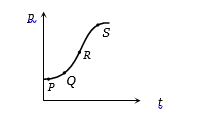
The variation of momentum $(p)$ with time $(t)$ for one of the bodies in a two-body collision is shown in the figure. The instantaneous force is maximum corresponding to which point?
A
$P$
B
$Q$
C
$R$
D
$S$
Solution
(C) According to Newton's second law of motion,the instantaneous force $F$ is given by the rate of change of momentum with respect to time:
$F = \frac{dp}{dt}$
This expression represents the slope of the momentum-time $(p-t)$ graph.
Therefore,the instantaneous force is maximum where the slope of the $p-t$ graph is maximum.
Looking at the provided curve,the slope is steepest at point $R$,which is the point of inflection where the curve transitions from concave up to concave down.
Thus,the force is maximum at point $R$.
$F = \frac{dp}{dt}$
This expression represents the slope of the momentum-time $(p-t)$ graph.
Therefore,the instantaneous force is maximum where the slope of the $p-t$ graph is maximum.
Looking at the provided curve,the slope is steepest at point $R$,which is the point of inflection where the curve transitions from concave up to concave down.
Thus,the force is maximum at point $R$.
0 likes
View Solution23
MediumMCQ
$A$ force of $6 \; N$ acts on a body at rest and of mass $1 \; kg$. During this time,the body attains a velocity of $30 \; m/s$. The time for which the force acts on the body is ..... $seconds$.
A
$5$
B
$7$
C
$8$
D
$10$
Solution
(A) Given: Force $F = 6 \; N$,mass $m = 1 \; kg$,initial velocity $u = 0 \; m/s$,and final velocity $v = 30 \; m/s$.
According to Newton's second law of motion,the acceleration $a$ is given by $a = \frac{F}{m} = \frac{6 \; N}{1 \; kg} = 6 \; m/s^2$.
Using the first equation of motion,$v = u + at$,we can find the time $t$:
$30 = 0 + 6 \times t$
$t = \frac{30}{6} = 5 \; s$.
Therefore,the force acts on the body for $5 \; seconds$.
According to Newton's second law of motion,the acceleration $a$ is given by $a = \frac{F}{m} = \frac{6 \; N}{1 \; kg} = 6 \; m/s^2$.
Using the first equation of motion,$v = u + at$,we can find the time $t$:
$30 = 0 + 6 \times t$
$t = \frac{30}{6} = 5 \; s$.
Therefore,the force acts on the body for $5 \; seconds$.
0 likes
View Solution24
EasyMCQ
$A$ car of mass $100 \, kg$ is moving with a velocity of $5 \, m/s$. The force required to stop it in $\frac{1}{10} \, s$ is . . . . . . $N$.
A
$5000$
B
$500$
C
$50$
D
$1000$
Solution
(A) Given: Mass $m = 100 \, kg$,Initial velocity $u = 5 \, m/s$,Final velocity $v = 0 \, m/s$,Time $t = 0.1 \, s$.
According to Newton's second law of motion,the force $F$ is given by the rate of change of momentum:
$F = m \cdot a = m \cdot \frac{(v - u)}{t}$
Substituting the values:
$F = 100 \cdot \frac{(0 - 5)}{0.1}$
$F = 100 \cdot \frac{-5}{0.1}$
$F = -5000 \, N$
The magnitude of the force required to stop the car is $5000 \, N$.
According to Newton's second law of motion,the force $F$ is given by the rate of change of momentum:
$F = m \cdot a = m \cdot \frac{(v - u)}{t}$
Substituting the values:
$F = 100 \cdot \frac{(0 - 5)}{0.1}$
$F = 100 \cdot \frac{-5}{0.1}$
$F = -5000 \, N$
The magnitude of the force required to stop the car is $5000 \, N$.
0 likes
View Solution25
EasyMCQ
$A$ body,under the action of a force $\vec F = 6\hat i - 8\hat j + 10\hat k$,acquires an acceleration of $1\, m/s^2$. The mass of this body must be
A
$15\,kg$
B
$20\,kg$
C
$10\sqrt 2 \,kg$
D
$2\sqrt {10} \,kg$
Solution
(C) Given force vector $\vec F = 6\hat i - 8\hat j + 10\hat k$.
The magnitude of the force is given by $|\vec F| = \sqrt{6^2 + (-8)^2 + 10^2} = \sqrt{36 + 64 + 100} = \sqrt{200} = 10\sqrt 2 \,N$.
According to Newton's second law of motion,$F = ma$,where $m$ is the mass and $a$ is the acceleration.
Given acceleration $a = 1\, m/s^2$.
Therefore,$m = \frac{F}{a} = \frac{10\sqrt 2}{1} = 10\sqrt 2 \,kg$.
The magnitude of the force is given by $|\vec F| = \sqrt{6^2 + (-8)^2 + 10^2} = \sqrt{36 + 64 + 100} = \sqrt{200} = 10\sqrt 2 \,N$.
According to Newton's second law of motion,$F = ma$,where $m$ is the mass and $a$ is the acceleration.
Given acceleration $a = 1\, m/s^2$.
Therefore,$m = \frac{F}{a} = \frac{10\sqrt 2}{1} = 10\sqrt 2 \,kg$.
0 likes
View Solution26
EasyMCQ
When a body is acted upon by a constant force,then which of the following quantities remains constant?
A
Velocity
B
Acceleration
C
Momentum
D
None of these
Solution
(B) According to Newton's second law of motion,the force acting on a body is given by $F = ma$,where $m$ is the mass of the body and $a$ is the acceleration.
Since the mass $m$ of the body is constant and the applied force $F$ is constant,the acceleration $a = F/m$ must also be constant.
Velocity changes because acceleration is non-zero,and momentum $p = mv$ changes because velocity changes.
Therefore,the correct option is $B$.
Since the mass $m$ of the body is constant and the applied force $F$ is constant,the acceleration $a = F/m$ must also be constant.
Velocity changes because acceleration is non-zero,and momentum $p = mv$ changes because velocity changes.
Therefore,the correct option is $B$.
0 likes
View Solution27
DifficultMCQ
$A$ body of mass $1 \, kg$ is acted upon by a force $\vec F = 2\sin(3\pi t)\hat i + 3\cos(3\pi t)\hat j$. Find its position at $t = 1 \, s$ if at $t = 0$ it is at rest at the origin.
A
$\left( \frac{3}{3\pi^2}, \frac{2}{9\pi^2} \right)$
B
$\left( \frac{2}{3\pi^2}, \frac{2}{3\pi^2} \right)$
C
$\left( \frac{2}{3\pi}, \frac{2}{9\pi^2} \right)$
D
none of these
Solution
(D) Given mass $m = 1 \, kg$ and force $\vec{F} = 2 \sin(3 \pi t) \hat{i} + 3 \cos(3 \pi t) \hat{j}$.
Acceleration $\vec{a} = \frac{\vec{F}}{m} = 2 \sin(3 \pi t) \hat{i} + 3 \cos(3 \pi t) \hat{j}$.
Velocity $\vec{v} = \int \vec{a} dt = \int (2 \sin(3 \pi t) \hat{i} + 3 \cos(3 \pi t) \hat{j}) dt = -\frac{2}{3\pi} \cos(3\pi t) \hat{i} + \frac{3}{3\pi} \sin(3\pi t) \hat{j} + \vec{C}_1$.
At $t=0$,$\vec{v}=0$,so $0 = -\frac{2}{3\pi} \hat{i} + \vec{C}_1 \implies \vec{C}_1 = \frac{2}{3\pi} \hat{i}$.
Thus,$\vec{v} = \left( \frac{2}{3\pi} - \frac{2}{3\pi} \cos(3\pi t) \right) \hat{i} + \frac{1}{\pi} \sin(3\pi t) \hat{j}$.
Position $\vec{r} = \int \vec{v} dt = \left( \frac{2t}{3\pi} - \frac{2}{9\pi^2} \sin(3\pi t) \right) \hat{i} - \frac{1}{3\pi^2} \cos(3\pi t) \hat{j} + \vec{C}_2$.
At $t=0$,$\vec{r}=0$,so $0 = 0 \hat{i} - \frac{1}{3\pi^2} \hat{j} + \vec{C}_2 \implies \vec{C}_2 = \frac{1}{3\pi^2} \hat{j}$.
The position vector is $\vec{r} = \left( \frac{2t}{3\pi} - \frac{2}{9\pi^2} \sin(3\pi t) \right) \hat{i} + \left( \frac{1}{3\pi^2} - \frac{1}{3\pi^2} \cos(3\pi t) \right) \hat{j}$.
At $t=1 \, s$,$\vec{r}(1) = \left( \frac{2}{3\pi} - 0 \right) \hat{i} + \left( \frac{1}{3\pi^2} - \frac{1}{3\pi^2} (-1) \right) \hat{j} = \frac{2}{3\pi} \hat{i} + \frac{2}{3\pi^2} \hat{j}$.
Since this result is not in the options,the correct choice is $D$.
Acceleration $\vec{a} = \frac{\vec{F}}{m} = 2 \sin(3 \pi t) \hat{i} + 3 \cos(3 \pi t) \hat{j}$.
Velocity $\vec{v} = \int \vec{a} dt = \int (2 \sin(3 \pi t) \hat{i} + 3 \cos(3 \pi t) \hat{j}) dt = -\frac{2}{3\pi} \cos(3\pi t) \hat{i} + \frac{3}{3\pi} \sin(3\pi t) \hat{j} + \vec{C}_1$.
At $t=0$,$\vec{v}=0$,so $0 = -\frac{2}{3\pi} \hat{i} + \vec{C}_1 \implies \vec{C}_1 = \frac{2}{3\pi} \hat{i}$.
Thus,$\vec{v} = \left( \frac{2}{3\pi} - \frac{2}{3\pi} \cos(3\pi t) \right) \hat{i} + \frac{1}{\pi} \sin(3\pi t) \hat{j}$.
Position $\vec{r} = \int \vec{v} dt = \left( \frac{2t}{3\pi} - \frac{2}{9\pi^2} \sin(3\pi t) \right) \hat{i} - \frac{1}{3\pi^2} \cos(3\pi t) \hat{j} + \vec{C}_2$.
At $t=0$,$\vec{r}=0$,so $0 = 0 \hat{i} - \frac{1}{3\pi^2} \hat{j} + \vec{C}_2 \implies \vec{C}_2 = \frac{1}{3\pi^2} \hat{j}$.
The position vector is $\vec{r} = \left( \frac{2t}{3\pi} - \frac{2}{9\pi^2} \sin(3\pi t) \right) \hat{i} + \left( \frac{1}{3\pi^2} - \frac{1}{3\pi^2} \cos(3\pi t) \right) \hat{j}$.
At $t=1 \, s$,$\vec{r}(1) = \left( \frac{2}{3\pi} - 0 \right) \hat{i} + \left( \frac{1}{3\pi^2} - \frac{1}{3\pi^2} (-1) \right) \hat{j} = \frac{2}{3\pi} \hat{i} + \frac{2}{3\pi^2} \hat{j}$.
Since this result is not in the options,the correct choice is $D$.
0 likes
View Solution28
DifficultMCQ
$A$ force $F = Be^{-Ct}$ acts on a particle of mass $m$,which is at rest at $t = 0$. Its terminal velocity is:
A
$\frac{C}{mB}$
B
$\frac{B}{mC}$
C
$\frac{BC}{m}$
D
$-\frac{B}{mC}$
Solution
(B) Given force $F = Be^{-Ct}$.
According to Newton's second law,$F = ma$,so $ma = Be^{-Ct}$.
Acceleration $a = \frac{dv}{dt} = \frac{B}{m} e^{-Ct}$.
Integrating with respect to time $t$ from $0$ to $t$:
$\int_{0}^{v} dv = \int_{0}^{t} \frac{B}{m} e^{-Ct} dt$.
$v = \frac{B}{m} \left[ \frac{e^{-Ct}}{-C} \right]_{0}^{t} = \frac{B}{mC} (1 - e^{-Ct})$.
Terminal velocity is the velocity as $t \to \infty$.
As $t \to \infty$,$e^{-Ct} \to 0$.
Therefore,$v_{terminal} = \frac{B}{mC} (1 - 0) = \frac{B}{mC}$.
According to Newton's second law,$F = ma$,so $ma = Be^{-Ct}$.
Acceleration $a = \frac{dv}{dt} = \frac{B}{m} e^{-Ct}$.
Integrating with respect to time $t$ from $0$ to $t$:
$\int_{0}^{v} dv = \int_{0}^{t} \frac{B}{m} e^{-Ct} dt$.
$v = \frac{B}{m} \left[ \frac{e^{-Ct}}{-C} \right]_{0}^{t} = \frac{B}{mC} (1 - e^{-Ct})$.
Terminal velocity is the velocity as $t \to \infty$.
As $t \to \infty$,$e^{-Ct} \to 0$.
Therefore,$v_{terminal} = \frac{B}{mC} (1 - 0) = \frac{B}{mC}$.
0 likes
View Solution29
DifficultMCQ
$A$ particle of mass $m$ is at rest at the origin at time $t = 0$. It is subjected to a force $F(t) = F_0e^{-bt}$ in the $x$ direction. Its speed $v(t)$ is depicted by which of the following curves?
A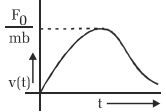
B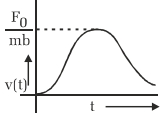
C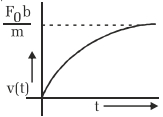
D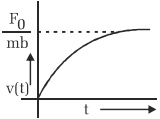
Solution
(D) Given that the force is $F(t) = F_0e^{-bt}$.
According to Newton's second law,$F = m \frac{dv}{dt}$.
So,$m \frac{dv}{dt} = F_0e^{-bt}$.
Rearranging the terms,we get $\frac{dv}{dt} = \frac{F_0}{m} e^{-bt}$.
Integrating both sides with respect to time $t$ from $0$ to $t$,and velocity $v$ from $0$ to $v(t)$:
$\int_0^{v(t)} dv = \int_0^t \frac{F_0}{m} e^{-bt} dt$.
$v(t) = \frac{F_0}{m} \left[ \frac{e^{-bt}}{-b} \right]_0^t$.
$v(t) = \frac{F_0}{m} \left( \frac{e^{-bt}}{-b} - \frac{e^0}{-b} \right)$.
$v(t) = \frac{F_0}{mb} (1 - e^{-bt})$.
As $t \to \infty$,$v(t) \to \frac{F_0}{mb}$.
This represents an exponential growth curve that approaches a horizontal asymptote at $v = \frac{F_0}{mb}$.
Comparing this with the given options,curve $D$ represents this behavior.
According to Newton's second law,$F = m \frac{dv}{dt}$.
So,$m \frac{dv}{dt} = F_0e^{-bt}$.
Rearranging the terms,we get $\frac{dv}{dt} = \frac{F_0}{m} e^{-bt}$.
Integrating both sides with respect to time $t$ from $0$ to $t$,and velocity $v$ from $0$ to $v(t)$:
$\int_0^{v(t)} dv = \int_0^t \frac{F_0}{m} e^{-bt} dt$.
$v(t) = \frac{F_0}{m} \left[ \frac{e^{-bt}}{-b} \right]_0^t$.
$v(t) = \frac{F_0}{m} \left( \frac{e^{-bt}}{-b} - \frac{e^0}{-b} \right)$.
$v(t) = \frac{F_0}{mb} (1 - e^{-bt})$.
As $t \to \infty$,$v(t) \to \frac{F_0}{mb}$.
This represents an exponential growth curve that approaches a horizontal asymptote at $v = \frac{F_0}{mb}$.
Comparing this with the given options,curve $D$ represents this behavior.
0 likes
View Solution30
DifficultMCQ
$A$ player caught a cricket ball of mass $150 \ g$ moving at a rate of $20 \ m/s$. If the catching process is completed in $0.1 \ s$,the force of the blow exerted by the ball on the hand of the player is equal to .......... $N$.
A
$300$
B
$150$
C
$3$
D
$30$
Solution
(D) Given:
Mass of the ball,$m = 150 \ g = 0.15 \ kg$.
Initial velocity,$u = 20 \ m/s$.
Final velocity,$v = 0 \ m/s$ (since the ball is caught).
Time taken,$t = 0.1 \ s$.
According to Newton's Second Law of Motion,the force $F$ is given by the rate of change of momentum:
$F = \frac{m(v - u)}{t}$
Substituting the values:
$F = \frac{0.15 \times (0 - 20)}{0.1}$
$F = \frac{0.15 \times (-20)}{0.1}$
$F = \frac{-3}{0.1} = -30 \ N$.
The magnitude of the force exerted by the ball on the hand is $30 \ N$.
Mass of the ball,$m = 150 \ g = 0.15 \ kg$.
Initial velocity,$u = 20 \ m/s$.
Final velocity,$v = 0 \ m/s$ (since the ball is caught).
Time taken,$t = 0.1 \ s$.
According to Newton's Second Law of Motion,the force $F$ is given by the rate of change of momentum:
$F = \frac{m(v - u)}{t}$
Substituting the values:
$F = \frac{0.15 \times (0 - 20)}{0.1}$
$F = \frac{0.15 \times (-20)}{0.1}$
$F = \frac{-3}{0.1} = -30 \ N$.
The magnitude of the force exerted by the ball on the hand is $30 \ N$.
1 likes
View Solution31
MediumMCQ
$A$ particle of mass $m$ is at rest at the origin at time $t = 0$. It is subjected to a force $F(t) = F_0e^{-bt}$ in the $x$-direction. Its speed $v(t)$ is depicted by which of the following curves?
A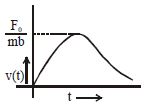
B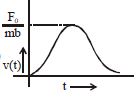
C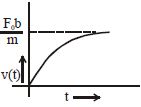
D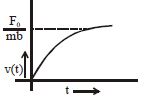
Solution
(D) Given,force $F(t) = F_0e^{-bt}$.
According to Newton's second law,$F = ma = m \frac{dv}{dt}$.
So,$m \frac{dv}{dt} = F_0e^{-bt}$.
Integrating both sides with respect to time $t$ from $0$ to $t$:
$\int_0^v dv = \int_0^t \frac{F_0}{m} e^{-bt} dt$.
$v(t) = \frac{F_0}{m} \left[ \frac{e^{-bt}}{-b} \right]_0^t$.
$v(t) = \frac{F_0}{m} \left( \frac{e^{-bt} - 1}{-b} \right) = \frac{F_0}{mb} (1 - e^{-bt})$.
As $t \to 0$,$v(t) \to 0$.
As $t \to \infty$,$v(t) \to \frac{F_0}{mb}$.
The function $v(t) = \frac{F_0}{mb} (1 - e^{-bt})$ represents an increasing curve that asymptotically approaches the value $\frac{F_0}{mb}$.
This corresponds to the curve shown in option $D$.
According to Newton's second law,$F = ma = m \frac{dv}{dt}$.
So,$m \frac{dv}{dt} = F_0e^{-bt}$.
Integrating both sides with respect to time $t$ from $0$ to $t$:
$\int_0^v dv = \int_0^t \frac{F_0}{m} e^{-bt} dt$.
$v(t) = \frac{F_0}{m} \left[ \frac{e^{-bt}}{-b} \right]_0^t$.
$v(t) = \frac{F_0}{m} \left( \frac{e^{-bt} - 1}{-b} \right) = \frac{F_0}{mb} (1 - e^{-bt})$.
As $t \to 0$,$v(t) \to 0$.
As $t \to \infty$,$v(t) \to \frac{F_0}{mb}$.
The function $v(t) = \frac{F_0}{mb} (1 - e^{-bt})$ represents an increasing curve that asymptotically approaches the value $\frac{F_0}{mb}$.
This corresponds to the curve shown in option $D$.
0 likes
View Solution32
MediumMCQ
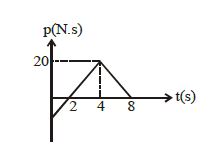
From the following graph,find the magnitude of the negative force in $N$.
A
$5$
B
$10$
C
$4$
D
$2$
Solution
(A) According to Newton's second law of motion,force is defined as the rate of change of momentum: $F = \frac{dp}{dt}$.
In a momentum-time $(p-t)$ graph,the force $F$ corresponds to the slope of the graph.
The negative force occurs where the slope of the graph is negative,which is in the interval $t = 4 \ s$ to $t = 8 \ s$.
The slope in this interval is calculated as:
$F = \frac{p_2 - p_1}{t_2 - t_1} = \frac{0 - 20}{8 - 4} = \frac{-20}{4} = -5 \ N$.
The magnitude of the negative force is $|-5 \ N| = 5 \ N$.
In a momentum-time $(p-t)$ graph,the force $F$ corresponds to the slope of the graph.
The negative force occurs where the slope of the graph is negative,which is in the interval $t = 4 \ s$ to $t = 8 \ s$.
The slope in this interval is calculated as:
$F = \frac{p_2 - p_1}{t_2 - t_1} = \frac{0 - 20}{8 - 4} = \frac{-20}{4} = -5 \ N$.
The magnitude of the negative force is $|-5 \ N| = 5 \ N$.
0 likes
View Solution33
MediumMCQ
$A$ constant force acting on a body of mass $5\,kg$ changes its speed from $5\,ms^{-1}$ to $10\,ms^{-1}$ in $10\,s$ without changing the direction of motion. The force acting on the body is ......... $N$.
A
$1.5$
B
$2$
C
$2.5$
D
$5$
Solution
(C) Given:
Mass $m = 5\,kg$
Initial velocity $u = 5\,ms^{-1}$
Final velocity $v = 10\,ms^{-1}$
Time $t = 10\,s$
First,calculate the acceleration $a$ using the formula $a = \frac{v - u}{t}$:
$a = \frac{10\,ms^{-1} - 5\,ms^{-1}}{10\,s} = \frac{5\,ms^{-1}}{10\,s} = 0.5\,ms^{-2}$
Now,calculate the force $F$ using Newton's second law $F = ma$:
$F = (5\,kg) \times (0.5\,ms^{-2}) = 2.5\,N$
Therefore,the force acting on the body is $2.5\,N$.
Mass $m = 5\,kg$
Initial velocity $u = 5\,ms^{-1}$
Final velocity $v = 10\,ms^{-1}$
Time $t = 10\,s$
First,calculate the acceleration $a$ using the formula $a = \frac{v - u}{t}$:
$a = \frac{10\,ms^{-1} - 5\,ms^{-1}}{10\,s} = \frac{5\,ms^{-1}}{10\,s} = 0.5\,ms^{-2}$
Now,calculate the force $F$ using Newton's second law $F = ma$:
$F = (5\,kg) \times (0.5\,ms^{-2}) = 2.5\,N$
Therefore,the force acting on the body is $2.5\,N$.
0 likes
View Solution34
EasyMCQ
$A$ $10 \; N$ force is applied on a body,producing an acceleration of $1 \; m/s^2$ in it. The mass of the body is ...... $kg$.
A
$10$
B
$15$
C
$20$
D
$5$
Solution
(A) According to Newton's Second Law of Motion,the force $F$ applied to a body is equal to the product of its mass $m$ and acceleration $a$,given by the formula: $F = m \times a$.
To find the mass $m$,we rearrange the formula: $m = \frac{F}{a}$.
Given values are: Force $F = 10 \; N$ and acceleration $a = 1 \; m/s^2$.
Substituting these values into the formula: $m = \frac{10 \; N}{1 \; m/s^2} = 10 \; kg$.
Therefore,the mass of the body is $10 \; kg$.
To find the mass $m$,we rearrange the formula: $m = \frac{F}{a}$.
Given values are: Force $F = 10 \; N$ and acceleration $a = 1 \; m/s^2$.
Substituting these values into the formula: $m = \frac{10 \; N}{1 \; m/s^2} = 10 \; kg$.
Therefore,the mass of the body is $10 \; kg$.
0 likes
View Solution35
EasyMCQ
$A$ body under the action of a force $\vec{F} = 6\hat{i} - 8\hat{j} \text{ N}$ acquires an acceleration of $5 \text{ m s}^{-2}$. The mass of the body is ........ $\text{kg}$.
A
$2$
B
$5$
C
$4$
D
$6$
Solution
(A) Given: Force $\vec{F} = 6\hat{i} - 8\hat{j} \text{ N}$ and acceleration $a = 5 \text{ m s}^{-2}$.
First,calculate the magnitude of the force vector $\vec{F}$ using the formula $F = \sqrt{F_x^2 + F_y^2}$.
$F = \sqrt{(6)^2 + (-8)^2} = \sqrt{36 + 64} = \sqrt{100} = 10 \text{ N}$.
According to Newton's second law of motion,$F = ma$,therefore the mass $m = \frac{F}{a}$.
Substituting the values,$m = \frac{10 \text{ N}}{5 \text{ m s}^{-2}} = 2 \text{ kg}$.
Thus,the mass of the body is $2 \text{ kg}$.
First,calculate the magnitude of the force vector $\vec{F}$ using the formula $F = \sqrt{F_x^2 + F_y^2}$.
$F = \sqrt{(6)^2 + (-8)^2} = \sqrt{36 + 64} = \sqrt{100} = 10 \text{ N}$.
According to Newton's second law of motion,$F = ma$,therefore the mass $m = \frac{F}{a}$.
Substituting the values,$m = \frac{10 \text{ N}}{5 \text{ m s}^{-2}} = 2 \text{ kg}$.
Thus,the mass of the body is $2 \text{ kg}$.
0 likes
View Solution36
MediumMCQ
$5\, kg$ દળ ધરાવતા એક પદાર્થ પર અચળ બળ $\overrightarrow F = {F_x}\hat i + {F_y}\hat j$ લાગે છે. $t = 0\, s$ સમયે તેનો વેગ $\overrightarrow v = (6\hat i - 2\hat j)\, m/s$ છે અને $t = 10\, s$ સમયે તેનો વેગ $\overrightarrow v = 6\hat j\, m/s$ છે. તો બળ $\overrightarrow F$ શોધો.
A
$(-3\hat i + 4\hat j)\, N$
B
$(-\frac{3}{5}\hat i + \frac{4}{5}\hat j)\, N$
C
$(3\hat i - 4\hat j)\, N$
D
$(\frac{3}{5}\hat i - \frac{4}{5}\hat j)\, N$
Solution
(A) આપેલ માહિતી:
દળ $m = 5\, kg$
$t = 0\, s$ સમયે વેગ $\vec{u} = (6\hat i - 2\hat j)\, m/s$
$t = 10\, s$ સમયે વેગ $\vec{v} = 6\hat j\, m/s$
પ્રવેગ $\vec{a} = \frac{\vec{v} - \vec{u}}{t}$
$\vec{a} = \frac{6\hat j - (6\hat i - 2\hat j)}{10} = \frac{-6\hat i + 8\hat j}{10} = (-0.6\hat i + 0.8\hat j)\, m/s^2$
ન્યૂટનના ગતિના બીજા નિયમ મુજબ,બળ $\vec{F} = m\vec{a}$
$\vec{F} = 5 \times (-0.6\hat i + 0.8\hat j) = (-3\hat i + 4\hat j)\, N$
તેથી,સાચો વિકલ્પ $A$ છે.
દળ $m = 5\, kg$
$t = 0\, s$ સમયે વેગ $\vec{u} = (6\hat i - 2\hat j)\, m/s$
$t = 10\, s$ સમયે વેગ $\vec{v} = 6\hat j\, m/s$
પ્રવેગ $\vec{a} = \frac{\vec{v} - \vec{u}}{t}$
$\vec{a} = \frac{6\hat j - (6\hat i - 2\hat j)}{10} = \frac{-6\hat i + 8\hat j}{10} = (-0.6\hat i + 0.8\hat j)\, m/s^2$
ન્યૂટનના ગતિના બીજા નિયમ મુજબ,બળ $\vec{F} = m\vec{a}$
$\vec{F} = 5 \times (-0.6\hat i + 0.8\hat j) = (-3\hat i + 4\hat j)\, N$
તેથી,સાચો વિકલ્પ $A$ છે.
0 likes
View Solution37
MediumMCQ
$A$ particle of mass $m$ is moving in a straight line with momentum $p$. Starting at time $t = 0$,a force $F = kt$ acts in the same direction on the moving particle during time interval $T$ so that its momentum changes from $p$ to $3p$. Here $k$ is a constant. The value of $T$ is
A
$2\sqrt{\frac{k}{p}}$
B
$2\sqrt{\frac{p}{k}}$
C
$\sqrt{\frac{2k}{p}}$
D
$\sqrt{\frac{2p}{k}}$
Solution
(B) According to Newton's second law,the rate of change of momentum is equal to the applied force:
$\frac{dp}{dt} = F = kt$
Integrating both sides with respect to time from $t = 0$ to $t = T$ and momentum from $p$ to $3p$:
$\int_{p}^{3p} dp = \int_{0}^{T} kt \, dt$
$[p]_{p}^{3p} = k \left[ \frac{t^2}{2} \right]_{0}^{T}$
$3p - p = k \left( \frac{T^2}{2} - 0 \right)$
$2p = \frac{kT^2}{2}$
$4p = kT^2$
$T^2 = \frac{4p}{k}$
$T = 2\sqrt{\frac{p}{k}}$
$\frac{dp}{dt} = F = kt$
Integrating both sides with respect to time from $t = 0$ to $t = T$ and momentum from $p$ to $3p$:
$\int_{p}^{3p} dp = \int_{0}^{T} kt \, dt$
$[p]_{p}^{3p} = k \left[ \frac{t^2}{2} \right]_{0}^{T}$
$3p - p = k \left( \frac{T^2}{2} - 0 \right)$
$2p = \frac{kT^2}{2}$
$4p = kT^2$
$T^2 = \frac{4p}{k}$
$T = 2\sqrt{\frac{p}{k}}$
0 likes
View Solution38
DifficultMCQ
$A$ particle of mass $m$ at rest is acted upon by a force $P$ for a time $t$. Its kinetic energy after an interval $t$ is
A
$\frac{P^2 t^2}{m}$
B
$\frac{P^2 t^2}{2m}$
C
$\frac{P^2 t^2}{3m}$
D
$\frac{Pt}{2m}$
Solution
(B) Given that the particle is at rest,the initial velocity $u = 0$.
According to Newton's second law,the acceleration $a$ is given by $a = \frac{P}{m}$.
Using the first equation of motion,$v = u + at$,we get $v = 0 + (\frac{P}{m})t = \frac{Pt}{m}$.
The kinetic energy $KE$ is given by the formula $KE = \frac{1}{2}mv^2$.
Substituting the value of $v$,we get $KE = \frac{1}{2}m(\frac{Pt}{m})^2$.
$KE = \frac{1}{2}m(\frac{P^2 t^2}{m^2}) = \frac{P^2 t^2}{2m}$.
According to Newton's second law,the acceleration $a$ is given by $a = \frac{P}{m}$.
Using the first equation of motion,$v = u + at$,we get $v = 0 + (\frac{P}{m})t = \frac{Pt}{m}$.
The kinetic energy $KE$ is given by the formula $KE = \frac{1}{2}mv^2$.
Substituting the value of $v$,we get $KE = \frac{1}{2}m(\frac{Pt}{m})^2$.
$KE = \frac{1}{2}m(\frac{P^2 t^2}{m^2}) = \frac{P^2 t^2}{2m}$.
0 likes
View Solution39
MediumMCQ
An object of mass $3\,kg$ is at rest. If a force $\vec{F} = (6t^2\hat{i} + 4t\hat{j})\,N$ is applied on the object,then the velocity of the object at $t = 3\,s$ will be
A
$18\hat{i} + 6\hat{j}$
B
$18\hat{i} + 18\hat{j}$
C
$18\hat{i} + 4\hat{j}$
D
$6\hat{i} + 18\hat{j}$
Solution
(A) Given mass $m = 3\,kg$ and force $\vec{F} = (6t^2\hat{i} + 4t\hat{j})\,N$.
Using Newton's second law,$\vec{a} = \frac{\vec{F}}{m} = \frac{6t^2\hat{i} + 4t\hat{j}}{3} = (2t^2\hat{i} + \frac{4}{3}t\hat{j})\,m/s^2$.
Since the object starts from rest,$\vec{v}(0) = 0$. The velocity $\vec{v}$ at time $t$ is given by $\vec{v} = \int_{0}^{t} \vec{a} dt$.
$\vec{v} = \int_{0}^{3} (2t^2\hat{i} + \frac{4}{3}t\hat{j}) dt$.
$\vec{v} = [\frac{2t^3}{3}\hat{i} + \frac{4t^2}{6}\hat{j}]_{0}^{3}$.
$\vec{v} = [\frac{2(3)^3}{3}\hat{i} + \frac{4(3)^2}{6}\hat{j}] = [\frac{54}{3}\hat{i} + \frac{36}{6}\hat{j}] = 18\hat{i} + 6\hat{j}\,m/s$.
Using Newton's second law,$\vec{a} = \frac{\vec{F}}{m} = \frac{6t^2\hat{i} + 4t\hat{j}}{3} = (2t^2\hat{i} + \frac{4}{3}t\hat{j})\,m/s^2$.
Since the object starts from rest,$\vec{v}(0) = 0$. The velocity $\vec{v}$ at time $t$ is given by $\vec{v} = \int_{0}^{t} \vec{a} dt$.
$\vec{v} = \int_{0}^{3} (2t^2\hat{i} + \frac{4}{3}t\hat{j}) dt$.
$\vec{v} = [\frac{2t^3}{3}\hat{i} + \frac{4t^2}{6}\hat{j}]_{0}^{3}$.
$\vec{v} = [\frac{2(3)^3}{3}\hat{i} + \frac{4(3)^2}{6}\hat{j}] = [\frac{54}{3}\hat{i} + \frac{36}{6}\hat{j}] = 18\hat{i} + 6\hat{j}\,m/s$.
0 likes
View Solution40
MediumMCQ
An object of mass $2 \, kg$ is placed at rest in a frame $S_1$ moving with velocity $10 \hat{i} + 5 \hat{j} \, m/s$ and having acceleration $5 \hat{i} + 10 \hat{j} \, m/s^2$. The object is also seen by an observer standing in a frame $S_2$ moving with velocity $5 \hat{i} + 10 \hat{j} \, m/s$. Calculate the net force acting on the object with respect to the $S_1$ frame.
A
$0 \, N$
B
$1 \, N$
C
$2 \, N$
D
None of these
Solution
(A) The object is placed at rest in the frame $S_1$.
By definition,if an object is at rest within a specific frame of reference,its acceleration with respect to that frame is zero $(a_{rel} = 0)$.
According to Newton's Second Law of Motion,the net force acting on an object is given by $F_{net} = m \times a$.
Since the object is at rest in frame $S_1$,the acceleration of the object with respect to $S_1$ is $0 \, m/s^2$.
Therefore,the net force acting on the object with respect to the $S_1$ frame is $F_{net} = 2 \, kg \times 0 \, m/s^2 = 0 \, N$.
By definition,if an object is at rest within a specific frame of reference,its acceleration with respect to that frame is zero $(a_{rel} = 0)$.
According to Newton's Second Law of Motion,the net force acting on an object is given by $F_{net} = m \times a$.
Since the object is at rest in frame $S_1$,the acceleration of the object with respect to $S_1$ is $0 \, m/s^2$.
Therefore,the net force acting on the object with respect to the $S_1$ frame is $F_{net} = 2 \, kg \times 0 \, m/s^2 = 0 \, N$.
0 likes
View Solution41
MediumMCQ
$A$ body of mass $2\, kg$ travels according to the law $x = at + bt^2 + ct^3$,where $a = 3\, m/s$,$b = 4\, m/s^2$,and $c = 5\, m/s^3$. The force acting on the body at $t = 2\, s$ is ......... $N$.
A
$68$
B
$136$
C
$272$
D
$336$
Solution
(B) Given: mass $m = 2\, kg$,position $x = at + bt^2 + ct^3$,$a = 3\, m/s$,$b = 4\, m/s^2$,$c = 5\, m/s^3$.
Velocity $v = \frac{dx}{dt} = a + 2bt + 3ct^2$.
Acceleration $a_c = \frac{dv}{dt} = 2b + 6ct$.
At $t = 2\, s$,acceleration $a_c = 2(4) + 6(5)(2) = 8 + 60 = 68\, m/s^2$.
Force $F = m \times a_c = 2 \times 68 = 136\, N$.
Velocity $v = \frac{dx}{dt} = a + 2bt + 3ct^2$.
Acceleration $a_c = \frac{dv}{dt} = 2b + 6ct$.
At $t = 2\, s$,acceleration $a_c = 2(4) + 6(5)(2) = 8 + 60 = 68\, m/s^2$.
Force $F = m \times a_c = 2 \times 68 = 136\, N$.
0 likes
View Solution42
DifficultMCQ
The engine of a jet aircraft applies a thrust force of $10^5\, N$ during take-off and causes the plane to attain a velocity of $1\, km/s$ in $10\, s$. The mass of the plane is:
A
$10^2\, kg$
B
$10^3\, kg$
C
$10^4\, kg$
D
$10^5\, kg$
Solution
(B) Given: Thrust force $F = 10^5\, N$,Final velocity $v = 1\, km/s = 1000\, m/s$,Time $t = 10\, s$,Initial velocity $u = 0\, m/s$.
Using the first equation of motion: $v = u + at$.
$1000 = 0 + a \times 10$.
$a = \frac{1000}{10} = 100\, m/s^2$.
Using Newton's second law of motion: $F = ma$.
$m = \frac{F}{a} = \frac{10^5}{100} = 10^3\, kg$.
Using the first equation of motion: $v = u + at$.
$1000 = 0 + a \times 10$.
$a = \frac{1000}{10} = 100\, m/s^2$.
Using Newton's second law of motion: $F = ma$.
$m = \frac{F}{a} = \frac{10^5}{100} = 10^3\, kg$.
0 likes
View Solution43
MediumMCQ
The maximum acceleration of a $5\,kg$ block is $.............\,m/s^{2}$.
A
$1$
B
$3$
C
$0$
D
None
Solution
(C) The acceleration of the block is $0\,m/s^{2}$.
Since the problem does not specify an external force or a coefficient of friction,and assuming the block is resting on a horizontal surface without any applied force,the net force acting on the block is $0\,N$.
According to Newton's Second Law,$F_{net} = ma$,where $m = 5\,kg$.
If $F_{net} = 0$,then $a = 0/5 = 0\,m/s^{2}$.
Since the problem does not specify an external force or a coefficient of friction,and assuming the block is resting on a horizontal surface without any applied force,the net force acting on the block is $0\,N$.
According to Newton's Second Law,$F_{net} = ma$,where $m = 5\,kg$.
If $F_{net} = 0$,then $a = 0/5 = 0\,m/s^{2}$.
0 likes
View Solution44
MediumMCQ
The linear momentum $p$ of a body of mass $5 \,kg$ varies with time $t$ as $p = 5t^2 + t + 5$. It follows that the body is moving with:
A
constant acceleration
B
constant speed
C
variable acceleration which is increasing with time
D
variable retardation which is decreasing with time
Solution
(C) Given the linear momentum $p = 5t^2 + t + 5$ and mass $m = 5 \,kg$.
Since $p = mv$,we have $v = \frac{p}{m} = \frac{5t^2 + t + 5}{5} = t^2 + 0.2t + 1$.
The acceleration $a$ is the rate of change of velocity with respect to time: $a = \frac{dv}{dt} = \frac{d}{dt}(t^2 + 0.2t + 1) = 2t + 0.2$.
As time $t$ increases,the acceleration $a = 2t + 0.2$ also increases linearly with time.
Therefore,the body is moving with variable acceleration which is increasing with time.
Since $p = mv$,we have $v = \frac{p}{m} = \frac{5t^2 + t + 5}{5} = t^2 + 0.2t + 1$.
The acceleration $a$ is the rate of change of velocity with respect to time: $a = \frac{dv}{dt} = \frac{d}{dt}(t^2 + 0.2t + 1) = 2t + 0.2$.
As time $t$ increases,the acceleration $a = 2t + 0.2$ also increases linearly with time.
Therefore,the body is moving with variable acceleration which is increasing with time.
0 likes
View Solution45
MediumMCQ
The motion of a particle of mass $m$ is described by $y = ut + \frac{1}{2}gt^2$. Find the force acting on the particle.
A
$mg$
B
$2mg$
C
$mg/2$
D
$0$
Solution
(A) The position of the particle is given by the equation $y = ut + \frac{1}{2}gt^2$.
To find the velocity $v$,we differentiate the position $y$ with respect to time $t$:
$v = \frac{dy}{dt} = \frac{d}{dt}(ut + \frac{1}{2}gt^2) = u + gt$.
To find the acceleration $a$,we differentiate the velocity $v$ with respect to time $t$:
$a = \frac{dv}{dt} = \frac{d}{dt}(u + gt) = g$.
According to Newton's second law of motion,the force $F$ acting on the particle is given by $F = ma$.
Substituting the value of acceleration,we get $F = m \times g = mg$.
To find the velocity $v$,we differentiate the position $y$ with respect to time $t$:
$v = \frac{dy}{dt} = \frac{d}{dt}(ut + \frac{1}{2}gt^2) = u + gt$.
To find the acceleration $a$,we differentiate the velocity $v$ with respect to time $t$:
$a = \frac{dv}{dt} = \frac{d}{dt}(u + gt) = g$.
According to Newton's second law of motion,the force $F$ acting on the particle is given by $F = ma$.
Substituting the value of acceleration,we get $F = m \times g = mg$.
0 likes
View Solution46
MediumMCQ
$A$ constant retarding force of $50\; N$ is applied to a body of mass $20\; kg$ moving initially with a speed of $15\; m/s$. How long (in $sec$) does the body take to stop?
A
$6$
B
$5$
C
$3$
D
$8$
Solution
(A) Retarding force,$F = -50\; N$
Mass of the body,$m = 20\; kg$
Initial velocity of the body,$u = 15\; m/s$
Final velocity of the body,$v = 0\; m/s$
Using Newton's second law of motion,the acceleration $(a)$ produced in the body is given by:
$F = ma$
$-50 = 20 \times a$
$\therefore a = \frac{-50}{20} = -2.5\; m/s^2$
Using the first equation of motion,the time $(t)$ taken by the body to come to rest is:
$v = u + at$
$0 = 15 + (-2.5)t$
$2.5t = 15$
$\therefore t = \frac{15}{2.5} = 6\; s$
Mass of the body,$m = 20\; kg$
Initial velocity of the body,$u = 15\; m/s$
Final velocity of the body,$v = 0\; m/s$
Using Newton's second law of motion,the acceleration $(a)$ produced in the body is given by:
$F = ma$
$-50 = 20 \times a$
$\therefore a = \frac{-50}{20} = -2.5\; m/s^2$
Using the first equation of motion,the time $(t)$ taken by the body to come to rest is:
$v = u + at$
$0 = 15 + (-2.5)t$
$2.5t = 15$
$\therefore t = \frac{15}{2.5} = 6\; s$
0 likes
View Solution47
Medium
$A$ constant force acting on a body of mass $3.0 \, kg$ changes its speed from $2.0 \, m/s$ to $3.5 \, m/s$ in $25 \, s$. The direction of the motion of the body remains unchanged. What is the magnitude and direction of the force?
Solution
(A) The magnitude of the force is $0.18 \, N$,and its direction is in the direction of the motion of the body.
Given:
Mass of the body,$m = 3.0 \, kg$
Initial speed,$u = 2.0 \, m/s$
Final speed,$v = 3.5 \, m/s$
Time,$t = 25 \, s$
Using the first equation of motion,the acceleration $(a)$ produced in the body is calculated as:
$v = u + at$
$a = \frac{v - u}{t} = \frac{3.5 - 2.0}{25} = \frac{1.5}{25} = 0.06 \, m/s^2$
According to Newton's second law of motion,the force $(F)$ is given by:
$F = m \times a$
$F = 3.0 \, kg \times 0.06 \, m/s^2 = 0.18 \, N$
Since the speed of the body increases and the direction of motion remains unchanged,the force must be acting in the direction of the motion of the body.
Given:
Mass of the body,$m = 3.0 \, kg$
Initial speed,$u = 2.0 \, m/s$
Final speed,$v = 3.5 \, m/s$
Time,$t = 25 \, s$
Using the first equation of motion,the acceleration $(a)$ produced in the body is calculated as:
$v = u + at$
$a = \frac{v - u}{t} = \frac{3.5 - 2.0}{25} = \frac{1.5}{25} = 0.06 \, m/s^2$
According to Newton's second law of motion,the force $(F)$ is given by:
$F = m \times a$
$F = 3.0 \, kg \times 0.06 \, m/s^2 = 0.18 \, N$
Since the speed of the body increases and the direction of motion remains unchanged,the force must be acting in the direction of the motion of the body.
0 likes
View Solution48
Medium
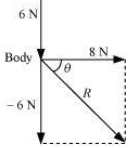
$A$ body of mass $5 \; kg$ is acted upon by two perpendicular forces $8 \; N$ and $6 \; N$. Find the magnitude and direction of the acceleration of the body.
Solution
(N/A) The magnitude of the resultant force $R$ is given by the Pythagorean theorem for two perpendicular forces:
$R = \sqrt{(8 \; N)^2 + (6 \; N)^2} = \sqrt{64 + 36} = \sqrt{100} = 10 \; N$
According to Newton's second law of motion,the magnitude of acceleration $a$ is:
$a = \frac{F}{m} = \frac{10 \; N}{5 \; kg} = 2 \; m/s^2$
The direction of the acceleration $\theta$ with respect to the $8 \; N$ force is given by:
$\tan \theta = \frac{6 \; N}{8 \; N} = 0.75$
$\theta = \tan^{-1}(0.75) \approx 36.87^{\circ}$
Thus,the acceleration is $2 \; m/s^2$ at an angle of $36.87^{\circ}$ with the $8 \; N$ force.
$R = \sqrt{(8 \; N)^2 + (6 \; N)^2} = \sqrt{64 + 36} = \sqrt{100} = 10 \; N$
According to Newton's second law of motion,the magnitude of acceleration $a$ is:
$a = \frac{F}{m} = \frac{10 \; N}{5 \; kg} = 2 \; m/s^2$
The direction of the acceleration $\theta$ with respect to the $8 \; N$ force is given by:
$\tan \theta = \frac{6 \; N}{8 \; N} = 0.75$
$\theta = \tan^{-1}(0.75) \approx 36.87^{\circ}$
Thus,the acceleration is $2 \; m/s^2$ at an angle of $36.87^{\circ}$ with the $8 \; N$ force.
1 likes
View Solution49
MediumMCQ
The driver of a three-wheeler moving with a speed of $36\; km/h$ sees a child standing in the middle of the road and brings his vehicle to rest in $4.0\; s$ just in time to save the child. What is the average retarding force (in $N$) on the vehicle? The mass of the three-wheeler is $400\; kg$ and the mass of the driver is $65\; kg$.
A
$465$
B
$2312.5$
C
$823.36$
D
$1162.5$
Solution
(D) Initial speed of the three-wheeler,$u = 36\; km/h = 36 \times \frac{5}{18} = 10\; m/s$.
Final speed of the three-wheeler,$v = 0\; m/s$.
Time taken to stop,$t = 4.0\; s$.
Total mass of the system,$M = 400\; kg + 65\; kg = 465\; kg$.
Using the first equation of motion,$v = u + at$,the acceleration $a$ is:
$a = \frac{v - u}{t} = \frac{0 - 10}{4} = -2.5\; m/s^2$.
The negative sign indicates retardation.
Using Newton's second law of motion,the retarding force $F$ is:
$F = M \times |a| = 465 \times 2.5 = 1162.5\; N$.
Final speed of the three-wheeler,$v = 0\; m/s$.
Time taken to stop,$t = 4.0\; s$.
Total mass of the system,$M = 400\; kg + 65\; kg = 465\; kg$.
Using the first equation of motion,$v = u + at$,the acceleration $a$ is:
$a = \frac{v - u}{t} = \frac{0 - 10}{4} = -2.5\; m/s^2$.
The negative sign indicates retardation.
Using Newton's second law of motion,the retarding force $F$ is:
$F = M \times |a| = 465 \times 2.5 = 1162.5\; N$.
0 likes
View SolutionNewton's Laws of Motion and Friction — Second Law of Motion · Frequently Asked Questions
1Are these Newton's Laws of Motion and Friction questions useful for JEE and NEET?
Yes. All questions in this section are mapped to JEE Main and NEET exam patterns. Previous year questions from JEE Main, NEET, GUJCET and state-level exams are included with full solutions.
2Can I switch to Hindi or Gujarati for these questions?
Yes. Use the language tabs in the hero section or the sidebar to view the same questions and solutions in English, Hindi or Gujarati.
3How do I generate a question paper from this subtopic?
Use the Vedclass Exam Paper Generator — select the chapter and subtopic, set difficulty, and generate Sets A, B, C, D automatically. First 3 chapters of every subject are free.
Vedclass Products
For Students
Vedclass Test Series
Mock tests in real JEE/NEET style with performance analysis. 5-day free trial.
Start Free TrialFor Teachers
Exam Paper Generator
Generate Set A/B/C/D papers from this chapter in 2 minutes. 3 chapters free.
Try FreeFor Institutes
Online Exam Module
Live online exams with unlimited students, 360° analytics & white-label branding.
See DemoFor Teachers & Institutes
Generate a Newton's Laws of Motion and Friction Exam Paper in 2 Minutes
Select subtopic & difficulty — Sets A, B, C, D auto-generated with No Repeat logic.
First 3 chapters of every subject are free — no payment required.