
A English
Motion (or rest) on Rough Inclined Surface Questions in English
Class 11 Physics · Newton's Laws of Motion and Friction · Motion (or rest) on Rough Inclined Surface
244+
Questions
English
Language
100%
With Solutions
Showing 46 of 244 questions in English
1
MediumMCQ
$A$ uniform rope of length $l$ lies on a table. If the coefficient of friction is $\mu$,then the maximum length $l_1$ of the part of this rope which can overhang from the edge of the table without sliding down is
A
$\frac{l}{\mu}$
B
$\frac{l}{\mu + l}$
C
$\frac{\mu l}{1 + \mu}$
D
$\frac{\mu l}{\mu - 1}$
Solution
(C) Let the total length of the rope be $l$ and its total mass be $M$. The mass per unit length is $\lambda = \frac{M}{l}$.
Let $l_1$ be the length of the rope overhanging the table. The length of the rope on the table is $(l - l_1)$.
The mass of the overhanging part is $m_1 = \lambda l_1 = \frac{M}{l} l_1$. The weight of this part acts as the force pulling the rope down: $F_g = m_1 g = \frac{M g l_1}{l}$.
The mass of the part on the table is $m_2 = \lambda (l - l_1) = \frac{M}{l} (l - l_1)$. The normal force on this part is $N = m_2 g = \frac{M g (l - l_1)}{l}$.
The maximum static frictional force is $f_{max} = \mu N = \mu \frac{M g (l - l_1)}{l}$.
For the rope to be in equilibrium without sliding,the pulling force must be equal to the maximum frictional force: $F_g = f_{max}$.
$\frac{M g l_1}{l} = \mu \frac{M g (l - l_1)}{l}$.
$l_1 = \mu (l - l_1)$.
$l_1 = \mu l - \mu l_1$.
$l_1 (1 + \mu) = \mu l$.
$l_1 = \frac{\mu l}{1 + \mu}$.
Let $l_1$ be the length of the rope overhanging the table. The length of the rope on the table is $(l - l_1)$.
The mass of the overhanging part is $m_1 = \lambda l_1 = \frac{M}{l} l_1$. The weight of this part acts as the force pulling the rope down: $F_g = m_1 g = \frac{M g l_1}{l}$.
The mass of the part on the table is $m_2 = \lambda (l - l_1) = \frac{M}{l} (l - l_1)$. The normal force on this part is $N = m_2 g = \frac{M g (l - l_1)}{l}$.
The maximum static frictional force is $f_{max} = \mu N = \mu \frac{M g (l - l_1)}{l}$.
For the rope to be in equilibrium without sliding,the pulling force must be equal to the maximum frictional force: $F_g = f_{max}$.
$\frac{M g l_1}{l} = \mu \frac{M g (l - l_1)}{l}$.
$l_1 = \mu (l - l_1)$.
$l_1 = \mu l - \mu l_1$.
$l_1 (1 + \mu) = \mu l$.
$l_1 = \frac{\mu l}{1 + \mu}$.
0 likes
View Solution2
MediumMCQ
$A$ heavy uniform chain lies on a horizontal table-top. If the coefficient of friction between the chain and table surface is $0.25$,then the maximum fraction of length of the chain that can hang over one edge of the table is ...... $\%$
A
$20$
B
$25$
C
$35$
D
$15$
Solution
(A) Let the total length of the chain be $L$ and its total mass be $M$. The mass per unit length is $\lambda = M/L$.
Let $x$ be the length of the chain hanging over the edge. Then the length of the chain on the table is $(L - x)$.
The mass of the hanging part is $m_h = \lambda x$ and the mass of the part on the table is $m_t = \lambda (L - x)$.
The force pulling the chain down is the weight of the hanging part: $F_g = m_h g = \lambda x g$.
The maximum static frictional force acting on the part on the table is $f_{max} = \mu N = \mu m_t g = \mu \lambda (L - x) g$.
For the chain to be on the verge of sliding,the pulling force must equal the maximum frictional force: $\lambda x g = \mu \lambda (L - x) g$.
Dividing both sides by $\lambda g$,we get $x = \mu (L - x)$.
Substituting $\mu = 0.25$: $x = 0.25(L - x) \implies x = 0.25L - 0.25x \implies 1.25x = 0.25L$.
Thus,the fraction $x/L = 0.25 / 1.25 = 1/5 = 0.20$.
Converting to percentage,the fraction is $20\%$.
Let $x$ be the length of the chain hanging over the edge. Then the length of the chain on the table is $(L - x)$.
The mass of the hanging part is $m_h = \lambda x$ and the mass of the part on the table is $m_t = \lambda (L - x)$.
The force pulling the chain down is the weight of the hanging part: $F_g = m_h g = \lambda x g$.
The maximum static frictional force acting on the part on the table is $f_{max} = \mu N = \mu m_t g = \mu \lambda (L - x) g$.
For the chain to be on the verge of sliding,the pulling force must equal the maximum frictional force: $\lambda x g = \mu \lambda (L - x) g$.
Dividing both sides by $\lambda g$,we get $x = \mu (L - x)$.
Substituting $\mu = 0.25$: $x = 0.25(L - x) \implies x = 0.25L - 0.25x \implies 1.25x = 0.25L$.
Thus,the fraction $x/L = 0.25 / 1.25 = 1/5 = 0.20$.
Converting to percentage,the fraction is $20\%$.
0 likes
View Solution3
EasyMCQ
$A$ uniform chain of length $L$ hangs partly from a table and is kept in equilibrium by friction. If the maximum length of the chain that can hang without slipping is $l$,then the coefficient of friction between the table and the chain is:
A
$\frac{l}{L}$
B
$\frac{l}{L + l}$
C
$\frac{l}{L - l}$
D
$\frac{L}{L + l}$
Solution
(C) Let the total length of the chain be $L$ and the mass per unit length be $\lambda$.
The length of the chain hanging from the table is $l$.
The length of the chain lying on the table is $(L - l)$.
The weight of the hanging part,which acts as the pulling force,is $F_g = (\lambda l)g$.
The normal force acting on the part of the chain on the table is $N = (\lambda(L - l))g$.
For the chain to be in equilibrium,the limiting friction must balance the weight of the hanging part: $f_{max} = \mu N = F_g$.
Substituting the values: $\mu (\lambda(L - l))g = (\lambda l)g$.
Solving for $\mu$: $\mu = \frac{l}{L - l}$.
The length of the chain hanging from the table is $l$.
The length of the chain lying on the table is $(L - l)$.
The weight of the hanging part,which acts as the pulling force,is $F_g = (\lambda l)g$.
The normal force acting on the part of the chain on the table is $N = (\lambda(L - l))g$.
For the chain to be in equilibrium,the limiting friction must balance the weight of the hanging part: $f_{max} = \mu N = F_g$.
Substituting the values: $\mu (\lambda(L - l))g = (\lambda l)g$.
Solving for $\mu$: $\mu = \frac{l}{L - l}$.
1 likes
View Solution4
EasyMCQ
$A$ box is lying on an inclined plane. What is the coefficient of static friction if the box starts sliding when the angle of inclination is $60^\circ$?
A
$1.173$
B
$1.732$
C
$2.732$
D
$1.677$
Solution
(B) When a body is placed on an inclined plane,the angle at which it just begins to slide is called the angle of repose $(\theta)$.
At this angle,the component of gravitational force acting down the plane is equal to the maximum static frictional force.
$mg \sin \theta = \mu_s mg \cos \theta$
Therefore,the coefficient of static friction $\mu_s = \tan \theta$.
Given that the angle of inclination $\theta = 60^\circ$,
$\mu_s = \tan 60^\circ = \sqrt{3} \approx 1.732$.
Thus,the correct option is $B$.
At this angle,the component of gravitational force acting down the plane is equal to the maximum static frictional force.
$mg \sin \theta = \mu_s mg \cos \theta$
Therefore,the coefficient of static friction $\mu_s = \tan \theta$.
Given that the angle of inclination $\theta = 60^\circ$,
$\mu_s = \tan 60^\circ = \sqrt{3} \approx 1.732$.
Thus,the correct option is $B$.
0 likes
View Solution5
MediumMCQ
$A$ uniform metal chain is placed on a rough table such that one end of the chain hangs down over the edge of the table. When one-third of its length hangs over the edge,the chain starts sliding. Then,the coefficient of static friction is
A
$3/4$
B
$1/4$
C
$2/3$
D
$1/2$
Solution
(D) Let the total length of the chain be $L$ and its total mass be $M$. The mass per unit length is $\lambda = M/L$.
When $1/3$ of the length hangs over the edge,the length of the hanging part is $L_h = L/3$ and the length on the table is $L_t = 2L/3$.
The mass of the hanging part is $m_h = \lambda (L/3) = M/3$.
The mass of the part on the table is $m_t = \lambda (2L/3) = 2M/3$.
The force pulling the chain down is the weight of the hanging part: $F_g = m_h g = (M/3)g$.
The normal force on the part of the chain on the table is $N = m_t g = (2M/3)g$.
The limiting friction force is $f_s = \mu_s N = \mu_s (2M/3)g$.
At the point of sliding,the pulling force equals the limiting friction force: $F_g = f_s$.
$(M/3)g = \mu_s (2M/3)g$.
Solving for $\mu_s$: $\mu_s = (M/3) / (2M/3) = 1/2$.
When $1/3$ of the length hangs over the edge,the length of the hanging part is $L_h = L/3$ and the length on the table is $L_t = 2L/3$.
The mass of the hanging part is $m_h = \lambda (L/3) = M/3$.
The mass of the part on the table is $m_t = \lambda (2L/3) = 2M/3$.
The force pulling the chain down is the weight of the hanging part: $F_g = m_h g = (M/3)g$.
The normal force on the part of the chain on the table is $N = m_t g = (2M/3)g$.
The limiting friction force is $f_s = \mu_s N = \mu_s (2M/3)g$.
At the point of sliding,the pulling force equals the limiting friction force: $F_g = f_s$.
$(M/3)g = \mu_s (2M/3)g$.
Solving for $\mu_s$: $\mu_s = (M/3) / (2M/3) = 1/2$.
0 likes
View Solution6
EasyMCQ
When a body is lying on a rough inclined plane and does not move,the force of friction
A
is equal to $\mu R$
B
is less than $\mu R$
C
is greater than $\mu R$
D
is equal to $R$
Solution
(B) When a body is at rest on an inclined plane,the force of friction acting on it is static friction.
Static friction is a self-adjusting force that balances the component of the gravitational force acting down the plane $(mg \sin \theta)$.
Since the body is not moving,the static friction is less than or equal to the limiting friction $(f_s \leq \mu R)$.
Therefore,in the general case where the body is not on the verge of sliding,the force of friction is less than $\mu R$.
Static friction is a self-adjusting force that balances the component of the gravitational force acting down the plane $(mg \sin \theta)$.
Since the body is not moving,the static friction is less than or equal to the limiting friction $(f_s \leq \mu R)$.
Therefore,in the general case where the body is not on the verge of sliding,the force of friction is less than $\mu R$.
0 likes
View Solution7
EasyMCQ
When a body is placed on a rough plane inclined at an angle $\theta$ to the horizontal,its acceleration is
A
$g(\sin \theta - \mu \cos \theta)$
B
$g(\sin \theta + \mu \cos \theta)$
C
$g(\mu \sin \theta - \cos \theta)$
D
$g\mu (\sin \theta - \cos \theta)$
Solution
(A) For a body of mass $m$ on an inclined plane with angle of inclination $\theta$ and coefficient of friction $\mu$,the forces acting along the plane are the component of gravity $mg \sin \theta$ acting downwards and the frictional force $f = \mu N$ acting upwards.
The normal force $N$ is given by $N = mg \cos \theta$.
The net force $F_{\text{net}}$ acting down the plane is $F_{\text{net}} = mg \sin \theta - f = mg \sin \theta - \mu mg \cos \theta$.
Using Newton's second law,$F_{\text{net}} = ma$,we get $ma = mg(\sin \theta - \mu \cos \theta)$.
Therefore,the acceleration $a$ is $g(\sin \theta - \mu \cos \theta)$.
The normal force $N$ is given by $N = mg \cos \theta$.
The net force $F_{\text{net}}$ acting down the plane is $F_{\text{net}} = mg \sin \theta - f = mg \sin \theta - \mu mg \cos \theta$.
Using Newton's second law,$F_{\text{net}} = ma$,we get $ma = mg(\sin \theta - \mu \cos \theta)$.
Therefore,the acceleration $a$ is $g(\sin \theta - \mu \cos \theta)$.
0 likes
View Solution8
EasyMCQ
$A$ block is at rest on an inclined plane making an angle $\alpha$ with the horizontal. As the angle $\alpha$ of the incline is increased,the block starts slipping when the angle of inclination becomes $\theta$. The coefficient of static friction between the block and the surface of the inclined plane is:
A
$\sin \theta$
B
$\cos \theta$
C
$\tan \theta$
D
Independent of $\theta$
Solution
(C) When a block is placed on an inclined plane,the forces acting on it are the gravitational force $(mg)$,the normal force $(N)$,and the static frictional force $(f_s)$.
The component of weight acting down the plane is $mg \sin \alpha$ and the component perpendicular to the plane is $mg \cos \alpha$.
For the block to be at rest,the frictional force $f_s = mg \sin \alpha$ and the normal force $N = mg \cos \alpha$.
The block starts slipping when the angle of inclination reaches the angle of repose,$\theta$. At this point,the static friction reaches its maximum value,$f_{s,max} = \mu_s N$.
Equating the forces at the point of slipping: $mg \sin \theta = \mu_s (mg \cos \theta)$.
Dividing both sides by $mg \cos \theta$,we get $\mu_s = \frac{\sin \theta}{\cos \theta} = \tan \theta$.
Thus,the coefficient of static friction is $\tan \theta$.
The component of weight acting down the plane is $mg \sin \alpha$ and the component perpendicular to the plane is $mg \cos \alpha$.
For the block to be at rest,the frictional force $f_s = mg \sin \alpha$ and the normal force $N = mg \cos \alpha$.
The block starts slipping when the angle of inclination reaches the angle of repose,$\theta$. At this point,the static friction reaches its maximum value,$f_{s,max} = \mu_s N$.
Equating the forces at the point of slipping: $mg \sin \theta = \mu_s (mg \cos \theta)$.
Dividing both sides by $mg \cos \theta$,we get $\mu_s = \frac{\sin \theta}{\cos \theta} = \tan \theta$.
Thus,the coefficient of static friction is $\tan \theta$.
0 likes
View Solution9
DifficultMCQ
The time taken by an object to slide down a $45^{\circ}$ rough inclined plane is $n$ times the time it takes to slide down a perfectly smooth $45^{\circ}$ inclined plane. The coefficient of kinetic friction between the object and the inclined plane is:
A
$\left( 1 - \frac{1}{n^2} \right)$
B
$1 + \frac{1}{n^2}$
C
$\sqrt{1 - \frac{1}{n^2}}$
D
$\sqrt{\frac{1}{1 - n^2}}$
Solution
(A) For a smooth inclined plane,the acceleration is $a_s = g \sin \theta$. The time taken to cover distance $s$ is $t_s = \sqrt{\frac{2s}{g \sin \theta}}$.
For a rough inclined plane,the acceleration is $a_r = g(\sin \theta - \mu \cos \theta)$. The time taken is $t_r = \sqrt{\frac{2s}{g(\sin \theta - \mu \cos \theta)}}$.
Given $t_r = n t_s$,so $t_r^2 = n^2 t_s^2$.
$\frac{2s}{g(\sin \theta - \mu \cos \theta)} = n^2 \frac{2s}{g \sin \theta}$.
$\sin \theta - \mu \cos \theta = \frac{\sin \theta}{n^2}$.
$\mu \cos \theta = \sin \theta \left( 1 - \frac{1}{n^2} \right)$.
$\mu = \tan \theta \left( 1 - \frac{1}{n^2} \right)$.
Since $\theta = 45^{\circ}$,$\tan 45^{\circ} = 1$,so $\mu = 1 - \frac{1}{n^2}$.
For a rough inclined plane,the acceleration is $a_r = g(\sin \theta - \mu \cos \theta)$. The time taken is $t_r = \sqrt{\frac{2s}{g(\sin \theta - \mu \cos \theta)}}$.
Given $t_r = n t_s$,so $t_r^2 = n^2 t_s^2$.
$\frac{2s}{g(\sin \theta - \mu \cos \theta)} = n^2 \frac{2s}{g \sin \theta}$.
$\sin \theta - \mu \cos \theta = \frac{\sin \theta}{n^2}$.
$\mu \cos \theta = \sin \theta \left( 1 - \frac{1}{n^2} \right)$.
$\mu = \tan \theta \left( 1 - \frac{1}{n^2} \right)$.
Since $\theta = 45^{\circ}$,$\tan 45^{\circ} = 1$,so $\mu = 1 - \frac{1}{n^2}$.
0 likes
View Solution10
DifficultMCQ
The force required just to move a body up an inclined plane is double the force required just to prevent the body from sliding down. If the coefficient of friction is $0.25$,the angle of inclination of the plane is ...... $^o$.
A
$36.8$
B
$45$
C
$30$
D
$42.6$
Solution
(A) Let $m$ be the mass of the body,$\theta$ be the angle of inclination,and $\mu$ be the coefficient of friction.
For moving the body up the plane,the applied force $F_{up}$ must overcome both the component of gravity $mg \sin \theta$ and the frictional force $\mu mg \cos \theta$.
Thus,$F_{up} = mg(\sin \theta + \mu \cos \theta)$.
To prevent the body from sliding down,the applied force $F_{dn}$ acts upwards,balancing the component of gravity $mg \sin \theta$ minus the frictional force $\mu mg \cos \theta$ (which acts upwards to oppose sliding).
Thus,$F_{dn} = mg(\sin \theta - \mu \cos \theta)$.
Given that $F_{up} = 2F_{dn}$,we have:
$mg(\sin \theta + \mu \cos \theta) = 2mg(\sin \theta - \mu \cos \theta)$.
Dividing by $mg$,we get $\sin \theta + \mu \cos \theta = 2\sin \theta - 2\mu \cos \theta$.
Rearranging the terms,we get $3\mu \cos \theta = \sin \theta$,which implies $\tan \theta = 3\mu$.
Given $\mu = 0.25$,$\tan \theta = 3 \times 0.25 = 0.75$.
Therefore,$\theta = \tan^{-1}(0.75) \approx 36.8^\circ$.
For moving the body up the plane,the applied force $F_{up}$ must overcome both the component of gravity $mg \sin \theta$ and the frictional force $\mu mg \cos \theta$.
Thus,$F_{up} = mg(\sin \theta + \mu \cos \theta)$.
To prevent the body from sliding down,the applied force $F_{dn}$ acts upwards,balancing the component of gravity $mg \sin \theta$ minus the frictional force $\mu mg \cos \theta$ (which acts upwards to oppose sliding).
Thus,$F_{dn} = mg(\sin \theta - \mu \cos \theta)$.
Given that $F_{up} = 2F_{dn}$,we have:
$mg(\sin \theta + \mu \cos \theta) = 2mg(\sin \theta - \mu \cos \theta)$.
Dividing by $mg$,we get $\sin \theta + \mu \cos \theta = 2\sin \theta - 2\mu \cos \theta$.
Rearranging the terms,we get $3\mu \cos \theta = \sin \theta$,which implies $\tan \theta = 3\mu$.
Given $\mu = 0.25$,$\tan \theta = 3 \times 0.25 = 0.75$.
Therefore,$\theta = \tan^{-1}(0.75) \approx 36.8^\circ$.
0 likes
View Solution11
MediumMCQ
The coefficient of friction between a body and the surface of an inclined plane at $45^o$ is $0.5$. If $g = 9.8\,m/s^2$,the acceleration of the body downwards in $m/s^2$ is
A
$\frac{4.9}{\sqrt{2}}$
B
$4.9\sqrt{2}$
C
$19.6\sqrt{2}$
D
$4.9$
Solution
(A) The acceleration $a$ of a body sliding down an inclined plane with friction is given by the formula: $a = g(\sin \theta - \mu \cos \theta)$.
Given: $g = 9.8\,m/s^2$,$\theta = 45^o$,and $\mu = 0.5$.
Substituting the values:
$a = 9.8(\sin 45^o - 0.5 \cos 45^o)$
Since $\sin 45^o = \cos 45^o = \frac{1}{\sqrt{2}}$:
$a = 9.8 \left( \frac{1}{\sqrt{2}} - 0.5 \times \frac{1}{\sqrt{2}} \right)$
$a = 9.8 \left( \frac{1 - 0.5}{\sqrt{2}} \right)$
$a = 9.8 \left( \frac{0.5}{\sqrt{2}} \right)$
$a = \frac{4.9}{\sqrt{2}}\,m/s^2$.
Given: $g = 9.8\,m/s^2$,$\theta = 45^o$,and $\mu = 0.5$.
Substituting the values:
$a = 9.8(\sin 45^o - 0.5 \cos 45^o)$
Since $\sin 45^o = \cos 45^o = \frac{1}{\sqrt{2}}$:
$a = 9.8 \left( \frac{1}{\sqrt{2}} - 0.5 \times \frac{1}{\sqrt{2}} \right)$
$a = 9.8 \left( \frac{1 - 0.5}{\sqrt{2}} \right)$
$a = 9.8 \left( \frac{0.5}{\sqrt{2}} \right)$
$a = \frac{4.9}{\sqrt{2}}\,m/s^2$.
0 likes
View Solution12
EasyMCQ
$A$ box is placed on an inclined plane and has to be pushed down. The angle of inclination is
A
Equal to angle of friction
B
More than angle of friction
C
Equal to angle of repose
D
Less than angle of repose
Solution
(D) The angle of repose is defined as the minimum angle of an inclined plane at which a body placed on it just begins to slide down.
If the angle of inclination $\theta$ is equal to the angle of repose $\alpha$,the body is on the verge of sliding.
If the angle of inclination $\theta$ is greater than the angle of repose $\alpha$,the body will slide down automatically due to gravity.
Since the box has to be pushed down,it implies that the box is not sliding on its own,which means the gravitational component pulling it down is less than the maximum static frictional force.
Therefore,the angle of inclination must be less than the angle of repose. Hence,the correct option is $D$.
If the angle of inclination $\theta$ is equal to the angle of repose $\alpha$,the body is on the verge of sliding.
If the angle of inclination $\theta$ is greater than the angle of repose $\alpha$,the body will slide down automatically due to gravity.
Since the box has to be pushed down,it implies that the box is not sliding on its own,which means the gravitational component pulling it down is less than the maximum static frictional force.
Therefore,the angle of inclination must be less than the angle of repose. Hence,the correct option is $D$.
1 likes
View Solution13
MediumMCQ
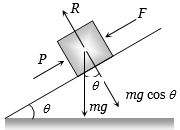
$A$ force of $750 \, N$ is applied to a block of mass $102 \, kg$ to prevent it from sliding on a plane with an inclination angle $30^{\circ}$ with the horizontal. If the coefficients of static friction and kinetic friction between the block and the plane are $0.4$ and $0.3$ respectively,then the frictional force acting on the block is...... $N$.
A
$750$
B
$500$
C
$345$
D
$250$
Solution
(D) $1$. The component of the gravitational force acting down the plane is $mg \sin \theta = 102 \times 9.8 \times \sin 30^{\circ} = 102 \times 9.8 \times 0.5 = 499.8 \, N \approx 500 \, N$.
$2$. The applied force $P = 750 \, N$ acts up the plane.
$3$. The net external force along the plane is $F_{\text{net}} = P - mg \sin \theta = 750 - 500 = 250 \, N$.
$4$. The normal reaction is $R = mg \cos \theta = 102 \times 9.8 \times \cos 30^{\circ} = 102 \times 9.8 \times 0.866 \approx 865.6 \, N$.
$5$. The limiting static friction is $f_{l} = \mu_s R = 0.4 \times 865.6 = 346.24 \, N$.
$6$. Since the net external force $(250 \, N)$ is less than the limiting static friction $(346.24 \, N)$,the block remains in equilibrium.
$7$. According to the law of static friction,the actual frictional force adjusts itself to balance the net external force. Therefore,the frictional force is $250 \, N$ acting down the plane.
$2$. The applied force $P = 750 \, N$ acts up the plane.
$3$. The net external force along the plane is $F_{\text{net}} = P - mg \sin \theta = 750 - 500 = 250 \, N$.
$4$. The normal reaction is $R = mg \cos \theta = 102 \times 9.8 \times \cos 30^{\circ} = 102 \times 9.8 \times 0.866 \approx 865.6 \, N$.
$5$. The limiting static friction is $f_{l} = \mu_s R = 0.4 \times 865.6 = 346.24 \, N$.
$6$. Since the net external force $(250 \, N)$ is less than the limiting static friction $(346.24 \, N)$,the block remains in equilibrium.
$7$. According to the law of static friction,the actual frictional force adjusts itself to balance the net external force. Therefore,the frictional force is $250 \, N$ acting down the plane.
0 likes
View Solution14
MediumMCQ
$A$ block is lying on an inclined plane which makes $60^\circ$ with the horizontal. If the coefficient of friction between the block and the plane is $0.25$ and $g = 10\,m/s^2$,then the acceleration of the block when it moves along the plane will be ........ $m/s^2$.
A
$2.50$
B
$5.00$
C
$7.4$
D
$8.66$
Solution
(C) The acceleration $a$ of a block sliding down an inclined plane with friction is given by the formula: $a = g(\sin \theta - \mu \cos \theta)$.
Given values are: $g = 10\,m/s^2$,$\theta = 60^\circ$,and $\mu = 0.25$.
Substituting these values into the formula:
$a = 10 \times (\sin 60^\circ - 0.25 \times \cos 60^\circ)$
$a = 10 \times (\frac{\sqrt{3}}{2} - 0.25 \times \frac{1}{2})$
$a = 10 \times (0.866 - 0.125)$
$a = 10 \times 0.741$
$a \approx 7.4\,m/s^2$.
Given values are: $g = 10\,m/s^2$,$\theta = 60^\circ$,and $\mu = 0.25$.
Substituting these values into the formula:
$a = 10 \times (\sin 60^\circ - 0.25 \times \cos 60^\circ)$
$a = 10 \times (\frac{\sqrt{3}}{2} - 0.25 \times \frac{1}{2})$
$a = 10 \times (0.866 - 0.125)$
$a = 10 \times 0.741$
$a \approx 7.4\,m/s^2$.
0 likes
View Solution15
EasyMCQ
$A$ body of mass $100\, g$ is sliding down an inclined plane of inclination $30^\circ$. What is the frictional force experienced if the coefficient of friction $\mu = 1.7$?
A
$1.7 \times \sqrt{2} \times \frac{1}{\sqrt{3}}\,N$
B
$1.7 \times \sqrt{3} \times \frac{1}{2}\,N$
C
$1.7 \times \sqrt{3}\,N$
D
$1.7 \times \sqrt{2} \times \frac{1}{3}\,N$
Solution
(B) The frictional force $F_k$ acting on a body sliding down an inclined plane is given by the formula: $F_k = \mu N$,where $N$ is the normal reaction.
For an inclined plane,the normal reaction $N = mg \cos \theta$.
Given: mass $m = 100\, g = 0.1\, kg$,inclination $\theta = 30^\circ$,$\mu = 1.7$,and taking acceleration due to gravity $g = 10\, m/s^2$.
Substituting the values: $F_k = 1.7 \times (0.1\, kg) \times (10\, m/s^2) \times \cos 30^\circ$.
$F_k = 1.7 \times 1 \times \frac{\sqrt{3}}{2} = 1.7 \times \sqrt{3} \times \frac{1}{2}\,N$.
For an inclined plane,the normal reaction $N = mg \cos \theta$.
Given: mass $m = 100\, g = 0.1\, kg$,inclination $\theta = 30^\circ$,$\mu = 1.7$,and taking acceleration due to gravity $g = 10\, m/s^2$.
Substituting the values: $F_k = 1.7 \times (0.1\, kg) \times (10\, m/s^2) \times \cos 30^\circ$.
$F_k = 1.7 \times 1 \times \frac{\sqrt{3}}{2} = 1.7 \times \sqrt{3} \times \frac{1}{2}\,N$.
0 likes
View Solution16
DifficultMCQ
$A$ body takes just twice the time to slide down a plane inclined at $30^\circ$ to the horizontal as it would if the plane were frictionless. The coefficient of friction between the body and the plane is:
A
$\frac{\sqrt{3}}{4}$
B
$\sqrt{3}$
C
$\frac{4}{3}$
D
$\frac{3}{4}$
Solution
(A) Let $L$ be the length of the inclined plane and $\theta = 30^\circ$ be the angle of inclination.
For a frictionless plane,the acceleration is $a_1 = g \sin \theta$. The time taken is $t_1 = \sqrt{\frac{2L}{g \sin \theta}}$.
For a rough plane with coefficient of friction $\mu$,the acceleration is $a_2 = g(\sin \theta - \mu \cos \theta)$. The time taken is $t_2 = \sqrt{\frac{2L}{g(\sin \theta - \mu \cos \theta)}}$.
Given $t_2 = 2t_1$,we have $\frac{t_2}{t_1} = 2$,so $\frac{t_2^2}{t_1^2} = 4$.
Substituting the expressions,$\frac{\sin \theta}{\sin \theta - \mu \cos \theta} = 4$.
$\sin \theta = 4 \sin \theta - 4 \mu \cos \theta \implies 4 \mu \cos \theta = 3 \sin \theta$.
$\mu = \frac{3}{4} \tan \theta = \frac{3}{4} \tan 30^\circ = \frac{3}{4} \times \frac{1}{\sqrt{3}} = \frac{\sqrt{3}}{4}$.
For a frictionless plane,the acceleration is $a_1 = g \sin \theta$. The time taken is $t_1 = \sqrt{\frac{2L}{g \sin \theta}}$.
For a rough plane with coefficient of friction $\mu$,the acceleration is $a_2 = g(\sin \theta - \mu \cos \theta)$. The time taken is $t_2 = \sqrt{\frac{2L}{g(\sin \theta - \mu \cos \theta)}}$.
Given $t_2 = 2t_1$,we have $\frac{t_2}{t_1} = 2$,so $\frac{t_2^2}{t_1^2} = 4$.
Substituting the expressions,$\frac{\sin \theta}{\sin \theta - \mu \cos \theta} = 4$.
$\sin \theta = 4 \sin \theta - 4 \mu \cos \theta \implies 4 \mu \cos \theta = 3 \sin \theta$.
$\mu = \frac{3}{4} \tan \theta = \frac{3}{4} \tan 30^\circ = \frac{3}{4} \times \frac{1}{\sqrt{3}} = \frac{\sqrt{3}}{4}$.
0 likes
View Solution17
EasyMCQ
$A$ brick of mass $2 \, kg$ begins to slide down on a plane inclined at an angle of $45^\circ$ with the horizontal. The force of friction will be
A
$19.6 \sin 45^\circ$
B
$19.6 \cos 45^\circ$
C
$9.8 \sin 45^\circ$
D
$9.8 \cos 45^\circ$
Solution
(A) When an object begins to slide down an inclined plane,it is at the angle of repose.
At the angle of repose,the force of static friction is equal to the component of the gravitational force acting down the plane.
The component of weight acting down the plane is given by $mg \sin \theta$.
Given: mass $m = 2 \, kg$,angle $\theta = 45^\circ$,and acceleration due to gravity $g = 9.8 \, m/s^2$.
Therefore,the force of friction $f = mg \sin \theta = 2 \times 9.8 \times \sin 45^\circ = 19.6 \sin 45^\circ$.
At the angle of repose,the force of static friction is equal to the component of the gravitational force acting down the plane.
The component of weight acting down the plane is given by $mg \sin \theta$.
Given: mass $m = 2 \, kg$,angle $\theta = 45^\circ$,and acceleration due to gravity $g = 9.8 \, m/s^2$.
Therefore,the force of friction $f = mg \sin \theta = 2 \times 9.8 \times \sin 45^\circ = 19.6 \sin 45^\circ$.
0 likes
View Solution18
DifficultMCQ
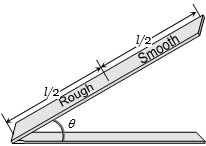
The upper half of an inclined plane of inclination $\theta$ is perfectly smooth,while the lower half is rough. $A$ body starting from rest at the top comes back to rest at the bottom. The coefficient of friction $\mu$ for the lower half is given by:
A
$\mu = \sin \theta$
B
$\mu = \cot \theta$
C
$\mu = 2 \cos \theta$
D
$\mu = 2 \tan \theta$
Solution
(D) Let the total length of the inclined plane be $l$. The upper half has length $l/2$ and is smooth,while the lower half has length $l/2$ and is rough with coefficient of friction $\mu$.
For the upper half (smooth):
The acceleration is $a_1 = g \sin \theta$. Starting from rest $(u=0)$,the velocity $v$ at the midpoint is given by:
$v^2 = u^2 + 2 a_1 (l/2) = 0 + 2(g \sin \theta)(l/2) = gl \sin \theta$.
For the lower half (rough):
The acceleration is $a_2 = g(\sin \theta - \mu \cos \theta)$. The body starts with velocity $v$ and comes to rest $(v_f = 0)$ at the bottom after covering distance $l/2$:
$v_f^2 = v^2 + 2 a_2 (l/2) = 0$.
Substituting $v^2 = gl \sin \theta$ and $a_2 = g(\sin \theta - \mu \cos \theta)$:
$gl \sin \theta + 2[g(\sin \theta - \mu \cos \theta)](l/2) = 0$.
$gl \sin \theta + gl(\sin \theta - \mu \cos \theta) = 0$.
$2 \sin \theta - \mu \cos \theta = 0$.
$\mu \cos \theta = 2 \sin \theta$.
$\mu = 2 \tan \theta$.
For the upper half (smooth):
The acceleration is $a_1 = g \sin \theta$. Starting from rest $(u=0)$,the velocity $v$ at the midpoint is given by:
$v^2 = u^2 + 2 a_1 (l/2) = 0 + 2(g \sin \theta)(l/2) = gl \sin \theta$.
For the lower half (rough):
The acceleration is $a_2 = g(\sin \theta - \mu \cos \theta)$. The body starts with velocity $v$ and comes to rest $(v_f = 0)$ at the bottom after covering distance $l/2$:
$v_f^2 = v^2 + 2 a_2 (l/2) = 0$.
Substituting $v^2 = gl \sin \theta$ and $a_2 = g(\sin \theta - \mu \cos \theta)$:
$gl \sin \theta + 2[g(\sin \theta - \mu \cos \theta)](l/2) = 0$.
$gl \sin \theta + gl(\sin \theta - \mu \cos \theta) = 0$.
$2 \sin \theta - \mu \cos \theta = 0$.
$\mu \cos \theta = 2 \sin \theta$.
$\mu = 2 \tan \theta$.
0 likes
View Solution19
MediumMCQ
$A$ body is sliding down an inclined plane having a coefficient of friction $0.5$. If the normal reaction is twice that of the resultant downward force along the incline,the angle between the inclined plane and the horizontal is ....... $^o$
A
$15$
B
$30$
C
$45$
D
$60$
Solution
(C) The resultant downward force along the incline is given by $F_{net} = mg(\sin \theta - \mu \cos \theta)$.
The normal reaction force is $N = mg \cos \theta$.
According to the problem,the normal reaction is twice the resultant downward force:
$mg \cos \theta = 2 \times mg(\sin \theta - \mu \cos \theta)$.
Dividing both sides by $mg$:
$\cos \theta = 2(\sin \theta - 0.5 \cos \theta)$.
Expanding the equation:
$\cos \theta = 2 \sin \theta - 1.0 \cos \theta$.
Rearranging the terms:
$2 \cos \theta = 2 \sin \theta$.
Dividing by $2 \cos \theta$:
$1 = \tan \theta$.
Therefore,$\theta = \tan^{-1}(1) = 45^o$.
The normal reaction force is $N = mg \cos \theta$.
According to the problem,the normal reaction is twice the resultant downward force:
$mg \cos \theta = 2 \times mg(\sin \theta - \mu \cos \theta)$.
Dividing both sides by $mg$:
$\cos \theta = 2(\sin \theta - 0.5 \cos \theta)$.
Expanding the equation:
$\cos \theta = 2 \sin \theta - 1.0 \cos \theta$.
Rearranging the terms:
$2 \cos \theta = 2 \sin \theta$.
Dividing by $2 \cos \theta$:
$1 = \tan \theta$.
Therefore,$\theta = \tan^{-1}(1) = 45^o$.
0 likes
View Solution20
MediumMCQ
$A$ body of mass $10\, kg$ is lying on a rough plane inclined at an angle of $30^\circ$ to the horizontal,and the coefficient of friction is $0.5$. The minimum force required to pull the body up the plane is ........ $N$.
A
$914$
B
$91.4$
C
$9.14$
D
$0.914$
Solution
(B) The force required to pull a body of mass $m$ up an inclined plane of angle $\theta$ with coefficient of friction $\mu$ is given by the formula:
$F = mg(\sin \theta + \mu \cos \theta)$
Given:
$m = 10\, kg$
$\theta = 30^\circ$
$\mu = 0.5$
$g = 9.8\, m/s^2$
Substituting the values:
$F = 10 \times 9.8 \times (\sin 30^\circ + 0.5 \cos 30^\circ)$
$F = 98 \times (0.5 + 0.5 \times 0.866)$
$F = 98 \times (0.5 + 0.433)$
$F = 98 \times 0.933 = 91.434\, N$
Rounding to the nearest provided option,the correct value is $91.4\, N$.
$F = mg(\sin \theta + \mu \cos \theta)$
Given:
$m = 10\, kg$
$\theta = 30^\circ$
$\mu = 0.5$
$g = 9.8\, m/s^2$
Substituting the values:
$F = 10 \times 9.8 \times (\sin 30^\circ + 0.5 \cos 30^\circ)$
$F = 98 \times (0.5 + 0.5 \times 0.866)$
$F = 98 \times (0.5 + 0.433)$
$F = 98 \times 0.933 = 91.434\, N$
Rounding to the nearest provided option,the correct value is $91.4\, N$.
0 likes
View Solution21
EasyMCQ
$A$ block of mass $1 \,kg$ slides down on a rough inclined plane of inclination $60^\circ$ starting from its top. If the coefficient of kinetic friction is $0.5$ and the length of the plane is $1 \,m$,then the work done against friction is ........ $J$.
A
$9.82$
B
$4.94$
C
$2.45$
D
$1.96$
Solution
(C) The work done against friction $(W_f)$ is given by the product of the frictional force $(f_k)$ and the displacement $(S)$.
$f_k = \mu_k N = \mu_k mg \cos \theta$
Given: mass $m = 1 \,kg$,coefficient of kinetic friction $\mu_k = 0.5$,inclination $\theta = 60^\circ$,and length $S = 1 \,m$.
Using $g = 9.8 \,m/s^2$:
$W_f = f_k \times S = (\mu_k mg \cos \theta) \times S$
$W_f = 0.5 \times 1 \times 9.8 \times \cos(60^\circ) \times 1$
Since $\cos(60^\circ) = 0.5$:
$W_f = 0.5 \times 9.8 \times 0.5 \times 1 = 2.45 \,J$.
$f_k = \mu_k N = \mu_k mg \cos \theta$
Given: mass $m = 1 \,kg$,coefficient of kinetic friction $\mu_k = 0.5$,inclination $\theta = 60^\circ$,and length $S = 1 \,m$.
Using $g = 9.8 \,m/s^2$:
$W_f = f_k \times S = (\mu_k mg \cos \theta) \times S$
$W_f = 0.5 \times 1 \times 9.8 \times \cos(60^\circ) \times 1$
Since $\cos(60^\circ) = 0.5$:
$W_f = 0.5 \times 9.8 \times 0.5 \times 1 = 2.45 \,J$.
0 likes
View Solution22
EasyMCQ
$A$ block of mass $10\, kg$ is placed on an inclined plane. When the angle of inclination is $30^\circ$,the block just begins to slide down the plane. The force of static friction is ....... $kg\, wt$.
A
$10$
B
$8.66$
C
$4.9$
D
$5$
Solution
(D) The block is on the verge of sliding down the inclined plane. At this point,the component of the gravitational force acting down the plane is balanced by the maximum static friction force.
The force acting down the plane is $F = mg \sin \theta$.
Given $m = 10\, kg$,$\theta = 30^\circ$,and $g \approx 9.8\, m/s^2$.
The force of static friction $f_s = mg \sin 30^\circ = 10 \times 9.8 \times 0.5 = 49\, N$.
Since $1\, kg\, wt = 9.8\, N$,the force in $kg\, wt$ is $f_s = \frac{49}{9.8} = 5\, kg\, wt$.
The force acting down the plane is $F = mg \sin \theta$.
Given $m = 10\, kg$,$\theta = 30^\circ$,and $g \approx 9.8\, m/s^2$.
The force of static friction $f_s = mg \sin 30^\circ = 10 \times 9.8 \times 0.5 = 49\, N$.
Since $1\, kg\, wt = 9.8\, N$,the force in $kg\, wt$ is $f_s = \frac{49}{9.8} = 5\, kg\, wt$.
0 likes
View Solution23
MediumMCQ
$A$ block rests on a rough inclined plane making an angle of $30^{\circ}$ with the horizontal. The coefficient of static friction between the block and the plane is $0.8$. If the frictional force on the block is $10 \, N$,the mass of the block (in $kg$) is (take $g = 10 \, m/s^2$).
A
$2$
B
$4$
C
$1.6$
D
$2.5$
Solution
(A) The angle of repose is given by $\alpha = \tan^{-1}(\mu) = \tan^{-1}(0.8) \approx 38.6^{\circ}$.
Since the angle of the inclined plane $\theta = 30^{\circ}$ is less than the angle of repose $\alpha$,the block remains at rest.
For a block at rest on an inclined plane,the static frictional force $f_s$ balances the component of gravity acting down the plane:
$f_s = mg \sin \theta$
Given $f_s = 10 \, N$,$g = 10 \, m/s^2$,and $\theta = 30^{\circ}$:
$10 = m \times 10 \times \sin(30^{\circ})$
$10 = m \times 10 \times 0.5$
$10 = 5m$
$m = 2 \, kg$.
Since the angle of the inclined plane $\theta = 30^{\circ}$ is less than the angle of repose $\alpha$,the block remains at rest.
For a block at rest on an inclined plane,the static frictional force $f_s$ balances the component of gravity acting down the plane:
$f_s = mg \sin \theta$
Given $f_s = 10 \, N$,$g = 10 \, m/s^2$,and $\theta = 30^{\circ}$:
$10 = m \times 10 \times \sin(30^{\circ})$
$10 = m \times 10 \times 0.5$
$10 = 5m$
$m = 2 \, kg$.
1 likes
View Solution24
MediumMCQ
$A$ body takes time $t$ to reach the bottom of an inclined plane of angle $\theta$ with the horizontal. If the plane is made rough,the time taken now is $2t$. The coefficient of friction of the rough surface is
A
$\frac{3}{4}\tan \theta $
B
$\frac{2}{3}\tan \theta $
C
$\frac{1}{4}\tan \theta $
D
$\frac{1}{2}\tan \theta $
Solution
(A) For a smooth inclined plane,the acceleration is $a_1 = g \sin \theta$. The distance $s$ is given by $s = \frac{1}{2} a_1 t^2 = \frac{1}{2} (g \sin \theta) t^2$.
For a rough inclined plane,the acceleration is $a_2 = g(\sin \theta - \mu \cos \theta)$. The distance $s$ is $s = \frac{1}{2} a_2 (2t)^2 = \frac{1}{2} g(\sin \theta - \mu \cos \theta) (4t^2)$.
Equating the two expressions for $s$: $\frac{1}{2} g \sin \theta t^2 = 2 g(\sin \theta - \mu \cos \theta) t^2$.
Dividing by $g t^2$: $\frac{1}{2} \sin \theta = 2(\sin \theta - \mu \cos \theta)$.
$\frac{1}{4} \sin \theta = \sin \theta - \mu \cos \theta$.
$\mu \cos \theta = \sin \theta - \frac{1}{4} \sin \theta = \frac{3}{4} \sin \theta$.
Therefore,$\mu = \frac{3}{4} \tan \theta$.
For a rough inclined plane,the acceleration is $a_2 = g(\sin \theta - \mu \cos \theta)$. The distance $s$ is $s = \frac{1}{2} a_2 (2t)^2 = \frac{1}{2} g(\sin \theta - \mu \cos \theta) (4t^2)$.
Equating the two expressions for $s$: $\frac{1}{2} g \sin \theta t^2 = 2 g(\sin \theta - \mu \cos \theta) t^2$.
Dividing by $g t^2$: $\frac{1}{2} \sin \theta = 2(\sin \theta - \mu \cos \theta)$.
$\frac{1}{4} \sin \theta = \sin \theta - \mu \cos \theta$.
$\mu \cos \theta = \sin \theta - \frac{1}{4} \sin \theta = \frac{3}{4} \sin \theta$.
Therefore,$\mu = \frac{3}{4} \tan \theta$.
0 likes
View Solution25
MediumMCQ
$A$ block is kept on an inclined plane of inclination $\theta$ and length $l$. The velocity of the block at the bottom of the inclined plane is (the coefficient of friction is $\mu$):
A
$\sqrt{2gl(\mu \cos \theta - \sin \theta)}$
B
$\sqrt{2gl(\sin \theta - \mu \cos \theta)}$
C
$\sqrt{2gl(\sin \theta + \mu \cos \theta)}$
D
$\sqrt{2gl(\cos \theta + \mu \sin \theta)}$
Solution
(B) The forces acting on the block along the inclined plane are the component of gravity $mg \sin \theta$ acting downwards and the frictional force $f_k = \mu N = \mu mg \cos \theta$ acting upwards.
Applying Newton's second law along the incline: $mg \sin \theta - \mu mg \cos \theta = ma$.
Thus,the acceleration of the block is $a = g(\sin \theta - \mu \cos \theta)$.
Using the kinematic equation $v^2 = u^2 + 2as$,where initial velocity $u = 0$ and distance $s = l$:
$v^2 = 0 + 2 \cdot g(\sin \theta - \mu \cos \theta) \cdot l$.
Therefore,the velocity at the bottom is $v = \sqrt{2gl(\sin \theta - \mu \cos \theta)}$.
Applying Newton's second law along the incline: $mg \sin \theta - \mu mg \cos \theta = ma$.
Thus,the acceleration of the block is $a = g(\sin \theta - \mu \cos \theta)$.
Using the kinematic equation $v^2 = u^2 + 2as$,where initial velocity $u = 0$ and distance $s = l$:
$v^2 = 0 + 2 \cdot g(\sin \theta - \mu \cos \theta) \cdot l$.
Therefore,the velocity at the bottom is $v = \sqrt{2gl(\sin \theta - \mu \cos \theta)}$.
0 likes
View Solution26
MediumMCQ
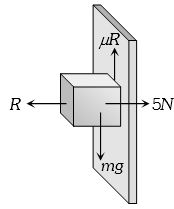
$A$ block of mass $0.1 \, kg$ is held against a wall by applying a horizontal force of $5 \, N$ on the block. If the coefficient of friction between the block and the wall is $0.5$,the magnitude of the frictional force acting on the block is ........ $N$.
A
$2.5$
B
$0.98$
C
$4.9$
D
$0.49$
Solution
(B) The normal force $R$ exerted by the wall on the block is equal to the applied horizontal force,so $R = 5 \, N$.
The limiting friction $F_l$ is given by $F_l = \mu R = 0.5 \times 5 = 2.5 \, N$.
The weight of the block acting downwards is $W = mg = 0.1 \times 9.8 = 0.98 \, N$.
Since the downward force (weight) is less than the limiting friction $(0.98 \, N < 2.5 \, N)$,the block remains at rest.
For a block in equilibrium,the static frictional force $F_s$ must balance the downward weight. Therefore,$F_s = W = 0.98 \, N$.
The limiting friction $F_l$ is given by $F_l = \mu R = 0.5 \times 5 = 2.5 \, N$.
The weight of the block acting downwards is $W = mg = 0.1 \times 9.8 = 0.98 \, N$.
Since the downward force (weight) is less than the limiting friction $(0.98 \, N < 2.5 \, N)$,the block remains at rest.
For a block in equilibrium,the static frictional force $F_s$ must balance the downward weight. Therefore,$F_s = W = 0.98 \, N$.
0 likes
View Solution27
MediumMCQ
$A$ block of mass $2 \, kg$ rests on a rough inclined plane making an angle of $30^\circ$ with the horizontal. The coefficient of static friction between the block and the plane is $0.7$. The frictional force on the block is ....... $N$.
A
$9.8$
B
$0.7 \times 9.8 \times \sqrt{3}$
C
$9.8 \times \sqrt{3}$
D
$0.8 \times 9.8$
Solution
(A) The component of the weight acting down the inclined plane is $F_{applied} = mg \sin \theta = 2 \times 9.8 \times \sin 30^\circ = 2 \times 9.8 \times 0.5 = 9.8 \, N$.
The limiting friction is given by $F_l = \mu_s N = \mu_s mg \cos \theta$.
$F_l = 0.7 \times 2 \times 9.8 \times \cos 30^\circ = 0.7 \times 19.6 \times \frac{\sqrt{3}}{2} \approx 11.88 \, N$.
Since the applied force $(9.8 \, N)$ is less than the limiting friction $(11.88 \, N)$,the block remains at rest.
Therefore,the static frictional force is equal to the component of the weight acting down the plane,which is $9.8 \, N$.
The limiting friction is given by $F_l = \mu_s N = \mu_s mg \cos \theta$.
$F_l = 0.7 \times 2 \times 9.8 \times \cos 30^\circ = 0.7 \times 19.6 \times \frac{\sqrt{3}}{2} \approx 11.88 \, N$.
Since the applied force $(9.8 \, N)$ is less than the limiting friction $(11.88 \, N)$,the block remains at rest.
Therefore,the static frictional force is equal to the component of the weight acting down the plane,which is $9.8 \, N$.
0 likes
View Solution28
MediumMCQ
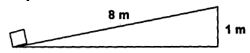
$A$ body of mass $2 \ kg$ is at rest at the bottom of an inclined plane of length $8 \ m$ and height $1 \ m$ as shown in the figure. If the coefficient of friction is $0.2$,what is the work done in moving the body from the bottom to the top of the incline (in $J$)? (Take $g = 10 \ m/s^2$)
A
$19.2$
B
$48$
C
$51$
D
$192$
Solution
(C) Given: Mass $m = 2 \ kg$,length of incline $S = 8 \ m$,height $h = 1 \ m$,coefficient of friction $\mu = 0.2$,$g = 10 \ m/s^2$.
From the geometry,$\sin \theta = h/S = 1/8$.
Using $\sin^2 \theta + \cos^2 \theta = 1$,we get $\cos \theta = \sqrt{1 - (1/8)^2} = \sqrt{63/64} = \sqrt{63}/8 \approx 7.937/8 \approx 0.992$.
To move the body at a constant speed,the applied force $F$ must balance the gravitational component and the frictional force: $F = mg \sin \theta + \mu mg \cos \theta$.
The work done $W = F \times S = (mg \sin \theta + \mu mg \cos \theta) \times S$.
$W = mgS \sin \theta + \mu mgS \cos \theta = mgh + \mu mgS \cos \theta$.
$W = (2 \times 10 \times 1) + (0.2 \times 2 \times 10 \times 8 \times 0.992) = 20 + 31.74 = 51.74 \ J$.
Rounding to the nearest integer provided in the options,the correct answer is $51 \ J$.
From the geometry,$\sin \theta = h/S = 1/8$.
Using $\sin^2 \theta + \cos^2 \theta = 1$,we get $\cos \theta = \sqrt{1 - (1/8)^2} = \sqrt{63/64} = \sqrt{63}/8 \approx 7.937/8 \approx 0.992$.
To move the body at a constant speed,the applied force $F$ must balance the gravitational component and the frictional force: $F = mg \sin \theta + \mu mg \cos \theta$.
The work done $W = F \times S = (mg \sin \theta + \mu mg \cos \theta) \times S$.
$W = mgS \sin \theta + \mu mgS \cos \theta = mgh + \mu mgS \cos \theta$.
$W = (2 \times 10 \times 1) + (0.2 \times 2 \times 10 \times 8 \times 0.992) = 20 + 31.74 = 51.74 \ J$.
Rounding to the nearest integer provided in the options,the correct answer is $51 \ J$.
2 likes
View Solution29
MediumMCQ
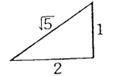
An engine of mass $1$ metric ton is ascending an inclined plane,at an angle $\theta = \tan^{-1}(1/2)$ with the horizontal,with a speed of $36 \; km/h$. If the coefficient of friction of the surface is $1/\sqrt{3}$,then the power developed by the engine is:
A
$94.4 \times 10^3 \; W$
B
$9.44 \times 10^3 \; W$
C
$944 \; W$
D
$94.4 \; W$
Solution
(A) Given: Mass $m = 1000 \; kg$,speed $v = 36 \; km/h = 36 \times (5/18) = 10 \; m/s$,$\tan \theta = 1/2$,$\mu = 1/\sqrt{3}$.
From the triangle,$\sin \theta = 1/\sqrt{5}$ and $\cos \theta = 2/\sqrt{5}$.
The force required to move the engine up the incline at a constant speed is $F = mg \sin \theta + f_k = mg \sin \theta + \mu mg \cos \theta$.
$F = mg(\sin \theta + \mu \cos \theta) = 1000 \times 9.8 \times (1/\sqrt{5} + (1/\sqrt{3}) \times (2/\sqrt{5}))$.
$F = 9800 \times (1/\sqrt{5} + 2/\sqrt{15}) = 9800 \times (0.4472 + 0.5164) \approx 9800 \times 0.9636 \approx 9443 \; N$.
Power $P = F \times v = 9443 \times 10 = 94430 \; W = 94.4 \times 10^3 \; W$.
From the triangle,$\sin \theta = 1/\sqrt{5}$ and $\cos \theta = 2/\sqrt{5}$.
The force required to move the engine up the incline at a constant speed is $F = mg \sin \theta + f_k = mg \sin \theta + \mu mg \cos \theta$.
$F = mg(\sin \theta + \mu \cos \theta) = 1000 \times 9.8 \times (1/\sqrt{5} + (1/\sqrt{3}) \times (2/\sqrt{5}))$.
$F = 9800 \times (1/\sqrt{5} + 2/\sqrt{15}) = 9800 \times (0.4472 + 0.5164) \approx 9800 \times 0.9636 \approx 9443 \; N$.
Power $P = F \times v = 9443 \times 10 = 94430 \; W = 94.4 \times 10^3 \; W$.
1 likes
View Solution30
MediumMCQ
$A$ block of mass $5 \, kg$ is placed on a rough inclined plane with an angle of $30^\circ$. If the block moves down with a constant velocity,what is the coefficient of friction? (Take $g = 10 \, m/s^2$)
A
$1/\sqrt{3}$
B
$2/\sqrt{3}$
C
$\sqrt{3}$
D
$2\sqrt{3}$
Solution
(A) When a block moves down an inclined plane with a constant velocity,the net force acting on it is zero.
This implies that the component of gravitational force acting down the plane is balanced by the kinetic frictional force.
Let $m$ be the mass,$\theta$ be the angle of inclination,and $\mu_k$ be the coefficient of kinetic friction.
The force down the plane is $mg \sin \theta$.
The frictional force is $f_k = \mu_k N = \mu_k mg \cos \theta$.
Equating the two: $mg \sin \theta = \mu_k mg \cos \theta$.
Therefore,$\mu_k = \tan \theta$.
Given $\theta = 30^\circ$,we have $\mu_k = \tan 30^\circ = \frac{1}{\sqrt{3}}$.
This implies that the component of gravitational force acting down the plane is balanced by the kinetic frictional force.
Let $m$ be the mass,$\theta$ be the angle of inclination,and $\mu_k$ be the coefficient of kinetic friction.
The force down the plane is $mg \sin \theta$.
The frictional force is $f_k = \mu_k N = \mu_k mg \cos \theta$.
Equating the two: $mg \sin \theta = \mu_k mg \cos \theta$.
Therefore,$\mu_k = \tan \theta$.
Given $\theta = 30^\circ$,we have $\mu_k = \tan 30^\circ = \frac{1}{\sqrt{3}}$.
0 likes
View Solution31
DifficultMCQ
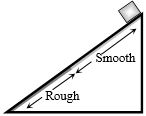
The upper half of an inclined plane of inclination $\theta$ is smooth,while the lower half is rough. If a block released from the top comes to rest at the bottom,what is the coefficient of friction between the block and the rough surface?
A
$\mu = \sin \theta$
B
$\mu = \cot \theta$
C
$\mu = 2 \cos \theta$
D
$\mu = 2 \tan \theta$
Solution
(D) Let the total length of the incline be $L$. The length of each half is $l = L/2$.
For the smooth upper half,the acceleration is $a_1 = g \sin \theta$. Starting from rest $(u=0)$,the velocity $v$ at the midpoint is given by:
$v^2 = u^2 + 2 a_1 l = 0 + 2(g \sin \theta)(L/2) = gL \sin \theta$.
For the rough lower half,the acceleration is $a_2 = g(\sin \theta - \mu \cos \theta)$. The block comes to rest at the bottom,so the final velocity is $0$. Using $v_f^2 = v^2 + 2 a_2 l$:
$0 = gL \sin \theta + 2[g(\sin \theta - \mu \cos \theta)](L/2)$.
$0 = gL \sin \theta + gL \sin \theta - gL \mu \cos \theta$.
$2 \sin \theta = \mu \cos \theta$.
Therefore,$\mu = 2 \tan \theta$.
For the smooth upper half,the acceleration is $a_1 = g \sin \theta$. Starting from rest $(u=0)$,the velocity $v$ at the midpoint is given by:
$v^2 = u^2 + 2 a_1 l = 0 + 2(g \sin \theta)(L/2) = gL \sin \theta$.
For the rough lower half,the acceleration is $a_2 = g(\sin \theta - \mu \cos \theta)$. The block comes to rest at the bottom,so the final velocity is $0$. Using $v_f^2 = v^2 + 2 a_2 l$:
$0 = gL \sin \theta + 2[g(\sin \theta - \mu \cos \theta)](L/2)$.
$0 = gL \sin \theta + gL \sin \theta - gL \mu \cos \theta$.
$2 \sin \theta = \mu \cos \theta$.
Therefore,$\mu = 2 \tan \theta$.
0 likes
View Solution32
MediumMCQ
$A$ block is projected up an inclined plane of angle $\theta = 30^o$ with an initial velocity of $5 \, m/s$. It comes to rest in $0.5 \, s$. What is the coefficient of friction?
A
$0.5$
B
$1.25$
C
$0.6$
D
None of these
Solution
(C) When a block moves up an inclined plane,the retardation $a$ is given by $a = g(\sin \theta + \mu \cos \theta)$.
Using the equation of motion $v = u - at$,where $v = 0$ (final velocity at rest),$u = 5 \, m/s$,and $t = 0.5 \, s$:
$0 = u - at \implies a = \frac{u}{t} = \frac{5}{0.5} = 10 \, m/s^2$.
Now,substitute $a = 10 \, m/s^2$,$g = 10 \, m/s^2$,and $\theta = 30^o$ into the retardation formula:
$10 = 10(\sin 30^o + \mu \cos 30^o)$.
$1 = 0.5 + \mu (\frac{\sqrt{3}}{2})$.
$0.5 = \mu (\frac{1.732}{2}) = \mu (0.866)$.
$\mu = \frac{0.5}{0.866} \approx 0.577$.
Rounding to the nearest provided option,the value is approximately $0.6$.
Using the equation of motion $v = u - at$,where $v = 0$ (final velocity at rest),$u = 5 \, m/s$,and $t = 0.5 \, s$:
$0 = u - at \implies a = \frac{u}{t} = \frac{5}{0.5} = 10 \, m/s^2$.
Now,substitute $a = 10 \, m/s^2$,$g = 10 \, m/s^2$,and $\theta = 30^o$ into the retardation formula:
$10 = 10(\sin 30^o + \mu \cos 30^o)$.
$1 = 0.5 + \mu (\frac{\sqrt{3}}{2})$.
$0.5 = \mu (\frac{1.732}{2}) = \mu (0.866)$.
$\mu = \frac{0.5}{0.866} \approx 0.577$.
Rounding to the nearest provided option,the value is approximately $0.6$.
0 likes
View Solution33
DifficultMCQ
If $300\,J$ of work is done to move a $2\,kg$ block up a rough inclined plane to a height of $10\,m$,find the work done against friction in $J$. (Take $g = 10\,m/s^2$)
A
$100$
B
$200$
C
$300$
D
$0$
Solution
(A) The total work done $(W_{total})$ is the sum of the work done against gravity $(W_g)$ and the work done against friction $(W_f)$.
$W_{total} = W_g + W_f$
Given: $m = 2\,kg$,$h = 10\,m$,$g = 10\,m/s^2$,$W_{total} = 300\,J$.
The work done against gravity is $W_g = mgh = 2 \times 10 \times 10 = 200\,J$.
Therefore,the work done against friction is $W_f = W_{total} - W_g$.
$W_f = 300\,J - 200\,J = 100\,J$.
$W_{total} = W_g + W_f$
Given: $m = 2\,kg$,$h = 10\,m$,$g = 10\,m/s^2$,$W_{total} = 300\,J$.
The work done against gravity is $W_g = mgh = 2 \times 10 \times 10 = 200\,J$.
Therefore,the work done against friction is $W_f = W_{total} - W_g$.
$W_f = 300\,J - 200\,J = 100\,J$.
0 likes
View Solution34
DifficultMCQ
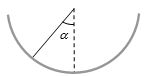
If the coefficient of friction between an ant and the surface is $1/3$,find the maximum value of $\alpha$.
A
$\cot \alpha = 3$
B
$\tan \alpha = 3$
C
$\sec \alpha = 3$
D
$\csc \alpha = 3$
Solution
(A) For an object to remain at rest on an inclined surface,the angle of inclination $\alpha$ must be less than or equal to the angle of repose $\theta$,where $\tan \theta = \mu$.
Here,the surface is curved,and the angle $\alpha$ is measured with the vertical.
The forces acting on the ant are gravity ($mg$ downwards),normal force ($N$ perpendicular to the surface),and friction ($f$ along the tangent).
At the point of slipping,the friction is limiting,so $f = \mu N$.
Resolving forces along the tangent and normal to the surface:
$mg \sin \alpha = f = \mu N$
$mg \cos \alpha = N$
Dividing the two equations:
$\tan \alpha = \mu$
Given $\mu = 1/3$,we have $\tan \alpha = 1/3$.
Therefore,$\cot \alpha = 1/\tan \alpha = 3$.
Here,the surface is curved,and the angle $\alpha$ is measured with the vertical.
The forces acting on the ant are gravity ($mg$ downwards),normal force ($N$ perpendicular to the surface),and friction ($f$ along the tangent).
At the point of slipping,the friction is limiting,so $f = \mu N$.
Resolving forces along the tangent and normal to the surface:
$mg \sin \alpha = f = \mu N$
$mg \cos \alpha = N$
Dividing the two equations:
$\tan \alpha = \mu$
Given $\mu = 1/3$,we have $\tan \alpha = 1/3$.
Therefore,$\cot \alpha = 1/\tan \alpha = 3$.
0 likes
View Solution35
MediumMCQ
What percentage of the total length of a chain can hang off the edge of a table without sliding,given that the coefficient of friction between the chain and the table is $0.25$?
A
$20$
B
$25$
C
$35$
D
$15$
Solution
(A) Let $L$ be the total length of the chain and $M$ be its total mass. The mass per unit length is $\lambda = M/L$.
Let $l$ be the length of the chain hanging off the table. The length of the chain on the table is $(L - l)$.
The weight of the hanging part is $W_h = (\lambda l)g$,which acts as the pulling force.
The normal force on the part of the chain on the table is $N = (\lambda(L - l))g$.
The limiting friction force is $f_{max} = \mu N = \mu \lambda(L - l)g$.
For the chain to be in equilibrium,the pulling force must equal the limiting friction force:
$\lambda l g = \mu \lambda(L - l)g$
$l = \mu(L - l)$
$l = \mu L - \mu l$
$l(1 + \mu) = \mu L$
$l/L = \mu / (1 + \mu)$
Given $\mu = 0.25$:
$l/L = 0.25 / (1 + 0.25) = 0.25 / 1.25 = 1/5 = 0.20$.
Thus,the percentage of the length is $0.20 \times 100 = 20\%$.
Let $l$ be the length of the chain hanging off the table. The length of the chain on the table is $(L - l)$.
The weight of the hanging part is $W_h = (\lambda l)g$,which acts as the pulling force.
The normal force on the part of the chain on the table is $N = (\lambda(L - l))g$.
The limiting friction force is $f_{max} = \mu N = \mu \lambda(L - l)g$.
For the chain to be in equilibrium,the pulling force must equal the limiting friction force:
$\lambda l g = \mu \lambda(L - l)g$
$l = \mu(L - l)$
$l = \mu L - \mu l$
$l(1 + \mu) = \mu L$
$l/L = \mu / (1 + \mu)$
Given $\mu = 0.25$:
$l/L = 0.25 / (1 + 0.25) = 0.25 / 1.25 = 1/5 = 0.20$.
Thus,the percentage of the length is $0.20 \times 100 = 20\%$.
0 likes
View Solution36
DifficultMCQ
The time taken by a block to slide down a rough inclined plane of angle $30^{\circ}$ is $n=2$ times the time taken to slide down a frictionless inclined plane of the same angle $30^{\circ}$. The coefficient of kinetic friction between the block and the plane is:
A
$\frac{\sqrt{3}}{4}$
B
$\sqrt{3}$
C
$\frac{4}{3}$
D
$\frac{3}{4}$
Solution
(A) For a frictionless inclined plane,the acceleration is $a_1 = g \sin \theta$. The time taken to cover distance $s$ is $t_1 = \sqrt{\frac{2s}{g \sin \theta}}$.
For a rough inclined plane,the acceleration is $a_2 = g(\sin \theta - \mu \cos \theta)$. The time taken is $t_2 = \sqrt{\frac{2s}{g(\sin \theta - \mu \cos \theta)}}$.
Given $t_2 = n t_1$,so $\frac{t_2}{t_1} = n$.
Thus,$\frac{\sin \theta}{\sin \theta - \mu \cos \theta} = n^2$.
Rearranging for $\mu$: $\mu = \tan \theta \left( 1 - \frac{1}{n^2} \right)$.
Substituting $\theta = 30^{\circ}$ and $n = 2$:
$\mu = \tan 30^{\circ} \left( 1 - \frac{1}{2^2} \right) = \frac{1}{\sqrt{3}} \left( 1 - \frac{1}{4} \right) = \frac{1}{\sqrt{3}} \left( \frac{3}{4} \right) = \frac{\sqrt{3}}{4}$.
For a rough inclined plane,the acceleration is $a_2 = g(\sin \theta - \mu \cos \theta)$. The time taken is $t_2 = \sqrt{\frac{2s}{g(\sin \theta - \mu \cos \theta)}}$.
Given $t_2 = n t_1$,so $\frac{t_2}{t_1} = n$.
Thus,$\frac{\sin \theta}{\sin \theta - \mu \cos \theta} = n^2$.
Rearranging for $\mu$: $\mu = \tan \theta \left( 1 - \frac{1}{n^2} \right)$.
Substituting $\theta = 30^{\circ}$ and $n = 2$:
$\mu = \tan 30^{\circ} \left( 1 - \frac{1}{2^2} \right) = \frac{1}{\sqrt{3}} \left( 1 - \frac{1}{4} \right) = \frac{1}{\sqrt{3}} \left( \frac{3}{4} \right) = \frac{\sqrt{3}}{4}$.
0 likes
View Solution37
MediumMCQ
$A$ child weighing $25$ kg slides down a rope hanging from the branch of a tall tree. If the force of friction acting against him is $2$ $N$,the acceleration of the child is ........ $m/s^2$. (Take $g = 9.8$ $m/s^2$)
A
$22.5$
B
$8$
C
$5$
D
$9.72$
Solution
(D) The child is sliding down the rope,so the gravitational force acts downwards and the frictional force acts upwards.
Weight of the child,$W = mg = 25 \times 9.8 = 245$ $N$.
Frictional force,$f = 2$ $N$.
According to Newton's second law,the net force $F_{net} = W - f$.
$ma = mg - f$
$25 \times a = 245 - 2$
$25a = 243$
$a = \frac{243}{25} = 9.72$ $m/s^2$.
Therefore,the acceleration of the child is $9.72$ $m/s^2$.
Weight of the child,$W = mg = 25 \times 9.8 = 245$ $N$.
Frictional force,$f = 2$ $N$.
According to Newton's second law,the net force $F_{net} = W - f$.
$ma = mg - f$
$25 \times a = 245 - 2$
$25a = 243$
$a = \frac{243}{25} = 9.72$ $m/s^2$.
Therefore,the acceleration of the child is $9.72$ $m/s^2$.
0 likes
View Solution38
DifficultMCQ
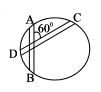
$A$ disc arranged in a vertical plane has two grooves of the same length directed along the vertical chord $AB$ and the chord $CD$ as shown in the figure. Particles slide down along $AB$ and $CD$ starting from rest. The ratio of the time $t_{AB}/t_{CD}$ is
A
$1 : 2$
B
$1 : \sqrt{2}$
C
$2 : 1$
D
$\sqrt{2} : 1$
Solution
(B) Let the length of both grooves be $L$. The acceleration of a particle sliding down a smooth groove inclined at an angle $\theta$ with the vertical is $a = g \cos \theta$.
For the vertical chord $AB$,the angle with the vertical is $\theta_1 = 0^\circ$. Thus,$a_{AB} = g \cos 0^\circ = g$.
The time taken is $t_{AB} = \sqrt{\frac{2L}{a_{AB}}} = \sqrt{\frac{2L}{g}}$.
For the chord $CD$,the angle with the vertical is $\theta_2 = 60^\circ$. Thus,$a_{CD} = g \cos 60^\circ = g/2$.
The time taken is $t_{CD} = \sqrt{\frac{2L}{a_{CD}}} = \sqrt{\frac{2L}{g/2}} = \sqrt{\frac{4L}{g}} = 2\sqrt{\frac{L}{g}}$.
Taking the ratio,$\frac{t_{AB}}{t_{CD}} = \frac{\sqrt{2L/g}}{2\sqrt{L/g}} = \frac{\sqrt{2}}{2} = \frac{1}{\sqrt{2}}$.
For the vertical chord $AB$,the angle with the vertical is $\theta_1 = 0^\circ$. Thus,$a_{AB} = g \cos 0^\circ = g$.
The time taken is $t_{AB} = \sqrt{\frac{2L}{a_{AB}}} = \sqrt{\frac{2L}{g}}$.
For the chord $CD$,the angle with the vertical is $\theta_2 = 60^\circ$. Thus,$a_{CD} = g \cos 60^\circ = g/2$.
The time taken is $t_{CD} = \sqrt{\frac{2L}{a_{CD}}} = \sqrt{\frac{2L}{g/2}} = \sqrt{\frac{4L}{g}} = 2\sqrt{\frac{L}{g}}$.
Taking the ratio,$\frac{t_{AB}}{t_{CD}} = \frac{\sqrt{2L/g}}{2\sqrt{L/g}} = \frac{\sqrt{2}}{2} = \frac{1}{\sqrt{2}}$.
0 likes
View Solution39
MediumMCQ
$A$ body is placed on a rough inclined plane of inclination $\theta$. As the angle $\theta$ is increased from $0^o$ to $90^o$,the contact force between the block and the plane
A
remains constant
B
first remains constant then decreases
C
first decreases then increases
D
first increases then decreases
Solution
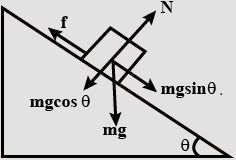
(B) The contact force $F_c$ between the block and the plane is the resultant of the normal force $N$ and the frictional force $f$.
$F_c = \sqrt{N^2 + f^2}$.
For a block on an inclined plane,the normal force is $N = mg \cos \theta$.
Case $1$: When the block is at rest (static friction),$f = mg \sin \theta$.
Then $F_c = \sqrt{(mg \cos \theta)^2 + (mg \sin \theta)^2} = \sqrt{m^2g^2(\cos^2 \theta + \sin^2 \theta)} = mg$.
This holds until the angle of repose $\theta_r$ is reached,where $\tan \theta_r = \mu$.
Case $2$: When the block starts sliding (kinetic friction),$f = \mu N = \mu mg \cos \theta$.
Then $F_c = \sqrt{N^2 + f^2} = \sqrt{(mg \cos \theta)^2 + (\mu mg \cos \theta)^2} = mg \cos \theta \sqrt{1 + \mu^2}$.
As $\theta$ increases from $0^o$ to $\theta_r$,$F_c$ remains constant at $mg$.
As $\theta$ increases from $\theta_r$ to $90^o$,$F_c = mg \cos \theta \sqrt{1 + \mu^2}$ decreases because $\cos \theta$ decreases.
Therefore,the contact force first remains constant and then decreases.
$F_c = \sqrt{N^2 + f^2}$.
For a block on an inclined plane,the normal force is $N = mg \cos \theta$.
Case $1$: When the block is at rest (static friction),$f = mg \sin \theta$.
Then $F_c = \sqrt{(mg \cos \theta)^2 + (mg \sin \theta)^2} = \sqrt{m^2g^2(\cos^2 \theta + \sin^2 \theta)} = mg$.
This holds until the angle of repose $\theta_r$ is reached,where $\tan \theta_r = \mu$.
Case $2$: When the block starts sliding (kinetic friction),$f = \mu N = \mu mg \cos \theta$.
Then $F_c = \sqrt{N^2 + f^2} = \sqrt{(mg \cos \theta)^2 + (\mu mg \cos \theta)^2} = mg \cos \theta \sqrt{1 + \mu^2}$.
As $\theta$ increases from $0^o$ to $\theta_r$,$F_c$ remains constant at $mg$.
As $\theta$ increases from $\theta_r$ to $90^o$,$F_c = mg \cos \theta \sqrt{1 + \mu^2}$ decreases because $\cos \theta$ decreases.
Therefore,the contact force first remains constant and then decreases.
0 likes
View Solution40
DifficultMCQ
$A$ block is projected upwards on an inclined plane of inclination $37^{\circ}$ along the line of greatest slope with a coefficient of friction $\mu = 0.5$ and an initial velocity of $5 \ m/s$. The block first stops at a distance of .......... $m$ from the starting point.
A
$1.25$
B
$2.5$
C
$10$
D
$12.5$
Solution
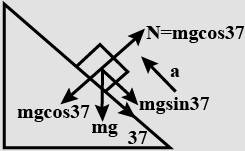
(A) From the Free Body Diagram $(FBD)$,both the gravitational component $(mg \sin 37^{\circ})$ and the frictional force $(f = \mu N = \mu mg \cos 37^{\circ})$ act downward along the inclined plane.
Therefore,the block experiences a constant deceleration $(a)$ while moving up the plane:
$ma = mg \sin 37^{\circ} + \mu mg \cos 37^{\circ}$
$a = g(\sin 37^{\circ} + \mu \cos 37^{\circ})$
Given $g = 10 \ m/s^2$,$\sin 37^{\circ} \approx 0.6$,$\cos 37^{\circ} \approx 0.8$,and $\mu = 0.5$:
$a = 10(0.6 + 0.5 \times 0.8) = 10(0.6 + 0.4) = 10 \ m/s^2$
Using the kinematic equation $v^2 = u^2 - 2aS$,where final velocity $v = 0$ and initial velocity $u = 5 \ m/s$:
$0 = (5)^2 - 2(10)S$
$20S = 25$
$S = 1.25 \ m$
Therefore,the block experiences a constant deceleration $(a)$ while moving up the plane:
$ma = mg \sin 37^{\circ} + \mu mg \cos 37^{\circ}$
$a = g(\sin 37^{\circ} + \mu \cos 37^{\circ})$
Given $g = 10 \ m/s^2$,$\sin 37^{\circ} \approx 0.6$,$\cos 37^{\circ} \approx 0.8$,and $\mu = 0.5$:
$a = 10(0.6 + 0.5 \times 0.8) = 10(0.6 + 0.4) = 10 \ m/s^2$
Using the kinematic equation $v^2 = u^2 - 2aS$,where final velocity $v = 0$ and initial velocity $u = 5 \ m/s$:
$0 = (5)^2 - 2(10)S$
$20S = 25$
$S = 1.25 \ m$
0 likes
View Solution41
MediumMCQ
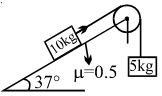
The blocks are in equilibrium. The friction force acting on the $10 \, kg$ block is:
A
$10 \, N$ down the plane
B
$40 \, N$ up the plane
C
$10 \, N$ up the plane
D
None
Solution
(C) $1$. Analyze the forces on the $5 \, kg$ block: Since the system is in equilibrium,the tension $T$ in the string is equal to the weight of the $5 \, kg$ block. Thus,$T = m_2g = 5 \times 10 = 50 \, N$.
$2$. Analyze the forces on the $10 \, kg$ block along the inclined plane: The component of gravity acting down the plane is $m_1g \sin(37^\circ) = 10 \times 10 \times 0.6 = 60 \, N$.
$3$. Determine the direction of friction: The gravitational force component $(60 \, N)$ is greater than the tension $(50 \, N)$ pulling the block up the plane. Therefore,the block has a tendency to slide down the plane. To maintain equilibrium,the friction force must act up the plane.
$4$. Calculate the friction force: Let $f$ be the friction force. For equilibrium along the plane,$T + f = m_1g \sin(37^\circ)$. Substituting the values,$50 + f = 60$,which gives $f = 10 \, N$ up the plane.
$2$. Analyze the forces on the $10 \, kg$ block along the inclined plane: The component of gravity acting down the plane is $m_1g \sin(37^\circ) = 10 \times 10 \times 0.6 = 60 \, N$.
$3$. Determine the direction of friction: The gravitational force component $(60 \, N)$ is greater than the tension $(50 \, N)$ pulling the block up the plane. Therefore,the block has a tendency to slide down the plane. To maintain equilibrium,the friction force must act up the plane.
$4$. Calculate the friction force: Let $f$ be the friction force. For equilibrium along the plane,$T + f = m_1g \sin(37^\circ)$. Substituting the values,$50 + f = 60$,which gives $f = 10 \, N$ up the plane.
0 likes
View Solution42
DifficultMCQ
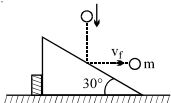
As shown in the figure,a body of mass $m$ moving vertically downward with a speed of $3\, m/s$ hits a smooth fixed inclined plane and rebounds with a velocity $v_f$ in the horizontal direction. If the angle of the inclined plane is $30^{\circ}$,the velocity $v_f$ will be:
A
$3\, m/s$
B
$\sqrt{3}\, m/s$
C
$1/\sqrt{3}\, m/s$
D
This is not possible
Solution
(B) When the body hits the smooth inclined plane,the impulse acts perpendicular to the surface of the plane. Therefore,the component of velocity parallel to the inclined plane remains unchanged.
Let the initial velocity be $v = 3\, m/s$ directed vertically downward.
The angle of the inclined plane with the horizontal is $\theta = 30^{\circ}$.
The component of the initial velocity $v$ parallel to the inclined plane is $v_{\parallel} = v \sin 30^{\circ}$.
After the collision,the body moves horizontally with velocity $v_f$. The component of this final velocity $v_f$ parallel to the inclined plane is $v_{f\parallel} = v_f \cos 30^{\circ}$.
Since the surface is smooth,there is no force parallel to the plane,so the velocity component parallel to the plane is conserved:
$v \sin 30^{\circ} = v_f \cos 30^{\circ}$
$v_f = v \tan 30^{\circ}$
Substituting the values $v = 3\, m/s$ and $\tan 30^{\circ} = 1/\sqrt{3}$:
$v_f = 3 \times (1/\sqrt{3}) = \sqrt{3}\, m/s$.
Let the initial velocity be $v = 3\, m/s$ directed vertically downward.
The angle of the inclined plane with the horizontal is $\theta = 30^{\circ}$.
The component of the initial velocity $v$ parallel to the inclined plane is $v_{\parallel} = v \sin 30^{\circ}$.
After the collision,the body moves horizontally with velocity $v_f$. The component of this final velocity $v_f$ parallel to the inclined plane is $v_{f\parallel} = v_f \cos 30^{\circ}$.
Since the surface is smooth,there is no force parallel to the plane,so the velocity component parallel to the plane is conserved:
$v \sin 30^{\circ} = v_f \cos 30^{\circ}$
$v_f = v \tan 30^{\circ}$
Substituting the values $v = 3\, m/s$ and $\tan 30^{\circ} = 1/\sqrt{3}$:
$v_f = 3 \times (1/\sqrt{3}) = \sqrt{3}\, m/s$.
0 likes
View Solution43
MediumMCQ
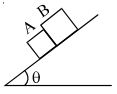
Two blocks $A$ and $B$ of equal mass are initially in contact when released from rest on an inclined plane. The coefficients of friction between the inclined plane and blocks $A$ and $B$ are $\mu_1$ and $\mu_2$ respectively.
A
If $\mu_1 > \mu_2$,the blocks will always remain in contact.
B
If $\mu_1 < \mu_2$,the blocks will slide down with different accelerations (if the blocks slide).
C
If $\mu_1 > \mu_2$,the blocks will have a common acceleration $\frac{1}{2} (\mu_1 + \mu_2) g \sin \theta$.
D
Both $(A)$ and $(B)$.
Solution
(D) The acceleration of a block on an inclined plane is given by $a = g(\sin \theta - \mu \cos \theta)$.
Since the masses are equal,the block with the lower coefficient of friction $(\mu)$ will have a greater acceleration down the slope.
If $\mu_1 > \mu_2$,block $B$ (with $\mu_2$) tends to accelerate faster than block $A$ (with $\mu_1$). Since $B$ is behind $A$,they will remain in contact.
If $\mu_1 < \mu_2$,block $A$ tends to accelerate faster than block $B$. Since $A$ is in front of $B$,they will separate and slide down with different accelerations.
Therefore,both statements $(A)$ and $(B)$ are correct.
Since the masses are equal,the block with the lower coefficient of friction $(\mu)$ will have a greater acceleration down the slope.
If $\mu_1 > \mu_2$,block $B$ (with $\mu_2$) tends to accelerate faster than block $A$ (with $\mu_1$). Since $B$ is behind $A$,they will remain in contact.
If $\mu_1 < \mu_2$,block $A$ tends to accelerate faster than block $B$. Since $A$ is in front of $B$,they will separate and slide down with different accelerations.
Therefore,both statements $(A)$ and $(B)$ are correct.
0 likes
View Solution44
DifficultMCQ
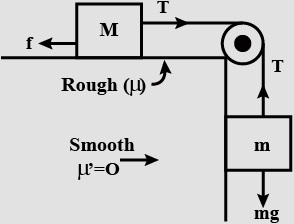
In the figure,two blocks $M$ and $m$ are tied together with an inextensible and light string. The mass $M$ is placed on a rough horizontal surface with a coefficient of friction $\mu$,and the mass $m$ is hanging vertically. The pulley is frictionless. Choose the correct statement$(s)$.

A
The system will accelerate for any value of $m$.
B
The system will accelerate only when $m > M$.
C
The system will accelerate only when $m > \mu M$.
D
Nothing can be said.
Solution
(C) For the system to accelerate,the driving force must overcome the limiting friction force acting on block $M$.
$1$. The limiting friction force on block $M$ is $f_{max} = \mu N = \mu M g$,where $N = M g$ is the normal force.
$2$. The driving force acting on the system is the weight of the hanging block $m$,which is $m g$.
$3$. The system will start to accelerate only when the driving force exceeds the limiting friction force:
$m g > \mu M g$
$4$. Dividing both sides by $g$,we get:
$m > \mu M$
Therefore,the system will accelerate only when $m > \mu M$.
$1$. The limiting friction force on block $M$ is $f_{max} = \mu N = \mu M g$,where $N = M g$ is the normal force.
$2$. The driving force acting on the system is the weight of the hanging block $m$,which is $m g$.
$3$. The system will start to accelerate only when the driving force exceeds the limiting friction force:
$m g > \mu M g$
$4$. Dividing both sides by $g$,we get:
$m > \mu M$
Therefore,the system will accelerate only when $m > \mu M$.
0 likes
View Solution45
AdvancedMCQ
$A$ block of mass $m$ slides down a plane inclined at an angle $\theta$. Which of the following will $NOT$ increase the energy lost by the block due to friction?
A
Increasing the angle of inclination
B
Increasing the distance that the block travels
C
Increasing the acceleration due to gravity
D
Increasing the mass of the block
Solution
(A) The energy lost due to friction $(E)$ as a block slides down an inclined plane of length $d$ is given by the work done against the frictional force.
The frictional force is $f = \mu_k N$, where $N = mg \cos \theta$ is the normal force.
Thus, the energy lost is $E = f \cdot d = \mu_k (mg \cos \theta) d$.
Analyzing the variables:
$1$. Increasing the angle of inclination $(\theta)$: As $\theta$ increases, $\cos \theta$ decreases, so the energy lost decreases.
$2$. Increasing the distance $(d)$: Energy lost increases linearly with $d$.
$3$. Increasing the acceleration due to gravity $(g)$: Energy lost increases linearly with $g$.
$4$. Increasing the mass $(m)$: Energy lost increases linearly with $m$.
Therefore, increasing the angle of inclination does not increase the energy lost; it decreases it.
The frictional force is $f = \mu_k N$, where $N = mg \cos \theta$ is the normal force.
Thus, the energy lost is $E = f \cdot d = \mu_k (mg \cos \theta) d$.
Analyzing the variables:
$1$. Increasing the angle of inclination $(\theta)$: As $\theta$ increases, $\cos \theta$ decreases, so the energy lost decreases.
$2$. Increasing the distance $(d)$: Energy lost increases linearly with $d$.
$3$. Increasing the acceleration due to gravity $(g)$: Energy lost increases linearly with $g$.
$4$. Increasing the mass $(m)$: Energy lost increases linearly with $m$.
Therefore, increasing the angle of inclination does not increase the energy lost; it decreases it.
0 likes
View Solution46
MediumMCQ
$A$ homogeneous cubical brick lies motionless on a rough inclined surface. The half of the brick which applies greater pressure on the plane is:

A
left half
B
right half
C
both applies equal pressure
D
the answer depends upon the coefficient of friction
Solution
(A) Consider the brick on an inclined plane. The center of mass of the brick is at its geometric center. For the brick to remain in equilibrium,the normal force from the inclined plane must act at a point such that the torque due to gravity about that point is zero.
Since the brick is on an incline,the normal force is shifted towards the lower edge (left side in the diagram) to counteract the torque produced by the gravitational force acting at the center of mass.
Because the normal force is distributed more towards the left half of the base,the left half of the brick exerts greater pressure on the inclined plane.
Since the brick is on an incline,the normal force is shifted towards the lower edge (left side in the diagram) to counteract the torque produced by the gravitational force acting at the center of mass.
Because the normal force is distributed more towards the left half of the base,the left half of the brick exerts greater pressure on the inclined plane.
0 likes
View SolutionNewton's Laws of Motion and Friction — Motion (or rest) on Rough Inclined Surface · Frequently Asked Questions
1Are these Newton's Laws of Motion and Friction questions useful for JEE and NEET?
Yes. All questions in this section are mapped to JEE Main and NEET exam patterns. Previous year questions from JEE Main, NEET, GUJCET and state-level exams are included with full solutions.
2Can I switch to Hindi or Gujarati for these questions?
Yes. Use the language tabs in the hero section or the sidebar to view the same questions and solutions in English, Hindi or Gujarati.
3How do I generate a question paper from this subtopic?
Use the Vedclass Exam Paper Generator — select the chapter and subtopic, set difficulty, and generate Sets A, B, C, D automatically. First 3 chapters of every subject are free.
Vedclass Products
For Students
Vedclass Test Series
Mock tests in real JEE/NEET style with performance analysis. 5-day free trial.
Start Free TrialFor Teachers
Exam Paper Generator
Generate Set A/B/C/D papers from this chapter in 2 minutes. 3 chapters free.
Try FreeFor Institutes
Online Exam Module
Live online exams with unlimited students, 360° analytics & white-label branding.
See DemoFor Teachers & Institutes
Generate a Newton's Laws of Motion and Friction Exam Paper in 2 Minutes
Select subtopic & difficulty — Sets A, B, C, D auto-generated with No Repeat logic.
First 3 chapters of every subject are free — no payment required.