
A English
Circular motion with Friction Questions in English
Class 11 Physics · Newton's Laws of Motion and Friction · Circular motion with Friction
124+
Questions
English
Language
100%
With Solutions
Showing 50 of 124 questions in English
1
EasyMCQ
$A$ cyclist turns around a curve at $15\, miles/hour$. If he turns at double the speed,the tendency to overturn is
A
Doubled
B
Quadrupled
C
Halved
D
Unchanged
Solution
(B) The centripetal force required for a cyclist to turn around a curve is given by $F = \frac{mv^2}{r}$,where $m$ is the mass,$v$ is the velocity,and $r$ is the radius of the curve.
From this relation,we can see that the force $F$ is directly proportional to the square of the velocity,i.e.,$F \propto v^2$.
If the speed $v$ is doubled $(v' = 2v)$,the new force $F'$ becomes $F' \propto (2v)^2 = 4v^2$.
Therefore,$F' = 4F$.
This means the tendency to overturn becomes four times (quadrupled) the original value.
From this relation,we can see that the force $F$ is directly proportional to the square of the velocity,i.e.,$F \propto v^2$.
If the speed $v$ is doubled $(v' = 2v)$,the new force $F'$ becomes $F' \propto (2v)^2 = 4v^2$.
Therefore,$F' = 4F$.
This means the tendency to overturn becomes four times (quadrupled) the original value.
0 likes
View Solution2
EasyMCQ
$A$ car moving on a horizontal road may be thrown out of the road when taking a turn due to:
A
The gravitational force
B
Lack of sufficient centripetal force
C
Rolling frictional force between the tyre and the road
D
The reaction of the ground
Solution
(B) When a car takes a turn on a horizontal road,the necessary centripetal force is provided by the static friction between the tyres and the road surface.
If the speed of the car is too high or the friction is insufficient,the required centripetal force $(F_c = \frac{mv^2}{r})$ cannot be maintained.
Consequently,the car fails to follow the circular path and is thrown out of the road due to the lack of sufficient centripetal force.
If the speed of the car is too high or the friction is insufficient,the required centripetal force $(F_c = \frac{mv^2}{r})$ cannot be maintained.
Consequently,the car fails to follow the circular path and is thrown out of the road due to the lack of sufficient centripetal force.
0 likes
View Solution3
EasyMCQ
$A$ car sometimes overturns while taking a turn. When it overturns,which wheel leaves the ground first?
A
The inner wheel
B
The outer wheel
C
Both wheels leave the ground simultaneously
D
Either wheel leaves the ground first
Solution
(A) When a car takes a turn,it experiences a centrifugal force acting outward at its center of gravity.
This force creates a torque that tends to rotate the car about the outer wheels.
As the speed of the car increases,the normal reaction on the inner wheels decreases.
When the centrifugal torque becomes sufficient to overcome the stabilizing torque provided by the car's weight,the normal reaction on the inner wheels becomes zero.
Therefore,the inner wheels lose contact with the ground first.
This force creates a torque that tends to rotate the car about the outer wheels.
As the speed of the car increases,the normal reaction on the inner wheels decreases.
When the centrifugal torque becomes sufficient to overcome the stabilizing torque provided by the car's weight,the normal reaction on the inner wheels becomes zero.
Therefore,the inner wheels lose contact with the ground first.
0 likes
View Solution4
MediumMCQ
$A$ motorcyclist moving with a velocity of $72\, km/h$ on a flat road takes a turn at a point where the radius of curvature of the road is $20\, m$. The acceleration due to gravity is $10\, m/s^2$. In order to avoid skidding,he must not bend with respect to the vertical plane by an angle greater than
A
$\theta = \tan^{-1}(6)$
B
$\theta = \tan^{-1}(2)$
C
$\theta = \tan^{-1}(25.92)$
D
$\theta = \tan^{-1}(4)$
Solution
(B) The velocity of the motorcyclist is $v = 72\, km/h = 72 \times \frac{5}{18}\, m/s = 20\, m/s$.
Given the radius of curvature $r = 20\, m$ and acceleration due to gravity $g = 10\, m/s^2$.
To avoid skidding while taking a turn on a flat road,the angle of banking $\theta$ with the vertical is given by the formula $\tan \theta = \frac{v^2}{rg}$.
Substituting the values: $\tan \theta = \frac{20^2}{20 \times 10} = \frac{400}{200} = 2$.
Therefore,the angle is $\theta = \tan^{-1}(2)$.
Given the radius of curvature $r = 20\, m$ and acceleration due to gravity $g = 10\, m/s^2$.
To avoid skidding while taking a turn on a flat road,the angle of banking $\theta$ with the vertical is given by the formula $\tan \theta = \frac{v^2}{rg}$.
Substituting the values: $\tan \theta = \frac{20^2}{20 \times 10} = \frac{400}{200} = 2$.
Therefore,the angle is $\theta = \tan^{-1}(2)$.
0 likes
View Solution5
DifficultMCQ
$A$ car is moving on a circular path and takes a turn. If $R_1$ and $R_2$ are the reactions on the inner and outer wheels respectively,then:
A
$R_1 = R_2$
B
$R_1 < R_2$
C
$R_1 > R_2$
D
$R_1 \ge R_2$
Solution
(B) When a car takes a turn on a circular path,the centripetal force is provided by the friction between the tires and the road. This creates a torque that tends to tilt the car outward.
To maintain equilibrium,the normal reaction on the outer wheel increases while the normal reaction on the inner wheel decreases.
The reaction on the inner wheel is given by $R_1 = \frac{1}{2}M \left[ g - \frac{v^2 h}{ra} \right]$.
The reaction on the outer wheel is given by $R_2 = \frac{1}{2}M \left[ g + \frac{v^2 h}{ra} \right]$.
Here,$r$ is the radius of the circular path,$2a$ is the distance between the two wheels,$h$ is the height of the center of gravity of the car,$M$ is the mass,and $v$ is the velocity.
Comparing the two expressions,it is clear that $R_1 < R_2$.
To maintain equilibrium,the normal reaction on the outer wheel increases while the normal reaction on the inner wheel decreases.
The reaction on the inner wheel is given by $R_1 = \frac{1}{2}M \left[ g - \frac{v^2 h}{ra} \right]$.
The reaction on the outer wheel is given by $R_2 = \frac{1}{2}M \left[ g + \frac{v^2 h}{ra} \right]$.
Here,$r$ is the radius of the circular path,$2a$ is the distance between the two wheels,$h$ is the height of the center of gravity of the car,$M$ is the mass,and $v$ is the velocity.
Comparing the two expressions,it is clear that $R_1 < R_2$.
0 likes
View Solution6
MediumMCQ
$A$ circular road of radius $1000 \, m$ has a banking angle of $45^\circ$. The maximum safe speed of a car having mass $2000 \, kg$ will be,if the coefficient of friction between the tyre and road is $0.5$,equal to ....... $m/s$.
A
$172$
B
$124$
C
$99$
D
$86$
Solution
(A) The formula for the maximum safe speed $v$ on a banked road with friction is given by:
$v = \sqrt{gr \left( \frac{\mu + \tan \theta}{1 - \mu \tan \theta} \right)}$
Given values are:
Radius $r = 1000 \, m$
Banking angle $\theta = 45^\circ$
Coefficient of friction $\mu = 0.5$
Acceleration due to gravity $g = 9.8 \, m/s^2$
Substituting these values into the formula:
$v^2 = 9.8 \times 1000 \times \left( \frac{0.5 + \tan 45^\circ}{1 - 0.5 \times \tan 45^\circ} \right)$
Since $\tan 45^\circ = 1$:
$v^2 = 9800 \times \left( \frac{0.5 + 1}{1 - 0.5 \times 1} \right)$
$v^2 = 9800 \times \left( \frac{1.5}{0.5} \right)$
$v^2 = 9800 \times 3 = 29400$
$v = \sqrt{29400} \approx 171.46 \, m/s \approx 172 \, m/s$.
$v = \sqrt{gr \left( \frac{\mu + \tan \theta}{1 - \mu \tan \theta} \right)}$
Given values are:
Radius $r = 1000 \, m$
Banking angle $\theta = 45^\circ$
Coefficient of friction $\mu = 0.5$
Acceleration due to gravity $g = 9.8 \, m/s^2$
Substituting these values into the formula:
$v^2 = 9.8 \times 1000 \times \left( \frac{0.5 + \tan 45^\circ}{1 - 0.5 \times \tan 45^\circ} \right)$
Since $\tan 45^\circ = 1$:
$v^2 = 9800 \times \left( \frac{0.5 + 1}{1 - 0.5 \times 1} \right)$
$v^2 = 9800 \times \left( \frac{1.5}{0.5} \right)$
$v^2 = 9800 \times 3 = 29400$
$v = \sqrt{29400} \approx 171.46 \, m/s \approx 172 \, m/s$.
1 likes
View Solution7
EasyMCQ
Find the maximum velocity for skidding for a car moved on a circular track of radius $100 \, m$. The coefficient of friction between the road and tyre is $0.2$.
A
$0.14$
B
$140$
C
$1.4$
D
$14$
Solution
(D) For a car moving on a circular track,the centripetal force is provided by the static friction between the tyres and the road.
To avoid skidding,the maximum centripetal force must be less than or equal to the maximum static friction force.
$F_c \leq f_{s, \max}$
$\frac{mv^2}{r} \leq \mu mg$
$v^2 \leq \mu rg$
$v_{\max} = \sqrt{\mu rg}$
Given: $\mu = 0.2$,$r = 100 \, m$,and $g = 9.8 \, m/s^2$.
$v_{\max} = \sqrt{0.2 \times 100 \times 9.8}$
$v_{\max} = \sqrt{20 \times 9.8}$
$v_{\max} = \sqrt{196}$
$v_{\max} = 14 \, m/s$.
To avoid skidding,the maximum centripetal force must be less than or equal to the maximum static friction force.
$F_c \leq f_{s, \max}$
$\frac{mv^2}{r} \leq \mu mg$
$v^2 \leq \mu rg$
$v_{\max} = \sqrt{\mu rg}$
Given: $\mu = 0.2$,$r = 100 \, m$,and $g = 9.8 \, m/s^2$.
$v_{\max} = \sqrt{0.2 \times 100 \times 9.8}$
$v_{\max} = \sqrt{20 \times 9.8}$
$v_{\max} = \sqrt{196}$
$v_{\max} = 14 \, m/s$.
1 likes
View Solution8
EasyMCQ
$A$ car when passing through a convex bridge exerts a force on it which is equal to:
A
$Mg + \frac{Mv^2}{r}$
B
$\frac{Mv^2}{r}$
C
$Mg$
D
$Mg - \frac{Mv^2}{r}$
Solution
(D) When a car of mass $M$ moves over a convex bridge of radius $r$ with a velocity $v$,the forces acting on the car are its weight $Mg$ acting downwards and the normal reaction $N$ from the bridge acting upwards.
The net centripetal force required for circular motion is provided by the difference between the weight and the normal reaction:
$Mg - N = \frac{Mv^2}{r}$
Therefore,the normal reaction $N$ exerted by the car on the bridge is:
$N = Mg - \frac{Mv^2}{r}$
Thus,the correct option is $D$.
The net centripetal force required for circular motion is provided by the difference between the weight and the normal reaction:
$Mg - N = \frac{Mv^2}{r}$
Therefore,the normal reaction $N$ exerted by the car on the bridge is:
$N = Mg - \frac{Mv^2}{r}$
Thus,the correct option is $D$.
0 likes
View Solution9
EasyMCQ
$A$ $100 \, kg$ car is moving with a maximum velocity of $9 \, m/s$ across a circular track of radius $30 \, m$. The maximum force of friction between the road and the car is ........ $N$.
A
$1000$
B
$706$
C
$270$
D
$200$
Solution
(C) The maximum force of friction provides the necessary centripetal force for the car to move in a circular path.
The formula for centripetal force is $F_c = \frac{mv^2}{r}$.
Given:
Mass $m = 100 \, kg$
Velocity $v = 9 \, m/s$
Radius $r = 30 \, m$
Substituting the values:
$F_c = \frac{100 \times (9)^2}{30}$
$F_c = \frac{100 \times 81}{30}$
$F_c = \frac{8100}{30} = 270 \, N$.
Therefore,the maximum force of friction is $270 \, N$.
The formula for centripetal force is $F_c = \frac{mv^2}{r}$.
Given:
Mass $m = 100 \, kg$
Velocity $v = 9 \, m/s$
Radius $r = 30 \, m$
Substituting the values:
$F_c = \frac{100 \times (9)^2}{30}$
$F_c = \frac{100 \times 81}{30}$
$F_c = \frac{8100}{30} = 270 \, N$.
Therefore,the maximum force of friction is $270 \, N$.
0 likes
View Solution10
EasyMCQ
The maximum speed of a car on a road-turn of radius $30\, m$,if the coefficient of friction between the tyres and the road is $0.4$,will be .......... $m/s$. (in $.84$)
A
$10$
B
$9$
C
$8$
D
$6$
Solution
(A) To find the maximum speed of a car on a curved road,we use the formula for safe circular motion on a flat road provided by friction:
$v_{max} = \sqrt{\mu rg}$
Given:
Radius $(r)$ = $30\, m$
Coefficient of friction $(\mu)$ = $0.4$
Acceleration due to gravity $(g)$ = $9.8\, m/s^2$
Substituting the values:
$v_{max} = \sqrt{0.4 \times 30 \times 9.8}$
$v_{max} = \sqrt{12 \times 9.8}$
$v_{max} = \sqrt{117.6}$
$v_{max} \approx 10.84\, m/s$
Therefore,the correct option is $A$.
$v_{max} = \sqrt{\mu rg}$
Given:
Radius $(r)$ = $30\, m$
Coefficient of friction $(\mu)$ = $0.4$
Acceleration due to gravity $(g)$ = $9.8\, m/s^2$
Substituting the values:
$v_{max} = \sqrt{0.4 \times 30 \times 9.8}$
$v_{max} = \sqrt{12 \times 9.8}$
$v_{max} = \sqrt{117.6}$
$v_{max} \approx 10.84\, m/s$
Therefore,the correct option is $A$.
1 likes
View Solution11
EasyMCQ
If a cyclist moving with a speed of $4.9 \, m/s$ on a level road can take a sharp circular turn of radius $4 \, m$,then the coefficient of friction between the cycle tyres and the road is:
A
$0.41$
B
$0.51$
C
$0.61$
D
$0.71$
Solution
(C) For a cyclist taking a circular turn on a level road,the necessary centripetal force is provided by the static friction between the tyres and the road.
The condition for safe turning is given by the formula: $v^2 \leq \mu rg$,where $v$ is the speed,$\mu$ is the coefficient of friction,$r$ is the radius,and $g$ is the acceleration due to gravity.
To find the minimum coefficient of friction,we use: $\mu = \frac{v^2}{rg}$.
Given: $v = 4.9 \, m/s$,$r = 4 \, m$,and $g = 9.8 \, m/s^2$.
Substituting the values: $\mu = \frac{(4.9)^2}{4 \times 9.8} = \frac{24.01}{39.2} = 0.6125$.
Rounding to two decimal places,we get $\mu = 0.61$.
The condition for safe turning is given by the formula: $v^2 \leq \mu rg$,where $v$ is the speed,$\mu$ is the coefficient of friction,$r$ is the radius,and $g$ is the acceleration due to gravity.
To find the minimum coefficient of friction,we use: $\mu = \frac{v^2}{rg}$.
Given: $v = 4.9 \, m/s$,$r = 4 \, m$,and $g = 9.8 \, m/s^2$.
Substituting the values: $\mu = \frac{(4.9)^2}{4 \times 9.8} = \frac{24.01}{39.2} = 0.6125$.
Rounding to two decimal places,we get $\mu = 0.61$.
0 likes
View Solution12
EasyMCQ
The maximum velocity (in $m/s$) with which a car driver must traverse a flat curve of radius $150 \, m$ and coefficient of friction $0.6$ to avoid skidding is
A
$60$
B
$30$
C
$15$
D
$25$
Solution
(B) To avoid skidding on a flat circular curve,the centripetal force required is provided by the static friction force.
$F_c = F_f$
$\frac{mv^2}{r} = \mu mg$
$v^2 = \mu rg$
$v = \sqrt{\mu rg}$
Given:
Radius $r = 150 \, m$
Coefficient of friction $\mu = 0.6$
Acceleration due to gravity $g = 10 \, m/s^2$
Substituting the values:
$v = \sqrt{0.6 \times 150 \times 10}$
$v = \sqrt{900}$
$v = 30 \, m/s$
Therefore,the maximum velocity is $30 \, m/s$.
$F_c = F_f$
$\frac{mv^2}{r} = \mu mg$
$v^2 = \mu rg$
$v = \sqrt{\mu rg}$
Given:
Radius $r = 150 \, m$
Coefficient of friction $\mu = 0.6$
Acceleration due to gravity $g = 10 \, m/s^2$
Substituting the values:
$v = \sqrt{0.6 \times 150 \times 10}$
$v = \sqrt{900}$
$v = 30 \, m/s$
Therefore,the maximum velocity is $30 \, m/s$.
0 likes
View Solution13
EasyMCQ
The coefficient of friction between the tyres and the road is $0.25$. The maximum speed with which a car can be driven round a curve of radius $40 \,m$ without skidding is ........ $ms^{-1}$ (assume $g = 10 \,ms^{-2}$)
A
$40$
B
$20$
C
$15$
D
$10$
Solution
(D) For a car moving on a flat circular curve,the centripetal force required for turning is provided by the static friction between the tyres and the road.
To avoid skidding,the centripetal force must be less than or equal to the maximum static friction force:
$\frac{mv^2}{r} \leq \mu mg$
$v^2 \leq \mu rg$
$v_{max} = \sqrt{\mu rg}$
Given:
$\mu = 0.25$
$r = 40 \,m$
$g = 10 \,ms^{-2}$
Substituting the values:
$v_{max} = \sqrt{0.25 \times 40 \times 10}$
$v_{max} = \sqrt{10 \times 10}$
$v_{max} = 10 \,ms^{-1}$
To avoid skidding,the centripetal force must be less than or equal to the maximum static friction force:
$\frac{mv^2}{r} \leq \mu mg$
$v^2 \leq \mu rg$
$v_{max} = \sqrt{\mu rg}$
Given:
$\mu = 0.25$
$r = 40 \,m$
$g = 10 \,ms^{-2}$
Substituting the values:
$v_{max} = \sqrt{0.25 \times 40 \times 10}$
$v_{max} = \sqrt{10 \times 10}$
$v_{max} = 10 \,ms^{-1}$
0 likes
View Solution14
EasyMCQ
$A$ car of mass $800 \, kg$ moves on a circular track of radius $40 \, m$. If the coefficient of friction is $0.5$,then the maximum velocity with which the car can move is ......... $m/s$.
A
$7$
B
$14$
C
$8$
D
$12$
Solution
(B) For a car moving on a circular track,the centripetal force is provided by the frictional force.
$F_c = F_f$
$\frac{mv^2}{r} = \mu mg$
$v^2 = \mu rg$
$v = \sqrt{\mu rg}$
Given: $\mu = 0.5$,$r = 40 \, m$,and taking $g = 9.8 \, m/s^2$.
$v = \sqrt{0.5 \times 40 \times 9.8}$
$v = \sqrt{20 \times 9.8}$
$v = \sqrt{196}$
$v = 14 \, m/s$.
$F_c = F_f$
$\frac{mv^2}{r} = \mu mg$
$v^2 = \mu rg$
$v = \sqrt{\mu rg}$
Given: $\mu = 0.5$,$r = 40 \, m$,and taking $g = 9.8 \, m/s^2$.
$v = \sqrt{0.5 \times 40 \times 9.8}$
$v = \sqrt{20 \times 9.8}$
$v = \sqrt{196}$
$v = 14 \, m/s$.
0 likes
View Solution15
DifficultMCQ
$A$ long horizontal rod has a bead which can slide along its length,and is initially placed at a distance $L$ from one end $A$ of the rod. The rod is set in angular motion about $A$ with constant angular acceleration $\alpha$. If the coefficient of friction between the rod and the bead is $\mu$,and gravity is neglected,then the time after which the bead starts slipping is
A
$\sqrt {\frac{\mu }{\alpha }} $
B
$\frac{\mu }{{\sqrt \alpha }}$
C
$\frac{1}{{\sqrt {\mu \alpha } }}$
D
Infinitesimal
Solution
(A) Let the bead start slipping after time $t$.
For the bead to slip,the net force acting on it must exceed the maximum static frictional force.
The forces acting on the bead in the rotating frame are the centrifugal force $F_c = m\omega^2 L$ (acting radially outward) and the tangential force $F_t = m a_t = m \alpha L$ (acting perpendicular to the rod).
The normal force $N$ is zero as gravity is neglected and there are no other vertical forces.
Wait,the friction force $f$ must balance the resultant of these forces. The maximum static friction is $f_{max} = \mu N$. Since there is no vertical force,$N$ is effectively provided by the constraint of the rod. However,in this specific problem context,the friction is assumed to be $\mu m a_t$ or similar. Re-evaluating: The bead slips when the resultant force $F_{net} = \sqrt{(m\omega^2 L)^2 + (m\alpha L)^2} = \mu N$. Assuming $N = m a_t = m \alpha L$ is not standard. Actually,the friction must oppose the tendency to move. The bead will slip when the net force required to keep it in circular motion exceeds the maximum available friction. The force required is $F = \sqrt{(m\omega^2 L)^2 + (m\alpha L)^2}$. Given the options,the intended logic is $m\omega^2 L = \mu m \alpha L$,which implies $\omega^2 = \mu \alpha$. Since $\omega = \alpha t$,we get $(\alpha t)^2 = \mu \alpha$,so $t^2 = \mu / \alpha$,or $t = \sqrt{\mu / \alpha}$.
For the bead to slip,the net force acting on it must exceed the maximum static frictional force.
The forces acting on the bead in the rotating frame are the centrifugal force $F_c = m\omega^2 L$ (acting radially outward) and the tangential force $F_t = m a_t = m \alpha L$ (acting perpendicular to the rod).
The normal force $N$ is zero as gravity is neglected and there are no other vertical forces.
Wait,the friction force $f$ must balance the resultant of these forces. The maximum static friction is $f_{max} = \mu N$. Since there is no vertical force,$N$ is effectively provided by the constraint of the rod. However,in this specific problem context,the friction is assumed to be $\mu m a_t$ or similar. Re-evaluating: The bead slips when the resultant force $F_{net} = \sqrt{(m\omega^2 L)^2 + (m\alpha L)^2} = \mu N$. Assuming $N = m a_t = m \alpha L$ is not standard. Actually,the friction must oppose the tendency to move. The bead will slip when the net force required to keep it in circular motion exceeds the maximum available friction. The force required is $F = \sqrt{(m\omega^2 L)^2 + (m\alpha L)^2}$. Given the options,the intended logic is $m\omega^2 L = \mu m \alpha L$,which implies $\omega^2 = \mu \alpha$. Since $\omega = \alpha t$,we get $(\alpha t)^2 = \mu \alpha$,so $t^2 = \mu / \alpha$,or $t = \sqrt{\mu / \alpha}$.
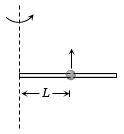
0 likes
View Solution16
EasyMCQ
The maximum speed that can be achieved without skidding by a car on a circular unbanked road of radius $R$ and coefficient of static friction $\mu$ is
A
$\mu Rg$
B
$Rg\sqrt{\mu}$
C
$\mu\sqrt{Rg}$
D
$\sqrt{\mu Rg}$
Solution
(D) For a car moving on a circular unbanked road,the necessary centripetal force is provided by the static frictional force between the tires and the road surface.
Let $m$ be the mass of the car,$v$ be its speed,and $R$ be the radius of the circular path.
The centripetal force required is $F_c = \frac{mv^2}{R}$.
The maximum static frictional force available is $f_{max} = \mu N = \mu mg$,where $N = mg$ is the normal force.
To avoid skidding,the centripetal force must be less than or equal to the maximum static friction:
$\frac{mv^2}{R} \leq \mu mg$
$v^2 \leq \mu Rg$
$v_{max} = \sqrt{\mu Rg}$.
Let $m$ be the mass of the car,$v$ be its speed,and $R$ be the radius of the circular path.
The centripetal force required is $F_c = \frac{mv^2}{R}$.
The maximum static frictional force available is $f_{max} = \mu N = \mu mg$,where $N = mg$ is the normal force.
To avoid skidding,the centripetal force must be less than or equal to the maximum static friction:
$\frac{mv^2}{R} \leq \mu mg$
$v^2 \leq \mu Rg$
$v_{max} = \sqrt{\mu Rg}$.
0 likes
View Solution17
MediumMCQ
$A$ car turns a corner on a slippery road at a constant speed of $10\,m/s$. If the coefficient of friction is $0.5$,the minimum radius of the arc in meters in which the car turns is:
A
$20$
B
$10$
C
$5$
D
$4$
Solution
(A) For a car turning on a flat circular road,the centripetal force is provided by the static friction force.
$F_c = F_f$
$\frac{mv^2}{r} = \mu mg$
$\frac{v^2}{r} = \mu g$
Rearranging for the radius $r$:
$r = \frac{v^2}{\mu g}$
Given values: $v = 10\,m/s$,$\mu = 0.5$,and taking $g = 10\,m/s^2$.
$r = \frac{10^2}{0.5 \times 10} = \frac{100}{5} = 20\,m$.
Thus,the minimum radius is $20\,m$.
$F_c = F_f$
$\frac{mv^2}{r} = \mu mg$
$\frac{v^2}{r} = \mu g$
Rearranging for the radius $r$:
$r = \frac{v^2}{\mu g}$
Given values: $v = 10\,m/s$,$\mu = 0.5$,and taking $g = 10\,m/s^2$.
$r = \frac{10^2}{0.5 \times 10} = \frac{100}{5} = 20\,m$.
Thus,the minimum radius is $20\,m$.
0 likes
View Solution18
MediumMCQ
Assuming the coefficient of friction between the road and tyres of a car to be $0.5$,the maximum speed with which the car can move round a curve of $40.0\, m$ radius without slipping,if the road is unbanked,should be ......... $m/s$.
A
$25$
B
$19$
C
$14$
D
$11$
Solution
(C) For a car moving on an unbanked circular road,the centripetal force required for turning is provided by the static friction between the tyres and the road.
For the car not to slip,the maximum centripetal force must be less than or equal to the maximum static frictional force:
$\frac{mv^2}{r} \leq \mu mg$
$v^2 \leq \mu gr$
$v_{max} = \sqrt{\mu gr}$
Given: $\mu = 0.5$,$r = 40.0\, m$,and taking $g = 9.8\, m/s^2$:
$v_{max} = \sqrt{0.5 \times 9.8 \times 40.0}$
$v_{max} = \sqrt{196}$
$v_{max} = 14\, m/s$.
For the car not to slip,the maximum centripetal force must be less than or equal to the maximum static frictional force:
$\frac{mv^2}{r} \leq \mu mg$
$v^2 \leq \mu gr$
$v_{max} = \sqrt{\mu gr}$
Given: $\mu = 0.5$,$r = 40.0\, m$,and taking $g = 9.8\, m/s^2$:
$v_{max} = \sqrt{0.5 \times 9.8 \times 40.0}$
$v_{max} = \sqrt{196}$
$v_{max} = 14\, m/s$.
0 likes
View Solution19
DifficultMCQ
The maximum speed of a car on a road turn of radius $30\,m$; if the coefficient of friction between the tyres and the road is $0.4$; will be ........ $m/s$. (in $.84$)
A
$9$
B
$10$
C
$7$
D
$5$
Solution
(B) To find the maximum speed of a car on a circular turn without skidding,we use the formula for the maximum safe speed on a flat circular road:
$v_{max} = \sqrt{\mu rg}$
Given:
Radius of the turn,$r = 30\,m$
Coefficient of friction,$\mu = 0.4$
Acceleration due to gravity,$g = 9.8\,m/s^2$
Substituting the values into the formula:
$v_{max} = \sqrt{0.4 \times 30 \times 9.8}$
$v_{max} = \sqrt{12 \times 9.8}$
$v_{max} = \sqrt{117.6}$
$v_{max} \approx 10.84\,m/s$
Therefore,the maximum speed is $10.84\,m/s$.
$v_{max} = \sqrt{\mu rg}$
Given:
Radius of the turn,$r = 30\,m$
Coefficient of friction,$\mu = 0.4$
Acceleration due to gravity,$g = 9.8\,m/s^2$
Substituting the values into the formula:
$v_{max} = \sqrt{0.4 \times 30 \times 9.8}$
$v_{max} = \sqrt{12 \times 9.8}$
$v_{max} = \sqrt{117.6}$
$v_{max} \approx 10.84\,m/s$
Therefore,the maximum speed is $10.84\,m/s$.
0 likes
View Solution20
EasyMCQ
$A$ motorcycle is travelling on a curved track of radius $500\,m$. If the coefficient of friction between the road and tyres is $0.5$,the maximum speed to avoid skidding will be ....... $m/s$. (Take $g = 10\,m/s^2$)
A
$50$
B
$75$
C
$25$
D
$35$
Solution
(A) To avoid skidding on a curved track,the centripetal force required is provided by the static friction between the tyres and the road.
For a motorcycle on a flat curved track,the condition for safe turning without skidding is given by $v \le \sqrt{\mu rg}$.
Given:
Radius $r = 500\,m$
Coefficient of friction $\mu = 0.5$
Acceleration due to gravity $g = 10\,m/s^2$
Substituting the values into the formula:
$v = \sqrt{0.5 \times 500 \times 10}$
$v = \sqrt{2500}$
$v = 50\,m/s$
Therefore,the maximum speed to avoid skidding is $50\,m/s$.
For a motorcycle on a flat curved track,the condition for safe turning without skidding is given by $v \le \sqrt{\mu rg}$.
Given:
Radius $r = 500\,m$
Coefficient of friction $\mu = 0.5$
Acceleration due to gravity $g = 10\,m/s^2$
Substituting the values into the formula:
$v = \sqrt{0.5 \times 500 \times 10}$
$v = \sqrt{2500}$
$v = 50\,m/s$
Therefore,the maximum speed to avoid skidding is $50\,m/s$.
0 likes
View Solution21
EasyMCQ
$A$ gramophone record is rotating with an angular velocity $\omega$. $A$ coin is placed at a distance $r$ from the center of the record. The coefficient of static friction is $\mu$. The coin will revolve with the record if .......
A
$r = \frac{g \mu}{\omega^2}$
B
$r < \frac{\omega^2}{\mu g}$
C
$r \le \frac{\mu g}{\omega^2}$
D
$r \ge \frac{\mu g}{\omega^2}$
Solution
(C) For the coin to revolve with the record without slipping,the required centripetal force must be provided by the static friction force.
The condition for the coin to remain stationary relative to the record is:
$f_s \ge F_c$
where $f_s$ is the static friction force and $F_c$ is the centripetal force.
The maximum static friction force is $f_{s,max} = \mu N = \mu mg$.
The centripetal force required is $F_c = mr\omega^2$.
Therefore,the condition is:
$\mu mg \ge mr\omega^2$
Dividing both sides by $m\omega^2$ (assuming $m \neq 0$ and $\omega \neq 0$):
$r \le \frac{\mu g}{\omega^2}$
The condition for the coin to remain stationary relative to the record is:
$f_s \ge F_c$
where $f_s$ is the static friction force and $F_c$ is the centripetal force.
The maximum static friction force is $f_{s,max} = \mu N = \mu mg$.
The centripetal force required is $F_c = mr\omega^2$.
Therefore,the condition is:
$\mu mg \ge mr\omega^2$
Dividing both sides by $m\omega^2$ (assuming $m \neq 0$ and $\omega \neq 0$):
$r \le \frac{\mu g}{\omega^2}$
0 likes
View Solution22
MediumMCQ
If the coefficient of friction between the tires and the road is $\mu$,the maximum safe speed is $10\;m/s$. If the coefficient of friction becomes $\mu' = \frac{\mu}{2}$,what will be the new maximum safe speed?
A
$5\;m/s$
B
$10\;m/s$
C
$10\sqrt{2}\;m/s$
D
$5\sqrt{2}\;m/s$
Solution
(D) The maximum safe speed $v$ of a vehicle on a circular road is given by the formula $v = \sqrt{\mu rg}$,where $\mu$ is the coefficient of friction,$r$ is the radius of the curve,and $g$ is the acceleration due to gravity.
From this formula,we can see that $v \propto \sqrt{\mu}$.
Given initial conditions: $v_1 = 10\;m/s$ and $\mu_1 = \mu$.
New conditions: $\mu_2 = \frac{\mu}{2}$.
Using the proportionality $v_2 = v_1 \sqrt{\frac{\mu_2}{\mu_1}}$:
$v_2 = 10 \times \sqrt{\frac{\mu/2}{\mu}} = 10 \times \sqrt{\frac{1}{2}} = \frac{10}{\sqrt{2}}$.
Rationalizing the denominator: $v_2 = \frac{10\sqrt{2}}{2} = 5\sqrt{2}\;m/s$.
From this formula,we can see that $v \propto \sqrt{\mu}$.
Given initial conditions: $v_1 = 10\;m/s$ and $\mu_1 = \mu$.
New conditions: $\mu_2 = \frac{\mu}{2}$.
Using the proportionality $v_2 = v_1 \sqrt{\frac{\mu_2}{\mu_1}}$:
$v_2 = 10 \times \sqrt{\frac{\mu/2}{\mu}} = 10 \times \sqrt{\frac{1}{2}} = \frac{10}{\sqrt{2}}$.
Rationalizing the denominator: $v_2 = \frac{10\sqrt{2}}{2} = 5\sqrt{2}\;m/s$.
0 likes
View Solution23
MediumMCQ
What is the maximum safe speed of a car on a flat road of radius $40 \, m$ in $m \, s^{-1}$? The coefficient of friction between the road and the tires is $0.25$. (Take $g = 10 \, m \, s^{-2}$)
A
$40$
B
$20$
C
$15$
D
$10$
Solution
(D) The maximum safe speed $v_{\max}$ on a flat circular road is given by the formula:
$v_{\max} = \sqrt{\mu \, r \, g}$
Given:
Radius $r = 40 \, m$
Coefficient of friction $\mu = 0.25$
Acceleration due to gravity $g = 10 \, m \, s^{-2}$
Substituting the values:
$v_{\max} = \sqrt{0.25 \times 40 \times 10}$
$v_{\max} = \sqrt{100}$
$v_{\max} = 10 \, m \, s^{-1}$
Therefore,the maximum safe speed is $10 \, m \, s^{-1}$.
$v_{\max} = \sqrt{\mu \, r \, g}$
Given:
Radius $r = 40 \, m$
Coefficient of friction $\mu = 0.25$
Acceleration due to gravity $g = 10 \, m \, s^{-2}$
Substituting the values:
$v_{\max} = \sqrt{0.25 \times 40 \times 10}$
$v_{\max} = \sqrt{100}$
$v_{\max} = 10 \, m \, s^{-1}$
Therefore,the maximum safe speed is $10 \, m \, s^{-1}$.
0 likes
View Solution24
EasyMCQ
The maximum safe speed of a car on a flat circular road of radius $4 \; m$ is $4.9 \; m/s$. What is the coefficient of friction between the road and the tires?
A
$0.41$
B
$0.51$
C
$0.71$
D
$0.61$
Solution
(D) Given: Radius $r = 4 \; m$,Maximum speed $v = 4.9 \; m/s$,Acceleration due to gravity $g = 9.8 \; m/s^2$.
For a car moving on a flat circular road,the centripetal force is provided by the static friction force.
Therefore,$F_c = F_f \implies \frac{mv^2}{r} = \mu mg$.
Simplifying for the coefficient of friction $\mu$,we get $\mu = \frac{v^2}{rg}$.
Substituting the values: $\mu = \frac{4.9 \times 4.9}{4 \times 9.8}$.
Since $4.9 / 9.8 = 0.5$,we have $\mu = \frac{4.9 \times 0.5}{4} = \frac{2.45}{4} = 0.6125$.
Rounding to two decimal places,the coefficient of friction is $0.61$.
For a car moving on a flat circular road,the centripetal force is provided by the static friction force.
Therefore,$F_c = F_f \implies \frac{mv^2}{r} = \mu mg$.
Simplifying for the coefficient of friction $\mu$,we get $\mu = \frac{v^2}{rg}$.
Substituting the values: $\mu = \frac{4.9 \times 4.9}{4 \times 9.8}$.
Since $4.9 / 9.8 = 0.5$,we have $\mu = \frac{4.9 \times 0.5}{4} = \frac{2.45}{4} = 0.6125$.
Rounding to two decimal places,the coefficient of friction is $0.61$.
0 likes
View Solution25
MediumMCQ
$A$ bike moving at a speed of $60 \; km/hr$ takes a turn with a radius of $0.1 \; km$. At what angle with the vertical should the bike be tilted to avoid slipping?
A
$\frac{{{{(60)}^2}}}{{0.1}}$
B
${\tan ^{ - 1}}\left[ {\frac{{{{(50/3)}^2}}}{{100 \times 9.8}}} \right]$
C
${\tan ^{ - 1}}\left[ {\frac{{100 \times 9.8}}{{{{(50/3)}^2}}}} \right]$
D
${\tan ^{ - 1}}\sqrt {60 \times 0.1 \times 9.8} $
Solution
(B) Given: Speed $v = 60 \; km/hr = 60 \times \frac{5}{18} \; m/s = \frac{50}{3} \; m/s$.
Radius $r = 0.1 \; km = 100 \; m$.
Acceleration due to gravity $g = 9.8 \; m/s^2$.
For a bike to take a turn without slipping,the angle of banking $\theta$ with the vertical is given by the formula:
$\tan \theta = \frac{v^2}{rg}$.
Substituting the values:
$\tan \theta = \frac{(50/3)^2}{100 \times 9.8}$.
Therefore,$\theta = \tan^{-1} \left[ \frac{(50/3)^2}{100 \times 9.8} \right]$.
Radius $r = 0.1 \; km = 100 \; m$.
Acceleration due to gravity $g = 9.8 \; m/s^2$.
For a bike to take a turn without slipping,the angle of banking $\theta$ with the vertical is given by the formula:
$\tan \theta = \frac{v^2}{rg}$.
Substituting the values:
$\tan \theta = \frac{(50/3)^2}{100 \times 9.8}$.
Therefore,$\theta = \tan^{-1} \left[ \frac{(50/3)^2}{100 \times 9.8} \right]$.
0 likes
View Solution26
MediumMCQ
The distance between the two tires of a car is $1.5 \, m$. The center of mass of the car is at a height of $2 \, m$ from the ground. To take a turn on a road with a radius of $120 \, m$,the speed of the car should be ........ $m/s$.
A
$10.5$
B
$42$
C
$21$
D
$84$
Solution
(C) Given: Height of center of mass $h = 2 \, m$,acceleration due to gravity $g = 10 \, m/s^2$,distance between tires $2a = 1.5 \, m$ (so $a = 0.75 \, m$),and radius of the turn $r = 120 \, m$.
The condition to avoid overturning while taking a turn is given by the formula $v_{\max} = \sqrt{\frac{g \cdot r \cdot a}{h}}$.
Substituting the values: $v_{\max} = \sqrt{\frac{10 \times 120 \times 0.75}{2}}$.
$v_{\max} = \sqrt{\frac{900}{2}} = \sqrt{450} \approx 21.2 \, m/s$.
Rounding to the nearest integer provided in the options,the correct speed is $21 \, m/s$.
The condition to avoid overturning while taking a turn is given by the formula $v_{\max} = \sqrt{\frac{g \cdot r \cdot a}{h}}$.
Substituting the values: $v_{\max} = \sqrt{\frac{10 \times 120 \times 0.75}{2}}$.
$v_{\max} = \sqrt{\frac{900}{2}} = \sqrt{450} \approx 21.2 \, m/s$.
Rounding to the nearest integer provided in the options,the correct speed is $21 \, m/s$.
0 likes
View Solution27
DifficultMCQ
The maximum safe speed of a car on a horizontal road with a radius of $500\,m$ and a coefficient of friction of $0.5$ is ...... $m/s$.
A
$50$
B
$75$
C
$25$
D
$35$
Solution
(A) The maximum safe speed $v$ on a horizontal curved road is given by the formula $v = \sqrt{\mu rg}$.
Given:
Radius $r = 500\,m$
Coefficient of friction $\mu = 0.5$
Acceleration due to gravity $g = 10\,m/s^2$
Substituting the values:
$v = \sqrt{0.5 \times 500 \times 10}$
$v = \sqrt{2500}$
$v = 50\,m/s$.
Given:
Radius $r = 500\,m$
Coefficient of friction $\mu = 0.5$
Acceleration due to gravity $g = 10\,m/s^2$
Substituting the values:
$v = \sqrt{0.5 \times 500 \times 10}$
$v = \sqrt{2500}$
$v = 50\,m/s$.
0 likes
View Solution28
DifficultMCQ
$A$ car is negotiating a curved road of radius $R$. The road is banked at an angle $\theta$. The coefficient of friction between the tyres of the car and the road is $\mu_s$. The maximum safe velocity on this road is
A
$\sqrt{gR\frac{\mu_s + \tan\theta}{1 - \mu_s\tan\theta}}$
B
$\sqrt{\frac{g}{R}\frac{\mu_s + \tan\theta}{1 - \mu_s\tan\theta}}$
C
$\frac{g}{R^2}\frac{\mu_s + \tan\theta}{1 - \mu_s\tan\theta}$
D
$\sqrt{gR^2\frac{\mu_s + \tan\theta}{1 - \mu_s\tan\theta}}$
Solution
(A) For vertical equilibrium on the road:
$N \cos\theta = mg + f \sin\theta$
$mg = N \cos\theta - f \sin\theta$ ... $(i)$
For safe turning,the centripetal force is provided by the horizontal components of the normal force and friction:
$N \sin\theta + f \cos\theta = \frac{mv^2}{R}$ ... $(ii)$
Dividing equation $(ii)$ by equation $(i)$:
$\frac{v^2}{Rg} = \frac{N \sin\theta + f \cos\theta}{N \cos\theta - f \sin\theta}$
At maximum velocity,the friction force $f$ reaches its limiting value,$f = \mu_s N$. Substituting this into the equation:
$\frac{v_{\max}^2}{Rg} = \frac{N \sin\theta + \mu_s N \cos\theta}{N \cos\theta - \mu_s N \sin\theta}$
Dividing the numerator and denominator by $N \cos\theta$:
$\frac{v_{\max}^2}{Rg} = \frac{\tan\theta + \mu_s}{1 - \mu_s \tan\theta}$
Therefore,the maximum safe velocity is:
$v_{\max} = \sqrt{gR \left( \frac{\mu_s + \tan\theta}{1 - \mu_s \tan\theta} \right)}$
$N \cos\theta = mg + f \sin\theta$
$mg = N \cos\theta - f \sin\theta$ ... $(i)$
For safe turning,the centripetal force is provided by the horizontal components of the normal force and friction:
$N \sin\theta + f \cos\theta = \frac{mv^2}{R}$ ... $(ii)$
Dividing equation $(ii)$ by equation $(i)$:
$\frac{v^2}{Rg} = \frac{N \sin\theta + f \cos\theta}{N \cos\theta - f \sin\theta}$
At maximum velocity,the friction force $f$ reaches its limiting value,$f = \mu_s N$. Substituting this into the equation:
$\frac{v_{\max}^2}{Rg} = \frac{N \sin\theta + \mu_s N \cos\theta}{N \cos\theta - \mu_s N \sin\theta}$
Dividing the numerator and denominator by $N \cos\theta$:
$\frac{v_{\max}^2}{Rg} = \frac{\tan\theta + \mu_s}{1 - \mu_s \tan\theta}$
Therefore,the maximum safe velocity is:
$v_{\max} = \sqrt{gR \left( \frac{\mu_s + \tan\theta}{1 - \mu_s \tan\theta} \right)}$
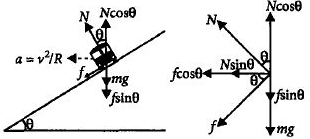
0 likes
View Solution29
MediumMCQ
$A$ cyclist on a level road takes a sharp circular turn of radius $3 \; m$ $(g = 10 \; m \cdot s^{-2})$. If the coefficient of static friction between the cycle tyres and the road is $0.2$,at which of the following speeds will the cyclist not skid while taking the turn?
A
$9 \; km \cdot h^{-1}$
B
$7.2 \; km \cdot h^{-1}$
C
$10.8 \; km \cdot h^{-1}$
D
$14.4 \; km \cdot h^{-1}$
Solution
(B) The maximum speed $v_{m}$ at which the cyclist will not skid is given by the formula $v_{m} = \sqrt{\mu r g}$.
Substituting the given values: $\mu = 0.2$,$r = 3 \; m$,and $g = 10 \; m \cdot s^{-2}$.
$v_{m} = \sqrt{0.2 \times 3 \times 10} = \sqrt{6} \approx 2.45 \; m \cdot s^{-1}$.
To convert this speed into $km \cdot h^{-1}$,we multiply by $\frac{18}{5}$:
$v_{m} = 2.45 \times 3.6 = 8.82 \; km \cdot h^{-1}$.
The cyclist will not skid if their speed is less than or equal to $8.82 \; km \cdot h^{-1}$.
Among the given options,$7.2 \; km \cdot h^{-1}$ is the only speed less than $8.82 \; km \cdot h^{-1}$.
Substituting the given values: $\mu = 0.2$,$r = 3 \; m$,and $g = 10 \; m \cdot s^{-2}$.
$v_{m} = \sqrt{0.2 \times 3 \times 10} = \sqrt{6} \approx 2.45 \; m \cdot s^{-1}$.
To convert this speed into $km \cdot h^{-1}$,we multiply by $\frac{18}{5}$:
$v_{m} = 2.45 \times 3.6 = 8.82 \; km \cdot h^{-1}$.
The cyclist will not skid if their speed is less than or equal to $8.82 \; km \cdot h^{-1}$.
Among the given options,$7.2 \; km \cdot h^{-1}$ is the only speed less than $8.82 \; km \cdot h^{-1}$.
0 likes
View Solution30
MediumMCQ
$A$ gramophone record is revolving with an angular velocity $\omega$. $A$ coin is placed at a distance $r$ from the centre of the record. The static coefficient of friction is $\mu$. The coin will revolve with the record if
A
$r = \mu g \omega^2$
B
$r < \frac{\omega^2}{\mu g}$
C
$r \le \frac{\mu g}{\omega^2}$
D
$r \ge \frac{\mu g}{\omega^2}$
Solution
(C) For the coin to revolve with the record without slipping,the required centripetal force must be provided by the static friction force.
The centripetal force required is $F_c = mr\omega^2$.
The maximum static friction force available is $f_{s,max} = \mu N = \mu mg$.
For the coin to stay in place,the friction force must be greater than or equal to the required centripetal force:
$f_{s,max} \ge F_c$
$\mu mg \ge mr\omega^2$
Dividing both sides by $m\omega^2$ (where $m$ is the mass of the coin),we get:
$r \le \frac{\mu g}{\omega^2}$
The centripetal force required is $F_c = mr\omega^2$.
The maximum static friction force available is $f_{s,max} = \mu N = \mu mg$.
For the coin to stay in place,the friction force must be greater than or equal to the required centripetal force:
$f_{s,max} \ge F_c$
$\mu mg \ge mr\omega^2$
Dividing both sides by $m\omega^2$ (where $m$ is the mass of the coin),we get:
$r \le \frac{\mu g}{\omega^2}$
0 likes
View Solution31
MediumMCQ
$A$ car of mass $m$ is moving on a level circular track of radius $R.$ If $\mu_s$ represents the static friction between the road and tyres of the car,the maximum speed of the car in circular motion is given by
A
$\mu_s Rg$
B
$Rg\sqrt{\mu_s}$
C
$\mu_s\sqrt{Rg}$
D
$\sqrt{\mu_s Rg}$
Solution
(D) The necessary centripetal force for circular motion is provided by the static friction between the road and the tyres.
The condition for the car not to skid is $f \leq \mu_s N$.
Since the track is level,the normal force $N = mg$.
The centripetal force required is $F_c = \frac{mv^2}{R}$.
Equating the maximum friction to the centripetal force: $\mu_s mg = \frac{mv_{max}^2}{R}$.
Solving for $v_{max}$:
$v_{max}^2 = \mu_s Rg$
$v_{max} = \sqrt{\mu_s Rg}$.
The condition for the car not to skid is $f \leq \mu_s N$.
Since the track is level,the normal force $N = mg$.
The centripetal force required is $F_c = \frac{mv^2}{R}$.
Equating the maximum friction to the centripetal force: $\mu_s mg = \frac{mv_{max}^2}{R}$.
Solving for $v_{max}$:
$v_{max}^2 = \mu_s Rg$
$v_{max} = \sqrt{\mu_s Rg}$.
0 likes
View Solution32
EasyMCQ
$A$ cyclist moves on a circular track of radius $100 \ m$. If the coefficient of friction is $0.2$,then the maximum velocity with which the cyclist can take the turn while leaning inwards is ...... $m/s$.
A
$9.8$
B
$1.4$
C
$140$
D
$14$
Solution
(D) The maximum velocity $v$ for a cyclist to take a turn on a circular track of radius $r$ with a coefficient of friction $\mu$ is given by the formula $v = \sqrt{\mu r g}$.
Given:
Radius $r = 100 \ m$
Coefficient of friction $\mu = 0.2$
Acceleration due to gravity $g = 10 \ m/s^2$
Substituting the values:
$v = \sqrt{0.2 \times 100 \times 10}$
$v = \sqrt{20 \times 10}$
$v = \sqrt{200}$
$v = 10\sqrt{2} \approx 14.14 \ m/s$.
Rounding to the nearest integer provided in the options,the correct velocity is $14 \ m/s$.
Given:
Radius $r = 100 \ m$
Coefficient of friction $\mu = 0.2$
Acceleration due to gravity $g = 10 \ m/s^2$
Substituting the values:
$v = \sqrt{0.2 \times 100 \times 10}$
$v = \sqrt{20 \times 10}$
$v = \sqrt{200}$
$v = 10\sqrt{2} \approx 14.14 \ m/s$.
Rounding to the nearest integer provided in the options,the correct velocity is $14 \ m/s$.
0 likes
View Solution33
MediumMCQ
$A$ motor car has a width of $1.1 \ m$ between its wheels. Its center of gravity is $0.62 \ m$ above the ground and the coefficient of friction between the wheels and the road is $0.8$. What is the maximum possible speed in $m/s$ if the center of gravity moves in a circle of radius $15 \ m$ on a horizontal road surface?
A
$7.64$
B
$6.28$
C
$10.84$
D
$11.23$
Solution
(C) For a car moving on a horizontal circular path,the limiting factor for speed is either skidding or overturning.
$1$. Condition for skidding: The centripetal force is provided by friction,so $mv^2/r \leq \mu mg$,which gives $v \leq \sqrt{\mu gr}$.
Substituting the values: $v = \sqrt{0.8 \times 9.8 \times 15} = \sqrt{117.6} \approx 10.84 \ m/s$.
$2$. Condition for overturning: The car will overturn if the torque due to centripetal force about the outer wheels exceeds the torque due to gravity. The condition is $v \leq \sqrt{gr(w/2h)}$,where $w = 1.1 \ m$ and $h = 0.62 \ m$.
$v \leq \sqrt{9.8 \times 15 \times (1.1 / (2 \times 0.62))} = \sqrt{147 \times 0.887} \approx \sqrt{130.4} \approx 11.42 \ m/s$.
Since the speed must satisfy both conditions,the maximum safe speed is the smaller of the two values,which is $10.84 \ m/s$.
$1$. Condition for skidding: The centripetal force is provided by friction,so $mv^2/r \leq \mu mg$,which gives $v \leq \sqrt{\mu gr}$.
Substituting the values: $v = \sqrt{0.8 \times 9.8 \times 15} = \sqrt{117.6} \approx 10.84 \ m/s$.
$2$. Condition for overturning: The car will overturn if the torque due to centripetal force about the outer wheels exceeds the torque due to gravity. The condition is $v \leq \sqrt{gr(w/2h)}$,where $w = 1.1 \ m$ and $h = 0.62 \ m$.
$v \leq \sqrt{9.8 \times 15 \times (1.1 / (2 \times 0.62))} = \sqrt{147 \times 0.887} \approx \sqrt{130.4} \approx 11.42 \ m/s$.
Since the speed must satisfy both conditions,the maximum safe speed is the smaller of the two values,which is $10.84 \ m/s$.
0 likes
View Solution34
MediumMCQ
$A$ man is standing on a rough $(\mu = 0.5)$ horizontal disc rotating with a constant angular velocity of $5 \ rad/s$. At what distance from the center should he stand so that he does not slip on the disc?
A
$R \leq 0.2 \ m$
B
$R > 0.2 \ m$
C
$R > 0.5 \ m$
D
$R > 0.3 \ m$
Solution
(A) To prevent slipping,the required centripetal force must be provided by the static frictional force.
The condition for no slipping is: $F_c \leq f_s$
Where $F_c = m R \omega^2$ is the centripetal force and $f_s \leq \mu N$ is the maximum static friction.
Since the disc is horizontal,the normal force $N = mg$.
Therefore,$m R \omega^2 \leq \mu mg$.
Canceling mass $m$ from both sides,we get $R \omega^2 \leq \mu g$.
Solving for $R$,we get $R \leq \frac{\mu g}{\omega^2}$.
Given $\mu = 0.5$,$\omega = 5 \ rad/s$,and taking $g = 10 \ m/s^2$:
$R \leq \frac{0.5 \times 10}{5^2} = \frac{5}{25} = 0.2 \ m$.
Thus,the man must stand at a distance $R \leq 0.2 \ m$ from the center.
The condition for no slipping is: $F_c \leq f_s$
Where $F_c = m R \omega^2$ is the centripetal force and $f_s \leq \mu N$ is the maximum static friction.
Since the disc is horizontal,the normal force $N = mg$.
Therefore,$m R \omega^2 \leq \mu mg$.
Canceling mass $m$ from both sides,we get $R \omega^2 \leq \mu g$.
Solving for $R$,we get $R \leq \frac{\mu g}{\omega^2}$.
Given $\mu = 0.5$,$\omega = 5 \ rad/s$,and taking $g = 10 \ m/s^2$:
$R \leq \frac{0.5 \times 10}{5^2} = \frac{5}{25} = 0.2 \ m$.
Thus,the man must stand at a distance $R \leq 0.2 \ m$ from the center.
0 likes
View Solution35
DifficultMCQ
$A$ car moves along a circular track of radius $R$ banked at an angle of $30^o$ to the horizontal. The coefficient of static friction between the wheels and the track is $\mu$. The maximum speed with which the car can move without skidding out is
A
${[gR(\mu + \tan \theta) / (1 - \mu \tan \theta)]}^{1/2}$
B
${[gR(1 - \mu \tan \theta) / (\mu + \tan \theta)]}^{1/2}$
C
${[gR(\mu + \sqrt{3}) / (1 - \mu \sqrt{3})]}^{1/2}$
D
None
Solution
(D) For a car moving on a banked circular track with friction,the maximum speed $v_{max}$ is given by the formula:
$v_{max} = \sqrt{gR \left( \frac{\mu + \tan \theta}{1 - \mu \tan \theta} \right)}$
Given the banking angle $\theta = 30^o$,we know that $\tan 30^o = \frac{1}{\sqrt{3}}$.
Substituting this into the formula:
$v_{max} = \sqrt{gR \left( \frac{\mu + \frac{1}{\sqrt{3}}}{1 - \mu \frac{1}{\sqrt{3}}} \right)}$
Multiplying the numerator and denominator inside the square root by $\sqrt{3}$:
$v_{max} = \sqrt{gR \left( \frac{\mu \sqrt{3} + 1}{\sqrt{3} - \mu} \right)}$
Comparing this with the given options,none of the provided expressions match this result. Therefore,the correct choice is $D$.
$v_{max} = \sqrt{gR \left( \frac{\mu + \tan \theta}{1 - \mu \tan \theta} \right)}$
Given the banking angle $\theta = 30^o$,we know that $\tan 30^o = \frac{1}{\sqrt{3}}$.
Substituting this into the formula:
$v_{max} = \sqrt{gR \left( \frac{\mu + \frac{1}{\sqrt{3}}}{1 - \mu \frac{1}{\sqrt{3}}} \right)}$
Multiplying the numerator and denominator inside the square root by $\sqrt{3}$:
$v_{max} = \sqrt{gR \left( \frac{\mu \sqrt{3} + 1}{\sqrt{3} - \mu} \right)}$
Comparing this with the given options,none of the provided expressions match this result. Therefore,the correct choice is $D$.
0 likes
View Solution36
DifficultMCQ
$A$ particle is moving along the circle $x^2 + y^2 = a^2$ in an anticlockwise direction. The $x-y$ plane is a rough horizontal stationary surface. At the point $(a \cos \theta, a \sin \theta)$,the unit vector in the direction of friction on the particle is:
A
$\cos \theta \hat{i} + \sin \theta \hat{j}$
B
$-\left( \cos \theta \hat{i} + \sin \theta \hat{j} \right)$
C
$\sin \theta \hat{i} - \cos \theta \hat{j}$
D
$\cos \theta \hat{i} - \sin \theta \hat{j}$
Solution
(C) The position vector of the particle at point $P(a \cos \theta, a \sin \theta)$ is $\vec{r} = a \cos \theta \hat{i} + a \sin \theta \hat{j}$.
The unit radial vector is $\hat{r} = \cos \theta \hat{i} + \sin \theta \hat{j}$.
Since the particle is moving in a circle,the velocity vector $\vec{v}$ is tangent to the circle. The direction of motion is anticlockwise,so the velocity vector is in the direction of $\hat{\theta} = -\sin \theta \hat{i} + \cos \theta \hat{j}$.
Friction acts in the direction opposite to the velocity of the particle. Therefore,the direction of friction is $-\hat{\theta} = \sin \theta \hat{i} - \cos \theta \hat{j}$.
The unit radial vector is $\hat{r} = \cos \theta \hat{i} + \sin \theta \hat{j}$.
Since the particle is moving in a circle,the velocity vector $\vec{v}$ is tangent to the circle. The direction of motion is anticlockwise,so the velocity vector is in the direction of $\hat{\theta} = -\sin \theta \hat{i} + \cos \theta \hat{j}$.
Friction acts in the direction opposite to the velocity of the particle. Therefore,the direction of friction is $-\hat{\theta} = \sin \theta \hat{i} - \cos \theta \hat{j}$.
0 likes
View Solution37
DifficultMCQ
$A$ particle on the inner rough surface of a cone rotating about its vertical axis is at rest relative to the cone at a height of $1 \ m$ above its vertex. If the coefficient of friction is $\mu = 0.5$ and the semi-vertical angle of the cone is $45^\circ$,what is the maximum angular velocity $\omega$ of the cone?
A
$\sqrt{10} \ \text{rad/s}$
B
$\sqrt{30} \ \text{rad/s}$
C
$\frac{\sqrt{40}}{3} \ \text{rad/s}$
D
$\sqrt{50} \ \text{rad/s}$
Solution
(B) Let $m$ be the mass of the particle,$r$ be the radius of the circular path,$\omega$ be the angular velocity,and $\theta = 45^\circ$ be the semi-vertical angle. The height $h = 1 \ m$. Since $\tan \theta = r/h$,we have $r = h \tan 45^\circ = 1 \ m$.
For maximum angular velocity,the friction force $f = \mu N$ acts downwards along the slant surface to prevent the particle from sliding up.
The forces acting on the particle are: Normal force $N$ perpendicular to the surface,gravitational force $mg$ downwards,and friction $f = \mu N$ downwards along the slope.
Resolving forces horizontally: $N \sin \theta + f \cos \theta = m \omega^2 r$.
Resolving forces vertically: $N \cos \theta - f \sin \theta = mg$.
Substituting $f = \mu N$: $N(\sin \theta + \mu \cos \theta) = m \omega^2 r$ and $N(\cos \theta - \mu \sin \theta) = mg$.
Dividing the two equations: $\frac{\sin \theta + \mu \cos \theta}{\cos \theta - \mu \sin \theta} = \frac{\omega^2 r}{g}$.
Given $\theta = 45^\circ$,$\sin 45^\circ = \cos 45^\circ = 1/\sqrt{2}$,and $\mu = 0.5$:
$\frac{1/\sqrt{2} + 0.5/\sqrt{2}}{1/\sqrt{2} - 0.5/\sqrt{2}} = \frac{\omega^2 (1)}{10} \implies \frac{1.5}{0.5} = \frac{\omega^2}{10} \implies 3 = \frac{\omega^2}{10}$.
Thus,$\omega^2 = 30$,so $\omega = \sqrt{30} \ \text{rad/s}$.
For maximum angular velocity,the friction force $f = \mu N$ acts downwards along the slant surface to prevent the particle from sliding up.
The forces acting on the particle are: Normal force $N$ perpendicular to the surface,gravitational force $mg$ downwards,and friction $f = \mu N$ downwards along the slope.
Resolving forces horizontally: $N \sin \theta + f \cos \theta = m \omega^2 r$.
Resolving forces vertically: $N \cos \theta - f \sin \theta = mg$.
Substituting $f = \mu N$: $N(\sin \theta + \mu \cos \theta) = m \omega^2 r$ and $N(\cos \theta - \mu \sin \theta) = mg$.
Dividing the two equations: $\frac{\sin \theta + \mu \cos \theta}{\cos \theta - \mu \sin \theta} = \frac{\omega^2 r}{g}$.
Given $\theta = 45^\circ$,$\sin 45^\circ = \cos 45^\circ = 1/\sqrt{2}$,and $\mu = 0.5$:
$\frac{1/\sqrt{2} + 0.5/\sqrt{2}}{1/\sqrt{2} - 0.5/\sqrt{2}} = \frac{\omega^2 (1)}{10} \implies \frac{1.5}{0.5} = \frac{\omega^2}{10} \implies 3 = \frac{\omega^2}{10}$.
Thus,$\omega^2 = 30$,so $\omega = \sqrt{30} \ \text{rad/s}$.
0 likes
View Solution38
MediumMCQ
$A$ hollow vertical cylinder of radius $R$ is rotated with angular velocity $\omega$ about an axis through its center. What is the minimum coefficient of static friction necessary to keep the mass $M$ suspended on the inside of the cylinder as it rotates?
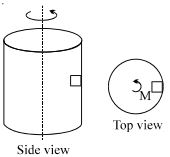
A
$\mu = \frac{gR}{\omega^2}$
B
$\mu = \frac{\omega^2 g}{R}$
C
$\mu = \frac{\omega^2 R}{g}$
D
$\mu = \frac{g}{\omega^2 R}$
Solution
(D) For the mass $M$ to remain suspended on the inner wall of the rotating cylinder,the upward frictional force $f_s$ must balance the downward gravitational force $mg$.
$f_s \geqslant mg$
Since the frictional force $f_s = \mu N$,where $N$ is the normal force provided by the wall of the cylinder,we have:
$\mu N \geqslant mg$
The normal force $N$ provides the necessary centripetal force for the mass $M$ to move in a circle of radius $R$ with angular velocity $\omega$:
$N = M R \omega^2$
Substituting this into the inequality:
$\mu (M R \omega^2) \geqslant Mg$
$\mu \geqslant \frac{g}{R \omega^2}$
Therefore,the minimum coefficient of static friction is:
$\mu_{\min} = \frac{g}{R \omega^2}$
$f_s \geqslant mg$
Since the frictional force $f_s = \mu N$,where $N$ is the normal force provided by the wall of the cylinder,we have:
$\mu N \geqslant mg$
The normal force $N$ provides the necessary centripetal force for the mass $M$ to move in a circle of radius $R$ with angular velocity $\omega$:
$N = M R \omega^2$
Substituting this into the inequality:
$\mu (M R \omega^2) \geqslant Mg$
$\mu \geqslant \frac{g}{R \omega^2}$
Therefore,the minimum coefficient of static friction is:
$\mu_{\min} = \frac{g}{R \omega^2}$
0 likes
View Solution39
DifficultMCQ
$A$ small mass $m$ rests at the edge of a horizontal disc of radius $R$. The coefficient of static friction between the mass and the disc is $\mu$. The disc is rotated about its axis at an angular velocity such that the mass slides off the disc and lands on the floor $h$ meters below. What was its horizontal distance of travel from the point it left the disc?
A
$\sqrt{\mu h}$
B
$\sqrt{\mu (R + h)^2}$
C
$\sqrt{\mu Rh}$
D
$\sqrt{2\mu Rh}$
Solution
(D) The mass slides off when the centripetal force required exceeds the maximum static frictional force.
$\frac{mv^2}{R} = \mu mg$
$v = \sqrt{\mu Rg}$
Once the mass leaves the disc,it undergoes projectile motion with an initial horizontal velocity $v$ and zero initial vertical velocity.
The time taken to fall a height $h$ is given by $h = \frac{1}{2}gt^2$,so $t = \sqrt{\frac{2h}{g}}$.
The horizontal distance $d$ traveled is $d = v \times t$.
$d = \sqrt{\mu Rg} \times \sqrt{\frac{2h}{g}} = \sqrt{2\mu Rh}$.
$\frac{mv^2}{R} = \mu mg$
$v = \sqrt{\mu Rg}$
Once the mass leaves the disc,it undergoes projectile motion with an initial horizontal velocity $v$ and zero initial vertical velocity.
The time taken to fall a height $h$ is given by $h = \frac{1}{2}gt^2$,so $t = \sqrt{\frac{2h}{g}}$.
The horizontal distance $d$ traveled is $d = v \times t$.
$d = \sqrt{\mu Rg} \times \sqrt{\frac{2h}{g}} = \sqrt{2\mu Rh}$.
0 likes
View Solution40
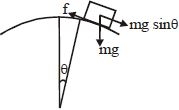
DifficultMCQ
$A$ particle moves on a circular overbridge with constant speed. The friction coefficient varies so that the speed remains constant. Which of the following graphs shows the magnitude of friction $f$ versus the angle $\theta$?
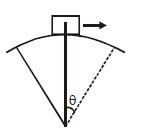
A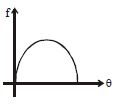
B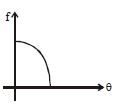
C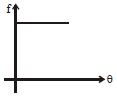
D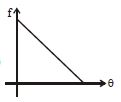
Solution
(A) For a particle moving on a circular overbridge with constant speed,the forces acting along the tangent to the path are the component of gravity $mg \sin \theta$ and the frictional force $f$.
Since the speed is constant,the net tangential force must be zero.
Therefore,the frictional force must balance the tangential component of gravity:
$f = mg \sin \theta$
As $\theta$ increases from $0$ to $\pi/2$,the value of $\sin \theta$ increases from $0$ to $1$.
Thus,the magnitude of friction $f$ increases with $\theta$ following a sine curve.
Looking at the provided options,the graph that represents $f = mg \sin \theta$ is the one that starts from zero at $\theta = 0$ and increases.
Since the speed is constant,the net tangential force must be zero.
Therefore,the frictional force must balance the tangential component of gravity:
$f = mg \sin \theta$
As $\theta$ increases from $0$ to $\pi/2$,the value of $\sin \theta$ increases from $0$ to $1$.
Thus,the magnitude of friction $f$ increases with $\theta$ following a sine curve.
Looking at the provided options,the graph that represents $f = mg \sin \theta$ is the one that starts from zero at $\theta = 0$ and increases.
0 likes
View Solution41
MediumMCQ
$A$ cyclist is travelling with velocity $v$ on a curved road of radius $R$. The angle $\theta$ through which the cyclist leans inwards is given by
A
$\tan \theta = \frac{Rg}{v^2}$
B
$\tan \theta = v^2 Rg$
C
$\tan \theta = \frac{v^2 g}{R}$
D
$\tan \theta = \frac{v^2}{Rg}$
Solution
(D) When a cyclist turns on a curved road,they must lean inwards to maintain balance against the centrifugal force.
Let $m$ be the mass of the cyclist,$v$ be the velocity,and $R$ be the radius of the curve.
The vertical component of the normal force $N$ balances the weight of the cyclist: $N \cos \theta = mg$.
The horizontal component of the normal force provides the necessary centripetal force: $N \sin \theta = \frac{mv^2}{R}$.
Dividing the second equation by the first,we get: $\frac{N \sin \theta}{N \cos \theta} = \frac{mv^2 / R}{mg}$.
Therefore,$\tan \theta = \frac{v^2}{Rg}$.
Let $m$ be the mass of the cyclist,$v$ be the velocity,and $R$ be the radius of the curve.
The vertical component of the normal force $N$ balances the weight of the cyclist: $N \cos \theta = mg$.
The horizontal component of the normal force provides the necessary centripetal force: $N \sin \theta = \frac{mv^2}{R}$.
Dividing the second equation by the first,we get: $\frac{N \sin \theta}{N \cos \theta} = \frac{mv^2 / R}{mg}$.
Therefore,$\tan \theta = \frac{v^2}{Rg}$.
0 likes
View Solution42
DifficultMCQ
$A$ circular road of radius $1000\, m$ has a banking angle of $45^o$. The maximum safe speed of a car having a mass of $2000\, kg$ will be,if the coefficient of friction between the tyre and the road is $0.5$.
A
$100\sqrt{3} \, m/s$
B
$124 \, m/s$
C
$172 \, m/s$
D
$86 \, m/s$
Solution
(C) The formula for the maximum safe speed $v$ on a banked road with friction is given by:
$v = \sqrt{gr \left( \frac{\mu + \tan \theta}{1 - \mu \tan \theta} \right)}$
Given:
Radius $r = 1000 \, m$
Banking angle $\theta = 45^o$
Coefficient of friction $\mu = 0.5$
Acceleration due to gravity $g = 9.8 \, m/s^2$
Substituting the values:
$v^2 = 9.8 \times 1000 \times \left( \frac{0.5 + \tan 45^o}{1 - 0.5 \times \tan 45^o} \right)$
Since $\tan 45^o = 1$:
$v^2 = 9800 \times \left( \frac{0.5 + 1}{1 - 0.5 \times 1} \right)$
$v^2 = 9800 \times \left( \frac{1.5}{0.5} \right)$
$v^2 = 9800 \times 3 = 29400$
$v = \sqrt{29400} \approx 171.46 \, m/s \approx 172 \, m/s$.
$v = \sqrt{gr \left( \frac{\mu + \tan \theta}{1 - \mu \tan \theta} \right)}$
Given:
Radius $r = 1000 \, m$
Banking angle $\theta = 45^o$
Coefficient of friction $\mu = 0.5$
Acceleration due to gravity $g = 9.8 \, m/s^2$
Substituting the values:
$v^2 = 9.8 \times 1000 \times \left( \frac{0.5 + \tan 45^o}{1 - 0.5 \times \tan 45^o} \right)$
Since $\tan 45^o = 1$:
$v^2 = 9800 \times \left( \frac{0.5 + 1}{1 - 0.5 \times 1} \right)$
$v^2 = 9800 \times \left( \frac{1.5}{0.5} \right)$
$v^2 = 9800 \times 3 = 29400$
$v = \sqrt{29400} \approx 171.46 \, m/s \approx 172 \, m/s$.
0 likes
View Solution43
DifficultMCQ
The maximum tension which an inextensible ring of mass $0.1\, kg/m$ can bear is $10\,N$. The maximum velocity in $m/s$ with which it can be rotated is ........ $m/s.$
A
$10$
B
$\sqrt{10}$
C
$20$
D
$15$
Solution
(A) For a rotating ring,the tension $T$ in the ring is related to its linear velocity $v$ and linear mass density $\mu$ by the formula $T = \mu v^2$.
Given,$T = 10\, N$ and $\mu = 0.1\, kg/m$.
Rearranging the formula to solve for $v$,we get $v = \sqrt{\frac{T}{\mu}}$.
Substituting the given values: $v = \sqrt{\frac{10}{0.1}} = \sqrt{100}$.
Therefore,the maximum velocity is $v = 10\, m/s$.
Given,$T = 10\, N$ and $\mu = 0.1\, kg/m$.
Rearranging the formula to solve for $v$,we get $v = \sqrt{\frac{T}{\mu}}$.
Substituting the given values: $v = \sqrt{\frac{10}{0.1}} = \sqrt{100}$.
Therefore,the maximum velocity is $v = 10\, m/s$.
0 likes
View Solution44
DifficultMCQ
In a motorcycle stunt called the "well of death",the track is a vertical cylindrical surface of $18\, m$ diameter. What should be the minimum speed of the motorcyclist in $m/s$ to prevent him from sliding down? The coefficient of friction is $0.8$ and take $g = 10\, m/s^2$.
A
$9.8$
B
$10.5$
C
$100$
D
$50$
Solution
(B) For a motorcyclist to stay on the vertical wall of the "well of death" without sliding down,the frictional force must balance the gravitational force.
$f = mg$
Since $f = \mu N$ and the normal force $N$ provides the centripetal force $N = \frac{mv^2}{r}$,we have:
$\mu \left( \frac{mv^2}{r} \right) = mg$
$v^2 = \frac{rg}{\mu}$
$v = \sqrt{\frac{rg}{\mu}}$
Given diameter $d = 18\, m$,so radius $r = 9\, m$.
Given $\mu = 0.8$ and $g = 10\, m/s^2$.
$v = \sqrt{\frac{9 \times 10}{0.8}} = \sqrt{\frac{90}{0.8}} = \sqrt{112.5} \approx 10.6\, m/s$.
Rounding to the nearest provided option,the minimum speed is $10.5\, m/s$.
$f = mg$
Since $f = \mu N$ and the normal force $N$ provides the centripetal force $N = \frac{mv^2}{r}$,we have:
$\mu \left( \frac{mv^2}{r} \right) = mg$
$v^2 = \frac{rg}{\mu}$
$v = \sqrt{\frac{rg}{\mu}}$
Given diameter $d = 18\, m$,so radius $r = 9\, m$.
Given $\mu = 0.8$ and $g = 10\, m/s^2$.
$v = \sqrt{\frac{9 \times 10}{0.8}} = \sqrt{\frac{90}{0.8}} = \sqrt{112.5} \approx 10.6\, m/s$.
Rounding to the nearest provided option,the minimum speed is $10.5\, m/s$.
0 likes
View Solution45
MediumMCQ
$A$ vehicle is moving with a velocity $v$ on a curved road of width $b$ and radius of curvature $R$. For counteracting the centrifugal force on the vehicle,the difference in elevation required between the outer and inner edges of the road is
A
$v^2b / Rg$
B
$vb / Rg$
C
$vb^2 / Rg$
D
$vb / R^2g$
Solution
(A) For a vehicle moving on a banked curved road,the condition for banking is given by $\tan \theta = \frac{v^2}{Rg}$.
Here,$v$ is the velocity,$R$ is the radius of curvature,and $b$ is the width of the road.
Let $h$ be the elevation difference between the outer and inner edges.
For small angles of banking,$\tan \theta \approx \sin \theta = \frac{h}{b}$.
Equating the two expressions for $\tan \theta$,we get $\frac{h}{b} = \frac{v^2}{Rg}$.
Therefore,the required elevation difference is $h = \frac{v^2b}{Rg}$.
Here,$v$ is the velocity,$R$ is the radius of curvature,and $b$ is the width of the road.
Let $h$ be the elevation difference between the outer and inner edges.
For small angles of banking,$\tan \theta \approx \sin \theta = \frac{h}{b}$.
Equating the two expressions for $\tan \theta$,we get $\frac{h}{b} = \frac{v^2}{Rg}$.
Therefore,the required elevation difference is $h = \frac{v^2b}{Rg}$.
0 likes
View Solution46
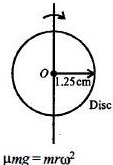
DifficultMCQ
$A$ disc rotates about its axis of symmetry in a horizontal plane at a steady rate of $3.5$ revolutions per second. $A$ coin placed at a distance of $1.25\,cm$ from the axis of rotation remains at rest on the disc. Find the coefficient of friction between the coin and the disc. (Take $g = 10\,m/s^2$)
A
$0.5$
B
$0.7$
C
$0.3$
D
$0.6$
Solution
(D) The centripetal force required for the coin to rotate with the disc is provided by the static frictional force.
For the coin to remain at rest relative to the disc,the frictional force must be equal to or greater than the required centripetal force: $f = mr\omega^2$.
The maximum static friction is given by $f_{max} = \mu mg$.
Equating the two,we get $\mu mg = mr\omega^2$,which simplifies to $\mu = \frac{r\omega^2}{g}$.
Given:
Frequency $n = 3.5\,rev/s$.
Angular velocity $\omega = 2\pi n = 2 \times \pi \times 3.5 = 7\pi\,rad/s$.
Radius $r = 1.25\,cm = 1.25 \times 10^{-2}\,m$.
Acceleration due to gravity $g = 10\,m/s^2$.
Substituting the values:
$\mu = \frac{(1.25 \times 10^{-2}) \times (7\pi)^2}{10}$.
Using $\pi \approx \frac{22}{7}$,we have $(7\pi)^2 = (7 \times \frac{22}{7})^2 = 22^2 = 484$.
$\mu = \frac{1.25 \times 10^{-2} \times 484}{10} = \frac{1.25 \times 4.84}{10} = 0.605 \approx 0.6$.
For the coin to remain at rest relative to the disc,the frictional force must be equal to or greater than the required centripetal force: $f = mr\omega^2$.
The maximum static friction is given by $f_{max} = \mu mg$.
Equating the two,we get $\mu mg = mr\omega^2$,which simplifies to $\mu = \frac{r\omega^2}{g}$.
Given:
Frequency $n = 3.5\,rev/s$.
Angular velocity $\omega = 2\pi n = 2 \times \pi \times 3.5 = 7\pi\,rad/s$.
Radius $r = 1.25\,cm = 1.25 \times 10^{-2}\,m$.
Acceleration due to gravity $g = 10\,m/s^2$.
Substituting the values:
$\mu = \frac{(1.25 \times 10^{-2}) \times (7\pi)^2}{10}$.
Using $\pi \approx \frac{22}{7}$,we have $(7\pi)^2 = (7 \times \frac{22}{7})^2 = 22^2 = 484$.
$\mu = \frac{1.25 \times 10^{-2} \times 484}{10} = \frac{1.25 \times 4.84}{10} = 0.605 \approx 0.6$.
0 likes
View Solution47
DifficultMCQ
To mop-clean a floor,a cleaning machine presses a circular mop of radius $R$ vertically down with a total force $F$ and rotates it with a constant angular speed about its axis. If the force $F$ is distributed uniformly over the mop and the coefficient of friction between the mop and the floor is $\mu$,the torque applied by the machine on the mop is
A
$\mu FR/3$
B
$\mu FR/6$
C
$\mu FR/2$
D
$\frac{2}{3}\mu FR$
Solution
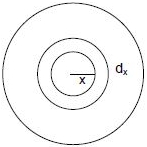
(D) Consider a small elemental ring of radius $x$ and width $dx$ on the circular mop. The area of this ring is $dA = 2\pi x dx$. The total area of the mop is $A = \pi R^2$. Since the force $F$ is distributed uniformly,the normal force $dN$ on this elemental ring is $dN = (F/A) dA = (F/(\pi R^2)) \times 2\pi x dx = (2F/R^2) x dx$. The frictional force on this ring is $df = \mu dN = \mu (2F/R^2) x dx$. The torque $d\tau$ due to this frictional force about the axis of rotation is $d\tau = x df = x \times \mu (2F/R^2) x dx = (2\mu F/R^2) x^2 dx$. To find the total torque $\tau$,we integrate $d\tau$ from $x = 0$ to $x = R$: $\tau = \int_0^R (2\mu F/R^2) x^2 dx = (2\mu F/R^2) [x^3/3]_0^R = (2\mu F/R^2) (R^3/3) = \frac{2}{3}\mu FR$.
0 likes
View Solution48
MediumMCQ
$A$ car is moving on a circular level road of curvature $300\,m.$ If the coefficient of friction is $0.3$ and acceleration due to gravity is $10\,m/s^2,$ the maximum speed the car can have is ........ $km/hr.$
A
$30$
B
$81$
C
$108$
D
$162$
Solution
(C) The maximum speed $v$ of a car on a circular level road is given by the formula $v = \sqrt{\mu r g},$ where $\mu$ is the coefficient of friction,$r$ is the radius of curvature,and $g$ is the acceleration due to gravity.
Given: $\mu = 0.3,$ $r = 300\,m,$ $g = 10\,m/s^2.$
Substituting the values: $v = \sqrt{0.3 \times 300 \times 10} = \sqrt{900} = 30\,m/s.$
To convert the speed from $m/s$ to $km/hr,$ multiply by $\frac{18}{5}:$
$v = 30 \times \frac{18}{5} = 6 \times 18 = 108\,km/hr.$
Given: $\mu = 0.3,$ $r = 300\,m,$ $g = 10\,m/s^2.$
Substituting the values: $v = \sqrt{0.3 \times 300 \times 10} = \sqrt{900} = 30\,m/s.$
To convert the speed from $m/s$ to $km/hr,$ multiply by $\frac{18}{5}:$
$v = 30 \times \frac{18}{5} = 6 \times 18 = 108\,km/hr.$
0 likes
View Solution49
DifficultMCQ
An unbanked curve has a radius of $60\,m$. The maximum speed at which a car can make a turn if the coefficient of static friction is $0.75$,is ........ $m/s$.
A
$2.1$
B
$14$
C
$21$
D
$7$
Solution
(C) The maximum speed $v_{max}$ for a car on an unbanked curve is given by the formula $v_{max} = \sqrt{\mu rg}$.
Here,the coefficient of static friction $\mu = 0.75$,the radius $r = 60\,m$,and the acceleration due to gravity $g = 9.8\,m/s^2$.
Substituting these values into the formula:
$v_{max} = \sqrt{0.75 \times 60 \times 9.8}$
$v_{max} = \sqrt{45 \times 9.8}$
$v_{max} = \sqrt{441}$
$v_{max} = 21\,m/s$.
Here,the coefficient of static friction $\mu = 0.75$,the radius $r = 60\,m$,and the acceleration due to gravity $g = 9.8\,m/s^2$.
Substituting these values into the formula:
$v_{max} = \sqrt{0.75 \times 60 \times 9.8}$
$v_{max} = \sqrt{45 \times 9.8}$
$v_{max} = \sqrt{441}$
$v_{max} = 21\,m/s$.
0 likes
View Solution50
MediumMCQ
$A$ small object placed on a rotating horizontal turntable just slips when it is placed at a distance $4\, cm$ from the axis of rotation. If the angular velocity of the turntable is doubled,the object slips when its distance from the axis of rotation is (in $, cm$)
A
$1$
B
$2$
C
$4$
D
$8$
Solution
(A) The condition for the object to just slip is that the required centripetal force must be equal to the maximum static frictional force.
$F_{c} = f_{s,max}$
$m r \omega^{2} = \mu m g$
From this,we get the relation $r \omega^{2} = \text{constant}$,which implies $r \propto \frac{1}{\omega^{2}}$.
Therefore,$\frac{r_{2}}{r_{1}} = \left( \frac{\omega_{1}}{\omega_{2}} \right)^{2}$.
Given $r_{1} = 4\, cm$ and $\omega_{2} = 2\omega_{1}$.
Substituting the values: $\frac{r_{2}}{4} = \left( \frac{\omega_{1}}{2\omega_{1}} \right)^{2} = \left( \frac{1}{2} \right)^{2} = \frac{1}{4}$.
$r_{2} = 4 \times \frac{1}{4} = 1\, cm$.
$F_{c} = f_{s,max}$
$m r \omega^{2} = \mu m g$
From this,we get the relation $r \omega^{2} = \text{constant}$,which implies $r \propto \frac{1}{\omega^{2}}$.
Therefore,$\frac{r_{2}}{r_{1}} = \left( \frac{\omega_{1}}{\omega_{2}} \right)^{2}$.
Given $r_{1} = 4\, cm$ and $\omega_{2} = 2\omega_{1}$.
Substituting the values: $\frac{r_{2}}{4} = \left( \frac{\omega_{1}}{2\omega_{1}} \right)^{2} = \left( \frac{1}{2} \right)^{2} = \frac{1}{4}$.
$r_{2} = 4 \times \frac{1}{4} = 1\, cm$.
0 likes
View SolutionNewton's Laws of Motion and Friction — Circular motion with Friction · Frequently Asked Questions
1Are these Newton's Laws of Motion and Friction questions useful for JEE and NEET?
Yes. All questions in this section are mapped to JEE Main and NEET exam patterns. Previous year questions from JEE Main, NEET, GUJCET and state-level exams are included with full solutions.
2Can I switch to Hindi or Gujarati for these questions?
Yes. Use the language tabs in the hero section or the sidebar to view the same questions and solutions in English, Hindi or Gujarati.
3How do I generate a question paper from this subtopic?
Use the Vedclass Exam Paper Generator — select the chapter and subtopic, set difficulty, and generate Sets A, B, C, D automatically. First 3 chapters of every subject are free.
Vedclass Products
For Students
Vedclass Test Series
Mock tests in real JEE/NEET style with performance analysis. 5-day free trial.
Start Free TrialFor Teachers
Exam Paper Generator
Generate Set A/B/C/D papers from this chapter in 2 minutes. 3 chapters free.
Try FreeFor Institutes
Online Exam Module
Live online exams with unlimited students, 360° analytics & white-label branding.
See DemoFor Teachers & Institutes
Generate a Newton's Laws of Motion and Friction Exam Paper in 2 Minutes
Select subtopic & difficulty — Sets A, B, C, D auto-generated with No Repeat logic.
First 3 chapters of every subject are free — no payment required.