
A English
Circular Motion Turning on Road without Friction Questions in English
Class 11 Physics · Newton's Laws of Motion and Friction · Circular Motion Turning on Road without Friction
30+
Questions
English
Language
100%
With Solutions
Showing 30 of 30 questions in English
1
EasyMCQ
On a railway curve,the outside rail is laid higher than the inside one so that the resultant force exerted on the wheels of the rail car by the tops of the rails will:
A
Have a horizontal inward component
B
Be vertical
C
Equilibrate the centripetal force
D
Be decreased
Solution
(A) When a railway track is banked (the outside rail is raised),the normal reaction force exerted by the rails on the wheels is tilted at an angle to the vertical.
This normal reaction force can be resolved into two components: a vertical component that balances the weight of the train,and a horizontal component directed towards the center of the curve.
This horizontal inward component provides the necessary centripetal force required for the train to move along the curved path.
Therefore,the correct option is $A$.
This normal reaction force can be resolved into two components: a vertical component that balances the weight of the train,and a horizontal component directed towards the center of the curve.
This horizontal inward component provides the necessary centripetal force required for the train to move along the curved path.
Therefore,the correct option is $A$.
0 likes
View Solution2
MediumMCQ
The radius of a curved road on a national highway is $R$. The width of the road is $b$. The outer edge of the road is raised by $h$ with respect to the inner edge so that a car with velocity $v$ can pass safely over it. The value of $h$ is
A
$\frac{v^2 b}{Rg}$
B
$\frac{v}{Rgb}$
C
$\frac{v^2 R}{g}$
D
$\frac{v^2 b}{R}$
Solution
(A) For a vehicle to negotiate a curved road of radius $R$ safely without relying on friction,the road is banked at an angle $\theta$.
From the dynamics of circular motion,the condition for safe banking is given by $\tan \theta = \frac{v^2}{Rg}$.
From the geometry of the banked road,where $h$ is the height of the outer edge and $b$ is the width of the road,we have $\tan \theta = \frac{h}{b}$ (assuming $\theta$ is small).
Equating the two expressions for $\tan \theta$:
$\frac{h}{b} = \frac{v^2}{Rg}$
Therefore,the height $h$ is given by $h = \frac{v^2 b}{Rg}$.
From the dynamics of circular motion,the condition for safe banking is given by $\tan \theta = \frac{v^2}{Rg}$.
From the geometry of the banked road,where $h$ is the height of the outer edge and $b$ is the width of the road,we have $\tan \theta = \frac{h}{b}$ (assuming $\theta$ is small).
Equating the two expressions for $\tan \theta$:
$\frac{h}{b} = \frac{v^2}{Rg}$
Therefore,the height $h$ is given by $h = \frac{v^2 b}{Rg}$.
0 likes
View Solution3
MediumMCQ
$A$ car is moving with speed $v$ on a banked road of radius $50 \ m$,width $10 \ m$,and height $1.5 \ m$. The velocity $v$ of the car is ......... $m/s$.
A
$6.5$
B
$8.6$
C
$8$
D
$10$
Solution
(B) Given: Radius $r = 50 \ m$,width $l = 10 \ m$,height $h = 1.5 \ m$,and acceleration due to gravity $g = 10 \ m/s^2$.
For a banked road without friction,the condition for safe turning is given by $\tan \theta = \frac{v^2}{rg}$.
From the geometry of the banked road,$\tan \theta = \frac{h}{l}$ (assuming small angle approximation).
Equating the two,we get $\frac{v^2}{rg} = \frac{h}{l}$.
Solving for $v$: $v = \sqrt{\frac{hrg}{l}}$.
Substituting the values: $v = \sqrt{\frac{1.5 \times 50 \times 10}{10}} = \sqrt{75} \approx 8.66 \ m/s$.
Rounding to the nearest given option,$v = 8.6 \ m/s$.
For a banked road without friction,the condition for safe turning is given by $\tan \theta = \frac{v^2}{rg}$.
From the geometry of the banked road,$\tan \theta = \frac{h}{l}$ (assuming small angle approximation).
Equating the two,we get $\frac{v^2}{rg} = \frac{h}{l}$.
Solving for $v$: $v = \sqrt{\frac{hrg}{l}}$.
Substituting the values: $v = \sqrt{\frac{1.5 \times 50 \times 10}{10}} = \sqrt{75} \approx 8.66 \ m/s$.
Rounding to the nearest given option,$v = 8.6 \ m/s$.
0 likes
View Solution4
MediumMCQ
The speed of a car is increased by $10\%$. If the angle of banking remains constant,the radius of the turn must be changed from $20 \ m$ to ........ $m$.
A
$16$
B
$18$
C
$24.2$
D
$30.5$
Solution
(C) The formula for banking of roads is given by $\tan \theta = \frac{v^2}{rg}$.
Since the angle of banking $\theta$ is constant,we have $r \propto v^2$.
Let the initial speed be $v_1 = v$ and the final speed be $v_2 = v + 0.1v = 1.1v$.
The initial radius is $r_1 = 20 \ m$.
Using the proportionality $r_2 / r_1 = (v_2 / v_1)^2$,we get:
$r_2 / 20 = (1.1v / v)^2 = (1.1)^2 = 1.21$.
Therefore,$r_2 = 1.21 \times 20 = 24.2 \ m$.
Since the angle of banking $\theta$ is constant,we have $r \propto v^2$.
Let the initial speed be $v_1 = v$ and the final speed be $v_2 = v + 0.1v = 1.1v$.
The initial radius is $r_1 = 20 \ m$.
Using the proportionality $r_2 / r_1 = (v_2 / v_1)^2$,we get:
$r_2 / 20 = (1.1v / v)^2 = (1.1)^2 = 1.21$.
Therefore,$r_2 = 1.21 \times 20 = 24.2 \ m$.
0 likes
View Solution5
MediumMCQ
$A$ car of mass $1000\, kg$ negotiates a banked curve of radius $90\, m$ on a frictionless road. If the banking angle is $45^\circ$,the speed of the car is ....... $m\,s^{-1}$.
A
$20$
B
$10$
C
$30$
D
$5$
Solution
(C) Given: Mass $m = 1000\, kg$,Radius $R = 90\, m$,Banking angle $\theta = 45^\circ$,Acceleration due to gravity $g = 10\, m\,s^{-2}$.
For a car on a frictionless banked road,the condition for safe turning is given by the formula: $\tan \theta = \frac{v^2}{Rg}$.
Rearranging for velocity $v$: $v = \sqrt{Rg \tan \theta}$.
Substituting the values: $v = \sqrt{90 \times 10 \times \tan 45^\circ}$.
Since $\tan 45^\circ = 1$,we get: $v = \sqrt{900 \times 1} = 30\, m\,s^{-1}$.
For a car on a frictionless banked road,the condition for safe turning is given by the formula: $\tan \theta = \frac{v^2}{Rg}$.
Rearranging for velocity $v$: $v = \sqrt{Rg \tan \theta}$.
Substituting the values: $v = \sqrt{90 \times 10 \times \tan 45^\circ}$.
Since $\tan 45^\circ = 1$,we get: $v = \sqrt{900 \times 1} = 30\, m\,s^{-1}$.
0 likes
View Solution6
EasyMCQ
Roads are banked on curves so that
A
The speeding vehicles may not fall outwards
B
The frictional force between the road and vehicle may be decreased
C
The wear and tear of tyres may be avoided
D
The weight of the vehicle may be decreased
Solution
(A) Banking of roads is done to provide the necessary centripetal force for safe turning of vehicles on curved paths.
When a road is banked at an angle $\theta$,the normal reaction $N$ has a horizontal component $N \sin \theta$ which acts towards the center of the circular path.
This component provides the required centripetal force,$F_c = \frac{mv^2}{r}$,which prevents the vehicle from skidding or falling outwards due to inertia.
When a road is banked at an angle $\theta$,the normal reaction $N$ has a horizontal component $N \sin \theta$ which acts towards the center of the circular path.
This component provides the required centripetal force,$F_c = \frac{mv^2}{r}$,which prevents the vehicle from skidding or falling outwards due to inertia.
0 likes
View Solution7
MediumMCQ
$A$ road is banked at an angle of $30^o$ to the horizontal for negotiating a curve of radius $10\sqrt{3} \ m$. At what velocity will a car experience no friction while negotiating the curve? ............... $km/hr$
A
$54$
B
$72$
C
$36$
D
$18$
Solution
(C) The condition for a car to experience no friction on a banked road is given by the formula: $\tan \theta = \frac{v^2}{rg}$.
Given: $\theta = 30^o$,$r = 10\sqrt{3} \ m$,and taking $g = 10 \ m/s^2$.
Substituting the values: $\tan 30^o = \frac{v^2}{(10\sqrt{3})(10)}$.
Since $\tan 30^o = \frac{1}{\sqrt{3}}$,we have: $\frac{1}{\sqrt{3}} = \frac{v^2}{100\sqrt{3}}$.
Solving for $v^2$: $v^2 = \frac{100\sqrt{3}}{\sqrt{3}} = 100$.
Thus,$v = 10 \ m/s$.
To convert the velocity into $km/hr$,multiply by $\frac{18}{5}$: $v = 10 \times \frac{18}{5} = 36 \ km/hr$.
Given: $\theta = 30^o$,$r = 10\sqrt{3} \ m$,and taking $g = 10 \ m/s^2$.
Substituting the values: $\tan 30^o = \frac{v^2}{(10\sqrt{3})(10)}$.
Since $\tan 30^o = \frac{1}{\sqrt{3}}$,we have: $\frac{1}{\sqrt{3}} = \frac{v^2}{100\sqrt{3}}$.
Solving for $v^2$: $v^2 = \frac{100\sqrt{3}}{\sqrt{3}} = 100$.
Thus,$v = 10 \ m/s$.
To convert the velocity into $km/hr$,multiply by $\frac{18}{5}$: $v = 10 \times \frac{18}{5} = 36 \ km/hr$.
0 likes
View Solution8
MediumMCQ
$A$ horizontal curve on a racing track is banked at a $45^o$ angle. When a vehicle goes around this curve at the curve's safe speed (no friction needed to stay on the track),what is its centripetal acceleration?
A
$g$
B
$2g$
C
$0.5g$
D
none
Solution
(A) For a vehicle moving on a banked road at the safe speed (where no friction is required),the forces acting on the vehicle are the gravitational force $(mg)$ acting downwards and the normal force $(N)$ acting perpendicular to the banked surface.
The vertical component of the normal force balances the weight: $N \cos \theta = mg$.
The horizontal component of the normal force provides the necessary centripetal force: $N \sin \theta = m a_c$,where $a_c$ is the centripetal acceleration.
Dividing the two equations: $\frac{N \sin \theta}{N \cos \theta} = \frac{m a_c}{mg}$.
This simplifies to: $\tan \theta = \frac{a_c}{g}$.
Therefore,the centripetal acceleration is $a_c = g \tan \theta$.
Given the banking angle $\theta = 45^o$,we have $a_c = g \tan(45^o) = g(1) = g$.
The vertical component of the normal force balances the weight: $N \cos \theta = mg$.
The horizontal component of the normal force provides the necessary centripetal force: $N \sin \theta = m a_c$,where $a_c$ is the centripetal acceleration.
Dividing the two equations: $\frac{N \sin \theta}{N \cos \theta} = \frac{m a_c}{mg}$.
This simplifies to: $\tan \theta = \frac{a_c}{g}$.
Therefore,the centripetal acceleration is $a_c = g \tan \theta$.
Given the banking angle $\theta = 45^o$,we have $a_c = g \tan(45^o) = g(1) = g$.
0 likes
View Solution9
DifficultMCQ
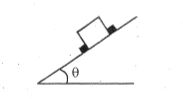
$A$ railway line is taken round a circular arc of radius $1000 \ m$,and is banked by raising the outer rail $h \ m$ above the inner rail. If the lateral force on the inner rail when a train travels round the curve at $10 \ ms^{-1}$ is equal to the lateral force on the outer rail when the train's speed is $20 \ ms^{-1}$,then the value of $4g \tan \theta$ is equal to: (The distance between the rails is $1.5 \ m$)
A
$1$
B
$2$
C
$3$
D
$4$
Solution
(A) Let $m$ be the mass of the train,$R = 1000 \ m$ be the radius of the curve,and $\theta$ be the angle of banking.
In the frame of the train,the forces acting along the inclined plane are the component of gravity $mg \sin \theta$,the centrifugal force $\frac{mv^2}{R} \cos \theta$,and the lateral force $F$ exerted by the rails.
For speed $v_1 = 10 \ ms^{-1}$,the lateral force $F_1$ on the inner rail is given by:
$F_1 + \frac{mv_1^2}{R} \cos \theta = mg \sin \theta \implies F_1 = mg \sin \theta - \frac{mv_1^2}{R} \cos \theta$
For speed $v_2 = 20 \ ms^{-1}$,the lateral force $F_2$ on the outer rail is given by:
$\frac{mv_2^2}{R} \cos \theta = mg \sin \theta + F_2 \implies F_2 = \frac{mv_2^2}{R} \cos \theta - mg \sin \theta$
Given $F_1 = F_2$,we have:
$mg \sin \theta - \frac{mv_1^2}{R} \cos \theta = \frac{mv_2^2}{R} \cos \theta - mg \sin \theta$
$2mg \sin \theta = \frac{m}{R} (v_1^2 + v_2^2) \cos \theta$
$2g \tan \theta = \frac{v_1^2 + v_2^2}{R} = \frac{10^2 + 20^2}{1000} = \frac{100 + 400}{1000} = \frac{500}{1000} = 0.5$
Thus,$\tan \theta = \frac{0.5}{2g} = \frac{1}{4g}$.
Therefore,$4g \tan \theta = 4g \times \frac{1}{4g} = 1$.
In the frame of the train,the forces acting along the inclined plane are the component of gravity $mg \sin \theta$,the centrifugal force $\frac{mv^2}{R} \cos \theta$,and the lateral force $F$ exerted by the rails.
For speed $v_1 = 10 \ ms^{-1}$,the lateral force $F_1$ on the inner rail is given by:
$F_1 + \frac{mv_1^2}{R} \cos \theta = mg \sin \theta \implies F_1 = mg \sin \theta - \frac{mv_1^2}{R} \cos \theta$
For speed $v_2 = 20 \ ms^{-1}$,the lateral force $F_2$ on the outer rail is given by:
$\frac{mv_2^2}{R} \cos \theta = mg \sin \theta + F_2 \implies F_2 = \frac{mv_2^2}{R} \cos \theta - mg \sin \theta$
Given $F_1 = F_2$,we have:
$mg \sin \theta - \frac{mv_1^2}{R} \cos \theta = \frac{mv_2^2}{R} \cos \theta - mg \sin \theta$
$2mg \sin \theta = \frac{m}{R} (v_1^2 + v_2^2) \cos \theta$
$2g \tan \theta = \frac{v_1^2 + v_2^2}{R} = \frac{10^2 + 20^2}{1000} = \frac{100 + 400}{1000} = \frac{500}{1000} = 0.5$
Thus,$\tan \theta = \frac{0.5}{2g} = \frac{1}{4g}$.
Therefore,$4g \tan \theta = 4g \times \frac{1}{4g} = 1$.
0 likes
View Solution10
MediumMCQ
$A$ car of mass $1000\,kg$ negotiates a banked curve of radius $90\,m$ on a frictionless road. If the banking angle is $45^\circ$,the maximum speed of the car is ............ $m/s$ $[g = 10\,m/s^2]$.
A
$20$
B
$30$
C
$5$
D
$10$
Solution
(B) For a car moving on a banked road without friction,the condition for safe turning is given by the formula: $\tan \theta = \frac{v^2}{Rg}$.
Here,the banking angle $\theta = 45^\circ$,the radius of the curve $R = 90\,m$,and the acceleration due to gravity $g = 10\,m/s^2$.
Substituting these values into the formula:
$\tan 45^\circ = \frac{v^2}{90 \times 10}$.
Since $\tan 45^\circ = 1$,we have:
$1 = \frac{v^2}{900}$.
$v^2 = 900$.
$v = \sqrt{900} = 30\,m/s$.
Therefore,the maximum speed of the car is $30\,m/s$.
Here,the banking angle $\theta = 45^\circ$,the radius of the curve $R = 90\,m$,and the acceleration due to gravity $g = 10\,m/s^2$.
Substituting these values into the formula:
$\tan 45^\circ = \frac{v^2}{90 \times 10}$.
Since $\tan 45^\circ = 1$,we have:
$1 = \frac{v^2}{900}$.
$v^2 = 900$.
$v = \sqrt{900} = 30\,m/s$.
Therefore,the maximum speed of the car is $30\,m/s$.
1 likes
View Solution11
DifficultMCQ
$A$ road is $10\, m$ wide. Its radius of curvature is $50\, m$. The outer edge is raised above the inner edge by a distance of $1.5\, m$. This road is most suited for the velocity of ........ $m/s$. (in $.5$)
A
$2$
B
$4$
C
$6$
D
$8$
Solution
(D) The angle of banking $\theta$ is given by $\tan \theta = \frac{h}{w}$,where $h = 1.5\, m$ is the height difference and $w = 10\, m$ is the width of the road.
$\tan \theta = \frac{1.5}{10} = 0.15$.
For a banked road,the optimum velocity $v$ is given by the formula $v = \sqrt{rg \tan \theta}$,where $r = 50\, m$ is the radius of curvature and $g = 9.8\, m/s^2$ is the acceleration due to gravity.
Substituting the values: $v = \sqrt{50 \times 9.8 \times 0.15}$.
$v = \sqrt{490 \times 0.15} = \sqrt{73.5} \approx 8.57\, m/s$.
Rounding to the nearest option,the most suitable velocity is $8.5\, m/s$.
$\tan \theta = \frac{1.5}{10} = 0.15$.
For a banked road,the optimum velocity $v$ is given by the formula $v = \sqrt{rg \tan \theta}$,where $r = 50\, m$ is the radius of curvature and $g = 9.8\, m/s^2$ is the acceleration due to gravity.
Substituting the values: $v = \sqrt{50 \times 9.8 \times 0.15}$.
$v = \sqrt{490 \times 0.15} = \sqrt{73.5} \approx 8.57\, m/s$.
Rounding to the nearest option,the most suitable velocity is $8.5\, m/s$.
0 likes
View Solution12
MediumMCQ
$A$ car of mass $1000 \, kg$ negotiates a banked curve of radius $90 \, m$ on a frictionless road. If the banking angle is $45^\circ$,the speed of the car is ......... $m \, s^{-1}$.
A
$5$
B
$10$
C
$20$
D
$30$
Solution
(D) For a car on a frictionless banked road,the condition for safe turning is given by the formula: $\tan \theta = \frac{v^2}{rg}$.
Here,the radius $r = 90 \, m$,the banking angle $\theta = 45^\circ$,and taking acceleration due to gravity $g = 10 \, m \, s^{-2}$.
Rearranging the formula for velocity $v$,we get: $v = \sqrt{rg \tan \theta}$.
Substituting the values: $v = \sqrt{90 \times 10 \times \tan 45^\circ}$.
Since $\tan 45^\circ = 1$,we have $v = \sqrt{900 \times 1} = 30 \, m \, s^{-1}$.
Here,the radius $r = 90 \, m$,the banking angle $\theta = 45^\circ$,and taking acceleration due to gravity $g = 10 \, m \, s^{-2}$.
Rearranging the formula for velocity $v$,we get: $v = \sqrt{rg \tan \theta}$.
Substituting the values: $v = \sqrt{90 \times 10 \times \tan 45^\circ}$.
Since $\tan 45^\circ = 1$,we have $v = \sqrt{900 \times 1} = 30 \, m \, s^{-1}$.
0 likes
View Solution13
MediumMCQ
$Assertion$ : There is a stage when frictional force is not needed at all to provide the necessary centripetal force on a banked road.
$Reason$ : On a banked road,due to its inclination the vehicle tends to remain inwards without any chances of skidding.
$Reason$ : On a banked road,due to its inclination the vehicle tends to remain inwards without any chances of skidding.
A
If both $Assertion$ and $Reason$ are correct and the $Reason$ is a correct explanation of the $Assertion$.
B
If both $Assertion$ and $Reason$ are correct but $Reason$ is not a correct explanation of the $Assertion$.
C
If the $Assertion$ is correct but $Reason$ is incorrect.
D
If both the $Assertion$ and $Reason$ are incorrect.
Solution
(C) The $Assertion$ is true because when a vehicle moves at an optimum speed $v = \sqrt{rg \tan \theta}$ on a banked road,the horizontal component of the normal reaction $(N \sin \theta)$ is sufficient to provide the necessary centripetal force $(mv^2/r)$.
In this specific case,the frictional force is not required to maintain the circular path.
The $Reason$ is incorrect because,on a banked road,the vehicle does not inherently tend to remain inwards without skidding; rather,the banking angle is designed specifically to balance the forces at a particular speed to prevent skidding.
In this specific case,the frictional force is not required to maintain the circular path.
The $Reason$ is incorrect because,on a banked road,the vehicle does not inherently tend to remain inwards without skidding; rather,the banking angle is designed specifically to balance the forces at a particular speed to prevent skidding.
0 likes
View Solution14
Medium
Write the formula for the maximum permissible speed of a vehicle moving on a smooth banked circular track.
Solution
(N/A) The velocity of a vehicle on a banked circular road is given by the general formula:
$v = \left[ rg \left( \frac{\mu_s + \tan \theta}{1 - \mu_s \tan \theta} \right) \right]^{1/2}$
For a smooth surface,the coefficient of static friction $\mu_s = 0$.
Substituting $\mu_s = 0$ into the formula:
$v_{\max} = \left[ rg \left( \frac{0 + \tan \theta}{1 - 0 \cdot \tan \theta} \right) \right]^{1/2}$
$v_{\max} = \left[ rg \tan \theta \right]^{1/2}$
Therefore,the formula for the maximum permissible speed on a smooth banked track is:
$v_{\max} = \sqrt{rg \tan \theta}$
At this speed,the horizontal component of the normal force provides the necessary centripetal force,and no frictional force is required.
$v = \left[ rg \left( \frac{\mu_s + \tan \theta}{1 - \mu_s \tan \theta} \right) \right]^{1/2}$
For a smooth surface,the coefficient of static friction $\mu_s = 0$.
Substituting $\mu_s = 0$ into the formula:
$v_{\max} = \left[ rg \left( \frac{0 + \tan \theta}{1 - 0 \cdot \tan \theta} \right) \right]^{1/2}$
$v_{\max} = \left[ rg \tan \theta \right]^{1/2}$
Therefore,the formula for the maximum permissible speed on a smooth banked track is:
$v_{\max} = \sqrt{rg \tan \theta}$
At this speed,the horizontal component of the normal force provides the necessary centripetal force,and no frictional force is required.
0 likes
View Solution15
Medium
Define optimum speed.
Solution
(N/A) The velocity of a vehicle on a banked circular road is given by the general formula:
$v = \left[ r g \left( \frac{\mu_{s} + \tan \theta}{1 - \mu_{s} \tan \theta} \right) \right]^{\frac{1}{2}}$
For the optimum speed,we assume the road surface is smooth,meaning the coefficient of static friction $\mu_{s} = 0$.
Substituting $\mu_{s} = 0$ into the equation:
$v_{0} = \left[ r g \left( \frac{0 + \tan \theta}{1 - 0 \cdot \tan \theta} \right) \right]^{\frac{1}{2}}$
$v_{0} = \sqrt{r g \tan \theta}$
At this speed,the horizontal component of the normal force provides the necessary centripetal force,and no frictional force is required. Driving at this speed on a banked road minimizes wear and tear on the tyres. This specific velocity $v_{0}$ is known as the optimum speed.
$v = \left[ r g \left( \frac{\mu_{s} + \tan \theta}{1 - \mu_{s} \tan \theta} \right) \right]^{\frac{1}{2}}$
For the optimum speed,we assume the road surface is smooth,meaning the coefficient of static friction $\mu_{s} = 0$.
Substituting $\mu_{s} = 0$ into the equation:
$v_{0} = \left[ r g \left( \frac{0 + \tan \theta}{1 - 0 \cdot \tan \theta} \right) \right]^{\frac{1}{2}}$
$v_{0} = \sqrt{r g \tan \theta}$
At this speed,the horizontal component of the normal force provides the necessary centripetal force,and no frictional force is required. Driving at this speed on a banked road minimizes wear and tear on the tyres. This specific velocity $v_{0}$ is known as the optimum speed.
0 likes
View Solution16
MediumMCQ
Does the motion of a vehicle on a level circular path depend on the mass of the vehicle?
A
Yes,it depends on the mass.
B
No,it does not depend on the mass.
C
It depends on the mass only at high speeds.
D
It depends on the mass only at low speeds.
Solution
(B) For a vehicle moving on a level circular path of radius $r$,the necessary centripetal force is provided by the static friction $f_s$ between the tires and the road.
$f_s = \frac{mv^2}{r}$
The maximum value of static friction is $f_{s,max} = \mu_s N = \mu_s mg$,where $\mu_s$ is the coefficient of static friction and $m$ is the mass of the vehicle.
For safe turning,the required centripetal force must be less than or equal to the maximum static friction:
$\frac{mv^2}{r} \leq \mu_s mg$
Dividing both sides by $m$,we get:
$\frac{v^2}{r} \leq \mu_s g$
$v^2 \leq \mu_s rg$
$v \leq \sqrt{\mu_s rg}$
Since the mass $m$ cancels out from both sides of the inequality,the maximum safe speed $v_{max} = \sqrt{\mu_s rg}$ is independent of the mass of the vehicle.
$f_s = \frac{mv^2}{r}$
The maximum value of static friction is $f_{s,max} = \mu_s N = \mu_s mg$,where $\mu_s$ is the coefficient of static friction and $m$ is the mass of the vehicle.
For safe turning,the required centripetal force must be less than or equal to the maximum static friction:
$\frac{mv^2}{r} \leq \mu_s mg$
Dividing both sides by $m$,we get:
$\frac{v^2}{r} \leq \mu_s g$
$v^2 \leq \mu_s rg$
$v \leq \sqrt{\mu_s rg}$
Since the mass $m$ cancels out from both sides of the inequality,the maximum safe speed $v_{max} = \sqrt{\mu_s rg}$ is independent of the mass of the vehicle.
1 likes
View Solution17
Medium
What is optimum speed? Write its equation.
Solution
(N/A) Optimum speed is the speed at which a vehicle can negotiate a banked curve without relying on friction between the tires and the road surface. At this speed,the necessary centripetal force is provided entirely by the horizontal component of the normal force.
The equation for optimum speed $(v_0)$ on a banked road with banking angle $(\theta)$ and radius of curvature $(r)$ is given by:
$v_0 = \sqrt{rg \tan \theta}$
where:
$r$ = radius of the curve
$g$ = acceleration due to gravity
$\theta$ = angle of banking
The equation for optimum speed $(v_0)$ on a banked road with banking angle $(\theta)$ and radius of curvature $(r)$ is given by:
$v_0 = \sqrt{rg \tan \theta}$
where:
$r$ = radius of the curve
$g$ = acceleration due to gravity
$\theta$ = angle of banking
0 likes
View Solution18
Easy
Why are curved roads banked?
Solution
(N/A) When a vehicle moves on a curved road,it undergoes circular motion. In circular motion,a centrifugal force acts on the vehicle,tending to push it outward. To prevent the vehicle from skidding or overturning,a centripetal force is required to keep it on the curved path. By banking the road (raising the outer edge higher than the inner edge),a component of the normal force provides the necessary centripetal force,reducing the reliance on friction.
0 likes
View Solution19
EasyMCQ
Write the formula for the maximum safe speed of a vehicle moving on a smooth curved road of radius $r$ and banking angle $\theta$.
A
$v = \sqrt{rg \tan \theta}$
B
$v = \sqrt{rg \sin \theta}$
C
$v = \sqrt{rg \cos \theta}$
D
$v = \sqrt{rg / \tan \theta}$
Solution
(A) For a vehicle moving on a banked road without friction,the centripetal force required for circular motion is provided by the horizontal component of the normal force.
Let $N$ be the normal force and $m$ be the mass of the vehicle.
The vertical component of the normal force balances the weight: $N \cos \theta = mg$.
The horizontal component of the normal force provides the centripetal force: $N \sin \theta = \frac{mv^2}{r}$.
Dividing the two equations: $\frac{N \sin \theta}{N \cos \theta} = \frac{mv^2/r}{mg}$.
This simplifies to $\tan \theta = \frac{v^2}{rg}$.
Therefore,the maximum safe speed is $v = \sqrt{rg \tan \theta}$.
Let $N$ be the normal force and $m$ be the mass of the vehicle.
The vertical component of the normal force balances the weight: $N \cos \theta = mg$.
The horizontal component of the normal force provides the centripetal force: $N \sin \theta = \frac{mv^2}{r}$.
Dividing the two equations: $\frac{N \sin \theta}{N \cos \theta} = \frac{mv^2/r}{mg}$.
This simplifies to $\tan \theta = \frac{v^2}{rg}$.
Therefore,the maximum safe speed is $v = \sqrt{rg \tan \theta}$.
0 likes
View Solution20
EasyMCQ
What is the speed of a vehicle moving on a flat and smooth (frictionless) circular path of radius $r$?
A
$\sqrt{rg}$
B
$\sqrt{\mu rg}$
C
$0$
D
Infinite
Solution
(C) For a vehicle to move in a circular path of radius $r$ on a flat road, the necessary centripetal force is provided by the static friction between the tires and the road surface.
Since the road is smooth (frictionless), the coefficient of friction $\mu = 0$.
The maximum safe speed $v$ on a flat circular road is given by $v = \sqrt{\mu rg}$.
Substituting $\mu = 0$, we get $v = \sqrt{0 \cdot rg} = 0$.
Therefore, it is impossible for a vehicle to maintain a circular path on a perfectly smooth flat road at any non-zero speed.
Since the road is smooth (frictionless), the coefficient of friction $\mu = 0$.
The maximum safe speed $v$ on a flat circular road is given by $v = \sqrt{\mu rg}$.
Substituting $\mu = 0$, we get $v = \sqrt{0 \cdot rg} = 0$.
Therefore, it is impossible for a vehicle to maintain a circular path on a perfectly smooth flat road at any non-zero speed.
0 likes
View Solution21
MediumMCQ
Which component provides the centripetal force for a vehicle moving at an optimum speed on a banked road?
A
Vertical component of the normal force
B
Horizontal component of the normal force
C
Frictional force
D
Gravitational force
Solution
(B) On a banked road,the normal force $N$ exerted by the road on the vehicle acts perpendicular to the surface of the road.
This normal force can be resolved into two rectangular components:
$1$. The vertical component $N \cos \theta$,which balances the weight of the vehicle $(mg)$.
$2$. The horizontal component $N \sin \theta$,which points towards the center of the circular path.
Therefore,the horizontal component of the normal force provides the necessary centripetal force for the vehicle to turn safely without relying on friction.
This normal force can be resolved into two rectangular components:
$1$. The vertical component $N \cos \theta$,which balances the weight of the vehicle $(mg)$.
$2$. The horizontal component $N \sin \theta$,which points towards the center of the circular path.
Therefore,the horizontal component of the normal force provides the necessary centripetal force for the vehicle to turn safely without relying on friction.
0 likes
View Solution22
MediumMCQ
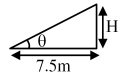
The safe speed of a vehicle over a smooth banked road of radius $150\ m$ is $10\ m/s$. If the width of the road is $7.5\ m$,the height of the outer edge is: (in $m$)
A
$0.25$
B
$0.50$
C
$0.35$
D
$0.60$
Solution
(B) For a smooth banked road,the angle of banking $\theta$ is given by the relation: $\tan \theta = \frac{v^2}{Rg}$.
Given: $v = 10\ m/s$,$R = 150\ m$,and taking $g = 10\ m/s^2$.
Substituting the values: $\tan \theta = \frac{10^2}{150 \times 10} = \frac{100}{1500} = \frac{1}{15}$.
From the geometry of the banked road,if $H$ is the height of the outer edge and $w$ is the width of the road,then $\tan \theta = \frac{H}{w}$.
Given $w = 7.5\ m$,we have $\frac{H}{7.5} = \frac{1}{15}$.
Solving for $H$: $H = \frac{7.5}{15} = 0.5\ m$.
Given: $v = 10\ m/s$,$R = 150\ m$,and taking $g = 10\ m/s^2$.
Substituting the values: $\tan \theta = \frac{10^2}{150 \times 10} = \frac{100}{1500} = \frac{1}{15}$.
From the geometry of the banked road,if $H$ is the height of the outer edge and $w$ is the width of the road,then $\tan \theta = \frac{H}{w}$.
Given $w = 7.5\ m$,we have $\frac{H}{7.5} = \frac{1}{15}$.
Solving for $H$: $H = \frac{7.5}{15} = 0.5\ m$.
0 likes
View Solution23
MediumMCQ
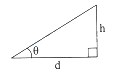
$A$ railway track is banked for a speed $v$ by elevating the outer rail by a height $h$ above the inner rail. If the distance between the two rails is $d$,then the radius of curvature of the track is ($g$ = gravitational acceleration).
A
$\frac{v^2 d}{gh}$
B
$\frac{2 v^2}{gdh}$
C
$\frac{gd}{2 v^2 h}$
D
$\frac{v^2}{2 gh d}$
Solution
(A) For a banked track,the angle of banking $\theta$ is given by $\tan \theta = \frac{v^2}{rg}$.
From the geometry of the track,where $h$ is the elevation and $d$ is the distance between the rails,we have $\tan \theta = \frac{h}{d}$.
Equating the two expressions for $\tan \theta$:
$\frac{v^2}{rg} = \frac{h}{d}$
Rearranging the equation to solve for the radius of curvature $r$:
$r = \frac{v^2 d}{gh}$
From the geometry of the track,where $h$ is the elevation and $d$ is the distance between the rails,we have $\tan \theta = \frac{h}{d}$.
Equating the two expressions for $\tan \theta$:
$\frac{v^2}{rg} = \frac{h}{d}$
Rearranging the equation to solve for the radius of curvature $r$:
$r = \frac{v^2 d}{gh}$
0 likes
View Solution24
DifficultMCQ
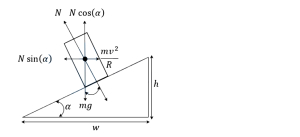
$A$ road is $10 \text{ m}$ wide. Its radius of curvature is $50 \text{ m}$. The outer edge is above the inner edge by a distance of $1.5 \text{ m}$. This road is most suited for the velocity $[g = 9.8 \text{ m/s}^2]$: (in $\text{ m/s}$)
A
$2.5$
B
$6.5$
C
$4.5$
D
$8.5$
Solution
(D) For a banked road, the optimum velocity $v$ is given by the formula $\tan \alpha = \frac{v^2}{Rg}$.
Here, $\alpha$ is the banking angle, $R$ is the radius of curvature, and $g$ is the acceleration due to gravity.
From the geometry of the road, $\tan \alpha = \frac{h}{w}$, where $h$ is the height difference between the outer and inner edges and $w$ is the width of the road.
Equating the two expressions for $\tan \alpha$: $\frac{v^2}{Rg} = \frac{h}{w}$.
Rearranging for $v$: $v = \sqrt{\frac{Rgh}{w}}$.
Given: $R = 50 \text{ m}$, $h = 1.5 \text{ m}$, $w = 10 \text{ m}$, and $g = 9.8 \text{ m/s}^2$.
Substituting the values: $v = \sqrt{\frac{50 \times 9.8 \times 1.5}{10}} = \sqrt{5 \times 9.8 \times 1.5} = \sqrt{73.5} \approx 8.57 \text{ m/s}$.
Comparing this with the given options, the most suitable velocity is $8.5 \text{ m/s}$.
Here, $\alpha$ is the banking angle, $R$ is the radius of curvature, and $g$ is the acceleration due to gravity.
From the geometry of the road, $\tan \alpha = \frac{h}{w}$, where $h$ is the height difference between the outer and inner edges and $w$ is the width of the road.
Equating the two expressions for $\tan \alpha$: $\frac{v^2}{Rg} = \frac{h}{w}$.
Rearranging for $v$: $v = \sqrt{\frac{Rgh}{w}}$.
Given: $R = 50 \text{ m}$, $h = 1.5 \text{ m}$, $w = 10 \text{ m}$, and $g = 9.8 \text{ m/s}^2$.
Substituting the values: $v = \sqrt{\frac{50 \times 9.8 \times 1.5}{10}} = \sqrt{5 \times 9.8 \times 1.5} = \sqrt{73.5} \approx 8.57 \text{ m/s}$.
Comparing this with the given options, the most suitable velocity is $8.5 \text{ m/s}$.
0 likes
View Solution25
EasyMCQ
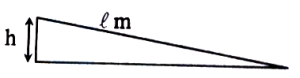
$A$ train has to negotiate a curve of radius $r \ m$. The distance between the rails is $\ell \ m$ and the outer rail is raised above the inner rail by a distance of $h \ m$. If the angle of banking is small,the safety speed limit on this banked track is:
A
$\sqrt{rg \left(\frac{h}{\ell}\right)}$
B
$rg \frac{h}{\ell}$
C
$\frac{(\frac{h}{\ell})^2}{rg}$
D
$(rg \frac{h}{\ell})^2$
Solution
(A) For a banked track,the angle of banking $\theta$ is given by $\tan \theta = \frac{v^2}{rg}$.
From the geometry of the track,$\sin \theta = \frac{h}{\ell}$.
Since the angle of banking $\theta$ is small,we can approximate $\tan \theta \approx \sin \theta$.
Therefore,$\frac{v^2}{rg} = \frac{h}{\ell}$.
Solving for $v$,we get $v^2 = rg \left(\frac{h}{\ell}\right)$.
Thus,the safety speed limit is $v = \sqrt{rg \left(\frac{h}{\ell}\right)}$.
From the geometry of the track,$\sin \theta = \frac{h}{\ell}$.
Since the angle of banking $\theta$ is small,we can approximate $\tan \theta \approx \sin \theta$.
Therefore,$\frac{v^2}{rg} = \frac{h}{\ell}$.
Solving for $v$,we get $v^2 = rg \left(\frac{h}{\ell}\right)$.
Thus,the safety speed limit is $v = \sqrt{rg \left(\frac{h}{\ell}\right)}$.
0 likes
View Solution26
EasyMCQ
In the case of a conical pendulum,if $T$ is the tension in the string and $\theta$ is the semi-vertical angle of the cone,then the component of tension which balances the centrifugal force in the equilibrium position is
A
$T \sin \theta$
B
$\frac{T \sin \theta}{2}$
C
$T \tan \theta$
D
$T \cos \theta$
Solution
(A) In a conical pendulum,the bob moves in a horizontal circle. The forces acting on the bob are:
$1$. The tension $T$ in the string,acting along the string towards the point of suspension.
$2$. The weight $mg$ of the bob,acting vertically downwards.
Resolving the tension $T$ into two rectangular components:
- The vertical component $T \cos \theta$ balances the weight of the bob $(T \cos \theta = mg)$.
- The horizontal component $T \sin \theta$ provides the necessary centripetal force required for circular motion $(T \sin \theta = \frac{mv^2}{r})$.
In the rotating frame of reference (non-inertial frame),the centrifugal force acts outwards,which is balanced by the horizontal component of the tension. Therefore,the component of tension that balances the centrifugal force is $T \sin \theta$.
$1$. The tension $T$ in the string,acting along the string towards the point of suspension.
$2$. The weight $mg$ of the bob,acting vertically downwards.
Resolving the tension $T$ into two rectangular components:
- The vertical component $T \cos \theta$ balances the weight of the bob $(T \cos \theta = mg)$.
- The horizontal component $T \sin \theta$ provides the necessary centripetal force required for circular motion $(T \sin \theta = \frac{mv^2}{r})$.
In the rotating frame of reference (non-inertial frame),the centrifugal force acts outwards,which is balanced by the horizontal component of the tension. Therefore,the component of tension that balances the centrifugal force is $T \sin \theta$.
0 likes
View Solution27
EasyMCQ
$A$ lorry is moving on a smooth circular path of radius $50 \ m$ with a velocity of $20 \ ms^{-1}$. Then the banking angle of the road is (Acceleration due to gravity $= 10 \ ms^{-2}$)
A
$\tan^{-1} \frac{5}{4}$
B
$\tan^{-1} \frac{4}{5}$
C
$\tan^{-1} \frac{2}{5}$
D
$\tan^{-1} \frac{5}{2}$
Solution
(B) The radius of the circular path is $R = 50 \ m$.
The velocity of the lorry is $V = 20 \ ms^{-1}$.
The acceleration due to gravity is $g = 10 \ ms^{-2}$.
The formula for the banking angle $\theta$ of a road is given by $\tan \theta = \frac{V^2}{Rg}$.
Substituting the given values into the formula:
$\tan \theta = \frac{(20)^2}{50 \times 10} = \frac{400}{500} = \frac{4}{5}$.
Therefore,the banking angle is $\theta = \tan^{-1} \left( \frac{4}{5} \right)$.
The velocity of the lorry is $V = 20 \ ms^{-1}$.
The acceleration due to gravity is $g = 10 \ ms^{-2}$.
The formula for the banking angle $\theta$ of a road is given by $\tan \theta = \frac{V^2}{Rg}$.
Substituting the given values into the formula:
$\tan \theta = \frac{(20)^2}{50 \times 10} = \frac{400}{500} = \frac{4}{5}$.
Therefore,the banking angle is $\theta = \tan^{-1} \left( \frac{4}{5} \right)$.
0 likes
View Solution28
EasyMCQ
$A$ truck of mass $2000 \,kg$ is moving along a circular path having a radius of curvature $10 \,m$. If the banking angle is $39^{\circ}$, then the maximum permissible speed of the truck is (Acceleration due to gravity $= 10 \,ms^{-2}$, take $\tan 39^{\circ} = 0.81$). (in $\,ms^{-1}$)
A
$14$
B
$5$
C
$18$
D
$9$
Solution
(D) Given:
Mass of the truck, $M = 2000 \,kg$
Radius of curvature, $R = 10 \,m$
Banking angle, $\theta = 39^{\circ}$
Acceleration due to gravity, $g = 10 \,ms^{-2}$
Value of $\tan 39^{\circ} = 0.81$
The formula for the maximum permissible speed $v$ on a banked road (without friction) is given by:
$v = \sqrt{Rg \tan \theta}$
Substituting the given values into the formula:
$v = \sqrt{10 \times 10 \times 0.81}$
$v = \sqrt{100 \times 0.81}$
$v = \sqrt{81}$
$v = 9 \,ms^{-1}$
Thus, the maximum permissible speed of the truck is $9 \,ms^{-1}$.
Mass of the truck, $M = 2000 \,kg$
Radius of curvature, $R = 10 \,m$
Banking angle, $\theta = 39^{\circ}$
Acceleration due to gravity, $g = 10 \,ms^{-2}$
Value of $\tan 39^{\circ} = 0.81$
The formula for the maximum permissible speed $v$ on a banked road (without friction) is given by:
$v = \sqrt{Rg \tan \theta}$
Substituting the given values into the formula:
$v = \sqrt{10 \times 10 \times 0.81}$
$v = \sqrt{100 \times 0.81}$
$v = \sqrt{81}$
$v = 9 \,ms^{-1}$
Thus, the maximum permissible speed of the truck is $9 \,ms^{-1}$.
0 likes
View Solution29
MediumMCQ
What is the angle of banking of a railway track of radius of curvature $250 \,m$, if the maximum velocity of the train is $90 \,km/h$? $(g=10 \,ms^{-2})$
A
$\theta=\tan^{-1}\left(\frac{1}{2}\right)$
B
$\theta=\tan^{-1}\left(\frac{1}{3}\right)$
C
$\theta=\tan^{-1}\left(\frac{1}{4}\right)$
D
$\theta=\tan^{-1}\left(\frac{1}{5}\right)$
Solution
(C) Given, radius of curvature, $r = 250 \,m$.
Maximum velocity of train, $v = 90 \,km/h$.
Converting velocity to $m/s$: $v = 90 \times \frac{5}{18} = 25 \,m/s$.
Let $\theta$ be the angle of banking.
The formula for the angle of banking is $\tan \theta = \frac{v^2}{rg}$.
Substituting the values: $\tan \theta = \frac{(25)^2}{250 \times 10} = \frac{625}{2500} = \frac{1}{4}$.
Therefore, $\theta = \tan^{-1}\left(\frac{1}{4}\right)$.
Maximum velocity of train, $v = 90 \,km/h$.
Converting velocity to $m/s$: $v = 90 \times \frac{5}{18} = 25 \,m/s$.
Let $\theta$ be the angle of banking.
The formula for the angle of banking is $\tan \theta = \frac{v^2}{rg}$.
Substituting the values: $\tan \theta = \frac{(25)^2}{250 \times 10} = \frac{625}{2500} = \frac{1}{4}$.
Therefore, $\theta = \tan^{-1}\left(\frac{1}{4}\right)$.
0 likes
View Solution30
MediumMCQ
$A$ circular freeway entrance and exit are commonly banked to control a moving car at $14 \ m/s$. To design a similar ramp for $28 \ m/s$,one should:
A
increase the radius by a factor of $2$
B
increase the radius by a factor of $4$
C
decrease the radius by a factor of $4$
D
decrease the radius by a factor of $2$
Solution
(B) Given,$v_1 = 14 \ m/s$ and $v_2 = 28 \ m/s$.
For a banked road,the angle of banking $\theta$ is related to the velocity $v$ and radius $r$ by the formula: $\tan \theta = \frac{v^2}{rg}$.
Rearranging for radius,we get $r = \frac{v^2}{g \tan \theta}$.
Since the ramp is similar,the banking angle $\theta$ remains constant.
Thus,$r \propto v^2$.
Therefore,$\frac{r_2}{r_1} = \left( \frac{v_2}{v_1} \right)^2 = \left( \frac{28}{14} \right)^2 = (2)^2 = 4$.
This implies $r_2 = 4r_1$.
Hence,the radius should be increased by a factor of $4$.
For a banked road,the angle of banking $\theta$ is related to the velocity $v$ and radius $r$ by the formula: $\tan \theta = \frac{v^2}{rg}$.
Rearranging for radius,we get $r = \frac{v^2}{g \tan \theta}$.
Since the ramp is similar,the banking angle $\theta$ remains constant.
Thus,$r \propto v^2$.
Therefore,$\frac{r_2}{r_1} = \left( \frac{v_2}{v_1} \right)^2 = \left( \frac{28}{14} \right)^2 = (2)^2 = 4$.
This implies $r_2 = 4r_1$.
Hence,the radius should be increased by a factor of $4$.
0 likes
View SolutionNewton's Laws of Motion and Friction — Circular Motion Turning on Road without Friction · Frequently Asked Questions
1Are these Newton's Laws of Motion and Friction questions useful for JEE and NEET?
Yes. All questions in this section are mapped to JEE Main and NEET exam patterns. Previous year questions from JEE Main, NEET, GUJCET and state-level exams are included with full solutions.
2Can I switch to Hindi or Gujarati for these questions?
Yes. Use the language tabs in the hero section or the sidebar to view the same questions and solutions in English, Hindi or Gujarati.
3How do I generate a question paper from this subtopic?
Use the Vedclass Exam Paper Generator — select the chapter and subtopic, set difficulty, and generate Sets A, B, C, D automatically. First 3 chapters of every subject are free.
Vedclass Products
For Students
Vedclass Test Series
Mock tests in real JEE/NEET style with performance analysis. 5-day free trial.
Start Free TrialFor Teachers
Exam Paper Generator
Generate Set A/B/C/D papers from this chapter in 2 minutes. 3 chapters free.
Try FreeFor Institutes
Online Exam Module
Live online exams with unlimited students, 360° analytics & white-label branding.
See DemoFor Teachers & Institutes
Generate a Newton's Laws of Motion and Friction Exam Paper in 2 Minutes
Select subtopic & difficulty — Sets A, B, C, D auto-generated with No Repeat logic.
First 3 chapters of every subject are free — no payment required.