
A English
Apparent weight and Pseudo Force Questions in English
Class 11 Physics · Newton's Laws of Motion and Friction · Apparent weight and Pseudo Force
157+
Questions
English
Language
100%
With Solutions
Showing 49 of 157 questions in English
1
MediumMCQ
An elevator car,whose floor-to-ceiling distance is $2.7 \, m$,starts ascending with a constant acceleration of $1.2 \, m/s^2$. $2 \, s$ after the start,a bolt begins falling from the ceiling of the car. The free-fall time of the bolt is ......... $s$.
A
$\sqrt{0.54}$
B
$\sqrt{6}$
C
$0.7$
D
$1$
Solution
(C) The elevator is moving upwards with an acceleration $a = 1.2 \, m/s^2$. When the bolt detaches from the ceiling,it is in a frame of reference accelerating upwards.
The effective acceleration of the bolt relative to the elevator is $g_{eff} = g + a$,where $g = 9.8 \, m/s^2$ is the acceleration due to gravity.
Given the height $h = 2.7 \, m$,the time $t$ taken for the bolt to reach the floor is given by the kinematic equation $h = \frac{1}{2} g_{eff} t^2$.
Substituting the values:
$2.7 = \frac{1}{2} (9.8 + 1.2) t^2$
$2.7 = \frac{1}{2} (11) t^2$
$2.7 = 5.5 t^2$
$t^2 = \frac{2.7}{5.5} \approx 0.49$
$t = \sqrt{0.49} = 0.7 \, s$.
The effective acceleration of the bolt relative to the elevator is $g_{eff} = g + a$,where $g = 9.8 \, m/s^2$ is the acceleration due to gravity.
Given the height $h = 2.7 \, m$,the time $t$ taken for the bolt to reach the floor is given by the kinematic equation $h = \frac{1}{2} g_{eff} t^2$.
Substituting the values:
$2.7 = \frac{1}{2} (9.8 + 1.2) t^2$
$2.7 = \frac{1}{2} (11) t^2$
$2.7 = 5.5 t^2$
$t^2 = \frac{2.7}{5.5} \approx 0.49$
$t = \sqrt{0.49} = 0.7 \, s$.
0 likes
View Solution2
MediumMCQ
Cream gets separated out of milk when it is churned,it is due to
A
Gravitational force
B
Centripetal force
C
Centrifugal force
D
Frictional force
Solution
(C) When milk is churned,it undergoes circular motion.
Due to the rotation,a pseudo force known as centrifugal force acts on the particles in the rotating frame of reference.
This force acts radially outward from the center of rotation.
Since cream particles are lighter than the other components of milk,they are pushed towards the center of the vessel during the churning process,allowing them to be separated.
Therefore,the separation of cream from milk is due to centrifugal force.
Due to the rotation,a pseudo force known as centrifugal force acts on the particles in the rotating frame of reference.
This force acts radially outward from the center of rotation.
Since cream particles are lighter than the other components of milk,they are pushed towards the center of the vessel during the churning process,allowing them to be separated.
Therefore,the separation of cream from milk is due to centrifugal force.
0 likes
View Solution3
EasyMCQ
$A$ point mass $m$ is suspended from a light thread of length $l$,fixed at $O$,and is whirled in a horizontal circle at a constant speed as shown. From your point of view,stationary with respect to the mass,the forces on the mass are
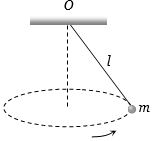
A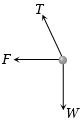
B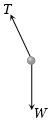
C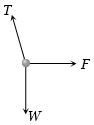
D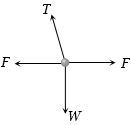
Solution
(A) When observing the system from a frame of reference that is stationary with respect to the mass $m$,we are in a non-inertial frame.
In this frame,the mass appears to be at rest,so the net force acting on it must be zero.
The forces acting on the mass are:
$1$. The tension $T$ in the thread,acting along the thread towards the pivot $O$.
$2$. The weight $W = mg$ acting vertically downwards.
$3$. The centrifugal force $F = m\omega^2r$ acting radially outwards from the center of the circular path.
Since the mass is in equilibrium in this rotating frame,these three forces must balance each other.
Looking at the provided options,the correct representation of these three forces is shown in image $18-b87$ (Option $A$). Therefore,the correct option is $A$.
In this frame,the mass appears to be at rest,so the net force acting on it must be zero.
The forces acting on the mass are:
$1$. The tension $T$ in the thread,acting along the thread towards the pivot $O$.
$2$. The weight $W = mg$ acting vertically downwards.
$3$. The centrifugal force $F = m\omega^2r$ acting radially outwards from the center of the circular path.
Since the mass is in equilibrium in this rotating frame,these three forces must balance each other.
Looking at the provided options,the correct representation of these three forces is shown in image $18-b87$ (Option $A$). Therefore,the correct option is $A$.
0 likes
View Solution4
MediumMCQ
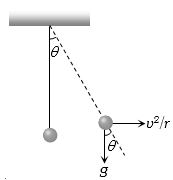
$A$ car is moving on a circular horizontal track of radius $10 \, m$ with a constant speed of $10 \, m/s$. $A$ plumb bob is suspended from the roof of the car by a light rigid rod of length $1.00 \, m$. The angle made by the rod with the vertical is ........ $^o$.
A
$0$
B
$30$
C
$45$
D
$60$
Solution
(C) When the car moves in a circular path,the plumb bob experiences a pseudo-force (centrifugal force) in the frame of the car,directed radially outward,given by $F_c = \frac{mv^2}{r}$.
The gravitational force acting on the bob is $mg$,directed vertically downward.
Let $\theta$ be the angle the rod makes with the vertical. In the equilibrium position,the net force on the bob in the car's frame is zero.
Taking the ratio of the horizontal force to the vertical force,we get:
$\tan \theta = \frac{F_c}{mg} = \frac{mv^2/r}{mg} = \frac{v^2}{rg}$.
Given $v = 10 \, m/s$,$r = 10 \, m$,and taking $g = 10 \, m/s^2$:
$\tan \theta = \frac{10^2}{10 \times 10} = \frac{100}{100} = 1$.
Therefore,$\theta = \tan^{-1}(1) = 45^\circ$.
The gravitational force acting on the bob is $mg$,directed vertically downward.
Let $\theta$ be the angle the rod makes with the vertical. In the equilibrium position,the net force on the bob in the car's frame is zero.
Taking the ratio of the horizontal force to the vertical force,we get:
$\tan \theta = \frac{F_c}{mg} = \frac{mv^2/r}{mg} = \frac{v^2}{rg}$.
Given $v = 10 \, m/s$,$r = 10 \, m$,and taking $g = 10 \, m/s^2$:
$\tan \theta = \frac{10^2}{10 \times 10} = \frac{100}{100} = 1$.
Therefore,$\theta = \tan^{-1}(1) = 45^\circ$.
0 likes
View Solution5
EasyMCQ
$A$ body of mass $2 \, kg$ is hung on a spring balance mounted vertically in a lift. If the lift descends with an acceleration equal to the acceleration due to gravity $g$,the reading on the spring balance will be ....... $kg$.
A
$2$
B
$4$
C
$1$
D
$0$
Solution
(D) The reading on a spring balance represents the normal force or the apparent weight of the body.
When a lift descends with an acceleration $a$,the apparent weight $W'$ is given by the formula $W' = m(g - a)$.
In this problem,the mass $m = 2 \, kg$ and the acceleration of the lift $a = g$.
Substituting these values into the formula:
$W' = m(g - g) = m(0) = 0$.
Therefore,the reading on the spring balance will be $0 \, kg$.
When a lift descends with an acceleration $a$,the apparent weight $W'$ is given by the formula $W' = m(g - a)$.
In this problem,the mass $m = 2 \, kg$ and the acceleration of the lift $a = g$.
Substituting these values into the formula:
$W' = m(g - g) = m(0) = 0$.
Therefore,the reading on the spring balance will be $0 \, kg$.
1 likes
View Solution6
EasyMCQ
$A$ body of mass $2 \, kg$ is hung on a spring balance mounted vertically in a lift. If the lift descends with an acceleration equal to the acceleration due to gravity $g$,and if the lift moves up with a constant velocity of $2 \, m/s$,the reading on the balance will be ......... $kg$.
A
$2$
B
$4$
C
$0$
D
$1$
Solution
(A) The problem asks for the reading on the spring balance when the lift moves up with a constant velocity of $2 \, m/s$.
When the lift moves with a constant velocity,its acceleration $a = 0$.
The apparent weight $R$ is given by the formula $R = m(g + a)$.
Substituting $a = 0$ and $m = 2 \, kg$,we get $R = 2(g + 0) = 2g \, N$.
Since the spring balance is calibrated to read mass in $kg$,the reading is $R/g = 2 \, kg$.
Note: The condition regarding the lift descending with acceleration $g$ is a separate scenario where the reading would be $m(g - g) = 0 \, kg$,but the question specifically asks for the reading when moving up with constant velocity.
When the lift moves with a constant velocity,its acceleration $a = 0$.
The apparent weight $R$ is given by the formula $R = m(g + a)$.
Substituting $a = 0$ and $m = 2 \, kg$,we get $R = 2(g + 0) = 2g \, N$.
Since the spring balance is calibrated to read mass in $kg$,the reading is $R/g = 2 \, kg$.
Note: The condition regarding the lift descending with acceleration $g$ is a separate scenario where the reading would be $m(g - g) = 0 \, kg$,but the question specifically asks for the reading when moving up with constant velocity.
0 likes
View Solution7
EasyMCQ
$A$ body of mass $2\, kg$ is hung on a spring balance mounted vertically in a lift. If the lift moves up with an acceleration equal to the acceleration due to gravity $g$,the reading on the spring balance will be .......... $kg$.
A
$2$
B
$2g$
C
$4g$
D
$4$
Solution
(D) The reading of a spring balance in a lift is given by the apparent weight $R = m(g + a)$,where $m$ is the mass,$g$ is the acceleration due to gravity,and $a$ is the acceleration of the lift.
Given: $m = 2\, kg$ and $a = g$ (upward acceleration).
Substituting these values into the formula:
$R = 2(g + g) = 2(2g) = 4g\, N$.
Since the spring balance is calibrated to read mass in $kg$,the reading corresponds to $4\, kg$.
Given: $m = 2\, kg$ and $a = g$ (upward acceleration).
Substituting these values into the formula:
$R = 2(g + g) = 2(2g) = 4g\, N$.
Since the spring balance is calibrated to read mass in $kg$,the reading corresponds to $4\, kg$.
0 likes
View Solution8
MediumMCQ
$A$ coin is dropped in a lift. It takes time $t_1$ to reach the floor when the lift is stationary. It takes time $t_2$ when the lift is moving up with constant acceleration. Then:
A
$t_1 > t_2$
B
$t_2 > t_1$
C
$t_1 = t_2$
D
$t_1 >> t_2$
Solution
(A) When the lift is stationary,the acceleration of the coin relative to the floor is $g$. The time taken to cover distance $h$ is $t_1 = \sqrt{\frac{2h}{g}}$.
When the lift moves upward with constant acceleration $a$,the effective acceleration of the coin relative to the lift floor is $g_{eff} = g + a$.
The time taken to cover the same distance $h$ is $t_2 = \sqrt{\frac{2h}{g + a}}$.
Since $g + a > g$,it follows that $\frac{2h}{g + a} < \frac{2h}{g}$,which implies $t_2 < t_1$ or $t_1 > t_2$.
When the lift moves upward with constant acceleration $a$,the effective acceleration of the coin relative to the lift floor is $g_{eff} = g + a$.
The time taken to cover the same distance $h$ is $t_2 = \sqrt{\frac{2h}{g + a}}$.
Since $g + a > g$,it follows that $\frac{2h}{g + a} < \frac{2h}{g}$,which implies $t_2 < t_1$ or $t_1 > t_2$.
0 likes
View Solution9
EasyMCQ
$A$ person is standing in an elevator. In which of the following situations does he find his weight to be less than his actual weight?
A
The elevator moves upward with constant acceleration.
B
The elevator moves downward with constant acceleration.
C
The elevator moves upward with uniform velocity.
D
The elevator moves downward with uniform velocity.
Solution
(B) The apparent weight $W'$ of a person in an elevator is given by $W' = m(g \pm a)$,where $m$ is the mass of the person,$g$ is the acceleration due to gravity,and $a$ is the acceleration of the elevator.
When the elevator moves downward with an acceleration $a$,the apparent weight is $W' = m(g - a)$.
Since $(g - a) < g$,the apparent weight $W'$ is less than the actual weight $W = mg$.
Therefore,the person feels lighter when the elevator moves downward with constant acceleration.
When the elevator moves downward with an acceleration $a$,the apparent weight is $W' = m(g - a)$.
Since $(g - a) < g$,the apparent weight $W'$ is less than the actual weight $W = mg$.
Therefore,the person feels lighter when the elevator moves downward with constant acceleration.
0 likes
View Solution10
MediumMCQ
$A$ man is standing on a weighing machine placed in a lift. When stationary,his weight is recorded as $40 \, kg$. If the lift is accelerated upwards with an acceleration of $2 \, m/s^2$,then the weight recorded in the machine will be .......... $kg$ $(g = 10 \, m/s^2)$.
A
$32$
B
$40$
C
$42$
D
$48$
Solution
(D) When the lift is stationary,the normal force $N$ exerted by the weighing machine is equal to the actual weight $W = mg = 40 \times 10 = 400 \, N$.
When the lift accelerates upwards with an acceleration $a = 2 \, m/s^2$,the apparent weight $W'$ is given by the equation $W' = m(g + a)$.
Substituting the values: $W' = 40 \times (10 + 2) = 40 \times 12 = 480 \, N$.
Since the weighing machine is calibrated to show weight in $kg$ (where $1 \, kg$ corresponds to $10 \, N$ in this problem),the reading will be $480 / 10 = 48 \, kg$.
When the lift accelerates upwards with an acceleration $a = 2 \, m/s^2$,the apparent weight $W'$ is given by the equation $W' = m(g + a)$.
Substituting the values: $W' = 40 \times (10 + 2) = 40 \times 12 = 480 \, N$.
Since the weighing machine is calibrated to show weight in $kg$ (where $1 \, kg$ corresponds to $10 \, N$ in this problem),the reading will be $480 / 10 = 48 \, kg$.
0 likes
View Solution11
MediumMCQ
$A$ body of mass $4 \, kg$ weighs $4.8 \, kg$ when suspended in a moving lift. The acceleration of the lift is
A
$9.80 \, m/s^2$ downwards
B
$9.80 \, m/s^2$ upwards
C
$1.96 \, m/s^2$ downwards
D
$1.96 \, m/s^2$ upwards
Solution
(D) The apparent weight of the body is $W' = 4.8 \, kgf = 4.8 \, g \, N$.
The actual mass of the body is $m = 4 \, kg$,so its actual weight is $W = 4 \, g \, N$.
Since the apparent weight is greater than the actual weight $(4.8 \, g > 4 \, g)$,the lift must be accelerating upwards.
The formula for apparent weight in an accelerating lift is $R = m(g + a)$.
Substituting the values: $4.8 \, g = 4(g + a)$.
Dividing both sides by $4$: $1.2 \, g = g + a$.
Therefore,$a = 1.2 \, g - g = 0.2 \, g$.
Using $g = 9.8 \, m/s^2$,we get $a = 0.2 \times 9.8 = 1.96 \, m/s^2$ in the upward direction.
The actual mass of the body is $m = 4 \, kg$,so its actual weight is $W = 4 \, g \, N$.
Since the apparent weight is greater than the actual weight $(4.8 \, g > 4 \, g)$,the lift must be accelerating upwards.
The formula for apparent weight in an accelerating lift is $R = m(g + a)$.
Substituting the values: $4.8 \, g = 4(g + a)$.
Dividing both sides by $4$: $1.2 \, g = g + a$.
Therefore,$a = 1.2 \, g - g = 0.2 \, g$.
Using $g = 9.8 \, m/s^2$,we get $a = 0.2 \times 9.8 = 1.96 \, m/s^2$ in the upward direction.
0 likes
View Solution12
EasyMCQ
$A$ boy having a mass equal to $40 \, kg$ is standing in an elevator. The force felt by the feet of the boy (apparent weight) will be greatest when the elevator $(g = 9.8 \, m/s^2)$:
A
Stands still
B
Moves downward at a constant velocity of $4 \, m/s$
C
Accelerates downward with an acceleration equal to $4 \, m/s^2$
D
Accelerates upward with an acceleration equal to $4 \, m/s^2$
Solution
(D) The apparent weight $N$ of a person in an elevator is given by $N = m(g + a)$,where $a$ is the upward acceleration.
For case $A$ (Stands still): $a = 0$,so $N = mg = 40 \times 9.8 = 392 \, N$.
For case $B$ (Constant velocity): $a = 0$,so $N = mg = 392 \, N$.
For case $C$ (Accelerates downward): $a = -4 \, m/s^2$,so $N = m(g - 4) = 40(9.8 - 4) = 40(5.8) = 232 \, N$.
For case $D$ (Accelerates upward): $a = 4 \, m/s^2$,so $N = m(g + 4) = 40(9.8 + 4) = 40(13.8) = 552 \, N$.
Comparing all cases,the force is greatest when the elevator accelerates upward.
For case $A$ (Stands still): $a = 0$,so $N = mg = 40 \times 9.8 = 392 \, N$.
For case $B$ (Constant velocity): $a = 0$,so $N = mg = 392 \, N$.
For case $C$ (Accelerates downward): $a = -4 \, m/s^2$,so $N = m(g - 4) = 40(9.8 - 4) = 40(5.8) = 232 \, N$.
For case $D$ (Accelerates upward): $a = 4 \, m/s^2$,so $N = m(g + 4) = 40(9.8 + 4) = 40(13.8) = 552 \, N$.
Comparing all cases,the force is greatest when the elevator accelerates upward.
0 likes
View Solution13
MediumMCQ
The ratio of the weight of a man in a stationary lift and when it is moving downward with uniform acceleration $a$ is $3 : 2$. The value of $a$ is ($g$ = acceleration due to gravity of the earth).
A
$3/2 g$
B
$g/3$
C
$2/3 g$
D
$g$
Solution
(B) Let the mass of the man be $m$.
When the lift is stationary,the apparent weight is $W_1 = mg$.
When the lift is moving downward with uniform acceleration $a$,the apparent weight is $W_2 = m(g - a)$.
According to the problem,the ratio of the weights is $W_1 : W_2 = 3 : 2$.
Therefore,$\frac{mg}{m(g - a)} = \frac{3}{2}$.
Canceling $m$ from the numerator and denominator,we get $\frac{g}{g - a} = \frac{3}{2}$.
Cross-multiplying gives $2g = 3(g - a)$.
$2g = 3g - 3a$.
$3a = 3g - 2g$.
$3a = g$.
Thus,$a = g/3$.
When the lift is stationary,the apparent weight is $W_1 = mg$.
When the lift is moving downward with uniform acceleration $a$,the apparent weight is $W_2 = m(g - a)$.
According to the problem,the ratio of the weights is $W_1 : W_2 = 3 : 2$.
Therefore,$\frac{mg}{m(g - a)} = \frac{3}{2}$.
Canceling $m$ from the numerator and denominator,we get $\frac{g}{g - a} = \frac{3}{2}$.
Cross-multiplying gives $2g = 3(g - a)$.
$2g = 3g - 3a$.
$3a = 3g - 2g$.
$3a = g$.
Thus,$a = g/3$.
0 likes
View Solution14
EasyMCQ
In an elevator moving vertically up with an acceleration $g$,the force exerted on the floor by a passenger of mass $M$ is
A
$Mg$
B
$\frac{1}{2}Mg$
C
$Zero$
D
$2Mg$
Solution
(D) The apparent weight $R$ of a person in an elevator moving with an upward acceleration $a$ is given by the formula $R = M(g + a)$.
Given that the elevator is moving vertically up with an acceleration $a = g$.
Substituting the value of $a$ in the formula,we get $R = M(g + g)$.
Therefore,$R = M(2g) = 2Mg$.
Thus,the force exerted on the floor by the passenger is $2Mg$.
Given that the elevator is moving vertically up with an acceleration $a = g$.
Substituting the value of $a$ in the formula,we get $R = M(g + g)$.
Therefore,$R = M(2g) = 2Mg$.
Thus,the force exerted on the floor by the passenger is $2Mg$.
0 likes
View Solution15
EasyMCQ
$A$ boy of $50 \, kg$ is in a lift moving down with an acceleration of $9.8 \, m/s^2$. The apparent weight of the boy is ........... $N$ $(g = 9.8 \, m/s^2)$.
A
$490$
B
$0$
C
$50$
D
$5.1$
Solution
(B) The apparent weight $W'$ of a body in a lift moving downwards with an acceleration $a$ is given by the formula: $W' = m(g - a)$.
Given:
Mass $m = 50 \, kg$
Acceleration $a = 9.8 \, m/s^2$
Acceleration due to gravity $g = 9.8 \, m/s^2$
Substituting the values:
$W' = 50 \times (9.8 - 9.8)$
$W' = 50 \times 0 = 0 \, N$.
Therefore,the apparent weight of the boy is $0 \, N$.
Given:
Mass $m = 50 \, kg$
Acceleration $a = 9.8 \, m/s^2$
Acceleration due to gravity $g = 9.8 \, m/s^2$
Substituting the values:
$W' = 50 \times (9.8 - 9.8)$
$W' = 50 \times 0 = 0 \, N$.
Therefore,the apparent weight of the boy is $0 \, N$.
0 likes
View Solution16
EasyMCQ
$A$ mass is hanging on a spring balance which is kept in a lift. The lift ascends. The spring balance will show in its reading
A
Increase
B
Decrease
C
No change
D
Change depending upon velocity
Solution
(D) The apparent weight $W'$ of a body of mass $m$ in a lift moving with an acceleration $a$ is given by $W' = m(g + a)$ if the lift is accelerating upwards and $W' = m(g - a)$ if it is accelerating downwards.
In this question,it is stated that the lift ascends,but it is not specified whether the lift is moving with constant velocity or with acceleration.
If the lift moves with a constant velocity,the acceleration $a = 0$,so the reading remains $mg$ (no change).
If the lift moves with an upward acceleration,the reading increases.
If the lift moves with a downward acceleration (deceleration while ascending),the reading decreases.
Therefore,the reading depends on the state of motion (acceleration) of the lift,which is related to its velocity change over time.
In this question,it is stated that the lift ascends,but it is not specified whether the lift is moving with constant velocity or with acceleration.
If the lift moves with a constant velocity,the acceleration $a = 0$,so the reading remains $mg$ (no change).
If the lift moves with an upward acceleration,the reading increases.
If the lift moves with a downward acceleration (deceleration while ascending),the reading decreases.
Therefore,the reading depends on the state of motion (acceleration) of the lift,which is related to its velocity change over time.
0 likes
View Solution17
EasyMCQ
The apparent weight of a body,when it is travelling upwards with an acceleration of $2 \ m/s^2$ and its mass is $10 \ kg$,will be ......... $N$.
A
$198$
B
$164$
C
$140$
D
$118$
Solution
(D) When a body of mass $m$ moves upwards with an acceleration $a$,the apparent weight $R$ is given by the formula: $R = m(g + a)$.
Given: Mass $m = 10 \ kg$,acceleration $a = 2 \ m/s^2$,and acceleration due to gravity $g = 9.8 \ m/s^2$.
Substituting the values into the formula:
$R = 10 \times (9.8 + 2)$
$R = 10 \times 11.8$
$R = 118 \ N$.
Therefore,the apparent weight is $118 \ N$.
Given: Mass $m = 10 \ kg$,acceleration $a = 2 \ m/s^2$,and acceleration due to gravity $g = 9.8 \ m/s^2$.
Substituting the values into the formula:
$R = 10 \times (9.8 + 2)$
$R = 10 \times 11.8$
$R = 118 \ N$.
Therefore,the apparent weight is $118 \ N$.
0 likes
View Solution18
EasyMCQ
$A$ body of mass $1.0 \, kg$ is falling with an acceleration of $10 \, m/s^2$. Its apparent weight will be ......... $kg \, wt$ $(g = 10 \, m/s^2)$.
A
$1.0$
B
$2.0$
C
$0.5$
D
$0$
Solution
(D) The apparent weight $R$ of a body of mass $m$ moving with an acceleration $a$ in a downward direction is given by the formula: $R = m(g - a)$.
Given:
Mass $m = 1.0 \, kg$
Acceleration $a = 10 \, m/s^2$
Acceleration due to gravity $g = 10 \, m/s^2$
Substituting the values into the formula:
$R = 1.0 \times (10 - 10)$
$R = 1.0 \times 0$
$R = 0 \, kg \, wt$.
Therefore,the apparent weight of the body is $0$.
Given:
Mass $m = 1.0 \, kg$
Acceleration $a = 10 \, m/s^2$
Acceleration due to gravity $g = 10 \, m/s^2$
Substituting the values into the formula:
$R = 1.0 \times (10 - 10)$
$R = 1.0 \times 0$
$R = 0 \, kg \, wt$.
Therefore,the apparent weight of the body is $0$.
0 likes
View Solution19
EasyMCQ
If the rope of a lift breaks suddenly,what is the tension exerted by the floor of the lift on a person inside? ($a =$ acceleration of the lift)
A
$mg$
B
$m(g + a)$
C
$m(g - a)$
D
$0$
Solution
(D) When the rope of a lift breaks,the lift falls freely under gravity.
Therefore,the acceleration of the lift becomes equal to the acceleration due to gravity,i.e.,$a = g$.
The apparent weight (normal force or tension exerted by the floor) $N$ on a person of mass $m$ inside the lift is given by $N = m(g - a)$.
Substituting $a = g$ into the equation,we get $N = m(g - g) = 0$.
Thus,the person experiences weightlessness,and the tension exerted by the surface is $0$.
Therefore,the acceleration of the lift becomes equal to the acceleration due to gravity,i.e.,$a = g$.
The apparent weight (normal force or tension exerted by the floor) $N$ on a person of mass $m$ inside the lift is given by $N = m(g - a)$.
Substituting $a = g$ into the equation,we get $N = m(g - g) = 0$.
Thus,the person experiences weightlessness,and the tension exerted by the surface is $0$.
0 likes
View Solution20
EasyMCQ
$A$ boy whose mass is $50\,kg$ stands on a spring balance inside a lift. The lift starts to ascend with an acceleration of $2\,m/s^2$. The reading of the machine or balance $(g = 10\,m/s^2)$ is ........ $kg$.
A
$50$
B
$0$
C
$49$
D
$60$
Solution
(D) The apparent weight $R$ of a person in an accelerating lift is given by the formula $R = m(g + a)$,where $m$ is the mass,$g$ is the acceleration due to gravity,and $a$ is the acceleration of the lift.
Given: $m = 50\,kg$,$g = 10\,m/s^2$,and $a = 2\,m/s^2$.
Substituting the values: $R = 50 \times (10 + 2) = 50 \times 12 = 600\,N$.
The reading of the balance is in $kg$ weight,so $R = 600/10 = 60\,kg$.
Given: $m = 50\,kg$,$g = 10\,m/s^2$,and $a = 2\,m/s^2$.
Substituting the values: $R = 50 \times (10 + 2) = 50 \times 12 = 600\,N$.
The reading of the balance is in $kg$ weight,so $R = 600/10 = 60\,kg$.
0 likes
View Solution21
EasyMCQ
$A$ lift is accelerating downward with an acceleration $a$. $A$ man inside the lift throws a ball upward with an acceleration $a_0$ relative to the lift $(a_0 < a)$. What is the acceleration of the ball as observed by an observer on the Earth?
A
$(a + a_0)$ upward
B
$(a - a_0)$ upward
C
$(a + a_0)$ downward
D
$(a - a_0)$ downward
Solution
(D) Let the downward direction be positive.
The acceleration of the lift relative to the Earth is $a_{lift} = a$ (downward).
The acceleration of the ball relative to the lift is $a_{ball/lift} = -a_0$ (upward,so negative).
Using the relative acceleration formula: $a_{ball/earth} = a_{ball/lift} + a_{lift/earth}$.
Substituting the values: $a_{ball/earth} = -a_0 + a = (a - a_0)$.
Since the result is positive,the acceleration of the ball as observed by an observer on the Earth is $(a - a_0)$ in the downward direction.
The acceleration of the lift relative to the Earth is $a_{lift} = a$ (downward).
The acceleration of the ball relative to the lift is $a_{ball/lift} = -a_0$ (upward,so negative).
Using the relative acceleration formula: $a_{ball/earth} = a_{ball/lift} + a_{lift/earth}$.
Substituting the values: $a_{ball/earth} = -a_0 + a = (a - a_0)$.
Since the result is positive,the acceleration of the ball as observed by an observer on the Earth is $(a - a_0)$ in the downward direction.
0 likes
View Solution22
MediumMCQ
$A$ lift is moving down with an acceleration $a$. $A$ man in the lift drops a ball inside the lift. The acceleration of the ball as observed by the man in the lift and a man standing stationary on the ground are respectively:
A
$g, g$
B
$g - a, g - a$
C
$g - a, g$
D
$a, g$
Solution
(C) $1$. For the man standing stationary on the ground (inertial frame),the ball is under the influence of gravity alone. Therefore,its acceleration is $g$ downwards.
$2$. For the man inside the lift (non-inertial frame),we must apply a pseudo force. The lift is accelerating downwards with $a$,so a pseudo force $ma$ acts upwards on the ball.
$3$. The net force on the ball in the lift frame is $F_{net} = mg - ma$ (downwards).
$4$. The acceleration observed by the man in the lift is $a_{lift} = F_{net} / m = (mg - ma) / m = g - a$ downwards.
$5$. Thus,the accelerations are $g - a$ and $g$ respectively.
$2$. For the man inside the lift (non-inertial frame),we must apply a pseudo force. The lift is accelerating downwards with $a$,so a pseudo force $ma$ acts upwards on the ball.
$3$. The net force on the ball in the lift frame is $F_{net} = mg - ma$ (downwards).
$4$. The acceleration observed by the man in the lift is $a_{lift} = F_{net} / m = (mg - ma) / m = g - a$ downwards.
$5$. Thus,the accelerations are $g - a$ and $g$ respectively.
0 likes
View Solution23
EasyMCQ
$A$ man weighs $80\,kg.$ He stands on a weighing scale in a lift which is moving upwards with a uniform acceleration of $5\,m/s^2.$ What would be the reading on the scale? $(g = 10\,m/s^2)$ ............ $N$
A
$400$
B
$800$
C
$1200$
D
$0$
Solution
(C) When a lift moves upwards with a uniform acceleration $a$,the apparent weight $R$ (reading on the weighing scale) is given by the formula:
$R = m(g + a)$
Given:
Mass of the man,$m = 80\,kg$
Acceleration of the lift,$a = 5\,m/s^2$
Acceleration due to gravity,$g = 10\,m/s^2$
Substituting the values into the formula:
$R = 80 \times (10 + 5)$
$R = 80 \times 15$
$R = 1200\,N$
Therefore,the reading on the scale is $1200\,N$.
$R = m(g + a)$
Given:
Mass of the man,$m = 80\,kg$
Acceleration of the lift,$a = 5\,m/s^2$
Acceleration due to gravity,$g = 10\,m/s^2$
Substituting the values into the formula:
$R = 80 \times (10 + 5)$
$R = 80 \times 15$
$R = 1200\,N$
Therefore,the reading on the scale is $1200\,N$.
0 likes
View Solution24
MediumMCQ
$A$ spring balance is attached to the ceiling of a lift. $A$ man hangs his bag on the spring and the spring reads $49 \, N$,when the lift is stationary. If the lift moves downward with an acceleration of $5 \, m/s^2$,the reading of the spring balance will be .......... $N$.
A
$49$
B
$24$
C
$74$
D
$15$
Solution
(B) When the lift is stationary,the reading of the spring balance is equal to the actual weight of the bag: $W = mg = 49 \, N$.
Taking $g = 9.8 \, m/s^2$,we find the mass of the bag: $m = \frac{49}{9.8} = 5 \, kg$.
When the lift moves downward with an acceleration $a = 5 \, m/s^2$,the apparent weight $R$ is given by the formula: $R = m(g - a)$.
Substituting the values: $R = 5 \times (9.8 - 5) = 5 \times 4.8 = 24 \, N$.
Therefore,the reading of the spring balance will be $24 \, N$.
Taking $g = 9.8 \, m/s^2$,we find the mass of the bag: $m = \frac{49}{9.8} = 5 \, kg$.
When the lift moves downward with an acceleration $a = 5 \, m/s^2$,the apparent weight $R$ is given by the formula: $R = m(g - a)$.
Substituting the values: $R = 5 \times (9.8 - 5) = 5 \times 4.8 = 24 \, N$.
Therefore,the reading of the spring balance will be $24 \, N$.
0 likes
View Solution25
EasyMCQ
The mass of a person sitting in a lift is $50 \, kg$. If the lift is coming down with a constant acceleration of $10 \, m/s^2$,then the reading of the spring balance will be ......... $N$ $(g = 10 \, m/s^2)$.
A
$0$
B
$1000$
C
$100$
D
$10$
Solution
(A) The apparent weight $R$ of a person in a lift moving downwards with an acceleration $a$ is given by the formula $R = m(g - a)$.
Given:
Mass $m = 50 \, kg$
Acceleration of lift $a = 10 \, m/s^2$
Acceleration due to gravity $g = 10 \, m/s^2$
Substituting the values into the formula:
$R = 50 \times (10 - 10)$
$R = 50 \times 0$
$R = 0 \, N$.
Therefore,the reading of the spring balance will be $0 \, N$.
Given:
Mass $m = 50 \, kg$
Acceleration of lift $a = 10 \, m/s^2$
Acceleration due to gravity $g = 10 \, m/s^2$
Substituting the values into the formula:
$R = 50 \times (10 - 10)$
$R = 50 \times 0$
$R = 0 \, N$.
Therefore,the reading of the spring balance will be $0 \, N$.
0 likes
View Solution26
DifficultMCQ
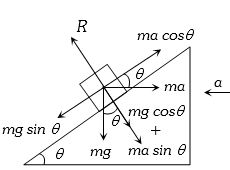
$A$ block of mass $m$ is placed on a smooth wedge of inclination $\theta$. The whole system is accelerated horizontally so that the block does not slip on the wedge. The force exerted by the wedge on the block ($g$ is acceleration due to gravity) will be
A
$mg\cos \theta$
B
$mg\sin \theta$
C
$mg$
D
$mg/\cos \theta$
Solution
(D) To keep the block stationary relative to the wedge,the net force acting on the block along the inclined plane must be zero.
$1$. Resolve the forces acting on the block in the frame of the wedge:
- Gravitational force $mg$ acting downwards.
- Pseudo force $ma$ acting horizontally in the direction opposite to the acceleration of the wedge.
- Normal reaction $R$ exerted by the wedge perpendicular to the inclined surface.
$2$. For the block not to slip,the component of $mg$ down the plane must be balanced by the component of the pseudo force $ma$ up the plane:
$mg \sin \theta = ma \cos \theta$
$a = g \tan \theta$
$3$. The normal force $R$ balances the components of $mg$ and $ma$ perpendicular to the inclined plane:
$R = mg \cos \theta + ma \sin \theta$
Substitute $a = g \tan \theta = g \frac{\sin \theta}{\cos \theta}$:
$R = mg \cos \theta + m(g \frac{\sin \theta}{\cos \theta}) \sin \theta$
$R = mg \frac{\cos^2 \theta + \sin^2 \theta}{\cos \theta}$
$R = \frac{mg}{\cos \theta}$
$1$. Resolve the forces acting on the block in the frame of the wedge:
- Gravitational force $mg$ acting downwards.
- Pseudo force $ma$ acting horizontally in the direction opposite to the acceleration of the wedge.
- Normal reaction $R$ exerted by the wedge perpendicular to the inclined surface.
$2$. For the block not to slip,the component of $mg$ down the plane must be balanced by the component of the pseudo force $ma$ up the plane:
$mg \sin \theta = ma \cos \theta$
$a = g \tan \theta$
$3$. The normal force $R$ balances the components of $mg$ and $ma$ perpendicular to the inclined plane:
$R = mg \cos \theta + ma \sin \theta$
Substitute $a = g \tan \theta = g \frac{\sin \theta}{\cos \theta}$:
$R = mg \cos \theta + m(g \frac{\sin \theta}{\cos \theta}) \sin \theta$
$R = mg \frac{\cos^2 \theta + \sin^2 \theta}{\cos \theta}$
$R = \frac{mg}{\cos \theta}$
0 likes
View Solution27
EasyMCQ
$A$ man of mass $75\, kg$ is standing in an elevator which is moving with an acceleration of $5\, m/s^2$ in the upward direction. The apparent weight of the man will be ........... $N$ $(g = 10\, m/s^2)$.
A
$1425$
B
$1375$
C
$1250$
D
$1125$
Solution
(D) The apparent weight $R$ of a person in an elevator moving upwards with acceleration $a$ is given by the formula:
$R = m(g + a)$
Given:
Mass $m = 75\, kg$
Acceleration $a = 5\, m/s^2$
Acceleration due to gravity $g = 10\, m/s^2$
Substituting the values into the formula:
$R = 75(10 + 5)$
$R = 75 \times 15$
$R = 1125\, N$
Therefore,the apparent weight of the man is $1125\, N$.
$R = m(g + a)$
Given:
Mass $m = 75\, kg$
Acceleration $a = 5\, m/s^2$
Acceleration due to gravity $g = 10\, m/s^2$
Substituting the values into the formula:
$R = 75(10 + 5)$
$R = 75 \times 15$
$R = 1125\, N$
Therefore,the apparent weight of the man is $1125\, N$.
0 likes
View Solution28
EasyMCQ
The spring balance inside a lift suspends an object. As the lift begins to ascend,the reading indicated by the spring balance will
A
Increase
B
Decrease
C
Remain unchanged
D
Depend on the speed of ascend
Solution
(A) When a lift accelerates upwards with an acceleration $a$,the normal force $N$ (or tension $T$ in the spring balance) acting on the object is given by Newton's second law: $N - mg = ma$.
Therefore,the apparent weight $N = m(g + a)$.
Since the acceleration $a > 0$ during the start of the ascent,the reading $N$ becomes greater than the actual weight $mg$.
Thus,the reading of the spring balance increases.
Therefore,the apparent weight $N = m(g + a)$.
Since the acceleration $a > 0$ during the start of the ascent,the reading $N$ becomes greater than the actual weight $mg$.
Thus,the reading of the spring balance increases.
0 likes
View Solution29
EasyMCQ
$A$ man of mass $80\, kg$ is standing in an elevator which is moving with an acceleration of $6\, m/s^2$ in the upward direction. The apparent weight of the man will be ......... $N$ $(g = 10\, m/s^2)$.
A
$1480$
B
$1280$
C
$1380$
D
None of these
Solution
(B) The apparent weight $R$ of a person in an elevator moving upwards with acceleration $a$ is given by the formula:
$R = m(g + a)$
Given:
Mass of the man,$m = 80\, kg$
Acceleration of the elevator,$a = 6\, m/s^2$
Acceleration due to gravity,$g = 10\, m/s^2$
Substituting the values into the formula:
$R = 80(10 + 6)$
$R = 80 \times 16$
$R = 1280\, N$
Therefore,the apparent weight of the man is $1280\, N$.
$R = m(g + a)$
Given:
Mass of the man,$m = 80\, kg$
Acceleration of the elevator,$a = 6\, m/s^2$
Acceleration due to gravity,$g = 10\, m/s^2$
Substituting the values into the formula:
$R = 80(10 + 6)$
$R = 80 \times 16$
$R = 1280\, N$
Therefore,the apparent weight of the man is $1280\, N$.
0 likes
View Solution30
EasyMCQ
$A$ thief stole a box full of valuable articles of weight $W$ and while carrying it on his back,he jumped down a wall of height $h$ from the ground. Before he reached the ground,he experienced a load of:
A
$2W$
B
$W$
C
$W/2$
D
Zero
Solution
(D) When the thief jumps from the wall,both the thief and the box are in a state of free fall under the influence of gravity alone.
In a state of free fall,the acceleration of the system is equal to the acceleration due to gravity $(a = g)$.
The apparent weight $W'$ of an object is given by the formula $W' = m(g - a)$.
Substituting $a = g$ into the equation,we get $W' = m(g - g) = 0$.
Therefore,the thief experiences a load of zero while in the air.
In a state of free fall,the acceleration of the system is equal to the acceleration due to gravity $(a = g)$.
The apparent weight $W'$ of an object is given by the formula $W' = m(g - a)$.
Substituting $a = g$ into the equation,we get $W' = m(g - g) = 0$.
Therefore,the thief experiences a load of zero while in the air.
0 likes
View Solution31
EasyMCQ
If a body of mass $m$ is carried by a lift moving with an upward acceleration $a$,then the forces acting on the body are:
$(i)$ The reaction $R$ on the floor of the lift acting upwards.
$(ii)$ The weight $mg$ of the body acting vertically downwards.
The equation of motion will be given by:
$(i)$ The reaction $R$ on the floor of the lift acting upwards.
$(ii)$ The weight $mg$ of the body acting vertically downwards.
The equation of motion will be given by:
A
$R = mg - ma$
B
$R = mg + ma$
C
$R = ma - mg$
D
$R = mg \times ma$
Solution
(B) When a body of mass $m$ is in a lift moving upwards with an acceleration $a$,the forces acting on the body are the normal reaction $R$ (upwards) and the weight $mg$ (downwards).
According to Newton's second law of motion,the net force is equal to the product of mass and acceleration:
$F_{net} = ma$
Here,the net force is $R - mg$ because the lift is accelerating upwards.
Therefore,the equation of motion is:
$R - mg = ma$
Rearranging the terms to solve for $R$:
$R = mg + ma$
According to Newton's second law of motion,the net force is equal to the product of mass and acceleration:
$F_{net} = ma$
Here,the net force is $R - mg$ because the lift is accelerating upwards.
Therefore,the equation of motion is:
$R - mg = ma$
Rearranging the terms to solve for $R$:
$R = mg + ma$
0 likes
View Solution32
MediumMCQ
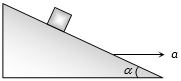
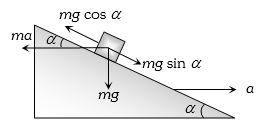
$A$ block is kept on a frictionless inclined surface with an angle of inclination '$\alpha$'. The incline is given a horizontal acceleration '$a$' to keep the block stationary relative to the incline. Then '$a$' is equal to:
A
$g$
B
$g \tan \alpha$
C
$g / \tan \alpha$
D
$g \csc \alpha$
Solution
(B) Let the mass of the block be $m$. To keep the block stationary relative to the inclined surface,we analyze the forces in the frame of the incline.
$1$. The forces acting on the block are its weight $(mg)$ acting downwards,the normal force $(N)$ perpendicular to the surface,and the pseudo force $(ma)$ acting horizontally in the direction opposite to the acceleration of the incline.
$2$. Resolving the forces along the inclined surface:
- The component of the gravitational force down the incline is $mg \sin \alpha$.
- The component of the pseudo force up the incline is $ma \cos \alpha$.
$3$. For the block to remain stationary relative to the incline,these two forces must balance each other:
$ma \cos \alpha = mg \sin \alpha$
$4$. Dividing both sides by $m \cos \alpha$:
$a = g \frac{\sin \alpha}{\cos \alpha}$
$a = g \tan \alpha$
$1$. The forces acting on the block are its weight $(mg)$ acting downwards,the normal force $(N)$ perpendicular to the surface,and the pseudo force $(ma)$ acting horizontally in the direction opposite to the acceleration of the incline.
$2$. Resolving the forces along the inclined surface:
- The component of the gravitational force down the incline is $mg \sin \alpha$.
- The component of the pseudo force up the incline is $ma \cos \alpha$.
$3$. For the block to remain stationary relative to the incline,these two forces must balance each other:
$ma \cos \alpha = mg \sin \alpha$
$4$. Dividing both sides by $m \cos \alpha$:
$a = g \frac{\sin \alpha}{\cos \alpha}$
$a = g \tan \alpha$
0 likes
View Solution33
EasyMCQ
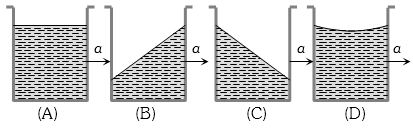
$A$ vessel containing water is given a constant acceleration $a$ towards the right,along a straight horizontal path. Which of the following diagrams represents the surface of the liquid?
A
$A$
B
$B$
C
$C$
D
$D$
Solution
(C) When a vessel containing liquid is accelerated horizontally with an acceleration $a$,the effective acceleration experienced by the liquid in the frame of the vessel is the vector sum of the gravitational acceleration $g$ (downwards) and the pseudo-acceleration $-a$ (backwards).
The free surface of the liquid must be perpendicular to the net effective acceleration vector. The angle $\theta$ that the surface makes with the horizontal is given by $\tan \theta = \frac{a}{g}$.
Since the acceleration $a$ is towards the right,the pseudo-force acts towards the left. Consequently,the liquid level rises on the left side and falls on the right side of the vessel. This corresponds to the surface profile shown in diagram $C$.
The free surface of the liquid must be perpendicular to the net effective acceleration vector. The angle $\theta$ that the surface makes with the horizontal is given by $\tan \theta = \frac{a}{g}$.
Since the acceleration $a$ is towards the right,the pseudo-force acts towards the left. Consequently,the liquid level rises on the left side and falls on the right side of the vessel. This corresponds to the surface profile shown in diagram $C$.
0 likes
View Solution34
MediumMCQ
The mass of a body measured by a physical balance in a lift at rest is found to be $m$. If the lift is going up with an acceleration $a$,its mass will be measured as
A
$m(1 - a/g)$
B
$m(1 + a/g)$
C
$m$
D
$0$
Solution
(C) physical balance works on the principle of comparing the gravitational force (weight) acting on the body with the gravitational force acting on the standard weights placed on the other pan.
Since the weight of the body $W = mg$ and the weight of the standard masses $W' = m'g$ are both affected by the same acceleration $a$ of the lift,the effective weight becomes $W_{eff} = m(g + a)$ and $W'_{eff} = m'(g + a)$.
When the balance is in equilibrium,$W_{eff} = W'_{eff}$,which implies $m(g + a) = m'(g + a)$.
Therefore,$m = m'$.
Thus,the mass measured by a physical balance remains $m$ and is independent of the acceleration of the lift.
Since the weight of the body $W = mg$ and the weight of the standard masses $W' = m'g$ are both affected by the same acceleration $a$ of the lift,the effective weight becomes $W_{eff} = m(g + a)$ and $W'_{eff} = m'(g + a)$.
When the balance is in equilibrium,$W_{eff} = W'_{eff}$,which implies $m(g + a) = m'(g + a)$.
Therefore,$m = m'$.
Thus,the mass measured by a physical balance remains $m$ and is independent of the acceleration of the lift.
0 likes
View Solution35
MediumMCQ
Three weights $W, 2W$,and $3W$ are connected to identical springs suspended from a rigid horizontal rod. The assembly of the rod and the weights falls freely under gravity. The positions of the weights from the rod are such that:
A
$3W$ will be farthest
B
$W$ will be farthest
C
All will be at the same distance
D
$2W$ will be farthest
Solution
(C) When a system falls freely under gravity,it experiences an acceleration equal to the acceleration due to gravity,$g$,directed downwards.
In the frame of reference of the falling rod,the effective acceleration of the weights is zero because the pseudo-force acting on each mass $m$ is $F_p = -mg$,which exactly cancels the gravitational force $F_g = mg$.
Since the net force on each spring is zero,there is no extension in any of the springs.
Therefore,all weights will remain at their natural (unstretched) length from the rod,meaning they will all be at the same distance.
In the frame of reference of the falling rod,the effective acceleration of the weights is zero because the pseudo-force acting on each mass $m$ is $F_p = -mg$,which exactly cancels the gravitational force $F_g = mg$.
Since the net force on each spring is zero,there is no extension in any of the springs.
Therefore,all weights will remain at their natural (unstretched) length from the rod,meaning they will all be at the same distance.
0 likes
View Solution36
DifficultMCQ
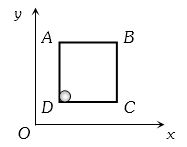
$A$ solid sphere of mass $2\, kg$ is resting inside a cube as shown in the figure. The cube is moving with a velocity $\vec v = (5t\,\hat i + 2t\,\hat j)\,m/s$. Here $t$ is the time in seconds. All surfaces are smooth. The sphere is at rest with respect to the cube. Find the total force $N$ exerted by the sphere on the cube. (Take $g = 10\, m/s^2$)
A
$\sqrt{29}\,N$
B
$29\,N$
C
$26\,N$
D
$\sqrt{89}\,N$
Solution
(C) Given velocity of the cube: $\vec v = 5t\,\hat i + 2t\,\hat j$.
Acceleration of the cube: $\vec a = \frac{d\vec v}{dt} = 5\,\hat i + 2\,\hat j\,m/s^2$.
Here,$a_x = 5\,m/s^2$ and $a_y = 2\,m/s^2$.
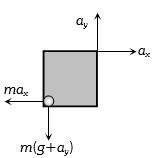
In the frame of the cube,the sphere experiences a pseudo force $\vec F_p = -m\vec a = -m(5\,\hat i + 2\,\hat j)$.
The forces acting on the sphere in the cube's frame are:
$1$. Weight: $\vec W = -mg\,\hat j = -2(10)\,\hat j = -20\,\hat j\,N$.
$2$. Pseudo force: $\vec F_p = -2(5\,\hat i + 2\,\hat j) = -10\,\hat i - 4\,\hat j\,N$.
$3$. Normal forces from the walls of the cube: $\vec N_x$ (from wall $AD$) and $\vec N_y$ (from wall $DC$).
Since the sphere is at rest relative to the cube,the net force is zero:
$\vec N_x + \vec N_y + \vec W + \vec F_p = 0$.
$\vec N_x = -(-10\,\hat i) = 10\,\hat i\,N$.
$\vec N_y = -(-20\,\hat j - 4\,\hat j) = 24\,\hat j\,N$.
The total force exerted by the sphere on the cube is the vector sum of the normal forces: $\vec N = \vec N_x + \vec N_y = 10\,\hat i + 24\,\hat j\,N$.
The magnitude is $N = \sqrt{10^2 + 24^2} = \sqrt{100 + 576} = \sqrt{676} = 26\,N$.
Acceleration of the cube: $\vec a = \frac{d\vec v}{dt} = 5\,\hat i + 2\,\hat j\,m/s^2$.
Here,$a_x = 5\,m/s^2$ and $a_y = 2\,m/s^2$.
In the frame of the cube,the sphere experiences a pseudo force $\vec F_p = -m\vec a = -m(5\,\hat i + 2\,\hat j)$.
The forces acting on the sphere in the cube's frame are:
$1$. Weight: $\vec W = -mg\,\hat j = -2(10)\,\hat j = -20\,\hat j\,N$.
$2$. Pseudo force: $\vec F_p = -2(5\,\hat i + 2\,\hat j) = -10\,\hat i - 4\,\hat j\,N$.
$3$. Normal forces from the walls of the cube: $\vec N_x$ (from wall $AD$) and $\vec N_y$ (from wall $DC$).
Since the sphere is at rest relative to the cube,the net force is zero:
$\vec N_x + \vec N_y + \vec W + \vec F_p = 0$.
$\vec N_x = -(-10\,\hat i) = 10\,\hat i\,N$.
$\vec N_y = -(-20\,\hat j - 4\,\hat j) = 24\,\hat j\,N$.
The total force exerted by the sphere on the cube is the vector sum of the normal forces: $\vec N = \vec N_x + \vec N_y = 10\,\hat i + 24\,\hat j\,N$.
The magnitude is $N = \sqrt{10^2 + 24^2} = \sqrt{100 + 576} = \sqrt{676} = 26\,N$.
0 likes
View Solution37
EasyMCQ
$A$ lift is moving downwards with an acceleration equal to the acceleration due to gravity. $A$ body of mass $m$ kept on the floor of the lift is pulled horizontally. If the coefficient of friction is $\mu$,then the frictional resistance offered by the body is:
A
$mg$
B
$\mu mg$
C
$2\mu mg$
D
Zero
Solution
(D) The normal force $N$ acting on the body of mass $m$ inside the lift can be calculated using Newton's second law.
For a lift moving downwards with acceleration $a$,the equation of motion is $mg - N = ma$.
Given that the lift is moving downwards with an acceleration equal to the acceleration due to gravity,we have $a = g$.
Substituting $a = g$ into the equation: $mg - N = mg$.
This simplifies to $N = mg - mg = 0$.
The frictional force $f$ is given by $f = \mu N$.
Since the normal force $N = 0$,the frictional resistance $f = \mu \times 0 = 0$.
Therefore,the correct option is $D$.
For a lift moving downwards with acceleration $a$,the equation of motion is $mg - N = ma$.
Given that the lift is moving downwards with an acceleration equal to the acceleration due to gravity,we have $a = g$.
Substituting $a = g$ into the equation: $mg - N = mg$.
This simplifies to $N = mg - mg = 0$.
The frictional force $f$ is given by $f = \mu N$.
Since the normal force $N = 0$,the frictional resistance $f = \mu \times 0 = 0$.
Therefore,the correct option is $D$.
0 likes
View Solution38
EasyMCQ
$A$ cork is submerged in water by a spring attached to the bottom of a bowl. When the bowl is kept in an elevator moving with an acceleration $a$ downwards, the length of the spring:
A
Increases
B
Decreases
C
Remains unchanged
D
None of these
Solution
(B) The cork is held submerged by the spring force $F_s$ and the buoyant force $F_B$, balancing its weight $W = mg$.
$F_s + W = F_B$ or $F_s = F_B - W = V \rho_w g - V \rho_c g = V(\rho_w - \rho_c)g$.
When the elevator accelerates downwards with acceleration $a$, the effective gravity becomes $g' = (g - a)$.
The new spring force is $F_s' = V(\rho_w - \rho_c)(g - a)$.
Since $(g - a) < g$, the spring force $F_s'$ decreases.
As $F_s = kx$, where $k$ is the spring constant and $x$ is the extension, a decrease in $F_s$ leads to a decrease in the extension $x$.
Therefore, the length of the spring decreases.
$F_s + W = F_B$ or $F_s = F_B - W = V \rho_w g - V \rho_c g = V(\rho_w - \rho_c)g$.
When the elevator accelerates downwards with acceleration $a$, the effective gravity becomes $g' = (g - a)$.
The new spring force is $F_s' = V(\rho_w - \rho_c)(g - a)$.
Since $(g - a) < g$, the spring force $F_s'$ decreases.
As $F_s = kx$, where $k$ is the spring constant and $x$ is the extension, a decrease in $F_s$ leads to a decrease in the extension $x$.
Therefore, the length of the spring decreases.
0 likes
View Solution39
MediumMCQ
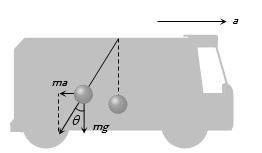
$A$ simple pendulum is set up in a trolley which moves to the right with an acceleration $a$ on a horizontal plane. Then the thread of the pendulum in the mean position makes an angle $\theta$ with the vertical.
A
$\tan^{-1}(\frac{a}{g})$ in the forward direction
B
$\tan^{-1}(\frac{a}{g})$ in the backward direction
C
$\tan^{-1}(\frac{g}{a})$ in the backward direction
D
$\tan^{-1}(\frac{g}{a})$ in the forward direction
Solution
(B) In the accelerated frame of reference (the trolley),a fictitious force (pseudo force) $F_p = ma$ acts on the bob of the pendulum in the direction opposite to the acceleration of the trolley.
The forces acting on the bob in the frame of the trolley are:
$1$. Gravitational force $mg$ acting vertically downwards.
$2$. Pseudo force $ma$ acting horizontally backwards.
$3$. Tension $T$ in the string.
In the equilibrium position (mean position),the net force on the bob is zero. Resolving the forces,we have:
$\tan \theta = \frac{\text{Pseudo force}}{\text{Gravitational force}} = \frac{ma}{mg} = \frac{a}{g}$
Therefore,$\theta = \tan^{-1}(\frac{a}{g})$ in the backward direction.
The forces acting on the bob in the frame of the trolley are:
$1$. Gravitational force $mg$ acting vertically downwards.
$2$. Pseudo force $ma$ acting horizontally backwards.
$3$. Tension $T$ in the string.
In the equilibrium position (mean position),the net force on the bob is zero. Resolving the forces,we have:
$\tan \theta = \frac{\text{Pseudo force}}{\text{Gravitational force}} = \frac{ma}{mg} = \frac{a}{g}$
Therefore,$\theta = \tan^{-1}(\frac{a}{g})$ in the backward direction.
0 likes
View Solution40
DifficultMCQ
$A$ smooth sphere of radius $R$ moves along a straight line with a constant acceleration $a = g$. $A$ particle is placed at the top of the sphere. It is released from there with zero velocity relative to the sphere. What will be its speed relative to the sphere as a function of the angle $\theta$ as the particle slides?
A
$\frac{\sqrt{Rg(\sin \theta + \cos \theta)}}{2}$
B
$\sqrt{Rg(1 + \cos \theta - \sin \theta)}$
C
$\sqrt{4Rg \sin \theta}$
D
$\sqrt{2Rg(1 + \sin \theta - \cos \theta)}$
Solution
(D) The sphere moves with acceleration $a = g$ towards the left,so the particle experiences a pseudo force $F_p = ma = mg$ towards the right.
Let the particle be at the top of the sphere at $t = 0$. As it slides to an angle $\theta$ from the vertical,the vertical displacement is $h = R(1 - \cos \theta)$ and the horizontal displacement is $d = R \sin \theta$.
Applying the work-energy theorem relative to the sphere:
$W_g + W_{pseudo} = \Delta K.E.$
Work done by gravity: $W_g = mg \cdot h = mgR(1 - \cos \theta)$.
Work done by pseudo force: $W_{pseudo} = F_p \cdot d = (mg)(R \sin \theta)$.
Since the initial kinetic energy is zero,the final kinetic energy is $\frac{1}{2}mv^2$:
$mgR(1 - \cos \theta) + mgR \sin \theta = \frac{1}{2}mv^2$.
Dividing by $m$ and multiplying by $2$:
$2gR(1 - \cos \theta + \sin \theta) = v^2$.
Therefore,$v = \sqrt{2gR(1 + \sin \theta - \cos \theta)}$.
Let the particle be at the top of the sphere at $t = 0$. As it slides to an angle $\theta$ from the vertical,the vertical displacement is $h = R(1 - \cos \theta)$ and the horizontal displacement is $d = R \sin \theta$.
Applying the work-energy theorem relative to the sphere:
$W_g + W_{pseudo} = \Delta K.E.$
Work done by gravity: $W_g = mg \cdot h = mgR(1 - \cos \theta)$.
Work done by pseudo force: $W_{pseudo} = F_p \cdot d = (mg)(R \sin \theta)$.
Since the initial kinetic energy is zero,the final kinetic energy is $\frac{1}{2}mv^2$:
$mgR(1 - \cos \theta) + mgR \sin \theta = \frac{1}{2}mv^2$.
Dividing by $m$ and multiplying by $2$:
$2gR(1 - \cos \theta + \sin \theta) = v^2$.
Therefore,$v = \sqrt{2gR(1 + \sin \theta - \cos \theta)}$.
0 likes
View Solution41
DifficultMCQ
$A$ wire is bent into the shape of a parabola given by $Y = Kx^2$. $A$ bead of mass $m$ is placed on the wire,which can slide on it without friction. Initially,when the wire is at rest,the bead is at the lowest point of the parabola. If the wire is now moved with a constant acceleration $a$ parallel to the $X$-axis,what will be the distance of the new equilibrium position of the bead from the $Y$-axis,such that it remains stationary relative to the wire?
A
$\frac{a}{gk}$
B
$\frac{a}{2gk}$
C
$\frac{2a}{2gk}$
D
$\frac{a}{4gk}$
Solution
(B) When the bead is in equilibrium relative to the wire,the forces acting on it in the frame of the wire are gravity ($mg$ downwards),pseudo force ($ma$ in the negative $X$-direction),and the normal force $(N)$.
At equilibrium,the net force along the wire is zero.
Resolving forces: $N \cos \theta = mg$ and $N \sin \theta = ma$,where $\theta$ is the angle the tangent makes with the horizontal.
Dividing the two equations,we get $\tan \theta = \frac{a}{g}$.
The slope of the parabola $Y = Kx^2$ is given by $\frac{dy}{dx} = 2Kx$.
Since the slope is equal to $\tan \theta$,we have $2Kx = \frac{a}{g}$.
Solving for $x$,we get $x = \frac{a}{2Kg}$.
At equilibrium,the net force along the wire is zero.
Resolving forces: $N \cos \theta = mg$ and $N \sin \theta = ma$,where $\theta$ is the angle the tangent makes with the horizontal.
Dividing the two equations,we get $\tan \theta = \frac{a}{g}$.
The slope of the parabola $Y = Kx^2$ is given by $\frac{dy}{dx} = 2Kx$.
Since the slope is equal to $\tan \theta$,we have $2Kx = \frac{a}{g}$.
Solving for $x$,we get $x = \frac{a}{2Kg}$.
0 likes
View Solution42
DifficultMCQ
The ratio of the weight of a man in a stationary lift to his weight in a lift moving downwards with an acceleration '$a$' is $3:2$. Then '$a$' = . . . . . . .
A
$\frac{3}{2}g$
B
$\frac{g}{3}$
C
$\frac{2}{3}g$
D
$g$
Solution
(B) The weight of a man in a stationary lift is $W_1 = mg$.
When the lift moves downwards with an acceleration '$a$',the apparent weight of the man is $W_2 = m(g - a)$.
Given the ratio $\frac{W_1}{W_2} = \frac{3}{2}$.
Substituting the expressions: $\frac{mg}{m(g - a)} = \frac{3}{2}$.
$\frac{g}{g - a} = \frac{3}{2}$.
Cross-multiplying gives: $2g = 3(g - a)$.
$2g = 3g - 3a$.
$3a = 3g - 2g$.
$3a = g$.
Therefore,$a = \frac{g}{3}$.
When the lift moves downwards with an acceleration '$a$',the apparent weight of the man is $W_2 = m(g - a)$.
Given the ratio $\frac{W_1}{W_2} = \frac{3}{2}$.
Substituting the expressions: $\frac{mg}{m(g - a)} = \frac{3}{2}$.
$\frac{g}{g - a} = \frac{3}{2}$.
Cross-multiplying gives: $2g = 3(g - a)$.
$2g = 3g - 3a$.
$3a = 3g - 2g$.
$3a = g$.
Therefore,$a = \frac{g}{3}$.
0 likes
View Solution43
MediumMCQ
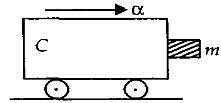
$A$ block of mass $m$ is in contact with the cart $C$ as shown in the figure. The coefficient of static friction between the block and the cart is $\mu$. The acceleration $\alpha$ of the cart that will prevent the block from falling satisfies:
A
$\alpha > \frac{mg}{\mu}$
B
$\alpha > \frac{g}{\mu m}$
C
$\alpha \ge \frac{g}{\mu}$
D
$\alpha < \frac{g}{\mu}$
Solution
(C) To prevent the block from falling,the upward frictional force $f$ must balance the downward gravitational force $mg$.
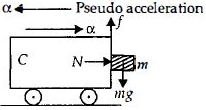
$1$. The cart accelerates with $\alpha$. In the frame of the cart,a pseudo force $F_{fic} = m\alpha$ acts on the block,pushing it against the cart. This force provides the normal reaction $N = m\alpha$.
$2$. The maximum static frictional force available is $f_{max} = \mu N = \mu m\alpha$.
$3$. For the block not to fall,the frictional force $f$ must be at least equal to the weight of the block: $f \ge mg$.
$4$. Substituting $f = \mu m\alpha$,we get $\mu m\alpha \ge mg$.
$5$. Solving for $\alpha$,we obtain $\alpha \ge \frac{g}{\mu}$.
$1$. The cart accelerates with $\alpha$. In the frame of the cart,a pseudo force $F_{fic} = m\alpha$ acts on the block,pushing it against the cart. This force provides the normal reaction $N = m\alpha$.
$2$. The maximum static frictional force available is $f_{max} = \mu N = \mu m\alpha$.
$3$. For the block not to fall,the frictional force $f$ must be at least equal to the weight of the block: $f \ge mg$.
$4$. Substituting $f = \mu m\alpha$,we get $\mu m\alpha \ge mg$.
$5$. Solving for $\alpha$,we obtain $\alpha \ge \frac{g}{\mu}$.
0 likes
View Solution44
MediumMCQ
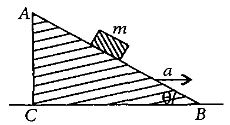
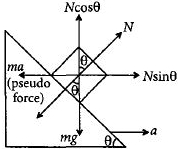
$A$ block of mass $m$ is placed on a smooth inclined wedge $ABC$ of inclination $\theta$ as shown in the figure. The wedge is given an acceleration $a$ towards the right. The relation between $a$ and $\theta$ for the block to remain stationary on the wedge is
A
$a = g \csc \theta$
B
$a = g \sin \theta$
C
$a = g \tan \theta$
D
$a = g \cos \theta$
Solution
(C) To keep the block stationary on the wedge,we analyze the forces in the non-inertial frame of the wedge.
$1$. The forces acting on the block are: gravitational force $mg$ (downwards),normal reaction $N$ (perpendicular to the surface),and pseudo force $ma$ (towards the left).
$2$. Resolving the forces into components parallel and perpendicular to the inclined surface:
- Perpendicular to the surface: $N = mg \cos \theta + ma \sin \theta$. However,for the block to be stationary relative to the wedge,the net force along the incline must be zero.
- Parallel to the incline: $ma \cos \theta = mg \sin \theta$.
$3$. From the parallel component equation:
$ma \cos \theta = mg \sin \theta$
$a \cos \theta = g \sin \theta$
$a = g \frac{\sin \theta}{\cos \theta}$
$a = g \tan \theta$
$1$. The forces acting on the block are: gravitational force $mg$ (downwards),normal reaction $N$ (perpendicular to the surface),and pseudo force $ma$ (towards the left).
$2$. Resolving the forces into components parallel and perpendicular to the inclined surface:
- Perpendicular to the surface: $N = mg \cos \theta + ma \sin \theta$. However,for the block to be stationary relative to the wedge,the net force along the incline must be zero.
- Parallel to the incline: $ma \cos \theta = mg \sin \theta$.
$3$. From the parallel component equation:
$ma \cos \theta = mg \sin \theta$
$a \cos \theta = g \sin \theta$
$a = g \frac{\sin \theta}{\cos \theta}$
$a = g \tan \theta$
0 likes
View Solution45
EasyMCQ
$A$ car is moving with a uniform speed on a level road. Inside the car,there is a balloon filled with helium and attached to a piece of string tied to the floor. The string is observed to be vertical. The car now takes a left turn while maintaining the same speed on the level road. The balloon in the car will:
A
Continue to remain vertical
B
Burst while taking the curve
C
Be thrown to the right side
D
Be thrown to the left side
Solution
(D) When the car takes a left turn,it undergoes centripetal acceleration directed towards the center of the turn (left).
Due to inertia,the air inside the car tends to move in a straight line,but because the car is enclosed,the air experiences a pseudo-force directed towards the right.
Since the air is denser than the helium-filled balloon,the air is pushed towards the right side of the car due to this pseudo-force.
This displacement of the denser air towards the right creates a pressure gradient that pushes the lighter helium balloon towards the left.
Therefore,the balloon will be thrown to the left side.
Due to inertia,the air inside the car tends to move in a straight line,but because the car is enclosed,the air experiences a pseudo-force directed towards the right.
Since the air is denser than the helium-filled balloon,the air is pushed towards the right side of the car due to this pseudo-force.
This displacement of the denser air towards the right creates a pressure gradient that pushes the lighter helium balloon towards the left.
Therefore,the balloon will be thrown to the left side.
0 likes
View Solution46
MediumMCQ
$A$ block can slide on a smooth inclined plane of inclination $\theta$ kept on the floor of a lift. When the lift is descending with a retardation $a$,the acceleration of the block relative to the incline is
A
$(g + a)\sin \theta$
B
$(g - a)$
C
$g\sin \theta$
D
$(g - a)\sin \theta$
Solution
(A) In a stationary lift,the acceleration of a block sliding down a smooth inclined plane is $a_{rel} = g \sin \theta$.
When the lift is moving with an acceleration $A$ (upward being positive),the effective acceleration due to gravity becomes $g_{eff} = g + A$.
In this problem,the lift is descending with a retardation $a$. Retardation while descending means the acceleration vector is directed upwards. Thus,$A = +a$.
The effective acceleration becomes $g_{eff} = g + a$.
Therefore,the acceleration of the block relative to the incline is $a_{rel} = g_{eff} \sin \theta = (g + a) \sin \theta$.
When the lift is moving with an acceleration $A$ (upward being positive),the effective acceleration due to gravity becomes $g_{eff} = g + A$.
In this problem,the lift is descending with a retardation $a$. Retardation while descending means the acceleration vector is directed upwards. Thus,$A = +a$.
The effective acceleration becomes $g_{eff} = g + a$.
Therefore,the acceleration of the block relative to the incline is $a_{rel} = g_{eff} \sin \theta = (g + a) \sin \theta$.
0 likes
View Solution47
MediumMCQ
$A$ $60\, kg$ man stands on a spring scale in a lift. At some instant,he finds the scale reading has changed from $60\, kg$ to $50\, kg$ for a while and then comes back to the original mark. What should we conclude?
A
The lift was in constant motion upwards.
B
The lift was in constant motion downwards.
C
The lift,while in constant motion upwards,is stopped suddenly.
D
The lift,while in constant motion downwards,is suddenly stopped.
Solution
(C) The apparent weight $W'$ of a person in a lift is given by $W' = m(g + a)$,where $a$ is the acceleration of the lift.
If the lift is moving upwards with a constant velocity,the acceleration $a = 0$,so the reading is $m \times g = 60\, kg$.
When the lift suddenly stops while moving upwards,it experiences a downward acceleration (retardation),so $a$ becomes negative. The apparent weight becomes $W' = m(g - a)$.
Since the reading decreases from $60\, kg$ to $50\, kg$,it indicates that the lift experienced a downward acceleration (deceleration) while moving upwards.
Therefore,we conclude that the lift was moving upwards with constant speed and was suddenly stopped.
If the lift is moving upwards with a constant velocity,the acceleration $a = 0$,so the reading is $m \times g = 60\, kg$.
When the lift suddenly stops while moving upwards,it experiences a downward acceleration (retardation),so $a$ becomes negative. The apparent weight becomes $W' = m(g - a)$.
Since the reading decreases from $60\, kg$ to $50\, kg$,it indicates that the lift experienced a downward acceleration (deceleration) while moving upwards.
Therefore,we conclude that the lift was moving upwards with constant speed and was suddenly stopped.
0 likes
View Solution48
EasyMCQ
$A$ spring balance and a physical balance are kept in a lift. In these balances,equal masses are placed. If the lift starts moving upwards with constant acceleration,then:
A
The reading of the spring balance will increase and the equilibrium position of the physical balance will be disturbed.
B
The reading of the spring balance will remain unchanged and the physical balance will remain in equilibrium.
C
The reading of the spring balance will decrease and the physical balance will remain in equilibrium.
D
The reading of the spring balance will increase and the physical balance will remain in equilibrium.
Solution
(D) When the lift accelerates upwards with acceleration $a$,a pseudo force $F_p = ma$ acts downwards on any mass $m$ inside the lift.
For a spring balance,the reading is the normal force or tension,which becomes $T = m(g + a)$. Since $g + a > g$,the reading of the spring balance increases.
For a physical balance,the pseudo force $F_p = ma$ acts on both pans equally. Since the balance compares the weights on both sides,the effect of the pseudo force cancels out,and the equilibrium position remains undisturbed.
For a spring balance,the reading is the normal force or tension,which becomes $T = m(g + a)$. Since $g + a > g$,the reading of the spring balance increases.
For a physical balance,the pseudo force $F_p = ma$ acts on both pans equally. Since the balance compares the weights on both sides,the effect of the pseudo force cancels out,and the equilibrium position remains undisturbed.
0 likes
View Solution49
MediumMCQ
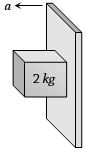
$A$ rough vertical board has an acceleration $a$ so that a $2 \ kg$ block pressing against it does not fall. The coefficient of friction between the block and the board should be
A
$> g/a$
B
$< g/a$
C
$= g/a$
D
$> a/g$
Solution
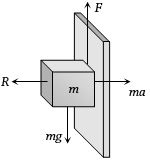
(A) For the block not to fall,the upward frictional force $f$ must balance the downward gravitational force $mg$.
$f = mg$
The normal force $R$ exerted by the board on the block is provided by the pseudo-force acting on the block due to the acceleration $a$ of the board:
$R = ma$
The frictional force is given by $f \leq \mu R$. To prevent falling,we need the maximum possible friction to be at least equal to the weight:
$f_{max} = \mu R = \mu (ma)$
Setting $f_{max} \geq mg$:
$\mu (ma) \geq mg$
Dividing both sides by $ma$:
$\mu \geq g/a$
$f = mg$
The normal force $R$ exerted by the board on the block is provided by the pseudo-force acting on the block due to the acceleration $a$ of the board:
$R = ma$
The frictional force is given by $f \leq \mu R$. To prevent falling,we need the maximum possible friction to be at least equal to the weight:
$f_{max} = \mu R = \mu (ma)$
Setting $f_{max} \geq mg$:
$\mu (ma) \geq mg$
Dividing both sides by $ma$:
$\mu \geq g/a$
0 likes
View SolutionNewton's Laws of Motion and Friction — Apparent weight and Pseudo Force · Frequently Asked Questions
1Are these Newton's Laws of Motion and Friction questions useful for JEE and NEET?
Yes. All questions in this section are mapped to JEE Main and NEET exam patterns. Previous year questions from JEE Main, NEET, GUJCET and state-level exams are included with full solutions.
2Can I switch to Hindi or Gujarati for these questions?
Yes. Use the language tabs in the hero section or the sidebar to view the same questions and solutions in English, Hindi or Gujarati.
3How do I generate a question paper from this subtopic?
Use the Vedclass Exam Paper Generator — select the chapter and subtopic, set difficulty, and generate Sets A, B, C, D automatically. First 3 chapters of every subject are free.
Vedclass Products
For Students
Vedclass Test Series
Mock tests in real JEE/NEET style with performance analysis. 5-day free trial.
Start Free TrialFor Teachers
Exam Paper Generator
Generate Set A/B/C/D papers from this chapter in 2 minutes. 3 chapters free.
Try FreeFor Institutes
Online Exam Module
Live online exams with unlimited students, 360° analytics & white-label branding.
See DemoFor Teachers & Institutes
Generate a Newton's Laws of Motion and Friction Exam Paper in 2 Minutes
Select subtopic & difficulty — Sets A, B, C, D auto-generated with No Repeat logic.
First 3 chapters of every subject are free — no payment required.