
A English
Block on Block System, psudo force and Constrained Motion In Friction Questions in English
Class 11 Physics · Newton's Laws of Motion and Friction · Block on Block System, psudo force and Constrained Motion In Friction
66+
Questions
English
Language
100%
With Solutions
Showing 50 of 66 questions in English
1
MediumMCQ
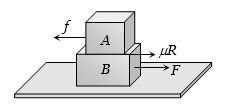
$A$ body $B$ lies on a smooth horizontal table and another body $A$ is placed on $B$. The coefficient of friction between $A$ and $B$ is $\mu$. What acceleration given to $B$ will cause slipping to occur between $A$ and $B$?
A
$\mu g$
B
$g/\mu$
C
$\mu /g$
D
$\sqrt{\mu g}$
Solution
(A) Let $m_A$ be the mass of body $A$ and $m_B$ be the mass of body $B$. The table is smooth,so there is no friction between $B$ and the table.
When an acceleration $a$ is given to body $B$,a pseudo force $F_p = m_A a$ acts on body $A$ in the backward direction relative to $B$.
The maximum static friction force available between $A$ and $B$ is $f_{max} = \mu N = \mu m_A g$,where $N = m_A g$ is the normal force between $A$ and $B$.
Slipping will occur when the pseudo force exceeds the maximum static friction force.
Therefore,the condition for slipping is $m_A a > \mu m_A g$.
Simplifying this,we get $a > \mu g$.
Thus,the minimum acceleration required for slipping to occur is $a = \mu g$.
When an acceleration $a$ is given to body $B$,a pseudo force $F_p = m_A a$ acts on body $A$ in the backward direction relative to $B$.
The maximum static friction force available between $A$ and $B$ is $f_{max} = \mu N = \mu m_A g$,where $N = m_A g$ is the normal force between $A$ and $B$.
Slipping will occur when the pseudo force exceeds the maximum static friction force.
Therefore,the condition for slipping is $m_A a > \mu m_A g$.
Simplifying this,we get $a > \mu g$.
Thus,the minimum acceleration required for slipping to occur is $a = \mu g$.
0 likes
View Solution2
MediumMCQ
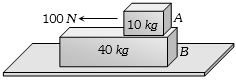
$A$ $40 \,kg$ slab rests on a frictionless floor as shown in the figure. $A$ $10 \,kg$ block rests on the top of the slab. The static coefficient of friction between the block and slab is $0.60$ while the kinetic friction is $0.40$. The $10 \,kg$ block is acted upon by a horizontal force $100 \,N$. If $g = 9.8 \,m/s^2$,the resulting acceleration of the slab will be ........ $m/s^2$.
A
$0.98$
B
$1.47$
C
$1.52$
D
$6.1$
Solution
(A) $1$. Calculate the limiting friction between the block $(m_A = 10 \,kg)$ and the slab $(m_B = 40 \,kg)$:
$f_{s,max} = \mu_s m_A g = 0.60 \times 10 \times 9.8 = 58.8 \,N$.
$2$. Compare the applied force $(F = 100 \,N)$ with the limiting friction:
Since $F > f_{s,max}$ $(100 \,N > 58.8 \,N)$,the block will slip over the slab.
$3$. Calculate the kinetic friction force acting between the block and the slab:
$f_k = \mu_k m_A g = 0.40 \times 10 \times 9.8 = 39.2 \,N$.
$4$. This kinetic friction force $f_k$ acts on the slab in the direction of the applied force,causing it to accelerate:
$F_{net, slab} = f_k = 39.2 \,N$.
$5$. Calculate the acceleration of the slab $(a_B)$:
$a_B = \frac{F_{net, slab}}{m_B} = \frac{39.2}{40} = 0.98 \,m/s^2$.
$f_{s,max} = \mu_s m_A g = 0.60 \times 10 \times 9.8 = 58.8 \,N$.
$2$. Compare the applied force $(F = 100 \,N)$ with the limiting friction:
Since $F > f_{s,max}$ $(100 \,N > 58.8 \,N)$,the block will slip over the slab.
$3$. Calculate the kinetic friction force acting between the block and the slab:
$f_k = \mu_k m_A g = 0.40 \times 10 \times 9.8 = 39.2 \,N$.
$4$. This kinetic friction force $f_k$ acts on the slab in the direction of the applied force,causing it to accelerate:
$F_{net, slab} = f_k = 39.2 \,N$.
$5$. Calculate the acceleration of the slab $(a_B)$:
$a_B = \frac{F_{net, slab}}{m_B} = \frac{39.2}{40} = 0.98 \,m/s^2$.
0 likes
View Solution3
MediumMCQ
The coefficient of friction between two blocks is $0.2$,and the coefficient of friction between block $B$ and the surface is $0.5$. If a force of $25 \ N$ is applied to block $B$ (mass $A = 2 \ kg$,mass $B = 8 \ kg$),what is the magnitude of the frictional force between the two blocks in $N$?
A
$0$
B
$39$
C
$50$
D
$49$
Solution
(A) Let $m_A = 2 \ kg$ and $m_B = 8 \ kg$. The force applied is $F = 25 \ N$.
First,check if the system moves. The maximum static friction between block $B$ and the ground is $f_{g,max} = \mu_B (m_A + m_B)g = 0.5 \times (2 + 8) \times 10 = 50 \ N$.
Since the applied force $F = 25 \ N$ is less than the maximum static friction $f_{g,max} = 50 \ N$,the entire system remains at rest.
Because the system is in equilibrium and no external force is trying to move block $A$ relative to block $B$,the frictional force between the two blocks is $0 \ N$.
First,check if the system moves. The maximum static friction between block $B$ and the ground is $f_{g,max} = \mu_B (m_A + m_B)g = 0.5 \times (2 + 8) \times 10 = 50 \ N$.
Since the applied force $F = 25 \ N$ is less than the maximum static friction $f_{g,max} = 50 \ N$,the entire system remains at rest.
Because the system is in equilibrium and no external force is trying to move block $A$ relative to block $B$,the frictional force between the two blocks is $0 \ N$.
0 likes
View Solution4
DifficultMCQ
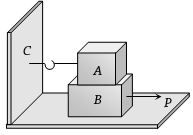
Block $A$ weighing $100 \, kg$ rests on a block $B$ and is tied with a horizontal string to the wall at $C$. Block $B$ weighs $200 \, kg$. The coefficient of friction between $A$ and $B$ is $0.25$ and between $B$ and the surface is $1/3$. The horizontal force $P$ necessary to move the block $B$ should be ........ $N$ $(g = 10 \, m/s^2)$.
A
$1150$
B
$1250$
C
$1300$
D
$1420$
Solution
(B) To move block $B$,the applied force $P$ must overcome the frictional forces acting on it.
$1$. The friction between block $A$ and block $B$ $(F_{AB})$ acts on the top surface of block $B$ in the direction opposite to the motion. Since block $A$ is stationary,$F_{AB} = \mu_{AB} \cdot N_A = \mu_{AB} \cdot m_A \cdot g = 0.25 \times 100 \times 10 = 250 \, N$.
$2$. The friction between block $B$ and the ground $(F_{BS})$ acts on the bottom surface of block $B$. The normal force on the ground is the sum of the weights of both blocks: $N_{ground} = (m_A + m_B)g = (100 + 200) \times 10 = 3000 \, N$. Thus,$F_{BS} = \mu_{BS} \cdot N_{ground} = (1/3) \times 3000 = 1000 \, N$.
$3$. The total force $P$ required is the sum of these two frictional forces: $P = F_{AB} + F_{BS} = 250 + 1000 = 1250 \, N$.
$1$. The friction between block $A$ and block $B$ $(F_{AB})$ acts on the top surface of block $B$ in the direction opposite to the motion. Since block $A$ is stationary,$F_{AB} = \mu_{AB} \cdot N_A = \mu_{AB} \cdot m_A \cdot g = 0.25 \times 100 \times 10 = 250 \, N$.
$2$. The friction between block $B$ and the ground $(F_{BS})$ acts on the bottom surface of block $B$. The normal force on the ground is the sum of the weights of both blocks: $N_{ground} = (m_A + m_B)g = (100 + 200) \times 10 = 3000 \, N$. Thus,$F_{BS} = \mu_{BS} \cdot N_{ground} = (1/3) \times 3000 = 1000 \, N$.
$3$. The total force $P$ required is the sum of these two frictional forces: $P = F_{AB} + F_{BS} = 250 + 1000 = 1250 \, N$.
0 likes
View Solution5
AdvancedMCQ
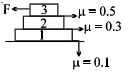
If force $F$ is increasing with time and at $t = 0, F = 0$,where will slipping first start?
A
between $3 \ kg$ and $2 \ kg$
B
between $2 \ kg$ and $1 \ kg$
C
between $1 \ kg$ and ground
D
both $(a)$ and $(b)$
Solution
(C) Let the masses be $m_3 = 3 \ kg$,$m_2 = 2 \ kg$,and $m_1 = 1 \ kg$. The acceleration due to gravity is $g = 10 \ m/s^2$.
$1$. Minimum force required for slipping to occur between $3 \ kg$ and $2 \ kg$ block:
$F_{s1} = \mu_1 \cdot m_3 \cdot g = 0.5 \times 3 \times 10 = 15 \ N$.
$2$. Minimum force required for slipping to occur between $2 \ kg$ and $1 \ kg$ block:
$F_{s2} = \mu_2 \cdot (m_3 + m_2) \cdot g = 0.3 \times (3 + 2) \times 10 = 0.3 \times 50 = 15 \ N$.
$3$. Minimum force required for slipping to occur between $1 \ kg$ block and ground:
$F_{s3} = \mu_3 \cdot (m_3 + m_2 + m_1) \cdot g = 0.1 \times (3 + 2 + 1) \times 10 = 0.1 \times 60 = 6 \ N$.
Since the minimum force required to initiate slipping is least for the surface between the $1 \ kg$ block and the ground $(6 \ N)$,slipping will start there first.
$1$. Minimum force required for slipping to occur between $3 \ kg$ and $2 \ kg$ block:
$F_{s1} = \mu_1 \cdot m_3 \cdot g = 0.5 \times 3 \times 10 = 15 \ N$.
$2$. Minimum force required for slipping to occur between $2 \ kg$ and $1 \ kg$ block:
$F_{s2} = \mu_2 \cdot (m_3 + m_2) \cdot g = 0.3 \times (3 + 2) \times 10 = 0.3 \times 50 = 15 \ N$.
$3$. Minimum force required for slipping to occur between $1 \ kg$ block and ground:
$F_{s3} = \mu_3 \cdot (m_3 + m_2 + m_1) \cdot g = 0.1 \times (3 + 2 + 1) \times 10 = 0.1 \times 60 = 6 \ N$.
Since the minimum force required to initiate slipping is least for the surface between the $1 \ kg$ block and the ground $(6 \ N)$,slipping will start there first.
0 likes
View Solution6
DifficultMCQ
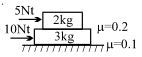
The system shown in the figure is released. Find the accelerations $a_1$ (for the $2 \ kg$ block) and $a_2$ (for the $3 \ kg$ block).
A
$a_1 = 0.35 \ m/s^2 ; a_2 = 4.5 \ m/s^2$
B
$a_1 = 3 \ m/s^2 ; a_2 = 0.5 \ m/s^2$
C
$a_1 = 2 \ m/s^2 ; a_2 = 2 \ m/s^2$
D
$a_1 = 0.5 \ m/s^2 ; a_2 = 3 \ m/s^2$
Solution
(D) $1$. Analyze the friction between the $2 \ kg$ and $3 \ kg$ blocks: The maximum static friction force is $f_{max1} = \mu_1 N_1 = 0.2 \times 2 \times 10 = 4 \ N$. The applied force on the $2 \ kg$ block is $5 \ N$. Since $5 \ N > 4 \ N$,the blocks will slip relative to each other. The kinetic friction force is $f_k = 4 \ N$.
$2$. Analyze the friction between the $3 \ kg$ block and the ground: The normal force is $N_2 = (2 + 3) \times 10 = 50 \ N$. The maximum static friction force is $f_{max2} = \mu_2 N_2 = 0.1 \times 50 = 5 \ N$.
$3$. Calculate acceleration of the $2 \ kg$ block $(a_1)$: The net force is $F_{net1} = 5 \ N - 4 \ N = 1 \ N$. Thus,$a_1 = 1 \ N / 2 \ kg = 0.5 \ m/s^2$.
$4$. Calculate acceleration of the $3 \ kg$ block $(a_2)$: The forces acting on the $3 \ kg$ block are the applied $10 \ N$ force,the kinetic friction from the $2 \ kg$ block $(4 \ N)$,and the friction from the ground $(5 \ N)$. The net force is $F_{net2} = 10 \ N + 4 \ N - 5 \ N = 9 \ N$. Thus,$a_2 = 9 \ N / 3 \ kg = 3 \ m/s^2$.
$2$. Analyze the friction between the $3 \ kg$ block and the ground: The normal force is $N_2 = (2 + 3) \times 10 = 50 \ N$. The maximum static friction force is $f_{max2} = \mu_2 N_2 = 0.1 \times 50 = 5 \ N$.
$3$. Calculate acceleration of the $2 \ kg$ block $(a_1)$: The net force is $F_{net1} = 5 \ N - 4 \ N = 1 \ N$. Thus,$a_1 = 1 \ N / 2 \ kg = 0.5 \ m/s^2$.
$4$. Calculate acceleration of the $3 \ kg$ block $(a_2)$: The forces acting on the $3 \ kg$ block are the applied $10 \ N$ force,the kinetic friction from the $2 \ kg$ block $(4 \ N)$,and the friction from the ground $(5 \ N)$. The net force is $F_{net2} = 10 \ N + 4 \ N - 5 \ N = 9 \ N$. Thus,$a_2 = 9 \ N / 3 \ kg = 3 \ m/s^2$.
0 likes
View Solution7
DifficultMCQ
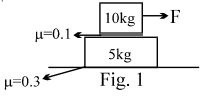
When $F = 2 \text{ N}$, what is the frictional force between the $5 \text{ kg}$ block and the ground (in $\text{ N}$)?
A
$2$
B
$0$
C
$8$
D
$10$
Solution
$(A)$ Let $m_1 = 10 \text{ kg}$ (top block) and $m_2 = 5 \text{ kg}$ (bottom block). The coefficient of friction between the blocks is $\mu_1 = 0.1$ and between the bottom block and the ground is $\mu_2 = 0.3$. Taking $g = 10 \text{ m/s}^2$.
Maximum static friction between the blocks: $f_{1,max} = \mu_1 m_1 g = 0.1 \times 10 \times 10 = 10 \text{ N}$.
Maximum static friction between the bottom block and the ground: $f_{2,max} = \mu_2 (m_1 + m_2) g = 0.3 \times (10 + 5) \times 10 = 0.3 \times 150 = 45 \text{ N}$.
When an external force $F = 2 \text{ N}$ is applied to the top block, the system will only move if $F > f_{2,max}$. Since $F = 2 \text{ N}$ is less than both $f_{1,max}$ and $f_{2,max}$, the entire system remains at rest.
For the system to be in equilibrium, the frictional force from the ground must balance the applied force $F$. Therefore, the frictional force between the $5 \text{ kg}$ block and the ground is equal to the applied force $F = 2 \text{ N}$.
Maximum static friction between the blocks: $f_{1,max} = \mu_1 m_1 g = 0.1 \times 10 \times 10 = 10 \text{ N}$.
Maximum static friction between the bottom block and the ground: $f_{2,max} = \mu_2 (m_1 + m_2) g = 0.3 \times (10 + 5) \times 10 = 0.3 \times 150 = 45 \text{ N}$.
When an external force $F = 2 \text{ N}$ is applied to the top block, the system will only move if $F > f_{2,max}$. Since $F = 2 \text{ N}$ is less than both $f_{1,max}$ and $f_{2,max}$, the entire system remains at rest.
For the system to be in equilibrium, the frictional force from the ground must balance the applied force $F$. Therefore, the frictional force between the $5 \text{ kg}$ block and the ground is equal to the applied force $F = 2 \text{ N}$.
0 likes
View Solution8
DifficultMCQ
When $F = 2 \text{ N}$,the frictional force between the $10 \text{ kg}$ block and the $5 \text{ kg}$ block is ...... $\text{ N}$. (Assume $g = 10 \text{ m/s}^2$)
A
$2$
B
$15$
C
$10$
D
None
Solution
(A) Let $m_1 = 10 \text{ kg}$ and $m_2 = 5 \text{ kg}$. The coefficient of friction between the blocks is $\mu_1 = 0.1$ and between the $5 \text{ kg}$ block and the ground is $\mu_2 = 0.3$.
First,calculate the maximum static friction between the $10 \text{ kg}$ and $5 \text{ kg}$ blocks: $f_{max1} = \mu_1 m_1 g = 0.1 \times 10 \times 10 = 10 \text{ N}$.
Next,calculate the maximum static friction between the $5 \text{ kg}$ block and the ground: $f_{max2} = \mu_2 (m_1 + m_2) g = 0.3 \times (10 + 5) \times 10 = 0.3 \times 150 = 45 \text{ N}$.
Since the applied force $F = 2 \text{ N}$ is less than $f_{max1} = 10 \text{ N}$,the $10 \text{ kg}$ block will not slide over the $5 \text{ kg}$ block.
Therefore,the frictional force between the blocks is equal to the applied force $F$,which is $2 \text{ N}$.
First,calculate the maximum static friction between the $10 \text{ kg}$ and $5 \text{ kg}$ blocks: $f_{max1} = \mu_1 m_1 g = 0.1 \times 10 \times 10 = 10 \text{ N}$.
Next,calculate the maximum static friction between the $5 \text{ kg}$ block and the ground: $f_{max2} = \mu_2 (m_1 + m_2) g = 0.3 \times (10 + 5) \times 10 = 0.3 \times 150 = 45 \text{ N}$.
Since the applied force $F = 2 \text{ N}$ is less than $f_{max1} = 10 \text{ N}$,the $10 \text{ kg}$ block will not slide over the $5 \text{ kg}$ block.
Therefore,the frictional force between the blocks is equal to the applied force $F$,which is $2 \text{ N}$.
0 likes
View Solution9
DifficultMCQ
Find the maximum force $F$ (in $N$) which will not cause motion of any of the blocks as shown in the figure.
A
$10$
B
$15$
C
data insufficient
D
None
Solution
(A) Let $m_1 = 10 \ kg$ (upper block) and $m_2 = 5 \ kg$ (lower block). The coefficient of friction between the blocks is $\mu_1 = 0.1$ and between the lower block and the ground is $\mu_2 = 0.3$.
For the system to remain at rest,the force $F$ must be balanced by the static friction force between the lower block and the ground.
The maximum static friction force between the lower block and the ground is $f_{max, ground} = \mu_2 (m_1 + m_2) g = 0.3 \times (10 + 5) \times 10 = 0.3 \times 150 = 45 \ N$.
However,we must also ensure the upper block does not slide over the lower block. The maximum static friction force between the two blocks is $f_{max, block} = \mu_1 m_1 g = 0.1 \times 10 \times 10 = 10 \ N$.
If $F > 10 \ N$,the upper block will start moving relative to the lower block.
Therefore,the maximum force $F$ that can be applied without causing any motion is $10 \ N$.
For the system to remain at rest,the force $F$ must be balanced by the static friction force between the lower block and the ground.
The maximum static friction force between the lower block and the ground is $f_{max, ground} = \mu_2 (m_1 + m_2) g = 0.3 \times (10 + 5) \times 10 = 0.3 \times 150 = 45 \ N$.
However,we must also ensure the upper block does not slide over the lower block. The maximum static friction force between the two blocks is $f_{max, block} = \mu_1 m_1 g = 0.1 \times 10 \times 10 = 10 \ N$.
If $F > 10 \ N$,the upper block will start moving relative to the lower block.
Therefore,the maximum force $F$ that can be applied without causing any motion is $10 \ N$.
0 likes
View Solution10
DifficultMCQ
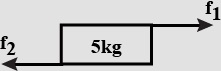
The maximum acceleration of the $5\, kg$ block is ...... $m/s^2$.
A
$1$
B
$3$
C
$0$
D
None
Solution
(C) Let the $10\, kg$ block be $m_1$ and the $5\, kg$ block be $m_2$. The coefficient of friction between $m_1$ and $m_2$ is $\mu_1 = 0.1$,and between $m_2$ and the ground is $\mu_2 = 0.3$.
The maximum static friction force between $m_1$ and $m_2$ is $f_{1,max} = \mu_1 m_1 g = 0.1 \times 10 \times 10 = 10\, N$.
The maximum static friction force between $m_2$ and the ground is $f_{2,max} = \mu_2 (m_1 + m_2) g = 0.3 \times (10 + 5) \times 10 = 0.3 \times 150 = 45\, N$.
For the $5\, kg$ block $(m_2)$ to move,the force applied by the $10\, kg$ block on it (which is the friction $f_1$) must exceed the maximum static friction force from the ground $(f_{2,max} = 45\, N)$.
Since the maximum force that $m_1$ can exert on $m_2$ is $f_{1,max} = 10\, N$,and $10\, N < 45\, N$,the $5\, kg$ block will never move regardless of the force $F$ applied to the $10\, kg$ block.
Therefore,the acceleration of the $5\, kg$ block is $0\, m/s^2$.
The maximum static friction force between $m_1$ and $m_2$ is $f_{1,max} = \mu_1 m_1 g = 0.1 \times 10 \times 10 = 10\, N$.
The maximum static friction force between $m_2$ and the ground is $f_{2,max} = \mu_2 (m_1 + m_2) g = 0.3 \times (10 + 5) \times 10 = 0.3 \times 150 = 45\, N$.
For the $5\, kg$ block $(m_2)$ to move,the force applied by the $10\, kg$ block on it (which is the friction $f_1$) must exceed the maximum static friction force from the ground $(f_{2,max} = 45\, N)$.
Since the maximum force that $m_1$ can exert on $m_2$ is $f_{1,max} = 10\, N$,and $10\, N < 45\, N$,the $5\, kg$ block will never move regardless of the force $F$ applied to the $10\, kg$ block.
Therefore,the acceleration of the $5\, kg$ block is $0\, m/s^2$.
0 likes
View Solution11
DifficultMCQ
The acceleration of the $10\, kg$ block when $F = 30\, N$ is applied as shown in the figure is ........ $m/s^2$.
A
$2$
B
$3$
C
$1$
D
None
Solution
(A) Given: Mass of upper block $m_1 = 10\, kg$,mass of lower block $m_2 = 5\, kg$,coefficient of friction between blocks $\mu_1 = 0.1$,coefficient of friction between lower block and ground $\mu_2 = 0.3$,and applied force $F = 30\, N$.
First,calculate the maximum static friction force between the two blocks: $f_{max1} = \mu_1 m_1 g = 0.1 \times 10 \times 10 = 10\, N$.
Next,calculate the maximum static friction force between the lower block and the ground: $f_{max2} = \mu_2 (m_1 + m_2) g = 0.3 \times (10 + 5) \times 10 = 0.3 \times 150 = 45\, N$.
Since the applied force $F = 30\, N$ is less than the force required to move the entire system $(f_{max2} = 45\, N)$,the lower block will not move.
Now,check if the upper block moves relative to the lower block: The applied force $F = 30\, N$ is greater than the maximum friction $f_{max1} = 10\, N$ between the blocks.
Therefore,the upper block will slide over the lower block. The net force on the $10\, kg$ block is $F_{net} = F - f_{max1} = 30 - 10 = 20\, N$.
The acceleration of the $10\, kg$ block is $a = \frac{F_{net}}{m_1} = \frac{20}{10} = 2\, m/s^2$.
First,calculate the maximum static friction force between the two blocks: $f_{max1} = \mu_1 m_1 g = 0.1 \times 10 \times 10 = 10\, N$.
Next,calculate the maximum static friction force between the lower block and the ground: $f_{max2} = \mu_2 (m_1 + m_2) g = 0.3 \times (10 + 5) \times 10 = 0.3 \times 150 = 45\, N$.
Since the applied force $F = 30\, N$ is less than the force required to move the entire system $(f_{max2} = 45\, N)$,the lower block will not move.
Now,check if the upper block moves relative to the lower block: The applied force $F = 30\, N$ is greater than the maximum friction $f_{max1} = 10\, N$ between the blocks.
Therefore,the upper block will slide over the lower block. The net force on the $10\, kg$ block is $F_{net} = F - f_{max1} = 30 - 10 = 20\, N$.
The acceleration of the $10\, kg$ block is $a = \frac{F_{net}}{m_1} = \frac{20}{10} = 2\, m/s^2$.
0 likes
View Solution12
AdvancedMCQ
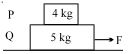
The coefficient of friction between $4 \, kg$ and $5 \, kg$ blocks is $0.2$ and between $5 \, kg$ block and ground is $0.1$ respectively. Choose the correct statements.
A
Minimum force needed to cause the system to move is $9 \, N$.
B
When force is $4 \, N$,static friction at all surfaces is $4 \, N$ to keep the system at rest.
C
Maximum acceleration of $4 \, kg$ block is $2 \, m/s^2$.
D
Slipping between $4 \, kg$ and $5 \, kg$ blocks starts when $F$ is $17 \, N$.
Solution
(C) Let $m_1 = 4 \, kg$ (top block $P$) and $m_2 = 5 \, kg$ (bottom block $Q$).
Coefficient of friction between $P$ and $Q$ is $\mu_1 = 0.2$. Coefficient of friction between $Q$ and ground is $\mu_2 = 0.1$.
Maximum static friction between $P$ and $Q$ is $f_{1,max} = \mu_1 m_1 g = 0.2 \times 4 \times 10 = 8 \, N$.
Maximum static friction between $Q$ and ground is $f_{2,max} = \mu_2 (m_1 + m_2) g = 0.1 \times (4 + 5) \times 10 = 9 \, N$.
For the system to move,the applied force $F$ must exceed $f_{2,max} = 9 \, N$. Thus,minimum force is $9 \, N$. Statement $A$ is incorrect.
If $F = 4 \, N < 9 \, N$,the system remains at rest. The friction from the ground balances $F$,so $f_2 = 4 \, N$. There is no tendency for $P$ to move relative to $Q$,so $f_1 = 0$. Statement $B$ is incorrect.
Maximum acceleration of $P$ is $a_{max} = f_{1,max} / m_1 = 8 / 4 = 2 \, m/s^2$. Statement $C$ is correct.
Slipping starts when the acceleration of $Q$ exceeds $2 \, m/s^2$. For the whole system,$F - f_{2,max} = (m_1 + m_2) a$. At $a = 2 \, m/s^2$,$F - 9 = (9) \times 2 \Rightarrow F = 27 \, N$. Statement $D$ is incorrect.
Coefficient of friction between $P$ and $Q$ is $\mu_1 = 0.2$. Coefficient of friction between $Q$ and ground is $\mu_2 = 0.1$.
Maximum static friction between $P$ and $Q$ is $f_{1,max} = \mu_1 m_1 g = 0.2 \times 4 \times 10 = 8 \, N$.
Maximum static friction between $Q$ and ground is $f_{2,max} = \mu_2 (m_1 + m_2) g = 0.1 \times (4 + 5) \times 10 = 9 \, N$.
For the system to move,the applied force $F$ must exceed $f_{2,max} = 9 \, N$. Thus,minimum force is $9 \, N$. Statement $A$ is incorrect.
If $F = 4 \, N < 9 \, N$,the system remains at rest. The friction from the ground balances $F$,so $f_2 = 4 \, N$. There is no tendency for $P$ to move relative to $Q$,so $f_1 = 0$. Statement $B$ is incorrect.
Maximum acceleration of $P$ is $a_{max} = f_{1,max} / m_1 = 8 / 4 = 2 \, m/s^2$. Statement $C$ is correct.
Slipping starts when the acceleration of $Q$ exceeds $2 \, m/s^2$. For the whole system,$F - f_{2,max} = (m_1 + m_2) a$. At $a = 2 \, m/s^2$,$F - 9 = (9) \times 2 \Rightarrow F = 27 \, N$. Statement $D$ is incorrect.
0 likes
View Solution13
DifficultMCQ
$A$ block of mass $M$ is placed on a horizontal surface and is tied with an inextensible string to a block of mass $m$,as shown in the figure. $A$ block of mass $m_0$ is also placed on $M$. If friction exists between the block $M$ and the block $m_0$ and there is no friction between the block $M$ and the horizontal surface,then the minimum value of $\mu$ for which the block $m_0$ remains stationary with respect to $M$ is:

A
$\frac{m}{m_0}$
B
$\frac{m}{m_0 + M}$
C
$\frac{m - m_0}{M}$
D
none of these
Solution
(D) Let $a$ be the acceleration of the system consisting of blocks $M$ and $m_0$ moving horizontally,and block $m$ moving vertically downwards. Since the string is inextensible,all blocks have the same magnitude of acceleration $a$.
For the system $(M + m_0)$,the equation of motion is: $T = (M + m_0)a$.
For the block $m$,the equation of motion is: $mg - T = ma$.
Adding these two equations: $mg = (M + m_0 + m)a$,so $a = \frac{mg}{M + m_0 + m}$.
For the block $m_0$ to remain stationary with respect to $M$,the static friction $f$ must provide the necessary pseudo force: $f = m_0 a$.
The maximum static friction is $f_{max} = \mu N = \mu m_0 g$.
For $m_0$ to not slide,we require $f \le f_{max}$,so $m_0 a \le \mu m_0 g$.
Substituting $a$: $m_0 \left( \frac{mg}{M + m_0 + m} \right) \le \mu m_0 g$.
Thus,$\mu \ge \frac{m}{M + m_0 + m}$.
Since this expression is not among the given options,the correct choice is $(D)$.
For the system $(M + m_0)$,the equation of motion is: $T = (M + m_0)a$.
For the block $m$,the equation of motion is: $mg - T = ma$.
Adding these two equations: $mg = (M + m_0 + m)a$,so $a = \frac{mg}{M + m_0 + m}$.
For the block $m_0$ to remain stationary with respect to $M$,the static friction $f$ must provide the necessary pseudo force: $f = m_0 a$.
The maximum static friction is $f_{max} = \mu N = \mu m_0 g$.
For $m_0$ to not slide,we require $f \le f_{max}$,so $m_0 a \le \mu m_0 g$.
Substituting $a$: $m_0 \left( \frac{mg}{M + m_0 + m} \right) \le \mu m_0 g$.
Thus,$\mu \ge \frac{m}{M + m_0 + m}$.
Since this expression is not among the given options,the correct choice is $(D)$.
0 likes
View Solution14
DifficultMCQ
$A$ block of mass $M$ is placed on a horizontal surface and is tied with an inextensible string to a block of mass $m$,as shown in the figure. $A$ block of mass $m_0$ is also placed on $M$. The horizontal surface is frictionless. Find the minimum value of the coefficient of friction $\mu$ between the blocks $M$ and $m_0$ such that all three blocks move together.
A
$\frac{m}{m + m_0 + M}$
B
$\frac{m}{m + M}$
C
$\frac{m_0}{m + m_0 + M}$
D
None of these
Solution
(A) Let the acceleration of the system be $a$. Since all three blocks move together,they share the same acceleration $a$. The total mass of the system is $(M + m_0 + m)$. The driving force is the weight of block $m$,which is $mg$. Applying Newton's second law to the whole system: $mg = (M + m_0 + m)a$,so $a = \frac{mg}{M + m_0 + m}$.
Now,consider the block $m_0$. The only horizontal force acting on $m_0$ is the static friction $f$ exerted by block $M$. For $m_0$ to move with acceleration $a$,we must have $f = m_0 a$.
The maximum value of static friction is $f_{max} = \mu N = \mu m_0 g$,where $N = m_0 g$ is the normal force between $m_0$ and $M$.
For the blocks to move together,the required friction must not exceed the maximum static friction: $f \le f_{max}$.
Substituting the expressions: $m_0 a \le \mu m_0 g$.
$a \le \mu g$.
$\frac{mg}{M + m_0 + m} \le \mu g$.
$\mu \ge \frac{m}{M + m_0 + m}$.
Thus,the minimum value of $\mu$ is $\frac{m}{M + m_0 + m}$.
Now,consider the block $m_0$. The only horizontal force acting on $m_0$ is the static friction $f$ exerted by block $M$. For $m_0$ to move with acceleration $a$,we must have $f = m_0 a$.
The maximum value of static friction is $f_{max} = \mu N = \mu m_0 g$,where $N = m_0 g$ is the normal force between $m_0$ and $M$.
For the blocks to move together,the required friction must not exceed the maximum static friction: $f \le f_{max}$.
Substituting the expressions: $m_0 a \le \mu m_0 g$.
$a \le \mu g$.
$\frac{mg}{M + m_0 + m} \le \mu g$.
$\mu \ge \frac{m}{M + m_0 + m}$.
Thus,the minimum value of $\mu$ is $\frac{m}{M + m_0 + m}$.
0 likes
View Solution15
DifficultMCQ
Imagine a situation in which the horizontal surface of block $M_0$ is smooth and its vertical surface is rough with a coefficient of friction $\mu$. Identify the correct statement$(s)$.
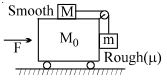
A
If $F = 0$,the blocks cannot remain stationary.
B
For one unique value of $F$,the blocks $M$ and $m$ remain stationary with respect to $M_0$.
C
There exists a value of $F$ at which friction force is equal to zero.
D
Both $(A)$ and $(C)$.
Solution
(A) Let the acceleration of the system be $a = F / (M + m + M_0)$.
For block $m$ to be stationary with respect to $M_0$,the normal force $N$ exerted by $M_0$ on $m$ must provide the acceleration $a$. Thus,$N = ma$.
The vertical forces on $m$ are gravity $mg$ downwards and friction $f$ upwards. For equilibrium,$f = mg$.
Since $f \le \mu N$,we have $mg \le \mu (ma)$,which implies $a \ge g / \mu$.
If $F = 0$,then $a = 0$,so $f = mg$ cannot be balanced,meaning the blocks cannot remain stationary. Thus,$(A)$ is correct.
For $f = 0$,we need $mg = 0$,which is impossible. Thus,$(C)$ is incorrect.
For a range of $F$ such that $a \ge g / \mu$,the blocks can remain stationary,not just for one unique value. Thus,$(B)$ is incorrect.
Therefore,only statement $(A)$ is correct.
For block $m$ to be stationary with respect to $M_0$,the normal force $N$ exerted by $M_0$ on $m$ must provide the acceleration $a$. Thus,$N = ma$.
The vertical forces on $m$ are gravity $mg$ downwards and friction $f$ upwards. For equilibrium,$f = mg$.
Since $f \le \mu N$,we have $mg \le \mu (ma)$,which implies $a \ge g / \mu$.
If $F = 0$,then $a = 0$,so $f = mg$ cannot be balanced,meaning the blocks cannot remain stationary. Thus,$(A)$ is correct.
For $f = 0$,we need $mg = 0$,which is impossible. Thus,$(C)$ is incorrect.
For a range of $F$ such that $a \ge g / \mu$,the blocks can remain stationary,not just for one unique value. Thus,$(B)$ is incorrect.
Therefore,only statement $(A)$ is correct.
0 likes
View Solution16
AdvancedMCQ
Imagine a situation in which the horizontal surface of block $M_0$ is smooth and its vertical surface is rough with a coefficient of friction $\mu$. Find the value$(s)$ of $F$ for which $M$ and $m$ are stationary with respect to $M_0$.
A
$(M_0 + M + m) \frac{mg}{\mu M}$
B
$(M_0 + M + m) \frac{mg}{M}$
C
$(M_0 + M + m) \frac{Mg}{m}$
D
none of these
Solution
(D) Let the acceleration of the system be $a$. Since $M$ and $m$ are stationary with respect to $M_0$,the whole system moves with acceleration $a = \frac{F}{M_0 + M + m}$.
For block $M$: The pseudo force $Ma$ acts to the right. The tension $T$ in the string pulls it to the right. So,$T = Ma$.
For block $m$: The weight $mg$ acts downwards. The friction force $f = \mu N$ acts upwards,where $N$ is the normal force. The pseudo force $ma$ acts horizontally on $m$ against the vertical surface,so $N = ma$.
For $m$ to be stationary,the vertical forces must balance: $f = mg \implies \mu N = mg \implies \mu(ma) = mg \implies a = \frac{g}{\mu}$.
Substituting $a$ into the system equation: $\frac{F}{M_0 + M + m} = \frac{g}{\mu} \implies F = (M_0 + M + m) \frac{g}{\mu}$.
Since this result is not among the options,the correct choice is $D$.
For block $M$: The pseudo force $Ma$ acts to the right. The tension $T$ in the string pulls it to the right. So,$T = Ma$.
For block $m$: The weight $mg$ acts downwards. The friction force $f = \mu N$ acts upwards,where $N$ is the normal force. The pseudo force $ma$ acts horizontally on $m$ against the vertical surface,so $N = ma$.
For $m$ to be stationary,the vertical forces must balance: $f = mg \implies \mu N = mg \implies \mu(ma) = mg \implies a = \frac{g}{\mu}$.
Substituting $a$ into the system equation: $\frac{F}{M_0 + M + m} = \frac{g}{\mu} \implies F = (M_0 + M + m) \frac{g}{\mu}$.
Since this result is not among the options,the correct choice is $D$.
0 likes
View Solution17
DifficultMCQ
Three blocks $A$,$B$,and $C$ of equal mass $m$ are placed on a smooth surface as shown. The coefficient of friction between any two blocks $A$,$B$,and $C$ is $\mu$. The maximum value of mass $M$ of block $D$ such that blocks $A$,$B$,and $C$ move without slipping over each other is:
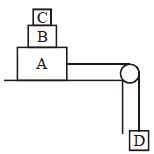
A
$\frac{3m\mu}{\mu + 1}$
B
$\frac{3m(1 - \mu)}{\mu}$
C
$\frac{3m(1 + \mu)}{\mu}$
D
$\frac{3m\mu}{1 - \mu}$
Solution
(D) Let the mass of block $D$ be $M$. The blocks $A, B, C$ move together with acceleration $a$. The maximum acceleration $a_{max}$ that blocks $B$ and $C$ can have without slipping is determined by the friction force. For block $C$,the maximum friction force is $f_{max} = \mu mg$. Thus,$a_{max} = \frac{f_{max}}{m} = \mu g$.
For the system of blocks $(A+B+C)$,the total mass is $3m$. The tension $T$ in the string provides the acceleration:
$T = (3m)a = (3m)(\mu g) = 3m\mu g$.
For block $D$ of mass $M$ moving downwards:
$Mg - T = Ma$
$Mg - 3m\mu g = M(\mu g)$
$Mg - M\mu g = 3m\mu g$
$Mg(1 - \mu) = 3m\mu g$
$M = \frac{3m\mu}{1 - \mu}$.
For the system of blocks $(A+B+C)$,the total mass is $3m$. The tension $T$ in the string provides the acceleration:
$T = (3m)a = (3m)(\mu g) = 3m\mu g$.
For block $D$ of mass $M$ moving downwards:
$Mg - T = Ma$
$Mg - 3m\mu g = M(\mu g)$
$Mg - M\mu g = 3m\mu g$
$Mg(1 - \mu) = 3m\mu g$
$M = \frac{3m\mu}{1 - \mu}$.
0 likes
View Solution18
DifficultMCQ
Determine the time in which the smaller block reaches the other end of the bigger block as shown in the figure. $(g = 10\ m s^{-2})$.
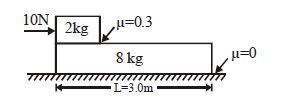
A
$4$
B
$8$
C
$3.6$
D
$2.19$
Solution
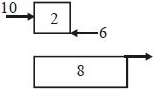
(D) The kinetic friction force acting between the blocks is $f_k = \mu N = 0.3 \times (2 \times 10) = 6\ N$.
For the $2\ kg$ block,the net force is $F_{net,1} = 10 - 6 = 4\ N$. Its acceleration is $a_1 = \frac{4}{2} = 2\ m s^{-2}$.
For the $8\ kg$ block,the only horizontal force is the friction force $f_k = 6\ N$ acting in the forward direction. Its acceleration is $a_2 = \frac{6}{8} = 0.75\ m s^{-2}$.
The relative acceleration of the $2\ kg$ block with respect to the $8\ kg$ block is $a_{rel} = a_1 - a_2 = 2 - 0.75 = 1.25\ m s^{-2}$.
Using the equation of motion $s = ut + \frac{1}{2} a_{rel} t^2$,where $s = 3.0\ m$ and $u = 0$:
$3.0 = 0 + \frac{1}{2} \times 1.25 \times t^2$
$t^2 = \frac{3.0 \times 2}{1.25} = \frac{6}{1.25} = 4.8$
$t = \sqrt{4.8} \approx 2.19\ s$.
For the $2\ kg$ block,the net force is $F_{net,1} = 10 - 6 = 4\ N$. Its acceleration is $a_1 = \frac{4}{2} = 2\ m s^{-2}$.
For the $8\ kg$ block,the only horizontal force is the friction force $f_k = 6\ N$ acting in the forward direction. Its acceleration is $a_2 = \frac{6}{8} = 0.75\ m s^{-2}$.
The relative acceleration of the $2\ kg$ block with respect to the $8\ kg$ block is $a_{rel} = a_1 - a_2 = 2 - 0.75 = 1.25\ m s^{-2}$.
Using the equation of motion $s = ut + \frac{1}{2} a_{rel} t^2$,where $s = 3.0\ m$ and $u = 0$:
$3.0 = 0 + \frac{1}{2} \times 1.25 \times t^2$
$t^2 = \frac{3.0 \times 2}{1.25} = \frac{6}{1.25} = 4.8$
$t = \sqrt{4.8} \approx 2.19\ s$.
0 likes
View Solution19
DifficultMCQ
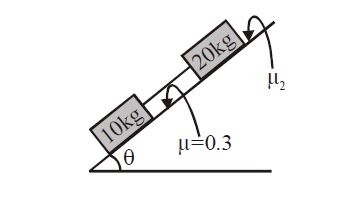
The value of $\theta$ is increased gradually from $\theta = 0$. At $\theta = \tan^{-1}(1/2)$,both blocks just start slipping. Then the value of $\mu_2$ is: $(g = 10 \ m/s^2)$
A
$0.5$
B
$0.4$
C
$0.6$
D
$0.3$
Solution
(C) Let $m_1 = 10 \ kg$ and $m_2 = 20 \ kg$. The coefficients of friction are $\mu_1 = 0.3$ and $\mu_2$.
At the limiting equilibrium,the total gravitational force component along the incline must be equal to the sum of the maximum static frictional forces on both blocks.
$(m_1 + m_2) g \sin \theta = (\mu_1 m_1 g \cos \theta + \mu_2 m_2 g \cos \theta)$
$(10 + 20) g \sin \theta = (0.3 \times 10 \times g \cos \theta + \mu_2 \times 20 \times g \cos \theta)$
Dividing by $g \cos \theta$,we get:
$30 \tan \theta = 3 + 20 \mu_2$
Given $\tan \theta = 1/2$,so $30(1/2) = 3 + 20 \mu_2$
$15 = 3 + 20 \mu_2$
$12 = 20 \mu_2$
$\mu_2 = 12/20 = 0.6$
At the limiting equilibrium,the total gravitational force component along the incline must be equal to the sum of the maximum static frictional forces on both blocks.
$(m_1 + m_2) g \sin \theta = (\mu_1 m_1 g \cos \theta + \mu_2 m_2 g \cos \theta)$
$(10 + 20) g \sin \theta = (0.3 \times 10 \times g \cos \theta + \mu_2 \times 20 \times g \cos \theta)$
Dividing by $g \cos \theta$,we get:
$30 \tan \theta = 3 + 20 \mu_2$
Given $\tan \theta = 1/2$,so $30(1/2) = 3 + 20 \mu_2$
$15 = 3 + 20 \mu_2$
$12 = 20 \mu_2$
$\mu_2 = 12/20 = 0.6$
0 likes
View Solution20
AdvancedMCQ
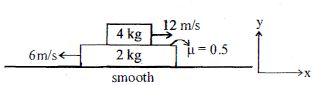
The blocks are given velocities in the directions shown in the figure. The coefficient of friction between the two blocks is $\mu = 0.5$. Take $g = 10\ m/s^2$. (Consider that the $4\ kg$ block does not fall off the $2\ kg$ block).
Consider the following statements:
$(i)$ Time when relative motion between them stops is $1.4\ s$.
$(ii)$ Time when relative motion between them stops is $1.2\ s$.
$(iii)$ The common velocity of the two blocks is $8\ m/s$,towards the right.
$(iv)$ The displacement of the $4\ kg$ block when relative motion stops is $10.8\ m$.
Which of the statements is/are correct?
Consider the following statements:
$(i)$ Time when relative motion between them stops is $1.4\ s$.
$(ii)$ Time when relative motion between them stops is $1.2\ s$.
$(iii)$ The common velocity of the two blocks is $8\ m/s$,towards the right.
$(iv)$ The displacement of the $4\ kg$ block when relative motion stops is $10.8\ m$.
Which of the statements is/are correct?
A
$i, iii, iv$
B
$ii, iv$
C
$ii, iii, iv$
D
$i, iv$
Solution
(B) The frictional force between the blocks is $f = \mu N = 0.5 \times 4 \times 10 = 20\ N$.
For the $4\ kg$ block (moving right at $12\ m/s$): $a_2 = -f/m_2 = -20/4 = -5\ m/s^2$.
For the $2\ kg$ block (moving left at $6\ m/s$): $a_1 = +f/m_1 = +20/2 = +10\ m/s^2$.
Relative motion stops when $v_1 = v_2$:
$-6 + 10t = 12 - 5t$
$15t = 18 \implies t = 1.2\ s$. (Statement $ii$ is correct).
Common velocity $v = 12 - 5(1.2) = 6\ m/s$ (towards the right). (Statement $iii$ is incorrect).
Displacement of $4\ kg$ block: $s = ut + 0.5at^2 = 12(1.2) + 0.5(-5)(1.2)^2 = 14.4 - 3.6 = 10.8\ m$. (Statement $iv$ is correct).
Thus,statements $ii$ and $iv$ are correct.
For the $4\ kg$ block (moving right at $12\ m/s$): $a_2 = -f/m_2 = -20/4 = -5\ m/s^2$.
For the $2\ kg$ block (moving left at $6\ m/s$): $a_1 = +f/m_1 = +20/2 = +10\ m/s^2$.
Relative motion stops when $v_1 = v_2$:
$-6 + 10t = 12 - 5t$
$15t = 18 \implies t = 1.2\ s$. (Statement $ii$ is correct).
Common velocity $v = 12 - 5(1.2) = 6\ m/s$ (towards the right). (Statement $iii$ is incorrect).
Displacement of $4\ kg$ block: $s = ut + 0.5at^2 = 12(1.2) + 0.5(-5)(1.2)^2 = 14.4 - 3.6 = 10.8\ m$. (Statement $iv$ is correct).
Thus,statements $ii$ and $iv$ are correct.
0 likes
View Solution21
MediumMCQ
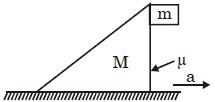
As shown in the figure, block $m$ and wedge $M$ move together with a horizontal acceleration of $20\, m/s^2$. Given $m = 1\, kg$, $\mu = 0.6$ (between $m$ and $M$) and $g = 10\, m/s^2$. Choose the $\text{CORRECT}$ alternative:
A
As acceleration of the system is slightly increased, friction force between $m$ and $M$ will increase.
B
As acceleration of the system is slightly decreased, friction force between $m$ and $M$ will decrease.
C
As acceleration of the system is slightly increased, friction force between $m$ and $M$ remains constant.
D
Friction force attains its maximum value at an acceleration of $15\, m/s^2$.
Solution
(C) For the block $m$ to move with the wedge $M$, the vertical forces must balance. The pseudo force acting on $m$ is $F_p = ma$ in the backward direction. This pseudo force acts as the normal force $N$ between $m$ and $M$, so $N = ma = 1 \times 20 = 20\, N$.
The maximum static friction force is $f_{max} = \mu N = 0.6 \times 20 = 12\, N$.
The weight of the block is $mg = 1 \times 10 = 10\, N$.
Since $f_{max} > mg$, the block $m$ will not slide down. The static friction force $f$ balances the weight of the block, so $f = mg = 10\, N$.
As long as the block does not slide, the friction force $f$ remains equal to $mg$, which is constant, regardless of small changes in acceleration $a$, provided $f_{max} \ge mg$ (i.e., $\mu ma \ge mg \implies a \ge g/\mu = 10/0.6 = 16.67\, m/s^2$).
Since the current acceleration $20\, m/s^2 > 16.67\, m/s^2$, the friction force is constant at $10\, N$.
The maximum static friction force is $f_{max} = \mu N = 0.6 \times 20 = 12\, N$.
The weight of the block is $mg = 1 \times 10 = 10\, N$.
Since $f_{max} > mg$, the block $m$ will not slide down. The static friction force $f$ balances the weight of the block, so $f = mg = 10\, N$.
As long as the block does not slide, the friction force $f$ remains equal to $mg$, which is constant, regardless of small changes in acceleration $a$, provided $f_{max} \ge mg$ (i.e., $\mu ma \ge mg \implies a \ge g/\mu = 10/0.6 = 16.67\, m/s^2$).
Since the current acceleration $20\, m/s^2 > 16.67\, m/s^2$, the friction force is constant at $10\, N$.
0 likes
View Solution22
DifficultMCQ
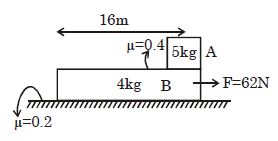
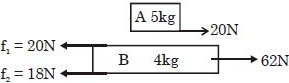
Initially,the whole system is at rest. Now,a force of $62 \ N$ is applied on block $B$ as shown in the figure. Find the time taken by block $A$ to fall off block $B$.
A
$8/3 \ \text{sec}$
B
$3 \ \text{sec}$
C
$4 \ \text{sec}$
D
$5 \ \text{sec}$
Solution
(C) $1$. Calculate the friction forces:
- Friction between $A$ and $B$: $f_1 = \mu_1 m_A g = 0.4 \times 5 \times 10 = 20 \ N$.
- Friction between $B$ and ground: $f_2 = \mu_2 (m_A + m_B) g = 0.2 \times (5 + 4) \times 10 = 0.2 \times 90 = 18 \ N$.
$2$. Calculate accelerations:
- For block $A$: $a_A = f_1 / m_A = 20 / 5 = 4 \ m/s^2$ (towards the right).
- For block $B$: $F - f_1 - f_2 = m_B a_B \Rightarrow 62 - 20 - 18 = 4 a_B \Rightarrow 24 = 4 a_B \Rightarrow a_B = 6 \ m/s^2$ (towards the right).
$3$. Relative motion:
- Relative acceleration $a_{B/A} = a_B - a_A = 6 - 4 = 2 \ m/s^2$ (towards the right).
- Using $s = ut + 1/2 a t^2$,where $s = 16 \ m$,$u = 0$,$a = 2 \ m/s^2$:
- $16 = 0 + 1/2 \times 2 \times t^2 \Rightarrow 16 = t^2 \Rightarrow t = 4 \ \text{sec}$.
- Friction between $A$ and $B$: $f_1 = \mu_1 m_A g = 0.4 \times 5 \times 10 = 20 \ N$.
- Friction between $B$ and ground: $f_2 = \mu_2 (m_A + m_B) g = 0.2 \times (5 + 4) \times 10 = 0.2 \times 90 = 18 \ N$.
$2$. Calculate accelerations:
- For block $A$: $a_A = f_1 / m_A = 20 / 5 = 4 \ m/s^2$ (towards the right).
- For block $B$: $F - f_1 - f_2 = m_B a_B \Rightarrow 62 - 20 - 18 = 4 a_B \Rightarrow 24 = 4 a_B \Rightarrow a_B = 6 \ m/s^2$ (towards the right).
$3$. Relative motion:
- Relative acceleration $a_{B/A} = a_B - a_A = 6 - 4 = 2 \ m/s^2$ (towards the right).
- Using $s = ut + 1/2 a t^2$,where $s = 16 \ m$,$u = 0$,$a = 2 \ m/s^2$:
- $16 = 0 + 1/2 \times 2 \times t^2 \Rightarrow 16 = t^2 \Rightarrow t = 4 \ \text{sec}$.
0 likes
View Solution23
DifficultMCQ
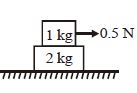
$A$ force of $0.5 \ N$ is applied on the upper block as shown in the figure. The coefficient of static friction between the two blocks is $0.1$ and that between the lower block and the surface is zero. The work done by the lower block on the upper block for a displacement of $3 \ m$ of the upper block is ...... $J$.
A
$1$
B
$-1$
C
$2$
D
$-2$
Solution
(B) Let the masses be $m_1 = 1 \ kg$ and $m_2 = 2 \ kg$. The applied force is $F = 0.5 \ N$.
Assuming both blocks move together with acceleration $a$,the equation of motion for the system is $F = (m_1 + m_2)a$.
$0.5 = (1 + 2)a \Rightarrow 0.5 = 3a \Rightarrow a = \frac{0.5}{3} = \frac{1}{6} \ m/s^2$.
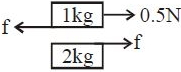
The friction force $f$ acting on the lower block $(m_2)$ is $f = m_2 a = 2 \times \frac{1}{6} = \frac{1}{3} \ N$.
The maximum static friction force is $f_{max} = \mu_s m_1 g = 0.1 \times 1 \times 10 = 1 \ N$.
Since $f = \frac{1}{3} \ N < f_{max} = 1 \ N$,the assumption that they move together is correct.
The lower block exerts a friction force $f$ in the backward direction on the upper block.
Work done by the lower block on the upper block $W = -f \times d$,where $d = 3 \ m$.
$W = -(\frac{1}{3}) \times 3 = -1 \ J$.
Assuming both blocks move together with acceleration $a$,the equation of motion for the system is $F = (m_1 + m_2)a$.
$0.5 = (1 + 2)a \Rightarrow 0.5 = 3a \Rightarrow a = \frac{0.5}{3} = \frac{1}{6} \ m/s^2$.
The friction force $f$ acting on the lower block $(m_2)$ is $f = m_2 a = 2 \times \frac{1}{6} = \frac{1}{3} \ N$.
The maximum static friction force is $f_{max} = \mu_s m_1 g = 0.1 \times 1 \times 10 = 1 \ N$.
Since $f = \frac{1}{3} \ N < f_{max} = 1 \ N$,the assumption that they move together is correct.
The lower block exerts a friction force $f$ in the backward direction on the upper block.
Work done by the lower block on the upper block $W = -f \times d$,where $d = 3 \ m$.
$W = -(\frac{1}{3}) \times 3 = -1 \ J$.
0 likes
View Solution24
DifficultMCQ
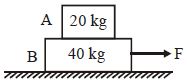
In the figure,the coefficient of friction between the floor and block $B$ is $\mu_1 = 0.2$ and between blocks $A$ and $B$ is $\mu_2 = 0.3$. The masses are $m_A = 20 \text{ kg}$ and $m_B = 40 \text{ kg}$. Find the maximum horizontal force $F$ that can be applied to block $B$ so that both blocks move together. (in $\text{ N}$)
A
$60$
B
$120$
C
$240$
D
$300$
Solution
(D) For both blocks to move together,block $A$ must move with the same acceleration $a$ as block $B$. The only force causing acceleration on block $A$ is the static friction force $f_s$ from block $B$.
The maximum static friction force between $A$ and $B$ is $f_{s,max} = \mu_2 m_A g = 0.3 \times 20 \times 10 = 60 \text{ N}$.
The maximum acceleration $a_{max}$ of block $A$ is $a_{max} = \frac{f_{s,max}}{m_A} = \frac{60}{20} = 3 \text{ m/s}^2$.
Now,consider the system of both blocks $(A+B)$ moving together with acceleration $a_{max} = 3 \text{ m/s}^2$. The external force $F$ must overcome the kinetic friction $f_k$ between block $B$ and the floor.
The normal force on the floor is $N = (m_A + m_B)g = (20 + 40) \times 10 = 600 \text{ N}$.
The kinetic friction force is $f_k = \mu_1 N = 0.2 \times 600 = 120 \text{ N}$.
Applying Newton's second law to the system $(A+B)$:
$F - f_k = (m_A + m_B) a_{max}$
$F - 120 = (20 + 40) \times 3$
$F - 120 = 60 \times 3$
$F - 120 = 180$
$F = 300 \text{ N}$.
The maximum static friction force between $A$ and $B$ is $f_{s,max} = \mu_2 m_A g = 0.3 \times 20 \times 10 = 60 \text{ N}$.
The maximum acceleration $a_{max}$ of block $A$ is $a_{max} = \frac{f_{s,max}}{m_A} = \frac{60}{20} = 3 \text{ m/s}^2$.
Now,consider the system of both blocks $(A+B)$ moving together with acceleration $a_{max} = 3 \text{ m/s}^2$. The external force $F$ must overcome the kinetic friction $f_k$ between block $B$ and the floor.
The normal force on the floor is $N = (m_A + m_B)g = (20 + 40) \times 10 = 600 \text{ N}$.
The kinetic friction force is $f_k = \mu_1 N = 0.2 \times 600 = 120 \text{ N}$.
Applying Newton's second law to the system $(A+B)$:
$F - f_k = (m_A + m_B) a_{max}$
$F - 120 = (20 + 40) \times 3$
$F - 120 = 60 \times 3$
$F - 120 = 180$
$F = 300 \text{ N}$.
0 likes
View Solution25
MediumMCQ
Block $A$ of mass $30\, kg$ is resting on a frictionless floor. Another block $B$ of mass $5\, kg$ is resting on it as shown in the figure. The coefficient of static friction between the blocks is $0.4$ while kinetic friction is $0.3$. If a horizontal force of $175\, N$ is applied to block $B$,then the acceleration of block $A$ will be ........ $m/s^2$ $(g = 10\, m/s^2)$.
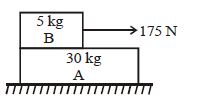
A
$0.5$
B
$0.67$
C
$5$
D
$10$
Solution
(A) $1$. First,calculate the maximum static friction force between the blocks: $f_{s,max} = \mu_s N = \mu_s m_B g = 0.4 \times 5 \times 10 = 20\, N$.
$2$. If both blocks move together with acceleration $a$,then $F = (m_A + m_B) a$. Thus,$175 = (30 + 5) a \Rightarrow a = 175 / 35 = 5\, m/s^2$.
$3$. The force required to accelerate block $A$ at $5\, m/s^2$ is $F_A = m_A a = 30 \times 5 = 150\, N$. Since $150\, N > f_{s,max} (20\, N)$,the blocks will slip.
$4$. Since they slip,the kinetic friction force $f_k = \mu_k m_B g = 0.3 \times 5 \times 10 = 15\, N$ acts on block $A$.
$5$. The acceleration of block $A$ is $a_A = f_k / m_A = 15 / 30 = 0.5\, m/s^2$.
$2$. If both blocks move together with acceleration $a$,then $F = (m_A + m_B) a$. Thus,$175 = (30 + 5) a \Rightarrow a = 175 / 35 = 5\, m/s^2$.
$3$. The force required to accelerate block $A$ at $5\, m/s^2$ is $F_A = m_A a = 30 \times 5 = 150\, N$. Since $150\, N > f_{s,max} (20\, N)$,the blocks will slip.
$4$. Since they slip,the kinetic friction force $f_k = \mu_k m_B g = 0.3 \times 5 \times 10 = 15\, N$ acts on block $A$.
$5$. The acceleration of block $A$ is $a_A = f_k / m_A = 15 / 30 = 0.5\, m/s^2$.
0 likes
View Solution26
MediumMCQ
Find the maximum force $F$ (in $N$) for which both the blocks will move with the same acceleration.
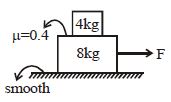
A
$16$
B
$32$
C
$48$
D
$8$
Solution
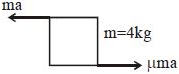
(C) Let the acceleration of the system be $a$. For the $4 \ kg$ block to move with the $8 \ kg$ block without slipping,the maximum frictional force must provide the necessary acceleration.
The limiting friction on the $4 \ kg$ block is $f_{max} = \mu N = \mu mg = 0.4 \times 4 \times 10 = 16 \ N$.
This frictional force provides the acceleration to the $4 \ kg$ block: $f_{max} = m_1 a \Rightarrow 16 = 4a \Rightarrow a = 4 \ m/s^2$.
Now,considering the whole system of $(4 \ kg + 8 \ kg)$ moving with acceleration $a$ under force $F$:
$F = (m_1 + m_2) a = (4 + 8) \times 4 = 12 \times 4 = 48 \ N$.
Thus,the maximum force $F$ is $48 \ N$.
The limiting friction on the $4 \ kg$ block is $f_{max} = \mu N = \mu mg = 0.4 \times 4 \times 10 = 16 \ N$.
This frictional force provides the acceleration to the $4 \ kg$ block: $f_{max} = m_1 a \Rightarrow 16 = 4a \Rightarrow a = 4 \ m/s^2$.
Now,considering the whole system of $(4 \ kg + 8 \ kg)$ moving with acceleration $a$ under force $F$:
$F = (m_1 + m_2) a = (4 + 8) \times 4 = 12 \times 4 = 48 \ N$.
Thus,the maximum force $F$ is $48 \ N$.
0 likes
View Solution27
MediumMCQ
In the shown arrangement,the mass of $A = 1\,kg$ and the mass of $B = 2\,kg$. The coefficient of friction between $A$ and $B$ is $\mu = 0.2$. There is no friction between $B$ and the ground. $A$ horizontal force $F = 5\,N$ is applied to block $B$. The frictional force exerted by $A$ on $B$ is equal to:
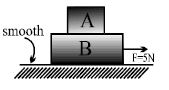
A
$\frac{5}{3}\,N$
B
$\frac{7}{8}\,N$
C
$5\,N$
D
None
Solution
(A) $1$. Assume both blocks $A$ and $B$ move together with a common acceleration $a$. The total mass of the system is $M = m_A + m_B = 1 + 2 = 3\,kg$.
$2$. The external force applied is $F = 5\,N$. The acceleration of the system is $a = \frac{F}{M} = \frac{5}{3}\,m/s^2$.
$3$. For block $A$ to move with this acceleration,the required force is $f = m_A \cdot a = 1 \cdot \frac{5}{3} = \frac{5}{3}\,N$.
$4$. The maximum static friction force between $A$ and $B$ is $f_{max} = \mu \cdot m_A \cdot g = 0.2 \cdot 1 \cdot 10 = 2\,N$.
$5$. Since the required force $f = \frac{5}{3}\,N \approx 1.67\,N$ is less than $f_{max} = 2\,N$,the blocks move together.
$6$. Therefore,the frictional force exerted by $A$ on $B$ is equal to the force required to accelerate $A$,which is $\frac{5}{3}\,N$.
$2$. The external force applied is $F = 5\,N$. The acceleration of the system is $a = \frac{F}{M} = \frac{5}{3}\,m/s^2$.
$3$. For block $A$ to move with this acceleration,the required force is $f = m_A \cdot a = 1 \cdot \frac{5}{3} = \frac{5}{3}\,N$.
$4$. The maximum static friction force between $A$ and $B$ is $f_{max} = \mu \cdot m_A \cdot g = 0.2 \cdot 1 \cdot 10 = 2\,N$.
$5$. Since the required force $f = \frac{5}{3}\,N \approx 1.67\,N$ is less than $f_{max} = 2\,N$,the blocks move together.
$6$. Therefore,the frictional force exerted by $A$ on $B$ is equal to the force required to accelerate $A$,which is $\frac{5}{3}\,N$.
0 likes
View Solution28
DifficultMCQ
$A$ block $A$ of mass $4\, kg$ is placed on another block $B$ of mass $5\, kg$,and the block $B$ rests on a smooth horizontal table. If the minimum force that can be applied on $A$ so that both the blocks move together is $12\, N$,the maximum force that can be applied to $B$ for the blocks to move together will be ....... $N$.
A
$30$
B
$25$
C
$15$
D
$48$
Solution
(C) Let the coefficient of friction between blocks $A$ and $B$ be $\mu$. The maximum static friction force between $A$ and $B$ is $f_{max} = \mu m_A g = \mu \times 4 \times 10 = 40\mu$.
When a force $F_A = 12\, N$ is applied on $A$,the acceleration of the system is $a = \frac{F_A}{m_A + m_B} = \frac{12}{4 + 5} = \frac{12}{9} = \frac{4}{3}\, m/s^2$.
For block $A$ to move with $B$,the friction force $f$ must provide the acceleration to $A$: $f = m_A a = 4 \times \frac{4}{3} = \frac{16}{3}\, N$.
Since this is the limiting case,$f = f_{max} \Rightarrow 40\mu = \frac{16}{3} \Rightarrow \mu = \frac{16}{120} = \frac{2}{15}$.
Now,let a maximum force $F_B$ be applied to block $B$. The acceleration of the system is $a' = \frac{F_B}{m_A + m_B} = \frac{F_B}{9}$.
For block $A$ to move with $B$,the friction force $f$ must provide the acceleration to $A$: $f = m_A a' = 4 \times \frac{F_B}{9}$.
Since $f \le f_{max}$,we have $4 \times \frac{F_B}{9} \le 40 \times \frac{2}{15}$.
$F_B \le 40 \times \frac{2}{15} \times \frac{9}{4} = 10 \times 2 \times \frac{3}{5} \times 3 = 36\, N$. Wait,re-calculating: $F_B \le 40 \times \frac{2}{15} \times \frac{9}{4} = 10 \times 2 \times \frac{9}{15} = 20 \times 0.6 = 12\, N$ is incorrect. Let's re-evaluate: $f_{max} = 40 \times \frac{2}{15} = \frac{16}{3}$. $4 \times \frac{F_B}{9} = \frac{16}{3} \Rightarrow F_B = \frac{16}{3} \times \frac{9}{4} = 4 \times 3 = 12\, N$. Actually,the question implies $F_B$ is applied to $B$ only. $F_B - f = m_B a' \Rightarrow F_B - \frac{16}{3} = 5 \times \frac{F_B}{9} \Rightarrow F_B(1 - 5/9) = 16/3 \Rightarrow F_B(4/9) = 16/3 \Rightarrow F_B = 16/3 \times 9/4 = 12\, N$. Given the options,let's re-check the initial $\mu$ calculation. $12 - f = 4a$ and $f = 5a$. $12 = 9a \Rightarrow a = 4/3$. $f = 5(4/3) = 20/3$. $f_{max} = \mu(4)(10) = 40\mu = 20/3 \Rightarrow \mu = 1/6$. Now for $B$: $F_B - f = 5a'$ and $f = 4a'$. $F_B = 9a'$. Max $f = 40(1/6) = 20/3$. $4a' = 20/3 \Rightarrow a' = 5/3$. $F_B = 9(5/3) = 15\, N$.
When a force $F_A = 12\, N$ is applied on $A$,the acceleration of the system is $a = \frac{F_A}{m_A + m_B} = \frac{12}{4 + 5} = \frac{12}{9} = \frac{4}{3}\, m/s^2$.
For block $A$ to move with $B$,the friction force $f$ must provide the acceleration to $A$: $f = m_A a = 4 \times \frac{4}{3} = \frac{16}{3}\, N$.
Since this is the limiting case,$f = f_{max} \Rightarrow 40\mu = \frac{16}{3} \Rightarrow \mu = \frac{16}{120} = \frac{2}{15}$.
Now,let a maximum force $F_B$ be applied to block $B$. The acceleration of the system is $a' = \frac{F_B}{m_A + m_B} = \frac{F_B}{9}$.
For block $A$ to move with $B$,the friction force $f$ must provide the acceleration to $A$: $f = m_A a' = 4 \times \frac{F_B}{9}$.
Since $f \le f_{max}$,we have $4 \times \frac{F_B}{9} \le 40 \times \frac{2}{15}$.
$F_B \le 40 \times \frac{2}{15} \times \frac{9}{4} = 10 \times 2 \times \frac{3}{5} \times 3 = 36\, N$. Wait,re-calculating: $F_B \le 40 \times \frac{2}{15} \times \frac{9}{4} = 10 \times 2 \times \frac{9}{15} = 20 \times 0.6 = 12\, N$ is incorrect. Let's re-evaluate: $f_{max} = 40 \times \frac{2}{15} = \frac{16}{3}$. $4 \times \frac{F_B}{9} = \frac{16}{3} \Rightarrow F_B = \frac{16}{3} \times \frac{9}{4} = 4 \times 3 = 12\, N$. Actually,the question implies $F_B$ is applied to $B$ only. $F_B - f = m_B a' \Rightarrow F_B - \frac{16}{3} = 5 \times \frac{F_B}{9} \Rightarrow F_B(1 - 5/9) = 16/3 \Rightarrow F_B(4/9) = 16/3 \Rightarrow F_B = 16/3 \times 9/4 = 12\, N$. Given the options,let's re-check the initial $\mu$ calculation. $12 - f = 4a$ and $f = 5a$. $12 = 9a \Rightarrow a = 4/3$. $f = 5(4/3) = 20/3$. $f_{max} = \mu(4)(10) = 40\mu = 20/3 \Rightarrow \mu = 1/6$. Now for $B$: $F_B - f = 5a'$ and $f = 4a'$. $F_B = 9a'$. Max $f = 40(1/6) = 20/3$. $4a' = 20/3 \Rightarrow a' = 5/3$. $F_B = 9(5/3) = 15\, N$.
0 likes
View Solution29
DifficultMCQ
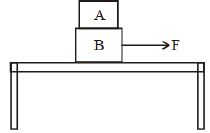
Two blocks $A$ and $B$ of masses $m_A = 1\,kg$ and $m_B = 3\,kg$ are kept on a table as shown in the figure. The coefficient of friction between $A$ and $B$ is $\mu_1 = 0.2$ and between $B$ and the surface of the table is $\mu_2 = 0.2$. The maximum horizontal force $F$ that can be applied on $B$ such that block $A$ does not slide over block $B$ is ........ $N$. [Take $g = 10\,m/s^2$]
A
$8$
B
$16$
C
$12$
D
$40$
Solution
(B) For block $A$ not to slide over $B$,the maximum acceleration $a$ of the system is limited by the friction between $A$ and $B$.
The maximum frictional force on $A$ is $f_{max} = \mu_1 m_A g = 0.2 \times 1 \times 10 = 2\,N$.
This friction provides the maximum acceleration to block $A$: $a_{max} = \frac{f_{max}}{m_A} = \frac{2}{1} = 2\,m/s^2$.
Now,consider the whole system $(A+B)$ moving with acceleration $a_{max}$. The external force $F$ must overcome the friction between $B$ and the table surface $(f_{table})$ and provide the required acceleration to both blocks.
The friction between $B$ and the table is $f_{table} = \mu_2 (m_A + m_B) g = 0.2 \times (1 + 3) \times 10 = 0.2 \times 4 \times 10 = 8\,N$.
Applying Newton's second law to the system $(A+B)$: $F - f_{table} = (m_A + m_B) a_{max}$.
$F - 8 = (1 + 3) \times 2$.
$F - 8 = 4 \times 2 = 8$.
$F = 8 + 8 = 16\,N$.
The maximum frictional force on $A$ is $f_{max} = \mu_1 m_A g = 0.2 \times 1 \times 10 = 2\,N$.
This friction provides the maximum acceleration to block $A$: $a_{max} = \frac{f_{max}}{m_A} = \frac{2}{1} = 2\,m/s^2$.
Now,consider the whole system $(A+B)$ moving with acceleration $a_{max}$. The external force $F$ must overcome the friction between $B$ and the table surface $(f_{table})$ and provide the required acceleration to both blocks.
The friction between $B$ and the table is $f_{table} = \mu_2 (m_A + m_B) g = 0.2 \times (1 + 3) \times 10 = 0.2 \times 4 \times 10 = 8\,N$.
Applying Newton's second law to the system $(A+B)$: $F - f_{table} = (m_A + m_B) a_{max}$.
$F - 8 = (1 + 3) \times 2$.
$F - 8 = 4 \times 2 = 8$.
$F = 8 + 8 = 16\,N$.

0 likes
View Solution30
DifficultMCQ
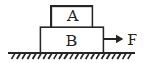
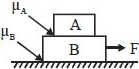
In the figure,the coefficient of friction between the floor and the block $B$ is $0.1$. The coefficient of friction between the blocks $B$ and $A$ is $0.2$. The mass of $A$ is $\frac{m}{2}$ and the mass of $B$ is $m$. What is the maximum horizontal force $F$ that can be applied to the block $B$ so that the two blocks move together?
A
$0.15$
B
$0.05$
C
$0.1$
D
$0.45$
Solution
(D) Given: Mass of block $A$,$m_{A} = \frac{m}{2}$. Mass of block $B$,$m_{B} = m$.
Coefficient of friction between $A$ and $B$,$\mu_{A} = 0.2$. Coefficient of friction between $B$ and the floor,$\mu_{B} = 0.1$.
For the blocks to move together,the maximum acceleration $a$ is provided by the friction between $A$ and $B$.
$f_{max} = \mu_{A} m_{A} g = m_{A} a$
$a = \mu_{A} g = 0.2 g$.
Now,considering both blocks as a single system,the total mass is $M = m_{A} + m_{B} = \frac{m}{2} + m = \frac{3m}{2}$.
The force $F$ must overcome the friction between $B$ and the floor,and provide acceleration $a$ to the system.
$F - \mu_{B} (m_{A} + m_{B}) g = (m_{A} + m_{B}) a$
$F = (m_{A} + m_{B}) a + \mu_{B} (m_{A} + m_{B}) g$
$F = (\frac{3m}{2})(0.2 g) + (0.1)(\frac{3m}{2}) g$
$F = 0.3 mg + 0.15 mg = 0.45 mg$.
Thus,the maximum force is $0.45 mg$.
Coefficient of friction between $A$ and $B$,$\mu_{A} = 0.2$. Coefficient of friction between $B$ and the floor,$\mu_{B} = 0.1$.
For the blocks to move together,the maximum acceleration $a$ is provided by the friction between $A$ and $B$.
$f_{max} = \mu_{A} m_{A} g = m_{A} a$
$a = \mu_{A} g = 0.2 g$.
Now,considering both blocks as a single system,the total mass is $M = m_{A} + m_{B} = \frac{m}{2} + m = \frac{3m}{2}$.
The force $F$ must overcome the friction between $B$ and the floor,and provide acceleration $a$ to the system.
$F - \mu_{B} (m_{A} + m_{B}) g = (m_{A} + m_{B}) a$
$F = (m_{A} + m_{B}) a + \mu_{B} (m_{A} + m_{B}) g$
$F = (\frac{3m}{2})(0.2 g) + (0.1)(\frac{3m}{2}) g$
$F = 0.3 mg + 0.15 mg = 0.45 mg$.
Thus,the maximum force is $0.45 mg$.
0 likes
View Solution31
MediumMCQ
$A$ block of mass $1\, kg$ lies on a horizontal surface in a truck. The coefficient of static friction between the block and the surface is $0.6$. If the acceleration of the truck is $5\, m/s^2$,the frictional force acting on the block is ........ $N$.
A
$10$
B
$5$
C
$2.5$
D
$20$
Solution
(B) The maximum static frictional force (limiting friction) is given by $f_{max} = \mu_s N = \mu_s mg$.
Given $\mu_s = 0.6$,$m = 1\, kg$,and $g = 9.8\, m/s^2$.
$f_{max} = 0.6 \times 1 \times 9.8 = 5.88\, N$.
The pseudo force acting on the block due to the acceleration of the truck is $F_{pseudo} = ma = 1 \times 5 = 5\, N$.
Since the applied pseudo force $(5\, N)$ is less than the limiting friction $(5.88\, N)$,the block does not slide relative to the truck.
Therefore,the static frictional force adjusts itself to balance the pseudo force.
Thus,the frictional force acting on the block is $5\, N$.
Given $\mu_s = 0.6$,$m = 1\, kg$,and $g = 9.8\, m/s^2$.
$f_{max} = 0.6 \times 1 \times 9.8 = 5.88\, N$.
The pseudo force acting on the block due to the acceleration of the truck is $F_{pseudo} = ma = 1 \times 5 = 5\, N$.
Since the applied pseudo force $(5\, N)$ is less than the limiting friction $(5.88\, N)$,the block does not slide relative to the truck.
Therefore,the static frictional force adjusts itself to balance the pseudo force.
Thus,the frictional force acting on the block is $5\, N$.
0 likes
View Solution32
MediumMCQ
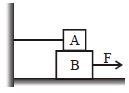
$A$ block $A$ of mass $100\, kg$ rests on another block $B$ of mass $200\, kg$ and is tied to a wall as shown in the figure. The coefficient of friction between $A$ and $B$ is $0.2$ and that between $B$ and the ground is $0.3$. The minimum force $F$ required to move the block $B$ is........ $N$. $(g = 10\, m/s^2)$
A
$900$
B
$200$
C
$1100$
D
$700$
Solution
(C) To move block $B$,the applied force $F$ must overcome the frictional forces acting on it.
$1$. Friction between block $A$ and block $B$ $(f_{AB})$: This is the limiting friction acting on the top surface of block $B$ as it moves to the right. Since block $A$ is tied to the wall,it remains stationary. The normal force on $A$ is $N_A = m_A g = 100 \times 10 = 1000\, N$. Thus,$f_{AB} = \mu_{AB} N_A = 0.2 \times 1000 = 200\, N$.
$2$. Friction between block $B$ and the ground $(f_{BS})$: This is the limiting friction acting on the bottom surface of block $B$. The normal force on the ground is $N_G = (m_A + m_B) g = (100 + 200) \times 10 = 3000\, N$. Thus,$f_{BS} = \mu_{BS} N_G = 0.3 \times 3000 = 900\, N$.
$3$. Total force $F$ required: The force $F$ must overcome both frictional forces.
$F = f_{AB} + f_{BS} = 200\, N + 900\, N = 1100\, N$.
$1$. Friction between block $A$ and block $B$ $(f_{AB})$: This is the limiting friction acting on the top surface of block $B$ as it moves to the right. Since block $A$ is tied to the wall,it remains stationary. The normal force on $A$ is $N_A = m_A g = 100 \times 10 = 1000\, N$. Thus,$f_{AB} = \mu_{AB} N_A = 0.2 \times 1000 = 200\, N$.
$2$. Friction between block $B$ and the ground $(f_{BS})$: This is the limiting friction acting on the bottom surface of block $B$. The normal force on the ground is $N_G = (m_A + m_B) g = (100 + 200) \times 10 = 3000\, N$. Thus,$f_{BS} = \mu_{BS} N_G = 0.3 \times 3000 = 900\, N$.
$3$. Total force $F$ required: The force $F$ must overcome both frictional forces.
$F = f_{AB} + f_{BS} = 200\, N + 900\, N = 1100\, N$.
0 likes
View Solution33
MediumMCQ
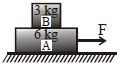
Two blocks $A$ and $B$ of masses $6 \, kg$ and $3 \, kg$ rest on a smooth horizontal surface as shown in the figure. If the coefficient of friction between $A$ and $B$ is $0.4$,find the maximum horizontal force $F$ that can be applied to block $A$ such that they move together without separation. (in $, N$)
A
$72$
B
$40$
C
$36$
D
$20$
Solution
(C) The maximum frictional force $f_{max}$ acting on block $B$ is provided by the static friction between $A$ and $B$.
$f_{max} = \mu m_B g = 0.4 \times 3 \times 10 = 12 \, N$.
This frictional force provides the maximum acceleration $a_{max}$ to block $B$ so that it does not slip over $A$.
$a_{max} = \frac{f_{max}}{m_B} = \frac{12}{3} = 4 \, m/s^2$.
For both blocks to move together without separation,the entire system must move with this maximum acceleration $a_{max}$.
Applying Newton's second law to the combined system of blocks $A$ and $B$:
$F = (m_A + m_B) a_{max} = (6 + 3) \times 4 = 9 \times 4 = 36 \, N$.
$f_{max} = \mu m_B g = 0.4 \times 3 \times 10 = 12 \, N$.
This frictional force provides the maximum acceleration $a_{max}$ to block $B$ so that it does not slip over $A$.
$a_{max} = \frac{f_{max}}{m_B} = \frac{12}{3} = 4 \, m/s^2$.
For both blocks to move together without separation,the entire system must move with this maximum acceleration $a_{max}$.
Applying Newton's second law to the combined system of blocks $A$ and $B$:
$F = (m_A + m_B) a_{max} = (6 + 3) \times 4 = 9 \times 4 = 36 \, N$.
0 likes
View Solution34
DifficultMCQ
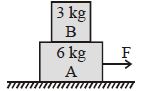
Two blocks $A$ and $B$ of masses $6\, kg$ and $3\, kg$ are placed on a smooth horizontal surface as shown in the figure. If the coefficient of friction between $A$ and $B$ is $0.4$,find the maximum horizontal force $F$ that can be applied to block $A$ such that they move together without separation. (Take $g = 10\, m/s^2$)
A
$72$
B
$40$
C
$36$
D
$20$
Solution
(C) For the blocks to move together without separation,the maximum acceleration $a_{max}$ is determined by the limiting friction between block $A$ and block $B$.
The limiting frictional force $f_{max}$ acting on block $B$ is given by $f_{max} = \mu m_B g$.
Substituting the values,$f_{max} = 0.4 \times 3 \times 10 = 12\, N$.
This frictional force provides the necessary acceleration to block $B$. Thus,$f_{max} = m_B a_{max}$.
$12 = 3 \times a_{max} \implies a_{max} = 4\, m/s^2$.
Now,considering both blocks as a single system,the total force $F$ required to move them with acceleration $a_{max}$ is $F = (m_A + m_B) a_{max}$.
$F = (6 + 3) \times 4 = 9 \times 4 = 36\, N$.
The limiting frictional force $f_{max}$ acting on block $B$ is given by $f_{max} = \mu m_B g$.
Substituting the values,$f_{max} = 0.4 \times 3 \times 10 = 12\, N$.
This frictional force provides the necessary acceleration to block $B$. Thus,$f_{max} = m_B a_{max}$.
$12 = 3 \times a_{max} \implies a_{max} = 4\, m/s^2$.
Now,considering both blocks as a single system,the total force $F$ required to move them with acceleration $a_{max}$ is $F = (m_A + m_B) a_{max}$.
$F = (6 + 3) \times 4 = 9 \times 4 = 36\, N$.
0 likes
View Solution35
EasyMCQ
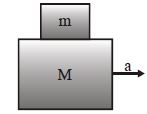
$A$ block of mass $m$ is placed on the top of another block of mass $M$ as shown in the figure. The coefficient of friction between them is $\mu$. What is the maximum acceleration with which the block $M$ may move so that $m$ also moves along with it?
A
$\mu g$
B
$g/\mu$
C
$\mu^2/g$
D
$g/\mu^2$
Solution
(A) For the block of mass $m$ to move along with the block of mass $M$,the frictional force between them must provide the necessary acceleration to the block $m$.
The maximum static frictional force acting on the block $m$ is given by $f_{\max} = \mu N$,where $N$ is the normal force.
Since the block $m$ is on top of $M$,the normal force $N = mg$.
Therefore,the maximum frictional force is $f_{\max} = \mu mg$.
According to Newton's second law,the maximum acceleration $a_{\max}$ that can be provided to the block $m$ by this frictional force is $f_{\max} = m a_{\max}$.
Substituting the value of $f_{\max}$,we get $\mu mg = m a_{\max}$.
Solving for $a_{\max}$,we find $a_{\max} = \mu g$.
The maximum static frictional force acting on the block $m$ is given by $f_{\max} = \mu N$,where $N$ is the normal force.
Since the block $m$ is on top of $M$,the normal force $N = mg$.
Therefore,the maximum frictional force is $f_{\max} = \mu mg$.
According to Newton's second law,the maximum acceleration $a_{\max}$ that can be provided to the block $m$ by this frictional force is $f_{\max} = m a_{\max}$.
Substituting the value of $f_{\max}$,we get $\mu mg = m a_{\max}$.
Solving for $a_{\max}$,we find $a_{\max} = \mu g$.
0 likes
View Solution36
MediumMCQ
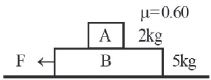
Two blocks $(A)$ of $2\,kg$ and $(B)$ of $5\,kg$ rest one over the other on a smooth horizontal plane. The coefficient of static and dynamic friction between $(A)$ and $(B)$ is the same and equal to $0.60$. Find the maximum horizontal force that can be applied to $(B)$ such that both $(A)$ and $(B)$ do not have any relative motion. $(g = 10\,m/s^2)$
A
$42\,N$
B
$42\,kgf$
C
$5.4\,kgf$
D
$1.2\,N$
Solution
(A) For block $A$ to move with block $B$ without any relative motion,the maximum acceleration $a_{max}$ of the system is provided by the friction force between $A$ and $B$.
The limiting friction force on block $A$ is $f_{max} = \mu N_A = \mu m_A g$.
Using Newton's second law for block $A$,$f_{max} = m_A a_{max}$.
Therefore,$m_A a_{max} = \mu m_A g$,which gives $a_{max} = \mu g$.
Given $\mu = 0.60$ and $g = 10\,m/s^2$,we have $a_{max} = 0.60 \times 10 = 6\,m/s^2$.
Now,considering both blocks $A$ and $B$ as a single system of mass $(m_A + m_B)$,the maximum force $F_{max}$ that can be applied to $B$ is $F_{max} = (m_A + m_B) a_{max}$.
Substituting the values,$F_{max} = (2 + 5) \times 6 = 7 \times 6 = 42\,N$.
The limiting friction force on block $A$ is $f_{max} = \mu N_A = \mu m_A g$.
Using Newton's second law for block $A$,$f_{max} = m_A a_{max}$.
Therefore,$m_A a_{max} = \mu m_A g$,which gives $a_{max} = \mu g$.
Given $\mu = 0.60$ and $g = 10\,m/s^2$,we have $a_{max} = 0.60 \times 10 = 6\,m/s^2$.
Now,considering both blocks $A$ and $B$ as a single system of mass $(m_A + m_B)$,the maximum force $F_{max}$ that can be applied to $B$ is $F_{max} = (m_A + m_B) a_{max}$.
Substituting the values,$F_{max} = (2 + 5) \times 6 = 7 \times 6 = 42\,N$.
0 likes
View Solution37
DifficultMCQ
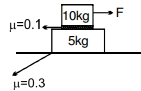
When $F = 2 \, N$,the frictional force between the $5 \, kg$ block and the ground is $.......... \, N$.
A
$0$
B
$2$
C
$8$
D
$10$
Solution
(B) Let $m_1 = 10 \, kg$ (upper block) and $m_2 = 5 \, kg$ (lower block).
The coefficient of friction between the blocks is $\mu_1 = 0.1$ and between the lower block and the ground is $\mu_2 = 0.3$.
The maximum static friction between the blocks is $f_{1 \max} = \mu_1 m_1 g = 0.1 \times 10 \times 10 = 10 \, N$.
The maximum static friction between the lower block and the ground is $f_{2 \max} = \mu_2 (m_1 + m_2) g = 0.3 \times (10 + 5) \times 10 = 0.3 \times 150 = 45 \, N$.
When an external force $F = 2 \, N$ is applied to the upper block,the force trying to move the system is $F = 2 \, N$.
Since $F < f_{1 \max}$ $(2 \, N < 10 \, N)$,the upper block does not move relative to the lower block.
Consequently,the entire system $(15 \, kg)$ remains at rest because the applied force $F = 2 \, N$ is also less than $f_{2 \max} = 45 \, N$.
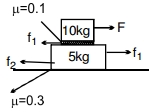
Since the system is in equilibrium,the frictional force between the $5 \, kg$ block and the ground must balance the applied force $F$ to keep the system stationary.
Therefore,the frictional force between the $5 \, kg$ block and the ground is $2 \, N$.
The coefficient of friction between the blocks is $\mu_1 = 0.1$ and between the lower block and the ground is $\mu_2 = 0.3$.
The maximum static friction between the blocks is $f_{1 \max} = \mu_1 m_1 g = 0.1 \times 10 \times 10 = 10 \, N$.
The maximum static friction between the lower block and the ground is $f_{2 \max} = \mu_2 (m_1 + m_2) g = 0.3 \times (10 + 5) \times 10 = 0.3 \times 150 = 45 \, N$.
When an external force $F = 2 \, N$ is applied to the upper block,the force trying to move the system is $F = 2 \, N$.
Since $F < f_{1 \max}$ $(2 \, N < 10 \, N)$,the upper block does not move relative to the lower block.
Consequently,the entire system $(15 \, kg)$ remains at rest because the applied force $F = 2 \, N$ is also less than $f_{2 \max} = 45 \, N$.
Since the system is in equilibrium,the frictional force between the $5 \, kg$ block and the ground must balance the applied force $F$ to keep the system stationary.
Therefore,the frictional force between the $5 \, kg$ block and the ground is $2 \, N$.
0 likes
View Solution38
MediumMCQ
When $F = 2\,N$,the frictional force between the $10\,kg$ block and the $5\,kg$ block is $..........\,N$. (Given: $\mu_s = 0.1$ between blocks,$\mu_s = 0.3$ between $5\,kg$ block and ground).
A
$2$
B
$15$
C
$10$
D
$0$
Solution
(A) $1$. Identify the maximum static friction between the $10\,kg$ block and the $5\,kg$ block: $f_{max} = \mu_s N = 0.1 \times (10\,kg \times 10\,m/s^2) = 10\,N$.
$2$. The applied force $F = 2\,N$ is less than the maximum static friction $f_{max} = 10\,N$.
$3$. Since the applied force is insufficient to overcome the static friction,the blocks will not move relative to each other.
$4$. Therefore,the static frictional force acting between the blocks is equal to the applied force,which is $2\,N$.
$2$. The applied force $F = 2\,N$ is less than the maximum static friction $f_{max} = 10\,N$.
$3$. Since the applied force is insufficient to overcome the static friction,the blocks will not move relative to each other.
$4$. Therefore,the static frictional force acting between the blocks is equal to the applied force,which is $2\,N$.
0 likes
View Solution39
DifficultMCQ
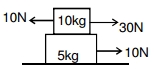
Find the acceleration of the $10\,kg$ block when a force $F = 30\,N$ is applied as shown in the figure. The coefficients of friction are $\mu = 0.1$ between the blocks and $\mu = 0.3$ between the $5\,kg$ block and the ground. (in $,m/s^2$)
A
$1$
B
$3$
C
$2$
D
$0$
Solution
(C) $1$. Calculate the limiting friction between the $10\,kg$ and $5\,kg$ blocks: $f_{1} = \mu_1 N_1 = 0.1 \times 10 \times 10 = 10\,N$.
$2$. The net force on the $10\,kg$ block is $F_{net} = F - f_1 = 30\,N - 10\,N = 20\,N$.
$3$. The acceleration of the $10\,kg$ block is $a = \frac{F_{net}}{m} = \frac{20\,N}{10\,kg} = 2\,m/s^2$.
$2$. The net force on the $10\,kg$ block is $F_{net} = F - f_1 = 30\,N - 10\,N = 20\,N$.
$3$. The acceleration of the $10\,kg$ block is $a = \frac{F_{net}}{m} = \frac{20\,N}{10\,kg} = 2\,m/s^2$.
0 likes
View Solution40
Difficult
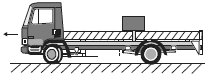
The rear side of a truck is open and a box of $40 \;kg$ mass is placed $5 \;m$ away from the open end as shown in Figure. The coefficient of friction between the box and the surface below it is $0.15$. On a straight road,the truck starts from rest and accelerates with $2 \;m s^{-2}$. At what distance from the starting point does the box fall off the truck? (Ignore the size of the box).
Solution
(C) Mass of the box,$m = 40 \;kg$.
Coefficient of friction,$\mu = 0.15$.
Initial velocity,$u = 0$.
Acceleration of the truck,$a = 2 \;m s^{-2}$.
Distance of the box from the end of the truck,$s' = 5 \;m$.
In the frame of reference of the truck,the box experiences a pseudo force $F_p = ma$ in the backward direction.
$F_p = 40 \times 2 = 80 \;N$.
The limiting friction force acting in the forward direction is $f = \mu mg = 0.15 \times 40 \times 10 = 60 \;N$.
The net force on the box in the backward direction is $F_{net} = F_p - f = 80 - 60 = 20 \;N$.
The backward acceleration of the box relative to the truck is $a_{rel} = \frac{F_{net}}{m} = \frac{20}{40} = 0.5 \;m s^{-2}$.
Using the equation of motion $s' = u t + \frac{1}{2} a_{rel} t^2$:
$5 = 0 + \frac{1}{2} \times 0.5 \times t^2$
$5 = 0.25 \times t^2$
$t^2 = 20$
$t = \sqrt{20} \;s$.
The distance $s$ traveled by the truck in time $t$ is:
$s = ut + \frac{1}{2} a t^2$
$s = 0 + \frac{1}{2} \times 2 \times (\sqrt{20})^2$
$s = 20 \;m$.
Coefficient of friction,$\mu = 0.15$.
Initial velocity,$u = 0$.
Acceleration of the truck,$a = 2 \;m s^{-2}$.
Distance of the box from the end of the truck,$s' = 5 \;m$.
In the frame of reference of the truck,the box experiences a pseudo force $F_p = ma$ in the backward direction.
$F_p = 40 \times 2 = 80 \;N$.
The limiting friction force acting in the forward direction is $f = \mu mg = 0.15 \times 40 \times 10 = 60 \;N$.
The net force on the box in the backward direction is $F_{net} = F_p - f = 80 - 60 = 20 \;N$.
The backward acceleration of the box relative to the truck is $a_{rel} = \frac{F_{net}}{m} = \frac{20}{40} = 0.5 \;m s^{-2}$.
Using the equation of motion $s' = u t + \frac{1}{2} a_{rel} t^2$:
$5 = 0 + \frac{1}{2} \times 0.5 \times t^2$
$5 = 0.25 \times t^2$
$t^2 = 20$
$t = \sqrt{20} \;s$.
The distance $s$ traveled by the truck in time $t$ is:
$s = ut + \frac{1}{2} a t^2$
$s = 0 + \frac{1}{2} \times 2 \times (\sqrt{20})^2$
$s = 20 \;m$.
0 likes
View Solution41
MediumMCQ
Two blocks ($m = 0.5\, kg$ and $M = 4.5\, kg$) are arranged on a horizontal frictionless table as shown in the figure. The coefficient of static friction between the two blocks is $\frac{3}{7}$. Find the maximum horizontal force $F$ that can be applied on the larger block so that the blocks move together. (Round off to the nearest integer) [Take $g = 9.8\, m/s^2$]
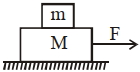
A
$35$
B
$24$
C
$21$
D
$27$
Solution
(C) For the blocks to move together,the acceleration $a$ of the system must be such that the frictional force on the smaller block $m$ is sufficient to provide its acceleration.
The maximum frictional force available is $f_{\max} = \mu N = \mu mg$.
The maximum acceleration $a_{\max}$ that the block $m$ can have without slipping is $a_{\max} = \frac{f_{\max}}{m} = \mu g$.
Given $\mu = \frac{3}{7}$ and $g = 9.8\, m/s^2$,we have:
$a_{\max} = \frac{3}{7} \times 9.8 = 3 \times 1.4 = 4.2\, m/s^2$.
Now,for the entire system of mass $(M + m)$,the force $F$ is applied:
$F = (M + m) a_{\max}$.
Substituting the values:
$F = (4.5 + 0.5) \times 4.2 = 5 \times 4.2 = 21\, N$.
Thus,the maximum horizontal force is $21\, N$.
The maximum frictional force available is $f_{\max} = \mu N = \mu mg$.
The maximum acceleration $a_{\max}$ that the block $m$ can have without slipping is $a_{\max} = \frac{f_{\max}}{m} = \mu g$.
Given $\mu = \frac{3}{7}$ and $g = 9.8\, m/s^2$,we have:
$a_{\max} = \frac{3}{7} \times 9.8 = 3 \times 1.4 = 4.2\, m/s^2$.
Now,for the entire system of mass $(M + m)$,the force $F$ is applied:
$F = (M + m) a_{\max}$.
Substituting the values:
$F = (4.5 + 0.5) \times 4.2 = 5 \times 4.2 = 21\, N$.
Thus,the maximum horizontal force is $21\, N$.
0 likes
View Solution42
DifficultMCQ
The coefficient of static friction between two blocks is $0.5$ and the table is smooth. The maximum horizontal force that can be applied to move the blocks together is $\ldots \ldots N$. (take $g=10 \, m/s^2$)
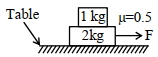
A
$45$
B
$35$
C
$25$
D
$15$
Solution
(D) Let the mass of the upper block be $m_1 = 1 \, kg$ and the lower block be $m_2 = 2 \, kg$. The total mass of the system is $M = m_1 + m_2 = 3 \, kg$.
For the blocks to move together,the upper block must move with the same acceleration $a$ as the lower block. The only force causing the upper block to accelerate is the static friction force $f_s$ between the two blocks.
The maximum static friction force is $f_{s,max} = \mu m_1 g = 0.5 \times 1 \times 10 = 5 \, N$.
This friction force provides the maximum acceleration to the $1 \, kg$ block: $f_{s,max} = m_1 a \Rightarrow 5 = 1 \times a \Rightarrow a = 5 \, m/s^2$.
Now,considering the whole system of $3 \, kg$ moving with acceleration $a$,the applied force $F$ is given by $F = (m_1 + m_2) a = 3 \times 5 = 15 \, N$.
For the blocks to move together,the upper block must move with the same acceleration $a$ as the lower block. The only force causing the upper block to accelerate is the static friction force $f_s$ between the two blocks.
The maximum static friction force is $f_{s,max} = \mu m_1 g = 0.5 \times 1 \times 10 = 5 \, N$.
This friction force provides the maximum acceleration to the $1 \, kg$ block: $f_{s,max} = m_1 a \Rightarrow 5 = 1 \times a \Rightarrow a = 5 \, m/s^2$.
Now,considering the whole system of $3 \, kg$ moving with acceleration $a$,the applied force $F$ is given by $F = (m_1 + m_2) a = 3 \times 5 = 15 \, N$.
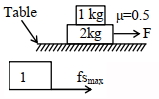
0 likes
View Solution43
MediumMCQ
$A$ system of two blocks of masses $m = 2 \; kg$ and $M = 8 \; kg$ is placed on a smooth table as shown in the figure. The coefficient of static friction between the two blocks is $0.5$. The maximum horizontal force $F$ that can be applied to the block of mass $M$ so that the blocks move together will be $\dots \; N$.
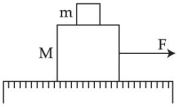
A
$9.8$
B
$39.2$
C
$49$
D
$78.4$
Solution
(C) The maximum acceleration $a_{\max}$ that the block of mass $m$ can have without slipping is determined by the static friction force $f_{s, \max} = \mu_s N = \mu_s mg$.
Using Newton's second law for block $m$: $f_{s, \max} = m a_{\max} \implies \mu_s mg = m a_{\max} \implies a_{\max} = \mu_s g$.
Given $\mu_s = 0.5$ and $g = 9.8 \; m/s^2$,we have $a_{\max} = 0.5 \times 9.8 = 4.9 \; m/s^2$.
For the two blocks to move together,the entire system must move with an acceleration $a \le a_{\max}$.
Applying Newton's second law to the combined system of mass $(m + M)$:
$F = (m + M) a_{\max} = (2 + 8) \times 4.9 = 10 \times 4.9 = 49 \; N$.
Using Newton's second law for block $m$: $f_{s, \max} = m a_{\max} \implies \mu_s mg = m a_{\max} \implies a_{\max} = \mu_s g$.
Given $\mu_s = 0.5$ and $g = 9.8 \; m/s^2$,we have $a_{\max} = 0.5 \times 9.8 = 4.9 \; m/s^2$.
For the two blocks to move together,the entire system must move with an acceleration $a \le a_{\max}$.
Applying Newton's second law to the combined system of mass $(m + M)$:
$F = (m + M) a_{\max} = (2 + 8) \times 4.9 = 10 \times 4.9 = 49 \; N$.
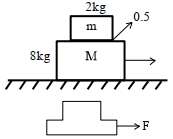
0 likes
View Solution44
MediumMCQ
Consider the system shown below. $A$ horizontal force $F$ is applied to a block $X$ of mass $8 \,kg$,such that the block $Y$ of mass $2 \,kg$ adjacent to it does not slip downwards under gravity. There is no friction between the horizontal plane and the base of the block $X$. The coefficient of friction between the surfaces of blocks $X$ and $Y$ is $0.5$. The minimum value of $F$ is ............ $N$ (take acceleration due to gravity to be $10 \,ms^{-2}$).
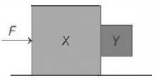
A
$200$
B
$160$
C
$40$
D
$240$
Solution
(A) Let the acceleration of the system of blocks $X$ and $Y$ be $a$.
Since the blocks move together,the total mass is $M = m_X + m_Y = 8 \,kg + 2 \,kg = 10 \,kg$.
The acceleration of the system is given by $a = \frac{F}{M} = \frac{F}{10} \,ms^{-2}$.
For block $Y$ to not slip downwards,the upward frictional force $f$ must balance its weight $m_Y g$.
$f = m_Y g = 2 \times 10 = 20 \,N$.
The frictional force is also given by $f = \mu R$,where $R$ is the normal reaction between blocks $X$ and $Y$.
From the horizontal motion of block $Y$,the normal reaction $R$ provides the necessary acceleration $a$ to block $Y$:
$R = m_Y a = 2 \times \frac{F}{10} = \frac{F}{5}$.
Substituting the values into the friction equation:
$f = \mu R \Rightarrow 20 = 0.5 \times \frac{F}{5}$.
$20 = \frac{F}{10} \Rightarrow F = 200 \,N$.
Thus,the minimum value of $F$ is $200 \,N$.
Since the blocks move together,the total mass is $M = m_X + m_Y = 8 \,kg + 2 \,kg = 10 \,kg$.
The acceleration of the system is given by $a = \frac{F}{M} = \frac{F}{10} \,ms^{-2}$.
For block $Y$ to not slip downwards,the upward frictional force $f$ must balance its weight $m_Y g$.
$f = m_Y g = 2 \times 10 = 20 \,N$.
The frictional force is also given by $f = \mu R$,where $R$ is the normal reaction between blocks $X$ and $Y$.
From the horizontal motion of block $Y$,the normal reaction $R$ provides the necessary acceleration $a$ to block $Y$:
$R = m_Y a = 2 \times \frac{F}{10} = \frac{F}{5}$.
Substituting the values into the friction equation:
$f = \mu R \Rightarrow 20 = 0.5 \times \frac{F}{5}$.
$20 = \frac{F}{10} \Rightarrow F = 200 \,N$.
Thus,the minimum value of $F$ is $200 \,N$.
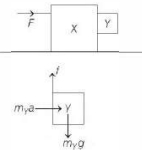
0 likes
View Solution45
AdvancedMCQ
$A$ pen of mass $m$ is lying on a piece of paper of mass $M$ placed on a rough table. If the coefficients of friction between the pen and paper and the paper and the table are $\mu_1$ and $\mu_2$,respectively,then the minimum horizontal force with which the paper has to be pulled for the pen to start slipping is given by:
A
$(m+M)(\mu_1+\mu_2)g$
B
$(m\mu_1+M\mu_2)g$
C
$(m\mu_1+(m+M)\mu_2)g$
D
$m(\mu_1-\mu_2)g$
Solution
(A) The limiting friction between the pen and the paper is $f_1 = \mu_1 mg$.
For the pen to start slipping,the force acting on the pen must be at least $f_1$. This force is provided by the friction from the paper,which is equal to the force of friction on the pen.
Thus,the acceleration $a$ of the pen is $a = \frac{f_1}{m} = \mu_1 g$.
For the pen to slip,the paper must accelerate at least with this acceleration $a = \mu_1 g$.
Now,consider the free body diagram of the paper of mass $M$. The forces acting on the paper are the applied force $F$,the friction from the pen $f_1$ (acting backwards),and the friction from the table $f_2$ (acting backwards).
The normal force on the table is $N = (M+m)g$,so $f_2 = \mu_2(M+m)g$.
Applying Newton's second law to the paper:
$F - f_1 - f_2 = Ma$
$F = Ma + f_1 + f_2$
Substituting the values:
$F = M(\mu_1 g) + \mu_1 mg + \mu_2(M+m)g$
$F = (M+m)\mu_1 g + (M+m)\mu_2 g$
$F = (M+m)(\mu_1 + \mu_2)g$.
For the pen to start slipping,the force acting on the pen must be at least $f_1$. This force is provided by the friction from the paper,which is equal to the force of friction on the pen.
Thus,the acceleration $a$ of the pen is $a = \frac{f_1}{m} = \mu_1 g$.
For the pen to slip,the paper must accelerate at least with this acceleration $a = \mu_1 g$.
Now,consider the free body diagram of the paper of mass $M$. The forces acting on the paper are the applied force $F$,the friction from the pen $f_1$ (acting backwards),and the friction from the table $f_2$ (acting backwards).
The normal force on the table is $N = (M+m)g$,so $f_2 = \mu_2(M+m)g$.
Applying Newton's second law to the paper:
$F - f_1 - f_2 = Ma$
$F = Ma + f_1 + f_2$
Substituting the values:
$F = M(\mu_1 g) + \mu_1 mg + \mu_2(M+m)g$
$F = (M+m)\mu_1 g + (M+m)\mu_2 g$
$F = (M+m)(\mu_1 + \mu_2)g$.
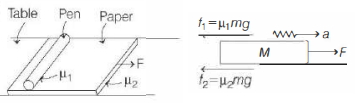
0 likes
View Solution46
DifficultMCQ
The maximum value of $F$ which can be applied on the system shown in the figure so that both blocks move together with the same acceleration is ..........
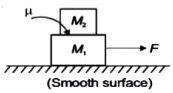
A
$F=\mu M_2 g$
B
$F=\mu(M_1-M_2)g$
C
$F=\mu M_1 g$
D
$F=\mu(M_1+M_2)g$
Solution
(D) Let both blocks move together with acceleration $a$.
For block $M_2$,the only horizontal force providing acceleration is the friction force $f_r$.
The maximum static friction force is $f_{r,max} = \mu N = \mu M_2 g$.
Thus,the maximum acceleration $a_{max}$ of block $M_2$ is $a_{max} = \frac{f_{r,max}}{M_2} = \frac{\mu M_2 g}{M_2} = \mu g$.
For the entire system of both blocks $(M_1 + M_2)$ to move together with this maximum acceleration $a_{max}$,the force $F$ applied on $M_1$ must satisfy:
$F = (M_1 + M_2) a_{max}$
$F = (M_1 + M_2) \mu g$
$F = \mu(M_1 + M_2) g$
Therefore,the correct option is $(d)$.
For block $M_2$,the only horizontal force providing acceleration is the friction force $f_r$.
The maximum static friction force is $f_{r,max} = \mu N = \mu M_2 g$.
Thus,the maximum acceleration $a_{max}$ of block $M_2$ is $a_{max} = \frac{f_{r,max}}{M_2} = \frac{\mu M_2 g}{M_2} = \mu g$.
For the entire system of both blocks $(M_1 + M_2)$ to move together with this maximum acceleration $a_{max}$,the force $F$ applied on $M_1$ must satisfy:
$F = (M_1 + M_2) a_{max}$
$F = (M_1 + M_2) \mu g$
$F = \mu(M_1 + M_2) g$
Therefore,the correct option is $(d)$.
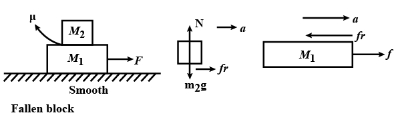
0 likes
View Solution47
MediumMCQ
In the given arrangement,find the maximum value of $F$ for which there is no relative motion between the blocks.
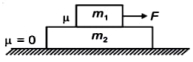
A
$\mu m_1 g$
B
$\mu(m_1+m_2) g$
C
$\mu m_1 g\left(\frac{m_1}{m_2}+1\right)$
D
Zero
Solution
(C) For no relative motion between the blocks,both blocks must move with the same acceleration $a$.
Consider the block of mass $m_2$. The only horizontal force acting on it is the friction force $f$ exerted by block $m_1$.
Thus,$f = m_2 a$.
The maximum value of friction is $f_{\text{max}} = \mu N = \mu m_1 g$.
Therefore,the maximum acceleration $a_{\text{max}}$ that block $m_2$ can have is given by $m_2 a_{\text{max}} = \mu m_1 g$,which implies $a_{\text{max}} = \mu \frac{m_1}{m_2} g$.
Now,consider the system of both blocks $(m_1 + m_2)$. The external force $F$ is applied to $m_1$.
For the whole system,$F = (m_1 + m_2) a$.
Substituting $a_{\text{max}}$,we get $F_{\text{max}} = (m_1 + m_2) \mu \frac{m_1}{m_2} g$.
$F_{\text{max}} = \mu m_1 g \left(\frac{m_1 + m_2}{m_2}\right) = \mu m_1 g \left(\frac{m_1}{m_2} + 1\right)$.
Consider the block of mass $m_2$. The only horizontal force acting on it is the friction force $f$ exerted by block $m_1$.
Thus,$f = m_2 a$.
The maximum value of friction is $f_{\text{max}} = \mu N = \mu m_1 g$.
Therefore,the maximum acceleration $a_{\text{max}}$ that block $m_2$ can have is given by $m_2 a_{\text{max}} = \mu m_1 g$,which implies $a_{\text{max}} = \mu \frac{m_1}{m_2} g$.
Now,consider the system of both blocks $(m_1 + m_2)$. The external force $F$ is applied to $m_1$.
For the whole system,$F = (m_1 + m_2) a$.
Substituting $a_{\text{max}}$,we get $F_{\text{max}} = (m_1 + m_2) \mu \frac{m_1}{m_2} g$.
$F_{\text{max}} = \mu m_1 g \left(\frac{m_1 + m_2}{m_2}\right) = \mu m_1 g \left(\frac{m_1}{m_2} + 1\right)$.
0 likes
View Solution48
MediumMCQ
If the acceleration of block $A$ is $2 \, m/s^2$,which is provided by the frictional force from block $B$,then the magnitude of the frictional force applied by block $B$ on block $A$ is ......... $N$.
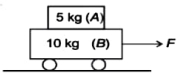
A
$50$
B
$20$
C
$10$
D
None of these
Solution
(C) The only horizontal force acting on block $A$ (mass $m_A = 5 \, kg$) is the static frictional force $f$ exerted by block $B$.
According to Newton's second law of motion,the net force on an object is equal to the product of its mass and acceleration $(F_{net} = m \cdot a)$.
Here,the frictional force $f$ provides the acceleration $a_A = 2 \, m/s^2$ to block $A$.
Therefore,$f = m_A \cdot a_A$.
Substituting the given values: $f = 5 \, kg \times 2 \, m/s^2 = 10 \, N$.
Thus,the frictional force applied by block $B$ on block $A$ is $10 \, N$.
According to Newton's second law of motion,the net force on an object is equal to the product of its mass and acceleration $(F_{net} = m \cdot a)$.
Here,the frictional force $f$ provides the acceleration $a_A = 2 \, m/s^2$ to block $A$.
Therefore,$f = m_A \cdot a_A$.
Substituting the given values: $f = 5 \, kg \times 2 \, m/s^2 = 10 \, N$.
Thus,the frictional force applied by block $B$ on block $A$ is $10 \, N$.
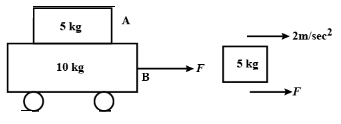
0 likes
View Solution49
MediumMCQ
The acceleration of block $A$ varies with time as shown in the figure. Find the value of the coefficient of kinetic friction between block $A$ and block $B$.
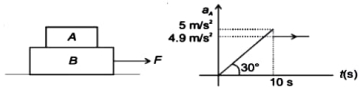
A
$0.5$
B
$0.6$
C
$0.4$
D
None of these
Solution
(A) The block $A$ is placed on block $B$. $A$ force $F$ is applied on block $B$. The block $A$ moves due to the friction force acting between $A$ and $B$.
From the graph,the acceleration of block $A$ increases linearly until it reaches $4.9 \ m/s^2$. At this point,the block $A$ is on the verge of slipping relative to block $B$.
The maximum static friction force $f_{max}$ provides the maximum acceleration to block $A$:
$f_{max} = m_A a_{max} = \mu_k m_A g$
Where $m_A$ is the mass of block $A$,$a_{max} = 4.9 \ m/s^2$ is the maximum acceleration before slipping,and $g = 9.8 \ m/s^2$ is the acceleration due to gravity.
$a_{max} = \mu_k g$
$4.9 = \mu_k \times 9.8$
$\mu_k = \frac{4.9}{9.8} = 0.5$
Thus,the coefficient of kinetic friction is $0.5$.
From the graph,the acceleration of block $A$ increases linearly until it reaches $4.9 \ m/s^2$. At this point,the block $A$ is on the verge of slipping relative to block $B$.
The maximum static friction force $f_{max}$ provides the maximum acceleration to block $A$:
$f_{max} = m_A a_{max} = \mu_k m_A g$
Where $m_A$ is the mass of block $A$,$a_{max} = 4.9 \ m/s^2$ is the maximum acceleration before slipping,and $g = 9.8 \ m/s^2$ is the acceleration due to gravity.
$a_{max} = \mu_k g$
$4.9 = \mu_k \times 9.8$
$\mu_k = \frac{4.9}{9.8} = 0.5$
Thus,the coefficient of kinetic friction is $0.5$.
0 likes
View Solution50
MediumMCQ
Two blocks $A$ and $B$ of masses $5 \,kg$ and $3 \,kg$ respectively rest on a smooth horizontal surface with $B$ over $A$. The coefficient of friction between $A$ and $B$ is $0.5$. The maximum horizontal force (in $kg \,wt.$) that can be applied to $A$,so that there will be motion of $A$ and $B$ without relative slipping,is
A
$1.5$
B
$2.5$
C
$4$
D
$5$
Solution
(C) Let the force $F$ be applied to block $A$ $(5 \,kg)$.
Since there is no relative slipping,both blocks move with the same acceleration $a$.
The total mass of the system is $M = 5 \,kg + 3 \,kg = 8 \,kg$.
The acceleration of the system is $a = \frac{F}{M} = \frac{F}{8}$.
For the upper block $B$ $(3 \,kg)$,the only horizontal force causing acceleration is the static friction $f$ between $A$ and $B$.
Thus,$f = m_B \cdot a = 3 \cdot \left(\frac{F}{8}\right) = \frac{3F}{8}$.
The maximum value of static friction is $f_{max} = \mu \cdot N = \mu \cdot m_B \cdot g = 0.5 \cdot 3 \cdot 10 = 15 \,N$ (taking $g = 10 \,m/s^2$).
For no relative slipping,$f \leq f_{max}$,so $\frac{3F}{8} \leq 15$.
$3F \leq 120 \implies F \leq 40 \,N$.
Since $1 \,kg \,wt. = 10 \,N$,the maximum force in $kg \,wt.$ is $\frac{40}{10} = 4 \,kg \,wt.$
Since there is no relative slipping,both blocks move with the same acceleration $a$.
The total mass of the system is $M = 5 \,kg + 3 \,kg = 8 \,kg$.
The acceleration of the system is $a = \frac{F}{M} = \frac{F}{8}$.
For the upper block $B$ $(3 \,kg)$,the only horizontal force causing acceleration is the static friction $f$ between $A$ and $B$.
Thus,$f = m_B \cdot a = 3 \cdot \left(\frac{F}{8}\right) = \frac{3F}{8}$.
The maximum value of static friction is $f_{max} = \mu \cdot N = \mu \cdot m_B \cdot g = 0.5 \cdot 3 \cdot 10 = 15 \,N$ (taking $g = 10 \,m/s^2$).
For no relative slipping,$f \leq f_{max}$,so $\frac{3F}{8} \leq 15$.
$3F \leq 120 \implies F \leq 40 \,N$.
Since $1 \,kg \,wt. = 10 \,N$,the maximum force in $kg \,wt.$ is $\frac{40}{10} = 4 \,kg \,wt.$
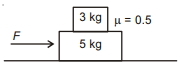
0 likes
View SolutionNewton's Laws of Motion and Friction — Block on Block System, psudo force and Constrained Motion In Friction · Frequently Asked Questions
1Are these Newton's Laws of Motion and Friction questions useful for JEE and NEET?
Yes. All questions in this section are mapped to JEE Main and NEET exam patterns. Previous year questions from JEE Main, NEET, GUJCET and state-level exams are included with full solutions.
2Can I switch to Hindi or Gujarati for these questions?
Yes. Use the language tabs in the hero section or the sidebar to view the same questions and solutions in English, Hindi or Gujarati.
3How do I generate a question paper from this subtopic?
Use the Vedclass Exam Paper Generator — select the chapter and subtopic, set difficulty, and generate Sets A, B, C, D automatically. First 3 chapters of every subject are free.
Vedclass Products
For Students
Vedclass Test Series
Mock tests in real JEE/NEET style with performance analysis. 5-day free trial.
Start Free TrialFor Teachers
Exam Paper Generator
Generate Set A/B/C/D papers from this chapter in 2 minutes. 3 chapters free.
Try FreeFor Institutes
Online Exam Module
Live online exams with unlimited students, 360° analytics & white-label branding.
See DemoFor Teachers & Institutes
Generate a Newton's Laws of Motion and Friction Exam Paper in 2 Minutes
Select subtopic & difficulty — Sets A, B, C, D auto-generated with No Repeat logic.
First 3 chapters of every subject are free — no payment required.