
A English
Second Law of Motion Questions in English
Class 11 Physics · Newton's Laws of Motion and Friction · Second Law of Motion
102+
Questions
English
Language
100%
With Solutions
Showing 49 of 102 questions in English
51
Easy
What is dynamics?
Solution
(N/A) Dynamics is the branch of physics that deals with the motion of objects,specifically considering the causes of that motion (forces) and the properties of the moving bodies.
It is the study of how forces affect the motion of physical systems.
It is the study of how forces affect the motion of physical systems.
0 likes
View Solution52
Difficult
State and explain Newton's second law of motion. Write its important points.
Solution
(N/A) Statement: The time rate of change of momentum of a body is directly proportional to the resultant force acting on it,and this change occurs in the direction of the resultant force.
Let a resultant force $\vec{F}$ act on a body of mass $m$ for a time interval $\Delta t$. During this,let its velocity change from $\vec{v}$ to $\vec{v} + \Delta \vec{v}$.
Initial momentum: $\vec{p}_i = m\vec{v}$
Final momentum: $\vec{p}_f = m(\vec{v} + \Delta \vec{v})$
Change in momentum:
$\Delta \vec{p} = \vec{p}_f - \vec{p}_i = m(\vec{v} + \Delta \vec{v}) - m\vec{v} = m\Delta \vec{v}$
From the second law of motion:
$\vec{F} \propto \frac{\Delta \vec{p}}{\Delta t} \implies \vec{F} = k \frac{\Delta \vec{p}}{\Delta t}$
Taking the limit $\Delta t \to 0$:
$\vec{F} = \frac{d\vec{p}}{dt} = \frac{d(m\vec{v})}{dt} = m\frac{d\vec{v}}{dt} = m\vec{a}$ (assuming constant mass).
Important points:
$(i)$ Newton's second law is $\vec{F} = \frac{d\vec{p}}{dt}$. If mass is constant,$\vec{F} = m\vec{a}$.
$(ii)$ If the resultant external force is zero,then $\vec{a} = 0$,meaning velocity is constant,which is consistent with Newton's first law.
$(iii)$ The law provides the magnitude of force. It is a vector quantity with components: $F_x = ma_x, F_y = ma_y, F_z = ma_z$. If force acts at an angle,only the component in the direction of velocity changes it.
$(iv)$ The equation $\vec{F} = m\vec{a}$ applies to point objects,rigid bodies,or systems of particles where $\vec{F}$ is the resultant force and $\vec{a}$ is the acceleration of the center of mass.
$(v)$ The law relates force and acceleration at a specific instant; it does not depend on the history of the object's motion.
Let a resultant force $\vec{F}$ act on a body of mass $m$ for a time interval $\Delta t$. During this,let its velocity change from $\vec{v}$ to $\vec{v} + \Delta \vec{v}$.
Initial momentum: $\vec{p}_i = m\vec{v}$
Final momentum: $\vec{p}_f = m(\vec{v} + \Delta \vec{v})$
Change in momentum:
$\Delta \vec{p} = \vec{p}_f - \vec{p}_i = m(\vec{v} + \Delta \vec{v}) - m\vec{v} = m\Delta \vec{v}$
From the second law of motion:
$\vec{F} \propto \frac{\Delta \vec{p}}{\Delta t} \implies \vec{F} = k \frac{\Delta \vec{p}}{\Delta t}$
Taking the limit $\Delta t \to 0$:
$\vec{F} = \frac{d\vec{p}}{dt} = \frac{d(m\vec{v})}{dt} = m\frac{d\vec{v}}{dt} = m\vec{a}$ (assuming constant mass).
Important points:
$(i)$ Newton's second law is $\vec{F} = \frac{d\vec{p}}{dt}$. If mass is constant,$\vec{F} = m\vec{a}$.
$(ii)$ If the resultant external force is zero,then $\vec{a} = 0$,meaning velocity is constant,which is consistent with Newton's first law.
$(iii)$ The law provides the magnitude of force. It is a vector quantity with components: $F_x = ma_x, F_y = ma_y, F_z = ma_z$. If force acts at an angle,only the component in the direction of velocity changes it.
$(iv)$ The equation $\vec{F} = m\vec{a}$ applies to point objects,rigid bodies,or systems of particles where $\vec{F}$ is the resultant force and $\vec{a}$ is the acceleration of the center of mass.
$(v)$ The law relates force and acceleration at a specific instant; it does not depend on the history of the object's motion.
0 likes
View Solution53
Medium
State Newton's second law of motion.
Solution
(N/A) Newton's second law of motion states that the rate of change of linear momentum of a body is directly proportional to the external force applied to it,and this change takes place in the direction of the applied force.
Mathematically,it is expressed as $F = \frac{dp}{dt}$,where $F$ is the force and $p$ is the linear momentum.
For a body of constant mass $m$,this simplifies to $F = ma$,where $a$ is the acceleration of the body.
Mathematically,it is expressed as $F = \frac{dp}{dt}$,where $F$ is the force and $p$ is the linear momentum.
For a body of constant mass $m$,this simplifies to $F = ma$,where $a$ is the acceleration of the body.
0 likes
View Solution54
MediumMCQ
The ratio of the change in linear momentum to the time taken for this change represents which physical quantity?
A
Work
B
Force
C
Impulse
D
Power
Solution
(B) According to Newton's second law of motion,the rate of change of linear momentum of a body is directly proportional to the external force applied to it.
Mathematically,$F = \frac{dp}{dt}$,where $dp$ is the change in linear momentum and $dt$ is the time interval.
Therefore,the ratio of the change in linear momentum to the time taken is equal to the force applied.
Mathematically,$F = \frac{dp}{dt}$,where $dp$ is the change in linear momentum and $dt$ is the time interval.
Therefore,the ratio of the change in linear momentum to the time taken is equal to the force applied.
0 likes
View Solution55
EasyMCQ
Which physical quantity is represented by the first derivative of linear momentum with respect to time?
A
Work
B
Force
C
Impulse
D
Energy
Solution
(B) According to Newton's second law of motion,the rate of change of linear momentum $(p)$ with respect to time $(t)$ is equal to the net force $(F)$ acting on the object.
Mathematically,this is expressed as: $F = \frac{dp}{dt}$.
Therefore,the first derivative of linear momentum with respect to time represents force.
Mathematically,this is expressed as: $F = \frac{dp}{dt}$.
Therefore,the first derivative of linear momentum with respect to time represents force.
0 likes
View Solution56
Difficult
Write the symbolic form of Newton's second law.
Solution
(N/A) Newton's second law of motion states that the rate of change of momentum of a body is directly proportional to the applied force and takes place in the direction of the force.
Mathematically,this is expressed as:
$F = \frac{dp}{dt}$
Where:
$F$ is the net force acting on the object.
$p$ is the linear momentum of the object.
$t$ is time.
For a body of constant mass $m$ moving with acceleration $a$,this simplifies to:
$F = ma$
Mathematically,this is expressed as:
$F = \frac{dp}{dt}$
Where:
$F$ is the net force acting on the object.
$p$ is the linear momentum of the object.
$t$ is time.
For a body of constant mass $m$ moving with acceleration $a$,this simplifies to:
$F = ma$
0 likes
View Solution57
EasyMCQ
What is the mass of an object whose weight is $1\,N$ (in $,kg$)?
A
$0.102$
B
$1$
C
$9.8$
D
$10$
Solution
(A) The relationship between weight $(W)$ and mass $(m)$ is given by the formula $W = m \times g$,where $g$ is the acceleration due to gravity.
Taking the standard value of $g = 9.8\,m/s^2$,we have:
$W = 1\,N$
$m = \frac{W}{g} = \frac{1}{9.8}\,kg$
$m \approx 0.102\,kg$
Therefore,the mass of the object is $0.102\,kg$.
Taking the standard value of $g = 9.8\,m/s^2$,we have:
$W = 1\,N$
$m = \frac{W}{g} = \frac{1}{9.8}\,kg$
$m \approx 0.102\,kg$
Therefore,the mass of the object is $0.102\,kg$.
0 likes
View Solution58
MediumMCQ
The velocity of a body of mass $2 \, kg$ as a function of $t$ is given by $\vec{v}(t) = 2t \hat{i} + t^2 \hat{j}$. Find the momentum and the force acting on it at time $t = 2 \, s$.
A
Momentum = $(8 \hat{i} + 8 \hat{j}) \, kg \cdot m/s$,Force = $(4 \hat{i} + 8 \hat{j}) \, N$
B
Momentum = $(4 \hat{i} + 8 \hat{j}) \, kg \cdot m/s$,Force = $(8 \hat{i} + 8 \hat{j}) \, N$
C
Momentum = $(8 \hat{i} + 4 \hat{j}) \, kg \cdot m/s$,Force = $(4 \hat{i} + 4 \hat{j}) \, N$
D
Momentum = $(2 \hat{i} + 4 \hat{j}) \, kg \cdot m/s$,Force = $(2 \hat{i} + 8 \hat{j}) \, N$
Solution
(A) Given mass $m = 2 \, kg$ and velocity $\vec{v}(t) = 2t \hat{i} + t^2 \hat{j}$.
At $t = 2 \, s$,the velocity is:
$\vec{v}(2) = 2(2) \hat{i} + (2)^2 \hat{j} = 4 \hat{i} + 4 \hat{j} \, m/s$.
Momentum $\vec{p} = m\vec{v} = 2(4 \hat{i} + 4 \hat{j}) = (8 \hat{i} + 8 \hat{j}) \, kg \cdot m/s$.
Acceleration $\vec{a} = \frac{d\vec{v}}{dt} = \frac{d}{dt}(2t \hat{i} + t^2 \hat{j}) = 2 \hat{i} + 2t \hat{j}$.
At $t = 2 \, s$,acceleration is:
$\vec{a}(2) = 2 \hat{i} + 2(2) \hat{j} = 2 \hat{i} + 4 \hat{j} \, m/s^2$.
Force $\vec{F} = m\vec{a} = 2(2 \hat{i} + 4 \hat{j}) = (4 \hat{i} + 8 \hat{j}) \, N$.
At $t = 2 \, s$,the velocity is:
$\vec{v}(2) = 2(2) \hat{i} + (2)^2 \hat{j} = 4 \hat{i} + 4 \hat{j} \, m/s$.
Momentum $\vec{p} = m\vec{v} = 2(4 \hat{i} + 4 \hat{j}) = (8 \hat{i} + 8 \hat{j}) \, kg \cdot m/s$.
Acceleration $\vec{a} = \frac{d\vec{v}}{dt} = \frac{d}{dt}(2t \hat{i} + t^2 \hat{j}) = 2 \hat{i} + 2t \hat{j}$.
At $t = 2 \, s$,acceleration is:
$\vec{a}(2) = 2 \hat{i} + 2(2) \hat{j} = 2 \hat{i} + 4 \hat{j} \, m/s^2$.
Force $\vec{F} = m\vec{a} = 2(2 \hat{i} + 4 \hat{j}) = (4 \hat{i} + 8 \hat{j}) \, N$.
0 likes
View Solution59
MediumMCQ
$A$ boy pushes a box of mass $2 \, kg$ with a force $\overrightarrow{F} = (20 \hat{i} + 10 \hat{j}) \, N$ on a frictionless surface. If the box was initially at rest,then the displacement along the $x$-axis after $10 \, s$ is ........... $m$.
A
$400$
B
$500$
C
$800$
D
$1200$
Solution
(B) Given force $\overrightarrow{F} = (20 \hat{i} + 10 \hat{j}) \, N$ and mass $m = 2 \, kg$.
Using Newton's second law,the acceleration is $\overrightarrow{a} = \frac{\overrightarrow{F}}{m} = \frac{20 \hat{i} + 10 \hat{j}}{2} = (10 \hat{i} + 5 \hat{j}) \, m/s^2$.
The initial velocity $\overrightarrow{u} = 0$. The time $t = 10 \, s$.
The displacement vector is given by $\overrightarrow{s} = \overrightarrow{u}t + \frac{1}{2} \overrightarrow{a} t^2$.
$\overrightarrow{s} = 0 + \frac{1}{2} (10 \hat{i} + 5 \hat{j}) (10)^2$.
$\overrightarrow{s} = \frac{1}{2} (10 \hat{i} + 5 \hat{j}) (100) = 50 (10 \hat{i} + 5 \hat{j}) = (500 \hat{i} + 250 \hat{j}) \, m$.
The displacement along the $x$-axis is the $i$-component of the displacement vector,which is $500 \, m$.
Using Newton's second law,the acceleration is $\overrightarrow{a} = \frac{\overrightarrow{F}}{m} = \frac{20 \hat{i} + 10 \hat{j}}{2} = (10 \hat{i} + 5 \hat{j}) \, m/s^2$.
The initial velocity $\overrightarrow{u} = 0$. The time $t = 10 \, s$.
The displacement vector is given by $\overrightarrow{s} = \overrightarrow{u}t + \frac{1}{2} \overrightarrow{a} t^2$.
$\overrightarrow{s} = 0 + \frac{1}{2} (10 \hat{i} + 5 \hat{j}) (10)^2$.
$\overrightarrow{s} = \frac{1}{2} (10 \hat{i} + 5 \hat{j}) (100) = 50 (10 \hat{i} + 5 \hat{j}) = (500 \hat{i} + 250 \hat{j}) \, m$.
The displacement along the $x$-axis is the $i$-component of the displacement vector,which is $500 \, m$.
0 likes
View Solution60
MediumMCQ
$A$ force $\vec{F}=(40 \hat{i}+10 \hat{j}) \, N$ acts on a body of mass $5 \, kg$. If the body starts from rest,its position vector $\vec{r}$ at time $t=10 \, s$ will be -
A
$(100 \hat{i}+400 \hat{j}) \, m$
B
$(400 \hat{i}+100 \hat{j}) \, m$
C
$(100 \hat{i}+100 \hat{j}) \, m$
D
$(400 \hat{i}+400 \hat{j}) \, m$
Solution
(B) Given: Force $\vec{F} = (40 \hat{i} + 10 \hat{j}) \, N$,mass $m = 5 \, kg$,initial velocity $\vec{u} = 0$,time $t = 10 \, s$.
Using Newton's second law,acceleration $\vec{a} = \frac{\vec{F}}{m} = \frac{40 \hat{i} + 10 \hat{j}}{5} = (8 \hat{i} + 2 \hat{j}) \, m/s^2$.
Since the body starts from rest,the position vector $\vec{r}$ at time $t$ is given by the kinematic equation $\vec{r} = \vec{u}t + \frac{1}{2} \vec{a} t^2$.
Substituting $\vec{u} = 0$,$\vec{a} = (8 \hat{i} + 2 \hat{j}) \, m/s^2$,and $t = 10 \, s$:
$\vec{r} = 0 + \frac{1}{2} (8 \hat{i} + 2 \hat{j}) (10)^2$
$\vec{r} = \frac{1}{2} (8 \hat{i} + 2 \hat{j}) (100)$
$\vec{r} = (4 \hat{i} + 1 \hat{j}) (100) = (400 \hat{i} + 100 \hat{j}) \, m$.
Using Newton's second law,acceleration $\vec{a} = \frac{\vec{F}}{m} = \frac{40 \hat{i} + 10 \hat{j}}{5} = (8 \hat{i} + 2 \hat{j}) \, m/s^2$.
Since the body starts from rest,the position vector $\vec{r}$ at time $t$ is given by the kinematic equation $\vec{r} = \vec{u}t + \frac{1}{2} \vec{a} t^2$.
Substituting $\vec{u} = 0$,$\vec{a} = (8 \hat{i} + 2 \hat{j}) \, m/s^2$,and $t = 10 \, s$:
$\vec{r} = 0 + \frac{1}{2} (8 \hat{i} + 2 \hat{j}) (10)^2$
$\vec{r} = \frac{1}{2} (8 \hat{i} + 2 \hat{j}) (100)$
$\vec{r} = (4 \hat{i} + 1 \hat{j}) (100) = (400 \hat{i} + 100 \hat{j}) \, m$.
0 likes
View Solution61
DifficultMCQ
$A$ particle of mass $M$ originally at rest is subjected to a force whose direction is constant but magnitude varies with time according to the relation $F = F_{0} \left(1 - \left(\frac{t - T}{T}\right)^{2}\right)$. Where $F_{0}$ and $T$ are constants. The force acts only for the time interval $2T$. The velocity $v$ of the particle after time $2T$ is:
A
$\frac{F_{0} T}{3 M}$
B
$\frac{F_{0} T}{2 M}$
C
$\frac{2 F_{0} T}{M}$
D
$\frac{4 F_{0} T}{3 M}$
Solution
(D) Given that the particle is initially at rest,so at $t = 0$,$u = 0$.
According to Newton's second law,$F = M a$,so $a = \frac{F}{M}$.
Substituting the given force relation: $a = \frac{F_{0}}{M} \left(1 - \frac{(t - T)^{2}}{T^{2}}\right) = \frac{dv}{dt}$.
To find the velocity $v$ at $t = 2T$,we integrate the acceleration with respect to time from $t = 0$ to $t = 2T$:
$v = \int_{0}^{2T} \frac{F_{0}}{M} \left(1 - \frac{(t - T)^{2}}{T^{2}}\right) dt$.
Let $x = t - T$,then $dx = dt$. When $t = 0, x = -T$ and when $t = 2T, x = T$.
$v = \frac{F_{0}}{M} \int_{-T}^{T} \left(1 - \frac{x^{2}}{T^{2}}\right) dx$.
$v = \frac{F_{0}}{M} \left[ x - \frac{x^{3}}{3T^{2}} \right]_{-T}^{T}$.
$v = \frac{F_{0}}{M} \left( (T - \frac{T^{3}}{3T^{2}}) - (-T - \frac{(-T)^{3}}{3T^{2}}) \right)$.
$v = \frac{F_{0}}{M} \left( (T - \frac{T}{3}) - (-T + \frac{T}{3}) \right) = \frac{F_{0}}{M} \left( \frac{2T}{3} + \frac{2T}{3} \right) = \frac{4 F_{0} T}{3 M}$.
According to Newton's second law,$F = M a$,so $a = \frac{F}{M}$.
Substituting the given force relation: $a = \frac{F_{0}}{M} \left(1 - \frac{(t - T)^{2}}{T^{2}}\right) = \frac{dv}{dt}$.
To find the velocity $v$ at $t = 2T$,we integrate the acceleration with respect to time from $t = 0$ to $t = 2T$:
$v = \int_{0}^{2T} \frac{F_{0}}{M} \left(1 - \frac{(t - T)^{2}}{T^{2}}\right) dt$.
Let $x = t - T$,then $dx = dt$. When $t = 0, x = -T$ and when $t = 2T, x = T$.
$v = \frac{F_{0}}{M} \int_{-T}^{T} \left(1 - \frac{x^{2}}{T^{2}}\right) dx$.
$v = \frac{F_{0}}{M} \left[ x - \frac{x^{3}}{3T^{2}} \right]_{-T}^{T}$.
$v = \frac{F_{0}}{M} \left( (T - \frac{T^{3}}{3T^{2}}) - (-T - \frac{(-T)^{3}}{3T^{2}}) \right)$.
$v = \frac{F_{0}}{M} \left( (T - \frac{T}{3}) - (-T + \frac{T}{3}) \right) = \frac{F_{0}}{M} \left( \frac{2T}{3} + \frac{2T}{3} \right) = \frac{4 F_{0} T}{3 M}$.
0 likes
View Solution62
MediumMCQ
$A$ force on an object of mass $100\, g$ is $(10 \hat{i}+5 \hat{j})\ N$. The position of that object at $t= 2\ s$ is $(a \hat{i}+b \hat{j})\, m$ after starting from rest. The value of $\frac{a}{b}$ will be..........
A
$2$
B
$99$
C
$20$
D
$60$
Solution
(A) Given: Force $\vec{F} = (10 \hat{i} + 5 \hat{j})\ N$,mass $m = 100\, g = 0.1\, kg$,initial velocity $\vec{u} = 0$,time $t = 2\ s$.
Using Newton's second law,acceleration $\vec{a} = \frac{\vec{F}}{m} = \frac{10 \hat{i} + 5 \hat{j}}{0.1} = (100 \hat{i} + 50 \hat{j})\ m/s^2$.
Using the equation of motion $\vec{s} = \vec{u}t + \frac{1}{2} \vec{a} t^2$,since $\vec{u} = 0$:
$\vec{s} = \frac{1}{2} (100 \hat{i} + 50 \hat{j}) (2)^2$
$\vec{s} = \frac{1}{2} (100 \hat{i} + 50 \hat{j}) (4) = 2 (100 \hat{i} + 50 \hat{j}) = (200 \hat{i} + 100 \hat{j})\ m$.
Comparing this with $(a \hat{i} + b \hat{j})\ m$,we get $a = 200$ and $b = 100$.
Therefore,$\frac{a}{b} = \frac{200}{100} = 2$.
Using Newton's second law,acceleration $\vec{a} = \frac{\vec{F}}{m} = \frac{10 \hat{i} + 5 \hat{j}}{0.1} = (100 \hat{i} + 50 \hat{j})\ m/s^2$.
Using the equation of motion $\vec{s} = \vec{u}t + \frac{1}{2} \vec{a} t^2$,since $\vec{u} = 0$:
$\vec{s} = \frac{1}{2} (100 \hat{i} + 50 \hat{j}) (2)^2$
$\vec{s} = \frac{1}{2} (100 \hat{i} + 50 \hat{j}) (4) = 2 (100 \hat{i} + 50 \hat{j}) = (200 \hat{i} + 100 \hat{j})\ m$.
Comparing this with $(a \hat{i} + b \hat{j})\ m$,we get $a = 200$ and $b = 100$.
Therefore,$\frac{a}{b} = \frac{200}{100} = 2$.
0 likes
View Solution63
AdvancedMCQ
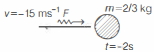
$A$ particle of mass $2/3 \, kg$ with velocity $v = -15 \, m/s$ at $t = -2 \, s$ is acted upon by a force $F = k - \beta t^2$. Here,$k = 8 \, N$ and $\beta = 2 \, N/s^2$. The motion is one-dimensional. Then,the speed at which the particle acceleration is zero again,is ........... $m/s$.
A
$1$
B
$16$
C
$17$
D
$32$
Solution
(C) The force on the object is $F = k - \beta t^2$.
The acceleration of the particle is given by $a = \frac{F}{m} = \frac{k - \beta t^2}{m}$.
The acceleration is zero when $k - \beta t^2 = 0$,which implies $t^2 = \frac{k}{\beta} = \frac{8}{2} = 4$,so $t = 2 \, s$.
Since $a = \frac{dv}{dt}$,we have $dv = \frac{k - \beta t^2}{m} \, dt$.
Integrating from $t = -2 \, s$ to $t = 2 \, s$:
$\int_{v_i}^{v_f} dv = \int_{-2}^{2} \frac{k - \beta t^2}{m} \, dt$
$v_f - (-15) = \frac{1}{2/3} \int_{-2}^{2} (8 - 2t^2) \, dt = \frac{3}{2} \left[ 8t - \frac{2t^3}{3} \right]_{-2}^{2}$
$v_f + 15 = \frac{3}{2} \left[ (16 - 16/3) - (-16 + 16/3) \right] = \frac{3}{2} \left[ 32 - 32/3 \right] = \frac{3}{2} \left( \frac{64}{3} \right) = 32$
$v_f = 32 - 15 = 17 \, m/s$.
The acceleration of the particle is given by $a = \frac{F}{m} = \frac{k - \beta t^2}{m}$.
The acceleration is zero when $k - \beta t^2 = 0$,which implies $t^2 = \frac{k}{\beta} = \frac{8}{2} = 4$,so $t = 2 \, s$.
Since $a = \frac{dv}{dt}$,we have $dv = \frac{k - \beta t^2}{m} \, dt$.
Integrating from $t = -2 \, s$ to $t = 2 \, s$:
$\int_{v_i}^{v_f} dv = \int_{-2}^{2} \frac{k - \beta t^2}{m} \, dt$
$v_f - (-15) = \frac{1}{2/3} \int_{-2}^{2} (8 - 2t^2) \, dt = \frac{3}{2} \left[ 8t - \frac{2t^3}{3} \right]_{-2}^{2}$
$v_f + 15 = \frac{3}{2} \left[ (16 - 16/3) - (-16 + 16/3) \right] = \frac{3}{2} \left[ 32 - 32/3 \right] = \frac{3}{2} \left( \frac{64}{3} \right) = 32$
$v_f = 32 - 15 = 17 \, m/s$.
0 likes
View Solution64
EasyMCQ
The momentum $p$ (in $kg \cdot m/s$) of a particle is varying with time $t$ (in $s$) as $p = 2 + 3t^2$. The force acting on the particle at $t = 3 \, s$ will be ......... $N$.
A
$18$
B
$54$
C
$9$
D
$15$
Solution
(A) Given the momentum of the particle as a function of time: $p = 2 + 3t^2$.
According to Newton's second law of motion,the force $F$ acting on a particle is equal to the rate of change of its momentum with respect to time:
$F = \frac{dp}{dt}$
Substituting the given expression for $p$:
$F = \frac{d}{dt}(2 + 3t^2)$
$F = 0 + 3(2t) = 6t$
Now,we need to find the force at time $t = 3 \, s$:
$F = 6 \times 3 = 18 \, N$.
Therefore,the force acting on the particle at $t = 3 \, s$ is $18 \, N$.
According to Newton's second law of motion,the force $F$ acting on a particle is equal to the rate of change of its momentum with respect to time:
$F = \frac{dp}{dt}$
Substituting the given expression for $p$:
$F = \frac{d}{dt}(2 + 3t^2)$
$F = 0 + 3(2t) = 6t$
Now,we need to find the force at time $t = 3 \, s$:
$F = 6 \times 3 = 18 \, N$.
Therefore,the force acting on the particle at $t = 3 \, s$ is $18 \, N$.
0 likes
View Solution65
MediumMCQ
An object of mass $2 \, kg$ at rest at the origin starts moving under the action of a force $\vec{F} = (3t^2 \hat{i} + 4 \hat{j}) \, N$. The velocity of the object at $t = 2 \, s$ will be ............. $m/s$.
A
$(3 \hat{i} + 2 \hat{j})$
B
$(2 \hat{i} + 4 \hat{j})$
C
$(4 \hat{i} + 4 \hat{j})$
D
$(3 \hat{i} - 4 \hat{j})$
Solution
(C) Given: Mass $m = 2 \, kg$,initial velocity $\vec{u} = 0$,force $\vec{F} = (3t^2 \hat{i} + 4 \hat{j}) \, N$.
According to Newton's second law,$\vec{F} = m \vec{a} = m \frac{d\vec{v}}{dt}$.
Therefore,$d\vec{v} = \frac{\vec{F}}{m} dt$.
Integrating both sides from $t = 0$ to $t = 2 \, s$:
$\int_{0}^{\vec{v}} d\vec{v} = \int_{0}^{2} \frac{3t^2 \hat{i} + 4 \hat{j}}{2} dt$.
$\vec{v} = \frac{1}{2} \left[ \int_{0}^{2} 3t^2 dt \hat{i} + \int_{0}^{2} 4 dt \hat{j} \right]$.
$\vec{v} = \frac{1}{2} \left[ (t^3)_{0}^{2} \hat{i} + (4t)_{0}^{2} \hat{j} \right]$.
$\vec{v} = \frac{1}{2} [ (8 - 0) \hat{i} + (8 - 0) \hat{j} ]$.
$\vec{v} = \frac{1}{2} [ 8 \hat{i} + 8 \hat{j} ] = 4 \hat{i} + 4 \hat{j} \, m/s$.
According to Newton's second law,$\vec{F} = m \vec{a} = m \frac{d\vec{v}}{dt}$.
Therefore,$d\vec{v} = \frac{\vec{F}}{m} dt$.
Integrating both sides from $t = 0$ to $t = 2 \, s$:
$\int_{0}^{\vec{v}} d\vec{v} = \int_{0}^{2} \frac{3t^2 \hat{i} + 4 \hat{j}}{2} dt$.
$\vec{v} = \frac{1}{2} \left[ \int_{0}^{2} 3t^2 dt \hat{i} + \int_{0}^{2} 4 dt \hat{j} \right]$.
$\vec{v} = \frac{1}{2} \left[ (t^3)_{0}^{2} \hat{i} + (4t)_{0}^{2} \hat{j} \right]$.
$\vec{v} = \frac{1}{2} [ (8 - 0) \hat{i} + (8 - 0) \hat{j} ]$.
$\vec{v} = \frac{1}{2} [ 8 \hat{i} + 8 \hat{j} ] = 4 \hat{i} + 4 \hat{j} \, m/s$.
0 likes
View Solution66
MediumMCQ
$A$ spherical body of mass $2\,kg$ starting from rest acquires a kinetic energy of $10000\,J$ at the end of $5^{\text{th}}$ second. The force acting on the body is $.....N$.
A
$40$
B
$41$
C
$42$
D
$43$
Solution
(A) Given: Mass $m = 2\,kg$,initial velocity $u = 0$,time $t = 5\,s$,and final kinetic energy $K = 10000\,J$.
Using the formula for kinetic energy: $K = \frac{1}{2}mv^2$.
Substituting the values: $10000 = \frac{1}{2} \times 2 \times v^2$.
$v^2 = 10000$,which gives $v = 100\,m/s$.
Using the equation of motion $v = u + at$:
$100 = 0 + a \times 5$.
$a = \frac{100}{5} = 20\,m/s^2$.
Now,using Newton's second law $F = ma$:
$F = 2\,kg \times 20\,m/s^2 = 40\,N$.
Using the formula for kinetic energy: $K = \frac{1}{2}mv^2$.
Substituting the values: $10000 = \frac{1}{2} \times 2 \times v^2$.
$v^2 = 10000$,which gives $v = 100\,m/s$.
Using the equation of motion $v = u + at$:
$100 = 0 + a \times 5$.
$a = \frac{100}{5} = 20\,m/s^2$.
Now,using Newton's second law $F = ma$:
$F = 2\,kg \times 20\,m/s^2 = 40\,N$.
0 likes
View Solution67
MediumMCQ
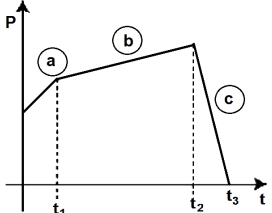
The figure represents the momentum-time $(p-t)$ curve for a particle moving along an axis under the influence of a force. Identify the regions on the graph where the magnitude of the force is maximum and minimum,respectively.
A
$c$ and $a$
B
$b$ and $c$
C
$c$ and $b$
D
$a$ and $b$
Solution
(C) According to Newton's second law of motion,the force $\vec{F}$ acting on a particle is equal to the rate of change of momentum with respect to time: $\vec{F} = \frac{d\vec{p}}{dt}$.
This implies that the magnitude of the force $|\vec{F}|$ is equal to the magnitude of the slope of the $p-t$ graph: $|\vec{F}| = |\text{slope of } p-t \text{ curve}|$.
$1$. In region $a$,the slope is positive and moderate.
$2$. In region $b$,the slope is positive and small (the line is nearly horizontal).
$3$. In region $c$,the slope is negative and its magnitude is very large (the line is very steep).
Comparing the magnitudes of the slopes,the slope is maximum in region $c$ and minimum in region $b$.
Therefore,the magnitude of the force is maximum in region $c$ and minimum in region $b$.
This implies that the magnitude of the force $|\vec{F}|$ is equal to the magnitude of the slope of the $p-t$ graph: $|\vec{F}| = |\text{slope of } p-t \text{ curve}|$.
$1$. In region $a$,the slope is positive and moderate.
$2$. In region $b$,the slope is positive and small (the line is nearly horizontal).
$3$. In region $c$,the slope is negative and its magnitude is very large (the line is very steep).
Comparing the magnitudes of the slopes,the slope is maximum in region $c$ and minimum in region $b$.
Therefore,the magnitude of the force is maximum in region $c$ and minimum in region $b$.
0 likes
View Solution68
MediumMCQ
At any instant,the velocity of a particle of mass $500 \, g$ is $(2t \hat{i} + 3t^2 \hat{j}) \, ms^{-1}$. If the force acting on the particle at $t = 1 \, s$ is $(\hat{i} + x \hat{j}) \, N$,then the value of $x$ will be:
A
$3$
B
$4$
C
$6$
D
$2$
Solution
(A) Given mass $m = 500 \, g = 0.5 \, kg$.
The velocity vector is $\vec{v} = 2t \hat{i} + 3t^2 \hat{j}$.
The acceleration $\vec{a}$ is the derivative of velocity with respect to time: $\vec{a} = \frac{d\vec{v}}{dt} = \frac{d}{dt}(2t \hat{i} + 3t^2 \hat{j}) = 2 \hat{i} + 6t \hat{j}$.
At $t = 1 \, s$,the acceleration is $\vec{a} = 2 \hat{i} + 6(1) \hat{j} = 2 \hat{i} + 6 \hat{j} \, ms^{-2}$.
Using Newton's second law,$\vec{F} = m\vec{a} = 0.5(2 \hat{i} + 6 \hat{j}) = 1 \hat{i} + 3 \hat{j} \, N$.
Comparing this with the given force $(\hat{i} + x \hat{j}) \, N$,we get $x = 3$.
The velocity vector is $\vec{v} = 2t \hat{i} + 3t^2 \hat{j}$.
The acceleration $\vec{a}$ is the derivative of velocity with respect to time: $\vec{a} = \frac{d\vec{v}}{dt} = \frac{d}{dt}(2t \hat{i} + 3t^2 \hat{j}) = 2 \hat{i} + 6t \hat{j}$.
At $t = 1 \, s$,the acceleration is $\vec{a} = 2 \hat{i} + 6(1) \hat{j} = 2 \hat{i} + 6 \hat{j} \, ms^{-2}$.
Using Newton's second law,$\vec{F} = m\vec{a} = 0.5(2 \hat{i} + 6 \hat{j}) = 1 \hat{i} + 3 \hat{j} \, N$.
Comparing this with the given force $(\hat{i} + x \hat{j}) \, N$,we get $x = 3$.
0 likes
View Solution69
MediumMCQ
$A$ body of mass $500\,g$ moves along the $x$-axis such that its velocity varies with displacement $x$ according to the relation $v = 10\sqrt{x}\,m/s$. The force acting on the body is $...........\,N$.
A
$166$
B
$25$
C
$125$
D
$5$
Solution
(B) Given mass $m = 500\,g = 0.5\,kg$.
The velocity is given by $v = 10\sqrt{x}$.
Squaring both sides,we get $v^2 = 100x$.
Differentiating both sides with respect to $x$,we get $2v \frac{dv}{dx} = 100$.
Since acceleration $a = v \frac{dv}{dx}$,we can write $2a = 100$,which gives $a = 50\,m/s^2$.
The force acting on the body is $F = ma$.
Substituting the values,$F = 0.5\,kg \times 50\,m/s^2 = 25\,N$.
The velocity is given by $v = 10\sqrt{x}$.
Squaring both sides,we get $v^2 = 100x$.
Differentiating both sides with respect to $x$,we get $2v \frac{dv}{dx} = 100$.
Since acceleration $a = v \frac{dv}{dx}$,we can write $2a = 100$,which gives $a = 50\,m/s^2$.
The force acting on the body is $F = ma$.
Substituting the values,$F = 0.5\,kg \times 50\,m/s^2 = 25\,N$.
0 likes
View Solution70
MediumMCQ
The position vector of a particle related to time $t$ is given by $\overrightarrow{r} = (10t \hat{i} + 15t^2 \hat{j} + 7 \hat{k}) \text{ m}$. The direction of the net force experienced by the particle is:
A
Positive $y$-axis
B
Positive $x$-axis
C
Positive $z$-axis
D
In $x-y$ plane
Solution
(A) The position vector is given by $\overrightarrow{r} = 10t \hat{i} + 15t^2 \hat{j} + 7 \hat{k}$.
The velocity vector $\overrightarrow{v}$ is the derivative of position with respect to time: $\overrightarrow{v} = \frac{d\overrightarrow{r}}{dt} = 10 \hat{i} + 30t \hat{j}$.
The acceleration vector $\overrightarrow{a}$ is the derivative of velocity with respect to time: $\overrightarrow{a} = \frac{d\overrightarrow{v}}{dt} = 30 \hat{j}$.
According to Newton's Second Law,$\overrightarrow{F} = m\overrightarrow{a}$. Since mass $m$ is a positive scalar,the direction of the net force $\overrightarrow{F}$ is the same as the direction of acceleration $\overrightarrow{a}$.
Since $\overrightarrow{a} = 30 \hat{j}$,the net force is directed along the positive $y$-axis.
The velocity vector $\overrightarrow{v}$ is the derivative of position with respect to time: $\overrightarrow{v} = \frac{d\overrightarrow{r}}{dt} = 10 \hat{i} + 30t \hat{j}$.
The acceleration vector $\overrightarrow{a}$ is the derivative of velocity with respect to time: $\overrightarrow{a} = \frac{d\overrightarrow{v}}{dt} = 30 \hat{j}$.
According to Newton's Second Law,$\overrightarrow{F} = m\overrightarrow{a}$. Since mass $m$ is a positive scalar,the direction of the net force $\overrightarrow{F}$ is the same as the direction of acceleration $\overrightarrow{a}$.
Since $\overrightarrow{a} = 30 \hat{j}$,the net force is directed along the positive $y$-axis.
0 likes
View Solution71
MediumMCQ
$A$ cricket player catches a ball of mass $120 \,g$ moving with $25 \,m/s$ speed. If the catching process is completed in $0.1 \,s$, then the magnitude of force exerted by the ball on the hand of the player will be (in $SI$ unit):
A
$24$
B
$12$
C
$25$
D
$30$
Solution
(D) Given:
Mass of the ball,$m = 120 \,g = 0.12 \,kg$
Initial velocity,$u = 25 \,m/s$
Final velocity,$v = 0 \,m/s$ (as the ball is caught)
Time taken,$\Delta t = 0.1 \,s$
According to Newton's Second Law of Motion,the force exerted is equal to the rate of change of momentum:
$F = \frac{\Delta p}{\Delta t} = \frac{m(v - u)}{\Delta t}$
Substituting the values:
$F = \frac{0.12 \times (0 - 25)}{0.1}$
$F = \frac{0.12 \times (-25)}{0.1}$
$F = \frac{-3}{0.1} = -30 \,N$
The magnitude of the force exerted by the ball on the hand is $|F| = 30 \,N$.
Mass of the ball,$m = 120 \,g = 0.12 \,kg$
Initial velocity,$u = 25 \,m/s$
Final velocity,$v = 0 \,m/s$ (as the ball is caught)
Time taken,$\Delta t = 0.1 \,s$
According to Newton's Second Law of Motion,the force exerted is equal to the rate of change of momentum:
$F = \frac{\Delta p}{\Delta t} = \frac{m(v - u)}{\Delta t}$
Substituting the values:
$F = \frac{0.12 \times (0 - 25)}{0.1}$
$F = \frac{0.12 \times (-25)}{0.1}$
$F = \frac{-3}{0.1} = -30 \,N$
The magnitude of the force exerted by the ball on the hand is $|F| = 30 \,N$.
0 likes
View Solution72
MediumMCQ
$A$ body of mass $4 \ kg$ experiences two forces $\overrightarrow{F}_1 = 5 \hat{i} + 8 \hat{j} + 7 \hat{k}$ and $\overrightarrow{F}_2 = 3 \hat{i} - 4 \hat{j} - 3 \hat{k}$. The acceleration acting on the body is :
A
$2 \hat{i} - \hat{j} - \hat{k}$
B
$4 \hat{i} + 2 \hat{j} + 2 \hat{k}$
C
$2 \hat{i} + \hat{j} + \hat{k}$
D
$2 \hat{i} + 3 \hat{j} + 3 \hat{k}$
Solution
(C) The net force $\vec{F}_{net}$ acting on the body is the vector sum of the two forces:
$\vec{F}_{net} = \vec{F}_1 + \vec{F}_2 = (5 \hat{i} + 8 \hat{j} + 7 \hat{k}) + (3 \hat{i} - 4 \hat{j} - 3 \hat{k})$
$\vec{F}_{net} = (5+3) \hat{i} + (8-4) \hat{j} + (7-3) \hat{k} = 8 \hat{i} + 4 \hat{j} + 4 \hat{k} \ N$.
According to Newton's second law,$\vec{F} = m \vec{a}$,so the acceleration $\vec{a} = \frac{\vec{F}_{net}}{m}$.
Given mass $m = 4 \ kg$,we have:
$\vec{a} = \frac{8 \hat{i} + 4 \hat{j} + 4 \hat{k}}{4} = 2 \hat{i} + \hat{j} + \hat{k} \ m/s^2$.
$\vec{F}_{net} = \vec{F}_1 + \vec{F}_2 = (5 \hat{i} + 8 \hat{j} + 7 \hat{k}) + (3 \hat{i} - 4 \hat{j} - 3 \hat{k})$
$\vec{F}_{net} = (5+3) \hat{i} + (8-4) \hat{j} + (7-3) \hat{k} = 8 \hat{i} + 4 \hat{j} + 4 \hat{k} \ N$.
According to Newton's second law,$\vec{F} = m \vec{a}$,so the acceleration $\vec{a} = \frac{\vec{F}_{net}}{m}$.
Given mass $m = 4 \ kg$,we have:
$\vec{a} = \frac{8 \hat{i} + 4 \hat{j} + 4 \hat{k}}{4} = 2 \hat{i} + \hat{j} + \hat{k} \ m/s^2$.
0 likes
View Solution73
DifficultMCQ
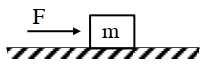
$A$ wooden block,initially at rest on the ground,is pushed by a force which increases linearly with time $t$. Which of the following curves best describes the acceleration of the block with time?
A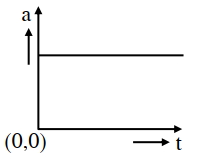
B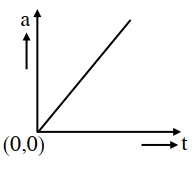
C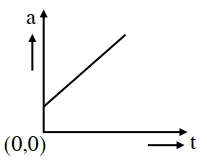
D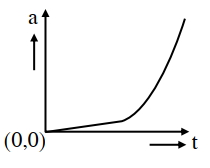
Solution
(B) According to Newton's second law of motion,the force $F$ acting on a body of mass $m$ is given by $F = ma$.
Given that the force increases linearly with time $t$,we can write $F = kt$,where $k$ is a constant.
Substituting this into the equation of motion:
$kt = ma$
$a = \frac{k}{m} t$
Since $k$ and $m$ are constants,the acceleration $a$ is directly proportional to time $t$ $(a \propto t)$.
This relationship represents a straight line passing through the origin $(0,0)$ in an $a$ vs $t$ graph.
Therefore,the correct curve is the one shown in option $B$.
Given that the force increases linearly with time $t$,we can write $F = kt$,where $k$ is a constant.
Substituting this into the equation of motion:
$kt = ma$
$a = \frac{k}{m} t$
Since $k$ and $m$ are constants,the acceleration $a$ is directly proportional to time $t$ $(a \propto t)$.
This relationship represents a straight line passing through the origin $(0,0)$ in an $a$ vs $t$ graph.
Therefore,the correct curve is the one shown in option $B$.
0 likes
View Solution74
MediumMCQ
An object with mass $500 \ g$ moves along the $x$-axis with speed $v = 4 \sqrt{x} \ m/s$. The force acting on the object is ....... $N$.
A
$8$
B
$5$
C
$6$
D
$4$
Solution
(D) Given mass $m = 500 \ g = 0.5 \ kg$.
The velocity is given by $v = 4 \sqrt{x}$.
Squaring both sides,we get $v^2 = 16x$.
Differentiating with respect to $x$,we get $2v \frac{dv}{dx} = 16$,which simplifies to $v \frac{dv}{dx} = 8$.
We know that acceleration $a = v \frac{dv}{dx}$. Therefore,$a = 8 \ m/s^2$.
Using Newton's second law,$F = ma = 0.5 \ kg \times 8 \ m/s^2 = 4 \ N$.
The velocity is given by $v = 4 \sqrt{x}$.
Squaring both sides,we get $v^2 = 16x$.
Differentiating with respect to $x$,we get $2v \frac{dv}{dx} = 16$,which simplifies to $v \frac{dv}{dx} = 8$.
We know that acceleration $a = v \frac{dv}{dx}$. Therefore,$a = 8 \ m/s^2$.
Using Newton's second law,$F = ma = 0.5 \ kg \times 8 \ m/s^2 = 4 \ N$.
0 likes
View Solution75
MediumMCQ
$A$ body of mass $2 \ kg$ moving with velocity of $\overrightarrow{v}_{in} = 3 \hat{i} + 4 \hat{j} \ ms^{-1}$ enters into a constant force field of $6 \ N$ directed along the positive $z$-axis. If the body remains in the field for a period of $\frac{5}{3} \ s$, then the velocity of the body when it emerges from the force field is:
A
$4 \hat{i} + 3 \hat{j} + 5 \hat{k}$
B
$3 \hat{i} + 4 \hat{j} + 5 \hat{k}$
C
$3 \hat{i} + 4 \hat{j} - 5 \hat{k}$
D
$3 \hat{i} + 4 \hat{j} + \sqrt{5} \hat{k}$
Solution
(B) Given: Mass $m = 2 \ kg$, Initial velocity $\overrightarrow{u} = 3 \hat{i} + 4 \hat{j} \ ms^{-1}$, Force $\overrightarrow{F} = 6 \hat{k} \ N$, Time $t = \frac{5}{3} \ s$.
Using Newton's second law, the acceleration is $\overrightarrow{a} = \frac{\overrightarrow{F}}{m} = \frac{6 \hat{k}}{2} = 3 \hat{k} \ ms^{-2}$.
Using the first equation of motion, $\overrightarrow{v} = \overrightarrow{u} + \overrightarrow{a}t$.
Substituting the values: $\overrightarrow{v} = (3 \hat{i} + 4 \hat{j}) + (3 \hat{k}) \times \left(\frac{5}{3}\right)$.
$\overrightarrow{v} = 3 \hat{i} + 4 \hat{j} + 5 \hat{k} \ ms^{-1}$.
Using Newton's second law, the acceleration is $\overrightarrow{a} = \frac{\overrightarrow{F}}{m} = \frac{6 \hat{k}}{2} = 3 \hat{k} \ ms^{-2}$.
Using the first equation of motion, $\overrightarrow{v} = \overrightarrow{u} + \overrightarrow{a}t$.
Substituting the values: $\overrightarrow{v} = (3 \hat{i} + 4 \hat{j}) + (3 \hat{k}) \times \left(\frac{5}{3}\right)$.
$\overrightarrow{v} = 3 \hat{i} + 4 \hat{j} + 5 \hat{k} \ ms^{-1}$.
0 likes
View Solution76
MediumMCQ
$A$ force acting on a body of mass $5 \ kg$ is $(4 \hat{i} - 2 \hat{j} + 3 \hat{k}) \ N$. If the body is initially at rest,then the magnitude of its velocity at the end of $10 \ s$ in $m/s$ will be:
A
$2 \sqrt{29}$
B
$3 \sqrt{29}$
C
$2 \sqrt{35}$
D
$3 \sqrt{35}$
Solution
(A) Given: Mass $m = 5 \ kg$,Force $\vec{F} = (4 \hat{i} - 2 \hat{j} + 3 \hat{k}) \ N$,Initial velocity $\vec{u} = 0$,Time $t = 10 \ s$.
Using Newton's second law,acceleration $\vec{a} = \frac{\vec{F}}{m} = \frac{4 \hat{i} - 2 \hat{j} + 3 \hat{k}}{5} = (0.8 \hat{i} - 0.4 \hat{j} + 0.6 \hat{k}) \ m/s^2$.
Using the equation of motion $\vec{v} = \vec{u} + \vec{a}t$:
$\vec{v} = 0 + (0.8 \hat{i} - 0.4 \hat{j} + 0.6 \hat{k}) \times 10 = (8 \hat{i} - 4 \hat{j} + 6 \hat{k}) \ m/s$.
The magnitude of velocity is $|\vec{v}| = \sqrt{8^2 + (-4)^2 + 6^2} = \sqrt{64 + 16 + 36} = \sqrt{116} \ m/s$.
$|\vec{v}| = \sqrt{4 \times 29} = 2 \sqrt{29} \ m/s$.
Using Newton's second law,acceleration $\vec{a} = \frac{\vec{F}}{m} = \frac{4 \hat{i} - 2 \hat{j} + 3 \hat{k}}{5} = (0.8 \hat{i} - 0.4 \hat{j} + 0.6 \hat{k}) \ m/s^2$.
Using the equation of motion $\vec{v} = \vec{u} + \vec{a}t$:
$\vec{v} = 0 + (0.8 \hat{i} - 0.4 \hat{j} + 0.6 \hat{k}) \times 10 = (8 \hat{i} - 4 \hat{j} + 6 \hat{k}) \ m/s$.
The magnitude of velocity is $|\vec{v}| = \sqrt{8^2 + (-4)^2 + 6^2} = \sqrt{64 + 16 + 36} = \sqrt{116} \ m/s$.
$|\vec{v}| = \sqrt{4 \times 29} = 2 \sqrt{29} \ m/s$.
0 likes
View Solution77
EasyMCQ
$A$ constant force $F$ acts on two different masses $m_1$ and $m_2$ independently and produces accelerations $A_1$ and $A_2$ respectively. When the same force $F$ acts on their combined mass $(m_1 + m_2)$,the acceleration $A$ produced is:
A
$A_1 - A_2$
B
$A_1 + A_2$
C
$\frac{A_1 A_2}{A_1 + A_2}$
D
$\frac{A_1 A_2}{A_1 - A_2}$
Solution
(C) Given that a constant force $F$ acts on mass $m_1$,the acceleration is $A_1 = \frac{F}{m_1}$,which implies $m_1 = \frac{F}{A_1}$.
Similarly,for mass $m_2$,the acceleration is $A_2 = \frac{F}{m_2}$,which implies $m_2 = \frac{F}{A_2}$.
When the same force $F$ acts on the combined mass $(m_1 + m_2)$,the acceleration $A$ is given by $A = \frac{F}{m_1 + m_2}$.
Substituting the values of $m_1$ and $m_2$ into the equation:
$A = \frac{F}{\frac{F}{A_1} + \frac{F}{A_2}}$
$A = \frac{F}{F(\frac{1}{A_1} + \frac{1}{A_2})}$
$A = \frac{1}{\frac{A_1 + A_2}{A_1 A_2}}$
$A = \frac{A_1 A_2}{A_1 + A_2}$.
Similarly,for mass $m_2$,the acceleration is $A_2 = \frac{F}{m_2}$,which implies $m_2 = \frac{F}{A_2}$.
When the same force $F$ acts on the combined mass $(m_1 + m_2)$,the acceleration $A$ is given by $A = \frac{F}{m_1 + m_2}$.
Substituting the values of $m_1$ and $m_2$ into the equation:
$A = \frac{F}{\frac{F}{A_1} + \frac{F}{A_2}}$
$A = \frac{F}{F(\frac{1}{A_1} + \frac{1}{A_2})}$
$A = \frac{1}{\frac{A_1 + A_2}{A_1 A_2}}$
$A = \frac{A_1 A_2}{A_1 + A_2}$.
0 likes
View Solution78
EasyMCQ
$A$ body of mass $5 \ kg$ is moving in a straight line. The relation between its displacement and time is $x = (t^3 - 2t - 10) \ m$. What is the force acting on it at the end of $5 \ s$ (in $N$)?
A
$150$
B
$120$
C
$80$
D
$100$
Solution
(A) Given mass $m = 5 \ kg$ and displacement $x = t^3 - 2t - 10$.
Velocity $v$ is the derivative of displacement with respect to time:
$v = \frac{dx}{dt} = \frac{d}{dt}(t^3 - 2t - 10) = 3t^2 - 2$.
Acceleration $a$ is the derivative of velocity with respect to time:
$a = \frac{dv}{dt} = \frac{d}{dt}(3t^2 - 2) = 6t$.
Force $F$ is given by Newton's second law,$F = ma$:
$F = 5 \times (6t) = 30t$.
At $t = 5 \ s$:
$F = 30 \times 5 = 150 \ N$.
Velocity $v$ is the derivative of displacement with respect to time:
$v = \frac{dx}{dt} = \frac{d}{dt}(t^3 - 2t - 10) = 3t^2 - 2$.
Acceleration $a$ is the derivative of velocity with respect to time:
$a = \frac{dv}{dt} = \frac{d}{dt}(3t^2 - 2) = 6t$.
Force $F$ is given by Newton's second law,$F = ma$:
$F = 5 \times (6t) = 30t$.
At $t = 5 \ s$:
$F = 30 \times 5 = 150 \ N$.
0 likes
View Solution79
MediumMCQ
An object with mass $5 \ kg$ is acted upon by a force,$\vec{F}=(-3 \hat{i}+4 \hat{j}) \ N$. If its initial velocity at $t=0$ is $\vec{v}=(6 \hat{i}-12 \hat{j}) \ ms^{-1}$,the time at which it will just have a velocity along the $y$-axis is: (in $s$)
A
$2$
B
$5$
C
$15$
D
$10$
Solution
(D) Given: Mass $m = 5 \ kg$,Force $\vec{F} = (-3 \hat{i} + 4 \hat{j}) \ N$,Initial velocity $\vec{u} = (6 \hat{i} - 12 \hat{j}) \ ms^{-1}$.
Using Newton's second law,$\vec{a} = \frac{\vec{F}}{m} = \left(\frac{-3}{5} \hat{i} + \frac{4}{5} \hat{j}\right) \ ms^{-2}$.
The velocity at any time $t$ is given by $\vec{v} = \vec{u} + \vec{a}t$.
$\vec{v} = (6 \hat{i} - 12 \hat{j}) + \left(-\frac{3}{5} \hat{i} + \frac{4}{5} \hat{j}\right)t$.
$\vec{v} = \left(6 - \frac{3}{5}t\right) \hat{i} + \left(-12 + \frac{4}{5}t\right) \hat{j}$.
For the velocity to be along the $y$-axis,the $x$-component of the velocity must be zero:
$6 - \frac{3}{5}t = 0$.
$\frac{3}{5}t = 6$.
$t = \frac{6 \times 5}{3} = 10 \ s$.
Using Newton's second law,$\vec{a} = \frac{\vec{F}}{m} = \left(\frac{-3}{5} \hat{i} + \frac{4}{5} \hat{j}\right) \ ms^{-2}$.
The velocity at any time $t$ is given by $\vec{v} = \vec{u} + \vec{a}t$.
$\vec{v} = (6 \hat{i} - 12 \hat{j}) + \left(-\frac{3}{5} \hat{i} + \frac{4}{5} \hat{j}\right)t$.
$\vec{v} = \left(6 - \frac{3}{5}t\right) \hat{i} + \left(-12 + \frac{4}{5}t\right) \hat{j}$.
For the velocity to be along the $y$-axis,the $x$-component of the velocity must be zero:
$6 - \frac{3}{5}t = 0$.
$\frac{3}{5}t = 6$.
$t = \frac{6 \times 5}{3} = 10 \ s$.
0 likes
View Solution80
MediumMCQ
$A$ body of mass $0.05 \ kg$ is observed to fall with an acceleration of $9.5 \ ms^{-2}$. The opposing force of air on the body is $(g = 9.8 \ ms^{-2})$.
A
$0.015 \ N$
B
$0.15 \ N$
C
$0.030 \ N$
D
zero
Solution
(A) According to Newton's second law of motion,the net force acting on the body is given by $F_{net} = ma$.
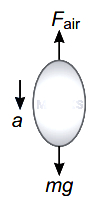
Here,the forces acting on the body are the gravitational force $(mg)$ acting downwards and the air resistance force $(F_{air})$ acting upwards.
Since the body is falling downwards with acceleration $a$,the net force equation is:
$mg - F_{air} = ma$
Rearranging the equation to solve for the air resistance force $(F_{air})$:
$F_{air} = mg - ma = m(g - a)$
Given:
Mass $(m)$ = $0.05 \ kg$
Acceleration due to gravity $(g)$ = $9.8 \ ms^{-2}$
Acceleration of the body $(a)$ = $9.5 \ ms^{-2}$
Substituting the values:
$F_{air} = 0.05 \times (9.8 - 9.5)$
$F_{air} = 0.05 \times 0.3$
$F_{air} = 0.015 \ N$
Here,the forces acting on the body are the gravitational force $(mg)$ acting downwards and the air resistance force $(F_{air})$ acting upwards.
Since the body is falling downwards with acceleration $a$,the net force equation is:
$mg - F_{air} = ma$
Rearranging the equation to solve for the air resistance force $(F_{air})$:
$F_{air} = mg - ma = m(g - a)$
Given:
Mass $(m)$ = $0.05 \ kg$
Acceleration due to gravity $(g)$ = $9.8 \ ms^{-2}$
Acceleration of the body $(a)$ = $9.5 \ ms^{-2}$
Substituting the values:
$F_{air} = 0.05 \times (9.8 - 9.5)$
$F_{air} = 0.05 \times 0.3$
$F_{air} = 0.015 \ N$
0 likes
View Solution81
MediumMCQ
$A$ body of mass $5 \ kg$ starts from the origin with an initial velocity $(30 \hat{i} + 40 \hat{j}) \ m/s$. If a constant force $-(\hat{i} + 5 \hat{j}) \ N$ acts on the body,then the time in which the $y$-component of its velocity becomes zero is (in $s$)
A
$5$
B
$20$
C
$40$
D
$80$
Solution
(C) Given: Mass $m = 5 \ kg$,initial velocity $\vec{u} = (30 \hat{i} + 40 \hat{j}) \ m/s$,and force $\vec{F} = -(\hat{i} + 5 \hat{j}) \ N$.
Using Newton's second law,the acceleration $\vec{a}$ is given by $\vec{a} = \frac{\vec{F}}{m} = \frac{-(\hat{i} + 5 \hat{j})}{5} = (-0.2 \hat{i} - 1 \hat{j}) \ m/s^2$.
The velocity at any time $t$ is given by $\vec{v} = \vec{u} + \vec{a}t$.
Substituting the components,the $y$-component of velocity is $v_y = u_y + a_y t$.
Here,$u_y = 40 \ m/s$ and $a_y = -1 \ m/s^2$.
We want the time $t$ when $v_y = 0$.
$0 = 40 + (-1)t$.
$t = 40 \ s$.
Using Newton's second law,the acceleration $\vec{a}$ is given by $\vec{a} = \frac{\vec{F}}{m} = \frac{-(\hat{i} + 5 \hat{j})}{5} = (-0.2 \hat{i} - 1 \hat{j}) \ m/s^2$.
The velocity at any time $t$ is given by $\vec{v} = \vec{u} + \vec{a}t$.
Substituting the components,the $y$-component of velocity is $v_y = u_y + a_y t$.
Here,$u_y = 40 \ m/s$ and $a_y = -1 \ m/s^2$.
We want the time $t$ when $v_y = 0$.
$0 = 40 + (-1)t$.
$t = 40 \ s$.
0 likes
View Solution82
EasyMCQ
$A$ car of mass $1500 \,kg$ is moving with $20 \,ms^{-1}$ velocity. If the brakes are applied,it comes to rest in $5 \,s$. The retarding force is: (in $\,N$)
A
$9000$
B
$6000$
C
$12000$
D
$3000$
Solution
(B) Given: Mass $m = 1500 \,kg$,Initial velocity $u = 20 \,ms^{-1}$,Final velocity $v = 0 \,ms^{-1}$,Time $t = 5 \,s$.
Using Newton's Second Law of Motion,the force $F = ma$.
First,calculate the acceleration $a = \frac{v - u}{t} = \frac{0 - 20}{5} = -4 \,ms^{-2}$.
The negative sign indicates retardation.
Now,calculate the retarding force: $F = m \times a = 1500 \,kg \times (-4 \,ms^{-2}) = -6000 \,N$.
The magnitude of the retarding force is $6000 \,N$.
Using Newton's Second Law of Motion,the force $F = ma$.
First,calculate the acceleration $a = \frac{v - u}{t} = \frac{0 - 20}{5} = -4 \,ms^{-2}$.
The negative sign indicates retardation.
Now,calculate the retarding force: $F = m \times a = 1500 \,kg \times (-4 \,ms^{-2}) = -6000 \,N$.
The magnitude of the retarding force is $6000 \,N$.
0 likes
View Solution83
EasyMCQ
The magnitude of the external force acting on moving bodies can be known directly by
A
Law of conservation of angular momentum.
B
Newton's first law of motion.
C
Newton's second law of motion.
D
Law of conservation of energy.
Solution
(C) According to Newton's second law of motion,the external force $F$ acting on a body is equal to the rate of change of its linear momentum,which is given by $F = ma$,where $m$ is the mass and $a$ is the acceleration produced in the body. Thus,the magnitude of the external force can be calculated directly using this law.
0 likes
View Solution84
MediumMCQ
$A$ bullet of mass $20 \,g$ moving with $500 \,ms^{-1}$ is pierced $1 \,cm$ into a wooden block. The retarding force experienced by the bullet is:
A
$125 \times 10^3 \,N$
B
$750 \times 10^3 \,N$
C
$500 \times 10^3 \,N$
D
$250 \times 10^3 \,N$
Solution
(D) Given: Mass $m = 20 \,g = 0.02 \,kg$,Initial velocity $u = 500 \,m/s$,Final velocity $v = 0$,Displacement $s = 1 \,cm = 0.01 \,m$.
Using the third equation of motion: $v^2 - u^2 = 2as$.
Substituting the values: $0^2 - (500)^2 = 2 \times a \times 0.01$.
$-250000 = 0.02 \times a$.
$a = -\frac{250000}{0.02} = -1.25 \times 10^7 \,m/s^2$.
The retarding force $F$ is given by Newton's second law: $F = ma$.
$F = 0.02 \,kg \times 1.25 \times 10^7 \,m/s^2 = 250 \times 10^3 \,N$.
Using the third equation of motion: $v^2 - u^2 = 2as$.
Substituting the values: $0^2 - (500)^2 = 2 \times a \times 0.01$.
$-250000 = 0.02 \times a$.
$a = -\frac{250000}{0.02} = -1.25 \times 10^7 \,m/s^2$.
The retarding force $F$ is given by Newton's second law: $F = ma$.
$F = 0.02 \,kg \times 1.25 \times 10^7 \,m/s^2 = 250 \times 10^3 \,N$.
0 likes
View Solution85
MediumMCQ
The force required to stop a body of mass $10 \,kg$ moving along a straight line path with a velocity of $10 \,ms^{-1}$ in a time of $10 \,s$ is (in $\,N$)
A
$10$
B
$1000$
C
$100$
D
$1$
Solution
(A) Given: Mass $m = 10 \,kg$,Initial velocity $u = 10 \,ms^{-1}$,Final velocity $v = 0 \,ms^{-1}$,Time $t = 10 \,s$.
According to Newton's second law of motion,the force $F$ is given by $F = m \times a$,where acceleration $a = \frac{v - u}{t}$.
Substituting the values: $a = \frac{0 - 10}{10} = -1 \,ms^{-2}$.
The negative sign indicates a retarding force.
Magnitude of force $F = m \times |a| = 10 \,kg \times 1 \,ms^{-2} = 10 \,N$.
According to Newton's second law of motion,the force $F$ is given by $F = m \times a$,where acceleration $a = \frac{v - u}{t}$.
Substituting the values: $a = \frac{0 - 10}{10} = -1 \,ms^{-2}$.
The negative sign indicates a retarding force.
Magnitude of force $F = m \times |a| = 10 \,kg \times 1 \,ms^{-2} = 10 \,N$.
0 likes
View Solution86
DifficultMCQ
$A$ cricket ball of mass $50 \ g$ having velocity $50 \ cm \ s^{-1}$ is stopped in $0.5 \ s$. The force applied to stop the ball is (in $N$)
A
$0.07$
B
$0.05$
C
$5$
D
$7$
Solution
(B) Given:
Mass $m = 50 \ g = 50 \times 10^{-3} \ kg = 0.05 \ kg$
Initial velocity $u = 50 \ cm \ s^{-1} = 50 \times 10^{-2} \ m \ s^{-1} = 0.5 \ m \ s^{-1}$
Final velocity $v = 0 \ m \ s^{-1}$
Time $t = 0.5 \ s$
Initial momentum $p_i = m \times u = 0.05 \ kg \times 0.5 \ m \ s^{-1} = 0.025 \ kg \ m \ s^{-1}$
Final momentum $p_f = m \times v = 0.05 \ kg \times 0 \ m \ s^{-1} = 0 \ kg \ m \ s^{-1}$
According to Newton's second law,the force $F$ is the rate of change of momentum:
$F = \frac{\Delta p}{t} = \frac{p_f - p_i}{t}$
$F = \frac{0 - 0.025 \ kg \ m \ s^{-1}}{0.5 \ s}$
$F = -0.05 \ N$
The magnitude of the force applied to stop the ball is $0.05 \ N$.
Mass $m = 50 \ g = 50 \times 10^{-3} \ kg = 0.05 \ kg$
Initial velocity $u = 50 \ cm \ s^{-1} = 50 \times 10^{-2} \ m \ s^{-1} = 0.5 \ m \ s^{-1}$
Final velocity $v = 0 \ m \ s^{-1}$
Time $t = 0.5 \ s$
Initial momentum $p_i = m \times u = 0.05 \ kg \times 0.5 \ m \ s^{-1} = 0.025 \ kg \ m \ s^{-1}$
Final momentum $p_f = m \times v = 0.05 \ kg \times 0 \ m \ s^{-1} = 0 \ kg \ m \ s^{-1}$
According to Newton's second law,the force $F$ is the rate of change of momentum:
$F = \frac{\Delta p}{t} = \frac{p_f - p_i}{t}$
$F = \frac{0 - 0.025 \ kg \ m \ s^{-1}}{0.5 \ s}$
$F = -0.05 \ N$
The magnitude of the force applied to stop the ball is $0.05 \ N$.
0 likes
View Solution87
EasyMCQ
When a force $F$ given by $F=(6 \hat{i}-18 \hat{j}+10 \hat{k}) \text{ N}$ acts on a body,it imparts an acceleration of $8 \text{ m/s}^2$. Find the mass of the body.
A
$\frac{\sqrt{115}}{4} \text{ kg}$
B
$10 \sqrt{2} \text{ kg}$
C
$\frac{\sqrt{115}}{2} \text{ kg}$
D
$\frac{115}{2} \text{ kg}$
Solution
(A) Given that,the force vector is $F = (6 \hat{i} - 18 \hat{j} + 10 \hat{k}) \text{ N}$.
The magnitude of the force is calculated as:
$|F| = \sqrt{(6)^2 + (-18)^2 + (10)^2} = \sqrt{36 + 324 + 100} = \sqrt{460} \text{ N}$.
Given acceleration $a = 8 \text{ m/s}^2$.
According to Newton's second law of motion,$F = ma$,which implies $m = \frac{F}{a}$.
Substituting the values:
$m = \frac{\sqrt{460}}{8} = \frac{\sqrt{4 \times 115}}{8} = \frac{2\sqrt{115}}{8} = \frac{\sqrt{115}}{4} \text{ kg}$.
The magnitude of the force is calculated as:
$|F| = \sqrt{(6)^2 + (-18)^2 + (10)^2} = \sqrt{36 + 324 + 100} = \sqrt{460} \text{ N}$.
Given acceleration $a = 8 \text{ m/s}^2$.
According to Newton's second law of motion,$F = ma$,which implies $m = \frac{F}{a}$.
Substituting the values:
$m = \frac{\sqrt{460}}{8} = \frac{\sqrt{4 \times 115}}{8} = \frac{2\sqrt{115}}{8} = \frac{\sqrt{115}}{4} \text{ kg}$.
0 likes
View Solution88
EasyMCQ
The time taken by a force of $2 \ N$ to produce a change of momentum of $0.4 \ kg \ m \ s^{-1}$ in a body is: (in $s$)
A
$0.2$
B
$0.02$
C
$0.5$
D
$0.05$
Solution
(A) According to Newton's second law of motion,the force applied to an object is equal to the rate of change of its momentum.
Mathematically,the force $F$ is given by the ratio of the change in momentum $\Delta P$ to the time interval $\Delta t$:
$F = \frac{\Delta P}{\Delta t}$
Given:
Force $F = 2 \ N$
Change in momentum $\Delta P = 0.4 \ kg \ m \ s^{-1}$
Rearranging the formula to solve for time $\Delta t$:
$\Delta t = \frac{\Delta P}{F}$
Substituting the given values:
$\Delta t = \frac{0.4}{2} = 0.2 \ s$
Therefore,the time taken is $0.2 \ s$.
Mathematically,the force $F$ is given by the ratio of the change in momentum $\Delta P$ to the time interval $\Delta t$:
$F = \frac{\Delta P}{\Delta t}$
Given:
Force $F = 2 \ N$
Change in momentum $\Delta P = 0.4 \ kg \ m \ s^{-1}$
Rearranging the formula to solve for time $\Delta t$:
$\Delta t = \frac{\Delta P}{F}$
Substituting the given values:
$\Delta t = \frac{0.4}{2} = 0.2 \ s$
Therefore,the time taken is $0.2 \ s$.
0 likes
View Solution89
EasyMCQ
$A$ force $(2 \hat{i} + \hat{j} - \hat{k}) \text{ N}$ acts on a body, which is initially at rest. At the end of $20 \text{ s}$, the velocity of the body is $(4 \hat{i} + 2 \hat{j} - 2 \hat{k}) \text{ ms}^{-1}$. The mass of the body is: (in $\text{ kg}$)
A
$8$
B
$10$
C
$5$
D
$4.5$
Solution
(B) Given force vector $\vec{F} = (2 \hat{i} + \hat{j} - \hat{k}) \text{ N}$.
Initial velocity $\vec{u} = 0 \text{ ms}^{-1}$.
Final velocity $\vec{v} = (4 \hat{i} + 2 \hat{j} - 2 \hat{k}) \text{ ms}^{-1}$.
Time $t = 20 \text{ s}$.
Using Newton's Second Law, $\vec{F} = m \vec{a} = m \left( \frac{\vec{v} - \vec{u}}{t} \right)$.
Rearranging for mass: $m = \frac{\vec{F} \cdot t}{\vec{v} - \vec{u}}$.
Since $\vec{v} - \vec{u} = (4 \hat{i} + 2 \hat{j} - 2 \hat{k}) = 2(2 \hat{i} + \hat{j} - \hat{k}) = 2 \vec{F}$.
Substituting the values: $m = \frac{\vec{F} \cdot 20}{2 \vec{F}} = \frac{20}{2} = 10 \text{ kg}$.
Initial velocity $\vec{u} = 0 \text{ ms}^{-1}$.
Final velocity $\vec{v} = (4 \hat{i} + 2 \hat{j} - 2 \hat{k}) \text{ ms}^{-1}$.
Time $t = 20 \text{ s}$.
Using Newton's Second Law, $\vec{F} = m \vec{a} = m \left( \frac{\vec{v} - \vec{u}}{t} \right)$.
Rearranging for mass: $m = \frac{\vec{F} \cdot t}{\vec{v} - \vec{u}}$.
Since $\vec{v} - \vec{u} = (4 \hat{i} + 2 \hat{j} - 2 \hat{k}) = 2(2 \hat{i} + \hat{j} - \hat{k}) = 2 \vec{F}$.
Substituting the values: $m = \frac{\vec{F} \cdot 20}{2 \vec{F}} = \frac{20}{2} = 10 \text{ kg}$.
0 likes
View Solution90
EasyMCQ
$A$ force $\vec{F_1}$ of magnitude $4 \ N$ acts on an object of mass $1 \ kg$ at the origin in a direction $30^{\circ}$ above the positive $x$-axis. $A$ second force $\vec{F_2}$ of magnitude $4 \ N$ acts on the same object in the direction of the positive $y$-axis. The magnitude of the acceleration of the object is nearly: (in $m \ s^{-2}$)
A
$6.9$
B
$7.6$
C
$4.3$
D
$8.0$
Solution
(A) The components of force $\vec{F_1}$ are: $F_{1x} = 4 \cos 30^{\circ} = 4 \times \frac{\sqrt{3}}{2} = 2\sqrt{3} \ N$ and $F_{1y} = 4 \sin 30^{\circ} = 4 \times \frac{1}{2} = 2 \ N$.
The components of force $\vec{F_2}$ are: $F_{2x} = 0 \ N$ and $F_{2y} = 4 \ N$.
The net force components are: $F_x = F_{1x} + F_{2x} = 2\sqrt{3} \ N$ and $F_y = F_{1y} + F_{2y} = 2 + 4 = 6 \ N$.
The magnitude of the resultant force is $F_R = \sqrt{F_x^2 + F_y^2} = \sqrt{(2\sqrt{3})^2 + 6^2} = \sqrt{12 + 36} = \sqrt{48} \approx 6.928 \ N$.
Using Newton's second law,the acceleration $a = \frac{F_R}{m} = \frac{6.928}{1} \approx 6.9 \ m \ s^{-2}$.
The components of force $\vec{F_2}$ are: $F_{2x} = 0 \ N$ and $F_{2y} = 4 \ N$.
The net force components are: $F_x = F_{1x} + F_{2x} = 2\sqrt{3} \ N$ and $F_y = F_{1y} + F_{2y} = 2 + 4 = 6 \ N$.
The magnitude of the resultant force is $F_R = \sqrt{F_x^2 + F_y^2} = \sqrt{(2\sqrt{3})^2 + 6^2} = \sqrt{12 + 36} = \sqrt{48} \approx 6.928 \ N$.
Using Newton's second law,the acceleration $a = \frac{F_R}{m} = \frac{6.928}{1} \approx 6.9 \ m \ s^{-2}$.
0 likes
View Solution91
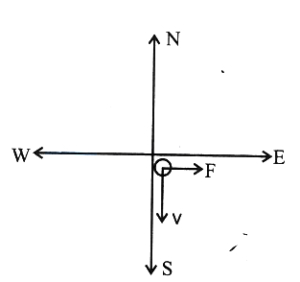
EasyMCQ
$A$ body of mass $1.5 \ kg$ is moving towards south with a uniform velocity of $8 \ ms^{-1}$. $A$ force of $6 \ N$ is applied to the body towards east. The displacement of the body $3 \ s$ after the application of the force is (in $m$)
A
$24$
B
$30$
C
$18$
D
$42$
Solution
(B) Given: Mass $m = 1.5 \ kg$,initial velocity $\overrightarrow{v} = -8 \hat{j} \ ms^{-1}$ (towards south),force $\overrightarrow{F} = 6 \hat{i} \ N$ (towards east),time $t = 3 \ s$.
Acceleration $\overrightarrow{a} = \frac{\overrightarrow{F}}{m} = \frac{6}{1.5} \hat{i} = 4 \hat{i} \ ms^{-2}$.
Using the equation of motion for displacement: $\overrightarrow{s} = \overrightarrow{v}t + \frac{1}{2} \overrightarrow{a}t^2$.
Substituting the values: $\overrightarrow{s} = (-8 \hat{j})(3) + \frac{1}{2}(4 \hat{i})(3)^2$.
$\overrightarrow{s} = -24 \hat{j} + 2(9) \hat{i} = 18 \hat{i} - 24 \hat{j} \ m$.
The magnitude of displacement is $S = |\overrightarrow{s}| = \sqrt{(18)^2 + (-24)^2} = \sqrt{324 + 576} = \sqrt{900} = 30 \ m$.
Acceleration $\overrightarrow{a} = \frac{\overrightarrow{F}}{m} = \frac{6}{1.5} \hat{i} = 4 \hat{i} \ ms^{-2}$.
Using the equation of motion for displacement: $\overrightarrow{s} = \overrightarrow{v}t + \frac{1}{2} \overrightarrow{a}t^2$.
Substituting the values: $\overrightarrow{s} = (-8 \hat{j})(3) + \frac{1}{2}(4 \hat{i})(3)^2$.
$\overrightarrow{s} = -24 \hat{j} + 2(9) \hat{i} = 18 \hat{i} - 24 \hat{j} \ m$.
The magnitude of displacement is $S = |\overrightarrow{s}| = \sqrt{(18)^2 + (-24)^2} = \sqrt{324 + 576} = \sqrt{900} = 30 \ m$.
0 likes
View Solution92
EasyMCQ
When will a body of mass $20 \ kg$ moving at $15 \ m s^{-1}$,subjected to a retarding force of $100 \ N$,come to rest (in $s$)?
A
$3$
B
$6$
C
$1.5$
D
$9$
Solution
(A) Given that:
Mass $m = 20 \ kg$
Initial velocity $u = 15 \ m s^{-1}$
Retarding force $F = 100 \ N$
Final velocity $v = 0 \ m s^{-1}$ (since the body comes to rest)
According to Newton's second law of motion,the acceleration $a$ is given by $F = ma$. Since the force is retarding,it acts in the opposite direction of motion,so $a = -F/m$.
$a = -\frac{100 \ N}{20 \ kg} = -5 \ m s^{-2}$.
Using the first equation of motion,$v = u + at$:
$0 = 15 + (-5)t$
$5t = 15$
$t = 3 \ s$.
Thus,the body will come to rest after $3 \ s$.
Mass $m = 20 \ kg$
Initial velocity $u = 15 \ m s^{-1}$
Retarding force $F = 100 \ N$
Final velocity $v = 0 \ m s^{-1}$ (since the body comes to rest)
According to Newton's second law of motion,the acceleration $a$ is given by $F = ma$. Since the force is retarding,it acts in the opposite direction of motion,so $a = -F/m$.
$a = -\frac{100 \ N}{20 \ kg} = -5 \ m s^{-2}$.
Using the first equation of motion,$v = u + at$:
$0 = 15 + (-5)t$
$5t = 15$
$t = 3 \ s$.
Thus,the body will come to rest after $3 \ s$.
0 likes
View Solution93
MediumMCQ
$A$ person holds a ball of mass $0.25 \ kg$ in his hand and throws it,so that it leaves his hand with a speed of $12 \ m \ s^{-1}$. In this process,if his hand moved through a distance of $0.9 \ m$,then the net force acted on the ball is (in $N$)
A
$40$
B
$20$
C
$25$
D
$10$
Solution
(B) Given: Mass of the ball $m = 0.25 \ kg$,final velocity $v = 12 \ m \ s^{-1}$,initial velocity $u = 0 \ m \ s^{-1}$,and distance $s = 0.9 \ m$.
Using the third equation of motion: $v^2 = u^2 + 2as$.
Substituting the values: $(12)^2 = (0)^2 + 2 \times a \times 0.9$.
$144 = 1.8 \times a$.
$a = 144 / 1.8 = 80 \ m \ s^{-2}$.
Now,using Newton's second law of motion: $F = ma$.
$F = 0.25 \ kg \times 80 \ m \ s^{-2} = 20 \ N$.
Therefore,the net force acting on the ball is $20 \ N$.
Using the third equation of motion: $v^2 = u^2 + 2as$.
Substituting the values: $(12)^2 = (0)^2 + 2 \times a \times 0.9$.
$144 = 1.8 \times a$.
$a = 144 / 1.8 = 80 \ m \ s^{-2}$.
Now,using Newton's second law of motion: $F = ma$.
$F = 0.25 \ kg \times 80 \ m \ s^{-2} = 20 \ N$.
Therefore,the net force acting on the ball is $20 \ N$.
0 likes
View Solution94
MediumMCQ
$A$ force separately produces accelerations of $18 \ m/s^2$,$9 \ m/s^2$,and $6 \ m/s^2$ in three bodies of masses $P$,$Q$,and $R$ respectively. If the same force is applied on a body of mass $P+Q+R$,then the acceleration of that body is: (in $m/s^2$)
A
$3$
B
$6$
C
$2$
D
$33$
Solution
(A) Let the force be $F$. According to Newton's second law,$F = ma$,so $m = F/a$.
For mass $P$,$P = F/18$.
For mass $Q$,$Q = F/9$.
For mass $R$,$R = F/6$.
When the same force $F$ is applied to the combined mass $(P+Q+R)$,the acceleration $a'$ is given by $a' = F / (P+Q+R)$.
Substituting the values of $P, Q,$ and $R$:
$a' = F / (F/18 + F/9 + F/6) = F / [F(1/18 + 2/18 + 3/18)]$.
$a' = 1 / (6/18) = 1 / (1/3) = 3 \ m/s^2$.
Thus,the acceleration is $3 \ m/s^2$.
For mass $P$,$P = F/18$.
For mass $Q$,$Q = F/9$.
For mass $R$,$R = F/6$.
When the same force $F$ is applied to the combined mass $(P+Q+R)$,the acceleration $a'$ is given by $a' = F / (P+Q+R)$.
Substituting the values of $P, Q,$ and $R$:
$a' = F / (F/18 + F/9 + F/6) = F / [F(1/18 + 2/18 + 3/18)]$.
$a' = 1 / (6/18) = 1 / (1/3) = 3 \ m/s^2$.
Thus,the acceleration is $3 \ m/s^2$.
0 likes
View Solution95
MediumMCQ
The velocity of an object of mass $2 \ kg$ is given by $v = (8t \hat{i} + 3t^2 \hat{j}) \ m/s$,where $t$ is time in seconds. What will be the direction of the net force on the object relative to the positive direction of the $X$-axis,at the instant when its magnitude is $20 \ N$?
A
$\tan^{-1}(1/2)$
B
$\tan^{-1}(2/3)$
C
$\tan^{-1}(4/5)$
D
$\tan^{-1}(3/4)$
Solution
(D) Given,mass of the object,$m = 2 \ kg$.
Velocity,$v = (8t \hat{i} + 3t^2 \hat{j}) \ m/s$.
The acceleration of the object is given by:
$a = \frac{dv}{dt} = \frac{d}{dt}(8t \hat{i} + 3t^2 \hat{j}) = (8 \hat{i} + 6t \hat{j}) \ m/s^2$.
According to Newton's second law of motion,the net force on the object is:
$F = ma = 2(8 \hat{i} + 6t \hat{j}) = (16 \hat{i} + 12t \hat{j}) \ N$.
The magnitude of the force is given as $|F| = 20 \ N$.
$|F| = \sqrt{16^2 + (12t)^2} = 20$.
Squaring both sides:
$256 + 144t^2 = 400$.
$144t^2 = 144 \implies t^2 = 1 \implies t = 1 \ s$.
At $t = 1 \ s$,the force vector is:
$F = 16 \hat{i} + 12(1) \hat{j} = (16 \hat{i} + 12 \hat{j}) \ N$.
The angle $\theta$ made by the force vector with the positive $X$-axis is:
$\tan \theta = \frac{F_y}{F_x} = \frac{12}{16} = \frac{3}{4}$.
$\theta = \tan^{-1}\left(\frac{3}{4}\right)$.
Velocity,$v = (8t \hat{i} + 3t^2 \hat{j}) \ m/s$.
The acceleration of the object is given by:
$a = \frac{dv}{dt} = \frac{d}{dt}(8t \hat{i} + 3t^2 \hat{j}) = (8 \hat{i} + 6t \hat{j}) \ m/s^2$.
According to Newton's second law of motion,the net force on the object is:
$F = ma = 2(8 \hat{i} + 6t \hat{j}) = (16 \hat{i} + 12t \hat{j}) \ N$.
The magnitude of the force is given as $|F| = 20 \ N$.
$|F| = \sqrt{16^2 + (12t)^2} = 20$.
Squaring both sides:
$256 + 144t^2 = 400$.
$144t^2 = 144 \implies t^2 = 1 \implies t = 1 \ s$.
At $t = 1 \ s$,the force vector is:
$F = 16 \hat{i} + 12(1) \hat{j} = (16 \hat{i} + 12 \hat{j}) \ N$.
The angle $\theta$ made by the force vector with the positive $X$-axis is:
$\tan \theta = \frac{F_y}{F_x} = \frac{12}{16} = \frac{3}{4}$.
$\theta = \tan^{-1}\left(\frac{3}{4}\right)$.

0 likes
View Solution96
EasyMCQ
$A$ $4 \ kg$ object has a velocity of $3.0 \hat{i} \ m/s$ at some instant. Eight seconds later,its velocity is $(8.0 \hat{i} + 10.0 \hat{j}) \ m/s$. Assuming that the object is subjected to a constant net force,the magnitude of the force is
A
$\frac{5 \sqrt{5}}{2} \ N$
B
$\frac{5 \sqrt{3}}{8} \ N$
C
$\frac{8 \sqrt{5}}{3} \ N$
D
$\frac{10 \sqrt{3}}{7} \ N$
Solution
(A) Given: mass $m = 4 \ kg$,initial velocity $\vec{u} = 3 \hat{i} \ m/s$,final velocity $\vec{v} = (8 \hat{i} + 10 \hat{j}) \ m/s$,and time $t = 8 \ s$.
Using the first equation of motion,$\vec{v} = \vec{u} + \vec{a}t$,we find the acceleration $\vec{a}$:
$\vec{a} = \frac{\vec{v} - \vec{u}}{t} = \frac{(8 \hat{i} + 10 \hat{j}) - 3 \hat{i}}{8} = \frac{5 \hat{i} + 10 \hat{j}}{8} \ m/s^2$.
Now,using Newton's second law,$\vec{F} = m\vec{a}$:
$\vec{F} = 4 \times \left( \frac{5 \hat{i} + 10 \hat{j}}{8} \right) = \frac{1}{2} (5 \hat{i} + 10 \hat{j}) = (2.5 \hat{i} + 5 \hat{j}) \ N$.
The magnitude of the force is $|\vec{F}| = \sqrt{(2.5)^2 + 5^2} = \sqrt{6.25 + 25} = \sqrt{31.25} = \sqrt{\frac{125}{4}} = \frac{5 \sqrt{5}}{2} \ N$.
Using the first equation of motion,$\vec{v} = \vec{u} + \vec{a}t$,we find the acceleration $\vec{a}$:
$\vec{a} = \frac{\vec{v} - \vec{u}}{t} = \frac{(8 \hat{i} + 10 \hat{j}) - 3 \hat{i}}{8} = \frac{5 \hat{i} + 10 \hat{j}}{8} \ m/s^2$.
Now,using Newton's second law,$\vec{F} = m\vec{a}$:
$\vec{F} = 4 \times \left( \frac{5 \hat{i} + 10 \hat{j}}{8} \right) = \frac{1}{2} (5 \hat{i} + 10 \hat{j}) = (2.5 \hat{i} + 5 \hat{j}) \ N$.
The magnitude of the force is $|\vec{F}| = \sqrt{(2.5)^2 + 5^2} = \sqrt{6.25 + 25} = \sqrt{31.25} = \sqrt{\frac{125}{4}} = \frac{5 \sqrt{5}}{2} \ N$.
0 likes
View Solution97
MediumMCQ
$A$ body of mass $10 \,kg$ is acted upon by a force given by the equation $F = (3t^2 - 30) \,N$. The initial velocity of the body is $10 \,m/s$. What is the velocity of the body after $5 \,s$ (in $\,m/s$)?
A
$4.5$
B
$6$
C
$7.5$
D
$5$
Solution
(C) Given: Mass $m = 10 \,kg$,Initial velocity $u = 10 \,m/s$,Force $F = (3t^2 - 30) \,N$.
Using the impulse-momentum theorem,the change in momentum is equal to the integral of force over time:
$\Delta p = \int_{0}^{t} F dt = m(v - u)$
$\int_{0}^{5} (3t^2 - 30) dt = 10(v - 10)$
$[t^3 - 30t]_{0}^{5} = 10(v - 10)$
$(5^3 - 30(5)) - (0) = 10(v - 10)$
$(125 - 150) = 10(v - 10)$
$-25 = 10(v - 10)$
$-2.5 = v - 10$
$v = 10 - 2.5 = 7.5 \,m/s$.
Using the impulse-momentum theorem,the change in momentum is equal to the integral of force over time:
$\Delta p = \int_{0}^{t} F dt = m(v - u)$
$\int_{0}^{5} (3t^2 - 30) dt = 10(v - 10)$
$[t^3 - 30t]_{0}^{5} = 10(v - 10)$
$(5^3 - 30(5)) - (0) = 10(v - 10)$
$(125 - 150) = 10(v - 10)$
$-25 = 10(v - 10)$
$-2.5 = v - 10$
$v = 10 - 2.5 = 7.5 \,m/s$.
0 likes
View Solution98
MediumMCQ
$A$ force $\vec{F} = a \hat{i} + b \hat{j} + c \hat{k}$ is acting on a body of mass $m$. The body was initially at rest at the origin. The coordinates of the body after time $t$ will be:
A
$\frac{at^2}{2m}, \frac{bt^2}{2m}, \frac{ct^2}{2m}$
B
$\frac{at^2}{2m}, \frac{bt^2}{m}, \frac{ct^2}{2m}$
C
$\frac{at^2}{m}, \frac{bt^2}{2m}, \frac{ct^2}{2m}$
D
$\frac{at^2}{2m}, \frac{bt^2}{2m}, \frac{ct^2}{m}$
Solution
(A) Given force $\vec{F} = a \hat{i} + b \hat{j} + c \hat{k}$.
Using Newton's second law,the acceleration $\vec{a}_{acc} = \frac{\vec{F}}{m} = \frac{a}{m} \hat{i} + \frac{b}{m} \hat{j} + \frac{c}{m} \hat{k}$.
Since the body starts from rest at the origin,the initial velocity $\vec{u} = 0$ and initial position $\vec{r}_0 = 0$.
Using the kinematic equation $\vec{s} = \vec{u}t + \frac{1}{2} \vec{a}_{acc} t^2$,we get $\vec{r} = \frac{1}{2} \vec{a}_{acc} t^2$.
Substituting the components:
$x = \frac{1}{2} (\frac{a}{m}) t^2 = \frac{at^2}{2m}$
$y = \frac{1}{2} (\frac{b}{m}) t^2 = \frac{bt^2}{2m}$
$z = \frac{1}{2} (\frac{c}{m}) t^2 = \frac{ct^2}{2m}$
Thus,the coordinates are $(\frac{at^2}{2m}, \frac{bt^2}{2m}, \frac{ct^2}{2m})$.
Using Newton's second law,the acceleration $\vec{a}_{acc} = \frac{\vec{F}}{m} = \frac{a}{m} \hat{i} + \frac{b}{m} \hat{j} + \frac{c}{m} \hat{k}$.
Since the body starts from rest at the origin,the initial velocity $\vec{u} = 0$ and initial position $\vec{r}_0 = 0$.
Using the kinematic equation $\vec{s} = \vec{u}t + \frac{1}{2} \vec{a}_{acc} t^2$,we get $\vec{r} = \frac{1}{2} \vec{a}_{acc} t^2$.
Substituting the components:
$x = \frac{1}{2} (\frac{a}{m}) t^2 = \frac{at^2}{2m}$
$y = \frac{1}{2} (\frac{b}{m}) t^2 = \frac{bt^2}{2m}$
$z = \frac{1}{2} (\frac{c}{m}) t^2 = \frac{ct^2}{2m}$
Thus,the coordinates are $(\frac{at^2}{2m}, \frac{bt^2}{2m}, \frac{ct^2}{2m})$.
0 likes
View Solution99
MediumMCQ
The velocity $(v)$ of a particle (under a force $F$) depends on its distance $(x)$ from the origin (with $x > 0$) as $v \propto \frac{1}{\sqrt{x}}$. Find how the magnitude of the force $(F)$ on the particle depends on $x$.
A
$F \propto \frac{1}{x^{3/2}}$
B
$F \propto \frac{1}{x}$
C
$F \propto \frac{1}{x^2}$
D
$F \propto \frac{1}{x^3}$
Solution
(C) Given,$v = \frac{k}{\sqrt{x}} = k x^{-1/2}$,where $k$ is a constant.
Acceleration $a = \frac{dv}{dt} = \frac{dv}{dx} \cdot \frac{dx}{dt} = v \frac{dv}{dx}$.
First,find $\frac{dv}{dx}$:
$\frac{dv}{dx} = k \cdot (-\frac{1}{2}) x^{-3/2} = -\frac{k}{2x^{3/2}}$.
Now,substitute $v$ and $\frac{dv}{dx}$ into the acceleration formula:
$a = (k x^{-1/2}) \cdot (-\frac{k}{2x^{3/2}}) = -\frac{k^2}{2x^2}$.
According to Newton's second law,$F = ma$.
The magnitude of the force is $F = |ma| = m \cdot \frac{k^2}{2x^2}$.
Since $m$ and $k$ are constants,$F \propto \frac{1}{x^2}$.
Acceleration $a = \frac{dv}{dt} = \frac{dv}{dx} \cdot \frac{dx}{dt} = v \frac{dv}{dx}$.
First,find $\frac{dv}{dx}$:
$\frac{dv}{dx} = k \cdot (-\frac{1}{2}) x^{-3/2} = -\frac{k}{2x^{3/2}}$.
Now,substitute $v$ and $\frac{dv}{dx}$ into the acceleration formula:
$a = (k x^{-1/2}) \cdot (-\frac{k}{2x^{3/2}}) = -\frac{k^2}{2x^2}$.
According to Newton's second law,$F = ma$.
The magnitude of the force is $F = |ma| = m \cdot \frac{k^2}{2x^2}$.
Since $m$ and $k$ are constants,$F \propto \frac{1}{x^2}$.
0 likes
View SolutionNewton's Laws of Motion and Friction — Second Law of Motion · Frequently Asked Questions
1Are these Newton's Laws of Motion and Friction questions useful for JEE and NEET?
Yes. All questions in this section are mapped to JEE Main and NEET exam patterns. Previous year questions from JEE Main, NEET, GUJCET and state-level exams are included with full solutions.
2Can I switch to Hindi or Gujarati for these questions?
Yes. Use the language tabs in the hero section or the sidebar to view the same questions and solutions in English, Hindi or Gujarati.
3How do I generate a question paper from this subtopic?
Use the Vedclass Exam Paper Generator — select the chapter and subtopic, set difficulty, and generate Sets A, B, C, D automatically. First 3 chapters of every subject are free.
Vedclass Products
For Students
Vedclass Test Series
Mock tests in real JEE/NEET style with performance analysis. 5-day free trial.
Start Free TrialFor Teachers
Exam Paper Generator
Generate Set A/B/C/D papers from this chapter in 2 minutes. 3 chapters free.
Try FreeFor Institutes
Online Exam Module
Live online exams with unlimited students, 360° analytics & white-label branding.
See DemoFor Teachers & Institutes
Generate a Newton's Laws of Motion and Friction Exam Paper in 2 Minutes
Select subtopic & difficulty — Sets A, B, C, D auto-generated with No Repeat logic.
First 3 chapters of every subject are free — no payment required.