
A English
Kinetic Friction and Motion on Rough Horizontal Surface Questions in English
Class 11 Physics · Newton's Laws of Motion and Friction · Kinetic Friction and Motion on Rough Horizontal Surface
154+
Questions
English
Language
100%
With Solutions
Showing 50 of 154 questions in English
1
MediumMCQ
$A$ body of mass $2 \, kg$ moving on a horizontal surface with an initial velocity of $4 \, m/s$ comes to rest after $2 \, s$. If one wants to keep this body moving on the same surface with a constant velocity of $4 \, m/s$,the force required is ........ $N$.
A
$8$
B
$4$
C
$0$
D
$2$
Solution
(B) Given: Mass $m = 2 \, kg$,initial velocity $u = 4 \, m/s$,final velocity $v = 0 \, m/s$,time $t = 2 \, s$.
Using the first equation of motion,$v = u + at$:
$0 = 4 + a(2) \implies 2a = -4 \implies a = -2 \, m/s^2$.
The retarding force (frictional force) acting on the body is $F_{friction} = m|a| = 2 \times 2 = 4 \, N$.
To keep the body moving with a constant velocity of $4 \, m/s$,the net force on the body must be zero.
Therefore,an external applied force must be equal and opposite to the frictional force.
Applied force $F = F_{friction} = 4 \, N$.
Using the first equation of motion,$v = u + at$:
$0 = 4 + a(2) \implies 2a = -4 \implies a = -2 \, m/s^2$.
The retarding force (frictional force) acting on the body is $F_{friction} = m|a| = 2 \times 2 = 4 \, N$.
To keep the body moving with a constant velocity of $4 \, m/s$,the net force on the body must be zero.
Therefore,an external applied force must be equal and opposite to the frictional force.
Applied force $F = F_{friction} = 4 \, N$.
0 likes
View Solution2
EasyMCQ
When two surfaces are coated with a lubricant,then they
A
Stick to each other
B
Slide upon each other
C
Roll upon each other
D
None of these
Solution
(B) When a lubricant is applied between two surfaces,it forms a thin layer that fills the irregularities of the surfaces.
This reduces the direct contact between the surfaces and decreases the coefficient of friction.
As a result,the surfaces can easily slide over each other with minimal resistance.
This reduces the direct contact between the surfaces and decreases the coefficient of friction.
As a result,the surfaces can easily slide over each other with minimal resistance.
0 likes
View Solution3
EasyMCQ
$A$ body of mass $2 \, kg$ is kept by pressing it against a vertical wall by a force of $100 \, N$. The coefficient of friction between the wall and the body is $0.3$. Then the frictional force is equal to ........ $N$.
A
$6$
B
$20$
C
$600$
D
$700$
Solution
(B) $1$. First,calculate the limiting friction $(f_L)$ which is the maximum possible static friction: $f_L = \mu N$,where $\mu = 0.3$ and $N = 100 \, N$.
$2$. $f_L = 0.3 \times 100 = 30 \, N$.
$3$. The weight of the body $(W)$ acts downwards: $W = mg = 2 \times 10 = 20 \, N$.
$4$. Since the weight of the body $(20 \, N)$ is less than the limiting friction $(30 \, N)$,the body remains in equilibrium.
$5$. For a body in equilibrium,the frictional force must balance the weight of the body.
$6$. Therefore,the frictional force $f = W = 20 \, N$.
$2$. $f_L = 0.3 \times 100 = 30 \, N$.
$3$. The weight of the body $(W)$ acts downwards: $W = mg = 2 \times 10 = 20 \, N$.
$4$. Since the weight of the body $(20 \, N)$ is less than the limiting friction $(30 \, N)$,the body remains in equilibrium.
$5$. For a body in equilibrium,the frictional force must balance the weight of the body.
$6$. Therefore,the frictional force $f = W = 20 \, N$.
0 likes
View Solution4
EasyMCQ
Which one of the following statements is correct?
A
Rolling friction is greater than sliding friction.
B
Rolling friction is less than sliding friction.
C
Rolling friction is equal to sliding friction.
D
Rolling friction and sliding friction are same.
Solution
(B) Rolling friction occurs when an object rolls over a surface,while sliding friction occurs when an object slides over a surface.
Because the contact area in rolling is significantly smaller and the deformation of surfaces is minimized compared to sliding,the resistance offered by rolling friction is much lower.
Therefore,rolling friction is always less than sliding friction.
Thus,the correct statement is that rolling friction is less than sliding friction.
Because the contact area in rolling is significantly smaller and the deformation of surfaces is minimized compared to sliding,the resistance offered by rolling friction is much lower.
Therefore,rolling friction is always less than sliding friction.
Thus,the correct statement is that rolling friction is less than sliding friction.
0 likes
View Solution5
MediumMCQ
$A$ car is moving along a straight horizontal road with a speed $v_0$. If the coefficient of friction between the tyres and the road is $\mu$,the shortest distance in which the car can be stopped is
A
$\frac{v_0^2}{2\mu g}$
B
$\frac{v_0}{\mu g}$
C
$\left( \frac{v_0}{\mu g} \right)^2$
D
$\frac{v_0}{\mu}$
Solution
(A) The retarding force $F$ acting on the car is due to friction,given by $F = \mu R = \mu mg$.
According to Newton's second law,$F = ma$,so $ma = \mu mg$,which gives the retardation $a = \mu g$.
Using the third equation of motion,$v^2 = u^2 - 2as$,where $v$ is the final velocity $(0)$,$u$ is the initial velocity $(v_0)$,and $s$ is the stopping distance.
Substituting the values: $0^2 = v_0^2 - 2(\mu g)s$.
Rearranging for $s$,we get $2\mu gs = v_0^2$.
Therefore,the shortest stopping distance is $s = \frac{v_0^2}{2\mu g}$.
According to Newton's second law,$F = ma$,so $ma = \mu mg$,which gives the retardation $a = \mu g$.
Using the third equation of motion,$v^2 = u^2 - 2as$,where $v$ is the final velocity $(0)$,$u$ is the initial velocity $(v_0)$,and $s$ is the stopping distance.
Substituting the values: $0^2 = v_0^2 - 2(\mu g)s$.
Rearranging for $s$,we get $2\mu gs = v_0^2$.
Therefore,the shortest stopping distance is $s = \frac{v_0^2}{2\mu g}$.
0 likes
View Solution6
MediumMCQ
$A$ block of mass $5\, kg$ is on a rough horizontal surface and is at rest. Now a force of $24\, N$ is imparted to it with negligible impulse. If the coefficient of kinetic friction is $0.4$ and $g = 9.8\, m/s^2$,then the acceleration of the block is ........ $m/s^2$.
A
$0.26$
B
$0.39$
C
$0.69$
D
$0.88$
Solution
(D) Given: Mass $m = 5\, kg$,Applied force $F = 24\, N$,Coefficient of kinetic friction $\mu_k = 0.4$,Acceleration due to gravity $g = 9.8\, m/s^2$.
First,calculate the kinetic frictional force: $f_k = \mu_k \cdot m \cdot g = 0.4 \times 5 \times 9.8 = 19.6\, N$.
Since the applied force $F = 24\, N$ is greater than the frictional force $f_k = 19.6\, N$,the block will accelerate.
The net force acting on the block is $F_{net} = F - f_k = 24 - 19.6 = 4.4\, N$.
Using Newton's second law,$F_{net} = ma$,the acceleration $a$ is given by $a = \frac{F_{net}}{m} = \frac{4.4}{5} = 0.88\, m/s^2$.
First,calculate the kinetic frictional force: $f_k = \mu_k \cdot m \cdot g = 0.4 \times 5 \times 9.8 = 19.6\, N$.
Since the applied force $F = 24\, N$ is greater than the frictional force $f_k = 19.6\, N$,the block will accelerate.
The net force acting on the block is $F_{net} = F - f_k = 24 - 19.6 = 4.4\, N$.
Using Newton's second law,$F_{net} = ma$,the acceleration $a$ is given by $a = \frac{F_{net}}{m} = \frac{4.4}{5} = 0.88\, m/s^2$.
0 likes
View Solution7
DifficultMCQ
$A$ body of mass $2\, kg$ is being dragged with uniform velocity of $2\, m/s$ on a rough horizontal plane. The coefficient of friction between the body and the surface is $0.20$. The amount of heat generated in $5\, s$ is ........ $cal$ $(J = 4.2\, J/cal$ and $g = 9.8\, m/s^2)$
A
$9.33$
B
$10.21$
C
$12.67$
D
$13.34$
Solution
(A) The body moves with a uniform velocity,which means the applied force is equal to the force of kinetic friction.
Force of friction $f_k = \mu_k N = \mu_k mg$.
Given: $m = 2\, kg$,$\mu_k = 0.20$,$v = 2\, m/s$,$t = 5\, s$,$g = 9.8\, m/s^2$,and $J = 4.2\, J/cal$.
Distance covered $d = v \times t = 2\, m/s \times 5\, s = 10\, m$.
Work done against friction $W = f_k \times d = (\mu_k mg) \times d$.
$W = 0.20 \times 2\, kg \times 9.8\, m/s^2 \times 10\, m = 39.2\, J$.
Heat generated $Q = \frac{W}{J} = \frac{39.2\, J}{4.2\, J/cal} \approx 9.33\, cal$.
Force of friction $f_k = \mu_k N = \mu_k mg$.
Given: $m = 2\, kg$,$\mu_k = 0.20$,$v = 2\, m/s$,$t = 5\, s$,$g = 9.8\, m/s^2$,and $J = 4.2\, J/cal$.
Distance covered $d = v \times t = 2\, m/s \times 5\, s = 10\, m$.
Work done against friction $W = f_k \times d = (\mu_k mg) \times d$.
$W = 0.20 \times 2\, kg \times 9.8\, m/s^2 \times 10\, m = 39.2\, J$.
Heat generated $Q = \frac{W}{J} = \frac{39.2\, J}{4.2\, J/cal} \approx 9.33\, cal$.
0 likes
View Solution8
DifficultMCQ
$A$ $60\, kg$ body is pushed with just enough force to start it moving across a floor and the same force continues to act afterwards. The coefficient of static friction and sliding friction are $0.5$ and $0.4$ respectively. The acceleration of the body is ........ $m/s^2$. (Take $g = 10\, m/s^2$)
A
$6$
B
$4.9$
C
$3.92$
D
$1$
Solution
(D) The force required to start the motion is equal to the limiting friction.
Limiting friction $f_s = \mu_s R = \mu_s mg = 0.5 \times 60 \times 10 = 300\, N$.
Since the same force continues to act,the applied force $F = 300\, N$.
Once the body is in motion,the kinetic friction acts on it.
Kinetic friction $f_k = \mu_k R = \mu_k mg = 0.4 \times 60 \times 10 = 240\, N$.
The net force acting on the body is $F_{net} = F - f_k = 300 - 240 = 60\, N$.
Using Newton's second law,$F_{net} = ma$.
$60 = 60 \times a$.
Therefore,$a = 1\, m/s^2$.
Limiting friction $f_s = \mu_s R = \mu_s mg = 0.5 \times 60 \times 10 = 300\, N$.
Since the same force continues to act,the applied force $F = 300\, N$.
Once the body is in motion,the kinetic friction acts on it.
Kinetic friction $f_k = \mu_k R = \mu_k mg = 0.4 \times 60 \times 10 = 240\, N$.
The net force acting on the body is $F_{net} = F - f_k = 300 - 240 = 60\, N$.
Using Newton's second law,$F_{net} = ma$.
$60 = 60 \times a$.
Therefore,$a = 1\, m/s^2$.
1 likes
View Solution9
MediumMCQ
On a rough horizontal surface,a body of mass $2 \, kg$ is given a velocity of $10 \, m/s$. If the coefficient of friction is $0.2$ and $g = 10 \, m/s^2$,the body will stop after covering a distance of ........ $m$.
A
$10$
B
$25$
C
$50$
D
$250$
Solution
(B) The frictional force acting on the body is $f = \mu N = \mu mg$.
According to Newton's second law,the retardation $a$ is given by $a = \frac{f}{m} = \frac{\mu mg}{m} = \mu g$.
Given $\mu = 0.2$ and $g = 10 \, m/s^2$,the retardation is $a = 0.2 \times 10 = 2 \, m/s^2$.
Using the equation of motion $v^2 = u^2 - 2as$,where final velocity $v = 0$,initial velocity $u = 10 \, m/s$,and $a = 2 \, m/s^2$:
$0 = (10)^2 - 2 \times 2 \times s$
$4s = 100$
$s = 25 \, m$.
Therefore,the body will stop after covering a distance of $25 \, m$.
According to Newton's second law,the retardation $a$ is given by $a = \frac{f}{m} = \frac{\mu mg}{m} = \mu g$.
Given $\mu = 0.2$ and $g = 10 \, m/s^2$,the retardation is $a = 0.2 \times 10 = 2 \, m/s^2$.
Using the equation of motion $v^2 = u^2 - 2as$,where final velocity $v = 0$,initial velocity $u = 10 \, m/s$,and $a = 2 \, m/s^2$:
$0 = (10)^2 - 2 \times 2 \times s$
$4s = 100$
$s = 25 \, m$.
Therefore,the body will stop after covering a distance of $25 \, m$.
0 likes
View Solution10
MediumMCQ
$A$ body of $10\, kg$ is acted upon by a force of $129.4\, N$. If $g = 9.8\, m/s^2$ and the acceleration of the block is $10\, m/s^2$,what is the coefficient of kinetic friction?
A
$0.03$
B
$0.01$
C
$0.3$
D
$0.25$
Solution
(C) The net force acting on the body is given by the difference between the applied force and the kinetic frictional force.
According to Newton's second law: $F_{net} = ma$.
Here,$F_{net} = F - f_k$,where $f_k = \mu_k N = \mu_k mg$.
Substituting the values: $ma = F - \mu_k mg$.
Rearranging for $\mu_k$: $\mu_k = \frac{F - ma}{mg}$.
Given: $m = 10\, kg$,$F = 129.4\, N$,$a = 10\, m/s^2$,and $g = 9.8\, m/s^2$.
$\mu_k = \frac{129.4 - (10 \times 10)}{10 \times 9.8} = \frac{129.4 - 100}{98} = \frac{29.4}{98} = 0.3$.
Thus,the coefficient of kinetic friction is $0.3$.
According to Newton's second law: $F_{net} = ma$.
Here,$F_{net} = F - f_k$,where $f_k = \mu_k N = \mu_k mg$.
Substituting the values: $ma = F - \mu_k mg$.
Rearranging for $\mu_k$: $\mu_k = \frac{F - ma}{mg}$.
Given: $m = 10\, kg$,$F = 129.4\, N$,$a = 10\, m/s^2$,and $g = 9.8\, m/s^2$.
$\mu_k = \frac{129.4 - (10 \times 10)}{10 \times 9.8} = \frac{129.4 - 100}{98} = \frac{29.4}{98} = 0.3$.
Thus,the coefficient of kinetic friction is $0.3$.
0 likes
View Solution11
MediumMCQ
Consider a car moving along a straight horizontal road with a speed of $72 \, km/h$. If the coefficient of kinetic friction between the tyres and the road is $0.5$,the shortest distance in which the car can be stopped is ........ $m$. $[g = 10 \, m/s^2]$
A
$30$
B
$40$
C
$72$
D
$20$
Solution
(B) First,convert the speed from $km/h$ to $m/s$:
$u = 72 \times \frac{5}{18} = 20 \, m/s$.
When the car stops,the final velocity $v = 0$.
The retarding force is the kinetic friction $f_k = \mu_k N = \mu_k mg$.
Using Newton's second law,$ma = -f_k = -\mu_k mg$,so the deceleration $a = -\mu_k g$.
Using the kinematic equation $v^2 - u^2 = 2as$:
$0^2 - (20)^2 = 2(-\mu_k g)s$.
$s = \frac{u^2}{2 \mu_k g} = \frac{20^2}{2 \times 0.5 \times 10} = \frac{400}{10} = 40 \, m$.
$u = 72 \times \frac{5}{18} = 20 \, m/s$.
When the car stops,the final velocity $v = 0$.
The retarding force is the kinetic friction $f_k = \mu_k N = \mu_k mg$.
Using Newton's second law,$ma = -f_k = -\mu_k mg$,so the deceleration $a = -\mu_k g$.
Using the kinematic equation $v^2 - u^2 = 2as$:
$0^2 - (20)^2 = 2(-\mu_k g)s$.
$s = \frac{u^2}{2 \mu_k g} = \frac{20^2}{2 \times 0.5 \times 10} = \frac{400}{10} = 40 \, m$.
0 likes
View Solution12
MediumMCQ
$A$ block of mass $50\, kg$ slides over a horizontal distance of $1\, m$. If the coefficient of friction between their surfaces is $0.2$,then the work done against friction is ......... $J$.
A
$98$
B
$72$
C
$56$
D
$34$
Solution
(A) The work done against friction is given by the formula $W = f_k \times S$,where $f_k$ is the kinetic frictional force and $S$ is the displacement.
Since the surface is horizontal,the normal force $N = mg$.
The frictional force is $f_k = \mu N = \mu mg$.
Given: mass $m = 50\, kg$,distance $S = 1\, m$,coefficient of friction $\mu = 0.2$,and acceleration due to gravity $g = 9.8\, m/s^2$.
Substituting the values: $W = 0.2 \times 50 \times 9.8 \times 1$.
$W = 10 \times 9.8 = 98\, J$.
Since the surface is horizontal,the normal force $N = mg$.
The frictional force is $f_k = \mu N = \mu mg$.
Given: mass $m = 50\, kg$,distance $S = 1\, m$,coefficient of friction $\mu = 0.2$,and acceleration due to gravity $g = 9.8\, m/s^2$.
Substituting the values: $W = 0.2 \times 50 \times 9.8 \times 1$.
$W = 10 \times 9.8 = 98\, J$.
0 likes
View Solution13
MediumMCQ
$A$ vehicle of mass $m$ is moving on a rough horizontal road with momentum $P$. If the coefficient of friction between the tyres and the road is $\mu$,then the stopping distance is:
A
$\frac{P}{2\mu mg}$
B
$\frac{P^2}{2\mu mg}$
C
$\frac{P}{2\mu m^2g}$
D
$\frac{P^2}{2\mu m^2g}$
Solution
(D) The kinetic energy of the vehicle is $K = \frac{P^2}{2m}$.
When the brakes are applied,the work done by the frictional force $f = \mu mg$ brings the vehicle to rest.
According to the work-energy theorem,the work done by friction is equal to the change in kinetic energy:
$W = \Delta K$
$f \cdot S = K$
$(\mu mg) \cdot S = \frac{P^2}{2m}$
Solving for the stopping distance $S$:
$S = \frac{P^2}{2\mu m^2g}$
When the brakes are applied,the work done by the frictional force $f = \mu mg$ brings the vehicle to rest.
According to the work-energy theorem,the work done by friction is equal to the change in kinetic energy:
$W = \Delta K$
$f \cdot S = K$
$(\mu mg) \cdot S = \frac{P^2}{2m}$
Solving for the stopping distance $S$:
$S = \frac{P^2}{2\mu m^2g}$
0 likes
View Solution14
EasyMCQ
When a body is moving on a surface,the force of friction is called
A
Static friction
B
Dynamic friction
C
Limiting friction
D
Rolling friction
Solution
(B) When a body is in motion relative to a surface,the frictional force acting between them is known as kinetic friction or dynamic friction.
Static friction acts when there is no relative motion between the surfaces.
Limiting friction is the maximum value of static friction just before the body starts moving.
Rolling friction occurs when a body rolls over a surface.
Therefore,the correct term for friction during motion is dynamic friction.
Static friction acts when there is no relative motion between the surfaces.
Limiting friction is the maximum value of static friction just before the body starts moving.
Rolling friction occurs when a body rolls over a surface.
Therefore,the correct term for friction during motion is dynamic friction.
0 likes
View Solution15
MediumMCQ
$A$ block of mass $10 \, kg$ is placed on a rough horizontal surface having a coefficient of friction $\mu = 0.5$. If a horizontal force of $100 \, N$ is acting on it,then the acceleration of the block will be ....... $m/s^2$.
A
$0.5$
B
$5$
C
$10$
D
$15$
Solution
(B) Given: Mass $m = 10 \, kg$,coefficient of friction $\mu = 0.5$,applied force $F = 100 \, N$,and acceleration due to gravity $g = 10 \, m/s^2$.
First,calculate the limiting friction force: $f_k = \mu \cdot m \cdot g = 0.5 \times 10 \times 10 = 50 \, N$.
Since the applied force $F = 100 \, N$ is greater than the limiting friction $f_k = 50 \, N$,the block will move.
The net force acting on the block is $F_{net} = F - f_k = 100 - 50 = 50 \, N$.
Using Newton's second law,$F_{net} = m \cdot a$,the acceleration $a = \frac{F_{net}}{m} = \frac{50}{10} = 5 \, m/s^2$.
First,calculate the limiting friction force: $f_k = \mu \cdot m \cdot g = 0.5 \times 10 \times 10 = 50 \, N$.
Since the applied force $F = 100 \, N$ is greater than the limiting friction $f_k = 50 \, N$,the block will move.
The net force acting on the block is $F_{net} = F - f_k = 100 - 50 = 50 \, N$.
Using Newton's second law,$F_{net} = m \cdot a$,the acceleration $a = \frac{F_{net}}{m} = \frac{50}{10} = 5 \, m/s^2$.
0 likes
View Solution16
EasyMCQ
It is easier to roll a barrel than to pull it along the road. This statement is
A
False
B
True
C
Uncertain
D
Not possible
Solution
(B) This phenomenon is explained by the concept of friction.
Rolling friction is the force that resists the motion of a rolling body on a surface.
Sliding friction is the force that resists the motion of a body sliding over a surface.
Since rolling friction is significantly less than sliding friction,it requires less force to roll an object than to slide (pull) it.
Therefore,the statement is true.
Rolling friction is the force that resists the motion of a rolling body on a surface.
Sliding friction is the force that resists the motion of a body sliding over a surface.
Since rolling friction is significantly less than sliding friction,it requires less force to roll an object than to slide (pull) it.
Therefore,the statement is true.
0 likes
View Solution17
MediumMCQ
$A$ marble block of mass $2 \, kg$ lying on ice,when given a velocity of $6 \, m/s$,is stopped by friction in $10 \, s$. The coefficient of friction is:
A
$0.01$
B
$0.02$
C
$0.03$
D
$0.06$
Solution
(D) Given: Mass $m = 2 \, kg$,initial velocity $u = 6 \, m/s$,final velocity $v = 0 \, m/s$,time $t = 10 \, s$.
Using the first equation of motion: $v = u + at$.
Since the block is decelerating due to friction,$v = u - at$.
Substituting the values: $0 = 6 - a(10) \Rightarrow a = 0.6 \, m/s^2$.
The frictional force is $f = ma = \mu mg$.
Therefore,$\mu g = a \Rightarrow \mu = \frac{a}{g}$.
Taking $g = 10 \, m/s^2$,we get $\mu = \frac{0.6}{10} = 0.06$.
Using the first equation of motion: $v = u + at$.
Since the block is decelerating due to friction,$v = u - at$.
Substituting the values: $0 = 6 - a(10) \Rightarrow a = 0.6 \, m/s^2$.
The frictional force is $f = ma = \mu mg$.
Therefore,$\mu g = a \Rightarrow \mu = \frac{a}{g}$.
Taking $g = 10 \, m/s^2$,we get $\mu = \frac{0.6}{10} = 0.06$.
0 likes
View Solution18
MediumMCQ
$A$ horizontal force of $129.4 \, N$ is applied on a $10 \, kg$ block which rests on a horizontal surface. If the coefficient of friction is $0.3$,the acceleration should be ....... $m/s^2$.
A
$9.8$
B
$10$
C
$12.6$
D
$19.6$
Solution
(B) Given: Applied force $F = 129.4 \, N$,mass $m = 10 \, kg$,coefficient of friction $\mu = 0.3$,and acceleration due to gravity $g = 9.8 \, m/s^2$.
The frictional force $f_k$ acting on the block is given by $f_k = \mu N = \mu mg$.
Substituting the values: $f_k = 0.3 \times 10 \times 9.8 = 29.4 \, N$.
According to Newton's second law,the net force $F_{net} = F - f_k = ma$.
$129.4 - 29.4 = 10 \times a$.
$100 = 10a$.
$a = 10 \, m/s^2$.
The frictional force $f_k$ acting on the block is given by $f_k = \mu N = \mu mg$.
Substituting the values: $f_k = 0.3 \times 10 \times 9.8 = 29.4 \, N$.
According to Newton's second law,the net force $F_{net} = F - f_k = ma$.
$129.4 - 29.4 = 10 \times a$.
$100 = 10a$.
$a = 10 \, m/s^2$.
0 likes
View Solution19
DifficultMCQ
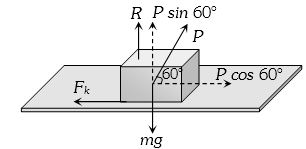
$A$ $60 \, kg$ mass is dragged on a horizontal surface by a rope for a distance of $2 \, m$. If the coefficient of friction is $\mu = 0.5$,the angle of the rope with the surface is $60^\circ$,and $g = 9.8 \, m/s^2$,then the work done against friction is ........ $J$.
A
$294$
B
$315$
C
$588$
D
$197$
Solution
(B) Let the body be dragged with a constant force $P$ at an angle of $60^\circ$ with the horizontal.
For the body to move at a constant velocity,the horizontal component of the applied force must balance the kinetic friction force $F_k$.
$F_k = \mu R$,where $R$ is the normal reaction.
From the free body diagram,the vertical forces are balanced: $R + P \sin 60^\circ = mg \implies R = mg - P \sin 60^\circ$.
The horizontal forces are balanced: $P \cos 60^\circ = F_k = \mu(mg - P \sin 60^\circ)$.
Substituting the values: $P \cos 60^\circ = 0.5(60 \times 9.8 - P \sin 60^\circ)$.
$P(0.5) = 0.5(588 - P \times 0.866)$.
$P = 588 - 0.866P \implies 1.866P = 588 \implies P \approx 315.11 \, N$.
The work done against friction is $W = F_k \times s = (P \cos 60^\circ) \times s$.
$W = (315.11 \times 0.5) \times 2 = 315.11 \, J$.
Rounding to the nearest integer,the work done is $315 \, J$.
For the body to move at a constant velocity,the horizontal component of the applied force must balance the kinetic friction force $F_k$.
$F_k = \mu R$,where $R$ is the normal reaction.
From the free body diagram,the vertical forces are balanced: $R + P \sin 60^\circ = mg \implies R = mg - P \sin 60^\circ$.
The horizontal forces are balanced: $P \cos 60^\circ = F_k = \mu(mg - P \sin 60^\circ)$.
Substituting the values: $P \cos 60^\circ = 0.5(60 \times 9.8 - P \sin 60^\circ)$.
$P(0.5) = 0.5(588 - P \times 0.866)$.
$P = 588 - 0.866P \implies 1.866P = 588 \implies P \approx 315.11 \, N$.
The work done against friction is $W = F_k \times s = (P \cos 60^\circ) \times s$.
$W = (315.11 \times 0.5) \times 2 = 315.11 \, J$.
Rounding to the nearest integer,the work done is $315 \, J$.
0 likes
View Solution20
MediumMCQ
$A$ car having a mass of $1000\, kg$ is moving at a speed of $30\, m/s$. Brakes are applied to bring the car to rest. If the frictional force between the tyres and the road surface is $5000\, N$,the car will come to rest in ........ $s$.
A
$5$
B
$10$
C
$12$
D
$6$
Solution
(D) Given: Mass of the car $m = 1000\, kg$,Initial velocity $u = 30\, m/s$,Final velocity $v = 0\, m/s$,Frictional force $F = 5000\, N$.
According to Newton's second law,the retardation $a$ is given by $a = \frac{F}{m} = \frac{5000\, N}{1000\, kg} = 5\, m/s^2$.
Using the first equation of motion,$v = u - at$,where $t$ is the time taken to stop.
Substituting the values: $0 = 30 - 5 \times t$.
$5t = 30$.
$t = \frac{30}{5} = 6\, s$.
Therefore,the car will come to rest in $6\, s$.
According to Newton's second law,the retardation $a$ is given by $a = \frac{F}{m} = \frac{5000\, N}{1000\, kg} = 5\, m/s^2$.
Using the first equation of motion,$v = u - at$,where $t$ is the time taken to stop.
Substituting the values: $0 = 30 - 5 \times t$.
$5t = 30$.
$t = \frac{30}{5} = 6\, s$.
Therefore,the car will come to rest in $6\, s$.
0 likes
View Solution21
DifficultMCQ
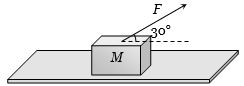
$A$ block of mass $M = 5\,kg$ is resting on a rough horizontal surface for which the coefficient of friction is $0.2$. When a force $F = 40\,N$ is applied at an angle of $30^\circ$ with the horizontal,the acceleration of the block will be ........ $m/s^2$ $(g = 10\,m/s^2)$.
A
$5.73$
B
$8.0$
C
$3.17$
D
$10.0$
Solution
(A) Given: Mass $M = 5\,kg$,coefficient of friction $\mu_k = 0.2$,applied force $F = 40\,N$,angle $\theta = 30^\circ$,and $g = 10\,m/s^2$.
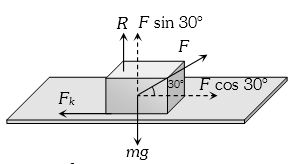
The normal reaction $R$ on the block is given by $R = Mg - F\sin 30^\circ$.
$R = (5 \times 10) - (40 \times \sin 30^\circ) = 50 - (40 \times 0.5) = 50 - 20 = 30\,N$.
The kinetic friction force $f_k$ is given by $f_k = \mu_k R$.
$f_k = 0.2 \times 30 = 6\,N$.
The net force acting on the block in the horizontal direction is $F_{net} = F\cos 30^\circ - f_k$.
$F_{net} = (40 \times \cos 30^\circ) - 6 = (40 \times \frac{\sqrt{3}}{2}) - 6 = 20\sqrt{3} - 6$.
Using $\sqrt{3} \approx 1.732$,$F_{net} = 20(1.732) - 6 = 34.64 - 6 = 28.64\,N$.
The acceleration $a$ of the block is $a = \frac{F_{net}}{M} = \frac{28.64}{5} = 5.728\,m/s^2 \approx 5.73\,m/s^2$.
The normal reaction $R$ on the block is given by $R = Mg - F\sin 30^\circ$.
$R = (5 \times 10) - (40 \times \sin 30^\circ) = 50 - (40 \times 0.5) = 50 - 20 = 30\,N$.
The kinetic friction force $f_k$ is given by $f_k = \mu_k R$.
$f_k = 0.2 \times 30 = 6\,N$.
The net force acting on the block in the horizontal direction is $F_{net} = F\cos 30^\circ - f_k$.
$F_{net} = (40 \times \cos 30^\circ) - 6 = (40 \times \frac{\sqrt{3}}{2}) - 6 = 20\sqrt{3} - 6$.
Using $\sqrt{3} \approx 1.732$,$F_{net} = 20(1.732) - 6 = 34.64 - 6 = 28.64\,N$.
The acceleration $a$ of the block is $a = \frac{F_{net}}{M} = \frac{28.64}{5} = 5.728\,m/s^2 \approx 5.73\,m/s^2$.
0 likes
View Solution22
MediumMCQ
$A$ body is moving along a rough horizontal surface with an initial velocity $6\,m/s$. If the body comes to rest after travelling $9\,m$,then the coefficient of sliding friction will be
A
$0.4$
B
$0.2$
C
$0.6$
D
$0.8$
Solution
(B) Given:
Initial velocity $u = 6\,m/s$
Final velocity $v = 0\,m/s$
Distance $s = 9\,m$
Acceleration due to gravity $g = 10\,m/s^2$
Using the work-energy theorem or equations of motion:
$v^2 = u^2 + 2as$
$0 = (6)^2 + 2a(9)$
$0 = 36 + 18a$
$a = -2\,m/s^2$
The retarding force is due to friction,so $F = ma = \mu mg$.
Thus,$\mu g = |a|$.
$\mu = \frac{|a|}{g} = \frac{2}{10} = 0.2$.
Alternatively,using the formula $s = \frac{u^2}{2\mu g}$:
$\mu = \frac{u^2}{2gs} = \frac{6^2}{2 \times 10 \times 9} = \frac{36}{180} = 0.2$.
Initial velocity $u = 6\,m/s$
Final velocity $v = 0\,m/s$
Distance $s = 9\,m$
Acceleration due to gravity $g = 10\,m/s^2$
Using the work-energy theorem or equations of motion:
$v^2 = u^2 + 2as$
$0 = (6)^2 + 2a(9)$
$0 = 36 + 18a$
$a = -2\,m/s^2$
The retarding force is due to friction,so $F = ma = \mu mg$.
Thus,$\mu g = |a|$.
$\mu = \frac{|a|}{g} = \frac{2}{10} = 0.2$.
Alternatively,using the formula $s = \frac{u^2}{2\mu g}$:
$\mu = \frac{u^2}{2gs} = \frac{6^2}{2 \times 10 \times 9} = \frac{36}{180} = 0.2$.
0 likes
View Solution23
MediumMCQ
Consider a car moving on a straight road with a speed of $100\, m/s$. The distance at which the car can be stopped is ........ $m$. $[\mu_k = 0.5, g = 10\, m/s^2]$
A
$100$
B
$400$
C
$800$
D
$1000$
Solution
(D) Given: Initial velocity $u = 100\, m/s$,Final velocity $v = 0\, m/s$,Coefficient of kinetic friction $\mu_k = 0.5$,Acceleration due to gravity $g = 10\, m/s^2$.
Using the work-energy theorem,the work done by the frictional force is equal to the change in kinetic energy:
$W = \Delta K$
$-f_k \cdot s = 0 - \frac{1}{2} m u^2$
$-(\mu_k m g) s = -\frac{1}{2} m u^2$
$s = \frac{u^2}{2 \mu_k g}$
Substituting the values:
$s = \frac{(100)^2}{2 \times 0.5 \times 10} = \frac{10000}{10} = 1000\, m$.
Using the work-energy theorem,the work done by the frictional force is equal to the change in kinetic energy:
$W = \Delta K$
$-f_k \cdot s = 0 - \frac{1}{2} m u^2$
$-(\mu_k m g) s = -\frac{1}{2} m u^2$
$s = \frac{u^2}{2 \mu_k g}$
Substituting the values:
$s = \frac{(100)^2}{2 \times 0.5 \times 10} = \frac{10000}{10} = 1000\, m$.
0 likes
View Solution24
MediumMCQ
$A$ cylinder of $10 \, kg$ is sliding on a plane with an initial velocity of $10 \, m/s$. If the coefficient of friction between the surface and the cylinder is $0.5$,then the distance it will cover before stopping is ........ $m$. $(g = 10 \, m/s^2)$
A
$2.5$
B
$5$
C
$7.5$
D
$10$
Solution
(D) According to the Work-Energy Theorem,the work done by the frictional force is equal to the change in kinetic energy of the cylinder.
$W = \Delta K$
$-f_k \cdot s = K_f - K_i$
Since the final velocity is $0$,the final kinetic energy $K_f = 0$.
$-\mu_k \cdot m \cdot g \cdot s = 0 - \frac{1}{2} m v^2$
$\mu_k \cdot m \cdot g \cdot s = \frac{1}{2} m v^2$
$s = \frac{v^2}{2 \mu_k g}$
Substituting the given values: $v = 10 \, m/s$,$\mu_k = 0.5$,and $g = 10 \, m/s^2$.
$s = \frac{(10)^2}{2 \times 0.5 \times 10} = \frac{100}{10} = 10 \, m$.
$W = \Delta K$
$-f_k \cdot s = K_f - K_i$
Since the final velocity is $0$,the final kinetic energy $K_f = 0$.
$-\mu_k \cdot m \cdot g \cdot s = 0 - \frac{1}{2} m v^2$
$\mu_k \cdot m \cdot g \cdot s = \frac{1}{2} m v^2$
$s = \frac{v^2}{2 \mu_k g}$
Substituting the given values: $v = 10 \, m/s$,$\mu_k = 0.5$,and $g = 10 \, m/s^2$.
$s = \frac{(10)^2}{2 \times 0.5 \times 10} = \frac{100}{10} = 10 \, m$.
0 likes
View Solution25
EasyMCQ
Which of the following is correct when a person walks on a rough surface?
A
The frictional force exerted by the surface keeps him moving.
B
The force which the man exerts on the floor keeps him moving.
C
The reaction of the force which the man exerts on the floor keeps him moving.
D
None of the above.
Solution
(C) According to Newton's $3^{rd}$ law of motion,when a person walks,they push the ground backward with their foot.
In response,the ground exerts an equal and opposite reaction force on the person.
The vertical component of this reaction force balances the person's weight,preventing vertical motion.
The horizontal component of this reaction force (which is the static friction force) acts in the forward direction and pushes the person forward.
Therefore,the reaction force exerted by the floor on the person is responsible for their forward motion.
Hence,option $C$ is correct.
In response,the ground exerts an equal and opposite reaction force on the person.
The vertical component of this reaction force balances the person's weight,preventing vertical motion.
The horizontal component of this reaction force (which is the static friction force) acts in the forward direction and pushes the person forward.
Therefore,the reaction force exerted by the floor on the person is responsible for their forward motion.
Hence,option $C$ is correct.
0 likes
View Solution26
DifficultMCQ
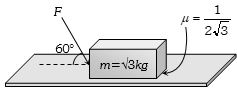
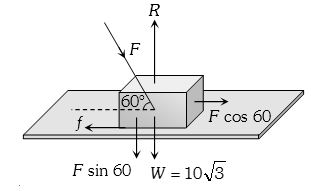
What is the maximum value of the force $F$ such that the block shown in the arrangement does not move (in $N$)? (Given $m = \sqrt{3} \ kg$,$\mu = \frac{1}{2\sqrt{3}}$,$g = 10 \ m/s^2$)
A
$20$
B
$10$
C
$12$
D
$15$
Solution
(A) The forces acting on the block are the applied force $F$ at an angle of $60^\circ$ with the horizontal,the weight $W = mg$,the normal reaction $R$,and the frictional force $f$.
Resolving the force $F$ into components:
Horizontal component: $F_x = F \cos 60^\circ$
Vertical component: $F_y = F \sin 60^\circ$
For vertical equilibrium:
$R = W + F \sin 60^\circ$
Given $m = \sqrt{3} \ kg$ and $g = 10 \ m/s^2$,$W = mg = 10\sqrt{3} \ N$.
So,$R = 10\sqrt{3} + F \sin 60^\circ = 10\sqrt{3} + F \frac{\sqrt{3}}{2}$.
For the block not to move,the horizontal component of the applied force must be less than or equal to the limiting friction:
$F \cos 60^\circ \leq \mu R$
$F \cos 60^\circ \leq \mu (W + F \sin 60^\circ)$
Substituting the values $\mu = \frac{1}{2\sqrt{3}}$,$\cos 60^\circ = \frac{1}{2}$,and $\sin 60^\circ = \frac{\sqrt{3}}{2}$:
$F \cdot \frac{1}{2} = \frac{1}{2\sqrt{3}} (10\sqrt{3} + F \cdot \frac{\sqrt{3}}{2})$
$F \cdot \frac{1}{2} = \frac{10\sqrt{3}}{2\sqrt{3}} + \frac{F \sqrt{3}}{4\sqrt{3}}$
$F \cdot \frac{1}{2} = 5 + \frac{F}{4}$
$F \cdot \frac{1}{2} - \frac{F}{4} = 5$
$\frac{F}{4} = 5$
$F = 20 \ N$.
Resolving the force $F$ into components:
Horizontal component: $F_x = F \cos 60^\circ$
Vertical component: $F_y = F \sin 60^\circ$
For vertical equilibrium:
$R = W + F \sin 60^\circ$
Given $m = \sqrt{3} \ kg$ and $g = 10 \ m/s^2$,$W = mg = 10\sqrt{3} \ N$.
So,$R = 10\sqrt{3} + F \sin 60^\circ = 10\sqrt{3} + F \frac{\sqrt{3}}{2}$.
For the block not to move,the horizontal component of the applied force must be less than or equal to the limiting friction:
$F \cos 60^\circ \leq \mu R$
$F \cos 60^\circ \leq \mu (W + F \sin 60^\circ)$
Substituting the values $\mu = \frac{1}{2\sqrt{3}}$,$\cos 60^\circ = \frac{1}{2}$,and $\sin 60^\circ = \frac{\sqrt{3}}{2}$:
$F \cdot \frac{1}{2} = \frac{1}{2\sqrt{3}} (10\sqrt{3} + F \cdot \frac{\sqrt{3}}{2})$
$F \cdot \frac{1}{2} = \frac{10\sqrt{3}}{2\sqrt{3}} + \frac{F \sqrt{3}}{4\sqrt{3}}$
$F \cdot \frac{1}{2} = 5 + \frac{F}{4}$
$F \cdot \frac{1}{2} - \frac{F}{4} = 5$
$\frac{F}{4} = 5$
$F = 20 \ N$.
0 likes
View Solution27
MediumMCQ
$A$ cylinder of mass $10\,kg$ is sliding on a plane with an initial velocity of $10\,m/s$. If the coefficient of friction between the surface and the cylinder is $0.5$,then before stopping,it will travel a distance of ............. $m$.
A
$12.5$
B
$5$
C
$7.5$
D
$10$
Solution
(D) Given: Mass $m = 10\,kg$,initial velocity $u = 10\,m/s$,final velocity $v = 0\,m/s$,coefficient of friction $\mu = 0.5$,and acceleration due to gravity $g = 10\,m/s^2$.
The frictional force acting on the cylinder is $f_k = \mu N = \mu mg$.
According to Newton's second law,the retardation $a$ is given by $a = \frac{f_k}{m} = \frac{\mu mg}{m} = \mu g$.
Substituting the values: $a = 0.5 \times 10 = 5\,m/s^2$.
Using the kinematic equation $v^2 = u^2 - 2as$:
$0^2 = (10)^2 - 2(5)s$
$0 = 100 - 10s$
$10s = 100$
$s = 10\,m$.
Therefore,the cylinder will travel $10\,m$ before stopping.
The frictional force acting on the cylinder is $f_k = \mu N = \mu mg$.
According to Newton's second law,the retardation $a$ is given by $a = \frac{f_k}{m} = \frac{\mu mg}{m} = \mu g$.
Substituting the values: $a = 0.5 \times 10 = 5\,m/s^2$.
Using the kinematic equation $v^2 = u^2 - 2as$:
$0^2 = (10)^2 - 2(5)s$
$0 = 100 - 10s$
$10s = 100$
$s = 10\,m$.
Therefore,the cylinder will travel $10\,m$ before stopping.
0 likes
View Solution28
EasyMCQ
When we rub our palms,they get heated,but only up to a maximum temperature because:
A
Heat is absorbed by our palms.
B
Heat is lost to the environment.
C
The production of heat stops.
D
None of the above.
Solution
(B) When we rub our palms,mechanical work is converted into heat energy due to friction.
As the temperature of the palms increases,it eventually exceeds the ambient temperature of the surroundings.
Once the palm temperature is higher than the surrounding temperature,heat starts flowing from the palms to the environment via conduction and convection.
When the rate of heat production due to rubbing equals the rate of heat loss to the surroundings,the palms reach a steady-state maximum temperature.
As the temperature of the palms increases,it eventually exceeds the ambient temperature of the surroundings.
Once the palm temperature is higher than the surrounding temperature,heat starts flowing from the palms to the environment via conduction and convection.
When the rate of heat production due to rubbing equals the rate of heat loss to the surroundings,the palms reach a steady-state maximum temperature.
0 likes
View Solution29
MediumMCQ
Calculate the stopping distance of a vehicle of mass $M$ moving with velocity $v$ on a straight road. (Where $\mu$ is the coefficient of friction between the tires and the road.)
A
$S = \frac{v}{2\mu g}$
B
$S = \frac{v^2}{\mu g}$
C
$S = \frac{v}{\mu g}$
D
$S = \frac{v^2}{2\mu g}$
Solution
(D) The kinetic energy of the vehicle moving with velocity $v$ is $K = \frac{1}{2} Mv^2$.
If $S$ is the stopping distance,the work done by the frictional force is $W = F_f S \cos(180^\circ) = -\mu MgS$.
According to the work-energy theorem,the work done is equal to the change in kinetic energy: $W = \Delta K = K_f - K_i$.
Substituting the values: $-\mu MgS = 0 - \frac{1}{2} Mv^2$.
Solving for $S$: $S = \frac{v^2}{2\mu g}$.
If $S$ is the stopping distance,the work done by the frictional force is $W = F_f S \cos(180^\circ) = -\mu MgS$.
According to the work-energy theorem,the work done is equal to the change in kinetic energy: $W = \Delta K = K_f - K_i$.
Substituting the values: $-\mu MgS = 0 - \frac{1}{2} Mv^2$.
Solving for $S$: $S = \frac{v^2}{2\mu g}$.
0 likes
View Solution30
DifficultMCQ
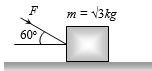
What is the maximum force $F$ (in $N$) that can be applied such that the block does not move? (Given $\mu = 1/(2\sqrt{3})$ and $m = \sqrt{3} \ kg$)
A
$20$
B
$10$
C
$12$
D
$15$
Solution
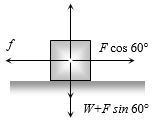
(A) For the block not to move,the applied horizontal force must be less than or equal to the limiting friction force.
The horizontal component of the applied force is $F_x = F \cos 60^{\circ} = F/2$.
The vertical forces acting on the block are the weight $W = mg = \sqrt{3}g$ (taking $g = 10 \ m/s^2$,$W = 10\sqrt{3} \ N$) and the vertical component of the applied force $F_y = F \sin 60^{\circ} = F\sqrt{3}/2$.
The normal reaction $R$ is $R = W + F \sin 60^{\circ} = 10\sqrt{3} + F\sqrt{3}/2$.
The limiting friction force is $f_L = \mu R = \frac{1}{2\sqrt{3}} (10\sqrt{3} + \frac{F\sqrt{3}}{2})$.
For the block to remain stationary,$F \cos 60^{\circ} \le f_L$.
Setting $F \cos 60^{\circ} = f_L$ to find the maximum force:
$\frac{F}{2} = \frac{1}{2\sqrt{3}} (10\sqrt{3} + \frac{F\sqrt{3}}{2})$
$\frac{F}{2} = \frac{10\sqrt{3}}{2\sqrt{3}} + \frac{F\sqrt{3}}{4\sqrt{3}}$
$\frac{F}{2} = 5 + \frac{F}{4}$
$\frac{F}{2} - \frac{F}{4} = 5$
$\frac{F}{4} = 5 \implies F = 20 \ N$.
The horizontal component of the applied force is $F_x = F \cos 60^{\circ} = F/2$.
The vertical forces acting on the block are the weight $W = mg = \sqrt{3}g$ (taking $g = 10 \ m/s^2$,$W = 10\sqrt{3} \ N$) and the vertical component of the applied force $F_y = F \sin 60^{\circ} = F\sqrt{3}/2$.
The normal reaction $R$ is $R = W + F \sin 60^{\circ} = 10\sqrt{3} + F\sqrt{3}/2$.
The limiting friction force is $f_L = \mu R = \frac{1}{2\sqrt{3}} (10\sqrt{3} + \frac{F\sqrt{3}}{2})$.
For the block to remain stationary,$F \cos 60^{\circ} \le f_L$.
Setting $F \cos 60^{\circ} = f_L$ to find the maximum force:
$\frac{F}{2} = \frac{1}{2\sqrt{3}} (10\sqrt{3} + \frac{F\sqrt{3}}{2})$
$\frac{F}{2} = \frac{10\sqrt{3}}{2\sqrt{3}} + \frac{F\sqrt{3}}{4\sqrt{3}}$
$\frac{F}{2} = 5 + \frac{F}{4}$
$\frac{F}{2} - \frac{F}{4} = 5$
$\frac{F}{4} = 5 \implies F = 20 \ N$.
0 likes
View Solution31
DifficultMCQ
The coefficients of static and kinetic friction for a block on a rough surface are $0.6$ and $0.4$ respectively. The minimum force required to set the block in motion is $64 \, N$. If this force continues to be applied after the block starts moving,what will be the acceleration of the block?
A
$\frac{g}{6.4}$
B
$0.64 \, g$
C
$\frac{g}{32}$
D
$0.2 \, g$
Solution
(D) The minimum force required to start motion is equal to the limiting static friction: $F_{lim} = \mu_s N = \mu_s mg$.
Given $F_{lim} = 64 \, N$ and $\mu_s = 0.6$,we have $64 = 0.6 \times m \times g$,which gives the mass $m = \frac{64}{0.6g}$.
Once the block is in motion,the kinetic friction acting on it is $f_k = \mu_k N = \mu_k mg$.
Substituting the values: $f_k = 0.4 \times m \times g = 0.4 \times \left( \frac{64}{0.6g} \right) \times g = 0.4 \times \frac{64}{0.6} = \frac{25.6}{0.6} = \frac{128}{3} \approx 42.67 \, N$.
The net force acting on the block is $F_{net} = F_{applied} - f_k = 64 - \frac{128}{3} = \frac{192 - 128}{3} = \frac{64}{3} \, N$.
The acceleration $a$ is given by $a = \frac{F_{net}}{m} = \frac{64/3}{64/(0.6g)} = \frac{64}{3} \times \frac{0.6g}{64} = \frac{0.6g}{3} = 0.2g$.
Given $F_{lim} = 64 \, N$ and $\mu_s = 0.6$,we have $64 = 0.6 \times m \times g$,which gives the mass $m = \frac{64}{0.6g}$.
Once the block is in motion,the kinetic friction acting on it is $f_k = \mu_k N = \mu_k mg$.
Substituting the values: $f_k = 0.4 \times m \times g = 0.4 \times \left( \frac{64}{0.6g} \right) \times g = 0.4 \times \frac{64}{0.6} = \frac{25.6}{0.6} = \frac{128}{3} \approx 42.67 \, N$.
The net force acting on the block is $F_{net} = F_{applied} - f_k = 64 - \frac{128}{3} = \frac{192 - 128}{3} = \frac{64}{3} \, N$.
The acceleration $a$ is given by $a = \frac{F_{net}}{m} = \frac{64/3}{64/(0.6g)} = \frac{64}{3} \times \frac{0.6g}{64} = \frac{0.6g}{3} = 0.2g$.
0 likes
View Solution32
DifficultMCQ
Find the work done against friction in $J$ when a block of mass $50\, kg$ moves a distance of $1\, m$ on a rough horizontal surface with a coefficient of friction of $0.2$.
A
$98$
B
$72$
C
$56$
D
$34$
Solution
(A) The force of friction $f_k$ is given by $f_k = \mu_k N = \mu_k mg$.
Given: $\mu_k = 0.2$,$m = 50\, kg$,$g = 9.8\, m/s^2$,and displacement $s = 1\, m$.
The work done against friction is $W = f_k \times s$.
$W = \mu_k mg s = 0.2 \times 50 \times 9.8 \times 1$.
$W = 10 \times 9.8 = 98\, J$.
Given: $\mu_k = 0.2$,$m = 50\, kg$,$g = 9.8\, m/s^2$,and displacement $s = 1\, m$.
The work done against friction is $W = f_k \times s$.
$W = \mu_k mg s = 0.2 \times 50 \times 9.8 \times 1$.
$W = 10 \times 9.8 = 98\, J$.
0 likes
View Solution33
MediumMCQ
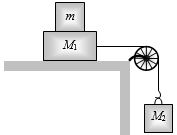
The coefficient of friction between the block of mass ${M_1}$ and the surface is $\mu$. When the system is released,it moves with acceleration. What mass $m$ should be placed on the block ${M_1}$ so that the system moves with a constant velocity?
A
$\frac{{{M_2 - M_1}}}{\mu }$
B
$\frac{{{M_2}}}{\mu } - {M_1}$
C
${M_2} - \frac{{{M_1}}}{\mu }$
D
$({M_2} - {M_1})\mu $
Solution
(B) For the system to move with a constant velocity,the net force on the system must be zero. This means the tension in the string must balance the frictional force on the block ${M_1}$ and the weight of the block ${M_2}$.
The frictional force $f$ acting on the combined mass $(M_1 + m)$ is given by $f = \mu N = \mu (M_1 + m)g$.
The tension $T$ in the string is equal to the weight of the hanging block,$T = M_2 g$.
For constant velocity,$T = f$,so:
$M_2 g = \mu (M_1 + m)g$
$M_2 = \mu (M_1 + m)$
$\frac{M_2}{\mu} = M_1 + m$
$m = \frac{M_2}{\mu} - M_1$
The frictional force $f$ acting on the combined mass $(M_1 + m)$ is given by $f = \mu N = \mu (M_1 + m)g$.
The tension $T$ in the string is equal to the weight of the hanging block,$T = M_2 g$.
For constant velocity,$T = f$,so:
$M_2 g = \mu (M_1 + m)g$
$M_2 = \mu (M_1 + m)$
$\frac{M_2}{\mu} = M_1 + m$
$m = \frac{M_2}{\mu} - M_1$
0 likes
View Solution34
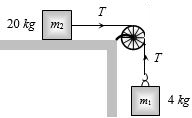
MediumMCQ
The coefficient of friction between the block and the surface is $0.03$. Find the acceleration of the system in $m/s^{2}$. $(g = 10\,m/s^{2})$
A
$1.8$
B
$0.8$
C
$1.4$
D
$0.4$
Solution
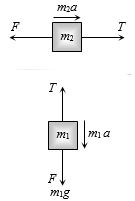
(C) Let the acceleration of the system be $a$ and the tension in the string be $T$.
For block $m_2$ $(20\,kg)$ on the horizontal surface:
The equation of motion is $T - F_f = m_2 a$,where $F_f = \mu m_2 g$.
$T - 0.03 \times 20 \times 10 = 20a$
$T - 6 = 20a$ ... $(i)$
For block $m_1$ $(4\,kg)$ hanging vertically:
The equation of motion is $m_1 g - T = m_1 a$.
$4 \times 10 - T = 4a$
$40 - T = 4a$ ... $(ii)$
Adding equations $(i)$ and $(ii)$:
$(T - 6) + (40 - T) = 20a + 4a$
$34 = 24a$
$a = \frac{34}{24} = \frac{17}{12} \approx 1.416\,m/s^{2}$.
Rounding to the nearest given option,the acceleration is $1.4\,m/s^{2}$.
For block $m_2$ $(20\,kg)$ on the horizontal surface:
The equation of motion is $T - F_f = m_2 a$,where $F_f = \mu m_2 g$.
$T - 0.03 \times 20 \times 10 = 20a$
$T - 6 = 20a$ ... $(i)$
For block $m_1$ $(4\,kg)$ hanging vertically:
The equation of motion is $m_1 g - T = m_1 a$.
$4 \times 10 - T = 4a$
$40 - T = 4a$ ... $(ii)$
Adding equations $(i)$ and $(ii)$:
$(T - 6) + (40 - T) = 20a + 4a$
$34 = 24a$
$a = \frac{34}{24} = \frac{17}{12} \approx 1.416\,m/s^{2}$.
Rounding to the nearest given option,the acceleration is $1.4\,m/s^{2}$.
0 likes
View Solution35
EasyMCQ
$A$ $2 \, kg$ block on ice is given a velocity of $6 \, m/s$. If it comes to rest in $10 \, s$,what is the coefficient of friction?
A
$0.01$
B
$0.02$
C
$0.03$
D
$0.06$
Solution
(D) Given: Mass $m = 2 \, kg$,initial velocity $u = 6 \, m/s$,final velocity $v = 0 \, m/s$,time $t = 10 \, s$,and acceleration due to gravity $g = 10 \, m/s^2$.
Using the first equation of motion: $v = u + at$.
Since the block is decelerating due to friction,$v = u - at$.
Here,the frictional force $f = \mu N = \mu mg$,so the deceleration $a = \frac{f}{m} = \mu g$.
Substituting the values: $0 = 6 - (\mu \times 10) \times 10$.
$100 \mu = 6$.
$\mu = \frac{6}{100} = 0.06$.
Using the first equation of motion: $v = u + at$.
Since the block is decelerating due to friction,$v = u - at$.
Here,the frictional force $f = \mu N = \mu mg$,so the deceleration $a = \frac{f}{m} = \mu g$.
Substituting the values: $0 = 6 - (\mu \times 10) \times 10$.
$100 \mu = 6$.
$\mu = \frac{6}{100} = 0.06$.
0 likes
View Solution36
DifficultMCQ
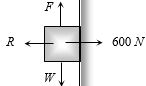
$A$ man of mass $60 \, kg$ slides down a pole by applying a force of $600 \, N$ on it. If the coefficient of friction between the hands and the pole is $0.5$,then the acceleration of the man is ............ $m/s^2$ $(g = 10 \, m/s^2)$.
A
$1$
B
$2.5$
C
$10$
D
$5$
Solution
(D) The normal force $N$ exerted by the man on the pole is $600 \, N$.
According to the third law of motion,the pole exerts an equal and opposite normal force $R = 600 \, N$ on the man.
The frictional force $f$ acting upwards on the man is given by $f = \mu R$,where $\mu = 0.5$.
$f = 0.5 \times 600 = 300 \, N$.
The weight of the man acting downwards is $W = mg = 60 \times 10 = 600 \, N$.
Applying Newton's second law in the downward direction: $W - f = ma$.
$600 - 300 = 60 \times a$.
$300 = 60a$.
$a = \frac{300}{60} = 5 \, m/s^2$.
According to the third law of motion,the pole exerts an equal and opposite normal force $R = 600 \, N$ on the man.
The frictional force $f$ acting upwards on the man is given by $f = \mu R$,where $\mu = 0.5$.
$f = 0.5 \times 600 = 300 \, N$.
The weight of the man acting downwards is $W = mg = 60 \times 10 = 600 \, N$.
Applying Newton's second law in the downward direction: $W - f = ma$.
$600 - 300 = 60 \times a$.
$300 = 60a$.
$a = \frac{300}{60} = 5 \, m/s^2$.
0 likes
View Solution37
MediumMCQ
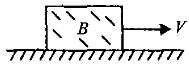
$A$ block $B$ is pushed momentarily along a horizontal surface with an initial velocity $V$. If $\mu$ is the coefficient of sliding friction between $B$ and the surface,the block $B$ will come to rest after a time:
A
$\frac{g\mu}{V}$
B
$\frac{g}{V}$
C
$\frac{V}{g}$
D
$\frac{V}{\mu g}$
Solution
(D) Given: Initial velocity $u = V$,final velocity $v = 0$.
The force of kinetic friction acting on the block is $f = \mu R = \mu mg$,where $m$ is the mass of the block and $g$ is the acceleration due to gravity.
According to Newton's second law,the retardation $a$ produced by this friction is:
$a = \frac{f}{m} = \frac{\mu mg}{m} = \mu g$.
Using the first equation of motion,$v = u - at$ (where $a$ is retardation):
$0 = V - (\mu g)t$
$V = \mu gt$
$t = \frac{V}{\mu g}$.
The force of kinetic friction acting on the block is $f = \mu R = \mu mg$,where $m$ is the mass of the block and $g$ is the acceleration due to gravity.
According to Newton's second law,the retardation $a$ produced by this friction is:
$a = \frac{f}{m} = \frac{\mu mg}{m} = \mu g$.
Using the first equation of motion,$v = u - at$ (where $a$ is retardation):
$0 = V - (\mu g)t$
$V = \mu gt$
$t = \frac{V}{\mu g}$.
0 likes
View Solution38
MediumMCQ
$A$ conveyor belt is moving at a constant speed of $2\, m s^{-1}$. $A$ box is gently dropped on it. The coefficient of friction between them is $\mu = 0.5$. The distance that the box will move relative to the belt before coming to rest on it,taking $g = 10\, m s^{-2}$,is ........... $m$.
A
$0.4$
B
$1.2$
C
$0.6$
D
$0.8$
Solution
(A) The box is dropped on the moving belt. Initially,the box is at rest relative to the ground,but the belt is moving at $v = 2\, m s^{-1}$.
Relative to the belt,the box has an initial velocity $u_{rel} = 2\, m s^{-1}$.
The kinetic friction force acting on the box is $f = \mu N = \mu mg$.
The acceleration of the box relative to the belt is $a = \frac{f}{m} = \mu g = 0.5 \times 10 = 5\, m s^{-2}$.
Since the friction force opposes the relative motion,the box will decelerate relative to the belt until its velocity relative to the belt becomes zero.
Using the equation of motion $v_{rel}^2 = u_{rel}^2 - 2as$,where $v_{rel} = 0$:
$0^2 = 2^2 - 2(5)s$
$10s = 4$
$s = 0.4\, m$.
Relative to the belt,the box has an initial velocity $u_{rel} = 2\, m s^{-1}$.
The kinetic friction force acting on the box is $f = \mu N = \mu mg$.
The acceleration of the box relative to the belt is $a = \frac{f}{m} = \mu g = 0.5 \times 10 = 5\, m s^{-2}$.
Since the friction force opposes the relative motion,the box will decelerate relative to the belt until its velocity relative to the belt becomes zero.
Using the equation of motion $v_{rel}^2 = u_{rel}^2 - 2as$,where $v_{rel} = 0$:
$0^2 = 2^2 - 2(5)s$
$10s = 4$
$s = 0.4\, m$.
0 likes
View Solution39
MediumMCQ
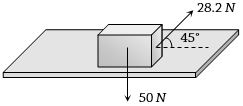
$A$ body of weight $50 \,N$ placed on a horizontal surface is just moved by a force of $28.2 \,N$ applied at an angle of $45^\circ$ with the horizontal. The frictional force and the normal reaction are
A
$10 \,N, 15 \,N$
B
$20 \,N, 30 \,N$
C
$2 \,N, 3 \,N$
D
$5 \,N, 6 \,N$
Solution
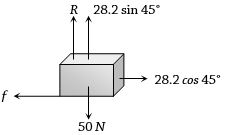
(B) To find the frictional force and normal reaction,we resolve the applied force $F = 28.2 \,N$ into its horizontal and vertical components.
Horizontal component: $F_x = F \cos 45^\circ = 28.2 \times \frac{1}{\sqrt{2}} = 28.2 \times 0.707 \approx 20 \,N$.
Since the body is just moved,the frictional force $f$ is equal to the horizontal component of the applied force: $f = 20 \,N$.
Vertical component: $F_y = F \sin 45^\circ = 28.2 \times \frac{1}{\sqrt{2}} = 28.2 \times 0.707 \approx 20 \,N$.
The normal reaction $R$ is given by the balance of vertical forces: $R + F_y = W$,where $W = 50 \,N$ is the weight of the body.
$R = W - F_y = 50 \,N - 20 \,N = 30 \,N$.
Thus,the frictional force is $20 \,N$ and the normal reaction is $30 \,N$.
Horizontal component: $F_x = F \cos 45^\circ = 28.2 \times \frac{1}{\sqrt{2}} = 28.2 \times 0.707 \approx 20 \,N$.
Since the body is just moved,the frictional force $f$ is equal to the horizontal component of the applied force: $f = 20 \,N$.
Vertical component: $F_y = F \sin 45^\circ = 28.2 \times \frac{1}{\sqrt{2}} = 28.2 \times 0.707 \approx 20 \,N$.
The normal reaction $R$ is given by the balance of vertical forces: $R + F_y = W$,where $W = 50 \,N$ is the weight of the body.
$R = W - F_y = 50 \,N - 20 \,N = 30 \,N$.
Thus,the frictional force is $20 \,N$ and the normal reaction is $30 \,N$.
0 likes
View Solution40
MediumMCQ
$A$ stone weighing $1$ kg and sliding on ice with a velocity of $2$ m/s is stopped by friction in $10$ sec. The force of friction (assuming it to be constant) will be ......... $N$.
A
$ - 20$
B
$ - 0.2$
C
$0.2$
D
$20$
Solution
(B) Given: Mass $m = 1$ kg,Initial velocity $u = 2$ m/s,Final velocity $v = 0$ m/s,Time $t = 10$ s.
Using the first equation of motion,$v = u + at$,we find the acceleration $a$:
$0 = 2 + a(10)$
$10a = -2$
$a = -0.2$ m/s$^2$.
According to Newton's second law,the force of friction $F$ is given by $F = ma$:
$F = 1 \times (-0.2) = -0.2$ $N$.
The negative sign indicates that the friction force acts in the direction opposite to the motion.
Using the first equation of motion,$v = u + at$,we find the acceleration $a$:
$0 = 2 + a(10)$
$10a = -2$
$a = -0.2$ m/s$^2$.
According to Newton's second law,the force of friction $F$ is given by $F = ma$:
$F = 1 \times (-0.2) = -0.2$ $N$.
The negative sign indicates that the friction force acts in the direction opposite to the motion.
0 likes
View Solution41
EasyMCQ
$A$ lift is moving downwards with an acceleration equal to acceleration due to gravity. $A$ body of mass $M$ kept on the floor of the lift is pulled horizontally. If the coefficient of friction is $\mu$,what is the frictional resistance offered by the body when the lift is moving upwards with a uniform velocity?
A
$Mg$
B
$\mu Mg$
C
$2\mu Mg$
D
Zero
Solution
(B) When the lift moves upwards with a uniform velocity,its acceleration $a = 0$.
According to Newton's second law,the normal reaction $R$ on the body of mass $M$ is equal to the weight of the body.
$R = Mg$
The frictional resistance $F$ is given by the formula $F = \mu R$.
Substituting the value of $R$,we get $F = \mu Mg$.
According to Newton's second law,the normal reaction $R$ on the body of mass $M$ is equal to the weight of the body.
$R = Mg$
The frictional resistance $F$ is given by the formula $F = \mu R$.
Substituting the value of $R$,we get $F = \mu Mg$.
0 likes
View Solution42
EasyMCQ
$A$ body of mass $2$ kg is moving on the ground and comes to rest after some time. The coefficient of kinetic friction between the body and the ground is $0.2$. The retardation in the body is ...... $m/s^2$.
A
$9.8$
B
$4.73$
C
$2.16$
D
$1.96$
Solution
(D) The force of kinetic friction $f_k$ acting on the body is given by $f_k = \mu_k N$,where $\mu_k$ is the coefficient of kinetic friction and $N$ is the normal force.
Since the body is moving on a horizontal ground,the normal force $N = mg$.
Therefore,$f_k = \mu_k mg$.
According to Newton's second law,the frictional force causes a retardation $a$ such that $f_k = ma$.
Equating the two expressions for $f_k$: $ma = \mu_k mg$.
This simplifies to $a = \mu_k g$.
Given $\mu_k = 0.2$ and taking $g = 9.8\;m/s^2$,we get $a = 0.2 \times 9.8 = 1.96\;m/s^2$.
Since the body is moving on a horizontal ground,the normal force $N = mg$.
Therefore,$f_k = \mu_k mg$.
According to Newton's second law,the frictional force causes a retardation $a$ such that $f_k = ma$.
Equating the two expressions for $f_k$: $ma = \mu_k mg$.
This simplifies to $a = \mu_k g$.
Given $\mu_k = 0.2$ and taking $g = 9.8\;m/s^2$,we get $a = 0.2 \times 9.8 = 1.96\;m/s^2$.
0 likes
View Solution43
EasyMCQ
$A$ block of mass $5 \, kg$ lies on a rough horizontal table. $A$ force of $19.6 \, N$ is enough to keep the body sliding at uniform velocity. The coefficient of sliding friction is
A
$0.5$
B
$0.2$
C
$0.4$
D
$0.8$
Solution
(C) Given: Mass $m = 5 \, kg$,Force $F = 19.6 \, N$,Acceleration due to gravity $g = 9.8 \, m/s^2$.
Since the body is sliding at a uniform velocity,the net force on it is zero.
This means the applied force $F$ is equal to the kinetic frictional force $f_k$.
$f_k = F = 19.6 \, N$.
The normal reaction $R$ on the horizontal surface is $R = mg = 5 \times 9.8 = 49 \, N$.
The coefficient of sliding friction $\mu_k$ is given by the formula $\mu_k = \frac{f_k}{R}$.
Substituting the values: $\mu_k = \frac{19.6}{49} = 0.4$.
Since the body is sliding at a uniform velocity,the net force on it is zero.
This means the applied force $F$ is equal to the kinetic frictional force $f_k$.
$f_k = F = 19.6 \, N$.
The normal reaction $R$ on the horizontal surface is $R = mg = 5 \times 9.8 = 49 \, N$.
The coefficient of sliding friction $\mu_k$ is given by the formula $\mu_k = \frac{f_k}{R}$.
Substituting the values: $\mu_k = \frac{19.6}{49} = 0.4$.
0 likes
View Solution44
MediumMCQ
$A$ block is thrown with a velocity of $2 \, m/s$ (relative to the ground) on a belt,which is moving with a velocity of $4 \, m/s$ in the opposite direction of the initial velocity of the block. If the block stops slipping on the belt after $4 \, s$ of throwing,then choose the correct statement$(s)$:
A
Displacement with respect to the ground is zero in $8/3 \, s$.
B
Magnitude of displacement with respect to the ground in $4 \, s$ is $4 \, m$.
C
Magnitude of displacement with respect to the belt in $4 \, s$ is $12 \, m$.
D
All of the above.
Solution
(D) Let the belt move towards the left with $v_b = -4 \, m/s$ and the block be thrown towards the right with $v_{block,g} = 2 \, m/s$.
Relative velocity of the block with respect to the belt is $v_{block,b} = v_{block,g} - v_b = 2 - (-4) = 6 \, m/s$.
The block stops slipping on the belt after $t = 4 \, s$,meaning its final velocity relative to the belt is $v_f = 0$.
Using $v_f = u + at$,we get $0 = 6 + a(4)$,so $a = -1.5 \, m/s^2$ (relative to the belt).
Displacement relative to the belt: $S_b = u_{rel}t + 0.5at^2 = 6(4) + 0.5(-1.5)(4^2) = 24 - 12 = 12 \, m$.
Displacement of the belt relative to the ground: $S_{belt,g} = v_b \times t = -4 \times 4 = -16 \, m$.
Displacement of the block relative to the ground: $S_{block,g} = S_b + S_{belt,g} = 12 - 16 = -4 \, m$. The magnitude is $4 \, m$.
For displacement relative to the ground to be zero: $S_{block,g}(t) = (v_{block,g})t + 0.5a_g t^2 = 0$. Since $a_g = a = -1.5 \, m/s^2$,$2t - 0.75t^2 = 0 \Rightarrow t(2 - 0.75t) = 0 \Rightarrow t = 2/0.75 = 8/3 \, s$.
Relative velocity of the block with respect to the belt is $v_{block,b} = v_{block,g} - v_b = 2 - (-4) = 6 \, m/s$.
The block stops slipping on the belt after $t = 4 \, s$,meaning its final velocity relative to the belt is $v_f = 0$.
Using $v_f = u + at$,we get $0 = 6 + a(4)$,so $a = -1.5 \, m/s^2$ (relative to the belt).
Displacement relative to the belt: $S_b = u_{rel}t + 0.5at^2 = 6(4) + 0.5(-1.5)(4^2) = 24 - 12 = 12 \, m$.
Displacement of the belt relative to the ground: $S_{belt,g} = v_b \times t = -4 \times 4 = -16 \, m$.
Displacement of the block relative to the ground: $S_{block,g} = S_b + S_{belt,g} = 12 - 16 = -4 \, m$. The magnitude is $4 \, m$.
For displacement relative to the ground to be zero: $S_{block,g}(t) = (v_{block,g})t + 0.5a_g t^2 = 0$. Since $a_g = a = -1.5 \, m/s^2$,$2t - 0.75t^2 = 0 \Rightarrow t(2 - 0.75t) = 0 \Rightarrow t = 2/0.75 = 8/3 \, s$.
0 likes
View Solution45
DifficultMCQ
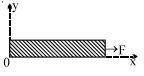
$A$ uniform rod of length $L$ and mass $M$ is placed on a rough horizontal surface. $A$ horizontal force $F$ is applied at one end of the rod such that the rod is just in the state of rest. The coefficient of friction varies according to the relation $\mu = Kx$,where $K$ is a positive constant and $x$ is the distance from the end where the force is not applied. Find the tension at the midpoint of the rod.
A
$F/2$
B
$F/4$
C
$F/8$
D
None
Solution
(B) Let the rod extend from $x = 0$ to $x = L$. The force $F$ is applied at $x = L$. The friction force on an element $dx$ at position $x$ is $df = \mu(x) \cdot dm \cdot g = (Kx) \cdot (M/L) dx \cdot g$.
The total friction force $F$ required to keep the rod in equilibrium is the integral of $df$ from $0$ to $L$:
$F = \int_{0}^{L} \frac{MgK}{L} x dx = \frac{MgK}{L} \left[ \frac{x^2}{2} \right]_{0}^{L} = \frac{MgKL}{2}$.
Thus,$K = \frac{2F}{MgL}$.
Now,consider the tension $T$ at the midpoint $x = L/2$. The tension $T$ must balance the total friction force acting on the segment from $x = 0$ to $x = L/2$:
$T = \int_{0}^{L/2} \frac{MgK}{L} x dx = \frac{MgK}{L} \left[ \frac{x^2}{2} \right]_{0}^{L/2} = \frac{MgK}{L} \cdot \frac{L^2}{8} = \frac{MgKL}{8}$.
Substituting $K = \frac{2F}{MgL}$ into the expression for $T$:
$T = \frac{MgL}{8} \cdot \left( \frac{2F}{MgL} \right) = \frac{2F}{8} = \frac{F}{4}$.
The total friction force $F$ required to keep the rod in equilibrium is the integral of $df$ from $0$ to $L$:
$F = \int_{0}^{L} \frac{MgK}{L} x dx = \frac{MgK}{L} \left[ \frac{x^2}{2} \right]_{0}^{L} = \frac{MgKL}{2}$.
Thus,$K = \frac{2F}{MgL}$.
Now,consider the tension $T$ at the midpoint $x = L/2$. The tension $T$ must balance the total friction force acting on the segment from $x = 0$ to $x = L/2$:
$T = \int_{0}^{L/2} \frac{MgK}{L} x dx = \frac{MgK}{L} \left[ \frac{x^2}{2} \right]_{0}^{L/2} = \frac{MgK}{L} \cdot \frac{L^2}{8} = \frac{MgKL}{8}$.
Substituting $K = \frac{2F}{MgL}$ into the expression for $T$:
$T = \frac{MgL}{8} \cdot \left( \frac{2F}{MgL} \right) = \frac{2F}{8} = \frac{F}{4}$.
1 likes
View Solution46
MediumMCQ
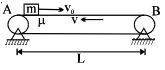
With what minimum velocity should a block be projected from the left end $A$ towards end $B$ such that it reaches the other end $B$ of a conveyor belt moving with a constant velocity $v$ towards the left? The length of the belt is $L$ and the coefficient of friction between the block and the belt is $\mu$.
A
$\sqrt{\mu gL}$
B
$\sqrt{2\mu gL}$
C
$\sqrt{3\mu gL}$
D
$2\sqrt{\mu gL}$
Solution
(B) The block is projected with velocity $v_0$ towards the right. The conveyor belt is moving towards the left with velocity $v$. The friction force acts on the block towards the left,providing a retardation $a = \mu g$.
For the block to just reach the end $B$,its velocity relative to the belt must become zero exactly at point $B$.
Let $v_{rel}$ be the initial velocity of the block relative to the belt. Since the belt moves to the left with $v$,the velocity of the block relative to the belt is $v_{rel} = v_0 + v$ (towards the right).
The retardation of the block relative to the belt is $a = \mu g$.
Using the equation of motion $v_f^2 = u^2 - 2as$,where $v_f = 0$,$u = v_0 + v$,and $s = L$:
$0 = (v_0 + v)^2 - 2(\mu g)L$
$(v_0 + v)^2 = 2\mu gL$
$v_0 + v = \sqrt{2\mu gL}$
$v_0 = \sqrt{2\mu gL} - v$
If the belt were stationary $(v=0)$,the minimum velocity would be $\sqrt{2\mu gL}$. Given the options provided,the question implies the case where the belt velocity $v$ is negligible or the relative velocity condition is simplified to the standard work-energy theorem application for a stationary surface.
For the block to just reach the end $B$,its velocity relative to the belt must become zero exactly at point $B$.
Let $v_{rel}$ be the initial velocity of the block relative to the belt. Since the belt moves to the left with $v$,the velocity of the block relative to the belt is $v_{rel} = v_0 + v$ (towards the right).
The retardation of the block relative to the belt is $a = \mu g$.
Using the equation of motion $v_f^2 = u^2 - 2as$,where $v_f = 0$,$u = v_0 + v$,and $s = L$:
$0 = (v_0 + v)^2 - 2(\mu g)L$
$(v_0 + v)^2 = 2\mu gL$
$v_0 + v = \sqrt{2\mu gL}$
$v_0 = \sqrt{2\mu gL} - v$
If the belt were stationary $(v=0)$,the minimum velocity would be $\sqrt{2\mu gL}$. Given the options provided,the question implies the case where the belt velocity $v$ is negligible or the relative velocity condition is simplified to the standard work-energy theorem application for a stationary surface.
0 likes
View Solution47
DifficultMCQ
$A$ small block of mass $m$ is projected horizontally with speed $u$. The coefficient of friction between the block and the plane is given by $\mu = cx$,where $x$ is the displacement of the block on the plane. Find the maximum distance covered by the block.
A
$\frac{u}{\sqrt{cg}}$
B
$\frac{u}{\sqrt{2cg}}$
C
$\frac{2u}{\sqrt{cg}}$
D
$\frac{u}{2\sqrt{cg}}$
Solution
(A) The normal force acting on the block is $N = mg$.
The frictional force is $f = \mu N = (cx)mg$.
Using Newton's second law,the retardation $a$ is given by $a = \frac{f}{m} = \frac{(cx)mg}{m} = cgx$.
Since the block is decelerating,$a = v \frac{dv}{dx} = -cgx$.
Separating the variables and integrating from the initial velocity $u$ to final velocity $0$ over the distance $x$:
$\int_{u}^{0} v \, dv = \int_{0}^{x} -cgx \, dx$
$\left[ \frac{v^2}{2} \right]_{u}^{0} = -cg \left[ \frac{x^2}{2} \right]_{0}^{x}$
$0 - \frac{u^2}{2} = -cg \frac{x^2}{2}$
$\frac{u^2}{2} = \frac{cgx^2}{2}$
$x^2 = \frac{u^2}{cg}$
$x = \frac{u}{\sqrt{cg}}$
The frictional force is $f = \mu N = (cx)mg$.
Using Newton's second law,the retardation $a$ is given by $a = \frac{f}{m} = \frac{(cx)mg}{m} = cgx$.
Since the block is decelerating,$a = v \frac{dv}{dx} = -cgx$.
Separating the variables and integrating from the initial velocity $u$ to final velocity $0$ over the distance $x$:
$\int_{u}^{0} v \, dv = \int_{0}^{x} -cgx \, dx$
$\left[ \frac{v^2}{2} \right]_{u}^{0} = -cg \left[ \frac{x^2}{2} \right]_{0}^{x}$
$0 - \frac{u^2}{2} = -cg \frac{x^2}{2}$
$\frac{u^2}{2} = \frac{cgx^2}{2}$
$x^2 = \frac{u^2}{cg}$
$x = \frac{u}{\sqrt{cg}}$
0 likes
View Solution48
MediumMCQ
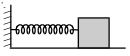
$A$ spring-block system is placed on a rough horizontal floor. The block is pulled towards the right to give the spring some elongation and then released. The block will have maximum velocity when:
A
the spring force becomes zero
B
the acceleration of the block becomes zero
C
the net force becomes zero
D
Both $(b)$ and $(c)$
Solution
(D) According to Newton's second law,the net force acting on the block is given by $F_{net} = ma$,where $m$ is the mass of the block and $a$ is its acceleration.
Velocity is maximum when the acceleration of the object is zero,which implies that the net force acting on the object is also zero.
In this system,the forces acting on the block are the spring force and the kinetic friction force. The block reaches its maximum velocity at the point where the spring force is exactly balanced by the frictional force,resulting in a net force of zero and consequently zero acceleration.
Velocity is maximum when the acceleration of the object is zero,which implies that the net force acting on the object is also zero.
In this system,the forces acting on the block are the spring force and the kinetic friction force. The block reaches its maximum velocity at the point where the spring force is exactly balanced by the frictional force,resulting in a net force of zero and consequently zero acceleration.
0 likes
View Solution49
MediumMCQ
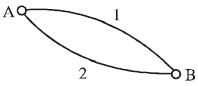
$A$ small body slips,subject to the force of friction,from point $A$ to point $B$ along two curved surfaces of equal radius,first along route $1$,then along route $2$. Friction does not depend on the speed and the coefficient of friction on both routes is the same. In which case will the body's speed at $B$ be greater?
A
speed is greater in case $1$
B
speed is greater in case $2$
C
speed is same in both cases
D
cannot be determined
Solution
(A) The work done by friction is given by $W_f = -\int \mu N \, ds$.
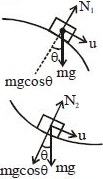
For route $1$,the surface is convex,so the normal force $N_1 = mg \cos \theta - \frac{mv^2}{r}$.
For route $2$,the surface is concave,so the normal force $N_2 = mg \cos \theta + \frac{mv^2}{r}$.
Since $N_2 > N_1$,the frictional force $f = \mu N$ is greater on route $2$ than on route $1$.
As the work done against friction is greater on route $2$,more mechanical energy is dissipated as heat on route $2$.
Therefore,the final kinetic energy and speed at point $B$ will be greater for route $1$.
For route $1$,the surface is convex,so the normal force $N_1 = mg \cos \theta - \frac{mv^2}{r}$.
For route $2$,the surface is concave,so the normal force $N_2 = mg \cos \theta + \frac{mv^2}{r}$.
Since $N_2 > N_1$,the frictional force $f = \mu N$ is greater on route $2$ than on route $1$.
As the work done against friction is greater on route $2$,more mechanical energy is dissipated as heat on route $2$.
Therefore,the final kinetic energy and speed at point $B$ will be greater for route $1$.
0 likes
View Solution50
DifficultMCQ
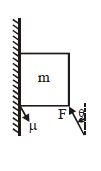
$A$ block of mass $m$ (initially at rest) is sliding up a rough vertical wall with the help of a force $F$ whose magnitude is constant but direction is changing. $\theta = {\theta _0}t$,where $t$ is time in seconds. At $t = 0$,the force is in the vertical upward direction,and as time passes,its direction changes until $\theta = \frac{\pi }{2}$. The value of $F$ such that the block comes to rest when $\theta = \frac{\pi }{2}$ is:
A
$\frac{{mg \times \pi }}{{2{\theta _o}}}$
B
$\frac{{mg \times \pi }}{{2\left( {1 - \mu } \right){\theta _o}}}$
C
$\frac{{mg \times \pi }}{{\left( {1 - \mu } \right)}}$
D
$\frac{{mg \times \pi }}{{2\left( {1 - \mu } \right)}}$
Solution
(D) The forces acting on the block along the vertical direction are the vertical component of the applied force $F \cos \theta$,the gravitational force $mg$,and the kinetic friction force $f_k = \mu N$. Since the force $F$ acts at an angle $\theta$ with the vertical,the normal force $N = F \sin \theta$.
The net force in the vertical direction is $F_{\text{net}} = F \cos \theta - mg - \mu F \sin \theta = m \frac{dv}{dt}$.
Integrating the equation of motion from $t=0$ to $t_0$ (where $\theta = \theta_0 t_0 = \frac{\pi}{2}$):
$\int_{0}^{v_f} m dv = \int_{0}^{t_0} (F \cos(\theta_0 t) - mg - \mu F \sin(\theta_0 t)) dt$.
Since the block starts from rest and comes to rest at $t_0$,the change in velocity is zero:
$0 = \int_{0}^{\pi/2} (F \cos \theta - mg - \mu F \sin \theta) \frac{d\theta}{\theta_0}$.
$0 = \frac{F}{\theta_0} [\sin \theta]_0^{\pi/2} - \frac{mg}{\theta_0} [\theta]_0^{\pi/2} - \frac{\mu F}{\theta_0} [-\cos \theta]_0^{\pi/2}$.
$0 = \frac{F}{\theta_0} (1) - \frac{mg}{\theta_0} (\frac{\pi}{2}) - \frac{\mu F}{\theta_0} (0 - (-1))$.
$0 = F - mg \frac{\pi}{2} - \mu F$.
$F(1 - \mu) = \frac{mg \pi}{2}$.
$F = \frac{mg \pi}{2(1 - \mu)}$.
The net force in the vertical direction is $F_{\text{net}} = F \cos \theta - mg - \mu F \sin \theta = m \frac{dv}{dt}$.
Integrating the equation of motion from $t=0$ to $t_0$ (where $\theta = \theta_0 t_0 = \frac{\pi}{2}$):
$\int_{0}^{v_f} m dv = \int_{0}^{t_0} (F \cos(\theta_0 t) - mg - \mu F \sin(\theta_0 t)) dt$.
Since the block starts from rest and comes to rest at $t_0$,the change in velocity is zero:
$0 = \int_{0}^{\pi/2} (F \cos \theta - mg - \mu F \sin \theta) \frac{d\theta}{\theta_0}$.
$0 = \frac{F}{\theta_0} [\sin \theta]_0^{\pi/2} - \frac{mg}{\theta_0} [\theta]_0^{\pi/2} - \frac{\mu F}{\theta_0} [-\cos \theta]_0^{\pi/2}$.
$0 = \frac{F}{\theta_0} (1) - \frac{mg}{\theta_0} (\frac{\pi}{2}) - \frac{\mu F}{\theta_0} (0 - (-1))$.
$0 = F - mg \frac{\pi}{2} - \mu F$.
$F(1 - \mu) = \frac{mg \pi}{2}$.
$F = \frac{mg \pi}{2(1 - \mu)}$.
0 likes
View SolutionNewton's Laws of Motion and Friction — Kinetic Friction and Motion on Rough Horizontal Surface · Frequently Asked Questions
1Are these Newton's Laws of Motion and Friction questions useful for JEE and NEET?
Yes. All questions in this section are mapped to JEE Main and NEET exam patterns. Previous year questions from JEE Main, NEET, GUJCET and state-level exams are included with full solutions.
2Can I switch to Hindi or Gujarati for these questions?
Yes. Use the language tabs in the hero section or the sidebar to view the same questions and solutions in English, Hindi or Gujarati.
3How do I generate a question paper from this subtopic?
Use the Vedclass Exam Paper Generator — select the chapter and subtopic, set difficulty, and generate Sets A, B, C, D automatically. First 3 chapters of every subject are free.
Vedclass Products
For Students
Vedclass Test Series
Mock tests in real JEE/NEET style with performance analysis. 5-day free trial.
Start Free TrialFor Teachers
Exam Paper Generator
Generate Set A/B/C/D papers from this chapter in 2 minutes. 3 chapters free.
Try FreeFor Institutes
Online Exam Module
Live online exams with unlimited students, 360° analytics & white-label branding.
See DemoFor Teachers & Institutes
Generate a Newton's Laws of Motion and Friction Exam Paper in 2 Minutes
Select subtopic & difficulty — Sets A, B, C, D auto-generated with No Repeat logic.
First 3 chapters of every subject are free — no payment required.