
A English
Third Law of Motion and Momentum and Impulse Questions in English
Class 11 Physics · Newton's Laws of Motion and Friction · Third Law of Motion and Momentum and Impulse
208+
Questions
English
Language
100%
With Solutions
Showing 50 of 208 questions in English
1
MediumMCQ
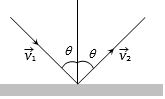
An object of mass $m \, kg$ with speed $v \, m/s$ strikes a wall at an angle $\theta$ with the normal and rebounds at the same speed and same angle. The magnitude of the change in momentum of the object will be
A
$2m v \cos \theta$
B
$2m v \sin \theta$
C
$0$
D
$2m v$
Solution
(A) Let the normal to the wall be along the $y$-axis and the wall be along the $x$-axis.
The initial velocity is $\vec{v}_1 = v \sin \theta \hat{i} - v \cos \theta \hat{j}$.
The final velocity is $\vec{v}_2 = v \sin \theta \hat{i} + v \cos \theta \hat{j}$.
The initial momentum is $\vec{P}_1 = m\vec{v}_1 = m v \sin \theta \hat{i} - m v \cos \theta \hat{j}$.
The final momentum is $\vec{P}_2 = m\vec{v}_2 = m v \sin \theta \hat{i} + m v \cos \theta \hat{j}$.
The change in momentum is $\Delta \vec{P} = \vec{P}_2 - \vec{P}_1$.
$\Delta \vec{P} = (m v \sin \theta \hat{i} + m v \cos \theta \hat{j}) - (m v \sin \theta \hat{i} - m v \cos \theta \hat{j}) = 2 m v \cos \theta \hat{j}$.
The magnitude of the change in momentum is $|\Delta \vec{P}| = 2 m v \cos \theta$.
The initial velocity is $\vec{v}_1 = v \sin \theta \hat{i} - v \cos \theta \hat{j}$.
The final velocity is $\vec{v}_2 = v \sin \theta \hat{i} + v \cos \theta \hat{j}$.
The initial momentum is $\vec{P}_1 = m\vec{v}_1 = m v \sin \theta \hat{i} - m v \cos \theta \hat{j}$.
The final momentum is $\vec{P}_2 = m\vec{v}_2 = m v \sin \theta \hat{i} + m v \cos \theta \hat{j}$.
The change in momentum is $\Delta \vec{P} = \vec{P}_2 - \vec{P}_1$.
$\Delta \vec{P} = (m v \sin \theta \hat{i} + m v \cos \theta \hat{j}) - (m v \sin \theta \hat{i} - m v \cos \theta \hat{j}) = 2 m v \cos \theta \hat{j}$.
The magnitude of the change in momentum is $|\Delta \vec{P}| = 2 m v \cos \theta$.
0 likes
View Solution2
MediumMCQ
$A$ particle moves in the $x-y$ plane under the action of a force $\overrightarrow{F}$ such that the value of its linear momentum $\overrightarrow{P}$ at any time $t$ is $P_x = 2\cos t$ and $P_y = 2\sin t$. The angle $\theta$ between $\overrightarrow{F}$ and $\overrightarrow{P}$ at a given time $t$ will be $\theta = $ ........... $^o$.
A
$0$
B
$30$
C
$90$
D
$180$
Solution
(C) Given the linear momentum vector $\overrightarrow{P} = P_x \hat{i} + P_y \hat{j} = (2\cos t) \hat{i} + (2\sin t) \hat{j}$.
The force $\overrightarrow{F}$ is the rate of change of linear momentum: $\overrightarrow{F} = \frac{d\overrightarrow{P}}{dt}$.
Calculating the derivative: $\overrightarrow{F} = \frac{d}{dt}(2\cos t) \hat{i} + \frac{d}{dt}(2\sin t) \hat{j} = (-2\sin t) \hat{i} + (2\cos t) \hat{j}$.
To find the angle $\theta$ between $\overrightarrow{F}$ and $\overrightarrow{P}$,we use the dot product formula: $\overrightarrow{F} \cdot \overrightarrow{P} = |\overrightarrow{F}| |\overrightarrow{P}| \cos \theta$.
Calculating the dot product: $\overrightarrow{F} \cdot \overrightarrow{P} = (-2\sin t)(2\cos t) + (2\cos t)(2\sin t) = -4\sin t \cos t + 4\sin t \cos t = 0$.
Since the dot product is $0$,the vectors are perpendicular,which means $\cos \theta = 0$,so $\theta = 90^o$.
The force $\overrightarrow{F}$ is the rate of change of linear momentum: $\overrightarrow{F} = \frac{d\overrightarrow{P}}{dt}$.
Calculating the derivative: $\overrightarrow{F} = \frac{d}{dt}(2\cos t) \hat{i} + \frac{d}{dt}(2\sin t) \hat{j} = (-2\sin t) \hat{i} + (2\cos t) \hat{j}$.
To find the angle $\theta$ between $\overrightarrow{F}$ and $\overrightarrow{P}$,we use the dot product formula: $\overrightarrow{F} \cdot \overrightarrow{P} = |\overrightarrow{F}| |\overrightarrow{P}| \cos \theta$.
Calculating the dot product: $\overrightarrow{F} \cdot \overrightarrow{P} = (-2\sin t)(2\cos t) + (2\cos t)(2\sin t) = -4\sin t \cos t + 4\sin t \cos t = 0$.
Since the dot product is $0$,the vectors are perpendicular,which means $\cos \theta = 0$,so $\theta = 90^o$.
0 likes
View Solution3
EasyMCQ
The unit of impulse is
A
Newton
B
$kg \cdot m$
C
$kg \cdot m/s$
D
Joule
Solution
(C) Impulse is defined as the product of force and time interval.
$\text{Impulse} = \text{Force} \times \text{time}$
Since the unit of force is $kg \cdot m/s^2$ (Newton) and the unit of time is $s$:
$\text{Unit of Impulse} = (kg \cdot m/s^2) \times s = kg \cdot m/s$
Therefore,the correct unit is $kg \cdot m/s$.
$\text{Impulse} = \text{Force} \times \text{time}$
Since the unit of force is $kg \cdot m/s^2$ (Newton) and the unit of time is $s$:
$\text{Unit of Impulse} = (kg \cdot m/s^2) \times s = kg \cdot m/s$
Therefore,the correct unit is $kg \cdot m/s$.
0 likes
View Solution4
MediumMCQ
The dimensions of impulse are equal to that of
A
Momentum
B
Force
C
Angular momentum
D
Torque
Solution
(A) The dimension of momentum is given by $p = mv = [M][L][T^{-1}] = [MLT^{-1}]$.
Impulse is defined as the product of force and time,$I = F \times \Delta t$.
The dimensions of force are $[MLT^{-2}]$ and time are $[T]$.
Therefore,the dimensions of impulse are $[MLT^{-2}] \times [T] = [MLT^{-1}]$.
Since the dimensions of impulse and momentum are both $[MLT^{-1}]$,they are equal.
Impulse is defined as the product of force and time,$I = F \times \Delta t$.
The dimensions of force are $[MLT^{-2}]$ and time are $[T]$.
Therefore,the dimensions of impulse are $[MLT^{-2}] \times [T] = [MLT^{-1}]$.
Since the dimensions of impulse and momentum are both $[MLT^{-1}]$,they are equal.
0 likes
View Solution5
EasyMCQ
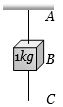
$A$ mass of $1 \ kg$ is suspended by a string $A$. Another string $C$ is connected to its lower end (see figure). If a sudden jerk is given to $C$,then
A
The portion $A$ of the string will break
B
The portion $C$ of the string will break
C
None of the strings will break
D
The mass will start rotating
Solution
(B) When a sudden jerk is given to string $C$,an impulsive force is applied to it. Due to the inertia of the $1 \ kg$ mass,it does not immediately move.
This impulsive force creates a very high tension in string $C$ that exceeds its breaking strength.
Since the impulse is applied directly to $C$ and the mass acts as a buffer,the tension does not propagate to string $A$ instantaneously.
Therefore,string $C$ breaks before the impulse can reach string $A$.
This impulsive force creates a very high tension in string $C$ that exceeds its breaking strength.
Since the impulse is applied directly to $C$ and the mass acts as a buffer,the tension does not propagate to string $A$ instantaneously.
Therefore,string $C$ breaks before the impulse can reach string $A$.
0 likes
View Solution6
EasyMCQ
An object with a mass $10 \, kg$ moves at a constant velocity of $10 \, m/s$. $A$ constant force then acts for $4 \, s$ on the object and gives it a speed of $2 \, m/s$ in the opposite direction. The impulse acting on the object is ......... $N \cdot s$.
A
$120$
B
$-120$
C
$30$
D
$-30$
Solution
(B) The impulse $J$ acting on an object is equal to the change in its linear momentum,given by $J = \Delta p = m(v_f - v_i)$.
Given: mass $m = 10 \, kg$,initial velocity $v_i = 10 \, m/s$,and final velocity $v_f = -2 \, m/s$ (since it is in the opposite direction).
Substituting the values: $J = 10 \times (-2 - 10) = 10 \times (-12) = -120 \, N \cdot s$.
Thus,the impulse acting on the object is $-120 \, N \cdot s$.
Given: mass $m = 10 \, kg$,initial velocity $v_i = 10 \, m/s$,and final velocity $v_f = -2 \, m/s$ (since it is in the opposite direction).
Substituting the values: $J = 10 \times (-2 - 10) = 10 \times (-12) = -120 \, N \cdot s$.
Thus,the impulse acting on the object is $-120 \, N \cdot s$.
0 likes
View Solution7
EasyMCQ
$A$ cricket ball of mass $250\, g$ collides with a bat with velocity $10\, m/s$ and returns with the same velocity within $0.01\, s$. The force exerted on the ball is ....... $N$.
A
$25$
B
$50$
C
$250$
D
$500$
Solution
(D) Given: Mass $m = 250\, g = 0.25\, kg$,initial velocity $u = 10\, m/s$,final velocity $v = -10\, m/s$ (since it returns in the opposite direction),and time interval $\Delta t = 0.01\, s$.
According to Newton's second law,the force $F$ is given by the rate of change of momentum:
$F = \frac{\Delta p}{\Delta t} = \frac{m(v - u)}{\Delta t}$
Substituting the values:
$F = \frac{0.25 \times (-10 - 10)}{0.01}$
$F = \frac{0.25 \times (-20)}{0.01}$
$F = \frac{-5}{0.01} = -500\, N$
The magnitude of the force exerted on the ball is $500\, N$.
According to Newton's second law,the force $F$ is given by the rate of change of momentum:
$F = \frac{\Delta p}{\Delta t} = \frac{m(v - u)}{\Delta t}$
Substituting the values:
$F = \frac{0.25 \times (-10 - 10)}{0.01}$
$F = \frac{0.25 \times (-20)}{0.01}$
$F = \frac{-5}{0.01} = -500\, N$
The magnitude of the force exerted on the ball is $500\, N$.
0 likes
View Solution8
EasyMCQ
$A$ force of $10 \, N$ acts on a body of mass $20 \, kg$ for $10 \, s$. The change in its momentum is ........... $kg \cdot m/s$.
A
$5$
B
$100$
C
$200$
D
$1000$
Solution
(B) According to Newton's second law of motion,the impulse applied to an object is equal to the change in its momentum.
Impulse $(J)$ is defined as the product of force $(F)$ and the time interval $(\Delta t)$ over which it acts.
Given:
Force $(F)$ = $10 \, N$
Time interval $(\Delta t)$ = $10 \, s$
Change in momentum $(\Delta p)$ = $F \times \Delta t$
$\Delta p = 10 \, N \times 10 \, s = 100 \, kg \cdot m/s$.
Therefore,the change in momentum is $100 \, kg \cdot m/s$.
Impulse $(J)$ is defined as the product of force $(F)$ and the time interval $(\Delta t)$ over which it acts.
Given:
Force $(F)$ = $10 \, N$
Time interval $(\Delta t)$ = $10 \, s$
Change in momentum $(\Delta p)$ = $F \times \Delta t$
$\Delta p = 10 \, N \times 10 \, s = 100 \, kg \cdot m/s$.
Therefore,the change in momentum is $100 \, kg \cdot m/s$.
0 likes
View Solution9
EasyMCQ
$A$ player catches a cricket ball of mass $150 \, g$ moving at a speed of $20 \, m/s$. If the catching process is completed in $0.1 \, s$,the force of the blow exerted by the ball on the hands of the player is ........... $N$.
A
$0.3$
B
$30$
C
$300$
D
$3000$
Solution
(B) Given:
Mass of the ball,$m = 150 \, g = 0.15 \, kg$.
Initial velocity,$u = 20 \, m/s$.
Final velocity,$v = 0 \, m/s$ (since the ball is caught).
Time taken,$\Delta t = 0.1 \, s$.
According to Newton's second law of motion,the force exerted is given by the rate of change of momentum:
$F = \frac{\Delta p}{\Delta t} = \frac{m(v - u)}{\Delta t}$
$F = \frac{0.15 \times (0 - 20)}{0.1}$
$F = \frac{0.15 \times (-20)}{0.1} = \frac{-3}{0.1} = -30 \, N$.
The magnitude of the force exerted by the ball on the hands is $30 \, N$.
Mass of the ball,$m = 150 \, g = 0.15 \, kg$.
Initial velocity,$u = 20 \, m/s$.
Final velocity,$v = 0 \, m/s$ (since the ball is caught).
Time taken,$\Delta t = 0.1 \, s$.
According to Newton's second law of motion,the force exerted is given by the rate of change of momentum:
$F = \frac{\Delta p}{\Delta t} = \frac{m(v - u)}{\Delta t}$
$F = \frac{0.15 \times (0 - 20)}{0.1}$
$F = \frac{0.15 \times (-20)}{0.1} = \frac{-3}{0.1} = -30 \, N$.
The magnitude of the force exerted by the ball on the hands is $30 \, N$.
0 likes
View Solution10
MediumMCQ
$A$ machine gun fires a bullet of mass $40\,g$ with a velocity $1200\,m/s$. The man holding it can exert a maximum force of $144\,N$ on the gun. How many bullets can he fire per second at the most?
A
$1$
B
$4$
C
$2$
D
$3$
Solution
(D) The force exerted by the machine gun is equal to the rate of change of momentum of the bullets fired.
$F = \frac{dp}{dt} = v \cdot \frac{dm}{dt}$
Here,$v = 1200\,m/s$ is the velocity of the bullet.
Let $n$ be the number of bullets fired per second.
The mass of one bullet is $m = 40\,g = 40 \times 10^{-3}\,kg = 0.04\,kg$.
The total mass fired per second is $\frac{dm}{dt} = n \times m$.
Given the maximum force $F = 144\,N$,we have:
$144 = 1200 \times (n \times 0.04)$
$144 = 1200 \times 0.04 \times n$
$144 = 48 \times n$
$n = \frac{144}{48} = 3$.
Therefore,the man can fire at most $3$ bullets per second.
$F = \frac{dp}{dt} = v \cdot \frac{dm}{dt}$
Here,$v = 1200\,m/s$ is the velocity of the bullet.
Let $n$ be the number of bullets fired per second.
The mass of one bullet is $m = 40\,g = 40 \times 10^{-3}\,kg = 0.04\,kg$.
The total mass fired per second is $\frac{dm}{dt} = n \times m$.
Given the maximum force $F = 144\,N$,we have:
$144 = 1200 \times (n \times 0.04)$
$144 = 1200 \times 0.04 \times n$
$144 = 48 \times n$
$n = \frac{144}{48} = 3$.
Therefore,the man can fire at most $3$ bullets per second.
1 likes
View Solution11
EasyMCQ
When the speed of a moving body is doubled:
A
Its acceleration is doubled
B
Its momentum is doubled
C
Its kinetic energy is doubled
D
Its potential energy is doubled
Solution
(B) The momentum $p$ of a body is defined as the product of its mass $m$ and its velocity $v$,given by the formula $p = mv$.
Since the mass $m$ of the body remains constant,the momentum $p$ is directly proportional to the speed $v$ $(p \propto v)$.
When the speed is doubled $(v' = 2v)$,the new momentum $p'$ becomes $p' = m(2v) = 2(mv) = 2p$.
Therefore,the momentum of the body is doubled.
Kinetic energy $K = \frac{1}{2}mv^2$ would increase by a factor of $4$,not $2$.
Since the mass $m$ of the body remains constant,the momentum $p$ is directly proportional to the speed $v$ $(p \propto v)$.
When the speed is doubled $(v' = 2v)$,the new momentum $p'$ becomes $p' = m(2v) = 2(mv) = 2p$.
Therefore,the momentum of the body is doubled.
Kinetic energy $K = \frac{1}{2}mv^2$ would increase by a factor of $4$,not $2$.
0 likes
View Solution12
EasyMCQ
$A$ body of mass $m$ collides against a wall with a velocity $v$ and rebounds with the same speed. Its change of momentum is
A
$2\, mv$
B
$mv$
C
$-mv$
D
Zero
Solution
(A) The initial momentum of the body is $p_i = mv$ (taking the direction towards the wall as positive).
After the collision,the body rebounds with the same speed $v$ in the opposite direction,so the final momentum is $p_f = -mv$.
The change in momentum $\Delta p$ is defined as the final momentum minus the initial momentum:
$\Delta p = p_f - p_i$
$\Delta p = (-mv) - (mv) = -2\,mv$.
Since the magnitude of the change in momentum is requested,we consider the absolute value: $|\Delta p| = 2\,mv$.
After the collision,the body rebounds with the same speed $v$ in the opposite direction,so the final momentum is $p_f = -mv$.
The change in momentum $\Delta p$ is defined as the final momentum minus the initial momentum:
$\Delta p = p_f - p_i$
$\Delta p = (-mv) - (mv) = -2\,mv$.
Since the magnitude of the change in momentum is requested,we consider the absolute value: $|\Delta p| = 2\,mv$.
0 likes
View Solution13
EasyMCQ
$N$ bullets,each of mass $m \, kg$,are fired with a velocity $v \, m/s$ at the rate of $n$ bullets per second upon a wall. The reaction force offered by the wall to the bullets is given by:
A
$nmv$
B
$\frac{Nmv}{n}$
C
$n \frac{Nm}{v}$
D
$n \frac{Nv}{m}$
Solution
(A) The force exerted by the wall on the bullets is equal to the rate of change of momentum of the bullets.
Each bullet has a mass $m$ and velocity $v$,so the momentum of one bullet is $p = mv$.
Since $n$ bullets strike the wall per second,the total momentum change per second is $\Delta p = n \times (mv - 0) = nmv$.
According to Newton's second law,the force $F$ is equal to the rate of change of momentum: $F = \frac{dp}{dt} = nmv$.
Thus,the reaction force offered by the wall is $nmv$.
Each bullet has a mass $m$ and velocity $v$,so the momentum of one bullet is $p = mv$.
Since $n$ bullets strike the wall per second,the total momentum change per second is $\Delta p = n \times (mv - 0) = nmv$.
According to Newton's second law,the force $F$ is equal to the rate of change of momentum: $F = \frac{dp}{dt} = nmv$.
Thus,the reaction force offered by the wall is $nmv$.
0 likes
View Solution14
EasyMCQ
$A$ ball of mass $m$ moves with speed $v$ and strikes a wall normally and is reflected back normally. If its time of contact with the wall is $t$,find the force exerted by the ball on the wall.
A
$\frac{2mv}{t}$
B
$\frac{mv}{t}$
C
$mvt$
D
$\frac{mv}{2t}$
Solution
(A) The force exerted by the ball on the wall is equal to the rate of change of momentum of the ball.
Initial momentum of the ball,$p_i = mv$.
Final momentum of the ball after reflection,$p_f = -mv$ (since it moves in the opposite direction).
Change in momentum,$\Delta p = p_f - p_i = -mv - mv = -2mv$.
The magnitude of the change in momentum is $|\Delta p| = 2mv$.
The force exerted on the wall is given by $F = \frac{|\Delta p|}{t} = \frac{2mv}{t}$.
Initial momentum of the ball,$p_i = mv$.
Final momentum of the ball after reflection,$p_f = -mv$ (since it moves in the opposite direction).
Change in momentum,$\Delta p = p_f - p_i = -mv - mv = -2mv$.
The magnitude of the change in momentum is $|\Delta p| = 2mv$.
The force exerted on the wall is given by $F = \frac{|\Delta p|}{t} = \frac{2mv}{t}$.
0 likes
View Solution15
EasyMCQ
$A$ ball of mass $0.5\, kg$ moving with a velocity of $2\, m/s$ strikes a wall normally and bounces back with the same speed. If the time of contact between the ball and the wall is $1\, ms$,the average force exerted by the wall on the ball is ......... $N$.
A
$2000$
B
$1000$
C
$5000$
D
$125$
Solution
(A) Given: Mass $m = 0.5\, kg$,initial velocity $u = 2\, m/s$,final velocity $v = -2\, m/s$ (since it bounces back),and time of contact $\Delta t = 1\, ms = 10^{-3}\, s$.
According to Newton's second law,the average force $F_{av}$ is the rate of change of momentum:
$F_{av} = \frac{\Delta p}{\Delta t} = \frac{m(v - u)}{\Delta t}$
$F_{av} = \frac{0.5 \times (-2 - 2)}{10^{-3}}$
$F_{av} = \frac{0.5 \times (-4)}{10^{-3}} = \frac{-2}{10^{-3}} = -2000\, N$.
The magnitude of the average force exerted by the wall on the ball is $2000\, N$.
According to Newton's second law,the average force $F_{av}$ is the rate of change of momentum:
$F_{av} = \frac{\Delta p}{\Delta t} = \frac{m(v - u)}{\Delta t}$
$F_{av} = \frac{0.5 \times (-2 - 2)}{10^{-3}}$
$F_{av} = \frac{0.5 \times (-4)}{10^{-3}} = \frac{-2}{10^{-3}} = -2000\, N$.
The magnitude of the average force exerted by the wall on the ball is $2000\, N$.
0 likes
View Solution16
MediumMCQ
$A$ particle moves in the $xy$-plane under the action of a force $\vec{F}$ such that the components of its linear momentum $\vec{p}$ at any time $t$ are $p_x = 2\cos t$ and $p_y = 2\sin t$. The angle between $\vec{F}$ and $\vec{p}$ at time $t$ is ........... $^o$.
A
$90$
B
$0$
C
$180$
D
$30$
Solution
(A) Given the linear momentum vector is $\vec{p} = p_x \hat{i} + p_y \hat{j} = (2\cos t) \hat{i} + (2\sin t) \hat{j}$.
The force $\vec{F}$ is the rate of change of linear momentum,so $\vec{F} = \frac{d\vec{p}}{dt}$.
Calculating the derivative: $\vec{F} = \frac{d}{dt}(2\cos t) \hat{i} + \frac{d}{dt}(2\sin t) \hat{j} = (-2\sin t) \hat{i} + (2\cos t) \hat{j}$.
To find the angle between $\vec{F}$ and $\vec{p}$,we calculate their dot product: $\vec{F} \cdot \vec{p} = [(-2\sin t)(2\cos t)] + [(2\cos t)(2\sin t)]$.
$\vec{F} \cdot \vec{p} = -4\sin t \cos t + 4\sin t \cos t = 0$.
Since the dot product $\vec{F} \cdot \vec{p} = |\vec{F}| |\vec{p}| \cos \theta = 0$,and neither vector is a null vector,we must have $\cos \theta = 0$,which implies $\theta = 90^o$.
The force $\vec{F}$ is the rate of change of linear momentum,so $\vec{F} = \frac{d\vec{p}}{dt}$.
Calculating the derivative: $\vec{F} = \frac{d}{dt}(2\cos t) \hat{i} + \frac{d}{dt}(2\sin t) \hat{j} = (-2\sin t) \hat{i} + (2\cos t) \hat{j}$.
To find the angle between $\vec{F}$ and $\vec{p}$,we calculate their dot product: $\vec{F} \cdot \vec{p} = [(-2\sin t)(2\cos t)] + [(2\cos t)(2\sin t)]$.
$\vec{F} \cdot \vec{p} = -4\sin t \cos t + 4\sin t \cos t = 0$.
Since the dot product $\vec{F} \cdot \vec{p} = |\vec{F}| |\vec{p}| \cos \theta = 0$,and neither vector is a null vector,we must have $\cos \theta = 0$,which implies $\theta = 90^o$.
1 likes
View Solution17
DifficultMCQ
$A$ ball of mass $400\, g$ is dropped from a height of $5\, m$. $A$ boy standing on the ground hits the ball vertically upwards with a bat with an average force of $100\, N$ so that it reaches a height of $20\, m$. For how long does the ball remain in contact with the bat (in $, s$)? $[g = 10\, m/s^2]$
A
$0.12$
B
$0.08$
C
$0.04$
D
$12$
Solution
(A) $1$. Velocity of the ball just before hitting the bat:
$v_1 = \sqrt{2gh_1} = \sqrt{2 \times 10 \times 5} = 10\, m/s$ (downwards).
$2$. Velocity of the ball just after leaving the bat:
$v_2 = \sqrt{2gh_2} = \sqrt{2 \times 10 \times 20} = 20\, m/s$ (upwards).
$3$. Using the impulse-momentum theorem:
$F_{avg} \times \Delta t = m(v_{final} - v_{initial})$
Taking the upward direction as positive (+),we have $v_{final} = +20\, m/s$ and $v_{initial} = -10\, m/s$.
Given $m = 400\, g = 0.4\, kg$ and $F_{avg} = 100\, N$.
$100 \times \Delta t = 0.4 \times (20 - (-10))$
$100 \times \Delta t = 0.4 \times 30$
$100 \times \Delta t = 12$
$\Delta t = 0.12\, s$.
$v_1 = \sqrt{2gh_1} = \sqrt{2 \times 10 \times 5} = 10\, m/s$ (downwards).
$2$. Velocity of the ball just after leaving the bat:
$v_2 = \sqrt{2gh_2} = \sqrt{2 \times 10 \times 20} = 20\, m/s$ (upwards).
$3$. Using the impulse-momentum theorem:
$F_{avg} \times \Delta t = m(v_{final} - v_{initial})$
Taking the upward direction as positive (+),we have $v_{final} = +20\, m/s$ and $v_{initial} = -10\, m/s$.
Given $m = 400\, g = 0.4\, kg$ and $F_{avg} = 100\, N$.
$100 \times \Delta t = 0.4 \times (20 - (-10))$
$100 \times \Delta t = 0.4 \times 30$
$100 \times \Delta t = 12$
$\Delta t = 0.12\, s$.
1 likes
View Solution18
EasyMCQ
The time in which a force of $2 \, N$ produces a change of momentum of $0.4 \, kg \cdot m/s$ in a body is ......... $s$.
A
$0.2$
B
$0.02$
C
$0.5$
D
$0.05$
Solution
(A) According to Newton's second law of motion,the force applied is equal to the rate of change of momentum.
$\vec{F} = \frac{\Delta \vec{p}}{\Delta t}$
Given:
Force,$F = 2 \, N$
Change in momentum,$\Delta p = 0.4 \, kg \cdot m/s$
Rearranging the formula to solve for time,$\Delta t$:
$\Delta t = \frac{\Delta p}{F}$
$\Delta t = \frac{0.4}{2} = 0.2 \, s$
Therefore,the time required is $0.2 \, s$.
$\vec{F} = \frac{\Delta \vec{p}}{\Delta t}$
Given:
Force,$F = 2 \, N$
Change in momentum,$\Delta p = 0.4 \, kg \cdot m/s$
Rearranging the formula to solve for time,$\Delta t$:
$\Delta t = \frac{\Delta p}{F}$
$\Delta t = \frac{0.4}{2} = 0.2 \, s$
Therefore,the time required is $0.2 \, s$.
0 likes
View Solution19
EasyMCQ
Swimming is possible on account of
A
First law of motion
B
Second law of motion
C
Third law of motion
D
Newton's law of gravitation
Solution
(C) Swimming is possible due to Newton's $Third$ law of motion.
When a swimmer pushes the water backward with their hands and feet, the water exerts an equal and opposite force on the swimmer in the forward direction.
This action-reaction pair allows the swimmer to move forward through the water.
When a swimmer pushes the water backward with their hands and feet, the water exerts an equal and opposite force on the swimmer in the forward direction.
This action-reaction pair allows the swimmer to move forward through the water.
0 likes
View Solution20
EasyMCQ
When we jump out of a boat standing in water,it moves:
A
Forward
B
Backward
C
Sideways
D
None of the above
Solution
(B) According to Newton's $Third$ $Law$ $of$ $Motion$,for every action,there is an equal and opposite reaction.
When a person jumps forward out of a boat,the person exerts a force on the boat in the forward direction (action).
In response,the boat exerts an equal and opposite force on the person,and the person exerts an equal and opposite force on the boat in the backward direction (reaction).
Therefore,the boat moves backward.
When a person jumps forward out of a boat,the person exerts a force on the boat in the forward direction (action).
In response,the boat exerts an equal and opposite force on the person,and the person exerts an equal and opposite force on the boat in the backward direction (reaction).
Therefore,the boat moves backward.
0 likes
View Solution21
EasyMCQ
$A$ man is at rest in the middle of a pond on perfectly smooth ice. He can get himself to the shore by making use of Newton's
A
First law
B
Second law
C
Third law
D
All the laws
Solution
(C) According to Newton's third law of motion,for every action,there is an equal and opposite reaction.
On a perfectly smooth (frictionless) surface,a man cannot walk normally because there is no friction to provide the necessary reaction force.
However,if the man throws an object in the direction opposite to the shore,the object exerts an equal and opposite force on the man.
This reaction force pushes the man toward the shore,allowing him to move despite the lack of friction.
On a perfectly smooth (frictionless) surface,a man cannot walk normally because there is no friction to provide the necessary reaction force.
However,if the man throws an object in the direction opposite to the shore,the object exerts an equal and opposite force on the man.
This reaction force pushes the man toward the shore,allowing him to move despite the lack of friction.
0 likes
View Solution22
EasyMCQ
$A$ cannon after firing recoils due to
A
Conservation of energy
B
Backward thrust of gases produced
C
Newton's third law of motion
D
Newton's first law of motion
Solution
(C) When a cannon fires a cannonball,it exerts a large forward force on the ball,causing it to travel a large distance. This force is the action.
At the same time,the cannonball exerts an equal and opposite force on the cannon,which causes the cannon to recoil. This force is the reaction.
Since this is an action-reaction pair,it is governed by Newton's third law of motion.
Therefore,option $C$ is correct.
At the same time,the cannonball exerts an equal and opposite force on the cannon,which causes the cannon to recoil. This force is the reaction.
Since this is an action-reaction pair,it is governed by Newton's third law of motion.
Therefore,option $C$ is correct.
0 likes
View Solution23
EasyMCQ
Action and reaction forces act on
A
The same body
B
The different bodies
C
The horizontal surface
D
Nothing can be said
Solution
(B) According to Newton's third law of motion,for every action,there is an equal and opposite reaction. These two forces always act on different bodies simultaneously. Therefore,they do not cancel each other out.
0 likes
View Solution24
EasyMCQ
$A$ machine gun fires $20$ bullets per second into a target. Each bullet weighs $150 \, g$ and has a speed of $800 \, m/s$. Find the force necessary to hold the gun in position.
A
$800$
B
$1000$
C
$1200$
D
$2400$
Solution
(D) The force required to hold the gun is equal to the rate of change of momentum of the bullets.
Given:
Number of bullets per second $(n)$ = $20 \, s^{-1}$
Mass of each bullet $(m)$ = $150 \, g = 0.15 \, kg$
Velocity of each bullet $(v)$ = $800 \, m/s$
The force $(F)$ is given by the formula:
$F = n \times m \times v$
$F = 20 \times 0.15 \times 800$
$F = 20 \times 120$
$F = 2400 \, N.$
Given:
Number of bullets per second $(n)$ = $20 \, s^{-1}$
Mass of each bullet $(m)$ = $150 \, g = 0.15 \, kg$
Velocity of each bullet $(v)$ = $800 \, m/s$
The force $(F)$ is given by the formula:
$F = n \times m \times v$
$F = 20 \times 0.15 \times 800$
$F = 20 \times 120$
$F = 2400 \, N.$
0 likes
View Solution25
EasyMCQ
$A$ book is lying on the table. What is the angle between the action of the book on the table and the reaction of the table on the book ............ $^o$
A
$0$
B
$30$
C
$45$
D
$180$
Solution
(D) According to Newton's $Third$ $Law$ $of$ $Motion$,for every action,there is an equal and opposite reaction.
The action force exerted by the book on the table acts downwards.
The reaction force exerted by the table on the book acts upwards.
Since these two forces act along the same line but in exactly opposite directions,the angle between them is $180^o$.
The action force exerted by the book on the table acts downwards.
The reaction force exerted by the table on the book acts upwards.
Since these two forces act along the same line but in exactly opposite directions,the angle between them is $180^o$.
0 likes
View Solution26
EasyMCQ
$A$ student attempts to pull himself up by tugging on his hair. He will not succeed because:
A
The force exerted is small.
B
The frictional force while gripping is small.
C
Newton's law of inertia is not applicable to living beings.
D
The force applied is internal to the system.
Solution
(D) According to Newton's third law,for every action,there is an equal and opposite reaction. When the student pulls his hair,he exerts a force on his hair,and his hair exerts an equal and opposite force on his hand. Since both the student and his hair are part of the same system,these forces are internal forces. Internal forces cannot change the state of motion of the center of mass of a system. Therefore,the student cannot lift himself up.
0 likes
View Solution27
EasyMCQ
If a force of $250\, N$ acts on a body,the momentum acquired is $125\, kg \cdot m/s$. What is the period for which the force acts on the body? ......... $s$
A
$0.5$
B
$0.2$
C
$0.4$
D
$0.25$
Solution
(A) The impulse applied to a body is equal to the change in its momentum.
According to the impulse-momentum theorem:
$Impulse = F \times \Delta t = \Delta p$
Given:
Force $(F)$ = $250\, N$
Change in momentum $(\Delta p)$ = $125\, kg \cdot m/s$
We need to find the time interval $(\Delta t)$:
$\Delta t = \frac{\Delta p}{F}$
$\Delta t = \frac{125}{250} = 0.5\, s$
Therefore,the period for which the force acts on the body is $0.5\, s$.
According to the impulse-momentum theorem:
$Impulse = F \times \Delta t = \Delta p$
Given:
Force $(F)$ = $250\, N$
Change in momentum $(\Delta p)$ = $125\, kg \cdot m/s$
We need to find the time interval $(\Delta t)$:
$\Delta t = \frac{\Delta p}{F}$
$\Delta t = \frac{125}{250} = 0.5\, s$
Therefore,the period for which the force acts on the body is $0.5\, s$.
0 likes
View Solution28
EasyMCQ
$A$ ball of mass $150\,g$ starts moving with an acceleration of $20\,m/s^2$. When hit by a force,which acts on it for $0.1\,s$. The impulsive force is ........ $N-s$.
A
$0.5$
B
$0.1$
C
$0.3$
D
$1.2$
Solution
(C) Given: Mass $m = 150\,g = 0.15\,kg$,Acceleration $a = 20\,m/s^2$,Time $t = 0.1\,s$.
Impulse is defined as the change in momentum,which is equal to the product of force and time.
Impulse $J = F \times t = (m \times a) \times t$.
Substituting the values: $J = 0.15\,kg \times 20\,m/s^2 \times 0.1\,s$.
$J = 3\,N \times 0.1\,s = 0.3\,N-s$.
Therefore,the impulsive force is $0.3\,N-s$.
Impulse is defined as the change in momentum,which is equal to the product of force and time.
Impulse $J = F \times t = (m \times a) \times t$.
Substituting the values: $J = 0.15\,kg \times 20\,m/s^2 \times 0.1\,s$.
$J = 3\,N \times 0.1\,s = 0.3\,N-s$.
Therefore,the impulsive force is $0.3\,N-s$.
0 likes
View Solution29
EasyMCQ
The momentum is most closely related to
A
Force
B
Impulse
C
Power
D
$K$.$E$.
Solution
(B) The impulse is defined as the change in momentum of an object. Mathematically,it is given by $J = \Delta p = F \times \Delta t$.
Since impulse is directly equal to the change in momentum,it is the most closely related quantity among the given options.
Force is the rate of change of momentum $(F = \frac{dp}{dt})$,which involves time as a divisor.
Kinetic energy $(K.E. = \frac{p^2}{2m})$ depends on both momentum and mass.
Power is the rate of doing work and is not directly related to momentum in the same fundamental way as impulse.
Therefore,impulse is the correct answer.
Since impulse is directly equal to the change in momentum,it is the most closely related quantity among the given options.
Force is the rate of change of momentum $(F = \frac{dp}{dt})$,which involves time as a divisor.
Kinetic energy $(K.E. = \frac{p^2}{2m})$ depends on both momentum and mass.
Power is the rate of doing work and is not directly related to momentum in the same fundamental way as impulse.
Therefore,impulse is the correct answer.
0 likes
View Solution30
MediumMCQ
$A$ force of $50\, dynes$ acts on a body of mass $5\, g$ which is at rest for an interval of $3\, seconds$. The impulse is:
A
$0.15 \times 10^{-3}\, Ns$
B
$0.98 \times 10^{-3}\, Ns$
C
$1.5 \times 10^{-3}\, Ns$
D
$2.5 \times 10^{-3}\, Ns$
Solution
(C) Impulse $(I)$ is defined as the product of force $(F)$ and the time interval $(\Delta t)$ for which it acts.
Given:
Force $(F)$ = $50\, dynes = 50 \times 10^{-5}\, N$ (since $1\, dyne = 10^{-5}\, N$)
Time interval $(\Delta t)$ = $3\, s$
Impulse $(I)$ = $F \times \Delta t$
$I = (50 \times 10^{-5}\, N) \times (3\, s)$
$I = 150 \times 10^{-5}\, Ns$
$I = 1.5 \times 10^{-3}\, Ns$
Given:
Force $(F)$ = $50\, dynes = 50 \times 10^{-5}\, N$ (since $1\, dyne = 10^{-5}\, N$)
Time interval $(\Delta t)$ = $3\, s$
Impulse $(I)$ = $F \times \Delta t$
$I = (50 \times 10^{-5}\, N) \times (3\, s)$
$I = 150 \times 10^{-5}\, Ns$
$I = 1.5 \times 10^{-3}\, Ns$
0 likes
View Solution31
DifficultMCQ
$A$ bullet is fired from a gun. The force on the bullet is given by $F = 600 - 2 \times 10^5 t$,where $F$ is in newtons and $t$ is in seconds. The force on the bullet becomes zero as soon as it leaves the barrel. What is the impulse imparted to the bullet in $N-s$?
A
$9$
B
$0$
C
$0.9$
D
$1.8$
Solution
(C) The force on the bullet is given by $F = 600 - 2 \times 10^5 t$.
When the bullet leaves the barrel,the force becomes zero,so $F = 0$.
$600 - 2 \times 10^5 t = 0$
$2 \times 10^5 t = 600$
$t = \frac{600}{2 \times 10^5} = 3 \times 10^{-3} \ s$.
Impulse $I$ is defined as the integral of force with respect to time: $I = \int_{0}^{t} F \ dt$.
$I = \int_{0}^{3 \times 10^{-3}} (600 - 2 \times 10^5 t) \ dt$
$I = [600t - 10^5 t^2]_{0}^{3 \times 10^{-3}}$
$I = 600(3 \times 10^{-3}) - 10^5(3 \times 10^{-3})^2$
$I = 1.8 - 10^5(9 \times 10^{-6})$
$I = 1.8 - 0.9 = 0.9 \ N-s$.
When the bullet leaves the barrel,the force becomes zero,so $F = 0$.
$600 - 2 \times 10^5 t = 0$
$2 \times 10^5 t = 600$
$t = \frac{600}{2 \times 10^5} = 3 \times 10^{-3} \ s$.
Impulse $I$ is defined as the integral of force with respect to time: $I = \int_{0}^{t} F \ dt$.
$I = \int_{0}^{3 \times 10^{-3}} (600 - 2 \times 10^5 t) \ dt$
$I = [600t - 10^5 t^2]_{0}^{3 \times 10^{-3}}$
$I = 600(3 \times 10^{-3}) - 10^5(3 \times 10^{-3})^2$
$I = 1.8 - 10^5(9 \times 10^{-6})$
$I = 1.8 - 0.9 = 0.9 \ N-s$.
0 likes
View Solution32
EasyMCQ
Consider the following statement: When jumping from some height,you should bend your knees as you come to rest,instead of keeping your legs stiff. Which of the following relations can be useful in explaining the statement?
A
$\Delta \overrightarrow{P_1} = - \Delta \overrightarrow{P_2}$
B
$\Delta E = - \Delta (PE + KE) = 0$
C
$\overrightarrow{F} \Delta t = m \Delta \overrightarrow{v}$
D
$\Delta \overrightarrow{x} \propto \Delta \overrightarrow{F}$
Solution
(C) The correct relation is $\overrightarrow{F} \Delta t = m \Delta \overrightarrow{v}$,which represents the impulse-momentum theorem.
From this,we can write $F = \frac{m \Delta \overrightarrow{v}}{\Delta t}$.
When you bend your knees upon landing,the time interval $\Delta t$ during which your velocity changes to zero increases.
Since the change in momentum $m \Delta \overrightarrow{v}$ is constant,increasing the time $\Delta t$ results in a decrease in the impulsive force $F$ exerted on your knees,thereby reducing the risk of injury.
From this,we can write $F = \frac{m \Delta \overrightarrow{v}}{\Delta t}$.
When you bend your knees upon landing,the time interval $\Delta t$ during which your velocity changes to zero increases.
Since the change in momentum $m \Delta \overrightarrow{v}$ is constant,increasing the time $\Delta t$ results in a decrease in the impulsive force $F$ exerted on your knees,thereby reducing the risk of injury.
0 likes
View Solution33
MediumMCQ
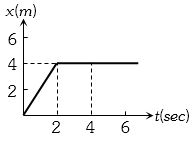
In the figure given below,the position-time graph of a particle of mass $0.1 \,kg$ is shown. The impulse at $t = 2 \,s$ is .......... $kg \,m \,s^{-1}$.
A
$0.2$
B
$-0.2$
C
$0.1$
D
$-0.4$
Solution
(B) The impulse acting on a particle is equal to the change in its momentum.
Impulse $J = \Delta p = m(v_f - v_i)$.
From the position-time graph,the velocity $v$ is the slope of the line.
For $t = 0$ to $t = 2 \,s$,the velocity $v_i = \frac{\Delta x}{\Delta t} = \frac{4 - 0}{2 - 0} = 2 \,m/s$.
For $t > 2 \,s$,the position is constant $(x = 4 \,m)$,so the velocity $v_f = 0 \,m/s$.
The mass of the particle is $m = 0.1 \,kg$.
Therefore,the impulse at $t = 2 \,s$ is $J = 0.1 \,kg \times (0 \,m/s - 2 \,m/s) = -0.2 \,kg \,m \,s^{-1}$.
Impulse $J = \Delta p = m(v_f - v_i)$.
From the position-time graph,the velocity $v$ is the slope of the line.
For $t = 0$ to $t = 2 \,s$,the velocity $v_i = \frac{\Delta x}{\Delta t} = \frac{4 - 0}{2 - 0} = 2 \,m/s$.
For $t > 2 \,s$,the position is constant $(x = 4 \,m)$,so the velocity $v_f = 0 \,m/s$.
The mass of the particle is $m = 0.1 \,kg$.
Therefore,the impulse at $t = 2 \,s$ is $J = 0.1 \,kg \times (0 \,m/s - 2 \,m/s) = -0.2 \,kg \,m \,s^{-1}$.
0 likes
View Solution34
MediumMCQ
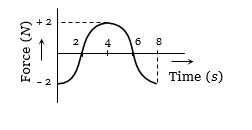
The force-time $(F-t)$ curve of a particle executing linear motion is as shown in the figure. The momentum acquired by the particle in the time interval from $0$ to $8 \ s$ will be ........... $N-s$.
A
$-2$
B
$+4$
C
$6$
D
$0$
Solution
(D) The change in momentum $(\Delta p)$ of a particle is equal to the impulse,which is given by the area under the force-time $(F-t)$ graph.
$\Delta p = \int F \, dt = \text{Area under } F-t \text{ curve}$.
In the given graph,the area from $t = 2 \ s$ to $t = 6 \ s$ is above the time axis,representing a positive impulse.
The area from $t = 0 \ s$ to $t = 2 \ s$ and $t = 6 \ s$ to $t = 8 \ s$ is below the time axis,representing a negative impulse.
Due to the symmetry of the curve,the positive area (between $2 \ s$ and $6 \ s$) is equal in magnitude to the total negative area (from $0$ to $2 \ s$ and $6$ to $8 \ s$).
Therefore,the net area is $0$,which implies the net change in momentum acquired by the particle in the interval from $0$ to $8 \ s$ is $0 \ N-s$.
$\Delta p = \int F \, dt = \text{Area under } F-t \text{ curve}$.
In the given graph,the area from $t = 2 \ s$ to $t = 6 \ s$ is above the time axis,representing a positive impulse.
The area from $t = 0 \ s$ to $t = 2 \ s$ and $t = 6 \ s$ to $t = 8 \ s$ is below the time axis,representing a negative impulse.
Due to the symmetry of the curve,the positive area (between $2 \ s$ and $6 \ s$) is equal in magnitude to the total negative area (from $0$ to $2 \ s$ and $6$ to $8 \ s$).
Therefore,the net area is $0$,which implies the net change in momentum acquired by the particle in the interval from $0$ to $8 \ s$ is $0 \ N-s$.
0 likes
View Solution35
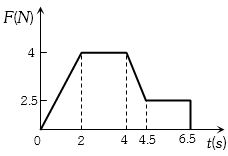
MediumMCQ
$A$ body of $2\, kg$ has an initial speed of $5\, ms^{-1}$. $A$ force acts on it for some time in the direction of motion. The force-time graph is shown in the figure. Find the final speed of the body in $ms^{-1}$.
A
$9.25$
B
$5$
C
$14.25$
D
$4.25$
Solution
(C) The impulse applied to the body is equal to the change in its momentum: $J = \Delta p = m(v_f - v_i)$ ... $(i)$
The impulse is also equal to the area under the force-time graph:
Area $= \text{Area of triangle} (0-2s) + \text{Area of rectangle} (2-4s) + \text{Area of trapezoid} (4-4.5s) + \text{Area of rectangle} (4.5-6.5s)$
Area $= (\frac{1}{2} \times 2 \times 4) + (2 \times 4) + (\frac{1}{2} \times (4 + 2.5) \times 0.5) + (2 \times 2.5)$
Area $= 4 + 8 + 1.625 + 5 = 18.625\, Ns$
Equating $(i)$ and the calculated impulse:
$m(v_f - v_i) = 18.625$
$2(v_f - 5) = 18.625$
$v_f - 5 = 9.3125$
$v_f = 14.3125\, ms^{-1}$
*Note: Based on the provided options,the intended calculation likely used a slightly different area approximation or rounding. Re-evaluating the area: $4 + 8 + 1.625 + 5 = 18.625$. $v_f = 5 + (18.625/2) = 5 + 9.3125 = 14.3125$. Given the options,$14.25$ is the closest match.*
The impulse is also equal to the area under the force-time graph:
Area $= \text{Area of triangle} (0-2s) + \text{Area of rectangle} (2-4s) + \text{Area of trapezoid} (4-4.5s) + \text{Area of rectangle} (4.5-6.5s)$
Area $= (\frac{1}{2} \times 2 \times 4) + (2 \times 4) + (\frac{1}{2} \times (4 + 2.5) \times 0.5) + (2 \times 2.5)$
Area $= 4 + 8 + 1.625 + 5 = 18.625\, Ns$
Equating $(i)$ and the calculated impulse:
$m(v_f - v_i) = 18.625$
$2(v_f - 5) = 18.625$
$v_f - 5 = 9.3125$
$v_f = 14.3125\, ms^{-1}$
*Note: Based on the provided options,the intended calculation likely used a slightly different area approximation or rounding. Re-evaluating the area: $4 + 8 + 1.625 + 5 = 18.625$. $v_f = 5 + (18.625/2) = 5 + 9.3125 = 14.3125$. Given the options,$14.25$ is the closest match.*
0 likes
View Solution36
DifficultMCQ
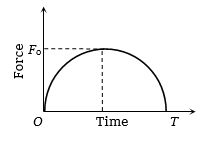
$A$ particle of mass $m$, initially at rest, is acted upon by a variable force $F$ for a brief interval of time $T$. It begins to move with a velocity $u$ after the force stops acting. The graph shows $F$ as a function of time, where the curve is a semicircle with peak force $F_0$ at time $T/2$.
A
$u = \frac{\pi F_0^2}{2m}$
B
$u = \frac{\pi T^2}{8m}$
C
$u = \frac{\pi F_0 T}{4m}$
D
$u = \frac{F_0 T}{2m}$
Solution
(C) The impulse applied to the particle is equal to the change in its momentum.
Since the particle is initially at rest, the final momentum $p = mu$ is equal to the impulse, which is the area under the $F-t$ graph.
The graph is a semicircle with radius $r_1 = F_0$ (height) and $r_2 = T/2$ (base width).
The area of a semicircle is given by $\frac{1}{2} \pi r_1 r_2$.
Therefore, $mu = \frac{1}{2} \pi (F_0) (T/2)$.
$mu = \frac{\pi F_0 T}{4}$.
Solving for velocity $u$, we get $u = \frac{\pi F_0 T}{4m}$.
Since the particle is initially at rest, the final momentum $p = mu$ is equal to the impulse, which is the area under the $F-t$ graph.
The graph is a semicircle with radius $r_1 = F_0$ (height) and $r_2 = T/2$ (base width).
The area of a semicircle is given by $\frac{1}{2} \pi r_1 r_2$.
Therefore, $mu = \frac{1}{2} \pi (F_0) (T/2)$.
$mu = \frac{\pi F_0 T}{4}$.
Solving for velocity $u$, we get $u = \frac{\pi F_0 T}{4m}$.
0 likes
View Solution37
MediumMCQ
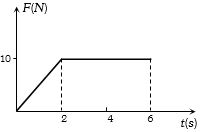
$A$ body of mass $3\,kg$ is acted on by a force which varies as shown in the graph below. The momentum acquired is given by ........... $N-s$.
A
$0$
B
$5$
C
$30$
D
$50$
Solution
(D) The impulse applied to a body is equal to the change in its momentum. According to the impulse-momentum theorem,the impulse is equal to the area under the force-time $(F-t)$ graph.
Impulse = Area under the $F-t$ graph
The graph consists of a triangle from $t = 0$ to $t = 2\,s$ and a rectangle from $t = 2\,s$ to $t = 6\,s$.
Area of triangle = $\frac{1}{2} \times \text{base} \times \text{height} = \frac{1}{2} \times 2\,s \times 10\,N = 10\,N-s$.
Area of rectangle = $\text{length} \times \text{width} = (6 - 2)\,s \times 10\,N = 4\,s \times 10\,N = 40\,N-s$.
Total momentum acquired = Total area = $10\,N-s + 40\,N-s = 50\,N-s$.
Therefore,the correct option is $D$.
Impulse = Area under the $F-t$ graph
The graph consists of a triangle from $t = 0$ to $t = 2\,s$ and a rectangle from $t = 2\,s$ to $t = 6\,s$.
Area of triangle = $\frac{1}{2} \times \text{base} \times \text{height} = \frac{1}{2} \times 2\,s \times 10\,N = 10\,N-s$.
Area of rectangle = $\text{length} \times \text{width} = (6 - 2)\,s \times 10\,N = 4\,s \times 10\,N = 40\,N-s$.
Total momentum acquired = Total area = $10\,N-s + 40\,N-s = 50\,N-s$.
Therefore,the correct option is $D$.
0 likes
View Solution38
MediumMCQ
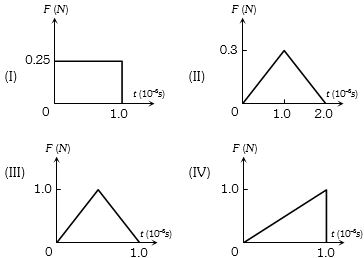
Figures $I, II, III$ and $IV$ depict the variation of force with time. In which of these situations is the impulse the highest?
A
$I$ and $II$
B
$III$ and $I$
C
$III$ and $IV$
D
$IV$ only
Solution
(C) Impulse is defined as the area under the force-time $(F-t)$ graph.
For figure $(I)$ (Rectangle): $\text{Area} = \text{base} \times \text{height} = 1.0 \times 0.25 = 0.25 \text{ units}$.
For figure $(II)$ (Triangle): $\text{Area} = \frac{1}{2} \times \text{base} \times \text{height} = \frac{1}{2} \times 2.0 \times 0.3 = 0.3 \text{ units}$.
For figure $(III)$ (Triangle): $\text{Area} = \frac{1}{2} \times \text{base} \times \text{height} = \frac{1}{2} \times 1.0 \times 1.0 = 0.5 \text{ units}$.
For figure $(IV)$ (Triangle): $\text{Area} = \frac{1}{2} \times \text{base} \times \text{height} = \frac{1}{2} \times 1.0 \times 1.0 = 0.5 \text{ units}$.
Comparing the areas,the impulse is highest for figures $(III)$ and $(IV)$.
For figure $(I)$ (Rectangle): $\text{Area} = \text{base} \times \text{height} = 1.0 \times 0.25 = 0.25 \text{ units}$.
For figure $(II)$ (Triangle): $\text{Area} = \frac{1}{2} \times \text{base} \times \text{height} = \frac{1}{2} \times 2.0 \times 0.3 = 0.3 \text{ units}$.
For figure $(III)$ (Triangle): $\text{Area} = \frac{1}{2} \times \text{base} \times \text{height} = \frac{1}{2} \times 1.0 \times 1.0 = 0.5 \text{ units}$.
For figure $(IV)$ (Triangle): $\text{Area} = \frac{1}{2} \times \text{base} \times \text{height} = \frac{1}{2} \times 1.0 \times 1.0 = 0.5 \text{ units}$.
Comparing the areas,the impulse is highest for figures $(III)$ and $(IV)$.
0 likes
View Solution39
MediumMCQ
$A$ body of mass $5 \, kg$ is moving with a momentum of $10 \, kg \cdot m/s$. $A$ force of $0.2 \, N$ acts on it in the direction of motion of the body for $10 \, seconds$. The increase in its kinetic energy is ............... $J$.
A
$2.8$
B
$3.2$
C
$3.8$
D
$4.4$
Solution
(D) Initial momentum $P_1 = 10 \, kg \cdot m/s$.
Force $F = 0.2 \, N$ acts for time $t = 10 \, s$.
Change in momentum $\Delta P = F \times t = 0.2 \times 10 = 2 \, kg \cdot m/s$.
Final momentum $P_2 = P_1 + \Delta P = 10 + 2 = 12 \, kg \cdot m/s$.
Kinetic energy $K = \frac{P^2}{2m}$.
Increase in kinetic energy $\Delta K = \frac{P_2^2 - P_1^2}{2m}$.
$\Delta K = \frac{12^2 - 10^2}{2 \times 5} = \frac{144 - 100}{10} = \frac{44}{10} = 4.4 \, J$.
Force $F = 0.2 \, N$ acts for time $t = 10 \, s$.
Change in momentum $\Delta P = F \times t = 0.2 \times 10 = 2 \, kg \cdot m/s$.
Final momentum $P_2 = P_1 + \Delta P = 10 + 2 = 12 \, kg \cdot m/s$.
Kinetic energy $K = \frac{P^2}{2m}$.
Increase in kinetic energy $\Delta K = \frac{P_2^2 - P_1^2}{2m}$.
$\Delta K = \frac{12^2 - 10^2}{2 \times 5} = \frac{144 - 100}{10} = \frac{44}{10} = 4.4 \, J$.
0 likes
View Solution40
MediumMCQ
$A$ mass of $100\,g$ strikes the wall with a speed of $5\,m/s$ at an angle as shown in the figure and it rebounds with the same speed. If the contact time is $2 \times 10^{-3}\,s$,what is the force applied on the mass by the wall?
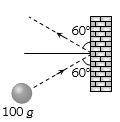
A
$250\sqrt{3}\,N$ to the right
B
$250\,N$ to the right
C
$250\sqrt{3}\,N$ to the left
D
$250\,N$ to the left
Solution
(C) The force applied on the mass is given by the rate of change of momentum: $\vec{F} = \frac{\Delta \vec{P}}{\Delta t}$.
Let the wall be along the $y$-axis. The initial velocity vector is $\vec{v}_i = v \sin \theta \hat{i} + v \cos \theta \hat{j}$.
The final velocity vector is $\vec{v}_f = -v \sin \theta \hat{i} + v \cos \theta \hat{j}$.
The change in momentum is $\Delta \vec{P} = m(\vec{v}_f - \vec{v}_i) = m(-2v \sin \theta \hat{i}) = -2mv \sin \theta \hat{i}$.
Given $m = 0.1\,kg$,$v = 5\,m/s$,$\theta = 60^\circ$,and $\Delta t = 2 \times 10^{-3}\,s$.
Substituting the values: $\Delta P_x = -2 \times 0.1 \times 5 \times \sin(60^\circ) = -1 \times \frac{\sqrt{3}}{2} = -0.5\sqrt{3}\,kg\cdot m/s$.
The force $\vec{F} = \frac{-0.5\sqrt{3}}{2 \times 10^{-3}} = -250\sqrt{3}\,N$.
The negative sign indicates that the force exerted by the wall on the mass is directed to the left.
Let the wall be along the $y$-axis. The initial velocity vector is $\vec{v}_i = v \sin \theta \hat{i} + v \cos \theta \hat{j}$.
The final velocity vector is $\vec{v}_f = -v \sin \theta \hat{i} + v \cos \theta \hat{j}$.
The change in momentum is $\Delta \vec{P} = m(\vec{v}_f - \vec{v}_i) = m(-2v \sin \theta \hat{i}) = -2mv \sin \theta \hat{i}$.
Given $m = 0.1\,kg$,$v = 5\,m/s$,$\theta = 60^\circ$,and $\Delta t = 2 \times 10^{-3}\,s$.
Substituting the values: $\Delta P_x = -2 \times 0.1 \times 5 \times \sin(60^\circ) = -1 \times \frac{\sqrt{3}}{2} = -0.5\sqrt{3}\,kg\cdot m/s$.
The force $\vec{F} = \frac{-0.5\sqrt{3}}{2 \times 10^{-3}} = -250\sqrt{3}\,N$.
The negative sign indicates that the force exerted by the wall on the mass is directed to the left.
2 likes
View Solution41
MediumMCQ
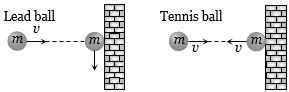
$A$ lead ball strikes a wall and falls down,while a tennis ball having the same mass and velocity strikes the wall and bounces back. Check the correct statement.
A
The momentum of the lead ball is greater than that of the tennis ball.
B
The lead ball suffers a greater change in momentum compared with the tennis ball.
C
The tennis ball suffers a greater change in momentum as compared with the lead ball.
D
Both suffer an equal change in momentum.
Solution
(C) Change in momentum is defined as $\Delta \vec{P} = \vec{P}_{final} - \vec{P}_{initial}$.
For the lead ball,it strikes the wall and falls down,so its final velocity is $0$. Thus,$\Delta \vec{P}_{lead} = 0 - m\vec{v} = -m\vec{v}$. The magnitude of change is $m\vec{v}$.
For the tennis ball,it bounces back with the same velocity $\vec{v}$ in the opposite direction,so its final velocity is $-\vec{v}$. Thus,$\Delta \vec{P}_{tennis} = m(-\vec{v}) - m\vec{v} = -2m\vec{v}$. The magnitude of change is $2m\vec{v}$.
Comparing the magnitudes,$|\Delta \vec{P}_{tennis}| > |\Delta \vec{P}_{lead}|$. Therefore,the tennis ball suffers a greater change in momentum.
For the lead ball,it strikes the wall and falls down,so its final velocity is $0$. Thus,$\Delta \vec{P}_{lead} = 0 - m\vec{v} = -m\vec{v}$. The magnitude of change is $m\vec{v}$.
For the tennis ball,it bounces back with the same velocity $\vec{v}$ in the opposite direction,so its final velocity is $-\vec{v}$. Thus,$\Delta \vec{P}_{tennis} = m(-\vec{v}) - m\vec{v} = -2m\vec{v}$. The magnitude of change is $2m\vec{v}$.
Comparing the magnitudes,$|\Delta \vec{P}_{tennis}| > |\Delta \vec{P}_{lead}|$. Therefore,the tennis ball suffers a greater change in momentum.
0 likes
View Solution42
EasyMCQ
$A$ body of mass $M$ collides against a wall with a velocity $v$ and retraces its path with the same speed. The change in momentum is (take initial direction of velocity as positive).
A
$Zero$
B
$2Mv$
C
$Mv$
D
$-2Mv$
Solution
(D) The initial momentum of the body is $p_i = Mv$ (taking the initial direction as positive).
Since the body retraces its path with the same speed,the final velocity is $-v$.
Therefore,the final momentum is $p_f = M(-v) = -Mv$.
The change in momentum $\Delta p$ is given by $\Delta p = p_f - p_i$.
Substituting the values: $\Delta p = -Mv - (Mv) = -2Mv$.
Since the body retraces its path with the same speed,the final velocity is $-v$.
Therefore,the final momentum is $p_f = M(-v) = -Mv$.
The change in momentum $\Delta p$ is given by $\Delta p = p_f - p_i$.
Substituting the values: $\Delta p = -Mv - (Mv) = -2Mv$.
0 likes
View Solution43
EasyMCQ
$A$ body of mass $2 \, kg$ collides with a wall with a speed of $100 \, m/s$ and rebounds with the same speed. If the time of contact was $1/50 \, s$,the force exerted on the wall is:
A
$8 \, N$
B
$2 \times 10^4 \, N$
C
$4 \, N$
D
$10^4 \, N$
Solution
(B) The force exerted on the wall is given by the rate of change of momentum: $F = \frac{\Delta p}{\Delta t}$.
Initial momentum $p_i = m \times v = 2 \, kg \times 100 \, m/s = 200 \, kg \cdot m/s$.
Final momentum $p_f = m \times (-v) = 2 \, kg \times (-100 \, m/s) = -200 \, kg \cdot m/s$ (assuming the wall is in the positive direction).
Change in momentum $\Delta p = p_f - p_i = -200 - 200 = -400 \, kg \cdot m/s$.
The magnitude of the change in momentum is $|\Delta p| = 400 \, kg \cdot m/s$.
Given time of contact $\Delta t = 1/50 \, s$.
Force $F = \frac{|\Delta p|}{\Delta t} = \frac{400}{1/50} = 400 \times 50 = 20,000 \, N = 2 \times 10^4 \, N$.
Initial momentum $p_i = m \times v = 2 \, kg \times 100 \, m/s = 200 \, kg \cdot m/s$.
Final momentum $p_f = m \times (-v) = 2 \, kg \times (-100 \, m/s) = -200 \, kg \cdot m/s$ (assuming the wall is in the positive direction).
Change in momentum $\Delta p = p_f - p_i = -200 - 200 = -400 \, kg \cdot m/s$.
The magnitude of the change in momentum is $|\Delta p| = 400 \, kg \cdot m/s$.
Given time of contact $\Delta t = 1/50 \, s$.
Force $F = \frac{|\Delta p|}{\Delta t} = \frac{400}{1/50} = 400 \times 50 = 20,000 \, N = 2 \times 10^4 \, N$.
0 likes
View Solution44
MediumMCQ
$A$ ball of mass $0.1 \, kg$ coming with a speed of $30 \, m/s$ strikes a bat and returns in the opposite direction with a speed of $40 \, m/s$. Calculate the impulse. (Take the final velocity as positive.)
A
$ - 0.1 \times (40) - 0.1 \times (30)$
B
$0.1 \times (40) - 0.1 \times (-30)$
C
$0.1 \times (40) + 0.1 \times (-30)$
D
$0.1 \times (40) - 0.1 \times (20)$
Solution
(B) Impulse is defined as the change in momentum of an object.
Formula: $J = \Delta p = m(v_f - v_i)$
Given:
Mass $m = 0.1 \, kg$
Final velocity $v_f = 40 \, m/s$ (taken as positive)
Initial velocity $v_i = -30 \, m/s$ (since it is in the opposite direction to the final velocity)
Calculation:
$J = 0.1 \times (40) - 0.1 \times (-30)$
$J = 4 + 3 = 7 \, N \cdot s$
Therefore,the correct expression is $0.1 \times (40) - 0.1 \times (-30)$.
Formula: $J = \Delta p = m(v_f - v_i)$
Given:
Mass $m = 0.1 \, kg$
Final velocity $v_f = 40 \, m/s$ (taken as positive)
Initial velocity $v_i = -30 \, m/s$ (since it is in the opposite direction to the final velocity)
Calculation:
$J = 0.1 \times (40) - 0.1 \times (-30)$
$J = 4 + 3 = 7 \, N \cdot s$
Therefore,the correct expression is $0.1 \times (40) - 0.1 \times (-30)$.
0 likes
View Solution45
EasyMCQ
If two balls each of mass $0.06 \,kg$ moving in opposite directions with speed $4 \,m/s$ collide and rebound with the same speed,then the impulse imparted to each ball due to the other is ........... $kg \cdot m/s$.
A
$0.48$
B
$0.24$
C
$0.81$
D
$0$
Solution
(A) Impulse is defined as the change in momentum of an object.
Let the mass of each ball be $m = 0.06 \,kg$.
The initial velocity of the first ball is $v_i = 4 \,m/s$ and the second ball is $-4 \,m/s$.
After the collision,the balls rebound with the same speed,so the final velocity of the first ball is $v_f = -4 \,m/s$ and the second ball is $4 \,m/s$.
The change in momentum for one ball is $\Delta p = m(v_f - v_i)$.
$\Delta p = 0.06 \times (-4 - 4) = 0.06 \times (-8) = -0.48 \,kg \cdot m/s$.
The magnitude of the impulse imparted to each ball is $|\Delta p| = 0.48 \,kg \cdot m/s$.
Let the mass of each ball be $m = 0.06 \,kg$.
The initial velocity of the first ball is $v_i = 4 \,m/s$ and the second ball is $-4 \,m/s$.
After the collision,the balls rebound with the same speed,so the final velocity of the first ball is $v_f = -4 \,m/s$ and the second ball is $4 \,m/s$.
The change in momentum for one ball is $\Delta p = m(v_f - v_i)$.
$\Delta p = 0.06 \times (-4 - 4) = 0.06 \times (-8) = -0.48 \,kg \cdot m/s$.
The magnitude of the impulse imparted to each ball is $|\Delta p| = 0.48 \,kg \cdot m/s$.
0 likes
View Solution46
EasyMCQ
$A$ ball hits a vertical wall horizontally at $10 \ m/s$ and bounces back at $10 \ m/s$. Which of the following statements is correct?
A
There is no acceleration because $10 \ m/s - 10 \ m/s = 0$.
B
There may be an acceleration because its initial direction is horizontal.
C
There is an acceleration because there is a momentum change.
D
Even though there is no change in momentum,there is a change in direction. Hence it has an acceleration.
Solution
(C) The velocity of the ball changes from $v_i = 10 \ m/s$ to $v_f = -10 \ m/s$ (taking the direction towards the wall as positive).
Since velocity is a vector quantity,a change in direction implies a change in velocity.
Change in momentum $\Delta p = m(v_f - v_i) = m(-10 - 10) = -20m$.
Since there is a change in momentum over a finite time interval during the collision,a force $F = \frac{\Delta p}{\Delta t}$ acts on the ball.
According to Newton's second law,$F = ma$,therefore,the ball experiences an acceleration during the impact.
Since velocity is a vector quantity,a change in direction implies a change in velocity.
Change in momentum $\Delta p = m(v_f - v_i) = m(-10 - 10) = -20m$.
Since there is a change in momentum over a finite time interval during the collision,a force $F = \frac{\Delta p}{\Delta t}$ acts on the ball.
According to Newton's second law,$F = ma$,therefore,the ball experiences an acceleration during the impact.
0 likes
View Solution47
MediumMCQ
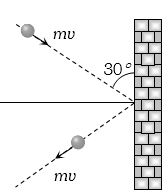
$A$ $100 \, g$ iron ball having a velocity of $10 \, m/s$ collides with a wall at an angle of $30^\circ$ with the wall surface and rebounds with the same angle. If the period of contact between the ball and the wall is $0.1 \, s$,then the force experienced by the ball is ............. $N$.
A
$100$
B
$10$
C
$0.1$
D
$1$
Solution
(B) The force experienced by the ball is equal to the rate of change of momentum.
Given: mass $m = 100 \, g = 0.1 \, kg$,velocity $v = 10 \, m/s$,angle with the wall $\theta = 30^\circ$,and time $t = 0.1 \, s$.
The change in momentum $\Delta p$ is given by the component perpendicular to the wall: $\Delta p = 2mv \sin \theta$.
Substituting the values: $\Delta p = 2 \times 0.1 \times 10 \times \sin 30^\circ = 2 \times 0.1 \times 10 \times 0.5 = 1 \, kg \cdot m/s$.
The force $F = \frac{\Delta p}{t} = \frac{1}{0.1} = 10 \, N$.
Given: mass $m = 100 \, g = 0.1 \, kg$,velocity $v = 10 \, m/s$,angle with the wall $\theta = 30^\circ$,and time $t = 0.1 \, s$.
The change in momentum $\Delta p$ is given by the component perpendicular to the wall: $\Delta p = 2mv \sin \theta$.
Substituting the values: $\Delta p = 2 \times 0.1 \times 10 \times \sin 30^\circ = 2 \times 0.1 \times 10 \times 0.5 = 1 \, kg \cdot m/s$.
The force $F = \frac{\Delta p}{t} = \frac{1}{0.1} = 10 \, N$.
0 likes
View Solution48
DifficultMCQ
Two particles of masses $m_1$ and $m_2$ in projectile motion have velocities $\vec{v}_1$ and $\vec{v}_2$ respectively at time $t = 0$. They collide at time $t_0$. Their velocities become $\vec{v}_1'$ and $\vec{v}_2'$ at time $2t_0$ while still moving in air. The value of $|(m_1\vec{v}_1' + m_2\vec{v}_2') - (m_1\vec{v}_1 + m_2\vec{v}_2)|$ is
A
Zero
B
$(m_1 + m_2)gt_0$
C
$2(m_1 + m_2)gt_0$
D
$\frac{1}{2}(m_1 + m_2)gt_0$
Solution
(C) The initial momentum of the two-particle system at $t = 0$ is $\vec{P}_i = m_1\vec{v}_1 + m_2\vec{v}_2$.
Collision between the two particles is an internal interaction and does not affect the total momentum of the system.
The only external force acting on the system is gravity,which is $\vec{F}_{ext} = (m_1 + m_2)g$ acting downwards.
According to the impulse-momentum theorem,the change in momentum $\Delta \vec{P}$ is equal to the impulse of the external force: $\Delta \vec{P} = \int_{0}^{2t_0} \vec{F}_{ext} dt$.
Since the force is constant,$\Delta \vec{P} = (m_1 + m_2)g \times (2t_0 - 0) = 2(m_1 + m_2)gt_0$.
Therefore,the magnitude of the change in momentum is $|(m_1\vec{v}_1' + m_2\vec{v}_2') - (m_1\vec{v}_1 + m_2\vec{v}_2)| = 2(m_1 + m_2)gt_0$.
Collision between the two particles is an internal interaction and does not affect the total momentum of the system.
The only external force acting on the system is gravity,which is $\vec{F}_{ext} = (m_1 + m_2)g$ acting downwards.
According to the impulse-momentum theorem,the change in momentum $\Delta \vec{P}$ is equal to the impulse of the external force: $\Delta \vec{P} = \int_{0}^{2t_0} \vec{F}_{ext} dt$.
Since the force is constant,$\Delta \vec{P} = (m_1 + m_2)g \times (2t_0 - 0) = 2(m_1 + m_2)gt_0$.
Therefore,the magnitude of the change in momentum is $|(m_1\vec{v}_1' + m_2\vec{v}_2') - (m_1\vec{v}_1 + m_2\vec{v}_2)| = 2(m_1 + m_2)gt_0$.
0 likes
View Solution49
EasyMCQ
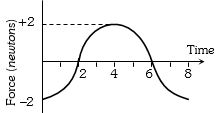
$A$ force-time graph for a linear motion is shown in the figure,where the segments are circular. The linear momentum gained between $0$ and $8$ seconds is
A
$ - 2\pi \, N \cdot s$
B
$0 \, N \cdot s$
C
$ + 4\pi \, N \cdot s$
D
$ - 6\pi \, N \cdot s$
Solution
(B) The change in linear momentum $\Delta p$ is equal to the impulse,which is the area under the force-time $(F-t)$ graph.
$\Delta p = \int F \, dt = \text{Area under } F-t \text{ graph}$.
The graph consists of circular segments. From $t = 0$ to $t = 2$,the area is a quarter-circle below the time axis with radius $r = 2$. Area $= -\frac{1}{4} \pi r^2 = -\frac{1}{4} \pi (2)^2 = -\pi$.
From $t = 2$ to $t = 6$,the area is a semi-circle above the time axis with radius $r = 2$. Area $= +\frac{1}{2} \pi r^2 = +\frac{1}{2} \pi (2)^2 = +2\pi$.
From $t = 6$ to $t = 8$,the area is a quarter-circle below the time axis with radius $r = 2$. Area $= -\frac{1}{4} \pi r^2 = -\frac{1}{4} \pi (2)^2 = -\pi$.
The total area (net impulse) $= -\pi + 2\pi - \pi = 0$.
Therefore,the linear momentum gained between $0$ and $8$ seconds is $0 \, N \cdot s$.
$\Delta p = \int F \, dt = \text{Area under } F-t \text{ graph}$.
The graph consists of circular segments. From $t = 0$ to $t = 2$,the area is a quarter-circle below the time axis with radius $r = 2$. Area $= -\frac{1}{4} \pi r^2 = -\frac{1}{4} \pi (2)^2 = -\pi$.
From $t = 2$ to $t = 6$,the area is a semi-circle above the time axis with radius $r = 2$. Area $= +\frac{1}{2} \pi r^2 = +\frac{1}{2} \pi (2)^2 = +2\pi$.
From $t = 6$ to $t = 8$,the area is a quarter-circle below the time axis with radius $r = 2$. Area $= -\frac{1}{4} \pi r^2 = -\frac{1}{4} \pi (2)^2 = -\pi$.
The total area (net impulse) $= -\pi + 2\pi - \pi = 0$.
Therefore,the linear momentum gained between $0$ and $8$ seconds is $0 \, N \cdot s$.
0 likes
View Solution50
MediumMCQ
If the speed of an object is doubled,then which of the following is true?
A
$K.E.$ becomes double
B
$P.E.$ becomes double
C
Momentum becomes double
D
Acceleration becomes double
Solution
(C) The momentum of an object is given by the formula $p = mv$,where $m$ is the mass and $v$ is the velocity (or speed).
If the speed is doubled,the new velocity becomes $v' = 2v$.
Substituting this into the momentum formula: $p' = m(2v) = 2(mv) = 2p$.
Therefore,the momentum becomes double.
Kinetic energy is given by $K.E. = \frac{1}{2}mv^2$. If $v$ is doubled,$K.E.' = \frac{1}{2}m(2v)^2 = 4(\frac{1}{2}mv^2) = 4K.E.$,so kinetic energy becomes four times.
If the speed is doubled,the new velocity becomes $v' = 2v$.
Substituting this into the momentum formula: $p' = m(2v) = 2(mv) = 2p$.
Therefore,the momentum becomes double.
Kinetic energy is given by $K.E. = \frac{1}{2}mv^2$. If $v$ is doubled,$K.E.' = \frac{1}{2}m(2v)^2 = 4(\frac{1}{2}mv^2) = 4K.E.$,so kinetic energy becomes four times.
0 likes
View SolutionNewton's Laws of Motion and Friction — Third Law of Motion and Momentum and Impulse · Frequently Asked Questions
1Are these Newton's Laws of Motion and Friction questions useful for JEE and NEET?
Yes. All questions in this section are mapped to JEE Main and NEET exam patterns. Previous year questions from JEE Main, NEET, GUJCET and state-level exams are included with full solutions.
2Can I switch to Hindi or Gujarati for these questions?
Yes. Use the language tabs in the hero section or the sidebar to view the same questions and solutions in English, Hindi or Gujarati.
3How do I generate a question paper from this subtopic?
Use the Vedclass Exam Paper Generator — select the chapter and subtopic, set difficulty, and generate Sets A, B, C, D automatically. First 3 chapters of every subject are free.
Vedclass Products
For Students
Vedclass Test Series
Mock tests in real JEE/NEET style with performance analysis. 5-day free trial.
Start Free TrialFor Teachers
Exam Paper Generator
Generate Set A/B/C/D papers from this chapter in 2 minutes. 3 chapters free.
Try FreeFor Institutes
Online Exam Module
Live online exams with unlimited students, 360° analytics & white-label branding.
See DemoFor Teachers & Institutes
Generate a Newton's Laws of Motion and Friction Exam Paper in 2 Minutes
Select subtopic & difficulty — Sets A, B, C, D auto-generated with No Repeat logic.
First 3 chapters of every subject are free — no payment required.